<?xml version="1.0" encoding="utf-8"?>
<!DOCTYPE article PUBLIC "-//NLM//DTD Journal Publishing DTD v2.3 20070202//EN" "journalpublishing.dtd">
<article article-type="review-article" xmlns:xlink="http://www.w3.org/1999/xlink">
	<front>
		<journal-meta>
			<journal-id journal-id-type="publisher-id">MD</journal-id>
			<journal-title>Marine Drugs</journal-title>
			<abbrev-journal-title>MD</abbrev-journal-title>
			<issn pub-type="epub">1660-3397</issn>
			<publisher>
				<publisher-name>Molecular Diversity Preservation International</publisher-name>
			</publisher>
		</journal-meta>
		<article-meta>
			<article-id pub-id-type="publisher-id">marinedrugs-05-00220</article-id>
			<article-categories>
				<subj-group>
					<subject>Review</subject>
				</subj-group>
			</article-categories>
			<title-group>
				<article-title>Bioactive Compound Synthetic Capacity and Ecological Significance of Marine Bacterial Genus <italic>Pseudoalteromonas</italic>
				</article-title>
			</title-group>
			<contrib-group>
				<contrib contrib-type="author">
					<name>
						<surname>Bowman</surname>
						<given-names>John P.</given-names>
					</name>
					<xref ref-type="corresp" rid="c1-marinedrugs-05-00220">&#x0002A;</xref>
				</contrib>
				<aff id="af1-marinedrugs-05-00220">Tasmania Institute of Agricultural Research, School of Agricultural Science, University of Tasmania, Sandy Bay, Private Bag 54, Hobart, Tasmania, 7001, Australia</aff>
			</contrib-group>
			<author-notes>
				<corresp id="c1-marinedrugs-05-00220">E-mail:
					<email>john.bowman@utas.edu.au</email>
				</corresp>
			</author-notes>
			<pub-date pub-type="collection">
				<month>12</month>
				<year>2007</year>
			</pub-date>
			<pub-date pub-type="epub">
				<day>18</day>
				<month>12</month>
				<year>2007</year>
			</pub-date>
			<volume>5</volume>
			<issue>4</issue>
			<fpage>220</fpage>
			<lpage>241</lpage>
			<history>
				<date date-type="received">
					<day>27</day>
					<month>11</month>
					<year>2007</year>
				</date>
				<date date-type="accepted">
					<day>14</day>
					<month>12</month>
					<year>2007</year>
				</date>
			</history>
			<copyright-statement>&#x000A9; 2007 by MDPI</copyright-statement>
			<copyright-year>2007</copyright-year>
			<abstract>
				<p>The genus <italic>Pseudoalteromonas</italic> is a marine group of bacteria belonging to the class <italic>Gammaproteobacteria</italic> that has come to attention in the natural product and microbial ecology science fields in the last decade. Pigmented species of the genus have been shown to produce an array of low and high molecular weight compounds with antimicrobial, anti-fouling, algicidal and various pharmaceutically-relevant activities. Compounds formed include toxic proteins, polyanionic exopolymers, substituted phenolic and pyrolle-containing alkaloids, cyclic peptides and a range of bromine-substituted compounds. Ecologically, <italic>Pseudoalteromonas</italic> appears significant and to date has been shown to influence biofilm formation in various marine econiches; involved in predator-like interactions within the microbial loop; influence settlement, germination and metamorphosis of various invertebrate and algal species; and may also be adopted by marine flora and fauna as defensive agents. Studies have been so far limited to a relatively small subset of strains compared to the known diversity of the genus suggesting that many more discoveries of novel natural products as well as ecological connections these may have in the marine ecosystem remain to be made.</p>
			</abstract>
			<kwd-group>
				<kwd>
					<italic>Pseudoalteromonas</italic>
				</kwd>
				<kwd>antibiotics</kwd>
				<kwd>biofilms</kwd>
				<kwd>anti-fouling</kwd>
				<kwd>marine bacteria</kwd>
			</kwd-group>
		</article-meta>
	</front>
	<body>
		<sec sec-type="intro">
			<title>1. Introduction</title>
			<p>The genus <italic>Pseudoalteromonas</italic> was described by Gauthier <italic>et al.</italic> &#x0005B;<xref ref-type="bibr" rid="b35-marinedrugs-05-00220">35</xref>&#x0005D; and represents a clade of marine bacteria defined on the basis of 16S rRNA gene sequence data. Originally many of the <italic>Pseudoalteromonas</italic> species that are discussed in this review were members of the genus <italic>Alteromonas</italic> &#x0005B;<xref ref-type="bibr" rid="b5-marinedrugs-05-00220">5</xref>, <xref ref-type="bibr" rid="b77-marinedrugs-05-00220">77</xref>&#x0005D; but <italic>Alteromonas</italic> was taxonomically re-organized based on phylogenetic analysis. Since 1995, 22 additional <italic>Pseudoalteromonas</italic> species have been described (details available at <ext-link ext-link-type="uri" xlink:href="http://www.bacterio.cict.fr/p/pseudoalteromonas.html">http://www.bacterio.cict.fr/p/pseudoalteromonas.html</ext-link>). More recently two <italic>Pseudoalteromonas</italic> species have been moved into the genus <italic>Algicola</italic> &#x0005B;<xref ref-type="bibr" rid="b50-marinedrugs-05-00220">50</xref>, <xref ref-type="bibr" rid="b74-marinedrugs-05-00220">74</xref>&#x0005D;. The taxonomy and general features of <italic>Pseudoalteromonas</italic> (<italic>ca.</italic> 2000/2001) are covered in the 2<sup>nd</sup> edition of <italic>Bergey&#x02019;s Manual of Systematic Bacteriology</italic> &#x0005B;<xref ref-type="bibr" rid="b8-marinedrugs-05-00220">8</xref>&#x0005D;.</p>
			<p>Possessing Gram-negative cell walls, all members of genus <italic>Pseudoalteromonas</italic> require Na<sup>&#x0002B;</sup> ions, form rod-shaped cells, are motile via sheathed polar and/or unsheathed lateral flagella and possess a strictly aerobic, chemoheterotrophic metabolism. This general set of features has coined the common term &#x0201C;alteromonad&#x0201D; that could be potentially used to now describe other marine genera within class <italic>Gammaproteobacteria</italic>. Genus <italic>Pseudoalteromonas</italic> groups within a larger clade of marine taxa, located under the umbrella of order <italic>Alteromonadales</italic> that inhabit all known non-geothermal marine biomes.</p>
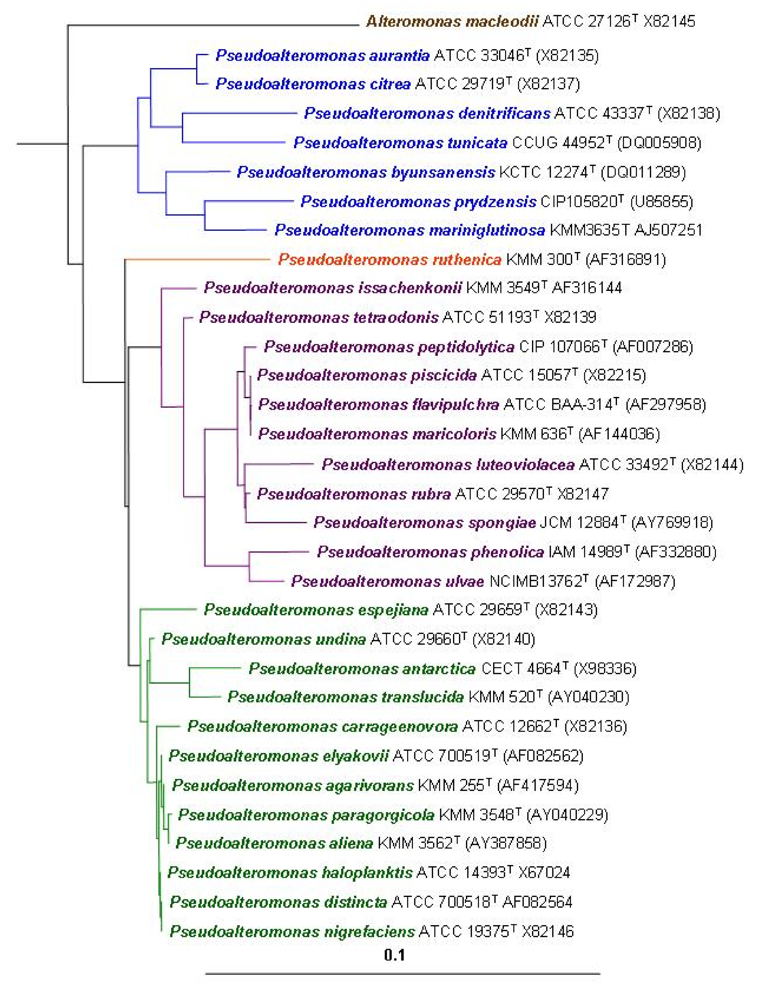
			<p>One interesting feature of <italic>Pseudoalteromonas</italic> is that the genus can be divided relatively cleanly into pigmented and non-pigmented species clades (<xref ref-type="fig" rid="f1-marinedrugs-05-00220">Fig. 1</xref>) and that pigmentation correlates with their proclivity for natural product formation &#x0005B;<xref ref-type="bibr" rid="b22-marinedrugs-05-00220">22</xref>&#x0005D;. The non-pigmented species form a relatively distinct clade typified by phylogenetic shallowness between most member species. Pigmented species show greater sequence divergence and are concentrated within the other 2 major clades making up the genus (<xref ref-type="fig" rid="f1-marinedrugs-05-00220">Fig. 1</xref>). With more than 2000 <italic>Pseudoalteromonas</italic> 16S rRNA gene sequences available on nucleotide sequence databases (e.g. <ext-link ext-link-type="uri" xlink:href="www.ncbi.nlm.nih.gov">www.ncbi.nlm.nih.gov</ext-link>) the described diversity of the genus still remains largely incomplete.</p>
			<p>Studies by Holmstr&#x000F6;m <italic>et al.</italic> &#x0005B;<xref ref-type="bibr" rid="b43-marinedrugs-05-00220">43</xref>&#x0005D; found deeply pigmented strains within a marine bacterial isolate collection were effective in the inhibition of the settlement of various fouling invertebrates and algae. Based on subsequent analyses some of these isolates lead to the general conclusion that pigmented <italic>Pseudoalteromonas</italic> species possess a broad range of bioactivity associated with the secretion of extracellular compounds, several of which include pigment compounds &#x0005B;<xref ref-type="bibr" rid="b44-marinedrugs-05-00220">44</xref>&#x0005D;. This realization provided greater credence to earlier studies of alteromonads that this group of marine bacteria represents a rich source of biologically active substances. Non-pigmented species of <italic>Pseudoalteromonas</italic> do not appear to share the same extensiveness of bioactive compound synthesis and this may reflect their econiche distribution, which is admittedly still poorly defined. Within the limits of existing knowledge non-pigmented clade species tend to possess unusual and diverse enzymatic activities (carrageenases, chitinases, alginases, cold-active enzymes), generally broader environmental tolerance ranges (temperature, water activity and pH) and substantially greater nutritional versatility compared to the pigmented species &#x0005B;<xref ref-type="bibr" rid="b8-marinedrugs-05-00220">8</xref>&#x0005D;. The pigmented species also tend to have more exacting growth requirements (some require amino acids) and have peroxidase activity rather than catalase activity.</p>
		</sec>
		<sec>
			<title>2. Ecological Significance</title>
			<p>Marine biofilms influence the settlement of a variety of marine invertebrates and algae and may promote cellular metamorphosis. As biofilms can be quite variable in distribution and in species and chemical composition the influence they can have is complex. The activity of marine flora and fauna have been shown to be clearly positively or negatively influenced by experimental monospecific biofilms &#x0005B;<xref ref-type="bibr" rid="b17-marinedrugs-05-00220">17</xref>, <xref ref-type="bibr" rid="b82-marinedrugs-05-00220">82</xref>, <xref ref-type="bibr" rid="b98-marinedrugs-05-00220">98</xref>&#x0005D;. This activity is believed to be due mainly to the production of antibiotic compounds as well as stimulatory chemical cues that are so far mostly uncharacterized.</p>
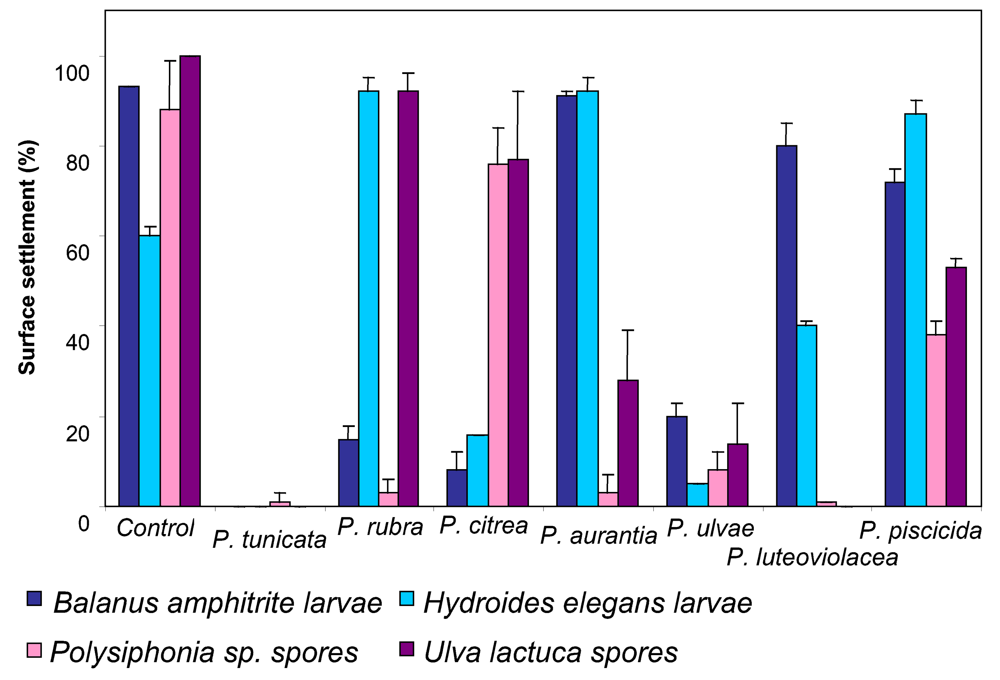
			<p>Several known <italic>Pseudoalteromonas</italic> species and likely many other described and undescribed bacterial species can influence the reproductive success of various marine fauna and flora due to the production of natural anti-fouling substances &#x0005B;<xref ref-type="bibr" rid="b17-marinedrugs-05-00220">17</xref>&#x0005D; (<xref ref-type="table" rid="t1-marinedrugs-05-00220">Table 1</xref>). A survey by Holmstr&#x000F6;m <italic>et al.</italic> &#x0005B;<xref ref-type="bibr" rid="b42-marinedrugs-05-00220">42</xref>&#x0005D; found that the effectiveness of different <italic>Pseudoalteromonas</italic> species to prevent settlement of fouling invertebrate larvae and algal spores varies considerably (<xref ref-type="fig" rid="f2-marinedrugs-05-00220">Figure 2</xref>).</p>
			<p>It was generally observed that algal dwelling species were particularly effective in preventing biofouling suggesting the ability is important for their survival in the marine ecosystem and likely required for effective colonization of various surfaces, especially the surfaces of macroalgal species. <italic>P. luteoviolacea</italic> &#x0005B;<xref ref-type="bibr" rid="b34-marinedrugs-05-00220">34</xref>&#x0005D;, <italic>P. aurantia</italic> &#x0005B;<xref ref-type="bibr" rid="b33-marinedrugs-05-00220">33</xref>&#x0005D;; <italic>P. citrea</italic> &#x0005B;<xref ref-type="bibr" rid="b31-marinedrugs-05-00220">31</xref>, <xref ref-type="bibr" rid="b79-marinedrugs-05-00220">79</xref>&#x0005D;, <italic>P. tunicata</italic>, and <italic>P. ulvae</italic> &#x0005B;<xref ref-type="bibr" rid="b20-marinedrugs-05-00220">20</xref>&#x02013;<xref ref-type="bibr" rid="b22-marinedrugs-05-00220">22</xref>, <xref ref-type="bibr" rid="b45-marinedrugs-05-00220">45</xref>&#x0005D; are of particular interest as the host of compounds these species form are essentially produced to prevent biofilm residents becoming overwhelmed by other colonizing, potentially fouling species &#x0005B;<xref ref-type="bibr" rid="b26-marinedrugs-05-00220">26</xref>, <xref ref-type="bibr" rid="b38-marinedrugs-05-00220">38</xref>&#x0005D;. Species resistant to natural antibiotics have an advantage in colonization &#x0005B;<xref ref-type="bibr" rid="b83-marinedrugs-05-00220">83</xref>&#x0005D; though presumably due to the array of compounds that may be formed no one species is likely to have such an edge that they always become numerically dominant in a given econiche. The result could be that antibiotic-producing strains and development of synergisms within biofilm communities may actually encourage the formation of multi-species biofilms. This protects the biofilm community from being overgrown by a single species as well as reducing invasion by other species &#x0005B;<xref ref-type="bibr" rid="b12-marinedrugs-05-00220">12</xref>&#x0005D;. The complex community formed has the advantage in that there is an inherent increase in the efficiency of nutrient acquisition, enhanced tolerance to toxic compounds and physicochemical stresses, and presumably excellent opportunities for genetic exchange &#x0005B;<xref ref-type="bibr" rid="b78-marinedrugs-05-00220">78</xref>&#x0005D;. Ironically, <italic>Pseudoalteromonas</italic> species are highly effective biofilm formers and thus may potentially cause biofouling issues &#x0005B;<xref ref-type="bibr" rid="b87-marinedrugs-05-00220">87</xref>&#x0005D;, however it is still unknown whether their presence controls the type and accumulation level of biofouling species beyond specific habitats such as the surface of marine algal species. Quorum-sensing mechanisms may play an important role in the influencing settlement and subsequent biofilm formation &#x0005B;<xref ref-type="bibr" rid="b19-marinedrugs-05-00220">19</xref>, <xref ref-type="bibr" rid="b46-marinedrugs-05-00220">46</xref>&#x0005D; though it is unknown to what extent quorum sensing molecules influence antibiotic production.</p>
			<p>
				<italic>Pseudoalteromonas</italic> species have been found to inhibit the settlement, germination, growth or even directly lyse the cells of various algal species. Thus the interactions <italic>Pseudoalteromonas</italic> strains are involved is intricate dictated by the type of ecosystem involved (planktonic, benthic, surficial etc.), physiological state populations of the species involved, and prevailing environmental chemical parameters. At this point in time specific aspects of these ecological networks remain largely unexplored. To make the ecological connections even more manifestly complex strains of <italic>Pseudoalteromonas</italic> have also been shown to have promotive affects on various marine eukaryotes in regards to their potential reproductive success.</p>
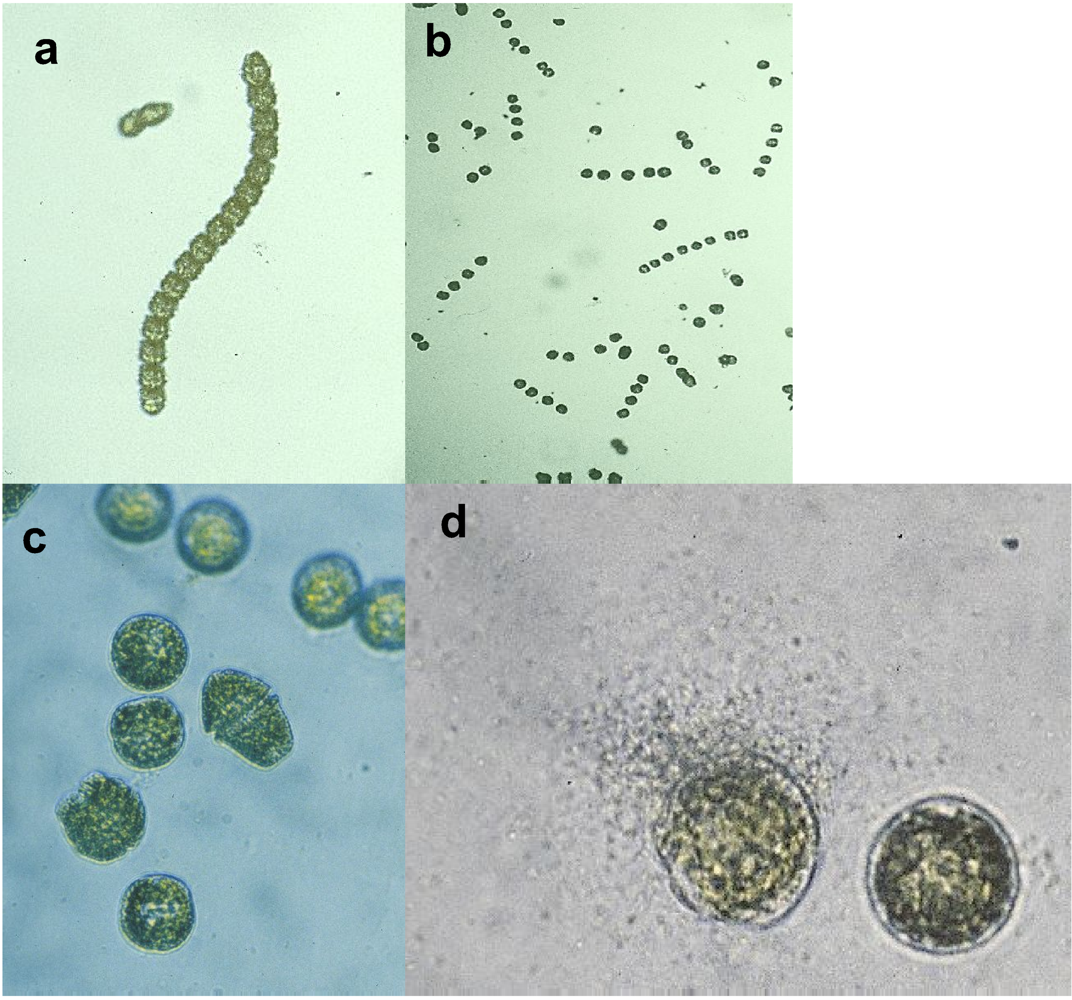
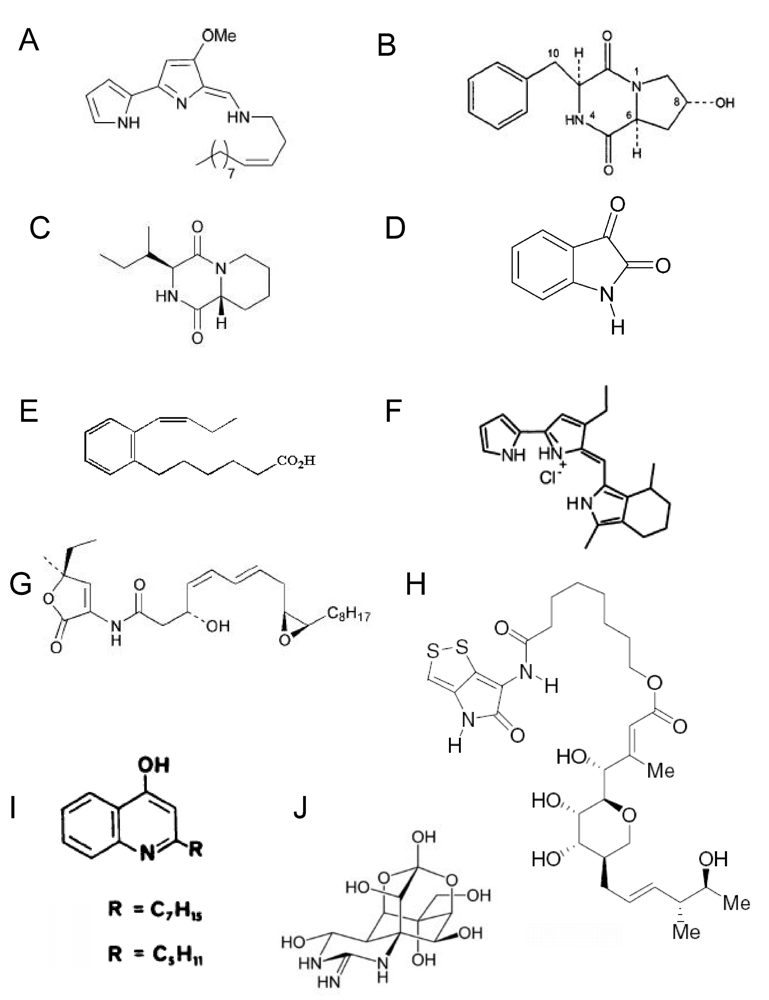
			<p>An example of an inhibitory-oriented interaction involves unidentified strains of <italic>Pseudoalteromonas</italic> &#x0005B;<xref ref-type="bibr" rid="b18-marinedrugs-05-00220">18</xref>, <xref ref-type="bibr" rid="b62-marinedrugs-05-00220">62</xref>&#x0005D; that were found to inhibit the growth but not kill various diatom species due to production of antibiotic compounds. One of these compounds was identified as 2-heptyl-4-quinolinol (<xref ref-type="fig" rid="f6-marinedrugs-05-00220">Fig 6I</xref>) &#x0005B;<xref ref-type="bibr" rid="b62-marinedrugs-05-00220">62</xref>&#x0005D; that have been found to possess antibacterial activity &#x0005B;<xref ref-type="bibr" rid="b101-marinedrugs-05-00220">101</xref>&#x0005D;. Another strain, <italic>Pseudoalteromonas</italic> sp. 4 produced unknown substances that impeded the motility and surface attachment of a <italic>Navicula</italic> sp. and <italic>Amphora coffeaeformis.</italic> These diatoms eventually underwent lysis. This ability could be blocked by enhancing lectin formation by the diatoms leading to stronger biofilm attachment &#x0005B;<xref ref-type="bibr" rid="b99-marinedrugs-05-00220">99</xref>&#x0005D;. A further different example involves strain Y, closely related to <italic>Pseudoalteromonas piscicida</italic>, which produces unidentified brominated antibiotic compounds as well as an unknown low molecular weight compound that can completely lyse algal cells within a matter of hours &#x0005B;<xref ref-type="bibr" rid="b64-marinedrugs-05-00220">64</xref>, <xref ref-type="bibr" rid="b92-marinedrugs-05-00220">92</xref>, <xref ref-type="bibr" rid="b93-marinedrugs-05-00220">93</xref>&#x0005D;. This more &#x0201C;aggressive&#x0201D; activity was found to be pronounced on bloom-forming toxin-producing dinoflagellates of the genera <italic>Gymnodinium</italic>, <italic>Chatonella</italic> and <italic>Heterosigma</italic> species, however only ecdysis was observed for <italic>Alexandrium</italic> species while diatom and other algal species tested were effectively immune. The progress of this lytic effect on <italic>Gymnodinium catenatum</italic> is shown in <xref ref-type="fig" rid="f3-marinedrugs-05-00220">Figure 3</xref>. It was also observed that cells were attracted in a swarm to lysed cells providing the concept that the compound production is used as a means to generate nutrients in a predatory-like manner. Subsequently it was determined that production of the unknown algicidal factor was triggered by an autoinducer quorum sensing system, possibly an AI-2-type peptide &#x0005B;<xref ref-type="bibr" rid="b93-marinedrugs-05-00220">93</xref>&#x0005D; and that it is likely that algicidal activity is maximal during the peak of algal blooms and may thus contribute to bloom dissolution.</p>
			<p>
				<italic>Pseudoalteromonas</italic> clearly also positively interacts with higher eukaryotes inducing invertebrate larval settlement and subsequent metamorphosis. <italic>P. espejiana</italic> was observed to induce the settlement and metamorphosis of the hydrozoan <italic>Hydractinia echinata</italic> &#x0005B;<xref ref-type="bibr" rid="b59-marinedrugs-05-00220">59</xref>&#x0005D; possibly due to induction of caspases &#x0005B;<xref ref-type="bibr" rid="b88-marinedrugs-05-00220">88</xref>&#x0005D;, suggesting <italic>Pseudoalteromonas</italic> strains may have apoptosis-inducing effects in some marine eukaryotes. <italic>Pseudoalteromonas</italic> sp. A3, interestingly closely related to <italic>P. piscicida</italic>, isolated from the crustose coralline algae <italic>Hydrolithon onkodes</italic> clearly encouraged coral larvae settlement and subsequently induced metamorphosis in the planula of the coral <italic>Acropora</italic> &#x0005B;<xref ref-type="bibr" rid="b75-marinedrugs-05-00220">75</xref>&#x0005D;. The presumed chemical cue for this induction has not yet been discovered, however methanolic extracts of A3 cultures provided induction that was highly variable. A further example includes an extensive survey of marine bacterial isolates from coralline algae and larvae, from which 12 of 17 <italic>Pseudoalteromonas</italic> strains were found to be effective in inducing the larval settlement of the sea urchin <italic>Heliocidaris erythrogramma</italic>. It was also observed that the larvae metamorphosed in higher numbers on biofilms consisting of <italic>P. luteoviolacea</italic> &#x0005B;<xref ref-type="bibr" rid="b48-marinedrugs-05-00220">48</xref>&#x0005D; a species known to produce several antibiotic and bioactive compounds. Huang <italic>et al.</italic> &#x0005B;<xref ref-type="bibr" rid="b47-marinedrugs-05-00220">47</xref>&#x0005D; demonstrated that biofilms strongly promoted the settlement of <italic>Hydroides elegans</italic> larvae suggesting that when in the biofilm state chemical cues are actively formed. It is important to note that biofilm communities are dynamic complex entities. The direct detection of antibiotic compounds formed from artificial laboratory biofilms has been challenging &#x0005B;<xref ref-type="bibr" rid="b40-marinedrugs-05-00220">40</xref>&#x0005D; possibly due to lack of replicability of natural biofilms as well as due to the variable abundance of antibiotic-producing taxa.</p>
			<p>These examples suggest that chemical substance production may help various <italic>Pseudoalteromonas</italic> species compete in quite different situations. The advantages derived could include increased access to space for growth or for nutrient access and potentially can occur in marine biofilms or planktonically. It is not clear how significant or prevalent these interactions are for planktonic and benthic sediment associated cells or for cells ensconced in sinking marine aggregates. Mechanistically the processes involved are also poorly understood and how these activities contribute to larger networks of ecological interactions. Thus the questions that involve <italic>Pseudoalteromonas</italic> are manifold. Keeping with the theme of antibiotics, a popular subject in microbiology, the significance of cell-to-cell proximity, dilution rate and inherent antibiotic resistance within natural settings in regards to natural antibiotics are still open questions. In marine biology a greater interest may exist on what are the different &#x0201C;broadcasted&#x0201D; chemical cues produced by bacteria, including <italic>Pseudoalteromonas</italic> that may affect the development or growth of eukaryotes as well as other prokaryotes. Assuming chemical cues can be identified we still need know what they do exactly, why and how. The contribution of many different factors suggests that understanding the ecological ramifications and impact of natural bioactive compounds can only be approached at first by specific, controlled experiments focusing on &#x0201C;model&#x0201D; species, a necessary simplification that allows important specific ecologically to better conceived and tested. One such model species that has appeared within the last few years is <italic>P. tunicata</italic>, a species that possesses an unusually extensive capacity for inhibiting other types of microorganisms and larger eukaryotes and is the focus of the Prof. Staffan Kjelleberg research team at the University of New South Wales, Sydney, Australia.</p>
		</sec>
		<sec sec-type="methods">
			<title>3 <italic>. P. tunicata</italic> as a model to study the mechanisms and ecology of natural antibiotic production, anti-fouling activity and biofilm formation</title>
			<p>
				<italic>P. tunicata</italic> possesses the highest and broadest range of anti-fouling activities observed to date and was first isolated from a tunicate off the coast of Sweden &#x0005B;<xref ref-type="bibr" rid="b45-marinedrugs-05-00220">45</xref>&#x0005D; and subsequently found to dwell on a number of marine species, especially macroalgae &#x0005B;<xref ref-type="bibr" rid="b20-marinedrugs-05-00220">20</xref>, <xref ref-type="bibr" rid="b44-marinedrugs-05-00220">44</xref>&#x0005D;. Transposon mutagenesis analysis demonstrated the pigment production by the species is linked to this activity &#x0005B;<xref ref-type="bibr" rid="b22-marinedrugs-05-00220">22</xref>, <xref ref-type="bibr" rid="b23-marinedrugs-05-00220">23</xref>&#x0005D; and includes both purple and yellow pigments that give <italic>P. tunicata</italic> a distinctly dark green-color. The purple pigments were found to prevent the settlement of invertebrate larvae (<italic>Balanus amphrtite</italic>, <italic>Hydroides elegans</italic>) and algal spores (<italic>Ulva lactuca</italic>, <italic>Polysiphonia</italic> sp.) (<xref ref-type="fig" rid="f2-marinedrugs-05-00220">Figure 2</xref>) but remains unidentified. The species <italic>P. ulvae</italic>, isolated from the surface of the seaweed <italic>Ulva lactuca</italic>, was found to also inhibit the settlement of invertebrate larvae (<italic>Balanus amphritite</italic>) and inhibit algal spore germination and settlement &#x0005B;<xref ref-type="bibr" rid="b20-marinedrugs-05-00220">20</xref>, <xref ref-type="bibr" rid="b21-marinedrugs-05-00220">21</xref>&#x0005D;. The purple pigment formed by <italic>P. ulvae</italic> may be chemically similar to the compound(s) found in <italic>P. tunicata</italic> and other <italic>Pseudoalteromonas</italic> species &#x0005B;<xref ref-type="bibr" rid="b22-marinedrugs-05-00220">22</xref>&#x0005D;.</p>
			<p>The anti-fouling ability of <italic>P. tunicata</italic> is linked to its ability to produce a range of inhibitory substances (more details below) including a toxic antibiotic protein (AlpP) &#x0005B;<xref ref-type="bibr" rid="b52-marinedrugs-05-00220">52</xref>&#x0005D;; a heat labile anti-algal substance &#x0005B;<xref ref-type="bibr" rid="b21-marinedrugs-05-00220">21</xref>&#x0005D;; violet-colored polar compound(s) of &lt;500 Da &#x0005B;<xref ref-type="bibr" rid="b43-marinedrugs-05-00220">43</xref>&#x0005D;; an antifungal yellow pigment compound &#x0005B;<xref ref-type="bibr" rid="b25-marinedrugs-05-00220">25</xref>&#x0005D; as well as small molecules active against protists and diatoms (unpublished data). WmpR, similar to the <italic>Vibrio cholerae</italic> cholera toxin regulator ToxR, was found to act as a response regulator activating several genes in <italic>P. tunicata</italic> including pigment and antifouling compound production, biofilm formation, type IV pili, some ubiquinone and amino acid synthetic genes, a putative Fe<sup>3&#x0002B;</sup> complex TonB-type transporter and also a non-ribosomal peptide synthetase that possibly is involved in Fe<sup>3&#x0002B;</sup> siderophore synthesis. The wild type strain survives iron starvation better than a &#x00394;WmpR mutant suggesting that the tendency of <italic>P. tunicata</italic> to colonize surfaces and produce antifoulants is controlled by nutrient related responses, perhaps acquisition of trace iron &#x0005B;<xref ref-type="bibr" rid="b23-marinedrugs-05-00220">23</xref>, <xref ref-type="bibr" rid="b96-marinedrugs-05-00220">96</xref>&#x0005D;. <italic>P. tunicata</italic> appeared to be most effective in colonization when it had access to an exogenous carbon source associated with the colonization surface e.g. cellobiose derived from degradation of the cellulose surface polymer of the macroalgal species &#x0005B;<xref ref-type="bibr" rid="b83-marinedrugs-05-00220">83</xref>&#x0005D;. This may suggest the types and levels of nutrient available for growth may also drive colonization.</p>
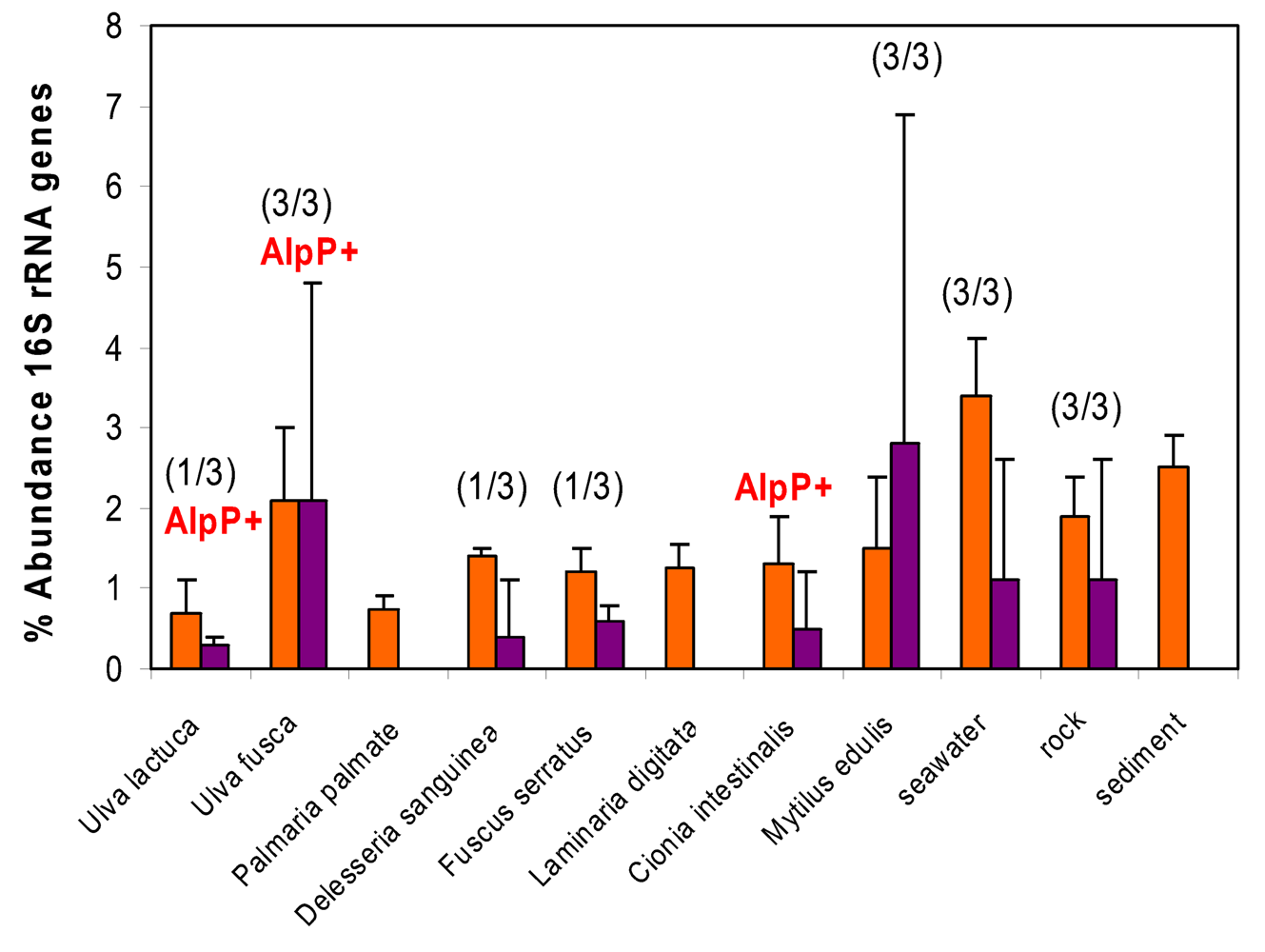
			<p>Population estimates of antifouling species <italic>P. tunicata</italic> and <italic>P. ulvae</italic>, able to form toxic protein AlpP, has been made by using real-time PCR targeting <italic>Pseudoalteromonas</italic>-specific and <italic>P.tunicata/P.ulvae</italic>-specific 16S rRNA genes as well as detection of the gene coding AlpP &#x0005B;<xref ref-type="bibr" rid="b94-marinedrugs-05-00220">94</xref>&#x0005D;. It was found that from various samples collected off the Danish coast that <italic>Pseudoalteromonas</italic> are abundant, especially in seawater (<xref ref-type="fig" rid="f4-marinedrugs-05-00220">Figure 4</xref>). <italic>P. tunicata</italic> and <italic>P. ulvae</italic>, however prefer colonization of various cellulose-producing algal species as suggested by the specific abundance of anti-fouling <italic>Pseudoalteromonas</italic> spp, positive detection of the <italic>alpP</italic> gene (<xref ref-type="fig" rid="f4-marinedrugs-05-00220">Fig. 4</xref>) and PCR-DGGE fingerprinting. Almost all of the antifouling species found were related to <italic>P. tunicata</italic> and <italic>P. ulvae</italic> but these only made up about 1&#x00025; of the total <italic>Pseudoalteromonas</italic> abundance. This may suggest that other species await isolation that could also have anti-fouling roles on the hosts sampled or the specific populations change over time as the biofilm matures. Based on the compiled data shown in <xref ref-type="fig" rid="f2-marinedrugs-05-00220">Figure 2</xref> &#x0005B;<xref ref-type="bibr" rid="b42-marinedrugs-05-00220">42</xref>&#x0005D; the variation in settlement inhibition assays is highly species-specific (and possibly strain-specific) and that marine macrophyta and marine fauna may play host to their own specific anti-fouling microorganisms.</p>
		</sec>
		<sec>
			<title>4. Natural product compound production by <italic>Pseudoalteromonas</italic> spp</title>
			<p>Antibiotic substances linked to the genus <italic>Pseudoalteromonas</italic> go back to the very early days of marine natural product discovery. Over the years several <italic>Pseudoalteromonas</italic> strains that have been investigated in this regard have been misidentified or misclassified as <italic>Pseudomonas, Chromobacterium</italic>, <italic>Alteromonas</italic> etc. With the current rate of bacterial genus and species descriptions from marine samples, it is difficult if not impossible to be certain of genus identities (let alone species) from the limited taxonomic analyses applied in the times prior to routine sequence based bacterial identification. The information below is based on strains that on the basis of existing data can be attributed at a high level of confidence to the genus <italic>Pseudoalteromonas</italic>.</p>
			<sec>
				<title>4.1. Low molecular weight substances</title>
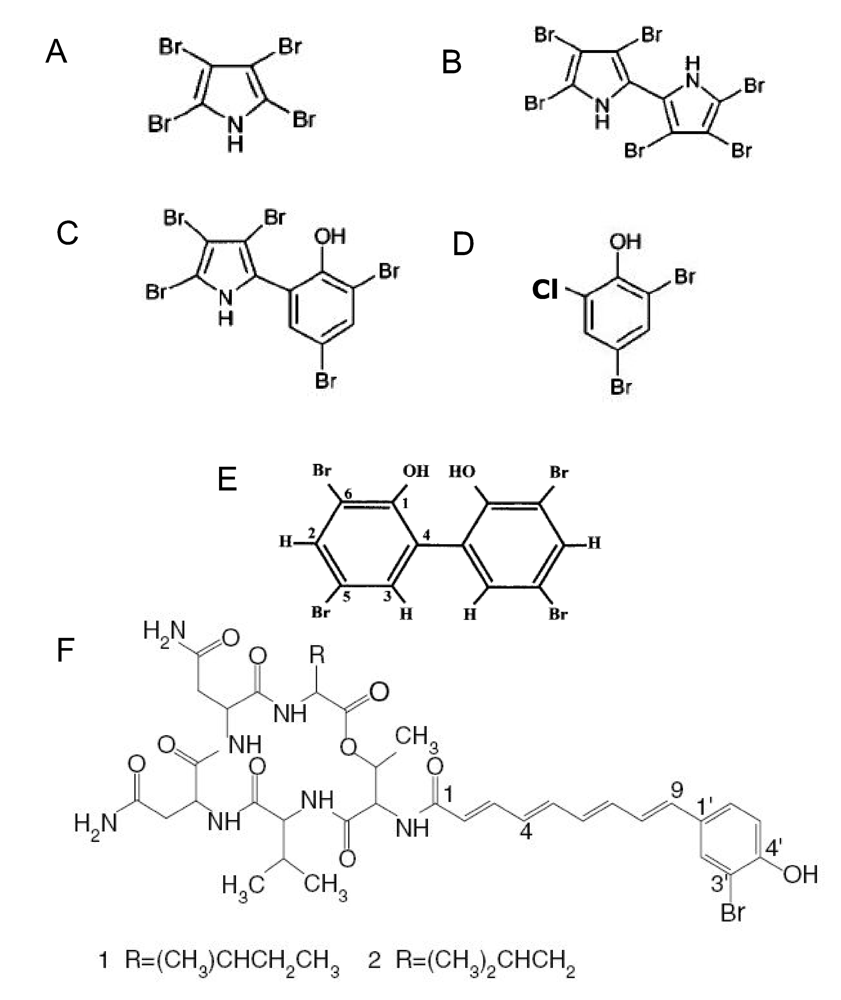
				<p>Early discoveries of marine-derived antibiotics included the identification of brominated pyrroles from purple-pigmented alteromonads. 2,3,4-tribromo-5(1&#x02019;-hydroxy-2&#x02019;,4&#x02019;-dibromophenyl)pyrrole was identified from a strain isolated from a <italic>Thalassia</italic> sp. &#x0005B;<xref ref-type="bibr" rid="b65-marinedrugs-05-00220">65</xref>&#x0005D;. Several low weight antibacterial substances were obtained from <italic>P. luteoviolacea</italic> misclassified initially as <italic>Chromobacterium marinum</italic> &#x0005B;<xref ref-type="bibr" rid="b32-marinedrugs-05-00220">32</xref>&#x0005D;. These included 2,3,4,5-tetrabromopyrrole (<xref ref-type="fig" rid="f5-marinedrugs-05-00220">Figure 5A</xref>), 2,2&#x02019;,3,3&#x02019;,4,4&#x02019;-hexabromobipyrrole (<xref ref-type="fig" rid="f5-marinedrugs-05-00220">Figure 5B</xref>), 2,3,4-tribromo-5(2&#x02019;-hydroxy-3&#x02019;,5&#x02019;-dibromophenyl)pyrrole (also called pentabromopseudilin) (<xref ref-type="fig" rid="f5-marinedrugs-05-00220">Figure 5C</xref>), 2,4-dibromo-6-chlorophenol (<xref ref-type="fig" rid="f5-marinedrugs-05-00220">Figure 5D</xref>), 4-hydroxybenzaldehyde, and <italic>n</italic>-propyl-4-hydroxybenzoate &#x0005B;<xref ref-type="bibr" rid="b2-marinedrugs-05-00220">2</xref>, <xref ref-type="bibr" rid="b11-marinedrugs-05-00220">11</xref>, <xref ref-type="bibr" rid="b24-marinedrugs-05-00220">24</xref>, <xref ref-type="bibr" rid="b32-marinedrugs-05-00220">32</xref>, <xref ref-type="bibr" rid="b34-marinedrugs-05-00220">34</xref>, <xref ref-type="bibr" rid="b37-marinedrugs-05-00220">37</xref>, <xref ref-type="bibr" rid="b85-marinedrugs-05-00220">85</xref>, <xref ref-type="bibr" rid="b86-marinedrugs-05-00220">86</xref>&#x0005D;. One or more of these substances also seem to also have activity against protists &#x0005B;<xref ref-type="bibr" rid="b55-marinedrugs-05-00220">55</xref>&#x0005D;. The seawater species <italic>P. phenolica</italic> was also found to form a brominated biphenyl compound, 3,3&#x02019;,5,5&#x02019;-tetrabromo-2,2&#x02019;-diphenyldiol (<xref ref-type="fig" rid="f5-marinedrugs-05-00220">Figure 5E</xref>) that was inhibitory to methicillin resistant <italic>Staphylococcus aureus</italic> strains &#x0005B;<xref ref-type="bibr" rid="b49-marinedrugs-05-00220">49</xref>&#x0005D;.</p>
				<p>The yellow pigment of <italic>P. tunicata</italic> has anti-fungal activity &#x0005B;<xref ref-type="bibr" rid="b22-marinedrugs-05-00220">22</xref>&#x0005D; and was identified as a tambjamine-like alkaloid, designated YP1 &#x0005B;<xref ref-type="bibr" rid="b25-marinedrugs-05-00220">25</xref>&#x0005D; (<xref ref-type="fig" rid="f6-marinedrugs-05-00220">Figure 6A</xref>). Tambjamines are 4-methoxypyrrole-containing bioactive compounds previously isolated from marine invertebrates and possess antimicrobial, anti-tumorigenic, immunosuppressive, anti-proliferation and ichthyodeterrent activities &#x0005B;<xref ref-type="bibr" rid="b61-marinedrugs-05-00220">61</xref>&#x0005D; and are likely produced as natural defensive compounds against predators. Most evidence points to bacteria, colonizing the surface of higher organisms, as the source of these compounds &#x0005B;<xref ref-type="bibr" rid="b58-marinedrugs-05-00220">58</xref>&#x0005D;. Indeed, the biosynthetic pathway for YP1 was elucidated in <italic>P. tunicata</italic> by Burke <italic>et al</italic>. &#x0005B;<xref ref-type="bibr" rid="b10-marinedrugs-05-00220">10</xref>&#x0005D; and is coded by a cluster of 19 genes (<italic>tamA</italic> to <italic>tamS</italic>) that code proteins with homology to prodigiosin biosynthetic genes in various other bacteria &#x0005B;<xref ref-type="bibr" rid="b100-marinedrugs-05-00220">100</xref>&#x0005D;, including the formation of a bipyrrole precursor, 4-methoxybipyrrole-5-carbaldehyde (MPC) from proline, malonyl-CoA and serine. YP1 is formed by condensation of MPC with dodec-3-en-1-amine &#x0005B;<xref ref-type="bibr" rid="b10-marinedrugs-05-00220">10</xref>&#x0005D;. A related compound to YP1 acts as an ionophore &#x0005B;<xref ref-type="bibr" rid="b97-marinedrugs-05-00220">97</xref>&#x0005D;. The bright red pigments of <italic>P. denitrificans</italic> and <italic>P. rubra</italic> identified as cycloprodigiosin HCl (<xref ref-type="fig" rid="f6-marinedrugs-05-00220">Figure 6F</xref>) &#x0005B;<xref ref-type="bibr" rid="b36-marinedrugs-05-00220">36</xref>, <xref ref-type="bibr" rid="b56-marinedrugs-05-00220">56</xref>&#x0005D; also acts as an ionophore blocking proton/chloride ion symporters but have been shown to generally uncouple proton translocation &#x0005B;<xref ref-type="bibr" rid="b67-marinedrugs-05-00220">67</xref>&#x0005D;. It has significant potential pharmaceutical impact able to suppress immunoproliferation &#x0005B;<xref ref-type="bibr" rid="b68-marinedrugs-05-00220">68</xref>&#x0005D;, has anti-malarial activity &#x0005B;<xref ref-type="bibr" rid="b57-marinedrugs-05-00220">57</xref>&#x0005D; and is able to induce apoptosis in several cancer cell lines &#x0005B;<xref ref-type="bibr" rid="b13-marinedrugs-05-00220">13</xref>, <xref ref-type="bibr" rid="b80-marinedrugs-05-00220">80</xref>&#x0005D;. In synergy with other drugs cycloprodigiosin may have an anti-tumorigenic application.</p>
				<p>Substituted phenylalkenoic acids referred to as rubrenoic acids (<xref ref-type="fig" rid="f6-marinedrugs-05-00220">Figure 6E</xref>) have also been purified from <italic>P. rubra</italic> and shown to have bronchodilatatoric activity &#x0005B;<xref ref-type="bibr" rid="b41-marinedrugs-05-00220">41</xref>&#x0005D;. The species <italic>P. tetraodonis</italic> (as well as a number of other bacterial species), isolated from the skin slime of the puffer fish <italic>Fugu poecilonorus</italic>, was shown to form the notorious tetrodotoxin (<xref ref-type="fig" rid="f6-marinedrugs-05-00220">Figure 6J</xref>) &#x0005B;<xref ref-type="bibr" rid="b27-marinedrugs-05-00220">27</xref>, <xref ref-type="bibr" rid="b91-marinedrugs-05-00220">91</xref>&#x0005D;, which is an exceptionally potent blocker of voltage-gated, Na<sup>&#x0002B;</sup> ion membrane channels. Production of tetrodotoxin by <italic>P. tetraodonis</italic> was dramatically stimulated under phosphate-limiting growth conditions &#x0005B;<xref ref-type="bibr" rid="b28-marinedrugs-05-00220">28</xref>&#x0005D;. Korormycin (<xref ref-type="fig" rid="f6-marinedrugs-05-00220">Figure 6G</xref>), produced by an unidentified <italic>Pseudoalteromonas</italic> sp., is a heptylated hydroxyquinonolone that has antibiotic activity against various marine bacteria, especially <italic>Vibrio</italic> spp. It was found to strongly inhibit the respiratory chain-linked Na<sup>&#x0002B;</sup>-ion translocating NADH-quinone reductase of <italic>Vibrio alginolyticus</italic> &#x0005B;<xref ref-type="bibr" rid="b103-marinedrugs-05-00220">103</xref>&#x0005D;.</p>
				<p>Butanol extracts of the algal associated species <italic>P. issachenkonii</italic> cultures were found to inhibit <italic>Candida albicans</italic> and cause hemolysis. Analysis of ethyl acetate extracts revealed that isatin (indole-2,3-dione) (<xref ref-type="fig" rid="f6-marinedrugs-05-00220">Figure 6D</xref>) was responsible for the anti-fungal activity. A red-brown haemolytic pigment of 269 Da and corresponding to C<sub>9</sub>H<sub>7</sub>N<sub>3</sub>OS<sub>3</sub> was also discovered and still awaits complete structural analysis &#x0005B;<xref ref-type="bibr" rid="b54-marinedrugs-05-00220">54</xref>&#x0005D;. A possibly misidentified <italic>Pseudoalteromonas</italic> species designated <italic>Alteromonas</italic> sp. P7, isolated from the larva of <italic>Penaeus monodon</italic> was found to be vibriostatic with the antibacterial substance recovered in ethyl acetate but not the culture supernatant suggesting the compound may also be a substituted aromatic compound &#x0005B;<xref ref-type="bibr" rid="b1-marinedrugs-05-00220">1</xref>&#x0005D;. A potentially misclassified pigmented <italic>Pseudoalteromonas</italic>-like species called &#x0201C;<italic>Alteromonas rava</italic>&#x0201D; was found to form a substituted 6-amino-4<italic>H</italic>-&#x0005B;<xref ref-type="bibr" rid="b1-marinedrugs-05-00220">1</xref>,<xref ref-type="bibr" rid="b2-marinedrugs-05-00220">2</xref>&#x0005D;dithiolo&#x0005B;4,3-<italic>b</italic>&#x0005D;pyrrol-5-one called thiomarinol A (<xref ref-type="fig" rid="f6-marinedrugs-05-00220">Figure 6H</xref>). Various thiomarinol derivatives have been also synthesized that exhibit potent antibacterial activity &#x0005B;<xref ref-type="bibr" rid="b89-marinedrugs-05-00220">89</xref>, <xref ref-type="bibr" rid="b90-marinedrugs-05-00220">90</xref>&#x0005D;.</p>
				<p>The yellow-pigmented species <italic>P. piscicida</italic> has been described as being able to produce a neuromuscular toxin able to kill a variety of fish and crab species &#x0005B;<xref ref-type="bibr" rid="b7-marinedrugs-05-00220">7</xref>, <xref ref-type="bibr" rid="b39-marinedrugs-05-00220">39</xref>, <xref ref-type="bibr" rid="b72-marinedrugs-05-00220">72</xref>&#x0005D;, however no recent studies have re-examined or confirmed this property and the toxin compound has never been detected. This may suggest <italic>P. piscicida</italic> is rarely an opportunistic pathogen. Strains were also described as being able to inhibit the growth of yeast &#x0005B;<xref ref-type="bibr" rid="b9-marinedrugs-05-00220">9</xref>&#x0005D;. <italic>P. maricaloris</italic>, a close relative of <italic>P. piscicida</italic> isolated from the Coral Sea sponge <italic>Fascaplysinopsis reticulata</italic>, forms yellow colored dibromo- and bromo-alterochomides (<xref ref-type="fig" rid="f5-marinedrugs-05-00220">Figure 5F</xref>) that possess antimicrobial activity and as well as cytotoxicity against the larvae of a sea urchin &#x0005B;<xref ref-type="bibr" rid="b95-marinedrugs-05-00220">95</xref>&#x0005D;. The algicidal strain Y, also closely related to <italic>P. piscicida</italic>, forms broad spectrum antimicrobial yellow brominated substances that LC-MS analysis revealed to comprise 12 different but likely structurally similar compounds. The molecular weights of the most abundant components ranged from 830&#x02013;954 &#x0005B;<xref ref-type="bibr" rid="b92-marinedrugs-05-00220">92</xref>&#x0005D;. NMR spectral analysis revealed the presence of bromine, aromatic rings, hydroxyl and carbonyl groups. These still so far unidentified substances may also represent other cyclic or acyclic depsipeptide brominated compounds and may be relevant to the observation of other low molecular weight peptide like substances potentially contributing to anti-fouling activity &#x0005B;<xref ref-type="bibr" rid="b104-marinedrugs-05-00220">104</xref>&#x0005D;. A variety of diketopiperazines (DKP) are produced by an Antarctic <italic>Pseudoalteromonas haloplanktis</italic> isolate &#x0005B;<xref ref-type="bibr" rid="b73-marinedrugs-05-00220">73</xref>&#x0005D; including a novel compound, cyclo-(D-pipecolinyl-<italic>L</italic>-isoleucine) (<xref ref-type="fig" rid="f6-marinedrugs-05-00220">Figure 6C</xref>). This novel DKP was inactive in a free radical scavenging assay using 1,1-diphenyl-2-picrylhydrazyl. Another novel DKP, cyclo-(<italic>L</italic>-phenylalanyl-4<italic>R</italic>-hydroxyl-<italic>L</italic>-proline) (<xref ref-type="fig" rid="f6-marinedrugs-05-00220">Figure 6B</xref>) is produced by <italic>P. luteoviolacea</italic> &#x0005B;<xref ref-type="bibr" rid="b53-marinedrugs-05-00220">53</xref>&#x0005D; that exhibited antibacterial activity. The continued examination of peptide like pigment and non-pigment substances from <italic>Pseudoalteromonas</italic> appears to be necessary as these compounds seem to have a potentially important impact in biological interactions.</p>
			</sec>
			<sec>
				<title>4.2 High molecular weight substances</title>
				<p>Several <italic>Pseudoalteromonas</italic> species have been found to secrete proteins and other soluble high molecular weight substances with antibacterial activities that are also autotoxic in nature &#x0005B;<xref ref-type="bibr" rid="b3-marinedrugs-05-00220">3</xref>&#x0005D;. This included a 100 kDA protein produced by <italic>P. luteoviolacea</italic> &#x0005B;<xref ref-type="bibr" rid="b34-marinedrugs-05-00220">34</xref>&#x0005D;, which was likely also observed in the study of Kamei <italic>et al</italic>. &#x0005B;<xref ref-type="bibr" rid="b55-marinedrugs-05-00220">55</xref>&#x0005D;. The synthesis of this protein appeared to be induced during late exponential to stationary growth &#x0005B;<xref ref-type="bibr" rid="b71-marinedrugs-05-00220">71</xref>&#x0005D;. <italic>P. rubra</italic> was found to form a strongly anthrone-reactive polyanionic substance, possibly a glycoprotein or polysaccharide, which had antibacterial activity, especially to species that did not naturally possess catalase activity. Subsequently it was found that growth inhibition by the antibiotic was due to induction of oxidative stress in target cells through increased O<sub>2</sub> uptake and accumulation of hydrogen peroxide &#x0005B;<xref ref-type="bibr" rid="b29-marinedrugs-05-00220">29</xref>, <xref ref-type="bibr" rid="b30-marinedrugs-05-00220">30</xref>&#x0005D;. An alteromonad, designated NCIMB 2144, was found to produce an autotoxic, antibacterial 90 kDA thermolabile glycoprotein &#x0005B;<xref ref-type="bibr" rid="b4-marinedrugs-05-00220">4</xref>&#x0005D; that could be analogous to that found in <italic>P. rubra. P. tunicata</italic> strain D2 secretes an autotoxic 190 kDa dimeric protein referred to as AlpP. This protein was found to inhibit a wide range of marine and medically significant bacteria &#x0005B;<xref ref-type="bibr" rid="b52-marinedrugs-05-00220">52</xref>&#x0005D; but is particularly potent against strain D2 itself (MIC 4 &#x003BC;g mL<sup>&#x02212;1</sup>). However, as cells progress into the stationary growth phase they become increasingly resistant. The autoxicity of AlpP appears to provide a dispersal mechanism to biofilm dwelling <italic>P. tunicata</italic>, working through a process akin to programmed cell death &#x0005B;<xref ref-type="bibr" rid="b6-marinedrugs-05-00220">6</xref>&#x0005D;. The AlpP-autolysis of cells within biofilm substructures seems to provide nutrients for a subpopulation of cells resistant to AlpP with the lysis causing sections of the biofilm to also detach. Survivor cells are actively motile and presumably are dispersed in the water flow and thus can recolonize new surfaces &#x0005B;<xref ref-type="bibr" rid="b69-marinedrugs-05-00220">69</xref>, <xref ref-type="bibr" rid="b70-marinedrugs-05-00220">70</xref>&#x0005D;. Observations in other bacteria suggest dispersal mechanisms analogous to this could be relatively common amongst biofilm forming species &#x0005B;<xref ref-type="bibr" rid="b6-marinedrugs-05-00220">6</xref>&#x0005D;. An isolate related to <italic>P. piscicida</italic>, designated X153 has been proposed as an effective probiont, protecting commercial shellfish species from pathogenic <italic>Vibrio</italic> species. X153 was shown to produce a, unstable tetrameric 280 kDa vibriostatic protein that also appeared to have broad spectrum inhibitory activity against marine bacteria &#x0005B;<xref ref-type="bibr" rid="b63-marinedrugs-05-00220">63</xref>&#x0005D;. <italic>P. haloplanktis</italic> and <italic>P. undina</italic> strains have also been found to provide probiotic benefits &#x0005B;<xref ref-type="bibr" rid="b66-marinedrugs-05-00220">66</xref>, <xref ref-type="bibr" rid="b84-marinedrugs-05-00220">84</xref>&#x0005D; though it is unknown if antibiotic factors are involved.</p>
				<p>Some species of <italic>Pseudoalteromonas</italic> have been rarely implicated as opportunistic pathogens of marine animals including fish and crustacea &#x0005B;<xref ref-type="bibr" rid="b14-marinedrugs-05-00220">14</xref>, <xref ref-type="bibr" rid="b76-marinedrugs-05-00220">76</xref>, <xref ref-type="bibr" rid="b81-marinedrugs-05-00220">81</xref>&#x0005D;. This pathogenicity may relate to lipopolysaccharide and other heat labile factors &#x0005B;<xref ref-type="bibr" rid="b15-marinedrugs-05-00220">15</xref>&#x0005D; and other virulence determinants such as hemolysins &#x0005B;<xref ref-type="bibr" rid="b54-marinedrugs-05-00220">54</xref>&#x0005D; and thrombolysins &#x0005B;<xref ref-type="bibr" rid="b16-marinedrugs-05-00220">16</xref>&#x0005D;. The structure of O-specific polysaccharides has been determined for a number of <italic>Pseudoalteromonas</italic> species, which are notable in being acidic and containing a variety of substituted sugar and non-sugar subunits &#x0005B;<xref ref-type="bibr" rid="b60-marinedrugs-05-00220">60</xref>&#x0005D;. It is unknown if these substances have antibiotic or cytotoxic properties in the marine environment.</p>
			</sec>
		</sec>
		<sec>
			<title>5. Concluding Remarks</title>
			<p>
				<italic>Pseudoalteromonas</italic> though it appears to be only one of many marine bacterial genera (either cultured or uncultured) clearly has been shown to possess ecologically- and pharmaceutically-relevant features that are both unusual and intriguing. Greater understanding of the activities of this genus in the marine ecosystem would represent a boon to microbial and marine ecology. More knowledge of the biologically active chemicals formed by <italic>Pseudoalteromonas</italic> species would also be potentially pharmacologically beneficial. Such research could be performed from a marine biology point of view in order determine the relationships of <italic>Pseudoalteromonas</italic> to the reproductive success of many invertebrates and algal species. Detection and identification of new chemical cues could be valuable in understanding the interactive ecology of marine fauna and their associated microbiota. It could also be expanded to conservation-oriented dimensions. Negri and colleagues &#x0005B;<xref ref-type="bibr" rid="b75-marinedrugs-05-00220">75</xref>&#x0005D; proposed there is a possibility that broadcast chemical producing bacteria like <italic>Pseudoalteromonas</italic> sp. A3 could be used as a means to re-seed reefs with coral species owing to its positive effects on coral larvae settlement and metamorphosis. It is unknown if any of these undiscovered compounds would have pharmaceutical benefit too or would have other applications. In that respect several broad spectrum antibiotic compounds have been detected from <italic>Pseudoalteromonas</italic> spp. including pentabromopseudilin, korormycin, thiomarinol A, bromo-alterochromides A and B, tambjamine YP1 etc. Various strains also form compounds with intriguing pharmaceutical properties such as the red pigment cycloprodigiosine HCl. Since these substances have been derived from only a small subset of strains the potential pool of natural product diversity possessed by genus <italic>Pseudoalteromonas</italic> is likely mostly unrealized.</p>
			<p>Proteases from various strains of <italic>Pseudoalteromonas</italic>, in particular from a strain of <italic>P. issachenkonii</italic> were recently found to be effective in reducing biofouling by the bryozoan <italic>Bugula neritina</italic> &#x0005B;<xref ref-type="bibr" rid="b19-marinedrugs-05-00220">19</xref>&#x0005D;. The innovative practical application of small and large antibiotic compounds as well as proteinaceous enzymatic substances to combat marine biofouling is progressing through the use of paints and gel-encapsulation &#x0005B;<xref ref-type="bibr" rid="b19-marinedrugs-05-00220">19</xref>, <xref ref-type="bibr" rid="b102-marinedrugs-05-00220">102</xref>&#x0005D;. Thus the extensive enzymatic ability of various <italic>Pseudoalteromonas</italic> (as suggested for some species in <xref ref-type="table" rid="t1-marinedrugs-05-00220">Table 1</xref>) is also worth noting as this generally unexplored facet can be potentially useful in a practical sense to combat biofouling as well as an ecologically relevant feature.</p>
		</sec>
	</body>
	<back>
		<fn-group>
			<fn>
				<p>
					<italic>Sample Availability:</italic> Available from the author.</p>
			</fn>
		</fn-group>
		<ref-list>
			<title>References and Notes</title>
			<ref id="b1-marinedrugs-05-00220">
				<label>1</label>
				<citation citation-type="journal">
					<person-group person-group-type="author">
						<name>
							<surname>Abraham</surname>
							<given-names>TJ</given-names>
						</name>
					</person-group>
					<article-title>Antibacterial marine bacterium deters luminous vibriosis in shrimp larvae</article-title>
					<source>NAGA WorldFish Cent Quart</source>
					<year>2004</year>
					<volume>27</volume>
					<fpage>28</fpage>
					<lpage>31</lpage>
				</citation>
			</ref>
			<ref id="b2-marinedrugs-05-00220">
				<label>2</label>
				<citation citation-type="journal">
					<person-group person-group-type="author">
						<name>
							<surname>Anderson</surname>
							<given-names>RJ</given-names>
						</name>
						<name>
							<surname>Wolfe</surname>
							<given-names>MS</given-names>
						</name>
						<name>
							<surname>Faulkner</surname>
							<given-names>DJ</given-names>
						</name>
					</person-group>
					<article-title>Autotoxic antibiotic production by a marine <italic>Chromobacterium</italic>
					</article-title>
					<source>Mar Biol</source>
					<year>1974</year>
					<volume>27</volume>
					<fpage>281</fpage>
					<lpage>285</lpage>
				</citation>
			</ref>
			<ref id="b3-marinedrugs-05-00220">
				<label>3</label>
				<citation citation-type="journal">
					<person-group person-group-type="author">
						<name>
							<surname>Ballester</surname>
							<given-names>M</given-names>
						</name>
						<name>
							<surname>Ballester</surname>
							<given-names>JM</given-names>
						</name>
						<name>
							<surname>Belaich</surname>
							<given-names>JP</given-names>
						</name>
					</person-group>
					<article-title>Isolation and characterization of a high molecular weight antibiotic produced by a marine bacterium</article-title>
					<source>Microb Ecol</source>
					<year>1977</year>
					<volume>3</volume>
					<fpage>289</fpage>
					<lpage>303</lpage>
				</citation>
			</ref>
			<ref id="b4-marinedrugs-05-00220">
				<label>4</label>
				<citation citation-type="journal">
					<person-group person-group-type="author">
						<name>
							<surname>Barja</surname>
							<given-names>JL</given-names>
						</name>
						<name>
							<surname>Lemos</surname>
							<given-names>ML</given-names>
						</name>
						<name>
							<surname>Toranzo</surname>
							<given-names>AE</given-names>
						</name>
					</person-group>
					<article-title>Purification and characterization of an antibacterial substance produced by a marine <italic>Alteromonas</italic> species</article-title>
					<source>Antimicrob Agents Chemother</source>
					<year>1989</year>
					<volume>33</volume>
					<fpage>1674</fpage>
					<lpage>1679</lpage>
				</citation>
			</ref>
			<ref id="b5-marinedrugs-05-00220">
				<label>5</label>
				<citation citation-type="journal">
					<person-group person-group-type="author">
						<name>
							<surname>Baumann</surname>
							<given-names>L</given-names>
						</name>
						<name>
							<surname>Baumann</surname>
							<given-names>P</given-names>
						</name>
						<name>
							<surname>Mandel</surname>
							<given-names>M</given-names>
						</name>
						<name>
							<surname>Allen</surname>
							<given-names>RD</given-names>
						</name>
					</person-group>
					<article-title>Taxonomy of aerobic marine eubacteria</article-title>
					<source>J Bacteriol</source>
					<year>1972</year>
					<volume>110</volume>
					<fpage>402</fpage>
					<lpage>429</lpage>
				</citation>
			</ref>
			<ref id="b6-marinedrugs-05-00220">
				<label>6</label>
				<citation citation-type="journal">
					<person-group person-group-type="author">
						<name>
							<surname>Bayles</surname>
							<given-names>KW</given-names>
						</name>
					</person-group>
					<article-title>The biological role of death and lysis in biofilm development</article-title>
					<source>Nature Rev Microbiol</source>
					<year>2007</year>
					<volume>5</volume>
					<fpage>721</fpage>
					<lpage>726</lpage>
				</citation>
			</ref>
			<ref id="b7-marinedrugs-05-00220">
				<label>7</label>
				<citation citation-type="journal">
					<person-group person-group-type="author">
						<name>
							<surname>Bein</surname>
							<given-names>SJ</given-names>
						</name>
					</person-group>
					<article-title>A study of certain chromogenic bacteria isolated from &#x0201C;Red Tide&#x0201D; water with a description of a new species</article-title>
					<source>Bull Mar Sci Gulf Caribb</source>
					<year>1954</year>
					<volume>4</volume>
					<fpage>110</fpage>
					<lpage>119</lpage>
				</citation>
			</ref>
			<ref id="b8-marinedrugs-05-00220">
				<label>8</label>
				<citation citation-type="book">
					<person-group person-group-type="author">
						<name>
							<surname>Bowman</surname>
							<given-names>JP</given-names>
						</name>
						<name>
							<surname>McMeekin</surname>
							<given-names>TA</given-names>
						</name>
					</person-group>
					<person-group person-group-type="editor">
						<name>
							<surname>Brenner</surname>
							<given-names>DJ</given-names>
						</name>
						<name>
							<surname>Krieg</surname>
							<given-names>NR</given-names>
						</name>
						<name>
							<surname>Staley</surname>
							<given-names>JT</given-names>
						</name>
						<name>
							<surname>Garrity</surname>
							<given-names>GM</given-names>
						</name>
					</person-group>
					<article-title>Bergey&#x02019;s Manual of Bacteriology</article-title>
					<edition>2</edition>
					<publisher-name>Springer</publisher-name>
					<publisher-loc>New York</publisher-loc>
					<year>2005</year>
					<volume>2</volume>
					<fpage>467</fpage>
					<lpage>478</lpage>
				</citation>
			</ref>
			<ref id="b9-marinedrugs-05-00220">
				<label>9</label>
				<citation citation-type="journal">
					<person-group person-group-type="author">
						<name>
							<surname>Buck</surname>
							<given-names>JD</given-names>
						</name>
						<name>
							<surname>Meyers</surname>
							<given-names>SP</given-names>
						</name>
					</person-group>
					<article-title>In vitro inhibition of <italic>Rhodotorula minuta</italic> by a variant of marine bacterium <italic>Pseudomonas piscicida</italic>
					</article-title>
					<source>Helgol Wiss Meeresunters</source>
					<year>1966</year>
					<volume>13</volume>
					<fpage>171</fpage>
				</citation>
			</ref>
			<ref id="b10-marinedrugs-05-00220">
				<label>10</label>
				<citation citation-type="journal">
					<person-group person-group-type="author">
						<name>
							<surname>Burke</surname>
							<given-names>C</given-names>
						</name>
						<name>
							<surname>Thomas</surname>
							<given-names>T</given-names>
						</name>
						<name>
							<surname>Egan</surname>
							<given-names>S</given-names>
						</name>
						<name>
							<surname>Kjelleberg</surname>
							<given-names>S</given-names>
						</name>
					</person-group>
					<article-title>The use of functional genomics for the identification of a gene cluster encoding for the biosynthesis of an antifungal tambjamine in the marine bacterium <italic>Pseudoalteromonas tunicata</italic>
					</article-title>
					<source>Env Microbiol</source>
					<year>2007</year>
					<volume>9</volume>
					<fpage>814</fpage>
					<lpage>818</lpage>
				</citation>
			</ref>
			<ref id="b11-marinedrugs-05-00220">
				<label>11</label>
				<citation citation-type="journal">
					<person-group person-group-type="author">
						<name>
							<surname>Burkholder</surname>
							<given-names>PR</given-names>
						</name>
						<name>
							<surname>Pfister</surname>
							<given-names>RM</given-names>
						</name>
						<name>
							<surname>Leitz</surname>
							<given-names>LH</given-names>
						</name>
					</person-group>
					<article-title>Production of a pyrrole antibiotic by a marine bacterium</article-title>
					<source>Appl Microbiol</source>
					<year>1966</year>
					<volume>14</volume>
					<fpage>649</fpage>
					<lpage>653</lpage>
				</citation>
			</ref>
			<ref id="b12-marinedrugs-05-00220">
				<label>12</label>
				<citation citation-type="journal">
					<person-group person-group-type="author">
						<name>
							<surname>Burm&#x00F8;lle</surname>
							<given-names>M</given-names>
						</name>
						<name>
							<surname>Webb</surname>
							<given-names>JS</given-names>
						</name>
						<name>
							<surname>Rao</surname>
							<given-names>D</given-names>
						</name>
						<name>
							<surname>Hansen</surname>
							<given-names>LH</given-names>
						</name>
						<name>
							<surname>Sorensen</surname>
							<given-names>SJ</given-names>
						</name>
						<name>
							<surname>Kjelleberg</surname>
							<given-names>S</given-names>
						</name>
					</person-group>
					<article-title>Enhanced biofilm formation and increased resistance to antimicrobial agents and bacterial invasion are caused by synergistic interactions in multispecies biofilms</article-title>
					<source>Appl Env Microbiol</source>
					<year>2006</year>
					<volume>72</volume>
					<fpage>3916</fpage>
					<lpage>3923</lpage>
				</citation>
			</ref>
			<ref id="b13-marinedrugs-05-00220">
				<label>13</label>
				<citation citation-type="journal">
					<person-group person-group-type="author">
						<name>
							<surname>Camp&#x000E0;s</surname>
							<given-names>C</given-names>
						</name>
						<name>
							<surname>Dalmau</surname>
							<given-names>M</given-names>
						</name>
						<name>
							<surname>Montaner</surname>
							<given-names>B</given-names>
						</name>
						<name>
							<surname>Barrag&#x000E1;n</surname>
							<given-names>M</given-names>
						</name>
						<name>
							<surname>Bellosillo</surname>
							<given-names>B</given-names>
						</name>
						<name>
							<surname>Colomer</surname>
							<given-names>D</given-names>
						</name>
						<name>
							<surname>Pons</surname>
							<given-names>G</given-names>
						</name>
						<name>
							<surname>P&#x000E9;rez-Tom&#x000E1;s</surname>
							<given-names>R</given-names>
						</name>
						<name>
							<surname>Gil</surname>
							<given-names>J</given-names>
						</name>
					</person-group>
					<article-title>Prodigiosin induces apoptosis of B and T cells from B-cell chronic lymphocytic leukemia</article-title>
					<source>Leukemia</source>
					<year>2003</year>
					<volume>17</volume>
					<fpage>746</fpage>
					<lpage>750</lpage>
				</citation>
			</ref>
			<ref id="b14-marinedrugs-05-00220">
				<label>14</label>
				<citation citation-type="journal">
					<person-group person-group-type="author">
						<name>
							<surname>Colwell</surname>
							<given-names>RR</given-names>
						</name>
						<name>
							<surname>Sparks</surname>
							<given-names>AK</given-names>
						</name>
					</person-group>
					<article-title>Properties of <italic>Pseudomonas enalia</italic>, a marine bacterium pathogenic for the invertebrate <italic>Crassostrea gigas</italic> (Thunberg)</article-title>
					<source>Appl Microbiol</source>
					<year>1967</year>
					<volume>15</volume>
					<fpage>980</fpage>
					<lpage>986</lpage>
				</citation>
			</ref>
			<ref id="b15-marinedrugs-05-00220">
				<label>15</label>
				<citation citation-type="journal">
					<person-group person-group-type="author">
						<name>
							<surname>Costa-Ramos</surname>
							<given-names>C</given-names>
						</name>
						<name>
							<surname>Rowley</surname>
							<given-names>AF</given-names>
						</name>
					</person-group>
					<article-title>Effect of extracellular products of <italic>Pseudoalteromonas atlantica</italic> on the edible crab <italic>Cancer pagurus</italic>
					</article-title>
					<source>Appl Env Microbiol</source>
					<year>2004</year>
					<volume>70</volume>
					<fpage>729</fpage>
					<lpage>735</lpage>
				</citation>
			</ref>
			<ref id="b16-marinedrugs-05-00220">
				<label>16</label>
				<citation citation-type="journal">
					<person-group person-group-type="author">
						<name>
							<surname>Demina</surname>
							<given-names>NS</given-names>
						</name>
						<name>
							<surname>Veslopolova</surname>
							<given-names>EF</given-names>
						</name>
						<name>
							<surname>Gaenko</surname>
							<given-names>GP</given-names>
						</name>
					</person-group>
					<article-title>Marine-bacteria <italic>Alteromonas piscicida</italic> produces thrombolytic enzymes</article-title>
					<source>Izv Akad Nauk SSSR Ser Biologich</source>
					<year>1990</year>
					<volume>3</volume>
					<fpage>415</fpage>
					<lpage>419</lpage>
				</citation>
			</ref>
			<ref id="b17-marinedrugs-05-00220">
				<label>17</label>
				<citation citation-type="journal">
					<person-group person-group-type="author">
						<name>
							<surname>Dobretsov</surname>
							<given-names>S</given-names>
						</name>
						<name>
							<surname>Dahms</surname>
							<given-names>H-W</given-names>
						</name>
						<name>
							<surname>Qian</surname>
							<given-names>P-Y</given-names>
						</name>
					</person-group>
					<article-title>Inhibition of biofouling by marine microorganisms and their metabolites</article-title>
					<source>Biofouling</source>
					<year>2006</year>
					<volume>22</volume>
					<fpage>43</fpage>
					<lpage>54</lpage>
				</citation>
			</ref>
			<ref id="b18-marinedrugs-05-00220">
				<label>18</label>
				<citation citation-type="journal">
					<person-group person-group-type="author">
						<name>
							<surname>Dobretsov</surname>
							<given-names>S</given-names>
						</name>
						<name>
							<surname>Qian</surname>
							<given-names>PY</given-names>
						</name>
					</person-group>
					<article-title>Effect of bacteria associated with the green alga <italic>Ulva reticulata</italic> on marine micro- and macrofouling</article-title>
					<source>Biofouling</source>
					<year>2002</year>
					<volume>18</volume>
					<fpage>217</fpage>
					<lpage>228</lpage>
				</citation>
			</ref>
			<ref id="b19-marinedrugs-05-00220">
				<label>19</label>
				<citation citation-type="journal">
					<person-group person-group-type="author">
						<name>
							<surname>Dobretsov</surname>
							<given-names>S</given-names>
						</name>
						<name>
							<surname>Xiong</surname>
							<given-names>HR</given-names>
						</name>
						<name>
							<surname>Xu</surname>
							<given-names>Y</given-names>
						</name>
						<name>
							<surname>Levin</surname>
							<given-names>LA</given-names>
						</name>
						<name>
							<surname>Qian</surname>
							<given-names>PY</given-names>
						</name>
					</person-group>
					<article-title>Novel antifoulants: Inhibition of larval attachment by proteases</article-title>
					<source>Mar Biotechnol</source>
					<year>2007</year>
					<volume>9</volume>
					<fpage>388</fpage>
					<lpage>397</lpage>
				</citation>
			</ref>
			<ref id="b20-marinedrugs-05-00220">
				<label>20</label>
				<citation citation-type="journal">
					<person-group person-group-type="author">
						<name>
							<surname>Egan</surname>
							<given-names>S</given-names>
						</name>
						<name>
							<surname>Thomas</surname>
							<given-names>T</given-names>
						</name>
						<name>
							<surname>Holmstr&#x000F6;m</surname>
							<given-names>C</given-names>
						</name>
						<name>
							<surname>Kjelleberg</surname>
							<given-names>S</given-names>
						</name>
					</person-group>
					<article-title>Phylogenetic relationship and antifouling activity of bacterial epiphytes from the marine alga <italic>Ulva lactuca</italic>
					</article-title>
					<source>Env Microbiol</source>
					<year>2000</year>
					<volume>2</volume>
					<fpage>343</fpage>
					<lpage>347</lpage>
				</citation>
			</ref>
			<ref id="b21-marinedrugs-05-00220">
				<label>21</label>
				<citation citation-type="journal">
					<person-group person-group-type="author">
						<name>
							<surname>Egan</surname>
							<given-names>S</given-names>
						</name>
						<name>
							<surname>Holmstr&#x000F6;m</surname>
							<given-names>C</given-names>
						</name>
						<name>
							<surname>Kjelleberg</surname>
							<given-names>S</given-names>
						</name>
					</person-group>
					<article-title>
						<italic>Pseudoalteromonas ulvae</italic> sp. nov., a bacterium with antifouling activities isolated from the surface of a marine alga</article-title>
					<source>Int J Syst Evol Microbiol</source>
					<year>2001</year>
					<volume>51 </volume>
					<fpage>1499</fpage>
					<lpage>1504</lpage>
				</citation>
			</ref>
			<ref id="b22-marinedrugs-05-00220">
				<label>22</label>
				<citation citation-type="journal">
					<person-group person-group-type="author">
						<name>
							<surname>Egan</surname>
							<given-names>S</given-names>
						</name>
						<name>
							<surname>James</surname>
							<given-names>S</given-names>
						</name>
						<name>
							<surname>Holmstr&#x000F6;m</surname>
							<given-names>C</given-names>
						</name>
						<name>
							<surname>Kjelleberg</surname>
							<given-names>S</given-names>
						</name>
					</person-group>
					<article-title>Correlation between pigmentation and antifouling compounds produced by <italic>Pseudoalteromonas tunicata</italic>
					</article-title>
					<source>Env Microbiol</source>
					<year>2002</year>
					<volume>4</volume>
					<fpage>433</fpage>
					<lpage>442</lpage>
				</citation>
			</ref>
			<ref id="b23-marinedrugs-05-00220">
				<label>23</label>
				<citation citation-type="journal">
					<person-group person-group-type="author">
						<name>
							<surname>Egan</surname>
							<given-names>S</given-names>
						</name>
						<name>
							<surname>James</surname>
							<given-names>S</given-names>
						</name>
						<name>
							<surname>Kjelleberg</surname>
							<given-names>S</given-names>
						</name>
					</person-group>
					<article-title>Identification and characterization of a putative transcriptional regulator controlling the expression of fouling inhibitors in <italic>Pseudoalteromonas tunicata</italic>
					</article-title>
					<source>Appl Env Microbiol</source>
					<year>2002</year>
					<volume>68</volume>
					<fpage>372</fpage>
					<lpage>378</lpage>
				</citation>
			</ref>
			<ref id="b24-marinedrugs-05-00220">
				<label>24</label>
				<citation citation-type="book">
					<person-group person-group-type="author">
						<name>
							<surname>Faulkner</surname>
							<given-names>DJ</given-names>
						</name>
					</person-group>
					<person-group person-group-type="editor">
						<name>
							<surname>Sammes</surname>
							<given-names>EG</given-names>
						</name>
					</person-group>
					<source>Topics in Antibiotic Chemistry</source>
					<publisher-name>John Wiley</publisher-name>
					<publisher-loc>New York</publisher-loc>
					<year>1978</year>
					<article-title>Chapter 2</article-title>
					<fpage>9</fpage>
					<lpage>58</lpage>
				</citation>
			</ref>
			<ref id="b25-marinedrugs-05-00220">
				<label>25</label>
				<citation citation-type="journal">
					<person-group person-group-type="author">
						<name>
							<surname>Franks</surname>
							<given-names>A</given-names>
						</name>
						<name>
							<surname>Haywood</surname>
							<given-names>P</given-names>
						</name>
						<name>
							<surname>Holmstr&#x000F6;m</surname>
							<given-names>C</given-names>
						</name>
						<name>
							<surname>Egan</surname>
							<given-names>S</given-names>
						</name>
						<name>
							<surname>Kjelleberg</surname>
							<given-names>S</given-names>
						</name>
						<name>
							<surname>Kumar</surname>
							<given-names>N</given-names>
						</name>
					</person-group>
					<article-title>Isolation and structure elucidation of a novel yellow pigment from the marine bacterium <italic>Pseudoalteromonas tunicata</italic>
					</article-title>
					<source>Molecules</source>
					<year>2005</year>
					<volume>10</volume>
					<fpage>1286</fpage>
					<lpage>1291</lpage>
				</citation>
			</ref>
			<ref id="b26-marinedrugs-05-00220">
				<label>26</label>
				<citation citation-type="journal">
					<person-group person-group-type="author">
						<name>
							<surname>Franks</surname>
							<given-names>A</given-names>
						</name>
						<name>
							<surname>Egan</surname>
							<given-names>S</given-names>
						</name>
						<name>
							<surname>Holmstr&#x000F6;m</surname>
							<given-names>C</given-names>
						</name>
						<name>
							<surname>James</surname>
							<given-names>S</given-names>
						</name>
						<name>
							<surname>Lappin-Scott</surname>
							<given-names>H</given-names>
						</name>
						<name>
							<surname>Kjelleberg</surname>
							<given-names>S</given-names>
						</name>
					</person-group>
					<article-title>Inhibition of fungal colonization by <italic>Pseudoalteromonas tunicata</italic> provides a competitive advantage during surface colonization</article-title>
					<source>Appl Env Microbiol</source>
					<year>2006</year>
					<volume>72</volume>
					<fpage>6079</fpage>
					<lpage>6087</lpage>
				</citation>
			</ref>
			<ref id="b27-marinedrugs-05-00220">
				<label>27</label>
				<citation citation-type="journal">
					<person-group person-group-type="author">
						<name>
							<surname>Gallacher</surname>
							<given-names>S</given-names>
						</name>
						<name>
							<surname>Birkbeck</surname>
							<given-names>TH</given-names>
						</name>
					</person-group>
					<article-title>A tissue-culture assay for direct detection of sodium-channel blocking toxins in bacterial culture supernates</article-title>
					<source>FEMS Microbiol Lett</source>
					<year>1992</year>
					<volume>92</volume>
					<fpage>101</fpage>
					<lpage>108</lpage>
				</citation>
			</ref>
			<ref id="b28-marinedrugs-05-00220">
				<label>28</label>
				<citation citation-type="journal">
					<person-group person-group-type="author">
						<name>
							<surname>Gallacher</surname>
							<given-names>S</given-names>
						</name>
						<name>
							<surname>Birkbeck</surname>
							<given-names>TH</given-names>
						</name>
					</person-group>
					<article-title>Effect of phosphate concentration on production of tetrodotoxin by <italic>Alteromonas tetraodonis</italic>
					</article-title>
					<source>Appl Env Microbiol</source>
					<year>1993</year>
					<volume>59</volume>
					<fpage>3981</fpage>
					<lpage>3983</lpage>
				</citation>
			</ref>
			<ref id="b29-marinedrugs-05-00220">
				<label>29</label>
				<citation citation-type="journal">
					<person-group person-group-type="author">
						<name>
							<surname>Gauthier</surname>
							<given-names>MJ</given-names>
						</name>
					</person-group>
					<article-title>
						<italic>Alteromonas rubra</italic> sp. nov., a new marine antibiotic-producing bacterium</article-title>
					<source>Int J Syst Bacteriol</source>
					<year>1976</year>
					<volume>26</volume>
					<fpage>459</fpage>
					<lpage>466</lpage>
				</citation>
			</ref>
			<ref id="b30-marinedrugs-05-00220">
				<label>30</label>
				<citation citation-type="journal">
					<person-group person-group-type="author">
						<name>
							<surname>Gauthier</surname>
							<given-names>MJ</given-names>
						</name>
					</person-group>
					<article-title>Modification of bacterial respiration by a macromolecular polyanionic antibiotic produced by a marine <italic>Alteromonas</italic>
					</article-title>
					<source>Antimicrob Agents Chemother</source>
					<year>1976</year>
					<volume>76</volume>
					<fpage>361</fpage>
					<lpage>366</lpage>
				</citation>
			</ref>
			<ref id="b31-marinedrugs-05-00220">
				<label>31</label>
				<citation citation-type="journal">
					<person-group person-group-type="author">
						<name>
							<surname>Gauthier</surname>
							<given-names>MJ</given-names>
						</name>
					</person-group>
					<article-title>
						<italic>Alteromonas citrea</italic>, a new Gram-negative, yellow-pigmented species from seawater</article-title>
					<source>Int J Syst Bacteriol</source>
					<year>1977</year>
					<volume>27</volume>
					<fpage>349</fpage>
					<lpage>354</lpage>
				</citation>
			</ref>
			<ref id="b32-marinedrugs-05-00220">
				<label>32</label>
				<citation citation-type="journal">
					<person-group person-group-type="author">
						<name>
							<surname>Gauthier</surname>
							<given-names>MJ</given-names>
						</name>
					</person-group>
					<article-title>Validation of the name <italic>Alteromonas luteoviolacea</italic>
					</article-title>
					<source>Int J Syst Bacteriol</source>
					<year>1982</year>
					<volume>32 </volume>
					<fpage>82</fpage>
					<lpage>86</lpage>
				</citation>
			</ref>
			<ref id="b33-marinedrugs-05-00220">
				<label>33</label>
				<citation citation-type="journal">
					<person-group person-group-type="author">
						<name>
							<surname>Gauthier</surname>
							<given-names>MJ</given-names>
						</name>
						<name>
							<surname>Breittmayer</surname>
							<given-names>VA</given-names>
						</name>
					</person-group>
					<article-title>A new antibiotic-producing bacterium from seawater: <italic>Alteromonas aurantia</italic> sp. nov</article-title>
					<source>Int J Syst Bacteriol</source>
					<year>1979</year>
					<volume>29</volume>
					<fpage>366</fpage>
					<lpage>372</lpage>
				</citation>
			</ref>
			<ref id="b34-marinedrugs-05-00220">
				<label>34</label>
				<citation citation-type="journal">
					<person-group person-group-type="author">
						<name>
							<surname>Gauthier</surname>
							<given-names>MJ</given-names>
						</name>
						<name>
							<surname>Flatau</surname>
							<given-names>GN</given-names>
						</name>
					</person-group>
					<article-title>Antibacterial activity of marine violet-pigmented <italic>Alteromonas</italic> with special reference to the production of brominated compounds</article-title>
					<source>Can J Microbiol</source>
					<year>1976</year>
					<volume>22</volume>
					<fpage>1612</fpage>
					<lpage>1619</lpage>
				</citation>
			</ref>
			<ref id="b35-marinedrugs-05-00220">
				<label>35</label>
				<citation citation-type="journal">
					<person-group person-group-type="author">
						<name>
							<surname>Gauthier</surname>
							<given-names>G</given-names>
						</name>
						<name>
							<surname>Gauthier</surname>
							<given-names>M</given-names>
						</name>
						<name>
							<surname>Christen</surname>
							<given-names>R</given-names>
						</name>
					</person-group>
					<article-title>Phylogenetic analysis of the genera <italic>Alteromonas, Shewanella</italic> and <italic>Moritella</italic> using genes coding for small-subunit rRNA sequences and division of the genus <italic>Alteromonas</italic> into two genera, <italic>Alteromonas</italic> (emended) and <italic>Pseudoalteromonas</italic> gen. nov., and proposal of twelve new species combinations</article-title>
					<source>Int J Syst Bacteriol</source>
					<year>1995</year>
					<volume>45</volume>
					<fpage>755</fpage>
					<lpage>761</lpage>
				</citation>
			</ref>
			<ref id="b36-marinedrugs-05-00220">
				<label>36</label>
				<citation citation-type="journal">
					<person-group person-group-type="author">
						<name>
							<surname>Gerber</surname>
							<given-names>NN</given-names>
						</name>
						<name>
							<surname>Gauthier</surname>
							<given-names>MJ</given-names>
						</name>
					</person-group>
					<article-title>New prodigiosin-like pigment from <italic>Alteromonas rubra</italic>
					</article-title>
					<source>Appl Env Microbiol</source>
					<year>1979</year>
					<volume>37</volume>
					<fpage>1176</fpage>
					<lpage>1179</lpage>
				</citation>
			</ref>
			<ref id="b37-marinedrugs-05-00220">
				<label>37</label>
				<citation citation-type="journal">
					<person-group person-group-type="author">
						<name>
							<surname>Gribble</surname>
							<given-names>GW</given-names>
						</name>
					</person-group>
					<article-title>The diversity of naturally occurring organobromine compounds</article-title>
					<source>Chem Soc Rev</source>
					<year>1999</year>
					<volume>28</volume>
					<fpage>335</fpage>
					<lpage>348</lpage>
				</citation>
			</ref>
			<ref id="b38-marinedrugs-05-00220">
				<label>38</label>
				<citation citation-type="journal">
					<person-group person-group-type="author">
						<name>
							<surname>Grossart</surname>
							<given-names>HP</given-names>
						</name>
						<name>
							<surname>Ki&#x00F8;rboe</surname>
							<given-names>T</given-names>
						</name>
						<name>
							<surname>Tang</surname>
							<given-names>K</given-names>
						</name>
						<name>
							<surname>Ploug</surname>
							<given-names>H</given-names>
						</name>
					</person-group>
					<article-title>Bacterial colonization of particles: growth and interactions</article-title>
					<source>Appl Env Microbiol</source>
					<year>2003</year>
					<volume>69</volume>
					<fpage>3500</fpage>
					<lpage>3509</lpage>
				</citation>
			</ref>
			<ref id="b39-marinedrugs-05-00220">
				<label>39</label>
				<citation citation-type="journal">
					<person-group person-group-type="author">
						<name>
							<surname>Hansen</surname>
							<given-names>AJ</given-names>
						</name>
						<name>
							<surname>Weeks</surname>
							<given-names>OB</given-names>
						</name>
						<name>
							<surname>Colwell</surname>
							<given-names>RR</given-names>
						</name>
					</person-group>
					<article-title>Taxonomy of <italic>Pseudomonas piscicida</italic> (Bein) Buck, Meyers and Leifson</article-title>
					<source>J Bacteriol</source>
					<year>1965</year>
					<volume>89</volume>
					<fpage>752</fpage>
					<lpage>761</lpage>
				</citation>
			</ref>
			<ref id="b40-marinedrugs-05-00220">
				<label>40</label>
				<citation citation-type="journal">
					<person-group person-group-type="author">
						<name>
							<surname>Harder</surname>
							<given-names>T</given-names>
						</name>
						<name>
							<surname>Dobretsov</surname>
							<given-names>S</given-names>
						</name>
						<name>
							<surname>Qian</surname>
							<given-names>PY</given-names>
						</name>
					</person-group>
					<article-title>Waterborne polar macromolecules act as algal antifoulants in the seaweed <italic>Ulva reticulata</italic>
					</article-title>
					<source>Mar Ecol Prog Ser</source>
					<year>2004</year>
					<volume>274</volume>
					<fpage>133</fpage>
					<lpage>141</lpage>
				</citation>
			</ref>
			<ref id="b41-marinedrugs-05-00220">
				<label>41</label>
				<citation citation-type="journal">
					<person-group person-group-type="author">
						<name>
							<surname>Holland</surname>
							<given-names>GS</given-names>
						</name>
						<name>
							<surname>Jamieson</surname>
							<given-names>DD</given-names>
						</name>
						<name>
							<surname>Reichelt</surname>
							<given-names>JR</given-names>
						</name>
						<name>
							<surname>Viset</surname>
							<given-names>G</given-names>
						</name>
						<name>
							<surname>Wells</surname>
							<given-names>RJ</given-names>
						</name>
					</person-group>
					<source>Chem Ind (London)</source>
					<year>1984</year>
					<fpage>850</fpage>
				</citation>
			</ref>
			<ref id="b42-marinedrugs-05-00220">
				<label>42</label>
				<citation citation-type="journal">
					<person-group person-group-type="author">
						<name>
							<surname>Holmstr&#x000F6;m</surname>
							<given-names>C</given-names>
						</name>
						<name>
							<surname>Egan</surname>
							<given-names>S</given-names>
						</name>
						<name>
							<surname>Franks</surname>
							<given-names>A</given-names>
						</name>
						<name>
							<surname>McCloy</surname>
							<given-names>S</given-names>
						</name>
						<name>
							<surname>Kjelleberg</surname>
							<given-names>S</given-names>
						</name>
					</person-group>
					<article-title>Antifouling activities expressed by marine surface associated <italic>Pseudoalteromonas</italic> species</article-title>
					<source>FEMS Microbiol Ecol</source>
					<year>2002</year>
					<volume>41</volume>
					<fpage>47</fpage>
					<lpage>58</lpage>
				</citation>
			</ref>
			<ref id="b43-marinedrugs-05-00220">
				<label>43</label>
				<citation citation-type="journal">
					<person-group person-group-type="author">
						<name>
							<surname>Holmstr&#x000F6;m</surname>
							<given-names>C</given-names>
						</name>
						<name>
							<surname>James</surname>
							<given-names>S</given-names>
						</name>
						<name>
							<surname>Egan</surname>
							<given-names>S</given-names>
						</name>
						<name>
							<surname>Kjelleberg</surname>
							<given-names>S</given-names>
						</name>
					</person-group>
					<article-title>Inhibition of common fouling organisms by marine bacterial isolates with special reference to the role of pigmented bacteria</article-title>
					<source>Biofouling</source>
					<year>1996</year>
					<volume>10 </volume>
					<fpage>251</fpage>
					<lpage>259</lpage>
				</citation>
			</ref>
			<ref id="b44-marinedrugs-05-00220">
				<label>44</label>
				<citation citation-type="journal">
					<person-group person-group-type="author">
						<name>
							<surname>Holmstr&#x000F6;m</surname>
							<given-names>C</given-names>
						</name>
						<name>
							<surname>Kjelleberg</surname>
							<given-names>S</given-names>
						</name>
					</person-group>
					<article-title>Marine <italic>Pseudoalteromonas</italic> species are associated with higher organisms and produce active extracellular agents</article-title>
					<source>FEMS Microbiol Ecol</source>
					<year>1999</year>
					<volume>30</volume>
					<fpage>285</fpage>
					<lpage>293</lpage>
				</citation>
			</ref>
			<ref id="b45-marinedrugs-05-00220">
				<label>45</label>
				<citation citation-type="journal">
					<person-group person-group-type="author">
						<name>
							<surname>Holmstr&#x000F6;m</surname>
							<given-names>C</given-names>
						</name>
						<name>
							<surname>James</surname>
							<given-names>S</given-names>
						</name>
						<name>
							<surname>Neilan</surname>
							<given-names>B</given-names>
						</name>
						<name>
							<surname>White</surname>
							<given-names>D</given-names>
						</name>
						<name>
							<surname>Kjelleberg</surname>
							<given-names>S</given-names>
						</name>
					</person-group>
					<article-title>
						<italic>Pseudoalteromonas tunicata</italic> sp. nov., a bacterium that produces anti-fouling agents</article-title>
					<source>Int J Syst Bacteriol</source>
					<year>1998</year>
					<volume>48</volume>
					<fpage>1205</fpage>
					<lpage>1212</lpage>
				</citation>
			</ref>
			<ref id="b46-marinedrugs-05-00220">
				<label>46</label>
				<citation citation-type="journal">
					<person-group person-group-type="author">
						<name>
							<surname>Huang</surname>
							<given-names>YL</given-names>
						</name>
						<name>
							<surname>Dobretsov</surname>
							<given-names>S</given-names>
						</name>
						<name>
							<surname>Ki</surname>
							<given-names>JS</given-names>
						</name>
						<name>
							<surname>Yang</surname>
							<given-names>LH</given-names>
						</name>
						<name>
							<surname>Qian</surname>
							<given-names>PY</given-names>
						</name>
					</person-group>
					<article-title>Presence of acylhomoserine lactone in subtidal biofilm and the implication in larval behavioral response in the polychaete <italic>Hydroides elegans</italic>
					</article-title>
					<source>Microb Ecol</source>
					<year>2007</year>
					<volume>54</volume>
					<fpage>384</fpage>
					<lpage>392</lpage>
				</citation>
			</ref>
			<ref id="b47-marinedrugs-05-00220">
				<label>47</label>
				<citation citation-type="journal">
					<person-group person-group-type="author">
						<name>
							<surname>Huang</surname>
							<given-names>YL</given-names>
						</name>
						<name>
							<surname>Dobretsov</surname>
							<given-names>S</given-names>
						</name>
						<name>
							<surname>Xiong</surname>
							<given-names>HR</given-names>
						</name>
						<name>
							<surname>Qian</surname>
							<given-names>PY</given-names>
						</name>
					</person-group>
					<article-title>Effect of biofilm formation by <italic>Pseudoalteromonas spongiae</italic> on induction of larval settlement of the polychaete <italic>Hydroides elegans</italic>
					</article-title>
					<source>Appl Env Microbiol</source>
					<year>2007</year>
					<volume>73</volume>
					<fpage>6284</fpage>
					<lpage>6288</lpage>
				</citation>
			</ref>
			<ref id="b48-marinedrugs-05-00220">
				<label>48</label>
				<citation citation-type="journal">
					<person-group person-group-type="author">
						<name>
							<surname>Huggett</surname>
							<given-names>MJ</given-names>
						</name>
						<name>
							<surname>Williamson</surname>
							<given-names>JE</given-names>
						</name>
						<name>
							<surname>de Nys</surname>
							<given-names>R</given-names>
						</name>
						<name>
							<surname>Kjelleberg</surname>
							<given-names>S</given-names>
						</name>
						<name>
							<surname>Steinberg</surname>
							<given-names>P</given-names>
						</name>
					</person-group>
					<article-title>Larval settlement of the common Australian sea urchin <italic>Heliocidaris erythrogramma</italic> in response to bacteria from the surface of coralline algae</article-title>
					<source>Oecologia</source>
					<year>2006</year>
					<volume>149</volume>
					<fpage>604</fpage>
					<lpage>619</lpage>
				</citation>
			</ref>
			<ref id="b49-marinedrugs-05-00220">
				<label>49</label>
				<citation citation-type="journal">
					<person-group person-group-type="author">
						<name>
							<surname>Isnanetyo</surname>
							<given-names>A</given-names>
						</name>
						<name>
							<surname>Kamei</surname>
							<given-names>Y</given-names>
						</name>
					</person-group>
					<article-title>MC21-A, a bactericidal antibiotic produced by a new marine bacterium, <italic>Pseudoalteromonas phenolica</italic> sp. nov. O-BC30<sup>T</sup> against methicillin-resistant <italic>Staphylococcus aureus</italic>
					</article-title>
					<source>Antimicrob Agents Chemother</source>
					<year>2003</year>
					<volume>47</volume>
					<fpage>480</fpage>
					<lpage>488</lpage>
				</citation>
			</ref>
			<ref id="b50-marinedrugs-05-00220">
				<label>50</label>
				<citation citation-type="journal">
					<person-group person-group-type="author">
						<name>
							<surname>Ivanova</surname>
							<given-names>EP</given-names>
						</name>
						<name>
							<surname>Flavier</surname>
							<given-names>S</given-names>
						</name>
						<name>
							<surname>Christen</surname>
							<given-names>R</given-names>
						</name>
					</person-group>
					<article-title>Phylogenetic relationships among marine <italic>Alteromonas</italic>-like proteobacteria: emended description of the family <italic>Alteromonadaceae</italic> and proposal of <italic>Pseudoalteromonadaceae</italic> fam. nov., <italic>Colwelliaceae</italic> fam. nov., <italic>Shewanellaceae</italic> fam. nov., <italic>Moritellaceae</italic> fam. nov., <italic>Ferrimonadaceae</italic> fam. nov., <italic>Idiomarinaceae</italic> fam. nov. and <italic>Psychromonadaceae</italic> fam. nov</article-title>
					<source>Int J Syst Evol Microbiol</source>
					<year>2004</year>
					<volume>54</volume>
					<fpage>1773</fpage>
					<lpage>1788</lpage>
				</citation>
			</ref>
			<ref id="b51-marinedrugs-05-00220">
				<label>51</label>
				<citation citation-type="journal">
					<person-group person-group-type="author">
						<name>
							<surname>Ivanova</surname>
							<given-names>EP</given-names>
						</name>
						<name>
							<surname>Gorshkova</surname>
							<given-names>NM</given-names>
						</name>
						<name>
							<surname>Zhukova</surname>
							<given-names>NV</given-names>
						</name>
						<name>
							<surname>Lysenko</surname>
							<given-names>AM</given-names>
						</name>
						<name>
							<surname>Zelepuga</surname>
							<given-names>EA</given-names>
						</name>
						<name>
							<surname>Prokof&#x00027;eva</surname>
							<given-names>NG</given-names>
						</name>
						<name>
							<surname>Mikhailov</surname>
							<given-names>VV</given-names>
						</name>
						<name>
							<surname>Nicolau</surname>
							<given-names>DV</given-names>
						</name>
						<name>
							<surname>Christens</surname>
							<given-names>R</given-names>
						</name>
					</person-group>
					<article-title>Characterization of <italic>Pseudoalteromonas distincta</italic>-like sea-water isolates and description of <italic>Pseudoalteromonas aliena</italic> sp nov</article-title>
					<source>Int J Syst Evol Microbiol</source>
					<year>2004</year>
					<volume>54</volume>
					<fpage>1431</fpage>
					<lpage>1437</lpage>
				</citation>
			</ref>
			<ref id="b52-marinedrugs-05-00220">
				<label>52</label>
				<citation citation-type="journal">
					<person-group person-group-type="author">
						<name>
							<surname>James</surname>
							<given-names>SG</given-names>
						</name>
						<name>
							<surname>Holmstr&#x000F6;m</surname>
							<given-names>C</given-names>
						</name>
						<name>
							<surname>Kjelleberg</surname>
							<given-names>S</given-names>
						</name>
					</person-group>
					<article-title>Purification and characterization of a novel antibacterial protein from the marine bacterium D2</article-title>
					<source>Appl Env Microbiol</source>
					<year>1996</year>
					<volume>62</volume>
					<fpage>2783</fpage>
					<lpage>2788</lpage>
				</citation>
			</ref>
			<ref id="b53-marinedrugs-05-00220">
				<label>53</label>
				<citation citation-type="journal">
					<person-group person-group-type="author">
						<name>
							<surname>Jiang</surname>
							<given-names>Z</given-names>
						</name>
						<name>
							<surname>Boyd</surname>
							<given-names>KG</given-names>
						</name>
						<name>
							<surname>Mearns-Spragg</surname>
							<given-names>A</given-names>
						</name>
						<name>
							<surname>Adams</surname>
							<given-names>DR</given-names>
						</name>
						<name>
							<surname>Wright</surname>
							<given-names>PC</given-names>
						</name>
						<name>
							<surname>Burgess</surname>
							<given-names>JG</given-names>
						</name>
					</person-group>
					<article-title>Two diketopiperazines and halogenated phenol from cultures of the marine bacterium, <italic>Pseudoalteromonas luteoviolacea</italic>
					</article-title>
					<source>Nat Prod Lett</source>
					<year>2000</year>
					<volume>14</volume>
					<fpage>435</fpage>
					<lpage>440</lpage>
				</citation>
			</ref>
			<ref id="b54-marinedrugs-05-00220">
				<label>54</label>
				<citation citation-type="journal">
					<person-group person-group-type="author">
						<name>
							<surname>Kalinovskaya</surname>
							<given-names>NI</given-names>
						</name>
						<name>
							<surname>Ivanova</surname>
							<given-names>EP</given-names>
						</name>
						<name>
							<surname>Alexeeva</surname>
							<given-names>YV</given-names>
						</name>
						<name>
							<surname>Gorshkova</surname>
							<given-names>NM</given-names>
						</name>
						<name>
							<surname>Kuznetsova</surname>
							<given-names>TA</given-names>
						</name>
						<name>
							<surname>Dmitronek</surname>
							<given-names>AD</given-names>
						</name>
						<name>
							<surname>Nicolau</surname>
							<given-names>DV</given-names>
						</name>
					</person-group>
					<article-title>Low-molecular-weight, biologically active compounds from marine <italic>Pseudoalteromonas</italic> species</article-title>
					<source>Curr Microbiol</source>
					<year>2004</year>
					<volume>48</volume>
					<fpage>441</fpage>
					<lpage>446</lpage>
				</citation>
			</ref>
			<ref id="b55-marinedrugs-05-00220">
				<label>55</label>
				<citation citation-type="journal">
					<person-group person-group-type="author">
						<name>
							<surname>Kamei</surname>
							<given-names>Y</given-names>
						</name>
						<name>
							<surname>McCarthy</surname>
							<given-names>SA</given-names>
						</name>
						<name>
							<surname>Kakimoto</surname>
							<given-names>D</given-names>
						</name>
						<name>
							<surname>Johnson</surname>
							<given-names>R</given-names>
						</name>
					</person-group>
					<article-title>Inhibition of <italic>Paramecium caudatum</italic> by an <italic>Alteromonas luteoviolacea</italic> antibiotic</article-title>
					<source>Antimicrob Agents Chemother</source>
					<year>1986</year>
					<volume>30</volume>
					<fpage>301</fpage>
					<lpage>303</lpage>
				</citation>
			</ref>
			<ref id="b56-marinedrugs-05-00220">
				<label>56</label>
				<citation citation-type="journal">
					<person-group person-group-type="author">
						<name>
							<surname>Kawauchi</surname>
							<given-names>K</given-names>
						</name>
						<name>
							<surname>Shibutani</surname>
							<given-names>K</given-names>
						</name>
						<name>
							<surname>Yagisawa</surname>
							<given-names>H</given-names>
						</name>
						<name>
							<surname>Kamata</surname>
							<given-names>H</given-names>
						</name>
						<name>
							<surname>Nakatsuji</surname>
							<given-names>S</given-names>
						</name>
						<name>
							<surname>Anzai</surname>
							<given-names>H</given-names>
						</name>
						<name>
							<surname>Yokoyama</surname>
							<given-names>Y</given-names>
						</name>
						<name>
							<surname>Ikegami</surname>
							<given-names>Y</given-names>
						</name>
						<name>
							<surname>Moriyama</surname>
							<given-names>Y</given-names>
						</name>
						<name>
							<surname>Hirata</surname>
							<given-names>H</given-names>
						</name>
					</person-group>
					<article-title>A possible immunosuppressant, cycloprodigiosin hydrochloride, obtained from <italic>Pseudoalteromonas denitrificans</italic>
					</article-title>
					<source>Biochem Biophys Res Comm</source>
					<year>1997</year>
					<volume>237</volume>
					<fpage>543</fpage>
					<lpage>547</lpage>
				</citation>
			</ref>
			<ref id="b57-marinedrugs-05-00220">
				<label>57</label>
				<citation citation-type="journal">
					<person-group person-group-type="author">
						<name>
							<surname>Kim</surname>
							<given-names>HS</given-names>
						</name>
						<name>
							<surname>Hayashi</surname>
							<given-names>M</given-names>
						</name>
						<name>
							<surname>Shibata</surname>
							<given-names>Y</given-names>
						</name>
						<name>
							<surname>Wataya</surname>
							<given-names>Y</given-names>
						</name>
						<name>
							<surname>Mitamura</surname>
							<given-names>T</given-names>
						</name>
						<name>
							<surname>Horii</surname>
							<given-names>T</given-names>
						</name>
						<name>
							<surname>Kawauchi</surname>
							<given-names>K</given-names>
						</name>
						<name>
							<surname>Hirata</surname>
							<given-names>H</given-names>
						</name>
						<name>
							<surname>Tsuboi</surname>
							<given-names>S</given-names>
						</name>
						<name>
							<surname>Moriyama</surname>
							<given-names>Y</given-names>
						</name>
					</person-group>
					<article-title>Cycloprodigiosin hydrochloride obtained from <italic>Pseudoalteromonas denitrificans</italic> is a potent antimalarial agent</article-title>
					<source>Biol Pharm Bull</source>
					<year>1999</year>
					<volume>22</volume>
					<fpage>532</fpage>
					<lpage>534</lpage>
				</citation>
			</ref>
			<ref id="b58-marinedrugs-05-00220">
				<label>58</label>
				<citation citation-type="journal">
					<person-group person-group-type="author">
						<name>
							<surname>K&#x000F6;nig</surname>
							<given-names>G</given-names>
						</name>
						<name>
							<surname>Kehraus</surname>
							<given-names>S</given-names>
						</name>
						<name>
							<surname>Seibert</surname>
							<given-names>S</given-names>
						</name>
						<name>
							<surname>Abdel-Lateff</surname>
							<given-names>A</given-names>
						</name>
						<name>
							<surname>M&#x000FC;ller</surname>
							<given-names>D</given-names>
						</name>
					</person-group>
					<article-title>Natural products from marine organisms and their associated microbes</article-title>
					<source>Chembiochem</source>
					<year>2006</year>
					<volume>7</volume>
					<fpage>229</fpage>
					<lpage>238</lpage>
				</citation>
			</ref>
			<ref id="b59-marinedrugs-05-00220">
				<label>59</label>
				<citation citation-type="journal">
					<person-group person-group-type="author">
						<name>
							<surname>Leitz</surname>
							<given-names>T</given-names>
						</name>
						<name>
							<surname>Wagner</surname>
							<given-names>T</given-names>
						</name>
					</person-group>
					<article-title>The marine bacterium <italic>Alteromonas espejiana</italic> induces metamorphosis of the hydroid <italic>Hydractinia echinata</italic>
					</article-title>
					<source>Mar Biol</source>
					<year>1993</year>
					<volume>115</volume>
					<fpage>173</fpage>
					<lpage>178</lpage>
				</citation>
			</ref>
			<ref id="b60-marinedrugs-05-00220">
				<label>60</label>
				<citation citation-type="journal">
					<person-group person-group-type="author">
						<name>
							<surname>Leone</surname>
							<given-names>S</given-names>
						</name>
						<name>
							<surname>Silipo</surname>
							<given-names>A</given-names>
						</name>
						<name>
							<surname>Nazarenko</surname>
							<given-names>EL</given-names>
						</name>
						<name>
							<surname>Lanetta</surname>
							<given-names>R</given-names>
						</name>
						<name>
							<surname>Parrilli</surname>
							<given-names>M</given-names>
						</name>
						<name>
							<surname>Molinaro</surname>
							<given-names>A</given-names>
						</name>
					</person-group>
					<article-title>Molecular structure of endotoxins from Gram-negative, marine bacteria: an update</article-title>
					<source>Mar Drugs</source>
					<year>2007</year>
					<volume>5</volume>
					<fpage>85</fpage>
					<lpage>112</lpage>
				</citation>
			</ref>
			<ref id="b61-marinedrugs-05-00220">
				<label>61</label>
				<citation citation-type="journal">
					<person-group person-group-type="author">
						<name>
							<surname>Lindquist</surname>
							<given-names>N</given-names>
						</name>
						<name>
							<surname>Fenical</surname>
							<given-names>W</given-names>
						</name>
					</person-group>
					<article-title>New tambjamine class alkaloids from the marine ascidian <italic>Atapozoa</italic> sp. and its nudibranch predators &#x02013; origins of the tambjamines in atapozoa</article-title>
					<source>Experientia</source>
					<year>1991</year>
					<volume>47</volume>
					<fpage>504</fpage>
					<lpage>508</lpage>
				</citation>
			</ref>
			<ref id="b62-marinedrugs-05-00220">
				<label>62</label>
				<citation citation-type="journal">
					<person-group person-group-type="author">
						<name>
							<surname>Long</surname>
							<given-names>RA</given-names>
						</name>
						<name>
							<surname>Qureshi</surname>
							<given-names>A</given-names>
						</name>
						<name>
							<surname>Faulkner</surname>
							<given-names>DJ</given-names>
						</name>
						<name>
							<surname>Azam</surname>
							<given-names>F</given-names>
						</name>
					</person-group>
					<article-title>2-n-pentyl-4-quinolinol produced by a marine <italic>Alteromonas</italic> sp. and its potential ecological and biogeochemical roles</article-title>
					<source>Appl Environ Microbiol</source>
					<year>2003</year>
					<volume>69</volume>
					<fpage>568</fpage>
					<lpage>576</lpage>
				</citation>
			</ref>
			<ref id="b63-marinedrugs-05-00220">
				<label>63</label>
				<citation citation-type="journal">
					<person-group person-group-type="author">
						<name>
							<surname>Longeon</surname>
							<given-names>A</given-names>
						</name>
						<name>
							<surname>Peduzzi</surname>
							<given-names>J</given-names>
						</name>
						<name>
							<surname>Barthelemy</surname>
							<given-names>M</given-names>
						</name>
						<name>
							<surname>Corre</surname>
							<given-names>S</given-names>
						</name>
						<name>
							<surname>Nicolas</surname>
							<given-names>JL</given-names>
						</name>
						<name>
							<surname>Guyot</surname>
							<given-names>M</given-names>
						</name>
					</person-group>
					<article-title>Purification and partial identification of novel antimicrobial protein from marine bacterium <italic>Pseudoalteromonas</italic> species strain X153</article-title>
					<source>Ma Biotech</source>
					<year>2004</year>
					<volume>6</volume>
					<fpage>633</fpage>
					<lpage>641</lpage>
				</citation>
			</ref>
			<ref id="b64-marinedrugs-05-00220">
				<label>64</label>
				<citation citation-type="journal">
					<person-group person-group-type="author">
						<name>
							<surname>Lovejoy</surname>
							<given-names>C</given-names>
						</name>
						<name>
							<surname>Bowman</surname>
							<given-names>JP</given-names>
						</name>
						<name>
							<surname>Hallegraeff</surname>
							<given-names>GM</given-names>
						</name>
					</person-group>
					<article-title>Algicidal effects of a novel marine <italic>Pseudoalteromonas</italic> isolate (class Proteobacteria, gamma subdivision) on harmful algal bloom species of the genera <italic>Chatonella: Gymnodinium: Heterosigma</italic>
					</article-title>
					<source>Appl Environ Microbiol</source>
					<year>1998</year>
					<volume>64 </volume>
					<fpage>2806</fpage>
					<lpage>2813</lpage>
				</citation>
			</ref>
			<ref id="b65-marinedrugs-05-00220">
				<label>65</label>
				<citation citation-type="journal">
					<person-group person-group-type="author">
						<name>
							<surname>Lowell</surname>
							<given-names>FM</given-names>
						</name>
					</person-group>
					<article-title>The structure of a bromine rich antibiotic</article-title>
					<source>J Amer Chem Soc</source>
					<year>1966</year>
					<volume>88</volume>
					<fpage>4510</fpage>
					<lpage>4511</lpage>
				</citation>
			</ref>
			<ref id="b66-marinedrugs-05-00220">
				<label>66</label>
				<citation citation-type="journal">
					<person-group person-group-type="author">
						<name>
							<surname>Maeda</surname>
							<given-names>M</given-names>
						</name>
						<name>
							<surname>Nogami</surname>
							<given-names>K</given-names>
						</name>
						<name>
							<surname>Kanematsu</surname>
							<given-names>M</given-names>
						</name>
						<name>
							<surname>Hirayama</surname>
							<given-names>K</given-names>
						</name>
					</person-group>
					<article-title>The concept of biological control methods in aquaculture</article-title>
					<source>Hydrobiologia</source>
					<year>1997</year>
					<volume>358</volume>
					<fpage>285</fpage>
					<lpage>290</lpage>
				</citation>
			</ref>
			<ref id="b67-marinedrugs-05-00220">
				<label>67</label>
				<citation citation-type="journal">
					<person-group person-group-type="author">
						<name>
							<surname>Maeshima</surname>
							<given-names>M</given-names>
						</name>
						<name>
							<surname>Nakayasu</surname>
							<given-names>T</given-names>
						</name>
						<name>
							<surname>Kawauchi</surname>
							<given-names>K</given-names>
						</name>
						<name>
							<surname>Hirata</surname>
							<given-names>H</given-names>
						</name>
						<name>
							<surname>Shimmen</surname>
							<given-names>T</given-names>
						</name>
					</person-group>
					<article-title>Cycloprodigiosin uncouples H<sup>&#x0002B;</sup>-pyrophosphatase of plant vacuolar membranes in the presence of chloride ion. 1999</article-title>
					<source>Plant Cell Physiol</source>
					<year>1999</year>
					<volume>40</volume>
					<fpage>439</fpage>
					<lpage>442</lpage>
				</citation>
			</ref>
			<ref id="b68-marinedrugs-05-00220">
				<label>68</label>
				<citation citation-type="journal">
					<person-group person-group-type="author">
						<name>
							<surname>Magae</surname>
							<given-names>J</given-names>
						</name>
						<name>
							<surname>Miller</surname>
							<given-names>MW</given-names>
						</name>
						<name>
							<surname>Nagai</surname>
							<given-names>K</given-names>
						</name>
						<name>
							<surname>Shearer</surname>
							<given-names>GM</given-names>
						</name>
					</person-group>
					<article-title>Effect of metacycloprodigiosin, an inhibitor of killer T cells on murine skill and heart transplants</article-title>
					<source>J Antiobiot</source>
					<year>1996</year>
					<volume>48</volume>
					<fpage>86</fpage>
					<lpage>90</lpage>
				</citation>
			</ref>
			<ref id="b69-marinedrugs-05-00220">
				<label>69</label>
				<citation citation-type="journal">
					<person-group person-group-type="author">
						<name>
							<surname>Mai-Prochnow</surname>
							<given-names>A</given-names>
						</name>
						<name>
							<surname>Evans</surname>
							<given-names>F</given-names>
						</name>
						<name>
							<surname>Dalisay-Saludes</surname>
							<given-names>D</given-names>
						</name>
						<name>
							<surname>Stelzer</surname>
							<given-names>S</given-names>
						</name>
						<name>
							<surname>Egan</surname>
							<given-names>S</given-names>
						</name>
						<name>
							<surname>James</surname>
							<given-names>S</given-names>
						</name>
						<name>
							<surname>Webb</surname>
							<given-names>JS</given-names>
						</name>
						<name>
							<surname>Kjelleberg</surname>
							<given-names>S</given-names>
						</name>
					</person-group>
					<article-title>Biofilm development and cell death in the marine bacterium <italic>Pseudoalteromonas tunicata</italic>
					</article-title>
					<source>Appl Env Microbiol</source>
					<year>2004</year>
					<volume>70</volume>
					<fpage>3232</fpage>
					<lpage>3238</lpage>
				</citation>
			</ref>
			<ref id="b70-marinedrugs-05-00220">
				<label>70</label>
				<citation citation-type="journal">
					<person-group person-group-type="author">
						<name>
							<surname>Mai-Prochnow</surname>
							<given-names>A</given-names>
						</name>
						<name>
							<surname>Webb</surname>
							<given-names>JS</given-names>
						</name>
						<name>
							<surname>Ferrari</surname>
							<given-names>BC</given-names>
						</name>
						<name>
							<surname>Kjelleberg</surname>
							<given-names>S</given-names>
						</name>
					</person-group>
					<article-title>Ecological advantages of autolysis during the development and dispersal of <italic>Pseudoalteromonas tunicata</italic> biofilms</article-title>
					<source>Appl Env Microbiol</source>
					<year>2006</year>
					<volume>72</volume>
					<fpage>5414</fpage>
					<lpage>5420</lpage>
				</citation>
			</ref>
			<ref id="b71-marinedrugs-05-00220">
				<label>71</label>
				<citation citation-type="journal">
					<person-group person-group-type="author">
						<name>
							<surname>McCarthy</surname>
							<given-names>SA</given-names>
						</name>
						<name>
							<surname>Johnson</surname>
							<given-names>RM</given-names>
						</name>
						<name>
							<surname>Kakimoto</surname>
							<given-names>D</given-names>
						</name>
					</person-group>
					<article-title>Characterisation of an antibiotic produced by <italic>Alteromonas luteoviolacea</italic> Gauthier 1982, 85 isolated from Kinko Bay, Japan</article-title>
					<source>J Appl Bacteriol</source>
					<year>1994</year>
					<volume>77</volume>
					<fpage>426</fpage>
					<lpage>432</lpage>
				</citation>
			</ref>
			<ref id="b72-marinedrugs-05-00220">
				<label>72</label>
				<citation citation-type="journal">
					<person-group person-group-type="author">
						<name>
							<surname>Meyers</surname>
							<given-names>SP</given-names>
						</name>
						<name>
							<surname>Baslow</surname>
							<given-names>MH</given-names>
						</name>
						<name>
							<surname>Bein</surname>
							<given-names>SJ</given-names>
						</name>
						<name>
							<surname>Marks</surname>
							<given-names>CE</given-names>
						</name>
					</person-group>
					<article-title>Studies of <italic>Flavobacterium piscicida</italic> Bein. I. Growth, toxicity, and ecological considerations</article-title>
					<source>J Bacteriol</source>
					<year>1950</year>
					<volume>78</volume>
					<fpage>225</fpage>
					<lpage>230</lpage>
				</citation>
			</ref>
			<ref id="b73-marinedrugs-05-00220">
				<label>73</label>
				<citation citation-type="journal">
					<person-group person-group-type="author">
						<name>
							<surname>Mitova</surname>
							<given-names>M</given-names>
						</name>
						<name>
							<surname>Tutino</surname>
							<given-names>ML</given-names>
						</name>
						<name>
							<surname>Infusini</surname>
							<given-names>G</given-names>
						</name>
						<name>
							<surname>Marino</surname>
							<given-names>G</given-names>
						</name>
						<name>
							<surname>De Rosa</surname>
							<given-names>S</given-names>
						</name>
					</person-group>
					<article-title>Extracellular peptides from Antarctic psychrophile <italic>Pseudoalteromonas haloplanktis</italic>
					</article-title>
					<source>Mar Biotechnol</source>
					<year>2005</year>
					<volume>7</volume>
					<fpage>523</fpage>
					<lpage>531</lpage>
				</citation>
			</ref>
			<ref id="b74-marinedrugs-05-00220">
				<label>74</label>
				<citation citation-type="journal">
					<person-group person-group-type="author">
						<name>
							<surname>Nam</surname>
							<given-names>YD</given-names>
						</name>
						<name>
							<surname>Chang</surname>
							<given-names>HW</given-names>
						</name>
						<name>
							<surname>Park</surname>
							<given-names>JR</given-names>
						</name>
						<name>
							<surname>Kwon</surname>
							<given-names>HY</given-names>
						</name>
						<name>
							<surname>Quan</surname>
							<given-names>ZX</given-names>
						</name>
						<name>
							<surname>Park;</surname>
							<given-names>YH</given-names>
						</name>
						<name>
							<surname>Lee</surname>
							<given-names>JS</given-names>
						</name>
						<name>
							<surname>Yoon</surname>
							<given-names>JH</given-names>
						</name>
						<name>
							<surname>Bae</surname>
							<given-names>JW</given-names>
						</name>
					</person-group>
					<article-title>
						<italic>Pseudoalteromonas marina</italic> sp. nov., a marine bacterium isolated from tidal flats of the Yellow Sea, and reclassification of <italic>Pseudoalteromonas sagamiensis</italic> as <italic>Algicola sagamiensis</italic> comb. nov</article-title>
					<source>Int J Syst Evol Microbiol</source>
					<year>2007</year>
					<volume>57</volume>
					<fpage>12</fpage>
					<lpage>18</lpage>
				</citation>
			</ref>
			<ref id="b75-marinedrugs-05-00220">
				<label>75</label>
				<citation citation-type="journal">
					<person-group person-group-type="author">
						<name>
							<surname>Negri</surname>
							<given-names>A</given-names>
						</name>
						<name>
							<surname>Webster</surname>
							<given-names>NS</given-names>
						</name>
						<name>
							<surname>Hill</surname>
							<given-names>RT</given-names>
						</name>
						<name>
							<surname>Heyward</surname>
							<given-names>AJ</given-names>
						</name>
					</person-group>
					<article-title>Metamorphosis of broadcast spawning corals in response to bacteria isolated from crustose algae</article-title>
					<source>Mar Ecol Prog Ser</source>
					<year>2001</year>
					<volume>223</volume>
					<fpage>121</fpage>
					<lpage>131</lpage>
				</citation>
			</ref>
			<ref id="b76-marinedrugs-05-00220">
				<label>76</label>
				<citation citation-type="journal">
					<person-group person-group-type="author">
						<name>
							<surname>Nelson</surname>
							<given-names>EJ</given-names>
						</name>
						<name>
							<surname>Ghiorse</surname>
							<given-names>WC</given-names>
						</name>
					</person-group>
					<article-title>Isolation and identification of <italic>Pseudoalteromonas piscicida</italic> strain Curad associated with diseased damselfish (<italic>Pomacentridae</italic>) eggs</article-title>
					<source>J Fish Diseases</source>
					<year>1999</year>
					<volume>22</volume>
					<fpage>253</fpage>
					<lpage>260</lpage>
				</citation>
			</ref>
			<ref id="b77-marinedrugs-05-00220">
				<label>77</label>
				<citation citation-type="journal">
					<person-group person-group-type="author">
						<name>
							<surname>Novick</surname>
							<given-names>NJ</given-names>
						</name>
						<name>
							<surname>Tyler</surname>
							<given-names>ME</given-names>
						</name>
					</person-group>
					<article-title>Isolation and characterization of <italic>Alteromonas luteoviolacea</italic> strains with sheathed flagella</article-title>
					<source>Int J Syst Bacteriol</source>
					<year>1985</year>
					<volume>35</volume>
					<fpage>111</fpage>
					<lpage>113</lpage>
				</citation>
			</ref>
			<ref id="b78-marinedrugs-05-00220">
				<label>78</label>
				<citation citation-type="journal">
					<person-group person-group-type="author">
						<name>
							<surname>O&#x02019;Toole</surname>
							<given-names>G</given-names>
						</name>
						<name>
							<surname>Kaplan</surname>
							<given-names>HB</given-names>
						</name>
						<name>
							<surname>Kolter</surname>
							<given-names>R</given-names>
						</name>
					</person-group>
					<article-title>Biofilm formation as microbial development</article-title>
					<source>Annu Rev Microbiol</source>
					<year>2000</year>
					<volume>54</volume>
					<fpage>49</fpage>
					<lpage>79</lpage>
				</citation>
			</ref>
			<ref id="b79-marinedrugs-05-00220">
				<label>79</label>
				<citation citation-type="journal">
					<person-group person-group-type="author">
						<name>
							<surname>Patel</surname>
							<given-names>P</given-names>
						</name>
						<name>
							<surname>Callow</surname>
							<given-names>ME</given-names>
						</name>
						<name>
							<surname>Joint</surname>
							<given-names>I</given-names>
						</name>
						<name>
							<surname>Callow</surname>
							<given-names>JA</given-names>
						</name>
					</person-group>
					<article-title>Specificity in larval settlement &#x02013; modifying response of bacterial biofilms towards zoospores of the marine alga <italic>Enteromorpha</italic>
					</article-title>
					<source>Env Microbiol</source>
					<year>2004</year>
					<volume>5</volume>
					<fpage>338</fpage>
					<lpage>349</lpage>
				</citation>
			</ref>
			<ref id="b80-marinedrugs-05-00220">
				<label>80</label>
				<citation citation-type="journal">
					<person-group person-group-type="author">
						<name>
							<surname>Perez-Tomas</surname>
							<given-names>R</given-names>
						</name>
						<name>
							<surname>Montaner</surname>
							<given-names>B</given-names>
						</name>
						<name>
							<surname>Llagostera</surname>
							<given-names>R</given-names>
						</name>
						<name>
							<surname>Soto-Cerrato</surname>
							<given-names>V</given-names>
						</name>
					</person-group>
					<article-title>The prodigiosins, proapoptotic drugs with anticancer properties</article-title>
					<source>Biochem Pharmacol</source>
					<year>2003</year>
					<volume>66</volume>
					<fpage>1447</fpage>
					<lpage>1452</lpage>
				</citation>
			</ref>
			<ref id="b81-marinedrugs-05-00220">
				<label>81</label>
				<citation citation-type="journal">
					<person-group person-group-type="author">
						<name>
							<surname>Pujalte</surname>
							<given-names>MJ</given-names>
						</name>
						<name>
							<surname>Sitja-Bobadilla</surname>
							<given-names>A</given-names>
						</name>
						<name>
							<surname>Macian</surname>
							<given-names>MC</given-names>
						</name>
						<name>
							<surname>Alvarez-Pellitero</surname>
							<given-names>P</given-names>
						</name>
						<name>
							<surname>Garay</surname>
							<given-names>E</given-names>
						</name>
					</person-group>
					<article-title>Occurrence and virulence of <italic>Pseudoalteromonas</italic> spp. in cultured gilthead sea bream (<italic>Sparus aurata</italic> L.) and European sea bass (<italic>Dicentrarchus labrax</italic> L.). Molecular and phenotypic characterisation of <italic>P.undina</italic> strain U58</article-title>
					<source>Aquaculture</source>
					<year>2007</year>
					<volume>271</volume>
					<fpage>47</fpage>
					<lpage>53</lpage>
				</citation>
			</ref>
			<ref id="b82-marinedrugs-05-00220">
				<label>82</label>
				<citation citation-type="journal">
					<person-group person-group-type="author">
						<name>
							<surname>Qian</surname>
							<given-names>PY</given-names>
						</name>
						<name>
							<surname>Lau</surname>
							<given-names>SCK</given-names>
						</name>
						<name>
							<surname>Dahms</surname>
							<given-names>H-U</given-names>
						</name>
						<name>
							<surname>Dobretsov</surname>
							<given-names>S</given-names>
						</name>
						<name>
							<surname>Harder</surname>
							<given-names>T</given-names>
						</name>
					</person-group>
					<article-title>Marine biofilms as mediators of colonization by marine macroorganisms: Implications for antifouling and aquaculture</article-title>
					<source>Mar Biotechnol</source>
					<year>2007</year>
					<volume>9</volume>
					<fpage>399</fpage>
					<lpage>410</lpage>
				</citation>
			</ref>
			<ref id="b83-marinedrugs-05-00220">
				<label>83</label>
				<citation citation-type="journal">
					<person-group person-group-type="author">
						<name>
							<surname>Rao</surname>
							<given-names>D</given-names>
						</name>
						<name>
							<surname>Webb</surname>
							<given-names>JS</given-names>
						</name>
						<name>
							<surname>Kjelleberg</surname>
							<given-names>S</given-names>
						</name>
					</person-group>
					<article-title>Microbial colonization and competition on the marine alga <italic>Ulva australis</italic>
					</article-title>
					<source>Appl Env Microbiol</source>
					<year>2006</year>
					<volume>72</volume>
					<fpage>5547</fpage>
					<lpage>5555</lpage>
				</citation>
			</ref>
			<ref id="b84-marinedrugs-05-00220">
				<label>84</label>
				<citation citation-type="journal">
					<person-group person-group-type="author">
						<name>
							<surname>Riquelme</surname>
							<given-names>C</given-names>
						</name>
						<name>
							<surname>Hayashida</surname>
							<given-names>G</given-names>
						</name>
						<name>
							<surname>Araya</surname>
							<given-names>R</given-names>
						</name>
						<name>
							<surname>Uchida</surname>
							<given-names>A</given-names>
						</name>
						<name>
							<surname>Satomi</surname>
							<given-names>M</given-names>
						</name>
						<name>
							<surname>Ishida</surname>
							<given-names>Y</given-names>
						</name>
					</person-group>
					<article-title>Isolation of a native bacterial strain from the scallop <italic>Argopecten purpuratus</italic> with inhibitory effects against pathogenic vibrios</article-title>
					<source>J Shellfish Res</source>
					<year>1996</year>
					<volume>15</volume>
					<fpage>369</fpage>
					<lpage>374</lpage>
				</citation>
			</ref>
			<ref id="b85-marinedrugs-05-00220">
				<label>85</label>
				<citation citation-type="journal">
					<person-group person-group-type="author">
						<name>
							<surname>Sakata</surname>
							<given-names>T</given-names>
						</name>
						<name>
							<surname>Sakaguchi</surname>
							<given-names>K</given-names>
						</name>
						<name>
							<surname>Kakimoto</surname>
							<given-names>D</given-names>
						</name>
					</person-group>
					<article-title>Antiobiotic production by marine pigmented bacteria. I. Antibacterial effect of <italic>Alteromonas luteoviolaceus</italic>
					</article-title>
					<source>Mem Fac Fish, Kagoshima Univ</source>
					<year>1982</year>
					<volume>31</volume>
					<fpage>243</fpage>
					<lpage>250</lpage>
				</citation>
			</ref>
			<ref id="b86-marinedrugs-05-00220">
				<label>86</label>
				<citation citation-type="journal">
					<person-group person-group-type="author">
						<name>
							<surname>Sakata</surname>
							<given-names>T</given-names>
						</name>
						<name>
							<surname>Sakaguchi</surname>
							<given-names>K</given-names>
						</name>
						<name>
							<surname>Kakimoto</surname>
							<given-names>D</given-names>
						</name>
					</person-group>
					<article-title>Antiobiotic production by marine pigmented bacteria. II. Purification and characterization of antibiotic substances of <italic>Alteromonas luteoviolacea</italic>
					</article-title>
					<source>Mem Fac Fish, Kagoshima Univ</source>
					<year>1986</year>
					<volume>35</volume>
					<fpage>29</fpage>
					<lpage>37</lpage>
				</citation>
			</ref>
			<ref id="b87-marinedrugs-05-00220">
				<label>87</label>
				<citation citation-type="journal">
					<person-group person-group-type="author">
						<name>
							<surname>Saravanan</surname>
							<given-names>P</given-names>
						</name>
						<name>
							<surname>Nancharaiah</surname>
							<given-names>YV</given-names>
						</name>
						<name>
							<surname>Venugopalan</surname>
							<given-names>VP</given-names>
						</name>
						<name>
							<surname>Subba Rao</surname>
							<given-names>T</given-names>
						</name>
						<name>
							<surname>Jayachandran</surname>
							<given-names>S</given-names>
						</name>
					</person-group>
					<article-title>Biofilm formation by <italic>Pseudoalteromonas ruthenica</italic> and its removal by chlorine</article-title>
					<source>Biofouling</source>
					<year>2006</year>
					<volume>22</volume>
					<fpage>371</fpage>
					<lpage>381</lpage>
				</citation>
			</ref>
			<ref id="b88-marinedrugs-05-00220">
				<label>88</label>
				<citation citation-type="journal">
					<person-group person-group-type="author">
						<name>
							<surname>Seipp</surname>
							<given-names>S</given-names>
						</name>
						<name>
							<surname>Wittig</surname>
							<given-names>K</given-names>
						</name>
						<name>
							<surname>Stiening</surname>
							<given-names>B</given-names>
						</name>
						<name>
							<surname>Bottger</surname>
							<given-names>A</given-names>
						</name>
						<name>
							<surname>Leitz</surname>
							<given-names>T</given-names>
						</name>
					</person-group>
					<article-title>Metamorphosis of <italic>Hydractinia echinata</italic> (<italic>Cnidaria</italic>) is caspase-dependent</article-title>
					<source>Int J Dev Biol</source>
					<year>2006</year>
					<volume>50</volume>
					<fpage>63</fpage>
					<lpage>70</lpage>
				</citation>
			</ref>
			<ref id="b89-marinedrugs-05-00220">
				<label>89</label>
				<citation citation-type="journal">
					<person-group person-group-type="author">
						<name>
							<surname>Shiozawa</surname>
							<given-names>H</given-names>
						</name>
						<name>
							<surname>Kagasaki</surname>
							<given-names>T</given-names>
						</name>
						<name>
							<surname>Kinoshita</surname>
							<given-names>T</given-names>
						</name>
						<name>
							<surname>Haruyama</surname>
							<given-names>H</given-names>
						</name>
						<name>
							<surname>Domon</surname>
							<given-names>H</given-names>
						</name>
						<name>
							<surname>Utsui</surname>
							<given-names>Y</given-names>
						</name>
						<name>
							<surname>Kodama</surname>
							<given-names>K</given-names>
						</name>
						<name>
							<surname>Takahashi</surname>
							<given-names>S</given-names>
						</name>
					</person-group>
					<article-title>Thiomarinol, a new hybrid antimicrobial antibiotic produced by a marine bacterium fermentation, isolation, structure, and antimicrobial activity</article-title>
					<source>J Antibiot</source>
					<year>1993</year>
					<volume>46</volume>
					<fpage>1834</fpage>
					<lpage>1842</lpage>
				</citation>
			</ref>
			<ref id="b90-marinedrugs-05-00220">
				<label>90</label>
				<citation citation-type="journal">
					<person-group person-group-type="author">
						<name>
							<surname>Shiozawa</surname>
							<given-names>H</given-names>
						</name>
						<name>
							<surname>Shimada</surname>
							<given-names>A</given-names>
						</name>
						<name>
							<surname>Takahashi</surname>
							<given-names>S</given-names>
						</name>
					</person-group>
					<article-title>Thiomarinol D, E, F and G, new hybrid antimicrobial antibiotics produced by a marine bacterium: isolation, structure and antimicrobial activity</article-title>
					<source>J Antibiot</source>
					<year>1997</year>
					<volume>50</volume>
					<fpage>449</fpage>
					<lpage>452</lpage>
				</citation>
			</ref>
			<ref id="b91-marinedrugs-05-00220">
				<label>91</label>
				<citation citation-type="journal">
					<person-group person-group-type="author">
						<name>
							<surname>Simidu</surname>
							<given-names>U</given-names>
						</name>
						<name>
							<surname>Kita-Tsukamoto</surname>
							<given-names>K</given-names>
						</name>
						<name>
							<surname>Yasumoto</surname>
							<given-names>T</given-names>
						</name>
						<name>
							<surname>Yotsu</surname>
							<given-names>M</given-names>
						</name>
					</person-group>
					<article-title>Taxonomy of marine bacteria that produce tetrodotoxin</article-title>
					<source>Int J Syst Bacteriol</source>
					<year>1990</year>
					<volume>40</volume>
					<fpage>331</fpage>
					<lpage>336</lpage>
				</citation>
			</ref>
			<ref id="b92-marinedrugs-05-00220">
				<label>92</label>
				<citation citation-type="book">
					<person-group person-group-type="author">
						<name>
							<surname>Skerratt</surname>
							<given-names>JH</given-names>
						</name>
					</person-group>
					<article-title>Bacterial and algal interaction in a Tasmanian estuary</article-title>
					<source>PhD Thesis</source>
					<publisher-name>University of Tasmania, Hobart</publisher-name>
					<publisher-loc>Tasmania, Australia</publisher-loc>
					<year>2001</year>
					<fpage>219</fpage>
					<lpage>235</lpage>
				</citation>
			</ref>
			<ref id="b93-marinedrugs-05-00220">
				<label>93</label>
				<citation citation-type="journal">
					<person-group person-group-type="author">
						<name>
							<surname>Skerratt</surname>
							<given-names>JH</given-names>
						</name>
						<name>
							<surname>Bowman</surname>
							<given-names>JP</given-names>
						</name>
						<name>
							<surname>Hallegraeff</surname>
							<given-names>G</given-names>
						</name>
						<name>
							<surname>James</surname>
							<given-names>S</given-names>
						</name>
						<name>
							<surname>Nichols</surname>
							<given-names>PD</given-names>
						</name>
					</person-group>
					<article-title>Algicidal bacteria associated with blooms of a toxic dinoflagellate in a temperate Australian estuary</article-title>
					<source>Mar Ecol Prog Ser</source>
					<year>2002</year>
					<volume>244</volume>
					<fpage>1</fpage>
					<lpage>15</lpage>
				</citation>
			</ref>
			<ref id="b94-marinedrugs-05-00220">
				<label>94</label>
				<citation citation-type="journal">
					<person-group person-group-type="author">
						<name>
							<surname>Skovhus</surname>
							<given-names>T</given-names>
						</name>
						<name>
							<surname>Holmstr&#x000F6;m</surname>
							<given-names>C</given-names>
						</name>
						<name>
							<surname>Kjelleberg</surname>
							<given-names>S</given-names>
						</name>
						<name>
							<surname>Dahll&#x000F6;f</surname>
							<given-names>I</given-names>
						</name>
					</person-group>
					<article-title>Molecular investigation of the distribution, abundance and diversity of the genus <italic>Pseudoalteromonas</italic> in marine samples</article-title>
					<source>FEMS Microbiol Ecol</source>
					<year>2007</year>
					<volume>61</volume>
					<fpage>348</fpage>
					<lpage>361</lpage>
				</citation>
			</ref>
			<ref id="b95-marinedrugs-05-00220">
				<label>95</label>
				<citation citation-type="journal">
					<person-group person-group-type="author">
						<name>
							<surname>Sobolevskaya</surname>
							<given-names>MP</given-names>
						</name>
						<name>
							<surname>Smetanina</surname>
							<given-names>OF</given-names>
						</name>
						<name>
							<surname>Speitling</surname>
							<given-names>M</given-names>
						</name>
						<name>
							<surname>Shevchenko</surname>
							<given-names>LS</given-names>
						</name>
						<name>
							<surname>Dmitrenok</surname>
							<given-names>PS</given-names>
						</name>
						<name>
							<surname>Laatsch</surname>
							<given-names>H</given-names>
						</name>
						<name>
							<surname>Kuznetsova</surname>
							<given-names>TA</given-names>
						</name>
						<name>
							<surname>Ivanova</surname>
							<given-names>EP</given-names>
						</name>
						<name>
							<surname>Elyakov</surname>
							<given-names>GB</given-names>
						</name>
					</person-group>
					<article-title>Controlling production of brominated cyclic depsipeptides by <italic>Pseudoalteromonas maricaloris</italic> KMM 636<sup>T</sup>
					</article-title>
					<source>Lett Appl Microbiol</source>
					<year>2005</year>
					<volume>40</volume>
					<fpage>243</fpage>
					<lpage>248</lpage>
				</citation>
			</ref>
			<ref id="b96-marinedrugs-05-00220">
				<label>96</label>
				<citation citation-type="journal">
					<person-group person-group-type="author">
						<name>
							<surname>Stelzer</surname>
							<given-names>S</given-names>
						</name>
						<name>
							<surname>Egan</surname>
							<given-names>S</given-names>
						</name>
						<name>
							<surname>Larsen</surname>
							<given-names>MR</given-names>
						</name>
						<name>
							<surname>Bartlett</surname>
							<given-names>DH</given-names>
						</name>
						<name>
							<surname>Kjelleberg</surname>
							<given-names>S</given-names>
						</name>
					</person-group>
					<article-title>Unravelling the role of the ToxR-like transcriptional regulator WmpR in the marine antifouling bacterium <italic>Pseudoalteromonas tunicata</italic>
					</article-title>
					<source>Microbiology</source>
					<year>2006</year>
					<volume>152</volume>
					<fpage>1385</fpage>
					<lpage>1394</lpage>
				</citation>
			</ref>
			<ref id="b97-marinedrugs-05-00220">
				<label>97</label>
				<citation citation-type="journal">
					<person-group person-group-type="author">
						<name>
							<surname>Tanigaki</surname>
							<given-names>K</given-names>
						</name>
						<name>
							<surname>Sato</surname>
							<given-names>T</given-names>
						</name>
						<name>
							<surname>Tanaka</surname>
							<given-names>Y</given-names>
						</name>
						<name>
							<surname>Ochi</surname>
							<given-names>T</given-names>
						</name>
						<name>
							<surname>Nishikawa</surname>
							<given-names>A</given-names>
						</name>
						<name>
							<surname>Nagai</surname>
							<given-names>K</given-names>
						</name>
						<name>
							<surname>Kwashima</surname>
							<given-names>H</given-names>
						</name>
						<name>
							<surname>Ohkuma</surname>
							<given-names>S</given-names>
						</name>
					</person-group>
					<article-title>BE-18591 as a new H<sup>&#x0002B;</sup>/Cl<sup>&#x02212;</sup> symport ionophore that inhibits immunoproliferation and gastritis</article-title>
					<source>FEBS Lett</source>
					<year>2002</year>
					<volume>524</volume>
					<fpage>37</fpage>
					<lpage>42</lpage>
				</citation>
			</ref>
			<ref id="b98-marinedrugs-05-00220">
				<label>98</label>
				<citation citation-type="journal">
					<person-group person-group-type="author">
						<name>
							<surname>Wieczorek</surname>
							<given-names>SK</given-names>
						</name>
						<name>
							<surname>Todd</surname>
							<given-names>CD</given-names>
						</name>
					</person-group>
					<article-title>Inhibition and facilitation of the settlement of epifaunal marine invertebrate larvae by microbial biofilm cues</article-title>
					<source>Biofouling</source>
					<year>1998</year>
					<volume>12</volume>
					<fpage>81</fpage>
					<lpage>93</lpage>
				</citation>
			</ref>
			<ref id="b99-marinedrugs-05-00220">
				<label>99</label>
				<citation citation-type="journal">
					<person-group person-group-type="author">
						<name>
							<surname>Wigglesworth-Cooksey</surname>
							<given-names>B</given-names>
						</name>
						<name>
							<surname>Cooksey</surname>
							<given-names>KE</given-names>
						</name>
					</person-group>
					<article-title>Use of fluorophore-conjugated lectins to study cell-cell interactions in model marine biofilms</article-title>
					<source>Appl Env Microbiol</source>
					<year>2005</year>
					<volume>71</volume>
					<fpage>428</fpage>
					<lpage>435</lpage>
				</citation>
			</ref>
			<ref id="b100-marinedrugs-05-00220">
				<label>100</label>
				<citation citation-type="journal">
					<person-group person-group-type="author">
						<name>
							<surname>Williamson</surname>
							<given-names>N</given-names>
						</name>
						<name>
							<surname>Simonsen</surname>
							<given-names>H</given-names>
						</name>
						<name>
							<surname>Ahmed</surname>
							<given-names>R</given-names>
						</name>
						<name>
							<surname>Goldet</surname>
							<given-names>G</given-names>
						</name>
						<name>
							<surname>Slater</surname>
							<given-names>H</given-names>
						</name>
						<name>
							<surname>Woodley</surname>
							<given-names>L</given-names>
						</name>
						<name>
							<surname>Leeper</surname>
							<given-names>FJ</given-names>
						</name>
						<name>
							<surname>Salmond</surname>
							<given-names>GPC</given-names>
						</name>
					</person-group>
					<article-title>Biosynthesis of the red antibiotic, prodigiosin, in <italic>Serratia</italic>: identification of a novel 2-methyl-n-amyl-pyrrole (MAP) assembly pathway, definition of the terminal condensing enzyme, and implications for undecylprodigiosin biosynthesis in <italic>Streptomyces</italic>
					</article-title>
					<source>Mol Microbiol</source>
					<year>2005</year>
					<volume>56</volume>
					<fpage>971</fpage>
					<lpage>989</lpage>
				</citation>
			</ref>
			<ref id="b101-marinedrugs-05-00220">
				<label>101</label>
				<citation citation-type="journal">
					<person-group person-group-type="author">
						<name>
							<surname>Wratten</surname>
							<given-names>SJ</given-names>
						</name>
						<name>
							<surname>Wolfe</surname>
							<given-names>MS</given-names>
						</name>
						<name>
							<surname>Andersen</surname>
							<given-names>RJ</given-names>
						</name>
						<name>
							<surname>Faulkner</surname>
							<given-names>DJ</given-names>
						</name>
					</person-group>
					<article-title>Antibiotic metabolites from a marine pseudomonad</article-title>
					<source>Antimicrob Agents Chemother</source>
					<year>1977</year>
					<volume>11</volume>
					<fpage>411</fpage>
					<lpage>414</lpage>
				</citation>
			</ref>
			<ref id="b102-marinedrugs-05-00220">
				<label>102</label>
				<citation citation-type="journal">
					<person-group person-group-type="author">
						<name>
							<surname>Yee</surname>
							<given-names>LH</given-names>
						</name>
						<name>
							<surname>Holmstr&#x000F6;m</surname>
							<given-names>C</given-names>
						</name>
						<name>
							<surname>Fuary</surname>
							<given-names>ET</given-names>
						</name>
						<name>
							<surname>Lewin</surname>
							<given-names>NC</given-names>
						</name>
						<name>
							<surname>Kjelleberg</surname>
							<given-names>S</given-names>
						</name>
						<name>
							<surname>Steinberg</surname>
							<given-names>PD</given-names>
						</name>
					</person-group>
					<article-title>Inhibition of fouling by marine bacteria immobilised in kappa-carrageenan beads</article-title>
					<source>Biofouling</source>
					<year>2007</year>
					<volume>23</volume>
					<fpage>287</fpage>
					<lpage>294</lpage>
				</citation>
			</ref>
			<ref id="b103-marinedrugs-05-00220">
				<label>103</label>
				<citation citation-type="journal">
					<person-group person-group-type="author">
						<name>
							<surname>Yoshikawa</surname>
							<given-names>K</given-names>
						</name>
						<name>
							<surname>Nakayama</surname>
							<given-names>Y</given-names>
						</name>
						<name>
							<surname>Hayashi</surname>
							<given-names>M</given-names>
						</name>
						<name>
							<surname>Unemoto</surname>
							<given-names>T</given-names>
						</name>
						<name>
							<surname>Mochida</surname>
							<given-names>K</given-names>
						</name>
					</person-group>
					<article-title>Korormicin, an antibiotic specific for Gram-negative marine bacteria, strongly inhibits the respiratory chain-linked Na&#x0002B;-translocating NADH: Quinone reductase from the marine <italic>Vibrio alginolyticus</italic>
					</article-title>
					<source>J Antiobiot</source>
					<year>1999</year>
					<volume>52 </volume>
					<fpage>182</fpage>
					<lpage>185</lpage>
				</citation>
			</ref>
			<ref id="b104-marinedrugs-05-00220">
				<label>104</label>
				<citation citation-type="journal">
					<person-group person-group-type="author">
						<name>
							<surname>Zapata</surname>
							<given-names>M</given-names>
						</name>
						<name>
							<surname>Silva</surname>
							<given-names>F</given-names>
						</name>
						<name>
							<surname>Luza</surname>
							<given-names>Y</given-names>
						</name>
						<name>
							<surname>Wilkens</surname>
							<given-names>M</given-names>
						</name>
						<name>
							<surname>Riquelme</surname>
							<given-names>C</given-names>
						</name>
					</person-group>
					<article-title>The inhibitory effect of biofilms produced by wild bacterial isolates to the larval settlement of the fouling ascidia <italic>Cionia intestinalis</italic> and <italic>Pyura praeputialis</italic>
					</article-title>
					<source>Electr J Biotechnol</source>
					<year>2007</year>
					<volume>10</volume>
					<fpage>149</fpage>
					<lpage>159</lpage>
				</citation>
			</ref>
		</ref-list>
		<sec sec-type="display-objects">
			<title>Figures and Table</title>
			<fig id="f1-marinedrugs-05-00220" position="float">
				<label>Figure 1</label>
				<caption>
					<p>Phylogenetic tree of genus <italic>Pseudoalteromonas</italic> based on 16S rRNA gene sequences (5&#x02019;-prime region, poisitions 10 to 509 <italic>E. coli</italic> equivalent). Nucleotide distances are based on the maximum likelihood algorithm and the tree clustered using the Neighbor-joining procedure (Phylip v. 3.67; Joe Felsenstein; <ext-link ext-link-type="uri" xlink:href="http://evolution.genetics.washington.edu/phylip.html">http://evolution.genetics.washington.edu/phylip.html</ext-link>). Clades within the genus are demarcated in different color type. Species in green are non-pigmented species. Species in blue and purple, as well as <italic>P. ruthenica</italic> are predominantly brightly-pigmented species (see <xref ref-type="table" rid="t1-marinedrugs-05-00220">Table 1</xref>).</p>
				</caption>
				<graphic xmlns:xlink="http://www.w3.org/1999/xlink" xlink:href="marinedrugs-05-00220-g001.tif"/>
			</fig>
			<fig id="f2-marinedrugs-05-00220" position="float">
				<label>Figure 2</label>
				<caption>
					<p>The inhibition of invertebrate larvae and algal spore settlement by different <italic>Pseudoalteromonas</italic> species. Data adapted from Holmstr&#x000F6;m <italic>et al</italic>. &#x0005B;<xref ref-type="bibr" rid="b42-marinedrugs-05-00220">42</xref>&#x0005D;.</p>
				</caption>
				<graphic xmlns:xlink="http://www.w3.org/1999/xlink" xlink:href="marinedrugs-05-00220-g002.tif"/>
			</fig>
			<fig id="f3-marinedrugs-05-00220" position="float">
				<label>Figure 3</label>
				<caption>
					<p>Anti-algal activity of <italic>Pseudoalteromonas</italic> species strain Y on the dinoflagellate <italic>Gymnodinium catenatum.</italic> a) Typical chain form of <italic>G. catenatum</italic> (time 0&#x02013;10 minutes). b) Cell chains disassemble into individual cells (T&#x0003D;20 minutes); c) Cells become rounded (T&#x0003D;45 minutes; d) Cell lysis and leakage with strain Y swarming to a lysis cell (T&#x0003D;3 hours). Data and figures adapted from &#x0005B;<xref ref-type="bibr" rid="b92-marinedrugs-05-00220">92</xref>, <xref ref-type="bibr" rid="b93-marinedrugs-05-00220">93</xref>&#x0005D;.</p>
				</caption>
				<graphic xmlns:xlink="http://www.w3.org/1999/xlink" xlink:href="marinedrugs-05-00220-g003.tif"/>
			</fig>
			<fig id="f4-marinedrugs-05-00220" position="float">
				<label>Figure 4</label>
				<caption>
					<p>Abundance of <italic>Pseudoalteromonas</italic> (compared to total bacteria; orange bars) and abundance of anti-fouling species <italic>P. tunicata</italic> and <italic>P. ulvae</italic> (compared to total <italic>Pseudoalteromonas</italic>; purple bars) on various marine alga, invertebrates, rocks and in sediment. Error bars are standard deviations of results from 3 separate samples. Numbers in parentheses indicate the number of samples showing the presence of the biofouling species in DGGE analyses. The presence of toxic protein AlpP (as determined by positive PCR results for the <italic>alpP</italic> gene) is indicated in red type. Data adapted from Skovhus <italic>et al</italic>. &#x0005B;<xref ref-type="bibr" rid="b94-marinedrugs-05-00220">94</xref>&#x0005D;.</p>
				</caption>
				<graphic xmlns:xlink="http://www.w3.org/1999/xlink" xlink:href="marinedrugs-05-00220-g004.tif"/>
			</fig>
			<fig id="f5-marinedrugs-05-00220" position="float">
				<label>Figure 5</label>
				<caption>
					<p>Brominated compounds formed by <italic>Pseudoalteromonas</italic> species. See text for more information.</p>
				</caption>
				<graphic xmlns:xlink="http://www.w3.org/1999/xlink" xlink:href="marinedrugs-05-00220-g005.tif"/>
			</fig>
			<fig id="f6-marinedrugs-05-00220" position="float">
				<label>Figure 6</label>
				<caption>
					<p>Non-halogenated low molecular weight compounds produced by <italic>Pseudoalteromonas</italic> species. See text for details.</p>
				</caption>
				<graphic xmlns:xlink="http://www.w3.org/1999/xlink" xlink:href="marinedrugs-05-00220-g006.tif"/>
			</fig>
			<table-wrap id="t1-marinedrugs-05-00220" position="float">
				<label>Table 1</label>
				<caption>
					<p>Bioactive compound production and associated activities by described <italic>Pseudoalteromonas</italic> species.</p>
				</caption>
				<table frame="hsides" rules="groups">
					<thead>
						<tr>
							<th align="left">Species</th>
							<th align="left">Pigmented <xref ref-type="table-fn" rid="tfn1-marinedrugs-05-00220">a</xref>
							</th>
							<th align="left">Source</th>
							<th align="left">Bioactive compounds<xref ref-type="table-fn" rid="tfn2-marinedrugs-05-00220">b</xref>
							</th>
							<th align="left">Inhibitory activities &#x0005B;other activities&#x0005D;<xref ref-type="table-fn" rid="tfn2-marinedrugs-05-00220">b</xref>
							</th>
						</tr>
					</thead>
					<tbody>
						<tr>
							<td align="left">
								<italic>P. aliena</italic>
							</td>
							<td align="left">&#x0002B; (melanin)</td>
							<td align="left">seawater</td>
							<td align="left">Unknown compound(s) formed</td>
							<td align="left">Anti-tumorigenic activity-Ehrlich ascites carcinoma cell line inhibited<xref ref-type="table-fn" rid="tfn3-marinedrugs-05-00220">c</xref>
							</td>
						</tr>
						<tr>
							<td align="left">
								<italic>P. agarivorans</italic>
							</td>
							<td align="left">-</td>
							<td align="left">seawater, ascidians</td>
							<td align="left">-<xref ref-type="table-fn" rid="tfn4-marinedrugs-05-00220">d</xref>
							</td>
							<td align="left">-<xref ref-type="table-fn" rid="tfn4-marinedrugs-05-00220">d</xref> &#x0005B;degrades algal polysaccharides&#x0005D;</td>
						</tr>
						<tr>
							<td align="left">
								<italic>P. antarctica</italic>
							</td>
							<td align="left">-</td>
							<td align="left">seawater, sea-ice, muddy soils, sediment</td>
							<td align="left">-</td>
							<td align="left">None observed<xref ref-type="table-fn" rid="tfn5-marinedrugs-05-00220">e</xref>,<xref ref-type="table-fn" rid="tfn6-marinedrugs-05-00220">f</xref> &#x0005B;novel polysaccharides, cold-active enzymes&#x0005D;</td>
						</tr>
						<tr>
							<td align="left">
								<italic>P. atlantica</italic>
							</td>
							<td align="left">-</td>
							<td align="left">seawater, marine alga</td>
							<td align="left">-</td>
							<td align="left">May cause opportunistic disease in crabs &#x0005B;strong degrader of algal polysaccharides&#x0005D;</td>
						</tr>
						<tr>
							<td align="left">
								<italic>P. aurantia</italic>
							</td>
							<td align="left">&#x0002B; (yellow)</td>
							<td align="left">surface of <italic>Ulva lactuca</italic>, seawater</td>
							<td align="left">Unknown compound(s) formed</td>
							<td align="left">Antimicrobial activity; inhibits settlement of invertebrate larvae</td>
						</tr>
						<tr>
							<td align="left">
								<italic>P. byunsanensis</italic>
							</td>
							<td align="left">-</td>
							<td align="left">tidal flat sediment</td>
							<td align="left">-</td>
							<td align="left">-</td>
						</tr>
						<tr>
							<td align="left">
								<italic>P. carrageenovora</italic>
							</td>
							<td align="left">-</td>
							<td align="left">seawater, marine alga</td>
							<td align="left"/>
							<td align="left">None observed<xref ref-type="table-fn" rid="tfn5-marinedrugs-05-00220">e</xref> &#x0005B;strong degrader of algal polysaccharides&#x0005D;</td>
						</tr>
						<tr>
							<td align="left">
								<italic>P. citrea</italic>
							</td>
							<td align="left">&#x0002B; (yellow, melanin)</td>
							<td align="left">seawater, mussels, ascidians, sponges</td>
							<td align="left">Unknown compound(s) formed</td>
							<td align="left">Inhibits settlement of invertebrate larvae; cytotoxic against sea urchin &#x0005B;algal polysaccharide degradation&#x0005D;</td>
						</tr>
						<tr>
							<td align="left">
								<italic>P. denitrificans</italic>
							</td>
							<td align="left">&#x0002B; (red)</td>
							<td align="left">seawater</td>
							<td align="left">high molecular weight polyanionic substance; cycloprodigiosin HCl</td>
							<td align="left">Anti-tumorigenic activity; inhibits T-cell/lymphocyte proliferation; anti-malarial activity; induces settlement of sea urchin <italic>Heliocidaris erythrogramma</italic>
								<xref ref-type="table-fn" rid="tfn7-marinedrugs-05-00220">g</xref>
							</td>
						</tr>
						<tr>
							<td align="left">
								<italic>P. distincta</italic>
							</td>
							<td align="left">&#x000B1; (melanin)</td>
							<td align="left">sponge</td>
							<td align="left">-</td>
							<td align="left">-</td>
						</tr>
						<tr>
							<td align="left">
								<italic>P. elyakovii</italic>
							</td>
							<td align="left">-</td>
							<td align="left">mussels, marine alga</td>
							<td align="left">-</td>
							<td align="left">None observed<xref ref-type="table-fn" rid="tfn5-marinedrugs-05-00220">e</xref>,<xref ref-type="table-fn" rid="tfn6-marinedrugs-05-00220">f</xref>
							</td>
						</tr>
						<tr>
							<td align="left">
								<italic>P. espejiana</italic>
							</td>
							<td align="left">-</td>
							<td align="left">seawater</td>
							<td align="left">-</td>
							<td align="left">None observed<xref ref-type="table-fn" rid="tfn5-marinedrugs-05-00220">e</xref>,<xref ref-type="table-fn" rid="tfn6-marinedrugs-05-00220">f</xref>
							</td>
						</tr>
						<tr>
							<td align="left">
								<italic>P. flavipulchra</italic>
							</td>
							<td align="left">&#x0002B; (orange)</td>
							<td align="left">seawater</td>
							<td align="left">-</td>
							<td align="left">-</td>
						</tr>
						<tr>
							<td align="left">
								<italic>P. haloplanktis</italic>
							</td>
							<td align="left">-</td>
							<td align="left">seawater</td>
							<td align="left">novel diketopiperazines</td>
							<td align="left">- &#x0005B;Probiotic benefits to shellfish; cold-active enzymes&#x0005D;</td>
						</tr>
						<tr>
							<td align="left">
								<italic>P. issachenkonii</italic>
							</td>
							<td align="left">-</td>
							<td align="left">marine alga</td>
							<td align="left">isatin; unknown reddish-brown compound</td>
							<td align="left">Anti-fungal activity; hemolytic</td>
						</tr>
						<tr>
							<td align="left">
								<italic>P. luteoviolacea</italic>
							</td>
							<td align="left">&#x0002B; (purple, yellow)</td>
							<td align="left">seawater, marine alga</td>
							<td align="left">toxic antimicrobial protein; brominated pyrrole-containing compounds, 4- benzaldehyde; <italic>n</italic>-propyl-4-hydroxybenzoate</td>
							<td align="left">Antimicrobial activity; inhibits algal spore settlement; cytotoxic against sea urchin <italic>Strongylocentrotus intermedius</italic>; induces settlement of sea urchin <italic>Heliocidaris erythrogramma</italic>
								<xref ref-type="table-fn" rid="tfn7-marinedrugs-05-00220">g</xref>
							</td>
						</tr>
						<tr>
							<td align="left">
								<italic>P. maricoloris</italic>
							</td>
							<td align="left">&#x0002B; (yellow)</td>
							<td align="left">sponges</td>
							<td align="left">bromo-alterochromides A and B</td>
							<td align="left">Antibacterial activity; cytotoxicity against sea urchins</td>
						</tr>
						<tr>
							<td align="left">
								<italic>P. marina</italic>
							</td>
							<td align="left">-</td>
							<td align="left">tidal flat sediment</td>
							<td align="left">-</td>
							<td align="left">-</td>
						</tr>
						<tr>
							<td align="left">
								<italic>P. mariniglutinosa</italic>
							</td>
							<td align="left">-</td>
							<td align="left">diatoms</td>
							<td align="left">-</td>
							<td align="left">-</td>
						</tr>
						<tr>
							<td align="left">
								<italic>P. nigrifaciens</italic>
							</td>
							<td align="left">&#x000B1; (melanin)</td>
							<td align="left">seawater, salted foods, mussels</td>
							<td align="left">-</td>
							<td align="left">-</td>
						</tr>
						<tr>
							<td align="left">
								<italic>P. paragorgicola</italic>
							</td>
							<td align="left">-</td>
							<td align="left">sponge</td>
							<td align="left">-</td>
							<td align="left">-</td>
						</tr>
						<tr>
							<td align="left">
								<italic>P. peptidolytica</italic>
							</td>
							<td align="left">&#x0002B;(yellow)</td>
							<td align="left">seawater</td>
							<td align="left">unknown compounds</td>
							<td align="left">Antimicrobial activity, hemolytic<xref ref-type="table-fn" rid="tfn5-marinedrugs-05-00220">e</xref>
							</td>
						</tr>
						<tr>
							<td align="left">
								<italic>P. phenolica</italic>
							</td>
							<td align="left">&#x0002B; (brown)</td>
							<td align="left">seawater</td>
							<td align="left">3,3&#x02019;,5,5&#x02019;-tetra-bromo-2,2- biphenyldiol</td>
							<td align="left">Antimicrobial activity</td>
						</tr>
						<tr>
							<td align="left">
								<italic>P. piscicida</italic> (and related bacteria)</td>
							<td align="left">&#x0002B; (yellow)</td>
							<td align="left">estuarine waters, fish samples</td>
							<td align="left">toxic protein; possible yellow cyclic/acyclic brominated depsipeptide compounds; unknown anti-algal compound(s)</td>
							<td align="left">Antibacterial; algicidal activity; possible cytotoxicity &#x0005B;opportunistic fish pathogen; thrombolytic enzymes&#x0005D;</td>
						</tr>
						<tr>
							<td align="left">
								<italic>P. rubra</italic>
							</td>
							<td align="left">&#x0002B; (red)</td>
							<td align="left">seawater</td>
							<td align="left">high molecular weight polyanionic substance; cycloprodigiosin HCl; rubrenoic acids</td>
							<td align="left">Antimicrobial activity; anti- tumorigenic activity; inhibits T-cell/lymphocyte proliferation; anti-malarial; bronchodilatatoric<xref ref-type="table-fn" rid="tfn5-marinedrugs-05-00220">e</xref>,<xref ref-type="table-fn" rid="tfn6-marinedrugs-05-00220">f</xref>
							</td>
						</tr>
						<tr>
							<td align="left">
								<italic>P. ruthenica</italic>
							</td>
							<td align="left">&#x0002B;(pale orange)</td>
							<td align="left">shellfish</td>
							<td align="left">unknown compounds</td>
							<td align="left">Antimicrobial activity</td>
						</tr>
						<tr>
							<td align="left">
								<italic>P. spongiae</italic>
							</td>
							<td align="left">&#x0002B; (pale orange)</td>
							<td align="left">sponge</td>
							<td align="left">-</td>
							<td align="left">Strongly induces settlement of <italic>Hydroides elegans</italic>
							</td>
						</tr>
						<tr>
							<td align="left">
								<italic>P. tetraodonis</italic>
							</td>
							<td align="left">-</td>
							<td align="left">puffer fish</td>
							<td align="left">tetrodotoxin</td>
							<td align="left">Neurotoxic effects<xref ref-type="table-fn" rid="tfn5-marinedrugs-05-00220">e</xref>,<xref ref-type="table-fn" rid="tfn6-marinedrugs-05-00220">f</xref>
							</td>
						</tr>
						<tr>
							<td align="left">
								<italic>P. translucida</italic>
							</td>
							<td align="left">-</td>
							<td align="left">seawater</td>
							<td align="left">-</td>
							<td align="left">-</td>
						</tr>
						<tr>
							<td align="left">
								<italic>P. tunicata</italic>
							</td>
							<td align="left">&#x0002B; (green, purple, yellow)</td>
							<td align="left">marine alga, tunicates</td>
							<td align="left">unknown purple pigment; tambjamine-like alkaloid YP1; toxic protein AlpP; other unknown sunstances</td>
							<td align="left">Anti-fungal, anti-algal, antimicrobial, inhibits settlement of invertebrate larvae and algal spores; inhibits protists</td>
						</tr>
						<tr>
							<td align="left">
								<italic>P. ulvae</italic>
							</td>
							<td align="left">&#x0002B; (purple)</td>
							<td align="left">marine alga</td>
							<td align="left">unknown substances</td>
							<td align="left">Inhibits invertebrate larval settlement and algal spore germination and settlement</td>
						</tr>
						<tr>
							<td align="left">
								<italic>P. undina</italic>
							</td>
							<td align="left">-</td>
							<td align="left">seawater, fish</td>
							<td align="left">-</td>
							<td align="left">hemolytic; &#x0005B;probiotic benefits; possible opportunistic fish pathogen&#x0005D;</td>
						</tr>
					</tbody>
				</table>
				<table-wrap-foot>
					<fn id="tfn1-marinedrugs-05-00220">
						<label>a</label>
						<p>Data is obtained from species description papers listed at <ext-link ext-link-type="uri" xlink:href="http://www.bacterio.cict.fr/p/pseudoalteromonas.html">http://www.bacterio.cict.fr/p/pseudoalteromonas.html</ext-link>.</p>
					</fn>
					<fn id="tfn2-marinedrugs-05-00220">
						<label>b</label>
						<p>Data on natural compounds with known structural data and associated activity are detailed in sections 3 and 4.</p>
					</fn>
					<fn id="tfn3-marinedrugs-05-00220">
						<label>c</label>
						<p>Pigments not formed under standard growth conditions. Melanin production is stimulated when grown on L-tyrosine and/or 3,4-dihydroxyl-L-phenylalanine. Butanol extracts inhibited an Ehrlich&#x02019;s ascites carcinoma cell line &#x0005B;<xref ref-type="bibr" rid="b51-marinedrugs-05-00220">51</xref>&#x0005D;.</p>
					</fn>
					<fn id="tfn4-marinedrugs-05-00220">
						<label>d</label>
						<p>No published natural product or bioassay data for these species is available.</p>
					</fn>
					<fn id="tfn5-marinedrugs-05-00220">
						<label>e</label>
						<p>Ethyl acetate and butanol extracts negative for antimicrobial and haemolytic activity &#x0005B;<xref ref-type="bibr" rid="b54-marinedrugs-05-00220">54</xref>&#x0005D;.</p>
					</fn>
					<fn id="tfn6-marinedrugs-05-00220">
						<label>f</label>
						<p>Ethyl acetate extracts negative for cytotoxicity against sea urchin <italic>Stronglyocentrotus intermedius</italic> &#x0005B;<xref ref-type="bibr" rid="b54-marinedrugs-05-00220">54</xref>&#x0005D;.</p>
					</fn>
					<fn id="tfn7-marinedrugs-05-00220">
						<label>g</label>
						<p>Data from Huggett <italic>et al.</italic> &#x0005B;<xref ref-type="bibr" rid="b48-marinedrugs-05-00220">48</xref>&#x0005D;.</p>
					</fn>
				</table-wrap-foot>
			</table-wrap>
		</sec>
	</back>
</article>