<?xml version="1.0" encoding="utf-8"?>
<!DOCTYPE article PUBLIC "-//NLM//DTD Journal Publishing DTD v2.3 20070202//EN" "journalpublishing.dtd">
<article article-type="review-article" xmlns:xlink="http://www.w3.org/1999/xlink">
<front>
<journal-meta>
<journal-id journal-id-type="publisher-id">MD</journal-id>
<journal-title>Marine Drugs</journal-title>
<abbrev-journal-title>MD</abbrev-journal-title>
<issn pub-type="epub">1660-3397</issn>
<publisher>
<publisher-name>Molecular Diversity Preservation International</publisher-name></publisher></journal-meta>
<article-meta>
<article-id pub-id-type="publisher-id">marinedrugs-05-00157</article-id>
<article-categories>
<subj-group>
<subject>Review</subject></subj-group></article-categories>
<title-group>
<article-title>Mechanisms of Toxicity of 3-Alkylpyridinium Polymers from Marine Sponge <italic>Reniera sarai</italic></article-title></title-group>
<contrib-group>
<contrib contrib-type="author">
<name><surname>Turk</surname><given-names>Tom</given-names></name><xref ref-type="aff" rid="af1-marinedrugs-05-00157">1</xref></contrib>
<contrib contrib-type="author">
<name><surname>Frange&#x0017E;</surname><given-names>Robert</given-names></name><xref ref-type="aff" rid="af2-marinedrugs-05-00157">2</xref></contrib>
<contrib contrib-type="author">
<name><surname>Sep&#x0010D;i&#x00107;</surname><given-names>Kristina</given-names></name><xref ref-type="aff" rid="af1-marinedrugs-05-00157">1</xref><xref ref-type="corresp" rid="c1-marinedrugs-05-00157">&#x0002A;</xref></contrib></contrib-group>
<aff id="af1-marinedrugs-05-00157">
<label>1</label> Department of Biology, Biotechnical Faculty, University of Ljubljana, Ve&#x0010D;na pot 111, 1000 Ljubljana, Slovenia; e-mail:
<email>tom.turk@bf.uni-lj.si</email></aff>
<aff id="af2-marinedrugs-05-00157">
<label>2</label>Institute of Physiology, Pharmacology and Toxicology, Veterinary Faculty, Gerbi&#x0010D;eva 60, University of Ljubljana, Slovenia; e-mail:
<email>robert.frangez@vf.uni-lj.si</email></aff>
<author-notes>
<corresp id="c1-marinedrugs-05-00157">&#x0002A; Author to whom correspondence should be addressed; e-mail:
<email>kristina.sepcic@bf.uni-lj.si</email>; Fax: &#x0002B;38612573390, Tel: &#x0002B;38614233388.</corresp></author-notes>
<pub-date pub-type="collection">
<month>12</month>
<year>2007</year></pub-date>
<pub-date pub-type="epub">
<day>13</day>
<month>11</month>
<year>2007</year></pub-date>
<volume>5</volume>
<issue>4</issue>
<fpage>157</fpage>
<lpage>167</lpage>
<history>
<date date-type="received">
<day>16</day>
<month>10</month>
<year>2007</year></date>
<date date-type="accepted">
<day>31</day>
<month>10</month>
<year>2007</year></date></history>
<copyright-statement>&#x000A9; 2007 by MDPI</copyright-statement>
<copyright-year>2007</copyright-year>
<abstract>
<p>Polymeric 3-alkylpyridinium salts (poly-APS) present in the marine sponge <italic>Reniera sarai</italic> show a broad spectrum of biological activities. They are lytic to erythrocytes and various other mammalian cells, enabling the transfection of the latter with alien DNA. Furthermore, they show inhibitory effects to marine bacteria and can inhibit fouling of micro- and macroorganisms to submerged surfaces. Finally, poly-APS act as potent cholinesterase inhibitors. The kinetics of acetylcholinesterase inhibition by poly-APS <italic>in vitro</italic> is complex and comprises several successive phases ending in irreversible inhibition of the enzyme. The latter is accounted for by aggregation and precipitation of the enzyme-inhibitor complexes. Poly-APS are lethal to rats in concentrations above 2.7 mg/kg. Monitoring of the basic vital functions and histopathological analysis showed that the effects directly ascribable to acetylcholinesterase inhibition are only observed after application of lower concentrations of poly-APS. At higher concentrations, such effects were masked by other, more pronounced and faster developing lethal effects of the toxin, such as haemolysis and platelet aggregation.</p></abstract>
<kwd-group>
<kwd>Acetylcholinesterase inhibitor</kwd>
<kwd>marine sponge</kwd>
<kwd>polymeric alkylpyridinium salts</kwd>
<kwd><italic>Reniera sarai</italic></kwd>
<kwd>toxicity</kwd></kwd-group></article-meta></front>
<body>
<sec sec-type="intro">
<title>1. Introduction</title>
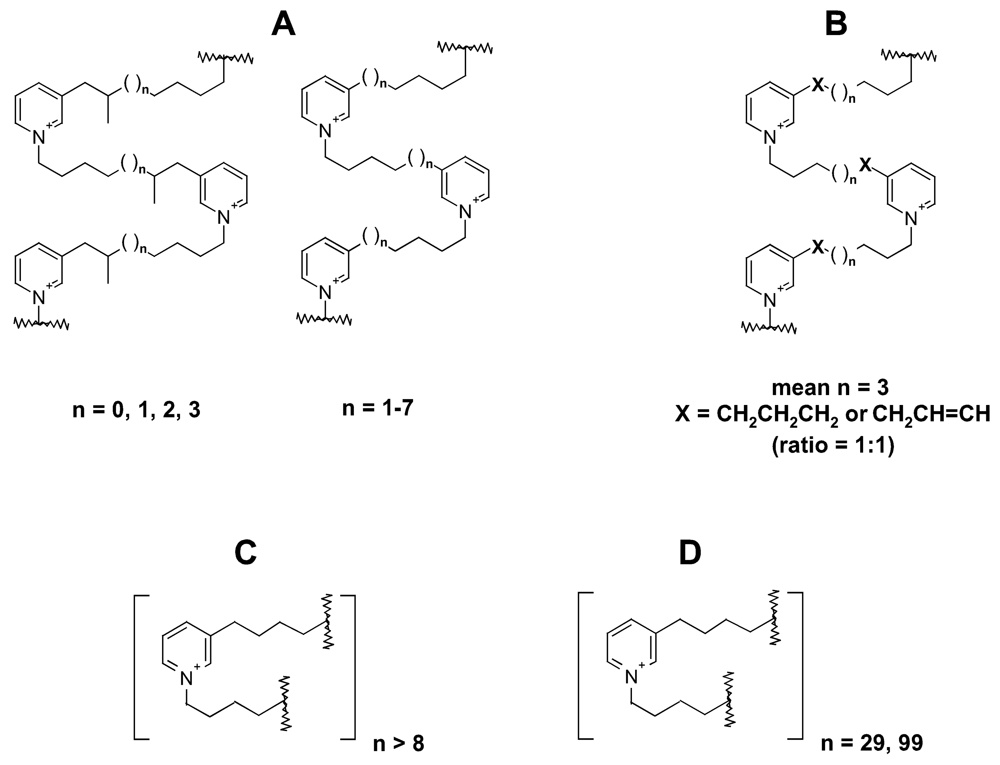
<p>Monomeric, oligomeric and polymeric 3-alkylpyridiniums and 3-alkylpyridines comprise a group of biologically active compounds found in several sponges of the order Haplosclerida &#x0005B;<xref ref-type="bibr" rid="b1-marinedrugs-05-00157">1</xref>&#x02013;<xref ref-type="bibr" rid="b4-marinedrugs-05-00157">4</xref>&#x0005D;. In general, the variety and potency of the biological effects of these compounds increase with their degree of polymerisation, resulting in complex and unprecedented mechanisms of action and/or toxicity. 3-Alkylpyridinium polymers isolated so far from haplosclerid marine sponges are shown in <xref ref-type="fig" rid="f1-marinedrugs-05-00157">Figure 1</xref>. Among them, polymeric 3-alkylpyridinium salts (poly-APS), isolated from crude extracts of the Mediterranean marine sponge <italic>Reniera sarai</italic>, show the highest degree of polymerisation.</p>
<p>Matrix-assisted laser desorption/ionization time-of-flight (MALDI-TOF) mass spectrometry has shown that poly-APS are a mixture of two main polymers with molecular weights of 5520 and 18900 Da, corresponding to polymers composed of 29 and 99 covalently head-to-tail linked N-butyl-3-butyl pyridinium units, respectively (<xref ref-type="fig" rid="f1-marinedrugs-05-00157">Figure 1D</xref>). Poly-APS are highly water-soluble (up to a concentration of 50 mg/mL), and have only limited solubility in other less polar organic solvents like methanol and ethanol. At concentrations of more than 0.23 mg/mL they form large supramolecular aggregates with an average hydrodynamic radius of 23 &#x000B1; 2 nm &#x0005B;<xref ref-type="bibr" rid="b5-marinedrugs-05-00157">5</xref>&#x0005D;. This behaviour resembles that of other structurally related cationic detergents like cetylpyridinium chloride (CPC) and cetyltrimethylammonium bromide (CTAB) &#x0005B;<xref ref-type="bibr" rid="b6-marinedrugs-05-00157">6</xref>&#x0005D;. Similarly, the biological effects exerted by poly-APS reflect, at least in part, their surfactant-like nature. At concentrations below 0.5 &#x003BC;g/mL, poly-APS act as antifouling compounds &#x0005B;<xref ref-type="bibr" rid="b7-marinedrugs-05-00157">7</xref>&#x0005D;, are strong inhibitors of acetylcholinesterase (AChE) &#x0005B;<xref ref-type="bibr" rid="b5-marinedrugs-05-00157">5</xref>&#x0005D;, and show moderate haemolytic and cytotoxic activity &#x0005B;<xref ref-type="bibr" rid="b6-marinedrugs-05-00157">6</xref>,<xref ref-type="bibr" rid="b8-marinedrugs-05-00157">8</xref>&#x0005D; that allows stable transfection of living cells with double-stranded DNA &#x0005B;<xref ref-type="bibr" rid="b9-marinedrugs-05-00157">9</xref>&#x0005D;. The concentrations of poly-APS that produce biological effects are far below their aggregation point, strongly suggesting that the observed activities are properties of the monomolecular form of the compounds. In higher concentrations (above 1 mg/mL), poly-APS can be toxic and lethal to experimental animals after intravenous (<italic>i.v.</italic>) application. The aim of this review is to summarize current knowledge on the biological activity and toxicity of poly-APS, with particular emphasis on mechanisms of poly-APS toxicity <italic>in vivo</italic>, and to correlate their structural characteristics and behaviour in aqueous solution with their observed biological effects.</p></sec>
<sec>
<title>2. Biological activity and toxicity of 3-alkylpyridinium compounds &#x02013; an overview</title>
<p>To date, around 30 and 50 structurally different 3-alkylpyridinium and 3-alkylpyridine compounds have been isolated, respectively, from marine sponges. They occur mainly in sponges belonging to the order Haplosclerida, and can therefore also be used as chemical markers for the determination of haplosclerid sponges. 3-Alkylpyridinium and 3-alkylpyridine compounds and their biological activities have been described in detail in several reviews &#x0005B;<xref ref-type="bibr" rid="b1-marinedrugs-05-00157">1</xref>&#x02013;<xref ref-type="bibr" rid="b4-marinedrugs-05-00157">4</xref>&#x0005D;. The majority of these compounds are monomeric and display mainly cytotoxic and/or antibacterial activities at concentrations of a few micrograms per mL &#x0005B;<xref ref-type="bibr" rid="b3-marinedrugs-05-00157">3</xref>,<xref ref-type="bibr" rid="b4-marinedrugs-05-00157">4</xref>&#x0005D;. A smaller number of oligomeric and polymeric 3-alkylpyridinium salts have also been isolated and partially characterized. Linear and cyclic 3-alkylpyridinium dimers and trimers are reported to be cytotoxic, antimitotic and inhibitory to muscarinic acetylcholine receptors and to some enzymes like histone deacetylase &#x0005B;reviewed in <xref ref-type="bibr" rid="b3-marinedrugs-05-00157">3</xref>,<xref ref-type="bibr" rid="b4-marinedrugs-05-00157">4</xref>&#x0005D;. Polymeric compounds on the other hand, like halitoxins &#x0005B;<xref ref-type="bibr" rid="b10-marinedrugs-05-00157">10</xref>&#x02013;<xref ref-type="bibr" rid="b12-marinedrugs-05-00157">12</xref>&#x0005D;, amphitoxins &#x0005B;<xref ref-type="bibr" rid="b13-marinedrugs-05-00157">13</xref>&#x0005D;, natural and synthetic epidermal growth factor (EGF)-active factors &#x0005B;<xref ref-type="bibr" rid="b14-marinedrugs-05-00157">14</xref>,<xref ref-type="bibr" rid="b15-marinedrugs-05-00157">15</xref>&#x0005D; and poly-APS &#x0005B;<xref ref-type="bibr" rid="b5-marinedrugs-05-00157">5</xref>&#x0005D; (<xref ref-type="fig" rid="f1-marinedrugs-05-00157">Figure 1</xref>), show many more diverse and potent biological activities. Halitoxin was reported to be haemolytic and cytotoxic towards transformed cells, toxic to fish and mice, inhibitory to some Gram positive bacteria, antimitotic and neurotoxic &#x0005B;<xref ref-type="bibr" rid="b10-marinedrugs-05-00157">10</xref>,<xref ref-type="bibr" rid="b11-marinedrugs-05-00157">11</xref>&#x0005D;, and amphitoxin shows antifeedant activity against fish &#x0005B;<xref ref-type="bibr" rid="b13-marinedrugs-05-00157">13</xref>&#x0005D;. A mixture of these two toxins, isolated from the haplosclerid sponge <italic>Amphimedon viridis</italic>, was found to selectively inhibit the growth of marine and sponge-associated bacteria &#x0005B;<xref ref-type="bibr" rid="b16-marinedrugs-05-00157">16</xref>&#x0005D;. EGF-active factors are cytotoxic and inhibitory to the EGF receptor that is overexpressed in several tumour cells &#x0005B;<xref ref-type="bibr" rid="b14-marinedrugs-05-00157">14</xref>&#x0005D;. Finally, poly-APS possess a broad range of potent biological activities, the most prominent being cytolytic, haemolytic, acetylcholinesterase-inhibitory and antifouling, that are reviewed in detail in the following sections.</p>
<p>In general, several biological activities of 3-alkylpyridinium compounds, as well as their potency, increase with the degree of polymerisation. This phenomenon is most prominent in one of the most studied 3-alkylpyridinium polymers, poly-APS, whose polycationic nature and surfactant-like behaviour in aqueous solution are responsible not only for the high potency of the biological activities, but also for the complex and unprecedented mechanisms by which the latter are achieved.</p></sec>
<sec>
<title>3. Biological activities of polymeric 3-alkylpyridinium salts (poly-APS) from the marine sponge <italic>Reniera sarai</italic></title>
<sec>
<title>3.1. Membrane activity</title>
<p>The ability of poly-APS to form lesions in biological membranes can be explained, at least partially, by their surfactant-like characteristics. Despite their polymeric nature and considerably shorter alkyl tail, poly-APS are structurally related to cationic pyridinium detergents like CPC and CTAB &#x0005B;<xref ref-type="bibr" rid="b6-marinedrugs-05-00157">6</xref>&#x0005D;. In aqueous solution poly-APS display surfactant-like properties; for example, at 0.23 mg/mL, they form large micelle-like non-covalently bound aggregates &#x0005B;<xref ref-type="bibr" rid="b5-marinedrugs-05-00157">5</xref>&#x0005D;. Poly-APS are lytic to erythrocytes and different cell lines in sub-micromolar concentrations &#x0005B;<xref ref-type="bibr" rid="b8-marinedrugs-05-00157">8</xref>&#x0005D;. In erythrocytes, they induce the formation of discrete lesions in the membrane (5.8 nm in diameter) by a colloid-osmotic type of lysis &#x0005B;<xref ref-type="bibr" rid="b6-marinedrugs-05-00157">6</xref>&#x0005D;. Haemolysis can be attenuated or prevented by various divalent cations &#x0005B;<xref ref-type="bibr" rid="b6-marinedrugs-05-00157">6</xref>&#x0005D;, and is surprisingly much more effective at lower temperatures (Sep&#x0010D;i&#x00107; and Turk, unpublished observation). Further electrophysiological studies on different cell lines showed that poly-APS display dose-dependent interactions with cell membranes &#x0005B;<xref ref-type="bibr" rid="b17-marinedrugs-05-00157">17</xref>&#x0005D;. At low concentrations (around 0.5 &#x003BC;g/mL), these can be reversible and can enable transfection of HEK293 cells with alien DNA for enhanced green fluorescent protein, pBABE and TNF receptor type 2 &#x0005B;<xref ref-type="bibr" rid="b9-marinedrugs-05-00157">9</xref>,<xref ref-type="bibr" rid="b18-marinedrugs-05-00157">18</xref>&#x0005D;. Although being four-fold less efficient than the transfection agent lipofectamine, compounds like poly-APS have been proposed as new tools for stable cell transfection &#x0005B;<xref ref-type="bibr" rid="b19-marinedrugs-05-00157">19</xref>&#x0005D;. The mechanism of poly-APS-induced transfection differs from that induced by lipofectamine &#x0005B;<xref ref-type="bibr" rid="b18-marinedrugs-05-00157">18</xref>&#x0005D; and still remains to be explained. It comprises both the formation of reversible membrane lesions and binding to DNA &#x0005B;<xref ref-type="bibr" rid="b18-marinedrugs-05-00157">18</xref>&#x0005D;, and is (like haemolysis) more effective at lower temperatures (7&#x02013;12&#x000B0;C), suggesting that temperature-dependent alterations of the physical properties of the membrane can be key events in poly-APS membrane activity. Furthermore, the degree of polymerisation appears to play an important role in this event, since monomeric CPC and CTAB failed to transfect cells &#x0005B;<xref ref-type="bibr" rid="b17-marinedrugs-05-00157">17</xref>&#x0005D;. Recent studies, using surface plasmon resonance &#x0005B;<xref ref-type="bibr" rid="b20-marinedrugs-05-00157">20</xref>&#x0005D;, suggest that the mechanism of poly-APS-induced membrane activity comprises sequential binding of these molecules to lipid membranes. Poly-APS molecules that are present within the membrane at sub-lytic concentrations might provide either cooperative support for further poly-APS &#x02013; membrane interactions, or could produce sites of membrane vulnerability, leading to its disruption.</p></sec>
<sec>
<title>3.2. Antifouling activity</title>
<p>Sponges are sessile animals that breathe and that feed by filtering the water. Production of biologically active compounds that prevent other micro- and macroorganisms from settling on their surface is therefore extremely important for their survival. Indeed, we found that the surface of <italic>Reniera sarai</italic> is almost never fouled by other marine organisms. It is veiled by a greasy coating incorporating large amounts of poly-APS, which appear to be responsible for the observed effective antisettlement activity. The antimicro- and antimacrofouling activity of poly-APS was studied in details under <italic>in vitro</italic> conditions, and compared to booster biocides like Zinc Omadine<sup>&#x000AE;</sup> and Copper Omadine<sup>&#x000AE;</sup>, compounds showing irreversible antifouling properties that are due to their toxicity towards marine biota &#x0005B;<xref ref-type="bibr" rid="b7-marinedrugs-05-00157">7</xref>&#x0005D;.</p>
<p>Poly-APS inhibit the settlement of <italic>Balanus amphitrite</italic> cypris larvae with an EC<sub>50</sub> of 0.27 &#x003BC;g/mL &#x02013; about ten fold less effective than the booster biocides. However, in contrast to the latter, the antisettlement activity of poly-APS was almost non-toxic and reversible. A similar phenomenon was also observed in the swimming inhibition assay against <italic>B. amphitrite</italic> nauplii, as well as in toxicity tests against other relevant representatives of the phyto- and zooplankton (e.g. microalga <italic>Tetraselmis suecica</italic> and larvae of the edible mussel <italic>Mytilus galloprovincialis</italic>). Besides their antimacrofouling properties, poly-APS, in the range of 0.1&#x02013;1 &#x003BC;g/mL, also inhibit fouling by bacteria, fungi, and microalgae &#x0005B;<xref ref-type="bibr" rid="b21-marinedrugs-05-00157">21</xref>&#x0005D;, and show considerable antibacterial activity against marine biofilm bacteria &#x0005B;<xref ref-type="bibr" rid="b22-marinedrugs-05-00157">22</xref>&#x0005D;. All these features suggest poly-APS (or their synthetic analogues) as good candidates for new biocides in the development of antifouling paints. The poly-APS inhibition of settlement of cyprids can be partially explained in terms of their surfactant properties. In aqueous solution, they behave similarly to cationic detergents &#x0005B;<xref ref-type="bibr" rid="b6-marinedrugs-05-00157">6</xref>&#x0005D; and are lytic to different cell lines &#x0005B;<xref ref-type="bibr" rid="b8-marinedrugs-05-00157">8</xref>&#x0005D;, so the detergent-induced prevention of adhesion and lysis of microorganisms could be possible mechanisms of their antifouling action. On the other hand, acetylcholine was suggested to be involved in the settlement of <italic>B. amphitrite</italic> cyprids &#x0005B;<xref ref-type="bibr" rid="b23-marinedrugs-05-00157">23</xref>&#x0005D;, and AChE activity has been detected in the setae of the antennules, which play an important role in the process of settlement of this organism &#x0005B;<xref ref-type="bibr" rid="b24-marinedrugs-05-00157">24</xref>&#x0005D;. The application of AChE inhibitors clearly inhibited larval settlement &#x0005B;<xref ref-type="bibr" rid="b23-marinedrugs-05-00157">23</xref>&#x0005D;, so another mechanism of poly-APS - induced antifouling activity could derive from their potent AChE-inhibitory properties &#x0005B;<xref ref-type="bibr" rid="b25-marinedrugs-05-00157">25</xref>,<xref ref-type="bibr" rid="b26-marinedrugs-05-00157">26</xref>&#x0005D;.</p></sec>
<sec>
<title>3.3. Inhibition of acetylcholinesterase</title>
<p>The most prominent biological activity attributed to poly-APS is probably the inhibition of acetylcholinesterase (AChE), the enzyme that hydrolyses the neurotransmitter acetylcholine (ACh) in nervous system synapses. The hydrolysis of ACh takes place at the bottom of a 20 &#x000C5; deep enzyme active gorge, which bears the anionic site responsible for the recognition of choline, and the catalytic site with the active serine (responsible for cleaving the substrate). At the rim of the gorge is another choline binding site &#x02013; the peripheral anionic site &#x0005B;<xref ref-type="bibr" rid="b27-marinedrugs-05-00157">27</xref>&#x0005D;. This site is responsible for the inhibition by excess substrate, and for binding of the AChE inhibitor propidium. Only a few natural AChE inhibitors have been isolated from marine organisms &#x0005B;<xref ref-type="bibr" rid="b5-marinedrugs-05-00157">5</xref>, <xref ref-type="bibr" rid="b28-marinedrugs-05-00157">28</xref>-<xref ref-type="bibr" rid="b31-marinedrugs-05-00157">31</xref>&#x0005D; and, of these, poly-APS are the most potent, with unprecedented inhibition kinetics. Simple synthetic mono-, di- and tetrameric alkylpyridinium compounds have also been described as anti-cholinesterase agents that act in micromolar concentrations &#x0005B;<xref ref-type="bibr" rid="b25-marinedrugs-05-00157">25</xref>, <xref ref-type="bibr" rid="b32-marinedrugs-05-00157">32</xref>, <xref ref-type="bibr" rid="b33-marinedrugs-05-00157">33</xref>&#x0005D;. All these compounds show reversible and competitive, non-competitive or mixed type inhibition kinetics following their binding to the anionic site inside the active gorge, to the peripheral anionic site, or to both, respectively. In contrast, poly-APS strongly inhibits AChEs and butyrylcholinesterases (BuChEs) from different sources at nanomolar concentrations &#x0005B;<xref ref-type="bibr" rid="b5-marinedrugs-05-00157">5</xref>, <xref ref-type="bibr" rid="b25-marinedrugs-05-00157">25</xref>&#x0005D;, showing a non-linear, time-dependent course of inhibition. These types of inhibition curves often reflect the presence of a slow-binding and/or irreversible component in the inhibition, the latter being confirmed by the fact that the activity of the enzyme could never be completely restored after dilution of the enzyme-inhibitor mixture &#x0005B;<xref ref-type="bibr" rid="b25-marinedrugs-05-00157">25</xref>&#x0005D;. By analysing the different phases of AChE inhibition by poly-APS, we found that the first interaction between the two molecules is reversible and non-competitive, with a <italic>K<sub>i</sub></italic> of 11&#x000B1;3 nM. This finding, together with the ability of poly-APS to compete with the binding of propidium or with substrate inhibition (at high concentrations of substrate), suggests that the first binding of the inhibitor occurs at the peripheral anionic site of AChE &#x0005B;<xref ref-type="bibr" rid="b25-marinedrugs-05-00157">25</xref>&#x0005D;. This binding is followed by a slow-binding component showing a <italic>K<sub>i</sub></italic> (<italic>k<sub>rec</sub>/k<sub>bind</sub></italic>) of 3.23 &#x003BC;M, and finally by irreversible inactivation of the enzyme, following pseudo-first order kinetics and showing a <italic>k<sub>i</sub></italic> of 388&#x000B1;47 mmol-1Lmin-1 &#x0005B;<xref ref-type="bibr" rid="b25-marinedrugs-05-00157">25</xref>&#x0005D;. The observed complex inhibition kinetics result from the high degree of polymerisation of poly-APS. Indeed, the inhibitor does not induce significant changes of the enzyme conformation, but extensively quenches its intrinsic tryptophan fluorescence, suggesting that the first, reversible binding to the peripheral anionic site is followed by successive binding of different poly-APS pyridinium units to several sites on the AChE molecule &#x0005B;<xref ref-type="bibr" rid="b26-marinedrugs-05-00157">26</xref>&#x0005D;. This multisite binding between the two molecules results in aggregation and precipitation of the enzyme-inhibitor complexes, that can be followed by sodium dodecyl sulfate polyacrylamide gel electrophoresis (SDS-PAGE) analysis of the sediment obtained after AChE &#x02013; poly-APS incubation and centrifuging, as well as by eye &#x0005B;<xref ref-type="bibr" rid="b26-marinedrugs-05-00157">26</xref>&#x0005D;. It is interesting that poly-APS appear to interact specifically with AChE, since they do not inhibit other enzymes like trypsin and alkaline phosphatase &#x0005B;<xref ref-type="bibr" rid="b26-marinedrugs-05-00157">26</xref>&#x0005D;, and are only slightly inhibitory to human protein phosphatase 2A &#x0005B;<xref ref-type="bibr" rid="b33-marinedrugs-05-00157">33</xref>&#x0005D;. It must however be stressed that the polycationic nature of poly-APS can result in binding to other proteins that is less specific, as demonstrated for serum proteins &#x0005B;<xref ref-type="bibr" rid="b34-marinedrugs-05-00157">34</xref>&#x0005D;.</p>
<p>The AChE-inhibitory activity appears to be related to the antitumoral activity of poly-APS towards non-small cell lung cancer cells (NSCLC). These cells are responsible for the most common form of lung cancer, and have been shown to express molecules belonging to the cholinergic system, such as cholinoacetyltransferase, vesicular ACh transporter and AChE. Poly-APS, in non-toxic concentrations, show a significant selective cytotoxicity towards NSCLC cells, with no significant effects on normal cells <italic>in vitro</italic> and normal tissues <italic>in vivo</italic> &#x0005B;<xref ref-type="bibr" rid="b35-marinedrugs-05-00157">35</xref>&#x0005D;. Based on observations that some drugs used in lung cancer treatment and therapy, such as Irinotecan, can also inhibit AChE activity &#x0005B;<xref ref-type="bibr" rid="b36-marinedrugs-05-00157">36</xref>,<xref ref-type="bibr" rid="b37-marinedrugs-05-00157">37</xref>&#x0005D;, our results suggest that the selective cytotoxicity of poly-APS against NSCLC cells derives from the interruption of the NSCLC cells&#x02019; cholinergic system through AChE inhibition, resulting in their apoptosis.</p></sec></sec>
<sec>
<title>4. Toxicity of 3-alkylpyridinium compounds &#x02013; an overview</title>
<p>The toxic effects of 3-alkylpyridinium compounds, commonly expressed as an EC<sub>50</sub> or LD<sub>50</sub> dose, have been quantified using different plant and animal species. These effects include toxicity and/or antifeeding activity against different marine organisms (fish, starfish and amphipods), which were observed for a mixture of polymeric halitoxins &#x0005B;<xref ref-type="bibr" rid="b10-marinedrugs-05-00157">10</xref>&#x0005D;, amphitoxins &#x0005B;<xref ref-type="bibr" rid="b13-marinedrugs-05-00157">13</xref>&#x0005D;, and for oligomeric haliclamines &#x0005B;<xref ref-type="bibr" rid="b38-marinedrugs-05-00157">38</xref>&#x0005D;. A recent report on the activity of cyclohaliclonamines A-E from an unidentified sponge of the genus <italic>Haliclona</italic> &#x0005B;<xref ref-type="bibr" rid="b39-marinedrugs-05-00157">39</xref>&#x0005D; demonstrated the toxicity of these compounds in a brine shrimp assay, with an LD<sub>50</sub> of 65 &#x003BC;g/mL. The toxic effects of polymeric alkylpyridinium salts (poly-APS) from the marine sponge <italic>Reniera sarai</italic> were also studied on various target organisms, and are discussed in detail below.</p></sec>
<sec>
<title>5. Toxicity of polymeric 3-alkylpyridinium salts (poly-APS) from the marine sponge <italic>R. sarai</italic></title>
<sec>
<title>5. 1. Toxicity of poly-APS to non-mammals</title>
<p>During the evaluation of their antifouling potential, polymeric 3-alkylpyridinium salts (poly-APS) from the sponge <italic>Reniera sarai</italic> were found to be slightly toxic to the naupliar larvae of <italic>Balanus amphitrite</italic> (LC<sub>50</sub> &#x0003D; 30.01 &#x003BC;g/mL in a 24-h assay), to the microalga <italic>Tetraselmis suecica</italic> (LC<sub>50</sub> &#x0003D; 10.66 &#x003BC;g/mL in a 72-h assay), and to trocophora and veliger larvae of the edible mussel <italic>Mytillus galloprovincialis</italic> (LC<sub>50</sub> &#x0003D; 2.42 and 2.73 &#x003BC;g/mL in a 24 h assay, respectively) &#x0005B;<xref ref-type="bibr" rid="b7-marinedrugs-05-00157">7</xref>&#x0005D;. Interestingly, in contrast to amphitoxins &#x0005B;<xref ref-type="bibr" rid="b13-marinedrugs-05-00157">13</xref>&#x0005D;, poly-APS were not ichtyotoxic towards freshwater and sea fish at a concentration of 0.1 &#x003BC;g/mL (unpublished observation).</p></sec>
<sec>
<title>5. 2. Toxicity of poly-APS to mammals</title>
<p>The ability of poly-APS to strongly inhibit AChE <italic>in vitro</italic> has resulted in further studies of their effects in experimental rodents <italic>in vivo</italic> &#x0005B;<xref ref-type="bibr" rid="b34-marinedrugs-05-00157">34</xref>, <xref ref-type="bibr" rid="b40-marinedrugs-05-00157">40</xref>, <xref ref-type="bibr" rid="b41-marinedrugs-05-00157">41</xref>&#x0005D;. In sublethal doses, poly-APS produce pharmacological effects characteristic of AChE inhibition, including bradicardia, low blood pressure and prolonged expiratory phase of breathing. However, the lethality, following the injection of rats with a lethal dose of poly-APS, appears not to derive just from AChE inhibition, but also seems to reflect their highly polycationic nature and surfactant-like behaviour.</p>
<p><italic>In vivo</italic> experiments with poly-APS were performed on male Wistar rats. Different doses of the toxin (dissolved in physiological solution) were applied slowly for 20&#x02013;40 s through the cannulated jugular vein. Electrocardiograms (ECG), blood pressure and breathing patterns were monitored, followed by histological post-mortem analysis of vital organs. At sublethal doses (below 1 mg/kg) poly-APS induced a transient fall in blood pressure, bradycardia and prolongation of expirium &#x0005B;<xref ref-type="bibr" rid="b40-marinedrugs-05-00157">40</xref>,<xref ref-type="bibr" rid="b41-marinedrugs-05-00157">41</xref>&#x0005D;. These signs probably derive from the inhibition of AChE. The consequent accumulation of ACh and its peripheral action could readily result in the observed effects like bradycardia and fall in cardiac output. However, at lethal doses (above 2.7 mg/kg), the signs were not completely typical of AChE inhibition, and were masked by other, more pronounced and faster developing lethal effects produced by the toxin. Reduction of the arterial blood pressure to a mid-circulatory pressure was observed, which could reflect a peripheral effect of ACh on the heart, and probably the central action of poly-APS (acting as anti-AChE agents) on the medullary vasomotor and cardiac centres of the central nervous system. Furthermore, the observed cessation of breathing after a few breaths, with cyanosis and an increase of the residual volume, may also be induced by the AChE-inhibitory activity of poly-APS, resulting in contraction of smooth muscle fibres of the bronchioles. The resulting hypoxemia can both intensify sympathetic tone and trigger ACh-evoked epinephrine release from the adrenal medulla. For these reasons, it is not surprising that normal or even increased heart rate was observed in experimental animals receiving lethal doses of poly-APS. These signs are similar to those induced by a related sponge-derived compound, halitoxin &#x0005B;<xref ref-type="bibr" rid="b10-marinedrugs-05-00157">10</xref>,<xref ref-type="bibr" rid="b11-marinedrugs-05-00157">11</xref>&#x0005D; which was lethal to mice, with an <italic>i.v.</italic> LD<sub>50</sub> of 1.4 mg/kg. The intoxicated mice were cyanotic and died of respiratory arrest.</p>
<p>Autopsy of the experimental animals that died due to the effects of poly-APS revealed that the lumen of the mid- and small-sized blood vessels in the heart and lungs were filled with granular brownish material with inclusions of fibrin, red blood cells and platelets. Perivascular and intra-alveolar haemorrhages were also regularly observed that could also contribute to the diffusion abnormalities and result in hypoxemia. Data obtained on blood samples from animals treated with poly-APS showed numerous thrombocyte aggregates &#x0005B;<xref ref-type="bibr" rid="b40-marinedrugs-05-00157">40</xref>,<xref ref-type="bibr" rid="b41-marinedrugs-05-00157">41</xref>&#x0005D;. Further <italic>in vitro</italic> studies have revealed that poly-APS do not affect the coagulation rate, but rather induce thrombocyte aggregation in a dose-dependent manner. Aggregation of thrombocytes could be followed, up to a poly-APS concentration of 100 ng/mL &#x0005B;<xref ref-type="bibr" rid="b34-marinedrugs-05-00157">34</xref>,<xref ref-type="bibr" rid="b41-marinedrugs-05-00157">41</xref>&#x0005D;. This fact, together with the finding that they can bind directly and non-specifically to plasma serum proteins &#x0005B;<xref ref-type="bibr" rid="b34-marinedrugs-05-00157">34</xref>&#x0005D;, has been proposed as the underlying mechanism of poly-APS lethality.</p>
<p>The different effects observed after intravenous applications of different doses of poly-APS could derive from their ability to form large, non-covalently bound supramolecular aggregates, a process that occurs in water solutions at around 0.23 mg/mL &#x0005B;<xref ref-type="bibr" rid="b5-marinedrugs-05-00157">5</xref>&#x0005D;. Thus, at lower doses, the greater part of the poly-APS injected into the experimental animal probably exists in the monomolecular form, which allows passage through the capillary walls and action as AChE inhibitors on neuromuscular junctions. Therefore, higher concentrations of poly-APS in their monomolecular form might block neuromuscular transmission and produce respiratory arrest. At higher doses, in which the majority of poly-APS exist in the form of spherically shaped aggregates with a diameter of 46 nm &#x0005B;<xref ref-type="bibr" rid="b5-marinedrugs-05-00157">5</xref>&#x0005D;, crossing of capillary walls is less reasonable, so that other toxic mechanisms, including the aggregation of poly-APS with thrombocytes and serum proteins, leading to the formation of large intravascular plugs, are more pronounced. The ability of poly-APS to permeabilize the membranes of erythrocytes and other cells &#x0005B;<xref ref-type="bibr" rid="b6-marinedrugs-05-00157">6</xref>,<xref ref-type="bibr" rid="b8-marinedrugs-05-00157">8</xref>&#x0005D; is an additional factor that could produce toxic effects through direct cytolysis of endothelial cells. Indeed, microscope examination of blood smears obtained from poly-APS-treated experimental animals revealed several lysed erythrocytes which could, in the case of severe lysis, produce hyperkalaemia and reduce oxygen transport capacity. Blood samples of halitoxin-treated experimental animals also showed partial haemolysis, and lethal effects were therefore attributed to the haemolytic action of the toxin &#x0005B;<xref ref-type="bibr" rid="b11-marinedrugs-05-00157">11</xref>&#x0005D;.</p>
<p>In conclusion, the observed <italic>in vivo</italic> toxic effects of poly-APS (and probably of other polymerised 3-alkylpyridinium salts like halitoxins &#x0005B;<xref ref-type="bibr" rid="b10-marinedrugs-05-00157">10</xref>,<xref ref-type="bibr" rid="b11-marinedrugs-05-00157">11</xref>&#x0005D;) reflect their polycationic nature and behaviour in aqueous solution. While at lower concentrations poly-APS can act as AChE inhibitors, at higher doses other mechanisms producing haematological and vascular effects dominate and mask these effects. Besides the membrane-permeabilizing activity on erythrocytes and other tissue cells, which is probably also responsible for arrhythmia and thrombocyte aggregation, the non-specific binding of poly-APS to different serum proteins and membrane-bound proteins on platelets induces the formation of large plugs that could block the small blood vessels and stop the lung and heart blood flow.</p></sec></sec></body>
<back>
<ack>
<title>Acknowledgements</title>
<p>The authors would like to acknowledge the Slovenian Research Agency (ARRS) for their financial support, and Prof. Roger Pain for critically reading the manuscript.</p></ack>
<fn-group><fn>
<p><italic>Sample Availability:</italic> Available from the authors.</p></fn></fn-group>
<ref-list>
<title>References</title>
<ref id="b1-marinedrugs-05-00157"><label>1</label><citation citation-type="journal"><person-group person-group-type="author"><name><surname>Almeida</surname><given-names>AMP</given-names></name><name><surname>Berlinck</surname><given-names>RGS</given-names></name></person-group><article-title>Alcal&#x000F3;ides alquilpirid&#x000ED;nicos de esponjas marinhas</article-title><source>Quim Nova</source><year>1997</year><volume>20</volume><fpage>170</fpage><lpage>185</lpage></citation></ref>
<ref id="b2-marinedrugs-05-00157"><label>2</label><citation citation-type="journal"><person-group person-group-type="author"><name><surname>Sep&#x0010D;i&#x00107;</surname><given-names>K</given-names></name></person-group><article-title>Bioactive alkylpyridinium compounds from marine sponges</article-title><source>J Toxicol , Toxin Rev</source><year>2000</year><volume>19</volume><fpage>139</fpage><lpage>160</lpage></citation></ref>
<ref id="b3-marinedrugs-05-00157"><label>3</label><citation citation-type="book"><person-group person-group-type="author"><name><surname>Sep&#x0010D;i&#x00107;</surname><given-names>K</given-names></name><name><surname>Turk</surname><given-names>T</given-names></name></person-group><person-group person-group-type="editor"><name><surname>Fusetani</surname><given-names>N</given-names></name><name><surname>Clare</surname><given-names>AC</given-names></name></person-group><article-title>3-alkylpyridinium compounds as potential non-toxic antifouling agents</article-title><source>Antifouling Compounds, Progress in Molecular and Subcellular Biology, Subseries Marine Molecular Biotechnology</source><publisher-name>Springer-Verlag</publisher-name><publisher-loc>Berlin, Heidelberg</publisher-loc><year>2006</year><fpage>105</fpage><lpage>124</lpage></citation></ref>
<ref id="b4-marinedrugs-05-00157"><label>4</label><citation citation-type="journal"><person-group person-group-type="author"><name><surname>Turk</surname><given-names>T</given-names></name><name><surname>Sep&#x0010D;i&#x00107;</surname><given-names>K</given-names></name><name><surname>Mancini</surname><given-names>I</given-names></name><name><surname>Guella</surname><given-names>G</given-names></name></person-group><article-title>3-alkylpyridinium and 3-alkylpyridine compounds from marine sponges, their synthesis, biological activities and potential use</article-title><source>In Stud Nat Prod Chem</source><year>2007</year><comment>in press</comment></citation></ref>
<ref id="b5-marinedrugs-05-00157"><label>5</label><citation citation-type="journal"><person-group person-group-type="author"><name><surname>Sep&#x0010D;i&#x00107;</surname><given-names>K</given-names></name><name><surname>Guella</surname><given-names>G</given-names></name><name><surname>Mancini</surname><given-names>I</given-names></name><name><surname>Pietra</surname><given-names>F</given-names></name><name><surname>Dalla Serra</surname><given-names>M</given-names></name><name><surname>Menestrina</surname><given-names>G</given-names></name><name><surname>Tubbs</surname><given-names>K</given-names></name><name><surname>Ma&#x0010D;ek</surname><given-names>P</given-names></name><name><surname>Turk</surname><given-names>T</given-names></name></person-group><article-title>Characterization of anticholinesterase-active 3-alkylpyridinium polymers from the marine sponge <italic>Reniera sarai</italic> in aqueous solutions</article-title><source>J Nat Prod</source><year>1997a</year><volume>60</volume><fpage>991</fpage><lpage>996</lpage></citation></ref>
<ref id="b6-marinedrugs-05-00157"><label>6</label><citation citation-type="journal"><person-group person-group-type="author"><name><surname>Malovrh</surname><given-names>P</given-names></name><name><surname>Sep&#x0010D;i&#x00107;</surname><given-names>K</given-names></name><name><surname>Turk</surname><given-names>T</given-names></name><name><surname>Ma&#x0010D;ek</surname><given-names>P</given-names></name></person-group><article-title>Characterization of haemolytic activity of 3-alkylpyridinium polymers from the marine sponge <italic>Reniera sarai</italic></article-title><source>Comp Biochem Physiol</source><year>1999</year><volume>124C</volume><fpage>221</fpage><lpage>226</lpage></citation></ref>
<ref id="b7-marinedrugs-05-00157"><label>7</label><citation citation-type="journal"><person-group person-group-type="author"><name><surname>Faimali</surname><given-names>M</given-names></name><name><surname>Sep&#x0010D;i&#x00107;</surname><given-names>K</given-names></name><name><surname>Turk</surname><given-names>T</given-names></name><name><surname>Geraci</surname><given-names>S</given-names></name></person-group><article-title>Non-toxic antifouling activity of polymeric 3-alkylpyridium salts from the Mediterranean sponge <italic>Reniera sarai</italic> (Pulitzer-Finali)</article-title><source>Biofouling</source><year>2003a</year><volume>19</volume><fpage>47</fpage><lpage>56</lpage></citation></ref>
<ref id="b8-marinedrugs-05-00157"><label>8</label><citation citation-type="journal"><person-group person-group-type="author"><name><surname>Sep&#x0010D;i&#x00107;</surname><given-names>K</given-names></name><name><surname>Batista</surname><given-names>U</given-names></name><name><surname>Vacelet</surname><given-names>J</given-names></name><name><surname>Ma&#x0010D;ek</surname><given-names>P</given-names></name><name><surname>Turk</surname><given-names>T</given-names></name></person-group><article-title>Biological activities of aqueous extracts from marine sponges and cytotoxic effects of 3-alkylpyridinium polymers from <italic>Reniera sarai</italic></article-title><source>Comp Biochem Physiol</source><year>1997b</year><volume>117C</volume><fpage>47</fpage><lpage>53</lpage></citation></ref>
<ref id="b9-marinedrugs-05-00157"><label>9</label><citation citation-type="journal"><person-group person-group-type="author"><name><surname>Tucker</surname><given-names>SJ</given-names></name><name><surname>McClelland</surname><given-names>D</given-names></name><name><surname>Jaspars</surname><given-names>M</given-names></name><name><surname>Sep&#x0010D;i&#x00107;</surname><given-names>K</given-names></name><name><surname>MacEwan</surname><given-names>DJ</given-names></name><name><surname>Scott</surname><given-names>RH</given-names></name></person-group><article-title>The influence of alkyl pyridinium sponge toxins on membrane properties, cytotoxicity, transfection and protein expression in mammalian cells</article-title><source>Biochim Biophys Acta</source><year>2003</year><volume>1614</volume><fpage>171</fpage><lpage>181</lpage></citation></ref>
<ref id="b10-marinedrugs-05-00157"><label>10</label><citation citation-type="journal"><person-group person-group-type="author"><name><surname>Schmitz</surname><given-names>FJ</given-names></name><name><surname>Hollenbeak</surname><given-names>KH</given-names></name><name><surname>Campbell</surname><given-names>DC</given-names></name></person-group><article-title>Marine natural products: halitoxin, toxic complex of several marine sponges of the genus <italic>Haliclona</italic></article-title><source>J Org Chem</source><year>1978</year><volume>43</volume><fpage>3916</fpage><lpage>3922</lpage></citation></ref>
<ref id="b11-marinedrugs-05-00157"><label>11</label><citation citation-type="journal"><person-group person-group-type="author"><name><surname>Berlinck</surname><given-names>RGS</given-names></name><name><surname>Ogawa</surname><given-names>CA</given-names></name><name><surname>Almeida</surname><given-names>AMP</given-names></name><name><surname>Sanchez</surname><given-names>MAA</given-names></name><name><surname>Malpezzi</surname><given-names>ELA</given-names></name><name><surname>Costa</surname><given-names>LV</given-names></name><name><surname>Hajdu</surname><given-names>E</given-names></name><name><surname>de Freitas</surname><given-names>JC</given-names></name></person-group><article-title>Chemical and pharmacological characterization of halitoxin from <italic>Amphimedon viridis</italic> (Porifera) from the southeastern Brazilian coast</article-title><source>Comp Biochem Physiol</source><year>1996</year><volume>115C</volume><fpage>155</fpage><lpage>163</lpage></citation></ref>
<ref id="b12-marinedrugs-05-00157"><label>12</label><citation citation-type="journal"><person-group person-group-type="author"><name><surname>Scott</surname><given-names>RH</given-names></name><name><surname>Whyment</surname><given-names>AD</given-names></name><name><surname>Foster</surname><given-names>A</given-names></name><name><surname>Gordon</surname><given-names>KH</given-names></name><name><surname>Milne</surname><given-names>BF</given-names></name><name><surname>Jaspars</surname><given-names>M</given-names></name></person-group><article-title>Analysis of the structure and electrophysiological actions of halitoxins: 1,3 alkyl-pyridinium salts from <italic>Callyspongia ridleyi</italic></article-title><source>J Membrane Biol</source><year>2000</year><volume>176</volume><fpage>119</fpage><lpage>131</lpage></citation></ref>
<ref id="b13-marinedrugs-05-00157"><label>13</label><citation citation-type="journal"><person-group person-group-type="author"><name><surname>Albrizio</surname><given-names>S</given-names></name><name><surname>Ciminiello</surname><given-names>P</given-names></name><name><surname>Fattorusso</surname><given-names>E</given-names></name><name><surname>Magno</surname><given-names>S</given-names></name><name><surname>Pawlik</surname><given-names>JR</given-names></name></person-group><article-title>Amphitoxin, a new high molecular weight antifeedant pyridinium salt from the Caribbean sponge <italic>Amphimedon compressa</italic></article-title><source>J Nat Prod</source><year>1995</year><volume>58</volume><fpage>647</fpage><lpage>652</lpage></citation></ref>
<ref id="b14-marinedrugs-05-00157"><label>14</label><citation citation-type="journal"><person-group person-group-type="author"><name><surname>Davies-Coleman</surname><given-names>MT</given-names></name><name><surname>Faulkner</surname><given-names>DJ</given-names></name><name><surname>Dubowchik</surname><given-names>GM</given-names></name><name><surname>Roth</surname><given-names>GP</given-names></name><name><surname>Polson</surname><given-names>C</given-names></name><name><surname>Fairchild</surname><given-names>C</given-names></name></person-group><article-title>A new EGF-active polymeric pyridinium alkaloid from the sponge <italic>Callyspongia fibrosa</italic></article-title><source>J Org Chem</source><year>1993</year><volume>58</volume><fpage>5925</fpage><lpage>5930</lpage></citation></ref>
<ref id="b15-marinedrugs-05-00157"><label>15</label><citation citation-type="journal"><person-group person-group-type="author"><name><surname>Gil</surname><given-names>L</given-names></name><name><surname>Gateau-Olesker</surname><given-names>A</given-names></name><name><surname>Wong</surname><given-names>YS</given-names></name><name><surname>Chernatova</surname><given-names>L</given-names></name><name><surname>Marazano</surname><given-names>C</given-names></name><name><surname>Das</surname><given-names>BC</given-names></name></person-group><article-title>Synthesis of macrocyclic or linear pyridinium oligomers from 3-substituted pyridines. Model synthetic studies toward macrocyclic marine alkaloids</article-title><source>Tetrahedron Lett</source><year>1995</year><volume>36</volume><fpage>2059</fpage><lpage>2062</lpage></citation></ref>
<ref id="b16-marinedrugs-05-00157"><label>16</label><citation citation-type="journal"><person-group person-group-type="author"><name><surname>Kelman</surname><given-names>D</given-names></name><name><surname>Kashman</surname><given-names>Y</given-names></name><name><surname>Rosenberg</surname><given-names>E</given-names></name><name><surname>Ilan</surname><given-names>M</given-names></name><name><surname>Ifrach</surname><given-names>I</given-names></name><name><surname>Loya</surname><given-names>Y</given-names></name></person-group><article-title>Antimicrobial activity of the reef sponge <italic>Amphimedon viridis</italic> from the Red Sea: evidence for selective toxicity</article-title><source>Aquat Microb Ecol</source><year>2001</year><volume>24</volume><fpage>9</fpage><lpage>16</lpage></citation></ref>
<ref id="b17-marinedrugs-05-00157"><label>17</label><citation citation-type="journal"><person-group person-group-type="author"><name><surname>McClelland</surname><given-names>D</given-names></name><name><surname>Evans</surname><given-names>RM</given-names></name><name><surname>Abidin</surname><given-names>I</given-names></name><name><surname>Sharma</surname><given-names>S</given-names></name><name><surname>Choudry</surname><given-names>FZ</given-names></name><name><surname>Jaspars</surname><given-names>M</given-names></name><name><surname>Sep&#x0010D;i&#x00107;</surname><given-names>K</given-names></name><name><surname>Scott</surname><given-names>RH</given-names></name></person-group><article-title>Irreversible and reversible pore formation by polymeric alkylpyridinium salts (poly-APS) from the sponge <italic>Reniera sarai</italic></article-title><source>Brit J Pharmacol</source><year>2003</year><volume>139</volume><fpage>1399</fpage><lpage>1408</lpage></citation></ref>
<ref id="b18-marinedrugs-05-00157"><label>18</label><citation citation-type="journal"><person-group person-group-type="author"><name><surname>McLaggan</surname><given-names>D</given-names></name><name><surname>Adjimatera</surname><given-names>N</given-names></name><name><surname>Sep&#x0010D;i&#x00107;</surname><given-names>K</given-names></name><name><surname>Jaspars</surname><given-names>M</given-names></name><name><surname>MacEwan</surname><given-names>DJ</given-names></name><name><surname>Blagbrough</surname><given-names>IS</given-names></name><name><surname>Scott</surname><given-names>RH</given-names></name></person-group><article-title>Pore forming polyalkylpyridinium salts from marine sponges versus synthetic lipofection systems: distinct tools for intracellular delivery of cDNA and siRNA</article-title><source>BMC Biotechnol</source><year>2006</year><volume>6</volume><fpage>6</fpage></citation></ref>
<ref id="b19-marinedrugs-05-00157"><label>19</label><citation citation-type="patent"><person-group person-group-type="author"><name><surname>Scott</surname><given-names>RH</given-names></name><name><surname>Jaspars</surname><given-names>M</given-names></name><name><surname>Platt</surname><given-names>B</given-names></name><name><surname>Reidel</surname><given-names>G</given-names></name><name><surname>Sep&#x0010D;i&#x00107;</surname><given-names>K</given-names></name><name><surname>McLaggan</surname><given-names>D</given-names></name></person-group><article-title>Sponge toxins</article-title><source>Patent WO 2004&#x02013;GB 2659 20040621</source><comment>International Application No. PCT/GB2004/002659</comment><year>2004</year></citation></ref>
<ref id="b20-marinedrugs-05-00157"><label>20</label><citation citation-type="journal"><person-group person-group-type="author"><name><surname>Koss</surname><given-names>DJ</given-names></name><name><surname>Hindley</surname><given-names>KP</given-names></name><name><surname>David</surname><given-names>KC</given-names></name><name><surname>Mancini</surname><given-names>I</given-names></name><name><surname>Guella</surname><given-names>G</given-names></name><name><surname>Sep&#x0010D;i&#x00107;</surname><given-names>K</given-names></name><name><surname>Turk</surname><given-names>T</given-names></name><name><surname>Rebolj</surname><given-names>K</given-names></name><name><surname>Riedel</surname><given-names>G</given-names></name><name><surname>Platt</surname><given-names>B</given-names></name><name><surname>Scott</surname><given-names>RH</given-names></name></person-group><article-title>A comparative study of the actions of alkylpyridinium salts from a marine sponge and related synthetic compounds in rat cultured hippocampal neurons</article-title><source>BMC Pharmacol</source><year>2007</year><volume>7</volume><fpage>1</fpage></citation></ref>
<ref id="b21-marinedrugs-05-00157"><label>21</label><citation citation-type="journal"><person-group person-group-type="author"><name><surname>Garaventa</surname><given-names>F</given-names></name><name><surname>Faimali</surname><given-names>M</given-names></name><name><surname>Sep&#x0010D;i&#x00107;</surname><given-names>K</given-names></name><name><surname>Geraci</surname><given-names>S</given-names></name></person-group><article-title>Laboratory analysis of antimicrofouling activity of Poly-APS extracted from <italic>Reniera sarai</italic> (Porifera: Demospongiae)</article-title><source>Biol Mar Mediterr</source><year>2003</year><volume>10 </volume><fpage>565</fpage><lpage>567</lpage></citation></ref>
<ref id="b22-marinedrugs-05-00157"><label>22</label><citation citation-type="journal"><person-group person-group-type="author"><name><surname>Chelossi</surname><given-names>E</given-names></name><name><surname>Mancini</surname><given-names>I</given-names></name><name><surname>Sep&#x0010D;i&#x00107;</surname><given-names>K</given-names></name><name><surname>Turk</surname><given-names>T</given-names></name><name><surname>Faimali</surname><given-names>M</given-names></name></person-group><article-title>Comparative antibacterial activity of polymeric 3-alkylpyridinium salts isolated from the Mediterranean sponge Reniera sarai and their synthetic analogues</article-title><source>Biomol Eng</source><year>2006</year><volume>23</volume><fpage>317</fpage><lpage>323</lpage></citation></ref>
<ref id="b23-marinedrugs-05-00157"><label>23</label><citation citation-type="journal"><person-group person-group-type="author"><name><surname>Faimali</surname><given-names>M</given-names></name><name><surname>Falugi</surname><given-names>C</given-names></name><name><surname>Gallus</surname><given-names>L</given-names></name><name><surname>Piazza</surname><given-names>V</given-names></name><name><surname>Tagliafierro</surname><given-names>G</given-names></name></person-group><article-title>Involvement of acetyl choline in settlement of <italic>Balanus amphitrite</italic></article-title><source>Biofouling</source><year>2003b</year><volume>19 </volume><issue>Suppl</issue><fpage>213</fpage><lpage>220</lpage></citation></ref>
<ref id="b24-marinedrugs-05-00157"><label>24</label><citation citation-type="journal"><person-group person-group-type="author"><name><surname>Clare</surname><given-names>AS</given-names></name><name><surname>Freet</surname><given-names>RK</given-names></name><name><surname>McClary</surname><given-names>MJ</given-names></name></person-group><article-title>On the. antennular secretion of the cyprid of Balanus amphitrite. amphitrite, and its role as a settlement feromone</article-title><source>J Mar Biol Assoc UK</source><year>1994</year><volume>74</volume><fpage>243</fpage><lpage>250</lpage></citation></ref>
<ref id="b25-marinedrugs-05-00157"><label>25</label><citation citation-type="journal"><person-group person-group-type="author"><name><surname>Sep&#x0010D;i&#x00107;</surname><given-names>K</given-names></name><name><surname>Marcel</surname><given-names>V</given-names></name><name><surname>Klaebe</surname><given-names>A</given-names></name><name><surname>Turk</surname><given-names>T</given-names></name><name><surname>&#x00160;uput</surname><given-names>D</given-names></name><name><surname>Fournier</surname><given-names>D</given-names></name></person-group><article-title>Inhibition of acetylcholinesterase by an alkyl pyridinium polymer from the marine sponge, <italic>Reniera sarai</italic></article-title><source>Biochem Biophys Acta</source><year>1998</year><volume>1387</volume><fpage>217</fpage><lpage>225</lpage></citation></ref>
<ref id="b26-marinedrugs-05-00157"><label>26</label><citation citation-type="journal"><person-group person-group-type="author"><name><surname>Sep&#x0010D;i&#x00107;</surname><given-names>K</given-names></name><name><surname>Poklar</surname><given-names>N</given-names></name><name><surname>Vesnaver</surname><given-names>G</given-names></name><name><surname>Fournier</surname><given-names>D</given-names></name><name><surname>Turk</surname><given-names>T</given-names></name><name><surname>Ma&#x0010D;ek</surname><given-names>P</given-names></name></person-group><article-title>Interaction of 3-alkylpyridinium polymers from the sea sponge <italic>Reniera sarai</italic> with insect acetylcholinesterase</article-title><source>J Protein Chem</source><year>1999</year><volume>18</volume><fpage>251</fpage><lpage>257</lpage></citation></ref>
<ref id="b27-marinedrugs-05-00157"><label>27</label><citation citation-type="journal"><person-group person-group-type="author"><name><surname>Quinn</surname><given-names>DM</given-names></name></person-group><article-title>Acetylcholinesterase: enzyme structure, reaction dynamics, and virtual transition-states</article-title><source>Chem Rev</source><year>1987</year><volume>87</volume><fpage>955</fpage><lpage>979</lpage></citation></ref>
<ref id="b28-marinedrugs-05-00157"><label>28</label><citation citation-type="journal"><person-group person-group-type="author"><name><surname>Abramson</surname><given-names>SN</given-names></name><name><surname>Radic</surname><given-names>Z</given-names></name><name><surname>Manker</surname><given-names>D</given-names></name><name><surname>Faulkner</surname><given-names>J</given-names></name><name><surname>Taylor</surname><given-names>P</given-names></name></person-group><article-title>Onchidal: a naturally occurring irreversible inhibitor of acetylcholinesterase with a novel mechanism of action</article-title><source>Mol Pharmacol</source><year>1989</year><volume>36</volume><fpage>349</fpage><lpage>354</lpage></citation></ref>
<ref id="b29-marinedrugs-05-00157"><label>29</label><citation citation-type="journal"><person-group person-group-type="author"><name><surname>Turk</surname><given-names>T</given-names></name><name><surname>Ma&#x0010D;ek</surname><given-names>P</given-names></name><name><surname>&#x00160;uput</surname><given-names>T</given-names></name></person-group><article-title>Inhibition of acetylcholinesterase by a pseudozoanthoxanthin-like compound isolated from the zoanthid Parazoanthus axinellae (O.Schmidt)</article-title><source>Toxicon</source><year>1995</year><volume>33</volume><fpage>133</fpage><lpage>142</lpage></citation></ref>
<ref id="b30-marinedrugs-05-00157"><label>30</label><citation citation-type="journal"><person-group person-group-type="author"><name><surname>Sep&#x0010D;i&#x00107;</surname><given-names>K</given-names></name><name><surname>Mancini</surname><given-names>I</given-names></name><name><surname>Vidic</surname><given-names>I</given-names></name><name><surname>Jovan</surname><given-names>U</given-names></name><name><surname>Frassanito</surname><given-names>R</given-names></name><name><surname>Pietra</surname><given-names>F</given-names></name><name><surname>Ma&#x0010D;ek</surname><given-names>P</given-names></name><name><surname>Turk</surname><given-names>T</given-names></name></person-group><article-title>Antibacterial and anticholinesterase activities of aplysamine-4, a bromotyrosine-derived metabolite of a Red Sea marine sponge</article-title><source>J Nat Toxins</source><year>2001</year><volume>10</volume><fpage>181</fpage><lpage>191</lpage></citation></ref>
<ref id="b31-marinedrugs-05-00157"><label>31</label><citation citation-type="journal"><person-group person-group-type="author"><name><surname>Choi</surname><given-names>BW</given-names></name><name><surname>Ryu</surname><given-names>G</given-names></name><name><surname>Park</surname><given-names>SH</given-names></name><name><surname>Kim</surname><given-names>ES</given-names></name><name><surname>Shin</surname><given-names>J</given-names></name><name><surname>Roh</surname><given-names>SS</given-names></name><name><surname>Shin</surname><given-names>HC</given-names></name><name><surname>Lee</surname><given-names>BH</given-names></name></person-group><article-title>Anticholinesterase activity of plastoquinones from <italic>Sargassum sagamianum</italic>: lead compounds for Alzheimer&#x02019;s disease therapy</article-title><source>Phytother Res</source><year>2007</year><volume>21</volume><fpage>423</fpage><lpage>426</lpage></citation></ref>
<ref id="b32-marinedrugs-05-00157"><label>32</label><citation citation-type="journal"><person-group person-group-type="author"><name><surname>Whiteley</surname><given-names>CG</given-names></name><name><surname>Ngwenya</surname><given-names>DS</given-names></name></person-group><article-title>Protein ligand interactions: alkylated pyridinium salts as inhibitors of acetylcholinesterase from <italic>Electrophorus electricus</italic></article-title><source>Biochem Biophys Res Commun</source><year>1995</year><volume>211</volume><fpage>1083</fpage><lpage>1090</lpage></citation></ref>
<ref id="b33-marinedrugs-05-00157"><label>33</label><citation citation-type="journal"><person-group person-group-type="author"><name><surname>Mancini</surname><given-names>I</given-names></name><name><surname>Sicurelli</surname><given-names>A</given-names></name><name><surname>Guella</surname><given-names>G</given-names></name><name><surname>Turk</surname><given-names>T</given-names></name><name><surname>Ma&#x0010D;ek</surname><given-names>P</given-names></name><name><surname>Sep&#x0010D;i&#x00107;</surname><given-names>K</given-names></name></person-group><article-title>Synthesis and bioactivity of linear oligomers related to polymeric alkylpyridinium metabolites from the Mediterranean sponge <italic>Reniera sarai</italic></article-title><source>Org Biomol Chem</source><year>2004</year><volume>2</volume><fpage>1368</fpage><lpage>1375</lpage></citation></ref>
<ref id="b34-marinedrugs-05-00157"><label>34</label><citation citation-type="journal"><person-group person-group-type="author"><name><surname>Bunc</surname><given-names>M</given-names></name><name><surname>&#x00160;arc</surname><given-names>L</given-names></name><name><surname>Rozman</surname><given-names>J</given-names></name><name><surname>Turk</surname><given-names>T</given-names></name><name><surname>Sep&#x0010D;i&#x00107;</surname><given-names>K</given-names></name><name><surname>&#x00160;uput</surname><given-names>D</given-names></name></person-group><article-title>Intravascular plug formation induced by poly-APS is the principal mechanism of the toxin&#x02019;s lethality in rats/rat tissues</article-title><source>Cell Mol Biol Lett</source><year>2002a</year><volume>7</volume><fpage>106</fpage><lpage>108</lpage></citation></ref>
<ref id="b35-marinedrugs-05-00157"><label>35</label><citation citation-type="journal"><person-group person-group-type="author"><name><surname>Paleari</surname><given-names>L</given-names></name><name><surname>Trombino</surname><given-names>S</given-names></name><name><surname>Falugi</surname><given-names>C</given-names></name><name><surname>Gallus</surname><given-names>L</given-names></name><name><surname>Carlone</surname><given-names>S</given-names></name><name><surname>Angelini</surname><given-names>C</given-names></name><name><surname>Sep&#x0010D;i&#x00107;</surname><given-names>K</given-names></name><name><surname>Turk</surname><given-names>T</given-names></name><name><surname>Faimali</surname><given-names>M</given-names></name><name><surname>Noonan</surname><given-names>DM</given-names></name><name><surname>Albini</surname><given-names>A</given-names></name></person-group><article-title>Marine sponge-derived polymeric alkylpyridinium salts as a novel tumor chaemotherapeutic targeting the cholinergic system in lung tumors</article-title><source>Int J Oncol</source><year>2006</year><volume>29</volume><fpage>1381</fpage><lpage>1388</lpage></citation></ref>
<ref id="b36-marinedrugs-05-00157"><label>36</label><citation citation-type="journal"><person-group person-group-type="author"><name><surname>Doods</surname><given-names>HM</given-names></name><name><surname>Hanrhan</surname><given-names>J</given-names></name><name><surname>Rivory</surname><given-names>LR</given-names></name></person-group><article-title>The inhibition of acetylcholinesterase by irinotecan and related camptothecins: key structural properties and experimental variables</article-title><source>Anticancer Drugs Des</source><year>2001</year><volume>16</volume><fpage>239</fpage><lpage>246</lpage></citation></ref>
<ref id="b37-marinedrugs-05-00157"><label>37</label><citation citation-type="journal"><person-group person-group-type="author"><name><surname>Fukuda</surname><given-names>M</given-names></name><name><surname>Oka</surname><given-names>M</given-names></name><name><surname>Soda</surname><given-names>H</given-names></name><name><surname>Kinoshita</surname><given-names>A</given-names></name><name><surname>Fukuda</surname><given-names>M</given-names></name><name><surname>Nagashima</surname><given-names>S</given-names></name><name><surname>Kuba</surname><given-names>M</given-names></name><name><surname>Takatani</surname><given-names>H</given-names></name><name><surname>Tsurutani</surname><given-names>J</given-names></name><name><surname>Nakamura</surname><given-names>Y</given-names></name><name><surname>Kasai</surname><given-names>T</given-names></name><name><surname>Inoue</surname><given-names>Y</given-names></name><name><surname>Soejima</surname><given-names>Y</given-names></name><name><surname>Kohno</surname><given-names>S</given-names></name></person-group><article-title>Phase II study of irinotecan combined with carboplatin in previously untreated non-small-cell lung cancer</article-title><source>Cancer Chemother Pharmacol</source><year>2004</year><volume>54</volume><fpage>573</fpage><lpage>577</lpage></citation></ref>
<ref id="b38-marinedrugs-05-00157"><label>38</label><citation citation-type="journal"><person-group person-group-type="author"><name><surname>Volk</surname><given-names>CA</given-names></name><name><surname>Lippert</surname><given-names>H</given-names></name><name><surname>Lichte</surname><given-names>E</given-names></name><name><surname>K&#x000F6;ck</surname><given-names>M</given-names></name></person-group><article-title>Two new haliclamines from the arctic sponge <italic>Haliclona viscosa</italic></article-title><source>Eur J Org Chem</source><year>2004</year><volume>14</volume><fpage>3154</fpage><lpage>3158</lpage></citation></ref>
<ref id="b39-marinedrugs-05-00157"><label>39</label><citation citation-type="journal"><person-group person-group-type="author"><name><surname>Teruya</surname><given-names>T</given-names></name><name><surname>Kobayashi</surname><given-names>K</given-names></name><name><surname>Suenaga</surname><given-names>K</given-names></name><name><surname>Kigoshi</surname><given-names>H</given-names></name></person-group><article-title>Cyclohaliclonamines A-E: dimeric, trimeric, tetrameric, pentameric, and hexameric 3-alkyl pyridinium alkaloids from a marine sponge <italic>Haliclona</italic> sp</article-title><source>J Nat Prod</source><year>2006</year><volume>69</volume><fpage>135</fpage><lpage>137</lpage></citation></ref>
<ref id="b40-marinedrugs-05-00157"><label>40</label><citation citation-type="journal"><person-group person-group-type="author"><name><surname>Bunc</surname><given-names>M</given-names></name><name><surname>Sep&#x0010D;i&#x00107;</surname><given-names>K</given-names></name><name><surname>Turk</surname><given-names>T</given-names></name><name><surname>&#x00160;uput</surname><given-names>D</given-names></name></person-group><article-title><italic>In vivo</italic> effects of head-to-tail 3-alkylpiridium polymers isolated from the marine sponge <italic>Reniera sarai</italic></article-title><source>Pfl&#x000FC;gers Arch</source><year>2000</year><volume>440</volume><fpage>R173</fpage><lpage>R174</lpage></citation></ref>
<ref id="b41-marinedrugs-05-00157"><label>41</label><citation citation-type="journal"><person-group person-group-type="author"><name><surname>Bunc</surname><given-names>M</given-names></name><name><surname>Strupi-&#x00160;uput</surname><given-names>J</given-names></name><name><surname>Vodovnik</surname><given-names>A</given-names></name><name><surname>&#x00160;uput</surname><given-names>D</given-names></name></person-group><article-title>Toxic effects of head-to-tail 3-alkylpyridinium polymers isolated from the marine sponge <italic>Reniera sarai</italic> in rat</article-title><source>Toxicon</source><year>2002b</year><volume>40 </volume><fpage>843</fpage><lpage>849</lpage></citation></ref></ref-list>
<sec sec-type="display-objects">
<title>Figure</title>
<fig id="f1-marinedrugs-05-00157" position="float">
<label>Figure 1</label>
<caption>
<p>Chemical structures of 3-alkylpyridinium polymers isolated from haplosclerid marine sponges. <bold>A,</bold> halitoxins &#x0005B;<xref ref-type="bibr" rid="b10-marinedrugs-05-00157">10</xref>,<xref ref-type="bibr" rid="b12-marinedrugs-05-00157">12</xref>&#x0005D;; <bold>B,</bold> amphitoxins &#x0005B;<xref ref-type="bibr" rid="b13-marinedrugs-05-00157">13</xref>&#x0005D;; <bold>C,</bold> EGF-active factors &#x0005B;<xref ref-type="bibr" rid="b14-marinedrugs-05-00157">14</xref>&#x0005D;; <bold>D,</bold> poly-APS &#x0005B;<xref ref-type="bibr" rid="b5-marinedrugs-05-00157">5</xref>&#x0005D;.</p></caption>
<graphic xmlns:xlink="http://www.w3.org/1999/xlink" xlink:href="marinedrugs-05-00157-g001.tif"/></fig></sec></back></article>