
<?xml version="1.0" encoding="UTF-8"?>
<!DOCTYPE article PUBLIC "-//NLM//DTD Journal Publishing DTD v2.3 20070202//EN" "journalpublishing.dtd">
<article xmlns:mml="http://www.w3.org/1998/Math/MathML" xmlns:xlink="http://www.w3.org/1999/xlink" xml:lang="en" article-type="other">
  <front>
    <journal-meta>
      <journal-id journal-id-type="publisher-id">marinedrugs</journal-id>
      <journal-title>Marine Drugs</journal-title>
      <abbrev-journal-title abbrev-type="publisher">Mar. Drugs</abbrev-journal-title>
      <abbrev-journal-title abbrev-type="pubmed">Marine Drugs</abbrev-journal-title>
      <issn pub-type="epub">1660-3397</issn>
      <publisher>
        <publisher-name>MDPI</publisher-name>
      </publisher>
    </journal-meta>
    <article-meta>
      <article-id pub-id-type="doi">10.3390/md11020559</article-id>
      <article-id pub-id-type="publisher-id">marinedrugs-11-00559</article-id>
      <article-categories>
        <subj-group>
          <subject>Short Note</subject>
        </subj-group>
      </article-categories>
      <title-group>
        <article-title>Probing a Coral Genome for Components of the Photoprotective Scytonemin Biosynthetic Pathway and the 2-Aminoethylphosphonate Pathway </article-title>

      </title-group>
      <contrib-group>
        <contrib contrib-type="author">
          <name>
            <surname>Shoguchi</surname>
            <given-names>Eiichi</given-names>
          </name>
          <xref rid="c1-marinedrugs-11-00559" ref-type="corresp">*</xref>
        </contrib>
        <contrib contrib-type="author">
          <name>
            <surname>Tanaka</surname>
            <given-names>Makiko</given-names>
          </name>
        </contrib>
        <contrib contrib-type="author">
          <name>
            <surname>Takeuchi</surname>
            <given-names>Takeshi</given-names>
          </name>
        </contrib>
        <contrib contrib-type="author">
          <name>
            <surname>Shinzato</surname>
            <given-names>Chuya</given-names>
          </name>
        </contrib>
        <contrib contrib-type="author">
          <name>
            <surname>Satoh</surname>
            <given-names>Nori</given-names>
          </name>
        </contrib>
      </contrib-group>
      <aff id="af1-marinedrugs-11-00559">Marine Genomics Unit, Okinawa Institute of Science and Technology, Onna, Okinawa 904-0495, Japan; E-Mails: <email>m.tanaka@oist.jp</email> (M.T.); <email>take9255837@gmail.com</email> (T.T.); <email>c.shinzato@oist.jp</email> (C.S.); <email>norisky@oist.jp</email> (N.S.)</aff>
      <author-notes>
        <corresp id="c1-marinedrugs-11-00559"><label>*</label> Author  to whom correspondence should be addressed; E-Mail: <email>eiichi@oist.jp</email>; Tel.: +81-98-966-8653; Fax: +81-98-966-2890.</corresp>
      </author-notes>
      <pub-date pub-type="epub">
        <day>22</day>
        <month>02</month>
        <year>2013</year>
      </pub-date>
      <pub-date pub-type="collection"><month>02</month>
        <year>2013</year>
      </pub-date>
      <volume>11</volume>
      <issue>2</issue>
      <fpage>559</fpage>
      <lpage>570</lpage>
      <history>
        <date date-type="received">
          <day>09</day>
          <month>01</month>
          <year>2013</year>
        </date>
        <date date-type="rev-recd">
          <day>01</day>
          <month>02</month>
          <year>2013</year>
        </date>
        <date date-type="accepted">
          <day>06</day>
          <month>02</month>
          <year>2013</year>
        </date>
      </history>
      <permissions>
        <copyright-statement>©  2013 by the authors; licensee MDPI, Basel, Switzerland.</copyright-statement>
        <copyright-year>2013</copyright-year>
        <license xmlns:xlink="http://www.w3.org/1999/xlink" license-type="open-access" xlink:href="http://creativecommons.org/licenses/by/3.0/">
          <p>This article is an open access article distributed under the terms and conditions of the Creative Commons Attribution license (http://creativecommons.org/licenses/by/3.0/).</p>
        </license>
      </permissions>
      <abstract>
        <p>Genome sequences of the reef-building coral, <italic>Acropora digitifera</italic>, have been decoded. <italic>Acropora</italic> inhabits an environment with intense ultraviolet exposure and hosts the photosynthetic endosymbiont, <italic>Symbiodinium</italic>. <italic>Acropora</italic> homologs of all four genes necessary for biosynthesis of the photoprotective cyanobacterial compound, shinorine, are present. Among metazoans, these genes are found only in anthozoans. To gain further evolutionary insights into biosynthesis of photoprotective compounds and associated coral proteins, we surveyed the <italic>Acropora</italic> genome for 18 clustered genes involved in cyanobacterial synthesis of the anti-UV compound, scytonemin, even though it had not previously been detected in corals. We identified candidates for only 6 of the 18 genes, including <italic>tyrP</italic>, <italic>scyA</italic>, and <italic>scyB</italic>. Therefore, it does not appear that <italic>Acropora digitifera</italic> can synthesize scytonemin independently. On the other hand, molecular phylogenetic analysis showed that one tyrosinase gene is an ortholog of vertebrate tyrosinase genes and that the coral homologs, <italic>scyA</italic> and <italic>scyB</italic>, are similar to bacterial metabolic genes, <italic>phosphonopyruvate</italic> (<italic>ppyr</italic>) <italic>decarboxylase </italic>and <italic>glutamate dehydrogenase</italic> (<italic>GDH</italic>), respectively. Further genomic searches for <italic>ppyr</italic> gene-related biosynthetic components indicate that the coral possesses a metabolic pathway similar to the bacterial 2-aminoethylphosphonate (AEP) biosynthetic pathway. The results suggest that <italic>de novo</italic> synthesis of carbon-phosphorus compounds is performed in corals.</p>
      </abstract>
      <kwd-group>
        <kwd>coral genome</kwd>
        <kwd>sunscreen</kwd>
        <kwd>MAA</kwd>
        <kwd>scytonemin</kwd>
        <kwd>tyrosinase</kwd>
        <kwd>phosphonopyruvate decarboxylase</kwd>
        <kwd>glutamate dehydrogenase</kwd>
        <kwd>2-aminoethylphosphonate (AEP) pathway</kwd>
      </kwd-group>
    </article-meta>
  </front>
  <body>
    <sec sec-type="intro">
      <title>1. Introduction</title>
      <p>Reef-building corals (Class Anthozoa) typically inhabit shallow and relatively clear tropical waters; therefore, they are constantly exposed to high levels of ultraviolet radiation. Since corals are particularly susceptible to bleaching when exposed to both rising temperatures and high solar radiation [<xref ref-type="bibr" rid="B1-marinedrugs-11-00559">1</xref>,<xref ref-type="bibr" rid="B2-marinedrugs-11-00559">2</xref>], one intriguing question is how corals protect themselves against ultraviolet damage. UV-absorbing substances potentially act as photoprotective compounds. These include mycosporine-like amino acids (MAAs), scytonemin, carotenoids, and other compounds of unknown structure [<xref ref-type="bibr" rid="B3-marinedrugs-11-00559">3</xref>,<xref ref-type="bibr" rid="B4-marinedrugs-11-00559">4</xref>]. These photoprotective compounds have been isolated from various marine organisms, including corals [<xref ref-type="bibr" rid="B5-marinedrugs-11-00559">5</xref>,<xref ref-type="bibr" rid="B6-marinedrugs-11-00559">6</xref>]. However, since reef-building corals maintain symbiotic dinoflagellates, such as <italic>Symbiodinium</italic>, in the gastrodermal tissue layer [<xref ref-type="bibr" rid="B7-marinedrugs-11-00559">7</xref>,<xref ref-type="bibr" rid="B8-marinedrugs-11-00559">8</xref>], and since dinoflagellates can independently synthesize photoprotective compounds [<xref ref-type="bibr" rid="B9-marinedrugs-11-00559">9</xref>], the origins of these compounds are often uncertain [<xref ref-type="bibr" rid="B10-marinedrugs-11-00559">10</xref>]. </p>
      <p>Following the sequencing of the genome of the sea anemone (anthozoan) <italic>Nematostella vectensis</italic> [<xref ref-type="bibr" rid="B11-marinedrugs-11-00559">11</xref>], Starcevic <italic>et al.</italic> [<xref ref-type="bibr" rid="B12-marinedrugs-11-00559">12</xref>] investigated whether the <italic>Nematostella </italic>genome contains genes for enzymes of the shikimic acid pathway, which contributes to the biosynthesis of MAAs. They found that the <italic>Nematostella</italic> genome contains genes encoding aroB (dehydroquinate synthase (DHQS)) and other genes from the same pathway. The <italic>Nematostella</italic> genes are closely related to those of dinoflagellates, suggesting that the <italic>Nematostella</italic> genes were acquired via horizontal gene transfer (HGT) [<xref ref-type="bibr" rid="B12-marinedrugs-11-00559">12</xref>]. Recently, the genome of the hydrozoan, <italic>Hydra magnipapillata</italic>, was also sequenced [<xref ref-type="bibr" rid="B13-marinedrugs-11-00559">13</xref>], and the presence of retained genes in cnidarians, not found in the other animal genomes, has been reported [<xref ref-type="bibr" rid="B14-marinedrugs-11-00559">14</xref>]. </p>
      <p>We have now sequenced the genome of the coral, <italic>Acropora digitifera</italic>, using Roche 454 GS-FLX and Illumina GAIIx sequencers, obtaining approximately 110-fold coverage with whole-genome shotgun, paired-end and mate-pair methods [<xref ref-type="bibr" rid="B15-marinedrugs-11-00559">15</xref>]. The coral genome was estimated to be 420 Mbp in size. We identified 23,668 gene models in the coral genome; 16,434 of these are complete gene models with both start and stop codons. Approximately 93% of the coral gene models have counterparts in other metazoan genomes [<xref ref-type="bibr" rid="B15-marinedrugs-11-00559">15</xref>].</p>
      <p>Recently, Balskus and Walsh [<xref ref-type="bibr" rid="B16-marinedrugs-11-00559">16</xref>] identified a four-gene cluster (encoding DHQS-like, <italic>O</italic>-MT (<italic>O</italic>-methyltransferase), ATP-grasp, and NRPS-like (nonribosomal peptide synthetase-like) enzymes) that is required for conversion of pentose-phosphate metabolites into shinorine (an MAA) in the cyanobacterium, <italic>Anabaena variabilis</italic>. We scanned the <italic>Acropora</italic> gene models for homologs of the shinorine gene cluster, and found that this four-gene pathway is present in both <italic>Acropora</italic> and <italic>Nematostella</italic>, but not in <italic>Hydra</italic> [<xref ref-type="bibr" rid="B15-marinedrugs-11-00559">15</xref>]. This strongly suggests that both <italic>Acropora </italic>and <italic>Nematostella</italic> can synthesize shinorine, which may be used to produce photoprotective compounds. In addition, by molecular phylogenetic analyses, we showed that the homologous putative proteins in <italic>Acropora</italic> had more sequence similarities to those of bacteria and dinoflagellates than to those of humans and <italic>Drosophila</italic> [<xref ref-type="bibr" rid="B15-marinedrugs-11-00559">15</xref>].</p>
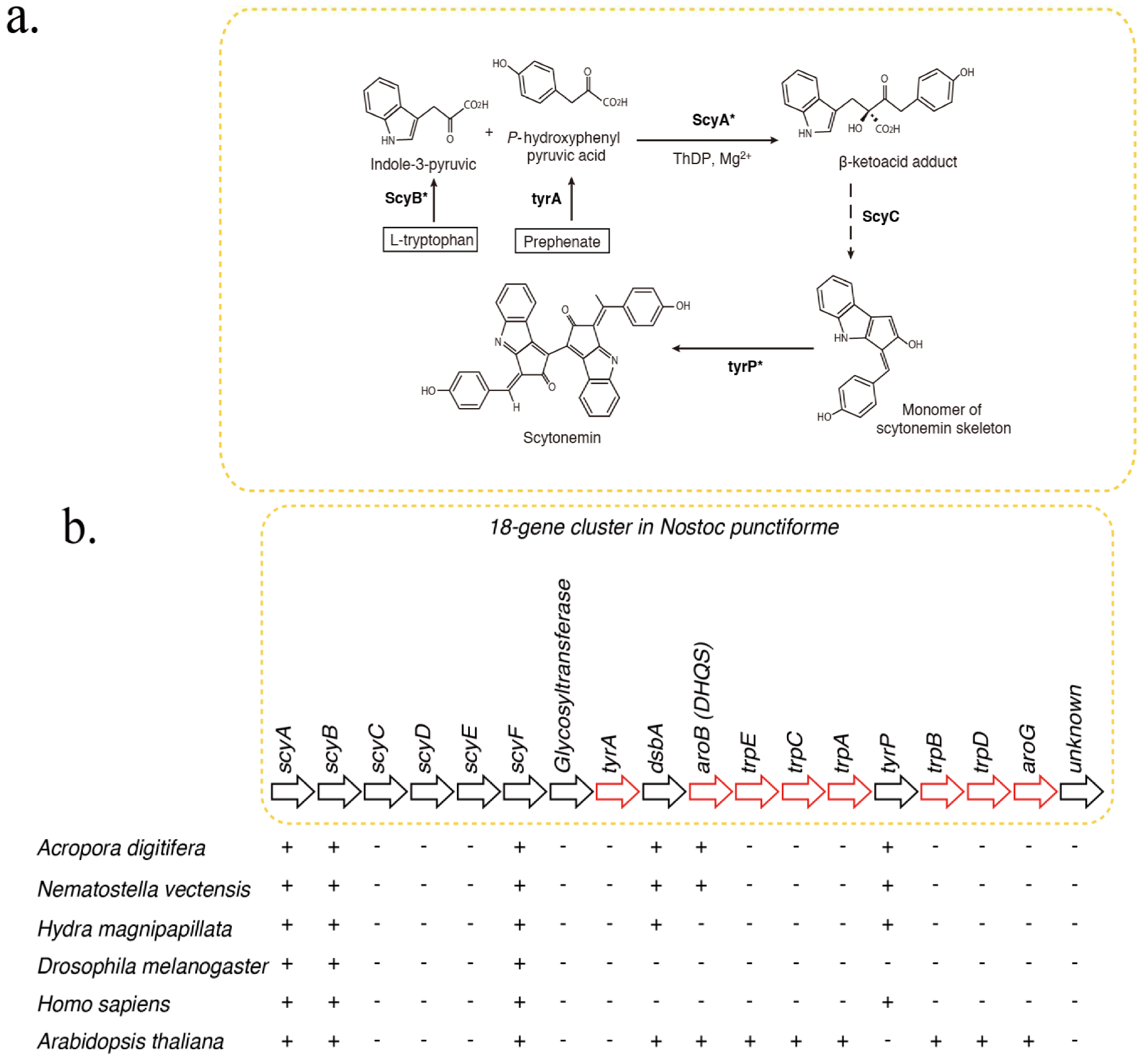
      <p>The indole-alkaloid, scytonemin, is a UV-blocking compound, found exclusively in cyanobacteria, and has been evaluated for biomedical applications [<xref ref-type="bibr" rid="B17-marinedrugs-11-00559">17</xref>]. Recently, Soule <italic>et al.</italic> [<xref ref-type="bibr" rid="B18-marinedrugs-11-00559">18</xref>,<xref ref-type="bibr" rid="B19-marinedrugs-11-00559">19</xref>] showed that scytonemin synthesis is controlled by an 18-gene cluster in the cyanobacterium, <italic>Nostoc punctiforme</italic> (<xref ref-type="fig" rid="marinedrugs-11-00559-f001">Figure 1</xref>). The <italic>Nostoc</italic> operon includes <italic>scyA</italic>, <italic>scyB</italic>, <italic>scyC</italic>, <italic>scyD</italic>, <italic>scyE</italic>, <italic>scyF</italic>, <italic>NpR1270</italic> (<italic>glycosyltransferase</italic>), <italic>tyrA</italic>, <italic>dsbA</italic> and <italic>aroB</italic>. Although scytonemins have not been found in corals, the presence of symbiotic cyanobacteria in coral species has been reported [<xref ref-type="bibr" rid="B20-marinedrugs-11-00559">20</xref>]. Furthermore, some cyanobacteria have been implicated in coral disease [<xref ref-type="bibr" rid="B21-marinedrugs-11-00559">21</xref>] and the roles of microbial communities associated with coral are being discussed [<xref ref-type="bibr" rid="B22-marinedrugs-11-00559">22</xref>]. Therefore, in this study, we investigated whether the coral genome contains genes encoding proteins that are homologous to cyanobacterial enzymes involved in scytonemin synthesis. In relation to the homologs of <italic>scyA</italic>, we surveyed the <italic>Acropora</italic> genome for genes encoding enzymes of the 2-aminoethylphosphonate (AEP) pathway. AEP is a natural carbon-phosphorus compound, first reported by Horiguchi &amp; Kandatsu [<xref ref-type="bibr" rid="B23-marinedrugs-11-00559">23</xref>]. This study will provide a basis for natural product surveys of anthozoans. </p>
      <fig id="marinedrugs-11-00559-f001" position="float">
        <label>Figure 1</label>
        <caption>
          <p>Distribution of genes associated with biosynthesis of scytonemin in cyanobacteria, cnidarians, and other metazoans. (<bold>a</bold>) Pathways of biosynthesis of the photoprotective molecule, scytonemin, in the cyanobacterium, <italic>Nostoc punctiforme</italic> [<xref ref-type="bibr" rid="B6-marinedrugs-11-00559">6</xref>,<xref ref-type="bibr" rid="B16-marinedrugs-11-00559">16</xref>]. Gene homologs encoding enzymes indicated with asterisks were identified in the <italic>A. digitifera</italic> genome. (<bold>b</bold>) Schematic showing the organization of the scytonemin gene cluster. Genes indicated by red arrows encode enzymes involved in the biosynthesis of aromatic amino acids. The presence of corresponding genes in various organisms is indicated by “+”, indicating that a TBLASTN search against <italic>N. punctiforme</italic> as query showed significant hits. Anthozoan genomes encode a gene homologous to <italic>aroB</italic>, involved in aromatic amino acid metabolism, which is not found in higher metazoans.</p>
        </caption>
        <graphic xmlns:xlink="http://www.w3.org/1999/xlink" xlink:href="marinedrugs-11-00559-g001.tif"/>
      </fig>
    </sec>
    <sec sec-type="results">
      <title>2. Results and Discussion</title>
      <p>The UV-blocking compound, scytonemin, is produced exclusively by cyanobacteria (<xref ref-type="fig" rid="marinedrugs-11-00559-f001">Figure 1</xref>). The probable biosynthetic pathway has been reported [<xref ref-type="bibr" rid="B24-marinedrugs-11-00559">24</xref>] (<xref ref-type="fig" rid="marinedrugs-11-00559-f001">Figure 1</xref>a). The scytonemin gene cluster in <italic>Nostoc punctiforme</italic> consists of one subcluster of genes involved in aromatic amino acid biosynthesis, but the functions of many novel genes in another subcluster are unknown [<xref ref-type="bibr" rid="B19-marinedrugs-11-00559">19</xref>]. The former subcluster includes <italic>tyrA</italic>, <italic>dsbA</italic>, <italic>aroB</italic>, <italic>trpE</italic>, <italic>trpC</italic>, <italic>trpA</italic>, <italic>tyrP</italic>, <italic>trpB</italic>, <italic>trpD</italic> and <italic>aroG</italic> (<xref ref-type="fig" rid="marinedrugs-11-00559-f001">Figure 1</xref>b, red arrows). The latter includes <italic>scyA</italic>, <italic>scyB</italic>, <italic>scyC</italic>, <italic>scyD</italic>, <italic>scyE</italic>, and <italic>scyF</italic> (<xref ref-type="fig" rid="marinedrugs-11-00559-f001">Figure 1</xref>b, black arrows).</p>
      <p>Screening of the <italic>A. digitifera</italic> genome via BLAST and domain structure comparisons led to the identification of candidates for six of the 18 genes involved in scytonemin synthesis: <italic>scyA</italic>, <italic>scyB</italic>, <italic>scyF</italic>, <italic>dsbA</italic>, <italic>aroB</italic>, and <italic>tyrP</italic> (<xref ref-type="fig" rid="marinedrugs-11-00559-f001">Figure 1</xref>b). Analysis of <italic>aroB</italic> (<italic>DHQS</italic>) in a previous study identified an <italic>aroB</italic> homolog in the <italic>Acropora</italic> genome [<xref ref-type="bibr" rid="B15-marinedrugs-11-00559">15</xref>]. Molecular phylogenetic analyses group the <italic>aroB-like</italic> sequences of <italic>Acropora</italic> and <italic>Nematostella</italic> with those of several dinoflagellates,ss, consistent with the possibility that the <italic>aroB-like</italic> genes of cnidarians originated by horizontal transfer from dinoflagellates [<xref ref-type="bibr" rid="B12-marinedrugs-11-00559">12</xref>]. Here we describe results of molecular phylogenetic analyses of <italic>scyA</italic>, <italic>scyB</italic>, <italic>dsbA</italic>, and <italic>tyrP.</italic> Detailed analyses of <italic>scyF</italic> homologs were not performed for reasons that will be explained subsequently (See <xref ref-type="sec" rid="sec2dot3-marinedrugs-11-00559">Section 2.3</xref>).</p>
      <sec>
        <title>2.1. scyA (TPP-Dependent Enzyme)</title>
        <p><italic>scyA</italic> encodes a TPP (thiamine pyrophosphate)-dependent enzyme [<xref ref-type="bibr" rid="B25-marinedrugs-11-00559">25</xref>], a protein similar to human 2-hydroxyacyl-CoA lyase, which has close homologs in a variety of organisms, including <italic>Drosophila</italic> and <italic>Arabidopsis</italic> (<xref ref-type="fig" rid="marinedrugs-11-00559-f001">Figure 1</xref>b; <xref ref-type="table" rid="marinedrugs-11-00559-t001">Table 1</xref>). It is also similar to acetolactate synthase which is found in plants and micro-organisms. Both 2-hydroxyacyl-CoA lyase and acetolactate synthase are involved in synthesis of the essential amino acids, valine, leucine, and isoleucine [<xref ref-type="bibr" rid="B26-marinedrugs-11-00559">26</xref>]. Biosynthesis of 2-aminoethylphosphonate (AEP) from phosphoenolpyruvate (PEP) requires just three enzymes: PEP mutase, phosphonopyruvate decarboxylase, and AEP transaminase, collectively known as the AEP biosynthetic pathway [<xref ref-type="bibr" rid="B27-marinedrugs-11-00559">27</xref>] (<xref ref-type="fig" rid="marinedrugs-11-00559-f002">Figure 2</xref>; See <xref ref-type="sec" rid="sec2dot6-marinedrugs-11-00559">Section 2.6</xref>). Phosphonopyruvate (ppyr) decarboxylase is also similar to both 2-hydroxyacyl-CoA lyase and acetolactate synthase. </p>
        <table-wrap id="marinedrugs-11-00559-t001" position="float">
          <object-id pub-id-type="pii">marinedrugs-11-00559-t001_Table 1</object-id>
          <label>Table 1</label>
          <caption>
            <p>Putative enzyme genes in the <italic>Acropora digitifera</italic> genome that are similar to enzymes involved in biosynthesis of the cyanobacterial sunscreen, scytonemin.</p>
          </caption>
          <table>
            <thead>
              <tr>
                <th align="center" valign="middle">Gene name</th>
                <th align="center" valign="middle">Gene model ID</th>
                <th align="center" valign="middle">Intron number</th>
                <th align="center" valign="middle">All PFAM domains (in order) *</th>
                <th align="center" valign="middle">corresponding to ESTs</th>
                <th align="center" valign="middle">scaffold</th>
                <th align="center" valign="middle">References</th>
              </tr>
            </thead>
            <tbody>
              <tr>
                <td align="center" valign="middle">
                  <italic>phosphonopyruvate decarboxylase</italic>
                </td>
                <td align="center" valign="middle">aug_v2a.20271</td>
                <td align="center" valign="middle">6</td>
                <td align="center" valign="middle">TPP_enzyme_N, TPP_enzyme_C</td>
                <td align="center" valign="middle">+</td>
                <td align="center" valign="middle">12471</td>
                <td align="center" valign="middle">Figure S1</td>
              </tr>
              <tr>
                <td align="center" valign="middle">
                  <italic>2-hydroxyacyl-CoA lyase 1</italic>
                </td>
                <td align="center" valign="middle">aug_v2a.06817</td>
                <td align="center" valign="middle">13</td>
                <td align="center" valign="middle">TPP_enzyme_C</td>
                <td align="center" valign="middle">−</td>
                <td align="center" valign="middle">2544</td>
                <td align="center" valign="middle">Figure S1</td>
              </tr>
              <tr>
                <td align="center" valign="middle">
                  <italic>glutamate dehydrogenase1-1 (gdh1-1)</italic>
                </td>
                <td align="center" valign="middle">aug_v2a.22675</td>
                <td align="center" valign="middle">0</td>
                <td align="center" valign="middle">ELFV_dehydrog_N, ELFV_dehydrog</td>
                <td align="center" valign="middle">+</td>
                <td align="center" valign="middle">15779</td>
                <td align="center" valign="middle">Figure S2</td>
              </tr>
              <tr>
                <td align="center" valign="middle">
                  <italic>glutamate dehydrogenase1-2 (gdh1-2)</italic>
                </td>
                <td align="center" valign="middle">aug_v2a.23483</td>
                <td align="center" valign="middle">1</td>
                <td align="center" valign="middle">ELFV_dehydrog_N, ELFV_dehydrog</td>
                <td align="center" valign="middle">+</td>
                <td align="center" valign="middle">16875</td>
                <td align="center" valign="middle">Figure S2</td>
              </tr>
              <tr>
                <td align="center" valign="middle">
                  <italic>glutamate dehydrogenase2-1 (gdh2-1)</italic>
                </td>
                <td align="center" valign="middle">aug_v2a.13667</td>
                <td align="center" valign="middle">6</td>
                <td align="center" valign="middle">ELFV_dehydrog_N, ELFV_dehydrog</td>
                <td align="center" valign="middle">+</td>
                <td align="center" valign="middle">5605</td>
                <td align="center" valign="middle">Figure S2</td>
              </tr>
              <tr>
                <td align="center" valign="middle">
                  <italic>glutamate dehydrogenase2-2</italic>
                  <italic>(gdh2-2)</italic>
                </td>
                <td align="center" valign="middle">aug_v2a.16277</td>
                <td align="center" valign="middle">7</td>
                <td align="center" valign="middle">ELFV_dehydrog_N, ELFV_dehydrog</td>
                <td align="center" valign="middle">−</td>
                <td align="center" valign="middle">7525</td>
                <td align="center" valign="middle">Figure S2</td>
              </tr>
              <tr>
                <td align="center" valign="middle">
                  <italic>DSBA domain containing gene-1</italic>
                </td>
                <td align="center" valign="middle">aug_v2a.12085</td>
                <td align="center" valign="middle">21</td>
                <td align="center" valign="middle">Dynein_Heavy, DSBA, DSBA</td>
                <td align="center" valign="middle">+</td>
                <td align="center" valign="middle">4763</td>
                <td align="center" valign="middle">Figure S3</td>
              </tr>
              <tr>
                <td align="center" valign="middle"><italic>DHQS-like</italic> (<italic>aroB-like</italic>)</td>
                <td align="center" valign="middle">aug_v2a.14548</td>
                <td align="center" valign="middle">2</td>
                <td align="center" valign="middle">DHQ_synthase</td>
                <td align="center" valign="middle">+</td>
                <td align="center" valign="middle">6105</td>
                <td align="center" valign="middle">[<xref ref-type="bibr" rid="B15-marinedrugs-11-00559">15</xref>]</td>
              </tr>
              <tr>
                <td align="center" valign="middle">
                  <italic>TyrP1</italic>
                </td>
                <td align="center" valign="middle">aug_v2a.08070</td>
                <td align="center" valign="middle">2</td>
                <td align="center" valign="middle">TSP_1, TSP_1, TSP_1, TSP_1, Tyrosinase</td>
                <td align="center" valign="middle">+</td>
                <td align="center" valign="middle">3066</td>
                <td align="center" valign="middle">Figure S4</td>
              </tr>
              <tr>
                <td align="center" valign="middle">
                  <italic>TyrP2</italic>
                </td>
                <td align="center" valign="middle">aug_v2a.10437</td>
                <td align="center" valign="middle">12</td>
                <td align="center" valign="middle">Tyrosinase</td>
                <td align="center" valign="middle">+</td>
                <td align="center" valign="middle">4001</td>
                <td align="center" valign="middle">Figure S4</td>
              </tr>
            </tbody>
          </table>
    <table-wrap-foot>
      <fn>
        <p>* Search parameters: <italic>E</italic>-value of 1.0.</p>
      </fn>
    </table-wrap-foot>		
		</table-wrap>
        <fig id="marinedrugs-11-00559-f002" position="float">
          <label>Figure 2</label>
          <caption>
            <p>Metabolic pathways unique among metazoans and found in corals. The 2-aminoethylphosphonate (AEP) biosynthetic pathway was first discovered in <italic>Tetrahymena pyriformis</italic>. Phosphoenolpyruvate decarboxylase, shown in <xref ref-type="table" rid="marinedrugs-11-00559-t001">Table 1</xref>, is uncommon in metazoans. Homologs of the other two enzyme genes involved, indicated by asterisks, are also found in coral; see <xref ref-type="table" rid="marinedrugs-11-00559-t002">Table 2</xref> for details.</p>
          </caption>
          <graphic xmlns:xlink="http://www.w3.org/1999/xlink" xlink:href="marinedrugs-11-00559-g002.tif"/>
        </fig>
        <p>Molecular phylogenetic analysis showed that two <italic>Acropora</italic> proteins containing a TPP enzyme domain were separated into two clades, one containing PEP decarboxylase, with orthology to the <italic>Bacteroides fragilis</italic> enzyme and the other, 2-hydroxyacyl-CoA lyase, with orthology to the human protein (<xref ref-type="table" rid="marinedrugs-11-00559-t001">Table 1</xref>; Figure S1). Both enzymes have <italic>Nematostella</italic> counterparts, and these were closely related to each other (Figure S1). In contrast, the latter group formed a clade that includes <italic>Homo</italic>, <italic>Drosophila</italic>, and <italic>Arabidopsis</italic> orthologs. PEP decarboxylase was not found in other metazoan genomes. The <italic>Acropora PEP decarboxylase</italic> gene has six introns and was located at the 5′ terminus of scaffold 12471. Its neighbor was a gene for an ephrin-like protein, which belongs to the tyrosine kinase receptor subfamily. mRNA corresponding to <italic>ppyr decarboxylase</italic>, but not <italic>hydroxyacyl-CoA lyase</italic>, was present in EST databases (<xref ref-type="table" rid="marinedrugs-11-00559-t001">Table 1</xref>). The gene for acetolactate synthase was not found. Neither of the two <italic>Acropora</italic> genes formed a clade with <italic>scyA</italic> of the cyanobacteria, <italic>Nostoc</italic> and <italic>Nodularia</italic>.</p>
      </sec>
      <sec>
        <title>2.2. scyB (GDH Subfamly)</title>
        <p><italic>scyB</italic> encodes a protein that resembles glutamate dehydrogenase (GDH) [<xref ref-type="bibr" rid="B17-marinedrugs-11-00559">17</xref>]. GDH enzymes are divided into four classes [<xref ref-type="bibr" rid="B28-marinedrugs-11-00559">28</xref>,<xref ref-type="bibr" rid="B29-marinedrugs-11-00559">29</xref>]. Searches for GDH genes in the <italic>Acropora</italic> genome revealed four genes, <italic>gdh-1-1</italic>, <italic>-1-2</italic>, <italic>-2-1</italic>, and <italic>-2-2</italic> (<xref ref-type="table" rid="marinedrugs-11-00559-t001">Table 1</xref>). Molecular phylogenetic analysis indicated that <italic>gdh-2-1</italic> and <italic>gdh-2-2</italic> form a clade with <italic>Nematostella</italic> and <italic>Hydra</italic> orthologs (Figure S2). This clade also includes orthologs of <italic>Drosophila</italic> and <italic>Homo</italic>, suggesting that <italic>gdh-2-1</italic> and <italic>gdh-2-2</italic> encode metazoan GDH. The presence of <italic>gdh-2-1</italic> and <italic>gdh-2-2</italic> in one clade implies that they were duplicated within the lineage (<xref ref-type="table" rid="marinedrugs-11-00559-t001">Table 1</xref>).</p>
        <p>On the other hand, <italic>gdh-1-1</italic> and <italic>gdh-1-2</italic> form another clade with the corresponding <italic>Nematostella</italic> genes (Figure S2). This group includes bacterial and <italic>Arabidopsis</italic> genes, but not those of metazoans (Figure S2). All trees (Bayesian inference, Neighbor joining, and Maximum likelihood) supported the clade (Figure S2). <italic>gdh-1-1</italic> has no introns while <italic>gdh-1-2</italic> has one. The expression of <italic>gdh-1-1</italic> was confirmed in the EST database. <italic>gdh-1-2</italic> was located at the 5′ terminus of scaffold 16875 and the neighboring gene is similar to human caseinolytic peptidase B, a hexameric chaperone. This analysis indicates that corals have two GDH class 1 and two GDH class 2 enzymes. Because GDH class 1 has not been found in metazoans [<xref ref-type="bibr" rid="B29-marinedrugs-11-00559">29</xref>], corals may have unknown GDH metabolic pathways.</p>
      </sec>
      <sec id="sec2dot3-marinedrugs-11-00559">
        <title>2.3. scyF (NHL Repeat Containing)</title>
        <p>NHL is a conserved structural motif present in a large family of growth regulators. Many NHL-containing proteins also possess additional domains, e.g., RING fingers, B-box zinc fingers, and coiled-coil motifs. According to structural model analysis, the NHL domain-containing genes could be involved in protein−protein interactions and/or protein-nucleic acid interactions [<xref ref-type="bibr" rid="B30-marinedrugs-11-00559">30</xref>]. <italic>scyF</italic> encodes a protein that contains an NHL repeat (Ncl-1, HT2A and Lin-41), which is defined by amino acid sequence similarities to Ncl-1, HT2A, and Lin-41 proteins [<xref ref-type="bibr" rid="B30-marinedrugs-11-00559">30</xref>].</p>
        <p>Most animal and plant genomes contain <italic>scyF</italic>-like genes (<xref ref-type="fig" rid="marinedrugs-11-00559-f001">Figure 1</xref>b). A Pfam domain search of the NHL domain revealed that the <italic>Acropora</italic> genome contains 107 genes encoding NHL-containing proteins. In addition, the three <italic>Acropora</italic> genes most similar to <italic>Nostoc scyF</italic>, aug-v2a.11071, aug-v2a.01011, and aug-v2a.06686, included other domains such Filamin, SGL, and zf-B Box. Therefore, it was difficult to clarify the relationship among NHL-repeat-containing genes. Only three genes encode proteins with one NHL repeat each. Some of these may be members of novel metabolic pathways. </p>
      </sec>
      <sec>
        <title>2.4. dsbA</title>
        <p>DsbA (disulfide bond A) is a subfamily of the thioredoxin family [<xref ref-type="bibr" rid="B31-marinedrugs-11-00559">31</xref>,<xref ref-type="bibr" rid="B32-marinedrugs-11-00559">32</xref>]. Efficient, correct folding of bacterial disulfide-bonded proteins <italic>in vivo</italic> is dependent upon a class of periplasmic oxidoreductase proteins called DsbA. The bacterial protein-folding factor DsbA is the most oxidizing member of the thioredoxin family. </p>
        <p><italic>dsbA</italic> genes with high similarities to <italic>Nostoc dsbA</italic> have been identified in each of the cnidarians (<italic>A. digitifera</italic>, <italic>Nematostella vectensis</italic> and <italic>Hydra magnipapillata</italic>) and in <italic>Trichoplax</italic> (Phylum Placozoa), but are not found in <italic>Drosophila</italic> and <italic>Homo</italic> (<xref ref-type="table" rid="marinedrugs-11-00559-t001">Table 1</xref>). Metazoan <italic>dsbA</italic> genes have greatly diverged from bacterial <italic>DsbA</italic> genes; therefore, it was difficult to align the sequences. Such low similarities may be due to selenoproteins, in which it is difficult to predict the open reading frame [<xref ref-type="bibr" rid="B33-marinedrugs-11-00559">33</xref>]. By domain search, we found three candidates, aug-v2a.12085, aug-v2a.05997, and aug-v2a.00764 in the <italic>Acropora</italic> genome. However, the gene models, aug-v2a.05997 and aug-v2a.00764, were likely partial, and were excluded from further analyses. These models may be artifacts of insufficient assembly or inaccurate gene prediction. The four cnidarian <italic>dsbA</italic> sequences formed discrete clades in molecular phylogenetic analyses (Figure S3), suggesting diversification of these genes in the cnidarian lineage. In addition, <italic>DSBA domain-containing gene-1</italic> was positioned in a subgroup different from the cyanobacterium <italic>dsbA</italic>.</p>
      </sec>
      <sec>
        <title>2.5. TyrP</title>
        <p>TyrP (Tyrosinase-related Protein) has a well-established role in melanin biosynthesis in mammals, and is involved in several biological functions [<xref ref-type="bibr" rid="B34-marinedrugs-11-00559">34</xref>]. We found six candidate tyrosinases, but four of them were partial sequences. Therefore, we used only the two complete candidates for molecular phylogenetic analysis. Interestingly, TyrP 1 forms a clade with its vertebrate equivalents (Figure S4), although we could not find any <italic>Nematostella</italic> and <italic>Hydra</italic> orthologs in this clade (Figure S4). On the other hand, TyrP 2 is a member of a group that included the tyrosinase-related proteins of cnidarians (Figure S4). No <italic>Acropora</italic> tyrosinase genes form a clade with cyanobacterium TyrP, but further studies will be needed to understand the relationships of the four unknown, partial genes.</p>
      </sec>
      <sec id="sec2dot6-marinedrugs-11-00559">
        <title>2.6. Genes for AEP Pathway</title>
        <p>Because it has been reported that PEP decarboxylase is an enzyme for one of three steps in the AEP biosynthetic pathway in protists and bacteria [<xref ref-type="bibr" rid="B35-marinedrugs-11-00559">35</xref>], we surveyed homologs of enzyme genes for the other two steps. Interestingly, we found candidate genes for phosphoenolpyruvate mutase and aminoethylphosphonate transaminase (<xref ref-type="table" rid="marinedrugs-11-00559-t002">Table 2</xref>; Figures S5 and S6). Our gene survey suggests that <italic>Acropora digitifera</italic> has a complete AEP biosynthetic pathway from phosphoenolpyruvate (PEP) (<xref ref-type="fig" rid="marinedrugs-11-00559-f002">Figure 2</xref>, S1, S5 and S6), which is the shortest known pathway for construction of natural phosphonate [<xref ref-type="bibr" rid="B35-marinedrugs-11-00559">35</xref>]. Therefore, corals may be important producers of carbon-phosphorus compounds in marine ecosystems.</p>
        <p>It is possible that reported draft genome sequences of metazoans could include sequences from other organisms, resulting from contamination. However, the coral <italic>A. digitifera</italic> genome sequences from the purified sperm genomic DNA of one individual did not contain contaminated sequences [<xref ref-type="bibr" rid="B15-marinedrugs-11-00559">15</xref>]. The following observations indicate that all of the annotated genes in this study are encoded by the <italic>A. digitifera</italic> genome: (1) Orthologs of these genes, which formed a clade in molecular phylogenetic analysis, were found in <italic>Nematostella</italic>; (2) Expression of most genes was confirmed by embryonic transcriptome analysis; and (3) Some of the gene orders, including annotated genes, were conserved between <italic>A. digitifera</italic> and <italic>N. vectensis</italic>.</p>
        <table-wrap id="marinedrugs-11-00559-t002" position="float">
          <object-id pub-id-type="pii">marinedrugs-11-00559-t002_Table 2</object-id>
          <label>Table 2</label>
          <caption>
            <p>Orthologs of genes for the AEP biosynthetic pathway in the <italic>Acropora digitifera</italic> genome.</p>
          </caption>
          <table>
            <thead>
              <tr>
                <th align="center" valign="middle">Gene name</th>
                <th align="center" valign="middle">Gene model ID</th>
                <th align="center" valign="middle">Intron number</th>
                <th align="center" valign="middle">All PFAM domains (in order) *</th>
                <th align="center" valign="middle">corresponding to ESTs</th>
                <th align="center" valign="middle">scaffold</th>
                <th align="center" valign="middle">References</th>
              </tr>
            </thead>
            <tbody>
              <tr>
                <td align="center" valign="middle">
                  <italic>phosphoenolpyruvate mutase</italic>
                </td>
                <td align="center" valign="middle">aug_v2a.19072</td>
                <td align="center" valign="middle">7</td>
                <td align="center" valign="middle">PEP_mutase</td>
                <td align="center" valign="middle">+</td>
                <td align="center" valign="middle">11028</td>
                <td align="center" valign="middle">Figure S5</td>
              </tr>
              <tr>
                <td align="center" valign="middle">
                  <italic>2-aminoethylphosphonate transaminase</italic>
                </td>
                <td align="center" valign="middle">aug_v2a.21804</td>
                <td align="center" valign="middle">4</td>
                <td align="center" valign="middle">−</td>
                <td align="center" valign="middle">+</td>
                <td align="center" valign="middle">14440</td>
                <td align="center" valign="middle">Figure S6</td>
              </tr>
            </tbody>
          </table>
    <table-wrap-foot>
      <fn>
        <p>* Search parameters: <italic>E</italic>-value of 1.0.</p>
      </fn>
    </table-wrap-foot>		
		</table-wrap>
      </sec>
    </sec>
    <sec>
      <title>3. Experimental Section</title>
      <sec>
        <title>3.1. Gene Search</title>
        <p>We used two methods to search the <italic>A. digitifera</italic> database [<xref ref-type="bibr" rid="B36-marinedrugs-11-00559">36</xref>,<xref ref-type="bibr" rid="B37-marinedrugs-11-00559">37</xref>] for genes encoding components of the scytonemin biosynthetic pathway. First, BLAST searches with cyanobacterial protein sequences as queries (BLASTP) were used to probe <italic>A. digitifera</italic> gene models for putative orthologs. Genome sequences of <italic>Nematostella vectensis</italic> [<xref ref-type="bibr" rid="B11-marinedrugs-11-00559">11</xref>], <italic>Hydra magnipapillata</italic> [<xref ref-type="bibr" rid="B13-marinedrugs-11-00559">13</xref>], <italic>Drosophila melanogaster</italic> [<xref ref-type="bibr" rid="B38-marinedrugs-11-00559">38</xref>], <italic>Homo sapiens</italic> [<xref ref-type="bibr" rid="B39-marinedrugs-11-00559">39</xref>], and <italic>Arabidopsis thaliana</italic> [<xref ref-type="bibr" rid="B40-marinedrugs-11-00559">40</xref>] were also surveyed. In addition, several bacteria genes and eukaryotic genes with high similarity to <italic>A. digitifera</italic> models were retrieved from the NCBI genome database [<xref ref-type="bibr" rid="B41-marinedrugs-11-00559">41</xref>] for molecular phylogenetic analysis. The second method was the characterization of specific protein domains. To screen and identify protein domains in the gene models, we used the Pfam database [<xref ref-type="bibr" rid="B42-marinedrugs-11-00559">42</xref>], which contains 11,912 conserved domains using HMMER (hmmer3) [<xref ref-type="bibr" rid="B43-marinedrugs-11-00559">43</xref>]. In order to avoid eliminating cnidarian- or coral-specific domains, we first used an <italic>E</italic>-value cutoff of 10<sup>−3</sup>, as previously suggested [<xref ref-type="bibr" rid="B44-marinedrugs-11-00559">44</xref>] and subsequently an <italic>E</italic>-value cutoff of 1.</p>
      </sec>
      <sec>
        <title>3.2. Molecular Phylogenetic Analysis</title>
        <p>Amino acid sequences found in gene searches were aligned using ClustalX [<xref ref-type="bibr" rid="B45-marinedrugs-11-00559">45</xref>] with default parameters. Gaps and ambiguous areas were excluded manually, using Se-Al v2.0 [<xref ref-type="bibr" rid="B46-marinedrugs-11-00559">46</xref>]. For Bayesian inference analysis, the alignment datasets were analyzed using PhyloBayes 3.3 [<xref ref-type="bibr" rid="B47-marinedrugs-11-00559">47</xref>] with the site heterogeneous mixture CAT model and two independent Markov chains. Phylogenetic trees were constructed by Neighbor-Joining (NJ). Calculations of the NJ bootstrap value (1000 trials) were made using ClustalX, and tree constructions were performed in SeaView [<xref ref-type="bibr" rid="B48-marinedrugs-11-00559">48</xref>] or Njplot [<xref ref-type="bibr" rid="B49-marinedrugs-11-00559">49</xref>]. Maximum likelihood analyses employed TREEFINDER version October 2008 [<xref ref-type="bibr" rid="B50-marinedrugs-11-00559">50</xref>] and Aminosan [<xref ref-type="bibr" rid="B51-marinedrugs-11-00559">51</xref>]. The bootstrap value was calculated using 100 trials.</p>
      </sec>
    </sec>
    <sec>
      <title>4. Conclusion</title>
      <p>We have previously identified environmental response genes in corals. These included genes unique to metazoans, such as fluorescent proteins [<xref ref-type="bibr" rid="B52-marinedrugs-11-00559">52</xref>] and enzymes involved in shinorine synthesis [<xref ref-type="bibr" rid="B15-marinedrugs-11-00559">15</xref>]. The present gene survey does not support the hypothesis that <italic>A. digitifera</italic> can synthesize scytonemin independently. Although the <italic>A. digitifera</italic> genome contains homologs of several genes that function in scytonemin synthesis in <italic>Nostoc</italic>, these genes may have acquired new functions in <italic>Acropora</italic> that remain to be elucidated. The homologs of <italic>scyA</italic> and <italic>scyB</italic>, <italic>ppyr decarboxylase</italic>, <italic>gdh-1-1</italic>, <italic>and gdh-1-2</italic> are similar to genes involved in general bacterial metabolic pathways. Our genome-wide surveys for genes of enzymes involved in synthesis of photoprotective compounds indicate that corals retain genes for some enzymes not found in <italic>Homo</italic> and <italic>Drosophila</italic>. Therefore, it is likely that not only marine bacteria, but also marine invertebrates produce many unknown natural compounds, as suggested by the presence of the AEP pathway. Genomic surveys will undoubtedly provide more clues regarding natural product synthesis.</p>
    </sec>
  </body>
  <back>
    <ack>
      <title>Acknowledgments</title>
      <p>We would like to acknowledge Mayuki Fujiwara for supporting figure illustrations, and Takeshi Kawashima, Ryo Koyanagi and Kanako Hisata for updating the coral database. We thank Steven D. Aird for carefully editing the manuscript.</p>
    </ack>
    <ref-list>
      <title>References</title>
      <ref id="B1-marinedrugs-11-00559">
        <label>1.</label>
        <citation citation-type="journal">
          <person-group person-group-type="author">
            <name>
              <surname>Hoegh-Guldberg</surname>
              <given-names>O.</given-names>
            </name>
            <name>
              <surname>Mumby</surname>
              <given-names>P.J.</given-names>
            </name>
            <name>
              <surname>Hooten</surname>
              <given-names>A.J.</given-names>
            </name>
            <name>
              <surname>Steneck</surname>
              <given-names>R.S.</given-names>
            </name>
            <name>
              <surname>Greenfield</surname>
              <given-names>P.</given-names>
            </name>
            <name>
              <surname>Gomez</surname>
              <given-names>E.</given-names>
            </name>
            <name>
              <surname>Harvell</surname>
              <given-names>C.D.</given-names>
            </name>
            <name>
              <surname>Sale</surname>
              <given-names>P.F.</given-names>
            </name>
            <name>
              <surname>Edwards</surname>
              <given-names>A.J.</given-names>
            </name>
            <name>
              <surname>Caldeira</surname>
              <given-names>K.</given-names>
            </name>
            <etal/>
          </person-group>
          <article-title>Coral reefs under rapid climate change and ocean acidification</article-title>
          <source>Science</source>
          <year>2007</year>
          <volume>318</volume>
          <fpage>1737</fpage>
          <lpage>1742</lpage>
        <pub-id pub-id-type="doi">10.1126/science.1152509</pub-id><pub-id pub-id-type="pmid">18079392</pub-id></citation>
      </ref>
      <ref id="B2-marinedrugs-11-00559">
        <label>2.</label>
        <citation citation-type="journal">
          <person-group person-group-type="author">
            <name>
              <surname>Weis</surname>
              <given-names>V.M.</given-names>
            </name>
          </person-group>
          <article-title>Cellular mechanisms of Cnidarian bleaching: Stress causes the collapse of symbiosis</article-title>
          <source>J.Exp. Biol.</source>
          <year>2008</year>
          <volume>211</volume>
          <fpage>3059</fpage>
          <lpage>3066</lpage>
          <pub-id pub-id-type="doi">10.1242/jeb.009597</pub-id>
        </citation>
      </ref>
      <ref id="B3-marinedrugs-11-00559">
        <label>3.</label>
        <citation citation-type="journal">
          <person-group person-group-type="author">
            <name>
              <surname>Shick</surname>
              <given-names>J.M.</given-names>
            </name>
            <name>
              <surname>Romaine-Lioud</surname>
              <given-names>S.</given-names>
            </name>
            <name>
              <surname>Ferrier-Pages</surname>
              <given-names>C.</given-names>
            </name>
            <name>
              <surname>Gattuso</surname>
              <given-names>J.P.</given-names>
            </name>
          </person-group>
          <article-title>Ultraviolet-B radiation stimulates shikimate pathway-dependent accumulation of mycosporine-like amino acids in the coral <italic>Stylophora pistillata</italic> despite decreases in its population of symbiotic dinoflagellates</article-title>
          <source>Limnol. Oceanogr.</source>
          <year>1999</year>
          <volume>44</volume>
          <fpage>1667</fpage>
          <lpage>1682</lpage>
          <pub-id pub-id-type="doi">10.4319/lo.1999.44.7.1667</pub-id>
        </citation>
      </ref>
      <ref id="B4-marinedrugs-11-00559">
        <label>4.</label>
        <citation citation-type="journal">
          <person-group person-group-type="author">
            <name>
              <surname>Reef</surname>
              <given-names>R.</given-names>
            </name>
            <name>
              <surname>Dunn</surname>
              <given-names>S.</given-names>
            </name>
            <name>
              <surname>Levy</surname>
              <given-names>O.</given-names>
            </name>
            <name>
              <surname>Dove</surname>
              <given-names>S.</given-names>
            </name>
            <name>
              <surname>Shemesh</surname>
              <given-names>E.</given-names>
            </name>
            <name>
              <surname>Brickner</surname>
              <given-names>I.</given-names>
            </name>
            <name>
              <surname>Leggat</surname>
              <given-names>W.</given-names>
            </name>
            <name>
              <surname>Hoegh-Guldberg</surname>
              <given-names>O.</given-names>
            </name>
          </person-group>
          <article-title>Photoreactivation is the main repair pathway for UV-induced DNA damage in coral planulae</article-title>
          <source>J. Exp. Biol.</source>
          <year>2009</year>
          <volume>212</volume>
          <fpage>2760</fpage>
          <lpage>2766</lpage>
        <pub-id pub-id-type="doi">10.1242/jeb.031286</pub-id><pub-id pub-id-type="pmid">19684208</pub-id></citation>
      </ref>
      <ref id="B5-marinedrugs-11-00559">
        <label>5.</label>
        <citation citation-type="journal">
          <person-group person-group-type="author">
            <name>
              <surname>Gordon</surname>
              <given-names>B.R.</given-names>
            </name>
            <name>
              <surname>Leggat</surname>
              <given-names>W.</given-names>
            </name>
          </person-group>
          <article-title>Symbiodinium-invertebrate symbioses and the role of metabolomics</article-title>
          <source>Mar. Drugs</source>
          <year>2010</year>
          <volume>8</volume>
          <fpage>2546</fpage>
          <lpage>2568</lpage>
          <pub-id pub-id-type="doi">10.3390/md8102546</pub-id>
        </citation>
      </ref>
      <ref id="B6-marinedrugs-11-00559">
        <label>6.</label>
        <citation citation-type="journal">
          <person-group person-group-type="author">
            <name>
              <surname>Rastogi</surname>
              <given-names>R.P.</given-names>
            </name>
            <name>
              <surname>Richa</surname>
            </name>
            <name>
              <surname>Sinha</surname>
              <given-names>R.P.</given-names>
            </name>
            <name>
              <surname>Singh</surname>
              <given-names>S.P.</given-names>
            </name>
            <name>
              <surname>Hader</surname>
              <given-names>D.-P.</given-names>
            </name>
          </person-group>
          <article-title>Photoprotective compounds from marine organisms</article-title>
          <source>J. Ind. Microbiol. Biotechnol.</source>
          <year>2010</year>
          <volume>37</volume>
          <fpage>537</fpage>
          <lpage>558</lpage>
        <pub-id pub-id-type="doi">10.1007/s10295-010-0718-5</pub-id><pub-id pub-id-type="pmid">20401734</pub-id></citation>
      </ref>
      <ref id="B7-marinedrugs-11-00559">
        <label>7.</label>
        <citation citation-type="book">
          <person-group person-group-type="author">
            <name>
              <surname>Dubinsky</surname>
              <given-names>Z.</given-names>
            </name>
          </person-group>
          <source>Coral Reef</source>
          <publisher-name>Elsevier</publisher-name>
          <publisher-loc>New York, NY, USA</publisher-loc>
          <year>1990</year>
        </citation>
      </ref>
      <ref id="B8-marinedrugs-11-00559">
        <label>8.</label>
        <citation citation-type="journal">
          <person-group person-group-type="author">
            <name>
              <surname>Stat</surname>
              <given-names>M.</given-names>
            </name>
            <name>
              <surname>Morris</surname>
              <given-names>E.</given-names>
            </name>
            <name>
              <surname>Gates</surname>
              <given-names>R.D.</given-names>
            </name>
          </person-group>
          <article-title>Functional diversity in coral-dinoflagellate symbiosis</article-title>
          <source>Proc. Natl. Acad. Sci. USA</source>
          <year>2008</year>
          <volume>105</volume>
          <fpage>9256</fpage>
          <lpage>9261</lpage>
          <pub-id pub-id-type="doi">10.1073/pnas.0801328105</pub-id>
        </citation>
      </ref>
      <ref id="B9-marinedrugs-11-00559">
        <label>9.</label>
        <citation citation-type="journal">
          <person-group person-group-type="author">
            <name>
              <surname>Banaszak</surname>
              <given-names>A.T.</given-names>
            </name>
            <name>
              <surname>LaJeunesse</surname>
              <given-names>T.C.</given-names>
            </name>
            <name>
              <surname>Trench</surname>
              <given-names>R.K.</given-names>
            </name>
          </person-group>
          <article-title>The synthesis of mycosporine-like amino acids (MAAs) by cultured, symbiotic dinoflagellates</article-title>
          <source>J. Exp. Mar. Biol. Ecol.</source>
          <year>2000</year>
          <volume>249</volume>
          <fpage>219</fpage>
          <lpage>233</lpage>
        <pub-id pub-id-type="doi">10.1016/S0022-0981(00)00192-1</pub-id><pub-id pub-id-type="pmid">10841936</pub-id></citation>
      </ref>
      <ref id="B10-marinedrugs-11-00559">
        <label>10.</label>
        <citation citation-type="journal">
          <person-group person-group-type="author">
            <name>
              <surname>Villarreal-Chiu</surname>
              <given-names>J.F.</given-names>
            </name>
            <name>
              <surname>Quinn</surname>
              <given-names>J.P.</given-names>
            </name>
            <name>
              <surname>McGrath</surname>
              <given-names>J.W.</given-names>
            </name>
          </person-group>
          <article-title>The genes and enzymes of phosphonate metabolism by bacteria, and their distribution in the marine environment</article-title>
          <source>Front. Microbiol.</source>
          <year>2012</year>
          <volume>3</volume>
          <fpage>19:1</fpage>
          <lpage>19:13</lpage>
        </citation>
      </ref>
      <ref id="B11-marinedrugs-11-00559">
        <label>11.</label>
        <citation citation-type="journal">
          <person-group person-group-type="author">
            <name>
              <surname>Putnam</surname>
              <given-names>N.H.</given-names>
            </name>
            <name>
              <surname>Srivastava</surname>
              <given-names>M.</given-names>
            </name>
            <name>
              <surname>Hellsten</surname>
              <given-names>U.</given-names>
            </name>
            <name>
              <surname>Dirks</surname>
              <given-names>B.</given-names>
            </name>
            <name>
              <surname>Chapman</surname>
              <given-names>J.</given-names>
            </name>
            <name>
              <surname>Salamov</surname>
              <given-names>A.</given-names>
            </name>
            <name>
              <surname>Terry</surname>
              <given-names>A.</given-names>
            </name>
            <name>
              <surname>Shapiro</surname>
              <given-names>H.</given-names>
            </name>
            <name>
              <surname>Lindquist</surname>
              <given-names>E.</given-names>
            </name>
            <name>
              <surname>Kapitonov</surname>
              <given-names>V.V.</given-names>
            </name>
            <etal/>
          </person-group>
          <article-title>Sea anemone genome reveals ancestral eumetazoan gene repertoire and genomic organization</article-title>
          <source>Science</source>
          <year>2007</year>
          <volume>317</volume>
          <fpage>86</fpage>
          <lpage>94</lpage>
        <pub-id pub-id-type="doi">10.1126/science.1139158</pub-id><pub-id pub-id-type="pmid">17615350</pub-id></citation>
      </ref>
      <ref id="B12-marinedrugs-11-00559">
        <label>12.</label>
        <citation citation-type="journal">
          <person-group person-group-type="author">
            <name>
              <surname>Starcevic</surname>
              <given-names>A.</given-names>
            </name>
            <name>
              <surname>Akthar</surname>
              <given-names>S.</given-names>
            </name>
            <name>
              <surname>Dunlap</surname>
              <given-names>W.C.</given-names>
            </name>
            <name>
              <surname>Shick</surname>
              <given-names>J.M.</given-names>
            </name>
            <name>
              <surname>Hranueli</surname>
              <given-names>D.</given-names>
            </name>
            <name>
              <surname>Cullum</surname>
              <given-names>J.</given-names>
            </name>
            <name>
              <surname>Long</surname>
              <given-names>P.F.</given-names>
            </name>
          </person-group>
          <article-title>Enzymes of the shikimic acid pathway encoded in the genome of a basal metazoan, <italic>Nematostella vectensis</italic>, have microbial origins</article-title>
          <source>Proc. Natl. Acad. Sci. USA</source>
          <year>2008</year>
          <volume>105</volume>
          <fpage>2533</fpage>
          <lpage>2537</lpage>
        <pub-id pub-id-type="pmid">18268342</pub-id></citation>
      </ref>
      <ref id="B13-marinedrugs-11-00559">
        <label>13.</label>
        <citation citation-type="journal">
          <person-group person-group-type="author">
            <name>
              <surname>Chapman</surname>
              <given-names>J.A.</given-names>
            </name>
            <name>
              <surname>Kirkness</surname>
              <given-names>E.F.</given-names>
            </name>
            <name>
              <surname>Simakov</surname>
              <given-names>O.</given-names>
            </name>
            <name>
              <surname>Hampson</surname>
              <given-names>S.E.</given-names>
            </name>
            <name>
              <surname>Mitros</surname>
              <given-names>T.</given-names>
            </name>
            <name>
              <surname>Weinmaier</surname>
              <given-names>T.</given-names>
            </name>
            <name>
              <surname>Rattei</surname>
              <given-names>T.</given-names>
            </name>
            <name>
              <surname>Balasubramanian</surname>
              <given-names>P.G.</given-names>
            </name>
            <name>
              <surname>Borman</surname>
              <given-names>J.</given-names>
            </name>
            <name>
              <surname>Busam</surname>
              <given-names>D.</given-names>
            </name>
            <etal/>
          </person-group>
          <article-title>The dynamic genome of <italic>Hydra</italic></article-title>
          <source>Nature</source>
          <year>2010</year>
          <volume>464</volume>
          <fpage>592</fpage>
          <lpage>596</lpage>
        <pub-id pub-id-type="doi">10.1038/nature08830</pub-id><pub-id pub-id-type="pmid">20228792</pub-id></citation>
      </ref>
      <ref id="B14-marinedrugs-11-00559">
        <label>14.</label>
        <citation citation-type="journal">
          <person-group person-group-type="author">
            <name>
              <surname>Forêt</surname>
              <given-names>S.</given-names>
            </name>
            <name>
              <surname>Knack</surname>
              <given-names>B.</given-names>
            </name>
            <name>
              <surname>Houliston</surname>
              <given-names>E.</given-names>
            </name>
            <name>
              <surname>Momose</surname>
              <given-names>T.</given-names>
            </name>
            <name>
              <surname>Manuel</surname>
              <given-names>M.</given-names>
            </name>
            <name>
              <surname>Quéinnec</surname>
              <given-names>E.</given-names>
            </name>
            <name>
              <surname>Hayward</surname>
              <given-names>D.C.</given-names>
            </name>
            <name>
              <surname>Ball</surname>
              <given-names>E.E.</given-names>
            </name>
            <name>
              <surname>Miller</surname>
              <given-names>D.J.</given-names>
            </name>
          </person-group>
          <article-title>New tricks with old genes: The genetic bases of novel cnidarian traits</article-title>
          <source>Trends Genet.</source>
          <year>2010</year>
          <volume>26</volume>
          <fpage>154</fpage>
          <lpage>158</lpage>
        <pub-id pub-id-type="doi">10.1016/j.tig.2010.01.003</pub-id><pub-id pub-id-type="pmid">20129693</pub-id></citation>
      </ref>
      <ref id="B15-marinedrugs-11-00559">
        <label>15.</label>
        <citation citation-type="journal">
          <person-group person-group-type="author">
            <name>
              <surname>Shinzato</surname>
              <given-names>C.</given-names>
            </name>
            <name>
              <surname>Shoguchi</surname>
              <given-names>E.</given-names>
            </name>
            <name>
              <surname>Kawashima</surname>
              <given-names>T.</given-names>
            </name>
            <name>
              <surname>Hamada</surname>
              <given-names>M.</given-names>
            </name>
            <name>
              <surname>Hisata</surname>
              <given-names>K.</given-names>
            </name>
          </person-group>
          <article-title>Using the <italic>Acropora</italic> <italic>digitifera</italic> genome to understand coral responses to environmental change</article-title>
          <source>Nature</source>
          <year>2011</year>
          <volume>476</volume>
          <fpage>320</fpage>
          <lpage>323</lpage>
        <pub-id pub-id-type="doi">10.1038/nature10249</pub-id><pub-id pub-id-type="pmid">21785439</pub-id></citation>
      </ref>
      <ref id="B16-marinedrugs-11-00559">
        <label>16.</label>
        <citation citation-type="journal">
          <person-group person-group-type="author">
            <name>
              <surname>Balskus</surname>
              <given-names>E.P.</given-names>
            </name>
            <name>
              <surname>Walsh</surname>
              <given-names>C.T.</given-names>
            </name>
          </person-group>
          <article-title>The genetic and molecular basis for sunscreen biosynthesis in cyanobacteria</article-title>
          <source>Science</source>
          <year>2010</year>
          <volume>329</volume>
          <fpage>1653</fpage>
          <lpage>1656</lpage>
        <pub-id pub-id-type="doi">10.1126/science.1193637</pub-id><pub-id pub-id-type="pmid">20813918</pub-id></citation>
      </ref>
      <ref id="B17-marinedrugs-11-00559">
        <label>17.</label>
        <citation citation-type="journal">
          <person-group person-group-type="author">
            <name>
              <surname>Gao</surname>
              <given-names>Q.</given-names>
            </name>
            <name>
              <surname>Garcia-Pichel</surname>
              <given-names>F.</given-names>
            </name>
          </person-group>
          <article-title>Microbial ultraviolet sunscreens</article-title>
          <source>Nat. Rev. Microbiol.</source>
          <year>2011</year>
          <volume>9</volume>
          <fpage>791</fpage>
          <lpage>802</lpage>
          <pub-id pub-id-type="doi">10.1038/nrmicro2649</pub-id>
        </citation>
      </ref>
      <ref id="B18-marinedrugs-11-00559">
        <label>18.</label>
        <citation citation-type="journal">
          <person-group person-group-type="author">
            <name>
              <surname>Soule</surname>
              <given-names>T.</given-names>
            </name>
            <name>
              <surname>Stout</surname>
              <given-names>V.</given-names>
            </name>
            <name>
              <surname>Swingley</surname>
              <given-names>W.D.</given-names>
            </name>
            <name>
              <surname>Meeks</surname>
              <given-names>J.C.</given-names>
            </name>
            <name>
              <surname>Garcia-Pichel</surname>
              <given-names>F.</given-names>
            </name>
          </person-group>
          <article-title>Molecular genetics and genomic analysis of scytonemin biosynthesis in <italic>Nostoc punctiforme</italic> ATCC 29133</article-title>
          <source>J. Bacteriol.</source>
          <year>2007</year>
          <volume>189</volume>
          <fpage>4465</fpage>
          <lpage>4472</lpage>
          <pub-id pub-id-type="doi">10.1128/JB.01816-06</pub-id>
        </citation>
      </ref>
      <ref id="B19-marinedrugs-11-00559">
        <label>19.</label>
        <citation citation-type="journal">
          <person-group person-group-type="author">
            <name>
              <surname>Soule</surname>
              <given-names>T.</given-names>
            </name>
            <name>
              <surname>Palmer</surname>
              <given-names>K.</given-names>
            </name>
            <name>
              <surname>Gao</surname>
              <given-names>Q.J.</given-names>
            </name>
            <name>
              <surname>Potrafka</surname>
              <given-names>R.M.</given-names>
            </name>
            <name>
              <surname>Stout</surname>
              <given-names>V.</given-names>
            </name>
            <name>
              <surname>Garcia-Pichel</surname>
              <given-names>F.</given-names>
            </name>
          </person-group>
          <article-title>A comparative genomics approach to understanding the biosynthesis of the sunscreen scytonemin in cyanobacteria</article-title>
          <source>BMC Genomics</source>
          <year>2009</year>
          <volume>10</volume>
          <fpage>336:1</fpage>
          <lpage>336:10</lpage>
        </citation>
      </ref>
      <ref id="B20-marinedrugs-11-00559">
        <label>20.</label>
        <citation citation-type="journal">
          <person-group person-group-type="author">
            <name>
              <surname>Lesser</surname>
              <given-names>M.P.</given-names>
            </name>
            <name>
              <surname>Mazel</surname>
              <given-names>C.H.</given-names>
            </name>
            <name>
              <surname>Gorbunov</surname>
              <given-names>M.Y.</given-names>
            </name>
            <name>
              <surname>Falkowski</surname>
              <given-names>P.G.</given-names>
            </name>
          </person-group>
          <article-title>Discovery of symbiotic nitrogen-fixing cyanobacteria in corals</article-title>
          <source>Science</source>
          <year>2004</year>
          <volume>305</volume>
          <fpage>997</fpage>
          <lpage>1000</lpage>
        <pub-id pub-id-type="doi">10.1126/science.1099128</pub-id><pub-id pub-id-type="pmid">15310901</pub-id></citation>
      </ref>
      <ref id="B21-marinedrugs-11-00559">
        <label>21.</label>
        <citation citation-type="journal">
          <person-group person-group-type="author">
            <name>
              <surname>Gantar</surname>
              <given-names>M.</given-names>
            </name>
            <name>
              <surname>Kaczmarsky</surname>
              <given-names>L.T.</given-names>
            </name>
            <name>
              <surname>Stanic</surname>
              <given-names>D.</given-names>
            </name>
            <name>
              <surname>Miller</surname>
              <given-names>A.W.</given-names>
            </name>
            <name>
              <surname>Richardson</surname>
              <given-names>L.L.</given-names>
            </name>
          </person-group>
          <article-title>Antibacterial activity of marine and black band disease cyanobacteria against coral-associated bacteria</article-title>
          <source>Mar. Drugs</source>
          <year>2011</year>
          <volume>9</volume>
          <fpage>2089</fpage>
          <lpage>2105</lpage>
          <pub-id pub-id-type="doi">10.3390/md9102089</pub-id>
        </citation>
      </ref>
      <ref id="B22-marinedrugs-11-00559">
        <label>22.</label>
        <citation citation-type="journal">
          <person-group person-group-type="author">
            <name>
              <surname>Sunagawa</surname>
              <given-names>S.</given-names>
            </name>
            <name>
              <surname>DeSantis</surname>
              <given-names>T.Z.</given-names>
            </name>
            <name>
              <surname>Piceno</surname>
              <given-names>Y.M.</given-names>
            </name>
            <name>
              <surname>Brodie</surname>
              <given-names>E.L.</given-names>
            </name>
            <name>
              <surname>DeSalvo</surname>
              <given-names>M.K.</given-names>
            </name>
            <name>
              <surname>Voolstra</surname>
              <given-names>C.R.</given-names>
            </name>
            <name>
              <surname>Weil</surname>
              <given-names>E.</given-names>
            </name>
            <name>
              <surname>Andersen</surname>
              <given-names>G.L.</given-names>
            </name>
            <name>
              <surname>Medina</surname>
              <given-names>M.</given-names>
            </name>
          </person-group>
          <article-title>Bacterial diversity and White Plague Disease-associated community changes in the Caribbean coral <italic>Montastraea faveolata</italic></article-title>
          <source>ISME J.</source>
          <year>2009</year>
          <volume>3</volume>
          <fpage>512</fpage>
          <lpage>521</lpage>
          <pub-id pub-id-type="doi">10.1038/ismej.2008.131</pub-id>
        </citation>
      </ref>
      <ref id="B23-marinedrugs-11-00559">
        <label>23.</label>
        <citation citation-type="journal">
          <person-group person-group-type="author">
            <name>
              <surname>Horiguchi</surname>
              <given-names>M.</given-names>
            </name>
            <name>
              <surname>Kandatsu</surname>
              <given-names>M.</given-names>
            </name>
          </person-group>
          <article-title>Isolation of 2-aminoethane phosphonic acid from rumen protozoa</article-title>
          <source>Nature</source>
          <year>1959</year>
          <volume>184</volume>
          <fpage>901</fpage>
          <lpage>902</lpage>
          <pub-id pub-id-type="doi">10.1038/184901b0</pub-id>
        </citation>
      </ref>
      <ref id="B24-marinedrugs-11-00559">
        <label>24.</label>
        <citation citation-type="journal">
          <person-group person-group-type="author">
            <name>
              <surname>Balskus</surname>
              <given-names>E.P.</given-names>
            </name>
            <name>
              <surname>Walsh</surname>
              <given-names>C.T.</given-names>
            </name>
          </person-group>
          <article-title>Investigating the initial steps in the biosynthesis of cyanobacterial sunscreen scytonemin</article-title>
          <source>J. Am. Chem. Soc.</source>
          <year>2008</year>
          <volume>130</volume>
          <fpage>15260</fpage>
        <pub-id pub-id-type="pmid">18954141</pub-id></citation>
      </ref>
      <ref id="B25-marinedrugs-11-00559">
        <label>25.</label>
        <citation citation-type="journal">
          <person-group person-group-type="author">
            <name>
              <surname>Costelloe</surname>
              <given-names>S.J.</given-names>
            </name>
            <name>
              <surname>Ward</surname>
              <given-names>J.M.</given-names>
            </name>
            <name>
              <surname>Dalby</surname>
              <given-names>P.A.</given-names>
            </name>
          </person-group>
          <article-title>Evolutionary analysis of the TPP-dependent enzyme family</article-title>
          <source>J. Mol. Evol.</source>
          <year>2008</year>
          <volume>66</volume>
          <fpage>36</fpage>
          <lpage>49</lpage>
          <pub-id pub-id-type="doi">10.1007/s00239-007-9056-2</pub-id>
        </citation>
      </ref>
      <ref id="B26-marinedrugs-11-00559">
        <label>26.</label>
        <citation citation-type="journal">
          <person-group person-group-type="author">
            <name>
              <surname>McCourt</surname>
              <given-names>J.A.</given-names>
            </name>
            <name>
              <surname>Duggleby</surname>
              <given-names>R.G.</given-names>
            </name>
          </person-group>
          <article-title>Acetohydroxyacid synthase and its role in the biosynthetic pathway for branched-chain amino acids</article-title>
          <source>Amino Acids</source>
          <year>2006</year>
          <volume>31</volume>
          <fpage>173</fpage>
          <lpage>210</lpage>
        <pub-id pub-id-type="doi">10.1007/s00726-005-0297-3</pub-id><pub-id pub-id-type="pmid">16699828</pub-id></citation>
      </ref>
      <ref id="B27-marinedrugs-11-00559">
        <label>27.</label>
        <citation citation-type="journal">
          <person-group person-group-type="author">
            <name>
              <surname>Zhang</surname>
              <given-names>G.</given-names>
            </name>
            <name>
              <surname>Dai</surname>
              <given-names>J.</given-names>
            </name>
            <name>
              <surname>Lu</surname>
              <given-names>Z.</given-names>
            </name>
            <name>
              <surname>Dunaway-Mariano</surname>
              <given-names>D.</given-names>
            </name>
          </person-group>
          <article-title>The phosphonopyruvate decarboxylase from <italic>Bacteroides fragilis</italic></article-title>
          <source>J. Biol. Chem.</source>
          <year>2003</year>
          <volume>278</volume>
          <fpage>41302</fpage>
          <lpage>41308</lpage>
        <pub-id pub-id-type="doi">10.1074/jbc.M305976200</pub-id><pub-id pub-id-type="pmid">12904299</pub-id></citation>
      </ref>
      <ref id="B28-marinedrugs-11-00559">
        <label>28.</label>
        <citation citation-type="journal">
          <person-group person-group-type="author">
            <name>
              <surname>Miñambres</surname>
              <given-names>B.</given-names>
            </name>
            <name>
              <surname>Olivera</surname>
              <given-names>E.R.</given-names>
            </name>
            <name>
              <surname>Jensen</surname>
              <given-names>R.A.</given-names>
            </name>
            <name>
              <surname>Luengo</surname>
              <given-names>J.M.</given-names>
            </name>
          </person-group>
          <article-title>A new class of glutamate dehydrogenases (GDH). Biochemical and genetic characterization of the first member, the AMP-requiring NAD-specific GDH of <italic>Streptomyces clavuligerus</italic></article-title>
          <source>J. Biol. Chem.</source>
          <year>2000</year>
          <volume>275</volume>
          <fpage>39529</fpage>
          <lpage>39542</lpage>
        <pub-id pub-id-type="doi">10.1074/jbc.M005136200</pub-id><pub-id pub-id-type="pmid">10924516</pub-id></citation>
      </ref>
      <ref id="B29-marinedrugs-11-00559">
        <label>29.</label>
        <citation citation-type="journal">
          <person-group person-group-type="author">
            <name>
              <surname>Andersson</surname>
              <given-names>J.O.</given-names>
            </name>
            <name>
              <surname>Roger</surname>
              <given-names>A.J.</given-names>
            </name>
          </person-group>
          <article-title>Evolution of glutamate dehydrogenase genes: Evidence for lateral gene transfer within and between prokaryotes and eukaryotes</article-title>
          <source>BMC Evol. Biol.</source>
          <year>2003</year>
          <volume>3</volume>
          <fpage>14:1</fpage>
          <lpage>14:10</lpage>
        </citation>
      </ref>
      <ref id="B30-marinedrugs-11-00559">
        <label>30.</label>
        <citation citation-type="journal">
          <person-group person-group-type="author">
            <name>
              <surname>Slack</surname>
              <given-names>F.J.</given-names>
            </name>
            <name>
              <surname>Ruvkun</surname>
              <given-names>G.</given-names>
            </name>
          </person-group>
          <article-title>A novel repeat domain that is often associated with RING finger and B-box motifs</article-title>
          <source>Trends Biochem. Sci.</source>
          <year>1998</year>
          <volume>23</volume>
          <fpage>474</fpage>
          <lpage>475</lpage>
          <pub-id pub-id-type="doi">10.1016/S0968-0004(98)01299-7</pub-id>
        </citation>
      </ref>
      <ref id="B31-marinedrugs-11-00559">
        <label>31.</label>
        <citation citation-type="journal">
          <person-group person-group-type="author">
            <name>
              <surname>Bardwell</surname>
              <given-names>J.C.A.</given-names>
            </name>
            <name>
              <surname>Mcgovern</surname>
              <given-names>K.</given-names>
            </name>
            <name>
              <surname>Beckwith</surname>
              <given-names>J.</given-names>
            </name>
          </person-group>
          <article-title>Identification of a protein required for disulfide bond formation <italic>in vivo</italic></article-title>
          <source>Cell</source>
          <year>1991</year>
          <volume>67</volume>
          <fpage>581</fpage>
          <lpage>589</lpage>
          <pub-id pub-id-type="doi">10.1016/0092-8674(91)90532-4</pub-id>
        </citation>
      </ref>
      <ref id="B32-marinedrugs-11-00559">
        <label>32.</label>
        <citation citation-type="journal">
          <person-group person-group-type="author">
            <name>
              <surname>Hu</surname>
              <given-names>S.H.</given-names>
            </name>
            <name>
              <surname>Peek</surname>
              <given-names>J.A.</given-names>
            </name>
            <name>
              <surname>Rattigan</surname>
              <given-names>E.</given-names>
            </name>
            <name>
              <surname>Taylor</surname>
              <given-names>R.K.</given-names>
            </name>
            <name>
              <surname>Martin</surname>
              <given-names>J.L.</given-names>
            </name>
          </person-group>
          <article-title>Structure of TcpG, the DsbA protein folding catalyst from <italic>Vibrio cholerae</italic></article-title>
          <source>J. Mol. Biol.</source>
          <year>1997</year>
          <volume>268</volume>
          <fpage>137</fpage>
          <lpage>146</lpage>
          <pub-id pub-id-type="doi">10.1006/jmbi.1997.0940</pub-id>
        </citation>
      </ref>
      <ref id="B33-marinedrugs-11-00559">
        <label>33.</label>
        <citation citation-type="journal">
          <person-group person-group-type="author">
            <name>
              <surname>Jiang</surname>
              <given-names>L.</given-names>
            </name>
            <name>
              <surname>Liu</surname>
              <given-names>Q.</given-names>
            </name>
            <name>
              <surname>Ni</surname>
              <given-names>J.</given-names>
            </name>
          </person-group>
          <article-title><italic>In silico</italic> identification of the sea squirt selenoproteome</article-title>
          <source>BMC Genomics</source>
          <year>2010</year>
          <volume>11</volume>
          <fpage>289:1</fpage>
          <lpage>289:14</lpage>
        </citation>
      </ref>
      <ref id="B34-marinedrugs-11-00559">
        <label>34.</label>
        <citation citation-type="journal">
          <person-group person-group-type="author">
            <name>
              <surname>Halaouli</surname>
              <given-names>S.</given-names>
            </name>
            <name>
              <surname>Asther</surname>
              <given-names>M.</given-names>
            </name>
            <name>
              <surname>Sigoillot</surname>
              <given-names>J.C.</given-names>
            </name>
            <name>
              <surname>Hamdi</surname>
              <given-names>M.</given-names>
            </name>
            <name>
              <surname>Lomascolo</surname>
              <given-names>A.</given-names>
            </name>
          </person-group>
          <article-title>Fungal tyrosinases: New prospects in molecular characteristics, bioengineering and biotechnological applications</article-title>
          <source>J. Appl. Microbiol.</source>
          <year>2006</year>
          <volume>100</volume>
          <fpage>219</fpage>
          <lpage>232</lpage>
        <pub-id pub-id-type="doi">10.1111/j.1365-2672.2006.02866.x</pub-id><pub-id pub-id-type="pmid">16430498</pub-id></citation>
      </ref>
      <ref id="B35-marinedrugs-11-00559">
        <label>35.</label>
        <citation citation-type="journal">
          <person-group person-group-type="author">
            <name>
              <surname>Metcalf</surname>
              <given-names>W.W.</given-names>
            </name>
            <name>
              <surname>van der Donk</surname>
              <given-names>W.A.</given-names>
            </name>
          </person-group>
          <article-title>Biosynthesis of phosphonic and phosphinic acid natural products</article-title>
          <source>Annu. Rev. Biochem.</source>
          <year>2009</year>
          <volume>78</volume>
          <fpage>65</fpage>
          <lpage>94</lpage>
        <pub-id pub-id-type="doi">10.1146/annurev.biochem.78.091707.100215</pub-id><pub-id pub-id-type="pmid">19489722</pub-id></citation>
      </ref>
      <ref id="B36-marinedrugs-11-00559">
        <label>36.</label>
        <citation citation-type="journal">
          <person-group person-group-type="author">
            <name>
              <surname>Koyanagi</surname>
              <given-names>R.</given-names>
            </name>
            <name>
              <surname>Takeuchi</surname>
              <given-names>T.</given-names>
            </name>
            <name>
              <surname>Hisata</surname>
              <given-names>K.</given-names>
            </name>
            <name>
              <surname>Gyoja</surname>
              <given-names>F.</given-names>
            </name>
            <name>
              <surname>Shoguchi</surname>
              <given-names>E.</given-names>
            </name>
            <name>
              <surname>Satoh</surname>
              <given-names>N.</given-names>
            </name>
            <name>
              <surname>Kawashima</surname>
              <given-names>T. </given-names>
            </name>
          </person-group>
          <article-title>An integrated genome viewer for community-based annotation of genomes</article-title>
          <source>Zool. Sci.</source>
          <year>2013</year>
          <comment>in press</comment>
        </citation>
      </ref>
      <ref id="B37-marinedrugs-11-00559">
        <label>37.</label>
        <citation citation-type="web">
          <article-title>Oist Marine Genomics Unit Genome Project</article-title>
          
          <comment>Available online:<ext-link xmlns:xlink="http://www.w3.org/1999/xlink" xlink:href="http://marinegenomics.oist.jp/acropora_digitifera" ext-link-type="uri">http://marinegenomics.oist.jp/acropora_digitifera</ext-link></comment><access-date>(accessed on 18 August 2011)</access-date>
        </citation>
      </ref>
      <ref id="B38-marinedrugs-11-00559">
        <label>38.</label>
        <citation citation-type="journal">
          <person-group person-group-type="author">
            <name>
              <surname>Adams</surname>
              <given-names>M.D.</given-names>
            </name>
            <name>
              <surname>Celniker</surname>
              <given-names>S.E.</given-names>
            </name>
            <name>
              <surname>Holt</surname>
              <given-names>R.A.</given-names>
            </name>
            <name>
              <surname>Evans</surname>
              <given-names>C.A.</given-names>
            </name>
            <name>
              <surname>Gocayne</surname>
              <given-names>J.D.</given-names>
            </name>
            <name>
              <surname>Amanatides</surname>
              <given-names>P.G.</given-names>
            </name>
            <name>
              <surname>Scherer</surname>
              <given-names>S.E.</given-names>
            </name>
            <name>
              <surname>Li</surname>
              <given-names>P.W.</given-names>
            </name>
            <name>
              <surname>Hoskins</surname>
              <given-names>R.A.</given-names>
            </name>
            <name>
              <surname>Galle</surname>
              <given-names>R.F.</given-names>
            </name>
            <etal/>
          </person-group>
          <article-title>The genome sequence of <italic>Drosophila melanogaster</italic></article-title>
          <source>Science</source>
          <year>2000</year>
          <volume>287</volume>
          <fpage>2185</fpage>
          <lpage>2195</lpage>
        <pub-id pub-id-type="doi">10.1126/science.287.5461.2185</pub-id><pub-id pub-id-type="pmid">10731132</pub-id></citation>
      </ref>
      <ref id="B39-marinedrugs-11-00559">
        <label>39.</label>
        <citation citation-type="journal">
          <person-group person-group-type="author">
            <name>
              <surname>Lander</surname>
              <given-names>E.S.</given-names>
            </name>
            <name>
              <surname>Linton</surname>
              <given-names>L.M.</given-names>
            </name>
            <name>
              <surname>Birren</surname>
              <given-names>B.</given-names>
            </name>
            <name>
              <surname>Nusbaum</surname>
              <given-names>C.</given-names>
            </name>
            <name>
              <surname>Zody</surname>
              <given-names>M.C.</given-names>
            </name>
            <name>
              <surname>Baldwin</surname>
              <given-names>J.</given-names>
            </name>
            <name>
              <surname>Devon</surname>
              <given-names>K.</given-names>
            </name>
            <name>
              <surname>Dewar</surname>
              <given-names>K.</given-names>
            </name>
            <name>
              <surname>Doyle</surname>
              <given-names>M.</given-names>
            </name>
            <name>
              <surname>FitzHugh</surname>
              <given-names>W.</given-names>
            </name>
            <etal/>
          </person-group>
          <article-title>Initial sequencing and analysis of the human genome</article-title>
          <source>Nature</source>
          <year>2001</year>
          <volume>409</volume>
          <fpage>860</fpage>
          <lpage>921</lpage>
        <pub-id pub-id-type="doi">10.1038/35057062</pub-id><pub-id pub-id-type="pmid">11237011</pub-id></citation>
      </ref>
      <ref id="B40-marinedrugs-11-00559">
        <label>40.</label>
        <citation citation-type="journal">
		  <collab>Arabidopsis Genome Initiative</collab>
          <article-title>Analysis of the genome sequence of the flowering plant <italic>Arabidopsis thaliana</italic></article-title>
          <source>Nature</source>
          <year>2000</year>
          <volume>408</volume>
          <fpage>796</fpage>
          <lpage>815</lpage>
        <pub-id pub-id-type="doi">10.1038/35048692</pub-id><pub-id pub-id-type="pmid">11130711</pub-id></citation>
      </ref>
      <ref id="B41-marinedrugs-11-00559">
        <label>41.</label>
        <citation citation-type="web">
          <article-title>National Center for Biotechnology Information</article-title>
          
          <comment>Available online:<ext-link xmlns:xlink="http://www.w3.org/1999/xlink" xlink:href="http://www.ncbi.nlm.nih.gov/guide/" ext-link-type="uri">http://www.ncbi.nlm.nih.gov/guide/</ext-link></comment><access-date>(accessed on 30 December 2011)</access-date>
        </citation>
      </ref>
      <ref id="B42-marinedrugs-11-00559">
        <label>42.</label>
        <citation citation-type="journal">
          <person-group person-group-type="author">
            <name>
              <surname>Finn</surname>
              <given-names>R.D.</given-names>
            </name>
            <name>
              <surname>Mistry</surname>
              <given-names>J.</given-names>
            </name>
            <name>
              <surname>Schuster-Bockler</surname>
              <given-names>B.</given-names>
            </name>
            <name>
              <surname>Griffiths-Jones</surname>
              <given-names>S.</given-names>
            </name>
            <name>
              <surname>Hollich</surname>
              <given-names>V.</given-names>
            </name>
            <name>
              <surname>Lassmann</surname>
              <given-names>T.</given-names>
            </name>
            <name>
              <surname>Moxon</surname>
              <given-names>S.</given-names>
            </name>
            <name>
              <surname>Marshall</surname>
              <given-names>M.</given-names>
            </name>
            <name>
              <surname>Khanna</surname>
              <given-names>A.</given-names>
            </name>
            <name>
              <surname>Durbin</surname>
              <given-names>R.</given-names>
            </name>
            <etal/>
          </person-group>
          <article-title>Pfam: Clans, web tools and services</article-title>
          <source>Nucl. Acids Res.</source>
          <year>2006</year>
          <volume>34</volume>
          <fpage>D247</fpage>
          <lpage>D251</lpage>
        <pub-id pub-id-type="doi">10.1093/nar/gkj149</pub-id><pub-id pub-id-type="pmid">16381856</pub-id></citation>
      </ref>
      <ref id="B43-marinedrugs-11-00559">
        <label>43.</label>
        <citation citation-type="journal">
          <person-group person-group-type="author">
            <name>
              <surname>Eddy</surname>
              <given-names>S.R.</given-names>
            </name>
          </person-group>
          <article-title>Profile hidden Markov models</article-title>
          <source>Bioinformatics</source>
          <year>1998</year>
          <volume>14</volume>
          <fpage>755</fpage>
          <lpage>763</lpage>
        <pub-id pub-id-type="doi">10.1093/bioinformatics/14.9.755</pub-id><pub-id pub-id-type="pmid">9918945</pub-id></citation>
      </ref>
      <ref id="B44-marinedrugs-11-00559">
        <label>44.</label>
        <citation citation-type="journal">
          <person-group person-group-type="author">
            <name>
              <surname>Kawashima</surname>
              <given-names>T.</given-names>
            </name>
            <name>
              <surname>Kawashima</surname>
              <given-names>S.</given-names>
            </name>
            <name>
              <surname>Tanaka</surname>
              <given-names>C.</given-names>
            </name>
            <name>
              <surname>Murai</surname>
              <given-names>M.</given-names>
            </name>
            <name>
              <surname>Yoneda</surname>
              <given-names>M.</given-names>
            </name>
            <name>
              <surname>Putnam</surname>
              <given-names>N.H.</given-names>
            </name>
            <name>
              <surname>Rokhsar</surname>
              <given-names>D.S.</given-names>
            </name>
            <name>
              <surname>Kanehisa</surname>
              <given-names>M.</given-names>
            </name>
            <name>
              <surname>Satoh</surname>
              <given-names>N.</given-names>
            </name>
            <name>
              <surname>Wada</surname>
              <given-names>H.</given-names>
            </name>
          </person-group>
          <article-title>Domain shuffling and the evolution of vertebrates</article-title>
          <source>Genome Res.</source>
          <year>2009</year>
          <volume>19</volume>
          <fpage>1393</fpage>
          <lpage>1403</lpage>
        <pub-id pub-id-type="doi">10.1101/gr.087072.108</pub-id><pub-id pub-id-type="pmid">19443856</pub-id></citation>
      </ref>
      <ref id="B45-marinedrugs-11-00559">
        <label>45.</label>
        <citation citation-type="journal">
          <person-group person-group-type="author">
            <name>
              <surname>Larkin</surname>
              <given-names>M.A.</given-names>
            </name>
            <name>
              <surname>Blackshields</surname>
              <given-names>G.</given-names>
            </name>
            <name>
              <surname>Brown</surname>
              <given-names>N.P.</given-names>
            </name>
            <name>
              <surname>Chenna</surname>
              <given-names>R.</given-names>
            </name>
            <name>
              <surname>McGettigan</surname>
              <given-names>P.A.</given-names>
            </name>
            <name>
              <surname>McWilliam</surname>
              <given-names>H.</given-names>
            </name>
            <name>
              <surname>Valentin</surname>
              <given-names>F.</given-names>
            </name>
            <name>
              <surname>Wallace</surname>
              <given-names>I.M.</given-names>
            </name>
            <name>
              <surname>Wilm</surname>
              <given-names>A.</given-names>
            </name>
            <name>
              <surname>Lopez</surname>
              <given-names>R.</given-names>
            </name>
            <etal/>
          </person-group>
          <article-title>Clustal W and clustal X version 2.0</article-title>
          <source>Bioinformatics</source>
          <year>2007</year>
          <volume>23</volume>
          <fpage>2947</fpage>
          <lpage>2948</lpage>
        <pub-id pub-id-type="doi">10.1093/bioinformatics/btm404</pub-id><pub-id pub-id-type="pmid">17846036</pub-id></citation>
      </ref>
      <ref id="B46-marinedrugs-11-00559">
        <label>46.</label>
        <citation citation-type="journal">
          <person-group person-group-type="author">
            <name>
              <surname>Castresana</surname>
              <given-names>J.</given-names>
            </name>
          </person-group>
          <article-title>Selection of conserved blocks from multiple alignments for their use in phylogenetic analysis</article-title>
          <source>Mol. Biol. Evol.</source>
          <year>2000</year>
          <volume>17</volume>
          <fpage>540</fpage>
          <lpage>552</lpage>
        <pub-id pub-id-type="doi">10.1093/oxfordjournals.molbev.a026334</pub-id><pub-id pub-id-type="pmid">10742046</pub-id></citation>
      </ref>
      <ref id="B47-marinedrugs-11-00559">
        <label>47.</label>
        <citation citation-type="journal">
          <person-group person-group-type="author">
            <name>
              <surname>Lartillot</surname>
              <given-names>N.</given-names>
            </name>
            <name>
              <surname>Philippe</surname>
              <given-names>H.</given-names>
            </name>
          </person-group>
          <article-title>A Bayesian mixture model for across-site heterogeneities in the amino-acid replacement process</article-title>
          <source>Mol. Biol. Evol.</source>
          <year>2004</year>
          <volume>21</volume>
          <fpage>1095</fpage>
          <lpage>1109</lpage>
        <pub-id pub-id-type="doi">10.1093/molbev/msh112</pub-id><pub-id pub-id-type="pmid">15014145</pub-id></citation>
      </ref>
      <ref id="B48-marinedrugs-11-00559">
        <label>48.</label>
        <citation citation-type="journal">
          <person-group person-group-type="author">
            <name>
              <surname>Gouy</surname>
              <given-names>M.</given-names>
            </name>
            <name>
              <surname>Guindon</surname>
              <given-names>S.</given-names>
            </name>
            <name>
              <surname>Gascuel</surname>
              <given-names>O.</given-names>
            </name>
          </person-group>
          <article-title>SeaView Version 4: A multiplatform graphical user interface for sequence alignment and phylogenetic tree building</article-title>
          <source>Mol. Biol. Evol.</source>
          <year>2010</year>
          <volume>27</volume>
          <fpage>221</fpage>
          <lpage>224</lpage>
        <pub-id pub-id-type="doi">10.1093/molbev/msp259</pub-id><pub-id pub-id-type="pmid">19854763</pub-id></citation>
      </ref>
      <ref id="B49-marinedrugs-11-00559">
        <label>49.</label>
        <citation citation-type="journal">
          <person-group person-group-type="author">
            <name>
              <surname>Perriere</surname>
              <given-names>G.</given-names>
            </name>
            <name>
              <surname>Gouy</surname>
              <given-names>M.</given-names>
            </name>
          </person-group>
          <article-title>WWW-Query: An on-line retrieval system for biological sequence banks</article-title>
          <source>Biochimie</source>
          <year>1996</year>
          <volume>78</volume>
          <fpage>364</fpage>
          <lpage>369</lpage>
          <pub-id pub-id-type="doi">10.1016/0300-9084(96)84768-7</pub-id>
        </citation>
      </ref>
      <ref id="B50-marinedrugs-11-00559">
        <label>50.</label>
        <citation citation-type="journal">
          <person-group person-group-type="author">
            <name>
              <surname>Jobb</surname>
              <given-names>G.</given-names>
            </name>
            <name>
              <surname>von Haeseler</surname>
              <given-names>A.</given-names>
            </name>
            <name>
              <surname>Strimmer</surname>
              <given-names>K.</given-names>
            </name>
          </person-group>
          <article-title>TREEFINDER: A powerful graphical analysis environment for molecular phylogenetics</article-title>
          <source>BMC Evol. Biol.</source>
          <year>2004</year>
          <fpage>4:1</fpage>
          <lpage>4:18</lpage>
        </citation>
      </ref>
      <ref id="B51-marinedrugs-11-00559">
        <label>51.</label>
        <citation citation-type="journal">
          <person-group person-group-type="author">
            <name>
              <surname>Tanabe</surname>
              <given-names>A.S.</given-names>
            </name>
          </person-group>
          <article-title>Kakusan4 and Aminosan: Two programs for comparing nonpartitioned, proportional and separate models for combined molecular phylogenetic analyses of multilocus sequence data</article-title>
          <source>Mol. Ecol. Resour.</source>
          <year>2011</year>
          <volume>11</volume>
          <fpage>914</fpage>
          <lpage>921</lpage>
          <pub-id pub-id-type="doi">10.1111/j.1755-0998.2011.03021.x</pub-id>
        </citation>
      </ref>
      <ref id="B52-marinedrugs-11-00559">
        <label>52.</label>
        <citation citation-type="journal">
          <person-group person-group-type="author">
            <name>
              <surname>Shinzato</surname>
              <given-names>C.</given-names>
            </name>
            <name>
              <surname>Shoguchi</surname>
              <given-names>E.</given-names>
            </name>
            <name>
              <surname>Tanaka</surname>
              <given-names>M.</given-names>
            </name>
            <name>
              <surname>Satoh</surname>
              <given-names>N.</given-names>
            </name>
          </person-group>
          <article-title>Fluorescent protein candidate genes in the coral <italic>Acropora digitifera</italic> genome</article-title>
          <source>Zool. Sci.</source>
          <year>2012</year>
          <volume>29</volume>
          <fpage>260</fpage>
          <lpage>264</lpage>
        <pub-id pub-id-type="doi">10.2108/zsj.29.260</pub-id><pub-id pub-id-type="pmid">22468836</pub-id></citation>
      </ref>
    </ref-list>
  </back>
</article>