<?xml version="1.0" encoding="UTF-8"?>
<!DOCTYPE article PUBLIC "-//NLM//DTD Journal Publishing DTD v2.3 20070202//EN" "journalpublishing.dtd">
<article xmlns:mml="http://www.w3.org/1998/Math/MathML" xmlns:xlink="http://www.w3.org/1999/xlink" xml:lang="en" article-type="rapid-communication">
  <front>
    <journal-meta>
      <journal-id journal-id-type="publisher-id">marinedrugs</journal-id>
      <journal-title>Marine Drugs</journal-title>
      <abbrev-journal-title abbrev-type="publisher">Mar. Drugs</abbrev-journal-title>
      <abbrev-journal-title abbrev-type="pubmed">Marine Drugs</abbrev-journal-title>
      <issn pub-type="epub">1660-3397</issn>
      <publisher>
        <publisher-name>MDPI</publisher-name>
      </publisher>
    </journal-meta>
    <article-meta>
      <article-id pub-id-type="doi">10.3390/md10061412</article-id>
      <article-id pub-id-type="publisher-id">marinedrugs-10-01412</article-id>
      <article-categories>
        <subj-group>
          <subject>Communication</subject>
        </subj-group>
      </article-categories>
      <title-group>
        <article-title>Total Synthesis of a Marine Alkaloid—Rigidin E</article-title>
      </title-group>
      
      <contrib-group>
        <contrib contrib-type="author">
          <name>
            <surname>Cao</surname>
            <given-names>Banpeng</given-names>
          </name>
        </contrib>
        <contrib contrib-type="author">
          <name>
            <surname>Ding</surname>
            <given-names>Haixin</given-names>
          </name>
        </contrib>
        <contrib contrib-type="author">
          <name>
            <surname>Yang</surname>
            <given-names>Ruchun</given-names>
          </name>
        </contrib>
        <contrib contrib-type="author">
          <name>
            <surname>Wang</surname>
            <given-names>Xiaoji</given-names>
          </name>
          <xref rid="c1-marinedrugs-10-01412" ref-type="corresp">*</xref>
        </contrib>
        <contrib contrib-type="author">
          <name>
            <surname>Xiao</surname>
            <given-names>Qiang</given-names>
          </name>
          <xref rid="c1-marinedrugs-10-01412" ref-type="corresp">*</xref>
        </contrib>
      </contrib-group>
      <aff id="af1-marinedrugs-10-01412">Jiangxi Key Laboratory of Organic Chemistry, Jiangxi Science and Technology Normal University, Nanchang 330013, China; Email: <email>caobanpeng@126.com</email> (B.C.); <email>dinghaixin@yahoo.cn</email> (H.D.); <email>ouyangruchun@yahoo.cn</email> (R.Y.)</aff>
      <author-notes>
        <corresp id="c1-marinedrugs-10-01412"><label>*</label> Authors  to whom correspondence should be addressed; Email: <email>13767101659@163.com</email> (X.W.); <email>xiaoqiang@tsinghua.org.cn</email> (Q.X.); Tel.: +86-791-86422903; Fax: +86-791-86422903.</corresp>
      </author-notes>
      <pub-date pub-type="epub">
        <day>20</day>
        <month>06</month>
        <year>2012</year>
      </pub-date>
      <pub-date pub-type="collection"><month>06</month>
        <year>2012</year>
      </pub-date>
      <volume>10</volume>
      <issue>6</issue>
      <fpage>1412</fpage>
      <lpage>1421</lpage>
      <history>
        <date date-type="received">
          <day>28</day>
          <month>05</month>
          <year>2012</year>
        </date>
        <date date-type="rev-recd">
          <day>07</day>
          <month>06</month>
          <year>2012</year>
        </date>
        <date date-type="accepted">
          <day>08</day>
          <month>06</month>
          <year>2012</year>
        </date>
      </history>
      <permissions>
        <copyright-statement>©  2012 by the authors; licensee MDPI, Basel, Switzerland.</copyright-statement>
        <copyright-year>2012</copyright-year>
        <license xmlns:xlink="http://www.w3.org/1999/xlink" license-type="open-access" xlink:href="http://creativecommons.org/licenses/by/3.0/">
          <p>This article is an open-access article distributed under the terms and conditions of the Creative Commons Attribution license (http://creativecommons.org/licenses/by/3.0/).</p>
        </license>
      </permissions>
      <abstract>
        <p>In the present paper, we report an efficient total synthesis of a marine alkaloid, rigidin E. The key tetrasubstituted 2-amino-3-carboxamidepyrrole intermediate was synthesized by cascade Michael addition/intramolecular cyclization between <italic>N</italic>-(2-(4-(benzyloxy)phenyl)-2-oxoethyl)methanesulfonamide and 3-(4-(benzyloxy)phenyl)-2-cyano-<italic>N</italic>-methylacrylamide. Subsequent carbonylation with triphosgene catalyzed by I<sub>2</sub> and deprotection of benzyl groups afforded rigidin E in 21% overall yield. This strategy has the merits of metal-free reactions, low cost, mild reaction protocols, and easy access to diversity-oriented derivatives for potential structure-activity relationship investigation.</p>
      </abstract>
      <kwd-group>
        <kwd>pyrrolo[2,3-<italic>d</italic>]pyrimidine</kwd>
        <kwd>alkaloids</kwd>
        <kwd>total synthesis</kwd>
        <kwd>domino reaction</kwd>
        <kwd>marine natural products</kwd>
      </kwd-group>
    </article-meta>
  </front>
  <body>
    <sec sec-type="intro">
      <title>1. Introduction</title>
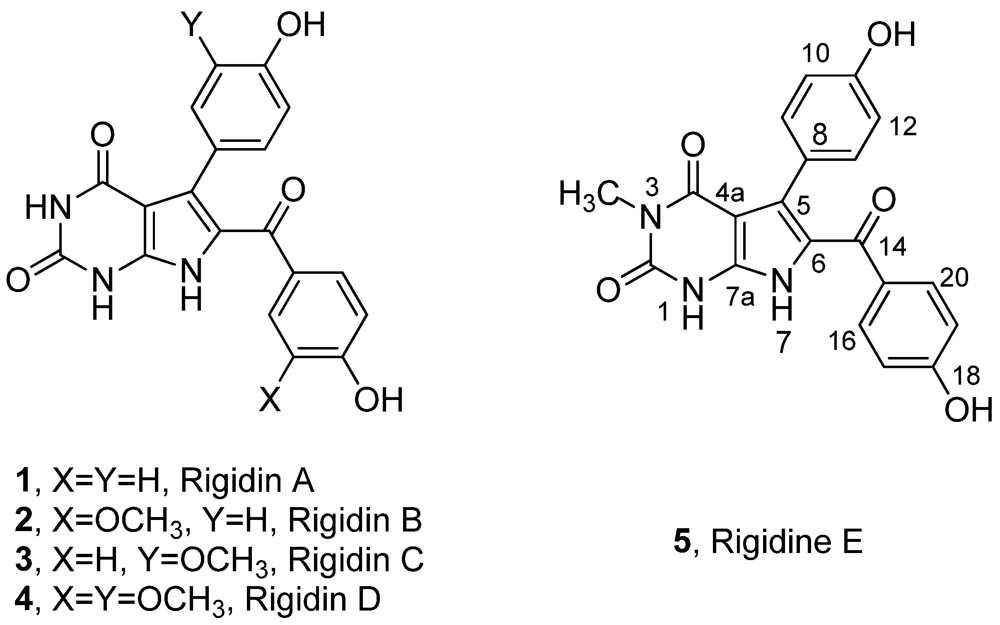
      <p>Rigidin A (<bold>1</bold>), a pyrrolo[2,3-<italic>d</italic>]pyrimidine alkaloid, was first isolated by Kobayashi <italic>et al.</italic> from Okinawa marine tunicate <italic>Eudisromu</italic> cf. <italic>rigida</italic> in 1990 [<xref ref-type="bibr" rid="B1-marinedrugs-10-01412">1</xref>]. Later on, a series of its analogues, Rigidin B–E (<bold>2</bold>–<bold>5</bold>) (<xref ref-type="fig" rid="marinedrugs-10-01412-f001">Figure 1</xref>), which were consequently isolated from the same marine species [<xref ref-type="bibr" rid="B2-marinedrugs-10-01412">2</xref>], were found to have strong inhibitory activity against calmodulin brain phosphodiesterase [<xref ref-type="bibr" rid="B3-marinedrugs-10-01412">3</xref>]. The core structure of rigidin A–E is a tetrasubstituted pyrrole fused to a pyrimidine, which is an important structural subunit in a variety of biologically active compounds. In the past decades, much attention have been drawn on the pyrrolo[2,3-<italic>d</italic>]pyrimidine analogues for biological and pharmaceutical applications [<xref ref-type="bibr" rid="B4-marinedrugs-10-01412">4</xref>,<xref ref-type="bibr" rid="B5-marinedrugs-10-01412">5</xref>,<xref ref-type="bibr" rid="B6-marinedrugs-10-01412">6</xref>,<xref ref-type="bibr" rid="B7-marinedrugs-10-01412">7</xref>,<xref ref-type="bibr" rid="B8-marinedrugs-10-01412">8</xref>,<xref ref-type="bibr" rid="B9-marinedrugs-10-01412">9</xref>,<xref ref-type="bibr" rid="B10-marinedrugs-10-01412">10</xref>,<xref ref-type="bibr" rid="B11-marinedrugs-10-01412">11</xref>].</p>
      <fig id="marinedrugs-10-01412-f001" position="anchor">
        <label>Figure 1</label>
        <caption>
          <p>Structures of marine alkaloids rigidin A–E.</p>
        </caption>
        <graphic xmlns:xlink="http://www.w3.org/1999/xlink" xlink:href="marinedrugs-10-01412-g001.tif"/>
      </fig>
      <p>Due to the fact that the content of rigidins in localized tunicate species is very low (0.0015% wet weight), only very limited amount of rigidins could be isolated for biological study. Therefore, total synthesis of rigidin was employed to provide sufficient samples for their biological assays.</p>
      <p>Currently, there are four published synthetic routes for the total synthesis of rigidins. In 1993, Edstrom <italic>et al.</italic> presented the first report of total synthesis of rigidin A (<bold>1</bold>) with 1,3-dibenzyl protected 6-chlorouracil in 26% overall yield [<xref ref-type="bibr" rid="B12-marinedrugs-10-01412">12</xref>]. After a S<sub>N</sub>2 substitution of the 6-chloro group with <italic>N</italic>-benzylglycine, the pyrrolo[2,3-<italic>d</italic>]pyrimidine skeleton was formed by reflux in acetic anhydride. The two substitutes at 5- and 6-position were then attached on Stille cross-coupling and Friedel-Crafts acylation respectively.</p>
      <p>Soon after, Sakamoto and his co-workers reported the second strategy for total synthesis of rigidin A (<bold>1</bold>) in 1994 [<xref ref-type="bibr" rid="B13-marinedrugs-10-01412">13</xref>,<xref ref-type="bibr" rid="B14-marinedrugs-10-01412">14</xref>]. With a multi-substituted bromopyrimidine as starting material, the pyrrolo[2,3-<italic>d</italic>]pyrimidine core was built by Stille cross-coupling reaction with vinylstannane and subsequent acidic hydrolysis. The two substitutes were then introduced by similar reactions reported by Edstrom [<xref ref-type="bibr" rid="B12-marinedrugs-10-01412">12</xref>]. Rigidin A (<bold>1</bold>) was obtained in less than 10% overall yield.</p>
      <p>In 2006, Gupton <italic>et al.</italic> reported the third total synthesis strategy for rigidin A (<bold>1</bold>) and rigidin E (<bold>5</bold>), which used a symmetrical vinamidinium salt to construct 2,4-disubstituted pyrrole [<xref ref-type="bibr" rid="B15-marinedrugs-10-01412">15</xref>]. After C-6 substitute was introduced by Friedel-Crafts acylation, the pyrimidine moiety was constructed to accomplish the total synthesis of rigidin A (<bold>1</bold>) and rigidin E (<bold>5</bold>).</p>
      <p>The first and second synthetic routes employed substituted pyrimidine as the starting material and subsequently constructed the pyrrole moiety. In contrast, the third route constructed multi-substituted pyrrole moiety before pyrimidine formation. All three routes suffered from harsh reaction conditions, expensive Palladium-based catalyst, lengthy route and lack of variability for diversity-oriented derivatives.</p>
      <p>In 2011, Magedov reported that tetra- and pentasubstituted 2-aminopyrroles can be prepared via multi-component reactions of structurally diverse aldehydes and <italic>N</italic>-(aryl-, heteroaryl-, alkylsulfonamido)acetophenones with cyanoacetic acid derivatives, such as malononitrile and cyanoacetate [<xref ref-type="bibr" rid="B16-marinedrugs-10-01412">16</xref>]. Furthermore, this methodology was used successfully in total synthesis of rigidins A–D in moderate overall yield, which is the fourth total synthetic route [<xref ref-type="bibr" rid="B16-marinedrugs-10-01412">16</xref>]. So far, this is the most efficient total synthetic strategy. However, this protocol’s generality and reproducibility still needs to be proved. We describe herein an improved and practical synthetic route for the total synthesis of rigidin E.</p>
    </sec>
    <sec sec-type="results">
      <title>2. Results and Discussion</title>
      <p>Rigidin E contains many <italic>H</italic>-bond donor/acceptors, which may coordinate with heavy metal ions and form metal-rigidin complexes. The resulting metal contamination cannot usually be easily removed by a normal purification process. This promoted us to develop a metal-free strategy. </p>
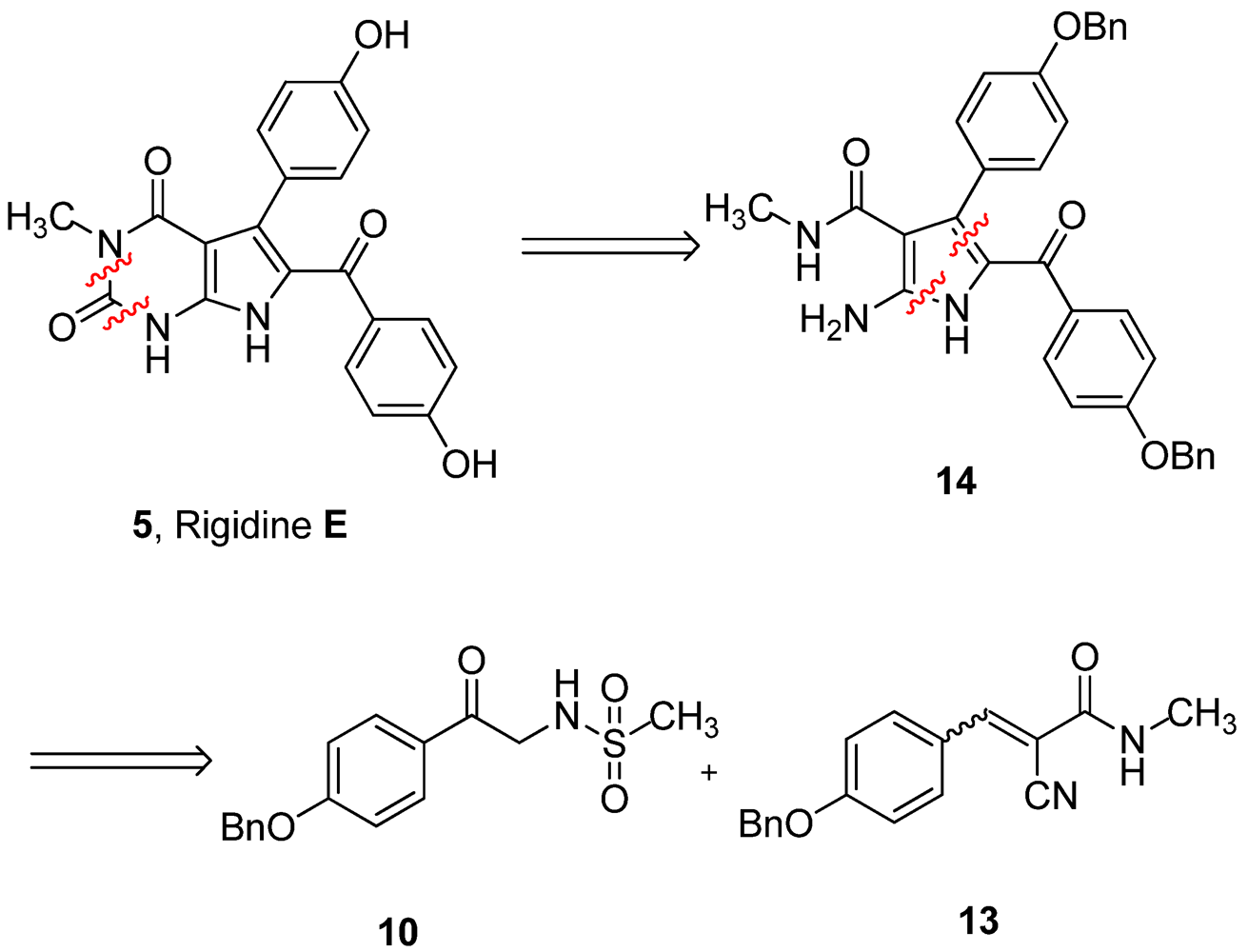
      <p>Our retrosynthetic analysis is showed in <xref ref-type="fig" rid="marinedrugs-10-01412-f002">Figure 2</xref>. Principally, rigidin E may be synthesized from rigidin A through regioselective methylation at N-3. This reaction is very difficult to realize due to the three NH groups in rigidin E. Therefore, it is preferable to introduce the methyl group before constructing the tetrasubstituted 2-aminopyrrole.</p>
      <fig id="marinedrugs-10-01412-f002" position="anchor">
        <label>Figure 2</label>
        <caption>
          <p>Retrosynthetic analysis of rigidin E. </p>
        </caption>
        <graphic xmlns:xlink="http://www.w3.org/1999/xlink" xlink:href="marinedrugs-10-01412-g002.tif"/>
      </fig>
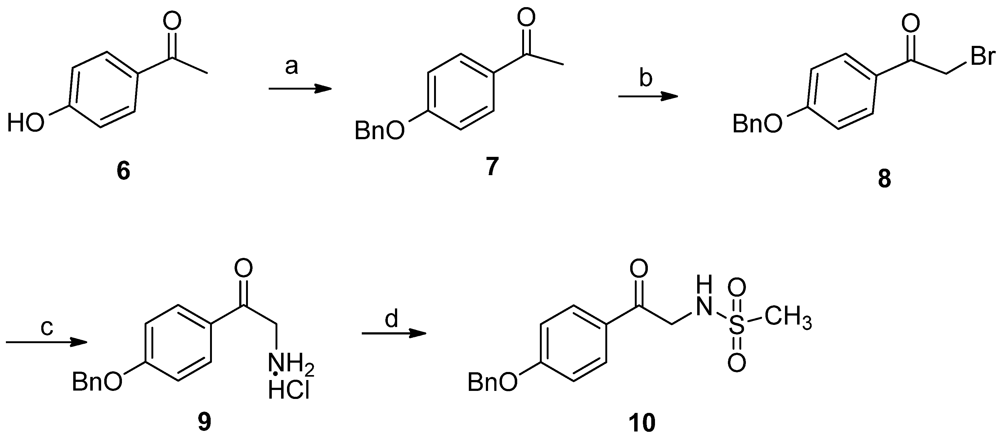
      <p>Regioselective bromination of acetophenone <bold>7</bold> with phenyltrimethylammonium tribromide in anhydrous THF afforded 2-bromoacetophenone <bold>8</bold> in 80% yield [<xref ref-type="bibr" rid="B17-marinedrugs-10-01412">17</xref>]. 2-Amino-acetophenone <bold>9 </bold>was synthesized using hexamethylenetetramine as an NH<sub>2</sub> source in anhydrous chlorobenzene. Subsequent reaction with methanesulfonyl chloride gave methanesulfonamide <bold>10</bold> in 60% yield over two steps (<xref ref-type="fig" rid="marinedrugs-10-01412-f003">Scheme 1</xref>).</p>
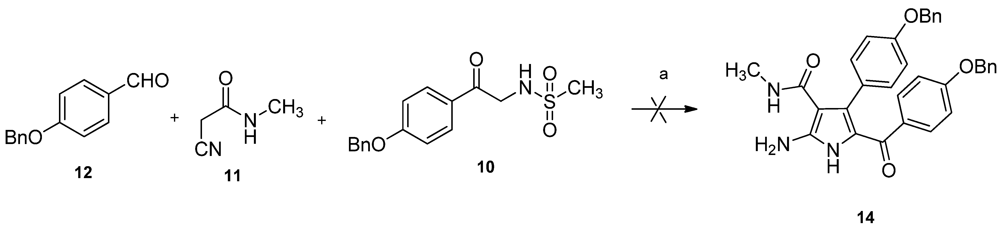
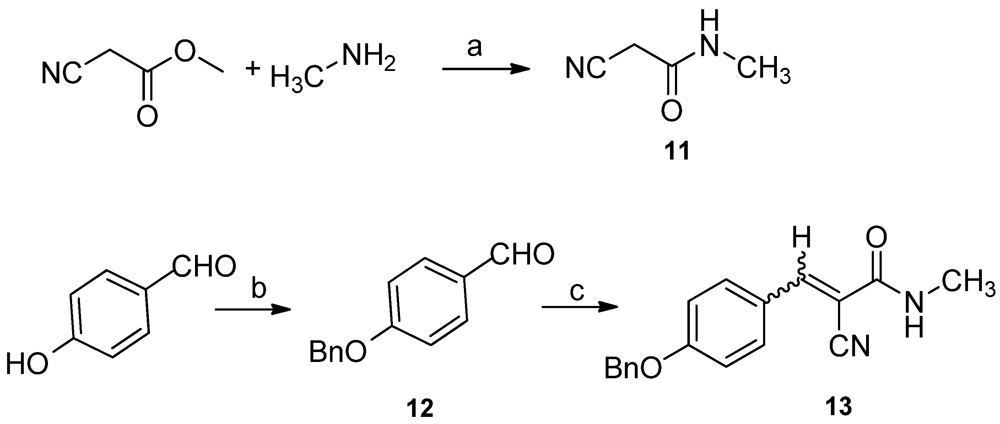
      <p>In order to introduce the methyl group to N-3, 2-cyano-<italic>N</italic>-methylacetamide <bold>11</bold> was synthesized from ethyl cyanoacetate and methylamine in 90% yield [<xref ref-type="bibr" rid="B18-marinedrugs-10-01412">18</xref>,<xref ref-type="bibr" rid="B19-marinedrugs-10-01412">19</xref>]. Attempts to synthesize key intermediate <bold>14</bold> using the reported three-components reaction of compound <bold>10</bold>, <bold>11</bold>, and <bold>12</bold> proceeded in very low yield and was complicated by undesired byproducts (<xref ref-type="fig" rid="marinedrugs-10-01412-f004">Scheme 2</xref>). As reported by Magedov [<xref ref-type="bibr" rid="B16-marinedrugs-10-01412">16</xref>], Knoevenagel adduct <bold>13</bold> may be the intermediate in the three-component reaction. We speculated that the intermediate <bold>13</bold> could not form efficiently because of the higher p<italic>K</italic><sub>a</sub> of the methylene of <italic>N</italic>-methylacetamide compare to <italic>N</italic>-unsubstituted acetamide. Therefore, it is possible to solve this problem through synthesis of the intermediate <bold>13 </bold> independently.</p>
      <fig id="marinedrugs-10-01412-f003" position="anchor">
        <object-id pub-id-type="pii">marinedrugs-10-01412-scheme1_Scheme 1</object-id>
        <label>Scheme 1</label>
        <caption>
          <p>Synthesis of methanesulfonamide <bold>10</bold>. Reagents and conditions: (<bold>a</bold>) K<sub>2</sub>CO<sub>3</sub>, acetone, BnBr, 0 °C, 98%; (<bold>b</bold>) phenyltriethylammonium tribromide, THF, 80%; (<bold>c</bold>) hexamethylenetetramine, chlorobenzene, then conc. HCl; (<bold>d</bold>) MsCl, Et<sub>3</sub>N, acetone/H<sub>2</sub>O 2:1, 60% over two steps.</p>
        </caption>
        <graphic xmlns:xlink="http://www.w3.org/1999/xlink" xlink:href="marinedrugs-10-01412-g003.tif"/>
      </fig>
      
      <fig id="marinedrugs-10-01412-f004" position="anchor">
        <object-id pub-id-type="pii">marinedrugs-10-01412-scheme2_Scheme 2</object-id>
        <label>Scheme 2</label>
        <caption>
          <p>Three-components reaction for synthesis the key intermediate <bold>14</bold> failed. Reagents and conditions: (<bold>a</bold>) K<sub>2</sub>CO<sub>3</sub>, EtOH, reflux.</p>
        </caption>
        <graphic xmlns:xlink="http://www.w3.org/1999/xlink" xlink:href="marinedrugs-10-01412-g004.tif"/>
      </fig>
      <p>After Knoevenagel condensation of 2-cyano-<italic>N</italic>-methylacetamide <bold>11</bold> and 4-(benzyloxy)benzaldehyde <bold>12</bold> using piperidine as a catalyst, 3-(4-(benzyloxy)phenyl)-2-cyano-<italic>N</italic>-methylacrylamide <bold>13</bold> was obtained in 80% yield as a mixture of <italic>E/Z</italic> in about 1:1 ratio (<xref ref-type="fig" rid="marinedrugs-10-01412-f005">Scheme 3</xref>) [<xref ref-type="bibr" rid="B20-marinedrugs-10-01412">20</xref>]. Then, a variation of the reported three-components reaction was conducted to synthesize the precursor <bold>14</bold>.</p>
      <fig id="marinedrugs-10-01412-f005" position="anchor">
        <object-id pub-id-type="pii">marinedrugs-10-01412-scheme3_Scheme 3</object-id>
        <label>Scheme 3</label>
        <caption>
          <p>Synthesis of <italic>N</italic>-methylacrylamide <bold>13</bold>. Reagents and conditions: (<bold>a</bold>) methylamine, H<sub>2</sub>O, 90%; (<bold>b</bold>) K<sub>2</sub>CO<sub>3</sub>, acetone, BnBr, 0 °C, 95%; (<bold>c</bold>) <bold>11</bold>, piperidine, toluene, 80%.</p>
        </caption>
        <graphic xmlns:xlink="http://www.w3.org/1999/xlink" xlink:href="marinedrugs-10-01412-g005.tif"/>
      </fig>
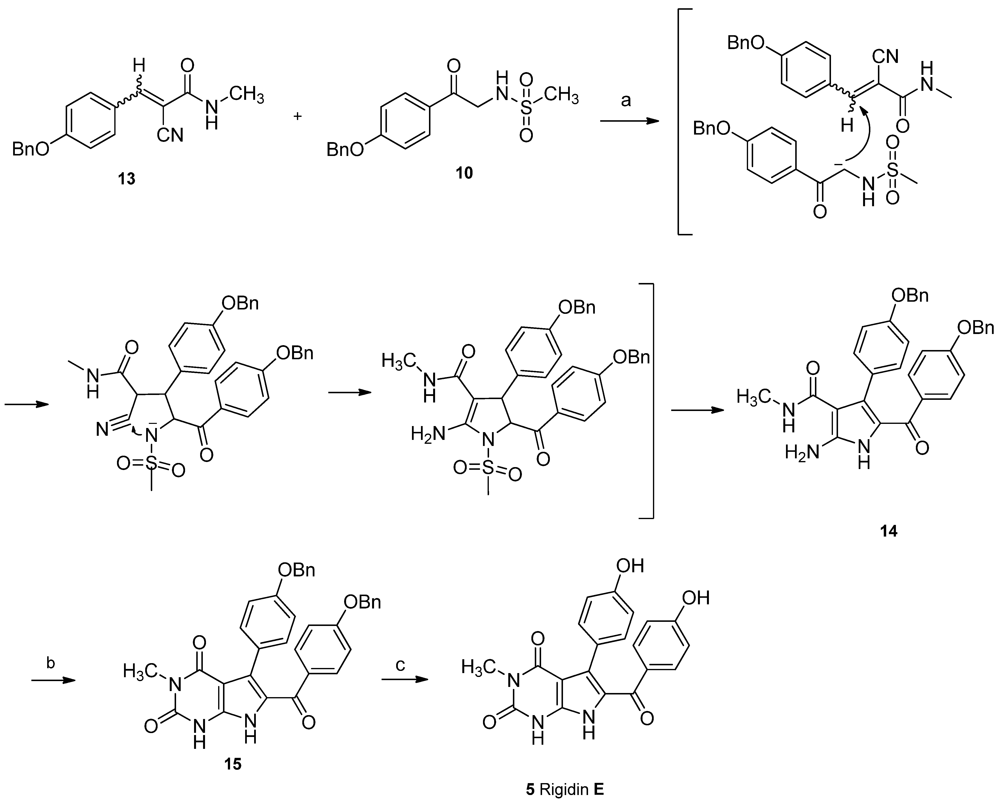
      <p>After a careful screening of reaction conditions, the key intermediate <bold>14</bold> was successfully prepared by a cascade Michael addition/intermolecular cyclization between <italic>N</italic>-methylacrylamide <bold>13</bold> and methanesulfonamide <bold>10</bold> in one pot, with K<sub>2</sub>CO<sub>3</sub> as base and ethanol as solvent under refluxing conditions. The present result proves that phenyl-2-cyanoacrylamide like Knoevenagel adduct was the intermediate for cyclization in the reported three-component reaction [<xref ref-type="bibr" rid="B21-marinedrugs-10-01412">21</xref>].</p>
      <p>Carbonylation with oxalyl chloride in diglyme failed to give pyrimidinedione <bold>15</bold> [<xref ref-type="bibr" rid="B16-marinedrugs-10-01412">16</xref>]. Various reagents and conditions were tested, and triphosgene was found ideal to promote the I<sub>2</sub>-catalyzed cyclization in anhydrous THF to give pyrimidinedione <bold>15</bold> in 60% yield [<xref ref-type="bibr" rid="B22-marinedrugs-10-01412">22</xref>,<xref ref-type="bibr" rid="B23-marinedrugs-10-01412">23</xref>]. The final deprotection of benzyl groups using catalytic hydrogenation resulted in a complicated mixture. The reason might be the accompanied reduction of carbonyl at C-14. Finally, the protective groups were successfully removed by TMSI <italic>in situ</italic> prepared by TMSCl and NaI to afford rigidin E (<bold>5</bold>) in 88% yield (<xref ref-type="fig" rid="marinedrugs-10-01412-f006">Scheme 4</xref>). All spectral data are consistent with those of the reported natural product [<xref ref-type="bibr" rid="B3-marinedrugs-10-01412">3</xref>].</p>
      <fig id="marinedrugs-10-01412-f006" position="anchor">
        <object-id pub-id-type="pii">marinedrugs-10-01412-scheme4_Scheme 4</object-id>
        <label>Scheme 4</label>
        <caption>
          <p>Total synthesis of rigidin E. Reagents and conditions: (<bold>a</bold>) K<sub>2</sub>CO<sub>3</sub>, EtOH, reflux, 50%; (<bold>b</bold>) triphosgene, I<sub>2</sub>, THF, 60%; (<bold>c</bold>) TMSCl, NaI, CH<sub>3</sub>CN, 88%.</p>
        </caption>
        <graphic xmlns:xlink="http://www.w3.org/1999/xlink" xlink:href="marinedrugs-10-01412-g006.tif"/>
      </fig>
    </sec>
    <sec>
      <title>3. Experimental Section</title>
      <sec>
        <title>3.1. General</title>
        <p>All reagents and catalysts were purchased from commercial sources (Acros or Sigma Aldrich) and used without purification. MeCN, chlorobenzene and DCM were dried with CaH<sub>2 </sub>and distilled prior to use. THF was dried with LiAlH<sub>4</sub> and distilled prior to use. Thin layer chromatography was performed using silica gel GF-254 plates (Qing-Dao Chemical Company, China) with detection by UV (254 nm) or charting with 10% sulfuric acid in ethanol. Column chromatography was performed on silica gel (200–300 mesh, Qing-Dao Chemical Company, China). NMR spectra were recorded on a Bruker AV400 spectrometer, and chemical shifts (δ) are reported in ppm. <sup>1</sup>H NMR and <sup>13</sup>C NMR spectra were calibrated with TMS as internal standard, and coupling constants (<italic>J</italic>) are reported in Hz. The ESI-HRMS were obtained on a Bruker Dalton microTOFQ II spectrometer in positive ion mode. Melting points were measured on an electrothermal apparatus uncorrected.</p>
      </sec>
      <sec>
        <title>3.2. 1-(4-(Benzyloxy)phenyl)-2-bromoethanone <bold>8</bold></title>
        <p>To a solution of 1-(4-(benzyloxy)phenyl)ethanone <bold>7</bold> (2.26 g, 10 mmol) in anhydrous THF (20 mL) was added phenyltrimethylammonium tribromide (3.76 g, 10 mmol). The resulting solution was stirred at room temperature. A white precipitate was formed and the solution became yellowish over several minutes. After 30 min, the mixture was poured into ice water (50 mL) and extracted with ethyl acetate (20 mL × 3). The combined organic layer was dried over anhydrous Na<sub>2</sub>SO<sub>4</sub>, filtered, and concentrated. The crude product was recrystallized from ethanol (15 mL) to afford the title product <bold>8</bold> (2.43 g, 80% yield).</p>
        <p>MP: 67–69 °C; <italic>R<sub>f</sub></italic> = 0.30 (PE–EtOAc, 50:1). <sup>1</sup>H NMR (400 MHz, CDCl<sub>3</sub>): δ = 4.40 (s, 2H, CH<sub>2</sub>Br), 5.14 (s, 2H, C<sub>6</sub>H<sub>5</sub>CH<sub>2</sub>), 7.03 (d, <italic>J</italic> = 8.8 Hz, 2H, C<sub>6</sub>H<sub>4</sub>, H-3,5), 7.35–7.44 (m, 5H, C<sub>6</sub>H<sub>5</sub>), 7.96 (d, <italic>J</italic> = 8.8 Hz, 2H, C<sub>6</sub>H<sub>4</sub>, H-2,4). <sup>13</sup>C NMR (100 MHz, CDCl<sub>3</sub>): δ = 30.7, 70.2, 114.9, 127.5, 128.3, 128.7, 130.6, 131.4, 135.9, 163.3, 190.0. MS (ESI): <italic>m/z</italic> = 304.8 [M + H]<sup>+</sup>.</p>
      </sec>
      <sec>
        <title>3.3. <italic>N</italic>-(2-(4-(Benzyloxy)phenyl)-2-oxoethyl)methanesulfonamide <bold>10</bold></title>
        <p>1-(4-(Benzyloxy)phenyl)-2-bromoethanone <bold>8</bold> (3.04 g, 10 mmol) was dissolved in anhydrous chlorobenzene (8.5 mL). The solution was added dropwise to a solution of hexamethylenetetramine (1.15 g, 11 mmol) in anhydrous chlorobenzene (10 mL) at 30 °C. The reaction mixture was stirred at 30 °C for 4 h and filtered. The filter cake was washed with ethanol (10 mL) and dried <italic>in vacuo</italic>. The filter cake was redissolved in a mixture of concentrated hydrochloric acid (10 mL) and ethanol (20 mL) with vigorous stirring. The resulting reaction mixture was stirred occasionally under N<sub>2</sub> atmosphere for 48 h. The reaction mixture was cooled to 0 °C and filtered to give compound <bold>9</bold>. It was redissolved in H<sub>2</sub>O/acetone (1:2, 600 mL). Then methanesulfonyl chloride (1.71 g, 15 mmol) was added to the mixture. The mixture was placed in an ice bath and triethylamine (2.53 g, 25 mmol) was added dropwise over 30 min. Then acetone (14 mL) was added to the above mixture. The reaction mixture was stirred at room temperature for 10 h, and then the volatiles were evaporated under reduced pressure. The solid started to precipitate. To the obtained slurry were added ethyl acetate (20 mL) and saturated NH<sub>4</sub>Cl (20 mL) aqueous solution. The organic layer was separated and washed with saturated NaHCO<sub>3</sub> (20 mL) aqueous solution and brine (20 mL), dried with anhydrous MgSO<sub>4</sub>, and concentrated to afford the title product <bold>10</bold> (1.91 g, 60% yield).</p>
        <p>Mp: 138–140 °C; <italic>R<sub>f</sub></italic> = 0.43 (CH<sub>3</sub>OH–CH<sub>2</sub>Cl<sub>2</sub>, 1:50). <sup>1</sup>H NMR (400 MHz, CDCl<sub>3</sub>): δ = 2.99 (s, 3H, CH<sub>3</sub>), 4.61 (s, 2H, CH<sub>2</sub>NH), 5.15 (s, 2H, C<sub>6</sub>H<sub>5</sub>CH<sub>2</sub>), 5.32–5.49 (b, 1H, NH), 7.04 (d, <italic>J</italic> = 8.8 Hz, 2H, C<sub>6</sub>H<sub>4</sub>, H-3,5), 7.25–7.42 (m, 5H, C<sub>6</sub>H<sub>5</sub>), 7.91 (d, <italic>J</italic> = 8.8 Hz, 2H, C<sub>6</sub>H<sub>4</sub>, H-2,4). <sup>13</sup>C NMR (100 MHz, CDCl<sub>3</sub>): δ = 40.7, 48.8, 70.3, 115.1, 126.9, 127.5, 128.4, 128.7, 130.3, 135.8, 163.7, 191.6. MS (ESI): <italic>m/z</italic> = 342.5 [M + Na]<sup>+</sup>.</p>
      </sec>
      <sec>
        <title>3.4. 4-(Benzyloxy)benzaldehyde <bold>12</bold></title>
        <p>To a mixture of 4-hydroxybenzaldehyde (1.22 g, 10 mmol) and K<sub>2</sub>CO<sub>3</sub> (1.45 g, 10.5 mmol) in acetone (10 mL) was added benzyl bromide (1.80 g, 10.5 mmol). The resulting mixture was heated to reflux for 3 h. After cooling, the reaction mixture was poured into water (5 mL) and extracted with Et<sub>2</sub>O (5 mL × 3). The combined organic layers were washed with brine (20 mL), dried over anhydrous MgSO<sub>4</sub>, filtered, and concentrated under reduced pressure to give a white solid. The solid was washed with 95% ethanol (2 mL) to afford pure product <bold>12</bold> (2.01 g, 95% yield). </p>
        <p>MP: 69–71 °C; <italic>R<sub>f</sub></italic> = 0.49 (PE–EtOAc, 4:1). <sup>1</sup>H NMR (400 MHz, CDCl<sub>3</sub>): δ = 5.15 (s, 2H, C<sub>6</sub>H<sub>5</sub>CH<sub>2</sub>), 7.08 (d, <italic>J</italic> = 8.4 Hz, 2H, C<sub>6</sub>H<sub>4</sub>, H-3,5), 7.35–7.45 (m, 5H, C<sub>6</sub>H<sub>5</sub>CH<sub>2</sub>), 7.84 (d, <italic>J</italic> = 8.4 Hz, 2H, C<sub>6</sub>H<sub>4</sub>, H-2,4), 9.89 (s, 1H, CHO). <sup>13</sup>C NMR (100 MHz, CDCl<sub>3</sub>): δ = 70.6, 115.5, 127.8, 128.6, 129.1, 130.5, 132.3, 136.3, 164.1, 191.1. MS (ESI): <italic>m/z</italic> = 213.2 [M + Na]<sup>+</sup>.</p>
      </sec>
      <sec>
        <title>3.5. 2-Cyano-<italic>N</italic>-methylacetamide</title>
        <p>To an ice cooled solution of methylamine (2.17 g, 75 mmol) in water, ethyl cyanoacetate (5.65 g, 50 mmol) was added dropwise. The solution was stirred at room temperature for 3 h. Most of the solvent were evaporated under reduced pressure. The obtained solid was filtered and redissolved in ethyl acetate (200 mL). The solution was dried over anhydrous Na<sub>2</sub>SO<sub>4</sub>. The solvent was evaporated to give the title product (4.14 g, 90% yield). </p>
        <p>MP: 81–83 °C. <sup>1</sup>H NMR (400 MHz, DMSO): δ = 2.58 (d, <italic>J</italic> = 4.4 Hz, 3H, CH<sub>3</sub>), 3.57 (s, 2H, CH<sub>2</sub>), 8.14 (s, 1H, NH). <sup>13</sup>C NMR (100 MHz, DMSO-<italic>d</italic><sub>6</sub>): δ = 24.6, 25.4, 115.6, 161.9. MS (ESI): <italic>m/z</italic> = 99.4 [M + H]<sup>+</sup>.</p>
      </sec>
      <sec>
        <title>3.6. 3-(4-(Benzyloxy)phenyl)-2-cyano-<italic>N</italic>-methylacrylamide <bold>13</bold></title>
        <p>To a mixture of 4-(benzyloxy)benzaldehyde <bold>12</bold> (2.12 g, 10 mmol) and piperidine (34 mg, 0.4 mmol) in toluene (10 mL) was added 2-cyano-<italic>N</italic>-methylacetamide (1.08 g, 11 mmol). The resulting mixture was heated to reflux for 15 h. After cooling, the reaction mixture was filtered. The filter cake was washed with 95% ethanol (20 mL), and then dried <italic>in vacuo</italic> to afford the title product <bold>13</bold> (2.34 g, 80% yield).</p>
        <p>MP: 170–172 °C; <italic>R<sub>f</sub></italic> = 0.37 (PE–EtOAc, 2:1). <sup>1</sup>H NMR (400 MHz, DMSO-<italic>d</italic><sub>6</sub>): δ = 2.72 (d, <italic>J</italic> = 4.4 Hz, 3H, CH<sub>3</sub>), 5.19 (s, 2H, CH<sub>2</sub>), 7.18 (d, <italic>J</italic> = 8.8 Hz, 2H, C<sub>6</sub>H<sub>4</sub>, H-3,5), 7.31–7.46 (m, 5H, C<sub>6</sub>H<sub>5</sub>), 7.95 (d, <italic>J</italic> = 8.8 Hz, 2H, C<sub>6</sub>H<sub>4</sub>, H-2,4), 8.08 (s, 1H, NH), 8.27 (d, <italic>J</italic> = 4.4 Hz, 1H, CH<sub>2</sub>). <sup>13</sup>C NMR (100 MHz, DMSO-<italic>d</italic><sub>6</sub>): δ = 27.2, 70.0, 103.0, 116.0, 117.4, 125.1, 128.4, 128.5, 129.0, 132.9, 136.8, 150.4, 162.0. MS (ESI): <italic>m/z</italic> = 315.1 [M + H]<sup>+</sup>.</p>
      </sec>
      <sec>
        <title>3.7. 2-Amino-5-(4-(benzyloxy)benzoyl)-4-(4-(benzyloxy)phenyl)-<italic>N</italic>-methyl-1h-pyrrole-3-carboxamide <bold>14</bold></title>
        <p>To a mixture of 3-(4-(benzyloxy)phenyl)-2-cyano-<italic>N</italic>-methylarcylamide <bold>13</bold> (3.21 g, 11 mmol) and K<sub>2</sub>CO<sub>3</sub> (0.69 g, 5 mmol) in ethanol (10 mL) was added <italic>N</italic>-(2-(4-(benzyloxy)phenyl)-2-oxoethyl)methanesulfonamide <bold>10</bold> (3.19 g, 10 mmol). The resulting mixture was refluxed for 12 h under N<sub>2</sub> atmosphere. After the solvent was evaporated, the residue was purified by column chromatography with CH<sub>3</sub>OH/CH<sub>2</sub>Cl<sub>2</sub> = 1:60 to afford the title product <bold>14</bold> (2.66 g, 50% yield).</p>
        <p>MP 247–249 °C; <italic>R<sub>f</sub></italic> = 0.40 (CH<sub>3</sub>OH–CH<sub>2</sub>Cl<sub>2</sub>, 1:60). <sup>1</sup>H NMR (400 MHz, DMSO-<italic>d</italic><sub>6</sub>): δ = 2.46 (d, <italic>J</italic> = 4.8 Hz, 3H, CONHCH<sub>3</sub>), 5.01 (s, 2H, C<sub>6</sub>H<sub>4</sub>OCH<sub>2</sub>C<sub>6</sub>H<sub>5</sub>), 5.03 (s, 2H, CH<sub>2</sub>), 5.24 (b, 1H), 6.25 (s, 2H, NH<sub>2</sub>), 6.62 (d, <italic>J</italic> = 8.8 Hz, 2H), 6.77 (d, <italic>J</italic> = 8.4 Hz, 2H), 6.94 (d, <italic>J</italic> = 8.4 Hz, 2H), 7.09 (d, 2H, <italic>J</italic> = 8.8 Hz), 7.33–7.36 (b, 10 H), 10.80 (s, 1H). <sup>13</sup>C NMR (100 MHz, DMSO-<italic>d</italic><sub>6</sub>): δ = 25.7, 69.8, 99.2, 113.6, 114.7,121.5, 126.5, 127.8, 128.2, 128.7, 130.2, 131.0, 132.1, 132.2, 137.0, 137.2, 148.8, 158.2, 159.8, 166.3, 183.3. MS (ESI): <italic>m/z</italic> = 570.2 [M + K]<sup>+</sup>.</p>
      </sec>
      <sec>
        <title>3.8. 6-(4-(Benzyloxy)benzoyl)-5-(4-(benzyloxy)phenyl)-3-methyl-1<italic>H</italic>-pyrrolo[2,3-<italic>d</italic>]pyrimidine-2,4(3<italic>H</italic>,7<italic>H</italic>)-dione <bold>15</bold></title>
        <p>A mixture of pyrrolocarboxamide <bold>14</bold> (5.31 g, 10.0 mmol), triphosgene (1.48 g, 5.0 mmol) and iodine (0.127 g, 0.5 mmol) in anhydrous THF (10 mL) was heated to reflux for 20 h before the volatiles were removed <italic>in vacuo</italic>. The residue was dissolved in ethyl acetate (10 mL) and washed with brine (10 mL), dried over anhydrous MgSO<sub>4</sub>, and purified by column chromatography (MeOH/CH<sub>2</sub>Cl<sub>2</sub> = 1:10) to afford the title product <bold>15</bold> (3.34 g, 60% yield).</p>
        <p>MP: 226–228 °C; <italic>R<sub>f</sub></italic> = 0.35 (MeOH–CH<sub>2</sub>Cl<sub>2</sub>, 1:10). <sup>1</sup>H NMR (400 MHz, DMSO-<italic>d</italic><sub>6</sub>): δ = 3.14 (s, 3H, CH<sub>3</sub>), 5.00 (s, 2H, CH<sub>2</sub>), 5.03 (s, 2H), 6.67–6.73 (m, 4H), 7.03–7.05 (m, 2H), 7.28–7.35 (m, 12H), 11.65 (s, 1H), 11.96 (s, 1H). <sup>13</sup>C NMR (100 MHz, DMSO-<italic>d</italic><sub>6</sub>): δ = 27.2, 69.7, 69.9, 98.4, 113.7, 114.2, 125.1, 125.7, 127.9, 128.0, 128.2, 128.4, 128.9, 130.9, 131.7, 132.7, 136.9, 137.5, 140.1, 151.2, 158.0, 159.5, 161.4, 185.7. MS (ESI): <italic>m/z</italic> = 596.2 [M + Na]<sup>+</sup>.</p>
      </sec>
      <sec>
        <title>3.9. Rigidin E <bold>5</bold></title>
        <p>A mixture of 6-(4-(benzyloxy)benzoyl)-5-(4-(benzyloxy)phenyl)-3-methyl-1<italic>H</italic>-pyrrolo[2,3-<italic>d</italic>]pyrimidine-2,4(3<italic>H</italic>,7<italic>H</italic>)-dione <bold>15</bold> (1.114 g, 2 mmol) and NaI (9.0 g, 60 mmol) in CH<sub>3</sub>CN (20 mL) under N<sub>2</sub> was stirred at room temperature for 20 min. Chlorotrimethylsilane (17.8 g, 60 mmol) was then added. The mixture was stirred at 60 °C for 18 h before the volatiles were removed <italic>in vacuo</italic>. The residue was extracted with petroleum ether (10 mL × 3) in order to remove benzyl iodide, and then treated with water (5 mL) and ethyl acetate (10 mL). The mixture was stirred vigorously at room temperature for 2 h and extracted with more ethyl acetate (40 mL × 2). The combined organic layers were washed with brine (5 mL) containing a small amount of sodium thiosulfate, dried over anhydrous MgSO<sub>4</sub>, and purified by column chromatography (PE/Ethyl Acetate/MeOH/AcOH = 9:18:1:1) to afford the title product rigidin E (<bold>5</bold>) (664 mg, 88% yield).</p>
        <p>MP &gt; 300 °C; <italic>R<sub>f</sub></italic> = 0.31 (PE–Ethyl Acetate–MeOH–AcOH = 9:18:1:1). <sup>1</sup>H NMR (400 MHz, DMSO-<italic>d</italic><sub>6</sub>): δ = 3.14 (s, 3H, CH<sub>3</sub>), 6.44 (t, <italic>J</italic> = 8.0 Hz, 4H), 6.93 (d, <italic>J</italic> = 7.6 Hz, 2H), 7.27 (d, <italic>J</italic> = 8.0 Hz, 2H). <sup>13</sup>C NMR (100 MHz, DMSO-<italic>d</italic><sub>6</sub>): δ = 27.2, 98.2, 114.2, 114.7, 123.4, 125.3, 128.7, 129.2, 132.0, 132.8, 152.4, 156.8, 159.9, 161.0, 185.7. HRMS–ESI: <italic>m/z</italic> [M + H]<sup>+</sup> calcd for C<sub>20</sub>H<sub>15</sub>N<sub>3</sub>O<sub>5</sub>: 378.1012; found: 378.1098.</p>
      </sec>
    </sec>
    <sec sec-type="conclusions">
      <title>4. Conclusions</title>
      <p>In conclusion, we have developed an efficient approach for the total synthesis of rigidin E using readily available starting materials and routine chemical transformations. This strategy is especially useful to access different N-3 substituted rigidin derivatives. </p>
    </sec>
    
  </body>
  <back>
<app-group>
<app>
<title>Supplementary Files</title>
<supplementary-material xmlns:xlink="http://www.w3.org/1999/xlink" id="marinedrugs-10-01412-s001" xlink:href="marinedrugs-10-01412-s001.pdf">
<label>Supplementary File 1:</label>
<caption>
<p>PDF-Document (PDF, 689 KB)</p>
</caption>
</supplementary-material>
</app>
</app-group>
  <ack>
      <title>Acknowledgments</title>
      <p>We thank NSFC (No. 20962009, 21062006), NCET (11-1000), Education Department of Jiangxi Province (GJJ 11223) and Bureau of Science &amp; Technology of Nanchang City for financial support.</p>
    </ack>
    <ref-list>
      <title>References</title>
      <ref id="B1-marinedrugs-10-01412">
        <label>1.</label>
        <citation citation-type="journal">
          <person-group person-group-type="author">
            <name>
              <surname>Kobayashi</surname>
              <given-names>J.</given-names>
            </name>
            <name>
              <surname>Cheng</surname>
              <given-names>J.</given-names>
            </name>
            <name>
              <surname>Kikuchi</surname>
              <given-names>Y.</given-names>
            </name>
            <name>
              <surname>Ishibashi</surname>
              <given-names>M.</given-names>
            </name>
            <name>
              <surname>Yamamura</surname>
              <given-names>S.</given-names>
            </name>
            <name>
              <surname>Ohizumi</surname>
              <given-names>Y.</given-names>
            </name>
            <name>
              <surname>Ohtac</surname>
              <given-names>T.</given-names>
            </name>
            <name>
              <surname>Nozoec</surname>
              <given-names>S.</given-names>
            </name>
          </person-group>
          <article-title>Rigidin, a novel alkaloid with calmodulin antagonistic activity from the okinawan marine tunicate <italic>Eudistoma</italic> cf. <italic>rigida</italic></article-title>
          <source>Tetrahedron Lett.</source>
          <year>1990</year>
          <volume>31</volume>
          <fpage>4617</fpage>
          <lpage>4620</lpage>
        <pub-id pub-id-type="doi">10.1016/S0040-4039(00)97690-1</pub-id></citation>
      </ref>
      <ref id="B2-marinedrugs-10-01412">
        <label>2.</label>
        <citation citation-type="journal">
          <person-group person-group-type="author">
            <name>
              <surname>Tsuda</surname>
              <given-names>M.</given-names>
            </name>
            <name>
              <surname>Nozawa</surname>
              <given-names>K.</given-names>
            </name>
            <name>
              <surname>Shimbo</surname>
              <given-names>K.</given-names>
            </name>
            <name>
              <surname>Kobayashi</surname>
              <given-names>J.</given-names>
            </name>
          </person-group>
          <article-title>Rigidins B–D, new pyrrolopyrimidine alkaloids from a tunicate <italic>Cystodytes</italic> species</article-title>
          <source>J. Nat. Prod.</source>
          <year>2003</year>
          <volume>66</volume>
          <fpage>292</fpage>
          <lpage>294</lpage>
          <pub-id pub-id-type="doi">10.1021/np020393a</pub-id>
        </citation>
      </ref>
      <ref id="B3-marinedrugs-10-01412">
        <label>3.</label>
        <citation citation-type="journal">
          <person-group person-group-type="author">
            <name>
              <surname>Davis</surname>
              <given-names>R.A.</given-names>
            </name>
            <name>
              <surname>Christensen</surname>
              <given-names>L.V.</given-names>
            </name>
            <name>
              <surname>Richardson</surname>
              <given-names>A.D.</given-names>
            </name>
            <name>
              <surname>Da Rocha</surname>
              <given-names>R.M.</given-names>
            </name>
            <name>
              <surname>Ireland</surname>
              <given-names>C.M.</given-names>
            </name>
          </person-group>
          <article-title>Rigidin E, a new pyrrolopyrimidine alkaloid from a Papua New Guinea tunicate <italic>Eudistoma</italic> species</article-title>
          <source>Mar. Drugs</source>
          <year>2003</year>
          <volume>1</volume>
          <fpage>27</fpage>
          <lpage>33</lpage>
          <pub-id pub-id-type="doi">10.3390/md101027</pub-id>
        </citation>
      </ref>
      <ref id="B4-marinedrugs-10-01412">
        <label>4.</label>
        <citation citation-type="journal">
          <person-group person-group-type="author">
            <name>
              <surname>lgen</surname>
              <given-names>S.</given-names>
            </name>
            <name>
              <surname>Isgör</surname>
              <given-names>Y.G.</given-names>
            </name>
            <name>
              <surname>Coban</surname>
              <given-names>T.</given-names>
            </name>
          </person-group>
          <article-title>Synthesis and Activity of Novel 5-Substituted Pyrrolo[2,3-<italic>d</italic>] pyrimidine Analogues as pp60c-Src Tyrosine Kinase Inhibitors</article-title>
          <source>Arch. Pharm.</source>
          <year>2008</year>
          <volume>341</volume>
          <fpage>113</fpage>
          <lpage>120</lpage>
          <pub-id pub-id-type="doi">10.1002/ardp.200700141</pub-id>
        </citation>
      </ref>
      <ref id="B5-marinedrugs-10-01412">
        <label>5.</label>
        <citation citation-type="journal">
          <person-group person-group-type="author">
            <name>
              <surname>Bhat</surname>
              <given-names>U.G.</given-names>
            </name>
            <name>
              <surname>Gartel</surname>
              <given-names>A.L.</given-names>
            </name>
          </person-group>
          <article-title>Differential sensitivity of human colon cancer cell lines to the nucleoside analogs ARC and DRB</article-title>
          <source>Int. J. Cancer</source>
          <year>2008</year>
          <volume>122</volume>
          <fpage>1426</fpage>
          <lpage>1429</lpage>
        <pub-id pub-id-type="pmid">17999411</pub-id></citation>
      </ref>
      <ref id="B6-marinedrugs-10-01412">
        <label>6.</label>
        <citation citation-type="journal">
          <person-group person-group-type="author">
            <name>
              <surname>Seela</surname>
              <given-names>F.</given-names>
            </name>
            <name>
              <surname>Peng</surname>
              <given-names>X.</given-names>
            </name>
            <name>
              <surname>Budow</surname>
              <given-names>S.</given-names>
            </name>
          </person-group>
          <article-title>Advances in the Synthesis of 7-Deazapurine—pyrrolo[2,3-<italic>d</italic>] pyrimidine 2′-Deoxyribonucleosides Including <sc>D</sc>- and <sc>L</sc>-Enantiomers, Fluoro Derivatives and 2′,3′-Dideoxyribonucleosides</article-title>
          <source>Curr. Org. Chem.</source>
          <year>2007</year>
          <volume>11</volume>
          <fpage>427</fpage>
          <lpage>462</lpage>
          <pub-id pub-id-type="doi">10.2174/138527207780059286</pub-id>
        </citation>
      </ref>
      <ref id="B7-marinedrugs-10-01412">
        <label>7.</label>
        <citation citation-type="journal">
          <person-group person-group-type="author">
            <name>
              <surname>Matthew</surname>
              <given-names>M.</given-names>
            </name>
            <name>
              <surname>Xu</surname>
              <given-names>F.</given-names>
            </name>
            <name>
              <surname>Waters</surname>
              <given-names>M.</given-names>
            </name>
            <name>
              <surname>Williams</surname>
              <given-names>J.M.</given-names>
            </name>
            <name>
              <surname>Savary</surname>
              <given-names>K.A.</given-names>
            </name>
            <name>
              <surname>Cameron</surname>
              <given-names>J.</given-names>
            </name>
            <name>
              <surname>Yang</surname>
              <given-names>C.</given-names>
            </name>
            <name>
              <surname>Buck</surname>
              <given-names>E.</given-names>
            </name>
            <name>
              <surname>Song</surname>
              <given-names>Z.J.</given-names>
            </name>
            <name>
              <surname>Tschaen</surname>
              <given-names>D.M.</given-names>
            </name>
          </person-group>
          <article-title>Practical synthesis of a potent hepatitis C virus RNA replication inhibitor</article-title>
          <source>J. Org. Chem.</source>
          <year>2004</year>
          <volume>69</volume>
          <fpage>6257</fpage>
          <lpage>6266</lpage>
        <pub-id pub-id-type="doi">10.1021/jo0491096</pub-id><pub-id pub-id-type="pmid">15357584</pub-id></citation>
      </ref>
      <ref id="B8-marinedrugs-10-01412">
        <label>8.</label>
        <citation citation-type="journal">
          <person-group person-group-type="author">
            <name>
              <surname>Gangjee</surname>
              <given-names>A.</given-names>
            </name>
            <name>
              <surname>Vidwans</surname>
              <given-names>A.</given-names>
            </name>
            <name>
              <surname>Elzein</surname>
              <given-names>E.</given-names>
            </name>
            <name>
              <surname>McGuire</surname>
              <given-names>J.J.</given-names>
            </name>
            <name>
              <surname>Queener</surname>
              <given-names>S.F.</given-names>
            </name>
            <name>
              <surname>Kisliuk</surname>
              <given-names>R.L.</given-names>
            </name>
          </person-group>
          <article-title>Synthesis, antifolate, and antitumor activities of classical and nonclassical 2-amino-4-oxo-5-substituted-pyrrolo[2,3-<italic>d</italic>] pyrimidines</article-title>
          <source>J. Med. Chem.</source>
          <year>2001</year>
          <volume>44</volume>
          <fpage>1993</fpage>
          <lpage>2003</lpage>
          <pub-id pub-id-type="doi">10.1021/jm0100382</pub-id>
        </citation>
      </ref>
      <ref id="B9-marinedrugs-10-01412">
        <label>9.</label>
        <citation citation-type="journal">
          <person-group person-group-type="author">
            <name>
              <surname>Renau</surname>
              <given-names>T.E.</given-names>
            </name>
            <name>
              <surname>Kennedy</surname>
              <given-names>C.</given-names>
            </name>
            <name>
              <surname>Ptak</surname>
              <given-names>R.G.</given-names>
            </name>
            <name>
              <surname>Breitenbach</surname>
              <given-names>J.M.</given-names>
            </name>
            <name>
              <surname>Drach</surname>
              <given-names>J.C.</given-names>
            </name>
            <name>
              <surname>Townsend</surname>
              <given-names>L.B.</given-names>
            </name>
          </person-group>
          <article-title>Synthesis of non-nucleoside analogs of toyocamycin, sangivamycin, and thiosangivamycin: The effect of certain 4- and 4,6-substituents on the antiviral activity of pyrrolo[2,3-<italic>d</italic>] pyrimidines</article-title>
          <source>J. Med. Chem.</source>
          <year>1996</year>
          <volume>39</volume>
          <fpage>3470</fpage>
          <lpage>3476</lpage>
          <pub-id pub-id-type="doi">10.1021/jm950835y</pub-id>
        </citation>
      </ref>
      <ref id="B10-marinedrugs-10-01412">
        <label>10.</label>
        <citation citation-type="journal">
          <person-group person-group-type="author">
            <name>
              <surname>Sun</surname>
              <given-names>J.</given-names>
            </name>
            <name>
              <surname>Dou</surname>
              <given-names>Y.</given-names>
            </name>
            <name>
              <surname>Ding</surname>
              <given-names>H.</given-names>
            </name>
            <name>
              <surname>Yang</surname>
              <given-names>R.</given-names>
            </name>
            <name>
              <surname>Sun</surname>
              <given-names>Q.</given-names>
            </name>
            <name>
              <surname>Xiao</surname>
              <given-names>Q.</given-names>
            </name>
          </person-group>
          <article-title>First Total Synthesis of a Naturally Occurring Iodinated 5′-Deoxyxylofuranosyl Marine Nucleoside</article-title>
          <source>Mar. Drugs</source>
          <year>2012</year>
          <volume>10</volume>
          <fpage>881</fpage>
          <lpage>889</lpage>
          <pub-id pub-id-type="doi">10.3390/md10040881</pub-id>
        </citation>
      </ref>
      <ref id="B11-marinedrugs-10-01412">
        <label>11.</label>
        <citation citation-type="journal">
          <person-group person-group-type="author">
            <name>
              <surname>Song</surname>
              <given-names>Y.</given-names>
            </name>
            <name>
              <surname>Ding</surname>
              <given-names>H.</given-names>
            </name>
            <name>
              <surname>Dou</surname>
              <given-names>Y.</given-names>
            </name>
            <name>
              <surname>Yang</surname>
              <given-names>R.</given-names>
            </name>
            <name>
              <surname>Sun</surname>
              <given-names>Q.</given-names>
            </name>
            <name>
              <surname>Xiao</surname>
              <given-names>Q.</given-names>
            </name>
            <name>
              <surname>Ju</surname>
              <given-names>Y.</given-names>
            </name>
          </person-group>
          <article-title>Efficient and practical synthesis of 5′-deoxytubercidin and its analogues via Vorbruggen glycosylation</article-title>
          <source>Synthesis</source>
          <year>2011</year>
          <fpage>1442</fpage>
          <lpage>1446</lpage>
        </citation>
      </ref>
      <ref id="B12-marinedrugs-10-01412">
        <label>12.</label>
        <citation citation-type="journal">
          <person-group person-group-type="author">
            <name>
              <surname>Edstrom</surname>
              <given-names>E.D.</given-names>
            </name>
            <name>
              <surname>Wei</surname>
              <given-names>Y.</given-names>
            </name>
          </person-group>
          <article-title>Synthesis of a novel pyrrolo[2,3-<italic>d</italic>] pyrimidine alkaloid, rigidin</article-title>
          <source>J. Org. Chem.</source>
          <year>1993</year>
          <volume>58</volume>
          <fpage>403</fpage>
          <lpage>407</lpage>
          <pub-id pub-id-type="doi">10.1021/jo00054a024</pub-id>
        </citation>
      </ref>
      <ref id="B13-marinedrugs-10-01412">
        <label>13.</label>
        <citation citation-type="journal">
          <person-group person-group-type="author">
            <name>
              <surname>Sakamoto</surname>
              <given-names>T.</given-names>
            </name>
            <name>
              <surname>Kondo</surname>
              <given-names>Y.</given-names>
            </name>
            <name>
              <surname>Sato</surname>
              <given-names>S.</given-names>
            </name>
            <name>
              <surname>Yamanaka</surname>
              <given-names>H.</given-names>
            </name>
          </person-group>
          <article-title>Condensed heteroaromatic ring systems. Part 24. Synthesis of rigidin, a pyrrolo[2,3-<italic>d</italic>] pyrimidine marine alkaloid</article-title>
          <source>J. Chem. Soc. Perkin Trans. 1</source>
          <year>1996</year>
          <fpage>459</fpage>
          <lpage>464</lpage>
        </citation>
      </ref>
      <ref id="B14-marinedrugs-10-01412">
        <label>14.</label>
        <citation citation-type="journal">
          <person-group person-group-type="author">
            <name>
              <surname>Sakamoto</surname>
              <given-names>T.</given-names>
            </name>
            <name>
              <surname>Kondo</surname>
              <given-names>Y.</given-names>
            </name>
            <name>
              <surname>Sato</surname>
              <given-names>S.</given-names>
            </name>
            <name>
              <surname>Yamanaka</surname>
              <given-names>H.</given-names>
            </name>
          </person-group>
          <article-title>Total synthesis of a marine alkaloid, rigidin</article-title>
          <source>Tetrahedron Lett.</source>
          <year>1994</year>
          <volume>35</volume>
          <fpage>2919</fpage>
          <lpage>2920</lpage>
          <pub-id pub-id-type="doi">10.1016/S0040-4039(00)76660-3</pub-id>
        </citation>
      </ref>
      <ref id="B15-marinedrugs-10-01412">
        <label>15.</label>
        <citation citation-type="journal">
          <person-group person-group-type="author">
            <name>
              <surname>Gupton</surname>
              <given-names>J.T.</given-names>
            </name>
            <name>
              <surname>Banner</surname>
              <given-names>E.J.</given-names>
            </name>
            <name>
              <surname>Scharf</surname>
              <given-names>A.B.</given-names>
            </name>
            <name>
              <surname>Norwood</surname>
              <given-names>B.K.</given-names>
            </name>
            <name>
              <surname>Kanters</surname>
              <given-names>R.P.F.</given-names>
            </name>
            <name>
              <surname>Dominey</surname>
              <given-names>R.N.</given-names>
            </name>
            <name>
              <surname>Hempel</surname>
              <given-names>J.E.</given-names>
            </name>
            <name>
              <surname>Kharlamova</surname>
              <given-names>A.</given-names>
            </name>
            <name>
              <surname>Bluhn-Chertudi</surname>
              <given-names>I.</given-names>
            </name>
            <name>
              <surname>Hickenboth</surname>
              <given-names>C.R.</given-names>
            </name>
          </person-group>
          <article-title>The application of vinylogous iminium salt derivatives to an efficient synthesis of the pyrrole containing alkaloids Rigidin and Rigidin E</article-title>
          <source>Tetrahedron</source>
          <year>2006</year>
          <volume>62</volume>
          <fpage>8243</fpage>
          <lpage>8255</lpage>
        <pub-id pub-id-type="doi">10.1016/j.tet.2006.06.047</pub-id></citation>
      </ref>
      <ref id="B16-marinedrugs-10-01412">
        <label>16.</label>
        <citation citation-type="journal">
          <person-group person-group-type="author">
            <name>
              <surname>Frolova</surname>
              <given-names>L.V.</given-names>
            </name>
            <name>
              <surname>Evdokimov</surname>
              <given-names>N.M.</given-names>
            </name>
            <name>
              <surname>Hayden</surname>
              <given-names>K.</given-names>
            </name>
            <name>
              <surname>Malik</surname>
              <given-names>I.</given-names>
            </name>
            <name>
              <surname>Rogelj</surname>
              <given-names>S.</given-names>
            </name>
            <name>
              <surname>Kornienko</surname>
              <given-names>A.</given-names>
            </name>
            <name>
              <surname>Magedov</surname>
              <given-names>I.V.</given-names>
            </name>
          </person-group>
          <article-title>One-Pot Multicomponent Synthesis of Diversely Substituted 2-Aminopyrroles. A Short General Synthesis of Rigidins A, B, C, and D</article-title>
          <source>Org. Lett.</source>
          <year>2011</year>
          <volume>13</volume>
          <fpage>1118</fpage>
          <lpage>1121</lpage>
        <pub-id pub-id-type="doi">10.1021/ol103149b</pub-id><pub-id pub-id-type="pmid">21268660</pub-id></citation>
      </ref>
      <ref id="B17-marinedrugs-10-01412">
        <label>17.</label>
        <citation citation-type="journal">
          <person-group person-group-type="author">
            <name>
              <surname>Jaques</surname>
              <given-names>J.</given-names>
            </name>
            <name>
              <surname>Marquet</surname>
              <given-names>A.</given-names>
            </name>
          </person-group>
          <article-title>Selective α-bromination of an aralkyl ketone with phenyltrimethylammonium tribromide: 2-bromoacetyl-6-methoxynaphthalene and 2,2-dibromoacetyl-6-methoxynaphthalene</article-title>
          <source>Org. Synth.</source>
          <year>1976</year>
          <volume>53</volume>
          <fpage>111</fpage>
        </citation>
      </ref>
      <ref id="B18-marinedrugs-10-01412">
        <label>18.</label>
        <citation citation-type="journal">
          <person-group person-group-type="author">
            <name>
              <surname>Basheer</surname>
              <given-names>A.</given-names>
            </name>
            <name>
              <surname>Yamataka</surname>
              <given-names>H.</given-names>
            </name>
            <name>
              <surname>Ammal</surname>
              <given-names>S.C.</given-names>
            </name>
            <name>
              <surname>Rappoport</surname>
              <given-names>Z.</given-names>
            </name>
          </person-group>
          <article-title>Enols of substituted cyanomalonamides</article-title>
          <source>J. Org. Chem.</source>
          <year>2007</year>
          <volume>72</volume>
          <fpage>5297</fpage>
          <lpage>5312</lpage>
        <pub-id pub-id-type="doi">10.1021/jo070877h</pub-id><pub-id pub-id-type="pmid">17559283</pub-id></citation>
      </ref>
      <ref id="B19-marinedrugs-10-01412">
        <label>19.</label>
        <citation citation-type="journal">
          <person-group person-group-type="author">
            <name>
              <surname>Laliberté</surname>
              <given-names>R.</given-names>
            </name>
            <name>
              <surname>Médawar</surname>
              <given-names>G.</given-names>
            </name>
          </person-group>
          <article-title>β-Ketoalkylthioacrylic acid derivatives as precursors of thiophenes, thiazolines, and thienopyrimidines</article-title>
          <source>Can. J. Chem.</source>
          <year>1970</year>
          <volume>48</volume>
          <fpage>2709</fpage>
          <lpage>2717</lpage>
          <pub-id pub-id-type="doi">10.1139/v70-457</pub-id>
        </citation>
      </ref>
      <ref id="B20-marinedrugs-10-01412">
        <label>20.</label>
        <citation citation-type="journal">
          <person-group person-group-type="author">
            <name>
              <surname>Lyons</surname>
              <given-names>D.M.</given-names>
            </name>
            <name>
              <surname>Huttunen</surname>
              <given-names>K.M.</given-names>
            </name>
            <name>
              <surname>Browne</surname>
              <given-names>K.A.</given-names>
            </name>
            <name>
              <surname>Ciccione</surname>
              <given-names>A.</given-names>
            </name>
            <name>
              <surname>Trapani</surname>
              <given-names>J.A.</given-names>
            </name>
            <name>
              <surname>Denny</surname>
              <given-names>W.A.</given-names>
            </name>
            <name>
              <surname>Spicer</surname>
              <given-names>J.A.</given-names>
            </name>
          </person-group>
          <article-title>Inhibition of the cellular function of perforin by 1-amino-2,4-dicyanopyrido[1,2-<italic>a</italic>] benzimidazoles</article-title>
          <source>Biorg. Med. Chem.</source>
          <year>2011</year>
          <volume>19</volume>
          <fpage>4091</fpage>
          <lpage>4110</lpage>
          <pub-id pub-id-type="doi">10.1016/j.bmc.2011.05.013</pub-id>
        </citation>
      </ref>
      <ref id="B21-marinedrugs-10-01412">
        <label>21.</label>
        <citation citation-type="journal">
          <person-group person-group-type="author">
            <name>
              <surname>Magedov</surname>
              <given-names>I.V.</given-names>
            </name>
            <name>
              <surname>Luchetti</surname>
              <given-names>G.</given-names>
            </name>
            <name>
              <surname>Evdokimov</surname>
              <given-names>N.M.</given-names>
            </name>
            <name>
              <surname>Manpadi</surname>
              <given-names>M.</given-names>
            </name>
            <name>
              <surname>Steelant</surname>
              <given-names>W.F.A.</given-names>
            </name>
          </person-group>
          <article-title>Novel three-component synthesis and antiproliferative properties of diversely functionalized pyrrolines</article-title>
          <source>Bioorg. Med. Chem. Lett.</source>
          <year>2008</year>
          <volume>18</volume>
          <fpage>1392</fpage>
          <lpage>1396</lpage>
        <pub-id pub-id-type="doi">10.1016/j.bmcl.2008.01.019</pub-id><pub-id pub-id-type="pmid">18221874</pub-id></citation>
      </ref>
      <ref id="B22-marinedrugs-10-01412">
        <label>22.</label>
        <citation citation-type="journal">
          <person-group person-group-type="author">
            <name>
              <surname>Wang</surname>
              <given-names>S.L.</given-names>
            </name>
            <name>
              <surname>Yang</surname>
              <given-names>K.</given-names>
            </name>
            <name>
              <surname>Yao</surname>
              <given-names>C.S.</given-names>
            </name>
            <name>
              <surname>Wang</surname>
              <given-names>X.S.</given-names>
            </name>
          </person-group>
          <article-title>Green Synthesis of Quinazolinone Derivatives Catalyzed by Iodine in Ionic Liquid</article-title>
          <source>Synth. Commun.</source>
          <year>2012</year>
          <volume>42</volume>
          <fpage>341</fpage>
          <lpage>349</lpage>
          <pub-id pub-id-type="doi">10.1080/00397911.2010.524340</pub-id>
        </citation>
      </ref>
      <ref id="B23-marinedrugs-10-01412">
        <label>23.</label>
        <citation citation-type="journal">
          <person-group person-group-type="author">
            <name>
              <surname>Kirincich</surname>
              <given-names>S.J.</given-names>
            </name>
            <name>
              <surname>Xiang</surname>
              <given-names>J.</given-names>
            </name>
            <name>
              <surname>Green</surname>
              <given-names>N.</given-names>
            </name>
            <name>
              <surname>Tam</surname>
              <given-names>S.</given-names>
            </name>
            <name>
              <surname>Yang</surname>
              <given-names>H.Y.</given-names>
            </name>
            <name>
              <surname>Shim</surname>
              <given-names>J.</given-names>
            </name>
            <name>
              <surname>Shen</surname>
              <given-names>M.W.H.</given-names>
            </name>
            <name>
              <surname>Clark</surname>
              <given-names>J.D.</given-names>
            </name>
            <name>
              <surname>McKew</surname>
              <given-names>J.C.</given-names>
            </name>
          </person-group>
          <article-title>Benzhydrylquinazolinediones: Novel cytosolic phospholipase A 2 α inhibitors with improved physicochemical properties</article-title>
          <source>Biorg. Med. Chem.</source>
          <year>2009</year>
          <volume>17</volume>
          <fpage>4383</fpage>
          <lpage>4405</lpage>
        <pub-id pub-id-type="doi">10.1016/j.bmc.2009.05.027</pub-id></citation>
      </ref>
    </ref-list>
    <fn-group>
    <fn><p><italic>Samples Availability:</italic> Available from the authors.</p></fn>
    </fn-group>
  </back>
</article>