
<?xml version="1.0" encoding="UTF-8"?>
<!DOCTYPE article PUBLIC "-//NLM//DTD Journal Publishing DTD v2.3 20070202//EN" "journalpublishing.dtd">
<article xmlns:xlink="http://www.w3.org/1999/xlink" xml:lang="en" article-type="review-article">
<front>
<journal-meta>
<journal-id journal-id-type="publisher-id">Pharmaceuticals</journal-id>
<journal-title>Pharmaceuticals</journal-title>
<issn pub-type="epub">1424-8247</issn>
<publisher>
<publisher-name>Molecular Diversity Preservation International (MDPI)</publisher-name></publisher></journal-meta>
<article-meta>
<article-id pub-id-type="doi">10.3390/ph4030470</article-id>
<article-id pub-id-type="publisher-id">pharmaceuticals-04-00470</article-id>
<article-categories>
<subj-group>
<subject>Review</subject></subj-group></article-categories>
<title-group>
<article-title>Myocardial Opioid Receptors in Conditioning and Cytoprotection</article-title></title-group>
<contrib-group>
<contrib contrib-type="author">
<name><surname>Williams-Pritchard</surname><given-names>Grant</given-names></name></contrib>
<contrib contrib-type="author">
<name><surname>Headrick</surname><given-names>John P.</given-names></name></contrib>
<contrib contrib-type="author">
<name><surname>Peart</surname><given-names>Jason N.</given-names></name><xref ref-type="corresp" rid="c1-pharmaceuticals-04-00470"><sup>*</sup></xref></contrib>
<aff id="af1-pharmaceuticals-04-00470">Heart Foundation Research Centre, Griffith University, PMB 50 Gold Coast Mail Centre, QLD 9726, Australia</aff></contrib-group>
<author-notes>
<corresp id="c1-pharmaceuticals-04-00470">
<label>*</label>Author to whom correspondence should be addressed; E-Mail: <email>j.peart@griffith.edu.au</email>; Tel.: +61-7-5552-8357; Fax: +61-7-5552-8802.</corresp></author-notes>
<pub-date pub-type="collection">
<year>2011</year></pub-date>
<pub-date pub-type="epub">
<day>04</day>
<month>03</month>
<year>2011</year></pub-date>
<volume>4</volume>
<issue>3</issue>
<fpage>470</fpage>
<lpage>484</lpage>
<history>
<date date-type="received">
<day>25</day>
<month>01</month>
<year>2011</year></date>
<date date-type="rev-recd">
<day>23</day>
<month>02</month>
<year>2011</year></date>
<date date-type="accepted">
<day>28</day>
<month>02</month>
<year>2011</year></date></history>
<permissions>
<copyright-statement>© 2011 by the authors; licensee MDPI, Basel, Switzerland.</copyright-statement>
<copyright-year>2011</copyright-year>
<license>
<p>This article is an open access article distributed under the terms and conditions of the Creative Commons Attribution license (http://creativecommons.org/licenses/by/3.0/).</p></license></permissions>
<abstract>
<p>Opioid compounds and G-protein coupled opioid receptors (ORs) have been studied widely in terms of central nervous system (CNS) actions relating to pain management and drug abuse. Opioids are also linked to induction of mammalian hibernation, a natural state of tolerance involving prolonged and orchestrated shifts in cellular metabolism, growth and stress resistance. It is not surprising then that OR agonism induces acute or delayed cytoprotective states in myocardium, rendering ORs an attractive target for protection of cardiac tissue from the potentially fatal consequences of ischemic heart disease. Cardiac ORs are implicated in triggering/mediating so-called ‘conditioning’ responses, in which powerful cytoprotection arises following transient receptor ligation prior to or immediately following ischemic insult. These responses involve one or more OR sub-types engaging pro-survival kinase cascades to ultimately modulate cell stress and mitochondrial end-effectors. However, important questions remain regarding the role of endogenous opioids, OR signalling, and the transduction and mediation of these protective responses. We briefly review opioid-mediated cardioprotection, focussing on recent developments in signal transduction, the role of receptor ‘cross-talk’, and the effects of sustained OR ligand activation.</p></abstract>
<kwd-group>
<kwd>opioids</kwd>
<kwd>preconditioning</kwd>
<kwd>postconditioning</kwd>
<kwd>cross-talk</kwd></kwd-group></article-meta></front>
<body>
<sec sec-type="intro">
<label>1.</label>
<title>Introduction</title>
<p>Opioids modulate cellular function via G<sub>i/o</sub> coupled members of the G-protein protein coupled receptor (GPCR) superfamily—the μ-, κ-, and δ-ORs. They are activated by opioid peptides derived from the endorphin, dynorphin and enkephalin families, share ∼50% homology, and differ in binding properties, tissue distribution, and cell signalling. The μ-ORs appear sensitive to endorphins, κ-ORs preferentially bind dynorphins, while δ-ORs have a higher affinity for enkephalins. Pharmacological evidence suggests that the κ-, and δ-OR sub-families may include κ<sub>1</sub>, κ<sub>2</sub>, δ1, and δ<sub>2</sub> sub-types. For a comprehensive review of OR pharmacology specifically within the cardiovascular system, readers are directed to comprehensive review [<xref ref-type="bibr" rid="b1-pharmaceuticals-04-00470">1</xref>].</p>
<p>While initially considered to act indirectly via modulation of nervous/sympathetic control, it is known that myocardial cells are sites of opioid peptide synthesis, storage and release [<xref ref-type="bibr" rid="b2-pharmaceuticals-04-00470">2</xref>]. Stressors such as ischemia elevate myocardial peptide turnover [<xref ref-type="bibr" rid="b3-pharmaceuticals-04-00470">3</xref>], and κ- and δ-ORs are expressed in myocardium, whereas binding and gene expression studies excluded μ-ORs from adult myocardium [<xref ref-type="bibr" rid="b4-pharmaceuticals-04-00470">4</xref>,<xref ref-type="bibr" rid="b5-pharmaceuticals-04-00470">5</xref>]. However, immunofluorescence microscopy showed co-localization of μ-opioid receptors with Cav-3 in both sarcolemmal and intracellular membranes of the adult myocyte [<xref ref-type="bibr" rid="b6-pharmaceuticals-04-00470">6</xref>]. Ventricular myocardium actually contains the highest levels of preproenkephalin (enkephalin precursor) mRNA in the body, surpassing that for the central nervous system [<xref ref-type="bibr" rid="b7-pharmaceuticals-04-00470">7</xref>]. Myocardial expression of opioids and ORs is consistent with opioidergic regulation of cardiovascular function and myocardial stress resistance. This review focuses specifically on the roles of OR in myocardial cytoprotection.</p></sec>
<sec>
<label>2.</label>
<title>Opioid Receptor-Mediated Cardioprotection</title>
<p>Endogenous opioids possess autocrine/paracrine functions within the heart and vessels. For example, OR activity inhibits excitation-contraction coupling, modulates vascular tone, may play a role in cardiogenesis, and exerts potent cytoprotective actions in the heart. Recent work indicates endogenous opioids play a role in protecting cardiac tissues from ischemia-reperfusion (I/R) injury [<xref ref-type="bibr" rid="b8-pharmaceuticals-04-00470">8</xref>], and in mediating ischaemic preconditioning [<xref ref-type="bibr" rid="b9-pharmaceuticals-04-00470">9</xref>-<xref ref-type="bibr" rid="b11-pharmaceuticals-04-00470">11</xref>]. Other studies suggest opioids function as ‘mediators’ rather than ‘triggers’ of acute preconditioning [<xref ref-type="bibr" rid="b12-pharmaceuticals-04-00470">12</xref>].</p></sec>
<sec>
<label>3.</label>
<title>Involvement in Pre- and Post-Conditioning</title>
<p>Two of the most intensely studied protective modalities are the conditioning responses—pre- and postconditioning. Preconditioning was discovered by Murry <italic>et al.</italic> [<xref ref-type="bibr" rid="b13-pharmaceuticals-04-00470">13</xref>], and refers to induction of both acute and delayed protective states in response to a transient episode of ischemia prior to prolonged insult. The transient ischemia can be replaced by transient agonism of GPCRs implicated in this response [<xref ref-type="bibr" rid="b14-pharmaceuticals-04-00470">14</xref>]. Protection against infarction with postconditioning was established by Vinten-Johannsen and colleagues, who documented protective actions of brief episodic ischemia during the first minutes of reperfusion following sustained insult [<xref ref-type="bibr" rid="b15-pharmaceuticals-04-00470">15</xref>], extending earlier observations of electrophysiological protection with intermittent reperfusion [<xref ref-type="bibr" rid="b16-pharmaceuticals-04-00470">16</xref>]. These responses have garnered considerable interest as potentially clinically relevant protective stimuli [<xref ref-type="bibr" rid="b17-pharmaceuticals-04-00470">17</xref>], underpinning extensive interrogation of underlying mechanisms. Despite some conflicting findings, these studies identify roles for opioids and ORs in induction or mediation of conditioning responses.</p>
<p>Pre-ischemic OR agonism mimics ischemic preconditioning [<xref ref-type="bibr" rid="b18-pharmaceuticals-04-00470">18</xref>], antagonists of ORs counter the protection with preconditioning when applied prior to the ischemic preconditioning stimulus, in an acute setting [<xref ref-type="bibr" rid="b19-pharmaceuticals-04-00470">19</xref>] or during the index ischemia in a delayed preconditioning model [<xref ref-type="bibr" rid="b20-pharmaceuticals-04-00470">20</xref>]. Thus, there is some support not only for a role for ORs in the initial trigger phase of preconditioning, but also in subsequent mediation of protection during subsequent ischemia-reperfusion.</p>
<p>Consistent with mechanistic links between preconditioning and more recently studied postconditioning, evidence also supports an essential role for ORs in postconditioning. Beneficial effects of ischemic post-conditioning are replicated by OR activation, and countered by δ-OR antagonism [<xref ref-type="bibr" rid="b21-pharmaceuticals-04-00470">21</xref>]. Furthermore, Zatta <italic>et al.</italic> [<xref ref-type="bibr" rid="b22-pharmaceuticals-04-00470">22</xref>] presented evidence implicating both μ- and δ-ORs in cardioprotection afforded by ischemic postconditioning, and showed protection was associated with preservation of myocardial enkephalin levels (particularly the precursor proenkephalin). In contrast, a recent study in a similar model reports that κ- and δ-ORs but not μ-ORs mediated ischemic postconditioning [<xref ref-type="bibr" rid="b23-pharmaceuticals-04-00470">23</xref>]. Reasons underlying these differences are unclear, though may potentially involve dose-dependent selectivity of pharmacological tools employed. Analysis of protection of the brain via remote postcondtioning (triggered in response to ischemia in remote limbs or organs) also supports protection via intrinsic OR activity [<xref ref-type="bibr" rid="b24-pharmaceuticals-04-00470">24</xref>], though this is yet to be established for remote cardiac postconditioning.</p>
<p>As with opioidergic preconditioning, exogenous activation of κ- and δ-ORs at reperfusion affords protective postconditioning [<xref ref-type="bibr" rid="b25-pharmaceuticals-04-00470">25</xref>-<xref ref-type="bibr" rid="b28-pharmaceuticals-04-00470">28</xref>], and underlying mechanisms mirroring those for ischemic conditioning responses. Studies thus support recruitment of the archetypal PI3k and GSK3β signalling axis [<xref ref-type="bibr" rid="b26-pharmaceuticals-04-00470">26</xref>,<xref ref-type="bibr" rid="b27-pharmaceuticals-04-00470">27</xref>,<xref ref-type="bibr" rid="b29-pharmaceuticals-04-00470">29</xref>], phosphorylation of eNOS and NO production [<xref ref-type="bibr" rid="b28-pharmaceuticals-04-00470">28</xref>], regulation of mitochondrial and sarcolemmal K<sub>ATP</sub> channel opening [<xref ref-type="bibr" rid="b26-pharmaceuticals-04-00470">26</xref>,<xref ref-type="bibr" rid="b27-pharmaceuticals-04-00470">27</xref>,<xref ref-type="bibr" rid="b29-pharmaceuticals-04-00470">29</xref>], and inhibition of mPTP function, perhaps through a NO-cGMP-PKG path [<xref ref-type="bibr" rid="b21-pharmaceuticals-04-00470">21</xref>]. However, multiple pathways to cardiac protection have been identified, including the Reperfusion Injury Salvage Kinase (RISK) [<xref ref-type="bibr" rid="b30-pharmaceuticals-04-00470">30</xref>] and Survivor Activating Factor Enhancement (SAFE) [<xref ref-type="bibr" rid="b31-pharmaceuticals-04-00470">31</xref>] paths. In this respect, there is also evidence for JAK-STAT involvement and modulation of BCL-2 expression and apoptosis [<xref ref-type="bibr" rid="b32-pharmaceuticals-04-00470">32</xref>], as in the SAFE signalling model. Whether these different signal paths are distinct or do indeed interact and/or converge on end-effectors is at present unclear.</p>
<sec>
<label>3.1.</label>
<title>Downstream Effectors of Opioid Mediated Cardioprotection</title>
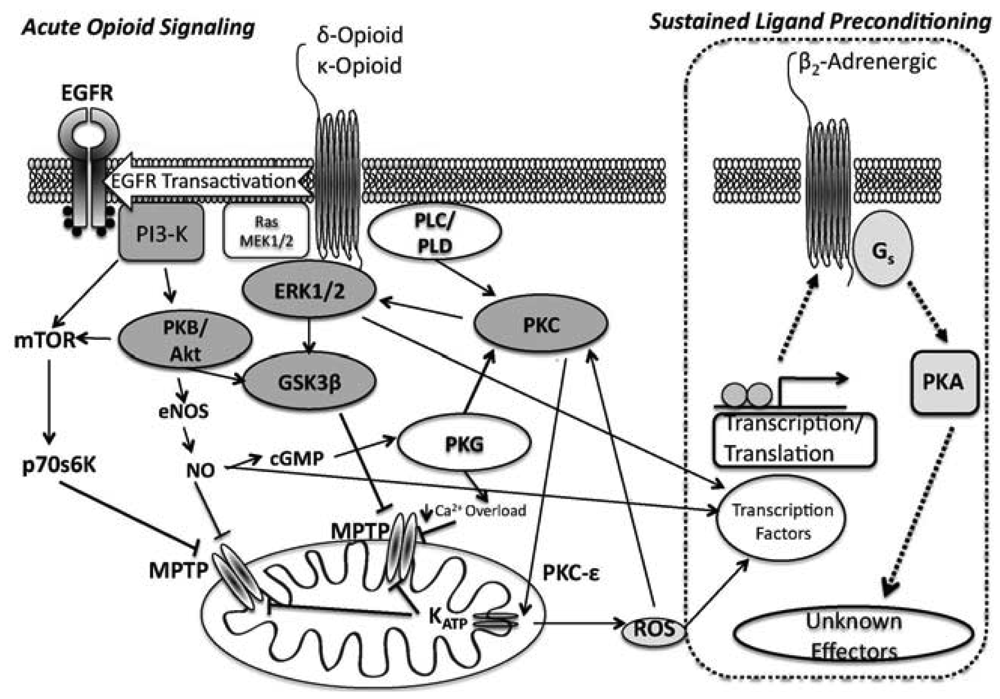
<p>As detailed previously [<xref ref-type="bibr" rid="b33-pharmaceuticals-04-00470">33</xref>,<xref ref-type="bibr" rid="b34-pharmaceuticals-04-00470">34</xref>], conventional models link acute OR activation to protein kinase cascades, reactive oxygen species (ROS) generation, and modulation of mito K<sub>ATP</sub> channel controlling mPTP opening [<xref ref-type="bibr" rid="b35-pharmaceuticals-04-00470">35</xref>-<xref ref-type="bibr" rid="b39-pharmaceuticals-04-00470">39</xref>]. Whether the latter channels are ‘end-effectors’ or proximal to end-effectors is still debated, as is the contribution of sarcolemmal channels [<xref ref-type="bibr" rid="b36-pharmaceuticals-04-00470">36</xref>,<xref ref-type="bibr" rid="b40-pharmaceuticals-04-00470">40</xref>,<xref ref-type="bibr" rid="b41-pharmaceuticals-04-00470">41</xref>].</p>
<p>ORs couple to G<sub>i/o</sub> proteins to inhibit adenylyl cyclase, with δ- and κ-ORs known to activate PLC [<xref ref-type="bibr" rid="b42-pharmaceuticals-04-00470">42</xref>] and phosphoinositol turnover [<xref ref-type="bibr" rid="b43-pharmaceuticals-04-00470">43</xref>]. Additionally, OR agonism activates tyrosine kinase and PKC, perhaps in parallel [<xref ref-type="bibr" rid="b36-pharmaceuticals-04-00470">36</xref>,<xref ref-type="bibr" rid="b44-pharmaceuticals-04-00470">44</xref>], and leads to opening of both sarcolemmal and mito K<sub>ATP</sub> channels [<xref ref-type="bibr" rid="b37-pharmaceuticals-04-00470">37</xref>,<xref ref-type="bibr" rid="b38-pharmaceuticals-04-00470">38</xref>]. ORs also regulate ion channels via G-protein interactions [<xref ref-type="bibr" rid="b45-pharmaceuticals-04-00470">45</xref>,<xref ref-type="bibr" rid="b46-pharmaceuticals-04-00470">46</xref>]. In terms of cardioprotection, infarct limitation with δ-OR agonism is PKC- and NOS-dependent [<xref ref-type="bibr" rid="b44-pharmaceuticals-04-00470">44</xref>,<xref ref-type="bibr" rid="b47-pharmaceuticals-04-00470">47</xref>], and involves tyrosine kinase (TK) and MAPK signalling [<xref ref-type="bibr" rid="b36-pharmaceuticals-04-00470">36</xref>,<xref ref-type="bibr" rid="b44-pharmaceuticals-04-00470">44</xref>,<xref ref-type="bibr" rid="b48-pharmaceuticals-04-00470">48</xref>]. Acute OR protection during reperfusion is dependent upon PI3-K, target of rapamycin (mTOR), and GSK3β modulation [<xref ref-type="bibr" rid="b49-pharmaceuticals-04-00470">49</xref>]. Collectively, data implicate non-Src-dependent TK, extracellular signal-regulated kinase (ERK1/2) and PI3K/PKC pathways as integral signalling components of acute δ-<italic>OR</italic> mediated cardioprotection.</p>
<p>Signalling in acute κ-OR dependent cardioprotection is less well defined: κ-OR inhibition of ventricular cardiomyocyte shortening appears to be G<sub>i</sub>-dependent [<xref ref-type="bibr" rid="b50-pharmaceuticals-04-00470">50</xref>], and κ-ORs suppress cardiomyocyte cAMP accumulation via a phosphoinositol/Ca<sup>2+</sup> path [<xref ref-type="bibr" rid="b51-pharmaceuticals-04-00470">51</xref>]. Downstream effectors affording cardioprotection from κ-OR activation likely mimics that of the δ-OR, (PI3k/Akt, PKC and mito K<sub>ATP</sub> channel dependent, [<xref ref-type="bibr" rid="b26-pharmaceuticals-04-00470">26</xref>,<xref ref-type="bibr" rid="b52-pharmaceuticals-04-00470">52</xref>]) (<xref ref-type="fig" rid="f1-pharmaceuticals-04-00470">Figure 1</xref>).</p>
<p>There is little information regarding any potential role for the μ-ORs in the setting of cardioprotection. Until recently it was thought that the μ-OR was absent from the mature myocardium [<xref ref-type="bibr" rid="b4-pharmaceuticals-04-00470">4</xref>-<xref ref-type="bibr" rid="b6-pharmaceuticals-04-00470">6</xref>]. Indeed, there is a lack of evidence supporting a role for the μ-OR in preconditioning. However, Zatta <italic>et al.</italic> [<xref ref-type="bibr" rid="b22-pharmaceuticals-04-00470">22</xref>] recently reported that ischemic postconditioning was mediated through endogenous μ-OR activation. The involvement of μ-OR in conditioning the heart is controversial at best. As such, detail regarding potential mechanisms is absent.</p></sec>
<sec>
<label>3.2.</label>
<title>Caveolae and ORs</title>
<p>Immunohistochemical analysis co-locates μ-ORs and caveolin-3 (Cav-3) in sarcolemmal and intracellular membranes of the adult myocyte, and caveolins appear essential to OR cytoprotection [<xref ref-type="bibr" rid="b6-pharmaceuticals-04-00470">6</xref>]. Caveolae, microenvironments enriched in caveolin, cholesterol and sphingolipids, form characteristic flask-like invaginations of the membrane. Caveolar structural proteins (caveolins-1, -2 and -3) may act as scaffolding molecules to localise and regulate interactions between receptors, signalling components, and effectors, facilitating coordinated regulation of cell function [<xref ref-type="bibr" rid="b53-pharmaceuticals-04-00470">53</xref>]. This not only impact on sarcolemmal targeting, but transduction of protective signals to mitochondria [<xref ref-type="bibr" rid="b54-pharmaceuticals-04-00470">54</xref>]. Importantly, caveolae are critical to I/R tolerance and cardioprotection: protective stimuli increase caveolae formation, cardioprotection is blocked by caveolar disruption, caveolin-3 (cav-3) knockout (KO) eliminates preconditioning [<xref ref-type="bibr" rid="b55-pharmaceuticals-04-00470">55</xref>,<xref ref-type="bibr" rid="b56-pharmaceuticals-04-00470">56</xref>], and overexpression of cav-3 boosts intrinsic I/R tolerance [<xref ref-type="bibr" rid="b56-pharmaceuticals-04-00470">56</xref>].</p>
<p>In adult cardiac myocytes, ORs are localised to cav-3-associated domains [<xref ref-type="bibr" rid="b6-pharmaceuticals-04-00470">6</xref>], and caveolar disruption abolishes the protective effects of δ-OR activation [<xref ref-type="bibr" rid="b57-pharmaceuticals-04-00470">57</xref>]. Interestingly, an <italic>in vivo</italic> model utilising cav-3 overexpression and knock-out mice confirmed cav-3 dependence of δ-OR protection, and revealed that protection conferred by cav-3 overexpression was negated by naloxone [<xref ref-type="bibr" rid="b58-pharmaceuticals-04-00470">58</xref>]. This supports an integral relationship between caveolae, caveolins and ORs, with δ-ORs specifically implicated in the cytoprotective capacity of caveolae. Caveolar localisation of ORs may also contribute to potential cross-talk between ORs and other protective GPCRs.</p></sec></sec>
<sec>
<label>4.</label>
<title>Opioid Receptor Cross-Talk and Cardioprotection</title>
<p>The OR family engages in cross-talk between its own members and with other receptors. Action of ORs may involve modulation of or dependence upon the function of other receptor types and vice versa. Cross-talk may be indirect through trans-regulation of downstream signalling and the effects of heterologous sensitisation and desensitisation, or more direct, in the context of receptor-receptor interactions and GPCR dimerisation. The ORs are known to form homo- and heterodimers in heterologous cell lines and non-cardiac tissue: δ-ORs can heterodimerise with both κ- and μ-ORs, altering pharmacological properties, and heterodimers may also form between ORs and other GPCRs, including somatostatin, substance P, and α<sub>1</sub> and ß<sub>2</sub>-adrenergic receptors. Specific studies in cardiovascular tissue are lacking, though such complexes could impact on cardiac control and underpin forms of OR cross-talk.</p>
<p>One of the earlier reported forms of myocardial OR cross talk involves δ-OR modulation of ß-adrenergic responsiveness, limiting norepinephrine-induced increases in sarcolemmal L-type Ca<sup>2+</sup> current, cytosolic Ca<sup>2+</sup> transients, and contraction in isolated ventricular myocytes [<xref ref-type="bibr" rid="b59-pharmaceuticals-04-00470">59</xref>]. These results were confirmed by Pepe <italic>et al.</italic> [<xref ref-type="bibr" rid="b60-pharmaceuticals-04-00470">60</xref>] in intact hearts, demonstrating cross-talk between δ-OR and ß<sub>1</sub>-adrenoceptor signaling, with ORs inhibiting adenylyl cyclase via a PTX-sensitive G<sub>i/o</sub> protein. The cAMP-independent inotropic effects of ß<sub>2</sub>-AR agonism appear insensitive to δ-OR activity. In terms of cardioprotection, δ-OR mediated infarct reduction is negated by ß<sub>2</sub>-adrenoceptor blockade [<xref ref-type="bibr" rid="b61-pharmaceuticals-04-00470">61</xref>]. These investigators also reported an essential requirement for intrinsic cardiac adrenergic cells in δ-OR protection of cardiac myocytes, supporting reliance on endogenous epinephrine/ß<sub>2</sub>-adrenoceptor signaling. A subsequent study [<xref ref-type="bibr" rid="b62-pharmaceuticals-04-00470">62</xref>] added calcitonin gene-related peptide receptors (CGRP-R) to the interaction between δ-OR and ß-adrenoceptors, reporting synergistic cardioprotection through a δ-OR regulated ß<sub>2</sub>-adrenoceptorAR/CGRP-R co-signaling in cardiac adrenergic cells. Our own data indicates that mediation of protection with sustained opioid agonism (see below) is ß<sub>2</sub>-adrenoceptor dependent [<xref ref-type="bibr" rid="b63-pharmaceuticals-04-00470">63</xref>]. ß-adrenoceptor and OR cross-talk appears to involve modulation of G-protein signaling and kinase activity, but could also involve dimerisation: both δ- and κ-ORs physically associate with ß<sub>2</sub>-adrenoceptors when co-expressed in HEK-293 cells [<xref ref-type="bibr" rid="b64-pharmaceuticals-04-00470">64</xref>]. As a result, δ-OR activation mediates ß<sub>2</sub>-adrenoceptor internalisation and inhibits ß<sub>2</sub>-adrenoceptor triggered ERK1/2 activation.</p>
<p>Our prior work highlights cardioprotective cross-talk between OR and adenosine receptors. In an initial study [<xref ref-type="bibr" rid="b65-pharmaceuticals-04-00470">65</xref>], the infarct sparing effects of OR stimulation in rats were abolished by an adenosine A1 receptor (A<sub>1</sub>AR) antagonist, and the reverse was also found to be true (OR blockade attenuated cardioprotection in response to A<sub>1</sub>AR activation). In a subsequent study, the protective effects of increased endogenous adenosine (following adenosine kinase inhibition) were found to be dependent upon δ-OR activity [<xref ref-type="bibr" rid="b66-pharmaceuticals-04-00470">66</xref>]. The basis of this cross-talk, which evidences an essential role for both receptors in responses to either, remains to be established. There is evidence of positive cross-talk between AR and ORs in other models, which may reflect modulation of endogenous ligand levels and distal signalling: Kaster <italic>et al.</italic> [<xref ref-type="bibr" rid="b67-pharmaceuticals-04-00470">67</xref>] report that anti-depressant actions of A1 and A<sub>2</sub>ARs involve κ- and μ-OR activities; and remote conditioning effects of intrathecal ORs require both central and peripheral AR activities [<xref ref-type="bibr" rid="b68-pharmaceuticals-04-00470">68</xref>]. While these effects may involve modulation of endogenous ligand signaling, AR/OR receptor complexes could contribute. There is evidence that ARs are essential for synergistic signaling between δ-OR, μ-ORs, CB1 and D<sub>2</sub> receptors in nervous tissue (with A1 or A<sub>2A</sub> activity and Gi-βγ required for this synergistic action) [<xref ref-type="bibr" rid="b69-pharmaceuticals-04-00470">69</xref>,<xref ref-type="bibr" rid="b70-pharmaceuticals-04-00470">70</xref>]. The mechanism underlying AR-dependent hypersensitisation of co-expressed OR receptors is not known, but appears to centre on priming of adenylate cyclase and increased signaling activation. However, while studies in heterologous cell lines support receptor-receptor interactions between A<sub>1</sub>ARs and δ-ORs, their nature is distinct from responses observed in native cardiac tissue: in a CHO cell model, co-expressed A<sub>1</sub>ARs heterologously desensitize δ-OR mediated kinase signaling, and induce phosphorylation of δ-ORs [<xref ref-type="bibr" rid="b71-pharmaceuticals-04-00470">71</xref>]. Our data, in contrast, supports an essential requirement for both AR and OR activities in cardioprotection. In recent studies in murine HL-1 cells [<xref ref-type="bibr" rid="b72-pharmaceuticals-04-00470">72</xref>], we also find that intracellular kinase signaling (ERK1/2) and AR and OR mRNA expression are similarly co-regulated via A<sub>1</sub>ARs and δ-ORs, with antagonism of either receptor alone negating responses to both. Providing a link between the two receptors, signal activation by either A<sub>1</sub>AR or δ-ORs appears commonly dependent upon EGFR function. Indeed, δ-OR post-conditioning of the myocardium has been shown to depend upon transactivation of the EGFR [<xref ref-type="bibr" rid="b73-pharmaceuticals-04-00470">73</xref>]. Thus, ORs and ARs may both engage a common EGFR-dependent pathway to activate downstream protective signals, which may contribute to observed cross-talk.</p>
<p>In addition to these forms of cross-talk, one can consider δ-ORs as signaling intermediates involved in transducing cardioprotection. It was recently demonstrated that epicatechin, an antioxidant flavonoid with no known direct receptor-mediated activity, produced profound δ-OR dependent protection against infarct development [<xref ref-type="bibr" rid="b74-pharmaceuticals-04-00470">74</xref>]. Protective effects of epicatechin were associated with increased phosphorylation of pro-survival kinases (Src, Akt, IκBα) and decreased pro-apoptotic protein expression, both effects countered by δ-OR antagonism. Similarly, infarct sparing actions of the epoxyeicosatrienoic acid 11,12-EET, for which a specific EET membrane receptor is yet to be identified, are reversed by either δ- or κ-OR inhibition [<xref ref-type="bibr" rid="b75-pharmaceuticals-04-00470">75</xref>]. Irrespective of the specific molecular basis of these cross-talk effects, such reports further highlight the importance of intrinsic OR activity in transduction of cardioprotection.</p></sec>
<sec>
<label>5.</label>
<title>Sustained Opioidergic Preconditioning</title>
<p>In 2004, we described a protective phenomenon dubbed chronic morphine preconditioning [<xref ref-type="bibr" rid="b76-pharmaceuticals-04-00470">76</xref>], which we more accurately label as sustained ligand-activated protection (SLP), since we show the response involves selective δ-opioid receptor (δ-<italic>OR</italic>) activation [<xref ref-type="bibr" rid="b77-pharmaceuticals-04-00470">77</xref>]. SLP can be induced by 3–5 days of δ-<italic>OR</italic> activation, mediating protection that exceeds that with preconditioning or postconditioning and persists for at 5 days (perhaps ≥7 days) [<xref ref-type="bibr" rid="b77-pharmaceuticals-04-00470">77</xref>]. Signalling is unique <italic>vs.</italic> that for preconditioning or postconditioning [<xref ref-type="bibr" rid="b63-pharmaceuticals-04-00470">63</xref>].</p>
<p>From a clinical standpoint, generation of sustained protected states (as in SLP) has advantages [<xref ref-type="bibr" rid="b78-pharmaceuticals-04-00470">78</xref>]. Precise timing of treatment relative to I/R becomes less critical, and the need for ongoing therapy is reduced. Prolonged protection might be particularly useful in prophylactic therapy in high-risk patients, and for limiting time-dependent progression of injury during or after surgery (for example). Temporal properties of classic preconditioning are sub-optimal: despite rapid induction, the powerful initial window is brief (1–2 h), while the later sustained window is less efficacious and lasts only 2–3 days. With postconditioning, protection arises rapidly yet does not impact on ischaemic injury, the window of opportunity for protection is likely narrow, and it is unclear if protection is long-lasting (or effective in aged hearts).</p>
<p>Downey's group initially addressed the possibility of sustained cardioprotection (via continuous A<sub>1</sub> adenosine receptor agonism) [<xref ref-type="bibr" rid="b79-pharmaceuticals-04-00470">79</xref>], and Dana <italic>et al.</italic> [<xref ref-type="bibr" rid="b80-pharmaceuticals-04-00470">80</xref>] subsequently showed it was possible to generate persistent protection for 10 days with repetitive A<sub>1</sub> receptor agonism. Inagaki <italic>et al.</italic> [<xref ref-type="bibr" rid="b81-pharmaceuticals-04-00470">81</xref>] described sustained protection following 10-day infusion of a PKC-ε activator. We document protection for at least 5 days following acute irreversible δ<italic>-OR</italic> agonism [<xref ref-type="bibr" rid="b82-pharmaceuticals-04-00470">82</xref>]. Thus, prolonged protected states can be generated in cardiac tissue, though are yet to be exploited clinically to limit injury.</p>
<p>The SLP response [<xref ref-type="bibr" rid="b76-pharmaceuticals-04-00470">76</xref>,<xref ref-type="bibr" rid="b77-pharmaceuticals-04-00470">77</xref>,<xref ref-type="bibr" rid="b83-pharmaceuticals-04-00470">83</xref>] affords protection exceeding that for conventional preconditioning, and persists for up to 7 days after removal of the initiating stimulus [<xref ref-type="bibr" rid="b77-pharmaceuticals-04-00470">77</xref>]. We showed that SLP depends upon signalling distinct from so-called RISK paths [<xref ref-type="bibr" rid="b30-pharmaceuticals-04-00470">30</xref>,<xref ref-type="bibr" rid="b63-pharmaceuticals-04-00470">63</xref>] that mediate preconditioning and postconditioning, likely explaining retention of SLP efficacy with aging [<xref ref-type="bibr" rid="b34-pharmaceuticals-04-00470">34</xref>] <italic>vs.</italic> failure of the latter responses [<xref ref-type="bibr" rid="b84-pharmaceuticals-04-00470">84</xref>-<xref ref-type="bibr" rid="b88-pharmaceuticals-04-00470">88</xref>]. Inhibition of downstream kinases (including PI3-K/Akt, PKC) and mito K<sub>ATP</sub> channels <italic>all</italic> fail to block mediation of SLP during acute I/R [<xref ref-type="bibr" rid="b63-pharmaceuticals-04-00470">63</xref>]. Rather, mediation of SLAP is G<sub>s</sub>- <italic>vs.</italic> G<sub>i</sub>-dependent, requires protein kinase A (PKA), and depends upon ß<sub>2</sub>-adrenoceptor activity [<xref ref-type="bibr" rid="b63-pharmaceuticals-04-00470">63</xref>] (<xref ref-type="fig" rid="f1-pharmaceuticals-04-00470">Figure 1</xref>). These findings are consistent with emerging roles for PKA in cardioprotection [<xref ref-type="bibr" rid="b89-pharmaceuticals-04-00470">89</xref>-<xref ref-type="bibr" rid="b91-pharmaceuticals-04-00470">91</xref>]. ß<sub>2</sub>-adrenoceptor involvement is interesting, since ß<sub>2</sub>-adrenoceptors favour cell survival, limiting I/R injury and apoptosis in a G<sub>i</sub>/PI3-K (<italic>vs.</italic> G<sub>s</sub>) dependent manner [<xref ref-type="bibr" rid="b92-pharmaceuticals-04-00470">92</xref>,<xref ref-type="bibr" rid="b93-pharmaceuticals-04-00470">93</xref>]. Inhibitory effects of ß<sub>2</sub>-adrenoceptor antagonism against SLP protection may reflect shifts in effector coupling or PKA activation in SLP hearts.</p>
<p>Certainly this is documented for the ß<sub>2</sub> receptor, though not strictly in accordance with these observations. For example, receptor phosphorylation by PKA alters G-protein selectivity of ß<sub>2</sub>-adrenergic receptors, favoring coupling to G<sub>i</sub> <italic>vs.</italic> G<sub>s</sub> protein, and reversing the effects of the receptor on cAMP generation [<xref ref-type="bibr" rid="b94-pharmaceuticals-04-00470">94</xref>]. Phosphorylation-dependent switching of G-protein coupling allows the receptor to engage alternate signaling (e.g., G<sub>i</sub>-dependent MAPK activation). Cardiomyocyte ß<sub>2</sub> (but not ß<sub>1</sub>) receptors favor cell survival via pertussis toxin sensitive G<sub>i</sub> signaling, PI3K and Akt.</p>
<p>In contrast to the mediation phase (<italic>i.e.</italic>, the period of ischemia-reperfusion when protection is expressed), the induction of the SLP phenotype is δ-opioid receptor mediated and is induced in a PI3K-dependent/PKA-independent manner [<xref ref-type="bibr" rid="b77-pharmaceuticals-04-00470">77</xref>]. This is interesting, as it supports distinct phases to the response, with PI3K/Akt involvement during induction vs. mediation, and PKA involvement during mediation. It seems that sustained OR agonism induces changes in signaling that may switch OR responses from Gi to Gs dependent mechanisms, and involves PI3K- and PKA signalling (albeit, temporally distinct). These findings are also somewhat consistent with the role for OR signalling in hibernation.</p></sec>
<sec>
<label>6.</label>
<title>Opioids and Hibernation</title>
<p>Opioids, and in particular the δ-receptor sub-type, are strongly implicated in mammalian hibernation. Hibernation can be induced or reversed by δ-opioid agonists and antagonists, respectively, even in species that do not normally hibernate. Hibernation is thought to be triggered by changes in serum levels of a δ-opioid like peptide, termed ‘hibernation induction trigger’ (HIT) [<xref ref-type="bibr" rid="b95-pharmaceuticals-04-00470">95</xref>]. HIT and the δ-opioid peptide DADLE can induce hibernation like states in non-hibernating mammals, and mammalian hibernation is associated with an improvement in tissue resistance to stressors such as hypoxia.</p>
<p>Many parallels exist between SLP and hibernation: hibernation is normally triggered by endogenous δ-opioid agonism, which can also induce hibernation in non-hibernating primates [<xref ref-type="bibr" rid="b96-pharmaceuticals-04-00470">96</xref>,<xref ref-type="bibr" rid="b97-pharmaceuticals-04-00470">97</xref>]; δ-opioid-triggered hibernation increases cellular stress resistance [<xref ref-type="bibr" rid="b98-pharmaceuticals-04-00470">98</xref>,<xref ref-type="bibr" rid="b99-pharmaceuticals-04-00470">99</xref>]; hibernating and anoxia-tolerant species specifically harness PKA-dependent signaling [<xref ref-type="bibr" rid="b100-pharmaceuticals-04-00470">100</xref>,<xref ref-type="bibr" rid="b101-pharmaceuticals-04-00470">101</xref>]; and repression of Akt may suppress energy-costly anabolic/growth processes to maintain cell viability over extended hibernation periods [<xref ref-type="bibr" rid="b102-pharmaceuticals-04-00470">102</xref>,<xref ref-type="bibr" rid="b103-pharmaceuticals-04-00470">103</xref>]. The protected SLP phenotype is induced by prolonged δ-opioid agonism, involves PI3K dependent signals with early and late repression of Akt expression (both total and phosphorylated) [<xref ref-type="bibr" rid="b77-pharmaceuticals-04-00470">77</xref>], leading to sustained PKA-dependent cardioprotection. We also unexpectedly found that prolonged PI3K/Akt inhibition with wortmannin induces some ischemic tolerance. Together, these speculative data hint at cardioprotection in response to sustained PI3K/Akt repression, consistent with the role for Akt in δ-opioid-mediated cytoprotective hibernation.</p></sec>
<sec sec-type="conclusions">
<label>7.</label>
<title>Summary</title>
<p>The opioid system of peptides and receptors have been shown to evoke profound cytoprotective states, from intrinsic/endogenous examples such as hibernation, through to exogenous pharmacological manipulation of receptors such as a post-conditioning mimetic. While the mechanisms may not be fully understood, they appear to mirror those of ischemic preconditioning (involving a signaling axis incorporating PI3k, GSK3β, K<sub>ATP</sub> channels and the mPTP). Acute opioid-mediated protection also appears dependent upon activated adenosine receptors. Moreover, opioids can confer an extended window of cardioprotection. As opioids are currently used both post-operatively and for both acute and chronic pain, a long period of drug development before opioids will be approved for use as cardioprotective agents would not be required.</p></sec></body>
<back>
<sec sec-type="display-objects">
<title>Figure</title>
<fig id="f1-pharmaceuticals-04-00470" position="float">
<label>Figure 1.</label>
<caption>
<p>Generalized signaling scheme for acute- and sustained ligand opioid-dependent cardioprotection. Sustained ligand preconditioning with opioids appears to share common ‘acute’ signaling during the induction phase of the phenotype. Shaded text identifies proteins shown to be involved in opioid-mediated cardioprotection. Dashed arrows imply unknown pathways/mechanisms of activation in sustained ligand activated preconditioning.</p></caption>
<graphic xlink:href="pharmaceuticals-04-00470f1.gif"/></fig></sec>
<ref-list>
<title>References</title>
<ref id="b1-pharmaceuticals-04-00470"><label>1.</label><citation citation-type="journal"><person-group person-group-type="author"><name><surname>Pugsley</surname><given-names>M.K.</given-names></name></person-group><article-title>The diverse molecular mechanisms responsible for the actions of opioids on the cardiovascular system</article-title><source>Pharmacol. Ther.</source><year>2002</year><volume>93</volume><fpage>51</fpage><lpage>75</lpage><pub-id pub-id-type="doi">10.1016/S0163-7258(02)00165-1</pub-id><pub-id pub-id-type="pmid">11916541</pub-id></citation></ref>
<ref id="b2-pharmaceuticals-04-00470"><label>2.</label><citation citation-type="journal"><person-group person-group-type="author"><name><surname>Barron</surname><given-names>B.A.</given-names></name><name><surname>Jones</surname><given-names>C.E.</given-names></name><name><surname>Caffrey</surname><given-names>J.L.</given-names></name></person-group><article-title>Pericardial repair depresses canine cardiac catecholamines and met-enkephalin</article-title><source>Regul. Peptides</source><year>1995</year><volume>59</volume><fpage>313</fpage><lpage>320</lpage><pub-id pub-id-type="doi">10.1016/0167-0115(95)00086-Q</pub-id></citation></ref>
<ref id="b3-pharmaceuticals-04-00470"><label>3.</label><citation citation-type="journal"><person-group person-group-type="author"><name><surname>Eliasson</surname><given-names>T.</given-names></name><name><surname>Mannheimer</surname><given-names>C.</given-names></name><name><surname>Waagstein</surname><given-names>F.</given-names></name><name><surname>Andersson</surname><given-names>B.</given-names></name><name><surname>Bergh</surname><given-names>C.H.</given-names></name><name><surname>Augustinsson</surname><given-names>L.E.</given-names></name><name><surname>Hedner</surname><given-names>T.</given-names></name><name><surname>Larson</surname><given-names>G.</given-names></name></person-group><article-title>Myocardial turnover of endogenous opioids and calcitonin-gene-related peptide in the human heart and the effects of spinal cord stimulation on pacing-induced angina pectoris</article-title><source>Cardiology</source><year>1998</year><volume>89</volume><fpage>170</fpage><lpage>177</lpage><pub-id pub-id-type="doi">10.1159/000006783</pub-id><pub-id pub-id-type="pmid">9570430</pub-id></citation></ref>
<ref id="b4-pharmaceuticals-04-00470"><label>4.</label><citation citation-type="journal"><person-group person-group-type="author"><name><surname>Ventura</surname><given-names>C.</given-names></name><name><surname>Bastagli</surname><given-names>L.</given-names></name><name><surname>Bernardi</surname><given-names>P.</given-names></name><name><surname>Caldera</surname><given-names>C.M.</given-names></name><name><surname>Guarnieri</surname><given-names>C.</given-names></name></person-group><article-title>Opioid receptors in rat cardiac sarcolemma: effect of phenylephrine and isoproterenol</article-title><source>Biochim. Biophys. Acta</source><year>1989</year><volume>987</volume><fpage>69</fpage><lpage>74</lpage><pub-id pub-id-type="doi">10.1016/0005-2736(89)90456-2</pub-id><pub-id pub-id-type="pmid">2557082</pub-id></citation></ref>
<ref id="b5-pharmaceuticals-04-00470"><label>5.</label><citation citation-type="journal"><person-group person-group-type="author"><name><surname>Wittert</surname><given-names>G.</given-names></name><name><surname>Hope</surname><given-names>P.</given-names></name><name><surname>Pyle</surname><given-names>D.</given-names></name></person-group><article-title>Tissue distribution of opioid gene expression in the rat</article-title><source>Biochem. Biophys. Res. Commun.</source><year>1996</year><volume>218</volume><fpage>877</fpage><lpage>888</lpage><pub-id pub-id-type="doi">10.1006/bbrc.1996.0156</pub-id><pub-id pub-id-type="pmid">8579608</pub-id></citation></ref>
<ref id="b6-pharmaceuticals-04-00470"><label>6.</label><citation citation-type="journal"><person-group person-group-type="author"><name><surname>Head</surname><given-names>B.P.</given-names></name><name><surname>Patel</surname><given-names>H.H.</given-names></name><name><surname>Roth</surname><given-names>D.M.</given-names></name><name><surname>Lai</surname><given-names>N.C.</given-names></name><name><surname>Niesman</surname><given-names>I.R.</given-names></name><name><surname>Farquhar</surname><given-names>M.G.</given-names></name><name><surname>Insel</surname><given-names>P.A.</given-names></name></person-group><article-title>G-protein-coupled receptor signaling components localize in both sarcolemmal and intracellular caveolin-3-associated microdomains in adult cardiac myocytes</article-title><source>J. Biol Chem.</source><year>2005</year><volume>280</volume><fpage>31036</fpage><lpage>31044</lpage><pub-id pub-id-type="doi">10.1074/jbc.M502540200</pub-id><pub-id pub-id-type="pmid">15961389</pub-id></citation></ref>
<ref id="b7-pharmaceuticals-04-00470"><label>7.</label><citation citation-type="journal"><person-group person-group-type="author"><name><surname>Howells</surname><given-names>R.D.</given-names></name><name><surname>Kilpatrick</surname><given-names>D.L.</given-names></name><name><surname>Bailey</surname><given-names>L.C.</given-names></name><name><surname>Noe</surname><given-names>M.</given-names></name><name><surname>Udenfriend</surname><given-names>S.</given-names></name></person-group><article-title>Proenkephalin mRNA in rat heart</article-title><source>Proc. Natl. Acad. Sci. USA</source><year>1986</year><volume>83</volume><fpage>1960</fpage><lpage>1963</lpage><pub-id pub-id-type="doi">10.1073/pnas.83.6.1960</pub-id><pub-id pub-id-type="pmid">3456615</pub-id></citation></ref>
<ref id="b8-pharmaceuticals-04-00470"><label>8.</label><citation citation-type="journal"><person-group person-group-type="author"><name><surname>Romano</surname><given-names>M.A.</given-names></name><name><surname>Seymour</surname><given-names>E.M.</given-names></name><name><surname>Berry</surname><given-names>J.A.</given-names></name><name><surname>McNish</surname><given-names>R.A.</given-names></name><name><surname>Boiling</surname><given-names>S.F.</given-names></name></person-group><article-title>Relative contribution of endogenous opioids to myocardial ischemic tolerance</article-title><source>J. Surg. Res.</source><year>2004</year><volume>118</volume><fpage>32</fpage><lpage>37</lpage><pub-id pub-id-type="doi">10.1016/j.jss.2003.12.006</pub-id><pub-id pub-id-type="pmid">15093714</pub-id></citation></ref>
<ref id="b9-pharmaceuticals-04-00470"><label>9.</label><citation citation-type="journal"><person-group person-group-type="author"><name><surname>Schultz</surname><given-names>J.J.</given-names></name><name><surname>Hsu</surname><given-names>A.K</given-names></name><name><surname>Gross</surname><given-names>G.J.</given-names></name></person-group><article-title>Ischemic preconditioning and morphine-induced cardioprotection involve the δ-opioid receptor in the intact rat heart</article-title><source>J. Mol. Cell. Cardiol.</source><year>1997</year><volume>29</volume><fpage>2187</fpage><lpage>2195</lpage><pub-id pub-id-type="doi">10.1006/jmcc.1997.0454</pub-id><pub-id pub-id-type="pmid">9281450</pub-id></citation></ref>
<ref id="b10-pharmaceuticals-04-00470"><label>10.</label><citation citation-type="journal"><person-group person-group-type="author"><name><surname>Schultz</surname><given-names>J.E.</given-names></name><name><surname>Hsu</surname><given-names>A.K</given-names></name><name><surname>Gross</surname><given-names>G.J.</given-names></name></person-group><article-title>Ischemic preconditioning in the intact rat heart is mediated by δ1- but not μ- or κ-opioid receptors</article-title><source>Circulation</source><year>1998</year><volume>97</volume><fpage>1282</fpage><lpage>1289</lpage><pub-id pub-id-type="doi">10.1161/01.CIR.97.13.1282</pub-id><pub-id pub-id-type="pmid">9570199</pub-id></citation></ref>
<ref id="b11-pharmaceuticals-04-00470"><label>11.</label><citation citation-type="journal"><person-group person-group-type="author"><name><surname>Schulz</surname><given-names>R.</given-names></name><name><surname>Gres</surname><given-names>P.</given-names></name><name><surname>Heusch</surname><given-names>G.</given-names></name></person-group><article-title>Role of endogenous opioids in ischemic preconditioning but not in short-term hibernation in pigs</article-title><source>Am. J. Physiol. Heart Circ. Physiol.</source><year>2001</year><volume>280</volume><fpage>H2175</fpage><lpage>H2181</lpage><pub-id pub-id-type="pmid">11299219</pub-id></citation></ref>
<ref id="b12-pharmaceuticals-04-00470"><label>12.</label><citation citation-type="journal"><person-group person-group-type="author"><name><surname>Genade</surname><given-names>S.</given-names></name><name><surname>Moolman</surname><given-names>J.A.</given-names></name><name><surname>Lochner</surname><given-names>A.</given-names></name></person-group><article-title>Opioid receptor stimulation acts as mediator of protection in ischemic preconditioning</article-title><source>Cardiovasc JS Afr</source><year>2001</year><volume>12</volume><fpage>8</fpage><lpage>16</lpage></citation></ref>
<ref id="b13-pharmaceuticals-04-00470"><label>13.</label><citation citation-type="journal"><person-group person-group-type="author"><name><surname>Murry</surname><given-names>C.E.</given-names></name><name><surname>Jennings</surname><given-names>R.</given-names></name><name><surname>Reimer</surname><given-names>K.A.</given-names></name></person-group><article-title>Preconditioning with ischemia: a delay of lethal cell injury in ischemic myocardium</article-title><source>Circulation</source><year>1986</year><volume>74</volume><fpage>1124</fpage><lpage>1136</lpage><pub-id pub-id-type="doi">10.1161/01.CIR.74.5.1124</pub-id><pub-id pub-id-type="pmid">3769170</pub-id></citation></ref>
<ref id="b14-pharmaceuticals-04-00470"><label>14.</label><citation citation-type="journal"><person-group person-group-type="author"><name><surname>Kharbanda</surname><given-names>R.K.</given-names></name></person-group><article-title>Cardiac conditioning: a review of evolving strategies to reduce ischaemia-reperfusion injury</article-title><source>Heart</source><year>2010</year><volume>96</volume><fpage>1179</fpage><lpage>1186</lpage><pub-id pub-id-type="doi">10.1136/hrt.2009.179101</pub-id><pub-id pub-id-type="pmid">20558460</pub-id></citation></ref>
<ref id="b15-pharmaceuticals-04-00470"><label>15.</label><citation citation-type="journal"><person-group person-group-type="author"><name><surname>Zhao</surname><given-names>Z.Q.</given-names></name><name><surname>Corvera</surname><given-names>J.S.</given-names></name><name><surname>Halkos</surname><given-names>M.E.</given-names></name><name><surname>Kerendi</surname><given-names>F.</given-names></name><name><surname>Wang</surname><given-names>N.P.</given-names></name><name><surname>Guyton</surname><given-names>R.A.</given-names></name><name><surname>Vinten-Johansen</surname><given-names>J.</given-names></name></person-group><article-title>Inhibition of myocardial injury by ischemic postconditioning during reperfusion: comparison with ischemic preconditioning</article-title><source>Am. J. Physiol. Heart Circ. Physiol.</source><year>2003</year><volume>285</volume><fpage>H579</fpage><lpage>H588</lpage><pub-id pub-id-type="pmid">12860564</pub-id></citation></ref>
<ref id="b16-pharmaceuticals-04-00470"><label>16.</label><citation citation-type="journal"><person-group person-group-type="author"><name><surname>Na</surname><given-names>H.S</given-names></name><name><surname>Kim</surname><given-names>Y.I.</given-names></name><name><surname>Yoon</surname><given-names>Y.W.</given-names></name><name><surname>Han</surname><given-names>H.C.</given-names></name><name><surname>Nahm</surname><given-names>S.H.</given-names></name><name><surname>Hong</surname><given-names>S.K.</given-names></name></person-group><article-title>Ventricular premature beat-driven intermittent restoration of coronary blood flow reduces the incidence of reperfusion-induced ventricular fibrillation in a cat model of regional ischemia</article-title><source>Am. Heart J.</source><year>1996</year><volume>132</volume><fpage>78</fpage><lpage>83</lpage><pub-id pub-id-type="doi">10.1016/S0002-8703(96)90393-2</pub-id><pub-id pub-id-type="pmid">8701879</pub-id></citation></ref>
<ref id="b17-pharmaceuticals-04-00470"><label>17.</label><citation citation-type="journal"><person-group person-group-type="author"><name><surname>Yang</surname><given-names>X.C.</given-names></name><name><surname>Liu</surname><given-names>Y.</given-names></name><name><surname>Wang</surname><given-names>L.F.</given-names></name><name><surname>Cui</surname><given-names>L.</given-names></name><name><surname>Wang</surname><given-names>T.</given-names></name><name><surname>Ge</surname><given-names>Y.G.</given-names></name><name><surname>Wang</surname><given-names>H.S.</given-names></name><name><surname>Li</surname><given-names>W.M.</given-names></name><name><surname>Xu</surname><given-names>L.</given-names></name><name><surname>Ni</surname><given-names>Z.H.</given-names></name><name><surname>Liu</surname><given-names>S.H.</given-names></name><name><surname>Zhang</surname><given-names>L.</given-names></name><name><surname>Jia</surname><given-names>H.M.</given-names></name><name><surname>Vinten-Johansen</surname><given-names>J.</given-names></name><name><surname>Zhao</surname><given-names>Z.Q.</given-names></name></person-group><article-title>Reduction in myocardial infarct size by postconditioning in patients after percutaneous coronary intervention</article-title><source>J. Invasive Cardiol.</source><year>2007</year><volume>19</volume><fpage>424</fpage><lpage>430</lpage><pub-id pub-id-type="pmid">17906344</pub-id></citation></ref>
<ref id="b18-pharmaceuticals-04-00470"><label>18.</label><citation citation-type="journal"><person-group person-group-type="author"><name><surname>Schultz</surname><given-names>J.E.</given-names></name><name><surname>Hsu</surname><given-names>A.K.</given-names></name><name><surname>Gross</surname><given-names>G.J.</given-names></name></person-group><article-title>Morphine mimics the cardioprotective effect of ischemic preconditioning via a glibenclamide-sensitive mechanism in the rat heart</article-title><source>Circ. Res.</source><year>1996</year><volume>78</volume><fpage>1100</fpage><lpage>1104</lpage><pub-id pub-id-type="doi">10.1161/01.RES.78.6.1100</pub-id><pub-id pub-id-type="pmid">8635241</pub-id></citation></ref>
<ref id="b19-pharmaceuticals-04-00470"><label>19.</label><citation citation-type="journal"><person-group person-group-type="author"><name><surname>Schultz</surname><given-names>J.E.</given-names></name><name><surname>Rose</surname><given-names>E.</given-names></name><name><surname>Yao</surname><given-names>Z.</given-names></name><name><surname>Gross</surname><given-names>G.J.</given-names></name></person-group><article-title>Evidence for involvement of opioid receptors in ischemic preconditioning in rat hearts</article-title><source>Am. J. Physiol.</source><year>1995</year><volume>268</volume><fpage>H2157</fpage><lpage>H2161</lpage><pub-id pub-id-type="pmid">7771566</pub-id></citation></ref>
<ref id="b20-pharmaceuticals-04-00470"><label>20.</label><citation citation-type="journal"><person-group person-group-type="author"><name><surname>Fryer</surname><given-names>R.M.</given-names></name><name><surname>Hsu</surname><given-names>A.K.</given-names></name><name><surname>Eells</surname><given-names>J.T.</given-names></name><name><surname>Nagase</surname><given-names>H.</given-names></name><name><surname>Gross</surname><given-names>G.J.</given-names></name></person-group><article-title>Opioid-induced second window of cardioprotection: potential role of mitochondrial KATP channels</article-title><source>Circ. Res.</source><year>1999</year><volume>84</volume><fpage>846</fpage><lpage>851</lpage><pub-id pub-id-type="doi">10.1161/01.RES.84.7.846</pub-id><pub-id pub-id-type="pmid">10205153</pub-id></citation></ref>
<ref id="b21-pharmaceuticals-04-00470"><label>21.</label><citation citation-type="journal"><person-group person-group-type="author"><name><surname>Jang</surname><given-names>Y.</given-names></name><name><surname>Xi</surname><given-names>J</given-names></name><name><surname>Wang</surname><given-names>H.</given-names></name><name><surname>Mueller</surname><given-names>R.A.</given-names></name><name><surname>Norfleet</surname><given-names>E.A.</given-names></name><name><surname>Xu</surname><given-names>Z.</given-names></name></person-group><article-title>Postconditioning prevents reperfusion injury by activating delta-opioid receptors</article-title><source>Anesthesiology</source><year>2008</year><volume>108</volume><fpage>243</fpage><lpage>250</lpage><pub-id pub-id-type="doi">10.1097/01.anes.0000299437.93898.4a</pub-id><pub-id pub-id-type="pmid">18212569</pub-id></citation></ref>
<ref id="b22-pharmaceuticals-04-00470"><label>22.</label><citation citation-type="journal"><person-group person-group-type="author"><name><surname>Zatta</surname><given-names>A.J.</given-names></name><name><surname>Kin</surname><given-names>H.</given-names></name><name><surname>Yoshishige</surname><given-names>D.</given-names></name><name><surname>Jiang</surname><given-names>R.</given-names></name><name><surname>Wang</surname><given-names>N.</given-names></name><name><surname>Reeves</surname><given-names>J.G.</given-names></name><name><surname>Mykytenko</surname><given-names>J.</given-names></name><name><surname>Guyton</surname><given-names>R.A.</given-names></name><name><surname>Zhao</surname><given-names>Z.Q.</given-names></name><name><surname>Caffrey</surname><given-names>J.L.</given-names></name><name><surname>Vinten-Johansen</surname><given-names>J.</given-names></name></person-group><article-title>Evidence that cardioprotection by postconditioning involves preservation of myocardial opioid content and selective opioid receptor activation</article-title><source>Am. J. Physiol. Heart Circ. Physiol.</source><year>2008</year><volume>294</volume><fpage>H1444</fpage><lpage>H1151</lpage><pub-id pub-id-type="pmid">18203844</pub-id></citation></ref>
<ref id="b23-pharmaceuticals-04-00470"><label>23.</label><citation citation-type="journal"><person-group person-group-type="author"><name><surname>Wong</surname><given-names>G.T.</given-names></name><name><surname>Li</surname><given-names>R.</given-names></name><name><surname>Jiang</surname><given-names>L.L.</given-names></name><name><surname>Irwin</surname><given-names>M.G.</given-names></name></person-group><article-title>Remifentanil post-conditioning attenuates cardiac ischemia-reperfusion injury via kappa or delta opioid receptor activation</article-title><source>Acta Anaesthesiol. Scand.</source><year>2010</year><volume>54</volume><fpage>510</fpage><lpage>518</lpage><pub-id pub-id-type="doi">10.1111/j.1399-6576.2009.02145.x</pub-id><pub-id pub-id-type="pmid">19878098</pub-id></citation></ref>
<ref id="b24-pharmaceuticals-04-00470"><label>24.</label><citation citation-type="journal"><person-group person-group-type="author"><name><surname>Zhou</surname><given-names>Y.</given-names></name><name><surname>Fathali</surname><given-names>N.</given-names></name><name><surname>Lekic</surname><given-names>T.</given-names></name><name><surname>Ostrowski</surname><given-names>R.P.</given-names></name><name><surname>Chen</surname><given-names>C.</given-names></name><name><surname>Martin</surname><given-names>R.D.</given-names></name><name><surname>Tang</surname><given-names>J.</given-names></name><name><surname>Zhang</surname><given-names>J.H.</given-names></name></person-group><article-title>Remote limb ischemic postconditioning protects against neonatal hypoxic-ischemic brain injury in rat pups by the opioid receptor/akt pathway</article-title><source>Stroke</source><year>2011</year><volume>42</volume><fpage>439</fpage><lpage>444</lpage><pub-id pub-id-type="doi">10.1161/STROKEAHA.110.592162</pub-id><pub-id pub-id-type="pmid">21183744</pub-id></citation></ref>
<ref id="b25-pharmaceuticals-04-00470"><label>25.</label><citation citation-type="journal"><person-group person-group-type="author"><name><surname>Gross</surname><given-names>E.R.</given-names></name><name><surname>Hsu</surname><given-names>A.K.</given-names></name><name><surname>Gross</surname><given-names>G.J.</given-names></name></person-group><article-title>GSK3beta inhibition and K(ATP) channel opening mediate acute opioid-induced cardioprotection at reperfusion</article-title><source>Basic Res. Cardiol.</source><year>2007</year><volume>102</volume><fpage>341</fpage><lpage>349</lpage><pub-id pub-id-type="doi">10.1007/s00395-007-0651-6</pub-id><pub-id pub-id-type="pmid">17450314</pub-id></citation></ref>
<ref id="b26-pharmaceuticals-04-00470"><label>26.</label><citation citation-type="journal"><person-group person-group-type="author"><name><surname>Peart</surname><given-names>J.N.</given-names></name><name><surname>Gross</surname><given-names>E.R.</given-names></name><name><surname>Reichelt</surname><given-names>M.E.</given-names></name><name><surname>Hsu</surname><given-names>A.</given-names></name><name><surname>Headrick</surname><given-names>J.P.</given-names></name><name><surname>Gross</surname><given-names>G.J.</given-names></name></person-group><article-title>Activation of kappa-opioid receptors at reperfusion affords cardioprotection in both rat and mouse hearts</article-title><source>Basic Res. Cardiol.</source><year>2008</year><volume>103</volume><fpage>454</fpage><lpage>463</lpage><pub-id pub-id-type="doi">10.1007/s00395-008-0726-z</pub-id><pub-id pub-id-type="pmid">18500486</pub-id></citation></ref>
<ref id="b27-pharmaceuticals-04-00470"><label>27.</label><citation citation-type="journal"><person-group person-group-type="author"><name><surname>Gross</surname><given-names>E.R.</given-names></name><name><surname>Hsu</surname><given-names>A.K.</given-names></name><name><surname>Gross</surname><given-names>G.J.</given-names></name></person-group><article-title>Acute methadone treatment reduces myocardial infarct size via the delta-opioid receptor in rats during reperfusion</article-title><source>Anesth. Analg.</source><year>2009</year><volume>109</volume><fpage>1395</fpage><lpage>1402</lpage><pub-id pub-id-type="doi">10.1213/ANE.0b013e3181b92201</pub-id><pub-id pub-id-type="pmid">19843777</pub-id></citation></ref>
<ref id="b28-pharmaceuticals-04-00470"><label>28.</label><citation citation-type="journal"><person-group person-group-type="author"><name><surname>Tong</surname><given-names>G.</given-names></name><name><surname>Sun</surname><given-names>Z.</given-names></name><name><surname>Wei</surname><given-names>X.</given-names></name><name><surname>Gu</surname><given-names>C.</given-names></name><name><surname>Kaye</surname><given-names>A.D.</given-names></name><name><surname>Wang</surname><given-names>Y.</given-names></name><name><surname>Li</surname><given-names>J.</given-names></name><name><surname>Zhang</surname><given-names>Q.</given-names></name><name><surname>Guo</surname><given-names>H.</given-names></name><name><surname>Yu</surname><given-names>S.</given-names></name><name><surname>Yi</surname><given-names>D.</given-names></name><name><surname>Pei</surname><given-names>J.</given-names></name></person-group><article-title>U50,488H postconditioning reduces apoptosis after myocardial ischemia and reperfusion</article-title><source>Life Sci.</source><year>2011</year><volume>88</volume><fpage>31</fpage><lpage>38</lpage><pub-id pub-id-type="doi">10.1016/j.lfs.2010.10.018</pub-id><pub-id pub-id-type="pmid">21034750</pub-id></citation></ref>
<ref id="b29-pharmaceuticals-04-00470"><label>29.</label><citation citation-type="journal"><person-group person-group-type="author"><name><surname>Gross</surname><given-names>E.R.</given-names></name><name><surname>Hsu</surname><given-names>A.K.</given-names></name><name><surname>Gross</surname><given-names>G.J.</given-names></name></person-group><article-title>Opioid-induced cardioprotection occurs via glycogen synthase kinase beta inhibition during reperfusion in intact rat hearts</article-title><source>Circ. Res.</source><year>2004</year><volume>94</volume><fpage>960</fpage><lpage>966</lpage><pub-id pub-id-type="doi">10.1161/01.RES.0000122392.33172.09</pub-id><pub-id pub-id-type="pmid">14976126</pub-id></citation></ref>
<ref id="b30-pharmaceuticals-04-00470"><label>30.</label><citation citation-type="journal"><person-group person-group-type="author"><name><surname>Hausenloy</surname><given-names>D.J.</given-names></name><name><surname>Yellon</surname><given-names>D.M.</given-names></name></person-group><article-title>New directions for protecting the heart against ischaemia-reperfusion injury: targeting the Reperfusion Injury Salvage Kinase (RISK)-pathway</article-title><source>Cardiovasc Res.</source><year>2004</year><volume>61</volume><fpage>448</fpage><lpage>460</lpage><pub-id pub-id-type="doi">10.1016/j.cardiores.2003.09.024</pub-id><pub-id pub-id-type="pmid">14962476</pub-id></citation></ref>
<ref id="b31-pharmaceuticals-04-00470"><label>31.</label><citation citation-type="journal"><person-group person-group-type="author"><name><surname>Lecour</surname><given-names>S.</given-names></name></person-group><article-title>Activation of the protective Survivor Activating Factor Enhancement (SAFE) pathway against reperfusion injury: Does it go beyond the RISK pathway?</article-title><source>J. Mol. Cell. Cardiol.</source><year>2009</year><volume>47</volume><fpage>32</fpage><lpage>40</lpage><pub-id pub-id-type="doi">10.1016/j.yjmcc.2009.03.019</pub-id><pub-id pub-id-type="pmid">19344728</pub-id></citation></ref>
<ref id="b32-pharmaceuticals-04-00470"><label>32.</label><citation citation-type="journal"><person-group person-group-type="author"><name><surname>You</surname><given-names>L.</given-names></name><name><surname>Li</surname><given-names>L.</given-names></name><name><surname>Xu</surname><given-names>Q.</given-names></name><name><surname>Ren</surname><given-names>J.</given-names></name><name><surname>Zhang</surname><given-names>F.</given-names></name></person-group><article-title>Postconditioning reduces infarct size and cardiac myocyte apoptosis via the opioid receptor and JAK-STAT signaling pathway</article-title><source>Mol. Biol. Rep.</source><year>2011</year><volume>38</volume><fpage>437</fpage><lpage>443</lpage><pub-id pub-id-type="doi">10.1007/s11033-010-0126-y</pub-id><pub-id pub-id-type="pmid">20349141</pub-id></citation></ref>
<ref id="b33-pharmaceuticals-04-00470"><label>33.</label><citation citation-type="journal"><person-group person-group-type="author"><name><surname>Gross</surname><given-names>G.J.</given-names></name></person-group><article-title>Role of opioids in acute and delayed preconditioning</article-title><source>J. Mol. Cell. Cardiol.</source><year>2003</year><volume>35</volume><fpage>709</fpage><lpage>718</lpage><pub-id pub-id-type="doi">10.1016/S0022-2828(03)00135-4</pub-id><pub-id pub-id-type="pmid">12818560</pub-id></citation></ref>
<ref id="b34-pharmaceuticals-04-00470"><label>34.</label><citation citation-type="journal"><person-group person-group-type="author"><name><surname>Peart</surname><given-names>J.N.</given-names></name><name><surname>Gross</surname><given-names>E.R.</given-names></name><name><surname>Gross</surname><given-names>G.J.</given-names></name></person-group><article-title>Opioid-induced preconditioning: Recent advances and future perspectives</article-title><source>Vasc. Pharmacol.</source><year>2005</year><volume>42</volume><fpage>211</fpage><lpage>218</lpage><pub-id pub-id-type="doi">10.1016/j.vph.2005.02.003</pub-id></citation></ref>
<ref id="b35-pharmaceuticals-04-00470"><label>35.</label><citation citation-type="journal"><person-group person-group-type="author"><name><surname>Cohen</surname><given-names>M.V.</given-names></name><name><surname>Baines</surname><given-names>C.P.</given-names></name><name><surname>Downey</surname><given-names>J.M.</given-names></name></person-group><article-title>Ischemic preconditioning: From adenosine receptor to K-ATP channel</article-title><source>Ann. Rev. Physiol.</source><year>2000</year><volume>62</volume><fpage>79</fpage><lpage>109</lpage><pub-id pub-id-type="doi">10.1146/annurev.physiol.62.1.79</pub-id></citation></ref>
<ref id="b36-pharmaceuticals-04-00470"><label>36.</label><citation citation-type="journal"><person-group person-group-type="author"><name><surname>Fryer</surname><given-names>R.M.</given-names></name><name><surname>Wang</surname><given-names>Y.</given-names></name><name><surname>Hsu</surname><given-names>A.K.</given-names></name><name><surname>Gross</surname><given-names>G.J.</given-names></name></person-group><article-title>Essential activation of PKC-delta in opioid-initiated cardioprotection</article-title><source>Am. J. Physiol.</source><year>2001</year><volume>280</volume><fpage>H1346</fpage><lpage>H1353</lpage></citation></ref>
<ref id="b37-pharmaceuticals-04-00470"><label>37.</label><citation citation-type="journal"><person-group person-group-type="author"><name><surname>Patel</surname><given-names>H.H.</given-names></name><name><surname>Hsu</surname><given-names>A.K.</given-names></name><name><surname>Peart</surname><given-names>J.N.</given-names></name><name><surname>Gross</surname><given-names>G.J.</given-names></name></person-group><article-title>Sarcolemmal K<sub>ATP</sub> channel triggers opioid-induced delayed cardioprotection in the rat</article-title><source>Circ. Res.</source><year>2002</year><volume>91</volume><fpage>186</fpage><lpage>188</lpage><pub-id pub-id-type="doi">10.1161/01.RES.0000029085.69891.F2</pub-id><pub-id pub-id-type="pmid">12169643</pub-id></citation></ref>
<ref id="b38-pharmaceuticals-04-00470"><label>38.</label><citation citation-type="journal"><person-group person-group-type="author"><name><surname>Peart</surname><given-names>J.N.</given-names></name><name><surname>Gross</surname><given-names>G.J.</given-names></name></person-group><article-title>Adenosine and opioid receptor-mediated cardioprotection in the rat: evidence for cross-talk between receptors</article-title><source>Am. J. Physiol. Heart Circ. Physiol.</source><year>2003</year><volume>285</volume><fpage>H81</fpage><lpage>H89</lpage><pub-id pub-id-type="pmid">12637353</pub-id></citation></ref>
<ref id="b39-pharmaceuticals-04-00470"><label>39.</label><citation citation-type="journal"><person-group person-group-type="author"><name><surname>Xi</surname><given-names>J</given-names></name><name><surname>Tian</surname><given-names>W</given-names></name><name><surname>Zhang</surname><given-names>L</given-names></name><name><surname>Jin</surname><given-names>Y</given-names></name><name><surname>Xu</surname><given-names>Z.</given-names></name></person-group><article-title>Morphine prevents the mitochondrial permeability transition pore opening through NO/cGMP/PKG/Zn2+/GSK-3beta signal pathway in cardiomyocytes</article-title><source>Am. J. Physiol. Heart Circ. Physiol.</source><year>2010</year><volume>298</volume><fpage>H601</fpage><lpage>H607</lpage><pub-id pub-id-type="doi">10.1152/ajpheart.00453.2009</pub-id><pub-id pub-id-type="pmid">19966058</pub-id></citation></ref>
<ref id="b40-pharmaceuticals-04-00470"><label>40.</label><citation citation-type="journal"><person-group person-group-type="author"><name><surname>Gross</surname><given-names>E.R.</given-names></name><name><surname>Peart</surname><given-names>J.N.</given-names></name><name><surname>Hsu</surname><given-names>A.K.</given-names></name><name><surname>Grover</surname><given-names>G.J.</given-names></name><name><surname>Gross</surname><given-names>G.J.</given-names></name></person-group><article-title>K<sub>ATP</sub> opener-induced delayed cardioprotection: involvement of sarcolemmal and mitochondrial K<sub>ATP</sub> channels, free radicals and MEK1/2</article-title><source>J. Mol. Cell. Cardiol.</source><year>2003</year><volume>35</volume><fpage>985</fpage><lpage>992</lpage><pub-id pub-id-type="doi">10.1016/S0022-2828(03)00183-4</pub-id><pub-id pub-id-type="pmid">12878485</pub-id></citation></ref>
<ref id="b41-pharmaceuticals-04-00470"><label>41.</label><citation citation-type="journal"><person-group person-group-type="author"><name><surname>Patel</surname><given-names>H.H.</given-names></name><name><surname>Gross</surname><given-names>E.R.</given-names></name><name><surname>Peart</surname><given-names>J.N.</given-names></name><name><surname>Hsu</surname><given-names>A.K.</given-names></name><name><surname>Gross</surname><given-names>G.J.</given-names></name></person-group><article-title>Sarcolemmal K<sub>ATP</sub> channel triggers delayed ischemic preconditioning in rats</article-title><source>Am. J. Physiol. Heart Circ. Physiol.</source><year>2005</year><volume>288</volume><fpage>H445</fpage><lpage>H447</lpage><pub-id pub-id-type="pmid">15563543</pub-id></citation></ref>
<ref id="b42-pharmaceuticals-04-00470"><label>42.</label><citation citation-type="journal"><person-group person-group-type="author"><name><surname>Lee</surname><given-names>J.W.</given-names></name><name><surname>Joshi</surname><given-names>S.</given-names></name><name><surname>Chan</surname><given-names>J.S.C.</given-names></name><name><surname>Wong</surname><given-names>Y.H.</given-names></name></person-group><article-title>Differential coupling of μ-, δ-, and κ-opioid receptors to Gα16-mediated stimulation of phospholipase C</article-title><source>J. Neurochem.</source><year>1998</year><volume>70</volume><fpage>2203</fpage><lpage>2211</lpage><pub-id pub-id-type="pmid">9572309</pub-id></citation></ref>
<ref id="b43-pharmaceuticals-04-00470"><label>43.</label><citation citation-type="journal"><person-group person-group-type="author"><name><surname>Schultz</surname><given-names>J.E.</given-names></name><name><surname>Gross</surname><given-names>G.J.</given-names></name></person-group><article-title>Opioids and cardioprotection</article-title><source>Pharmacol. Ther.</source><year>2001</year><volume>89</volume><fpage>123</fpage><lpage>137</lpage><pub-id pub-id-type="doi">10.1016/S0163-7258(00)00106-6</pub-id><pub-id pub-id-type="pmid">11316516</pub-id></citation></ref>
<ref id="b44-pharmaceuticals-04-00470"><label>44.</label><citation citation-type="journal"><person-group person-group-type="author"><name><surname>Fryer</surname><given-names>R.M.</given-names></name><name><surname>Schultz</surname><given-names>J.E.</given-names></name><name><surname>Gross</surname><given-names>G.J.</given-names></name></person-group><article-title>Pretreatment with tyrosine kinase inhibitors partially attenuates ischemic preconditioning in rat hearts</article-title><source>Am. J. Physiol.</source><year>1998</year><volume>275</volume><fpage>H2009</fpage><lpage>H2015</lpage><pub-id pub-id-type="pmid">9843799</pub-id></citation></ref>
<ref id="b45-pharmaceuticals-04-00470"><label>45.</label><citation citation-type="journal"><person-group person-group-type="author"><name><surname>Gross</surname><given-names>R.A.</given-names></name><name><surname>Moises</surname><given-names>H.C.</given-names></name><name><surname>Uhler</surname><given-names>M.D.</given-names></name><name><surname>Macdonald</surname><given-names>R.L.</given-names></name></person-group><article-title>Dynorphin A and cAMP-dependent protein kinase independently regulate neuronal calcium currents</article-title><source>Proc. Natl. Acad. Sci. USA</source><year>1990</year><volume>87</volume><fpage>7025</fpage><lpage>7029</lpage><pub-id pub-id-type="doi">10.1073/pnas.87.18.7025</pub-id><pub-id pub-id-type="pmid">1976250</pub-id></citation></ref>
<ref id="b46-pharmaceuticals-04-00470"><label>46.</label><citation citation-type="journal"><person-group person-group-type="author"><name><surname>North</surname><given-names>R.A.</given-names></name><name><surname>Williams</surname><given-names>J.T.</given-names></name><name><surname>Surprenant</surname><given-names>A.</given-names></name><name><surname>Christie</surname><given-names>M.J.</given-names></name></person-group><article-title>Mu and delta receptors belong to a family of receptors that are coupled to potassium channels</article-title><source>Proc. Natl. Acad. Sci. USA</source><year>1987</year><volume>84</volume><fpage>5487</fpage><lpage>5491</lpage><pub-id pub-id-type="doi">10.1073/pnas.84.15.5487</pub-id><pub-id pub-id-type="pmid">2440052</pub-id></citation></ref>
<ref id="b47-pharmaceuticals-04-00470"><label>47.</label><citation citation-type="journal"><person-group person-group-type="author"><name><surname>Maslov</surname><given-names>L.N.</given-names></name><name><surname>Lishmanov</surname><given-names>Y.B.</given-names></name><name><surname>Oeltgen</surname><given-names>P.R.</given-names></name><name><surname>Barzakh</surname><given-names>E.I.</given-names></name><name><surname>Krylatov</surname><given-names>A.V.</given-names></name><name><surname>Govindaswami</surname><given-names>M.</given-names></name><name><surname>Brown</surname><given-names>S.A.</given-names></name></person-group><article-title>Activation of peripheral delta2 opioid receptors increases cardiac tolerance to ischemia/reperfusion injury Involvement of protein kinase C, NO-synthase, KATP channels and the autonomic nervous system</article-title><source>Life Sci.</source><year>2009</year><volume>84</volume><fpage>657</fpage><lpage>663</lpage><pub-id pub-id-type="doi">10.1016/j.lfs.2009.02.016</pub-id><pub-id pub-id-type="pmid">19245818</pub-id></citation></ref>
<ref id="b48-pharmaceuticals-04-00470"><label>48.</label><citation citation-type="journal"><person-group person-group-type="author"><name><surname>Fryer</surname><given-names>R.M.</given-names></name><name><surname>Wang</surname><given-names>Y.</given-names></name><name><surname>Hsu</surname><given-names>A.K.</given-names></name><name><surname>Nagase</surname><given-names>H.</given-names></name><name><surname>Gross</surname><given-names>G.J.</given-names></name></person-group><article-title>Dependence of 1-opioid receptor-induced cardioprotection on a tyrosine kinase-dependent but not a Src-dependent pathway</article-title><source>J. Pharmacol. Exp. Ther.</source><year>2001</year><volume>299</volume><fpage>477</fpage><lpage>482</lpage><pub-id pub-id-type="pmid">11602657</pub-id></citation></ref>
<ref id="b49-pharmaceuticals-04-00470"><label>49.</label><citation citation-type="journal"><person-group person-group-type="author"><name><surname>Gross</surname><given-names>E.R.</given-names></name><name><surname>Hsu</surname><given-names>A.K.</given-names></name><name><surname>Gross</surname><given-names>G.J.</given-names></name></person-group><article-title>Opioid-induced cardioprotection occurs via glycogen synthase kinase beta inhibition during reperfusion in intact rat hearts</article-title><source>Circ. Res.</source><year>2004</year><volume>94</volume><fpage>960</fpage><lpage>966</lpage><pub-id pub-id-type="doi">10.1161/01.RES.0000122392.33172.09</pub-id><pub-id pub-id-type="pmid">14976126</pub-id></citation></ref>
<ref id="b50-pharmaceuticals-04-00470"><label>50.</label><citation citation-type="journal"><person-group person-group-type="author"><name><surname>Wenzlaff</surname><given-names>H.</given-names></name><name><surname>Stein</surname><given-names>B.</given-names></name><name><surname>Teschemacher</surname><given-names>H.</given-names></name></person-group><article-title>Diminution of contractile response by kappa-opioid receptor agonists in isolated rat ventricular cardiomyocytes is mediated via a pertussis toxin-sensitive G protein</article-title><source>Nauyn-Schmiederberg's Arch. Pharmacol.</source><year>1998</year><volume>358</volume><fpage>360</fpage><lpage>366</lpage><pub-id pub-id-type="doi">10.1007/PL00005265</pub-id></citation></ref>
<ref id="b51-pharmaceuticals-04-00470"><label>51.</label><citation citation-type="journal"><person-group person-group-type="author"><name><surname>Zhang</surname><given-names>W.M.</given-names></name><name><surname>Wong</surname><given-names>T.M.</given-names></name></person-group><article-title>Suppression of cAMP by phosphoinositol/Ca<sup>2+</sup> pathway in the cardiac k-opioid receptor</article-title><source>Am. J. Physiol.</source><year>1998</year><volume>274</volume><fpage>C82</fpage><lpage>C87</lpage><pub-id pub-id-type="pmid">9458715</pub-id></citation></ref>
<ref id="b52-pharmaceuticals-04-00470"><label>52.</label><citation citation-type="journal"><person-group person-group-type="author"><name><surname>Wong</surname><given-names>T.M.</given-names></name><name><surname>Wu</surname><given-names>S.</given-names></name></person-group><article-title>Roles of kappa opioid receptors in cardioprotection against ischemia: the signaling mechanisms</article-title><source>Sheng Li Xue Bao</source><year>2003</year><volume>55</volume><fpage>115</fpage><lpage>120</lpage><pub-id pub-id-type="pmid">12715097</pub-id></citation></ref>
<ref id="b53-pharmaceuticals-04-00470"><label>53.</label><citation citation-type="journal"><person-group person-group-type="author"><name><surname>Insel</surname><given-names>P.A.</given-names></name><name><surname>Head</surname><given-names>B.P.</given-names></name><name><surname>Ostrom</surname><given-names>R.S.</given-names></name><name><surname>Patel</surname><given-names>H.H.</given-names></name><name><surname>Swaney</surname><given-names>J.S.</given-names></name><name><surname>Tang</surname><given-names>C.M.</given-names></name><name><surname>Roth</surname><given-names>D.M.</given-names></name></person-group><article-title>Caveolae and lipid rafts: G protein-coupled receptor signaling microdomains in cardiac myocytes</article-title><source>Ann. NY Acad. Sci.</source><year>2005</year><volume>1047</volume><fpage>166</fpage><lpage>172</lpage><pub-id pub-id-type="doi">10.1196/annals.1341.015</pub-id><pub-id pub-id-type="pmid">16093494</pub-id></citation></ref>
<ref id="b54-pharmaceuticals-04-00470"><label>54.</label><citation citation-type="journal"><person-group person-group-type="author"><name><surname>Quinlan</surname><given-names>C.L.</given-names></name><name><surname>Costa</surname><given-names>A.D.</given-names></name><name><surname>Costa</surname><given-names>C.L.</given-names></name><name><surname>Pierre</surname><given-names>S.V.</given-names></name><name><surname>Dos Santos</surname><given-names>P.</given-names></name><name><surname>Garlid</surname><given-names>K.D.</given-names></name></person-group><article-title>Conditioning the heart induces formation of signalosomes that interact with mitochondria to open mitoKATP channels</article-title><source>Am. J. Physiol. Heart Circ. Physiol.</source><year>2008</year><volume>295</volume><fpage>H953</fpage><lpage>H961</lpage><pub-id pub-id-type="doi">10.1152/ajpheart.00520.2008</pub-id><pub-id pub-id-type="pmid">18621853</pub-id></citation></ref>
<ref id="b55-pharmaceuticals-04-00470"><label>55.</label><citation citation-type="journal"><person-group person-group-type="author"><name><surname>Horikawa</surname><given-names>Y.T.</given-names></name><name><surname>Patel</surname><given-names>H.H.</given-names></name><name><surname>Tsutsumi</surname><given-names>Y.M.</given-names></name><name><surname>Jennings</surname><given-names>M.M.</given-names></name><name><surname>Kidd</surname><given-names>M.W.</given-names></name><name><surname>Hagiwara</surname><given-names>Y.</given-names></name><name><surname>Ishikawa</surname><given-names>Y.</given-names></name><name><surname>Insel</surname><given-names>P.A.</given-names></name><name><surname>Roth</surname><given-names>D.M.</given-names></name></person-group><article-title>Caveolin-3 expression and caveolae are required for isofluorane-induced cardiac protection from hypoxia and ischemia/reperfusion injury</article-title><source>J. Mol. Cell. Cardiol.</source><year>2008</year><volume>44</volume><fpage>123</fpage><lpage>130</lpage><pub-id pub-id-type="doi">10.1016/j.yjmcc.2007.10.003</pub-id><pub-id pub-id-type="pmid">18054955</pub-id></citation></ref>
<ref id="b56-pharmaceuticals-04-00470"><label>56.</label><citation citation-type="journal"><person-group person-group-type="author"><name><surname>Tsutsumi</surname><given-names>Y.M.</given-names></name><name><surname>Horikawa</surname><given-names>Y.T.</given-names></name><name><surname>Jennings</surname><given-names>M.M.</given-names></name><name><surname>Kidd</surname><given-names>M.W.</given-names></name><name><surname>Niesman</surname><given-names>I.R.</given-names></name><name><surname>Yokoyama</surname><given-names>U.</given-names></name><name><surname>Head</surname><given-names>B.P.</given-names></name><name><surname>Hagiwara</surname><given-names>Y.</given-names></name><name><surname>Ishikawa</surname><given-names>Y.</given-names></name><name><surname>Miyanohara</surname><given-names>A.</given-names></name><etal/></person-group><article-title>Cardiac-specific overexpression of caveolin-3 induces endogenous cardiac protection by mimicking ischemic preconditioning</article-title><source>Circulation</source><year>2008</year><volume>118</volume><fpage>1979</fpage><lpage>1988</lpage><pub-id pub-id-type="doi">10.1161/CIRCULATIONAHA.108.788331</pub-id><pub-id pub-id-type="pmid">18936328</pub-id></citation></ref>
<ref id="b57-pharmaceuticals-04-00470"><label>57.</label><citation citation-type="journal"><person-group person-group-type="author"><name><surname>Patel</surname><given-names>H.H.</given-names></name><name><surname>Head</surname><given-names>B.P.</given-names></name><name><surname>Petersen</surname><given-names>H.N.</given-names></name><name><surname>Niesman</surname><given-names>I.R.</given-names></name><name><surname>Huang</surname><given-names>D.</given-names></name><name><surname>Gross</surname><given-names>G.J.</given-names></name><name><surname>Insel</surname><given-names>P.A.</given-names></name><name><surname>Roth</surname><given-names>D.M.</given-names></name></person-group><article-title>Protection of adult rat cardiac myocytes from ischemic cell death: role of caveolar microdomains and delta-opioid receptors</article-title><source>Am. J. Physiol. Heart Circ. Physiol.</source><year>2006</year><volume>291</volume><fpage>H344</fpage><lpage>H350</lpage><pub-id pub-id-type="doi">10.1152/ajpheart.01100.2005</pub-id><pub-id pub-id-type="pmid">16501018</pub-id></citation></ref>
<ref id="b58-pharmaceuticals-04-00470"><label>58.</label><citation citation-type="journal"><person-group person-group-type="author"><name><surname>Tsutsumi</surname><given-names>Y.M.</given-names></name><name><surname>Kawaraguchi</surname><given-names>Y.</given-names></name><name><surname>Niesman</surname><given-names>I.R.</given-names></name><name><surname>Patel</surname><given-names>H.H.</given-names></name><name><surname>Roth</surname><given-names>D.M.</given-names></name></person-group><article-title>Opioid-induced preconditioning is dependent on caveolin-3 expression</article-title><source>Anesth. Analg.</source><year>2010</year><volume>111</volume><fpage>1117</fpage><lpage>1121</lpage><pub-id pub-id-type="doi">10.1213/ANE.0b013e3181f3351a</pub-id><pub-id pub-id-type="pmid">20736437</pub-id></citation></ref>
<ref id="b59-pharmaceuticals-04-00470"><label>59.</label><citation citation-type="journal"><person-group person-group-type="author"><name><surname>Xiao</surname><given-names>R.P.</given-names></name><name><surname>Pepe</surname><given-names>S.</given-names></name><name><surname>Spurgeon</surname><given-names>H.A.</given-names></name><name><surname>Capogrossi</surname><given-names>M.C.</given-names></name><name><surname>Lakatta</surname><given-names>E.G.</given-names></name></person-group><article-title>Opioid peptide receptor stimulation reverses beta-adrenergic effects in rat heart cells</article-title><source>Am. J. Physiol.</source><year>1997</year><volume>272</volume><fpage>H797</fpage><lpage>H805</lpage><pub-id pub-id-type="pmid">9124441</pub-id></citation></ref>
<ref id="b60-pharmaceuticals-04-00470"><label>60.</label><citation citation-type="journal"><person-group person-group-type="author"><name><surname>Pepe</surname><given-names>S.</given-names></name><name><surname>Xiao</surname><given-names>R.P.</given-names></name><name><surname>Hohl</surname><given-names>C.</given-names></name><name><surname>Altschuld</surname><given-names>R.</given-names></name><name><surname>Lakatta</surname><given-names>E.G.</given-names></name></person-group><article-title>‘Cross talk’ between opioid peptide and adrenergic receptor signaling in isolated rat heart</article-title><source>Circulation</source><year>1997</year><volume>95</volume><fpage>2122</fpage><lpage>2129</lpage><pub-id pub-id-type="doi">10.1161/01.CIR.95.8.2122</pub-id><pub-id pub-id-type="pmid">9133523</pub-id></citation></ref>
<ref id="b61-pharmaceuticals-04-00470"><label>61.</label><citation citation-type="journal"><person-group person-group-type="author"><name><surname>Huang</surname><given-names>M.H.</given-names></name><name><surname>Wang</surname><given-names>H.Q.</given-names></name><name><surname>Roeske</surname><given-names>W.R.</given-names></name><name><surname>Birnbaum</surname><given-names>Y.</given-names></name><name><surname>Wu</surname><given-names>Y.</given-names></name><name><surname>Yang</surname><given-names>N.P.</given-names></name><name><surname>Lin</surname><given-names>Y.</given-names></name><name><surname>Ye</surname><given-names>Y.</given-names></name><name><surname>McAdoo</surname><given-names>D.J.</given-names></name><name><surname>Hughes</surname><given-names>M.G.</given-names></name><etal/></person-group><article-title>Mediating delta-opioid-initiated heart protection via the beta2-adrenergic receptor: role of the intrinsic cardiac adrenergic cell</article-title><source>Am. J. Physiol. Heart Circ. Physiol.</source><year>2007</year><volume>293</volume><fpage>H376</fpage><lpage>H384</lpage><pub-id pub-id-type="doi">10.1152/ajpheart.01195.2006</pub-id><pub-id pub-id-type="pmid">17369460</pub-id></citation></ref>
<ref id="b62-pharmaceuticals-04-00470"><label>62.</label><citation citation-type="journal"><person-group person-group-type="author"><name><surname>Huang</surname><given-names>M.H.</given-names></name><name><surname>Nguyen</surname><given-names>V.</given-names></name><name><surname>Wu</surname><given-names>Y.</given-names></name><name><surname>Rastogi</surname><given-names>S.</given-names></name><name><surname>Lui</surname><given-names>C.Y.</given-names></name><name><surname>Birnbaum</surname><given-names>Y.</given-names></name><name><surname>Wang</surname><given-names>H.Q.</given-names></name><name><surname>Ware</surname><given-names>D.L.</given-names></name><name><surname>Chauhan</surname><given-names>M.</given-names></name><name><surname>Garg</surname><given-names>N.</given-names></name><etal/></person-group><article-title>Reducing ischaemia/reperfusion injury through delta-opioid-regulated intrinsic cardiac adrenergic cells: adrenopeptidergic co-signalling</article-title><source>Cardiovasc Res.</source><year>2009</year><volume>84</volume><fpage>452</fpage><lpage>460</lpage><pub-id pub-id-type="doi">10.1093/cvr/cvp233</pub-id><pub-id pub-id-type="pmid">19581316</pub-id></citation></ref>
<ref id="b63-pharmaceuticals-04-00470"><label>63.</label><citation citation-type="journal"><person-group person-group-type="author"><name><surname>Peart</surname><given-names>J.N.</given-names></name><name><surname>Gross</surname><given-names>G.J.</given-names></name></person-group><article-title>Cardioprotective effects of acute and chronic opioid treatment are mediated via different signaling pathways</article-title><source>Am. J. Physiol. Heart Circ. Physiol.</source><year>2006</year><volume>291</volume><fpage>H1746</fpage><lpage>H1753</lpage><pub-id pub-id-type="doi">10.1152/ajpheart.00233.2006</pub-id><pub-id pub-id-type="pmid">16731654</pub-id></citation></ref>
<ref id="b64-pharmaceuticals-04-00470"><label>64.</label><citation citation-type="journal"><person-group person-group-type="author"><name><surname>Jordan</surname><given-names>B.A.</given-names></name><name><surname>Trapaidze</surname><given-names>N.</given-names></name><name><surname>Gomes</surname><given-names>I.</given-names></name><name><surname>Nivarthi</surname><given-names>R.</given-names></name><name><surname>Devi</surname><given-names>L.A.</given-names></name></person-group><article-title>Oligomerization of opioid receptors with beta 2-adrenergic receptors: a role in trafficking and mitogen-activated protein kinase activation</article-title><source>Proc. Natl. Acad. Sci. USA</source><year>2001</year><volume>98</volume><fpage>343</fpage><lpage>348</lpage><pub-id pub-id-type="pmid">11134510</pub-id></citation></ref>
<ref id="b65-pharmaceuticals-04-00470"><label>65.</label><citation citation-type="journal"><person-group person-group-type="author"><name><surname>Peart</surname><given-names>J.N.</given-names></name><name><surname>Gross</surname><given-names>G.J.</given-names></name></person-group><article-title>Adenosine and opioid receptor-mediated cardioprotection in the rat: evidence for cross-talk between receptors</article-title><source>Am. J. Physiol. Heart Circ. Physiol.</source><year>2003</year><volume>285</volume><fpage>H81</fpage><lpage>H89</lpage><pub-id pub-id-type="pmid">12637353</pub-id></citation></ref>
<ref id="b66-pharmaceuticals-04-00470"><label>66.</label><citation citation-type="journal"><person-group person-group-type="author"><name><surname>Peart</surname><given-names>J.N.</given-names></name><name><surname>Gross</surname><given-names>G.J.</given-names></name></person-group><article-title>Cardioprotection following adenosine kinase inhibition in rat hearts</article-title><source>Basic Res. Cardiol.</source><year>2005</year><volume>100</volume><fpage>328</fpage><lpage>336</lpage><pub-id pub-id-type="doi">10.1007/s00395-005-0526-7</pub-id><pub-id pub-id-type="pmid">15795795</pub-id></citation></ref>
<ref id="b67-pharmaceuticals-04-00470"><label>67.</label><citation citation-type="journal"><person-group person-group-type="author"><name><surname>Kaster</surname><given-names>M.P.</given-names></name><name><surname>Budni</surname><given-names>J.</given-names></name><name><surname>Santos</surname><given-names>A.R.</given-names></name><name><surname>Rodrigues</surname><given-names>A.L.</given-names></name></person-group><article-title>Pharmacological evidence for the involvement of the opioid system in the antidepressant-like effect of adenosine in the mouse forced swimming test</article-title><source>Eur. J. Pharmacol.</source><year>2007</year><volume>576</volume><fpage>91</fpage><lpage>98</lpage><pub-id pub-id-type="doi">10.1016/j.ejphar.2007.08.026</pub-id><pub-id pub-id-type="pmid">17868670</pub-id></citation></ref>
<ref id="b68-pharmaceuticals-04-00470"><label>68.</label><citation citation-type="journal"><person-group person-group-type="author"><name><surname>Yao</surname><given-names>L.</given-names></name><name><surname>Wong</surname><given-names>G.T.</given-names></name><name><surname>Xia</surname><given-names>Z.</given-names></name><name><surname>Irwin</surname><given-names>M.G.</given-names></name></person-group><article-title>Interaction between spinal opioid and adenosine receptors in remote cardiac preconditioning: effect of intrathecal morphine</article-title><source>J. Cardiothorac Vasc. Anesth.</source><year>2010</year><comment>in press</comment></citation></ref>
<ref id="b69-pharmaceuticals-04-00470"><label>69.</label><citation citation-type="journal"><person-group person-group-type="author"><name><surname>Yao</surname><given-names>L.</given-names></name><name><surname>McFarland</surname><given-names>K.</given-names></name><name><surname>Fan</surname><given-names>P.</given-names></name><name><surname>Jiang</surname><given-names>Z.</given-names></name><name><surname>Ueda</surname><given-names>T.</given-names></name><name><surname>Diamond</surname><given-names>I.</given-names></name></person-group><article-title>Adenosine A2a blockade prevents synergy between mu-opiate and cannabinoid CB1 receptors and eliminates heroin-seeking behavior in addicted rats</article-title><source>Proc. Natl. Acad. Sci. USA</source><year>2006</year><volume>103</volume><fpage>7877</fpage><lpage>7882</lpage><pub-id pub-id-type="doi">10.1073/pnas.0602661103</pub-id><pub-id pub-id-type="pmid">16684876</pub-id></citation></ref>
<ref id="b70-pharmaceuticals-04-00470"><label>70.</label><citation citation-type="journal"><person-group person-group-type="author"><name><surname>Yao</surname><given-names>L.</given-names></name><name><surname>Fan</surname><given-names>P.</given-names></name><name><surname>Jiang</surname><given-names>Z.</given-names></name><name><surname>Mailliard</surname><given-names>W.S.</given-names></name><name><surname>Gordon</surname><given-names>A.S.</given-names></name><name><surname>Diamond</surname><given-names>I.</given-names></name></person-group><article-title>Addicting drugs utilize a synergistic molecular mechanism in common requiring adenosine and Gi-beta gamma dimers</article-title><source>Proc. Natl. Acad. Sci. USA</source><year>2003</year><volume>100</volume><fpage>14379</fpage><lpage>14384</lpage><pub-id pub-id-type="doi">10.1073/pnas.2336093100</pub-id><pub-id pub-id-type="pmid">14605213</pub-id></citation></ref>
<ref id="b71-pharmaceuticals-04-00470"><label>71.</label><citation citation-type="journal"><person-group person-group-type="author"><name><surname>Cheng</surname><given-names>Y.</given-names></name><name><surname>Tao</surname><given-names>Y.M.</given-names></name><name><surname>Sun</surname><given-names>J.F.</given-names></name><name><surname>Wang</surname><given-names>Y.H.</given-names></name><name><surname>Xu</surname><given-names>X.J.</given-names></name><name><surname>Chen</surname><given-names>J.</given-names></name><name><surname>Chi</surname><given-names>Z.Q.</given-names></name><name><surname>Liu</surname><given-names>J.G.</given-names></name></person-group><article-title>Adenosine A(1) receptor agonist N(6)-cyclohexyl-adenosine induced phosphorylation of delta opioid receptor and desensitization of its signaling</article-title><source>Acta Pharmacol. Sin.</source><year>2010</year><volume>31</volume><fpage>784</fpage><lpage>790</lpage><pub-id pub-id-type="doi">10.1038/aps.2010.70</pub-id><pub-id pub-id-type="pmid">20562901</pub-id></citation></ref>
<ref id="b72-pharmaceuticals-04-00470"><label>72.</label><citation citation-type="journal"><person-group person-group-type="author"><name><surname>Williams-Pritchard</surname><given-names>G.A.</given-names></name><name><surname>Peart</surname><given-names>J.N.</given-names></name><name><surname>Headrick</surname><given-names>J.P.</given-names></name></person-group><article-title>Abstract 373: Transcriptional and cell signaling cross-talk between adenosine and diploid receptors in cardiac cells</article-title><source>Circulation</source><year>2008</year><volume>118</volume><fpage>S293</fpage></citation></ref>
<ref id="b73-pharmaceuticals-04-00470"><label>73.</label><citation citation-type="journal"><person-group person-group-type="author"><name><surname>Förster</surname><given-names>K.</given-names></name><name><surname>Kuno</surname><given-names>A.</given-names></name><name><surname>Solenkova</surname><given-names>N.</given-names></name><name><surname>Felix</surname><given-names>S.B.</given-names></name><name><surname>Krieg</surname><given-names>T.</given-names></name></person-group><article-title>The delta-opioid receptor agonist DADLE at reperfusion protects the heart through activation of pro-survival kinases via EGF receptor transactivation</article-title><source>Am. J. Physiol. Heart Circ. Physiol.</source><year>2007</year><volume>293</volume><fpage>H1604</fpage><lpage>H1608</lpage><pub-id pub-id-type="doi">10.1152/ajpheart.00418.2007</pub-id><pub-id pub-id-type="pmid">17545478</pub-id></citation></ref>
<ref id="b74-pharmaceuticals-04-00470"><label>74.</label><citation citation-type="journal"><person-group person-group-type="author"><name><surname>Panneerselvam</surname><given-names>M.</given-names></name><name><surname>Tsutsumi</surname><given-names>Y.M.</given-names></name><name><surname>Bonds</surname><given-names>J.A.</given-names></name><name><surname>Horikawa</surname><given-names>Y.T.</given-names></name><name><surname>Saldana</surname><given-names>M.</given-names></name><name><surname>Dalton</surname><given-names>N.D.</given-names></name><name><surname>Head</surname><given-names>B.P.</given-names></name><name><surname>Patel</surname><given-names>P.M.</given-names></name><name><surname>Roth</surname><given-names>D.M.</given-names></name><name><surname>Patel</surname><given-names>H.H.</given-names></name></person-group><article-title>Dark chocolate receptors: epicatechin-induced cardiac protection is dependent on delta-opioid receptor stimulation</article-title><source>Am. J. Physiol. Heart Circ. Physiol.</source><year>2010</year><volume>299</volume><fpage>H1604</fpage><lpage>H1609</lpage><pub-id pub-id-type="doi">10.1152/ajpheart.00073.2010</pub-id><pub-id pub-id-type="pmid">20833967</pub-id></citation></ref>
<ref id="b75-pharmaceuticals-04-00470"><label>75.</label><citation citation-type="journal"><person-group person-group-type="author"><name><surname>Gross</surname><given-names>G.J.</given-names></name><name><surname>Baker</surname><given-names>J.E.</given-names></name><name><surname>Hsu</surname><given-names>A.</given-names></name><name><surname>Wu</surname><given-names>H.E.</given-names></name><name><surname>Falck</surname><given-names>J.R.</given-names></name><name><surname>Nithipatikom</surname><given-names>K.</given-names></name></person-group><article-title>Evidence for a role of opioids in epoxyeicosatrienoic acid-induced cardioprotection in rat hearts</article-title><source>Am. J. Physiol. Heart Circ. Physiol.</source><year>2010</year><volume>298</volume><fpage>H2201</fpage><lpage>H2207</lpage><pub-id pub-id-type="doi">10.1152/ajpheart.00815.2009</pub-id><pub-id pub-id-type="pmid">20400686</pub-id></citation></ref>
<ref id="b76-pharmaceuticals-04-00470"><label>76.</label><citation citation-type="journal"><person-group person-group-type="author"><name><surname>Peart</surname><given-names>J.N.</given-names></name><name><surname>Gross</surname><given-names>G.J.</given-names></name></person-group><article-title>Morphine-tolerant mice exhibit a profound and persistent cardioprotective phenotype</article-title><source>Circulation</source><year>2004</year><volume>109</volume><fpage>1219</fpage><lpage>1222</lpage><pub-id pub-id-type="doi">10.1161/01.CIR.0000121422.85989.BD</pub-id><pub-id pub-id-type="pmid">14993125</pub-id></citation></ref>
<ref id="b77-pharmaceuticals-04-00470"><label>77.</label><citation citation-type="journal"><person-group person-group-type="author"><name><surname>Peart</surname><given-names>J.N.</given-names></name><name><surname>See Hoe</surname><given-names>L.E.</given-names></name><name><surname>Gross</surname><given-names>G.J.</given-names></name><name><surname>Headrick</surname><given-names>J.P.</given-names></name></person-group><article-title>Sustained ligand-activated preconditioning via δ-opioid receptors</article-title><source>J. Pharmacol. Exp. Ther.</source><year>2011</year><volume>336</volume><fpage>274</fpage><lpage>281</lpage><pub-id pub-id-type="doi">10.1124/jpet.110.172593</pub-id><pub-id pub-id-type="pmid">20947639</pub-id></citation></ref>
<ref id="b78-pharmaceuticals-04-00470"><label>78.</label><citation citation-type="journal"><person-group person-group-type="author"><name><surname>Peart</surname><given-names>J. N.</given-names></name><name><surname>Headrick</surname><given-names>J. P.</given-names></name></person-group><article-title>Sustained cardioprotection: Exploring unconventional modalities</article-title><source>Vasc. Pharmacol.</source><year>2008</year><volume>49</volume><fpage>63</fpage><lpage>70</lpage><pub-id pub-id-type="doi">10.1016/j.vph.2008.07.001</pub-id></citation></ref>
<ref id="b79-pharmaceuticals-04-00470"><label>79.</label><citation citation-type="journal"><person-group person-group-type="author"><name><surname>Tsuchida</surname><given-names>A.</given-names></name><name><surname>Thompson</surname><given-names>R.</given-names></name><name><surname>Olsson</surname><given-names>R.A.</given-names></name><name><surname>Downey</surname><given-names>J.M.</given-names></name></person-group><article-title>The anti-infarct effect of an adenosine A<sub>1</sub>-selective agonist is diminished after prolonged infusion as is the cardioprotective effect of ischaemic preconditioning in rabbit heart</article-title><source>J. Mol. Cell. Cardiol.</source><year>1994</year><volume>26</volume><fpage>303</fpage><lpage>311</lpage><pub-id pub-id-type="doi">10.1006/jmcc.1994.1039</pub-id><pub-id pub-id-type="pmid">8028014</pub-id></citation></ref>
<ref id="b80-pharmaceuticals-04-00470"><label>80.</label><citation citation-type="journal"><person-group person-group-type="author"><name><surname>Dana</surname><given-names>A.</given-names></name><name><surname>Baxter</surname><given-names>G.F.</given-names></name><name><surname>Walker</surname><given-names>J.M.</given-names></name><name><surname>Yellon</surname><given-names>D.M.</given-names></name></person-group><article-title>Prolonging the delayed phase of myocardial protection: repetitive adenosine A<sub>1</sub> receptor activation maintains a preconditioned state</article-title><source>J. Am. Coll. Cardiol.</source><year>1998</year><volume>31</volume><fpage>1142</fpage><lpage>1149</lpage><pub-id pub-id-type="doi">10.1016/S0735-1097(98)00054-0</pub-id><pub-id pub-id-type="pmid">9562020</pub-id></citation></ref>
<ref id="b81-pharmaceuticals-04-00470"><label>81.</label><citation citation-type="journal"><person-group person-group-type="author"><name><surname>Inagaki</surname><given-names>K.</given-names></name><name><surname>Begley</surname><given-names>R.</given-names></name><name><surname>Ikeno</surname><given-names>F.</given-names></name><name><surname>Mochly-Rosen</surname><given-names>D.</given-names></name></person-group><article-title>Cardioprotection by epsilon-protein kinase C activation from ischemia: continuous delivery and antiarrhythmic effect of an epsilon-protein kinase C-activating peptide</article-title><source>Circulation</source><year>2005</year><volume>111</volume><fpage>44</fpage><lpage>50</lpage><pub-id pub-id-type="doi">10.1161/01.CIR.0000151614.22282.F1</pub-id><pub-id pub-id-type="pmid">15611364</pub-id></citation></ref>
<ref id="b82-pharmaceuticals-04-00470"><label>82.</label><citation citation-type="journal"><person-group person-group-type="author"><name><surname>Gross</surname><given-names>E.R.</given-names></name><name><surname>Peart</surname><given-names>J.N.</given-names></name><name><surname>Hsu</surname><given-names>A.K.</given-names></name><name><surname>Auchampach</surname><given-names>J.A.</given-names></name><name><surname>Gross</surname><given-names>G.J.</given-names></name></person-group><article-title>Extending the cardioprotective window using a novel delta-opioid agonist fentanyl isothiocyanate via the PI3-kinase pathway</article-title><source>Am. J. Physiol. Heart Circ. Physiol.</source><year>2005</year><volume>288</volume><fpage>H2744</fpage><lpage>H2749</lpage><pub-id pub-id-type="doi">10.1152/ajpheart.00918.2004</pub-id><pub-id pub-id-type="pmid">15653765</pub-id></citation></ref>
<ref id="b83-pharmaceuticals-04-00470"><label>83.</label><citation citation-type="journal"><person-group person-group-type="author"><name><surname>Peart</surname><given-names>J.N.</given-names></name><name><surname>Gross</surname><given-names>G.J.</given-names></name></person-group><article-title>Chronic exposure to morphine produces a marked cardioprotective phenotype in aged mouse hearts</article-title><source>Exp. Gerontol.</source><year>2004</year><volume>39</volume><fpage>1021</fpage><lpage>1026</lpage><pub-id pub-id-type="doi">10.1016/j.exger.2004.03.038</pub-id><pub-id pub-id-type="pmid">15236761</pub-id></citation></ref>
<ref id="b84-pharmaceuticals-04-00470"><label>84.</label><citation citation-type="journal"><person-group person-group-type="author"><name><surname>Bartling</surname><given-names>B.</given-names></name><name><surname>Friedrich</surname><given-names>I.</given-names></name><name><surname>Silber</surname><given-names>R.E.</given-names></name><name><surname>Simm</surname><given-names>A.</given-names></name></person-group><article-title>Ischemic preconditioning is not cardioprotective in senescent human myocardium</article-title><source>Ann. Thorac. Surg.</source><year>2003</year><volume>76</volume><fpage>105</fpage><lpage>111</lpage><pub-id pub-id-type="doi">10.1016/S0003-4975(03)00186-3</pub-id><pub-id pub-id-type="pmid">12842522</pub-id></citation></ref>
<ref id="b85-pharmaceuticals-04-00470"><label>85.</label><citation citation-type="journal"><person-group person-group-type="author"><name><surname>Headrick</surname><given-names>J.P.</given-names></name></person-group><article-title>Aging impairs functional, metabolic and ionic recovery from ischemia reperfusion and hypoxia-reoxygenation</article-title><source>J. Mol. Cell. Cardiol.</source><year>1998</year><volume>30</volume><fpage>1415</fpage><lpage>1430</lpage><pub-id pub-id-type="doi">10.1006/jmcc.1998.0710</pub-id><pub-id pub-id-type="pmid">9710809</pub-id></citation></ref>
<ref id="b86-pharmaceuticals-04-00470"><label>86.</label><citation citation-type="journal"><person-group person-group-type="author"><name><surname>Headrick</surname><given-names>J.P.</given-names></name><name><surname>Willems</surname><given-names>L.</given-names></name><name><surname>Ashton</surname><given-names>K.J.</given-names></name><name><surname>Holmgren</surname><given-names>K.</given-names></name><name><surname>Matherne</surname><given-names>G.P.</given-names></name></person-group><article-title>Ischaemic tolerance in aged myocardium: the role of adenosine and effects of A<sub>1</sub> adenosine receptor overexpression</article-title><source>J. Physiol.</source><year>2003</year><volume>549</volume><fpage>823</fpage><lpage>833</lpage><pub-id pub-id-type="doi">10.1113/jphysiol.2003.041541</pub-id><pub-id pub-id-type="pmid">12717009</pub-id></citation></ref>
<ref id="b87-pharmaceuticals-04-00470"><label>87.</label><citation citation-type="journal"><person-group person-group-type="author"><name><surname>Peart</surname><given-names>J.N.</given-names></name><name><surname>Gross</surname><given-names>E.R.</given-names></name><name><surname>Headrick</surname><given-names>J.P.</given-names></name><name><surname>Gross</surname><given-names>G.J.</given-names></name></person-group><article-title>Impaired p38 MAPK/HSP27 signaling underlies aging-related failure in opioid-mediated cardioprotection</article-title><source>J. Mol. Cell. Cardiol.</source><year>2007</year><volume>42</volume><fpage>972</fpage><lpage>980</lpage><pub-id pub-id-type="doi">10.1016/j.yjmcc.2007.02.011</pub-id><pub-id pub-id-type="pmid">17407780</pub-id></citation></ref>
<ref id="b88-pharmaceuticals-04-00470"><label>88.</label><citation citation-type="journal"><person-group person-group-type="author"><name><surname>Willems</surname><given-names>L.</given-names></name><name><surname>Ashton</surname><given-names>K. J.</given-names></name><name><surname>Headrick</surname><given-names>J. P.</given-names></name></person-group><article-title>Adenosine-mediated cardioprotection in the aging myocardium</article-title><source>Cardiovasc. Res.</source><year>2005</year><volume>66</volume><fpage>245</fpage><lpage>255</lpage><pub-id pub-id-type="doi">10.1016/j.cardiores.2004.11.008</pub-id><pub-id pub-id-type="pmid">15820193</pub-id></citation></ref>
<ref id="b89-pharmaceuticals-04-00470"><label>89.</label><citation citation-type="journal"><person-group person-group-type="author"><name><surname>Nishida</surname><given-names>H.</given-names></name><name><surname>Sato</surname><given-names>T.</given-names></name><name><surname>Miyazaki</surname><given-names>M.</given-names></name><name><surname>Nakaya</surname><given-names>H.</given-names></name></person-group><article-title>Infarct size limitation by adrenomedullin: protein kinase A but not PI3-kinase is linked to mitochondrial KCa channels</article-title><source>Cardiovasc. Res.</source><year>2008</year><volume>77</volume><fpage>398</fpage><lpage>405</lpage><pub-id pub-id-type="pmid">17706952</pub-id></citation></ref>
<ref id="b90-pharmaceuticals-04-00470"><label>90.</label><citation citation-type="journal"><person-group person-group-type="author"><name><surname>Redel</surname><given-names>A.</given-names></name><name><surname>Lange</surname><given-names>M.</given-names></name><name><surname>Jazbutyte</surname><given-names>V.</given-names></name><name><surname>Lotz</surname><given-names>C.</given-names></name><name><surname>Smul</surname><given-names>T.M.</given-names></name><name><surname>Roewer</surname><given-names>N.</given-names></name><name><surname>Kehl</surname><given-names>F.</given-names></name></person-group><article-title>Activation of mitochondrial large-conductance calcium-activated K<sup>+</sup> channels via protein kinase A mediates desflurane-induced preconditioning</article-title><source>Anesth. Analg.</source><year>2008</year><volume>106</volume><fpage>384</fpage><lpage>391</lpage><pub-id pub-id-type="doi">10.1213/ane.0b013e318160650f</pub-id><pub-id pub-id-type="pmid">18227289</pub-id></citation></ref>
<ref id="b91-pharmaceuticals-04-00470"><label>91.</label><citation citation-type="journal"><person-group person-group-type="author"><name><surname>Sanada</surname><given-names>S.</given-names></name><name><surname>Asanuma</surname><given-names>H.</given-names></name><name><surname>Tsukamoto</surname><given-names>O.</given-names></name><name><surname>Minamino</surname><given-names>T.</given-names></name><name><surname>Node</surname><given-names>K.</given-names></name><name><surname>Takashima</surname><given-names>S.</given-names></name><name><surname>Fukushima</surname><given-names>T.</given-names></name><name><surname>Ogai</surname><given-names>A.</given-names></name><name><surname>Shinozaki</surname><given-names>Y.</given-names></name><name><surname>Fujita</surname><given-names>M.</given-names></name><etal/></person-group><article-title>Protein kinase A as another mediator of ischemic preconditioning independent of protein kinase C</article-title><source>Circulation</source><year>2004</year><volume>110</volume><fpage>51</fpage><lpage>57</lpage><pub-id pub-id-type="doi">10.1161/01.CIR.0000133390.12306.C7</pub-id><pub-id pub-id-type="pmid">15210595</pub-id></citation></ref>
<ref id="b92-pharmaceuticals-04-00470"><label>92.</label><citation citation-type="journal"><person-group person-group-type="author"><name><surname>Foerster</surname><given-names>K.</given-names></name><name><surname>Groner</surname><given-names>F.</given-names></name><name><surname>Matthes</surname><given-names>J.</given-names></name><name><surname>Koch</surname><given-names>W.J.</given-names></name><name><surname>Birnbaumer</surname><given-names>L.</given-names></name><name><surname>Herzig</surname><given-names>S.</given-names></name></person-group><article-title>Cardioprotection specific for the G protein G<sub>i2</sub> in chronic adrenergic signaling through beta 2-adrenoceptors</article-title><source>Proc. Natl. Acad. Sci. USA</source><year>2003</year><volume>100</volume><fpage>14475</fpage><lpage>14480</lpage><pub-id pub-id-type="doi">10.1073/pnas.1936026100</pub-id><pub-id pub-id-type="pmid">14612574</pub-id></citation></ref>
<ref id="b93-pharmaceuticals-04-00470"><label>93.</label><citation citation-type="journal"><person-group person-group-type="author"><name><surname>Chesley</surname><given-names>A.</given-names></name><name><surname>Lundberg</surname><given-names>M.S.</given-names></name><name><surname>Asai</surname><given-names>T.</given-names></name><name><surname>Xiao</surname><given-names>R.P.</given-names></name><name><surname>Ohtani</surname><given-names>S.</given-names></name><name><surname>Lakatta</surname><given-names>E.G.</given-names></name><name><surname>Crow</surname><given-names>M.T.</given-names></name></person-group><article-title>The beta<sub>2</sub>-adrenergic receptor delivers an antiapoptotic signal to cardiac myocytes through G<sub>i</sub>-dependent coupling to phosphatidylinositol 3′-kinase</article-title><source>Circ. Res.</source><year>2000</year><volume>87</volume><fpage>1172</fpage><lpage>1179</lpage><pub-id pub-id-type="doi">10.1161/01.RES.87.12.1172</pub-id><pub-id pub-id-type="pmid">11110775</pub-id></citation></ref>
<ref id="b94-pharmaceuticals-04-00470"><label>94.</label><citation citation-type="journal"><person-group person-group-type="author"><name><surname>Daaka</surname><given-names>Y.</given-names></name><name><surname>Luttrell</surname><given-names>L.M.</given-names></name><name><surname>Lefkowitz</surname><given-names>R.J.</given-names></name></person-group><article-title>Switching of the coupling of the beta2-adrenergic receptor to different G proteins by protein kinase A</article-title><source>Nature</source><year>1997</year><volume>390</volume><fpage>88</fpage><lpage>91</lpage><pub-id pub-id-type="doi">10.1038/36362</pub-id><pub-id pub-id-type="pmid">9363896</pub-id></citation></ref>
<ref id="b95-pharmaceuticals-04-00470"><label>95.</label><citation citation-type="journal"><person-group person-group-type="author"><name><surname>Bruce</surname><given-names>D.S.</given-names></name><name><surname>Cope</surname><given-names>G.W.</given-names></name><name><surname>Elam</surname><given-names>T.R.</given-names></name><name><surname>Ruit</surname><given-names>K.A.</given-names></name><name><surname>Oeltgen</surname><given-names>P.R.</given-names></name><name><surname>Su</surname><given-names>T.P.</given-names></name></person-group><article-title>Opioids and hibernation. I. Effects of naloxone on bear HIT'S depression of guinea pig ileum contractility and on induction of summer hibernation in the ground squirrel</article-title><source>Life Sci.</source><year>1987</year><volume>41</volume><fpage>2107</fpage><lpage>2113</lpage><pub-id pub-id-type="doi">10.1016/0024-3205(87)90528-5</pub-id><pub-id pub-id-type="pmid">2823038</pub-id></citation></ref>
<ref id="b96-pharmaceuticals-04-00470"><label>96.</label><citation citation-type="journal"><person-group person-group-type="author"><name><surname>Oeltgen</surname><given-names>P.R.</given-names></name><name><surname>Walsh</surname><given-names>J.W.</given-names></name><name><surname>Hamann</surname><given-names>S.R.</given-names></name><name><surname>Randall</surname><given-names>D.C.</given-names></name><name><surname>Spurrier</surname><given-names>W.A.</given-names></name><name><surname>Myers</surname><given-names>R.D.</given-names></name></person-group><article-title>Hibernation “trigger”: opioid-like inhibitory action on brain function of the monkey</article-title><source>Pharmacol. Biochem. Behav.</source><year>1982</year><volume>17</volume><fpage>1271</fpage><lpage>1274</lpage><pub-id pub-id-type="doi">10.1016/0091-3057(82)90132-0</pub-id><pub-id pub-id-type="pmid">6298834</pub-id></citation></ref>
<ref id="b97-pharmaceuticals-04-00470"><label>97.</label><citation citation-type="journal"><person-group person-group-type="author"><name><surname>Oeltgen</surname><given-names>P.R.</given-names></name><name><surname>Nilekani</surname><given-names>S.P.</given-names></name><name><surname>Nuchols</surname><given-names>P.A.</given-names></name><name><surname>Spurrier</surname><given-names>W.A.</given-names></name><name><surname>Su</surname><given-names>T.P.</given-names></name></person-group><article-title>Further studies on opioids and hibernation: delta opioid receptor ligand selectively induced hibernation in summer-active ground squirrels</article-title><source>Life Sci.</source><year>1988</year><volume>43</volume><fpage>1565</fpage><lpage>1574</lpage><pub-id pub-id-type="doi">10.1016/0024-3205(88)90406-7</pub-id><pub-id pub-id-type="pmid">2904105</pub-id></citation></ref>
<ref id="b98-pharmaceuticals-04-00470"><label>98.</label><citation citation-type="journal"><person-group person-group-type="author"><name><surname>Bolling</surname><given-names>S.F.</given-names></name><name><surname>Tramontini</surname><given-names>N.L.</given-names></name><name><surname>Kilgore</surname><given-names>K.S.</given-names></name><name><surname>Su</surname><given-names>T.P.</given-names></name><name><surname>Oeltgen</surname><given-names>P.R.</given-names></name><name><surname>Harlow</surname><given-names>H.H.</given-names></name></person-group><article-title>Use of “natural” hibernation induction triggers for myocardial protection</article-title><source>Ann. Thorac. Surg.</source><year>1997</year><volume>64</volume><fpage>623</fpage><lpage>627</lpage><pub-id pub-id-type="doi">10.1016/S0003-4975(97)00631-0</pub-id><pub-id pub-id-type="pmid">9307448</pub-id></citation></ref>
<ref id="b99-pharmaceuticals-04-00470"><label>99.</label><citation citation-type="journal"><person-group person-group-type="author"><name><surname>Hong</surname><given-names>J.</given-names></name><name><surname>Sigg</surname><given-names>D.C.</given-names></name><name><surname>Coles</surname><given-names>J.A.</given-names><suffix>Jr.</suffix></name><name><surname>Oeltgen</surname><given-names>P.R.</given-names></name><name><surname>Harlow</surname><given-names>H.J.</given-names></name><name><surname>Soule</surname><given-names>C.L.</given-names></name><name><surname>Iaizzo</surname><given-names>P.A.</given-names></name></person-group><article-title>Hibernation induction trigger reduces hypoxic damage of swine skeletal muscle</article-title><source>Muscle Nerve</source><year>2005</year><volume>32</volume><fpage>200</fpage><lpage>207</lpage><pub-id pub-id-type="doi">10.1002/mus.20354</pub-id><pub-id pub-id-type="pmid">15940690</pub-id></citation></ref>
<ref id="b100-pharmaceuticals-04-00470"><label>100.</label><citation citation-type="journal"><person-group person-group-type="author"><name><surname>Storey</surname><given-names>K.B.</given-names></name></person-group><article-title>Metabolic adaptations supporting anoxia tolerance in reptiles: recent advances</article-title><source>Comp. Biochem. Physiol. B Biochem. Mol. Biol.</source><year>1996</year><volume>113</volume><fpage>23</fpage><lpage>35</lpage><pub-id pub-id-type="doi">10.1016/0305-0491(95)02043-8</pub-id><pub-id pub-id-type="pmid">8936040</pub-id></citation></ref>
<ref id="b101-pharmaceuticals-04-00470"><label>101.</label><citation citation-type="journal"><person-group person-group-type="author"><name><surname>Holden</surname><given-names>C.P.</given-names></name><name><surname>Storey</surname><given-names>K.B.</given-names></name></person-group><article-title>Protein kinase A from bat skeletal muscle: a kinetic study of the enzyme from a hibernating mammal</article-title><source>Arch. Biochem. Biophys.</source><year>1998</year><volume>358</volume><fpage>243</fpage><lpage>250</lpage><pub-id pub-id-type="doi">10.1006/abbi.1998.0810</pub-id><pub-id pub-id-type="pmid">9841635</pub-id></citation></ref>
<ref id="b102-pharmaceuticals-04-00470"><label>102.</label><citation citation-type="journal"><person-group person-group-type="author"><name><surname>Cai</surname><given-names>D.</given-names></name><name><surname>McCarron</surname><given-names>R.M.</given-names></name><name><surname>Yu</surname><given-names>E.Z.</given-names></name><name><surname>Li</surname><given-names>Y.</given-names></name><name><surname>Hallenbeck</surname><given-names>J.</given-names></name></person-group><article-title>Akt phosphorylation and kinase activity are down-regulated during hibernation in the 13-lined ground squirrel</article-title><source>Brain Res.</source><year>2004</year><volume>1014</volume><fpage>14</fpage><lpage>21</lpage><pub-id pub-id-type="doi">10.1016/j.brainres.2004.04.008</pub-id><pub-id pub-id-type="pmid">15212987</pub-id></citation></ref>
<ref id="b103-pharmaceuticals-04-00470"><label>103.</label><citation citation-type="journal"><person-group person-group-type="author"><name><surname>Abnous</surname><given-names>K.</given-names></name><name><surname>Dieni</surname><given-names>C.A.</given-names></name><name><surname>Storey</surname><given-names>K.B.</given-names></name></person-group><article-title>Regulation of Akt during hibernation in Richardson's ground squirrels</article-title><source>Biochim. Biophys. Acta</source><year>2008</year><volume>1780</volume><fpage>185</fpage><lpage>193</lpage><pub-id pub-id-type="doi">10.1016/j.bbagen.2007.10.009</pub-id><pub-id pub-id-type="pmid">17983605</pub-id></citation></ref></ref-list></back></article>