
<?xml version="1.0" encoding="UTF-8"?>
<!DOCTYPE article PUBLIC "-//NLM//DTD Journal Publishing DTD v2.3 20070202//EN" "journalpublishing.dtd">
<article xmlns:xlink="http://www.w3.org/1999/xlink" xml:lang="en" article-type="review-article">
<front>
<journal-meta>
<journal-id journal-id-type="publisher-id">Pharmaceuticals</journal-id>
<journal-title>Pharmaceuticals</journal-title>
<issn pub-type="epub">1424-8247</issn>
<publisher>
<publisher-name>Molecular Diversity Preservation International (MDPI)</publisher-name></publisher></journal-meta>
<article-meta>
<article-id pub-id-type="doi">10.3390/ph4020273</article-id>
<article-id pub-id-type="publisher-id">pharmaceuticals-04-00273</article-id>
<article-categories>
<subj-group>
<subject>Review</subject></subj-group></article-categories>
<title-group>
<article-title>Expanding the Concept of G Protein-Coupled Receptor (GPCR) Dimer Asymmetry towards GPCR-Interacting Proteins</article-title></title-group>
<contrib-group>
<contrib contrib-type="author">
<name><surname>Kamal</surname><given-names>Maud</given-names></name><xref ref-type="aff" rid="af1-pharmaceuticals-04-00273"><sup>1</sup></xref><xref ref-type="aff" rid="af2-pharmaceuticals-04-00273"><sup>2</sup></xref></contrib>
<contrib contrib-type="author">
<name><surname>Maurice</surname><given-names>Pascal</given-names></name><xref ref-type="aff" rid="af1-pharmaceuticals-04-00273"><sup>1</sup></xref><xref ref-type="aff" rid="af2-pharmaceuticals-04-00273"><sup>2</sup></xref></contrib>
<contrib contrib-type="author">
<name><surname>Jockers</surname><given-names>Ralf</given-names></name><xref ref-type="aff" rid="af1-pharmaceuticals-04-00273"><sup>1</sup></xref><xref ref-type="aff" rid="af2-pharmaceuticals-04-00273"><sup>2</sup></xref><xref ref-type="corresp" rid="c1-pharmaceuticals-04-00273"><sup>*</sup></xref></contrib></contrib-group>
<aff id="af1-pharmaceuticals-04-00273">
<label>1</label> Institut Cochin, Universite Paris Descartes, CNRS, Paris, France</aff>
<aff id="af2-pharmaceuticals-04-00273">
<label>2</label> Inserm, U1016, Paris, France; E-Mails: <email>maud.kamal@inserm.fr</email> (M.K.); <email>pascal.maurice@inserm.fr</email> (P.M.)</aff>
<author-notes>
<corresp id="c1-pharmaceuticals-04-00273">
<label>*</label> Author to whom correspondence should be addressed; E-Mail: <email>ralf.jockers@inserm.fr</email>; Tel.: +331-40-51-64-34; Fax: +331-40-51-64-30.</corresp></author-notes>
<pub-date pub-type="collection">
<year>2011</year></pub-date>
<pub-date pub-type="epub">
<day>25</day>
<month>01</month>
<year>2011</year></pub-date>
<volume>4</volume>
<issue>2</issue>
<fpage>273</fpage>
<lpage>284</lpage>
<history>
<date date-type="received">
<day>06</day>
<month>12</month>
<year>2010</year></date>
<date date-type="rev-recd">
<day>07</day>
<month>01</month>
<year>2011</year></date>
<date date-type="accepted">
<day>14</day>
<month>01</month>
<year>2011</year></date></history>
<permissions>
<copyright-statement>© 2011 by the authors; licensee MDPI, Basel, Switzerland.</copyright-statement>
<copyright-year>2011</copyright-year>
<license>
<p>This article is an open access article distributed under the terms and conditions of the Creative Commons Attribution license (http://creativecommons.org/licenses/by/3.0/).</p></license></permissions>
<abstract>
<p>G protein-coupled receptors (GPCRs), major targets of drug discovery, are organized in dimeric and/or oligomeric clusters. The minimal oligomeric unit, the dimer, is composed of two protomers, which can behave differently within the dimer. Several examples of GPCR asymmetry within dimers at the level of ligand binding, ligand-promoted conformational changes, conformational changes within transmembrane domains, G protein coupling, and most recently GPCR-interacting proteins (GIPs), have been reported in the literature. Asymmetric organization of GPCR dimers has important implications on GPCR function and drug design. Indeed, the extension of the “asymmetry concept” to GIPs adds a new level of specific therapeutic intervention.</p></abstract>
<kwd-group>
<kwd>GPCR</kwd>
<kwd>dimerization</kwd>
<kwd>GIP</kwd>
<kwd>allosterism</kwd></kwd-group></article-meta></front>
<body>
<sec sec-type="intro">
<label>1.</label>
<title>Introduction</title>
<p>A growing body of pharmacological, biochemical and biophysical data indicate that GPCRs form functional homo- and hetero-dimers and most likely higher-order oligomers [<xref ref-type="bibr" rid="b1-pharmaceuticals-04-00273">1</xref>,<xref ref-type="bibr" rid="b2-pharmaceuticals-04-00273">2</xref>]. Formation of such oligomeric structures has been shown to provide shielding from the quality-control checkpoints during the biosynthetic pathway [<xref ref-type="bibr" rid="b3-pharmaceuticals-04-00273">3</xref>] and to have an important role in modulating GPCR function and signaling [<xref ref-type="bibr" rid="b4-pharmaceuticals-04-00273">4</xref>]. In addition, this oligomeric organization raises a fundamental question: does each protomer within a GPCR oligomer operate as an independent functional unit or do the different protomers intercommunicate to insure the signaling response of the cell? Communication within dimers has indeed been observed for several GPCRs at different levels. Ligand binding to one protomer has been shown to modify the properties of the ligand binding pocket of the second protomer. The latter observation most likely involves ligand-induced conformational changes that are transmitted from one protomer to the other. Intercommunication among the different protomers results in dimer asymmetry and asymmetric recruitment of GPCR-interacting proteins (GIPs) including heterotrimeric G proteins. This mini-review summarizes the evidence supporting the emerging concept of asymmetric behavior within a GPCR complex. We will briefly discuss asymmetry in G protein coupling, ligand binding, conformational changes within transmembrane domains, and binding of GIPs.</p></sec>
<sec>
<label>2.</label>
<title>Asymmetry at the Level of G Protein Binding</title>
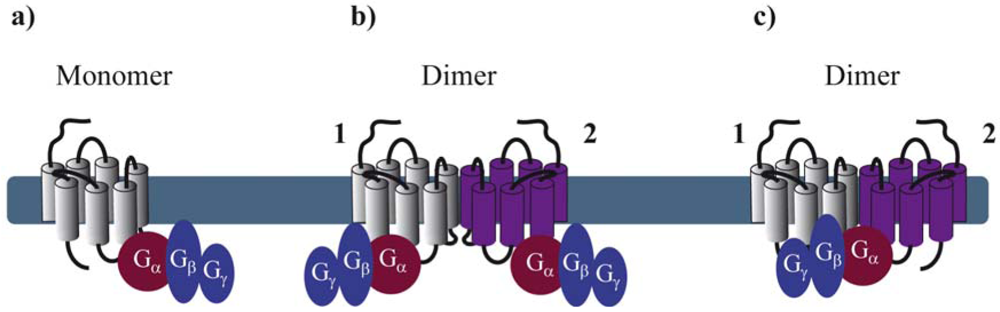
<p>Reconstitution of purified monomeric GPCRs, in high-density lipoprotein phospholipid bilayer particles, showed that monomeric GPCRs are able to couple to G proteins. These and similar results clearly demonstrate that the minimal functional unit consists of 1 receptor monomer activating its cognate G protein (<xref ref-type="fig" rid="f1-pharmaceuticals-04-00273">Figure 1a</xref>) [<xref ref-type="bibr" rid="b5-pharmaceuticals-04-00273">5</xref>-<xref ref-type="bibr" rid="b7-pharmaceuticals-04-00273">7</xref>]. When rod outer segment membranes were solubilized with different detergents to obtain preparations enriched in monomeric, dimeric and oligomeric rhodopsin structures, monomeric rhodopsin was indeed able to activate its G protein, the heterotrimeric transducin (G<sub>t</sub>) confirming studies in reconstituted systems [<xref ref-type="bibr" rid="b8-pharmaceuticals-04-00273">8</xref>]. However, preparations containing mostly dimeric and oligomeric rhodopsin appeared to be more active.</p>
<p>By extrapolating the idea that a GPCR monomer couples to a single G protein, one might anticipate that GPCR dimers, composed of two protomers, bind to two G proteins (<xref ref-type="fig" rid="f1-pharmaceuticals-04-00273">Figure 1b</xref>). Nevertheless, to our knowledge, there is no clear experimental evidence today confirming such an arrangement, except one study published in 2008 by Parker <italic>et al.</italic> on the neuropeptide Y (NPY) Y2 receptor. Using radiolabeled-ligand binding assays, GTPγS binding and gradient ultracentrifugation experiments, the authors show that Y2 receptors and G proteins could be solubilized in complexes of 2:2, 2:1 and 1:1 stoichiometry, depending on the detergent and the concentration of agonist used [<xref ref-type="bibr" rid="b9-pharmaceuticals-04-00273">9</xref>]. Cumulative evidence from the literature is, however, rather consistent with a 2:1 stoichiometry with two receptor protomers coupling only one heterotrimeric G protein (<xref ref-type="fig" rid="f1-pharmaceuticals-04-00273">Figure 1c</xref>). Such a stoichiometry implies that GPCR dimers have a radically different mode of function than monomers therefore introducing the concept of asymmetry.</p>
<p>GPCR asymmetry was intensely debated when the first high-resolution structure of rhodopsin, the archetypal class A GPCR, was solved by Palczewski and associates [<xref ref-type="bibr" rid="b10-pharmaceuticals-04-00273">10</xref>]. Computational docking simulations and molecular modeling of rhodopsin and its G<sub>t</sub> protein illustrated that the receptor-facing surface of G<sub>t</sub> is too large with respect to the rhodopsin cytoplasmic surface. These results suggest that GPCR dimer formation is a pre-requisite to fully accommodate the binding of the G protein [<xref ref-type="bibr" rid="b11-pharmaceuticals-04-00273">11</xref>,<xref ref-type="bibr" rid="b12-pharmaceuticals-04-00273">12</xref>]. Concomitantly, a 2:1 stoichiometry was proposed for another class A GPCR, the leukotriene B4 receptors BLT<sub>1</sub> and its cognate G protein, by using purified proteins and chemical cross-linking [<xref ref-type="bibr" rid="b13-pharmaceuticals-04-00273">13</xref>].</p>
<p>These pioneering studies raised the fundamental question of the respective role of each protomer within a dimer in regards to G protein activation. Indeed, there are at least two ways for the G protein to contact the dimer (through protomer 1 or 2). Based on this assumption, asymmetry of the receptor dimer might be dictated by the position of the Gα subunit relative to the agonist-occupied monomer. A possible model would be that activation of one of the protomers favors an oriented interaction of the receptor dimer with the G protein in such a way that the agonist-occupied protomer directly interacts with the G protein and is therefore stabilized in a fully active, high affinity conformation, whereas the other protomer remains in an uncoupled, low affinity conformation [<xref ref-type="bibr" rid="b14-pharmaceuticals-04-00273">14</xref>]. Further important progress on how the receptor dimer interacts with the G protein has been made using BLT<sub>1</sub> and dopamine D<sub>2</sub> homodimers as models. By using the intrinsic fluorescence properties of the BLT<sub>1</sub> receptor to monitor its activation, Damian <italic>et al.</italic> showed that a receptor dimer with only a single agonist-occupied subunit can trigger G protein activation. Interestingly, the two subunits of the dimer in the G protein-coupled state differ in their conformation, even when both protomers are occupied by agonists. In the absence of G protein coupling, no such asymmetric conformational changes were observed [<xref ref-type="bibr" rid="b15-pharmaceuticals-04-00273">15</xref>]. These results suggest that the interaction of the G protein with the receptor dimer would bring specific constraints, which prevent a symmetric functioning of the dimer and that the G protein itself might be partly responsible for the asymmetric functioning in a context where ligand binding <italic>cis</italic>-activates G protein binding to the same protomer [<xref ref-type="bibr" rid="b14-pharmaceuticals-04-00273">14</xref>]. On the other hand, using an original approach based on a functional complementation assay with the D<sub>2</sub> receptor, allosteric communication between protomers of GPCR dimers was proposed [<xref ref-type="bibr" rid="b16-pharmaceuticals-04-00273">16</xref>]. This study confirmed that agonist binding to a single protomer within the dimer can maximally activate the G protein. Moreover, activation of the second protomer inhibits the functional response whereas inverse agonist binding enhances signaling, definitely proving that the way the two protomers contribute to the activated complex with the G protein is not symmetric, and that activation requires different conformational changes in each protomer [<xref ref-type="bibr" rid="b16-pharmaceuticals-04-00273">16</xref>]. Such asymmetry also applies to class C GPCRs as exemplified by the GABA<sub>B</sub> receptor, which is an obligatory heteromer composed of GB1 and GB2 subunits, with GB1 binding the ligand and GB2 activating the G protein [<xref ref-type="bibr" rid="b17-pharmaceuticals-04-00273">17</xref>,<xref ref-type="bibr" rid="b18-pharmaceuticals-04-00273">18</xref>].</p>
<p>Collectively, the most convincing examples in the literature favor a 2:1 stoichiometry between the receptor and the G protein. Several studies using purified and reconstituted GPCRs suggest a 1:1 stoichiometry. However, one should be careful when extrapolating these <italic>in vitro</italic> observations into a more physiological context; <italic>i.e.</italic> the plasma membrane of mammalian cells. Asymmetric behavior of GPCR dimers is further supported by observations at the level of ligand binding and ligand-promoted conformational changes within the heptahelical transmembrane domain as discussed in the next paragraphs.</p></sec>
<sec>
<label>3.</label>
<title>Asymmetry at the Level of Ligand Binding</title>
<p>The phenomenon of allostery has been observed in many biological processes, and refers to different, albeit related, mechanisms by which protein function can be regulated and fine-tuned in either a positive or negative direction [<xref ref-type="bibr" rid="b19-pharmaceuticals-04-00273">19</xref>]. In pharmacology, allosteric modulation of a receptor results from the binding of allosteric molecules at a different site (allosteric site) from that of the endogenous ligand (orthosteric site). Allosteric modulators normally induce a conformational change in the receptor resulting in a positive or negative effect on binding affinity and efficacy of ligand binding to the orthosteric site. In the context of GPCR oligomerization, each protomer in the complex possesses an orthosteric binding pocket and one can expect that the orthosteric site of one protomer could exert allosteric effects on the orthosteric site of another protomer [<xref ref-type="bibr" rid="b20-pharmaceuticals-04-00273">20</xref>].</p>
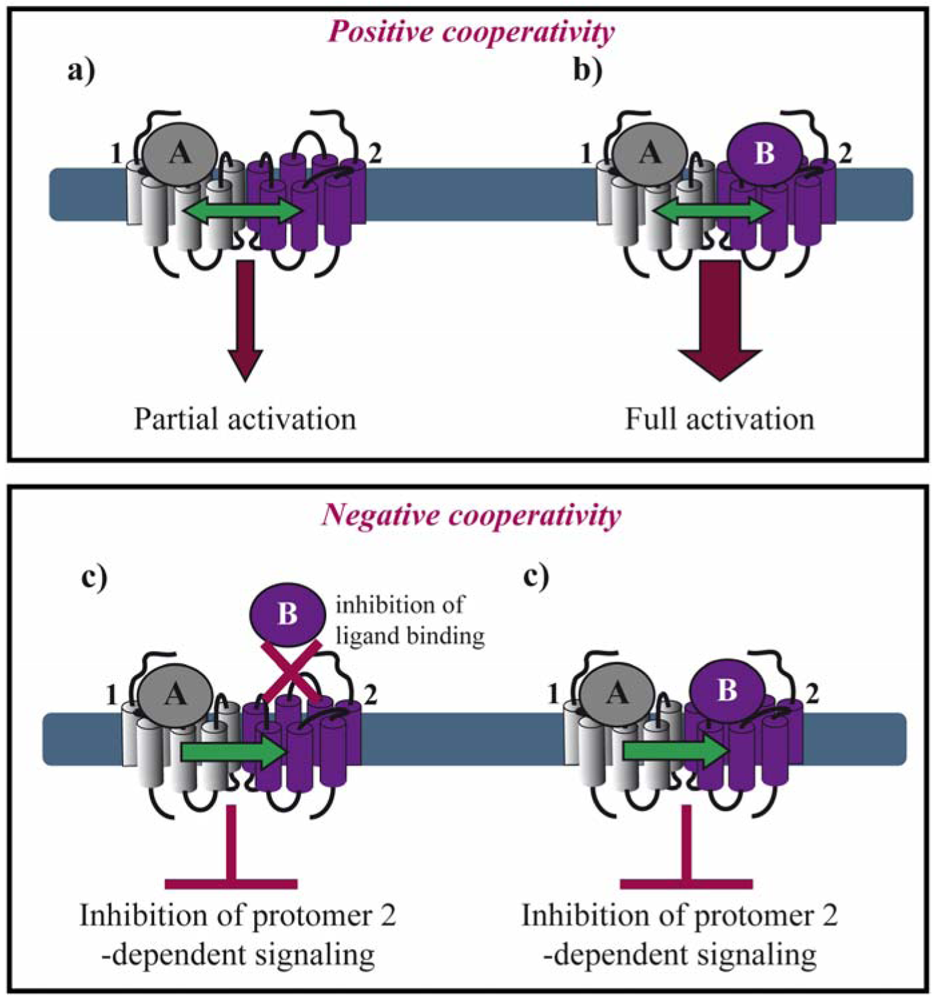
<p>Allosteric interactions between ligand binding sites within a dimeric complex result in either positive or negative cooperativity. This fact raises the question of stoichiometry concerning the number of ligand molecules binding a dimer. The majority of the examples in the literature suggest that negative cooperativity is due to a single ligand molecule binding one protomer of the dimer, whereas positive cooperativity results from two ligand molecules binding, each, one protomer in a dimer. However, exceptions from this rule exist as mentioned below.</p>
<p>Positive cooperativity has early on been reported for several GPCRs. In the case of agonist binding to the μ/δ opioid receptor (OR) heteromer, both agonists are required for efficient MAP kinase activation (<xref ref-type="fig" rid="f2-pharmaceuticals-04-00273">Figures 2a,b</xref>) [<xref ref-type="bibr" rid="b21-pharmaceuticals-04-00273">21</xref>]. Similarly, activation of both protomers of a muscarinic M3 homomer is required for beta-arrestin recruitment [<xref ref-type="bibr" rid="b22-pharmaceuticals-04-00273">22</xref>]. Positive cooperative binding was also documented for class C GPCRs. Binding of a single agonist is sufficient for the activation of the homomeric metabotropic glutamate receptor (mGluR) 5. However, full activation requires binding of two agonist molecules and the closure of both agonist-binding domains of the homodimer, also called venus fly trap (VFT) [<xref ref-type="bibr" rid="b23-pharmaceuticals-04-00273">23</xref>]. Another type of positive allosterism is seen in the CXCR2/δOR heteromer, where CXCR2 antagonists enhance the function of both peptide and alkaloid-based agonists at the δOR when the two receptors are co-expressed [<xref ref-type="bibr" rid="b24-pharmaceuticals-04-00273">24</xref>].</p>
<p>Negative binding cooperativity of allosteric nature has been observed in other cases such as homo-and heteromers of glycoprotein hormone receptors. Ligand binding to the large extracellular ectodomain triggers activation of constitutive receptor dimers that are mainly stabilized by interactions between the transmembrane domains. Using competition, saturation and dissociation kinetics binding experiments, Urizar <italic>et al.</italic> showed for the first time for class A GPCRs that the two orthosteric sites of each dimer are implicated in negative allosteric interactions with one another (<xref ref-type="fig" rid="f2-pharmaceuticals-04-00273">Figure 2c</xref>) [<xref ref-type="bibr" rid="b25-pharmaceuticals-04-00273">25</xref>]. Similarly, an extensive pharmacological characterization of the dopamine D<sub>2</sub> receptor by performing saturation binding assays and dissociation kinetics with three different radioligands showed that some D<sub>2</sub> receptor antagonists exhibit negative binding cooperativity within a D<sub>2</sub> homodimer [<xref ref-type="bibr" rid="b26-pharmaceuticals-04-00273">26</xref>]. Furthermore, chemokine receptor heteromers display allosteric modulation in ligand binding and dissociation kinetic experiments strongly suggesting negative cooperativity for several different heteromers. <italic>Trans</italic>-inhibition of ligand binding was observed between CCR5 and CCR2b co-expressed in the same cell line and in cells endogenously expressing both receptors [<xref ref-type="bibr" rid="b27-pharmaceuticals-04-00273">27</xref>,<xref ref-type="bibr" rid="b28-pharmaceuticals-04-00273">28</xref>]. CCR5-specific ligands, unable to compete for the binding of CCR2-specific ligands on cells expressing CCR2 alone, inhibited this binding when both receptors were co-expressed. Similar results were obtained with CCR2-selective ligands.</p>
<p>Moreover, in the context of the μOR/α<sub>2A</sub>-adrenoceptor (AR) heteromer, Vilardaga <italic>et al.</italic> showed that simultaneous binding of the two respective agonists, norepinephrine and morphine, inhibits α<sub>2A</sub>-AR-dependent G<sub>i</sub> signaling and the downstream MAP kinase cascade [<xref ref-type="bibr" rid="b29-pharmaceuticals-04-00273">29</xref>]. These results interestingly show that negative cooperativity may occur in a dimer where both binding pockets are occupied by their respective agonists (<xref ref-type="fig" rid="f2-pharmaceuticals-04-00273">Figure 2d</xref>).</p>
<p>Recently, Albizu <italic>et al.</italic> used fluorescent-labeled ligands to study oxytocine receptor dimerization in native tissues. A mixture of two antagonists, either labeled with an energy donor or acceptor, generated a strong FRET signal. However, only marginal FRET signals were obtained when two labeled agonists were used indicating that agonist binding to one protomer suppresses agonist binding to the second protomer whereas no such inhibitory effect is seen for antagonist binding [<xref ref-type="bibr" rid="b30-pharmaceuticals-04-00273">30</xref>]. Both positive and negative cooperativity have also been reported within the same heteromer as illustrated by the dopamine D<sub>2</sub> receptor and somatostatin sst5 receptor heteromer, for which the positive cooperativity was observed for D<sub>2</sub> agonists and negative cooperativity for D<sub>2</sub> antagonists [<xref ref-type="bibr" rid="b31-pharmaceuticals-04-00273">31</xref>].</p>
<p>Collectively, different types of negative and positive allosteric modulations can be observed and may involve binding of one or two agonists or antagonists to the respective GPCR homo- or heteromer. In 2005, Durroux proposed mathematical models attempting to explain the complex allosteric interactions observed between ligand binding sites within dimeric complexes. [<xref ref-type="bibr" rid="b32-pharmaceuticals-04-00273">32</xref>].</p></sec>
<sec>
<label>4.</label>
<title>Asymmetry at the Level of Ligand-Induced Conformation Changes</title>
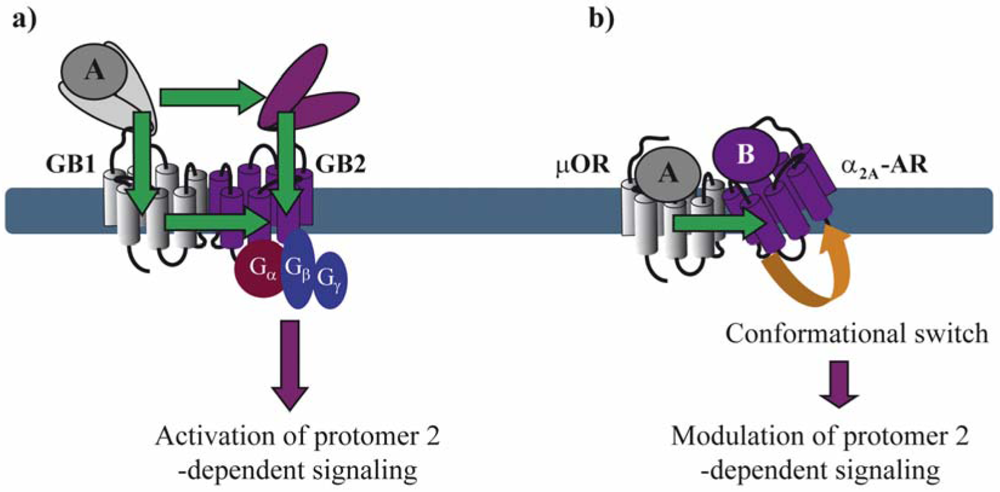
<p>With the exception of neutral antagonists, binding of all other types of ligands ranging from full inverse agonists to full agonists induce conformational changes in GPCRs. Negative and positive cooperativity at the level of ligand binding is further propagated to the subsequent conformational changes within the dimer. Such cross-conformational switches between the two protomers of GPCR dimers have been observed in some cases (<xref ref-type="fig" rid="f3-pharmaceuticals-04-00273">Figure 3</xref>). In the μOR/α<sub>2A</sub>-AR heteromer, morphine binding to the μOR triggers an inhibitory conformational change with subsecond kinetics in the norepinephrine-occupied α<sub>2A</sub>-AR as monitored directly by FRET in living cells [<xref ref-type="bibr" rid="b29-pharmaceuticals-04-00273">29</xref>].</p>
<p>Asymmetric ligand-induced conformational changes within GPCR dimers have been fully characterized in the GABA<sub>B</sub> receptor. Within this obligatory heterodimer, GB1 and GB2 subunits accomplish different tasks. The role of the GB2 is to traffic GB1 to the membrane where the VFT of GB1 binds to GABA and <italic>trans</italic>-activates GB2, which in turn couples to G<sub>i</sub> proteins [<xref ref-type="bibr" rid="b33-pharmaceuticals-04-00273">33</xref>]. By analyzing chimeric and deletion constructs of GB1 and GB2, the authors show that several different conformational changes are necessary for full G protein activation. GABA-induced changes in the relative position of the VFTs of GB1 and GB2 activate the transmembrane (TM) portion of GB2 most likely through two allosteric pathways: (1) one direct from the GB2 VFT to the GB2 TM portion and (2) a second one that interconnects the GB1 VFT to GB1 TM portion, which, in turn, <italic>trans</italic>-activates GB2 TM portion [<xref ref-type="bibr" rid="b17-pharmaceuticals-04-00273">17</xref>,<xref ref-type="bibr" rid="b34-pharmaceuticals-04-00273">34</xref>].</p>
<p>Recently, Damian <italic>et al.</italic> monitored conformational changes within purified BLT<sub>1</sub> receptor dimers, which were labeled with a single 5-hydroxytryptophan [<xref ref-type="bibr" rid="b15-pharmaceuticals-04-00273">15</xref>]. They showed that a receptor dimer with only a single agonist-occupied subunit can trigger G protein <italic>cis</italic>-activation. Interestingly, asymmetric conformational changes were observed even when both protomers were occupied by the same agonist. This asymmetry was highly dependent on the coupling of the dimer to purified G proteins. Altogether, asymmetric ligand-induced conformational changes have been monitored with several different techniques using different GPCRs either in living cells or as purified proteins.</p></sec>
<sec>
<label>5.</label>
<title>Asymmetry at the Level of GPCR-Interacting Proteins (GIPs)</title>
<p>In addition to heterotrimeric G proteins, most GPCRs also bind to other intracellular proteins either directly or indirectly forming large protein complexes as exemplified by the melatonin MT<sub>1</sub> and MT<sub>2</sub> receptors [<xref ref-type="bibr" rid="b35-pharmaceuticals-04-00273">35</xref>,<xref ref-type="bibr" rid="b36-pharmaceuticals-04-00273">36</xref>]. Among those proteins that directly interact with GPCRs, GPCR kinases (GRKs) and arrestins are probably the most studied. GPCR signaling is believed to involve the sequential interaction of the activated receptor with the G protein, GRKs and arrestin. In contrast to this current model, recent observations made with energy transfer techniques however suggest that these different events might be interconnected and might overlap in time [<xref ref-type="bibr" rid="b37-pharmaceuticals-04-00273">37</xref>]. Recruitment of GRK2 to the α<sub>2A</sub>-AR, for instance, was shown to occur before dissociation of the G protein, therefore raising the question of the exact molecular organization of this transient protein complex. A first hint of the putative organization of such a complex came from crystallographic data of the GRK2/G<sub>αq</sub>/G<sub>β1γ2</sub> complex. These data showed that GRK2 can bind G<sub>βγ</sub> and G<sub>αq</sub> subunits simultaneously while maintaining a surface for a possible interaction with the receptor [<xref ref-type="bibr" rid="b38-pharmaceuticals-04-00273">38</xref>].</p>
<p>Arrestin is believed to be recruited after the first wave of G protein-dependent signaling events and to compete with G proteins and other GIPs for receptor binding. However, recent data on the parathyroid hormone receptor (PTHR) suggest that at least part of the arrestin binding might be faster than anticipated and occur within a pre-associated complex depending on the GIP Na/H exchange regulatory factor-1 (NHERF1). These results raise once again the question of the composition of GPCR-associated complexes [<xref ref-type="bibr" rid="b39-pharmaceuticals-04-00273">39</xref>].</p>
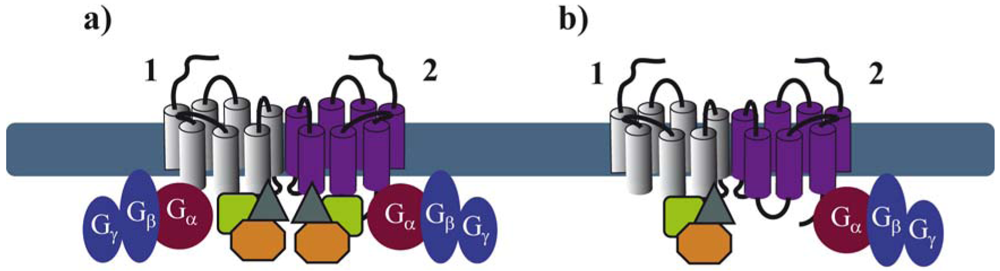
<p>Recent advances in proteomic approaches for the identification of GPCR-associated protein complexes provided a number of further GIPs that directly or indirectly interact with intracellular domains of GPCRs [<xref ref-type="bibr" rid="b40-pharmaceuticals-04-00273">40</xref>,<xref ref-type="bibr" rid="b41-pharmaceuticals-04-00273">41</xref>]. Among these domains, the C-terminal tail and the third intracellular (i3) loop of the receptor have been shown to be the major interacting domains [<xref ref-type="bibr" rid="b42-pharmaceuticals-04-00273">42</xref>]. Many of these proteins appear to bind constitutively to receptors [<xref ref-type="bibr" rid="b43-pharmaceuticals-04-00273">43</xref>,<xref ref-type="bibr" rid="b44-pharmaceuticals-04-00273">44</xref>]. In order to better understand the exact molecular architecture of these complexes, their precise composition, which might be dynamically regulated in space and time, needs to be determined. It is quite logical to anticipate that GPCRs are likely to bind simultaneously, in a constitutive or a ligand-dependent manner, several GIPs. Binding of these proteins to the extended surface of receptor dimers, offers many possibilities for the spatiotemporal interaction of several GIPs with the same receptor. Some of these interactions may depend on receptor domains that are sufficiently distinct to allow simultaneous binding to the receptor, others are likely to overlap. As illustrated above for G proteins, asymmetric binding of GIPs to GPCR dimers might be a solution to accommodate simultaneous binding of several GIPs (<xref ref-type="fig" rid="f4-pharmaceuticals-04-00273">Figure 4</xref>). This has been recently illustrated in the ternary complex between the melatonin MT<sub>1</sub> receptor, G<sub>i</sub> proteins and the regulator of G protein signaling (RGS) 20 [<xref ref-type="bibr" rid="b44-pharmaceuticals-04-00273">44</xref>]. This study shows that G<sub>i</sub> and RGS20 are both constitutively binding to overlapping, membrane-proximal domains of MT<sub>1</sub>. These data strongly imply that G<sub>i</sub> and RGS20 bind to two different protomers within the homodimer.</p>
<p>Similar observations were made for heteromeric complexes of MT<sub>1</sub> with MT<sub>2</sub>, the second melatonin receptor, suggesting the formation of an asymmetric quaternary complex with MT<sub>1</sub> binding to RGS20 and MT<sub>2</sub> binding to G<sub>i</sub>. This example suggests that a receptor, which is not regulated by a specific GIP, could become sensitive to the action of this GIP when heterodimerizing with a GIP-binding receptor. This latter observation thus provides additional options in fine-tuning GPCR function in a context-dependent manner.</p></sec>
<sec sec-type="conclusions">
<label>6.</label>
<title>Conclusions and Perspectives</title>
<p>GPCR dimerization is a topic of great interest due to the potential importance of the functional consequences of such interactions on signal transduction pathways. Emerging evidence indicates asymmetric function of GPCR dimers and communication between the two protomers of the dimer at the level of ligand binding, ligand-induced conformational changes and interaction with intracellular signaling proteins. Negative and positive allosteric interactions between the two orthosteric binding sites of GPCR homo- and heterodimers may have major consequences on the pharmacology and functional drug outcomes.</p>
<p>Although monomeric GPCRs are able to bind and activate G proteins, formation of receptor dimers clearly offers additional opportunities for regulating G protein activation and signal transduction by accommodating the simultaneous binding of other regulatory GIPs to the receptor.</p>
<p>Finally, formation of higher-order oligomeric clusters needs to be considered in the future. Despite the existence of an extensive literature on GPCR dimerization, the precise oligomerization state of GPCRs remains in most cases unknown. Atomic force microscopy studies provided convincing evidence that rhodopsin is organized as long oligomeric arrays of dimers in rod outer segment membranes [<xref ref-type="bibr" rid="b45-pharmaceuticals-04-00273">45</xref>]. This idea was further extended in molecular docking studies based on the resolved structures of rhodopsin and G<sub>t</sub> by proposing an hexameric complex composed of two G<sub>t</sub> proteins and a rhodopsin tetramer [<xref ref-type="bibr" rid="b46-pharmaceuticals-04-00273">46</xref>]. These modeling studies obviously warrant experimental confirmation but provide already an interesting framework for the organization and asymmetric binding of different GIPs to GPCR oligomers. Formation of oligomeric complexes might not be restricted to rhodopsin as formation of tetrameric complexes has been proposed for the GABA<sub>B</sub> receptors, which are composed of two obligatory GABA<sub>B</sub> heterodimers [<xref ref-type="bibr" rid="b47-pharmaceuticals-04-00273">47</xref>]. Finally, the putative dynamic regulation of GPCR oligomerization might introduce a further level of regulation for GPCR function.</p></sec></body>
<back>
<sec sec-type="display-objects">
<title>Figures</title>
<fig id="f1-pharmaceuticals-04-00273" position="float">
<label>Figure 1.</label>
<caption>
<p>Stoichiometry of G protein coupling to GPCR dimers. <bold>(a)</bold> The minimal functional unit is constituted of one monomeric receptor and one heterotrimeric G protein; <bold>(b)</bold> Two G proteins binding, each, one protomer within a dimer; <bold>(c)</bold> Asymmetric G protein coupling to a receptor dimer: only one G protein binds one protomer of the dimer.</p></caption>
<graphic xlink:href="pharmaceuticals-04-00273f1.gif"/></fig>
<fig id="f2-pharmaceuticals-04-00273" position="float">
<label>Figure 2.</label>
<caption>
<p>Asymmetry in ligand binding within a GPCR dimer. Positive cooperativity: <bold>(a)</bold> One agonist (A) binding to a dimer results in GPCR partial activation; but <bold>(b</bold>) two agonists (A, B) are required for full activation. Ligand B can be identical to agonist A or a different agonist or an antagonist, which can enhance GPCR activation. Negative cooperativity; <bold>(c)</bold> Agonist A binding to protomer 1 inhibits the binding of ligand B to protomer 2, therefore suppressing protomer 2-dependent signaling; or <bold>(d)</bold> agonist A binding to protomer 1 inhibits ligand B-induced protomer 2 signaling.</p></caption>
<graphic xlink:href="pharmaceuticals-04-00273f2.gif"/></fig>
<fig id="f3-pharmaceuticals-04-00273" position="float">
<label>Figure 3.</label>
<caption>
<p>Conformational changes within a GPCR dimer. <bold>(a)</bold> Agonist A binding to the VFT of GB1 induces conformational changes that are transmitted to the VFT and the transmembrane (TM) domain of GB2 and activate its G protein. Binding of agonist A to the VFT of GB1 can also activate the TM domain of GB1 which then <italic>trans</italic>-activates the TM domain of GB2 and its G protein; <bold>(b)</bold> Binding of agonist A to μOR induces a conformational switch in α<sub>2A</sub>-AR resulting in negative modulation of α<sub>2A</sub>-AR-dependent signaling. Panel (a) has been modified from reference 32.</p></caption>
<graphic xlink:href="pharmaceuticals-04-00273f3.gif"/></fig>
<fig id="f4-pharmaceuticals-04-00273" position="float">
<label>Figure 4.</label>
<caption>
<p>Symmetry <bold>(a)</bold> and asymmetry <bold>(b)</bold> of GIP and G protein coupling within a GPCR dimer.</p></caption>
<graphic xlink:href="pharmaceuticals-04-00273f4.gif"/></fig></sec>
<ack>
<p>This work was supported by grants from SERVIER, the Fondation Recherche Médicale (“Equipe FRM”), Institut National de la Santé et de la Recherche Médicale (INSERM), Centre National de la Recherche Scientifique (CNRS). We thank Nathalie Clément (Institut Cochin, Paris) for help in figure preparation.</p></ack>
<ref-list>
<title>References</title>
<ref id="b1-pharmaceuticals-04-00273"><label>1.</label><citation citation-type="journal"><person-group person-group-type="author"><name><surname>Bouvier</surname><given-names>M.</given-names></name></person-group><article-title>Oligomerization of G-protein-coupled transmitter receptors</article-title><source>Nat. Rev. Neurosci.</source><year>2001</year><volume>2</volume><fpage>274</fpage><lpage>286</lpage><pub-id pub-id-type="doi">10.1038/35067575</pub-id><pub-id pub-id-type="pmid">11283750</pub-id></citation></ref>
<ref id="b2-pharmaceuticals-04-00273"><label>2.</label><citation citation-type="journal"><person-group person-group-type="author"><name><surname>Milligan</surname><given-names>G.</given-names></name></person-group><article-title>G protein-coupled receptor hetero-dimerization: contribution to pharmacology and function</article-title><source>Br. J. Pharmacol.</source><year>2009</year><volume>158</volume><fpage>5</fpage><lpage>14</lpage><pub-id pub-id-type="doi">10.1111/j.1476-5381.2009.00169.x</pub-id><pub-id pub-id-type="pmid">19309353</pub-id></citation></ref>
<ref id="b3-pharmaceuticals-04-00273"><label>3.</label><citation citation-type="journal"><person-group person-group-type="author"><name><surname>Bulenger</surname><given-names>S.</given-names></name><name><surname>Marullo</surname><given-names>S.</given-names></name><name><surname>Bouvier</surname><given-names>M.</given-names></name></person-group><article-title>Emerging role of homo- and heterodimerization in G-protein-coupled receptor biosynthesis and maturation</article-title><source>Trends Pharmacol. Sci.</source><year>2005</year><volume>26</volume><fpage>131</fpage><lpage>137</lpage><pub-id pub-id-type="doi">10.1016/j.tips.2005.01.004</pub-id><pub-id pub-id-type="pmid">15749158</pub-id></citation></ref>
<ref id="b4-pharmaceuticals-04-00273"><label>4.</label><citation citation-type="journal"><person-group person-group-type="author"><name><surname>Rozenfeld</surname><given-names>R.</given-names></name><name><surname>Devi</surname><given-names>L.A.</given-names></name></person-group><article-title>Receptor heteromerization and drug discovery</article-title><source>Trends Pharmacol. Sci.</source><year>2010</year><volume>31</volume><fpage>124</fpage><lpage>130</lpage><pub-id pub-id-type="doi">10.1016/j.tips.2009.11.008</pub-id><pub-id pub-id-type="pmid">20060175</pub-id></citation></ref>
<ref id="b5-pharmaceuticals-04-00273"><label>5.</label><citation citation-type="journal"><person-group person-group-type="author"><name><surname>Whorton</surname><given-names>M.R.</given-names></name><name><surname>Bokoch</surname><given-names>M.P.</given-names></name><name><surname>Rasmussen</surname><given-names>S.G.</given-names></name><name><surname>Huang</surname><given-names>B.</given-names></name><name><surname>Zare</surname><given-names>R.N.</given-names></name><name><surname>Kobilka</surname><given-names>B.</given-names></name><name><surname>Sunahara</surname><given-names>R.K.</given-names></name></person-group><article-title>A monomeric G protein-coupled receptor isolated in a high-density lipoprotein particle efficiently activates its G protein</article-title><source>Proc. Natl. Acad. Sci. USA</source><year>2007</year><volume>104</volume><fpage>7682</fpage><lpage>7687</lpage><pub-id pub-id-type="doi">10.1073/pnas.0611448104</pub-id><pub-id pub-id-type="pmid">17452637</pub-id></citation></ref>
<ref id="b6-pharmaceuticals-04-00273"><label>6.</label><citation citation-type="journal"><person-group person-group-type="author"><name><surname>Bayburt</surname><given-names>T.H.</given-names></name><name><surname>Leitz</surname><given-names>A.J.</given-names></name><name><surname>Xie</surname><given-names>G.</given-names></name><name><surname>Oprian</surname><given-names>D.D.</given-names></name><name><surname>Sligar</surname><given-names>S.G.</given-names></name></person-group><article-title>Transducin activation by nanoscale lipid bilayers containing one and two rhodopsins</article-title><source>J. Biol. Chem.</source><year>2007</year><volume>282</volume><fpage>14875</fpage><lpage>14881</lpage><pub-id pub-id-type="doi">10.1074/jbc.M701433200</pub-id><pub-id pub-id-type="pmid">17395586</pub-id></citation></ref>
<ref id="b7-pharmaceuticals-04-00273"><label>7.</label><citation citation-type="journal"><person-group person-group-type="author"><name><surname>Ernst</surname><given-names>O.P.</given-names></name><name><surname>Gramse</surname><given-names>V.</given-names></name><name><surname>Kolbe</surname><given-names>M.</given-names></name><name><surname>Hofmann</surname><given-names>K.P.</given-names></name><name><surname>Heck</surname><given-names>M.</given-names></name></person-group><article-title>Monomeric G protein-coupled receptor rhodopsin in solution activates its G protein transducin at the diffusion limit</article-title><source>Proc. Natl. Acad. Sci. USA</source><year>2007</year><volume>104</volume><fpage>10859</fpage><lpage>10864</lpage><pub-id pub-id-type="doi">10.1073/pnas.0701967104</pub-id><pub-id pub-id-type="pmid">17578920</pub-id></citation></ref>
<ref id="b8-pharmaceuticals-04-00273"><label>8.</label><citation citation-type="journal"><person-group person-group-type="author"><name><surname>Jastrzebska</surname><given-names>B.</given-names></name><name><surname>Maeda</surname><given-names>T.</given-names></name><name><surname>Zhu</surname><given-names>L.</given-names></name><name><surname>Fotiadis</surname><given-names>D.</given-names></name><name><surname>Filipek</surname><given-names>S.</given-names></name><name><surname>Engel</surname><given-names>A.</given-names></name><name><surname>Stenkamp</surname><given-names>R.E.</given-names></name><name><surname>Palczewski</surname><given-names>K.</given-names></name></person-group><article-title>Functional characterization of rhodopsin monomers and dimers in detergents</article-title><source>J. Biol. Chem.</source><year>2004</year><volume>279</volume><fpage>54663</fpage><lpage>54675</lpage><pub-id pub-id-type="doi">10.1074/jbc.M408691200</pub-id><pub-id pub-id-type="pmid">15489507</pub-id></citation></ref>
<ref id="b9-pharmaceuticals-04-00273"><label>9.</label><citation citation-type="journal"><person-group person-group-type="author"><name><surname>Parker</surname><given-names>M.S.</given-names></name><name><surname>Sah</surname><given-names>R.</given-names></name><name><surname>Balasubramaniam</surname><given-names>A.</given-names></name><name><surname>Sallee</surname><given-names>F.R.</given-names></name><name><surname>Sweatman</surname><given-names>T.</given-names></name><name><surname>Park</surname><given-names>E.A.</given-names></name><name><surname>Parker</surname><given-names>S.L.</given-names></name></person-group><article-title>Dimers of the neuropeptide Y (NPY) Y2 receptor show asymmetry in agonist affinity and association with G proteins</article-title><source>J. Recept. Signal. Transduct. Res.</source><year>2008</year><volume>28</volume><fpage>437</fpage><lpage>451</lpage><pub-id pub-id-type="doi">10.1080/10799890802447423</pub-id><pub-id pub-id-type="pmid">18946765</pub-id></citation></ref>
<ref id="b10-pharmaceuticals-04-00273"><label>10.</label><citation citation-type="journal"><person-group person-group-type="author"><name><surname>Palczewski</surname><given-names>K.</given-names></name><name><surname>Kumasaka</surname><given-names>T.</given-names></name><name><surname>Hori</surname><given-names>T.</given-names></name><name><surname>Behnke</surname><given-names>C.A.</given-names></name><name><surname>Motoshima</surname><given-names>H.</given-names></name><name><surname>Fox</surname><given-names>B.A.</given-names></name><name><surname>LeTrong</surname><given-names>I.</given-names></name><name><surname>Teller</surname><given-names>D.C.</given-names></name><name><surname>Okada</surname><given-names>T.</given-names></name><name><surname>Stenkamp</surname><given-names>R.E.</given-names></name><name><surname>Yamamoto</surname><given-names>M.</given-names></name><name><surname>Miyano</surname><given-names>M.</given-names></name></person-group><article-title>Crystal structure of rhodopsin: A G protein-coupled receptor</article-title><source>Science</source><year>2000</year><volume>289</volume><fpage>739</fpage><lpage>745</lpage><pub-id pub-id-type="doi">10.1126/science.289.5480.739</pub-id><pub-id pub-id-type="pmid">10926528</pub-id></citation></ref>
<ref id="b11-pharmaceuticals-04-00273"><label>11.</label><citation citation-type="journal"><person-group person-group-type="author"><name><surname>Hamm</surname><given-names>H.E.</given-names></name></person-group><article-title>How activated receptors couple to G proteins</article-title><source>Proc. Natl. Acad. Sci. USA</source><year>2001</year><volume>98</volume><fpage>4819</fpage><lpage>4821</lpage><pub-id pub-id-type="doi">10.1073/pnas.011099798</pub-id><pub-id pub-id-type="pmid">11320227</pub-id></citation></ref>
<ref id="b12-pharmaceuticals-04-00273"><label>12.</label><citation citation-type="journal"><person-group person-group-type="author"><name><surname>Arimoto</surname><given-names>R.</given-names></name><name><surname>Kisselev</surname><given-names>O.G.</given-names></name><name><surname>Makara</surname><given-names>G.M.</given-names></name><name><surname>Marshall</surname><given-names>G.R.</given-names></name></person-group><article-title>Rhodopsin-transducin interface: studies with conformationally constrained peptides</article-title><source>Biophys. J.</source><year>2001</year><volume>81</volume><fpage>3285</fpage><lpage>3293</lpage><pub-id pub-id-type="doi">10.1016/S0006-3495(01)75962-0</pub-id><pub-id pub-id-type="pmid">11720992</pub-id></citation></ref>
<ref id="b13-pharmaceuticals-04-00273"><label>13.</label><citation citation-type="journal"><person-group person-group-type="author"><name><surname>Baneres</surname><given-names>J.L.</given-names></name><name><surname>Parello</surname><given-names>J.</given-names></name></person-group><article-title>Structure-based analysis of GPCR function: evidence for a novel pentameric assembly between the dimeric leukotriene B4 receptor BLT1 and the G-protein</article-title><source>J. Mol. Biol.</source><year>2003</year><volume>329</volume><fpage>815</fpage><lpage>829</lpage><pub-id pub-id-type="doi">10.1016/S0022-2836(03)00439-X</pub-id><pub-id pub-id-type="pmid">12787680</pub-id></citation></ref>
<ref id="b14-pharmaceuticals-04-00273"><label>14.</label><citation citation-type="journal"><person-group person-group-type="author"><name><surname>Damian</surname><given-names>M.</given-names></name><name><surname>Mary</surname><given-names>S.</given-names></name><name><surname>Martin</surname><given-names>A.</given-names></name><name><surname>Pin</surname><given-names>J.P.</given-names></name><name><surname>Baneres</surname><given-names>J.L.</given-names></name></person-group><article-title>G protein activation by the leukotriene B4 receptor dimer. Evidence for an absence of <italic>trans</italic>-activation</article-title><source>J. Biol. Chem.</source><year>2008</year><volume>283</volume><fpage>21084</fpage><lpage>21092</lpage><pub-id pub-id-type="doi">10.1074/jbc.M710419200</pub-id><pub-id pub-id-type="pmid">18490452</pub-id></citation></ref>
<ref id="b15-pharmaceuticals-04-00273"><label>15.</label><citation citation-type="journal"><person-group person-group-type="author"><name><surname>Damian</surname><given-names>M.</given-names></name><name><surname>Martin</surname><given-names>A.</given-names></name><name><surname>Mesnier</surname><given-names>D.</given-names></name><name><surname>Pin</surname><given-names>J.P.</given-names></name><name><surname>Baneres</surname><given-names>J.L.</given-names></name></person-group><article-title>Asymmetric conformational changes in a GPCR dimer controlled by G-proteins</article-title><source>EMBO J.</source><year>2006</year><volume>25</volume><fpage>5693</fpage><lpage>5702</lpage><pub-id pub-id-type="doi">10.1038/sj.emboj.7601449</pub-id><pub-id pub-id-type="pmid">17139258</pub-id></citation></ref>
<ref id="b16-pharmaceuticals-04-00273"><label>16.</label><citation citation-type="journal"><person-group person-group-type="author"><name><surname>Han</surname><given-names>Y.</given-names></name><name><surname>Moreira</surname><given-names>I.S.</given-names></name><name><surname>Urizar</surname><given-names>E.</given-names></name><name><surname>Weinstein</surname><given-names>H.</given-names></name><name><surname>Javitch</surname><given-names>J.A.</given-names></name></person-group><article-title>Allosteric communication between protomers of dopamine class A GPCR dimers modulates activation</article-title><source>Nat. Chem. Biol.</source><year>2009</year><volume>5</volume><fpage>688</fpage><lpage>695</lpage><pub-id pub-id-type="doi">10.1038/nchembio.199</pub-id><pub-id pub-id-type="pmid">19648932</pub-id></citation></ref>
<ref id="b17-pharmaceuticals-04-00273"><label>17.</label><citation citation-type="journal"><person-group person-group-type="author"><name><surname>Galvez</surname><given-names>T.</given-names></name><name><surname>Duthey</surname><given-names>B.</given-names></name><name><surname>Kniazeff</surname><given-names>J.</given-names></name><name><surname>Blahos</surname><given-names>J.</given-names></name><name><surname>Rovelli</surname><given-names>G.</given-names></name><name><surname>Bettler</surname><given-names>B.</given-names></name><name><surname>Prezeau</surname><given-names>L.</given-names></name><name><surname>Pin</surname><given-names>J.P.</given-names></name></person-group><article-title>Allosteric interactions between GB1 and GB2 subunits are required for optimal GABA(B) receptor function</article-title><source>EMBO J.</source><year>2001</year><volume>20</volume><fpage>2152</fpage><lpage>2159</lpage><pub-id pub-id-type="doi">10.1093/emboj/20.9.2152</pub-id><pub-id pub-id-type="pmid">11331581</pub-id></citation></ref>
<ref id="b18-pharmaceuticals-04-00273"><label>18.</label><citation citation-type="journal"><person-group person-group-type="author"><name><surname>Duthey</surname><given-names>B.</given-names></name><name><surname>Caudron</surname><given-names>S.</given-names></name><name><surname>Perroy</surname><given-names>J.</given-names></name><name><surname>Bettler</surname><given-names>B.</given-names></name><name><surname>Fagni</surname><given-names>L.</given-names></name><name><surname>Pin</surname><given-names>J.P.</given-names></name><name><surname>Prezeau</surname><given-names>L.</given-names></name></person-group><article-title>A single subunit (GB2) is required for G-protein activation by the heterodimeric GABA(B) receptor</article-title><source>J. Biol. Chem.</source><year>2002</year><volume>277</volume><fpage>3236</fpage><lpage>3241</lpage><pub-id pub-id-type="doi">10.1074/jbc.M108900200</pub-id><pub-id pub-id-type="pmid">11711539</pub-id></citation></ref>
<ref id="b19-pharmaceuticals-04-00273"><label>19.</label><citation citation-type="journal"><person-group person-group-type="author"><name><surname>Changeux</surname><given-names>J.P.</given-names></name></person-group><article-title>Allosteric receptors: from electric organ to cognition</article-title><source>Annu. Rev. Pharmacol. Toxicol.</source><year>2010</year><volume>50</volume><fpage>1</fpage><lpage>38</lpage><pub-id pub-id-type="doi">10.1146/annurev.pharmtox.010909.105741</pub-id><pub-id pub-id-type="pmid">20055696</pub-id></citation></ref>
<ref id="b20-pharmaceuticals-04-00273"><label>20.</label><citation citation-type="journal"><person-group person-group-type="author"><name><surname>Schwartz</surname><given-names>T.W.</given-names></name><name><surname>Holst</surname><given-names>B.</given-names></name></person-group><article-title>Ago-allosteric modulation and other types of allostery in dimeric 7TM receptors</article-title><source>J. Recept. Signal. Transduct. Res.</source><year>2006</year><volume>26</volume><fpage>107</fpage><lpage>128</lpage><pub-id pub-id-type="doi">10.1080/10799890600567570</pub-id><pub-id pub-id-type="pmid">16595341</pub-id></citation></ref>
<ref id="b21-pharmaceuticals-04-00273"><label>21.</label><citation citation-type="journal"><person-group person-group-type="author"><name><surname>Jordan</surname><given-names>B.A.</given-names></name><name><surname>Devi</surname><given-names>L.A.</given-names></name></person-group><article-title>G-protein-coupled receptor heterodimerization modulates receptor function</article-title><source>Nature</source><year>1999</year><volume>399</volume><fpage>697</fpage><lpage>700</lpage><pub-id pub-id-type="doi">10.1038/21441</pub-id><pub-id pub-id-type="pmid">10385123</pub-id></citation></ref>
<ref id="b22-pharmaceuticals-04-00273"><label>22.</label><citation citation-type="journal"><person-group person-group-type="author"><name><surname>Novi</surname><given-names>F.</given-names></name><name><surname>Stanasila</surname><given-names>L.</given-names></name><name><surname>Giorgi</surname><given-names>F.</given-names></name><name><surname>Corsini</surname><given-names>G.U.</given-names></name><name><surname>Cotecchia</surname><given-names>S.</given-names></name><name><surname>Maggio</surname><given-names>R.</given-names></name></person-group><article-title>Paired activation of two components within muscarinic M3 receptor dimers is required for recruitment of beta-arrestin-1 to the plasma membrane</article-title><source>J. Biol. Chem.</source><year>2005</year><volume>280</volume><fpage>19768</fpage><lpage>19776</lpage><pub-id pub-id-type="doi">10.1074/jbc.M411281200</pub-id><pub-id pub-id-type="pmid">15769745</pub-id></citation></ref>
<ref id="b23-pharmaceuticals-04-00273"><label>23.</label><citation citation-type="journal"><person-group person-group-type="author"><name><surname>Kniazeff</surname><given-names>J.</given-names></name><name><surname>Bessis</surname><given-names>A.S.</given-names></name><name><surname>Maurel</surname><given-names>D.</given-names></name><name><surname>Ansanay</surname><given-names>H.</given-names></name><name><surname>Prezeau</surname><given-names>L.</given-names></name><name><surname>Pin</surname><given-names>J.P.</given-names></name></person-group><article-title>Closed state of both binding domains of homodimeric mGlu receptors is required for full activity</article-title><source>Nat. Struct. Mol. Biol.</source><year>2004</year><volume>11</volume><fpage>706</fpage><lpage>713</lpage><pub-id pub-id-type="doi">10.1038/nsmb794</pub-id><pub-id pub-id-type="pmid">15235591</pub-id></citation></ref>
<ref id="b24-pharmaceuticals-04-00273"><label>24.</label><citation citation-type="journal"><person-group person-group-type="author"><name><surname>Parenty</surname><given-names>G.</given-names></name><name><surname>Appelbe</surname><given-names>S.</given-names></name><name><surname>Milligan</surname><given-names>G.</given-names></name></person-group><article-title>CXCR2 chemokine receptor antagonism enhances DOP opioid receptor function via allosteric regulation of the CXCR2-DOP receptor heterodimer</article-title><source>Biochem. J.</source><year>2008</year><volume>412</volume><fpage>245</fpage><lpage>256</lpage><pub-id pub-id-type="doi">10.1042/BJ20071689</pub-id><pub-id pub-id-type="pmid">18307412</pub-id></citation></ref>
<ref id="b25-pharmaceuticals-04-00273"><label>25.</label><citation citation-type="journal"><person-group person-group-type="author"><name><surname>Urizar</surname><given-names>E.</given-names></name><name><surname>Montanelli</surname><given-names>L.</given-names></name><name><surname>Loy</surname><given-names>T.</given-names></name><name><surname>Bonomi</surname><given-names>M.</given-names></name><name><surname>Swillens</surname><given-names>S.</given-names></name><name><surname>Gales</surname><given-names>C.</given-names></name><name><surname>Bouvier</surname><given-names>M.</given-names></name><name><surname>Smits</surname><given-names>G.</given-names></name><name><surname>Vassart</surname><given-names>G.</given-names></name><name><surname>Costagliola</surname><given-names>S.</given-names></name></person-group><article-title>Glycoprotein hormone receptors: link between receptor homodimerization and negative cooperativity</article-title><source>EMBO J.</source><year>2005</year><volume>24</volume><fpage>1954</fpage><lpage>1964</lpage><pub-id pub-id-type="doi">10.1038/sj.emboj.7600686</pub-id><pub-id pub-id-type="pmid">15889138</pub-id></citation></ref>
<ref id="b26-pharmaceuticals-04-00273"><label>26.</label><citation citation-type="journal"><person-group person-group-type="author"><name><surname>Vivo</surname><given-names>M.</given-names></name><name><surname>Lin</surname><given-names>H.</given-names></name><name><surname>Strange</surname><given-names>P.G.</given-names></name></person-group><article-title>Investigation of cooperativity in the binding of ligands to the D(2) dopamine receptor</article-title><source>Mol. Pharmacol.</source><year>2006</year><volume>69</volume><fpage>226</fpage><lpage>235</lpage><pub-id pub-id-type="pmid">16204468</pub-id></citation></ref>
<ref id="b27-pharmaceuticals-04-00273"><label>27.</label><citation citation-type="journal"><person-group person-group-type="author"><name><surname>Springael</surname><given-names>J.Y.</given-names></name><name><surname>Le Minh</surname><given-names>P.N.</given-names></name><name><surname>Urizar</surname><given-names>E.</given-names></name><name><surname>Costagliola</surname><given-names>S.</given-names></name><name><surname>Vassart</surname><given-names>G.</given-names></name><name><surname>Parmentier</surname><given-names>M.</given-names></name></person-group><article-title>Allosteric modulation of binding properties between units of chemokine receptor homo- and hetero-oligomers</article-title><source>Mol. Pharmacol.</source><year>2006</year><volume>69</volume><fpage>1652</fpage><lpage>1661</lpage><pub-id pub-id-type="doi">10.1124/mol.105.019414</pub-id><pub-id pub-id-type="pmid">16467191</pub-id></citation></ref>
<ref id="b28-pharmaceuticals-04-00273"><label>28.</label><citation citation-type="journal"><person-group person-group-type="author"><name><surname>El-Asmar</surname><given-names>L.</given-names></name><name><surname>Springael</surname><given-names>J.Y.</given-names></name><name><surname>Ballet</surname><given-names>S.</given-names></name><name><surname>Andrieu</surname><given-names>E.U.</given-names></name><name><surname>Vassart</surname><given-names>G.</given-names></name><name><surname>Parmentier</surname><given-names>M.</given-names></name></person-group><article-title>Evidence for negative binding cooperativity within CCR5-CCR2b heterodimers</article-title><source>Mol. Pharmacol.</source><year>2005</year><volume>67</volume><fpage>460</fpage><lpage>469</lpage><pub-id pub-id-type="pmid">15509716</pub-id></citation></ref>
<ref id="b29-pharmaceuticals-04-00273"><label>29.</label><citation citation-type="journal"><person-group person-group-type="author"><name><surname>Vilardaga</surname><given-names>J.P.</given-names></name><name><surname>Nikolaev</surname><given-names>V.O.</given-names></name><name><surname>Lorenz</surname><given-names>K.</given-names></name><name><surname>Ferrandon</surname><given-names>S.</given-names></name><name><surname>Zhuang</surname><given-names>Z.</given-names></name><name><surname>Lohse</surname><given-names>M.J.</given-names></name></person-group><article-title>Conformational cross-talk between alpha2A-adrenergic and mu-opioid receptors controls cell signaling</article-title><source>Nat. Chem. Biol.</source><year>2008</year><volume>4</volume><fpage>126</fpage><lpage>131</lpage><pub-id pub-id-type="doi">10.1038/nchembio.64</pub-id><pub-id pub-id-type="pmid">18193048</pub-id></citation></ref>
<ref id="b30-pharmaceuticals-04-00273"><label>30.</label><citation citation-type="journal"><person-group person-group-type="author"><name><surname>Albizu</surname><given-names>L.</given-names></name><name><surname>Cottet</surname><given-names>M.</given-names></name><name><surname>Kralikova</surname><given-names>M.</given-names></name><name><surname>Stoev</surname><given-names>S.</given-names></name><name><surname>Seyer</surname><given-names>R.</given-names></name><name><surname>Brabet</surname><given-names>I.</given-names></name><name><surname>Roux</surname><given-names>T.</given-names></name><name><surname>Bazin</surname><given-names>H.</given-names></name><name><surname>Bourrier</surname><given-names>E.</given-names></name><name><surname>Lamarque</surname><given-names>L.</given-names></name><name><surname>Breton</surname><given-names>C.</given-names></name><name><surname>Rives</surname><given-names>M.L.</given-names></name><name><surname>Newman</surname><given-names>A.</given-names></name><name><surname>Javitch</surname><given-names>J.</given-names></name><name><surname>Trinquet</surname><given-names>E.</given-names></name><name><surname>Manning</surname><given-names>M.</given-names></name><name><surname>Pin</surname><given-names>J.P.</given-names></name><name><surname>Mouillac</surname><given-names>B.</given-names></name><name><surname>Durroux</surname><given-names>T.</given-names></name></person-group><article-title>Time-resolved FRET between GPCR ligands reveals oligomers in native tissues</article-title><source>Nat. Chem. Biol.</source><year>2010</year><volume>6</volume><fpage>587</fpage><lpage>594</lpage><pub-id pub-id-type="doi">10.1038/nchembio.396</pub-id><pub-id pub-id-type="pmid">20622858</pub-id></citation></ref>
<ref id="b31-pharmaceuticals-04-00273"><label>31.</label><citation citation-type="journal"><person-group person-group-type="author"><name><surname>Rocheville</surname><given-names>M.</given-names></name><name><surname>Lange</surname><given-names>D.C.</given-names></name><name><surname>Kumar</surname><given-names>U.</given-names></name><name><surname>Patel</surname><given-names>S.C.</given-names></name><name><surname>Patel</surname><given-names>R.C.</given-names></name><name><surname>Patel</surname><given-names>Y.C.</given-names></name></person-group><article-title>Receptors for dopamine and somatostatin: formation of hetero-oligomers with enhanced functional activity</article-title><source>Science</source><year>2000</year><volume>288</volume><fpage>154</fpage><lpage>157</lpage><pub-id pub-id-type="doi">10.1126/science.288.5463.154</pub-id><pub-id pub-id-type="pmid">10753124</pub-id></citation></ref>
<ref id="b32-pharmaceuticals-04-00273"><label>32.</label><citation citation-type="journal"><person-group person-group-type="author"><name><surname>Durroux</surname><given-names>T.</given-names></name></person-group><article-title>Principles: a model for the allosteric interactions between ligand binding sites within a dimeric GPCR</article-title><source>Trends Pharmacol. Sci.</source><year>2005</year><volume>26</volume><fpage>376</fpage><lpage>384</lpage><pub-id pub-id-type="doi">10.1016/j.tips.2005.05.006</pub-id><pub-id pub-id-type="pmid">15946747</pub-id></citation></ref>
<ref id="b33-pharmaceuticals-04-00273"><label>33.</label><citation citation-type="journal"><person-group person-group-type="author"><name><surname>Rondard</surname><given-names>P.</given-names></name><name><surname>Goudet</surname><given-names>C.</given-names></name><name><surname>Kniazeff</surname><given-names>J.</given-names></name><name><surname>Pin</surname><given-names>J.P.</given-names></name><name><surname>Prezeau</surname><given-names>L.</given-names></name></person-group><article-title>The complexity of their activation mechanism opens new possibilities for the modulation of mGlu and GABA(B) class C G protein-coupled receptors</article-title><source>Neuropharmacology</source><year>2011</year><volume>60</volume><fpage>82</fpage><lpage>92</lpage><pub-id pub-id-type="doi">10.1016/j.neuropharm.2010.08.009</pub-id><pub-id pub-id-type="pmid">20713070</pub-id></citation></ref>
<ref id="b34-pharmaceuticals-04-00273"><label>34.</label><citation citation-type="journal"><person-group person-group-type="author"><name><surname>Monnier</surname><given-names>C.</given-names></name><name><surname>Tu</surname><given-names>H.</given-names></name><name><surname>Bourrier</surname><given-names>E.</given-names></name><name><surname>Vol</surname><given-names>C.</given-names></name><name><surname>Lamarque</surname><given-names>L.</given-names></name><name><surname>Trinquet</surname><given-names>E.</given-names></name><name><surname>Pin</surname><given-names>J.P.</given-names></name><name><surname>Rondard</surname><given-names>P.</given-names></name></person-group><article-title>Trans-activation between 7TM domains: implication in heterodimeric GABA(B) receptor activation</article-title><source>EMBO J.</source><year>2010</year><volume>30</volume><fpage>32</fpage><lpage>42</lpage><pub-id pub-id-type="pmid">21063387</pub-id></citation></ref>
<ref id="b35-pharmaceuticals-04-00273"><label>35.</label><citation citation-type="journal"><person-group person-group-type="author"><name><surname>Daulat</surname><given-names>A.M.</given-names></name><name><surname>Maurice</surname><given-names>P.</given-names></name><name><surname>Froment</surname><given-names>C.</given-names></name><name><surname>Guillaume</surname><given-names>J.L.</given-names></name><name><surname>Broussard</surname><given-names>C.</given-names></name><name><surname>Monsarrat</surname><given-names>B.</given-names></name><name><surname>Delagrange</surname><given-names>P.</given-names></name><name><surname>Jockers</surname><given-names>R.</given-names></name></person-group><article-title>Purification and identification of G protein-coupled receptor protein complexes under native conditions</article-title><source>Mol. Cell. Proteomics</source><year>2007</year><volume>6</volume><fpage>835</fpage><lpage>844</lpage><pub-id pub-id-type="doi">10.1074/mcp.M600298-MCP200</pub-id><pub-id pub-id-type="pmid">17215244</pub-id></citation></ref>
<ref id="b36-pharmaceuticals-04-00273"><label>36.</label><citation citation-type="journal"><person-group person-group-type="author"><name><surname>Maurice</surname><given-names>P.</given-names></name><name><surname>Daulat</surname><given-names>A.M.</given-names></name><name><surname>Broussard</surname><given-names>C.</given-names></name><name><surname>Mozo</surname><given-names>J.</given-names></name><name><surname>Clary</surname><given-names>G.</given-names></name><name><surname>Hotellier</surname><given-names>F.</given-names></name><name><surname>Chafey</surname><given-names>P.</given-names></name><name><surname>Guillaume</surname><given-names>J.L.</given-names></name><name><surname>Ferry</surname><given-names>G.</given-names></name><name><surname>Boutin</surname><given-names>J.A.</given-names></name><name><surname>Delagrange</surname><given-names>P.</given-names></name><name><surname>Camoin</surname><given-names>L.</given-names></name><name><surname>Jockers</surname><given-names>R.</given-names></name></person-group><article-title>A generic approach for the purification of signaling complexes that specifically interact with the carboxy-terminal domain of G protein-coupled receptors</article-title><source>Mol. Cell. Proteomics</source><year>2008</year><volume>7</volume><fpage>1556</fpage><lpage>1569</lpage><pub-id pub-id-type="doi">10.1074/mcp.M700435-MCP200</pub-id><pub-id pub-id-type="pmid">18448421</pub-id></citation></ref>
<ref id="b37-pharmaceuticals-04-00273"><label>37.</label><citation citation-type="journal"><person-group person-group-type="author"><name><surname>Breton</surname><given-names>B.</given-names></name><name><surname>Lagace</surname><given-names>M.</given-names></name><name><surname>Bouvier</surname><given-names>M.</given-names></name></person-group><article-title>Combining resonance energy transfer methods reveals a complex between the {alpha}2A-adrenergic receptor, G{alpha}i1{beta}1{gamma}2, and GRK2</article-title><source>FASEB J.</source><year>2010</year><volume>24</volume><fpage>4733</fpage><lpage>4743</lpage><pub-id pub-id-type="doi">10.1096/fj.10-164061</pub-id><pub-id pub-id-type="pmid">20696855</pub-id></citation></ref>
<ref id="b38-pharmaceuticals-04-00273"><label>38.</label><citation citation-type="journal"><person-group person-group-type="author"><name><surname>Tesmer</surname><given-names>V.M.</given-names></name><name><surname>Kawano</surname><given-names>T.</given-names></name><name><surname>Shankaranarayanan</surname><given-names>A.</given-names></name><name><surname>Kozasa</surname><given-names>T.</given-names></name><name><surname>Tesmer</surname><given-names>J.J.</given-names></name></person-group><article-title>Snapshot of activated G proteins at the membrane: the Galphaq-GRK2-Gbetagamma complex</article-title><source>Science</source><year>2005</year><volume>310</volume><fpage>1686</fpage><lpage>1690</lpage><pub-id pub-id-type="doi">10.1126/science.1118890</pub-id><pub-id pub-id-type="pmid">16339447</pub-id></citation></ref>
<ref id="b39-pharmaceuticals-04-00273"><label>39.</label><citation citation-type="journal"><person-group person-group-type="author"><name><surname>Klenk</surname><given-names>C.</given-names></name><name><surname>Vetter</surname><given-names>T.</given-names></name><name><surname>Zurn</surname><given-names>A.</given-names></name><name><surname>Vilardaga</surname><given-names>J.P.</given-names></name><name><surname>Friedman</surname><given-names>P.A.</given-names></name><name><surname>Wang</surname><given-names>B.</given-names></name><name><surname>Lohse</surname><given-names>M.J.</given-names></name></person-group><article-title>Formation of a ternary complex among NHERF1, beta-arrestin, and parathyroid hormone receptor</article-title><source>J. Biol. Chem.</source><year>2010</year><volume>285</volume><fpage>30355</fpage><lpage>30362</lpage><pub-id pub-id-type="doi">10.1074/jbc.M110.114900</pub-id><pub-id pub-id-type="pmid">20656684</pub-id></citation></ref>
<ref id="b40-pharmaceuticals-04-00273"><label>40.</label><citation citation-type="journal"><person-group person-group-type="author"><name><surname>Daulat</surname><given-names>A.M.</given-names></name><name><surname>Maurice</surname><given-names>P.</given-names></name><name><surname>Jockers</surname><given-names>R.</given-names></name></person-group><article-title>Recent methodological advances in the discovery of GPCR-associated protein complexes</article-title><source>Trends Pharmacol. Sci.</source><year>2009</year><volume>30</volume><fpage>72</fpage><lpage>78</lpage><pub-id pub-id-type="doi">10.1016/j.tips.2008.10.009</pub-id><pub-id pub-id-type="pmid">19100631</pub-id></citation></ref>
<ref id="b41-pharmaceuticals-04-00273"><label>41.</label><citation citation-type="journal"><person-group person-group-type="author"><name><surname>Bockaert</surname><given-names>J.</given-names></name><name><surname>Perroy</surname><given-names>J.</given-names></name><name><surname>Becamel</surname><given-names>C.</given-names></name><name><surname>Marin</surname><given-names>P.</given-names></name><name><surname>Fagni</surname><given-names>L.</given-names></name></person-group><article-title>GPCR interacting proteins (GIPs) in the nervous system: Roles in physiology and pathologies</article-title><source>Annu. Rev. Pharmacol. Toxicol.</source><year>2010</year><volume>50</volume><fpage>89</fpage><lpage>109</lpage><pub-id pub-id-type="doi">10.1146/annurev.pharmtox.010909.105705</pub-id><pub-id pub-id-type="pmid">20055699</pub-id></citation></ref>
<ref id="b42-pharmaceuticals-04-00273"><label>42.</label><citation citation-type="journal"><person-group person-group-type="author"><name><surname>Bockaert</surname><given-names>J.</given-names></name><name><surname>Fagni</surname><given-names>L.</given-names></name><name><surname>Dumuis</surname><given-names>A.</given-names></name><name><surname>Marin</surname><given-names>P.</given-names></name></person-group><article-title>GPCR interacting proteins (GIP)</article-title><source>Pharmacol. Ther.</source><year>2004</year><volume>103</volume><fpage>203</fpage><lpage>221</lpage><pub-id pub-id-type="doi">10.1016/j.pharmthera.2004.06.004</pub-id><pub-id pub-id-type="pmid">15464590</pub-id></citation></ref>
<ref id="b43-pharmaceuticals-04-00273"><label>43.</label><citation citation-type="journal"><person-group person-group-type="author"><name><surname>Guillaume</surname><given-names>J.L.</given-names></name><name><surname>Daulat</surname><given-names>A.M.</given-names></name><name><surname>Maurice</surname><given-names>P.</given-names></name><name><surname>Levoye</surname><given-names>A.</given-names></name><name><surname>Migaud</surname><given-names>M.</given-names></name><name><surname>Brydon</surname><given-names>L.</given-names></name><name><surname>Malpaux</surname><given-names>B.</given-names></name><name><surname>Borg-Capra</surname><given-names>C.</given-names></name><name><surname>Jockers</surname><given-names>R.</given-names></name></person-group><article-title>The PDZ protein mupp1 promotes Gi coupling and signaling of the Mt1 melatonin receptor</article-title><source>J. Biol. Chem.</source><year>2008</year><volume>283</volume><fpage>16762</fpage><lpage>16771</lpage><pub-id pub-id-type="doi">10.1074/jbc.M802069200</pub-id><pub-id pub-id-type="pmid">18378672</pub-id></citation></ref>
<ref id="b44-pharmaceuticals-04-00273"><label>44.</label><citation citation-type="journal"><person-group person-group-type="author"><name><surname>Maurice</surname><given-names>P.</given-names></name><name><surname>Daulat</surname><given-names>A.M.</given-names></name><name><surname>Turecek</surname><given-names>R.</given-names></name><name><surname>Ivankova-Susankova</surname><given-names>K.</given-names></name><name><surname>Zamponi</surname><given-names>F.</given-names></name><name><surname>Kamal</surname><given-names>M.</given-names></name><name><surname>Clement</surname><given-names>N.</given-names></name><name><surname>Guillaume</surname><given-names>J.L.</given-names></name><name><surname>Bettler</surname><given-names>B.</given-names></name><name><surname>Gales</surname><given-names>C.</given-names></name><name><surname>Delagrange</surname><given-names>P.</given-names></name><name><surname>Jockers</surname><given-names>R.</given-names></name></person-group><article-title>Molecular organization and dynamics of the melatonin MT receptor/RGS20/G(i) protein complex reveal asymmetry of receptor dimers for RGS and G(i) coupling</article-title><source>EMBO J.</source><year>2010</year><volume>29</volume><fpage>3646</fpage><lpage>3659</lpage><pub-id pub-id-type="doi">10.1038/emboj.2010.236</pub-id><pub-id pub-id-type="pmid">20859254</pub-id></citation></ref>
<ref id="b45-pharmaceuticals-04-00273"><label>45.</label><citation citation-type="journal"><person-group person-group-type="author"><name><surname>Fotiadis</surname><given-names>D.</given-names></name><name><surname>Liang</surname><given-names>Y.</given-names></name><name><surname>Filipek</surname><given-names>S.</given-names></name><name><surname>Saperstein</surname><given-names>D.A.</given-names></name><name><surname>Engel</surname><given-names>A.</given-names></name><name><surname>Palczewski</surname><given-names>K.</given-names></name></person-group><article-title>Atomic-force microscopy: Rhodopsin dimers in native disc membranes</article-title><source>Nature</source><year>2003</year><volume>421</volume><fpage>127</fpage><lpage>128</lpage><pub-id pub-id-type="doi">10.1038/421127a</pub-id><pub-id pub-id-type="pmid">12520290</pub-id></citation></ref>
<ref id="b46-pharmaceuticals-04-00273"><label>46.</label><citation citation-type="journal"><person-group person-group-type="author"><name><surname>Filipek</surname><given-names>S.</given-names></name><name><surname>Krzysko</surname><given-names>K.A.</given-names></name><name><surname>Fotiadis</surname><given-names>D.</given-names></name><name><surname>Liang</surname><given-names>Y.</given-names></name><name><surname>Saperstein</surname><given-names>D.A.</given-names></name><name><surname>Engel</surname><given-names>A.</given-names></name><name><surname>Palczewski</surname><given-names>K.</given-names></name></person-group><article-title>A concept for G protein activation by G protein-coupled receptor dimers: the transducin/rhodopsin interface</article-title><source>Photochem. Photobiol. Sci.</source><year>2004</year><volume>3</volume><fpage>628</fpage><lpage>638</lpage><pub-id pub-id-type="doi">10.1039/b315661c</pub-id><pub-id pub-id-type="pmid">15170495</pub-id></citation></ref>
<ref id="b47-pharmaceuticals-04-00273"><label>47.</label><citation citation-type="journal"><person-group person-group-type="author"><name><surname>Maurel</surname><given-names>D.</given-names></name><name><surname>Comps-Agrar</surname><given-names>L.</given-names></name><name><surname>Brock</surname><given-names>C.</given-names></name><name><surname>Rives</surname><given-names>M.L.</given-names></name><name><surname>Bourrier</surname><given-names>E.</given-names></name><name><surname>Ayoub</surname><given-names>M.A.</given-names></name><name><surname>Bazin</surname><given-names>H.</given-names></name><name><surname>Tinel</surname><given-names>N.</given-names></name><name><surname>Durroux</surname><given-names>T.</given-names></name><name><surname>Prezeau</surname><given-names>L.</given-names></name><name><surname>Trinquet</surname><given-names>E.</given-names></name><name><surname>Pin</surname><given-names>J.P.</given-names></name></person-group><article-title>Cell-surface protein-protein interaction analysis with time-resolved FRET and snap-tag technologies: application to GPCR oligomerization</article-title><source>Nat. Methods</source><year>2008</year><volume>5</volume><fpage>561</fpage><lpage>567</lpage><pub-id pub-id-type="doi">10.1038/nmeth.1213</pub-id><pub-id pub-id-type="pmid">18488035</pub-id></citation></ref></ref-list></back></article>