<?xml version="1.0" encoding="UTF-8"?>
<!DOCTYPE article PUBLIC "-//NLM//DTD Journal Publishing DTD v2.3 20070202//EN" "journalpublishing.dtd">
<article xmlns:xlink="http://www.w3.org/1999/xlink" xml:lang="en" article-type="review-article">
<front>
<journal-meta>
<journal-id journal-id-type="publisher-id">Pharmaceuticals</journal-id>
<journal-title>Pharmaceuticals</journal-title>
<issn pub-type="epub">1424-8247</issn>
<publisher>
<publisher-name>Molecular Diversity Preservation International (MDPI)</publisher-name></publisher></journal-meta>
<article-meta>
<article-id pub-id-type="doi">10.3390/ph4010154</article-id>
<article-id pub-id-type="publisher-id">pharmaceuticals-04-00154</article-id>
<article-categories>
<subj-group>
<subject>Review</subject></subj-group></article-categories>
<title-group>
<article-title>Cardiorenal Effects of Kappa Opioid Peptides During Ontogeny</article-title></title-group>
<contrib-group>
<contrib contrib-type="author">
<name><surname>Smith</surname><given-names>Francine G.</given-names></name><xref ref-type="corresp" rid="c1-pharmaceuticals-04-00154"><sup>*</sup></xref></contrib>
<contrib contrib-type="author">
<name><surname>Qi</surname><given-names>Wei</given-names></name></contrib>
<aff id="af1-pharmaceuticals-04-00154">Department of Physiology &amp; Pharmacology/Paediatrics, Faculty of Medicine, University of Calgary, 3330 Hospital Drive NW, Calgary, T2N 4N1, Canada</aff></contrib-group>
<author-notes>
<corresp id="c1-pharmaceuticals-04-00154">
<label>*</label> Author to whom correspondence should be addressed; E-Mail: <email>fsmith@ucalgary.ca</email>.</corresp></author-notes>
<pub-date pub-type="collection">
<year>2011</year></pub-date>
<pub-date pub-type="epub">
<day>11</day>
<month>01</month>
<year>2011</year></pub-date>
<volume>4</volume>
<issue>1</issue>
<fpage>154</fpage>
<lpage>168</lpage>
<history>
<date date-type="received">
<day>09</day>
<month>12</month>
<year>2010</year></date>
<date date-type="rev-recd">
<day>30</day>
<month>12</month>
<year>2010</year></date>
<date date-type="accepted">
<day>07</day>
<month>01</month>
<year>2011</year></date></history>
<permissions>
<copyright-statement>© 2011 by the authors; licensee MDPI, Basel, Switzerland.</copyright-statement>
<copyright-year>2011</copyright-year>
<license>
<p>This article is an open-access article distributed under the terms and conditions of the Creative Commons Attribution license (http://creativecommons.org/licenses/by/3.0/).</p></license></permissions>
<abstract>
<p>This review focuses on the physiological roles for kappa opioid receptors (KORs) in adult animals and humans, as well as in the developing newborn animal. Our recent findings have provided new information that under physiological conditions in conscious newborn animals, activation of KORs with the selective agonist, U-50488H, results in an aquaresis, as previously observed in adult animals and humans. In addition, we have shown in conscious lambs that KORs modulate systemic and renal haemodynamics as well as the arterial baroreflex control of heart rate, providing a previously unidentified role for KORs.</p></abstract>
<kwd-group>
<kwd>kappa opioid peptides</kwd>
<kwd>KORs</kwd>
<kwd>newborn</kwd>
<kwd>physiology</kwd></kwd-group></article-meta></front>
<body>
<sec sec-type="intro">
<label>1.</label>
<title>Introduction</title>
<p>Endogenous opioid peptides, also known as endorphins, are part of the endocrine system, and are involved in numerous physiological processes including feeding, cardiovascular and endocrine function. As well, endorphins are involved in pain, substance abuse, traumatic brain injury, and haemorrhagic shock [<xref ref-type="bibr" rid="b1-pharmaceuticals-04-00154">1</xref>]. The known effects of endorphins are elicited through dynorphins, β-endorphins, endomorphins, enkephalins, and nociceptins/orphanin FQ which activate specific receptor subtypes designated as kappa (κ) opioid receptor (KOR), mu (μ) opioid receptor (MOR), and delta (δ) opioid receptor (DOR), as well as the N/OFQ peptide receptor (NOP). This review focuses on the putative roles for the first class of endorphins – the dynorphins – and their cardiovascular and renal effects through activation of KORs, especially with regard to the physiology of development.</p></sec>
<sec>
<label>2.</label>
<title>Dynorphins</title>
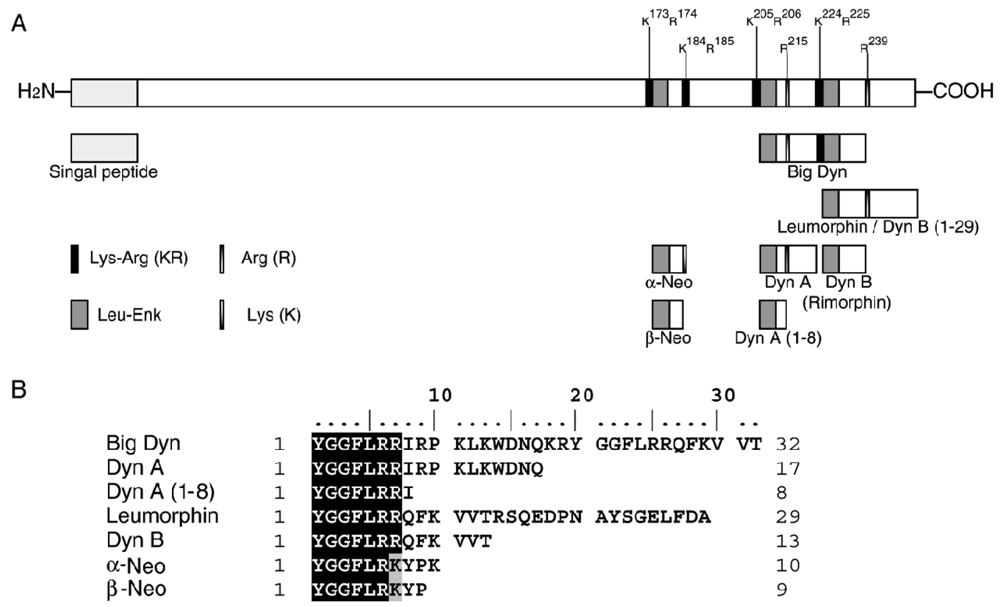
<p>In the late 70s and early 80s, several kappa preferring endogenous peptides were identified, their common precursor being prodynorphin (PDYN) which was subsequently cloned in 1982 by Akil <italic>et al.</italic> [<xref ref-type="bibr" rid="b1-pharmaceuticals-04-00154">1</xref>]. Seven peptides are generated from PDYN by sequential enzymatic cleavage mainly through proprotein convertase 2 (<xref ref-type="fig" rid="f1-pharmaceuticals-04-00154">Figure 1</xref>) [<xref ref-type="bibr" rid="b2-pharmaceuticals-04-00154">2</xref>]. PDYN-derived peptides collectively known as dynorphins are putative endogenous ligands for KORs and comprise dynorphin A (Dyn A), dynorphin A(1-8), dynorphin B (Dyn B), α-neoendorphin (α-Neo), β-neoendorphin (β-Neo), leumorphin, and big dynorphin (Big Dyn, which contains both Dyn A and Dyn B) (<xref ref-type="table" rid="t1-pharmaceuticals-04-00154">Table 1</xref>) (<xref ref-type="fig" rid="f1-pharmaceuticals-04-00154">Figure 1</xref>) [<xref ref-type="bibr" rid="b3-pharmaceuticals-04-00154">3</xref>]. The potential of dynorphin to bind to and activate KORs is similar to that of synthetic κ-agonists such as ethylketocyclazocine (EKC), bremazocine, and U-50488H. Dynorphins can also bind to MOR and DOR, although their selectivity for KOR is considerably greater which can be attributed to differences in the structure of the KOR second extracellular loop which contains eight amino acids and displays an amphiphilic helical region, which is not present in MOR or DOR [<xref ref-type="bibr" rid="b4-pharmaceuticals-04-00154">4</xref>]. Dyn A has a 46-fold higher affinity for KOR than Dyn B whilst the affinity of Big Dyn for KOR is similar to Dyn A because the binding potency correlates with the presence of the Dyn A(9-17) segment (see <xref ref-type="table" rid="t1-pharmaceuticals-04-00154">Table 1</xref>), present in both Big Dyn and Dyn A but lacking in Dyn A(1-18) and Dyn B which demonstrate lower potency [<xref ref-type="bibr" rid="b3-pharmaceuticals-04-00154">3</xref>].</p></sec>
<sec>
<label>3.</label>
<title>Cardiovascular Effects of KOR</title>
<p>Previous studies in adult mammals have explored the role of KOR centrally in modulating cardiovascular homeostasis: Dynorphin when microinjected into the preoptic <italic>medialis nucleus</italic> of anaesthetised rats results in a decrease in both arterial pressure and heart rate [<xref ref-type="bibr" rid="b5-pharmaceuticals-04-00154">5</xref>] and microinjection into the <italic>nucleus tractus solitarius</italic> (NTS) of the selective KOR agonist, U-50488H, elicits a dose-dependent increase in arterial pressure and a decrease in heart rate similar to that observed following injection of dynorphin [<xref ref-type="bibr" rid="b6-pharmaceuticals-04-00154">6</xref>]. Furthermore, U-50488H microinjected into the parvocellular paraventricular nucleus (PVN) results in an immediate pressor response along with a bradycardia [<xref ref-type="bibr" rid="b7-pharmaceuticals-04-00154">7</xref>].</p>
<p>In contrast, the actions of KOR agonists administered into the peripheral circulation are not completely understood [<xref ref-type="bibr" rid="b8-pharmaceuticals-04-00154">8</xref>]. For example, systemic administration of the KOR agonists bremazocine, tifluaodom, and U-50488H to urethane-anaesthetised Sprague Dawley rats is associated with a decrease in arterial pressure [<xref ref-type="bibr" rid="b9-pharmaceuticals-04-00154">9</xref>]. In chloralose-anaesthetised cats, spiradoline mesylate administered systemically decreases arterial pressure and in baroreceptor-denervated cats, there is a dose-related hypotensive effect [<xref ref-type="bibr" rid="b10-pharmaceuticals-04-00154">10</xref>]. In healthy human volunteers, I.V. infusion of the KOR agonist, niravoline, induces a transient increase in arterial pressure but no concomitant change in heart rate [<xref ref-type="bibr" rid="b11-pharmaceuticals-04-00154">11</xref>]. In conscious adult ewes, Szeto <italic>et al.</italic> showed that I.V. administration of U-50488H, also increases arterial pressure as well as heart rate [<xref ref-type="bibr" rid="b12-pharmaceuticals-04-00154">12</xref>]. To date, there have been no studies investigating the role of kappa opioid peptides in regulating the arterial baroreflex. Taken together then, the aforementioned studies investigating systemic cardiovascular effects of KOR agonists in adult animals and humans have provided variable and often conflicting results likely resulting from differences in experimental design including state of consciousness, dose, choice of drug, and mode of administration.</p></sec>
<sec>
<label>4.</label>
<title>Renal Effects of KORs</title>
<p>Initially, opiate-like activity was identified in kidney tissues [<xref ref-type="bibr" rid="b13-pharmaceuticals-04-00154">13</xref>,<xref ref-type="bibr" rid="b14-pharmaceuticals-04-00154">14</xref>]; however, it is now apparent that there are considerable species differences in the intra-renal localization of specific ORs [<xref ref-type="bibr" rid="b15-pharmaceuticals-04-00154">15</xref>,<xref ref-type="bibr" rid="b16-pharmaceuticals-04-00154">16</xref>]. In the opossum kidney (OK) cell line, a model of proximal tubular cells, a high affinity KOR subtype (κ<sub>1</sub>) has been identified [<xref ref-type="bibr" rid="b17-pharmaceuticals-04-00154">17</xref>]. This is known as the KOR1 and is believed to be the receptor through which the endogenous ligand, dynorphin A, as well as the structurally similar nociceptin, elicit their renal effects [<xref ref-type="bibr" rid="b18-pharmaceuticals-04-00154">18</xref>] as detailed in the proceeding paragraphs:</p>
<p>For almost three decades, it has been known that KORs are involved in fluid homeostasis. Both central and peripheral administration of selective KOR agonists as well as the endogenous ligand, dynorphin, leads to an increase in urinary flow rate also known as a diuresis, in rats [<xref ref-type="bibr" rid="b19-pharmaceuticals-04-00154">19</xref>-<xref ref-type="bibr" rid="b23-pharmaceuticals-04-00154">23</xref>], mice [<xref ref-type="bibr" rid="b24-pharmaceuticals-04-00154">24</xref>], dogs [<xref ref-type="bibr" rid="b25-pharmaceuticals-04-00154">25</xref>], and humans [<xref ref-type="bibr" rid="b26-pharmaceuticals-04-00154">26</xref>,<xref ref-type="bibr" rid="b27-pharmaceuticals-04-00154">27</xref>]: Slizgi and Ludens first reported a diuretic response to subcutaneous (S.Q.) administration of the partial KOR agonist and benzomorphan analogue, EKC to conscious rats [<xref ref-type="bibr" rid="b28-pharmaceuticals-04-00154">28</xref>]. Leander described a diuresis following S.Q. administration of bremazocine, EKC, and ketazocine, which was inhibited by the selective KOR antagonists, WIN-44,441 and MR-2266BS [<xref ref-type="bibr" rid="b20-pharmaceuticals-04-00154">20</xref>]. In hydrated conscious rats, Hiudobro-Toro and Parada measured a diuretic response to intra-peritoneal (I.P.) administration of KOR agonists; this diuresis was abolished by the selective KOR antagonists (WIN-44,441 and MR2266BS) but not the non-selective antagonist, naloxone [<xref ref-type="bibr" rid="b19-pharmaceuticals-04-00154">19</xref>]. Dykstra <italic>et al.</italic> [<xref ref-type="bibr" rid="b29-pharmaceuticals-04-00154">29</xref>] also reported a dose-dependent diuretic response to S.Q. administration of U-50488H in conscious rhesus monkeys. The diuresis was abolished by the selective KOR antagonist, MR-2266. In human subjects, Kramer <italic>et al.</italic> [<xref ref-type="bibr" rid="b27-pharmaceuticals-04-00154">27</xref>] showed that administration of the KOR agonist, asimadoline, was also associated with a diuretic response.</p>
<p>KOR agonists and the naturally occurring ligands, dynorphins, also increase free water clearance and therefore are considered aquaretic compounds [<xref ref-type="bibr" rid="b30-pharmaceuticals-04-00154">30</xref>-<xref ref-type="bibr" rid="b32-pharmaceuticals-04-00154">32</xref>]. This aquaresis is thought to result from a combination of its direct inhibitory effects on the tubular action of arginine vasopressin (AVP) in promoting water reabsorption, and suppression of AVP release from the neurohypophysis [<xref ref-type="bibr" rid="b21-pharmaceuticals-04-00154">21</xref>,<xref ref-type="bibr" rid="b23-pharmaceuticals-04-00154">23</xref>,<xref ref-type="bibr" rid="b31-pharmaceuticals-04-00154">31</xref>,<xref ref-type="bibr" rid="b33-pharmaceuticals-04-00154">33</xref>-<xref ref-type="bibr" rid="b36-pharmaceuticals-04-00154">36</xref>]. With respect to the latter, KOR activation within the central nervous system (CNS) is associated with stimulation of the PVN concomitantly with a triggering of brainstem noradrenergic regions that innervate this nucleus [<xref ref-type="bibr" rid="b37-pharmaceuticals-04-00154">37</xref>].</p>
<p>There is also evidence that KOR and AVP work synergistically within specific brain neurons: Dynorphin is co-localized with AVP and KOR in neurosecretory vesicles that are exocytosed from dendrites and terminals of cells within the supraoptic nucleus (SON). In hypothalamo-neurohypophysial explants of Long Evans rats, Rossi <italic>et al.</italic> [<xref ref-type="bibr" rid="b38-pharmaceuticals-04-00154">38</xref>] showed that AVP gene expression, as well as osmotically-induced AVP secretion were inhibited by the KOR agonist, RU 51599, at the level of the hypothalamus. In neurosecretosomes removed from Wistar rat pituitaries, Zhao <italic>et al.</italic> [<xref ref-type="bibr" rid="b39-pharmaceuticals-04-00154">39</xref>] showed that U-50488H and dynorphin A<sub>1–13</sub> inhibited AVP secretion evoked by direct depolarization of the nerve terminals, thus providing evidence that KORs are located on the nerve terminals of magnocellular neurons with direct modulation by kappa opioid peptides.</p>
<p>Brown <italic>et al.</italic> [<xref ref-type="bibr" rid="b40-pharmaceuticals-04-00154">40</xref>] showed that in SON cells of female Sprague Dawley rats, administration of the selective KOR antagonist, Nor-BNI, increases the activity of phasically active, vasopressinergic neurons. This demonstrates an auto-inhibitory effect of dynorphin at the level of vasopressin cells of the SON, or presynaptically on their afferent inputs. The same group using intracellular recordings of SON cells in superfused hypothalamic explants of male Long Evans rats and showed that Nor-BNI alters burst patterns and removes silent periods between bursts resulting in a continuous firing pattern [<xref ref-type="bibr" rid="b41-pharmaceuticals-04-00154">41</xref>]. Therefore, it appears that dendritic dynorphin release contributes to the termination of spontaneous phasic bursts <italic>in vivo</italic> in magnocellular neurosecretory cells of the SON.</p>
<p>A role for κ-opioid peptides in influencing tubular electrolye reabsorption in the adult has also been implicated, although the literature in this regard is inconsistent: Huidobro-Toro and Parada demonstrated a dose-dependent anti-natriuresis following I.P. administration of U-50488H to hydrated conscious rats [<xref ref-type="bibr" rid="b19-pharmaceuticals-04-00154">19</xref>], but no consistent anti-kaliuretic effect. In the isolated perfused rat kidney, however, administration of the KOR agonist, ketocyclazocine, has no effects on sodium or potassium excretion rates [<xref ref-type="bibr" rid="b42-pharmaceuticals-04-00154">42</xref>]. Kapusta and Obih [<xref ref-type="bibr" rid="b43-pharmaceuticals-04-00154">43</xref>] showed that U-50488H administered I.C.V. elicited a decrease in sodium excretion which occurs concomitantly with an increase in renal sympathetic nerve activity; this anti-natriuresis is abolished in the absence of renal sympathetic nerves. Ashton <italic>et al.</italic> [<xref ref-type="bibr" rid="b32-pharmaceuticals-04-00154">32</xref>] also measured an anti-natriuresis and anti-kaliuresis following S.Q. injection of U-50488H to inactin-anesthetized rats. In contrast, an increase in sodium excretion occurred following I.V. administration of U-50488H to pentobarbital-anesthetized dogs [<xref ref-type="bibr" rid="b25-pharmaceuticals-04-00154">25</xref>], whereas administration of the stable dynorphin analog, E2078, to conscious rats elicited no change in sodium excretion yet potassium excretion decreased [<xref ref-type="bibr" rid="b44-pharmaceuticals-04-00154">44</xref>].</p>
<p>Taken together, it is generally well recognized that kappa opioid peptides are aquaretic. To date, however, their role in tubular electrolyte reabsorption has not been fully characterized. With the recent advancement in new technologies including novel ligands and cellular, molecular, and genetic techniques, it will be important for new studies to further evaluate the renal effects of kappa opioid peptides and therefore help to increase our understanding of their role in regulating fluid and electrolyte homeostasis.</p></sec>
<sec>
<label>5.</label>
<title>Physiological Effects of KORs during Development</title>
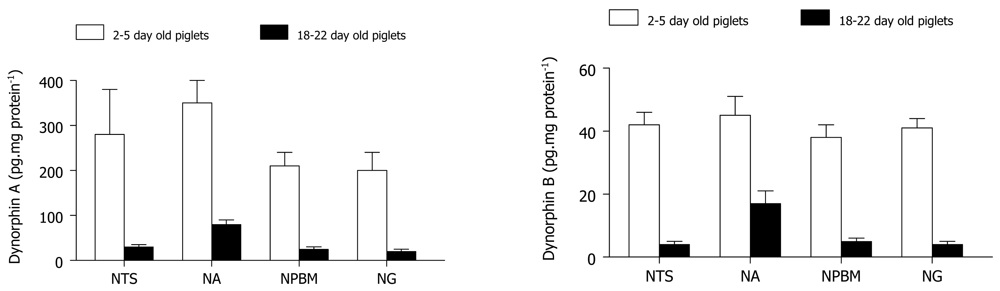
<p>Elevated levels of enzymes such as enkephalin convertase (which forms enkephalin) around the time of birth in rats predict a heightened opioid activation in the newborn [<xref ref-type="bibr" rid="b45-pharmaceuticals-04-00154">45</xref>]. Zhang and Moss [<xref ref-type="bibr" rid="b46-pharmaceuticals-04-00154">46</xref>] demonstrated an age-related increase in the content of β-endorphin, methionine-enkephalin, as well as dynorphin A and B within the NTS, ambigualis, gigantoreticularis and parabrachialis medialis nuclei in piglets (<xref ref-type="fig" rid="f2-pharmaceuticals-04-00154">Figure 2</xref>). These are brain regions that normally influence cardiorespiratory control. In the ovine brain, maximum opioid receptor binding is present in the pons and medulla by term of gestation, remaining high in newborn lambs and decreasing with postnatal maturation [<xref ref-type="bibr" rid="b47-pharmaceuticals-04-00154">47</xref>]. Specifically, KOR binding sites as well as their density increase gradually with postnatal development in the rat [<xref ref-type="bibr" rid="b48-pharmaceuticals-04-00154">48</xref>-<xref ref-type="bibr" rid="b51-pharmaceuticals-04-00154">51</xref>], guinea pig [<xref ref-type="bibr" rid="b48-pharmaceuticals-04-00154">48</xref>,<xref ref-type="bibr" rid="b49-pharmaceuticals-04-00154">49</xref>], mouse [<xref ref-type="bibr" rid="b52-pharmaceuticals-04-00154">52</xref>], and human [<xref ref-type="bibr" rid="b53-pharmaceuticals-04-00154">53</xref>] in various organs including the brain, spinal cord and heart, implicating alterations in their physiological roles during ontogeny. Therefore, it seems likely that κ-opioid peptides may modulate cardiovascular and renal function during the perinatal period.</p></sec>
<sec>
<label>6.</label>
<title>Cardiovascular Effects of KOR during Development</title>
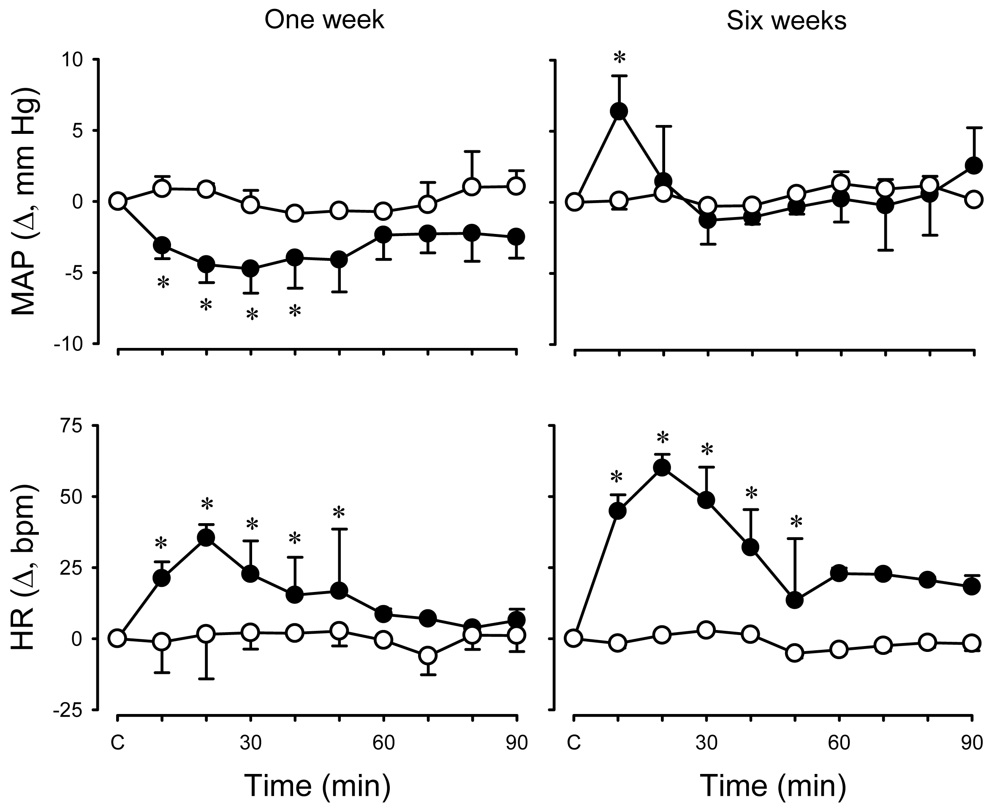
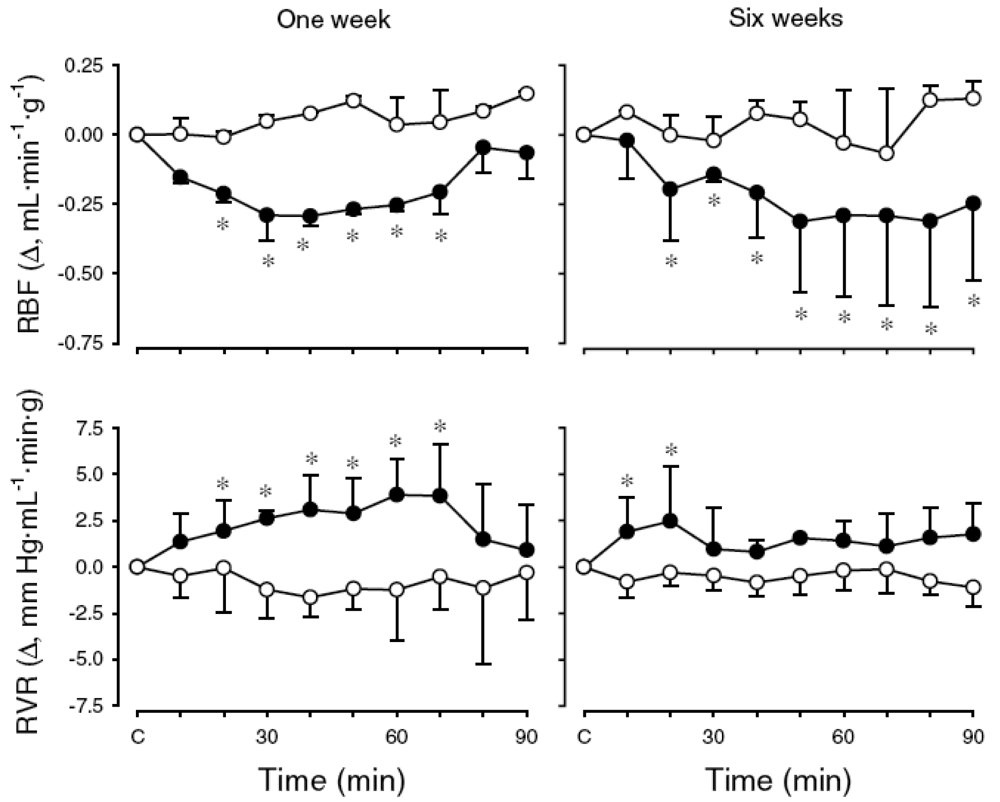
<p>To test the hypothesis that activation of KORs modulates systemic and renal haemodynamics in an age-dependent manner, cardiovascular effects of the KOR agonist, U-50488H, were investigated in conscious lambs at two stages of post natal maturation and under physiological conditions [<xref ref-type="bibr" rid="b54-pharmaceuticals-04-00154">54</xref>]. First, experiments were undertaken to determine the maximum effective dose (ED100) of U-50488H to be applied in subsequent experiments. Cardiovascular measurements were made for 30 min before and 90 min after I.V. injection of U-50488H over the range of doses 0-5.0 mg/kg. In both age groups of lambs, the U-50488H dose <italic>versus</italic> peak heart rate response curve was constructed and the ED100 determined to be 0.5 mg/kg at one week and 1.0 mg/kg at six weeks [<xref ref-type="bibr" rid="b54-pharmaceuticals-04-00154">54</xref>]. In subsequent experiments, the aforementioned ED<sub>100</sub> dose of U-50488H was administered to conscious lambs and shown to elicit a small but sustained decrease in mean arterial pressure one week post natally whereas a small but transient increase occurred at six weeks (<xref ref-type="fig" rid="f3-pharmaceuticals-04-00154">Figure 3</xref>). In both age groups of lambs, there was a sustained increase in heart rate after U-50488H (<xref ref-type="fig" rid="f3-pharmaceuticals-04-00154">Figure 3</xref>). There was also a significant and sustained decrease in renal blood flow in both age groups following I.V. administration of U-50488H, resulting from an increase in renal vascular resistance (<xref ref-type="fig" rid="f4-pharmaceuticals-04-00154">Figure 4</xref>). Although the mechanism underlying this renal haemodynamic response to U-50488H is not known, it may reflect an increase in renal sympathetic nerve activity [<xref ref-type="bibr" rid="b55-pharmaceuticals-04-00154">55</xref>,<xref ref-type="bibr" rid="b56-pharmaceuticals-04-00154">56</xref>], although effects of local vasoactive factors cannot be ruled out.</p>
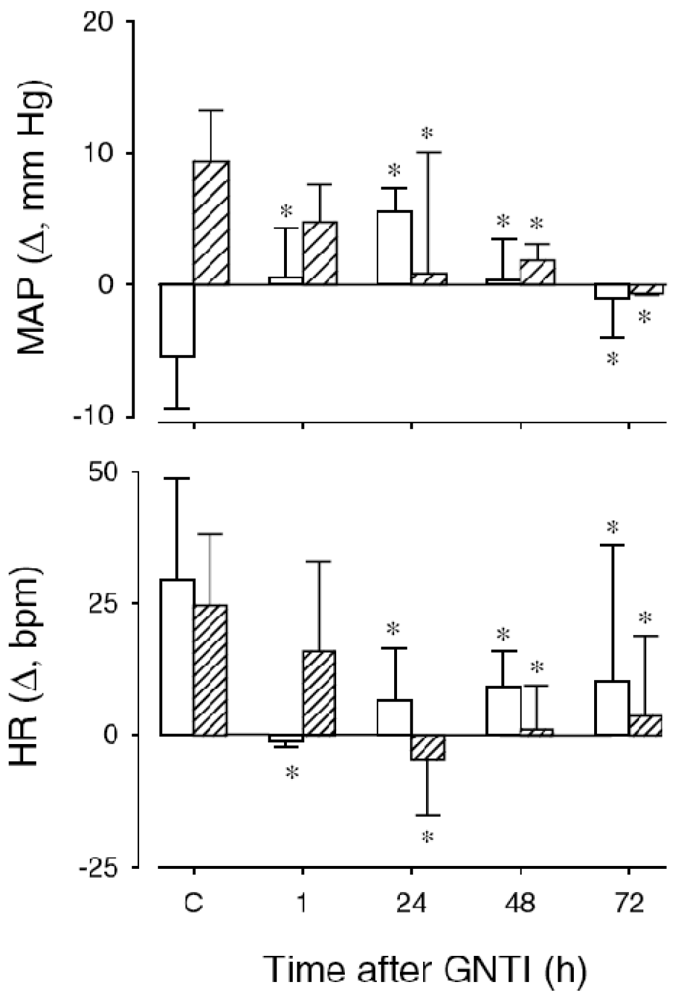
<p>To investigate whether the aforementioned responses to U-50488H resulted from direct activation of KORs and to rule out any non-receptor or secondary effects of U-50488H, additional experiments were carried out in the presence of the selective KOR antagonist 5′guanidinyl-17-(cyclopropylmethyl)-6,7-dehydro-4,5α-epoxy-3,14-dihydroxy-6,7-2′,3′-indolomorphinan dihydrochloride (GNTI). A potent KOR antagonist, GNTI displays 208- and 799-fold selectivity over MOR and DOR, respectively, and greater antagonist potency than the prototypical KOR antagonist, norbinaltorphimine, (nor-BNI) [<xref ref-type="bibr" rid="b57-pharmaceuticals-04-00154">57</xref>,<xref ref-type="bibr" rid="b58-pharmaceuticals-04-00154">58</xref>]. As illustrated in <xref ref-type="fig" rid="f5-pharmaceuticals-04-00154">Figure 5</xref>, the maximum inhibitory effects of GNTI on the cardiovascular responses to U-50488H are present within 24 h and remain for up to 72 h.</p>
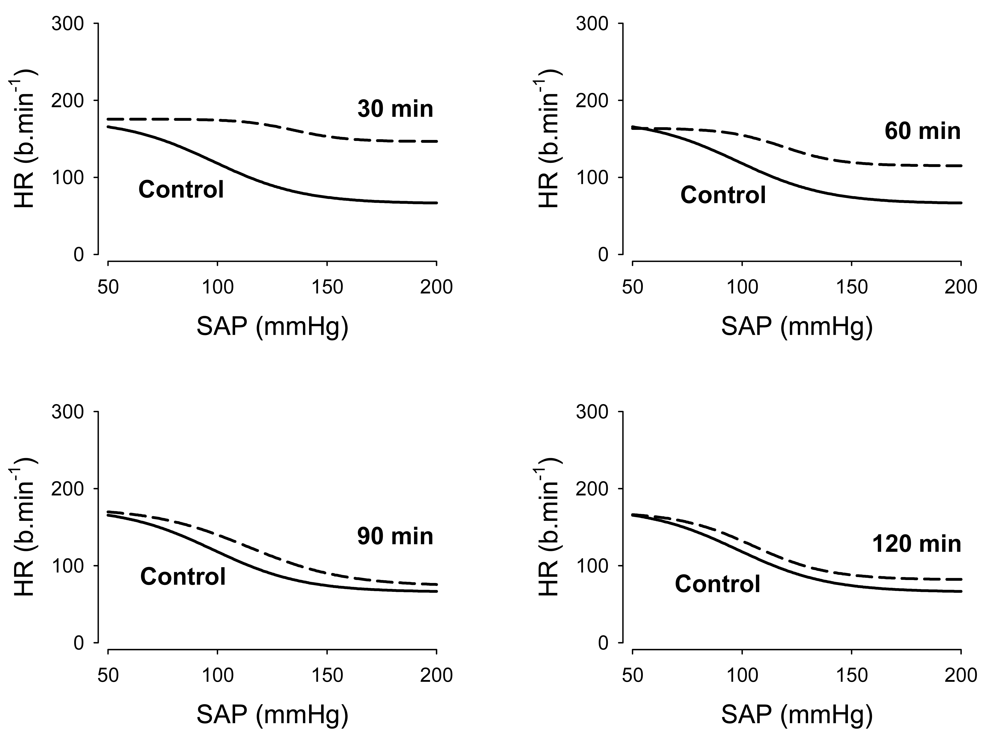
<p>Because the KOR agonist, U50488H, increased heart rate (as described above), with minimal changes in pressure, it appeared that KORs might also modulate the arterial baroreceptor reflex. Therefore, in an ensuing study, we measured the parameters governing the arterial baroreflex control of heart rate in the presence and absence of U-50488H in conscious young lambs [<xref ref-type="bibr" rid="b59-pharmaceuticals-04-00154">59</xref>]. In this study, the dose of 5.0 mg/kg of U-50488H was selected as it produced a sustained increase in both arterial pressure and heart rate [<xref ref-type="bibr" rid="b59-pharmaceuticals-04-00154">59</xref>]. Administration of U-50488H considerably decreased the heart rate range (<italic>P1</italic>) through a dramatic increase in the minimum heart rate (<italic>P4</italic>) at 30 min. There was also an increase in the systolic arterial pressure at the midpoint of the heart rate range (<italic>P3</italic>) as well as the slope coefficient (<italic>P2</italic>) an increase in the maximum gain (<italic>Gmax</italic>) (<xref ref-type="fig" rid="f6-pharmaceuticals-04-00154">Figure 6</xref>). Taken together, these findings provide the first direct evidence that κ-opioids may modulate the baroreflex, revealing a previously unidentified role for this opioid peptide.</p>
<p>Although all OR subtypes have been localized to midbrain and brainstem regions involved in cardiovascular integration, KOR binding sites predominate in the preoptic area, and in several hypothalamic regions of the rat brain including the supraoptic and paraventricular nucleus, notably the magnocellular and parvocellular regions [<xref ref-type="bibr" rid="b60-pharmaceuticals-04-00154">60</xref>]. There is also considerable KOR binding in the NTS, at least in the rat brain [<xref ref-type="bibr" rid="b61-pharmaceuticals-04-00154">61</xref>,<xref ref-type="bibr" rid="b62-pharmaceuticals-04-00154">62</xref>]. Laorden <italic>et al.</italic> [<xref ref-type="bibr" rid="b37-pharmaceuticals-04-00154">37</xref>] demonstrated increased c-<italic>fos</italic> expression in the rat paraventricular nucleus as well as noradrenergic A<sub>1</sub> and A<sub>2</sub> cell groups following I.P. administration of U-50488H. In addition, catecholaminergic-positive neurons in the NTS and ventrolateral medulla which innervate the paraventricular nucleus showed a significant increase in <italic>fos</italic> expression following U-50488H [<xref ref-type="bibr" rid="b37-pharmaceuticals-04-00154">37</xref>]. Therefore, the observed effects of U-50488H in modulating the arterial baroreflex control of heart rate could reflect activation of KOR in these regions of the CNS.</p></sec>
<sec>
<label>7.</label>
<title>Renal effects of KOR during development</title>
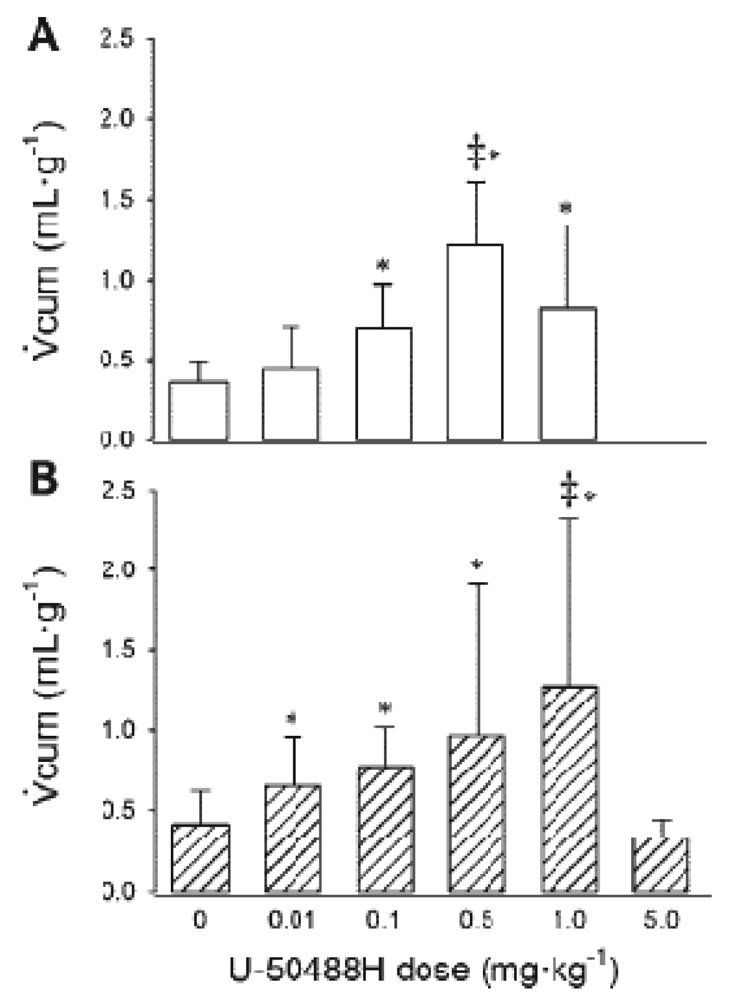
<p>The endorphin precursors proenkephalin A and B are detectable in the kidney of newborn rat pups but not adult rats [<xref ref-type="bibr" rid="b63-pharmaceuticals-04-00154">63</xref>,<xref ref-type="bibr" rid="b64-pharmaceuticals-04-00154">64</xref>] and newborn piglets but not adult pigs [<xref ref-type="bibr" rid="b65-pharmaceuticals-04-00154">65</xref>,<xref ref-type="bibr" rid="b66-pharmaceuticals-04-00154">66</xref>]. Little is known, however, regarding the renal responses to activation of KORs during the perinatal period, or whether they are in fact aquaretic during this time. Jackson and Kitchen [<xref ref-type="bibr" rid="b67-pharmaceuticals-04-00154">67</xref>] reported an increase in urinary output in response to I.P. administration of U-50488H to 10 day old rat pups, although no other measurements were made and no additional age groups were studied. Recently, Qi <italic>et al.</italic> measured renal responses to activation of KORs in conscious lambs [<xref ref-type="bibr" rid="b68-pharmaceuticals-04-00154">68</xref>]. Initially, the relationship between U-50488H dose and cumulative urinary flow rate (Vcum) was determined to define the maximal effective dose (ED<sub>100</sub>) for both age groups as 0.5 mg/kg (one week) and 1.0 mg/kg (six weeks) [<xref ref-type="bibr" rid="b68-pharmaceuticals-04-00154">68</xref>] (<xref ref-type="fig" rid="f7-pharmaceuticals-04-00154">Figure 7</xref>).</p>
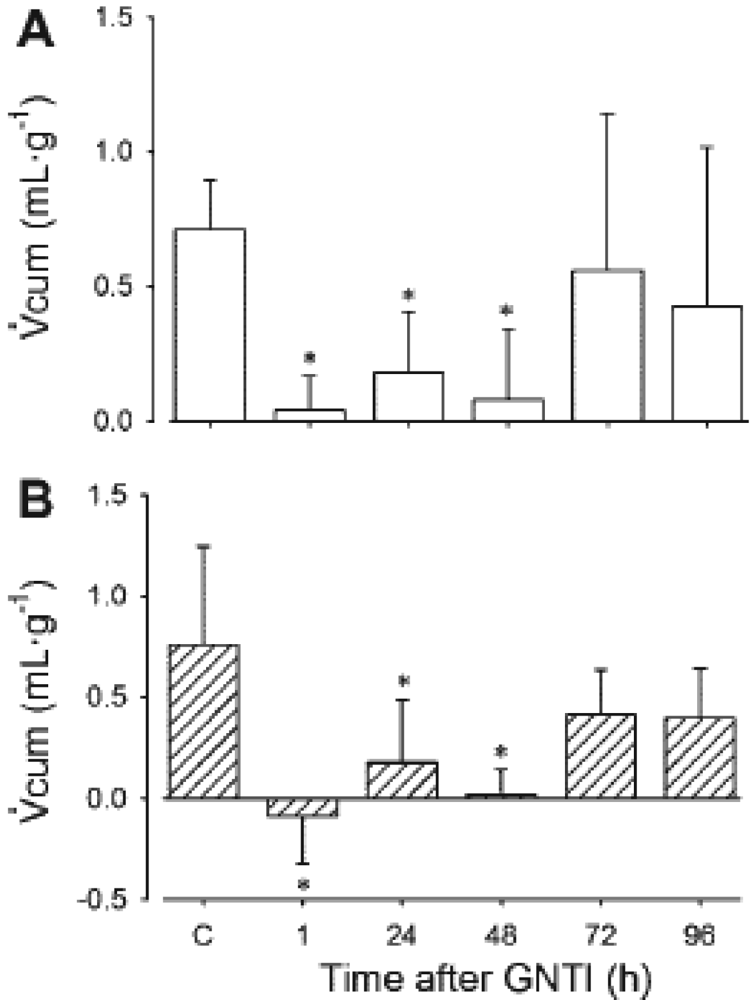
<p>In subsequent experiments, ED100 U-50488H was administered and urinary flow rate and electrolyte excretions were measured. As for adult animals and humans, administration of U-50488H, to lambs aged ∼one-and ∼six weeks elicits a diuresis which is abolished by the selective KOR antagonist, GNTI. Since this diuretic response to U-50488H was abolished 1 h after pre-treatment with GNTI, with effects persisting for 48 h (<xref ref-type="fig" rid="f8-pharmaceuticals-04-00154">Figure 8</xref>), we can conclude that it results from the direct action of KORs. The diuresis which followed administration of U-50488H to conscious lambs was unaccompanied by any alterations in electrolyte excretions. There was, however, an accompanying increase in free water clearance which provides evidence that the effects of KOR in the newborn period are in fact aquaretic.</p>
<p>In hypothalamic neurons in culture derived from 70-day gestation ovine fetuses, AVP is secreted basally and in response to K<sup>+</sup>-induced depolarizations [<xref ref-type="bibr" rid="b69-pharmaceuticals-04-00154">69</xref>]. Dynorphin also inhibits basal as well as K<sup>+</sup>-stimulated AVP release, demonstrating that the negative feedback control of AVP by activation of KORs is intact before birth [<xref ref-type="bibr" rid="b69-pharmaceuticals-04-00154">69</xref>] in the developing ovine. These findings provide evidence that the diuretic effect of KOR activation early in life may result from alterations in AVP release which could reflect age-dependent changes in the central distribution of KOR as described in section 5 above.</p></sec>
<sec>
<label>8.</label>
<title>Pharmacological Inhibition of KORs</title>
<p>Previously, the prototypical KOR antagonist used in physiological studies has been nor-BNI. This compound, however, produces non-selective antagonism for both MOR and DOR 1-2 h after its administration [<xref ref-type="bibr" rid="b70-pharmaceuticals-04-00154">70</xref>-<xref ref-type="bibr" rid="b71-pharmaceuticals-04-00154">71</xref>]. Nor-BNI also has a relatively low potency <italic>in vivo</italic> after systemic administration, a slow onset and long duration of action, with effects persisting for many weeks. GNTI is a recently synthesized KOR antagonist which is considered more potent than nor-BNI [<xref ref-type="bibr" rid="b57-pharmaceuticals-04-00154">57</xref>,<xref ref-type="bibr" rid="b72-pharmaceuticals-04-00154">72</xref>]. In a schedule-controlled behavioral study in the rhesus monkey [<xref ref-type="bibr" rid="b73-pharmaceuticals-04-00154">73</xref>], GNTI exhibited antagonism of U-50488H-induced behavioural effects in a dose- and time-dependent manner. Negus <italic>et al.</italic> demonstrated that GNTI had a faster onset and shorter duration than nor-BNI, with a peak effect at 24 h after I.V. administration, with effects persisting for ∼four days [<xref ref-type="bibr" rid="b73-pharmaceuticals-04-00154">73</xref>]. Our experiments in conscious lambs provide the first physiological investigations into the role of GNTI as a tool to evaluate the contributions from KORs to cardiovascular and fluid and electrolyte homeostasis in the conscious animal. Because this compound is more potent and selective for KORs as compared to nor-BNI, it may be considered a more suitable pharmacological KOR antagonist for future experimental studies.</p></sec>
<sec sec-type="conclusions">
<label>9.</label>
<title>Conclusions</title>
<p>Our experiments under physiological conditions in conscious newborn animals have provided the first information that activation of KORs results in an aquaresis, as previously observed in adult animals and humans. In addition, KORs modulate systemic and renal haemodynamics as well as the arterial baroreflex control of heart rate, providing a previously unidentified role for KORs. It is apparent that kappa opioids are emerging as an important peptide under physiological conditions throughout life with important functions early in post natal life. Additional studies are clearly warranted to more fully elucidate the role that kappa opioid peptides may play in regulating electrolyte balance. New investigations are also needed into a role for KORs in regulating the arterial baroreflex. Future studies should also evaluate a role for KORs in such pathophysiological states as haemorrhagic shock, pain, and brain injury in the newborn which may have important clinical ramifications.</p></sec></body>
<back>
<sec sec-type="display-objects">
<title>Figures and Table</title>
<fig id="f1-pharmaceuticals-04-00154" position="float">
<label>Figure 1.</label>
<caption>
<p>Generation and amino acid sequences of naturally occurring dynorphins.</p>
<p>A. Endogenous dynorphins are generated from the precursor through differential cleavages by proprotein convertases at paired and single basic amino acids followed by carboxypeptidases; B. Amino acid sequences of prodynorphin gene products. Reproduced from Chen <italic>et al.</italic> [<xref ref-type="bibr" rid="b4-pharmaceuticals-04-00154">4</xref>] with permission.</p></caption>
<graphic xlink:href="pharmaceuticals-04-00154f1.gif"/></fig>
<fig id="f2-pharmaceuticals-04-00154" position="float">
<label>Figure 2.</label>
<caption>
<p>Dynorphin levels in brainstem regions of developing piglets.</p>
<p>Dynorphin A (left) and dynorphin B (right) measured in brainstem regions of piglets. NTS, nucleus tractus solitarius; NA, nucleus ambiguus; NPB, nucleus parabrachialis; NG, nucleus gigantoreticularis. Values are mean ± S.E.M. Adapted from Zhang and Moss [<xref ref-type="bibr" rid="b46-pharmaceuticals-04-00154">46</xref>].</p></caption>
<graphic xlink:href="pharmaceuticals-04-00154f2.gif"/></fig>
<fig id="f3-pharmaceuticals-04-00154" position="float">
<label>Figure 3.</label>
<caption>
<p>Effects of U-50488H on mean arterial pressure (MAP) and heart rate (HR) in conscious lambs.</p>
<p>Mean arterial pressure (MAP, upper panel) and heart rate (HR, lower panel) measured before and after I.V. administration of vehicle (open symbols) or U-50488H (solid symbols) to conscious lambs aged ∼one week (left; N = 7) and ∼six-weeks (right; N = 10). * p &lt; 0.05 compared to control (C). Reproduced from Qi and Smith [<xref ref-type="bibr" rid="b54-pharmaceuticals-04-00154">54</xref>] with permission.</p></caption>
<graphic xlink:href="pharmaceuticals-04-00154f3.gif"/></fig>
<fig id="f4-pharmaceuticals-04-00154" position="float">
<label>Figure 4.</label>
<caption>
<p>Effects of U-50488H on renal blood flow (RBF) and renal vascular resistance (RVR) in conscious lambs.</p>
<p>RBF (upper panel) and RVR (lower panel) measured before and after I.V. administration of vehicle (open symbols) or U-50488H (solid symbols) to conscious lambs aged ∼one week (left hand panel; N = 7) and ∼six-weeks (right hand panel; N = 10). * p &lt; 0.05 compared to control (C). Reproduced from Qi &amp; Smith (2006) [<xref ref-type="bibr" rid="b54-pharmaceuticals-04-00154">54</xref>] with permission.</p></caption>
<graphic xlink:href="pharmaceuticals-04-00154f4.gif"/></fig>
<fig id="f5-pharmaceuticals-04-00154" position="float">
<label>Figure 5.</label>
<caption>
<p>Effects of GNTI on mean arterial pressure (MAP) and heart rate (HR) responses to U50488H in conscious lambs.</p>
<p>Change in MAP (top) and HR (bottom) after I.V. administration of U-50488H at 24 h (control, C) and at 1, 24, 48, and 72 h after I.V. injection of GNTI to lambs aged ∼one week (open bars, n = 4) and ∼six weeks (hatched bars, n = 4). p &lt; 0.05 compared to C. Reproduced from Qi and Smith [<xref ref-type="bibr" rid="b54-pharmaceuticals-04-00154">54</xref>] with permission.</p></caption>
<graphic xlink:href="pharmaceuticals-04-00154f5.gif"/></fig>
<fig id="f6-pharmaceuticals-04-00154" position="float">
<label>Figure 6.</label>
<caption>
<p>Activation of KOR modulates the arterial baroreflex control of heart rate (HR) in conscious lambs.</p>
<p>A logistic function was applied to pooled raw data for control measurements (solid line) and for 30 min, 60 min, 90 min, and 120 min, after administration of U-50488H (dashed line). Reproduced from Qi and Smith [<xref ref-type="bibr" rid="b59-pharmaceuticals-04-00154">59</xref>] with permission.</p></caption>
<graphic xlink:href="pharmaceuticals-04-00154f6.gif"/></fig>
<fig id="f7-pharmaceuticals-04-00154" position="float">
<label>Figure 7.</label>
<caption>
<p>Dose dependent effects of U-50488H on cumulative urinary flow rate (Vcum).</p>
<p>Urine flow rate was measured over 90 min (Vcum) after administration of U-50488H to conscious lambs aged ∼one week (A) and ∼six weeks (B). * p &lt; 0.05 compared with 0 dose. ‡ indicates maximum effective dose (or ED100). Reproduced from Qi <italic>et al.</italic> [<xref ref-type="bibr" rid="b68-pharmaceuticals-04-00154">68</xref>] with permission.</p></caption>
<graphic xlink:href="pharmaceuticals-04-00154f7.gif"/></fig>
<fig id="f8-pharmaceuticals-04-00154" position="float">
<label>Figure 8.</label>
<caption>
<p>Effects of GNTI on Vcum responses to U-50488H in conscious lambs.</p>
<p>Urine flow rate was measured over 90 min (Vcum) after administration of U-50488H before (Control, C) and at 1, 24, 48, 72, and 96 h after I.V. administration of GNTI to lambs aged ∼one week (A) and ∼six weeks (B). * p &lt; 0.05 compared to C. Reproduced from Qi <italic>et al.</italic> [<xref ref-type="bibr" rid="b68-pharmaceuticals-04-00154">68</xref>] with permission.</p></caption>
<graphic xlink:href="pharmaceuticals-04-00154f8.gif"/></fig>
<table-wrap id="t1-pharmaceuticals-04-00154" position="float">
<label>Table 1.</label>
<caption>
<p>Amino acid sequences of dynorphins.</p></caption>
<table frame="hsides" rules="groups">
<thead>
<tr>
<th align="left" valign="bottom"><bold>Peptide</bold></th>
<th align="center" valign="bottom"><bold>Amino Acids (n)</bold></th>
<th align="center" valign="bottom"><bold>Sequence</bold></th></tr></thead>
<tbody>
<tr>
<td align="left" valign="top">Big Dyn<xref ref-type="table-fn" rid="tfn1-pharmaceuticals-04-00154">*</xref></td>
<td align="center" valign="top">1-32</td>
<td align="left" valign="top">YGGFLRRI<bold>RPKLKWDNQ</bold>KRYGGFLRRDFKVVT</td></tr>
<tr>
<td align="left" valign="top">Dyn A(1-8)</td>
<td align="center" valign="top">1-8</td>
<td align="left" valign="top">YGGFLRRI</td></tr>
<tr>
<td align="left" valign="top">Dyn A</td>
<td align="center" valign="top">1-17</td>
<td align="left" valign="top">YGGFLRRI<bold>RPKLKWDNQ</bold></td></tr>
<tr>
<td align="left" valign="top">Big Dyn(6-26)</td>
<td align="center" valign="top">6-26</td>
<td align="left" valign="top">RRI<bold>RPKLKWDNQ</bold>KRYGGFLRR</td></tr>
<tr>
<td align="left" valign="top">Dyn B</td>
<td align="center" valign="top">20-32</td>
<td align="left" valign="top">YGGFLRRDFKVVT</td></tr></tbody></table>
<table-wrap-foot><fn id="tfn1-pharmaceuticals-04-00154">
<label>*</label>
<p>human prodynorphin 207-238; Bolded, shadowed region indicates the amino acid sequence Dyn(9-17) which correlates to potency of binding of peptide to KOR. Adapted from Merg <italic>et al.</italic> [<xref ref-type="bibr" rid="b3-pharmaceuticals-04-00154">3</xref>].</p></fn></table-wrap-foot></table-wrap></sec>
<ref-list>
<title>References</title>
<ref id="b1-pharmaceuticals-04-00154"><label>1.</label><citation citation-type="book"><person-group person-group-type="author"><name><surname>Akil</surname><given-names>H.</given-names></name><name><surname>Bronstein</surname><given-names>D.</given-names></name><name><surname>Mansour</surname><given-names>A.</given-names></name></person-group><article-title>Overview of endogeneous opioid systems: anatomical, biological and fuctional issues</article-title><source>Endorphins, Opiates and Behavioral Processes</source><person-group person-group-type="editor"><name><surname>Rodgers</surname><given-names>R.J.</given-names></name><name><surname>Cooper</surname><given-names>S.J.</given-names></name></person-group><publisher-name>John Wiley &amp; Sons Ltd.</publisher-name><publisher-loc>Chichester, UK</publisher-loc><year>1988</year><fpage>1</fpage><lpage>23</lpage></citation></ref>
<ref id="b2-pharmaceuticals-04-00154"><label>2.</label><citation citation-type="journal"><person-group person-group-type="author"><name><surname>Day</surname><given-names>R.</given-names></name><name><surname>Lazure</surname><given-names>C.</given-names></name><name><surname>Basak</surname><given-names>A.</given-names></name><name><surname>Boudreault</surname><given-names>A.</given-names></name><name><surname>Limperis</surname><given-names>P.</given-names></name><name><surname>Dong</surname><given-names>W.</given-names></name></person-group><article-title>Prodynorphin processing by proprotein convertase 2. Cleavage at single basic residues and enhanced processing in the presence of carboxypeptidase activity</article-title><source>J. Biol. Chem.</source><year>1998</year><volume>273</volume><fpage>829</fpage><lpage>836</lpage><pub-id pub-id-type="doi">10.1074/jbc.273.2.829</pub-id><pub-id pub-id-type="pmid">9422738</pub-id></citation></ref>
<ref id="b3-pharmaceuticals-04-00154"><label>3.</label><citation citation-type="journal"><person-group person-group-type="author"><name><surname>Merg</surname><given-names>F.</given-names></name><name><surname>Filliol</surname><given-names>D.</given-names></name><name><surname>Usynin</surname><given-names>I.</given-names></name><name><surname>Bazov</surname><given-names>I.</given-names></name><name><surname>Bark</surname><given-names>N.</given-names></name><name><surname>Hurd</surname><given-names>Y.L.</given-names></name></person-group><article-title>Big dynorphin as a putative endogenous ligand for the kappa-opioid receptor</article-title><source>J. Neurochem.</source><year>2006</year><volume>97</volume><fpage>292</fpage><lpage>301</lpage><pub-id pub-id-type="doi">10.1111/j.1471-4159.2006.03732.x</pub-id><pub-id pub-id-type="pmid">16515546</pub-id></citation></ref>
<ref id="b4-pharmaceuticals-04-00154"><label>4.</label><citation citation-type="journal"><person-group person-group-type="author"><name><surname>Meng</surname><given-names>F.</given-names></name><name><surname>Hoversten</surname><given-names>M.T.</given-names></name><name><surname>Thompson</surname><given-names>R.C.</given-names></name><name><surname>Taylor</surname><given-names>L.</given-names></name><name><surname>Watson</surname><given-names>S.J.</given-names></name><name><surname>Akil</surname><given-names>H.</given-names></name></person-group><article-title>A chimeric study of the molecular basis of affinity and selectivity of the κ and δ opioid receptors. Potential role of extracellular domains</article-title><source>J. Biol. Chem.</source><year>1995</year><volume>270</volume><fpage>12730</fpage><lpage>12736</lpage><pub-id pub-id-type="doi">10.1074/jbc.270.21.12730</pub-id><pub-id pub-id-type="pmid">7759527</pub-id></citation></ref>
<ref id="b5-pharmaceuticals-04-00154"><label>5.</label><citation citation-type="journal"><person-group person-group-type="author"><name><surname>Feuerstein</surname><given-names>G.</given-names></name><name><surname>Faden</surname><given-names>A.I.</given-names></name></person-group><article-title>Cardiovascular effects of dynorphin A-(1-8), dynorphin A-(1-13) and dynorphin A-(1-17) microinjected into the preoptic medialis nucleus of the rat</article-title><source>Neuropeptides</source><year>1984</year><volume>5</volume><fpage>295</fpage><lpage>298</lpage><pub-id pub-id-type="doi">10.1016/0143-4179(84)90086-6</pub-id><pub-id pub-id-type="pmid">6152328</pub-id></citation></ref>
<ref id="b6-pharmaceuticals-04-00154"><label>6.</label><citation citation-type="journal"><person-group person-group-type="author"><name><surname>Carter</surname><given-names>D.A.</given-names></name><name><surname>Lightman</surname><given-names>S.L.</given-names></name></person-group><article-title>Selective cardiovascular and neuroendocrine effects of a k-opioid agonist in the nucleus tractus solitarii of rats</article-title><source>J. Physiol.</source><year>1985</year><volume>367</volume><fpage>363</fpage><lpage>375</lpage><pub-id pub-id-type="pmid">2997441</pub-id></citation></ref>
<ref id="b7-pharmaceuticals-04-00154"><label>7.</label><citation citation-type="journal"><person-group person-group-type="author"><name><surname>Gottlieb</surname><given-names>H.B.</given-names></name><name><surname>Varner</surname><given-names>K.J.</given-names></name><name><surname>Kenigs</surname><given-names>V.A.</given-names></name><name><surname>Cabral</surname><given-names>A.M.</given-names></name><name><surname>Kapusta</surname><given-names>D.R.</given-names></name></person-group><article-title>Differential cardiovascular and renal responses produced by microinjection of the κ-opioid U-50488H [<italic>trans</italic>-3,4-dichloro-<italic>N</italic>-methyl-<italic>N</italic>-[2-(1-pyrrolidinyl)cyclohexyl]-benzene-acetamide)methane sulfonate] into subregions of the paraventricular nucleus</article-title><source>J. Pharmacol. Exp. Ther.</source><year>2005</year><volume>312</volume><fpage>678</fpage><lpage>685</lpage><pub-id pub-id-type="pmid">15381735</pub-id></citation></ref>
<ref id="b8-pharmaceuticals-04-00154"><label>8.</label><citation citation-type="journal"><person-group person-group-type="author"><name><surname>Pugsley</surname><given-names>M.K.</given-names></name></person-group><article-title>The opioid receptor independent actions of kappa receptor agonists in the cardiovascular system</article-title><source>Curr. Pharm. Des.</source><year>2004</year><volume>10</volume><fpage>2429</fpage><lpage>2444</lpage><pub-id pub-id-type="doi">10.2174/1381612043383917</pub-id><pub-id pub-id-type="pmid">15320754</pub-id></citation></ref>
<ref id="b9-pharmaceuticals-04-00154"><label>9.</label><citation citation-type="journal"><person-group person-group-type="author"><name><surname>Gulati</surname><given-names>A.</given-names></name><name><surname>Bhargava</surname><given-names>H.N.</given-names></name></person-group><article-title>Cardiovascular responses to κ opioid agonists in intact and adrenal demedullated rats</article-title><source>Eur. J. Pharmacol.</source><year>1988</year><volume>156</volume><fpage>247</fpage><lpage>257</lpage><pub-id pub-id-type="doi">10.1016/0014-2999(88)90328-7</pub-id><pub-id pub-id-type="pmid">2853675</pub-id></citation></ref>
<ref id="b10-pharmaceuticals-04-00154"><label>10.</label><citation citation-type="journal"><person-group person-group-type="author"><name><surname>Hall</surname><given-names>E.D.</given-names></name><name><surname>Wolf</surname><given-names>D.L.</given-names></name><name><surname>McCall</surname><given-names>R.B.</given-names></name></person-group><article-title>Cardiovascular depressant effects of the kappa opioid receptor agonists U50488H and spiradoline mesylate</article-title><source>Circ. Shock</source><year>1988</year><volume>26</volume><fpage>409</fpage><lpage>417</lpage><pub-id pub-id-type="pmid">2850873</pub-id></citation></ref>
<ref id="b11-pharmaceuticals-04-00154"><label>11.</label><citation citation-type="journal"><person-group person-group-type="author"><name><surname>Bellissant</surname><given-names>E.</given-names></name><name><surname>Denolle</surname><given-names>T.</given-names></name><name><surname>Sinnassamy</surname><given-names>P.</given-names></name><name><surname>Bichet</surname><given-names>D.G.</given-names></name><name><surname>Guidicelli</surname><given-names>J.F.</given-names></name><name><surname>Lecoz</surname><given-names>F.</given-names></name><name><surname>Gandon</surname><given-names>J.M.</given-names></name><name><surname>Allain</surname><given-names>H.</given-names></name></person-group><article-title>Systemic and regional hemodynamic and biological effects of a new κ-opioid agonist, niravoline, in healthy volunteers</article-title><source>J. Pharmacol. Exp. Ther.</source><year>1996</year><volume>278</volume><fpage>232</fpage><lpage>242</lpage><pub-id pub-id-type="pmid">8764356</pub-id></citation></ref>
<ref id="b12-pharmaceuticals-04-00154"><label>12.</label><citation citation-type="journal"><person-group person-group-type="author"><name><surname>Szeto</surname><given-names>H.H.</given-names></name><name><surname>Wu</surname><given-names>D.</given-names></name><name><surname>Cheng</surname><given-names>P.Y.</given-names></name><name><surname>Soong</surname><given-names>Y.</given-names></name><name><surname>Taylor</surname><given-names>C.C.</given-names></name><name><surname>Yee</surname><given-names>J.</given-names></name></person-group><article-title>Cardiovascular and respiratory actions of U50,488H in the unanaesthetized ovine foetus</article-title><source>Eur. J. Pharmacol.</source><year>1996</year><volume>297</volume><fpage>77</fpage><lpage>82</lpage><pub-id pub-id-type="doi">10.1016/0014-2999(95)00726-1</pub-id><pub-id pub-id-type="pmid">8851169</pub-id></citation></ref>
<ref id="b13-pharmaceuticals-04-00154"><label>13.</label><citation citation-type="journal"><person-group person-group-type="author"><name><surname>Neidle</surname><given-names>A.</given-names></name><name><surname>Manigault</surname><given-names>I.</given-names></name><name><surname>Wajda</surname><given-names>I.J.</given-names></name></person-group><article-title>Distribution of opiate-like substances in rat tissues</article-title><source>Neurochem. Res.</source><year>1979</year><volume>4</volume><fpage>399</fpage><lpage>410</lpage><pub-id pub-id-type="doi">10.1007/BF00963809</pub-id><pub-id pub-id-type="pmid">223080</pub-id></citation></ref>
<ref id="b14-pharmaceuticals-04-00154"><label>14.</label><citation citation-type="journal"><person-group person-group-type="author"><name><surname>Hughes</surname><given-names>J.</given-names></name><name><surname>Kosterlitz</surname><given-names>H.W.</given-names></name><name><surname>Smith</surname><given-names>T.W.</given-names></name></person-group><article-title>The distribution of methionine-enkephalin and leucine-enkephalin in the brain and peripheral tissues</article-title><source>Br. J. Pharmacol.</source><year>1977</year><volume>61</volume><fpage>639</fpage><lpage>647</lpage><pub-id pub-id-type="doi">10.1111/j.1476-5381.1977.tb07557.x</pub-id><pub-id pub-id-type="pmid">597668</pub-id></citation></ref>
<ref id="b15-pharmaceuticals-04-00154"><label>15.</label><citation citation-type="journal"><person-group person-group-type="author"><name><surname>Slizgi</surname><given-names>G.R.</given-names></name><name><surname>Ludens</surname><given-names>J.H.</given-names></name></person-group><article-title>Displacement of <sup>3</sup>H-EKC binding by opioids in rat kidney: A correlate to diuretic activity</article-title><source>Life Sci.</source><year>1985</year><volume>36</volume><fpage>2189</fpage><lpage>2193</lpage><pub-id pub-id-type="doi">10.1016/0024-3205(85)90328-5</pub-id><pub-id pub-id-type="pmid">2860552</pub-id></citation></ref>
<ref id="b16-pharmaceuticals-04-00154"><label>16.</label><citation citation-type="journal"><person-group person-group-type="author"><name><surname>Quirion</surname><given-names>R.</given-names></name><name><surname>Finkel</surname><given-names>M.S.</given-names></name><name><surname>Mendelsohn</surname><given-names>F.A.O.</given-names></name><name><surname>Zamir</surname><given-names>N.</given-names></name></person-group><article-title>Localization of opiate binding sites in kidney and adrenal gland of the rat</article-title><source>Life Sci.</source><year>1983</year><volume>33</volume><supplement>Suppl. I</supplement><fpage>299</fpage><lpage>302</lpage><pub-id pub-id-type="doi">10.1016/0024-3205(83)90502-7</pub-id><pub-id pub-id-type="pmid">6319881</pub-id></citation></ref>
<ref id="b17-pharmaceuticals-04-00154"><label>17.</label><citation citation-type="journal"><person-group person-group-type="author"><name><surname>Hatzoglou</surname><given-names>A.</given-names></name><name><surname>Bakogeorgou</surname><given-names>E.</given-names></name><name><surname>Papakonstanti</surname><given-names>E.</given-names></name><name><surname>Stournaras</surname><given-names>C.</given-names></name><name><surname>Emmanouel</surname><given-names>D.S.</given-names></name><name><surname>Castanas</surname><given-names>E.</given-names></name></person-group><article-title>Identification and characterization of opioid and somatostatin binding sites in the opossum kidney (OK) cell line and their effect on growth</article-title><source>J. Cell. Biochem.</source><year>1996</year><volume>63</volume><fpage>410</fpage><lpage>421</lpage><pub-id pub-id-type="doi">10.1002/(SICI)1097-4644(19961215)63:4&lt;410::AID-JCB3&gt;3.0.CO;2-W</pub-id><pub-id pub-id-type="pmid">8978457</pub-id></citation></ref>
<ref id="b18-pharmaceuticals-04-00154"><label>18.</label><citation citation-type="journal"><person-group person-group-type="author"><name><surname>Mollereau</surname><given-names>C.</given-names></name><name><surname>Mouledous</surname><given-names>L.</given-names></name><name><surname>Lapalu</surname><given-names>S.</given-names></name><name><surname>Cambois</surname><given-names>G.</given-names></name><name><surname>Moisand</surname><given-names>C.</given-names></name><name><surname>Butour</surname><given-names>J.-L.</given-names></name><name><surname>Meunier</surname><given-names>J.-C.</given-names></name></person-group><article-title>Distinct mechanisms for activation of the opioid receptor-like 1 and κ-opioid receptors by nociceptin and dynorphin A</article-title><source>Mol. Pharmacol.</source><year>1999</year><volume>55</volume><fpage>324</fpage><lpage>331</lpage><pub-id pub-id-type="pmid">9927625</pub-id></citation></ref>
<ref id="b19-pharmaceuticals-04-00154"><label>19.</label><citation citation-type="journal"><person-group person-group-type="author"><name><surname>Huidobro-Toro</surname><given-names>J.P.</given-names></name><name><surname>Parada</surname><given-names>S.</given-names></name></person-group><article-title>κ-opiates and urination: Pharmacological evidence for an endogenous role of the κ-opiate receptor in fluid and electrolyte balance</article-title><source>Eur. J. Pharmacol.</source><year>1984</year><volume>107</volume><fpage>1</fpage><lpage>10</lpage><pub-id pub-id-type="doi">10.1016/0014-2999(84)90084-0</pub-id><pub-id pub-id-type="pmid">6098480</pub-id></citation></ref>
<ref id="b20-pharmaceuticals-04-00154"><label>20.</label><citation citation-type="journal"><person-group person-group-type="author"><name><surname>Leander</surname><given-names>J.D.</given-names></name></person-group><article-title>A <italic>Kappa</italic> opioid effect: increased urination in the rat</article-title><source>J. Pharmacol. Exp. Ther.</source><year>1983</year><volume>224</volume><fpage>89</fpage><lpage>94</lpage><pub-id pub-id-type="pmid">6294284</pub-id></citation></ref>
<ref id="b21-pharmaceuticals-04-00154"><label>21.</label><citation citation-type="journal"><person-group person-group-type="author"><name><surname>Leander</surname><given-names>J.D.</given-names></name></person-group><article-title>Further study of <italic>Kappa</italic> opioids in increased urination</article-title><source>J. Pharmacol. Exp. Ther.</source><year>1983</year><volume>227</volume><fpage>35</fpage><lpage>41</lpage><pub-id pub-id-type="pmid">6137557</pub-id></citation></ref>
<ref id="b22-pharmaceuticals-04-00154"><label>22.</label><citation citation-type="journal"><person-group person-group-type="author"><name><surname>Leander</surname><given-names>J.D.</given-names></name></person-group><article-title>Effects of full and partial kappa agonists and mu agonists on urine output of normally hydrated rats</article-title><source>Neuropeptides</source><year>1984</year><volume>5</volume><fpage>283</fpage><lpage>286</lpage><pub-id pub-id-type="doi">10.1016/0143-4179(84)90083-0</pub-id><pub-id pub-id-type="pmid">6099514</pub-id></citation></ref>
<ref id="b23-pharmaceuticals-04-00154"><label>23.</label><citation citation-type="journal"><person-group person-group-type="author"><name><surname>Leander</surname><given-names>J.D.</given-names></name><name><surname>Zerbe</surname><given-names>R.L.</given-names></name><name><surname>Hart</surname><given-names>J.C.</given-names></name></person-group><article-title>Diuresis and suppression of vasopressin by kappa opioids: Comparison with <italic>Mu</italic> and <italic>Delta</italic> opioids and clonidine</article-title><source>J. Pharmacol. Exp. Ther.</source><year>1985</year><volume>234</volume><fpage>463</fpage><lpage>469</lpage><pub-id pub-id-type="pmid">2991502</pub-id></citation></ref>
<ref id="b24-pharmaceuticals-04-00154"><label>24.</label><citation citation-type="journal"><person-group person-group-type="author"><name><surname>Rathbun</surname><given-names>R.C.</given-names></name><name><surname>Kattau</surname><given-names>R.W.</given-names></name><name><surname>Leander</surname><given-names>J.D.</given-names></name></person-group><article-title>Effects of mu- and kappa-opioid receptor agonists on urinary output in mice</article-title><source>Pharmacol. Biochem. Behav.</source><year>1983</year><volume>19</volume><fpage>863</fpage><lpage>866</lpage><pub-id pub-id-type="doi">10.1016/0091-3057(83)90094-1</pub-id><pub-id pub-id-type="pmid">6316374</pub-id></citation></ref>
<ref id="b25-pharmaceuticals-04-00154"><label>25.</label><citation citation-type="journal"><person-group person-group-type="author"><name><surname>Slizgi</surname><given-names>G.R.</given-names></name><name><surname>Taylor</surname><given-names>C.J.</given-names></name><name><surname>Ludens</surname><given-names>J.H.</given-names></name></person-group><article-title>Effects of the highly selective <italic>Kappa</italic> opioid, U-50,488, on renal function in the anesthetized dog</article-title><source>J. Pharmacol. Exp. Ther.</source><year>1984</year><volume>230</volume><fpage>641</fpage><lpage>645</lpage><pub-id pub-id-type="pmid">6088759</pub-id></citation></ref>
<ref id="b26-pharmaceuticals-04-00154"><label>26.</label><citation citation-type="journal"><person-group person-group-type="author"><name><surname>Peters</surname><given-names>G.R.</given-names></name><name><surname>Ward</surname><given-names>N.J.</given-names></name><name><surname>Antal</surname><given-names>E.G.</given-names></name><name><surname>Lai</surname><given-names>P.Y.</given-names></name><name><surname>DeMaar</surname><given-names>E.W.</given-names></name></person-group><article-title>Diuretic actions in man of a selective <italic>Kappa</italic> opioid antagonist: U-62,066E</article-title><source>J. Pharmacol. Exp. Ther.</source><year>1987</year><volume>240</volume><fpage>128</fpage><lpage>131</lpage><pub-id pub-id-type="pmid">3027300</pub-id></citation></ref>
<ref id="b27-pharmaceuticals-04-00154"><label>27.</label><citation citation-type="journal"><person-group person-group-type="author"><name><surname>Kramer</surname><given-names>H.J.</given-names></name><name><surname>Uhl</surname><given-names>W.</given-names></name><name><surname>Ladstetter</surname><given-names>B.</given-names></name><name><surname>Bäcker</surname><given-names>A.</given-names></name></person-group><article-title>Influence of asimadoline, a new κ-opioid receptor agonist, on tubular water absorption and vasopressin secretion in man</article-title><source>Br. J. Clin. Pharmacol.</source><year>2006</year><volume>50</volume><fpage>227</fpage><lpage>235</lpage></citation></ref>
<ref id="b28-pharmaceuticals-04-00154"><label>28.</label><citation citation-type="journal"><person-group person-group-type="author"><name><surname>Slizgi</surname><given-names>G.R.</given-names></name><name><surname>Ludens</surname><given-names>J.H.</given-names></name></person-group><article-title>Studies on the nature and mechanism of the diuretic activity of the opioid analgesic ethylketocyclazocine</article-title><source>J. Pharmacol. Exp. Ther.</source><year>1982</year><volume>220</volume><fpage>585</fpage><lpage>591</lpage><pub-id pub-id-type="pmid">6121047</pub-id></citation></ref>
<ref id="b29-pharmaceuticals-04-00154"><label>29.</label><citation citation-type="journal"><person-group person-group-type="author"><name><surname>Dykstra</surname><given-names>L.A.</given-names></name><name><surname>Gmerek</surname><given-names>D.E.</given-names></name><name><surname>Winger</surname><given-names>G.</given-names></name><name><surname>Woods</surname><given-names>J.H.</given-names></name></person-group><article-title><italic>Kappa</italic> opioids in rhesus monkeys. I. Diuresis, sedation, analgesia and discriminative stimulus effects</article-title><source>J. Pharmacol. Exp. Ther.</source><year>1987</year><volume>342</volume><fpage>413</fpage><lpage>420</lpage></citation></ref>
<ref id="b30-pharmaceuticals-04-00154"><label>30.</label><citation citation-type="journal"><person-group person-group-type="author"><name><surname>Yamada</surname><given-names>K.</given-names></name><name><surname>Imai</surname><given-names>M.</given-names></name><name><surname>Yoshida</surname><given-names>S.</given-names></name></person-group><article-title>Mechanism of diuretic action of U-62,066E, a κ opioid receptor agonist</article-title><source>Eur. J. Pharmacol.</source><year>1989</year><volume>160</volume><fpage>229</fpage><lpage>237</lpage><pub-id pub-id-type="doi">10.1016/0014-2999(89)90495-0</pub-id><pub-id pub-id-type="pmid">2547626</pub-id></citation></ref>
<ref id="b31-pharmaceuticals-04-00154"><label>31.</label><citation citation-type="journal"><person-group person-group-type="author"><name><surname>Ashton</surname><given-names>N.</given-names></name><name><surname>Balment</surname><given-names>R.J.</given-names></name><name><surname>Blackburn</surname><given-names>T.P.</given-names></name></person-group><article-title>κ-Opioid-induced changes in renal water and electrolyte management and endocrine secretion</article-title><source>Br. J. Pharmacol.</source><year>1989</year><volume>97</volume><fpage>769</fpage><lpage>776</lpage><pub-id pub-id-type="doi">10.1111/j.1476-5381.1989.tb12015.x</pub-id><pub-id pub-id-type="pmid">2547485</pub-id></citation></ref>
<ref id="b32-pharmaceuticals-04-00154"><label>32.</label><citation citation-type="journal"><person-group person-group-type="author"><name><surname>Ashton</surname><given-names>N.</given-names></name><name><surname>Balment</surname><given-names>R.J.</given-names></name><name><surname>Blackburn</surname><given-names>T.P.</given-names></name></person-group><article-title>κ-opioid-receptor agonists modulate the renal excretion of water and electrolytes in anaesthetized rats</article-title><source>Br. J. Pharmacol.</source><year>1990</year><volume>99</volume><fpage>181</fpage><lpage>185</lpage><pub-id pub-id-type="doi">10.1111/j.1476-5381.1990.tb14674.x</pub-id><pub-id pub-id-type="pmid">2158834</pub-id></citation></ref>
<ref id="b33-pharmaceuticals-04-00154"><label>33.</label><citation citation-type="journal"><person-group person-group-type="author"><name><surname>Van de Heijning</surname><given-names>B.J.M.</given-names></name><name><surname>Koekkoek-van den Herik</surname><given-names>I.</given-names></name><name><surname>Van Wimersma Greidanus</surname><given-names>T.B.</given-names></name></person-group><article-title>The opioid receptor subtypes μ and κ, but not δ, are involved in the control of the vasopressin and oxytocin release in the rat</article-title><source>Eur. J. Pharmacol.</source><year>1991</year><volume>209</volume><fpage>199</fpage><lpage>206</lpage><pub-id pub-id-type="doi">10.1016/0014-2999(91)90170-U</pub-id><pub-id pub-id-type="pmid">1665795</pub-id></citation></ref>
<ref id="b34-pharmaceuticals-04-00154"><label>34.</label><citation citation-type="journal"><person-group person-group-type="author"><name><surname>Blackburn</surname><given-names>T.P.</given-names></name><name><surname>Borkowski</surname><given-names>K.R.</given-names></name><name><surname>Friend</surname><given-names>J.</given-names></name><name><surname>Rance</surname><given-names>M.J.</given-names></name></person-group><article-title>On the mechanisms of κ-opioid-induced diuresis</article-title><source>Br. J. Pharmacol.</source><year>1986</year><volume>89</volume><fpage>593</fpage><lpage>598</lpage><pub-id pub-id-type="doi">10.1111/j.1476-5381.1986.tb11160.x</pub-id><pub-id pub-id-type="pmid">3542107</pub-id></citation></ref>
<ref id="b35-pharmaceuticals-04-00154"><label>35.</label><citation citation-type="journal"><person-group person-group-type="author"><name><surname>Evans</surname><given-names>R.G.</given-names></name><name><surname>Olley</surname><given-names>J.E.</given-names></name><name><surname>Rice</surname><given-names>G.E.</given-names></name><name><surname>Abrahams</surname><given-names>J.M.</given-names></name></person-group><article-title>μ- and κ-opiate receptor agonists reduce plasma neurophypophysial hormone concentrations in water-deprived and normally hydrated rats</article-title><source>Clin. Exp. Pharmacol. Physiol.</source><year>1989</year><volume>16</volume><fpage>191</fpage><lpage>197</lpage><pub-id pub-id-type="doi">10.1111/j.1440-1681.1989.tb01544.x</pub-id><pub-id pub-id-type="pmid">2541954</pub-id></citation></ref>
<ref id="b36-pharmaceuticals-04-00154"><label>36.</label><citation citation-type="journal"><person-group person-group-type="author"><name><surname>Brooks</surname><given-names>D.P.</given-names></name><name><surname>Giardina</surname><given-names>G.</given-names></name><name><surname>Gellai</surname><given-names>M.</given-names></name><name><surname>Dondio</surname><given-names>G.</given-names></name><name><surname>Edwards</surname><given-names>R.M.</given-names></name><name><surname>Petrone</surname><given-names>G.</given-names></name><name><surname>DePalma</surname><given-names>P.D.</given-names></name><name><surname>Sbacchi</surname><given-names>M.</given-names></name><name><surname>Jugus</surname><given-names>M.</given-names></name><name><surname>Misiano</surname><given-names>P.</given-names></name></person-group><article-title>Opiate receptors within the blood-brain barrier mediate <italic>kappa</italic> agonist-induced water diuresis</article-title><source>J. Pharmacol. Exp. Ther.</source><year>1993</year><volume>266</volume><fpage>164</fpage><lpage>171</lpage><pub-id pub-id-type="pmid">8392549</pub-id></citation></ref>
<ref id="b37-pharmaceuticals-04-00154"><label>37.</label><citation citation-type="journal"><person-group person-group-type="author"><name><surname>Laorden</surname><given-names>M.L.</given-names></name><name><surname>Castells</surname><given-names>M.T.</given-names></name><name><surname>Milanés</surname><given-names>M.V.</given-names></name></person-group> <article-title>Effects of U-50,488H and U-50488H withdrawal on c-<italic>fos</italic> expression in the rat paraventricular nucleus. Correlation with c-<italic>fos</italic> in brainstem catecholaminergic neurons</article-title><source>Br. J. Pharmacol.</source><year>2003</year><volume>138</volume><fpage>1544</fpage><lpage>1552</lpage><pub-id pub-id-type="doi">10.1038/sj.bjp.0705179</pub-id><pub-id pub-id-type="pmid">12721110</pub-id></citation></ref>
<ref id="b38-pharmaceuticals-04-00154"><label>38.</label><citation citation-type="journal"><person-group person-group-type="author"><name><surname>Rossi</surname><given-names>N.F.</given-names></name><name><surname>Kim</surname><given-names>J.K.</given-names></name><name><surname>Summers</surname><given-names>S.N.</given-names></name><name><surname>Schrier</surname><given-names>R.W.</given-names></name></person-group><article-title>Kappa opiate agonist RU 51599 inhibits vasopressin gene expression and osmotically-induced vasopressin secretion <italic>in vitro</italic></article-title><source>Life Sci.</source><year>1977</year><volume>61</volume><fpage>2271</fpage><lpage>2282</lpage></citation></ref>
<ref id="b39-pharmaceuticals-04-00154"><label>39.</label><citation citation-type="journal"><person-group person-group-type="author"><name><surname>Zhao</surname><given-names>B.-G.</given-names></name><name><surname>Chapman</surname><given-names>C.</given-names></name><name><surname>Bicknell</surname><given-names>R.J.</given-names></name></person-group><article-title>Functional κ-opioid receptors on oxytocin and vasopressin nerve terminals isolated from the rat neurohypophysis</article-title><source>Brain Res.</source><year>1988</year><volume>462</volume><fpage>62</fpage><lpage>66</lpage><pub-id pub-id-type="doi">10.1016/0006-8993(88)90585-9</pub-id><pub-id pub-id-type="pmid">2902908</pub-id></citation></ref>
<ref id="b40-pharmaceuticals-04-00154"><label>40.</label><citation citation-type="journal"><person-group person-group-type="author"><name><surname>Brown</surname><given-names>C.H.</given-names></name><name><surname>Ludwig</surname><given-names>M.</given-names></name><name><surname>Leng</surname><given-names>G.</given-names></name></person-group><article-title>kappa-opioid regulation of neuronal activity in the rat supraoptic nucleus <italic>in vivo</italic></article-title><source>J. Neurosci.</source><year>1998</year><volume>18</volume><fpage>9480</fpage><lpage>9488</lpage><pub-id pub-id-type="pmid">9801385</pub-id></citation></ref>
<ref id="b41-pharmaceuticals-04-00154"><label>41.</label><citation citation-type="journal"><person-group person-group-type="author"><name><surname>Brown</surname><given-names>C.H.</given-names></name><name><surname>Leng</surname><given-names>G.</given-names></name><name><surname>Ludwig</surname><given-names>M</given-names></name><name><surname>Bourque</surname><given-names>C.W.</given-names></name></person-group><article-title>Endogenous activation of supraoptic nucleus kappa-opioid receptors terminates spontaneous phasic bursts in rat magnocellular neurosecretory cells</article-title><source>J. Neurophysiol.</source><year>2006</year><volume>95</volume><fpage>3235</fpage><lpage>3244</lpage><pub-id pub-id-type="doi">10.1152/jn.00062.2006</pub-id><pub-id pub-id-type="pmid">16495366</pub-id></citation></ref>
<ref id="b42-pharmaceuticals-04-00154"><label>42.</label><citation citation-type="journal"><person-group person-group-type="author"><name><surname>Ellis</surname><given-names>A.G.</given-names></name><name><surname>Adam</surname><given-names>W.R.</given-names></name></person-group><article-title>Effects of opiates on sodium excretion in the isolated perfused rat kidney</article-title><source>Clin. Exp. Pharmacol. Physiol.</source><year>1991</year><volume>18</volume><fpage>835</fpage><lpage>842</lpage><pub-id pub-id-type="doi">10.1111/j.1440-1681.1991.tb01403.x</pub-id><pub-id pub-id-type="pmid">1797448</pub-id></citation></ref>
<ref id="b43-pharmaceuticals-04-00154"><label>43.</label><citation citation-type="journal"><person-group person-group-type="author"><name><surname>Kapusta</surname><given-names>D.R.</given-names></name><name><surname>Obih</surname><given-names>J.C.</given-names></name></person-group><article-title>Central <italic>Kappa</italic> opioid receptor-evoked changes in renal function in conscious rats: participation of renal nerves</article-title><source>J. Pharmacol. Exp. Ther.</source><year>1993</year><volume>267</volume><fpage>197</fpage><lpage>204</lpage><pub-id pub-id-type="pmid">8229746</pub-id></citation></ref>
<ref id="b44-pharmaceuticals-04-00154"><label>44.</label><citation citation-type="journal"><person-group person-group-type="author"><name><surname>Garcia</surname><given-names>A.</given-names></name></person-group><article-title>Critical care issues in the early management of severe trauma</article-title><source>Surg. Clin. North. Am.</source><year>2006</year><volume>86</volume><fpage>1359</fpage><lpage>1387</lpage><pub-id pub-id-type="doi">10.1016/j.suc.2006.07.004</pub-id><pub-id pub-id-type="pmid">17116453</pub-id></citation></ref>
<ref id="b45-pharmaceuticals-04-00154"><label>45.</label><citation citation-type="journal"><person-group person-group-type="author"><name><surname>Strittmatter</surname><given-names>S.M.</given-names></name><name><surname>Lynch</surname><given-names>D.R.</given-names></name><name><surname>Snyder</surname><given-names>S.H.</given-names></name></person-group><article-title>Differential ontogeny of rat brain peptidases: Prenatal expression of enkephalin convertase and postnatal development of angiotensin-converting enzyme</article-title><source>Dev. Brain Res.</source><year>1986</year><volume>29</volume><fpage>207</fpage><lpage>215</lpage><pub-id pub-id-type="doi">10.1016/0165-3806(86)90096-9</pub-id></citation></ref>
<ref id="b46-pharmaceuticals-04-00154"><label>46.</label><citation citation-type="journal"><person-group person-group-type="author"><name><surname>Zhang</surname><given-names>C.</given-names></name><name><surname>Moss</surname><given-names>I.R.</given-names></name></person-group><article-title>Age-related μ-, δ- and κ-opioid ligands in respiratory-related brain regions of piglets: effect of prenatal cocaine</article-title><source>Dev. Brain Res.</source><year>1995</year><volume>87</volume><fpage>188</fpage><lpage>193</lpage><pub-id pub-id-type="doi">10.1016/0165-3806(95)00075-O</pub-id></citation></ref>
<ref id="b47-pharmaceuticals-04-00154"><label>47.</label><citation citation-type="journal"><person-group person-group-type="author"><name><surname>Villiger</surname><given-names>J.W.</given-names></name><name><surname>Taylor</surname><given-names>K.M.</given-names></name><name><surname>Gluckman</surname><given-names>P.D.</given-names></name></person-group><article-title>Ontogenesis of opiate receptors in regions of the ovine brain</article-title><source>Pediatr. Pharmacol.</source><year>1982</year><volume>2</volume><fpage>349</fpage><lpage>356</lpage></citation></ref>
<ref id="b48-pharmaceuticals-04-00154"><label>48.</label><citation citation-type="journal"><person-group person-group-type="author"><name><surname>Barg</surname><given-names>J.</given-names></name><name><surname>Simantov</surname><given-names>R.</given-names></name></person-group><article-title>Developmental profile of kappa, mu and delta opioid receptors in the rat and guinea pig cerebellum</article-title><source>Dev. Neurosci.</source><year>1989</year><volume>11</volume><fpage>428</fpage><lpage>434</lpage><pub-id pub-id-type="doi">10.1159/000111918</pub-id><pub-id pub-id-type="pmid">2553387</pub-id></citation></ref>
<ref id="b49-pharmaceuticals-04-00154"><label>49.</label><citation citation-type="journal"><person-group person-group-type="author"><name><surname>Barg</surname><given-names>J</given-names></name><name><surname>Levy</surname><given-names>R.</given-names></name><name><surname>Simantov</surname><given-names>R.</given-names></name></person-group><article-title>Expression of the three opioid receptor subtypes mu, delta and kappa in guinea pig and rat brain cell cultures and <italic>in vivo</italic></article-title><source>In. J. Dev. Neurosci.</source><year>1989</year><volume>7</volume><fpage>173</fpage><lpage>179</lpage><pub-id pub-id-type="doi">10.1016/0736-5748(89)90067-1</pub-id></citation></ref>
<ref id="b50-pharmaceuticals-04-00154"><label>50.</label><citation citation-type="journal"><person-group person-group-type="author"><name><surname>Spain</surname><given-names>J.L.</given-names></name><name><surname>Roth</surname><given-names>B.L.</given-names></name><name><surname>Coscia</surname><given-names>C.J.</given-names></name></person-group><article-title>Differential ontogeny of multiple opioid receptors (μ,δ,κ)</article-title><source>J. Neurosci.</source><year>1985</year><volume>5</volume><fpage>584</fpage><lpage>588</lpage><pub-id pub-id-type="pmid">2983043</pub-id></citation></ref>
<ref id="b51-pharmaceuticals-04-00154"><label>51.</label><citation citation-type="journal"><person-group person-group-type="author"><name><surname>Zimlichman</surname><given-names>R.</given-names></name><name><surname>Gefel</surname><given-names>D.</given-names></name><name><surname>Eliahou</surname><given-names>H.</given-names></name><name><surname>Matas</surname><given-names>Z.</given-names></name><name><surname>Rosen</surname><given-names>B.</given-names></name><name><surname>Gass</surname><given-names>S.</given-names></name><name><surname>Ela</surname><given-names>C.</given-names></name><name><surname>Eilam</surname><given-names>Y.</given-names></name><name><surname>Vogel</surname><given-names>Z.</given-names></name><name><surname>Barg</surname><given-names>J.</given-names></name></person-group><article-title>Expression of opioid receptors during heart ontogeny in normotensive and hypertensive Rats</article-title><source>Circulation</source><year>1996</year><volume>93</volume><fpage>1020</fpage><lpage>1025</lpage><pub-id pub-id-type="doi">10.1161/01.CIR.93.5.1020</pub-id><pub-id pub-id-type="pmid">8598065</pub-id></citation></ref>
<ref id="b52-pharmaceuticals-04-00154"><label>52.</label><citation citation-type="journal"><person-group person-group-type="author"><name><surname>Le Moine</surname><given-names>C.</given-names></name><name><surname>Fauchey</surname><given-names>V.</given-names></name><name><surname>Jaber</surname><given-names>M.</given-names></name></person-group><article-title>Opioid receptor gene expression in dopamine transporter knock-out mice in adult and during development</article-title><source>Neuroscience</source><year>2002</year><volume>112</volume><fpage>131</fpage><lpage>139</lpage><pub-id pub-id-type="doi">10.1016/S0306-4522(02)00014-3</pub-id><pub-id pub-id-type="pmid">12044478</pub-id></citation></ref>
<ref id="b53-pharmaceuticals-04-00154"><label>53.</label><citation citation-type="journal"><person-group person-group-type="author"><name><surname>Pfeiffer</surname><given-names>A.</given-names></name><name><surname>Pasi</surname><given-names>A.</given-names></name><name><surname>Mehraein</surname><given-names>P.</given-names></name><name><surname>Herz</surname><given-names>A.</given-names></name></person-group><article-title>Opiate receptor binding sites in human brain</article-title><source>Brain Res.</source><year>1982</year><volume>248</volume><fpage>87</fpage><lpage>96</lpage><pub-id pub-id-type="doi">10.1016/0006-8993(82)91150-7</pub-id><pub-id pub-id-type="pmid">6289997</pub-id></citation></ref>
<ref id="b54-pharmaceuticals-04-00154"><label>54.</label><citation citation-type="journal"><person-group person-group-type="author"><name><surname>Qi</surname><given-names>W.</given-names></name><name><surname>Smith</surname><given-names>F.G.</given-names></name></person-group><article-title>Modulation of systemic and renal haemodynamics by kappa opioids in conscious lambs</article-title><source>Exp. Physiol.</source><year>2006</year><volume>91</volume><fpage>877</fpage><lpage>885</lpage><pub-id pub-id-type="doi">10.1113/expphysiol.2006.033456</pub-id><pub-id pub-id-type="pmid">16728455</pub-id></citation></ref>
<ref id="b55-pharmaceuticals-04-00154"><label>55.</label><citation citation-type="journal"><person-group person-group-type="author"><name><surname>Kapusta</surname><given-names>D.R.</given-names></name><name><surname>Jones</surname><given-names>S.Y.</given-names></name><name><surname>DiBona</surname><given-names>G.F.</given-names></name></person-group><article-title>Role of renal nerves in excretory responses to administration of <italic>Kappa</italic> agonists in conscious spontaneously hypertensive rats</article-title><source>J. Pharmacol. Exp. Ther.</source><year>1989</year><volume>251</volume><fpage>230</fpage><lpage>237</lpage><pub-id pub-id-type="pmid">2552076</pub-id></citation></ref>
<ref id="b56-pharmaceuticals-04-00154"><label>56.</label><citation citation-type="journal"><person-group person-group-type="author"><name><surname>Kapusta</surname><given-names>D.R.</given-names></name></person-group><article-title>Opioids mechanisms controlling renal function</article-title><source>Clin. Exp. Pharmacol. Physiol.</source><year>1995</year><volume>22</volume><fpage>891</fpage><lpage>902</lpage><pub-id pub-id-type="doi">10.1111/j.1440-1681.1995.tb02324.x</pub-id><pub-id pub-id-type="pmid">8846510</pub-id></citation></ref>
<ref id="b57-pharmaceuticals-04-00154"><label>57.</label><citation citation-type="journal"><person-group person-group-type="author"><name><surname>Jones</surname><given-names>R.M.</given-names></name><name><surname>Portoghese</surname><given-names>P.S.</given-names></name></person-group><article-title>5′-Guanidinonaltrindole, a highly selective and potent κ-opioid receptor antagonist</article-title><source>Eur. J. Pharmacol.</source><year>2000</year><volume>396</volume><fpage>49</fpage><lpage>52</lpage><pub-id pub-id-type="doi">10.1016/S0014-2999(00)00208-9</pub-id><pub-id pub-id-type="pmid">10822054</pub-id></citation></ref>
<ref id="b58-pharmaceuticals-04-00154"><label>58.</label><citation citation-type="journal"><person-group person-group-type="author"><name><surname>Jewett</surname><given-names>D.C.</given-names></name><name><surname>Grace</surname><given-names>M.K.</given-names></name><name><surname>Jones</surname><given-names>R.M.</given-names></name><name><surname>Billington</surname><given-names>C.J.</given-names></name><name><surname>Portoghese</surname><given-names>P.S.</given-names></name><name><surname>Levine</surname><given-names>A.S.</given-names></name></person-group><article-title>The kappa-opioid antagonist GNTI reduces U50,488-, DAMGO-, and deprivation-induced feeding, but not butorphanol- and neuropeptide Y-induced feeding in rats</article-title><source>Brain Res.</source><year>2001</year><volume>909</volume><fpage>75</fpage><lpage>80</lpage><pub-id pub-id-type="doi">10.1016/S0006-8993(01)02624-5</pub-id><pub-id pub-id-type="pmid">11478923</pub-id></citation></ref>
<ref id="b59-pharmaceuticals-04-00154"><label>59.</label><citation citation-type="journal"><person-group person-group-type="author"><name><surname>Qi</surname><given-names>W.</given-names></name><name><surname>Smith</surname><given-names>F.G.</given-names></name></person-group><article-title>Kappa opioid receptors modulate cardiovascular homeostasis and the arterial baroreflex control of heart rate in conscious young sheep</article-title><source>Can. J. Physiol. Pharmacol.</source><year>2007</year><volume>85</volume><fpage>811</fpage><lpage>817</lpage><pub-id pub-id-type="doi">10.1139/Y07-074</pub-id><pub-id pub-id-type="pmid">17901891</pub-id></citation></ref>
<ref id="b60-pharmaceuticals-04-00154"><label>60.</label><citation citation-type="journal"><person-group person-group-type="author"><name><surname>Mansour</surname><given-names>A.</given-names></name><name><surname>Burke</surname><given-names>S.</given-names></name><name><surname>Pavlic</surname><given-names>R.J.</given-names></name><name><surname>Akil</surname><given-names>H.</given-names></name><name><surname>Watson</surname><given-names>S.J.</given-names></name></person-group><article-title>Immunohistochemical localization of the cloned κ<sub>1</sub> receptor in the rat CNS and pituitary</article-title><source>Neuroscience</source><year>1996</year><volume>71</volume><fpage>671</fpage><lpage>690</lpage><pub-id pub-id-type="doi">10.1016/0306-4522(95)00464-5</pub-id><pub-id pub-id-type="pmid">8867040</pub-id></citation></ref>
<ref id="b61-pharmaceuticals-04-00154"><label>61.</label><citation citation-type="journal"><person-group person-group-type="author"><name><surname>Mansour</surname><given-names>A.</given-names></name><name><surname>Khachaturian</surname><given-names>H.</given-names></name><name><surname>Lewis</surname><given-names>M.E.</given-names></name><name><surname>Akil</surname><given-names>H.</given-names></name><name><surname>Watson</surname><given-names>S.J.</given-names></name></person-group><article-title>Anatomy of CNS opioid receptors</article-title><source>Trends Neurosci.</source><year>1988</year><volume>11</volume><fpage>308</fpage><lpage>314</lpage><pub-id pub-id-type="doi">10.1016/0166-2236(88)90093-8</pub-id><pub-id pub-id-type="pmid">2465635</pub-id></citation></ref>
<ref id="b62-pharmaceuticals-04-00154"><label>62.</label><citation citation-type="journal"><person-group person-group-type="author"><name><surname>Gutstein</surname><given-names>H.B.</given-names></name><name><surname>Mansour</surname><given-names>A.</given-names></name><name><surname>Watson</surname><given-names>S.J.</given-names></name><name><surname>Akil</surname><given-names>H.</given-names></name><name><surname>Fields</surname><given-names>H.L.</given-names></name></person-group><article-title>Mu and kappa opioid receptors in periaqueductal gray and rostal ventromedial medulla</article-title><source>NeuroReport</source><year>1998</year><volume>9</volume><fpage>1777</fpage><lpage>1781</lpage><pub-id pub-id-type="doi">10.1097/00001756-199806010-00019</pub-id><pub-id pub-id-type="pmid">9665599</pub-id></citation></ref>
<ref id="b63-pharmaceuticals-04-00154"><label>63.</label><citation citation-type="journal"><person-group person-group-type="author"><name><surname>Keshet</surname><given-names>E.</given-names></name><name><surname>Polakiewicz</surname><given-names>R.D.</given-names></name><name><surname>Itin</surname><given-names>A.</given-names></name><name><surname>Ornoy</surname><given-names>A.</given-names></name><name><surname>Rosen</surname><given-names>H.</given-names></name></person-group><article-title>Proenkephalin A is expressed in mesodermal lineages during organogenesis</article-title><source>EMBO J.</source><year>1989</year><volume>8</volume><fpage>2917</fpage><lpage>2923</lpage><pub-id pub-id-type="pmid">2583085</pub-id></citation></ref>
<ref id="b64-pharmaceuticals-04-00154"><label>64.</label><citation citation-type="journal"><person-group person-group-type="author"><name><surname>Kew</surname><given-names>D.</given-names></name><name><surname>Kilpatrick</surname><given-names>D.L.</given-names></name></person-group><article-title>Widespread organ expression of the rat proenkephalin gene during early postnatal development</article-title><source>Mol. Endocrinol.</source><year>1990</year><volume>4</volume><fpage>337</fpage><lpage>340</lpage><pub-id pub-id-type="doi">10.1210/mend-4-2-337</pub-id><pub-id pub-id-type="pmid">2330008</pub-id></citation></ref>
<ref id="b65-pharmaceuticals-04-00154"><label>65.</label><citation citation-type="journal"><person-group person-group-type="author"><name><surname>Pittius</surname><given-names>C.W.</given-names></name><name><surname>Kley</surname><given-names>N.</given-names></name><name><surname>Loeffler</surname><given-names>J.-P</given-names></name><name><surname>Höllt</surname><given-names>V.</given-names></name></person-group><article-title>Proenkephalin B messenger RNA in porcine tissues: Characterization, quantification, and correlation with opioid peptides</article-title><source>J. Neurochem.</source><year>1987</year><volume>48</volume><fpage>586</fpage><lpage>592</lpage><pub-id pub-id-type="doi">10.1111/j.1471-4159.1987.tb04133.x</pub-id><pub-id pub-id-type="pmid">3025373</pub-id></citation></ref>
<ref id="b66-pharmaceuticals-04-00154"><label>66.</label><citation citation-type="journal"><person-group person-group-type="author"><name><surname>Pittius</surname><given-names>C.W.</given-names></name><name><surname>Ellendorff</surname><given-names>F.</given-names></name><name><surname>Hollt</surname><given-names>V.</given-names></name><name><surname>Parvizi</surname><given-names>N.</given-names></name></person-group><article-title>Ontogenetic development of proenkephalin A and proenkephalin B messenger RNA in fetal pigs</article-title><source>Exp. Brain Res.</source><year>1987</year><volume>69</volume><fpage>208</fpage><lpage>212</lpage><pub-id pub-id-type="pmid">3436388</pub-id></citation></ref>
<ref id="b67-pharmaceuticals-04-00154"><label>67.</label><citation citation-type="journal"><person-group person-group-type="author"><name><surname>Jackson</surname><given-names>H.C.</given-names></name><name><surname>Kitchen</surname><given-names>I.</given-names></name></person-group><article-title>Effects of opioid agonists on urine production in neonatal rats</article-title><source>J. Pharm. Pharmacol.</source><year>1989</year><volume>41</volume><fpage>281</fpage><lpage>283</lpage><pub-id pub-id-type="doi">10.1111/j.2042-7158.1989.tb06455.x</pub-id><pub-id pub-id-type="pmid">2568475</pub-id></citation></ref>
<ref id="b68-pharmaceuticals-04-00154"><label>68.</label><citation citation-type="journal"><person-group person-group-type="author"><name><surname>Qi</surname><given-names>W.</given-names></name><name><surname>Ebenezar</surname><given-names>K.K.</given-names></name><name><surname>Samhan</surname><given-names>M.A.</given-names></name><name><surname>Smith</surname><given-names>F.G.</given-names></name></person-group><article-title>Renal responses to the kappa opioid receptor agonist U-50488H in conscious lambs</article-title><source>Am. J. Physiol. Regul. Integr. Comp. Physiol.</source><year>2007</year><volume>293</volume><fpage>R162</fpage><lpage>R168</lpage><pub-id pub-id-type="doi">10.1152/ajpregu.00863.2006</pub-id><pub-id pub-id-type="pmid">17409260</pub-id></citation></ref>
<ref id="b69-pharmaceuticals-04-00154"><label>69.</label><citation citation-type="journal"><person-group person-group-type="author"><name><surname>Currie</surname><given-names>I.S.</given-names></name><name><surname>Gillies</surname><given-names>G.</given-names></name><name><surname>Brooks</surname><given-names>A.N.</given-names></name></person-group><article-title>Modulation of arginine vasopressin secretion from cultured ovine hypothalamic cells by glucocorticoids and opioid peptides</article-title><source>Neuroendocrinology</source><year>1994</year><volume>60</volume><fpage>360</fpage><lpage>367</lpage><pub-id pub-id-type="doi">10.1159/000126770</pub-id><pub-id pub-id-type="pmid">7824079</pub-id></citation></ref>
<ref id="b70-pharmaceuticals-04-00154"><label>70.</label><citation citation-type="journal"><person-group person-group-type="author"><name><surname>Endoh</surname><given-names>T.</given-names></name><name><surname>Matsuura</surname><given-names>H</given-names></name><name><surname>Tanaka</surname><given-names>C.</given-names></name><name><surname>Nagase</surname><given-names>H.</given-names></name></person-group><article-title>Nor-binaltorphimine: a potent and selective κ-opioid receptor antagonist with long-lasting activity <italic>in vivo</italic></article-title><source>Arch. Int. Pharmacodyn. Ther.</source><year>1992</year><volume>316</volume><fpage>30</fpage><lpage>42</lpage><pub-id pub-id-type="pmid">1326932</pub-id></citation></ref>
<ref id="b71-pharmaceuticals-04-00154"><label>71.</label><citation citation-type="journal"><person-group person-group-type="author"><name><surname>Broadbear</surname><given-names>J.H.</given-names></name><name><surname>Negus</surname><given-names>S.S.</given-names></name><name><surname>Butelman</surname><given-names>E.R.</given-names></name><name><surname>de Costa</surname><given-names>B.R.</given-names></name><name><surname>Woods</surname><given-names>J.H.</given-names></name></person-group><article-title>Differential effects of systemically administered nor-binaltorphimine (nor-BNI) on κ-opioid agonists in the mouse writing assays</article-title><source>Psychopharmacology</source><year>1994</year><volume>115</volume><fpage>311</fpage><lpage>319</lpage><pub-id pub-id-type="doi">10.1007/BF02245071</pub-id><pub-id pub-id-type="pmid">7871070</pub-id></citation></ref>
<ref id="b72-pharmaceuticals-04-00154"><label>72.</label><citation citation-type="journal"><person-group person-group-type="author"><name><surname>Stevens</surname><given-names>W.C.</given-names></name><name><surname>Jones</surname><given-names>R.M.</given-names></name><name><surname>Subramanian</surname><given-names>G.</given-names></name><name><surname>Metzger</surname><given-names>T.G.</given-names></name><name><surname>Ferguson</surname><given-names>D.M.</given-names></name><name><surname>Portoghese</surname><given-names>P.S.</given-names></name></person-group><article-title>Potent and selective indolomorphinan antagonists of the kappa-opioid receptor</article-title><source>J. Med. Chem.</source><year>2000</year><volume>43</volume><fpage>2759</fpage><lpage>2769</lpage><pub-id pub-id-type="doi">10.1021/jm0000665</pub-id><pub-id pub-id-type="pmid">10893314</pub-id></citation></ref>
<ref id="b73-pharmaceuticals-04-00154"><label>73.</label><citation citation-type="journal"><person-group person-group-type="author"><name><surname>Negus</surname><given-names>S.S.</given-names></name><name><surname>Mello</surname><given-names>N.K.</given-names></name><name><surname>Linsenmayer</surname><given-names>D.C.</given-names></name><name><surname>Jones</surname><given-names>R.M.</given-names></name><name><surname>Portoghese</surname><given-names>P.S.</given-names></name></person-group><article-title>Kappa opioid antagonist effects of the novel kappa antagonist 5′guanidinonaltrindole (GNTI) in an assay of schedule-controlled behavior in rhesus monkeys</article-title><source>Psychopharmacology</source><year>2002</year><volume>163</volume><fpage>412</fpage><lpage>419</lpage><pub-id pub-id-type="doi">10.1007/s00213-002-1038-x</pub-id><pub-id pub-id-type="pmid">12373442</pub-id></citation></ref>
<ref id="b74-pharmaceuticals-04-00154"><label>74.</label><citation citation-type="journal"><person-group person-group-type="author"><name><surname>Chen</surname><given-names>Y.</given-names></name><name><surname>Chen</surname><given-names>C.</given-names></name><name><surname>Liu-Chen</surname><given-names>L.Y.</given-names></name></person-group><article-title>Dynorphin peptides differentially regulate the human kappa opioid receptor</article-title><source>Life Sci.</source><year>2007</year><volume>80</volume><fpage>1439</fpage><lpage>1448</lpage><pub-id pub-id-type="doi">10.1016/j.lfs.2007.01.018</pub-id><pub-id pub-id-type="pmid">17316701</pub-id></citation></ref></ref-list></back></article>