
<?xml version="1.0" encoding="UTF-8"?>
<!DOCTYPE article PUBLIC "-//NLM//DTD Journal Publishing DTD v2.3 20070202//EN" "journalpublishing.dtd">
<article xmlns:mml="http://www.w3.org/1998/Math/MathML" xmlns:xlink="http://www.w3.org/1999/xlink" article-type="review-article">
  <front>
    <journal-meta>
      <journal-id journal-id-type="publisher-id">10</journal-id>
      <journal-title>Pharmaceuticals</journal-title>
      <abbrev-journal-title abbrev-type="publisher">Pharmaceuticals</abbrev-journal-title>
      <abbrev-journal-title abbrev-type="pubmed">Pharmaceuticals</abbrev-journal-title>
      <abbrev-journal-title>Pharmaceuticals</abbrev-journal-title>
      <issn pub-type="epub">1424-8247</issn>
      <publisher>
        <publisher-name>MDPI</publisher-name>
      </publisher>
    <abbrev-journal-title abbrev-type="system">pharmaceuticals</abbrev-journal-title></journal-meta>
    <article-meta><article-id pub-id-type="pii">pharmaceuticals-03-01456</article-id>
      <article-id pub-id-type="publisher-id">ph3051456</article-id>
      <article-id pub-id-type="doi">10.3390/ph3051456</article-id>
      <article-id pub-id-type="pii">pharmaceuticals-03-01456</article-id>
      <article-categories>
        <subj-group>
          <subject>Review</subject>
        </subj-group>
      </article-categories>
      <title-group>
        <article-title>Building Cell Selectivity into CPP-Mediated Strategies</article-title>
      </title-group>
      <contrib-group>
        <contrib contrib-type="author">
          <name>
            <surname>Martín</surname>
            <given-names>Irene</given-names>
          </name>
          <xref rid="aff1" ref-type="aff">1</xref>
        </contrib>
        <contrib contrib-type="author">
          <name>
            <surname>Teixidó</surname>
            <given-names>Meritxell </given-names>
          </name>
          <xref rid="aff1" ref-type="aff">1</xref>
          <xref rid="c1" ref-type="corresp">*</xref>
        </contrib>
        <contrib contrib-type="author">
          <name>
            <surname>Giralt</surname>
            <given-names>Ernest </given-names>
          </name>
          <xref rid="aff1" ref-type="aff">1</xref>
          <xref rid="aff2" ref-type="aff">2</xref>
          <xref rid="c1" ref-type="corresp">*</xref>
        </contrib>
      </contrib-group>
      <aff id="aff1"><label>1</label>          Institute for Research in Biomedicine (IRB Barcelona), Barcelona Science Park, Baldiri Reixac 10, Barcelona, Spain; E-Mail: irene.martin@irbbarcelona.org (I.M.)</aff>
      <aff id="aff2"><label>2</label>          Department of Organic Chemistry, University of Barcelona, Martí i Franquès 1-11, Barcelona, Spain</aff>
      <author-notes>
        <corresp id="c1">*  Authors to whom correspondence should be addressed; E-Mails: meritxell.teixido@irbbarcelona.org (M.T.); ernest.giralt@irbbarcelona.org (E.G.); Tel.: +34-93-403-7125; Fax: +34-93-403-7126.</corresp>
      </author-notes>
      <pub-date pub-type="epub">
        <day>14</day>
        <month>05</month>
        <year>2010</year>
      </pub-date>
      <volume>3</volume>
      <issue>5</issue>
      <fpage>1456</fpage>
      <lpage>1490</lpage>
      <history>
        <date date-type="received">
          <day>08</day>
          <month>01</month>
          <year>2010</year>
        </date>
        <date date-type="rev-recd">
          <day>29</day>
          <month>04</month>
          <year>2010</year>
        </date>
        <date date-type="accepted">
          <day>05</day>
          <month>05</month>
          <year>2010</year>
        </date>
      </history>
      <permissions>
        <copyright-statement>2010 by the authors; licensee MoDPI, Basel, Switzerland</copyright-statement>
        <copyright-year>2010</copyright-year>
        <license xmlns:xlink="http://www.w3.org/1999/xlink" license-type="open-access" xlink:href="http://creativecommons.org/licenses/by/3.0/">
          <p>This is an open-access article distributed under the terms of the Creative Commons Attribution License, which permits unrestricted use, distribution, and reproduction in any medium, provided the original work is properly cited.</p>
        </license>
      </permissions>
      <abstract>
        <p>There is a pressing need for more effective and selective therapies for cancer and other diseases. Consequently, much effort is being devoted to the development of alternative experimental approaches based on selective systems, which are designed to be specifically directed against target cells. In addition, a large number of highly potent therapeutic molecules are being discovered. However, they do not reach clinical trials because of their low delivery, poor specificity or their incapacity to bypass the plasma membrane. Cell-penetrating peptides (CPPs) are an open door for cell-impermeable compounds to reach intracellular targets. Putting all these together, research is sailing in the direction of the design of systems with the capacity to transport new drugs into a target cell. Some CPPs show cell type specificity while others require modifications or form part of more sophisticated drug delivery systems. In this review article we summarize several strategies for directed drug delivery involving CPPs that have been reported in the literature. </p>
      </abstract>
      <kwd-group>
        <kwd>cell-penetrating peptides (CPPs)</kwd>
        <kwd>targeted drug delivery</kwd>
        <kwd>homing peptides</kwd>
        <kwd>selective targeting</kwd>
        <kwd>peptide transduction domains (PTDs)</kwd>
      </kwd-group>
    <supplement>2010</supplement></article-meta>
  </front>
  <body>
    <sec>
      <title>1. Introduction</title>
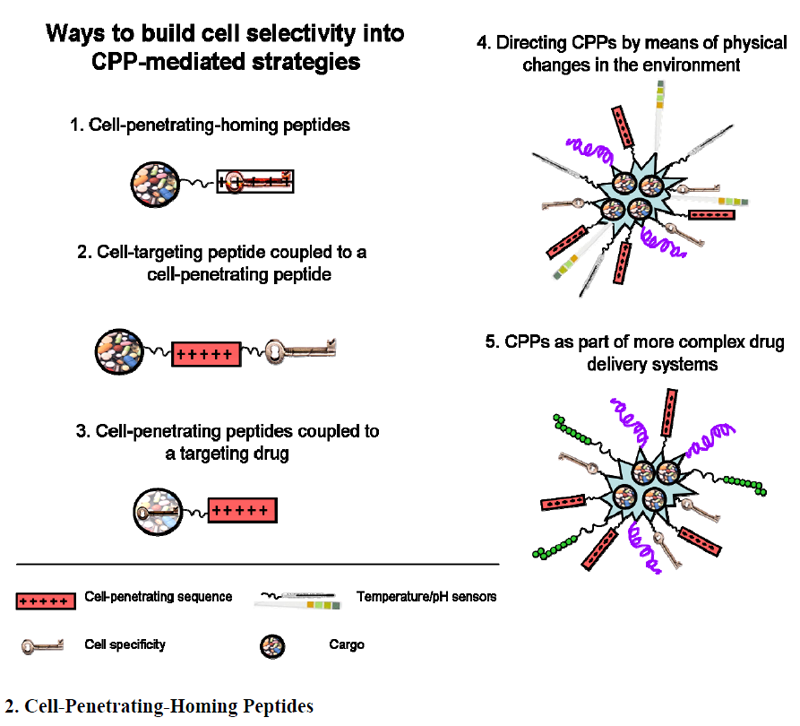
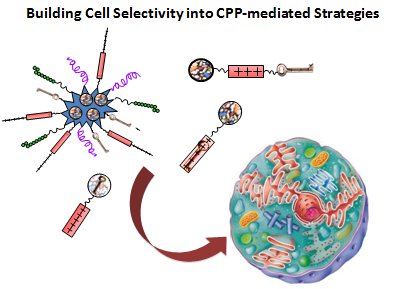
      <p><xref ref-type="fig" rid="figure1">Figure 1</xref> summarizes different strategies for drug delivery involving CPPs. </p>
      <fig id="figure1" position="float">
        <label>Figure 1</label>
        <caption>
          <p>Strategies used to achieve cell selectivity.</p>
        </caption>
        <graphic xmlns:xlink="http://www.w3.org/1999/xlink" xlink:href="pharmaceuticals-03-01456-g001.tif" scale="0"/>
      </fig>
    </sec>
    <sec>
      <title>2. Cell-Penetrating-Homing Peptides</title>
      <p>Cell-penetrating peptides (CPPs) [<xref ref-type="bibr" rid="B1">1</xref>,<xref ref-type="bibr" rid="B2">2</xref>,<xref ref-type="bibr" rid="B3">3</xref>,<xref ref-type="bibr" rid="B4">4</xref>,<xref ref-type="bibr" rid="B5">5</xref>,<xref ref-type="bibr" rid="B6">6</xref>,<xref ref-type="bibr" rid="B7">7</xref>,<xref ref-type="bibr" rid="B8">8</xref>] have been harnessed to translocate a wide range of molecules such as proteins, plasmids, peptide nucleic acids, short interfering RNA (siRNA), liposomes and nanoparticles across the cell membranes [<xref ref-type="bibr" rid="B9">9</xref>,<xref ref-type="bibr" rid="B10">10</xref>,<xref ref-type="bibr" rid="B11">11</xref>]. While CPPs provide a means through which cell-impermeable compounds can reach intracellular targets, conventional CPPs, like TAT or R<sub>8</sub>, can not deliver chemotherapeutic agents with cell specificity. Herein lays one of the major drawbacks of CPPs, their lack of cell specificity. This limitation hampers one of the most promising applications of CPPs; their use in the delivery of drug- and imaging agents would have a major relevance if they were able to target specific cells or tissues.</p>
      <p>Each healthy or diseased tissue contains organ- or disease-specific molecular tags on its vasculature that constitute a vascular ‘zip code’ system [<xref ref-type="bibr" rid="B12">12</xref>]. The number of “homing peptides” that recognize specific types of cells is increasing every day. The advantage of these peptides is their capacity to recognize specific phenotypes and thus home onto a desired location. Furthermore, some of these peptides not only recognize the targeted cell but also have the capacity to translocate across its cellular membrane. These are the so called “cell-penetrating-homing peptides” (<xref ref-type="table" rid="table1">Table 1</xref>). The key feature of these peptides is that their sequences hold the target molecular address. Consequently, they offer great potential as vectors for drug delivery purposes, as they show the desired selectivity and the capacity to introduce cargos into a specific cell target. Cell-penetrating-homing peptides are usually small (no longer than 25–30 amino acids) non-immunogenic molecules and they show low cytotoxicity. Most of cell-penetrating homing peptides have been described using <italic>in vivo</italic> biopanning using phage display peptide libraries. The phage-display peptide library method was first developed by Parmley and Smith in 1988 [<xref ref-type="bibr" rid="B13">13</xref>]. This technique consists of the creation of a library of filamentous phages (such as M13) that express random peptides at the N-terminus of a protein (<italic>i.e.</italic> pIII) that is located at surface of the virus. The phage display peptide library is screened by biopanning. The following three general screening methods are currently used: (a) biopanning against purified cell surface membrane proteins [<xref ref-type="bibr" rid="B14">14</xref>]; (b) panning against intact cells [<xref ref-type="bibr" rid="B15">15</xref>]; and (c) <italic>in vivo</italic> selection by intravenous injection of phage-display libraries [<xref ref-type="bibr" rid="B12">12</xref>,<xref ref-type="bibr" rid="B16">16</xref>]. The bound phages are then eluted, amplified in <italic>E. coli</italic> and repanned a second time. The whole screening process is usually repeated a third time, in order to increase the affinity for the desired target. The amino acid sequence of the peptide displayed on each phagemid clone can be determined by DNA sequencing. This phage-display technology allows the detection of differentially expressed molecules and also differentially modified molecules. In addition, this technique does not require any previous knowledge of the molecular composition at the site of interest [<xref ref-type="bibr" rid="B12">12</xref>]. </p>
      <table-wrap id="table1" position="float"><object-id pub-id-type="pii">pharmaceuticals-03-01456_table1</object-id>
        <object-id pub-id-type="pii">pharmaceuticals-03-01456_table1</object-id>
        <label>Table 1</label>
        <caption>
          <p>Examples of some homing peptides and their cancer target [<xref ref-type="bibr" rid="B17">17</xref>].</p>
        </caption>
        <table>
          <thead>
            <tr>
              <th align="left" valign="middle">
                <bold>Peptide</bold>
              </th>
              <th align="left" valign="middle">
                <bold>Homes to</bold>
              </th>
            </tr>
          </thead>
          <tbody>
            <tr>
              <td align="left" valign="middle">AGR (CAGRRSAYC)</td>
              <td align="left" valign="middle">TRAMP (prostate)</td>
            </tr>
            <tr>
              <td align="left" valign="middle">LyP-2 (CNRRTKAGC)</td>
              <td align="left" valign="middle">K14-HPV16 (skin) tumorK14-HPV16/E2 (cervix) tumor</td>
            </tr>
            <tr>
              <td align="left" valign="middle">REA (CREAGRKAC)</td>
              <td align="left" valign="middle">TRAMP (prostate)PPC1 (prostate)M12 (prostate)DU145 (prostate)LNCaP (prostate)K14-HPV16/E2 (cervix)KRIB (osteosarcoma)MMTV-PyMT (breast)</td>
            </tr>
            <tr>
              <td align="left" valign="middle">LSD (CLSDGKRKC)</td>
              <td align="left" valign="middle">C8161 (melanoma)KRIB (osteosarcoma)</td>
            </tr>
          </tbody>
        </table>
      </table-wrap>
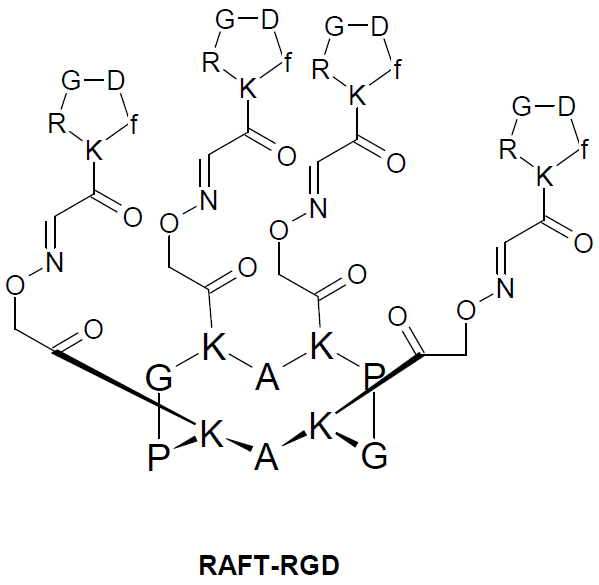
      <p>One of the first was described to target tumor cells. It was in 1988 [<xref ref-type="bibr" rid="B18">18</xref>] when the internalization properties of RGD (Arg-Gly-Asp) peptides were first reported. These peptides recognize integrins, a family of cell-surface receptors that mediate the interaction of cells with the extracellular matrix, and are important for the migration and invasion of tumor cells. Integrin α<sub>v</sub>ß<sub>3</sub> is overexpressed on neoendothelial cells and frequently on tumor cells [<xref ref-type="bibr" rid="B19">19</xref>]. Sancey <italic>et al.</italic> have recently developed a peptide-like constructs (RAFT-RGD) which targets integrin α<sub>v</sub>ß<sub>3</sub><italic>in vitro </italic>and <italic>in vivo </italic>[<xref ref-type="bibr" rid="B20">20</xref>]. It is based in a regioselectively addressable functionalized template (RAFT) cyclo-decapeptide scaffold developed by M. Mutter [<xref ref-type="bibr" rid="B21">21</xref>], able to present four cyclic RGD pentapeptide motifs (<xref ref-type="fig" rid="figure2">Figure 2</xref>). RAFT is a cyclic decapeptide (KKKPGKKKPG) with two orthogonally addressable domains pointing on either side of the cyclopeptide backbone. On the upper side, RAFT-RGD peptide has four copies of the cyclic RGDfK homing peptide while on the opposite face it has a fluorescent dye. The tetrameric RAFT-RGD was reported to have a ten-fold higher affinity for its soluble receptor integrin α<sub>v</sub>ß<sub>3</sub> than the monomeric cRGD. Moreover, RAFT-RGD was rapidly internalized in small vesicles after 10 minutes. In fact, RAFT-RGD was proved to induce integrin α<sub>v</sub>ß<sub>3 </sub>internalization. The observation that internalization is enhanced by RAFT-RGD allows it to be defined as a CPP. This research group revealed that the internalization of this peptide is through clathrin-mediated endocytosis. This finding contrasts with the trafficking route followed by the ß<sub>1 </sub>integrin, which was shown to preferentially use a caveolae-dependent pathway. In summary, this selective peptide can be used for targeting α<sub>v</sub>ß<sub>3</sub>-integrin-expressing tumors and/or their microvasculature [<xref ref-type="bibr" rid="B20">20</xref>].</p>
      <fig id="figure2" position="float">
        <label>Figure 2</label>
        <caption>
          <p>Chemical structure of RAFT-RGD [<xref ref-type="bibr" rid="B20">20</xref>].</p>
        </caption>
        <graphic xmlns:xlink="http://www.w3.org/1999/xlink" xlink:href="pharmaceuticals-03-01456-g002.tif" scale="0"/>
      </fig>
      <p>The neovasculature homing motif NGR was isolated from peptides upon screening of cyclic peptide libraries against the α5ß1 integrin [<xref ref-type="bibr" rid="B22">22</xref>]. This motif specifically binds to cells expressing aminopeptidase N (CD13), [<xref ref-type="bibr" rid="B23">23</xref>] a membrane-bound metallopeptidase that has multiple functions as a regulator of various hormones and cytokines, protein degradation, antigen presentation, cell proliferation, cell migration and angiogenesis. CD13 is barely expressed by the endothelium of normal blood vessels, and is up-regulated in angiogenic blood vessels [<xref ref-type="bibr" rid="B23">23</xref>]. Therefore, NGR-containing peptides can target endothelial cells and pericytes not only in tumors, but also in other pathological conditions, such as inflammation [<xref ref-type="bibr" rid="B24">24</xref>]. Various compounds and particles have been coupled or added synthetically to NGR peptides in order to increase their specificity towards neovasculature. The first example of an NGR peptide coupled to an anti-cancer drug was the conjugation of CNGRC peptide to doxorubicin [<xref ref-type="bibr" rid="B25">25</xref>]. This conjugate showed reduced toxicity and improved efficacy against human cancer xenografts in nude mice, compared with free doxorubicin. Liposomal formulations of doxorubicin can be targeted to tumors by coupling with linear peptides containing the CNGRC sequence [<xref ref-type="bibr" rid="B26">26</xref>,<xref ref-type="bibr" rid="B27">27</xref>]. Another example of the use of CNGRC as delivery vector is the complex formed by this cell-penetrating homing peptide and the mitochondrial disrupter peptide D(KLAKLAK)<sub>2</sub>. This peptide induces mitochondrial membrane disruption, rather than damaging eukaryotic plasma membranes [<xref ref-type="bibr" rid="B28">28</xref>,<xref ref-type="bibr" rid="B29">29</xref>,<xref ref-type="bibr" rid="B30">30</xref>]. This research group succeeded in demonstrating the apoptotic effect of the peptide construct in breast carcinoma xenografts in mice [<xref ref-type="bibr" rid="B28">28</xref>].</p>
      <p>Special mention is given NGR-TNF, the result of the conjugation of this CNGRC peptide to the N-terminus of tumor necrosis factor α (TNF). This conjugate (named NRG-TNF) is currently being tested in Phase II clinical studies. Not only has this drug improved anti-tumor activity but the administration of only picograms of this complex (but not of TNF alone) exerts synergistic antitumor effects with various chemotherapeutic agents, such as doxorubicin, melphalan, cisplatin, paclitaxel and gemcitabine. The <italic>modus operandi</italic> of NGR-TNF is through the alteration of drug-penetrating barriers [<xref ref-type="bibr" rid="B31">31</xref>,<xref ref-type="bibr" rid="B32">32</xref>,<xref ref-type="bibr" rid="B33">33</xref>,<xref ref-type="bibr" rid="B34">34</xref>,<xref ref-type="bibr" rid="B35">35</xref>]. The biologic activity of other cytokines and anti-angiogenic molecules, such as IFNγ, IFNα2a, endostatin and tumstatin fragment has been improved by coupling to NGR peptides [<xref ref-type="bibr" rid="B36">36</xref>,<xref ref-type="bibr" rid="B37">37</xref>,<xref ref-type="bibr" rid="B38">38</xref>,<xref ref-type="bibr" rid="B39">39</xref>]. Targeted delivery of ultra-low doses (picogram range) of a recombinant IFNγ-CNGRC conjugate (IFNγ-NGR) to tumor vasculature overcomes major counter regulatory mechanisms and delays tumor growth in mice [<xref ref-type="bibr" rid="B39">39</xref>]. </p>
      <p>Bieker <italic>et al.</italic> [<xref ref-type="bibr" rid="B40">40</xref>] recently generated the fusion protein tTNF-NGR (the extracellular domain of tissue factor (truncated tissue factor, tTNF) and the peptide GNGRAHA, that contains the NGR motif), which targets tumor endothelial cells. tTNF-NGR inhibits tumor growth in mice by thrombotic occlusion of tumor vessels without any major side effects. It has also been reported to inhibit tumor perfusion in the first patients treated with this molecule [<xref ref-type="bibr" rid="B40">40</xref>]. With all these examples, NGR-containing peptides provide a good tool for tumor targeting of drugs and drug delivery systems.</p>
      <p>F3 peptide is a 31 amino acid sequence derived from the nuclear protein high mobility group (HMG) protein 2 (HMGN2) [<xref ref-type="bibr" rid="B41">41</xref>]. HMGN2 is a highly conserved nucleosomal protein thought to be involved in unfolding higher-order chromatin structure and facilitating the transcriptional activation of mammalian genes [<xref ref-type="bibr" rid="B42">42</xref>]. The authors of the following work aimed to find markers shared by tumor vasculature and endothelial progenitor cells in the bone marrow. To do so they screened cDNA libraries displayed on phages, first on bone marrow cells <italic>ex vivo</italic> and then in tumor-bearing mice <italic>in vivo</italic>. F3 accumulates in the nuclei of tumor endothelial cells and tumor cells and has the capacity to carrying a cargo to the nuclei of the target cells. It recognizes a minor population of progenitor cell-like bone marrow cells, and it also binds to endothelial cells in tumors [<xref ref-type="bibr" rid="B41">41</xref>]. In addition, F3 appears to recognize a variety of tumor types; it binds not only the bone marrow subpopulation and tumor endothelial cells, but also systemically injected F3 recognizes a minor population in healthy skin and the gut. This peptide may be useful in targeting therapeutic agents into tumors. Furthermore, the capacity of F3 to carry a cargo into the cell nucleus makes it a promising tool for drug targeting applications, as multiple anti-cancer drugs exert their effect in the nucleus [<xref ref-type="bibr" rid="B41">41</xref>,<xref ref-type="bibr" rid="B43">43</xref>].</p>
      <p>In Texas, Hong and Clayman described the isolation of a 12-mer peptide, HN-1 (TSPLNIHNGQKL) [<xref ref-type="bibr" rid="B44">44</xref>] able to translocate selectively across the cell membranes of human head and neck squamous cell carcinoma (HNSCC). The lack of specificity in current approaches to treat HNSCC produces dose-limiting toxicity, which has impeded the development of curative systemic approaches and also significant improvement in survival [<xref ref-type="bibr" rid="B45">45</xref>]. The authors of that study consider HN-1 as a potential shuttle of drugs into this kind of tumor. HN-1 is non-toxic, non-immunogenic in mice, and stable <italic>in vivo</italic>. Moreover, it protects its cargo during transit and accumulates efficiently within the tumor in 48 h [<xref ref-type="bibr" rid="B44">44</xref>]. This peptide may serve not only in cancer therapy, but also as a tumor diagnostic agent or imaging agent or it may even provide tumor-specificity to gene transfer approaches [<xref ref-type="bibr" rid="B44">44</xref>]. HN-1 is a novel peptide and the authors propose that its internalization is receptor-mediated. However, where is the limit between receptor-mediated endocytosis and specific adsorptive endocytosis of a CPP? Logically, all cell-penetrating homing peptides “recognize” some kind of molecule on the surface of the target cell. This recognition could lead to the classification of these peptides not as CPPs but as other kinds of peptides that are internalized into cells as a result of the interaction of a cellular receptor. We do not aim to discuss the tag of each peptide or their classification. We will consider homing cell-penetrating homing peptides as those peptides with the capacity to selectively recognize one or various types of cells and transport any kind of cargo across their cell membrane. </p>
      <p>Pep42 is a cyclic 13-mer oligopeptide (CTVALPGGYVRVC) that specifically binds to glucose-regulated protein 78 (GRP78) and internalizes into cancer cells. Given these properties, Pep42 is a promising vector for tumor cell-specific chemotherapy [<xref ref-type="bibr" rid="B46">46</xref>,<xref ref-type="bibr" rid="B47">47</xref>]. GRP78 was discovered in the late 1970s as a cellular protein induced by glucose starvation [<xref ref-type="bibr" rid="B48">48</xref>]. GRP78 expression is maintained at low basal levels in major adult organs such as the brain, lung, and heart, and is strongly induced in tumors [<xref ref-type="bibr" rid="B49">49</xref>]. In these cells, the overexpression of this intracellular chaperone and member of the heat shock protein 70 (HSP70) family provides a protective cellular response against stress conditions. Indeed, GRP78 is specifically overexpressed on the cancer cell surface. Normal GRP78 expression is maintained at low levels but is upregulated in a stress environment and induced in the tumor environment. Furthermore, in human cancer, higher expression of GRP78 has been related to greater pathological grade, recurrence and poor patient survival in breast, liver, prostate and colon cancers [<xref ref-type="bibr" rid="B49">49</xref>,<xref ref-type="bibr" rid="B50">50</xref>]. Pep42 is also internalized by receptor-mediated translocation (and clathrin-mediated endocytosis is its main mechanism of uptake); however, it has been referred to as a CPP [<xref ref-type="bibr" rid="B46">46</xref>,<xref ref-type="bibr" rid="B51">51</xref>]. Those authors demonstrated that Pep42 specifically recognizes GRP78 present on the cell surface of melanoma Me6654/2 cells, and after this recognition it is internalized. This targeted molecule is present only in cancer cells, as it has been previously shown that a number of human primary and cancer cell lines overexpress this glucose-regulated protein [<xref ref-type="bibr" rid="B49">49</xref>]. To assess the drug delivery properties of this new peptide, the authors conjugated Pep42 to a range of molecules with distinct biochemical properties and mechanisms of action. For instance, once again they chose the amphipathic apoptosis-inducing peptide D-(KLAKLAK)<sub>2</sub>. As seen above, this peptide exerts its action at the mitochondrial membrane. The other drug chosen was hematoporphyrin, a photosynthesizer that is active in the lysosomal compartment. These two drugs are imported to cells only in the presence of Pep42 [<xref ref-type="bibr" rid="B47">47</xref>]. A year later, Yoneda <italic>et al</italic>. evaluated Pep42-prodrug conjugates containing a cathepsin B-cleavable linker, in order to increase the release of drug inside the cancer cells, thereby facilitating endosomal release [<xref ref-type="bibr" rid="B51">51</xref>]. Their approach takes advantage of the presence of cathepsin B inside cell lysosomes. As previously described, Pep42 binds GRP78 receptor and is internalized with it. After the endosomal pathway, both molecules end up in the lysosomal compartment of cells. These researchers synthesized Pep42-drug conjugates containing cathepsin B cleavable linkers (Val-Cit motif in this case, which is highly stable in plasma and rapidly cleavable by cathepsin B [<xref ref-type="bibr" rid="B52">52</xref>]), and as drugs they chose the well known anticancer agents Taxol and doxorubicin. They did not perform <italic>in vivo</italic> assays, but the <italic>in vitro</italic> results in SJSA-1 (ostesarcoma cells, a GRP78-expressing cell line) are very promising. The delivery system induced higher cell death compared to treatment with the drug only [<xref ref-type="bibr" rid="B51">51</xref>]. </p>
      <p>This mitochondrial cytotoxic peptide, D-(KLAKLAK)<sub>2, </sub>was also coupled to the heptapeptide SMSIARL [<xref ref-type="bibr" rid="B53">53</xref>], isolated from an <italic>in vivo </italic>phage display peptide library, and specific target for the prostate vasculature. When this peptide was coupled to D-(KLAKLAK)<sub>2, </sub>only prostate tissue was destroyed. In prostate-cancer-prone transgenic TRAMP (transgenic adenocarcinoma of the mouse prostate model, [<xref ref-type="bibr" rid="B54">54</xref>]) this chimeric peptide postponed cancer development, thereby suggesting a potential alternative to the surgical approach used to treat this disease [<xref ref-type="bibr" rid="B53">53</xref>].</p>
      <p>Azurin is a cupredoxin protein secreted by the microorganism <italic>Pseudomonas aeruginosa</italic>. Two peptides (amino acids 50 to 77 of azurin, p28 (LALSTAADMQGVVTDGMASGLDKDYLKPDD) and amino acids 50 to 67 of azurin, p18(LGLSTAADMQGVVTDGMASG)) have been described as a potential CPPs [<xref ref-type="bibr" rid="B55">55</xref>,<xref ref-type="bibr" rid="B56">56</xref>]. These peptides penetrate cancer cells without disrupting the cell membrane. Although still not fully understood, the uptake mechanism of p18 and p28 is energy-dependent and saturable. This mechanism involves caveolae and the Golgi complex, as nocodazole (which disrupts caveolae transport) and inhibitors of cholesterol mobilization inhibit the penetration of these peptides. The authors propose that the internalization of p18 and p28 follows more than one mechanism. But the main advantage of these peptides is that they preferentially enter cancer cells. The authors of that study showed an enhanced internalization rate in several tumoral cell lines <italic>in vitro</italic> compared with the corresponding non tumoral ones. In addition, these peptides inhibit cancer cell proliferation through cytostatic and cytotoxic mechanisms, as Azurin itself inhibits the growth of several human cancer lines <italic>in vitro</italic> [<xref ref-type="bibr" rid="B57">57</xref>,<xref ref-type="bibr" rid="B58">58</xref>,<xref ref-type="bibr" rid="B59">59</xref>]. Together, these peptides are not only capable of preferentially internalizing cancer cells, but can also exert a toxic effect on them and thereby prevent their proliferation.</p>
      <p>Laakkonen together with Ruoslahti and coworkers have been intensively studying cell penetrating homing peptides [<xref ref-type="bibr" rid="B60">60</xref>,<xref ref-type="bibr" rid="B61">61</xref>]. They have performed <italic>in vivo</italic> biopanning using phage display peptide libraries to identify peptide ligands against vascular markers selectively expressed in tumor endothelium or lymph vessels. After several rounds of biopanning, some peptides have been selected. These are targeted to a specific site (homing to desired location) but some also have the capacity to internalize the targeted cells. In addition, some of these peptides are also able to destroy the targeted cell. LyP-1 is a nine-amino acid cyclic peptide (CGNKRTRGC) which was isolated in a screen using human MDA-MB-435 breast cancer xenografts [<xref ref-type="bibr" rid="B60">60</xref>]. Like F3, it recognizes a marker present in tumor cells and tumor endothelial cells. Furthermore, and unlike most vascular cell penetrating homing peptides, LyP-1 also recognizes tumor-associated lymphatic vessels. It recognizes the lymphatic vessel markers lymphatic vessel endothelial hyaluronic acid receptor-1 (LYVE-1, a transmembrane hyaluronic acid receptor) and podoplanin (a glomerular podocyte membrane protein), and also the vascular endothelial growth factor receptor 3 (VEGFR-3). LyP-1 accumulates in the nucleus of targeted cells, both in primary tumors and their metastatic lesions after intravenous injection, localizing preferentially in hypoxic areas. The homing of LyP-1 peptides is tumor type-specific; it accumulates in some tumors but not in others. In addition to MDA-MB-435 tumors, it homes to a transgenic prostate tumor (TRAMP) (Lakkonen, Bernasconi and Ruoslahti; unpublished observations), transgenic breast carcinoma (MMTV-PyMT) and, to lesser extent, KRIB osteosarcoma xenografts, but not to C8161 melanoma or HL-60 leukemia xenografts [<xref ref-type="bibr" rid="B61">61</xref>]. To further describe this extraordinary cell-penetrating homing peptide, it is mandatory to stress its capacity to trigger apoptosis of the cells to which it binds. Treatment of tumor cells with LyP-1 causes cell death. This effect is specific because cells that do not bind LyP-1 are not affected. The mechanism through which LyP-1 kills cells remains unknown, but the pro-apoptotic effect seems to be directed against tumor cells that are under stress, as LyP-1 colocalizes with a tissue hypoxia marker <italic>in vivo</italic>, and serum starvation enhances LyP-1 binding and internalization by cultured tumor cells <italic>in vitro</italic> [<xref ref-type="bibr" rid="B60">60</xref>]. Lymph vessels are highly relevant in tumor metastasis. Given that LyP-1 destroys the most deadly parts of tumors [<xref ref-type="bibr" rid="B12">12</xref>,<xref ref-type="bibr" rid="B17">17</xref>], this peptide could provide an extraordinary therapeutic strategy to target metastasis in the early stages of the process. </p>
      <p>Combining the positive selection of a peptide-bearing phage library on poorly differentiated colon carcinoma cells (HT29) with negative selection of the phage library on well-differentiated colon carcinoma cells (HCT116), Kimberly <italic>et al</italic>. [<xref ref-type="bibr" rid="B62">62</xref>] described a nine-amino acid, disulfide-constrained peptide, CPIEDRPMC (RPMrel). This peptide has been reported to target colon tumor tissues from four patients, without binding healthy colon tissue or other tissues such as lungs, lung sarcoma, liver, liver sarcoma or stomach. Furthermore, the authors report the efficacy of this novel peptide in transporting the mitochondrial toxin D(KLAKLAK)<sub>2</sub> to these tumor colon cells, thereby inducing apoptosis and thus killing the cells [<xref ref-type="bibr" rid="B62">62</xref>]. Identification of a peptide that selectively enters colon cancer cells is very promising for developing new colon cancer diagnostic tools and therapeutic agents, such as RPMrel-D(KLAKLK)<sub>2</sub>. Colorectal cancer causes 655,000 deaths worldwide per year, and it is the third most common form of cancer and the third leading cause of cancer-related death in the western world. RPMrel could lead to the development of new direct targeting agents to fight against this disease.</p>
      <p>Another example of a cell-penetrating homing peptide targets dorsal root ganglion (DRG) neurons [<xref ref-type="bibr" rid="B63">63</xref>]. Diseases affecting these neurons are rare, but are included in the differential diagnosis of peripheral sensory neuropathies [<xref ref-type="bibr" rid="B64">64</xref>]. In fact, neuropathic pain is a common symptom in various disorders. Although several pharmaceutical agents have been used to treat neuropathic pain, most are not specific and have limited efficacy. DRG neurons are classified as either large or small. J. Oi <italic>et al</italic>. isolated three peptides that recognize specific, defined sizes of DRG neurons [<xref ref-type="bibr" rid="B63">63</xref>]. Furthermore, these peptides have the capacity to internalize the targeted cells, and therefore the potential to become powerful tools for studying the subpopulations of DRG neurons and/or developing carriers of therapeutic agents against diseases involving specific subtypes of these neurons. The sequences of these peptides are the following: DRG1: SPGARAF; DRG2: DGPWRKM; and DRG3: FGQKASS. Interestingly, DRG1 and DRG3 internalize mostly in small neurons, while DGP2 shows preference towards larger ones. Experiments showed that DRG1 and DRG3 recognize distinct molecules in the surface of small DRG neurons. These results provide a powerful tool that will facilitate future research into the structural basis of neuronal cellular subpopulations and, more importantly, the generation of new molecular delivery systems that target DRG neurons <italic>in vivo</italic> [<xref ref-type="bibr" rid="B63">63</xref>]. </p>
      <p>Proline has unique properties among the 20 genetically encoded amino acids. Its pyrrolidine ring confers the molecule great rigidity, which leads to steric hindrance in peptidic backbones. Moreover, the conformation of the amide bonds cannot be stabilized by hydrogen bonds. Peptides containing a certain amount of proline in (polyprolines) adopt a well defined secondary structure, polyproline II (PPII), in pure water. PPII is a left-handed extended helix of 3.0 residues per turn (in contrast to the 3.3 residues which comprises the right-handed PPI formed by polyprolines in the presence of aliphatic alcohols). This architecture allows for the precise orientation of hydrophilic and hydrophobic moieties along different faces of the helix, and makes the structure soluble in aqueous media. Several proline-rich CPPs have been described to date [<xref ref-type="bibr" rid="B7">7</xref>,<xref ref-type="bibr" rid="B8">8</xref>,<xref ref-type="bibr" rid="B65">65</xref>]. However, there are two examples of cationic polyproline helices that have the capacity to internalize cells in a specific way: P11LR [<xref ref-type="bibr" rid="B66">66</xref>] and P11/LRR [<xref ref-type="bibr" rid="B67">67</xref>,<xref ref-type="bibr" rid="B68">68</xref>]. These peptides display a rigid type II polyproline helix backbone functionalized to contain six cationic moieties (believed to be essential in cell internalization) and two distinctive hydrophobic groups. Geisler <italic>et al.</italic> assayed the internalization of these two CPPs in seven cell lines (six cancerous and one non-cancerous) and described the selectivity of each for some of these cell lines [<xref ref-type="bibr" rid="B68">68</xref>]. For instance, P11LRR preferentially enters MCF-7 (breast cancer), and is slightly internalized also in KB 3-1 (HeLa derivative) and HT1080 (connective tissue cancer). However, it presented no internalization into the other cell types. P11F/LRR was most effectively internalized by KB 3-1 cells and to a lesser degree by MCF-7 cells compared to P11LRR. Several cytotoxicity assays were also performed. These indicated that P11LRR displays minimal cytotoxicity to the cell lines, while P11F/LRR is slightly more toxic [<xref ref-type="bibr" rid="B68">68</xref>]. Again, these CPPs show cell type preference for internalization. This finding was again exploited in the future design of directed drug delivery systems. In this case, both peptides were rationally designed [<xref ref-type="bibr" rid="B66">66</xref>] and not obtained from a direct <italic>in vivo</italic> observation, such as phage display biopanning. The selectivity shown by these proline-rich peptides should, in our opinion, be validated by <italic>in vivo</italic> experiments, to further develop their capacity to select the desired target in an <italic>in vivo</italic> context, which may differ greatly from <italic>in vitro</italic> observations.</p>
      <p>As described above, phage display technology is a revolutionary tool to discover new highly specific peptides. This technique allows the selection of peptides with binding specificity to certain cells. In addition, <italic>in vivo</italic> phage display allows the binding of the peptides in a true physiological environment, in which diverse phenotype markers are expressed. Further screening of new phage libraries will undoubtedly lead to the discovery of highly selective peptides for certain diseases or even different stages of the same disease. Furthermore, some of these peptides would have the capacity to penetrate those cells, thereby providing the possibility to carry drugs or imaging agents, in order to directly target the affected area and thereby prevent the side effects caused by the non-specific drugs currently used. These cell-penetrating homing peptides are the minimal expression of a targeted drug delivery system [<xref ref-type="bibr" rid="B16">16</xref>,<xref ref-type="bibr" rid="B17">17</xref>,<xref ref-type="bibr" rid="B61">61</xref>,<xref ref-type="bibr" rid="B69">69</xref>].</p>
    </sec>
    <sec>
      <title>3. Cell-Targeting Peptide Coupled to a CPP</title>
      <p>Identifying a cell-specific peptide with cell-penetrating properties is not always easy. The capacity of a carrier to translocate across the cell membrane calls for many specific properties. The major drawback of the “classic” CPPs, such as TAT, <italic>Penetratin</italic>, and polyarginins, is their lack of specificity. However, they are powerful non-immunogenic tools to deliver cell-impermeable drugs to cells, such as cancer cells. Non-specific CPPs have been widely studied and their efficiency is improved almost yearly , and new CPPs are continually emerging. Many of these peptides are based on larger peptides or proteins present in nature, whose activity consists of breaking cellular membranes or penetrating cells [<xref ref-type="bibr" rid="B70">70</xref>,<xref ref-type="bibr" rid="B71">71</xref>]. Hence, their efficacy is high, an essential property for drug delivery systems. But having a strong internalization capacity commonly clashes with high specificity. Research in this field should make maximum use of all this knowledge. The following strategy for targeting CPPs is the design of a fusion peptide containing a cell-penetrating domain coupled to a targeting sequence, like for instance, a homing sequence.</p>
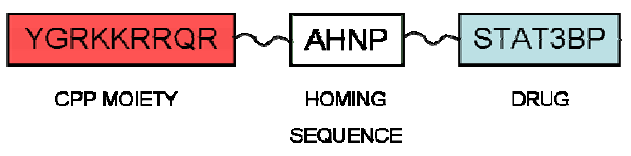
      <p>With this in mind, Ming Tan and coworkers designed a novel CPP-based CPP specific for ErbB2-overexpressing breast cancer cells [<xref ref-type="bibr" rid="B72">72</xref>]. The ErbB2 gene is a member of the epidermal growth factor receptor family and is overexpressed in about 30% of breast cancer [<xref ref-type="bibr" rid="B73">73</xref>]. Current therapies for ErbB2-overexpressing cells are urgently required. This phenotype has been shown to increase the metastatic potential of human breast cancer and confers an increased resistance to some chemotherapeutic agents [<xref ref-type="bibr" rid="B74">74</xref>,<xref ref-type="bibr" rid="B75">75</xref>]. Once activated, ErbB2 activates STAT proteins (signal transducers and activators of transcription proteins). Once phosphorylated, STATs translocate into the nucleus, binding to STAT-specific DNA response elements, and thereby regulating gene expression [<xref ref-type="bibr" rid="B76">76</xref>]. It was found that ErbB2 activates STAT3, and this activation may contribute to ErbB2-induced transformation and tumor progression. Hence, specifically targeting STAT3 in ErbB2-overexpressing breast cancer cells that contain activated STAT3 may inhibit ErbB2-mediated malignant phenotypes. TAT peptide is one of the most studied CPPs and has been widely studied and conjugated to a variety of cargos to transport them into cells [<xref ref-type="bibr" rid="B77">77</xref>,<xref ref-type="bibr" rid="B78">78</xref>,<xref ref-type="bibr" rid="B79">79</xref>]. In this study, Ming Tan <italic>et al.</italic> conjugated an ErbB2 extracellular domain-binding peptide with a TAT-derived CPP in order to achieve target specificity of delivery [<xref ref-type="bibr" rid="B72">72</xref>]. They synthesized a less efficient version of TAT (YGRKKRRQR, called P3) as starting point for inducing cell specificity. This new version of TAT peptide was not as potent as the original TAT peptide; consequently, it did not internalize cells in such an efficient manner. This is an advantage for directing the system to the desired area, as it is not unspecifically internalized, and enters only the target cells. The addition of AHNP (a 12-amino acid anti HER-2/<italic>neu</italic> peptide mimetic which binds to ErbB2 with high affinity) at the C-terminus of this TAT-derived peptide rendered the translocation profile of the peptide ErbB2 selective both <italic>in vitro</italic> and <italic>in vivo</italic>. They also showed how this construct (P3-AHNP) efficiently and selectively delivered a STAT3-inhibiting peptide, named STAT3BP, and even selectively inhibited the growth of ErbB2-overexpressing cells <italic>in vitro</italic> [<xref ref-type="bibr" rid="B72">72</xref>,<xref ref-type="bibr" rid="B74">74</xref>]. Compared with ErbB2 low-expressing MDA-MB-435 xenografts, i.p. injected P3-AHNP-STAT3BP preferentially accumulated in 435.eB xenografts, which led to a greater reduction of proliferation and increased apoptosis and targeted inhibition of tumor growth [<xref ref-type="bibr" rid="B72">72</xref>]. This study confirms that the “modular approach” (<xref ref-type="fig" rid="figure3">Figure 3</xref>) in designing cell-specific CPPs is feasible. Replacing the “directing” moiety in each case (with any other molecular marker) may lead to a personalized therapy in which the “vehicle peptide” delivers the desired drug to the targeted cell.</p>
      <fig id="figure3" position="float">
        <label>Figure 3</label>
        <caption>
          <p>“Modular approach” design for targeted drug delivery systems [<xref ref-type="bibr" rid="B72">72</xref>].</p>
        </caption>
        <graphic xmlns:xlink="http://www.w3.org/1999/xlink" xlink:href="pharmaceuticals-03-01456-g003.tif" scale="0"/>
      </fig>
      <p>PEGA (CPGPEGAGC) is a cyclic homing peptide that has previously been shown to accumulate in breast vasculature as well as in premalignant breast tissue and primary breast tumors [<xref ref-type="bibr" rid="B80">80</xref>]. It is thought that this peptide binds aminopeptidase P, a protein highly expressed in the membrane of breast tumor cells in mice [<xref ref-type="bibr" rid="B23">23</xref>]. PEGA is not a CPP. Langel’s group in Sweden, together with Myrberg from La Jolla, combined this tumor-specific homing peptide with the pVEC CPP. pVEC (LLIILRRRIRKQAHAHSK) is a well studied CPP derived from the murine sequence of the cell adhesion molecule vascular endothelial cadherin, amino acids 615–632. This CPP shows good internalization rates within several cell lines [<xref ref-type="bibr" rid="B81">81</xref>]. The combination of these two peptides showed internalization in tumor cells <italic>in vivo </italic>[<xref ref-type="bibr" rid="B82">82</xref>]. These researchers evaluated the specificity of the PEGA-pVEC construct by intravenously injecting the peptide labeled with fluorescein into MDA-MB-435 tumor-bearing mice. This peptide was detected in tumors but not in control tissue. Furthermore, conjugation of the peptide also with the nitrogen mustard (chlorambucil, Cbl, a cytotoxic agent that acts by alkylating and cross-linking DNA) produced higher efficacy of this drug for killing cells <italic>in vitro</italic>. Cbl is thought to be taken up by the cells by passive diffusion. A combination of this drug with the described chimera peptide resulted in an enhanced activity of this drug compared to its activity when administrated alone. This effect suggests that the new specific peptide construct could be useful in directed drug delivery to breast tumor tissue [<xref ref-type="bibr" rid="B82">82</xref>].</p>
      <p>Two years later, in 2009, the chimeric peptide described above was improved. The system once again combined a breast tumor homing peptide with pVEC CPP. In this case, the homing peptide was CREKA, identified in breast tumors in MMTV-PyMT transgenic mice by using <italic>in vivo</italic> phage display [<xref ref-type="bibr" rid="B69">69</xref>]. This peptide recognizes clotted plasma proteins, homing selectively to tumor blood vessels and stroma. There, it binds to fibrin-like structures, but does not show internalizing properties. These researchers again combined the chimeric targeted carrier with the cytotoxic agent Cbl. This formulation showed enhanced internalization properties compared to the previous one (PEGA-pVEC), and was more convenient to synthesize. This system has improved characteristics and could also be a useful tool for directed drug delivery.</p>
      <p>As these examples demonstrate, the combination of two or more peptides to achieve targeted delivery is already a reality. With these data in our hands, the range of possibilities is enormous. The conjugation of a homing peptide with a CPP to help in the translocation across the cellular membrane leads to a simple but efficient (and usually non-cytotoxic) drug delivery system. The number of homing peptides, as discussed above, increases yearly. In addition, the development of <italic>in vivo</italic> phage display technology could lead into a new “personalized” way of designing drug delivery systems.</p>
      <p>For instance, Laakkonen and Ruoslahti have addressed new homing peptides that specifically recognize tumoral vasculature, tumoral cells or that are even able to distinguish between different stages of cancer [<xref ref-type="bibr" rid="B17">17</xref>]. For this purpose, they have worked extensively with phage display peptide libraries for <italic>in vivo </italic>screening, and have described several peptides of interest. <xref ref-type="table" rid="table1">Table 1</xref> summarizes some examples within the lymphatic vasculature of several tumors. Combinations of targeting peptides and a CPP may provide a new approach to design specific drug delivery vectors. The level of specificity achieved would be selected by the type of tumor-homing peptide, which could be custom-design for each patient before the treatment. </p>
      <p>Several types of cancer overexpress certain surface molecules, including HER2 receptor in breast cancer, luteinizing hormone-releasing hormone receptor in most ovarian carcinomas, and CXC chemokine receptor 4 (CXCR4) receptor in multiple tumor types [<xref ref-type="bibr" rid="B83">83</xref>,<xref ref-type="bibr" rid="B84">84</xref>]. More than twenty types of cancer (for example breast cancer, ovarian cancer, glioma, pancreatic cancer, prostate cancer, cervical cancer, colon carcinoma, and renal cancer) overexpress CXCR4 [<xref ref-type="bibr" rid="B85">85</xref>,<xref ref-type="bibr" rid="B86">86</xref>]. In 2005, Steven F. Dowdy’s group [<xref ref-type="bibr" rid="B87">87</xref>] took advantage of these significant differences in the expression of tumoral cells versus healthy tissue to construct two chimeric peptides consisting of the CXCR4 receptor ligand, DV3 [<xref ref-type="bibr" rid="B88">88</xref>], bound to two proven transducible anticancer peptides, a p53-activating peptide (TATp53C'; [<xref ref-type="bibr" rid="B89">89</xref>]) and a cyclin-dependent kinase (cdk) 2 antagonist peptide (TAT-RxL; [<xref ref-type="bibr" rid="B90">90</xref>]). Thus, both anti-cancer peptides (named DV3-TATp53 and DV3-TAT-RxL) were specifically directed to the targeted cells (those overexpressing the CXCR4 receptor) and exerted their toxic effect without affecting non-tumoral cells [<xref ref-type="bibr" rid="B87">87</xref>]. </p>
      <p>By screening a random cyclic phage display library, Perea <italic>et al. </italic>identified a novel cyclic peptide, P15 (CWMSPRHLGTC), which abrogates CK2 phosphorylation by blocking the substrate [<xref ref-type="bibr" rid="B91">91</xref>]. This protease is considered a critical cancer target as it is frequently upregulated in many human tumors [<xref ref-type="bibr" rid="B92">92</xref>]. Direct inhibition of CK2 has been shown to induce apoptosis <italic>in vitro </italic>[<xref ref-type="bibr" rid="B93">93</xref>,<xref ref-type="bibr" rid="B94">94</xref>]. Therefore, CK2 phosphorylation constitutes a biochemical event that is a suitable target for the development of cancer therapeutics. P15 was fused to the TAT CPP to enhance the cellular uptake of the system. P15-Tat induced apoptosis, as evidenced by rapid caspase activation and cellular cytotoxicity in a variety of tumor cell lines. Furthermore, direct injection of P15-Tat into C57BL6 mice bearing day 7-established solid tumors resulted in substantial regression of the tumor mass [<xref ref-type="bibr" rid="B91">91</xref>]. </p>
      <p>Other examples of homing peptides can be found in the literature. For example, TLTYTWS peptide specifically binds to collagen IV modified by matrix metalloproteinase-2, (MMP-2) a essential protease involved in the process of angiogenesis [<xref ref-type="bibr" rid="B95">95</xref>]. This peptide is tumor-specific and inhibits angiogenesis in an in vivo assay in a concentration-dependent manner. It also significantly reduces endothelial differentiation in vitro. Peptides like this one, and all the other examples reported here, are potent candidates to specifically home to a wide range of tissues. Combining this homing capacity with that of CPPs may allow CPPs to be specifically directed to a desired location.</p>
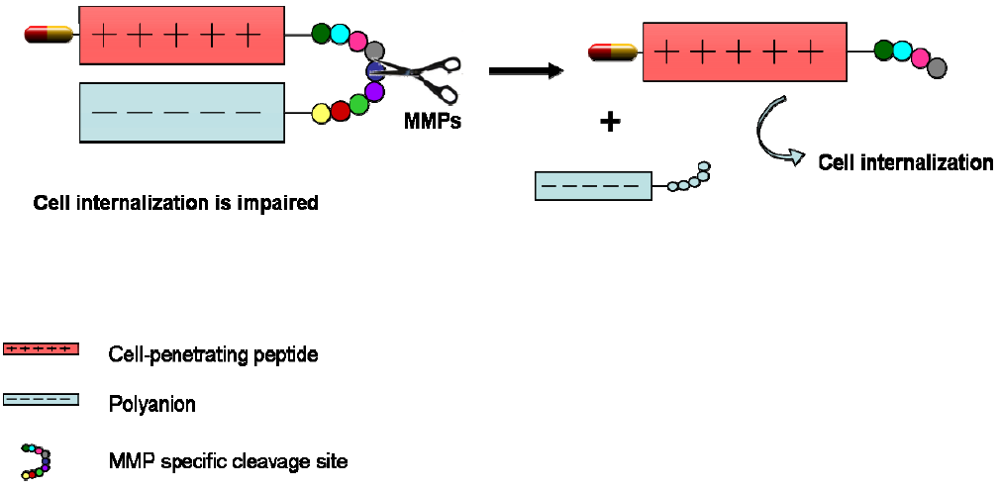
      <p>Tao Jiang <italic>et al</italic>. [<xref ref-type="bibr" rid="B96">96</xref>] took advantage of matrix metalloprotease (MMPs) oversecretion in cancer cells to create their targeted drug delivery system. MMPs are extracellular proteases that play a crucial role in extracellular matrix degradation, tissue invasion, and metastasis [<xref ref-type="bibr" rid="B97">97</xref>]. CPPs are known to enter cells as a result of their cationic nature, as they interact with the negatively charged cell surfaces [<xref ref-type="bibr" rid="B98">98</xref>]. The following system acts as a “dormant system” which is activated only upon reaching the desired tissue, in this case MMP-overexpressing cancer tissue. The positive charges of the CPP are initially masked by a polyanionic sequence. Upon reaching the tumoral tissue, overexpressed MMPs cleave the specific sequence that connects the CPP and the anionic sequence (<xref ref-type="fig" rid="figure4">Figure 4</xref>). Once the linker is cleaved, the acidic inhibitory domain drifts away, and the cationic CPP is free to carry its cargo into cells. This is a very interesting approach that benefits from an extracellular fate that occurs only in tumoral cells. The protease sequence could be designed in function of the kind of tumor or disease to be treated [<xref ref-type="bibr" rid="B96">96</xref>].</p>
      <fig id="figure4" position="float">
        <label>Figure 4</label>
        <caption>
          <p>Schematic diagram of dormant CPP [<xref ref-type="bibr" rid="B96">96</xref>].</p>
        </caption>
        <graphic xmlns:xlink="http://www.w3.org/1999/xlink" xlink:href="pharmaceuticals-03-01456-g004.tif" scale="0"/>
      </fig>
    </sec>
    <sec>
      <title>4. CPPs Coupled to a Targeting Drug</title>
      <p>Until now we have addressed homing approaches based on peptide sequences, either inherent to the CPP sequence or provided by an adjacent homing peptide. This chapter will focus on another way of targeting a drug delivery system. In this case, the specificity is achieved by the drug, which has an effect only on the desired target. </p>
      <p>p53 is a protein known as the “guardian of the genome”, a transcription factor that is encoded by the <italic>TP5 3 </italic>gene in humans. It regulates the cell cycle and functions as a tumor suppressor protein. p53 is the most frequently mutated gene in human cancer [<xref ref-type="bibr" rid="B99">99</xref>], and most of these mutations occur in the central DNA-binding region of the protein. This domain is regulated by its C-terminal sequence. Previous studies have reported that the addition of a chemically modified p53 C-terminal peptide (aa 363–393) restores <italic>in vitro</italic> sequence-specific DNA binding function to mutant p53-273 (Arg to His). Furthermore, intranuclear microinjection of this peptide into human colon cancer cells SW480 carrying an endogenous p53 mutant restores transcriptional activation of a p53-responsive reporter construct [<xref ref-type="bibr" rid="B100">100</xref>]. These results are very promising. But again, the bottleneck is the cellular uptake of this chemically modified p53 C-terminal peptide, which, due to its chemical structure, does not have the capacity to translocate across the cell membrane. Selivanova <italic>et al</italic>. designed a p53 C-terminal peptide (aa 361–382) fused to <italic>Antennapedia</italic> CPP to facilitate cellular uptake. They demonstrated inhibition of growth and induction of apoptosis in colon carcinoma cells with mutant p53 [<xref ref-type="bibr" rid="B101">101</xref>]. Fine’s team also reported that this construct (p53p-Ant) induced rapid apoptosis but this case in breast cancer cell lines carrying endogenous p53 mutations. The peptide was not toxic to non-malignant breast or colon cells. In a second study, this team showed that the same chimeric peptide induced apoptosis in human and rat glioma cells <italic>in vitro </italic>and<italic> in vivo</italic> [<xref ref-type="bibr" rid="B102">102</xref>,<xref ref-type="bibr" rid="B103">103</xref>,<xref ref-type="bibr" rid="B104">104</xref>]. They further studied the signaling mechanisms by which this protein acted in the cell. However, from the perspective concerning this review, the key feature of the system is the combination of two elements to target a desired cell and exert a pharmacological action. This strategy could be applied in the future treatment of cancers that have mutations in the DNA-binding domain of p53.</p>
      <p>A similar approach was developed by Dowdy and coworkers for the treatment of HIV [<xref ref-type="bibr" rid="B105">105</xref>]. They designed what they have called a “Trojan horse” strategy to kill HIV-infected cells by exploiting HIV protease. In this case, the combination of TAT CPP with procaspase-3 (Casp3) protein leads to a new strategy to kill only HIV-infected cells, while leaving uninfected cells unharmed. The protein used was a modified procaspase 3 protein, TAT-Casp3, which transduces about 100% of infected and uninfected cells. However, Casp3 is modified and has the endogenous cleavage sites substituted by HIV proteolytic cleavage sites. Thus, TAT-Casp3 is activated only by HIV protease in infected cells, thereby resulting in apoptosis, whereas in uninfected cells it remains in the inactive zymogene form. These results are proof of concept for this kind of “intelligent” drug delivery system and could be applied to treat other diseases caused by pathogen proteases, by fine tuning the proteolytic cleavage sites of proteases involved in each disease, like hepatitis C virus, cytomegalovirus and malaria [<xref ref-type="bibr" rid="B105">105</xref>]. </p>
      <p>Most solid tumors grow in an environment that differs completely from that of healthy tissues. For instance, the pH surrounding tumoral tissue is lower and usually the tumoral mass has low pO<sub>2.</sub> As a result of the hypoxic conditions, the tumor is refractory to radiotherapy and anticancer chemotherapy. Tumoral cells that do not receive the proper amounts of oxygen try to adapt to their poor environment and undergo several changes. For example, under aerobic conditions, the expression of HIF-1 (hypoxia-inducible transcription factor 1) is barely detectable. Upon hypoxia, the expression of this protein is greatly increased, thereby inducing and activating glucose metabolism and glucose transport, and producing angiogenic and growth factors. HIF-1 is also involved in the prevention of apoptosis and activates genes involved in metastasis and tumor invasion [<xref ref-type="bibr" rid="B106">106</xref>]. Given all these data, HIF-1 could be considered a good target in cancer treatment. HIF-1 is a heterodimer formed by an α and a β subunit. These subunits have several domains. In particular, there is a unique oxygen-dependent degradation domain (ODD), which is responsible for the regulation of the oxygen-dependent degradation of the HIF-1α protein. This protein stabilizes HIF-1 in a hypoxic environment and degrades it immediately under normal oxygen conditions [<xref ref-type="bibr" rid="B107">107</xref>]. The objective of the following work was to design a drug able to destroy HIF-1-expressing cells. To do so, Masahiro Hiraoka’s group designed a PTD-ODD-Procaspase-3 (TOP3) fusion protein drug [<xref ref-type="bibr" rid="B107">107</xref>]. ODD stabilized the fusion protein only in hypoxic conditions, while at normal pO<sub>2</sub> the complex was degraded. The ODD regulatory mechanism is dependent on the ubiquitin-proteasome system, which is located in the cell cytoplasm, so a PTD (protein transduction domain) was required to translocate the fusion protein into the cells. In this case, to translocate the system into the cell cytoplasm they used TAT peptide, which has been widely reported to transport proteins into cells [<xref ref-type="bibr" rid="B108">108</xref>]. Procaspase 3 (Casp3) is the functional part of the complex. When TOP3 is in HIF-1 expressing cells it is stable, and Casp3 is activated (initiator caspases are activated in hypoxic cells), thus leading to cell death. However, when the cell does not express enough HIF-1, the ODD domain leads to the ubiquitin degradation of the construct, thereby preventing the activation of Casp3 and thus triggering cell death. This final fusion protein product, TOP3, was systemically administered to mice bearing human pancreatic tumor xenografts. It suppressed tumor growth and reduced tumor size without any apparent side effects [<xref ref-type="bibr" rid="B107">107</xref>]. Given these observations, the specific imaging and targeting of HIF-1 active cells is feasible and may provide a novel approach to treat this kind of difficult cell in some tumors.</p>
      <p>Hsp90 is an ATPase-directed molecular chaperone that oversees the control of protein folding quality during the cellular stress response, and whose client proteins are usually signaling molecules involved in cell proliferation and cell survival [<xref ref-type="bibr" rid="B109">109</xref>]. This chaperone is thought to play a key role in cancer, as it is commonly upregulated in tumors and may contribute to the correct folding of proteins synthesized under stress conditions, thereby helping the cell to adapt to unfavorable environments caused by tumor growth [<xref ref-type="bibr" rid="B110">110</xref>]. Furthermore, survivin is an essential regulator of cell proliferation, differentiation and apoptosis. This protein is overexpressed in cancer tissues, and it interacts with Hsp90 in order to maintain its correct conformation [<xref ref-type="bibr" rid="B111">111</xref>]. The following strategy to direct inhibit tumor growth and progression is based on the disruption of survivin-Hsp90 interaction, by means of a “target drug” that enters cells by a CPP [<xref ref-type="bibr" rid="B112">112</xref>]. Fortugno <italic>et al</italic>. identified a survivin sequence (K79-K90) that blocks the interaction between survivin and Hsp90 <italic>in vitro</italic> [<xref ref-type="bibr" rid="B111">111</xref>]. Working on this sequence, Janet Plescia and coworkers succeeded in minimizing the number of amino acids required to block this interaction, and created sepherdin (K79-L87), a molecule that interacts specifically with Hsp90, and also with the capacity to disrupt Hsp90-survivin complex. They also demonstrated that intracellular delivery of sepherdin induced tumor cell death. For this purpose, they fused the N terminal of the <italic>Antennapedia</italic> CPP, and showed 100% internalization in HeLa cells. They further demonstrated that this fusion protein was able not only to inhibit the interaction of Hsp90 and survivin (and thus inhibit the activity of this pro cancer protein) but also to bind the ATP pocket of Hsp90, thereby destabilizing all Hsp90 client proteins. This new peptidic drug had the capacity to disrupt two crucial cell survival pathways and thus has become a promising drug for cancer treatment. One of the most interesting parts of this work is the capacity of the fusion protein to induce apoptosis only in tumoral cells. This is the main objective of “targeted cancer therapy”, and was achieved by this group. Sepherdin did not reduce the viability of non-transformed cells; however, it effectively killed cancer cells [<xref ref-type="bibr" rid="B112">112</xref>]. This fusion protein was further tested <italic>in vivo</italic>, in human cancer models (prostate carcinoma PC3 cells grown as superficial tumors in immunocompromised mice). The administration of sepherdin when the tumor was palpable resulted in the almost complete ablation of tumor growth and did not affect other tissues such as lung, spleen or liver. In addition, sepherdin killed tumor cells far more rapidly and more potently than other Hsp90 antagonists currently used in clinical applications [<xref ref-type="bibr" rid="B112">112</xref>]. Consequently, sepherdin is considered a potential new specific drug for cancer treatment. </p>
      <p>Prion diseases are also referred to as transmissible spongiform encephalopathies (TSE). They occur in humans and animals and primarily affect the central nervous system. The hallmark of these diseases is the presence of microscopic vacuolization of the brain tissue, called spongiform degeneration (meaning that the tissue deteriorates and develops a spongy texture), and the presence of an abnormal protein, called scrapie prion protein (PrP<sup>Sc</sup>), prion or abnormal prion protein. Diseases involving PrP<sup>Sc</sup>, unlike other known infectious diseases, are believed to result from a change in the conformation or shape of a normal protein called cellular prion protein (PrP<sup>C</sup>), which is present in large amounts in the brain as well as in other tissues. The conformation of PrP<sup>Sc</sup> makes it largely resistant to cellular degradation, and the accumulation in the brain is considered to cause neurodegeneration and death [<xref ref-type="bibr" rid="B113">113</xref>]. Interestingly, PrP<sup>C </sup>has several domains within its structure. It has some residues (1-22) that constitute a very hydrophobic signal sequence promoting entry into the endoplasmic reticulum (ER), and are usually cleaved before the protein reaches the cell surface, where is usually located in lipid raft regions. Residues 23–30 are positively charged, and form one of two independent nuclear localization signal-like segments of this protein. The basic segment of the prion protein has been described as a CPP [<xref ref-type="bibr" rid="B114">114</xref>] and confers solubility to the hydrophobic signal sequence. The prion protein-derived CPPs (PrP-CPPs) comprise the N-terminal signal peptide in mouse (residues 1–22) and residues 1–24 in bovine PrP, coupled to sequences 23–28 and 25–30, respectively (mPrP1 and bPrP1). These peptides transport hydrophobic cargos across cell membranes in a lipid raft-dependent macropinocytosis mechanism [<xref ref-type="bibr" rid="B115">115</xref>]. Lofgren and coworkers studied the capacity of various CPP to prevent PrP<sup>C</sup> conversion to PrP<sup>Sc</sup>[<xref ref-type="bibr" rid="B116">116</xref>]. This team found that peptides derived from the N-terminus of the unprocessed prion protein antagonizes prion infection. They worked <italic>in vitro</italic> using, GT1-1 cells, which are murine neuronal hypothalamic cells. These cells were infected with brain homogenate thus generating chronically prion-infected cell lines (Sc-GT1-1a and Sc-GT1-1b). mPrP<sub>1–28 </sub>and bPrP<sub>1–30</sub> strongly reduced PrP<sup>Sc</sup> expression in both prion-infected cell lines, but did not affect PrP<sup>C</sup> expression in non-infected GT1-1 cells [<xref ref-type="bibr" rid="B116">116</xref>]. Further research has been done to study the mechanisms by which these CPPs reduce PrP<sup>Sc</sup> expression. However, the main conclusion of this work is that these CPPs show selective anti-prion activity, thus opening up an avenue for the development of new drugs against prion diseases.</p>
      <p>We would like to add a final comment in this section of the review. We have described several strategies in which a CPP sequence helps a “target drug” to reach the intracellular compartment. One such approach involves taking advantage of specific proteases or overexpressed proteins. However, when considering “specific” drugs, mention of nucleic acid-based therapy is inevitable. Gene therapy is the maximum expression of a “target drug”, as it is sequence-specific. Various oligonucleotide derivatives have demonstrated remarkable potential for therapeutic application as gene regulators [<xref ref-type="bibr" rid="B117">117</xref>]. siRNA delivery is currently the focus of intensive research effort. It can specifically bind (after dicer processing) to mRNA sequences, thereby altering splicing sites and leading to modified proteins that may be useful in the treatment of diseases. However, nucleic acids are strongly negatively charged and are thus unable to cross the cell membrane. Descriptions of covalent and non-covalent strategies have been reported in which CPPs help siRNA to penetrate cells [<xref ref-type="bibr" rid="B10">10</xref>]. Many groups have demonstrated effective downregulation of gene expression by CPP-based siRNA delivery, although endosomal release continues to be a bottleneck and attempts to solve it are in course [<xref ref-type="bibr" rid="B10">10</xref>]. Some examples of CPP-siRNA as a potential delivery strategy are reviewed in the following studies [<xref ref-type="bibr" rid="B117">117</xref>,<xref ref-type="bibr" rid="B118">118</xref>,<xref ref-type="bibr" rid="B119">119</xref>,<xref ref-type="bibr" rid="B120">120</xref>,<xref ref-type="bibr" rid="B121">121</xref>,<xref ref-type="bibr" rid="B122">122</xref>,<xref ref-type="bibr" rid="B123">123</xref>,<xref ref-type="bibr" rid="B124">124</xref>,<xref ref-type="bibr" rid="B125">125</xref>]. The field of nucleic acid delivery is rapidly improving and undergoing further development. In fact, several chemical modifications have been performed to increase the stability of these molecules and reduce their size, thereby achieving improved binding specificity. For instance, peptide nucleic acids (PNAs) [<xref ref-type="bibr" rid="B123">123</xref>,<xref ref-type="bibr" rid="B126">126</xref>,<xref ref-type="bibr" rid="B127">127</xref>,<xref ref-type="bibr" rid="B128">128</xref>] are now widely used as phosphoramidate morpholino oligonucleotides (PMOs) are [<xref ref-type="bibr" rid="B129">129</xref>,<xref ref-type="bibr" rid="B130">130</xref>,<xref ref-type="bibr" rid="B131">131</xref>,<xref ref-type="bibr" rid="B132">132</xref>]. It is clear that complexing or conjugating oligonucleotides to CPPs is an efficient and non-toxic way to achieve intracellular delivery of pharmaceutical agents with significant biological activity. However, the main bottleneck of this delivery system is the endosomal escape. Further research effort should address this limiting step. </p>
    </sec>
    <sec>
      <title>5. Directing CPPs by Means of Physical Changes in the Environment</title>
      <p>In this section we will focus on a different way of directing a drug delivery system. In this case, the system finds its specific location by a physical change in the target environment. Thus, to avoid unspecific uptake the CPP domain of the system is initially hidden until it reaches the target area. After reaching the desired tissue, this domain is “woken up” and fully activated to promote efficient internalization. Some examples of this kind of strategy are described below.</p>
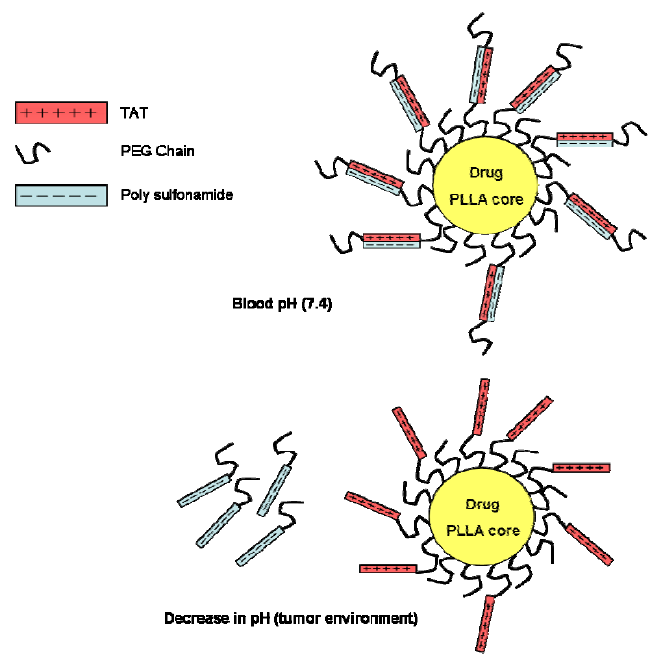
      <p>Sethuraman and coworkers designed a delivery system named “smart micellar nanoplatform” [<xref ref-type="bibr" rid="B133">133</xref>,<xref ref-type="bibr" rid="B134">134</xref>], which takes advantage of the low pH usually found in the tumor environment (pH below 7, as a result of lactic acid production in tumors [<xref ref-type="bibr" rid="B135">135</xref>,<xref ref-type="bibr" rid="B136">136</xref>,<xref ref-type="bibr" rid="B137">137</xref>]. This “smart micellar nanoplatform” has several components, which are shown in <xref ref-type="fig" rid="figure5">Figure 5</xref>. The core of the micelles is composed by poly(L-lactic acid) into which any chemotherapeutic agent can be incorporated. The core is decorated with polyethylene glycol (PEG) molecules that have TAT attached to them. TAT molecules electrostatically interact with polysulfonamide (PSD) molecules (negatively charged at pH = 7.4). Thus, TAT molecules are shielded and as a result the system cannot penetrate cells. When this system reaches the tumor site, the TAT micelles are exposed to the surroundings because PSD molecules become protonated and lose their negative charge. TAT then helps target the drug-loaded micelle to the tumoral cells, where the cytotoxic effect occurs. This system was tested <italic>in vitro</italic> using MCF-7 cells at a range of pH. Micelles loaded with fluorescent molecules penetrated cells only in an acidic environment, thereby proving the effectiveness of this intelligent system [<xref ref-type="bibr" rid="B134">134</xref>]. Nevertheless, further testing of this approach using cancer drugs and <italic>in vivo</italic> assays is required to evaluate its specificity and feasibility. </p>
      <fig id="figure5" position="float">
        <label>Figure 5</label>
        <caption>
          <p>Schematic model for the drug delivery system proposed by Sethuraman and coworkers [<xref ref-type="bibr" rid="B133">133</xref>,<xref ref-type="bibr" rid="B134">134</xref>]. At pH 7.4 the sulfonamide is negatively charged, masking the positively charged TAT cell-penetrating peptide. But when the pH decreases in the vicinity of the tumor, the sulfonamide loses charge and detaches, thereby exposing TAT for interaction with the tumoral cells.</p>
        </caption>
        <graphic xmlns:xlink="http://www.w3.org/1999/xlink" xlink:href="pharmaceuticals-03-01456-g005.tif" scale="0"/>
      </fig>
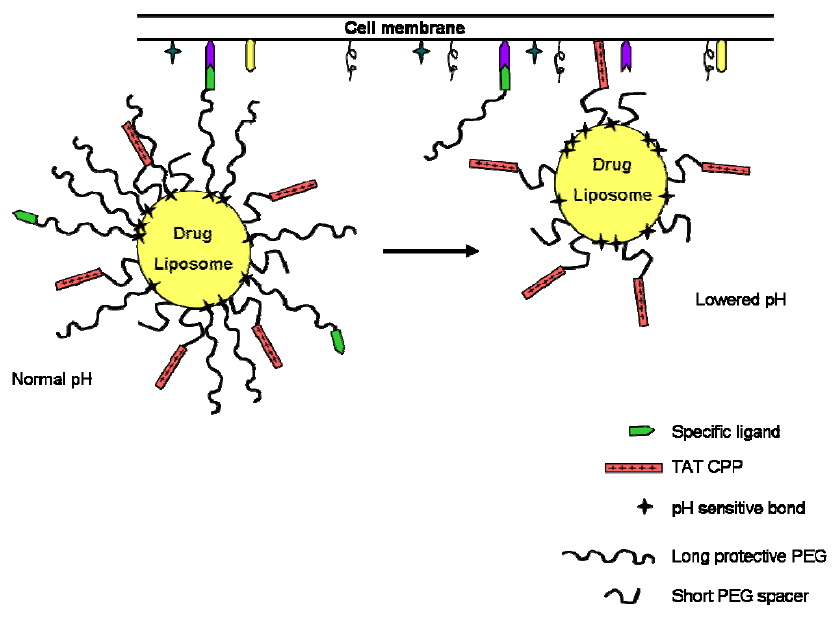
      <p>In 2006, Torchilin’s group developed another strategy to target tumoral cells based on the decrease of pH in the tumoral tissue [<xref ref-type="bibr" rid="B138">138</xref>]. They worked with liposomes as pharmaceutical nanocarriers, whose surface holds several moieties (<xref ref-type="fig" rid="figure6">Figure 6</xref>). Until the complex reaches the low pH environment, TAT peptide is hidden by long-chain PEGs. Some of these chains also hold a ligand that helps to achieve the concentration of the complex at the target cells. Given that the long-chain PEGs are attached to the complex by means of pH labile bonds (hydrazone bonds), they are released from the complex in response to a lowering of the pH of the media. The TAT peptide is then exposed, and interacts with the cell surface, thereby contributing to the internalization of the liposome and the drug it holds [<xref ref-type="bibr" rid="B138">138</xref>]. This correct function of this system has been confirmed <italic>in vitro</italic> in NIH 3T3 fibroblasts at pH 8.0 and pH 5.0. One year later, the same team tested a similar drug delivery system <italic>in vivo</italic>. For this purpose, the pH-sensitive complex was administered directly into the tumor tissue by intratumoral injection [<xref ref-type="bibr" rid="B139">139</xref>]. This work represents a significant step towards the development of “intelligent” drug delivery systems, and is a striking example of a multifunctional drug delivery system.</p>
      <fig id="figure6" position="float">
        <label>Figure 6</label>
        <caption>
          <p>Interaction of the multifunctional pH-responsive pharmaceutical nanocarrier with the target cell [<xref ref-type="bibr" rid="B138">138</xref>]. A decrease of pH in the tumor environment induces the hydrolysis of the hydrazone bond, thereby exposing the CPP, which helps the delivery system to enter the tumoral cells.</p>
        </caption>
        <graphic xmlns:xlink="http://www.w3.org/1999/xlink" xlink:href="pharmaceuticals-03-01456-g006.tif" scale="0"/>
      </fig>
      <p>One approach to treat primary tumors is by exposing them to high temperatures. Ablative therapies using temperatures above 43 °C of sufficient duration directly kill cells [<xref ref-type="bibr" rid="B140">140</xref>]. The application of mild hyperthermia (40–43 °C) is under clinical development as an adjunct with various established cancer treatments, such as radiotherapy and chemotherapy [<xref ref-type="bibr" rid="B130">130</xref>]. The following drug delivery system is temperature-sensitive and temperature is used to enhance the system selectivity to the target area. In conjunction with regional or local hyperthermia, temperature-sensitive delivery systems enhance their accumulation and penetration capacity in heated regions that contain the malignancy. To date, several temperature-sensitive peptides have been described [<xref ref-type="bibr" rid="B141">141</xref>,<xref ref-type="bibr" rid="B142">142</xref>,<xref ref-type="bibr" rid="B143">143</xref>,<xref ref-type="bibr" rid="B144">144</xref>]. They have been designed to change structures within a narrow thermal window around 40 °C. The transition between different secondary structures produces dramatic changes in peptide properties, and these changes should be reversible, as the peptide must return to its original state upon cooling to normal temperature. In 2005, Gene L. Bidwell and Drazen Raucher provided an example of a temperature-sensitive drug delivery system involving a CPP [<xref ref-type="bibr" rid="B145">145</xref>]. They designed an elastin-like polypeptide (Val-Pro-Gly-Xaa-Gly)<sub>20</sub> coupled to <italic>Penetratin</italic>  and to a peptide derived from helix 1 of the helix-loop-helix region of c-Myc (H1), known to inhibit c-Myc transcriptional function (Pen-ELP-H1). Elastin-like polymers are soluble in aqueous solution below their transition temperature (T<sub>t</sub>). However, when the temperature is raised above their T<sub>t</sub>, they undergo a phase transition and become insoluble, forming aggregates. In this case, heated MCF-7 cells showed notably greater uptake of the polypeptide compared to the same peptide in non-heat treated cells or compared to a non-responsive control peptide. This observation is attributed to the aggregation that takes place at high temperatures. Moreover, this aggregation effect is reversible. They also showed the cellular effect of peptide H1 [<xref ref-type="bibr" rid="B145">145</xref>,<xref ref-type="bibr" rid="B146">146</xref>]. The growth rate of HeLa and OVCAR-3 cells was slowed by this construct, thereby demonstrating the potential of this peptide in future treatment of tumors <italic>in vivo</italic>. The many favorable properties of the ELP sequence make it a good candidate drug delivery vector, as it has proved thermoresponsive properties, it is soluble at normal temperature and, in addition, it is expressed in bacteria. Large amounts of the ELP can be easily purified, and they can also be genetically modified in order to insert cell-penetrating sequences or therapeutic peptides or proteins. Applying high temperature to a tumoral mass could theoretically lead to an enhanced concentration of the delivery system in the region, thereby minimizing the side effects and improving cancer therapy.</p>
      <p>In the following example the target tool of the system consists of a low-voltage electrical pulse [<xref ref-type="bibr" rid="B147">147</xref>]. The authors of that study proved that the internalization efficacy of TAT peptide coupled to glycogen synthase kinase-3 (GSK-3) was highly enhanced by the application of a low-voltage pulse (130–140V, depending on the cell line), without harming the cells. This study is preliminary; however, it demonstrates another way to target systems into cells [<xref ref-type="bibr" rid="B147">147</xref>]. Further studies could apply low-voltage pulses in regions containing malignant cells in order to increase drug delivery. </p>
      <p>We wish to make reference to a final strategy in which a drug delivery system takes advantage of a “physical” characteristic that is present only in the area to be directly targeted. In this case, the “physical” target is not an inherent property of the disease, but this delivery system is topically applied in the affected area (this system is used to treat inflammatory skin diseases). The drug consists of a polyarginine CPP conjugated to cyclosporine A (CsA) [<xref ref-type="bibr" rid="B148">148</xref>]. Skin diseases are usually treated with systemically administrated drugs, which may involve side effects. Topically administered drugs could be very useful for the treatment of skin diseases; however, the poor absorption as a result of the lack of skin permeability continues to be the main drawback of this approach. In this study, the use of CPPs enhanced drug absorption by the skin. Orally administered CsA is highly effective against a wide range of inflammatory skin diseases, such as psoriasis or atopic dermatitis [<xref ref-type="bibr" rid="B149">149</xref>,<xref ref-type="bibr" rid="B150">150</xref>]. CsA was conjugated to a heptamer of arginine through a linker designed to release the active drug at physiologic pH within tissue. This approach facilitated the penetration of CsA into mouse and human skin, the solubility of CsA was enhanced in water and effects of reduced inflammation were observed. These observations demonstrate the efficacy of CPPs to enhance skin absorption of agents, thus opening a new avenue in the field of skin disease treatment [<xref ref-type="bibr" rid="B148">148</xref>]. In fact, this treatment (PsorBan<sup>®</sup>) is currently in clinical trials and phase I trials were successful [<xref ref-type="bibr" rid="B122">122</xref>].</p>
      <p>The literature provides other examples in which a CPP enhances drug absorption when applied locally. For instance, McCusker and coworkers described an original strategy for the treatment of allergic airway diseases [<xref ref-type="bibr" rid="B151">151</xref>]. They sought to inhibit STAT-6 protein, a key point target in the treatment of this disease as it is involved in the regulation of airway inflammation, mucus production and airway hyperresponsiveness [<xref ref-type="bibr" rid="B152">152</xref>]. However, targeting STAT-6 is complicated because of its intracellular location. This group designed a specific inhibitor peptide (STAT-6-IP) bound to TAT CPP. When delivered directly to the lungs of murine models, STAT-6-IP inhibited Ag-induced inflammatory responses, thereby inhibiting chemokine expression, mucus production and eosinophil influx into the lungs. Again, local application of a disease treatment consisting of a CPP coupled to a specific drug is a promising new therapeutic approach for the treatment of disease, in this case allergic rhinitis and asthma [<xref ref-type="bibr" rid="B151">151</xref>].</p>
    </sec>
    <sec>
      <title>6. CPPs as Part of More Complex Drug Delivery Systems</title>
      <p>The last section of this review addresses more complex drug delivery systems that target a specific location and that include a CPP, to increase the cellular uptake of the system. Some of these examples have been previously described, such as the a pH-sensitive drug delivery system system designed by V.P. Torchilin’s group [<xref ref-type="bibr" rid="B138">138</xref>].</p>
      <p>In 2003, Heckl and coworkers published a new strategy to visualize prostate cancer using magnetic resonance imaging (MRI). Their objective was to develop a novel MRI contrast agent with the capacity to accumulate specifically in tumoral cells for relatively long periods [<xref ref-type="bibr" rid="B153">153</xref>]. Gadolinium (Gd<sup>3+</sup>) is a commonly used extracellular imaging agent for MRI, but it is not suitable for intracellular imaging. Assays using Gd<sup>3+</sup> as an intracellular agent by means of microinjection into the cells [<xref ref-type="bibr" rid="B154">154</xref>], or conjugation with a CPP (TAT in this case [<xref ref-type="bibr" rid="B155">155</xref>]) had been reported. Apart from the lack of specificity, the main problem of these strategies is the rapid influx and efflux of the particles. To achieve a longer permanence of the Gd<sup>3+</sup>-complex in the cells, they constructed a Gd<sup>3+</sup>-complex bound to a PNA and connected it to <italic>Antennapedia</italic> CPP. The PNA was directed against the <italic>c-myc</italic> mRNA. This mRNA is highly expressed in tumoral cells [<xref ref-type="bibr" rid="B156">156</xref>]. They hypothesized that PNA coupling to <italic>c-myc</italic> mRNA would increase the life of the Gd<sup>3+</sup>, thereby providing this agent with specificity for MRI imaging. They verified the increased internalization of the complexes, on the basis of the presence of the CPP. Gd<sup>3+ </sup>complex transport through the cell membrane using a CPP may provide an alternative approach for <italic>in vivo</italic> and <italic>in vitro</italic> application. They also observed that both <italic>in vitro</italic> (HeLa cells) and <italic>in vivo</italic> (prostate adenocarcinoma) the Gd<sup>3+ </sup>particles were retained longer than the Gd<sup>3+</sup>- Antennapedia particles without the <italic>c-myc</italic> PNA. The authors have been cautious in the interpretation of their results and have not directly related the presence of a complementary PNA for a highly expressed protein in the cells with the longer retention time of the particles inside the cells. They suggest that the longer retention of the complex may be due to a given property of the tumoral membrane cells. Thus, the slower efflux of the c-myc-specific Gd<sup>3+ </sup>complex would be independent of PNA design. Although further research in this field is required, these are promising results for specific intracellular imaging of tumors [<xref ref-type="bibr" rid="B153">153</xref>].</p>
      <p>Liposomes have been widely studied for drug delivery in the treatment of many diseases, such as cancer and HIV [<xref ref-type="bibr" rid="B157">157</xref>,<xref ref-type="bibr" rid="B158">158</xref>,<xref ref-type="bibr" rid="B159">159</xref>]. In addition, cationic liposomes conjugated with DNA (lipoplexes) have been also investigated in preclinical and clinical trials because they have an <italic>in vitro</italic> transfection efficacy comparable to that of viral vectors [<xref ref-type="bibr" rid="B160">160</xref>]. The main drawback of these systems is, again, their lack of specificity. Despite having considerable potential, this approach still requires further development. Torchilin’s group has recently described a new strategy to target lipoplexes to ischemic cells [<xref ref-type="bibr" rid="B161">161</xref>]. The aim of the lipoplexes is to treat myocardial ischemia and myocardial infarction, two diseases in which gene therapy still holds a huge potential. There are enough data supporting that the overexpression of some genes in cardiac fibers protects them against ischemic injuries. For instance, overexpression of the fibroblast growth factor-2 in the heart increases resistance to ischemic injury in an isolated mouse heart model [<xref ref-type="bibr" rid="B162">162</xref>]. Shortly after this study, the gene transfer of HSP 70 was reported to protect cardiac functions under ischemia and reperfusion [<xref ref-type="bibr" rid="B163">163</xref>]. Improved myocardial perfusion and functional recovery have also been observed after gene transfer of VEGF, FGF and HGF [<xref ref-type="bibr" rid="B164">164</xref>,<xref ref-type="bibr" rid="B165">165</xref>]. Given all this information, directed gene delivery to cardiac cells would be a very good approach to treat this disease. Ko and coworkers have designed a new multifunctional drug delivery system as proof of concept for directed gene delivery into cardiac cells [<xref ref-type="bibr" rid="B161">161</xref>]. The system consists of cationic liposomes carrying pDNA encoding for green fluorescent protein (GFP) modified with TAT CPP (to increase cellular uptake) and the highly specific anti-myosin monoclonal antibody 2G4 (mAb 2G4). This antibody has demonstrated an excellent capacity to recognize and bind ischemic cells with damaged plasma membranes when intracellular myosin becomes exposed to the extracellular space [<xref ref-type="bibr" rid="B166">166</xref>]. Thus the lipoplexes concentrate in the desired area, and afterwards are internalized in the cells, thereby allowing gene transfer. Despite the solubility problems usually associated with intravenous injections of lipoplexes [<xref ref-type="bibr" rid="B167">167</xref>], the system described above has increased solubility because of the addition of some PEG3400-PE molecules to the system. This system was tested <italic>in vitro</italic> (cell culture with rat cardiomyocytes) and <italic>in vivo</italic> in an EMI model in rats and showed preferential accumulation of the construct in the ischemic areas of the infarcted rat heart [<xref ref-type="bibr" rid="B161">161</xref>]. These are promising results for the targeted delivery of genes; however, it would be interesting to see the effect of loading the therapeutic gene instead of GFP. Nevertheless, the field is undergoing certain improvement and in the near future these kinds of multicomponent systems are expected to be established as effective drug delivery systems in the treatment of many diseases.</p>
      <p>The following strategy uses human serum albumin (HSA) as a natural carrier polymer. HSA has many advantages, such as long circulation times, high biocompatibility, high biodegradability and the possibility of being easily chemically modified [<xref ref-type="bibr" rid="B168">168</xref>,<xref ref-type="bibr" rid="B169">169</xref>]. In this case, the drug was SB202190, a p38MAP kinase inhibitor. Targeting p38MAP kinase is a current strategy widely studied for the treatment of chronic inflammatory diseases, as p38MAP kinases are responsible for activating endothelial cells in these diseases. These cells in turn secrete cytokines and chemokines that further promote leukocyte recruitment and infiltration [<xref ref-type="bibr" rid="B170">170</xref>]. The system also includes the cyclic RGDfK peptide, known to bind with high affinity and specificity to α<sub>v</sub>ß<sub>3</sub> integrin, and previously defined as a CPP. This peptide confers selectivity and penetrating properties to the complex. α<sub>v</sub>ß<sub>3</sub> integrin is overexpressed on angiogenic endothelium, which is part of the pathology of chronic inflammatory diseases such as rheumatoid arthritis and Crohn’s disease [<xref ref-type="bibr" rid="B171">171</xref>]. This non-toxic drug delivery system interfered with the inflammatory signaling cascade <italic>in vitro</italic>, thereby showing its potential for the treatment of inflammatory diseases. One year later, this same group published another HAS-based drug delivery system which also carried RGD CPP to target angiogenic endothelial and tumor cells and, in this case, Auristatin as an anti-cancer drug. <italic>In vitro</italic> results are encouraging [<xref ref-type="bibr" rid="B172">172</xref>], but in both cases further studies are required to evaluate the suitability of the systems for <italic>in vivo </italic>applications. </p>
      <p>There are several examples of drug delivery systems in which CPPs are used to increase the penetrability of the system into cells. In these cases, the specificity of the system is again through siRNA, which acts only in those cells expressing amounts of mRNA complementary to that siRNA. Some of these examples are reviewed in [<xref ref-type="bibr" rid="B173">173</xref>].</p>
    </sec>
    <sec>
      <title>7. Future Directions</title>
      <p>One of the major drawbacks in the field of drug delivery is the way of bypassing the cell membrane. Many potential therapeutic agents, such as nucleic acids, proteins and hydrophilic drugs, are not useful because of they are unable to enter cells, where they exert their therapeutic action. Several approaches have been developed to overcome this problem. For example, viral vectors are highly efficient for intracellular delivery [<xref ref-type="bibr" rid="B174">174</xref>,<xref ref-type="bibr" rid="B175">175</xref>], but they have disadvantages as they can induce a specific immune response and they are quite complicated structures. Further development is required to elucidate the biology underlying virus–host interactions. In addition, the <italic>in vivo</italic> transduction efficiency of viral vehicles requires improvement. The development of non-viral vehicles represents an easier, less expensive and safer alternative to viral vectors. Non-viral vehicles are simpler systems that can be fully controlled, and are mainly non-immunogenic. However, limitations such as low transfection efficiency and insufficient distribution to target cells <italic>in vivo</italic> have to be overcome. One of the most important features to be improved in the field of non-viral delivery systems is cell specificity. Many non-viral vectors are available for drug and gene delivery [<xref ref-type="bibr" rid="B118">118</xref>,<xref ref-type="bibr" rid="B176">176</xref>,<xref ref-type="bibr" rid="B177">177</xref>,<xref ref-type="bibr" rid="B178">178</xref>,<xref ref-type="bibr" rid="B179">179</xref>]. Recently different efforts in the direction of chemical modified viral vectors have proposed strategies such as chemo-virus and chimeric systems  [<xref ref-type="bibr" rid="B180">180</xref>,<xref ref-type="bibr" rid="B181">181</xref>]. </p>
      <p>It is already more than 30 years since Frankel and Pabo described TAT in 1988 [<xref ref-type="bibr" rid="B182">182</xref>]. From then on, many cell-penetrating sequences have been reported, and many others have been improved. In addition, the capacity of these sequences to deliver a wide variety of cargos to cells, such as small peptides, proteins, DNA, siRNA, PNAs, and organic moieties, both <italic>in vivo</italic> and <italic>in vitro</italic> has been demonstrated<italic>. </italic>However, the main drawback of CPPs is that, despite their good cell-penetrating capacity and the fact that they are non-immunogenic and barely toxic, they do not show cell selectivity. The cellular uptake mechanism of CPPs is still not fully understood. There is a consensus that the first contacts between CPPs and the cell surface occurs through electrostatic interactions between the cationic peptide and the negatively charged cell surface [<xref ref-type="bibr" rid="B118">118</xref>]. Therefore the lack of specificity is a major issue to be solved before CPPs can be used for drug delivery. </p>
      <p>In this review, we have attempted to summarize examples of novel drug delivery systems. These systems share two main properties: they target a specific cell or tissue and their structure carries a CPP. </p>
      <p>Many of the strategies described have proved successful in <italic>in vivo </italic>experiments and therefore numerous clinical and preclinical studies of CPP-based delivery strategies are currently under evaluation. PsorBan<sup>®</sup> is a cyclosporine-poly-arginine conjugate for the topical treatment of psoriasis [<xref ref-type="bibr" rid="B122">122</xref>]. Orally administrated cyclosporine A (CsA) is effective against a broad range of inflammatory skin diseases, including psoriasis. However systemic administration of this molecule has considerably side effects such as nephrotoxicity. Topical application of CsA would minimize side effects and would contribute to the treatment of these diseases. But topical application of CsA shows low effectiveness, due to a poor absorption. However, the conjugation of a CPP (heptaarginine) with CsA through a linker designed to release the active compound at tissue’s pH enhances its topical absorption, inhibiting cutaneous inflammation [<xref ref-type="bibr" rid="B148">148</xref>]. PsorBan<sup>® </sup>entered phase II trials in 2003 (CellGate, Inc.). Other CPP-based strategies for drug delivery are currently also undergoing clinical trials. For instance, KAI-9803 is being tested by Kai Pharmaceutical [<xref ref-type="bibr" rid="B183">183</xref>] as a TAT-protein kinase C inhibitor peptide modulator of protein kinase C for acute myocardial infarction and cerebral ischemia. In 2007, this peptide entered in phase II. Avi Biopharma is working on clinical development of CPPs for the <italic>in vivo</italic> steric block splicing correction using 6-aminohexanoic acid spaced oligoarginine [(R-Ahx-R)<sub>4</sub>]. It consists on a Morpholino oligo conjugated to the mentioned CPP [(RXR)<sub>4</sub> XB CPP]. The goal of this construct is to prevent eventual blockage of a transplanted vein after cardiovascular bypass surgery [<xref ref-type="bibr" rid="B131">131</xref>,<xref ref-type="bibr" rid="B184">184</xref>]. Several companies (e.g. Traversa Inc., and Panomics Inc.) are currently evaluating CPPs in preclinical and clinical trials [<xref ref-type="bibr" rid="B118">118</xref>]. In addition, there are a great number of molecules conjugated to CPPs which are already in pre-clinical phases, getting optimized for future clinical trials [<xref ref-type="bibr" rid="B118">118</xref>,<xref ref-type="bibr" rid="B185">185</xref>]. In summary, CPPs are a reality for drug delivery. Inducing cell selectivity into CPP-mediated strategies will be the next step to improve current drug delivery systems, in order to decrease side effects and the amount of drug required to achieve a given intracellular target. The innovative range of strategies described in this review may soon enter clinical trials, which may contribute to furthering the field of drug delivery.</p>
    </sec>
    <sec>
      <title>Acknowledgments</title>
      <p>This work was supported by MCI-FEDER (Bio2008-00799), Generalitat de Catalunya (XRB and 2009SGR-1005) and CONSOLIDER-INGENIO 2010. We also thank Tanya Yates for her editorial support. </p>
    </sec>
  </body>
  <back>
    <ref-list>
      <ref id="B1">
        <citation citation-type="journal">
          <person-group person-group-type="author">
            <name>
              <surname>Hassane</surname>
              <given-names>F.S.</given-names>
            </name>
            <name>
              <surname>Saleh</surname>
              <given-names>A.</given-names>
            </name>
            <name>
              <surname>Abes</surname>
              <given-names>R.</given-names>
            </name>
            <name>
              <surname>Gait</surname>
              <given-names>M.</given-names>
            </name>
            <name>
              <surname>Lebleu</surname>
              <given-names>B.</given-names>
            </name>
          </person-group>
          <article-title>Cell-penetrating-peptides: Overview and applications to the delivery of oligonucleotides</article-title>
          <source>Cell. Mol. Life Sci.</source>
          <year>2009</year>
          <fpage>715</fpage>
          <lpage>726</lpage>
        </citation>
      </ref>
      <ref id="B2">
        <citation citation-type="journal">
          <person-group person-group-type="author">
            <name>
              <surname>Andaloussi</surname>
              <given-names>S. E.</given-names>
            </name>
            <name>
              <surname>Guterstam</surname>
              <given-names>P.</given-names>
            </name>
            <name>
              <surname>Langel</surname>
              <given-names>U.</given-names>
            </name>
          </person-group>
          <article-title>Assessing the delivery efficacy and internalization route of cell-penetrating peptides</article-title>
          <source>Nat. Protocols</source>
          <year>2007</year>
          <volume>2</volume>
          <fpage>2043</fpage>
          <lpage>2047</lpage>
          <pub-id pub-id-type="doi">10.1038/nprot.2007.302</pub-id>
        </citation>
      </ref>
      <ref id="B3">
        <citation citation-type="journal">
          <person-group person-group-type="author">
            <name>
              <surname>Pujals</surname>
              <given-names>S.</given-names>
            </name>
            <name>
              <surname>Fernandez-Carneado</surname>
              <given-names>J.</given-names>
            </name>
            <name>
              <surname>Kogan</surname>
              <given-names>M. J.</given-names>
            </name>
            <name>
              <surname>Martinez</surname>
              <given-names>J.</given-names>
            </name>
            <name>
              <surname>Cavelier</surname>
              <given-names>F.</given-names>
            </name>
            <name>
              <surname>Giralt</surname>
              <given-names>E.</given-names>
            </name>
          </person-group>
          <article-title>Replacement of a proline with silaproline causes a 20-fold increase in the cellular uptake of a pro-rich peptide</article-title>
          <source>J. Am. Chem. Soc.</source>
          <year>2006</year>
          <volume>128</volume>
          <fpage>8479</fpage>
          <lpage>8483</lpage>
          <pub-id pub-id-type="doi">10.1021/ja060036c</pub-id>
          <pub-id pub-id-type="pmid">16802813</pub-id>
        </citation>
      </ref>
      <ref id="B4">
        <citation citation-type="journal">
          <person-group person-group-type="author">
            <name>
              <surname>Futaki</surname>
              <given-names>S.</given-names>
            </name>
            <name>
              <surname>Nakase</surname>
              <given-names>I.</given-names>
            </name>
            <name>
              <surname>Tadokoro</surname>
              <given-names>A.</given-names>
            </name>
            <name>
              <surname>Takeuchi</surname>
              <given-names>T.</given-names>
            </name>
            <name>
              <surname>Jones</surname>
              <given-names>A. T.</given-names>
            </name>
          </person-group>
          <article-title>Arginine-rich peptides and their internalization mechanisms</article-title>
          <source>Biochem. Soc. Trans.</source>
          <year>2007</year>
          <volume>35</volume>
          <fpage>784</fpage>
          <lpage>787</lpage>
          <pub-id pub-id-type="doi">10.1042/BST0350784</pub-id>
          <pub-id pub-id-type="pmid">17635148</pub-id>
        </citation>
      </ref>
      <ref id="B5">
        <citation citation-type="journal">
          <person-group person-group-type="author">
            <name>
              <surname>Andaloussi</surname>
              <given-names>S.E.</given-names>
            </name>
            <name>
              <surname>Johansson</surname>
              <given-names>H.J.</given-names>
            </name>
            <name>
              <surname>Holm</surname>
              <given-names>T.</given-names>
            </name>
            <name>
              <surname>Langel</surname>
              <given-names>U.</given-names>
            </name>
          </person-group>
          <article-title>A Novel cell-penetrating peptide, M918, for efficient delivery of proteins and Peptide Nucleic Acids</article-title>
          <source>Mol. Ther.</source>
          <year>2007</year>
          <volume>15</volume>
          <fpage>1820</fpage>
          <lpage>1826</lpage>
          <pub-id pub-id-type="doi">10.1038/sj.mt.6300255</pub-id>
          <pub-id pub-id-type="pmid">17622242</pub-id>
        </citation>
      </ref>
      <ref id="B6">
        <citation citation-type="journal">
          <person-group person-group-type="author">
            <name>
              <surname>Gump</surname>
              <given-names>J.M.</given-names>
            </name>
            <name>
              <surname>Dowdy</surname>
              <given-names>S.F.</given-names>
            </name>
          </person-group>
          <article-title>TAT transduction: The molecular mechanism and therapeutic prospects</article-title>
          <source>Trends Mol. Med.</source>
          <year>2007</year>
          <volume>13</volume>
          <fpage>443</fpage>
          <lpage>448</lpage>
          <pub-id pub-id-type="doi">10.1016/j.molmed.2007.08.002</pub-id>
          <pub-id pub-id-type="pmid">17913584</pub-id>
        </citation>
      </ref>
      <ref id="B7">
        <citation citation-type="journal">
          <person-group person-group-type="author">
            <name>
              <surname>Pujals</surname>
              <given-names>S.</given-names>
            </name>
            <name>
              <surname>Fernández-Carneado</surname>
              <given-names>J.</given-names>
            </name>
            <name>
              <surname>Ludevid</surname>
              <given-names>M.D.</given-names>
            </name>
            <name>
              <surname>Giralt</surname>
              <given-names>E.</given-names>
            </name>
          </person-group>
          <article-title>D-SAP: A new, noncytotoxic, and fully protease resistant cell-penetrating peptide</article-title>
          <source>Chem. Med. Chem.</source>
          <year>2008</year>
          <volume>3</volume>
          <fpage>296</fpage>
          <lpage>301</lpage>
        <pub-id pub-id-type="pmid">18058782</pub-id></citation>
      </ref>
      <ref id="B8">
        <citation citation-type="journal">
          <person-group person-group-type="author">
            <name>
              <surname>Pujals</surname>
              <given-names>S.</given-names>
            </name>
            <name>
              <surname>Giralt</surname>
              <given-names>E.</given-names>
            </name>
          </person-group>
          <article-title>Proline-rich, amphipathic cell-penetrating peptides</article-title>
          <source>Adv. Drug Delivery Rev.</source>
          <year>2007</year>
          <volume>60</volume>
          <fpage>473</fpage>
          <lpage>484</lpage>
          <pub-id pub-id-type="doi">10.1016/j.addr.2007.09.012</pub-id>
        </citation>
      </ref>
      <ref id="B9">
        <citation citation-type="journal">
          <person-group person-group-type="author">
            <name>
              <surname>Torchilin</surname>
              <given-names>V.P.</given-names>
            </name>
          </person-group>
          <article-title>Tatp-mediated intracellular delivery of pharmaceutical nanocarriers</article-title>
          <source>Biochem. Soc. Trans.</source>
          <year>2007</year>
          <volume>35</volume>
          <fpage>816</fpage>
          <lpage>820</lpage>
          <pub-id pub-id-type="doi">10.1042/BST0350816</pub-id>
          <pub-id pub-id-type="pmid">17635155</pub-id>
        </citation>
      </ref>
      <ref id="B10">
        <citation citation-type="journal">
          <person-group person-group-type="author">
            <name>
              <surname>Endoh</surname>
              <given-names>T.</given-names>
            </name>
            <name>
              <surname>Ohtsuki</surname>
              <given-names>T.</given-names>
            </name>
          </person-group>
          <article-title>Cellular siRNA delivery using cell-penetrating peptides modified for endosomal escape</article-title>
          <source>Adv. Drug Delivery Rev.</source>
          <year>2009</year>
          <volume>61</volume>
          <fpage>704</fpage>
          <lpage>709</lpage>
          <pub-id pub-id-type="doi">10.1016/j.addr.2009.04.005</pub-id>
        </citation>
      </ref>
      <ref id="B11">
        <citation citation-type="journal">
          <person-group person-group-type="author">
            <name>
              <surname>Järver</surname>
              <given-names>P.</given-names>
            </name>
            <name>
              <surname>Langel</surname>
              <given-names>Ü.</given-names>
            </name>
          </person-group>
          <article-title>Cell-penetrating peptides-A brief introduction</article-title>
          <source>Biochim. Biophys. Acta.</source>
          <year>2006</year>
          <volume>1758</volume>
          <fpage>260</fpage>
          <lpage>263</lpage>
          <pub-id pub-id-type="pmid">16574060</pub-id>
          <pub-id pub-id-type="doi">10.1016/j.bbamem.2006.02.012</pub-id>
        </citation>
      </ref>
      <ref id="B12">
        <citation citation-type="journal">
          <person-group person-group-type="author">
            <name>
              <surname>Enbäck</surname>
              <given-names>J.</given-names>
            </name>
            <name>
              <surname>Laakkonen</surname>
              <given-names>P.</given-names>
            </name>
          </person-group>
          <article-title>Tumour-homing peptides:Tools for targeting, imaging and destruction</article-title>
          <source>Biochem. Soc. Trans.</source>
          <year>2007</year>
          <volume>035</volume>
          <fpage>780</fpage>
          <lpage>783</lpage>
          <pub-id pub-id-type="doi">10.1042/BST0350780</pub-id>
        </citation>
      </ref>
      <ref id="B13">
        <citation citation-type="journal">
          <person-group person-group-type="author">
            <name>
              <surname>Parmley</surname>
              <given-names>S.F.</given-names>
            </name>
            <name>
              <surname>Smith</surname>
              <given-names>G.P.</given-names>
            </name>
          </person-group>
          <article-title>Antibody-selectable filamentous fd phage vectors: Affinity purification of target genes</article-title>
          <source>Gene</source>
          <year>1988</year>
          <volume>73</volume>
          <fpage>305</fpage>
          <lpage>318</lpage>
          <pub-id pub-id-type="doi">10.1016/0378-1119(88)90495-7</pub-id>
          <pub-id pub-id-type="pmid">3149606</pub-id>
        </citation>
      </ref>
      <ref id="B14">
        <citation citation-type="journal">
          <person-group person-group-type="author">
            <name>
              <surname>Fukuda</surname>
              <given-names>M. N.</given-names>
            </name>
            <name>
              <surname>Ohyama</surname>
              <given-names>C.</given-names>
            </name>
            <name>
              <surname>Lowitz</surname>
              <given-names>K.</given-names>
            </name>
            <name>
              <surname>Matsuo</surname>
              <given-names>O.</given-names>
            </name>
            <name>
              <surname>Pasqualini</surname>
              <given-names>R.</given-names>
            </name>
            <name>
              <surname>Ruoslahti</surname>
              <given-names>E.</given-names>
            </name>
            <name>
              <surname>Fukuda</surname>
              <given-names>M.</given-names>
            </name>
          </person-group>
          <article-title>A peptide mimic of E-selectin ligand inhibits Sialyl Lewis X-dependent lung colonization of tumor cells</article-title>
          <source>Cancer Res.</source>
          <year>2000</year>
          <volume>60</volume>
          <fpage>450</fpage>
          <lpage>456</lpage>
          <pub-id pub-id-type="pmid">10667600</pub-id>
        </citation>
      </ref>
      <ref id="B15">
        <citation citation-type="journal">
          <person-group person-group-type="author">
            <name>
              <surname>Wang</surname>
              <given-names>X.</given-names>
            </name>
            <name>
              <surname>Cao</surname>
              <given-names>B. B.</given-names>
            </name>
          </person-group>
          <article-title>Screening of specific internalization Fab fragment from Human Naive Phage Library by combinational bio-panning</article-title>
          <source>Methods Mol. Biol.</source>
          <year>2009</year>
          <volume>525</volume>
          <fpage>161</fpage>
          <lpage>174</lpage>
          <pub-id pub-id-type="pmid">19252831</pub-id>
        </citation>
      </ref>
      <ref id="B16">
        <citation citation-type="journal">
          <person-group person-group-type="author">
            <name>
              <surname>Kolonin</surname>
              <given-names>M.</given-names>
            </name>
            <name>
              <surname>Pasqualini</surname>
              <given-names>R.</given-names>
            </name>
            <name>
              <surname>Arap</surname>
              <given-names>W.</given-names>
            </name>
          </person-group>
          <article-title>Molecular addresses in blood vessels as targets for therapy</article-title>
          <source>Curr. Opin. Chem. Biol.</source>
          <year>2001</year>
          <volume>5</volume>
          <fpage>308</fpage>
          <lpage>313</lpage>
          <pub-id pub-id-type="doi">10.1016/S1367-5931(00)00207-6</pub-id>
          <pub-id pub-id-type="pmid">11479123</pub-id>
        </citation>
      </ref>
      <ref id="B17">
        <citation citation-type="journal">
          <person-group person-group-type="author">
            <name>
              <surname>Laakkonen</surname>
              <given-names>P.</given-names>
            </name>
            <name>
              <surname>Zhang</surname>
              <given-names>L.</given-names>
            </name>
            <name>
              <surname>Ruoslahti</surname>
              <given-names>E.</given-names>
            </name>
          </person-group>
          <article-title>Peptide targeting of tumor lymph vessels</article-title>
          <source>Ann. N. Y. Acad. Sci.</source>
          <year>2008</year>
          <volume>1131</volume>
          <fpage>37</fpage>
          <lpage>43</lpage>
          <pub-id pub-id-type="doi">10.1196/annals.1413.003</pub-id>
          <pub-id pub-id-type="pmid">18519957</pub-id>
        </citation>
      </ref>
      <ref id="B18">
        <citation citation-type="journal">
          <person-group person-group-type="author">
            <name>
              <surname>Gehlsen</surname>
              <given-names>K.</given-names>
            </name>
            <name>
              <surname>Argraves</surname>
              <given-names>W.</given-names>
            </name>
            <name>
              <surname>Pierschbacher</surname>
              <given-names>M.</given-names>
            </name>
            <name>
              <surname>Ruoslahti</surname>
              <given-names>E.</given-names>
            </name>
          </person-group>
          <article-title>Inhibition of <italic>in vitro</italic> tumor cell invasion by Arg-Gly-Asp-containing synthetic peptides</article-title>
          <source>J. Cell Biol.</source>
          <year>1988</year>
          <volume>106</volume>
          <fpage>925</fpage>
          <lpage>930</lpage>
          <pub-id pub-id-type="doi">10.1083/jcb.106.3.925</pub-id>
          <pub-id pub-id-type="pmid">2450101</pub-id>
        </citation>
      </ref>
      <ref id="B19">
        <citation citation-type="journal">
          <person-group person-group-type="author">
            <name>
              <surname>Paolillo</surname>
              <given-names>M.</given-names>
            </name>
            <name>
              <surname>Russo</surname>
              <given-names>M. A.</given-names>
            </name>
            <name>
              <surname>Serra</surname>
              <given-names>M.</given-names>
            </name>
            <name>
              <surname>Colombo</surname>
              <given-names>L.</given-names>
            </name>
            <name>
              <surname>Schinelli</surname>
              <given-names>S.</given-names>
            </name>
          </person-group>
          <article-title>Small molecule integrin antagonists in cancer therapy</article-title>
          <source>Mini-Rev. Med. Chem.</source>
          <year>2009</year>
          <volume>9</volume>
          <fpage>1439</fpage>
          <lpage>1446</lpage>
          <pub-id pub-id-type="doi">10.2174/138955709789957404</pub-id>
          <pub-id pub-id-type="pmid">19929817</pub-id>
        </citation>
      </ref>
      <ref id="B20">
        <citation citation-type="journal">
          <person-group person-group-type="author">
            <name>
              <surname>Lucie</surname>
              <given-names>S.</given-names>
            </name>
            <name>
              <surname>Elisabeth</surname>
              <given-names>G.</given-names>
            </name>
            <name>
              <surname>Stephanie</surname>
              <given-names>F.</given-names>
            </name>
            <name>
              <surname>Guy</surname>
              <given-names>S.</given-names>
            </name>
            <name>
              <surname>Amandine</surname>
              <given-names>H.</given-names>
            </name>
            <name>
              <surname>Corinne</surname>
              <given-names>A.-R.</given-names>
            </name>
            <name>
              <surname>Didier</surname>
              <given-names>B.</given-names>
            </name>
            <name>
              <surname>Catherine</surname>
              <given-names>S.</given-names>
            </name>
            <name>
              <surname>Alexei</surname>
              <given-names>G.</given-names>
            </name>
            <name>
              <surname>Pascal</surname>
              <given-names>D.</given-names>
            </name>
            <name>
              <surname>Jean-Luc</surname>
              <given-names>C.</given-names>
            </name>
          </person-group>
          <article-title>Clustering and internalization of Integrin αvβ3 with a tetrameric RGD-synthetic peptide</article-title>
          <source>Mol. Ther.</source>
          <year>2009</year>
          <volume>17</volume>
          <fpage>837</fpage>
          <lpage>843</lpage>
          <pub-id pub-id-type="doi">10.1038/mt.2009.29</pub-id>
          <pub-id pub-id-type="pmid">19259068</pub-id>
        </citation>
      </ref>
      <ref id="B21">
        <citation citation-type="journal">
          <person-group person-group-type="author">
            <name>
              <surname>Dumy</surname>
              <given-names>P.</given-names>
            </name>
            <name>
              <surname>Eggleston</surname>
              <given-names>I. M.</given-names>
            </name>
            <name>
              <surname>Cervigni</surname>
              <given-names>S.</given-names>
            </name>
            <name>
              <surname>Sila</surname>
              <given-names>U.</given-names>
            </name>
            <name>
              <surname>Sun</surname>
              <given-names>X.</given-names>
            </name>
            <name>
              <surname>Mutter</surname>
              <given-names>M.</given-names>
            </name>
          </person-group>
          <article-title>A convenient synthesis of cyclic peptides as regioselectively addressable functionalized templates (RAFT)</article-title>
          <source>Tetrahedron Lett.</source>
          <year>1995</year>
          <volume>36</volume>
          <fpage>1255</fpage>
          <lpage>1258</lpage>
          <pub-id pub-id-type="doi">10.1016/0040-4039(94)02481-P</pub-id>
        </citation>
      </ref>
      <ref id="B22">
        <citation citation-type="journal">
          <person-group person-group-type="author">
            <name>
              <surname>Koivunen</surname>
              <given-names>E.</given-names>
            </name>
            <name>
              <surname>Gay</surname>
              <given-names>D. A.</given-names>
            </name>
            <name>
              <surname>Ruoslahti</surname>
              <given-names>E.</given-names>
            </name>
          </person-group>
          <article-title>Selection of peptides binding to the alpha 5 beta 1 integrin from phage display library</article-title>
          <source>J. Biol. Chem.</source>
          <year>1993</year>
          <volume>268</volume>
          <fpage>20205</fpage>
          <lpage>20210</lpage>
          <pub-id pub-id-type="pmid">7690752</pub-id>
        </citation>
      </ref>
      <ref id="B23">
        <citation citation-type="journal">
          <person-group person-group-type="author">
            <name>
              <surname>Pasqualini</surname>
              <given-names>R.</given-names>
            </name>
            <name>
              <surname>Koivunen</surname>
              <given-names>E.</given-names>
            </name>
            <name>
              <surname>Kain</surname>
              <given-names>R.</given-names>
            </name>
            <name>
              <surname>Lahdenranta</surname>
              <given-names>J.</given-names>
            </name>
            <name>
              <surname>Sakamoto</surname>
              <given-names>M.</given-names>
            </name>
            <name>
              <surname>Stryhn</surname>
              <given-names>A.</given-names>
            </name>
            <name>
              <surname>Ashmun</surname>
              <given-names>R. A.</given-names>
            </name>
            <name>
              <surname>Shapiro</surname>
              <given-names>L. H.</given-names>
            </name>
            <name>
              <surname>Arap</surname>
              <given-names>W.</given-names>
            </name>
            <name>
              <surname>Ruoslahti</surname>
              <given-names>E.</given-names>
            </name>
          </person-group>
          <article-title>Aminopeptidase N is a receptor for tumor-homing peptides and a target for inhibiting angiogenesis</article-title>
          <source>Cancer Res.</source>
          <year>2000</year>
          <volume>60</volume>
          <fpage>722</fpage>
          <lpage>727</lpage>
          <pub-id pub-id-type="pmid">10676659</pub-id>
        </citation>
      </ref>
      <ref id="B24">
        <citation citation-type="journal">
          <person-group person-group-type="author">
            <name>
              <surname>Corti</surname>
              <given-names>A.</given-names>
            </name>
            <name>
              <surname>Curnis</surname>
              <given-names>F.</given-names>
            </name>
            <name>
              <surname>Arap</surname>
              <given-names>W.</given-names>
            </name>
            <name>
              <surname>Pasqualini</surname>
              <given-names>R.</given-names>
            </name>
          </person-group>
          <article-title>The neovasculature homing motif NGR: More than meets the eye</article-title>
          <source>Blood</source>
          <year>2008</year>
          <volume>112</volume>
          <fpage>2628</fpage>
          <lpage>2635</lpage>
          <pub-id pub-id-type="doi">10.1182/blood-2008-04-150862</pub-id>
          <pub-id pub-id-type="pmid">18574027</pub-id>
        </citation>
      </ref>
      <ref id="B25">
        <citation citation-type="journal">
          <person-group person-group-type="author">
            <name>
              <surname>Arap</surname>
              <given-names>W.</given-names>
            </name>
            <name>
              <surname>Pasqualini</surname>
              <given-names>R.</given-names>
            </name>
            <name>
              <surname>Ruoslahti</surname>
              <given-names>E.</given-names>
            </name>
          </person-group>
          <article-title>Cancer treatment by targeted drug delivery to tumor vasculature in a mouse model</article-title>
          <source>Science</source>
          <year>1998</year>
          <volume>279</volume>
          <fpage>377</fpage>
          <lpage>380</lpage>
          <pub-id pub-id-type="doi">10.1126/science.279.5349.377</pub-id>
          <pub-id pub-id-type="pmid">9430587</pub-id>
        </citation>
      </ref>
      <ref id="B26">
        <citation citation-type="journal">
          <person-group person-group-type="author">
            <name>
              <surname>Pastorino</surname>
              <given-names>F.</given-names>
            </name>
            <name>
              <surname>Brignole</surname>
              <given-names>C.</given-names>
            </name>
            <name>
              <surname>Di Paolo</surname>
              <given-names>D.</given-names>
            </name>
            <name>
              <surname>Nico</surname>
              <given-names>B.</given-names>
            </name>
            <name>
              <surname>Pezzolo</surname>
              <given-names>A.</given-names>
            </name>
            <name>
              <surname>Marimpietri</surname>
              <given-names>D.</given-names>
            </name>
            <name>
              <surname>Pagnan</surname>
              <given-names>G.</given-names>
            </name>
            <name>
              <surname>Piccardi</surname>
              <given-names>F.</given-names>
            </name>
            <name>
              <surname>Cilli</surname>
              <given-names>M.</given-names>
            </name>
            <name>
              <surname>Longhi</surname>
              <given-names>R.</given-names>
            </name>
            <name>
              <surname>Ribatti</surname>
              <given-names>D.</given-names>
            </name>
            <name>
              <surname>Corti</surname>
              <given-names>A.</given-names>
            </name>
            <name>
              <surname>Allen</surname>
              <given-names>T.M.</given-names>
            </name>
            <name>
              <surname>Ponzoni</surname>
              <given-names>M.</given-names>
            </name>
          </person-group>
          <article-title>Targeting liposomal chemotherapy via both tumor cell-specific and tumor vasculature-specific ligands potentiates therapeutic efficacy</article-title>
          <source>Cancer Res.</source>
          <year>2006</year>
          <volume>66</volume>
          <fpage>10073</fpage>
          <lpage>10082</lpage>
          <pub-id pub-id-type="doi">10.1158/0008-5472.CAN-06-2117</pub-id>
          <pub-id pub-id-type="pmid">17047071</pub-id>
        </citation>
      </ref>
      <ref id="B27">
        <citation citation-type="journal">
          <person-group person-group-type="author">
            <name>
              <surname>Pastorino</surname>
              <given-names>F.</given-names>
            </name>
            <name>
              <surname>Brignole</surname>
              <given-names>C.</given-names>
            </name>
            <name>
              <surname>Marimpietri</surname>
              <given-names>D.</given-names>
            </name>
            <name>
              <surname>Cilli</surname>
              <given-names>M.</given-names>
            </name>
            <name>
              <surname>Gambini</surname>
              <given-names>C.</given-names>
            </name>
            <name>
              <surname>Ribatti</surname>
              <given-names>D.</given-names>
            </name>
            <name>
              <surname>Longhi</surname>
              <given-names>R.</given-names>
            </name>
            <name>
              <surname>Allen</surname>
              <given-names>T.M.</given-names>
            </name>
            <name>
              <surname>Corti</surname>
              <given-names>A.</given-names>
            </name>
            <name>
              <surname>Ponzoni</surname>
              <given-names>M.</given-names>
            </name>
          </person-group>
          <article-title>Vascular damage and anti-angiogenic effects of tumor vessel-targeted liposomal chemotherapy</article-title>
          <source>Cancer Res.</source>
          <year>2003</year>
          <volume>63</volume>
          <fpage>7400</fpage>
          <lpage>7409</lpage>
          <pub-id pub-id-type="pmid">14612539</pub-id>
        </citation>
      </ref>
      <ref id="B28">
        <citation citation-type="journal">
          <person-group person-group-type="author">
            <name>
              <surname>Ellerby</surname>
              <given-names>H. M.</given-names>
            </name>
            <name>
              <surname>Arap</surname>
              <given-names>W.</given-names>
            </name>
            <name>
              <surname>Ellerby</surname>
              <given-names>L.M.</given-names>
            </name>
            <name>
              <surname>Kain</surname>
              <given-names>R.</given-names>
            </name>
            <name>
              <surname>Andrusiak</surname>
              <given-names>R.</given-names>
            </name>
            <name>
              <surname>Rio</surname>
              <given-names>G.D.</given-names>
            </name>
            <name>
              <surname>Krajewski</surname>
              <given-names>S.</given-names>
            </name>
            <name>
              <surname>Lombardo</surname>
              <given-names>C.R.</given-names>
            </name>
            <name>
              <surname>Rao</surname>
              <given-names>R.</given-names>
            </name>
            <name>
              <surname>Ruoslahti</surname>
              <given-names>E.</given-names>
            </name>
            <name>
              <surname>Bredesen</surname>
              <given-names>D.E.</given-names>
            </name>
            <name>
              <surname>Pasqualini</surname>
              <given-names>R.</given-names>
            </name>
          </person-group>
          <article-title>Anti-cancer activity of targeted pro-apoptotic peptides</article-title>
          <source>Nat. Med.</source>
          <year>1999</year>
          <volume>5</volume>
          <fpage>1032</fpage>
          <lpage>1038</lpage>
          <pub-id pub-id-type="doi">10.1038/12469</pub-id>
          <pub-id pub-id-type="pmid">10470080</pub-id>
        </citation>
      </ref>
      <ref id="B29">
        <citation citation-type="journal">
          <person-group person-group-type="author">
            <name>
              <surname>Law</surname>
              <given-names>B.</given-names>
            </name>
            <name>
              <surname>Quinti</surname>
              <given-names>L.</given-names>
            </name>
            <name>
              <surname>Choi</surname>
              <given-names>Y.</given-names>
            </name>
            <name>
              <surname>Weissleder</surname>
              <given-names>R.</given-names>
            </name>
            <name>
              <surname>Tung</surname>
              <given-names>C.-H.</given-names>
            </name>
          </person-group>
          <article-title>A mitochondrial targeted fusion peptide exhibits remarkable cytotoxicity</article-title>
          <source>Mol. Cancer Ther.</source>
          <year>2006</year>
          <volume>5</volume>
          <fpage>1944</fpage>
          <lpage>1949</lpage>
          <pub-id pub-id-type="doi">10.1158/1535-7163.MCT-05-0509</pub-id>
          <pub-id pub-id-type="pmid">16928814</pub-id>
        </citation>
      </ref>
      <ref id="B30">
        <citation citation-type="journal">
          <person-group person-group-type="author">
            <name>
              <surname>Lemeshko</surname>
              <given-names>V.V.</given-names>
            </name>
          </person-group>
          <article-title>Potential-dependent membrane permeabilization and mitochondrial aggregation caused by anticancer polyarginine-KLA peptides</article-title>
          <source>Arch. Biochem. Biophys.</source>
          <year>2009</year>
          <supplement>in press</supplement>
        </citation>
      </ref>
      <ref id="B31">
        <citation citation-type="journal">
          <person-group person-group-type="author">
            <name>
              <surname>Sacchi</surname>
              <given-names>A.</given-names>
            </name>
            <name>
              <surname>Gasparri</surname>
              <given-names>A.</given-names>
            </name>
            <name>
              <surname>Curnis</surname>
              <given-names>F.</given-names>
            </name>
            <name>
              <surname>Bellone</surname>
              <given-names>M.</given-names>
            </name>
            <name>
              <surname>Corti</surname>
              <given-names>A.</given-names>
            </name>
          </person-group>
          <article-title>Crucial role for interferon γ in the synergism between tumor vasculature-targeted tumor necrosis factor-α (NGR-TNF) and doxorubicin</article-title>
          <source>Cancer Res.</source>
          <year>2004</year>
          <volume>64</volume>
          <fpage>7150</fpage>
          <lpage>7155</lpage>
          <pub-id pub-id-type="doi">10.1158/0008-5472.CAN-04-1445</pub-id>
          <pub-id pub-id-type="pmid">15466213</pub-id>
        </citation>
      </ref>
      <ref id="B32">
        <citation citation-type="journal">
          <person-group person-group-type="author">
            <name>
              <surname>Angelo</surname>
              <given-names>C.</given-names>
            </name>
            <name>
              <surname>Mirco</surname>
              <given-names>P.</given-names>
            </name>
          </person-group>
          <article-title>Tumor vascular targeting with Tumor Necrosis Factor α and chemotherapeutic drugs</article-title>
          <source>Ann. N. Y. Acad. Sci.</source>
          <year>2004</year>
          <volume>1028</volume>
          <fpage>104</fpage>
          <lpage>112</lpage>
          <pub-id pub-id-type="doi">10.1196/annals.1322.011</pub-id>
          <pub-id pub-id-type="pmid">15650236</pub-id>
        </citation>
      </ref>
      <ref id="B33">
        <citation citation-type="journal">
          <person-group person-group-type="author">
            <name>
              <surname>Curnis</surname>
              <given-names>F.</given-names>
            </name>
            <name>
              <surname>Sacchi</surname>
              <given-names>A.</given-names>
            </name>
            <name>
              <surname>Corti</surname>
              <given-names>A.</given-names>
            </name>
          </person-group>
          <article-title>Improving chemotherapeutic drug penetration in tumors by vascular targeting and barrier alteration</article-title>
          <source>J. Clin. Invest.</source>
          <year>2002</year>
          <volume>110</volume>
          <fpage>475</fpage>
          <lpage>482</lpage>
          <pub-id pub-id-type="pmid">12189241</pub-id>
        </citation>
      </ref>
      <ref id="B34">
        <citation citation-type="journal">
          <person-group person-group-type="author">
            <name>
              <surname>Zarovni</surname>
              <given-names>N.</given-names>
            </name>
            <name>
              <surname>Monaco</surname>
              <given-names>L.</given-names>
            </name>
            <name>
              <surname>Corti</surname>
              <given-names>A.</given-names>
            </name>
          </person-group>
          <article-title>Inhibition of tumor growth by intramuscular injection of cDNA encoding Tumor Necrosis Factor α coupled to NGR and RGD tumor-homing peptides</article-title>
          <source>Hum. Gene Ther.</source>
          <year>2004</year>
          <volume>15</volume>
          <fpage>373</fpage>
          <lpage>382</lpage>
          <pub-id pub-id-type="pmid">15053862</pub-id>
        </citation>
      </ref>
      <ref id="B35">
        <citation citation-type="journal">
          <person-group person-group-type="author">
            <name>
              <surname>Sacchi</surname>
              <given-names>A.</given-names>
            </name>
            <name>
              <surname>Gasparri</surname>
              <given-names>A.</given-names>
            </name>
            <name>
              <surname>Gallo-Stampino</surname>
              <given-names>C.</given-names>
            </name>
            <name>
              <surname>Toma</surname>
              <given-names>S.</given-names>
            </name>
            <name>
              <surname>Curnis</surname>
              <given-names>F.</given-names>
            </name>
            <name>
              <surname>Corti</surname>
              <given-names>A.</given-names>
            </name>
          </person-group>
          <article-title>Synergistic antitumor activity of Cisplatin, Paclitaxel, and Gemcitabine with tumor vasculature-targeted Tumor Necrosis Factor α</article-title>
          <source>Clin Cancer Res.</source>
          <year>2006</year>
          <volume>12</volume>
          <fpage>175</fpage>
          <lpage>182</lpage>
          <pub-id pub-id-type="doi">10.1158/1078-0432.CCR-05-1147</pub-id>
          <pub-id pub-id-type="pmid">16397040</pub-id>
        </citation>
      </ref>
      <ref id="B36">
        <citation citation-type="journal">
          <person-group person-group-type="author">
            <name>
              <surname>Yumi</surname>
              <given-names>Y.</given-names>
            </name>
            <name>
              <surname>Sundaram</surname>
              <given-names>R.</given-names>
            </name>
          </person-group>
          <article-title>Addition of an aminopeptidase N-binding sequence to human endostatin improves inhibition of ovarian carcinoma growth</article-title>
          <source>Cancer</source>
          <year>2005</year>
          <volume>104</volume>
          <fpage>321</fpage>
          <lpage>331</lpage>
          <pub-id pub-id-type="doi">10.1002/cncr.21149</pub-id>
          <pub-id pub-id-type="pmid">15952188</pub-id>
        </citation>
      </ref>
      <ref id="B37">
        <citation citation-type="journal">
          <person-group person-group-type="author">
            <name>
              <surname>Meng</surname>
              <given-names>J.</given-names>
            </name>
            <name>
              <surname>Ma</surname>
              <given-names>N.</given-names>
            </name>
            <name>
              <surname>Yan</surname>
              <given-names>Z.</given-names>
            </name>
            <name>
              <surname>Han</surname>
              <given-names>W.</given-names>
            </name>
            <name>
              <surname>Zhang</surname>
              <given-names>Y.</given-names>
            </name>
          </person-group>
          <article-title>NGR enhanced the anti-angiogenic activity of tum-5</article-title>
          <source>J. Biochem.</source>
          <year>2006</year>
          <volume>140</volume>
          <fpage>299</fpage>
          <lpage>304</lpage>
          <pub-id pub-id-type="doi">10.1093/jb/mvj152</pub-id>
          <pub-id pub-id-type="pmid">16845126</pub-id>
        </citation>
      </ref>
      <ref id="B38">
        <citation citation-type="journal">
          <person-group person-group-type="author">
            <name>
              <surname>Meng</surname>
              <given-names>J.</given-names>
            </name>
            <name>
              <surname>Yan</surname>
              <given-names>Z.</given-names>
            </name>
            <name>
              <surname>Wu</surname>
              <given-names>J.</given-names>
            </name>
            <name>
              <surname>Li</surname>
              <given-names>L.</given-names>
            </name>
            <name>
              <surname>Xue</surname>
              <given-names>X.</given-names>
            </name>
            <name>
              <surname>Li</surname>
              <given-names>M.</given-names>
            </name>
            <name>
              <surname>Li</surname>
              <given-names>W.</given-names>
            </name>
            <name>
              <surname>Hao</surname>
              <given-names>Q.</given-names>
            </name>
            <name>
              <surname>Wan</surname>
              <given-names>Y.</given-names>
            </name>
            <name>
              <surname>Qin</surname>
              <given-names>X.</given-names>
            </name>
            <name>
              <surname>Zhang</surname>
              <given-names>C.</given-names>
            </name>
            <name>
              <surname>You</surname>
              <given-names>Y.</given-names>
            </name>
            <name>
              <surname>Han</surname>
              <given-names>W.</given-names>
            </name>
            <name>
              <surname>Zhang</surname>
              <given-names>Y.</given-names>
            </name>
          </person-group>
          <article-title>High-yield expression, purification and characterization of tumor-targeted IFN-α2a</article-title>
          <source>Cytotherapy</source>
          <year>2007</year>
          <volume>9</volume>
          <fpage>60</fpage>
          <lpage>68</lpage>
          <pub-id pub-id-type="doi">10.1080/14653240601094322</pub-id>
        </citation>
      </ref>
      <ref id="B39">
        <citation citation-type="journal">
          <person-group person-group-type="author">
            <name>
              <surname>Curnis</surname>
              <given-names>F.</given-names>
            </name>
            <name>
              <surname>Gasparri</surname>
              <given-names>A.</given-names>
            </name>
            <name>
              <surname>Sacchi</surname>
              <given-names>A.</given-names>
            </name>
            <name>
              <surname>Cattaneo</surname>
              <given-names>A.</given-names>
            </name>
            <name>
              <surname>Magni</surname>
              <given-names>F.</given-names>
            </name>
            <name>
              <surname>Corti</surname>
              <given-names>A.</given-names>
            </name>
          </person-group>
          <article-title>Targeted delivery of IFN-γ to tumor vessels uncouples antitumor from counterregulatory mechanisms</article-title>
          <source>Cancer Res.</source>
          <year>2005</year>
          <volume>65</volume>
          <fpage>2906</fpage>
          <lpage>2913</lpage>
          <pub-id pub-id-type="doi">10.1158/0008-5472.CAN-04-4282</pub-id>
          <pub-id pub-id-type="pmid">15805293</pub-id>
        </citation>
      </ref>
      <ref id="B40">
        <citation citation-type="journal">
          <person-group person-group-type="author">
            <name>
              <surname>Bieker</surname>
              <given-names>R.</given-names>
            </name>
            <name>
              <surname>Kessler</surname>
              <given-names>T.</given-names>
            </name>
            <name>
              <surname>Schwoppe</surname>
              <given-names>C.</given-names>
            </name>
            <name>
              <surname>Padro</surname>
              <given-names>T.</given-names>
            </name>
            <name>
              <surname>Persigehl</surname>
              <given-names>T.</given-names>
            </name>
            <name>
              <surname>Bremer</surname>
              <given-names>C.</given-names>
            </name>
            <name>
              <surname>Dreischaluck</surname>
              <given-names>J.</given-names>
            </name>
            <name>
              <surname>Kolkmeyer</surname>
              <given-names>A.</given-names>
            </name>
            <name>
              <surname>Heindel</surname>
              <given-names>W.</given-names>
            </name>
            <name>
              <surname>Mesters</surname>
              <given-names>R.M.</given-names>
            </name>
            <name>
              <surname>Berdel</surname>
              <given-names>W.E.</given-names>
            </name>
          </person-group>
          <article-title>Infarction of tumor vessels by NGR-peptide-directed targeting of tissue factor: Experimental results and first-in-man experience</article-title>
          <source>Blood</source>
          <year>2009</year>
          <volume>113</volume>
          <fpage>5019</fpage>
          <lpage>5027</lpage>
          <pub-id pub-id-type="doi">10.1182/blood-2008-04-150318</pub-id>
          <pub-id pub-id-type="pmid">19179306</pub-id>
        </citation>
      </ref>
      <ref id="B41">
        <citation citation-type="journal">
          <person-group person-group-type="author">
            <name>
              <surname>Porkka</surname>
              <given-names>K.</given-names>
            </name>
            <name>
              <surname>Laakkonen</surname>
              <given-names>P.</given-names>
            </name>
            <name>
              <surname>Hoffman</surname>
              <given-names>J.A.</given-names>
            </name>
            <name>
              <surname>Bernasconi</surname>
              <given-names>M.</given-names>
            </name>
            <name>
              <surname>Ruoslahti</surname>
              <given-names>E.</given-names>
            </name>
          </person-group>
          <article-title>A fragment of the HMGN2 protein homes to the nuclei of tumor cells and tumor endothelial cells <italic>in vivo</italic></article-title>
          <source>Proc. Natl. Acad. Sci. USA</source>
          <year>2002</year>
          <volume>99</volume>
          <fpage>7444</fpage>
          <lpage>7449</lpage>
          <pub-id pub-id-type="doi">10.1073/pnas.062189599</pub-id>
        </citation>
      </ref>
      <ref id="B42">
        <citation citation-type="journal">
          <person-group person-group-type="author">
            <name>
              <surname>Bustin</surname>
              <given-names>M.</given-names>
            </name>
          </person-group>
          <article-title>Regulation of DNA-dependent activities by the functional motifs of the high-mobility-group chromosomal proteins</article-title>
          <source>Mol. Cell. Biol.</source>
          <year>1999</year>
          <volume>19</volume>
          <fpage>5237</fpage>
          <lpage>5246</lpage>
          <pub-id pub-id-type="pmid">10409715</pub-id>
        </citation>
      </ref>
      <ref id="B43">
        <citation citation-type="journal">
          <person-group person-group-type="author">
            <name>
              <surname>Hurley</surname>
              <given-names>L.H.</given-names>
            </name>
          </person-group>
          <article-title>DNA and its associated processes as targets for cancer therapy</article-title>
          <source>Nat. Rev. Cancer.</source>
          <year>2002</year>
          <volume>2</volume>
          <fpage>188</fpage>
          <lpage>200</lpage>
          <pub-id pub-id-type="doi">10.1038/nrc749</pub-id>
        </citation>
      </ref>
      <ref id="B44">
        <citation citation-type="journal">
          <person-group person-group-type="author">
            <name>
              <surname>Hong</surname>
              <given-names>F.D.</given-names>
            </name>
            <name>
              <surname>Clayman</surname>
              <given-names>G.L.</given-names>
            </name>
          </person-group>
          <article-title>Isolation of a peptide for targeted drug delivery into human head and neck solid tumors</article-title>
          <source>Cancer Res.</source>
          <year>2000</year>
          <volume>60</volume>
          <fpage>6551</fpage>
          <lpage>6556</lpage>
          <pub-id pub-id-type="pmid">11118031</pub-id>
        </citation>
      </ref>
      <ref id="B45">
        <citation citation-type="journal">
          <person-group person-group-type="author">
            <name>
              <surname>Hoekman</surname>
              <given-names>K.</given-names>
            </name>
            <name>
              <surname>van der Vijgh</surname>
              <given-names>W.J.F.</given-names>
            </name>
            <name>
              <surname>Vermorken</surname>
              <given-names>J.B.</given-names>
            </name>
          </person-group>
          <article-title>Clinical and preclinical modulation of chemotherapy-induced toxicity in patients with cancer</article-title>
          <source>Drugs</source>
          <year>1999</year>
          <volume>57</volume>
          <fpage>133</fpage>
          <lpage>155</lpage>
          <pub-id pub-id-type="doi">10.2165/00003495-199957020-00002</pub-id>
          <pub-id pub-id-type="pmid">10188757</pub-id>
        </citation>
      </ref>
      <ref id="B46">
        <citation citation-type="journal">
          <person-group person-group-type="author">
            <name>
              <surname>Kim</surname>
              <given-names>Y.</given-names>
            </name>
            <name>
              <surname>Lillo</surname>
              <given-names>A.M.</given-names>
            </name>
            <name>
              <surname>Steiniger</surname>
              <given-names>S.C.J.</given-names>
            </name>
            <name>
              <surname>Liu</surname>
              <given-names>Y.</given-names>
            </name>
            <name>
              <surname>Ballatore</surname>
              <given-names>C.</given-names>
            </name>
            <name>
              <surname>Anichini</surname>
              <given-names>A.</given-names>
            </name>
            <name>
              <surname>Mortarini</surname>
              <given-names>R.</given-names>
            </name>
            <name>
              <surname>Kaufmann</surname>
              <given-names>G.F.</given-names>
            </name>
            <name>
              <surname>Zhou</surname>
              <given-names>B.</given-names>
            </name>
            <name>
              <surname>Felding-Habermann</surname>
              <given-names>B.</given-names>
            </name>
            <name>
              <surname>Janda</surname>
              <given-names>K.D.</given-names>
            </name>
          </person-group>
          <article-title>Targeting Heat Shock Proteins on cancer cells: Selection, characterization, and cell-penetrating properties of a peptidic GRP78 ligand</article-title>
          <source>Biochemistry</source>
          <year>2006</year>
          <volume>45</volume>
          <fpage>9434</fpage>
          <lpage>9444</lpage>
          <pub-id pub-id-type="doi">10.1021/bi060264j</pub-id>
          <pub-id pub-id-type="pmid">16878978</pub-id>
        </citation>
      </ref>
      <ref id="B47">
        <citation citation-type="journal">
          <person-group person-group-type="author">
            <name>
              <surname>Liu</surname>
              <given-names>Y.</given-names>
            </name>
            <name>
              <surname>Steiniger</surname>
              <given-names>S.C.J.</given-names>
            </name>
            <name>
              <surname>Kim</surname>
              <given-names>Y.</given-names>
            </name>
            <name>
              <surname>Kaufmann</surname>
              <given-names>G.F.</given-names>
            </name>
            <name>
              <surname>Felding-Habermann</surname>
              <given-names>B.</given-names>
            </name>
            <name>
              <surname>Janda</surname>
              <given-names>K.D.</given-names>
            </name>
          </person-group>
          <article-title>Mechanistic studies of a peptidic GRP78 ligand for cancer cell-specific drug delivery</article-title>
          <source>Mol. Pharmaceutics</source>
          <year>2007</year>
          <volume>4</volume>
          <fpage>435</fpage>
          <lpage>447</lpage>
          <pub-id pub-id-type="doi">10.1021/mp060122j</pub-id>
        </citation>
      </ref>
      <ref id="B48">
        <citation citation-type="journal">
          <person-group person-group-type="author">
            <name>
              <surname>Lee</surname>
              <given-names>A.S.</given-names>
            </name>
          </person-group>
          <article-title>The glucose-regulated proteins: stress induction and clinical applications</article-title>
          <source>Trends Biochem. Sci.</source>
          <year>2001</year>
          <volume>26</volume>
          <fpage>504</fpage>
          <lpage>510</lpage>
          <pub-id pub-id-type="doi">10.1016/S0968-0004(01)01908-9</pub-id>
          <pub-id pub-id-type="pmid">11504627</pub-id>
        </citation>
      </ref>
      <ref id="B49">
        <citation citation-type="journal">
          <person-group person-group-type="author">
            <name>
              <surname>Lee</surname>
              <given-names>A.S.</given-names>
            </name>
          </person-group>
          <article-title>GRP78 induction in cancer: Therapeutic and prognostic implications</article-title>
          <source>Cancer Res.</source>
          <year>2007</year>
          <volume>67</volume>
          <fpage>3496</fpage>
          <lpage>3499</lpage>
          <pub-id pub-id-type="doi">10.1158/0008-5472.CAN-07-0325</pub-id>
          <pub-id pub-id-type="pmid">17440054</pub-id>
        </citation>
      </ref>
      <ref id="B50">
        <citation citation-type="journal">
          <person-group person-group-type="author">
            <name>
              <surname>Zhang</surname>
              <given-names>J.</given-names>
            </name>
            <name>
              <surname>Jiang</surname>
              <given-names>Y.</given-names>
            </name>
            <name>
              <surname>Jia</surname>
              <given-names>Z.</given-names>
            </name>
            <name>
              <surname>Li</surname>
              <given-names>Q.</given-names>
            </name>
            <name>
              <surname>Gong</surname>
              <given-names>W.</given-names>
            </name>
            <name>
              <surname>Wang</surname>
              <given-names>L.</given-names>
            </name>
            <name>
              <surname>Wei</surname>
              <given-names>D.</given-names>
            </name>
            <name>
              <surname>Yao</surname>
              <given-names>J.</given-names>
            </name>
            <name>
              <surname>Fang</surname>
              <given-names>S.</given-names>
            </name>
            <name>
              <surname>Xie</surname>
              <given-names>K.</given-names>
            </name>
          </person-group>
          <article-title>Association of elevated GRP78 expression with increased lymph node metastasis and poor prognosis in patients with gastric cancer</article-title>
          <source>Clin. Exp. Metastasis</source>
          <year>2006</year>
          <volume>23</volume>
          <fpage>401</fpage>
          <lpage>410</lpage>
          <pub-id pub-id-type="doi">10.1007/s10585-006-9051-9</pub-id>
          <pub-id pub-id-type="pmid">17187227</pub-id>
        </citation>
      </ref>
      <ref id="B51">
        <citation citation-type="journal">
          <person-group person-group-type="author">
            <name>
              <surname>Yoneda</surname>
              <given-names>Y.</given-names>
            </name>
            <name>
              <surname>Steiniger</surname>
              <given-names>S. C. J.</given-names>
            </name>
            <name>
              <surname>Čapková</surname>
              <given-names>K.</given-names>
            </name>
            <name>
              <surname>Mee</surname>
              <given-names>J.M.</given-names>
            </name>
            <name>
              <surname>Liu</surname>
              <given-names>Y.</given-names>
            </name>
            <name>
              <surname>Kaufmann</surname>
              <given-names>G.F.</given-names>
            </name>
            <name>
              <surname>Janda</surname>
              <given-names>K.D.</given-names>
            </name>
          </person-group>
          <article-title>A cell-penetrating peptidic GRP78 ligand for tumor cell-specific prodrug therapy</article-title>
          <source>Bioorg. Med. Chem. Lett.</source>
          <year>2008</year>
          <volume>18</volume>
          <fpage>1632</fpage>
          <lpage>1636</lpage>
          <pub-id pub-id-type="doi">10.1016/j.bmcl.2008.01.060</pub-id>
          <pub-id pub-id-type="pmid">18243696</pub-id>
        </citation>
      </ref>
      <ref id="B52">
        <citation citation-type="journal">
          <person-group person-group-type="author">
            <name>
              <surname>Dubowchik</surname>
              <given-names>G.M.</given-names>
            </name>
            <name>
              <surname>Firestone</surname>
              <given-names>R.A.</given-names>
            </name>
          </person-group>
          <article-title>Cathepsin B-sensitive dipeptide prodrugs. 1. A model study of structural requirements for efficient release of doxorubicin</article-title>
          <source>Bioorg. Med. Chem. Lett.</source>
          <year>1998</year>
          <volume>8</volume>
          <fpage>3341</fpage>
          <lpage>3346</lpage>
          <pub-id pub-id-type="doi">10.1016/S0960-894X(98)00609-X</pub-id>
        </citation>
      </ref>
      <ref id="B53">
        <citation citation-type="journal">
          <person-group person-group-type="author">
            <name>
              <surname>Arap</surname>
              <given-names>W.</given-names>
            </name>
            <name>
              <surname>Haedicke</surname>
              <given-names>W.</given-names>
            </name>
            <name>
              <surname>Bernasconi</surname>
              <given-names>M.</given-names>
            </name>
            <name>
              <surname>Kain</surname>
              <given-names>R.</given-names>
            </name>
            <name>
              <surname>Rajotte</surname>
              <given-names>D.</given-names>
            </name>
            <name>
              <surname>Krajewski</surname>
              <given-names>S.</given-names>
            </name>
            <name>
              <surname>Ellerby</surname>
              <given-names>H.M.</given-names>
            </name>
            <name>
              <surname>Bredesen</surname>
              <given-names>D.E.</given-names>
            </name>
            <name>
              <surname>Pasqualini</surname>
              <given-names>R.</given-names>
            </name>
            <name>
              <surname>Ruoslahti</surname>
              <given-names>E.</given-names>
            </name>
          </person-group>
          <article-title>Targeting the prostate for destruction through a vascular address</article-title>
          <source>Proc. Natl. Acad. Sci. USA</source>
          <year>2002</year>
          <volume>99</volume>
          <fpage>1527</fpage>
          <lpage>1531</lpage>
          <pub-id pub-id-type="doi">10.1073/pnas.241655998</pub-id>
        </citation>
      </ref>
      <ref id="B54">
        <citation citation-type="journal">
          <person-group person-group-type="author">
            <name>
              <surname>Gingrich</surname>
              <given-names>J.R.</given-names>
            </name>
            <name>
              <surname>Barrios</surname>
              <given-names>R.J.</given-names>
            </name>
            <name>
              <surname>Morton</surname>
              <given-names>R.A.</given-names>
            </name>
            <name>
              <surname>Boyce</surname>
              <given-names>B.F.</given-names>
            </name>
            <name>
              <surname>DeMayo</surname>
              <given-names>F.J.</given-names>
            </name>
            <name>
              <surname>Finegold</surname>
              <given-names>M.J.</given-names>
            </name>
            <name>
              <surname>Angelopoulou</surname>
              <given-names>R.</given-names>
            </name>
            <name>
              <surname>Rosen</surname>
              <given-names>J.M.</given-names>
            </name>
            <name>
              <surname>Greenberg</surname>
              <given-names>N.M.</given-names>
            </name>
          </person-group>
          <article-title>Metastatic prostate cancer in a transgenic mouse</article-title>
          <source>Cancer Res.</source>
          <year>1996</year>
          <volume>56</volume>
          <fpage>4096</fpage>
          <lpage>4102</lpage>
          <pub-id pub-id-type="pmid">8797572</pub-id>
        </citation>
      </ref>
      <ref id="B55">
        <citation citation-type="journal">
          <person-group person-group-type="author">
            <name>
              <surname>Tohru</surname>
              <given-names>Y.</given-names>
            </name>
            <name>
              <surname>Arsenio</surname>
              <given-names>M.F.</given-names>
            </name>
            <name>
              <surname>Vasu</surname>
              <given-names>P.</given-names>
            </name>
            <name>
              <surname>Laura</surname>
              <given-names>B.</given-names>
            </name>
            <name>
              <surname>Tapas</surname>
              <given-names>K.D.G.</given-names>
            </name>
            <name>
              <surname>Ananda</surname>
              <given-names>M.C.</given-names>
            </name>
          </person-group>
          <article-title>Internalization of bacterial redox protein azurin in mammalian cells: Entry domain and specificity</article-title>
          <source>Cell. Microbiol.</source>
          <year>2005</year>
          <volume>7</volume>
          <fpage>1418</fpage>
          <lpage>1431</lpage>
          <pub-id pub-id-type="doi">10.1111/j.1462-5822.2005.00567.x</pub-id>
          <pub-id pub-id-type="pmid">16153242</pub-id>
        </citation>
      </ref>
      <ref id="B56">
        <citation citation-type="journal">
          <person-group person-group-type="author">
            <name>
              <surname>Taylor</surname>
              <given-names>B.N.</given-names>
            </name>
            <name>
              <surname>Mehta</surname>
              <given-names>R.R.</given-names>
            </name>
            <name>
              <surname>Yamada</surname>
              <given-names>T.</given-names>
            </name>
            <name>
              <surname>Lekmine</surname>
              <given-names>F.</given-names>
            </name>
            <name>
              <surname>Christov</surname>
              <given-names>K.</given-names>
            </name>
            <name>
              <surname>Chakrabarty</surname>
              <given-names>A.M.</given-names>
            </name>
            <name>
              <surname>Green</surname>
              <given-names>A.</given-names>
            </name>
            <name>
              <surname>Bratescu</surname>
              <given-names>L.</given-names>
            </name>
            <name>
              <surname>Shilkaitis</surname>
              <given-names>A.</given-names>
            </name>
            <name>
              <surname>Beattie</surname>
              <given-names>C. W.</given-names>
            </name>
            <name>
              <surname>Das Gupta</surname>
              <given-names>T.K.</given-names>
            </name>
          </person-group>
          <article-title>Noncationic peptides obtained from Azurin preferentially enter cancer cells</article-title>
          <source>Cancer Res.</source>
          <year>2009</year>
          <volume>69</volume>
          <fpage>537</fpage>
          <lpage>546</lpage>
          <pub-id pub-id-type="doi">10.1158/0008-5472.CAN-08-2932</pub-id>
          <pub-id pub-id-type="pmid">19147567</pub-id>
        </citation>
      </ref>
      <ref id="B57">
        <citation citation-type="journal">
          <person-group person-group-type="author">
            <name>
              <surname>Chaudhari</surname>
              <given-names>A.</given-names>
            </name>
            <name>
              <surname>Mahfouz</surname>
              <given-names>M.</given-names>
            </name>
            <name>
              <surname>Fialho</surname>
              <given-names>A.M.</given-names>
            </name>
            <name>
              <surname>Yamada</surname>
              <given-names>T.</given-names>
            </name>
            <name>
              <surname>Granja</surname>
              <given-names>A.T.</given-names>
            </name>
            <name>
              <surname>Zhu</surname>
              <given-names>Y.</given-names>
            </name>
            <name>
              <surname>Hashimoto</surname>
              <given-names>W.</given-names>
            </name>
            <name>
              <surname>Schlarb-Ridley</surname>
              <given-names>B.</given-names>
            </name>
            <name>
              <surname>Cho</surname>
              <given-names>W.</given-names>
            </name>
            <name>
              <surname>Gupta</surname>
              <given-names>T.K.D.</given-names>
            </name>
            <name>
              <surname>Chakrabarty</surname>
              <given-names>A. M.</given-names>
            </name>
          </person-group>
          <article-title>Cupredoxin-cancer interrelationship: Azurin binding with EphB2, interference in EphB2 tyrosine phosphorylation, and inhibition of cancer growth</article-title>
          <source>Biochemistry</source>
          <year>2007</year>
          <volume>46</volume>
          <fpage>1799</fpage>
          <lpage>1810</lpage>
          <pub-id pub-id-type="doi">10.1021/bi061661x</pub-id>
          <pub-id pub-id-type="pmid">17249693</pub-id>
        </citation>
      </ref>
      <ref id="B58">
        <citation citation-type="journal">
          <person-group person-group-type="author">
            <name>
              <surname>Yang</surname>
              <given-names>D.-S.</given-names>
            </name>
            <name>
              <surname>Miao</surname>
              <given-names>X.-D.</given-names>
            </name>
            <name>
              <surname>Ye</surname>
              <given-names>Z.-M.</given-names>
            </name>
            <name>
              <surname>Feng</surname>
              <given-names>J.</given-names>
            </name>
            <name>
              <surname>Xu</surname>
              <given-names>R.-Z.</given-names>
            </name>
            <name>
              <surname>Huang</surname>
              <given-names>X.</given-names>
            </name>
            <name>
              <surname>Ge</surname>
              <given-names>F.-F.</given-names>
            </name>
          </person-group>
          <article-title>Bacterial redox protein azurin induce apoptosis in human osteosarcoma U2OS cells</article-title>
          <source>Pharmacol. Res.</source>
          <year>2005</year>
          <volume>52</volume>
          <fpage>413</fpage>
          <lpage>421</lpage>
          <pub-id pub-id-type="doi">10.1016/j.phrs.2005.06.002</pub-id>
          <pub-id pub-id-type="pmid">16026999</pub-id>
        </citation>
      </ref>
      <ref id="B59">
        <citation citation-type="journal">
          <person-group person-group-type="author">
            <name>
              <surname>Yamada</surname>
              <given-names>T.</given-names>
            </name>
            <name>
              <surname>Hiraoka</surname>
              <given-names>Y.</given-names>
            </name>
            <name>
              <surname>Ikehata</surname>
              <given-names>M.</given-names>
            </name>
            <name>
              <surname>Kimbara</surname>
              <given-names>K.</given-names>
            </name>
            <name>
              <surname>Avner</surname>
              <given-names>B. S.</given-names>
            </name>
            <name>
              <surname>Das Gupta</surname>
              <given-names>T.K.</given-names>
            </name>
            <name>
              <surname>Chakrabarty</surname>
              <given-names>A.M.</given-names>
            </name>
          </person-group>
          <article-title>Apoptosis or growth arrest: Modulation of tumor suppressor p53's specificity by bacterial redox protein azurin</article-title>
          <source>Proc. Natl. Acad. Sci. USA</source>
          <year>2004</year>
          <volume>101</volume>
          <fpage>4770</fpage>
          <lpage>4775</lpage>
          <pub-id pub-id-type="doi">10.1073/pnas.0400899101</pub-id>
        </citation>
      </ref>
      <ref id="B60">
        <citation citation-type="journal">
          <person-group person-group-type="author">
            <name>
              <surname>Laakkonen</surname>
              <given-names>P.</given-names>
            </name>
            <name>
              <surname>Åkerman</surname>
              <given-names>M. E.</given-names>
            </name>
            <name>
              <surname>Biliran</surname>
              <given-names>H.</given-names>
            </name>
            <name>
              <surname>Yang</surname>
              <given-names>M.</given-names>
            </name>
            <name>
              <surname>Ferrer</surname>
              <given-names>F.</given-names>
            </name>
            <name>
              <surname>Karpanen</surname>
              <given-names>T.</given-names>
            </name>
            <name>
              <surname>Hoffman</surname>
              <given-names>R. M.</given-names>
            </name>
            <name>
              <surname>Ruoslahti</surname>
              <given-names>E.</given-names>
            </name>
          </person-group>
          <article-title>Antitumor activity of a homing peptide that targets tumor lymphatics and tumor cells</article-title>
          <source>Proc. Natl. Acad. Sci. USA</source>
          <year>2004</year>
          <volume>101</volume>
          <fpage>9381</fpage>
          <lpage>9386</lpage>
          <pub-id pub-id-type="doi">10.1073/pnas.0403317101</pub-id>
        </citation>
      </ref>
      <ref id="B61">
        <citation citation-type="journal">
          <person-group person-group-type="author">
            <name>
              <surname>Laakkonen</surname>
              <given-names>P.</given-names>
            </name>
            <name>
              <surname>Porkka</surname>
              <given-names>K.</given-names>
            </name>
            <name>
              <surname>Hoffman</surname>
              <given-names>J.A.</given-names>
            </name>
            <name>
              <surname>Ruoslahti</surname>
              <given-names>E.</given-names>
            </name>
          </person-group>
          <article-title>A tumor-homing peptide with a targeting specificity related to lymphatic vessels</article-title>
          <source>Nat. Med.</source>
          <year>2002</year>
          <volume>8</volume>
          <fpage>751</fpage>
          <lpage>755</lpage>
        <pub-id pub-id-type="pmid">12053175</pub-id></citation>
      </ref>
      <ref id="B62">
        <citation citation-type="journal">
          <person-group person-group-type="author">
            <name>
              <surname>Kimberly</surname>
              <given-names>A.K.</given-names>
            </name>
            <name>
              <surname>Jones</surname>
              <given-names>D.A.</given-names>
            </name>
          </person-group>
          <article-title>Isolation of a colon tumor specific binding peptide using phage display selection</article-title>
          <source>Neoplasia</source>
          <year>2003</year>
          <volume>5</volume>
          <fpage>437</fpage>
          <lpage>444</lpage>
          <pub-id pub-id-type="pmid">14670181</pub-id>
        </citation>
      </ref>
      <ref id="B63">
        <citation citation-type="journal">
          <person-group person-group-type="author">
            <name>
              <surname>Oi</surname>
              <given-names>J.</given-names>
            </name>
            <name>
              <surname>Terashima</surname>
              <given-names>T.</given-names>
            </name>
            <name>
              <surname>Kojima</surname>
              <given-names>H.</given-names>
            </name>
            <name>
              <surname>Fujimiya</surname>
              <given-names>M.</given-names>
            </name>
            <name>
              <surname>Maeda</surname>
              <given-names>K.</given-names>
            </name>
            <name>
              <surname>Arai</surname>
              <given-names>R.</given-names>
            </name>
            <name>
              <surname>Chan</surname>
              <given-names>L.</given-names>
            </name>
            <name>
              <surname>Yasuda</surname>
              <given-names>H.</given-names>
            </name>
            <name>
              <surname>Kashiwagi</surname>
              <given-names>A.</given-names>
            </name>
            <name>
              <surname>Kimura</surname>
              <given-names>H.</given-names>
            </name>
          </person-group>
          <article-title>Isolation of specific peptides that home to dorsal root ganglion neurons in mice</article-title>
          <source>Neurosci. Lett.</source>
          <year>2008</year>
          <volume>434</volume>
          <fpage>266</fpage>
          <lpage>272</lpage>
          <pub-id pub-id-type="doi">10.1016/j.neulet.2008.01.062</pub-id>
          <pub-id pub-id-type="pmid">18329804</pub-id>
        </citation>
      </ref>
      <ref id="B64">
        <citation citation-type="journal">
          <person-group person-group-type="author">
            <name>
              <surname>Sghirlanzoni</surname>
              <given-names>A.</given-names>
            </name>
            <name>
              <surname>Pareyson</surname>
              <given-names>D.</given-names>
            </name>
            <name>
              <surname>Lauria</surname>
              <given-names>G.</given-names>
            </name>
          </person-group>
          <article-title>Sensory neuron diseases</article-title>
          <source>Lancet Neurol.</source>
          <year>2005</year>
          <volume>4</volume>
          <fpage>349</fpage>
          <lpage>361</lpage>
          <pub-id pub-id-type="doi">10.1016/S1474-4422(05)70096-X</pub-id>
        </citation>
      </ref>
      <ref id="B65">
        <citation citation-type="journal">
          <person-group person-group-type="author">
            <name>
              <surname>Sadler</surname>
              <given-names>K.</given-names>
            </name>
            <name>
              <surname>Eom</surname>
              <given-names>K.D.</given-names>
            </name>
            <name>
              <surname>Yang</surname>
              <given-names>J.-L.</given-names>
            </name>
            <name>
              <surname>Dimitrova</surname>
              <given-names>Y.</given-names>
            </name>
            <name>
              <surname>Tam</surname>
              <given-names>J.P.</given-names>
            </name>
          </person-group>
          <article-title>Translocating proline-rich peptides from the antimicrobial peptide Bactenecin 7</article-title>
          <source>Biochemistry</source>
          <year>2002</year>
          <volume>41</volume>
          <fpage>14150</fpage>
          <lpage>14157</lpage>
          <pub-id pub-id-type="doi">10.1021/bi026661l</pub-id>
          <pub-id pub-id-type="pmid">12450378</pub-id>
        </citation>
      </ref>
      <ref id="B66">
        <citation citation-type="journal">
          <person-group person-group-type="author">
            <name>
              <surname>Fillon</surname>
              <given-names>Y.A.</given-names>
            </name>
            <name>
              <surname>Anderson</surname>
              <given-names>J.P.</given-names>
            </name>
            <name>
              <surname>Chmielewski</surname>
              <given-names>J.</given-names>
            </name>
          </person-group>
          <article-title>Cell-penetrating agents based on a polyproline helix scaffold</article-title>
          <source>J. Am. Chem. Soc.</source>
          <year>2005</year>
          <volume>127</volume>
          <fpage>11798</fpage>
          <lpage>11803</lpage>
          <pub-id pub-id-type="doi">10.1021/ja052377g</pub-id>
          <pub-id pub-id-type="pmid">16104758</pub-id>
        </citation>
      </ref>
      <ref id="B67">
        <citation citation-type="journal">
          <person-group person-group-type="author">
            <name>
              <surname>Geisler</surname>
              <given-names>I.</given-names>
            </name>
            <name>
              <surname>Chmielewsk</surname>
              <given-names>J.</given-names>
            </name>
          </person-group>
          <article-title>Probing length effects and mechanism of cell penetrating agents mounted on a polyproline helix scaffold</article-title>
          <source>Bioorg. Med. Chem. Lett.</source>
          <year>2007</year>
          <volume>17</volume>
          <fpage>2765</fpage>
          <lpage>2768</lpage>
          <pub-id pub-id-type="doi">10.1016/j.bmcl.2007.02.077</pub-id>
          <pub-id pub-id-type="pmid">17363245</pub-id>
        </citation>
      </ref>
      <ref id="B68">
        <citation citation-type="journal">
          <person-group person-group-type="author">
            <name>
              <surname>Geisler</surname>
              <given-names>I.</given-names>
            </name>
            <name>
              <surname>Chmielewski</surname>
              <given-names>J.</given-names>
            </name>
          </person-group>
          <article-title>Cationic amphiphilic polyproline helices: Side-chain variations and cell-specific internalization</article-title>
          <source>Chem. Biol. Drug Des.</source>
          <year>2009</year>
          <volume>73</volume>
          <fpage>39</fpage>
          <lpage>45</lpage>
          <pub-id pub-id-type="doi">10.1111/j.1747-0285.2008.00759.x</pub-id>
          <pub-id pub-id-type="pmid">19152633</pub-id>
        </citation>
      </ref>
      <ref id="B69">
        <citation citation-type="journal">
          <person-group person-group-type="author">
            <name>
              <surname>Mäe</surname>
              <given-names>M.</given-names>
            </name>
            <name>
              <surname>Myrberg</surname>
              <given-names>H.</given-names>
            </name>
            <name>
              <surname>Andaloussi</surname>
              <given-names>S.E.</given-names>
            </name>
            <name>
              <surname>Langel</surname>
              <given-names>Ü.</given-names>
            </name>
          </person-group>
          <article-title>Design of a tumor homing cell-penetrating peptide for drug delivery</article-title>
          <source>Int. J. Pept. Res. Ther.</source>
          <year>2009</year>
          <volume>15</volume>
          <fpage>11</fpage>
          <lpage>15</lpage>
          <pub-id pub-id-type="doi">10.1007/s10989-008-9156-x</pub-id>
        </citation>
      </ref>
      <ref id="B70">
        <citation citation-type="journal">
          <person-group person-group-type="author">
            <name>
              <surname>Nakase</surname>
              <given-names>I.</given-names>
            </name>
            <name>
              <surname>Hirose</surname>
              <given-names>H.</given-names>
            </name>
            <name>
              <surname>Tanaka</surname>
              <given-names>G.</given-names>
            </name>
            <name>
              <surname>Tadokoro</surname>
              <given-names>A.</given-names>
            </name>
            <name>
              <surname>Kobayashi</surname>
              <given-names>S.</given-names>
            </name>
            <name>
              <surname>Takeuchi</surname>
              <given-names>T.</given-names>
            </name>
            <name>
              <surname>Futaki</surname>
              <given-names>S.</given-names>
            </name>
          </person-group>
          <article-title>Cell-surface accumulation of flock house virus-derived peptide leads to efficient internalization via macropinocytosis</article-title>
          <source>Mol. Ther.</source>
          <year>2009</year>
          <volume>17</volume>
          <fpage>1868</fpage>
          <lpage>1876</lpage>
          <pub-id pub-id-type="doi">10.1038/mt.2009.192</pub-id>
          <pub-id pub-id-type="pmid">19707187</pub-id>
        </citation>
      </ref>
      <ref id="B71">
        <citation citation-type="journal">
          <person-group person-group-type="author">
            <name>
              <surname>Andreu</surname>
              <given-names>D.</given-names>
            </name>
            <name>
              <surname>Merrifield</surname>
              <given-names>R.B.</given-names>
            </name>
            <name>
              <surname>Steiner</surname>
              <given-names>H.</given-names>
            </name>
            <name>
              <surname>Boman</surname>
              <given-names>H.G.</given-names>
            </name>
          </person-group>
          <article-title>N-Terminal analogs of cecropin A: Synthesis, antibacterial activity, and conformational properties</article-title>
          <source>Biochemistry</source>
          <year>2002</year>
          <volume>24</volume>
          <fpage>1683</fpage>
          <lpage>1688</lpage>
          <pub-id pub-id-type="doi">10.1021/bi00328a017</pub-id>
        </citation>
      </ref>
      <ref id="B72">
        <citation citation-type="journal">
          <person-group person-group-type="author">
            <name>
              <surname>Tan</surname>
              <given-names>M.</given-names>
            </name>
            <name>
              <surname>Lan</surname>
              <given-names>K.-H.</given-names>
            </name>
            <name>
              <surname>Yao</surname>
              <given-names>J.</given-names>
            </name>
            <name>
              <surname>Lu</surname>
              <given-names>C.-H.</given-names>
            </name>
            <name>
              <surname>Sun</surname>
              <given-names>M.</given-names>
            </name>
            <name>
              <surname>Neal</surname>
              <given-names>C.L.</given-names>
            </name>
            <name>
              <surname>Lu</surname>
              <given-names>J.</given-names>
            </name>
            <name>
              <surname>Yu</surname>
              <given-names>D.</given-names>
            </name>
          </person-group>
          <article-title>Selective inhibition of ErbB2-overexpressing breast cancer <italic>in vivo</italic> by a novel TAT-based ErbB2-targeting signal transducers and activators of Transcription 3-Blocking Peptide</article-title>
          <source>Cancer Res.</source>
          <year>2006</year>
          <volume>66</volume>
          <fpage>3764</fpage>
          <lpage>3772</lpage>
          <pub-id pub-id-type="doi">10.1158/0008-5472.CAN-05-2747</pub-id>
          <pub-id pub-id-type="pmid">16585203</pub-id>
        </citation>
      </ref>
      <ref id="B73">
        <citation citation-type="journal">
          <person-group person-group-type="author">
            <name>
              <surname>Yarden</surname>
              <given-names>Y.</given-names>
            </name>
            <name>
              <surname>Sliwkowski</surname>
              <given-names>M.X.</given-names>
            </name>
          </person-group>
          <article-title>Untangling the ErbB signalling network</article-title>
          <source>Nat. Rev. Mol. Cell Biol.</source>
          <year>2001</year>
          <volume>2</volume>
          <fpage>127</fpage>
          <lpage>137</lpage>
          <pub-id pub-id-type="doi">10.1038/35052073</pub-id>
        </citation>
      </ref>
      <ref id="B74">
        <citation citation-type="journal">
          <person-group person-group-type="author">
            <name>
              <surname>Dihua</surname>
              <given-names>Y.</given-names>
            </name>
            <name>
              <surname>Mien-Chie</surname>
              <given-names>H.</given-names>
            </name>
          </person-group>
          <article-title>Role of ErbB2 in breast cancer chemosensitivity</article-title>
          <source>BioEssays</source>
          <year>2000</year>
          <volume>22</volume>
          <fpage>673</fpage>
          <lpage>680</lpage>
          <pub-id pub-id-type="doi">10.1002/1521-1878(200007)22:7&lt;673::AID-BIES10&gt;3.0.CO;2-A</pub-id>
          <pub-id pub-id-type="pmid">10878580</pub-id>
        </citation>
      </ref>
      <ref id="B75">
        <citation citation-type="journal">
          <person-group person-group-type="author">
            <name>
              <surname>Tan</surname>
              <given-names>M.</given-names>
            </name>
            <name>
              <surname>Jing</surname>
              <given-names>T.</given-names>
            </name>
            <name>
              <surname>Lan</surname>
              <given-names>K.-H.</given-names>
            </name>
            <name>
              <surname>Neal</surname>
              <given-names>C.L.</given-names>
            </name>
            <name>
              <surname>Li</surname>
              <given-names>P.</given-names>
            </name>
            <name>
              <surname>Lee</surname>
              <given-names>S.</given-names>
            </name>
            <name>
              <surname>Fang</surname>
              <given-names>D.</given-names>
            </name>
            <name>
              <surname>Nagata</surname>
              <given-names>Y.</given-names>
            </name>
            <name>
              <surname>Liu</surname>
              <given-names>J.</given-names>
            </name>
            <name>
              <surname>Arlinghaus</surname>
              <given-names>R.</given-names>
            </name>
            <name>
              <surname>Hung</surname>
              <given-names>M.-C.</given-names>
            </name>
            <name>
              <surname>Yu</surname>
              <given-names>D.</given-names>
            </name>
          </person-group>
          <article-title>Phosphorylation on Tyrosine-15 of p34Cdc2 by ErbB2 Inhibits p34Cdc2 Activation and is Involved in Resistance to Taxol-Induced Apoptosis</article-title>
          <source>Mol. Cell</source>
          <year>2002</year>
          <volume>9</volume>
          <fpage>993</fpage>
          <lpage>1004</lpage>
          <pub-id pub-id-type="doi">10.1016/S1097-2765(02)00510-5</pub-id>
          <pub-id pub-id-type="pmid">12049736</pub-id>
        </citation>
      </ref>
      <ref id="B76">
        <citation citation-type="journal">
          <person-group person-group-type="author">
            <name>
              <surname>Bromberg</surname>
              <given-names>J.</given-names>
            </name>
            <name>
              <surname>Darnell</surname>
              <given-names>J.E.</given-names>
            </name>
          </person-group>
          <article-title>The role of STATs in transcriptional control and their impact on cellular function</article-title>
          <source>Oncogene</source>
          <year>2000</year>
          <volume>19</volume>
          <fpage>2468</fpage>
          <lpage>2473</lpage>
          <pub-id pub-id-type="doi">10.1038/sj.onc.1203476</pub-id>
          <pub-id pub-id-type="pmid">10851045</pub-id>
        </citation>
      </ref>
      <ref id="B77">
        <citation citation-type="journal">
          <person-group person-group-type="author">
            <name>
              <surname>Santra</surname>
              <given-names>S.</given-names>
            </name>
            <name>
              <surname>Yang</surname>
              <given-names>H.</given-names>
            </name>
            <name>
              <surname>Stanley</surname>
              <given-names>J.T.</given-names>
            </name>
            <name>
              <surname>Holloway</surname>
              <given-names>P.H.</given-names>
            </name>
            <name>
              <surname>Moudgil</surname>
              <given-names>B.M.</given-names>
            </name>
            <name>
              <surname>Walter</surname>
              <given-names>G.</given-names>
            </name>
            <name>
              <surname>Mericle</surname>
              <given-names>R.A.</given-names>
            </name>
          </person-group>
          <article-title>Rapid and effective labeling of brain tissue using TAT-conjugated CdSMn/ZnS quantum dots</article-title>
          <source>Chem. Commun.</source>
          <year>2005</year>
          <fpage>3144</fpage>
          <lpage>3146</lpage>
          <pub-id pub-id-type="doi">10.1039/b503234b</pub-id>
        </citation>
      </ref>
      <ref id="B78">
        <citation citation-type="journal">
          <person-group person-group-type="author">
            <name>
              <surname>Wadia</surname>
              <given-names>J.S.</given-names>
            </name>
            <name>
              <surname>Dowdy</surname>
              <given-names>S.F.</given-names>
            </name>
          </person-group>
          <article-title>Transmembrane delivery of protein and peptide drugs by TAT-mediated transduction in the treatment of cancer</article-title>
          <source>Adv. Drug Delivery Rev.</source>
          <year>2005</year>
          <volume>57</volume>
          <fpage>579</fpage>
          <lpage>596</lpage>
          <pub-id pub-id-type="doi">10.1016/j.addr.2004.10.005</pub-id>
        </citation>
      </ref>
      <ref id="B79">
        <citation citation-type="journal">
          <person-group person-group-type="author">
            <name>
              <surname>Melnick</surname>
              <given-names>A.</given-names>
            </name>
          </person-group>
          <article-title>Targeting aggressive B-cell lymphomas with cell-penetrating peptides</article-title>
          <source>Biochem. Soc. Trans.</source>
          <year>2007</year>
          <volume>035</volume>
          <fpage>802</fpage>
          <lpage>806</lpage>
          <pub-id pub-id-type="doi">10.1042/BST0350802</pub-id>
        </citation>
      </ref>
      <ref id="B80">
        <citation citation-type="journal">
          <person-group person-group-type="author">
            <name>
              <surname>Essler</surname>
              <given-names>M.</given-names>
            </name>
            <name>
              <surname>Ruoslahti</surname>
              <given-names>E.</given-names>
            </name>
          </person-group>
          <article-title>Molecular specialization of breast vasculature: A breast-homing phage-displayed peptide binds to Aminopeptidase P in breast vasculature</article-title>
          <source>Proc. Natl. Acad. Sci. USA</source>
          <year>2002</year>
          <volume>99</volume>
          <fpage>2252</fpage>
          <lpage>2257</lpage>
          <pub-id pub-id-type="doi">10.1073/pnas.251687998</pub-id>
        </citation>
      </ref>
      <ref id="B81">
        <citation citation-type="journal">
          <person-group person-group-type="author">
            <name>
              <surname>Elmquist</surname>
              <given-names>A.</given-names>
            </name>
            <name>
              <surname>Lindgren</surname>
              <given-names>M.</given-names>
            </name>
            <name>
              <surname>Bartfai</surname>
              <given-names>T.</given-names>
            </name>
            <name>
              <surname>Langel</surname>
              <given-names>Ü.</given-names>
            </name>
          </person-group>
          <article-title>VE-Cadherin-derived cell-penetrating peptide, pVEC, with carrier functions</article-title>
          <source>Exp. Cell Res.</source>
          <year>2001</year>
          <volume>269</volume>
          <fpage>237</fpage>
          <lpage>244</lpage>
          <pub-id pub-id-type="doi">10.1006/excr.2001.5316</pub-id>
          <pub-id pub-id-type="pmid">11570816</pub-id>
        </citation>
      </ref>
      <ref id="B82">
        <citation citation-type="journal">
          <person-group person-group-type="author">
            <name>
              <surname>Myrberg</surname>
              <given-names>H.</given-names>
            </name>
            <name>
              <surname>Zhang</surname>
              <given-names>L.</given-names>
            </name>
            <name>
              <surname>Mäe</surname>
              <given-names>M.</given-names>
            </name>
            <name>
              <surname>Langel</surname>
              <given-names>Ü.</given-names>
            </name>
          </person-group>
          <article-title>Design of a tumor-homing cell-penetrating peptide</article-title>
          <source>Bioconjugate Chem.</source>
          <year>2007</year>
          <volume>19</volume>
          <fpage>70</fpage>
          <lpage>75</lpage>
          <pub-id pub-id-type="doi">10.1021/bc0701139</pub-id>
        </citation>
      </ref>
      <ref id="B83">
        <citation citation-type="journal">
          <person-group person-group-type="author">
            <name>
              <surname>Menard</surname>
              <given-names>S.</given-names>
            </name>
            <name>
              <surname>Pupa</surname>
              <given-names>S.M.</given-names>
            </name>
            <name>
              <surname>Campiglio</surname>
              <given-names>M.</given-names>
            </name>
            <name>
              <surname>Tagliabue</surname>
              <given-names>E.</given-names>
            </name>
          </person-group>
          <article-title>Biologic and therapeutic role of HER2 in cancer</article-title>
          <source>Oncogene</source>
          <year>2003</year>
          <volume>22</volume>
          <fpage>6570</fpage>
          <lpage>6578</lpage>
          <pub-id pub-id-type="doi">10.1038/sj.onc.1206779</pub-id>
          <pub-id pub-id-type="pmid">14528282</pub-id>
        </citation>
      </ref>
      <ref id="B84">
        <citation citation-type="journal">
          <person-group person-group-type="author">
            <name>
              <surname>Dayanidhi</surname>
              <given-names>R.</given-names>
            </name>
            <name>
              <surname>Paige</surname>
              <given-names>J.B.</given-names>
            </name>
            <name>
              <surname>Yee Mon</surname>
              <given-names>T.</given-names>
            </name>
            <name>
              <surname>Ann</surname>
              <given-names>R.</given-names>
            </name>
          </person-group>
          <article-title>Role of chemokines in tumor growth</article-title>
          <source>Cancer Lett.</source>
          <year>2007</year>
          <volume>256</volume>
          <fpage>137</fpage>
          <lpage>165</lpage>
          <pub-id pub-id-type="doi">10.1016/j.canlet.2007.05.013</pub-id>
          <pub-id pub-id-type="pmid">17629396</pub-id>
        </citation>
      </ref>
      <ref id="B85">
        <citation citation-type="journal">
          <person-group person-group-type="author">
            <name>
              <surname>Daniel</surname>
              <given-names>J.C.</given-names>
            </name>
            <name>
              <surname>Chang</surname>
              <given-names>H.K.</given-names>
            </name>
            <name>
              <surname>Eugene</surname>
              <given-names>C.B.</given-names>
            </name>
          </person-group>
          <article-title>Chemokines in the systemic organization of immunity</article-title>
          <source>Immunol. Rev.</source>
          <year>2003</year>
          <volume>195</volume>
          <fpage>58</fpage>
          <lpage>71</lpage>
          <pub-id pub-id-type="doi">10.1034/j.1600-065X.2003.00067.x</pub-id>
          <pub-id pub-id-type="pmid">12969310</pub-id>
        </citation>
      </ref>
      <ref id="B86">
        <citation citation-type="journal">
          <person-group person-group-type="author">
            <name>
              <surname>Balkwill</surname>
              <given-names>F.</given-names>
            </name>
          </person-group>
          <article-title>Cancer and the chemokine network</article-title>
          <source>Nat. Rev. Cancer.</source>
          <year>2004</year>
          <volume>4</volume>
          <fpage>540</fpage>
          <lpage>550</lpage>
          <pub-id pub-id-type="doi">10.1038/nrc1388</pub-id>
          <pub-id pub-id-type="pmid">15229479</pub-id>
        </citation>
      </ref>
      <ref id="B87">
        <citation citation-type="journal">
          <person-group person-group-type="author">
            <name>
              <surname>Snyder</surname>
              <given-names>E.L.</given-names>
            </name>
            <name>
              <surname>Saenz</surname>
              <given-names>C.C.</given-names>
            </name>
            <name>
              <surname>Denicourt</surname>
              <given-names>C.</given-names>
            </name>
            <name>
              <surname>Meade</surname>
              <given-names>B.R.</given-names>
            </name>
            <name>
              <surname>Cui</surname>
              <given-names>X.-S.</given-names>
            </name>
            <name>
              <surname>Kaplan</surname>
              <given-names>I.M.</given-names>
            </name>
            <name>
              <surname>Dowdy</surname>
              <given-names>S.F.</given-names>
            </name>
          </person-group>
          <article-title>Enhanced targeting and killing of tumor cells expressing the CXC chemokine receptor 4 by transducible anticancer peptides</article-title>
          <source>Cancer Res.</source>
          <year>2005</year>
          <volume>65</volume>
          <fpage>10646</fpage>
          <lpage>10650</lpage>
          <pub-id pub-id-type="doi">10.1158/0008-5472.CAN-05-0118</pub-id>
          <pub-id pub-id-type="pmid">16322205</pub-id>
        </citation>
      </ref>
      <ref id="B88">
        <citation citation-type="journal">
          <person-group person-group-type="author">
            <name>
              <surname>Zhou</surname>
              <given-names>N.</given-names>
            </name>
            <name>
              <surname>Luo</surname>
              <given-names>Z.</given-names>
            </name>
            <name>
              <surname>Luo</surname>
              <given-names>J.</given-names>
            </name>
            <name>
              <surname>Fan</surname>
              <given-names>X.</given-names>
            </name>
            <name>
              <surname>Cayabyab</surname>
              <given-names>M.</given-names>
            </name>
            <name>
              <surname>Hiraoka</surname>
              <given-names>M.</given-names>
            </name>
            <name>
              <surname>Liu</surname>
              <given-names>D.</given-names>
            </name>
            <name>
              <surname>Han</surname>
              <given-names>X.</given-names>
            </name>
            <name>
              <surname>Pesavento</surname>
              <given-names>J.</given-names>
            </name>
            <name>
              <surname>Dong</surname>
              <given-names>C.-Z.</given-names>
            </name>
            <name>
              <surname>Wang</surname>
              <given-names>Y.</given-names>
            </name>
            <name>
              <surname>An</surname>
              <given-names>J.</given-names>
            </name>
            <name>
              <surname>Kaji</surname>
              <given-names>H.</given-names>
            </name>
            <name>
              <surname>Sodroski</surname>
              <given-names>J. G.</given-names>
            </name>
            <name>
              <surname>Huang</surname>
              <given-names>Z.</given-names>
            </name>
          </person-group>
          <article-title>Exploring the stereochemistry of CXCR4-peptide recognition and inhibiting HIV-1 entry with d-peptides derived from chemokines</article-title>
          <source>J. Biol. Chem.</source>
          <year>2002</year>
          <volume>277</volume>
          <fpage>17476</fpage>
          <lpage>17485</lpage>
          <pub-id pub-id-type="doi">10.1074/jbc.M202063200</pub-id>
          <pub-id pub-id-type="pmid">11880384</pub-id>
        </citation>
      </ref>
      <ref id="B89">
        <citation citation-type="journal">
          <person-group person-group-type="author">
            <name>
              <surname>Snyder</surname>
              <given-names>E.L.</given-names>
            </name>
            <name>
              <surname>Meade</surname>
              <given-names>B.R.</given-names>
            </name>
            <name>
              <surname>Saenz</surname>
              <given-names>C.C.</given-names>
            </name>
            <name>
              <surname>Dowdy</surname>
              <given-names>S.F.</given-names>
            </name>
          </person-group>
          <article-title>Treatment of terminal Peritoneal Carcinomatosis by a transducible p53-activating peptide</article-title>
          <source>PLoS Biol.</source>
          <year>2004</year>
          <volume>2</volume>
          <fpage>e36</fpage>
          <pub-id pub-id-type="doi">10.1371/journal.pbio.0020036</pub-id>
          <pub-id pub-id-type="pmid">14966535</pub-id>
        </citation>
      </ref>
      <ref id="B90">
        <citation citation-type="journal">
          <person-group person-group-type="author">
            <name>
              <surname>Chen</surname>
              <given-names>Y.-N.P.</given-names>
            </name>
            <name>
              <surname>Sharma</surname>
              <given-names>S.K.</given-names>
            </name>
            <name>
              <surname>Ramsey</surname>
              <given-names>T.M.</given-names>
            </name>
            <name>
              <surname>Jiang</surname>
              <given-names>L.</given-names>
            </name>
            <name>
              <surname>Martin</surname>
              <given-names>M.S.</given-names>
            </name>
            <name>
              <surname>Baker</surname>
              <given-names>K.</given-names>
            </name>
            <name>
              <surname>Adams</surname>
              <given-names>P.D.</given-names>
            </name>
            <name>
              <surname>Bair</surname>
              <given-names>K.W.</given-names>
            </name>
            <name>
              <surname>Kaelin</surname>
              <given-names>W.G.</given-names>
            </name>
          </person-group>
          <article-title>Selective killing of transformed cells by cyclin/cyclin-dependent kinase 2 antagonists</article-title>
          <source>Proc. Natl. Acad. Sci. USA</source>
          <year>1999</year>
          <volume>96</volume>
          <fpage>4325</fpage>
          <lpage>4329</lpage>
          <pub-id pub-id-type="doi">10.1073/pnas.96.8.4325</pub-id>
        </citation>
      </ref>
      <ref id="B91">
        <citation citation-type="journal">
          <person-group person-group-type="author">
            <name>
              <surname>Perea</surname>
              <given-names>S.E.</given-names>
            </name>
            <name>
              <surname>Reyes</surname>
              <given-names>O.</given-names>
            </name>
            <name>
              <surname>Puchades</surname>
              <given-names>Y.</given-names>
            </name>
            <name>
              <surname>Mendoza</surname>
              <given-names>O.</given-names>
            </name>
            <name>
              <surname>Vispo</surname>
              <given-names>N.S.</given-names>
            </name>
            <name>
              <surname>Torrens</surname>
              <given-names>I.</given-names>
            </name>
            <name>
              <surname>Santos</surname>
              <given-names>A.</given-names>
            </name>
            <name>
              <surname>Silva</surname>
              <given-names>R.</given-names>
            </name>
            <name>
              <surname>Acevedo</surname>
              <given-names>B.</given-names>
            </name>
            <name>
              <surname>Lopez</surname>
              <given-names>E.</given-names>
            </name>
            <name>
              <surname>Falcon</surname>
              <given-names>V.</given-names>
            </name>
            <name>
              <surname>Alonso</surname>
              <given-names>D.F.</given-names>
            </name>
          </person-group>
          <article-title>Antitumor effect of a novel proapoptotic peptide that impairs the phosphorylation by the Protein Kinase 2 (Casein Kinase 2)</article-title>
          <source>Cancer Res.</source>
          <year>2004</year>
          <volume>64</volume>
          <fpage>7127</fpage>
          <lpage>7129</lpage>
          <pub-id pub-id-type="doi">10.1158/0008-5472.CAN-04-2086</pub-id>
          <pub-id pub-id-type="pmid">15466209</pub-id>
        </citation>
      </ref>
      <ref id="B92">
        <citation citation-type="journal">
          <person-group person-group-type="author">
            <name>
              <surname>Yaylim</surname>
              <given-names>I.</given-names>
            </name>
            <name>
              <surname>Isbir</surname>
              <given-names>T.</given-names>
            </name>
          </person-group>
          <article-title>Enhanced casein kinase II (CK II) activity in human lung tumours</article-title>
          <source>Anticancer Res.</source>
          <year>2002</year>
          <volume>22</volume>
          <fpage>215</fpage>
          <lpage>218</lpage>
          <pub-id pub-id-type="pmid">12017291</pub-id>
        </citation>
      </ref>
      <ref id="B93">
        <citation citation-type="journal">
          <person-group person-group-type="author">
            <name>
              <surname>Wang</surname>
              <given-names>H.</given-names>
            </name>
            <name>
              <surname>Davis</surname>
              <given-names>A.</given-names>
            </name>
            <name>
              <surname>Yu</surname>
              <given-names>S.</given-names>
            </name>
            <name>
              <surname>Ahmed</surname>
              <given-names>K.</given-names>
            </name>
          </person-group>
          <article-title>Response of cancer cells to molecular interruption of the CK2 signal</article-title>
          <source>Mol. Cell. Biochem.</source>
          <year>2001</year>
          <volume>227</volume>
          <fpage>167</fpage>
          <lpage>174</lpage>
          <pub-id pub-id-type="doi">10.1023/A:1013112908734</pub-id>
          <pub-id pub-id-type="pmid">11827168</pub-id>
        </citation>
      </ref>
      <ref id="B94">
        <citation citation-type="journal">
          <person-group person-group-type="author">
            <name>
              <surname>Ruzzene</surname>
              <given-names>M.</given-names>
            </name>
            <name>
              <surname>Penzo</surname>
              <given-names>D.</given-names>
            </name>
            <name>
              <surname>Pinna</surname>
              <given-names>L.A.</given-names>
            </name>
          </person-group>
          <article-title>Protein kinase CK2 inhibitor 4,5,6,7-tetrabromobenzotriazole (TBB) induces apoptosis and caspase-dependent degradation of haematopoietic lineage cell-specific protein 1 (HS1) in Jurkat cells</article-title>
          <source>Biochem. J.</source>
          <year>2002</year>
          <volume>364</volume>
          <fpage>41</fpage>
          <lpage>47</lpage>
          <pub-id pub-id-type="pmid">11988074</pub-id>
        </citation>
      </ref>
      <ref id="B95">
        <citation citation-type="journal">
          <person-group person-group-type="author">
            <name>
              <surname>Mueller</surname>
              <given-names>J.</given-names>
            </name>
            <name>
              <surname>Gaertner</surname>
              <given-names>F.C.</given-names>
            </name>
            <name>
              <surname>Blechert</surname>
              <given-names>B.</given-names>
            </name>
            <name>
              <surname>Janssen</surname>
              <given-names>K.-P.</given-names>
            </name>
            <name>
              <surname>Essler</surname>
              <given-names>M.</given-names>
            </name>
          </person-group>
          <article-title>Targeting of tumor blood vessels: A phage-displayed tumor-homing peptide specifically binds to matrix metalloproteinase-2-processed collagen IV and blocks angiogenesis <italic>in vivo</italic></article-title>
          <source>Mol. Cancer Res.</source>
          <year>2009</year>
          <volume>7</volume>
          <fpage>1078</fpage>
          <lpage>1085</lpage>
          <pub-id pub-id-type="doi">10.1158/1541-7786.MCR-08-0538</pub-id>
          <pub-id pub-id-type="pmid">19584266</pub-id>
        </citation>
      </ref>
      <ref id="B96">
        <citation citation-type="journal">
          <person-group person-group-type="author">
            <name>
              <surname>Jiang</surname>
              <given-names>T.</given-names>
            </name>
            <name>
              <surname>Olson</surname>
              <given-names>E.S.</given-names>
            </name>
            <name>
              <surname>Nguyen</surname>
              <given-names>Q.T.</given-names>
            </name>
            <name>
              <surname>Roy</surname>
              <given-names>M.</given-names>
            </name>
            <name>
              <surname>Jennings</surname>
              <given-names>P.A.</given-names>
            </name>
            <name>
              <surname>Tsien</surname>
              <given-names>R. Y.</given-names>
            </name>
          </person-group>
          <article-title>Tumor imaging by means of proteolytic activation of cell-penetrating peptides</article-title>
          <source>Proc. Natl. Acad. Sci. USA</source>
          <year>2004</year>
          <volume>101</volume>
          <fpage>17867</fpage>
          <lpage>17872</lpage>
          <pub-id pub-id-type="doi">10.1073/pnas.0408191101</pub-id>
        </citation>
      </ref>
      <ref id="B97">
        <citation citation-type="journal">
          <person-group person-group-type="author">
            <name>
              <surname>Roy</surname>
              <given-names>R.</given-names>
            </name>
            <name>
              <surname>Yang</surname>
              <given-names>J.</given-names>
            </name>
            <name>
              <surname>Moses</surname>
              <given-names>M.A.</given-names>
            </name>
          </person-group>
          <article-title>Matrix metalloproteinases as novel biomarkers and potential therapeutic targets in human cancer</article-title>
          <source>J. Clin. Oncol.</source>
          <year>2009</year>
          <volume>27</volume>
          <fpage>5287</fpage>
          <lpage>5297</lpage>
          <pub-id pub-id-type="doi">10.1200/JCO.2009.23.5556</pub-id>
          <pub-id pub-id-type="pmid">19738110</pub-id>
        </citation>
      </ref>
      <ref id="B98">
        <citation citation-type="journal">
          <person-group person-group-type="author">
            <name>
              <surname>Morris</surname>
              <given-names>M.C.</given-names>
            </name>
            <name>
              <surname>Deshayes</surname>
              <given-names>S.</given-names>
            </name>
            <name>
              <surname>Heitz</surname>
              <given-names>F.</given-names>
            </name>
            <name>
              <surname>Divita</surname>
              <given-names>G.</given-names>
            </name>
          </person-group>
          <article-title>Cell-penetrating peptides: From molecular mechanisms to therapeutics</article-title>
          <source>Biol. Cell.</source>
          <year>2008</year>
          <volume>100</volume>
          <fpage>201</fpage>
          <lpage>217</lpage>
          <pub-id pub-id-type="doi">10.1042/BC20070116</pub-id>
          <pub-id pub-id-type="pmid">18341479</pub-id>
        </citation>
      </ref>
      <ref id="B99">
        <citation citation-type="journal">
          <person-group person-group-type="author">
            <name>
              <surname>Friend</surname>
              <given-names>S.</given-names>
            </name>
          </person-group>
          <article-title>p53: A glimpse at the puppet behind the shadow play</article-title>
          <source>Science</source>
          <year>1994</year>
          <volume>265</volume>
          <fpage>334</fpage>
          <lpage>335</lpage>
          <pub-id pub-id-type="pmid">8023155</pub-id>
        </citation>
      </ref>
      <ref id="B100">
        <citation citation-type="journal">
          <person-group person-group-type="author">
            <name>
              <surname>Abarzua</surname>
              <given-names>P.</given-names>
            </name>
            <name>
              <surname>Losardo</surname>
              <given-names>J.E.</given-names>
            </name>
            <name>
              <surname>Gubler</surname>
              <given-names>M.L.</given-names>
            </name>
            <name>
              <surname>Spathis</surname>
              <given-names>R.</given-names>
            </name>
            <name>
              <surname>Lu</surname>
              <given-names>Y.-A.</given-names>
            </name>
            <name>
              <surname>Felix</surname>
              <given-names>A.</given-names>
            </name>
            <name>
              <surname>Nerri</surname>
              <given-names>A.</given-names>
            </name>
          </person-group>
          <article-title>Restoration of the transcription activation function to mutant p53 in human cancer cells</article-title>
          <source>Oncogene</source>
          <year>1996</year>
          <volume>13</volume>
          <fpage>2477</fpage>
          <lpage>2248</lpage>
          <pub-id pub-id-type="pmid">8957091</pub-id>
        </citation>
      </ref>
      <ref id="B101">
        <citation citation-type="journal">
          <person-group person-group-type="author">
            <name>
              <surname>Selivanova</surname>
              <given-names>G.</given-names>
            </name>
            <name>
              <surname>Iotsova</surname>
              <given-names>V.</given-names>
            </name>
            <name>
              <surname>Okan</surname>
              <given-names>I.</given-names>
            </name>
            <name>
              <surname>Fritsche</surname>
              <given-names>M.</given-names>
            </name>
            <name>
              <surname>Strom</surname>
              <given-names>M.</given-names>
            </name>
            <name>
              <surname>Groner</surname>
              <given-names>B.</given-names>
            </name>
            <name>
              <surname>Grafstrom</surname>
              <given-names>R.C.</given-names>
            </name>
            <name>
              <surname>Wiman</surname>
              <given-names>K.G.</given-names>
            </name>
          </person-group>
          <article-title>Restoration of the growth suppression function of mutant p53 by a synthetic peptide derived from the p53 C-terminal domain</article-title>
          <source>Nat. Med.</source>
          <year>1997</year>
          <volume>3</volume>
          <fpage>632</fpage>
          <lpage>638</lpage>
          <pub-id pub-id-type="doi">10.1038/nm0697-632</pub-id>
          <pub-id pub-id-type="pmid">9176489</pub-id>
        </citation>
      </ref>
      <ref id="B102">
        <citation citation-type="journal">
          <person-group person-group-type="author">
            <name>
              <surname>Senatus</surname>
              <given-names>P. B.</given-names>
            </name>
            <name>
              <surname>Li</surname>
              <given-names>Y.</given-names>
            </name>
            <name>
              <surname>Mandigo</surname>
              <given-names>C.</given-names>
            </name>
            <name>
              <surname>Nichols</surname>
              <given-names>G.</given-names>
            </name>
            <name>
              <surname>Moise</surname>
              <given-names>G.</given-names>
            </name>
            <name>
              <surname>Mao</surname>
              <given-names>Y.</given-names>
            </name>
            <name>
              <surname>Brown</surname>
              <given-names>M.D.</given-names>
            </name>
            <name>
              <surname>Anderson</surname>
              <given-names>R.C.</given-names>
            </name>
            <name>
              <surname>Parsa</surname>
              <given-names>A.T.</given-names>
            </name>
            <name>
              <surname>Brandt-Rauf</surname>
              <given-names>P. W.</given-names>
            </name>
            <name>
              <surname>Bruce</surname>
              <given-names>J.N.</given-names>
            </name>
            <name>
              <surname>Fine</surname>
              <given-names>R. L.</given-names>
            </name>
          </person-group>
          <article-title>Restoration of p53 function for selective Fas-mediated apoptosis in human and rat glioma cells <italic>in vitro</italic> and <italic>in vivo</italic> by a p53 COOH-terminal peptide</article-title>
          <source>Mol. Cancer Ther.</source>
          <year>2006</year>
          <volume>5</volume>
          <fpage>20</fpage>
          <lpage>28</lpage>
          <pub-id pub-id-type="doi">10.1158/1535-7163.MCT-05-0181</pub-id>
        </citation>
      </ref>
      <ref id="B103">
        <citation citation-type="journal">
          <person-group person-group-type="author">
            <name>
              <surname>Li</surname>
              <given-names>Y.</given-names>
            </name>
            <name>
              <surname>Mao</surname>
              <given-names>Y.</given-names>
            </name>
            <name>
              <surname>Rosal</surname>
              <given-names>R. V.</given-names>
            </name>
            <name>
              <surname>Dinnen</surname>
              <given-names>R.D.</given-names>
            </name>
            <name>
              <surname>Williams</surname>
              <given-names>A.C.</given-names>
            </name>
            <name>
              <surname>Brandt-Rauf</surname>
              <given-names>P.W.</given-names>
            </name>
            <name>
              <surname>Fine</surname>
              <given-names>R.L.</given-names>
            </name>
          </person-group>
          <article-title>Selective induction of apoptosis through the FADD/caspase-8 pathway by a p53 c-terminal peptide in human pre-malignant and malignant cells</article-title>
          <source>Int. J. Cancer</source>
          <year>2005</year>
          <volume>115</volume>
          <fpage>55</fpage>
          <lpage>64</lpage>
          <pub-id pub-id-type="doi">10.1002/ijc.20838</pub-id>
          <pub-id pub-id-type="pmid">15645452</pub-id>
        </citation>
      </ref>
      <ref id="B104">
        <citation citation-type="journal">
          <person-group person-group-type="author">
            <name>
              <surname>Li</surname>
              <given-names>Y.</given-names>
            </name>
            <name>
              <surname>Rosal</surname>
              <given-names>R.V.</given-names>
            </name>
            <name>
              <surname>Brandt-Rauf</surname>
              <given-names>P.W.</given-names>
            </name>
            <name>
              <surname>Fine</surname>
              <given-names>R.L.</given-names>
            </name>
          </person-group>
          <article-title>Correlation between hydrophobic properties and efficiency of carrier-mediated membrane transduction and apoptosis of a p53 C-terminal peptide</article-title>
          <source>Biochem. Biophys. Res. Commun.</source>
          <year>2002</year>
          <volume>298</volume>
          <fpage>439</fpage>
          <lpage>449</lpage>
          <pub-id pub-id-type="doi">10.1016/S0006-291X(02)02470-1</pub-id>
          <pub-id pub-id-type="pmid">12413961</pub-id>
        </citation>
      </ref>
      <ref id="B105">
        <citation citation-type="journal">
          <person-group person-group-type="author">
            <name>
              <surname>Vocero-Akbani</surname>
              <given-names>A.M.</given-names>
            </name>
            <name>
              <surname>Heyden</surname>
              <given-names>N.V.</given-names>
            </name>
            <name>
              <surname>Lissy</surname>
              <given-names>N.A.</given-names>
            </name>
            <name>
              <surname>Ratner</surname>
              <given-names>L.</given-names>
            </name>
            <name>
              <surname>Dowdy</surname>
              <given-names>S.F.</given-names>
            </name>
          </person-group>
          <article-title>Killing HIV-infected cells by transduction with an HIV protease-activated caspase-3 protein</article-title>
          <source>Nat. Med.</source>
          <year>1999</year>
          <volume>5</volume>
          <fpage>29</fpage>
          <lpage>33</lpage>
          <pub-id pub-id-type="doi">10.1038/4710</pub-id>
        </citation>
      </ref>
      <ref id="B106">
        <citation citation-type="journal">
          <person-group person-group-type="author">
            <name>
              <surname>Semenza</surname>
              <given-names>G.L.</given-names>
            </name>
          </person-group>
          <article-title>Targeting HIF-1 for cancer therapy</article-title>
          <source>Nat. Rev. Cancer</source>
          <year>2003</year>
          <volume>3</volume>
          <fpage>721</fpage>
          <lpage>732</lpage>
          <pub-id pub-id-type="doi">10.1038/nrc1187</pub-id>
          <pub-id pub-id-type="pmid">13130303</pub-id>
        </citation>
      </ref>
      <ref id="B107">
        <citation citation-type="journal">
          <person-group person-group-type="author">
            <name>
              <surname>Kizaka-Kondoh</surname>
              <given-names>S.</given-names>
            </name>
            <name>
              <surname>Tanaka</surname>
              <given-names>S.</given-names>
            </name>
            <name>
              <surname>Hiraoka</surname>
              <given-names>M.</given-names>
            </name>
          </person-group>
          <article-title>Imaging and targeting of the hypoxia-inducible factor 1-active microenvironment</article-title>
          <source>Toxicol. Pathol.</source>
          <year>2009</year>
          <volume>22</volume>
          <fpage>93</fpage>
          <lpage>100</lpage>
          <pub-id pub-id-type="doi">10.1293/tox.22.93</pub-id>
        </citation>
      </ref>
      <ref id="B108">
        <citation citation-type="journal">
          <person-group person-group-type="author">
            <name>
              <surname>Schwarze</surname>
              <given-names>S.R.</given-names>
            </name>
            <name>
              <surname>Ho</surname>
              <given-names>A.</given-names>
            </name>
            <name>
              <surname>Vocero-Akbani</surname>
              <given-names>A.</given-names>
            </name>
            <name>
              <surname>Dowdy</surname>
              <given-names>S.F.</given-names>
            </name>
          </person-group>
          <article-title>In vivo Protein Transduction: Delivery of a Biologically Active Protein into the Mouse</article-title>
          <source>Science</source>
          <year>1999</year>
          <volume>285</volume>
          <fpage>1569</fpage>
          <lpage>1572</lpage>
          <pub-id pub-id-type="doi">10.1126/science.285.5433.1569</pub-id>
          <pub-id pub-id-type="pmid">10477521</pub-id>
        </citation>
      </ref>
      <ref id="B109">
        <citation citation-type="journal">
          <person-group person-group-type="author">
            <name>
              <surname>Hahn</surname>
              <given-names>J.-S.</given-names>
            </name>
          </person-group>
          <article-title>The Hsp90 chaperone machinery: From structure to drug development</article-title>
          <source>BMB Rep.</source>
          <year>2009</year>
          <volume>42</volume>
          <fpage>623</fpage>
          <lpage>630</lpage>
          <pub-id pub-id-type="pmid">19874705</pub-id>
        </citation>
      </ref>
      <ref id="B110">
        <citation citation-type="journal">
          <person-group person-group-type="author">
            <name>
              <surname>Isaacs</surname>
              <given-names>J. S.</given-names>
            </name>
            <name>
              <surname>Xu</surname>
              <given-names>W.</given-names>
            </name>
            <name>
              <surname>Neckers</surname>
              <given-names>L.</given-names>
            </name>
          </person-group>
          <article-title>Heat shock protein 90 as a molecular target for cancer therapeutics</article-title>
          <source>Cancer Cell</source>
          <year>2003</year>
          <volume>3</volume>
          <fpage>213</fpage>
          <lpage>217</lpage>
          <pub-id pub-id-type="doi">10.1016/S1535-6108(03)00029-1</pub-id>
          <pub-id pub-id-type="pmid">12676580</pub-id>
        </citation>
      </ref>
      <ref id="B111">
        <citation citation-type="journal">
          <person-group person-group-type="author">
            <name>
              <surname>Fortugno</surname>
              <given-names>P.</given-names>
            </name>
            <name>
              <surname>Beltrami</surname>
              <given-names>E.</given-names>
            </name>
            <name>
              <surname>Plescia</surname>
              <given-names>J.</given-names>
            </name>
            <name>
              <surname>Fontana</surname>
              <given-names>J.</given-names>
            </name>
            <name>
              <surname>Pradhan</surname>
              <given-names>D.</given-names>
            </name>
            <name>
              <surname>Marchisio</surname>
              <given-names>P.C.</given-names>
            </name>
            <name>
              <surname>Sessa</surname>
              <given-names>W.C.</given-names>
            </name>
            <name>
              <surname>Altieri</surname>
              <given-names>D.C.</given-names>
            </name>
          </person-group>
          <article-title>Regulation of survivin function by Hsp90</article-title>
          <source>Proc. Natl. Acad. Sci. USA</source>
          <year>2003</year>
          <volume>100</volume>
          <fpage>13791</fpage>
          <lpage>13796</lpage>
          <pub-id pub-id-type="doi">10.1073/pnas.2434345100</pub-id>
        </citation>
      </ref>
      <ref id="B112">
        <citation citation-type="journal">
          <person-group person-group-type="author">
            <name>
              <surname>Plescia</surname>
              <given-names>J.</given-names>
            </name>
            <name>
              <surname>Salz</surname>
              <given-names>W.</given-names>
            </name>
            <name>
              <surname>Xia</surname>
              <given-names>F.</given-names>
            </name>
            <name>
              <surname>Pennati</surname>
              <given-names>M.</given-names>
            </name>
            <name>
              <surname>Zaffaroni</surname>
              <given-names>N.</given-names>
            </name>
            <name>
              <surname>Daidone</surname>
              <given-names>M.G.</given-names>
            </name>
            <name>
              <surname>Meli</surname>
              <given-names>M.</given-names>
            </name>
            <name>
              <surname>Dohi</surname>
              <given-names>T.</given-names>
            </name>
            <name>
              <surname>Fortugno</surname>
              <given-names>P.</given-names>
            </name>
            <name>
              <surname>Nefedova</surname>
              <given-names>Y.</given-names>
            </name>
            <name>
              <surname>Gabrilovich</surname>
              <given-names>D.I.</given-names>
            </name>
            <name>
              <surname>Colombo</surname>
              <given-names>G.</given-names>
            </name>
            <name>
              <surname>Altieri</surname>
              <given-names>D.C.</given-names>
            </name>
          </person-group>
          <article-title>Rational design of shepherdin, a novel anticancer agent</article-title>
          <source>Cancer Cell</source>
          <year>2005</year>
          <volume>7</volume>
          <fpage>457</fpage>
          <lpage>468</lpage>
          <pub-id pub-id-type="doi">10.1016/j.ccr.2005.03.035</pub-id>
          <pub-id pub-id-type="pmid">15894266</pub-id>
        </citation>
      </ref>
      <ref id="B113">
        <citation citation-type="journal">
          <person-group person-group-type="author">
            <name>
              <surname>Caughey</surname>
              <given-names>B.</given-names>
            </name>
          </person-group>
          <article-title>Prion protein conversions: insight into mechanisms, TSE transmission barriers and strains</article-title>
          <source>Br. Med. Bull.</source>
          <year>2003</year>
          <volume>66</volume>
          <fpage>109</fpage>
          <lpage>120</lpage>
          <pub-id pub-id-type="doi">10.1093/bmb/66.1.109</pub-id>
          <pub-id pub-id-type="pmid">14522853</pub-id>
        </citation>
      </ref>
      <ref id="B114">
        <citation citation-type="journal">
          <person-group person-group-type="author">
            <name>
              <surname>Lundberg</surname>
              <given-names>P.</given-names>
            </name>
            <name>
              <surname>Magzoub</surname>
              <given-names>M.</given-names>
            </name>
            <name>
              <surname>Lindberg</surname>
              <given-names>M.</given-names>
            </name>
            <name>
              <surname>Hällbrink</surname>
              <given-names>M.</given-names>
            </name>
            <name>
              <surname>Jarvet</surname>
              <given-names>J.</given-names>
            </name>
            <name>
              <surname>Eriksson</surname>
              <given-names>L.E.G.</given-names>
            </name>
            <name>
              <surname>Langel</surname>
              <given-names>Ü.</given-names>
            </name>
            <name>
              <surname>Gräslund</surname>
              <given-names>A.</given-names>
            </name>
          </person-group>
          <article-title>Cell membrane translocation of the N-terminal (1–28) part of the prion protein</article-title>
          <source>Biochem. Biophys. Res. Commun.</source>
          <year>2002</year>
          <volume>299</volume>
          <fpage>85</fpage>
          <lpage>90</lpage>
          <pub-id pub-id-type="doi">10.1016/S0006-291X(02)02595-0</pub-id>
          <pub-id pub-id-type="pmid">12435392</pub-id>
        </citation>
      </ref>
      <ref id="B115">
        <citation citation-type="journal">
          <person-group person-group-type="author">
            <name>
              <surname>Magzoub</surname>
              <given-names>M.</given-names>
            </name>
            <name>
              <surname>Oglęcka</surname>
              <given-names>K.</given-names>
            </name>
            <name>
              <surname>Pramanik</surname>
              <given-names>A.</given-names>
            </name>
            <name>
              <surname>Eriksson</surname>
              <given-names>L.E.G.</given-names>
            </name>
            <name>
              <surname>Gräslund</surname>
              <given-names>A.</given-names>
            </name>
          </person-group>
          <article-title>Membrane perturbation effects of peptides derived from the N-termini of unprocessed prion proteins</article-title>
          <source>Biochim. Biophys. Acta Biomembr.</source>
          <year>2005</year>
          <volume>1716</volume>
          <fpage>126</fpage>
          <lpage>136</lpage>
          <pub-id pub-id-type="doi">10.1016/j.bbamem.2005.09.009</pub-id>
        </citation>
      </ref>
      <ref id="B116">
        <citation citation-type="journal">
          <person-group person-group-type="author">
            <name>
              <surname>Lofgren</surname>
              <given-names>K.</given-names>
            </name>
            <name>
              <surname>Wahlstrom</surname>
              <given-names>A.</given-names>
            </name>
            <name>
              <surname>Lundberg</surname>
              <given-names>P.</given-names>
            </name>
            <name>
              <surname>Langel</surname>
              <given-names>U.</given-names>
            </name>
            <name>
              <surname>Graslund</surname>
              <given-names>A.</given-names>
            </name>
            <name>
              <surname>Bedecs</surname>
              <given-names>K.</given-names>
            </name>
          </person-group>
          <article-title>Antiprion properties of prion protein-derived cell-penetrating peptides</article-title>
          <source>FASEB J.</source>
          <year>2008</year>
          <volume>22</volume>
          <fpage>2177</fpage>
          <lpage>2184</lpage>
          <pub-id pub-id-type="doi">10.1096/fj.07-099549</pub-id>
          <pub-id pub-id-type="pmid">18296502</pub-id>
        </citation>
      </ref>
      <ref id="B117">
        <citation citation-type="journal">
          <person-group person-group-type="author">
            <name>
              <surname>Patel</surname>
              <given-names>L.</given-names>
            </name>
            <name>
              <surname>Zaro</surname>
              <given-names>J.</given-names>
            </name>
            <name>
              <surname>Shen</surname>
              <given-names>W.-C.</given-names>
            </name>
          </person-group>
          <article-title>Cell-penetrating-peptides: Intracellular pathways and pharmaceutical perspectives</article-title>
          <source>Pharm. Res.</source>
          <year>2007</year>
          <volume>24</volume>
          <fpage>1977</fpage>
          <lpage>1992</lpage>
          <pub-id pub-id-type="doi">10.1007/s11095-007-9303-7</pub-id>
          <pub-id pub-id-type="pmid">17443399</pub-id>
        </citation>
      </ref>
      <ref id="B118">
        <citation citation-type="journal">
          <person-group person-group-type="author">
            <name>
              <surname>Heitz</surname>
              <given-names>F.</given-names>
            </name>
            <name>
              <surname>Morris</surname>
              <given-names>M.C.</given-names>
            </name>
            <name>
              <surname>Divita</surname>
              <given-names>G.</given-names>
            </name>
          </person-group>
          <article-title>Twenty years of cell-penetrating peptides: From molecular mechanisms to therapeutics</article-title>
          <source>Br. J. Pharmacol.</source>
          <year>2009</year>
          <volume>157</volume>
          <fpage>195</fpage>
          <lpage>206</lpage>
          <pub-id pub-id-type="doi">10.1111/j.1476-5381.2009.00057.x</pub-id>
          <pub-id pub-id-type="pmid">19309362</pub-id>
        </citation>
      </ref>
      <ref id="B119">
        <citation citation-type="journal">
          <person-group person-group-type="author">
            <name>
              <surname>Meade</surname>
              <given-names>B.R.</given-names>
            </name>
            <name>
              <surname>Dowdy</surname>
              <given-names>S.F.</given-names>
            </name>
          </person-group>
          <article-title>Enhancing the cellular uptake of siRNA duplexes following noncovalent packaging with protein transduction domain peptides</article-title>
          <source>Adv. Drug Delivery Rev.</source>
          <year>2008</year>
          <volume>60</volume>
          <fpage>530</fpage>
          <lpage>536</lpage>
          <pub-id pub-id-type="doi">10.1016/j.addr.2007.10.004</pub-id>
        </citation>
      </ref>
      <ref id="B120">
        <citation citation-type="journal">
          <person-group person-group-type="author">
            <name>
              <surname>Moschos</surname>
              <given-names>S. A.</given-names>
            </name>
            <name>
              <surname>Jones</surname>
              <given-names>S.W.</given-names>
            </name>
            <name>
              <surname>Perry</surname>
              <given-names>M.M.</given-names>
            </name>
            <name>
              <surname>Williams</surname>
              <given-names>A.E.</given-names>
            </name>
            <name>
              <surname>Erjefalt</surname>
              <given-names>J.S.</given-names>
            </name>
            <name>
              <surname>Turner</surname>
              <given-names>J.J.</given-names>
            </name>
            <name>
              <surname>Barnes</surname>
              <given-names>P.J.</given-names>
            </name>
            <name>
              <surname>Sproat</surname>
              <given-names>B.S.</given-names>
            </name>
            <name>
              <surname>Gait</surname>
              <given-names>M.J.</given-names>
            </name>
            <name>
              <surname>Lindsay</surname>
              <given-names>M.A.</given-names>
            </name>
          </person-group>
          <article-title>Lung selivery studies using siRNA conjugated to TAT(48-60) and Penetratin reveal peptide induced reduction in gene expression and induction of innate immunity</article-title>
          <source>Bioconjug. Chem.</source>
          <year>2007</year>
          <volume>18</volume>
          <fpage>1450</fpage>
          <lpage>1459</lpage>
          <pub-id pub-id-type="doi">10.1021/bc070077d</pub-id>
          <pub-id pub-id-type="pmid">17711319</pub-id>
        </citation>
      </ref>
      <ref id="B121">
        <citation citation-type="journal">
          <person-group person-group-type="author">
            <name>
              <surname>Fonseca</surname>
              <given-names>S.B.</given-names>
            </name>
            <name>
              <surname>Pereira</surname>
              <given-names>M.P.</given-names>
            </name>
            <name>
              <surname>Kelley</surname>
              <given-names>S.O.</given-names>
            </name>
          </person-group>
          <article-title>Recent advances in the use of cell-penetrating peptides for medical and biological applications</article-title>
          <source>Adv. Drug Delivery Rev.</source>
          <year>2009</year>
          <volume>61</volume>
          <fpage>953</fpage>
          <lpage>964</lpage>
          <pub-id pub-id-type="doi">10.1016/j.addr.2009.06.001</pub-id>
        </citation>
      </ref>
      <ref id="B122">
        <citation citation-type="journal">
          <person-group person-group-type="author">
            <name>
              <surname>Sebbage</surname>
              <given-names>V.</given-names>
            </name>
          </person-group>
          <article-title>Cell-penetrating peptides and their therapeutic applications</article-title>
          <source>Biosci. Horiz.</source>
          <year>2009</year>
          <volume>2</volume>
          <fpage>64</fpage>
          <lpage>72</lpage>
          <pub-id pub-id-type="doi">10.1093/biohorizons/hzp001</pub-id>
        </citation>
      </ref>
      <ref id="B123">
        <citation citation-type="journal">
          <person-group person-group-type="author">
            <name>
              <surname>Turner</surname>
              <given-names>J.J.</given-names>
            </name>
            <name>
              <surname>Jones</surname>
              <given-names>S.</given-names>
            </name>
            <name>
              <surname>Fabani</surname>
              <given-names>M. M.</given-names>
            </name>
          </person-group>
          <article-title>RNA targeting with peptide conjugates of oligonucleotides, siRNA and PNA</article-title>
          <source>Blood Cells Mol. Dis.</source>
          <year>2007</year>
          <volume>38</volume>
          <fpage>1</fpage>
          <lpage>7</lpage>
          <pub-id pub-id-type="doi">10.1016/j.bcmd.2006.10.003</pub-id>
          <pub-id pub-id-type="pmid">17113327</pub-id>
        </citation>
      </ref>
      <ref id="B124">
        <citation citation-type="journal">
          <person-group person-group-type="author">
            <name>
              <surname>Crombez</surname>
              <given-names>L.</given-names>
            </name>
            <name>
              <surname>Aldrian-Herrada</surname>
              <given-names>G.</given-names>
            </name>
            <name>
              <surname>Konate</surname>
              <given-names>K.</given-names>
            </name>
            <name>
              <surname>Nguyen</surname>
              <given-names>Q.N.</given-names>
            </name>
            <name>
              <surname>McMaster</surname>
              <given-names>G.K.</given-names>
            </name>
            <name>
              <surname>Brasseur</surname>
              <given-names>R.</given-names>
            </name>
            <name>
              <surname>Heitz</surname>
              <given-names>F.</given-names>
            </name>
            <name>
              <surname>Divita</surname>
              <given-names>G.</given-names>
            </name>
          </person-group>
          <article-title>A new potent secondary amphipathic cell-penetrating peptide for siRNA delivery into mammalian cells</article-title>
          <source>Mol. Ther.</source>
          <year>2008</year>
          <volume>17</volume>
          <fpage>95</fpage>
          <lpage>103</lpage>
          <pub-id pub-id-type="doi">10.1038/mt.2008.215</pub-id>
          <pub-id pub-id-type="pmid">18957965</pub-id>
        </citation>
      </ref>
      <ref id="B125">
        <citation citation-type="journal">
          <person-group person-group-type="author">
            <name>
              <surname>Eguchi</surname>
              <given-names>A.</given-names>
            </name>
            <name>
              <surname>Meade</surname>
              <given-names>B.R.</given-names>
            </name>
            <name>
              <surname>Chang</surname>
              <given-names>Y.-C.</given-names>
            </name>
            <name>
              <surname>Fredrickson</surname>
              <given-names>C.T.</given-names>
            </name>
            <name>
              <surname>Willert</surname>
              <given-names>K.</given-names>
            </name>
            <name>
              <surname>Puri</surname>
              <given-names>N.</given-names>
            </name>
            <name>
              <surname>Dowdy</surname>
              <given-names>S.F.</given-names>
            </name>
          </person-group>
          <article-title>Efficient siRNA delivery into primary cells by a peptide transduction domain-dsRNA binding domain fusion protein</article-title>
          <source>Nat. Biotech.</source>
          <year>2009</year>
          <volume>27</volume>
          <fpage>567</fpage>
          <lpage>571</lpage>
          <pub-id pub-id-type="doi">10.1038/nbt.1541</pub-id>
        </citation>
      </ref>
      <ref id="B126">
        <citation citation-type="journal">
          <person-group person-group-type="author">
            <name>
              <surname>El-Andaloussi</surname>
              <given-names>S.</given-names>
            </name>
            <name>
              <surname>Johansson</surname>
              <given-names>H.</given-names>
            </name>
            <name>
              <surname>Lundberg</surname>
              <given-names>P.</given-names>
            </name>
            <name>
              <surname>Langel</surname>
              <given-names>Ü.</given-names>
            </name>
          </person-group>
          <article-title>Induction of splice correction by cell-penetrating peptide nucleic acids</article-title>
          <source>J. Gen. Med.</source>
          <year>2006</year>
          <volume>8</volume>
          <fpage>1262</fpage>
          <lpage>1273</lpage>
          <pub-id pub-id-type="doi">10.1002/jgm.950</pub-id>
        </citation>
      </ref>
      <ref id="B127">
        <citation citation-type="journal">
          <person-group person-group-type="author">
            <name>
              <surname>Hassane</surname>
              <given-names>F.S.</given-names>
            </name>
            <name>
              <surname>Ivanova</surname>
              <given-names>G.D.</given-names>
            </name>
            <name>
              <surname>Bolewska-Pedyczak</surname>
              <given-names>E.</given-names>
            </name>
            <name>
              <surname>Abes</surname>
              <given-names>R.</given-names>
            </name>
            <name>
              <surname>Arzumanov</surname>
              <given-names>A.A.</given-names>
            </name>
            <name>
              <surname>Gait</surname>
              <given-names>M.J.</given-names>
            </name>
            <name>
              <surname>Lebleu</surname>
              <given-names>B.</given-names>
            </name>
            <name>
              <surname>Garièpy</surname>
              <given-names>J.</given-names>
            </name>
          </person-group>
          <article-title>A peptide-based dendrimer that enhances the splice-redirecting activity of PNA conjugates in cells</article-title>
          <source>Bioconjugate Chem.</source>
          <year>2009</year>
          <volume>20</volume>
          <fpage>1523</fpage>
          <lpage>1530</lpage>
          <pub-id pub-id-type="doi">10.1021/bc900075p</pub-id>
        </citation>
      </ref>
      <ref id="B128">
        <citation citation-type="journal">
          <person-group person-group-type="author">
            <name>
              <surname>Ivanova</surname>
              <given-names>G.D.</given-names>
            </name>
            <name>
              <surname>Arzumanov</surname>
              <given-names>A.</given-names>
            </name>
            <name>
              <surname>Abes</surname>
              <given-names>R.</given-names>
            </name>
            <name>
              <surname>Yin</surname>
              <given-names>H.</given-names>
            </name>
            <name>
              <surname>Wood</surname>
              <given-names>M.J.A.</given-names>
            </name>
            <name>
              <surname>Lebleu</surname>
              <given-names>B.</given-names>
            </name>
            <name>
              <surname>Gait</surname>
              <given-names>M.J.</given-names>
            </name>
          </person-group>
          <article-title>Improved cell-penetrating peptide-PNA conjugates for splicing redirection in HeLa cells and exon skipping in mdx mouse muscle</article-title>
          <source>Nucl. Acids Res.</source>
          <year>2008</year>
          <volume>36</volume>
          <fpage>6418</fpage>
          <lpage>6428</lpage>
          <pub-id pub-id-type="doi">10.1093/nar/gkn671</pub-id>
        </citation>
      </ref>
      <ref id="B129">
        <citation citation-type="journal">
          <person-group person-group-type="author">
            <name>
              <surname>Moulton</surname>
              <given-names>H.M.</given-names>
            </name>
            <name>
              <surname>Fletcher</surname>
              <given-names>S.</given-names>
            </name>
            <name>
              <surname>Neuman</surname>
              <given-names>B.W.</given-names>
            </name>
            <name>
              <surname>McClorey</surname>
              <given-names>G.</given-names>
            </name>
            <name>
              <surname>Stein</surname>
              <given-names>D.A.</given-names>
            </name>
            <name>
              <surname>Abes</surname>
              <given-names>S.</given-names>
            </name>
            <name>
              <surname>Wilton</surname>
              <given-names>S.D.</given-names>
            </name>
            <name>
              <surname>Buchmeier</surname>
              <given-names>M.J.</given-names>
            </name>
            <name>
              <surname>Lebleu</surname>
              <given-names>B.</given-names>
            </name>
            <name>
              <surname>Iversen</surname>
              <given-names>P.L.</given-names>
            </name>
          </person-group>
          <article-title>Cell-penetrating peptide-morpholino conjugates alter pre-mRNA splicing of DMD (Duchenne muscular dystrophy) and inhibit murine coronavirus replication <italic>in vivo</italic></article-title>
          <source>Biochem. Soc. Trans.</source>
          <year>2007</year>
          <volume>35</volume>
          <fpage>826</fpage>
          <lpage>828</lpage>
          <pub-id pub-id-type="doi">10.1042/BST0350053</pub-id>
          <pub-id pub-id-type="pmid">17635157</pub-id>
        </citation>
      </ref>
      <ref id="B130">
        <citation citation-type="journal">
          <person-group person-group-type="author">
            <name>
              <surname>Wust</surname>
              <given-names>P.</given-names>
            </name>
            <name>
              <surname>Hildebrandt</surname>
              <given-names>B.</given-names>
            </name>
            <name>
              <surname>Sreenivasa</surname>
              <given-names>G.</given-names>
            </name>
            <name>
              <surname>Rau</surname>
              <given-names>B.</given-names>
            </name>
            <name>
              <surname>Gellermann</surname>
              <given-names>J.</given-names>
            </name>
            <name>
              <surname>Riess</surname>
              <given-names>H.</given-names>
            </name>
            <name>
              <surname>Felix</surname>
              <given-names>R.</given-names>
            </name>
            <name>
              <surname>Schlag</surname>
              <given-names>P.M.</given-names>
            </name>
          </person-group>
          <article-title>Hyperthermia in combined treatment of cancer</article-title>
          <source>Lancet Oncol.</source>
          <year>2002</year>
          <volume>3</volume>
          <fpage>487</fpage>
          <lpage>497</lpage>
          <pub-id pub-id-type="doi">10.1016/S1470-2045(02)00818-5</pub-id>
        </citation>
      </ref>
      <ref id="B131">
        <citation citation-type="journal">
          <person-group person-group-type="author">
            <name>
              <surname>Lebleu</surname>
              <given-names>B.</given-names>
            </name>
            <name>
              <surname>Moulton</surname>
              <given-names>H.M.</given-names>
            </name>
            <name>
              <surname>Abes</surname>
              <given-names>R.</given-names>
            </name>
            <name>
              <surname>Ivanova</surname>
              <given-names>G.D.</given-names>
            </name>
            <name>
              <surname>Abes</surname>
              <given-names>S.</given-names>
            </name>
            <name>
              <surname>Stein</surname>
              <given-names>D.A.</given-names>
            </name>
            <name>
              <surname>Iversen</surname>
              <given-names>P.L.</given-names>
            </name>
            <name>
              <surname>Arzumanov</surname>
              <given-names>A.A.</given-names>
            </name>
            <name>
              <surname>Gait</surname>
              <given-names>M.J.</given-names>
            </name>
          </person-group>
          <article-title>Cell penetrating peptide conjugates of steric block oligonucleotides</article-title>
          <source>Adv. Drug Deliv. Rev.</source>
          <year>2008</year>
          <volume>60</volume>
          <fpage>517</fpage>
          <lpage>529</lpage>
          <pub-id pub-id-type="doi">10.1016/j.addr.2007.09.002</pub-id>
          <pub-id pub-id-type="pmid">18037527</pub-id>
        </citation>
      </ref>
      <ref id="B132">
        <citation citation-type="journal">
          <person-group person-group-type="author">
            <name>
              <surname>Abes</surname>
              <given-names>R.</given-names>
            </name>
            <name>
              <surname>Moulton</surname>
              <given-names>H.M.</given-names>
            </name>
            <name>
              <surname>Clair</surname>
              <given-names>P.</given-names>
            </name>
            <name>
              <surname>Yang</surname>
              <given-names>S.-T.</given-names>
            </name>
            <name>
              <surname>Abes</surname>
              <given-names>S.</given-names>
            </name>
            <name>
              <surname>Melikov</surname>
              <given-names>K.</given-names>
            </name>
            <name>
              <surname>Prevot</surname>
              <given-names>P.</given-names>
            </name>
            <name>
              <surname>Youngblood</surname>
              <given-names>D.S.</given-names>
            </name>
            <name>
              <surname>Iversen</surname>
              <given-names>P.L.</given-names>
            </name>
            <name>
              <surname>Chernomordik</surname>
              <given-names>L.V.</given-names>
            </name>
            <name>
              <surname>Lebleu</surname>
              <given-names>B.</given-names>
            </name>
          </person-group>
          <article-title>Delivery of steric block morpholino oligomers by (R-X-R)4 peptides: Structure-activity studies</article-title>
          <source>Nucl. Acids Res.</source>
          <year>2008</year>
          <volume>36</volume>
          <fpage>6343</fpage>
          <lpage>6354</lpage>
          <pub-id pub-id-type="doi">10.1093/nar/gkn541</pub-id>
        </citation>
      </ref>
      <ref id="B133">
        <citation citation-type="journal">
          <person-group person-group-type="author">
            <name>
              <surname>Sethuraman</surname>
              <given-names>V.A.</given-names>
            </name>
            <name>
              <surname>Na</surname>
              <given-names>K.</given-names>
            </name>
            <name>
              <surname>Bae</surname>
              <given-names>Y.H.</given-names>
            </name>
          </person-group>
          <article-title>pH-responsive Sulfonamide/PEI system for tumor specific gene delivery: An <italic>in vitro</italic> study</article-title>
          <source>Biomacromolecules</source>
          <year>2005</year>
          <volume>7</volume>
          <fpage>64</fpage>
          <lpage>70</lpage>
          <pub-id pub-id-type="doi">10.1021/bm0503571</pub-id>
        </citation>
      </ref>
      <ref id="B134">
        <citation citation-type="journal">
          <person-group person-group-type="author">
            <name>
              <surname>Sethuraman</surname>
              <given-names>V. A.</given-names>
            </name>
            <name>
              <surname>Bae</surname>
              <given-names>Y. H.</given-names>
            </name>
          </person-group>
          <article-title>TAT peptide-based micelle system for potential active targeting of anti-cancer agents to acidic solid tumors</article-title>
          <source>J. Control. Release</source>
          <year>2007</year>
          <volume>118</volume>
          <fpage>216</fpage>
          <lpage>224</lpage>
          <pub-id pub-id-type="doi">10.1016/j.jconrel.2006.12.008</pub-id>
          <pub-id pub-id-type="pmid">17239466</pub-id>
        </citation>
      </ref>
      <ref id="B135">
        <citation citation-type="journal">
          <person-group person-group-type="author">
            <name>
              <surname>Tannock</surname>
              <given-names>I.F.</given-names>
            </name>
            <name>
              <surname>Rotin</surname>
              <given-names>D.</given-names>
            </name>
          </person-group>
          <article-title>Acid pH in tumors and its potential for therapeutic exploitation</article-title>
          <source>Cancer Res.</source>
          <year>1989</year>
          <volume>49</volume>
          <fpage>4373</fpage>
          <lpage>4384</lpage>
          <pub-id pub-id-type="pmid">2545340</pub-id>
        </citation>
      </ref>
      <ref id="B136">
        <citation citation-type="journal">
          <person-group person-group-type="author">
            <name>
              <surname>Warburg</surname>
              <given-names>O.</given-names>
            </name>
            <name>
              <surname>Wind</surname>
              <given-names>F.</given-names>
            </name>
            <name>
              <surname>Negelein</surname>
              <given-names>E.</given-names>
            </name>
          </person-group>
          <article-title>The metabolism of tumors in the body</article-title>
          <source>J. Gen. Physiol.</source>
          <year>1927</year>
          <volume>8</volume>
          <fpage>519</fpage>
          <lpage>530</lpage>
          <pub-id pub-id-type="doi">10.1085/jgp.8.6.519</pub-id>
        </citation>
      </ref>
      <ref id="B137">
        <citation citation-type="book">
          <person-group person-group-type="author">
            <name>
              <surname>Semenza</surname>
              <given-names>G.L.</given-names>
            </name>
            <name>
              <surname>Artemov</surname>
              <given-names>D.</given-names>
            </name>
            <name>
              <surname>Bedi</surname>
              <given-names>A.</given-names>
            </name>
            <name>
              <surname>Bhujwalla</surname>
              <given-names>Z.</given-names>
            </name>
            <name>
              <surname>Chiles</surname>
              <given-names>K.</given-names>
            </name>
            <name>
              <surname>Feldser</surname>
              <given-names>D.</given-names>
            </name>
            <name>
              <surname>Laughner</surname>
              <given-names>E.</given-names>
            </name>
            <name>
              <surname>Ravi</surname>
              <given-names>R.</given-names>
            </name>
            <name>
              <surname>Simons</surname>
              <given-names>J.</given-names>
            </name>
            <name>
              <surname>Taghavi</surname>
              <given-names>P.</given-names>
            </name>
            <name>
              <surname>Zhong</surname>
              <given-names>H.</given-names>
            </name>
          </person-group>
          <article-title>The metabolism of tumours: 70 years later</article-title>
          <source>the Tumour Microenvironment: Causes and Consequences of Hypoxia and Acidity</source>
          <person-group person-group-type="editor">
            <name>
              <surname>Goode</surname>
              <given-names>J. A.</given-names>
            </name>
            <name>
              <surname>Chadwick</surname>
              <given-names>D.J.</given-names>
            </name>
          </person-group>
          <year>2001</year>
          <publisher-name>John Wiley &amp;amp; Sons</publisher-name>
          <publisher-loc>Chichester, UK</publisher-loc>
          <fpage>251</fpage>
          <lpage>264</lpage>
        </citation>
      </ref>
      <ref id="B138">
        <citation citation-type="journal">
          <person-group person-group-type="author">
            <name>
              <surname>Sawant</surname>
              <given-names>R.M.</given-names>
            </name>
            <name>
              <surname>Hurley</surname>
              <given-names>J.P.</given-names>
            </name>
            <name>
              <surname>Salmaso</surname>
              <given-names>S.</given-names>
            </name>
            <name>
              <surname>Kale</surname>
              <given-names>A.</given-names>
            </name>
            <name>
              <surname>Tolcheva</surname>
              <given-names>E.</given-names>
            </name>
            <name>
              <surname>Levchenko</surname>
              <given-names>T.S.</given-names>
            </name>
            <name>
              <surname>Torchilin</surname>
              <given-names>V.P.</given-names>
            </name>
          </person-group>
          <article-title>"SMART" drug delivery systems: Double-targeted pH-responsive pharmaceutical nanocarriers</article-title>
          <source>Bioconjugate Chem.</source>
          <year>2006</year>
          <volume>17</volume>
          <fpage>943</fpage>
          <lpage>949</lpage>
          <pub-id pub-id-type="doi">10.1021/bc060080h</pub-id>
        </citation>
      </ref>
      <ref id="B139">
        <citation citation-type="journal">
          <person-group person-group-type="author">
            <name>
              <surname>Kale</surname>
              <given-names>A.A.</given-names>
            </name>
            <name>
              <surname>Torchilin</surname>
              <given-names>V.P.</given-names>
            </name>
          </person-group>
          <article-title>Enhanced transfection of tumor cells <italic>in vivo</italic> using “Smart” pH-sensitive TAT-modified pegylated liposomes</article-title>
          <source>J. Drug Targeting</source>
          <year>2007</year>
          <volume>15</volume>
          <fpage>538</fpage>
          <lpage>545</lpage>
          <pub-id pub-id-type="doi">10.1080/10611860701498203</pub-id>
        </citation>
      </ref>
      <ref id="B140">
        <citation citation-type="journal">
          <person-group person-group-type="author">
            <name>
              <surname>Dewhirst</surname>
              <given-names>M. W.</given-names>
            </name>
            <name>
              <surname>Viglianti</surname>
              <given-names>B.L.</given-names>
            </name>
            <name>
              <surname>Lora-Michiels</surname>
              <given-names>M.</given-names>
            </name>
            <name>
              <surname>Hanson</surname>
              <given-names>M.</given-names>
            </name>
            <name>
              <surname>Hoopes</surname>
              <given-names>P.J.</given-names>
            </name>
          </person-group>
          <article-title>Basic principles of thermal dosimetry and thermal thresholds for tissue damage from hyperthermia</article-title>
          <source>Int. J. Hyperthermia</source>
          <year>2003</year>
          <volume>19</volume>
          <fpage>267</fpage>
          <lpage>294</lpage>
          <pub-id pub-id-type="doi">10.1080/0265673031000119006</pub-id>
          <pub-id pub-id-type="pmid">12745972</pub-id>
        </citation>
      </ref>
      <ref id="B141">
        <citation citation-type="journal">
          <person-group person-group-type="author">
            <name>
              <surname>Meyer</surname>
              <given-names>D.E.</given-names>
            </name>
            <name>
              <surname>Shin</surname>
              <given-names>B.C.</given-names>
            </name>
            <name>
              <surname>Kong</surname>
              <given-names>G.A.</given-names>
            </name>
            <name>
              <surname>Dewhirst</surname>
              <given-names>M.W.</given-names>
            </name>
            <name>
              <surname>Chilkoti</surname>
              <given-names>A.</given-names>
            </name>
          </person-group>
          <article-title>Drug targeting using thermally responsive polymers and local hyperthermia</article-title>
          <source>J. Control. Release</source>
          <year>2001</year>
          <volume>74</volume>
          <fpage>213</fpage>
          <lpage>224</lpage>
          <pub-id pub-id-type="doi">10.1016/S0168-3659(01)00319-4</pub-id>
          <pub-id pub-id-type="pmid">11489497</pub-id>
        </citation>
      </ref>
      <ref id="B142">
        <citation citation-type="journal">
          <person-group person-group-type="author">
            <name>
              <surname>Mart</surname>
              <given-names>R.J.</given-names>
            </name>
            <name>
              <surname>Osborne</surname>
              <given-names>R.D.</given-names>
            </name>
            <name>
              <surname>Stevens</surname>
              <given-names>M.M.</given-names>
            </name>
            <name>
              <surname>Ulijn</surname>
              <given-names>R.V.</given-names>
            </name>
          </person-group>
          <article-title>Peptide-based stimuli-responsive biomaterials</article-title>
          <source>Soft Matter</source>
          <year>2006</year>
          <volume>2</volume>
          <fpage>822</fpage>
          <lpage>835</lpage>
          <pub-id pub-id-type="doi">10.1039/b607706d</pub-id>
        </citation>
      </ref>
      <ref id="B143">
        <citation citation-type="journal">
          <person-group person-group-type="author">
            <name>
              <surname>Hart</surname>
              <given-names>D.S.</given-names>
            </name>
            <name>
              <surname>Gehrke</surname>
              <given-names>S.H.</given-names>
            </name>
          </person-group>
          <article-title>Thermally associating polypeptides designed for drug delivery produced by genetically engineered cells</article-title>
          <source>J. Pharm. Sci.</source>
          <year>2007</year>
          <volume>96</volume>
          <fpage>484</fpage>
          <lpage>516</lpage>
          <pub-id pub-id-type="doi">10.1002/jps.20755</pub-id>
          <pub-id pub-id-type="pmid">17080413</pub-id>
        </citation>
      </ref>
      <ref id="B144">
        <citation citation-type="journal">
          <person-group person-group-type="author">
            <name>
              <surname>Meyer</surname>
              <given-names>D.E.</given-names>
            </name>
            <name>
              <surname>Kong</surname>
              <given-names>G.A.</given-names>
            </name>
            <name>
              <surname>Dewhirst</surname>
              <given-names>M.W.</given-names>
            </name>
            <name>
              <surname>Zalutsky</surname>
              <given-names>M.R.</given-names>
            </name>
            <name>
              <surname>Chilkoti</surname>
              <given-names>A.</given-names>
            </name>
          </person-group>
          <article-title>Targeting a genetically engineered elastin-like polypeptide to solid tumors by local hyperthermia</article-title>
          <source>Cancer Res.</source>
          <year>2001</year>
          <volume>61</volume>
          <fpage>1548</fpage>
          <lpage>1554</lpage>
          <pub-id pub-id-type="pmid">11245464</pub-id>
        </citation>
      </ref>
      <ref id="B145">
        <citation citation-type="journal">
          <person-group person-group-type="author">
            <name>
              <surname>Bidwell</surname>
              <given-names>G.L.</given-names>
            </name>
            <name>
              <surname>Raucher</surname>
              <given-names>D.</given-names>
            </name>
          </person-group>
          <article-title>Application of thermally responsive polypeptides directed against c-Myc transcriptional function for cancer therapy</article-title>
          <source>Mol. Cancer Ther.</source>
          <year>2005</year>
          <volume>4</volume>
          <fpage>1076</fpage>
          <lpage>1085</lpage>
          <pub-id pub-id-type="doi">10.1158/1535-7163.MCT-04-0253</pub-id>
        </citation>
      </ref>
      <ref id="B146">
        <citation citation-type="journal">
          <person-group person-group-type="author">
            <name>
              <surname>Massodi</surname>
              <given-names>I.</given-names>
            </name>
            <name>
              <surname>Bidwell III</surname>
              <given-names>G.L.</given-names>
            </name>
            <name>
              <surname>Raucher</surname>
              <given-names>D.</given-names>
            </name>
          </person-group>
          <article-title>Evaluation of cell penetrating peptides fused to elastin-like polypeptide for drug delivery</article-title>
          <source>J. Control. Release</source>
          <year>2005</year>
          <volume>108</volume>
          <fpage>396</fpage>
          <lpage>408</lpage>
          <pub-id pub-id-type="doi">10.1016/j.jconrel.2005.08.007</pub-id>
          <pub-id pub-id-type="pmid">16157413</pub-id>
        </citation>
      </ref>
      <ref id="B147">
        <citation citation-type="journal">
          <person-group person-group-type="author">
            <name>
              <surname>Manceur</surname>
              <given-names>A.P.</given-names>
            </name>
            <name>
              <surname>Driscoll</surname>
              <given-names>B.D.</given-names>
            </name>
            <name>
              <surname>Sun</surname>
              <given-names>W.</given-names>
            </name>
            <name>
              <surname>Audet</surname>
              <given-names>J.</given-names>
            </name>
          </person-group>
          <article-title>Selective enhancement of the uptake and bioactivity of a TAT-conjugated peptide inhibitor of Glycogen Synthase Kinase-3</article-title>
          <source>Mol. Ther.</source>
          <year>2008</year>
          <volume>17</volume>
          <fpage>500</fpage>
          <lpage>507</lpage>
          <pub-id pub-id-type="doi">10.1038/mt.2008.271</pub-id>
          <pub-id pub-id-type="pmid">19107119</pub-id>
        </citation>
      </ref>
      <ref id="B148">
        <citation citation-type="journal">
          <person-group person-group-type="author">
            <name>
              <surname>Rothbard</surname>
              <given-names>J.B.</given-names>
            </name>
            <name>
              <surname>Garlington</surname>
              <given-names>S.</given-names>
            </name>
            <name>
              <surname>Lin</surname>
              <given-names>Q.</given-names>
            </name>
            <name>
              <surname>Kirschberg</surname>
              <given-names>T.</given-names>
            </name>
            <name>
              <surname>Kreider</surname>
              <given-names>E.</given-names>
            </name>
            <name>
              <surname>McGrane</surname>
              <given-names>P.L.</given-names>
            </name>
            <name>
              <surname>Wender</surname>
              <given-names>P.A.</given-names>
            </name>
            <name>
              <surname>Khavari</surname>
              <given-names>P.A.</given-names>
            </name>
          </person-group>
          <article-title>Conjugation of arginine oligomers to cyclosporin A facilitates topical delivery and inhibition of inflammation</article-title>
          <source>Nat. Med.</source>
          <year>2000</year>
          <volume>6</volume>
          <fpage>1253</fpage>
          <lpage>1257</lpage>
          <pub-id pub-id-type="doi">10.1038/81359</pub-id>
        </citation>
      </ref>
      <ref id="B149">
        <citation citation-type="journal">
          <person-group person-group-type="author">
            <name>
              <surname>Koo</surname>
              <given-names>J.</given-names>
            </name>
          </person-group>
          <article-title>A randomized, double-blind study comparing the efficacy, safety and optimal dose of two formulations of Cyclosporin, Neoral and Sandimmun, in patients with severe psoriasis</article-title>
          <source>Br. J. Dermatol.</source>
          <year>1998</year>
          <volume>139</volume>
          <fpage>88</fpage>
          <lpage>95</lpage>
          <pub-id pub-id-type="doi">10.1046/j.1365-2133.1998.02319.x</pub-id>
          <pub-id pub-id-type="pmid">9764154</pub-id>
        </citation>
      </ref>
      <ref id="B150">
        <citation citation-type="journal">
          <person-group person-group-type="author">
            <name>
              <surname>Naeyaert</surname>
              <given-names>J.M.</given-names>
            </name>
            <name>
              <surname>Lachapelle</surname>
              <given-names>J.M.</given-names>
            </name>
            <name>
              <surname>Degreef</surname>
              <given-names>H.</given-names>
            </name>
            <name>
              <surname>de la Brassinne</surname>
              <given-names>M.</given-names>
            </name>
            <name>
              <surname>Heenen</surname>
              <given-names>M.</given-names>
            </name>
            <name>
              <surname>Lambert</surname>
              <given-names>J.</given-names>
            </name>
          </person-group>
          <article-title>Cyclosporin in Atopic Dermatitis</article-title>
          <source>Dermatology</source>
          <year>1999</year>
          <volume>198</volume>
          <fpage>145</fpage>
          <lpage>152</lpage>
          <pub-id pub-id-type="doi">10.1159/000018091</pub-id>
          <pub-id pub-id-type="pmid">10325461</pub-id>
        </citation>
      </ref>
      <ref id="B151">
        <citation citation-type="journal">
          <person-group person-group-type="author">
            <name>
              <surname>McCusker</surname>
              <given-names>C.T.</given-names>
            </name>
            <name>
              <surname>Wang</surname>
              <given-names>Y.</given-names>
            </name>
            <name>
              <surname>Shan</surname>
              <given-names>J.</given-names>
            </name>
            <name>
              <surname>Kinyanjui</surname>
              <given-names>M.W.</given-names>
            </name>
            <name>
              <surname>Villeneuve</surname>
              <given-names>A.</given-names>
            </name>
            <name>
              <surname>Michael</surname>
              <given-names>H.</given-names>
            </name>
            <name>
              <surname>Fixman</surname>
              <given-names>E.D.</given-names>
            </name>
          </person-group>
          <article-title>Inhibition of experimental allergic airways disease by local application of a cell-penetrating dominant-negative STAT-6 peptide</article-title>
          <source>J. Immunol.</source>
          <year>2007</year>
          <volume>179</volume>
          <fpage>2556</fpage>
          <lpage>2564</lpage>
          <pub-id pub-id-type="pmid">17675518</pub-id>
        </citation>
      </ref>
      <ref id="B152">
        <citation citation-type="journal">
          <person-group person-group-type="author">
            <name>
              <surname>Kuperman</surname>
              <given-names>D.A.</given-names>
            </name>
            <name>
              <surname>Huang</surname>
              <given-names>X.</given-names>
            </name>
            <name>
              <surname>Koth</surname>
              <given-names>L.L.</given-names>
            </name>
            <name>
              <surname>Chang</surname>
              <given-names>G.H.</given-names>
            </name>
            <name>
              <surname>Dolganov</surname>
              <given-names>G.M.</given-names>
            </name>
            <name>
              <surname>Zhu</surname>
              <given-names>Z.</given-names>
            </name>
            <name>
              <surname>Elias</surname>
              <given-names>J.A.</given-names>
            </name>
            <name>
              <surname>Sheppard</surname>
              <given-names>D.</given-names>
            </name>
            <name>
              <surname>Erle</surname>
              <given-names>D.J.</given-names>
            </name>
          </person-group>
          <article-title>Direct effects of interleukin-13 on epithelial cells cause airway hyperreactivity and mucus overproduction in asthma</article-title>
          <source>Nat. Med.</source>
          <year>2002</year>
          <volume>8</volume>
          <fpage>885</fpage>
          <lpage>889</lpage>
          <pub-id pub-id-type="pmid">12091879</pub-id>
        </citation>
      </ref>
      <ref id="B153">
        <citation citation-type="journal">
          <person-group person-group-type="author">
            <name>
              <surname>Heckl</surname>
              <given-names>S.</given-names>
            </name>
            <name>
              <surname>Pipkorn</surname>
              <given-names>R.</given-names>
            </name>
            <name>
              <surname>Waldeck</surname>
              <given-names>W.</given-names>
            </name>
            <name>
              <surname>Spring</surname>
              <given-names>H.</given-names>
            </name>
            <name>
              <surname>Jenne</surname>
              <given-names>J.</given-names>
            </name>
            <name>
              <surname>von der Lieth</surname>
              <given-names>C.-W.</given-names>
            </name>
            <name>
              <surname>Corban-Wilhelm</surname>
              <given-names>H.</given-names>
            </name>
            <name>
              <surname>Debus</surname>
              <given-names>J.</given-names>
            </name>
            <name>
              <surname>Braun</surname>
              <given-names>K.</given-names>
            </name>
          </person-group>
          <article-title>Intracellular visualization of prostate cancer using magnetic resonance imaging</article-title>
          <source>Cancer Res.</source>
          <year>2003</year>
          <volume>63</volume>
          <fpage>4766</fpage>
          <lpage>4772</lpage>
          <pub-id pub-id-type="pmid">12941791</pub-id>
        </citation>
      </ref>
      <ref id="B154">
        <citation citation-type="journal">
          <person-group person-group-type="author">
            <name>
              <surname>Louie</surname>
              <given-names>A. Y.</given-names>
            </name>
            <name>
              <surname>Huber</surname>
              <given-names>M. M.</given-names>
            </name>
            <name>
              <surname>Ahrens</surname>
              <given-names>E. T.</given-names>
            </name>
            <name>
              <surname>Rothbacher</surname>
              <given-names>U.</given-names>
            </name>
            <name>
              <surname>Moats</surname>
              <given-names>R.</given-names>
            </name>
            <name>
              <surname>Jacobs</surname>
              <given-names>R. E.</given-names>
            </name>
            <name>
              <surname>Fraser</surname>
              <given-names>S. E.</given-names>
            </name>
            <name>
              <surname>Meade</surname>
              <given-names>T. J.</given-names>
            </name>
          </person-group>
          <article-title>In vivo visualization of gene expression using magnetic resonance imaging</article-title>
          <source>Nat. Biotech.</source>
          <year>2000</year>
          <volume>18</volume>
          <fpage>321</fpage>
          <lpage>325</lpage>
          <pub-id pub-id-type="doi">10.1038/73780</pub-id>
        </citation>
      </ref>
      <ref id="B155">
        <citation citation-type="journal">
          <person-group person-group-type="author">
            <name>
              <surname>Lewin</surname>
              <given-names>M.</given-names>
            </name>
            <name>
              <surname>Carlesso</surname>
              <given-names>N.</given-names>
            </name>
            <name>
              <surname>Tung</surname>
              <given-names>C.-H.</given-names>
            </name>
            <name>
              <surname>Tang</surname>
              <given-names>X.-W.</given-names>
            </name>
            <name>
              <surname>Cory</surname>
              <given-names>D.</given-names>
            </name>
            <name>
              <surname>Scadden</surname>
              <given-names>D. T.</given-names>
            </name>
            <name>
              <surname>Weissleder</surname>
              <given-names>R.</given-names>
            </name>
          </person-group>
          <article-title>Tat peptide-derivatized magnetic nanoparticles allow <italic>in vivo</italic> tracking and recovery of progenitor cells</article-title>
          <source>Nat. Biotech.</source>
          <year>2000</year>
          <volume>18</volume>
          <fpage>410</fpage>
          <lpage>414</lpage>
          <pub-id pub-id-type="doi">10.1038/74464</pub-id>
        </citation>
      </ref>
      <ref id="B156">
        <citation citation-type="journal">
          <person-group person-group-type="author">
            <name>
              <surname>Sherr</surname>
              <given-names>C. J.</given-names>
            </name>
          </person-group>
          <article-title>Cancer cell cycles</article-title>
          <source>Science</source>
          <year>1996</year>
          <volume>274</volume>
          <fpage>1672</fpage>
          <lpage>1677</lpage>
          <pub-id pub-id-type="doi">10.1126/science.274.5293.1672</pub-id>
          <pub-id pub-id-type="pmid">8939849</pub-id>
        </citation>
      </ref>
      <ref id="B157">
        <citation citation-type="journal">
          <person-group person-group-type="author">
            <name>
              <surname>Tan</surname>
              <given-names>M. L.</given-names>
            </name>
            <name>
              <surname>Choong</surname>
              <given-names>P. F. M.</given-names>
            </name>
            <name>
              <surname>Dass</surname>
              <given-names>C. R.</given-names>
            </name>
          </person-group>
          <article-title>Recent developments in liposomes, microparticles and nanoparticles for protein and peptide drug delivery</article-title>
          <source>Peptides</source>
          <year>2010</year>
          <fpage>184</fpage>
          <lpage>193</lpage>
          <pub-id pub-id-type="doi">10.1016/j.peptides.2009.10.002</pub-id>
        </citation>
      </ref>
      <ref id="B158">
        <citation citation-type="journal">
          <person-group person-group-type="author">
            <name>
              <surname>Malam</surname>
              <given-names>Y.</given-names>
            </name>
            <name>
              <surname>Loizidou</surname>
              <given-names>M.</given-names>
            </name>
            <name>
              <surname>Seifalian</surname>
              <given-names>A. M.</given-names>
            </name>
          </person-group>
          <article-title>Liposomes and nanoparticles: nanosized vehicles for drug delivery in cancer</article-title>
          <source>Trends Pharmacol. Sci.</source>
          <year>2009</year>
          <volume>30</volume>
          <fpage>592</fpage>
          <lpage>599</lpage>
          <pub-id pub-id-type="doi">10.1016/j.tips.2009.08.004</pub-id>
          <pub-id pub-id-type="pmid">19837467</pub-id>
        </citation>
      </ref>
      <ref id="B159">
        <citation citation-type="journal">
          <person-group person-group-type="author">
            <name>
              <surname>Fanciullino</surname>
              <given-names>R.</given-names>
            </name>
            <name>
              <surname>Ciccolini</surname>
              <given-names>J.</given-names>
            </name>
          </person-group>
          <article-title>Liposome-encapsulated anticancer drugs: Still waiting for the magic bullet?</article-title>
          <source>Curr. Med. Chem.</source>
          <year>2009</year>
          <volume>16</volume>
          <fpage>4361</fpage>
          <lpage>4373</lpage>
          <pub-id pub-id-type="doi">10.2174/092986709789712916</pub-id>
          <pub-id pub-id-type="pmid">19835568</pub-id>
        </citation>
      </ref>
      <ref id="B160">
        <citation citation-type="journal">
          <person-group person-group-type="author">
            <name>
              <surname>Clark PR</surname>
              <given-names>H. E.</given-names>
            </name>
          </person-group>
          <article-title>Cationic lipid-mediated gene transfer: current concepts</article-title>
          <source>Curr. Opin. Mol. Ther.</source>
          <year>1999</year>
          <volume>1</volume>
          <fpage>158</fpage>
          <lpage>176</lpage>
          <pub-id pub-id-type="pmid">11715940</pub-id>
        </citation>
      </ref>
      <ref id="B161">
        <citation citation-type="journal">
          <person-group person-group-type="author">
            <name>
              <surname>Ko</surname>
              <given-names>Y. T.</given-names>
            </name>
            <name>
              <surname>Hartner</surname>
              <given-names>W. C.</given-names>
            </name>
            <name>
              <surname>Kale</surname>
              <given-names>A.</given-names>
            </name>
            <name>
              <surname>Torchilin</surname>
              <given-names>V. P.</given-names>
            </name>
          </person-group>
          <article-title>Gene delivery into ischemic myocardium by double-targeted lipoplexes with anti-myosin antibody and TAT peptide</article-title>
          <source>Gene Ther.</source>
          <year>2008</year>
          <volume>16</volume>
          <fpage>52</fpage>
          <lpage>59</lpage>
          <pub-id pub-id-type="doi">10.1038/gt.2008.135</pub-id>
          <pub-id pub-id-type="pmid">18701915</pub-id>
        </citation>
      </ref>
      <ref id="B162">
        <citation citation-type="journal">
          <person-group person-group-type="author">
            <name>
              <surname>Sheikh</surname>
              <given-names>F.</given-names>
            </name>
            <name>
              <surname>Sontag</surname>
              <given-names>D. P.</given-names>
            </name>
            <name>
              <surname>Fandrich</surname>
              <given-names>R. R.</given-names>
            </name>
            <name>
              <surname>Kardami</surname>
              <given-names>E.</given-names>
            </name>
            <name>
              <surname>Cattini</surname>
              <given-names>P. A.</given-names>
            </name>
          </person-group>
          <article-title>Overexpression of FGF-2 increases cardiac myocyte viability after injury in isolated mouse hearts</article-title>
          <source>Am. J. Physiol. Heart Circ. Physiol.</source>
          <year>2001</year>
          <volume>280</volume>
          <fpage>H1039</fpage>
          <lpage>H1050</lpage>
          <pub-id pub-id-type="pmid">11179045</pub-id>
        </citation>
      </ref>
      <ref id="B163">
        <citation citation-type="journal">
          <person-group person-group-type="author">
            <name>
              <surname>Jayakumar</surname>
              <given-names>J.</given-names>
            </name>
            <name>
              <surname>Suzuki</surname>
              <given-names>K.</given-names>
            </name>
            <name>
              <surname>Sammut</surname>
              <given-names>I. A.</given-names>
            </name>
            <name>
              <surname>Smolenski</surname>
              <given-names>R. T.</given-names>
            </name>
            <name>
              <surname>Khan</surname>
              <given-names>M.</given-names>
            </name>
            <name>
              <surname>Latif</surname>
              <given-names>N.</given-names>
            </name>
            <name>
              <surname>Abunasra</surname>
              <given-names>H.</given-names>
            </name>
            <name>
              <surname>Murtuza</surname>
              <given-names>B.</given-names>
            </name>
            <name>
              <surname>Amrani</surname>
              <given-names>M.</given-names>
            </name>
            <name>
              <surname>Yacoub</surname>
              <given-names>M. H.</given-names>
            </name>
          </person-group>
          <article-title>Heat Shock Protein 70 gene transfection protects mitochondrial and ventricular function against ischemia-reperfusion injury</article-title>
          <source>Circulation</source>
          <year>2001</year>
          <volume>104</volume>
          <fpage>I303</fpage>
          <lpage>I307</lpage>
          <pub-id pub-id-type="doi">10.1161/hc37t1.094932</pub-id>
          <pub-id pub-id-type="pmid">11568073</pub-id>
        </citation>
      </ref>
      <ref id="B164">
        <citation citation-type="journal">
          <person-group person-group-type="author">
            <name>
              <surname>Mack</surname>
              <given-names>C. A.</given-names>
            </name>
            <name>
              <surname>Patel</surname>
              <given-names>S. R.</given-names>
            </name>
            <name>
              <surname>Schwarz</surname>
              <given-names>E. A.</given-names>
            </name>
            <name>
              <surname>Zanzonico</surname>
              <given-names>P.</given-names>
            </name>
            <name>
              <surname>Hahn</surname>
              <given-names>R. T.</given-names>
            </name>
            <name>
              <surname>Ilercil</surname>
              <given-names>A.</given-names>
            </name>
            <name>
              <surname>Devereux</surname>
              <given-names>R. B.</given-names>
            </name>
            <name>
              <surname>Goldsmith</surname>
              <given-names>S. J.</given-names>
            </name>
            <name>
              <surname>Christian</surname>
              <given-names>T. F.</given-names>
            </name>
            <name>
              <surname>Sanborn</surname>
              <given-names>T. A.</given-names>
            </name>
            <name>
              <surname>Kovesdi</surname>
              <given-names>I.</given-names>
            </name>
            <name>
              <surname>Hackett</surname>
              <given-names>N.</given-names>
            </name>
            <name>
              <surname>Isom</surname>
              <given-names>O. W.</given-names>
            </name>
            <name>
              <surname>Crystal</surname>
              <given-names>R. G.</given-names>
            </name>
            <name>
              <surname>Rosengart</surname>
              <given-names>T. K.</given-names>
            </name>
          </person-group>
          <article-title>Biologic bypass with the use of adenovirus-mediated gene transfer of the complementary deoxyribonucleic acid for vascular endothelial growth factor 121 improves myocardial perfusion and function in the ischemic porcine heart</article-title>
          <source>J. Thorac. Cardiovasc. Surg.</source>
          <year>1998</year>
          <volume>115</volume>
          <fpage>168</fpage>
          <lpage>177</lpage>
          <pub-id pub-id-type="doi">10.1016/S0022-5223(98)70455-6</pub-id>
          <pub-id pub-id-type="pmid">9451061</pub-id>
        </citation>
      </ref>
      <ref id="B165">
        <citation citation-type="journal">
          <person-group person-group-type="author">
            <name>
              <surname>Keiji</surname>
              <given-names>I.</given-names>
            </name>
            <name>
              <surname>Yoshiki</surname>
              <given-names>S.</given-names>
            </name>
            <name>
              <surname>Satoru</surname>
              <given-names>K.-S.</given-names>
            </name>
            <name>
              <surname>Naomasa</surname>
              <given-names>K.</given-names>
            </name>
            <name>
              <surname>Nariaki</surname>
              <given-names>M.</given-names>
            </name>
            <name>
              <surname>Toshikazu</surname>
              <given-names>N.</given-names>
            </name>
            <name>
              <surname>Hikaru</surname>
              <given-names>M.</given-names>
            </name>
          </person-group>
          <article-title>Gene transfection of hepatocyte growth factor attenuates the progression of cardiac remodeling in the hypertrophied heart</article-title>
          <source>J. Thorac. Cardiovasc. Surg.</source>
          <year>2005</year>
          <volume>130</volume>
          <fpage>719</fpage>
          <lpage>725</lpage>
          <pub-id pub-id-type="doi">10.1016/j.jtcvs.2005.04.031</pub-id>
          <pub-id pub-id-type="pmid">16153919</pub-id>
        </citation>
      </ref>
      <ref id="B166">
        <citation citation-type="journal">
          <person-group person-group-type="author">
            <name>
              <surname>Khaw</surname>
              <given-names>B. A.</given-names>
            </name>
            <name>
              <surname>Mattis</surname>
              <given-names>J. A.</given-names>
            </name>
            <name>
              <surname>Melincoff</surname>
              <given-names>G.</given-names>
            </name>
            <name>
              <surname>Strauss</surname>
              <given-names>H. W.</given-names>
            </name>
            <name>
              <surname>Gold</surname>
              <given-names>H. K.</given-names>
            </name>
            <name>
              <surname>Haber</surname>
              <given-names>E.</given-names>
            </name>
          </person-group>
          <article-title>Monoclonal antibody to cardiac myosin: Imaging of experimental myocardial infarction</article-title>
          <source>Hybridoma</source>
          <year>1984</year>
          <volume>3</volume>
          <fpage>11</fpage>
          <lpage>23</lpage>
          <pub-id pub-id-type="doi">10.1089/hyb.1984.3.11</pub-id>
          <pub-id pub-id-type="pmid">6469268</pub-id>
        </citation>
      </ref>
      <ref id="B167">
        <citation citation-type="journal">
          <person-group person-group-type="author">
            <name>
              <surname>Dass</surname>
              <given-names>C. R.</given-names>
            </name>
            <name>
              <surname>Choong</surname>
              <given-names>P. F. M.</given-names>
            </name>
          </person-group>
          <article-title>Selective gene delivery for cancer therapy using cationic liposomes: <italic>In vivo</italic> proof of applicability</article-title>
          <source>J. Control. Release</source>
          <year>2009</year>
          <volume>113</volume>
          <fpage>155</fpage>
          <lpage>163</lpage>
          <pub-id pub-id-type="doi">10.1016/j.jconrel.2006.04.009</pub-id>
        </citation>
      </ref>
      <ref id="B168">
        <citation citation-type="journal">
          <person-group person-group-type="author">
            <name>
              <surname>Leonie</surname>
              <given-names>B.</given-names>
            </name>
            <name>
              <surname>Klaas</surname>
              <given-names>P.</given-names>
            </name>
            <name>
              <surname>Grietje</surname>
              <given-names>M.</given-names>
            </name>
            <name>
              <surname>Dirk</surname>
              <given-names>K. F. M.</given-names>
            </name>
          </person-group>
          <article-title>Targeting of sugar- and charge-modified albumins to fibrotic rat livers: The accessibility of hepatic cells after chronic bile duct ligation</article-title>
          <source>J. Hepatol.</source>
          <year>1998</year>
          <volume>29</volume>
          <fpage>579</fpage>
          <lpage>588</lpage>
          <pub-id pub-id-type="doi">10.1016/S0168-8278(98)80153-0</pub-id>
          <pub-id pub-id-type="pmid">9824267</pub-id>
        </citation>
      </ref>
      <ref id="B169">
        <citation citation-type="journal">
          <person-group person-group-type="author">
            <name>
              <surname>Tuan Giam Chuang</surname>
              <given-names>V.</given-names>
            </name>
            <name>
              <surname>Kragh-Hansen</surname>
              <given-names>U.</given-names>
            </name>
            <name>
              <surname>Otagiri</surname>
              <given-names>M.</given-names>
            </name>
          </person-group>
          <article-title>Pharmaceutical strategies utilizing recombinant human serum albumin</article-title>
          <source>Pharm. Res.</source>
          <year>2002</year>
          <volume>19</volume>
          <fpage>569</fpage>
          <lpage>577</lpage>
          <pub-id pub-id-type="doi">10.1023/A:1015396825274</pub-id>
          <pub-id pub-id-type="pmid">12069157</pub-id>
        </citation>
      </ref>
      <ref id="B170">
        <citation citation-type="journal">
          <person-group person-group-type="author">
            <name>
              <surname>Zoltán</surname>
              <given-names>S.</given-names>
            </name>
            <name>
              <surname>Alisa</surname>
              <given-names>E. K.</given-names>
            </name>
          </person-group>
          <article-title>Vascular endothelium and immune responses: Implications for inflammation and angiogenesis</article-title>
          <source>Rheum. Dis. Clin. North Am.</source>
          <year>2004</year>
          <volume>30</volume>
          <fpage>97</fpage>
          <lpage>114</lpage>
          <pub-id pub-id-type="doi">10.1016/S0889-857X(03)00116-9</pub-id>
          <pub-id pub-id-type="pmid">15061570</pub-id>
        </citation>
      </ref>
      <ref id="B171">
        <citation citation-type="journal">
          <person-group person-group-type="author">
            <name>
              <surname>Temming</surname>
              <given-names>K.</given-names>
            </name>
            <name>
              <surname>Lacombe</surname>
              <given-names>M.</given-names>
            </name>
            <name>
              <surname>van der Hoeven</surname>
              <given-names>P.</given-names>
            </name>
            <name>
              <surname>Prakash</surname>
              <given-names>J.</given-names>
            </name>
            <name>
              <surname>Gonzalo</surname>
              <given-names>T.</given-names>
            </name>
            <name>
              <surname>Dijkers</surname>
              <given-names>E. C. F.</given-names>
            </name>
            <name>
              <surname>Orfi</surname>
              <given-names>L.</given-names>
            </name>
            <name>
              <surname>Keri</surname>
              <given-names>G.</given-names>
            </name>
            <name>
              <surname>Poelstra</surname>
              <given-names>K.</given-names>
            </name>
            <name>
              <surname>Molema</surname>
              <given-names>G.</given-names>
            </name>
            <name>
              <surname>Kok</surname>
              <given-names>R. J.</given-names>
            </name>
          </person-group>
          <article-title>Delivery of the p38 MAPkinase inhibitor SB202190 to angiogenic endothelial cells: Development of novel RGD-Equipped and PEGylated drug-albumin conjugates using platinum(II)-based drug linker technology</article-title>
          <source>Bioconjugate Chem.</source>
          <year>2006</year>
          <volume>17</volume>
          <fpage>1246</fpage>
          <lpage>1255</lpage>
          <pub-id pub-id-type="doi">10.1021/bc0600158</pub-id>
        </citation>
      </ref>
      <ref id="B172">
        <citation citation-type="journal">
          <person-group person-group-type="author">
            <name>
              <surname>Temming</surname>
              <given-names>K.</given-names>
            </name>
            <name>
              <surname>Meyer</surname>
              <given-names>D. L.</given-names>
            </name>
            <name>
              <surname>Zabinski</surname>
              <given-names>R.</given-names>
            </name>
            <name>
              <surname>Senter</surname>
              <given-names>P. D.</given-names>
            </name>
            <name>
              <surname>Poelstra</surname>
              <given-names>K.</given-names>
            </name>
            <name>
              <surname>Molema</surname>
              <given-names>G.</given-names>
            </name>
            <name>
              <surname>Kok</surname>
              <given-names>R. J.</given-names>
            </name>
          </person-group>
          <article-title>Improved efficacy of αvβ3-targeted albumin conjugates by conjugation of a novel Auristatin derivative</article-title>
          <source>Mol. Pharmaceutics</source>
          <year>2007</year>
          <volume>4</volume>
          <fpage>686</fpage>
          <lpage>694</lpage>
          <pub-id pub-id-type="doi">10.1021/mp0700312</pub-id>
        </citation>
      </ref>
      <ref id="B173">
        <citation citation-type="journal">
          <person-group person-group-type="author">
            <name>
              <surname>El-Sayed</surname>
              <given-names>A.</given-names>
            </name>
            <name>
              <surname>Futaki</surname>
              <given-names>S.</given-names>
            </name>
            <name>
              <surname>Harashima</surname>
              <given-names>H.</given-names>
            </name>
          </person-group>
          <article-title>Delivery of macromolecules using arginine-rich cell-penetrating peptides: Ways to overcome endosomal entrapment</article-title>
          <source>AAPS J.</source>
          <year>2009</year>
          <volume>11</volume>
          <fpage>13</fpage>
          <lpage>22</lpage>
          <pub-id pub-id-type="doi">10.1208/s12248-008-9071-2</pub-id>
          <pub-id pub-id-type="pmid">19125334</pub-id>
        </citation>
      </ref>
      <ref id="B174">
        <citation citation-type="journal">
          <person-group person-group-type="author">
            <name>
              <surname>Singh</surname>
              <given-names>R.</given-names>
            </name>
            <name>
              <surname>Kostarelos</surname>
              <given-names>K.</given-names>
            </name>
          </person-group>
          <article-title>Designer adenoviruses for nanomedicine and nanodiagnostics</article-title>
          <source>Trends Biotechnol.</source>
          <year>2009</year>
          <volume>27</volume>
          <fpage>220</fpage>
          <lpage>229</lpage>
          <pub-id pub-id-type="doi">10.1016/j.tibtech.2009.01.003</pub-id>
          <pub-id pub-id-type="pmid">19251331</pub-id>
        </citation>
      </ref>
      <ref id="B175">
        <citation citation-type="journal">
          <person-group person-group-type="author">
            <name>
              <surname>Zochowska</surname>
              <given-names>M.</given-names>
            </name>
            <name>
              <surname>Paca</surname>
              <given-names>A.</given-names>
            </name>
            <name>
              <surname>Schoehn</surname>
              <given-names>G.</given-names>
            </name>
            <name>
              <surname>Andrieu</surname>
              <given-names>J.-P.</given-names>
            </name>
            <name>
              <surname>Chroboczek</surname>
              <given-names>J.</given-names>
            </name>
            <name>
              <surname>Dublet</surname>
              <given-names>B.</given-names>
            </name>
            <name>
              <surname>Szolajska</surname>
              <given-names>E.</given-names>
            </name>
          </person-group>
          <article-title>Adenovirus Dodecahedron, as a drug delivery vector</article-title>
          <source>PLoS One</source>
          <year>2009</year>
          <volume>4</volume>
          <fpage>e5569</fpage>
          <pub-id pub-id-type="doi">10.1371/journal.pone.0005569</pub-id>
          <pub-id pub-id-type="pmid">19440379</pub-id>
        </citation>
      </ref>
      <ref id="B176">
        <citation citation-type="journal">
          <person-group person-group-type="author">
            <name>
              <surname>Ogris</surname>
              <given-names>M.</given-names>
            </name>
            <name>
              <surname>Wagner</surname>
              <given-names>E.</given-names>
            </name>
          </person-group>
          <article-title>Targeting tumors with non-viral gene delivery systems</article-title>
          <source>Drug Discov. Today</source>
          <year>2002</year>
          <volume>7</volume>
          <fpage>479</fpage>
          <lpage>485</lpage>
          <pub-id pub-id-type="doi">10.1016/S1359-6446(02)02243-2</pub-id>
          <pub-id pub-id-type="pmid">11965397</pub-id>
        </citation>
      </ref>
      <ref id="B177">
        <citation citation-type="journal">
          <person-group person-group-type="author">
            <name>
              <surname>Järver</surname>
              <given-names>P.</given-names>
            </name>
            <name>
              <surname>Langel</surname>
              <given-names>Ü.</given-names>
            </name>
          </person-group>
          <article-title>The use of cell-penetrating peptides as a tool for gene regulation</article-title>
          <source>Drug Discov. Today</source>
          <year>2004</year>
          <volume>9</volume>
          <fpage>395</fpage>
          <lpage>402</lpage>
          <pub-id pub-id-type="doi">10.1016/S1359-6446(04)03042-9</pub-id>
          <pub-id pub-id-type="pmid">15081956</pub-id>
        </citation>
      </ref>
      <ref id="B178">
        <citation citation-type="journal">
          <person-group person-group-type="author">
            <name>
              <surname>Mintzer</surname>
              <given-names>M. A.</given-names>
            </name>
            <name>
              <surname>Simanek</surname>
              <given-names>E. E.</given-names>
            </name>
          </person-group>
          <article-title>Nonviral vectors for gene delivery</article-title>
          <source>Chem. Rev.</source>
          <year>2008</year>
          <volume>109</volume>
          <fpage>259</fpage>
          <lpage>302</lpage>
          <pub-id pub-id-type="doi">10.1021/cr800409e</pub-id>
        </citation>
      </ref>
      <ref id="B179">
        <citation citation-type="journal">
          <person-group person-group-type="author">
            <name>
              <surname>Torchilin</surname>
              <given-names>V. P.</given-names>
            </name>
          </person-group>
          <article-title>Recent advances with liposomes as pharmaceutical carriers</article-title>
          <source>Nat. Rev. Drug. Discov.</source>
          <year>2005</year>
          <volume>4</volume>
          <fpage>145</fpage>
          <lpage>160</lpage>
          <pub-id pub-id-type="doi">10.1038/nrd1632</pub-id>
        </citation>
      </ref>
      <ref id="B180">
        <citation citation-type="journal">
          <person-group person-group-type="author">
            <name>
              <surname>Boeckle</surname>
              <given-names>S.</given-names>
            </name>
            <name>
              <surname>Wagner</surname>
              <given-names>E.</given-names>
            </name>
          </person-group>
          <article-title>Optimizing targeted gene delivery: Chemical modification of viral vectors and synthesis of artificial virus vector systems</article-title>
          <source>AAPS J.</source>
          <year>2006</year>
          <volume>8</volume>
          <fpage>731</fpage>
          <lpage>742</lpage>
          <pub-id pub-id-type="doi">10.1208/aapsj080483</pub-id>
        </citation>
      </ref>
      <ref id="B181">
        <citation citation-type="journal">
          <person-group person-group-type="author">
            <name>
              <surname>Kreppel</surname>
              <given-names>F.</given-names>
            </name>
            <name>
              <surname>Gackowski</surname>
              <given-names>J.</given-names>
            </name>
            <name>
              <surname>Schmidt</surname>
              <given-names>E.</given-names>
            </name>
            <name>
              <surname>Stefan</surname>
              <given-names>K.</given-names>
            </name>
          </person-group>
          <article-title>Combined genetic and chemical capsid modifications enable flexible and efficient de- and retargeting of Adenovirus vectors</article-title>
          <source>Mol. Ther.</source>
          <year>2005</year>
          <volume>12</volume>
          <fpage>107</fpage>
          <lpage>117</lpage>
          <pub-id pub-id-type="doi">10.1016/j.ymthe.2005.03.006</pub-id>
          <pub-id pub-id-type="pmid">15963926</pub-id>
        </citation>
      </ref>
      <ref id="B182">
        <citation citation-type="journal">
          <person-group person-group-type="author">
            <name>
              <surname>Frankel</surname>
              <given-names>A. D.</given-names>
            </name>
            <name>
              <surname>Pabo</surname>
              <given-names>C. O.</given-names>
            </name>
          </person-group>
          <article-title>Cellular uptake of the tat protein from human immunodeficiency virus</article-title>
          <source>Cell</source>
          <year>1988</year>
          <volume>55</volume>
          <fpage>1189</fpage>
          <lpage>1193</lpage>
          <pub-id pub-id-type="doi">10.1016/0092-8674(88)90263-2</pub-id>
          <pub-id pub-id-type="pmid">2849510</pub-id>
        </citation>
      </ref>
      <ref id="B183">
        <citation citation-type="journal">
          <person-group person-group-type="author">
            <name>
              <surname>Chen</surname>
              <given-names>L.</given-names>
            </name>
            <name>
              <surname>Harrison</surname>
              <given-names>S. D.</given-names>
            </name>
          </person-group>
          <article-title>Cell-penetrating peptides in drug development: Enabling intracellular targets</article-title>
          <source>Biochem. Soc. Trans.</source>
          <year>2007</year>
          <volume>35</volume>
          <fpage>821</fpage>
          <lpage>825</lpage>
          <pub-id pub-id-type="doi">10.1042/BST0350821</pub-id>
          <pub-id pub-id-type="pmid">17635156</pub-id>
        </citation>
      </ref>
      <ref id="B184">
        <citation citation-type="book">
          <person-group person-group-type="author">
            <name>
              <surname>Moulton</surname>
              <given-names>H. M.</given-names>
            </name>
            <name>
              <surname>Moulton</surname>
              <given-names>M. J.</given-names>
            </name>
          </person-group>
          <article-title>Antisense morpholino oligomers and theirs peptide conjugates</article-title>
          <source>Therapeutic Oligonucleotide</source>
          <person-group person-group-type="editor">
            <name>
              <surname>Kurreck</surname>
              <given-names>J.</given-names>
            </name>
          </person-group>
          <publisher-name>Royal Society of Chemistry</publisher-name>
          <publisher-loc>Cambridge, UK</publisher-loc>
          <year>2008</year>
          <fpage>43</fpage>
          <lpage>79</lpage>
        </citation>
      </ref>
      <ref id="B185">
        <citation citation-type="journal">
          <person-group person-group-type="author">
            <name>
              <surname>Juliano</surname>
              <given-names>R. L.</given-names>
            </name>
            <name>
              <surname>Alam</surname>
              <given-names>R.</given-names>
            </name>
            <name>
              <surname>Dixit</surname>
              <given-names>V.</given-names>
            </name>
            <name>
              <surname>Kang</surname>
              <given-names>H. M.</given-names>
            </name>
          </person-group>
          <article-title>Cell-targeting and cell-penetrating peptides for delivery of therapeutic and imaging agents</article-title>
          <source>Wiley Interdiscip. Rev. Nanomed. Nanobiotechnol.</source>
          <year>2009</year>
          <volume>1</volume>
          <fpage>324</fpage>
          <lpage>335</lpage>
          <pub-id pub-id-type="doi">10.1002/wnan.4</pub-id>
          <pub-id pub-id-type="pmid">20049800</pub-id>
        </citation>
      </ref>
    </ref-list>
  </back>
</article>