
<?xml version="1.0" encoding="UTF-8"?>
<!DOCTYPE article PUBLIC "-//NLM//DTD Journal Publishing DTD v2.3 20070202//EN" "journalpublishing.dtd">
<article xmlns:mml="http://www.w3.org/1998/Math/MathML" xmlns:xlink="http://www.w3.org/1999/xlink" article-type="review-article">
  <front>
    <journal-meta>
      <journal-id journal-id-type="publisher-id">10</journal-id>
      <journal-title>Pharmaceuticals</journal-title>
      <abbrev-journal-title abbrev-type="publisher">Pharmaceuticals</abbrev-journal-title>
      <abbrev-journal-title abbrev-type="pubmed">Pharmaceuticals</abbrev-journal-title>
      <abbrev-journal-title>Pharmaceuticals</abbrev-journal-title>
      <issn pub-type="epub">1424-8247</issn>
      <publisher>
        <publisher-name>Molecular Diversity Preservation International</publisher-name>
      </publisher>
    <abbrev-journal-title abbrev-type="system">pharmaceuticals</abbrev-journal-title></journal-meta>
    <article-meta><article-id pub-id-type="pii">pharmaceuticals-03-00667</article-id>
      <article-id pub-id-type="publisher-id">ph3030667</article-id>
      <article-id pub-id-type="doi">10.3390/ph3030667</article-id>
      <article-id pub-id-type="pii">pharmaceuticals-03-00667</article-id>
      <article-categories>
        <subj-group>
          <subject>Review</subject>
        </subj-group>
      </article-categories>
      <title-group>
        <article-title>Hybridoma-Derived Idiotype Vaccine for Lymphoma: Approval Must Wait</article-title>
      </title-group>
      <contrib-group>
        <contrib contrib-type="author">
          <name>
            <surname>Bendandi</surname>
            <given-names>Maurizio </given-names>
          </name>
          <xref rid="aff2" ref-type="aff">†</xref>
        </contrib>
      </contrib-group>
      <aff id="aff1">Center for Applied Medical Research and University Hospital, University of Navarra, Avda. Pio XII 36-55, 31008 Pamplona, Spain; E-Mail: mbendandi@unav.es;Tel.: +34 948 194 700 x1004</aff>
      <aff id="aff2"><label>†</label> Current address: Simmons Comprehensive Cancer Center, University of Texas at Southwestern Medical Center, 5323 Harry Hines Blvd., Dallas, TX 75390-8590, USA; E-Mail: maurizio.bendandi@utsouthwestern.edu; Tel.: +1 214 648 1803.</aff>
      <pub-date pub-type="epub">
        <day>15</day>
        <month>03</month>
        <year>2010</year>
      </pub-date>
      <volume>3</volume>
      <issue>3</issue>
      <fpage>667</fpage>
      <lpage>678</lpage>
      <history>
        <date date-type="received">
          <day>05</day>
          <month>02</month>
          <year>2010</year>
        </date>
        <date date-type="rev-recd">
          <day>03</day>
          <month>03</month>
          <year>2010</year>
        </date>
        <date date-type="accepted">
          <day>08</day>
          <month>03</month>
          <year>2010</year>
        </date>
      </history>
      <permissions>
        <copyright-statement>2010 by the authors; licensee MDPI, Basel, Switzerland</copyright-statement>
        <copyright-year>2010</copyright-year>
        <license xmlns:xlink="http://www.w3.org/1999/xlink" license-type="open-access" xlink:href="http://creativecommons.org/licenses/by/3.0/">
          <p>This is an open-access article distributed under the terms of the Creative Commons Attribution License, which permits unrestricted use, distribution, and reproduction in any medium, provided the original work is properly cited.</p>
        </license>
      </permissions>
      <abstract>
        <p>: Hybridoma-derived idiotype vaccines have been used for the experimental treatment of human lymphoma over the last twenty years, providing evidence of biological efficacy, clinical efficacy and clinical benefit. However, the product that has come closer to regulatory approval is unlikely to clear that hurdle due to the insufficiently robust data obtained in a recently closed clinical trial. This review aims at discussing the reasons for hybridoma-derived idiotype vaccines, more difficult to produce but also more successful than recombinant idiotype vaccines so far, are unlikely to gain regulatory approval. In particular, it is necessary to examine the many peculiar features of this therapeutic approach in a broader context, with special attention to concepts like customized active immunotherapy and randomization. Most published trials based on hybridoma-derived idiotype vaccines are being analyzed, together with the yet non-peer reviewed data from the only randomized study conducted so far with this product, and with the main trials on recombinant idiotype vaccines for thorough comparison. All in all, the sole randomized trial ever conducted on hybridoma-derived idiotype vaccines failed to achieve its primary clinical end point because of an insufficient accrual and because the statistical significance achieved was not as stringent as required for regulatory approval.</p>
      </abstract>
      <kwd-group>
        <kwd> hybridoma</kwd>
        <kwd>idiotype</kwd>
        <kwd>immune response</kwd>
        <kwd>lymphoma</kwd>
        <kwd>randomized trials</kwd>
        <kwd>recombinant</kwd>
        <kwd>vaccine</kwd>
      </kwd-group>
    <supplement>2010</supplement></article-meta>
  </front>
  <body>
    <sec>
      <title>Introduction</title>
      <p>The estimated 66,000 new cases over this year make of non-Hodgkin’s lymphoma (NHL) the most common hematologic malignancy in the United States [<xref ref-type="bibr" rid="B1">1</xref>]. While significant epidemiological differences exist in different geographic regions, among B-cell NHL subtypes follicular lymphoma (FL) represents about 29% of cases, while mantle cell lymphoma (MCL) accounts for about 7% of them [<xref ref-type="bibr" rid="B2">2</xref>]. These two B-cell NHL subtypes are the sole in which hybridoma-derived idiotype vaccines have been tested so far, with the former having been the subject of the vast majority of such clinical trials [<xref ref-type="bibr" rid="B3">3</xref>]. However, at least in principle, any B-cell NHL subtype whose cells express on their surface either a complete clonal immunoglobulin or at least some of its idiotopes [<xref ref-type="bibr" rid="B4">4</xref>] could be treated with an idiotype vaccine with the aim of preventing disease relapse once a clinical response has been achieved through standard of care therapy [<xref ref-type="bibr" rid="B5">5</xref>].</p>
      <p>While quite different from a clinical and biological standpoint, both FL and MCL are still considered incurable, and even though many more therapeutic tools are available for the former, indolent type of cancer [<xref ref-type="bibr" rid="B6">6</xref>], in both cases it is safe to state that a successful, innocuous [<xref ref-type="bibr" rid="B7">7</xref>], patient-specific and therefore customized vaccination strategy like that targeting the lymphoma-specific idiotype would definitely fulfill the criteria of responding to an unmet medical need. Indeed, upon demonstration of clinical efficacy and benefit, no other currently available treatment could compare with idiotypic vaccination in terms of safety profile [<xref ref-type="bibr" rid="B6">6</xref>]. </p>
      <sec>
        <title>Overview of the market</title>
        <p>Most cases of B-cell NHL remain incurable. However, the more indolent the subtype is, the more likely subsequent clinical remissions may be achieved through several therapeutic options. This is particularly true in the case of FL [<xref ref-type="bibr" rid="B8">8</xref>], the most classical field of application of idiotypic vaccination [<xref ref-type="bibr" rid="B3">3</xref>]. Over the last decade, the anti-CD20 monoclonal antibody rituximab has revolutionized the way oncologists treat FL, MCL and virtually any other CD20-positive B-cell NHL, to such an extent that the combination of rituximab and different chemotherapy regimens is now the standard of care for most if not all B-cell lymphoma [<xref ref-type="bibr" rid="B6">6</xref>]. In particular, with these combinations both higher response rates and longer response duration are systematically achieved compared to those obtained by chemotherapy alone [<xref ref-type="bibr" rid="B6">6</xref>]. Other novel agents, including new monoclonal antibodies targeting CD20 or other surface antigens [<xref ref-type="bibr" rid="B6">6</xref>], are also approaching the final stages of their development. However, neither rituximab nor any of them seem to have the potential to cure most if not all patients with indolent B-cell NHL. Many patients tend to develop resistance upon retreatment [<xref ref-type="bibr" rid="B9">9</xref>] and/or to suffer from the side effects. In this respect, even use of the generally safe rituximab is not entirely devoid of them, particularly when employed for an extensive period of time as a maintenance treatment. Progressive multifocal leukoencephalopathy is as rare as invariably and rapidly lethal, while the full implications of the long-term immune suppression associated with the use of rituximab has not yet been evaluated due to the relatively short follow-up of most trials on rituximab maintenance [<xref ref-type="bibr" rid="B6">6</xref>].</p>
        <p>All in all, as mentioned above, we still need therapeutic tools that may be both curative and completely safe for at least a portion of patients with B-cell NHL. Idiotype vaccines are serious candidates to prove possessing both these features, and among them hybridoma-derived idiotype vaccines are those with the longest track record (<xref ref-type="table" rid="table1">Table 1</xref>), although none of them has yet either made it to the market or gained regulatory approval [<xref ref-type="bibr" rid="B3">3</xref>].</p>
        <table-wrap id="table1" position="float"><object-id pub-id-type="pii">pharmaceuticals-03-00667_table1</object-id>
          <object-id pub-id-type="pii">pharmaceuticals-03-00667_table1</object-id>
          <label>Table 1</label>
          <caption>
            <p>Major studies on hybridoma-derived idiotype vaccine for lymphoma. Legend: Id: idiotype; KLH: keyhole limpet hemocyanin; FL: follicular lymphoma; MCL: mantle cell lymphoma.</p>
          </caption>
          <table>
            <thead>
              <tr>
                <th align="left" valign="middle">
                  <bold>Institution/Sponsor</bold>
                </th>
                <th align="left" valign="middle">
                  <bold>Idiotype Production</bold>
                </th>
                <th align="left" valign="middle">
                  <bold>Vaccine Formulation</bold>
                </th>
                <th align="left" valign="middle">
                  <bold>Disease</bold>
                </th>
                <th align="left" valign="middle">
                  <bold>Biological Efficacy</bold>
                </th>
                <th align="left" valign="middle">
                  <bold>Clinical Efficacy</bold>
                </th>
                <th align="left" valign="middle">
                  <bold>Clinical Benefit</bold>
                </th>
                <th align="left" valign="middle">
                  <bold>Reference</bold>
                </th>
              </tr>
            </thead>
            <tbody>
              <tr>
                <td align="left" valign="middle">Stanford University</td>
                <td align="left" valign="middle">Hybridoma</td>
                <td align="left" valign="middle">Id-KLH + SAF-1</td>
                <td align="left" valign="middle">FL</td>
                <td align="left" valign="middle">YES</td>
                <td align="left" valign="middle">N/A</td>
                <td align="left" valign="middle">N/A</td>
                <td align="left" valign="middle">[23]</td>
              </tr>
              <tr>
                <td align="left" valign="middle">NCI</td>
                <td align="left" valign="middle">Hybridoma</td>
                <td align="left" valign="middle">Id-KLH + GM-CSF</td>
                <td align="left" valign="middle">MCL</td>
                <td align="left" valign="middle">YES</td>
                <td align="left" valign="middle">N/A</td>
                <td align="left" valign="middle">N/A</td>
                <td align="left" valign="middle">[37]</td>
              </tr>
              <tr>
                <td align="left" valign="middle">NCI</td>
                <td align="left" valign="middle">Hybridoma</td>
                <td align="left" valign="middle">Id-KLH + GM-CSF</td>
                <td align="left" valign="middle">FL</td>
                <td align="left" valign="middle">YES</td>
                <td align="left" valign="middle">YES</td>
                <td align="left" valign="middle">N/A</td>
                <td align="left" valign="middle">[24]</td>
              </tr>
              <tr>
                <td align="left" valign="middle">Puerta de Hierro Hospital</td>
                <td align="left" valign="middle">Hybridoma</td>
                <td align="left" valign="middle">Id-KLH + GM-CSF</td>
                <td align="left" valign="middle">FL</td>
                <td align="left" valign="middle">YES</td>
                <td align="left" valign="middle">YES</td>
                <td align="left" valign="middle">N/A</td>
                <td align="left" valign="middle">[25]</td>
              </tr>
              <tr>
                <td align="left" valign="middle">University of Navarra</td>
                <td align="left" valign="middle">Hybridoma</td>
                <td align="left" valign="middle">Id-KLH + GM-CSF</td>
                <td align="left" valign="middle">FL</td>
                <td align="left" valign="middle">YES</td>
                <td align="left" valign="middle">N/A</td>
                <td align="left" valign="middle">YES</td>
                <td align="left" valign="middle">[26]</td>
              </tr>
              <tr>
                <td align="left" valign="middle">Biovest</td>
                <td align="left" valign="middle">Hybridoma/AutovaxId/BiovaxId</td>
                <td align="left" valign="middle">Id-KLH + GM-CSF</td>
                <td align="left" valign="middle">FL</td>
                <td align="left" valign="middle">pending</td>
                <td align="left" valign="middle">pending</td>
                <td align="left" valign="middle">YES</td>
                <td align="left" valign="middle">[31]</td>
              </tr>
            </tbody>
          </table>
        </table-wrap>
        <p>
          <bold>Introduction to the Compound</bold>
        </p>
        <p>Most idiotype vaccines, including those whose idiotype is rescued from hybridomas, currently consist of three ingredients [<xref ref-type="bibr" rid="B3">3</xref>]: an idiotype-containing immunoglobulin, an immunogenic carrier like keyhole limpet hemocyanin (KLH), and immunologic adjuvant like granulocyte-macrophage colony-stimulating factor (GM-CSF).</p>
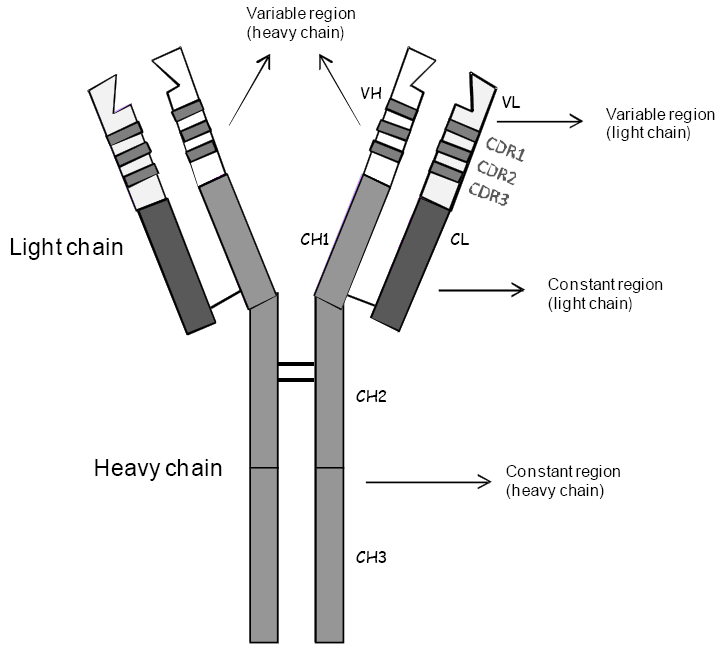
        <p>The idiotype (<xref ref-type="fig" rid="figure1">Figure 1</xref>) is defined as the collection of idiotopes, that is the collection of all epitopes solely found on the hypervariable regions of an immunoglobulin [<xref ref-type="bibr" rid="B10">10</xref>,<xref ref-type="bibr" rid="B11">11</xref>]. As such, the idiotype defines the clonality of each and every immunoglobulin, including those expressed by B-cell NHL [<xref ref-type="bibr" rid="B3">3</xref>]. As a consequence, most B-cell NHL clones feature a patient- and tumor-specific idiotype, which can be used as cancer vaccine antigen and targeted in a customized fashion [<xref ref-type="bibr" rid="B12">12</xref>]. So far, the most important idiotype vaccine trials have been conducted using soluble protein, idiotype-containing full immunoglobulins [<xref ref-type="bibr" rid="B3">3</xref>]. </p>
        <p>KLH is a natural and powerful immunogenic carrier extracted from the mollusk Megathura Crenulata and used in humans now for decades without any type of clinical or biological concern [<xref ref-type="bibr" rid="B13">13</xref>].</p>
        <p>GM-CSF is a hematopoietic growth factor that, besides stimulating myeloid cell maturation, is also known to attract dendritic cells at the site of an antigen injection (function not possessed by the more widely used alternative, that is G-CSF), and as such is commonly used as an immunologic adjuvant [<xref ref-type="bibr" rid="B14">14</xref>].</p>
      </sec>
      <sec>
        <title>Chemistry</title>
        <p>While a few clinical studies have already been conducted using recombinant idiotype vaccines [<xref ref-type="bibr" rid="B3">3</xref>], the hybridoma-based rescue of patient- and tumor-specific idiotypes relies on an entirely different methodology [<xref ref-type="bibr" rid="B3">3</xref>], certainly more tedious and far less straightforward [<xref ref-type="bibr" rid="B15">15</xref>,<xref ref-type="bibr" rid="B16">16</xref>] even when partly streamlined and automated through the development of cell growth instruments [<xref ref-type="bibr" rid="B17">17</xref>]. However, at the time of this writing hybridoma-derived idiotype vaccines have shown biological efficacy, clinical efficacy and clinical benefit in lymphoma patients, while the recombinant alternatives have shown only biological efficacy [<xref ref-type="bibr" rid="B3">3</xref>].</p>
        <fig id="figure1" position="float">
          <label>Figure 1</label>
          <caption>
            <p>Schematic representation of the structure of a monomeric immunoglobulin. The collection of idiotopes termed idiotype is located within both heavy and light chain variable regions. VH: heavy chain variable region; VL: light chain variable region; CH: heavy chain constant region; CL: light chain constant region; CDR: complementarity-determining region.</p>
          </caption>
          <graphic xmlns:xlink="http://www.w3.org/1999/xlink" xlink:href="pharmaceuticals-03-00667-g001.tif" scale="0"/>
        </fig>
        <p>As opposed to recombinant idiotypes, which are mounted on a shared, tumor- and potentially isotype-unrelated immunoglobulin heavy chain scaffold [<xref ref-type="bibr" rid="B3">3</xref>], hybridoma-methodology allows the reproduction in the lab of the original and unique, idiotype-containing tumor immunoglobulin [<xref ref-type="bibr" rid="B3">3</xref>]. In neither version of the tumor-specific idiotype, however, it is possible to reproduce the same idiotype glycosylation [<xref ref-type="bibr" rid="B18">18</xref>,<xref ref-type="bibr" rid="B19">19</xref>,<xref ref-type="bibr" rid="B20">20</xref>] pattern as it is present on the idiotype expressed on the surface of the lymphoma cell [<xref ref-type="bibr" rid="B3">3</xref>]. It is not fully known whether these types of difference may affect the immunogenicity of an idiotype vaccine and/or the relevance of a vaccine-induced immune response to the tumor antigen actually expressed on the tumor cell membrane. The limited data available in this respect seem to confirm that they do not [<xref ref-type="bibr" rid="B3">3</xref>], but further research is certainly warranted.</p>
        <p>Once the tumor-specific idiotype has been reproduced, it is subjected to conjugation with KLH through the use of either glutharaldeide or maleimide [<xref ref-type="bibr" rid="B3">3</xref>]. So far, only the former has been employed for the development of clinical grade idiotype vaccines to be used in clinical trials. GM-CSF is administered separately subcutaneously over few days at the same site where the idiotype-KLH conjugate has been also administered subcutaneously on the first day of the vaccination cycle [<xref ref-type="bibr" rid="B3">3</xref>].</p>
      </sec>
      <sec>
        <title>Pharmacodynamics</title>
        <p>Typically, idiotype vaccines are administered at a dose of 1 mg (0.5 mg of idiotype conjugated with 0.5 mg of KLH) on day 0 of each vaccination cycle, while GM-CSF is administered together with the vaccine at a dose which may vary from trial to trial [<xref ref-type="bibr" rid="B3">3</xref>]. The frequency and duration of these vaccination cycles may also vary from trial to trial [<xref ref-type="bibr" rid="B3">3</xref>], sometimes even constantly over several years [<xref ref-type="bibr" rid="B7">7</xref>].</p>
        <p>As discussed elsewhere [<xref ref-type="bibr" rid="B7">7</xref>], an idiotype vaccine for lymphoma is not a drug in its common definition. It is rather a customized pharmacological agent meant to do per se little or nothing to both normal and tumor cells. The sole purpose of its combination of ingredients is that of eliciting an idiotype-specific immune response possibly capable of eliminating the tumor cells of one patient at a time. Irrespective of whether such an ambitious goal is or is not achieved by this type of customized active immunotherapy, the side effects are absent or minimal, self-limiting and typically local, although mild flu-like symptoms have also been reported in a minority of patients as due to GM-CSF [<xref ref-type="bibr" rid="B7">7</xref>].</p>
      </sec>
      <sec>
        <title>Pharmacokinetics and Metabolism</title>
        <p>Similarly, the destine of any of the three proteins comprised in the vaccine formulation (idiotype, KLH and GM-CSF) is not expected to be different from that of any other vaccine protein administered subcutaneously, beginning with the uptake from professional antigen-presenting cells.</p>
        <p>It has to be noted that both the self/non-self and the danger model [<xref ref-type="bibr" rid="B21">21</xref>] seem to fall short in explaining the basic way of functioning of idiotype vaccines. The former because it does not explain why it is still possible to allure the immune system into recognizing a self antigen, the idiotype, as if it were non-self by simply conjugating it with a bona fide non-self antigen like KLH. The latter because, assuming that repeated administrations of idiotype-KLH (where KLH is supposed to represent the danger signal) are responsible for the circumvention of the self/non-self issue, then this strategy should work in all patients endowed with a relatively normal immune function. However, this is not the case, as a non-negligible fraction of such vaccinated patients still fails to develop an idiotype-specific immune response in spite of normally reacting to KLH [<xref ref-type="bibr" rid="B10">10</xref>,<xref ref-type="bibr" rid="B11">11</xref>].</p>
      </sec>
      <sec>
        <title>Clinical efficacy and benefit</title>
        <p>After showing biological efficacy [<xref ref-type="bibr" rid="B3">3</xref>] in several phase-I and -II studies over the last twenty years [<xref ref-type="bibr" rid="B22">22</xref>,<xref ref-type="bibr" rid="B23">23</xref>,<xref ref-type="bibr" rid="B24">24</xref>,<xref ref-type="bibr" rid="B25">25</xref>,<xref ref-type="bibr" rid="B26">26</xref>], hybridoma-derived idiotype vaccines have more recently shown also clinical efficacy [<xref ref-type="bibr" rid="B3">3</xref>] in a couple of phase-II trials [<xref ref-type="bibr" rid="B24">24</xref>,<xref ref-type="bibr" rid="B25">25</xref>] and even clinical benefit in a single phase-II trial [<xref ref-type="bibr" rid="B26">26</xref>]. In particular, it is now well established that most patients receiving a hybridoma-derived idiotype vaccine develop an idiotype-specific humoral and/or cellular immune response [<xref ref-type="bibr" rid="B22">22</xref>,<xref ref-type="bibr" rid="B23">23</xref>,<xref ref-type="bibr" rid="B24">24</xref>,<xref ref-type="bibr" rid="B25">25</xref>,<xref ref-type="bibr" rid="B26">26</xref>]. Moreover, these vaccine-induced, specific immune responses are often associated with the clearance <italic>in vivo</italic> [<xref ref-type="bibr" rid="B3">3</xref>] of tumor cells that had survived pre-vaccine chemotherapy [<xref ref-type="bibr" rid="B24">24</xref>,<xref ref-type="bibr" rid="B25">25</xref>]. Finally, a single study was designed to show that, contrary to the knowledge gathered over 50 years of clinical research in follicular lymphoma [<xref ref-type="bibr" rid="B27">27</xref>], immunization with a hybridoma-derived idiotype vaccine was capable of prolonging post-chemotherapy (without rituximab) second complete responses in FL patients well beyond its typical average duration (13 months), as well as beyond the duration of the post-chemotherapy (with/without rituximab) first complete response in each and every patient with a vaccine-induced, idiotype-specific immune response [<xref ref-type="bibr" rid="B26">26</xref>]. Indeed, 20/20 patients who developed such an immune response achieved this dual goal in a highly statistical fashion, while the 5/5 who did not develop such an immune response failed to achieve either result. Of course, this novel way to show clinical benefit of a customized type of active immunotherapy has raised some generic objections [<xref ref-type="bibr" rid="B28">28</xref>,<xref ref-type="bibr" rid="B29">29</xref>]. However, as discussed elsewhere [<xref ref-type="bibr" rid="B3">3</xref>,<xref ref-type="bibr" rid="B30">30</xref>], these criticisms cannot withstand a deeper and unbiased analysis of the actual clinical data.</p>
        <p>The only phase-III trial ever conducted to test hybridoma-derived idiotype vaccines [<xref ref-type="bibr" rid="B31">31</xref>] has recently failed to achieve its main clinical endpoint for reasons that are completely unrelated to the actual vaccine effectiveness [<xref ref-type="bibr" rid="B3">3</xref>]. Appropriately designed to offer either the customized, soluble protein, hybridoma-derived idiotype vaccine (BiovaxId<sup>TM</sup>, Biovest International, Inc.) or a placebo control only to follicular lymphoma patients in first complete response [<xref ref-type="bibr" rid="B3">3</xref>], this study did not include a sufficiently effective and popular pre-vaccine chemotherapy regimen [<xref ref-type="bibr" rid="B3">3</xref>]. As a consequence, and as predicted [<xref ref-type="bibr" rid="B32">32</xref>], it ultimately failed to both enroll enough patients and to achieve the highly statistical significance required in this particular context for regulatory approval of this type of customized active immunotherapy [<xref ref-type="bibr" rid="B3">3</xref>]. In particular (<xref ref-type="table" rid="table2">Table 2</xref>), the trial enrolled 234 patients instead of the planned 629 (later revised to 563), randomized 177 (but only 117 ever made it to receive either the experimental or the control product) instead of 375, actually provided at least one dosis of the idiotype vaccine to 76 instead of 250, and had only 41 instead of 125 receiving the control product [<xref ref-type="bibr" rid="B31">31</xref>,<xref ref-type="bibr" rid="B32">32</xref>,<xref ref-type="bibr" rid="B33">33</xref>].</p>
        <table-wrap id="table2" position="float"><object-id pub-id-type="pii">pharmaceuticals-03-00667_table2</object-id>
          <object-id pub-id-type="pii">pharmaceuticals-03-00667_table2</object-id>
          <label>Table 2</label>
          <caption>
            <p>Comparison between approval requirements and actual achievements of the phase-III randomized trial on BiovaxId<sup>TM</sup>. Legend: pts: patients; ITT: intent to treat; RFS: relapse-free survival.</p>
          </caption>
          <table>
            <thead>
              <tr>
                <th align="left" valign="middle">
                  <bold>Variable</bold>
                </th>
                <th align="left" valign="middle">
                  <bold>Planned</bold>
                </th>
                <th align="left" valign="middle">
                  <bold>Actual</bold>
                </th>
              </tr>
            </thead>
            <tbody>
              <tr>
                <td align="left" valign="middle">Accrual</td>
                <td align="left" valign="middle">629 (later revised to 563) pts</td>
                <td align="left" valign="middle">234 pts</td>
              </tr>
              <tr>
                <td align="left" valign="middle">Randomization</td>
                <td align="left" valign="middle">375 pts</td>
                <td align="left" valign="middle">177 (later reduced to 117 on a modified ITT basis) pts</td>
              </tr>
              <tr>
                <td align="left" valign="middle">Vaccinated (5 doses)</td>
                <td align="left" valign="middle">250 pts</td>
                <td align="left" valign="middle">76 pts (at least 1 dose)</td>
              </tr>
              <tr>
                <td align="left" valign="middle">Control product</td>
                <td align="left" valign="middle">125 pts</td>
                <td align="left" valign="middle">41 pts</td>
              </tr>
              <tr>
                <td align="left" valign="middle">Required statistical significance (difference in RFS)</td>
                <td align="left" valign="middle">p &lt; 0.01</td>
                <td align="left" valign="middle">p = 0.045</td>
              </tr>
            </tbody>
          </table>
        </table-wrap>
        <p>Notably, the vast majority of the 60 randomized patients who never had a chance to receive either treatment lost such an opportunity due to an early relapse [<xref ref-type="bibr" rid="B31">31</xref>]. Therefore, exactly 50% of all enrolled patients were unable to proceed with the crucial portion of the trial because pre-vaccine chemotherapy failed to induce or maintain a durable first complete response before vaccination could even start [<xref ref-type="bibr" rid="B3">3</xref>]. Since the data of this study have not yet been published in the peer-reviewed literature, it is impossible to ascertain how many patients actually completed the vaccination schedule and how many received fewer vaccinations than planned. In any case, the relapse-free survival of vaccinated patients was statistically significantly longer (p = 0.045) than that of patients who received the placebo control [<xref ref-type="bibr" rid="B31">31</xref>]. However, this statistical significance fell very short of the threshold of highly statistical significance (p, 0.01) previously established as necessary for regulatory approval, since no back-up trial had been planned [<xref ref-type="bibr" rid="B3">3</xref>].</p>
        <p>All in all, the data of this trial further support the notion of clinical benefit of idiotypic vaccination in follicular lymphoma [<xref ref-type="bibr" rid="B26">26</xref>]. However, given the important pitfalls accumulated throughout the several years during which the study remained open, they are unlikely to provide ground for regulatory approval [<xref ref-type="bibr" rid="B3">3</xref>]. After all, had the trial succeeded in enrolling all planned patients, statistical significance of the difference in relapse-free survival could have improved, disappeared or remained unchanged [<xref ref-type="bibr" rid="B30">30</xref>]</p>
      </sec>
      <sec>
        <title>Safety and Tolerability</title>
        <p>Several hundreds of patients have now being vaccinated with different types of recombinant and hybridoma-derived idiotype vaccine [<xref ref-type="bibr" rid="B3">3</xref>]. It is now clear that these products are very safe and tolerable, with negligible side effects even when administered periodically over several years [<xref ref-type="bibr" rid="B7">7</xref>].</p>
      </sec>
      <sec>
        <title>Regulatory affairs</title>
        <p>Recently, all three randomized clinical trials (<xref ref-type="table" rid="table3">Table 3</xref>) conducted to confirm clinical benefit of idiotypic vaccination in follicular lymphoma, that is the study described above and two other using recombinant vaccines, have failed to achieve their main endpoints [<xref ref-type="bibr" rid="B31">31</xref>,<xref ref-type="bibr" rid="B34">34</xref>,<xref ref-type="bibr" rid="B35">35</xref>]. These predicted [<xref ref-type="bibr" rid="B32">32</xref>] and unfortunate outcomes could be explained on the basis of so many pitfalls intrinsic to each single study design and conduction that, nevertheless, it is impossible to firmly conclude whether any or all of these different vaccines [<xref ref-type="bibr" rid="B3">3</xref>] are or are not effective products [<xref ref-type="bibr" rid="B3">3</xref>,<xref ref-type="bibr" rid="B32">32</xref>,<xref ref-type="bibr" rid="B33">33</xref>].</p>
        <table-wrap id="table3" position="float"><object-id pub-id-type="pii">pharmaceuticals-03-00667_table3</object-id>
          <object-id pub-id-type="pii">pharmaceuticals-03-00667_table3</object-id>
          <label>Table 3</label>
          <caption>
            <p>Main features of all randomized clinical trials on idiotypic vaccination. Legend: Legend: CR: complete response; PR: partial response; SD: stable disease; DFS: disease-free survival; TTP: time to progression; PFS: progression-free survival; ITT: intent to treat; n.s.: non-significant; CVP: cyclophosphamide, vincristine and prednisone; PACE: prednisone, doxorubicin, cyclophosphamide and etoposide.</p>
          </caption>
          <table>
            <thead>
              <tr>
                <th align="left" valign="middle">
                  <bold>Pre-Vaccine Therapy</bold>
                </th>
                <th align="left" valign="middle">
                  <bold>Patient Status Before Vaccination</bold>
                </th>
                <th align="left" valign="middle">
                  <bold>Accrual (planned / actual)</bold>
                </th>
                <th align="left" valign="middle">
                  <bold>Endpoint</bold>
                </th>
                <th align="left" valign="middle">
                  <bold>Results (required / obtained)</bold>
                </th>
                <th align="left" valign="middle">
                  <bold>Reference</bold>
                </th>
              </tr>
            </thead>
            <tbody>
              <tr>
                <td align="left" valign="middle">CVP (8 cycles)</td>
                <td align="left" valign="middle">First CR or PR</td>
                <td align="left" valign="middle">360 / 285</td>
                <td align="left" valign="middle">PFS</td>
                <td align="left" valign="middle">p &lt; 0.01 / p = n.s.</td>
                <td align="left" valign="middle">34</td>
              </tr>
              <tr>
                <td align="left" valign="middle">Rituximab (4 doses)</td>
                <td align="left" valign="middle">First CR or PR or SD</td>
                <td align="left" valign="middle">342 / 345</td>
                <td align="left" valign="middle">TTP</td>
                <td align="left" valign="middle">p &lt; 0.01 / p = n.s.</td>
                <td align="left" valign="middle">35</td>
              </tr>
              <tr>
                <td align="left" valign="middle">PACE (90% of pts) or Rituximab-CHOP (6 cycles)</td>
                <td align="left" valign="middle">First CR</td>
                <td align="left" valign="middle">375 / 117 (modified ITT)</td>
                <td align="left" valign="middle">DFS</td>
                <td align="left" valign="middle">p &lt; 0.01 / p = 0.045</td>
                <td align="left" valign="middle">31</td>
              </tr>
            </tbody>
          </table>
        </table-wrap>
        <p>Even more important, the very same concept of randomization as a viable and meaningful tool to assess clinical benefit of idiotypic vaccination or any other customized active immunotherapy requires deeper and less biased questioning [<xref ref-type="bibr" rid="B3">3</xref>]. In facts, contrary to standard randomized trials where all patients within a same treatment group receive indeed the same therapy, in this case this statement holds true only for the control arm [<xref ref-type="bibr" rid="B8">8</xref>]. In the experimental arm, each and every patient receives a unique, different and differently immunogenic product, which is per se inactive against the tumor while supposed to stimulate a unique and different immune system that is in itself intrinsically prone to be more or less different at the time of each and every immunization [<xref ref-type="bibr" rid="B3">3</xref>]. In a sense, idiotypic vaccination, like any other customized active immunotherapy, challenges us with the ultimate “customized setting”, in which nearly all major biological variables - treatment (the idiotype), effector system (every time the vaccine is administered) and disease (particularly in the case of the clinically very heterogeneous follicular lymphoma) - are truly customized, and as such, arguably impossible to be subjected to the rigid constrains of randomization. In these extreme conditions, even studies theoretically well designed [<xref ref-type="bibr" rid="B31">31</xref>] may be ultimately doomed to fail simply because clearly unfeasible [<xref ref-type="bibr" rid="B32">32</xref>].</p>
      </sec>
    </sec>
    <sec sec-type="conclusions">
      <title>Conclusions</title>
      <p>After showing biological efficacy, clinical efficacy and clinical benefit [<xref ref-type="bibr" rid="B3">3</xref>], a hybridoma-derived idiotype vaccine is likely to fail to obtain regulatory approval for marketing due to the fact that the sole large-scale clinical trial that aimed at such a goal failed to achieve its main endpoint. With the substantial limitations of an insufficient patient accrual and of a limited statistical significance, this study nevertheless confirms the conclusions of a previous report of clinical benefit associated with idiotypic vaccination in follicular lymphoma [<xref ref-type="bibr" rid="B26">26</xref>].</p>
      <p>The development of idiotype vaccines has temporarily come to an abrupt stalemate. Hybridoma methodology is unlikely to represent the basis for further testing of idiotypic vaccination in large scale clinical trials. Recombinant technology, in spite of the initial lack of success [<xref ref-type="bibr" rid="B34">34</xref>,<xref ref-type="bibr" rid="B35">35</xref>], may still provide ground for a renewed sense of hope for idiotype vaccines to be used in better designed and better conducted clinical trials [<xref ref-type="bibr" rid="B3">3</xref>]. In particular, new studies are being planned that employ recombinant idiotype proteins rapidly and effectively produced in plants [<xref ref-type="bibr" rid="B36">36</xref>]. Should these projects succeed, of course it would remain to be determined whether idiotypic vaccination may have a role in B-cell malignancies other than follicular lymphoma [<xref ref-type="bibr" rid="B37">37</xref>,<xref ref-type="bibr" rid="B38">38</xref>]. Most of these open questions might be answered over the next decade.</p>
      <p>All in all, in the subset of patients with lymphoma in which it works, idiotypic vaccination is meant to represent a virtually innocuous maintenance treatment to be used after tumor shrinkage achieved by other pre-vaccine treatments: some to be preferred because non heavily immune suppressive, others not to because of their associated long-lasting B- or T-cell depletion [<xref ref-type="bibr" rid="B3">3</xref>,<xref ref-type="bibr" rid="B6">6</xref>]. In the maintenance setting, a successful idiotype vaccine would have to minimally compete with the far more toxic interferon and, above all, with the far more popular (although not devoid of relevant long-term toxicity) rituximab [<xref ref-type="bibr" rid="B3">3</xref>,<xref ref-type="bibr" rid="B6">6</xref>].</p>
      <p>In most B-cell lymphoma, rituximab has shown best results when used in combination with standard chemotherapy in the first-line treatment, while its potential is clearly diminished upon re-usage at subsequent relapses [<xref ref-type="bibr" rid="B3">3</xref>,<xref ref-type="bibr" rid="B6">6</xref>]. Vice versa, idiotypic vaccination has shown its potential also in first relapse patients, provided that the subsequent pre-vaccine treatment was not accompanied by profound immune suppression. Therefore, should an idiotype vaccine make it to the market of indolent lymphoma, a potential long-term strategy might include both types of maintenance treatment at different time points. Alternatively, should the sequential use of rituximab (with or without chemotherapy) and idiotypic vaccination be considered within the same line of treatment, it might be important that, in the patients who do not experience an early relapse, substantial B-cell recovery be allowed before starting the latter procedure [<xref ref-type="bibr" rid="B3">3</xref>], although the evidence supporting this opinion is currently only indirect [<xref ref-type="bibr" rid="B35">35</xref>,<xref ref-type="bibr" rid="B37">37</xref>].</p>
      <p>A major logistical difference between active (vaccine) and passive (rituximab and other monoclonal antibodies) immunotherapy of B-cell malignancies is that the former has to be provided on a customized basis and requires adequate tumor sample handling to assure that the individualized vaccine is properly produced, while the other is already available on an off-the-shelf basis.</p>
      <p>Another aspect of idiotypic vaccination that will require further refinement is the way by which we assess and monitor vaccine-induced and idiotype-specific immune responses. Whether we refer to the arbitrary definitions of positive and negative humoral responses as measured by standard ELISA [<xref ref-type="bibr" rid="B30">30</xref>] or to the plethora of non-standardized methods used to document cellular responses [<xref ref-type="bibr" rid="B26">26</xref>], there is definitely room for conspicuous improvement.</p>
      <p>Notwithstanding all these hurdles still to be overcome by idiotypic vaccination, the push to make them available to the patients remains unwavering, particularly considering that, as opposed to virtually any other cancer treatment, when effective it has basically no side effects; and when ineffective also [<xref ref-type="bibr" rid="B3">3</xref>].</p>
    </sec>
  </body>
  <back>
    <ref-list>
      <ref id="B1">
        <citation citation-type="journal">
          <person-group person-group-type="author">
            <name>
              <surname>Jemal</surname>
              <given-names>A.</given-names>
            </name>
            <name>
              <surname>Siegel</surname>
              <given-names>R.</given-names>
            </name>
            <name>
              <surname>Ward</surname>
              <given-names>E</given-names>
            </name>
            <name>
              <surname>Hao</surname>
              <given-names>Y.</given-names>
            </name>
            <name>
              <surname>Xu</surname>
              <given-names>J.</given-names>
            </name>
            <name>
              <surname>Thun</surname>
              <given-names>M.J.</given-names>
            </name>
          </person-group>
          <article-title>Cancer statistics, 2009</article-title>
          <source>CA Cancer J. Clin.</source>
          <year>2009</year>
          <volume>59</volume>
          <fpage>225</fpage>
          <lpage>249</lpage>
          <pub-id pub-id-type="doi">10.3322/caac.20006</pub-id>
          <pub-id pub-id-type="pmid">19474385</pub-id>
        </citation>
      </ref>
      <ref id="B2">
        <citation citation-type="book">
          <person-group person-group-type="author">
            <name>
              <surname>Jaffe</surname>
              <given-names>E.S.</given-names>
            </name>
            <name>
              <surname>Harris</surname>
              <given-names>N.L.</given-names>
            </name>
            <name>
              <surname>Stein</surname>
              <given-names>H.</given-names>
            </name>
            <name>
              <surname>Campos</surname>
              <given-names>E.</given-names>
            </name>
            <name>
              <surname>Pileri</surname>
              <given-names>S.A.</given-names>
            </name>
            <name>
              <surname>Swerdlow</surname>
              <given-names>S.H.</given-names>
            </name>
          </person-group>
          <article-title>Introduction and overview of the classification of the lymphoid neoplasms</article-title>
          <source>WHO Classification of Tumours of Haematopoietic and Lymphoid Tissues</source>
          <edition>4th ed</edition>
          <person-group person-group-type="editor">
            <name>
              <surname>Swerdlow</surname>
              <given-names>S.H.</given-names>
            </name>
            <name>
              <surname>Campos</surname>
              <given-names>E.</given-names>
            </name>
            <name>
              <surname>Harris</surname>
              <given-names>N.L.</given-names>
            </name>
            <name>
              <surname>Jaffe</surname>
              <given-names>E.S.</given-names>
            </name>
            <name>
              <surname>Pileri</surname>
              <given-names>S.A.</given-names>
            </name>
            <name>
              <surname>Stein</surname>
              <given-names>H.</given-names>
            </name>
            <name>
              <surname>Thiele</surname>
              <given-names>J.</given-names>
            </name>
            <name>
              <surname>Vardiman</surname>
              <given-names>J.W.</given-names>
            </name>
          </person-group>
          <year>2008</year>
          <publisher-name>IARC Press</publisher-name>
          <publisher-loc>Lyon, France</publisher-loc>
        </citation>
      </ref>
      <ref id="B3">
        <citation citation-type="journal">
          <person-group person-group-type="author">
            <name>
              <surname>Bendandi</surname>
              <given-names>M.</given-names>
            </name>
          </person-group>
          <article-title>Idiotype vaccines for lymphoma: proof-of-principles and clinical trial failures</article-title>
          <source>Nat. Rev. Cancer</source>
          <year>2009</year>
          <volume>9</volume>
          <fpage>675</fpage>
          <lpage>681</lpage>
          <pub-id pub-id-type="doi">10.1038/nrc2717</pub-id>
        </citation>
      </ref>
      <ref id="B4">
        <citation citation-type="journal">
          <person-group person-group-type="author">
            <name>
              <surname>Bendandi</surname>
              <given-names>M.</given-names>
            </name>
          </person-group>
          <article-title>Anti-idiotype vaccines for human follicular lymphoma</article-title>
          <source>Leukemia</source>
          <year>2000</year>
          <volume>14</volume>
          <fpage>1333</fpage>
          <lpage>1339</lpage>
          <pub-id pub-id-type="doi">10.1038/sj.leu.2401861</pub-id>
          <pub-id pub-id-type="pmid">10942225</pub-id>
        </citation>
      </ref>
      <ref id="B5">
        <citation citation-type="journal">
          <person-group person-group-type="author">
            <name>
              <surname>Inogés</surname>
              <given-names>S.</given-names>
            </name>
            <name>
              <surname>Rodríguez-Calvillo</surname>
              <given-names>M.</given-names>
            </name>
            <name>
              <surname>López-Díaz de Cerio</surname>
              <given-names>A.</given-names>
            </name>
            <name>
              <surname>Zabalegui</surname>
              <given-names>N.</given-names>
            </name>
            <name>
              <surname>Pérez-Calvo</surname>
              <given-names>J.</given-names>
            </name>
            <name>
              <surname>Panizo</surname>
              <given-names>C.</given-names>
            </name>
            <name>
              <surname>Hernandez</surname>
              <given-names>M.</given-names>
            </name>
            <name>
              <surname>Cuesta</surname>
              <given-names>B.;Rocha</given-names>
            </name>
          </person-group>
          <article-title/>
          <source>Haematologica</source>
          <year>2003</year>
          <volume>88</volume>
          <fpage>1438</fpage>
          <lpage>1440</lpage>
          <supplement/>
          <pub-id pub-id-type="pmid">14688006</pub-id>
        </citation>
      </ref>
      <ref id="B6">
        <citation citation-type="journal">
          <person-group person-group-type="author">
            <name>
              <surname>Bendandi</surname>
              <given-names>M.</given-names>
            </name>
          </person-group>
          <article-title>Aiming at a curative strategy for follicular lymphoma</article-title>
          <source>CA Cancer J. Clin.</source>
          <year>2008</year>
          <volume>58</volume>
          <fpage>305</fpage>
          <lpage>317</lpage>
          <pub-id pub-id-type="doi">10.3322/CA.2008.0011</pub-id>
          <pub-id pub-id-type="pmid">18755938</pub-id>
        </citation>
      </ref>
      <ref id="B7">
        <citation citation-type="journal">
          <person-group person-group-type="author">
            <name>
              <surname>Inogés</surname>
              <given-names>S.</given-names>
            </name>
            <name>
              <surname>López-Díaz de Cerio</surname>
              <given-names>A.</given-names>
            </name>
            <name>
              <surname>Zabalegui</surname>
              <given-names>N.</given-names>
            </name>
            <name>
              <surname>Soria</surname>
              <given-names>E.</given-names>
            </name>
            <name>
              <surname>Villanueva</surname>
              <given-names>H.</given-names>
            </name>
            <name>
              <surname>Panizo</surname>
              <given-names>C.</given-names>
            </name>
            <name>
              <surname>Rodriguez-Caballero</surname>
              <given-names>A.</given-names>
            </name>
            <name>
              <surname>Suarez</surname>
              <given-names>L.</given-names>
            </name>
            <name>
              <surname>Pastor</surname>
              <given-names>F.</given-names>
            </name>
            <name>
              <surname>Rodriguez-Calvillo</surname>
              <given-names>M.</given-names>
            </name>
          </person-group>
          <article-title><italic>et al.</italic> Prolonged idiotypic vaccination against follicular lymphoma</article-title>
          <source>Leuk Lymphoma</source>
          <year>2009</year>
          <volume>50</volume>
          <fpage>47</fpage>
          <lpage>53</lpage>
          <pub-id pub-id-type="doi">10.1080/10428190802601122</pub-id>
          <pub-id pub-id-type="pmid">19152172</pub-id>
        </citation>
      </ref>
      <ref id="B8">
        <citation citation-type="journal">
          <person-group person-group-type="author">
            <name>
              <surname>Longo</surname>
              <given-names>D.L.</given-names>
            </name>
          </person-group>
          <article-title>Idiotype vaccination in follicular lymphoma: knocking on the doorway to cure</article-title>
          <source>J. Natl. Cancer Inst.</source>
          <year>2006</year>
          <volume>98</volume>
          <fpage>1263</fpage>
          <lpage>1265</lpage>
          <pub-id pub-id-type="doi">10.1093/jnci/djj371</pub-id>
          <pub-id pub-id-type="pmid">16985240</pub-id>
        </citation>
      </ref>
      <ref id="B9">
        <citation citation-type="journal">
          <person-group person-group-type="author">
            <name>
              <surname>Hagenbeek</surname>
              <given-names>A.</given-names>
            </name>
          </person-group>
          <article-title>Monoclonal antibodies (update): CD20, rituximab</article-title>
          <source>Hematol. Meeting Rep.</source>
          <year>2008</year>
          <volume>2</volume>
          <fpage>50</fpage>
          <lpage>51</lpage>
        </citation>
      </ref>
      <ref id="B10">
        <citation citation-type="journal">
          <person-group person-group-type="author">
            <name>
              <surname>Bendandi</surname>
              <given-names>M.</given-names>
            </name>
          </person-group>
          <article-title>Role of anti-idiotype vaccines in the modern treatment of human follicular lymphoma</article-title>
          <source>Expert. Rev. Anticancer Ther.</source>
          <year>2001</year>
          <volume>1</volume>
          <fpage>65</fpage>
          <lpage>72</lpage>
          <pub-id pub-id-type="doi">10.1586/14737140.1.1.65</pub-id>
        </citation>
      </ref>
      <ref id="B11">
        <citation citation-type="journal">
          <person-group person-group-type="author">
            <name>
              <surname>Bendandi</surname>
              <given-names>M.</given-names>
            </name>
          </person-group>
          <article-title>The role of idiotype vaccines in the treatment of human B-cell malignancies</article-title>
          <source>Expert. Rev. Vaccines</source>
          <year>2004</year>
          <volume>3</volume>
          <fpage>163</fpage>
          <lpage>170</lpage>
          <pub-id pub-id-type="doi">10.1586/14760584.3.2.163</pub-id>
          <pub-id pub-id-type="pmid">15056042</pub-id>
        </citation>
      </ref>
      <ref id="B12">
        <citation citation-type="journal">
          <person-group person-group-type="author">
            <name>
              <surname>de Cerio</surname>
              <given-names>A.L.</given-names>
            </name>
            <name>
              <surname>Zabalegui</surname>
              <given-names>N.</given-names>
            </name>
            <name>
              <surname>Rodríguez-Calvillo</surname>
              <given-names>M.</given-names>
            </name>
            <name>
              <surname>Inoges</surname>
              <given-names>S.</given-names>
            </name>
            <name>
              <surname>Bendandi</surname>
              <given-names>M.</given-names>
            </name>
          </person-group>
          <article-title>Anti-idiotype antibodies in cancer treatment</article-title>
          <source>Oncogene</source>
          <year>2007</year>
          <volume>26</volume>
          <fpage>3594</fpage>
          <lpage>3602</lpage>
          <pub-id pub-id-type="doi">10.1038/sj.onc.1210371</pub-id>
          <pub-id pub-id-type="pmid">17530013</pub-id>
        </citation>
      </ref>
      <ref id="B13">
        <citation citation-type="journal">
          <person-group person-group-type="author">
            <name>
              <surname>Harris</surname>
              <given-names>J.R.</given-names>
            </name>
            <name>
              <surname>Markl</surname>
              <given-names>J.</given-names>
            </name>
          </person-group>
          <article-title>Keyhole limpet hemocyanin: molecular structure of a potent marine immunoactivator</article-title>
          <source>A review. Eur. Urology</source>
          <year>2000</year>
          <volume>37</volume>
          <fpage>24</fpage>
          <lpage>33</lpage>
          <supplement>(Suppl. 3)</supplement>
          <pub-id pub-id-type="doi">10.1159/000052389</pub-id>
        </citation>
      </ref>
      <ref id="B14">
        <citation citation-type="journal">
          <person-group person-group-type="author">
            <name>
              <surname>Kwak</surname>
              <given-names>L.W.</given-names>
            </name>
            <name>
              <surname>Young</surname>
              <given-names>H.A.</given-names>
            </name>
            <name>
              <surname>Pennington</surname>
              <given-names>R.W.</given-names>
            </name>
            <name>
              <surname>Weeks</surname>
              <given-names>S.D.</given-names>
            </name>
          </person-group>
          <article-title>Vaccination with syngeneic, lymphoma-derived immunoglobulin idiotype combined with granulocyte/macrophage colony-stimulating factor primes mice for a protective T cell response</article-title>
          <source>Proc. Natl. Acad. Sci. USA</source>
          <year>1996</year>
          <volume>93</volume>
          <fpage>10972</fpage>
          <lpage>10977</lpage>
          <pub-id pub-id-type="doi">10.1073/pnas.93.20.10972</pub-id>
        </citation>
      </ref>
      <ref id="B15">
        <citation citation-type="journal">
          <person-group person-group-type="author">
            <name>
              <surname>Carroll</surname>
              <given-names>W.L.</given-names>
            </name>
            <name>
              <surname>Thielemans</surname>
              <given-names>K.</given-names>
            </name>
            <name>
              <surname>Dilley</surname>
              <given-names>J.</given-names>
            </name>
            <name>
              <surname>Levy</surname>
              <given-names>R.</given-names>
            </name>
          </person-group>
          <article-title>Mouse x human heterohybridomas as fusion partners with human B-cell tumors</article-title>
          <source>J. Immunol. Methods</source>
          <year>1986</year>
          <volume>89</volume>
          <fpage>61</fpage>
          <lpage>72</lpage>
          <pub-id pub-id-type="doi">10.1016/0022-1759(86)90032-3</pub-id>
          <pub-id pub-id-type="pmid">3084658</pub-id>
        </citation>
      </ref>
      <ref id="B16">
        <citation citation-type="journal">
          <person-group person-group-type="author">
            <name>
              <surname>Rodríguez-Calvillo</surname>
              <given-names>M.</given-names>
            </name>
            <name>
              <surname>Inogés</surname>
              <given-names>S.</given-names>
            </name>
            <name>
              <surname>López-Díaz de Cerio</surname>
              <given-names>A.</given-names>
            </name>
            <name>
              <surname>Zabalegui</surname>
              <given-names>N.</given-names>
            </name>
            <name>
              <surname>Villanueva</surname>
              <given-names>H.</given-names>
            </name>
            <name>
              <surname>Bendandi</surname>
              <given-names>M.</given-names>
            </name>
          </person-group>
          <article-title>Variations in “rescuability” of immunoglobulin molecules from different forms of human lymphoma: implications for antiidiotype vaccine development</article-title>
          <source>Crit. Rev. Oncol. Hematol.</source>
          <year>2004</year>
          <volume>52</volume>
          <fpage>1</fpage>
          <lpage>7</lpage>
          <pub-id pub-id-type="pmid">15363462</pub-id>
        </citation>
      </ref>
      <ref id="B17">
        <citation citation-type="web">
          <person-group person-group-type="author">
            <name>
              <surname>De Palma</surname>
              <given-names>A.</given-names>
            </name>
          </person-group>
          <article-title>Vaccine manufacturing reborn</article-title>
          <source>Pharmaceutical Manufacturing</source>
          <comment>Available online: <ext-link xmlns:xlink="http://www.w3.org/1999/xlink" xlink:href="http://www.pharmamanufacturing.com/articles/2007/051.html?page=full/" ext-link-type="uri">http://www.pharmamanufacturing.com/articles/2007/051.html?page=full/</ext-link></comment>
          <access-date>(accessed on March 12, 2007)</access-date>
          <year>2007</year>
        </citation>
      </ref>
      <ref id="B18">
        <citation citation-type="journal">
          <person-group person-group-type="author">
            <name>
              <surname>Zhu</surname>
              <given-names>D.</given-names>
            </name>
            <name>
              <surname>McCarthy</surname>
              <given-names>H.</given-names>
            </name>
            <name>
              <surname>Ottensmeier</surname>
              <given-names>C.H.</given-names>
            </name>
            <name>
              <surname>Johnson</surname>
              <given-names>P.</given-names>
            </name>
            <name>
              <surname>Hamblin</surname>
              <given-names>T.J.</given-names>
            </name>
            <name>
              <surname>Stevenson</surname>
              <given-names>F.K.</given-names>
            </name>
          </person-group>
          <article-title>Acquisition of potential N-glycosylation sites in the immunoglobulin variable region by somatic mutation is a distinctive feature of follicular lymphoma</article-title>
          <source>Blood</source>
          <year>2002</year>
          <volume>99</volume>
          <fpage>2562</fpage>
          <lpage>2568</lpage>
          <pub-id pub-id-type="doi">10.1182/blood.V99.7.2562</pub-id>
          <pub-id pub-id-type="pmid">11895794</pub-id>
        </citation>
      </ref>
      <ref id="B19">
        <citation citation-type="journal">
          <person-group person-group-type="author">
            <name>
              <surname>Zabalegui</surname>
              <given-names>N.</given-names>
            </name>
            <name>
              <surname>de Cerio</surname>
              <given-names>A.L.</given-names>
            </name>
            <name>
              <surname>Inogés</surname>
              <given-names>S.</given-names>
            </name>
            <name>
              <surname>Rodríguez-Calvillo</surname>
              <given-names>M.</given-names>
            </name>
            <name>
              <surname>Pérez-Calvo</surname>
              <given-names>J.</given-names>
            </name>
            <name>
              <surname>Hernández</surname>
              <given-names>M.</given-names>
            </name>
            <name>
              <surname>García-Foncillas</surname>
              <given-names>J.</given-names>
            </name>
            <name>
              <surname>Martín-Algarra</surname>
              <given-names>S.</given-names>
            </name>
            <name>
              <surname>Rocha</surname>
              <given-names>E.</given-names>
            </name>
            <name>
              <surname>Bendandi</surname>
              <given-names>M.</given-names>
            </name>
          </person-group>
          <article-title>Acquired potential N-glycosylation sites within the tumor-specific heavy chains of B-cell malignancies</article-title>
          <source>Haematologica</source>
          <year>2004</year>
          <volume>89</volume>
          <fpage>541</fpage>
          <lpage>546</lpage>
          <pub-id pub-id-type="pmid">15136216</pub-id>
        </citation>
      </ref>
      <ref id="B20">
        <citation citation-type="journal">
          <person-group person-group-type="author">
            <name>
              <surname>Radcliffe</surname>
              <given-names>C.M.</given-names>
            </name>
            <name>
              <surname>Arnold</surname>
              <given-names>J.N.</given-names>
            </name>
            <name>
              <surname>Suter</surname>
              <given-names>D.M.</given-names>
            </name>
            <name>
              <surname>Wormald</surname>
              <given-names>M.R.</given-names>
            </name>
            <name>
              <surname>Harvey</surname>
              <given-names>D.J.</given-names>
            </name>
            <name>
              <surname>Royle</surname>
              <given-names>L.</given-names>
            </name>
            <name>
              <surname>Mimura</surname>
              <given-names>Y.</given-names>
            </name>
            <name>
              <surname>Kimura</surname>
              <given-names>Y.</given-names>
            </name>
            <name>
              <surname>Sim</surname>
              <given-names>R.B.</given-names>
            </name>
            <name>
              <surname>Inogès</surname>
              <given-names>S.</given-names>
            </name>
          </person-group>
          <article-title><italic>et al.</italic> Human follicular lymphoma cells contain oligomannose glycans in the antigen-binding site of the B-cell receptor</article-title>
          <source>J. Biol. Chem.</source>
          <year>2007</year>
          <volume>282</volume>
          <fpage>7405</fpage>
          <lpage>7415</lpage>
          <pub-id pub-id-type="pmid">17197448</pub-id>
          <pub-id pub-id-type="doi">10.1074/jbc.M602690200</pub-id>
        </citation>
      </ref>
      <ref id="B21">
        <citation citation-type="journal">
          <person-group person-group-type="author">
            <name>
              <surname>Matzinger</surname>
              <given-names>P.</given-names>
            </name>
          </person-group>
          <article-title>The danger model: a renewed sense of self</article-title>
          <source>Science</source>
          <year>2002</year>
          <volume>296</volume>
          <fpage>301</fpage>
          <lpage>305</lpage>
          <pub-id pub-id-type="doi">10.1126/science.1071059</pub-id>
          <pub-id pub-id-type="pmid">11951032</pub-id>
        </citation>
      </ref>
      <ref id="B22">
        <citation citation-type="journal">
          <person-group person-group-type="author">
            <name>
              <surname>Kwak</surname>
              <given-names>L.W.</given-names>
            </name>
            <name>
              <surname>Campbell</surname>
              <given-names>M.J.</given-names>
            </name>
            <name>
              <surname>Czerwinski</surname>
              <given-names>D.K.</given-names>
            </name>
            <name>
              <surname>Hart</surname>
              <given-names>S.</given-names>
            </name>
            <name>
              <surname>Miller</surname>
              <given-names>R.A.</given-names>
            </name>
            <name>
              <surname>Levy</surname>
              <given-names>R.</given-names>
            </name>
          </person-group>
          <article-title>Induction of immune responses in patients with B-cell lymphoma against the surface-immunoglobulin idiotype expressed by their tumors</article-title>
          <source>N Engl. J. Med.</source>
          <year>1992</year>
          <volume>327</volume>
          <fpage>1209</fpage>
          <lpage>1215</lpage>
          <pub-id pub-id-type="pmid">1406793</pub-id>
          <pub-id pub-id-type="doi">10.1056/NEJM199210223271705</pub-id>
        </citation>
      </ref>
      <ref id="B23">
        <citation citation-type="journal">
          <person-group person-group-type="author">
            <name>
              <surname>Hsu</surname>
              <given-names>F.J.</given-names>
            </name>
            <name>
              <surname>Caspar</surname>
              <given-names>C.B.</given-names>
            </name>
            <name>
              <surname>Czerwinski</surname>
              <given-names>D.</given-names>
            </name>
            <name>
              <surname>Kwak</surname>
              <given-names>L.W.</given-names>
            </name>
            <name>
              <surname>Liles</surname>
              <given-names>T.M.</given-names>
            </name>
            <name>
              <surname>Syrengelas</surname>
              <given-names>A.</given-names>
            </name>
            <name>
              <surname>Taidi-Laskowski</surname>
              <given-names>B.</given-names>
            </name>
            <name>
              <surname>Levy</surname>
              <given-names>R.</given-names>
            </name>
          </person-group>
          <article-title>Tumor-specific idiotype vaccines in the treatment of patients with B-cell lymphoma—long-term results of a clinical trial</article-title>
          <source>Blood</source>
          <year>1997</year>
          <volume>89</volume>
          <fpage>3129</fpage>
          <lpage>3135</lpage>
          <pub-id pub-id-type="pmid">9129015</pub-id>
        </citation>
      </ref>
      <ref id="B24">
        <citation citation-type="journal">
          <person-group person-group-type="author">
            <name>
              <surname>Bendandi</surname>
              <given-names>M.</given-names>
            </name>
            <name>
              <surname>Gocke</surname>
              <given-names>C.D.</given-names>
            </name>
            <name>
              <surname>Kobrin</surname>
              <given-names>C.B.</given-names>
            </name>
            <name>
              <surname>Benko</surname>
              <given-names>F.A.</given-names>
            </name>
            <name>
              <surname>Sternas</surname>
              <given-names>L.A.</given-names>
            </name>
            <name>
              <surname>Pennington</surname>
              <given-names>R.</given-names>
            </name>
            <name>
              <surname>Watson</surname>
              <given-names>T.M.</given-names>
            </name>
            <name>
              <surname>Reynolds</surname>
              <given-names>C.W.</given-names>
            </name>
            <name>
              <surname>Gause</surname>
              <given-names>B.L.</given-names>
            </name>
            <name>
              <surname>Duffey</surname>
              <given-names>P.L.</given-names>
            </name>
          </person-group>
          <article-title><italic>et al.</italic> Complete molecular remissions induced by patient-specific vaccination plus granulocyte-monocyte colony-stimulating factor against lymphoma</article-title>
          <source>Nat. Med.</source>
          <year>1999</year>
          <volume>5</volume>
          <fpage>1171</fpage>
          <lpage>1177</lpage>
          <pub-id pub-id-type="pmid">10502821</pub-id>
          <pub-id pub-id-type="doi">10.1038/13928</pub-id>
        </citation>
      </ref>
      <ref id="B25">
        <citation citation-type="journal">
          <person-group person-group-type="author">
            <name>
              <surname>Barrios Y</surname>
              <given-names>Cabrera R</given-names>
            </name>
          </person-group>
          <article-title>Anti-idiotypic vaccination in the treatment of low-grade B-cell lymphoma</article-title>
          <source>Haematologica</source>
          <year>2002</year>
          <volume>87</volume>
          <fpage>400</fpage>
          <lpage>407</lpage>
          <pub-id pub-id-type="pmid">11940484</pub-id>
        </citation>
      </ref>
      <ref id="B26">
        <citation citation-type="journal">
          <person-group person-group-type="author">
            <name>
              <surname>Inogès</surname>
              <given-names>S.</given-names>
            </name>
            <name>
              <surname>Rodrìguez-Calvillo</surname>
              <given-names>M.</given-names>
            </name>
            <name>
              <surname>Zabalegui</surname>
              <given-names>N.</given-names>
            </name>
            <name>
              <surname>Lòpez-Dìaz de Cerio</surname>
              <given-names>A.</given-names>
            </name>
            <name>
              <surname>Villanueva</surname>
              <given-names>H.</given-names>
            </name>
            <name>
              <surname>Soria</surname>
              <given-names>E.</given-names>
            </name>
            <name>
              <surname>Suárez</surname>
              <given-names>L.</given-names>
            </name>
            <name>
              <surname>Rodríguez-Caballero</surname>
              <given-names>A.</given-names>
            </name>
            <name>
              <surname>Pastor</surname>
              <given-names>F.</given-names>
            </name>
            <name>
              <surname>García-Muñóz</surname>
              <given-names>R.</given-names>
            </name>
          </person-group>
          <article-title><italic>et al.</italic> Clinical benefit associated with idiotypic vaccination in patients with follicular lymphoma</article-title>
          <source>J. Natl. Cancer Inst.</source>
          <year>2006</year>
          <volume>98</volume>
          <fpage>1292</fpage>
          <lpage>1301</lpage>
          <pub-id pub-id-type="pmid">16985248</pub-id>
          <pub-id pub-id-type="doi">10.1093/jnci/djj358</pub-id>
        </citation>
      </ref>
      <ref id="B27">
        <citation citation-type="journal">
          <person-group person-group-type="author">
            <name>
              <surname>Longo</surname>
              <given-names>D.L.</given-names>
            </name>
          </person-group>
          <article-title>Idiotype vaccination in follicular lymphoma: knocking on the doorway to cure</article-title>
          <source>J. Natl. Cancer Inst.</source>
          <year>2006</year>
          <volume>98</volume>
          <fpage>1263</fpage>
          <lpage>1265</lpage>
          <pub-id pub-id-type="doi">10.1093/jnci/djj371</pub-id>
          <pub-id pub-id-type="pmid">16985240</pub-id>
        </citation>
      </ref>
      <ref id="B28">
        <citation citation-type="journal">
          <person-group person-group-type="author">
            <name>
              <surname>Houot</surname>
              <given-names>R.</given-names>
            </name>
          </person-group>
          <article-title>Vaccines for lymphomas: idiotype vaccines and beyond</article-title>
          <source>Blood Rev.</source>
          <year>2009</year>
          <volume>23</volume>
          <fpage>137</fpage>
          <lpage>142</lpage>
          <pub-id pub-id-type="doi">10.1016/j.blre.2008.09.001</pub-id>
          <pub-id pub-id-type="pmid">18951668</pub-id>
        </citation>
      </ref>
      <ref id="B29">
        <citation citation-type="book">
          <person-group person-group-type="author">
            <name>
              <surname>Foglietta</surname>
              <given-names>M.</given-names>
            </name>
            <name>
              <surname>Neelapu</surname>
              <given-names>S.S.</given-names>
            </name>
            <name>
              <surname>Kwak</surname>
              <given-names>L.W.</given-names>
            </name>
          </person-group>
          <article-title>Therapeutic vaccines for lymphoma: from bench to bedside</article-title>
          <source>ASCO 2009 Educational Book</source>
          <year>2009</year>
          <publisher-name>American Society of Clinical Oncology</publisher-name>
          <publisher-loc>Orlando, FL, USA</publisher-loc>
        </citation>
      </ref>
      <ref id="B30">
        <citation citation-type="journal">
          <person-group person-group-type="author">
            <name>
              <surname>Inogés</surname>
              <given-names>S.</given-names>
            </name>
            <name>
              <surname>López-Díaz de Cerio</surname>
              <given-names>A.</given-names>
            </name>
            <name>
              <surname>Soria</surname>
              <given-names>E.</given-names>
            </name>
            <name>
              <surname>Villanueva</surname>
              <given-names>H.</given-names>
            </name>
            <name>
              <surname>Pastor</surname>
              <given-names>F.</given-names>
            </name>
            <name>
              <surname>Bendandi</surname>
              <given-names>M.</given-names>
            </name>
          </person-group>
          <article-title>Idiotype vaccines for human B-cell malignancies</article-title>
          <source>Curr. Pharm. Design</source>
          <year>2010</year>
          <volume>16</volume>
          <fpage>300</fpage>
          <lpage>307</lpage>
          <pub-id pub-id-type="doi">10.2174/138161210790170111</pub-id>
        </citation>
      </ref>
      <ref id="B31">
        <citation citation-type="journal">
          <person-group person-group-type="author">
            <name>
              <surname>Schuster</surname>
              <given-names>S.J.</given-names>
            </name>
            <name>
              <surname>Neelapu</surname>
              <given-names>S.S.</given-names>
            </name>
            <name>
              <surname>Gause</surname>
              <given-names>B.L.</given-names>
            </name>
            <name>
              <surname>Muggia</surname>
              <given-names>F.M.</given-names>
            </name>
            <name>
              <surname>Gockerman</surname>
              <given-names>J.P.</given-names>
            </name>
            <name>
              <surname>Sotomayor</surname>
              <given-names>E.M.</given-names>
            </name>
            <name>
              <surname>Winter</surname>
              <given-names>J.N.</given-names>
            </name>
            <name>
              <surname>Flowers</surname>
              <given-names>C.R.</given-names>
            </name>
            <name>
              <surname>Stergiou</surname>
              <given-names>A.M.</given-names>
            </name>
            <name>
              <surname>Kwak</surname>
              <given-names>L.W.</given-names>
            </name>
          </person-group>
          <article-title>Idiotype vaccine therapy (BiovaxID) in follicular lymphoma in first complete remission: Phase III clinical trial results</article-title>
          <source>J. Clin. Oncol.</source>
          <year>2009</year>
          <volume>27</volume>
          <fpage>18s</fpage>
          <pub-id pub-id-type="doi">10.1200/JCO.2009.22.4626</pub-id>
        </citation>
      </ref>
      <ref id="B32">
        <citation citation-type="journal">
          <person-group person-group-type="author">
            <name>
              <surname>Bendandi</surname>
              <given-names>M.</given-names>
            </name>
          </person-group>
          <article-title>Clinical benefit of idiotype vaccines: too many trials for a clever demonstration?</article-title>
          <source>Rev. Recent Clin. Trials</source>
          <year>2006</year>
          <volume>1</volume>
          <fpage>67</fpage>
          <lpage>74</lpage>
          <pub-id pub-id-type="doi">10.2174/157488706775246120</pub-id>
        </citation>
      </ref>
      <ref id="B33">
        <citation citation-type="journal">
          <person-group person-group-type="author">
            <name>
              <surname>López-Díaz de Cerio</surname>
              <given-names>A.</given-names>
            </name>
          </person-group>
          <article-title>Future of idiotypic vaccination for B-cell lymphoma</article-title>
          <source>Expert Rev .Vaccines</source>
          <year>2009</year>
          <volume>8</volume>
          <fpage>43</fpage>
          <lpage>50</lpage>
          <pub-id pub-id-type="doi">10.1586/14760584.8.1.43</pub-id>
        </citation>
      </ref>
      <ref id="B34">
        <citation citation-type="journal">
          <person-group person-group-type="author">
            <name>
              <surname>Levy</surname>
              <given-names>R.</given-names>
            </name>
            <name>
              <surname>Robertson</surname>
              <given-names>M.J.</given-names>
            </name>
            <name>
              <surname>Ganjoo</surname>
              <given-names>K.</given-names>
            </name>
            <name>
              <surname>Leonard</surname>
              <given-names>J.</given-names>
            </name>
            <name>
              <surname>Vose</surname>
              <given-names>J.</given-names>
            </name>
            <name>
              <surname>Denney</surname>
              <given-names>D.J.</given-names>
            </name>
          </person-group>
          <article-title>Results of a Phase 3 trial evaluating safety and efficacy of specific immunotherapy, recombinant idiotype (Id) conjugated to KLH (Id-KLH)
with GM-CSF, compared with non-specific immunotherapy, KLH with GM-CSF, in patients with follicular non-Hodgkin’s lymphoma (fNHL)</article-title>
          <source>AACR Meeting Abstracts</source>
          <year>2008</year>
          <supplement>Abstract LB-204</supplement>
        </citation>
      </ref>
      <ref id="B35">
        <citation citation-type="journal">
          <person-group person-group-type="author">
            <name>
              <surname>Freedman</surname>
              <given-names>A.</given-names>
            </name>
            <name>
              <surname>Neelapu</surname>
              <given-names>S.S.</given-names>
            </name>
            <name>
              <surname>Nichols</surname>
              <given-names>C.</given-names>
            </name>
            <name>
              <surname>Robertson</surname>
              <given-names>M.J.</given-names>
            </name>
            <name>
              <surname>Djulbegovic</surname>
              <given-names>B.</given-names>
            </name>
            <name>
              <surname>Winter</surname>
              <given-names>J.N.</given-names>
            </name>
            <name>
              <surname>Bender</surname>
              <given-names>J.F.</given-names>
            </name>
            <name>
              <surname>Gold</surname>
              <given-names>D.P.</given-names>
            </name>
            <name>
              <surname>Ghalie</surname>
              <given-names>R.G.</given-names>
            </name>
            <name>
              <surname>Stewart</surname>
              <given-names>M.E.</given-names>
            </name>
          </person-group>
          <article-title><italic/><italic>et al.</italic> Placebo-Controlled Phase III Trial of Patient-Specific Immunotherapy With Mitumprotimut-T and Granulocyte-Macrophage
Colony-Stimulating Factor After Rituximab in Patients With Follicular Lymphoma</article-title>
          <source>J. Clin. Oncol.</source>
          <year>2009</year>
          <volume>27</volume>
          <fpage>3036</fpage>
          <lpage>3043</lpage>
          <pub-id pub-id-type="pmid">19414675</pub-id>
          <pub-id pub-id-type="doi">10.1200/JCO.2008.19.8903</pub-id>
        </citation>
      </ref>
      <ref id="B36">
        <citation citation-type="journal">
          <person-group person-group-type="author">
            <name>
              <surname>Bendandi</surname>
              <given-names>M.</given-names>
            </name>
            <name>
              <surname>Marillonnet</surname>
              <given-names>S.</given-names>
            </name>
            <name>
              <surname>Kandzia</surname>
              <given-names>R.</given-names>
            </name>
            <name>
              <surname>Thieme</surname>
              <given-names>F.</given-names>
            </name>
            <name>
              <surname>Nickstadt</surname>
              <given-names>A.</given-names>
            </name>
            <name>
              <surname>Herz</surname>
              <given-names>S.</given-names>
            </name>
            <name>
              <surname>Frode</surname>
              <given-names>R.</given-names>
            </name>
            <name>
              <surname>Inoges</surname>
              <given-names>S.</given-names>
            </name>
            <name>
              <surname>Lopez-Diaz de Cerio</surname>
              <given-names>A.</given-names>
            </name>
            <name>
              <surname>Soria</surname>
              <given-names>E.</given-names>
            </name>
          </person-group>
          <article-title><italic>et al.</italic> Rapid, high-yield production in plants of individualized idiotype vaccines for non-Hodgkin's lymphoma</article-title>
          <source>Ann. Onc.</source>
          <year>2010</year>
          <supplement>submitted</supplement>
        </citation>
      </ref>
      <ref id="B37">
        <citation citation-type="journal">
          <person-group person-group-type="author">
            <name>
              <surname>Neelapu</surname>
              <given-names>S.S.</given-names>
            </name>
            <name>
              <surname>Kwak</surname>
              <given-names>L.W.</given-names>
            </name>
            <name>
              <surname>Kobrin</surname>
              <given-names>C.B.</given-names>
            </name>
            <name>
              <surname>Reynolds</surname>
              <given-names>C.W.</given-names>
            </name>
            <name>
              <surname>Janik</surname>
              <given-names>J.E.</given-names>
            </name>
            <name>
              <surname>Dunleavy</surname>
              <given-names>K.</given-names>
            </name>
            <name>
              <surname>White</surname>
              <given-names>T.</given-names>
            </name>
            <name>
              <surname>Harvey</surname>
              <given-names>L.</given-names>
            </name>
            <name>
              <surname>Pennington</surname>
              <given-names>R.</given-names>
            </name>
            <name>
              <surname>Stetler-Stevenson</surname>
              <given-names>M.</given-names>
            </name>
          </person-group>
          <article-title><italic>et al.</italic> Vaccine-induced tumor-specific immunity despite severe B-cell depletion in mantle cell lymphoma</article-title>
          <source>Nat. Med.</source>
          <year>2005</year>
          <volume>11</volume>
          <fpage>986</fpage>
          <lpage>991</lpage>
          <pub-id pub-id-type="pmid">16116429</pub-id>
        </citation>
      </ref>
      <ref id="B38">
        <citation citation-type="journal">
          <person-group person-group-type="author">
            <name>
              <surname>Bendandi</surname>
              <given-names>M.</given-names>
            </name>
            <name>
              <surname>Rodríguez-Calvillo</surname>
              <given-names>M.</given-names>
            </name>
            <name>
              <surname>Inogés</surname>
              <given-names>S.</given-names>
            </name>
            <name>
              <surname>López-Díaz de Cerio</surname>
              <given-names>A.</given-names>
            </name>
            <name>
              <surname>Pérez-Simón</surname>
              <given-names>J.A.</given-names>
            </name>
            <name>
              <surname>Rodríguez-Caballero</surname>
              <given-names>A.</given-names>
            </name>
            <name>
              <surname>García-Montero</surname>
              <given-names>A.</given-names>
            </name>
            <name>
              <surname>Almeida</surname>
              <given-names>J.</given-names>
            </name>
            <name>
              <surname>Zabalegui</surname>
              <given-names>N.</given-names>
            </name>
            <name>
              <surname>Giraldo</surname>
              <given-names>P.</given-names>
            </name>
          </person-group>
          <article-title><italic>et al.</italic> Combined vaccination with idiotype-pulsed allogeneic dendritic cells and soluble protein idiotype for multiple myeloma
patients relapsing after reduced-intensity conditioning allogeneic stem cell transplantation</article-title>
          <source>Leuk. Lymphoma</source>
          <year>2006</year>
          <volume>47</volume>
          <fpage>29</fpage>
          <lpage>37</lpage>
          <pub-id pub-id-type="doi">10.1080/10428190500272473</pub-id>
          <pub-id pub-id-type="pmid">16321824</pub-id>
        </citation>
      </ref>
    </ref-list>
  </back>
</article>