<?xml version="1.0" encoding="UTF-8"?>
<!DOCTYPE article PUBLIC "-//NLM//DTD Journal Publishing DTD v2.3 20070202//EN" "journalpublishing.dtd">
<article xmlns:mml="http://www.w3.org/1998/Math/MathML" xmlns:xlink="http://www.w3.org/1999/xlink" xml:lang="en" article-type="research-article">
<front>
<journal-meta>
<journal-id journal-id-type="nlm-ta">Sensors</journal-id>
<journal-title>Sensors</journal-title>
<issn pub-type="epub">1424-8220</issn>
<publisher>
<publisher-name>Molecular Diversity Preservation International (MDPI)</publisher-name></publisher></journal-meta>
<article-meta>
<article-id pub-id-type="doi">10.3390/s90907509</article-id>
<article-id pub-id-type="publisher-id">sensors-09-07509</article-id>
<article-categories>
<subj-group>
<subject>Article</subject></subj-group></article-categories>
<title-group>
<article-title>A Wavelet Neural Network for SAR Image Segmentation</article-title></title-group>
<contrib-group>
<contrib contrib-type="author">
<name><surname>Wen</surname><given-names>Xian-Bin</given-names></name><xref ref-type="aff" rid="af1-sensors-09-07509"><sup>1</sup></xref><xref ref-type="aff" rid="af2-sensors-09-07509"><sup>2</sup></xref><xref ref-type="corresp" rid="c1-sensors-09-07509"><sup>*</sup></xref></contrib>
<contrib contrib-type="author">
<name><surname>Zhang</surname><given-names>Hua</given-names></name><xref ref-type="aff" rid="af1-sensors-09-07509"><sup>1</sup></xref><xref ref-type="aff" rid="af2-sensors-09-07509"><sup>2</sup></xref></contrib>
<contrib contrib-type="author">
<name><surname>Wang</surname><given-names>Fa-Yu</given-names></name><xref ref-type="aff" rid="af1-sensors-09-07509"><sup>1</sup></xref><xref ref-type="aff" rid="af2-sensors-09-07509"><sup>2</sup></xref></contrib></contrib-group>
<aff id="af1-sensors-09-07509">
<label>1</label> Key Laboratory of Computer Vision and System of Ministry of Education, Tianjin University of Technology, Tianjin 300191, China</aff>
<aff id="af2-sensors-09-07509">
<label>2</label> Tianjin Key Laboratory of Intelligence Computing and Novel Software Technology, Tianjin, 300191, China</aff>
<author-notes>
<corresp id="c1-sensors-09-07509">
<label>*</label>Author to whom correspondence should be addressed; E-Mail: <email>xbwen@tjut.edu.cn</email>; Tel.: +86-22-23679692; Fax: +86-22-23679351.</corresp></author-notes>
<pub-date pub-type="collection">
<year>2009</year></pub-date>
<pub-date pub-type="epub">
<day>22</day>
<month>9</month>
<year>2009</year></pub-date>
<volume>9</volume>
<issue>9</issue>
<fpage>7509</fpage>
<lpage>7515</lpage>
<history>
<date date-type="received">
<day>29</day>
<month>7</month>
<year>2009</year></date>
<date date-type="rev-recd">
<day>9</day>
<month>9</month>
<year>2009</year></date>
<date date-type="accepted">
<day>12</day>
<month>9</month>
<year>2009</year></date></history>
<permissions>
<copyright-statement>© 2009 by the authors; licensee MDPI, Basel, Switzerland</copyright-statement>
<copyright-year>2009</copyright-year>
<license>
<p>This article is an open access article distributed under the terms and conditions of the Creative Commons Attribution license (http://creativecommons.org/licenses/by/3.0/).</p></license></permissions>
<abstract>
<p>This paper proposes a wavelet neural network (WNN) for SAR image segmentation by combining the wavelet transform and an artificial neural network. The WNN combines the multiscale analysis ability of the wavelet transform and the classification capability of the artificial neural network by setting the wavelet function as the transfer function of the neural network. Several SAR images are segmented by the network whose transfer functions are the Morlet and Mexihat functions, respectively. The experimental results show the proposed method is very effective and accurate.</p></abstract>
<kwd-group>
<kwd>synthetic aperture radar</kwd>
<kwd>image segmentation</kwd>
<kwd>Wavelet Neural Network</kwd></kwd-group></article-meta></front>
<body>
<sec sec-type="intro">
<label>1.</label>
<title>Introduction</title>
<p>The synthetic aperture radar (SAR) system is a powerful tool for observing the Earth under all weather conditions. In recent years, SAR imaging has been rapidly gaining prominence in applications such as remote sensing, surface surveillance and automatic target recognition. Segmentation of SAR images is a critical preliminary operation in various SAR images processing applications, such as target detection, recognition, and image compression.</p>
<p>SAR images characteristically have a particular kind of noise, called speckle, which occurs by random interferences, either constructive or destructive, between electromagnetic waves from different reflections in the imaged area. This makes SAR segmentation a difficult task, though several different segmentation methods designed specifically for SAR images have been proposed. Three common methods are optical image segmentation after speckle filter, the multiscale method [<xref ref-type="bibr" rid="b1-sensors-09-07509">1</xref>–<xref ref-type="bibr" rid="b3-sensors-09-07509">3</xref>], and the neural networks method [<xref ref-type="bibr" rid="b4-sensors-09-07509">4</xref>,<xref ref-type="bibr" rid="b5-sensors-09-07509">5</xref>].</p>
<p>Artificial neural networks (ANNs) are a class of computational architectures that are composed of interconnected, simple processing nodes with weighted interconnections. Neural networks have proven to be a popular tool for knowledge extraction, pattern matching, and classification due to their capability of learning from examples with both linear and nonlinear relationships between the input and output signals. However, ANNs have limited ability to characterize local features, such as discontinuities in curvature, jumps in value or other edges, so these algorithma are not well suited for speckled SAR images. The wavelet transform, on the other hand, is efficient in representing and detecting local features in images due to the spatial and frequency localization properties of wavelet bases [<xref ref-type="bibr" rid="b6-sensors-09-07509">6</xref>]. With the detection of local features, an object can be easily recognized. Many new algorithms based on wavelet transform have been developed to solve SAR image segmentation problems [<xref ref-type="bibr" rid="b7-sensors-09-07509">7</xref>,<xref ref-type="bibr" rid="b8-sensors-09-07509">8</xref>]. However, the feature-matching of these algorithms have some shortcomings. In order to ensure the reliability of the matching results, they all require an enormous number of scales to construct the time-frequency features at various scales during the classification process. Each scale corresponds to convolving the signal with a wavelet function; hence a large number of convolutions are needed for these algorithms, which make them computationally inefficient.</p>
<p>In this paper, a wavelet neural network (WNN) method is proposed for SAR image segmentation, which takes full advantages of the partial-resolution characteristic of the wavelet transform and the nonlinear mapping behavior of artificial neural networks.</p>
<p>This paper is organized as follows. In the next section, we will describe quadtree interpretation of SAR imagery and its mixture multiscale autoregressive (MMAR) modeling. In Section 3, we will propose a hybrid method based on the GA algorithm and EM algorithm for the MMAR model. In Section 4, we will present the experimental results. In Section 5, we will present a short conclusion concerning our algorithm.</p></sec>
<sec>
<label>2.</label>
<title>Wavelet Transform</title>
<p>In signal analysis applications, it is necessary to extract signal features with Fourier transformation, but it is only a time domain transform, which has no time-frequency localization features. The theory of wavelet transformation was first proposed in the field of multi-resolution analysis; among others, it has been applied to image and signal processing. A continuous wavelet transform (CWT) can decompose a signal into a set of finite basis functions, which can uncover transient characteristics in the signal. Wavelet analysis is the breaking up of a signal into dilations and translation versions of the original wavelet, referred to as the mother wavelet. The wavelet must be oscillatory, have amplitudes that quickly decay to zero, and have at least one vanishing moment. Wavelet coefficients <italic>W<sub>x</sub></italic>(<italic>a</italic>, <italic>τ</italic>) are produced through the convolution of a mother wavelet function <italic>ψ</italic>(<italic>t</italic>) with the analyzed signal <italic>f</italic>(<italic>t</italic>), it is:
<disp-formula id="FD1">
<label>(1)</label>
<mml:math display="block">
<mml:mrow>
<mml:msub>
<mml:mi>W</mml:mi>
<mml:mi>x</mml:mi></mml:msub>
<mml:mo> </mml:mo>
<mml:mo stretchy="false">(</mml:mo>
<mml:mi>a</mml:mi>
<mml:mo>,</mml:mo>
<mml:mi>τ</mml:mi>
<mml:mo stretchy="false">)</mml:mo>
<mml:mo>=</mml:mo>
<mml:mfrac>
<mml:mn>1</mml:mn>
<mml:mrow>
<mml:msqrt>
<mml:mrow>
<mml:mrow>
<mml:mo stretchy="false">|</mml:mo>
<mml:mi>a</mml:mi>
<mml:mo stretchy="false">|</mml:mo></mml:mrow></mml:mrow></mml:msqrt></mml:mrow></mml:mfrac>
<mml:mo> </mml:mo>
<mml:mo>∫</mml:mo>
<mml:mo> </mml:mo>
<mml:mi>f</mml:mi>
<mml:mo stretchy="false">(</mml:mo>
<mml:mi>t</mml:mi>
<mml:mo stretchy="false">)</mml:mo>
<mml:mi>ψ</mml:mi>
<mml:mrow>
<mml:mo stretchy="false">(</mml:mo>
<mml:mrow>
<mml:mfrac>
<mml:mrow>
<mml:mi>t</mml:mi>
<mml:mo>−</mml:mo>
<mml:mi>τ</mml:mi></mml:mrow>
<mml:mi>a</mml:mi></mml:mfrac></mml:mrow>
<mml:mo stretchy="false">)</mml:mo></mml:mrow>
<mml:mi mathvariant="italic">dt</mml:mi></mml:mrow></mml:math></disp-formula>where <italic>a</italic> and <italic>τ</italic> denote the scale and local center of the analyzing wavelet. By adjusting the scale, <italic>a</italic>, a series of different frequency components in the signal can be obtained.</p>
<p>Several wavelet mother functions have been proposed in the wavelet theory. Each mother function has its suitable application. In this work, the wavelet employed is the Morlet Wavelet, due to its directional selectiveness capability of detecting oriented features, fine tuning to specific frequencies and its good localization in time and frequency [<xref ref-type="bibr" rid="b9-sensors-09-07509">9</xref>]. This is a sinusoidal signal modulated by a Gaussian wave. It is characterized for its narrow frequency response, which offers a higher spectral resolution than the Mexican Hat wavelet. This wavelet is particularly useful for filtering out the background noise of the images. In this paper, the Morlet wavelet is applied as:
<disp-formula id="FD2">
<label>(2)</label>
<mml:math display="block">
<mml:mrow>
<mml:msub>
<mml:mrow>
<mml:mi>ψ</mml:mi></mml:mrow>
<mml:mrow>
<mml:mi>a</mml:mi>
<mml:mo>,</mml:mo>
<mml:mi>τ</mml:mi></mml:mrow></mml:msub>
<mml:mo> </mml:mo>
<mml:mo stretchy="false">(</mml:mo>
<mml:mi>t</mml:mi>
<mml:mo stretchy="false">)</mml:mo>
<mml:mo>=</mml:mo>
<mml:msup>
<mml:mrow>
<mml:mi>e</mml:mi></mml:mrow>
<mml:mrow>
<mml:mo>−</mml:mo>
<mml:msubsup>
<mml:mi>t</mml:mi>
<mml:mi>i</mml:mi>
<mml:mn>2</mml:mn></mml:msubsup>
<mml:mo>/</mml:mo>
<mml:mn>2</mml:mn></mml:mrow></mml:msup>
<mml:mo> </mml:mo>
<mml:mtext>cos</mml:mtext>
<mml:mrow>
<mml:mo stretchy="false">(</mml:mo>
<mml:mrow>
<mml:mn>5</mml:mn>
<mml:msub>
<mml:mi>t</mml:mi>
<mml:mi>i</mml:mi></mml:msub></mml:mrow>
<mml:mo stretchy="false">)</mml:mo></mml:mrow></mml:mrow></mml:math></disp-formula>where 
<inline-formula>
<mml:math>
<mml:mrow>
<mml:msub>
<mml:mi>t</mml:mi>
<mml:mi>i</mml:mi></mml:msub>
<mml:mo>=</mml:mo>
<mml:mfrac>
<mml:mrow>
<mml:mi>t</mml:mi>
<mml:mo>−</mml:mo>
<mml:mi>τ</mml:mi></mml:mrow>
<mml:mi>a</mml:mi></mml:mfrac></mml:mrow></mml:math></inline-formula>.</p></sec>
<sec>
<label>3.</label>
<title>Wavelet Neural Network</title>
<sec>
<label>3.1.</label>
<title>Structure of Wavelet Neural Network</title>
<p>The reason for the application of WNN in case of such a problem as classification is that the feature extraction and representation properties of the wavelet transform are merged into the structure of the ANN to further extend the ability to approximate complicated patterns.</p>
<p>The WNN can be considered an expanded perceptron in which the neurons of the first layer are replaced by wavelet nodes [<xref ref-type="bibr" rid="b10-sensors-09-07509">10</xref>,<xref ref-type="bibr" rid="b11-sensors-09-07509">11</xref>]. The wavelet nodes allow the detection of the transient, as well as the extraction and selection of a small number of meaningful features; the obtained features are then regarded as inputs to the subsequent neurons used as a classifier.</p>
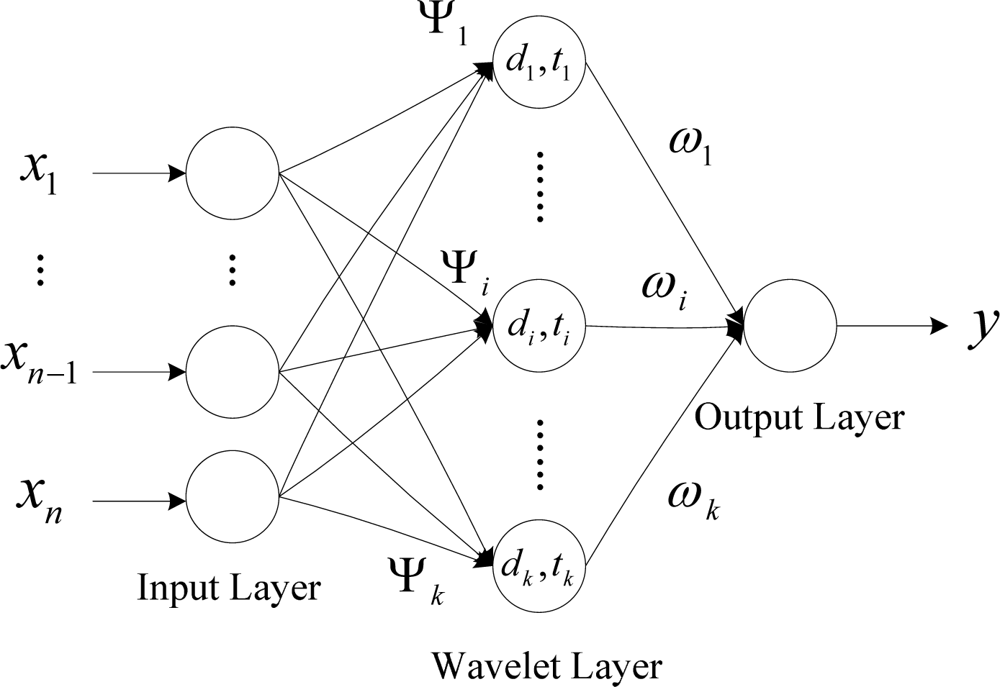
<p>The WNN employed in this paper is designed as a three-layer structure with an input layer, a wavelet layer, and an output layer. The topological structure of the WNN is illustrated in <xref ref-type="fig" rid="f1-sensors-09-07509">Figure 1</xref>. In this WNN model, the hidden neurons have wavelet activation functions of different resolutions and <italic>ω<sub>i</sub></italic> is the weight connecting the hidden layer and output layer. For an input vector <italic>x</italic> = [<italic>x</italic><sub>1</sub>, <italic>x</italic><sub>2</sub>, …., <italic>x</italic><sub>n</sub>], the output of the <italic>i</italic> th wavelet layer neuron is described as follows:
<disp-formula id="FD3">
<label>(3)</label>
<mml:math display="block">
<mml:mrow>
<mml:msub>
<mml:mrow>
<mml:mi>ψ</mml:mi></mml:mrow>
<mml:mi>k</mml:mi></mml:msub>
<mml:mo stretchy="false">(</mml:mo>
<mml:mi>x</mml:mi>
<mml:mo stretchy="false">)</mml:mo>
<mml:mo>=</mml:mo>
<mml:munderover>
<mml:mo>∑</mml:mo>
<mml:mrow>
<mml:mi>i</mml:mi>
<mml:mo>=</mml:mo>
<mml:mn>1</mml:mn></mml:mrow>
<mml:mi>n</mml:mi></mml:munderover>
<mml:mo> </mml:mo>
<mml:mtext>exp</mml:mtext>
<mml:mrow>
<mml:mo>(</mml:mo>
<mml:mrow>
<mml:mo>−</mml:mo>
<mml:mrow>
<mml:mrow>
<mml:msup>
<mml:mrow>
<mml:mrow>
<mml:mrow>
<mml:mo stretchy="false">(</mml:mo>
<mml:mrow>
<mml:mfrac>
<mml:mrow>
<mml:msub>
<mml:mi>x</mml:mi>
<mml:mi>i</mml:mi></mml:msub>
<mml:mo>−</mml:mo>
<mml:msub>
<mml:mi>d</mml:mi>
<mml:mi>k</mml:mi></mml:msub></mml:mrow>
<mml:mrow>
<mml:msub>
<mml:mi>t</mml:mi>
<mml:mi>k</mml:mi></mml:msub></mml:mrow></mml:mfrac></mml:mrow>
<mml:mo stretchy="false">)</mml:mo></mml:mrow></mml:mrow></mml:mrow>
<mml:mn>2</mml:mn></mml:msup></mml:mrow>
<mml:mo stretchy="true">/</mml:mo>
<mml:mn>2</mml:mn></mml:mrow></mml:mrow>
<mml:mo>)</mml:mo></mml:mrow>
<mml:mtext>cos</mml:mtext>
<mml:mrow>
<mml:mo stretchy="false">(</mml:mo>
<mml:mrow>
<mml:mn>5</mml:mn>
<mml:mo>⋅</mml:mo>
<mml:mfrac>
<mml:mrow>
<mml:msub>
<mml:mi>x</mml:mi>
<mml:mi>i</mml:mi></mml:msub>
<mml:mo>−</mml:mo>
<mml:msub>
<mml:mi>d</mml:mi>
<mml:mi>k</mml:mi></mml:msub></mml:mrow>
<mml:mrow>
<mml:msub>
<mml:mi>t</mml:mi>
<mml:mi>k</mml:mi></mml:msub></mml:mrow></mml:mfrac></mml:mrow>
<mml:mo stretchy="false">)</mml:mo></mml:mrow></mml:mrow></mml:math></disp-formula>where <italic>x<sub>i</sub></italic> is the <italic>i</italic> th input vector and <italic>k</italic> is the number of wavelet node. <italic>d<sub>k</sub></italic> and <italic>t<sub>k</sub></italic> are translation parameter and the dilation parameter, respectively.</p>
<p>The output of the third layer is the weighted sum of <italic>ψ<sub>k</sub></italic>(<italic>x</italic>)
<disp-formula id="FD4">
<label>(4)</label>
<mml:math display="block">
<mml:mrow>
<mml:mi>y</mml:mi>
<mml:mo stretchy="false">(</mml:mo>
<mml:mi>x</mml:mi>
<mml:mo stretchy="false">)</mml:mo>
<mml:mo>=</mml:mo>
<mml:munderover>
<mml:mo>∑</mml:mo>
<mml:mrow>
<mml:mi>m</mml:mi>
<mml:mo>=</mml:mo>
<mml:mn>1</mml:mn></mml:mrow>
<mml:mi>k</mml:mi></mml:munderover>
<mml:mo> </mml:mo>
<mml:msub>
<mml:mrow>
<mml:mi>ω</mml:mi></mml:mrow>
<mml:mi>m</mml:mi></mml:msub>
<mml:mo> </mml:mo>
<mml:msub>
<mml:mrow>
<mml:mi>ψ</mml:mi></mml:mrow>
<mml:mi>m</mml:mi></mml:msub>
<mml:mo stretchy="false">(</mml:mo>
<mml:mi>x</mml:mi>
<mml:mo stretchy="false">)</mml:mo></mml:mrow></mml:math></disp-formula></p></sec>
<sec>
<label>3.2.</label>
<title>Training of WNN</title>
<p>Wavelet network training consists of minimizing the usual least-squares cost function:
<disp-formula id="FD5">
<label>(5)</label>
<mml:math display="block">
<mml:mrow>
<mml:mi>E</mml:mi>
<mml:mo>=</mml:mo>
<mml:mfrac>
<mml:mn>1</mml:mn>
<mml:mn>2</mml:mn></mml:mfrac>
<mml:munderover>
<mml:mo>∑</mml:mo>
<mml:mrow>
<mml:mi>j</mml:mi>
<mml:mo>=</mml:mo>
<mml:mn>1</mml:mn></mml:mrow>
<mml:mi>s</mml:mi></mml:munderover>
<mml:mo> </mml:mo>
<mml:msup>
<mml:mrow>
<mml:mrow>
<mml:mrow>
<mml:mo stretchy="false">(</mml:mo>
<mml:mrow>
<mml:msub>
<mml:mi>y</mml:mi>
<mml:mi>j</mml:mi></mml:msub>
<mml:mo>−</mml:mo>
<mml:msub>
<mml:mi>o</mml:mi>
<mml:mi>j</mml:mi></mml:msub></mml:mrow>
<mml:mo stretchy="false">)</mml:mo></mml:mrow></mml:mrow></mml:mrow>
<mml:mn>2</mml:mn></mml:msup></mml:mrow></mml:math></disp-formula>where <italic>s</italic> is the number of training samples for each class and <italic>o<sub>j</sub></italic> is the optimal output of the <italic>j</italic> th input vector.</p>
<p>Due to the fact that wavelets are rapidly vanishing functions, a wavelet may be too local if its dilation parameter is too small and it may sit out of the domain of interest if the translation parameter is not chosen appropriately.</p>
<p>Therefore, it is inadvisable to initialize the dilations and translations randomly, as is usually the case for the weights of a standard neural network with sigmoid activation function. We use the following initialization procedure, setting.</p>
<p>The same value to dilation parameter <italic>d<sub>k</sub></italic> is given randomly at the beginning, and initializing the translation parameter <italic>t<sub>k</sub></italic> is as follows:
<disp-formula id="FD6">
<label>(6)</label>
<mml:math display="block">
<mml:mrow>
<mml:msub>
<mml:mi>t</mml:mi>
<mml:mi>k</mml:mi></mml:msub>
<mml:mo>=</mml:mo>
<mml:mo stretchy="false">(</mml:mo>
<mml:mi>k</mml:mi>
<mml:mo>×</mml:mo>
<mml:mi>s</mml:mi>
<mml:mo stretchy="false">)</mml:mo>
<mml:mo>/</mml:mo>
<mml:mi>K</mml:mi>
<mml:mo>,</mml:mo>
<mml:mo> </mml:mo>
<mml:mo> </mml:mo>
<mml:mo> </mml:mo>
<mml:mo> </mml:mo>
<mml:mo> </mml:mo>
<mml:mo> </mml:mo>
<mml:mi>k</mml:mi>
<mml:mo>=</mml:mo>
<mml:mn>0</mml:mn>
<mml:mo>,</mml:mo>
<mml:mn>1</mml:mn>
<mml:mo>,</mml:mo>
<mml:mn>2</mml:mn>
<mml:mo>⋯</mml:mo>
<mml:mi>K</mml:mi>
<mml:mo>−</mml:mo>
<mml:mn>1</mml:mn></mml:mrow></mml:math></disp-formula>where <italic>s</italic> is the number of training samples for each class and <italic>K</italic> is the number of nodes in the wavelet layer.</p>
<p>The partial derivative of parameters <italic>d</italic>, <italic>t</italic>, <italic>ω</italic> are as follows:
<disp-formula id="FD7">
<label>(7)</label>
<mml:math display="block">
<mml:mrow>
<mml:mtable columnalign="left">
<mml:mtr columnalign="left">
<mml:mtd columnalign="left">
<mml:mrow>
<mml:mfrac>
<mml:mrow>
<mml:mo>∂</mml:mo>
<mml:mi>E</mml:mi></mml:mrow>
<mml:mrow>
<mml:mo>∂</mml:mo>
<mml:msub>
<mml:mi>d</mml:mi>
<mml:mi>m</mml:mi></mml:msub></mml:mrow></mml:mfrac></mml:mrow></mml:mtd>
<mml:mtd columnalign="left">
<mml:mrow>
<mml:mo>=</mml:mo>
<mml:munderover>
<mml:mo>∑</mml:mo>
<mml:mrow>
<mml:mi>j</mml:mi>
<mml:mo>=</mml:mo>
<mml:mn>1</mml:mn></mml:mrow>
<mml:mi>s</mml:mi></mml:munderover>
<mml:mo> </mml:mo>
<mml:mn>2</mml:mn>
<mml:mrow>
<mml:mo stretchy="false">(</mml:mo>
<mml:mrow>
<mml:msub>
<mml:mi>y</mml:mi>
<mml:mi>j</mml:mi></mml:msub>
<mml:mo>−</mml:mo>
<mml:msub>
<mml:mi>o</mml:mi>
<mml:mi>j</mml:mi></mml:msub></mml:mrow>
<mml:mo stretchy="false">)</mml:mo></mml:mrow>
<mml:mo>⋅</mml:mo>
<mml:mrow>
<mml:mo>(</mml:mo>
<mml:mrow>
<mml:munderover>
<mml:mo>∑</mml:mo>
<mml:mrow>
<mml:mi>m</mml:mi>
<mml:mo>=</mml:mo>
<mml:mn>1</mml:mn></mml:mrow>
<mml:mi>k</mml:mi></mml:munderover>
<mml:mo> </mml:mo>
<mml:msub>
<mml:mrow>
<mml:mi>ω</mml:mi></mml:mrow>
<mml:mi>m</mml:mi></mml:msub>
<mml:mo> </mml:mo>
<mml:mtext>exp</mml:mtext>
<mml:mrow>
<mml:mo>(</mml:mo>
<mml:mrow>
<mml:mo>−</mml:mo>
<mml:mrow>
<mml:mrow>
<mml:msup>
<mml:mrow>
<mml:mrow>
<mml:mo stretchy="false">(</mml:mo>
<mml:mrow>
<mml:mfrac>
<mml:mrow>
<mml:mi>x</mml:mi>
<mml:mo>−</mml:mo>
<mml:msub>
<mml:mi>d</mml:mi>
<mml:mi>m</mml:mi></mml:msub></mml:mrow>
<mml:mrow>
<mml:msub>
<mml:mi>t</mml:mi>
<mml:mi>m</mml:mi></mml:msub></mml:mrow></mml:mfrac></mml:mrow>
<mml:mo stretchy="false">)</mml:mo></mml:mrow></mml:mrow>
<mml:mn>2</mml:mn></mml:msup></mml:mrow>
<mml:mo stretchy="true">/</mml:mo>
<mml:mn>2</mml:mn></mml:mrow></mml:mrow>
<mml:mo>)</mml:mo></mml:mrow>
<mml:mo> </mml:mo>
<mml:mrow>
<mml:mo>(</mml:mo>
<mml:mrow>
<mml:mrow>
<mml:mo stretchy="false">(</mml:mo>
<mml:mrow>
<mml:mfrac>
<mml:mrow>
<mml:mi>x</mml:mi>
<mml:mo>−</mml:mo>
<mml:msub>
<mml:mi>d</mml:mi>
<mml:mi>m</mml:mi></mml:msub></mml:mrow>
<mml:mrow>
<mml:msubsup>
<mml:mi>t</mml:mi>
<mml:mi>m</mml:mi>
<mml:mn>2</mml:mn></mml:msubsup></mml:mrow></mml:mfrac></mml:mrow>
<mml:mo stretchy="false">)</mml:mo></mml:mrow>
<mml:mo> </mml:mo>
<mml:mtext>cos</mml:mtext>
<mml:mrow>
<mml:mo stretchy="false">(</mml:mo>
<mml:mrow>
<mml:mn>5</mml:mn>
<mml:mo>⋅</mml:mo>
<mml:mfrac>
<mml:mrow>
<mml:mi>x</mml:mi>
<mml:mo>−</mml:mo>
<mml:msub>
<mml:mi>d</mml:mi>
<mml:mi>m</mml:mi></mml:msub></mml:mrow>
<mml:mrow>
<mml:msub>
<mml:mi>t</mml:mi>
<mml:mi>m</mml:mi></mml:msub></mml:mrow></mml:mfrac></mml:mrow>
<mml:mo stretchy="false">)</mml:mo></mml:mrow>
<mml:mo>+</mml:mo>
<mml:mfrac>
<mml:mn>5</mml:mn>
<mml:mrow>
<mml:msub>
<mml:mi>t</mml:mi>
<mml:mi>m</mml:mi></mml:msub></mml:mrow></mml:mfrac>
<mml:mtext>sin</mml:mtext>
<mml:mrow>
<mml:mo stretchy="false">(</mml:mo>
<mml:mrow>
<mml:mn>5</mml:mn>
<mml:mo>⋅</mml:mo>
<mml:mfrac>
<mml:mrow>
<mml:mi>x</mml:mi>
<mml:mo>−</mml:mo>
<mml:msub>
<mml:mi>d</mml:mi>
<mml:mi>m</mml:mi></mml:msub></mml:mrow>
<mml:mrow>
<mml:msub>
<mml:mi>t</mml:mi>
<mml:mi>m</mml:mi></mml:msub></mml:mrow></mml:mfrac></mml:mrow>
<mml:mo stretchy="false">)</mml:mo></mml:mrow></mml:mrow>
<mml:mo>)</mml:mo></mml:mrow></mml:mrow>
<mml:mo>)</mml:mo></mml:mrow></mml:mrow></mml:mtd></mml:mtr>
<mml:mtr columnalign="left">
<mml:mtd columnalign="left">
<mml:mrow/></mml:mtd>
<mml:mtd columnalign="left">
<mml:mrow>
<mml:mo>=</mml:mo>
<mml:munderover>
<mml:mo>∑</mml:mo>
<mml:mrow>
<mml:mi>j</mml:mi>
<mml:mo>=</mml:mo>
<mml:mn>1</mml:mn></mml:mrow>
<mml:mi>s</mml:mi></mml:munderover>
<mml:mo> </mml:mo>
<mml:mn>2</mml:mn>
<mml:mrow>
<mml:mo stretchy="false">(</mml:mo>
<mml:mrow>
<mml:msub>
<mml:mi>y</mml:mi>
<mml:mi>j</mml:mi></mml:msub>
<mml:mo>−</mml:mo>
<mml:msub>
<mml:mi>o</mml:mi>
<mml:mi>j</mml:mi></mml:msub></mml:mrow>
<mml:mo stretchy="false">)</mml:mo></mml:mrow>
<mml:mo>⋅</mml:mo>
<mml:mrow>
<mml:mo>(</mml:mo>
<mml:mrow>
<mml:munderover>
<mml:mo>∑</mml:mo>
<mml:mrow>
<mml:mi>m</mml:mi>
<mml:mo>=</mml:mo>
<mml:mn>1</mml:mn></mml:mrow>
<mml:mi>k</mml:mi></mml:munderover>
<mml:mo> </mml:mo>
<mml:msub>
<mml:mrow>
<mml:mi>ω</mml:mi></mml:mrow>
<mml:mi>m</mml:mi></mml:msub>
<mml:mo> </mml:mo>
<mml:mtext>exp</mml:mtext>
<mml:mrow>
<mml:mo stretchy="false">(</mml:mo>
<mml:mrow>
<mml:mo>−</mml:mo>
<mml:mfrac>
<mml:mrow>
<mml:msubsup>
<mml:mi>s</mml:mi>
<mml:mi>m</mml:mi>
<mml:mn>2</mml:mn></mml:msubsup></mml:mrow>
<mml:mn>2</mml:mn></mml:mfrac></mml:mrow>
<mml:mo stretchy="false">)</mml:mo></mml:mrow>
<mml:mo> </mml:mo>
<mml:mfrac>
<mml:mrow>
<mml:mrow>
<mml:mo stretchy="false">(</mml:mo>
<mml:mrow>
<mml:msub>
<mml:mi>s</mml:mi>
<mml:mi>m</mml:mi></mml:msub>
<mml:mo> </mml:mo>
<mml:mtext>cos</mml:mtext>
<mml:mrow>
<mml:mo stretchy="false">(</mml:mo>
<mml:mrow>
<mml:mn>5</mml:mn>
<mml:msub>
<mml:mi>s</mml:mi>
<mml:mi>m</mml:mi></mml:msub></mml:mrow>
<mml:mo stretchy="false">)</mml:mo></mml:mrow>
<mml:mo>+</mml:mo>
<mml:mn>5</mml:mn>
<mml:mo> </mml:mo>
<mml:mtext>sin</mml:mtext>
<mml:mrow>
<mml:mo stretchy="false">(</mml:mo>
<mml:mrow>
<mml:mn>5</mml:mn>
<mml:msub>
<mml:mi>s</mml:mi>
<mml:mi>m</mml:mi></mml:msub></mml:mrow>
<mml:mo stretchy="false">)</mml:mo></mml:mrow></mml:mrow>
<mml:mrow>
<mml:msub>
<mml:mi>t</mml:mi>
<mml:mi>m</mml:mi></mml:msub></mml:mrow></mml:mfrac></mml:mrow>
<mml:mo>)</mml:mo></mml:mrow></mml:mrow></mml:mtd></mml:mtr></mml:mtable></mml:mrow></mml:math></disp-formula>
<disp-formula id="FD8">
<label>(8)</label>
<mml:math display="block">
<mml:mrow>
<mml:mtable columnalign="left">
<mml:mtr columnalign="left">
<mml:mtd columnalign="left">
<mml:mrow>
<mml:mfrac>
<mml:mrow>
<mml:mo>∂</mml:mo>
<mml:mi>E</mml:mi></mml:mrow>
<mml:mrow>
<mml:mo>∂</mml:mo>
<mml:msub>
<mml:mi>t</mml:mi>
<mml:mi>m</mml:mi></mml:msub></mml:mrow></mml:mfrac></mml:mrow></mml:mtd>
<mml:mtd columnalign="left">
<mml:mrow>
<mml:mo>=</mml:mo>
<mml:munderover>
<mml:mo>∑</mml:mo>
<mml:mrow>
<mml:mi>j</mml:mi>
<mml:mo>=</mml:mo>
<mml:mn>1</mml:mn></mml:mrow>
<mml:mi>s</mml:mi></mml:munderover>
<mml:mo> </mml:mo>
<mml:mn>2</mml:mn>
<mml:mrow>
<mml:mo stretchy="false">(</mml:mo>
<mml:mrow>
<mml:msub>
<mml:mi>y</mml:mi>
<mml:mi>j</mml:mi></mml:msub>
<mml:mo>−</mml:mo>
<mml:msub>
<mml:mi>o</mml:mi>
<mml:mi>j</mml:mi></mml:msub></mml:mrow>
<mml:mo stretchy="false">)</mml:mo></mml:mrow>
<mml:mo>⋅</mml:mo>
<mml:mrow>
<mml:mo>(</mml:mo>
<mml:mrow>
<mml:munderover>
<mml:mo>∑</mml:mo>
<mml:mrow>
<mml:mi>m</mml:mi>
<mml:mo>=</mml:mo>
<mml:mn>1</mml:mn></mml:mrow>
<mml:mi>k</mml:mi></mml:munderover>
<mml:mo> </mml:mo>
<mml:msub>
<mml:mrow>
<mml:mi>ω</mml:mi></mml:mrow>
<mml:mi>m</mml:mi></mml:msub>
<mml:mo> </mml:mo>
<mml:mtext>exp</mml:mtext>
<mml:mrow>
<mml:mo>(</mml:mo>
<mml:mrow>
<mml:mo>−</mml:mo>
<mml:mrow>
<mml:mrow>
<mml:msup>
<mml:mrow>
<mml:mrow>
<mml:mrow>
<mml:mo stretchy="false">(</mml:mo>
<mml:mrow>
<mml:mfrac>
<mml:mrow>
<mml:mi>x</mml:mi>
<mml:mo>−</mml:mo>
<mml:msub>
<mml:mi>d</mml:mi>
<mml:mi>m</mml:mi></mml:msub></mml:mrow>
<mml:mrow>
<mml:msub>
<mml:mi>t</mml:mi>
<mml:mi>m</mml:mi></mml:msub></mml:mrow></mml:mfrac></mml:mrow>
<mml:mo stretchy="false">)</mml:mo></mml:mrow></mml:mrow></mml:mrow>
<mml:mn>2</mml:mn></mml:msup></mml:mrow>
<mml:mo stretchy="true">/</mml:mo>
<mml:mn>2</mml:mn></mml:mrow></mml:mrow>
<mml:mo>)</mml:mo></mml:mrow>
<mml:mo> </mml:mo>
<mml:mfrac>
<mml:mrow>
<mml:mi>x</mml:mi>
<mml:mo>−</mml:mo>
<mml:msub>
<mml:mi>d</mml:mi>
<mml:mi>m</mml:mi></mml:msub></mml:mrow>
<mml:mrow>
<mml:msubsup>
<mml:mi>t</mml:mi>
<mml:mi>m</mml:mi>
<mml:mn>2</mml:mn></mml:msubsup></mml:mrow></mml:mfrac>
<mml:mo> </mml:mo>
<mml:mrow>
<mml:mo>(</mml:mo>
<mml:mrow>
<mml:mfrac>
<mml:mrow>
<mml:mi>x</mml:mi>
<mml:mo>−</mml:mo>
<mml:msub>
<mml:mi>d</mml:mi>
<mml:mi>m</mml:mi></mml:msub></mml:mrow>
<mml:mrow>
<mml:msub>
<mml:mi>t</mml:mi>
<mml:mi>m</mml:mi></mml:msub></mml:mrow></mml:mfrac>
<mml:mo> </mml:mo>
<mml:mtext>cos</mml:mtext>
<mml:mo stretchy="false">(</mml:mo>
<mml:mn>5</mml:mn>
<mml:mo>⋅</mml:mo>
<mml:mfrac>
<mml:mrow>
<mml:mi>x</mml:mi>
<mml:mo>−</mml:mo>
<mml:msub>
<mml:mi>d</mml:mi>
<mml:mi>m</mml:mi></mml:msub></mml:mrow>
<mml:mrow>
<mml:msub>
<mml:mi>t</mml:mi>
<mml:mi>m</mml:mi></mml:msub></mml:mrow></mml:mfrac>
<mml:mo stretchy="false">)</mml:mo>
<mml:mo>+</mml:mo>
<mml:mn>5</mml:mn>
<mml:mtext>sin</mml:mtext>
<mml:mrow>
<mml:mo stretchy="false">(</mml:mo>
<mml:mrow>
<mml:mn>5</mml:mn>
<mml:mo>⋅</mml:mo>
<mml:mfrac>
<mml:mrow>
<mml:mi>x</mml:mi>
<mml:mo>−</mml:mo>
<mml:msub>
<mml:mi>d</mml:mi>
<mml:mi>m</mml:mi></mml:msub></mml:mrow>
<mml:mrow>
<mml:msub>
<mml:mi>t</mml:mi>
<mml:mi>m</mml:mi></mml:msub></mml:mrow></mml:mfrac></mml:mrow>
<mml:mo stretchy="false">)</mml:mo></mml:mrow></mml:mrow>
<mml:mo>)</mml:mo></mml:mrow></mml:mrow>
<mml:mo>)</mml:mo></mml:mrow></mml:mrow></mml:mtd></mml:mtr>
<mml:mtr columnalign="left">
<mml:mtd columnalign="left">
<mml:mrow/></mml:mtd>
<mml:mtd columnalign="left">
<mml:mrow>
<mml:mo>=</mml:mo>
<mml:munderover>
<mml:mo>∑</mml:mo>
<mml:mrow>
<mml:mi>j</mml:mi>
<mml:mo>=</mml:mo>
<mml:mn>1</mml:mn></mml:mrow>
<mml:mi>s</mml:mi></mml:munderover>
<mml:mo> </mml:mo>
<mml:mn>2</mml:mn>
<mml:mrow>
<mml:mo stretchy="false">(</mml:mo>
<mml:mrow>
<mml:msub>
<mml:mi>y</mml:mi>
<mml:mi>j</mml:mi></mml:msub>
<mml:mo>−</mml:mo>
<mml:msub>
<mml:mi>o</mml:mi>
<mml:mi>j</mml:mi></mml:msub></mml:mrow>
<mml:mo stretchy="false">)</mml:mo></mml:mrow>
<mml:mo>⋅</mml:mo>
<mml:mrow>
<mml:mo>(</mml:mo>
<mml:mrow>
<mml:munderover>
<mml:mo>∑</mml:mo>
<mml:mrow>
<mml:mi>m</mml:mi>
<mml:mo>=</mml:mo>
<mml:mn>1</mml:mn></mml:mrow>
<mml:mi>k</mml:mi></mml:munderover>
<mml:mo> </mml:mo>
<mml:msub>
<mml:mrow>
<mml:mi>ω</mml:mi></mml:mrow>
<mml:mi>m</mml:mi></mml:msub>
<mml:mo> </mml:mo>
<mml:mtext>exp</mml:mtext>
<mml:mrow>
<mml:mo stretchy="false">(</mml:mo>
<mml:mrow>
<mml:mo>−</mml:mo>
<mml:mfrac>
<mml:mrow>
<mml:msubsup>
<mml:mi>s</mml:mi>
<mml:mi>m</mml:mi>
<mml:mn>2</mml:mn></mml:msubsup></mml:mrow>
<mml:mn>2</mml:mn></mml:mfrac></mml:mrow>
<mml:mo stretchy="false">)</mml:mo></mml:mrow>
<mml:mo> </mml:mo>
<mml:mfrac>
<mml:mrow>
<mml:msub>
<mml:mi>s</mml:mi>
<mml:mi>m</mml:mi></mml:msub></mml:mrow>
<mml:mrow>
<mml:msub>
<mml:mi>t</mml:mi>
<mml:mi>m</mml:mi></mml:msub></mml:mrow></mml:mfrac>
<mml:mo> </mml:mo>
<mml:mrow>
<mml:mo stretchy="false">(</mml:mo>
<mml:mrow>
<mml:msub>
<mml:mi>s</mml:mi>
<mml:mi>m</mml:mi></mml:msub>
<mml:mo> </mml:mo>
<mml:mtext>cos</mml:mtext>
<mml:mrow>
<mml:mo stretchy="false">(</mml:mo>
<mml:mrow>
<mml:mn>5</mml:mn>
<mml:msub>
<mml:mi>s</mml:mi>
<mml:mi>m</mml:mi></mml:msub></mml:mrow>
<mml:mo stretchy="false">)</mml:mo></mml:mrow>
<mml:mo>+</mml:mo>
<mml:mn>5</mml:mn>
<mml:mtext>sin</mml:mtext>
<mml:mrow>
<mml:mo stretchy="false">(</mml:mo>
<mml:mrow>
<mml:mn>5</mml:mn>
<mml:msub>
<mml:mi>s</mml:mi>
<mml:mi>m</mml:mi></mml:msub></mml:mrow>
<mml:mo stretchy="false">)</mml:mo></mml:mrow></mml:mrow>
<mml:mo>)</mml:mo></mml:mrow></mml:mrow></mml:mtd></mml:mtr></mml:mtable></mml:mrow></mml:math></disp-formula>
<disp-formula id="FD9">
<label>(9)</label>
<mml:math display="block">
<mml:mrow>
<mml:mfrac>
<mml:mrow>
<mml:mo>∂</mml:mo>
<mml:mi>E</mml:mi></mml:mrow>
<mml:mrow>
<mml:mo>∂</mml:mo>
<mml:msub>
<mml:mrow>
<mml:mi>ω</mml:mi></mml:mrow>
<mml:mi>m</mml:mi></mml:msub></mml:mrow></mml:mfrac>
<mml:mo>=</mml:mo>
<mml:munderover>
<mml:mo>∑</mml:mo>
<mml:mrow>
<mml:mi>j</mml:mi>
<mml:mo>=</mml:mo>
<mml:mn>1</mml:mn></mml:mrow>
<mml:mi>s</mml:mi></mml:munderover>
<mml:mo> </mml:mo>
<mml:munderover>
<mml:mo>∑</mml:mo>
<mml:mrow>
<mml:mi>m</mml:mi>
<mml:mo>=</mml:mo>
<mml:mn>1</mml:mn></mml:mrow>
<mml:mi>k</mml:mi></mml:munderover>
<mml:mo> </mml:mo>
<mml:msub>
<mml:mrow>
<mml:mi>ψ</mml:mi></mml:mrow>
<mml:mi>m</mml:mi></mml:msub>
<mml:mo> </mml:mo>
<mml:mn>2</mml:mn>
<mml:mrow>
<mml:mo stretchy="false">(</mml:mo>
<mml:mrow>
<mml:msub>
<mml:mi>y</mml:mi>
<mml:mi>j</mml:mi></mml:msub>
<mml:mo>−</mml:mo>
<mml:msub>
<mml:mi>o</mml:mi>
<mml:mi>j</mml:mi></mml:msub></mml:mrow>
<mml:mo stretchy="false">)</mml:mo></mml:mrow></mml:mrow></mml:math></disp-formula>where 
<inline-formula>
<mml:math>
<mml:mrow>
<mml:msub>
<mml:mi>s</mml:mi>
<mml:mi>m</mml:mi></mml:msub>
<mml:mo>=</mml:mo>
<mml:mfrac>
<mml:mrow>
<mml:mi>x</mml:mi>
<mml:mo>−</mml:mo>
<mml:msub>
<mml:mi>d</mml:mi>
<mml:mi>m</mml:mi></mml:msub></mml:mrow>
<mml:mrow>
<mml:msub>
<mml:mi>t</mml:mi>
<mml:mi>m</mml:mi></mml:msub></mml:mrow></mml:mfrac></mml:mrow></mml:math></inline-formula></p>
<p>We adjust the parameters by the following equation:
<disp-formula id="FD10">
<label>(10)</label>
<mml:math display="block">
<mml:mrow>
<mml:msup>
<mml:mrow>
<mml:mi mathvariant="normal">Θ</mml:mi></mml:mrow>
<mml:mi>n</mml:mi></mml:msup>
<mml:mo>=</mml:mo>
<mml:msup>
<mml:mrow>
<mml:mi mathvariant="normal">Θ</mml:mi></mml:mrow>
<mml:mrow>
<mml:mi>n</mml:mi>
<mml:mo>−</mml:mo>
<mml:mn>1</mml:mn></mml:mrow></mml:msup>
<mml:mo>−</mml:mo>
<mml:mi>α</mml:mi>
<mml:mi mathvariant="normal">Δ</mml:mi>
<mml:mi mathvariant="normal">Θ</mml:mi></mml:mrow></mml:math></disp-formula>where Θ = (<italic>d</italic>,<italic>t</italic>,<italic>ω</italic>)<italic><sup>T</sup></italic> is vector of the parameters <italic>d</italic>, <italic>t</italic> and <italic>ω</italic>, <italic>a</italic> is learning rate between 0.1 and 0.9.</p></sec></sec>
<sec>
<label>4.</label>
<title>Experiments</title>
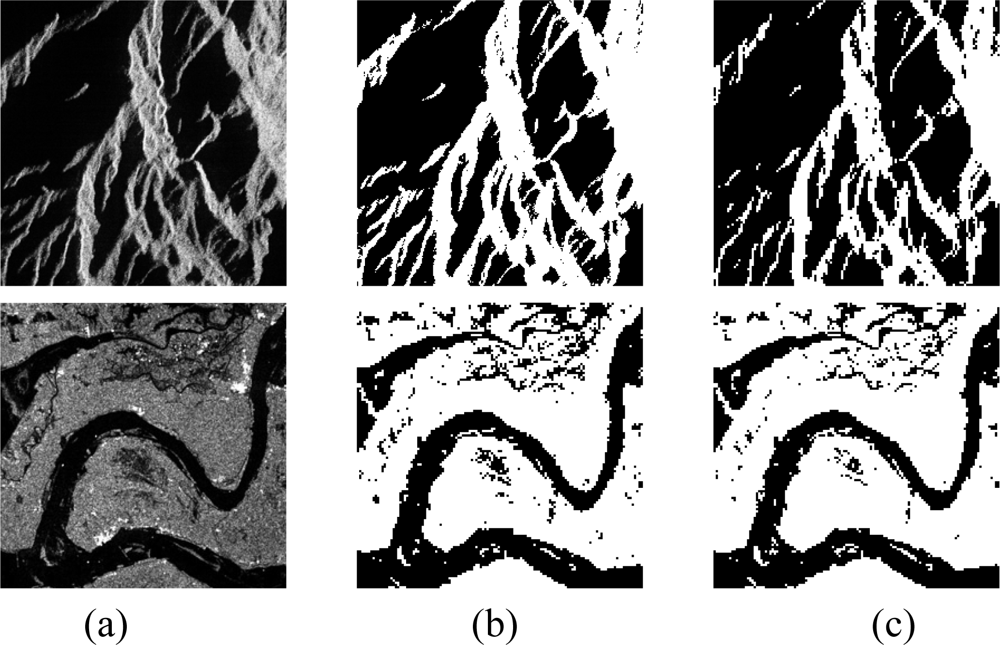
<p>We applied the proposed method to two SAR images sized 256 × 256 pixels [<xref ref-type="fig" rid="f2-sensors-09-07509">Figure 2(a)</xref>] to demonstrate the differences between the Morlet and Mexihat procedures; these images include two regions.</p>
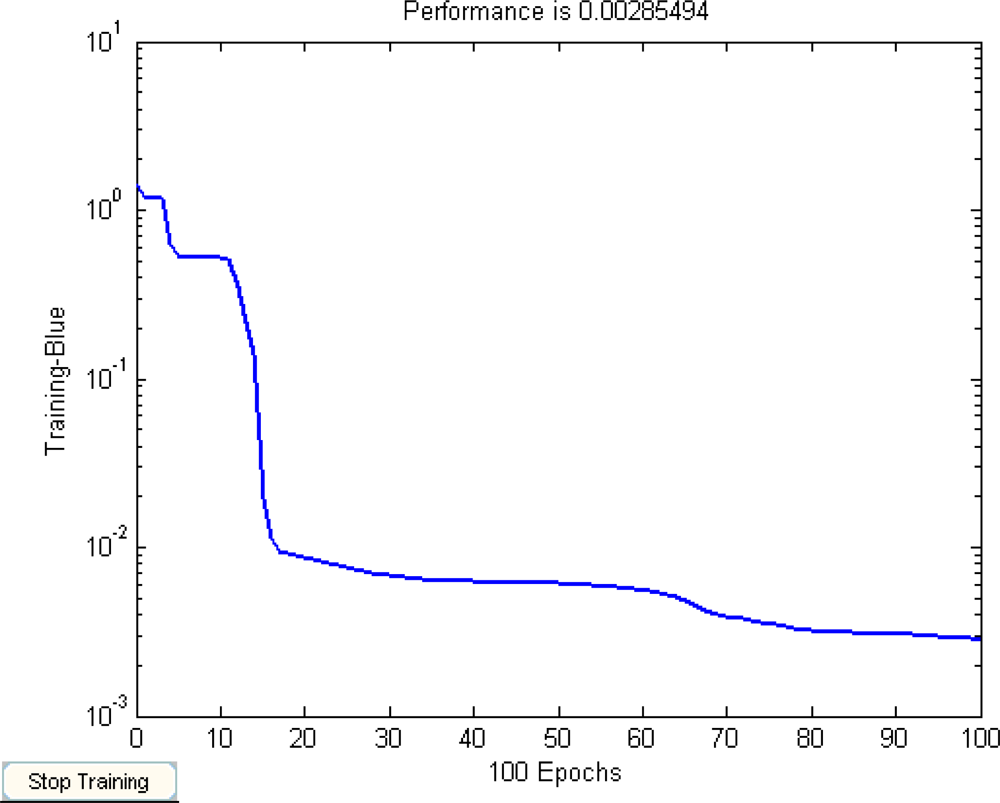
<p>First, about 100 samples were selected as the training data. In our experiment, the initial value of <italic>t<sub>k</sub></italic> is decided by <xref ref-type="disp-formula" rid="FD6">Equation (6)</xref><italic>d<sub>k</sub></italic> = 2, and <italic>ω</italic> is a random value between −0.5∼0.5. When the neuron number of the wavelet layer is 25, the segmentation results are best. The compared segmentation results are shown in <xref ref-type="fig" rid="f2-sensors-09-07509">Figure 2</xref>, with (b) showing the Mexihat Wavelet mother function as the transfer function of the second layer and (c) showing the Morlet Wavelet as the transfer function of the second layer. <xref ref-type="table" rid="t1-sensors-09-07509">Table 1</xref> is a comparison of the mean square of the above images. It shows that the accuracy ratio of the WNN using Morlet as the transfer function is higher than that of the WNN using Mexihat as the transfer function. <xref ref-type="fig" rid="f3-sensors-09-07509">Figure 3</xref> is the convergence curve of the WNN training algorithm, which shows the error is almost 10<sup>−2</sup> by the 25<sup>th</sup> iteration.</p></sec>
<sec sec-type="conclusions">
<label>5.</label>
<title>Conclusions</title>
<p>In this paper, an effective wavelet neural network for SAR image segmentation is proposed. The method not only has the feature of multiscale analysis, but also has a good performance in classification. Experimental results show that using Morlet as the transfer function is better than using Mexihat. WNN is an effective and accurate method for SAR image segmentation.</p></sec></body>
<back>
<ack>
<p>The authors would like to thank the anonymous reviewers for their detailed comments and questions which improved the quality of the presentation of this paper. This work is supported in part by the National Natural Science Foundation of China (No. 60872064 No. 60375003), the Tianjin Natural Science Foundation (08JCYBJC12300) (08JCYBJC12200), the Science Foundation of Tianjin University of Technology (2006BA15).</p></ack>
<ref-list>
<title>References</title>
<ref id="b1-sensors-09-07509"><label>1.</label><citation citation-type="journal"><person-group person-group-type="author"><name><surname>Chang</surname><given-names>C.M.</given-names></name><name><surname>Liu</surname><given-names>T.S.</given-names></name></person-group><article-title>A wavelet network control method for disk drives</article-title><source>IEEE Trans. Contr. Syst. Technol</source><year>2006</year><volume>14</volume><fpage>63</fpage><lpage>68</lpage><pub-id pub-id-type="doi">10.1109/TCST.2005.860523</pub-id></citation></ref>
<ref id="b2-sensors-09-07509"><label>2.</label><citation citation-type="journal"><person-group person-group-type="author"><name><surname>Lin</surname><given-names>C.H.</given-names></name><name><surname>Wang</surname><given-names>C.H.</given-names></name></person-group><article-title>Adaptive wavelet networks for power-quality detection and discrimination in a power system</article-title><source>IEEE Trans. Pow. Deliv</source><year>2006</year><volume>21</volume><fpage>1106</fpage><lpage>1113</lpage><pub-id pub-id-type="doi">10.1109/TPWRD.2006.874105</pub-id></citation></ref>
<ref id="b3-sensors-09-07509"><label>3.</label><citation citation-type="journal"><person-group person-group-type="author"><name><surname>Grimaldi</surname><given-names>D.</given-names></name></person-group><article-title>Time-of-flight measurement of ultrasonic pulse echoes using wavelet networks</article-title><source>IEEE Trans. Instrum. Meas</source><year>2006</year><volume>55</volume><fpage>5</fpage><lpage>13</lpage><pub-id pub-id-type="doi">10.1109/TIM.2005.862021</pub-id></citation></ref>
<ref id="b4-sensors-09-07509"><label>4.</label><citation citation-type="journal"><person-group person-group-type="author"><name><surname>Angrisani</surname><given-names>L.</given-names></name><name><surname>Daponte</surname><given-names>P.</given-names></name></person-group><article-title>wavelet network-based detection and classification of transients</article-title><source>IEEE Trans. Instrum. Meas</source><year>2001</year><volume>50</volume><fpage>1425</fpage><lpage>1435</lpage><pub-id pub-id-type="doi">10.1109/19.963220</pub-id></citation></ref>
<ref id="b5-sensors-09-07509"><label>5.</label><citation citation-type="journal"><person-group person-group-type="author"><name><surname>Subasi</surname><given-names>A.</given-names></name><name><surname>Alkan</surname><given-names>A.</given-names></name><name><surname>Koklukaya</surname><given-names>E.</given-names></name><name><surname>Kiymik</surname><given-names>M.K.</given-names></name></person-group><article-title>Wavelet neural network classification of EEG signals by using AR model with MLE preprocessing. Neural Network</article-title><source>IEEE Trans. Pattern Anal. Mach. Intel</source><year>2005</year><volume>18</volume><fpage>985</fpage><lpage>997</lpage></citation></ref>
<ref id="b6-sensors-09-07509"><label>6.</label><citation citation-type="journal"><person-group person-group-type="author"><name><surname>Mallat</surname><given-names>S.</given-names></name><name><surname>Hwang</surname><given-names>W.L.</given-names></name></person-group><article-title>Singularity detection and processing with wavelets</article-title><source>IEEE Trans. Inf. Theory</source><year>1992</year><volume>38</volume><fpage>617</fpage><lpage>643</lpage><pub-id pub-id-type="doi">10.1109/18.119727</pub-id></citation></ref>
<ref id="b7-sensors-09-07509"><label>7.</label><citation citation-type="journal"><person-group person-group-type="author"><name><surname>Grandi</surname><given-names>G.D.</given-names></name><name><surname>Lee</surname><given-names>J.S.</given-names></name><name><surname>Schuler</surname><given-names>D.L.</given-names></name></person-group><article-title>Target detection and texture segmentation in polarimetric SAR images using a wavelet frame: theoretical aspects</article-title><source>IEEE Trans. Geosci. Remote Sens</source><year>2007</year><volume>45</volume><fpage>3437</fpage><lpage>3453</lpage><pub-id pub-id-type="doi">10.1109/TGRS.2007.905103</pub-id></citation></ref>
<ref id="b8-sensors-09-07509"><label>8.</label><citation citation-type="journal"><person-group person-group-type="author"><name><surname>Bustamante</surname><given-names>I.T.</given-names></name><name><surname>Mata</surname><given-names>F.S.</given-names></name><name><surname>Gonzáleza</surname><given-names>N.H.</given-names></name><name><surname>Gazapoa</surname><given-names>R.G.</given-names></name><name><surname>Palaua</surname><given-names>J.</given-names></name><name><surname>Ferreirab</surname><given-names>M.M.C.</given-names></name></person-group><article-title>Application of chemometric tools for automatic classification and profile extraction of DNA samples in forensic tasks</article-title><source>Analyt. Chim. Acta</source><year>2007</year><volume>595</volume><fpage>43</fpage><lpage>50</lpage><pub-id pub-id-type="doi">10.1016/j.aca.2007.01.010</pub-id></citation></ref>
<ref id="b9-sensors-09-07509"><label>9.</label><citation citation-type="journal"><person-group person-group-type="author"><name><surname>Armande</surname><given-names>N.</given-names></name><name><surname>Montesinos</surname><given-names>P.</given-names></name></person-group><article-title>Thin nets and crest lines: Application to satellite data and medical images</article-title><source>Compu. Vis. Image Underst</source><year>1997</year><volume>67</volume><fpage>285</fpage><lpage>295</lpage><pub-id pub-id-type="doi">10.1006/cviu.1996.0507</pub-id></citation></ref>
<ref id="b10-sensors-09-07509"><label>10.</label><citation citation-type="journal"><person-group person-group-type="author"><name><surname>Zhang</surname><given-names>J.</given-names></name><name><surname>Walter</surname><given-names>G.</given-names></name><name><surname>Miao</surname><given-names>G.Y.</given-names></name><name><surname>Lee</surname><given-names>W.N.W.</given-names></name></person-group><article-title>Wavelet neural networks for function learning</article-title><source>IEEE Trans. Signal Processing</source><year>1995</year><volume>43</volume><fpage>1485</fpage><lpage>1497</lpage><pub-id pub-id-type="doi">10.1109/78.388860</pub-id></citation></ref>
<ref id="b11-sensors-09-07509"><label>11.</label><citation citation-type="journal"><person-group person-group-type="author"><name><surname>Delyon</surname><given-names>B.</given-names></name><name><surname>Juditsky</surname><given-names>A.</given-names></name><name><surname>Benveniste</surname><given-names>A.</given-names></name></person-group><article-title>Accuracy analysis for wavelet approximations</article-title><source>IEEE Trans. Neural Networks</source><year>1995</year><volume>6</volume><fpage>332</fpage><lpage>348</lpage><pub-id pub-id-type="doi">10.1109/72.363469</pub-id></citation></ref></ref-list>
<sec sec-type="display-objects">
<title>Figures and Table</title>
<fig id="f1-sensors-09-07509" position="float">
<label>Figure 1.</label>
<caption>
<p>Wavelet Neural Network Structure.</p></caption>
<graphic xlink:href="sensors-09-07509f1.gif"/></fig>
<fig id="f2-sensors-09-07509" position="float">
<label>Figure 2.</label>
<caption>
<p>(a) Original SAR image. (b) Segmented image obtained using WNN(Mexihat). (c) Segmented image obtained using WNN(Morlet).</p></caption>
<graphic xlink:href="sensors-09-07509f2.gif"/></fig>
<fig id="f3-sensors-09-07509" position="float">
<label>Figure 3.</label>
<caption>
<p>Convergence curve for WNN.</p></caption>
<graphic xlink:href="sensors-09-07509f3.gif"/></fig>
<table-wrap id="t1-sensors-09-07509" position="float">
<label>Table 1.</label>
<caption>
<p>Comparison of mean square of the WNN(Mexihat) and WNN(Morlet).</p></caption>
<table frame="hsides" rules="groups">
<thead>
<tr>
<th align="center" valign="middle"/>
<th align="center" valign="middle"><bold>WNN(Mexihat)</bold></th>
<th align="center" valign="middle"><bold>WNN(Motlet)</bold></th></tr></thead>
<tbody>
<tr>
<td align="left" valign="top"><xref ref-type="fig" rid="f2-sensors-09-07509">Figure 2</xref> (top)</td>
<td align="center" valign="top">26.256</td>
<td align="center" valign="top">21.0044</td></tr>
<tr>
<td align="left" valign="top"><xref ref-type="fig" rid="f2-sensors-09-07509">Figure 2</xref> (bottom)</td>
<td align="center" valign="top">83.69</td>
<td align="center" valign="top">66.406</td></tr></tbody></table></table-wrap></sec></back></article>