
<?xml version="1.0" encoding="UTF-8"?>
<!DOCTYPE article PUBLIC "-//NLM//DTD Journal Publishing DTD v2.3 20070202//EN" "journalpublishing.dtd">
<article xmlns:mml="http://www.w3.org/1998/Math/MathML" xmlns:xlink="http://www.w3.org/1999/xlink" xml:lang="en" article-type="research-article">
<front>
<journal-meta>
<journal-id journal-id-type="nlm-ta">Sensors</journal-id>
<journal-title>Sensors</journal-title>
<issn pub-type="epub">1424-8220</issn>
<publisher>
<publisher-name>Molecular Diversity Preservation International (MDPI)</publisher-name></publisher></journal-meta>
<article-meta>
<article-id pub-id-type="doi">10.3390/s90907412</article-id>
<article-id pub-id-type="publisher-id">sensors-09-07412</article-id>
<article-categories>
<subj-group>
<subject>Article</subject></subj-group></article-categories>
<title-group>
<article-title>A Real-Time Smart Sensor for High-Resolution Frequency Estimation in Power Systems</article-title></title-group>
<contrib-group>
<contrib contrib-type="author">
<name><surname>Granados-Lieberman</surname><given-names>David</given-names></name><xref ref-type="aff" rid="af1-sensors-09-07412"><sup>1</sup></xref></contrib>
<contrib contrib-type="author">
<name><surname>Romero-Troncoso</surname><given-names>Rene J.</given-names></name><xref ref-type="aff" rid="af1-sensors-09-07412"><sup>1</sup></xref></contrib>
<contrib contrib-type="author">
<name><surname>Cabal-Yepez</surname><given-names>Eduardo</given-names></name><xref ref-type="aff" rid="af1-sensors-09-07412"><sup>1</sup></xref><xref ref-type="corresp" rid="c1-sensors-09-07412"><sup>*</sup></xref></contrib>
<contrib contrib-type="author">
<name><surname>Osornio-Rios</surname><given-names>Roque A.</given-names></name><xref ref-type="aff" rid="af2-sensors-09-07412"><sup>2</sup></xref></contrib>
<contrib contrib-type="author">
<name><surname>Franco-Gasca</surname><given-names>Luis A.</given-names></name><xref ref-type="aff" rid="af3-sensors-09-07412"><sup>3</sup></xref></contrib></contrib-group>
<aff id="af1-sensors-09-07412">
<label>1</label> HSPdigital Research Group, División de Ingenierías, Campus Irapuato-Salamanca, Universidad de Guanajuato / Carr. Salamanca-Valle km 3.5+1.8, Comunidad de Palo Blanco, 36700 Salamanca, Guanajuato, Mexico; E-Mails: <email>granlieber@hspdigital.org</email> (D.G.-L.); <email>troncoso@hspdigital.org</email> (R.J.R.-T.)</aff>
<aff id="af2-sensors-09-07412">
<label>2</label> Facultad de Ingeniería, Campus San Juan del Río, Universidad Autónoma de Querétaro / Río Moctezuma 249, Col. San Cayetano, 76807 San Juan del Río, Querétaro, Mexico; E-Mail: <email>raosornio@hspdigital.org</email></aff>
<aff id="af3-sensors-09-07412">
<label>3</label> LabCASD, CIATEQ, Calz. del Retablo 150, Col. Fovissste, 76150 Querétaro, Qro., Mexico; E-Mail: <email>luis.franco@ciateq.mx</email></aff>
<author-notes>
<corresp id="c1-sensors-09-07412">
<label>*</label>Author to whom correspondence should be addressed; E-Mail: <email>ecabal@hspdigital.org</email>; Tel.: +52-464-647-9940; Fax: +52-464-647-9940.</corresp></author-notes>
<pub-date pub-type="collection">
<year>2009</year></pub-date>
<pub-date pub-type="epub">
<day>15</day>
<month>9</month>
<year>2009</year></pub-date>
<volume>9</volume>
<issue>9</issue>
<fpage>7412</fpage>
<lpage>7429</lpage>
<history>
<date date-type="received">
<day>2</day>
<month>7</month>
<year>2009</year></date>
<date date-type="rev-recd">
<day>9</day>
<month>9</month>
<year>2009</year></date>
<date date-type="accepted">
<day>14</day>
<month>9</month>
<year>2009</year></date></history>
<permissions>
<copyright-statement>© 2009 by the authors; licensee MDPI, Basel, Switzerland</copyright-statement>
<copyright-year>2009</copyright-year>
<license>
<p>This article is an open access article distributed under the terms and conditions of the Creative Commons Attribution license (http://creativecommons.org/licenses/by/3.0/).</p></license></permissions>
<abstract>
<p>Power quality monitoring is a theme in vogue and accurate frequency measurement of the power line is a major issue. This problem is particularly relevant for power generating systems since the generated signal must comply with restrictive standards. The novelty of this work is the development of a smart sensor for real-time high-resolution frequency measurement in accordance with international standards for power quality monitoring. The proposed smart sensor utilizes commercially available current clamp, hall-effect sensor or resistor as primary sensor. The signal processing is carried out through the chirp <italic>z</italic>-transform. Simulations and experimental results show the efficiency of the proposed smart sensor.</p></abstract>
<kwd-group>
<kwd>smart sensor</kwd>
<kwd>frequency estimation</kwd>
<kwd>chirp <italic>z</italic>-transform</kwd>
<kwd>high resolution</kwd>
<kwd>power systems</kwd></kwd-group></article-meta></front>
<body>
<sec sec-type="intro">
<label>1.</label>
<title>Introduction</title>
<p>Power quality monitoring is a theme in vogue and accurate frequency measurement of the power line is a major issue. This problem is particularly relevant for power generating systems as shown in the work of Xue and Yang [<xref ref-type="bibr" rid="b1-sensors-09-07412">1</xref>], since the generated signal must comply with restrictive international standards. The international standard CEI/IEC 61000-4-30 [<xref ref-type="bibr" rid="b2-sensors-09-07412">2</xref>] specifies that the frequency measurement for class-<italic>A</italic> performance power systems must be obtained every 10 s. the measurement time intervals shall be non-overlapping, and the measurement uncertainty shall not exceed ±0.01 Hz. This standard demands performance features that are not easily met by most commercially available measurement equipment, requiring expensive instrumentation systems to comply with specifications [<xref ref-type="bibr" rid="b3-sensors-09-07412">3</xref>]. Regardless of the cost, the measured frequency from these systems cannot be easily integrated into the power generation process to provide the feedback in order to accurately control the frequency at the output generated signal. Moreover, the output signal is generally embedded in noise, which increases the difficulty of the monitoring process within the required accuracy. Therefore, there is a clear need for a simple and inexpensive way to accurately measure the frequency of the line on power generating systems.</p>
<p>Accurate frequency detection of a periodic signal embedded in noise is a problem that has been largely studied for several applications. Many methodologies [<xref ref-type="bibr" rid="b4-sensors-09-07412">4</xref>–<xref ref-type="bibr" rid="b7-sensors-09-07412">7</xref>] have been proposed for tackling this problem, most of them relaying on Fast Fourier Transform (FFT) computation. Unfortunately, as it has been thoroughly shown, the FFT offers a fast processing engine, but its performance and resolution heavily depend on the signal-to-noise ratio (SNR) and the number of samples from the analyzed signal, jeopardizing its compliance on certain application requirements as those of frequency monitoring in power systems. Regarding this subject, Cheng and Fang [<xref ref-type="bibr" rid="b8-sensors-09-07412">8</xref>] presented a methodology for frequency measurement in power systems combining the FFT with a quadratic interpolation technique in order to improve its precision and resolution, obtaining accuracies of 99.74% with estimation errors around 0.1 and 0.2 Hz. Qing-Qiang <italic>et al.</italic> [<xref ref-type="bibr" rid="b9-sensors-09-07412">9</xref>] presented an algorithm for measuring frequency by sampling current signals utilizing rigorous mathematics, Newton iterative techniques, and Taylor series expansions, obtaining measurement errors around 1.0 Hz. López <italic>et al.</italic> [<xref ref-type="bibr" rid="b10-sensors-09-07412">10</xref>] proposed a methodology for power-system frequency measurement based on the monitoring of the voltage signal, applying statistical computations, and a weighting factor to prefiltered samples in order to reduce the estimation error, reaching uncertainties of 0.025 Hz and 0.035 Hz. Xue and Yang [<xref ref-type="bibr" rid="b1-sensors-09-07412">1</xref>] presented a supervised Gauss-Newton algorithm for power system frequency estimation applying a recursive discrete Fourier transform (DFT), a zero-crossing method, and an infinite-impulse response (IIR) filter, obtaining estimation errors around 0.1 Hz. Bellini <italic>et al</italic>. [<xref ref-type="bibr" rid="b11-sensors-09-07412">11</xref>] use the parameters of the Zoom-FFT algorithm to increases the frequency resolution, keeping constant the computational cost, for detecting rotor faults on induction motors; the obtained resolution applying this technique is 0.1 Hz. The chirp <italic>z</italic>-transform (CZT) has a higher frequency resolution than the FFT for the same number of input samples regardless SNR as shown in the works of Feng-Xiang <italic>et al.</italic> [<xref ref-type="bibr" rid="b12-sensors-09-07412">12</xref>], and Nguyen and Li [<xref ref-type="bibr" rid="b13-sensors-09-07412">13</xref>]. In [<xref ref-type="bibr" rid="b12-sensors-09-07412">12</xref>] an algorithm for accurate frequency estimation is proposed based on a recurrent CZT computation that narrows the frequency bandwidth at each iteration, until the desired resolution is reached. In [<xref ref-type="bibr" rid="b13-sensors-09-07412">13</xref>] a <italic>z</italic>-transform signal model combined with nonlinear postfiltering is proposed for estimating the operating frequency in a power system utilizing simulation studies. Unfortunately, the complexities in these methodologies difficult the real time and online frequency estimation in power systems, compromising the compliance of international standards. From the exposed above, it is evident the necessity for a frequency estimation methodology that combines real-time processing with high-resolution results. A promising approach to overcome the needs on performance and cost is the smart sensor, which utilizes a standard sensor and includes in its functionalities signal processing, communication, and integration capabilities. The term “smart sensor” is employed according to the functionality classification given by Rivera <italic>et al.</italic> [<xref ref-type="bibr" rid="b14-sensors-09-07412">14</xref>], from the definitions of the Institute of Electrical and Electronics Engineers [<xref ref-type="bibr" rid="b15-sensors-09-07412">15</xref>,<xref ref-type="bibr" rid="b16-sensors-09-07412">16</xref>].</p>
<p>The novelty of this work is the development of a smart sensor for real-time high-resolution frequency measurement, in accordance with the international standard CEI/IEC 61000-4-30 [<xref ref-type="bibr" rid="b2-sensors-09-07412">2</xref>] for power quality monitoring. The proposed smart sensor can utilize a commercially available current clamp, a hall-effect sensor or a resistor as primary sensor of the signal in which the frequency measurement is to be performed. Besides, the CZT that computes the power spectrum of the analyzed signal for the high-resolution frequency estimation is implemented into a low-cost field-programmable gate array (FPGA) with a processing time of 1.0078 s and readouts every 2 s. The CZT implemented algorithm is performed in the real domain, contrary to [<xref ref-type="bibr" rid="b12-sensors-09-07412">12</xref>], to achieve the desired processing time. Several cases of study, including simulations and experimental results, are presented to show the effectiveness and performance of the proposed smart sensor.</p></sec>
<sec>
<label>2.</label>
<title>Theoretical Background</title>
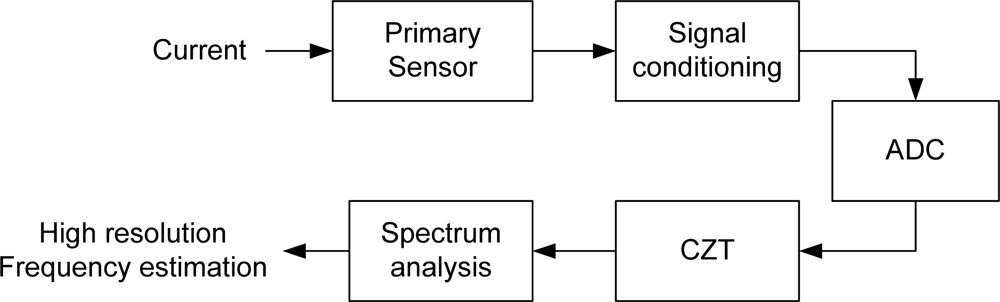
<p><xref ref-type="fig" rid="f1-sensors-09-07412">Figure 1</xref> shows the block diagram of the proposed smart sensor for frequency monitoring. The system uses a standard primary sensor (current clamp, hall-effect sensor or resistor) to measure the signal under analysis. Signal conditioning is then applied. Afterwards, the sensed signal is converted to digital in the analog-to-digital converter (ADC). The quantized information is then processed utilizing the CZT for obtaining a high-resolution frequency spectrum. Finally, the resulting spectrum is analyzed in order to determine the component with the highest magnitude that provides the signal frequency with the required resolution for meeting the standard demands.</p>
<sec>
<label>2.1.</label>
<title>Chirp-Z Transform</title>
<p>The CZT <italic>X(k)</italic> of an <italic>N</italic>-point sequence <italic>x(n)</italic> for <italic>n</italic> = 0, 1, 2, …, <italic>N−1</italic> is given by <xref ref-type="disp-formula" rid="FD1">Equation (1)</xref>. In <xref ref-type="disp-formula" rid="FD1">Equation (1)</xref>, <italic>X(k)</italic> allows computing the frequency contents of <italic>x(n)</italic>, sampled at a frequency rate of <italic>f<sub>s</sub></italic>, at a dense set of <italic>L</italic> frequencies in the range covered by the arc of the unit circle that begins at <italic>ω<sub>0</sub> = 2π f<sub>0</sub></italic> and ends at <italic>ω<sub>1</sub> = 2π f<sub>1</sub></italic> [<xref ref-type="bibr" rid="b17-sensors-09-07412">17</xref>]:
<disp-formula id="FD1">
<label>(1)</label>
<mml:math display="block">
<mml:mrow>
<mml:mi>X</mml:mi>
<mml:mo stretchy="false">(</mml:mo>
<mml:mi>k</mml:mi>
<mml:mo stretchy="false">)</mml:mo>
<mml:mo>=</mml:mo>
<mml:munderover>
<mml:mo>∑</mml:mo>
<mml:mrow>
<mml:mi>n</mml:mi>
<mml:mo>=</mml:mo>
<mml:mn>0</mml:mn></mml:mrow>
<mml:mrow>
<mml:mi>N</mml:mi>
<mml:mo>−</mml:mo>
<mml:mn>1</mml:mn></mml:mrow></mml:munderover>
<mml:mrow>
<mml:mi>x</mml:mi>
<mml:mo stretchy="false">(</mml:mo>
<mml:mi>n</mml:mi>
<mml:mo stretchy="false">)</mml:mo>
<mml:msubsup>
<mml:mi>Z</mml:mi>
<mml:mi>L</mml:mi>
<mml:mi mathvariant="italic">kn</mml:mi></mml:msubsup></mml:mrow></mml:mrow></mml:math></disp-formula></p>
<p>In <xref ref-type="disp-formula" rid="FD1">Equation (1)</xref> the transformation kernel 
<inline-formula>
<mml:math>
<mml:mrow>
<mml:msubsup>
<mml:mi>Z</mml:mi>
<mml:mi>L</mml:mi>
<mml:mi mathvariant="italic">kn</mml:mi></mml:msubsup></mml:mrow></mml:math></inline-formula> is given by (2).
<disp-formula id="FD2">
<label>(2)</label>
<mml:math display="block">
<mml:mrow>
<mml:msubsup>
<mml:mi>Z</mml:mi>
<mml:mi>L</mml:mi>
<mml:mi mathvariant="italic">kn</mml:mi></mml:msubsup>
<mml:mo>=</mml:mo>
<mml:mtext>exp</mml:mtext>
<mml:mrow>
<mml:mo>{</mml:mo>
<mml:mrow>
<mml:mo>−</mml:mo>
<mml:mi>j</mml:mi>
<mml:mfrac>
<mml:mrow>
<mml:mn>2</mml:mn>
<mml:mi>π</mml:mi>
<mml:mi> </mml:mi>
<mml:mi>n</mml:mi></mml:mrow>
<mml:mrow>
<mml:msub>
<mml:mi>f</mml:mi>
<mml:mi>s</mml:mi></mml:msub></mml:mrow></mml:mfrac>
<mml:mrow>
<mml:mo>[</mml:mo>
<mml:mrow>
<mml:msub>
<mml:mi>f</mml:mi>
<mml:mn>0</mml:mn></mml:msub>
<mml:mo>+</mml:mo>
<mml:mfrac>
<mml:mrow>
<mml:mrow>
<mml:mo stretchy="false">(</mml:mo>
<mml:mrow>
<mml:msub>
<mml:mi>f</mml:mi>
<mml:mn>1</mml:mn></mml:msub>
<mml:mo>−</mml:mo>
<mml:msub>
<mml:mrow>
<mml:mi>f</mml:mi></mml:mrow>
<mml:mn>0</mml:mn></mml:msub></mml:mrow>
<mml:mo stretchy="false">)</mml:mo></mml:mrow>
<mml:mi>k</mml:mi></mml:mrow>
<mml:mi>L</mml:mi></mml:mfrac></mml:mrow>
<mml:mo>]</mml:mo></mml:mrow></mml:mrow>
<mml:mo>}</mml:mo></mml:mrow>
<mml:mo>=</mml:mo>
<mml:mtext>cos</mml:mtext>
<mml:mo stretchy="false">(</mml:mo>
<mml:mi>ω</mml:mi>
<mml:mi>n</mml:mi>
<mml:mo stretchy="false">)</mml:mo>
<mml:mo>−</mml:mo>
<mml:mi mathvariant="italic">jsen</mml:mi>
<mml:mo stretchy="false">(</mml:mo>
<mml:mi>ω</mml:mi>
<mml:mi>n</mml:mi>
<mml:mo stretchy="false">)</mml:mo></mml:mrow></mml:math></disp-formula>
<disp-formula>
<mml:math display="block">
<mml:mrow>
<mml:mi mathvariant="italic">where</mml:mi>
<mml:mi>   </mml:mi>
<mml:mi>ω</mml:mi>
<mml:mo>=</mml:mo>
<mml:mfrac>
<mml:mrow>
<mml:mn>2</mml:mn>
<mml:mi>π</mml:mi></mml:mrow>
<mml:mrow>
<mml:msub>
<mml:mi>f</mml:mi>
<mml:mi>s</mml:mi></mml:msub></mml:mrow></mml:mfrac>
<mml:mrow>
<mml:mo>[</mml:mo>
<mml:mrow>
<mml:msub>
<mml:mi>f</mml:mi>
<mml:mn>0</mml:mn></mml:msub>
<mml:mo>+</mml:mo>
<mml:mfrac>
<mml:mrow>
<mml:mrow>
<mml:mo stretchy="false">(</mml:mo>
<mml:mrow>
<mml:msub>
<mml:mi>f</mml:mi>
<mml:mn>1</mml:mn></mml:msub>
<mml:mo>−</mml:mo>
<mml:msub>
<mml:mrow>
<mml:mi>f</mml:mi></mml:mrow>
<mml:mn>0</mml:mn></mml:msub></mml:mrow>
<mml:mo stretchy="false">)</mml:mo></mml:mrow>
<mml:mi>k</mml:mi></mml:mrow>
<mml:mi>L</mml:mi></mml:mfrac></mml:mrow>
<mml:mo>]</mml:mo></mml:mrow>
<mml:mi> </mml:mi>
<mml:mi mathvariant="italic">and</mml:mi>
<mml:mi>   </mml:mi>
<mml:mi>k</mml:mi>
<mml:mo>=</mml:mo>
<mml:mn>0</mml:mn>
<mml:mo>,</mml:mo>
<mml:mn>1</mml:mn>
<mml:mo>,</mml:mo>
<mml:mo>…</mml:mo>
<mml:mo>,</mml:mo>
<mml:mi>L</mml:mi>
<mml:mo>−</mml:mo>
<mml:mn>1</mml:mn></mml:mrow></mml:math></disp-formula></p>
<p>The transformation kernel 
<inline-formula>
<mml:math>
<mml:mrow>
<mml:msubsup>
<mml:mi>Z</mml:mi>
<mml:mi>L</mml:mi>
<mml:mi mathvariant="italic">kn</mml:mi></mml:msubsup></mml:mrow></mml:math></inline-formula> can be implemented as two discrete recursive functions described by <xref ref-type="disp-formula" rid="FD3">Equations (3)</xref> and <xref ref-type="disp-formula" rid="FD4">(4)</xref> for its real <italic>Z<sub>R</sub></italic> and imaginary <italic>Z<sub>I</sub></italic> components, respectively:
<disp-formula id="FD3">
<label>(3)</label>
<mml:math display="block">
<mml:mrow>
<mml:msub>
<mml:mi>Z</mml:mi>
<mml:mi>R</mml:mi></mml:msub>
<mml:mo> </mml:mo>
<mml:mo stretchy="false">(</mml:mo>
<mml:mi>n</mml:mi>
<mml:mo stretchy="false">)</mml:mo>
<mml:mo>=</mml:mo>
<mml:msub>
<mml:mi>Z</mml:mi>
<mml:mi>R</mml:mi></mml:msub>
<mml:mo> </mml:mo>
<mml:mo stretchy="false">(</mml:mo>
<mml:mi>n</mml:mi>
<mml:mo>−</mml:mo>
<mml:mn>1</mml:mn>
<mml:mo stretchy="false">)</mml:mo>
<mml:mo> </mml:mo>
<mml:mtext>cos</mml:mtext>
<mml:mo stretchy="false">(</mml:mo>
<mml:mi>ω</mml:mi>
<mml:mi>n</mml:mi>
<mml:mo stretchy="false">)</mml:mo>
<mml:mo>−</mml:mo>
<mml:msub>
<mml:mi>Z</mml:mi>
<mml:mi>I</mml:mi></mml:msub>
<mml:mo> </mml:mo>
<mml:mo stretchy="false">(</mml:mo>
<mml:mi>n</mml:mi>
<mml:mo>−</mml:mo>
<mml:mn>1</mml:mn>
<mml:mo stretchy="false">)</mml:mo>
<mml:mo> </mml:mo>
<mml:mtext>sin</mml:mtext>
<mml:mo stretchy="false">(</mml:mo>
<mml:mi>ω</mml:mi>
<mml:mi>n</mml:mi>
<mml:mo stretchy="false">)</mml:mo></mml:mrow></mml:math></disp-formula>
<disp-formula id="FD4">
<label>(4)</label>
<mml:math display="block">
<mml:mrow>
<mml:msub>
<mml:mi>Z</mml:mi>
<mml:mi>I</mml:mi></mml:msub>
<mml:mo> </mml:mo>
<mml:mo stretchy="false">(</mml:mo>
<mml:mi>n</mml:mi>
<mml:mo stretchy="false">)</mml:mo>
<mml:mo>=</mml:mo>
<mml:msub>
<mml:mi>Z</mml:mi>
<mml:mi>I</mml:mi></mml:msub>
<mml:mo> </mml:mo>
<mml:mo stretchy="false">(</mml:mo>
<mml:mi>n</mml:mi>
<mml:mo>−</mml:mo>
<mml:mn>1</mml:mn>
<mml:mo stretchy="false">)</mml:mo>
<mml:mo> </mml:mo>
<mml:mtext>cos</mml:mtext>
<mml:mo stretchy="false">(</mml:mo>
<mml:mi>ω</mml:mi>
<mml:mi>n</mml:mi>
<mml:mo stretchy="false">)</mml:mo>
<mml:mo>+</mml:mo>
<mml:msub>
<mml:mi>Z</mml:mi>
<mml:mi>R</mml:mi></mml:msub>
<mml:mo> </mml:mo>
<mml:mo stretchy="false">(</mml:mo>
<mml:mi>n</mml:mi>
<mml:mo>−</mml:mo>
<mml:mn>1</mml:mn>
<mml:mo stretchy="false">)</mml:mo>
<mml:mo> </mml:mo>
<mml:mtext>sin</mml:mtext>
<mml:mo stretchy="false">(</mml:mo>
<mml:mi>ω</mml:mi>
<mml:mi>n</mml:mi>
<mml:mo stretchy="false">)</mml:mo></mml:mrow></mml:math></disp-formula></p></sec>
<sec sec-type="methods">
<label>2.2.</label>
<title>Power Spectrum Analysis</title>
<p>The power spectrum of the CZT <italic>X(k)</italic> is given by (5):
<disp-formula id="FD5">
<label>(5)</label>
<mml:math display="block">
<mml:mrow>
<mml:msup>
<mml:mrow>
<mml:mrow>
<mml:mrow>
<mml:mo stretchy="false">[</mml:mo>
<mml:mrow>
<mml:mi>X</mml:mi>
<mml:mrow>
<mml:mo stretchy="false">(</mml:mo>
<mml:mi>k</mml:mi>
<mml:mo stretchy="false">)</mml:mo></mml:mrow></mml:mrow>
<mml:mo stretchy="false">]</mml:mo></mml:mrow></mml:mrow></mml:mrow>
<mml:mn>2</mml:mn></mml:msup>
<mml:mo>=</mml:mo>
<mml:msup>
<mml:mrow>
<mml:mrow>
<mml:mrow>
<mml:mo stretchy="false">[</mml:mo>
<mml:mrow>
<mml:msub>
<mml:mi>X</mml:mi>
<mml:mi>R</mml:mi></mml:msub>
<mml:mrow>
<mml:mo stretchy="false">(</mml:mo>
<mml:mi>k</mml:mi>
<mml:mo stretchy="false">)</mml:mo></mml:mrow></mml:mrow>
<mml:mo stretchy="false">]</mml:mo></mml:mrow></mml:mrow></mml:mrow>
<mml:mn>2</mml:mn></mml:msup>
<mml:mo>+</mml:mo>
<mml:msup>
<mml:mrow>
<mml:mrow>
<mml:mrow>
<mml:mo stretchy="false">[</mml:mo>
<mml:mrow>
<mml:msub>
<mml:mi>X</mml:mi>
<mml:mi>I</mml:mi></mml:msub>
<mml:mrow>
<mml:mo stretchy="false">(</mml:mo>
<mml:mi>k</mml:mi>
<mml:mo stretchy="false">)</mml:mo></mml:mrow></mml:mrow>
<mml:mo stretchy="false">]</mml:mo></mml:mrow></mml:mrow></mml:mrow>
<mml:mn>2</mml:mn></mml:msup></mml:mrow></mml:math></disp-formula></p>
<p>From <xref ref-type="disp-formula" rid="FD5">Equation (5)</xref>, the minimum value of [<italic>X(k)</italic>]<sup>2</sup> at which the CZT converges, on the high-resolution power spectrum, corresponds to the main frequency component of the discrete signal <italic>x(n)</italic>. The frequency resolution <italic>Δ f</italic> of the CZT power spectrum depends on the length of the analyzed unit circle arc, and the number of frequency elements covered in this length <italic>L</italic>, as given in <xref ref-type="disp-formula" rid="FD6">Equation (6)</xref>:
<disp-formula id="FD6">
<label>(6)</label>
<mml:math display="block">
<mml:mrow>
<mml:mi mathvariant="normal">Δ</mml:mi>
<mml:mi> </mml:mi>
<mml:mi>f</mml:mi>
<mml:mo>=</mml:mo>
<mml:mfrac>
<mml:mrow>
<mml:mrow>
<mml:mo stretchy="false">(</mml:mo>
<mml:mrow>
<mml:msub>
<mml:mi>f</mml:mi>
<mml:mn>1</mml:mn></mml:msub>
<mml:mo>−</mml:mo>
<mml:msub>
<mml:mrow>
<mml:mi>f</mml:mi></mml:mrow>
<mml:mn>0</mml:mn></mml:msub></mml:mrow>
<mml:mo stretchy="false">)</mml:mo></mml:mrow></mml:mrow>
<mml:mi>L</mml:mi></mml:mfrac></mml:mrow></mml:math></disp-formula></p></sec>
<sec>
<label>2.3.</label>
<title>CZT Computation Unit</title>
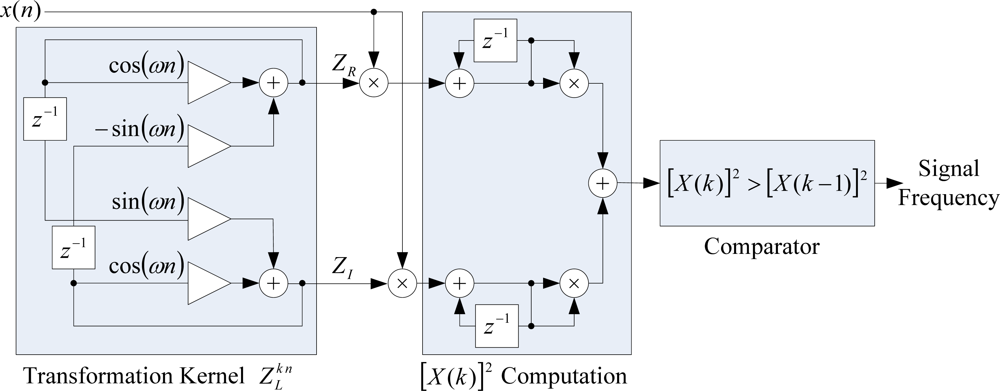
<p>The operational architecture for the CZT computation unit of the proposed smart sensor is depicted in <xref ref-type="fig" rid="f2-sensors-09-07412">Figure 2</xref>. The transformation kernel block provides the real and imaginary components <italic>Z<sub>R</sub></italic> and <italic>Z<sub>I</sub></italic> of 
<inline-formula>
<mml:math>
<mml:mrow>
<mml:msubsup>
<mml:mi>Z</mml:mi>
<mml:mi>L</mml:mi>
<mml:mi mathvariant="italic">kn</mml:mi></mml:msubsup></mml:mrow></mml:math></inline-formula> implementing the recursive functions in <xref ref-type="disp-formula" rid="FD3">Equations (3)</xref> and <xref ref-type="disp-formula" rid="FD4">(4)</xref>, respectively. The power spectrum magnitude [<italic>X(k)</italic>]<sup>2</sup> is obtained by adding the squared accumulation of <italic>Z<sub>R</sub></italic> and <italic>Z<sub>I</sub></italic> times the discrete input signal <italic>x(n)</italic>. Finally, a magnitude comparison is carried out in order to identify the signal frequency with high resolution. The structure in <xref ref-type="fig" rid="f2-sensors-09-07412">Figure 2</xref> for the CZT computation utilizes basic operations like addition, multiplications, and accumulations that provide an efficient architecture for hardware implementation.</p></sec>
<sec>
<label>2.4</label>
<title>Computational Complexity Comparison between CZT, FFT, and Zoom-FFT</title>
<p>In order to find an optimal algorithm that meets the international standard for frequency measurement [<xref ref-type="bibr" rid="b2-sensors-09-07412">2</xref>], a computational complexity comparison between CZT, FFT, and Zoom-FFT, based on the number of operations, is developed in this section. The number of operations <italic>Op<sub>FFT</sub></italic> for computing the FFT is given by <xref ref-type="disp-formula" rid="FD7">Equation (7)</xref> [<xref ref-type="bibr" rid="b17-sensors-09-07412">17</xref>]; whereas for computing the Zoom-FFT the number of operations <italic>Op<sub>ZFFT</sub></italic> is given by <xref ref-type="disp-formula" rid="FD8">Equation (8)</xref> [<xref ref-type="bibr" rid="b18-sensors-09-07412">18</xref>]; finally the CZT requires <italic>Op<sub>CZT</sub></italic> operations, as given by <xref ref-type="disp-formula" rid="FD9">Equation (9)</xref> [<xref ref-type="bibr" rid="b17-sensors-09-07412">17</xref>]. <italic>N</italic> is the data length for all algorithms, and <italic>L</italic> is the length of the interest region for the Zoom-FFT and the CZT:
<disp-formula id="FD7">
<label>(7)</label>
<mml:math display="block">
<mml:mrow>
<mml:msub>
<mml:mi mathvariant="italic">Op</mml:mi>
<mml:mi mathvariant="italic">FFT</mml:mi></mml:msub>
<mml:mo>=</mml:mo>
<mml:mi>N</mml:mi>
<mml:msub>
<mml:mtext>log</mml:mtext>
<mml:mn>2</mml:mn></mml:msub>
<mml:mo> </mml:mo>
<mml:mi>N</mml:mi></mml:mrow></mml:math></disp-formula>
<disp-formula id="FD8">
<label>(8)</label>
<mml:math display="block">
<mml:mrow>
<mml:msub>
<mml:mi mathvariant="italic">Op</mml:mi>
<mml:mi mathvariant="italic">ZFFT</mml:mi></mml:msub>
<mml:mo>=</mml:mo>
<mml:mi>N</mml:mi>
<mml:mrow>
<mml:mo stretchy="false">(</mml:mo>
<mml:mrow>
<mml:mn>1</mml:mn>
<mml:mo>+</mml:mo>
<mml:msub>
<mml:mtext>log</mml:mtext>
<mml:mn>2</mml:mn></mml:msub>
<mml:mo> </mml:mo>
<mml:mi>L</mml:mi></mml:mrow>
<mml:mo stretchy="false">)</mml:mo></mml:mrow></mml:mrow></mml:math></disp-formula>
<disp-formula id="FD9">
<label>(9)</label>
<mml:math display="block">
<mml:mrow>
<mml:msub>
<mml:mi mathvariant="italic">Op</mml:mi>
<mml:mi mathvariant="italic">CZT</mml:mi></mml:msub>
<mml:mo>=</mml:mo>
<mml:mi>N</mml:mi>
<mml:mo>⋅</mml:mo>
<mml:mi>L</mml:mi></mml:mrow></mml:math></disp-formula></p>
<p><xref ref-type="table" rid="t1-sensors-09-07412">Table 1</xref> summarizes the computational complexity and acquisition time <italic>T<sub>acq</sub></italic> required for complying international standard of frequency measurement with a resolution of <italic>Δ f</italic> = 0.01 Hz. The resolution <italic>Δ f</italic> for the FFT and the Zoom-FFT is given by <xref ref-type="disp-formula" rid="FD10">Equation (10)</xref> with a sampling rate set to <italic>f<sub>s</sub></italic> = 655.36 Hz; whereas the resolution for the CZT is given by <xref ref-type="disp-formula" rid="FD2">Equations (2)</xref> and <xref ref-type="disp-formula" rid="FD6">(6)</xref> with a sampling rate set to <italic>f<sub>s</sub></italic> = 512 Hz in order to meet the standard.
<disp-formula id="FD10">
<label>(10)</label>
<mml:math display="block">
<mml:mrow>
<mml:mi mathvariant="normal">Δ</mml:mi>
<mml:mi> </mml:mi>
<mml:mi>f</mml:mi>
<mml:mo>=</mml:mo>
<mml:mfrac>
<mml:mrow>
<mml:msub>
<mml:mi>f</mml:mi>
<mml:mi>s</mml:mi></mml:msub></mml:mrow>
<mml:mi>N</mml:mi></mml:mfrac></mml:mrow></mml:math></disp-formula></p>
<p>From <xref ref-type="table" rid="t1-sensors-09-07412">Table 1</xref> it can be seen that the CZT requires less operations for computation than FFT and Zoom-FFT, but the most restricting parameter is the acquisition time that according to the standard is 10 s. which is only met by CZT.</p></sec></sec>
<sec sec-type="results">
<label>3.</label>
<title>Simulation Results</title>
<p>The performance of the proposed smart sensor for real-time high-resolution frequency measurement is tested in this section. The simulation accuracy tests consist in feeding an artificially generated waveform into the proposed smart sensor for confirming its performance and compliance of the international standard CEI/IEC 61000-4-30 [<xref ref-type="bibr" rid="b2-sensors-09-07412">2</xref>]. The tests carried out detect the frequency in high resolution of: a pure periodic signal, a periodic signal plus white noise, a main periodic signal with harmonic contamination, and a main periodic signal with harmonic contamination plus white noise.</p>
<sec>
<label>3.1.</label>
<title>Pure periodic signal</title>
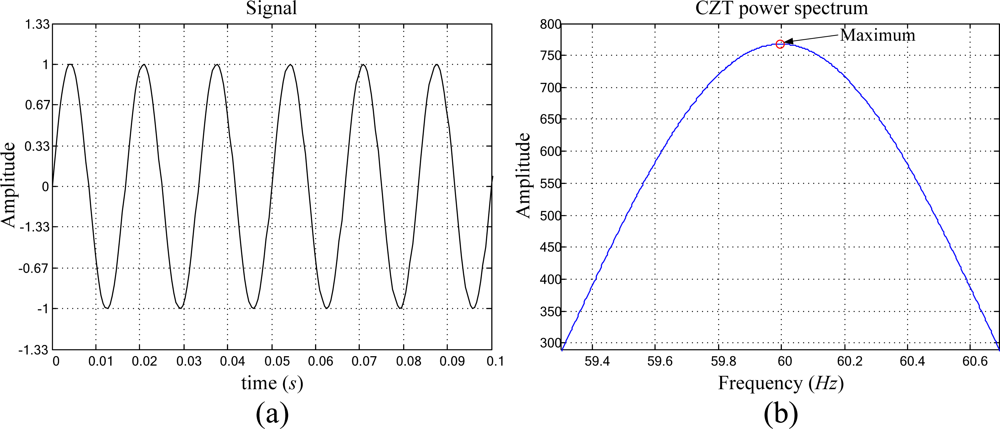
<p>The analyzed pure periodic signal is described in <xref ref-type="disp-formula" rid="FD11">Equation (11)</xref>, with normalized amplitude, and frequency <italic>f</italic> = 60 Hz, as shown in <xref ref-type="fig" rid="f3-sensors-09-07412">Figure 3a</xref>. Analyzing the artificially generated pure periodic signal and utilizing the proposed smart sensor for high-resolution frequency estimation, the CZT power spectrum in <xref ref-type="fig" rid="f3-sensors-09-07412">Figure 3b</xref> is obtained, giving the frequency estimation result of 60.0000 Hz for <italic>x(t)</italic>:
<disp-formula id="FD11">
<label>(11)</label>
<mml:math display="block">
<mml:mrow>
<mml:mi>x</mml:mi>
<mml:mo stretchy="false">(</mml:mo>
<mml:mi>t</mml:mi>
<mml:mo stretchy="false">)</mml:mo>
<mml:mo>=</mml:mo>
<mml:mtext>sin</mml:mtext>
<mml:mrow>
<mml:mo stretchy="false">(</mml:mo>
<mml:mrow>
<mml:mn>2</mml:mn>
<mml:mi>π</mml:mi>
<mml:mi mathvariant="italic">ft</mml:mi></mml:mrow>
<mml:mo stretchy="false">)</mml:mo></mml:mrow></mml:mrow></mml:math></disp-formula></p></sec>
<sec>
<label>3.2.</label>
<title>Periodic Signal with White-Noise Contamination</title>
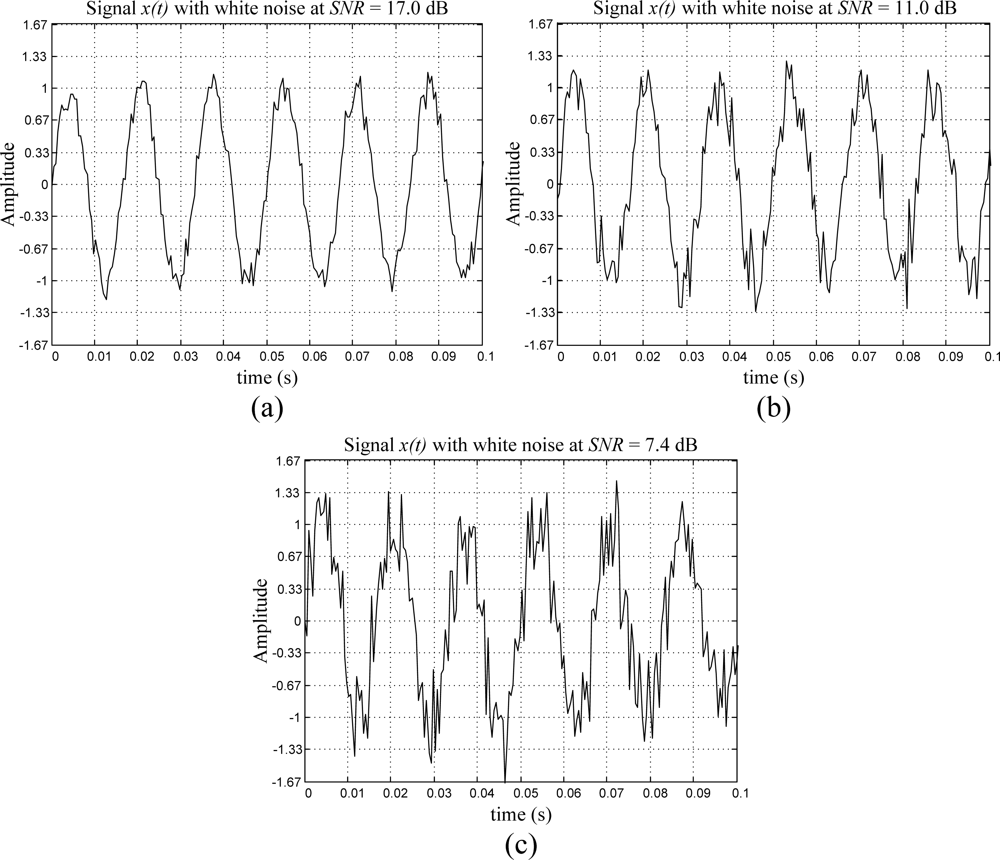
<p>The periodic signal contaminated with white noise is described in <xref ref-type="disp-formula" rid="FD12">Equation (12)</xref>. The amplitude of the periodic signal is normalized, and it has a frequency <italic>f</italic> = 60 Hz, whereas three cases of severe white noise <italic>n(t)</italic> contamination are considered. The first case considers a normalized periodic signal with white noise contamination at 10% of its amplitude for a <italic>SNR =</italic> 17.0 dB, as shown in <xref ref-type="fig" rid="f4-sensors-09-07412">Figure 4a</xref>. The second case, shown in <xref ref-type="fig" rid="f4-sensors-09-07412">Figure 4b</xref>, analyzes a normalized periodic signal with white noise contamination at 20% of the signal amplitude for a <italic>SNR =</italic> 11.0 dB. Finally, the third case considers a white noise contamination at 30% of the periodic signal amplitude for a <italic>SNR =</italic> 7.4 dB, presented in <xref ref-type="fig" rid="f4-sensors-09-07412">Figure 4c</xref>. <xref ref-type="table" rid="t2-sensors-09-07412">Table 2</xref> shows the obtained result from the proposed smart-sensor frequency estimation for 40 runs of the periodic signal with added white noise.
<disp-formula id="FD12">
<label>(12)</label>
<mml:math display="block">
<mml:mrow>
<mml:mi>x</mml:mi>
<mml:mo stretchy="false">(</mml:mo>
<mml:mi>t</mml:mi>
<mml:mo stretchy="false">)</mml:mo>
<mml:mo>=</mml:mo>
<mml:mtext>sin</mml:mtext>
<mml:mrow>
<mml:mo stretchy="false">(</mml:mo>
<mml:mrow>
<mml:mn>2</mml:mn>
<mml:mi>π</mml:mi>
<mml:mi> </mml:mi>
<mml:mi>f</mml:mi>
<mml:mi> </mml:mi>
<mml:mi>t</mml:mi></mml:mrow>
<mml:mo stretchy="false">)</mml:mo></mml:mrow>
<mml:mo>+</mml:mo>
<mml:mi>n</mml:mi>
<mml:mo stretchy="false">(</mml:mo>
<mml:mi>t</mml:mi>
<mml:mo stretchy="false">)</mml:mo></mml:mrow></mml:math></disp-formula></p></sec>
<sec>
<label>3.3.</label>
<title>Periodic Signal plus Harmonic Contamination</title>
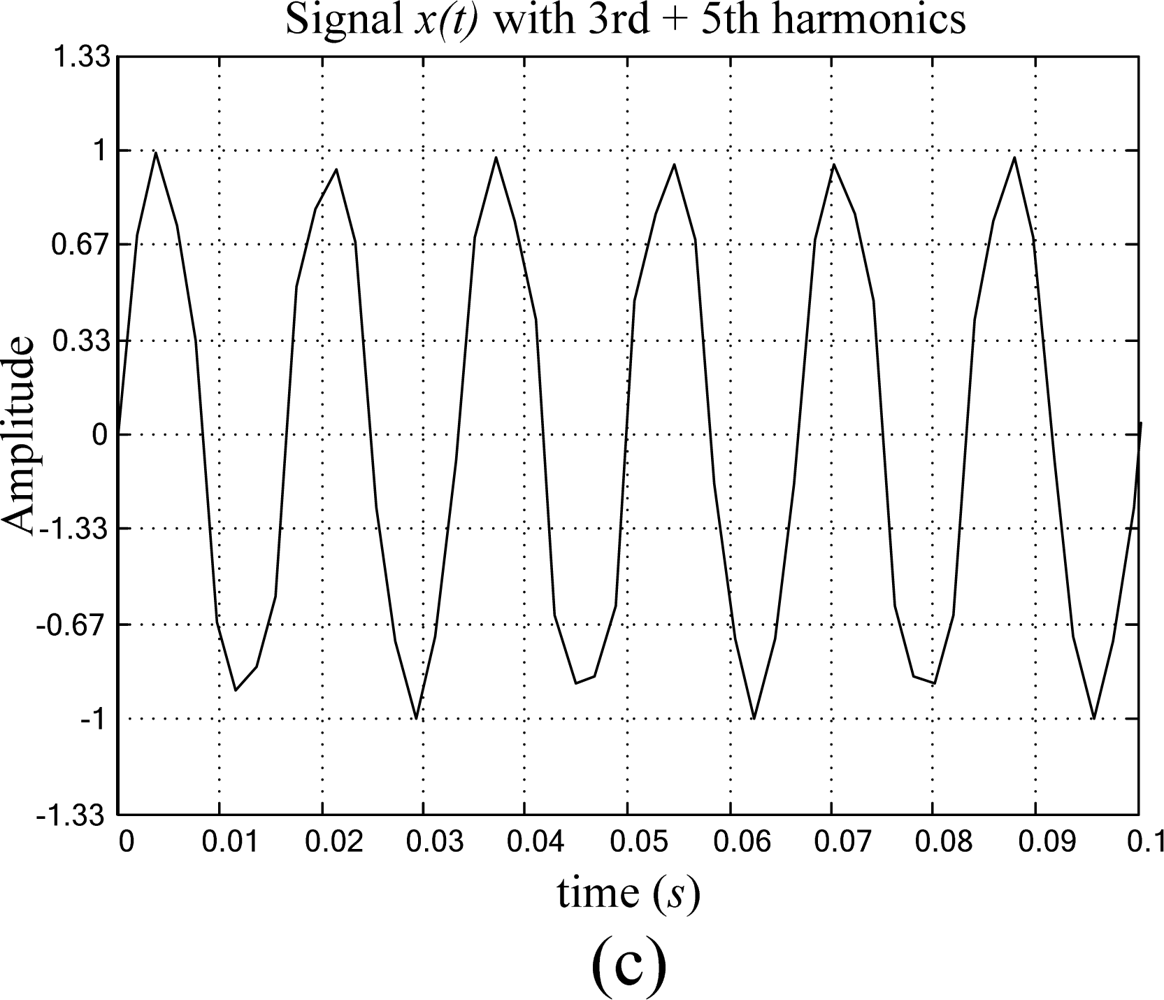
<p>The harmonic contamination of the periodic signal is described in <xref ref-type="disp-formula" rid="FD13">Equation (13)</xref>. Three different cases of harmonic contamination are treated. The first case considers a periodic signal contaminated with its 2<sup>nd</sup> harmonic, as depicted in <xref ref-type="fig" rid="f5-sensors-09-07412">Figure 5a</xref>. The second case analyzes the periodic signal plus its 3<sup>rd</sup> harmonic, as shown in <xref ref-type="fig" rid="f5-sensors-09-07412">Figure 5b</xref>. The last case considers the contamination of the periodic signal with its 3<sup>rd</sup> + 5<sup>th</sup> harmonics, as presented in <xref ref-type="fig" rid="f5-sensors-09-07412">Figure 5c</xref>. The amplitude of the periodic signal is normalized and has a frequency <italic>f = 60</italic> Hz, whereas the harmonic signals <italic>h(t)</italic> added to the periodic signal have an amplitude of 10% of the main periodic signal amplitude for a signal-to-harmonic ratio <italic>SHR</italic> = 20.0 dB. <xref ref-type="table" rid="t3-sensors-09-07412">Table 3</xref> shows the obtained result from the proposed smart-sensor frequency estimation for 40 runs of a periodic signal with harmonic contamination.
<disp-formula id="FD13">
<label>(13)</label>
<mml:math display="block">
<mml:mtable columnalign="left">
<mml:mtr>
<mml:mtd>
<mml:mi>x</mml:mi>
<mml:mo stretchy="false">(</mml:mo>
<mml:mi>t</mml:mi>
<mml:mo stretchy="false">)</mml:mo>
<mml:mo>=</mml:mo>
<mml:mtext>sin</mml:mtext>
<mml:mrow>
<mml:mo stretchy="false">(</mml:mo>
<mml:mrow>
<mml:mn>2</mml:mn>
<mml:mi>π</mml:mi>
<mml:mi> </mml:mi>
<mml:mi>f</mml:mi>
<mml:mi> </mml:mi>
<mml:mi>t</mml:mi></mml:mrow>
<mml:mo stretchy="false">)</mml:mo></mml:mrow>
<mml:mo>+</mml:mo>
<mml:mi>h</mml:mi>
<mml:mo stretchy="false">(</mml:mo>
<mml:mi>t</mml:mi>
<mml:mo stretchy="false">)</mml:mo>
<mml:mi> </mml:mi>
<mml:mi mathvariant="italic">where</mml:mi></mml:mtd></mml:mtr>
<mml:mtr>
<mml:mtd>
<mml:mi>h</mml:mi>
<mml:mo stretchy="false">(</mml:mo>
<mml:mi>t</mml:mi>
<mml:mo stretchy="false">)</mml:mo>
<mml:mo>=</mml:mo>
<mml:mn>0.1</mml:mn>
<mml:mtext>sin</mml:mtext>
<mml:mo stretchy="false">(</mml:mo>
<mml:mn>2</mml:mn>
<mml:mi>π</mml:mi>
<mml:mi> </mml:mi>
<mml:mi>f</mml:mi>
<mml:mi> </mml:mi>
<mml:mi>l</mml:mi>
<mml:mi> </mml:mi>
<mml:mi>t</mml:mi>
<mml:mo stretchy="false">)</mml:mo>
<mml:mi> </mml:mi>
<mml:mi mathvariant="italic">and</mml:mi>
<mml:mi>   </mml:mi>
<mml:mi>l</mml:mi>
<mml:mo>=</mml:mo>
<mml:mn>2</mml:mn>
<mml:mo>,</mml:mo>
<mml:mi> </mml:mi>
<mml:mn>3</mml:mn>
<mml:mo>,</mml:mo>
<mml:mi> </mml:mi>
<mml:mn>5</mml:mn></mml:mtd></mml:mtr></mml:mtable></mml:math></disp-formula></p></sec>
<sec>
<label>3.4.</label>
<title>Periodic Signal plus White Noise and Harmonic Contamination</title>
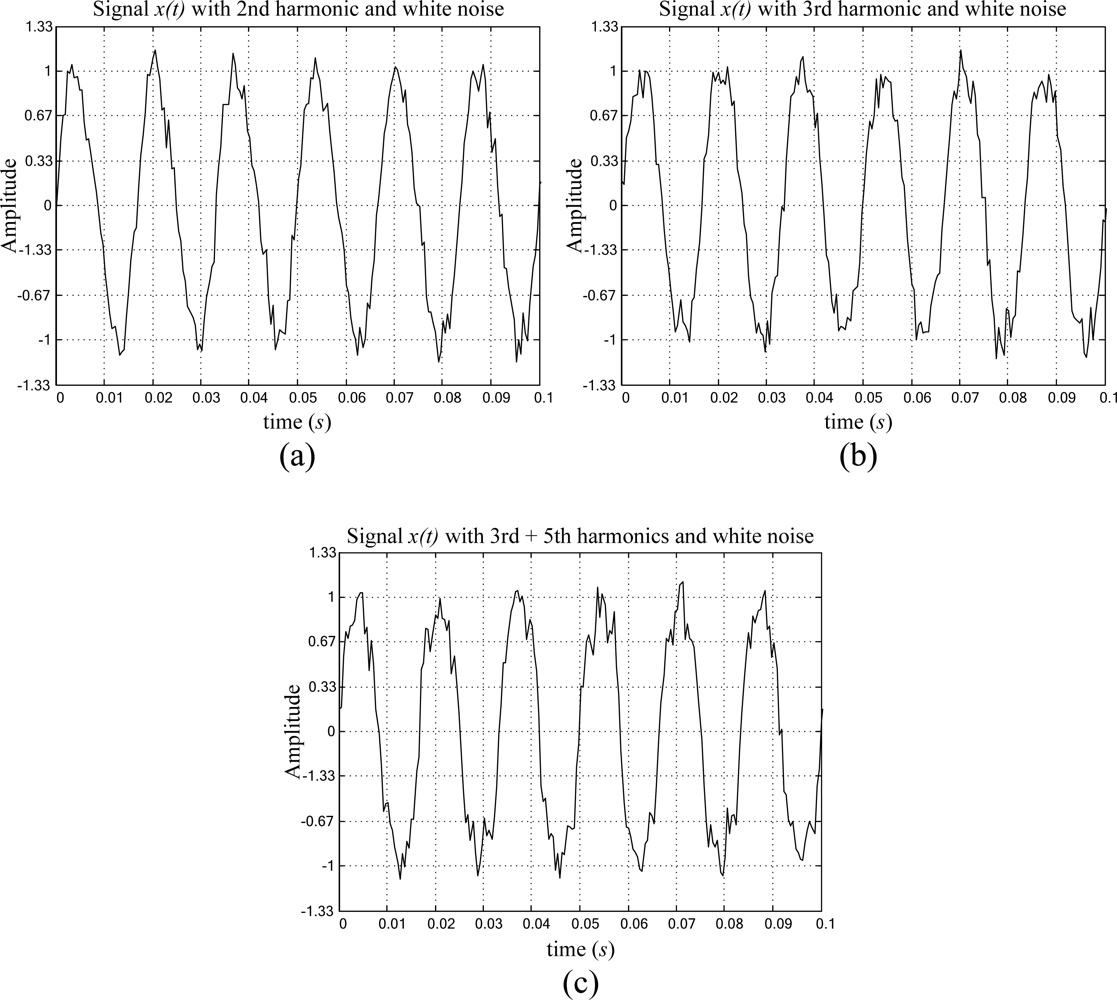
<p>The white noise <italic>n(t)</italic> and harmonic <italic>h(t)</italic> contamination of a periodic signal is described in (14), where the amplitude of the periodic signal is normalized, and has a frequency <italic>f = 60</italic> Hz, whereas the white noise signal <italic>n(t)</italic> added to the periodic signal have a maximum amplitude of 10% of the main periodic signal amplitude and three different cases of harmonic contamination are considered. The first case considers a periodic signal contaminated with its 2<sup>nd</sup> harmonic, as depicted in <xref ref-type="fig" rid="f6-sensors-09-07412">Figure 6a</xref>. The second case analyzes the periodic signal plus its 3<sup>rd</sup> harmonic, as shown in <xref ref-type="fig" rid="f6-sensors-09-07412">Figure 6b</xref>. The last case considers the contamination of the periodic signal with its 3<sup>rd</sup> + 5<sup>th</sup> harmonics, as presented in <xref ref-type="fig" rid="f6-sensors-09-07412">Figure 6c</xref>. Where the signal-to-harmonic-plus-noise ratio <italic>SHNR</italic> = 15.2 dB. <xref ref-type="table" rid="t4-sensors-09-07412">Table 4</xref> shows the obtained result from the proposed smart-sensor frequency estimation for 40 runs of a periodic signal with white noise plus harmonic contamination.
<disp-formula id="FD14">
<label>(14)</label>
<mml:math display="block">
<mml:mtable columnalign="left">
<mml:mtr>
<mml:mtd>
<mml:mi>x</mml:mi>
<mml:mo stretchy="false">(</mml:mo>
<mml:mi>t</mml:mi>
<mml:mo stretchy="false">)</mml:mo>
<mml:mo>=</mml:mo>
<mml:mtext>sin</mml:mtext>
<mml:mrow>
<mml:mo stretchy="false">(</mml:mo>
<mml:mrow>
<mml:mn>2</mml:mn>
<mml:mi>π</mml:mi>
<mml:mi> </mml:mi>
<mml:mi>f</mml:mi>
<mml:mi> </mml:mi>
<mml:mi>t</mml:mi></mml:mrow>
<mml:mo stretchy="false">)</mml:mo></mml:mrow>
<mml:mo>+</mml:mo>
<mml:mi>h</mml:mi>
<mml:mo stretchy="false">(</mml:mo>
<mml:mi>t</mml:mi>
<mml:mo stretchy="false">)</mml:mo>
<mml:mo>+</mml:mo>
<mml:mi>n</mml:mi>
<mml:mo stretchy="false">(</mml:mo>
<mml:mi>t</mml:mi>
<mml:mo stretchy="false">)</mml:mo>
<mml:mi> </mml:mi>
<mml:mi mathvariant="italic">where</mml:mi></mml:mtd></mml:mtr>
<mml:mtr>
<mml:mtd>
<mml:mi>h</mml:mi>
<mml:mo stretchy="false">(</mml:mo>
<mml:mi>t</mml:mi>
<mml:mo stretchy="false">)</mml:mo>
<mml:mo>=</mml:mo>
<mml:mn>0.1</mml:mn>
<mml:mtext>sin</mml:mtext>
<mml:mo stretchy="false">(</mml:mo>
<mml:mn>2</mml:mn>
<mml:mi>π</mml:mi>
<mml:mi> </mml:mi>
<mml:mi>f</mml:mi>
<mml:mi> </mml:mi>
<mml:mi>l</mml:mi>
<mml:mi> </mml:mi>
<mml:mi>t</mml:mi>
<mml:mo stretchy="false">)</mml:mo>
<mml:mi> </mml:mi>
<mml:mi mathvariant="italic">and</mml:mi>
<mml:mi>   </mml:mi>
<mml:mi>l</mml:mi>
<mml:mo>=</mml:mo>
<mml:mn>2</mml:mn>
<mml:mo>,</mml:mo>
<mml:mn>3</mml:mn>
<mml:mo>,</mml:mo>
<mml:mn>5</mml:mn></mml:mtd></mml:mtr></mml:mtable></mml:math></disp-formula></p></sec>
<sec>
<label>3.5.</label>
<title>Simulation of an Instantaneous Jump on the Power Line Frequency</title>
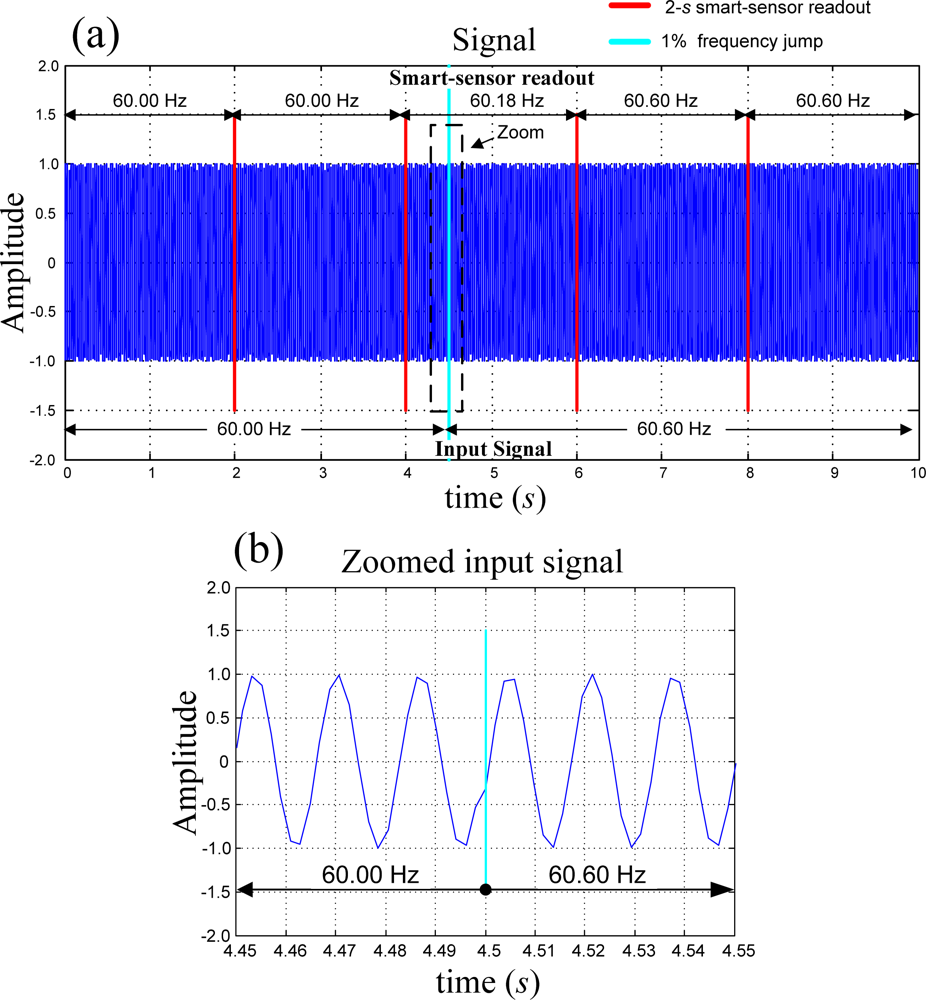
<p><xref ref-type="fig" rid="f7-sensors-09-07412">Figure 7</xref> shows the effects of an instantaneous jump in the power line frequency over the proposed smart sensor readouts. The input signal was originally synthesized as a pure sinusoidal with a frequency of 60.0 Hz and at half of the measurement process the frequency was suddenly changed to 60.6 Hz, representing a 1% instantaneous jump. The international standard for frequency measurement [<xref ref-type="bibr" rid="b2-sensors-09-07412">2</xref>], requires to give a readout every 10 <italic>s</italic>; the processing of the signal takes 1.0078 s and the instrument was set to provide a readout every 2 <italic>s</italic>. <xref ref-type="fig" rid="f7-sensors-09-07412">Figure 7a</xref> compares the input signal frequency against the smart-sensor readouts before and after the 1% frequency jump during the 10 s of the measurement required by the standard. Before the jump the frequency readout of the smart-sensor is 60.0 Hz as expected; during the jump, the readout is 60.18 Hz; once the signal frequency stabilizes, the readout is 60.6 Hz that corresponds to the magnitude of the jump. The final readout of the smart sensor follows the frequency change in the standard required time.</p></sec></sec>
<sec sec-type="results">
<label>4.</label>
<title>Experimental Results</title>
<p>This section presents the application of the proposed smart sensor for frequency estimation in two different study cases. The first study case considers the frequency measurement of the electrical power supply, and the second one considers the frequency measurement of the signal obtained from a Stanford Research DS345 synthesized function generator [<xref ref-type="bibr" rid="b19-sensors-09-07412">19</xref>]. Some of the main features of this device are that it generates standard waveforms with frequency resolution of 1 <italic>μ</italic>Hz, and accuracy of ±5 part-per-million; which makes it suitable for being used as reference to test the performance of the proposed smart sensor. The output from the synthesized function generator is contaminated with white noise at 10%, 20%, and 30% for a <italic>SNR</italic> = 17.0, 11.0, 7.4 dB, respectively. The proposed smart sensor depicted in <xref ref-type="fig" rid="f2-sensors-09-07412">Figure 2</xref> is implemented in a low cost FPGA device xc3s1000 from Xilinx, embedded on the Spartan-3 Starter Board from Digilent [<xref ref-type="bibr" rid="b20-sensors-09-07412">20</xref>]. The processing time takes 1.0078 s to perform the frequency estimation and the smart sensor provides readouts every 2 <italic>s</italic>.</p>
<sec>
<label>4.1.</label>
<title>Power Supply Frequency Measurement</title>
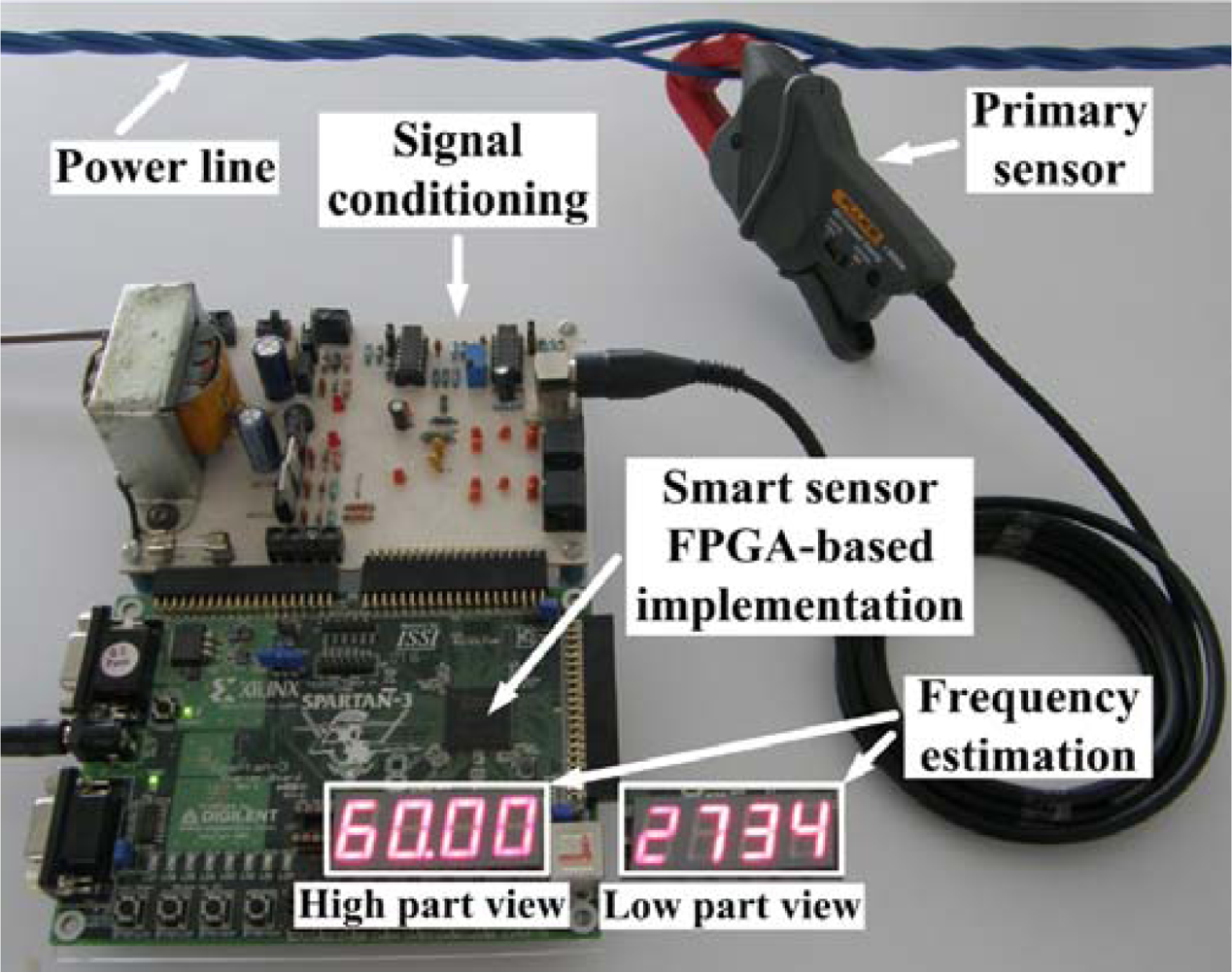
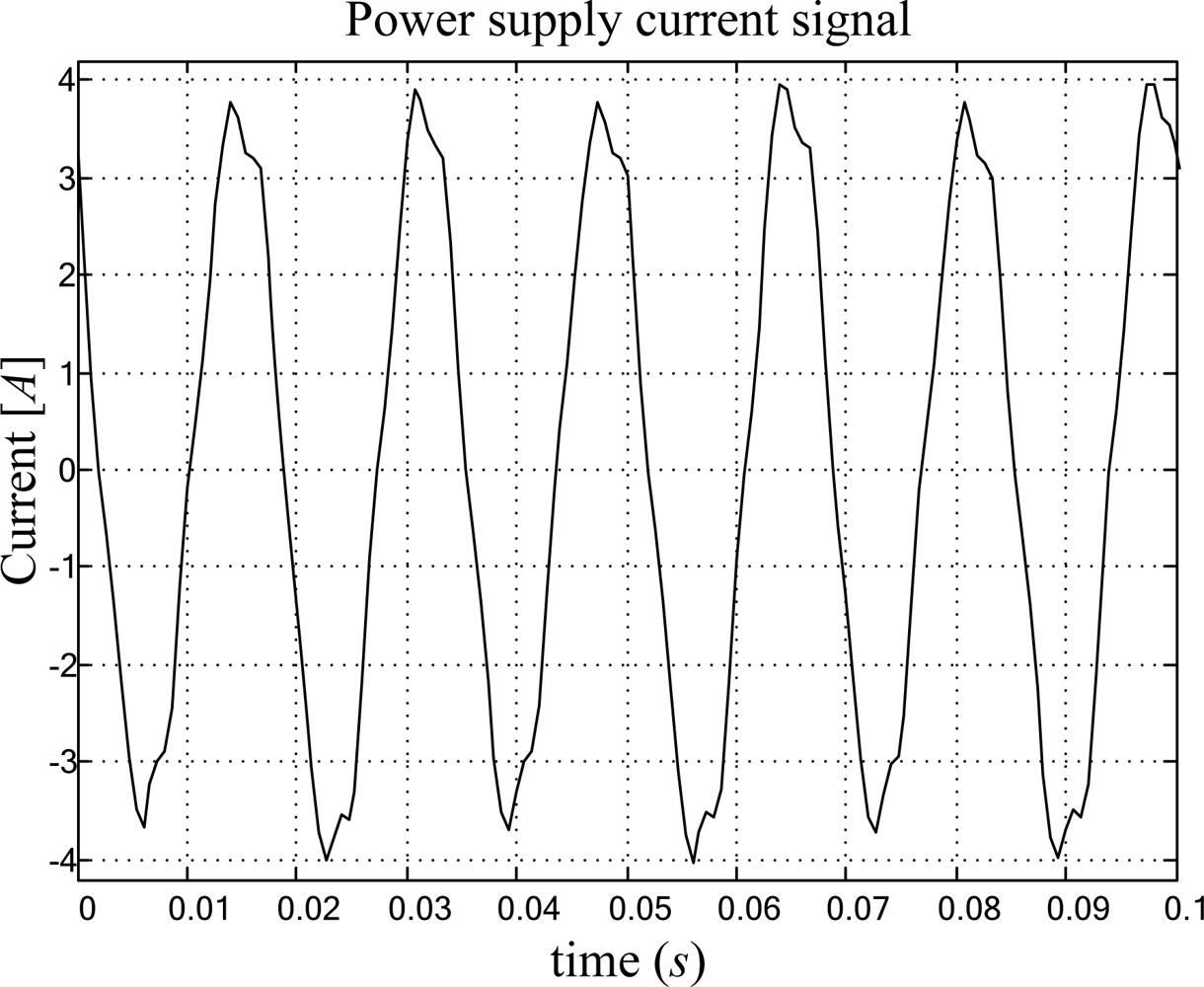
<p>The proposed smart sensor for frequency measurement can be utilized with several primary sensors. For this study case, the standard off-the-shelf current clamp i200s from Fluke is utilized for current monitoring. A 12-bit 4-channel serial-output analog to digital converter ADS7841 [<xref ref-type="bibr" rid="b21-sensors-09-07412">21</xref>] is used for signal acquisition. <xref ref-type="fig" rid="f8-sensors-09-07412">Figure 8</xref> shows the experiment setup for high-resolution frequency measurement monitoring the power-line-supply current from a standard electrical load (1 <italic>hp</italic> induction motor) with a current clamp as primary sensor. The current signal is sensed during 1 s at a sampling frequency of 512 Hz. The signal conditioning system provides the FPGA implementation of the proposed smart sensor with 512 discrete samples for high-resolution frequency estimation, the result is shown on the 4-digit 7-segment LED display, where the user selects between the high- and low-part of the estimation result to be shown on the display. For the case treated here 60.002734 Hz. <xref ref-type="fig" rid="f9-sensors-09-07412">Figure 9</xref> shows the sensed current signal from the power line. By taking 40 readouts of the power-line frequency, the calculated mean and standard deviation are 60.0008 Hz and 0.0013 Hz, respectively.</p></sec>
<sec>
<label>4.2.</label>
<title>Frequency Estimation of Digitally Synthesized Functions</title>
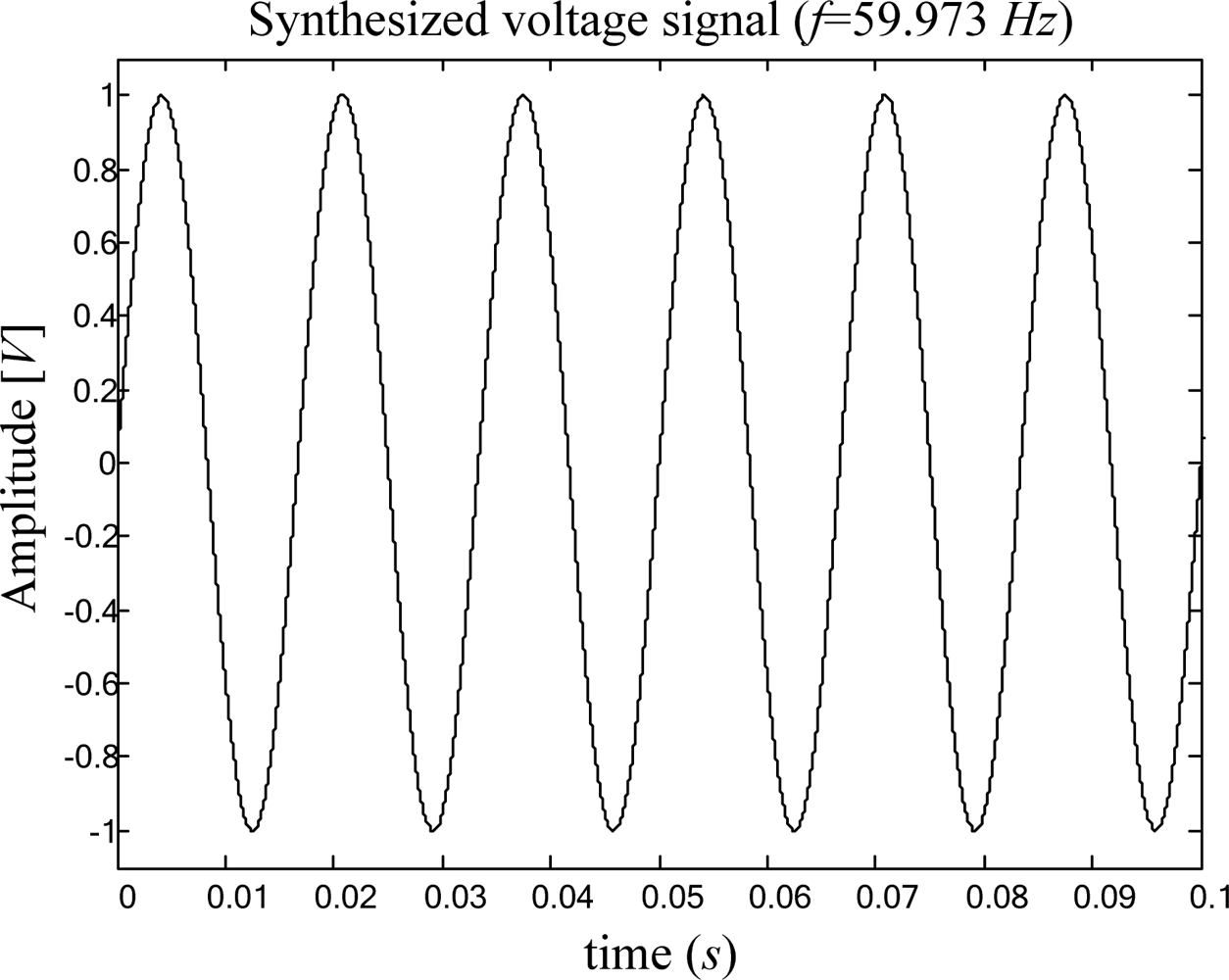
<p>In this case the frequency is estimated from voltage signals generated by a Stanford Research DS345 synthesized function generator. Similar to the previous case of study, a 12-bit 4-channel serial-output analog to digital converter ADS7841 is used for signal acquisition. <xref ref-type="fig" rid="f10-sensors-09-07412">Figure 10</xref> shows the experiment setup for high-resolution frequency measurement, monitoring voltage signals. The synthesized voltage signal shown in <xref ref-type="fig" rid="f11-sensors-09-07412">Figure 11</xref> is sampled during 1 s at a sampling rate of 512 Hz. The signal conditioning system provides the FPGA implementation of the proposed smart sensor with 512 discrete samples for high-resolution frequency estimation. The estimation result is shown on the 4-digit 7-segment LED display, where the high- and low-part of the estimation result can be selected for being shown on the display. For the case treated here, the frequency estimation of a synthesized pure sinusoidal signal with a frequency of 59.973 Hz is 59.972656 Hz.</p>
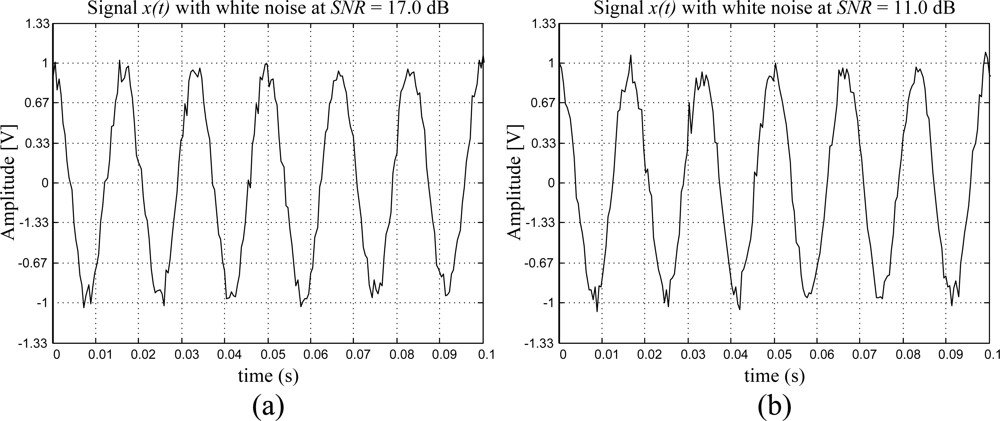
<p>To test the performance of the proposed smart sensor, three experiments are set up considering a 60 Hz sinusoidal signal generated by the DS345 function generator with white noise contamination at 10%, 20%, and 30% of its amplitude for a <italic>SNR</italic> = 17.0, 11.0, 7.4 dB, and as shown in <xref ref-type="fig" rid="f12-sensors-09-07412">Figure 12a–c</xref>, respectively. <xref ref-type="table" rid="t5-sensors-09-07412">Table 5</xref> summarizes the obtained results for 40 readouts from the proposed smart sensor.</p></sec>
<sec>
<label>4.3.</label>
<title>Smart Sensor Linearity</title>
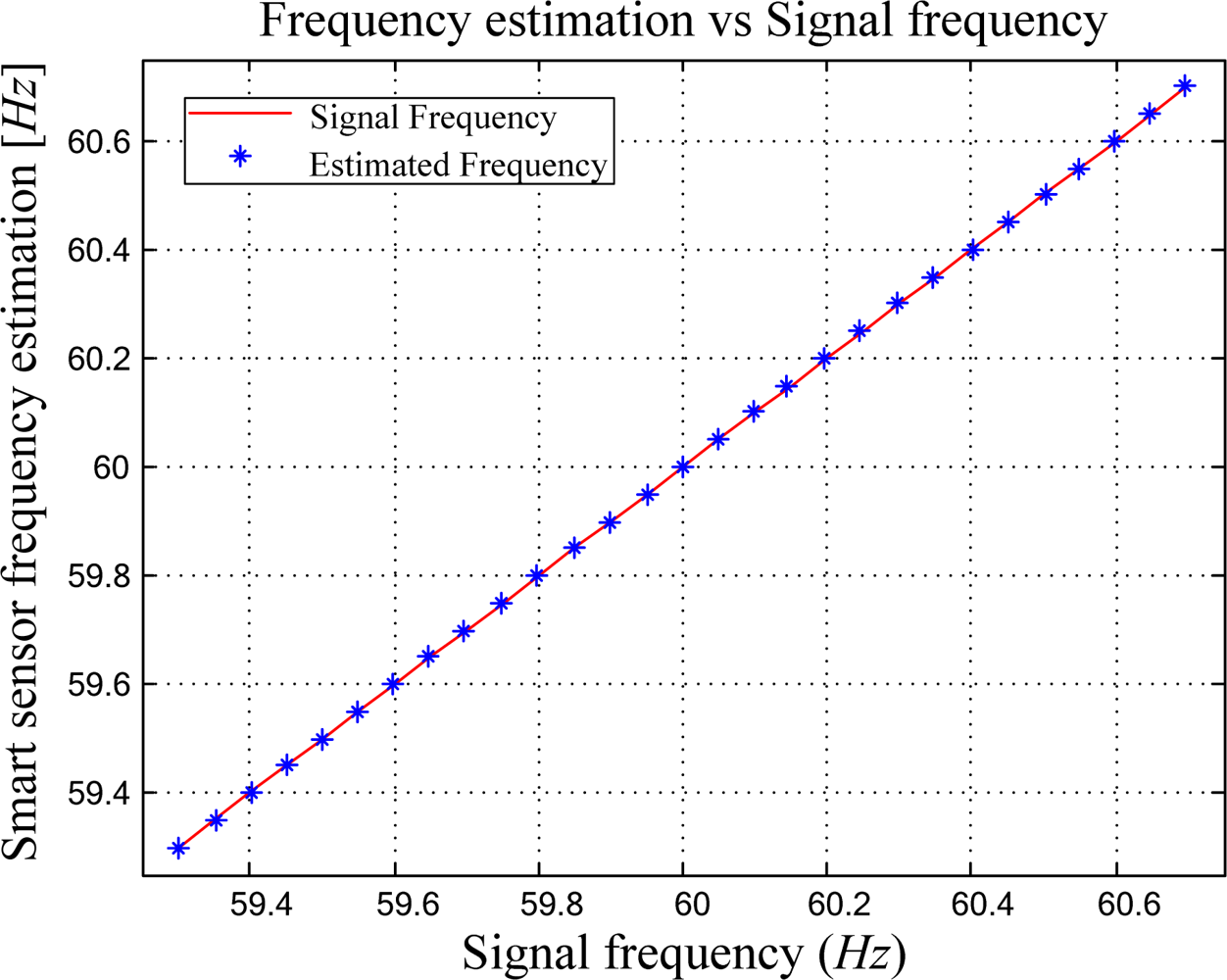
<p>A test of linearity to the proposed smart sensor for high resolution frequency estimation is carried out in this section. <xref ref-type="fig" rid="f13-sensors-09-07412">Figure 13</xref> shows the proposed smart sensor behavior under small variations of the input signal frequency. The input signal frequency increases from 59.3 Hz in steps of 0.05 Hz up to 60.7 Hz obtaining the correspondence line in <xref ref-type="fig" rid="f13-sensors-09-07412">Figure 13</xref>; which shows a linear behavior of the proposed smart sensor. The frequency variation range from 59.3 Hz to 60.7 Hz corresponds to the international standard CEI/IEC 61000-4-30 [<xref ref-type="bibr" rid="b2-sensors-09-07412">2</xref>]; which states that the power frequency of the supply signal must vary around ±1% (from 59.4 Hz to 60.6 Hz). The results show that the proposed smart sensor provides a very accurate solution with an uncertainty of ±0.0024 Hz, with a maximum estimation error of 0.0055 Hz and an integral linearity of 0.189 %.</p></sec></sec>
<sec sec-type="discussion">
<label>5.</label>
<title>Discussion</title>
<p>An important result of this work is the hardware implementation of a smart sensor for high-resolution frequency detection in real-time applications. The proposed smart sensor is implemented in a low-cost FPGA device reaching operation speeds of 33.74 <italic>M</italic>Hz; which provides accurate frequency readouts every 2 <italic>s</italic>.</p>
<p>The proposed smart sensor shows high performance operation, meeting the international standards for frequency measurement even with high-level noise contamination. This is shown in the simulation results where different study cases were treated, with the white-noise-contamination case at <italic>SNR</italic> = 7.4 dB being the one with the highest error. On the other hand, the proposed sensor shows a very good performance in analyzing real signals generated with a highly accurate reference source with high resolution, giving mean errors of 0.0007, 0.0001, and 0.0020 Hz for a periodic signal contaminated with white noise at <italic>SNR</italic> = 17.0, 11.0, and 7.4 dB, respectively. Regarding harmonic contamination, the proposed sensor showed to be highly insensitive as depicted in <xref ref-type="table" rid="t3-sensors-09-07412">Tables 3</xref> and <xref ref-type="table" rid="t4-sensors-09-07412">4</xref>. Finally, the proposed smart sensor shows a linear behavior for small frequency variations, which means that it will follow any small change in the signal frequency; this is shown in the linearity tests where the efficiency of the proposed smart sensor for power systems frequency estimation is demonstrated, providing results that are even below of those prescribed by international standards.</p></sec>
<sec sec-type="conclusions">
<label>6.</label>
<title>Conclusions</title>
<p>This work presents the development of a smart sensor for frequency estimation in real-time applications. The proposed sensor complies with international standards for frequency measurement in power systems, providing fast and accurate estimations with high resolution and small deviations as demonstrated by the results obtained in linearity test section, different from other methodologies where low resolutions of just decades of Hz are achieved. The proposed smart sensor implementation uses a simple architecture describing recursive functions for the CZT computation utilizing addition, multiplication, and accumulation operations, different from other algorithms using complex mathematics (e.g., FFT) and weighting factors for increasing their resolution (e.g., Zoom-FFT) or implementing the CZT in multiple iterations. The proposed system is considered a smart sensor since it integrates a commercially available current clamp, hall-effect sensor, or resistor as primary sensor, analyzing the corresponding output with digital signal processing techniques in the time domain for estimating the input signal frequency online, with high resolution. Other techniques can use only one kind of primary sensor and require the transformation of the monitored signal into the frequency domain. From the stated above, it can be concluded that the proposed smart sensor for high resolution frequency estimation is a low-cost and efficient solution for real-time application in power systems such as control and protection, thanks to its straightforward FPGA-based implementation that provides an accurate frequency readout every 2 s. complying international standards for power frequency monitoring different from other that either have problems meeting the norm [<xref ref-type="bibr" rid="b9-sensors-09-07412">9</xref>–<xref ref-type="bibr" rid="b11-sensors-09-07412">11</xref>], or require complex algorithms that make difficult their implementation [<xref ref-type="bibr" rid="b22-sensors-09-07412">22</xref>,<xref ref-type="bibr" rid="b23-sensors-09-07412">23</xref>].</p></sec></body>
<back>
<ack>
<p>This project was partially supported by CONACYT scholarship 312846, and CONCYTEG 08-16-K662-124 ANEXO 02 project.</p></ack>
<ref-list>
<title>References and Notes</title>
<ref id="b1-sensors-09-07412"><label>1.</label><citation citation-type="journal"><person-group person-group-type="author"><name><surname>Xue</surname><given-names>S.Y.</given-names></name><name><surname>Yang</surname><given-names>S.X.</given-names></name></person-group><article-title>Power system frequency estimation using supervised Gauss-Newton Algorith</article-title><source>Measurement</source><year>2009</year><volume>42</volume><fpage>28</fpage><lpage>37</lpage><pub-id pub-id-type="doi">10.1016/j.measurement.2008.03.018</pub-id></citation></ref>
<ref id="b2-sensors-09-07412"><label>2.</label><citation citation-type="book"><person-group person-group-type="author"><collab>CEI/IEC 61000-4-30 International Standard</collab></person-group><source>Testing and Measurement Techniques Power Quality Measurement Methods</source><edition>1st ed</edition><publisher-name>International Electrotechnical Commission</publisher-name><publisher-loc>Geneva, Switzerland</publisher-loc><year>2003</year></citation></ref>
<ref id="b3-sensors-09-07412"><label>3.</label><citation citation-type="book"><person-group person-group-type="author"><collab>Agilent Technology</collab></person-group><source>Making High-Resolution Frequency Measurements with Agilent InfiniiVision Oscilloscopes</source><publisher-name>Agilent Technologies, Inc</publisher-name><publisher-loc>Santa Clara, CA, USA</publisher-loc><month>April</month><year>2008</year></citation></ref>
<ref id="b4-sensors-09-07412"><label>4.</label><citation citation-type="journal"><person-group person-group-type="author"><name><surname>Venkataramanan</surname><given-names>R.</given-names></name><name><surname>Prabhu</surname><given-names>K.M.M.</given-names></name></person-group><article-title>Estimation of frequency offset using warped discrete-Fourier transform</article-title><source>Signal Proc</source><year>2006</year><volume>86</volume><fpage>250</fpage><lpage>256</lpage><pub-id pub-id-type="doi">10.1016/j.sigpro.2005.05.035</pub-id></citation></ref>
<ref id="b5-sensors-09-07412"><label>5.</label><citation citation-type="confproc"><person-group person-group-type="author"><name><surname>Ohbong</surname><given-names>K.</given-names></name><name><surname>Taylor</surname><given-names>F.</given-names></name></person-group><article-title>Multi-tone detection using the warped discrete Fourier transform</article-title><conf-name>Proceedings of the IEEE MWSCAS</conf-name><conf-loc>Knoxville, TN, USA</conf-loc><conf-date>August 2008</conf-date><fpage>281</fpage><lpage>284</lpage></citation></ref>
<ref id="b6-sensors-09-07412"><label>6.</label><citation citation-type="confproc"><person-group person-group-type="author"><name><surname>Yang</surname><given-names>X.</given-names></name><name><surname>Cui</surname><given-names>X.W.</given-names></name><name><surname>Lu</surname><given-names>M.Q.</given-names></name><name><surname>Fen</surname><given-names>Z.M.</given-names></name></person-group><article-title>Carrier recovery using FFT and Kalman filter</article-title><conf-name>Proceedings of the IEEE ISPA</conf-name><conf-loc>Aizu, Japan</conf-loc><conf-date>July 2003</conf-date><fpage>1094</fpage><lpage>1096</lpage></citation></ref>
<ref id="b7-sensors-09-07412"><label>7.</label><citation citation-type="confproc"><person-group person-group-type="author"><name><surname>Goohyun</surname><given-names>P.</given-names></name><name><surname>Dongkyu</surname><given-names>H.</given-names></name><name><surname>Daesik</surname><given-names>H.</given-names></name><name><surname>Changeopon</surname><given-names>K.</given-names></name></person-group><article-title>A new maximum Doppler frequency estimation algorithm in frequency domain</article-title><conf-name>Proceedings of the IEEE ICCS</conf-name><conf-loc>Amsterdam, The Netherlands</conf-loc><conf-date>April 2002</conf-date><fpage>548</fpage><lpage>552</lpage></citation></ref>
<ref id="b8-sensors-09-07412"><label>8.</label><citation citation-type="confproc"><person-group person-group-type="author"><name><surname>Chen</surname><given-names>Y.</given-names></name><name><surname>Fang</surname><given-names>C.</given-names></name></person-group><article-title>A new method of frequency measurement of power supply</article-title><conf-name>Proceedings of the IEEE ICIEA</conf-name><conf-loc>Harbin, China</conf-loc><conf-date>May 2007</conf-date><fpage>2522</fpage><lpage>2525</lpage></citation></ref>
<ref id="b9-sensors-09-07412"><label>9.</label><citation citation-type="journal"><person-group person-group-type="author"><name><surname>Xu</surname><given-names>Q.Q.</given-names></name><name><surname>Jia</surname><given-names>S.N.</given-names></name><name><surname>Ge</surname><given-names>Y.-Z.</given-names></name></person-group><article-title>Real-time measurement of mean frequency in two-machine system during power swings</article-title><source>IEEE T. Power Deliver</source><year>2004</year><volume>19</volume><fpage>1018</fpage><lpage>1023</lpage><pub-id pub-id-type="doi">10.1109/TPWRD.2003.823208</pub-id></citation></ref>
<ref id="b10-sensors-09-07412"><label>10.</label><citation citation-type="journal"><person-group person-group-type="author"><name><surname>López</surname><given-names>A.</given-names></name><name><surname>Montaño</surname><given-names>J.C.</given-names></name><name><surname>Castilla</surname><given-names>M.</given-names></name><name><surname>Gutiérrez</surname><given-names>J.</given-names></name><name><surname>Borrás</surname><given-names>M.D.</given-names></name><name><surname>Bravo</surname><given-names>J.C.</given-names></name></person-group><article-title>Power system frequency measurement under nonstationary situations</article-title><source>IEEE T. Power Deliver</source><year>2008</year><volume>23</volume><fpage>562</fpage><lpage>567</lpage><pub-id pub-id-type="doi">10.1109/TPWRD.2007.916018</pub-id></citation></ref>
<ref id="b11-sensors-09-07412"><label>11.</label><citation citation-type="journal"><person-group person-group-type="author"><name><surname>Bellini</surname><given-names>A.</given-names></name><name><surname>Yazidi</surname><given-names>A.</given-names></name><name><surname>Filippetti</surname><given-names>F.</given-names></name><name><surname>Rossi</surname><given-names>C.</given-names></name><name><surname>Capolino</surname><given-names>G.A.</given-names></name></person-group><article-title>High frequency resolution techniques for rotor faults detection of induction machines</article-title><source>IEEE T. Ind. Electron</source><year>2008</year><volume>55</volume><fpage>4200</fpage><lpage>4209</lpage><pub-id pub-id-type="doi">10.1109/TIE.2008.2007004</pub-id></citation></ref>
<ref id="b12-sensors-09-07412"><label>12.</label><citation citation-type="confproc"><person-group person-group-type="author"><name><surname>Ge</surname><given-names>F.X.</given-names></name><name><surname>Shen</surname><given-names>D.X.</given-names></name><name><surname>Sui</surname><given-names>A.F.</given-names></name><name><surname>Li</surname><given-names>V.O.K.</given-names></name></person-group><article-title>Iterative CZT-based frequency offset estimation for frequency-selective channels</article-title><conf-name>Proceedings of the IEEE ICC</conf-name><conf-loc>Seoul, Korea</conf-loc><conf-date>May 2005</conf-date><fpage>2157</fpage><lpage>2161</lpage></citation></ref>
<ref id="b13-sensors-09-07412"><label>13.</label><citation citation-type="journal"><person-group person-group-type="author"><name><surname>Nguyen</surname><given-names>T.T.</given-names></name><name><surname>Li</surname><given-names>X.J.</given-names></name></person-group><article-title>Application of a z-transform signal model and median filtering for power system frequency and phasor measurements</article-title><source>IET Gener. Transm. Distrib</source><year>2007</year><volume>1</volume><fpage>72</fpage><lpage>79</lpage><pub-id pub-id-type="doi">10.1049/iet-gtd:20060105</pub-id></citation></ref>
<ref id="b14-sensors-09-07412"><label>14.</label><citation citation-type="journal"><person-group person-group-type="author"><name><surname>Rivera</surname><given-names>J.</given-names></name><name><surname>Herrera</surname><given-names>G.</given-names></name><name><surname>Chacon</surname><given-names>M.</given-names></name><name><surname>Acosta</surname><given-names>P.</given-names></name><name><surname>Carrillo</surname><given-names>M.</given-names></name></person-group><article-title>Improved progressive polynomial algorithm for self-adjustment and optimal response in intelligent sensors</article-title><source>Sensors</source><year>2008</year><volume>8</volume><fpage>7410</fpage><lpage>7427</lpage><pub-id pub-id-type="doi">10.3390/s8117410</pub-id></citation></ref>
<ref id="b15-sensors-09-07412"><label>15.</label><citation citation-type="book"><person-group person-group-type="author"><name><surname>Frank</surname><given-names>R.</given-names></name></person-group><source>Understanding Smart Sensors</source><publisher-name>Artech House</publisher-name><publisher-loc>Norwood, MA, USA</publisher-loc><year>2000</year></citation></ref>
<ref id="b16-sensors-09-07412"><label>16.</label><citation citation-type="journal"><person-group person-group-type="author"><name><surname>Samir</surname><given-names>M.</given-names></name></person-group><article-title>Further structural intelligence for sensors cluster technology in manufacturing</article-title><source>Sensors</source><year>2006</year><volume>6</volume><fpage>557</fpage><lpage>577</lpage></citation></ref>
<ref id="b17-sensors-09-07412"><label>17.</label><citation citation-type="book"><person-group person-group-type="author"><name><surname>Proakis</surname><given-names>J.G.</given-names></name><name><surname>Manolakis</surname><given-names>D.K.</given-names></name></person-group><source>Digital signal processing, Principles, Algorithms and Applications</source><edition>4th ed</edition><publisher-name>Prentice-Hall</publisher-name><publisher-loc>Englewood Cliffs, NJ, USA</publisher-loc><year>2006</year></citation></ref>
<ref id="b18-sensors-09-07412"><label>18.</label><citation citation-type="book"><person-group person-group-type="author"><name><surname>Porat</surname><given-names>B.</given-names></name></person-group><source>A Course on Digital Signal Processing</source><publisher-name>John Wiley &amp; Sons</publisher-name><publisher-loc>Hoboken, NJ, USA</publisher-loc><year>1996</year></citation></ref>
<ref id="b19-sensors-09-07412"><label>19.</label><citation citation-type="book"><source>Function Generator–DS345 Function/Arbitrary Waveform Generator</source><publisher-name>Stanford Research Systems, Inc</publisher-name><publisher-loc>Sunnyvale, CA, USA</publisher-loc><year>2003</year></citation></ref>
<ref id="b20-sensors-09-07412"><label>20.</label><citation citation-type="book"><source>Spartan-3 Starter Kit Board User Guide</source><comment>Version 1.1;</comment><publisher-name>Xilinx Inc</publisher-name><publisher-loc>San Jose, CA, USA</publisher-loc><year>2005</year></citation></ref>
<ref id="b21-sensors-09-07412"><label>21.</label><citation citation-type="book"><source>Texas Instruments Data Sheet ADS7841</source><publisher-name>Texas Instruments Inc</publisher-name><publisher-loc>Dallas, TX, USA</publisher-loc><year>2005</year></citation></ref>
<ref id="b22-sensors-09-07412"><label>22.</label><citation citation-type="journal"><person-group person-group-type="author"><name><surname>Sadinezhand</surname><given-names>I.</given-names></name><name><surname>Joorabian</surname><given-names>M.</given-names></name></person-group><article-title>A novel frequency tracking method based on complex adaptive linear neural network state vector in power systems</article-title><source>Electr. Pow. Syst. Res</source><year>2009</year><volume>79</volume><fpage>1216</fpage><lpage>1225</lpage><pub-id pub-id-type="doi">10.1016/j.epsr.2009.03.001</pub-id></citation></ref>
<ref id="b23-sensors-09-07412"><label>23.</label><citation citation-type="journal"><person-group person-group-type="author"><name><surname>Fan</surname><given-names>D.</given-names></name><name><surname>Centeno</surname><given-names>V.</given-names></name></person-group><article-title>Phasor-based synchronized frequency measurement in power systems</article-title><source>IEEE T. Power Deliver</source><year>2007</year><volume>22</volume><fpage>2010</fpage><lpage>2016</lpage><pub-id pub-id-type="doi">10.1109/TPWRD.2007.905371</pub-id></citation></ref></ref-list>
<sec sec-type="display-objects">
<title>Figures and Tables</title>
<fig id="f1-sensors-09-07412" position="float">
<label>Figure 1.</label>
<caption>
<p>Block diagram of the frequency-monitoring smart sensor.</p></caption>
<graphic xlink:href="sensors-09-07412f1.gif"/></fig>
<fig id="f2-sensors-09-07412" position="float">
<label>Figure 2.</label>
<caption>
<p>Operational structure for the CZT computation unit.</p></caption>
<graphic xlink:href="sensors-09-07412f2.gif"/></fig>
<fig id="f3-sensors-09-07412" position="float">
<label>Figure 3.</label>
<caption>
<p>(a) Artificially generated pure periodic signal, (b) CZT power spectrum.</p></caption>
<graphic xlink:href="sensors-09-07412f3.gif"/></fig>
<fig id="f4-sensors-09-07412" position="float">
<label>Figure 4.</label>
<caption>
<p>Artificially generated periodic signal with added white noise at <italic>SNR</italic> = (a) 17.0 dB, (b) 11.0 dB, (c) 7.4 dB.</p></caption>
<graphic xlink:href="sensors-09-07412f4.gif"/></fig>
<fig id="f5-sensors-09-07412" position="float">
<label>Figure 5.</label>
<caption>
<p>Artificially generated periodic signal contaminated with (a) 2<sup>nd</sup>, (b) 3<sup>rd</sup>, (c) (3<sup>rd</sup> + 5<sup>th</sup>) harmonics, at 10% of the main periodic signal amplitude for a <italic>SHR</italic> = 20.0 dB.</p></caption>
<graphic xlink:href="sensors-09-07412f5a.gif"/>
<graphic xlink:href="sensors-09-07412f5b.gif"/></fig>
<fig id="f6-sensors-09-07412" position="float">
<label>Figure 6.</label>
<caption>
<p>Artificially generated periodic signal contaminated with white noise, and (a) 2<sup>nd</sup>, (b) 3<sup>rd</sup>, (c) (3<sup>rd</sup> + 5<sup>th</sup>) harmonics for a <italic>SHNR</italic> = 15.2 dB.</p></caption>
<graphic xlink:href="sensors-09-07412f6.gif"/></fig>
<fig id="f7-sensors-09-07412" position="float">
<label>Figure 7.</label>
<caption>
<p>Instantaneous 1% frequency jump on the power line (a) comparison of the input-signal frequency against the smart-sensor readout, (b) zoomed input signal.</p></caption>
<graphic xlink:href="sensors-09-07412f7.gif"/></fig>
<fig id="f8-sensors-09-07412" position="float">
<label>Figure 8.</label>
<caption>
<p>Experiment setup for high-resolution power line frequency estimation utilizing an FPGA-implementation of the proposed smart sensor.</p></caption>
<graphic xlink:href="sensors-09-07412f8.gif"/></fig>
<fig id="f9-sensors-09-07412" position="float">
<label>Figure 9.</label>
<caption>
<p>Power supply current.</p></caption>
<graphic xlink:href="sensors-09-07412f9.gif"/></fig>
<fig id="f10-sensors-09-07412" position="float">
<label>Figure 10.</label>
<caption>
<p>Experiment setup for high-resolution frequency estimation monitoring voltage signals and utilizing the FPGA-implementation of the proposed smart sensor.</p></caption>
<graphic xlink:href="sensors-09-07412f10.gif"/></fig>
<fig id="f11-sensors-09-07412" position="float">
<label>Figure 11.</label>
<caption>
<p>Pure sinusoidal signal with frequency of 59.973 Hz generated by the Stanford Research DS345 synthesized function generator.</p></caption>
<graphic xlink:href="sensors-09-07412f11.gif"/></fig>
<fig id="f12-sensors-09-07412" position="float">
<label>Figure 12.</label>
<caption>
<p>60 Hz Sinusoidal signals with white noise contamination at <italic>SNR</italic> = (a) 17.0 dB, (b) 11.0 dB, (c) 7.4 dB, generated by the Stanford Research DS345 synthesized function generator.</p></caption>
<graphic xlink:href="sensors-09-07412f12a.gif"/>
<graphic xlink:href="sensors-09-07412f12b.gif"/></fig>
<fig id="f13-sensors-09-07412" position="float">
<label>Figure 13.</label>
<caption>
<p>Linearity test of the proposed smart sensor for high-resolution frequency estimation.</p></caption>
<graphic xlink:href="sensors-09-07412f13.gif"/></fig>
<table-wrap id="t1-sensors-09-07412" position="float">
<label>Table 1.</label>
<caption>
<p>Estimated number of operations and acquisition time comparison.</p></caption>
<table frame="box" rules="cols">
<thead>
<tr>
<th align="center" valign="top"><bold>Parameter</bold></th>
<th align="center" valign="top"><bold>FFT</bold></th>
<th align="center" valign="top"><bold>Zoom-FFT</bold></th>
<th align="center" valign="top"><bold>CZT</bold></th></tr>
<tr>
<th align="left" valign="bottom" colspan="4">
<hr/></th></tr></thead>
<tbody>
<tr>
<td align="center" valign="top"><italic>N</italic></td>
<td align="center" valign="top">65,536</td>
<td align="center" valign="top">512</td></tr>
<tr>
<td align="center" valign="top"><italic>L</italic></td>
<td align="center" valign="top">--</td>
<td align="center" valign="top">512</td>
<td align="center" valign="top">512</td></tr>
<tr>
<td align="center" valign="top"><italic>Op</italic></td>
<td align="center" valign="top">1,048,576</td>
<td align="center" valign="top">655,360</td>
<td align="center" valign="top">262,144</td></tr>
<tr>
<td align="center" valign="top"><italic>T<sub>acq</sub></italic> (<italic>s</italic>)</td>
<td align="center" valign="top">100</td>
<td align="center" valign="top">1</td></tr></tbody></table></table-wrap>
<table-wrap id="t2-sensors-09-07412" position="float">
<label>Table 2.</label>
<caption>
<p>Proposed smart-sensor frequency estimation of a periodic signal with added white noise at <italic>SNR</italic> = 71.0 dB, 11.0 dB, and 7.4 dB.</p></caption>
<table frame="box" rules="cols">
<thead>
<tr>
<th align="center" valign="middle" rowspan="3"><bold>Signal + white noise at <italic>SNR</italic> (dB)</bold></th>
<th colspan="2" align="center" valign="middle"><bold>Frequency estimation (Hz)</bold></th>
<th colspan="2" align="center" valign="middle"><bold>Error (Hz)</bold></th></tr>
<tr>
<th align="left" valign="bottom" colspan="4">
<hr/></th></tr>
<tr>
<th align="center" valign="middle"><bold>Mean (μ)</bold></th>
<th align="center" valign="middle"><bold>Standard deviation (σ)</bold></th>
<th align="center" valign="middle"><bold>Mean (μ)</bold></th>
<th align="center" valign="middle"><bold>Standard deviation (σ)</bold></th></tr>
<tr>
<th align="left" valign="bottom" colspan="5">
<hr/></th></tr></thead>
<tbody>
<tr>
<td align="center" valign="top">17.0</td>
<td align="center" valign="top">59.9997</td>
<td align="center" valign="top">0.0040</td>
<td align="center" valign="top">0.0003</td>
<td align="center" valign="top">0.0040</td></tr>
<tr>
<td align="center" valign="top">11.0</td>
<td align="center" valign="top">59.9992</td>
<td align="center" valign="top">0.0066</td>
<td align="center" valign="top">0.0008</td>
<td align="center" valign="top">0.0066</td></tr>
<tr>
<td align="center" valign="top">7.4</td>
<td align="center" valign="top">60.0007</td>
<td align="center" valign="top">0.0106</td>
<td align="center" valign="top">0.0007</td>
<td align="center" valign="top">0.0106</td></tr></tbody></table></table-wrap>
<table-wrap id="t3-sensors-09-07412" position="float">
<label>Table 3.</label>
<caption>
<p>Proposed smart-sensor frequency estimation of a periodic signal contaminated with its 2<sup>nd</sup>, 3<sup>rd</sup>, and (3<sup>rd</sup> + 5<sup>th</sup>) harmonics, at 10% of the main periodic signal amplitude for a <italic>SHR</italic> = 20.0 dB.</p></caption>
<table frame="box" rules="cols">
<thead>
<tr>
<th align="center" valign="middle" rowspan="3"><bold>Signal + harmonic</bold></th>
<th colspan="2" align="center" valign="middle"><bold>Frequency estimation (Hz)</bold></th>
<th colspan="2" align="center" valign="middle"><bold>Error (Hz)</bold></th></tr>
<tr>
<th align="left" valign="bottom" colspan="4">
<hr/></th></tr>
<tr>
<th align="center" valign="middle"><bold>Mean (μ)</bold></th>
<th align="center" valign="middle"><bold>Standard deviation (σ)</bold></th>
<th align="center" valign="middle"><bold>Mean (μ)</bold></th>
<th align="center" valign="middle"><bold>Standard deviation (σ)</bold></th></tr>
<tr>
<th align="left" valign="bottom" colspan="5">
<hr/></th></tr></thead>
<tbody>
<tr>
<td align="center" valign="top">2<sup>nd</sup></td>
<td align="center" valign="top">60.0000</td>
<td align="center" valign="top">0.0000</td>
<td align="center" valign="top">0.0000</td></tr>
<tr>
<td align="center" valign="top">3<sup>rd</sup></td>
<td align="center" valign="top">60.0000</td>
<td align="center" valign="top">0.0000</td>
<td align="center" valign="top">0.0000</td></tr>
<tr>
<td align="center" valign="top">3<sup>rd</sup> + 5<sup>th</sup></td>
<td align="center" valign="top">60.0000</td>
<td align="center" valign="top">0.0000</td>
<td align="center" valign="top">0.0000</td></tr></tbody></table></table-wrap>
<table-wrap id="t4-sensors-09-07412" position="float">
<label>Table 4.</label>
<caption>
<p>Proposed smart-sensor frequency estimation of a periodic signal contaminated with white noise and its 2<sup>nd</sup>, 3<sup>rd</sup>, and (3<sup>rd</sup> + 5<sup>th</sup>) harmonics for a <italic>SHNR</italic> = 15.2 dB.</p></caption>
<table frame="box" rules="cols">
<thead>
<tr>
<th align="center" valign="middle" rowspan="3"><bold>Signal + white noise and harmonic</bold></th>
<th colspan="2" align="center" valign="middle"><bold>Frequency estimation (Hz)</bold></th>
<th colspan="2" align="center" valign="middle"><bold>Error (Hz)</bold></th></tr>
<tr>
<th align="left" valign="bottom" colspan="4">
<hr/></th></tr>
<tr>
<th align="center" valign="middle"><bold>Mean (μ)</bold></th>
<th align="center" valign="middle"><bold>Standard deviation (σ)</bold></th>
<th align="center" valign="middle"><bold>Mean (μ)</bold></th>
<th align="center" valign="middle"><bold>Standard deviation (σ)</bold></th></tr>
<tr>
<th align="left" valign="bottom" colspan="5">
<hr/></th></tr></thead>
<tbody>
<tr>
<td align="center" valign="top">2<sup>nd</sup></td>
<td align="center" valign="top">60.0002</td>
<td align="center" valign="top">0.0042</td>
<td align="center" valign="top">0.0002</td>
<td align="center" valign="top">0.0042</td></tr>
<tr>
<td align="center" valign="top">3<sup>rd</sup></td>
<td align="center" valign="top">59.9996</td>
<td align="center" valign="top">0.0032</td>
<td align="center" valign="top">0.0004</td>
<td align="center" valign="top">0.0032</td></tr>
<tr>
<td align="center" valign="top">3<sup>rd</sup> + 5<sup>th</sup></td>
<td align="center" valign="top">59.9999</td>
<td align="center" valign="top">0.0038</td>
<td align="center" valign="top">0.0001</td>
<td align="center" valign="top">0.0038</td></tr></tbody></table></table-wrap>
<table-wrap id="t5-sensors-09-07412" position="float">
<label>Table 5.</label>
<caption>
<p>Frequency estimation of a 60 Hz sinusoidal signal contaminated with white noise at <italic>SNR</italic> = 17.0 dB, 11.0 dB, and 7.4 dB.</p></caption>
<table frame="box" rules="cols">
<thead>
<tr>
<th align="center" valign="middle" rowspan="3"><bold>Signal + white noise at <italic>SNR</italic> (dB)</bold></th>
<th colspan="2" align="center" valign="middle"><bold>Frequency estimation (Hz)</bold></th>
<th colspan="2" align="center" valign="middle"><bold>Error (Hz)</bold></th></tr>
<tr>
<th align="left" valign="bottom" colspan="4">
<hr/></th></tr>
<tr>
<th align="center" valign="middle"><bold>Mean (μ)</bold></th>
<th align="center" valign="middle"><bold>Standard deviation (σ)</bold></th>
<th align="center" valign="middle"><bold>Mean (μ)</bold></th>
<th align="center" valign="middle"><bold>Standard deviation (σ)</bold></th></tr>
<tr>
<th align="left" valign="bottom" colspan="5">
<hr/></th></tr></thead>
<tbody>
<tr>
<td align="center" valign="top">17.0</td>
<td align="center" valign="top">60.0007</td>
<td align="center" valign="top">0.0034</td>
<td align="center" valign="top">0.0007</td>
<td align="center" valign="top">0.0034</td></tr>
<tr>
<td align="center" valign="top">11.0</td>
<td align="center" valign="top">60.0001</td>
<td align="center" valign="top">0.0064</td>
<td align="center" valign="top">0.0001</td>
<td align="center" valign="top">0.0064</td></tr>
<tr>
<td align="center" valign="top">7.4</td>
<td align="center" valign="top">60.0020</td>
<td align="center" valign="top">0.0091</td>
<td align="center" valign="top">0.0020</td>
<td align="center" valign="top">0.0091</td></tr></tbody></table></table-wrap></sec></back></article>