Recent Development of Nano-Materials Used in DNA Biosensors


Abstract
:1. Introduction
2. Nano-Material as Substrates for DNA Attachment
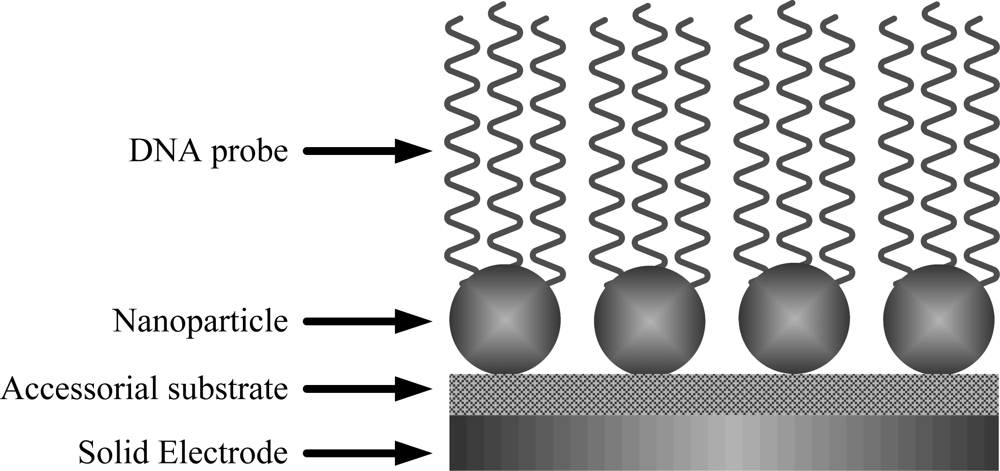
2.1. Nanoparticles
2.1.1. Gold Nanoparticles
2.1.2. Platinum Nanoparticles
2.1.3. Metal-Oxide Nanoparticles
2.1.4. Silicon Nanoparticles
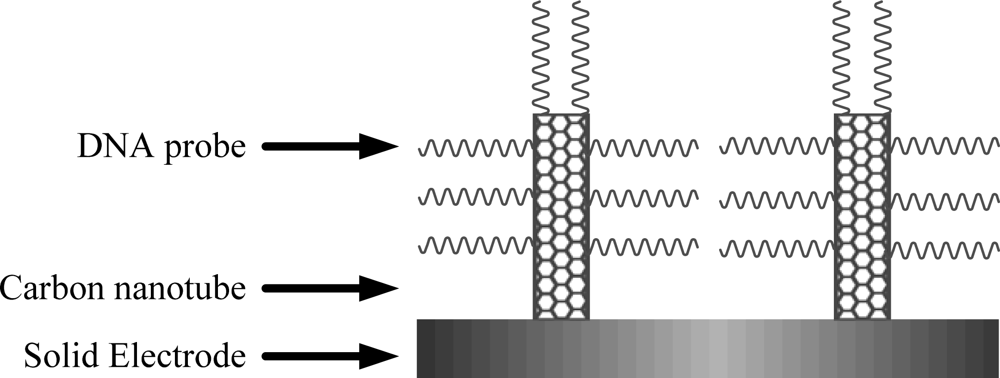
2.2. Nanotubes
2.2.1. Direct Attachment of DNA to Functionalized CNTs
2.2.2. Indirect Attachment of DNA through Different Polymers
2.3. Nanowires
2.4. Nanoclusters
3. Nano-Materials as Signal Amplifier for Hybridization
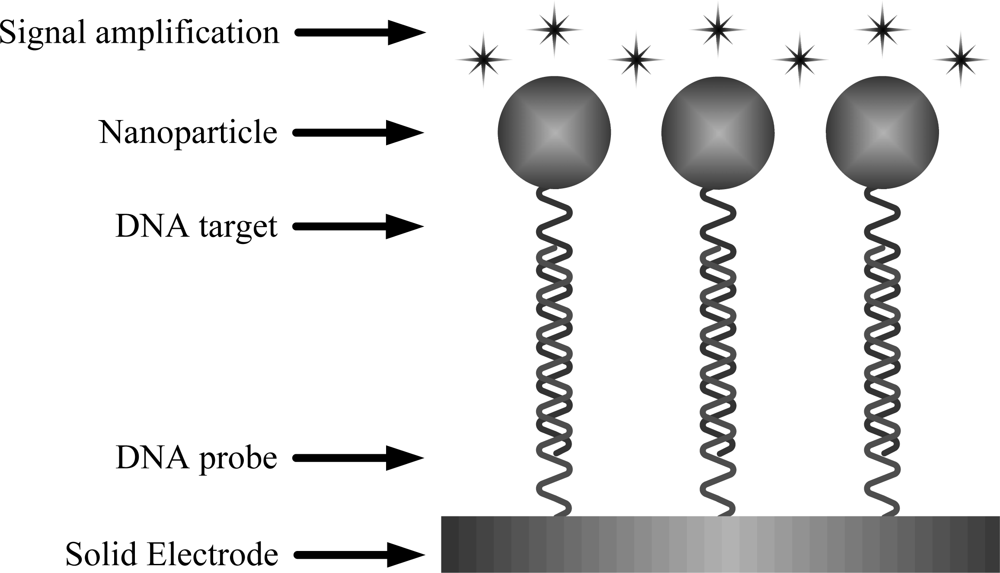
3.1. Nanoparticles
3.1.1. Gold Nanoparticles
3.1.2. Silver Nanoparticles
3.1.3. Cadmium Sulfide Nanoparticles
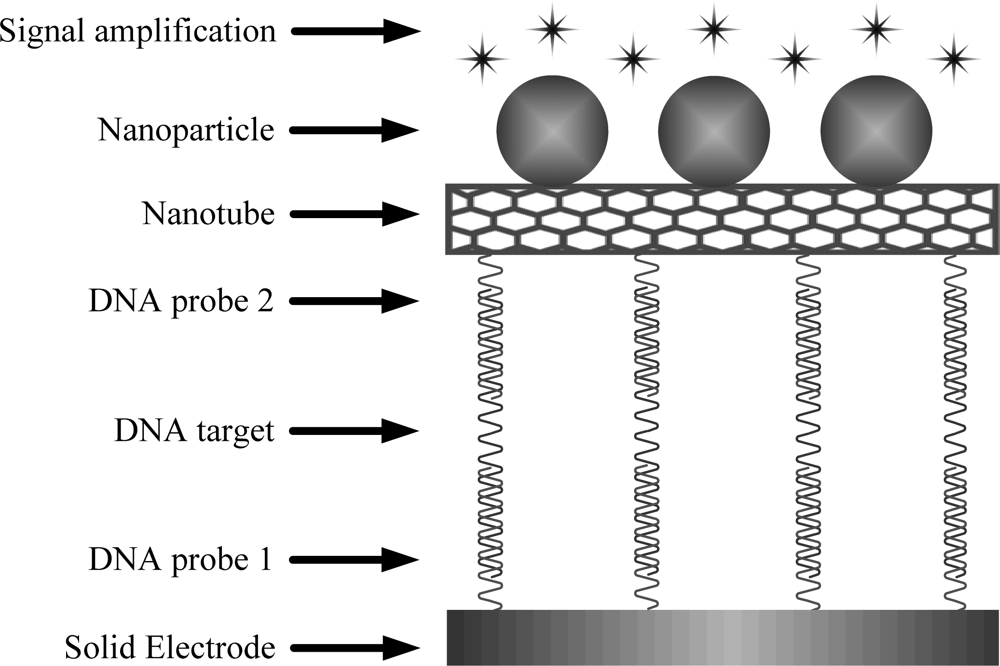
3.2. Nanotubes
3.3. Nanowires
3.4. Nanoclusters
4. Conclusions and Future Prospects
Acknowledgments
References and Notes
- Hejazi, M.S.; Alipour, E.; Pournaghi-Azar, M.H. Immobilization and voltammetric detection of human interleukine-2 gene on the pencil graphite electrode. Talanta 2007, 71, 1734–1740. [Google Scholar]
- Chen, S.H.; Wu, V.C.H.; Chuang, Y.C.; Lin, C.S. Using oligonucleotide-functionalized Au nanoparticles to rapidly detect foodborne pathogens on a piezoelectric biosensor. J. Microbiol. Meth 2008, 73, 7–17. [Google Scholar]
- Sun, H.; Choy, T.S.; Zhu, D.R.; Yam, W.C.; Fung, Y.S. Nano-silver-modified PQC/DNA biosensor for detecting E. coli in environmental water. Biosens. Bioelectron 2009, 24, 1405–1410. [Google Scholar]
- Zhang, D.; Alocilja, E.C. Characterization of nanoporous silicon-based DNA biosensor for the detection of Salmonella Enteritidis. IEEE Sens. J 2008, 8, 775–780. [Google Scholar]
- Xia, H.; Wang, F.; Huang, Q.; Huang, J.; Chen, M.; Wang, J.; Yao, C.; Chen, Q.; Cai, G.; Fu, W. Detection of Staphylococcus epidermidis by a quartz crystal microbalance nucleic acid biosensor array using Au nanoparticle signal amplification. Sensors 2008, 8, 6453–6470. [Google Scholar]
- Tichoniuk, M.; Ligaj, M.; Filipiak, M. Application of DNA hybridization biosensor as a screening method for the detection of genetically modified food components. Sensors 2008, 8, 2118–2135. [Google Scholar]
- Bogani, P.; Minunni, M.; Tombelli, S.; Buiatti, M.; Mascini, M. Transgenes monitoring in an industrial soybean processing chain by DNA-based conventional approaches and biosensors. Food Chem 2009, 113, 658–664. [Google Scholar]
- Berganza, J.; Olabarria, G.; Garcia, R.; Verdoy, D.; Rebollo, A.; Arana, S. DNA microdevice for electrochemical detection of Escherichia coli O157 : H7 molecular markers. Biosens. Bioelectron 2007, 22, 2132–2137. [Google Scholar]
- Centola, M.; Frank, M.B.; Bolstad, A.I.; Alex, P.; Szanto, A.; Zeher, M.; Hjelmervik, T.O.; Jonsson, R.; Nakken, B.; Szegedi, G.; Szodoray, P. Genome-scale assessment of molecular pathology in systemic autoimmune diseases using microarray technology: a potential breakthrough diagnostic and individualized therapy-design tool. Scand. J. Immunol 2006, 64, 236–242. [Google Scholar]
- Hendry, L.B.; Mahesh, V.B.; Bransome, E.D.; Ewing, D.E. Small molecule intercalation with double stranded DNA: Implications for normal gene regulation and for predicting the biological efficacy and genotoxicity of drugs and other chemicals. Mutat. Res-Fund Mol. M 2007, 623, 53–71. [Google Scholar]
- Urthaler, J.; Buchinger, W.; Necina, R. Improved downstream process for the production of plasmid DNA for gene therapy. Acta Biochim. Pol 2005, 52, 703–711. [Google Scholar]
- Verschaeve, L.; Koppen, G.; van Gorp, U.; Schoeters, G.; Jacobs, G.; Zwijzen, C. Seasonal variations in spontaneous levels of DNA damage; implication in the risk assessment of environmental chemicals. J. Appl. Toxicol 2007, 27, 612–620. [Google Scholar]
- Lee, A.C.; Ye, J.S.; Tan, S.N.; Poenar, D.P.; Sheu, F.-S.; Heng, C.K.; Lin, T.M. Carbon nanotube-based labels for highly sensitive colorimetric and aggregation-based visual detection of nucleic acids. Nanotechnology 2007, 18, 455102:1–455102:9. [Google Scholar]
- Giakoumaki, E.; Minunni, M.; Tombelli, S.; Tothill, I.E.; Mascini, M.; Bogani, P.; Buiatti, M. Combination of amplification and post-amplification strategies to improve optical DNA sensing. Biosens. Bioelectron 2003, 19, 337–344. [Google Scholar]
- Weller, H. Quantized semiconductor particles: a novel state of matter for materials science. Adv. Mater 1993, 5, 88–95. [Google Scholar]
- Henglein, A. Q-particles: size quantization effects in colloidal semiconductors. Progr. Colloid Polymer Sci 1987, 73, 1–3. [Google Scholar]
- Templeton, A.C.; Wuelfing, M.P.; Murray, R.W. Monolayer protected cluster molecules. Accounts. Chem. Res 2000, 33, 27–36. [Google Scholar]
- Antoine, O.; Bultel, Y.; Durand, R. Oxygen reduction reaction kinetics and mechanism on platinum nanoparticles inside Nafion (R). J. Electroanal. Chem 2001, 499, 85–94. [Google Scholar]
- Srivastava, C.; Balasubramanian, J.; Turner, C.H.; Turner, C.H.; Wiest, J.M. Formation mechanism and composition distribution of FePt nanoparticles. J. Appl. Phys 2007, 102, 104310:1–104310:8. [Google Scholar]
- Chen, C.W.; Takezako, T.; Yamamoto, K.; Serizawa, T.; Akashi, M. PoIy(N-vinylisobutyramide)-stabilized platinum nanoparticles: synthesis and temperature-responsive behavior in aqueous solution. Colloid Surface A 2000, 169, 107–116. [Google Scholar]
- Collier, P.J.; Iggo, J.A.; Whyman, R. Preparation and characterisation of solvent-stabilised nanoparticulate platinum and palladium and their catalytic behaviour towards the enantioselective hydrogenation of ethyl pyruvate. J. Mol. Catal. A-Chem 1999, 146, 149–157. [Google Scholar]
- Guerin, S.; Attard, G.S. Electrochemical behaviour of electrodeposited nanostructured palladium plus platinum films in 2 M H2SO4. Electrochem. Commun 2001, 3, 544–548. [Google Scholar]
- Boccuzzi, F.; Chiorino, A.; Manzoli, M. Au/TiO2 nanostructured catalyst: effects of gold particle sizes on CO oxidation at 90 K. Mat. Sci. Eng. C-Bio. S 2001, 15, 215–217. [Google Scholar]
- Johnson, S.R.; Evans, S.D.; Mahon, S.W.; Ulman, A. Synthesis and characterisation of surfactant-stabilised gold nanoparticles. Supramol. Sci 1997, 4, 329–333. [Google Scholar]
- Jin, B.K.; Ji, X.P.; Nakamura, T. Voltammetric study of interaction of Co(phen)33+ with DNA at gold nanoparticle self-assembly electrode. Electrochim. Acta 2004, 50, 1049–1055. [Google Scholar]
- Fu, Y.Z.; Yuan, R.; Xu, L.; Chai, Y.Q.; Zhong, X.; Tang, D.P. Indicator free DNA hybridization detection via EIS based on self-assembled gold nanoparticles and bilayer two-dimensional 3-mercaptopropyltrimethoxysilane onto a gold substrate. Biochem. Eng. J 2005, 23, 37–44. [Google Scholar]
- Kang, J.W.; Li, X.N.; Wu, G.F.; Wang, Z.H.; Lu, X.Q. A new scheme of hybridization based on the Au-nano-DNA modified glassy carbon electrode. Anal. Biochem 2007, 364, 165–170. [Google Scholar]
- Kerman, K.; Morita, Y.; Takamura, Y.; Ozsoz, M.; Tamiya, E. Modification of Escherichia coli single-stranded DNA binding protein with gold nanoparticles for electrochemical detection of DNA hybridization. Anal. Chim. Acta 2004, 510, 169–174. [Google Scholar]
- Kerman, K.; Saito, M.; Morita, Y.; Takamura, Y.; Ozsoz, M.; Tamiya, E. Electrochemical coding of single-nucleotide polymorphisms by monobase-modified gold nanoparticles. Anal. Chem 2004, 76, 1877–1884. [Google Scholar]
- Lu, W.S.; Lin, L.; Jiang, L. Nanogold hollow balls with dendritic surface for hybridization of DNA. Biosens. Bioelectron 2007, 22, 1101–1105. [Google Scholar]
- Maxwell, D.J.; Taylor, J.R.; Nie, S.M. Self-assembled nanoparticle probes for recognition and detection of biomolecules. J. Am. Chem. Soc 2002, 124, 9606–9612. [Google Scholar]
- Tsai, C.Y.; Chang, T.L.; Kuo, L.S.; Chen, P.H. Detection of electrical characteristics of DNA strands immobilized on self-assembled multilayer gold nanoparticles. Appl. Phys. Lett 2006, 89, 203902:1–203902:3. [Google Scholar]
- Wang, H.; Zhang, C.X.; Li, Y.; Qi, H.L. Electrogenerated chemiluminescence detection for deoxyribonucleic acid hybridization based on gold nanoparticles carrying multiple probes. Anal. Chim. Acta 2006, 575, 205–211. [Google Scholar]
- Spadavecchia, J.; Prete, P.; Lovergine, N.; Tapfer, L.; Rella, R. Au nanoparticles prepared by physical method on Si and sapphire substrates for biosensor applications. J. Phys. Chem. B 2005, 109, 17347–17349. [Google Scholar]
- Pan, J. Voltammetric detection of DNA hybridization using a non-competitive enzyme linked assay. Biochem. Eng. J 2007, 35, 183–190. [Google Scholar]
- Yang, J.; Yang, T.; Feng, Y.Y.; Jiao, K. A DNA electrochemical sensor based on nanogold-modified poly-2,6-pyridinedicarboxylic acid film and detection of PAT gene fragment. Anal. Biochem 2007, 365, 24–30. [Google Scholar]
- Kim, D.K.; Kerman, K.; Saito, M.; Sathuluri, R.R.; Endo, T.; Yamamura, S.; Kwon, Y.-S.; Tamiya, E. Label-free DNA biosensor based on localized surface plasmon resonance coupled with interferometry. Anal. Chem 2007, 79, 1855–1864. [Google Scholar]
- Zhu, N.N.; Chang, Z.; He, P.G.; Fang, Y.Z. Electrochemical DNA biosensors based on platinum nanoparticles combined carbon nanotubes. Anal. Chim. Acta 2005, 545, 21–26. [Google Scholar]
- Zhu, N.N.; Zhang, A.P.; Wang, Q.J.; He, P.G.; Fang, Y.Z. Electrochemical detection of DNA hybridization using methylene blue and electro-deposited zirconia thin films on gold electrodes. Anal. Chim. Acta 2004, 510, 163–168. [Google Scholar]
- Yang, Y.H.; Wang, Z.J.; Yang, M.H.; Li, J.S.; Zheng, F.; Shen, G.L.; Yu, R.Q. Electrical detection of deoxyribonucleic acid hybridization based on carbon-nanotubes/nano zirconium dioxide/chitosan-modified electrodes. Anal. Chim. Acta 2007, 584, 268–274. [Google Scholar]
- Shrestha, S.; Yeung, C.M.Y.; Mills, C.E.; Lewington, J.; Tsang, S.C. Chemically immobilized single-stranded oligonucleotides on praseodymium oxide nanoparticles as an unlabeled DNA sensor probe using impedance. Angew. Chem. Int. Ed 2007, 46, 3855–3859. [Google Scholar]
- Zhang, D.; Chen, Y.; Chen, H.Y.; Xia, X.H. Silica-nanoparticle-based interface for the enhanced immobilization and sequence-specific detection of DNA. Anal. Bioanal. Chem 2004, 379, 1025–1030. [Google Scholar]
- Wei, H.; Wang, E. Electrochemiluminescence-based DNA detection using guanine oxidation at electrostatic self-assembly of Ru(bpy)32+-doped silica nanoparticles on indium tin oxide electrode. Chem. Lett 2007, 36, 210–211. [Google Scholar]
- Iijima, S. Helical microtubules of graphitic carbon. Nature 1991, 354, 56–58. [Google Scholar]
- Trojanowicz, M. Analytical applications of carbon nanotubes: a review. Trac-Trend Anal. Chem 2006, 25, 480–489. [Google Scholar]
- Tang, T.; Peng, T.Z.; Shi, Q.C. Sequence determination of DNA pieces using carbon nanotube modified gold electrodes. Acta Chim. Sinica 2005, 63, 2042–2046. [Google Scholar]
- Abdullin, T.I.; Nikitina, I.I.; Ishmukhametova, D.G.; Budnikov, G.K.; Konovalova, O.A.; Salakhov, M.K. Carbon nanotube-modified electrodes for electrochemical DNA-sensors. J. Anal. Chem 2007, 62, 599–603. [Google Scholar]
- Kerman, K.; Morita, Y.; Takamura, Y.; Tamiya, E. Escherichia coli single-strand binding protein-DNA interactions on carbon nanotube-modified electrodes from a label-free electrochemical hybridization sensor. Anal. Bioanal. Chem 2005, 381, 1114–1121. [Google Scholar]
- Erdem, A.; Papakonstantinou, P.; Murphy, H. Direct DNA hybridization at disposable graphite electrodes modified with carbon nanotubes. Anal. Chem 2006, 78, 6656–6659. [Google Scholar]
- Liang, Z.Q.; Lao, R.J.; Wang, J.W.; Liu, Y.B.; Wang, L.H.; Huang, Q.; Song, S.P.; Li, G.X.; Fan, C.H. Solubilization of single-walled carbon nanotubes with single-stranded DNA generated from asymmetric PCR. Int. J. Mol. Sci 2007, 8, 705–713. [Google Scholar]
- Xu, Y.; Jiang, Y.; Cai, H.; He, P.G.; Fang, Y.Z. Electrochemical impedance detection of DNA hybridization based on the formation of M-DNA on polypyrrole/carbon nanotube modified electrode. Anal. Chim. Acta 2004, 516, 19–27. [Google Scholar]
- Xu, Y.; Ye, X.Y.; Yang, L.; He, P.A.; Fang, Y.Z. Impedance DNA biosensor using electropolymerized polypyrrole/multiwalled carbon nanotubes modified electrode. Electroanalysis 2006, 18, 1471–1478. [Google Scholar]
- Cai, H.; Xu, Y.; He, P.G.; Fang, Y.Z. Indicator free DNA hybridization detection by impedance measurement based on the DNA-doped conducting polymer film formed on the carbon nanotube modified electrode. Electroanalysis 2003, 15, 1864–1870. [Google Scholar]
- Qi, H.; Li, X.X.; Chen, P.; Zhang, C.X. Electrochemical detection of DNA hybridization based on polypyrrole/ss-DNA/multi-wall carbon nanotubes paste electrode. Talanta 2007, 72, 1030–1035. [Google Scholar]
- Li, J.; Liu, Q.; Liu, Y.J.; Liu, S.C.; Yao, S.Z. DNA biosensor based on chitosan film doped with carbon nanotubes. Anal. Biochem 2005, 346, 107–114. [Google Scholar]
- Bollo, S.; Ferreyra, N.F.; Rivas, G.A. Electrooxidation of DNA at glassy carbon electrodes modified with multiwall carbon nanotubes dispersed in chitosan. Electroanal 2007, 19, 833–840. [Google Scholar]
- Guo, M.L.; Chen, J.H.; Liu, D.Y.; Nie, L.H.; Yao, S.Z. Electrochemical characteristics of the immobilization of calf thymus DNA molecules on multi-walled carbon nanotubes. Bioelectrochemistry 2004, 62, 29–35. [Google Scholar]
- Jung, D.H.; Kim, B.H.; Ko, Y.K.; Jung, M.S.; Jung, S.; Lee, S.Y.; Jung, H.-T. Covalent attachment and hybridization of DNA oligonucleotides on patterned single-walled carbon nanotube films. Langmuir 2004, 20, 8886–8891. [Google Scholar]
- Guo, M.L.; Chen, J.H.; Nie, L.H.; Yao, S.Z. Electrostatic assembly of calf thymus DNA on multi-walled carbon nanotube modified gold electrode and its interaction with chlorpromazine hydrochloride. Electrochim. Acta 2004, 49, 2637–2643. [Google Scholar]
- Chang, Z.; Zhu, N.N.; Zhao, K.; Fan, H.; He, P.-G.; Fang, Y.-Z. Study of polyaniline nanowire modified electrode for electrochemical DNA biosensor. Acta Chim. Sinica 2007, 65, 135–139. [Google Scholar]
- Zhu, N.N.; Chang, Z.; He, P.G.; Fang, Y.Z. Electrochemically fabricated polyaniline nanowire-modified electrode for voltammetric detection of DNA hybridization. Electrochim. Acta 2006, 51, 3758–3762. [Google Scholar]
- Nebel, C.E.; Yang, N.; Uetsuka, H.; Osawa, H.; Tokuda, N.; Williams, O. Diamond nano-wires, a new approach towards next generation electrochemical gene sensor platforms. Diam. Rel. Mat 2008, 18, 910–917. [Google Scholar]
- Zhu, N.N.; Zhang, A.P.; He, P.G.; Fang, Y.Z. Cadmium sulfide nanocluster-based electrochemical stripping detection of DNA hybridization. Analyst 2003, 128, 260–264. [Google Scholar]
- Wang, J.B.; Profitt, J.A.; Pugia, M.J.; Suni, I.I. Au nanoparticle conjugation for impedance and capacitance signal amplification in biosensors. Anal. Chem 2006, 78, 1769–1773. [Google Scholar]
- Baca, A.J.; Zhou, F.M.; Wang, J.; Hu, J.B.; Li, J.H.; Wang, J.X.; Chikneyan, Z.S. Attachment of ferrocene-capped gold nanoparticle-streptavidin conjugates onto electrode surfaces covered with biotinylated biomolecules for enhanced voltammetric analysis. Electroanalysis 2004, 16, 73–80. [Google Scholar]
- Li, J.H.; Hu, J.B.; Ding, X.Q.; Li, Q.L. DNA electrochemical biosensor based on functional gold nanoparticles-amplification. Chem. J. Chinese Univ 2005, 26, 1432–1436. [Google Scholar]
- Wang, J.; Li, J.H.; Baca, A.J.; Hu, J.B.; Zhou, F.M.; Yan, W.; Pang, D.-W. Amplified voltammetric detection of DNA hybridization via oxidation of ferrocene caps on gold nanoparticle/streptavidin conjugates. Anal. Chem 2003, 75, 3941–3945. [Google Scholar]
- Li, J.H.; Hu, J.B. Functional gold nanoparticle-enhanced electrochemical determination of DNA hybridization and sequence-speciric analysis. Acta Chim. Sinica 2004, 62, 2081–2088. [Google Scholar]
- Yao, X.; Li, X.; Toledo, F.; Zurita-Lopez, C.; Gutova, M.; Momand, J.; Zhou, F.M. Sub-attomole oligonucleotide and p53 cDNA determinations via a high-resolution surface plasmon resonance combined with oligonucleotide-capped gold nanoparticle signal amplification. Anal. Biochem 2006, 354, 220–228. [Google Scholar]
- Kalogianni, D.P.; Koraki, T.; Christopoulos, T.K.; Ioannou, P.C. Nanoparticle-based DNA biosensor for visual detection of genetically modified organisms. Biosens. Bioelectron 2006, 21, 1069–1076. [Google Scholar]
- Martins, R.; Baptista, P.; Raniero, L.; Doria, G.; Silva, L.; Franco, R.; Fortunato, E. Amorphous/nanocrystalline silicon biosensor for the specific identification of unamplified nucleic acid sequences using gold nanoparticle probes. Appl. Phys. Lett 2007, 90, 023903:1–023903:3. [Google Scholar]
- Liu, T.; Tang, J.; Jiang, L. The enhancement effect of gold nanoparticles as a surface modifier on DNA sensor sensitivity. Biochem. Bioph. Res. Co 2004, 313, 3–7. [Google Scholar]
- Nicu, L.; Guirardel, M.; Chambosse, F.; Rougerie, P.; Hinh, S.; Trevisiol, E.; Francois, J.-M.; Majoral, J.-P.; Caminade, A.-M.; Eric Cattan, E.; Bergaud, C. Resonating piezoelectric membranes for microelectromechanically based bioassay: detection of streptavidin-gold nanoparticles interaction with biotinylated DNA. Sensors Actuat. B-Chem 2005, 110, 125–136. [Google Scholar]
- Pang, L.L.; Li, J.S.; Jiang, J.H.; Shen, G.L.; Yu, R.Q. DNA-point mutation detection based on DNA ligase reaction and nano-Au amplification: a piezoelectric approach. Anal. Biochem 2006, 358, 99–103. [Google Scholar]
- Willner, I.; Patolsky, F.; Weizmann, Y.; Willner, B. Amplified detection of single-base mismatches in DNA using micro gravimetric quartz-crystal-microbalance transduction. Talanta 2002, 56, 847–856. [Google Scholar]
- Cai, H.; Xu, Y.; Zhu, N.N.; He, P.G.; Fang, Y.Z. An electrochemical DNA hybridization detection assay based on a silver nanoparticle label. Analyst 2002, 127, 803–808. [Google Scholar]
- Fu, Y.Z.; Yuan, R.; Xu, L.; Chai, Y.Q.; Liu, Y.; Tang, D.P.; Zhang, Y. Electrochemical impedance behavior of DNA biosensor based on colloidal Ag and bilayer two-dimensional sol-gel as matrices. J. Biochem. Bioph. Meth 2005, 62, 163–174. [Google Scholar]
- K’Owino, I.O.; Mwilu, S.K.; Sadik, O.A. Metal-enhanced biosensor for genetic mismatch detection. Anal. Biochem 2007, 369, 8–17. [Google Scholar]
- Xu, Y.; Cai, H.; He, P.G.; Fang, Y.Z. Probing DNA hybridization by impedance measurement based on CdS-oligonucleotide nanoconjugates. Electroanal 2004, 16, 150–155. [Google Scholar]
- Peng, H.; Soeller, C.; Cannell, M.B.; Bowmaker, G.A.; Cooney, R.P.; Travas-Sejdic, J. Electrochemical detection of DNA hybridization amplified by nanoparticles. Biosens. Bioelectron 2006, 21, 1727–1736. [Google Scholar]
- Katz, E.; Willner, I. Biomolecule-functionalized carbon nanotubes: applications in nanobioelectronics. Chem. Phys. Chem 2004, 5, 1085–1104. [Google Scholar]
- Zhang, R.Y.; Wang, X.M.; Chen, C. Electrochemical biosensing platform using carbon nanotube activated glassy carbon electrode. Electroanalysis 2007, 19, 1623–1627. [Google Scholar]
- Hwang, E.S.; Cao, C.F.; Hong, S.H.; Jung, H.-J.; Cha, C.-Y.; Choi, J.-B.; Kim, Y.-J.; Baik, S. The DNA hybridization assay using single-walled carbon nanotubes as ultrasensitive, long-term optical labels. Nanotechnology 2006, 17, 3442–3445. [Google Scholar]
- Cao, C.F.; Kim, J.H.; Yoon, D.; Hwang, E.-S.; Kim, Y.-J.; Baik, S. Optical detection of DNA hybridization using absorption spectra of single-walled carbon nanotubes. Mater. Chem. Phys 2008, 112, 738–741. [Google Scholar]
- Wang, J.; Liu, G.D.; Jan, M.R. Ultrasensitive electrical biosensing of proteins and D.NA: Carbon-nanotube derived amplification of the recognition and transduction events. J. Am. Chem. Soc 2004, 126, 3010–3011. [Google Scholar]
- Li, Y.; Qi, H.L.; Fang, F.; Zhang, C.X. Ultrasensitive electrogenerated chemiluminescence detection of DNA hybridization using carbon-nanotubes loaded with tris(2,2′-bipyridyl) ruthenium derivative tags. Talanta 2007, 72, 1704–1709. [Google Scholar]
- Gao, Z.Q.; Agarwal, A.; Trigg, A.D.; Singh, N.; Fang, C.; Tung, C.-H.; Fan, Y.; Buddharaju, K.D.; Kong, J.M. Silicon nanowire arrays for label-free detection of DNA. Anal. Chem 2007, 79, 3291–3297. [Google Scholar]
- Hu, W.P.; Chen, S.J.; Huang, K.T.; Hsu, J.H.; Chen, W.Y.; Chang, G.L.; Lai, K.A. A novel ultrahigh-resolution surface plasmon resonance biosensor with an Au nanocluster-embedded dielectric film. Biosens. Bioelectron 2004, 19, 1465–1471. [Google Scholar]
- Ghanbari, K.; Bathaie, S.Z.; Mousavi, M.F. Electrochemically fabricated polypyrrole nanofiber-modified electrode as a new electrochemical DNA biosensor. Biosens. Bioelectron 2008, 23, 1825–1831. [Google Scholar]
- Kerman, K.; Morita, Y.; Takamura, Y.; Ozsoz, M.; Tamiya, E. DNA-directed attachment of carbon nanotubes for enhanced label-free electrochemical detection of DNA hybridization. Electroanalysis 2004, 16, 1667–1672. [Google Scholar]
- Wang, J.; Liu, G.D.; Jan, M.R.; Zhu, Q.Y. Electrochemical detection of DNA hybridization based on carbon-nanotubes loaded with CdS tags. Electrochem. Commun 2003, 5, 1000–1004. [Google Scholar]
- Xia, Q.; Chen, X.; Zhao, K.; Liu, J.H. Synthesis and characterizations of polycrystalline walnut-like CdS nanoparticle by solvothermal method with PVP as stabilizer. Mater. Chem. Phys 2008, 111, 98–105. [Google Scholar]
- Zhang, W.; Yang, T.; Zhuang, X.; Guo, Z.; Jiao, K. An ionic liquid supported CeO2 nanoshuttles–carbon nanotubes composite as a platform for impedance DNA hybridization sensing. Biosens. Bioelectron 2009, 24, 2417–2422. [Google Scholar]
- Cai, H.; Wang, Y.Q.; He, P.G.; Fang, Y.H. Electrochemical detection of DNA hybridization based on silver-enhanced gold nanoparticle label. Anal. Chim. Acta 2002, 469, 165–172. [Google Scholar]
- Cai, H.; Zhu, N.N.; Jiang, Y.; He, P.G.; Fang, Y.Z. Cu@Au alloy nanoparticle as oligonucleotides labels for electrochemical stripping detection of DNA hybridization. Biosens. Bioelectron 2003, 18, 1311–1319. [Google Scholar]
- Fu, Y.Z.; Yuan, R.; Chai, Y.Q.; Zhou, L.; Zhang, Y. Coupling of a reagentless electrochemical DNA biosensor with conducting polymer film and nanocomposite as matrices for the detection of the HIV DNA sequences. Anal. Lett 2006, 39, 467–482. [Google Scholar]
- Kerman, K.; Kobayashi, M.; Tamiya, E. Recent trends in electrochemical DNA biosensor technology. Meas. Sci. Technol 2004, 15, R1–R11. [Google Scholar]
- Ye, Y.K.; Zhao, J.H.; Yan, F.; Zhu, Y.L.; Ju, H.X. Electrochemical behavior and detection of hepatitis B virus DNA PCR production at gold electrode. Biosens. Bioelectron 2003, 18, 1501–1508. [Google Scholar]
- Mannelli, I.; Minunni, M.; Tombelli, S.; Mascini, M. Quartz crystal microbalance (QCM) affinity biosensor for genetically modified organisms (GMOs) detection. Biosens. Bioelectron 2003, 18, 129–140. [Google Scholar]


| Author | Form | Material | Size | Detection Method | Purpose | Effect | Reference |
|---|---|---|---|---|---|---|---|
| Baca, Zhou et al. 2004 | Particle | Ferrocene-capped Au nanoparticle | 10 nm | Voltammetry | Signal amplification | The detection level for glutathione was 1 nM | [65] |
| Bollo, Ferreyra et al. 2007 | Tube | MWCNT | 1–5 μm long and (30 ± 15) nm diameter | Voltammetry | Substrates for DNA attachment | The guanine oxidation signal of double stranded DNA after 3-min accumulation was 20 times higher than at bare GCE | [56] |
| Cao, Kim et al. 2008 | Tube | SWCNT | Diameter: 0.7–1.1 nm, average length: 1 μm | UV–VIS–NIR absorption spectra | Substrates for DNA attachment | DNA hybridization on the sidewall of SWCNT resulted in systematic red shifts of the absorption spectra of semiconducting nanotubes | [84] |
| Chen, Wu et al. 2008 | Particle | Au | Average diameter: 20 nm | Circulating-flow QCM | Signal amplification | Effectively amplified the signals in frequency change | [2] |
| Fu, Yuan et al. 2005 | Particle | Au | 16 nm | EIS | Substrates for DNA attachment | Detection limit: 5.0 × 10⁻⁹ M | [26] |
| Gao, Agarwal et al. 2007 | wire | Silicon | 50–80 nm | Electrical measurements | Substrates for DNA attachment | Detection limit: 10 fM | [87] |
| Ghanbari, Bathaie et al. 2008 | Wire | Polypyrrole | 30–90nm in diameter | SEM & EIS & Voltammetry & FTIR spectroscopy | Substrates for DNA attachment | A binding constant value of 4.08 × 10⁵ ± 0.05M−1 was obtained. | [89] |
| Hu, Chen et al. 2004 | Cluster | Au & SiO2 | 4.0 nm | SPR | Signal amplification | 10-fold improvement in the resolution performance | [88] |
| Kalogianni, Koraki et al. 2006 | Particle | Au | Dry-reagent visual detection | Signal amplification | Detection limit: 0.16 nM | [70] | |
| Kang, Li et al. 2007 | Particle | Au | Voltammetry & EIS | Substrates for DNA attachment | detection limit could reach the concentration of 10 × 10−9 M | [27] | |
| Kerman, Morita et al. 2004 | Tube | MWCNT | 10–20 nm i.d. and 1–5 μm length | Square-wave voltammetry & UV-visible spectrophotometer | Substrates for DNA attachment | Detection limit: 10 pg/mL | [90] |
| Lee, Ye et al. 2007 | Tube | SWCNT | AFM & Colorimetric detection | Substrates for HRP-DP | Enhanced sensitivity by at least 1000 times, and detection limit: 1 × 10⁻¹² M | [13] | |
| Li, Liu et al. 2005 | Tube | MWCNT | CV & UV–visible spectrophotometric | Substrates for DNA attachment | Enhance the electroactive surface area threefold | [55] | |
| Lu, Lin et al. 2007 | Hollow ball | Au | 3.5 nm | AFM & QCM | Substrates for DNA attachment | Detected limit is extend from 10−9 to 10−12 M | [30] |
| Nebel, Yang et al. 2008 | Wire | Diamond | 10 nm diameter | AFM & SEM & EIS & Voltammetry | Substrates for DNA attachment | The sensitivity of 2 pM on 3 mm2 sensor areas and superior DNA bonding stability over 30 hybridization/denaturation cycles. | [62] |
| Peng, Soeller et al. 2006 | Particle | CdS | Average diameter: 10 nm | EIS & Voltammetry | Signal amplification | Increase in electron-transfer resistance per CdS–ODN bound is 500 times larger than the increase per unlabeled ODN-probe bound. | [80] |
| Qi, Li et al. 2007 | Tube | MWCNT | SEM & DPV | Substrates for DNA attachment | Detection limit: 8.5 × 10⁻¹¹ M | [54] | |
| Sun, Choy et al. 2009 | Particle | Ag | QCM & EIS | Substrates for DNA attachment | Enhancement of 3.3 times for binding of complementary DNA has been shown | [3] | |
| Tsai, Chang et al. 2006 | Particle | Au | FESEM & Voltammetry | Substrates for DNA attachment | The number density of the AuNP spots in the multi-AuNPs biosensor is much higher than that in the single-AuNPs biosensor | [32] | |
| Wang, Liu et al. 2003 | Tube & Particle | SWCNT & CdS | 5–10 nm diameter & 2 μm length | SEM & Stripping-voltammetric | SWCNT used as substrates for CdS tags | Detection limit: 40 pg/mL | [91] |
| Xia, Chen et al. 2008 | Particle | CdS | About 600 nm | CV | Substrates for DNA attachment | Detection range: 1 × 10⁻¹ to 1 × 10⁻⁵ μM | [92] |
| Xu, Cai et al. 2004 | Particle | CdS | Average diameter: 5 nm | EIS | Signal amplification | Sensitivity is improved to two orders of magnitude compared with non-CdS tagged DNA sequences | [79] |
| Xu, Jiang et al. 2004 | Tube | MWCNT | 30–50 nm diameter & 1–10 μm length | EIS & Voltammetry | Substrates for DNA attachment | Detection limit: 5 × 10⁻¹¹ M | [51] |
| Yang, Wang et al. 2007 | Tube & Particle | MWCNT & ZrO2 | CV | Substrates for DNA attachment | Detection limit: 7.5 × 10⁻¹¹ M | [40] | |
| Yao, Li et al. 2006 | Particle | Au | SPR | Signal amplification | A 39-mer target at a quantity as low as 2.1 × 10⁻²⁰ mol, corresponding to 1.38 fM in a 15 μL solution, can be measured. | [69] | |
| Zhang, Chen et al. 2004 | Particle | SiO2 | AFM & SEM & X-ray & photoelectron spectroscopy & EIS & Voltammetry | Substrates for DNA attachment | Enhanced immobilization of ss-DNA up to 1.6 × 10⁻⁸ mol/cm2, markedly larger than the commonly accepted saturation monolayer adsorption (2.77 × 10⁻¹⁰ mol/cm2) | [42] | |
| Zhang, Wang et al. 2007 | Tube | MWCNT | 30 nm diameter | AFM & Voltammetry | Substrates for DNA attachment | Detection limit of 7.5 nM for guanine and 150 ng/mL for acid denatured DNA | [82] |
| Zhang, Yang et al. 2009 | Tube & shuttle | SWCNT & CeO2 | SEM & EIS & Voltammetry | Substrates for DNA attachment | The dynamic range for detecting the sequence specific DNA was from 1.0 × 10⁻¹² mol/L to 1.0 × 10⁻⁷ mol/L, and the detection limit was 2.3 × 10⁻¹³ mol/L | [93] | |
| Zhu, Chang et al. 2005 | Tube & Particle | MWCNT & Pt | 40–60 nm diameter & 1–10 μm length | CV & DPV | Substrates for DNA attachment | Detection limit: 1.0 × 10⁻¹¹ M | [38] |
© 2009 by the authors; licensee MDPI, Basel, Switzerland This article is an open access article distributed under the terms and conditions of the Creative Commons Attribution license (http://creativecommons.org/licenses/by/3.0/).
Share and Cite
Xu, K.; Huang, J.; Ye, Z.; Ying, Y.; Li, Y. Recent Development of Nano-Materials Used in DNA Biosensors. Sensors 2009, 9, 5534-5557. https://doi.org/10.3390/s90705534
Xu K, Huang J, Ye Z, Ying Y, Li Y. Recent Development of Nano-Materials Used in DNA Biosensors. Sensors. 2009; 9(7):5534-5557. https://doi.org/10.3390/s90705534
Chicago/Turabian StyleXu, Kai, Junran Huang, Zunzhong Ye, Yibin Ying, and Yanbin Li. 2009. "Recent Development of Nano-Materials Used in DNA Biosensors" Sensors 9, no. 7: 5534-5557. https://doi.org/10.3390/s90705534