
<?xml version="1.0" encoding="UTF-8"?>
<!DOCTYPE article PUBLIC "-//NLM//DTD Journal Publishing DTD v2.3 20070202//EN" "journalpublishing.dtd">
<article xmlns:mml="http://www.w3.org/1998/Math/MathML" xmlns:xlink="http://www.w3.org/1999/xlink" xml:lang="en" article-type="research-article">
<front>
<journal-meta>
<journal-id journal-id-type="nlm-ta">Sensors</journal-id>
<journal-title>Sensors</journal-title>
<issn pub-type="epub">1424-8220</issn>
<publisher>
<publisher-name>Molecular Diversity Preservation International (MDPI)</publisher-name></publisher></journal-meta>
<article-meta>
<article-id pub-id-type="doi">10.3390/s90100148</article-id>
<article-id pub-id-type="publisher-id">sensors-09-00148</article-id>
<article-categories>
<subj-group>
<subject>Article</subject></subj-group></article-categories>
<title-group>
<article-title>Remote Sensing Data with the Conditional Latin Hypercube Sampling and Geostatistical Approach to Delineate Landscape Changes Induced by Large Chronological Physical Disturbances</article-title></title-group>
<contrib-group>
<contrib contrib-type="author">
<name><surname>Lin</surname><given-names>Yu-Pin</given-names></name><xref ref-type="corresp" rid="c1-sensors-09-00148"><sup>*</sup></xref></contrib>
<contrib contrib-type="author">
<name><surname>Chu</surname><given-names>Hone-Jay</given-names></name></contrib>
<contrib contrib-type="author">
<name><surname>Wang</surname><given-names>Cheng-Long</given-names></name></contrib>
<contrib contrib-type="author">
<name><surname>Yu</surname><given-names>Hsiao-Hsuan</given-names></name></contrib>
<contrib contrib-type="author">
<name><surname>Wang</surname><given-names>Yung-Chieh</given-names></name></contrib>
<aff id="af1-sensors-09-00148">Department of Bioenvironmental Systems Engineering, National Taiwan University, 1, Sec. 4, Roosevelt Rd., Da-an District, Taipei City 106, Taiwan, R. O. C; E-Mails: <email>honejaychu@gmail.com</email> (H.-J. C.); <email>r96622053@ntu.edu.tw</email> (C.-L. W.); <email>b94602038@ntu.edu.tw</email> (H.-H. Y.); <email>b92602015@ntu.edu.tw</email> (Y.-C. W.)</aff></contrib-group>
<author-notes>
<corresp id="c1-sensors-09-00148">
<label>*</label>Author to whom correspondence should be addressed; Email: <email>yplin@ntu.edu.tw</email> (Y.-P. L.); Tel.: +886-2-33663467; Fax: +886-2-33663464</corresp></author-notes>
<pub-date pub-type="collection">
<year>2009</year></pub-date>
<pub-date pub-type="epub">
<day>7</day>
<month>1</month>
<year>2008</year></pub-date>
<volume>9</volume>
<issue>1</issue>
<fpage>148</fpage>
<lpage>174</lpage>
<history>
<date date-type="received">
<day>12</day>
<month>11</month>
<year>2008</year></date>
<date date-type="rev-recd">
<day>5</day>
<month>1</month>
<year>2009</year></date>
<date date-type="accepted">
<day>6</day>
<month>1</month>
<year>2009</year></date></history>
<permissions>
<copyright-statement>© 2009 by the authors; licensee Molecular Diversity Preservation International, Basel, Switzerland.</copyright-statement>
<copyright-year>2009</copyright-year>
<license>
<p>This article is an open access article distributed under the terms and conditions of the Creative Commons Attribution license (http://creativecommons.org/licenses/by/3.0/).</p></license></permissions>
<abstract>
<p>This study applies variogram analyses of normalized difference vegetation index (NDVI) images derived from SPOT HRV images obtained before and after the ChiChi earthquake in the Chenyulan watershed, Taiwan, as well as images after four large typhoons, to delineate the spatial patterns, spatial structures and spatial variability of landscapes caused by these large disturbances. The conditional Latin hypercube sampling approach was applied to select samples from multiple NDVI images. Kriging and sequential Gaussian simulation with sufficient samples were then used to generate maps of NDVI images. The variography of NDVI image results demonstrate that spatial patterns of disturbed landscapes were successfully delineated by variogram analysis in study areas. The high-magnitude Chi-Chi earthquake created spatial landscape variations in the study area. After the earthquake, the cumulative impacts of typhoons on landscape patterns depended on the magnitudes and paths of typhoons, but were not always evident in the spatiotemporal variability of landscapes in the study area. The statistics and spatial structures of multiple NDVI images were captured by 3,000 samples from 62,500 grids in the NDVI images. Kriging and sequential Gaussian simulation with the 3,000 samples effectively reproduced spatial patterns of NDVI images. However, the proposed approach, which integrates the conditional Latin hypercube sampling approach, variogram, kriging and sequential Gaussian simulation in remotely sensed images, efficiently monitors, samples and maps the effects of large chronological disturbances on spatial characteristics of landscape changes including spatial variability and heterogeneity.</p></abstract>
<kwd-group>
<kwd>Chi-Chi earthquake</kwd>
<kwd>typhoons</kwd>
<kwd>landscape changes</kwd>
<kwd>remotely sensed images</kwd>
<kwd>geostatistics</kwd>
<kwd>spatial patterns</kwd>
<kwd>Latin hypercube sampling</kwd>
<kwd>conditional simulation</kwd></kwd-group></article-meta></front>
<body>
<sec sec-type="intro">
<label>1.</label>
<title>Introduction</title>
<p>The influences of large physical disturbances on ecosystem structure and function have garnered considerable attention [<xref ref-type="bibr" rid="b1-sensors-09-00148">1</xref>-<xref ref-type="bibr" rid="b4-sensors-09-00148">4</xref>]. Fires, hurricanes (typhoons), tornados, ice storms, and landslides are examples of such large disturbances [<xref ref-type="bibr" rid="b4-sensors-09-00148">4</xref>]. Earthquakes have long been recognized as a major cause of landslides [<xref ref-type="bibr" rid="b5-sensors-09-00148">5</xref>, <xref ref-type="bibr" rid="b6-sensors-09-00148">6</xref>]. However, landslides are only the first in a series of processes by which materials are removed from slopes and transported out of a region by fluvial action [<xref ref-type="bibr" rid="b6-sensors-09-00148">6</xref>, <xref ref-type="bibr" rid="b7-sensors-09-00148">7</xref>]. Additionally, typhoons are extremely important natural disturbances that characterize the structure, function and dynamics of many tropical and temperate forest ecosystems [<xref ref-type="bibr" rid="b8-sensors-09-00148">8</xref>]. Taiwan, which is located in a subtropical region, sits on the Philippine plate at the Euro-Asian Plate junction [<xref ref-type="bibr" rid="b9-sensors-09-00148">9</xref>]. Plate convergence occasionally generates earthquakes that have disastrous effects on Taiwan [<xref ref-type="bibr" rid="b10-sensors-09-00148">10</xref>]. Moreover, typhoons that bring tremendous amounts of rainfall hit Taiwan every year from July to October [<xref ref-type="bibr" rid="b11-sensors-09-00148">11</xref>]. During 1996–2004, large disturbances in the following sequence impacted central Taiwan: (1) typhoon Herb (August 1996); (2) the Chi-Chi earthquake (September 1999); (3) typhoon Xangsane (November 2000); (4) typhoon Toraji (July 2001); (4) typhoon Dujuan (September, 2003); and, (5) typhoon Mindulle (June 2004) [<xref ref-type="bibr" rid="b11-sensors-09-00148">11</xref>]. In particular, after the ChiChi earthquake, the expansion rate of landslide areas increased 20-fold in central Taiwan [<xref ref-type="bibr" rid="b12-sensors-09-00148">12</xref>]. Numerous extension cracks, which accelerate landslides during downpours, were generated on hill slopes during the ChiChi earthquake [<xref ref-type="bibr" rid="b13-sensors-09-00148">13</xref>]. Moreover, during typhoon seasons, a massive amount of loose earth and stones accumulated on the surface of slopes, increasing the risk of debris flows and additional landslides [<xref ref-type="bibr" rid="b14-sensors-09-00148">14</xref>] that worsen the revegetation problem. Accordingly, monitoring, delineating and sampling landscape changes, spatial structure and spatial variation induced by large physical disturbances are essential to landscape management and restoration, and disaster management in Taiwan.</p>
<p>Remotely sensed data can describe surface processes, including landscape dynamics, as such data provide frequent spatial estimates of key earth surface variables [<xref ref-type="bibr" rid="b15-sensors-09-00148">15</xref>, <xref ref-type="bibr" rid="b16-sensors-09-00148">16</xref>]. For example, the SPOT, LANSAT and MODIS data sets have notable advantages that account for their use in ecological applications, including a long-running historical time-series, a special resolution appropriate to regional land-cover and land-use change investigations, and a spectral coverage appropriate to studies of vegetation properties [<xref ref-type="bibr" rid="b17-sensors-09-00148">17</xref>-<xref ref-type="bibr" rid="b19-sensors-09-00148">19</xref>]. The Normalized Difference Vegetation Index (NDVI), a widely used vegetation index, is typically used to quantify landscape dynamics, including vegetation cover and landslides changes induced by large disturbances [<xref ref-type="bibr" rid="b6-sensors-09-00148">6</xref>, <xref ref-type="bibr" rid="b8-sensors-09-00148">8</xref>, <xref ref-type="bibr" rid="b11-sensors-09-00148">11</xref>, <xref ref-type="bibr" rid="b16-sensors-09-00148">16</xref>, <xref ref-type="bibr" rid="b20-sensors-09-00148">20</xref>]. Notably, NDVI images can be determined by simply geometric operations near-infrared and visible-red spectral data almost immediately after remotely sensed data is obtained. The NDVI, which is the most common vegetation index, has been extensively used to determine the vigor of plants as a surrogate measure of canopy density [<xref ref-type="bibr" rid="b21-sensors-09-00148">21</xref>]. A high NDVI indicates a high level of photosynthetic activity [<xref ref-type="bibr" rid="b22-sensors-09-00148">22</xref>]. Moreover, significant differences in NDVI images before and after a natural disturbance can represent landscape changes, including vegetation and landslides induced by a disturbance that changes plant-covered land to bare lands or bare lands to plant-covered land [<xref ref-type="bibr" rid="b23-sensors-09-00148">23</xref>].</p>
<p>Spatial patterns in ecological systems are the result of an interaction among dynamic processes operating across abroad range of spatial and temporal scales [<xref ref-type="bibr" rid="b24-sensors-09-00148">24</xref>-<xref ref-type="bibr" rid="b26-sensors-09-00148">26</xref>]. Ecological manifestations of large disturbances are rarely homogeneous in their spatial coverage [<xref ref-type="bibr" rid="b4-sensors-09-00148">4</xref>]. Variograms are crucial to geostatistics. A variogram is a function related to the variance to spatial separation and provides a concise description of the scale and pattern of spatial variability [<xref ref-type="bibr" rid="b27-sensors-09-00148">27</xref>]. Samples of remotely sensed data (e.g., satellite or air-borne sensor imagery) can be employed to construct variograms for remotely sensed research [<xref ref-type="bibr" rid="b27-sensors-09-00148">27</xref>]. Moreover, variograms have been used widely to understand the nature and causes of spatial variation within an image [<xref ref-type="bibr" rid="b28-sensors-09-00148">28</xref>]. Modeling the variogram of NDVI images with high spatial resolution is an efficient approach for characterizing and quantifying heterogeneous spatial components (spatial variability and spatial structure) of a landscape and the spatial heterogeneity of vegetation cover at the landscape level [<xref ref-type="bibr" rid="b28-sensors-09-00148">28</xref>, <xref ref-type="bibr" rid="b29-sensors-09-00148">29</xref>].</p>
<p>Reliable data analysis of spatially distributed data requires the use of appropriate statistical tools and a sound data sampling strategy [<xref ref-type="bibr" rid="b30-sensors-09-00148">30</xref>]. Spatial sampling schemes have been developed to determine the sampling locations that cover the variation in environmental properties in a given area [<xref ref-type="bibr" rid="b31-sensors-09-00148">31</xref>]. Moreover, data samples are transformed via a series of interpretation steps to obtain complete descriptions of phenomena of interest [<xref ref-type="bibr" rid="b32-sensors-09-00148">32</xref>]. Different sampling schemes are, say, random, systematic, stratified, or nested schemes [<xref ref-type="bibr" rid="b32-sensors-09-00148">32</xref>, <xref ref-type="bibr" rid="b33-sensors-09-00148">33</xref>]. Latin hypercube sampling (LHS) is a stratified random procedure that is an efficient way of sampling variables from their multivariate distributions [<xref ref-type="bibr" rid="b34-sensors-09-00148">34</xref>]. Initially developed for Monte-Carlo simulation, LHS efficiently selects input variables for computer models [<xref ref-type="bibr" rid="b35-sensors-09-00148">35</xref>, <xref ref-type="bibr" rid="b36-sensors-09-00148">36</xref>]. Kriging, a geostatistical method, is a linear interpolation approach that provides a best linear unbiased estimator (BLUE) for quantities that vary spatially [<xref ref-type="bibr" rid="b37-sensors-09-00148">37</xref>]. However, kriging interpolate algorithms generate maps of best local estimate and generally smooth out the local details of the spatial variation of an attribute [<xref ref-type="bibr" rid="b38-sensors-09-00148">38</xref>].For sampled data, a geostatistical conditional simulation technique, such as sequential Gaussian simulation (SGS), can be applied to generate multiple realizations, including an error component, which is absent from classical interpolation approaches [<xref ref-type="bibr" rid="b37-sensors-09-00148">37</xref>]. In such conditional simulations, all generated realizations reproduce available data at measurement locations, and, on average, reproduce a data histogram and a model of spatial correlations (i.e., variogram) between observations [<xref ref-type="bibr" rid="b39-sensors-09-00148">39</xref>]. In SGS, Gaussian transformation of available measurements is simulated, such that each simulated value is conditional on original data and all previously simulated values [<xref ref-type="bibr" rid="b37-sensors-09-00148">37</xref>, <xref ref-type="bibr" rid="b40-sensors-09-00148">40</xref>]. Geostatistical conditional simulations have been widely applied to simulate the spatial variability and spatial distribution of interest in many fields. Moreover, geostatistical simulation techniques with LHS have been applied to simulate Gaussian random fields [<xref ref-type="bibr" rid="b39-sensors-09-00148">39</xref>, <xref ref-type="bibr" rid="b41-sensors-09-00148">41</xref>-<xref ref-type="bibr" rid="b43-sensors-09-00148">43</xref>].</p>
<p>This study applied variogram analysis to delineate spatial variations of NDVI images before and after large physical disturbances in central Taiwan. The NDVI data derived from SPOT images before and after the ChiChi earthquake (ML=7.3 on the Richter scale) in the Chenyulan basin, Taiwan, as well as images before and after four large typhoons (Xangsane, Toraji, Dujuan and Mindulle) were analyzed to identify the spatial patterns of landscapes caused by these major disturbances. Landscape spatial patterns of different disturbance regimes were discussed. Moreover, conditional LHS (cLHS) schemes with NDVI images were used to select spatial samples from actual NDVI images to detect landscape changes induced by a series of large disturbances. The best cLHS samples selected with the NDVI values were used to estimate and simulate NDVI distributions using kriging and SGS. The simulated NDVI images were compared with actual NDVI images induced by the disturbances.</p></sec>
<sec sec-type="materials|methods">
<label>2.</label>
<title>Methods and Materials</title>
<sec sec-type="methods">
<label>2.1.</label>
<title>Study area and remote sensing data</title>
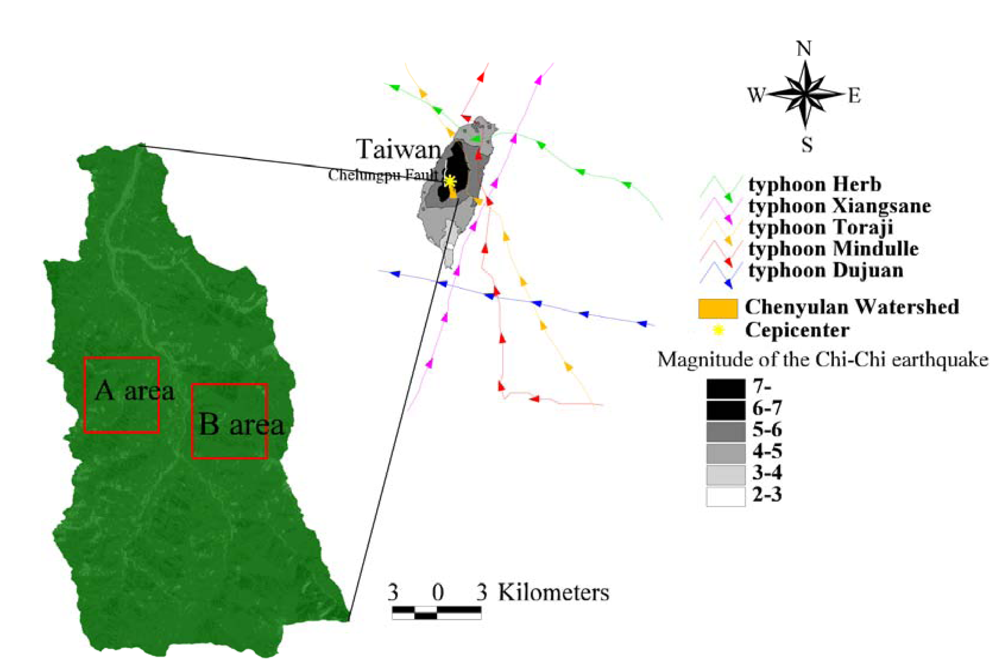
<p>The Chenyulan watershed, located in central Taiwan, is a classical intermountain watershed, and has an average altitude of 1,540 m and an area of 449 km<sup>2</sup> (<xref ref-type="fig" rid="f1-sensors-09-00148">Figure 1</xref>). The Chenyulan stream, which coincides with the Chenyulan fault, flows from south to north and elongates the watershed in the same direction. Differences in uplifting along the fault generated abundant fractures over the watershed and resulted in an average slope of 62.5% and relief of 585 m/km<sup>2</sup>. Moreover, the main course of the Chenyulan stream had a gradient of 6.1%, and more than 60% of its tributaries had gradients exceeding 20%. The special geological and geographical characteristics of the watershed result in frequent landsides and debris flows [<xref ref-type="bibr" rid="b12-sensors-09-00148">12</xref>]. The September 21, 1999, Chi-Chi earthquake occurred at 1:47 a.m. local time (17:47:18 GMT the previous day) at an epicentral location of 23.85_N and 120.78_E and at a depth 6.99 km (<xref ref-type="fig" rid="f1-sensors-09-00148">Figure 1</xref>). It was caused by a rupture in the Chelungpu Fault. The magnitude of the earthquake was estimated to be ML = 7.3 (ML: Local Magnitude or Richter Magnitude), and the rupture zone, defined by the aftershocks, measured about 80 km north-south by 25–30 km downdip [<xref ref-type="bibr" rid="b10-sensors-09-00148">10</xref>, <xref ref-type="bibr" rid="b44-sensors-09-00148">44</xref>]. Iso-contour maps of the earthquake's magnitude were reproduced from the Central Weather Bureau (<xref ref-type="fig" rid="f1-sensors-09-00148">Figure 1</xref>) [<xref ref-type="bibr" rid="b45-sensors-09-00148">45</xref>]. After the earthquake, from October 31, 2000 to November 1, 2000, the center of typhoon Xiangsane moved from south to north through eastern Taiwan [<xref ref-type="bibr" rid="b46-sensors-09-00148">46</xref>], with a maximum wind speed of 138.9 km/hr and a radius of 250 km (<xref ref-type="fig" rid="f1-sensors-09-00148">Figure 1</xref>). The maximum daily rainfall was 550 mm/day. On July 30, 2001, the Toraji typhoon swept across central Taiwan from east to west [<xref ref-type="bibr" rid="b47-sensors-09-00148">47</xref>], with a maximum wind speed of 138.9 km/hr and a radius of 180 km (<xref ref-type="fig" rid="f1-sensors-09-00148">Figure 1</xref>). The typhoon brought extremely heavy rainfall, from 230 to 650 mm/ day, and triggered more than 6000 landslides in Taiwan. After crossing Taiwan, typhoon Toraji became a tropical storm; however it brought 339 to 757 mm of total accumulated rainfall in the watershed [<xref ref-type="bibr" rid="b47-sensors-09-00148">47</xref>] (<xref ref-type="fig" rid="f1-sensors-09-00148">Figure 1</xref>). After typhoon Toraji, typhoons Dujuan with a maximum wind speed of 165.0 km/hr, a radius of 200 km and maximum rainfall 200 mm/hr (August 31, 2003–September 2, 2003) and Mindulle with maximum wind speed of 200.0 km/hr, a radius of 200 km and maximum rainfall 166 mm/hr (June 29, 2004–July 2, 2004) chronologically produced heavy rainfall that fell across the eastern and central parts of Taiwan on September 2003 and June 2004 [<xref ref-type="bibr" rid="b48-sensors-09-00148">48</xref>] (<xref ref-type="fig" rid="f1-sensors-09-00148">Figure 1</xref>). The two study area with dimensions of 50×50 km<sup>2</sup> (250×250 pixels) was selected from the upstream of the large debris flood announced in the watershed, as shown in <xref ref-type="fig" rid="f1-sensors-09-00148">Figure 1</xref>.</p></sec>
<sec>
<label>2.2.</label>
<title>NDVI</title>
<p>Seven cloud-free SPOT images (1996/11/08, 1999/03/06, 1999/10/31, 2000/11/27, 2001/11/20, 2003/12/17 and 2004/11/19) of the Chenyulan watershed were purchased from the Space and Remote-sensing Research Center, Taiwan. The NDVI images of the study area were generated from SPOT HRV images with a resolution of 20 m according to the following equation:
<disp-formula id="FD1">
<label>(1)</label>
<mml:math id="mm1" display="block">
<mml:semantics id="sm1">
<mml:mrow>
<mml:mtext mathvariant="italic">NDVI</mml:mtext>
<mml:mo>=</mml:mo>
<mml:mfrac>
<mml:mrow>
<mml:mtext mathvariant="italic">NIR</mml:mtext>
<mml:mo>−</mml:mo>
<mml:mi>R</mml:mi></mml:mrow>
<mml:mrow>
<mml:mtext mathvariant="italic">NIR</mml:mtext>
<mml:mo>+</mml:mo>
<mml:mi>R</mml:mi></mml:mrow></mml:mfrac></mml:mrow></mml:semantics></mml:math></disp-formula>where NIR and R are near-infrared and visible-red spectral data, respectively. The NDVI values range from −1 to +1; a high NDVI value represents a large amount of high photosynthesizing vegetation [<xref ref-type="bibr" rid="b49-sensors-09-00148">49</xref>].</p></sec>
<sec>
<label>2.3.</label>
<title>Variogram and kriging estimation</title>
<p>In geostatistical methods, variograms can be used to quantify the observed relationship between the values of samples and the proximity of samples [<xref ref-type="bibr" rid="b37-sensors-09-00148">37</xref>]. Following the work of Garrigues <italic>et al.</italic> (2006), Garrigues <italic>et al.</italic> (2008) and Lin <italic>et al.</italic> (2008), NDVI data are considered values of punctual regionalized variable. An experimental variogram for interval lag distance class <italic>h</italic>, <italic>γ</italic>(<italic>h</italic>), is represented by
<disp-formula id="FD2">
<label>(2)</label>
<mml:math id="mm2" display="block">
<mml:semantics id="sm2">
<mml:mrow>
<mml:mi>γ</mml:mi>
<mml:mo stretchy="false">(</mml:mo>
<mml:mi>h</mml:mi>
<mml:mo stretchy="false">)</mml:mo>
<mml:mo>=</mml:mo>
<mml:mfrac>
<mml:mn>1</mml:mn>
<mml:mrow>
<mml:mn>2</mml:mn>
<mml:mi>n</mml:mi>
<mml:mo stretchy="false">(</mml:mo>
<mml:mi>h</mml:mi>
<mml:mo stretchy="false">)</mml:mo></mml:mrow></mml:mfrac>
<mml:munderover>
<mml:mo>∑</mml:mo>
<mml:mrow>
<mml:mi>i</mml:mi>
<mml:mo>=</mml:mo>
<mml:mn>1</mml:mn></mml:mrow>
<mml:mrow>
<mml:mi>n</mml:mi>
<mml:mo stretchy="false">(</mml:mo>
<mml:mi>h</mml:mi>
<mml:mo stretchy="false">)</mml:mo></mml:mrow></mml:munderover>
<mml:mrow>
<mml:msup>
<mml:mrow>
<mml:mo stretchy="false">[</mml:mo>
<mml:mi>Z</mml:mi>
<mml:mo stretchy="false">(</mml:mo>
<mml:msub>
<mml:mi>x</mml:mi>
<mml:mi>i</mml:mi></mml:msub>
<mml:mo>+</mml:mo>
<mml:mi>h</mml:mi>
<mml:mo stretchy="false">)</mml:mo>
<mml:mo>−</mml:mo>
<mml:mi>Z</mml:mi>
<mml:mo stretchy="false">(</mml:mo>
<mml:msub>
<mml:mi>x</mml:mi>
<mml:mi>i</mml:mi></mml:msub>
<mml:mo stretchy="false">)</mml:mo>
<mml:mo stretchy="false">]</mml:mo></mml:mrow>
<mml:mn>2</mml:mn></mml:msup></mml:mrow></mml:mrow></mml:semantics></mml:math></disp-formula>where <italic>h</italic> is the lag distance that separates pairs of points; <italic>Z(x)</italic> is bird diversity at location x, and <italic>Z(x</italic> + <italic>h</italic>) is bird diversity at location <italic>x</italic> + <italic>h</italic>; <italic>n(h)</italic> is the number of pairs separated by lag distance <italic>h</italic>.</p>
<p>Kriging is estimated using weighted sums of adjacent sampled concentrations. The weights depend on the correlation structure exhibited. The weights are determined by minimizing estimated variance. In this context, kriging estimates (Best Linear Unbiased Estimator) are the most accurate of all linear estimators. Accordingly, kriging estimates the value of the random variable at unsampled location X0based on measured values in a linear form:
<disp-formula id="FD3">
<label>(3)</label>
<mml:math id="mm3" display="block">
<mml:semantics id="sm3">
<mml:mrow>
<mml:msup>
<mml:mi>Z</mml:mi>
<mml:mo>∗</mml:mo></mml:msup>
<mml:mo stretchy="false">(</mml:mo>
<mml:msub>
<mml:mi>x</mml:mi>
<mml:mn>0</mml:mn></mml:msub>
<mml:mo stretchy="false">)</mml:mo>
<mml:mo>=</mml:mo>
<mml:munderover>
<mml:mo>∑</mml:mo>
<mml:mrow>
<mml:mi>i</mml:mi>
<mml:mo>=</mml:mo>
<mml:mn>1</mml:mn></mml:mrow>
<mml:mi>N</mml:mi></mml:munderover>
<mml:mrow>
<mml:msub>
<mml:mi>λ</mml:mi>
<mml:mrow>
<mml:mi>i</mml:mi>
<mml:mn>0</mml:mn></mml:mrow></mml:msub>
<mml:mi>Z</mml:mi>
<mml:mo stretchy="false">(</mml:mo>
<mml:msub>
<mml:mi>x</mml:mi>
<mml:mi>i</mml:mi></mml:msub>
<mml:mo stretchy="false">)</mml:mo></mml:mrow></mml:mrow></mml:semantics></mml:math></disp-formula>where <italic>Z</italic>* (<italic>x</italic><sub>0</sub>) is the estimated value at location <italic>x</italic><sub>0</sub>, <italic>λ</italic><sub>i0</sub> is the estimation weight of <italic>Z</italic>(<italic>x<sub>i</sub></italic>), <italic>x<sub>i</sub></italic> is the location of sampling point for variable Z, and N is the number of the variable Z involved in the estimation.</p>
<p>Based on non-biased constraints and minimizing estimation variance, estimated kriging variance can be presented as:
<disp-formula id="FD4">
<label>(4)</label>
<mml:math id="mm4" display="block">
<mml:semantics id="sm4">
<mml:mrow>
<mml:msub>
<mml:mrow>
<mml:msup>
<mml:mi>σ</mml:mi>
<mml:mn>2</mml:mn></mml:msup></mml:mrow>
<mml:mrow>
<mml:mtext mathvariant="italic">kriging</mml:mtext></mml:mrow></mml:msub>
<mml:mo>=</mml:mo>
<mml:munderover>
<mml:mo>∑</mml:mo>
<mml:mrow>
<mml:mi>i</mml:mi>
<mml:mo>=</mml:mo>
<mml:mn>1</mml:mn></mml:mrow>
<mml:mi>N</mml:mi></mml:munderover>
<mml:mrow>
<mml:msub>
<mml:mi>λ</mml:mi>
<mml:mrow>
<mml:mi>i</mml:mi>
<mml:mn>0</mml:mn></mml:mrow></mml:msub>
<mml:msub>
<mml:mi>γ</mml:mi>
<mml:mrow>
<mml:mi>z</mml:mi>
<mml:mi>z</mml:mi></mml:mrow></mml:msub>
<mml:mo stretchy="false">(</mml:mo>
<mml:msub>
<mml:mi>x</mml:mi>
<mml:mi>i</mml:mi></mml:msub>
<mml:mo>−</mml:mo>
<mml:msub>
<mml:mi>x</mml:mi>
<mml:mn>0</mml:mn></mml:msub>
<mml:mo stretchy="false">)</mml:mo>
<mml:mo>+</mml:mo>
<mml:mi>μ</mml:mi></mml:mrow></mml:mrow></mml:semantics></mml:math></disp-formula>where <italic>μ</italic> is the Lagrange multiplier.</p></sec>
<sec>
<label>2.4.</label>
<title>Conditional Latin hypercube</title>
<p>The cLHS, which is based on the empirical distribution of original data, provides a full coverage of range each variable by maximally stratifying the marginal distribution and ensuring a good spread of sampling points [<xref ref-type="bibr" rid="b34-sensors-09-00148">34</xref>]. This sampling procedure represents an optimization problem: given N sites with ancillary data (<italic>Z</italic>), select n sample sites (<italic>n</italic>≪<italic>N</italic>) such that the sampled sites z form a Latin hypercube. For continuous variables, each component of X (size, <italic>N</italic>×<italic>k</italic>) is divided into n (sample size) equally probable strata based on their distributions, and x (size <italic>n</italic>×<italic>k</italic>) is a sub-sample of X. The procedures of the cLHS algorithm [<xref ref-type="bibr" rid="b34-sensors-09-00148">34</xref>] are follows.</p>
<list list-type="order">
<list-item>
<p>Divide the quantile distribution of X into n strata, and calculate the quantile distribution for each variable, 
<inline-formula>
<mml:math id="mm5">
<mml:semantics id="sm5">
<mml:mrow>
<mml:msubsup>
<mml:mi>q</mml:mi>
<mml:mi>j</mml:mi>
<mml:mi>i</mml:mi></mml:msubsup>
<mml:mo>,</mml:mo>
<mml:mo>…</mml:mo>
<mml:mo>,</mml:mo>
<mml:msubsup>
<mml:mi>q</mml:mi>
<mml:mi>j</mml:mi>
<mml:mrow>
<mml:mi>n</mml:mi>
<mml:mo>+</mml:mo>
<mml:mn>1</mml:mn></mml:mrow></mml:msubsup></mml:mrow></mml:semantics></mml:math></inline-formula>. Calculate the correlation matrix for <italic>Z</italic> (C).</p></list-item>
<list-item>
<p>Pick n random samples from <italic>N</italic>; z (<italic>i</italic>=1,…, <italic>n</italic>) are the sampled sites. Calculate the correlation matrix of x (T).</p></list-item>
<list-item>
<p>Calculate the objective function. The overall objective function is <italic>O</italic> = <italic>w</italic><sub>1</sub><italic>O</italic><sub>1</sub> + <italic>w</italic><sub>2</sub><italic>O</italic><sub>2</sub> + <italic>w</italic><sub>3</sub><italic>O</italic><sub>3</sub>, , where w is the weight given to each component of the objective function. For general applications, w is set to 1 for all components of the objective function.</p>
<list list-type="alpha-upper">
<list-item>
<p>For continuous variables,
<disp-formula id="FD5">
<label>(5)</label>
<mml:math id="mm6" display="block">
<mml:semantics id="sm6">
<mml:mrow>
<mml:msub>
<mml:mi>O</mml:mi>
<mml:mn>1</mml:mn></mml:msub>
<mml:mo>=</mml:mo>
<mml:munderover>
<mml:mo>∑</mml:mo>
<mml:mrow>
<mml:mi>i</mml:mi>
<mml:mo>=</mml:mo>
<mml:mn>1</mml:mn></mml:mrow>
<mml:mi>n</mml:mi></mml:munderover>
<mml:mrow>
<mml:munderover>
<mml:mo>∑</mml:mo>
<mml:mrow>
<mml:mi>j</mml:mi>
<mml:mo>=</mml:mo>
<mml:mn>1</mml:mn></mml:mrow>
<mml:mi>k</mml:mi></mml:munderover>
<mml:mrow>
<mml:mrow>
<mml:mo>|</mml:mo>
<mml:mrow>
<mml:mi>η</mml:mi>
<mml:mo stretchy="false">(</mml:mo>
<mml:msubsup>
<mml:mi>q</mml:mi>
<mml:mi>j</mml:mi>
<mml:mi>i</mml:mi></mml:msubsup>
<mml:mo>≤</mml:mo>
<mml:msub>
<mml:mi>x</mml:mi>
<mml:mi>j</mml:mi></mml:msub>
<mml:mo>≤</mml:mo>
<mml:msubsup>
<mml:mi>q</mml:mi>
<mml:mi>j</mml:mi>
<mml:mrow>
<mml:mi>i</mml:mi>
<mml:mo>+</mml:mo>
<mml:mn>1</mml:mn></mml:mrow></mml:msubsup>
<mml:mo stretchy="false">)</mml:mo></mml:mrow>
<mml:mo>|</mml:mo></mml:mrow></mml:mrow>
<mml:mo>−</mml:mo>
<mml:mn>1</mml:mn></mml:mrow></mml:mrow></mml:semantics></mml:math></disp-formula> where 
<inline-formula>
<mml:math id="mm7">
<mml:semantics id="sm7">
<mml:mrow>
<mml:mi>η</mml:mi>
<mml:mo stretchy="false">(</mml:mo>
<mml:msubsup>
<mml:mi>q</mml:mi>
<mml:mi>j</mml:mi>
<mml:mi>i</mml:mi></mml:msubsup>
<mml:mo>≤</mml:mo>
<mml:msub>
<mml:mi>x</mml:mi>
<mml:mi>j</mml:mi></mml:msub>
<mml:mo>≤</mml:mo>
<mml:msubsup>
<mml:mi>q</mml:mi>
<mml:mi>j</mml:mi>
<mml:mrow>
<mml:mi>i</mml:mi>
<mml:mo>+</mml:mo>
<mml:mn>1</mml:mn></mml:mrow></mml:msubsup>
<mml:mo stretchy="false">)</mml:mo></mml:mrow></mml:semantics></mml:math></inline-formula> is the number of <italic>x<sub>i</sub></italic> that falls between quantiles 
<inline-formula>
<mml:math id="mm8">
<mml:semantics id="sm8">
<mml:mrow>
<mml:msubsup>
<mml:mi>q</mml:mi>
<mml:mi>j</mml:mi>
<mml:mi>i</mml:mi></mml:msubsup></mml:mrow></mml:semantics></mml:math></inline-formula> and 
<inline-formula>
<mml:math id="mm9">
<mml:semantics id="sm9">
<mml:mrow>
<mml:msubsup>
<mml:mi>q</mml:mi>
<mml:mi>j</mml:mi>
<mml:mrow>
<mml:mi>i</mml:mi>
<mml:mo>+</mml:mo>
<mml:mn>1</mml:mn></mml:mrow></mml:msubsup></mml:mrow></mml:semantics></mml:math></inline-formula></p></list-item>
<list-item>
<p>For categorical data, the objective function is to match the probability distribution for each class of:
<disp-formula id="FD6">
<label>(6)</label>
<mml:math id="mm10" display="block">
<mml:semantics id="sm10">
<mml:mrow>
<mml:msub>
<mml:mi>O</mml:mi>
<mml:mn>2</mml:mn></mml:msub>
<mml:mo>=</mml:mo>
<mml:munderover>
<mml:mo>∑</mml:mo>
<mml:mrow>
<mml:mi>j</mml:mi>
<mml:mo>=</mml:mo>
<mml:mn>1</mml:mn></mml:mrow>
<mml:mi>C</mml:mi></mml:munderover>
<mml:mrow>
<mml:mrow>
<mml:mo>|</mml:mo>
<mml:mrow>
<mml:mfrac>
<mml:mrow>
<mml:mi>η</mml:mi>
<mml:mo>′</mml:mo>
<mml:mo stretchy="false">(</mml:mo>
<mml:msub>
<mml:mi>z</mml:mi>
<mml:mi>j</mml:mi></mml:msub>
<mml:mo stretchy="false">)</mml:mo></mml:mrow>
<mml:mi>n</mml:mi></mml:mfrac>
<mml:mo>−</mml:mo>
<mml:msub>
<mml:mi>k</mml:mi>
<mml:mi>j</mml:mi></mml:msub></mml:mrow>
<mml:mo>|</mml:mo></mml:mrow></mml:mrow></mml:mrow></mml:semantics></mml:math></disp-formula>where <italic>η'</italic>(<italic>x<sub>i</sub></italic>) is the number of x that belongs to class j in sampled data, and <italic>k<sub>i</sub></italic> is the proportion of class j in X.</p></list-item>
<list-item>
<p>C. To ensure that the correlation of the sampled variables will replicate the original data, another objective function is added:
<disp-formula id="FD7">
<label>(7)</label>
<mml:math id="mm11" display="block">
<mml:semantics id="sm11">
<mml:mrow>
<mml:msub>
<mml:mi>O</mml:mi>
<mml:mn>3</mml:mn></mml:msub>
<mml:mo>=</mml:mo>
<mml:munderover>
<mml:mo>∑</mml:mo>
<mml:mrow>
<mml:mi>i</mml:mi>
<mml:mo>=</mml:mo>
<mml:mn>1</mml:mn></mml:mrow>
<mml:mi>k</mml:mi></mml:munderover>
<mml:mrow>
<mml:munderover>
<mml:mo>∑</mml:mo>
<mml:mrow>
<mml:mi>j</mml:mi>
<mml:mo>=</mml:mo>
<mml:mn>1</mml:mn></mml:mrow>
<mml:mi>k</mml:mi></mml:munderover>
<mml:mrow>
<mml:mrow>
<mml:mo>|</mml:mo>
<mml:mrow>
<mml:msub>
<mml:mi>c</mml:mi>
<mml:mrow>
<mml:mi>i</mml:mi>
<mml:mi>j</mml:mi></mml:mrow></mml:msub>
<mml:mo>−</mml:mo>
<mml:msub>
<mml:mi>t</mml:mi>
<mml:mrow>
<mml:mi>i</mml:mi>
<mml:mi>j</mml:mi></mml:mrow></mml:msub></mml:mrow>
<mml:mo>|</mml:mo></mml:mrow></mml:mrow></mml:mrow></mml:mrow></mml:semantics></mml:math></disp-formula>where c is the element of C, the correlation matrix of X, and t is the equivalent element of T, the correlation matrix of x.</p></list-item></list></list-item>
<list-item>
<p>Perform an annealing schedule [<xref ref-type="bibr" rid="b50-sensors-09-00148">50</xref>]: <italic>M</italic> = exp[-ΔO/T], where 
<inline-formula>
<mml:math id="mm12">
<mml:semantics id="sm12">
<mml:mrow>
<mml:mo>Δ</mml:mo>
<mml:mtext>O</mml:mtext></mml:mrow></mml:semantics></mml:math></inline-formula> is the change in the objective function, and T is a cooling temperature (between 0 and 1), which is decreased by a factor d during each iteration.</p></list-item>
<list-item>
<p>Generate a uniform random number between 0 and 1. If <italic>rand</italic> &lt; <italic>M</italic>, accept the new values; otherwise, discard changes.</p></list-item>
<list-item>
<p>Try to perform changes: Generate a uniform random number rand. If <italic>rand</italic> &lt; <italic>P</italic>, pick a sample randomly from x and swap it with a random site from unsampled sites r. Otherwise, remove the sample(s) from x that has the largest 
<inline-formula>
<mml:math id="mm13">
<mml:semantics id="sm13">
<mml:mrow>
<mml:mi>η</mml:mi>
<mml:mo stretchy="false">(</mml:mo>
<mml:msubsup>
<mml:mi>q</mml:mi>
<mml:mi>j</mml:mi>
<mml:mi>i</mml:mi></mml:msubsup>
<mml:mo>≤</mml:mo>
<mml:msub>
<mml:mi>x</mml:mi>
<mml:mi>j</mml:mi></mml:msub>
<mml:mo>≤</mml:mo>
<mml:msubsup>
<mml:mi>q</mml:mi>
<mml:mi>j</mml:mi>
<mml:mrow>
<mml:mi>i</mml:mi>
<mml:mo>+</mml:mo>
<mml:mn>1</mml:mn></mml:mrow></mml:msubsup>
<mml:mo stretchy="false">)</mml:mo></mml:mrow></mml:semantics></mml:math></inline-formula> and replace it with a random site(s) from unsampled sites r. End when the value of <italic>P</italic> is between 0 and 1, indicating that the probability of the search is a random search or systematically replacing the samples that have the worst fit with the strata.</p></list-item>
<list-item>
<p>Go to step 3</p>
<p>Repeat steps 3–7 until the objective function value falls beyond a given stop criterion or a specified number of iterations.</p></list-item></list></sec>
<sec>
<label>2.5.</label>
<title>Sequential Gaussian Simulation</title>
<p>In sequential simulation algorithm, modeling of the N-point cumulative density function (ccdf) is a sequence of N univariate ccdfs at each node (grid cell) along a random path [<xref ref-type="bibr" rid="b39-sensors-09-00148">39</xref>]. The sequential simulation algorithm has the following steps [<xref ref-type="bibr" rid="b39-sensors-09-00148">39</xref>]:</p>
<list list-type="order">
<list-item>
<p>Establish a random path that is visited once and only once, all nodes {<italic>u<sub>i</sub>, i</italic> = 1, Λ, N} discretizing the domain of interest Doman. A random visiting sequence ensures that no spatial continuity artifact is introduced into the simulation by a specific path visiting N nodes.</p></list-item>
<list-item>
<p>At the first visited N nodes <italic>u</italic><sub>1</sub>:
<list list-type="alpha-upper">
<list-item>
<p>Model, using either a parametric or nonparametric approach, the local ccdf of <italic>Z</italic>(<italic>u</italic><sub>1</sub>) conditional on n original data {<italic>Z</italic> (<italic>u<sub>α</sub></italic>), <italic>α</italic> = 1,Λ, <italic>n</italic>} <italic>F<sub>Z</sub></italic> (<italic>u</italic><sub>1</sub>; <italic>z</italic><sub>1</sub>|(<italic>n</italic>)) = <italic>prob</italic> {<italic>Z</italic> (<italic>u</italic><sub>1</sub>) ≤ <italic>z</italic><sub>1</sub>|(<italic>n</italic>)}</p></list-item>
<list-item>
<p>Generate, via the Monte Carlo drawing relation, a simulated value <italic>z</italic><sup>(</sup><italic><sup>l</sup></italic><sup>)</sup>(<italic>u</italic><sub>1</sub>) from this ccdf <italic>F<sub>Z</sub></italic> (<italic>u</italic><sub>1</sub>: <italic>z</italic><sub>1</sub>|(<italic>n</italic>)), and add it to the conditioning data set, now of dimension <italic>n</italic> + 1, to be used for all subsequent local ccdf determinations.</p></list-item></list></p></list-item>
<list-item>
<p>At the i<sub>th</sub> node <italic>u<sub>i</sub></italic> along the random path:
<list list-type="alpha-upper">
<list-item>
<p>Model the local ccdf of <italic>Z</italic>(<italic>u<sub>i</sub></italic>) conditional on n original data and the <italic>i</italic> - 1 near previously simulated values { <italic>z</italic><sup>(</sup><italic><sup>l</sup></italic><sup>)</sup>(<italic>u<sub>i</sub></italic>), <italic>j</italic> = 1,Λ, <italic>i</italic> - 1}:
<disp-formula id="FD8">
<label>(8)</label>
<mml:math id="mm14" display="block">
<mml:semantics id="sm14">
<mml:mrow>
<mml:msub>
<mml:mi>F</mml:mi>
<mml:mi>Z</mml:mi></mml:msub>
<mml:mo stretchy="false">(</mml:mo>
<mml:msub>
<mml:mi>u</mml:mi>
<mml:mn>1</mml:mn></mml:msub>
<mml:mo>;</mml:mo>
<mml:msub>
<mml:mi>z</mml:mi>
<mml:mi>i</mml:mi></mml:msub>
<mml:mrow>
<mml:mo>|</mml:mo>
<mml:mrow>
<mml:mo stretchy="false">(</mml:mo>
<mml:mi>n</mml:mi>
<mml:mo>+</mml:mo>
<mml:mi>i</mml:mi>
<mml:mo>−</mml:mo>
<mml:mn>1</mml:mn>
<mml:mo stretchy="false">)</mml:mo></mml:mrow></mml:mrow>
<mml:mo stretchy="false">)</mml:mo>
<mml:mo>=</mml:mo>
<mml:mtext mathvariant="italic">prob</mml:mtext>
<mml:mo stretchy="false">{</mml:mo>
<mml:mi>Z</mml:mi>
<mml:mo stretchy="false">(</mml:mo>
<mml:msub>
<mml:mi>u</mml:mi>
<mml:mi>i</mml:mi></mml:msub>
<mml:mo stretchy="false">)</mml:mo>
<mml:mo>≤</mml:mo>
<mml:msub>
<mml:mi>z</mml:mi>
<mml:mi>i</mml:mi></mml:msub>
<mml:mrow>
<mml:mo>|</mml:mo>
<mml:mrow>
<mml:mo stretchy="false">(</mml:mo>
<mml:mi>n</mml:mi>
<mml:mo>+</mml:mo>
<mml:mi>i</mml:mi>
<mml:mo>−</mml:mo>
<mml:mn>1</mml:mn>
<mml:mo stretchy="false">)</mml:mo>
<mml:mo stretchy="false">}</mml:mo></mml:mrow></mml:mrow></mml:mrow></mml:semantics></mml:math></disp-formula></p></list-item>
<list-item>
<p>Generate a simulated value <italic>z</italic><sup>(</sup><italic><sup>l</sup></italic><sup>)</sup>(<italic>u<sub>i</sub></italic>) from this ccdf and add it to the conditioning data set, now of dimension <italic>n</italic> + <italic>i</italic>.</p></list-item></list></p></list-item>
<list-item>
<p>Repeat step 3 until all N nodes along the random path are visited.</p></list-item></list>
<p>The SGS assumes a Gaussian random field, such that the mean value and covariance completely characterize the ccdf [<xref ref-type="bibr" rid="b51-sensors-09-00148">51</xref>]. During the SGS process, Gaussian transformation of available measurements is simulated, such that each simulated value is conditional on original data and all previously simulated values [<xref ref-type="bibr" rid="b14-sensors-09-00148">14</xref>, <xref ref-type="bibr" rid="b40-sensors-09-00148">40</xref>]. A value simulated at a one location is randomly selected from the normal distribution function defined by the kriging mean and variance based on neighborhood values. Finally, simulated normal values are back-transformed into simulated values to yield the original variable. The simulated value at the new randomly visited point value depends on both original data and previously simulated values. This process is repeated until all points have been simulated.</p></sec></sec>
<sec sec-type="results|discussion">
<label>3.</label>
<title>Results and Discussion</title>
<sec>
<label>3.1.</label>
<title>Statistics and spatial structures of NDVI images</title>
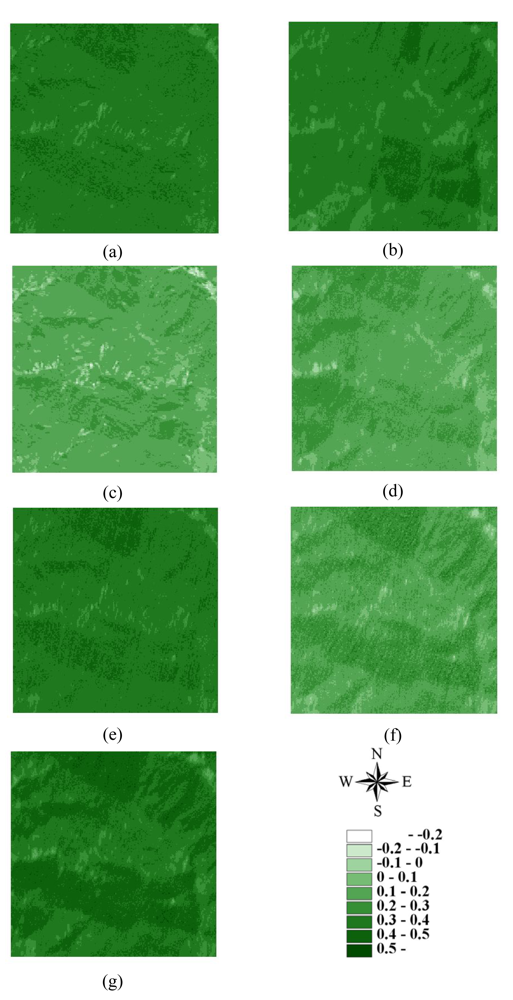
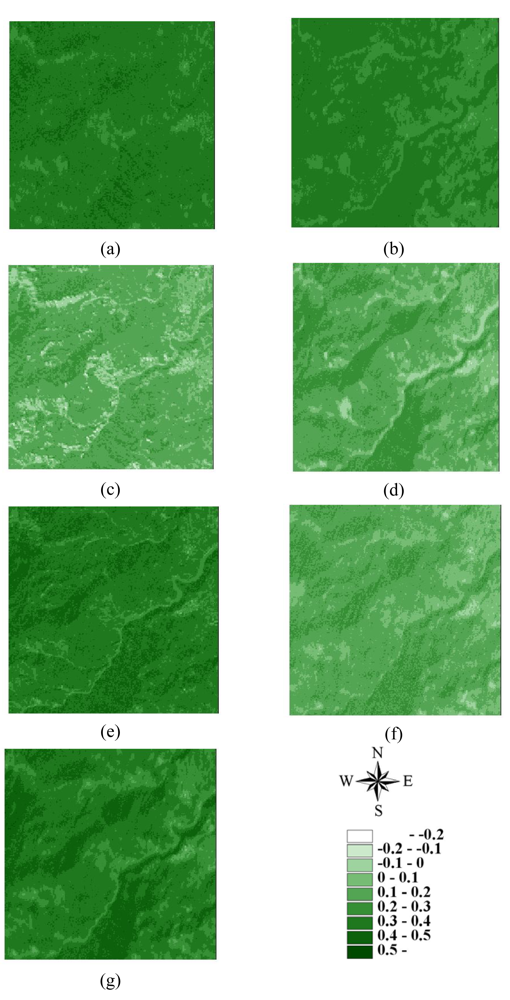
<p>Statistics of remotely sensed images can be used as a basic tool to characterize landscape changes [<xref ref-type="bibr" rid="b52-sensors-09-00148">52</xref>-<xref ref-type="bibr" rid="b56-sensors-09-00148">56</xref>]. <xref ref-type="table" rid="t1-sensors-09-00148">Table 1</xref> summaries the statistics for seven actual NDVI images of areas A and B before and after disturbances. The lowest mean and minimum NDVI values in 1996–2004 occurred on March 6, 1999, after the Chi-Chi earthquake in both areas A and B areas. Moreover, the largest range between minimum and maximum NDVI values also occurred on March 6, 1999, after the Chi-Chi earthquake in both areas A and B. The most negative minimum NDVI values occurred on November 27, 2000, and December 17, 2003, in both areas A and B. On these dates, the standard deviations of NDVI values were slightly larger than those on other dates. These statistical results illustrate that the Chi-Chi earthquake had the largest impact on all landscapes represented by NDVI images for areas A and B. The second and third greatest impacts on all landscapes are from typhoons Xangsane (November 2000) and Dujuan (September 2003) in areas A and B, respectively (<xref ref-type="fig" rid="f2-sensors-09-00148">Figures 2</xref> and <xref ref-type="fig" rid="f3-sensors-09-00148">3</xref> and <xref ref-type="table" rid="t1-sensors-09-00148">Table 1</xref>). Particularly, typhoon Xangsane right after the ChiChi earthquake was the second disturbance to impact landscape changes in the study areas. Numerous extension cracks, which increase the number of landslides during downpours, were generated on hill slopes during the Chi-Chi earthquake [<xref ref-type="bibr" rid="b13-sensors-09-00148">13</xref>]. Statistical results illustrate that the effects of disturbances on the watershed landscape in the study areas were cumulative, but were not always evident in space and time over the entire landscape [<xref ref-type="bibr" rid="b13-sensors-09-00148">13</xref>]. The effects of the Chi-Chi earthquake on the landscapes of the study areas gradually declined; this finding was also obtained by Chang <italic>et al.</italic> (2007). However, in the Chenyulan watershed, as the landslide ratio increased with successive rainstorms and strong earthquakes, the NDVI values decreased [<xref ref-type="bibr" rid="b11-sensors-09-00148">11</xref>]. Hence, subsequent rainstorms cause divergent destruction of vegetation; this destruction may be influenced by the precipitation distribution and typhoon path [<xref ref-type="bibr" rid="b11-sensors-09-00148">11</xref>] (<xref ref-type="table" rid="t1-sensors-09-00148">Table 1</xref>).</p>
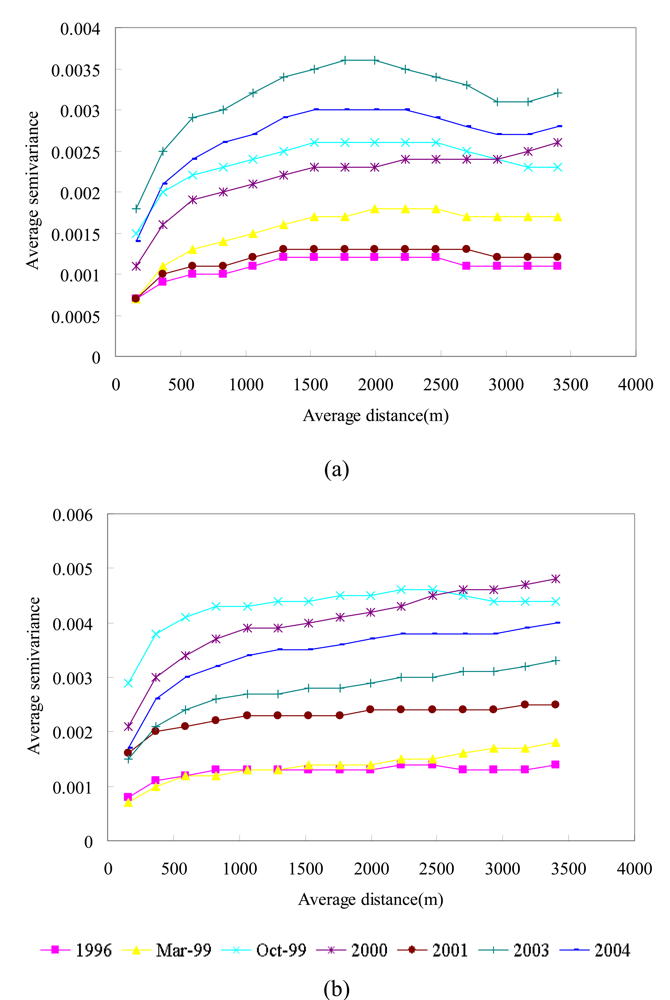
<p>Previous studies that quantified the impact of large disturbances did not evaluate the spatial structures of NDVI images in the study areas. To demonstrate the ability of the variogram to depict landscape heterogeneity, spatial variability and patterns, experimental variograms and their variogram models were first analyzed and fit to seven images of areas A and B (<xref ref-type="fig" rid="f4-sensors-09-00148">Figure 4</xref> and <xref ref-type="table" rid="t2-sensors-09-00148">Table 2</xref>). The models are obtained in two processes such as parameter estimation (fitting) and cross validation. Cross-validation in <xref ref-type="table" rid="t2-sensors-09-00148">Table 2</xref> is a means for evaluating effective parameters for kriging interpolations. In cross-validation analysis each measured point in a spatial domain is individually removed from the domain and its value estimated via kriging as though it were never there. In this way a graph can be constructed of the estimated vs. actual values for each sample location in the domain.</p>
<p>The three main features of a typical variogram model are (1) the range, (2) the sill, and (3) the nugget effect. The sill is the upper limit that a variogram approaches at a large distance, and is a measure of the variability of the investigated variable: a higher sill corresponds to greater variability in the variable. The range of a variogram model is the distance lag at which the variogram approaches the sill, and can reveal the distance above which the variables become spatially independent. The nugget effect is exhibited by the apparent non-zero value of the variogram at the origin, which may be due to the small-scale variability of the investigated process and/or measured errors. In this study, the variogram models of the seven NDVI images for areas A and B areas are exponential models. The spatial variations (Sill; <italic>C</italic><sub>0</sub> + <italic>C</italic>) of NDVI images from high to low are in 2003/12/17, 2004/11/19, 1999/10, 2000/11/27, 1999/03/06, 2001/11/20 and 1996/11/08 in area A. The spatial variations (Sill; <italic>C</italic><sub>0</sub> + <italic>C</italic>) of NDVI images from high to low in area B are in 1999/10/31, 2000/11/27, 2004/11/19, 2003/12/17, 2001/11/20, 1999/03/06 and 1996/11/08. The spatial variations of NDVI images increase considerably from 1996/11/08 to 1999/10/31 (after the Chi-Chi earthquake) in both areas A and B. Similarly, small variations (Nugget effect) of NDVI images in 2003/12/17 (after typhoon Dujuan), 1999/10 (after the Chi-Chi earthquake) and 2000/11/27 in area A are larger than those in 1999/03/06, 2001/11/20, 1996/11/08 and 2004/11/19. In area B, small variations (Nugget effects) of NDVI images in 1999/10/31 are larger than those in other images. As the range of a variogram model increases, the continuity of an NDVI image increases. The ranges of NDVI variogram models in area A from long range to short range are in 2000/11/27, 2001/11/20, 1999/03/06, 1996/11/08, 1999/10, 2003/12/17, and 2004/11/19. In area B, the ranges of NDVI variogram models from long range to short range are in 1999/03/06, 2000/11/27, 2003/12/17, 2004/11/19, 2001/11/20, 1996/11/08, and 1999/10. However, exponential models with large sills, large nugget effects and short-range NDVI images are indicative of significant spatial heterogeneous landscapes induced by the Chi-Chi earthquake in areas A and B. Moreover, typhoons Xangsane and Dujuan generated heterogeneous landscapes in area A.</p>
<p>High-spatial-resolution observations (e.g., SPOT-HRV, pixel size of 20 m) capture most landscape spatial heterogeneity and are thus can be used to quantify the spatial heterogeneity within moderate spatial resolution pixels [<xref ref-type="bibr" rid="b16-sensors-09-00148">16</xref>, <xref ref-type="bibr" rid="b29-sensors-09-00148">29</xref>]. The shape of variograms can be used to understand the NDVI spatial structures within an image domain [<xref ref-type="bibr" rid="b29-sensors-09-00148">29</xref>]. Millward and Kraft (2004) applied variograms to evaluate the impacts of disturbances on landscapes. In this study, experimental variogram and modeling results indicate that large disturbances, such as the Chi-Chi earthquake, created extremely complex heterogeneous patterns across the landscape. Notably, a disturbance may affect some areas but not others, and disturbance severity often varies considerably within an affected area on the landscape level [<xref ref-type="bibr" rid="b3-sensors-09-00148">3</xref>, <xref ref-type="bibr" rid="b13-sensors-09-00148">13</xref>]. Variography results illustrate that NDVI discontinuities between fields create a mosaic spatial structure resulting primarily from large disturbances, such as the Chi-Chi earthquake, in the study areas. Moreover, the high-magnitude Chi-Chi earthquake created these landscape variations in space in the Chenyulan watershed [<xref ref-type="bibr" rid="b13-sensors-09-00148">13</xref>]. Previous studies [<xref ref-type="bibr" rid="b11-sensors-09-00148">11</xref>, <xref ref-type="bibr" rid="b13-sensors-09-00148">13</xref>, <xref ref-type="bibr" rid="b57-sensors-09-00148">57</xref>] indicated that landslides in the Chenyulan watershed were impacted by the Chi-Chi earthquake; however, the effect of the earthquake decreased as the time between a typhoon and the Chi-Chi earthquake increased [<xref ref-type="bibr" rid="b57-sensors-09-00148">57</xref>]. Moreover, variography results confirm that the impacts of disturbances on the watershed landscape pattern were cumulative, but were not always evident in space and time in the entire landscape [<xref ref-type="bibr" rid="b23-sensors-09-00148">23</xref>, <xref ref-type="bibr" rid="b57-sensors-09-00148">57</xref>]. Moreover, landslides induced by earthquakes and typhoons have distinct spatial patterns [<xref ref-type="bibr" rid="b11-sensors-09-00148">11</xref>]. Typhoons significantly influence NDVI variations via the flow of accumulated rainfall and wind gradients [<xref ref-type="bibr" rid="b37-sensors-09-00148">37</xref>]. The statistical and variogram results also indicate that basic statistics without variograms of NDVI images may not sufficient to present landscape changes induced by disturbances, particularly via spatial structure, variability and heterogeneity analysis. Moreover, variogram modeling results also support the above statistical results, indicating that subsequent rainstorms may cause divergent destruction of vegetation, and then this destruction may be influenced by the precipitation distribution and typhoon path [<xref ref-type="bibr" rid="b12-sensors-09-00148">12</xref>, <xref ref-type="bibr" rid="b13-sensors-09-00148">13</xref>].</p></sec>
<sec>
<label>3.2.</label>
<title>Latin hypercube sampling for multiple images</title>
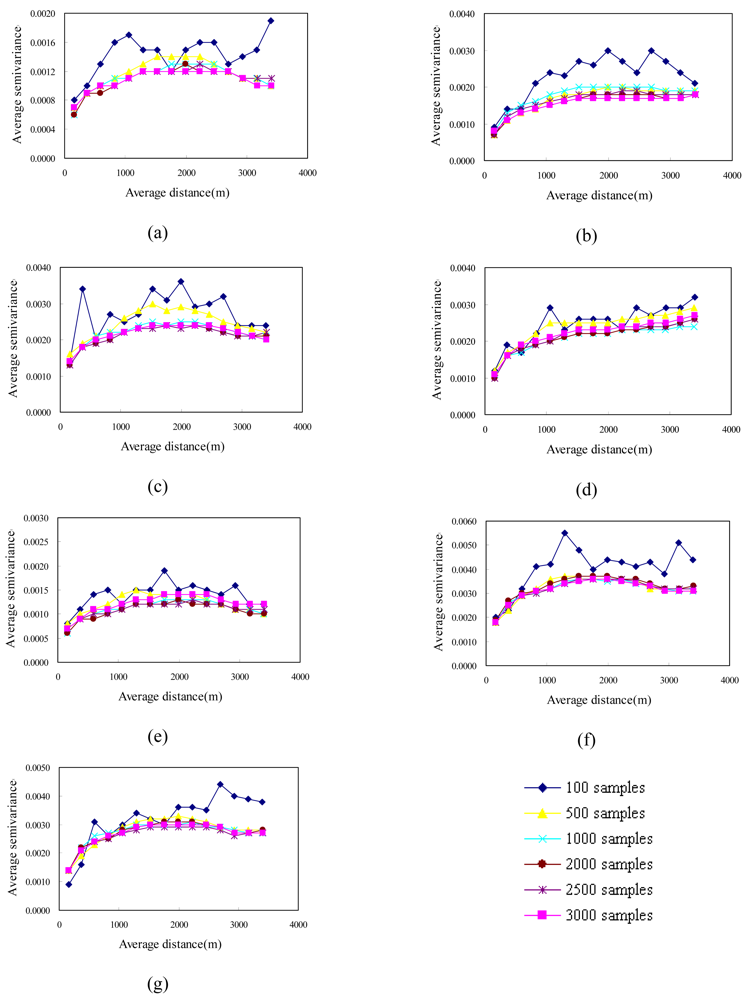
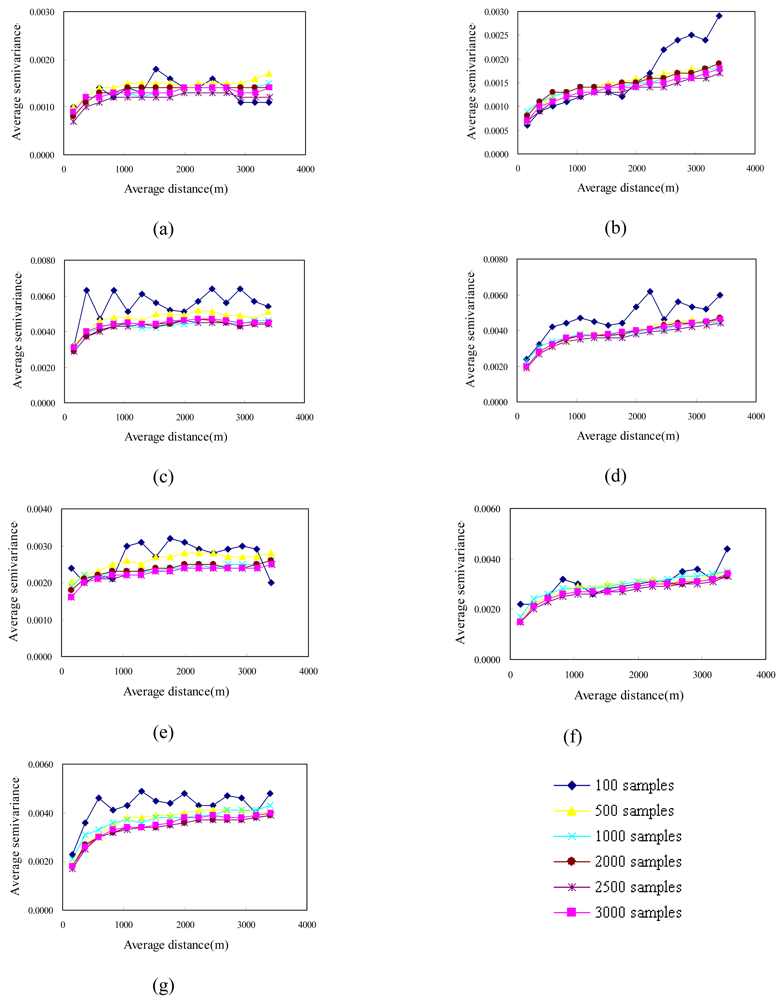
<p>Sampling strategies are typically based on an assumed theoretical framework (Edwards and Fortin, 2001). Sampling under such a framework involves attempting to locate samples to capture the possible variations and fluctuations in a gradient field [<xref ref-type="bibr" rid="b32-sensors-09-00148">32</xref>]. An efficient sampling method is therefore needed to cover the entire range of ancillary variables [<xref ref-type="bibr" rid="b34-sensors-09-00148">34</xref>]. In this study, experimental variograms of cLHS samples with their NDVI values were constructed using the same lag interval to compare the spatial structures of the actual NDVI images. <xref ref-type="fig" rid="f5-sensors-09-00148">Figures 5</xref> and <xref ref-type="fig" rid="f6-sensors-09-00148">6</xref> show experimental variograms for 100, 500, 1,000, 2,000, 2,500 and 3,000 cLHS samples in 1996/11/08, 1999/03/06, 1999/10/31, 2000/11/27, 2001/11/20, 2003/12/17 and 2004/11/19, respectively. These experimental variograms show that as the number of samples increased from 100 to 3000, the ability of experimental variograms to capture the spatial structure of actual NDVI images increased. These variography results show that the cLHS approach can simultaneously select samples from multiple NDVI images to capture spatial structures of all NDVI spatial structures.</p>
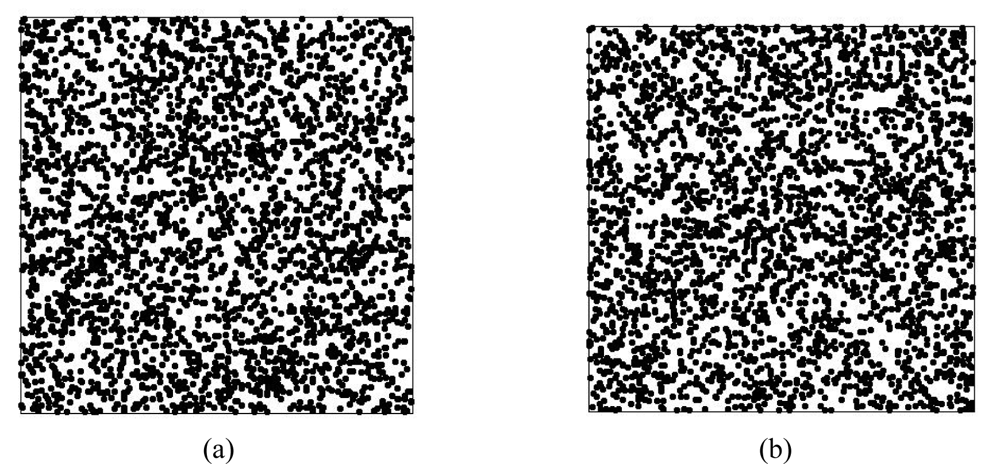
<p><xref ref-type="table" rid="t3-sensors-09-00148">Table 3</xref> lists statistics for 100, 500, 1,000 and 3,000 samples from multiple NDVI images with 62,500 grids using the cLHS approach. <xref ref-type="fig" rid="f7-sensors-09-00148">Figure 7</xref> shows the 3,000 samples selected using cLHS in each area. The distributions of selected samples confirm that samples selected using cLHS provide a good coverage of the study area and are well spread and partially clustered in the study areas [<xref ref-type="bibr" rid="b34-sensors-09-00148">34</xref>]. The statistics for these 3,000 samples indicate that the statistics obtained by cLHS can capture statistics of all actual NDVI images. The statistical and variogram analyses of cLHS samples also illustrate that the cLHS approach can be applied to select samples and capture the spatial structures of multiple historically accurate NDVI images. These samples can be used in further monitoring and to determine the impacts of disturbances on study landscapes in the future.</p></sec>
<sec>
<label>3.3.</label>
<title>Estimations and conditional simulations with selected samples</title>
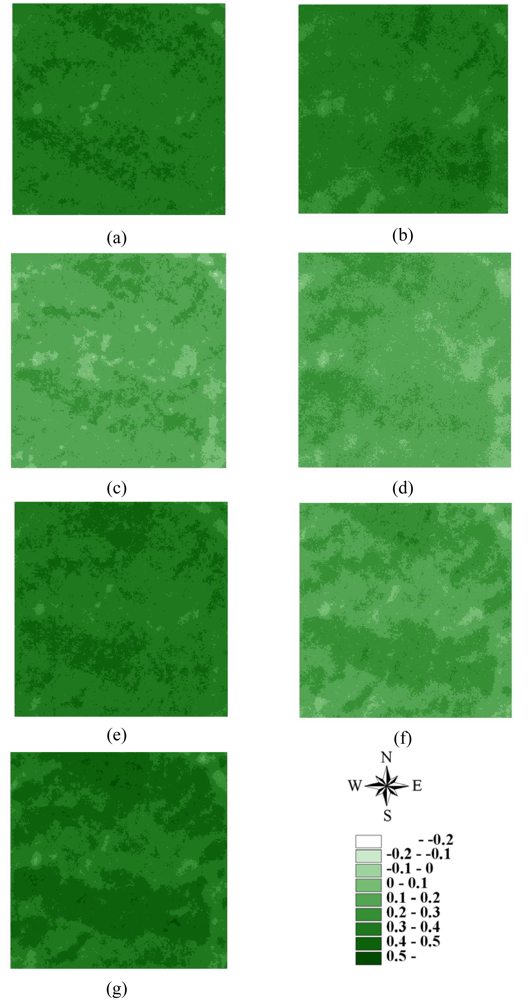
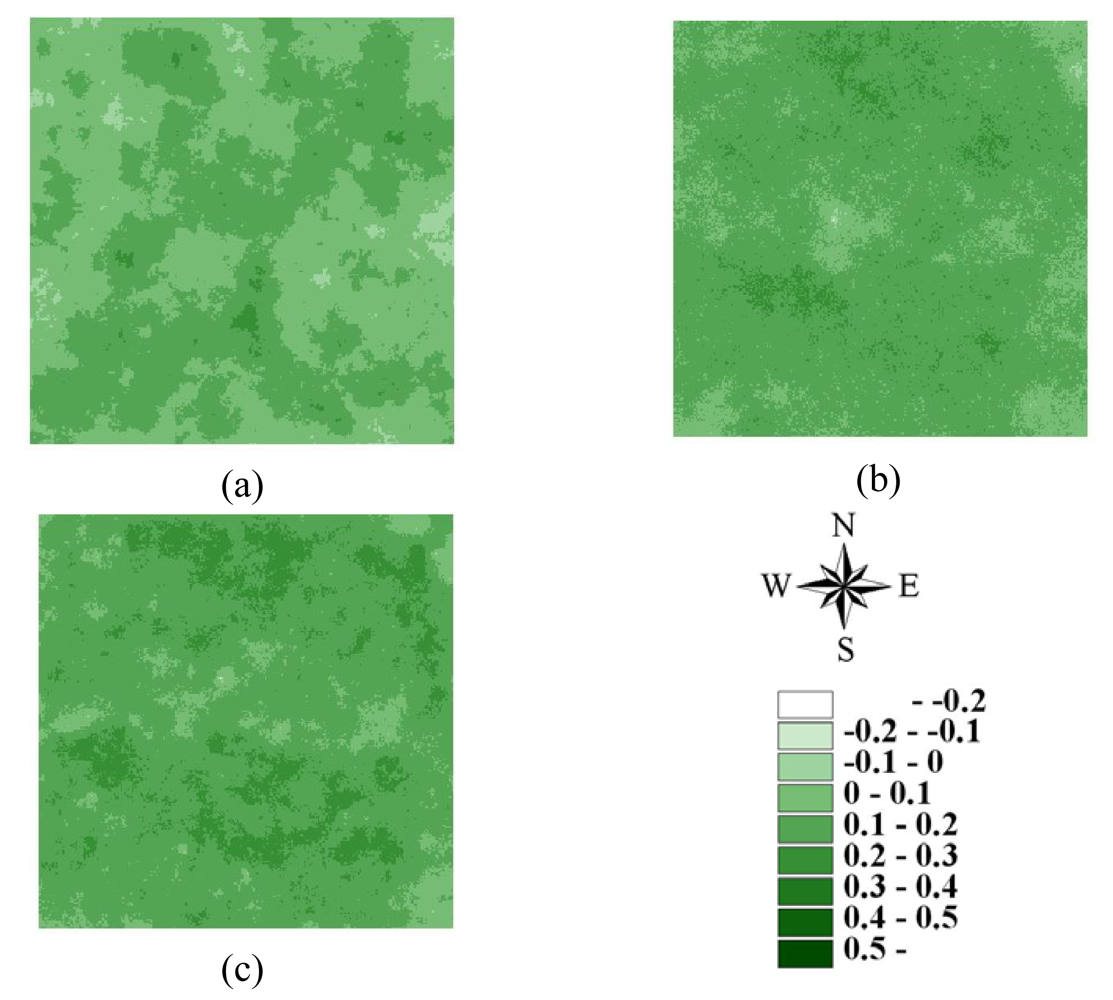
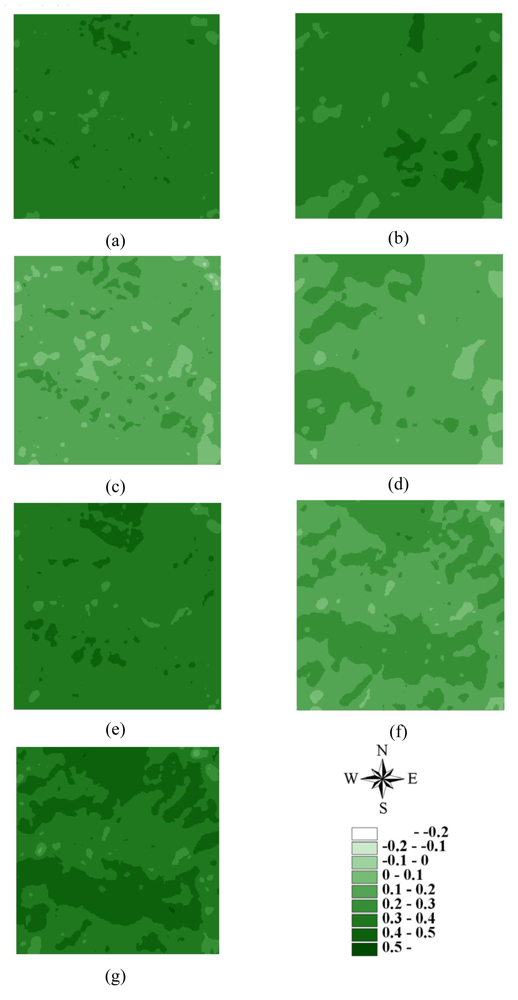
<p>The LHS approach can also be used in SGS [<xref ref-type="bibr" rid="b41-sensors-09-00148">41</xref>, <xref ref-type="bibr" rid="b43-sensors-09-00148">43</xref>] and kriging estimation. However, because the LHS is conducted by shifting simple random sampling, meaningful deviations exist when sample size is small [<xref ref-type="bibr" rid="b41-sensors-09-00148">41</xref>, <xref ref-type="bibr" rid="b43-sensors-09-00148">43</xref>]. In this study, ordinary kriging estimates and SGS simulations were performed based on the above variogram models of 3000 samples for 7 NDVI images in areas A and B. <xref ref-type="fig" rid="f8-sensors-09-00148">Figures 8</xref>–<xref ref-type="fig" rid="f11-sensors-09-00148">11</xref> show the maps of kriging and averages of 1000 realizations of SGS of NDVI images in 62500 grids in areas A and B. A comparison of actual NDVI images and NDVI images estimated by kriging indicates that kriging estimation with sufficient samples provides the best local estimates to capture actual NDVI images, but generally smoothed extreme values of the actual NDVI images in areas A and B (<xref ref-type="fig" rid="f8-sensors-09-00148">Figures 8</xref>–<xref ref-type="fig" rid="f11-sensors-09-00148">11</xref>). <xref ref-type="fig" rid="f12-sensors-09-00148">Figures 12</xref> and <xref ref-type="fig" rid="f13-sensors-09-00148">13</xref> show NDVI maps produced by SGS simulations with 100, 500 and 1000 cLHS samples in 1999/10/31 for areas A and B. The kriging estimation results illustrate that interpolation techniques such as kriging typically ignore phase information, which can result in an over-smoothed view of the distribution of spatial variables and remove important information about spatial discontinuities in a pattern [<xref ref-type="bibr" rid="b6-sensors-09-00148">6</xref>, <xref ref-type="bibr" rid="b14-sensors-09-00148">14</xref>, <xref ref-type="bibr" rid="b20-sensors-09-00148">20</xref>, <xref ref-type="bibr" rid="b26-sensors-09-00148">26</xref>, <xref ref-type="bibr" rid="b40-sensors-09-00148">40</xref>], particular with an insufficient number of samples (<xref ref-type="fig" rid="f8-sensors-09-00148">Figures 8</xref>-<xref ref-type="fig" rid="f13-sensors-09-00148">13</xref>). However, kriging interpolation algorithms produce maps of the best local estimate and generally smooth local details of spatial variation of an attribute [<xref ref-type="bibr" rid="b38-sensors-09-00148">38</xref>].</p>
<p>The SGS results verify that the limits of spatial analysis and interpolations of landscape variables are based on semivariograms (or autocorrelation functions) solely, stressing the need to account for spatial discontinuities [<xref ref-type="bibr" rid="b26-sensors-09-00148">26</xref>], particularly in highly heterogeneous landscapes induced by large physical disturbances such as the Chi-Chi earthquake. Therefore, procedures for interpolation of ecological variables must include information on spatial discontinuities, either directly from remotely sensed images (assuming the phase pattern in the image and ecological variables are equivalent) or indirectly by sampling with sufficient intensity spatial variables in the field that have a known functional relationship with the variable of interest (assuming the variable of interest is too difficult or expensive to sample in the field) [<xref ref-type="bibr" rid="b26-sensors-09-00148">26</xref>]. The simulated NDVI images show that kriging and SGS and the cLHS approach provide effective tools for monitoring, sampling and mapping landscape changes induced by large disturbances.</p></sec></sec>
<sec sec-type="conclusions">
<label>4.</label>
<title>Conclusions</title>
<p>This study presents a novel and effective approach that integrates cLHS, variograms, kriging and SGS in remotely sensed images for efficient monitoring, sampling and mapping of the impacts of chronologically ordered large disturbances on spatial characteristics of landscape changes to spatial structure, variability and heterogeneity. The NDVI images, which can be generated almost immediately after the remotely sensed data are acquired, were used as the inferential index because landscape changes induced by a large disturbance are easily recognized by changes in NDVI images. Variography of multiple NDVI images before and after a large disturbance is an essential method for characterizing and quantifying the spatial variability, structure and heterogeneity of landscapes induced by a disturbance. The variography results illustrated that cumulative impacts of disturbances on spatial variability existed and depended on disturbance magnitudes and paths, but were not always evident in spatiotemporal variability of landscapes in the study areas. Moreover, the cLHS approach is an effective sampling approach for multiple true NDVI images from their multivariate distributions to replicate the statistical distribution and spatial structures of the NDVI images. The sufficient number of NDVI samples using cLHS can be used to monitor and sample changes in landscapes induced by large physical disturbances. Kriging and SGS combined with the sufficient number of cLHS samples can be used to estimate and simulate NDVI images to generate maps that capture the spatial pattern and variability of actual NDVI images of disturbed landscapes. Kriging with sufficient number of NDVI cLHS samples produces NDVI maps with the best local estimates to identify patterns of NDVI images of disturbed landscapes. SGS with sufficient cLHS samples generate multiple realizations and an average of the realizations of NDVI and captures the spatial variability and heterogeneity of disturbed landscapes.</p></sec></body>
<back>
<ack>
<p>The authors thank the Soil and Water Conservation Bureau of Taiwan for providing field data and financially supporting this research under Contract No. SWCB-92-026-08. The authors also would like to thanks Mr. Deng for treatments of remote sensing data.</p></ack>
<ref-list>
<title>References</title>
<ref id="b1-sensors-09-00148"><label>1.</label><citation citation-type="journal"><person-group person-group-type="author"><name><surname>Foster</surname><given-names>D.R.</given-names></name><name><surname>Knight</surname><given-names>D.H.</given-names></name><name><surname>Franklin</surname><given-names>J.F.</given-names></name></person-group><article-title>Landscape patterns and legacies resulting from large, infrequent forest disturbances</article-title><source>Ecosystems</source><year>1998</year><volume>1</volume><fpage>497</fpage><lpage>510</lpage><pub-id pub-id-type="doi">10.1007/s100219900046</pub-id></citation></ref>
<ref id="b2-sensors-09-00148"><label>2.</label><citation citation-type="journal"><person-group person-group-type="author"><name><surname>Swanson</surname><given-names>F.J.</given-names></name><name><surname>Johnson</surname><given-names>S.L.</given-names></name><name><surname>Gregory</surname><given-names>S.V.</given-names></name><name><surname>Acker</surname><given-names>S.A.</given-names></name></person-group><article-title>Flood disturbance in a forested mountain landscape</article-title><source>Bioscience</source><year>1998</year><volume>48</volume><fpage>681</fpage><lpage>689</lpage><pub-id pub-id-type="doi">10.2307/1313331</pub-id></citation></ref>
<ref id="b3-sensors-09-00148"><label>3.</label><citation citation-type="journal"><person-group person-group-type="author"><name><surname>Turner</surname><given-names>M. G.</given-names></name><name><surname>Dale</surname><given-names>V.H.</given-names></name></person-group><article-title>Comparing large, infrequent disturbances: what have we learned?</article-title><source>Ecosystems</source><year>1998</year><volume>1</volume><fpage>493</fpage><lpage>496</lpage><pub-id pub-id-type="doi">10.1007/s100219900045</pub-id></citation></ref>
<ref id="b4-sensors-09-00148"><label>4.</label><citation citation-type="journal"><person-group person-group-type="author"><name><surname>Millward</surname><given-names>A.A.</given-names></name><name><surname>Kraft</surname><given-names>C.E.</given-names></name></person-group><article-title>Physical influences of landscape on a large-extent ecological disturbance: the northeastern North American ice storm of 1998</article-title><source>Landscape Ecol.</source><year>2004</year><volume>19</volume><fpage>99</fpage><lpage>111</lpage><pub-id pub-id-type="doi">10.1023/B:LAND.0000018369.41798.2f</pub-id></citation></ref>
<ref id="b5-sensors-09-00148"><label>5.</label><citation citation-type="journal"><person-group person-group-type="author"><name><surname>Keefer</surname><given-names>D.K.</given-names></name></person-group><article-title>Landslides caused by earthquakes</article-title><source>Geol. Soc. Am. Bul.</source><year>1984</year><volume>95</volume><fpage>406</fpage><lpage>421</lpage><pub-id pub-id-type="doi">10.1130/0016-7606(1984)95&lt;406:LCBE&gt;2.0.CO;2</pub-id></citation></ref>
<ref id="b6-sensors-09-00148"><label>6.</label><citation citation-type="journal"><person-group person-group-type="author"><name><surname>Lin</surname><given-names>Y.B.</given-names></name><name><surname>Lin</surname><given-names>Y.P</given-names></name><name><surname>Deng</surname><given-names>D.P.</given-names></name></person-group><article-title>Integrating remote sensing data with directional two-dimension wavelet analysis and open geospatial techniques for effective disaster monitoring and management</article-title><source>Sensors</source><year>2008</year><volume>8</volume><fpage>1070</fpage><lpage>1089</lpage><pub-id pub-id-type="doi">10.3390/s8021070</pub-id></citation></ref>
<ref id="b7-sensors-09-00148"><label>7.</label><citation citation-type="journal"><person-group person-group-type="author"><name><surname>Keefer</surname><given-names>D.K.</given-names></name></person-group><article-title>The importance of earthquake-induced landslides to long term slope erosion and slope-failure hazards in seismically active regions</article-title><source>Geomorphology</source><year>1994</year><volume>10</volume><fpage>265</fpage><lpage>284</lpage><pub-id pub-id-type="doi">10.1016/0169-555X(94)90021-3</pub-id></citation></ref>
<ref id="b8-sensors-09-00148"><label>8.</label><citation citation-type="journal"><person-group person-group-type="author"><name><surname>Lee</surname><given-names>M.F.</given-names></name><name><surname>Lin</surname><given-names>T.C.</given-names></name><name><surname>Vadeboncoeur</surname><given-names>M.A.</given-names></name><name><surname>Hwong</surname><given-names>J.L.</given-names></name></person-group><article-title>Remote sensing asseeement of forest damage in relation to the 1996 strong typhoon Herb at Lienhuachi Experimental Forest, Taiwan</article-title><source>Forest Ecol. Manag.</source><year>2008</year><volume>255</volume><fpage>3297</fpage><lpage>3306</lpage><pub-id pub-id-type="doi">10.1016/j.foreco.2008.02.010</pub-id></citation></ref>
<ref id="b9-sensors-09-00148"><label>9.</label><citation citation-type="journal"><person-group person-group-type="author"><name><surname>DeMets</surname><given-names>C.</given-names></name><name><surname>Gordon</surname><given-names>R.G.</given-names></name><name><surname>Argus</surname><given-names>D.F.</given-names></name><name><surname>Stein</surname><given-names>S.</given-names></name></person-group><article-title>Current plate motions</article-title><source>Geophys. J. Int.</source><year>1990</year><volume>104</volume><fpage>425</fpage><lpage>478</lpage></citation></ref>
<ref id="b10-sensors-09-00148"><label>10.</label><citation citation-type="journal"><person-group person-group-type="author"><name><surname>Lin</surname><given-names>C.W.</given-names></name><name><surname>Liu</surname><given-names>S.H.</given-names></name><name><surname>Lee</surname><given-names>S.Y.</given-names></name><name><surname>Liu</surname><given-names>C.C.</given-names></name></person-group><article-title>Impacts of the Chi-Chi earthquake on subsequent rainfall-induced landslides in central Taiwan</article-title><source>Eng. Geol.</source><year>2006</year><fpage>87</fpage><lpage>101</lpage></citation></ref>
<ref id="b11-sensors-09-00148"><label>11.</label><citation citation-type="journal"><person-group person-group-type="author"><name><surname>Lin</surname><given-names>G.W.</given-names></name><name><surname>Chen</surname><given-names>H.</given-names></name><name><surname>Chen</surname><given-names>Y.H.</given-names></name><name><surname>Horng</surname><given-names>M.J.</given-names></name></person-group><article-title>Influence of typhoons and earthquakes on rainfall-induced landslides and suspended sediments discharge</article-title><source>Eng. Geol.</source><year>2008</year><volume>97</volume><fpage>32</fpage><lpage>41</lpage><pub-id pub-id-type="doi">10.1016/j.enggeo.2007.12.001</pub-id></citation></ref>
<ref id="b12-sensors-09-00148"><label>12.</label><citation citation-type="journal"><person-group person-group-type="author"><name><surname>Lin</surname><given-names>C.W.</given-names></name><name><surname>Shieh</surname><given-names>C.L.</given-names></name><name><surname>Yuan</surname><given-names>B.D.</given-names></name><name><surname>Shieh</surname><given-names>Y.C.</given-names></name><name><surname>Liu</surname><given-names>S.H.</given-names></name><name><surname>Lee</surname><given-names>S.Y.</given-names></name></person-group><article-title>Impact of Chi-Chi earthquake on the occurrence of landslides and debris flows: example from the Chenyulan River watershed, Nantou, Taiwan</article-title><source>Eng. Geol</source><year>2003</year><volume>71</volume><fpage>49</fpage><lpage>61</lpage></citation></ref>
<ref id="b13-sensors-09-00148"><label>13.</label><citation citation-type="journal"><person-group person-group-type="author"><name><surname>Lin</surname><given-names>Y.P.</given-names></name><name><surname>Chang</surname><given-names>T.K.</given-names></name><name><surname>Wu</surname><given-names>C.F</given-names></name><name><surname>Chiang</surname><given-names>T.C.</given-names></name><name><surname>Lin</surname><given-names>S.H.</given-names></name></person-group><article-title>Assessing impacts of typhoons and the ChiChi earthquake on Chenyuland watershed landscape patterns in Central Taiwan</article-title><source>Environ. Manage.</source><year>2006</year><volume>38</volume><fpage>108</fpage><lpage>125</lpage><pub-id pub-id-type="doi">10.1007/s00267-005-0077-6</pub-id><pub-id pub-id-type="pmid">16738824</pub-id></citation></ref>
<ref id="b14-sensors-09-00148"><label>14.</label><citation citation-type="journal"><person-group person-group-type="author"><name><surname>Lin</surname><given-names>C.Y.</given-names></name><name><surname>Wu</surname><given-names>J.P.</given-names></name><name><surname>Lin</surname><given-names>W.T.</given-names></name></person-group><article-title>The priority of revegetation for the landslides caused by the catastrophic Chi-Chi earthquake at ninety-nine Peaks in Nantoun area</article-title><source>J. Chinese Soil Water Cons.</source><year>2001</year><volume>32</volume><fpage>59</fpage><lpage>66</lpage></citation></ref>
<ref id="b15-sensors-09-00148"><label>15.</label><citation citation-type="journal"><person-group person-group-type="author"><name><surname>Sellers</surname><given-names>P.J.</given-names></name></person-group><article-title>Modeling the exchange of energy, water, and Carbon between continents and atmosphere</article-title><source>Science</source><year>1997</year><volume>275</volume><fpage>602</fpage><lpage>609</lpage><pub-id pub-id-type="pmid">9019812</pub-id></citation></ref>
<ref id="b16-sensors-09-00148"><label>16.</label><citation citation-type="journal"><person-group person-group-type="author"><name><surname>Garrigues</surname><given-names>S.</given-names></name><name><surname>Allard</surname><given-names>D.</given-names></name><name><surname>Baret</surname><given-names>F.</given-names></name><name><surname>Morisette</surname><given-names>J.</given-names></name></person-group><article-title>Multivariate quantification of landscape spatial heterogeneity using variogram models</article-title><source>Remote Sens. Environ.</source><year>2008</year><volume>112</volume><fpage>216</fpage><lpage>230</lpage><pub-id pub-id-type="doi">10.1016/j.rse.2007.04.017</pub-id></citation></ref>
<ref id="b17-sensors-09-00148"><label>17.</label><citation citation-type="journal"><person-group person-group-type="author"><name><surname>Cohen</surname><given-names>W.B.</given-names></name><name><surname>Goward</surname><given-names>S.N.</given-names></name></person-group><article-title>Landsat's role in ecological applications of remote sensing</article-title><source>Bioscience</source><year>2004</year><volume>54</volume><fpage>535</fpage><lpage>545</lpage><pub-id pub-id-type="doi">10.1641/0006-3568(2004)054[0535:LRIEAO]2.0.CO;2</pub-id></citation></ref>
<ref id="b18-sensors-09-00148"><label>18.</label><citation citation-type="journal"><person-group person-group-type="author"><name><surname>Hayes</surname><given-names>D.J.</given-names></name><name><surname>Cohen</surname><given-names>W.B.</given-names></name></person-group><article-title>Spatial, spectral and temporal patterns of tropical forest cover change as observed with multiple scales of optical satellite data</article-title><source>Remote Sens. Environ.</source><year>2007</year><volume>106</volume><fpage>1</fpage><lpage>16</lpage><pub-id pub-id-type="doi">10.1016/j.rse.2006.07.002</pub-id></citation></ref>
<ref id="b19-sensors-09-00148"><label>19.</label><citation citation-type="journal"><person-group person-group-type="author"><name><surname>Tarnavsky</surname><given-names>E.</given-names></name><name><surname>Garrigues</surname><given-names>S.</given-names></name><name><surname>Brown</surname><given-names>M.E.</given-names></name></person-group><article-title>Multiscale geostatistical analysis of AVHRR, SPOT-VGT, and MODIS global NDVI products</article-title><source>Remote Sens. Environ.</source><year>2008</year><volume>112</volume><fpage>535</fpage><lpage>549</lpage><pub-id pub-id-type="doi">10.1016/j.rse.2007.05.008</pub-id></citation></ref>
<ref id="b20-sensors-09-00148"><label>20.</label><citation citation-type="journal"><person-group person-group-type="author"><name><surname>Lin</surname><given-names>W.T.</given-names></name><name><surname>Chou</surname><given-names>W.C.</given-names></name><name><surname>Lin</surname><given-names>C.Y.</given-names></name></person-group><article-title>Earthquake-induced landslide hazard and vegetation recovery assessment using remotely sensed data and a neural network-based classifier: a case study in central Taiwan</article-title><source>Nat. Hazards</source><year>2008</year><volume>47</volume><fpage>331</fpage><lpage>347</lpage><pub-id pub-id-type="doi">10.1007/s11069-008-9222-x</pub-id></citation></ref>
<ref id="b21-sensors-09-00148"><label>21.</label><citation citation-type="book"><person-group person-group-type="author"><name><surname>Jensen</surname><given-names>T.R.</given-names></name></person-group><source>Introductory digital image processing: a remote sensing perspective</source><publisher-name>Prentice Hall</publisher-name><publisher-loc>New York</publisher-loc><year>1996</year><fpage>179</fpage><lpage>186</lpage><fpage>116</fpage><lpage>121</lpage></citation></ref>
<ref id="b22-sensors-09-00148"><label>22.</label><citation citation-type="journal"><person-group person-group-type="author"><name><surname>Sellers</surname><given-names>P.J.</given-names></name></person-group><article-title>Canopy reflectance, photosynthesis and transpiration</article-title><source>Int. J. Remote Sens.</source><year>1985</year><volume>6</volume><fpage>1335</fpage><lpage>1372</lpage><pub-id pub-id-type="doi">10.1080/01431168508948283</pub-id></citation></ref>
<ref id="b23-sensors-09-00148"><label>23.</label><citation citation-type="journal"><person-group person-group-type="author"><name><surname>Lin</surname><given-names>W.T.</given-names></name><name><surname>Lin</surname><given-names>C.Y.</given-names></name><name><surname>Chou</surname><given-names>W.C.</given-names></name></person-group><article-title>Assessment of vegetation recovery and soil erosion at landslides caused by a catastrophic earthquake: a case study in Central Taiwan</article-title><source>Ecol. Eng.</source><year>2006</year><volume>28</volume><fpage>79</fpage><lpage>89</lpage><pub-id pub-id-type="doi">10.1016/j.ecoleng.2006.04.005</pub-id></citation></ref>
<ref id="b24-sensors-09-00148"><label>24.</label><citation citation-type="journal"><person-group person-group-type="author"><name><surname>Wiens</surname><given-names>J.A.</given-names></name></person-group><article-title>Spatial scaling in ecology</article-title><source>Funct. Ecol.</source><year>1989</year><volume>3</volume><fpage>385</fpage><lpage>397</lpage><pub-id pub-id-type="doi">10.2307/2389612</pub-id></citation></ref>
<ref id="b25-sensors-09-00148"><label>25.</label><citation citation-type="journal"><person-group person-group-type="author"><name><surname>Urban</surname><given-names>D.L.</given-names></name><name><surname>O'Niell</surname><given-names>R.V.</given-names></name><name><surname>Shugart</surname><given-names>H.H.</given-names></name></person-group><article-title>Landscape ecology</article-title><source>Bioscience</source><year>1987</year><volume>37</volume><fpage>119</fpage><lpage>127</lpage><pub-id pub-id-type="doi">10.2307/1310366</pub-id></citation></ref>
<ref id="b26-sensors-09-00148"><label>26.</label><citation citation-type="journal"><person-group person-group-type="author"><name><surname>Lobo</surname><given-names>A.</given-names></name><name><surname>Moloney</surname><given-names>K.</given-names></name><name><surname>Chic</surname><given-names>O.</given-names></name><name><surname>Chiariello</surname><given-names>N.</given-names></name></person-group><article-title>Analysis of fine-scale spatial pattern of a grassland from remotely-sensed imagery and field collected data</article-title><source>Landscape Ecol.</source><year>1998</year><volume>13</volume><fpage>111</fpage><lpage>131</lpage><pub-id pub-id-type="doi">10.1023/A:1007938526886</pub-id></citation></ref>
<ref id="b27-sensors-09-00148"><label>27.</label><citation citation-type="journal"><person-group person-group-type="author"><name><surname>Curran</surname><given-names>P.J.</given-names></name><name><surname>Atkinson</surname><given-names>P.M.</given-names></name></person-group><article-title>Geostatistics and remote sensing</article-title><source>Prog. Phys. Geog.</source><year>1998</year><volume>22</volume><fpage>61</fpage><lpage>78</lpage></citation></ref>
<ref id="b28-sensors-09-00148"><label>28.</label><citation citation-type="journal"><person-group person-group-type="author"><name><surname>Garrigues</surname><given-names>S.</given-names></name><name><surname>Allard</surname><given-names>D.</given-names></name><name><surname>Baret</surname><given-names>F.</given-names></name></person-group><article-title>Modeling temporal changes in surface spatial heterogeneity over an agricultural site</article-title><source>Remote Sens. Environ.</source><year>2008</year><volume>112</volume><fpage>58</fpage><lpage>602</lpage></citation></ref>
<ref id="b29-sensors-09-00148"><label>29.</label><citation citation-type="journal"><person-group person-group-type="author"><name><surname>Garrigues</surname><given-names>S.</given-names></name><name><surname>Allard</surname><given-names>D.</given-names></name><name><surname>Baret</surname><given-names>F.</given-names></name></person-group><article-title>Influence of the spatial heterogeneity on the non linear estimation of Leaf Area Index from moderate resolution remote sensing data</article-title><source>Remote Sens. Environ.</source><year>2006</year><volume>106</volume><fpage>286</fpage><lpage>298</lpage></citation></ref>
<ref id="b30-sensors-09-00148"><label>30.</label><citation citation-type="book"><person-group person-group-type="author"><name><surname>Fortin</surname><given-names>M.J.</given-names></name><name><surname>Edwards</surname><given-names>G.</given-names></name></person-group><source>A cognitive view of spatial uncertainty</source><person-group person-group-type="editor"><name><surname>Hunsaker</surname><given-names>C.T.</given-names></name><name><surname>Goodchild</surname><given-names>M.F.</given-names></name><name><surname>Friedl</surname><given-names>M.A.</given-names></name><name><surname>Case</surname><given-names>T.J.</given-names></name></person-group><publisher-name>Springer</publisher-name><publisher-loc>New York</publisher-loc><year>2001</year><fpage>133</fpage><lpage>157</lpage></citation></ref>
<ref id="b31-sensors-09-00148"><label>31.</label><citation citation-type="journal"><person-group person-group-type="author"><name><surname>Minasny</surname><given-names>B.</given-names></name><name><surname>McBratney</surname><given-names>A.B.</given-names></name></person-group><article-title>The variance quadtree algorithm: use for spatial sampling design</article-title><source>Comput. Geosci.</source><year>2007</year><volume>33</volume><fpage>383</fpage><lpage>392</lpage><pub-id pub-id-type="doi">10.1016/j.cageo.2006.08.009</pub-id></citation></ref>
<ref id="b32-sensors-09-00148"><label>32.</label><citation citation-type="book"><person-group person-group-type="author"><name><surname>Edwards</surname><given-names>G.</given-names></name><name><surname>Fortin</surname><given-names>M.J.</given-names></name></person-group><source>Delineation and analysis of vegetation boundaries, Spatial uncertainty in ecology: implications for remote sensing and GIS application</source><person-group person-group-type="editor"><name><surname>Hunsaker</surname><given-names>C. T.</given-names></name><name><surname>Goodchild</surname><given-names>M. A.</given-names></name><name><surname>Friedl</surname><given-names>A.</given-names></name><name><surname>Case</surname><given-names>T.J.</given-names></name></person-group><publisher-name>Springer</publisher-name><publisher-loc>New York</publisher-loc><year>2001</year><fpage>158</fpage><lpage>174</lpage></citation></ref>
<ref id="b33-sensors-09-00148"><label>33.</label><citation citation-type="book"><person-group person-group-type="author"><name><surname>Thompson</surname><given-names>S.K.</given-names></name></person-group><source>Sampling</source><publisher-name>Wiley Interscience</publisher-name><publisher-loc>New York</publisher-loc><year>1992</year></citation></ref>
<ref id="b34-sensors-09-00148"><label>34.</label><citation citation-type="journal"><person-group person-group-type="author"><name><surname>Minasny</surname><given-names>B.</given-names></name><name><surname>McBratney</surname><given-names>A.B.</given-names></name></person-group><article-title>A conditioned Latin hypercube method for sampling in the presence of ancillary information</article-title><source>Comput. Geosci.</source><year>2006</year><volume>32</volume><fpage>1378</fpage><lpage>1388</lpage><pub-id pub-id-type="doi">10.1016/j.cageo.2005.12.009</pub-id></citation></ref>
<ref id="b35-sensors-09-00148"><label>35.</label><citation citation-type="journal"><person-group person-group-type="author"><name><surname>McKay</surname><given-names>M.D.</given-names></name><name><surname>Beckman</surname><given-names>R.J.</given-names></name><name><surname>Conover</surname><given-names>W.J.</given-names></name></person-group><article-title>A comparison of three methods for selecting values of input variables in the analysis of output from a computer code</article-title><source>Technometrics</source><year>1979</year><volume>21</volume><fpage>239</fpage><lpage>245</lpage></citation></ref>
<ref id="b36-sensors-09-00148"><label>36.</label><citation citation-type="journal"><person-group person-group-type="author"><name><surname>Iman</surname><given-names>R.L.</given-names></name><name><surname>Conover</surname><given-names>W.J.</given-names></name></person-group><article-title>Small sample sensitivity analysis techniques for computer models, with an application to risk assessment</article-title><source>Commun. Statist. Theory Meth.</source><year>1980</year><volume>A9</volume><fpage>1749</fpage><lpage>1874</lpage></citation></ref>
<ref id="b37-sensors-09-00148"><label>37.</label><citation citation-type="journal"><person-group person-group-type="author"><name><surname>Lin</surname><given-names>Y.P.</given-names></name><name><surname>Yen</surname><given-names>M.H.</given-names></name><name><surname>Deng</surname><given-names>D.P.</given-names></name><name><surname>Wang</surname><given-names>Y.C.</given-names></name></person-group><article-title>Geostatistical Approaches and Optimal Additional Sampling Schemes for Spatial Patterns and Future Samplings of Bird Diversity</article-title><source>Global Ecol. Biogeogr.</source><year>2008</year><volume>17</volume><fpage>175</fpage><lpage>188</lpage><pub-id pub-id-type="doi">10.1111/j.1466-8238.2007.00352.x</pub-id></citation></ref>
<ref id="b38-sensors-09-00148"><label>38.</label><citation citation-type="book"><person-group person-group-type="author"><name><surname>Goovaters</surname><given-names>P.</given-names></name></person-group><source>Geostatistics for Natural Resources Evaluation</source><publisher-name>Oxford University Press</publisher-name><publisher-loc>New York</publisher-loc><year>1997</year></citation></ref>
<ref id="b39-sensors-09-00148"><label>39.</label><citation citation-type="book"><person-group person-group-type="author"><name><surname>Kyriakidis</surname><given-names>P.C.</given-names></name></person-group><source>Geostatistical models of uncertainty for spatial data, Spatial uncertainty in ecology: implications for remote sensing and GIS application</source><person-group person-group-type="editor"><name><surname>Hunsaker</surname><given-names>C. T.</given-names></name><name><surname>Goodchild</surname><given-names>M. F.</given-names></name><name><surname>Friedl</surname><given-names>M.A.</given-names></name><name><surname>Case</surname><given-names>T.J.</given-names></name></person-group><publisher-name>Springer</publisher-name><publisher-loc>New York</publisher-loc><year>2001</year><fpage>175</fpage><lpage>213</lpage></citation></ref>
<ref id="b40-sensors-09-00148"><label>40.</label><citation citation-type="book"><person-group person-group-type="author"><name><surname>Deutsch</surname><given-names>C.V.</given-names></name><name><surname>Journel</surname><given-names>A. G.</given-names></name></person-group><source>GSLIB. Geostatistical Software Library and User's Guide</source><publisher-name>Oxford University Press</publisher-name><publisher-loc>New York</publisher-loc><year>1992</year></citation></ref>
<ref id="b41-sensors-09-00148"><label>41.</label><citation citation-type="journal"><person-group person-group-type="author"><name><surname>Pebesma</surname><given-names>E.J.</given-names></name><name><surname>Heuvelink</surname><given-names>G.B.M.</given-names></name></person-group><article-title>Latin hypercube sampling of Gaussian random fields</article-title><source>Technometrics</source><year>1999</year><volume>41</volume><fpage>303</fpage><lpage>312</lpage><pub-id pub-id-type="doi">10.1080/00401706.1999.10485930</pub-id></citation></ref>
<ref id="b42-sensors-09-00148"><label>42.</label><citation citation-type="journal"><person-group person-group-type="author"><name><surname>Zhang</surname><given-names>Y.</given-names></name><name><surname>Pinder</surname><given-names>G.F.</given-names></name></person-group><article-title>Latin-hypercube sample-selection strategies for correlated random hydraulic-conductivity fields</article-title><source>Water Resour. Res.</source><year>2004</year><volume>39</volume><comment>No. 1226</comment></citation></ref>
<ref id="b43-sensors-09-00148"><label>43.</label><citation citation-type="journal"><person-group person-group-type="author"><name><surname>Xu</surname><given-names>C.</given-names></name><name><surname>He</surname><given-names>H. S.</given-names></name><name><surname>Hu</surname><given-names>Y.</given-names></name><name><surname>Chang</surname><given-names>Y.</given-names></name><name><surname>Li</surname><given-names>X.</given-names></name><name><surname>Bu</surname><given-names>R.</given-names></name></person-group><article-title>Latin hypercube sampling and geostatistical modeling of spatial uncertainty in a spatially explicit forest landscape model simulation</article-title><source>Ecol. Model.</source><year>2005</year><volume>185</volume><fpage>255</fpage><lpage>269</lpage><pub-id pub-id-type="doi">10.1016/j.ecolmodel.2004.12.009</pub-id></citation></ref>
<ref id="b44-sensors-09-00148"><label>44.</label><citation citation-type="journal"><person-group person-group-type="author"><name><surname>Roger</surname><given-names>B.</given-names></name><name><surname>Yu</surname><given-names>T.T.</given-names></name></person-group><article-title>The morphology of thrust faulting in the 21 September 1999, Chi-Chi, Taiwan earthquake</article-title><source>J. Asian Earth Sci.</source><year>2000</year><volume>18</volume><fpage>351</fpage><lpage>367</lpage><pub-id pub-id-type="doi">10.1016/S1367-9120(99)00071-1</pub-id></citation></ref>
<ref id="b45-sensors-09-00148"><label>45.</label><citation citation-type="web"><person-group person-group-type="author"><collab>Central Weather Bureau (CWB)</collab></person-group><year>1999</year><comment>URL: <ext-link xlink:href="http://scman.cwb.gov.tw/eqv3/eq_report/special/19990921/921" ext-link-type="uri">http://scman.cwb.gov.tw/eqv3/eq_report/special/19990921/921</ext-link> , isomap. GIF</comment></citation></ref>
<ref id="b46-sensors-09-00148"><label>46.</label><citation citation-type="book"><person-group person-group-type="author"><collab>Central Weather Bureau</collab></person-group><source>Report on typhoons in 2000</source><publisher-name>Ministry of Transportation and Communications</publisher-name><publisher-loc>Taiwan</publisher-loc><year>2000</year><fpage>130</fpage><lpage>162</lpage></citation></ref>
<ref id="b47-sensors-09-00148"><label>47.</label><citation citation-type="book"><person-group person-group-type="author"><collab>Central Weather Bureau</collab></person-group><source>Report on typhoons in 2001</source><publisher-name>Ministry of Transportation and Communications</publisher-name><publisher-loc>Taiwan</publisher-loc><year>2001</year><fpage>84</fpage><lpage>111</lpage></citation></ref>
<ref id="b48-sensors-09-00148"><label>48.</label><citation citation-type="web"><person-group person-group-type="author"><collab>Central Weather Bureau (CWB)</collab></person-group><year>2008</year><source>Typhoon Database</source><comment>URL: <ext-link xlink:href="http://rdc28.cwb.gov.tw/" ext-link-type="uri">http://rdc28.cwb.gov.tw/</ext-link></comment></citation></ref>
<ref id="b49-sensors-09-00148"><label>49.</label><citation citation-type="book"><person-group person-group-type="author"><name><surname>Jensen</surname><given-names>T.R.</given-names></name></person-group><source>Introductory digital image processing: a remote sensing perspective</source><publisher-name>Prentice Hall</publisher-name><publisher-loc>New York</publisher-loc><year>1996</year><fpage>179</fpage><lpage>186</lpage><fpage>116</fpage><lpage>121</lpage></citation></ref>
<ref id="b50-sensors-09-00148"><label>50.</label><citation citation-type="book"><person-group person-group-type="author"><name><surname>Press</surname><given-names>W.H.</given-names></name><name><surname>Flannery</surname><given-names>B.T.</given-names></name><name><surname>Teukolsky</surname><given-names>S.A.</given-names></name><name><surname>Vetterling</surname><given-names>W.T.</given-names></name></person-group><source>Numerical Recipes in Fortran: The art of Scientific Computing</source><edition>2nd ed.</edition><publisher-name>Cambridge University Press</publisher-name><publisher-loc>Cambridge, UK</publisher-loc><year>1992</year></citation></ref>
<ref id="b51-sensors-09-00148"><label>51.</label><citation citation-type="journal"><person-group person-group-type="author"><name><surname>Fredericks</surname><given-names>A. K.</given-names></name><name><surname>Newman</surname><given-names>K. B.</given-names></name></person-group><article-title>A comparison of the sequential Gaussian and Markov-Bayes simulation methods for small samples</article-title><source>Math. Geol.</source><year>1998</year><volume>30</volume><fpage>1011</fpage><lpage>1032</lpage><pub-id pub-id-type="doi">10.1023/A:1021785726483</pub-id></citation></ref>
<ref id="b52-sensors-09-00148"><citation citation-type="journal"><label>52.</label><person-group person-group-type="author"><name><surname>Ward</surname><given-names>D</given-names></name><name><surname>Phinn</surname><given-names>SR</given-names></name><name><surname>Murray</surname><given-names>AT</given-names></name></person-group><article-title>Monitoring growth in rapidly urbanizing areas using remotely sensed data</article-title><source>Prof. Geogr.</source><year>2000</year><volume>52</volume><fpage>371</fpage><lpage>386</lpage><pub-id pub-id-type="doi">10.1111/0033-0124.00232</pub-id></citation></ref>
<ref id="b53-sensors-09-00148"><label>53.</label><citation citation-type="journal"><person-group person-group-type="author"><name><surname>Akiwumi</surname><given-names>F.A.</given-names></name><name><surname>Butler</surname><given-names>D.R.</given-names></name></person-group><article-title>Mining and environmental change in Sierra Leone, West Africa: A remote sensing and hydrogeomorphological study</article-title><source>Environ. Monit. Assess.</source><year>2008</year><volume>142</volume><fpage>309</fpage><lpage>318</lpage><pub-id pub-id-type="doi">10.1007/s10661-007-9930-9</pub-id><pub-id pub-id-type="pmid">17882524</pub-id></citation></ref>
<ref id="b54-sensors-09-00148"><citation citation-type="journal"><label>54.</label><person-group person-group-type="author"><name><surname>Giriraj</surname><given-names>A</given-names></name><name><surname>Irfan-Ullah</surname><given-names>M</given-names></name><name><surname>Murthy</surname><given-names>MSR</given-names></name><etal/></person-group><article-title>Modelling spatial and temporal forest cover change patterns (1973-2020): A case study from South Western Ghats (India)</article-title><source>Sensors</source><year>2008</year><volume>8</volume><fpage>6132</fpage><lpage>6153</lpage><pub-id pub-id-type="doi">10.3390/s8106132</pub-id></citation></ref>
<ref id="b55-sensors-09-00148"><label>55.</label><citation citation-type="journal"><person-group person-group-type="author"><name><surname>Fox</surname><given-names>D.M.</given-names></name><name><surname>Maselli</surname><given-names>F.</given-names></name><name><surname>Carrega</surname><given-names>P.</given-names></name></person-group><article-title>Using SPOT images and field sampling to map burn severity and vegetation factors affecting post forest fire erosion risk</article-title><source>Catena</source><year>2008</year><volume>75</volume><fpage>326</fpage><lpage>335</lpage><pub-id pub-id-type="doi">10.1016/j.catena.2008.08.001</pub-id></citation></ref>
<ref id="b56-sensors-09-00148"><label>56.</label><citation citation-type="journal"><person-group person-group-type="author"><name><surname>Zomeni</surname><given-names>M.</given-names></name><name><surname>Tzanopoulos</surname><given-names>J.</given-names></name><name><surname>Pantis</surname><given-names>J.D.</given-names></name></person-group><article-title>Historical analysis of landscape change using remote sensing techniques: An explanatory tool for agricultural transformation in Greek rural areas</article-title><source>Landscape Urban Plan.</source><year>2008</year><volume>86</volume><fpage>38</fpage><lpage>46</lpage><pub-id pub-id-type="doi">10.1016/j.landurbplan.2007.12.006</pub-id></citation></ref>
<ref id="b57-sensors-09-00148"><label>57.</label><citation citation-type="journal"><person-group person-group-type="author"><name><surname>Chang</surname><given-names>K.T.</given-names></name><name><surname>Chiang</surname><given-names>S.H.</given-names></name><name><surname>Hsu</surname><given-names>M.L.</given-names></name></person-group><article-title>Modeling typhoon- and earthquake- induced landslides in a mountains watershed using logistic regression</article-title><source>Geomorphology</source><year>2007</year><volume>89</volume><fpage>335</fpage><lpage>347</lpage><pub-id pub-id-type="doi">10.1016/j.geomorph.2006.12.011</pub-id></citation></ref></ref-list>
<sec sec-type="display-objects">
<title>Figures and Tables</title>
<fig id="f1-sensors-09-00148" position="float">
<label>Figure 1.</label>
<caption>
<p>Location of the study areas.</p></caption>
<graphic xlink:href="sensors-09-00148f1.gif"/></fig>
<fig id="f2-sensors-09-00148" position="float">
<label>Figure 2.</label>
<caption>
<p>NDVI images of area A on (a) 1996/11/08, (b) 1999/03/06, (c) 1999/10/31, (d) 2000/11/27, (e) 2001/11/20, (f) 2003/12/17, and (g) 2004/11/19.</p></caption>
<graphic xlink:href="sensors-09-00148f2.gif"/></fig>
<fig id="f3-sensors-09-00148" position="float">
<label>Figure 3.</label>
<caption>
<p>NDVI images of area B on (a) 1996/11/08, (b) 1999/03/06, (c) 1999/10/31, (d) 2000/11/27, (e) 2001/11/20, (f) 2003/12/17, and (g) 2004/11/19.</p></caption>
<graphic xlink:href="sensors-09-00148f3.gif"/></fig>
<fig id="f4-sensors-09-00148" position="float">
<label>Figure 4.</label>
<caption>
<p>Experimental variograms of NDVI images before and after disturbances in areas (a) A and (b) B.</p></caption>
<graphic xlink:href="sensors-09-00148f4.gif"/></fig>
<fig id="f5-sensors-09-00148" position="float">
<label>Figure 5.</label>
<caption>
<p>Experimental variograms of NDVI samples for area A on (a) 1996/11/08, (b) 1999/03/06, (c) 1999/10/31, (d) 2000/11/27, (e) 2001/11/20 (f) 2003/12/17, and (g) 2004/11/19.</p></caption>
<graphic xlink:href="sensors-09-00148f5.gif"/></fig>
<fig id="f6-sensors-09-00148" position="float">
<label>Figure 6.</label>
<caption>
<p>Experimental variograms of NDVI samples for area B on (a) 1996/11/08, (b) 1999/03/06, (c) 1999/10/31, (d) 2000/11/27, (e) 2001/11/20, (f) 2003/12/17, and (g) 2004/11/19.</p></caption>
<graphic xlink:href="sensors-09-00148f6.gif"/></fig>
<fig id="f7-sensors-09-00148" position="float">
<label>Figure 7.</label>
<caption>
<p>Locations of the 3,000 samples in areas (a) A and (b) B.</p></caption>
<graphic xlink:href="sensors-09-00148f7.gif"/></fig>
<fig id="f8-sensors-09-00148" position="float">
<label>Figure 8.</label>
<caption>
<p>Kriging estimated NDVI images based on 3,000 samples in area A on (a) 1996/11/08, (b) 1999/03/06, (c) 1999/10/31, (d) 2000/11/27, (e) 2001/11/20, (f) 2003/12/17, and (g) 2004/11/19.</p></caption>
<graphic xlink:href="sensors-09-00148f8.gif"/></fig>
<fig id="f9-sensors-09-00148" position="float">
<label>Figure 9.</label>
<caption>
<p>Conditional simulated NDVI images based on 3,000 samples in area A on (a) 1996/11/08, (b) 1999/03/06, (c) 1999/10/31 (d) 2000/11/27, (e) 2001/11/20, (f) 2003/12/17, and (g) 2004/11/19.</p></caption>
<graphic xlink:href="sensors-09-00148f9.gif"/></fig>
<fig id="f10-sensors-09-00148" position="float">
<label>Figure 10.</label>
<caption>
<p>NDVI images estimated by kriging based on 3,000 samples in area B on (a) 1996/11/08, (b) 1999/03/06, (c) 1999/10/31, (d) 2000/11/27, (e) 2001/11/20, (f) 2003/12/17, and (g) 2004/11/19.</p></caption>
<graphic xlink:href="sensors-09-00148f10.gif"/></fig>
<fig id="f11-sensors-09-00148" position="float">
<label>Figure 11.</label>
<caption>
<p>Conditional simulated NDVI images based on 3,000 samples for area B on (a) 1996/11/08, (b) 1999/03/06, (c) 1999/10/31, (d) 2000/11/27, (e) 2001/11/20, (f) 2003/12/17, and (g) 2004/11/19.</p></caption>
<graphic xlink:href="sensors-09-00148f11.gif"/></fig>
<fig id="f12-sensors-09-00148" position="float">
<label>Figure 12.</label>
<caption>
<p>Conditional simulated NDVI images for area A based on (a) 100, (b) 500, and (c) 1,000 cLHS samples on 1999/10/31</p></caption>
<graphic xlink:href="sensors-09-00148f12.gif"/></fig>
<fig id="f13-sensors-09-00148" position="float">
<label>Figure 13.</label>
<caption>
<p>Conditional simulated NDVI images for area B based on (a) 100, (b) 500, and (c) 1,000 cLHS samples on 1999/10/31.</p></caption>
<graphic xlink:href="sensors-09-00148f13.gif"/></fig>
<table-wrap id="t1-sensors-09-00148" position="float">
<label>Table 1.</label>
<caption>
<p>Statistics of NDVI images.</p></caption>
<table frame="hsides" rules="groups">
<thead>
<tr>
<th align="center" valign="top"><bold>Area</bold></th>
<th align="center" valign="top"><bold>Date</bold></th>
<th align="center" valign="top"><bold>Mean</bold></th>
<th align="center" valign="top"><bold>Std.</bold></th>
<th align="center" valign="top"><bold>Min.</bold></th>
<th align="center" valign="top"><bold>Max.</bold></th></tr></thead>
<tbody>
<tr>
<td align="center" valign="top" rowspan="7"><bold>A</bold></td>
<td align="center" valign="top">1996/11/08</td>
<td align="center" valign="top">0.36</td>
<td align="center" valign="top">0.04</td>
<td align="center" valign="top">0.11</td>
<td align="center" valign="top">0.48</td></tr>
<tr>
<td align="center" valign="top">1999/03/06</td>
<td align="center" valign="top">0.32</td>
<td align="center" valign="top">0.04</td>
<td align="center" valign="top">0.13</td>
<td align="center" valign="top">0.43</td></tr>
<tr>
<td align="center" valign="top">1999/10/31</td>
<td align="center" valign="top">0.14</td>
<td align="center" valign="top">0.07</td>
<td align="center" valign="top">-0.22</td>
<td align="center" valign="top">0.33</td></tr>
<tr>
<td align="center" valign="top">2000/11/27</td>
<td align="center" valign="top">0.15</td>
<td align="center" valign="top">0.07</td>
<td align="center" valign="top">-0.14</td>
<td align="center" valign="top">0.35</td></tr>
<tr>
<td align="center" valign="top">2001/11/20</td>
<td align="center" valign="top">0.37</td>
<td align="center" valign="top">0.05</td>
<td align="center" valign="top">0.03</td>
<td align="center" valign="top">0.50</td></tr>
<tr>
<td align="center" valign="top">2003/12/17</td>
<td align="center" valign="top">0.15</td>
<td align="center" valign="top">0.06</td>
<td align="center" valign="top">-0.12</td>
<td align="center" valign="top">0.33</td></tr>
<tr>
<td align="center" valign="top">2004/11/19</td>
<td align="center" valign="top">0.35</td>
<td align="center" valign="top">0.06</td>
<td align="center" valign="top">0.05</td>
<td align="center" valign="top">0.54</td></tr>
<tr>
<td align="center" valign="top"/>
<td colspan="5" valign="bottom">
<hr/></td></tr>
<tr>
<td align="center" valign="top" rowspan="7"><bold>B</bold></td>
<td align="center" valign="top">1996/11/08</td>
<td align="center" valign="top">0.36</td>
<td align="center" valign="top">0.03</td>
<td align="center" valign="top">0.13</td>
<td align="center" valign="top">0.47</td></tr>
<tr>
<td align="center" valign="top">1999/03/06</td>
<td align="center" valign="top">0.36</td>
<td align="center" valign="top">0.04</td>
<td align="center" valign="top">0.14</td>
<td align="center" valign="top">0.48</td></tr>
<tr>
<td align="center" valign="top">1999/10/31</td>
<td align="center" valign="top">0.16</td>
<td align="center" valign="top">0.05</td>
<td align="center" valign="top">-0.20</td>
<td align="center" valign="top">0.38</td></tr>
<tr>
<td align="center" valign="top">2000/11/27</td>
<td align="center" valign="top">0.17</td>
<td align="center" valign="top">0.05</td>
<td align="center" valign="top">-0.09</td>
<td align="center" valign="top">0.33</td></tr>
<tr>
<td align="center" valign="top">2001/11/20</td>
<td align="center" valign="top">0.37</td>
<td align="center" valign="top">0.04</td>
<td align="center" valign="top">0.14</td>
<td align="center" valign="top">0.48</td></tr>
<tr>
<td align="center" valign="top">2003/12/17</td>
<td align="center" valign="top">0.20</td>
<td align="center" valign="top">0.06</td>
<td align="center" valign="top">-0.08</td>
<td align="center" valign="top">0.44</td></tr>
<tr>
<td align="center" valign="top">2004/11/19</td>
<td align="center" valign="top">0.39</td>
<td align="center" valign="top">0.05</td>
<td align="center" valign="top">0.10</td>
<td align="center" valign="top">0.57</td></tr></tbody></table></table-wrap>
<table-wrap id="t2-sensors-09-00148" position="float">
<label>Table 2.</label>
<caption>
<p>Variogram models of NDVI images.</p></caption>
<table frame="hsides" rules="rows">
<thead>
<tr>
<th align="center" valign="top"><bold>Area</bold></th>
<th align="center" valign="top"><bold>Date</bold></th>
<th align="center" valign="top"><bold>Model</bold></th>
<th align="center" valign="top"><bold>Parameters</bold></th>
<th align="center" valign="top"><bold>The fit</bold></th>
<th align="center" valign="top"><bold>Cross-validate</bold></th></tr></thead>
<tbody>
<tr>
<td align="center" valign="middle" rowspan="7"><bold>A</bold></td>
<td align="center" valign="top">1996/11/08</td>
<td align="center" valign="top">Exponential model</td>
<td align="center" valign="top"><italic>C</italic><sub>0</sub>=0.000453, <italic>C</italic><sub>0</sub>+<italic>C</italic>=0.001212, <italic>R</italic>=1204.000</td>
<td align="center" valign="top">(SS=7.774E-08; <italic>r</italic><sup>2</sup>=0.832, <italic>C</italic><sub>0</sub>/<italic>C</italic><sub>0</sub>+<italic>C</italic>=0.374)</td>
<td align="center" valign="top"><italic>r</italic><sup>2</sup> =0.722</td></tr>
<tr>
<td align="center" valign="top">1999/03/06</td>
<td align="center" valign="top">Exponential model</td>
<td align="center" valign="top"><italic>C</italic><sub>0</sub>=0.000147, <italic>C</italic><sub>0</sub>+<italic>C</italic>=0.001744; <italic>R</italic>=1278.000</td>
<td align="center" valign="top">(SS=3.490E-08; <italic>r</italic><sup>2</sup>=0.978, <italic>C</italic><sub>0</sub>/<italic>C</italic><sub>0</sub>+<italic>C</italic>=0.084)</td>
<td align="center" valign="top"><italic>r</italic><sup>2</sup>=0.893</td></tr>
<tr>
<td align="center" valign="top">1999/10/31</td>
<td align="center" valign="top">Exponential model</td>
<td align="center" valign="top"><italic>C</italic><sub>0</sub>=0.000878, <italic>C</italic><sub>0</sub>+<italic>C</italic>=0.002496; <italic>R</italic>=1020.000</td>
<td align="center" valign="top">(SS=1.573E-07; <italic>r</italic><sup>2</sup>=0.873,<italic>C</italic><sub>0</sub>/<italic>C</italic><sub>0</sub>+<italic>C</italic>=0.352)</td>
<td align="center" valign="top"><italic>r</italic><sup>2</sup>=0.839</td></tr>
<tr>
<td align="center" valign="top">2000/11/27</td>
<td align="center" valign="top">Exponential model</td>
<td align="center" valign="top"><italic>C</italic><sub>0</sub>=0.000761, <italic>C</italic><sub>0</sub>+<italic>C</italic>=0.002452; <italic>R</italic>=1881.000</td>
<td align="center" valign="top">(SS=18.597E-08; <italic>r</italic><sup>2</sup>=0.961, <italic>C</italic><sub>0</sub>/<italic>C</italic><sub>0</sub>+C=0.310)</td>
<td align="center" valign="top"><italic>r</italic><sup>2</sup>=0.894</td></tr>
<tr>
<td align="center" valign="top">2001/11/20</td>
<td align="center" valign="top">Exponential model</td>
<td align="center" valign="top"><italic>C</italic><sub>0</sub>=0.000518, <italic>C</italic><sub>0</sub>+<italic>C</italic>=0.001294; <italic>R</italic>=1497.000</td>
<td align="center" valign="top">(SS=5.124E-08; <italic>r</italic><sup>2</sup>=0.878, <italic>C</italic><sub>0</sub>/<italic>C</italic><sub>0</sub>+<italic>C</italic>=0.400)</td>
<td align="center" valign="top"><italic>r</italic><sup>2</sup>=0.723</td></tr>
<tr>
<td align="center" valign="top">2003/12/17</td>
<td align="center" valign="top">Exponential model</td>
<td align="center" valign="top"><italic>C</italic><sub>0</sub>=0.000700, <italic>C</italic><sub>0</sub>+<italic>C</italic>=0.003370; <italic>R</italic>=981.000</td>
<td align="center" valign="top">(SS=3.420E-07; <italic>r</italic><sup>2</sup>=0.893, <italic>C</italic><sub>0</sub>/<italic>C</italic><sub>0</sub>+<italic>C</italic>=0.208)</td>
<td align="center" valign="top"><italic>r</italic><sup>2</sup>=0.737</td></tr>
<tr>
<td align="center" valign="top">2004/11/19</td>
<td align="center" valign="top">Exponential model</td>
<td align="center" valign="top"><italic>C</italic><sub>0</sub>=0.000229, <italic>C</italic><sub>0</sub>+<italic>C</italic>=0.002878; <italic>R</italic>=918.000</td>
<td align="center" valign="top">(SS=1.918E-07; <italic>r</italic><sup>2</sup>=0.930, <italic>C</italic><sub>0</sub>/<italic>C</italic><sub>0</sub>+<italic>C</italic>=0.080)</td>
<td align="center" valign="top"><italic>r</italic><sup>2</sup>=0.862</td></tr>
<tr>
<td align="center" valign="middle" rowspan="7"><bold>B</bold></td>
<td align="center" valign="top">1996/11/08</td>
<td align="center" valign="top">Exponential model</td>
<td align="center" valign="top"><italic>C</italic><sub>0</sub>=0.000138, <italic>C</italic><sub>0</sub>+<italic>C</italic>=0.001326; <italic>R</italic>=654.000</td>
<td align="center" valign="top">(SS=1.610E-08; <italic>r</italic><sup>2</sup>=0.953, <italic>C</italic><sub>0</sub>/<italic>C</italic><sub>0</sub>+C=0.104)</td>
<td align="center" valign="top"><italic>r</italic><sup>2</sup>=0.781</td></tr>
<tr>
<td align="center" valign="top">1999/03/06</td>
<td align="center" valign="top">Exponential model</td>
<td align="center" valign="top"><italic>C</italic><sub>0</sub>=0.000712, <italic>C</italic><sub>0</sub>+<italic>C</italic>=0.001814; <italic>R</italic>=4620.000</td>
<td align="center" valign="top">(SS=6.070E-08; <italic>r</italic><sup>2</sup>=0.945, <italic>C</italic><sub>0</sub>/<italic>C</italic><sub>0</sub>+<italic>C</italic>=0.393)</td>
<td align="center" valign="top"><italic>r</italic><sup>2</sup>=0.901</td></tr>
<tr>
<td align="center" valign="top">1999/10/31</td>
<td align="center" valign="top">Exponential model</td>
<td align="center" valign="top"><italic>C</italic><sub>0</sub>=0.000590, <italic>C</italic><sub>0</sub>+<italic>C</italic>=0.004440; <italic>R</italic>=564.000</td>
<td align="center" valign="top">(SS=1.678E-07; <italic>r</italic><sup>2</sup>=0.939, <italic>C</italic><sub>0</sub>/<italic>C</italic><sub>0</sub>+<italic>C</italic>=0.133)</td>
<td align="center" valign="top"><italic>r</italic><sup>2</sup>=0.849</td></tr>
<tr>
<td align="center" valign="top">2000/11/27</td>
<td align="center" valign="top">Exponential model</td>
<td align="center" valign="top"><italic>C</italic><sub>0</sub>=0.0001863, <italic>C</italic><sub>0</sub>+<italic>C</italic>=0.004676; <italic>R</italic>=2646.000</td>
<td align="center" valign="top">(SS=2.474E-07; <italic>r</italic><sup>2</sup>=0.952, <italic>C</italic><sub>0</sub>/<italic>C</italic><sub>0</sub>+<italic>C</italic>=0.398)</td>
<td align="center" valign="top"><italic>r</italic><sup>2</sup>=0.908</td></tr>
<tr>
<td align="center" valign="top">2001/11/20</td>
<td align="center" valign="top">Exponential model</td>
<td align="center" valign="top"><italic>C</italic><sub>0</sub>=0.0001205, <italic>C</italic><sub>0</sub>+<italic>C</italic>=0.002429; <italic>R</italic>=1281.000</td>
<td align="center" valign="top">(SS=5.621E-08; <italic>r</italic><sup>2</sup>=0.933, <italic>C</italic><sub>0</sub>/<italic>C</italic><sub>0</sub>+<italic>C</italic>=0.498)</td>
<td align="center" valign="top"><italic>r</italic><sup>2</sup>=0.728</td></tr>
<tr>
<td align="center" valign="top">2003/12/17</td>
<td align="center" valign="top">Exponential model</td>
<td align="center" valign="top"><italic>C</italic><sub>0</sub>=0.0001258, <italic>C</italic><sub>0</sub>+<italic>C</italic>=0.003126; <italic>R</italic>=2298.000</td>
<td align="center" valign="top">(SS=1.567E-07; <italic>r</italic><sup>2</sup>=0.949, <italic>C</italic><sub>0</sub>/<italic>C</italic><sub>0</sub>+<italic>C</italic>=0.402)</td>
<td align="center" valign="top"><italic>r</italic><sup>2</sup>=0.820</td></tr>
<tr>
<td align="center" valign="top">2004/11/19</td>
<td align="center" valign="top">Exponential model</td>
<td align="center" valign="top"><italic>C</italic><sub>0</sub>=0.0001161, <italic>C</italic><sub>0</sub>+<italic>C</italic>=0.003832; <italic>R</italic>=1680.000</td>
<td align="center" valign="top">(SS=1.186E-07; <italic>r</italic><sup>2</sup>=0.977, <italic>C</italic><sub>0</sub>/<italic>C</italic><sub>0</sub>+<italic>C</italic>=0.303)</td>
<td align="center" valign="top"><italic>r</italic><sup>2</sup>=0.902</td></tr></tbody></table>
<table-wrap-foot><fn id="tfn1-sensors-09-00148">
<p><italic>C</italic><sub>0</sub>=Nugget; <italic>C</italic><sub>0</sub>+<italic>C</italic>=Sill; <italic>R</italic>= Range</p></fn></table-wrap-foot></table-wrap>
<table-wrap id="t3-sensors-09-00148" position="float">
<label>Table 3.</label>
<caption>
<p>Statistics of 100, 500, 1,000 and 3,000 samples from NDVI images.</p></caption>
<table frame="hsides" rules="rows">
<thead>
<tr>
<th align="center" valign="top" colspan="2"><bold>Area</bold></th>
<th align="center" valign="top"><bold>Date</bold></th>
<th align="center" valign="top"><bold>Mean</bold></th>
<th align="center" valign="top"><bold>Std.</bold></th>
<th align="center" valign="top"><bold>Min.</bold></th>
<th align="center" valign="top"><bold>Max.</bold></th>
<th align="center" valign="top" colspan="2"><bold>Area</bold></th>
<th align="center" valign="top"><bold>Date</bold></th>
<th align="center" valign="top"><bold>Mean</bold></th>
<th align="center" valign="top"><bold>Std.</bold></th>
<th align="center" valign="top"><bold>Min.</bold></th>
<th align="center" valign="top"><bold>Max.</bold></th></tr></thead>
<tbody>
<tr>
<td align="left" valign="middle" rowspan="14"><bold>100</bold></td>
<td align="left" valign="top" rowspan="7"><bold>A</bold></td>
<td align="left" valign="top">1996/11/08</td>
<td align="left" valign="top">0.36</td>
<td align="left" valign="top">0.04</td>
<td align="left" valign="top">0.22</td>
<td align="left" valign="top">0.44</td>
<td align="left" valign="middle" rowspan="14"><bold>1,000</bold></td>
<td align="left" valign="top" rowspan="7"><bold>A</bold></td>
<td align="left" valign="top">1996/11/08</td>
<td align="left" valign="top">0.36</td>
<td align="left" valign="top">0.03</td>
<td align="left" valign="top">0.17</td>
<td align="left" valign="top">0.45</td></tr>
<tr>
<td align="left" valign="top">1999/03/06</td>
<td align="left" valign="top">0.36</td>
<td align="left" valign="top">0.05</td>
<td align="left" valign="top">0.22</td>
<td align="left" valign="top">0.45</td>
<td align="left" valign="top">1999/03/06</td>
<td align="left" valign="top">0.36</td>
<td align="left" valign="top">0.04</td>
<td align="left" valign="top">0.17</td>
<td align="left" valign="top">0.47</td></tr>
<tr>
<td align="left" valign="top">1999/10/31</td>
<td align="left" valign="top">0.16</td>
<td align="left" valign="top">0.05</td>
<td align="left" valign="top">0.00</td>
<td align="left" valign="top">0.24</td>
<td align="left" valign="top">1999/10/31</td>
<td align="left" valign="top">0.16</td>
<td align="left" valign="top">0.05</td>
<td align="left" valign="top">-0.10</td>
<td align="left" valign="top">0.33</td></tr>
<tr>
<td align="left" valign="top">2000/11/27</td>
<td align="left" valign="top">0.17</td>
<td align="left" valign="top">0.05</td>
<td align="left" valign="top">0.00</td>
<td align="left" valign="top">0.28</td>
<td align="left" valign="top">2000/11/27</td>
<td align="left" valign="top">0.17</td>
<td align="left" valign="top">0.05</td>
<td align="left" valign="top">0.00</td>
<td align="left" valign="top">0.33</td></tr>
<tr>
<td align="left" valign="top">2001/11/20</td>
<td align="left" valign="top">0.37</td>
<td align="left" valign="top">0.04</td>
<td align="left" valign="top">0.19</td>
<td align="left" valign="top">0.44</td>
<td align="left" valign="top">2001/11/20</td>
<td align="left" valign="top">0.37</td>
<td align="left" valign="top">0.04</td>
<td align="left" valign="top">0.20</td>
<td align="left" valign="top">0.46</td></tr>
<tr>
<td align="left" valign="top">2003/12/17</td>
<td align="left" valign="top">0.19</td>
<td align="left" valign="top">0.06</td>
<td align="left" valign="top">0.01</td>
<td align="left" valign="top">0.33</td>
<td align="left" valign="top">2003/12/17</td>
<td align="left" valign="top">0.20</td>
<td align="left" valign="top">0.06</td>
<td align="left" valign="top">0.00</td>
<td align="left" valign="top">0.38</td></tr>
<tr>
<td align="left" valign="top">2004/11/19</td>
<td align="left" valign="top">0.39</td>
<td align="left" valign="top">0.05</td>
<td align="left" valign="top">0.19</td>
<td align="left" valign="top">0.05</td>
<td align="left" valign="top">2004/11/19</td>
<td align="left" valign="top">0.40</td>
<td align="left" valign="top">0.05</td>
<td align="left" valign="top">0.17</td>
<td align="left" valign="top">0.54</td></tr>
<tr>
<td align="left" valign="top" rowspan="7"><bold>B</bold></td>
<td align="left" valign="top">1996/11/08</td>
<td align="left" valign="top">0.36</td>
<td align="left" valign="top">0.04</td>
<td align="left" valign="top">0.24</td>
<td align="left" valign="top">0.44</td>
<td align="left" valign="top" rowspan="7"><bold>B</bold></td>
<td align="left" valign="top">1996/11/08</td>
<td align="left" valign="top">0.16</td>
<td align="left" valign="top">0.07</td>
<td align="left" valign="top">0.00</td>
<td align="left" valign="top">0.30</td></tr>
<tr>
<td align="left" valign="top">1999/03/06</td>
<td align="left" valign="top">0.31</td>
<td align="left" valign="top">0.05</td>
<td align="left" valign="top">0.20</td>
<td align="left" valign="top">0.38</td>
<td align="left" valign="top">1999/03/06</td>
<td align="left" valign="top">0.36</td>
<td align="left" valign="top">0.05</td>
<td align="left" valign="top">0.15</td>
<td align="left" valign="top">0.47</td></tr>
<tr>
<td align="left" valign="top">1999/10/31</td>
<td align="left" valign="top">0.13</td>
<td align="left" valign="top">0.08</td>
<td align="left" valign="top">-0.08</td>
<td align="left" valign="top">0.28</td>
<td align="left" valign="top">1999/10/31</td>
<td align="left" valign="top">0.15</td>
<td align="left" valign="top">0.06</td>
<td align="left" valign="top">-0.04</td>
<td align="left" valign="top">0.29</td></tr>
<tr>
<td align="left" valign="top">2000/11/27</td>
<td align="left" valign="top">0.15</td>
<td align="left" valign="top">0.07</td>
<td align="left" valign="top">0.00</td>
<td align="left" valign="top">0.28</td>
<td align="left" valign="top">2000/11/27</td>
<td align="left" valign="top">0.36</td>
<td align="left" valign="top">0.06</td>
<td align="left" valign="top">0.12</td>
<td align="left" valign="top">0.50</td></tr>
<tr>
<td align="left" valign="top">2001/11/20</td>
<td align="left" valign="top">0.35</td>
<td align="left" valign="top">0.06</td>
<td align="left" valign="top">0.20</td>
<td align="left" valign="top">0.46</td>
<td align="left" valign="top">2001/11/20</td>
<td align="left" valign="top">0.36</td>
<td align="left" valign="top">0.04</td>
<td align="left" valign="top">0.17</td>
<td align="left" valign="top">0.44</td></tr>
<tr>
<td align="left" valign="top">2003/12/17</td>
<td align="left" valign="top">0.15</td>
<td align="left" valign="top">0.07</td>
<td align="left" valign="top">-0.05</td>
<td align="left" valign="top">0.29</td>
<td align="left" valign="top">2003/12/17</td>
<td align="left" valign="top">0.32</td>
<td align="left" valign="top">0.04</td>
<td align="left" valign="top">0.16</td>
<td align="left" valign="top">0.41</td></tr>
<tr>
<td align="left" valign="top">2004/11/19</td>
<td align="left" valign="top">0.35</td>
<td align="left" valign="top">0.08</td>
<td align="left" valign="top">0.16</td>
<td align="left" valign="top">0.49</td>
<td align="left" valign="top">2004/11/19</td>
<td align="left" valign="top">0.14</td>
<td align="left" valign="top">0.07</td>
<td align="left" valign="top">-0.12</td>
<td align="left" valign="top">0.29</td></tr>
<tr>
<td align="left" valign="middle" rowspan="14"><bold>500</bold></td>
<td align="left" valign="top" rowspan="7"><bold>A</bold></td>
<td align="left" valign="top">1996/11/08</td>
<td align="left" valign="top">0.37</td>
<td align="left" valign="top">0.04</td>
<td align="left" valign="top">0.17</td>
<td align="left" valign="top">0.44</td>
<td align="left" valign="middle" rowspan="14"><bold>3,000</bold></td>
<td align="left" valign="top" rowspan="7"><bold>A</bold></td>
<td align="left" valign="top">1996/11/08</td>
<td align="left" valign="top">0.36</td>
<td align="left" valign="top">0.04</td>
<td align="left" valign="top">0.15</td>
<td align="left" valign="top">0.46</td></tr>
<tr>
<td align="left" valign="top">1999/03/06</td>
<td align="left" valign="top">0.36</td>
<td align="left" valign="top">0.04</td>
<td align="left" valign="top">0.19</td>
<td align="left" valign="top">0.46</td>
<td align="left" valign="top">1999/03/06</td>
<td align="left" valign="top">0.36</td>
<td align="left" valign="top">0.04</td>
<td align="left" valign="top">0.16</td>
<td align="left" valign="top">0.48</td></tr>
<tr>
<td align="left" valign="top">1999/10/31</td>
<td align="left" valign="top">0.16</td>
<td align="left" valign="top">0.05</td>
<td align="left" valign="top">-0.20</td>
<td align="left" valign="top">0.26</td>
<td align="left" valign="top">1999/10/31</td>
<td align="left" valign="top">0.16</td>
<td align="left" valign="top">0.05</td>
<td align="left" valign="top">-0.10</td>
<td align="left" valign="top">0.30</td></tr>
<tr>
<td align="left" valign="top">2000/11/27</td>
<td align="left" valign="top">0.17</td>
<td align="left" valign="top">0.05</td>
<td align="left" valign="top">0.00</td>
<td align="left" valign="top">0.31</td>
<td align="left" valign="top">2000/11/27</td>
<td align="left" valign="top">0.17</td>
<td align="left" valign="top">0.05</td>
<td align="left" valign="top">0.00</td>
<td align="left" valign="top">0.33</td></tr>
<tr>
<td align="left" valign="top">2001/11/20</td>
<td align="left" valign="top">0.37</td>
<td align="left" valign="top">0.04</td>
<td align="left" valign="top">0.19</td>
<td align="left" valign="top">0.45</td>
<td align="left" valign="top">2001/11/20</td>
<td align="left" valign="top">0.37</td>
<td align="left" valign="top">0.04</td>
<td align="left" valign="top">0.15</td>
<td align="left" valign="top">0.48</td></tr>
<tr>
<td align="left" valign="top">2003/12/17</td>
<td align="left" valign="top">0.20</td>
<td align="left" valign="top">0.06</td>
<td align="left" valign="top">0.00</td>
<td align="left" valign="top">0.36</td>
<td align="left" valign="top">2003/12/17</td>
<td align="left" valign="top">0.20</td>
<td align="left" valign="top">0.06</td>
<td align="left" valign="top">0.00</td>
<td align="left" valign="top">0.44</td></tr>
<tr>
<td align="left" valign="top">2004/11/19</td>
<td align="left" valign="top">0.40</td>
<td align="left" valign="top">0.06</td>
<td align="left" valign="top">0.17</td>
<td align="left" valign="top">0.53</td>
<td align="left" valign="top">2004/11/19</td>
<td align="left" valign="top">0.39</td>
<td align="left" valign="top">0.06</td>
<td align="left" valign="top">0.13</td>
<td align="left" valign="top">0.57</td></tr>
<tr>
<td align="left" valign="top" rowspan="7"><bold>B</bold></td>
<td align="left" valign="top">1996/11/08</td>
<td align="left" valign="top">0.35</td>
<td align="left" valign="top">0.04</td>
<td align="left" valign="top">0.17</td>
<td align="left" valign="top">0.44</td>
<td align="left" valign="top" rowspan="7"><bold>B</bold></td>
<td align="left" valign="top">1996/11/08</td>
<td align="left" valign="top">0.36</td>
<td align="left" valign="top">0.04</td>
<td align="left" valign="top">0.20</td>
<td align="left" valign="top">0.46</td></tr>
<tr>
<td align="left" valign="top">1999/03/06</td>
<td align="left" valign="top">0.32</td>
<td align="left" valign="top">0.04</td>
<td align="left" valign="top">0.18</td>
<td align="left" valign="top">0.40</td>
<td align="left" valign="top">1999/03/06</td>
<td align="left" valign="top">0.32</td>
<td align="left" valign="top">0.04</td>
<td align="left" valign="top">0.16</td>
<td align="left" valign="top">0.41</td></tr>
<tr>
<td align="left" valign="top">1999/10/31</td>
<td align="left" valign="top">0.13</td>
<td align="left" valign="top">0.07</td>
<td align="left" valign="top">-0.15</td>
<td align="left" valign="top">0.25</td>
<td align="left" valign="top">1999/10/31</td>
<td align="left" valign="top">0.14</td>
<td align="left" valign="top">0.07</td>
<td align="left" valign="top">-0.19</td>
<td align="left" valign="top">0.33</td></tr>
<tr>
<td align="left" valign="top">2000/11/27</td>
<td align="left" valign="top">0.15</td>
<td align="left" valign="top">0.06</td>
<td align="left" valign="top">0.00</td>
<td align="left" valign="top">0.30</td>
<td align="left" valign="top">2000/11/27</td>
<td align="left" valign="top">0.15</td>
<td align="left" valign="top">0.07</td>
<td align="left" valign="top">0.00</td>
<td align="left" valign="top">0.32</td></tr>
<tr>
<td align="left" valign="top">2001/11/20</td>
<td align="left" valign="top">0.36</td>
<td align="left" valign="top">0.05</td>
<td align="left" valign="top">0.17</td>
<td align="left" valign="top">0.46</td>
<td align="left" valign="top">2001/11/20</td>
<td align="left" valign="top">0.36</td>
<td align="left" valign="top">0.05</td>
<td align="left" valign="top">0.07</td>
<td align="left" valign="top">0.47</td></tr>
<tr>
<td align="left" valign="top">2003/12/17</td>
<td align="left" valign="top">0.14</td>
<td align="left" valign="top">0.06</td>
<td align="left" valign="top">-0.05</td>
<td align="left" valign="top">0.31</td>
<td align="left" valign="top">2003/12/17</td>
<td align="left" valign="top">0.15</td>
<td align="left" valign="top">0.06</td>
<td align="left" valign="top">-0.11</td>
<td align="left" valign="top">0.31</td></tr>
<tr>
<td align="left" valign="top">2004/11/19</td>
<td align="left" valign="top">0.35</td>
<td align="left" valign="top">0.06</td>
<td align="left" valign="top">0.15</td>
<td align="left" valign="top">0.49</td>
<td align="left" valign="top">2004/11/19</td>
<td align="left" valign="top">0.35</td>
<td align="left" valign="top">0.06</td>
<td align="left" valign="top">0.12</td>
<td align="left" valign="top">0.52</td></tr></tbody></table></table-wrap></sec></back></article>