
Electrical Characterization of Microelectromechanical Silicon Carbide Resonators

Abstract
:1. Introduction
2. Experimental Setup
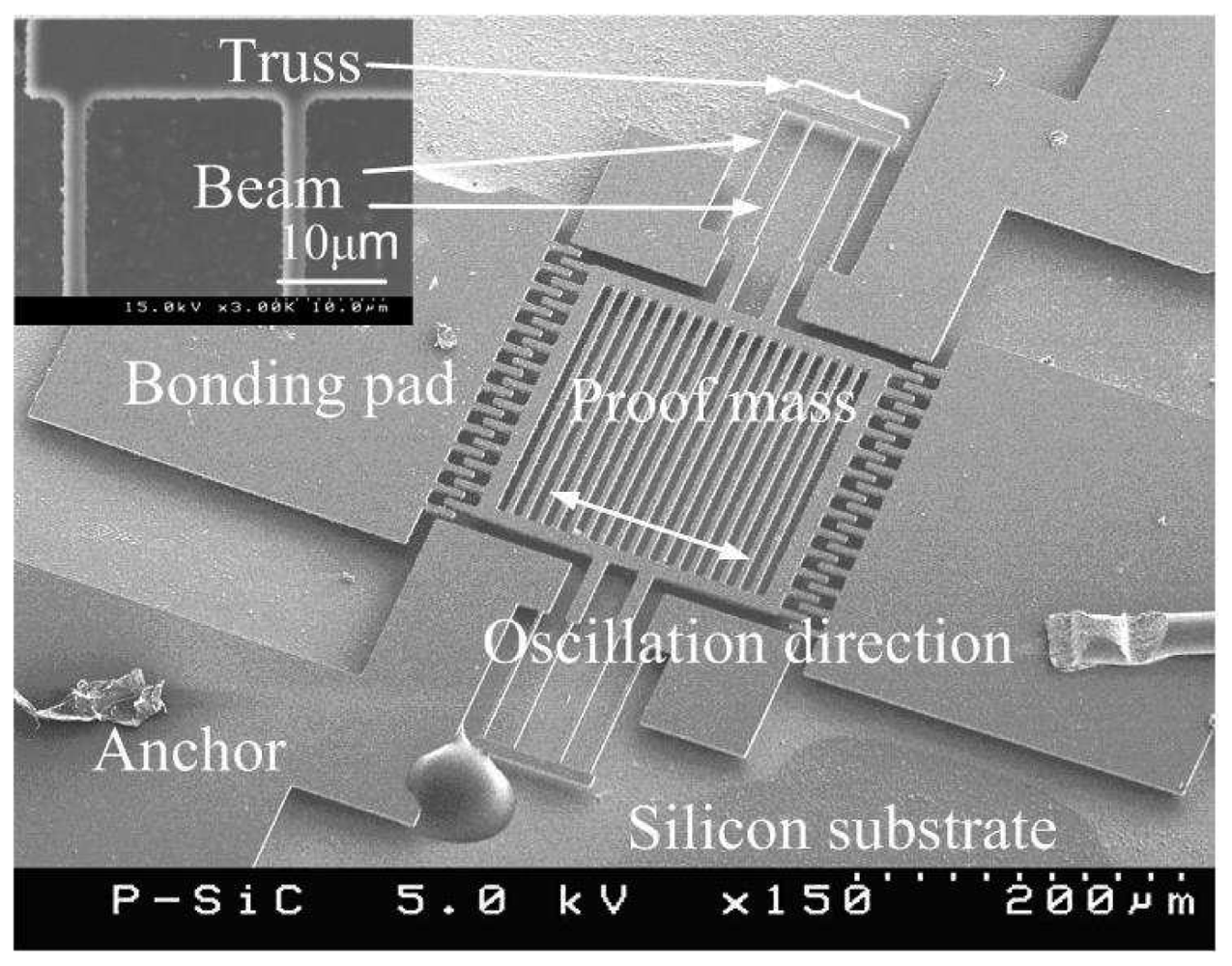
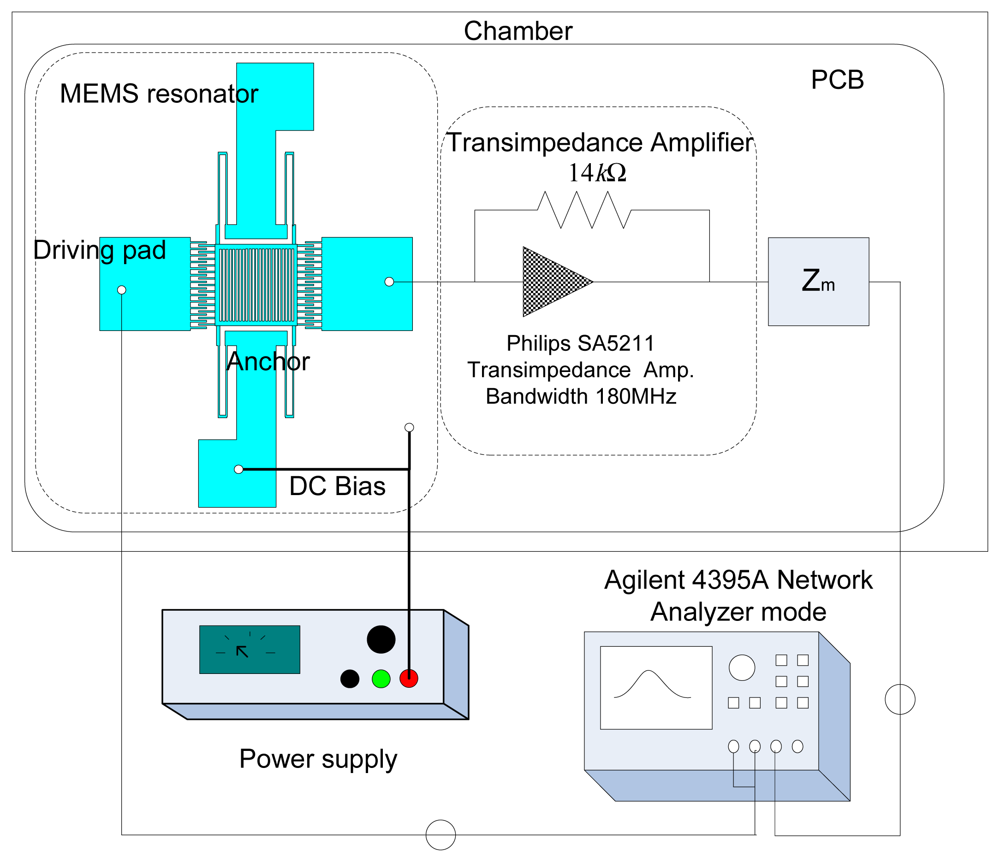
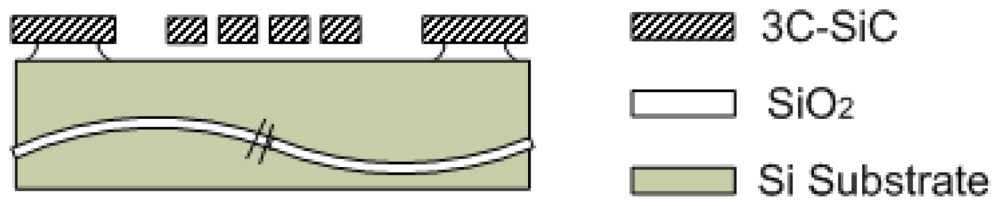
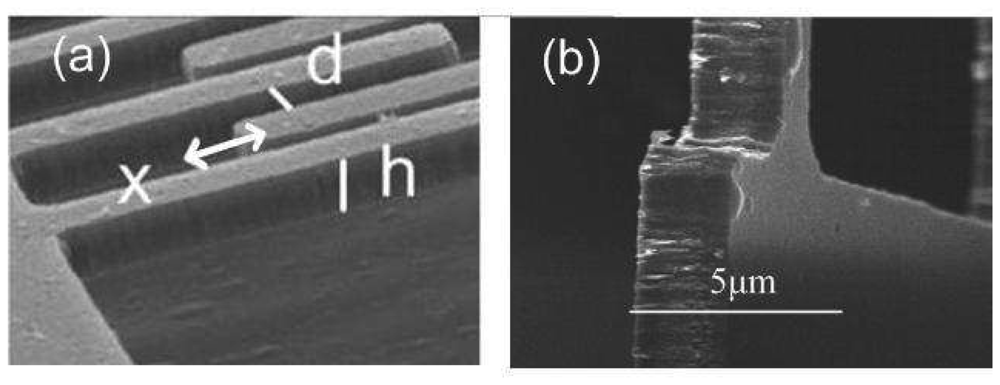
2.1 Device Fabrication and Measurement Technique
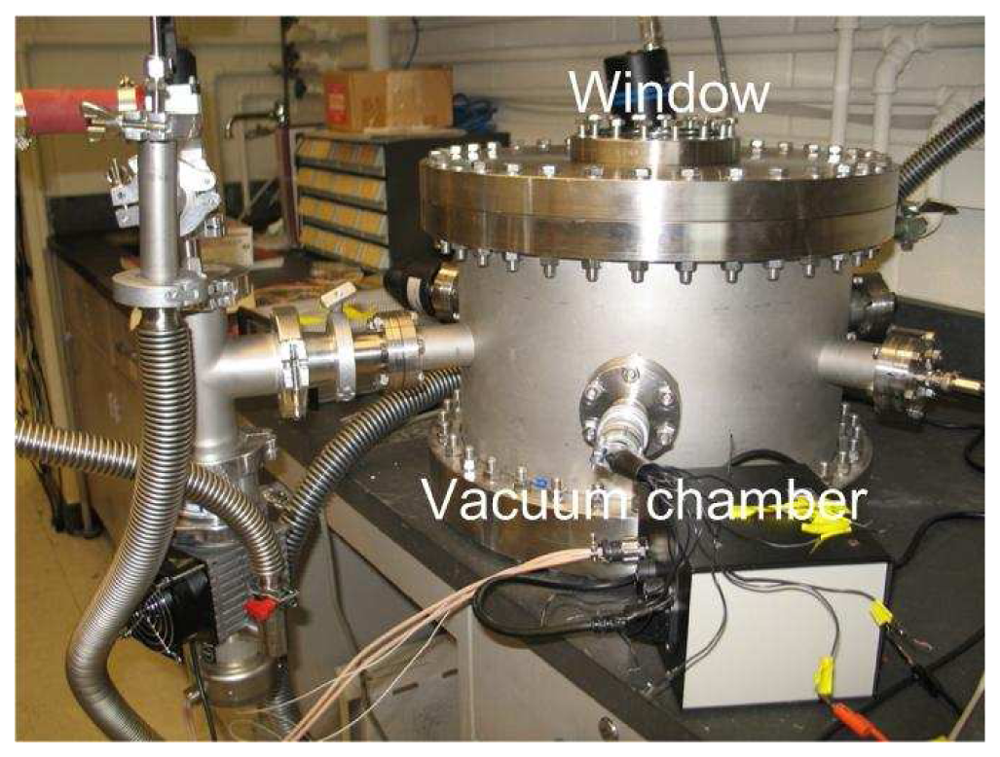
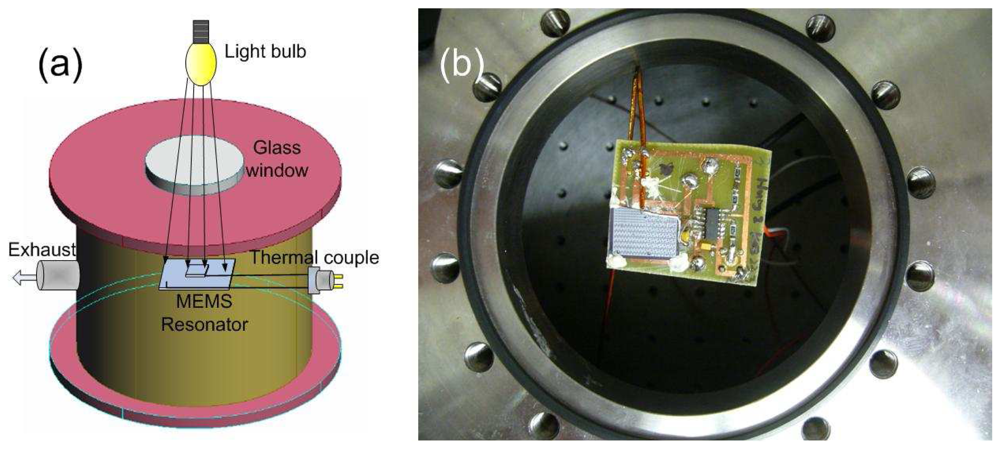
2.2 Setup for Temperature Testing
3. Result and Discussions
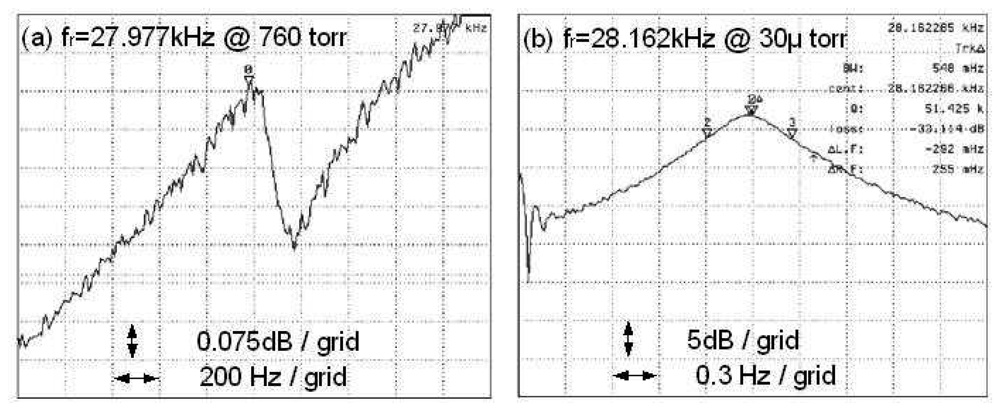
3.1 Gas rarefaction effect
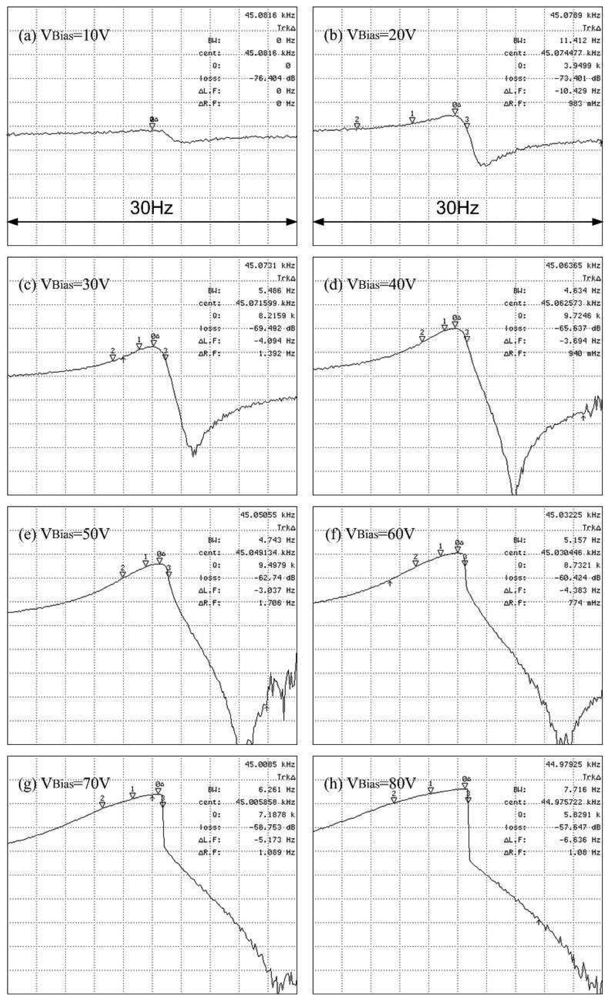
3.2 Nonlinearity due to bias potential
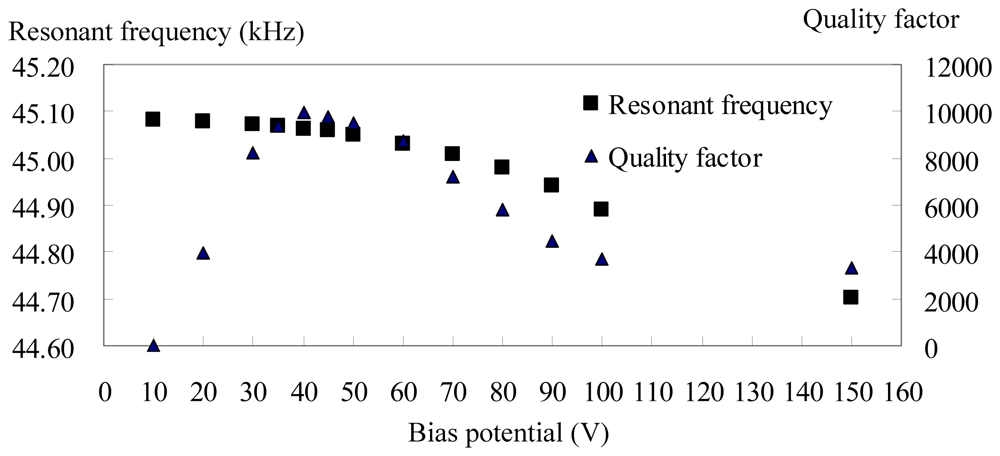
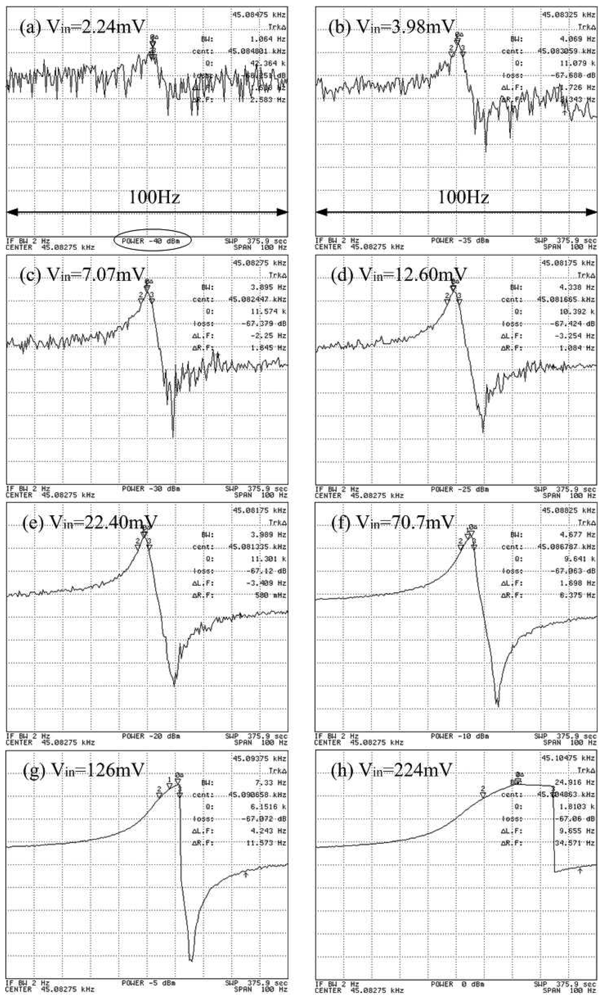
 oscillation system [21]. The electrical nonlinearity usually occurs between plates or beams that experience large deflections. Accordingly, the electrostatic force is modeled as the expression of Taylor expansion [22]. The mechanically dominant nonlinearity results in a rightward bending of the resonant peak. In these cases, the amplitude versus frequency plots exhibit a hysteresis, which is also called the Duffing effect [23]. The Duffing effect is a nonlinear dynamic behavior that, in a single degree-of-freedom (DOF) system (such as a lateral resonator) can be modeled by:
3.3 Nonlinearity from drive voltage
3.4 Temperature effect
4. Conclusions
Acknowledgments
References and Notes
- Nguyen, C.T.-C.; Howe, R.T. An integrated CMOS micromechanical resonator high-Q oscillator. IEEE J. of Solid-State Circuits 1999, 34, 440–455. [Google Scholar]
- Gong, J. F.; Xiao, Z. Y.; Chan, P. C. H. Integration of an RF MEMS resonator with a bulk CMOS process using a low-temperature and dry-release fabrication method. J. Micromech. Microeng. 2007, 17, 20–25. [Google Scholar]
- Huang, X.M.H.; Zorman, C.A.; Mehregany, M.; Roukes, M.L. Nanodevice motion at microwave frequencies. Nature 2003, 421, 496–497. [Google Scholar]
- Enderling, S.; Hedley, J.; Jiang, L.; Cheung, R.; Zorman, C; Mehregany, M.; Walton, A. Characterization of frequency tuning using focused ion beam platinum deposition. J. Micromech. Microeng. 2007, 17, 213–219. [Google Scholar]
- Kazinczi, R.; Mollinger, J.R.; Bossche, A. Adsorption-induced failure modes of thin-film resonators. Materials Research Society Symposium - Proceedings 2002, 695, 365–370. [Google Scholar]
- Veijola, T.; Turowski, M. Compact damping models for laterally moving microstructures with gas-rarefaction effects. J. Microelec. Syst. 2001, 10, 263–273. [Google Scholar]
- Kazinczi, R.; Mollinger, J.R.; Bossche, A. Environment-induced failure modes of thin film resonators. J. Microlit. Microfab. Microsyst. 2001, 1, 63–69. [Google Scholar]
- Blom, F.R.; Bouwstra, S; Elwenspoek, M.; Fluitman, J.H.J. Dependence of the quality factor of micromachined silicon beam resonators on pressure and geometry. J. Vac. Sci. Tech. B 1992, 10, 19–26. [Google Scholar]
- Gui, C.; Legtenberg, R.; Elwenspoek, M.; Fluitman, J.H. Q-Factor dependence of one-port encapsulated polysilicon resonator on reactive sealing pressure. J. Micromech. Microeng. 1995, 5, 183–185. [Google Scholar]
- Candler, R.N.; Li, H.; Lutz, M.; Park, W.-T.; Partridge, A.; Yama, G.; Kenny, T.W. Investigation of energy loss Mechanisms in micromechanical resonators. The 12th International Conference on Solid States Sensor, Actuators and Microsystems; 2003; 1, pp. 332–335. [Google Scholar]
- Chang, W.-T.; Mehregany, M.; Zorman, C. Energy Dissipation in Folded-Beam MEMS Resonators Made from Single Crystal and Polycrystalline 3C-SiC Films. Proceedings of the 2nd IEEE International Conference on Nano/Micro Engineered and Molecular Systems, IEEE NEMS; 2007; pp. 740–744. [Google Scholar]
- Petersen, K.E.; Guarnieri, C. R. Young's modulus measurements of thin films using micromechanics. J. Appl. Phys. 1979, 50, 6761–6766. [Google Scholar]
- Evoy, S.; Carr, D.W.; Sekaric, A.; Parpia, J.M.; Craighead, H.G. Nanofabrication and electrostatic operation of single-crystal silicon paddle oscillators. J. Appl. Phys. 1999, 86, 6072–6077. [Google Scholar]
- Carr, D.W.; Evoy, S.; Sekaric, L.; Craighead, H.G.; Parpia, J.M. Measurement of mechanical resonance and losses in nanometer scale silicon wires. Appl. Phys. Lett. 1999, 75, 920–922. [Google Scholar]
- Bohn, H. G.; Prieler, M.; Su, C.M.; Trinkaus, H.; Schilling, W. Internal friction effects due to grain boundary sliding in large- and small-grained aluminum. J. Phys. Chem. Solids 1994, 55, 1157–1164. [Google Scholar]
- Wang, K.; Wong, A.-C.; Nguyen, T.-C. VHF free-free beam high-Q micromechanical resonators. J. Microelec. Syst. 2000, 9, 347–360. [Google Scholar]
- Kuo, H.-I.; Zorman, C.A.; Mehregany, M. Fabrication and Testing of Single Crystalline 3C-SiC Devices Using a Novel SiC-on-Insulator Substrate. The 12th, Int. Conf. on Solid-State Sensors & Actuators (Transducers′03), Boston, Massachusetts, June 8–12, 2003; pp. 742–745.
- Gao, D.; Wijesundara, M.B.J.; Carraro, C.; Howe, R.T.; Maboudian, R. High Modulus Polycrystalline 3C-SiC Technology for RF MEMS. The 12th, Int. Conf. on Solid-State Sensors & Actuators (Transducers′03), Boston, Massachusetts, June 8–12, 2003; pp. 1160–1163.
- Roy, S.; DeAnna, R.G.; Zorman, C.A.; Mehregany, M. Fabrication and Characterization of Polycrystalline SiC Resonators. IEEE Trans. Electron. Dev. 2002, 49, 2323–2332. [Google Scholar]
- Wiser, R. F.; Tabib-Azar, M.; Mehregany, M.; Zorman, C. Polycrystalline silicon-carbide surface-micromachined vertical resonators - Part II: Electrical testing and material property extraction. J. Microelectromech. Syst. 2005, 14, 579–589. [Google Scholar]
- Agarwal, M.; Park, K.K.; Candler, R.N.; Hopcroft, M.A.; Kim, B.; Jha, C.M.; Melamud, R.; Chandorkar, S.; Bhat, S.N.; Murmann, B.; Kenny, T.W. Nonlinear Characterization of Electrostatic MEMS Resonators. Proc. IEEE International Frequency Control Symposium, Miami, FL, June 5–7, 2006; pp. 209–212.
- Ladabaum, L; Jin, X; Soh, H.T.; Atalar, A; Khuri-Yakub, B.T. Surface micromachined capacitive ultrasonic transducers. IEEE Trans. Ultra. Ferr. Freq. Control 1999, 45, 679–690. [Google Scholar]
- Landau, L.D.; Lifshitz, E.M. Mechanics, 2nd ed.; Addison-Wesley Publishing: Cambride, Mass, USA, 1969. [Google Scholar]
- Zhang, W.; Baskaran, R; Turner, L. Effect of cubic nonlinearity on auto-parametrically amplified resonant MEMS mass sensor. Sensor Actuat. A 2002, 102, 139–150. [Google Scholar]
- Zhang, W.; Zhang, K.; Turner, L. Nonlinear dynamics of micro impact oscillators in high frequency MEMS switch application. The 13th, Int. Conf. on Solid-State Sensors & Actuators (Transducers′05), Seoul, Korea, June 5–9, 2005; pp. 768–771.
- EerNisse, E.P.; Wiggins, R.B. Review of thickness-shear mode quartz resonator sensors for temperature and pressure. IEEE Sens. J. 2001, 1, 79–87. [Google Scholar]







| Pressure (Torr) | 760 | 1 | 0.3 | 0.003 | 0.00003 |
| Resonator frequency (Hz) | 27977 | 28148 | 28155 | 28158 | 28162 |
| Beam Width (m2) | Beam Length (m2) | Proof Mass Area (m2) | Truss Area (m2) | Beam Area (m2) |
|---|---|---|---|---|
| 2.10×10⁻⁶ | 1.00×10⁻⁴ | 2.40×10⁻⁸ | 6.90×10⁻¹⁰ | 1.60×10⁻⁹ |
© 2008 by the authors; licensee Molecular Diversity Preservation International, Basel, Switzerland. This article is an open-access article distributed under the terms and conditions of the Creative Commons Attribution license (http://creativecommons.org/licenses/by/3.0/).
Share and Cite
Chang, W.-T.; Zorman, C. Electrical Characterization of Microelectromechanical Silicon Carbide Resonators. Sensors 2008, 8, 5759-5774. https://doi.org/10.3390/s8095759
Chang W-T, Zorman C. Electrical Characterization of Microelectromechanical Silicon Carbide Resonators. Sensors. 2008; 8(9):5759-5774. https://doi.org/10.3390/s8095759
Chicago/Turabian StyleChang, Wen-Teng, and Christian Zorman. 2008. "Electrical Characterization of Microelectromechanical Silicon Carbide Resonators" Sensors 8, no. 9: 5759-5774. https://doi.org/10.3390/s8095759