
Time Series Forecasting Energy-efficient Organization of Wireless Sensor Networks


Abstract
:1. Introduction
1.1. Related work
2. Preliminaries
2.1. Target model
2.2. Multi-sensor model
2.3. Energy model
3. Collaborative Sensing and Adaptive Estimation in Target Tracking Problem
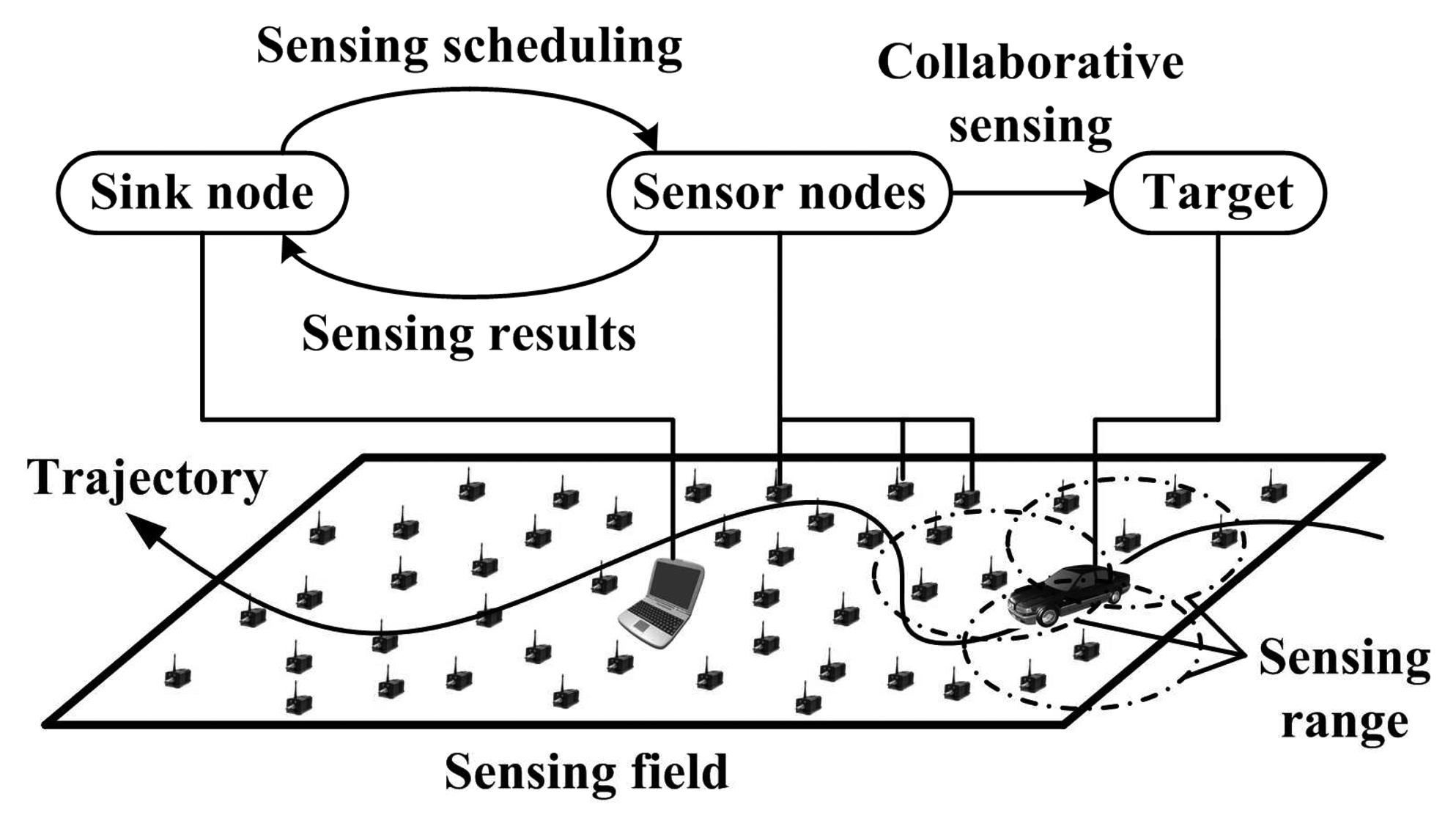
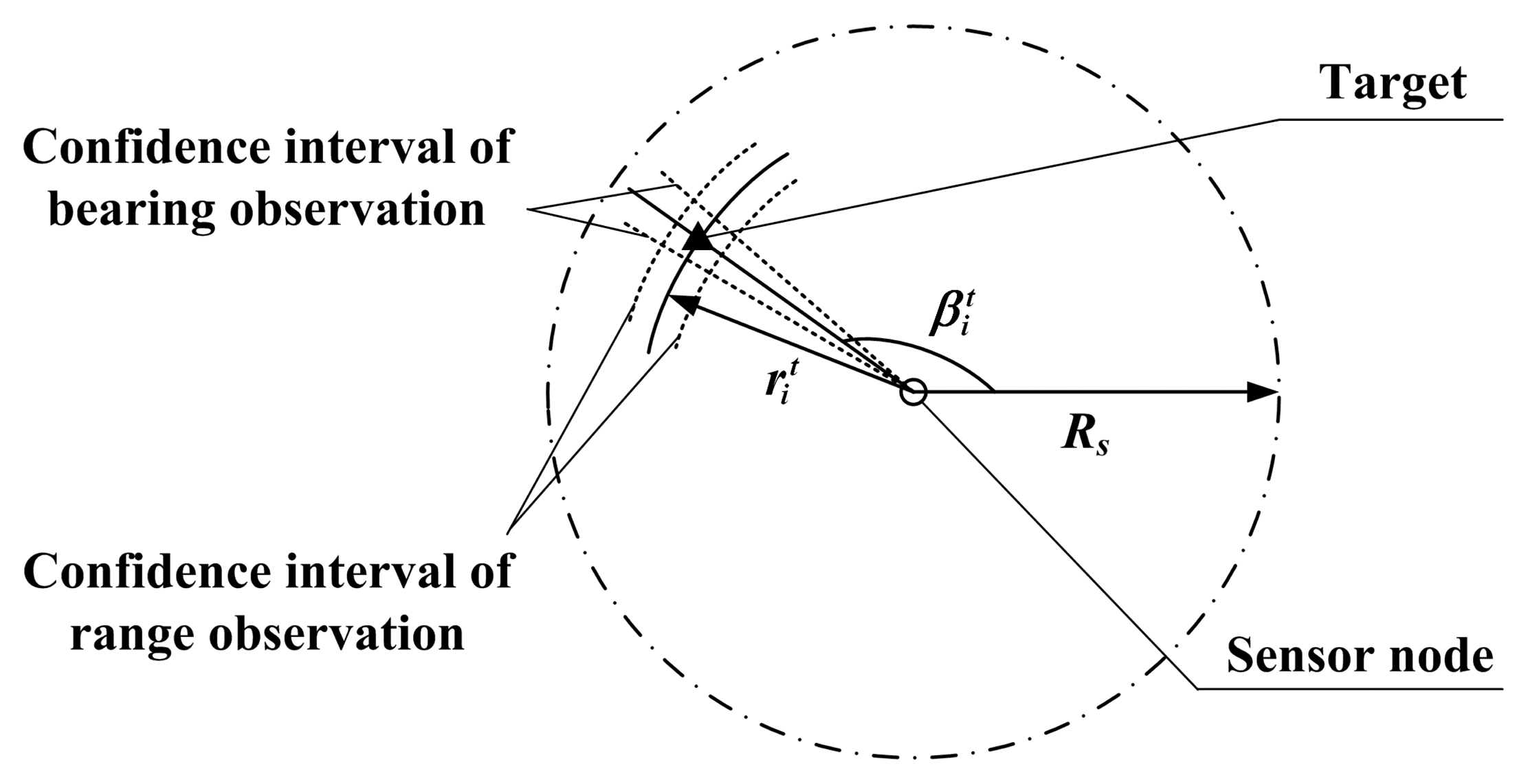
3.1. Target localization with multi-sensor fusion
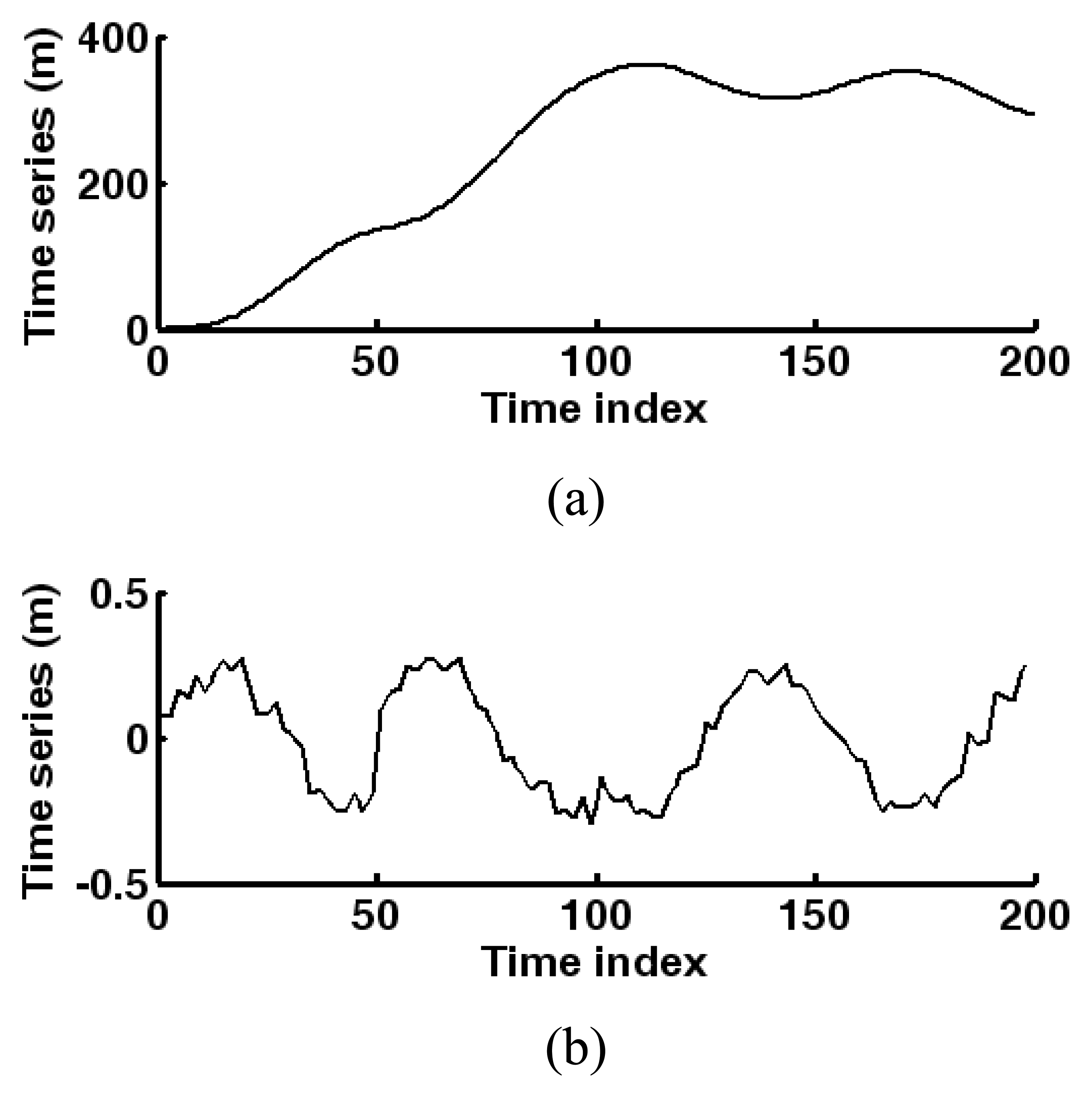
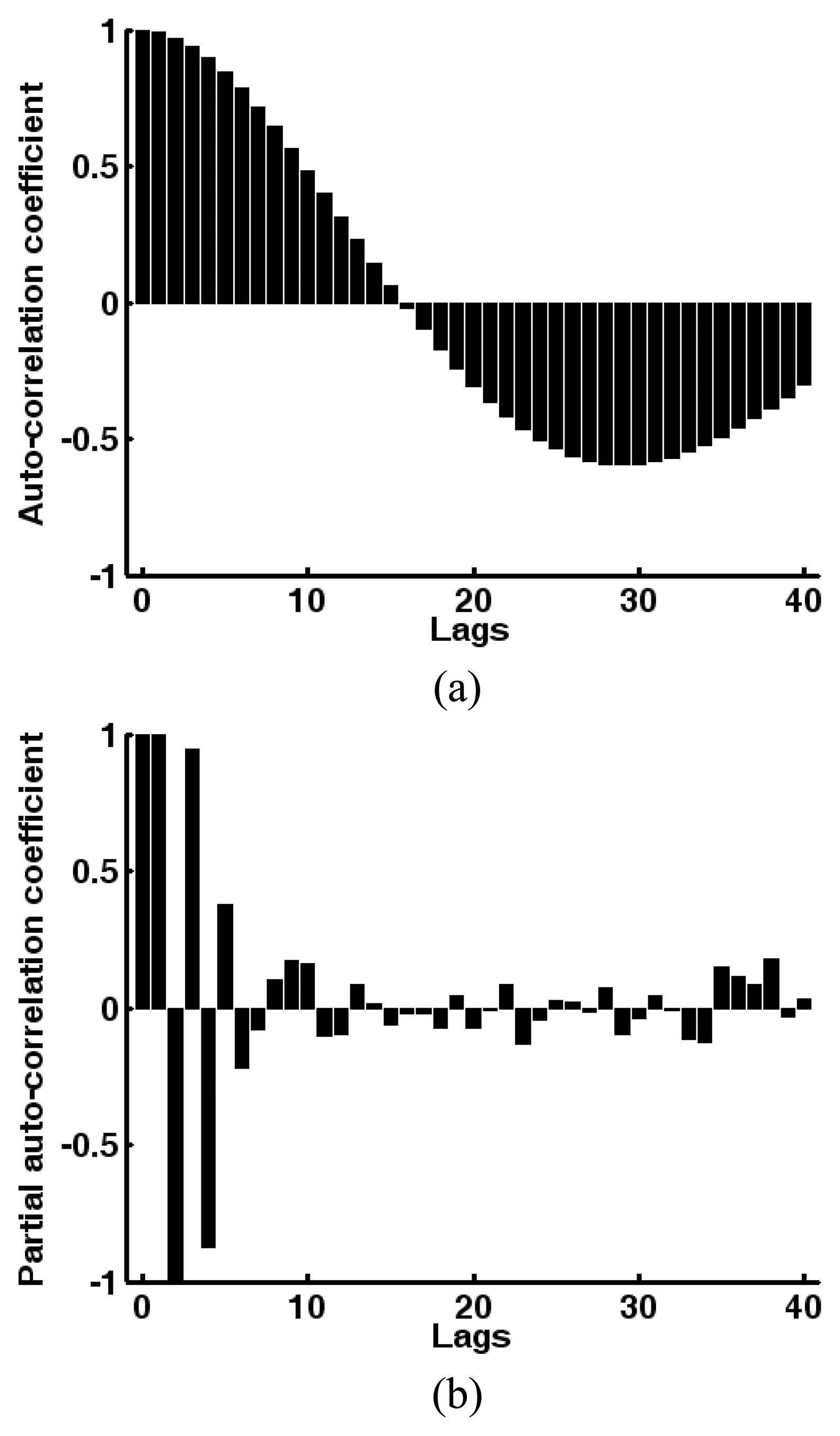
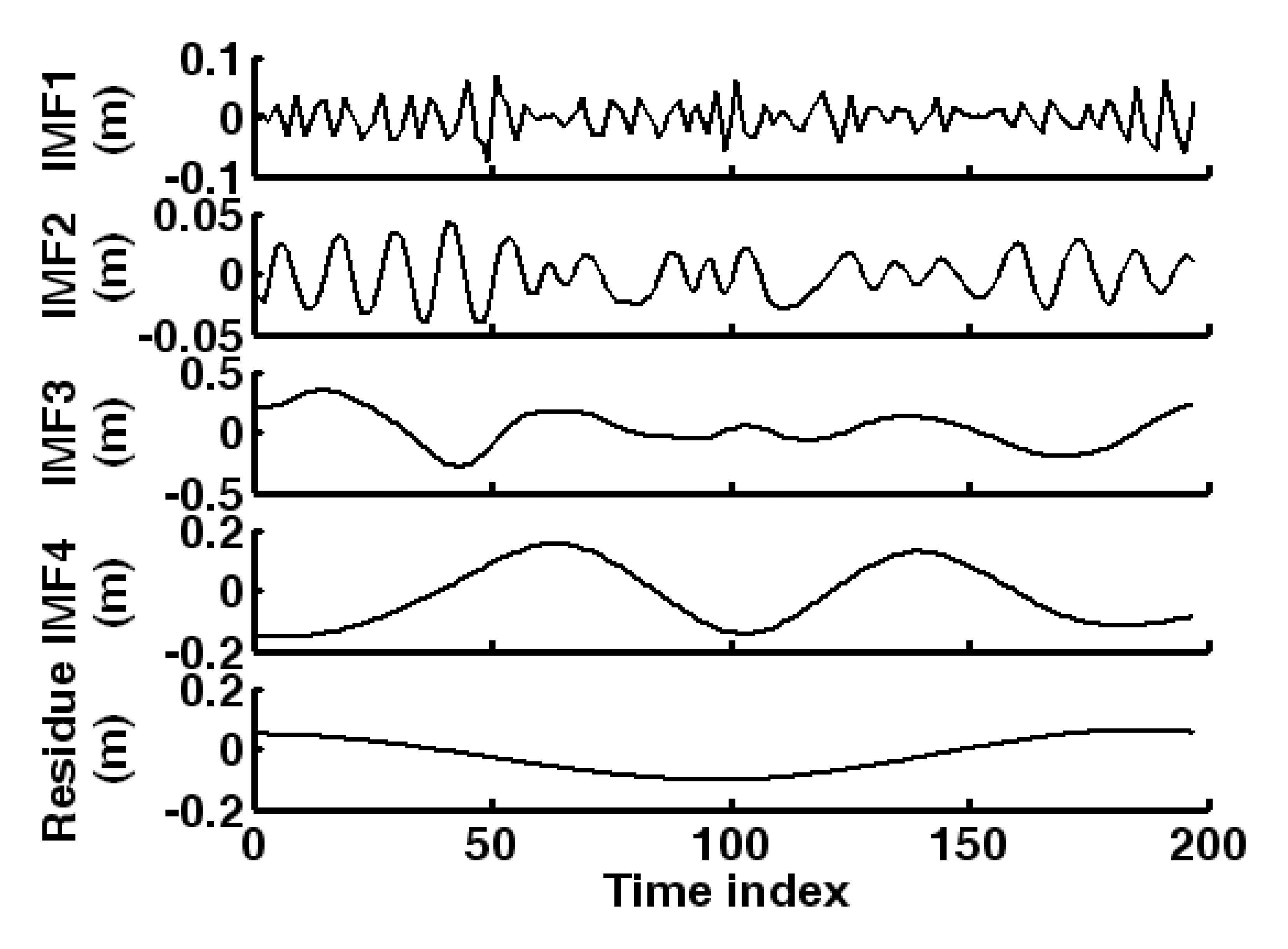
3.2. Time series analysis for target position forecasting
- a)
- Identify all the maxima and minima of .
- b)
- Generate its upper and lower envelopes and with cubic spline interpolation.
- c)
- Calculate the point-by-point mean from upper and lower envelopes as:
- d)
- Extract the detail as:
- e)
- Check the properties of ek. If it meets the definitive requirements, an IMF is derived and the residual is:Otherwise, replace with ek
- f)
- Repeat Steps a) to e) until the residual satisfies the stopping criterion.
4. Energy-efficient organization method
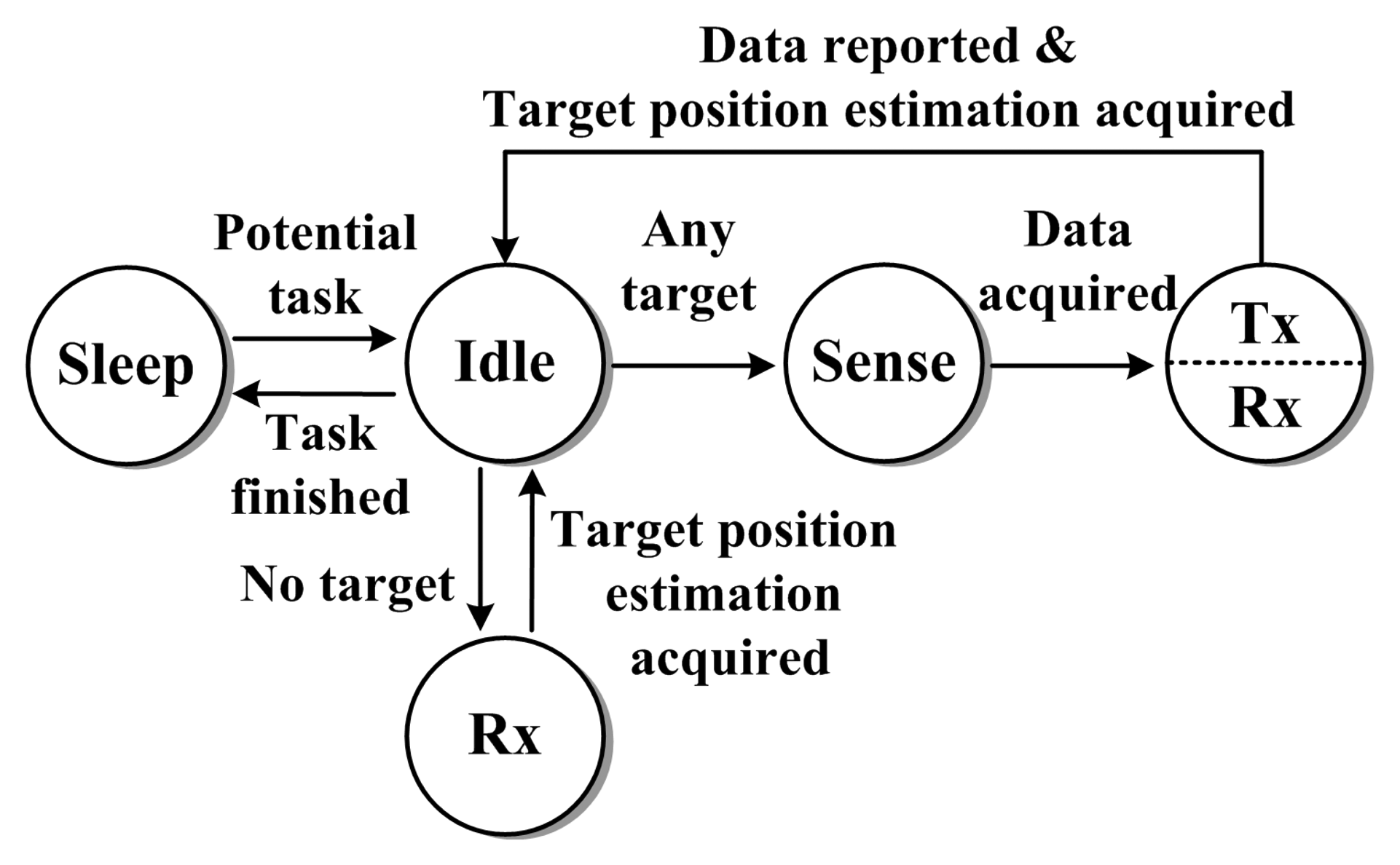
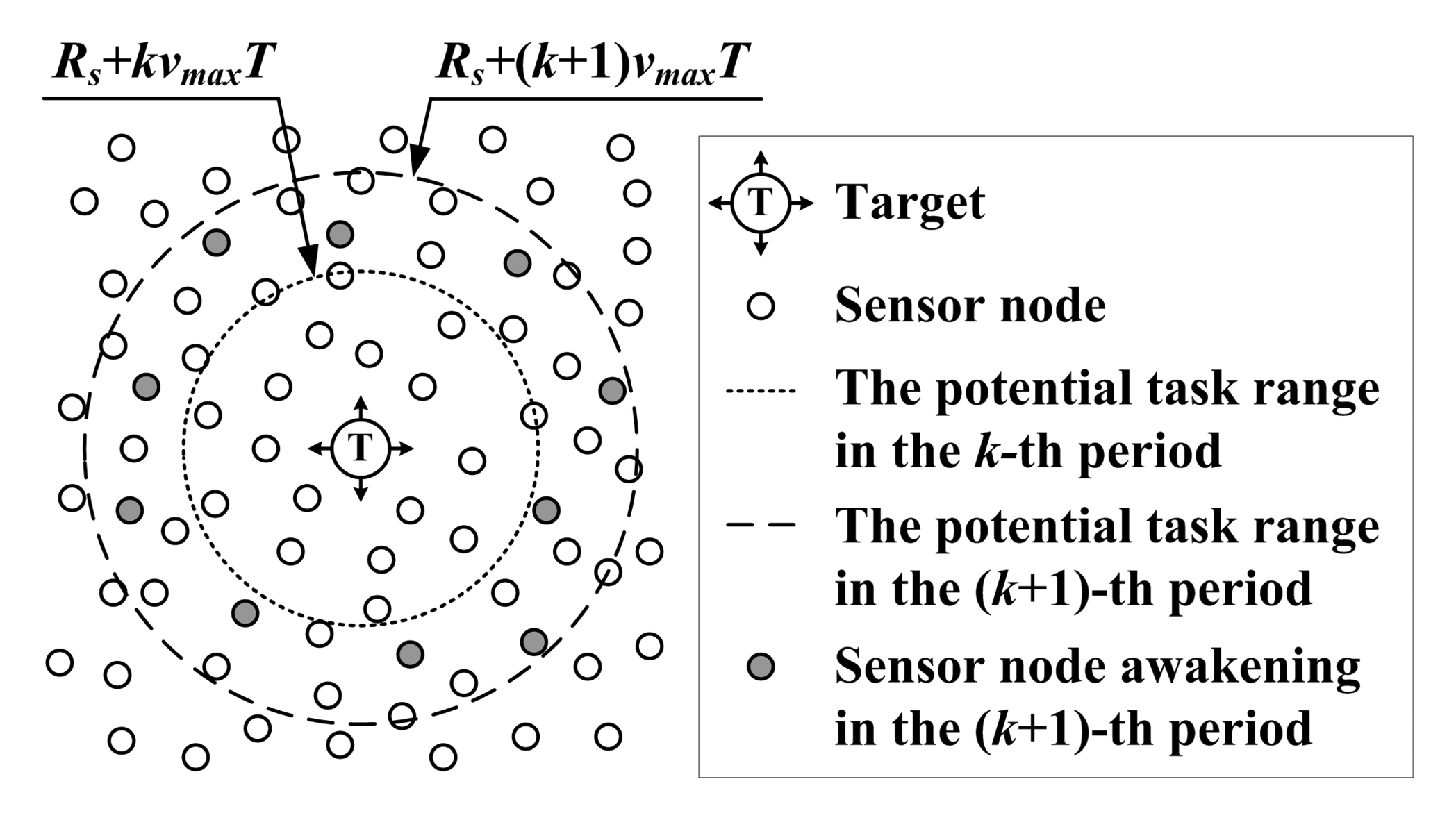
4.1. Distributed sensor node awakening
- (1)
- Sleep. It has the lowest power consumption as all the components are inactive. Only the timer-driven awakening is supported, that is, the processor component can be awakened by its own timer.
- (2)
- Idle. Only the processor component is active in this mode. All the other components can be controlled by the operation system.
- (3)
- Sense. The processor and sensor components are active. In this mode, sensor nodes can acquire the target observations.
- (4)
- Rx. The processor is working and the reception portion of RF circuits is turned on. Sensor nodes can receive request or data.
- (5)
- Rx & tx. The processor is active while both the reception and transmission portions of RF circuits are turned on. Sensor nodes can receive and transmit information.
4.2. Dynamic routing with ant colony optimization
- (1)
- The index of sensor nodes with observations is denoted by {1, 2, ⋯, na};
- (2)
- (3)
- A optimal path {λ(1), λ(2), ⋯, λ(na)} should be found, where λ(i) ∈ {1, 2, ⋯, na}. At the beginning, sensor node λ(1) transmits its observations to sensor node λ(2). Then the data is forwarded and integrated along the path. The sensor node λ(na) can localize the target by data fusion in the end. If i ≠ j, then λ(i) ≠ λ(j). The minimization objective function is:
5. Experimental Results
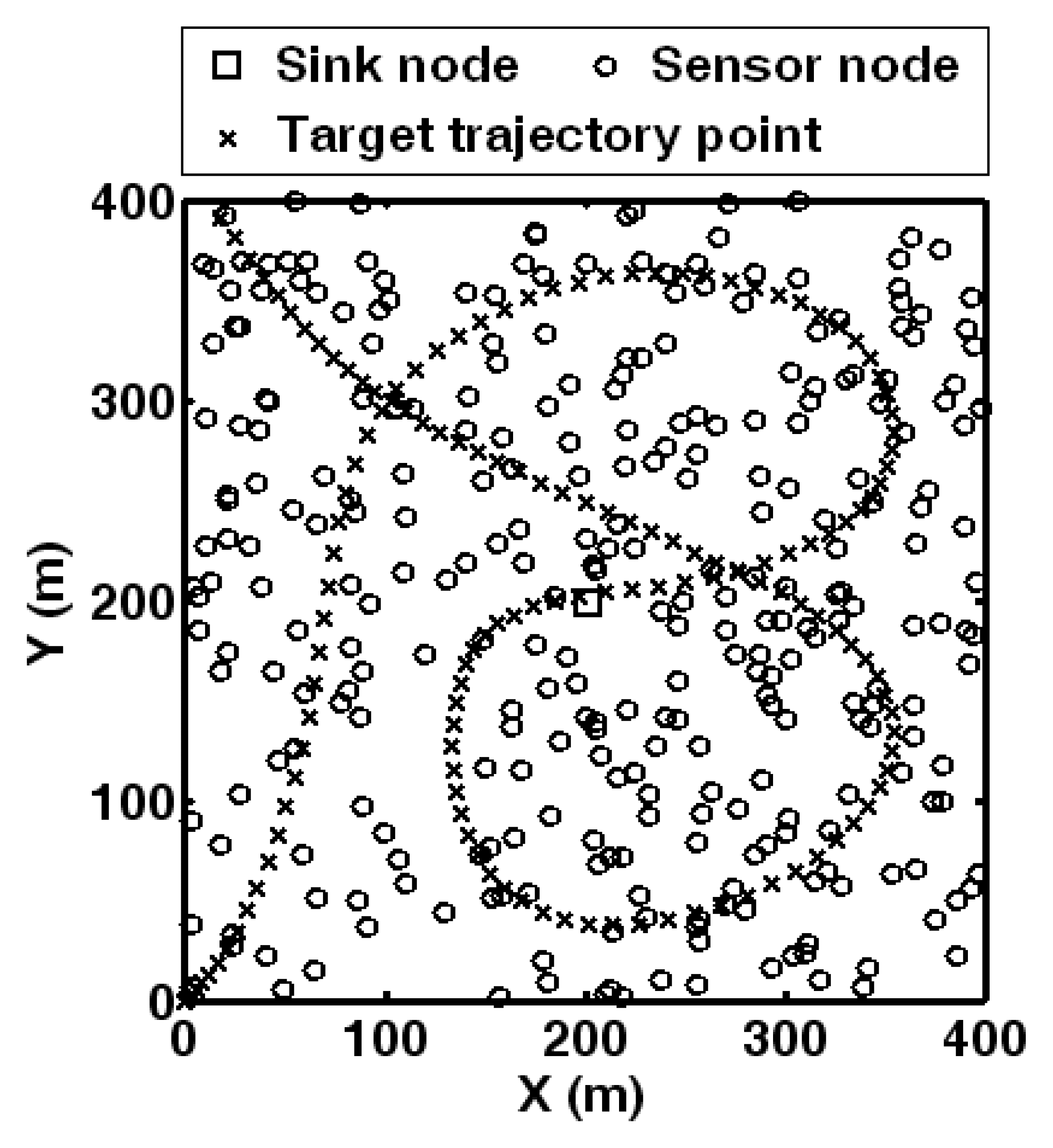
5.1. Experimentation platform
5.2. Target tracking experiments
6. Conclusions
Acknowledgments
References and Notes
- Sinha, A.; Chandrakasan, A. Dynamic Power Management in Wireless Sensor Networks. IEEE Design and Test of Computers 2001, 18, 62–74. [Google Scholar]
- Lim, S. Adaptive power controllable retrodirective array system for wireless sensor server applications. IEEE Transactions on Microwave Theory and Techniques 2005, 53, 3735–3743. [Google Scholar]
- Tang, C.; Raghavendra, C.S. Power aware wireless sensor networks using tripwire detection and cueing. Proceedings of International Conference on System Sciences; 2005; pp. 1–10. [Google Scholar]
- Duh, F.B.; Lin, C.T. Tracking a maneuvering target using neural fuzzy network. IEEE Transactions on System, Man, and Cybernetics 2004, 34, 16–33. [Google Scholar]
- Wang, X.; Wang, S.; Ma, J. An improved particle filter for target tracking in sensor system. Sensors 2007, 7, 144–156. [Google Scholar]
- Payne, O.; Marrs, A. An unscented particle filter for GMTI tracking. Proceedings of IEEE Aerospace Conference; 2004; 3, pp. 1869–1875. [Google Scholar]
- Zhang, H. Optimal and self-tuning State estimation for singular stochastic systems: a polynomial equation approach. IEEE Transactions on Circuits and Systems 2004, 51, 327–333. [Google Scholar]
- Lin, Z.; Zou, Q. Cramer-Rao lower bound for parameter estimation in nonlinear systems. IEEE Signal Processing Letters 2005, 12, 855–858. [Google Scholar]
- Gabriel, R.; Patrick, F.; Paulo, G. Empirical mode decomposition, fractional Gaussian noise and Hurst exponent estimation. Proceedings of International Conference on Acoustics, Speech, and Signal Processing; 2005; 4, pp. 489–492. [Google Scholar]
- Zecchin, A.C. Parametric study for an ant algorithm applied to water distribution system optimization. IEEE Transactions on Evolutionary Computation 2005, 9, 175–191. [Google Scholar]
- Cardei, M.; Thai, M.T. Energy-efficient target coverage in wireless sensor networks. Proceedings of IEEE INFOCOM; 2005; pp. 1976–1984. [Google Scholar]
- Hohlt, B.; Doherty, L. Flexible power scheduling for sensor networks. Proceedings of International Symposium on Information Processing in Sensor Networks; 2004; pp. 205–214. [Google Scholar]
- Passos, R.M.; Coelho, C.J.N. Dynamic Power Management in Wireless Sensor Networks: An Application-Driven Approach. Proceedings of International Conference on Wireless On-demand Network Systems and Services; 2005; pp. 109–118. [Google Scholar]
- Du, X.; Lin, F. Efficient energy management protocol for target tracking sensor networks. IEEE International Symposium on Integrated Network Management 2005, 45–58. [Google Scholar]
- Wang, X.; Ma, J.; Wang, S.; Bi, D. Prediction-based dynamic energy management in wireless sensor networks. Sensors 2007, 7, 251–266. [Google Scholar]
- Wang, X.; Wang, S. Collaborative signal processing for target tracking in distributed wireless sensor networks. Journal of Parallel and Distributed Computing 2007, 67, 501–515. [Google Scholar]
- Rong, L.X.; Jilkov, V.P. Survey of maneuvering target tracking Part I: Dynamic models. IEEE Transactions on Aerospace and Electronic Systems 2003, 39, 1333–1364. [Google Scholar]
- Yao, Q.; Tan, S.K.; Ge, Y. An area localization scheme for large wireless sensor networks. Proceedings of IEEE Vehicular Technology Conference; 2005; pp. 2835–2839. [Google Scholar]
- Chhetri, A.S. Energy efficient target tracking in a sensor network using non-myopic sensor scheduling. Proceedings of International Conference on Information Fusion; 2005; pp. 558–565. [Google Scholar]
- Oshman, Y.; Davidson, P. Optimization of observer trajectories for bearings-only target localization. IEEE Transactions on Aerospace and Electronic Systems 1999, 35, 892–902. [Google Scholar]
- Broersen, P.M.T. Automatic identification of time-series models from long autoregressive models. IEEE Transactions on Instrumentation and Measurement 2005, 54, 1862–1868. [Google Scholar]
- Delechelle, E. Empirical mode decomposition: an analytical approach for sifting process. IEEE Signal Processing Letters 2005, 12, 764–767. [Google Scholar]
- Salami, M.J.E. Analysis of multiexponential transient signals using interpolation-based deconvolution and parametric modeling techniques. Proceedings of IEEE International Conference on Industrial Technology; 2003; 1, pp. 271–276. [Google Scholar]
- Biscainho, L.W.P. AR model estimation from quantized signals. IEEE Signal Processing Letters 2004, 11, 183–185. [Google Scholar]
- Liang, Y.C. An ant colony optimization algorithm for the redundancy allocation problem (RAP). IEEE Transactions on Reliability 2004, 53, 417–423. [Google Scholar]
- Dorigo, M.; Gambardella, L.M. Ant colony system: A cooperative learning approach to the traveling salesman problem. IEEE Transactions on Evolutionary Computation 1997, 1, 53–66. [Google Scholar]





| Model | AR(p) | MA(q) | ARMA(p,q) |
|---|---|---|---|
| ACF | Exponential or sinusoidal decay to zero | Spikes cut off to zero after lag q | Exponential or sinusoidal decay to zero after lag q |
| PACF | Spikes cut off to zero after lag p | Exponential or sinusoidal decay to zero | Exponential or sinusoidal decay to zero after lag p |
| Mode | Power consumption (mW) |
|---|---|
| Sleep | 5 |
| Idle | 25 |
| Sense | 40 |
| Rx | 45 |
| Rx & tx | 45+Ptx |
| Cost type | Energy consumption (J) | Reduction (%) | |
|---|---|---|---|
| General organization | Energy-efficient organization | ||
| Operation | 167.4 | 148. 4 | 11.4 |
| Transmission | 132.4 | 84.1 | 36.5 |
| Total | 299.8 | 232. 5 | 22.4 |
| γ | 0.08 | 0.16 | 0.32 | 0.64 |
| Energy consumption (J) | 189.1 | 201.6 | 217.1 | 229.7 |
© 2007 by MDPI ( http://www.mdpi.org). Reproduction is permitted for noncommercial purposes.
Share and Cite
Wang, X.; Ma, J.-J.; Wang, S.; Bi, D.-W. Time Series Forecasting Energy-efficient Organization of Wireless Sensor Networks. Sensors 2007, 7, 1766-1792. https://doi.org/10.3390/s7091766
Wang X, Ma J-J, Wang S, Bi D-W. Time Series Forecasting Energy-efficient Organization of Wireless Sensor Networks. Sensors. 2007; 7(9):1766-1792. https://doi.org/10.3390/s7091766
Chicago/Turabian StyleWang, Xue, Jun-Jie Ma, Sheng Wang, and Dao-Wei Bi. 2007. "Time Series Forecasting Energy-efficient Organization of Wireless Sensor Networks" Sensors 7, no. 9: 1766-1792. https://doi.org/10.3390/s7091766
APA StyleWang, X., Ma, J.-J., Wang, S., & Bi, D.-W. (2007). Time Series Forecasting Energy-efficient Organization of Wireless Sensor Networks. Sensors, 7(9), 1766-1792. https://doi.org/10.3390/s7091766