<?xml version="1.0" encoding="utf-8"?>
<!DOCTYPE article PUBLIC "-//NLM//DTD Journal Publishing DTD v2.3 20070202//EN" "journalpublishing.dtd">
<article xml:lang="en" article-type="review-article" xmlns:mml="http://www.w3.org/1998/Math/MathML" xmlns:xlink="http://www.w3.org/1999/xlink">
<front>
<journal-meta>
<journal-id journal-id-type="publisher-id">sensors</journal-id>
<journal-title>Sensors</journal-title>      <abbrev-journal-title abbrev-type="publisher">Sensors</abbrev-journal-title>      <abbrev-journal-title abbrev-type="pubmed">Sensors</abbrev-journal-title>
<issn pub-type="epub">1424-8220</issn>
<publisher>
<publisher-name>MDPI</publisher-name></publisher></journal-meta>
<article-meta>
<article-id pub-id-type="doi">10.3390/s130100984</article-id>
<article-id pub-id-type="publisher-id">sensors-13-00984</article-id>
<article-categories>
<subj-group>
<subject>Review</subject></subj-group></article-categories>
<title-group>
<article-title>Monitoring Ion Activities In and Around Cells Using Ion-Selective Liquid-Membrane Microelectrodes</article-title></title-group>
<contrib-group>
<contrib contrib-type="author">
<name><surname>Lee</surname><given-names>Seong-Ki</given-names></name></contrib>
<contrib contrib-type="author">
<name><surname>Boron</surname><given-names>Walter F.</given-names></name></contrib>
<contrib contrib-type="author">
<name><surname>Parker</surname><given-names>Mark D.</given-names></name><xref ref-type="corresp" rid="c1-sensors-13-00984"><sup>&#x0002A;</sup></xref></contrib>
<aff id="af1-sensors-13-00984">Department of Physiology and Biophysics, School of Medicine, Case Western Reserve University, 10900 Euclid Avenue, Cleveland, OH 44106, USA; E-Mails: <email>sxl271@case.edu</email> (S.-K.L.); <email>wfb2@case.edu</email> (W.F.B.)</aff></contrib-group>
<author-notes>
<corresp id="c1-sensors-13-00984">
<label>&#x0002A;</label>Author to whom correspondence should be addressed; E-Mail: <email>mark.d.parker@case.edu</email>; Tel.: &#x0002B;1-216-368-5530; Fax: &#x0002B;1-216-368-5586.</corresp></author-notes>
<pub-date pub-type="collection"><month>01</month><year>2013</year></pub-date>
<pub-date pub-type="epub">
<day>15</day>
<month>01</month>
<year>2013</year></pub-date>
<volume>13</volume>
<issue>1</issue>
<fpage>984</fpage>
<lpage>1003</lpage>
<history>
<date date-type="received">
<day>03</day>
<month>12</month>
<year>2012</year></date>
<date date-type="rev-recd">
<day>31</day>
<month>12</month>
<year>2012</year></date>
<date date-type="accepted">
<day>02</day>
<month>01</month>
<year>2013</year></date></history>
<permissions>
<copyright-statement>&#x000A9; 2013 by the authors; licensee MDPI, Basel, Switzerland.</copyright-statement>
<copyright-year>2013</copyright-year>
<license>
<p>This article is an open access article distributed under the terms and conditions of the Creative Commons Attribution license (http://creativecommons.org/licenses/by/3.0/).</p></license></permissions>
<abstract>
<p>Determining the effective concentration (<italic>i.e.</italic>, activity) of ions in and around living cells is important to our understanding of the contribution of those ions to cellular function. Moreover, monitoring changes in ion activities in and around cells is informative about the actions of the transporters and/or channels operating in the cell membrane. The activity of an ion can be measured using a glass microelectrode that includes in its tip a liquid-membrane doped with an ion-selective ionophore. Because these electrodes can be fabricated with tip diameters that are less than 1 &#x003BC;m, they can be used to impale single cells in order to monitor the activities of intracellular ions. This review summarizes the history, theory, and practice of ion-selective microelectrode use and brings together a number of classic and recent examples of their usefulness in the realm of physiological study.</p></abstract>
<kwd-group>
<kwd>ISM</kwd>
<kwd>LIX</kwd>
<kwd>Nernst equation</kwd></kwd-group></article-meta></front>
<body>
<sec sec-type="intro">
<label>1.</label>
<title>Introduction</title>
<p>The activity of an ion is the effective concentration of that ion in a mixture of chemicals. This value is generally slightly smaller than the molar concentration of the parent chemical species because some salts do not fully ionize in solution. Moreover, the extent of ionization can be influenced by the presence of other chemical species in the solution as well as by factors such as temperature and ionic strength. Importantly it is the activity (<italic>a</italic>), rather than the concentration, of an ion that determines the thermodynamic contribution of the ion to a system such as membrane potential (a parameter that is predominantly determined by the intracellular and extracellular activities of Na<sup>&#x0002B;</sup>, K<sup>&#x0002B;</sup>, and Cl<sup>&#x02212;</sup>) and the rate of chemical reactions in which physiologists are interested. Every cell has the ability to control the distribution of ions across its membranes by virtue of the channels and transporters that are present in each membrane.</p>
<p>Three classical technologies that are applied to determining ion activity/concentration and monitoring the movement of ions across cell membranes are radiolabeled tracers (e.g., reference &#x0005B;<xref ref-type="bibr" rid="b1-sensors-13-00984">1</xref>&#x0005D;), ion-sensitive fluorescent indicator dyes &#x0005B;<xref ref-type="bibr" rid="b2-sensors-13-00984">2</xref>&#x0005D;, and ion-selective microelectrodes (ISMs). ISMs based on ion-selective liquid-membranes are the focus of the present review. These ISMs are glass microelectrodes that are used to continuously monitor the activity of a specific ion at a specific locus by virtue of their tips being filled with an ion-selective liquid membrane. ISM use facilitates ion measurement because
<list list-type="order">
<list-item>
<p>Numerous ISMs can be applied to a single cell at the same time, allowing numerous ion activities to be monitored simultaneously.</p></list-item>
<list-item>
<p>ISMs can be applied to monitor ion activity at specific loci such as the cell surface or the cytoplasm.</p></list-item>
<list-item>
<p>The reference electrode that is paired with the ISM for measurement of intracellular ion activity (see Section 5) provides a simultaneous measurement of membrane potential providing a more complete characterization of the transport processes that contribute to the changes in ion activities.</p></list-item>
<list-item>
<p>In combination with vibrating probe technology &#x0005B;<xref ref-type="bibr" rid="b3-sensors-13-00984">3</xref>&#x0005D;, ISMs can be used to measure net ion fluxes.</p></list-item></list></p>
<p>However, ISMs also have disadvantages:
<list list-type="order">
<list-item>
<p>Ionophore-doped liquid membranes are imperfectly ion-selective.</p></list-item>
<list-item>
<p>The use of ISMs to monitor intracellular ion activities is best applied to large cells that can be easily impaled with a microelectrode (e.g., <italic>Xenopus</italic> oocytes, which have a diameter that is greater than 1 mm; approximately 50&#x02013;100 times larger than a typical mammalian cell).</p></list-item></list></p>
<p>The earliest ISMs were fabricated from ion-selective glass &#x0005B;<xref ref-type="bibr" rid="b4-sensors-13-00984">4</xref>&#x0005D; but their usefulness for intracellular ion-measurements, which requires impalement of a cell, is limited by their relatively large tip diameter, slow response time, and expertise required to fabricate them &#x0005B;<xref ref-type="bibr" rid="b5-sensors-13-00984">5</xref>&#x0005D;. However their worth is evidenced by studies of, for example, pH<sub>i</sub> regulation in snail neurons &#x0005B;<xref ref-type="bibr" rid="b6-sensors-13-00984">6</xref>&#x0005D;, giant-barnacle muscle-fibers &#x0005B;<xref ref-type="bibr" rid="b7-sensors-13-00984">7</xref>&#x0005D;, and squid axons &#x0005B;<xref ref-type="bibr" rid="b8-sensors-13-00984">8</xref>&#x0005D; that were conducted using ISMs based on H<sup>&#x0002B;</sup>-selective glass.</p>
<p>The replacement of an ion-selective glass tip with an ionophore-doped liquid membrane (also known as an ionophore cocktail) conferred ion selectivity to glass microelectrodes with a smaller (less than 1 &#x003BC;m) diameter tip and a <italic>t</italic><sub>90</sub>&#x02014;the time taken for 90&#x00025; of the full electrode response to occur&#x02014;on the order of seconds (see reference &#x0005B;<xref ref-type="bibr" rid="b9-sensors-13-00984">9</xref>&#x0005D; for a review of more recently recommended measures of ion-selective electrode response times). Here, we discuss the theory, fabrication, and application of ionophore-cocktail based ISMs. The theory, construction, and application of ISMs have also been reviewed by others in references &#x0005B;<xref ref-type="bibr" rid="b4-sensors-13-00984">4</xref>,<xref ref-type="bibr" rid="b10-sensors-13-00984">10</xref>&#x02013;<xref ref-type="bibr" rid="b13-sensors-13-00984">13</xref>&#x0005D;.</p></sec>
<sec>
<label>2.</label>
<title>Theory of ISMs</title>
<p>In order for an ISM to be useful, the microelectrode must respond predictably and rapidly to changes in ion activity such that the voltage reported by the microelectrode can be used to recreate information about ion concentration. Underlying the theoretical considerations that describe the relationship between the electrical signal reported by an ISM and the ionic composition of the solution to which the ISM is exposed are the concepts of ion activity and electrochemical potential. In the following subsections, we first consider the theoretical behavior of gases in a closed system and extend that theory to uncharged solutes and ions. We then consider the distribution of a single ion species across a semi-permeable membrane, and finally the electrochemical potential difference across an ion-selective liquid membrane such as an ionophore cocktail.</p>
<sec>
<label>2.1.</label>
<title>Gibbs Energy</title>
<p>Gibbs energy (<italic>G</italic>) is the potential energy that can be absorbed or released during a chemical reaction in a closed system. <italic>G</italic> is a function of internal energy (<italic>U</italic>), pressure (<italic>P</italic>), volume (<italic>V</italic>), temperature (<italic>T</italic>), and entropy (<italic>S</italic>) as shown in <xref rid="FD1" ref-type="disp-formula">Equation (1)</xref>:
<disp-formula id="FD1">
<label>(1)</label>
<mml:math id="mm1" display="block">
<mml:semantics id="sm1">
<mml:mrow>
<mml:mi>G</mml:mi>
<mml:mo>&#x0003D;</mml:mo>
<mml:mi>U</mml:mi>
<mml:mo>&#x0002B;</mml:mo>
<mml:mi>P</mml:mi>
<mml:mi>V</mml:mi>
<mml:mo>&#x02212;</mml:mo>
<mml:mi>T</mml:mi>
<mml:mi>S</mml:mi>
<mml:mo>&#x0002E;</mml:mo></mml:mrow></mml:semantics></mml:math></disp-formula></p>
<p><xref rid="FD1" ref-type="disp-formula">Equation (1)</xref> can be differentiated to:
<disp-formula id="FD2">
<label>(2)</label>
<mml:math id="mm2" display="block">
<mml:semantics id="sm2">
<mml:mrow>
<mml:mi>d</mml:mi>
<mml:mi>G</mml:mi>
<mml:mo>&#x0003D;</mml:mo>
<mml:mi>d</mml:mi>
<mml:mi>U</mml:mi>
<mml:mo>&#x0002B;</mml:mo>
<mml:mtext mathvariant="italic">PdV</mml:mtext>
<mml:mo>&#x0002B;</mml:mo>
<mml:mtext mathvariant="italic">VdP</mml:mtext>
<mml:mo>&#x02212;</mml:mo>
<mml:mtext mathvariant="italic">TdS</mml:mtext>
<mml:mo>&#x02212;</mml:mo>
<mml:mtext mathvariant="italic">SdT</mml:mtext>
<mml:mo>&#x0002E;</mml:mo></mml:mrow></mml:semantics></mml:math></disp-formula></p>
<p><xref rid="FD2" ref-type="disp-formula">Equation (2)</xref> can be simplified because <italic>dU</italic> &#x0003D; <italic>dQ</italic> &#x02212; <italic>PdV</italic> (the first law of thermodynamics, in which Q is heat) and <italic>dQ</italic> &#x0003D; <italic>TdS</italic> (the second law of thermodynamics). Thus at fixed temperature (<italic>dT</italic> &#x0003D; 0), <xref rid="FD2" ref-type="disp-formula">Equation (2)</xref> can be restated as:
<disp-formula id="FD3">
<label>(3)</label>
<mml:math id="mm3" display="block">
<mml:semantics id="sm3">
<mml:mrow>
<mml:mi>d</mml:mi>
<mml:mi>G</mml:mi>
<mml:mo>&#x0003D;</mml:mo>
<mml:mtext mathvariant="italic">VdP</mml:mtext>
<mml:mo>&#x0002E;</mml:mo></mml:mrow></mml:semantics></mml:math></disp-formula></p>
<p>Substituting the definition of <italic>V</italic> into <xref rid="FD3" ref-type="disp-formula">Equation (3)</xref> according to the ideal gas law (<italic>V</italic> &#x0003D; <italic>nRT/P</italic>), where <italic>R</italic> is the ideal gas constant, describes the relationship between <italic>G</italic> and <italic>P</italic>:
<disp-formula id="FD4">
<label>(4)</label>
<mml:math id="mm4" display="block">
<mml:semantics id="sm4">
<mml:mrow>
<mml:mi>d</mml:mi>
<mml:mi>G</mml:mi>
<mml:mo>&#x0003D;</mml:mo>
<mml:mfrac>
<mml:mrow>
<mml:mtext mathvariant="italic">nRT</mml:mtext></mml:mrow>
<mml:mi>P</mml:mi></mml:mfrac>
<mml:mi>d</mml:mi>
<mml:mi>P</mml:mi>
<mml:mo>&#x0002E;</mml:mo></mml:mrow></mml:semantics></mml:math></disp-formula></p>
<p><italic>dG</italic> is defined as an infinitesimally small change in G in <xref rid="FD2" ref-type="disp-formula">Equations (2)</xref>, <xref rid="FD3" ref-type="disp-formula">(3)</xref>, and <xref rid="FD4" ref-type="disp-formula">(4)</xref>. But if we assume that our model system changes from an initial state &#x0201C;1&#x0201D; to a final state &#x0201C;2&#x0201D;, causing a measureable change in G (&#x00394;<italic>G</italic> &#x0003D; <italic>G</italic><sub>2</sub> &#x02212; <italic>G</italic><sub>1</sub>), we can integrate <xref rid="FD4" ref-type="disp-formula">Equation (4)</xref> between states 1 2, as shown below in <xref rid="FD5" ref-type="disp-formula">Equation (5)</xref>. (Note that &#x0222B;(<italic>dP/P</italic>) &#x0003D; ln <italic>P</italic>):
<disp-formula id="FD5">
<label>(5)</label>
<mml:math id="mm5" display="block">
<mml:semantics id="sm5">
<mml:mrow>
<mml:mi mathvariant="normal">&#x00394;</mml:mi>
<mml:mi>G</mml:mi>
<mml:mo>&#x0003D;</mml:mo>
<mml:mrow>
<mml:munderover>
<mml:mo>&#x0222B;</mml:mo>
<mml:mn>1</mml:mn>
<mml:mn>2</mml:mn></mml:munderover>
<mml:mrow>
<mml:mi>d</mml:mi>
<mml:mi>G</mml:mi>
<mml:mo>&#x0003D;</mml:mo>
<mml:msub>
<mml:mi>G</mml:mi>
<mml:mn>2</mml:mn></mml:msub>
<mml:mo>&#x02212;</mml:mo>
<mml:msub>
<mml:mi>G</mml:mi>
<mml:mn>1</mml:mn></mml:msub></mml:mrow></mml:mrow>
<mml:mo>&#x0003D;</mml:mo>
<mml:mrow>
<mml:munderover>
<mml:mo>&#x0222B;</mml:mo>
<mml:mn>1</mml:mn>
<mml:mn>2</mml:mn></mml:munderover>
<mml:mrow>
<mml:mfrac>
<mml:mrow>
<mml:mtext mathvariant="italic">nRT</mml:mtext></mml:mrow>
<mml:mi>P</mml:mi></mml:mfrac>
<mml:mo>&#x0003D;</mml:mo>
<mml:mi>d</mml:mi>
<mml:mi>P</mml:mi>
<mml:mo>&#x0003D;</mml:mo>
<mml:mtext mathvariant="italic">nRT</mml:mtext></mml:mrow></mml:mrow>
<mml:mrow>
<mml:munderover>
<mml:mo>&#x0222B;</mml:mo>
<mml:mn>1</mml:mn>
<mml:mn>2</mml:mn></mml:munderover>
<mml:mrow>
<mml:mfrac>
<mml:mrow>
<mml:mi>d</mml:mi>
<mml:mi>P</mml:mi></mml:mrow>
<mml:mi>P</mml:mi></mml:mfrac>
<mml:mo>&#x0003D;</mml:mo>
<mml:mtext mathvariant="italic">nRT</mml:mtext>
<mml:mo stretchy="false">&#x00028;</mml:mo>
<mml:mo>ln</mml:mo>
<mml:msub>
<mml:mi>P</mml:mi>
<mml:mn>2</mml:mn></mml:msub>
<mml:mo>&#x02212;</mml:mo>
<mml:mo>ln</mml:mo>
<mml:msub>
<mml:mi>P</mml:mi>
<mml:mn>1</mml:mn></mml:msub>
<mml:mo stretchy="false">&#x00029;</mml:mo></mml:mrow></mml:mrow>
<mml:mo>&#x0003D;</mml:mo>
<mml:mtext mathvariant="italic">nRT</mml:mtext>
<mml:mo>ln</mml:mo>
<mml:mfrac>
<mml:mrow>
<mml:msub>
<mml:mi>P</mml:mi>
<mml:mn>2</mml:mn></mml:msub></mml:mrow>
<mml:mrow>
<mml:msub>
<mml:mi>P</mml:mi>
<mml:mn>1</mml:mn></mml:msub></mml:mrow></mml:mfrac>
<mml:mo>&#x0002E;</mml:mo></mml:mrow></mml:semantics></mml:math></disp-formula></p>
<p>That is to say:
<disp-formula id="FD6">
<label>(6)</label>
<mml:math id="mm6" display="block">
<mml:semantics id="sm6">
<mml:mrow>
<mml:msub>
<mml:mi>G</mml:mi>
<mml:mn>2</mml:mn></mml:msub>
<mml:mo>&#x0003D;</mml:mo>
<mml:msub>
<mml:mi>G</mml:mi>
<mml:mn>1</mml:mn></mml:msub>
<mml:mo>&#x0002B;</mml:mo>
<mml:mtext mathvariant="italic">nRT</mml:mtext>
<mml:mo>ln</mml:mo>
<mml:mfrac>
<mml:mrow>
<mml:msub>
<mml:mi>P</mml:mi>
<mml:mn>2</mml:mn></mml:msub></mml:mrow>
<mml:mrow>
<mml:msub>
<mml:mi>P</mml:mi>
<mml:mn>1</mml:mn></mml:msub></mml:mrow></mml:mfrac>
<mml:mo>&#x0002E;</mml:mo></mml:mrow></mml:semantics></mml:math></disp-formula></p>
<p>Defining the initial state 1 as a standard state where <italic>G</italic><sup>&#x02296;</sup> is the standard free energy and <italic>P</italic><sup>&#x02296;</sup> is the standard state pressure (1 atm), provides us with <xref rid="FD7" ref-type="disp-formula">Equation (7)</xref>:
<disp-formula id="FD7">
<label>(7)</label>
<mml:math id="mm7" display="block">
<mml:semantics id="sm7">
<mml:mrow>
<mml:mi>G</mml:mi>
<mml:mo>&#x0003D;</mml:mo>
<mml:msup>
<mml:mi>G</mml:mi>
<mml:mi mathvariant="normal">&#x00398;</mml:mi></mml:msup>
<mml:mo>&#x0002B;</mml:mo>
<mml:mtext mathvariant="italic">nRT</mml:mtext>
<mml:mo>ln</mml:mo>
<mml:mfrac>
<mml:mi>P</mml:mi>
<mml:mrow>
<mml:msup>
<mml:mi>P</mml:mi>
<mml:mi mathvariant="normal">&#x00398;</mml:mi></mml:msup></mml:mrow></mml:mfrac>
<mml:mo>&#x0002E;</mml:mo></mml:mrow></mml:semantics></mml:math></disp-formula></p>
<p>In our closed system (at constant <italic>T</italic>, <italic>V</italic>) <xref rid="FD7" ref-type="disp-formula">Equation (7)</xref> can be restated in terms of chemical potential, (<italic>&#x003BC;</italic>) which can be described as Gibbs energy per mole <italic>(G/n)</italic>:
<disp-formula id="FD8">
<label>(8)</label>
<mml:math id="mm8" display="block">
<mml:semantics id="sm8">
<mml:mrow>
<mml:mi>&#x003BC;</mml:mi>
<mml:mo>&#x0003D;</mml:mo>
<mml:msup>
<mml:mi>&#x003BC;</mml:mi>
<mml:mi mathvariant="normal">&#x00398;</mml:mi></mml:msup>
<mml:mo>&#x0002B;</mml:mo>
<mml:mi>R</mml:mi>
<mml:mi>T</mml:mi>
<mml:mo>ln</mml:mo>
<mml:mfrac>
<mml:mi>P</mml:mi>
<mml:mrow>
<mml:msup>
<mml:mi>P</mml:mi>
<mml:mi mathvariant="normal">&#x00398;</mml:mi></mml:msup></mml:mrow></mml:mfrac>
<mml:mo>&#x0002E;</mml:mo></mml:mrow></mml:semantics></mml:math></disp-formula></p></sec>
<sec>
<label>2.2.</label>
<title>Chemical Potential and Activity</title>
<p>In the case of a solution, it is more useful to consider the concentration of a molecule (&#x0005B;X&#x0005D;) rather than its pressure (<italic><sub>P</sub></italic>). Henry&#x00027;s law relates pressure and concentration by a constant <italic>k<sub>H</sub></italic> that cancels out when we substitute the equation <italic>P</italic> &#x0003D; <italic>k<sub>H</sub></italic> &#x0005B;<italic>X</italic>&#x0005D; into <xref rid="FD8" ref-type="disp-formula">Equation (8)</xref>:
<disp-formula id="FD9">
<label>(9)</label>
<mml:math id="mm9" display="block">
<mml:semantics id="sm9">
<mml:mrow>
<mml:mi>&#x003BC;</mml:mi>
<mml:mo>&#x0003D;</mml:mo>
<mml:msup>
<mml:mi>&#x003BC;</mml:mi>
<mml:mi mathvariant="normal">&#x00398;</mml:mi></mml:msup>
<mml:mo>&#x0002B;</mml:mo>
<mml:mi>R</mml:mi>
<mml:mi>T</mml:mi>
<mml:mo>ln</mml:mo>
<mml:mfrac>
<mml:mrow>
<mml:mrow>
<mml:mo>&#x0005B;</mml:mo>
<mml:mi>X</mml:mi>
<mml:mo>&#x0005D;</mml:mo></mml:mrow></mml:mrow>
<mml:mrow>
<mml:msup>
<mml:mrow>
<mml:mrow>
<mml:mo>&#x0005B;</mml:mo>
<mml:mi>X</mml:mi>
<mml:mo>&#x0005D;</mml:mo></mml:mrow></mml:mrow>
<mml:mi mathvariant="normal">&#x00398;</mml:mi></mml:msup></mml:mrow></mml:mfrac>
<mml:mo>&#x0002E;</mml:mo></mml:mrow></mml:semantics></mml:math></disp-formula></p>
<p>Because the standard state concentration of particle &#x0005B;<italic>X</italic>&#x0005D; <sup>&#x02296;</sup> &#x0003D; 1 M, this term does not need to be included in the equation. As we noted earlier, because of the influence of physical factors upon solubilization, the activity of a chemical species (<italic>a</italic>) is usually less than its molar concentration &#x0005B;<xref ref-type="bibr" rid="b14-sensors-13-00984">14</xref>&#x0005D;. Thus we need to modify the relationship with an activity co-efficient (<italic>&#x003B3;</italic>) which relates the activity and concentration of a species (<italic>&#x003B3;</italic> &#x0005B;<italic>X</italic>&#x0005D; &#x0003D; <italic>a</italic>) such that:
<disp-formula id="FD10">
<label>(10)</label>
<mml:math id="mm10" display="block">
<mml:semantics id="sm10">
<mml:mrow>
<mml:mi>&#x003BC;</mml:mi>
<mml:mo>&#x0003D;</mml:mo>
<mml:msup>
<mml:mi>&#x003BC;</mml:mi>
<mml:mi mathvariant="normal">&#x00398;</mml:mi></mml:msup>
<mml:mo>&#x0002B;</mml:mo>
<mml:mi>R</mml:mi>
<mml:mi>T</mml:mi>
<mml:mo>ln</mml:mo>
<mml:mi>&#x003B3;</mml:mi>
<mml:mo stretchy="false">&#x0005B;</mml:mo>
<mml:mi>X</mml:mi>
<mml:mo stretchy="false">&#x0005D;</mml:mo>
<mml:mo>&#x0003D;</mml:mo>
<mml:msup>
<mml:mi>&#x003BC;</mml:mi>
<mml:mi mathvariant="normal">&#x00398;</mml:mi></mml:msup>
<mml:mo>&#x0002B;</mml:mo>
<mml:mi>R</mml:mi>
<mml:mi>T</mml:mi>
<mml:mo>ln</mml:mo>
<mml:mi>a</mml:mi>
<mml:mo>&#x0002E;</mml:mo></mml:mrow></mml:semantics></mml:math></disp-formula></p></sec>
<sec>
<label>2.3.</label>
<title>Electrochemical Potential</title>
<p>In order to extend our consideration to charged particles (<italic>i.e.</italic>, ions) we must further modify <xref rid="FD10" ref-type="disp-formula">Equation (10)</xref> to describe the contribution of charge to the electrochemical potential (<italic>&#x003BC;&#x00303;</italic>) of the system, where <italic>z</italic> is the valence of the ion, <italic>F</italic> is Faraday&#x00027;s constant, and &#x003A8; is electrostatic potential of the system:
<disp-formula id="FD11">
<label>(11)</label>
<mml:math id="mm11" display="block">
<mml:semantics id="sm11">
<mml:mrow>
<mml:mover accent="true">
<mml:mi>&#x003BC;</mml:mi>
<mml:mo>&#x002DC;</mml:mo></mml:mover>
<mml:mo>&#x0003D;</mml:mo>
<mml:msup>
<mml:mi>&#x003BC;</mml:mi>
<mml:mi mathvariant="normal">&#x00398;</mml:mi></mml:msup>
<mml:mo>&#x0002B;</mml:mo>
<mml:mi>R</mml:mi>
<mml:mi>T</mml:mi>
<mml:mo>ln</mml:mo>
<mml:mi>a</mml:mi>
<mml:mo>&#x0002B;</mml:mo>
<mml:mi>z</mml:mi>
<mml:mi>F</mml:mi>
<mml:mi mathvariant="normal">&#x003A8;</mml:mi>
<mml:mo>&#x0002E;</mml:mo></mml:mrow></mml:semantics></mml:math></disp-formula></p>
<p>Note that, if a particle is uncharged, <italic>z</italic> &#x0003D; 0 and <italic>&#x003BC;&#x00303;</italic> &#x0003D; <italic>&#x003BC;</italic>, per <xref rid="FD10" ref-type="disp-formula">Equation (10)</xref>.</p></sec>
<sec>
<label>2.4.</label>
<title>Electrochemical Potential Difference across a Semi-Permeable Membrane</title>
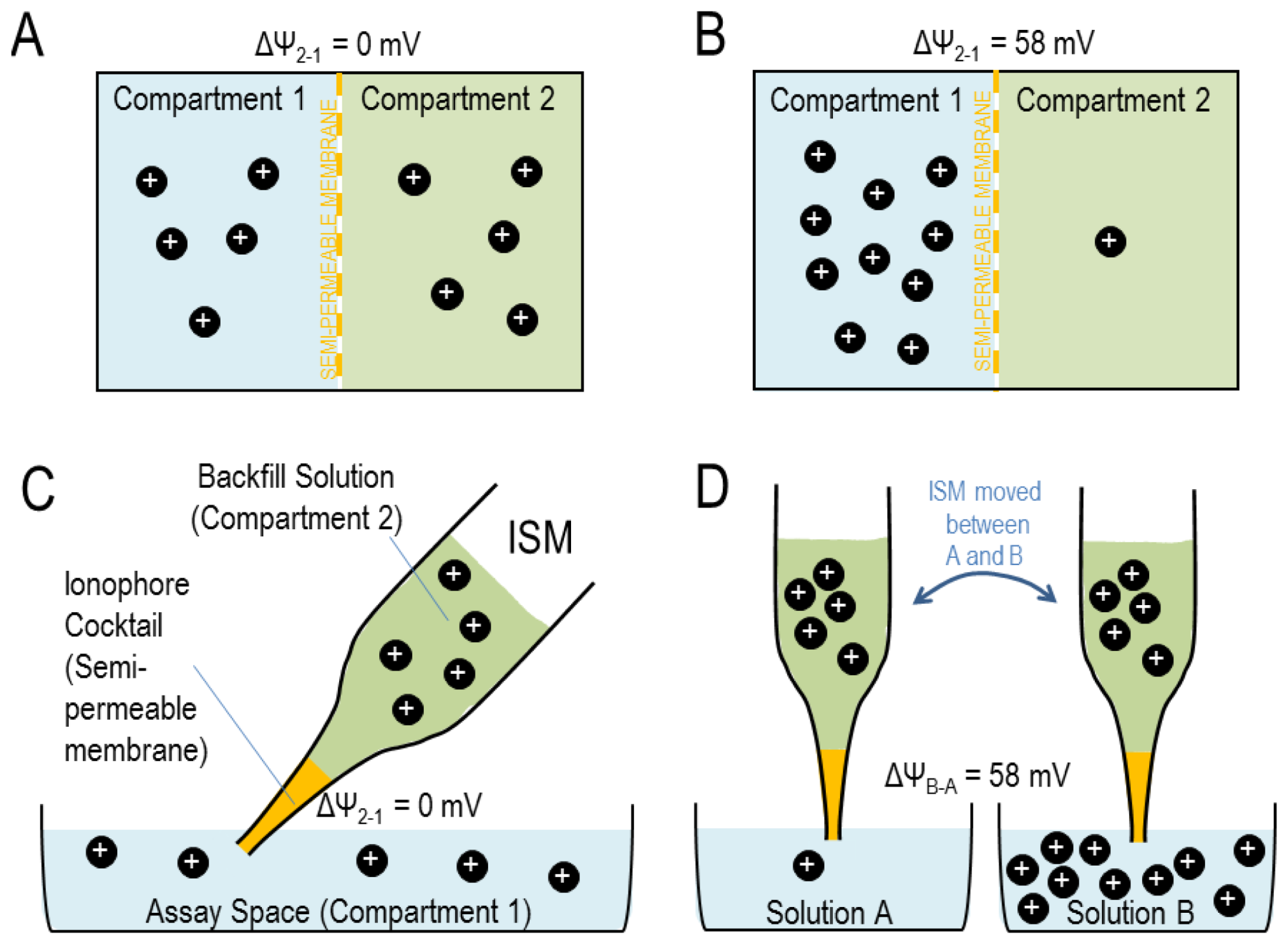
<p>Now, let us imagine two compartments 1 and 2 that are separated by a selectively-permeable barrier such as a cell membrane or an ionophore cocktail that permits selective permeation of a certain ion (shown in <xref ref-type="fig" rid="f1-sensors-13-00984">Figure 1, panels A and B</xref>).</p>
<p>When the two compartments are at equilibrium (<italic>i.e.</italic>, &#x00394;<italic>G</italic> &#x0003D; 0), net ion movement across the membrane is zero and the electrochemical potentials are identical between the two compartments, such that <italic>&#x003BC;&#x00303;</italic><sub>1</sub> &#x0003D; <italic>&#x003BC;&#x00303;</italic><sub>2</sub>. In this case, the electrical potential difference at equilibrium can be described as:
<disp-formula id="FD12">
<label>(12)</label>
<mml:math id="mm12" display="block">
<mml:semantics id="sm12">
<mml:mrow>
<mml:msup>
<mml:mi>&#x003BC;</mml:mi>
<mml:mi mathvariant="normal">&#x00398;</mml:mi></mml:msup>
<mml:mo>&#x0002B;</mml:mo>
<mml:mi>R</mml:mi>
<mml:mi>T</mml:mi>
<mml:mo>ln</mml:mo>
<mml:msub>
<mml:mi>a</mml:mi>
<mml:mn>1</mml:mn></mml:msub>
<mml:mo>&#x0002B;</mml:mo>
<mml:mi>z</mml:mi>
<mml:mi>F</mml:mi>
<mml:msub>
<mml:mi mathvariant="normal">&#x003A8;</mml:mi>
<mml:mn>1</mml:mn></mml:msub>
<mml:mo>&#x0003D;</mml:mo>
<mml:msup>
<mml:mi>&#x003BC;</mml:mi>
<mml:mi mathvariant="normal">&#x00398;</mml:mi></mml:msup>
<mml:mo>&#x0002B;</mml:mo>
<mml:mi>R</mml:mi>
<mml:mi>T</mml:mi>
<mml:mo>ln</mml:mo>
<mml:msub>
<mml:mi>a</mml:mi>
<mml:mn>2</mml:mn></mml:msub>
<mml:mo>&#x0002B;</mml:mo>
<mml:mi>z</mml:mi>
<mml:mi>F</mml:mi>
<mml:msub>
<mml:mi mathvariant="normal">&#x003A8;</mml:mi>
<mml:mn>2</mml:mn></mml:msub></mml:mrow></mml:semantics></mml:math></disp-formula>or:
<disp-formula id="FD13">
<label>(13)</label>
<mml:math id="mm13" display="block">
<mml:semantics id="sm13">
<mml:mrow>
<mml:mi>z</mml:mi>
<mml:mi>F</mml:mi>
<mml:mo stretchy="false">&#x00028;</mml:mo>
<mml:msub>
<mml:mi mathvariant="normal">&#x003A8;</mml:mi>
<mml:mn>2</mml:mn></mml:msub>
<mml:mo>&#x02212;</mml:mo>
<mml:msub>
<mml:mi mathvariant="normal">&#x003A8;</mml:mi>
<mml:mn>1</mml:mn></mml:msub>
<mml:mo stretchy="false">&#x00029;</mml:mo>
<mml:mo>&#x0003D;</mml:mo>
<mml:mi>R</mml:mi>
<mml:mi>T</mml:mi>
<mml:mo>ln</mml:mo>
<mml:mfrac>
<mml:mrow>
<mml:msub>
<mml:mi>a</mml:mi>
<mml:mn>1</mml:mn></mml:msub></mml:mrow>
<mml:mrow>
<mml:msub>
<mml:mi>a</mml:mi>
<mml:mn>2</mml:mn></mml:msub></mml:mrow></mml:mfrac></mml:mrow></mml:semantics></mml:math></disp-formula>
<disp-formula id="FD14">
<label>(14)</label>
<mml:math id="mm14" display="block">
<mml:semantics id="sm14">
<mml:mrow>
<mml:mi mathvariant="normal">&#x00394;</mml:mi>
<mml:msub>
<mml:mi mathvariant="normal">&#x003A8;</mml:mi>
<mml:mrow>
<mml:mn>2</mml:mn>
<mml:mo>&#x02212;</mml:mo>
<mml:mn>1</mml:mn></mml:mrow></mml:msub>
<mml:mo>&#x0003D;</mml:mo>
<mml:mfrac>
<mml:mrow>
<mml:mi>R</mml:mi>
<mml:mi>T</mml:mi></mml:mrow>
<mml:mrow>
<mml:mi>z</mml:mi>
<mml:mi>F</mml:mi></mml:mrow></mml:mfrac>
<mml:mo>ln</mml:mo>
<mml:mfrac>
<mml:mrow>
<mml:msub>
<mml:mi>a</mml:mi>
<mml:mn>1</mml:mn></mml:msub></mml:mrow>
<mml:mrow>
<mml:msub>
<mml:mi>a</mml:mi>
<mml:mn>2</mml:mn></mml:msub></mml:mrow></mml:mfrac>
<mml:mo>&#x0002E;</mml:mo></mml:mrow></mml:semantics></mml:math></disp-formula></p>
<p>Because <italic>a</italic> &#x0003D; <italic>&#x003B3;</italic> &#x0005B;X<sup>z&#x0002B;</sup>&#x0005D; (or &#x0005B;X<sup>z-</sup>&#x0005D; in the case of an anion) and assuming that the physiochemical properties of the two compartments are similar such that <italic>&#x003B3;</italic><sub>1</sub> is approximately the same as <italic>&#x003B3;</italic><sub>2</sub>, we derive the Nernst equation:
<disp-formula id="FD15">
<label>(15)</label>
<mml:math id="mm15" display="block">
<mml:semantics id="sm15">
<mml:mrow>
<mml:mi mathvariant="normal">&#x00394;</mml:mi>
<mml:msub>
<mml:mi mathvariant="normal">&#x003A8;</mml:mi>
<mml:mrow>
<mml:mn>2</mml:mn>
<mml:mo>&#x02212;</mml:mo>
<mml:mn>1</mml:mn></mml:mrow></mml:msub>
<mml:mo>&#x0003D;</mml:mo>
<mml:mfrac>
<mml:mrow>
<mml:mi>R</mml:mi>
<mml:mi>T</mml:mi></mml:mrow>
<mml:mrow>
<mml:mi>z</mml:mi>
<mml:mi>F</mml:mi></mml:mrow></mml:mfrac>
<mml:mo>ln</mml:mo>
<mml:mfrac>
<mml:mrow>
<mml:msub>
<mml:mrow>
<mml:mrow>
<mml:mo>&#x0005B;</mml:mo>
<mml:mrow>
<mml:msup>
<mml:mtext>X</mml:mtext>
<mml:mrow>
<mml:mi>z</mml:mi>
<mml:mo>&#x0002B;</mml:mo></mml:mrow></mml:msup></mml:mrow>
<mml:mo>&#x0005D;</mml:mo></mml:mrow></mml:mrow>
<mml:mn>1</mml:mn></mml:msub></mml:mrow>
<mml:mrow>
<mml:msub>
<mml:mrow>
<mml:mrow>
<mml:mo>&#x0005B;</mml:mo>
<mml:mrow>
<mml:msup>
<mml:mtext>X</mml:mtext>
<mml:mrow>
<mml:mi>z</mml:mi>
<mml:mo>&#x0002B;</mml:mo></mml:mrow></mml:msup></mml:mrow>
<mml:mo>&#x0005D;</mml:mo></mml:mrow></mml:mrow>
<mml:mn>2</mml:mn></mml:msub></mml:mrow></mml:mfrac>
<mml:mo>&#x0002E;</mml:mo></mml:mrow></mml:semantics></mml:math></disp-formula></p>
<p>At room temperature, <italic>RT</italic>/(<italic>F</italic> &#x000D7; log<italic>e</italic>) &#x0003D; 0.058 thus:
<disp-formula id="FD16">
<label>(16)</label>
<mml:math id="mm16" display="block">
<mml:semantics id="sm16">
<mml:mrow>
<mml:mi mathvariant="normal">&#x00394;</mml:mi>
<mml:msub>
<mml:mi mathvariant="normal">&#x003A8;</mml:mi>
<mml:mrow>
<mml:mn>2</mml:mn>
<mml:mo>&#x02212;</mml:mo>
<mml:mn>1</mml:mn></mml:mrow></mml:msub>
<mml:mo>&#x0003D;</mml:mo>
<mml:mfrac>
<mml:mrow>
<mml:mn>0&#x0002E;058</mml:mn></mml:mrow>
<mml:mi>z</mml:mi></mml:mfrac>
<mml:mo>log</mml:mo>
<mml:mfrac>
<mml:mrow>
<mml:msub>
<mml:mrow>
<mml:mrow>
<mml:mo>&#x0005B;</mml:mo>
<mml:mrow>
<mml:msup>
<mml:mtext>X</mml:mtext>
<mml:mrow>
<mml:mi>z</mml:mi>
<mml:mo>&#x0002B;</mml:mo></mml:mrow></mml:msup></mml:mrow>
<mml:mo>&#x0005D;</mml:mo></mml:mrow></mml:mrow>
<mml:mn>1</mml:mn></mml:msub></mml:mrow>
<mml:mrow>
<mml:msub>
<mml:mrow>
<mml:mrow>
<mml:mo>&#x0005B;</mml:mo>
<mml:mrow>
<mml:msup>
<mml:mtext>X</mml:mtext>
<mml:mrow>
<mml:mi>z</mml:mi>
<mml:mo>&#x0002B;</mml:mo></mml:mrow></mml:msup></mml:mrow>
<mml:mo>&#x0005D;</mml:mo></mml:mrow></mml:mrow>
<mml:mn>2</mml:mn></mml:msub></mml:mrow></mml:mfrac>
<mml:mo>&#x0002E;</mml:mo></mml:mrow></mml:semantics></mml:math></disp-formula></p>
<p>That is to say, when both compartments contain an equal concentration of &#x0005B;X<sup>z&#x0002B;</sup>&#x0005D;, &#x00394;&#x003A8;<sub>2&#x02212;1</sub> &#x0003D; 0 mV (<xref ref-type="fig" rid="f1-sensors-13-00984">Figure 1(A)</xref>) but a ten-fold difference in &#x0005B;X<sup>z&#x0002B;</sup>&#x0005D; across an X<sup>z&#x0002B;</sup>-permeable membrane will produce an electrical potential difference across that membrane of 0.058 V &#x0003D; 58 mV in the case of a monovalent ion (<xref ref-type="fig" rid="f1-sensors-13-00984">Figure 1(B)</xref>), or 29 mV in the case of a divalent ion. This predictable electrical response to changes in ion activity is the basis for the usefulness of ISMs.</p></sec>
<sec>
<label>2.5.</label>
<title>Electrochemical Potential Difference across an Ion-Selective Liquid Membrane</title>
<p>In the case of an ISM, we can consider the ionophore cocktail in the tip of the electrode as the semi-permeable membrane. A &#x02018;backfill&#x02019; solution within the ISM (<xref ref-type="fig" rid="f1-sensors-13-00984">Figure 1(C)</xref>; equivalent to compartment 2 in <xref ref-type="fig" rid="f1-sensors-13-00984">Figures 1(A) and 1(B)</xref>) provides the electrical connection between a silver wire (Ag/AgCl half-cell) in the microelectrode holder (see Section 5.1) and the ionophore cocktail. The assay space into which the electrode tip is placed, of which we would like to know the ion concentration (<xref ref-type="fig" rid="f1-sensors-13-00984">Figure 1(C)</xref>), is equivalent to compartment 1 in <xref ref-type="fig" rid="f1-sensors-13-00984">Figures 1(A) and 1(B)</xref>. Thus a ten-fold concentration difference between &#x0005B;X<sup>z&#x0002B;</sup>&#x0005D; in the assay space and &#x0005B;X<sup>z&#x0002B;</sup>&#x0005D; in the backfill solution is registered as a 58/<italic>z</italic> mV potential difference across the cocktail.</p>
<p>Crucially, given that the backfill solution in compartment 2 has a fixed composition (&#x0005B;X<sup>z&#x0002B;</sup>&#x0005D; <italic><sub>backfull</sub></italic>) and assuming that the activity co-efficient for &#x0005B;X<sup>z&#x0002B;</sup>&#x0005D; is constant in the assay space, we can determine that the potential difference between two solutions A and B containing &#x0005B;X<sup>z&#x0002B;</sup>&#x0005D;<italic><sub>solutionA</sub></italic> and &#x0005B;X<sup>z&#x0002B;</sup>&#x0005D;<italic><sub>solutionB</sub></italic> is:
<disp-formula id="FD17">
<label>(17)</label>
<mml:math id="mm17" display="block">
<mml:semantics id="sm17">
<mml:mrow>
<mml:mi mathvariant="normal">&#x00394;</mml:mi>
<mml:msub>
<mml:mi mathvariant="normal">&#x003A8;</mml:mi>
<mml:mrow>
<mml:mtext mathvariant="italic">solutionB</mml:mtext>
<mml:mo>&#x02212;</mml:mo>
<mml:mtext mathvariant="italic">solutionA</mml:mtext></mml:mrow></mml:msub>
<mml:mo>&#x0003D;</mml:mo>
<mml:mfrac>
<mml:mrow>
<mml:mn>0&#x0002E;058</mml:mn></mml:mrow>
<mml:mi>z</mml:mi></mml:mfrac>
<mml:mrow>
<mml:mo>&#x00028;</mml:mo>
<mml:mrow>
<mml:mo>log</mml:mo>
<mml:mfrac>
<mml:mrow>
<mml:msub>
<mml:mrow>
<mml:mrow>
<mml:mo>&#x0005B;</mml:mo>
<mml:mrow>
<mml:msup>
<mml:mtext>X</mml:mtext>
<mml:mrow>
<mml:mi>z</mml:mi>
<mml:mo>&#x0002B;</mml:mo></mml:mrow></mml:msup></mml:mrow>
<mml:mo>&#x0005D;</mml:mo></mml:mrow></mml:mrow>
<mml:mrow>
<mml:mtext mathvariant="italic">solutionB</mml:mtext></mml:mrow></mml:msub></mml:mrow>
<mml:mrow>
<mml:msub>
<mml:mrow>
<mml:mrow>
<mml:mo>&#x0005B;</mml:mo>
<mml:mrow>
<mml:msup>
<mml:mtext>X</mml:mtext>
<mml:mrow>
<mml:mi>z</mml:mi>
<mml:mo>&#x0002B;</mml:mo></mml:mrow></mml:msup></mml:mrow>
<mml:mo>&#x0005D;</mml:mo></mml:mrow></mml:mrow>
<mml:mrow>
<mml:mtext mathvariant="italic">backfull</mml:mtext></mml:mrow></mml:msub></mml:mrow></mml:mfrac>
<mml:mo>&#x02212;</mml:mo>
<mml:mo>log</mml:mo>
<mml:mfrac>
<mml:mrow>
<mml:msub>
<mml:mrow>
<mml:mrow>
<mml:mo>&#x0005B;</mml:mo>
<mml:mrow>
<mml:msup>
<mml:mtext>X</mml:mtext>
<mml:mrow>
<mml:mi>z</mml:mi>
<mml:mo>&#x0002B;</mml:mo></mml:mrow></mml:msup></mml:mrow>
<mml:mo>&#x0005D;</mml:mo></mml:mrow></mml:mrow>
<mml:mrow>
<mml:mtext mathvariant="italic">solutionA</mml:mtext></mml:mrow></mml:msub></mml:mrow>
<mml:mrow>
<mml:msub>
<mml:mrow>
<mml:mrow>
<mml:mo>&#x0005B;</mml:mo>
<mml:mrow>
<mml:msup>
<mml:mtext>X</mml:mtext>
<mml:mrow>
<mml:mi>z</mml:mi>
<mml:mo>&#x0002B;</mml:mo></mml:mrow></mml:msup></mml:mrow>
<mml:mo>&#x0005D;</mml:mo></mml:mrow></mml:mrow>
<mml:mrow>
<mml:mtext mathvariant="italic">backfull</mml:mtext></mml:mrow></mml:msub></mml:mrow></mml:mfrac></mml:mrow>
<mml:mo>&#x00029;</mml:mo></mml:mrow>
<mml:mo>&#x0003D;</mml:mo>
<mml:mfrac>
<mml:mrow>
<mml:mn>0&#x0002E;058</mml:mn></mml:mrow>
<mml:mi>z</mml:mi></mml:mfrac>
<mml:mo>log</mml:mo>
<mml:mfrac>
<mml:mrow>
<mml:msub>
<mml:mrow>
<mml:mrow>
<mml:mo>&#x0005B;</mml:mo>
<mml:mrow>
<mml:msup>
<mml:mtext>X</mml:mtext>
<mml:mrow>
<mml:mi>z</mml:mi>
<mml:mo>&#x0002B;</mml:mo></mml:mrow></mml:msup></mml:mrow>
<mml:mo>&#x0005D;</mml:mo></mml:mrow></mml:mrow>
<mml:mrow>
<mml:mtext mathvariant="italic">solutionB</mml:mtext></mml:mrow></mml:msub></mml:mrow>
<mml:mrow>
<mml:msub>
<mml:mrow>
<mml:mrow>
<mml:mo>&#x0005B;</mml:mo>
<mml:mrow>
<mml:msup>
<mml:mtext>X</mml:mtext>
<mml:mrow>
<mml:mi>z</mml:mi>
<mml:mo>&#x0002B;</mml:mo></mml:mrow></mml:msup></mml:mrow>
<mml:mo>&#x0005D;</mml:mo></mml:mrow></mml:mrow>
<mml:mrow>
<mml:mtext mathvariant="italic">solutionA</mml:mtext></mml:mrow></mml:msub></mml:mrow></mml:mfrac>
<mml:mo>&#x0002E;</mml:mo></mml:mrow></mml:semantics></mml:math></disp-formula></p>
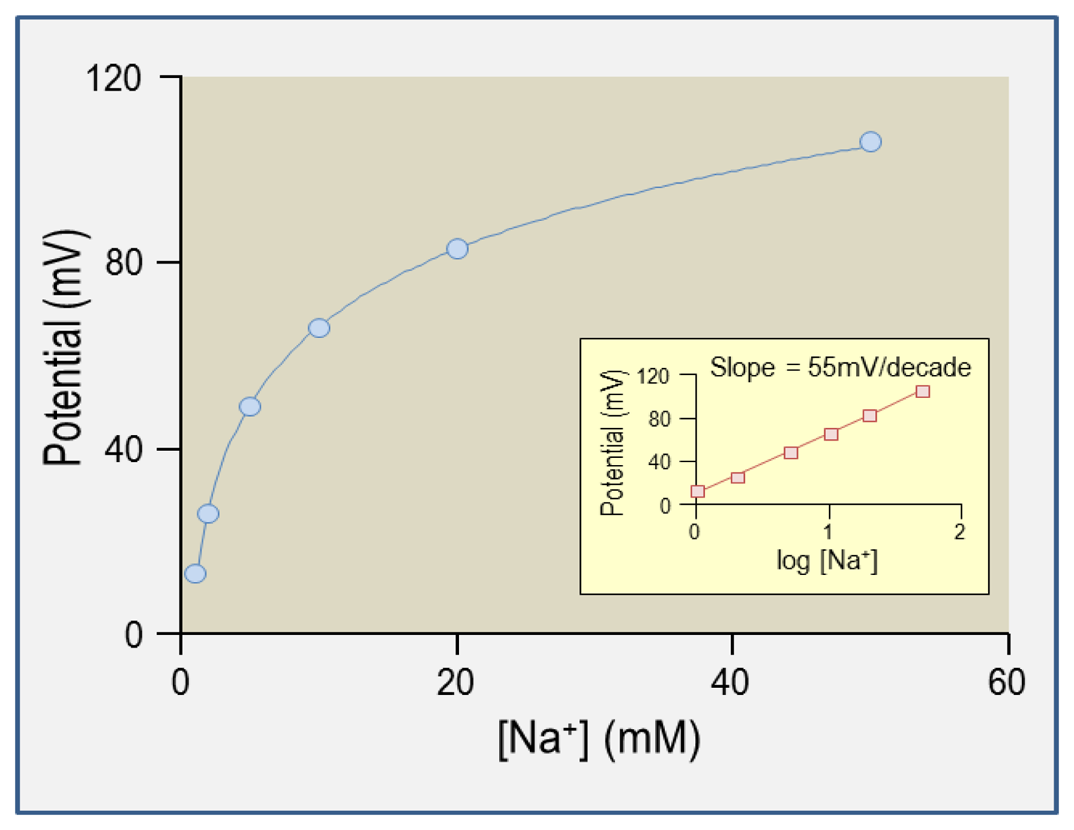
<p>That is to say, a ten-fold concentration difference between solution A and solution B will register as a 58 mV potential difference between the two solutions for a monovalent ion &#x0005B;<xref ref-type="fig" rid="f1-sensors-13-00984">Figure 1(D)</xref>&#x0005D;: a Nernstian response. The exhibition of a Nernstian response by an ISM proves that it is selectively permeable to the ion of interest among all ions present in the solutions. This is the basis of calibration, an example of which is shown in <xref ref-type="fig" rid="f2-sensors-13-00984">Figure 2</xref>. Practical aspects of electrode calibration are considered in Section 5.3. Traditionally, K<sup>&#x0002B;</sup>- and H<sup>&#x0002B;</sup>-selective ISMs are more ideally ion-selective than Na<sup>&#x0002B;</sup>- or Cl<sup>&#x02212;</sup>-selective ISMs. A consideration of the selectivity of each cocktail is presented in Sections 3.1 to 3.4 (guidelines for determining the selectivity coefficients for ISMs are provided in reference &#x0005B;<xref ref-type="bibr" rid="b15-sensors-13-00984">15</xref>&#x0005D;). Note that the activity of Na<sup>&#x0002B;</sup> decreases as &#x0005B;Na<sup>&#x0002B;</sup>&#x0005D; increases causing the calibration slope of Na<sup>&#x0002B;</sup>-selective ISM in <xref ref-type="fig" rid="f2-sensors-13-00984">Figure 2</xref> to be slightly less than the Nernstian ideal of 58 mV/decade. Note that the estimated activity coefficients of the ions considered in this review (H<sup>&#x0002B;</sup>, Na<sup>&#x0002B;</sup>, K<sup>&#x0002B;</sup>, and Cl<sup>&#x02212;</sup>), are 0.98 at 1 mM, 0.93 at 10 mM, and 0.82&#x02013;0.86 at 100 mM &#x0005B;<xref ref-type="bibr" rid="b14-sensors-13-00984">14</xref>&#x0005D;.</p></sec></sec>
<sec>
<label>3.</label>
<title>The Composition of H<sup>&#x0002B;</sup>, Na<sup>&#x0002B;</sup>, K<sup>&#x0002B;</sup>, and Cl<sup>&#x02212;</sup> Ionophore Cocktails and Backfill Solution</title>
<p>In this section we consider the chemical components of frequently used, commercially-available ionophore-cocktails and the associated backfill solutions that are used in the manufacture of ion-selective microelectrodes. Ionophore cocktails have three basic components: an ionophore, a water-immiscible solvent for the ionophore that does not substantially affect the ion-selectivity of the ionophore, and additives that are used to modify the electrical resistance, hydrophobicity, viscosity, and ion-selectivity of the cocktail. Ionophore cocktails are commercially available for a variety of other molecules besides H<sup>&#x0002B;</sup>, Na<sup>&#x0002B;</sup>, K<sup>&#x0002B;</sup>, and Cl<sup>&#x02212;</sup> (see The Sensor Application Portal hosted at <ext-link xlink:href="www.sigmaaldrich.com/analytical-chromatography/analytical-reagents/sensoric-applications.htm" ext-link-type="uri">www.sigmaaldrich.com/analytical-chromatography/analytical-reagents/sensoric-applications.htm</ext-link>). The imperfect selectivity of some ionophores means that under certain conditions ion-selective cocktails can be repurposed to monitor changes in the concentrations of &#x0201C;interfering&#x0201D; ions. For example, &#x0201C;Na<sup>&#x0002B;</sup>-selective&#x0201D;-cocktail based ISMs have been used to monitor &#x0005B;Li<sup>&#x0002B;</sup>&#x0005D; (see Section 6).</p>
<p>Backfill solutions, in order to fulfill the theoretical requirements mentioned in the previous section, must have a similar activity coefficient for X<sup>z&#x0002B;</sup> to the assay space, maintain a constant activity of X<italic><sup>z</sup></italic><sup>&#x0002B;</sup> throughout the measurement period, and must not contain interfering ions that compromise the selectivity of the ionophore cocktail.</p>
<sec>
<label>3.1.</label>
<title>H<sup>&#x0002B;</sup>-Selective Ionophore Cocktails</title>
<p>There are three commercially-available cocktails recommended for use in H<sup>&#x0002B;</sup>-selective microelectrodes: Ionophore I/Cocktail A (cat. no. 95291, Sigma Aldrich, St. Louis, MO, USA), Ionophore I/Cocktail B (cat. no. 95293, Sigma), and Ionophore II/Cocktail A (cat. no. 95297, Sigma). All three cocktails respond linearly to changes in pH over the range 5.5&#x02013;9.0, which covers most physiological applications. Outside of this range, care must be taken with cocktail choice; cocktails incorporating ionophore I can also be used at more alkaline pH values (up to pH 11, but not below pH 4.5) while cocktails incorporating ionophore II can be used at more acidic pH values (as low as pH 2.0 not above pH 9.0).</p>
<p>Ionophore I is tridodecylamine (TDDA), a lipophilic amine that acts as a proton carrier. In our laboratory we routinely use ISMs containing Ionophore I/Cocktail B (see <xref ref-type="table" rid="t1-sensors-13-00984">Table 1</xref>) to monitor intracellular and extracellular pH. Cocktails A and B differ only in the identity of the cocktail additive inasmuch as Cocktail A contains sodium tetraphenylborate (NaTPB) rather than potassium tetrakis (4-chlorophenyl)borate (KTCPB). Both cocktails behave essentially the same, both being extremely selective for H<sup>&#x0002B;</sup> over other ions such as Na<sup>&#x0002B;</sup> in the physiological range (greater than 10<sup>12</sup>-fold preference) and both exhibiting similar response times. The authors who first reported the use of ISMs based on TDDA recommended overnight incubation of cocktail A with 100&#x00025; CO<sub>2</sub> prior to use &#x0005B;<xref ref-type="bibr" rid="b16-sensors-13-00984">16</xref>&#x0005D;. This procedure was presumably a precaution to minimize drift of potential due to CO<sub>2</sub> interference when the ISM is used in biological systems. However, CO<sub>2</sub> does not interfere appreciably with Cocktail B due to the substitution of the NaTPB additive with KTCPB &#x0005B;<xref ref-type="bibr" rid="b12-sensors-13-00984">12</xref>&#x0005D;. Notably, a modified ISM that is fabricated with a CO<sub>2</sub>-permeable column of Ionophore I and a backfill that contains carbonic anhydrase can be used in concert with a H<sup>&#x0002B;</sup>-selective ISM to monitor pCO<sub>2</sub> &#x0005B;<xref ref-type="bibr" rid="b17-sensors-13-00984">17</xref>&#x0005D;.</p>
<p>Ionophore II/Cocktail A is composed of the same solvent and additive as Ionophore I/Cocktail B, albeit in a slightly different ratio, but is based on a different H<sup>&#x0002B;</sup> ionophore, namely 4-nonadecylpyridine (CAS No. 70268-36-9), which has a slightly poorer cation selectivity.</p></sec>
<sec>
<label>3.2.</label>
<title>Na<sup>&#x0002B;</sup>-Selective Ionophore Cocktails</title>
<p>There are two commercially-available cocktails recommended for use in Na<sup>&#x0002B;</sup>-selective microelectrodes: Ionophore I/Cocktail A (cat. no. 99314; Sigma, see <xref ref-type="table" rid="t2-sensors-13-00984">Table 2</xref>) and Ionophore II/Cocktail A (cat. no. 99357; Sigma).</p>
<p>Ionophore I is N,N&#x02032;,N&#x02033;-triheptyl-N,N&#x02032;,N&#x02033;-trimethyl-4,4&#x02032;,4&#x02033;-propylidynetris(3-oxabutyramide)&#x02014;also known as ETH227&#x02014;is reasonably selective for Na<sup>&#x0002B;</sup> over K<sup>&#x0002B;</sup> (more than 50-fold preference, see reference &#x0005B;<xref ref-type="bibr" rid="b19-sensors-13-00984">19</xref>&#x0005D;) but not well selective for Na<sup>&#x0002B;</sup> over Ca<sup>2&#x0002B;</sup> (Ionophore I actually exhibits a 1.6-fold preference for Ca<sup>2&#x0002B;</sup> over Na<sup>&#x0002B;</sup>). Thus Ionophore I/Cocktail A is the component of choice for monitoring of Na<sup>&#x0002B;</sup> in the cytoplasm &#x0005B;<xref ref-type="bibr" rid="b19-sensors-13-00984">19</xref>&#x0005D; in which compartment &#x0005B;Na<sup>&#x0002B;</sup>&#x0005D; is &#x0223C;4 mM, &#x0005B;K<sup>&#x0002B;</sup>&#x0005D;&#x0223C;100 mM, and &#x0005B;Ca<sup>2&#x0002B;</sup>&#x0005D; is &#x0003C;1 &#x003BC;M.</p>
<p>Ionophore II is N,N&#x02032;-dibenzyl-N,N&#x02032;-diphenyl-1,2-phenylenedioxydiacetamide, which is also known as ETH157 exhibits a worse selectivity for Na<sup>&#x0002B;</sup> over K<sup>&#x0002B;</sup> (5-fold) than Ionophore I, but a better selectivity for Na<sup>&#x0002B;</sup> over Ca<sup>2&#x0002B;</sup> (20-fold). Ionophore II/cocktail A is better suited for inclusion in ISMs designed for extracellular measurements in which compartment &#x0005B;Na<sup>&#x0002B;</sup>&#x0005D; may be &#x0223C;100 mM, &#x0005B;K<sup>&#x0002B;</sup>&#x0005D;&#x0223C;3 mM, and &#x0005B;Ca<sup>2&#x0002B;</sup>&#x0005D; &#x0223C;2 mM &#x0005B;<xref ref-type="bibr" rid="b20-sensors-13-00984">20</xref>&#x0005D;.</p></sec>
<sec>
<label>3.3.</label>
<title>K<sup>&#x0002B;</sup>-Selective Ionophore Cocktails</title>
<p>There are two commercially-available cocktails recommended for use in K<sup>&#x0002B;</sup>-selective microelectrodes: Ionophore I/Cocktail A (cat. no. 60031; Sigma, see <xref ref-type="table" rid="t3-sensors-13-00984">Table 3</xref>) and Ionophore I/Cocktail B (cat. no. 60398; Sigma). Ionophore I is valinomycin, which carries K<sup>&#x0002B;</sup> across membranes &#x0005B;<xref ref-type="bibr" rid="b21-sensors-13-00984">21</xref>&#x0005D;. Both cocktails are similar in composition but cocktail A contains the solvent dibutyl sebacate, which confers upon the cocktail an improved selectivity for K<sup>&#x0002B;</sup> over Na<sup>&#x0002B;</sup>.</p></sec>
<sec>
<label>3.4.</label>
<title>A Cl<sup>&#x02212;</sup>-Selective Ionophore Cocktail</title>
<p>At the time of writing, there is only one commercially available cocktail recommended for use in Cl<sup>&#x02212;</sup>-selective microelectrodes: Ionophore I/Cocktail A (cat. no. 99408; Sigma, see <xref ref-type="table" rid="t4-sensors-13-00984">Table 4</xref>). This cocktail is about 30-fold more selective for Cl<sup>&#x02212;</sup> over HCO<sub>3</sub><sup>&#x02212;</sup> &#x0005B;<xref ref-type="bibr" rid="b25-sensors-13-00984">25</xref>&#x0005D;, but is considered poorly selective with regard to its target ion compared to ion-selective cocktails for H<sup>&#x0002B;</sup>, Na<sup>&#x0002B;</sup>, and K<sup>&#x0002B;</sup>. The presence of HCO<sub>3</sub><sup>&#x02212;</sup> at close-to-physiological concentration does not substantially interfere with the Nernstian response of the electrode to Cl<sup>&#x02212;</sup>, but if the electrode is to be used in the presence of HCO<sub>3</sub><sup>&#x02212;</sup>, it should be calibrated in the presence of HCO<sub>3</sub><sup>&#x02212;</sup> in order to correct for interference &#x0005B;<xref ref-type="bibr" rid="b26-sensors-13-00984">26</xref>&#x0005D;. Great care should be taken to account for interference by HCO<sub>3</sub><sup>&#x02212;</sup> when designing and interpreting the results of experiments that employ this cocktail, especially (1) if used in an assay space with an alkaline pH (above pH 7.6, see reference &#x0005B;<xref ref-type="bibr" rid="b25-sensors-13-00984">25</xref>&#x0005D;), (2) if used in compartments such as the cytoplasm that could contain interfering anions that are beyond the investigators control, or (3) if &#x0005B;HCO<sub>3</sub><sup>&#x02212;</sup>&#x0005D; is expected to change substantially over the assay period.</p></sec></sec>
<sec>
<label>4.</label>
<title>Fabricating ISMs</title>
<sec>
<label>4.1.</label>
<title>Pulling Glass Microelectrodes from Capillary Glass</title>
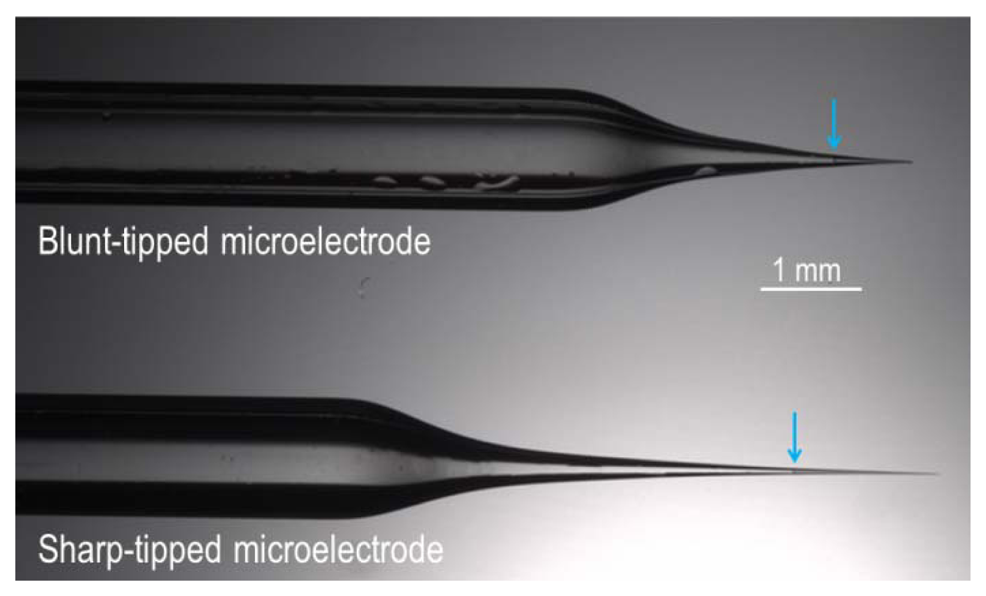
<p>Glass microelectrode can be fabricated with either a sharp end (tip diameter&#x0223C;1 &#x003BC;m) for intracellular recordings or a &#x02018;blunt&#x02019; end (tip diameter&#x0223C;20 &#x003BC;m) for cell-surface/extracellular recordings. We pull our microelectrodes from borosilicate capillary glass using a micropipette puller (for example, we use a Model P-97 Flaming/Brown from Sutter Instrument, Novato, CA, USA). An example of each type of electrode is shown in <xref ref-type="fig" rid="f3-sensors-13-00984">Figure 3</xref>.</p>
<p>Sharp-ended intracellular microelectrodes can be pulled from thin-walled borosilicate glass capillary that contains a filament (we use OD &#x0003D; 2 mm, ID &#x0003D; 1.56 mm; Part No. 30-0077; Harvard Apparatus, Holliston, MA, USA). The usefulness of a batch of pulled microelectrodes can be tested by filling one sample electrode with saturated KCl; the resistance of this KCl-filled microelectrode should be &#x0223C;0.5 M&#x003A9;. Smaller tip diameters can be achieved by controlled tip-breakage of occluded microelectrodes &#x0005B;<xref ref-type="bibr" rid="b29-sensors-13-00984">29</xref>&#x0005D;.</p>
<p>Blunt-ended extracellular microelectrodes can be pulled from thick-walled borosilicate glass capillary that contains a filament (we use OD &#x0003D; 2 mm, ID &#x0003D; 1.16 mm; Part No. G200F-4; Warner Instruments, Hamden, CT, USA). The tips of these pulled capillaries are fire polished using a microforge to eliminate sharp edges. The use of thick-walled, fire polished electrodes is important if the ISM is intended to be pushed up against a cell surface or into a tissue slice without cell impalement.</p></sec>
<sec>
<label>4.2.</label>
<title>Baking and Silanizing Empty Microelectrodes</title>
<p>Prior to filling with ionophore cocktail, the empty glass microelectrodes must be baked, silanized, and cured &#x0005B;<xref ref-type="bibr" rid="b30-sensors-13-00984">30</xref>&#x0005D;. This process makes the inside surface of the microelectrode hydrophobic, which encourages an unbroken interface between the hydrophobic ionophore cocktail and the glass, eliminating shunt pathways between the assay space and backfill solution that circumvent the cocktail and thereby reduce the selectivity of the ISM.</p>
<p>Empty microelectrodes are mounted in a metal rack with their tips pointing upwards and baked overnight in an oven at 200 &#x000B0;C to remove moisture. The following day, still at 200 &#x000B0;C, the microelectrode-containing rack is transferred to a glass petri-dish and covered with an inverted glass-jar to create a loosely sealed glass chamber around the baked microelectrodes. 90 &#x003BC;L of bis(dimethylamino)dimethylsilane (an organic silicon compound; cat. no. 14755; Sigma) is introduced under the jar such that the microelectrodes are exposed to &#x0201C;silane&#x0201D; vapor for 30-50 min within the chamber. Finally the jar is removed and the silane-coated microelectrodes are left to cure at 200 &#x000B0;C overnight. Cooling the cured electrodes to room temperature can be performed in a nitrogen-filled desiccation-chamber containing phosphorous pentoxide, to prevent condensation forming inside the microelectrode tip that could adversely affect ISM performance.</p></sec>
<sec>
<label>4.3.</label>
<title>Filling and Backfilling the Microelectrodes</title>
<p>A short column (&#x0223C;1 mm) of ionophore-cocktail can be introduced into the silanized microelectrode tip either by backfilling (for this purpose we use a 34 Gauge MicroFil&#x02122; flexible plastic syringe needle, cat. no. MF34G-5, World Precision Instruments Inc., Sarasota, FL, USA). The filament in each microelectrode draws the ionophore-cocktail into the extremity of the tip (the meniscus of the column of cocktail in each is indicated with cyan arrows in <xref ref-type="fig" rid="f3-sensors-13-00984">Figure 3</xref>). The backfill is introduced beneath the surface of the ionophore cocktail&#x02014;to avoid introducing an air gap between the backfill and the cocktail&#x02014;using a wider gauge needle (we use a 28 Gauge MicroFil&#x02122; needle, cat. no. MF28G-5, World Precision Instruments Inc.). An alternative approach is to frontfill the electrode, using suction to draw &#x0201C;backfill&#x0201D; solution into the electrode barrel through the tip and then to frontfill the electrode with a short column of ionophore cocktail (e.g., see reference &#x0005B;<xref ref-type="bibr" rid="b31-sensors-13-00984">31</xref>&#x0005D;).</p></sec></sec>
<sec>
<label>5.</label>
<title>Use and Calibration of ISMs</title>
<sec>
<label>5.1.</label>
<title>Mounting ISMs</title>
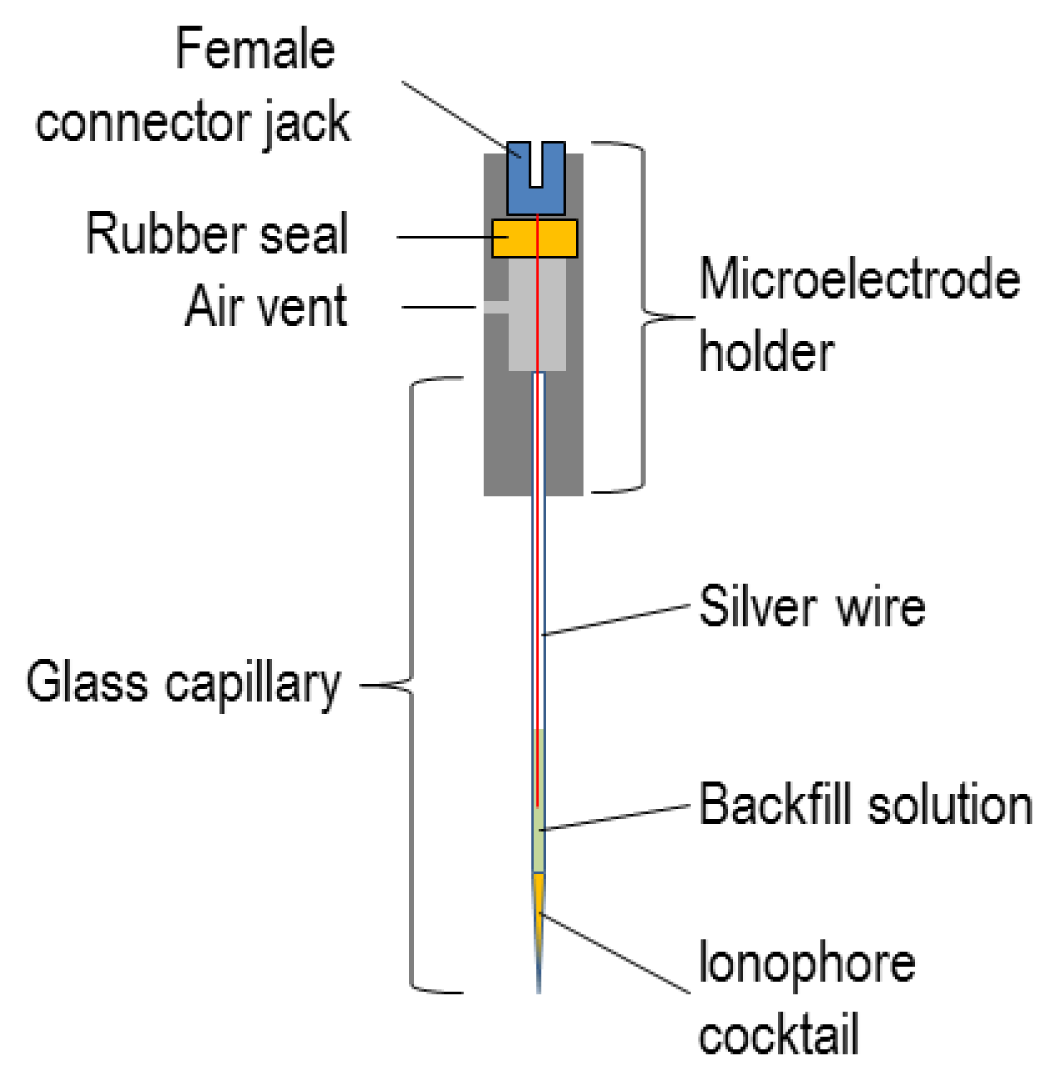
<p>The microelectrode can be mounted in a straight holder with a female connector jack, a silver wire (Ag/AgCl) half-cell that maintains a constant electrochemical potential within the ISM backfill, and a vent or pressure port (e.g., cat. no. MEH2SFW, World Precision Instruments Inc.).</p>
<p>In the final assembly, the ionophore-cocktail column should be a few hundred &#x003BC;m deep and the backfill should be reasonably shallow (perhaps 1 cm), but still deep enough to make contact, when mounted, with the Ag/AgCl half-cell, as shown in <xref ref-type="fig" rid="f4-sensors-13-00984">Figure 4</xref>. The connector jack enables the ISM assembly to be mounted into the electrometer headstage probe (see Section 5.2).</p></sec>
<sec>
<label>5.2.</label>
<title>Electrical Set-Up</title>
<p>As discussed in Section 2.5, the ion-selective potential measured by an ISM is described by the equation:
<disp-formula id="FD18">
<label>(18)</label>
<mml:math id="mm18" display="block">
<mml:semantics id="sm18">
<mml:mrow>
<mml:mi mathvariant="normal">&#x00394;</mml:mi>
<mml:msub>
<mml:mi mathvariant="normal">&#x003A8;</mml:mi>
<mml:mrow>
<mml:mtext mathvariant="italic">solutionB</mml:mtext>
<mml:mo>&#x02212;</mml:mo>
<mml:mtext mathvariant="italic">solutionA</mml:mtext></mml:mrow></mml:msub>
<mml:mo>&#x0003D;</mml:mo>
<mml:mfrac>
<mml:mrow>
<mml:mn>0&#x0002E;058</mml:mn></mml:mrow>
<mml:mi>z</mml:mi></mml:mfrac>
<mml:mo>ln</mml:mo>
<mml:mfrac>
<mml:mrow>
<mml:msub>
<mml:mrow>
<mml:mrow>
<mml:mo>&#x0005B;</mml:mo>
<mml:mrow>
<mml:msup>
<mml:mtext>X</mml:mtext>
<mml:mrow>
<mml:mi>z</mml:mi>
<mml:mo>&#x0002B;</mml:mo></mml:mrow></mml:msup></mml:mrow>
<mml:mo>&#x0005D;</mml:mo></mml:mrow></mml:mrow>
<mml:mrow>
<mml:mtext mathvariant="italic">solutionB</mml:mtext></mml:mrow></mml:msub></mml:mrow>
<mml:mrow>
<mml:msub>
<mml:mrow>
<mml:mrow>
<mml:mo>&#x0005B;</mml:mo>
<mml:mrow>
<mml:msup>
<mml:mtext>X</mml:mtext>
<mml:mrow>
<mml:mi>z</mml:mi>
<mml:mo>&#x0002B;</mml:mo></mml:mrow></mml:msup></mml:mrow>
<mml:mo>&#x0005D;</mml:mo></mml:mrow></mml:mrow>
<mml:mrow>
<mml:mtext mathvariant="italic">solutionA</mml:mtext></mml:mrow></mml:msub></mml:mrow></mml:mfrac></mml:mrow></mml:semantics></mml:math></disp-formula></p>
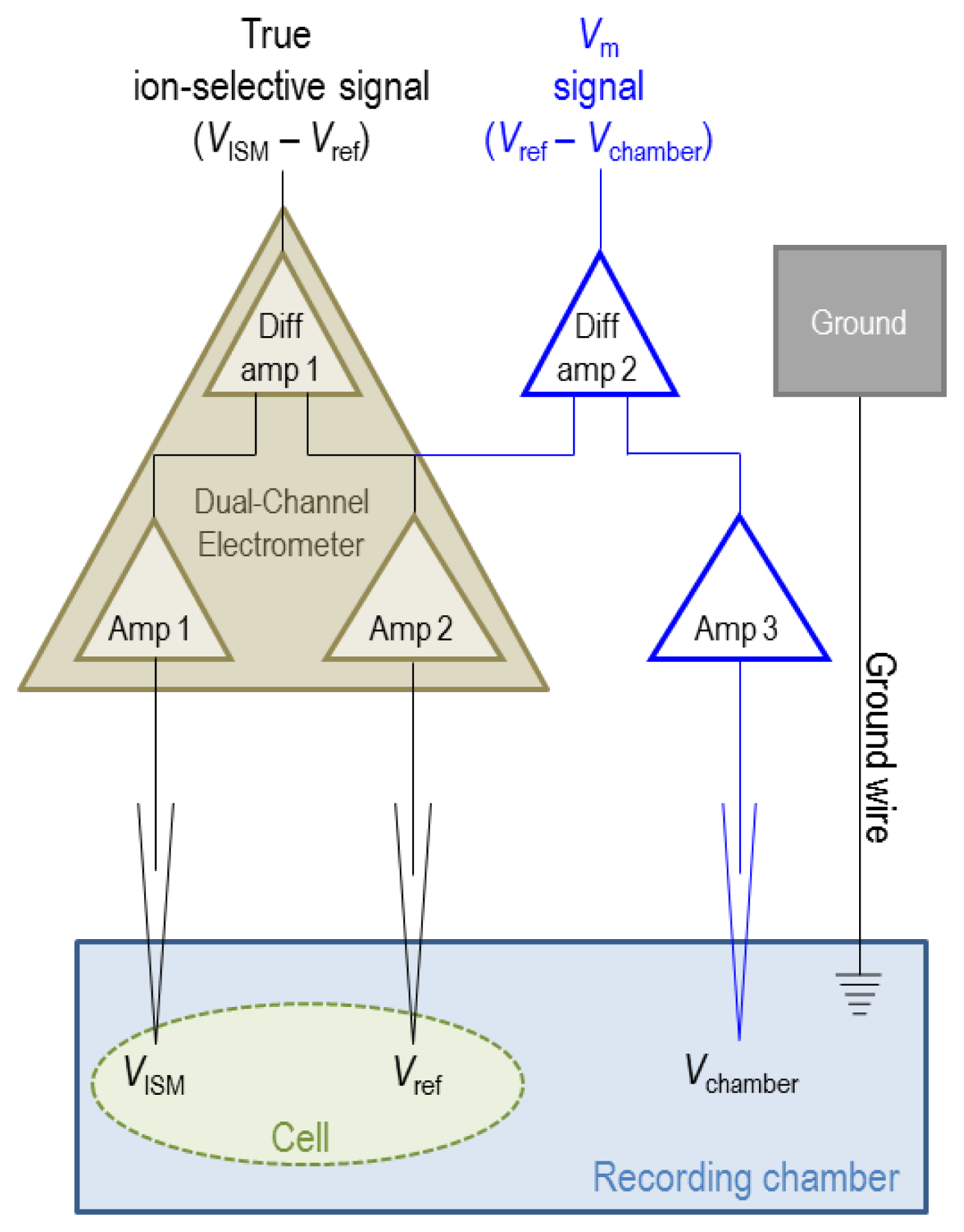
<p>Implicit in <xref rid="FD18" ref-type="disp-formula">Equation (18)</xref> is the assumption that solutions A and B have equal electrical potentials. In practice, &#x00394;&#x003A8;<italic><sub>solutionB</sub></italic><sub>&#x02212;</sub><italic><sub>solutionA</sub></italic> measured by the ISM can also include a contribution from the difference in electrical potential between solution A and solution B (for example if solution A is the cytoplasm and solution B is extracellular). For this reason a saturated-KCl-filled reference microelectrode (a sharp-ended microelectrode, see Section 4.1) is used to measure the electrical potential of solutions A and B in order to calculate corrections to the potentials measured by the ISM. Because K<sup>&#x0002B;</sup> and Cl<sup>&#x02212;</sup> have equal mobilities, junction-potential errors introduced by the reference electrode are not a major concern. When the reference-electrode signals are subtracted from the measured &#x00394;&#x003A8;<italic><sub>solutionB</sub></italic><sub>&#x02212;</sub><italic><sub>solutionA</sub></italic>, we obtain the true ion-selective &#x00394;&#x003A8;<italic><sub>solutionB</sub></italic><sub>&#x02212;</sub><italic><sub>solutionA</sub></italic>. The reference microelectrode signal is also used to correct for differences in electrical potential between assay compartments. For example, if the ISM is used to impale a cell for intracellular measurements, the reference electrode must also be impaled into the cell so that &#x003A8; does not include a contribution from the membrane potential of the cell (<italic>i.e.</italic>, the electrical potential difference between the cell cytoplasm and the extracellular compartment where the ISM was calibrated). The electrical configuration required to monitor the response of an ISM is represented in <xref ref-type="fig" rid="f5-sensors-13-00984">Figure 5</xref>.</p>
<p>In brief, the sample to be assayed (a solution or a cell in a solution) is placed in a recording chamber (such as those available from Warner Instruments). We use an FD223 dual-channel electrometer (World Precision Instruments Inc.) to monitor voltage signals. Both channels are connected to microelectrode holder/microelectrode assemblies via headstage probes that contain unity-gain amplifiers. The first probe is connected to an ISM and the second probe is connected to a saturated-KCl-filled reference electrode that senses the electrical potential of the assay space. Both probes should be mounted onto micromanipulators to allow fine positioning of the electrode tips.</p>
<p>Three features of the electrical set up allow accurate monitoring of the voltage signal from each electrode. Firstly, the amplifiers have an input-resistance/impedance (<italic>Z<sub>FD</sub></italic><sub>223</sub> &#x0003E; 10<sup>15</sup> &#x003A9;) that is many times greater than that of the electrode tip (for sharp-ended ISMs, <italic>Z<sub>ISM</sub></italic> is typically &#x0223C;10<sup>11</sup> &#x003A9;). This is an important consideration because the current that relays the input voltage signal (<italic>V<sub>in</sub></italic>) from the assay space passes through the ISM tip as well as the amplifier and thus is influenced by the sum of their impedances (<italic>Z<sub>FD</sub></italic><sub>223</sub> &#x0002B; <italic>Z<sub>ISM</sub></italic>), whereas the current that relays the output voltage signal (<italic>V<sub>out</sub></italic>) is influenced only by the impedance of the amplifier (<italic>Z<sub>FD</sub></italic><sub>223</sub>). A restatement of Ohm&#x00027;s law relates these quantities as:
<disp-formula id="FD19">
<label>(19)</label>
<mml:math id="mm19" display="block">
<mml:semantics id="sm19">
<mml:mrow>
<mml:msub>
<mml:mi>V</mml:mi>
<mml:mrow>
<mml:mtext mathvariant="italic">out</mml:mtext></mml:mrow></mml:msub>
<mml:mo>&#x0003D;</mml:mo>
<mml:msub>
<mml:mi>V</mml:mi>
<mml:mrow>
<mml:mi>i</mml:mi>
<mml:mi>n</mml:mi></mml:mrow></mml:msub>
<mml:mo>&#x000D7;</mml:mo>
<mml:mfrac>
<mml:mrow>
<mml:msub>
<mml:mi>Z</mml:mi>
<mml:mrow>
<mml:mi>F</mml:mi>
<mml:mi>D</mml:mi>
<mml:mn>223</mml:mn></mml:mrow></mml:msub></mml:mrow>
<mml:mrow>
<mml:msub>
<mml:mi>Z</mml:mi>
<mml:mrow>
<mml:mtext mathvariant="italic">ISM</mml:mtext></mml:mrow></mml:msub>
<mml:mo>&#x0002B;</mml:mo>
<mml:msub>
<mml:mi>Z</mml:mi>
<mml:mrow>
<mml:mi>F</mml:mi>
<mml:mi>D</mml:mi>
<mml:mn>223</mml:mn></mml:mrow></mml:msub></mml:mrow></mml:mfrac>
<mml:mo>&#x0002E;</mml:mo></mml:mrow></mml:semantics></mml:math></disp-formula></p>
<p>Thus, the relatively high impedance of the amplifier compared to that of the ISM tip minimizes the loss of signal amplitude by ensuring that both <italic>V<sub>in</sub></italic> and <italic>V<sub>out</sub></italic> are influenced by total impedances of similar magnitude. Furthermore the higher impedance of the amplifier reduces phase shift which could distort the relationship between <italic>V<sub>in</sub></italic> and <italic>V<sub>out</sub></italic>.</p>
<p>Secondly, a signal-driven shield built into each probe, feeds a duplicate <italic>V<sub>in</sub></italic> signal into the cable shielding, a maneuver that prevents stray capacitance between the signal-carrying wire and cable-shielding, increasing the responsiveness of the electrode. The shield also reduces electrical noise.</p>
<p>Thirdly, the dual-channel electrometer generates an ion-selective potential signal by subtracting the reference electrode signal (<italic>V</italic><sub>ref</sub>) from the ISM signal (<italic>V</italic><sub>ISM</sub>) with a high common-mode rejection ratio, which effectively eliminates noise common to both channels such that the true differential (<italic>i.e.</italic>, ion-selective) signal is accurately obtained, as depicted in <xref ref-type="fig" rid="f5-sensors-13-00984">Figure 5</xref>.</p>
<p>Note that, for intracellular recordings, the reference-electrode signal can be used to monitor membrane potential (<italic>V</italic><sub>m</sub>) by clamping the electrical potential of the recording chamber to 0 mV using voltage-clamp circuitry (e.g., the OC-725C Oocyte Clamp from Warner Instruments), in which case <italic>V</italic><sub>m</sub> &#x0003D; <italic>V</italic><sub>ref</sub>. Alternatively the potential of the extracellular space (<italic>V</italic><sub>chamber</sub>) can be monitored with a calomel electrode or a second saturated-KCl-filled microelectrode (connected to a separate amplifier) and subtracted from <italic>V</italic><sub>ref</sub> using a separate subtraction amplifier, in which case <italic>V</italic><sub>m</sub> &#x0003D; <italic>V</italic><sub>ref</sub> &#x02212; <italic>V</italic><sub>chamber</sub>. Note that <italic>V</italic><sub>ref</sub> &#x0003D; <italic>V</italic><sub>chamber</sub> when the reference electrode is not impaled into a cell.</p></sec>
<sec>
<label>5.3.</label>
<title>Calibration Procedure</title>
<p>The theory that underlies the calibration of ISMs is presented in Sections 2.5 and 5.2. An example calibration plot for a Na<sup>&#x0002B;</sup>-selective microelectrode is presented in <xref ref-type="fig" rid="f2-sensors-13-00984">Figure 2</xref>. A calibration slope of 58 mV/decade tells us that the ISM is ideally ion-selective with respect to its target ion. We use in-house software to convert the dual-channel electrometer output into a measure of ion concentration.</p>
<p>The series of solutions used to calibrate an ISM should have a composition that is close to that of the experimental sample to be measured (including potentially interfering ions), should cover the entire range of values expected to be encountered during the experiment, and should differ only in the concentration of target ion. For example, for calibration of a H<sup>&#x0002B;</sup>-selective ISM, we use a pH 6 buffer, a pH 7.5 buffer, and a pH 8 buffer. For ISMs that are less-ideally ion selective, such as Na<sup>&#x0002B;</sup>-selective microelectrodes, more calibration points may be necessary (e.g., a five-point calibration is shown in <xref ref-type="fig" rid="f2-sensors-13-00984">Figure 2</xref>).</p></sec></sec>
<sec>
<label>6.</label>
<title>Applications of ISMs</title>
<p>ISMs are suitable for obtaining both intracellular and extracellular measurements and can be used to monitor ion activities at a specific locus or, by virtue of self-referencing/vibrating probe technology (reviewed in references &#x0005B;<xref ref-type="bibr" rid="b3-sensors-13-00984">3</xref>&#x0005D; and &#x0005B;<xref ref-type="bibr" rid="b32-sensors-13-00984">32</xref>&#x0005D;), between two loci in order to gather information about ion gradients and fluxes. In this section we briefly review a selection of physiological studies that demonstrate the usefulness of ISMs.</p>
<p>The original application of the H<sup>&#x0002B;</sup>-selective (ionophore-based) ISMs reported by Ammann and coworkers was determination of the intracellular pH (pH<sub>i</sub>) of a <italic>Xenopus</italic> (frog) oocyte &#x0005B;<xref ref-type="bibr" rid="b16-sensors-13-00984">16</xref>&#x0005D;. Cicirelli and coworkers extended this application to the study of changes in oocyte pH<sub>i</sub> during oocyte maturation &#x0005B;<xref ref-type="bibr" rid="b33-sensors-13-00984">33</xref>&#x0005D;. Others have harnessed H<sup>&#x0002B;</sup>-selective ISMs to monitor the activities of heterologously-expressed H<sup>&#x0002B;</sup>-coupled transporters in oocytes. For example, these studies have been critical to understanding the molecular physiology of the monocarboxylate (H/lactate) cotransporter MCT1 &#x0005B;<xref ref-type="bibr" rid="b34-sensors-13-00984">34</xref>&#x0005D; and the H<sup>&#x0002B;</sup>-coupled oligopeptide transporter PepT1 &#x0005B;<xref ref-type="bibr" rid="b35-sensors-13-00984">35</xref>&#x0005D;. Of course, the same usefulness applies to any other ion-selective ISM, for example the use of a Na<sup>&#x0002B;</sup>-selective ISM to characterize a Na<sup>&#x0002B;</sup>-coupled transporter. The observation of ion-movement across the plasma membrane is critical to distinguish ion-transport from ion-dependence (e.g., a demonstration of increased lactate transport by MCT1 at low extracellular pH is not the same as a demonstration that H<sup>&#x0002B;</sup> is cotransported with lactate) and net ion-transport from gross ion-transport (e.g., see reference &#x0005B;<xref ref-type="bibr" rid="b26-sensors-13-00984">26</xref>&#x0005D;).</p>
<p>H<sup>&#x0002B;</sup>-selective ISMs are also routinely used to monitor the other processes that affect the pH<sub>i</sub> of cells. For example, the action of the electrogenic Na/HCO<sub>3</sub> cotransporter NBCe1 (because HCO<sub>3</sub><sup>&#x02212;</sup> uptake consumes H<sup>&#x0002B;</sup> and raises pH<sub>i</sub> &#x0005B;<xref ref-type="bibr" rid="b36-sensors-13-00984">36</xref>&#x0005D;), the movement of CO<sub>2</sub> across a cell membrane (because CO<sub>2</sub> is hydrated as it enters the cell, generating H<sup>&#x0002B;</sup> and lowering pH<sub>i</sub> &#x0005B;<xref ref-type="bibr" rid="b37-sensors-13-00984">37</xref>&#x0005D;), the action of the NH<sub>4</sub><sup>&#x0002B;</sup>/NH<sub>3</sub> channel AmtB &#x0005B;<xref ref-type="bibr" rid="b38-sensors-13-00984">38</xref>&#x0005D;, and the action of carbonic anhydrase II (that catalyzes the reversible hydration of CO<sub>2</sub> &#x0005B;<xref ref-type="bibr" rid="b37-sensors-13-00984">37</xref>&#x0005D;). Because the measured signals are robust, H<sup>&#x0002B;</sup>-selective ISMs can also be applied to the comparison of the activities of wild-type and mutant proteins expressed in oocytes. For example, ISMs have been used by multiple groups to study the molecular defects in Na<sup>&#x0002B;</sup> and HCO<sub>3</sub><sup>&#x02212;</sup> transport by disease-associated mutants of human NBCe1 &#x0005B;<xref ref-type="bibr" rid="b39-sensors-13-00984">39</xref>&#x02013;<xref ref-type="bibr" rid="b41-sensors-13-00984">41</xref>&#x0005D;.</p>
<p>ISMs can also be applied to measure changes in extracellular ion activities around cells and in intact tissues (e.g., those associated with swelling activated channels in epithelial cells &#x0005B;<xref ref-type="bibr" rid="b42-sensors-13-00984">42</xref>&#x0005D; or neuronal activity in hippocampal slices from rats &#x0005B;<xref ref-type="bibr" rid="b43-sensors-13-00984">43</xref>,<xref ref-type="bibr" rid="b44-sensors-13-00984">44</xref>&#x0005D;), and changes in extracellular ion activities in the brains of whole animals (e.g., anaesthetized rats &#x0005B;<xref ref-type="bibr" rid="b45-sensors-13-00984">45</xref>&#x0005D; and flies &#x0005B;<xref ref-type="bibr" rid="b46-sensors-13-00984">46</xref>&#x0005D;). The study of intracellular ion activities in cells that may only have a diameter of 10 &#x003BC;m, requires the use of smaller tip-diameter ISMs, with <italic>t</italic><sub>90</sub> values that are on the order of tens of seconds. Because it is technically difficult to impale a small cell with both an ISM and a reference electrode, these studies are typically performed with double-barreled electrodes that combine the ISM and reference in a single tip. These have been used to monitor changes in intracellular ion activities in cells of isolated perfused tissues such as rabbit proximal tubules &#x0005B;<xref ref-type="bibr" rid="b25-sensors-13-00984">25</xref>,<xref ref-type="bibr" rid="b47-sensors-13-00984">47</xref>,<xref ref-type="bibr" rid="b48-sensors-13-00984">48</xref>&#x0005D;, sheep cardiac Purkinje fibers &#x0005B;<xref ref-type="bibr" rid="b49-sensors-13-00984">49</xref>&#x0005D;, and insect Malpighian tubule cells &#x0005B;<xref ref-type="bibr" rid="b50-sensors-13-00984">50</xref>&#x0005D;.</p>
<p>In the extracellular milieu, small changes in ion activity that result from ion channel or transporter activity can be difficult to reliably detect because local ion gradients at the transport site are quickly dissipated, especially if the cells are being superfused. In order to facilitate these measurements, investigators have developed the ion-trap technique &#x0005B;<xref ref-type="bibr" rid="b51-sensors-13-00984">51</xref>&#x02013;<xref ref-type="bibr" rid="b53-sensors-13-00984">53</xref>&#x0005D; that uses a blunt-tipped ISM (Section 4.1) pushed up against the surface of a cell in order to isolate a small volume between the transport site and the ionophore cocktail within which a small accumulation or depletion of an ion will produce a substantial change in ion activity. This technique has been applied to the monitoring of CO<sub>2</sub> and NH<sub>3</sub> movement across the oocyte plasma membrane &#x0005B;<xref ref-type="bibr" rid="b54-sensors-13-00984">54</xref>&#x0005D;, the export of Cl<sup>&#x02212;</sup> by anion exchangers in the presence of HCO<sub>3</sub><sup>&#x02212;</sup> &#x0005B;<xref ref-type="bibr" rid="b26-sensors-13-00984">26</xref>&#x0005D;, and the influx of H<sup>&#x0002B;</sup> mediated by the Na<sup>&#x0002B;</sup>/glucose cotransport SGLT1 in the absence of Na<sup>&#x0002B;</sup> &#x0005B;<xref ref-type="bibr" rid="b55-sensors-13-00984">55</xref>&#x0005D;.</p>
<p>As mentioned earlier, ISMs&#x02014;with the exception of those based on H<sup>&#x0002B;</sup>-selective ionophores&#x02014;are not overwhelmingly selective towards their intended target ion. However, this phenomenon can be used to an investigator&#x00027;s advantage. For example, the poor selectivity of some primitive &#x0201C;K<sup>&#x0002B;</sup>-selective&#x0201D; ISMs with respect to quaternary ammonium ions (such as the cell-impermeant cation tetramethylammonium, TMA<sup>&#x0002B;</sup>) means that these ISMs can be exploited to monitor cell volume regulation in cells loaded with TMA<sup>&#x0002B;</sup> &#x0005B;<xref ref-type="bibr" rid="b56-sensors-13-00984">56</xref>&#x0005D;. Underlying this application is the assumption that, if the intracellular TMA<sup>&#x0002B;</sup> content is fixed, changes in measured TMA<sup>&#x0002B;</sup> activity are due to changes in cell water content &#x0005B;<xref ref-type="bibr" rid="b56-sensors-13-00984">56</xref>&#x0005D;. Another example of an &#x0201C;off-target&#x02019; use of an ISM relates to the &#x0201C;Na<sup>&#x0002B;</sup>-selective&#x0201D; ISM discussed in Section 3.2. These Na<sup>&#x0002B;</sup>-selective ISMs are actually somewhat more selective for Li<sup>&#x0002B;</sup> than Na<sup>&#x0002B;</sup>. Because Li<sup>&#x0002B;</sup> is not a major component of physiological solutions, Li<sup>&#x0002B;</sup> interference with the ISM is not a usual consideration. However, in experiments conducted in the presence of extracellular Li<sup>&#x0002B;</sup> and absence of extracellular Na<sup>&#x0002B;</sup> an intracellular &#x0201C;Na<sup>&#x0002B;</sup>-selective&#x0201D; ISM can be used to monitor Li<sup>&#x0002B;</sup> import across the plasma membrane, assuming that intracellular Na<sup>&#x0002B;</sup> activity remains constant &#x0005B;<xref ref-type="bibr" rid="b57-sensors-13-00984">57</xref>&#x0005D;.</p></sec>
<sec>
<label>7.</label>
<title>Outlook</title>
<p>The application of ISMs to the measurement of ion activities remains limited by the small size of individual cells in relation to the diameter of the ISM tip, which is why ISMs lend themselves better to use in large cells or tissue slices. Studies of ion perturbations in small, individual cells predominantly rely on the use of ion-sensitive dyes. In order to overcome size limitation, exciting efforts are currently underway to create miniaturized ISMs, and arrays of ISMs, by harnessing microfluidics technology (reviewed in reference &#x0005B;<xref ref-type="bibr" rid="b58-sensors-13-00984">58</xref>&#x0005D;). Furthermore, ion-selective cocktails with novel and improved characteristics and ion-selectivities are constantly in development (e.g., &#x0005B;<xref ref-type="bibr" rid="b59-sensors-13-00984">59</xref>&#x02013;<xref ref-type="bibr" rid="b61-sensors-13-00984">61</xref>&#x0005D; and review of ion-selective electrodes based on PVC-membranes that could be incorporated into ISMs in reference &#x0005B;<xref ref-type="bibr" rid="b62-sensors-13-00984">62</xref>&#x0005D;), broadening the range of studies to which ISMs can be applied.</p></sec></body>
<back>
<ack>
<p>We thank Ulrich Hopfer, Rossana Occhipinti, and Dale Huffman at CWRU for helpful discussions. We thank Yinghua Chen, director of the Protein Expression, Purification, and Crystallization Core Facility at CWRU for microscopy assistance. This work was supported by grants from the NIH to WFB (DK30344, NS18400) and to MDP and Michael L. Jennings (EY021646).</p></ack>
<ref-list>
<title>References</title>
<ref id="b1-sensors-13-00984"><label>1.</label><citation citation-type="journal"><person-group person-group-type="author"><name><surname>Markovich</surname><given-names>D.</given-names></name></person-group><article-title>Expression cloning and radiotracer uptakes in <italic>Xenopus laevis</italic> oocytes</article-title><source>Nat. Protoc.</source><year>2008</year><volume>3</volume><fpage>1975</fpage><lpage>1980</lpage></citation></ref>
<ref id="b2-sensors-13-00984"><label>2.</label><citation citation-type="journal"><person-group person-group-type="author"><name><surname>Tsien</surname><given-names>R.Y.</given-names></name></person-group><article-title>Fluorescent indicators of ion concentration</article-title><source>Methods Cell Biol.</source><year>1989</year><volume>30</volume><fpage>127</fpage><lpage>156</lpage></citation></ref>
<ref id="b3-sensors-13-00984"><label>3.</label><citation citation-type="journal"><person-group person-group-type="author"><name><surname>Reid</surname><given-names>B.</given-names></name><name><surname>Zhao</surname><given-names>M.</given-names></name></person-group><article-title>Ion-selective self-referencing probes for measuring specific ion flux</article-title><source>Commun Integr. Biol.</source><year>2011</year><volume>4</volume><fpage>524</fpage><lpage>527</lpage></citation></ref>
<ref id="b4-sensors-13-00984"><label>4.</label><citation citation-type="book"><person-group person-group-type="author"><name><surname>Thomas</surname><given-names>R.C.</given-names></name></person-group><source>Ion-sensitive Intracellular Microelectrodes: How to Make and Use Them</source><publisher-name>Academic Press</publisher-name><publisher-loc>London, UK</publisher-loc><year>1978</year></citation></ref>
<ref id="b5-sensors-13-00984"><label>5.</label><citation citation-type="book"><person-group person-group-type="author"><name><surname>Voipio</surname><given-names>J.</given-names></name><name><surname>Pasternack</surname><given-names>M.</given-names></name></person-group><article-title>Ion-selective microelectrodes</article-title><source>Microelectrode Techniques</source><publisher-name>Company of Biologists</publisher-name><publisher-loc>Cambridge, UK</publisher-loc><year>1994</year><fpage>275</fpage><lpage>315</lpage></citation></ref>
<ref id="b6-sensors-13-00984"><label>6.</label><citation citation-type="journal"><person-group person-group-type="author"><name><surname>Thomas</surname><given-names>R.C.</given-names></name></person-group><article-title>Intracellular pH of snail neurones measured with a new pH-sensitive glass micro-electrode</article-title><source>J. Physiol. (Lond.)</source><year>1974</year><volume>238</volume><fpage>159</fpage><lpage>180</lpage></citation></ref>
<ref id="b7-sensors-13-00984"><label>7.</label><citation citation-type="journal"><person-group person-group-type="author"><name><surname>Boron</surname><given-names>W.F.</given-names></name><name><surname>Roos</surname><given-names>A.</given-names></name></person-group><article-title>Comparison of microelectrode DMO and methylamine methods for measuring intracellular pH</article-title><source>Am. J. Physiol.</source><year>1976</year><volume>231</volume><fpage>799</fpage><lpage>809</lpage></citation></ref>
<ref id="b8-sensors-13-00984"><label>8.</label><citation citation-type="journal"><person-group person-group-type="author"><name><surname>Boron</surname><given-names>W.F.</given-names></name><name><surname>De Weer</surname><given-names>P.</given-names></name></person-group><article-title>Intracellular pH transients in squid giant axons caused by CO<sub>2</sub>, NH<sub>3</sub> and metabolic inhibitors</article-title><source>J. Gen. Physiol.</source><year>1976</year><volume>67</volume><fpage>91</fpage><lpage>112</lpage></citation></ref>
<ref id="b9-sensors-13-00984"><label>9.</label><citation citation-type="journal"><person-group person-group-type="author"><name><surname>Macc&#x000E0;</surname><given-names>C.</given-names></name></person-group><article-title>Response time of ion-selective electrodes: Current usage <italic>versus</italic> IUPAC recommendations</article-title><source>Anal. Chim. Acta.</source><year>2004</year><volume>512</volume><fpage>183</fpage><lpage>190</lpage></citation></ref>
<ref id="b10-sensors-13-00984"><label>10.</label><citation citation-type="book"><person-group person-group-type="author"><name><surname>Ogden</surname><given-names>D.</given-names></name></person-group><source>Microelectrode techniques: the Plymouth Workshop handbook</source><publisher-name>Company of Biologists</publisher-name><publisher-loc>Cambridge, UK</publisher-loc><year>1994</year></citation></ref>
<ref id="b11-sensors-13-00984"><label>11.</label><citation citation-type="book"><person-group person-group-type="author"><name><surname>Koryta</surname><given-names>J.</given-names></name><name><surname>&#x00160;tul&#x000ED;k</surname><given-names>K.</given-names></name></person-group><source>Ion-Selective Electrodes</source><publisher-name>Cambridge University Press</publisher-name><publisher-loc>Cambridge, UK</publisher-loc><year>2009</year></citation></ref>
<ref id="b12-sensors-13-00984"><label>12.</label><citation citation-type="journal"><person-group person-group-type="author"><name><surname>B&#x000FC;hrer</surname><given-names>T.</given-names></name><name><surname>Gehrig</surname><given-names>P.</given-names></name><name><surname>Simon</surname><given-names>W.</given-names></name></person-group><article-title>Neutral-carrier-based ion-selective microelectrodes design and application a review</article-title><source>Anal. Sci.</source><year>1988</year><volume>4</volume><fpage>547</fpage><lpage>557</lpage></citation></ref>
<ref id="b13-sensors-13-00984"><label>13.</label><citation citation-type="journal"><person-group person-group-type="author"><name><surname>Hinke</surname><given-names>J.A.</given-names></name></person-group><article-title>Thirty years of ion-selective microelectrodes: disappointments and successes</article-title><source>Can. J. Physiol. Pharmacol.</source><year>1987</year><volume>65</volume><fpage>873</fpage><lpage>878</lpage></citation></ref>
<ref id="b14-sensors-13-00984"><label>14.</label><citation citation-type="journal"><person-group person-group-type="author"><name><surname>Kielland</surname><given-names>J.</given-names></name></person-group><article-title>Individual activity coefficients of ions in aqueous solutions</article-title><source>J. Am. Chem. Soc.</source><year>1937</year><volume>59</volume><fpage>1675</fpage><lpage>1678</lpage></citation></ref>
<ref id="b15-sensors-13-00984"><label>15.</label><citation citation-type="journal"><person-group person-group-type="author"><name><surname>Umezawa</surname><given-names>Y.</given-names></name><name><surname>Umezawa</surname><given-names>K.</given-names></name><name><surname>Sato</surname><given-names>H.</given-names></name></person-group><article-title>Selectivity coefficients for ion-selective electrodes: Recommended methods for reporting K<sup>pot</sup><sub>A,B</sub> values</article-title><source>Pure Appl. Chem.</source><year>1995</year><volume>67</volume><fpage>507</fpage><lpage>518</lpage></citation></ref>
<ref id="b16-sensors-13-00984"><label>16.</label><citation citation-type="journal"><person-group person-group-type="author"><name><surname>Ammann</surname><given-names>D.</given-names></name><name><surname>Lanter</surname><given-names>F.</given-names></name><name><surname>Steiner</surname><given-names>R.A.</given-names></name><name><surname>Schulthess</surname><given-names>P.</given-names></name><name><surname>Shijo</surname><given-names>Y.</given-names></name><name><surname>Simon</surname><given-names>W.</given-names></name></person-group><article-title>Neutral carrier based hydrogen ion selective microelectrode for extra- and intracellular studies</article-title><source>Anal. Chem.</source><year>1981</year><volume>53</volume><fpage>2267</fpage><lpage>2269</lpage></citation></ref>
<ref id="b17-sensors-13-00984"><label>17.</label><citation citation-type="journal"><person-group person-group-type="author"><name><surname>Voipio</surname><given-names>J.</given-names></name><name><surname>Kaila</surname><given-names>K.</given-names></name></person-group><article-title>Interstitial PCO<sub>2</sub> and pH in rat hippocampal slices measured by means of a novel fast CO<sub>2</sub>/H<sup>&#x0002B;</sup>-sensitive microelectrode based on a PVC-gelled membrane</article-title><source>Pfl&#x000FC;gers Arch.</source><year>1993</year><volume>423</volume><fpage>193</fpage><lpage>201</lpage></citation></ref>
<ref id="b18-sensors-13-00984"><label>18.</label><citation citation-type="journal"><person-group person-group-type="author"><name><surname>Ammann</surname><given-names>D.</given-names></name><name><surname>Pretsch</surname><given-names>E.</given-names></name><name><surname>Simon</surname><given-names>W.</given-names></name><name><surname>Lindner</surname><given-names>E.</given-names></name><name><surname>Bezegh</surname><given-names>A.</given-names></name><name><surname>Pungor</surname><given-names>E.</given-names></name></person-group><article-title>Lipophilic salts as membrane additives and their influence on the properties of macro- and micro-electrodes based on neutral carriers</article-title><source>Anal. Chim. Acta.</source><year>1985</year><volume>171</volume><fpage>119</fpage><lpage>129</lpage></citation></ref>
<ref id="b19-sensors-13-00984"><label>19.</label><citation citation-type="journal"><person-group person-group-type="author"><name><surname>Steiner</surname><given-names>R.A.</given-names></name><name><surname>Oehme</surname><given-names>M.</given-names></name><name><surname>Ammann</surname><given-names>D.</given-names></name><name><surname>Simon</surname><given-names>W.</given-names></name></person-group><article-title>Neutral carrier sodium ion-selective microelectrode for intracellular studies</article-title><source>Anal. Chem.</source><year>1979</year><volume>51</volume><fpage>351</fpage><lpage>353</lpage></citation></ref>
<ref id="b20-sensors-13-00984"><label>20.</label><citation citation-type="journal"><person-group person-group-type="author"><name><surname>Ammann</surname><given-names>D.</given-names></name><name><surname>Anker</surname><given-names>P.</given-names></name></person-group><article-title>Neutral carrier sodium ion-selective microelectrode for extracellular studies</article-title><source>Neurosci. Lett.</source><year>1985</year><volume>57</volume><fpage>267</fpage><lpage>271</lpage></citation></ref>
<ref id="b21-sensors-13-00984"><label>21.</label><citation citation-type="journal"><person-group person-group-type="author"><name><surname>Hladky</surname><given-names>S.B.</given-names></name><name><surname>Leung</surname><given-names>J.C.</given-names></name><name><surname>Fitzgerald</surname><given-names>W.J.</given-names></name></person-group><article-title>The mechanism of ion conduction by valinomycin: analysis of charge pulse responses</article-title><source>Biophys. J.</source><year>1995</year><volume>69</volume><fpage>1758</fpage><lpage>1772</lpage></citation></ref>
<ref id="b22-sensors-13-00984"><label>22.</label><citation citation-type="journal"><person-group person-group-type="author"><name><surname>Neupert-Laves</surname><given-names>K.</given-names></name><name><surname>Dobler</surname><given-names>M.</given-names></name></person-group><article-title>The Crystal Structure of a K<sup>&#x0002B;</sup> Complex of Valinomycin</article-title><source>Helvetica Chim. Acta.</source><year>1975</year><volume>58</volume><fpage>432</fpage><lpage>442</lpage></citation></ref>
<ref id="b23-sensors-13-00984"><label>23.</label><citation citation-type="journal"><person-group person-group-type="author"><name><surname>Oehme</surname><given-names>M.</given-names></name><name><surname>Simon</surname><given-names>W.</given-names></name></person-group><article-title>Microelectrode for potassium ions based on a neutral carrier and comparison of its characteristics with a cation exchanger sensor</article-title><source>Anal. Chim. Acta.</source><year>1976</year><volume>86</volume><fpage>21</fpage><lpage>25</lpage></citation></ref>
<ref id="b24-sensors-13-00984"><label>24.</label><citation citation-type="journal"><person-group person-group-type="author"><name><surname>Ammann</surname><given-names>D.</given-names></name><name><surname>Chao</surname><given-names>P.S.</given-names></name><name><surname>Simon</surname><given-names>W.</given-names></name></person-group><article-title>Valinomycin-based K<sup>&#x0002B;</sup> selective microelectrodes with low electrical membrane resistance</article-title><source>Neurosci. Lett.</source><year>1987</year><volume>74</volume><fpage>221</fpage><lpage>226</lpage></citation></ref>
<ref id="b25-sensors-13-00984"><label>25.</label><citation citation-type="journal"><person-group person-group-type="author"><name><surname>Kondo</surname><given-names>Y.</given-names></name><name><surname>Buhrer</surname><given-names>T.</given-names></name><name><surname>Seiler</surname><given-names>K.</given-names></name><name><surname>Fr&#x000F6;mter</surname><given-names>E.</given-names></name><name><surname>Simon</surname><given-names>W.</given-names></name></person-group><article-title>A new double-barreled, ionophore-based microelectrode for chloride ions</article-title><source>Pfl&#x000FC;gers Arch.</source><year>1989</year><volume>414</volume><fpage>663</fpage><lpage>668</lpage></citation></ref>
<ref id="b26-sensors-13-00984"><label>26.</label><citation citation-type="journal"><person-group person-group-type="author"><name><surname>Parker</surname><given-names>M.D.</given-names></name><name><surname>Musa-Aziz</surname><given-names>R.</given-names></name><name><surname>Rojas</surname><given-names>J.D.</given-names></name><name><surname>Choi</surname><given-names>I.</given-names></name><name><surname>Daly</surname><given-names>C.M.</given-names></name><name><surname>Boron</surname><given-names>W.F.</given-names></name></person-group><article-title>Characterization of human SLC4A10 as an electroneutral Na/HCO<sub>3</sub> cotransporter (NBCn2) with Cl<sup>&#x02212;</sup> self-exchange activity</article-title><source>J Biol. Chem.</source><year>2008</year><volume>283</volume><fpage>12777</fpage><lpage>12788</lpage></citation></ref>
<ref id="b27-sensors-13-00984"><label>27.</label><citation citation-type="journal"><person-group person-group-type="author"><name><surname>Chaniotakis</surname><given-names>N.A.</given-names></name><name><surname>Chasser</surname><given-names>A.M.</given-names></name><name><surname>Meyerhoff</surname><given-names>M.E.</given-names></name><name><surname>Groves</surname><given-names>J.T.</given-names></name></person-group><article-title>Influence of porphyrin structure on anion selectivities of manganese(III) porphyrin based membrane electrodes</article-title><source>Anal. Chem.</source><year>1988</year><volume>60</volume><fpage>185</fpage><lpage>188</lpage></citation></ref>
<ref id="b28-sensors-13-00984"><label>28.</label><citation citation-type="journal"><person-group person-group-type="author"><name><surname>Ammann</surname><given-names>D.</given-names></name><name><surname>Huser</surname><given-names>M.</given-names></name><name><surname>Kr&#x000E4;utler</surname><given-names>B.</given-names></name><name><surname>Rusterholz</surname><given-names>B.</given-names></name><name><surname>Schulthess</surname><given-names>P.</given-names></name><name><surname>Lindemann</surname><given-names>B.</given-names></name><name><surname>Halder</surname><given-names>E.</given-names></name><name><surname>Simon</surname><given-names>W.</given-names></name></person-group><article-title>Anion Selectivity of Metalloporphyrins in Membranes</article-title><source>Helvetica Chim. Acta.</source><year>1986</year><volume>69</volume><fpage>849</fpage><lpage>854</lpage></citation></ref>
<ref id="b29-sensors-13-00984"><label>29.</label><citation citation-type="journal"><person-group person-group-type="author"><name><surname>Tripathi</surname><given-names>S.</given-names></name><name><surname>Morgunov</surname><given-names>N.</given-names></name><name><surname>Boulpaep</surname><given-names>E.L.</given-names></name></person-group><article-title>Submicron tip breakage and silanization control improve ion-selective microelectrodes</article-title><source>Am. J. Physiol.</source><year>1985</year><volume>249</volume><fpage>C514</fpage><lpage>C521</lpage></citation></ref>
<ref id="b30-sensors-13-00984"><label>30.</label><citation citation-type="journal"><person-group person-group-type="author"><name><surname>Munoz</surname><given-names>J.-L.</given-names></name><name><surname>Deyhimi</surname><given-names>F.</given-names></name><name><surname>Coles</surname><given-names>J.A.</given-names></name></person-group><article-title>Silanization of glass in the making of ion-selective microelectrodes</article-title><source>J. Neurosci. Methods</source><year>1983</year><volume>8</volume><fpage>231</fpage><lpage>247</lpage></citation></ref>
<ref id="b31-sensors-13-00984"><label>31.</label><citation citation-type="journal"><person-group person-group-type="author"><name><surname>Chesler</surname><given-names>M.</given-names></name><name><surname>Chen</surname><given-names>J.C.T.</given-names></name><name><surname>Kraig</surname><given-names>R.P.</given-names></name></person-group><article-title>Determination of extracellular bicarbonate and carbon dioxide concentrations in brain slices using carbonate and pH-selective microelectrodes</article-title><source>J. Neurosci. Methods</source><year>1994</year><volume>53</volume><fpage>129</fpage><lpage>136</lpage></citation></ref>
<ref id="b32-sensors-13-00984"><label>32.</label><citation citation-type="book"><person-group person-group-type="author"><name><surname>Smith</surname><given-names>P.J. S.</given-names></name><name><surname>Sanger</surname><given-names>R.H.</given-names></name><name><surname>Messerli</surname><given-names>M.A.</given-names></name></person-group><article-title>Principles, development and applications of self-referencing electrochemical microelectrodes to the determination of fluxes at cell membranes</article-title><source>Electrochemical Methods for Neuroscience</source><publisher-name>CRC Press</publisher-name><publisher-loc>Boca Raton, FL, USA</publisher-loc><year>2007</year></citation></ref>
<ref id="b33-sensors-13-00984"><label>33.</label><citation citation-type="journal"><person-group person-group-type="author"><name><surname>Cicirelli</surname><given-names>M.F.</given-names></name><name><surname>Robinson</surname><given-names>K.R.</given-names></name><name><surname>Smith</surname><given-names>L.D.</given-names></name></person-group><article-title>Internal pH of <italic>Xenopus</italic> oocytes: a study of the mechanism and role of pH changes during meiotic maturation</article-title><source>Developmental. Biol.</source><year>1983</year><volume>100</volume><fpage>133</fpage><lpage>146</lpage></citation></ref>
<ref id="b34-sensors-13-00984"><label>34.</label><citation citation-type="journal"><person-group person-group-type="author"><name><surname>Br&#x000F6;er</surname><given-names>S.</given-names></name><name><surname>Schneider</surname><given-names>H.P.</given-names></name><name><surname>Br&#x000F6;er</surname><given-names>A.</given-names></name><name><surname>Rahman</surname><given-names>B.</given-names></name><name><surname>Hamprecht</surname><given-names>B.</given-names></name><name><surname>Deitmer</surname><given-names>J.W.</given-names></name></person-group><article-title>Characterization of the monocarboxylate transporter 1 expressed in <italic>Xenopus laevis</italic> oocytes by changes in cytosolic pH</article-title><source>Biochem. J.</source><year>1998</year><volume>333</volume><fpage>167</fpage><lpage>174</lpage></citation></ref>
<ref id="b35-sensors-13-00984"><label>35.</label><citation citation-type="journal"><person-group person-group-type="author"><name><surname>Fei</surname><given-names>Y.J.</given-names></name><name><surname>Kanai</surname><given-names>Y.</given-names></name><name><surname>Nussberger</surname><given-names>S.</given-names></name><name><surname>Ganapathy</surname><given-names>V.</given-names></name><name><surname>Leibach</surname><given-names>F.H.</given-names></name><name><surname>Romero</surname><given-names>M.F.</given-names></name><name><surname>Singh</surname><given-names>S.K.</given-names></name><name><surname>Boron</surname><given-names>W.F.</given-names></name><name><surname>Hediger</surname><given-names>M.A.</given-names></name></person-group><article-title>Expression cloning of a mammalian proton-coupled oligopeptide transporter</article-title><source>Nature</source><year>1994</year><volume>368</volume><fpage>563</fpage><lpage>566</lpage></citation></ref>
<ref id="b36-sensors-13-00984"><label>36.</label><citation citation-type="journal"><person-group person-group-type="author"><name><surname>Romero</surname><given-names>M.F.</given-names></name><name><surname>Hediger</surname><given-names>M.A.</given-names></name><name><surname>Boulpaep</surname><given-names>E.L.</given-names></name><name><surname>Boron</surname><given-names>W.F.</given-names></name></person-group><article-title>Expression cloning and characterization of a renal electrogenic Na<sup>&#x0002B;</sup>/HCO<sub>3</sub><sup>&#x02212;</sup> cotransporter</article-title><source>Nature</source><year>1997</year><volume>387</volume><fpage>409</fpage><lpage>413</lpage></citation></ref>
<ref id="b37-sensors-13-00984"><label>37.</label><citation citation-type="journal"><person-group person-group-type="author"><name><surname>Nakhoul</surname><given-names>N.L.</given-names></name><name><surname>Davis</surname><given-names>B.A.</given-names></name><name><surname>Romero</surname><given-names>M.F.</given-names></name><name><surname>Boron</surname><given-names>W.F.</given-names></name></person-group><article-title>Effect of expressing the water channel aquaporin-1 on the CO<sub>2</sub> permeability of <italic>Xenopus</italic> oocytes</article-title><source>Am. J. Physiol.</source><year>1998</year><volume>274</volume><fpage>C543</fpage><lpage>C548</lpage></citation></ref>
<ref id="b38-sensors-13-00984"><label>38.</label><citation citation-type="journal"><person-group person-group-type="author"><name><surname>Musa-Aziz</surname><given-names>R.</given-names></name><name><surname>Jiang</surname><given-names>L.</given-names></name><name><surname>Chen</surname><given-names>L.M.</given-names></name><name><surname>Behar</surname><given-names>K.L.</given-names></name><name><surname>Boron</surname><given-names>W.F.</given-names></name></person-group><article-title>Concentration-dependent effects on intracellular and surface pH of exposing <italic>Xenopus</italic> oocytes to solutions containing NH<sub>3</sub>/NH<sub>4</sub><sup>&#x0002B;</sup></article-title><source>J. Membr. Biol.</source><year>2009</year><volume>228</volume><fpage>15</fpage><lpage>31</lpage></citation></ref>
<ref id="b39-sensors-13-00984"><label>39.</label><citation citation-type="journal"><person-group person-group-type="author"><name><surname>Dinour</surname><given-names>D.</given-names></name><name><surname>Chang</surname><given-names>M.H.</given-names></name><name><surname>Satoh</surname><given-names>J.</given-names></name><name><surname>Smith</surname><given-names>B.L.</given-names></name><name><surname>Angle</surname><given-names>N.</given-names></name><name><surname>Knecht</surname><given-names>A.</given-names></name><name><surname>Serban</surname><given-names>I.</given-names></name><name><surname>Holtzman</surname><given-names>E.J.</given-names></name><name><surname>Romero</surname><given-names>M.F.</given-names></name></person-group><article-title>A novel missense mutation in the sodium bicarbonate cotransporter (NBCe1/SLC4A4) causes proximal tubular acidosis and glaucoma through ion transport defects</article-title><source>J. Biol. Chem.</source><year>2004</year><volume>279</volume><fpage>52238</fpage><lpage>52246</lpage></citation></ref>
<ref id="b40-sensors-13-00984"><label>40.</label><citation citation-type="journal"><person-group person-group-type="author"><name><surname>Parker</surname><given-names>M.D.</given-names></name><name><surname>Qin</surname><given-names>X.</given-names></name><name><surname>Williamson</surname><given-names>R.C.</given-names></name><name><surname>Toye</surname><given-names>A.M.</given-names></name><name><surname>Boron</surname><given-names>W.F.</given-names></name></person-group><article-title>HCO<sub>3</sub><sup>&#x02212;</sup>-independent conductance with a mutant Na<sup>&#x0002B;</sup>/HCO<sub>3</sub><sup>&#x02212;</sup> cotransporter (SLC4A4) in a case of proximal renal tubular acidosis with hypokalemic paralysis</article-title><source>J. Physiol.</source><year>2012</year><volume>590</volume><fpage>2009</fpage><lpage>2034</lpage></citation></ref>
<ref id="b41-sensors-13-00984"><label>41.</label><citation citation-type="journal"><person-group person-group-type="author"><name><surname>Suzuki</surname><given-names>M.</given-names></name><name><surname>Vaisbich</surname><given-names>M.H.</given-names></name><name><surname>Yamada</surname><given-names>H.</given-names></name><name><surname>Horita</surname><given-names>S.</given-names></name><name><surname>Li</surname><given-names>Y.</given-names></name><name><surname>Sekine</surname><given-names>T.</given-names></name><name><surname>Moriyama</surname><given-names>N.</given-names></name><name><surname>Igarashi</surname><given-names>T.</given-names></name><name><surname>Endo</surname><given-names>Y.</given-names></name><name><surname>Cardoso</surname><given-names>T.P.</given-names></name><name><surname>De Sa</surname><given-names>L.C.</given-names></name><name><surname>Koch</surname><given-names>V.H.</given-names></name><name><surname>Seki</surname><given-names>G.</given-names></name><name><surname>Fujita</surname><given-names>T.</given-names></name></person-group><article-title>Functional analysis of a novel missense NBC1 mutation and of other mutations causing proximal renal tubular acidosis</article-title><source>Pfl&#x000FC;gers Arch.</source><year>2008</year><volume>455</volume><fpage>583</fpage><lpage>593</lpage></citation></ref>
<ref id="b42-sensors-13-00984"><label>42.</label><citation citation-type="journal"><person-group person-group-type="author"><name><surname>Garber</surname><given-names>S.S.</given-names></name><name><surname>Messerli</surname><given-names>M.A.</given-names></name><name><surname>Hubert</surname><given-names>M.</given-names></name><name><surname>Lewis</surname><given-names>R.</given-names></name><name><surname>Hammar</surname><given-names>K.</given-names></name><name><surname>Indyk</surname><given-names>E.</given-names></name><name><surname>Smith</surname><given-names>P.J.S.</given-names></name></person-group><article-title>Monitoring Cl- movement in single cells exposed to hypotonic solution</article-title><source>J. Membr. Biol.</source><year>2005</year><volume>203</volume><fpage>101</fpage><lpage>110</lpage></citation></ref>
<ref id="b43-sensors-13-00984"><label>43.</label><citation citation-type="journal"><person-group person-group-type="author"><name><surname>Grichtchenko</surname><given-names>I.I.</given-names></name><name><surname>Chesler</surname><given-names>M.</given-names></name></person-group><article-title>Depolarization-induced acid secretion in gliotic hippocampal slices</article-title><source>Neuroscience</source><year>1994</year><volume>62</volume><fpage>1057</fpage><lpage>1070</lpage></citation></ref>
<ref id="b44-sensors-13-00984"><label>44.</label><citation citation-type="journal"><person-group person-group-type="author"><name><surname>Grichtchenko</surname><given-names>I.I.</given-names></name><name><surname>Chesler</surname><given-names>M.</given-names></name></person-group><article-title>Depolarization-induced alkalinization of astrocytes in gliotic hippocampal slices</article-title><source>Neuroscience</source><year>1994</year><volume>62</volume><fpage>1071</fpage><lpage>1078</lpage></citation></ref>
<ref id="b45-sensors-13-00984"><label>45.</label><citation citation-type="journal"><person-group person-group-type="author"><name><surname>Kraig</surname><given-names>R.P.</given-names></name><name><surname>Ferreira-Filho</surname><given-names>C.R.</given-names></name><name><surname>Nicholson</surname><given-names>C.</given-names></name></person-group><article-title>Alkaline and acid transients in cerebellar microenvironment</article-title><source>J. Neurophysiol.</source><year>1983</year><volume>49</volume><fpage>831</fpage><lpage>850</lpage></citation></ref>
<ref id="b46-sensors-13-00984"><label>46.</label><citation citation-type="journal"><person-group person-group-type="author"><name><surname>Rodr&#x000ED;guez</surname><given-names>E.C.</given-names></name><name><surname>Robertson</surname><given-names>R.M.</given-names></name></person-group><article-title>Protective effect of hypothermia on brain potassium homeostasis during repetitive anoxia in Drosophila melanogaster</article-title><source>J. Exp. Biol.</source><year>2012</year><volume>215</volume><fpage>4157</fpage><lpage>4165</lpage></citation></ref>
<ref id="b47-sensors-13-00984"><label>47.</label><citation citation-type="journal"><person-group person-group-type="author"><name><surname>Sasaki</surname><given-names>S.</given-names></name><name><surname>Shiigai</surname><given-names>T.</given-names></name><name><surname>Takeuchi</surname><given-names>J.</given-names></name></person-group><article-title>Intracellular pH in the isolated perfused rabbit proximal tubule</article-title><source>Am. J. Physiol.</source><year>1985</year><volume>249</volume><fpage>F417</fpage><lpage>F423</lpage></citation></ref>
<ref id="b48-sensors-13-00984"><label>48.</label><citation citation-type="journal"><person-group person-group-type="author"><name><surname>Biagi</surname><given-names>B.A.</given-names></name><name><surname>Vance</surname><given-names>B.A.</given-names></name></person-group><article-title>Microelectrode characterization of the basolateral membrane of rabbit S3 proximal tubule</article-title><source>J. Membrane Biol.</source><year>1989</year><volume>108</volume><fpage>53</fpage><lpage>60</lpage></citation></ref>
<ref id="b49-sensors-13-00984"><label>49.</label><citation citation-type="journal"><person-group person-group-type="author"><name><surname>Semb</surname><given-names>S.O.</given-names></name><name><surname>Amundsen</surname><given-names>B.</given-names></name><name><surname>Sejersted</surname><given-names>O.M.</given-names></name></person-group><article-title>A new improved way of making double-barrelled ion-selective micro-electrodes</article-title><source>Acta Physiol. Scand.</source><year>1997</year><volume>161</volume><fpage>1</fpage><lpage>5</lpage></citation></ref>
<ref id="b50-sensors-13-00984"><label>50.</label><citation citation-type="journal"><person-group person-group-type="author"><name><surname>Ianowski</surname><given-names>J.P.</given-names></name><name><surname>Christensen</surname><given-names>R.J.</given-names></name><name><surname>O&#x00027;Donnell</surname><given-names>M.J.</given-names></name></person-group><article-title>Intracellular ion activities in Malpighian tubule cells of Rhodnius prolixus: Evaluation of Na<sup>&#x0002B;</sup>-K<sup>&#x0002B;</sup>-2Cl<sup>-</sup> cotransport across the basolateral membrane</article-title><source>J. Exp. Biol.</source><year>2002</year><volume>205</volume><fpage>1645</fpage><lpage>1655</lpage></citation></ref>
<ref id="b51-sensors-13-00984"><label>51.</label><citation citation-type="journal"><person-group person-group-type="author"><name><surname>Blanchard</surname><given-names>M.G.</given-names></name><name><surname>Longpre</surname><given-names>J.P.</given-names></name><name><surname>Wallendorff</surname><given-names>B.</given-names></name><name><surname>Lapointe</surname><given-names>J.Y.</given-names></name></person-group><article-title>Measuring ion transport activities in <italic>Xenopus</italic> oocytes using the ion-trap technique</article-title><source>Am. J. Physiol. Cell Physiol.</source><year>2008</year><volume>295</volume><fpage>C1464</fpage><lpage>C1472</lpage></citation></ref>
<ref id="b52-sensors-13-00984"><label>52.</label><citation citation-type="journal"><person-group person-group-type="author"><name><surname>Parker</surname><given-names>M.D.</given-names></name><name><surname>Musa-Aziz</surname><given-names>R.</given-names></name><name><surname>Boron</surname><given-names>W.F.</given-names></name></person-group><article-title>Letter to the editor: The use of extracellular, ion-selective microelectrodes to study the function of heterologously expressed transporters in <italic>Xenopus</italic> oocytes</article-title><source>Am. J. Physiol. Cell Physiol.</source><year>2009</year><volume>296</volume><fpage>C1243</fpage></citation></ref>
<ref id="b53-sensors-13-00984"><label>53.</label><citation citation-type="journal"><person-group person-group-type="author"><name><surname>Messerli</surname><given-names>M.A.</given-names></name><name><surname>Collis</surname><given-names>L.P.</given-names></name><name><surname>Smith</surname><given-names>P.J.</given-names></name></person-group><article-title>S. Ion trapping with fast-response ion-selective microelectrodes enhances detection of extracellular ion channel gradients</article-title><source>Biophys. J.</source><year>2009</year><volume>96</volume><fpage>1597</fpage><lpage>1605</lpage></citation></ref>
<ref id="b54-sensors-13-00984"><label>54.</label><citation citation-type="journal"><person-group person-group-type="author"><name><surname>Musa-Aziz</surname><given-names>R.</given-names></name><name><surname>Chen</surname><given-names>L.</given-names></name><name><surname>Pelletier</surname><given-names>M.F.</given-names></name><name><surname>Boron</surname><given-names>W.F.</given-names></name></person-group><article-title>Relative CO<sub>2</sub>/NH<sub>3</sub> selectivities of AQP1, AQP4, AQP5, AmtB, and RhAG</article-title><source>Proc Nat. Acad. Sci. USA</source><year>2009</year><volume>106</volume><fpage>5406</fpage><lpage>5411</lpage></citation></ref>
<ref id="b55-sensors-13-00984"><label>55.</label><citation citation-type="journal"><person-group person-group-type="author"><name><surname>Longpr&#x000E9;</surname><given-names>J.-P.</given-names></name><name><surname>Lapointe</surname><given-names>J.-Y.</given-names></name></person-group><article-title>Determination of the Na<sup>&#x0002B;</sup>/glucose cotransporter (SGLT1) turnover rate using the ion-trap technique</article-title><source>Biophys. J.</source><year>2011</year><volume>100</volume><fpage>52</fpage><lpage>59</lpage></citation></ref>
<ref id="b56-sensors-13-00984"><label>56.</label><citation citation-type="journal"><person-group person-group-type="author"><name><surname>Cotton</surname><given-names>C.U.</given-names></name><name><surname>Weinstein</surname><given-names>A.M.</given-names></name><name><surname>Reuss</surname><given-names>L.</given-names></name></person-group><article-title>Osmotic water permeability of Necturus gallbladder epithelium</article-title><source>J. Gen. Physiol.</source><year>1989</year><volume>93</volume><fpage>649</fpage><lpage>679</lpage></citation></ref>
<ref id="b57-sensors-13-00984"><label>57.</label><citation citation-type="journal"><person-group person-group-type="author"><name><surname>Chang</surname><given-names>M.H.</given-names></name><name><surname>Plata</surname><given-names>C.</given-names></name><name><surname>Kurita</surname><given-names>Y.</given-names></name><name><surname>Kato</surname><given-names>A.</given-names></name><name><surname>Hirose</surname><given-names>S.</given-names></name><name><surname>Romero</surname><given-names>M.F.</given-names></name></person-group><article-title>Euryhaline Pufferfish NBCe1 differs from non-marine species NBCe1 physiology</article-title><source>Am. J. Physiol. Cell Physiol.</source><year>2011</year><volume>302</volume><fpage>C1083</fpage><lpage>C1095</lpage></citation></ref>
<ref id="b58-sensors-13-00984"><label>58.</label><citation citation-type="journal"><person-group person-group-type="author"><name><surname>Johnson</surname><given-names>R.D.</given-names></name><name><surname>Gavalas</surname><given-names>V.G.</given-names></name><name><surname>Daunert</surname><given-names>S.</given-names></name><name><surname>Bachas</surname><given-names>L.G.</given-names></name></person-group><article-title>Microfluidic ion-sensing devices</article-title><source>Anal. Chim. Acta.</source><year>2008</year><volume>613</volume><fpage>20</fpage><lpage>30</lpage></citation></ref>
<ref id="b59-sensors-13-00984"><label>59.</label><citation citation-type="journal"><person-group person-group-type="author"><name><surname>Jayakannan</surname><given-names>M.</given-names></name><name><surname>Babourina</surname><given-names>O.</given-names></name><name><surname>Rengel</surname><given-names>Z.</given-names></name></person-group><article-title>Improved measurements of Na<sup>&#x0002B;</sup> fluxes in plants using calixarene-based microelectrodes</article-title><source>J. Plant Phys.</source><year>2011</year><volume>168</volume><fpage>1045</fpage><lpage>1051</lpage></citation></ref>
<ref id="b60-sensors-13-00984"><label>60.</label><citation citation-type="journal"><person-group person-group-type="author"><name><surname>Kim</surname><given-names>D.W.</given-names></name><name><surname>Park</surname><given-names>K.-W.</given-names></name><name><surname>Yang</surname><given-names>M.-H.</given-names></name><name><surname>Kim</surname><given-names>T.H.</given-names></name><name><surname>Mahajan</surname><given-names>R.K.</given-names></name><name><surname>Kim</surname><given-names>J.S.</given-names></name></person-group><article-title>Selective uranyl ion detection by polymeric ion-selective electrodes based on salphenH<sub>2</sub> derivatives</article-title><source>Talanta</source><year>2007</year><volume>74</volume><fpage>223</fpage><lpage>228</lpage></citation></ref>
<ref id="b61-sensors-13-00984"><label>61.</label><citation citation-type="journal"><person-group person-group-type="author"><name><surname>Moriuchi-Kawakami</surname><given-names>T.</given-names></name><name><surname>Tokunaga</surname><given-names>Y.</given-names></name><name><surname>Yamamoto</surname><given-names>H.</given-names></name><name><surname>Shibutani</surname><given-names>Y.</given-names></name></person-group><article-title>Ion-selective electrodes based on L-tryptophan and L-tyrosine</article-title><source>Talanta</source><year>2012</year><volume>94</volume><fpage>99</fpage><lpage>103</lpage></citation></ref>
<ref id="b62-sensors-13-00984"><label>62.</label><citation citation-type="journal"><person-group person-group-type="author"><name><surname>Faridbod</surname><given-names>F.</given-names></name><name><surname>Norouzi</surname><given-names>P.</given-names></name><name><surname>Dinarvand</surname><given-names>R.</given-names></name><name><surname>Ganjali</surname><given-names>M.R.</given-names></name></person-group><article-title>Developments in the Field of conducting and non-conducting polymer based potentiometric membrane sensors for ions over the past decade</article-title><source>Sensors</source><year>2008</year><volume>8</volume><fpage>2331</fpage><lpage>2412</lpage></citation></ref></ref-list>
<sec sec-type="display-objects">
<title>Figures and Tables</title>
<fig id="f1-sensors-13-00984" position="float">
<label>Figure 1.</label>
<caption>
<p>(<bold>a</bold>) Two compartments that contain equal numbers of ions, separated by a semi-permeable membrane. (<bold>b</bold>) Two compartments that differ ten-fold in ion content, separated by a semi-permeable membrane. (<bold>c</bold>) Model of an ISM based on <xref ref-type="fig" rid="f1-sensors-13-00984">Figure 1(A)</xref>. (<bold>d</bold>) Model of ISM calibration.</p></caption>
<graphic xlink:href="sensors-13-00984f1.tif"/></fig>
<fig id="f2-sensors-13-00984" position="float">
<label>Figure 2.</label>
<caption>
<p>Example calibration plot for an intracellular Na<sup>&#x0002B;</sup>-selective microelectrode gathered using NaCl solutions.</p></caption>
<graphic xlink:href="sensors-13-00984f2.tif"/></fig>
<fig id="f3-sensors-13-00984" position="float">
<label>Figure 3.</label>
<caption>
<p>Micrograph of blunt-tipped and sharp-tipped microelectrodes taken with a M205A Stereomicroscope (Leica Microsystems, Buffalo Grove, IL, USA). Blue arrows show ionophore-cocktail meniscus.</p></caption>
<graphic xlink:href="sensors-13-00984f3.tif"/></fig>
<fig id="f4-sensors-13-00984" position="float">
<label>Figure 4.</label>
<caption>
<p>Schematic of microelectrode holder/ISM assembly.</p></caption>
<graphic xlink:href="sensors-13-00984f4.tif"/></fig>
<fig id="f5-sensors-13-00984" position="float">
<label>Figure 5.</label>
<caption>
<p>Schematic of electrical configuration required to monitor the ion-selective response of an ISM (brown circuit). Amp &#x0003D; Amplifier, Diff amp &#x0003D; Differential Amplifier. The blue circuit represents optional components required to simultaneously monitor membrane potential (<italic>V</italic><sub>m</sub>) during intracellular recordings. Faraday shielding is also necessary, but not shown.</p></caption>
<graphic xlink:href="sensors-13-00984f5.tif"/></fig>
<table-wrap id="t1-sensors-13-00984" position="float">
<label>Table 1.</label>
<caption>
<p>The composition and components of H<sup>&#x0002B;</sup>-selective ionophore I cocktail B (Sigma cat. no. 95293) and associated backfill solution. CAS (Chemical Abstracts Service) Registry numbers are provided for uncommon chemical components. Further details are provided at The Sensor Application Portal hosted at <ext-link xlink:href="http://www.sigmaaldrich.com" ext-link-type="uri">www.sigmaaldrich.com</ext-link>.</p></caption>
<table frame="box" rules="all">
<thead>
<tr>
<th colspan="2" align="center" valign="top"><bold>Component</bold></th>
<th align="center" valign="top"><bold>Composition</bold></th>
<th align="center" valign="top"><bold>Requisite Characteristics</bold></th></tr></thead>
<tbody>
<tr>
<td align="left" valign="top" rowspan="3">Cocktail</td>
<td align="left" valign="top">Ionophore</td>
<td align="left" valign="top">10&#x00025; (w/w) tridodecylamine (TDDA; CAS no. 102-87-4)</td>
<td align="left" valign="top" rowspan="2">TDDA is a lipophilic amine that is predominantly uncharged in an organic solution equilibrated with a neutral aqueous solution, making it a neutral proton carrier &#x0005B;<xref ref-type="bibr" rid="b16-sensors-13-00984">16</xref>&#x0005D;.</td></tr>
<tr>
<td align="left" valign="top">Solvent</td>
<td align="left" valign="top">89.3&#x00025; 2-nitrophenyl octyl ether (<italic>o</italic>-NPOE; CAS no. 37682-29-4)</td></tr>
<tr>
<td align="left" valign="top">Additive</td>
<td align="left" valign="top">0.7&#x00025; potassium tetrakis(4-chlorophenyl) borate (KTCPB; CAS no. 14680-77-4)</td>
<td align="left" valign="top">Reduces anion interference and electrical resistance without compromising ion-selectivity &#x0005B;<xref ref-type="bibr" rid="b16-sensors-13-00984">16</xref>,<xref ref-type="bibr" rid="b18-sensors-13-00984">18</xref>&#x0005D;.</td></tr>
<tr>
<td colspan="2" align="left" valign="top">Backfill</td>
<td align="left" valign="top">40 mM KH<sub>2</sub>PO<sub>4</sub>, 15 mM NaCl, pH 7.0 with 23 mM NaOH &#x0005B;<xref ref-type="bibr" rid="b16-sensors-13-00984">16</xref>&#x0005D;</td>
<td align="left" valign="top">Buffered electrolyte solution</td></tr></tbody></table></table-wrap>
<table-wrap id="t2-sensors-13-00984" position="float">
<label>Table 2.</label>
<caption>
<p>The composition and components of Na<sup>&#x0002B;</sup>-selective ionophore I cocktail A (cat. no. 99314, Sigma) and associated backfill solution. Further details are provided at The Sensor Application Portal hosted at <ext-link xlink:href="http://www.sigmaaldrich.com" ext-link-type="uri">www.sigmaaldrich.com</ext-link>.</p></caption>
<table frame="box" rules="all">
<thead>
<tr>
<th colspan="2" align="center" valign="top"><bold>Component</bold></th>
<th align="center" valign="top"><bold>Composition</bold></th>
<th align="center" valign="top"><bold>Requisite Characteristics</bold></th></tr></thead>
<tbody>
<tr>
<td align="left" valign="top" rowspan="3">Cocktail</td>
<td align="left" valign="top">Ionophore</td>
<td align="left" valign="top">10&#x00025; (w/w) N,N&#x02032;,N&#x02033;-Triheptyl-N,N&#x02032;,N&#x02033;-trimethyl- 4,4&#x02032;,4&#x02033;-propylidynetris(3-oxa- butyramide) (CAS no. 61183-76-4)</td>
<td align="left" valign="top" rowspan="2">Forms a structure with a Na<sup>&#x0002B;</sup> co-ordinating site that is relatively selective over intracellular interfering ions in the intracellular space (e.g., K<sup>&#x0002B;</sup>).</td></tr>
<tr>
<td align="left" valign="top">Solvent</td>
<td align="left" valign="top">89.5&#x00025; <italic>o</italic>-NPOE</td></tr>
<tr>
<td align="left" valign="top">Additive</td>
<td align="left" valign="top">0.5&#x00025; sodium tetraphenyl borate (NaTPB; CAS no. 143-66-8)</td>
<td align="left" valign="top">Reduces anion interference, and electrical resistance without compromising ion-selectivity &#x0005B;<xref ref-type="bibr" rid="b18-sensors-13-00984">18</xref>,<xref ref-type="bibr" rid="b19-sensors-13-00984">19</xref>&#x0005D;.</td></tr>
<tr>
<td colspan="2" align="left" valign="top">Backfill</td>
<td align="left" valign="top">10 mM NaCl</td>
<td align="left" valign="top">Contains no interfering ions.</td></tr></tbody></table></table-wrap>
<table-wrap id="t3-sensors-13-00984" position="float">
<label>Table 3.</label>
<caption>
<p>The composition and components of K<sup>&#x0002B;</sup>-selective ionophore I cocktail A (Sigma cat. no. 60031). Further details are provided at The Sensor Application Portal hosted at <ext-link xlink:href="http://www.sigmaaldrich.com" ext-link-type="uri">www.sigmaaldrich.com</ext-link>.</p></caption>
<table frame="box" rules="all">
<thead>
<tr>
<th colspan="2" align="center" valign="top"><bold>Component</bold></th>
<th align="center" valign="top"><bold>Composition</bold></th>
<th align="center" valign="top"><bold>Requisite Characteristics</bold></th></tr></thead>
<tbody>
<tr>
<td align="left" valign="top" rowspan="4">Cocktail</td>
<td align="left" valign="top">Ionophore</td>
<td align="left" valign="top">5&#x00025; (w/w) valinomycin (CAS no. 2001-95-8)</td>
<td align="left" valign="top" rowspan="2">Valinomycin forms a ring structure that selectively co-ordinates K<sup>&#x0002B;</sup>&#x0005B;<xref ref-type="bibr" rid="b22-sensors-13-00984">22</xref>&#x0005D;.</td></tr>
<tr>
<td align="left" valign="top" rowspan="2">Solvents</td>
<td align="left" valign="top">25&#x00025; 1,2-dimethyl-3-nitrobenzene (CAS no. 83-41-0)</td></tr>
<tr>
<td align="left" valign="top">68&#x00025; dibutyl sebacate (CAS no. 109-43-3)</td>
<td align="left" valign="top"/></tr>
<tr>
<td align="left" valign="top">Additive</td>
<td align="left" valign="top">2&#x00025; KTCPB</td>
<td align="left" valign="top">Contributes to cation-sensing, reducing anion-interference and reduces electrical resistance without compromising ion-selectivity &#x0005B;<xref ref-type="bibr" rid="b16-sensors-13-00984">16</xref>,<xref ref-type="bibr" rid="b18-sensors-13-00984">18</xref>&#x0005D;.</td></tr>
<tr>
<td colspan="2" align="left" valign="top">Backfill</td>
<td align="left" valign="top">10&#x02013;100 mM KCl &#x0005B;<xref ref-type="bibr" rid="b23-sensors-13-00984">23</xref>,<xref ref-type="bibr" rid="b24-sensors-13-00984">24</xref>&#x0005D;</td>
<td align="left" valign="top">Contains no interfering ions.</td></tr></tbody></table></table-wrap>
<table-wrap id="t4-sensors-13-00984" position="float">
<label>Table 4.</label>
<caption>
<p>The composition and components of Cl<sup>&#x02212;</sup>-selective ionophore I cocktail A (Sigma cat. no. 99408). Further details are provided at The Sensor Application Portal hosted at <ext-link xlink:href="http://www.sigmaaldrich.com" ext-link-type="uri">www.sigmaaldrich.com</ext-link>.</p></caption>
<table frame="box" rules="all">
<thead>
<tr>
<th colspan="2" align="left" valign="top"><bold>Component</bold></th>
<th align="left" valign="top"><bold>Composition</bold></th>
<th align="left" valign="top"><bold>Requisite Characteristics</bold></th></tr></thead>
<tbody>
<tr>
<td align="left" valign="top" rowspan="4">Cocktail</td>
<td align="left" valign="top">Ionophore</td>
<td align="left" valign="top">5&#x00025; (w/w) <italic>m</italic>-Tetraphenyl-porphyrin manganese(III)-chloride complex (CAS no. 32195-55-4)</td>
<td align="left" valign="top">Ring structure that co-ordinates Mn<sup>3&#x0002B;</sup>, which has a greater affinity for Cl<sup>&#x02212;</sup> than for HCO<sub>3</sub><sup>&#x02212;</sup>, the other major physiological anion, conferring a useful selectivity to the cocktail &#x0005B;<xref ref-type="bibr" rid="b25-sensors-13-00984">25</xref>,<xref ref-type="bibr" rid="b27-sensors-13-00984">27</xref>,<xref ref-type="bibr" rid="b28-sensors-13-00984">28</xref>&#x0005D;.</td></tr>
<tr>
<td align="left" valign="top" rowspan="2">Solvents</td>
<td align="left" valign="top">90&#x00025; <italic>o</italic>-NPOE</td>
<td align="left" valign="top" rowspan="2">The addition of decanol reduces the electrical resistance of the cocktail, and increases its selectivity but at the cost of a reduced response time &#x0005B;<xref ref-type="bibr" rid="b25-sensors-13-00984">25</xref>&#x0005D;.</td></tr>
<tr>
<td align="left" valign="top">4&#x00025; decanol (CAS no. 112-30-1)</td></tr>
<tr>
<td align="left" valign="top">Additive</td>
<td align="left" valign="top">1&#x00025; Tetradodecylammonium tetrakis(4-chlorophenyl)-borate (CAS no. 100582-42-8)</td>
<td align="left" valign="top">Reduces electrical resistance without compromising ion-selectivity.</td></tr>
<tr>
<td colspan="2" align="left" valign="top">Backfill</td>
<td align="left" valign="top">100 mM NaCl buffered with 10 mM Tris, pH 7.4 with H<sub>2</sub>SO<sub>4</sub> &#x0005B;<xref ref-type="bibr" rid="b25-sensors-13-00984">25</xref>&#x0005D;.</td>
<td align="left" valign="top">Buffered Cl-containing solution that lacks interfering anions (divalent anions do not substantially interfere with porphyrin-based ionophores).</td></tr></tbody></table></table-wrap></sec></back></article>