
<?xml version="1.0" encoding="UTF-8"?>
<!DOCTYPE article PUBLIC "-//NLM//DTD Journal Publishing DTD v2.3 20070202//EN" "journalpublishing.dtd">
<article xmlns:mml="http://www.w3.org/1998/Math/MathML" xmlns:xlink="http://www.w3.org/1999/xlink" xml:lang="en" article-type="research-article">
<front>
<journal-meta>
<journal-id journal-id-type="nlm-ta">Sensors</journal-id>
<journal-title>Sensors</journal-title>
<issn pub-type="epub">1424-8220</issn>
<publisher>
<publisher-name>Molecular Diversity Preservation International (MDPI)</publisher-name></publisher></journal-meta>
<article-meta>
<article-id pub-id-type="doi">10.3390/s121216964</article-id>
<article-id pub-id-type="publisher-id">sensors-12-16964</article-id>
<article-categories>
<subj-group>
<subject>Article</subject></subj-group></article-categories>
<title-group>
<article-title>Research on Modeling of the Agile Satellite Using a Single Gimbal Magnetically Suspended CMG and the Disturbance Feedforward Compensation for Rotors</article-title></title-group>
<contrib-group>
<contrib contrib-type="author">
<name><surname>Cui</surname><given-names>Peiling</given-names></name><xref ref-type="aff" rid="af1-sensors-12-16964"><sup>1</sup></xref><xref ref-type="aff" rid="af2-sensors-12-16964"><sup>2</sup></xref><xref ref-type="corresp" rid="c1-sensors-12-16964"><sup>*</sup></xref></contrib>
<contrib contrib-type="author">
<name><surname>Yan</surname><given-names>Ning</given-names></name><xref ref-type="aff" rid="af1-sensors-12-16964"><sup>1</sup></xref><xref ref-type="aff" rid="af2-sensors-12-16964"><sup>2</sup></xref><xref ref-type="aff" rid="af3-sensors-12-16964"><sup>3</sup></xref></contrib></contrib-group>
<aff id="af1-sensors-12-16964">
<label>1</label>School of Instrumentation Science and Optoelectronics Engineering, Beihang University, Beijing 100191, China; E-Mail: <email>n_yann@sina.com</email></aff>
<aff id="af2-sensors-12-16964">
<label>2</label>Science and Technology on Inertial Laboratory, Beijing 100191, China</aff>
<aff id="af3-sensors-12-16964">
<label>3</label>Research and Design Centre, China Academy of Launch Vehicle Technology, Beijing 100076, China</aff>
<author-notes>
<corresp id="c1-sensors-12-16964">
<label>*</label>Author to whom correspondence should be addressed; E-Mail: <email>peilingcui@buaa.edu.cn</email>; Tel.: +86-10-8233-9273.</corresp></author-notes>
<pub-date pub-type="collection">
<month>12</month>
<year>2012</year></pub-date>
<pub-date pub-type="epub">
<day>12</day>
<month>12</month>
<year>2012</year></pub-date>
<volume>12</volume>
<issue>12</issue>
<fpage>16964</fpage>
<lpage>16987</lpage>
<history>
<date date-type="received">
<day>09</day>
<month>05</month>
<year>2012</year></date>
<date date-type="rev-recd">
<day>20</day>
<month>11</month>
<year>2012</year></date>
<date date-type="accepted">
<day>22</day>
<month>11</month>
<year>2012</year></date></history>
<permissions>
<copyright-statement>© 2012 by the authors; licensee MDPI, Basel, Switzerland</copyright-statement>
<copyright-year>2012</copyright-year>
<license>
<p>This article is an open access article distributed under the terms and conditions of the Creative Commons Attribution license (http://creativecommons.org/licenses/by/3.0/).</p></license></permissions>
<abstract>
<p>The magnetically suspended Control Moment Gyroscope (CMG) has the advantages of long-life, micro-vibration and being non-lubricating, and is the ideal actuator for agile maneuver satellite attitude control. However, the stability of the rotor in magnetic bearing and the precision of the output torque of a magnetically suspended CMG are affected by the rapid maneuvers of satellites. In this paper, a dynamic model of the agile satellite including a magnetically suspended single gimbal control moment gyroscope is built and the equivalent disturbance torque effected on the rotor is obtained. The feedforward compensation control method is used to depress the disturbance on the rotor. Simulation results are given to show that the rotor displacement is obviously reduced.</p></abstract>
<kwd-group>
<kwd>Control Moment Gyroscope</kwd>
<kwd>dynamic modeling</kwd>
<kwd>feedforward compensation</kwd>
<kwd>magnetic bearing</kwd></kwd-group></article-meta></front>
<body>
<sec sec-type="intro">
<label>1.</label>
<title>Introduction</title>
<p>With the development of high resolution imaging on Earth, the requirement of satellite agility is increasing. The magnetically suspended Single Gimbal Control Moment Gyroscope (SGCMG) is chosen as the ideal actuator for its large output torque to perform rapid maneuver tasks by using the magnetic bearing instead of traditional mechanical bearing [<xref ref-type="bibr" rid="b1-sensors-12-16964">1</xref>–<xref ref-type="bibr" rid="b3-sensors-12-16964">3</xref>]. It has the advantage of high precision, long-life, micro-vibration and being non-lubricating [<xref ref-type="bibr" rid="b4-sensors-12-16964">4</xref>]. It can be applied for agile maneuver satellite attitude control. For agile satellites, the slew rate is often at the level of 1∼10°/s [<xref ref-type="bibr" rid="b5-sensors-12-16964">5</xref>], but when the satellite slews fast or the gimbal rotates rapidly, the rotor displacement will be increased and the precision of output torque will be decreased, even leading to rotor instability, so research on agile satellite attitude control using magnetically suspended SGCMGs is very important.</p>
<p>For the control of magnetic bearing systems, scholars have reported some research results [<xref ref-type="bibr" rid="b4-sensors-12-16964">4</xref>–<xref ref-type="bibr" rid="b7-sensors-12-16964">7</xref>]. For example, cross feedback control of magnetic bearing systems [<xref ref-type="bibr" rid="b6-sensors-12-16964">6</xref>], filtered-X least mean square (FXLMS) algorithm for moving-gimbal effects [<xref ref-type="bibr" rid="b4-sensors-12-16964">4</xref>], and the compound control for moving-gimbal effect compensation to increase the response of the gimbal system [<xref ref-type="bibr" rid="b7-sensors-12-16964">7</xref>]. The research is all based on a static base, and the influence of rapid satellite maneuvers on the rotor displacement is not analyzed.</p>
<p>For the satellite attitude control based on a Control Moment Gyroscope (CMG), there are some research results [<xref ref-type="bibr" rid="b8-sensors-12-16964">8</xref>–<xref ref-type="bibr" rid="b14-sensors-12-16964">14</xref>]. Reference [<xref ref-type="bibr" rid="b12-sensors-12-16964">12</xref>] gives a model of the CMG mechanism and the CMG output torque in body frame. In Reference [<xref ref-type="bibr" rid="b13-sensors-12-16964">13</xref>], aiming at solving the problem of high precision and high stability attitude control of satellites, the influence of magnetically suspended rotor dynamic imbalance and static imbalance on the vibration of the base, and the stability of a magnetically suspended control system are investigated. The disturbance torque on the base resulting from the imbalance vibration is reduced. In Reference [<xref ref-type="bibr" rid="b14-sensors-12-16964">14</xref>], a dynamic model of a spacecraft with a magnetically suspended single gimbal control moment gyroscope is given, but the slew rate of the satellite is limited at 10<sup>−2</sup>rad/s level (approximate 0.5°/s). How to use magnetically suspended SGCMGs for the agile maneuver attitude control of the satellite is not mentioned.</p>
<p>In this paper, the dynamic model of the agile satellite including a magnetically suspended single gimbal control moment gyroscope is built and the equivalent disturbance torque effected on the rotor is obtained. The feedforward compensation control method is used to depress the disturbance on the rotor. Simulation results are given to show that the rotor displacement is obviously decreased.</p></sec>
<sec>
<label>2.</label>
<title>The Satellite Attitude Dynamic Model Including a Magnetically Suspended SGCMGs</title>
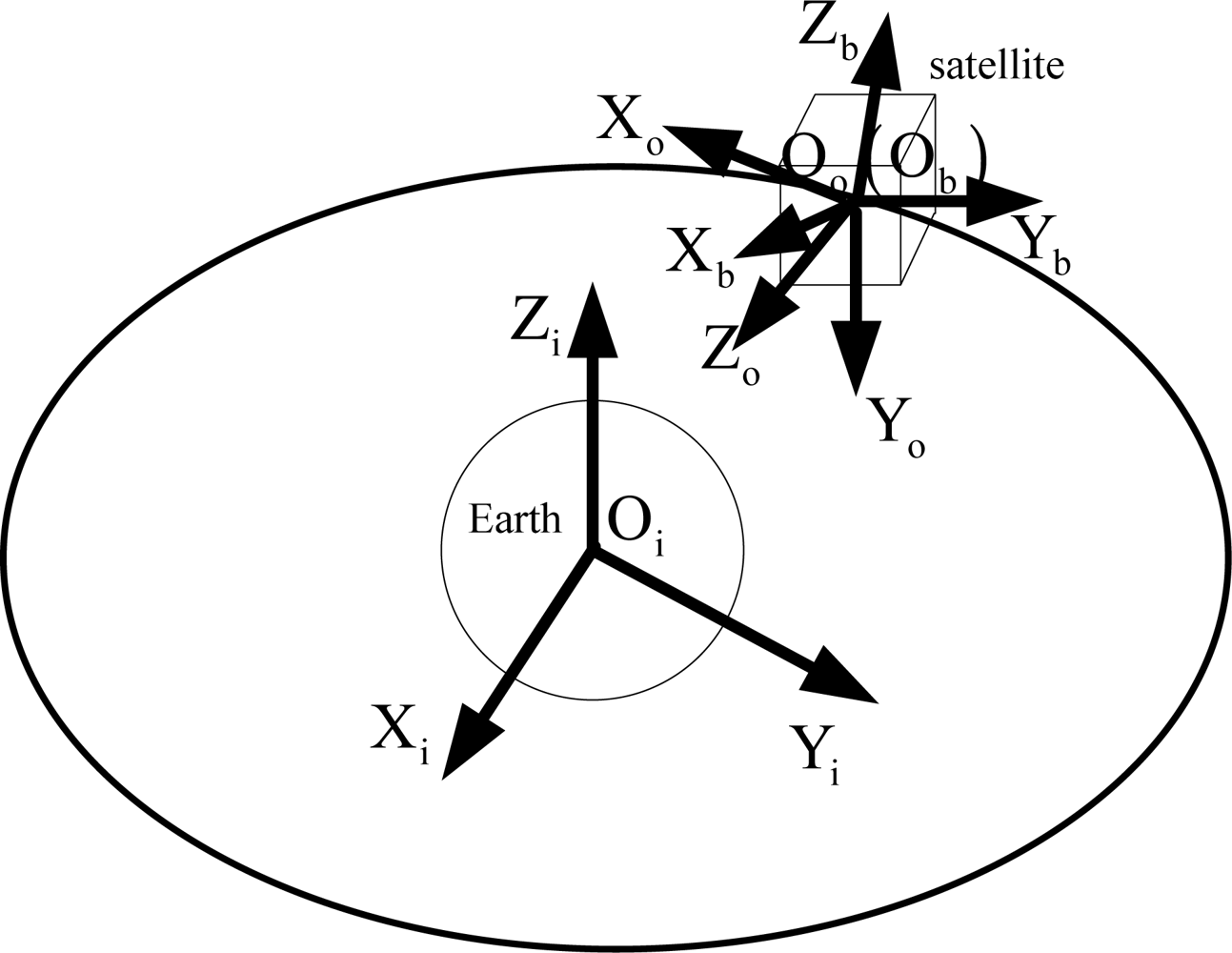
<p>Different from the mechanical CMG, a magnetically suspended rotor is used in a magnetically suspended CMG. The translational position of the rotor relative to the magnetic bearing can be controlled actively. Besides the high-speed rotation degree, the magnetically suspended CMG has five more degrees of freedom than the mechanical CMG, and thus the modeling process is complex. Firstly, the coordinate frames are needed to be defined. In the following, <italic>n</italic> = 1, 2, 3, 4 denotes the <italic>n</italic>-th CMG. <xref ref-type="fig" rid="f1-sensors-12-16964">Figure 1</xref> gives the relationship between inertial frame system, orbit frame, and satellite body frame.</p>
<list list-type="simple">
<list-item>
<p>F<sub>i</sub>: Inertia frame O<sub>i</sub>X<sub>i</sub>Y<sub>i</sub> Z<sub>i</sub>. The origin is the Earth’s core, <sc>o</sc><sub>i</sub><sc>x</sc><sub>i</sub> points to the vernal equinox, while <sc>o</sc><sub>i</sub><sc>z</sc><sub>i</sub> points to the North Pole.</p></list-item>
<list-item>
<p>F<sub>o</sub>: Orbit frame O<sub>o</sub>X<sub>o</sub>Y<sub>o</sub>Z<sub>o</sub>. The origin is the centre of mass of the satellite, <sc>o</sc><sub>o</sub><sc>x</sc><sub>o</sub> and <sc>o</sc><sub>o</sub><sc>y</sc><sub>o</sub> represent the roll axis and the pitch axis, respectively, both locating in the orbital plane.</p></list-item>
<list-item>
<p>F<sub>b</sub>: Satellite body frame O<sub>b</sub>X<sub>b</sub>Y<sub>b</sub>Z<sub>b</sub>. The origin is the centre of mass of satellite. <sc>o</sc><sub>b</sub><sc>x</sc><sub>b</sub>, <sc>o</sc><sub>b</sub><sc>y</sc><sub>b</sub> and <sc>o</sc><sub>b</sub><sc>z</sc><sub>b</sub> are along the principal axes of inertia of the satellite.</p></list-item>
<list-item>
<p>F<sub>cmg,n</sub>: The <italic>n</italic> -th CMG frame O<sub>cmg,n</sub>X<sub>cmg,n</sub>Y<sub>cmg,n</sub>Z<sub>cmg,n</sub>. Fixed with the satellite, but it is determined by configuration. O<sub>cmg,n</sub> is the rotor centre of mass of the <italic>n</italic> -th magnetically suspended SGCMG, X<sub>cmg,n</sub> is the gimbal axis, Y<sub>cmg,n</sub> is the spin direction of the rotor when the gimbal angle is in zero position.</p></list-item>
<list-item>
<p>F<sub>g,n</sub>: The <italic>n</italic> -th gimbal frame O<sub>g,n</sub>X<sub>g,n</sub>Y<sub>g,n</sub>Z<sub>g,n</sub>. Fixed with the gimbal, the frame can rotate with the gimbal. When the gimbal angle is in zero position, the gimbal frame coincides with the CMG frame.</p></list-item>
<list-item>
<p>F<sub>f ,n</sub>: The <italic>n</italic> -th magnetic bearing installed frame O<sub>f ,n</sub>X<sub>f ,n</sub>Y<sub>f ,n</sub>Z<sub>f ,n</sub>. It is fixed with the gimbal frame. This frame is obtained by 45° rotation of the gimbal frame and about the Y<sub>g,n</sub> axis.</p></list-item>
<list-item>
<p>F<sub>r,n</sub> : The <italic>n</italic> -th rotor frame O<sub>r,n</sub>X<sub>r,n</sub>Y<sub>r,n</sub>Z<sub>r,n</sub>. It is fixed with the rotor. This frame does not spin with the rotor. O<sub>f ,n</sub> coincides with O<sub>r,n</sub> when the rotor is not suspended.</p></list-item>
<list-item>
<p>
<inline-formula>
<mml:math id="mm1" display="inline">
<mml:mrow>
<mml:msubsup>
<mml:mrow>
<mml:mi mathvariant="bold">C</mml:mi></mml:mrow>
<mml:mrow>
<mml:msub>
<mml:mtext>F</mml:mtext>
<mml:mn>1</mml:mn></mml:msub></mml:mrow>
<mml:mrow>
<mml:msub>
<mml:mtext>F</mml:mtext>
<mml:mn>2</mml:mn></mml:msub></mml:mrow></mml:msubsup></mml:mrow></mml:math></inline-formula>: denotes the coordinate transformation matrix from frame F<sub>1</sub> to frame F<sub>2</sub>.</p></list-item></list>
<p>In Section 2.1, the rotor dynamic model of single gimbal magnetically suspended CMG is analyzed. For convenience, the index <italic>n</italic> is omitted. For example, F<sub>g</sub> represents the gimbal frame <sc>o</sc><sub>g</sub><sc>x</sc><sub>g</sub><sc>y</sc><sub>g</sub><sc>z</sc><sub>g</sub>.</p>
<sec>
<label>2.1.</label>
<title>The Dynamic Model of Magnetically Suspended Rotor</title>
<p>The Euler equation is used to build the magnetically suspended rotor dynamic model. A magnetically suspended SGCMG consists of the rotor and the gimbal. The magnetic force is produced from the unique relation between the rotor and the bearing. In order to perform the satellite attitude control, the direction of angular momentum is changed through magnetic bearing torque by the gimbal rotation, and then the gyroscope torque is generated, and is transmitted to the satellite by the magnetic bearings.</p>
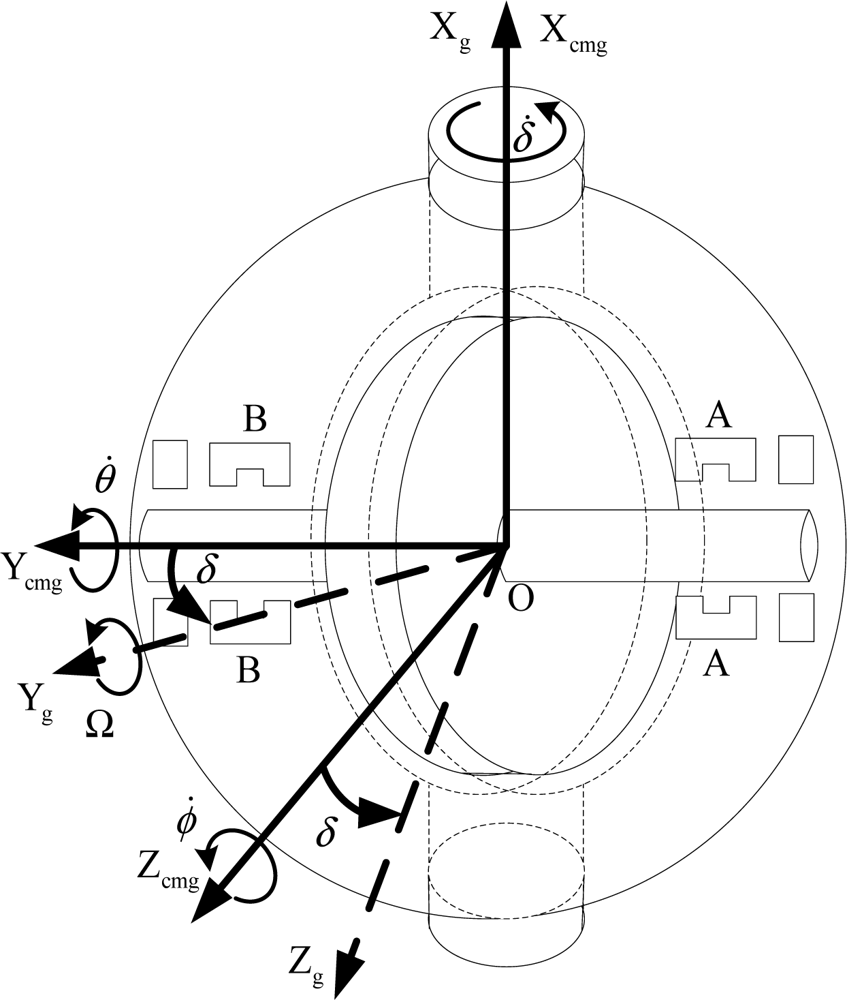
<p>In this paper, the rotor is supposed to be asymmetric, and the dynamic and static vibration induced by the geometry shape are ignored. Only the force induced from the gimbal rotation of the CMG frame relative to the inertial frame is considered. The rotation relationship between CMG frame and the gimbal frame is given in <xref ref-type="fig" rid="f2-sensors-12-16964">Figure 2</xref>.</p>
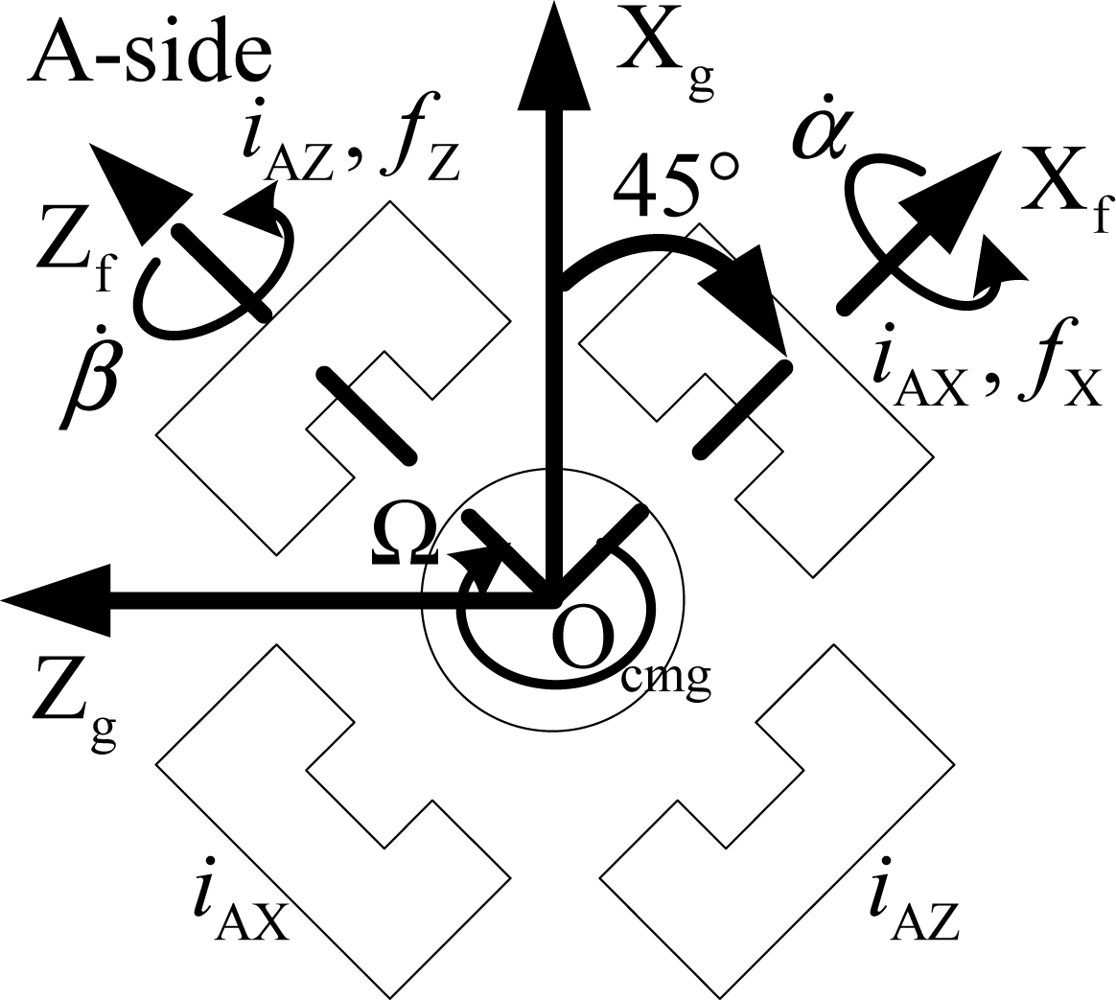
<p>As shown in <xref ref-type="fig" rid="f2-sensors-12-16964">Figure 2</xref>, <italic>δ̇</italic>, <italic>θ̇</italic> and <italic>ϕ̇</italic> are the angular velocity of CMG frame relative to gimbal frame. <italic>δ</italic> is the rotation angle from CMG frame to gimbal frame. <italic>δ̇</italic> is the gimbal rate about X<italic><sub>cmg</sub></italic> axis. <xref ref-type="fig" rid="f3-sensors-12-16964">Figure 3</xref> denotes the view from A-side about the Y<italic><sub>cmg</sub></italic>-direction in <xref ref-type="fig" rid="f2-sensors-12-16964">Figure 2</xref>. It shows the relationship between the gimbal frame and the installed magnetic bearing frame. <italic>f</italic><sub>X</sub> and <italic>f</italic><sub>Z</sub> denote the radial magnetic bearing force about the X<italic><sub>f</sub></italic>-axis and Z<italic><sub>f</sub></italic>-axis. <italic>f</italic><sub>Y</sub> is the axial magnetic bearing force. <italic>α</italic> and <italic>β</italic> are the rotation angle of the rotor about the X<italic><sub>f</sub></italic> -axis and Z<italic><sub>f</sub></italic> -axis, respectively. <italic>α̇</italic> and <italic>β̇</italic> are the angular velocity about the X<italic><sub>f</sub></italic> -axis and Z<italic><sub>f</sub></italic> -axis, respectively. Ω is the rotor speed relative to the rotor frame, and it is about Y<italic><sub>f</sub></italic> -axis. <italic>i<sub>AX</sub></italic> and <italic>i<sub>AZ</sub></italic> are the magnetic bearing control current about X<italic><sub>f</sub></italic> -axis and Z<italic><sub>f</sub></italic> -axis of the A-side.</p>
<p>Firstly, only one magnetically suspended SGCMG is analyzed. <bold>M</bold><italic><sup>r</sup></italic> is the torque acting on the rotor. By using the Euler equation, the magnetically suspended rotor dynamic model in the rotor frame can be obtained:
<disp-formula id="FD1">
<label>(1)</label>
<mml:math id="mm2" display="block">
<mml:mrow>
<mml:msup>
<mml:mrow>
<mml:mi mathvariant="bold">M</mml:mi></mml:mrow>
<mml:mi>r</mml:mi></mml:msup>
<mml:mo>=</mml:mo>
<mml:msup>
<mml:mrow>
<mml:mover accent="true">
<mml:mi mathvariant="bold">H</mml:mi>
<mml:mo>˙</mml:mo></mml:mover></mml:mrow>
<mml:mi>r</mml:mi></mml:msup>
<mml:mo>+</mml:mo>
<mml:msubsup>
<mml:mrow>
<mml:mi mathvariant="bold">ω</mml:mi></mml:mrow>
<mml:mrow>
<mml:mi>i</mml:mi>
<mml:mi>r</mml:mi></mml:mrow>
<mml:mi>r</mml:mi></mml:msubsup>
<mml:mo>×</mml:mo>
<mml:msup>
<mml:mrow>
<mml:mi mathvariant="bold">H</mml:mi></mml:mrow>
<mml:mi>r</mml:mi></mml:msup></mml:mrow></mml:math></disp-formula></p>
<p>In <xref ref-type="disp-formula" rid="FD1">Equation (1)</xref>, 
<inline-formula>
<mml:math id="mm3" display="inline">
<mml:mrow>
<mml:msubsup>
<mml:mi mathvariant="bold">ω</mml:mi>
<mml:mi mathvariant="italic">ir</mml:mi>
<mml:mi>r</mml:mi></mml:msubsup></mml:mrow></mml:math></inline-formula> denotes the absolute angular velocity in rotor frame. It includes 
<inline-formula>
<mml:math id="mm4" display="inline">
<mml:mrow>
<mml:msubsup>
<mml:mi mathvariant="bold">ω</mml:mi>
<mml:mi mathvariant="italic">rf</mml:mi>
<mml:mi>f</mml:mi></mml:msubsup></mml:mrow></mml:math></inline-formula>, 
<inline-formula>
<mml:math id="mm5" display="inline">
<mml:mrow>
<mml:msubsup>
<mml:mi mathvariant="bold">ω</mml:mi>
<mml:mi mathvariant="italic">icmg</mml:mi>
<mml:mi mathvariant="italic">cmg</mml:mi></mml:msubsup></mml:mrow></mml:math></inline-formula>, and <bold>ω</bold><italic><sup>g</sup></italic>. 
<inline-formula>
<mml:math id="mm6" display="inline">
<mml:mrow>
<mml:msubsup>
<mml:mi mathvariant="bold">ω</mml:mi>
<mml:mi mathvariant="italic">rf</mml:mi>
<mml:mi>f</mml:mi></mml:msubsup></mml:mrow></mml:math></inline-formula> is the angular velocity of the rotor. It is the magnetic bearing frame relative to the rotor frame, and is shown in the magnetic bearing frame. 
<inline-formula>
<mml:math id="mm7" display="inline">
<mml:mrow>
<mml:msubsup>
<mml:mi mathvariant="bold">ω</mml:mi>
<mml:mi mathvariant="italic">icmg</mml:mi>
<mml:mi mathvariant="italic">cmg</mml:mi></mml:msubsup></mml:mrow></mml:math></inline-formula> is the angle velocity of CMG frame relative to the inertial frame. <bold>ω</bold><italic><sup>g</sup></italic> is the gimbal angular velocity:
<disp-formula id="FD2">
<label>(2)</label>
<mml:math id="mm8" display="block">
<mml:mrow>
<mml:msubsup>
<mml:mi mathvariant="bold">ω</mml:mi>
<mml:mi mathvariant="italic">ir</mml:mi>
<mml:mi>r</mml:mi></mml:msubsup>
<mml:mo>=</mml:mo>
<mml:msubsup>
<mml:mi mathvariant="bold">C</mml:mi>
<mml:mi>f</mml:mi>
<mml:mi>r</mml:mi></mml:msubsup>
<mml:mrow>
<mml:mo>(</mml:mo>
<mml:mrow>
<mml:msubsup>
<mml:mi mathvariant="bold">ω</mml:mi>
<mml:mi mathvariant="italic">rf</mml:mi>
<mml:mi>f</mml:mi></mml:msubsup>
<mml:mo>+</mml:mo>
<mml:msubsup>
<mml:mi mathvariant="bold">C</mml:mi>
<mml:mi>g</mml:mi>
<mml:mi>f</mml:mi></mml:msubsup>
<mml:msubsup>
<mml:mi mathvariant="bold">C</mml:mi>
<mml:mi mathvariant="italic">cmg</mml:mi>
<mml:mi>g</mml:mi></mml:msubsup>
<mml:msubsup>
<mml:mi mathvariant="bold">ω</mml:mi>
<mml:mi mathvariant="italic">ig</mml:mi>
<mml:mi mathvariant="italic">cmg</mml:mi></mml:msubsup></mml:mrow>
<mml:mo>)</mml:mo></mml:mrow></mml:mrow></mml:math></disp-formula></p>
<p>The absolute angle velocity 
<inline-formula>
<mml:math id="mm9" display="inline">
<mml:mrow>
<mml:msubsup>
<mml:mi mathvariant="bold">Ω</mml:mi>
<mml:mi mathvariant="italic">ir</mml:mi>
<mml:mi>r</mml:mi></mml:msubsup></mml:mrow></mml:math></inline-formula> of the rotor includes the spin rate <bold>Ω</bold><italic><sup>r</sup></italic> and the rate 
<inline-formula>
<mml:math id="mm10" display="inline">
<mml:mrow>
<mml:msubsup>
<mml:mi mathvariant="bold">ω</mml:mi>
<mml:mi mathvariant="italic">ir</mml:mi>
<mml:mi>r</mml:mi></mml:msubsup></mml:mrow></mml:math></inline-formula> of the rotor frame:
<disp-formula id="FD3">
<label>(3)</label>
<mml:math id="mm11" display="block">
<mml:mrow>
<mml:msubsup>
<mml:mi mathvariant="bold">Ω</mml:mi>
<mml:mi mathvariant="italic">ir</mml:mi>
<mml:mi>r</mml:mi></mml:msubsup>
<mml:mo>=</mml:mo>
<mml:msup>
<mml:mi mathvariant="bold">Ω</mml:mi>
<mml:mi>r</mml:mi></mml:msup>
<mml:mo>+</mml:mo>
<mml:msubsup>
<mml:mi mathvariant="bold">ω</mml:mi>
<mml:mi mathvariant="italic">ir</mml:mi>
<mml:mi>r</mml:mi></mml:msubsup>
<mml:mo>=</mml:mo>
<mml:msup>
<mml:mi mathvariant="bold">Ω</mml:mi>
<mml:mi>r</mml:mi></mml:msup>
<mml:mo>+</mml:mo>
<mml:msubsup>
<mml:mi mathvariant="bold">C</mml:mi>
<mml:mi>f</mml:mi>
<mml:mi>r</mml:mi></mml:msubsup>
<mml:mrow>
<mml:mo>(</mml:mo>
<mml:mrow>
<mml:msubsup>
<mml:mi mathvariant="bold">ω</mml:mi>
<mml:mi mathvariant="italic">rf</mml:mi>
<mml:mi>f</mml:mi></mml:msubsup>
<mml:mo>+</mml:mo>
<mml:msubsup>
<mml:mi mathvariant="bold">C</mml:mi>
<mml:mi>g</mml:mi>
<mml:mi>f</mml:mi></mml:msubsup>
<mml:msubsup>
<mml:mi mathvariant="bold">C</mml:mi>
<mml:mi mathvariant="italic">cmg</mml:mi>
<mml:mi>g</mml:mi></mml:msubsup>
<mml:msubsup>
<mml:mi mathvariant="bold">ω</mml:mi>
<mml:mi mathvariant="italic">ig</mml:mi>
<mml:mi mathvariant="italic">cmg</mml:mi></mml:msubsup></mml:mrow>
<mml:mo>)</mml:mo></mml:mrow></mml:mrow></mml:math></disp-formula></p>
<p>Because <italic>α</italic> and <italic>β</italic> are very small, then cos<italic>α</italic> ≈ 1, cos<italic>β</italic> ≈ 1, sin<italic>α</italic> ≈ <italic>α</italic>, sin<italic>β</italic> ≈ <italic>β</italic>, <italic>αβ</italic> ≈ 0. Then:
<disp-formula id="FD4">
<label>(4)</label>
<mml:math id="mm12" display="block">
<mml:mrow>
<mml:mtable>
<mml:mtr>
<mml:mtd>
<mml:mrow>
<mml:msubsup>
<mml:mi mathvariant="bold">C</mml:mi>
<mml:mi>f</mml:mi>
<mml:mi>r</mml:mi></mml:msubsup>
<mml:mo>=</mml:mo>
<mml:mrow>
<mml:mo>[</mml:mo>
<mml:mrow>
<mml:mtable>
<mml:mtr>
<mml:mtd>
<mml:mrow>
<mml:mtext>cos</mml:mtext>
<mml:mi>β</mml:mi></mml:mrow></mml:mtd>
<mml:mtd>
<mml:mrow>
<mml:mtext>sin</mml:mtext>
<mml:mi>β</mml:mi></mml:mrow></mml:mtd>
<mml:mtd>
<mml:mn>0</mml:mn></mml:mtd></mml:mtr>
<mml:mtr>
<mml:mtd>
<mml:mrow>
<mml:mo>−</mml:mo>
<mml:mtext>sin</mml:mtext>
<mml:mi>β</mml:mi></mml:mrow></mml:mtd>
<mml:mtd>
<mml:mrow>
<mml:mtext>cos</mml:mtext>
<mml:mi>β</mml:mi></mml:mrow></mml:mtd>
<mml:mtd>
<mml:mn>0</mml:mn></mml:mtd></mml:mtr>
<mml:mtr>
<mml:mtd>
<mml:mn>0</mml:mn></mml:mtd>
<mml:mtd>
<mml:mn>0</mml:mn></mml:mtd>
<mml:mtd>
<mml:mn>1</mml:mn></mml:mtd></mml:mtr></mml:mtable></mml:mrow>
<mml:mo>]</mml:mo></mml:mrow>
<mml:mrow>
<mml:mo>[</mml:mo>
<mml:mrow>
<mml:mtable>
<mml:mtr>
<mml:mtd>
<mml:mn>1</mml:mn></mml:mtd>
<mml:mtd>
<mml:mn>0</mml:mn></mml:mtd>
<mml:mtd>
<mml:mn>0</mml:mn></mml:mtd></mml:mtr>
<mml:mtr>
<mml:mtd>
<mml:mn>0</mml:mn></mml:mtd>
<mml:mtd>
<mml:mrow>
<mml:mtext>cos</mml:mtext>
<mml:mi>α</mml:mi></mml:mrow></mml:mtd>
<mml:mtd>
<mml:mrow>
<mml:mtext>sin</mml:mtext>
<mml:mi>α</mml:mi></mml:mrow></mml:mtd></mml:mtr>
<mml:mtr>
<mml:mtd>
<mml:mn>0</mml:mn></mml:mtd>
<mml:mtd>
<mml:mrow>
<mml:mo>−</mml:mo>
<mml:mtext>sin</mml:mtext>
<mml:mi>α</mml:mi></mml:mrow></mml:mtd>
<mml:mtd>
<mml:mrow>
<mml:mtext>cos</mml:mtext>
<mml:mi>α</mml:mi></mml:mrow></mml:mtd></mml:mtr></mml:mtable></mml:mrow>
<mml:mo>]</mml:mo></mml:mrow>
<mml:mo>≈</mml:mo>
<mml:mrow>
<mml:mo>[</mml:mo>
<mml:mrow>
<mml:mtable>
<mml:mtr>
<mml:mtd>
<mml:mn>1</mml:mn></mml:mtd>
<mml:mtd>
<mml:mi>β</mml:mi></mml:mtd>
<mml:mtd>
<mml:mn>0</mml:mn></mml:mtd></mml:mtr>
<mml:mtr>
<mml:mtd>
<mml:mrow>
<mml:mo>−</mml:mo>
<mml:mi>β</mml:mi></mml:mrow></mml:mtd>
<mml:mtd>
<mml:mn>1</mml:mn></mml:mtd>
<mml:mtd>
<mml:mi>α</mml:mi></mml:mtd></mml:mtr>
<mml:mtr>
<mml:mtd>
<mml:mn>0</mml:mn></mml:mtd>
<mml:mtd>
<mml:mrow>
<mml:mo>−</mml:mo>
<mml:mi>α</mml:mi></mml:mrow></mml:mtd>
<mml:mtd>
<mml:mn>1</mml:mn></mml:mtd></mml:mtr></mml:mtable></mml:mrow>
<mml:mo>]</mml:mo></mml:mrow>
<mml:mo>,</mml:mo>
<mml:msubsup>
<mml:mrow>
<mml:mi mathvariant="bold">ω</mml:mi></mml:mrow>
<mml:mrow>
<mml:mi>r</mml:mi>
<mml:mi>f</mml:mi></mml:mrow>
<mml:mi>f</mml:mi></mml:msubsup>
<mml:mo>=</mml:mo>
<mml:mrow>
<mml:mo>[</mml:mo>
<mml:mrow>
<mml:mtable>
<mml:mtr>
<mml:mtd>
<mml:mover accent="true">
<mml:mi>α</mml:mi>
<mml:mo>˙</mml:mo></mml:mover></mml:mtd></mml:mtr>
<mml:mtr>
<mml:mtd>
<mml:mn>0</mml:mn></mml:mtd></mml:mtr>
<mml:mtr>
<mml:mtd>
<mml:mover accent="true">
<mml:mi>β</mml:mi>
<mml:mo>˙</mml:mo></mml:mover></mml:mtd></mml:mtr></mml:mtable></mml:mrow>
<mml:mo>]</mml:mo></mml:mrow></mml:mrow></mml:mtd></mml:mtr>
<mml:mtr>
<mml:mtd>
<mml:mrow>
<mml:msubsup>
<mml:mi mathvariant="bold">C</mml:mi>
<mml:mi>g</mml:mi>
<mml:mi>f</mml:mi></mml:msubsup>
<mml:mo>=</mml:mo>
<mml:mrow>
<mml:mo>[</mml:mo>
<mml:mrow>
<mml:mtable>
<mml:mtr>
<mml:mtd>
<mml:mrow>
<mml:mtext>cos</mml:mtext>
<mml:mn>45</mml:mn>
<mml:mo>°</mml:mo></mml:mrow></mml:mtd>
<mml:mtd>
<mml:mn>0</mml:mn></mml:mtd>
<mml:mtd>
<mml:mrow>
<mml:mo>−</mml:mo>
<mml:mtext>sin</mml:mtext>
<mml:mn>45</mml:mn>
<mml:mo>°</mml:mo></mml:mrow></mml:mtd></mml:mtr>
<mml:mtr>
<mml:mtd>
<mml:mn>0</mml:mn></mml:mtd>
<mml:mtd>
<mml:mn>1</mml:mn></mml:mtd>
<mml:mtd>
<mml:mn>0</mml:mn></mml:mtd></mml:mtr>
<mml:mtr>
<mml:mtd>
<mml:mrow>
<mml:mtext>sin</mml:mtext>
<mml:mn>45</mml:mn>
<mml:mo>°</mml:mo></mml:mrow></mml:mtd>
<mml:mtd>
<mml:mn>0</mml:mn></mml:mtd>
<mml:mtd>
<mml:mrow>
<mml:mtext>cos</mml:mtext>
<mml:mn>45</mml:mn>
<mml:mo>°</mml:mo></mml:mrow></mml:mtd></mml:mtr></mml:mtable></mml:mrow>
<mml:mo>]</mml:mo></mml:mrow></mml:mrow></mml:mtd></mml:mtr></mml:mtable></mml:mrow></mml:math></disp-formula></p>
<p>By rotating <italic>δ</italic> about X<italic><sub>cmg</sub></italic> axis from the CMG frame to the gimbal frame, then:
<disp-formula id="FD5">
<label>(5)</label>
<mml:math id="mm13" display="block">
<mml:mrow>
<mml:msubsup>
<mml:mi mathvariant="bold">C</mml:mi>
<mml:mi mathvariant="italic">cmg</mml:mi>
<mml:mi>g</mml:mi></mml:msubsup>
<mml:mo>=</mml:mo>
<mml:mrow>
<mml:mo>[</mml:mo>
<mml:mrow>
<mml:mtable>
<mml:mtr>
<mml:mtd>
<mml:mn>1</mml:mn></mml:mtd>
<mml:mtd>
<mml:mn>0</mml:mn></mml:mtd>
<mml:mtd>
<mml:mn>0</mml:mn></mml:mtd></mml:mtr>
<mml:mtr>
<mml:mtd>
<mml:mn>0</mml:mn></mml:mtd>
<mml:mtd>
<mml:mrow>
<mml:mtext>cos</mml:mtext>
<mml:mi>δ</mml:mi></mml:mrow></mml:mtd>
<mml:mtd>
<mml:mrow>
<mml:mtext>sin</mml:mtext>
<mml:mi>δ</mml:mi></mml:mrow></mml:mtd></mml:mtr>
<mml:mtr>
<mml:mtd>
<mml:mn>0</mml:mn></mml:mtd>
<mml:mtd>
<mml:mrow>
<mml:mo>−</mml:mo>
<mml:mtext>sin</mml:mtext>
<mml:mi>δ</mml:mi></mml:mrow></mml:mtd>
<mml:mtd>
<mml:mrow>
<mml:mtext>cos</mml:mtext>
<mml:mi>δ</mml:mi></mml:mrow></mml:mtd></mml:mtr></mml:mtable></mml:mrow>
<mml:mo>]</mml:mo></mml:mrow>
<mml:mo>,</mml:mo>
<mml:mo> </mml:mo>
<mml:mo> </mml:mo>
<mml:msup>
<mml:mrow>
<mml:mi mathvariant="bold">ω</mml:mi></mml:mrow>
<mml:mi>g</mml:mi></mml:msup>
<mml:mo>=</mml:mo>
<mml:mrow>
<mml:mo>[</mml:mo>
<mml:mrow>
<mml:mtable>
<mml:mtr>
<mml:mtd>
<mml:mover accent="true">
<mml:mi>δ</mml:mi>
<mml:mo>˙</mml:mo></mml:mover></mml:mtd></mml:mtr>
<mml:mtr>
<mml:mtd>
<mml:mn>0</mml:mn></mml:mtd></mml:mtr>
<mml:mtr>
<mml:mtd>
<mml:mn>0</mml:mn></mml:mtd></mml:mtr></mml:mtable></mml:mrow>
<mml:mo>]</mml:mo></mml:mrow>
<mml:mo>,</mml:mo>
<mml:mo> </mml:mo>
<mml:mo> </mml:mo>
<mml:mo> </mml:mo>
<mml:mo> </mml:mo>
<mml:mo> </mml:mo>
<mml:mo> </mml:mo>
<mml:mo> </mml:mo>
<mml:msubsup>
<mml:mi mathvariant="bold">ω</mml:mi>
<mml:mi mathvariant="italic">ig</mml:mi>
<mml:mi mathvariant="italic">cmg</mml:mi></mml:msubsup>
<mml:mo>=</mml:mo>
<mml:msubsup>
<mml:mi mathvariant="bold">ω</mml:mi>
<mml:mi mathvariant="italic">icmg</mml:mi>
<mml:mi mathvariant="italic">cmg</mml:mi></mml:msubsup>
<mml:mo>+</mml:mo>
<mml:msup>
<mml:mi mathvariant="bold">ω</mml:mi>
<mml:mi>g</mml:mi></mml:msup>
<mml:mo>=</mml:mo>
<mml:mrow>
<mml:mo>[</mml:mo>
<mml:mrow>
<mml:mtable>
<mml:mtr>
<mml:mtd>
<mml:mover accent="true">
<mml:mi>φ</mml:mi>
<mml:mo>˙</mml:mo></mml:mover></mml:mtd></mml:mtr>
<mml:mtr>
<mml:mtd>
<mml:mover accent="true">
<mml:mi>θ</mml:mi>
<mml:mo>˙</mml:mo></mml:mover></mml:mtd></mml:mtr>
<mml:mtr>
<mml:mtd>
<mml:mover accent="true">
<mml:mi>ϕ</mml:mi>
<mml:mo>˙</mml:mo></mml:mover></mml:mtd></mml:mtr></mml:mtable></mml:mrow>
<mml:mo>]</mml:mo></mml:mrow>
<mml:mo>+</mml:mo>
<mml:mrow>
<mml:mo>[</mml:mo>
<mml:mrow>
<mml:mtable>
<mml:mtr>
<mml:mtd>
<mml:mover accent="true">
<mml:mi>δ</mml:mi>
<mml:mo>˙</mml:mo></mml:mover></mml:mtd></mml:mtr>
<mml:mtr>
<mml:mtd>
<mml:mn>0</mml:mn></mml:mtd></mml:mtr>
<mml:mtr>
<mml:mtd>
<mml:mn>0</mml:mn></mml:mtd></mml:mtr></mml:mtable></mml:mrow>
<mml:mo>]</mml:mo></mml:mrow>
<mml:mo>=</mml:mo>
<mml:mrow>
<mml:mo>[</mml:mo>
<mml:mrow>
<mml:mtable>
<mml:mtr>
<mml:mtd>
<mml:mover accent="true">
<mml:mi>δ</mml:mi>
<mml:mo>˙</mml:mo></mml:mover>
<mml:mo>^</mml:mo></mml:mover></mml:mtd></mml:mtr>
<mml:mtr>
<mml:mtd>
<mml:mover accent="true">
<mml:mi>θ</mml:mi>
<mml:mo>˙</mml:mo></mml:mover></mml:mtd></mml:mtr>
<mml:mtr>
<mml:mtd>
<mml:mover accent="true">
<mml:mi>ϕ</mml:mi>
<mml:mo>˙</mml:mo></mml:mover></mml:mtd></mml:mtr></mml:mtable></mml:mrow>
<mml:mo>]</mml:mo></mml:mrow></mml:mrow></mml:math></disp-formula>where 
<inline-formula>
<mml:math id="mm14" display="inline">
<mml:mover accent="true">
<mml:mi>δ</mml:mi>
<mml:mo>˙</mml:mo></mml:mover>
<mml:mo>^</mml:mo></mml:mover></mml:math></inline-formula>, <italic>θ̇</italic> and <italic>ϕ̇</italic> show the absolute angular velocity of the CMG frame, and the detailed expression will be given in Section 2.2. By substituting the coordinate transformation matrix and the relative angular velocity, then:
<disp-formula id="FD6">
<label>(6)</label>
<mml:math id="mm15" display="block">
<mml:mrow>
<mml:msubsup>
<mml:mi mathvariant="bold">Ω</mml:mi>
<mml:mi mathvariant="italic">ir</mml:mi>
<mml:mi>r</mml:mi></mml:msubsup>
<mml:mo>=</mml:mo>
<mml:mrow>
<mml:mo>[</mml:mo>
<mml:mrow>
<mml:mtable>
<mml:mtr>
<mml:mtd>
<mml:mrow>
<mml:mfrac>
<mml:mrow>
<mml:msqrt>
<mml:mn>2</mml:mn></mml:msqrt></mml:mrow>
<mml:mn>2</mml:mn></mml:mfrac>
<mml:mrow>
<mml:mo>(</mml:mo>
<mml:mrow>
<mml:mover accent="true">
<mml:mi>δ</mml:mi>
<mml:mo>˙</mml:mo></mml:mover>
<mml:mo>^</mml:mo></mml:mover>
<mml:mo>−</mml:mo>
<mml:mover accent="true">
<mml:mi>ϕ</mml:mi>
<mml:mo>˙</mml:mo></mml:mover>
<mml:mtext>cos</mml:mtext>
<mml:mi>δ</mml:mi>
<mml:mo>+</mml:mo>
<mml:mover accent="true">
<mml:mi>θ</mml:mi>
<mml:mo>˙</mml:mo></mml:mover>
<mml:mtext>sin</mml:mtext>
<mml:mi>δ</mml:mi></mml:mrow>
<mml:mo>)</mml:mo></mml:mrow>
<mml:mo>+</mml:mo>
<mml:mover accent="true">
<mml:mi>α</mml:mi>
<mml:mo>˙</mml:mo></mml:mover>
<mml:mo>+</mml:mo>
<mml:mi>β</mml:mi>
<mml:mrow>
<mml:mo>(</mml:mo>
<mml:mrow>
<mml:mover accent="true">
<mml:mi>θ</mml:mi>
<mml:mo>˙</mml:mo></mml:mover>
<mml:mtext>cos</mml:mtext>
<mml:mi>δ</mml:mi>
<mml:mo>+</mml:mo>
<mml:mover accent="true">
<mml:mi>ϕ</mml:mi>
<mml:mo>˙</mml:mo></mml:mover>
<mml:mtext>sin</mml:mtext>
<mml:mi>δ</mml:mi></mml:mrow>
<mml:mo>)</mml:mo></mml:mrow></mml:mrow></mml:mtd></mml:mtr>
<mml:mtr>
<mml:mtd>
<mml:mrow>
<mml:mi mathvariant="normal">Ω</mml:mi>
<mml:mo>−</mml:mo>
<mml:mfrac>
<mml:mrow>
<mml:msqrt>
<mml:mn>2</mml:mn></mml:msqrt></mml:mrow>
<mml:mn>2</mml:mn></mml:mfrac>
<mml:mi>β</mml:mi>
<mml:mrow>
<mml:mo>(</mml:mo>
<mml:mrow>
<mml:mover accent="true">
<mml:mi>δ</mml:mi>
<mml:mo>˙</mml:mo></mml:mover>
<mml:mo>^</mml:mo></mml:mover>
<mml:mo>−</mml:mo>
<mml:mover accent="true">
<mml:mi>ϕ</mml:mi>
<mml:mo>˙</mml:mo></mml:mover>
<mml:mtext>cos</mml:mtext>
<mml:mi>δ</mml:mi>
<mml:mo>+</mml:mo>
<mml:mover accent="true">
<mml:mi>θ</mml:mi>
<mml:mo>˙</mml:mo></mml:mover>
<mml:mtext>sin</mml:mtext>
<mml:mi>δ</mml:mi></mml:mrow>
<mml:mo>)</mml:mo></mml:mrow>
<mml:mo>−</mml:mo>
<mml:mover accent="true">
<mml:mi>α</mml:mi>
<mml:mo>˙</mml:mo></mml:mover>
<mml:mi>β</mml:mi>
<mml:mo>+</mml:mo>
<mml:mrow>
<mml:mo>(</mml:mo>
<mml:mrow>
<mml:mover accent="true">
<mml:mi>θ</mml:mi>
<mml:mo>˙</mml:mo></mml:mover>
<mml:mtext>cos</mml:mtext>
<mml:mi>δ</mml:mi>
<mml:mo>+</mml:mo>
<mml:mover accent="true">
<mml:mi>ϕ</mml:mi>
<mml:mo>˙</mml:mo></mml:mover>
<mml:mtext>sin</mml:mtext>
<mml:mi>δ</mml:mi></mml:mrow>
<mml:mo>)</mml:mo></mml:mrow>
<mml:mo>−</mml:mo>
<mml:mfrac>
<mml:mrow>
<mml:msqrt>
<mml:mn>2</mml:mn></mml:msqrt></mml:mrow>
<mml:mn>2</mml:mn></mml:mfrac>
<mml:mi>α</mml:mi>
<mml:mrow>
<mml:mo>(</mml:mo>
<mml:mrow>
<mml:mover accent="true">
<mml:mi>δ</mml:mi>
<mml:mo>˙</mml:mo></mml:mover>
<mml:mo>^</mml:mo></mml:mover>
<mml:mo>+</mml:mo>
<mml:mover accent="true">
<mml:mi>ϕ</mml:mi>
<mml:mo>˙</mml:mo></mml:mover>
<mml:mtext>cos</mml:mtext>
<mml:mi>δ</mml:mi>
<mml:mo>−</mml:mo>
<mml:mover accent="true">
<mml:mi>θ</mml:mi>
<mml:mo>˙</mml:mo></mml:mover>
<mml:mtext>sin</mml:mtext>
<mml:mi>δ</mml:mi></mml:mrow>
<mml:mo>)</mml:mo></mml:mrow>
<mml:mo>+</mml:mo>
<mml:mi>α</mml:mi>
<mml:mover accent="true">
<mml:mi>β</mml:mi>
<mml:mo>˙</mml:mo></mml:mover></mml:mrow></mml:mtd></mml:mtr>
<mml:mtr>
<mml:mtd>
<mml:mrow>
<mml:mfrac>
<mml:mrow>
<mml:msqrt>
<mml:mn>2</mml:mn></mml:msqrt></mml:mrow>
<mml:mn>2</mml:mn></mml:mfrac>
<mml:mrow>
<mml:mo>(</mml:mo>
<mml:mrow>
<mml:mover accent="true">
<mml:mi>δ</mml:mi>
<mml:mo>˙</mml:mo></mml:mover>
<mml:mo>^</mml:mo></mml:mover>
<mml:mo>+</mml:mo>
<mml:mover accent="true">
<mml:mi>ϕ</mml:mi>
<mml:mo>˙</mml:mo></mml:mover>
<mml:mtext>cos</mml:mtext>
<mml:mi>δ</mml:mi>
<mml:mo>−</mml:mo>
<mml:mover accent="true">
<mml:mi>θ</mml:mi>
<mml:mo>˙</mml:mo></mml:mover>
<mml:mtext>sin</mml:mtext>
<mml:mi>δ</mml:mi></mml:mrow>
<mml:mo>)</mml:mo></mml:mrow>
<mml:mo>+</mml:mo>
<mml:mover accent="true">
<mml:mi>β</mml:mi>
<mml:mo>˙</mml:mo></mml:mover>
<mml:mo>−</mml:mo>
<mml:mi>α</mml:mi>
<mml:mrow>
<mml:mo>(</mml:mo>
<mml:mrow>
<mml:mover accent="true">
<mml:mi>θ</mml:mi>
<mml:mo>˙</mml:mo></mml:mover>
<mml:mtext>cos</mml:mtext>
<mml:mi>δ</mml:mi>
<mml:mo>+</mml:mo>
<mml:mover accent="true">
<mml:mi>ϕ</mml:mi>
<mml:mo>˙</mml:mo></mml:mover>
<mml:mtext>sin</mml:mtext>
<mml:mi>δ</mml:mi></mml:mrow>
<mml:mo>)</mml:mo></mml:mrow></mml:mrow></mml:mtd></mml:mtr></mml:mtable></mml:mrow>
<mml:mo>]</mml:mo></mml:mrow></mml:mrow></mml:math></disp-formula></p>
<p>In <xref ref-type="disp-formula" rid="FD1">Equation (1)</xref>, <bold>H</bold><italic><sup>r</sup></italic> is the rotor angular momentum in the rotor frame:
<disp-formula id="FD7">
<label>(7)</label>
<mml:math id="mm16" display="block">
<mml:mrow>
<mml:msup>
<mml:mrow>
<mml:mi mathvariant="bold">H</mml:mi></mml:mrow>
<mml:mi>r</mml:mi></mml:msup>
<mml:mo>=</mml:mo>
<mml:msub>
<mml:mrow>
<mml:mover accent="true">
<mml:mi mathvariant="bold">I</mml:mi>
<mml:mo>˜</mml:mo></mml:mover></mml:mrow>
<mml:mi>r</mml:mi></mml:msub>
<mml:msubsup>
<mml:mi mathvariant="bold">Ω</mml:mi>
<mml:mi mathvariant="bold">ir</mml:mi>
<mml:mi>r</mml:mi></mml:msubsup>
<mml:mo>=</mml:mo>
<mml:mrow>
<mml:mo>[</mml:mo>
<mml:mrow>
<mml:mtable>
<mml:mtr>
<mml:mtd>
<mml:mrow>
<mml:msub>
<mml:mi>I</mml:mi>
<mml:mi mathvariant="italic">rx</mml:mi></mml:msub></mml:mrow></mml:mtd>
<mml:mtd>
<mml:mn>0</mml:mn></mml:mtd>
<mml:mtd>
<mml:mn>0</mml:mn></mml:mtd></mml:mtr>
<mml:mtr>
<mml:mtd>
<mml:mn>0</mml:mn></mml:mtd>
<mml:mtd>
<mml:mrow>
<mml:msub>
<mml:mi>I</mml:mi>
<mml:mi mathvariant="italic">ry</mml:mi></mml:msub></mml:mrow></mml:mtd>
<mml:mtd>
<mml:mn>0</mml:mn></mml:mtd></mml:mtr>
<mml:mtr>
<mml:mtd>
<mml:mn>0</mml:mn></mml:mtd>
<mml:mtd>
<mml:mn>0</mml:mn></mml:mtd>
<mml:mtd>
<mml:mrow>
<mml:msub>
<mml:mi>I</mml:mi>
<mml:mi mathvariant="italic">rz</mml:mi></mml:msub></mml:mrow></mml:mtd></mml:mtr></mml:mtable></mml:mrow>
<mml:mo>]</mml:mo></mml:mrow>
<mml:msubsup>
<mml:mi mathvariant="bold">Ω</mml:mi>
<mml:mi mathvariant="italic">ir</mml:mi>
<mml:mi>r</mml:mi></mml:msubsup></mml:mrow></mml:math></disp-formula>where <bold>Ĩ</bold><italic><sub>r</sub></italic> denotes the wheel moment of inertia in the spin direction. <italic>I<sub>rx</sub></italic> and <italic>I<sub>ry</sub></italic> are the radial inertia of the magnetically suspended rotor in the <italic>x</italic> and <italic>y</italic> direction, respectively. <italic>I<sub>rz</sub></italic> is the axial inertia of the rotor. The angular momentum variation rate relative to the rotor frame can be obtained from the time derivatives:
<disp-formula id="FD8">
<label>(8)</label>
<mml:math id="mm17" display="block">
<mml:mrow>
<mml:msup>
<mml:mrow>
<mml:mover accent="true">
<mml:mi mathvariant="bold">H</mml:mi>
<mml:mo>˙</mml:mo></mml:mover></mml:mrow>
<mml:mi>r</mml:mi></mml:msup>
<mml:mo>=</mml:mo>
<mml:mrow>
<mml:mo>[</mml:mo>
<mml:mrow>
<mml:mtable>
<mml:mtr>
<mml:mtd>
<mml:mrow>
<mml:msub>
<mml:mrow>
<mml:mi>I</mml:mi></mml:mrow>
<mml:mrow>
<mml:mi>r</mml:mi>
<mml:mi>x</mml:mi></mml:mrow></mml:msub>
<mml:mrow>
<mml:mo>(</mml:mo>
<mml:mrow>
<mml:mtable columnalign="left">
<mml:mtr columnalign="left">
<mml:mtd columnalign="left">
<mml:mrow>
<mml:mfrac>
<mml:mrow>
<mml:msqrt>
<mml:mn>2</mml:mn></mml:msqrt></mml:mrow>
<mml:mn>2</mml:mn></mml:mfrac>
<mml:mrow>
<mml:mo>(</mml:mo>
<mml:mrow>
<mml:mover accent="true">
<mml:mi>δ</mml:mi>
<mml:mo>¨</mml:mo></mml:mover>
<mml:mo>^</mml:mo></mml:mover>
<mml:mo>−</mml:mo>
<mml:mover accent="true">
<mml:mi>ϕ</mml:mi>
<mml:mo>¨</mml:mo></mml:mover>
<mml:mtext>cos</mml:mtext>
<mml:mi>δ</mml:mi>
<mml:mo>+</mml:mo>
<mml:mover accent="true">
<mml:mi>ϕ</mml:mi>
<mml:mo>˙</mml:mo></mml:mover>
<mml:mover accent="true">
<mml:mi>δ</mml:mi>
<mml:mo>˙</mml:mo></mml:mover>
<mml:mo>^</mml:mo></mml:mover>
<mml:mtext>sin</mml:mtext>
<mml:mi>δ</mml:mi>
<mml:mo>+</mml:mo>
<mml:mover accent="true">
<mml:mi>θ</mml:mi>
<mml:mo>¨</mml:mo></mml:mover>
<mml:mtext>sin</mml:mtext>
<mml:mi>δ</mml:mi>
<mml:mo>+</mml:mo>
<mml:mover accent="true">
<mml:mi>θ</mml:mi>
<mml:mo>˙</mml:mo></mml:mover>
<mml:mover accent="true">
<mml:mi>δ</mml:mi>
<mml:mo>˙</mml:mo></mml:mover>
<mml:mo>^</mml:mo></mml:mover>
<mml:mtext>cos</mml:mtext>
<mml:mi>δ</mml:mi></mml:mrow>
<mml:mo>)</mml:mo></mml:mrow></mml:mrow></mml:mtd></mml:mtr>
<mml:mtr columnalign="left">
<mml:mtd columnalign="left">
<mml:mrow>
<mml:mo>+</mml:mo>
<mml:mover accent="true">
<mml:mi>β</mml:mi>
<mml:mo>˙</mml:mo></mml:mover>
<mml:mover accent="true">
<mml:mi>θ</mml:mi>
<mml:mo>˙</mml:mo></mml:mover>
<mml:mtext>cos</mml:mtext>
<mml:mi>δ</mml:mi>
<mml:mo>+</mml:mo>
<mml:mi>β</mml:mi>
<mml:mover accent="true">
<mml:mi>θ</mml:mi>
<mml:mo>¨</mml:mo></mml:mover>
<mml:mtext>cos</mml:mtext>
<mml:mi>δ</mml:mi>
<mml:mo>−</mml:mo>
<mml:mi>β</mml:mi>
<mml:mover accent="true">
<mml:mi>θ</mml:mi>
<mml:mo>˙</mml:mo></mml:mover>
<mml:mover accent="true">
<mml:mi>δ</mml:mi>
<mml:mo>˙</mml:mo></mml:mover>
<mml:mo>^</mml:mo></mml:mover>
<mml:mtext>sin</mml:mtext>
<mml:mi>δ</mml:mi>
<mml:mo>+</mml:mo>
<mml:mover accent="true">
<mml:mi>β</mml:mi>
<mml:mo>˙</mml:mo></mml:mover>
<mml:mover accent="true">
<mml:mi>ϕ</mml:mi>
<mml:mo>˙</mml:mo></mml:mover>
<mml:mtext>sin</mml:mtext>
<mml:mi>δ</mml:mi>
<mml:mo>+</mml:mo>
<mml:mi>β</mml:mi>
<mml:mover accent="true">
<mml:mi>ϕ</mml:mi>
<mml:mo>¨</mml:mo></mml:mover>
<mml:mtext>sin</mml:mtext>
<mml:mi>δ</mml:mi>
<mml:mo>+</mml:mo>
<mml:mi>β</mml:mi>
<mml:mover accent="true">
<mml:mi>ϕ</mml:mi>
<mml:mo>˙</mml:mo></mml:mover>
<mml:mover accent="true">
<mml:mi>δ</mml:mi>
<mml:mo>˙</mml:mo></mml:mover>
<mml:mo>^</mml:mo></mml:mover>
<mml:mtext>cos</mml:mtext>
<mml:mi>δ</mml:mi>
<mml:mo>+</mml:mo>
<mml:mover accent="true">
<mml:mi>α</mml:mi>
<mml:mo>¨</mml:mo></mml:mover></mml:mrow></mml:mtd></mml:mtr></mml:mtable></mml:mrow>
<mml:mo>)</mml:mo></mml:mrow></mml:mrow></mml:mtd></mml:mtr>
<mml:mtr>
<mml:mtd>
<mml:mrow>
<mml:msub>
<mml:mrow>
<mml:mi>I</mml:mi></mml:mrow>
<mml:mrow>
<mml:mi>r</mml:mi>
<mml:mi>y</mml:mi></mml:mrow></mml:msub>
<mml:mrow>
<mml:mo>(</mml:mo>
<mml:mtable columnalign="left">
<mml:mtr>
<mml:mtd>
<mml:mfrac>
<mml:mrow>
<mml:msqrt>
<mml:mn>2</mml:mn></mml:msqrt></mml:mrow>
<mml:mn>2</mml:mn></mml:mfrac>
<mml:mrow>
<mml:mo>(</mml:mo>
<mml:mtable columnalign="left">
<mml:mtr>
<mml:mtd>
<mml:mo>−</mml:mo>
<mml:mover accent="true">
<mml:mi>β</mml:mi>
<mml:mo>˙</mml:mo></mml:mover>
<mml:mover accent="true">
<mml:mi>δ</mml:mi>
<mml:mo>˙</mml:mo></mml:mover>
<mml:mo>^</mml:mo></mml:mover>
<mml:mo>−</mml:mo>
<mml:mi>β</mml:mi>
<mml:mover accent="true">
<mml:mi>δ</mml:mi>
<mml:mo>¨</mml:mo></mml:mover>
<mml:mo>^</mml:mo></mml:mover>
<mml:mo>+</mml:mo>
<mml:mover accent="true">
<mml:mi>β</mml:mi>
<mml:mo>˙</mml:mo></mml:mover>
<mml:mover accent="true">
<mml:mi>ϕ</mml:mi>
<mml:mo>˙</mml:mo></mml:mover>
<mml:mtext>cos</mml:mtext>
<mml:mi>δ</mml:mi>
<mml:mo>+</mml:mo>
<mml:mi>β</mml:mi>
<mml:mover accent="true">
<mml:mi>ϕ</mml:mi>
<mml:mo>¨</mml:mo></mml:mover>
<mml:mtext>cos</mml:mtext>
<mml:mi>δ</mml:mi>
<mml:mo>−</mml:mo>
<mml:mi>β</mml:mi>
<mml:mover accent="true">
<mml:mi>ϕ</mml:mi>
<mml:mo>˙</mml:mo></mml:mover>
<mml:mover accent="true">
<mml:mi>δ</mml:mi>
<mml:mo>˙</mml:mo></mml:mover>
<mml:mo>^</mml:mo></mml:mover>
<mml:mtext>sin</mml:mtext>
<mml:mi>δ</mml:mi>
<mml:mo>−</mml:mo>
<mml:mover accent="true">
<mml:mi>β</mml:mi>
<mml:mo>˙</mml:mo></mml:mover>
<mml:mover accent="true">
<mml:mi>θ</mml:mi>
<mml:mo>˙</mml:mo></mml:mover>
<mml:mtext>sin</mml:mtext>
<mml:mi>δ</mml:mi>
<mml:mo>−</mml:mo>
<mml:mi>β</mml:mi>
<mml:mover accent="true">
<mml:mi>θ</mml:mi>
<mml:mo>¨</mml:mo></mml:mover>
<mml:mtext>sin</mml:mtext>
<mml:mi>δ</mml:mi>
<mml:mo>−</mml:mo>
<mml:mi>β</mml:mi>
<mml:mover accent="true">
<mml:mi>θ</mml:mi>
<mml:mo>˙</mml:mo></mml:mover>
<mml:mover accent="true">
<mml:mi>δ</mml:mi>
<mml:mo>˙</mml:mo></mml:mover>
<mml:mo>^</mml:mo></mml:mover>
<mml:mtext>cos</mml:mtext>
<mml:mi>δ</mml:mi></mml:mtd></mml:mtr>
<mml:mtr>
<mml:mtd>
<mml:mo>+</mml:mo>
<mml:mover accent="true">
<mml:mi>α</mml:mi>
<mml:mo>˙</mml:mo></mml:mover>
<mml:mover accent="true">
<mml:mi>δ</mml:mi>
<mml:mo>˙</mml:mo></mml:mover>
<mml:mo>^</mml:mo></mml:mover>
<mml:mo>+</mml:mo>
<mml:mi>α</mml:mi>
<mml:mover accent="true">
<mml:mi>δ</mml:mi>
<mml:mo>¨</mml:mo></mml:mover>
<mml:mo>^</mml:mo></mml:mover>
<mml:mo>+</mml:mo>
<mml:mover accent="true">
<mml:mi>α</mml:mi>
<mml:mo>˙</mml:mo></mml:mover>
<mml:mover accent="true">
<mml:mi>ϕ</mml:mi>
<mml:mo>˙</mml:mo></mml:mover>
<mml:mtext>cos</mml:mtext>
<mml:mi>δ</mml:mi>
<mml:mo>+</mml:mo>
<mml:mi>α</mml:mi>
<mml:mover accent="true">
<mml:mi>ϕ</mml:mi>
<mml:mo>¨</mml:mo></mml:mover>
<mml:mtext>cos</mml:mtext>
<mml:mi>δ</mml:mi>
<mml:mo>−</mml:mo>
<mml:mi>α</mml:mi>
<mml:mover accent="true">
<mml:mi>ϕ</mml:mi>
<mml:mo>˙</mml:mo></mml:mover>
<mml:mover accent="true">
<mml:mi>δ</mml:mi>
<mml:mo>˙</mml:mo></mml:mover>
<mml:mo>^</mml:mo></mml:mover>
<mml:mtext>sin</mml:mtext>
<mml:mi>δ</mml:mi>
<mml:mo>−</mml:mo>
<mml:mover accent="true">
<mml:mi>α</mml:mi>
<mml:mo>˙</mml:mo></mml:mover>
<mml:mover accent="true">
<mml:mi>θ</mml:mi>
<mml:mo>˙</mml:mo></mml:mover>
<mml:mtext>sin</mml:mtext>
<mml:mi>δ</mml:mi>
<mml:mo>−</mml:mo>
<mml:mi>α</mml:mi>
<mml:mover accent="true">
<mml:mi>θ</mml:mi>
<mml:mo>¨</mml:mo></mml:mover>
<mml:mtext>sin</mml:mtext>
<mml:mi>δ</mml:mi>
<mml:mo>−</mml:mo>
<mml:mi>α</mml:mi>
<mml:mover accent="true">
<mml:mi>θ</mml:mi>
<mml:mo>˙</mml:mo></mml:mover>
<mml:mover accent="true">
<mml:mi>δ</mml:mi>
<mml:mo>˙</mml:mo></mml:mover>
<mml:mo>^</mml:mo></mml:mover>
<mml:mtext>cos</mml:mtext>
<mml:mi>δ</mml:mi></mml:mtd></mml:mtr></mml:mtable>
<mml:mo>)</mml:mo></mml:mrow></mml:mtd></mml:mtr>
<mml:mtr>
<mml:mtd>
<mml:mo>+</mml:mo>
<mml:mover accent="true">
<mml:mi mathvariant="normal">Ω</mml:mi>
<mml:mo>˙</mml:mo></mml:mover>
<mml:mo>+</mml:mo>
<mml:mover accent="true">
<mml:mi>θ</mml:mi>
<mml:mo>¨</mml:mo></mml:mover>
<mml:mtext>cos</mml:mtext>
<mml:mi>δ</mml:mi>
<mml:mo>−</mml:mo>
<mml:mover accent="true">
<mml:mi>θ</mml:mi>
<mml:mo>˙</mml:mo></mml:mover>
<mml:mover accent="true">
<mml:mi>δ</mml:mi>
<mml:mo>˙</mml:mo></mml:mover>
<mml:mo>^</mml:mo></mml:mover>
<mml:mtext>sin</mml:mtext>
<mml:mi>δ</mml:mi>
<mml:mo>+</mml:mo>
<mml:mover accent="true">
<mml:mi>ϕ</mml:mi>
<mml:mo>¨</mml:mo></mml:mover>
<mml:mtext>sin</mml:mtext>
<mml:mi>δ</mml:mi>
<mml:mo>+</mml:mo>
<mml:mover accent="true">
<mml:mi>ϕ</mml:mi>
<mml:mo>˙</mml:mo></mml:mover>
<mml:mover accent="true">
<mml:mi>δ</mml:mi>
<mml:mo>˙</mml:mo></mml:mover>
<mml:mo>^</mml:mo></mml:mover>
<mml:mtext>cos</mml:mtext>
<mml:mi>δ</mml:mi>
<mml:mo>−</mml:mo>
<mml:mover accent="true">
<mml:mi>α</mml:mi>
<mml:mo>¨</mml:mo></mml:mover>
<mml:mi>β</mml:mi>
<mml:mo>+</mml:mo>
<mml:mi>α</mml:mi>
<mml:mover accent="true">
<mml:mi>β</mml:mi>
<mml:mo>¨</mml:mo></mml:mover></mml:mtd></mml:mtr></mml:mtable>
<mml:mo>)</mml:mo></mml:mrow></mml:mrow></mml:mtd></mml:mtr>
<mml:mtr>
<mml:mtd>
<mml:mrow>
<mml:msub>
<mml:mrow>
<mml:mi>I</mml:mi></mml:mrow>
<mml:mrow>
<mml:mi>r</mml:mi>
<mml:mi>z</mml:mi></mml:mrow></mml:msub>
<mml:mrow>
<mml:mo>(</mml:mo>
<mml:mrow>
<mml:mtable columnalign="left">
<mml:mtr columnalign="left">
<mml:mtd columnalign="left">
<mml:mrow>
<mml:mfrac>
<mml:mrow>
<mml:msqrt>
<mml:mn>2</mml:mn></mml:msqrt></mml:mrow>
<mml:mn>2</mml:mn></mml:mfrac>
<mml:mrow>
<mml:mo>(</mml:mo>
<mml:mrow>
<mml:mover accent="true">
<mml:mi>δ</mml:mi>
<mml:mo>¨</mml:mo></mml:mover>
<mml:mo>^</mml:mo></mml:mover>
<mml:mo>+</mml:mo>
<mml:mover accent="true">
<mml:mi>ϕ</mml:mi>
<mml:mo>¨</mml:mo></mml:mover>
<mml:mtext>cos</mml:mtext>
<mml:mi>δ</mml:mi>
<mml:mo>−</mml:mo>
<mml:mover accent="true">
<mml:mi>ϕ</mml:mi>
<mml:mo>˙</mml:mo></mml:mover>
<mml:mover accent="true">
<mml:mi>δ</mml:mi>
<mml:mo>˙</mml:mo></mml:mover>
<mml:mo>^</mml:mo></mml:mover>
<mml:mtext>sin</mml:mtext>
<mml:mi>δ</mml:mi>
<mml:mo>−</mml:mo>
<mml:mover accent="true">
<mml:mi>θ</mml:mi>
<mml:mo>¨</mml:mo></mml:mover>
<mml:mtext>sin</mml:mtext>
<mml:mi>δ</mml:mi>
<mml:mo>−</mml:mo>
<mml:mover accent="true">
<mml:mi>θ</mml:mi>
<mml:mo>˙</mml:mo></mml:mover>
<mml:mover accent="true">
<mml:mi>δ</mml:mi>
<mml:mo>˙</mml:mo></mml:mover>
<mml:mo>^</mml:mo></mml:mover>
<mml:mtext>cos</mml:mtext>
<mml:mi>δ</mml:mi></mml:mrow>
<mml:mo>)</mml:mo></mml:mrow></mml:mrow></mml:mtd></mml:mtr>
<mml:mtr columnalign="left">
<mml:mtd columnalign="left">
<mml:mrow>
<mml:mo>−</mml:mo>
<mml:mover accent="true">
<mml:mi>α</mml:mi>
<mml:mo>˙</mml:mo></mml:mover>
<mml:mover accent="true">
<mml:mi>θ</mml:mi>
<mml:mo>˙</mml:mo></mml:mover>
<mml:mtext>cos</mml:mtext>
<mml:mi>δ</mml:mi>
<mml:mo>−</mml:mo>
<mml:mi>α</mml:mi>
<mml:mover accent="true">
<mml:mi>θ</mml:mi>
<mml:mo>¨</mml:mo></mml:mover>
<mml:mtext>cos</mml:mtext>
<mml:mi>δ</mml:mi>
<mml:mo>+</mml:mo>
<mml:mi>α</mml:mi>
<mml:mover accent="true">
<mml:mi>θ</mml:mi>
<mml:mo>˙</mml:mo></mml:mover>
<mml:mover accent="true">
<mml:mi>δ</mml:mi>
<mml:mo>˙</mml:mo></mml:mover>
<mml:mo>^</mml:mo></mml:mover>
<mml:mtext>sin</mml:mtext>
<mml:mi>δ</mml:mi>
<mml:mo>−</mml:mo>
<mml:mover accent="true">
<mml:mi>α</mml:mi>
<mml:mo>˙</mml:mo></mml:mover>
<mml:mover accent="true">
<mml:mi>ϕ</mml:mi>
<mml:mo>˙</mml:mo></mml:mover>
<mml:mtext>sin</mml:mtext>
<mml:mi>δ</mml:mi>
<mml:mo>−</mml:mo>
<mml:mi>α</mml:mi>
<mml:mover accent="true">
<mml:mi>ϕ</mml:mi>
<mml:mo>¨</mml:mo></mml:mover>
<mml:mtext>sin</mml:mtext>
<mml:mi>δ</mml:mi>
<mml:mo>−</mml:mo>
<mml:mi>α</mml:mi>
<mml:mover accent="true">
<mml:mi>ϕ</mml:mi>
<mml:mo>˙</mml:mo></mml:mover>
<mml:mover accent="true">
<mml:mi>δ</mml:mi>
<mml:mo>˙</mml:mo></mml:mover>
<mml:mo>^</mml:mo></mml:mover>
<mml:mtext>cos</mml:mtext>
<mml:mi>δ</mml:mi>
<mml:mo>+</mml:mo>
<mml:mover accent="true">
<mml:mi>β</mml:mi>
<mml:mo>¨</mml:mo></mml:mover></mml:mrow></mml:mtd></mml:mtr></mml:mtable></mml:mrow>
<mml:mo>)</mml:mo></mml:mrow></mml:mrow></mml:mtd></mml:mtr></mml:mtable></mml:mrow>
<mml:mo>]</mml:mo></mml:mrow></mml:mrow></mml:math></disp-formula></p>
<p>By substituting <xref ref-type="disp-formula" rid="FD4">Equations (4)</xref>–<xref ref-type="disp-formula" rid="FD8">(8)</xref> into <xref ref-type="disp-formula" rid="FD1">Equation (1)</xref>, the rotor torque in rotor frame can be obtained:
<disp-formula id="FD9">
<label>(9)</label>
<mml:math id="mm18" display="block">
<mml:mrow>
<mml:msup>
<mml:mi mathvariant="bold">M</mml:mi>
<mml:mi>r</mml:mi></mml:msup>
<mml:mo>=</mml:mo>
<mml:mrow>
<mml:mo>[</mml:mo>
<mml:mrow>
<mml:mtable>
<mml:mtr>
<mml:mtd>
<mml:mrow>
<mml:mo>−</mml:mo>
<mml:msub>
<mml:mi>I</mml:mi>
<mml:mi mathvariant="italic">ry</mml:mi></mml:msub>
<mml:mi mathvariant="normal">Ω</mml:mi>
<mml:mrow>
<mml:mo>(</mml:mo>
<mml:mrow>
<mml:mfrac>
<mml:mrow>
<mml:msqrt>
<mml:mn>2</mml:mn></mml:msqrt></mml:mrow>
<mml:mn>2</mml:mn></mml:mfrac>
<mml:mrow>
<mml:mo>(</mml:mo>
<mml:mrow>
<mml:mover accent="true">
<mml:mi>δ</mml:mi>
<mml:mo>˙</mml:mo></mml:mover>
<mml:mo>^</mml:mo></mml:mover>
<mml:mo>+</mml:mo>
<mml:mover accent="true">
<mml:mi>ϕ</mml:mi>
<mml:mo>˙</mml:mo></mml:mover>
<mml:mtext>cos</mml:mtext>
<mml:mi>δ</mml:mi>
<mml:mo>−</mml:mo>
<mml:mover accent="true">
<mml:mi>θ</mml:mi>
<mml:mo>˙</mml:mo></mml:mover>
<mml:mtext>sin</mml:mtext>
<mml:mi>δ</mml:mi></mml:mrow>
<mml:mo>)</mml:mo></mml:mrow>
<mml:mo>+</mml:mo>
<mml:mover accent="true">
<mml:mi>β</mml:mi>
<mml:mo>˙</mml:mo></mml:mover></mml:mrow>
<mml:mo>)</mml:mo></mml:mrow>
<mml:mo>+</mml:mo>
<mml:mrow>
<mml:mo>(</mml:mo>
<mml:mrow>
<mml:msub>
<mml:mi>I</mml:mi>
<mml:mtext>rz</mml:mtext></mml:msub>
<mml:mo>−</mml:mo>
<mml:msub>
<mml:mi>I</mml:mi>
<mml:mtext>ry</mml:mtext></mml:msub></mml:mrow>
<mml:mo>)</mml:mo></mml:mrow>
<mml:mrow>
<mml:mo>(</mml:mo>
<mml:mrow>
<mml:mover accent="true">
<mml:mi>θ</mml:mi>
<mml:mo>˙</mml:mo></mml:mover>
<mml:mtext>cos</mml:mtext>
<mml:mi>δ</mml:mi>
<mml:mo>+</mml:mo>
<mml:mover accent="true">
<mml:mi>ϕ</mml:mi>
<mml:mo>˙</mml:mo></mml:mover>
<mml:mtext>sin</mml:mtext>
<mml:mi>δ</mml:mi></mml:mrow>
<mml:mo>)</mml:mo></mml:mrow>
<mml:mrow>
<mml:mo>(</mml:mo>
<mml:mrow>
<mml:mfrac>
<mml:mrow>
<mml:msqrt>
<mml:mn>2</mml:mn></mml:msqrt></mml:mrow>
<mml:mn>2</mml:mn></mml:mfrac>
<mml:mrow>
<mml:mo>(</mml:mo>
<mml:mrow>
<mml:mover accent="true">
<mml:mi>δ</mml:mi>
<mml:mo>˙</mml:mo></mml:mover>
<mml:mo>^</mml:mo></mml:mover>
<mml:mo>+</mml:mo>
<mml:mover accent="true">
<mml:mi>ϕ</mml:mi>
<mml:mo>˙</mml:mo></mml:mover>
<mml:mtext>cos</mml:mtext>
<mml:mi>δ</mml:mi>
<mml:mo>−</mml:mo>
<mml:mover accent="true">
<mml:mi>θ</mml:mi>
<mml:mo>˙</mml:mo></mml:mover>
<mml:mtext>sin</mml:mtext>
<mml:mi>δ</mml:mi></mml:mrow>
<mml:mo>)</mml:mo></mml:mrow>
<mml:mo>+</mml:mo>
<mml:mover accent="true">
<mml:mi>β</mml:mi>
<mml:mo>˙</mml:mo></mml:mover></mml:mrow>
<mml:mo>)</mml:mo></mml:mrow></mml:mrow></mml:mtd></mml:mtr>
<mml:mtr>
<mml:mtd>
<mml:mrow>
<mml:mo>+</mml:mo>
<mml:msub>
<mml:mi>I</mml:mi>
<mml:mi mathvariant="italic">rx</mml:mi></mml:msub>
<mml:mrow>
<mml:mo>(</mml:mo>
<mml:mrow>
<mml:mfrac>
<mml:mrow>
<mml:msqrt>
<mml:mn>2</mml:mn></mml:msqrt></mml:mrow>
<mml:mn>2</mml:mn></mml:mfrac>
<mml:mrow>
<mml:mo>(</mml:mo>
<mml:mrow>
<mml:mover accent="true">
<mml:mi>δ</mml:mi>
<mml:mo>¨</mml:mo></mml:mover>
<mml:mo>^</mml:mo></mml:mover>
<mml:mo>−</mml:mo>
<mml:mover accent="true">
<mml:mi>ϕ</mml:mi>
<mml:mo>¨</mml:mo></mml:mover>
<mml:mtext>cos</mml:mtext>
<mml:mi>δ</mml:mi>
<mml:mo>+</mml:mo>
<mml:mover accent="true">
<mml:mi>ϕ</mml:mi>
<mml:mo>˙</mml:mo></mml:mover>
<mml:mover accent="true">
<mml:mi>δ</mml:mi>
<mml:mo>˙</mml:mo></mml:mover>
<mml:mo>^</mml:mo></mml:mover>
<mml:mtext>sin</mml:mtext>
<mml:mi>δ</mml:mi>
<mml:mo>+</mml:mo>
<mml:mover accent="true">
<mml:mi>θ</mml:mi>
<mml:mo>¨</mml:mo></mml:mover>
<mml:mtext>sin</mml:mtext>
<mml:mi>δ</mml:mi>
<mml:mo>+</mml:mo>
<mml:mover accent="true">
<mml:mi>θ</mml:mi>
<mml:mo>˙</mml:mo></mml:mover>
<mml:mover accent="true">
<mml:mi>δ</mml:mi>
<mml:mo>˙</mml:mo></mml:mover>
<mml:mo>^</mml:mo></mml:mover>
<mml:mtext>cos</mml:mtext>
<mml:mi>δ</mml:mi></mml:mrow>
<mml:mo>)</mml:mo></mml:mrow>
<mml:mo>+</mml:mo>
<mml:mover accent="true">
<mml:mi>β</mml:mi>
<mml:mo>˙</mml:mo></mml:mover>
<mml:mover accent="true">
<mml:mi>θ</mml:mi>
<mml:mo>˙</mml:mo></mml:mover>
<mml:mtext>cos</mml:mtext>
<mml:mi>δ</mml:mi>
<mml:mo>+</mml:mo>
<mml:mover accent="true">
<mml:mi>β</mml:mi>
<mml:mo>˙</mml:mo></mml:mover>
<mml:mover accent="true">
<mml:mi>ϕ</mml:mi>
<mml:mo>˙</mml:mo></mml:mover>
<mml:mtext>sin</mml:mtext>
<mml:mi>δ</mml:mi>
<mml:mo>+</mml:mo>
<mml:mover accent="true">
<mml:mi>α</mml:mi>
<mml:mo>¨</mml:mo></mml:mover></mml:mrow>
<mml:mo>)</mml:mo></mml:mrow></mml:mrow></mml:mtd></mml:mtr>
<mml:mtr>
<mml:mtd>
<mml:mrow>
<mml:mrow>
<mml:mo mathvariant="italic">(</mml:mo>
<mml:mrow>
<mml:msub>
<mml:mi>I</mml:mi>
<mml:mi mathvariant="italic">rx</mml:mi></mml:msub>
<mml:mo>−</mml:mo>
<mml:msub>
<mml:mi>I</mml:mi>
<mml:mi mathvariant="italic">rz</mml:mi></mml:msub></mml:mrow>
<mml:mo mathvariant="italic">)</mml:mo></mml:mrow>
<mml:mrow>
<mml:mo>(</mml:mo>
<mml:mrow>
<mml:mfrac>
<mml:mrow>
<mml:msqrt>
<mml:mn>2</mml:mn></mml:msqrt></mml:mrow>
<mml:mn>2</mml:mn></mml:mfrac>
<mml:mrow>
<mml:mo>(</mml:mo>
<mml:mrow>
<mml:mover accent="true">
<mml:mi>δ</mml:mi>
<mml:mo>˙</mml:mo></mml:mover>
<mml:mo>^</mml:mo></mml:mover>
<mml:mo>+</mml:mo>
<mml:mover accent="true">
<mml:mi>ϕ</mml:mi>
<mml:mo>˙</mml:mo></mml:mover>
<mml:mtext>cos</mml:mtext>
<mml:mi>δ</mml:mi>
<mml:mo>−</mml:mo>
<mml:mover accent="true">
<mml:mi>θ</mml:mi>
<mml:mo>˙</mml:mo></mml:mover>
<mml:mtext>sin</mml:mtext>
<mml:mi>δ</mml:mi></mml:mrow>
<mml:mo>)</mml:mo></mml:mrow>
<mml:mo>+</mml:mo>
<mml:mover accent="true">
<mml:mi>β</mml:mi>
<mml:mo>˙</mml:mo></mml:mover></mml:mrow>
<mml:mo>)</mml:mo></mml:mrow>
<mml:mrow>
<mml:mo>(</mml:mo>
<mml:mrow>
<mml:mfrac>
<mml:mrow>
<mml:msqrt>
<mml:mn>2</mml:mn></mml:msqrt></mml:mrow>
<mml:mn>2</mml:mn></mml:mfrac>
<mml:mrow>
<mml:mo>(</mml:mo>
<mml:mrow>
<mml:mover accent="true">
<mml:mi>δ</mml:mi>
<mml:mo>˙</mml:mo></mml:mover>
<mml:mo>^</mml:mo></mml:mover>
<mml:mo>−</mml:mo>
<mml:mover accent="true">
<mml:mi>ϕ</mml:mi>
<mml:mo>˙</mml:mo></mml:mover>
<mml:mtext>cos</mml:mtext>
<mml:mi>δ</mml:mi>
<mml:mo>+</mml:mo>
<mml:mover accent="true">
<mml:mi>θ</mml:mi>
<mml:mo>˙</mml:mo></mml:mover>
<mml:mtext>sin</mml:mtext>
<mml:mi>δ</mml:mi></mml:mrow>
<mml:mo>)</mml:mo></mml:mrow>
<mml:mo>+</mml:mo>
<mml:mover accent="true">
<mml:mi>α</mml:mi>
<mml:mo>˙</mml:mo></mml:mover></mml:mrow>
<mml:mo>)</mml:mo></mml:mrow></mml:mrow></mml:mtd></mml:mtr>
<mml:mtr>
<mml:mtd>
<mml:mrow>
<mml:mo>+</mml:mo>
<mml:msub>
<mml:mi>I</mml:mi>
<mml:mi mathvariant="italic">ry</mml:mi></mml:msub>
<mml:mrow>
<mml:mo>(</mml:mo>
<mml:mtable columnalign="left">
<mml:mtr>
<mml:mtd>
<mml:mfrac>
<mml:mrow>
<mml:msqrt>
<mml:mn>2</mml:mn></mml:msqrt></mml:mrow>
<mml:mn>2</mml:mn></mml:mfrac>
<mml:mrow>
<mml:mo>(</mml:mo>
<mml:mrow>
<mml:mo>−</mml:mo>
<mml:mover accent="true">
<mml:mi>β</mml:mi>
<mml:mo>˙</mml:mo></mml:mover>
<mml:mover accent="true">
<mml:mi>δ</mml:mi>
<mml:mo>˙</mml:mo></mml:mover>
<mml:mo>^</mml:mo></mml:mover>
<mml:mo>+</mml:mo>
<mml:mover accent="true">
<mml:mi>β</mml:mi>
<mml:mo>˙</mml:mo></mml:mover>
<mml:mover accent="true">
<mml:mi>ϕ</mml:mi>
<mml:mo>˙</mml:mo></mml:mover>
<mml:mtext>cos</mml:mtext>
<mml:mi>δ</mml:mi>
<mml:mo>−</mml:mo>
<mml:mover accent="true">
<mml:mi>β</mml:mi>
<mml:mo>˙</mml:mo></mml:mover>
<mml:mover accent="true">
<mml:mi>θ</mml:mi>
<mml:mo>˙</mml:mo></mml:mover>
<mml:mtext>sin</mml:mtext>
<mml:mi>δ</mml:mi>
<mml:mo>+</mml:mo>
<mml:mover accent="true">
<mml:mi>α</mml:mi>
<mml:mo>˙</mml:mo></mml:mover>
<mml:mover accent="true">
<mml:mi>δ</mml:mi>
<mml:mo>˙</mml:mo></mml:mover>
<mml:mo>^</mml:mo></mml:mover>
<mml:mo>+</mml:mo>
<mml:mover accent="true">
<mml:mi>α</mml:mi>
<mml:mo>˙</mml:mo></mml:mover>
<mml:mover accent="true">
<mml:mi>ϕ</mml:mi>
<mml:mo>˙</mml:mo></mml:mover>
<mml:mtext>cos</mml:mtext>
<mml:mi>δ</mml:mi>
<mml:mo>−</mml:mo>
<mml:mover accent="true">
<mml:mi>α</mml:mi>
<mml:mo>˙</mml:mo></mml:mover>
<mml:mover accent="true">
<mml:mi>θ</mml:mi>
<mml:mo>˙</mml:mo></mml:mover>
<mml:mtext>sin</mml:mtext>
<mml:mi>δ</mml:mi></mml:mrow>
<mml:mo>)</mml:mo></mml:mrow></mml:mtd></mml:mtr>
<mml:mtr>
<mml:mtd>
<mml:mo>+</mml:mo>
<mml:mover accent="true">
<mml:mi mathvariant="normal">Ω</mml:mi>
<mml:mo>˙</mml:mo></mml:mover>
<mml:mo>+</mml:mo>
<mml:mover accent="true">
<mml:mi>θ</mml:mi>
<mml:mo>¨</mml:mo></mml:mover>
<mml:mtext>cos</mml:mtext>
<mml:mi>δ</mml:mi>
<mml:mo>−</mml:mo>
<mml:mover accent="true">
<mml:mi>θ</mml:mi>
<mml:mo>˙</mml:mo></mml:mover>
<mml:mover accent="true">
<mml:mi>δ</mml:mi>
<mml:mo>˙</mml:mo></mml:mover>
<mml:mo>^</mml:mo></mml:mover>
<mml:mtext>sin</mml:mtext>
<mml:mi>δ</mml:mi>
<mml:mo>+</mml:mo>
<mml:mover accent="true">
<mml:mi>ϕ</mml:mi>
<mml:mo>¨</mml:mo></mml:mover>
<mml:mtext>sin</mml:mtext>
<mml:mi>δ</mml:mi>
<mml:mo>+</mml:mo>
<mml:mover accent="true">
<mml:mi>ϕ</mml:mi>
<mml:mo>˙</mml:mo></mml:mover>
<mml:mover accent="true">
<mml:mi>δ</mml:mi>
<mml:mo>˙</mml:mo></mml:mover>
<mml:mo>^</mml:mo></mml:mover>
<mml:mtext>cos</mml:mtext>
<mml:mi>δ</mml:mi>
<mml:mo>−</mml:mo>
<mml:mover accent="true">
<mml:mi>α</mml:mi>
<mml:mo>¨</mml:mo></mml:mover>
<mml:mi>β</mml:mi>
<mml:mo>+</mml:mo>
<mml:mi>α</mml:mi>
<mml:mover accent="true">
<mml:mi>β</mml:mi>
<mml:mo>¨</mml:mo></mml:mover></mml:mtd></mml:mtr></mml:mtable>
<mml:mo>)</mml:mo></mml:mrow></mml:mrow></mml:mtd></mml:mtr>
<mml:mtr>
<mml:mtd>
<mml:mrow>
<mml:msub>
<mml:mi>I</mml:mi>
<mml:mi mathvariant="italic">ry</mml:mi></mml:msub>
<mml:mi mathvariant="normal">Ω</mml:mi>
<mml:mrow>
<mml:mo>(</mml:mo>
<mml:mrow>
<mml:mfrac>
<mml:mrow>
<mml:msqrt>
<mml:mn>2</mml:mn></mml:msqrt></mml:mrow>
<mml:mn>2</mml:mn></mml:mfrac>
<mml:mrow>
<mml:mo>(</mml:mo>
<mml:mrow>
<mml:mover accent="true">
<mml:mi>δ</mml:mi>
<mml:mo>˙</mml:mo></mml:mover>
<mml:mo>^</mml:mo></mml:mover>
<mml:mo>−</mml:mo>
<mml:mover accent="true">
<mml:mi>ϕ</mml:mi>
<mml:mo>˙</mml:mo></mml:mover>
<mml:mtext>cos</mml:mtext>
<mml:mi>δ</mml:mi>
<mml:mo>+</mml:mo>
<mml:mover accent="true">
<mml:mi>θ</mml:mi>
<mml:mo>˙</mml:mo></mml:mover>
<mml:mtext>sin</mml:mtext>
<mml:mi>δ</mml:mi></mml:mrow>
<mml:mo>)</mml:mo></mml:mrow>
<mml:mo>+</mml:mo>
<mml:mover accent="true">
<mml:mi>α</mml:mi>
<mml:mo>˙</mml:mo></mml:mover></mml:mrow>
<mml:mo>)</mml:mo></mml:mrow>
<mml:mo>+</mml:mo>
<mml:mrow>
<mml:mo>(</mml:mo>
<mml:mrow>
<mml:msub>
<mml:mi>I</mml:mi>
<mml:mtext>ry</mml:mtext></mml:msub>
<mml:mo>−</mml:mo>
<mml:msub>
<mml:mi>I</mml:mi>
<mml:mtext>rx</mml:mtext></mml:msub></mml:mrow>
<mml:mo>)</mml:mo></mml:mrow>
<mml:mrow>
<mml:mo>(</mml:mo>
<mml:mrow>
<mml:mover accent="true">
<mml:mi>θ</mml:mi>
<mml:mo>˙</mml:mo></mml:mover>
<mml:mtext>cos</mml:mtext>
<mml:mi>δ</mml:mi>
<mml:mo>+</mml:mo>
<mml:mover accent="true">
<mml:mi>ϕ</mml:mi>
<mml:mo>˙</mml:mo></mml:mover>
<mml:mtext>sin</mml:mtext>
<mml:mi>δ</mml:mi></mml:mrow>
<mml:mo>)</mml:mo></mml:mrow>
<mml:mrow>
<mml:mo>(</mml:mo>
<mml:mrow>
<mml:mfrac>
<mml:mrow>
<mml:msqrt>
<mml:mn>2</mml:mn></mml:msqrt></mml:mrow>
<mml:mn>2</mml:mn></mml:mfrac>
<mml:mrow>
<mml:mo>(</mml:mo>
<mml:mrow>
<mml:mover accent="true">
<mml:mi>δ</mml:mi>
<mml:mo>˙</mml:mo></mml:mover>
<mml:mo>^</mml:mo></mml:mover>
<mml:mo>−</mml:mo>
<mml:mover accent="true">
<mml:mi>ϕ</mml:mi>
<mml:mo>˙</mml:mo></mml:mover>
<mml:mtext>cos</mml:mtext>
<mml:mi>δ</mml:mi>
<mml:mo>+</mml:mo>
<mml:mover accent="true">
<mml:mi>θ</mml:mi>
<mml:mo>˙</mml:mo></mml:mover>
<mml:mtext>sin</mml:mtext>
<mml:mi>δ</mml:mi></mml:mrow>
<mml:mo>)</mml:mo></mml:mrow>
<mml:mo>+</mml:mo>
<mml:mover accent="true">
<mml:mi>α</mml:mi>
<mml:mo>˙</mml:mo></mml:mover></mml:mrow>
<mml:mo>)</mml:mo></mml:mrow></mml:mrow></mml:mtd></mml:mtr>
<mml:mtr>
<mml:mtd>
<mml:mrow>
<mml:mo>+</mml:mo>
<mml:msub>
<mml:mi>I</mml:mi>
<mml:mi mathvariant="italic">rz</mml:mi></mml:msub>
<mml:mrow>
<mml:mo>(</mml:mo>
<mml:mrow>
<mml:mfrac>
<mml:mrow>
<mml:msqrt>
<mml:mn>2</mml:mn></mml:msqrt></mml:mrow>
<mml:mn>2</mml:mn></mml:mfrac>
<mml:mrow>
<mml:mo>(</mml:mo>
<mml:mrow>
<mml:mover accent="true">
<mml:mi>δ</mml:mi>
<mml:mo>¨</mml:mo></mml:mover>
<mml:mo>^</mml:mo></mml:mover>
<mml:mo>+</mml:mo>
<mml:mover accent="true">
<mml:mi>ϕ</mml:mi>
<mml:mo>¨</mml:mo></mml:mover>
<mml:mtext>cos</mml:mtext>
<mml:mi>δ</mml:mi>
<mml:mo>−</mml:mo>
<mml:mover accent="true">
<mml:mi>ϕ</mml:mi>
<mml:mo>˙</mml:mo></mml:mover>
<mml:mover accent="true">
<mml:mi>δ</mml:mi>
<mml:mo>˙</mml:mo></mml:mover>
<mml:mo>^</mml:mo></mml:mover>
<mml:mtext>sin</mml:mtext>
<mml:mi>δ</mml:mi>
<mml:mo>−</mml:mo>
<mml:mover accent="true">
<mml:mi>θ</mml:mi>
<mml:mo>¨</mml:mo></mml:mover>
<mml:mtext>sin</mml:mtext>
<mml:mi>δ</mml:mi>
<mml:mo>−</mml:mo>
<mml:mover accent="true">
<mml:mi>θ</mml:mi>
<mml:mo>˙</mml:mo></mml:mover>
<mml:mover accent="true">
<mml:mi>δ</mml:mi>
<mml:mo>˙</mml:mo></mml:mover>
<mml:mo>^</mml:mo></mml:mover>
<mml:mtext>cos</mml:mtext>
<mml:mi>δ</mml:mi></mml:mrow>
<mml:mo>)</mml:mo></mml:mrow>
<mml:mo>−</mml:mo>
<mml:mover accent="true">
<mml:mi>α</mml:mi>
<mml:mo>˙</mml:mo></mml:mover>
<mml:mover accent="true">
<mml:mi>θ</mml:mi>
<mml:mo>˙</mml:mo></mml:mover>
<mml:mtext>cos</mml:mtext>
<mml:mi>δ</mml:mi>
<mml:mo>−</mml:mo>
<mml:mover accent="true">
<mml:mi>α</mml:mi>
<mml:mo>˙</mml:mo></mml:mover>
<mml:mover accent="true">
<mml:mi>ϕ</mml:mi>
<mml:mo>˙</mml:mo></mml:mover>
<mml:mtext>sin</mml:mtext>
<mml:mi>δ</mml:mi>
<mml:mo>+</mml:mo>
<mml:mover accent="true">
<mml:mi>β</mml:mi>
<mml:mo>¨</mml:mo></mml:mover></mml:mrow>
<mml:mo>)</mml:mo></mml:mrow></mml:mrow></mml:mtd></mml:mtr></mml:mtable></mml:mrow>
<mml:mo>]</mml:mo></mml:mrow></mml:mrow></mml:math></disp-formula></p>
<p>From <xref ref-type="disp-formula" rid="FD9">Equation (9)</xref>, it can be seen that, for every magnetically suspended SGCMG,
<inline-formula>
<mml:math id="mm19" display="inline">
<mml:mrow>
<mml:msub>
<mml:mi>I</mml:mi>
<mml:mtext>ry</mml:mtext></mml:msub>
<mml:mi mathvariant="normal">Ω</mml:mi>
<mml:mover accent="true">
<mml:mi>δ</mml:mi>
<mml:mo>˙</mml:mo></mml:mover>
<mml:mo>^</mml:mo></mml:mover></mml:mrow></mml:math></inline-formula> is the gyro coupled torque produced by the gimbal rotation relative to the inertial frame. 
<inline-formula>
<mml:math id="mm20" display="inline">
<mml:mrow>
<mml:msub>
<mml:mi>I</mml:mi>
<mml:mtext>rr</mml:mtext></mml:msub>
<mml:mover accent="true">
<mml:mi>δ</mml:mi>
<mml:mo>¨</mml:mo></mml:mover>
<mml:mo>^</mml:mo></mml:mover></mml:mrow></mml:math></inline-formula> is the inertial coupled torque produced by the gimbal. <italic>I</italic><sub>ry</sub>Ω<italic>ϕ̇</italic>cos<italic>δ</italic> and <italic>I</italic><sub>ry</sub>Ω<italic>θ̇</italic>sin<italic>δ</italic> are the gyro coupled torque produced by the satellite rotation. <italic>I</italic><sub>rr</sub><italic>ϕ̈</italic>cos<italic>δ</italic> and <italic>I</italic><sub>rr</sub><italic>θ̈</italic>sin<italic>δ</italic> are the inertial coupled torque produced by the satellite rotation. <italic>I</italic><sub>ry</sub>Ω<italic>β̇</italic> and <italic>I</italic><sub>ry</sub>Ω<italic>α̇</italic> are the gyro coupled torque produced by the rotor tilt relative to the magnetic bearing. <italic>I</italic><sub>rr</sub><italic>α̈</italic> and <italic>I</italic><sub>rr</sub><italic>β̈</italic> are the inertial coupled torque produced by the rotor accelerating tilt relative to the magnetic bearing.</p>
<p><xref ref-type="disp-formula" rid="FD9">Equation (9)</xref> includes the gimbal angular velocity and the satellite angle acceleration. It shows that there is strong coupling between the rotor, the gimbal and the satellite. Moreover, there are many trigonometric functions, for example, sin<italic>δ</italic> and cos<italic>δ</italic>, which shows strongly nonlinear characteristics.</p></sec>
<sec>
<label>2.2.</label>
<title>The Torque of Magnetically Suspended SGCMG Clusters</title>
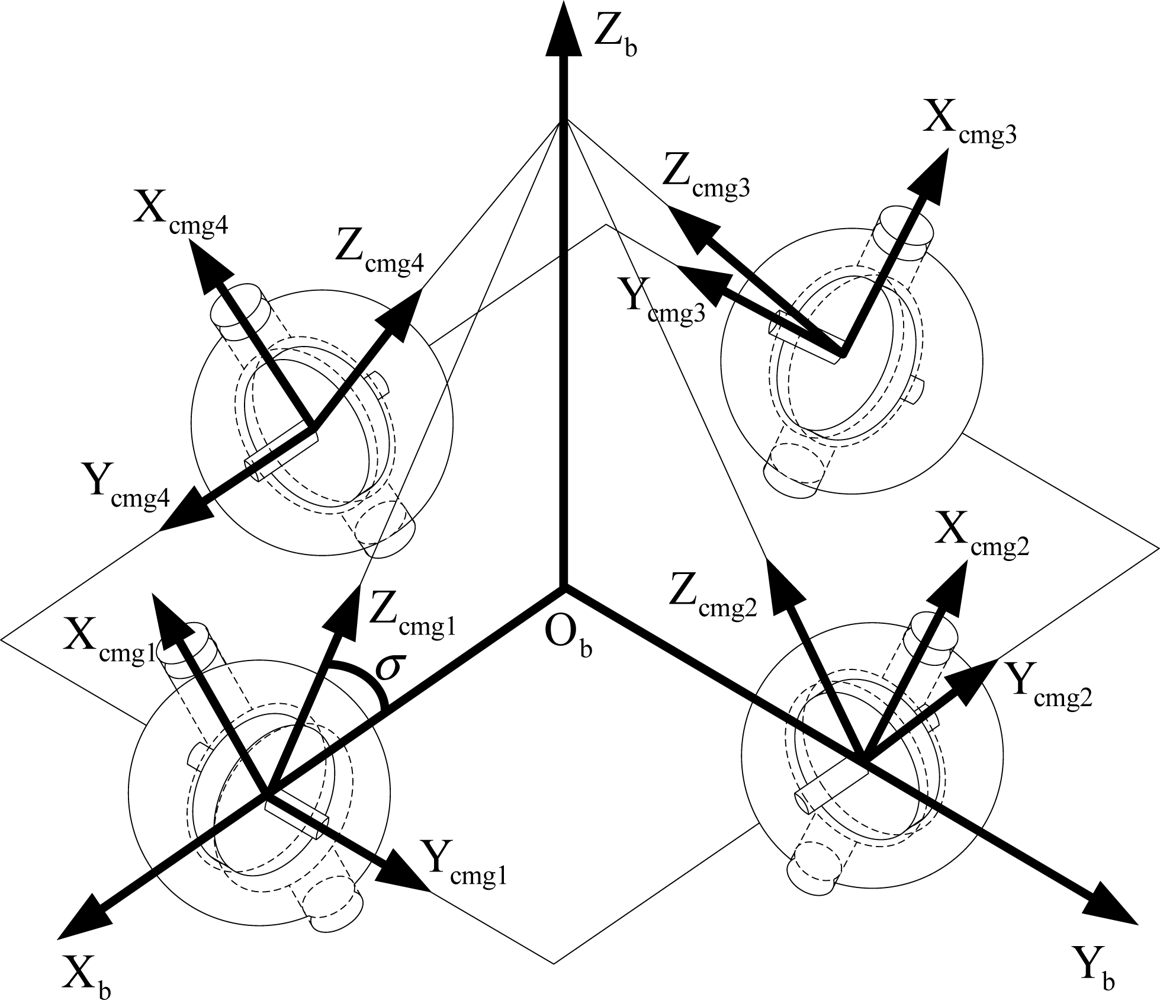
<p>In this paper, the pyramid configuration using four magnetically suspended SGCMGs is adopted (<xref ref-type="fig" rid="f4-sensors-12-16964">Figure 4</xref>). The frame of the <italic>n</italic>-th CMG can be obtained by rotating the satellite body frame <italic>γ<sub>n</sub></italic> about the Z<italic><sub>b</sub></italic> axis, and then rotating <italic>σ<sub>n</sub></italic> about the X<italic><sub>b</sub></italic> axis. <bold>γ =</bold> [<italic>γ</italic><sub>1</sub>  <italic>γ</italic><sub>2</sub>  <italic>γ</italic><sub>3</sub>  <italic>γ</italic><sub>4</sub>]<sup>T</sup> = [90°  180°  270°  0]<sup>T</sup>, <bold>σ</bold> = [<italic>σ</italic><sub>1</sub>  <italic>σ</italic><sub>2</sub>  <italic>σ</italic><sub>3</sub>  <italic>σ</italic><sub>4</sub>]<sup>T</sup> = [53.13°  53.13°  53.13°  53.13°  ]<sup>T</sup>.</p>
<p>By rotating the rotor frame 45° in the negative direction of the Y<italic><sub>g</sub></italic> axis, rotating −<italic>δ</italic> about the X<italic><sub>g</sub></italic> axis, and then transforming according to the installation matrix of the pyramid configuration, the attitude transformation matrix 
<inline-formula>
<mml:math id="mm21" display="inline">
<mml:mrow>
<mml:msubsup>
<mml:mi mathvariant="bold">C</mml:mi>
<mml:mi>r</mml:mi>
<mml:mi>b</mml:mi></mml:msubsup></mml:mrow></mml:math></inline-formula> from rotor frame to satellite body frame can be obtained. Because the magnetic bearing gap is small, the rotation displacement can be ignored relative to the rotation of the gimbal and the satellite, then 
<inline-formula>
<mml:math id="mm22" display="inline">
<mml:msubsup>
<mml:mi mathvariant="bold">C</mml:mi>
<mml:mi>r</mml:mi>
<mml:mi>f</mml:mi></mml:msubsup>
<mml:mo>≈</mml:mo>
<mml:mi mathvariant="bold">E</mml:mi></mml:math></inline-formula>:
<disp-formula id="FD10">
<label>(10)</label>
<mml:math id="mm23" display="block">
<mml:mrow>
<mml:msubsup>
<mml:mi mathvariant="bold">C</mml:mi>
<mml:mi>r</mml:mi>
<mml:mi>b</mml:mi></mml:msubsup>
<mml:mo>=</mml:mo>
<mml:msubsup>
<mml:mi mathvariant="bold">C</mml:mi>
<mml:mi mathvariant="italic">cmg</mml:mi>
<mml:mi>b</mml:mi></mml:msubsup>
<mml:msubsup>
<mml:mi mathvariant="bold">C</mml:mi>
<mml:mi>g</mml:mi>
<mml:mi mathvariant="italic">cmg</mml:mi></mml:msubsup>
<mml:msubsup>
<mml:mi mathvariant="bold">C</mml:mi>
<mml:mi>f</mml:mi>
<mml:mi>g</mml:mi></mml:msubsup>
<mml:msubsup>
<mml:mi mathvariant="bold">C</mml:mi>
<mml:mi>r</mml:mi>
<mml:mi>f</mml:mi></mml:msubsup>
<mml:mo>≈</mml:mo>
<mml:msubsup>
<mml:mi mathvariant="bold">C</mml:mi>
<mml:mi mathvariant="italic">cmg</mml:mi>
<mml:mi>b</mml:mi></mml:msubsup>
<mml:msubsup>
<mml:mi mathvariant="bold">C</mml:mi>
<mml:mi>g</mml:mi>
<mml:mi mathvariant="italic">cmg</mml:mi></mml:msubsup>
<mml:msubsup>
<mml:mi mathvariant="bold">C</mml:mi>
<mml:mi>f</mml:mi>
<mml:mi>g</mml:mi></mml:msubsup></mml:mrow></mml:math></disp-formula>where
<disp-formula id="FD11">
<label>(11)</label>
<mml:math id="mm24" display="block">
<mml:mrow>
<mml:msubsup>
<mml:mi mathvariant="bold">C</mml:mi>
<mml:mi mathvariant="italic">cmg</mml:mi>
<mml:mi>b</mml:mi></mml:msubsup>
<mml:mo>=</mml:mo>
<mml:mrow>
<mml:mo>[</mml:mo>
<mml:mrow>
<mml:mtable>
<mml:mtr>
<mml:mtd>
<mml:mrow>
<mml:mtext>sin</mml:mtext>
<mml:mi>σ</mml:mi>
<mml:mtext>sin</mml:mtext>
<mml:mi>γ</mml:mi></mml:mrow></mml:mtd>
<mml:mtd>
<mml:mrow>
<mml:mtext>cos</mml:mtext>
<mml:mi>γ</mml:mi></mml:mrow></mml:mtd>
<mml:mtd>
<mml:mrow>
<mml:mo>−</mml:mo>
<mml:mtext>cos</mml:mtext>
<mml:mi>σ</mml:mi>
<mml:mtext>sin</mml:mtext>
<mml:mi>γ</mml:mi></mml:mrow></mml:mtd></mml:mtr>
<mml:mtr>
<mml:mtd>
<mml:mrow>
<mml:mo>−</mml:mo>
<mml:mtext>sin</mml:mtext>
<mml:mi>σ</mml:mi>
<mml:mtext>cos</mml:mtext>
<mml:mi>γ</mml:mi></mml:mrow></mml:mtd>
<mml:mtd>
<mml:mrow>
<mml:mtext>sin</mml:mtext>
<mml:mi>γ</mml:mi></mml:mrow></mml:mtd>
<mml:mtd>
<mml:mrow>
<mml:mtext>cos</mml:mtext>
<mml:mi>σ</mml:mi>
<mml:mtext>cos</mml:mtext>
<mml:mi>γ</mml:mi></mml:mrow></mml:mtd></mml:mtr>
<mml:mtr>
<mml:mtd>
<mml:mrow>
<mml:mtext>cos</mml:mtext>
<mml:mi>σ</mml:mi></mml:mrow></mml:mtd>
<mml:mtd>
<mml:mn>0</mml:mn></mml:mtd>
<mml:mtd>
<mml:mrow>
<mml:mtext>sin</mml:mtext>
<mml:mi>σ</mml:mi></mml:mrow></mml:mtd></mml:mtr></mml:mtable></mml:mrow>
<mml:mo>]</mml:mo></mml:mrow>
<mml:mo>,</mml:mo>
<mml:mo> </mml:mo>
<mml:mo> </mml:mo>
<mml:msubsup>
<mml:mi mathvariant="bold">C</mml:mi>
<mml:mi>g</mml:mi>
<mml:mi mathvariant="italic">cmg</mml:mi></mml:msubsup>
<mml:mo>=</mml:mo>
<mml:msup>
<mml:mrow>
<mml:mrow>
<mml:mrow>
<mml:mo>(</mml:mo>
<mml:mrow>
<mml:msubsup>
<mml:mi mathvariant="bold">C</mml:mi>
<mml:mi mathvariant="italic">cmg</mml:mi>
<mml:mi>g</mml:mi></mml:msubsup></mml:mrow>
<mml:mo>)</mml:mo></mml:mrow></mml:mrow></mml:mrow>
<mml:mrow>
<mml:mo>−</mml:mo>
<mml:mn>1</mml:mn></mml:mrow></mml:msup>
<mml:mo>,</mml:mo>
<mml:mo> </mml:mo>
<mml:mo> </mml:mo>
<mml:msubsup>
<mml:mi mathvariant="bold">C</mml:mi>
<mml:mi>f</mml:mi>
<mml:mi>g</mml:mi></mml:msubsup>
<mml:mo>=</mml:mo>
<mml:mrow>
<mml:mo>[</mml:mo>
<mml:mrow>
<mml:mtable>
<mml:mtr>
<mml:mtd>
<mml:mrow>
<mml:mtext>cos</mml:mtext>
<mml:mn>45</mml:mn>
<mml:mo>°</mml:mo></mml:mrow></mml:mtd>
<mml:mtd>
<mml:mn>0</mml:mn></mml:mtd>
<mml:mtd>
<mml:mrow>
<mml:mtext>sin</mml:mtext>
<mml:mn>45</mml:mn>
<mml:mo>°</mml:mo></mml:mrow></mml:mtd></mml:mtr>
<mml:mtr>
<mml:mtd>
<mml:mn>0</mml:mn></mml:mtd>
<mml:mtd>
<mml:mn>1</mml:mn></mml:mtd>
<mml:mtd>
<mml:mn>0</mml:mn></mml:mtd></mml:mtr>
<mml:mtr>
<mml:mtd>
<mml:mrow>
<mml:mo>−</mml:mo>
<mml:mtext>sin</mml:mtext>
<mml:mn>45</mml:mn>
<mml:mo>°</mml:mo></mml:mrow></mml:mtd>
<mml:mtd>
<mml:mn>0</mml:mn></mml:mtd>
<mml:mtd>
<mml:mrow>
<mml:mtext>cos</mml:mtext>
<mml:mn>45</mml:mn>
<mml:mo>°</mml:mo></mml:mrow></mml:mtd></mml:mtr></mml:mtable></mml:mrow>
<mml:mo>]</mml:mo></mml:mrow></mml:mrow></mml:math></disp-formula></p>
<p>The transformation matrix from gimbal frame to body frame is:
<disp-formula id="FD12">
<label>(12)</label>
<mml:math id="mm25" display="block">
<mml:mrow>
<mml:msubsup>
<mml:mi mathvariant="bold">C</mml:mi>
<mml:mi>g</mml:mi>
<mml:mi>b</mml:mi></mml:msubsup>
<mml:mo>=</mml:mo>
<mml:msubsup>
<mml:mi mathvariant="bold">C</mml:mi>
<mml:mi mathvariant="italic">cmg</mml:mi>
<mml:mi>b</mml:mi></mml:msubsup>
<mml:msubsup>
<mml:mi mathvariant="bold">C</mml:mi>
<mml:mi>g</mml:mi>
<mml:mi mathvariant="italic">cmg</mml:mi></mml:msubsup>
<mml:mo>=</mml:mo>
<mml:mrow>
<mml:mo>[</mml:mo>
<mml:mrow>
<mml:mtable>
<mml:mtr>
<mml:mtd>
<mml:mrow>
<mml:mtext>sin</mml:mtext>
<mml:mi>σ</mml:mi>
<mml:mtext>sin</mml:mtext>
<mml:mi>γ</mml:mi></mml:mrow></mml:mtd>
<mml:mtd>
<mml:mrow>
<mml:mtext>cos</mml:mtext>
<mml:mi>γ</mml:mi>
<mml:mtext>cos</mml:mtext>
<mml:mi>δ</mml:mi>
<mml:mo>−</mml:mo>
<mml:mtext>cos</mml:mtext>
<mml:mi>σ</mml:mi>
<mml:mtext>sin</mml:mtext>
<mml:mi>γ</mml:mi>
<mml:mtext>sin</mml:mtext>
<mml:mi>δ</mml:mi></mml:mrow></mml:mtd>
<mml:mtd>
<mml:mrow>
<mml:mo>−</mml:mo>
<mml:mtext>cos</mml:mtext>
<mml:mi>γ</mml:mi>
<mml:mtext>sin</mml:mtext>
<mml:mi>δ</mml:mi>
<mml:mo>−</mml:mo>
<mml:mtext>cos</mml:mtext>
<mml:mi>σ</mml:mi>
<mml:mtext>sin</mml:mtext>
<mml:mi>γ</mml:mi>
<mml:mtext>cos</mml:mtext>
<mml:mi>δ</mml:mi></mml:mrow></mml:mtd></mml:mtr>
<mml:mtr>
<mml:mtd>
<mml:mrow>
<mml:mo>−</mml:mo>
<mml:mtext>sin</mml:mtext>
<mml:mi>σ</mml:mi>
<mml:mtext>cos</mml:mtext>
<mml:mi>γ</mml:mi></mml:mrow></mml:mtd>
<mml:mtd>
<mml:mrow>
<mml:mtext>sin</mml:mtext>
<mml:mi>γ</mml:mi>
<mml:mtext>cos</mml:mtext>
<mml:mi>δ</mml:mi>
<mml:mo>+</mml:mo>
<mml:mtext>cos</mml:mtext>
<mml:mi>σ</mml:mi>
<mml:mtext>cos</mml:mtext>
<mml:mi>γ</mml:mi>
<mml:mtext>sin</mml:mtext>
<mml:mi>δ</mml:mi></mml:mrow></mml:mtd>
<mml:mtd>
<mml:mrow>
<mml:mo>−</mml:mo>
<mml:mtext>sin</mml:mtext>
<mml:mi>γ</mml:mi>
<mml:mtext>sin</mml:mtext>
<mml:mi>δ</mml:mi>
<mml:mo>−</mml:mo>
<mml:mtext>cos</mml:mtext>
<mml:mi>α</mml:mi>
<mml:mtext>cos</mml:mtext>
<mml:mi>γ</mml:mi>
<mml:mtext>cos</mml:mtext>
<mml:mi>δ</mml:mi></mml:mrow></mml:mtd></mml:mtr>
<mml:mtr>
<mml:mtd>
<mml:mrow>
<mml:mtext>cos</mml:mtext>
<mml:mi>σ</mml:mi></mml:mrow></mml:mtd>
<mml:mtd>
<mml:mrow>
<mml:mtext>sin</mml:mtext>
<mml:mi>σ</mml:mi>
<mml:mtext>sin</mml:mtext>
<mml:mi>δ</mml:mi></mml:mrow></mml:mtd>
<mml:mtd>
<mml:mrow>
<mml:mtext>sin</mml:mtext>
<mml:mi>σ</mml:mi>
<mml:mtext>cos</mml:mtext>
<mml:mi>δ</mml:mi></mml:mrow></mml:mtd></mml:mtr></mml:mtable></mml:mrow>
<mml:mo>]</mml:mo></mml:mrow></mml:mrow></mml:math></disp-formula></p>
<p><xref ref-type="disp-formula" rid="FD10">Equation (10)</xref> can be written as:
<disp-formula id="FD13">
<label>(13)</label>
<mml:math id="mm26" display="block">
<mml:mrow>
<mml:msubsup>
<mml:mi mathvariant="bold">C</mml:mi>
<mml:mi>r</mml:mi>
<mml:mi>b</mml:mi></mml:msubsup>
<mml:mo>=</mml:mo>
<mml:mrow>
<mml:mo>[</mml:mo>
<mml:mrow>
<mml:mtable>
<mml:mtr>
<mml:mtd>
<mml:mrow>
<mml:mfrac>
<mml:mrow>
<mml:msqrt>
<mml:mn>2</mml:mn></mml:msqrt></mml:mrow>
<mml:mn>2</mml:mn></mml:mfrac>
<mml:mtext>sin</mml:mtext>
<mml:mi>δ</mml:mi>
<mml:mtext>cos</mml:mtext>
<mml:mi>γ</mml:mi>
<mml:mo>+</mml:mo>
<mml:mfrac>
<mml:mrow>
<mml:msqrt>
<mml:mn>2</mml:mn></mml:msqrt></mml:mrow>
<mml:mn>2</mml:mn></mml:mfrac>
<mml:mtext>sin</mml:mtext>
<mml:mi>σ</mml:mi>
<mml:mtext>sin</mml:mtext>
<mml:mi>γ</mml:mi>
<mml:mo>+</mml:mo>
<mml:mfrac>
<mml:mrow>
<mml:msqrt>
<mml:mn>2</mml:mn></mml:msqrt></mml:mrow>
<mml:mn>2</mml:mn></mml:mfrac>
<mml:mtext>cos</mml:mtext>
<mml:mi>δ</mml:mi>
<mml:mtext>cos</mml:mtext>
<mml:mi>σ</mml:mi>
<mml:mtext>sin</mml:mtext>
<mml:mi>γ</mml:mi></mml:mrow></mml:mtd>
<mml:mtd>
<mml:mrow>
<mml:mtext>cos</mml:mtext>
<mml:mi>δ</mml:mi>
<mml:mtext>cos</mml:mtext>
<mml:mi>γ</mml:mi>
<mml:mo>−</mml:mo>
<mml:mtext>sin</mml:mtext>
<mml:mi>δ</mml:mi>
<mml:mtext>cos</mml:mtext>
<mml:mi>σ</mml:mi>
<mml:mtext>sin</mml:mtext>
<mml:mi>γ</mml:mi></mml:mrow></mml:mtd>
<mml:mtd>
<mml:mrow>
<mml:mo>−</mml:mo>
<mml:mfrac>
<mml:mrow>
<mml:msqrt>
<mml:mn>2</mml:mn></mml:msqrt></mml:mrow>
<mml:mn>2</mml:mn></mml:mfrac>
<mml:mtext>sin</mml:mtext>
<mml:mi>δ</mml:mi>
<mml:mtext>cos</mml:mtext>
<mml:mi>γ</mml:mi>
<mml:mo>+</mml:mo>
<mml:mfrac>
<mml:mrow>
<mml:msqrt>
<mml:mn>2</mml:mn></mml:msqrt></mml:mrow>
<mml:mn>2</mml:mn></mml:mfrac>
<mml:mtext>sin</mml:mtext>
<mml:mi>σ</mml:mi>
<mml:mtext>sin</mml:mtext>
<mml:mi>γ</mml:mi>
<mml:mo>−</mml:mo>
<mml:mfrac>
<mml:mrow>
<mml:msqrt>
<mml:mn>2</mml:mn></mml:msqrt></mml:mrow>
<mml:mn>2</mml:mn></mml:mfrac>
<mml:mtext>cos</mml:mtext>
<mml:mi>δ</mml:mi>
<mml:mtext>cos</mml:mtext>
<mml:mi>σ</mml:mi>
<mml:mtext>sin</mml:mtext>
<mml:mi>γ</mml:mi></mml:mrow></mml:mtd></mml:mtr>
<mml:mtr>
<mml:mtd>
<mml:mrow>
<mml:mfrac>
<mml:mrow>
<mml:msqrt>
<mml:mn>2</mml:mn></mml:msqrt></mml:mrow>
<mml:mn>2</mml:mn></mml:mfrac>
<mml:mtext>sin</mml:mtext>
<mml:mi>δ</mml:mi>
<mml:mtext>sin</mml:mtext>
<mml:mi>γ</mml:mi>
<mml:mo>−</mml:mo>
<mml:mfrac>
<mml:mrow>
<mml:msqrt>
<mml:mn>2</mml:mn></mml:msqrt></mml:mrow>
<mml:mn>2</mml:mn></mml:mfrac>
<mml:mtext>sin</mml:mtext>
<mml:mi>σ</mml:mi>
<mml:mtext>cos</mml:mtext>
<mml:mi>γ</mml:mi>
<mml:mo>−</mml:mo>
<mml:mfrac>
<mml:mrow>
<mml:msqrt>
<mml:mn>2</mml:mn></mml:msqrt></mml:mrow>
<mml:mn>2</mml:mn></mml:mfrac>
<mml:mtext>cos</mml:mtext>
<mml:mi>δ</mml:mi>
<mml:mtext>cos</mml:mtext>
<mml:mi>σ</mml:mi>
<mml:mtext>cos</mml:mtext>
<mml:mi>γ</mml:mi></mml:mrow></mml:mtd>
<mml:mtd>
<mml:mrow>
<mml:mtext>cos</mml:mtext>
<mml:mi>δ</mml:mi>
<mml:mtext>sin</mml:mtext>
<mml:mi>γ</mml:mi>
<mml:mo>+</mml:mo>
<mml:mtext>sin</mml:mtext>
<mml:mi>δ</mml:mi>
<mml:mtext>cos</mml:mtext>
<mml:mi>σ</mml:mi>
<mml:mtext>cos</mml:mtext>
<mml:mi>γ</mml:mi></mml:mrow></mml:mtd>
<mml:mtd>
<mml:mrow>
<mml:mo>−</mml:mo>
<mml:mfrac>
<mml:mrow>
<mml:msqrt>
<mml:mn>2</mml:mn></mml:msqrt></mml:mrow>
<mml:mn>2</mml:mn></mml:mfrac>
<mml:mtext>sin</mml:mtext>
<mml:mi>δ</mml:mi>
<mml:mtext>sin</mml:mtext>
<mml:mi>γ</mml:mi>
<mml:mo>−</mml:mo>
<mml:mfrac>
<mml:mrow>
<mml:msqrt>
<mml:mn>2</mml:mn></mml:msqrt></mml:mrow>
<mml:mn>2</mml:mn></mml:mfrac>
<mml:mtext>sin</mml:mtext>
<mml:mi>σ</mml:mi>
<mml:mtext>cos</mml:mtext>
<mml:mi>γ</mml:mi>
<mml:mo>+</mml:mo>
<mml:mfrac>
<mml:mrow>
<mml:msqrt>
<mml:mn>2</mml:mn></mml:msqrt></mml:mrow>
<mml:mn>2</mml:mn></mml:mfrac>
<mml:mtext>cos</mml:mtext>
<mml:mi>δ</mml:mi>
<mml:mtext>cos</mml:mtext>
<mml:mi>σ</mml:mi>
<mml:mtext>cos</mml:mtext>
<mml:mi>γ</mml:mi></mml:mrow></mml:mtd></mml:mtr>
<mml:mtr>
<mml:mtd>
<mml:mrow>
<mml:mfrac>
<mml:mrow>
<mml:msqrt>
<mml:mn>2</mml:mn></mml:msqrt></mml:mrow>
<mml:mn>2</mml:mn></mml:mfrac>
<mml:mtext>cos</mml:mtext>
<mml:mi>σ</mml:mi>
<mml:mo>−</mml:mo>
<mml:mfrac>
<mml:mrow>
<mml:msqrt>
<mml:mn>2</mml:mn></mml:msqrt></mml:mrow>
<mml:mn>2</mml:mn></mml:mfrac>
<mml:mtext>cos</mml:mtext>
<mml:mi>δ</mml:mi>
<mml:mtext>sin</mml:mtext>
<mml:mi>σ</mml:mi></mml:mrow></mml:mtd>
<mml:mtd>
<mml:mrow>
<mml:mtext>sin</mml:mtext>
<mml:mi>δ</mml:mi>
<mml:mtext>sin</mml:mtext>
<mml:mi>σ</mml:mi></mml:mrow></mml:mtd>
<mml:mtd>
<mml:mrow>
<mml:mfrac>
<mml:mrow>
<mml:msqrt>
<mml:mn>2</mml:mn></mml:msqrt></mml:mrow>
<mml:mn>2</mml:mn></mml:mfrac>
<mml:mtext>cos</mml:mtext>
<mml:mi>σ</mml:mi>
<mml:mo>+</mml:mo>
<mml:mfrac>
<mml:mrow>
<mml:msqrt>
<mml:mn>2</mml:mn></mml:msqrt></mml:mrow>
<mml:mn>2</mml:mn></mml:mfrac>
<mml:mtext>cos</mml:mtext>
<mml:mi>δ</mml:mi>
<mml:mtext>sin</mml:mtext>
<mml:mi>σ</mml:mi></mml:mrow></mml:mtd></mml:mtr></mml:mtable></mml:mrow>
<mml:mo>]</mml:mo></mml:mrow></mml:mrow></mml:math></disp-formula></p>
<p>Then, the absolute angular velocity of the CMG frame can be obtained:
<disp-formula id="FD14">
<label>(14)</label>
<mml:math id="mm27" display="block">
<mml:mrow>
<mml:msubsup>
<mml:mi mathvariant="bold">C</mml:mi>
<mml:mi>b</mml:mi>
<mml:mi mathvariant="italic">cmg</mml:mi></mml:msubsup>
<mml:msubsup>
<mml:mi mathvariant="bold">ω</mml:mi>
<mml:mi mathvariant="italic">ib</mml:mi>
<mml:mi>b</mml:mi></mml:msubsup>
<mml:mo>+</mml:mo>
<mml:msup>
<mml:mi mathvariant="bold">ω</mml:mi>
<mml:mi>g</mml:mi></mml:msup>
<mml:mo>=</mml:mo>
<mml:mrow>
<mml:mo>[</mml:mo>
<mml:mrow>
<mml:mtable>
<mml:mtr>
<mml:mtd>
<mml:mrow>
<mml:mtext>sin</mml:mtext>
<mml:mi>σ</mml:mi>
<mml:mtext>sin</mml:mtext>
<mml:mi>γ</mml:mi></mml:mrow></mml:mtd>
<mml:mtd>
<mml:mrow>
<mml:mo>−</mml:mo>
<mml:mtext>sin</mml:mtext>
<mml:mi>σ</mml:mi>
<mml:mtext>cos</mml:mtext>
<mml:mi>γ</mml:mi></mml:mrow></mml:mtd>
<mml:mtd>
<mml:mrow>
<mml:mtext>cos</mml:mtext>
<mml:mi>σ</mml:mi></mml:mrow></mml:mtd></mml:mtr>
<mml:mtr>
<mml:mtd>
<mml:mrow>
<mml:mtext>cos</mml:mtext>
<mml:mi>γ</mml:mi></mml:mrow></mml:mtd>
<mml:mtd>
<mml:mrow>
<mml:mtext>sin</mml:mtext>
<mml:mi>γ</mml:mi></mml:mrow></mml:mtd>
<mml:mtd>
<mml:mn>0</mml:mn></mml:mtd></mml:mtr>
<mml:mtr>
<mml:mtd>
<mml:mrow>
<mml:mo>−</mml:mo>
<mml:mtext>cos</mml:mtext>
<mml:mi>σ</mml:mi>
<mml:mtext>sin</mml:mtext>
<mml:mi>γ</mml:mi></mml:mrow></mml:mtd>
<mml:mtd>
<mml:mrow>
<mml:mtext>cos</mml:mtext>
<mml:mi>σ</mml:mi>
<mml:mtext>cos</mml:mtext>
<mml:mi>γ</mml:mi></mml:mrow></mml:mtd>
<mml:mtd>
<mml:mrow>
<mml:mtext>sin</mml:mtext>
<mml:mi>σ</mml:mi></mml:mrow></mml:mtd></mml:mtr></mml:mtable></mml:mrow>
<mml:mo>]</mml:mo></mml:mrow>
<mml:mrow>
<mml:mo>[</mml:mo>
<mml:mrow>
<mml:mtable>
<mml:mtr>
<mml:mtd>
<mml:mrow>
<mml:msubsup>
<mml:mi>ω</mml:mi>
<mml:mi mathvariant="italic">ibx</mml:mi>
<mml:mi>b</mml:mi></mml:msubsup></mml:mrow></mml:mtd></mml:mtr>
<mml:mtr>
<mml:mtd>
<mml:mrow>
<mml:msubsup>
<mml:mi>ω</mml:mi>
<mml:mi mathvariant="italic">iby</mml:mi>
<mml:mi>b</mml:mi></mml:msubsup></mml:mrow></mml:mtd></mml:mtr>
<mml:mtr>
<mml:mtd>
<mml:mrow>
<mml:msubsup>
<mml:mi>ω</mml:mi>
<mml:mi mathvariant="italic">ibz</mml:mi>
<mml:mi>b</mml:mi></mml:msubsup></mml:mrow></mml:mtd></mml:mtr></mml:mtable></mml:mrow>
<mml:mo>]</mml:mo></mml:mrow>
<mml:mo>+</mml:mo>
<mml:mrow>
<mml:mo>[</mml:mo>
<mml:mrow>
<mml:mtable>
<mml:mtr>
<mml:mtd>
<mml:mover accent="true">
<mml:mi>δ</mml:mi>
<mml:mo>˙</mml:mo></mml:mover></mml:mtd></mml:mtr>
<mml:mtr>
<mml:mtd>
<mml:mn>0</mml:mn></mml:mtd></mml:mtr>
<mml:mtr>
<mml:mtd>
<mml:mn>0</mml:mn></mml:mtd></mml:mtr></mml:mtable></mml:mrow>
<mml:mo>]</mml:mo></mml:mrow></mml:mrow></mml:math></disp-formula></p>
<p>The torque generated by the rotor in body frame can be obtained after the sum of four CMGs:
<disp-formula id="FD15">
<label>(15)</label>
<mml:math id="mm28" display="block">
<mml:mrow>
<mml:msup>
<mml:mi mathvariant="bold">M</mml:mi>
<mml:mi>b</mml:mi></mml:msup>
<mml:mo>=</mml:mo>
<mml:munderover>
<mml:mo>∑</mml:mo>
<mml:mrow>
<mml:mi>n</mml:mi>
<mml:mo>=</mml:mo>
<mml:mn>1</mml:mn></mml:mrow>
<mml:mn>4</mml:mn></mml:munderover>
<mml:mrow>
<mml:msubsup>
<mml:mi mathvariant="bold">C</mml:mi>
<mml:mrow>
<mml:mi>r</mml:mi>
<mml:mo>,</mml:mo>
<mml:mi>n</mml:mi></mml:mrow>
<mml:mi>b</mml:mi></mml:msubsup>
<mml:msubsup>
<mml:mi mathvariant="bold">M</mml:mi>
<mml:mi>n</mml:mi>
<mml:mi>r</mml:mi></mml:msubsup></mml:mrow></mml:mrow></mml:math></disp-formula></p>
<p>By <xref ref-type="disp-formula" rid="FD15">Equation (15)</xref>, <bold>M</bold><italic><sup>b</sup></italic>, the torque of the magnetically suspended SGCMG cluster acting on the three inertial principal axis of the satellite can be obtained.</p></sec>
<sec>
<label>2.3.</label>
<title>Satellite Attitude Dynamic Model Including Magnetically Suspended SGCMGs</title>
<p>The satellite attitude dynamic equation including magnetically suspended SGCMGs can be obtained by the law of angular momentum conservation:
<disp-formula id="FD16">
<label>(16)</label>
<mml:math id="mm29" display="block">
<mml:mrow>
<mml:mi mathvariant="bold">J</mml:mi>
<mml:msubsup>
<mml:mrow>
<mml:mover accent="true">
<mml:mi mathvariant="bold">ω</mml:mi>
<mml:mo>˙</mml:mo></mml:mover></mml:mrow>
<mml:mi mathvariant="italic">ib</mml:mi>
<mml:mi>b</mml:mi></mml:msubsup>
<mml:mo>+</mml:mo>
<mml:msubsup>
<mml:mrow>
<mml:mi mathvariant="bold">ω</mml:mi></mml:mrow>
<mml:mi mathvariant="italic">ib</mml:mi>
<mml:mi>b</mml:mi></mml:msubsup>
<mml:mo>×</mml:mo>
<mml:mrow>
<mml:mo>(</mml:mo>
<mml:mrow>
<mml:mi mathvariant="bold">J</mml:mi>
<mml:msubsup>
<mml:mrow>
<mml:mi mathvariant="bold">ω</mml:mi></mml:mrow>
<mml:mi mathvariant="italic">ib</mml:mi>
<mml:mi>b</mml:mi></mml:msubsup></mml:mrow>
<mml:mo>)</mml:mo></mml:mrow>
<mml:mo>+</mml:mo>
<mml:msup>
<mml:mi mathvariant="bold">M</mml:mi>
<mml:mi>b</mml:mi></mml:msup>
<mml:mo>=</mml:mo>
<mml:msub>
<mml:mi mathvariant="bold">u</mml:mi>
<mml:mi>d</mml:mi></mml:msub></mml:mrow></mml:math></disp-formula>where <bold>J</bold> is moment of inertia of the satellite. 
<inline-formula>
<mml:math id="mm30" display="inline">
<mml:mrow>
<mml:msubsup>
<mml:mrow>
<mml:mi mathvariant="bold">ω</mml:mi></mml:mrow>
<mml:mi mathvariant="italic">ib</mml:mi>
<mml:mi>b</mml:mi></mml:msubsup></mml:mrow></mml:math></inline-formula> is the angular velocity vector relative to the inertia frame, and it is shown in the body frame. <bold>u</bold><italic><sub>d</sub></italic> is the environmental disturbance torque, such as aerodynamic drag gravity gradient, solar radiation pressure and Earth magnetic torque. 
<inline-formula>
<mml:math id="mm31" display="inline">
<mml:mrow>
<mml:msubsup>
<mml:mrow>
<mml:mi mathvariant="bold">ω</mml:mi></mml:mrow>
<mml:mi mathvariant="italic">ib</mml:mi>
<mml:mi>b</mml:mi></mml:msubsup>
<mml:mo>×</mml:mo>
<mml:mrow>
<mml:mo>(</mml:mo>
<mml:mrow>
<mml:mi mathvariant="bold">J</mml:mi>
<mml:msubsup>
<mml:mrow>
<mml:mi mathvariant="bold">ω</mml:mi></mml:mrow>
<mml:mi mathvariant="italic">ib</mml:mi>
<mml:mi>b</mml:mi></mml:msubsup></mml:mrow>
<mml:mo>)</mml:mo></mml:mrow></mml:mrow></mml:math></inline-formula> represents the gyroscope torque generated by the satellite rotation.</p>
<p><xref ref-type="disp-formula" rid="FD16">Equation (16)</xref> can be simplified to 
<inline-formula>
<mml:math id="mm32" display="inline">
<mml:mrow>
<mml:mi mathvariant="bold">J</mml:mi>
<mml:msubsup>
<mml:mrow>
<mml:mover accent="true">
<mml:mi mathvariant="bold">ω</mml:mi>
<mml:mo>˙</mml:mo></mml:mover></mml:mrow>
<mml:mi mathvariant="italic">ib</mml:mi>
<mml:mi>b</mml:mi></mml:msubsup>
<mml:mo>=</mml:mo>
<mml:msub>
<mml:mi mathvariant="bold">u</mml:mi>
<mml:mi>c</mml:mi></mml:msub>
<mml:mo>+</mml:mo>
<mml:msub>
<mml:mi mathvariant="bold">u</mml:mi>
<mml:mi>d</mml:mi></mml:msub></mml:mrow></mml:math></inline-formula>, where <bold>u</bold><italic><sub>c</sub></italic> is the command control torque acting on the satellite. The command torque for magnetically suspended SGCMGs is:
<disp-formula id="FD17">
<label>(17)</label>
<mml:math id="mm33" display="block">
<mml:mrow>
<mml:msub>
<mml:mi mathvariant="bold">u</mml:mi>
<mml:mi>g</mml:mi></mml:msub>
<mml:mo>=</mml:mo>
<mml:mo>−</mml:mo>
<mml:msub>
<mml:mi mathvariant="bold">u</mml:mi>
<mml:mi>c</mml:mi></mml:msub>
<mml:mo>−</mml:mo>
<mml:msubsup>
<mml:mrow>
<mml:mi mathvariant="bold">ω</mml:mi></mml:mrow>
<mml:mi mathvariant="italic">ib</mml:mi>
<mml:mi>b</mml:mi></mml:msubsup>
<mml:mo>×</mml:mo>
<mml:msub>
<mml:mi mathvariant="bold">H</mml:mi>
<mml:mi>g</mml:mi></mml:msub>
<mml:mo>−</mml:mo>
<mml:msubsup>
<mml:mi mathvariant="bold">ω</mml:mi>
<mml:mi mathvariant="italic">ib</mml:mi>
<mml:mi>b</mml:mi></mml:msubsup>
<mml:mo>×</mml:mo>
<mml:mrow>
<mml:mo>(</mml:mo>
<mml:mrow>
<mml:mi mathvariant="bold">J</mml:mi>
<mml:msubsup>
<mml:mi mathvariant="bold">ω</mml:mi>
<mml:mi mathvariant="italic">ib</mml:mi>
<mml:mi>b</mml:mi></mml:msubsup></mml:mrow>
<mml:mo>)</mml:mo></mml:mrow></mml:mrow></mml:math></disp-formula>where <bold>H</bold><italic><sub>g</sub></italic> is the total angular momentum of the actuator relative to the satellite body frame. The gimbal angle of four magnetically suspended SGCMGs is <bold>δ</bold> = [<italic>δ</italic><sub>1</sub>  <italic>δ</italic><sub>2</sub>  <italic>δ</italic><sub>3</sub>  <italic>δ</italic><sub>4</sub>]<sup>T</sup>, where <italic>δ<sub>n</sub></italic> represents the gimbal angle of the <italic>n</italic> -th CMG. By substituting <bold>γ</bold> into <xref ref-type="disp-formula" rid="FD12">Equation (12)</xref>, the total momentum of four magnetically suspended SGCMGs is:
<disp-formula id="FD18">
<label>(18)</label>
<mml:math id="mm34" display="block">
<mml:mrow>
<mml:msub>
<mml:mrow>
<mml:mi mathvariant="bold">H</mml:mi></mml:mrow>
<mml:mi>g</mml:mi></mml:msub>
<mml:mo>=</mml:mo>
<mml:msub>
<mml:mi>h</mml:mi>
<mml:mn>0</mml:mn></mml:msub>
<mml:mrow>
<mml:mo>[</mml:mo>
<mml:mrow>
<mml:mtable>
<mml:mtr>
<mml:mtd>
<mml:mrow>
<mml:mo>−</mml:mo>
<mml:mtext>cos</mml:mtext>
<mml:msub>
<mml:mrow>
<mml:mi>σ</mml:mi></mml:mrow>
<mml:mn>1</mml:mn></mml:msub>
<mml:mtext>sin</mml:mtext>
<mml:msub>
<mml:mrow>
<mml:mi>δ</mml:mi></mml:mrow>
<mml:mn>1</mml:mn></mml:msub>
<mml:mo>−</mml:mo>
<mml:mtext>cos</mml:mtext>
<mml:msub>
<mml:mrow>
<mml:mi>δ</mml:mi></mml:mrow>
<mml:mn>2</mml:mn></mml:msub>
<mml:mo>+</mml:mo>
<mml:mtext>cos</mml:mtext>
<mml:msub>
<mml:mrow>
<mml:mi>σ</mml:mi></mml:mrow>
<mml:mn>3</mml:mn></mml:msub>
<mml:mtext>sin</mml:mtext>
<mml:msub>
<mml:mrow>
<mml:mi>δ</mml:mi></mml:mrow>
<mml:mn>3</mml:mn></mml:msub>
<mml:mo>+</mml:mo>
<mml:mtext>cos</mml:mtext>
<mml:msub>
<mml:mrow>
<mml:mi>δ</mml:mi></mml:mrow>
<mml:mn>4</mml:mn></mml:msub></mml:mrow></mml:mtd></mml:mtr>
<mml:mtr>
<mml:mtd>
<mml:mrow>
<mml:mtext>cos</mml:mtext>
<mml:msub>
<mml:mrow>
<mml:mi>δ</mml:mi></mml:mrow>
<mml:mn>1</mml:mn></mml:msub>
<mml:mo>−</mml:mo>
<mml:mtext>cos</mml:mtext>
<mml:msub>
<mml:mrow>
<mml:mi>σ</mml:mi></mml:mrow>
<mml:mn>2</mml:mn></mml:msub>
<mml:mtext>sin</mml:mtext>
<mml:msub>
<mml:mrow>
<mml:mi>δ</mml:mi></mml:mrow>
<mml:mn>2</mml:mn></mml:msub>
<mml:mo>−</mml:mo>
<mml:mtext>cos</mml:mtext>
<mml:msub>
<mml:mrow>
<mml:mi>δ</mml:mi></mml:mrow>
<mml:mn>3</mml:mn></mml:msub>
<mml:mo>+</mml:mo>
<mml:mtext>cos</mml:mtext>
<mml:msub>
<mml:mrow>
<mml:mi>σ</mml:mi></mml:mrow>
<mml:mn>4</mml:mn></mml:msub>
<mml:mtext>sin</mml:mtext>
<mml:msub>
<mml:mrow>
<mml:mi>δ</mml:mi></mml:mrow>
<mml:mn>4</mml:mn></mml:msub></mml:mrow></mml:mtd></mml:mtr>
<mml:mtr>
<mml:mtd>
<mml:mrow>
<mml:mtext>sin</mml:mtext>
<mml:msub>
<mml:mrow>
<mml:mi>σ</mml:mi></mml:mrow>
<mml:mn>1</mml:mn></mml:msub>
<mml:mtext>sin</mml:mtext>
<mml:msub>
<mml:mrow>
<mml:mi>δ</mml:mi></mml:mrow>
<mml:mn>1</mml:mn></mml:msub>
<mml:mo>+</mml:mo>
<mml:mtext>sin</mml:mtext>
<mml:msub>
<mml:mrow>
<mml:mi>σ</mml:mi></mml:mrow>
<mml:mn>2</mml:mn></mml:msub>
<mml:mtext>sin</mml:mtext>
<mml:msub>
<mml:mrow>
<mml:mi>δ</mml:mi></mml:mrow>
<mml:mn>2</mml:mn></mml:msub>
<mml:mo>+</mml:mo>
<mml:mtext>sin</mml:mtext>
<mml:msub>
<mml:mrow>
<mml:mi>σ</mml:mi></mml:mrow>
<mml:mn>3</mml:mn></mml:msub>
<mml:mtext>sin</mml:mtext>
<mml:msub>
<mml:mrow>
<mml:mi>δ</mml:mi></mml:mrow>
<mml:mn>3</mml:mn></mml:msub>
<mml:mo>+</mml:mo>
<mml:mtext>sin</mml:mtext>
<mml:msub>
<mml:mrow>
<mml:mi>σ</mml:mi></mml:mrow>
<mml:mn>4</mml:mn></mml:msub>
<mml:mtext>sin</mml:mtext>
<mml:msub>
<mml:mrow>
<mml:mi>δ</mml:mi></mml:mrow>
<mml:mn>4</mml:mn></mml:msub></mml:mrow></mml:mtd></mml:mtr></mml:mtable></mml:mrow>
<mml:mo>]</mml:mo></mml:mrow></mml:mrow></mml:math></disp-formula>where <italic>h</italic><sub>0</sub> = <italic>I<sub>ry</sub></italic>Ω denotes the rotor angular momentum. Then the variation rate of CMG angular momentum in the satellite body frame can be obtained:
<disp-formula id="FD19">
<label>(19)</label>
<mml:math id="mm35" display="block">
<mml:mrow>
<mml:msub>
<mml:mi mathvariant="bold">u</mml:mi>
<mml:mi>g</mml:mi></mml:msub>
<mml:mo>=</mml:mo>
<mml:msub>
<mml:mrow>
<mml:mover accent="true">
<mml:mi mathvariant="bold">H</mml:mi>
<mml:mo>˙</mml:mo></mml:mover></mml:mrow>
<mml:mi>g</mml:mi></mml:msub>
<mml:mo>=</mml:mo>
<mml:mi mathvariant="bold">C</mml:mi>
<mml:mrow>
<mml:mo>(</mml:mo>
<mml:mi mathvariant="bold">δ</mml:mi>
<mml:mo>)</mml:mo></mml:mrow>
<mml:mover accent="true">
<mml:mi mathvariant="bold">δ</mml:mi>
<mml:mo>˙</mml:mo></mml:mover></mml:mrow></mml:math></disp-formula>where <bold>C</bold>(<bold>δ</bold>) is:
<disp-formula id="FD20">
<label>(20)</label>
<mml:math id="mm36" display="block">
<mml:mrow>
<mml:mi mathvariant="bold">C</mml:mi>
<mml:mrow>
<mml:mo>(</mml:mo>
<mml:mi mathvariant="bold">δ</mml:mi>
<mml:mo>)</mml:mo></mml:mrow>
<mml:mo>=</mml:mo>
<mml:mrow>
<mml:mo>[</mml:mo>
<mml:mrow>
<mml:mtable>
<mml:mtr>
<mml:mtd>
<mml:mrow>
<mml:mo>−</mml:mo>
<mml:mtext>cos</mml:mtext>
<mml:msub>
<mml:mrow>
<mml:mi>σ</mml:mi></mml:mrow>
<mml:mn>1</mml:mn></mml:msub>
<mml:mtext>cos</mml:mtext>
<mml:msub>
<mml:mrow>
<mml:mi>δ</mml:mi></mml:mrow>
<mml:mn>1</mml:mn></mml:msub></mml:mrow></mml:mtd>
<mml:mtd>
<mml:mrow>
<mml:mtext>sin</mml:mtext>
<mml:msub>
<mml:mrow>
<mml:mi>δ</mml:mi></mml:mrow>
<mml:mn>2</mml:mn></mml:msub></mml:mrow></mml:mtd>
<mml:mtd>
<mml:mrow>
<mml:mtext>cos</mml:mtext>
<mml:msub>
<mml:mrow>
<mml:mi>σ</mml:mi></mml:mrow>
<mml:mn>3</mml:mn></mml:msub>
<mml:mtext>cos</mml:mtext>
<mml:msub>
<mml:mrow>
<mml:mi>δ</mml:mi></mml:mrow>
<mml:mn>3</mml:mn></mml:msub></mml:mrow></mml:mtd>
<mml:mtd>
<mml:mrow>
<mml:mo>−</mml:mo>
<mml:mtext>sin</mml:mtext>
<mml:msub>
<mml:mrow>
<mml:mi>δ</mml:mi></mml:mrow>
<mml:mn>4</mml:mn></mml:msub></mml:mrow></mml:mtd></mml:mtr>
<mml:mtr>
<mml:mtd>
<mml:mrow>
<mml:mo>−</mml:mo>
<mml:mtext>sin</mml:mtext>
<mml:msub>
<mml:mrow>
<mml:mi>δ</mml:mi></mml:mrow>
<mml:mn>1</mml:mn></mml:msub></mml:mrow></mml:mtd>
<mml:mtd>
<mml:mrow>
<mml:mo>−</mml:mo>
<mml:mtext>cos</mml:mtext>
<mml:msub>
<mml:mrow>
<mml:mi>σ</mml:mi></mml:mrow>
<mml:mn>2</mml:mn></mml:msub>
<mml:mtext>cos</mml:mtext>
<mml:msub>
<mml:mrow>
<mml:mi>δ</mml:mi></mml:mrow>
<mml:mn>2</mml:mn></mml:msub></mml:mrow></mml:mtd>
<mml:mtd>
<mml:mrow>
<mml:mtext>sin</mml:mtext>
<mml:msub>
<mml:mrow>
<mml:mi>δ</mml:mi></mml:mrow>
<mml:mn>3</mml:mn></mml:msub></mml:mrow></mml:mtd>
<mml:mtd>
<mml:mrow>
<mml:mtext>cos</mml:mtext>
<mml:msub>
<mml:mrow>
<mml:mi>σ</mml:mi></mml:mrow>
<mml:mn>4</mml:mn></mml:msub>
<mml:mtext>cos</mml:mtext>
<mml:msub>
<mml:mrow>
<mml:mi>δ</mml:mi></mml:mrow>
<mml:mn>4</mml:mn></mml:msub></mml:mrow></mml:mtd></mml:mtr>
<mml:mtr>
<mml:mtd>
<mml:mrow>
<mml:mtext>sin</mml:mtext>
<mml:msub>
<mml:mrow>
<mml:mi>σ</mml:mi></mml:mrow>
<mml:mn>1</mml:mn></mml:msub>
<mml:mtext>cos</mml:mtext>
<mml:msub>
<mml:mrow>
<mml:mi>δ</mml:mi></mml:mrow>
<mml:mn>1</mml:mn></mml:msub></mml:mrow></mml:mtd>
<mml:mtd>
<mml:mrow>
<mml:mtext>sin</mml:mtext>
<mml:msub>
<mml:mrow>
<mml:mi>σ</mml:mi></mml:mrow>
<mml:mn>2</mml:mn></mml:msub>
<mml:mtext>cos</mml:mtext>
<mml:msub>
<mml:mrow>
<mml:mi>δ</mml:mi></mml:mrow>
<mml:mn>2</mml:mn></mml:msub></mml:mrow></mml:mtd>
<mml:mtd>
<mml:mrow>
<mml:mtext>sin</mml:mtext>
<mml:msub>
<mml:mrow>
<mml:mi>σ</mml:mi></mml:mrow>
<mml:mn>3</mml:mn></mml:msub>
<mml:mtext>cos</mml:mtext>
<mml:msub>
<mml:mrow>
<mml:mi>δ</mml:mi></mml:mrow>
<mml:mn>3</mml:mn></mml:msub></mml:mrow></mml:mtd>
<mml:mtd>
<mml:mrow>
<mml:mtext>sin</mml:mtext>
<mml:msub>
<mml:mrow>
<mml:mi>σ</mml:mi></mml:mrow>
<mml:mn>4</mml:mn></mml:msub>
<mml:mtext>cos</mml:mtext>
<mml:msub>
<mml:mrow>
<mml:mi>δ</mml:mi></mml:mrow>
<mml:mn>4</mml:mn></mml:msub></mml:mrow></mml:mtd></mml:mtr></mml:mtable></mml:mrow>
<mml:mo>]</mml:mo></mml:mrow></mml:mrow></mml:math></disp-formula></p>
<p>The command gimbal rate is calculated by the robust pseudo-inverse steering law with null motion [<xref ref-type="bibr" rid="b15-sensors-12-16964">15</xref>]:
<disp-formula id="FD21">
<label>(21)</label>
<mml:math id="mm37" display="block">
<mml:mrow>
<mml:mover accent="true">
<mml:mi mathvariant="bold">δ</mml:mi>
<mml:mo>˙</mml:mo></mml:mover>
<mml:mo>=</mml:mo>
<mml:msub>
<mml:mrow>
<mml:mover accent="true">
<mml:mi mathvariant="bold">δ</mml:mi>
<mml:mo>˙</mml:mo></mml:mover></mml:mrow>
<mml:mi>C</mml:mi></mml:msub>
<mml:mo>+</mml:mo>
<mml:msub>
<mml:mrow>
<mml:mover accent="true">
<mml:mi mathvariant="bold">δ</mml:mi>
<mml:mo>˙</mml:mo></mml:mover></mml:mrow>
<mml:mi>N</mml:mi></mml:msub></mml:mrow></mml:math></disp-formula>where <bold>δ̇</bold><italic><sub>C</sub></italic> denotes the command value calculated by robust pseudo-inverse steering law, <bold>δ̇</bold><italic><sub>N</sub></italic> denotes the command value calculated by null motion.</p>
<p>The attitude kinematics are described with the quaternion of the satellite body frame relative to the orbit frame, and then the attitude kinematics equation is:
<disp-formula id="FD22">
<label>(22)</label>
<mml:math id="mm38" display="block">
<mml:mrow>
<mml:mover accent="true">
<mml:mi mathvariant="bold">q</mml:mi>
<mml:mo>˙</mml:mo></mml:mover>
<mml:mo>=</mml:mo>
<mml:mfrac>
<mml:mn>1</mml:mn>
<mml:mn>2</mml:mn></mml:mfrac>
<mml:mi mathvariant="bold">q</mml:mi>
<mml:mo>⊗</mml:mo>
<mml:msub>
<mml:mi mathvariant="bold">ω</mml:mi>
<mml:mi mathvariant="italic">ob</mml:mi></mml:msub></mml:mrow></mml:math></disp-formula>where <bold>q</bold> = [<italic>q</italic><sub>0</sub>  <italic>q</italic><sub>1</sub>  <italic>q</italic><sub>2</sub>  <italic>q</italic><sub>3</sub>]<italic><sup>T</sup></italic> represents the attitude quaternion, ⊗ means quaternion multiply. The satellite body rate relative to the orbit is <bold>ω</bold><italic><sub>ob</sub></italic> = <bold>ω</bold><italic><sub>b</sub></italic> − <italic>A</italic><bold>ω</bold><italic><sub>o</sub></italic>. <italic>A</italic> is the attitude rotation matrix relative to the orbit frame. <bold>ω</bold><italic><sub>o</sub></italic> = [0  −<italic>ω</italic><sub>0</sub>  0]<italic><sup>T</sup></italic> is the orbit velocity.</p></sec></sec>
<sec sec-type="intro">
<label>3.</label>
<title>Feedforward Compensation for the Rotor Disturbance Torque</title>
<p>When the satellite maneuvers quickly, the satellite angular velocity and gimbal rate will introduce extra torque on the rotor, and the rotor tilt motion will be enhanced. The disturbance torque can be compensated by the feedforward control. <xref ref-type="fig" rid="f5-sensors-12-16964">Figure 5</xref> gives a diagram of the feedforward compensation.</p>
<p>In order to keep the rotor displacement close to zero, the controller provides the control voltage to maintain the rotor stability. However, the rotation of satellite and gimbal introduces disturbances to the rotor. Feedforward compensation is used to reduce the influence on the rotor. The compensation does not change the control system stability.</p>
<p>The disturbance caused by satellite and gimbal is given in <xref ref-type="disp-formula" rid="FD9">Equation (9)</xref>. When the satellite body and the gimbal are fixed, <italic>δ̇</italic>, <italic>ϕ̇</italic> and <italic>θ̇</italic> are all zero. The torque is generated by the rotor. <xref ref-type="disp-formula" rid="FD9">Equation (9)</xref> is written as:
<disp-formula id="FD23">
<label>(23)</label>
<mml:math id="mm39" display="block">
<mml:mrow>
<mml:msup>
<mml:mi mathvariant="bold">M</mml:mi>
<mml:mi>r</mml:mi></mml:msup>
<mml:mrow>
<mml:mo>(</mml:mo>
<mml:mn>0</mml:mn>
<mml:mo>)</mml:mo></mml:mrow>
<mml:mo>=</mml:mo>
<mml:mrow>
<mml:mo>[</mml:mo>
<mml:mrow>
<mml:mtable>
<mml:mtr>
<mml:mtd>
<mml:mrow>
<mml:mo>−</mml:mo>
<mml:msub>
<mml:mi>I</mml:mi>
<mml:mi mathvariant="italic">ry</mml:mi></mml:msub>
<mml:mi mathvariant="normal">Ω</mml:mi>
<mml:mover accent="true">
<mml:mi>β</mml:mi>
<mml:mo>˙</mml:mo></mml:mover>
<mml:mo>+</mml:mo>
<mml:msub>
<mml:mi>I</mml:mi>
<mml:mi mathvariant="italic">rx</mml:mi></mml:msub>
<mml:mover accent="true">
<mml:mi>α</mml:mi>
<mml:mo>¨</mml:mo></mml:mover></mml:mrow></mml:mtd></mml:mtr>
<mml:mtr>
<mml:mtd>
<mml:mrow>
<mml:mrow>
<mml:mo>(</mml:mo>
<mml:mrow>
<mml:msub>
<mml:mi>I</mml:mi>
<mml:mi mathvariant="italic">rx</mml:mi></mml:msub>
<mml:mo>−</mml:mo>
<mml:msub>
<mml:mi>I</mml:mi>
<mml:mi mathvariant="italic">rz</mml:mi></mml:msub></mml:mrow>
<mml:mo>)</mml:mo></mml:mrow>
<mml:mover accent="true">
<mml:mi>α</mml:mi>
<mml:mo>˙</mml:mo></mml:mover>
<mml:mover accent="true">
<mml:mi>β</mml:mi>
<mml:mo>˙</mml:mo></mml:mover>
<mml:mo>+</mml:mo>
<mml:msub>
<mml:mi>I</mml:mi>
<mml:mtext>ry</mml:mtext></mml:msub>
<mml:mrow>
<mml:mo>(</mml:mo>
<mml:mrow>
<mml:mover accent="true">
<mml:mi mathvariant="normal">Ω</mml:mi>
<mml:mo>˙</mml:mo></mml:mover>
<mml:mo>−</mml:mo>
<mml:mover accent="true">
<mml:mi>α</mml:mi>
<mml:mo>¨</mml:mo></mml:mover>
<mml:mi>β</mml:mi>
<mml:mo>+</mml:mo>
<mml:mi>α</mml:mi>
<mml:mover accent="true">
<mml:mi>β</mml:mi>
<mml:mo>¨</mml:mo></mml:mover></mml:mrow>
<mml:mo>)</mml:mo></mml:mrow></mml:mrow></mml:mtd></mml:mtr>
<mml:mtr>
<mml:mtd>
<mml:mrow>
<mml:msub>
<mml:mi>I</mml:mi>
<mml:mi mathvariant="italic">ry</mml:mi></mml:msub>
<mml:mi mathvariant="normal">Ω</mml:mi>
<mml:mover accent="true">
<mml:mi>α</mml:mi>
<mml:mo>˙</mml:mo></mml:mover>
<mml:mo>+</mml:mo>
<mml:msub>
<mml:mi>I</mml:mi>
<mml:mi mathvariant="italic">rz</mml:mi></mml:msub>
<mml:mover accent="true">
<mml:mi>β</mml:mi>
<mml:mo>¨</mml:mo></mml:mover></mml:mrow></mml:mtd></mml:mtr></mml:mtable></mml:mrow>
<mml:mo>]</mml:mo></mml:mrow></mml:mrow></mml:math></disp-formula></p>
<p>Assuming that the rotor acceleration is zero, Ω̇ = 0, the rotational inertia of the non-rotation axis is uniform, <italic>I<sub>G</sub></italic> = <italic>I<sub>O</sub></italic> = <italic>I<sub>rr</sub></italic>, <italic>I<sub>S</sub></italic> = <italic>I<sub>rz</sub></italic>. By ignoring the first order item that includes <italic>α</italic> and <italic>β</italic>, the above equation can be simplified as:
<disp-formula id="FD24">
<label>(24)</label>
<mml:math id="mm40" display="block">
<mml:mrow>
<mml:msup>
<mml:mi mathvariant="bold">M</mml:mi>
<mml:mi>r</mml:mi></mml:msup>
<mml:mrow>
<mml:mo>(</mml:mo>
<mml:mn>0</mml:mn>
<mml:mo>)</mml:mo></mml:mrow>
<mml:mo>=</mml:mo>
<mml:mrow>
<mml:mo>[</mml:mo>
<mml:mrow>
<mml:mtable>
<mml:mtr>
<mml:mtd>
<mml:mrow>
<mml:mo>−</mml:mo>
<mml:msub>
<mml:mi>I</mml:mi>
<mml:mi mathvariant="italic">ry</mml:mi></mml:msub>
<mml:mi mathvariant="normal">Ω</mml:mi>
<mml:mover accent="true">
<mml:mi>β</mml:mi>
<mml:mo>˙</mml:mo></mml:mover>
<mml:mo>+</mml:mo>
<mml:msub>
<mml:mi>I</mml:mi>
<mml:mi mathvariant="italic">rr</mml:mi></mml:msub>
<mml:mover accent="true">
<mml:mi>α</mml:mi>
<mml:mo>¨</mml:mo></mml:mover></mml:mrow></mml:mtd></mml:mtr>
<mml:mtr>
<mml:mtd>
<mml:mn>0</mml:mn></mml:mtd></mml:mtr>
<mml:mtr>
<mml:mtd>
<mml:mrow>
<mml:msub>
<mml:mi>I</mml:mi>
<mml:mi mathvariant="italic">ry</mml:mi></mml:msub>
<mml:mi mathvariant="normal">Ω</mml:mi>
<mml:mover accent="true">
<mml:mi>α</mml:mi>
<mml:mo>˙</mml:mo></mml:mover>
<mml:mo>+</mml:mo>
<mml:msub>
<mml:mi>I</mml:mi>
<mml:mi mathvariant="italic">rr</mml:mi></mml:msub>
<mml:mover accent="true">
<mml:mi>β</mml:mi>
<mml:mo>¨</mml:mo></mml:mover></mml:mrow></mml:mtd></mml:mtr></mml:mtable></mml:mrow>
<mml:mo>]</mml:mo></mml:mrow></mml:mrow></mml:math></disp-formula></p>
<p>By deleting <bold>M</bold><italic><sup>r</sup></italic> (0) from <bold>M</bold><italic><sup>r</sup></italic>, the equivalent disturbance torque 
<inline-formula>
<mml:math id="mm41" display="inline">
<mml:mrow>
<mml:msubsup>
<mml:mi mathvariant="bold">M</mml:mi>
<mml:mi mathvariant="italic">ext</mml:mi>
<mml:mi>r</mml:mi></mml:msubsup></mml:mrow></mml:math></inline-formula> acting on the magnetic bearing control system can be obtained:
<disp-formula id="FD25">
<label>(25)</label>
<mml:math id="mm42" display="block">
<mml:mrow>
<mml:msubsup>
<mml:mi mathvariant="bold">M</mml:mi>
<mml:mi mathvariant="italic">ext</mml:mi>
<mml:mi>r</mml:mi></mml:msubsup>
<mml:mo>=</mml:mo>
<mml:mrow>
<mml:mo>[</mml:mo>
<mml:mrow>
<mml:mtable>
<mml:mtr>
<mml:mtd>
<mml:mrow>
<mml:mo>−</mml:mo>
<mml:mfrac>
<mml:mrow>
<mml:msqrt>
<mml:mn>2</mml:mn></mml:msqrt></mml:mrow>
<mml:mn>2</mml:mn></mml:mfrac>
<mml:msub>
<mml:mi>I</mml:mi>
<mml:mi mathvariant="italic">ry</mml:mi></mml:msub>
<mml:mi mathvariant="normal">Ω</mml:mi>
<mml:mrow>
<mml:mo>(</mml:mo>
<mml:mrow>
<mml:mover accent="true">
<mml:mi>δ</mml:mi>
<mml:mo>˙</mml:mo></mml:mover>
<mml:mo>^</mml:mo></mml:mover>
<mml:mo>+</mml:mo>
<mml:mover accent="true">
<mml:mi>ϕ</mml:mi>
<mml:mo>˙</mml:mo></mml:mover>
<mml:mtext>cos</mml:mtext>
<mml:mi>δ</mml:mi>
<mml:mo>−</mml:mo>
<mml:mover accent="true">
<mml:mi>θ</mml:mi>
<mml:mo>˙</mml:mo></mml:mover>
<mml:mtext>sin</mml:mtext>
<mml:mi>δ</mml:mi></mml:mrow>
<mml:mo>)</mml:mo></mml:mrow>
<mml:mo>+</mml:mo>
<mml:mfrac>
<mml:mrow>
<mml:msqrt>
<mml:mn>2</mml:mn></mml:msqrt></mml:mrow>
<mml:mn>2</mml:mn></mml:mfrac>
<mml:msub>
<mml:mi>I</mml:mi>
<mml:mi mathvariant="italic">rr</mml:mi></mml:msub>
<mml:mrow>
<mml:mo>(</mml:mo>
<mml:mrow>
<mml:mover accent="true">
<mml:mi>δ</mml:mi>
<mml:mo>¨</mml:mo></mml:mover>
<mml:mo>^</mml:mo></mml:mover>
<mml:mo>−</mml:mo>
<mml:mover accent="true">
<mml:mi>ϕ</mml:mi>
<mml:mo>¨</mml:mo></mml:mover>
<mml:mtext>cos</mml:mtext>
<mml:mi>δ</mml:mi>
<mml:mo>+</mml:mo>
<mml:mover accent="true">
<mml:mi>ϕ</mml:mi>
<mml:mo>˙</mml:mo></mml:mover>
<mml:mover accent="true">
<mml:mi>δ</mml:mi>
<mml:mo>˙</mml:mo></mml:mover>
<mml:mo>^</mml:mo></mml:mover>
<mml:mtext>sin</mml:mtext>
<mml:mi>δ</mml:mi>
<mml:mo>+</mml:mo>
<mml:mover accent="true">
<mml:mi>θ</mml:mi>
<mml:mo>¨</mml:mo></mml:mover>
<mml:mtext>sin</mml:mtext>
<mml:mi>δ</mml:mi>
<mml:mo>+</mml:mo>
<mml:mover accent="true">
<mml:mi>θ</mml:mi>
<mml:mo>˙</mml:mo></mml:mover>
<mml:mover accent="true">
<mml:mi>δ</mml:mi>
<mml:mo>˙</mml:mo></mml:mover>
<mml:mo>^</mml:mo></mml:mover>
<mml:mtext>cos</mml:mtext>
<mml:mi>δ</mml:mi></mml:mrow>
<mml:mo>)</mml:mo></mml:mrow></mml:mrow></mml:mtd></mml:mtr>
<mml:mtr>
<mml:mtd>
<mml:mn>0</mml:mn></mml:mtd></mml:mtr>
<mml:mtr>
<mml:mtd>
<mml:mrow>
<mml:mfrac>
<mml:mrow>
<mml:msqrt>
<mml:mn>2</mml:mn></mml:msqrt></mml:mrow>
<mml:mn>2</mml:mn></mml:mfrac>
<mml:msub>
<mml:mi>I</mml:mi>
<mml:mi mathvariant="italic">ry</mml:mi></mml:msub>
<mml:mi mathvariant="normal">Ω</mml:mi>
<mml:mrow>
<mml:mo>(</mml:mo>
<mml:mrow>
<mml:mover accent="true">
<mml:mi>δ</mml:mi>
<mml:mo>˙</mml:mo></mml:mover>
<mml:mo>^</mml:mo></mml:mover>
<mml:mo>−</mml:mo>
<mml:mover accent="true">
<mml:mi>ϕ</mml:mi>
<mml:mo>˙</mml:mo></mml:mover>
<mml:mtext>cos</mml:mtext>
<mml:mi>δ</mml:mi>
<mml:mo>+</mml:mo>
<mml:mover accent="true">
<mml:mi>θ</mml:mi>
<mml:mo>˙</mml:mo></mml:mover>
<mml:mtext>sin</mml:mtext>
<mml:mi>δ</mml:mi></mml:mrow>
<mml:mo>)</mml:mo></mml:mrow>
<mml:mo>+</mml:mo>
<mml:mfrac>
<mml:mrow>
<mml:msqrt>
<mml:mn>2</mml:mn></mml:msqrt></mml:mrow>
<mml:mn>2</mml:mn></mml:mfrac>
<mml:msub>
<mml:mi>I</mml:mi>
<mml:mi mathvariant="italic">rr</mml:mi></mml:msub>
<mml:mrow>
<mml:mo>(</mml:mo>
<mml:mrow>
<mml:mover accent="true">
<mml:mi>δ</mml:mi>
<mml:mo>¨</mml:mo></mml:mover>
<mml:mo>^</mml:mo></mml:mover>
<mml:mo>+</mml:mo>
<mml:mover accent="true">
<mml:mi>ϕ</mml:mi>
<mml:mo>¨</mml:mo></mml:mover>
<mml:mtext>cos</mml:mtext>
<mml:mi>δ</mml:mi>
<mml:mo>−</mml:mo>
<mml:mover accent="true">
<mml:mi>ϕ</mml:mi>
<mml:mo>˙</mml:mo></mml:mover>
<mml:mover accent="true">
<mml:mi>δ</mml:mi>
<mml:mo>˙</mml:mo></mml:mover>
<mml:mo>^</mml:mo></mml:mover>
<mml:mtext>sin</mml:mtext>
<mml:mi>δ</mml:mi>
<mml:mo>−</mml:mo>
<mml:mover accent="true">
<mml:mi>θ</mml:mi>
<mml:mo>¨</mml:mo></mml:mover>
<mml:mtext>sin</mml:mtext>
<mml:mi>δ</mml:mi>
<mml:mo>−</mml:mo>
<mml:mover accent="true">
<mml:mi>θ</mml:mi>
<mml:mo>˙</mml:mo></mml:mover>
<mml:mover accent="true">
<mml:mi>δ</mml:mi>
<mml:mo>˙</mml:mo></mml:mover>
<mml:mo>^</mml:mo></mml:mover>
<mml:mtext>cos</mml:mtext>
<mml:mi>δ</mml:mi></mml:mrow>
<mml:mo>)</mml:mo></mml:mrow></mml:mrow></mml:mtd></mml:mtr></mml:mtable></mml:mrow>
<mml:mo>]</mml:mo></mml:mrow></mml:mrow></mml:math></disp-formula></p>
<p>Since <italic>I<sub>rz</sub></italic>Ω &gt;&gt; <italic>I<sub>rr</sub></italic>, the gimbal and satellite have more influence on the rotor than their angle acceleration. It is to say, the gyro coupling torque is more obvious than the inertia coupling torque. In designing the steering law, the limited gimbal angular velocity must be considered to prevent the instability. The gimbal angle acceleration should be limited to improve the dynamic response ability.</p></sec>
<sec sec-type="methods|results">
<label>4.</label>
<title>Simulation Results and Analysis</title>
<p>The initial satellite attitude angle is [−20°  50°  30°]<italic><sup>T</sup></italic>. The target satellite attitude angle is [0°  0°  0°]<italic><sup>T</sup></italic>. The moment of inertia of the satellite is [12  12  6]<sup>T</sup> kg · m<sup>2</sup>. The initial gimbal angle is [90°  −90°  90°  −90°]<italic><sup>T</sup></italic>. The radial inertia of the magnetically suspended rotor is <italic>I<sub>rx</sub></italic> = <italic>I<sub>ry</sub></italic> = <italic>I<sub>rr</sub></italic> = 0.0034kg · m<sup>2</sup>, the axial inertia is <italic>I<sub>rz</sub></italic> = 0.0052kg · m<sup>2</sup>, the speed of the rotor is 15,000 r/min. Ω = 500<italic>π</italic>rad/s.</p>
<sec sec-type="intro">
<label>4.1.</label>
<title>The Comparison of with and without Feedforward Compensation not Using an Attitude Control Loop</title>
<p>In this section, aiming at the dynamic characteristics of a single gimbal magnetically suspended CMG, the simulation is performed without the attitude control loop. The gimbal acceleration is 120°/s<sup>2</sup>, the maximal gimbal rate is 10°/s, and the simulation period is 3 s. The gimbal rate limit is <italic>δ̇</italic><sub>max</sub> = 10°/s. <xref ref-type="fig" rid="f6-sensors-12-16964">Figures 6</xref> and <xref ref-type="fig" rid="f7-sensors-12-16964">7</xref> are the simulation results of with and without feedforward compensation. From the local zoom in of <xref ref-type="fig" rid="f6-sensors-12-16964">Figures 6(a)</xref> and <xref ref-type="fig" rid="f7-sensors-12-16964">7(a)</xref>, it can been seen that, the vibration displacement range is decreased to some degree after using the feedforward compensation, and then a faster response and the higher precision of the output torque can be obtained. From the comparison of <xref ref-type="fig" rid="f6-sensors-12-16964">Figure 6(b)</xref> with <xref ref-type="fig" rid="f7-sensors-12-16964">Figure 7(b)</xref>, it can be seen that the overshooting of control current is reduced by using feedforward compensation, and the power consumption is decreased. Because the magnetic bearing control frequency is highly relative to the satellite motion, the disturbance torque induced from the satellite angle velocity can be compensated by the feedforward loop.</p>
<p><xref ref-type="fig" rid="f6-sensors-12-16964">Figures 6(c)</xref> and <xref ref-type="fig" rid="f7-sensors-12-16964">7(c)</xref> give the extent of tilt of the rotor relative to the magnetic bearing. It can be seen that after using feedforward compensation, the tilt extent is reduced, but the relative tilt angle velocity is increased, which can be seen from <xref ref-type="fig" rid="f6-sensors-12-16964">Figures 6(d)</xref> and <xref ref-type="fig" rid="f7-sensors-12-16964">7(d)</xref>. <xref ref-type="fig" rid="f6-sensors-12-16964">Figures 6(e,f)</xref> and <xref ref-type="fig" rid="f7-sensors-12-16964">7(e,f)</xref> correspond to the displacement of the two sides of the rotor. It can be seen that the rotor displacement in the maneuvering process is reduced apparently by the feedforward compensation.</p></sec>
<sec sec-type="intro">
<label>4.2.</label>
<title>The Comparison of with and without Feedforward Compensation Using Attitude Control Loop</title>
<p>The attitude control period is 0.5 s. The maximal gimbal rate is <italic>δ̇</italic><sub>max</sub> = 10°/s. The simulation results of the three-axis attitude control of the satellite with feedforward compensation are given in <xref ref-type="fig" rid="f8-sensors-12-16964">Figures 8</xref>–<xref ref-type="fig" rid="f13-sensors-12-16964">13</xref>. <xref ref-type="fig" rid="f8-sensors-12-16964">Figure 8</xref> is the satellite attitude angle. <xref ref-type="fig" rid="f9-sensors-12-16964">Figure 9</xref> is the satellite angle velocity. <xref ref-type="fig" rid="f10-sensors-12-16964">Figure 10</xref> gives the gimbal rates of four magnetically suspended SGCMGs. <xref ref-type="fig" rid="f11-sensors-12-16964">Figure 11</xref> gives the gimbal angles of four magnetically suspended SGCMGs. <xref ref-type="fig" rid="f12-sensors-12-16964">Figure 12</xref> is the satellite angle acceleration.</p>
<p>The magnetic bearing force in each channel depends on the magnetic bearing coefficient, the magnetic gap of the two sides of the magnetic bearing, the bias current, the rotor displacement and the control current, <italic>etc</italic>. When the magnetic bearing design is finished, it is determined by the magnetic bearing coefficient and magnetic bearing gap. By adjusting the control current, the magnetic bearing force is changed to assure the convergence of rotor displacement, but the magnetic bearing force has a nonlinear relationship with the rotor displacement and the control current. The magnetic bearing controller is used to make sure the stability under the working point.</p>
<p>In <xref ref-type="fig" rid="f14-sensors-12-16964">Figures 14</xref>–<xref ref-type="fig" rid="f19-sensors-12-16964">19</xref>, the left column gives the rotor X–Y displacement, the magnitude of rotor displacement and control current without feedforward compensation. The right column gives the results with feedforward compensation.</p>
<p>It can be seen that, after using feedforward compensation, the rotor displacement is reduced to about 30%, which decreases the risk of the rotor instability. <xref ref-type="fig" rid="f18-sensors-12-16964">Figures 18</xref>–<xref ref-type="fig" rid="f19-sensors-12-16964">19</xref> show that the control current does not vary apparently. Although the rotor displacement and the given control current are reduced, extra control current is needed for feedforward compensation. It is to say, the command torque is invariant. The torque is output by the control current to assure the stable suspending of the rotor, and so the control current did not vary apparently. By using feedforward compensation, the maximal displacement of the rotor is less than 10% of the magnetic bearing protecting gap, which can ensure the requirement of the stability of magnetically suspended rotor. <xref ref-type="fig" rid="f20-sensors-12-16964">Figures 20</xref>–<xref ref-type="fig" rid="f23-sensors-12-16964">23</xref> give <italic>α</italic>, <italic>β</italic>, <italic>α̇</italic> and <italic>β̇</italic> of the magnetically suspended SGCMG rotor, which describe the motion of the rotor relative to the magnetic bearing.</p>
<p>By using feedforward compensation for the magnetically suspended control system, the response of angle acceleration and angle velocity becomes faster owing to the increase of the control current, which decreases the rotor angle displacement. There is a magnetic saturation problem in the magnetic bearing design, so there exists a magnetic bearing control current saturation limit. When the satellite and the gimbal rate exceed the limit, the additional disturbance torque on the rotor is large, which exceeds the extent of the control current, and then the rotor becomes instable, even resulting in CMG failure. This will influence the stability of the whole system. When the maximal gimbal rate limit is <italic>δ̇</italic><sub>max</sub> = 12°/s, the results of not using feedforward compensation are shown in <xref ref-type="fig" rid="f24-sensors-12-16964">Figures 24</xref> and <xref ref-type="fig" rid="f25-sensors-12-16964">25</xref>.</p>
<p>The terminative condition of the simulation is whether the rotor displacement exceeds the magnetic gap (100 μm) or not. The above figures show that, the simulation finish in less than 1 s. The reason is that magnetically suspended SGCMG3 becomes instable. Because the gimbal angular acceleration command limit is not performed, the overshooting of gimbal servo system results in the real gimbal rate being larger than 12°/s, and then the equivalent additive magnetic bearing torque is large, which results in an increase of the rotor displacement. There exists the magnetic bearing control current saturation limit, it is difficult to provide sufficient magnetic bearing torque, which results in the rotor displacement exceeding the approximately linear zone and reaching the magnetic gap instantaneously, and then the magnetically suspended rotor becomes instable. In the end, the stability of magnetic bearing control system and satellite control system are destroyed.</p>
<p>The curves of gimbal rate and rotor displacement with feedforward compensation are given in <xref ref-type="fig" rid="f26-sensors-12-16964">Figures 26</xref> and <xref ref-type="fig" rid="f27-sensors-12-16964">27</xref>.</p>
<p>It can be seen that the rotor displacement is reduced by the feedforward compensation. Although there is overshooting of the gimbal rate, even exceeding 14°/s, the displacement of the rotor is less than 5 μm. This ensures the normal use of the magnetically suspended SGCMG. There are also some research results that are related to the compensation and disturbance attenuation [<xref ref-type="bibr" rid="b16-sensors-12-16964">16</xref>–<xref ref-type="bibr" rid="b19-sensors-12-16964">19</xref>]. In the future, the advanced algorithm will be employed.</p></sec>
<sec sec-type="methods">
<label>4.3.</label>
<title>Analysis on the Output Torque</title>
<p>The output torque of magnetically suspended SGCMG includes the inertial coupled torque and the gyro coupled torque, which is produced from the coupling of the satellite, the gimbal and the rotor. Traditionally, the inertial coupled torque is ignored when <xref ref-type="disp-formula" rid="FD19">Equation (19)</xref> is used to calculate the output torque according to the Jacobian matrix and the gimbal rate. In this paper, the total torque is produced from the magnetically suspended rotor dynamic equation, as shown in <xref ref-type="disp-formula" rid="FD15">Equation (15)</xref>. By using this method, a more actual output torque of the actuator can be obtained. This is important for the analysis of the agile satellite attitude control system. <xref ref-type="disp-formula" rid="FD15">Equation (15)</xref> also includes the strong coupling relationship between the rotor, gimbal, and satellite. This results in strongly nonlinear in the trigonometric function item that is relative with the gimbal angle. <xref ref-type="fig" rid="f28-sensors-12-16964">Figure 28</xref> shows the torque calculated from <xref ref-type="disp-formula" rid="FD19">Equation (19)</xref>. <xref ref-type="fig" rid="f29-sensors-12-16964">Figure 29</xref> gives the total output torque calculated from <xref ref-type="disp-formula" rid="FD15">Equation (15)</xref>.</p>
<p>From the simulation results, it can be seen that the trend of torque curves calculated using <xref ref-type="disp-formula" rid="FD15">Equations (15)</xref> and <xref ref-type="disp-formula" rid="FD19">(19)</xref> are consistent. <xref ref-type="fig" rid="f29-sensors-12-16964">Figure 29</xref> shows the influence of the rotor imbalance vibration and gimbal system, which is high frequency compared with the satellite attitude control system, so in the simulation, the torque model in <xref ref-type="disp-formula" rid="FD15">Equation (15)</xref> should be used, which can emulate the dynamic characteristics of a magnetically suspended SGCMG more really. In the feedforward compensation for a magnetically suspended rotor, the compensation should be performed according to the rotation rate of the CMG frame with respect to the inertial frame, so in a situation of satellite rapid maneuver, the dynamic modeling of the magnetically suspended SGCMG is very important. The simulation results show that it coincides with the theoretical analysis results.</p></sec></sec>
<sec sec-type="conclusions">
<label>5.</label>
<title>Conclusions</title>
<p>With magnetically suspended SGCMGs mounted as a pyramid, the modeling of satellite attitude dynamic is built, and feedforward compensation control is used. The simulation results are given to show that by using the feedforward control, the displacement of the rotor is reduced. This is important for the future semi-physics experiment, and becomes the basis for the application of a single gimbal magnetically suspended CMG in agile satellites.</p></sec></body>
<back>
<ack>
<p>This research has been supported by National Natural Science Foundation of China under Grant No. 61121003, the National Basic Research Program (973 Program) of China under Grant No. 2009CB72400101C and National Civil Aerospace Pre-research Project.</p></ack>
<ref-list>
<title>References</title>
<ref id="b1-sensors-12-16964"><label>1.</label><citation citation-type="journal"><person-group person-group-type="author"><name><surname>Wie</surname><given-names>B.</given-names></name><name><surname>Heiberg</surname><given-names>C.</given-names></name><name><surname>Bailey</surname><given-names>D.</given-names></name></person-group><article-title>Rapid Multi-Target Acquisition and Pointing Control of Agile Spacecraft</article-title><source>J. Guid. Contr. Dyn</source><year>2002</year><volume>25</volume><fpage>96</fpage><lpage>104</lpage><pub-id pub-id-type="doi">10.2514/2.4854</pub-id></citation></ref>
<ref id="b2-sensors-12-16964"><label>2.</label><citation citation-type="journal"><person-group person-group-type="author"><name><surname>Lappas</surname><given-names>V.</given-names></name><name><surname>Steyn</surname><given-names>W.H.</given-names></name><name><surname>Underwood</surname><given-names>C.</given-names></name></person-group><article-title>Design and Testing of a Control Moment Gyroscope Cluster for Small Satellites</article-title><source>J. Spacecraft Rockets</source><year>2005</year><volume>42</volume><fpage>729</fpage><lpage>739</lpage><pub-id pub-id-type="doi">10.2514/1.7308</pub-id></citation></ref>
<ref id="b3-sensors-12-16964"><label>3.</label><citation citation-type="journal"><person-group person-group-type="author"><name><surname>Toizumi</surname><given-names>T.</given-names></name><name><surname>Enomoto</surname><given-names>T.</given-names></name><name><surname>Yatsu</surname><given-names>Y.</given-names></name><name><surname>Nakamori</surname><given-names>T.</given-names></name><name><surname>Kawai</surname><given-names>N.</given-names></name><name><surname>Ishizaka</surname><given-names>K.</given-names></name><name><surname>Muta</surname><given-names>A.</given-names></name><name><surname>Morishita</surname><given-names>H.</given-names></name><name><surname>Akiyama</surname><given-names>K.</given-names></name><name><surname>Kisa</surname><given-names>N.</given-names></name><etal/></person-group><article-title>Development of the Small Satellite “Tsubame”</article-title><source>Phys. E Low Dimens. Syst. Nanostruct</source><year>2011</year><volume>43</volume><fpage>685</fpage><lpage>688</lpage><pub-id pub-id-type="doi">10.1016/j.physe.2010.07.029</pub-id></citation></ref>
<ref id="b4-sensors-12-16964"><label>4.</label><citation citation-type="journal"><person-group person-group-type="author"><name><surname>Wei</surname><given-names>T.</given-names></name><name><surname>Fang</surname><given-names>J.C.</given-names></name></person-group><article-title>Moving-Gimbal Effects and Angular Rate Feedforward Control in Magnetically Suspended Rotor System of CMG (in Chinese)</article-title><source>J. Astron</source><year>2005</year><volume>26</volume><fpage>19</fpage><lpage>23</lpage></citation></ref>
<ref id="b5-sensors-12-16964"><label>5.</label><citation citation-type="journal"><person-group person-group-type="author"><name><surname>Liu</surname><given-names>H.</given-names></name><name><surname>Li</surname><given-names>J.F.</given-names></name></person-group><article-title>SGCMG Steering Law Design for Agility Spacecraft Reorientation (in Chinese)</article-title><source>J. Astron</source><year>2006</year><volume>27</volume><fpage>113</fpage><lpage>116</lpage></citation></ref>
<ref id="b6-sensors-12-16964"><label>6.</label><citation citation-type="confproc"><person-group person-group-type="author"><name><surname>Ahrens</surname><given-names>M.</given-names></name><name><surname>KuEera</surname><given-names>L.</given-names></name></person-group><article-title>Cross Feedback Control of a Magnetic Bearing System</article-title><conf-name>Proceedings of the 3rd International Symposium on Magnetic Suspension Technology</conf-name><conf-loc>Tallahassee, FL, USA</conf-loc><conf-date>13–15 December 1995</conf-date><fpage>13</fpage><lpage>15</lpage></citation></ref>
<ref id="b7-sensors-12-16964"><label>7.</label><citation citation-type="journal"><person-group person-group-type="author"><name><surname>Wei</surname><given-names>T.</given-names></name><name><surname>Fang</surname><given-names>J.C.</given-names></name><name><surname>Liu</surname><given-names>Z.R.</given-names></name></person-group><article-title>Moving-Gimbal Effects Compensation of Double Gimbal Magnetically Suspended Control Moment Gyroscope Based on Compound Control (in Chinese)</article-title><source>J. Mech. Eng</source><year>2010</year><volume>46</volume><fpage>159</fpage><lpage>165</lpage></citation></ref>
<ref id="b8-sensors-12-16964"><label>8.</label><citation citation-type="thesis"><person-group person-group-type="author"><name><surname>Kwon</surname><given-names>S.</given-names></name></person-group><article-title>Attitude Control of Small Satellites Using Single-Gimbal Control Torque Gyros</article-title><comment>Ph.D. Thesis,</comment><publisher-name>Osaka Prefecture University</publisher-name><publisher-loc>Osaka, Japan</publisher-loc><year>2010</year></citation></ref>
<ref id="b9-sensors-12-16964"><label>9.</label><citation citation-type="confproc"><person-group person-group-type="author"><name><surname>Wie</surname><given-names>B.</given-names></name></person-group><article-title>New Singularity Escape/Avoidance Steering Logic for Control Torque Gyro Systems</article-title><conf-name>Proceedings of AIAA Guidance, Navigation, and Control Conference and Exhibit</conf-name><conf-loc>Austin, TX, USA</conf-loc><conf-date>11–14 August 2003</conf-date></citation></ref>
<ref id="b10-sensors-12-16964"><label>10.</label><citation citation-type="confproc"><person-group person-group-type="author"><name><surname>Lappas</surname><given-names>V.J.</given-names></name><name><surname>Oosthuizen</surname><given-names>P.</given-names></name><name><surname>Madle</surname><given-names>P.</given-names></name></person-group><article-title>Design, Analysis and In-Orbit Performance of the BILSAT-1 Microsatellite Twin Control Moment Gyroscope Experimental Cluster</article-title><conf-name>Proceedings of AIAA Guidance, Navigation, and Control Conference and Exhibit</conf-name><conf-loc>Providence, RI, USA</conf-loc><conf-date>16–19 August 2004</conf-date></citation></ref>
<ref id="b11-sensors-12-16964"><label>11.</label><citation citation-type="journal"><person-group person-group-type="author"><name><surname>Kwon</surname><given-names>S.</given-names></name><name><surname>Shimomuraa</surname><given-names>T.</given-names></name><name><surname>Okuboa</surname><given-names>H.</given-names></name></person-group><article-title>Pointing Control of Spacecraft using Two SGCMGs via LPV Control Theory</article-title><source>Acta Astron</source><year>2011</year><volume>68</volume><fpage>1168</fpage><lpage>1175</lpage><pub-id pub-id-type="doi">10.1016/j.actaastro.2010.10.001</pub-id></citation></ref>
<ref id="b12-sensors-12-16964"><label>12.</label><citation citation-type="confproc"><person-group person-group-type="author"><name><surname>Heiberg</surname><given-names>C.J.</given-names></name></person-group><article-title>A Practical Approach to Modeling Single-Gimbal Control Moment Gyroscope in Agile Spacecraft</article-title><conf-name>Proceedings of AIAA Guidance, Navigation, and Control Conference and Exhibit</conf-name><conf-loc>Denver, CO, USA</conf-loc><conf-date>14–17 August 2000</conf-date></citation></ref>
<ref id="b13-sensors-12-16964"><label>13.</label><citation citation-type="book"><person-group person-group-type="author"><name><surname>Yang</surname><given-names>B.H.</given-names></name></person-group><source>Guidance, Navigation and Control of Aircraft</source><publisher-name>China Science and Technology Press</publisher-name><publisher-loc>Beijing, China</publisher-loc><year>2011</year></citation></ref>
<ref id="b14-sensors-12-16964"><label>14.</label><citation citation-type="journal"><person-group person-group-type="author"><name><surname>Duan</surname><given-names>H.D.</given-names></name><name><surname>Wu</surname><given-names>Z.</given-names></name></person-group><article-title>Dynamics and Simulation of Spacecraft with Magnetically Suspended Control Moment Gyroscope (in Chinese)</article-title><source>J. Syst. Simulat</source><year>2009</year><volume>21</volume><fpage>2783</fpage><lpage>2786</lpage></citation></ref>
<ref id="b15-sensors-12-16964"><label>15.</label><citation citation-type="journal"><person-group person-group-type="author"><name><surname>Tao</surname><given-names>M.</given-names></name><name><surname>Saburo</surname><given-names>M.</given-names></name></person-group><article-title>Modified Singular-Direction Avoidance Steering for Control Moment Gyros</article-title><source>J. Guid. Contr. Dyn</source><year>2011</year><volume>34</volume><fpage>1915</fpage><lpage>1919</lpage><pub-id pub-id-type="doi">10.2514/1.52640</pub-id></citation></ref>
<ref id="b16-sensors-12-16964"><label>16.</label><citation citation-type="journal"><person-group person-group-type="author"><name><surname>Zhang</surname><given-names>H.</given-names></name><name><surname>Shi</surname><given-names>Y.</given-names></name><name><surname>Saadat Mehr</surname><given-names>A.</given-names></name></person-group><article-title>Robust H ∞ PID Control for Multivariable Networked Control Systems with Disturbance/Noise Attenuation</article-title><source>Int. J. Robust Nonlin. Contr</source><year>2009</year><volume>22</volume><fpage>183</fpage><lpage>204</lpage></citation></ref>
<ref id="b17-sensors-12-16964"><label>17.</label><citation citation-type="journal"><person-group person-group-type="author"><name><surname>Zhang</surname><given-names>H.</given-names></name><name><surname>Shi</surname><given-names>Y.</given-names></name><name><surname>Saadat Mehr</surname><given-names>A.</given-names></name></person-group><article-title>Robust Static Output Feedback Control and Remote PID Design for Networked Motor Systems</article-title><source>IEEE Trans. Ind. Electron</source><year>2011</year><volume>58</volume><fpage>5396</fpage><lpage>5405</lpage><pub-id pub-id-type="doi">10.1109/TIE.2011.2107720</pub-id></citation></ref>
<ref id="b18-sensors-12-16964"><label>18.</label><citation citation-type="journal"><person-group person-group-type="author"><name><surname>Yu</surname><given-names>B.</given-names></name><name><surname>Shi</surname><given-names>Y.</given-names></name><name><surname>Huang</surname><given-names>J.</given-names></name></person-group><article-title>Modified Generalized Predictive Control of Networked Systems with Application to a Hydraulic Position Control System</article-title><source>ASME J. Dynam. Syst. Measur. Contr</source><year>2011</year><volume>133</volume><fpage>031009</fpage><pub-id pub-id-type="doi">10.1115/1.4003385</pub-id></citation></ref>
<ref id="b19-sensors-12-16964"><label>19.</label><citation citation-type="journal"><person-group person-group-type="author"><name><surname>Shi</surname><given-names>Y.</given-names></name><name><surname>Yu</surname><given-names>B.</given-names></name></person-group><article-title>Robust Mixed h<sub>2</sub>/h<sub>∞</sub> Control of Networked Control Systems with Random Time Delays in Both Forward and Backward Communication Links</article-title><source>Automatica</source><year>2011</year><volume>47</volume><fpage>754</fpage><lpage>760</lpage><pub-id pub-id-type="doi">10.1016/j.automatica.2011.01.022</pub-id></citation></ref></ref-list>
<sec sec-type="display-objects">
<title>Figures</title>
<fig id="f1-sensors-12-16964" position="float">
<label>Figure 1.</label>
<caption>
<p>The relationship between the coordinate frames.</p></caption>
<graphic xlink:href="sensors-12-16964f1.gif"/></fig>
<fig id="f2-sensors-12-16964" position="float">
<label>Figure 2.</label>
<caption>
<p>A sketch of the magnetically suspended SGCMG.</p></caption>
<graphic xlink:href="sensors-12-16964f2.gif"/></fig>
<fig id="f3-sensors-12-16964" position="float">
<label>Figure 3.</label>
<caption>
<p>Sketch map of the magnetic bearing installation.</p></caption>
<graphic xlink:href="sensors-12-16964f3.gif"/></fig>
<fig id="f4-sensors-12-16964" position="float">
<label>Figure 4.</label>
<caption>
<p>The pyramid configuration installation of four magnetically suspended SGCMGs.</p></caption>
<graphic xlink:href="sensors-12-16964f4.gif"/></fig>
<fig id="f5-sensors-12-16964" position="float">
<label>Figure 5.</label>
<caption>
<p>Sketch of the feedforward compensation.</p></caption>
<graphic xlink:href="sensors-12-16964f5.gif"/></fig>
<fig id="f6-sensors-12-16964" position="float">
<label>Figure 6.</label>
<caption>
<p>The curves without feedforward compensation. (<bold>a</bold>) Magnetic bearing torque; (<bold>b</bold>) Control current; (<bold>c</bold>) The rotor tilt angle; (<bold>d</bold>) The rotor tilt angle velocity; (<bold>e</bold>) The rotor displacement of A-side; (<bold>f</bold>) The rotor displacement of B-side.</p></caption>
<graphic xlink:href="sensors-12-16964f6a.gif"/>
<graphic xlink:href="sensors-12-16964f6b.gif"/></fig>
<fig id="f7-sensors-12-16964" position="float">
<label>Figure 7.</label>
<caption>
<p>The curves with feedforward compensation. (<bold>a</bold>) Magnetic bearing torque; (<bold>b</bold>) Control current; (<bold>c</bold>) The rotor tilt angle (<bold>d</bold>) The rotor tilt angle velocity; (<bold>e</bold>) The rotor displacement of A-side (<bold>f</bold>) The rotor displacement of B-side; (<bold>e</bold>) The rotor displacement of A-side; (<bold>f</bold>) The rotor displacement of B-side.</p></caption>
<graphic xlink:href="sensors-12-16964f7a.gif"/>
<graphic xlink:href="sensors-12-16964f7b.gif"/></fig>
<fig id="f8-sensors-12-16964" position="float">
<label>Figure 8.</label>
<caption>
<p>Satellite attitude angle.</p></caption>
<graphic xlink:href="sensors-12-16964f8.gif"/></fig>
<fig id="f9-sensors-12-16964" position="float">
<label>Figure 9.</label>
<caption>
<p>Satellite angle velocity.</p></caption>
<graphic xlink:href="sensors-12-16964f9.gif"/></fig>
<fig id="f10-sensors-12-16964" position="float">
<label>Figure 10.</label>
<caption>
<p>The gimbal rates of magnetically suspended SGCMGs.</p></caption>
<graphic xlink:href="sensors-12-16964f10.gif"/></fig>
<fig id="f11-sensors-12-16964" position="float">
<label>Figure 11.</label>
<caption>
<p>The gimbal angle of magnetically suspended SGCMGs.</p></caption>
<graphic xlink:href="sensors-12-16964f11.gif"/></fig>
<fig id="f12-sensors-12-16964" position="float">
<label>Figure 12.</label>
<caption>
<p>Satellite angle acceleration.</p></caption>
<graphic xlink:href="sensors-12-16964f12.gif"/></fig>
<fig id="f13-sensors-12-16964" position="float">
<label>Figure 13.</label>
<caption>
<p>Singularity measurement curves.</p></caption>
<graphic xlink:href="sensors-12-16964f13.gif"/></fig>
<fig id="f14-sensors-12-16964" position="float">
<label>Figure 14.</label>
<caption>
<p>The rotor displacement without feedforward compensation.</p></caption>
<graphic xlink:href="sensors-12-16964f14.gif"/></fig>
<fig id="f15-sensors-12-16964" position="float">
<label>Figure 15.</label>
<caption>
<p>The rotor displacement with feedforward compensation.</p></caption>
<graphic xlink:href="sensors-12-16964f15.gif"/></fig>
<fig id="f16-sensors-12-16964" position="float">
<label>Figure 16.</label>
<caption>
<p>The magnitude of the rotor displacement without feedforward compensation.</p></caption>
<graphic xlink:href="sensors-12-16964f16.gif"/></fig>
<fig id="f17-sensors-12-16964" position="float">
<label>Figure 17.</label>
<caption>
<p>The magnitude of the rotor displacement with feedforward compensation.</p></caption>
<graphic xlink:href="sensors-12-16964f17.gif"/></fig>
<fig id="f18-sensors-12-16964" position="float">
<label>Figure 18.</label>
<caption>
<p>The magnetically suspended rotor control current without feedforward compensation.</p></caption>
<graphic xlink:href="sensors-12-16964f18.gif"/></fig>
<fig id="f19-sensors-12-16964" position="float">
<label>Figure 19.</label>
<caption>
<p>The magnetically suspended rotor control current with feedforward compensation.</p></caption>
<graphic xlink:href="sensors-12-16964f19.gif"/></fig>
<fig id="f20-sensors-12-16964" position="float">
<label>Figure 20.</label>
<caption>
<p>The magnetically suspended rotor tilt curves relative to rotor center before compensation.</p></caption>
<graphic xlink:href="sensors-12-16964f20.gif"/></fig>
<fig id="f21-sensors-12-16964" position="float">
<label>Figure 21.</label>
<caption>
<p>The magnetically suspended rotor tilt curves relative to rotor center after compensation.</p></caption>
<graphic xlink:href="sensors-12-16964f21.gif"/></fig>
<fig id="f22-sensors-12-16964" position="float">
<label>Figure 22.</label>
<caption>
<p>The magnetically suspended rotor angle velocity relative to rotor center before compensation.</p></caption>
<graphic xlink:href="sensors-12-16964f22.gif"/></fig>
<fig id="f23-sensors-12-16964" position="float">
<label>Figure 23.</label>
<caption>
<p>The magnetically suspended rotor angle velocity relative to rotor center after compensation.</p></caption>
<graphic xlink:href="sensors-12-16964f23.gif"/></fig>
<fig id="f24-sensors-12-16964" position="float">
<label>Figure 24.</label>
<caption>
<p>The gimbal rate of four magnetically suspended SGCMGs.</p></caption>
<graphic xlink:href="sensors-12-16964f24.gif"/></fig>
<fig id="f25-sensors-12-16964" position="float">
<label>Figure 25.</label>
<caption>
<p>The rotor X–Y displacement without feedforward compensation.</p></caption>
<graphic xlink:href="sensors-12-16964f25.gif"/></fig>
<fig id="f26-sensors-12-16964" position="float">
<label>Figure 26.</label>
<caption>
<p>The gimbal rate of four magnetically suspended SGCMGs with feedforward compensation.</p></caption>
<graphic xlink:href="sensors-12-16964f26.gif"/></fig>
<fig id="f27-sensors-12-16964" position="float">
<label>Figure 27.</label>
<caption>
<p>The rotor displacement with feedforward compensation.</p></caption>
<graphic xlink:href="sensors-12-16964f27.gif"/></fig>
<fig id="f28-sensors-12-16964" position="float">
<label>Figure 28.</label>
<caption>
<p>Torque calculated using <xref ref-type="disp-formula" rid="FD19">Equation (19)</xref>.</p></caption>
<graphic xlink:href="sensors-12-16964f28.gif"/></fig>
<fig id="f29-sensors-12-16964" position="float">
<label>Figure 29.</label>
<caption>
<p>Torque calculated using <xref ref-type="disp-formula" rid="FD15">Equation (15)</xref>.</p></caption>
<graphic xlink:href="sensors-12-16964f29.gif"/></fig></sec></back></article>