
<?xml version="1.0" encoding="UTF-8"?>
<!DOCTYPE article PUBLIC "-//NLM//DTD Journal Publishing DTD v2.3 20070202//EN" "journalpublishing.dtd">
<article xmlns:mml="http://www.w3.org/1998/Math/MathML" xmlns:xlink="http://www.w3.org/1999/xlink" xml:lang="en" article-type="research-article">
<front>
<journal-meta>
<journal-id journal-id-type="nlm-ta">Sensors</journal-id>
<journal-title>Sensors</journal-title>
<issn pub-type="epub">1424-8220</issn>
<publisher>
<publisher-name>Molecular Diversity Preservation International (MDPI)</publisher-name></publisher></journal-meta>
<article-meta>
<article-id pub-id-type="doi">10.3390/s121216920</article-id>
<article-id pub-id-type="publisher-id">sensors-12-16920</article-id>
<article-categories>
<subj-group>
<subject>Article</subject></subj-group></article-categories>
<title-group>
<article-title>Privacy-Preserved Behavior Analysis and Fall Detection by an Infrared Ceiling Sensor Network</article-title></title-group>
<contrib-group>
<contrib contrib-type="author">
<name><surname>Tao</surname><given-names>Shuai</given-names></name><xref ref-type="corresp" rid="c1-sensors-12-16920"><sup>★</sup></xref></contrib>
<contrib contrib-type="author">
<name><surname>Kudo</surname><given-names>Mineichi</given-names></name></contrib>
<contrib contrib-type="author">
<name><surname>Nonaka</surname><given-names>Hidetoshi</given-names></name></contrib>
<aff id="af1-sensors-12-16920">Division of Computer Science, Hokkaido University, Kita 8 Nishi 5, Kita-ku, Sapporo 060-0808, Japan; E-Mails: <email>mine@main.ist.hokudai.ac.jp</email> (M.K.); <email>nonaka@main.ist.hokudai.ac.jp</email> (H.N.)</aff></contrib-group>
<author-notes>
<corresp id="c1-sensors-12-16920">
<label>*</label> Author to whom correspondence should be addressed; E-Mail: <email>taoshuai@main.ist.hokudai.ac.jp</email>; Tel.: +81-011-706-6854.</corresp></author-notes>
<pub-date pub-type="collection">
<month>12</month>
<year>2012</year></pub-date>
<pub-date pub-type="epub">
<day>07</day>
<month>12</month>
<year>2012</year></pub-date>
<volume>12</volume>
<issue>12</issue>
<fpage>16920</fpage>
<lpage>16936</lpage>
<history>
<date date-type="received">
<day>30</day>
<month>09</month>
<year>2012</year></date>
<date date-type="rev-recd">
<day>19</day>
<month>11</month>
<year>2012</year></date>
<date date-type="accepted">
<day>03</day>
<month>12</month>
<year>2012</year></date></history>
<permissions>
<copyright-statement>© 2012 by the authors; licensee MDPI, Basel, Switzerland</copyright-statement>
<copyright-year>2012</copyright-year>
<license>
<p>This article is an open access article distributed under the terms and conditions of the Creative Commons Attribution license (http://creativecommons.org/licenses/by/3.0/).</p></license></permissions>
<abstract>
<p>An infrared ceiling sensor network system is reported in this study to realize behavior analysis and fall detection of a single person in the home environment. The sensors output multiple binary sequences from which we know the existence/non-existence of persons under the sensors. The short duration averages of the binary responses are shown to be able to be regarded as pixel values of a top-view camera, but more advantageous in the sense of preserving privacy. Using the “pixel values” as features, support vector machine classifiers succeeded in recognizing eight activities (walking, reading, <italic>etc</italic>.) performed by five subjects at an average recognition rate of 80.65%. In addition, we proposed a martingale framework for detecting falls in this system. The experimental results showed that we attained the best performance of 95.14% (<italic>F</italic><sub>1</sub> value), the FAR of 7.5% and the FRR of 2.0%. This accuracy is not sufficient in general but surprisingly high with such low-level information. In summary, it is shown that this system has the potential to be used in the home environment to provide personalized services and to detect abnormalities of elders who live alone.</p></abstract>
<kwd-group>
<kwd>behavior analysis</kwd>
<kwd>fall detection</kwd>
<kwd>privacy-preserved</kwd>
<kwd>ceiling sensor network</kwd>
<kwd>infrared sensors</kwd></kwd-group></article-meta></front>
<body>
<sec sec-type="intro">
<label>1.</label>
<title>Introduction</title>
<p>In recent years, human behavior analysis such as person tracking and activity/action recognition has progressed significantly [<xref ref-type="bibr" rid="b1-sensors-12-16920">1</xref>–<xref ref-type="bibr" rid="b7-sensors-12-16920">7</xref>]. They are becoming indispensable for providing many kinds of personalized services in response to the implicit/explicit demands of users. Due to the rapid development of sensor devices and the downsizing of computers and electronic devices, the research of human behavior analysis is not limited to that by the use of cameras anymore, but also can be realized by many kinds of sensor devices [<xref ref-type="bibr" rid="b4-sensors-12-16920">4</xref>–<xref ref-type="bibr" rid="b7-sensors-12-16920">7</xref>].</p>
<p>To provide personalized services in daily life, we need to recognize what the activity of individual user is, and to localize where it happens. In other words, activity recognition and localization are both necessary. However, elderly people, even young people, would not be comfortable to be observed for a long time, or to be required any cooperation for giving some information to the systems. In this situation, therefore, there are some important issues we have to concern, e.g., the elimination of disturbance to our daily life or cooperation requirement to the users.</p>
<p>One of the greatest dangers for aged people living alone is falling. More than 33% of people aged 65 years or older have one fall per year [<xref ref-type="bibr" rid="b8-sensors-12-16920">8</xref>]. Almost 62% of injury-related hospitalizations for seniors result from falling [<xref ref-type="bibr" rid="b9-sensors-12-16920">9</xref>]. Also, the situation will further exacerbate if the person cannot call for help. Therefore, reliable fall detection is of great importance for elders who live alone.</p>
<p>Nowadays, the major fall detection solutions use some wearable sensors like accelerometers and gyroscopes, or help buttons. However, elders may be unwilling to wear such devices. Furthermore, the help button would be useless when the elders are immobilized or unconscious after a fall. Another way of fall detection is to use video cameras. In that case, however, the privacy of the elders is not preserved anymore. They would be uncomfortable to be observed for a long time in the home environment.</p>
<p>To overcome these limitations, in this study, we consider such a system that has little physical or psychological disturbance to our daily life. The sensing devices are supposed to be unnoticeable, and the process of behavior analysis and fall detection is expected to improve the extent of privacy protection of users with respect to cameras. The change of light conditions during the day and at night should not affect the performance. The differences between sensing devices and cameras are summarized in <xref ref-type="table" rid="t1-sensors-12-16920">Table 1</xref>.</p></sec>
<sec>
<label>2.</label>
<title>Related Works</title>
<p>There are many studies about human behavior analysis realized by image processing [<xref ref-type="bibr" rid="b10-sensors-12-16920">10</xref>–<xref ref-type="bibr" rid="b12-sensors-12-16920">12</xref>]. Moeslund reviews recent trends in video-based human capture and analysis, as well as discussing open problems for future research to achieve automatic visual analysis of human movement [<xref ref-type="bibr" rid="b10-sensors-12-16920">10</xref>]. Image representations and the subsequent classification process are discussed separately to focus on the novelties of recent research in [<xref ref-type="bibr" rid="b11-sensors-12-16920">11</xref>]. Chaaraoui provides a review on Human Behaviour Analysis (HBA) for Ambient-Assisted Living (AAL) and aging in place purposes focusing especially on vision techniques [<xref ref-type="bibr" rid="b12-sensors-12-16920">12</xref>]. Such systems using cameras can always obtain high-level precision of recognition under a suitable light condition, but at home or at office, misrecognizing does not cause a serious problem. Rather, psychological/physical disturbance can be problematic.</p>
<p>Existing solutions for fall detection can be divided into two groups. The first group uses sensors to measure the acceleration and body orientation to detect falls. Some of them only analyze acceleration [<xref ref-type="bibr" rid="b13-sensors-12-16920">13</xref>–<xref ref-type="bibr" rid="b19-sensors-12-16920">19</xref>]. Lindemann [<xref ref-type="bibr" rid="b13-sensors-12-16920">13</xref>] installed a tri-axial accelerometer into a hearing aid housing, and used thresholds of acceleration and velocity to detect falls. Mathie [<xref ref-type="bibr" rid="b14-sensors-12-16920">14</xref>] used a single tri-axial accelerometer to detect falls. Prado [<xref ref-type="bibr" rid="b15-sensors-12-16920">15</xref>,<xref ref-type="bibr" rid="b16-sensors-12-16920">16</xref>] put a four-axis accelerometer at the height of the sacrum to detect falls. The acceleration of falls and activities of daily living (ADLs) were studied in [<xref ref-type="bibr" rid="b17-sensors-12-16920">17</xref>]. Especially, it was shown that acceleration from the waist and head were more useful for fall detection than that from wrist. Bourke [<xref ref-type="bibr" rid="b18-sensors-12-16920">18</xref>] put two tri-axial accelerometers at the trunk and thigh. Four thresholds were derived and exceeding any of the four thresholds implied an occurrence of fall. In one of our previous works, the speed information was used for fall detection [<xref ref-type="bibr" rid="b19-sensors-12-16920">19</xref>]. However, the robustness of the speed thresholds is not sufficient.</p>
<p>Some of them analyze both acceleration and body orientation for fall detection [<xref ref-type="bibr" rid="b20-sensors-12-16920">20</xref>–<xref ref-type="bibr" rid="b22-sensors-12-16920">22</xref>]. Bourke [<xref ref-type="bibr" rid="b20-sensors-12-16920">20</xref>] detected falls using a bi-axial gyroscope sensor based on thresholds. Noury [<xref ref-type="bibr" rid="b21-sensors-12-16920">21</xref>] used a sensor with two orthogonally oriented accelerometers to detect falls by monitoring the inclination and its speed. A fall detector consisting of three sensors was developed in [<xref ref-type="bibr" rid="b22-sensors-12-16920">22</xref>] to monitor body orientation, vertical acceleration shock and body movements. The common drawback in all these studies is to require the users to wear some sensors. As already stated, many people, especially elders, may feel uncomfortable to wear such devices. There are also some commercial health monitoring products that use a help button to report emergency. However, elders may not be able to do anything after a serious fall. Therefore, automatic fall detection using non-wearable devices is still challenging.</p>
<p>The second group uses video cameras to detect falls [<xref ref-type="bibr" rid="b23-sensors-12-16920">23</xref>–<xref ref-type="bibr" rid="b25-sensors-12-16920">25</xref>]. An unsupervised method was proposed in [<xref ref-type="bibr" rid="b23-sensors-12-16920">23</xref>] for detecting abnormal activity using the fusion of some simple features. In [<xref ref-type="bibr" rid="b24-sensors-12-16920">24</xref>], learned models of spatial context are used to detect unusual inactivity. Williams used a distributed network of smart cameras to detect and localize falls [<xref ref-type="bibr" rid="b25-sensors-12-16920">25</xref>]. By using video cameras, however, the privacy is easily violated. At least, some people would feel uncomfortable to be observed for a long period.</p>
<p>Another important fact is that, images including the users may not be obtained occasionally due to the existence of obstacles such as tables, sofas and chairs. To overcome this occlusion problem, some researchers [<xref ref-type="bibr" rid="b24-sensors-12-16920">24</xref>,<xref ref-type="bibr" rid="b26-sensors-12-16920">26</xref>] mounted the camera on the ceiling. Lee [<xref ref-type="bibr" rid="b26-sensors-12-16920">26</xref>] detected falls by analyzing the shape and the 2D velocity of the person. However, the privacy-preservation problem has not been resolved yet. In our study, we consider a fall detection system that imposes as little physical or psychological disturbance as possible to our daily life. It is desired that the sensing is unnoticeable from users and the process of fall detection preserves their privacy.</p>
<p>We use a ceiling sensor network of infrared sensors to analyze human behaviors and to detect falls. Twenty infrared sensors were installed on the ceiling in a corner of a lab room as an experimental environment. The novelty of this study is that we regard this 4 <italic>×</italic>5 sensor network as a “top view camera” that has a very poor resolution in principle: 20 pixels with binary values/levels. To increase the intensity level, we take a short-duration average of observed binary values at each pixel. To increase the spatial resolution, we take an expectation over positions of active sensors. In this paper, on the basis of those “pixel values”, eight activities are recognized. In addition, such a technique is further applied to fall detection of a single person.</p></sec>
<sec>
<label>3.</label>
<title>System</title>
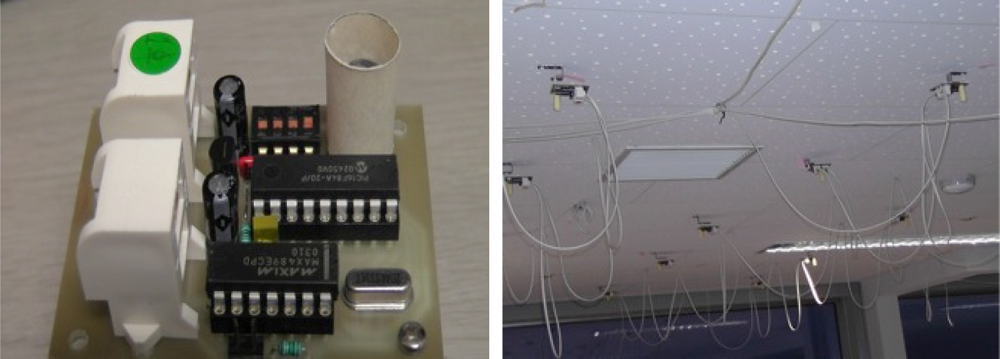
<p>In the simulated home environment, we attached “pyroelectric infrared sensors”, sometimes called “infrared motion sensors”, to the ceiling [<xref ref-type="bibr" rid="b27-sensors-12-16920">27</xref>]. This sensor detects an object with a different temperature from the surrounding temperature. The photographs of the sensor module and the interconnection of sensor nodes with cables are shown in <xref ref-type="fig" rid="f1-sensors-12-16920">Figure 1</xref>. Such infrared motion sensors are easy to set up at a low cost. The light condition does not affect the performance. Thus, this system can be used in the day and at night.</p>
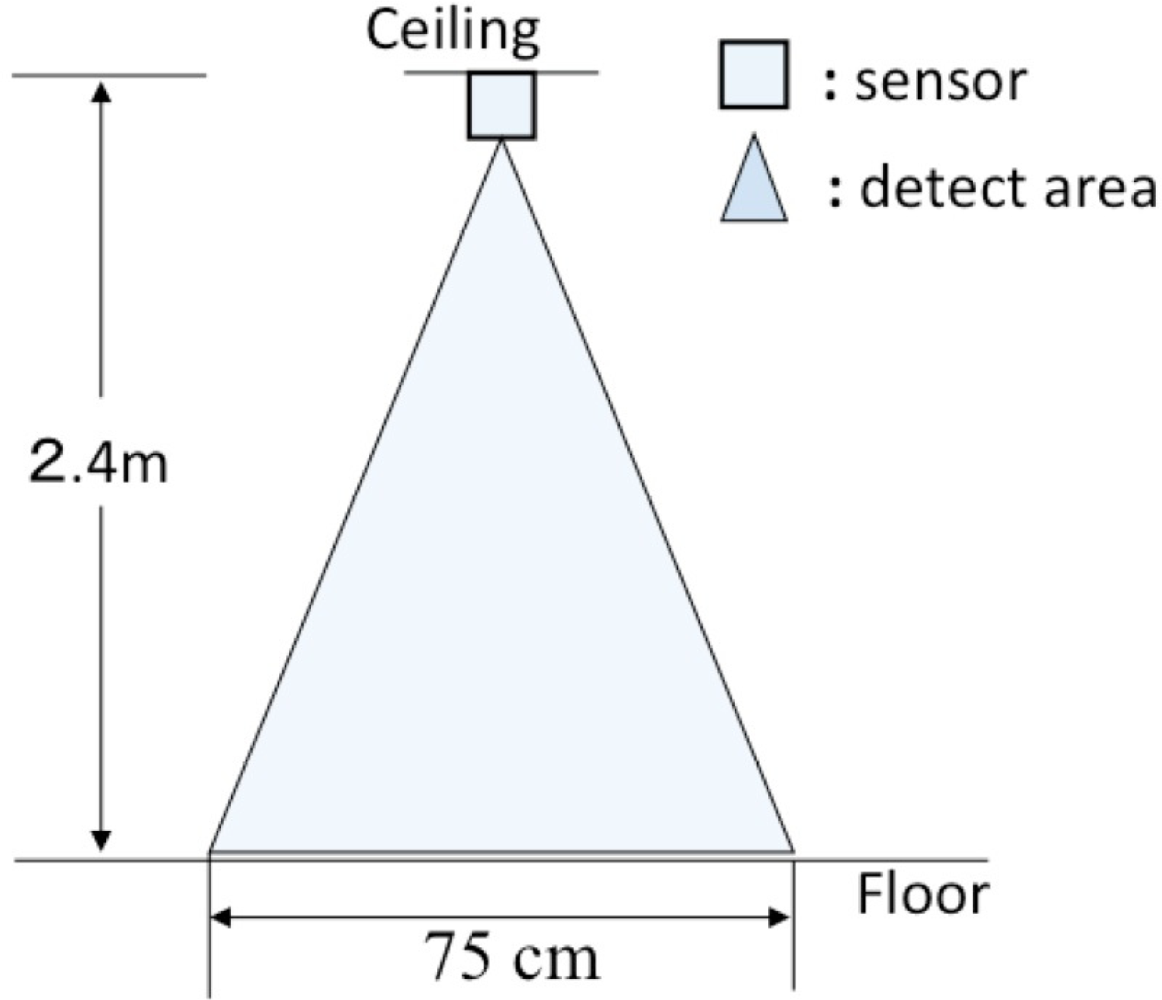
<p>A hand-made cylindrical lens hood with diameter of 11 mm and length of 30 mm was used to narrow the detection area of each sensor (shown in <xref ref-type="fig" rid="f1-sensors-12-16920">Figure 1</xref>). We set the detection distance of each sensor to 75 cm, from which we can guarantee that a moving person can be detected all the time. The side view of the detection area of a sensor adjusted by the paper cylinder is shown in <xref ref-type="fig" rid="f2-sensors-12-16920">Figure 2</xref>.</p>
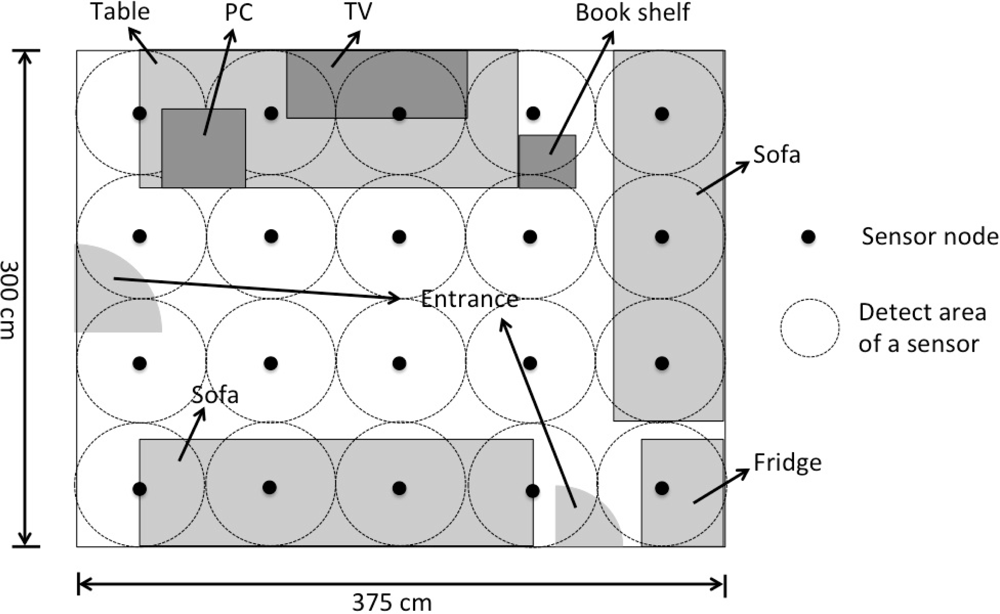
<p>In this study, we rearranged the sensor layout of this system in order to simulate a small room. The twenty sensors were attached to the ceiling (300 cm <italic>×</italic> 375 cm) so as to cover all the area and not to produce any dead space. The average distance between sensors is 75 cm. <xref ref-type="fig" rid="f3-sensors-12-16920">Figure 3</xref> shows the layout and the arrangement of the sensors. A data collection system was built by C++ program in this study to collect the sensor values. A binary response from each sensor can be read at a sampling rate chosen from 1 Hz to 80 Hz.</p>
<p>There are some characteristics of this sensor equipment room. A moving person often makes multiple sensors active at the same time. To the contrary, the sensor sometimes cannot be active if the person is motionless or moves only slightly, such as when reading a book or watching TV. Therefore, when there is no active sensor, we assume that the person has been staying at the previous position without moving.</p></sec>
<sec>
<label>4.</label>
<title>Sensor Network as a Low-Resolution Camera</title>
<p>The infrared ceiling sensor system simply produces 20 (4 <italic>×</italic> 5) binary values at a sampling. We regard our sensor system as a “top view camera” and the sensor responses as a “top view image.” The basic specification of this virtual camera is the resolution of 4 <italic>×</italic> 5 pixels with 2 sensitivity levels. Our basic idea is to increase the sensitivity by accumulating the binary values over a short duration, that is, by lengthening the exposure time of the virtual camera.</p>
<p>Let <italic>s<sub>i,j</sub></italic>(<italic>t</italic>), (<italic>i</italic> = 1, ⋯, 4, <italic>j</italic> = 1, ⋯, 5) denote the sensor active status (0 or 1) of the sensor locating at (<italic>i, j</italic>) at time <italic>t</italic>. When the sampling rate is <italic>H</italic> (Hz), we define the “pixel value” <italic>p<sub>i,j</sub></italic>(<italic>t</italic>) at time <italic>t</italic>(&gt; <italic>H/</italic>2):
<disp-formula id="FD1">
<label>(1)</label>
<mml:math id="mm1" display="block">
<mml:mrow>
<mml:msub>
<mml:mrow>
<mml:mi>p</mml:mi></mml:mrow>
<mml:mrow>
<mml:mi>i</mml:mi>
<mml:mo>,</mml:mo>
<mml:mi>j</mml:mi></mml:mrow></mml:msub>
<mml:mo stretchy="false">(</mml:mo>
<mml:mi>t</mml:mi>
<mml:mo stretchy="false">)</mml:mo>
<mml:mo>=</mml:mo>
<mml:mfrac>
<mml:mn>1</mml:mn>
<mml:mrow>
<mml:mi>H</mml:mi>
<mml:mo>+</mml:mo>
<mml:mn>1</mml:mn></mml:mrow></mml:mfrac>
<mml:munderover>
<mml:mo>∑</mml:mo>
<mml:mrow>
<mml:mi>u</mml:mi>
<mml:mo>=</mml:mo>
<mml:mi>t</mml:mi>
<mml:mo>−</mml:mo>
<mml:mi>H</mml:mi>
<mml:mo>/</mml:mo>
<mml:mn>2</mml:mn></mml:mrow>
<mml:mrow>
<mml:mi>t</mml:mi>
<mml:mo>+</mml:mo>
<mml:mi>H</mml:mi>
<mml:mo>/</mml:mo>
<mml:mn>2</mml:mn></mml:mrow></mml:munderover>
<mml:mrow>
<mml:msub>
<mml:mrow>
<mml:mi>s</mml:mi></mml:mrow>
<mml:mrow>
<mml:mi>i</mml:mi>
<mml:mo>,</mml:mo>
<mml:mi>j</mml:mi></mml:mrow></mml:msub>
<mml:mo stretchy="false">(</mml:mo>
<mml:mi>u</mml:mi>
<mml:mo stretchy="false">)</mml:mo></mml:mrow></mml:mrow></mml:math></disp-formula></p>
<p>It is clear that <italic>p<sub>i,j</sub></italic>(<italic>t</italic>) ∈ [0, 1]. That is, we take the average of binary responses over one second around time <italic>t</italic>. If a person stays near location (<italic>i, j</italic>) for a long time with a noticeable large motion, the corresponding pixel value <italic>p<sub>i,j</sub></italic> takes a large value close to one.</p>
<p>A moving person can make multiple sensors active according to his/her moving speed. Therefore, we can estimate the current location of the moving person from the sequence of active sensors.</p>
<p>We suppose that there are <italic>N</italic> (≤ 20) active sensors at time <italic>t</italic>, and they are indicated by their location indices (<italic>i, j</italic>). Let their pixel values be <italic>p<sub>i,j</sub></italic>(<italic>i</italic> = 1<italic>, ⋯,</italic> 4; <italic>j</italic> = 1<italic>, ⋯,</italic> 5). Then under the assumption that only a single person is in the room, we estimate the location of that person at time <italic>t</italic> by the weighted average as:
<disp-formula id="FD2">
<label>(2)</label>
<mml:math id="mm2" display="block">
<mml:mrow>
<mml:mo stretchy="false">(</mml:mo>
<mml:msub>
<mml:mrow>
<mml:mi>x</mml:mi></mml:mrow>
<mml:mi>t</mml:mi></mml:msub>
<mml:mo>,</mml:mo>
<mml:msub>
<mml:mrow>
<mml:mi>y</mml:mi></mml:mrow>
<mml:mi>t</mml:mi></mml:msub>
<mml:mo stretchy="false">)</mml:mo>
<mml:mo>=</mml:mo>
<mml:mfrac>
<mml:mrow>
<mml:msubsup>
<mml:mo>∑</mml:mo>
<mml:mrow>
<mml:mi>i</mml:mi>
<mml:mo>=</mml:mo>
<mml:mn>1</mml:mn></mml:mrow>
<mml:mn>4</mml:mn></mml:msubsup>
<mml:mrow>
<mml:msubsup>
<mml:mo>∑</mml:mo>
<mml:mrow>
<mml:mi>j</mml:mi>
<mml:mo>=</mml:mo>
<mml:mn>1</mml:mn></mml:mrow>
<mml:mn>5</mml:mn></mml:msubsup>
<mml:mrow>
<mml:mo stretchy="false">(</mml:mo>
<mml:mi>i</mml:mi>
<mml:mo>,</mml:mo>
<mml:mi>j</mml:mi>
<mml:mo stretchy="false">)</mml:mo>
<mml:msub>
<mml:mrow>
<mml:mi>p</mml:mi></mml:mrow>
<mml:mrow>
<mml:mi>i</mml:mi>
<mml:mo>,</mml:mo>
<mml:mi>j</mml:mi></mml:mrow></mml:msub>
<mml:mo stretchy="false">(</mml:mo>
<mml:mi>t</mml:mi>
<mml:mo stretchy="false">)</mml:mo></mml:mrow></mml:mrow></mml:mrow>
<mml:mrow>
<mml:msubsup>
<mml:mo>∑</mml:mo>
<mml:mrow>
<mml:mi>i</mml:mi>
<mml:mo>=</mml:mo>
<mml:mn>1</mml:mn></mml:mrow>
<mml:mn>4</mml:mn></mml:msubsup>
<mml:mrow>
<mml:msubsup>
<mml:mo>∑</mml:mo>
<mml:mrow>
<mml:mi>j</mml:mi>
<mml:mo>=</mml:mo>
<mml:mn>1</mml:mn></mml:mrow>
<mml:mn>5</mml:mn></mml:msubsup>
<mml:mrow>
<mml:msub>
<mml:mrow>
<mml:mi>p</mml:mi></mml:mrow>
<mml:mrow>
<mml:mi>i</mml:mi>
<mml:mo>,</mml:mo>
<mml:mi>j</mml:mi></mml:mrow></mml:msub>
<mml:mo stretchy="false">(</mml:mo>
<mml:mi>t</mml:mi>
<mml:mo stretchy="false">)</mml:mo></mml:mrow></mml:mrow></mml:mrow></mml:mfrac></mml:mrow></mml:math></disp-formula></p>
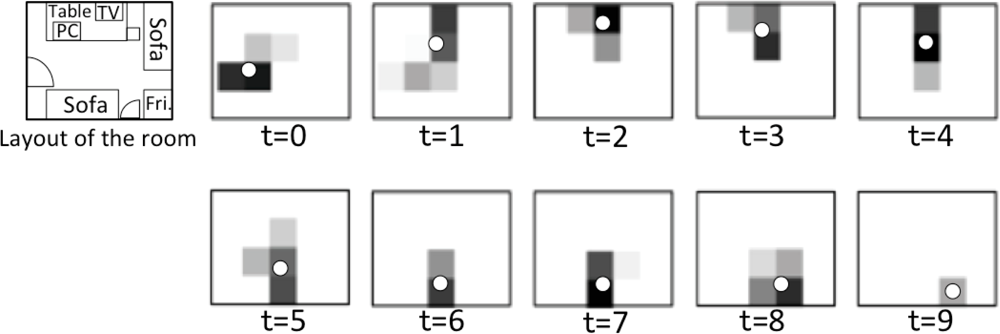
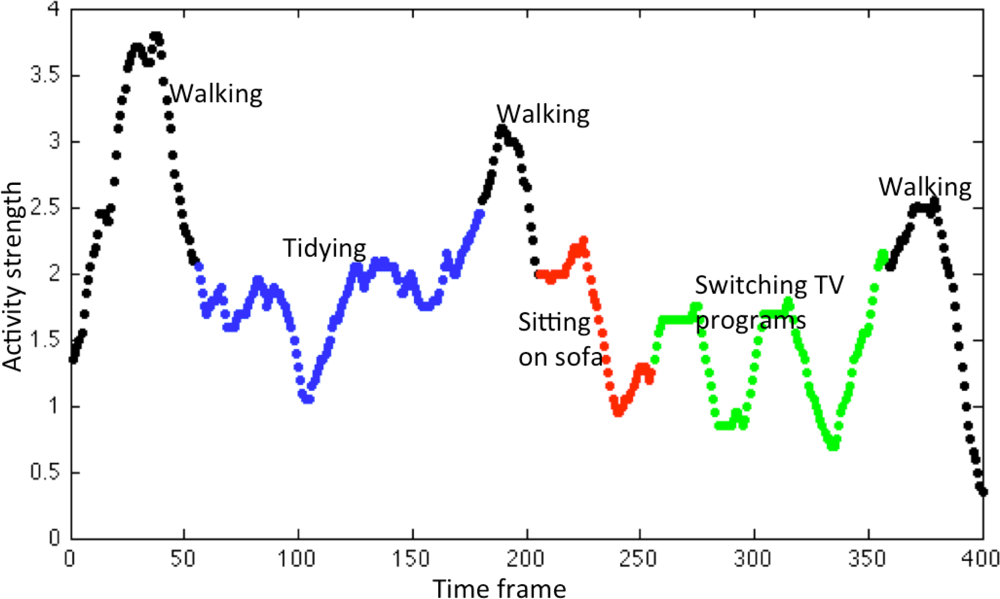
<p>We empirically evaluated the accuracy of <xref ref-type="disp-formula" rid="FD2">Equation (2)</xref>. A subject was instructed to do a series of activities in the home environment (walking, tidying the table, sitting on sofa, switching TV programs, leaving the room, in this order) during about 20 s. We set the sampling rate to <italic>H</italic> = 20 (Hz) to collect the data of <italic>s<sub>i,j</sub></italic>(<italic>t</italic>). Some of the “top view images” are shown in <xref ref-type="fig" rid="f4-sensors-12-16920">Figure 4</xref>. An example of varying sum of the 20 pixel values, 
<inline-formula>
<mml:math id="mm3" display="inline">
<mml:mrow>
<mml:msubsup>
<mml:mo>∑</mml:mo>
<mml:mrow>
<mml:mi>i</mml:mi>
<mml:mo>=</mml:mo>
<mml:mn>1</mml:mn></mml:mrow>
<mml:mn>4</mml:mn></mml:msubsup>
<mml:mrow>
<mml:msubsup>
<mml:mo>∑</mml:mo>
<mml:mrow>
<mml:mi>j</mml:mi>
<mml:mo>=</mml:mo>
<mml:mn>1</mml:mn></mml:mrow>
<mml:mn>5</mml:mn></mml:msubsup>
<mml:mrow>
<mml:msub>
<mml:mi>p</mml:mi>
<mml:mrow>
<mml:mi>i</mml:mi>
<mml:mo>,</mml:mo>
<mml:mi>j</mml:mi></mml:mrow></mml:msub></mml:mrow>
<mml:mo stretchy="false">(</mml:mo>
<mml:mi>t</mml:mi>
<mml:mo stretchy="false">)</mml:mo></mml:mrow></mml:mrow></mml:math></inline-formula>, is shown in <xref ref-type="fig" rid="f5-sensors-12-16920">Figure 5</xref>. The value of sum can be thought as the degree of the strength of activities.</p>
<p>In <xref ref-type="fig" rid="f4-sensors-12-16920">Figure 4</xref>, we see that the trajectory of a moving person can be almost captured successfully. By accumulating binary values from a short duration, we enhanced the intensity level of sensors spreading over [0,1] (<xref ref-type="disp-formula" rid="FD1">Equation (1)</xref>), and by taking the weighted average of the positions of active sensors, we succeeded to improve the spatial resolution (<xref ref-type="disp-formula" rid="FD2">Equation (2)</xref>). <xref ref-type="fig" rid="f5-sensors-12-16920">Figure 5</xref> shows that we can distinguish to some extent different activities from the average intensity.</p></sec>
<sec sec-type="methods">
<label>5.</label>
<title>Behavior Analysis</title>
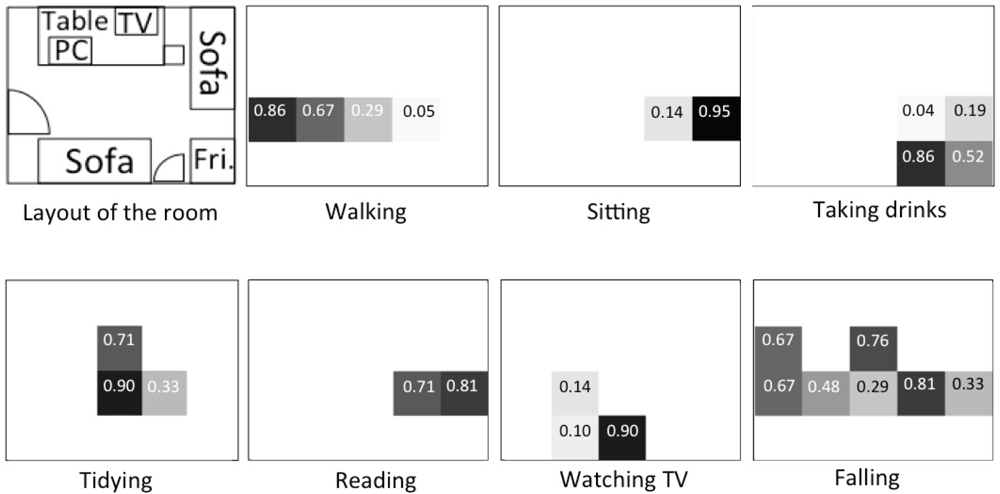
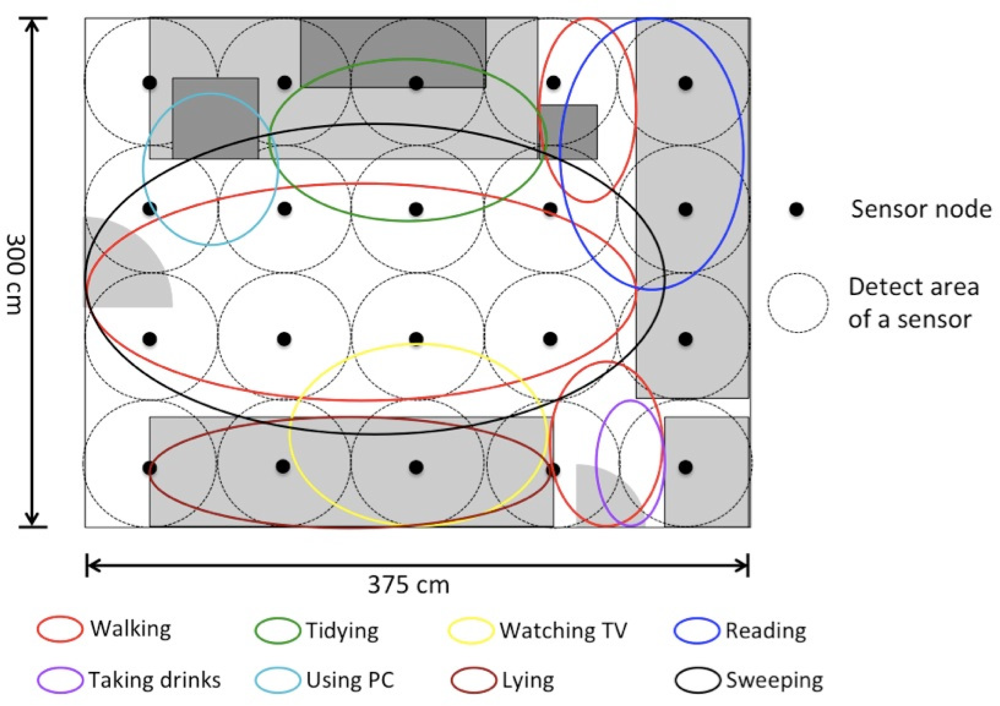
<p>In this experiment, we recognized different activities using the “pixel values”. The examined activities of daily living (shortly, ADLs) include “walking around”, “tidying the table”, “watching TV on the sofa”, “reading books on the sofa”, “taking drinks from the fridge”, “using a PC”, “lying on the sofa” and “sweeping the floor”. Each activity can be associated with a specific location (sensing area) as shown in <xref ref-type="fig" rid="f6-sensors-12-16920">Figure 6</xref>, though some locations overlap largely to the others. The subjects are five students belonging to our laboratory (four males and a female). We divided the 5 sets of “pixel values” of five subjects into 4 for training and one for testing. As a result, the average recognition rate was calculated by a 5-fold cross-validation. The classifier was a support vector machine (SVM) with a radial basic kernel with default parameter values. The ground truth was given manually from a video sequence recorded by a video camera that is used for reference only.</p>
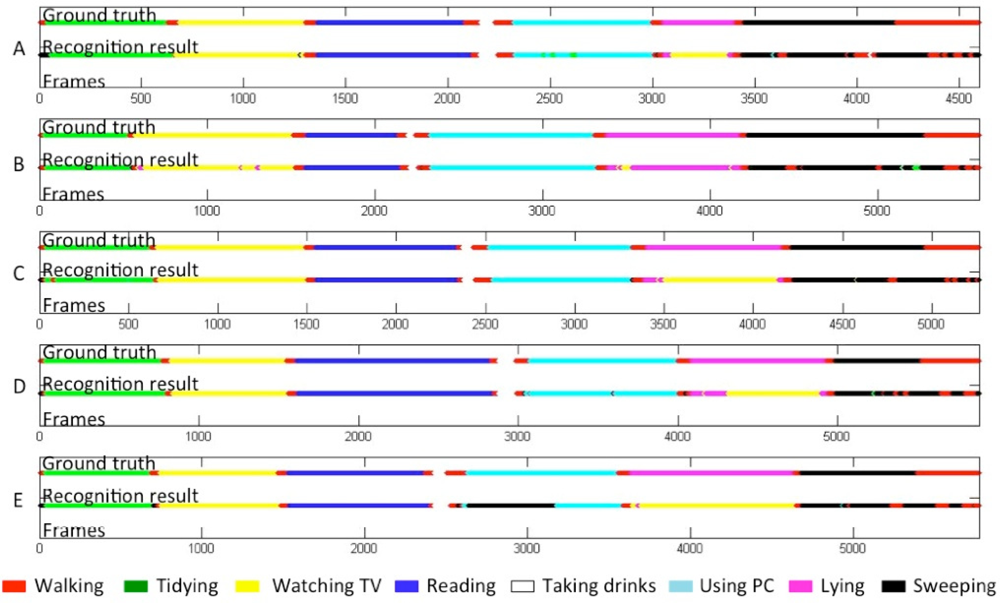
<p>Four different sets of features, <italic>F</italic><sub>1</sub>–<italic>F</italic><sub>4</sub>, were examined. The results are shown in <xref ref-type="table" rid="t2-sensors-12-16920">Table 2</xref>. The largest feature set <italic>F</italic><sub>4</sub> including time-difference information was most useful for the recognition and brought a recognition rate of 80.65%. <xref ref-type="table" rid="t3-sensors-12-16920">Table 3</xref> shows the confusion matrix of eight activities. The ground truth and the recognition results using <italic>F</italic><sub>4</sub> are shown in <xref ref-type="fig" rid="f7-sensors-12-16920">Figure 7</xref>.</p>
<p>In <xref ref-type="table" rid="t3-sensors-12-16920">Table 3</xref>, the element of row <italic>a</italic> and column <italic>b</italic> indicates the rate that activity <italic>a</italic> was recognized as activity <italic>b</italic>. We see that most of the “lying” are misrecognized to “watching TV” at 68.39%. The reverse-way misrecognition (“watching TV” to “lying”) is seldom seen probably due to the imbalance of data amount. Such a large amount of error is mainly because these two activities share the same location (bottom two ellipsoids in <xref ref-type="fig" rid="f6-sensors-12-16920">Figure 6</xref>). On the contrary, “walking around” and “sweeping the floor” are not so confused (confusion rates of 33.65% and 12.11%, respectively) even though they share a large part of the same location. One possible reason is that there is a difference on speed, so that time difference information included in <italic>F</italic><sub>4</sub> contributed to distinguish them.</p></sec>
<sec>
<label>6.</label>
<title>Fall Detection</title>
<sec>
<label>6.1.</label>
<title>Martingale Framework</title>
<p>Detecting a fall in our system is carried out on the basis of the changes of pixel values. The processing speed to realize online detection is a requirement to be achieved. Therefore, in our study, we use a martingale framework to detect falls from a stream of pixel values [<xref ref-type="bibr" rid="b28-sensors-12-16920">28</xref>].</p>
<p>Before we introduce the martingale framework for fall detection, we describe first a fundamental building block called the <italic>strangeness measure</italic>, which assesses how much a data point is different from the others. In the situation of fall detection, the steaming data is unlabeled and thus the strangeness of data points is measured in an unsupervised manner. Given a sequence of vectors of pixel values <italic>P<sub>t</sub></italic> = {𝕇(1), 𝕇(2), ⋯, 𝕇(<italic>t</italic>)}, 𝕇(<italic>t</italic>) = (<italic>p</italic><sub>1, 1</sub>(<italic>t</italic>), ⋯ <italic>, p</italic><sub>4, 5</sub>(<italic>t</italic>)), the strangeness <italic>s<sub>t</sub></italic> of the current vector 𝕇(<italic>t</italic>) with respect to the previous series of vectors <italic>P<sub>t</sub></italic> is defined by
<disp-formula id="FD3">
<label>(3)</label>
<mml:math id="mm4" display="block">
<mml:mrow>
<mml:msub>
<mml:mrow>
<mml:mi>s</mml:mi></mml:mrow>
<mml:mi>t</mml:mi></mml:msub>
<mml:mo>=</mml:mo>
<mml:mrow>
<mml:mo>‖</mml:mo>
<mml:mrow>
<mml:mi>𝕇</mml:mi>
<mml:mo stretchy="false">(</mml:mo>
<mml:mi>t</mml:mi>
<mml:mo stretchy="false">)</mml:mo>
<mml:mo>−</mml:mo>
<mml:mtext>c</mml:mtext></mml:mrow>
<mml:mo>‖</mml:mo></mml:mrow></mml:mrow></mml:math></disp-formula>where <bold>c</bold> is the cluster center, that is, 
<inline-formula>
<mml:math id="mm5" display="inline">
<mml:mrow>
<mml:mi mathvariant="bold">c</mml:mi>
<mml:mo>=</mml:mo>
<mml:mfrac>
<mml:mn>1</mml:mn>
<mml:mi>t</mml:mi></mml:mfrac>
<mml:msubsup>
<mml:mo>∑</mml:mo>
<mml:mrow>
<mml:mi>u</mml:mi>
<mml:mo>=</mml:mo>
<mml:mn>1</mml:mn></mml:mrow>
<mml:mi>t</mml:mi></mml:msubsup>
<mml:mrow>
<mml:mo>𝕇</mml:mo>
<mml:mo stretchy="false">(</mml:mo>
<mml:mi>u</mml:mi>
<mml:mo stretchy="false">)</mml:mo></mml:mrow></mml:mrow></mml:math></inline-formula>, and || · || is the Euclidean distance.</p>
<p>Using the strangeness measure described above, a martingale, indexed by ∊ ∈ [0, 1] and referred to as a <italic>randomized power martingale</italic>[<xref ref-type="bibr" rid="b29-sensors-12-16920">29</xref>], is defined as
<disp-formula id="FD4">
<label>(4)</label>
<mml:math id="mm6" display="block">
<mml:mrow>
<mml:msubsup>
<mml:mrow>
<mml:mi>M</mml:mi></mml:mrow>
<mml:mi>n</mml:mi>
<mml:mrow>
<mml:mo stretchy="false">(</mml:mo>
<mml:mo>∊</mml:mo>
<mml:mo stretchy="false">)</mml:mo></mml:mrow></mml:msubsup>
<mml:mo>=</mml:mo>
<mml:munderover>
<mml:mo>∏</mml:mo>
<mml:mrow>
<mml:mi>t</mml:mi>
<mml:mo>=</mml:mo>
<mml:mn>1</mml:mn></mml:mrow>
<mml:mi>n</mml:mi></mml:munderover>
<mml:mrow>
<mml:mo stretchy="false">(</mml:mo>
<mml:mo>∊</mml:mo>
<mml:msubsup>
<mml:mrow>
<mml:mover accent="true">
<mml:mi>q</mml:mi>
<mml:mo>^</mml:mo></mml:mover></mml:mrow>
<mml:mi>t</mml:mi>
<mml:mrow>
<mml:mo>∊</mml:mo>
<mml:mo>−</mml:mo>
<mml:mn>1</mml:mn></mml:mrow></mml:msubsup>
<mml:mo stretchy="false">)</mml:mo></mml:mrow></mml:mrow></mml:math></disp-formula>where the <italic>q̂<sub>t</sub></italic>’s are computed from the <italic>p̂</italic>-value function
<disp-formula id="FD5">
<label>(5)</label>
<mml:math id="mm7" display="block">
<mml:mrow>
<mml:msub>
<mml:mrow>
<mml:mover accent="true">
<mml:mi>q</mml:mi>
<mml:mo>^</mml:mo></mml:mover></mml:mrow>
<mml:mi>t</mml:mi></mml:msub>
<mml:mo stretchy="false">(</mml:mo>
<mml:mo>{</mml:mo>
<mml:mtext>P</mml:mtext>
<mml:mo stretchy="false">(</mml:mo>
<mml:mn>1</mml:mn>
<mml:mo stretchy="false">)</mml:mo>
<mml:mo>,</mml:mo>
<mml:mtext>P</mml:mtext>
<mml:mo stretchy="false">(</mml:mo>
<mml:mn>2</mml:mn>
<mml:mo stretchy="false">)</mml:mo>
<mml:mo>,</mml:mo>
<mml:mo>⋯</mml:mo>
<mml:mo>,</mml:mo>
<mml:mtext>P</mml:mtext>
<mml:mo stretchy="false">(</mml:mo>
<mml:mi>t</mml:mi>
<mml:mo stretchy="false">)</mml:mo>
<mml:mo>}</mml:mo>
<mml:mo>,</mml:mo>
<mml:msub>
<mml:mrow>
<mml:mi>θ</mml:mi></mml:mrow>
<mml:mi>t</mml:mi></mml:msub>
<mml:mo stretchy="false">)</mml:mo>
<mml:mo>=</mml:mo>
<mml:mfrac>
<mml:mrow>
<mml:mo>#</mml:mo>
<mml:mo stretchy="false">{</mml:mo>
<mml:mi>r</mml:mi>
<mml:mo>:</mml:mo>
<mml:msub>
<mml:mrow>
<mml:mi>s</mml:mi></mml:mrow>
<mml:mi>r</mml:mi></mml:msub>
<mml:mo>&gt;</mml:mo>
<mml:msub>
<mml:mrow>
<mml:mi>s</mml:mi></mml:mrow>
<mml:mi>t</mml:mi></mml:msub>
<mml:mo stretchy="false">}</mml:mo>
<mml:mo>+</mml:mo>
<mml:msub>
<mml:mrow>
<mml:mi>θ</mml:mi></mml:mrow>
<mml:mi>t</mml:mi></mml:msub>
<mml:mo>#</mml:mo>
<mml:mo stretchy="false">{</mml:mo>
<mml:mi>r</mml:mi>
<mml:mo>:</mml:mo>
<mml:msub>
<mml:mrow>
<mml:mi>s</mml:mi></mml:mrow>
<mml:mi>r</mml:mi></mml:msub>
<mml:mo>=</mml:mo>
<mml:msub>
<mml:mrow>
<mml:mi>s</mml:mi></mml:mrow>
<mml:mi>t</mml:mi></mml:msub>
<mml:mo stretchy="false">}</mml:mo></mml:mrow>
<mml:mi>t</mml:mi></mml:mfrac></mml:mrow></mml:math></disp-formula>where <italic>s<sub>r</sub></italic> is the <italic>strangeness</italic> measure at time <italic>r</italic> defined in (3), where <italic>r</italic> = 1, 2<italic>, ⋯, t</italic>, and <italic>θ<sub>t</sub></italic> is uniformly and randomly chosen from [0, 1] at every frame <italic>t</italic>. The initial martingale value is set to 
<inline-formula>
<mml:math id="mm8" display="inline">
<mml:mrow>
<mml:msubsup>
<mml:mrow>
<mml:mi>M</mml:mi></mml:mrow>
<mml:mn>0</mml:mn>
<mml:mrow>
<mml:mo stretchy="false">(</mml:mo>
<mml:mo>∊</mml:mo>
<mml:mo stretchy="false">)</mml:mo></mml:mrow></mml:msubsup>
<mml:mo>=</mml:mo>
<mml:mn>1</mml:mn></mml:mrow></mml:math></inline-formula>, and ∊ is set to 0.92 according to the reference [<xref ref-type="bibr" rid="b28-sensors-12-16920">28</xref>].</p>
<p>In the martingale framework for fall detection, when a new frame is observed, hypothesis testing takes place to decide whether a fall occurs or not, under the null hypothesis <italic>H</italic><sub>0</sub> “no fall” against the alternative <italic>H</italic><sub>1</sub> “a fall occurs.” The martingale test continues to operate as long as
<disp-formula id="FD6">
<label>(6)</label>
<mml:math id="mm9" display="block">
<mml:mrow>
<mml:mn>0</mml:mn>
<mml:mo>&lt;</mml:mo>
<mml:msubsup>
<mml:mrow>
<mml:mi>M</mml:mi></mml:mrow>
<mml:mi>n</mml:mi>
<mml:mrow>
<mml:mo stretchy="false">(</mml:mo>
<mml:mo>∊</mml:mo>
<mml:mo stretchy="false">)</mml:mo></mml:mrow></mml:msubsup>
<mml:mo>&lt;</mml:mo>
<mml:mi>λ</mml:mi></mml:mrow></mml:math></disp-formula>where λ is a positive real number that a user specifies. The null hypothesis <italic>H</italic><sub>0</sub> is rejected when 
<inline-formula>
<mml:math id="mm10" display="inline">
<mml:mrow>
<mml:msubsup>
<mml:mrow>
<mml:mi>M</mml:mi></mml:mrow>
<mml:mi>n</mml:mi>
<mml:mrow>
<mml:mo stretchy="false">(</mml:mo>
<mml:mo>∊</mml:mo>
<mml:mo stretchy="false">)</mml:mo></mml:mrow></mml:msubsup>
<mml:mo>≥</mml:mo>
<mml:mi>λ</mml:mi></mml:mrow></mml:math></inline-formula>, noticing a “change.” Then a new martingale starts with 
<inline-formula>
<mml:math id="mm11" display="inline">
<mml:mrow>
<mml:msubsup>
<mml:mrow>
<mml:mi>M</mml:mi></mml:mrow>
<mml:mn>0</mml:mn>
<mml:mrow>
<mml:mo stretchy="false">(</mml:mo>
<mml:mo>∊</mml:mo>
<mml:mo stretchy="false">)</mml:mo></mml:mrow></mml:msubsup>
<mml:mo>=</mml:mo>
<mml:mn>1</mml:mn></mml:mrow></mml:math></inline-formula>.</p>
<p>Since {<italic>M<sub>n</sub></italic> : 0 <italic>&lt; n &lt;</italic> ∞} is a nonnegative martingale and <italic>E</italic>(<italic>M<sub>n</sub></italic>) = <italic>E</italic>(<italic>M</italic><sub>0</sub>) = 1, according to the Doob’s Maximal Inequality [<xref ref-type="bibr" rid="b30-sensors-12-16920">30</xref>], we have
<disp-formula id="FD7">
<label>(7)</label>
<mml:math id="mm12" display="block">
<mml:mrow>
<mml:mi>P</mml:mi>
<mml:mrow>
<mml:mo>(</mml:mo>
<mml:mrow>
<mml:munder>
<mml:mrow>
<mml:mtext>max</mml:mtext></mml:mrow>
<mml:mrow>
<mml:mi>k</mml:mi>
<mml:mo>≤</mml:mo>
<mml:mi>n</mml:mi></mml:mrow></mml:munder>
<mml:msub>
<mml:mrow>
<mml:mi>M</mml:mi></mml:mrow>
<mml:mi>k</mml:mi></mml:msub>
<mml:mo>≥</mml:mo>
<mml:mi>λ</mml:mi></mml:mrow>
<mml:mo>)</mml:mo></mml:mrow>
<mml:mo>≤</mml:mo>
<mml:mfrac>
<mml:mn>1</mml:mn>
<mml:mi>λ</mml:mi></mml:mfrac></mml:mrow></mml:math></disp-formula>for any λ <italic>&gt;</italic> 0 and <italic>n ∈ ℕ</italic>.</p>
<p>It means that it is unlikely for any <italic>M<sub>k</sub></italic> to have a high value. The null hypothesis is rejected when the martingale value is greater than λ. In <xref ref-type="disp-formula" rid="FD7">Equation (7)</xref> is an upper bound for the false alarm rate (FAR) for detecting a fall when there is actually no fall. The value of λ is, therefore, determined by the value of acceptable FAR. For example, we may set λ to 20 if we need FAR lower than 5% as a rule of thumb.</p>
<p>The fall detection algorithm is shown as follows.</p>
<p><bold>Fall detection algorithm</bold>. Martingale Test (MT)</p>
<p>Initialize: <italic>M</italic>(0) = 1; <italic>t</italic> = 1; <italic>P<sub>t</sub></italic> = {}.</p>
<p>Set: λ.</p>
<list list-type="simple">
<list-item>
<p>1: <bold>loop</bold></p></list-item>
<list-item>
<p>2:   A new frame of 20 pixel values 𝕇(<italic>t</italic>) is observed.</p></list-item>
<list-item>
<p>3:   <bold>if</bold> <italic>P<sub>t</sub></italic> = {} <bold>then</bold></p></list-item>
<list-item>
<p>4:     Set strangeness of 𝕇(<italic>t</italic>): =0</p></list-item>
<list-item>
<p>5:   <bold>else</bold></p></list-item>
<list-item>
<p>6:     Compute the strangeness of 𝕇(<italic>t</italic>) and data points in <italic>P<sub>t</sub></italic>.</p></list-item>
<list-item>
<p>7:   <bold>end if</bold></p></list-item>
<list-item>
<p>8:   Compute the <italic>p̂</italic>-values <italic>q̂<sub>t</sub></italic> using (5).</p></list-item>
<list-item>
<p>9:   Compute <italic>M</italic>(<italic>t</italic>) using (4).</p></list-item>
<list-item>
<p>10:   <bold>if</bold> <italic>M</italic>(<italic>t</italic>) <italic>&gt; λ</italic> <bold>then</bold></p></list-item>
<list-item>
<p>11:     <bold>FALL DETECTED</bold></p></list-item>
<list-item>
<p>12:     Set <italic>M</italic>(<italic>t</italic>)=1;</p></list-item>
<list-item>
<p>13:     Re-initialize <italic>P<sub>t</sub></italic> to an empty set.</p></list-item>
<list-item>
<p>14:   <bold>else</bold></p></list-item>
<list-item>
<p>15:     Add 𝕇(<italic>t</italic>) into <italic>P<sub>t</sub></italic>.</p></list-item>
<list-item>
<p>16:   <bold>end if</bold></p></list-item>
<list-item>
<p>17:   <italic>t</italic> := <italic>t</italic> + 1;</p></list-item>
<list-item>
<p>18: <bold>end loop</bold></p></list-item></list></sec>
<sec sec-type="results">
<label>6.2.</label>
<title>Experiment and Results</title>
<p>Since falls are not normal activities seen in our daily life, we asked the subjects to pretend them. In an investigation of the fall of elders, Wei [<xref ref-type="bibr" rid="b31-sensors-12-16920">31</xref>] found that 85.0% of the falls are during walking, and 62.5% of the falls happen indoors. Therefore, we set up a virtual “room” in a corner of the laboratory (<xref ref-type="fig" rid="f3-sensors-12-16920">Figure 3</xref>) and asked the subjects to simulate falls in the middle of walking.</p>
<p>In this experiment, a subject was asked to stay in the room for about one minute every round. During this period, the subject behaved naturally and did some of activities randomly such as walking, tidying a table, watching TV, sitting on a sofa, reading books, or taking drinks form a fridge. The subject was also instructed to behave sometimes fall-like activities such as sitting fast and lying on the sofa. After a series of activities, the subject simulated a fall during walking. In total, three of subjects performed 65 normal activities, 20 fall-like activities and 50 true falls.</p>
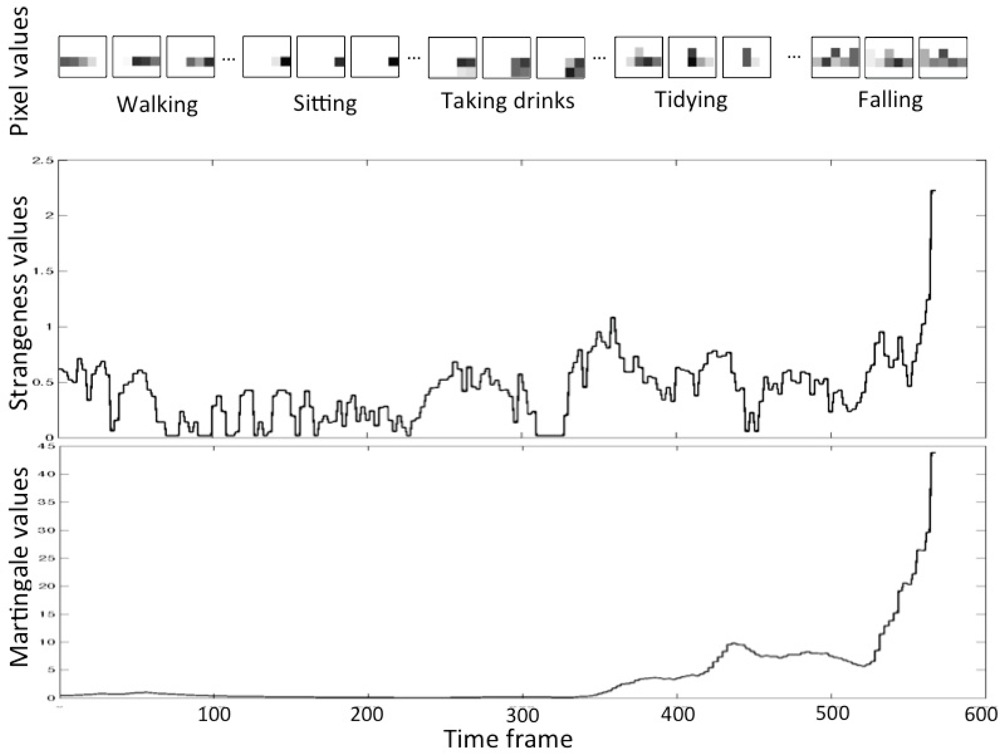
<p><xref ref-type="fig" rid="f8-sensors-12-16920">Figure 8</xref> shows the variation of pixel values when a subject performed several activities containing a fall. Activities performed sequentially were segmented manually. In the pixel values, we see that the (simulated) fall is different from other activities: fall’s pixel values spread widely. We suppose that the walking speed of an elder is about 1–1.5 m/s. Due to the characteristic of delay of our infrared sensor (a moving person makes multiple sensors active at the same time), when the person is walking before falling, there will be 2–4 active sensors. The number of active sensors depends on the speed and location of the person (below one sensor or between two sensors), which can be seen in <xref ref-type="fig" rid="f4-sensors-12-16920">Figures 4</xref> and <xref ref-type="fig" rid="f8-sensors-12-16920">8</xref>. When the person falls after walking, the spread area will be larger due to the stretch of the body, the active sensors will be more (usually 5–8 active ones). Accordingly, the <italic>strangeness</italic> of the pixels of fall is distinct from those of other activities. <xref ref-type="fig" rid="f9-sensors-12-16920">Figure 9</xref> describes the variation of pixel values, <italic>strangeness</italic> values and <italic>martingale</italic> values in a series of activities in detail. If the pixel values have a large variation in a short time, then the <italic>strangeness</italic> value increases and the martingale value increases as well.</p>
<p>The performance evaluation of fall detection is made based on two pairs of retrieval performance indicators, (precision and recall) and (false alarm rate (FAR) and false reject rate (FRR)). They are defined as
<disp-formula id="FD8">
<label>(8)</label>
<mml:math id="mm13" display="block">
<mml:mrow>
<mml:mtable>
<mml:mtr>
<mml:mtd>
<mml:mrow>
<mml:mi mathvariant="italic">Precision</mml:mi>
<mml:mo>=</mml:mo>
<mml:mfrac>
<mml:mrow>
<mml:mi mathvariant="italic">Number of Correct Detections of Falls</mml:mi></mml:mrow>
<mml:mrow>
<mml:mi mathvariant="italic">Number of Detections of Falls</mml:mi></mml:mrow></mml:mfrac>
<mml:mo>,</mml:mo></mml:mrow></mml:mtd></mml:mtr>
<mml:mtr>
<mml:mtd>
<mml:mrow>
<mml:mi mathvariant="italic">Recall</mml:mi>
<mml:mo>=</mml:mo>
<mml:mfrac>
<mml:mrow>
<mml:mi mathvariant="italic">Number of Correct Detections of Falls</mml:mi></mml:mrow>
<mml:mrow>
<mml:mi mathvariant="italic">Number of True Falls</mml:mi></mml:mrow></mml:mfrac>
<mml:mo>,</mml:mo></mml:mrow></mml:mtd></mml:mtr></mml:mtable></mml:mrow></mml:math></disp-formula>
<disp-formula id="FD9">
<label>(9)</label>
<mml:math id="mm14" display="block">
<mml:mrow>
<mml:mi mathvariant="italic">FAR</mml:mi>
<mml:mo>=</mml:mo>
<mml:mn>1</mml:mn>
<mml:mo>−</mml:mo>
<mml:mi mathvariant="italic">Precision</mml:mi>
<mml:mo>,</mml:mo>
<mml:mi mathvariant="italic">FRR</mml:mi>
<mml:mo>=</mml:mo>
<mml:mn>1</mml:mn>
<mml:mo>−</mml:mo>
<mml:mi mathvariant="italic">Recall</mml:mi>
<mml:mo>.</mml:mo></mml:mrow></mml:math></disp-formula></p>
<p>In addition, we use a single performance indicator <italic>F</italic><sub>1</sub> defined as
<disp-formula id="FD10">
<label>(10)</label>
<mml:math id="mm15" display="block">
<mml:mrow>
<mml:msub>
<mml:mrow>
<mml:mi>F</mml:mi></mml:mrow>
<mml:mn>1</mml:mn></mml:msub>
<mml:mo>=</mml:mo>
<mml:mfrac>
<mml:mrow>
<mml:mn>2</mml:mn>
<mml:mo>×</mml:mo>
<mml:mi mathvariant="italic">Recall</mml:mi>
<mml:mo>×</mml:mo>
<mml:mi mathvariant="italic">Precision</mml:mi></mml:mrow>
<mml:mrow>
<mml:mi mathvariant="italic">Recall</mml:mi>
<mml:mo>+</mml:mo>
<mml:mi mathvariant="italic">Precision</mml:mi></mml:mrow></mml:mfrac>
<mml:mo>,</mml:mo></mml:mrow></mml:math></disp-formula>representing a harmonic mean between precision and recall. A high value of <italic>F</italic><sub>1</sub> ensures reasonably high precision and recall.</p>
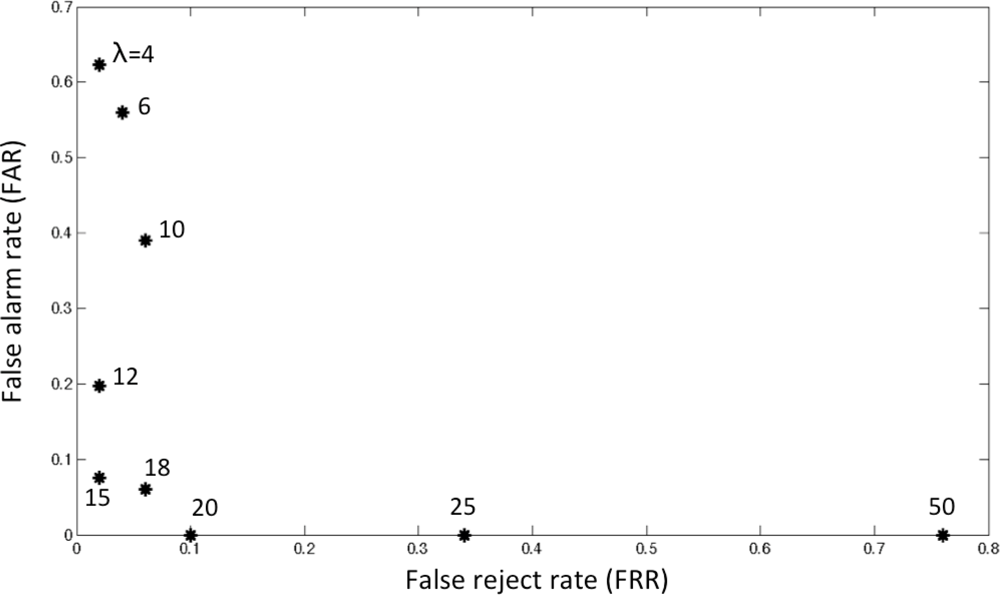
<p><xref ref-type="table" rid="t4-sensors-12-16920">Table 4</xref> shows the details of the performance in precision, recall and <italic>F</italic><sub>1</sub> for several values of λ. The receiver operating characteristic (ROC) evaluation is also shown in <xref ref-type="fig" rid="f10-sensors-12-16920">Figure 10</xref>. In <italic>F</italic><sub>1</sub>, we attained the best performance of 95.14% at λ = 15, which corresponds to FAR of 7.5% and FRR of 2.0% (<xref ref-type="fig" rid="f10-sensors-12-16920">Figure 10</xref>). It is serious to miss true falls, so we investigated the attainable minimum value of FRR. We can see in <xref ref-type="fig" rid="f10-sensors-12-16920">Figure 10</xref> that 2.0% of FRR at λ = 15 is the minimum. This corresponds to one case missing among fifty falls. In this case, immediately before overlooking the true “fall”, one “lying down” was misdetected as a “fall” due to its high martingale value and thus a newly started martingale could not detect the succeeding true fall. In contrast, all cases of 7.5% (=4 false alarms/53 detected falls) were fall-like activities. Unfortunately, we could not have a lower value of FRR even if we change the value of λ due to the above-mentioned special case.</p>
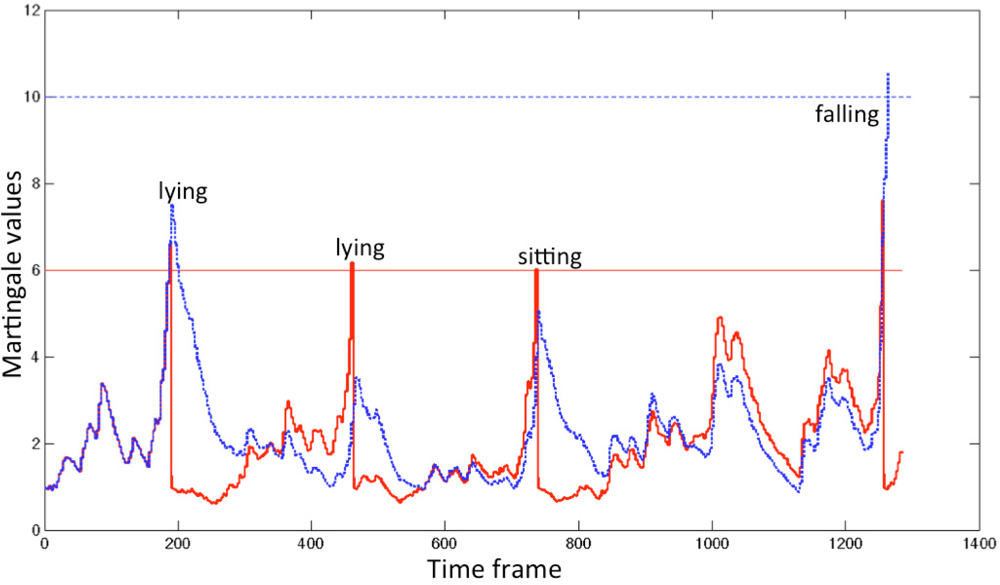
<p>One example of detection is shown in <xref ref-type="fig" rid="f11-sensors-12-16920">Figure 11</xref> for λ = 6, 10. By increasing the value of λ from 6 to 10, we can dismiss all false alarms.</p></sec></sec>
<sec sec-type="discussion">
<label>7.</label>
<title>Discussion</title>
<p>In this study, an infrared ceiling sensor network was used to recognize multiple activities and to detect falls in a home environment. Since the sensor system is installed on the ceiling, it is almost unnoticeable by the users. It does not require any cooperation from the users. Different from camera systems, the performance of our sensor system is not affected much by obstacles or light conditions. Most importantly, the privacy of users is always preserved.</p>
<p>However, in the practical usage, there are some limitations in our system. Our classification method relies on the assumption that a distinct activity has its own associated location where the activity is performed. Indeed, many activities are often associated with different locations, e.g., we have a rest sitting on the sofa, take drinks from a fridge and fall asleep in bed. This study basically aims at detecting such location-associated activities. Therefore, different activities carried out in the same location can be detected but it is difficult to distinguish them. However, such confusion usually does not cause a serious problem for ADL recording. Maybe we can combine such activities into one activity.</p>
<p>The system also utilizes the strength of activities, the pixel values, the area and speed information, the number of active sensors and time information from one time step before and after, to improve the performance on classification. These pieces of information make it possible to distinguish two activities even if they share largely their associated locations, e.g., “walking around” and “sweeping the floor.” The same information, especially the spread information of active sensors, brought a high level of detection performance of falls. On the contrary, if the amount is not sufficient, for example, in such cases that a person lies down on a sofa or falls from a fixed position by dizziness or unconsciousness with slight motion, it is difficult to generate sufficient <italic>strangeness</italic> information when he/she falls, our system may not detect the fall. This behavior of the system is sometimes right and sometimes not. In the current system, the sensitivity is controlled by the value of λ.</p>
<p>This system is supposed to be used by the users who live alone, which means that if there are multiple persons in the room, or even there is a pet like a cat or a dog with the user, this system has to be improved to cope with such complicated situations.</p>
<p>The ceiling sensor system is also a little inferior in detection capability of vertical moves due to the ceiling attachment. Therefore, it cannot detect vertical falls in high precision, although such a case is rare compared with forward/backward falls. To compensate the disability, more kinds of devices such as a depth camera could be used with this system.</p></sec>
<sec sec-type="conclusions">
<label>8.</label>
<title>Conclusions</title>
<p>In this research, we have developed a ceiling sensor system to recognize multiple activities and to detect falls in the home environment. The infrared sensors output binary responses from which we know only the presence/absence of a user. However, the privacy of users is preserved to some extent and no user cooperation is required in this system. The novelty of this study is that the definition of “pixel values” makes the sensor network work like a top view camera but improving the extent of privacy protection with respect to cameras. The experimental results showed that this system can recognize eight activities and detect abnormalities (falls) both at acceptable rates. The accuracy is not sufficient in general but surprisingly high with such low-level information. This privacy-preserved system has the potential to be used in the home environment to provide personalized services and to detect falls and other abnormalities of elders who live alone.</p></sec></body>
<back>
<ref-list>
<title>References</title>
<ref id="b1-sensors-12-16920"><label>1.</label><citation citation-type="journal"><person-group person-group-type="author"><name><surname>Haritaoglu</surname><given-names>I.</given-names></name><name><surname>Harwood</surname><given-names>D.</given-names></name><name><surname>Davis</surname><given-names>L.</given-names></name></person-group><article-title>W4: Real-Time surveillance of people and their activities</article-title><source>IEEE Trans. Patt. Anal. Mach. Int</source><year>2000</year><volume>22</volume><fpage>809</fpage><lpage>830</lpage><pub-id pub-id-type="doi">10.1109/34.868683</pub-id></citation></ref>
<ref id="b2-sensors-12-16920"><label>2.</label><citation citation-type="journal"><person-group person-group-type="author"><name><surname>Hongeng</surname><given-names>S.</given-names></name><name><surname>Nevatia</surname><given-names>R.</given-names></name><name><surname>Bremond</surname><given-names>F.</given-names></name></person-group><article-title>Video-Based event recognition: Activity representation and probabilistic recognition methods</article-title><source>Comput. Vis. Image Understand</source><year>2004</year><volume>96</volume><fpage>129</fpage><lpage>162</lpage><pub-id pub-id-type="doi">10.1016/j.cviu.2004.02.005</pub-id></citation></ref>
<ref id="b3-sensors-12-16920"><label>3.</label><citation citation-type="book"><person-group person-group-type="author"><name><surname>Tao</surname><given-names>S.</given-names></name><name><surname>Kudo</surname><given-names>M.</given-names></name><name><surname>Nonaka</surname><given-names>H.</given-names></name><name><surname>Toyama</surname><given-names>J.</given-names></name></person-group><article-title>Person Localization and Soft Authentication Using an Infrared Ceiling Sensor Network</article-title><source>Computer Analysis of Images and Patterns</source><person-group person-group-type="editor"><name><surname>Real</surname><given-names>P.</given-names></name><name><surname>Diaz-Pernil</surname><given-names>D.</given-names></name><name><surname>Molina-Abril</surname><given-names>H.</given-names></name><name><surname>Berciano</surname><given-names>A.</given-names></name><name><surname>Kropatsch</surname><given-names>W.</given-names></name></person-group><publisher-name>Springer</publisher-name><publisher-loc>Heidelberg, Germany</publisher-loc><year>2011</year><volume>6855</volume><fpage>122</fpage><lpage>129</lpage></citation></ref>
<ref id="b4-sensors-12-16920"><label>4.</label><citation citation-type="book"><person-group person-group-type="author"><name><surname>Lee</surname><given-names>T.</given-names></name><name><surname>Lin</surname><given-names>T.</given-names></name><name><surname>Huang</surname><given-names>S.</given-names></name><name><surname>Lai</surname><given-names>S.</given-names></name><name><surname>Hung</surname><given-names>S.</given-names></name></person-group><article-title>People Localization in a Camera Network Combining Background Subtraction and Scene-Aware Human Detection</article-title><source>Advances in Multimedia Modeling</source><person-group person-group-type="editor"><name><surname>Lee</surname><given-names>K.T.</given-names></name><name><surname>Tsai</surname><given-names>W.H.</given-names></name><name><surname>Liao</surname><given-names>H.Y.</given-names></name><name><surname>Chen</surname><given-names>T.</given-names></name><name><surname>Hsieh</surname><given-names>J.W.</given-names></name><name><surname>Tseng</surname><given-names>C.C.</given-names></name></person-group><publisher-name>Springer</publisher-name><publisher-loc>Heidelberg, Germany</publisher-loc><year>2011</year><volume>6523</volume><fpage>151</fpage><lpage>160</lpage></citation></ref>
<ref id="b5-sensors-12-16920"><label>5.</label><citation citation-type="journal"><person-group person-group-type="author"><name><surname>Hosokawa</surname><given-names>T.</given-names></name><name><surname>Kudo</surname><given-names>M.</given-names></name><name><surname>Nonaka</surname><given-names>H.</given-names></name><name><surname>Toyama</surname><given-names>J.</given-names></name></person-group><article-title>Soft authentication using an infrared ceiling sensor network</article-title><source>Pattern Anal. Appl</source><year>2009</year><volume>12</volume><fpage>237</fpage><lpage>249</lpage><pub-id pub-id-type="doi">10.1007/s10044-008-0119-9</pub-id></citation></ref>
<ref id="b6-sensors-12-16920"><label>6.</label><citation citation-type="journal"><person-group person-group-type="author"><name><surname>Shankar</surname><given-names>M.</given-names></name><name><surname>Burchett</surname><given-names>J.</given-names></name><name><surname>Hao</surname><given-names>Q.</given-names></name><name><surname>Guenther</surname><given-names>B.</given-names></name><name><surname>Brady</surname><given-names>D.</given-names></name></person-group><article-title>Human-Tracking systems using pyroelectric infrared detectors</article-title><source>Opt. Eng.</source><year>2006</year><pub-id pub-id-type="doi">10.1117/1.2360948</pub-id></citation></ref>
<ref id="b7-sensors-12-16920"><label>7.</label><citation citation-type="confproc"><person-group person-group-type="author"><name><surname>Tao</surname><given-names>S.</given-names></name><name><surname>Kudo</surname><given-names>M.</given-names></name><name><surname>Nonaka</surname><given-names>H.</given-names></name><name><surname>Toyama</surname><given-names>J.</given-names></name></person-group><article-title>Recording the Activities of Daily Living Based on Person Localization Using an Infrared Ceiling Sensor Network</article-title><conf-name>Proceedings of the IEEE International Conference on Granular Computing (GrC)</conf-name><conf-loc>Kaohsiung, Taiwan</conf-loc><conf-date>8–10 November 2011</conf-date><fpage>647</fpage><lpage>652</lpage></citation></ref>
<ref id="b8-sensors-12-16920"><label>8.</label><citation citation-type="confproc"><person-group person-group-type="author"><name><surname>Noury</surname><given-names>N.</given-names></name></person-group><article-title>A Smart Sensor for the Remote Follow up of Activity and Fall Detection of the Elderly</article-title><conf-name>Proceedings of the Biology 2nd Annual International IEEE-EMBS Special Topic Conference on Microtechnologies in Medicine and Biology</conf-name><conf-loc>Madison, WI, USA</conf-loc><conf-date>2–4 May 2002</conf-date><fpage>314</fpage><lpage>317</lpage></citation></ref>
<ref id="b9-sensors-12-16920"><label>9.</label><citation citation-type="book"><person-group person-group-type="author"><name><surname>Jones</surname><given-names>D.</given-names></name></person-group><source>Report on Seniors’ Falls in Canada [Electronic Resource]</source><publisher-name>Division of Aging and Seniors</publisher-name><publisher-loc>Public Health Agency of Canada, Ottawa, Canada</publisher-loc><year>2005</year></citation></ref>
<ref id="b10-sensors-12-16920"><label>10.</label><citation citation-type="journal"><person-group person-group-type="author"><name><surname>Moeslund</surname><given-names>T.</given-names></name><name><surname>Hilton</surname><given-names>A.</given-names></name><name><surname>Krüger</surname><given-names>V.</given-names></name></person-group><article-title>A survey of advances in vision-based human motion capture and analysis</article-title><source>Comput. Vis. Image Understand</source><year>2006</year><volume>104</volume><fpage>90</fpage><lpage>126</lpage><pub-id pub-id-type="doi">10.1016/j.cviu.2006.08.002</pub-id></citation></ref>
<ref id="b11-sensors-12-16920"><label>11.</label><citation citation-type="journal"><person-group person-group-type="author"><name><surname>Poppe</surname><given-names>R.</given-names></name></person-group><article-title>A survey on vision-based human action recognition</article-title><source>Image Vision Comput</source><year>2010</year><volume>28</volume><fpage>976</fpage><lpage>990</lpage><pub-id pub-id-type="doi">10.1016/j.imavis.2009.11.014</pub-id></citation></ref>
<ref id="b12-sensors-12-16920"><label>12.</label><citation citation-type="journal"><person-group person-group-type="author"><name><surname>Chaaraoui</surname><given-names>A.</given-names></name><name><surname>Climent-Pérez</surname><given-names>P.</given-names></name><name><surname>Flórez-Revuelta</surname><given-names>F.</given-names></name></person-group><article-title>A review on vision techniques applied to human behaviour analysis for ambient-assisted living</article-title><source>Expert Syst. Appl</source><year>2012</year><volume>39</volume><fpage>10873</fpage><lpage>10888</lpage><pub-id pub-id-type="doi">10.1016/j.eswa.2012.03.005</pub-id></citation></ref>
<ref id="b13-sensors-12-16920"><label>13.</label><citation citation-type="journal"><person-group person-group-type="author"><name><surname>Lindemann</surname><given-names>U.</given-names></name><name><surname>Hock</surname><given-names>A.</given-names></name><name><surname>Stuber</surname><given-names>M.</given-names></name><name><surname>Keck</surname><given-names>W.</given-names></name><name><surname>Becker</surname><given-names>C.</given-names></name></person-group><article-title>Evaluation of a fall detector based on accelerometers: A pilot study</article-title><source>Med. Biol. Eng. Comput</source><year>2005</year><volume>43</volume><fpage>548</fpage><lpage>551</lpage><pub-id pub-id-type="doi">10.1007/BF02351026</pub-id><pub-id pub-id-type="pmid">16411625</pub-id></citation></ref>
<ref id="b14-sensors-12-16920"><label>14.</label><citation citation-type="confproc"><person-group person-group-type="author"><name><surname>Mathie</surname><given-names>M.</given-names></name><name><surname>Basilakis</surname><given-names>J.</given-names></name><name><surname>Celler</surname><given-names>B.</given-names></name></person-group><article-title>A System for Monitoring Posture and Physical Activity Using Accelerometers</article-title><conf-name>Proceedings of the Proceedings of the 23rd Annual International Conference of the IEEE Engineering in Medicine and Biology Society</conf-name><conf-loc>Istanbul, Turkey</conf-loc><conf-date>25–28 October 2001</conf-date><fpage>3654</fpage><lpage>3657</lpage></citation></ref>
<ref id="b15-sensors-12-16920"><label>15.</label><citation citation-type="confproc"><person-group person-group-type="author"><name><surname>Prado</surname><given-names>M.</given-names></name><name><surname>Reina-Tosina</surname><given-names>J.</given-names></name><name><surname>Roa</surname><given-names>L.</given-names></name></person-group><article-title>Distributed Intelligent Architecture for Falling Detection and Physical Activity Analysis in the Elderly</article-title><conf-name>Proceedings of the 24th Annual Conference and the Annual Fall Meeting of the Biomedical Engineering Society EMBS/BMES Conference Engineering in Medicine and Biology</conf-name><conf-loc>Houston, TX, USA</conf-loc><conf-date>23–26 October 2002</conf-date><fpage>1910</fpage><lpage>1911</lpage></citation></ref>
<ref id="b16-sensors-12-16920"><label>16.</label><citation citation-type="confproc"><person-group person-group-type="author"><name><surname>Diaz</surname><given-names>A.</given-names></name><name><surname>Prado</surname><given-names>M.</given-names></name><name><surname>Roa</surname><given-names>L.</given-names></name><name><surname>Reina-Tosina</surname><given-names>J.</given-names></name><name><surname>Sánchez</surname><given-names>G.</given-names></name></person-group><article-title>Preliminary Evaluation of a Full-Time Falling Monitor for the Elderly</article-title><conf-name>Proceedings of the 26th Annual International Conference of the IEEE Engineering in Medicine and Biology Society</conf-name><conf-loc>San Francisco, CA, USA</conf-loc><conf-date>1–5 September 2004</conf-date><fpage>2180</fpage><lpage>2183</lpage></citation></ref>
<ref id="b17-sensors-12-16920"><label>17.</label><citation citation-type="confproc"><person-group person-group-type="author"><name><surname>Kangas</surname><given-names>M.</given-names></name><name><surname>Konttila</surname><given-names>A.</given-names></name><name><surname>Winblad</surname><given-names>I.</given-names></name><name><surname>Jamsa</surname><given-names>T.</given-names></name></person-group><article-title>Determination of Simple Thresholds for Accelerometry-Based Parameters for Fall Detection</article-title><conf-name>Proceedings of the 29th Annual International Conference of the IEEE Engineering in Medicine and Biology Society</conf-name><conf-loc>Lyon, France</conf-loc><conf-date>22–26 August 2007</conf-date><fpage>1367</fpage><lpage>1370</lpage></citation></ref>
<ref id="b18-sensors-12-16920"><label>18.</label><citation citation-type="journal"><person-group person-group-type="author"><name><surname>Bourke</surname><given-names>A.</given-names></name><name><surname>O’brien</surname><given-names>J.</given-names></name><name><surname>Lyons</surname><given-names>G.</given-names></name></person-group><article-title>Evaluation of a threshold-based tri-axial accelerometer fall detection algorithm</article-title><source>Gait Posture</source><year>2007</year><volume>26</volume><fpage>194</fpage><lpage>199</lpage><pub-id pub-id-type="doi">10.1016/j.gaitpost.2006.09.012</pub-id><pub-id pub-id-type="pmid">17101272</pub-id></citation></ref>
<ref id="b19-sensors-12-16920"><label>19.</label><citation citation-type="confproc"><person-group person-group-type="author"><name><surname>Tao</surname><given-names>S.</given-names></name><name><surname>Kudo</surname><given-names>M.</given-names></name><name><surname>Nonaka</surname><given-names>H.</given-names></name></person-group><article-title>Privacy-Preserved Fall Detection by an Infrared Ceiling Sensor Network</article-title><conf-name>Proceedings of Biometrics Workshop</conf-name><conf-loc>Tokyo, Japan</conf-loc><conf-date>27 August 2012</conf-date><fpage>23</fpage><lpage>28</lpage></citation></ref>
<ref id="b20-sensors-12-16920"><label>20.</label><citation citation-type="journal"><person-group person-group-type="author"><name><surname>Bourke</surname><given-names>A.</given-names></name><name><surname>Lyons</surname><given-names>G.</given-names></name></person-group><article-title>A threshold-based fall-detection algorithm using a bi-axial gyroscope sensor</article-title><source>Med. Eng. Phys</source><year>2008</year><volume>30</volume><fpage>84</fpage><lpage>90</lpage><pub-id pub-id-type="doi">10.1016/j.medengphy.2006.12.001</pub-id><pub-id pub-id-type="pmid">17222579</pub-id></citation></ref>
<ref id="b21-sensors-12-16920"><label>21.</label><citation citation-type="confproc"><person-group person-group-type="author"><name><surname>Noury</surname><given-names>N.</given-names></name><name><surname>Barralon</surname><given-names>P.</given-names></name><name><surname>Virone</surname><given-names>G.</given-names></name><name><surname>Boissy</surname><given-names>P.</given-names></name><name><surname>Hamel</surname><given-names>M.</given-names></name><name><surname>Rumeau</surname><given-names>P.</given-names></name></person-group><article-title>A Smart Sensor Based on Rules and its Evaluation in Daily Routines</article-title><conf-name>Proceedings of the 25th Annual International Conference of the IEEE Engineering in Medicine and Biology Society</conf-name><conf-loc>Cancun, Mexico</conf-loc><conf-date>17–21 September 2003</conf-date><fpage>3286</fpage><lpage>3289</lpage></citation></ref>
<ref id="b22-sensors-12-16920"><label>22.</label><citation citation-type="confproc"><person-group person-group-type="author"><name><surname>Noury</surname><given-names>N.</given-names></name><name><surname>Hervé</surname><given-names>T.</given-names></name><name><surname>Rialle</surname><given-names>V.</given-names></name><name><surname>Virone</surname><given-names>G.</given-names></name><name><surname>Mercier</surname><given-names>E.</given-names></name><name><surname>Morey</surname><given-names>G.</given-names></name><name><surname>Moro</surname><given-names>A.</given-names></name><name><surname>Porcheron</surname><given-names>T.</given-names></name></person-group><article-title>Monitoring Behavior in Home Using a Smart Fall Sensor and Position Sensors</article-title><conf-name>Proceedings of the 1st Annual International Conference on Microtechnologies in Medicine and Biology</conf-name><conf-loc>Lyon, France</conf-loc><conf-date>12–14 October 2000</conf-date><fpage>607</fpage><lpage>610</lpage></citation></ref>
<ref id="b23-sensors-12-16920"><label>23.</label><citation citation-type="confproc"><person-group person-group-type="author"><name><surname>Rougier</surname><given-names>C.</given-names></name><name><surname>Meunier</surname><given-names>J.</given-names></name><name><surname>St-Arnaud</surname><given-names>A.</given-names></name><name><surname>Rousseau</surname><given-names>J.</given-names></name></person-group><article-title>Monocular 3D Head Tracking to Detect Falls of Elderly People</article-title><conf-name>Proceedings of the 28th Annual International Conference of the IEEE Engineering in Medicine and Biology Society</conf-name><conf-loc>New York, NY, USA</conf-loc><conf-date>30 August–3 September 2006</conf-date><fpage>6384</fpage><lpage>6387</lpage></citation></ref>
<ref id="b24-sensors-12-16920"><label>24.</label><citation citation-type="confproc"><person-group person-group-type="author"><name><surname>Nait-Charif</surname><given-names>H.</given-names></name><name><surname>McKenna</surname><given-names>S.</given-names></name></person-group><article-title>Activity Summarisation and Fall Detection in a Supportive Home Environment</article-title><conf-name>Proceedings of the 17th International Conference on Pattern Recognition</conf-name><conf-loc>Cambridge, UK</conf-loc><conf-date>23–26 August 2004</conf-date><fpage>323</fpage><lpage>326</lpage></citation></ref>
<ref id="b25-sensors-12-16920"><label>25.</label><citation citation-type="confproc"><person-group person-group-type="author"><name><surname>Williams</surname><given-names>A.</given-names></name><name><surname>Ganesan</surname><given-names>D.</given-names></name><name><surname>Hanson</surname><given-names>A.</given-names></name></person-group><article-title>Aging in Place: Fall Detection and Localization in a Distributed Smart Camera Network</article-title><conf-name>Proceedings of the 15 th International Conference on Multimedia</conf-name><conf-loc>Augsburg, Germany</conf-loc><conf-date>24–29 September 2007</conf-date><fpage>892</fpage><lpage>901</lpage></citation></ref>
<ref id="b26-sensors-12-16920"><label>26.</label><citation citation-type="journal"><person-group person-group-type="author"><name><surname>Lee</surname><given-names>T.</given-names></name><name><surname>Mihailidis</surname><given-names>A.</given-names></name></person-group><article-title>An intelligent emergency response system: Preliminary development and testing of automated fall detection</article-title><source>J. Telemed. Telecare</source><year>2005</year><volume>11</volume><fpage>194</fpage><lpage>198</lpage><pub-id pub-id-type="doi">10.1258/1357633054068946</pub-id><pub-id pub-id-type="pmid">15969795</pub-id></citation></ref>
<ref id="b27-sensors-12-16920"><label>27.</label><citation citation-type="confproc"><person-group person-group-type="author"><name><surname>Nonaka</surname><given-names>H.</given-names></name><name><surname>Tao</surname><given-names>S.</given-names></name><name><surname>Toyama</surname><given-names>J.</given-names></name><name><surname>Kudo</surname><given-names>M.</given-names></name></person-group><article-title>Ceiling Sensor Network for Soft Authentication and Person Tracking Using Equilibrium Line</article-title><conf-name>Proceedings of the 1st International Conference of Pervasive and Embedded Computing and Communication Systems (PECCS)</conf-name><conf-loc>Algarve, Portugal</conf-loc><conf-date>5–7 March, 2011</conf-date><fpage>218</fpage><lpage>223</lpage></citation></ref>
<ref id="b28-sensors-12-16920"><label>28.</label><citation citation-type="journal"><person-group person-group-type="author"><name><surname>Ho</surname><given-names>S.</given-names></name><name><surname>Wechsler</surname><given-names>H.</given-names></name></person-group><article-title>A martingale framework for detecting changes in data streams by testing exchangeability</article-title><source>IEEE Trans. Patt. Anal. Mach. Int</source><year>2010</year><volume>32</volume><fpage>2113</fpage><lpage>2127</lpage><pub-id pub-id-type="doi">10.1109/TPAMI.2010.48</pub-id></citation></ref>
<ref id="b29-sensors-12-16920"><label>29.</label><citation citation-type="confproc"><person-group person-group-type="author"><name><surname>Vovk</surname><given-names>V.</given-names></name><name><surname>Nouretdinov</surname><given-names>I.</given-names></name><name><surname>Gammerman</surname><given-names>A.</given-names></name></person-group><article-title>Testing Exchangeability On-Line</article-title><conf-name>Proceedings of the Twentieth International Conference on Machine Learning (ICML-2003)</conf-name><conf-loc>Washington, DC, USA</conf-loc><conf-date>21–24 August 2003</conf-date><fpage>768</fpage><lpage>775</lpage></citation></ref>
<ref id="b30-sensors-12-16920"><label>30.</label><citation citation-type="book"><person-group person-group-type="author"><name><surname>Steele</surname><given-names>J.</given-names></name></person-group><source>Stochastic Calculus and Financial Applications</source><publisher-name>Springer-Verge</publisher-name><publisher-loc>New York, NY, USA</publisher-loc><year>2000</year></citation></ref>
<ref id="b31-sensors-12-16920"><label>31.</label><citation citation-type="journal"><person-group person-group-type="author"><name><surname>Wei</surname><given-names>T.</given-names></name><name><surname>Liu</surname><given-names>P.</given-names></name><name><surname>Liu</surname><given-names>C.</given-names></name><name><surname>Ding</surname><given-names>Y.</given-names></name></person-group><article-title>The correlation of fall characteristics and hip fracture in community-dwelling stroke patients</article-title><source>Taiwan Geriat. Gerontol</source><year>2008</year><volume>2</volume><fpage>130</fpage><lpage>140</lpage></citation></ref></ref-list>
<sec sec-type="display-objects">
<title>Figures and Tables</title>
<fig id="f1-sensors-12-16920" position="float">
<label>Figure 1.</label>
<caption>
<p>The sensor module and the interconnection of sensor nodes with cables.</p></caption>
<graphic xlink:href="sensors-12-16920f1.gif"/></fig>
<fig id="f2-sensors-12-16920" position="float">
<label>Figure 2.</label>
<caption>
<p>Side view of the detection area adjusted by a paper cylinder.</p></caption>
<graphic xlink:href="sensors-12-16920f2.gif"/></fig>
<fig id="f3-sensors-12-16920" position="float">
<label>Figure 3.</label>
<caption>
<p>Layout of the home environment and the infrared sensors (top view).</p></caption>
<graphic xlink:href="sensors-12-16920f3.gif"/></fig>
<fig id="f4-sensors-12-16920" position="float">
<label>Figure 4.</label>
<caption>
<p>Top view image sequence of a series of activities (the duration of walking, tidying the table, sitting on sofa, switching TV programs, leaving the room). Each image is selected in every two seconds. The gray level corresponds to the pixel value (darker is higher), each white dot shows the estimated position by <xref ref-type="disp-formula" rid="FD2">Equation (2)</xref> at time <italic>t</italic>.</p></caption>
<graphic xlink:href="sensors-12-16920f4.gif"/></fig>
<fig id="f5-sensors-12-16920" position="float">
<label>Figure 5.</label>
<caption>
<p>Activity strength (the sum of the 20 pixel values) of a series of activities in the home environment. Different colors show different activities.</p></caption>
<graphic xlink:href="sensors-12-16920f5.gif"/></fig>
<fig id="f6-sensors-12-16920" position="float">
<label>Figure 6.</label>
<caption>
<p>Areas associated with each activity. Different colors show different activities.</p></caption>
<graphic xlink:href="sensors-12-16920f6.gif"/></fig>
<fig id="f7-sensors-12-16920" position="float">
<label>Figure 7.</label>
<caption>
<p>The ground truth and recognition results of five users spending 4–5 minutes in the detection area. Different colors show different activities.</p></caption>
<graphic xlink:href="sensors-12-16920f7.gif"/></fig>
<fig id="f8-sensors-12-16920" position="float">
<label>Figure 8.</label>
<caption>
<p>The variation of pixel values when a subject performs some activities. The gray level corresponds to the pixel value (darker is higher), the decimal numbers are the pixel values.</p></caption>
<graphic xlink:href="sensors-12-16920f8.gif"/></fig>
<fig id="f9-sensors-12-16920" position="float">
<label>Figure 9.</label>
<caption>
<p>The variation of the pixel values, <italic>strangeness</italic> values and <italic>martingale</italic> values in a series of activities.</p></caption>
<graphic xlink:href="sensors-12-16920f9.gif"/></fig>
<fig id="f10-sensors-12-16920" position="float">
<label>Figure 10.</label>
<caption>
<p>The ROC evaluation for different λ’s.</p></caption>
<graphic xlink:href="sensors-12-16920f10.gif"/></fig>
<fig id="f11-sensors-12-16920" position="float">
<label>Figure 11.</label>
<caption>
<p>The martingale values when λ is set to 6 (red line) and 10 (blue line).</p></caption>
<graphic xlink:href="sensors-12-16920f11.gif"/></fig>
<table-wrap id="t1-sensors-12-16920" position="float">
<label>Table 1.</label>
<caption>
<p>Differences between cameras and sensing devices.</p></caption>
<table frame="hsides" rules="groups">
<thead>
<tr>
<th align="left" valign="middle"><bold>Item</bold></th>
<th align="left" valign="middle"><bold>Sensing devices</bold></th>
<th align="left" valign="middle"><bold>Cameras</bold></th></tr></thead>
<tbody>
<tr>
<td align="left" valign="top">Place to use</td>
<td align="left" valign="top">Anywhere in a room</td>
<td align="left" valign="top">Indoor and outdoor</td></tr>
<tr>
<td align="left" valign="top">Recognize accuracy</td>
<td align="left" valign="top">Lower</td>
<td align="left" valign="top">Higher</td></tr>
<tr>
<td align="left" valign="top">Number of users</td>
<td align="left" valign="top">Small</td>
<td align="left" valign="top">Large</td></tr>
<tr>
<td align="left" valign="top">Privacy protection</td>
<td align="left" valign="top">Strong</td>
<td align="left" valign="top">Weak</td></tr>
<tr>
<td align="left" valign="top">Light condition</td>
<td align="left" valign="top">No special condition</td>
<td align="left" valign="top">Stable light</td></tr>
<tr>
<td align="left" valign="top">Obstacle condition</td>
<td align="left" valign="top">Movable obstacles</td>
<td align="left" valign="top">No obstacles</td></tr>
<tr>
<td align="left" valign="top">Establishment cost</td>
<td align="left" valign="top">Low and flexible</td>
<td align="left" valign="top">High and fixed</td></tr></tbody></table></table-wrap>
<table-wrap id="t2-sensors-12-16920" position="float">
<label>Table 2.</label>
<caption>
<p>Examined feature sets and recognition rates.</p></caption>
<table frame="hsides" rules="groups">
<thead>
<tr>
<th align="left" valign="middle">No. Feature set (no. of features)</th>
<th align="left" valign="middle">Expression</th>
<th align="left" valign="middle">Description</th>
<th align="left" valign="middle">Rec. rate</th></tr></thead>
<tbody>
<tr>
<td align="left" valign="top"><italic>F</italic><sub>1</sub> Pixel values (20)</td>
<td align="left" valign="top"><italic>p<sub>i,j</sub></italic></td>
<td align="left" valign="top">Pixel values from 20 sensors</td>
<td align="left" valign="top">80.41%</td></tr>
<tr>
<td align="left" valign="top"><italic>F</italic><sub>2</sub> Sum (1)</td>
<td align="left" valign="top">∑<italic><sub>i,j</sub> p<sub>i,j</sub></italic></td>
<td align="left" valign="top">Sum of all pixel values</td>
<td align="left" valign="top">28.75%</td></tr>
<tr>
<td align="left" valign="top"><italic>F</italic><sub>3</sub> <italic>F</italic><sub>1</sub>+<italic>F</italic><sub>2</sub> (21)</td>
<td align="left" valign="top"><italic>p<sub>i,j</sub></italic>, ∑<italic><sub>i,j</sub> p<sub>i,j</sub></italic></td>
<td align="left" valign="top">Pixel values and the sum</td>
<td align="left" valign="top">73.04%</td></tr>
<tr>
<td align="left" valign="top"><italic>F</italic><sub>4</sub> Three frame pixel values (60)</td>
<td align="left" valign="top">(<italic>p<sub>i,j</sub></italic>)<italic><sub>t−</sub></italic><sub>1</sub>, (<italic>p<sub>i,j</sub></italic>)<italic><sub>t</sub></italic>, (<italic>p<sub>i,j</sub></italic>)<italic><sub>t</sub></italic><sub>+1</sub></td>
<td align="left" valign="top">Pixel values at times <italic>t −</italic> 1<italic>, t, t</italic> + 1</td>
<td align="left" valign="top">80.65%</td></tr></tbody></table></table-wrap>
<table-wrap id="t3-sensors-12-16920" position="float">
<label>Table 3.</label>
<caption>
<p>A confusion matrix between eight different activities by feature set <italic>F</italic><sub>4</sub>.</p></caption>
<table frame="hsides" rules="groups">
<thead>
<tr>
<th align="center" valign="middle"/>
<th align="center" valign="middle">Walking</th>
<th align="center" valign="middle">Tidying</th>
<th align="center" valign="middle">Watching TV</th>
<th align="center" valign="middle">Reading</th>
<th align="center" valign="middle">Taking drinks</th>
<th align="center" valign="middle">Using PC</th>
<th align="center" valign="middle">Lying</th>
<th align="center" valign="middle">Sweeping</th></tr></thead>
<tbody>
<tr>
<td align="left" valign="top">Walking</td>
<td align="center" valign="top">53.37</td>
<td align="center" valign="top">2.57</td>
<td align="center" valign="top">1.68</td>
<td align="center" valign="top">3.04</td>
<td align="center" valign="top">1.80</td>
<td align="center" valign="top">2.55</td>
<td align="center" valign="top">1.34</td>
<td align="center" valign="top">33.65</td></tr>
<tr>
<td align="left" valign="top">Tidying</td>
<td align="center" valign="top">1.09</td>
<td align="center" valign="top">98.21</td>
<td align="center" valign="top">0</td>
<td align="center" valign="top">0.10</td>
<td align="center" valign="top">0</td>
<td align="center" valign="top">0.59</td></tr>
<tr>
<td align="left" valign="top">Watching TV</td>
<td align="center" valign="top">0.85</td>
<td align="center" valign="top">0</td>
<td align="center" valign="top">97.69</td>
<td align="center" valign="top">0</td>
<td align="center" valign="top">1.27</td>
<td align="center" valign="top">0.19</td></tr>
<tr>
<td align="left" valign="top">Reading</td>
<td align="center" valign="top">0.22</td>
<td align="center" valign="top">0</td>
<td align="center" valign="top">99.78</td>
<td align="center" valign="top">0</td>
<td align="center" valign="top">0</td></tr>
<tr>
<td align="left" valign="top">Taking drinks</td>
<td align="center" valign="top">5.22</td>
<td align="center" valign="top">0</td>
<td align="center" valign="top">94.78</td>
<td align="center" valign="top">0</td>
<td align="center" valign="top">0</td></tr>
<tr>
<td align="left" valign="top">Using PC</td>
<td align="center" valign="top">0.87</td>
<td align="center" valign="top">2.01</td>
<td align="center" valign="top">0</td>
<td align="center" valign="top">85.14</td>
<td align="center" valign="top">0</td>
<td align="center" valign="top">11.98</td></tr>
<tr>
<td align="left" valign="top">Lying</td>
<td align="center" valign="top">1.11</td>
<td align="center" valign="top">0</td>
<td align="center" valign="top">68.39</td>
<td align="center" valign="top">0</td>
<td align="center" valign="top">30.05</td>
<td align="center" valign="top">0</td></tr>
<tr>
<td align="left" valign="top">Sweeping</td>
<td align="center" valign="top">12.11</td>
<td align="center" valign="top">0.92</td>
<td align="center" valign="top">0.24</td>
<td align="center" valign="top">0</td>
<td align="center" valign="top">0.31</td>
<td align="center" valign="top">0.55</td>
<td align="center" valign="top">0</td>
<td align="center" valign="top">85.87</td></tr></tbody></table></table-wrap>
<table-wrap id="t4-sensors-12-16920" position="float">
<label>Table 4.</label>
<caption>
<p>The performance in precision, recall and <italic>F</italic><sub>1</sub> for several values of λ.</p></caption>
<table frame="hsides" rules="groups">
<thead>
<tr>
<th align="center" valign="middle">λ</th>
<th align="left" valign="middle">4</th>
<th align="left" valign="middle">6</th>
<th align="left" valign="middle">10</th>
<th align="left" valign="middle">12</th>
<th align="left" valign="middle">15</th>
<th align="left" valign="middle">18</th>
<th align="left" valign="middle">20</th></tr></thead>
<tbody>
<tr>
<td align="left" valign="top">Precision (%)</td>
<td align="left" valign="top">37.69</td>
<td align="left" valign="top">43.96</td>
<td align="left" valign="top">61.04</td>
<td align="left" valign="top">80.33</td>
<td align="left" valign="top">92.45</td>
<td align="left" valign="top">94.00</td>
<td align="left" valign="top">100.00</td></tr>
<tr>
<td align="left" valign="top">Recall (%)</td>
<td align="left" valign="top">98.00</td>
<td align="left" valign="top">96.00</td>
<td align="left" valign="top">94.00</td>
<td align="left" valign="top">98.00</td>
<td align="left" valign="top">94.00</td>
<td align="left" valign="top">90.00</td></tr>
<tr>
<td align="left" valign="top"><italic>F</italic><sub>1</sub> (%)</td>
<td align="left" valign="top">54.44</td>
<td align="left" valign="top">60.31</td>
<td align="left" valign="top">74.02</td>
<td align="left" valign="top">88.29</td>
<td align="left" valign="top">95.14</td>
<td align="left" valign="top">94.00</td>
<td align="left" valign="top">94.74</td></tr></tbody></table></table-wrap></sec></back></article>