
<?xml version="1.0" encoding="UTF-8"?>
<!DOCTYPE article PUBLIC "-//NLM//DTD Journal Publishing DTD v2.3 20070202//EN" "journalpublishing.dtd">
<article xmlns:mml="http://www.w3.org/1998/Math/MathML" xmlns:xlink="http://www.w3.org/1999/xlink" xml:lang="en" article-type="research-article">
<front>
<journal-meta>
<journal-id journal-id-type="nlm-ta">Sensors</journal-id>
<journal-title>Sensors</journal-title>
<issn pub-type="epub">1424-8220</issn>
<publisher>
<publisher-name>Molecular Diversity Preservation International (MDPI)</publisher-name></publisher></journal-meta>
<article-meta>
<article-id pub-id-type="doi">10.3390/s121216168</article-id>
<article-id pub-id-type="publisher-id">sensors-12-16168</article-id>
<article-categories>
<subj-group>
<subject>Article</subject></subj-group></article-categories>
<title-group>
<article-title>A Catalytic Sensor for Measurement of Radical Density in CO<sub>2</sub> Plasmas</article-title></title-group>
<contrib-group>
<contrib contrib-type="author">
<name><surname>Vesel</surname><given-names>Alenka</given-names></name><xref ref-type="aff" rid="af1-sensors-12-16168"><sup>1</sup></xref></contrib>
<contrib contrib-type="author">
<name><surname>Zaplotnik</surname><given-names>Rok</given-names></name><xref ref-type="aff" rid="af1-sensors-12-16168"><sup>1</sup></xref></contrib>
<contrib contrib-type="author">
<name><surname>Iacono</surname><given-names>Jonathan</given-names></name><xref ref-type="aff" rid="af2-sensors-12-16168"><sup>2</sup></xref></contrib>
<contrib contrib-type="author">
<name><surname>Balat-Pichelin</surname><given-names>Marianne</given-names></name><xref ref-type="aff" rid="af2-sensors-12-16168"><sup>2</sup></xref></contrib>
<contrib contrib-type="author">
<name><surname>Mozetic</surname><given-names>Miran</given-names></name><xref ref-type="aff" rid="af1-sensors-12-16168"><sup>1</sup></xref><xref ref-type="corresp" rid="c1-sensors-12-16168"><sup>*</sup></xref></contrib></contrib-group>
<aff id="af1-sensors-12-16168">
<label>1</label>Jozef Stefan Institute, Jamova 39, 1000 Ljubljana, Slovenia; E-Mails: <email>alenka.vesel@ijs.si</email> (A.V.); <email>rok.zaplotnik@ijs.si</email> (R.Z.)</aff>
<aff id="af2-sensors-12-16168">
<label>2</label>PROMES-CNRS Laboratory, 7 rue du Four Solaire, 66120 Font-Romeu Odeillo, France; E-Mails: <email>jonathan.iacono@promes.cnrs.fr</email> (J.I.); <email>marianne.balat@promes.cnrs.fr</email> (M.B.P.)</aff>
<author-notes>
<corresp id="c1-sensors-12-16168">
<label>*</label>Author to whom correspondence should be addressed; E-Mail: <email>miran.mozetic@ijs.si</email>; Tel.: +386-1-477-3516; Fax: +386-1-477-3440.</corresp></author-notes>
<pub-date pub-type="collection">
<month>12</month>
<year>2012</year></pub-date>
<pub-date pub-type="epub">
<day>22</day>
<month>11</month>
<year>2012</year></pub-date>
<volume>12</volume>
<issue>12</issue>
<fpage>16168</fpage>
<lpage>16181</lpage>
<history>
<date date-type="received">
<day>10</day>
<month>10</month>
<year>2012</year></date>
<date date-type="rev-recd">
<day>06</day>
<month>11</month>
<year>2012</year></date>
<date date-type="accepted">
<day>07</day>
<month>11</month>
<year>2012</year></date></history>
<permissions>
<copyright-statement>© 2012 by the authors; licensee MDPI, Basel, Switzerland</copyright-statement>
<copyright-year>2012</copyright-year>
<license>
<p>This article is an open access article distributed under the terms and conditions of the Creative Commons Attribution license (http://creativecommons.org/licenses/by/3.0/).</p></license></permissions>
<abstract>
<p>A catalytic sensor for the measurement of radical density in weakly ionized CO<sub>2</sub> plasmas, created in a low-pressure electrodeless discharge, is presented. The CO<sub>2</sub> plasma was created in a 4 cm wide borosilicate glass tube inside a copper coil connected to a radio frequency generator operating at 27.12 MHz with a nominal power of 250 W. The dissociation fraction of the CO<sub>2</sub> molecules was measured in the early afterglow at pressures ranging from 10 Pa to 100 Pa, and at distances of up to 35 cm along the gas stream from the glowing plasma. The radical density peaked (2 × 10<sup>20</sup> m<sup>−3</sup>) at 80 Pa. The density quickly decreased with increasing distance from the glowing plasma despite a rather large drift velocity. The dissociation fraction showed similar behavior, except that the maximum was obtained at somewhat lower pressure. The results were explained by rather intense surface recombination of radicals.</p></abstract>
<kwd-group>
<kwd>catalytic probe</kwd>
<kwd>plasma probes</kwd>
<kwd>atom measurement</kwd>
<kwd>dissociation fraction measurement</kwd>
<kwd>carbon dioxide plasma</kwd></kwd-group></article-meta></front>
<body>
<sec sec-type="intro">
<label>1.</label>
<title>Introduction</title>
<p>Oxidative plasmas are a popular medium for modification of the surface properties of solid materials. Chemically reactive particles created in the oxidative plasma react with solid materials at much lower temperature than the parent molecules, and this allows for surface modification of the materials at relatively low temperature. This treatment often leads to unique surface properties for the treated materials. Hydrophobic materials may become hydrophilic [<xref ref-type="bibr" rid="b1-sensors-12-16168">1</xref>,<xref ref-type="bibr" rid="b2-sensors-12-16168">2</xref>] and sometimes superhydrophilic [<xref ref-type="bibr" rid="b3-sensors-12-16168">3</xref>]. When the surface morphology is modified [<xref ref-type="bibr" rid="b2-sensors-12-16168">2</xref>–<xref ref-type="bibr" rid="b4-sensors-12-16168">4</xref>] metals form a thin oxide film [<xref ref-type="bibr" rid="b5-sensors-12-16168">5</xref>], sometimes in the form of nanowires and other thermodynamically unfavorable forms [<xref ref-type="bibr" rid="b6-sensors-12-16168">6</xref>,<xref ref-type="bibr" rid="b7-sensors-12-16168">7</xref>], and composite materials are etched preferentially [<xref ref-type="bibr" rid="b8-sensors-12-16168">8</xref>,<xref ref-type="bibr" rid="b9-sensors-12-16168">9</xref>]. Oxidative plasmas are usually created in oxygen (O<sub>2</sub>) or a mixture of O<sub>2</sub> with a noble gas, such as argon or helium. These plasmas are often very reactive and may destroy delicate samples through thermal degradation caused by exothermic reactions that take place on the material surface.</p>
<p>Plasmas can be created with different gaseous discharges at different powers. Powerful discharges are suitable for production of large quantities of metal oxide nanoparticles [<xref ref-type="bibr" rid="b7-sensors-12-16168">7</xref>,<xref ref-type="bibr" rid="b10-sensors-12-16168">10</xref>]. However, they are too aggressive for treatment of polymer materials, let alone delicate biomedical samples [<xref ref-type="bibr" rid="b11-sensors-12-16168">11</xref>]. In such cases, it is best to use plasma at a very low neutral gas kinetic temperature, relatively low ionization fraction, and moderately high dissociation fraction. Electrodeless high frequency discharges seem to be particularly useful for the generation of plasmas with these characteristics. A small problem arising from application of plasmas created in discharges at low power is the ignition phenomenon. It has been known for a century that the breakdown power of many electrodeless discharges is much larger than the sustaining power. There are several methods for overcoming this problem, including application of powerful pulses for ignition of the discharge. Another possible solution is application of an early afterglow instead of the plasma itself. The density of many plasma particles is much lower in early afterglow than in glowing plasma, while some other particles appear to be relatively stable and their density in the early afterglow is not much lower than that seen in the plasma itself. This is especially true for neutral O atoms, where the decay length in high frequency discharges may be very long [<xref ref-type="bibr" rid="b12-sensors-12-16168">12</xref>]. A less aggressive alternative to O<sub>2</sub> is application of plasma created in a gas that contains O atoms, such as water vapor or carbon dioxide (CO<sub>2</sub>). Although it was demonstrated that CO<sub>2</sub> plasmas have certain advantages in polymer surface functionalization applications [<xref ref-type="bibr" rid="b13-sensors-12-16168">13</xref>–<xref ref-type="bibr" rid="b15-sensors-12-16168">15</xref>], very little work has been published on the decay of the dissociation fraction in an early afterglow of plasmas created in CO<sub>2</sub>[<xref ref-type="bibr" rid="b16-sensors-12-16168">16</xref>]. In the present paper, we address this phenomenon. For this purpose a thermocouple nickel catalytic probe was used. This probe is usually used for measuring the densities of neutral atoms produced in an electromagnetic discharge of diatomic gas molecules, such as oxygen and hydrogen. However with some modifications of the heterogeneous recombination model on a probe, radical densities in an early afterglow of a plasma created in a CO<sub>2</sub> electrodeless radiofrequency discharge can also be determined.</p></sec>
<sec>
<label>2.</label>
<title>Experimental Section</title>
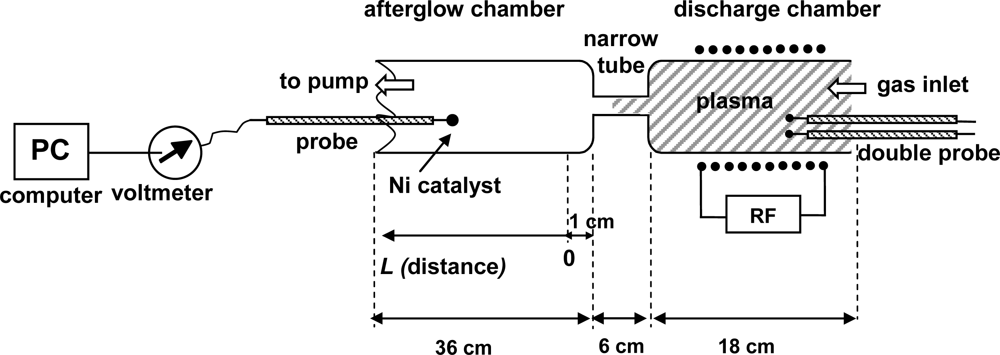
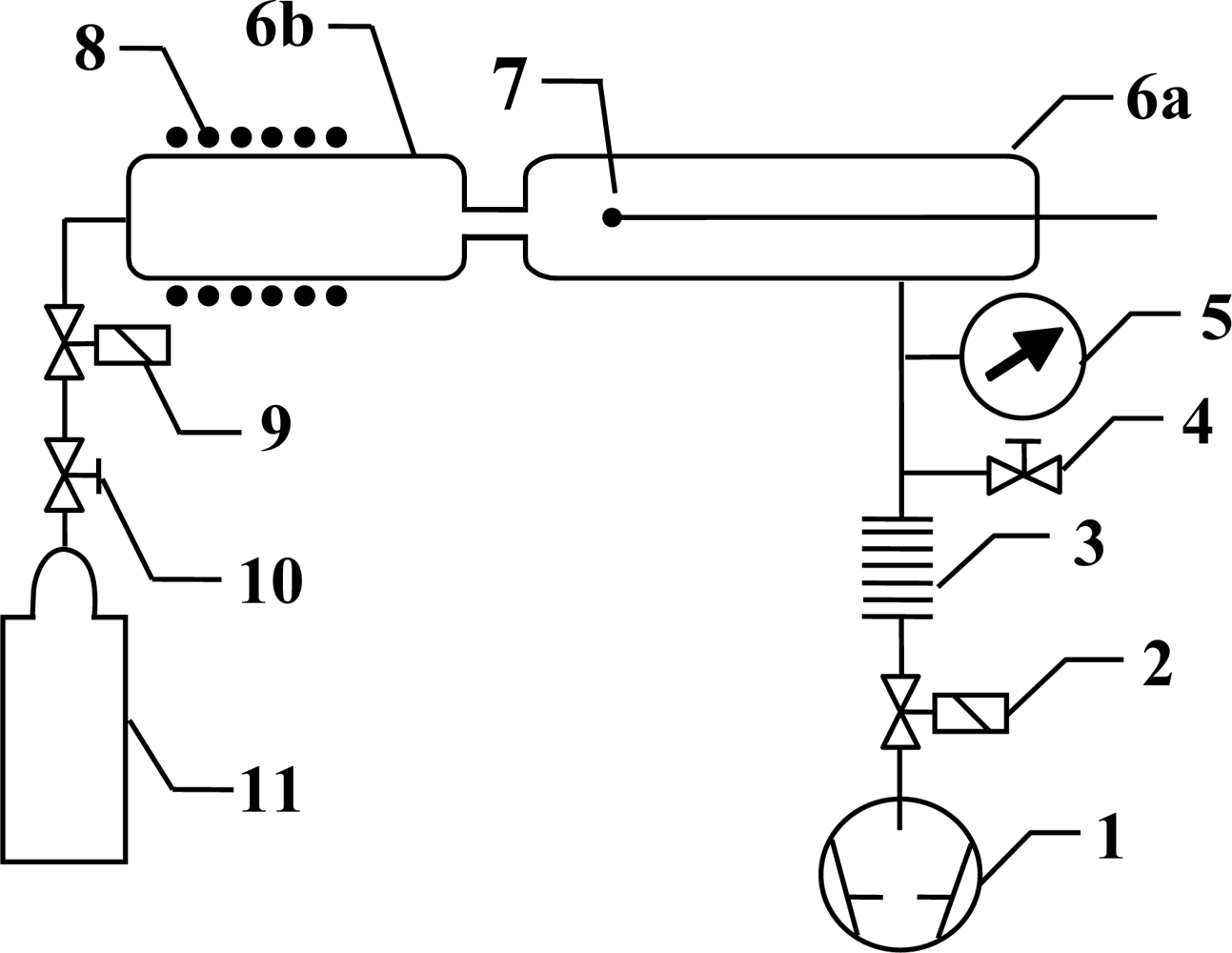
<p>Experiments were performed using the discharge system shown in <xref ref-type="fig" rid="f1-sensors-12-16168">Figure 1</xref>. The main component of this system is a discharge tube (I.D. 3.6 cm), which is connected to an afterglow tube (I.D. 3.6 cm) by a narrow glass tube (I.D. 7 mm, length 6 cm) as shown in <xref ref-type="fig" rid="f2-sensors-12-16168">Figure 2</xref>. Carbon dioxide leaks into the discharge system through a manually adjustable high vacuum leak valve. The gas passes into the discharge region where it is transformed into plasma, and then continues into the afterglow chamber through a narrow borosilicate glass tube. The narrow tube effectively separates the glowing plasma from the early afterglow. The intensity of the emitted light is uniform in the discharge tube and diminishes as the gas enters the narrow tube. Visibly glowing plasma is present in the first 3–5 cm of the narrow tube, with the exact distance depending on the pressure, and converts to early afterglow thereafter. The absence of plasma glow results from the loss of electrons because of surface neutralization along the narrow tube.</p>
<p>The gas in the afterglow continues its way toward the pump passing through the vacuum gauge (Baratron® Absolute, pressure range 1–1,000 Pa, MKS Instruments, Andover, MA, USA) and flowing through a recombinator until it finally reaches the pump. The CO<sub>2</sub> pressure was varied between 20 Pa and 120 Pa. The recombinator contains a rough copper mesh that effectively recombines any radicals into stable molecules, but this has practically no influence on the gas flow in the sense of lowering the effective pumping speed. Without the recombinator, radicals might react with the oil in the rotary pump. The nominal pumping speed of the two-stage rotary pump was 16 m<sup>3</sup> h<sup>−1</sup>.</p>
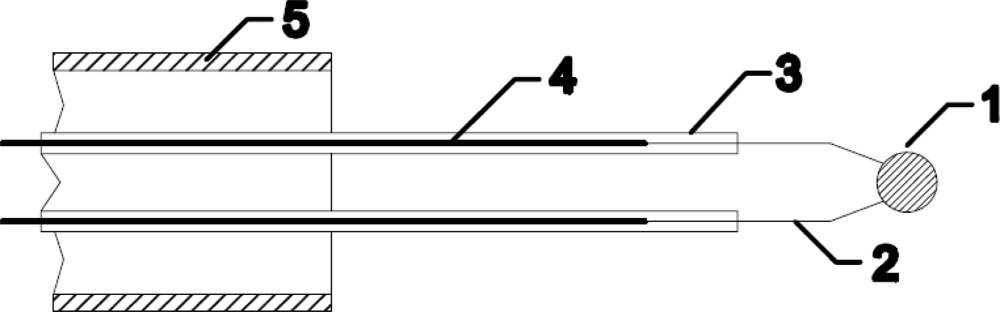
<p>A standard thermocouple nickel catalytic probe [<xref ref-type="bibr" rid="b12-sensors-12-16168">12</xref>] (<xref ref-type="fig" rid="f2-sensors-12-16168">Figure 2</xref>) was mounted into the afterglow chamber as shown in <xref ref-type="fig" rid="f3-sensors-12-16168">Figure 3</xref>. Detailed operation of catalytic probe and calculations for determination of neutral oxygen atoms in oxygen plasma afterglow is described elsewhere [<xref ref-type="bibr" rid="b17-sensors-12-16168">17</xref>]. The temperature of the catalytic probe, which is needed for calculation of the density of radicals, was measured by a voltmeter connected to a computer. The catalytic probe was movable so that it was possible to perform measurements with the probe tip at different positions in the afterglow chamber. Before the experiments with the catalytic probe, a simple double electrical probe was mounted into the center of the discharge tube to estimate the density of positive ions in the glowing plasma. The saturated ion current depended on the pressure and slowly decreased with increasing pressure. The order of magnitude for the density of charged particles was 10<sup>16</sup> m<sup>−3</sup>.</p></sec>
<sec sec-type="results|discussion">
<label>3.</label>
<title>Results and Discussion</title>
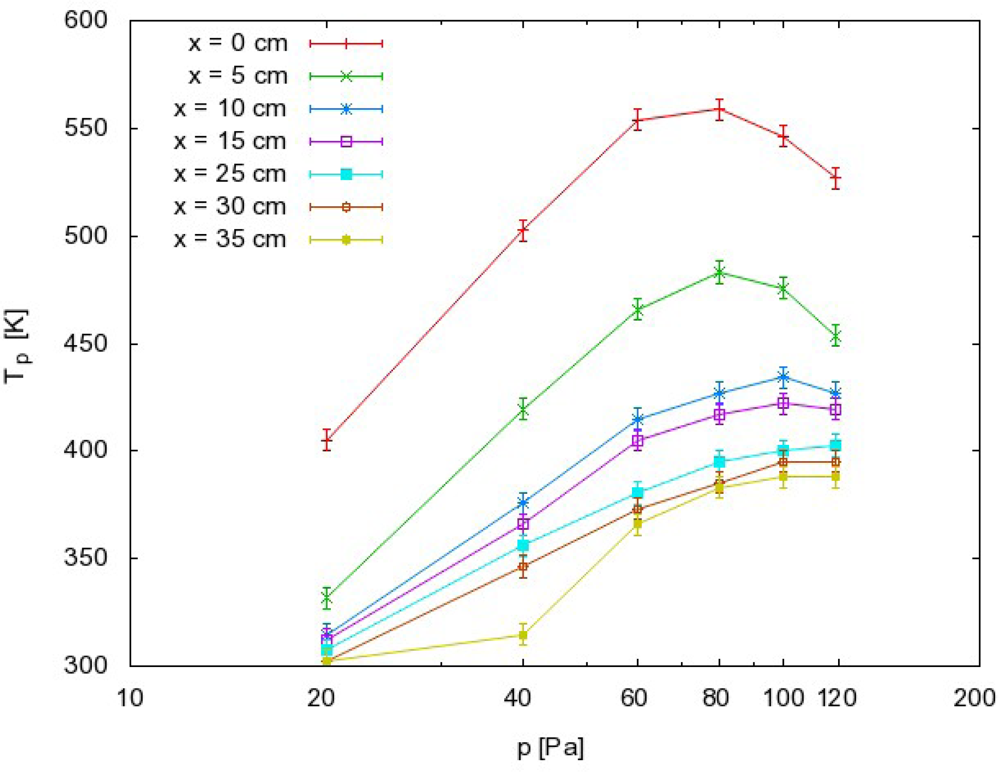
<p>Systematic measurements were performed by adjusting the pressure in the afterglow chamber to an appropriate value, and then moving the probe along the afterglow chamber. The zero position was approximately 1 cm away from the exit of the narrow tube (see <xref ref-type="fig" rid="f3-sensors-12-16168">Figure 3</xref>). Measurements were performed at discrete positions separated by 5 cm. The maximum temperature of the probe under various experimental conditions is presented in <xref ref-type="fig" rid="f4-sensors-12-16168">Figure 4</xref>. The probe temperature measurements are both reliable and reproducible, while only the thermocouple and voltmeter are used. These measurements are also very accurate, with a precision of about ≈ 5 K. The density of the radicals was then calculated using the standard procedure, which is based on heating of the probe because of recombination of plasma radicals on its surface. One must also consider the heating contribution of ions and plasma radiation. However in our case there were no ions in the afterglow chamber, as they all were neutralized in the narrow tube. The role of plasma irradiation on the probe was measured with an optical emission spectrometer (OES) with sensitivity of 14,000 counts μW<sup>−1</sup> per ms integration time. We measured OES spectra near the probe position and we estimated the radiation power to be about 10 W. This means that the nickel disk with mass of 2.6 × 10<sup>−6</sup> kg and 444 J·kg<sup>−1</sup>·K<sup>−1</sup> thermal heat capacity would heat up for 1 K in approximately 120 s. Even though this is an overestimation, while the solid angle of the probe is at least ten times lower than solid angle of spectrometer, the contribution from plasma irradiation can be neglected while the probe heats up, usually to about 100 K (<xref ref-type="fig" rid="f4-sensors-12-16168">Figure 4</xref>) in 20 s or less. Therefore the probe is heated mostly through the heterogeneous reactions of plasma radicals.</p>
<p>Here it is worth mentioning that we had to activate the probe. The nickel probe tip was oxidized and because of that, the first few measurements in an afterglow of the CO<sub>2</sub> plasma were not reproducible. Several measurements had to be done to achieve reproducibility. This could be explained with the adsorption of CO molecules on the surface of the nickel disk. Thus the heterogeneous reactions on the surface of the probe tip are [<xref ref-type="bibr" rid="b18-sensors-12-16168">18</xref>]:
<disp-formula id="FD1">
<label>(1)</label>
<mml:math id="mm1" display="block">
<mml:mrow>
<mml:mtext>O</mml:mtext>
<mml:mo>+</mml:mo>
<mml:mtext>O</mml:mtext>
<mml:mo>→</mml:mo>
<mml:msub>
<mml:mrow>
<mml:mtext>O</mml:mtext></mml:mrow>
<mml:mn>2</mml:mn></mml:msub></mml:mrow></mml:math></disp-formula>
<disp-formula id="FD2">
<label>(2)</label>
<mml:math id="mm2" display="block">
<mml:mrow>
<mml:mtext>CO</mml:mtext>
<mml:mo>+</mml:mo>
<mml:mtext>O</mml:mtext>
<mml:mo>→</mml:mo>
<mml:msub>
<mml:mrow>
<mml:mrow>
<mml:mtext>CO</mml:mtext></mml:mrow></mml:mrow>
<mml:mn>2</mml:mn></mml:msub></mml:mrow></mml:math></disp-formula></p>
<p>Reactions (1) and (2) include both the Langmuir-Hinshelwood (O<sub>ads</sub> + O<sub>ads</sub> → O<sub>2</sub>, CO<sub>ads</sub> + O<sub>ads</sub> → CO<sub>2</sub>) and Eley-Rideal mechanisms (O + O<sub>ads</sub> → O<sub>2</sub>, CO + O<sub>ads</sub> → CO<sub>2</sub>, CO<sub>ads</sub> + O → CO<sub>2</sub>), while for determination of radicals only power released by Reaction (1) and power released by Reaction (2) are needed. The recombination mechanism is not important for our calculations. Recombination probabilities γ used for determination of radicals are therefore averaged probabilities for both mechanisms.</p>
<p>Because the probe is exposed to fluxes of both O atoms and carbon monoxide (CO) molecules, the released power on the surface of the probe can be simply and roughly described by the following Equation:
<disp-formula id="FD3">
<label>(3)</label>
<mml:math id="mm3" display="block">
<mml:mrow>
<mml:mi>P</mml:mi>
<mml:mo>=</mml:mo>
<mml:mo>½</mml:mo>
<mml:mo>⋅</mml:mo>
<mml:msub>
<mml:mrow>
<mml:mi>γ</mml:mi></mml:mrow>
<mml:mrow>
<mml:msub>
<mml:mrow>
<mml:mtext>O</mml:mtext></mml:mrow>
<mml:mn>2</mml:mn></mml:msub></mml:mrow></mml:msub>
<mml:mo>⋅</mml:mo>
<mml:msub>
<mml:mrow>
<mml:mi>W</mml:mi></mml:mrow>
<mml:mrow>
<mml:msub>
<mml:mrow>
<mml:mtext>D</mml:mtext></mml:mrow>
<mml:mrow>
<mml:msub>
<mml:mrow>
<mml:mtext>O</mml:mtext></mml:mrow>
<mml:mn>2</mml:mn></mml:msub></mml:mrow></mml:msub></mml:mrow></mml:msub>
<mml:mo>⋅</mml:mo>
<mml:mo stretchy="false">(</mml:mo>
<mml:msub>
<mml:mrow>
<mml:mi>j</mml:mi></mml:mrow>
<mml:mtext>O</mml:mtext></mml:msub>
<mml:mo>−</mml:mo>
<mml:msub>
<mml:mrow>
<mml:mi>γ</mml:mi></mml:mrow>
<mml:mrow>
<mml:msub>
<mml:mrow>
<mml:mrow>
<mml:mtext>CO</mml:mtext></mml:mrow></mml:mrow>
<mml:mn>2</mml:mn></mml:msub></mml:mrow></mml:msub>
<mml:mo>⋅</mml:mo>
<mml:msub>
<mml:mrow>
<mml:mi>j</mml:mi></mml:mrow>
<mml:mrow>
<mml:mtext>CO</mml:mtext></mml:mrow></mml:msub>
<mml:mo stretchy="false">)</mml:mo>
<mml:mo>⋅</mml:mo>
<mml:mi>A</mml:mi>
<mml:mo>+</mml:mo>
<mml:mo>½</mml:mo>
<mml:mo>⋅</mml:mo>
<mml:msub>
<mml:mrow>
<mml:mi>γ</mml:mi></mml:mrow>
<mml:mrow>
<mml:msub>
<mml:mrow>
<mml:mrow>
<mml:mtext>CO</mml:mtext></mml:mrow></mml:mrow>
<mml:mn>2</mml:mn></mml:msub></mml:mrow></mml:msub>
<mml:mo>⋅</mml:mo>
<mml:msub>
<mml:mrow>
<mml:mi>W</mml:mi></mml:mrow>
<mml:mrow>
<mml:msub>
<mml:mrow>
<mml:mtext>D</mml:mtext></mml:mrow>
<mml:mrow>
<mml:msub>
<mml:mrow>
<mml:mrow>
<mml:mtext>CO</mml:mtext></mml:mrow></mml:mrow>
<mml:mn>2</mml:mn></mml:msub></mml:mrow></mml:msub></mml:mrow></mml:msub>
<mml:mo>⋅</mml:mo>
<mml:mn>2</mml:mn>
<mml:msub>
<mml:mrow>
<mml:mi>j</mml:mi></mml:mrow>
<mml:mrow>
<mml:mtext>CO</mml:mtext></mml:mrow></mml:msub>
<mml:mo>⋅</mml:mo>
<mml:mi>A</mml:mi></mml:mrow></mml:math></disp-formula>where γ<sub>O<sub>2</sub></sub> and γ<sub>CO<sub>2</sub></sub> are the recombination probabilities for Reactions (1) and (2), respectively; <italic>W</italic><sub>D<sub>O<sub>2</sub></sub></sub> and <italic>W</italic><sub>D<sub>CO<sub>2</sub></sub></sub> are dissociation energies of O<sub>2</sub> and CO<sub>2</sub> molecules (<italic>i.e</italic>., <italic>W</italic><sub>D<sub>O<sub>2</sub></sub></sub> = 5.2 eV and <italic>W</italic><sub>D<sub>CO<sub>2</sub></sub></sub> = 5.5 eV [<xref ref-type="bibr" rid="b19-sensors-12-16168">19</xref>]); <italic>j</italic><sub>O</sub> and <italic>j</italic><sub>CO</sub> are the fluxes of O atoms and CO molecules, respectively, to the probe surface with area <italic>A</italic> (1.4 × 10<sup>−5</sup> m<sup>2</sup>). The first part of <xref ref-type="disp-formula" rid="FD3">Equation (3)</xref> is the contribution from recombination into oxygen molecules, where the flux part is the O atoms flux minus the O atoms flux used for CO<sub>2</sub> recombination. The second part of <xref ref-type="disp-formula" rid="FD3">Equation (3)</xref> is the contribution from recombination into carbon dioxide molecules, where the flux part is two times CO flux whereas the flux of O atoms used for CO<sub>2</sub> recombination is the same as the flux of CO molecules. The factor ½ arises from the fact that two particles, two atoms (O) or one molecule (CO) and one atom (O), are needed to recombine into one molecule O<sub>2</sub> or CO<sub>2</sub>, respectively.</p>
<p>The fluxes <italic>j</italic><sub>O</sub> and <italic>j</italic><sub>CO</sub> are defined as follows:
<disp-formula id="FD4">
<label>(4)</label>
<mml:math id="mm4" display="block">
<mml:mrow>
<mml:msub>
<mml:mrow>
<mml:mi>j</mml:mi></mml:mrow>
<mml:mtext>O</mml:mtext></mml:msub>
<mml:mo>=</mml:mo>
<mml:mfrac bevelled="true">
<mml:mn>1</mml:mn>
<mml:mn>4</mml:mn></mml:mfrac>
<mml:mo>⋅</mml:mo>
<mml:msub>
<mml:mrow>
<mml:mi>n</mml:mi></mml:mrow>
<mml:mtext>O</mml:mtext></mml:msub>
<mml:mo>⋅</mml:mo>
<mml:msub>
<mml:mrow>
<mml:mi>v</mml:mi></mml:mrow>
<mml:mtext>O</mml:mtext></mml:msub></mml:mrow></mml:math></disp-formula>
<disp-formula id="FD5">
<label>(5)</label>
<mml:math id="mm5" display="block">
<mml:mrow>
<mml:msub>
<mml:mrow>
<mml:mi>j</mml:mi></mml:mrow>
<mml:mrow>
<mml:mtext>CO</mml:mtext></mml:mrow></mml:msub>
<mml:mo>=</mml:mo>
<mml:mfrac bevelled="true">
<mml:mn>1</mml:mn>
<mml:mn>4</mml:mn></mml:mfrac>
<mml:mo>⋅</mml:mo>
<mml:msub>
<mml:mrow>
<mml:mi>n</mml:mi></mml:mrow>
<mml:mrow>
<mml:mtext>CO</mml:mtext></mml:mrow></mml:msub>
<mml:mo>⋅</mml:mo>
<mml:msub>
<mml:mrow>
<mml:mi>v</mml:mi></mml:mrow>
<mml:mrow>
<mml:mtext>CO</mml:mtext></mml:mrow></mml:msub></mml:mrow></mml:math></disp-formula>where <italic>n</italic><sub>O</sub> and <italic>n</italic><sub>CO</sub> are the densities of O atoms and CO molecules. The average thermal velocities of the O atoms and CO molecules, <italic>v</italic><sub>O</sub> = 630 m/s and <italic>v</italic><sub>CO</sub> = 476 m/s, are calculated using 
<inline-formula>
<mml:math id="mm6" display="inline">
<mml:mrow>
<mml:mi>v</mml:mi>
<mml:mo>=</mml:mo>
<mml:msqrt>
<mml:mrow>
<mml:mn>8</mml:mn>
<mml:msub>
<mml:mrow>
<mml:mi>k</mml:mi></mml:mrow>
<mml:mtext>B</mml:mtext></mml:msub>
<mml:mi>T</mml:mi>
<mml:mo>/</mml:mo>
<mml:mo stretchy="false">(</mml:mo>
<mml:mi>π</mml:mi>
<mml:mo>⋅</mml:mo>
<mml:mi>m</mml:mi>
<mml:mo stretchy="false">)</mml:mo></mml:mrow></mml:msqrt></mml:mrow></mml:math></inline-formula>. Because the CO<sub>2</sub> molecule dissociates to equal amounts of CO and O, and because the probability for heterogeneous recombination of O atoms on glass surfaces is very low, around 10<sup>−4</sup>[<xref ref-type="bibr" rid="b20-sensors-12-16168">20</xref>], the densities of CO and O in a plasma afterglow can be considered as equal (<italic>i.e</italic>., <italic>n</italic><sub>O</sub> = <italic>n</italic><sub>CO</sub>). Combination of <xref ref-type="disp-formula" rid="FD3">Equations (3)</xref>, <xref ref-type="disp-formula" rid="FD4">(4)</xref> and <xref ref-type="disp-formula" rid="FD5">(5)</xref> provides the following formula:
<disp-formula id="FD6">
<label>(6)</label>
<mml:math id="mm7" display="block">
<mml:mrow>
<mml:mi>P</mml:mi>
<mml:mo>=</mml:mo>
<mml:mfrac>
<mml:mrow>
<mml:mi>A</mml:mi>
<mml:mo>⋅</mml:mo>
<mml:msub>
<mml:mrow>
<mml:mi>n</mml:mi></mml:mrow>
<mml:mtext>O</mml:mtext></mml:msub></mml:mrow>
<mml:mn>8</mml:mn></mml:mfrac>
<mml:mrow>
<mml:mo>(</mml:mo>
<mml:mrow>
<mml:msub>
<mml:mrow>
<mml:mi>γ</mml:mi></mml:mrow>
<mml:mrow>
<mml:msub>
<mml:mrow>
<mml:mtext>O</mml:mtext></mml:mrow>
<mml:mn>2</mml:mn></mml:msub></mml:mrow></mml:msub>
<mml:mo>⋅</mml:mo>
<mml:msub>
<mml:mrow>
<mml:mi>W</mml:mi></mml:mrow>
<mml:mrow>
<mml:msub>
<mml:mrow>
<mml:mtext>D</mml:mtext></mml:mrow>
<mml:mrow>
<mml:msub>
<mml:mrow>
<mml:mtext>O</mml:mtext></mml:mrow>
<mml:mn>2</mml:mn></mml:msub></mml:mrow></mml:msub></mml:mrow></mml:msub>
<mml:mo>⋅</mml:mo>
<mml:mo stretchy="false">(</mml:mo>
<mml:msub>
<mml:mrow>
<mml:mi>v</mml:mi></mml:mrow>
<mml:mtext>O</mml:mtext></mml:msub>
<mml:mo>−</mml:mo>
<mml:msub>
<mml:mrow>
<mml:mi>γ</mml:mi></mml:mrow>
<mml:mrow>
<mml:msub>
<mml:mrow>
<mml:mrow>
<mml:mtext>CO</mml:mtext></mml:mrow></mml:mrow>
<mml:mn>2</mml:mn></mml:msub></mml:mrow></mml:msub>
<mml:mo>⋅</mml:mo>
<mml:msub>
<mml:mrow>
<mml:mi>v</mml:mi></mml:mrow>
<mml:mrow>
<mml:mtext>CO</mml:mtext></mml:mrow></mml:msub>
<mml:mo stretchy="false">)</mml:mo>
<mml:mo>+</mml:mo>
<mml:msub>
<mml:mrow>
<mml:mi>γ</mml:mi></mml:mrow>
<mml:mrow>
<mml:msub>
<mml:mrow>
<mml:mrow>
<mml:mtext>CO</mml:mtext></mml:mrow></mml:mrow>
<mml:mn>2</mml:mn></mml:msub></mml:mrow></mml:msub>
<mml:mo>⋅</mml:mo>
<mml:msub>
<mml:mrow>
<mml:mi>W</mml:mi></mml:mrow>
<mml:mrow>
<mml:msub>
<mml:mrow>
<mml:mtext>D</mml:mtext></mml:mrow>
<mml:mrow>
<mml:msub>
<mml:mrow>
<mml:mrow>
<mml:mtext>CO</mml:mtext></mml:mrow></mml:mrow>
<mml:mn>2</mml:mn></mml:msub></mml:mrow></mml:msub></mml:mrow></mml:msub>
<mml:mo>⋅</mml:mo>
<mml:mn>2</mml:mn>
<mml:msub>
<mml:mrow>
<mml:mi>v</mml:mi></mml:mrow>
<mml:mrow>
<mml:mtext>CO</mml:mtext></mml:mrow></mml:msub></mml:mrow>
<mml:mo>)</mml:mo></mml:mrow></mml:mrow></mml:math></disp-formula></p>
<p>The probe heating can be calculated as follows:
<disp-formula id="FD7">
<label>(7)</label>
<mml:math id="mm8" display="block">
<mml:mrow>
<mml:mi>P</mml:mi>
<mml:mo>=</mml:mo>
<mml:msub>
<mml:mrow>
<mml:mi mathvariant="italic">mc</mml:mi></mml:mrow>
<mml:mi>p</mml:mi></mml:msub>
<mml:mfrac>
<mml:mrow>
<mml:mtext>d</mml:mtext>
<mml:mi>T</mml:mi></mml:mrow>
<mml:mrow>
<mml:mtext>d</mml:mtext>
<mml:mi>t</mml:mi></mml:mrow></mml:mfrac></mml:mrow></mml:math></disp-formula>where <italic>m</italic> is the mass of the probe, <italic>c<sub>p</sub></italic> is its thermal heat capacity, and d<italic>T</italic>/d<italic>t</italic> is the time derivate of the probe temperature just after the heating source has been turned on. The density of O atoms can be thus calculated from a combination of <xref ref-type="disp-formula" rid="FD6">Equations (6)</xref> and <xref ref-type="disp-formula" rid="FD7">(7)</xref> as follows:
<disp-formula id="FD8">
<label>(8)</label>
<mml:math id="mm9" display="block">
<mml:mrow>
<mml:msub>
<mml:mrow>
<mml:mi>n</mml:mi></mml:mrow>
<mml:mi>O</mml:mi></mml:msub>
<mml:mo>=</mml:mo>
<mml:mfrac>
<mml:mrow>
<mml:mn>8</mml:mn>
<mml:mo>⋅</mml:mo>
<mml:mi>m</mml:mi>
<mml:mo>⋅</mml:mo>
<mml:msub>
<mml:mrow>
<mml:mi>c</mml:mi></mml:mrow>
<mml:mi>p</mml:mi></mml:msub>
<mml:mo>⋅</mml:mo>
<mml:mrow>
<mml:mo>(</mml:mo>
<mml:mrow>
<mml:mrow>
<mml:mfrac bevelled="true">
<mml:mrow>
<mml:mtext>d</mml:mtext>
<mml:mi>T</mml:mi></mml:mrow>
<mml:mrow>
<mml:mtext>d</mml:mtext>
<mml:mi>t</mml:mi></mml:mrow></mml:mfrac></mml:mrow></mml:mrow>
<mml:mo>)</mml:mo></mml:mrow></mml:mrow>
<mml:mrow>
<mml:mi>A</mml:mi>
<mml:mo>⋅</mml:mo>
<mml:mrow>
<mml:mo>(</mml:mo>
<mml:mrow>
<mml:msub>
<mml:mrow>
<mml:mi>γ</mml:mi></mml:mrow>
<mml:mrow>
<mml:msub>
<mml:mrow>
<mml:mtext>O</mml:mtext></mml:mrow>
<mml:mn>2</mml:mn></mml:msub></mml:mrow></mml:msub>
<mml:mo>⋅</mml:mo>
<mml:msub>
<mml:mrow>
<mml:mi>W</mml:mi></mml:mrow>
<mml:mrow>
<mml:msub>
<mml:mrow>
<mml:mtext>D</mml:mtext></mml:mrow>
<mml:mrow>
<mml:msub>
<mml:mrow>
<mml:mtext>O</mml:mtext></mml:mrow>
<mml:mn>2</mml:mn></mml:msub></mml:mrow></mml:msub></mml:mrow></mml:msub>
<mml:mo>⋅</mml:mo>
<mml:mo stretchy="false">(</mml:mo>
<mml:msub>
<mml:mrow>
<mml:mi>v</mml:mi></mml:mrow>
<mml:mtext>O</mml:mtext></mml:msub>
<mml:mo>−</mml:mo>
<mml:msub>
<mml:mrow>
<mml:mi>γ</mml:mi></mml:mrow>
<mml:mrow>
<mml:msub>
<mml:mrow>
<mml:mrow>
<mml:mtext>CO</mml:mtext></mml:mrow></mml:mrow>
<mml:mn>2</mml:mn></mml:msub></mml:mrow></mml:msub>
<mml:mo>⋅</mml:mo>
<mml:msub>
<mml:mrow>
<mml:mi>v</mml:mi></mml:mrow>
<mml:mrow>
<mml:mtext>CO</mml:mtext></mml:mrow></mml:msub>
<mml:mo stretchy="false">)</mml:mo>
<mml:mo>+</mml:mo>
<mml:msub>
<mml:mrow>
<mml:mi>γ</mml:mi></mml:mrow>
<mml:mrow>
<mml:msub>
<mml:mrow>
<mml:mrow>
<mml:mtext>CO</mml:mtext></mml:mrow></mml:mrow>
<mml:mn>2</mml:mn></mml:msub></mml:mrow></mml:msub>
<mml:mo>⋅</mml:mo>
<mml:msub>
<mml:mrow>
<mml:mi>W</mml:mi></mml:mrow>
<mml:mrow>
<mml:msub>
<mml:mrow>
<mml:mtext>D</mml:mtext></mml:mrow>
<mml:mrow>
<mml:msub>
<mml:mrow>
<mml:mrow>
<mml:mtext>CO</mml:mtext></mml:mrow></mml:mrow>
<mml:mn>2</mml:mn></mml:msub></mml:mrow></mml:msub></mml:mrow></mml:msub>
<mml:mo>⋅</mml:mo>
<mml:mn>2</mml:mn>
<mml:msub>
<mml:mrow>
<mml:mi>v</mml:mi></mml:mrow>
<mml:mrow>
<mml:mtext>CO</mml:mtext></mml:mrow></mml:msub></mml:mrow>
<mml:mo>)</mml:mo></mml:mrow></mml:mrow></mml:mfrac></mml:mrow></mml:math></disp-formula></p>
<p>Recombination probability γ<sub>O<sub>2</sub></sub> is well known and for nickel surfaces it is 0.27, while the recombination probability for γ<sub>CO<sub>2</sub></sub> is not known. Most studies take into account the average heterogeneous surface recombination probability [<xref ref-type="bibr" rid="b19-sensors-12-16168">19</xref>] or assume γ<sub>O<sub>2</sub></sub> = γ<sub>CO<sub>2</sub></sub> [<xref ref-type="bibr" rid="b18-sensors-12-16168">18</xref>]. We made the same assumption in the present paper.</p>
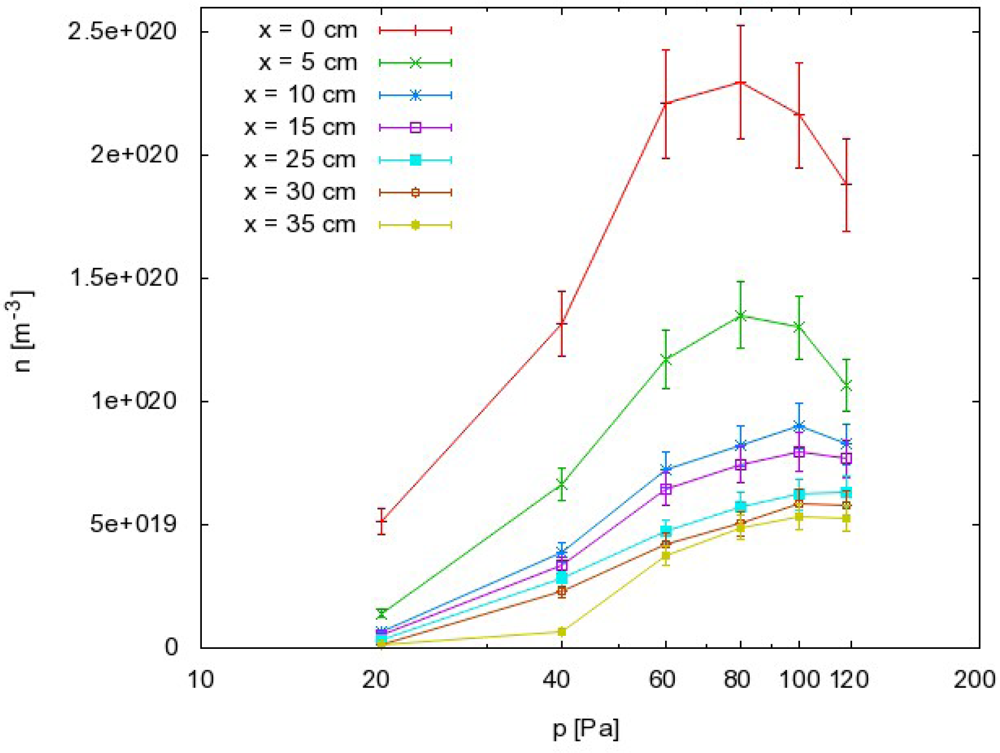
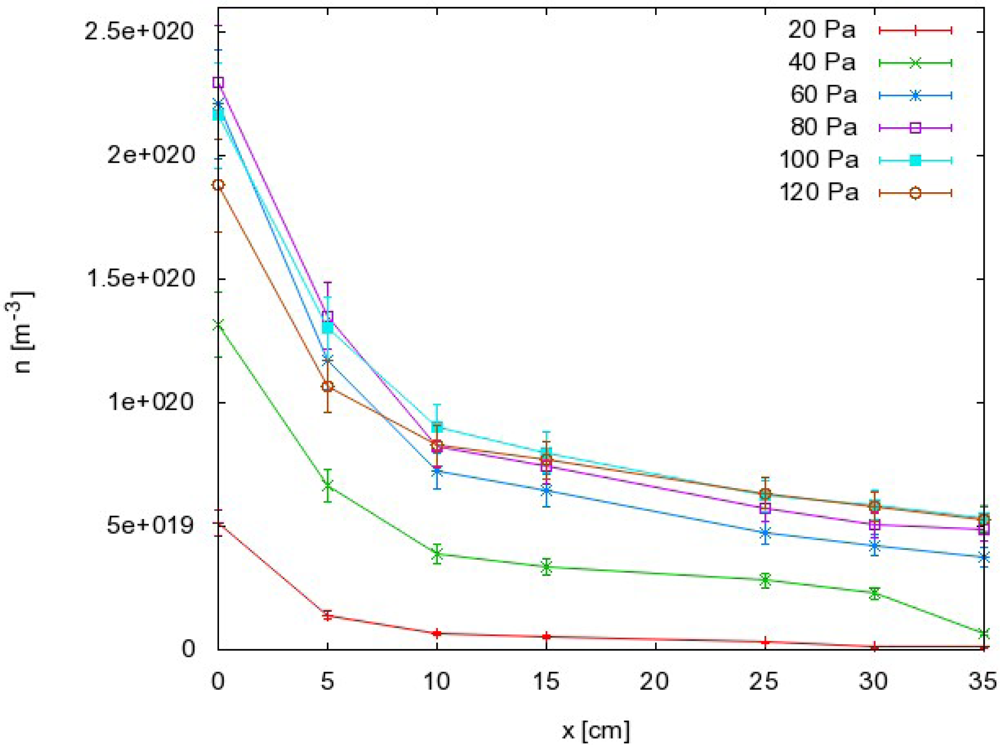
<p>The results as calculated from <xref ref-type="disp-formula" rid="FD8">Equation (8)</xref> are summarized in <xref ref-type="fig" rid="f5-sensors-12-16168">Figure 5</xref>, where the density of O atoms is plotted against the pressure at different distances along the narrow tube. The corresponding graph of <italic>n</italic><sub>O</sub> against the distance is presented in <xref ref-type="fig" rid="f6-sensors-12-16168">Figure 6</xref>.</p>
<p>Finally, the dissociation fraction of CO<sub>2</sub> molecules can be calculated from the following equation:
<disp-formula id="FD9">
<label>(9)</label>
<mml:math id="mm10" display="block">
<mml:mrow>
<mml:mi>η</mml:mi>
<mml:mo>=</mml:mo>
<mml:mfrac>
<mml:mrow>
<mml:msub>
<mml:mrow>
<mml:mi>n</mml:mi></mml:mrow>
<mml:mtext>O</mml:mtext></mml:msub></mml:mrow>
<mml:mrow>
<mml:msubsup>
<mml:mrow>
<mml:mi>n</mml:mi></mml:mrow>
<mml:mrow>
<mml:msub>
<mml:mrow>
<mml:mrow>
<mml:mtext>CO</mml:mtext></mml:mrow></mml:mrow>
<mml:mn>2</mml:mn></mml:msub></mml:mrow>
<mml:mn>0</mml:mn></mml:msubsup></mml:mrow></mml:mfrac>
<mml:mo>=</mml:mo>
<mml:mfrac>
<mml:mrow>
<mml:msub>
<mml:mrow>
<mml:mi>n</mml:mi></mml:mrow>
<mml:mi>O</mml:mi></mml:msub>
<mml:mi>k</mml:mi>
<mml:mi>T</mml:mi></mml:mrow>
<mml:mrow>
<mml:msubsup>
<mml:mrow>
<mml:mi>p</mml:mi></mml:mrow>
<mml:mrow>
<mml:msub>
<mml:mrow>
<mml:mrow>
<mml:mtext>CO</mml:mtext></mml:mrow></mml:mrow>
<mml:mn>2</mml:mn></mml:msub></mml:mrow>
<mml:mn>0</mml:mn></mml:msubsup></mml:mrow></mml:mfrac></mml:mrow></mml:math></disp-formula>where <italic>k</italic> is the Boltzmann constant, <italic>T</italic> is the neutral gas kinetic temperature, and 
<inline-formula>
<mml:math id="mm11" display="inline">
<mml:mrow>
<mml:msubsup>
<mml:mrow>
<mml:mi>p</mml:mi></mml:mrow>
<mml:mrow>
<mml:msub>
<mml:mrow>
<mml:mrow>
<mml:mtext>CO</mml:mtext></mml:mrow></mml:mrow>
<mml:mn>2</mml:mn></mml:msub></mml:mrow>
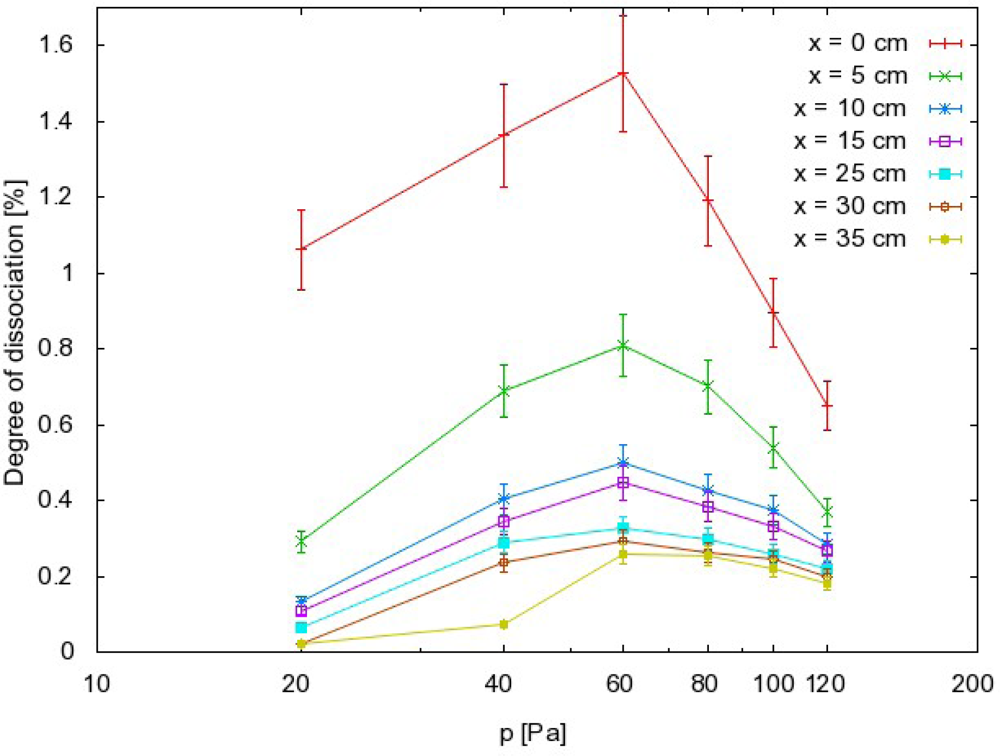
<mml:mn>0</mml:mn></mml:msubsup></mml:mrow></mml:math></inline-formula> is the pressure of CO<sub>2</sub> before the discharge is turned on. The results are summarized in <xref ref-type="fig" rid="f7-sensors-12-16168">Figure 7</xref>.</p>
<p>The results reveal some interesting behaviors that can be summarized as follows:
<list list-type="bullet">
<list-item>
<p>the order of magnitude for the dissociation fraction is about 1%;</p></list-item>
<list-item>
<p>the dissociation fraction exhibits a rather broad maximum at 60 Pa;</p></list-item>
<list-item>
<p>the O atom density also exhibits a maximum but it is slightly shifted to higher pressure compared to the dissociation fraction;</p></list-item>
<list-item>
<p>there is a sharp drop in both the dissociation fraction and atom density in the first few centimeters along the narrow tube exhaust.</p></list-item></list></p>
<p>The dissociation fraction of CO<sub>2</sub> molecules in the early afterglow is rather low, especially when compared with experiments performed in pure O<sub>2</sub> or hydrogen (H<sub>2</sub>) under very similar discharge conditions [<xref ref-type="bibr" rid="b21-sensors-12-16168">21</xref>,<xref ref-type="bibr" rid="b22-sensors-12-16168">22</xref>]. The value obtained in the present study was at least an order of magnitude lower than those obtained in the earlier studies. For example, in pure O<sub>2</sub> the neutral O atom density exceeded 5 × 10<sup>21</sup> m<sup>−3</sup>. The differences between our results and those in the earlier studies can be explained either by different production or loss rates of radicals. Because the plasma density is practically the same as those in experiments with O<sub>2</sub>, the only explanation for the reduced O atom production is a lower dissociation rate. The dissociation energies of O<sub>2</sub>, H<sub>2</sub>, and CO<sub>2</sub> molecules are 5.2, 4.5 and 5.5 eV, respectively. Because the dissociation energy of carbon molecules is not much larger, it cannot be the reason for poor production. CO<sub>2</sub> dissociation can occur by electron impact dissociation, dissociative recombination of positive ions, and dissociation stimulated by vibrational excitation of molecules [<xref ref-type="bibr" rid="b16-sensors-12-16168">16</xref>] as follows:
<disp-formula id="FD10">
<label>(10)</label>
<mml:math id="mm12" display="block">
<mml:mrow>
<mml:msub>
<mml:mrow>
<mml:mrow>
<mml:mtext>CO</mml:mtext></mml:mrow></mml:mrow>
<mml:mn>2</mml:mn></mml:msub>
<mml:mo>+</mml:mo>
<mml:msup>
<mml:mrow>
<mml:mtext>e</mml:mtext></mml:mrow>
<mml:mo>−</mml:mo></mml:msup>
<mml:mo>→</mml:mo>
<mml:mtext>CO</mml:mtext>
<mml:mo>+</mml:mo>
<mml:mtext>O</mml:mtext>
<mml:mo>+</mml:mo>
<mml:msup>
<mml:mrow>
<mml:mtext>e</mml:mtext></mml:mrow>
<mml:mo>−</mml:mo></mml:msup></mml:mrow></mml:math></disp-formula>
<disp-formula id="FD11">
<label>(11)</label>
<mml:math id="mm13" display="block">
<mml:mrow>
<mml:msubsup>
<mml:mrow>
<mml:mrow>
<mml:mtext>CO</mml:mtext></mml:mrow></mml:mrow>
<mml:mn>2</mml:mn>
<mml:mo>+</mml:mo></mml:msubsup>
<mml:mo>+</mml:mo>
<mml:msup>
<mml:mrow>
<mml:mtext>e</mml:mtext></mml:mrow>
<mml:mo>−</mml:mo></mml:msup>
<mml:mo>→</mml:mo>
<mml:mtext>CO</mml:mtext>
<mml:mo>+</mml:mo>
<mml:mtext>O</mml:mtext></mml:mrow></mml:math></disp-formula>
<disp-formula id="FD12">
<label>(12)</label>
<mml:math id="mm14" display="block">
<mml:mrow>
<mml:msubsup>
<mml:mrow>
<mml:mrow>
<mml:mtext>CO</mml:mtext></mml:mrow></mml:mrow>
<mml:mn>2</mml:mn>
<mml:mtext>v</mml:mtext></mml:msubsup>
<mml:mo>+</mml:mo>
<mml:msup>
<mml:mrow>
<mml:mi>e</mml:mi></mml:mrow>
<mml:mo>−</mml:mo></mml:msup>
<mml:mo>→</mml:mo>
<mml:mtext>CO</mml:mtext>
<mml:mo>+</mml:mo>
<mml:mtext>O</mml:mtext>
<mml:mo>+</mml:mo>
<mml:msup>
<mml:mrow>
<mml:mtext>e</mml:mtext></mml:mrow>
<mml:mo>−</mml:mo></mml:msup></mml:mrow></mml:math></disp-formula></p>
<p>Reaction (11) can be ignored in the present study because of a very low ionization fraction in the plasma, where the estimated value according to measurements by the double probe is approximately 10<sup>−6</sup>. Two other mechanisms definitely contribute to the dissociation phenomenon. According to classical work [<xref ref-type="bibr" rid="b19-sensors-12-16168">19</xref>], the mechanism in Reaction (12) is often the most effective channel for CO<sub>2</sub> dissociation in a non-equilibrium plasma. Namely, the rate coefficient of CO<sub>2</sub> vibrational excitation by electron impact reaches a maximum value of &gt;10<sup>−8</sup> cm<sup>3</sup> s<sup>−1</sup>. At the same time, the loss of vibrational energy by superelastic collisions, or V-T relaxation, is relatively slow [<xref ref-type="bibr" rid="b19-sensors-12-16168">19</xref>]. As a result, rather high vibrational temperatures are achieved in CO<sub>2</sub> plasmas. The cross-section for direct dissociation of the CO<sub>2</sub> molecule in the ground state Reaction (10) is very low at the electron temperature of a few electron volts so it could probably be ignored. Another mechanism worth mentioning is dissociation of CO<sub>2</sub> molecules found in metastable electronic states, such as CO<sub>2</sub> (<sup>1</sup>B<sub>2</sub>) and CO<sub>2</sub> (<sup>3</sup>B<sub>2</sub>). The densities of such states are unknown in our case, so it is difficult to discuss the contribution of this channel to dissociation of CO<sub>2</sub> molecules. In any case, there are quite a few possible mechanisms of dissociation by collision with an energetic electron, and the rate of CO and O production in CO<sub>2</sub> plasma is thought to be similar to the rate of O production in O<sub>2</sub> plasma. The production mechanisms are therefore not responsible for the rather low dissociation fraction as determined in our experiments for the early afterglow.</p>
<p>Another reason for a rather poor dissociation fraction could be loss rates. An important mechanism for the loss of radicals in the gas phase is recombination by three body collisions. Such a collision is required because the energy and momentum have to be preserved. At around 60 Pa, where the experiments were performed, the probability for three body collisions is low, and gas phase reactions are easily neglected. Radical loss mechanisms that are more important occur on the surfaces. Many authors have shown that the probability for heterogeneous surface recombination of O atoms on glass surfaces is around 10<sup>−4</sup>[<xref ref-type="bibr" rid="b12-sensors-12-16168">12</xref>,<xref ref-type="bibr" rid="b20-sensors-12-16168">20</xref>]. Less work has been performed on recombination of CO on glass surfaces. Most studies have investigated the average recombination probability for the reactions O + O → O<sub>2</sub> and CO + O → CO<sub>2</sub>[<xref ref-type="bibr" rid="b18-sensors-12-16168">18</xref>,<xref ref-type="bibr" rid="b21-sensors-12-16168">21</xref>]. Sepka <italic>et al.</italic> managed to separate the reactions and found out that the dominant surface reaction on a quartz surface in an O<sub>2</sub>-CO mixture was O + O → O<sub>2</sub>[<xref ref-type="bibr" rid="b23-sensors-12-16168">23</xref>]. Kolesnikov <italic>et al</italic>. proposed the average catalytic efficiency for both reactions was about 2.5 × 10<sup>−5</sup> at 300 K for silica-based surfaces [<xref ref-type="bibr" rid="b21-sensors-12-16168">21</xref>]. Bykova <italic>et al</italic>. obtained much higher values for quartz surfaces of about 2 × 10<sup>−3</sup>[<xref ref-type="bibr" rid="b18-sensors-12-16168">18</xref>]. The difference between the results obtained by Kolesnikov and Bykova is two orders of magnitude. There could be several reasons for this difference, in addition to the simple explanation that the coefficients are not determined precisely. Another, more probable explanation for this difference is the diverse surface properties of the materials investigated by these two groups.</p>
<p>The dissociation fraction is defined as the ratio between the density of a particular radical (e.g., CO) and the density of the stable parent molecules (e.g., CO<sub>2</sub>). The density of the parent molecules is determined from the pressure in the afterglow chamber using <xref ref-type="disp-formula" rid="FD9">Equation (9)</xref>. The dissociation fraction should therefore decrease with increasing pressure. This has been observed in many afterglow experiments [<xref ref-type="bibr" rid="b24-sensors-12-16168">24</xref>], but was not the case in the present study and <xref ref-type="fig" rid="f7-sensors-12-16168">Figure 7</xref> shows a well-defined maximum on the curve. Some mechanism must prevent a high dissociation fraction at low pressure. This mechanism should exclude any gas phase reactions, because their probability usually increases with increasing pressure. Therefore, the reasons for the rather poor dissociation rate at lower pressure could be explained by surface loss mechanisms. Again, there are several mechanisms for this, including Reactions (1) and (2), but because the coefficients for Reaction (2) are not known, a quantitative calculation could not be performed. However, it is possible to discuss the relatively low dissociation fraction qualitatively in view of the high probabilities for heterogeneous surface oxidation of CO (by Reaction (2)). As mentioned in earlier studies, much higher dissociation fractions were found in detailed characterizations of pure O<sub>2</sub> afterglows. The anomalous behavior of the CO<sub>2</sub> afterglow must therefore occur because of the presence of particles other than O or O<sub>2</sub>. In the afterglow of CO<sub>2</sub> weakly ionized plasma, the only candidate is CO. The recombination coefficient of the CO molecules on borosilicate glass should obviously be higher than the coefficient for recombination of neutral O atoms.</p>
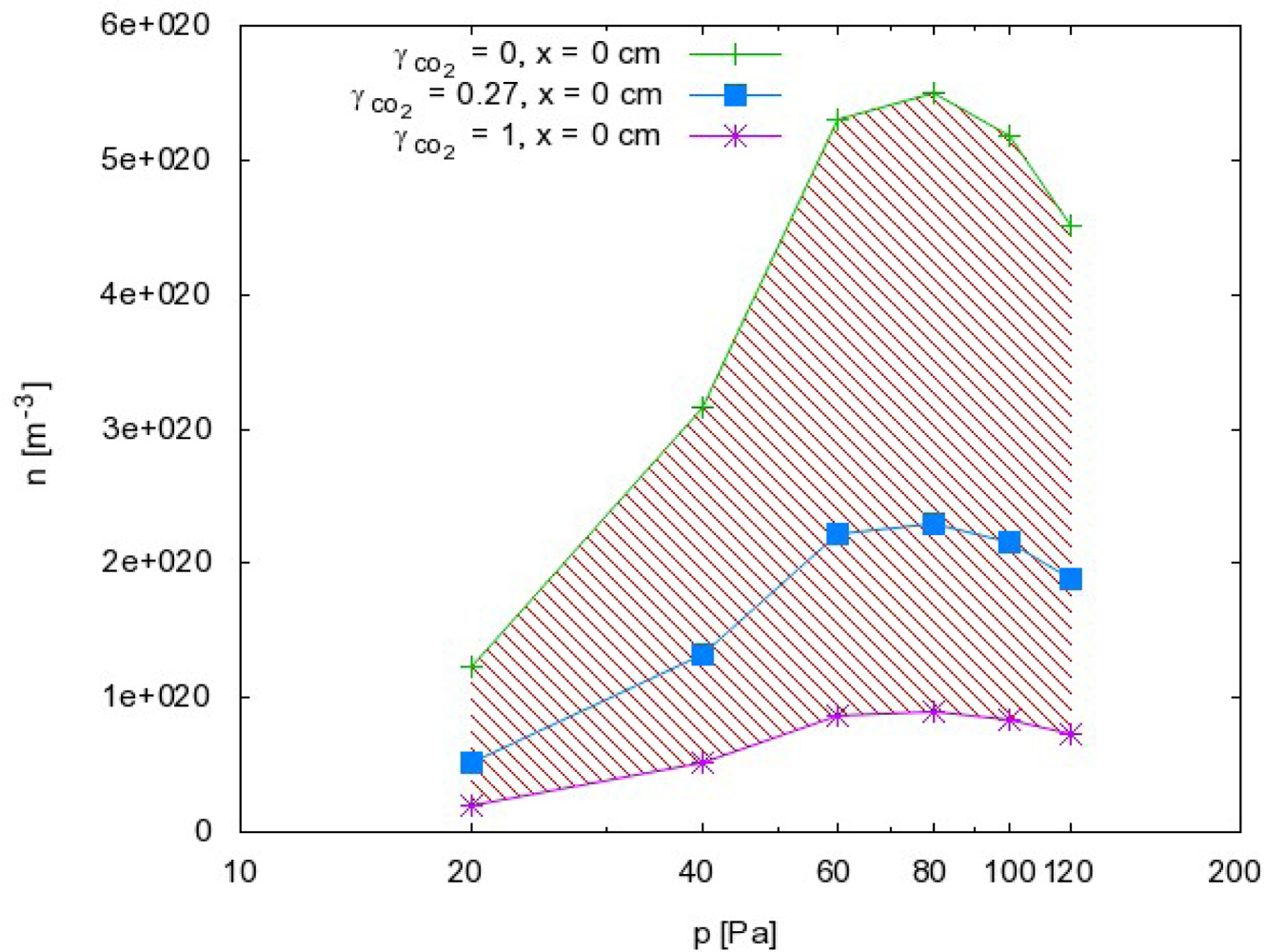
<p>From this point of view, we can also discuss the results presented in <xref ref-type="fig" rid="f5-sensors-12-16168">Figures 5</xref> and <xref ref-type="fig" rid="f6-sensors-12-16168">6</xref>. Because the probability for heterogeneous surface recombination of CO molecules in the presence of neutral O atoms is unknown, the results presented in <xref ref-type="fig" rid="f5-sensors-12-16168">Figures 5</xref> and <xref ref-type="fig" rid="f6-sensors-12-16168">6</xref> cannot be very accurate. In fact, the results in these figures were obtained by assuming the probability for recombination of CO molecules on the probe tip was the same as the probability for recombination of neutral O atoms Reaction (1). To estimate the error made by this assumption, we have to reconsider <xref ref-type="disp-formula" rid="FD8">Equation (8)</xref> and take into account the extreme cases. The recombination coefficient is by definition somewhere between 0 and 1. The O atom density as calculated from <xref ref-type="disp-formula" rid="FD8">Equation (8)</xref> obviously depends on the recombination coefficient for Reaction (1) and on the recombination coefficient for Reaction (2). <xref ref-type="fig" rid="f8-sensors-12-16168">Figure 8</xref> represents the possible range of O atom densities taking into account any value of the recombination coefficient for Reaction (2). The lower limit of the atom density is represented by the highest possible recombination coefficient (<italic>i.e</italic>., γ<sub>CO<sub>2</sub></sub> = 1). The upper limit is set by taking into account the lowest recombination coefficient (<italic>i.e</italic>., γ<sub>CO<sub>2</sub></sub>= 0). As can be seen from <xref ref-type="fig" rid="f8-sensors-12-16168">Figure 8</xref>, the differences between the lowest and the highest O atom densities were not small. Somewhere in between we can observe the values of the O atom density by taking into account the most probable value of the recombination coefficient (<italic>i.e</italic>., γ<sub>CO<sub>2</sub></sub>= 0.27). Although there is a difference of almost one order of magnitude between the extremes presented in <xref ref-type="fig" rid="f8-sensors-12-16168">Figure 8</xref>, the accuracy of the O atom density determined from the catalytic probe measurements should be good. As stated by Kolesnikov <italic>et al</italic>., the typical recombination coefficient for metals like nickel is between 0.1 and 1. From this point of view, the approximation usually used by all authors, which is that the recombination coefficient for Reaction (2) is equal to the recombination coefficient for Reaction (1), is not only convenient but also justified. The limits of the shaded area in <xref ref-type="fig" rid="f8-sensors-12-16168">Figure 8</xref> should therefore be taken only as theoretical limits for the worst-case conditions.</p>
<p>The results summarized in <xref ref-type="fig" rid="f4-sensors-12-16168">Figures 4</xref>–<xref ref-type="fig" rid="f6-sensors-12-16168">6</xref> have practical value because they represent important guidelines for authors working on modification of materials by CO<sub>2</sub> plasma or afterglow. First of all, <xref ref-type="fig" rid="f4-sensors-12-16168">Figure 4</xref> clearly shows that material that exhibits catalytic activity for heterogeneous surface recombination for O atoms or CO molecules can be heated to elevated temperatures only by the recombinations. The maximum temperature a sample can reach depends substantially on the position in the afterglow. In very early afterglow, temperatures of about 500 K were detected (<xref ref-type="fig" rid="f4-sensors-12-16168">Figure 4</xref>). Not far from this region (25 cm), the temperature was much lower and this position appears to be better for placing the material if it cannot withstand heating to elevated temperatures. Another possible way to avoid excessive heating of materials is application of lower pressure. <xref ref-type="fig" rid="f4-sensors-12-16168">Figure 4</xref> clearly shows that heating of a catalytic material is negligible at 20 Pa as long as the sample is placed 5 cm away from the plasma glow region. Here, it is worth noting that such negligible heating should also be obtained at higher pressures. The curves presented in <xref ref-type="fig" rid="f4-sensors-12-16168">Figure 4</xref> have extremes, and extrapolation to pressures of several 100 Pa should give low temperatures as well. From this point of view, the high pressure extreme would also save catalytic material from overheating. However, it should be stressed that ignition of the radiofrequency electrodeless discharges at elevated pressures is not an easy task.</p>
<p>Materials that do not exhibit catalytic reactivity for surface recombination following Reactions (1) and (2) could be placed anywhere in the afterglow chamber as long as heating is not a concern. As shown in <xref ref-type="fig" rid="f5-sensors-12-16168">Figures 5</xref> and <xref ref-type="fig" rid="f6-sensors-12-16168">6</xref>, an appropriate radical density can be selected either by changing the pressure or the position inside the tube. The first few centimeters of the afterglow region (<xref ref-type="fig" rid="f6-sensors-12-16168">Figure 6</xref>) are characterized by large radical gradients, and it is not advisable to place a material in this area. Positions further along the tube are much better for treatment of non-catalytic materials. <xref ref-type="fig" rid="f6-sensors-12-16168">Figure 6</xref> shows that strong gradients are not present at distances of about 10 cm away from the plasma. Positioning of the sample at around 20 cm would be very suitable for treatment of delicate organic materials where both the flux of radicals on the surface and the thermal load are of concern.</p>
<p>Finally, the right pressure needs to be chosen during treatment of delicate materials by CO<sub>2</sub> plasma afterglow. Because of uncertainties and for stable treatment, it is always best to operate the apparatus at conditions where a maximum in a certain parameter exists. From this point of view, it is recommended to take into account the results presented in <xref ref-type="fig" rid="f5-sensors-12-16168">Figure 5</xref>. Rather well pronounced maxima are observed on all the curves. If the selected distance from the plasma is 20 cm, the best results in the terms of stability are expected at 100 Pa, which is where the curve in <xref ref-type="fig" rid="f5-sensors-12-16168">Figure 5</xref> has a maximum. If a higher radical density is chosen, the sample has to be moved closer to the source. In such a case, a different pressure needs to be chosen. <xref ref-type="fig" rid="f5-sensors-12-16168">Figure 5</xref> indicates that the optimal pressure at 5 cm is 80 Pa, and this would be similar at positions very close to the source. Therefore, there are a variety of experimental conditions that can be chosen for CO<sub>2</sub> plasma afterglow treatment of materials.</p></sec>
<sec sec-type="conclusions">
<label>4.</label>
<title>Conclusions</title>
<p>A catalytic sensor for radical density measurement in CO<sub>2</sub> plasmas was investigated. For this purpose the dissociation of CO<sub>2</sub> molecules in a low-pressure weakly ionized plasma, created in a glass tube by an electrodeless radio frequency discharge, was studied using a nickel catalytic probe. Catalytic probes are well known and frequently used sensors for measuring atom densities in discharges of diatomic gas molecules, such as oxygen and hydrogen. With some modification of the recombination model on the probe tip we were able to determine the radical density in an afterglow of an inductively coupled CO<sub>2</sub> plasma. The nickel catalytic sensor has a very good repeatability and good precision, but a simple recombination model and rough assessment of CO<sub>2</sub> recombination coefficients on the nickel surface can give rather poor accuracy. For better accuracy a more thorough theoretical model of the CO<sub>2</sub> heterogeneous recombination must be researched and more accurate CO<sub>2</sub> recombination coefficients needs to be measured. Nevertheless some useful conclusions can be made from our results. The experimental setup allowed for effective separation of the glowing plasma from the early afterglow. The catalytic probe was mounted in the afterglow region and was movable. This allowed determination of the dissociation fraction along the axis of gas flow through the afterglow tube. The results of systematic measurements showed that the optimal radical density was obtained at a moderate pressure of about 80 Pa, while a well-defined maximum was found for the dissociation fraction at 60 Pa. The observations were discussed in terms of gas phase and surface reactions, and strong radical gradients were qualitatively described by heterogeneous surface loss of gaseous radicals on the walls of the glass chamber. The afterglow of CO<sub>2</sub> plasma is therefore characterized by a relatively small radical density, and is therefore suitable for treatment of delicate materials.</p></sec></body>
<back>
<ack>
<p>This project was funded by the Slovenian Research Agency (PROTEUS) and the French Ministry of Foreign Affairs through EGIDE in the framework of the PHC Proteus 22721TB/2011 program. The authors also acknowledge financial support from the Ministry of Higher Education, Science and Technology of the Republic of Slovenia (Grant No. 3211-10-000057) (Center of Excellence Polymer Materials and Technologies).</p></ack>
<ref-list>
<title>References</title>
<ref id="b1-sensors-12-16168"><label>1.</label><citation citation-type="journal"><person-group person-group-type="author"><name><surname>Chan</surname><given-names>C.M.</given-names></name><name><surname>Ko</surname><given-names>T.M.</given-names></name><name><surname>Hiraoka</surname><given-names>H.</given-names></name></person-group><article-title>Polymer surface modification by plasmas and photons</article-title><source>Surf. Sci. Rep</source><year>1996</year><volume>24</volume><fpage>1</fpage><lpage>54</lpage><pub-id pub-id-type="doi">10.1016/0167-5729(96)80003-3</pub-id></citation></ref>
<ref id="b2-sensors-12-16168"><label>2.</label><citation citation-type="journal"><person-group person-group-type="author"><name><surname>Junkar</surname><given-names>I.</given-names></name><name><surname>Cvelbar</surname><given-names>U.</given-names></name><name><surname>Vesel</surname><given-names>A.</given-names></name><name><surname>Hauptman</surname><given-names>N.</given-names></name><name><surname>Mozetič</surname><given-names>M.</given-names></name></person-group><article-title>The role of crystallinity on polymer interaction with oxygen plasma</article-title><source>Plasma Process. Polym</source><year>2009</year><volume>6</volume><fpage>667</fpage><lpage>675</lpage><pub-id pub-id-type="doi">10.1002/ppap.200900034</pub-id></citation></ref>
<ref id="b3-sensors-12-16168"><label>3.</label><citation citation-type="journal"><person-group person-group-type="author"><name><surname>Tsougeni</surname><given-names>K.</given-names></name><name><surname>Vourdas</surname><given-names>N.</given-names></name><name><surname>Tserepi</surname><given-names>A.</given-names></name><name><surname>Gogolides</surname><given-names>E.</given-names></name><name><surname>Cardinaud</surname><given-names>C.</given-names></name></person-group><article-title>Mechanisms of oxygen plasma nanotexturing of organic polymer surfaces: from stable super hydrophilic to super hydrophobic surfaces</article-title><source>Langmuir</source><year>2009</year><volume>25</volume><fpage>11748</fpage><lpage>11759</lpage><pub-id pub-id-type="doi">10.1021/la901072z</pub-id><pub-id pub-id-type="pmid">19788226</pub-id></citation></ref>
<ref id="b4-sensors-12-16168"><label>4.</label><citation citation-type="journal"><person-group person-group-type="author"><name><surname>Junkar</surname><given-names>I.</given-names></name><name><surname>Hauptman</surname><given-names>N.</given-names></name><name><surname>Rener-Sitar</surname><given-names>K.</given-names></name><name><surname>Klanjšek-Gunde</surname><given-names>M.</given-names></name><name><surname>Cvelbar</surname><given-names>U.</given-names></name></person-group><article-title>Surface modification of graphite by oxygen plasma = Modifikacija površine grafita s kisikovo plazmo</article-title><source>Inform. MIDEM</source><year>2008</year><volume>38</volume><fpage>266</fpage><lpage>271</lpage></citation></ref>
<ref id="b5-sensors-12-16168"><label>5.</label><citation citation-type="journal"><person-group person-group-type="author"><name><surname>Vesel</surname><given-names>A.</given-names></name><name><surname>Mozetič</surname><given-names>M.</given-names></name><name><surname>Drenik</surname><given-names>A.</given-names></name><name><surname>Hauptman</surname><given-names>N.</given-names></name><name><surname>Balat-Pichelin</surname><given-names>M.</given-names></name></person-group><article-title>High temperature oxidation of stainless steel AISI316L in air plasma</article-title><source>Appl. Surf. Sci</source><year>2008</year><volume>255</volume><fpage>1759</fpage><lpage>1765</lpage><pub-id pub-id-type="doi">10.1016/j.apsusc.2008.06.017</pub-id></citation></ref>
<ref id="b6-sensors-12-16168"><label>6.</label><citation citation-type="journal"><person-group person-group-type="author"><name><surname>Chen</surname><given-names>Z.Q.</given-names></name><name><surname>Cvelbar</surname><given-names>U.</given-names></name><name><surname>Mozetič</surname><given-names>M</given-names></name><name><surname>He</surname><given-names>J.Q.</given-names></name><name><surname>Sunkara</surname><given-names>M.K.</given-names></name></person-group><article-title>Long-Range ordering of oxygen-vacancy planes in α-Fe<sub>2</sub>O<sub>3</sub> nanowires and nanobelts</article-title><source>Chem. Mater</source><year>2008</year><volume>20</volume><fpage>3224</fpage><lpage>3228</lpage><pub-id pub-id-type="doi">10.1021/cm800288y</pub-id></citation></ref>
<ref id="b7-sensors-12-16168"><label>7.</label><citation citation-type="journal"><person-group person-group-type="author"><name><surname>Ostrikov</surname><given-names>K.</given-names></name><name><surname>Levchenko</surname><given-names>I.</given-names></name><name><surname>Cvelbar</surname><given-names>U.</given-names></name><name><surname>Sunkara</surname><given-names>M.</given-names></name><name><surname>Mozetič</surname><given-names>M.</given-names></name></person-group><article-title>From nucleation to nanowires: A single-step process in reactive plasmas</article-title><source>Nanoscale</source><year>2010</year><volume>2</volume><fpage>2012</fpage><lpage>2027</lpage><pub-id pub-id-type="doi">10.1039/c0nr00366b</pub-id><pub-id pub-id-type="pmid">20721365</pub-id></citation></ref>
<ref id="b8-sensors-12-16168"><label>8.</label><citation citation-type="journal"><person-group person-group-type="author"><name><surname>Eiselt</surname><given-names>P.</given-names></name></person-group><article-title>Interaction of highly dissociated oxygen plasma with polymers and their composites</article-title><source>Inform. MIDEM</source><year>2007</year><volume>37</volume><fpage>123</fpage><lpage>131</lpage></citation></ref>
<ref id="b9-sensors-12-16168"><label>9.</label><citation citation-type="journal"><person-group person-group-type="author"><name><surname>Gunde</surname><given-names>M.K.</given-names></name><name><surname>Kunaver</surname><given-names>M.</given-names></name><name><surname>Mozetič</surname><given-names>M.</given-names></name><name><surname>Pelicon</surname><given-names>P.</given-names></name><name><surname>Simcic</surname><given-names>J.</given-names></name><name><surname>Budnar</surname><given-names>M.</given-names></name><name><surname>Bele</surname><given-names>M.</given-names></name></person-group><article-title>Microstructure analysis of metal-effect coatings</article-title><source>Surf. Coat. Int. Pt. B: Coat. Trans</source><year>2002</year><volume>85</volume><fpage>115</fpage><lpage>121</lpage><pub-id pub-id-type="doi">10.1007/BF02699751</pub-id></citation></ref>
<ref id="b10-sensors-12-16168"><label>10.</label><citation citation-type="journal"><person-group person-group-type="author"><name><surname>Cvelbar</surname><given-names>U.</given-names></name><name><surname>Ostrikov</surname><given-names>K.</given-names></name><name><surname>Mozetič</surname><given-names>M.</given-names></name></person-group><article-title>Reactive oxygen plasma-enabled synthesis of nanostructured CdO: Tailoring nanostructures through plasma-surface interactions</article-title><source>Nanotechnology</source><year>2008</year><pub-id pub-id-type="doi">10.1088/0957-4484/19/40/405605</pub-id></citation></ref>
<ref id="b11-sensors-12-16168"><label>11.</label><citation citation-type="journal"><person-group person-group-type="author"><name><surname>Krstulović</surname><given-names>N.</given-names></name><name><surname>Labazan</surname><given-names>I.</given-names></name><name><surname>Milošević</surname><given-names>S.</given-names></name><name><surname>Cvelbar</surname><given-names>U.</given-names></name><name><surname>Vesel</surname><given-names>A.</given-names></name><name><surname>Mozetič</surname><given-names>M.</given-names></name></person-group><article-title>Optical emission spectroscopy characterization of oxygen plasma during treatment of a PET foil</article-title><source>J. Phys. D Appl. Phys</source><year>2006</year><volume>39</volume><pub-id pub-id-type="doi">10.1088/0022-3727/39/17/014</pub-id></citation></ref>
<ref id="b12-sensors-12-16168"><label>12.</label><citation citation-type="journal"><person-group person-group-type="author"><name><surname>Sorli</surname><given-names>I.</given-names></name><name><surname>Rocak</surname><given-names>R.</given-names></name></person-group><article-title>Determination of atomic oxygen density with a nickel catalytic probe</article-title><source>J. Vac. Sci. Technol. A</source><year>2000</year><volume>18</volume><fpage>338</fpage><lpage>342</lpage></citation></ref>
<ref id="b13-sensors-12-16168"><label>13.</label><citation citation-type="journal"><person-group person-group-type="author"><name><surname>Médard</surname><given-names>N.</given-names></name><name><surname>Soutif</surname><given-names>J.C.</given-names></name><name><surname>Poncin-Epaillard</surname><given-names>F.</given-names></name></person-group><article-title>Characterization of CO<sub>2</sub> plasma-treated polyethylene surface bearing carboxylic groups</article-title><source>Surf. Coat. Tech</source><year>2002</year><volume>160</volume><fpage>197</fpage><lpage>205</lpage><pub-id pub-id-type="doi">10.1016/S0257-8972(02)00407-3</pub-id></citation></ref>
<ref id="b14-sensors-12-16168"><label>14.</label><citation citation-type="journal"><person-group person-group-type="author"><name><surname>Poncin-Epaillard</surname><given-names>F.</given-names></name><name><surname>Aouinti</surname><given-names>M.</given-names></name></person-group><article-title>Characterization of CO<sub>2</sub> plasma and interactions with polypropylene film</article-title><source>Plasmas Polym</source><year>2002</year><volume>7</volume><fpage>1</fpage><lpage>17</lpage><pub-id pub-id-type="doi">10.1023/A:1015277316825</pub-id></citation></ref>
<ref id="b15-sensors-12-16168"><label>15.</label><citation citation-type="journal"><person-group person-group-type="author"><name><surname>Wang</surname><given-names>M.J.</given-names></name><name><surname>Chang</surname><given-names>Y.I.</given-names></name><name><surname>Poncin-Epaillard</surname><given-names>F.</given-names></name></person-group><article-title>Acid and basic functionalities of nitrogen and carbon dioxide plasma-treated polystyrene</article-title><source>Surf. Interface Anal</source><year>2005</year><volume>37</volume><fpage>348</fpage><lpage>355</lpage><pub-id pub-id-type="doi">10.1002/sia.2029</pub-id></citation></ref>
<ref id="b16-sensors-12-16168"><label>16.</label><citation citation-type="journal"><person-group person-group-type="author"><name><surname>Otorbaev</surname><given-names>D.K.</given-names></name></person-group><article-title>Catalytic properties of surfaces with respect to generation of CO<sub>2</sub> molecules in the plasma</article-title><source>Chem. Phys</source><year>1995</year><volume>196</volume><fpage>543</fpage><lpage>550</lpage><pub-id pub-id-type="doi">10.1016/0301-0104(95)00139-F</pub-id></citation></ref>
<ref id="b17-sensors-12-16168"><label>17.</label><citation citation-type="journal"><person-group person-group-type="author"><name><surname>Zaplotnik</surname><given-names>R.</given-names></name><name><surname>Vesel</surname><given-names>A.</given-names></name><name><surname>Mozetič</surname><given-names>M.</given-names></name></person-group><article-title>A fiber optic catalytic sensor for neutral atom measurements in oxygen plasma</article-title><source>Sensors</source><year>2012</year><volume>12</volume><fpage>3857</fpage><lpage>3867</lpage><pub-id pub-id-type="doi">10.3390/s120403857</pub-id><pub-id pub-id-type="pmid">22666005</pub-id></citation></ref>
<ref id="b18-sensors-12-16168"><label>18.</label><citation citation-type="journal"><person-group person-group-type="author"><name><surname>Bykova</surname><given-names>N.G.</given-names></name><name><surname>Vasilevskii</surname><given-names>S.A.</given-names></name><name><surname>Gordeev</surname><given-names>A.N.</given-names></name><name><surname>Kolesnikov</surname><given-names>A.F.</given-names></name><name><surname>Pershin</surname><given-names>I.S.</given-names></name><name><surname>Yakushin</surname><given-names>M.I.</given-names></name></person-group><article-title>Determination of the effective probabilities of catalytic reactions on the surfaces of heat shield materials in dissociated carbon dioxide flows</article-title><source>Fluid Dyn</source><year>1997</year><volume>32</volume><fpage>876</fpage><lpage>886</lpage></citation></ref>
<ref id="b19-sensors-12-16168"><label>19.</label><citation citation-type="book"><person-group person-group-type="author"><name><surname>Fridman</surname><given-names>A.</given-names></name></person-group><source>Plasma Chemistry</source><publisher-name>Cambridge University Press</publisher-name><publisher-loc>New York, NY, USA</publisher-loc><year>2008</year></citation></ref>
<ref id="b20-sensors-12-16168"><label>20.</label><citation citation-type="journal"><person-group person-group-type="author"><name><surname>Macko</surname><given-names>P.</given-names></name><name><surname>Veis</surname><given-names>P.</given-names></name><name><surname>Cernogora</surname><given-names>G.</given-names></name></person-group><article-title>Study of oxygen atom recombination on a pyrex surface at different wall temperatures by means of time-resolved actinometry in a double pulse discharge technique</article-title><source>Plasma Sources Sci. Technol</source><year>2004</year><volume>13</volume><fpage>251</fpage><lpage>262</lpage><pub-id pub-id-type="doi">10.1088/0963-0252/13/2/009</pub-id></citation></ref>
<ref id="b21-sensors-12-16168"><label>21.</label><citation citation-type="journal"><person-group person-group-type="author"><name><surname>Kolesnikov</surname><given-names>A.F.</given-names></name><name><surname>Pershin</surname><given-names>I.S.</given-names></name><name><surname>Vasilevskii</surname><given-names>S.A.</given-names></name><name><surname>Yakushin</surname><given-names>M.I.</given-names></name></person-group><article-title>Study of Quartz Surface Catalycity in Dissociated Carbon Dioxide Subsonic Flows</article-title><source>J. Spacecraft Rocket</source><year>2000</year><volume>37</volume><fpage>573</fpage><lpage>579</lpage><pub-id pub-id-type="doi">10.2514/2.3629</pub-id></citation></ref>
<ref id="b22-sensors-12-16168"><label>22.</label><citation citation-type="journal"><person-group person-group-type="author"><name><surname>Zaplotnik</surname><given-names>R.</given-names></name><name><surname>Vesel</surname><given-names>A.</given-names></name><name><surname>Mozetič</surname><given-names>M.</given-names></name></person-group><article-title>Transition from E to H mode in inductively coupled oxygen plasma: Hysteresis and the behaviour of oxygen atom density</article-title><source>EPL</source><year>2011</year><pub-id pub-id-type="doi">10.1209/0295-5075/95/55001</pub-id></citation></ref>
<ref id="b23-sensors-12-16168"><label>23.</label><citation citation-type="journal"><person-group person-group-type="author"><name><surname>Sepka</surname><given-names>S.</given-names></name><name><surname>Chen</surname><given-names>Y.K.</given-names></name><name><surname>Marschall</surname><given-names>J.</given-names></name><name><surname>Copeland</surname><given-names>R.A.</given-names></name></person-group><article-title>Experimental investigation of surface reactions in carbon monoxide and oxygen mixtures</article-title><source>J. Thermophys. Heat Transfer</source><year>2000</year><volume>14</volume><fpage>45</fpage><lpage>52</lpage><pub-id pub-id-type="doi">10.2514/2.6488</pub-id></citation></ref>
<ref id="b24-sensors-12-16168"><label>24.</label><citation citation-type="journal"><person-group person-group-type="author"><name><surname>Balat-Pichelin</surname><given-names>M.</given-names></name><name><surname>Vesel</surname><given-names>A.</given-names></name></person-group><article-title>Neutral oxygen atom density in the MESOX air plasma solar furnace facility</article-title><source>Chem. Phys</source><year>2006</year><volume>327</volume><fpage>112</fpage><lpage>118</lpage><pub-id pub-id-type="doi">10.1016/j.chemphys.2006.03.034</pub-id></citation></ref></ref-list>
<sec sec-type="display-objects">
<title>Figures</title>
<fig id="f1-sensors-12-16168" position="float">
<label>Figure 1.</label>
<caption>
<p>Experimental setup: 1. rotary pump; 2. gate valve; 3. Hopkins trap; 4. air inlet valve; 5. vacuum gauge; 6a. discharge chamber; 6b. post-discharge chamber; 7. catalytic probe; 8. RF coil; 9. leak valve; 10. high-pressure valve; 11. carbon dioxide.</p></caption>
<graphic xlink:href="sensors-12-16168f1.gif"/></fig>
<fig id="f2-sensors-12-16168" position="float">
<label>Figure 2.</label>
<caption>
<p>Thermocouple catalytic probe: 1. nickel disk; 2. thermocouple wires; 3. thin glass tube; 4. kovar wires; 5. glass tube.</p></caption>
<graphic xlink:href="sensors-12-16168f2.gif"/></fig>
<fig id="f3-sensors-12-16168" position="float">
<label>Figure 3.</label>
<caption>
<p>Details of the plasma and afterglow reactors.</p></caption>
<graphic xlink:href="sensors-12-16168f3.gif"/></fig>
<fig id="f4-sensors-12-16168" position="float">
<label>Figure 4.</label>
<caption>
<p>Maximum temperature of a nickel catalyst versus pressure with the catalytic probe at different positions in the afterglow chamber. Absolute error is about ≈ 5 K due to instrument (voltmeter) error.</p></caption>
<graphic xlink:href="sensors-12-16168f4.gif"/></fig>
<fig id="f5-sensors-12-16168" position="float">
<label>Figure 5.</label>
<caption>
<p>Oxygen atom density versus pressure at different positions in the afterglow chamber. Relative error is around ≈ 10% due to the temperature measurement error and probe physical characteristics measurement error (surface area, mass).</p></caption>
<graphic xlink:href="sensors-12-16168f5.gif"/></fig>
<fig id="f6-sensors-12-16168" position="float">
<label>Figure 6.</label>
<caption>
<p>Oxygen atom density along the afterglow chamber at different pressures. Relative error is around ≈ 10%.</p></caption>
<graphic xlink:href="sensors-12-16168f6.gif"/></fig>
<fig id="f7-sensors-12-16168" position="float">
<label>Figure 7.</label>
<caption>
<p>Dissociation fraction of CO<sub>2</sub> molecules in the afterglow chamber versus pressure. Relative error is the same as in density results (≈ 10%), while error in 
<inline-formula>
<mml:math id="mm15" display="inline">
<mml:mrow>
<mml:msubsup>
<mml:mrow>
<mml:mi>p</mml:mi></mml:mrow>
<mml:mrow>
<mml:msub>
<mml:mrow>
<mml:mrow>
<mml:mtext>CO</mml:mtext></mml:mrow></mml:mrow>
<mml:mn>2</mml:mn></mml:msub></mml:mrow>
<mml:mn>0</mml:mn></mml:msubsup></mml:mrow></mml:math></inline-formula> measurement is negligible.</p></caption>
<graphic xlink:href="sensors-12-16168f7.gif"/></fig>
<fig id="f8-sensors-12-16168" position="float">
<label>Figure 8.</label>
<caption>
<p>Oxygen atom density versus pressure at 0 cm. The shaded area represents the values that are theoretically possible when taking into account all values of the recombination coefficient. The lowest curve represents the lower limit when the recombination coefficient is 1, and the upper curve represents the upper limit when the recombination coefficient is 0. The curve in the middle represents the O atom density for the most probable value for the recombination coefficient (<italic>i.e</italic>., γ<sub>CO<sub>2</sub></sub> = 0.27).</p></caption>
<graphic xlink:href="sensors-12-16168f8.gif"/></fig></sec></back></article>