<?xml version="1.0" encoding="UTF-8"?>
<!DOCTYPE article PUBLIC "-//NLM//DTD Journal Publishing DTD v2.3 20070202//EN" "journalpublishing.dtd">
<article xmlns:mml="http://www.w3.org/1998/Math/MathML" xmlns:xlink="http://www.w3.org/1999/xlink" xml:lang="en" article-type="research-article">
<front>
<journal-meta>
<journal-id journal-id-type="nlm-ta">Sensors</journal-id>
<journal-title>Sensors</journal-title>
<issn pub-type="epub">1424-8220</issn>
<publisher>
<publisher-name>Molecular Diversity Preservation International (MDPI)</publisher-name></publisher></journal-meta>
<article-meta>
<article-id pub-id-type="doi">10.3390/s121012964</article-id>
<article-id pub-id-type="publisher-id">sensors-12-12964</article-id>
<article-categories>
<subj-group>
<subject>Article</subject></subj-group></article-categories>
<title-group>
<article-title>Operation Reliability Assessment for Cutting Tools by Applying a Proportional Covariate Model to Condition Monitoring Information</article-title></title-group>
<contrib-group>
<contrib contrib-type="author">
<name><surname>Cai</surname><given-names>Gaigai</given-names></name></contrib>
<contrib contrib-type="author">
<name><surname>Chen</surname><given-names>Xuefeng</given-names></name><xref ref-type="corresp" rid="c1-sensors-12-12964"><sup>*</sup></xref></contrib>
<contrib contrib-type="author">
<name><surname>Li</surname><given-names>Bing</given-names></name></contrib>
<contrib contrib-type="author">
<name><surname>Chen</surname><given-names>Baojia</given-names></name></contrib>
<contrib contrib-type="author">
<name><surname>He</surname><given-names>Zhengjia</given-names></name></contrib>
<aff id="af1-sensors-12-12964">State Key Laboratory for Manufacturing Systems Engineering, Xi'an Jiaotong University, Xi'an 710049, China; E-Mails: <email>caigaigai.2008@stu.xjtu.edu.cn</email> (G.C.); <email>bli@mail.xjtu.edu.cn</email> (B.L.); <email>cbjia@163.com</email> (B.C.); <email>hzj@mail.xjtu.edu.cn</email> (Z.H.)</aff></contrib-group>
<author-notes>
<corresp id="c1-sensors-12-12964">
<label>*</label> Author to whom correspondence should be addressed; E-Mail: <email>chenxf@mail.xjtu.edu.cn</email>; Tel./Fax: +86-29-8266-3689.</corresp></author-notes>
<pub-date pub-type="collection">
<year>2012</year></pub-date>
<pub-date pub-type="epub">
<day>25</day>
<month>09</month>
<year>2012</year></pub-date>
<volume>12</volume>
<issue>10</issue>
<fpage>12964</fpage>
<lpage>12987</lpage>
<history>
<date date-type="received">
<day>25</day>
<month>07</month>
<year>2012</year></date>
<date date-type="rev-recd">
<day>08</day>
<month>09</month>
<year>2012</year></date>
<date date-type="accepted">
<day>14</day>
<month>09</month>
<year>2012</year></date></history>
<permissions>
<copyright-statement>© 2012 by the authors; licensee MDPI, Basel, Switzerland.</copyright-statement>
<copyright-year>2012</copyright-year>
<license>
<p>This article is an open access article distributed under the terms and conditions of the Creative Commons Attribution license (http://creativecommons.org/licenses/by/3.0/).</p></license></permissions>
<abstract>
<p>The reliability of cutting tools is critical to machining precision and production efficiency. The conventional statistic-based reliability assessment method aims at providing a general and overall estimation of reliability for a large population of identical units under given and fixed conditions. However, it has limited effectiveness in depicting the operational characteristics of a cutting tool. To overcome this limitation, this paper proposes an approach to assess the operation reliability of cutting tools. A proportional covariate model is introduced to construct the relationship between operation reliability and condition monitoring information. The wavelet packet transform and an improved distance evaluation technique are used to extract sensitive features from vibration signals, and a covariate function is constructed based on the proportional covariate model. Ultimately, the failure rate function of the cutting tool being assessed is calculated using the baseline covariate function obtained from a small sample of historical data. Experimental results and a comparative study show that the proposed method is effective for assessing the operation reliability of cutting tools.</p></abstract>
<kwd-group>
<kwd>operation reliability assessment</kwd>
<kwd>condition monitoring information</kwd>
<kwd>distance evaluation technique</kwd>
<kwd>proportional covariate model</kwd>
<kwd>cutting tool</kwd></kwd-group></article-meta></front>
<body>
<sec sec-type="intro">
<label>1.</label>
<title>Introduction</title>
<p>Tool failure is a major cause of unscheduled stoppages in the current manufacturing industry and is costly, not only in terms of time lost, but also in terms of capital destroyed [<xref ref-type="bibr" rid="b1-sensors-12-12964">1</xref>]. Statistically, for modern machine tools, approximately 20% of downtime resulting in reduced productivity and economic losses is attributed to cutting tool failure [<xref ref-type="bibr" rid="b2-sensors-12-12964">2</xref>]. The traditional tool replacement strategy based on regular time periods can reduce unplanned downtime and production losses to some extent, but tool degradation is a complex process and is easily affected by sophisticated and various machining environments [<xref ref-type="bibr" rid="b3-sensors-12-12964">3</xref>]. There is a need to assess the real-time operation performance of a cutting tool to guarantee high machining quality and avoid unscheduled downtime to achieve higher economic efficiency and fewer disastrous accidents. For instance, during the manufacturing process of aircraft landing gear, the required processing precision is extremely high and scrapping a workpiece is not desirable because of the considerable cost. It is necessary to monitor the running states and assess the performance of cutting tools to create timely replacement policies or extend tool service life.</p>
<p>The past several decades have witnessed the rapid development of tool condition monitoring methods. As one of the outstanding examples in this field, wear-prediction-based monitoring methods have received great attention. Methods such as ANN [<xref ref-type="bibr" rid="b4-sensors-12-12964">4</xref>], ANN ensemble [<xref ref-type="bibr" rid="b5-sensors-12-12964">5</xref>], and SVM [<xref ref-type="bibr" rid="b6-sensors-12-12964">6</xref>] have proved to be effective in tool condition monitoring [<xref ref-type="bibr" rid="b7-sensors-12-12964">7</xref>]. Although these methods have played an important role in preventing degradation in machining quality, the wear value of a cutting tool is a single index; thus, it is difficult to provide a comprehensive estimation of the running condition of a cutting tool and the associated machining quality. It is necessary to find a method that can comprehensively assess the condition of a cutting tool and the performance of the corresponding machining process. Reliability theory describes the probability that a system will complete its expected function during an interval of time. The reliability function obtained from the reliability assessment of a cutting tool could provide a more detailed analysis of the cutting tool's performance [<xref ref-type="bibr" rid="b8-sensors-12-12964">8</xref>]. Therefore, an effective reliability assessment of a cutting tool is necessary to develop a more effective real-time tool replacement strategy, avoid unplanned shutdowns, guarantee high machining quality, and promote productivity.</p>
<p>Considerable efforts have been made by researchers and engineers to investigate the reliability of cutting tools. Hitomi <italic>et al.</italic> derived the reliability of cutting tools based on the tool-wear distribution estimated from tool-wear experiments [<xref ref-type="bibr" rid="b9-sensors-12-12964">9</xref>]. To quantify the reliability of carbide tools, Negishi and Aoki studied the influence of feed rate on the life of cutting tools during intermittent cutting [<xref ref-type="bibr" rid="b10-sensors-12-12964">10</xref>]. Liu and Makis used a proportional hazard model to assess the reliability of cutting tools in variable conditions by taking machining conditions into consideration [<xref ref-type="bibr" rid="b11-sensors-12-12964">11</xref>]. Based on the theorem of total probability, Klim <italic>et al.</italic> obtained the mean time to failure of cutting tools from the reliability function through a stochastic model [<xref ref-type="bibr" rid="b8-sensors-12-12964">8</xref>]. Wang <italic>et al.</italic> predicted the reliability of cutting tools based on a reliability-dependent failure rate model that involves two decay factors: the embedded decay factor and the process-dependent decay factor [<xref ref-type="bibr" rid="b12-sensors-12-12964">12</xref>]. Lin <italic>et al.</italic> used the normal distribution model to calculate the reliability of cutting tools in high-speed turning and revealed that the tool flank wear rate can be described by the reliability degradation rate [<xref ref-type="bibr" rid="b13-sensors-12-12964">13</xref>]. Hsu <italic>et al.</italic> proposed a non-homogenous continuous-time Markov process to model the tool wear process and performed a reliability assessment of a cutting tool with multi-state deterioration [<xref ref-type="bibr" rid="b14-sensors-12-12964">14</xref>].</p>
<p>The investigations mentioned above have made significant progress in cutting tool reliability analysis. However, some difficult problems still remain. Most of the above studies, to some extent, rely on the complex mechanisms of tool wear or machining conditions, which are generally unstable. More importantly, these studies only provide a general overall estimation of a group of cutting tools. The estimation is useful to manufacturers that produce units in high volumes [<xref ref-type="bibr" rid="b15-sensors-12-12964">15</xref>]. However, the aforementioned approaches become less powerful and are not accurate for the operation reliability assessment of cutting tools during field use. Unfortunately, engineers are particularly concerned about such characteristics of operation performance and operation reliability. To evaluate operation reliability that can effectively reflect the performance of a given cutting tool, it is preferable to develop a reliability assessment approach that depends less on professional knowledge of the complex wear mechanisms of the cutting tool and machining environment.</p>
<p>Accurate condition monitoring information of a cutting tool, including direct and indirect sensor-based information, can effectively reflect the real-time running state of the cutting tool. Over the past decades, a considerable number of studies have been carried out to focus on tool condition monitoring by using direct [<xref ref-type="bibr" rid="b16-sensors-12-12964">16</xref>,<xref ref-type="bibr" rid="b17-sensors-12-12964">17</xref>] or indirect sensor-based methods. Owing to the advantages of a less complicated setup and less reliance on professional knowledge of complex wear mechanisms, indirect sensor-based approaches have been widely preferred over direct sensor-based methods [<xref ref-type="bibr" rid="b18-sensors-12-12964">18</xref>]. Among all of the indirect sensor-based information that can be obtained, such as cutting forces [<xref ref-type="bibr" rid="b19-sensors-12-12964">19</xref>], vibration signals [<xref ref-type="bibr" rid="b20-sensors-12-12964">20</xref>–<xref ref-type="bibr" rid="b23-sensors-12-12964">23</xref>], acoustic emission signals [<xref ref-type="bibr" rid="b23-sensors-12-12964">23</xref>–<xref ref-type="bibr" rid="b26-sensors-12-12964">26</xref>], current signals [<xref ref-type="bibr" rid="b27-sensors-12-12964">27</xref>] and internal CNC signals [<xref ref-type="bibr" rid="b28-sensors-12-12964">28</xref>], vibration signals have been widely used in equipment condition monitoring for their advantages of low price, easy implementation and continuous on-line testing [<xref ref-type="bibr" rid="b29-sensors-12-12964">29</xref>]. Investigation results show that the features extracted from vibration signals in the time domain or the frequency domain are sensitive to tool wear [<xref ref-type="bibr" rid="b30-sensors-12-12964">30</xref>,<xref ref-type="bibr" rid="b31-sensors-12-12964">31</xref>] and insensitive to the variation in cutting conditions [<xref ref-type="bibr" rid="b32-sensors-12-12964">32</xref>]. It is beneficial to take advantage of real-time sensor-based vibration signals to evaluate the operation reliability of a cutting tool. However, there still remain some challenges in establishing an appropriate reliability assessment model to represent the relationship between vibration signals and operation reliability.</p>
<p>This study proposes an operation reliability assessment approach for cutting tools by applying the proportional covariate model (PCM) to construct the relationship between condition monitoring information and operation reliability. In the proposed method, wavelet packet transform (WPT) is utilised to analyse vibration signals. In this method, a feature set consists of the wavelet packet energy of each frequency-band signal and the wavelet packet energy entropy is obtained. An improved distance evaluation technique is performed to select sensitive features associated with cutting tool degradation and to determine the weights of sensitive features. Then, the feature covariate function of the sensitive features is constructed. Subsequently, the baseline covariate function is quantitatively obtained by integrating lifetime data and sensitive features extracted from historical vibration signals. The PCM is established to calculate the failure rate function of the cutting tool in operation. Finally, the operation reliability of the cutting tool during processing is assessed via the failure rate function. Experiments on a CNC lathe were carried out to verify the effectiveness of the proposed method. The assessment result verified that the presented approach is capable of and practical for evaluating the operation reliability of a given cutting tool during processing.</p>
<p>The rest of the paper is organised as follows: Section 2 introduces the proposed operation reliability assessment approach. Section 3 describes the experimental setup and sensor-based information acquisition. In Section 4, the proposed method is verified and the main results are discussed. Finally, conclusions are drawn in Section 5.</p></sec>
<sec>
<label>2.</label>
<title>Operation Reliability Assessment Approach for Cutting Tools</title>
<p>The key to the proposed operation reliability assessment approach is to establish the relationship between the condition monitoring information and the operation reliability of a cutting tool by applying PCM. Section 2.1 describes the rationale of the PCM. The calculation methods of the two key functions (the feature covariate function and the baseline covariate function) for constructing PCM are presented in Section 2.2 and Section 2.3, respectively. The algorithm of the proposed method is illustrated in Section 2.4.</p>
<sec>
<label>2.1.</label>
<title>Proportional Covariate Model</title>
<p>It is commonly understood that the deterioration of a mechanical system generally tends to increase the probability of failure. Accurate condition monitoring information of a system can reflect its deterioration progress. It is reasonable to assume that features extracted from condition monitoring information or a function of these features is proportional to the failure rate of the system. This assumption has been widely used to study mechanical systems and has been verified by Sun [<xref ref-type="bibr" rid="b33-sensors-12-12964">33</xref>,<xref ref-type="bibr" rid="b34-sensors-12-12964">34</xref>]. PCM was proposed to estimate the failure rate of a mechanical system by using condition monitoring information based on this assumption [<xref ref-type="bibr" rid="b33-sensors-12-12964">33</xref>]. PCM was constructed to forge a relationship between the failure rate function and condition monitoring information.</p>
<p>Suppose that at time <italic>t</italic>, <bold>Z</bold>(<italic>t</italic>) = (<italic>Z<sub>r</sub></italic><sub>1</sub>(<italic>t</italic>), <italic>Z<sub>r</sub></italic><sub>2</sub>(<italic>t</italic>), …, <italic>Z<sub>rM</sub></italic>(<italic>t</italic>))<sup>T</sup> is an <italic>M</italic>-dimensional signal feature set extracted from the condition monitoring information of a system. <italic>ψ</italic>(<bold>Z</bold>(<italic>t</italic>)) is the feature covariate function of the feature set <bold>Z</bold>(<italic>t</italic>). It is time dependent and represents the running states of the system. <italic>h</italic>(<italic>t</italic>) is the failure rate function of the operation reliability. PCM is formulated as follows [<xref ref-type="bibr" rid="b33-sensors-12-12964">33</xref>]:
<disp-formula id="FD1">
<label>(1)</label>
<mml:math id="mm1" display="block">
<mml:semantics id="sm1">
<mml:mrow>
<mml:mi>ψ</mml:mi>
<mml:mo stretchy="false">(</mml:mo>
<mml:mtext mathvariant="bold">Z</mml:mtext>
<mml:mo stretchy="false">(</mml:mo>
<mml:mi>t</mml:mi>
<mml:mo stretchy="false">)</mml:mo>
<mml:mo>=</mml:mo>
<mml:msub>
<mml:mi>c</mml:mi>
<mml:mn>0</mml:mn></mml:msub>
<mml:mo stretchy="false">(</mml:mo>
<mml:mi>t</mml:mi>
<mml:mo stretchy="false">)</mml:mo>
<mml:mi>h</mml:mi>
<mml:mo stretchy="false">(</mml:mo>
<mml:mi>t</mml:mi>
<mml:mo stretchy="false">)</mml:mo></mml:mrow></mml:semantics></mml:math></disp-formula>where <italic>c</italic><sub>0</sub>(<italic>t</italic>) represents the proportional relationship between the failure rate function and the condition monitoring information. Thus, the failure rate function can be obtained as:
<disp-formula id="FD2">
<label>(2)</label>
<mml:math id="mm2" display="block">
<mml:semantics id="sm2">
<mml:mrow>
<mml:mi>h</mml:mi>
<mml:mo stretchy="false">(</mml:mo>
<mml:mi>t</mml:mi>
<mml:mo stretchy="false">)</mml:mo>
<mml:mo>=</mml:mo>
<mml:mfrac>
<mml:mrow>
<mml:mi>ψ</mml:mi>
<mml:mo stretchy="false">(</mml:mo>
<mml:mtext mathvariant="bold">Z</mml:mtext>
<mml:mo stretchy="false">(</mml:mo>
<mml:mi>t</mml:mi>
<mml:mo stretchy="false">)</mml:mo>
<mml:mo stretchy="false">)</mml:mo></mml:mrow>
<mml:mrow>
<mml:msub>
<mml:mi>c</mml:mi>
<mml:mn>0</mml:mn></mml:msub>
<mml:mo stretchy="false">(</mml:mo>
<mml:mi>t</mml:mi>
<mml:mo stretchy="false">)</mml:mo></mml:mrow></mml:mfrac></mml:mrow></mml:semantics></mml:math></disp-formula></p>
<p>There are two key techniques used to estimate the failure rate function: one is the construction of the feature covariate function <italic>ψ</italic>(<bold>Z</bold>(<italic>t</italic>)), and the other is the creation of the baseline covariate function <italic>c</italic><sub>0</sub>(<italic>t</italic>).</p>
<p>Constructing a suitable mathematical model for <italic>ψ</italic>(<bold>Z</bold>(<italic>t</italic>)) plays a critical role in improving the accuracy of failure rate estimation, especially when <italic>M</italic> &gt; 1. In this study, <bold>Z</bold>(<italic>t</italic>) is an <italic>M</italic>-dimensional sensitive feature set extracted and selected from a vibration signal. Many statistical models are available for the formulation of <italic>ψ</italic>(<bold>Z</bold>(<italic>t</italic>)) [<xref ref-type="bibr" rid="b35-sensors-12-12964">35</xref>,<xref ref-type="bibr" rid="b36-sensors-12-12964">36</xref>]. The exponential model, one of the most commonly used in practice, is employed in this paper as follows:
<disp-formula id="FD3">
<label>(3)</label>
<mml:math id="mm3" display="block">
<mml:semantics id="sm3">
<mml:mrow>
<mml:mi>ψ</mml:mi>
<mml:mrow>
<mml:mo>(</mml:mo>
<mml:mrow>
<mml:mtext mathvariant="bold">Z</mml:mtext>
<mml:mo stretchy="false">(</mml:mo>
<mml:mi>t</mml:mi>
<mml:mo stretchy="false">)</mml:mo></mml:mrow>
<mml:mo>)</mml:mo></mml:mrow>
<mml:mo>=</mml:mo>
<mml:mo>exp</mml:mo>
<mml:mo stretchy="false">(</mml:mo>
<mml:munderover>
<mml:mo>∑</mml:mo>
<mml:mrow>
<mml:mi>m</mml:mi>
<mml:mo>=</mml:mo>
<mml:mn>1</mml:mn></mml:mrow>
<mml:mi>M</mml:mi></mml:munderover>
<mml:mrow>
<mml:msub>
<mml:mi>w</mml:mi>
<mml:mi>m</mml:mi></mml:msub></mml:mrow>
<mml:msub>
<mml:mi>Z</mml:mi>
<mml:mtext mathvariant="italic">rm</mml:mtext></mml:msub>
<mml:mo stretchy="false">(</mml:mo>
<mml:mi>t</mml:mi>
<mml:mo stretchy="false">)</mml:mo>
<mml:mrow>
<mml:mo>=</mml:mo></mml:mrow>
<mml:mo>exp</mml:mo>
<mml:mo stretchy="false">(</mml:mo>
<mml:msup>
<mml:mtext mathvariant="bold">w</mml:mtext>
<mml:mtext>T</mml:mtext></mml:msup>
<mml:mtext mathvariant="bold">Z</mml:mtext>
<mml:mo stretchy="false">(</mml:mo>
<mml:mi>t</mml:mi>
<mml:mo stretchy="false">)</mml:mo>
<mml:mo stretchy="false">)</mml:mo></mml:mrow></mml:semantics></mml:math></disp-formula>where <italic>Z</italic>(<italic>t</italic>) = (<italic>Z<sub>r</sub></italic><sub>1</sub>(<italic>t</italic>), <italic>Z<sub>r</sub></italic><sub>2</sub>(<italic>t</italic>), …, <italic>Z<sub>rM</sub></italic>(<italic>t</italic>))<sup>T</sup> is the sensitive feature set and the variables in <bold>w</bold> = (<italic>w</italic><sub>1</sub>, <italic>w</italic><sub>2</sub>, …, <italic>w<sub>M</sub></italic>)<sup>T</sup> are the corresponding feature weights. The detailed construction method for <italic>ψ</italic>(<bold>Z</bold>(<italic>t</italic>)) is described in Section 2.2.</p>
<p>Furthermore, studies have shown that there are two approaches to estimate the baseline covariate function: (1) Estimate the function from historical failure data and condition monitoring information. (2) In the case of sparse or even zero historical data, the baseline covariate function can also be determined according to the anecdotal experience of operators of plants and/or by using supplementary information such as data from accelerated life tests. In this study, we focus on the first approach. The baseline covariate function is quantitatively calculated by using historical failure data and condition monitoring information. The detailed approach is presented in Section 2.3.</p>
<p>Once both the feature covariate function <italic>ψ</italic>(<bold>Z</bold>(<italic>t</italic>)) and the baseline covariate function <italic>c</italic><sub>0</sub>(<italic>t</italic>) are determined, the failure rate function of the cutting tool during processing can be calculated by using the condition monitoring information of the cutting tool as follows:
<disp-formula id="FD4">
<label>(4)</label>
<mml:math id="mm4" display="block">
<mml:semantics id="sm4">
<mml:mrow>
<mml:mover accent="true">
<mml:mi>h</mml:mi>
<mml:mo>˜</mml:mo></mml:mover>
<mml:mo stretchy="false">(</mml:mo>
<mml:mi>t</mml:mi>
<mml:mo stretchy="false">)</mml:mo>
<mml:mo>=</mml:mo>
<mml:mfrac>
<mml:mrow>
<mml:mi>ψ</mml:mi>
<mml:mo stretchy="false">(</mml:mo>
<mml:mover accent="true">
<mml:mtext mathvariant="bold">Z</mml:mtext>
<mml:mo>˜</mml:mo></mml:mover>
<mml:mo stretchy="false">(</mml:mo>
<mml:mi>t</mml:mi>
<mml:mo stretchy="false">)</mml:mo>
<mml:mo stretchy="false">)</mml:mo></mml:mrow>
<mml:mrow>
<mml:msub>
<mml:mi>c</mml:mi>
<mml:mn>0</mml:mn></mml:msub>
<mml:mo stretchy="false">(</mml:mo>
<mml:mi>t</mml:mi>
<mml:mo stretchy="false">)</mml:mo></mml:mrow></mml:mfrac>
<mml:mo>=</mml:mo>
<mml:mfrac>
<mml:mrow>
<mml:mo>exp</mml:mo>
<mml:mo stretchy="false">(</mml:mo>
<mml:msup>
<mml:mtext mathvariant="bold">w</mml:mtext>
<mml:mtext>T</mml:mtext></mml:msup>
<mml:mover accent="true">
<mml:mtext mathvariant="bold">Z</mml:mtext>
<mml:mo>˜</mml:mo></mml:mover>
<mml:mo stretchy="false">(</mml:mo>
<mml:mi>t</mml:mi>
<mml:mo stretchy="false">)</mml:mo>
<mml:mo stretchy="false">)</mml:mo></mml:mrow>
<mml:mrow>
<mml:msub>
<mml:mi>c</mml:mi>
<mml:mn>0</mml:mn></mml:msub>
<mml:mo stretchy="false">(</mml:mo>
<mml:mi>t</mml:mi>
<mml:mo stretchy="false">)</mml:mo></mml:mrow></mml:mfrac></mml:mrow></mml:semantics></mml:math></disp-formula>where <bold>Z</bold>̃(<italic>t</italic>) = (<italic>Z̃<sub>r</sub></italic><sub>1</sub>(<italic>t</italic>), <italic>Z̃<sub>r</sub></italic><sub>2</sub>(<italic>t</italic>), …, <italic>Z̃<sub>rM</sub></italic>(<italic>t</italic>))<sup>T</sup> is the sensitive feature set of the cutting tool that is being assessed.</p>
<p>It has been stated that PCM was developed to estimate the failure rate of a system to ultimately perform a reliability assessment of a cutting tool. Some of the most essential definitions of reliability theory are reviewed as follows. The failure rate <italic>h</italic>(<italic>t</italic>) is defined as the ratio of probability density function <italic>f</italic>(<italic>t</italic>) to reliability <italic>R</italic>(<italic>t</italic>):
<disp-formula id="FD5">
<label>(5)</label>
<mml:math id="mm5" display="block">
<mml:semantics id="sm5">
<mml:mrow>
<mml:mi>h</mml:mi>
<mml:mo stretchy="false">(</mml:mo>
<mml:mi>t</mml:mi>
<mml:mo stretchy="false">)</mml:mo>
<mml:mo>=</mml:mo>
<mml:mi>f</mml:mi>
<mml:mo stretchy="false">(</mml:mo>
<mml:mi>t</mml:mi>
<mml:mo stretchy="false">)</mml:mo>
<mml:mo>/</mml:mo>
<mml:mi>R</mml:mi>
<mml:mo stretchy="false">(</mml:mo>
<mml:mi>t</mml:mi>
<mml:mo stretchy="false">)</mml:mo></mml:mrow></mml:semantics></mml:math></disp-formula>where <italic>f</italic>(<italic>t</italic>) is defined as:
<disp-formula id="FD6">
<label>(6)</label>
<mml:math id="mm6" display="block">
<mml:semantics id="sm6">
<mml:mrow>
<mml:mi>f</mml:mi>
<mml:mo stretchy="false">(</mml:mo>
<mml:mi>t</mml:mi>
<mml:mo stretchy="false">)</mml:mo>
<mml:mo>=</mml:mo>
<mml:mfrac>
<mml:mrow>
<mml:mtext>d</mml:mtext>
<mml:mi>F</mml:mi>
<mml:mo stretchy="false">(</mml:mo>
<mml:mi>t</mml:mi>
<mml:mo stretchy="false">)</mml:mo></mml:mrow>
<mml:mrow>
<mml:mtext>d</mml:mtext>
<mml:mi>t</mml:mi></mml:mrow></mml:mfrac>
<mml:mo>=</mml:mo>
<mml:mo>−</mml:mo>
<mml:mfrac>
<mml:mrow>
<mml:mtext>d</mml:mtext>
<mml:mi>R</mml:mi>
<mml:mo stretchy="false">(</mml:mo>
<mml:mi>t</mml:mi>
<mml:mo stretchy="false">)</mml:mo></mml:mrow>
<mml:mrow>
<mml:mtext>d</mml:mtext>
<mml:mi>t</mml:mi></mml:mrow></mml:mfrac></mml:mrow></mml:semantics></mml:math></disp-formula>yielding:
<disp-formula id="FD7">
<label>(7)</label>
<mml:math id="mm7" display="block">
<mml:semantics id="sm7">
<mml:mrow>
<mml:mi>R</mml:mi>
<mml:mo stretchy="false">(</mml:mo>
<mml:mi>t</mml:mi>
<mml:mo stretchy="false">)</mml:mo>
<mml:mo>=</mml:mo>
<mml:mo>exp</mml:mo>
<mml:mo stretchy="false">(</mml:mo>
<mml:mo>−</mml:mo>
<mml:mrow>
<mml:msubsup>
<mml:mo>∫</mml:mo>
<mml:mn>0</mml:mn>
<mml:mi>t</mml:mi></mml:msubsup>
<mml:mrow>
<mml:mi>h</mml:mi>
<mml:mo stretchy="false">(</mml:mo>
<mml:mi>t</mml:mi>
<mml:mo stretchy="false">)</mml:mo>
<mml:mtext>d</mml:mtext>
<mml:mi>t</mml:mi></mml:mrow></mml:mrow>
<mml:mo stretchy="false">)</mml:mo></mml:mrow></mml:semantics></mml:math></disp-formula></p>
<p>Eventually, the reliability assessment of a cutting tool can be obtained by PCM.</p></sec>
<sec>
<label>2.2.</label>
<title>The Construction of the Feature Covariate Function</title>
<p>To construct the feature covariate function, a two-stage feature covariate function construction approach based on WPT and an improved distance evaluation technique is presented in this subsection. Section 2.2.1 details the first stage: feature extraction by WPT. Section 2.2.2 presents the second stage: feature selection and weighting by using the improved distance evaluation technique.</p>
<sec>
<label>2.2.1.</label>
<title>Feature Extraction</title>
<p>Feature extraction is critical to acquiring characteristic information regarding cutting tool degradation. It has been reported that the characteristics mainly focus on some specific frequency bands [<xref ref-type="bibr" rid="b22-sensors-12-12964">22</xref>]. Therefore, WPT is performed to decompose the vibration signal into a set of distinct frequency bands.</p>
<p>Wavelet transform (WT) is a powerful multi-resolution analysis method that is localised both in the time domain and the frequency domain [<xref ref-type="bibr" rid="b37-sensors-12-12964">37</xref>–<xref ref-type="bibr" rid="b39-sensors-12-12964">39</xref>]. However, an unavoidable drawback of WT is that the frequency resolution in the high-frequency region is rather poor [<xref ref-type="bibr" rid="b40-sensors-12-12964">40</xref>]. As a generalisation of WT, WPT further decomposes the high-frequency bands and thus generates a finer frequency-band partition over the whole analysed frequency interval [<xref ref-type="bibr" rid="b40-sensors-12-12964">40</xref>,<xref ref-type="bibr" rid="b41-sensors-12-12964">41</xref>]. In this study, WPT is utilised to analyse the vibration signals of a cutting tool.</p>
<p>Study [<xref ref-type="bibr" rid="b29-sensors-12-12964">29</xref>] shows that the variations in the wavelet packet energies within some frequency bands are consistent with cutting tool degradation. Moreover, this can be easily recognised regardless of the cutting parameters. The energy value of each frequency band can effectively reflect the running condition of a cutting tool and provide useful information to conduct a cutting tool operation reliability assessment. Thus, single branch reconstruction is performed, and the wavelet packet energy of each frequency band is then calculated. The benefits of single branch reconstruction are manifold, including the preservation of the analysis resolution in both the time domain and the frequency domain, as well as the suppression of frequency aliasing.</p>
<p>Let <italic>X<sub>(m,n)</sub></italic> represent the <italic>n</italic>th frequency band signal of the <italic>m</italic>th level decomposition and <italic>S<sub>m,n</sub></italic> represent the single branch reconstruction of <italic>X<sub>(m,n)</sub></italic>; the corresponding wavelet packet energy <italic>E<sub>m,n</sub></italic> is calculated as follows [<xref ref-type="bibr" rid="b42-sensors-12-12964">42</xref>]:
<disp-formula id="FD8">
<label>(8)</label>
<mml:math id="mm8" display="block">
<mml:semantics id="sm8">
<mml:mrow>
<mml:msub>
<mml:mi>E</mml:mi>
<mml:mrow>
<mml:mi>m</mml:mi>
<mml:mo>,</mml:mo>
<mml:mi>n</mml:mi></mml:mrow></mml:msub>
<mml:mo>=</mml:mo>
<mml:mrow>
<mml:mo>∫</mml:mo>
<mml:mrow>
<mml:msup>
<mml:mrow>
<mml:mrow>
<mml:mo>|</mml:mo>
<mml:mrow>
<mml:msub>
<mml:mi>S</mml:mi>
<mml:mrow>
<mml:mi>m</mml:mi>
<mml:mo>,</mml:mo>
<mml:mi>n</mml:mi></mml:mrow></mml:msub>
<mml:mo stretchy="false">(</mml:mo>
<mml:mi>t</mml:mi>
<mml:mo stretchy="false">)</mml:mo></mml:mrow>
<mml:mo>|</mml:mo></mml:mrow></mml:mrow>
<mml:mn>2</mml:mn></mml:msup></mml:mrow></mml:mrow>
<mml:mtext>d</mml:mtext>
<mml:mi>t</mml:mi>
<mml:mo>=</mml:mo>
<mml:munderover>
<mml:mo>∑</mml:mo>
<mml:mrow>
<mml:mi>i</mml:mi>
<mml:mo>=</mml:mo>
<mml:mn>1</mml:mn></mml:mrow>
<mml:mi>L</mml:mi></mml:munderover>
<mml:mrow>
<mml:msup>
<mml:mrow>
<mml:mrow>
<mml:mo>|</mml:mo>
<mml:mrow>
<mml:msub>
<mml:mi>r</mml:mi>
<mml:mrow>
<mml:mi>m</mml:mi>
<mml:mo>,</mml:mo>
<mml:mi>n</mml:mi></mml:mrow></mml:msub>
<mml:mo stretchy="false">(</mml:mo>
<mml:mi>i</mml:mi>
<mml:mo stretchy="false">)</mml:mo></mml:mrow>
<mml:mo>|</mml:mo></mml:mrow></mml:mrow>
<mml:mn>2</mml:mn></mml:msup></mml:mrow></mml:mrow></mml:semantics></mml:math></disp-formula>where <italic>r<sub>m,n</sub></italic> (<italic>m</italic> = 1,2, …, <italic>N;n</italic> = 1,2, …, 2<italic><sup>m</sup></italic>) is the amplitude of the reconstructed signal <italic>S<sub>m,n</sub></italic>, and <italic>L</italic> represents the length of the signal. For the generalisation of the application, the normalised wavelet packet energy of <italic>S<sub>m,n</sub></italic> is calculated as follows:
<disp-formula id="FD9">
<label>(9)</label>
<mml:math id="mm9" display="block">
<mml:semantics id="sm9">
<mml:mrow>
<mml:msub>
<mml:mi>P</mml:mi>
<mml:mrow>
<mml:mi>m</mml:mi>
<mml:mo>,</mml:mo>
<mml:mi>n</mml:mi></mml:mrow></mml:msub>
<mml:mo>=</mml:mo>
<mml:mfrac>
<mml:mrow>
<mml:msub>
<mml:mi>E</mml:mi>
<mml:mrow>
<mml:mi>m</mml:mi>
<mml:mo>,</mml:mo>
<mml:mi>n</mml:mi></mml:mrow></mml:msub></mml:mrow>
<mml:mrow>
<mml:munder>
<mml:mo>∑</mml:mo>
<mml:mi>n</mml:mi></mml:munder>
<mml:mrow>
<mml:msub>
<mml:mi>E</mml:mi>
<mml:mrow>
<mml:mi>m</mml:mi>
<mml:mo>,</mml:mo>
<mml:mi>n</mml:mi></mml:mrow></mml:msub></mml:mrow></mml:mrow></mml:mfrac></mml:mrow></mml:semantics></mml:math></disp-formula></p>
<p>Energy entropy is capable of detecting the change in signal energy in different frequency bands and reveals the amount of information stored in the observed signal. The wavelet packet energy entropy quantifies the statistical properties of the instantaneous power of a vibration signal that are largely unaffected by changes in the machining environment. The wavelet packet energy entropy <italic>E<sub>m</sub></italic> is defined as:
<disp-formula id="FD10">
<label>(10)</label>
<mml:math id="mm10" display="block">
<mml:semantics id="sm10">
<mml:mrow>
<mml:msub>
<mml:mi>E</mml:mi>
<mml:mi>m</mml:mi></mml:msub>
<mml:mo>=</mml:mo>
<mml:mo>−</mml:mo>
<mml:munder>
<mml:mo>∑</mml:mo>
<mml:mi>n</mml:mi></mml:munder>
<mml:mrow>
<mml:msub>
<mml:mi>P</mml:mi>
<mml:mrow>
<mml:mi>m</mml:mi>
<mml:mo>,</mml:mo>
<mml:mi>n</mml:mi></mml:mrow></mml:msub></mml:mrow>
<mml:mo>log</mml:mo>
<mml:msub>
<mml:mi>P</mml:mi>
<mml:mrow>
<mml:mi>m</mml:mi>
<mml:mo>,</mml:mo>
<mml:mi>n</mml:mi></mml:mrow></mml:msub></mml:mrow></mml:semantics></mml:math></disp-formula></p>
<p>Thus, the original signal feature set of the vibration signal is constructed as follows:
<disp-formula id="FD11">
<label>(11)</label>
<mml:math id="mm11" display="block">
<mml:semantics id="sm11">
<mml:mrow>
<mml:mi>K</mml:mi>
<mml:mo>=</mml:mo>
<mml:mo>{</mml:mo>
<mml:msub>
<mml:mi>P</mml:mi>
<mml:mrow>
<mml:mi>m</mml:mi>
<mml:mo>,</mml:mo>
<mml:mn>1</mml:mn></mml:mrow></mml:msub>
<mml:mo>,</mml:mo>
<mml:msub>
<mml:mi>P</mml:mi>
<mml:mrow>
<mml:mi>m</mml:mi>
<mml:mo>,</mml:mo>
<mml:mn>2</mml:mn></mml:mrow></mml:msub>
<mml:mo>,</mml:mo>
<mml:mo>⋯</mml:mo>
<mml:mo>,</mml:mo>
<mml:msub>
<mml:mi>P</mml:mi>
<mml:mrow>
<mml:mi>m</mml:mi>
<mml:mo>,</mml:mo>
<mml:msup>
<mml:mn>2</mml:mn>
<mml:mi>m</mml:mi></mml:msup></mml:mrow></mml:msub>
<mml:mo>,</mml:mo>
<mml:msub>
<mml:mi>E</mml:mi>
<mml:mi>m</mml:mi></mml:msub>
<mml:mo>}</mml:mo></mml:mrow></mml:semantics></mml:math></disp-formula></p></sec>
<sec>
<label>2.2.2.</label>
<title>Feature Selection and Weighting</title>
<p>The extracted features in the original feature set have various degrees of importance in reflecting the degradation severity of a cutting tool from different aspects. Some features are sensitive and closely related to the degradation of the cutting tool, while others are not. Irrelevant or redundant features not only mask information that is useful for an operation reliability assessment but also increase the computational burden. Hence, an improved distance evaluation technique is introduced to select sensitive features of cutting tool degradation and reduce irrelevant or redundant features from the original feature set. The distance evaluation technique is carried out based on the “intra-class” and “inter-class” distances [<xref ref-type="bibr" rid="b43-sensors-12-12964">43</xref>]. In other words, the features that engender longer intra-class distances and shorter inter-class distances are regarded as superior. However, the distance evaluation technique ignores the difference between the aggregation degree among conditions and the intra-class distance. The improved distance evaluation technique enhances the evaluation results defining and calculating a compensation factor.</p>
<p>Suppose that a feature set of <italic>C</italic> conditions is:
<disp-formula id="FD12">
<label>(12)</label>
<mml:math id="mm12" display="block">
<mml:semantics id="sm12">
<mml:mrow>
<mml:mo>{</mml:mo>
<mml:msub>
<mml:mi>K</mml:mi>
<mml:mrow>
<mml:mi>m</mml:mi>
<mml:mo>,</mml:mo>
<mml:mi>c</mml:mi>
<mml:mo>,</mml:mo>
<mml:mi>j</mml:mi></mml:mrow></mml:msub>
<mml:mo>,</mml:mo>
<mml:mi>m</mml:mi>
<mml:mo>=</mml:mo>
<mml:mn>1</mml:mn>
<mml:mo>,</mml:mo>
<mml:mn>2</mml:mn>
<mml:mo>,</mml:mo>
<mml:mo>⋯</mml:mo>
<mml:mo>,</mml:mo>
<mml:msub>
<mml:mi>M</mml:mi>
<mml:mi>c</mml:mi></mml:msub>
<mml:mo>;</mml:mo>
<mml:mi>c</mml:mi>
<mml:mo>=</mml:mo>
<mml:mn>1</mml:mn>
<mml:mo>,</mml:mo>
<mml:mn>2</mml:mn>
<mml:mo>,</mml:mo>
<mml:mo>⋯</mml:mo>
<mml:mo>,</mml:mo>
<mml:mi>C</mml:mi>
<mml:mo>;</mml:mo>
<mml:mi>j</mml:mi>
<mml:mo>=</mml:mo>
<mml:mn>1</mml:mn>
<mml:mo>,</mml:mo>
<mml:mn>2</mml:mn>
<mml:mo>,</mml:mo>
<mml:mo>⋯</mml:mo>
<mml:mo>,</mml:mo>
<mml:mi>J</mml:mi>
<mml:mo>}</mml:mo></mml:mrow></mml:semantics></mml:math></disp-formula>where <italic>K<sub>m,c,j</sub></italic> is the <italic>j</italic>th feature of the <italic>m</italic>th sample under the <italic>c</italic>th condition, <italic>M<sub>c</sub></italic> is the sample number of the <italic>c</italic>th condition, and <italic>J</italic> is the feature number of each condition. The feature selection steps based on the improved distance evaluation technique are as follows.</p>
<list list-type="alpha-lower">
<list-item>
<p>Calculate the average distance of the same condition samples:
<disp-formula id="FD13">
<label>(13)</label>
<mml:math id="mm13" display="block">
<mml:semantics id="sm13">
<mml:mrow>
<mml:msub>
<mml:mi>d</mml:mi>
<mml:mrow>
<mml:mi>c</mml:mi>
<mml:mo>,</mml:mo>
<mml:mi>j</mml:mi></mml:mrow></mml:msub>
<mml:mo>=</mml:mo>
<mml:mfrac>
<mml:mn>1</mml:mn>
<mml:mrow>
<mml:msub>
<mml:mi>M</mml:mi>
<mml:mi>c</mml:mi></mml:msub>
<mml:mo>×</mml:mo>
<mml:mo stretchy="false">(</mml:mo>
<mml:msub>
<mml:mi>M</mml:mi>
<mml:mi>c</mml:mi></mml:msub>
<mml:mo>−</mml:mo>
<mml:mn>1</mml:mn>
<mml:mo stretchy="false">)</mml:mo></mml:mrow></mml:mfrac>
<mml:munderover>
<mml:mo>∑</mml:mo>
<mml:mrow>
<mml:mi>i</mml:mi>
<mml:mo>,</mml:mo>
<mml:mi>m</mml:mi>
<mml:mo>=</mml:mo>
<mml:mn>1</mml:mn></mml:mrow>
<mml:mrow>
<mml:msub>
<mml:mi>M</mml:mi>
<mml:mi>c</mml:mi></mml:msub></mml:mrow></mml:munderover>
<mml:mrow>
<mml:mrow>
<mml:mo>|</mml:mo>
<mml:mrow>
<mml:msub>
<mml:mi>K</mml:mi>
<mml:mrow>
<mml:mi>m</mml:mi>
<mml:mo>,</mml:mo>
<mml:mi>c</mml:mi>
<mml:mo>,</mml:mo>
<mml:mi>j</mml:mi></mml:mrow></mml:msub>
<mml:mo>−</mml:mo>
<mml:msub>
<mml:mi>K</mml:mi>
<mml:mrow>
<mml:mi>i</mml:mi>
<mml:mo>,</mml:mo>
<mml:mi>c</mml:mi>
<mml:mo>,</mml:mo>
<mml:mi>j</mml:mi></mml:mrow></mml:msub></mml:mrow>
<mml:mo>|</mml:mo></mml:mrow></mml:mrow>
<mml:mo>,</mml:mo>
<mml:mi>i</mml:mi>
<mml:mo>,</mml:mo>
<mml:mi>m</mml:mi>
<mml:mo>=</mml:mo>
<mml:mn>1</mml:mn>
<mml:mo>,</mml:mo>
<mml:mn>2</mml:mn>
<mml:mo>,</mml:mo>
<mml:mo>⋯</mml:mo>
<mml:mo>,</mml:mo>
<mml:msub>
<mml:mi>M</mml:mi>
<mml:mi>c</mml:mi></mml:msub>
<mml:mo>,</mml:mo>
<mml:mi>i</mml:mi>
<mml:mo>≠</mml:mo>
<mml:mi>m</mml:mi></mml:mrow></mml:semantics></mml:math></disp-formula>then determine the average intra-class distance of <italic>C</italic> conditions 
<inline-formula>
<mml:math id="mm14" display="inline">
<mml:semantics id="sm14">
<mml:mrow>
<mml:msubsup>
<mml:mi>d</mml:mi>
<mml:mi>j</mml:mi>
<mml:mrow>
<mml:mo stretchy="false">(</mml:mo>
<mml:mi>w</mml:mi>
<mml:mo stretchy="false">)</mml:mo></mml:mrow></mml:msubsup>
<mml:mo>=</mml:mo>
<mml:mfrac>
<mml:mn>1</mml:mn>
<mml:mi>C</mml:mi></mml:mfrac>
<mml:munderover>
<mml:mi>∑</mml:mi>
<mml:mrow>
<mml:mi>c</mml:mi>
<mml:mo>=</mml:mo>
<mml:mn>1</mml:mn></mml:mrow>
<mml:mi>C</mml:mi></mml:munderover>
<mml:mrow>
<mml:msub>
<mml:mi>d</mml:mi>
<mml:mrow>
<mml:mi>c</mml:mi>
<mml:mo>,</mml:mo>
<mml:mi>j</mml:mi></mml:mrow></mml:msub></mml:mrow></mml:mrow></mml:semantics></mml:math></inline-formula>.</p></list-item>
<list-item>
<p>Define and calculate the intra-class difference factor of 
<inline-formula>
<mml:math id="mm15" display="inline">
<mml:semantics id="sm15">
<mml:mrow>
<mml:msubsup>
<mml:mi>d</mml:mi>
<mml:mi>j</mml:mi>
<mml:mrow>
<mml:mo stretchy="false">(</mml:mo>
<mml:mi>w</mml:mi>
<mml:mo stretchy="false">)</mml:mo></mml:mrow></mml:msubsup></mml:mrow></mml:semantics></mml:math></inline-formula> as follows:
<disp-formula id="FD14">
<label>(14)</label>
<mml:math id="mm16" display="block">
<mml:semantics id="sm16">
<mml:mrow>
<mml:msubsup>
<mml:mi>v</mml:mi>
<mml:mi>j</mml:mi>
<mml:mrow>
<mml:mo stretchy="false">(</mml:mo>
<mml:mi>w</mml:mi>
<mml:mo stretchy="false">)</mml:mo></mml:mrow></mml:msubsup>
<mml:mo>=</mml:mo>
<mml:mrow>
<mml:mrow>
<mml:mo>max</mml:mo>
<mml:mo stretchy="false">(</mml:mo>
<mml:msub>
<mml:mi>d</mml:mi>
<mml:mrow>
<mml:mi>c</mml:mi>
<mml:mo>,</mml:mo>
<mml:mi>j</mml:mi></mml:mrow></mml:msub>
<mml:mo stretchy="false">)</mml:mo></mml:mrow>
<mml:mo>/</mml:mo>
<mml:mrow>
<mml:mo>min</mml:mo>
<mml:mo stretchy="false">(</mml:mo>
<mml:msub>
<mml:mi>d</mml:mi>
<mml:mrow>
<mml:mi>c</mml:mi>
<mml:mo>,</mml:mo>
<mml:mi>j</mml:mi></mml:mrow></mml:msub>
<mml:mo stretchy="false">)</mml:mo></mml:mrow></mml:mrow></mml:mrow></mml:semantics></mml:math></disp-formula></p></list-item>
<list-item>
<p>Compute the average feature value of all samples under the same condition:
<disp-formula id="FD15">
<label>(15)</label>
<mml:math id="mm17" display="block">
<mml:semantics id="sm17">
<mml:mrow>
<mml:msub>
<mml:mi>u</mml:mi>
<mml:mrow>
<mml:mi>c</mml:mi>
<mml:mo>,</mml:mo>
<mml:mi>j</mml:mi></mml:mrow></mml:msub>
<mml:mo>=</mml:mo>
<mml:mfrac>
<mml:mn>1</mml:mn>
<mml:mrow>
<mml:msub>
<mml:mi>M</mml:mi>
<mml:mi>c</mml:mi></mml:msub></mml:mrow></mml:mfrac>
<mml:munderover>
<mml:mo>∑</mml:mo>
<mml:mrow>
<mml:mi>m</mml:mi>
<mml:mo>=</mml:mo>
<mml:mn>1</mml:mn></mml:mrow>
<mml:mi>M</mml:mi></mml:munderover>
<mml:mrow>
<mml:msub>
<mml:mi>K</mml:mi>
<mml:mrow>
<mml:mi>m</mml:mi>
<mml:mo>,</mml:mo>
<mml:mi>c</mml:mi>
<mml:mo>,</mml:mo>
<mml:mi>j</mml:mi></mml:mrow></mml:msub></mml:mrow></mml:mrow></mml:semantics></mml:math></disp-formula>then determine the average distance between different sample conditions:
<disp-formula id="FD16">
<label>(16)</label>
<mml:math id="mm18" display="block">
<mml:semantics id="sm18">
<mml:mrow>
<mml:msubsup>
<mml:mi>d</mml:mi>
<mml:mi>j</mml:mi>
<mml:mrow>
<mml:mo stretchy="false">(</mml:mo>
<mml:mi>b</mml:mi>
<mml:mo stretchy="false">)</mml:mo></mml:mrow></mml:msubsup>
<mml:mo>=</mml:mo>
<mml:mfrac>
<mml:mn>1</mml:mn>
<mml:mrow>
<mml:mi>C</mml:mi>
<mml:mo>×</mml:mo>
<mml:mo stretchy="false">(</mml:mo>
<mml:mi>C</mml:mi>
<mml:mo>−</mml:mo>
<mml:mn>1</mml:mn>
<mml:mo stretchy="false">)</mml:mo></mml:mrow></mml:mfrac>
<mml:munderover>
<mml:mo>∑</mml:mo>
<mml:mrow>
<mml:mi>c</mml:mi>
<mml:mo>,</mml:mo>
<mml:mi>e</mml:mi>
<mml:mo>=</mml:mo>
<mml:mn>1</mml:mn></mml:mrow>
<mml:mi>C</mml:mi></mml:munderover>
<mml:mrow>
<mml:mrow>
<mml:mo>|</mml:mo>
<mml:mrow>
<mml:msub>
<mml:mi>u</mml:mi>
<mml:mrow>
<mml:mi>e</mml:mi>
<mml:mo>,</mml:mo>
<mml:mi>j</mml:mi></mml:mrow></mml:msub>
<mml:mo>−</mml:mo>
<mml:msub>
<mml:mi>u</mml:mi>
<mml:mrow>
<mml:mi>c</mml:mi>
<mml:mo>,</mml:mo>
<mml:mi>j</mml:mi></mml:mrow></mml:msub></mml:mrow>
<mml:mo>|</mml:mo></mml:mrow></mml:mrow>
<mml:mo>,</mml:mo>
<mml:mi>c</mml:mi>
<mml:mo>,</mml:mo>
<mml:mi>e</mml:mi>
<mml:mo>=</mml:mo>
<mml:mn>1</mml:mn>
<mml:mo>,</mml:mo>
<mml:mn>2</mml:mn>
<mml:mo>,</mml:mo>
<mml:mo>⋯</mml:mo>
<mml:mo>,</mml:mo>
<mml:mi>C</mml:mi>
<mml:mo>,</mml:mo>
<mml:mi>c</mml:mi>
<mml:mo>≠</mml:mo>
<mml:mi>e</mml:mi></mml:mrow></mml:semantics></mml:math></disp-formula></p></list-item>
<list-item>
<p>Compute the inter-class difference factor:
<disp-formula id="FD17">
<label>(17)</label>
<mml:math id="mm19" display="block">
<mml:semantics id="sm19">
<mml:mrow>
<mml:msubsup>
<mml:mi>v</mml:mi>
<mml:mi>j</mml:mi>
<mml:mrow>
<mml:mo stretchy="false">(</mml:mo>
<mml:mi>b</mml:mi>
<mml:mo stretchy="false">)</mml:mo></mml:mrow></mml:msubsup>
<mml:mo>=</mml:mo>
<mml:mfrac>
<mml:mrow>
<mml:mo>max</mml:mo>
<mml:mo stretchy="false">(</mml:mo>
<mml:mrow>
<mml:mo>|</mml:mo>
<mml:mrow>
<mml:msub>
<mml:mi>u</mml:mi>
<mml:mrow>
<mml:mi>e</mml:mi>
<mml:mo>,</mml:mo>
<mml:mi>j</mml:mi></mml:mrow></mml:msub>
<mml:mo>−</mml:mo>
<mml:msub>
<mml:mi>u</mml:mi>
<mml:mrow>
<mml:mi>c</mml:mi>
<mml:mo>,</mml:mo>
<mml:mi>j</mml:mi></mml:mrow></mml:msub></mml:mrow>
<mml:mo>|</mml:mo></mml:mrow>
<mml:mo stretchy="false">)</mml:mo></mml:mrow>
<mml:mrow>
<mml:mo>min</mml:mo>
<mml:mo stretchy="false">(</mml:mo>
<mml:mrow>
<mml:mo>|</mml:mo>
<mml:mrow>
<mml:msub>
<mml:mi>u</mml:mi>
<mml:mrow>
<mml:mi>e</mml:mi>
<mml:mo>,</mml:mo>
<mml:mi>j</mml:mi></mml:mrow></mml:msub>
<mml:mo>−</mml:mo>
<mml:msub>
<mml:mi>u</mml:mi>
<mml:mrow>
<mml:mi>c</mml:mi>
<mml:mo>,</mml:mo>
<mml:mi>j</mml:mi></mml:mrow></mml:msub></mml:mrow>
<mml:mo>|</mml:mo></mml:mrow>
<mml:mo stretchy="false">)</mml:mo></mml:mrow></mml:mfrac>
<mml:mo>,</mml:mo>
<mml:mi>c</mml:mi>
<mml:mo>,</mml:mo>
<mml:mi>e</mml:mi>
<mml:mo>=</mml:mo>
<mml:mn>1</mml:mn>
<mml:mo>,</mml:mo>
<mml:mn>2</mml:mn>
<mml:mo>,</mml:mo>
<mml:mo>⋯</mml:mo>
<mml:mo>,</mml:mo>
<mml:mi>C</mml:mi>
<mml:mo>,</mml:mo>
<mml:mi>c</mml:mi>
<mml:mo>≠</mml:mo>
<mml:mi>e</mml:mi></mml:mrow></mml:semantics></mml:math></disp-formula></p></list-item>
<list-item>
<p>Define and calculate the compensation factor:
<disp-formula id="FD18">
<label>(18)</label>
<mml:math id="mm20" display="block">
<mml:semantics id="sm20">
<mml:mrow>
<mml:msub>
<mml:mi>λ</mml:mi>
<mml:mi>j</mml:mi></mml:msub>
<mml:mo>=</mml:mo>
<mml:msup>
<mml:mrow>
<mml:mo stretchy="false">[</mml:mo>
<mml:mfrac>
<mml:mrow>
<mml:msubsup>
<mml:mi>v</mml:mi>
<mml:mi>j</mml:mi>
<mml:mrow>
<mml:mo stretchy="false">(</mml:mo>
<mml:mi>w</mml:mi>
<mml:mo stretchy="false">)</mml:mo></mml:mrow></mml:msubsup></mml:mrow>
<mml:mrow>
<mml:mo>max</mml:mo>
<mml:mo stretchy="false">(</mml:mo>
<mml:msubsup>
<mml:mi>v</mml:mi>
<mml:mi>j</mml:mi>
<mml:mrow>
<mml:mo stretchy="false">(</mml:mo>
<mml:mi>w</mml:mi>
<mml:mo stretchy="false">)</mml:mo></mml:mrow></mml:msubsup>
<mml:mo stretchy="false">)</mml:mo></mml:mrow></mml:mfrac>
<mml:mo>+</mml:mo>
<mml:mfrac>
<mml:mrow>
<mml:msubsup>
<mml:mi>v</mml:mi>
<mml:mi>j</mml:mi>
<mml:mrow>
<mml:mo stretchy="false">(</mml:mo>
<mml:mi>b</mml:mi>
<mml:mo stretchy="false">)</mml:mo></mml:mrow></mml:msubsup></mml:mrow>
<mml:mrow>
<mml:mo>max</mml:mo>
<mml:mo stretchy="false">(</mml:mo>
<mml:msubsup>
<mml:mi>v</mml:mi>
<mml:mi>j</mml:mi>
<mml:mrow>
<mml:mo stretchy="false">(</mml:mo>
<mml:mi>b</mml:mi>
<mml:mo stretchy="false">)</mml:mo></mml:mrow></mml:msubsup>
<mml:mo stretchy="false">)</mml:mo></mml:mrow></mml:mfrac>
<mml:mo stretchy="false">]</mml:mo></mml:mrow>
<mml:mrow>
<mml:mo>−</mml:mo>
<mml:mn>1</mml:mn></mml:mrow></mml:msup></mml:mrow></mml:semantics></mml:math></disp-formula></p></list-item>
<list-item>
<p>Calculate the ratio of 
<inline-formula>
<mml:math id="mm21" display="inline">
<mml:semantics id="sm21">
<mml:mrow>
<mml:msubsup>
<mml:mi>d</mml:mi>
<mml:mi>j</mml:mi>
<mml:mrow>
<mml:mo stretchy="false">(</mml:mo>
<mml:mi>b</mml:mi>
<mml:mo stretchy="false">)</mml:mo></mml:mrow></mml:msubsup></mml:mrow></mml:semantics></mml:math></inline-formula> to 
<inline-formula>
<mml:math id="mm22" display="inline">
<mml:semantics id="sm22">
<mml:mrow>
<mml:msubsup>
<mml:mi>d</mml:mi>
<mml:mi>j</mml:mi>
<mml:mrow>
<mml:mo stretchy="false">(</mml:mo>
<mml:mi>w</mml:mi>
<mml:mo stretchy="false">)</mml:mo></mml:mrow></mml:msubsup></mml:mrow></mml:semantics></mml:math></inline-formula> and create the compensation factor:
<disp-formula id="FD19">
<label>(19)</label>
<mml:math id="mm23" display="block">
<mml:semantics id="sm23">
<mml:mrow>
<mml:msub>
<mml:mi>a</mml:mi>
<mml:mi>j</mml:mi></mml:msub>
<mml:mo>=</mml:mo>
<mml:msub>
<mml:mi>λ</mml:mi>
<mml:mi>j</mml:mi></mml:msub>
<mml:mfrac>
<mml:mrow>
<mml:msubsup>
<mml:mi>d</mml:mi>
<mml:mi>j</mml:mi>
<mml:mrow>
<mml:mo stretchy="false">(</mml:mo>
<mml:mi>b</mml:mi>
<mml:mo stretchy="false">)</mml:mo></mml:mrow></mml:msubsup></mml:mrow>
<mml:mrow>
<mml:msubsup>
<mml:mi>d</mml:mi>
<mml:mi>j</mml:mi>
<mml:mrow>
<mml:mo stretchy="false">(</mml:mo>
<mml:mi>w</mml:mi>
<mml:mo stretchy="false">)</mml:mo></mml:mrow></mml:msubsup></mml:mrow></mml:mfrac></mml:mrow></mml:semantics></mml:math></disp-formula></p></list-item></list>
<p>Finally, normalise the value of <italic>a<sub>j</sub></italic> and use its maximum value to determine the distance evaluation criterion:
<disp-formula id="FD20">
<label>(20)</label>
<mml:math id="mm24" display="block">
<mml:semantics id="sm24">
<mml:mrow>
<mml:msub>
<mml:mover accent="true">
<mml:mi>a</mml:mi>
<mml:mo>¯</mml:mo></mml:mover>
<mml:mi>j</mml:mi></mml:msub>
<mml:mo>=</mml:mo>
<mml:mfrac>
<mml:mrow>
<mml:msub>
<mml:mi>a</mml:mi>
<mml:mi>j</mml:mi></mml:msub></mml:mrow>
<mml:mrow>
<mml:mo>max</mml:mo>
<mml:mo>{</mml:mo>
<mml:msub>
<mml:mi>a</mml:mi>
<mml:mi>j</mml:mi></mml:msub>
<mml:mo>;</mml:mo>
<mml:mi>j</mml:mi>
<mml:mo>=</mml:mo>
<mml:mn>1</mml:mn>
<mml:mo>,</mml:mo>
<mml:mn>2</mml:mn>
<mml:mo>,</mml:mo>
<mml:mo>⋯</mml:mo>
<mml:mo>,</mml:mo>
<mml:mi>J</mml:mi>
<mml:mo>}</mml:mo></mml:mrow></mml:mfrac></mml:mrow></mml:semantics></mml:math></disp-formula></p>
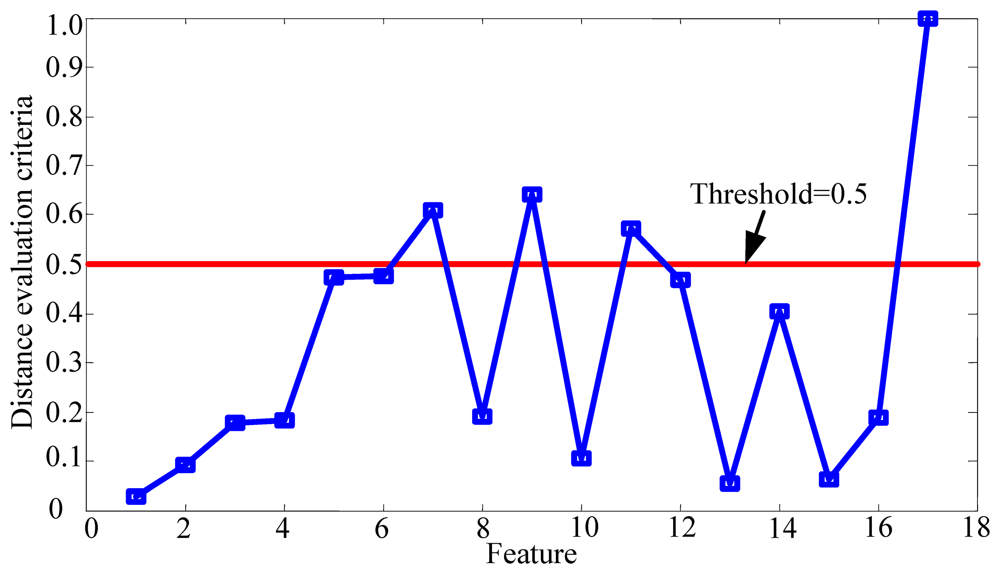
<p>Obviously, high a value of <italic>ā<sub>j</sub></italic> indicates that the corresponding feature is quite capable of distinguishing different degradation conditions of a cutting tool. By setting a threshold value <italic>ϕ</italic> ∈ [0,1], the first <italic>M</italic> most sensitive features can be selected from the original feature set according to the criterion <italic>ā<sub>j</sub></italic> ≥ <italic>ϕ</italic>.</p>
<p>Although sensitive features have been selected from the original feature set via the improved distance evaluation technique, the selected features have different sensitivities in reflecting the running condition of a cutting tool. Feature weighting is implemented here to achieve a more dependable reliability assessment result. The basic idea of feature weighting is to multiply each feature by a number within the interval [0,1] that is proportional to the capability of a given feature to distinguish between different conditions. Fortunately, the value of the distance evaluation criterion represents a feature's sensitivity to different conditions. Thus, it is rational to use the acquired distance evaluation criteria as weight factors of the sensitive features, that is:
<disp-formula id="FD21">
<label>(21)</label>
<mml:math id="mm25" display="block">
<mml:semantics id="sm25">
<mml:mrow>
<mml:msub>
<mml:mi>w</mml:mi>
<mml:mi>m</mml:mi></mml:msub>
<mml:mo>=</mml:mo>
<mml:msub>
<mml:mover accent="true">
<mml:mi>a</mml:mi>
<mml:mo>¯</mml:mo></mml:mover>
<mml:mi>m</mml:mi></mml:msub></mml:mrow></mml:semantics></mml:math></disp-formula></p>
<p>As mentioned in Section 2.1, the recommended form of the feature covariate function <italic>ψ</italic>(<bold>Z</bold>(<italic>t</italic>)) is as expressed in <xref rid="FD3" ref-type="disp-formula">Equation (3)</xref> in the case of multiple features. The determined distance evaluation criteria act as the feature weights of each sensitive feature and are then substituted into <xref rid="FD3" ref-type="disp-formula">Equation (3)</xref>. Thus, the feature covariate function <italic>ψ</italic>(<bold>Z</bold>(<italic>t</italic>)) can be fully constructed.</p></sec></sec>
<sec>
<label>2.3.</label>
<title>Quantitative Calculation of the Baseline Covariate Function</title>
<p>As previously mentioned in Section 2.1, there are two approaches to estimate the baseline covariate function. In this paper, the first approach is employed. According to <xref rid="FD2" ref-type="disp-formula">Equation (2)</xref>, a set of discrete values of <italic>c</italic><sub>0</sub>(<italic>t</italic>) can be obtained:
<disp-formula id="FD22">
<label>(22)</label>
<mml:math id="mm26" display="block">
<mml:semantics id="sm26">
<mml:mrow>
<mml:msub>
<mml:mi>c</mml:mi>
<mml:mn>0</mml:mn></mml:msub>
<mml:mo stretchy="false">(</mml:mo>
<mml:msub>
<mml:mi>t</mml:mi>
<mml:mi>i</mml:mi></mml:msub>
<mml:mo stretchy="false">)</mml:mo>
<mml:mo>=</mml:mo>
<mml:mfrac>
<mml:mrow>
<mml:mi>ψ</mml:mi>
<mml:mo stretchy="false">(</mml:mo>
<mml:mtext mathvariant="bold">Z</mml:mtext>
<mml:mo stretchy="false">(</mml:mo>
<mml:msub>
<mml:mi>t</mml:mi>
<mml:mi>i</mml:mi></mml:msub>
<mml:mo stretchy="false">)</mml:mo>
<mml:mo stretchy="false">)</mml:mo></mml:mrow>
<mml:mrow>
<mml:msub>
<mml:mi>h</mml:mi>
<mml:mrow>
<mml:mi>i</mml:mi>
<mml:mi>n</mml:mi></mml:mrow></mml:msub>
<mml:mo stretchy="false">(</mml:mo>
<mml:msub>
<mml:mi>t</mml:mi>
<mml:mi>i</mml:mi></mml:msub>
<mml:mo stretchy="false">)</mml:mo></mml:mrow></mml:mfrac>
<mml:mo>=</mml:mo>
<mml:mfrac>
<mml:mrow>
<mml:mo>exp</mml:mo>
<mml:mo stretchy="false">(</mml:mo>
<mml:msup>
<mml:mtext mathvariant="bold">w</mml:mtext>
<mml:mtext>T</mml:mtext></mml:msup>
<mml:mtext mathvariant="bold">Z</mml:mtext>
<mml:mo stretchy="false">(</mml:mo>
<mml:msub>
<mml:mi>t</mml:mi>
<mml:mi>i</mml:mi></mml:msub>
<mml:mo stretchy="false">)</mml:mo>
<mml:mo stretchy="false">)</mml:mo></mml:mrow>
<mml:mrow>
<mml:msub>
<mml:mi>h</mml:mi>
<mml:mrow>
<mml:mi>i</mml:mi>
<mml:mi>n</mml:mi></mml:mrow></mml:msub>
<mml:mo stretchy="false">(</mml:mo>
<mml:msub>
<mml:mi>t</mml:mi>
<mml:mi>i</mml:mi></mml:msub>
<mml:mo stretchy="false">)</mml:mo></mml:mrow></mml:mfrac>
<mml:mo stretchy="false">(</mml:mo>
<mml:mi>i</mml:mi>
<mml:mo>=</mml:mo>
<mml:mn>1</mml:mn>
<mml:mo>,</mml:mo>
<mml:mn>2</mml:mn>
<mml:mo>,</mml:mo>
<mml:mo>⋯</mml:mo>
<mml:mo>,</mml:mo>
<mml:msub>
<mml:mi>m</mml:mi>
<mml:mi>c</mml:mi></mml:msub>
<mml:mo stretchy="false">)</mml:mo></mml:mrow></mml:semantics></mml:math></disp-formula>where <italic>ψ</italic>(<bold>Z</bold>(<italic>t<sub>i</sub></italic>)) is the discrete value of the feature covariate function calculated by historical condition monitoring information, <italic>m<sub>c</sub></italic> is the sample size of historical vibration signals, and <italic>h<sub>in</sub></italic>(<italic>t<sub>i</sub></italic>) is the initial failure rate of the condition monitoring information at the corresponding moment. <italic>ψ</italic>(<bold>Z</bold>(<italic>t<sub>i</sub></italic>)) is determined by historical condition vibration signals according to Section 2.2.</p>
<p>To evaluate the initial failure rate function <italic>h<sub>in</sub></italic>(<italic>t</italic>), a proper failure distribution for the cutting tool being analysed must first be determined. A Weibull distribution is used to describe the tool failure [<xref ref-type="bibr" rid="b13-sensors-12-12964">13</xref>,<xref ref-type="bibr" rid="b37-sensors-12-12964">37</xref>]. The failure rate function of a Weibull distribution with two parameters is:
<disp-formula id="FD23">
<label>(23)</label>
<mml:math id="mm27" display="block">
<mml:semantics id="sm27">
<mml:mrow>
<mml:mi>h</mml:mi>
<mml:mo stretchy="false">(</mml:mo>
<mml:mi>t</mml:mi>
<mml:mo stretchy="false">)</mml:mo>
<mml:mo>=</mml:mo>
<mml:mo stretchy="false">(</mml:mo>
<mml:mrow>
<mml:mi>β</mml:mi>
<mml:mo>/</mml:mo>
<mml:mi>η</mml:mi></mml:mrow>
<mml:mo stretchy="false">)</mml:mo>
<mml:mo stretchy="false">(</mml:mo>
<mml:msup>
<mml:mrow>
<mml:mrow>
<mml:mi>t</mml:mi>
<mml:mo>/</mml:mo>
<mml:mrow>
<mml:mi>η</mml:mi>
<mml:mo stretchy="false">)</mml:mo></mml:mrow></mml:mrow></mml:mrow>
<mml:mrow>
<mml:mi>β</mml:mi>
<mml:mo>−</mml:mo>
<mml:mn>1</mml:mn></mml:mrow></mml:msup></mml:mrow></mml:semantics></mml:math></disp-formula>where <italic>β</italic> and <italic>η</italic> are the shape parameter and the scale parameter of the Weibull distribution, respectively.</p>
<p>To make sure that the failure distribution of the cutting tool obeys a Weibull distribution, the hypothesis test is implemented. The failure distribution of the cutting tool is identified based on the historical lifetime data {<italic>τ<sub>n</sub></italic> : <italic>n</italic> = 1,2,…,<italic>m<sub>f</sub></italic>} by the hypothesis test, where <italic>m<sub>f</sub></italic> is the number of lifetime data points. Once the failure distribution is determined, maximum likelihood estimation (MLE) is employed to identify the unknown parameters <italic>β</italic> and <italic>η</italic> by using the historical lifetime data.</p>
<p>By utilising the initial failure rate function <italic>h<sub>in</sub></italic>(<italic>t</italic>) and the historical feature covariate function <italic>ψ</italic>(<bold>Z</bold>(<italic>t</italic>)), a set of discrete values of <italic>c</italic><sub>0</sub>(<italic>t<sub>i</sub></italic>) (<italic>i</italic> = 1,2,…,<italic>m<sub>c</sub></italic>) are obtained by <xref rid="FD22" ref-type="disp-formula">Equation (22)</xref>. According to the recommendation made in [<xref ref-type="bibr" rid="b33-sensors-12-12964">33</xref>], a multiplicative model is chosen to represent the baseline covariate function, that is:
<disp-formula id="FD24">
<label>(24)</label>
<mml:math id="mm28" display="block">
<mml:semantics id="sm28">
<mml:mrow>
<mml:msub>
<mml:mi>c</mml:mi>
<mml:mn>0</mml:mn></mml:msub>
<mml:mo stretchy="false">(</mml:mo>
<mml:mi>t</mml:mi>
<mml:mo stretchy="false">)</mml:mo>
<mml:mo>=</mml:mo>
<mml:mi>a</mml:mi>
<mml:msup>
<mml:mi>t</mml:mi>
<mml:mi>b</mml:mi></mml:msup></mml:mrow></mml:semantics></mml:math></disp-formula></p>
<p>Then, the baseline covariate function can be estimated from the discrete data set {<italic>t<sub>i</sub></italic>, <italic>c</italic><sub>0</sub>(<italic>t<sub>i</sub></italic>) : <italic>i</italic> = 1,2,…,<italic>m<sub>c</sub></italic>}.</p></sec>
<sec>
<label>2.4.</label>
<title>The Algorithm of the Operation Reliability Assessment Approach</title>
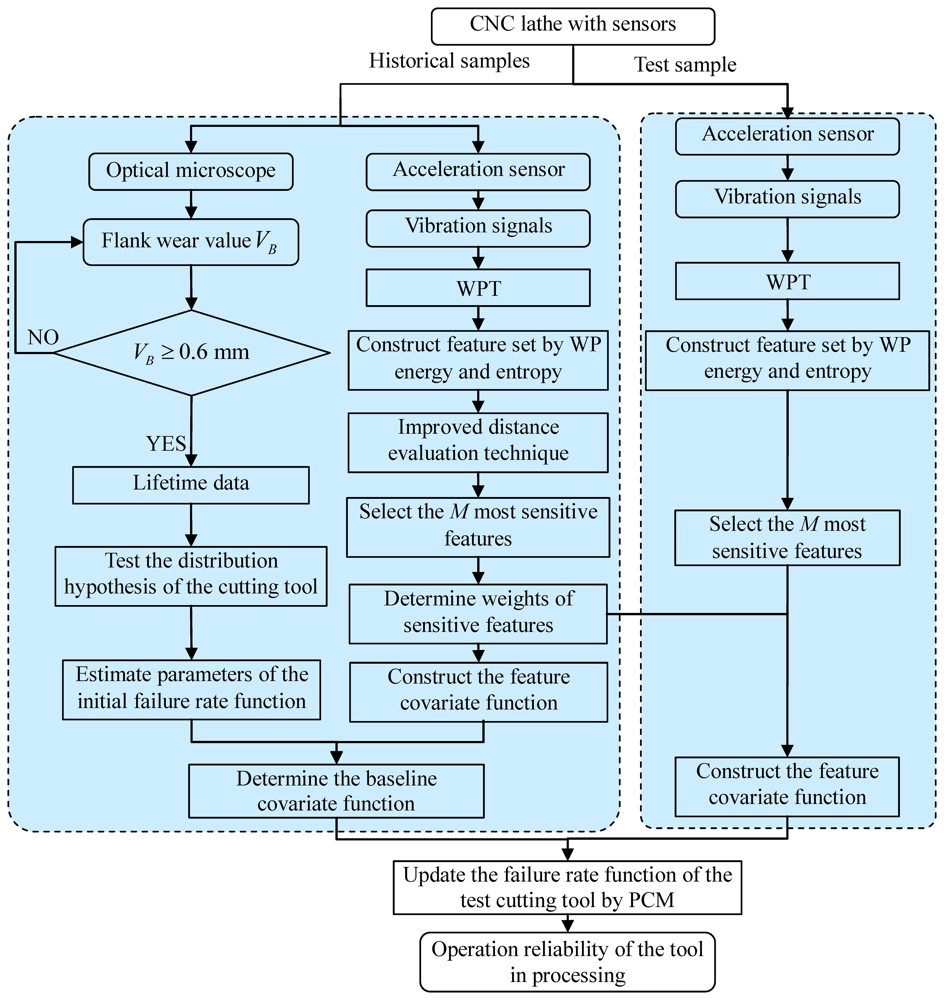
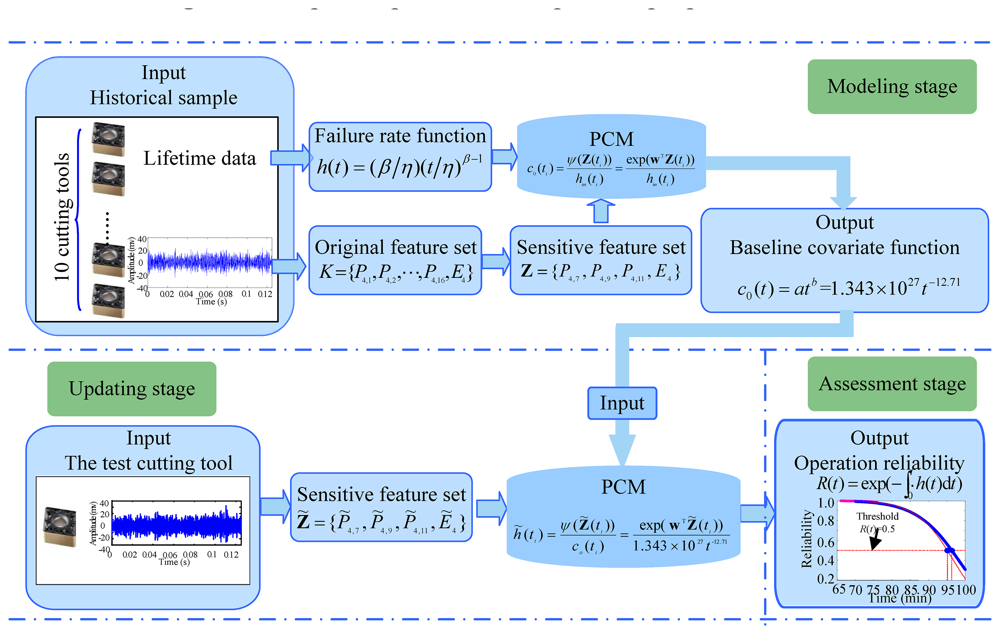
<p>To assess the operation reliability of the cutting tool that is to be assessed, a sensor-based data acquisition process that can record useful information about the cutting tool must be carried out first. In the present study, the vibration signals of the cutting tool and optical microscopy-based flank wear values are recorded. The lifetimes of the historical samples are determined under the condition that their flank wear value <italic>V<sub>B</sub></italic> exceeds 0.6 mm according to ISO3685. Then, the proposed approach is applied to estimate the operation reliability of the cutting tool to be assessed. The flowchart of the method is depicted in <xref ref-type="fig" rid="f1-sensors-12-12964">Figure 1</xref>. The detailed steps are summarised as follows:
<list list-type="simple">
<list-item>
<p><italic>Step 1:</italic> (<italic>Determine proper failure distribution for the cutting tool</italic>): Identify the failure distribution of the cutting tool by implementing a hypothesis test using the historical lifetime data {<italic>τ<sub>n</sub></italic> : <italic>n</italic> = 1,2,…,<italic>m<sub>f</sub></italic>}.</p></list-item>
<list-item>
<p><italic>Step 2:</italic> (<italic>Estimate the initial failure rate function</italic>): Once the failure distribution is determined, MLE is adopted to evaluate the parameters of the initial failure rate function <italic>h<sub>in</sub></italic>(<italic>t</italic>) by using historical lifetime data.</p></list-item>
<list-item>
<p><italic>Step 3:</italic> (<italic>Feature extraction</italic>): To acquire characteristic information regarding cutting tool degradation, WPT is performed to extract features from the vibration signals.</p></list-item>
<list-item>
<p><italic>Step 4:</italic> (<italic>Feature selection and weighting</italic>): Feature selection is performed through the improved distance evaluation technique. And the distance evaluation criteria of each sensitive feature act as feature weights to construct the feature covariate function.</p></list-item>
<list-item>
<p><italic>Step 5:</italic> (<italic>Construct the feature covariate function</italic>): The feature covariate function is constructed using the feature weights of each sensitive feature based on step 3 and step 4.</p></list-item>
<list-item>
<p><italic>Step 6:</italic> (<italic>Calculate the baseline covariate function</italic>): After the initial failure rate function and the feature covariate function are obtained using information from the historical samples, discrete baseline covariate values are calculated, and the baseline covariate function is then calculated by a regression analysis technique using the discrete baseline covariate values.</p></list-item>
<list-item>
<p><italic>Step 7:</italic> (<italic>Update the failure rate function of the test cutting tool</italic>): To update the failure rate function of the test cutting tool, the vibration signals of the test cutting tool are monitored by an acceleration sensor. The feature covariate function of the cutting tool is constructed according to step 3 and step 4.</p>
<p>Then, PCM is constructed to update the failure rate function of the test cutting tool based on the feature covariate function and the baseline covariate function of the cutting tool:
<disp-formula id="FD25">
<label>(25)</label>
<mml:math id="mm29" display="block">
<mml:semantics id="sm29">
<mml:mrow>
<mml:mover accent="true">
<mml:mi>h</mml:mi>
<mml:mo>˜</mml:mo></mml:mover>
<mml:mo stretchy="false">(</mml:mo>
<mml:msub>
<mml:mi>t</mml:mi>
<mml:mi>j</mml:mi></mml:msub>
<mml:mo stretchy="false">)</mml:mo>
<mml:mo>=</mml:mo>
<mml:mfrac>
<mml:mrow>
<mml:mo>exp</mml:mo>
<mml:mo stretchy="false">(</mml:mo>
<mml:munderover>
<mml:mi>∑</mml:mi>
<mml:mrow>
<mml:mi>m</mml:mi>
<mml:mo>=</mml:mo>
<mml:mn>1</mml:mn></mml:mrow>
<mml:mi>M</mml:mi></mml:munderover>
<mml:mrow>
<mml:msub>
<mml:mi>w</mml:mi>
<mml:mi>m</mml:mi></mml:msub></mml:mrow>
<mml:msub>
<mml:mover accent="true">
<mml:mi>Z</mml:mi>
<mml:mo>˜</mml:mo></mml:mover>
<mml:mrow>
<mml:mi>r</mml:mi>
<mml:mi>m</mml:mi></mml:mrow></mml:msub>
<mml:mo stretchy="false">(</mml:mo>
<mml:msub>
<mml:mi>t</mml:mi>
<mml:mi>j</mml:mi></mml:msub>
<mml:mo stretchy="false">)</mml:mo>
<mml:mo stretchy="false">)</mml:mo></mml:mrow>
<mml:mrow>
<mml:msub>
<mml:mi>c</mml:mi>
<mml:mn>0</mml:mn></mml:msub>
<mml:mo stretchy="false">(</mml:mo>
<mml:msub>
<mml:mi>t</mml:mi>
<mml:mi>j</mml:mi></mml:msub>
<mml:mo stretchy="false">)</mml:mo></mml:mrow></mml:mfrac>
<mml:mo>=</mml:mo>
<mml:mfrac>
<mml:mrow>
<mml:mo>exp</mml:mo>
<mml:mo stretchy="false">(</mml:mo>
<mml:msup>
<mml:mtext mathvariant="bold">w</mml:mtext>
<mml:mtext>T</mml:mtext></mml:msup>
<mml:mover accent="true">
<mml:mtext mathvariant="bold">Z</mml:mtext>
<mml:mo>˜</mml:mo></mml:mover>
<mml:mo stretchy="false">(</mml:mo>
<mml:mi>t</mml:mi>
<mml:mo stretchy="false">)</mml:mo>
<mml:mo stretchy="false">)</mml:mo></mml:mrow>
<mml:mrow>
<mml:msub>
<mml:mi>c</mml:mi>
<mml:mn>0</mml:mn></mml:msub>
<mml:mo stretchy="false">(</mml:mo>
<mml:msub>
<mml:mi>t</mml:mi>
<mml:mi>j</mml:mi></mml:msub>
<mml:mo stretchy="false">)</mml:mo></mml:mrow></mml:mfrac>
<mml:mo stretchy="false">(</mml:mo>
<mml:mi>j</mml:mi>
<mml:mo>=</mml:mo>
<mml:mn>1</mml:mn>
<mml:mo>,</mml:mo>
<mml:mn>2</mml:mn>
<mml:mo>,</mml:mo>
<mml:mo>⋯</mml:mo>
<mml:mo>,</mml:mo>
<mml:msub>
<mml:mi>m</mml:mi>
<mml:mi>n</mml:mi></mml:msub>
<mml:mo stretchy="false">)</mml:mo></mml:mrow></mml:semantics></mml:math></disp-formula></p>
<p>Assuming that the failure rate function of the cutting tool is of the form <italic>h</italic>(<italic>t</italic>) = (<italic>β</italic>/<italic>η</italic>)(<italic>t</italic>/<italic>η</italic>)<sup><italic>β</italic>−1</sup> shown in <xref rid="FD23" ref-type="disp-formula">Equation (23)</xref>, <italic>h̃</italic>(<italic>t</italic>) can be evaluated using {<italic>t<sub>j</sub></italic>, <italic>h̃</italic>(<italic>t<sub>j</sub></italic>)} by regression analysis. Thus, the updated failure rate function of the test cutting tool is obtained.</p></list-item>
<list-item>
<p><italic>Step 8:</italic> (<italic>Assess the operation reliability</italic>): Calculate the operation reliability of test cutting tool that is to be assessed using the updated failure rate function via <xref rid="FD7" ref-type="disp-formula">Equation (7)</xref>.</p></list-item></list></p></sec></sec>
<sec>
<label>3.</label>
<title>Experimental Setup and Sensor-Based Information Acquisition</title>
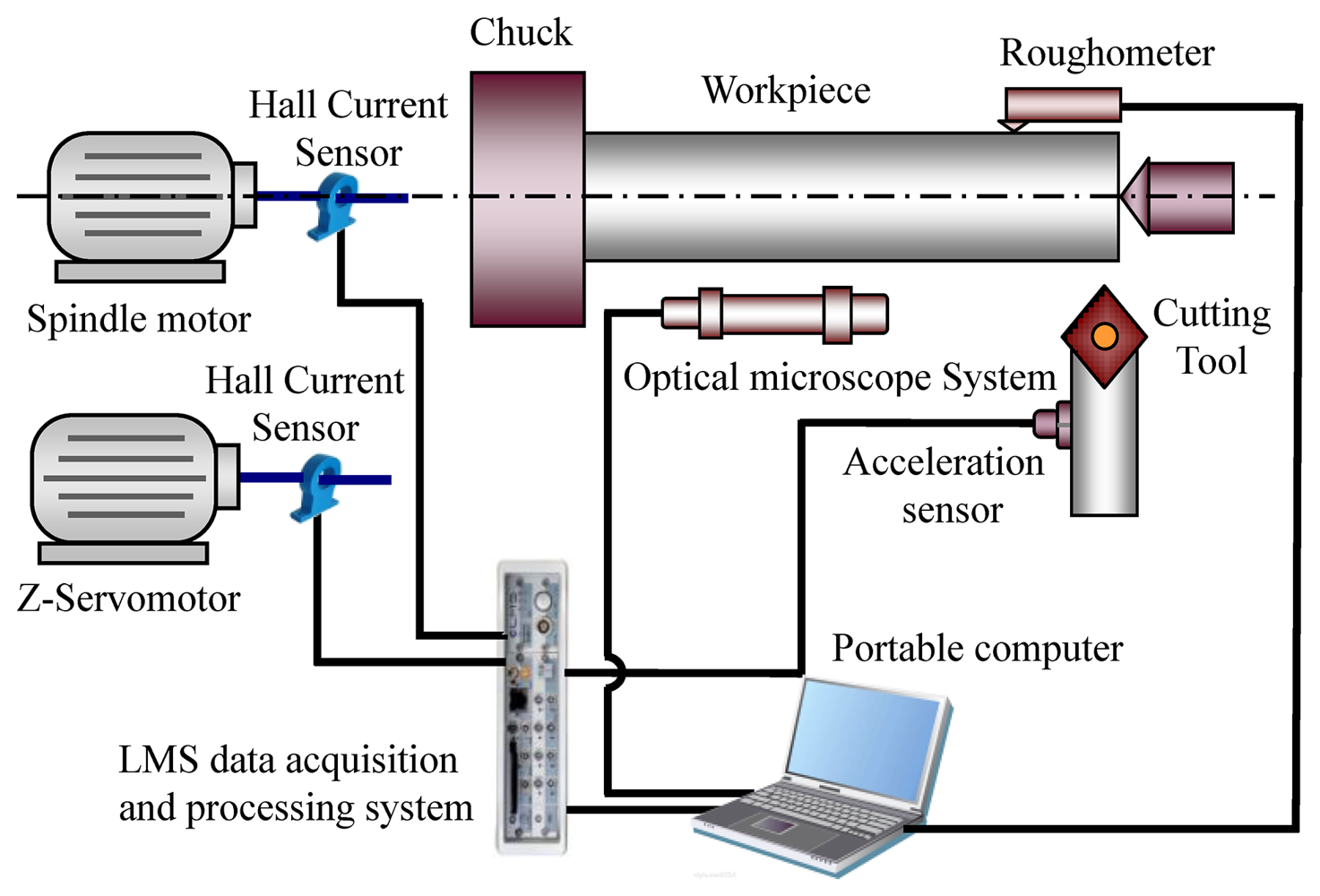
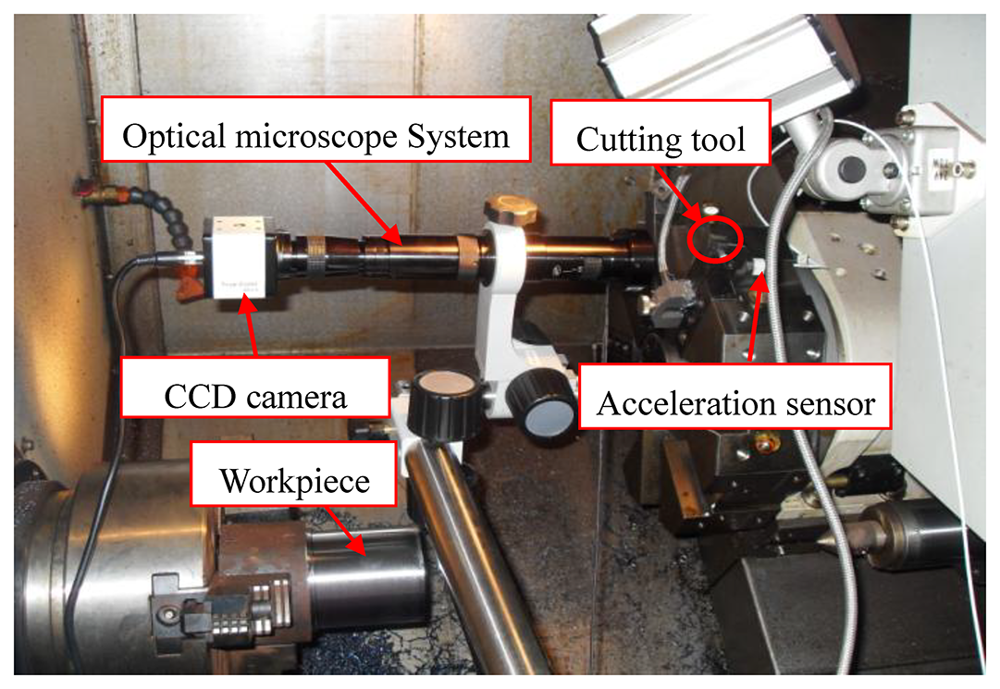
<p>To test the effectiveness of the proposed operation reliability assessment method, an experimental system for the studied cutting tool was designed and carried out on a CNC lathe. <xref ref-type="fig" rid="f2-sensors-12-12964">Figure 2</xref> shows a schematic diagram of the experimental setup. <xref ref-type="fig" rid="f3-sensors-12-12964">Figure 3</xref> shows the experimental system of the test rig and the locations of sensors. In the experiment, the carbide cutting tool was utilised to process 45# steel bars. The vibration signals of the cutting tool were monitored by an acceleration sensor, sent to a data acquisition and signal processing system (LMS SCADAS305), and finally stored in a portable computer. The flank wear value <italic>V<sub>B</sub></italic> of the cutting tool was measured by an optical microscopy system with a CCD camera, an adjustable LED annular source, and a micrometer. The surface roughness data of the workpiece, the current signals of the spindle motor and the Z-servo motor were also monitored for further study. <xref ref-type="table" rid="t1-sensors-12-12964">Table 1</xref> shows the experimental conditions. <xref ref-type="table" rid="t2-sensors-12-12964">Table 2</xref> lists the detailed information obtained by the sensors used in the experiment.</p>
<p>To accumulate sufficient vibration signals and lifetime data from the cutting tool, vibration signals and flank wear values were monitored during the cutting process under constant condition. Vibration signals were sampled every 2 min during the cutting process with a sampling frequency of 32,768 Hz and a sample interval of 2 s.</p></sec>
<sec sec-type="results|discussion">
<label>4.</label>
<title>Results and Discussion</title>
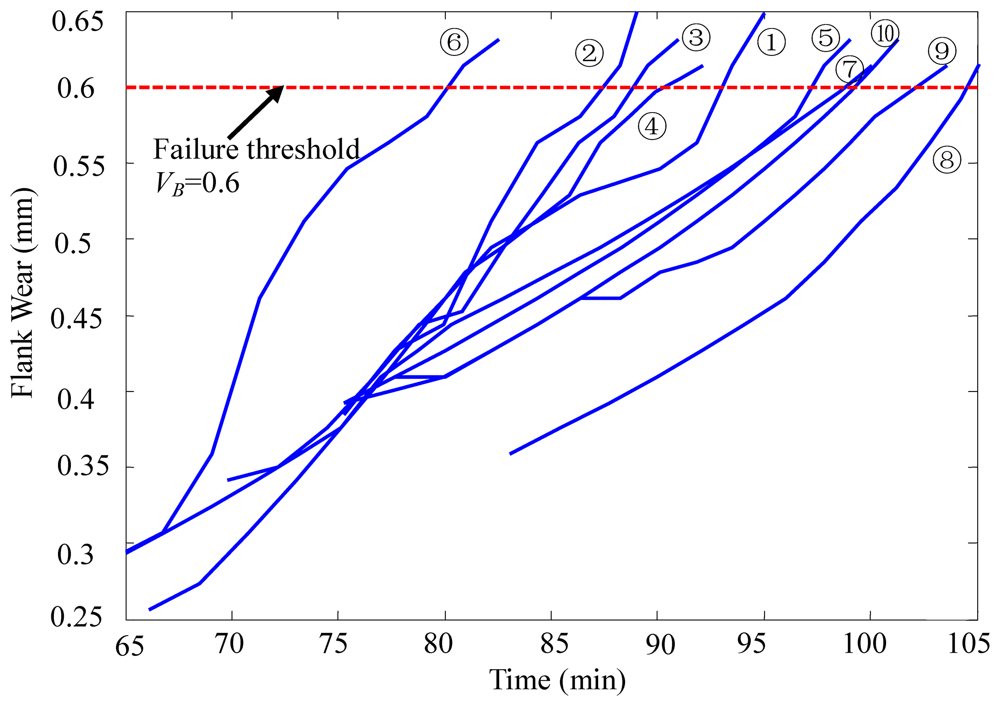
<p>First, 10 cutting tools were investigated as historical samples. The variation curves of the cutting tools' flank wear values are shown in <xref ref-type="fig" rid="f4-sensors-12-12964">Figure 4</xref>. The cutting tool is considered to have failed when the flank wear value <italic>V<sub>B</sub></italic> ≥ 0.6 mm. Lifetime data of all 10 cutting tools were obtained according to the measured flank wear values of the cutting tools.</p>
<sec>
<label>4.1.</label>
<title>Initial Failure Distribution Determination</title>
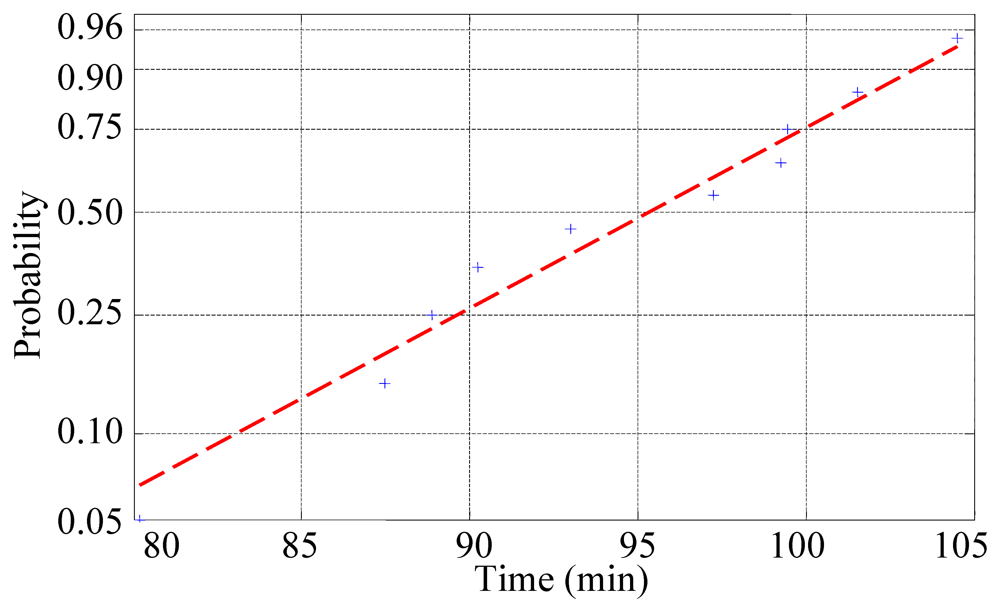
<p>The hypothesis test was implemented to analyse the failure distribution of the cutting tool. The result is shown in <xref ref-type="fig" rid="f5-sensors-12-12964">Figure 5</xref>. It is rational to assume that the failure distribution of the cutting tool obeys a Weibull distribution. Then, the failure distribution of the cutting tool was estimated by MLE:
<disp-formula id="FD26">
<mml:math id="mm30" display="block">
<mml:semantics id="sm30">
<mml:mrow>
<mml:mi>F</mml:mi>
<mml:mtext>(</mml:mtext>
<mml:mi>t</mml:mi>
<mml:mtext>)</mml:mtext>
<mml:mo>=</mml:mo>
<mml:mn>1</mml:mn>
<mml:mo>−</mml:mo>
<mml:mo>exp</mml:mo>
<mml:mrow>
<mml:mo>[</mml:mo>
<mml:mrow>
<mml:mo>−</mml:mo>
<mml:msup>
<mml:mrow>
<mml:mrow>
<mml:mo>(</mml:mo>
<mml:mrow>
<mml:mfrac>
<mml:mi>t</mml:mi>
<mml:mrow>
<mml:mn>97.358</mml:mn></mml:mrow></mml:mfrac></mml:mrow>
<mml:mo>)</mml:mo></mml:mrow></mml:mrow>
<mml:mrow>
<mml:mn>15.896</mml:mn></mml:mrow></mml:msup></mml:mrow>
<mml:mo>]</mml:mo></mml:mrow></mml:mrow></mml:semantics></mml:math></disp-formula></p>
<p>The initial failure rate function of the cutting tool is
<inline-formula>
<mml:math id="mm31" display="inline">
<mml:semantics id="sm31">
<mml:mrow>
<mml:msub>
<mml:mi>h</mml:mi>
<mml:mrow>
<mml:mi>i</mml:mi>
<mml:mi>n</mml:mi></mml:mrow></mml:msub>
<mml:mtext>(</mml:mtext>
<mml:mi>t</mml:mi>
<mml:mtext>)</mml:mtext>
<mml:mo>=</mml:mo>
<mml:mfrac>
<mml:mrow>
<mml:mn>15.896</mml:mn></mml:mrow>
<mml:mrow>
<mml:mn>97.358</mml:mn></mml:mrow></mml:mfrac>
<mml:msup>
<mml:mrow>
<mml:mrow>
<mml:mo>(</mml:mo>
<mml:mrow>
<mml:mfrac>
<mml:mi>t</mml:mi>
<mml:mrow>
<mml:mn>97.358</mml:mn></mml:mrow></mml:mfrac></mml:mrow>
<mml:mo>)</mml:mo></mml:mrow></mml:mrow>
<mml:mrow>
<mml:mn>14.896</mml:mn></mml:mrow></mml:msup></mml:mrow></mml:semantics></mml:math></inline-formula>.</p></sec>
<sec>
<label>4.2.</label>
<title>Construction of the Feature Covariate Function</title>
<p>The vibration signals of the 10 historical samples were investigated by WPT and the improved distance evaluation technique to construct the feature covariate function.</p>
<sec>
<label>4.2.1.</label>
<title>Feature Extraction and Selection</title>
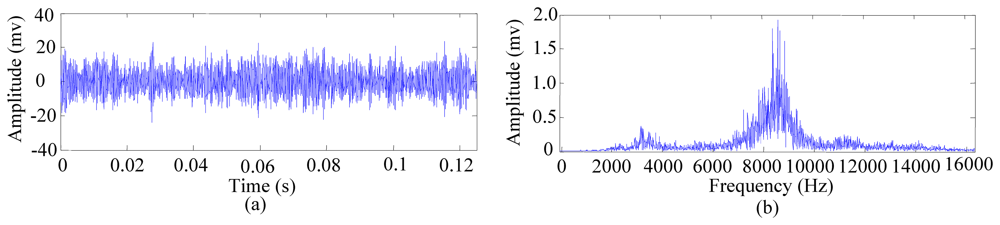
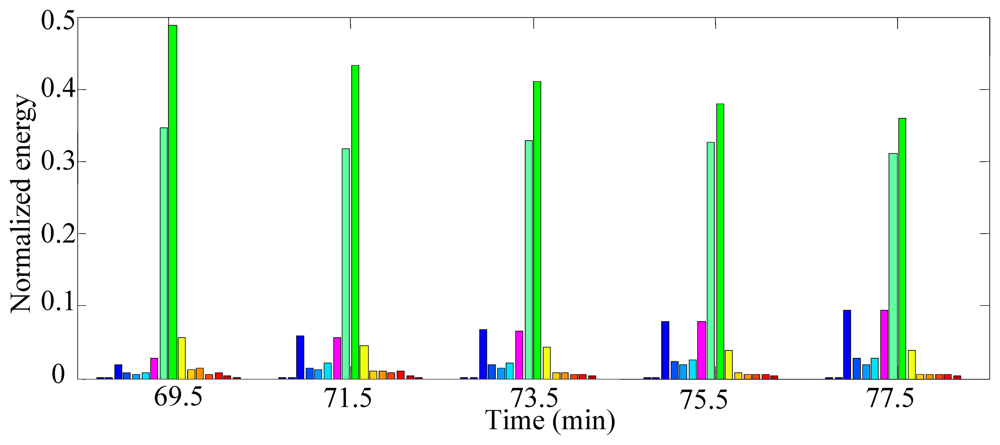
<p>To extract the features sensitive to cutting tool wear, WPT was adopted to decompose the vibration signals of the cutting tool. According to the characteristics of the vibration signals, the mother wavelet used here should have the properties of orthogonality, short support, symmetry and a certain order of vanishing moment. Thus, the Daubechies 10 (db10) wavelet was chosen as the mother wavelet to analyse the vibration signals of the cutting tool. The decomposition level can be determined by the sampling frequency and frequency scope of the concentrated energy of the signal obtained from spectrum analysis [<xref ref-type="bibr" rid="b44-sensors-12-12964">44</xref>]. First, the vibration signals were analysed to construct the feature covariate function. Tool No. 3 was taken as an example to demonstrate the procedure of feature extraction and feature set construction. <xref ref-type="fig" rid="f6-sensors-12-12964">Figure 6</xref> shows the raw vibration signal of the tool after running for 69.5 min and its spectrum. The energy of the signal is mainly concentrated in two specific frequency bands, [<xref ref-type="bibr" rid="b2-sensors-12-12964">2</xref>,<xref ref-type="bibr" rid="b4-sensors-12-12964">4</xref>] KHz and [<xref ref-type="bibr" rid="b7-sensors-12-12964">7</xref>,<xref ref-type="bibr" rid="b10-sensors-12-12964">10</xref>] KHz, the latter of which contains richer energy information. According to the concentration of the energy shown in <xref ref-type="fig" rid="f6-sensors-12-12964">Figure 6(b)</xref>, the vibrations signal was decomposed into four levels by WPT. The wavelet packet energies of the sixteen frequency-band signals and the WPT energy entropy of the vibration signal were calculated according to <xref rid="FD9" ref-type="disp-formula">Equation (9)</xref> and <xref rid="FD10" ref-type="disp-formula">Equation (10)</xref>, respectively. Then, the original feature set <italic>K</italic> = {<italic>P</italic><sub>4,1</sub>,<italic>P</italic><sub>4,2</sub>,…,<italic>P</italic><sub>4,16</sub>,<italic>E</italic><sub>4</sub>} of the vibration signal was constructed at each sample time. <xref ref-type="fig" rid="f7-sensors-12-12964">Figure 7</xref> displays the variation of the normalised wavelet packet energy values of tool No. 3 running from 69.5 min to 77.5 min. It can be observed that the frequency-band energy distribution presents certain variation regularity during the manufacturing process. For instance, the normalised energy values of band 9 decrease from 0.487 to 0.360 with the degradation of the cutting tool. The above analysis procedures were also applied to the other nine cutting tools, and signal feature sets at different running times were obtained with similar vibration regularities.</p>
<p>The wear states of the cutting tool were divided into three different conditions according to the tested flank wear values [<xref ref-type="bibr" rid="b14-sensors-12-12964">14</xref>,<xref ref-type="bibr" rid="b45-sensors-12-12964">45</xref>]. Each feature set obtained from the vibration signal of the cutting tool corresponds to a certain condition. Then, based on the acquired corresponding feature sets of each condition, the improved distance evaluation technique was performed to evaluate the ability of the feature to distinguish different conditions. <xref ref-type="fig" rid="f8-sensors-12-12964">Figure 8</xref> displays the distance evaluation criteria <italic>ā<sub>j</sub></italic> (<italic>j</italic> = 1,2,…, 17) of all of the features. A high <italic>ā<sub>j</sub></italic> value means that the corresponding feature is highly sensitive to degradation. To select the most sensitive features from the original feature set and keep only the important features, a threshold value <italic>ϕ</italic> must be properly selected. According to [<xref ref-type="bibr" rid="b43-sensors-12-12964">43</xref>], the range median of the evaluation criteria, 0.5, was chosen as the threshold to select the most sensitive features in the study. Therefore, the four most sensitive features (<italic>P</italic><sub>4,7</sub>,<italic>P</italic><sub>4,9</sub>, <italic>P</italic><sub>4,11</sub>,<italic>E</italic><sub>4</sub>) were selected. The corresponding distance evaluation criteria of the selected features are <bold>w</bold> = (0.6085, 0.6406, 0.5717, 1)<sup>T</sup>.</p></sec>
<sec>
<label>4.2.2.</label>
<title>The Construction of the Feature Covariate Function</title>
<p>After the four most sensitive features were selected from the original feature set, the distance evaluation criteria of the four selected features acted as weight factors to construct the feature covariate function. The corresponding feature weights set for the selected sensitive features set <bold>Z</bold>(<italic>t</italic>) = (<italic>P</italic><sub>4,7</sub>(<italic>t</italic>), <italic>P</italic><sub>4,9</sub>(<italic>t</italic>), <italic>P</italic><sub>4,11</sub>(<italic>t</italic>),<italic>E</italic><sub>4</sub>(<italic>t</italic>))<sup>T</sup> was <bold>w</bold> = (0.6805, 0.6406, 0.5717, 1)<sup>T</sup>. Then, the feature covariate function of the sensitive features was constructed:
<disp-formula id="FD27">
<mml:math id="mm32" display="block">
<mml:semantics id="sm32">
<mml:mrow>
<mml:mi>ψ</mml:mi>
<mml:mo stretchy="false">(</mml:mo>
<mml:mtext mathvariant="bold">Z</mml:mtext>
<mml:mo stretchy="false">(</mml:mo>
<mml:mi>t</mml:mi>
<mml:mo stretchy="false">)</mml:mo>
<mml:mo>=</mml:mo>
<mml:mo>exp</mml:mo>
<mml:mo stretchy="false">(</mml:mo>
<mml:msup>
<mml:mtext mathvariant="bold">w</mml:mtext>
<mml:mtext>T</mml:mtext></mml:msup>
<mml:mtext mathvariant="bold">Z</mml:mtext>
<mml:mo stretchy="false">(</mml:mo>
<mml:mi>t</mml:mi>
<mml:mo stretchy="false">)</mml:mo>
<mml:mo>=</mml:mo>
<mml:mo>exp</mml:mo>
<mml:mo stretchy="false">(</mml:mo>
<mml:mn>0.6085</mml:mn>
<mml:msub>
<mml:mi>P</mml:mi>
<mml:mrow>
<mml:mn>4</mml:mn>
<mml:mo>,</mml:mo>
<mml:mn>7</mml:mn></mml:mrow></mml:msub>
<mml:mo stretchy="false">(</mml:mo>
<mml:mi>t</mml:mi>
<mml:mo stretchy="false">)</mml:mo>
<mml:mrow>
<mml:mo>+</mml:mo></mml:mrow>
<mml:mn>0.6406</mml:mn>
<mml:msub>
<mml:mi>P</mml:mi>
<mml:mrow>
<mml:mn>4</mml:mn>
<mml:mo>,</mml:mo>
<mml:mn>9</mml:mn></mml:mrow></mml:msub>
<mml:mo stretchy="false">(</mml:mo>
<mml:mi>t</mml:mi>
<mml:mo stretchy="false">)</mml:mo>
<mml:mrow>
<mml:mo>+</mml:mo></mml:mrow>
<mml:mn>0.5717</mml:mn>
<mml:msub>
<mml:mi>P</mml:mi>
<mml:mrow>
<mml:mn>4</mml:mn>
<mml:mo>,</mml:mo>
<mml:mn>11</mml:mn></mml:mrow></mml:msub>
<mml:mo stretchy="false">(</mml:mo>
<mml:mi>t</mml:mi>
<mml:mo stretchy="false">)</mml:mo>
<mml:mo>+</mml:mo>
<mml:msub>
<mml:mi>E</mml:mi>
<mml:mn>4</mml:mn></mml:msub>
<mml:mo stretchy="false">(</mml:mo>
<mml:mi>t</mml:mi>
<mml:mo stretchy="false">)</mml:mo>
<mml:mo stretchy="false">)</mml:mo></mml:mrow></mml:semantics></mml:math></disp-formula></p></sec></sec>
<sec>
<label>4.3.</label>
<title>The Quantitative Calculation of the Baseline Covariate Function</title>
<p>According to Section 2.3, discrete values of the baseline covariate function can be obtained based on the initial failure rate function and the constructed feature covariate function of the 10 historical cutting tools. Then, the baseline covariate function can be estimated by using regression analysis based on the discrete values. The estimation result of the baseline covariate function for the cutting tool is:
<disp-formula id="FD28">
<mml:math id="mm33" display="block">
<mml:semantics id="sm33">
<mml:mrow>
<mml:msub>
<mml:mi>c</mml:mi>
<mml:mn>0</mml:mn></mml:msub>
<mml:mo stretchy="false">(</mml:mo>
<mml:mi>t</mml:mi>
<mml:mo stretchy="false">)</mml:mo>
<mml:mo>=</mml:mo>
<mml:mn>1.343</mml:mn>
<mml:mo>×</mml:mo>
<mml:msup>
<mml:mrow>
<mml:mn>10</mml:mn></mml:mrow>
<mml:mrow>
<mml:mn>27</mml:mn></mml:mrow></mml:msup>
<mml:msup>
<mml:mi>t</mml:mi>
<mml:mrow>
<mml:mo>−</mml:mo>
<mml:mn>12.71</mml:mn></mml:mrow></mml:msup></mml:mrow></mml:semantics></mml:math></disp-formula></p></sec>
<sec>
<label>4.4.</label>
<title>Failure Rate Function Update and Operation Reliability Assessment Using PCM</title>
<p>To assess the operation reliability of tool No. 11 during operation, the feature covariate function of tool No. 11 was constructed by using the corresponding vibration signals. Then, the PCM was utilised to update the failure rate function of tool No.11. According to <xref rid="FD25" ref-type="disp-formula">Equation (25)</xref>, discrete failure rates for the tool can be obtained as follows:
<disp-formula id="FD29">
<mml:math id="mm34" display="block">
<mml:semantics id="sm34">
<mml:mrow>
<mml:mover accent="true">
<mml:mi>h</mml:mi>
<mml:mo>˜</mml:mo></mml:mover>
<mml:mo stretchy="false">(</mml:mo>
<mml:msub>
<mml:mi>t</mml:mi>
<mml:mi>j</mml:mi></mml:msub>
<mml:mo stretchy="false">)</mml:mo>
<mml:mo>=</mml:mo>
<mml:mfrac>
<mml:mrow>
<mml:mi>ψ</mml:mi>
<mml:mo stretchy="false">(</mml:mo>
<mml:mover accent="true">
<mml:mtext mathvariant="bold">Z</mml:mtext>
<mml:mo>˜</mml:mo></mml:mover>
<mml:mo stretchy="false">(</mml:mo>
<mml:msub>
<mml:mi>t</mml:mi>
<mml:mi>j</mml:mi></mml:msub>
<mml:mo stretchy="false">)</mml:mo>
<mml:mo stretchy="false">)</mml:mo></mml:mrow>
<mml:mrow>
<mml:msub>
<mml:mi>c</mml:mi>
<mml:mn>0</mml:mn></mml:msub>
<mml:mo stretchy="false">(</mml:mo>
<mml:msub>
<mml:mi>t</mml:mi>
<mml:mi>j</mml:mi></mml:msub>
<mml:mo stretchy="false">)</mml:mo></mml:mrow></mml:mfrac>
<mml:mo>=</mml:mo>
<mml:mfrac>
<mml:mrow>
<mml:mo>exp</mml:mo>
<mml:mo stretchy="false">(</mml:mo>
<mml:mn>0.6085</mml:mn>
<mml:msub>
<mml:mover accent="true">
<mml:mi>P</mml:mi>
<mml:mo>˜</mml:mo></mml:mover>
<mml:mrow>
<mml:mn>4</mml:mn>
<mml:mo>,</mml:mo>
<mml:mn>7</mml:mn></mml:mrow></mml:msub>
<mml:mo stretchy="false">(</mml:mo>
<mml:msub>
<mml:mi>t</mml:mi>
<mml:mi>j</mml:mi></mml:msub>
<mml:mo stretchy="false">)</mml:mo>
<mml:mo>+</mml:mo>
<mml:mn>0.6406</mml:mn>
<mml:msub>
<mml:mover accent="true">
<mml:mi>P</mml:mi>
<mml:mo>˜</mml:mo></mml:mover>
<mml:mrow>
<mml:mn>4</mml:mn>
<mml:mo>,</mml:mo>
<mml:mn>9</mml:mn></mml:mrow></mml:msub>
<mml:mo stretchy="false">(</mml:mo>
<mml:msub>
<mml:mi>t</mml:mi>
<mml:mi>j</mml:mi></mml:msub>
<mml:mo stretchy="false">)</mml:mo>
<mml:mo>+</mml:mo>
<mml:mn>0.5717</mml:mn>
<mml:msub>
<mml:mover accent="true">
<mml:mi>P</mml:mi>
<mml:mo>˜</mml:mo></mml:mover>
<mml:mrow>
<mml:mn>4</mml:mn>
<mml:mo>,</mml:mo>
<mml:mn>11</mml:mn></mml:mrow></mml:msub>
<mml:mo stretchy="false">(</mml:mo>
<mml:msub>
<mml:mi>t</mml:mi>
<mml:mi>j</mml:mi></mml:msub>
<mml:mo stretchy="false">)</mml:mo>
<mml:mo>+</mml:mo>
<mml:msub>
<mml:mover accent="true">
<mml:mi>E</mml:mi>
<mml:mo>˜</mml:mo></mml:mover>
<mml:mn>4</mml:mn></mml:msub>
<mml:mo stretchy="false">(</mml:mo>
<mml:msub>
<mml:mi>t</mml:mi>
<mml:mi>j</mml:mi></mml:msub>
<mml:mo stretchy="false">)</mml:mo>
<mml:mo stretchy="false">)</mml:mo></mml:mrow>
<mml:mrow>
<mml:mn>1.343</mml:mn>
<mml:mo>×</mml:mo>
<mml:msup>
<mml:mrow>
<mml:mn>10</mml:mn></mml:mrow>
<mml:mrow>
<mml:mn>27</mml:mn></mml:mrow></mml:msup>
<mml:msubsup>
<mml:mi>t</mml:mi>
<mml:mi>j</mml:mi>
<mml:mrow>
<mml:mo>−</mml:mo>
<mml:mn>12.71</mml:mn></mml:mrow></mml:msubsup></mml:mrow></mml:mfrac>
<mml:mo stretchy="false">(</mml:mo>
<mml:mi>j</mml:mi>
<mml:mo>=</mml:mo>
<mml:mn>1</mml:mn>
<mml:mo>,</mml:mo>
<mml:mn>2</mml:mn>
<mml:mo>,</mml:mo>
<mml:mo>⋯</mml:mo>
<mml:mo>,</mml:mo>
<mml:msub>
<mml:mi>m</mml:mi>
<mml:mi>n</mml:mi></mml:msub>
<mml:mo stretchy="false">)</mml:mo></mml:mrow></mml:semantics></mml:math></disp-formula>where <italic>m<sub>n</sub></italic> = 16 is the number of sensitive feature sets extracted from the vibration signals of tool No. 11. Consequently, the failure rate function for tool No. 11 was acquired by regression analysis, that is:
<disp-formula id="FD30">
<mml:math id="mm35" display="block">
<mml:semantics id="sm35">
<mml:mrow>
<mml:mover accent="true">
<mml:mi>h</mml:mi>
<mml:mo>˜</mml:mo></mml:mover>
<mml:mo stretchy="false">(</mml:mo>
<mml:mi>t</mml:mi>
<mml:mo stretchy="false">)</mml:mo>
<mml:mo>=</mml:mo>
<mml:mfrac>
<mml:mrow>
<mml:mn>14.03</mml:mn></mml:mrow>
<mml:mrow>
<mml:mn>98.79</mml:mn></mml:mrow></mml:mfrac>
<mml:msup>
<mml:mrow>
<mml:mrow>
<mml:mo>(</mml:mo>
<mml:mrow>
<mml:mfrac>
<mml:mi>t</mml:mi>
<mml:mrow>
<mml:mn>98.79</mml:mn></mml:mrow></mml:mfrac></mml:mrow>
<mml:mo>)</mml:mo></mml:mrow></mml:mrow>
<mml:mrow>
<mml:mn>13.03</mml:mn></mml:mrow></mml:msup></mml:mrow></mml:semantics></mml:math></disp-formula></p>
<p>Finally, the operation reliability of the cutting tool can be calculated according to <xref rid="FD7" ref-type="disp-formula">Equation (7)</xref>. As mentioned in the Introduction, the conventional reliability assessment method fails to reflect the characteristics of a specific cutting tool. To verify that the proposed method can overcome this drawback, the updated failure rate of tool No. 11 was compared with the population failure rate calculated by the conventional reliability assessment method in <xref ref-type="fig" rid="f9-sensors-12-12964">Figure 9(a)</xref>. The reliability assessment result of the proposed method was compared with the population reliability in <xref ref-type="fig" rid="f9-sensors-12-12964">Figure 9(b)</xref>.</p>
<p>To test the effectiveness of the reliability assessment result, the lifetime of the cutting tool is estimated based on the reliability assessment of the proposed method and compared with the measured real lifetime of the tool by experiment. Based on engineering practice, in this paper, <italic>R</italic>(<italic>t</italic>) = 0.5 is set to be the failure threshold of the cutting tool. The estimated lifetime of tool No. 11 is 96.33 min based on the proposed method. Meanwhile, according to the conventional reliability assessment method, the estimated lifetime of tool No. 11 is 95.13 min. The experimentally measured real lifetime of the cutting tool is 96.83 min (<italic>V<sub>B</sub></italic> = 0.6 mm). Clearly, the proposed method provides a more accurate reliability and lifetime evaluation for the cutting tool. On the other hand, based on the assessment of the proposed method, the operation reliability of the cutting tool is 0.47 when the cutting tool is running for 96.83 min, which is also consistent with the cutting tool's actual running state.</p>
<p>To further confirm the effectiveness and general applicability of the proposed method, it was used to assess the failure rate and operation reliability of another two cutting tools. The assessment results are also shown in <xref ref-type="fig" rid="f9-sensors-12-12964">Figure 9(a)</xref> and <xref ref-type="fig" rid="f9-sensors-12-12964">Figure 9(b)</xref>. The actual lifetimes of tool No. 12 and tool No. 13 were measured to be 90.24 min and 97.63 min, respectively. Using the proposed operation reliability assessment method, the estimated lifetimes for tool No. 12 and tool No. 13 are 93.12 min and 96.41 min, respectively. Meanwhile, the estimated lifetimes of tool No. 12 and tool No. 13 are both 95.13 min, as determined by the conventional reliability assessment method. <xref ref-type="table" rid="t3-sensors-12-12964">Table 3</xref> shows a comparison between the two methods.</p>
<p>As illustrated in <xref ref-type="fig" rid="f9-sensors-12-12964">Figure 9</xref> and <xref ref-type="table" rid="t3-sensors-12-12964">Table 3</xref>, the estimation error of the proposed method is much smaller than that of the conventional reliability assessment method. Moreover, the result of the conventional method only reflects the population reliability of the identical units. The proposed method effectively reflects the characteristics of the cutting tool in operation by introducing the condition monitoring information of the cutting tool into the PCM.</p>
<p>To further validate the performance of the proposed method, the assessment result of the proposed method was compared with the assessment result of the previous study [<xref ref-type="bibr" rid="b29-sensors-12-12964">29</xref>]. In [<xref ref-type="bibr" rid="b29-sensors-12-12964">29</xref>], the reliability of the cutting tool was estimated using a logistic regression model based on vibration signals. The test cutting tool in [<xref ref-type="bibr" rid="b29-sensors-12-12964">29</xref>] corresponds to tool No. 13 in the present study. <xref ref-type="fig" rid="f10-sensors-12-12964">Figure 10</xref> shows the reliability assessment result of tool No.13 by using the logistic regression model introduced in [<xref ref-type="bibr" rid="b29-sensors-12-12964">29</xref>].</p>
<p>It can be observed from <xref ref-type="fig" rid="f10-sensors-12-12964">Figure 10</xref> that the estimated lifetime of tool No. 13 is 100 min. The estimated error is 1.42% in [<xref ref-type="bibr" rid="b29-sensors-12-12964">29</xref>]. Meanwhile, using the method proposed in this study, the estimated lifetime of the tool is 96.41 min and the estimated error is 1.25%. The assessment result of the method proposed in this paper shows an improvement compared with the result presented in [<xref ref-type="bibr" rid="b29-sensors-12-12964">29</xref>]. In addition, a 95% confidence interval (CI) is also given in <xref ref-type="fig" rid="f10-sensors-12-12964">Figure 10</xref>, as depicted by dashed lines.</p></sec>
<sec>
<label>4.5.</label>
<title>Discussion</title>
<p>According to the results of the operation reliability assessment, it is convincing that by introducing the condition monitoring information of the cutting tool into reliability assessment, the proposed operation reliability assessment approach effectively reflects the characteristics of the cutting tool in operation. However, other issues still remain to be discussed.</p>
<list list-type="order">
<list-item>
<p>The major contribution is that an operation reliability approach for assessing cutting tools by applying PCM and condition monitoring information is proposed. This contribution features two important aspects. First, by using PCM to introduce the condition monitoring information of a running cutting tool into operation reliability assessment, the method overcomes the main shortcoming of the conventional reliability assessment method: the inability to properly reflect the characteristic operation reliability of a given cutting tool. Second, PCM is introduced to assess operation reliability. In PCM, the baseline covariate function is employed to describe the relationship between condition monitoring information and operation reliability. The baseline covariate function represents the rate of change in the running condition when the operation reliability changes. Moreover, the baseline covariate function is dependent on both historical failure data and historical condition monitoring information; thus, it can be updated according to newly observed failure data and condition monitoring information.</p></list-item>
<list-item>
<p>The input, output, updating, and threshold setup of the model affect the performance of the proposed method. <xref ref-type="fig" rid="f11-sensors-12-12964">Figure 11</xref> shows the fundamental input/output relationship of the proposed method.</p>
<p>The input and output, as well as other factors that affect the estimation accuracy of the proposed method, are discussed within the context of each of the three stages in the method (the modeling stage, the updating stage and the assessment stage) as follows:
<list list-type="bullet">
<list-item>
<p>In the modeling stage, both the lifetime and vibration signals act as input information with which to build the assessment model. In the presented engineering experiment, 10 cutting tools' lifetime data and vibration signals acted as input to construct the PCM, where sample size scales with construction accuracy. However, when setting the parameter, there are two limitations that should be considered: (a) small sample size and (b) practical experiment or engineering practice. To construct the relationship between the vibration signals and operation reliability, the failure rate of the cutting tool estimated from the lifetime acted as the output initially. The ultimate goal of this stage is to obtain the baseline covariate function of the PCM. The baseline covariate function is the final output of this stage.</p></list-item>
<list-item>
<p>During the updating stage, the input is two-fold. First, there is the baseline covariate function, the output of the modeling stage. Then, there are the vibration signals of the cutting tool to be assessed. The output of this stage is the updated failure rate function of the cutting tool. During this stage, the sample of the input vibration signals is affected by practical experiment and computation effort.</p></list-item>
<list-item>
<p>During the assessment stage, what we are concerned about is the operation reliability threshold. In this paper, 0.5 was set to be the operation reliability threshold for the cutting tool.</p></list-item></list></p>
<p>Moreover, the setup of the parameters mentioned above requires much more theoretical study and experimental work to provide more scientific rules.</p></list-item>
<list-item>
<p>In engineering applications, the measurement of flank wear is difficult because of the continuous contact between tools and workpieces, and it is fairly inconvenient due to the presence of coolant fluids. Thus, based on the present study, on-line condition monitoring information can be used to assess the operation reliability of the cutting tool being studied.</p></list-item>
<list-item>
<p>In this study, the effectiveness of the proposed method was verified by submitting the cutting tool under flank wear on a CNC lathe. However, this does not mean the proposed method is limited in assessing the reliability of a cutting tool under flank wear. The method is also applicable and can be properly generalised for the analysis of other types of degradation failure. It should be mentioned here that the proposed method is not suitable in situations when a sudden failure occurs during the machining process. Further research will be focused on the application of the proposed method to other types of degradation failure.</p></list-item></list></sec></sec>
<sec sec-type="conclusions">
<label>5.</label>
<title>Conclusions</title>
<p>In this paper, an operation reliability assessment approach for cutting tools by applying PCM is proposed. Taking the condition monitoring information of the cutting tool that was analysed into consideration, the approach overcomes the main shortcoming of the conventional reliability assessment method: the inability to properly reflect the characteristics of a given cutting tool. WPT and an improved distance evaluation technology are employed to extract and select the relevant features that are most sensitive to the degradation of the cutting tool. The corresponding distance evaluation criteria of the sensitive features are adopted as their feature weights to construct the feature covariate function. Then, the PCM-based reliability assessment model can be constructed without specific knowledge about the degradation mechanism of the cutting tool.</p>
<p>The applications of the proposed approach in the operation reliability assessment of three cutting tools under flank wear on a CNC lathe confirmed that the proposed technique is effective in operation reliability assessment. Moreover, comparisons of the proposed method with the conventional method and another relatively new reliability assessment technique were made and testified the superiority of the proposed method. This study provides a foundation for developing specific production planning and tool management strategies to avoid unexpected downtime and economic loss.</p>
<p>In this study, information regarding wear values and that regarding other aspects of condition monitoring were fused to comprehensively assess a cutting tool's condition and corresponding machining performance. Based on reliability theory, PCM was used to construct the relationship between condition monitoring information and operation reliability and then evaluate the reliability of the cutting tool. Although the proposed method was used to evaluate the reliability of a cutting tool, this is not our ultimate goal. Further study should be undertaken to fuse other condition monitoring information about machining tools to assess the performance of equipment and machining quality.</p></sec></body>
<back>
<ack>
<p>Special thanks should be expressed to the editor and anonymous reviewers for their constructive suggestions which are particularly valuable in the improvement of the quality of the paper.</p>
<p>This work was supported by the National Basic Research Program of China (No. 2011CB706805), the key project of National Nature Science Foundation of China (No. 51035007), the Research Fund for the Doctoral Program of Higher Education of China (No. 20110201130001) and the Program for Changjiang Scholars and Innovative Research Team in University.</p></ack>
<ref-list>
<title>References</title>
<ref id="b1-sensors-12-12964"><label>1.</label><citation citation-type="journal"><person-group person-group-type="author"><name><surname>Rehorn</surname><given-names>A.G.</given-names></name><name><surname>Jiang</surname><given-names>J.</given-names></name><name><surname>Orban</surname><given-names>P.E.</given-names></name></person-group><article-title>State-of-the-art methods and results in tool condition monitoring: a review</article-title><source>Int. J. Adv. Manuf. Technol.</source><year>2005</year><volume>26</volume><fpage>693</fpage><lpage>710</lpage><pub-id pub-id-type="doi">10.1007/s00170-004-2038-2</pub-id></citation></ref>
<ref id="b2-sensors-12-12964"><label>2.</label><citation citation-type="journal"><person-group person-group-type="author"><name><surname>Bhattacharyya</surname><given-names>P.</given-names></name><name><surname>Sengupta</surname><given-names>D.</given-names></name><name><surname>Mukhopadhyay</surname><given-names>S.</given-names></name></person-group><article-title>Cutting force-based real-time estimation of tool wear in face milling using a combination of signal processing techniques</article-title><source>Mech. Syst. Signal Process.</source><year>2007</year><volume>21</volume><fpage>2665</fpage><lpage>2683</lpage><pub-id pub-id-type="doi">10.1016/j.ymssp.2007.01.004</pub-id></citation></ref>
<ref id="b3-sensors-12-12964"><label>3.</label><citation citation-type="journal"><person-group person-group-type="author"><name><surname>Trejo-Hernandez</surname><given-names>M.</given-names></name><name><surname>Osornio-Rios</surname><given-names>R.A.</given-names></name><name><surname>Romero-Troncoso</surname><given-names>R.D.J.</given-names></name></person-group><article-title>FPGA-based fused smart-sensor for tool-wear area quantitative estimation in CNC machine inserts</article-title><source>Sensors</source><year>2010</year><volume>10</volume><fpage>3373</fpage><lpage>3388</lpage><pub-id pub-id-type="doi">10.3390/s100403373</pub-id><pub-id pub-id-type="pmid">22319304</pub-id></citation></ref>
<ref id="b4-sensors-12-12964"><label>4.</label><citation citation-type="journal"><person-group person-group-type="author"><name><surname>Tuğrul Özel</surname><given-names>T.</given-names></name><name><surname>Karpat</surname><given-names>Y.</given-names></name></person-group><article-title>Predictive modeling of surface roughness and tool wear in hard turning using regression and neural networks</article-title><source>Int. J. Mach. Tool. Manuf.</source><year>2005</year><volume>45</volume><fpage>467</fpage><lpage>479</lpage><pub-id pub-id-type="doi">10.1016/j.ijmachtools.2004.09.007</pub-id></citation></ref>
<ref id="b5-sensors-12-12964"><label>5.</label><citation citation-type="journal"><person-group person-group-type="author"><name><surname>Yu</surname><given-names>J.</given-names></name></person-group><article-title>Online tool wear prediction in drilling operations using selective artificial neural network ensemble model</article-title><source>Neural Comput. Appl.</source><year>2011</year><volume>20</volume><fpage>473</fpage><lpage>485</lpage><pub-id pub-id-type="doi">10.1007/s00521-011-0539-0</pub-id></citation></ref>
<ref id="b6-sensors-12-12964"><label>6.</label><citation citation-type="journal"><person-group person-group-type="author"><name><surname>Shi</surname><given-names>D.</given-names></name><name><surname>Gindy</surname><given-names>N.</given-names></name></person-group><article-title>Tool wear predictive model based on least squares support vector machines</article-title><source>Mech. Syst. Signal Process.</source><year>2007</year><volume>21</volume><fpage>1799</fpage><lpage>1814</lpage><pub-id pub-id-type="doi">10.1016/j.ymssp.2006.07.016</pub-id></citation></ref>
<ref id="b7-sensors-12-12964"><label>7.</label><citation citation-type="journal"><person-group person-group-type="author"><name><surname>Siddhpura</surname><given-names>A.</given-names></name><name><surname>Paurobally</surname><given-names>R.</given-names></name></person-group><article-title>A review of flank wear prediction methods for tool condition monitoring in a turning process</article-title><source>Int. J. Adv. Manuf. Technol.</source><year>2012</year><pub-id pub-id-type="doi">10.1007/s00170-012-4177-1</pub-id></citation></ref>
<ref id="b8-sensors-12-12964"><label>8.</label><citation citation-type="journal"><person-group person-group-type="author"><name><surname>Klim</surname><given-names>Z.</given-names></name><name><surname>Ennajimi</surname><given-names>E.</given-names></name><name><surname>Balazinski</surname><given-names>M.</given-names></name></person-group><article-title>Cutting tool reliability analysis for variable feed milling of 17-4PH stainless steel</article-title><source>Wear</source><year>1996</year><volume>195</volume><fpage>206</fpage><lpage>213</lpage><pub-id pub-id-type="doi">10.1016/0043-1648(95)06863-5</pub-id></citation></ref>
<ref id="b9-sensors-12-12964"><label>9.</label><citation citation-type="journal"><person-group person-group-type="author"><name><surname>Hitomi</surname><given-names>K.</given-names></name><name><surname>Nakamura</surname><given-names>N.</given-names></name><name><surname>Inoue</surname><given-names>S.</given-names></name></person-group><article-title>Reliability analysis of cutting tools</article-title><source>J. Eng. Ind.</source><year>1979</year><volume>101</volume><fpage>185</fpage><lpage>190</lpage><pub-id pub-id-type="doi">10.1115/1.3439493</pub-id></citation></ref>
<ref id="b10-sensors-12-12964"><label>10.</label><citation citation-type="journal"><person-group person-group-type="author"><name><surname>Negishi</surname><given-names>H.</given-names></name><name><surname>Aoki</surname><given-names>K.</given-names></name></person-group><article-title>Study on tool failure of carbide tools in interrupted turning</article-title><source>CIRP Ann. Manuf. Technol.</source><year>1980</year><volume>29</volume><fpage>57</fpage><lpage>60</lpage><pub-id pub-id-type="doi">10.1016/S0007-8506(07)61295-5</pub-id></citation></ref>
<ref id="b11-sensors-12-12964"><label>11.</label><citation citation-type="journal"><person-group person-group-type="author"><name><surname>Liu</surname><given-names>H.</given-names></name><name><surname>Makis</surname><given-names>V.</given-names></name></person-group><article-title>Cutting-tool reliability assessment in variable machining conditions</article-title><source>IEEE Trans. Reliab.</source><year>1996</year><volume>45</volume><fpage>573</fpage><lpage>581</lpage><pub-id pub-id-type="doi">10.1109/24.556580</pub-id></citation></ref>
<ref id="b12-sensors-12-12964"><label>12.</label><citation citation-type="journal"><person-group person-group-type="author"><name><surname>Wang</surname><given-names>K.S.</given-names></name><name><surname>Lin</surname><given-names>W.S.</given-names></name><name><surname>Hsu</surname><given-names>F.S.</given-names></name></person-group><article-title>A new approach for determining the reliability of a cutting tool</article-title><source>Int. J. Adv. Manuf. Technol.</source><year>2001</year><volume>17</volume><fpage>705</fpage><lpage>709</lpage><pub-id pub-id-type="doi">10.1007/s001700170114</pub-id></citation></ref>
<ref id="b13-sensors-12-12964"><label>13.</label><citation citation-type="journal"><person-group person-group-type="author"><name><surname>Lin</surname><given-names>W.S.</given-names></name></person-group><article-title>The reliability analysis of cutting tools in the HSM processes</article-title><source>Arch. Mater. Sci. Eng.</source><year>2008</year><volume>30</volume><fpage>97</fpage><lpage>100</lpage></citation></ref>
<ref id="b14-sensors-12-12964"><label>14.</label><citation citation-type="journal"><person-group person-group-type="author"><name><surname>Hsu</surname><given-names>B.</given-names></name><name><surname>Shu</surname><given-names>M.</given-names></name></person-group><article-title>Reliability assessment and replacement for machine tools under wear deterioration</article-title><source>Int. J. Adv. Manuf. Technol.</source><year>2010</year><volume>48</volume><fpage>355</fpage><lpage>365</lpage><pub-id pub-id-type="doi">10.1007/s00170-009-2257-7</pub-id></citation></ref>
<ref id="b15-sensors-12-12964"><label>15.</label><citation citation-type="journal"><person-group person-group-type="author"><name><surname>Heng</surname><given-names>A.</given-names></name><name><surname>Zhang</surname><given-names>S.</given-names></name><name><surname>Tan</surname><given-names>A.</given-names></name><name><surname>Mathew</surname><given-names>J.</given-names></name></person-group><article-title>Rotating machinery prognostics: State of the art, challenges and opportunities</article-title><source>Mech. Syst. Signal Process.</source><year>2009</year><volume>23</volume><fpage>724</fpage><lpage>739</lpage><pub-id pub-id-type="doi">10.1016/j.ymssp.2008.06.009</pub-id></citation></ref>
<ref id="b16-sensors-12-12964"><label>16.</label><citation citation-type="journal"><person-group person-group-type="author"><name><surname>Cakan</surname><given-names>A.</given-names></name><name><surname>Ozkaner</surname><given-names>V.</given-names></name><name><surname>Yildirim</surname><given-names>M.M.</given-names></name></person-group><article-title>Quantifying cutting and wearing behaviors of TiN- and CrNCoated AISI 1070 steel</article-title><source>Sensors</source><year>2008</year><volume>8</volume><fpage>6984</fpage><lpage>6998</lpage><pub-id pub-id-type="doi">10.3390/s8116984</pub-id></citation></ref>
<ref id="b17-sensors-12-12964"><label>17.</label><citation citation-type="journal"><person-group person-group-type="author"><name><surname>Kurada</surname><given-names>S.</given-names></name><name><surname>Bradley</surname><given-names>C.</given-names></name></person-group><article-title>A review of machine vision sensors for tool condition monitoring</article-title><source>Comput. Ind.</source><year>1997</year><volume>34</volume><fpage>55</fpage><lpage>72</lpage><pub-id pub-id-type="doi">10.1016/S0166-3615(96)00075-9</pub-id></citation></ref>
<ref id="b18-sensors-12-12964"><label>18.</label><citation citation-type="journal"><person-group person-group-type="author"><name><surname>Zhu</surname><given-names>K.</given-names></name><name><surname>San</surname><given-names>W.Y.</given-names></name><name><surname>Soon</surname><given-names>H.G.</given-names></name></person-group><article-title>Wavelet analysis of sensor signals for tool condition monitoring: A review and some new results</article-title><source>Int. J. Mach. Tools Manuf.</source><year>2009</year><volume>49</volume><fpage>37</fpage><lpage>553</lpage></citation></ref>
<ref id="b19-sensors-12-12964"><label>19.</label><citation citation-type="journal"><person-group person-group-type="author"><name><surname>Sutter</surname><given-names>G.</given-names></name><name><surname>Molinari</surname><given-names>A.</given-names></name></person-group><article-title>Analysis of the cutting force components and friction in high speed machining</article-title><source>J. Manuf. Sci. Eng. Trans.</source><year>2005</year><volume>127</volume><fpage>245</fpage><lpage>250</lpage><pub-id pub-id-type="doi">10.1115/1.1863253</pub-id></citation></ref>
<ref id="b20-sensors-12-12964"><label>20.</label><citation citation-type="journal"><person-group person-group-type="author"><name><surname>Dimla</surname><given-names>D.E.</given-names><suffix>Sr</suffix></name><name><surname>Lister</surname><given-names>P.M.</given-names></name></person-group><article-title>On-line metal cutting tool condition monitoring I: Force and vibration analysis</article-title><source>Int. J. Mach. Tools Manuf.</source><year>2000</year><volume>40</volume><fpage>739</fpage><lpage>768</lpage><pub-id pub-id-type="doi">10.1016/S0890-6955(99)00084-X</pub-id></citation></ref>
<ref id="b21-sensors-12-12964"><label>21.</label><citation citation-type="journal"><person-group person-group-type="author"><name><surname>Dimla</surname><given-names>D.E.</given-names><suffix>Sr</suffix></name><name><surname>Lister</surname><given-names>P.M.</given-names></name></person-group><article-title>On-line metal cutting tool condition monitoring II: Tool-state classification using multi-layer perceptron neural networks</article-title><source>Int. J. Mach. Tools Manuf.</source><year>2000</year><volume>40</volume><fpage>769</fpage><lpage>781</lpage><pub-id pub-id-type="doi">10.1016/S0890-6955(99)00085-1</pub-id></citation></ref>
<ref id="b22-sensors-12-12964"><label>22.</label><citation citation-type="journal"><person-group person-group-type="author"><name><surname>Salgado</surname><given-names>D.R.</given-names></name><name><surname>Alonso</surname><given-names>F.J.</given-names></name></person-group><article-title>Tool wear detection in turning operations using singular spectrum analysis</article-title><source>J. Mater. Process. Technol.</source><year>2006</year><volume>171</volume><fpage>451</fpage><lpage>458</lpage><pub-id pub-id-type="doi">10.1016/j.jmatprotec.2005.08.005</pub-id></citation></ref>
<ref id="b23-sensors-12-12964"><label>23.</label><citation citation-type="journal"><person-group person-group-type="author"><name><surname>Tobon-Mejia</surname><given-names>D.A.</given-names></name><name><surname>Medjaher</surname><given-names>K.</given-names></name><name><surname>Zerhouni</surname><given-names>N.</given-names></name></person-group><article-title>CNC machine tool's wear diagnostic and prognostic by using dynamic Bayesian networks</article-title><source>Mech. Syst. Signal Process.</source><year>2012</year><volume>28</volume><fpage>167</fpage><lpage>182</lpage><pub-id pub-id-type="doi">10.1016/j.ymssp.2011.10.018</pub-id></citation></ref>
<ref id="b24-sensors-12-12964"><label>24.</label><citation citation-type="journal"><person-group person-group-type="author"><name><surname>Niu</surname><given-names>Y.M.</given-names></name><name><surname>Wong</surname><given-names>Y.S.</given-names></name><name><surname>Hong</surname><given-names>G.S.</given-names></name></person-group><article-title>Multi-category classification of tool conditions using wavelet packets and ART2 network</article-title><source>J. Manuf. Sci. Eng. Trans.</source><year>1998</year><volume>120</volume><fpage>807</fpage><lpage>815</lpage><pub-id pub-id-type="doi">10.1115/1.2830224</pub-id></citation></ref>
<ref id="b25-sensors-12-12964"><label>25.</label><citation citation-type="journal"><person-group person-group-type="author"><name><surname>Li</surname><given-names>X.</given-names></name></person-group><article-title>A brief review: Acoustic emission method for tool wear monitoring during turning</article-title><source>Int. J. Mach. Tool. Manuf.</source><year>2002</year><volume>42</volume><fpage>157</fpage><lpage>165</lpage><pub-id pub-id-type="doi">10.1016/S0890-6955(01)00108-0</pub-id></citation></ref>
<ref id="b26-sensors-12-12964"><label>26.</label><citation citation-type="journal"><person-group person-group-type="author"><name><surname>Li</surname><given-names>X.</given-names></name></person-group><article-title>On-line detection of the breakage of small diameter drills using current signature wavelet transform</article-title><source>Int. J. Mach. Tools Manuf.</source><year>1999</year><volume>39</volume><fpage>157</fpage><lpage>164</lpage><pub-id pub-id-type="doi">10.1016/S0890-6955(97)00066-7</pub-id></citation></ref>
<ref id="b27-sensors-12-12964"><label>27.</label><citation citation-type="journal"><person-group person-group-type="author"><name><surname>Li</surname><given-names>X.</given-names></name><name><surname>Tso</surname><given-names>S.K.</given-names></name><name><surname>Wang</surname><given-names>J.</given-names></name></person-group><article-title>Real-time tool condition monitoring using wavelet transforms and fuzzy techniques</article-title><source>IEEE Trans. Syst. Man Cybern. Part C Appl. Rev.</source><year>2000</year><volume>30</volume><fpage>352</fpage><lpage>357</lpage><pub-id pub-id-type="doi">10.1109/5326.885116</pub-id></citation></ref>
<ref id="b28-sensors-12-12964"><label>28.</label><citation citation-type="journal"><person-group person-group-type="author"><name><surname>Bustillo</surname><given-names>A.</given-names></name><name><surname>Correa</surname><given-names>M.</given-names></name><name><surname>Renones</surname><given-names>A.</given-names></name></person-group><article-title>A virtual sensor for online fault detection of multitooth-tools</article-title><source>Sensors</source><year>2011</year><volume>11</volume><fpage>2773</fpage><lpage>2795</lpage><pub-id pub-id-type="doi">10.3390/s110302773</pub-id><pub-id pub-id-type="pmid">22163766</pub-id></citation></ref>
<ref id="b29-sensors-12-12964"><label>29.</label><citation citation-type="journal"><person-group person-group-type="author"><name><surname>Chen</surname><given-names>B.</given-names></name><name><surname>Chen</surname><given-names>X.</given-names></name><name><surname>Li</surname><given-names>B.</given-names></name></person-group><article-title>Reliability estimation for cutting tools based on logistic regression model using vibration signals</article-title><source>Mech. Syst. Signal Process.</source><year>2011</year><volume>25</volume><fpage>2526</fpage><lpage>2537</lpage><pub-id pub-id-type="doi">10.1016/j.ymssp.2011.03.001</pub-id></citation></ref>
<ref id="b30-sensors-12-12964"><label>30.</label><citation citation-type="journal"><person-group person-group-type="author"><name><surname>Li</surname><given-names>D.</given-names></name><name><surname>Mathew</surname><given-names>J.</given-names></name></person-group><article-title>Tool wear and failure monitoring techniques for turning-A review</article-title><source>Int. J. Mach. Tools Manuf.</source><year>1990</year><volume>30</volume><fpage>579</fpage><lpage>598</lpage><pub-id pub-id-type="doi">10.1016/0890-6955(90)90009-8</pub-id></citation></ref>
<ref id="b31-sensors-12-12964"><label>31.</label><citation citation-type="journal"><person-group person-group-type="author"><name><surname>Dimla</surname><given-names>E.</given-names></name><name><surname>Dimla</surname><given-names>S.</given-names></name></person-group><article-title>Sensor signals for tool-wear monitoring in metal cutting operations-a review of methods</article-title><source>Int. J. Mach. Tools Manuf.</source><year>2000</year><volume>40</volume><fpage>1073</fpage><lpage>1098</lpage><pub-id pub-id-type="doi">10.1016/S0890-6955(99)00122-4</pub-id></citation></ref>
<ref id="b32-sensors-12-12964"><label>32.</label><citation citation-type="journal"><person-group person-group-type="author"><name><surname>Wardany</surname><given-names>T.</given-names></name><name><surname>Gao</surname><given-names>D.</given-names></name><name><surname>Elbestawi</surname><given-names>M.A.</given-names></name></person-group><article-title>Tool condition monitoring in drilling using vibration signature analysis</article-title><source>Int. J. Mach. Tools Manuf.</source><year>1996</year><volume>36</volume><fpage>687</fpage><lpage>711</lpage><pub-id pub-id-type="doi">10.1016/0890-6955(95)00058-5</pub-id></citation></ref>
<ref id="b33-sensors-12-12964"><label>33.</label><citation citation-type="journal"><person-group person-group-type="author"><name><surname>Sun</surname><given-names>Y.</given-names></name><name><surname>Ma</surname><given-names>L.</given-names></name><name><surname>Mathew</surname><given-names>J.</given-names></name></person-group><article-title>Mechanical systems hazard estimation using condition monitoring</article-title><source>Mech. Syst. Signal Process.</source><year>2006</year><volume>20</volume><fpage>1189</fpage><lpage>1201</lpage><pub-id pub-id-type="doi">10.1016/j.ymssp.2004.10.009</pub-id></citation></ref>
<ref id="b34-sensors-12-12964"><label>34.</label><citation citation-type="journal"><person-group person-group-type="author"><name><surname>Jardine</surname><given-names>A.K.S.</given-names></name><name><surname>Banjevic</surname><given-names>D.</given-names></name><name><surname>Makis</surname><given-names>V.</given-names></name></person-group><article-title>Optimal replacement policy and the structure of software for condition-based maintenance</article-title><source>J. Qual. Maint. Eng.</source><year>1997</year><volume>3</volume><fpage>109</fpage><lpage>119</lpage><pub-id pub-id-type="doi">10.1108/13552519710167728</pub-id></citation></ref>
<ref id="b35-sensors-12-12964"><label>35.</label><citation citation-type="journal"><person-group person-group-type="author"><name><surname>Cox</surname><given-names>D.R.</given-names></name></person-group><article-title>Regression models and life-tables</article-title><source>J. Roy. Stat. Soc.</source><year>1972</year><volume>34</volume><fpage>187</fpage><lpage>220</lpage></citation></ref>
<ref id="b36-sensors-12-12964"><label>36.</label><citation citation-type="journal"><person-group person-group-type="author"><name><surname>Volk</surname><given-names>P.</given-names></name><name><surname>Coetzee</surname><given-names>J.</given-names></name><name><surname>Banjevic</surname><given-names>D.</given-names></name><name><surname>Jardine</surname><given-names>A.K.S.</given-names></name></person-group><article-title>Optimal component replacement decisions using vibration monitoring and the proportional-hazards model</article-title><source>J. Oper. Res. Soc.</source><year>2002</year><volume>53</volume><fpage>193</fpage><lpage>202</lpage></citation></ref>
<ref id="b37-sensors-12-12964"><label>37.</label><citation citation-type="journal"><person-group person-group-type="author"><name><surname>Liu</surname><given-names>P.</given-names></name><name><surname>Makis</surname><given-names>V.</given-names></name><name><surname>Jardine</surname><given-names>A.K.S.</given-names></name></person-group><article-title>Scheduling of the optimal tool replacement times in a flexible manufacturing system</article-title><source>IIE Trans.</source><year>2001</year><volume>33</volume><fpage>487</fpage><lpage>495</lpage></citation></ref>
<ref id="b38-sensors-12-12964"><label>38.</label><citation citation-type="journal"><person-group person-group-type="author"><name><surname>Wang</surname><given-names>S.</given-names></name><name><surname>Huang</surname><given-names>W.</given-names></name><name><surname>Zhu</surname><given-names>Z.K.</given-names></name></person-group><article-title>Transient modeling and parameter identification based on wavelet and correlation filtering for rotating machine fault diagnosis</article-title><source>Mech. Syst. Signal Process.</source><year>2011</year><volume>25</volume><fpage>1299</fpage><lpage>1320</lpage><pub-id pub-id-type="doi">10.1016/j.ymssp.2010.10.013</pub-id></citation></ref>
<ref id="b39-sensors-12-12964"><label>39.</label><citation citation-type="journal"><person-group person-group-type="author"><name><surname>Yu</surname><given-names>B.</given-names></name><name><surname>Liu</surname><given-names>D.</given-names></name><name><surname>Zhang</surname><given-names>T.</given-names></name></person-group><article-title>Fault diagnosis for micro-gas turbine engine sensors via wavelet entropy</article-title><source>Sensors</source><year>2011</year><volume>11</volume><fpage>9928</fpage><lpage>9941</lpage><pub-id pub-id-type="doi">10.3390/s111009928</pub-id><pub-id pub-id-type="pmid">22163734</pub-id></citation></ref>
<ref id="b40-sensors-12-12964"><label>40.</label><citation citation-type="journal"><person-group person-group-type="author"><name><surname>Yan</surname><given-names>R.</given-names></name><name><surname>Gao</surname><given-names>R.</given-names></name></person-group><article-title>An efficient approach to machine health diagnosis based on harmonic wavelet packet transform</article-title><source>Rob. Comput. Integr. Manuf.</source><year>2005</year><volume>21</volume><fpage>291</fpage><lpage>301</lpage><pub-id pub-id-type="doi">10.1016/j.rcim.2004.10.005</pub-id></citation></ref>
<ref id="b41-sensors-12-12964"><label>41.</label><citation citation-type="journal"><person-group person-group-type="author"><name><surname>Van Dijck</surname><given-names>G.</given-names></name><name><surname>van Hulle</surname><given-names>M.</given-names></name></person-group><article-title>Information theoretic filters for wavelet packet coefficient selection with application to corrosion type identification from acoustic emission signals</article-title><source>Sensors</source><year>2011</year><volume>11</volume><fpage>5695</fpage><lpage>5715</lpage><pub-id pub-id-type="doi">10.3390/s110605695</pub-id><pub-id pub-id-type="pmid">22163921</pub-id></citation></ref>
<ref id="b42-sensors-12-12964"><label>42.</label><citation citation-type="journal"><person-group person-group-type="author"><name><surname>Gao</surname><given-names>L.</given-names></name><name><surname>Ren</surname><given-names>Z.</given-names></name><name><surname>Tang</surname><given-names>W.</given-names></name><name><surname>Wang</surname><given-names>H.</given-names></name><name><surname>Chen</surname><given-names>P.</given-names></name></person-group><article-title>Intelligent gearbox diagnosis methods based on SVM, wavelet lifting and RPR</article-title><source>Sensors</source><year>2010</year><volume>10</volume><fpage>4602</fpage><lpage>4621</lpage><pub-id pub-id-type="pmid">22399894</pub-id></citation></ref>
<ref id="b43-sensors-12-12964"><label>43.</label><citation citation-type="journal"><person-group person-group-type="author"><name><surname>Lei</surname><given-names>Y.</given-names></name><name><surname>He</surname><given-names>Z.</given-names></name><name><surname>Zi</surname><given-names>Y.</given-names></name></person-group><article-title>New clustering algorithm-based fault diagnosis using compensation distance evaluation technique</article-title><source>Mech. Syst. Signal Process.</source><year>2008</year><volume>22</volume><fpage>419</fpage><lpage>435</lpage><pub-id pub-id-type="doi">10.1016/j.ymssp.2007.07.013</pub-id></citation></ref>
<ref id="b44-sensors-12-12964"><label>44.</label><citation citation-type="journal"><person-group person-group-type="author"><name><surname>Li</surname><given-names>D.</given-names></name><name><surname>Ou</surname><given-names>J.</given-names></name><name><surname>Lan</surname><given-names>C.</given-names></name></person-group><article-title>Monitoring and failure analysis of corroded bridge cables under fatigue loading using acoustic emission sensors</article-title><source>Sensors</source><year>2012</year><volume>12</volume><fpage>3901</fpage><lpage>3915</lpage><pub-id pub-id-type="doi">10.3390/s120403901</pub-id><pub-id pub-id-type="pmid">22666009</pub-id></citation></ref>
<ref id="b45-sensors-12-12964"><label>45.</label><citation citation-type="journal"><person-group person-group-type="author"><name><surname>Shu</surname><given-names>M.</given-names></name><name><surname>Hsu</surname><given-names>B.M.</given-names></name><name><surname>Kapur</surname><given-names>K.C.</given-names></name></person-group><article-title>Dynamic performance measures for tools with multi-state wear process and their applications for tool design and selection</article-title><source>Int. J. Prod. Res.</source><year>2010</year><volume>48</volume><fpage>4725</fpage><lpage>4744</lpage><pub-id pub-id-type="doi">10.1080/00207540903071385</pub-id></citation></ref></ref-list>
<glossary>
<title>Abbreviations</title>
<def-list>
<title>Acronyms</title>
<def-item>
<term>CNC</term>
<def>
<p>Computerised Numerical Control</p></def></def-item>
<def-item>
<term>PCM</term>
<def>
<p>Proportional Covariate Model</p></def></def-item>
<def-item>
<term>WT</term>
<def>
<p>Wavelet Transform</p></def></def-item>
<def-item>
<term>WPT</term>
<def>
<p>Wavelet Packet Transform</p></def></def-item>
<def-item>
<term>MLE</term>
<def>
<p>Maximum Likelihood Estimation</p></def></def-item>
<def-item>
<term>CI</term>
<def>
<p>Confidence Interval</p></def></def-item></def-list>
<def-list>
<title>Notations</title>
<def-item>
<term><bold>Z</bold>(<italic>t</italic>)</term>
<def>
<p>Sensitive feature set</p></def></def-item>
<def-item>
<term>Z<italic><sub>rm</sub></italic>(<italic>t</italic>)</term>
<def>
<p><italic>m</italic>th feature in the sensitive feature set</p></def></def-item>
<def-item>
<term><italic>h</italic>(<italic>t</italic>)</term>
<def>
<p>Failure rate function</p></def></def-item>
<def-item>
<term><italic>c</italic><sub>0</sub>(<italic>t</italic>)</term>
<def>
<p>Baseline covariate function</p></def></def-item>
<def-item>
<term><italic>h<sub>in</sub></italic>(<italic>t</italic>)</term>
<def>
<p>Initial failure rate function</p></def></def-item>
<def-item>
<term><italic>h̃</italic>(<italic>t</italic>)</term>
<def>
<p>Updated failure rate function</p></def></def-item>
<def-item>
<term><italic>f</italic>(<italic>t</italic>)</term>
<def>
<p>Probability density function</p></def></def-item>
<def-item>
<term><italic>R</italic>(<italic>t</italic>)</term>
<def>
<p>Reliability function</p></def></def-item>
<def-item>
<term><italic>ψ</italic>(<bold>Z</bold>(<italic>t</italic>))</term>
<def>
<p>Feature covariate function</p></def></def-item>
<def-item>
<term><italic>E<sub>m</sub></italic></term>
<def>
<p>Wavelet energy entropy of the <italic>m</italic>th level decomposition</p></def></def-item>
<def-item>
<term><italic>X<sub>(m,n)</sub></italic></term>
<def>
<p><italic>n</italic>th frequency band coefficient of the <italic>m</italic>th level decomposition</p></def></def-item>
<def-item>
<term><italic>S<sub>m,n</sub></italic></term>
<def>
<p>Single branch reconstruction of <italic>X<sub>(m,n)</sub></italic></p></def></def-item>
<def-item>
<term><italic>r<sub>m,n</sub></italic></term>
<def>
<p>Amplitude of <italic>S<sub>m,n</sub></italic></p></def></def-item>
<def-item>
<term><italic>L</italic></term>
<def>
<p>Length of the original signal</p></def></def-item>
<def-item>
<term><italic>E<sub>m,n</sub></italic></term>
<def>
<p>Wavelet packet energy of <italic>S<sub>m,n</sub></italic></p></def></def-item>
<def-item>
<term><italic>P<sub>m,n</sub></italic></term>
<def>
<p>Normalised wavelet packet energy of <italic>S<sub>m,n</sub></italic></p></def></def-item>
<def-item>
<term><italic>K</italic></term>
<def>
<p>Original feature set</p></def></def-item>
<def-item>
<term><italic>J</italic></term>
<def>
<p>Feature number of each condition</p></def></def-item>
<def-item>
<term><italic>C</italic></term>
<def>
<p>Number of the conditions</p></def></def-item>
<def-item>
<term><italic>K<sub>m,c,j</sub></italic></term>
<def>
<p><italic>j</italic>th feature of the <italic>m</italic>th sample under the <italic>c</italic>th condition</p></def></def-item>
<def-item>
<term>
<inline-formula>
<mml:math id="mm36" display="inline">
<mml:semantics id="sm36">
<mml:mrow>
<mml:msubsup>
<mml:mi>v</mml:mi>
<mml:mi>j</mml:mi>
<mml:mrow>
<mml:mo stretchy="false">(</mml:mo>
<mml:mi>b</mml:mi>
<mml:mo stretchy="false">)</mml:mo></mml:mrow></mml:msubsup></mml:mrow></mml:semantics></mml:math></inline-formula></term>
<def>
<p>Inter-class difference factor</p></def></def-item>
<def-item>
<term><italic>M<sub>c</sub></italic></term>
<def>
<p>Sample number of the <italic>c</italic>th condition</p></def></def-item>
<def-item>
<term><italic>u<sub>c,j</sub></italic></term>
<def>
<p>Average feature value of all samples under the same condition</p></def></def-item>
<def-item>
<term><italic>d<sub>c,j</sub></italic></term>
<def>
<p>Average distance of the same condition samples</p></def></def-item>
<def-item>
<term>
<inline-formula>
<mml:math id="mm37" display="inline">
<mml:semantics id="sm37">
<mml:mrow>
<mml:msubsup>
<mml:mi>d</mml:mi>
<mml:mi>j</mml:mi>
<mml:mrow>
<mml:mo stretchy="false">(</mml:mo>
<mml:mi>w</mml:mi>
<mml:mo stretchy="false">)</mml:mo></mml:mrow></mml:msubsup></mml:mrow></mml:semantics></mml:math></inline-formula></term>
<def>
<p>Average intra-class difference factor</p></def></def-item>
<def-item>
<term>
<inline-formula>
<mml:math id="mm38" display="inline">
<mml:semantics id="sm38">
<mml:mrow>
<mml:msubsup>
<mml:mi>d</mml:mi>
<mml:mi>j</mml:mi>
<mml:mrow>
<mml:mo stretchy="false">(</mml:mo>
<mml:mi>b</mml:mi>
<mml:mo stretchy="false">)</mml:mo></mml:mrow></mml:msubsup></mml:mrow></mml:semantics></mml:math></inline-formula></term>
<def>
<p>Average distance between different sample conditions</p></def></def-item>
<def-item>
<term>
<inline-formula>
<mml:math id="mm39" display="inline">
<mml:semantics id="sm39">
<mml:mrow>
<mml:msubsup>
<mml:mi>v</mml:mi>
<mml:mi>j</mml:mi>
<mml:mrow>
<mml:mo stretchy="false">(</mml:mo>
<mml:mi>w</mml:mi>
<mml:mo stretchy="false">)</mml:mo></mml:mrow></mml:msubsup></mml:mrow></mml:semantics></mml:math></inline-formula></term>
<def>
<p>Intra-class difference factor of 
<inline-formula>
<mml:math id="mm40" display="inline">
<mml:semantics id="sm40">
<mml:mrow>
<mml:msubsup>
<mml:mi>d</mml:mi>
<mml:mi>j</mml:mi>
<mml:mrow>
<mml:mo stretchy="false">(</mml:mo>
<mml:mi>w</mml:mi>
<mml:mo stretchy="false">)</mml:mo></mml:mrow></mml:msubsup></mml:mrow></mml:semantics></mml:math></inline-formula></p></def></def-item>
<def-item>
<term><italic>a<sub>j</sub></italic></term>
<def>
<p>Distance evaluation criterion</p></def></def-item>
<def-item>
<term><italic>λ<sub>j</sub></italic></term>
<def>
<p>Compensation factor</p></def></def-item>
<def-item>
<term><italic>ā<sub>j</sub></italic></term>
<def>
<p>Normalised distance evaluation criterion</p></def></def-item>
<def-item>
<term><italic>ϕ</italic></term>
<def>
<p>Threshold for sensitive feature selection</p></def></def-item>
<def-item>
<term><italic>V<sub>B</sub></italic></term>
<def>
<p>Flank wear value</p></def></def-item>
<def-item>
<term><italic>β</italic></term>
<def>
<p>Shape parameter of the Weibull distribution</p></def></def-item>
<def-item>
<term><italic>η</italic></term>
<def>
<p>Scale parameter of the Weibull distribution</p></def></def-item>
<def-item>
<term><italic>τ<sub>n</sub></italic></term>
<def>
<p>Lifetime data</p></def></def-item>
<def-item>
<term><italic>m<sub>f</sub></italic></term>
<def>
<p>Number of lifetime data</p></def></def-item>
<def-item>
<term><italic>M</italic></term>
<def>
<p>Dimension of the signal feature set</p></def></def-item>
<def-item>
<term><bold>w</bold></term>
<def>
<p>Feature weight vector</p></def></def-item>
<def-item>
<term><italic>F</italic>(<italic>t</italic>)</term>
<def>
<p>Failure distribution of the cutting tool</p></def></def-item>
<def-item>
<term><bold>Z̃</bold>(<italic>t</italic>)</term>
<def>
<p>Sensitive feature set of the cutting tool in operation</p></def></def-item>
<def-item>
<term><italic>Z̃<sub>rm</sub></italic>(<italic>t</italic>)</term>
<def>
<p><italic>m</italic>th sensitive feature of the cutting tool in operation</p></def></def-item></def-list></glossary>
<sec sec-type="display-objects">
<title>Figures and Tables</title>
<fig id="f1-sensors-12-12964" position="float">
<label>Figure 1.</label>
<caption>
<p>Flowchart of the proposed method.</p></caption>
<graphic xlink:href="sensors-12-12964f1.gif"/></fig>
<fig id="f2-sensors-12-12964" position="float">
<label>Figure 2.</label>
<caption>
<p>The schematic diagram of the experimental setups.</p></caption>
<graphic xlink:href="sensors-12-12964f2.gif"/></fig>
<fig id="f3-sensors-12-12964" position="float">
<label>Figure 3.</label>
<caption>
<p>Experimental system and sensor locations.</p></caption>
<graphic xlink:href="sensors-12-12964f3.gif"/></fig>
<fig id="f4-sensors-12-12964" position="float">
<label>Figure 4.</label>
<caption>
<p>Variation curves of the cutting tools flank wear values.</p></caption>
<graphic xlink:href="sensors-12-12964f4.gif"/></fig>
<fig id="f5-sensors-12-12964" position="float">
<label>Figure 5.</label>
<caption>
<p>Weibull distribution fitting test.</p></caption>
<graphic xlink:href="sensors-12-12964f5.gif"/></fig>
<fig id="f6-sensors-12-12964" position="float">
<label>Figure 6.</label>
<caption>
<p>(<bold>a</bold>) Vibration signal and (<bold>b</bold>) spectrum of tool No. 3 after running for 69.5 min.</p></caption>
<graphic xlink:href="sensors-12-12964f6.gif"/></fig>
<fig id="f7-sensors-12-12964" position="float">
<label>Figure 7.</label>
<caption>
<p>Changes in WPT energy spectrum.</p></caption>
<graphic xlink:href="sensors-12-12964f7.gif"/></fig>
<fig id="f8-sensors-12-12964" position="float">
<label>Figure 8.</label>
<caption>
<p>Distance evaluation criteria of all features.</p></caption>
<graphic xlink:href="sensors-12-12964f8.gif"/></fig>
<fig id="f9-sensors-12-12964" position="float">
<label>Figure 9.</label>
<caption>
<p>(<bold>a</bold>) Failure rate comparison. (<bold>b</bold>) Reliability comparison.</p></caption>
<graphic xlink:href="sensors-12-12964f9.gif"/></fig>
<fig id="f10-sensors-12-12964" position="float">
<label>Figure 10.</label>
<caption>
<p>Reliability assessment result of the test tool determined by Chen's method [<xref ref-type="bibr" rid="b29-sensors-12-12964">29</xref>].</p></caption>
<graphic xlink:href="sensors-12-12964f10.gif"/></fig>
<fig id="f11-sensors-12-12964" position="float">
<label>Figure 11.</label>
<caption>
<p>Input/output relationship of the proposed method.</p></caption>
<graphic xlink:href="sensors-12-12964f11.gif"/></fig>
<table-wrap id="t1-sensors-12-12964" position="float">
<label>Table 1.</label>
<caption>
<p>Experimental conditions.</p></caption>
<table frame="hsides" rules="groups">
<thead>
<tr>
<th align="left" valign="top"><bold>CNC lathe</bold></th>
<th align="left" valign="top"><bold>FTC-20</bold></th></tr></thead>
<tbody>
<tr>
<td align="left" valign="top">Workpiece</td>
<td align="left" valign="top">45# Steel bars</td></tr>
<tr>
<td align="left" valign="top">Cutting tool</td>
<td align="left" valign="top">Type: Diamond carbide tool<break/>Model: CNMG120408-HM<break/>Material: 42CrMo4</td></tr>
<tr>
<td align="left" valign="top">Cutting conditions</td>
<td align="left" valign="top">Feed rate <italic>f</italic>: 0.15 mm/rev<break/>Cutting speed <italic>v<sub>c</sub></italic>: 200 m/min<break/>Depth of cut <italic>a<sub>p</sub></italic>: 2 mm</td></tr></tbody></table></table-wrap>
<table-wrap id="t2-sensors-12-12964" position="float">
<label>Table 2.</label>
<caption>
<p>Detailed information of the sensors.</p></caption>
<table frame="hsides" rules="groups">
<thead>
<tr>
<th align="left" valign="top"><bold>Sensor</bold></th>
<th align="left" valign="top"><bold>Sensor model</bold></th>
<th align="left" valign="top"><bold>Detailed information</bold></th></tr></thead>
<tbody>
<tr>
<td align="left" valign="top">Acceleration sensor</td>
<td align="left" valign="top">PCB ICP352C34</td>
<td align="left" valign="top">◆ Sensitivity: 100 mv/g<break/>◆ Working frequency range: 0.3 Hz–15 KHz<break/>◆ Measurement range: ±50 g pk<break/>◆ Resolution: 0.00015 g<break/>◆ Temperature range: −54 °C to +93 °C<break/>◆ Size: Φ50 mm × 160 mm<break/>◆ Weight: 5.6 g</td></tr>
<tr>
<td align="left" valign="top">Optical microscope</td>
<td align="left" valign="top">MZDH0670</td>
<td align="left" valign="top">◆ Zoom objective magnification 0.58X∼7.0X<break/>◆ Zoom radio 12:1<break/>◆ Working distance 82 mm (1× objective)<break/>◆ Adjusting high-brightness long-life LED coaxial illumination<break/>◆ The measurement to match between the support and the main body: Φ45 mm</td></tr></tbody></table></table-wrap>
<table-wrap id="t3-sensors-12-12964" position="float">
<label>Table 3.</label>
<caption>
<p>Reliability assessment results of the proposed method compared with those of the conventional method.</p></caption>
<table frame="hsides" rules="groups">
<thead>
<tr>
<th align="center" valign="middle" rowspan="3"/>
<th align="center" valign="middle" rowspan="3"><bold>Real lifetime (min)</bold></th>
<th colspan="2" align="center" valign="middle"><bold>The conventional reliability assessment method</bold></th>
<th colspan="2" align="center" valign="middle"><bold>The proposed operation reliability assessment method</bold></th></tr>
<tr>
<th valign="bottom" colspan="4">
<hr/></th></tr>
<tr>
<th align="center" valign="middle"><bold>Estimated lifetime (min)</bold></th>
<th align="center" valign="middle"><bold>Error (%)</bold></th>
<th align="center" valign="middle"><bold>Estimated lifetime (min)</bold></th>
<th align="center" valign="middle"><bold>Error (%)</bold></th></tr></thead>
<tbody>
<tr>
<td align="center" valign="top">Tool No. 11</td>
<td align="center" valign="top">96.83</td>
<td align="center" valign="middle" rowspan="3">95.13</td>
<td align="center" valign="top">1.76</td>
<td align="center" valign="top">96.33</td>
<td align="center" valign="top">0.52</td></tr>
<tr>
<td align="center" valign="top">Tool No. 12</td>
<td align="center" valign="top">90.24</td>
<td align="center" valign="top">5.42</td>
<td align="center" valign="top">93.12</td>
<td align="center" valign="top">3.19</td></tr>
<tr>
<td align="center" valign="top">Tool No. 13</td>
<td align="center" valign="top">97.63</td>
<td align="center" valign="top">2.56</td>
<td align="center" valign="top">96.41</td>
<td align="center" valign="top">1.25</td></tr></tbody></table></table-wrap></sec></back></article>