
<?xml version="1.0" encoding="UTF-8"?>
<!DOCTYPE article PUBLIC "-//NLM//DTD Journal Publishing DTD v2.3 20070202//EN" "journalpublishing.dtd">
<article xmlns:mml="http://www.w3.org/1998/Math/MathML" xmlns:xlink="http://www.w3.org/1999/xlink" xml:lang="en" article-type="research-article">
<front>
<journal-meta>
<journal-id journal-id-type="nlm-ta">Sensors</journal-id>
<journal-title>Sensors</journal-title>
<issn pub-type="epub">1424-8220</issn>
<publisher>
<publisher-name>Molecular Diversity Preservation International (MDPI)</publisher-name></publisher></journal-meta>
<article-meta>
<article-id pub-id-type="doi">10.3390/s110908888</article-id>
<article-id pub-id-type="publisher-id">sensors-11-08888</article-id>
<article-categories>
<subj-group>
<subject>Article</subject></subj-group></article-categories>
<title-group>
<article-title>Reconstruction of Self-Sparse 2D NMR Spectra from Undersampled Data in the Indirect Dimension<xref ref-type="fn" rid="fn1-sensors-11-08888"><sup>†</sup></xref></article-title></title-group>
<contrib-group>
<contrib contrib-type="author">
<name><surname>Qu</surname><given-names>Xiaobo</given-names></name><xref ref-type="aff" rid="af1-sensors-11-08888"><sup>1</sup></xref><xref ref-type="aff" rid="af2-sensors-11-08888"><sup>2</sup></xref></contrib>
<contrib contrib-type="author">
<name><surname>Guo</surname><given-names>Di</given-names></name><xref ref-type="aff" rid="af1-sensors-11-08888"><sup>1</sup></xref></contrib>
<contrib contrib-type="author">
<name><surname>Cao</surname><given-names>Xue</given-names></name><xref ref-type="aff" rid="af3-sensors-11-08888"><sup>3</sup></xref></contrib>
<contrib contrib-type="author">
<name><surname>Cai</surname><given-names>Shuhui</given-names></name><xref ref-type="aff" rid="af2-sensors-11-08888"><sup>2</sup></xref></contrib>
<contrib contrib-type="author">
<name><surname>Chen</surname><given-names>Zhong</given-names></name><xref ref-type="aff" rid="af2-sensors-11-08888"><sup>2</sup></xref><xref ref-type="corresp" rid="c1-sensors-11-08888"><sup>*</sup></xref></contrib></contrib-group>
<aff id="af1-sensors-11-08888">
<label>1</label> Department of Communication Engineering, Fujian Key Laboratory of Plasma and Magnetic Resonance, Xiamen University, Xiamen 361005, China; E-Mails: <email>quxiaobo@xmu.edu.cn</email> (X.Q.); <email>guodi@xmu.edu.cn</email> (D.G.)</aff>
<aff id="af2-sensors-11-08888">
<label>2</label> Department of Electronic Science, Fujian Key Laboratory of Plasma and Magnetic Resonance, Xiamen 361005, China; E-Mail: <email>shcai@xmu.edu.cn</email> (S.C.)</aff>
<aff id="af3-sensors-11-08888">
<label>3</label> School of Software, Shanghai Jiao Tong University, Shanghai 200240, China; E-Mail: <email>caoxue@sjtu.edu.cn</email> (X.C.)</aff>
<author-notes>
<corresp id="c1-sensors-11-08888">
<label>*</label>Author to whom correspondence should be addressed; E-Mail: <email>chenz@xmu.edu.cn</email>; Tel.: +86-592-218-1712; Fax: +86-592-218-9426.</corresp><fn id="fn1-sensors-11-08888" fn-type="presented-at">
<label>†</label>
<p>A one page abstract of this work was presented at <italic>the 18th Scientific Meeting of the International Society for Magnetic Resonance in Medicine</italic>, Stockholm, Sweden, 1–7 May 2010; p. 3371.</p></fn></author-notes>
<pub-date pub-type="collection">
<year>2011</year></pub-date>
<pub-date pub-type="epub">
<day>15</day>
<month>9</month>
<year>2011</year></pub-date>
<volume>11</volume>
<issue>9</issue>
<fpage>8888</fpage>
<lpage>8909</lpage>
<history>
<date date-type="received">
<day>31</day>
<month>7</month>
<year>2011</year></date>
<date date-type="rev-recd">
<day>31</day>
<month>8</month>
<year>2011</year></date>
<date date-type="accepted">
<day>5</day>
<month>9</month>
<year>2011</year></date></history>
<permissions>
<copyright-statement>© 2011 by the authors; licensee MDPI, Basel, Switzerland.</copyright-statement>
<copyright-year>2011</copyright-year>
<license>
<p>This article is an open access article distributed under the terms and conditions of the Creative Commons Attribution license (http://creativecommons.org/licenses/by/3.0/).</p></license></permissions>
<abstract>
<p>Reducing the acquisition time for two-dimensional nuclear magnetic resonance (2D NMR) spectra is important. One way to achieve this goal is reducing the acquired data. In this paper, within the framework of compressed sensing, we proposed to undersample the data in the indirect dimension for a type of self-sparse 2D NMR spectra, that is, only a few meaningful spectral peaks occupy partial locations, while the rest of locations have very small or even no peaks. The spectrum is reconstructed by enforcing its sparsity in an identity matrix domain with <italic>ℓ<sub>p</sub></italic> (<italic>p</italic> = 0.5) norm optimization algorithm. Both theoretical analysis and simulation results show that the proposed method can reduce the reconstruction errors compared with the wavelet-based <italic>ℓ</italic><sub>1</sub> norm optimization.</p></abstract>
<kwd-group>
<kwd>NMR</kwd>
<kwd>spectral reconstruction</kwd>
<kwd>sparsity</kwd>
<kwd>undersampling</kwd>
<kwd>compressed sensing</kwd></kwd-group></article-meta></front>
<body>
<sec sec-type="intro">
<label>1.</label>
<title>Introduction</title>
<p>Nuclear magnetic resonance (NMR) spectroscopy is widely utilized to analyze the structures of chemicals and proteins. Multidimensional NMR spectra can provide more information than one-dimensional (1D) NMR spectra. The acquisition time for a conventional two-dimensional (2D) NMR spectrum is mostly determined by the number of <italic>t</italic><sub>1</sub> increments in the indirect dimension. One possible way is to reduce the acquisition time is to reduce the number of <italic>t</italic><sub>1</sub> increments. However, this will result in aliasing of the spectrum in the indirect dimension [<xref ref-type="bibr" rid="b1-sensors-11-08888">1</xref>,<xref ref-type="bibr" rid="b2-sensors-11-08888">2</xref>], because the sampling rate is lower than the requirement of the Nyquist sampling rule.</p>
<p>Researchers have been seeking ways to suppress the aliasing from the aspects of sampling and reconstruction. Radial sampling presents relatively small leakage artifacts [<xref ref-type="bibr" rid="b3-sensors-11-08888">3</xref>] and Poisson disk sampling is observed to provide a large low-artifact area in the signal vicinity [<xref ref-type="bibr" rid="b4-sensors-11-08888">4</xref>]. The maximum sampling time for multi-dimensional NMR experiments was analyzed by Vosegaard and co-workers [<xref ref-type="bibr" rid="b5-sensors-11-08888">5</xref>]. Besides the sampling patterns, some reconstruction algorithms have been employed to improve spectral quality, including maximum entropy [<xref ref-type="bibr" rid="b6-sensors-11-08888">6</xref>,<xref ref-type="bibr" rid="b7-sensors-11-08888">7</xref>], iterative CLEAN algorithm [<xref ref-type="bibr" rid="b8-sensors-11-08888">8</xref>] and Bayesian reconstruction [<xref ref-type="bibr" rid="b9-sensors-11-08888">9</xref>]. The sparse sampling was incorporated with intermolecular multiple-quantum coherences for high-resolution 2D NMR spectra in inhomogeneous fields [<xref ref-type="bibr" rid="b10-sensors-11-08888">10</xref>].</p>
<p>Recently compressed sensing (CS) theory [<xref ref-type="bibr" rid="b11-sensors-11-08888">11</xref>,<xref ref-type="bibr" rid="b12-sensors-11-08888">12</xref>], for reconstructing signals from fewer numbers of measurements than the number that the Nyquist sampling rule requires has attracted lots of attention in medical imaging [<xref ref-type="bibr" rid="b13-sensors-11-08888">13</xref>], single pixel imaging [<xref ref-type="bibr" rid="b14-sensors-11-08888">14</xref>], and computer vision [<xref ref-type="bibr" rid="b15-sensors-11-08888">15</xref>], <italic>etc</italic>. Under the assumption that the acquired data is sparse or compressible in a certain sparsifying transform domain, CS can successfully recover the original signal from a small number of linear projections with little or no loss of information. The choice of sparsifying transform is important in the CS. The sparsfying transform should be maximally incoherent with the measurement operator. Intuitively, the target signal should be sparsely represented in the transform domain, e.g., wavelet transform domain, and this spare representation should be spread out in the encoding scheme. Iddo introduced CS to reconstruct a 2D NMR spectrum from partial random measurements of its time domain signal under the assumption that the spectrum is sparse in the wavelet domain [<xref ref-type="bibr" rid="b16-sensors-11-08888">16</xref>].</p>
<p>In this paper, we focus on the reconstruction of self-sparse NMR spectra, that is, a few meaningful spectral peaks occupy partial locations while the rest locations have very small or even no meaningful peaks. NMR spectra includes regions where no signals arise because of the discrete nature of chemical groups [<xref ref-type="bibr" rid="b17-sensors-11-08888">17</xref>]. The reason we pay attention to self-sparse NMR spectra is that many NMR spectra of chemical substances fall in this type [<xref ref-type="bibr" rid="b3-sensors-11-08888">3</xref>,<xref ref-type="bibr" rid="b10-sensors-11-08888">10</xref>,<xref ref-type="bibr" rid="b16-sensors-11-08888">16</xref>,<xref ref-type="bibr" rid="b17-sensors-11-08888">17</xref>]. Based on the concept of sparsity and coherence in CS, we demonstrate that a wavelet transform is not necessary to sparsify the self-sparse NMR spectra or even worsens the reconstruction. We propose to reconstruct the NMR spectrum by enforcing its sparsity in an identity matrix domain with a <italic>ℓ<sub>p</sub></italic> (<italic>p</italic> = 0.5) norm optimization algorithm. Simulation results show that the proposed method can reduce the reconstruction errors compared with the wavelet-based <italic>ℓ</italic><sub>1</sub> norm optimization.</p>
<p>Recently, Kazimierczuk and Orekhov [<xref ref-type="bibr" rid="b18-sensors-11-08888">18</xref>] and Holland <italic>et al.</italic> [<xref ref-type="bibr" rid="b19-sensors-11-08888">19</xref>] independently proposed to use CS in proton NMR and showed promising results in reducing acquired data. A combination of spatially encoding the indirect domain information and CS was proposed by Shrot and Frydman [<xref ref-type="bibr" rid="b20-sensors-11-08888">20</xref>]. The spectra were considered to be sparse themselves [<xref ref-type="bibr" rid="b18-sensors-11-08888">18</xref>–<xref ref-type="bibr" rid="b20-sensors-11-08888">20</xref>], differing from the sparse representation using wavelets [<xref ref-type="bibr" rid="b16-sensors-11-08888">16</xref>]. However, no comparison on the reconstructed spectra with and without wavelet transform was given and no theoretical analysis was presented. In this paper, we will analyze the performance of wavelet transform in the CS-NMR basing on the sparsity and coherence properties and simulated results.</p>
<p>The remainder of this paper is organized as follows. In Section 2, the reason to undersample the indirect dimension is given by calculating the acquisition time for a 2D NMR spectrum. In Section 3, the two key factors of CS, sparsity and coherence, are briefly summarized and their values are estimated for 2D spectra, followed by the proposed reconstruction method. In Section 4, reconstruction of self-sparse NMR spectra is simulated to show the shortcomings of the wavelet and the advantage of the identity matrix. The improvement of utilizing the <italic>ℓ<sub>p</sub></italic> norm is also demonstrated. Finally, discussions and conclusions are given in Section 5.</p></sec>
<sec>
<label>2.</label>
<title>Undersampling in the Indirect Dimension of 2D NMR</title>
<p>In NMR spectroscopy, a typical sampled noiseless time domain signal can be described as a sum of exponentially decaying sinusoids:
<disp-formula id="FD1">
<label>(1)</label>
<mml:math display="block">
<mml:mrow>
<mml:msub>
<mml:mrow>
<mml:mi>y</mml:mi></mml:mrow>
<mml:mi>k</mml:mi></mml:msub>
<mml:mo>=</mml:mo>
<mml:munderover>
<mml:mo>∑</mml:mo>
<mml:mrow>
<mml:mi>j</mml:mi>
<mml:mo>=</mml:mo>
<mml:mn>1</mml:mn></mml:mrow>
<mml:mi>J</mml:mi></mml:munderover>
<mml:mrow>
<mml:mrow>
<mml:mo>(</mml:mo>
<mml:mrow>
<mml:msub>
<mml:mrow>
<mml:mi>A</mml:mi></mml:mrow>
<mml:mi>j</mml:mi></mml:msub>
<mml:msup>
<mml:mrow>
<mml:mi>e</mml:mi></mml:mrow>
<mml:mrow>
<mml:mi>i</mml:mi>
<mml:msub>
<mml:mrow>
<mml:mi>ϕ</mml:mi></mml:mrow>
<mml:mi>j</mml:mi></mml:msub></mml:mrow></mml:msup></mml:mrow>
<mml:mo>)</mml:mo></mml:mrow></mml:mrow>
<mml:msup>
<mml:mrow>
<mml:mi>e</mml:mi></mml:mrow>
<mml:mrow>
<mml:mo>−</mml:mo>
<mml:mfrac>
<mml:mrow>
<mml:mi>k</mml:mi>
<mml:mo>Δ</mml:mo>
<mml:mi>t</mml:mi></mml:mrow>
<mml:mrow>
<mml:msub>
<mml:mrow>
<mml:mi>τ</mml:mi></mml:mrow>
<mml:mi>j</mml:mi></mml:msub></mml:mrow></mml:mfrac></mml:mrow></mml:msup>
<mml:msup>
<mml:mrow>
<mml:mi>e</mml:mi></mml:mrow>
<mml:mrow>
<mml:mn>2</mml:mn>
<mml:mi>π</mml:mi>
<mml:mi mathvariant="italic">ik</mml:mi>
<mml:mo>Δ</mml:mo>
<mml:mi>t</mml:mi>
<mml:msub>
<mml:mrow>
<mml:mi>ω</mml:mi></mml:mrow>
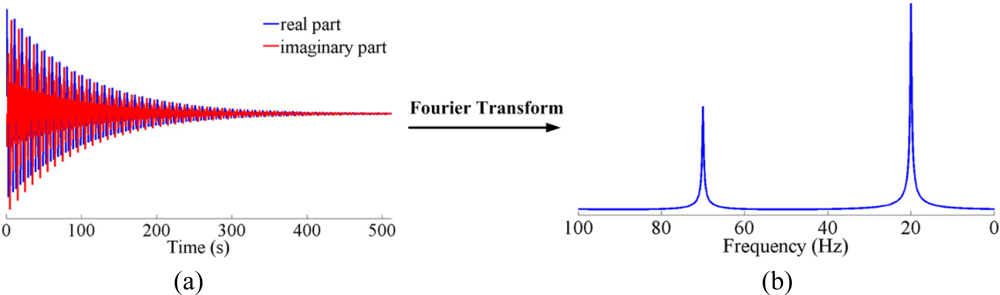
<mml:mi>j</mml:mi></mml:msub></mml:mrow></mml:msup></mml:mrow></mml:math></disp-formula>where <italic>J</italic> is the number of sinusoids, <italic>A<sub>j</sub></italic>, ∅<italic><sub>j</sub></italic>, <italic>τ<sub>j</sub></italic> and <italic>ω<sub>j</sub></italic> are the amplitude, phase in radians, decay time and frequency, respectively, of the <italic>j</italic>th sinusoid [<xref ref-type="bibr" rid="b21-sensors-11-08888">21</xref>]. Δ<italic>t</italic> is the sampling interval and <italic>k</italic> (<italic>k</italic> = 0, 1, …, <italic>K</italic>) is an integer to denote the <italic>k</italic>th sample point. Such a signal will give rise to a spectrum that is the sum of Lorentizian peaks centered at different frequencies <italic>ω<sub>j</sub></italic> [<xref ref-type="bibr" rid="b21-sensors-11-08888">21</xref>], where <italic>j</italic> corresponds to <italic>j</italic>th type of nuclear spins. A conventional 1D single pulse NMR experiment enforces an excitation pulse on a sample followed immediately by data acquisition. The signal eventually decays due to relaxation [<xref ref-type="bibr" rid="b22-sensors-11-08888">22</xref>], thus it is called <italic>free induction decay</italic> (FID). Fourier transform (FT) is applied on the FID to obtain a frequency domain spectrum. <xref ref-type="fig" rid="f1-sensors-11-08888">Figure 1</xref> shows the simulated FID signal and the corresponding 1D NMR spectrum obtained from FT.</p>
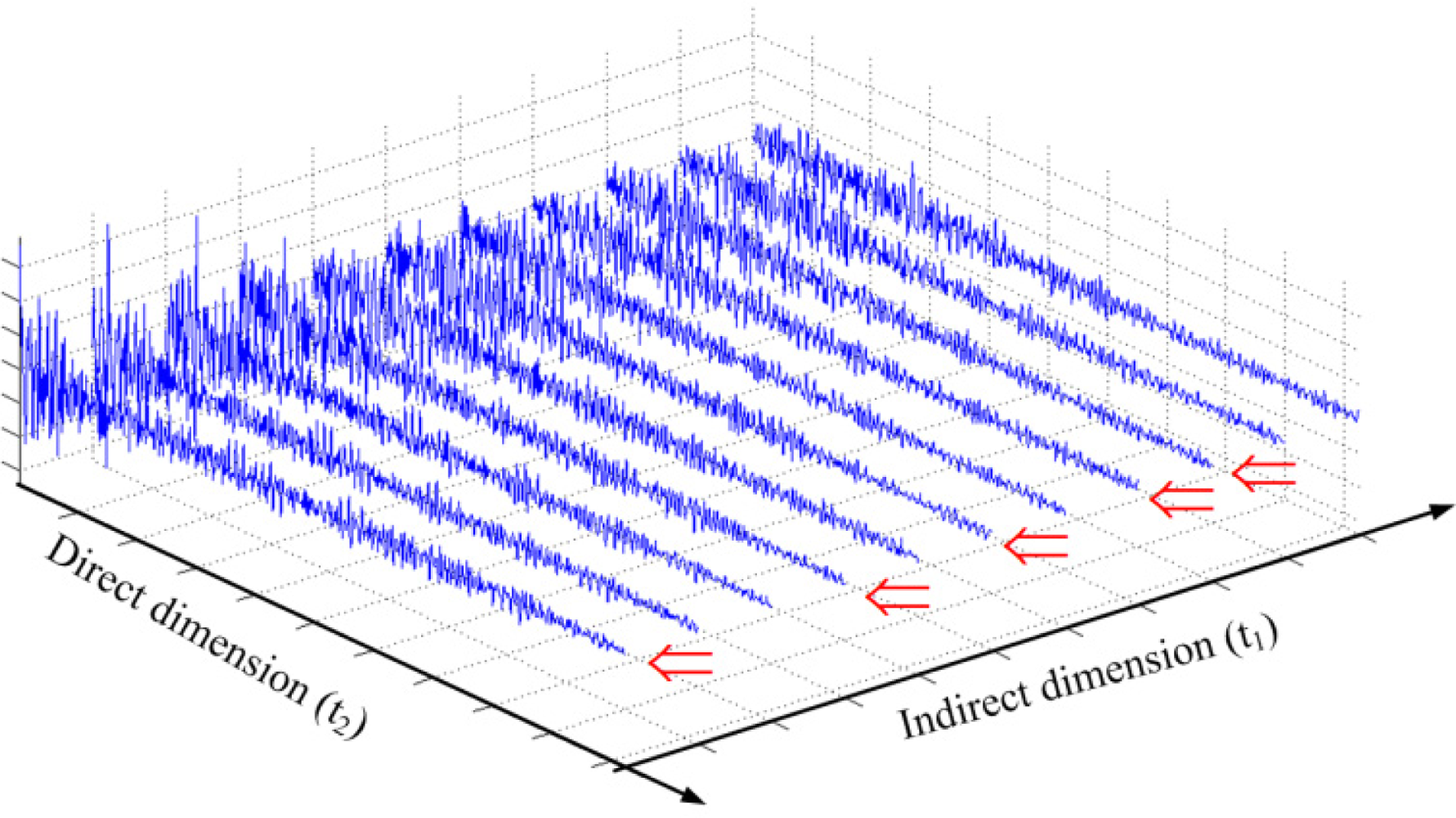
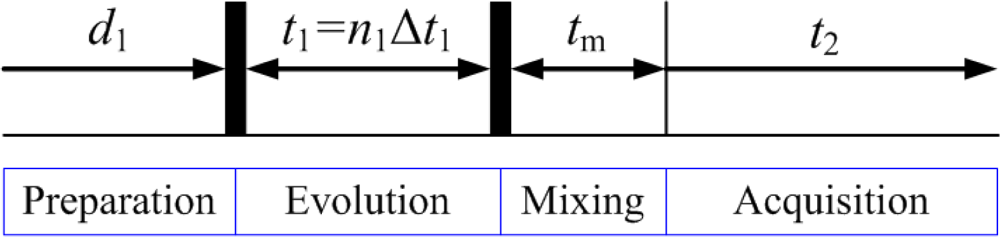
<p>The typical experimental time for a 1D NMR spectrum usually takes several seconds, thus it is not time consuming. However, for a 2D NMR spectrum, the time domain signal is generated based on two time variables <italic>t</italic><sub>1</sub> and <italic>t</italic><sub>2</sub>. As shown in <xref ref-type="fig" rid="f2-sensors-11-08888">Figure 2</xref>, one scan of 2D NMR spectrum contains three steps: first, the sample is excited by one or more pulses in the preparation period. These pulses result in the evolution of magnetization with time <italic>t</italic><sub>1</sub>; then, the sample is further excited in the mixing period; finally, an FID signal is recorded as a function of <italic>t</italic><sub>2</sub>. Usually, <italic>t</italic><sub>1</sub> is set as <italic>t</italic><sub>1</sub> = Δ<italic>t</italic><sub>1</sub>, 2Δ<italic>t</italic><sub>1</sub>, ..., <italic>n</italic><sub>1</sub>Δ<italic>t</italic><sub>1</sub>, <italic>N</italic><sub>1</sub>Δ<italic>t</italic><sub>1</sub> (The increment Δ<italic>t</italic><sub>1</sub> is usually at the order of milliseconds). The number of <italic>t</italic><sub>1</sub> increments (<italic>N</italic><sub>1</sub>) is determined by:
<disp-formula id="FD2">
<label>(2)</label>
<mml:math display="block">
<mml:mrow>
<mml:msub>
<mml:mrow>
<mml:mi>N</mml:mi></mml:mrow>
<mml:mn>1</mml:mn></mml:msub>
<mml:mo>=</mml:mo>
<mml:mfrac>
<mml:mrow>
<mml:msub>
<mml:mrow>
<mml:mi mathvariant="italic">SW</mml:mi></mml:mrow>
<mml:mn>1</mml:mn></mml:msub></mml:mrow>
<mml:mrow>
<mml:msub>
<mml:mrow>
<mml:mo>Δ</mml:mo>
<mml:mi>f</mml:mi></mml:mrow>
<mml:mn>1</mml:mn></mml:msub></mml:mrow></mml:mfrac></mml:mrow></mml:math></disp-formula>where 
<inline-formula>
<mml:math>
<mml:mrow>
<mml:msub>
<mml:mrow>
<mml:mi mathvariant="italic">SW</mml:mi></mml:mrow>
<mml:mn>1</mml:mn></mml:msub>
<mml:mo>=</mml:mo>
<mml:mfrac>
<mml:mn>1</mml:mn>
<mml:mrow>
<mml:msub>
<mml:mrow>
<mml:mo>Δ</mml:mo>
<mml:mi>t</mml:mi></mml:mrow>
<mml:mn>1</mml:mn></mml:msub></mml:mrow></mml:mfrac></mml:mrow></mml:math></inline-formula> is the desired spectral width and 
<inline-formula>
<mml:math>
<mml:mrow>
<mml:msub>
<mml:mrow>
<mml:mo>Δ</mml:mo>
<mml:mi>f</mml:mi></mml:mrow>
<mml:mn>1</mml:mn></mml:msub>
<mml:mo>=</mml:mo>
<mml:mfrac>
<mml:mn>1</mml:mn>
<mml:mrow>
<mml:msub>
<mml:mrow>
<mml:mi>N</mml:mi></mml:mrow>
<mml:mn>1</mml:mn></mml:msub>
<mml:msub>
<mml:mrow>
<mml:mo>Δ</mml:mo>
<mml:mi>t</mml:mi></mml:mrow>
<mml:mn>1</mml:mn></mml:msub></mml:mrow></mml:mfrac></mml:mrow></mml:math></inline-formula> is the corresponding spectral resolution. The typical <italic>N</italic><sub>1</sub> is from 50 to 500 [<xref ref-type="bibr" rid="b22-sensors-11-08888">22</xref>]. Given a fixed <italic>t</italic><sub>1</sub> = <italic>n</italic><sub>1</sub>Δ<italic>t</italic><sub>1</sub>, one scan is performed and the FID signal is recorded and stored along the direct dimension. After the scan, the nuclear spins are allowed to return to their equilibrium states before the next scan for <italic>t</italic><sub>1</sub> = (<italic>n</italic><sub>1</sub> + 1)Δ<italic>t</italic><sub>1</sub> [<xref ref-type="bibr" rid="b22-sensors-11-08888">22</xref>].</p>
<p>Finally, 2D FT is performed on the 2D FID data. If the time for performing all the pulses in one scan is <italic>t<sub>p</sub></italic>, the total scanning time for a 2D NMR spectrum will be:
<disp-formula id="FD3">
<label>(3)</label>
<mml:math display="block">
<mml:mrow>
<mml:msub>
<mml:mrow>
<mml:mi>T</mml:mi></mml:mrow>
<mml:mrow>
<mml:msub>
<mml:mrow>
<mml:mi>N</mml:mi></mml:mrow>
<mml:mn>1</mml:mn></mml:msub></mml:mrow></mml:msub>
<mml:mo>=</mml:mo>
<mml:munderover>
<mml:mo>∑</mml:mo>
<mml:mrow>
<mml:msub>
<mml:mrow>
<mml:mi>n</mml:mi></mml:mrow>
<mml:mn>1</mml:mn></mml:msub>
<mml:mo>=</mml:mo>
<mml:mn>1</mml:mn></mml:mrow>
<mml:mrow>
<mml:msub>
<mml:mrow>
<mml:mi>N</mml:mi></mml:mrow>
<mml:mn>1</mml:mn></mml:msub></mml:mrow></mml:munderover>
<mml:mrow>
<mml:mrow>
<mml:mo>(</mml:mo>
<mml:mrow>
<mml:msub>
<mml:mrow>
<mml:mi>d</mml:mi></mml:mrow>
<mml:mn>1</mml:mn></mml:msub>
<mml:mo>+</mml:mo>
<mml:msub>
<mml:mrow>
<mml:mi>n</mml:mi></mml:mrow>
<mml:mn>1</mml:mn></mml:msub>
<mml:msub>
<mml:mrow>
<mml:mo>Δ</mml:mo>
<mml:mi>t</mml:mi></mml:mrow>
<mml:mn>1</mml:mn></mml:msub>
<mml:mo>+</mml:mo>
<mml:msub>
<mml:mrow>
<mml:mi>t</mml:mi></mml:mrow>
<mml:mi>m</mml:mi></mml:msub>
<mml:mo>+</mml:mo>
<mml:msub>
<mml:mrow>
<mml:mi>t</mml:mi></mml:mrow>
<mml:mn>2</mml:mn></mml:msub>
<mml:mo>+</mml:mo>
<mml:msub>
<mml:mrow>
<mml:mi>t</mml:mi></mml:mrow>
<mml:mi>p</mml:mi></mml:msub></mml:mrow>
<mml:mo>)</mml:mo></mml:mrow>
<mml:mo>=</mml:mo>
<mml:msub>
<mml:mrow>
<mml:mi>N</mml:mi></mml:mrow>
<mml:mn>1</mml:mn></mml:msub>
<mml:mrow>
<mml:mo>(</mml:mo>
<mml:mrow>
<mml:msub>
<mml:mrow>
<mml:mi>d</mml:mi></mml:mrow>
<mml:mn>1</mml:mn></mml:msub>
<mml:mo>+</mml:mo>
<mml:mfrac>
<mml:mrow>
<mml:mrow>
<mml:mo>(</mml:mo>
<mml:mrow>
<mml:mn>1</mml:mn>
<mml:mo>+</mml:mo>
<mml:msub>
<mml:mrow>
<mml:mi>N</mml:mi></mml:mrow>
<mml:mn>1</mml:mn></mml:msub></mml:mrow>
<mml:mo>)</mml:mo></mml:mrow>
<mml:msub>
<mml:mrow>
<mml:mo>Δ</mml:mo>
<mml:mi>t</mml:mi></mml:mrow>
<mml:mn>1</mml:mn></mml:msub></mml:mrow>
<mml:mn>2</mml:mn></mml:mfrac>
<mml:mo>+</mml:mo>
<mml:msub>
<mml:mrow>
<mml:mi>t</mml:mi></mml:mrow>
<mml:mi>m</mml:mi></mml:msub>
<mml:mo>+</mml:mo>
<mml:msub>
<mml:mrow>
<mml:mi>t</mml:mi></mml:mrow>
<mml:mn>2</mml:mn></mml:msub>
<mml:mo>+</mml:mo>
<mml:msub>
<mml:mrow>
<mml:mi>t</mml:mi></mml:mrow>
<mml:mi>p</mml:mi></mml:msub></mml:mrow>
<mml:mo>)</mml:mo></mml:mrow></mml:mrow></mml:mrow></mml:math></disp-formula></p>
<p>In order to obtain a good resolution in the indirection dimension, <italic>N</italic><sub>1</sub> is usually several tens or hundreds or even more. This will cause the total scanning time for a 2D NMR spectrum to be tens of minutes or even several hours [<xref ref-type="bibr" rid="b22-sensors-11-08888">22</xref>–<xref ref-type="bibr" rid="b26-sensors-11-08888">26</xref>].</p>
<p>In this paper, we aim to reduce the scan number for the <italic>t</italic><sub>1</sub> dimension. Rather than using the uniform increment in the indirect dimension (<italic>t</italic><sub>1</sub> = Δ<italic>t</italic><sub>1</sub>, 2Δ<italic>t</italic><sub>1</sub>, ..., <italic>n</italic><sub>1</sub>Δ<italic>t</italic><sub>1</sub>, <italic>N</italic><sub>1</sub>Δ<italic>t</italic><sub>1</sub>), we randomly choose unduplicated <italic>Q</italic> numbers from <italic>n<sub>q</sub></italic> ∈ {1, 2, ..., <italic>N</italic><sub>1</sub>}, and let <italic>t</italic><sub>1</sub> = <italic>n<sub>q</sub></italic>Δ<italic>t</italic><sub>1</sub>. Let:
<disp-formula id="FD4">
<label>(4)</label>
<mml:math display="block">
<mml:mrow>
<mml:mi>ρ</mml:mi>
<mml:mo>=</mml:mo>
<mml:mfrac>
<mml:mi>Q</mml:mi>
<mml:mrow>
<mml:msub>
<mml:mrow>
<mml:mi>N</mml:mi></mml:mrow>
<mml:mn>1</mml:mn></mml:msub></mml:mrow></mml:mfrac></mml:mrow></mml:math></disp-formula>be the sampling rate in this paper, the total time to scan a 2D NMR spectrum is approximately:
<disp-formula id="FD5">
<label>(5)</label>
<mml:math display="block">
<mml:mrow>
<mml:msub>
<mml:mrow>
<mml:mi>T</mml:mi></mml:mrow>
<mml:mi>Q</mml:mi></mml:msub>
<mml:mo>=</mml:mo>
<mml:mfrac>
<mml:mi>Q</mml:mi>
<mml:mrow>
<mml:msub>
<mml:mrow>
<mml:mi>N</mml:mi></mml:mrow>
<mml:mn>1</mml:mn></mml:msub></mml:mrow></mml:mfrac>
<mml:msub>
<mml:mrow>
<mml:mi>T</mml:mi></mml:mrow>
<mml:mrow>
<mml:msub>
<mml:mrow>
<mml:mi>N</mml:mi></mml:mrow>
<mml:mn>1</mml:mn></mml:msub></mml:mrow></mml:msub>
<mml:mo>=</mml:mo>
<mml:mi>ρ</mml:mi>
<mml:msub>
<mml:mi>T</mml:mi>
<mml:mrow>
<mml:msub>
<mml:mi>N</mml:mi>
<mml:mn>1</mml:mn></mml:msub></mml:mrow></mml:msub></mml:mrow></mml:math></disp-formula></p>
<p>The approximation is made by ignoring the total evolution time ∑<sub><italic>n</italic><sub><italic>q</italic></sub>∈ {1,2,...,<italic>N</italic><sub>1</sub>},<italic>q</italic> = 1,2,...,<italic>Q</italic></sub><italic>n<sub>q</sub></italic>Δ<italic>t</italic><sub>1</sub> since this value is only in the order of seconds. Compared to the time to acquire a 2D spectrum with fully sampled FIDs in the indirection dimension, undersampling the FIDs in the indirect dimension can greatly reduce the acquisition time for a 2D NMR spectrum if <italic>ρ</italic> is small enough. <xref ref-type="fig" rid="f3-sensors-11-08888">Figure 3</xref> shows an example where we randomly undersample the indirect dimension with sampling rate <italic>ρ</italic> = 5/11 = 0.45. It means we save nearly half of the acquisition time of the conventional scheme.</p>
<p>However, this undersampling will result in aliasing artifacts [<xref ref-type="bibr" rid="b1-sensors-11-08888">1</xref>,<xref ref-type="bibr" rid="b6-sensors-11-08888">6</xref>]. It would be of great value if we can minimize these artifacts and reconstruct the full 2D NMR spectrum from the limited data. Here we explore the undersampling and reconstruction methods under the framework of CS.</p></sec>
<sec>
<label>3.</label>
<title>Reconstruction of 2D Self-Sparse NMR Spectra with Compressed Sensing</title>
<sec>
<label>3.1.</label>
<title>Basic Concepts in Compressed Sensing</title>
<p>The CS proposed by Candès <italic>et al.</italic> [<xref ref-type="bibr" rid="b11-sensors-11-08888">11</xref>] and Donoho [<xref ref-type="bibr" rid="b12-sensors-11-08888">12</xref>] is a new theory to do undersampling and reconstruct the signal of interest from limited physically acquired data. They build a theoretical foundation that one can exactly or approximately recover signals from highly incomplete measurements. The two basic tenets to guarantee the performance of CS are sparsity and incoherence.</p>
<p>(a) Sparsity. For the signal <bold>x</bold> ∈ R<italic><sup>N</sup></italic> and a basis dictionary <bold>Ψ</bold> ∈ R<sup><italic>S</italic> × <italic>N</italic></sup> (e.g., identity matrix, FT, discrete cosine transform or wavelet transform matrix), the sparsity is often interpreted as:
<disp-formula id="FD6">
<label>(6)</label>
<mml:math display="block">
<mml:mrow>
<mml:mi>S</mml:mi>
<mml:mo>=</mml:mo>
<mml:msub>
<mml:mrow>
<mml:mrow>
<mml:mrow>
<mml:mo>‖</mml:mo>
<mml:mi mathvariant="bold">α</mml:mi>
<mml:mo>‖</mml:mo></mml:mrow></mml:mrow></mml:mrow>
<mml:mn>0</mml:mn></mml:msub>
<mml:mo>=</mml:mo>
<mml:msub>
<mml:mrow>
<mml:mrow>
<mml:mrow>
<mml:mo>‖</mml:mo>
<mml:mrow>
<mml:mi mathvariant="bold">Ψ</mml:mi>
<mml:mi mathvariant="bold">x</mml:mi></mml:mrow>
<mml:mo>‖</mml:mo></mml:mrow></mml:mrow></mml:mrow>
<mml:mn>0</mml:mn></mml:msub>
<mml:mo>≪</mml:mo>
<mml:mi>N</mml:mi></mml:mrow></mml:math></disp-formula>where ‖ <bold>α</bold> ‖<sub>0</sub> denotes the <italic>ℓ</italic><sub>0</sub> norm that counts the nonzero entries in <bold>α</bold>, and <italic>S</italic> is the number of nonzero entries. If <bold>x</bold> is sparse without transformation (namely sparse in identity matrix <bold>I</bold> ∈ R<sup><italic>N</italic> × <italic>N</italic></sup>), it is called <italic>self-sparse</italic> since other complicated sparsifying transform, e.g., wavelet transform, is not required.</p>
<p>Candès <italic>et al.</italic> [<xref ref-type="bibr" rid="b11-sensors-11-08888">11</xref>] and Donoho [<xref ref-type="bibr" rid="b12-sensors-11-08888">12</xref>] proved that it is possible to recover the original signal <bold>x</bold> from O(<italic>N</italic>log<italic>S</italic>) measurements. This means the required number of measurements is proportional to the number of nonzero entries in the basis <bold>Ψ</bold>. The smaller the <italic>S</italic> is, the less the number of measurements is required.</p>
<p>(b) Incoherence. When a signal <bold>x</bold> is sampled by a sensing matrix Φ<sub><italic>M</italic> × <italic>N</italic></sub>, the measurements <bold>y</bold> ∈ R<italic><sup>M</sup></italic> of <bold>x</bold> is:
<disp-formula id="FD7">
<label>(7)</label>
<mml:math display="block">
<mml:mrow>
<mml:mi mathvariant="bold">f</mml:mi>
<mml:mo>=</mml:mo>
<mml:mi mathvariant="bold">Φ</mml:mi>
<mml:mi mathvariant="bold">x</mml:mi></mml:mrow></mml:math></disp-formula></p>
<p>The coherence is defined as [<xref ref-type="bibr" rid="b27-sensors-11-08888">27</xref>,<xref ref-type="bibr" rid="b28-sensors-11-08888">28</xref>]:
<disp-formula id="FD8">
<label>(8)</label>
<mml:math display="block">
<mml:mrow>
<mml:mi>μ</mml:mi>
<mml:mrow>
<mml:mo stretchy="false">(</mml:mo>
<mml:mrow>
<mml:mi mathvariant="bold">Φ</mml:mi>
<mml:mo mathvariant="bold">,</mml:mo>
<mml:mi mathvariant="bold">Ψ</mml:mi></mml:mrow>
<mml:mo stretchy="false">)</mml:mo></mml:mrow>
<mml:mo>=</mml:mo>
<mml:munder>
<mml:mrow>
<mml:mtext>max</mml:mtext></mml:mrow>
<mml:mrow>
<mml:mi>k</mml:mi>
<mml:mo>,</mml:mo>
<mml:mi>j</mml:mi></mml:mrow></mml:munder>
<mml:mrow>
<mml:mo>|</mml:mo>
<mml:mrow>
<mml:mrow>
<mml:mo>〈</mml:mo>
<mml:mrow>
<mml:msub>
<mml:mrow>
<mml:mi>ϕ</mml:mi></mml:mrow>
<mml:mi>k</mml:mi></mml:msub>
<mml:mo>,</mml:mo>
<mml:msub>
<mml:mrow>
<mml:mi>ψ</mml:mi></mml:mrow>
<mml:mi>j</mml:mi></mml:msub></mml:mrow>
<mml:mo>〉</mml:mo></mml:mrow></mml:mrow>
<mml:mo>|</mml:mo></mml:mrow></mml:mrow></mml:math></disp-formula>where ∅<italic><sub>k</sub></italic> is the <italic>k</italic>th rows of <bold>Φ</bold> and <italic>Ψ<sub>j</sub></italic> is the <italic>j</italic>th column of <bold>Ψ</bold>. The coherence measures the largest correlation between any row of <bold>Φ</bold> and column of <bold>Ψ</bold>. The less the coherence between <bold>Φ</bold> and <bold>Ψ</bold> is, the smaller the <italic>μ</italic> is. The value range of <italic>μ</italic> is 
<inline-formula>
<mml:math>
<mml:mrow>
<mml:mrow>
<mml:mo>[</mml:mo>
<mml:mrow>
<mml:mn>1</mml:mn>
<mml:mo>,</mml:mo>
<mml:msqrt>
<mml:mi>N</mml:mi></mml:msqrt></mml:mrow>
<mml:mo>]</mml:mo></mml:mrow></mml:mrow></mml:math></inline-formula>. The minimal coherence <italic>μ =</italic> 1 occurs when <bold>Φ</bold> and <bold>Ψ</bold> is a time-frequency pair [<xref ref-type="bibr" rid="b29-sensors-11-08888">29</xref>]. CS requires the coherence to be as small as possible, which means each measurement vector ∅<italic><sub>k</sub></italic> must be ‘spread out’ in the <bold>Ψ</bold> domain [<xref ref-type="bibr" rid="b28-sensors-11-08888">28</xref>].</p>
<p>If the signal <bold>x</bold> satisfies [<xref ref-type="bibr" rid="b30-sensors-11-08888">30</xref>]:
<disp-formula id="FD9">
<label>(9)</label>
<mml:math display="block">
<mml:mrow>
<mml:mi>S</mml:mi>
<mml:mo>=</mml:mo>
<mml:msub>
<mml:mrow>
<mml:mo>‖</mml:mo>
<mml:mrow>
<mml:mi mathvariant="bold">α</mml:mi></mml:mrow>
<mml:mo>‖</mml:mo></mml:mrow>
<mml:mn>0</mml:mn></mml:msub>
<mml:mo>&lt;</mml:mo>
<mml:mfrac>
<mml:mn>1</mml:mn>
<mml:mn>2</mml:mn></mml:mfrac>
<mml:mrow>
<mml:mo>(</mml:mo>
<mml:mrow>
<mml:mn>1</mml:mn>
<mml:mo>+</mml:mo>
<mml:mfrac>
<mml:mn>1</mml:mn>
<mml:mrow>
<mml:mi>μ</mml:mi>
<mml:mrow>
<mml:mo>(</mml:mo>
<mml:mrow>
<mml:mi mathvariant="bold">Φ</mml:mi>
<mml:mo mathvariant="bold">,</mml:mo>
<mml:mi mathvariant="bold">Ψ</mml:mi></mml:mrow>
<mml:mo>)</mml:mo></mml:mrow></mml:mrow></mml:mfrac></mml:mrow>
<mml:mo>)</mml:mo></mml:mrow></mml:mrow></mml:math></disp-formula>it can be perfectly recovered by solving:
<disp-formula id="FD10">
<label>(10)</label>
<mml:math display="block">
<mml:mrow>
<mml:mstyle fontweight="bold" fontstyle="normal">
<mml:mover accent="true">
<mml:mi mathvariant="bold">α</mml:mi>
<mml:mo>^</mml:mo></mml:mover></mml:mstyle>
<mml:mo>=</mml:mo>
<mml:munder>
<mml:mrow>
<mml:mtext>min</mml:mtext></mml:mrow>
<mml:mi mathvariant="bold">α</mml:mi></mml:munder>
<mml:msub>
<mml:mrow>
<mml:mrow>
<mml:mrow>
<mml:mo>‖</mml:mo>
<mml:mi mathvariant="bold">α</mml:mi>
<mml:mo>‖</mml:mo></mml:mrow></mml:mrow></mml:mrow>
<mml:mn>0</mml:mn></mml:msub>
<mml:mo>,</mml:mo>
<mml:mo> </mml:mo>
<mml:mo> </mml:mo>
<mml:mo> </mml:mo>
<mml:mi>s</mml:mi>
<mml:mo>.</mml:mo>
<mml:mi>t</mml:mi>
<mml:mo>.</mml:mo>
<mml:mi> </mml:mi>
<mml:mi> </mml:mi>
<mml:mi> </mml:mi>
<mml:mi mathvariant="bold">y</mml:mi>
<mml:mo>=</mml:mo>
<mml:mi mathvariant="bold">Φ</mml:mi>
<mml:mi mathvariant="normal">Ψ</mml:mi>
<mml:mi mathvariant="bold">α</mml:mi></mml:mrow></mml:math></disp-formula>where ‖ <bold>α</bold> ‖<sub>0</sub> denotes the <italic>ℓ</italic><sub>0</sub> norm that counts the nonzero entries in <bold>α</bold>.</p>
<p>The recovered signal is:
<disp-formula id="FD11">
<label>(11)</label>
<mml:math display="block">
<mml:mrow>
<mml:mover accent="true">
<mml:mi mathvariant="bold">x</mml:mi>
<mml:mo>^</mml:mo></mml:mover>
<mml:mo>=</mml:mo>
<mml:mi mathvariant="bold">Ψ</mml:mi>
<mml:mover accent="true">
<mml:mi mathvariant="bold">α</mml:mi>
<mml:mo>^</mml:mo></mml:mover></mml:mrow></mml:math></disp-formula></p>
<p><xref ref-type="disp-formula" rid="FD9">Equation (9)</xref> implies that if the coherence between <bold>Φ</bold> and <bold>Ψ</bold> is small, more non-zeros can be allowed in the sparse representation <bold>α</bold>. CS suggests <bold>Φ</bold> to be random enough to guarantee its incoherence with any <bold>Ψ</bold>. This is also observed that random sampling in time domain can improve the quality of reconstructed spectra [<xref ref-type="bibr" rid="b31-sensors-11-08888">31</xref>].</p>
<p>However, <italic>ℓ</italic><sub>0</sub> norm is known to be intractable and sensitive to noise [<xref ref-type="bibr" rid="b11-sensors-11-08888">11</xref>,<xref ref-type="bibr" rid="b12-sensors-11-08888">12</xref>], and <italic>ℓ</italic><sub>1</sub> norm convex optimization is commonly used in CS to recover <bold>x</bold> by solving:
<disp-formula id="FD12">
<label>(12)</label>
<mml:math display="block">
<mml:mrow>
<mml:mover accent="true">
<mml:mi mathvariant="bold">α</mml:mi>
<mml:mo>^</mml:mo></mml:mover>
<mml:mo>=</mml:mo>
<mml:munder>
<mml:mrow>
<mml:mtext>min</mml:mtext></mml:mrow>
<mml:mi mathvariant="bold">α</mml:mi></mml:munder>
<mml:msub>
<mml:mrow>
<mml:mrow>
<mml:mrow>
<mml:mo>‖</mml:mo>
<mml:mi mathvariant="bold">α</mml:mi>
<mml:mo>‖</mml:mo></mml:mrow></mml:mrow></mml:mrow>
<mml:mn>1</mml:mn></mml:msub>
<mml:mo>,</mml:mo>
<mml:mo> </mml:mo>
<mml:mo> </mml:mo>
<mml:mo> </mml:mo>
<mml:mi>s</mml:mi>
<mml:mo>.</mml:mo>
<mml:mi>t</mml:mi>
<mml:mo>.</mml:mo>
<mml:mi> </mml:mi>
<mml:mi> </mml:mi>
<mml:mi> </mml:mi>
<mml:mi mathvariant="bold">y</mml:mi>
<mml:mo>=</mml:mo>
<mml:mi mathvariant="bold">Φ</mml:mi>
<mml:mi mathvariant="bold">Ψ</mml:mi>
<mml:mi mathvariant="bold">α</mml:mi></mml:mrow></mml:math></disp-formula></p>
<p>The accuracy of CS reconstruction using <xref ref-type="disp-formula" rid="FD12">Equation (12)</xref> can be guaranteed if <bold>ΦΨ</bold> satisfies the appropriate restricted isometry properties [<xref ref-type="bibr" rid="b32-sensors-11-08888">32</xref>]. A restricted isometry constant <italic>σ</italic><sub>s</sub> [<xref ref-type="bibr" rid="b32-sensors-11-08888">32</xref>] defined as the smallest number such that:
<disp-formula id="FD13">
<label>(13)</label>
<mml:math display="block">
<mml:mrow>
<mml:mrow>
<mml:mo>(</mml:mo>
<mml:mrow>
<mml:mn>1</mml:mn>
<mml:mo>−</mml:mo>
<mml:msub>
<mml:mrow>
<mml:mi>σ</mml:mi></mml:mrow>
<mml:mi>S</mml:mi></mml:msub></mml:mrow>
<mml:mo>)</mml:mo></mml:mrow>
<mml:msubsup>
<mml:mrow>
<mml:mrow>
<mml:mrow>
<mml:mo>‖</mml:mo>
<mml:mi mathvariant="bold">α</mml:mi>
<mml:mo>‖</mml:mo></mml:mrow></mml:mrow></mml:mrow>
<mml:mn>2</mml:mn>
<mml:mn>2</mml:mn></mml:msubsup>
<mml:mo>≤</mml:mo>
<mml:mrow>
<mml:mo>‖</mml:mo>
<mml:mrow>
<mml:mi mathvariant="bold">Φ</mml:mi>
<mml:mi mathvariant="bold">Ψ</mml:mi>
<mml:mi mathvariant="bold">α</mml:mi></mml:mrow>
<mml:mo>‖</mml:mo></mml:mrow>
<mml:mo>≤</mml:mo>
<mml:mrow>
<mml:mo>(</mml:mo>
<mml:mrow>
<mml:mn>1</mml:mn>
<mml:mo>+</mml:mo>
<mml:msub>
<mml:mrow>
<mml:mi>σ</mml:mi></mml:mrow>
<mml:mi>S</mml:mi></mml:msub></mml:mrow>
<mml:mo>)</mml:mo></mml:mrow>
<mml:msubsup>
<mml:mrow>
<mml:mrow>
<mml:mrow>
<mml:mo>‖</mml:mo>
<mml:mi mathvariant="bold">α</mml:mi>
<mml:mo>‖</mml:mo></mml:mrow></mml:mrow></mml:mrow>
<mml:mn>2</mml:mn>
<mml:mn>2</mml:mn></mml:msubsup></mml:mrow></mml:math></disp-formula>holds for all vectors that have at most <italic>S</italic> nonzero entries. If 
<inline-formula>
<mml:math>
<mml:mrow>
<mml:msub>
<mml:mrow>
<mml:mi>σ</mml:mi></mml:mrow>
<mml:mrow>
<mml:mn>2</mml:mn>
<mml:mi>S</mml:mi></mml:mrow></mml:msub>
<mml:mo>&lt;</mml:mo>
<mml:msqrt>
<mml:mn>2</mml:mn></mml:msqrt>
<mml:mo>−</mml:mo>
<mml:mn>1</mml:mn></mml:mrow></mml:math></inline-formula>, the solution to the <italic>ℓ</italic><sub>1</sub> norm problem is that of the <italic>ℓ</italic><sub>0</sub> problem [<xref ref-type="bibr" rid="b32-sensors-11-08888">32</xref>].</p>
<p>The number of measurements <italic>M</italic> should satisfy:
<disp-formula id="FD14">
<label>(14)</label>
<mml:math display="block">
<mml:mrow>
<mml:mi>M</mml:mi>
<mml:mo>≥</mml:mo>
<mml:mi>C</mml:mi>
<mml:mo>⋅</mml:mo>
<mml:msup>
<mml:mrow>
<mml:mi>μ</mml:mi></mml:mrow>
<mml:mn>2</mml:mn></mml:msup>
<mml:mrow>
<mml:mo>(</mml:mo>
<mml:mrow>
<mml:mi mathvariant="bold">Φ</mml:mi>
<mml:mo mathvariant="bold">,</mml:mo>
<mml:mi mathvariant="bold">Ψ</mml:mi></mml:mrow>
<mml:mo>)</mml:mo></mml:mrow>
<mml:mo>⋅</mml:mo>
<mml:mi>S</mml:mi>
<mml:mo>⋅</mml:mo>
<mml:mtext>log</mml:mtext>
<mml:mo> </mml:mo>
<mml:mi>N</mml:mi></mml:mrow></mml:math></disp-formula>so that the signal <bold>x</bold> can be exactly recovered from measurements <bold>y</bold> in overwhelming majority of cases [<xref ref-type="bibr" rid="b28-sensors-11-08888">28</xref>]. <xref ref-type="disp-formula" rid="FD14">Equation (14)</xref> implies that the number of measurements is proportional to the number of nonzero entries <italic>S</italic> in <bold>α</bold> and the square of coherence <italic>μ</italic>. If both <italic>S</italic> and <italic>μ</italic> are small, the required number of measurements <italic>M</italic> could be small. This means that one can perform fewer measurements to save acquisition time while reconstruct original signal <bold>x</bold> very well.</p>
<p>Iddo [<xref ref-type="bibr" rid="b16-sensors-11-08888">16</xref>] applied CS to remove the aliasing artifacts from incompletely acquired FID data by enforcing the sparsity of 2D NMR spectra in wavelet domain according to:
<disp-formula id="FD15">
<label>(15)</label>
<mml:math display="block">
<mml:mrow>
<mml:mover accent="true">
<mml:mi mathvariant="bold">α</mml:mi>
<mml:mo>^</mml:mo></mml:mover>
<mml:mo>=</mml:mo>
<mml:munder>
<mml:mrow>
<mml:mtext>min</mml:mtext></mml:mrow>
<mml:mi mathvariant="bold">α</mml:mi></mml:munder>
<mml:msub>
<mml:mrow>
<mml:mrow>
<mml:mrow>
<mml:mo>‖</mml:mo>
<mml:mi mathvariant="bold">α</mml:mi>
<mml:mo>‖</mml:mo></mml:mrow></mml:mrow></mml:mrow>
<mml:mn>1</mml:mn></mml:msub>
<mml:mo>,</mml:mo>
<mml:mo> </mml:mo>
<mml:mo> </mml:mo>
<mml:mi>s</mml:mi>
<mml:mo>.</mml:mo>
<mml:mi>t</mml:mi>
<mml:mo>.</mml:mo>
<mml:mrow>
<mml:mo>‖</mml:mo>
<mml:mrow>
<mml:mi mathvariant="bold">y</mml:mi>
<mml:mo>−</mml:mo>
<mml:mi mathvariant="bold">Θ</mml:mi>
<mml:msup>
<mml:mrow>
<mml:mi mathvariant="bold">F</mml:mi></mml:mrow>
<mml:mi>T</mml:mi></mml:msup>
<mml:msup>
<mml:mrow>
<mml:mi mathvariant="bold">Ψ</mml:mi></mml:mrow>
<mml:mi>T</mml:mi></mml:msup>
<mml:mi mathvariant="bold">α</mml:mi></mml:mrow>
<mml:mo>‖</mml:mo></mml:mrow>
<mml:mo>≤</mml:mo>
<mml:mi>σ</mml:mi></mml:mrow></mml:math></disp-formula>where <bold>y</bold> is the measurements in time domain, <bold>Θ</bold> is a random sampling operator defining the FIDs acquired in the indirect dimension, <bold>F</bold><italic><sup>T</sup></italic> denotes the inverse 2D FT, and <bold>Ψ</bold><italic><sup>T</sup></italic> is the inverse 2D wavelet transform. According to <xref ref-type="disp-formula" rid="FD11">Equation (11)</xref>, the recovered spectrum is x̂ = Ψ<italic><sup>T</sup></italic>α̂.</p>
<p>In this paper, we focus on the reconstruction of self-sparse NMR spectra in which significant peaks take up partial locations of the full NMR spectra while the remaining locations have very small or even no peaks. Ideally, if the number of sinusoids <italic>J</italic> in <xref ref-type="disp-formula" rid="FD1">Equation (1)</xref> is very small, and the meaningful peaks are narrow enough relative to the whole 2D frequency coverage, the spectra can be considered to be sparse since the number of non-zeros for the spectra is much smaller than the number of spectrum points in the 2D NMR spectra.</p>
<p>The sparsifying transform and the coherence between <bold>Ψ</bold> and <bold>Φ</bold> = <bold>ΘF</bold><italic><sup>T</sup></italic> play important roles in the CS, as we have discussed. In the following sections, we will demonstrate that wavelet is not necessary to sparsify or even worsens the self-sparse NMR spectra based on the concept of sparsity and coherence. We will then reconstruct the NMR spectrum by enforcing its sparsity in an identity matrix domain with <italic>ℓ<sub>p</sub></italic> (<italic>p</italic> = 0.5) norm optimization algorithm.</p>
<p>To represent the NMR spectra in conventional way [<xref ref-type="bibr" rid="b4-sensors-11-08888">4</xref>–<xref ref-type="bibr" rid="b7-sensors-11-08888">7</xref>,<xref ref-type="bibr" rid="b17-sensors-11-08888">17</xref>], the X and Y coordinate axes are shown with unit of parts per million (ppm) [<xref ref-type="bibr" rid="b21-sensors-11-08888">21</xref>] defined as:
<disp-formula id="FD16">
<label>(16)</label>
<mml:math display="block">
<mml:mrow>
<mml:mi>δ</mml:mi>
<mml:mo>=</mml:mo>
<mml:mfrac>
<mml:mrow>
<mml:mi>ω</mml:mi>
<mml:mo>−</mml:mo>
<mml:msub>
<mml:mrow>
<mml:mi>ω</mml:mi></mml:mrow>
<mml:mrow>
<mml:mtext>ref</mml:mtext></mml:mrow></mml:msub></mml:mrow>
<mml:mrow>
<mml:msub>
<mml:mrow>
<mml:mi>ω</mml:mi></mml:mrow>
<mml:mn>0</mml:mn></mml:msub></mml:mrow></mml:mfrac>
<mml:mo>×</mml:mo>
<mml:msup>
<mml:mn>10</mml:mn>
<mml:mn>6</mml:mn></mml:msup></mml:mrow></mml:math></disp-formula>where <italic>δ</italic> is the chemical shift of a peak with frequency <italic>ω, ω</italic><sub>ref</sub> is the frequency of a reference peak and <italic>ω</italic><sub>0</sub> is the spectrometer carrier frequency.</p></sec>
<sec>
<label>3.2.</label>
<title>Sparsity of Self-Sparse NMR Spectra</title>
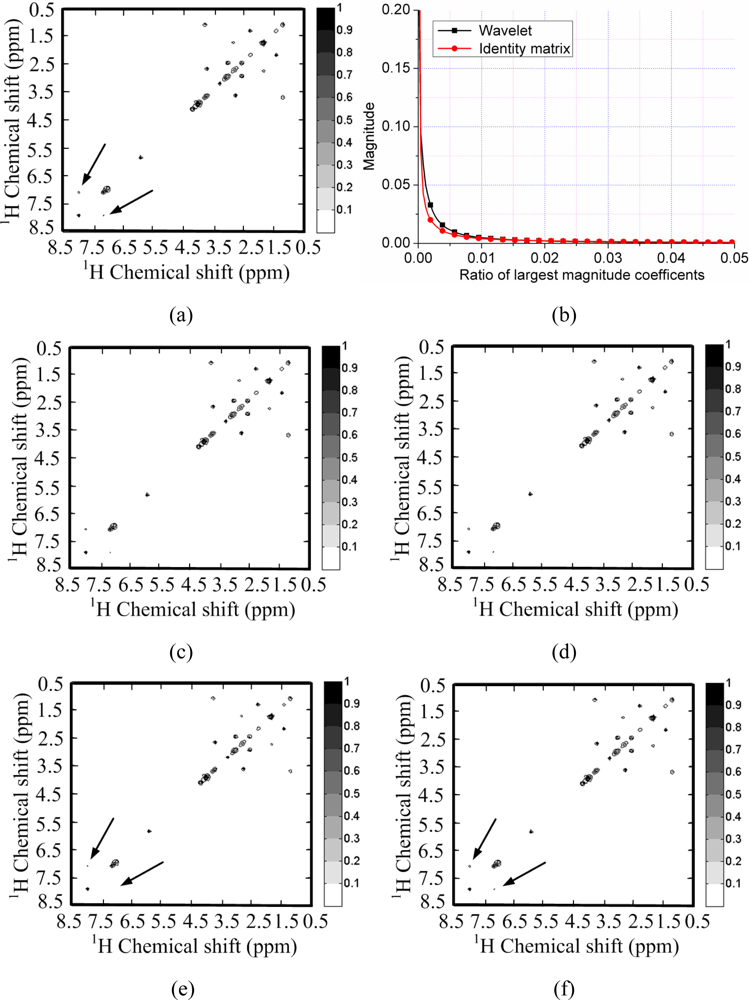
<p><xref ref-type="fig" rid="f4-sensors-11-08888">Figure 4(a)</xref> shows a 2D <sup>1</sup>H-<sup>1</sup>H correlation spectroscopy (COSY) spectrum where most of the peaks fill partial and very limited regions of the full spectrum. This leads to the sparsity of spectrum because the number of non zeros in the 2D spectrum is much smaller than the number of spectrum points. This phenomenon is also observed by Yoh Matsuki <italic>et al.</italic> [<xref ref-type="bibr" rid="b17-sensors-11-08888">17</xref>].</p>
<p>To test the sparsity of NMR spectra, we can measure the decay of coefficients in a sparsifying transform domain and evaluate the approximation error by retaining the <italic>k</italic><bold>-term</bold> largest coefficients, because the reconstruction error is proportional to the power law decay <italic>k</italic><sup>−<italic>r</italic></sup>, where <italic>r</italic> is a constant implying the sparsity of signal [<xref ref-type="bibr" rid="b29-sensors-11-08888">29</xref>]. Rapid decay of coefficients implies that one can use less non-zero coefficients to approximate a NMR spectrum. If we directly measure the decay of signal without complicated sparsifying transform, e.g., wavelets, it means measure the self-sparsity of signal. Mathematical saying is measuring its sparsity in the identity matrix.</p>
<p>As shown in <xref ref-type="fig" rid="f4-sensors-11-08888">Figure 4(b)</xref>, both the spectra and its wavelet coefficients can achieve rapid decay. By retaining 3% largest magnitude coefficients, the spectra can be reconstructed well in <xref ref-type="fig" rid="f4-sensors-11-08888">Figure 4(c,d)</xref>. However, the spectrum is sparser than its representation in the wavelet domain. This is demonstrated by the faster decay of spectrum than that of its wavelet coefficients in <xref ref-type="fig" rid="f4-sensors-11-08888">Figure 4(b)</xref>. By retaining the 1% largest magnitude coefficients, the wavelet fails to represent some peaks while the spectrum itself can represent these peaks, as marked by the arrows in <xref ref-type="fig" rid="f4-sensors-11-08888">Figure 4(e,f)</xref>.</p>
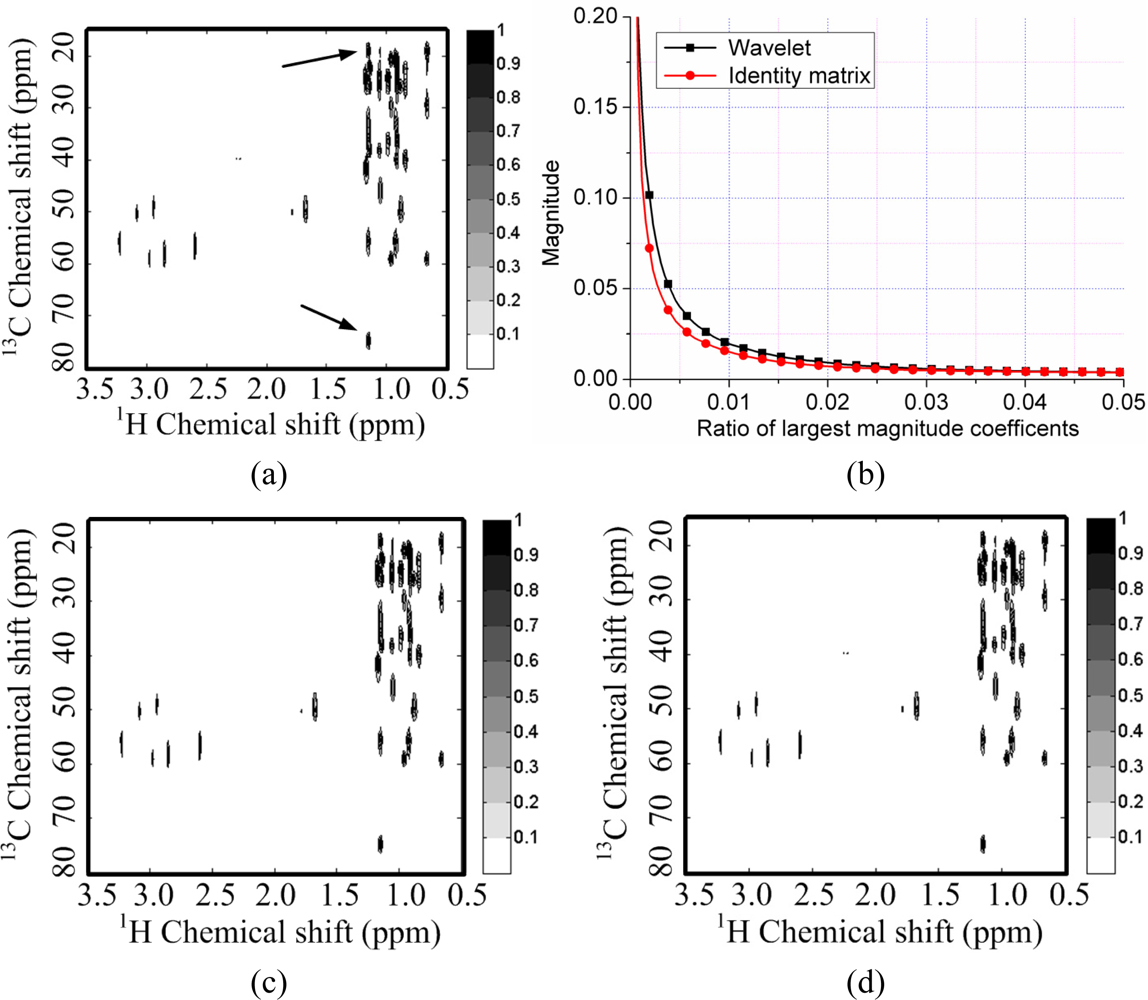
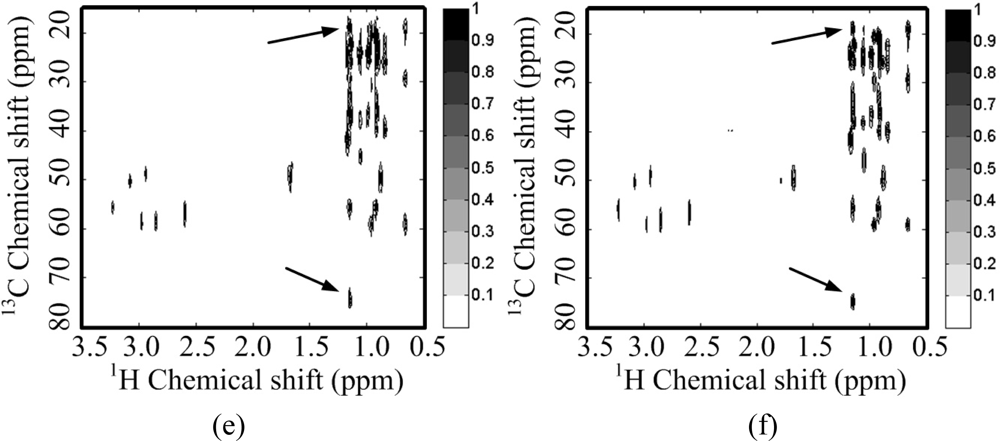
<p>For a 2D <sup>1</sup>H-<sup>13</sup>C COSY spectrum, the spectrum decays faster than its wavelet coefficients (<xref ref-type="fig" rid="f5-sensors-11-08888">Figure 5(b)</xref>). This implies that the identity matrix can provide a sparser representation of spectra than a wavelet does. Peaks are lost or distorted by using the wavelet transform to represent the spectrum (<xref ref-type="fig" rid="f5-sensors-11-08888">Figure 5(e)</xref>), but the spectrum is represented very well with the identity matrix (<xref ref-type="fig" rid="f5-sensors-11-08888">Figure 5(f)</xref>). This phenomenon is consistent with the observation on the 2D <sup>1</sup>H-<sup>1</sup>H COSY spectrum discussed above.</p>
<p>As a result, this spectrum is self-sparse, which means spectrum is sparse in the identity matrix. Thus, according to <xref ref-type="disp-formula" rid="FD9">Equations (9)</xref> and <xref ref-type="disp-formula" rid="FD14">(14)</xref>, it is better to use an identity matrix than to use a wavelet to reconstruct the self-sparse spectra from undersampled FIDs since the wavelet cannot provide a sparser representation of the spectrum. In fact, Stern <italic>et al.</italic> [<xref ref-type="bibr" rid="b33-sensors-11-08888">33</xref>] proposed to do iterative soft thresholding on the spectrum directly, not on wavelet coefficients, to recover one dimensional NMR spectra from the truncated FIDs. Although the sparsity of NMR spectra is not explicitly expressed in that work [<xref ref-type="bibr" rid="b33-sensors-11-08888">33</xref>], the recovered spectrum is obtained from minimizing <italic>ℓ</italic><sub>1</sub> norm of spectrum, which implies enforcing the sparsity of the spectrum. The problem of their method is that truncation violates the random sampling scheme in CS and results in strong Gibbs ringing which is hard to suppress [<xref ref-type="bibr" rid="b29-sensors-11-08888">29</xref>]. What is more, truncating the 1D FID is not necessary to save the time to scan a spectrum since scanning a 1D NMR spectrum is fast and only takes on the order of seconds.</p></sec>
<sec>
<label>3.3.</label>
<title>Coherence Property of Wavelet-Based and Identity Matrix-Based CS-NMR Spectra</title>
<p>Besides the sparsity of signal, another key factor for CS is the coherence between <bold>Φ</bold> and <bold>Ψ</bold> According to <xref ref-type="disp-formula" rid="FD9">Equations (9)</xref> and <xref ref-type="disp-formula" rid="FD14">(14)</xref>, fewer measurements are required for signal sampling system <bold>Φ</bold> if it is less coherent with <bold>Ψ</bold> and the signal has same sparsity for different <bold>Ψ</bold>.</p>
<p>Pioneering work on CS has pointed out that the coherence of a time-frequency pair is <italic>μ</italic>(<bold>Φ</bold>, <bold>I</bold>) = <italic>μ</italic>(<bold>ΘF</bold><italic><sup>T</sup></italic>, <bold>I</bold>) = 1 [<xref ref-type="bibr" rid="b28-sensors-11-08888">28</xref>]. Thus, we only need to compute the coherence between undersampled Fourier operator <bold>Φ</bold> and wavelet basis <bold>Ψ</bold><italic><sup>T</sup></italic>.</p>
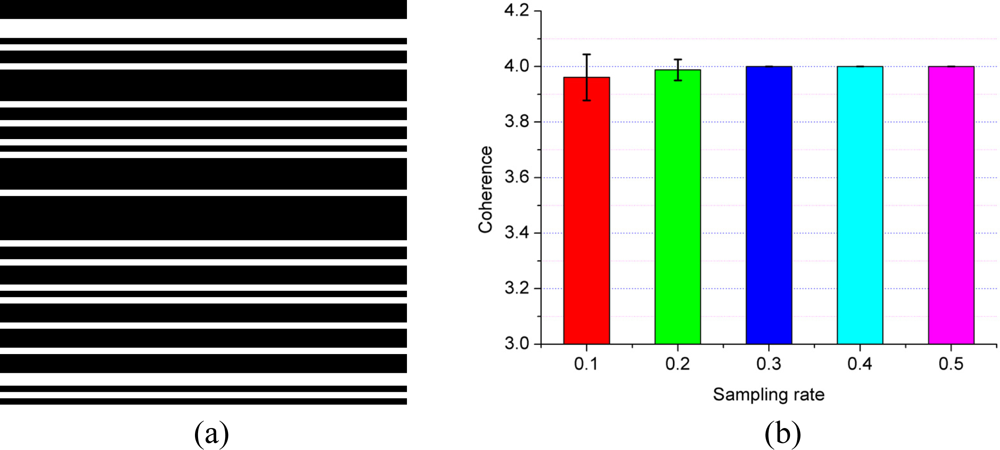
<p>The undersampling of <bold>Θ</bold> in the indirect dimension is carried out by choosing some of the FID points in this dimension. To make this undersampling intuitive, a binary mask which has the same size of 2D FID is shown as the undersampling pattern in <xref ref-type="fig" rid="f6-sensors-11-08888">Figure 6(a)</xref>. If the value of mask at location (<italic>i</italic>, <italic>j</italic>) is equal to 1 shown as a white pixel, the FID at location (<italic>i</italic>, <italic>j</italic>) is acquired.</p>
<p>To avoid the influence of randomness on the coherence calculation, <bold>Θ</bold> is randomly generated 10 times and the coherence is averaged for each sampling rate. <xref ref-type="fig" rid="f6-sensors-11-08888">Figure 6(b)</xref> shows that the coherence between wavelet and undersampled Fourier operator <bold>Φ</bold> is larger than the coherence between identity matrix and <bold>Φ</bold>. So, from the aspect of coherence, it is also better to choose the identity matrix for self-sparse NMR spectra.</p></sec>
<sec>
<label>3.4.</label>
<title>Reconstruction of Self-Sparse NMR Spectra with ℓ<sub>p</sub> Norm Minimization</title>
<p>In this paper, we propose to reconstruct the self-sparse 2D NMR spectra with identity matrix <bold>I</bold> as follows:
<disp-formula id="FD17">
<label>(17)</label>
<mml:math display="block">
<mml:mrow>
<mml:mover accent="true">
<mml:mi mathvariant="bold">x</mml:mi>
<mml:mo>^</mml:mo></mml:mover>
<mml:mo>=</mml:mo>
<mml:munder>
<mml:mrow>
<mml:mtext>min</mml:mtext></mml:mrow>
<mml:mi mathvariant="bold">x</mml:mi></mml:munder>
<mml:msub>
<mml:mrow>
<mml:mrow>
<mml:mrow>
<mml:mo>‖</mml:mo>
<mml:mi mathvariant="bold">x</mml:mi>
<mml:mo>‖</mml:mo></mml:mrow></mml:mrow></mml:mrow>
<mml:mn>1</mml:mn></mml:msub>
<mml:mo>,</mml:mo>
<mml:mi>s</mml:mi>
<mml:mo>.</mml:mo>
<mml:mi>t</mml:mi>
<mml:mo>.</mml:mo>
<mml:mi> </mml:mi>
<mml:mi> </mml:mi>
<mml:mi> </mml:mi>
<mml:mi mathvariant="bold">y</mml:mi>
<mml:mo>=</mml:mo>
<mml:mi mathvariant="bold">Φ</mml:mi>
<mml:mi mathvariant="bold">x</mml:mi></mml:mrow></mml:math></disp-formula>where <bold>Φ</bold> = <bold>ΘF</bold><italic><sup>T</sup></italic>.</p>
<p>To further improve the reconstruction, a <italic>ℓ<sub>p</sub></italic> (0 &lt; <italic>p</italic> &lt; 1) norm is incorporated which has been demonstrated to give better reconstruction of MR images with fewer measurements than <italic>ℓ</italic><sub>1</sub> norm does [<xref ref-type="bibr" rid="b34-sensors-11-08888">34</xref>–<xref ref-type="bibr" rid="b37-sensors-11-08888">37</xref>]:
<disp-formula id="FD18">
<label>(18)</label>
<mml:math display="block">
<mml:mrow>
<mml:mover accent="true">
<mml:mi mathvariant="bold">x</mml:mi>
<mml:mo>^</mml:mo></mml:mover>
<mml:mo>=</mml:mo>
<mml:munder>
<mml:mrow>
<mml:mtext>min</mml:mtext></mml:mrow>
<mml:mi mathvariant="bold">x</mml:mi></mml:munder>
<mml:msubsup>
<mml:mrow>
<mml:mrow>
<mml:mrow>
<mml:mo>‖</mml:mo>
<mml:mi mathvariant="bold">x</mml:mi>
<mml:mo>‖</mml:mo></mml:mrow></mml:mrow></mml:mrow>
<mml:mi>p</mml:mi>
<mml:mi>p</mml:mi></mml:msubsup>
<mml:mo>,</mml:mo>
<mml:mi>s</mml:mi>
<mml:mo>.</mml:mo>
<mml:mi>t</mml:mi>
<mml:mo>.</mml:mo>
<mml:mi> </mml:mi>
<mml:mi> </mml:mi>
<mml:mi> </mml:mi>
<mml:mi mathvariant="bold">y</mml:mi>
<mml:mo>=</mml:mo>
<mml:mi mathvariant="bold">Φ</mml:mi>
<mml:mi mathvariant="bold">x</mml:mi></mml:mrow></mml:math></disp-formula>where 
<inline-formula>
<mml:math>
<mml:mrow>
<mml:msubsup>
<mml:mrow>
<mml:mrow>
<mml:mrow>
<mml:mo>‖</mml:mo>
<mml:mi mathvariant="bold">x</mml:mi>
<mml:mo>‖</mml:mo></mml:mrow></mml:mrow></mml:mrow>
<mml:mi>p</mml:mi>
<mml:mi>p</mml:mi></mml:msubsup>
<mml:mo>=</mml:mo>
<mml:msup>
<mml:mrow>
<mml:mrow>
<mml:mo>∑</mml:mo>
<mml:mrow>
<mml:msubsup>
<mml:mrow/>
<mml:mrow>
<mml:mi>n</mml:mi>
<mml:mo>=</mml:mo>
<mml:mn>1</mml:mn></mml:mrow>
<mml:mi>N</mml:mi></mml:msubsup>
<mml:mrow>
<mml:mo>|</mml:mo>
<mml:mrow>
<mml:msub>
<mml:mrow>
<mml:mi>x</mml:mi></mml:mrow>
<mml:mi>n</mml:mi></mml:msub></mml:mrow>
<mml:mo>|</mml:mo></mml:mrow></mml:mrow></mml:mrow></mml:mrow>
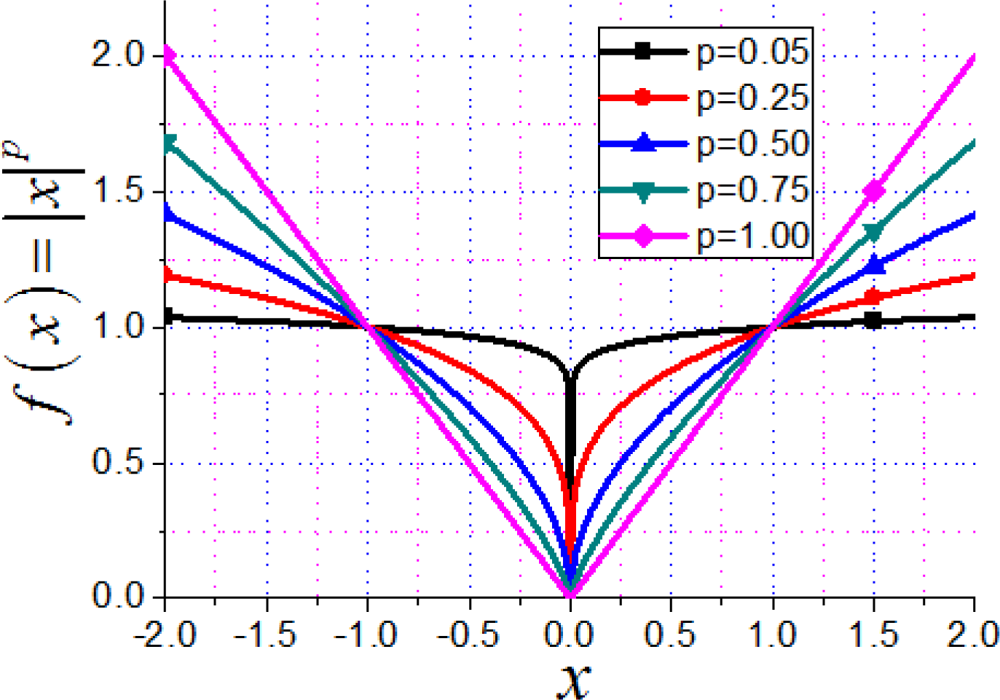
<mml:mi>p</mml:mi></mml:msup></mml:mrow></mml:math></inline-formula> and <italic>x<sub>n</sub></italic> is the <italic>n</italic><bold>th</bold> entry of vector <bold>x</bold>. For the function <italic>f</italic>(<italic>x</italic>) = |<italic>x</italic>|<italic><sup>p</sup></italic>, with <italic>p</italic> → 0, <italic>f</italic>(<italic>x</italic>) gets closer to the <italic>ℓ</italic><sub>0</sub> norm of <italic>x</italic>, as shown in <xref ref-type="fig" rid="f7-sensors-11-08888">Figure 7</xref>.</p>
<p>Theoretically, the required number of measurements [<xref ref-type="bibr" rid="b38-sensors-11-08888">38</xref>] by enforcing the sparsity with a <italic>ℓ<sub>p</sub></italic> (0 &lt; <italic>p</italic> &lt; 1) norm is:
<disp-formula id="FD19">
<label>(19)</label>
<mml:math display="block">
<mml:mrow>
<mml:mi>M</mml:mi>
<mml:mo>≥</mml:mo>
<mml:msub>
<mml:mrow>
<mml:mi>C</mml:mi></mml:mrow>
<mml:mn>1</mml:mn></mml:msub>
<mml:mi> </mml:mi>
<mml:mrow>
<mml:mo>(</mml:mo>
<mml:mi>p</mml:mi>
<mml:mo>)</mml:mo></mml:mrow>
<mml:mi> </mml:mi>
<mml:mi>K</mml:mi>
<mml:mo>+</mml:mo>
<mml:mi>p</mml:mi>
<mml:msub>
<mml:mrow>
<mml:mi>C</mml:mi></mml:mrow>
<mml:mn>2</mml:mn></mml:msub>
<mml:mi> </mml:mi>
<mml:mrow>
<mml:mo>(</mml:mo>
<mml:mi>p</mml:mi>
<mml:mo>)</mml:mo></mml:mrow>
<mml:mi> </mml:mi>
<mml:mi>K</mml:mi>
<mml:mi> </mml:mi>
<mml:mtext>log</mml:mtext>
<mml:mrow>
<mml:mo stretchy="false">(</mml:mo>
<mml:mrow>
<mml:mi>N</mml:mi>
<mml:mo>/</mml:mo>
<mml:mi>K</mml:mi></mml:mrow>
<mml:mo stretchy="false">)</mml:mo></mml:mrow></mml:mrow></mml:math></disp-formula>where <italic>C</italic><sub>1</sub> and <italic>C</italic><sub>2</sub> are determined explicitly and bounded in <italic>p</italic> and the recommend <italic>p</italic> is 0.5 [<xref ref-type="bibr" rid="b34-sensors-11-08888">34</xref>].</p>
<p>In this paper, the <italic>ℓ<sub>p</sub></italic> norm minimization is solved via the <italic>p</italic>-shrinkage operator [<xref ref-type="bibr" rid="b39-sensors-11-08888">39</xref>] with continuation algorithm [<xref ref-type="bibr" rid="b40-sensors-11-08888">40</xref>] because of its fast computation. This algorithm is abbreviated as PSOCA and summarized in <xref ref-type="table" rid="t4-sensors-11-08888">Algorithm 1</xref>.</p>
<table-wrap id="t4-sensors-11-08888" position="anchor">
<label>Algorithm 1.</label>
<caption>
<p>Self-sparse NMR spectra reconstruction with undersampled data using PSOCA.</p></caption>
<table frame="hsides" rules="none">
<tbody>
<tr>
<td align="left" valign="top"><bold>Initialization:</bold></td></tr>
<tr>
<td align="left" valign="top">Input the sampled FID data <bold>y</bold>, set the regularization parameter <italic>λ</italic> =10<sup>8</sup> and tolerance of inner loop <italic>η</italic> = 5 × 10<sup>−3</sup>.<break/>Initialize <bold>x</bold> = <bold>FΘ</bold><italic><sup>T</sup></italic> <bold>y</bold>, <bold>x<sub>last</sub></bold> = <bold>x</bold>, <italic>β</italic> = 2<sup>6</sup>, and <bold>α</bold> = <bold>0</bold>.</td></tr>
<tr>
<td align="left" valign="top"><bold>Main:</bold></td></tr>
<tr>
<td align="left" valign="top">  <bold>While</bold> <italic>β</italic> ≤ 2<sup>16</sup></td></tr>
<tr>
<td align="left" valign="top">    <bold>Inner loop:</bold></td></tr>
<tr>
<td align="left" valign="top">    1. Given <bold>x</bold>,</td></tr>
<tr>
<td align="left" valign="top">      <bold>For</bold> <italic>j</italic> = 1 to <italic>J</italic>, solve <xref ref-type="disp-formula" rid="FD20">Equation (20)</xref>, the solution is <bold>α</bold>;</td></tr>
<tr>
<td align="left" valign="top">    2. Given <bold>α</bold>,<break/>      solve <xref ref-type="disp-formula" rid="FD22">Equation (22)</xref>, the solution is <bold>x</bold>;</td></tr>
<tr>
<td align="left" valign="top">    3. If ‖Δ<bold>x</bold>‖ = ‖<bold>x<sub>last</sub></bold> – <bold>x</bold>‖ &gt; <italic>η,</italic> <bold>x<sub>last</sub></bold> ← <bold>x</bold>, go to step 1;<break/>        Otherwise, go to step 4;</td></tr>
<tr>
<td align="left" valign="top">    <bold>Outer loop:</bold></td></tr>
<tr>
<td align="left" valign="top">    4. <bold>x̂</bold> ← <bold>x</bold>, <italic>β</italic> ← 2<italic>β</italic>, go to step 1.</td></tr>
<tr>
<td align="left" valign="top">  <bold>End While</bold></td></tr>
<tr>
<td align="left" valign="top"><bold>Output: x</bold>̂</td></tr></tbody></table></table-wrap>
<p>For a given continuation parameter <italic>β</italic>, PSOCA is implemented to solve two sub-problems:</p>
<p>(1) <italic>p</italic>-shrinkage operator
<disp-formula id="FD20">
<label>(20)</label>
<mml:math display="block">
<mml:mrow>
<mml:msub>
<mml:mrow>
<mml:mi mathvariant="bold">α</mml:mi></mml:mrow>
<mml:mi>j</mml:mi></mml:msub>
<mml:mo>=</mml:mo>
<mml:msubsup>
<mml:mrow>
<mml:mi>S</mml:mi></mml:mrow>
<mml:mi>ɛ</mml:mi>
<mml:mi>p</mml:mi></mml:msubsup>
<mml:mrow>
<mml:mo>(</mml:mo>
<mml:mrow>
<mml:msub>
<mml:mrow>
<mml:mi mathvariant="bold">x</mml:mi></mml:mrow>
<mml:mi>j</mml:mi></mml:msub></mml:mrow>
<mml:mo>)</mml:mo></mml:mrow>
<mml:mo>=</mml:mo>
<mml:mtext>max</mml:mtext>
<mml:mrow>
<mml:mo>{</mml:mo>
<mml:mrow>
<mml:msub>
<mml:mrow>
<mml:mi mathvariant="bold">x</mml:mi></mml:mrow>
<mml:mi>j</mml:mi></mml:msub>
<mml:mo>−</mml:mo>
<mml:mi>ɛ</mml:mi>
<mml:msup>
<mml:mrow>
<mml:mrow>
<mml:mrow>
<mml:mo>|</mml:mo>
<mml:mrow>
<mml:msub>
<mml:mrow>
<mml:mi mathvariant="bold">x</mml:mi></mml:mrow>
<mml:mi>j</mml:mi></mml:msub></mml:mrow>
<mml:mo>|</mml:mo></mml:mrow></mml:mrow></mml:mrow>
<mml:mrow>
<mml:mi>p</mml:mi>
<mml:mo>−</mml:mo>
<mml:mn>1</mml:mn></mml:mrow></mml:msup>
<mml:mo>,</mml:mo>
<mml:mn>0</mml:mn></mml:mrow>
<mml:mo>}</mml:mo></mml:mrow>
<mml:mfrac>
<mml:mrow>
<mml:msub>
<mml:mrow>
<mml:mi mathvariant="bold">x</mml:mi></mml:mrow>
<mml:mi>j</mml:mi></mml:msub></mml:mrow>
<mml:mrow>
<mml:mrow>
<mml:mo>|</mml:mo>
<mml:mrow>
<mml:msub>
<mml:mrow>
<mml:mi mathvariant="bold">x</mml:mi></mml:mrow>
<mml:mi>j</mml:mi></mml:msub></mml:mrow>
<mml:mo>|</mml:mo></mml:mrow></mml:mrow></mml:mfrac></mml:mrow></mml:math></disp-formula>where 
<inline-formula>
<mml:math>
<mml:mrow>
<mml:mi>ɛ</mml:mi>
<mml:mo>=</mml:mo>
<mml:msup>
<mml:mrow>
<mml:mi>β</mml:mi></mml:mrow>
<mml:mrow>
<mml:mfrac>
<mml:mn>1</mml:mn>
<mml:mrow>
<mml:mi>p</mml:mi>
<mml:mo>−</mml:mo>
<mml:mn>2</mml:mn></mml:mrow></mml:mfrac></mml:mrow></mml:msup></mml:mrow></mml:math></inline-formula> and <italic>β</italic> is a parameter to be updated in the continuation scheme, <bold>x</bold><italic><sub>j</sub></italic> and <bold>α</bold><italic><sub>j</sub></italic> are the <italic>j</italic>th entry of column vectors <bold>x</bold> and <bold>α</bold>, respectively.</p>
<p>(2) solve the linear equation:
<disp-formula id="FD21">
<label>(21)</label>
<mml:math display="block">
<mml:mrow>
<mml:munder>
<mml:mrow>
<mml:mtext>min</mml:mtext></mml:mrow>
<mml:mi mathvariant="bold">x</mml:mi></mml:munder>
<mml:mfrac>
<mml:mi>β</mml:mi>
<mml:mn>2</mml:mn></mml:mfrac>
<mml:msubsup>
<mml:mrow>
<mml:mrow>
<mml:mrow>
<mml:mo>‖</mml:mo>
<mml:mrow>
<mml:mi mathvariant="bold">α</mml:mi>
<mml:mo>−</mml:mo>
<mml:mi mathvariant="bold">x</mml:mi></mml:mrow>
<mml:mo>‖</mml:mo></mml:mrow></mml:mrow></mml:mrow>
<mml:mn>2</mml:mn>
<mml:mn>2</mml:mn></mml:msubsup>
<mml:mo>+</mml:mo>
<mml:mfrac>
<mml:mi>λ</mml:mi>
<mml:mn>2</mml:mn></mml:mfrac>
<mml:msubsup>
<mml:mrow>
<mml:mrow>
<mml:mrow>
<mml:mo>‖</mml:mo>
<mml:mrow>
<mml:mi mathvariant="bold">y</mml:mi>
<mml:mo>−</mml:mo>
<mml:mi mathvariant="bold">Φ</mml:mi>
<mml:mi mathvariant="bold">x</mml:mi></mml:mrow>
<mml:mo>‖</mml:mo></mml:mrow></mml:mrow></mml:mrow>
<mml:mn>2</mml:mn>
<mml:mn>2</mml:mn></mml:msubsup></mml:mrow></mml:math></disp-formula>which can be simplified to:
<disp-formula id="FD22">
<label>(22)</label>
<mml:math display="block">
<mml:mrow>
<mml:mrow>
<mml:mo>(</mml:mo>
<mml:mrow>
<mml:mi>β</mml:mi>
<mml:mi mathvariant="bold">I</mml:mi>
<mml:mo>+</mml:mo>
<mml:mi>λ</mml:mi>
<mml:mi mathvariant="bold">P</mml:mi></mml:mrow>
<mml:mo>)</mml:mo></mml:mrow>
<mml:msup>
<mml:mrow>
<mml:mi mathvariant="bold">F</mml:mi></mml:mrow>
<mml:mi>T</mml:mi></mml:msup>
<mml:mi mathvariant="bold">x</mml:mi>
<mml:mo>=</mml:mo>
<mml:mi>β</mml:mi>
<mml:msup>
<mml:mrow>
<mml:mi mathvariant="bold">F</mml:mi></mml:mrow>
<mml:mi>T</mml:mi></mml:msup>
<mml:mi mathvariant="bold">α</mml:mi>
<mml:mo>+</mml:mo>
<mml:mi>λ</mml:mi>
<mml:msup>
<mml:mrow>
<mml:mi mathvariant="bold">Θ</mml:mi></mml:mrow>
<mml:mi>T</mml:mi></mml:msup>
<mml:mi mathvariant="bold">y</mml:mi></mml:mrow></mml:math></disp-formula>where the term <bold>P</bold> = <bold>Θ</bold><italic><sup>T</sup></italic><bold>Θ</bold> is a diagonal matrix consisting of ones and zeros. The diagonal entries of <bold>P</bold> correspond to the location of FID data and the entry value is 1 if a corresponding FID data point is sampled, otherwise the entry value is 0. <xref ref-type="disp-formula" rid="FD22">Equation (22)</xref> can be solved fast since only a discrete Fourier transform and entry-wise division are required.</p></sec></sec>
<sec sec-type="methods|results">
<label>4.</label>
<title>Simulation Results and Analysis</title>
<p>In this section, we will show the advantages of the proposed method in two aspects: (1) identity matrix as the sparsifying transform is compared with wavelet transform; (2) <italic>ℓ<sub>p</sub></italic> norm minimization is compared with <italic>ℓ</italic><sub>1</sub> norm minimization. The recommended value of <italic>p</italic> is 0.5 for stability from empirical experiments [<xref ref-type="bibr" rid="b34-sensors-11-08888">34</xref>]. The notation <italic>ℓ</italic><sub>0.5</sub> is short for <italic>ℓ<sub>p</sub></italic> with <italic>p</italic> = 0.5. The typical <italic>ℓ</italic><sub>1</sub> norm minimization algorithms compared in this paper include iterative soft thresholding (IST) algorithm [<xref ref-type="bibr" rid="b16-sensors-11-08888">16</xref>,<xref ref-type="bibr" rid="b41-sensors-11-08888">41</xref>–<xref ref-type="bibr" rid="b43-sensors-11-08888">43</xref>], alternating and continuation algorithm (ACA) [<xref ref-type="bibr" rid="b40-sensors-11-08888">40</xref>]. The ACA is just <italic>p</italic> = 1 in PSOCA.</p>
<p>Because regions of small spectrum values usually contain no peaks for practical analysis, we set magnitude smaller than a constant <italic>T</italic> to be zero according to:
<disp-formula id="FD23">
<label>(23)</label>
<mml:math display="block">
<mml:mrow>
<mml:msub>
<mml:mrow>
<mml:mi mathvariant="bold">x</mml:mi></mml:mrow>
<mml:mi>T</mml:mi></mml:msub>
<mml:mo> </mml:mo>
<mml:mrow>
<mml:mo>(</mml:mo>
<mml:mi>j</mml:mi>
<mml:mo>)</mml:mo></mml:mrow>
<mml:mo>=</mml:mo>
<mml:mrow>
<mml:mo>{</mml:mo>
<mml:mrow>
<mml:mtable columnalign="left">
<mml:mtr columnalign="left">
<mml:mtd columnalign="left">
<mml:mrow>
<mml:mi mathvariant="bold">x</mml:mi>
<mml:mo> </mml:mo>
<mml:mrow>
<mml:mo stretchy="false">(</mml:mo>
<mml:mi>j</mml:mi>
<mml:mo stretchy="false">)</mml:mo></mml:mrow>
<mml:mo>,</mml:mo></mml:mrow></mml:mtd>
<mml:mtd columnalign="left">
<mml:mrow>
<mml:mi mathvariant="bold">x</mml:mi>
<mml:mo> </mml:mo>
<mml:mrow>
<mml:mo stretchy="false">(</mml:mo>
<mml:mi>j</mml:mi>
<mml:mo stretchy="false">)</mml:mo></mml:mrow>
<mml:mo>≥</mml:mo>
<mml:mi>T</mml:mi></mml:mrow></mml:mtd></mml:mtr>
<mml:mtr columnalign="left">
<mml:mtd columnalign="left">
<mml:mrow>
<mml:mn>0</mml:mn>
<mml:mo>,</mml:mo></mml:mrow></mml:mtd>
<mml:mtd columnalign="left">
<mml:mrow>
<mml:mi mathvariant="bold">x</mml:mi>
<mml:mo> </mml:mo>
<mml:mrow>
<mml:mo stretchy="false">(</mml:mo>
<mml:mi>j</mml:mi>
<mml:mo stretchy="false">)</mml:mo></mml:mrow>
<mml:mo>&lt;</mml:mo>
<mml:mi>T</mml:mi></mml:mrow></mml:mtd></mml:mtr></mml:mtable></mml:mrow></mml:mrow></mml:mrow></mml:math></disp-formula>where <bold>x</bold> denotes the absolute value of spectra and <bold>x</bold><italic><sub>T</sub></italic> denotes the absolute value of post processed NMR spectra. For evaluation, <italic>T</italic> is set to two values. First, <italic>T</italic> is set to zero, which means a spectrum with small absolute values, possibly noise, are not suppressed. Second, <italic>T</italic> is set to the lowest value of contour when plotting the 2D spectrum. This is reasonable because peaks with absolute values smaller than <italic>T</italic> are not seen in the contour plot.</p>
<p>Suppose <bold>x̂</bold> denotes the reconstructed spectrum from undersampled FID, relative <italic>ℓ</italic><sub>2</sub> norm error (RLNE) is defined to measure the reconstruction error as:
<disp-formula id="FD24">
<label>(24)</label>
<mml:math display="block">
<mml:mrow>
<mml:mrow>
<mml:mtext>RLNE </mml:mtext>
<mml:mo>=</mml:mo>
<mml:mtext> </mml:mtext></mml:mrow>
<mml:mfrac>
<mml:mrow>
<mml:msub>
<mml:mrow>
<mml:mrow>
<mml:mrow>
<mml:mo>‖</mml:mo>
<mml:mrow>
<mml:msub>
<mml:mrow>
<mml:mover accent="true">
<mml:mi mathvariant="bold">x</mml:mi>
<mml:mo>^</mml:mo></mml:mover></mml:mrow>
<mml:mi>T</mml:mi></mml:msub>
<mml:mo>−</mml:mo>
<mml:msub>
<mml:mrow>
<mml:mover accent="true">
<mml:mi mathvariant="bold">x</mml:mi>
<mml:mo>˜</mml:mo></mml:mover></mml:mrow>
<mml:mi>T</mml:mi></mml:msub></mml:mrow>
<mml:mo>‖</mml:mo></mml:mrow></mml:mrow></mml:mrow>
<mml:mn>2</mml:mn></mml:msub></mml:mrow>
<mml:mrow>
<mml:msub>
<mml:mrow>
<mml:mo>‖</mml:mo>
<mml:mrow>
<mml:msub>
<mml:mrow>
<mml:mover accent="true">
<mml:mi mathvariant="bold">x</mml:mi>
<mml:mo>^</mml:mo></mml:mover></mml:mrow>
<mml:mi>T</mml:mi></mml:msub></mml:mrow>
<mml:mo>‖</mml:mo></mml:mrow>
<mml:mn>2</mml:mn></mml:msub></mml:mrow></mml:mfrac></mml:mrow></mml:math></disp-formula>where <bold>x̃</bold> is the reconstructed spectrum from fully sampled FID and 0 ≤ <bold>x̃</bold>, <bold>x̂</bold><italic><sub>T</sub></italic> ≤ 1. RLNE evaluates the normalized error presented in the reconstructed spectrum from undersampled FID. The lower the RLNE is, the better the reconstructed spectrum is consistent to the fully sampled spectrum.</p>
<sec>
<label>4.1.</label>
<title>Reconstruction of the spectra</title>
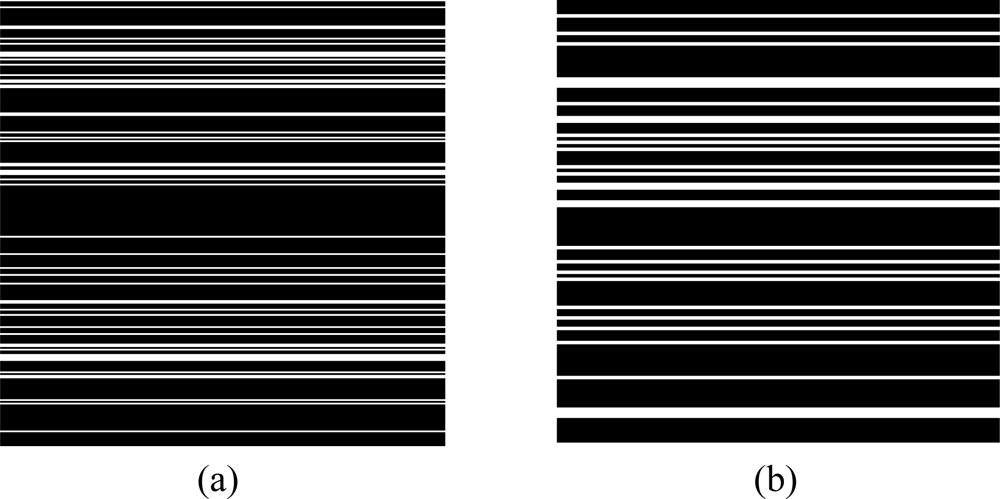
<p>The improvement by using the proposed method is verified from the less crowed <sup>1</sup>H-<sup>1</sup>H COSY spectrum and more crowded <sup>1</sup>H-<sup>13</sup>C COSY spectrum. The sampling patterns of the two spectra are shown in <xref ref-type="fig" rid="f8-sensors-11-08888">Figure 8</xref>.</p>
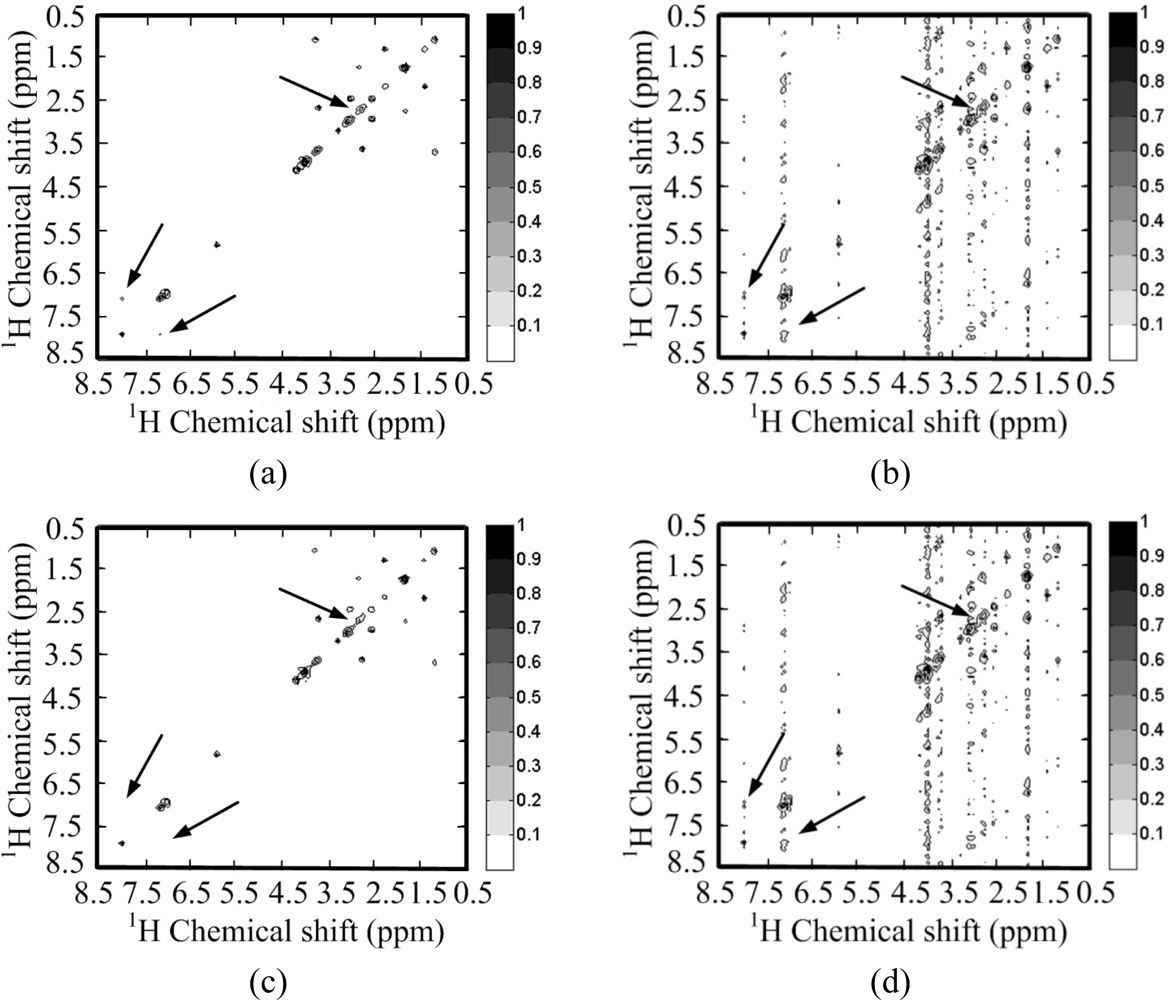
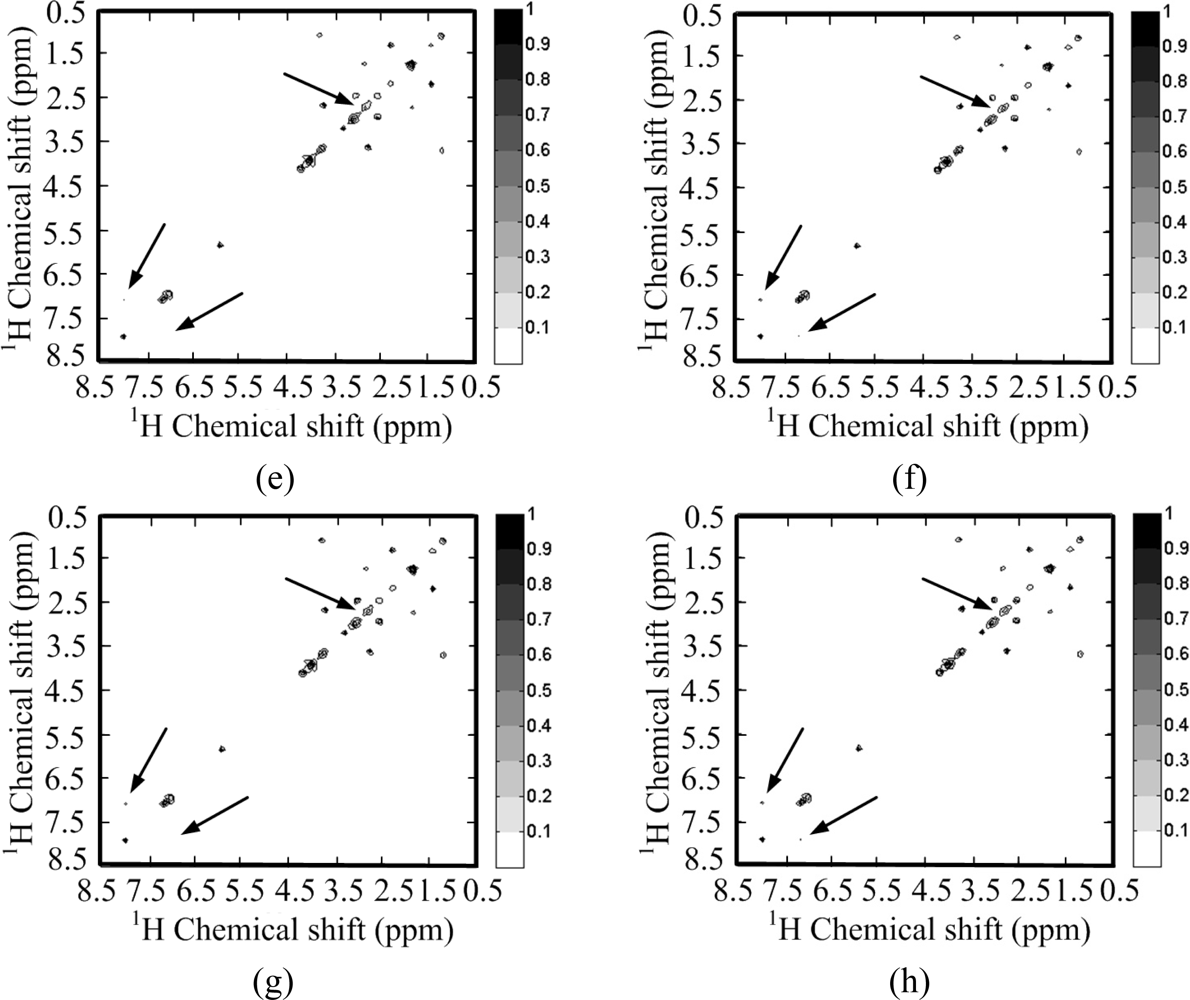
<p><xref ref-type="fig" rid="f9-sensors-11-08888">Figure 9(c–h)</xref> show the reconstructed <sup>1</sup>H-<sup>1</sup>H COSY spectra corresponding to the sampling pattern in <xref ref-type="fig" rid="f9-sensors-11-08888">Figure 9(a)</xref> with a sampling rate of 0.20. With the <italic>ℓ</italic><sub>1</sub> norm minimization, all the peaks are recovered successfully by using identity matrix (<xref ref-type="fig" rid="f9-sensors-11-08888">Figure 9(d,f)</xref>), while some peaks are lost by using wavelets (<xref ref-type="fig" rid="f9-sensors-11-08888">Figure 9(c,e)</xref>).</p>
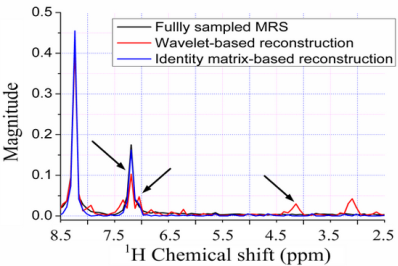
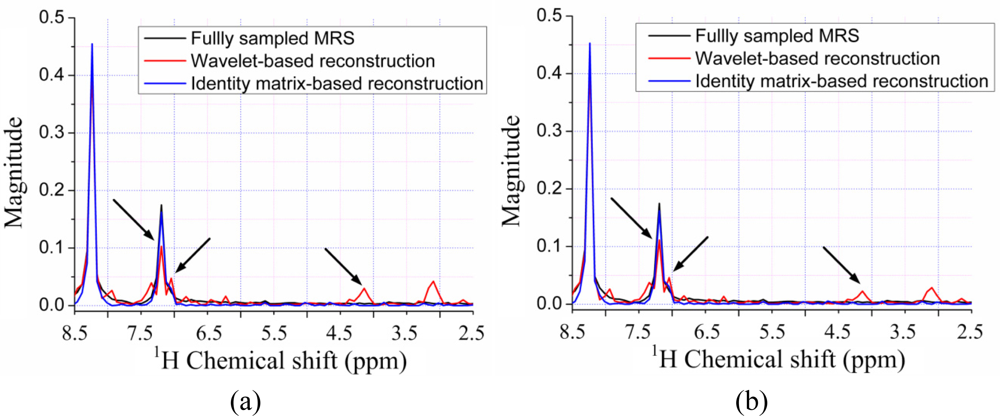
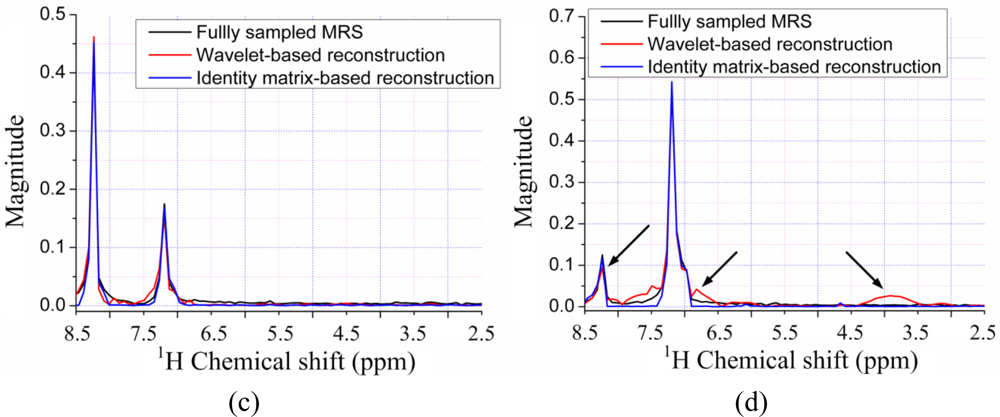
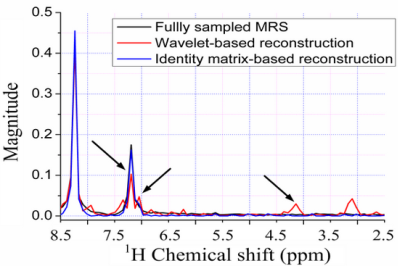
<p>Since the contours for the marked peaks look faint, we also plot the 1D slices along the indirect dimension in <xref ref-type="fig" rid="f10-sensors-11-08888">Figure 10</xref>. The height of one peak in the wavelet-based reconstruction in <xref ref-type="fig" rid="f10-sensors-11-08888">Figure 10(a,b)</xref> are much lower than those in the fully sampled spectrum, leading to the peak lost in the contour plots in <xref ref-type="fig" rid="f9-sensors-11-08888">Figure 9(c,e)</xref>.</p>
<p>Furthermore, the nonlinear operation on wavelet coefficients induces the artifacts labeled in <xref ref-type="fig" rid="f9-sensors-11-08888">Figure 9(c,e)</xref>. This phenomenon is also observed in the 1D slices shown in <xref ref-type="fig" rid="f10-sensors-11-08888">Figure 10(a,b)</xref>, where wavelet reconstruction generates illusive peaks. With the <italic>ℓ</italic><sub>0.5</sub> norm minimization, the errors caused from wavelet and identity matrix reconstruction are reduced, as shown in <xref ref-type="table" rid="t1-sensors-11-08888">Table 1</xref>. One can still observe the reduced peak height and artifacts in wavelet-based reconstruction, but identity matrix performs very well (<xref ref-type="fig" rid="f10-sensors-11-08888">Figure 10(d)</xref>). The advantage of <italic>ℓ</italic><sub>0.5</sub> norm over <italic>ℓ</italic><sub>1</sub> norm is obvious in the crowded <sup>1</sup>H-<sup>13</sup>C COSY spectra, as will be shown in the following discussion.</p>
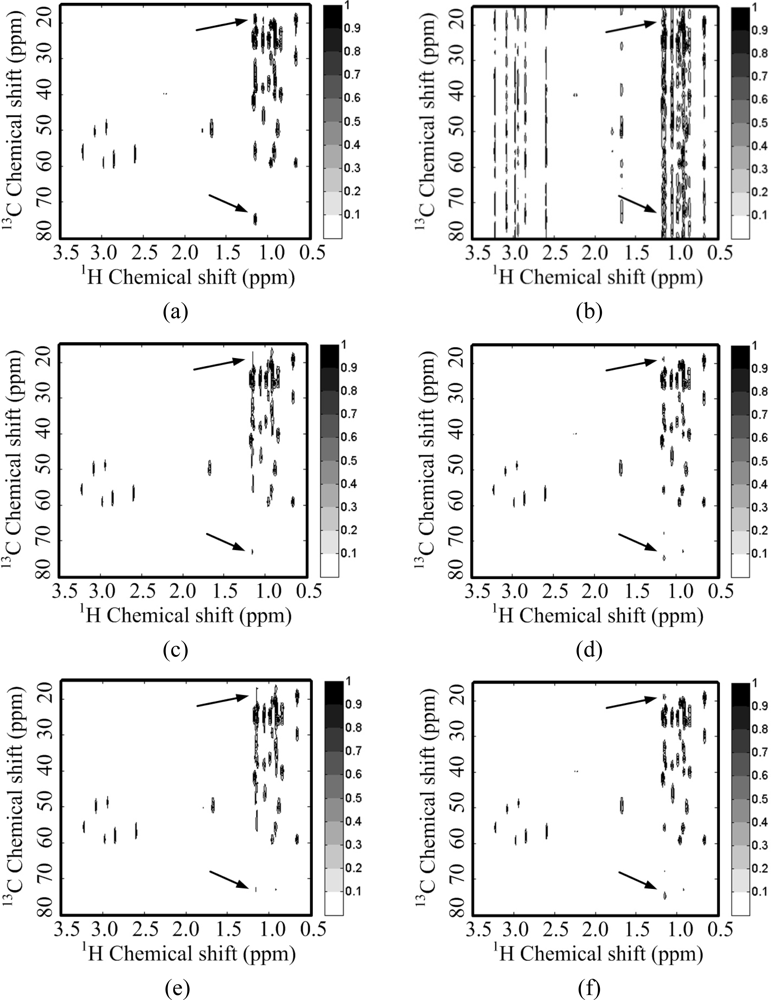
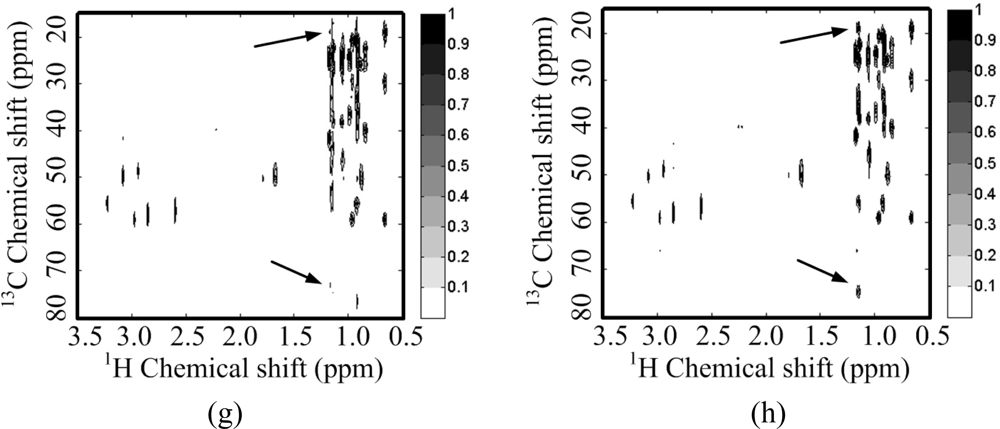
<p><xref ref-type="fig" rid="f11-sensors-11-08888">Figure 11</xref> shows the reconstructed <sup>1</sup>H-<sup>13</sup>C COSY spectra corresponding to the sampling pattern in <xref ref-type="fig" rid="f8-sensors-11-08888">Figure 8(b)</xref> with a sampling rate of 0.25. Some peaks are obviously lost in the reconstructed spectra using wavelets with both <italic>ℓ</italic><sub>1</sub> norm and <italic>ℓ</italic><sub>0.5</sub> norm minimization (<xref ref-type="fig" rid="f11-sensors-11-08888">Figure 11(c,e,g)</xref>). These lost peaks are found in the identity matrix-based reconstruction spectra (<xref ref-type="fig" rid="f11-sensors-11-08888">Figure 11(d,f,h)</xref>). With the <italic>ℓ</italic><sub>0.5</sub> norm minimization, the intensities of the peaks marked with arrow in <xref ref-type="fig" rid="f11-sensors-11-08888">Figure 11(h)</xref> are more consistent to the fully sampled spectra in <xref ref-type="fig" rid="f11-sensors-11-08888">Figure 11(b)</xref> than those in the reconstructed spectra with the <italic>ℓ</italic><sub>1</sub> norm minimization (<xref ref-type="fig" rid="f11-sensors-11-08888">Figure 11(d,f)</xref>). The smallest reconstruction error is achieved with the proposed identity matrix-based <italic>ℓ</italic><sub>0.5</sub> norm minimization method (<xref ref-type="table" rid="t2-sensors-11-08888">Table 2</xref>).</p>
<p>All above simulation results demonstrate that wavelet-based reconstruction obviously induces the loss of some peaks in the crowded <sup>1</sup>H-<sup>13</sup>C COSY spectrum and loss of some weak peaks in the less crowded <sup>1</sup>H-<sup>1</sup>H COSY spectrum. The wavelet may even worsen the reconstructed spectra. Thus, it is not a good choice to use wavelets for the self-sparse spectra discussed in this paper.</p></sec>
<sec sec-type="discussion">
<label>4.2.</label>
<title>Discussion on the Computation</title>
<p>Our simulation is run on a dual core 2.2 GHz CPU laptop with 3 GB RAM. The computational time for the algorithms using wavelet is two times that using the identity matrix, as shown in <xref ref-type="table" rid="t3-sensors-11-08888">Table 3</xref>.</p>
<p>In the simulation, with the gradual increase of continuation parameter <italic>β</italic>, the previous solution was used as a ‘warm start’ for the next alternating optimization in the PSOCA. For a given <italic>β</italic>, with the increase of iterations in inner loop, the difference between reconstructed spectra decreases (see <xref ref-type="fig" rid="f12-sensors-11-08888">Figure 12(a)</xref>), so does the error between the reconstructed spectrum and the fully sampled spectrum (see <xref ref-type="fig" rid="f12-sensors-11-08888">Figure 12(b)</xref>). The reconstruction error decreases when <italic>β</italic> becomes large in the outer loop. The computational time of <italic>ℓ</italic><sub>0.5</sub> norm minimization in PSOCA is nearly four times as that of <italic>ℓ</italic><sub>1</sub> norm minimization, as shown in <xref ref-type="table" rid="t3-sensors-11-08888">Table 3</xref>.</p></sec></sec>
<sec sec-type="conclusions">
<label>5.</label>
<title>Conclusions and Future Work</title>
<p>Random sampling in the indirect dimension is introduced to reconstruct 2D self-sparse NMR spectra within the CS framework. Based on the assumption of sparsity of NMR spectra, one may remove the aliasing by penalizing the <italic>ℓ</italic><sub>1</sub> norm on the coefficients of the sparse representation of NMR spectra. Considering the sparsity and the coherence property, we demonstrate that wavelet transform may reduce the peak height and result in loss of peaks. Thus, a wavelet is not necessary and even worsens the reconstruction of self-sparse NMR spectra. With the <italic>ℓ<sub>p</sub></italic> (<italic>p =</italic> 0.5) norm minimization, the quality of reconstructed spectra can be further improved.</p>
<p>However, how to define the meaningless peaks depends on applications and a qualitative analysis of self-sparse NMR spectra is needed in order to satisfy the requirement of CS. By defining regularity of ideal Lorentizian peaks with aspect to typical vanishing moment wavelet basis, it is possible to give a boundary for the approximation error of Lorentizian peaks in wavelet representation. Thus, one may quantify the sparsity of spectra composed of ideal Lorentizian peaks using wavelets. Another way is to set up a database and analyze the sparsity of the meaningful peaks based on the prior knowledge of chemists. Since the peak height may be reduced in the wavelet-based reconstruction and this reduction depends on the crowd of peaks, it is expected to give a quantitative analysis on the effect of using/skipping wavelet transform by setting up a simulated spectrum or spectrum from real chemical substance, in which the crowd of peaks and the fixed relative height of peaks are pre-defined in the spectrum. Besides, based on the coherence property in CS, the analysis of the performance of different random sampling schemes, e.g., Poisson disk sampling, may lead to further reduction of sampling rate and reconstruction error. Extension of the proposed method on higher dimensional NMR spectra is worth investigating.</p></sec></body>
<back>
<ack>
<p>This work was partially supported by the NNSF of China under Grant 10974164, and the Research Fund for the Doctoral Program of Higher Education of China under Grant 200803840019. Xiaobo Qu and Di Guo would like to acknowledge the fellowship of Postgraduates’ Oversea Study Program for Building High-Level Universities from the China Scholarship Council. The authors also thank the reviewers for their thorough review and highly appreciate the comments and suggestions, which significantly contributed to improving the quality of this article.</p></ack>
<ref-list>
<title>References</title>
<ref id="b1-sensors-11-08888"><label>1.</label><citation citation-type="journal"><person-group person-group-type="author"><name><surname>Bretthorst</surname><given-names>GL</given-names></name></person-group><article-title>Nonuniform sampling: Bandwidth and aliasing</article-title><source>Concept Magn. Reson. A</source><year>2008</year><volume>32A</volume><fpage>417</fpage><lpage>435</lpage><pub-id pub-id-type="doi">10.1002/cmr.a.20125</pub-id></citation></ref>
<ref id="b2-sensors-11-08888"><label>2.</label><citation citation-type="journal"><person-group person-group-type="author"><name><surname>Maciejewski</surname><given-names>MW</given-names></name><name><surname>Qui</surname><given-names>HZ</given-names></name><name><surname>Rujan</surname><given-names>I</given-names></name><name><surname>Mobli</surname><given-names>M</given-names></name><name><surname>Hoch</surname><given-names>JC</given-names></name></person-group><article-title>Nonuniform sampling and spectral aliasing</article-title><source>J. Magn. Reson</source><year>2009</year><volume>199</volume><fpage>88</fpage><lpage>93</lpage><pub-id pub-id-type="doi">10.1016/j.jmr.2009.04.006</pub-id><pub-id pub-id-type="pmid">19414274</pub-id></citation></ref>
<ref id="b3-sensors-11-08888"><label>3.</label><citation citation-type="journal"><person-group person-group-type="author"><name><surname>Kazimierczuk</surname><given-names>K</given-names></name><name><surname>Kozminski</surname><given-names>W</given-names></name><name><surname>Zhukov</surname><given-names>I</given-names></name></person-group><article-title>Two-dimensional fourier transform of arbitrarily sampled NMR data sets</article-title><source>J. Magn. Reson</source><year>2006</year><volume>179</volume><fpage>323</fpage><lpage>328</lpage><pub-id pub-id-type="doi">10.1016/j.jmr.2006.02.001</pub-id><pub-id pub-id-type="pmid">16488634</pub-id></citation></ref>
<ref id="b4-sensors-11-08888"><label>4.</label><citation citation-type="journal"><person-group person-group-type="author"><name><surname>Kazimierczuk</surname><given-names>K</given-names></name><name><surname>Zawadzka</surname><given-names>A</given-names></name><name><surname>Kozminski</surname><given-names>W</given-names></name></person-group><article-title>Optimization of random time domain sampling in multidimensional NMR</article-title><source>J. Magn. Reson</source><year>2008</year><volume>192</volume><fpage>123</fpage><lpage>130</lpage><pub-id pub-id-type="doi">10.1016/j.jmr.2008.02.003</pub-id><pub-id pub-id-type="pmid">18308599</pub-id></citation></ref>
<ref id="b5-sensors-11-08888"><label>5.</label><citation citation-type="journal"><person-group person-group-type="author"><name><surname>Vosegaard</surname><given-names>T</given-names></name><name><surname>Nielsen</surname><given-names>NC</given-names></name></person-group><article-title>Defining the sampling space in multidimensional NMR experiments: What should the maximum sampling time be?</article-title><source>J. Magn. Reson</source><year>2009</year><volume>199</volume><fpage>146</fpage><lpage>158</lpage><pub-id pub-id-type="doi">10.1016/j.jmr.2009.04.007</pub-id><pub-id pub-id-type="pmid">19428277</pub-id></citation></ref>
<ref id="b6-sensors-11-08888"><label>6.</label><citation citation-type="journal"><person-group person-group-type="author"><name><surname>Mobli</surname><given-names>M</given-names></name><name><surname>Hoch</surname><given-names>JC</given-names></name></person-group><article-title>Maximum entropy spectral reconstruction of nonuniformly sampled data</article-title><source>Concept Magn. Reson. A</source><year>2008</year><volume>32A</volume><fpage>436</fpage><lpage>448</lpage><pub-id pub-id-type="doi">10.1002/cmr.a.20126</pub-id></citation></ref>
<ref id="b7-sensors-11-08888"><label>7.</label><citation citation-type="journal"><person-group person-group-type="author"><name><surname>Jee</surname><given-names>JG</given-names></name></person-group><article-title>Real-time acquisition of three dimensional NMR spectra by non-uniform sampling and maximum entropy processing</article-title><source>Bull. Korean Chem. Soc</source><year>2008</year><volume>29</volume><fpage>2017</fpage><lpage>2022</lpage><pub-id pub-id-type="doi">10.5012/bkcs.2008.29.10.2017</pub-id></citation></ref>
<ref id="b8-sensors-11-08888"><label>8.</label><citation citation-type="journal"><person-group person-group-type="author"><name><surname>Coggins</surname><given-names>BE</given-names></name><name><surname>Zhou</surname><given-names>P</given-names></name></person-group><article-title>High resolution 4-D spectroscopy with sparse concentric shell sampling and FFT-CLEAN</article-title><source>J. Biomol. NMR</source><year>2008</year><volume>42</volume><fpage>225</fpage><lpage>239</lpage><pub-id pub-id-type="doi">10.1007/s10858-008-9275-x</pub-id><pub-id pub-id-type="pmid">18853260</pub-id></citation></ref>
<ref id="b9-sensors-11-08888"><label>9.</label><citation citation-type="confproc"><person-group person-group-type="author"><name><surname>Yoon</surname><given-names>JW</given-names></name><name><surname>Godsill</surname><given-names>SJ</given-names></name></person-group><article-title>Bayesian inference for multidimensional NMR image reconstruction</article-title><conf-name>Proceedings of the European Signal Processing Conference (EUSIPCO)</conf-name><conf-loc>Florence, Italy</conf-loc><conf-date>4–8 September 2006</conf-date></citation></ref>
<ref id="b10-sensors-11-08888"><label>10.</label><citation citation-type="journal"><person-group person-group-type="author"><name><surname>Lin</surname><given-names>MJ</given-names></name><name><surname>Huang</surname><given-names>YQ</given-names></name><name><surname>Chen</surname><given-names>X</given-names></name><name><surname>Cai</surname><given-names>SH</given-names></name><name><surname>Chen</surname><given-names>Z</given-names></name></person-group><article-title>High-resolution 2D NMR spectra in inhomogeneous fields based on intermolecular multiple-quantum coherences with efficient acquisition schemes</article-title><source>J. Magn. Reson</source><year>2011</year><volume>208</volume><fpage>87</fpage><lpage>94</lpage><pub-id pub-id-type="doi">10.1016/j.jmr.2010.10.009</pub-id><pub-id pub-id-type="pmid">21051250</pub-id></citation></ref>
<ref id="b11-sensors-11-08888"><label>11.</label><citation citation-type="journal"><person-group person-group-type="author"><name><surname>Candes</surname><given-names>EJ</given-names></name><name><surname>Romberg</surname><given-names>J</given-names></name><name><surname>Tao</surname><given-names>T</given-names></name></person-group><article-title>Robust uncertainty principles: Exact signal reconstruction from highly incomplete frequency information</article-title><source>IEEE Trans. Inform. Theory</source><year>2006</year><volume>52</volume><fpage>489</fpage><lpage>509</lpage><pub-id pub-id-type="doi">10.1109/TIT.2005.862083</pub-id></citation></ref>
<ref id="b12-sensors-11-08888"><label>12.</label><citation citation-type="journal"><person-group person-group-type="author"><name><surname>Donoho</surname><given-names>DL</given-names></name></person-group><article-title>Compressed sensing</article-title><source>IEEE Trans. Inform. Theory</source><year>2006</year><volume>52</volume><fpage>1289</fpage><lpage>1306</lpage><pub-id pub-id-type="doi">10.1109/TIT.2006.871582</pub-id></citation></ref>
<ref id="b13-sensors-11-08888"><label>13.</label><citation citation-type="journal"><person-group person-group-type="author"><name><surname>Lustig</surname><given-names>M</given-names></name><name><surname>Donoho</surname><given-names>D</given-names></name><name><surname>Pauly</surname><given-names>JM</given-names></name></person-group><article-title>Sparse MRI: The application of compressed sensing for rapid MR imaging</article-title><source>Magn. Reson. Med</source><year>2007</year><volume>58</volume><fpage>1182</fpage><lpage>1195</lpage><pub-id pub-id-type="doi">10.1002/mrm.21391</pub-id><pub-id pub-id-type="pmid">17969013</pub-id></citation></ref>
<ref id="b14-sensors-11-08888"><label>14.</label><citation citation-type="journal"><person-group person-group-type="author"><name><surname>Duarte</surname><given-names>MF</given-names></name><name><surname>Davenport</surname><given-names>MA</given-names></name><name><surname>Takhar</surname><given-names>D</given-names></name><name><surname>Laska</surname><given-names>JN</given-names></name><name><surname>Sun</surname><given-names>T</given-names></name><name><surname>Kelly</surname><given-names>KF</given-names></name><name><surname>Baraniuk</surname><given-names>RG</given-names></name></person-group><article-title>Single-pixel imaging via compressive sampling</article-title><source>IEEE Signal Proc. Mag</source><year>2008</year><volume>25</volume><fpage>83</fpage><lpage>91</lpage><pub-id pub-id-type="doi">10.1109/MSP.2007.914730</pub-id></citation></ref>
<ref id="b15-sensors-11-08888"><label>15.</label><citation citation-type="journal"><person-group person-group-type="author"><name><surname>Wright</surname><given-names>J</given-names></name><name><surname>Yang</surname><given-names>AY</given-names></name><name><surname>Ganesh</surname><given-names>A</given-names></name><name><surname>Sastry</surname><given-names>SS</given-names></name><name><surname>Ma</surname><given-names>Y</given-names></name></person-group><article-title>Robust face recognition via sparse representation</article-title><source>IEEE Trans. Pattern Anal</source><year>2009</year><volume>31</volume><fpage>210</fpage><lpage>227</lpage><pub-id pub-id-type="doi">10.1109/TPAMI.2008.79</pub-id></citation></ref>
<ref id="b16-sensors-11-08888"><label>16.</label><citation citation-type="journal"><person-group person-group-type="author"><name><surname>Drori</surname><given-names>I</given-names></name></person-group><article-title>Fast l<sub>1</sub> minimization by iterative thresholding for multidimensional NMR spectroscopy</article-title><source>EURASIP J Adv Sig Proc</source><year>2007</year><pub-id pub-id-type="doi">10.1155/2007/20248</pub-id></citation></ref>
<ref id="b17-sensors-11-08888"><label>17.</label><citation citation-type="journal"><person-group person-group-type="author"><name><surname>Matsuki</surname><given-names>Y</given-names></name><name><surname>Eddy</surname><given-names>MT</given-names></name><name><surname>Herzfeld</surname><given-names>J</given-names></name></person-group><article-title>Spectroscopy by integration of frequency and time domain information for fast acquisition of high-resolution dark spectra</article-title><source>J. Am. Chem. Soc</source><year>2009</year><volume>131</volume><fpage>4648</fpage><lpage>4656</lpage><pub-id pub-id-type="doi">10.1021/ja807893k</pub-id><pub-id pub-id-type="pmid">19284727</pub-id></citation></ref>
<ref id="b18-sensors-11-08888"><label>18.</label><citation citation-type="journal"><person-group person-group-type="author"><name><surname>Kazimierczuk</surname><given-names>K</given-names></name><name><surname>Orekhov</surname><given-names>VY</given-names></name></person-group><article-title>Accelerated NMR spectroscopy by using compressed sensing</article-title><source>Angew. Chem. Int. Ed</source><year>2011</year><volume>50</volume><fpage>5556</fpage><lpage>5559</lpage><pub-id pub-id-type="doi">10.1002/anie.201100370</pub-id></citation></ref>
<ref id="b19-sensors-11-08888"><label>19.</label><citation citation-type="journal"><person-group person-group-type="author"><name><surname>Holland</surname><given-names>DJ</given-names></name><name><surname>Bostock</surname><given-names>MJ</given-names></name><name><surname>Gladden</surname><given-names>LF</given-names></name><name><surname>Nietlispach</surname><given-names>D</given-names></name></person-group><article-title>Fast multidimensional NMR spectroscopy using compressed sensing</article-title><source>Angew. Chem. Int. Ed</source><year>2011</year><volume>50</volume><fpage>6548</fpage><lpage>6551</lpage><pub-id pub-id-type="doi">10.1002/anie.201100440</pub-id></citation></ref>
<ref id="b20-sensors-11-08888"><label>20.</label><citation citation-type="journal"><person-group person-group-type="author"><name><surname>Shrot</surname><given-names>Y</given-names></name><name><surname>Frydman</surname><given-names>L</given-names></name></person-group><article-title>Compressed sensing and the reconstruction of ultrafast 2D NMR data: Principles and biomolecular applications</article-title><source>J. Magn. Reson</source><year>2011</year><volume>209</volume><fpage>352</fpage><lpage>358</lpage><pub-id pub-id-type="doi">10.1016/j.jmr.2011.01.017</pub-id><pub-id pub-id-type="pmid">21316276</pub-id></citation></ref>
<ref id="b21-sensors-11-08888"><label>21.</label><citation citation-type="book"><person-group person-group-type="author"><name><surname>Hoch</surname><given-names>JC</given-names></name><name><surname>Stern</surname><given-names>AS</given-names></name></person-group><source>NMR Data Processing</source><publisher-name>Wiley-Liss</publisher-name><publisher-loc>New York, NY, USA</publisher-loc><year>1996</year><fpage>38</fpage></citation></ref>
<ref id="b22-sensors-11-08888"><label>22.</label><citation citation-type="book"><person-group person-group-type="author"><name><surname>Keeler</surname><given-names>J</given-names></name></person-group><source>Understanding NMR Spectroscopy</source><publisher-name>Wiley</publisher-name><publisher-loc>New York, NY, USA</publisher-loc><year>2005</year><comment>Chapter 7,</comment><fpage>1</fpage><lpage>30</lpage></citation></ref>
<ref id="b23-sensors-11-08888"><label>23.</label><citation citation-type="journal"><person-group person-group-type="author"><name><surname>Aue</surname><given-names>WP</given-names></name><name><surname>Bartholdi</surname><given-names>E</given-names></name><name><surname>Ernst</surname><given-names>RR</given-names></name></person-group><article-title>2-Dimensional spectroscopy: Application to nuclear magnetic-resonance</article-title><source>J. Chem. Phys</source><year>1976</year><volume>64</volume><fpage>2229</fpage><lpage>2246</lpage><pub-id pub-id-type="doi">10.1063/1.432450</pub-id></citation></ref>
<ref id="b24-sensors-11-08888"><label>24.</label><citation citation-type="book"><person-group person-group-type="author"><name><surname>Ernst</surname><given-names>RR</given-names></name><name><surname>Bodenhausen</surname><given-names>G</given-names></name><name><surname>Wokaun</surname><given-names>A</given-names></name></person-group><source>Principles of Nuclear Magnetic Resonance in One and Two dimensions</source><publisher-name>Oxford University Press</publisher-name><publisher-loc>New York, NY, USA</publisher-loc><year>1990</year></citation></ref>
<ref id="b25-sensors-11-08888"><label>25.</label><citation citation-type="journal"><person-group person-group-type="author"><name><surname>Frydman</surname><given-names>L</given-names></name><name><surname>Scherf</surname><given-names>T</given-names></name><name><surname>Lupulescu</surname><given-names>A</given-names></name></person-group><article-title>The acquisition of multidimensional NMR spectra within a single scan</article-title><source>Proc. Natl. Acad. Sci. USA</source><year>2002</year><volume>99</volume><fpage>15858</fpage><lpage>15862</lpage><pub-id pub-id-type="doi">10.1073/pnas.252644399</pub-id><pub-id pub-id-type="pmid">12461169</pub-id></citation></ref>
<ref id="b26-sensors-11-08888"><label>26.</label><citation citation-type="book"><person-group person-group-type="author"><name><surname>De Graaf</surname><given-names>RA</given-names></name></person-group><source>In Vivo <italic>NMR Spectroscopy Principles and Techniques</italic></source><edition>3rd ed</edition><publisher-name>John Wiley &amp; Sons</publisher-name><publisher-loc>Hoboken, NJ, USA</publisher-loc><year>2007</year><fpage>389</fpage><lpage>444</lpage></citation></ref>
<ref id="b27-sensors-11-08888"><label>27.</label><citation citation-type="journal"><person-group person-group-type="author"><name><surname>Donoho</surname><given-names>DL</given-names></name><name><surname>Huo</surname><given-names>XM</given-names></name></person-group><article-title>Uncertainty principles and ideal atomic decomposition</article-title><source>IEEE Trans. Inform. Theory</source><year>2001</year><volume>47</volume><fpage>2845</fpage><lpage>2862</lpage><pub-id pub-id-type="doi">10.1109/18.959265</pub-id></citation></ref>
<ref id="b28-sensors-11-08888"><label>28.</label><citation citation-type="journal"><person-group person-group-type="author"><name><surname>Candes</surname><given-names>E</given-names></name><name><surname>Romberg</surname><given-names>J</given-names></name></person-group><article-title>Sparsity and incoherence in compressive sampling</article-title><source>Inverse Probl</source><year>2007</year><volume>23</volume><fpage>969</fpage><lpage>985</lpage><pub-id pub-id-type="doi">10.1088/0266-5611/23/3/008</pub-id></citation></ref>
<ref id="b29-sensors-11-08888"><label>29.</label><citation citation-type="confproc"><person-group person-group-type="author"><name><surname>Candès</surname><given-names>EJ</given-names></name><name><surname>Romberg</surname><given-names>J</given-names></name></person-group><article-title>Practical signal recovery from random projections</article-title><conf-name>Proceedings of the Wavelet Applications in Signal and Image Processing XI</conf-name><conf-loc>San Diego, CA, USA</conf-loc><conf-date>31 July–4 August 2005</conf-date><fpage>5914</fpage></citation></ref>
<ref id="b30-sensors-11-08888"><label>30.</label><citation citation-type="journal"><person-group person-group-type="author"><name><surname>Elad</surname><given-names>M</given-names></name></person-group><article-title>Optimized projections for compressed sensing</article-title><source>IEEE Trans. Signal Process</source><year>2007</year><volume>55</volume><fpage>5695</fpage><lpage>5702</lpage><pub-id pub-id-type="doi">10.1109/TSP.2007.900760</pub-id></citation></ref>
<ref id="b31-sensors-11-08888"><label>31.</label><citation citation-type="journal"><person-group person-group-type="author"><name><surname>Hoch</surname><given-names>JC</given-names></name><name><surname>Maciejewski</surname><given-names>MW</given-names></name><name><surname>Filipovic</surname><given-names>B</given-names></name></person-group><article-title>Randomization improves sparse sampling in multidimensional NMR</article-title><source>J. Magn. Reson</source><year>2008</year><volume>193</volume><fpage>317</fpage><lpage>320</lpage><pub-id pub-id-type="doi">10.1016/j.jmr.2008.05.011</pub-id><pub-id pub-id-type="pmid">18547850</pub-id></citation></ref>
<ref id="b32-sensors-11-08888"><label>32.</label><citation citation-type="journal"><person-group person-group-type="author"><name><surname>Candes</surname><given-names>EJ</given-names></name></person-group><article-title>The restricted isometry property and its implications for compressed sensing</article-title><source>Compt. Rendus Math</source><year>2008</year><volume>346</volume><fpage>589</fpage><lpage>592</lpage><pub-id pub-id-type="doi">10.1016/j.crma.2008.03.014</pub-id></citation></ref>
<ref id="b33-sensors-11-08888"><label>33.</label><citation citation-type="journal"><person-group person-group-type="author"><name><surname>Stern</surname><given-names>AS</given-names></name><name><surname>Donoho</surname><given-names>DL</given-names></name><name><surname>Hoch</surname><given-names>JC</given-names></name></person-group><article-title>NMR data processing using iterative thresholding and minimum l<sub>1</sub>-norm reconstruction</article-title><source>J. Magn. Reson</source><year>2007</year><volume>188</volume><fpage>295</fpage><lpage>300</lpage><pub-id pub-id-type="doi">10.1016/j.jmr.2007.07.008</pub-id><pub-id pub-id-type="pmid">17723313</pub-id></citation></ref>
<ref id="b34-sensors-11-08888"><label>34.</label><citation citation-type="journal"><person-group person-group-type="author"><name><surname>Chartrand</surname><given-names>R</given-names></name></person-group><article-title>Exact reconstruction of sparse signals via nonconvex minimization</article-title><source>IEEE Signal Proc. Lett</source><year>2007</year><volume>14</volume><fpage>707</fpage><lpage>710</lpage><pub-id pub-id-type="doi">10.1109/LSP.2007.898300</pub-id></citation></ref>
<ref id="b35-sensors-11-08888"><label>35.</label><citation citation-type="journal"><person-group person-group-type="author"><name><surname>Trzasko</surname><given-names>J</given-names></name><name><surname>Manduca</surname><given-names>A</given-names></name></person-group><article-title>Highly undersampled magnetic resonance image reconstruction via homotopic l<sub>0</sub>-minimization</article-title><source>IEEE Trans. Med. Imaging</source><year>2009</year><volume>28</volume><fpage>106</fpage><lpage>121</lpage><pub-id pub-id-type="doi">10.1109/TMI.2008.927346</pub-id><pub-id pub-id-type="pmid">19116193</pub-id></citation></ref>
<ref id="b36-sensors-11-08888"><label>36.</label><citation citation-type="confproc"><person-group person-group-type="author"><name><surname>Qu</surname><given-names>X</given-names></name><name><surname>Cao</surname><given-names>X</given-names></name><name><surname>Guo</surname><given-names>D</given-names></name><name><surname>Hu</surname><given-names>C</given-names></name><name><surname>Chen</surname><given-names>Z</given-names></name></person-group><article-title>Compressed sensing MRI with combined sparsifying transforms and smoothed l<sub>0</sub> norm minimization</article-title><conf-name>Proceedings of the IEEE International Conference on Acoustics, Speech and Signal Processing—ICASSP’10</conf-name><conf-loc>Dallas, TX, USA</conf-loc><conf-date>14–19 March 2010</conf-date><fpage>626</fpage><lpage>629</lpage></citation></ref>
<ref id="b37-sensors-11-08888"><label>37.</label><citation citation-type="confproc"><person-group person-group-type="author"><name><surname>Majumdar</surname><given-names>A</given-names></name><name><surname>Ward</surname><given-names>R</given-names></name></person-group><article-title>Under-determined non-cartesian MR reconstruction with non-convex sparsity promoting analysis prior</article-title><conf-name>Proceedings of the Medical Image Computing and Computer-Assisted Intervention—MICCAI’10</conf-name><conf-loc>Beijing, China</conf-loc><conf-date>20–24 September 2010</conf-date><fpage>513</fpage><lpage>520</lpage></citation></ref>
<ref id="b38-sensors-11-08888"><label>38.</label><citation citation-type="journal"><person-group person-group-type="author"><name><surname>Chartrand</surname><given-names>R</given-names></name><name><surname>Staneva</surname><given-names>V</given-names></name></person-group><article-title>Restricted isometry properties and nonconvex compressive sensing</article-title><source>Inverse Probl</source><year>2008</year><volume>24</volume><fpage>1</fpage><lpage>14</lpage></citation></ref>
<ref id="b39-sensors-11-08888"><label>39.</label><citation citation-type="confproc"><person-group person-group-type="author"><name><surname>Chartrand</surname><given-names>R</given-names></name></person-group><article-title>Fast algorithms for nonconvex compressive sensing: MRI reconstruction from very few data</article-title><conf-name>Proceedings of the 2009 IEEE International Symposium on Biomedical Imaging: From Nano to Macro—ISBI’09</conf-name><conf-loc>Boston, MA, USA</conf-loc><conf-date>28 June–1 July 2009</conf-date><fpage>262</fpage><lpage>265</lpage></citation></ref>
<ref id="b40-sensors-11-08888"><label>40.</label><citation citation-type="journal"><person-group person-group-type="author"><name><surname>Yang</surname><given-names>JF</given-names></name><name><surname>Zhang</surname><given-names>Y</given-names></name><name><surname>Yin</surname><given-names>WT</given-names></name></person-group><article-title>A fast alternating direction method for TV L1-L2 signal reconstruction from partial fourier data</article-title><source>IEEE J. Sel. Top. Signal Process</source><year>2010</year><volume>4</volume><fpage>288</fpage><lpage>297</lpage><pub-id pub-id-type="doi">10.1109/JSTSP.2010.2042333</pub-id></citation></ref>
<ref id="b41-sensors-11-08888"><label>41.</label><citation citation-type="journal"><person-group person-group-type="author"><name><surname>Qu</surname><given-names>XB</given-names></name><name><surname>Zhang</surname><given-names>WR</given-names></name><name><surname>Guo</surname><given-names>D</given-names></name><name><surname>Cai</surname><given-names>CB</given-names></name><name><surname>Cai</surname><given-names>SH</given-names></name><name><surname>Chen</surname><given-names>Z</given-names></name></person-group><article-title>Iterative thresholding compressed sensing MRI based on contourlet transform</article-title><source>Inverse Probl. Sci. En</source><year>2010</year><volume>18</volume><fpage>737</fpage><lpage>758</lpage><pub-id pub-id-type="doi">10.1080/17415977.2010.492509</pub-id></citation></ref>
<ref id="b42-sensors-11-08888"><label>42.</label><citation citation-type="journal"><person-group person-group-type="author"><name><surname>Guo</surname><given-names>D</given-names></name><name><surname>Qu</surname><given-names>XB</given-names></name><name><surname>Huang</surname><given-names>LF</given-names></name><name><surname>Yao</surname><given-names>Y</given-names></name></person-group><article-title>Sparsity-based spatial interpolation in wireless sensor networks</article-title><source>Sensors</source><year>2011</year><volume>11</volume><fpage>2385</fpage><lpage>2407</lpage><pub-id pub-id-type="doi">10.3390/s110302385</pub-id><pub-id pub-id-type="pmid">22163745</pub-id></citation></ref>
<ref id="b43-sensors-11-08888"><label>43.</label><citation citation-type="journal"><person-group person-group-type="author"><name><surname>Zibulevsky</surname><given-names>M</given-names></name><name><surname>Elad</surname><given-names>M</given-names></name></person-group><article-title>L1-L2 optimization in signal and image processing</article-title><source>IEEE Signal Proc. Mag</source><year>2010</year><volume>27</volume><fpage>76</fpage><lpage>88</lpage></citation></ref></ref-list>
<sec sec-type="display-objects">
<title>Figures and Tables</title>
<fig id="f1-sensors-11-08888" position="float">
<label>Figure 1.</label>
<caption>
<p>Simulated FID data in time domain (<bold>a</bold>) and its corresponding 1D NMR spectrum (<bold>b</bold>). Note: the FID is simulated according to <xref ref-type="disp-formula" rid="FD1">Equation (1)</xref> with <italic>J</italic> = 2, <italic>A</italic><sub>1</sub> = 0.5, <italic>A</italic><sub>2</sub> = 1, Δ<italic>t</italic> = 0.01 s, <italic>τ</italic><sub>1</sub> = <italic>τ</italic><sub>2</sub> = 800, ∅<sub>1</sub> = ∅<sub>2</sub> = 0, and <italic>ω</italic><sub>1</sub> = 70 Hz, <italic>ω</italic><sub>2</sub> = 20 Hz.</p></caption>
<graphic xlink:href="sensors-11-08888f1.gif"/></fig>
<fig id="f2-sensors-11-08888" position="float">
<label>Figure 2.</label>
<caption>
<p>General scheme for 2D NMR spectra.</p></caption>
<graphic xlink:href="sensors-11-08888f2.gif"/></fig>
<fig id="f3-sensors-11-08888" position="float">
<label>Figure 3.</label>
<caption>
<p>An example of random undersampling in the indirect dimension. The symbol ⇐ denotes the acquired FIDs.</p></caption>
<graphic xlink:href="sensors-11-08888f3.gif"/></fig>
<fig id="f4-sensors-11-08888" position="float">
<label>Figure 4.</label>
<caption>
<p>Sparsity of a <sup>1</sup>H-<sup>1</sup>H COSY spectrum and its wavelet (symmlet wavelet with four decomposition levels and eight vanishing moments) representation. (<bold>a</bold>) The fully sampled NMR spectrum; (<bold>b</bold>) decay of real part of spectrum and its wavelet coefficients; (<bold>c</bold>,<bold>e</bold>) reconstructed spectra from 3% and 1% largest coefficients in wavelet domain; (<bold>d</bold>,<bold>f</bold>) reconstructed spectra from 3% and 1% largest coefficients in identity matrix domain. Note: the wavelet fails to represent peaks marked with arrows in (e) and these peaks are successfully represented in (f).</p></caption>
<graphic xlink:href="sensors-11-08888f4.gif"/></fig>
<fig id="f5-sensors-11-08888" position="float">
<label>Figure 5.</label>
<caption>
<p>Sparsity of a <sup>1</sup>H-<sup>13</sup>C COSY spectrum and its wavelet (symmlet wavelet with four decomposition levels and eight vanishing moments) representation. (<bold>a</bold>) The fully sampled NMR spectrum; (<bold>b</bold>) decay of real part of spectrum and its wavelet coefficients; (<bold>c</bold>,<bold>e</bold>) reconstructed spectra from 1% and 0.1% largest coefficients in wavelet domain; (<bold>d</bold>,<bold>f</bold>) reconstructed spectra from 1% and 0.1% largest coefficients in identity matrix domain. Note: the wavelet fails to represent peaks marked with arrows in (e) and these peaks are successfully represented in (f).</p></caption>
<graphic xlink:href="sensors-11-08888f5a.gif"/>
<graphic xlink:href="sensors-11-08888f5b.gif"/></fig>
<fig id="f6-sensors-11-08888" position="float">
<label>Figure 6.</label>
<caption>
<p>Coherence of wavelet and FT. (<bold>a</bold>) One sampling pattern in the indirect dimension with sampling rate <italic>ρ</italic> = 0.30 (fully sampled points in the indirect dimension is <italic>N</italic><sub>1</sub> = 64); (<bold>b</bold>) coherences for different sampling rates. The symmlet wavelet with four decomposition levels and eight vanishing moments is chosen as a typical wavelet for test, which is also the typical wavelet in [<xref ref-type="bibr" rid="b16-sensors-11-08888">16</xref>]. Error bar stands for the standard deviation when repeating 10 times at each sampling rate.</p></caption>
<graphic xlink:href="sensors-11-08888f6.gif"/></fig>
<fig id="f7-sensors-11-08888" position="float">
<label>Figure 7.</label>
<caption>
<p>The value of <italic>f</italic>(<italic>x</italic>) = |<italic>x</italic>|<italic><sup>p</sup></italic> <italic>versus</italic> the value of <italic>p</italic>.</p></caption>
<graphic xlink:href="sensors-11-08888f7.gif"/></fig>
<fig id="f8-sensors-11-08888" position="float">
<label>Figure 8.</label>
<caption>
<p>Sampling pattern used in simulation. (<bold>a</bold>) Cartesian sampling pattern with sampling rate 0.20 for the 2D <sup>1</sup>H-<sup>1</sup>H COSY spectrum (<italic>N</italic><sub>1</sub> = 256 points) in <xref ref-type="fig" rid="f4-sensors-11-08888">Figure 4(a)</xref>; and (<bold>b</bold>) Cartesian sampling pattern with sampling rate 0.25 for the 2D <sup>1</sup>H-<sup>13</sup>C COSY spectrum (<italic>N</italic><sub>1</sub> = 128 points) in <xref ref-type="fig" rid="f5-sensors-11-08888">Figure 5(a)</xref>.</p></caption>
<graphic xlink:href="sensors-11-08888f8.gif"/></fig>
<fig id="f9-sensors-11-08888" position="float">
<label>Figure 9.</label>
<caption>
<p>CS reconstruction of a 2D <sup>1</sup>H-<sup>1</sup>H COSY spectrum using wavelet and identity matrix. (<bold>a</bold>,<bold>b</bold>) reconstructed spectra using fully sampled FID and undersampled FID with zero filling, respectively; (<bold>c</bold>,<bold>d</bold>) reconstructed spectra using wavelets and identity matrix with IST-based <italic>ℓ</italic><sub>1</sub> norm, respectively; (<bold>e</bold>,<bold>f</bold>) reconstructed spectra using wavelets and identity matrix with PSOCA-based <italic>ℓ</italic><sub>1</sub> norm, respectively; (<bold>g</bold>,<bold>h</bold>) reconstructed spectra using wavelets and identity matrix with PSOCA-based <italic>ℓ<sub>p</sub></italic> norm, respectively.</p></caption>
<graphic xlink:href="sensors-11-08888f9a.gif"/>
<graphic xlink:href="sensors-11-08888f9b.gif"/></fig>
<fig id="f10-sensors-11-08888" position="float">
<label>Figure 10.</label>
<caption>
<p>1D slices along the indirect dimension for the chemical shift of 8.2 ppm (<bold>a</bold>–<bold>c</bold>) or 7.2 ppm (<bold>d</bold>) in the direct dimension. (<bold>a</bold>) Spectra reconstructed with IST-based <italic>ℓ</italic><sub>1</sub> norm; (<bold>b</bold>) spectra reconstructed with PSOCA-based <italic>ℓ</italic><sub>1</sub> norm; (<bold>c</bold>) spectra reconstructed with PSOCA-based <italic>ℓ</italic><sub>0.5</sub> norm; (<bold>d</bold>) spectra reconstructed with PSOCA-based <italic>ℓ</italic><sub>0.5</sub> norm.</p></caption>
<graphic xlink:href="sensors-11-08888f10a.gif"/>
<graphic xlink:href="sensors-11-08888f10b.gif"/></fig>
<fig id="f11-sensors-11-08888" position="float">
<label>Figure 11.</label>
<caption>
<p>CS reconstruction of a 2D <sup>1</sup>H-<sup>13</sup>C COSY spectrum using wavelet and identity matrix. (<bold>a</bold>,<bold>b</bold>) spectra reconstructed using fully sampled FID (<italic>N</italic><sub>1</sub> = 128 points) and undersampled FID with zero filling, respectively; (<bold>c</bold>,<bold>d</bold>) spectra reconstructed using wavelets and identity matrix with IST-based <italic>ℓ</italic><sub>1</sub> norm, respectively; (<bold>e</bold>,<bold>f</bold>) spectra reconstructed using wavelets and identity matrix with PSOCA-based <italic>ℓ</italic><sub>1</sub> norm, respectively; (<bold>g</bold>,<bold>h</bold>) spectra reconstructed using wavelets and identity matrix with PSOCA-based <italic>ℓ</italic><sub>0.5</sub> norm, respectively.</p></caption>
<graphic xlink:href="sensors-11-08888f11a.gif"/>
<graphic xlink:href="sensors-11-08888f11b.gif"/></fig>
<fig id="f12-sensors-11-08888" position="float">
<label>Figure 12.</label>
<caption>
<p>Numerical performance of PSOCA. (<bold>a</bold>) The <italic>ℓ</italic><sub>2</sub> norm of difference between reconstructed spectra in the current and previous iteration when <italic>β</italic> = 2<sup>12</sup> in inner loop; (<bold>b</bold>) the reconstruction error RLNE of the reconstructed spectra when <italic>β</italic> = 2<sup>12</sup> in inner loop; and (<bold>c</bold>) the reconstruction error RLNE <italic>versus</italic> the iterations in outer loop in PSOCA.</p></caption>
<graphic xlink:href="sensors-11-08888f12.gif"/></fig>
<table-wrap id="t1-sensors-11-08888" position="float">
<label>Table 1.</label>
<caption>
<p>Reconstruction error of a <sup>1</sup>H-<sup>1</sup>H COSY spectrum.</p></caption>
<table frame="hsides" rules="groups">
<thead>
<tr>
<th colspan="2" align="center" valign="middle"><bold>Methods</bold></th>
<th align="center" valign="middle"><bold>Zero-filling</bold></th>
<th align="center" valign="middle"><bold>IST <italic>ℓ</italic><sub>1</sub></bold></th>
<th align="center" valign="middle"><bold>PSOCA <italic>ℓ</italic><sub>1</sub></bold></th>
<th align="center" valign="middle"><bold>PSOCA <italic>ℓ</italic><sub>0.5</sub></bold></th></tr></thead>
<tbody>
<tr>
<td align="center" valign="top" rowspan="2">Wavelet</td>
<td align="center" valign="top">RLNE (T = 0)</td>
<td align="center" valign="top">2.054</td>
<td align="center" valign="top">0.415</td>
<td align="center" valign="top">0.393</td>
<td align="center" valign="top">0.430</td></tr>
<tr>
<td align="center" valign="top">RLNE (T = 0.1)</td>
<td align="center" valign="top">0.059</td>
<td align="center" valign="top">0.012</td>
<td align="center" valign="top">0.010</td>
<td align="center" valign="top">0.007</td></tr>
<tr>
<td align="center" valign="top" rowspan="2">Identity matrix</td>
<td align="center" valign="top">RLNE (T = 0)</td>
<td align="center" valign="top">2.054</td>
<td align="center" valign="top">0.282</td>
<td align="center" valign="top">0.273</td>
<td align="center" valign="top">0.245</td></tr>
<tr>
<td align="center" valign="top">RLNE (T = 0.1)</td>
<td align="center" valign="top">0.059</td>
<td align="center" valign="top">0.010</td>
<td align="center" valign="top">0.007</td>
<td align="center" valign="top">0.022</td></tr></tbody></table></table-wrap>
<table-wrap id="t2-sensors-11-08888" position="float">
<label>Table 2.</label>
<caption>
<p>Reconstruction error of a <sup>1</sup>H-<sup>13</sup>C COSY spectrum.</p></caption>
<table frame="hsides" rules="groups">
<thead>
<tr>
<th colspan="2" align="center" valign="middle"><bold>Methods</bold></th>
<th align="center" valign="middle"><bold>Zero-filling</bold></th>
<th align="center" valign="middle"><bold>IST <italic>ℓ</italic><sub>1</sub></bold></th>
<th align="center" valign="middle"><bold>PSOCA <italic>ℓ</italic><sub>1</sub></bold></th>
<th align="center" valign="middle"><bold>PSOCA <italic>ℓ</italic><sub>0.5</sub></bold></th></tr></thead>
<tbody>
<tr>
<td align="center" valign="top" rowspan="2">Wavelet</td>
<td align="center" valign="top">RLNE (T = 0)</td>
<td align="center" valign="top">1.687</td>
<td align="center" valign="top">0.547</td>
<td align="center" valign="top">0.533</td>
<td align="center" valign="top">0.541</td></tr>
<tr>
<td align="center" valign="top">RLNE (T = 0.1)</td>
<td align="center" valign="top">0.098</td>
<td align="center" valign="top">0.044</td>
<td align="center" valign="top">0.042</td>
<td align="center" valign="top">0.042</td></tr>
<tr>
<td align="center" valign="top" rowspan="2">Identity matrix</td>
<td align="center" valign="top">RLNE (T = 0)</td>
<td align="center" valign="top">1.687</td>
<td align="center" valign="top">0.422</td>
<td align="center" valign="top">0.405</td>
<td align="center" valign="top">0.343</td></tr>
<tr>
<td align="center" valign="top">RLNE (T = 0.1)</td>
<td align="center" valign="top">0.098</td>
<td align="center" valign="top">0.033</td>
<td align="center" valign="top">0.031</td>
<td align="center" valign="top">0.027</td></tr></tbody></table></table-wrap>
<table-wrap id="t3-sensors-11-08888" position="float">
<label>Table 3.</label>
<caption>
<p>Running time for reconstruction of a NMR spectrum (unit: second).</p></caption>
<table frame="hsides" rules="groups">
<thead>
<tr>
<th align="center" valign="middle" rowspan="3"><bold>Methods</bold></th>
<th colspan="2" align="center" valign="middle"><bold>Zero-filling</bold></th>
<th colspan="2" align="center" valign="middle"><bold>IST <italic>ℓ</italic><sub>1</sub></bold></th>
<th colspan="2" align="center" valign="middle"><bold>PSOCA <italic>ℓ</italic><sub>1</sub></bold></th>
<th colspan="2" align="center" valign="middle"><bold>PSOCA <italic>ℓ</italic><sub>0.5</sub></bold></th></tr>
<tr>
<th align="left" valign="middle" colspan="8">
<hr/></th></tr>
<tr>
<th align="center" valign="middle"><sup>1</sup>H-<sup>1</sup>H</th>
<th align="center" valign="middle"><sup>1</sup>H-<sup>13</sup>C</th>
<th align="center" valign="middle"><sup>1</sup>H-<sup>1</sup>H</th>
<th align="center" valign="middle"><sup>1</sup>H-<sup>13</sup>C</th>
<th align="center" valign="middle"><sup>1</sup>H-<sup>1</sup>H</th>
<th align="center" valign="middle"><sup>1</sup>H-<sup>13</sup>C</th>
<th align="center" valign="middle"><sup>1</sup>H-<sup>1</sup>H</th>
<th align="center" valign="middle"><sup>1</sup>H-<sup>13</sup>C</th></tr></thead>
<tbody>
<tr>
<td align="center" valign="top">Wavelet</td>
<td align="center" valign="top">0.1</td>
<td align="center" valign="top">11.1</td>
<td align="center" valign="top">56.8</td>
<td align="center" valign="top">8.5</td>
<td align="center" valign="top">70.4</td>
<td align="center" valign="top">29.1</td>
<td align="center" valign="top">221.2</td></tr>
<tr>
<td align="center" valign="top">Identity matrix</td>
<td align="center" valign="top">0.1</td>
<td align="center" valign="top">5.9</td>
<td align="center" valign="top">27.5</td>
<td align="center" valign="top">5.7</td>
<td align="center" valign="top">31.8</td>
<td align="center" valign="top">16.0</td>
<td align="center" valign="top">105.6</td></tr></tbody></table></table-wrap></sec></back></article>