
<?xml version="1.0" encoding="UTF-8"?>
<!DOCTYPE article PUBLIC "-//NLM//DTD Journal Publishing DTD v2.3 20070202//EN" "journalpublishing.dtd">
<article xmlns:mml="http://www.w3.org/1998/Math/MathML" xmlns:xlink="http://www.w3.org/1999/xlink" xml:lang="en" article-type="research-article">
<front>
<journal-meta>
<journal-id journal-id-type="nlm-ta">Sensors</journal-id>
<journal-title>Sensors</journal-title>
<issn pub-type="epub">1424-8220</issn>
<publisher>
<publisher-name>Molecular Diversity Preservation International (MDPI)</publisher-name></publisher></journal-meta>
<article-meta>
<article-id pub-id-type="doi">10.3390/s110504562</article-id>
<article-id pub-id-type="publisher-id">sensors-11-04562</article-id>
<article-categories>
<subj-group>
<subject>Article</subject></subj-group></article-categories>
<title-group>
<article-title>Optimization of Urea-EnFET Based on Ta<sub>2</sub>O<sub>5</sub> Layer with Post Annealing</article-title></title-group>
<contrib-group>
<contrib contrib-type="author">
<name><surname>Lue</surname><given-names>Cheng-En</given-names></name><xref ref-type="aff" rid="af1-sensors-11-04562"><sup>1</sup></xref></contrib>
<contrib contrib-type="author">
<name><surname>Yu</surname><given-names>Ting-Chun</given-names></name><xref ref-type="aff" rid="af1-sensors-11-04562"><sup>1</sup></xref></contrib>
<contrib contrib-type="author">
<name><surname>Yang</surname><given-names>Chia-Ming</given-names></name><xref ref-type="aff" rid="af2-sensors-11-04562"><sup>2</sup></xref></contrib>
<contrib contrib-type="author">
<name><surname>Pijanowska</surname><given-names>Dorota G.</given-names></name><xref ref-type="aff" rid="af3-sensors-11-04562"><sup>3</sup></xref></contrib>
<contrib contrib-type="author">
<name><surname>Lai</surname><given-names>Chao-Sung</given-names></name><xref ref-type="aff" rid="af1-sensors-11-04562"><sup>1</sup></xref><xref ref-type="aff" rid="af4-sensors-11-04562"><sup>4</sup></xref><xref ref-type="corresp" rid="c1-sensors-11-04562"><sup>*</sup></xref></contrib></contrib-group>
<aff id="af1-sensors-11-04562">
<label>1</label> Department of Electronic Engineering, Chang Gung University, 259 Wen-Hwa 1 st road, Kwei-Shan, Tao-Yuan, 333, Taiwan; E-Mail: <email>yolue411@gmail.com</email> (C.-E.L.); <email>nan.fttt18@gmail.com</email> (T.-C.Y.)</aff>
<aff id="af2-sensors-11-04562">
<label>2</label> Device Section, Department of WAT and Devices, Inotera Memories Inc., 667 Fuhsing 3 rd Road, Hwa-Ya Technology Park, Kwei-Shan, Tao-Yuan, 333, Taiwan; E-Mail: <email>charming2006@inotera.com</email></aff>
<aff id="af3-sensors-11-04562">
<label>3</label> Institute of Biocybernetics and Biomedical Engineering, Polish Academy of Sciences, Ul. Ks. Trojdena 4, 02-109 Warsaw, Poland; E-Mail: <email>dpijanowska@ibib.waw.pl</email></aff>
<aff id="af4-sensors-11-04562">
<label>4</label> Biosensor Group, Biomedical Engineering Research Center, Chang Gung University, 259 Wen-Hwa 1 st road, Kwei-Shan, Tao-Yuan, 333, Taiwan</aff>
<author-notes>
<corresp id="c1-sensors-11-04562">
<label>*</label>Author to whom correspondence should be addressed; E-Mail: <email>cslai@mail.cgu.edu.tw</email>; Tel.: +886-3-211-8800 ext. 5607; Fax: +886-3-211-8507.</corresp></author-notes>
<pub-date pub-type="collection">
<year>2011</year></pub-date>
<pub-date pub-type="epub">
<day>27</day>
<month>4</month>
<year>2011</year></pub-date>
<volume>11</volume>
<fpage>4562</fpage>
<lpage>4571</lpage>
<history>
<date date-type="received">
<day>4</day>
<month>3</month>
<year>2011</year></date>
<date date-type="rev-recd">
<day>30</day>
<month>3</month>
<year>2011</year></date>
<date date-type="accepted">
<day>11</day>
<month>4</month>
<year>2011</year></date></history>
<permissions>
<copyright-statement>© 2011 by the authors; licensee MDPI, Basel, Switzerland.</copyright-statement>
<copyright-year>2011</copyright-year>
<license>
<p>This article is an open access article distributed under the terms and conditions of the Creative Commons Attribution license (http://creativecommons.org/licenses/by/3.0/).</p></license></permissions>
<abstract>
<p>In this study, the urea-enzymatic field effect transistors (EnFETs) were investigated based on pH-ion sensitive field effect transistors (ISFETs) with tantalum pentoxide (Ta<sub>2</sub>O<sub>5</sub>) sensing membranes. In addition, a post N<sub>2</sub> annealing was used to improve the sensing properties. At first, the pH sensitivity, hysteresis, drift, and light induced drift of the ISFETs were evaluated. After the covalent bonding process and urease immobilization, the urea sensitivity of the EnFETs were also investigated and compared with the conventional Si<sub>3</sub>N<sub>4</sub> sensing layer. The ISFETs and EnFETs with annealed Ta<sub>2</sub>O<sub>5</sub> sensing membranes showed the best responses, including the highest pH sensitivity (56.9 mV/pH, from pH 2 to pH 12) and also corresponded to the highest urea sensitivity (61 mV/pC<sub>urea</sub>, from 1 mM to 7.5 mM). Besides, the non-ideal factors of pH hysteresis, time drift, and light induced drift of the annealed samples were also lower than the controlled Ta<sub>2</sub>O<sub>5</sub> and Si<sub>3</sub>N<sub>4</sub> sensing membranes.</p></abstract>
<kwd-group>
<kwd>urea</kwd>
<kwd>enzymatic field effect transistor (EnFET)</kwd>
<kwd>ion sensitive field effect transistor (ISFET)</kwd>
<kwd>tantalum pentoxide (Ta<sub>2</sub>O<sub>5</sub>)</kwd>
<kwd>post N<sub>2</sub> annealing</kwd></kwd-group></article-meta></front>
<body>
<sec sec-type="intro">
<label>1.</label>
<title>Introduction</title>
<p>Variation of human body fluid in even tiny concentrations can be critical for clinical diagnosis. To monitor the small changes in the early stage, an accurate and stable sensor is needed. Enzymatic field effect transistor (EnFETs) is one of the sensor platforms. The earliest report of EnFET was proposed by Janata and Moss in 1980 [<xref ref-type="bibr" rid="b1-sensors-11-04562">1</xref>]. Subsequently, many biomarkers have been detected by EnFET, such as penicillin [<xref ref-type="bibr" rid="b1-sensors-11-04562">1</xref>], urea [<xref ref-type="bibr" rid="b2-sensors-11-04562">2</xref>], glucose [<xref ref-type="bibr" rid="b3-sensors-11-04562">3</xref>], creatinine [<xref ref-type="bibr" rid="b4-sensors-11-04562">4</xref>], <italic>etc</italic>. To fabricate the EnFET, specific enzyme is immobilized on the surface of the sensing membrane of an ion sensitive field effect transistor (ISFET). Therefore, the sensing properties are not only dependent on the enzymatic layer but also dominated by the sensing membrane of ISFETs. For EnFET applications, Si<sub>3</sub>N<sub>4</sub> layers deposited by low pressure chemical vapor deposition (LPCVD) are the most common sensing membranes of ISFETs because of the high sensitivity and good stability.</p>
<p>Until now, plenty of materials have been applied for the sensing membranes of pH ISFETs, including: SiO<sub>2</sub>, Si<sub>3</sub>N<sub>4</sub> [<xref ref-type="bibr" rid="b5-sensors-11-04562">5</xref>,<xref ref-type="bibr" rid="b6-sensors-11-04562">6</xref>], Ta<sub>2</sub>O<sub>5</sub> [<xref ref-type="bibr" rid="b7-sensors-11-04562">7</xref>–<xref ref-type="bibr" rid="b9-sensors-11-04562">9</xref>], Al<sub>2</sub>O<sub>3</sub> [<xref ref-type="bibr" rid="b10-sensors-11-04562">10</xref>], TiO<sub>2</sub> [<xref ref-type="bibr" rid="b11-sensors-11-04562">11</xref>,<xref ref-type="bibr" rid="b12-sensors-11-04562">12</xref>], HfO<sub>2</sub> [<xref ref-type="bibr" rid="b13-sensors-11-04562">13</xref>,<xref ref-type="bibr" rid="b14-sensors-11-04562">14</xref>], SnO<sub>2</sub> [<xref ref-type="bibr" rid="b15-sensors-11-04562">15</xref>], <italic>etc</italic>. In these materials, Ta<sub>2</sub>O<sub>5</sub> layer has the largest surface buffer capacity (<italic>β</italic>), which gives the sensor better immunity to interference ions; wide applicable pH range, and high chemical resistance for the cleaning-in-place (CIP) test [<xref ref-type="bibr" rid="b14-sensors-11-04562">14</xref>,<xref ref-type="bibr" rid="b16-sensors-11-04562">16</xref>,<xref ref-type="bibr" rid="b17-sensors-11-04562">17</xref>]. Moreover, the Ta<sub>2</sub>O<sub>5</sub>-ISFETs were also used as the platform of EnFETs [<xref ref-type="bibr" rid="b18-sensors-11-04562">18</xref>,<xref ref-type="bibr" rid="b19-sensors-11-04562">19</xref>]. However, the serious effect of light induced drift was observed on the ISFETs with Ta<sub>2</sub>O<sub>5</sub> layers [<xref ref-type="bibr" rid="b20-sensors-11-04562">20</xref>,<xref ref-type="bibr" rid="b21-sensors-11-04562">21</xref>]. This drawback limited the applicable range of Ta<sub>2</sub>O<sub>5</sub> sensing membrane, and many research groups are using different fabrication process and post annealing treatment to solve this problem.</p>
<p>In this paper, urea concentration was monitored by a pH ISFET based EnFET. The urea hydrolysis reaction by urease is as follows:
<disp-formula id="FD1">
<label>(1)</label>
<mml:math display="block">
<mml:mrow>
<mml:mtext>CO</mml:mtext>
<mml:msub>
<mml:mrow>
<mml:mo stretchy="false">(</mml:mo>
<mml:msub>
<mml:mrow>
<mml:mtext>NH</mml:mtext></mml:mrow>
<mml:mn>2</mml:mn></mml:msub>
<mml:mo stretchy="false">)</mml:mo></mml:mrow>
<mml:mn>2</mml:mn></mml:msub>
<mml:mo>+</mml:mo>
<mml:mn>3</mml:mn>
<mml:msub>
<mml:mtext>H</mml:mtext>
<mml:mn>2</mml:mn></mml:msub>
<mml:mtext>O</mml:mtext>
<mml:mover>
<mml:mo stretchy="true">→</mml:mo>
<mml:mrow>
<mml:mtext mathvariant="italic">urease</mml:mtext></mml:mrow></mml:mover>
<mml:msub>
<mml:mrow>
<mml:mtext>CO</mml:mtext></mml:mrow>
<mml:mn>2</mml:mn></mml:msub>
<mml:mo>+</mml:mo>
<mml:mn>2</mml:mn>
<mml:msubsup>
<mml:mrow>
<mml:mtext>NH</mml:mtext></mml:mrow>
<mml:mn>4</mml:mn>
<mml:mo>+</mml:mo></mml:msubsup>
<mml:mo>+</mml:mo>
<mml:mn>2</mml:mn>
<mml:msup>
<mml:mrow>
<mml:mtext>OH</mml:mtext></mml:mrow>
<mml:mo>−</mml:mo></mml:msup></mml:mrow></mml:math></disp-formula></p>
<p>The sensing membrane of the pH ISFET was the Ta<sub>2</sub>O<sub>5</sub> layer deposited by reactive radio frequency (rf) sputter system. In order to improve the sensing properties, the Ta<sub>2</sub>O<sub>5</sub> layer was treated by post N<sub>2</sub> annealing at 900 °C for 30 min. In addition, the sensing properties were also compared with the urea-EnFET with conventional Si<sub>3</sub>N<sub>4</sub> sensing membrane.</p></sec>
<sec>
<label>2.</label>
<title>Experimental</title>
<sec>
<label>2.1.</label>
<title>Chemicals</title>
<p>The pH sensing properties were measured to evaluate the pH-ISFETs. The phosphate buffer solutions were prepared with 5 mM NaH<sub>2</sub>PO<sub>4</sub>, 0.1 M NaCl, and deionized (DI) water as the background solution. The initial pH value was 5.7. Then, the pH value of the buffer solutions were adjusted by adding 0.1 M NaOH and 0.1 M HCl solutions with autoburettes (Mettler-Toledo) and monitored by a combined pH glass electrode.</p>
<p>For the urea detection, all solutions were purchased from Sigma, including urease (E.C. 3.5.1.5, type IX, at activity 20 kU), glutaraldehyde (GA), 3-aminopropyl-triethoxysilane (APTS), and urea (U5378, 98+%). Urea and urease solutions were diluted with 5 mM phosphate buffer, which has been adjusted to pH 6 as background because of the high sensitivity for urea detection [<xref ref-type="bibr" rid="b2-sensors-11-04562">2</xref>].</p></sec>
<sec>
<label>2.2.</label>
<title>Device Fabrication</title>
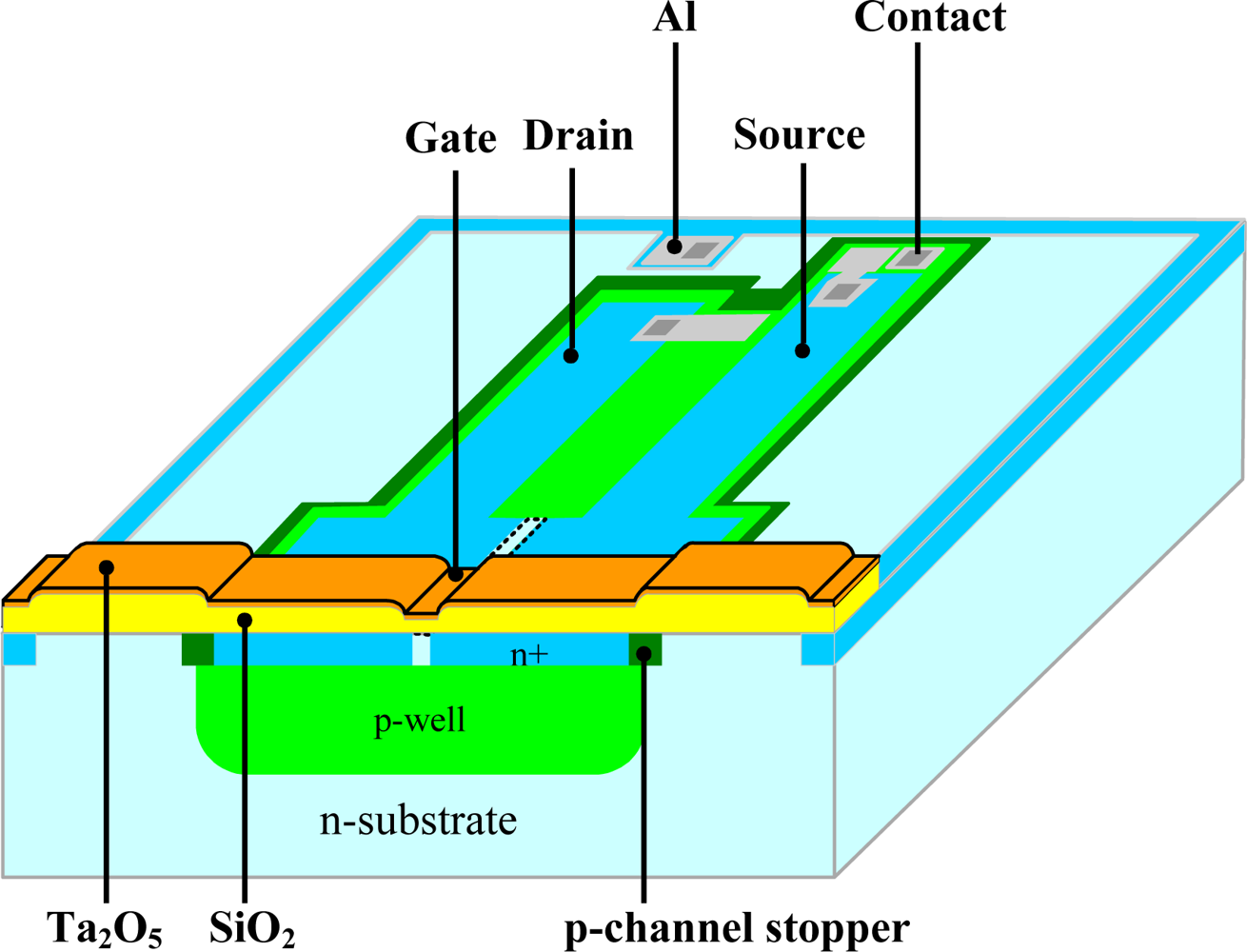
<p>The ISFETs were fabricated by Institute of Electron Technology (ITE, the polish abbreviation), Poland. The structure and cross section are shown in <xref ref-type="fig" rid="f1-sensors-11-04562">Figure 1</xref>. The ISFETs are designed with <italic>p</italic>-well arrangement on 3 inch (100) <italic>n</italic>-type wafers. The ratio of channel width and length was W/L = 600/16 (in μm). The 50 nm-thick buffering oxide layers between silicon and sensing membrane were deposited by dry oxidation. The sensing membranes, Ta<sub>2</sub>O<sub>5</sub> layers, were deposited by rf sputtering in Chang-Gung University (CGU), Taiwan. For the rf sputtering of Ta<sub>2</sub>O<sub>5</sub> layers, a pure Ta target was used. The rf power was fixed at 150 W, and the process pressure was 10 mTorr. The Ar/O<sub>2</sub> gas mixture ratio was controlled by mass flow controllers (MFC) as 22.5/2.5 in sccm. To improve the sensing membrane, a post deposition annealing (PDA) in N<sub>2</sub> ambient at 900 °C for 30 min was used. For the control group, the ISFETs with Si<sub>3</sub>N<sub>4</sub> sensing membrane were prepared. The Si<sub>3</sub>N<sub>4</sub> layers were deposited by LPCVD using the standard process parameters of ITE [<xref ref-type="bibr" rid="b2-sensors-11-04562">2</xref>,<xref ref-type="bibr" rid="b22-sensors-11-04562">22</xref>,<xref ref-type="bibr" rid="b23-sensors-11-04562">23</xref>].</p>
<p>Finally, all ISFETs were assembled on printed circuit boards (PCB) with a silver paste (TED PELLA, Inc.) and then encapsulated with epoxy resin type adhesive JU-100 (KOKI Company Ltd.) with open windows of 3 × 3 mm<sup>2</sup>.</p></sec>
<sec>
<label>2.3.</label>
<title>Enzyme Immobilization</title>
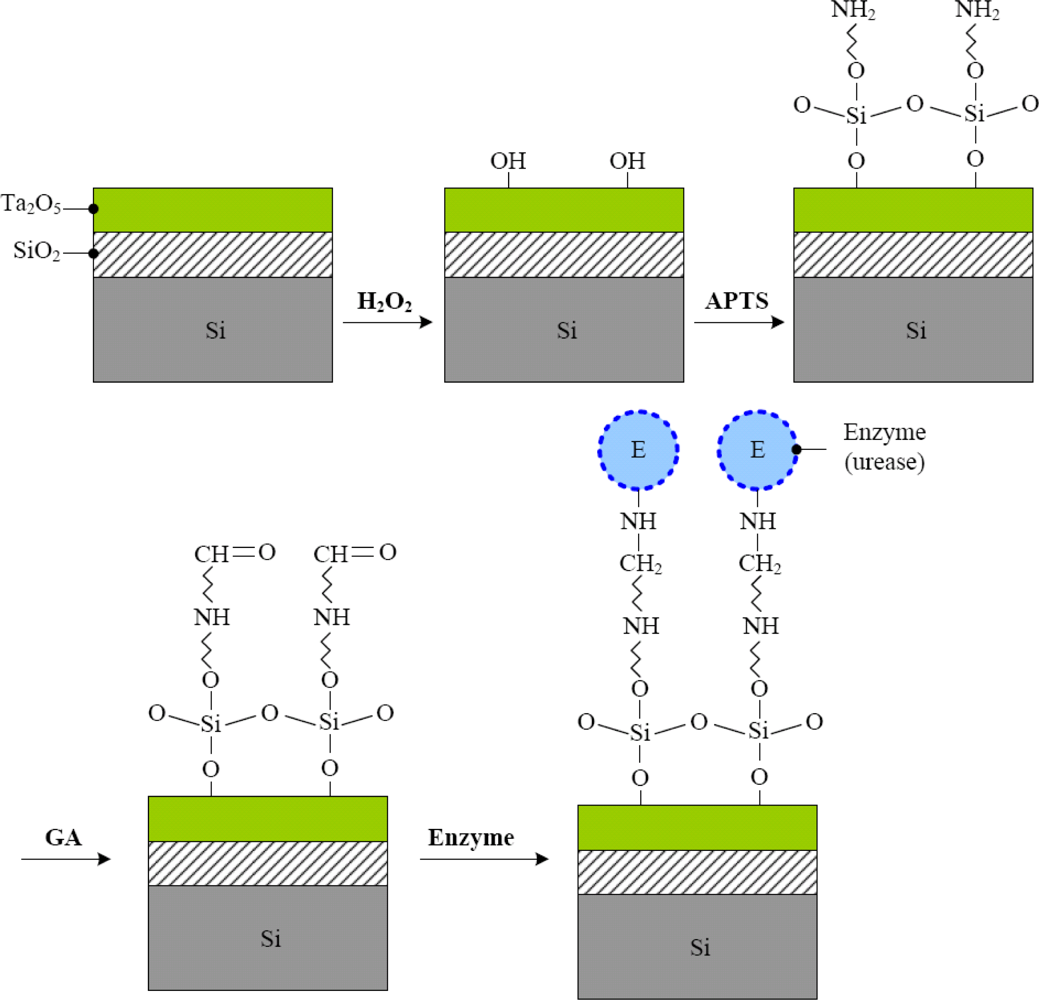
<p>The covalent bonding steps are shown in <xref ref-type="fig" rid="f2-sensors-11-04562">Figure 2</xref>. At first, to generate hydroxyl bond, the encapsulated Ta<sub>2</sub>O<sub>5</sub>-ISFETs were immersed into 10% hydrogen peroxide (H<sub>2</sub>O<sub>2</sub>) solution for 24 hours. Afterwards, the samples were put into 40 °C, 9% APTS solution for 4 hours for silylation. Then, the samples were immersed into 10% of glutaraldehyde for 1 hour, which is a dual function group to crosslink amine bond on urease and APTS. Finally, the urease powder was mixed with the phosphate buffer as the concentration of 1.5 μg/mL, and then 20 μL-urease was dripped on the open window of ISFET before storing the sample at 4 °C (fridge) overnight. After rinsing non-immobilized enzyme by phosphate buffer, the EnFETs were ready for measurement.</p></sec>
<sec>
<label>2.4.</label>
<title>Measurement Setup</title>
<p>To evaluate the performance of ISFETs and EnFETs, the drain-to-source current <italic>vs.</italic> gate-to-source voltage (I<sub>DS</sub>–V<sub>GS</sub>) curves were measured by HP 4156, firstly. Afterwards, a constant drain-source voltage and constant drain-source current (CVCC) circuit was used in measurements with I<sub>DS</sub> = 100 μA and V<sub>DS</sub> = +0.5 V. To evaluate the pH sensing properties, the commercial pH buffer solutions from pH 2 to pH 12 were used. For the urea sensitivity, different urea concentrations from 1 mM to 10 mM were prepared by diluting 5 mM phosphate buffer at pH 6. All of the measurements were done at 25 °C.</p>
<p>In addition, for all the measurement, a commercial Ag/AgCl electrode was used to provide the sensing system a constant and stable reference potential.</p></sec></sec>
<sec sec-type="results|discussion">
<label>3.</label>
<title>Results and Discussion</title>
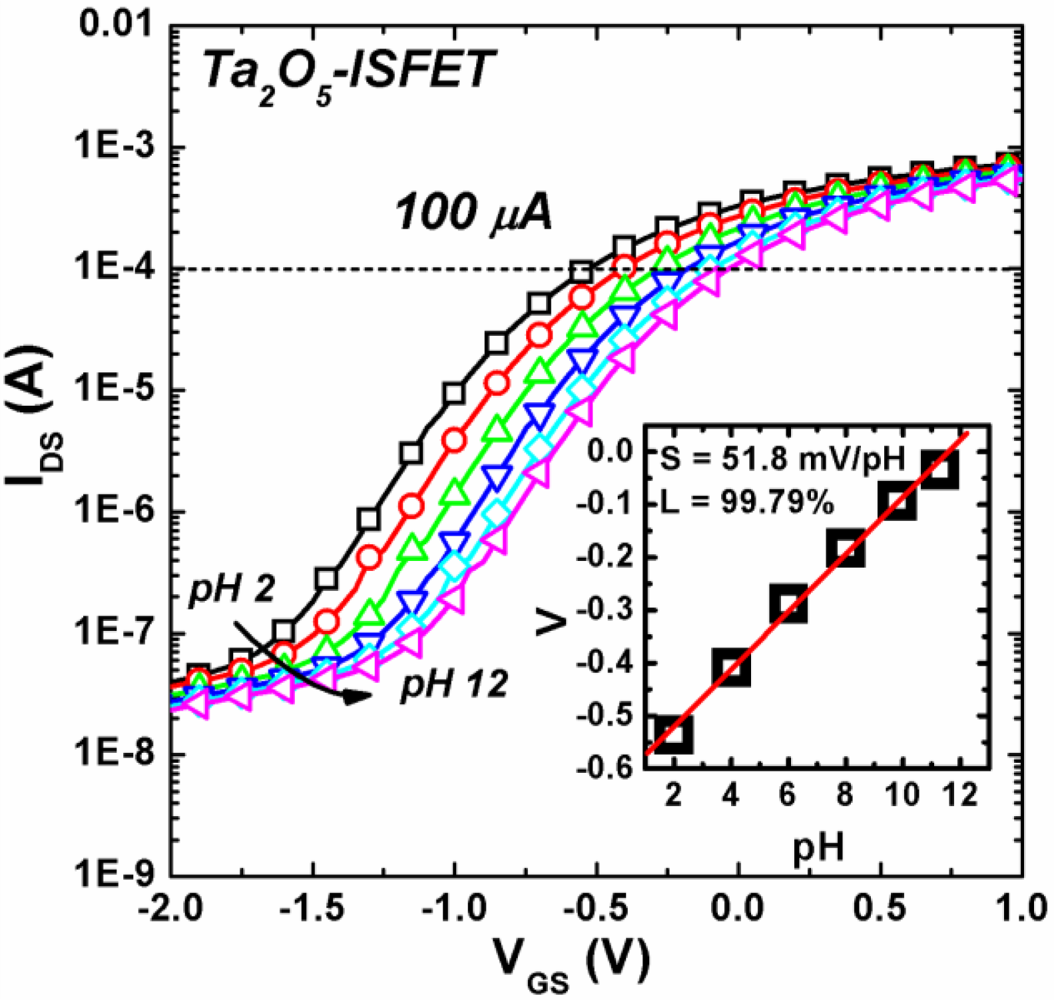
<p>The I<sub>DS</sub>–V<sub>GS</sub> curves of Ta<sub>2</sub>O<sub>5</sub>-ISFET measured in the buffer solutions from pH 2 to pH 12 are shown in <xref ref-type="fig" rid="f3-sensors-11-04562">Figure 3</xref>. The curves shifted to the right-side when the ISFETs were measured in buffer solutions of high pH values. The output voltage of different pH buffer solution was calculated from the corresponding point at I<sub>DS</sub> = 100 μA. The output voltage and calibration curve are shown in the insert of <xref ref-type="fig" rid="f3-sensors-11-04562">Figure 3</xref>. For this Ta<sub>2</sub>O<sub>5</sub>-ISFET without post treatment, the pH sensitivity was 51.8 mV/pH with a high linearity (99.79%) of the calibration curve.</p>
<p>Afterwards, the sensing properties including sensitivity, hysteresis, and drift were measured by the CVCC circuit. The results of Ta<sub>2</sub>O<sub>5</sub>-ISFETs without and with post annealing are listed in <xref ref-type="table" rid="t1-sensors-11-04562">Table 1</xref>. Besides, the results of standard Si<sub>3</sub>N<sub>4</sub>-ISFET are also included. In this table, both Ta<sub>2</sub>O<sub>5</sub>-ISFETs without and with post annealing show higher sensitivity than Si<sub>3</sub>N<sub>4</sub>-ISFET. Especially for the ISFETs with annealed Ta<sub>2</sub>O<sub>5</sub> sensing membrane, a near Nernstian response of 56.9 mV/pH was performed. In addition, better reliability was observed from the low hysteresis (with the measurement loop of pH 6-2-6-12-6, and 6-12-6-2-6) and drift (measured in pH 4 for 12 hours). The improved sensing properties of ISFETs with Ta<sub>2</sub>O<sub>5</sub> layer could be caused by the formation of polycrystalline, the increase of surface area, and the increasing of oxygen density [<xref ref-type="bibr" rid="b13-sensors-11-04562">13</xref>,<xref ref-type="bibr" rid="b24-sensors-11-04562">24</xref>,<xref ref-type="bibr" rid="b25-sensors-11-04562">25</xref>].</p>
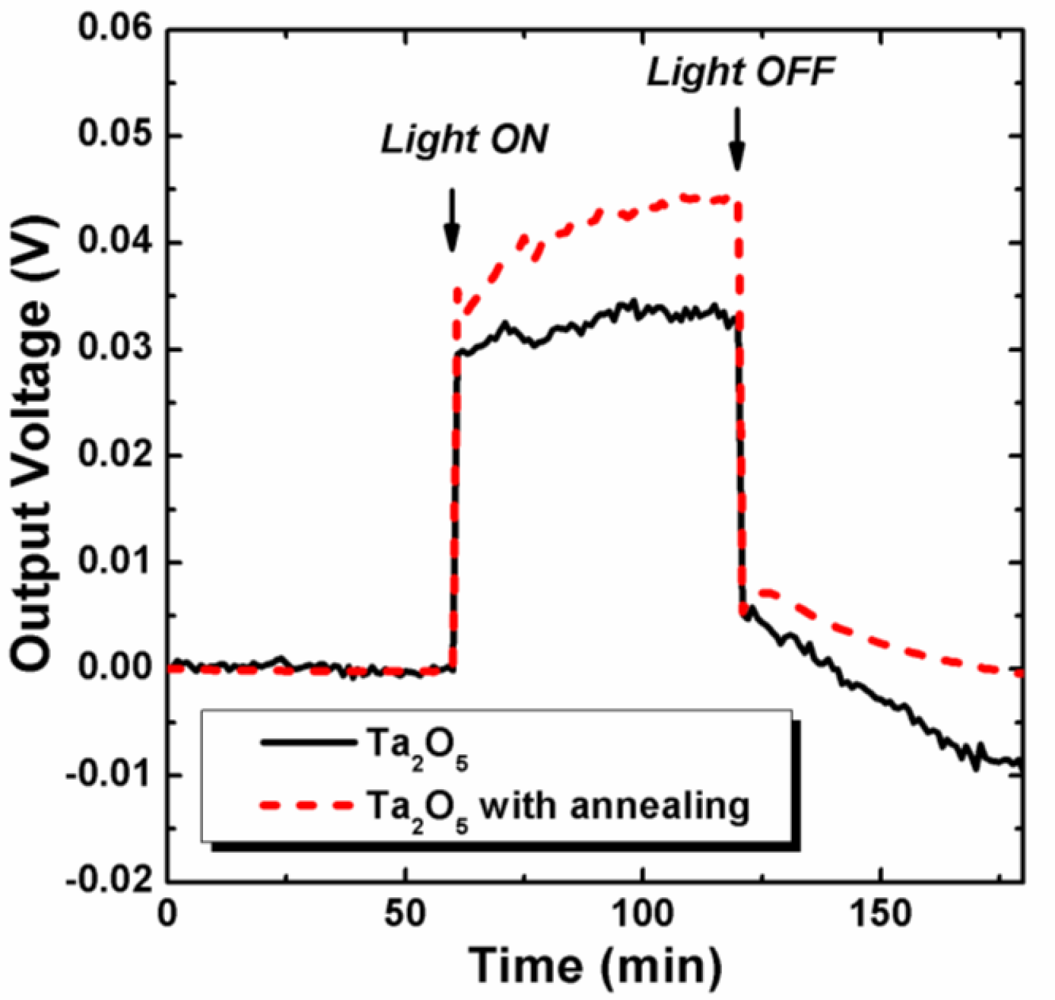
<p>In addition, the light induced drift of the Ta<sub>2</sub>O<sub>5</sub> ISFETs without and with post annealing was measured with a light source of optical microscope. The light intensity was 4,500 lux measured by a light meter. The ISFETs were stored in a beaker covered with aluminum foil for the uniform light illumination for all ISFETs. The V<sub>GS</sub> of ISFETs were firstly measured under dark condition for 1 hour, then with the light turned on for 1 hour, and then back under the dark condition for 1 hour. The results are shown in <xref ref-type="fig" rid="f4-sensors-11-04562">Figure 4</xref>. During the illumination, both curves shifted to the higher potential, similar to drift phenomena, which could be resulted by the light generated electrons and holes in the dielectric layer and silicon substrate [<xref ref-type="bibr" rid="b9-sensors-11-04562">9</xref>]. The curves of Ta<sub>2</sub>O<sub>5</sub>-ISFETs with post annealing showed better stability. Besides, after illuminating and back to the dark condition, the output voltage returned to the initial output voltage.</p>
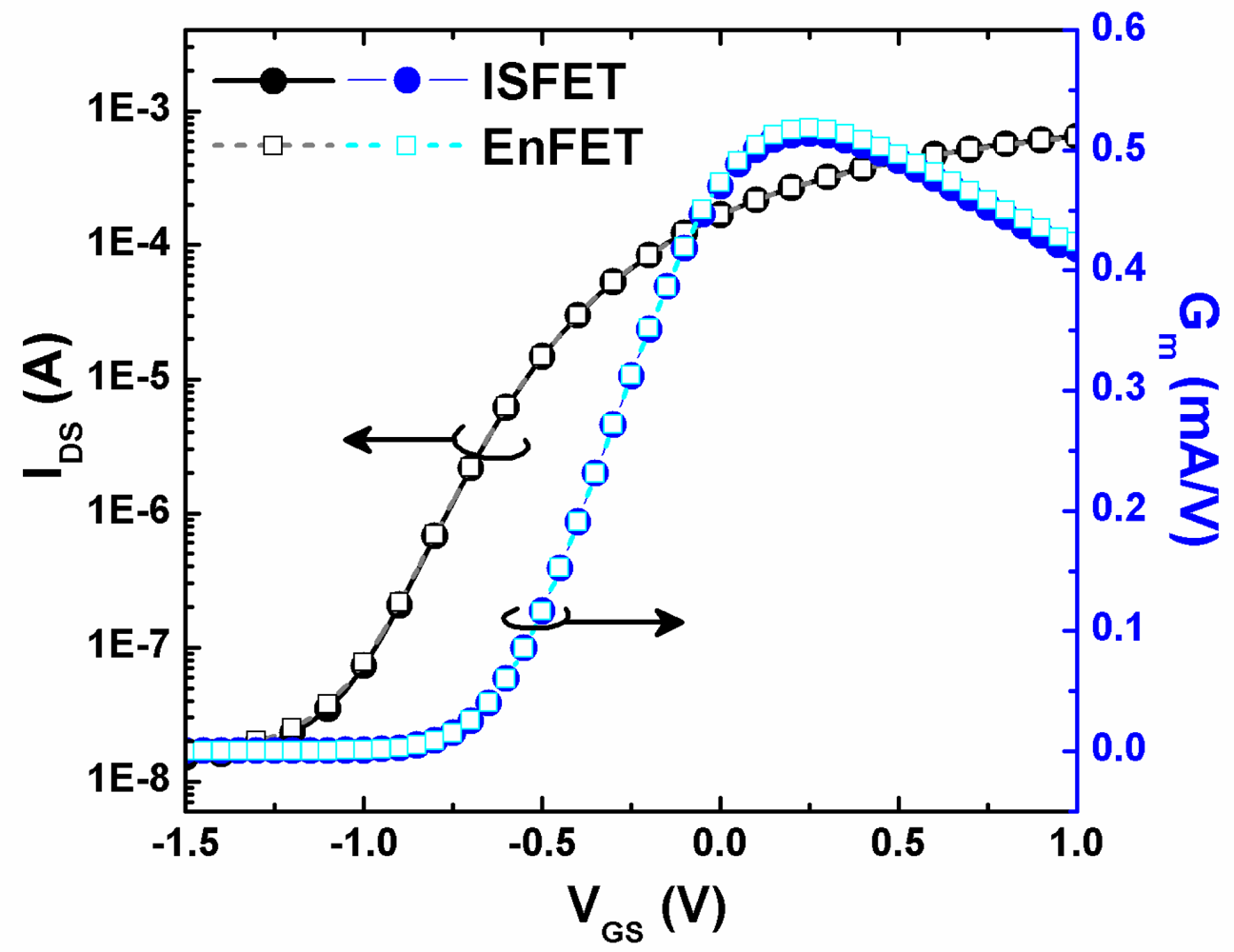
<p>After the evaluation of the pH sensing properties of the test ISFETs, other ISFETs were processed for the covalent bonding and urease immobilization. For monitoring the urea concentration by EnFET, at first, the I<sub>DS</sub>–V<sub>GS</sub> curves and transconductance (G<sub>m</sub>) of Ta<sub>2</sub>O<sub>5</sub>-ISFET and EnFET were measured by HP 4156, as shown in <xref ref-type="fig" rid="f5-sensors-11-04562">Figure 5</xref>. The similar response of ISFET and EnFET means the surface capacitance had almost no change before and after the chemical reaction of covalent bonding and urease immobilization. The good electrical compatibility between ISFET and EnFET are very suitable for the further application of enzymatic EnFET/ISFET (REFET) pair [<xref ref-type="bibr" rid="b26-sensors-11-04562">26</xref>].</p>
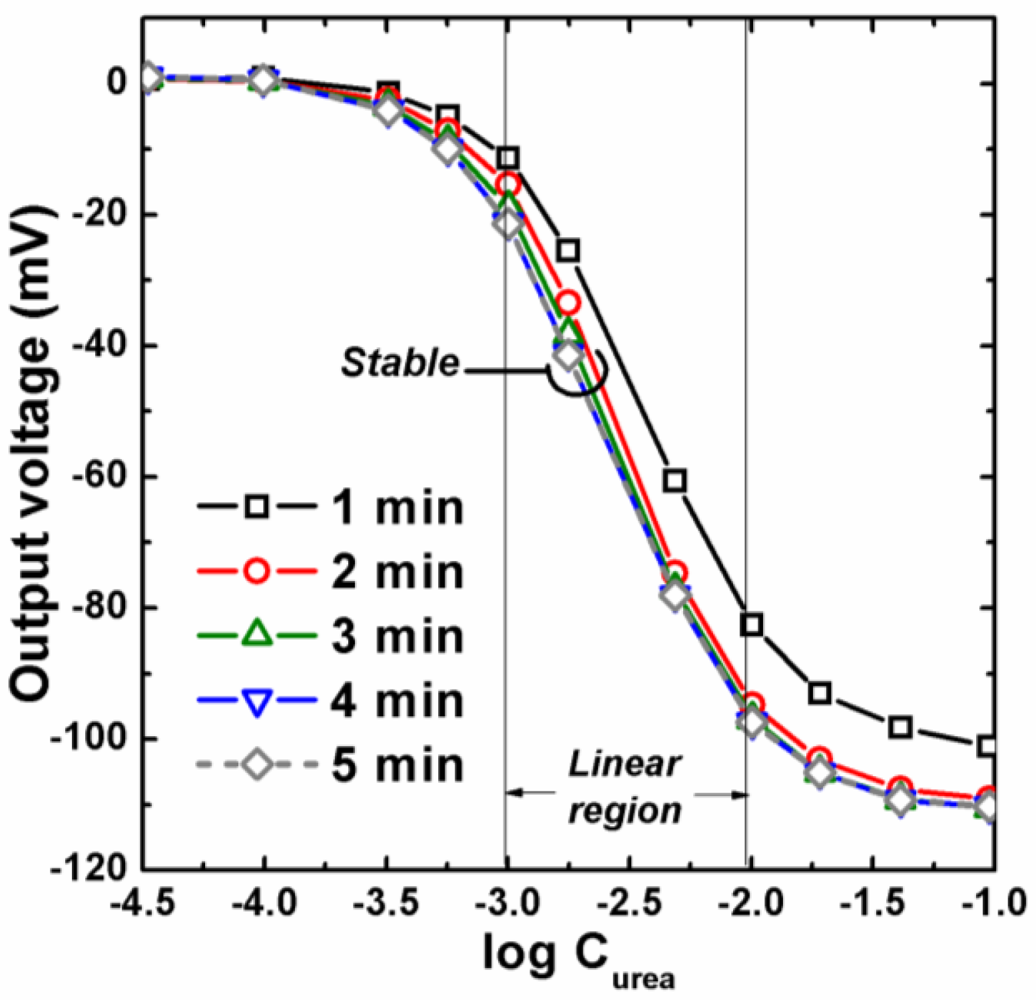
<p>The time response to output voltage measured in 0–30 mM urea are shown in <xref ref-type="fig" rid="f6-sensors-11-04562">Figure 6</xref>. In this figure, the output voltages were stable in about 2 min. In addition, the suitable operation region of urea concentration could also be observed in this figure. The response could be divided to three regions: (I) Low response (lower than 1 mM), which could be due to the limitation of the lowest urea concentration, (II) High response (between 1 mM to 15 mM), which showed the higher voltage shift and could be the suitable region for urea detection, (III) Saturation region (higher than 15 mM), where very low voltage shift was observed even though the urea concentration increased.</p>
<p>Based on <xref ref-type="fig" rid="f6-sensors-11-04562">Figure 6</xref>, the calibration curves of output voltage with different sampling time were also replotted and shown in <xref ref-type="fig" rid="f7-sensors-11-04562">Figure 7</xref>. In this figure, the calibration curves sampled from different time were checked again, which showed only slight shift between 2 and 5 min. Concerning time and accurate response, 5 min sampling time was chosen for further evaluation. In addition, the suitable operating region for urea detection by EnFET was redefined as logC<sub>urea</sub> from −3.00 (1 mM) to −2.12 (7.5 mM), which was caused by the change of the unit of urea concentration from linear scale to log scale.</p>
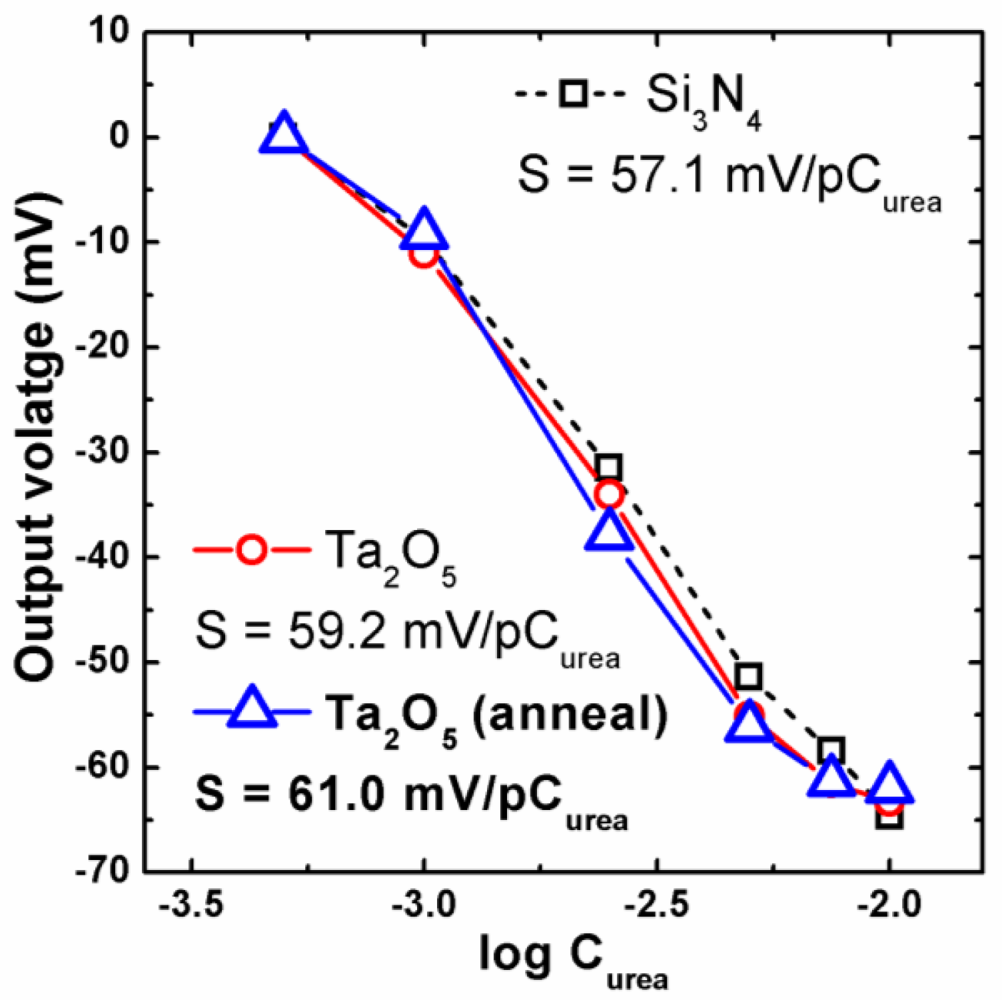
<p>Finally, the calibration curves of the urea-EnFETs with Si<sub>3</sub>N<sub>4</sub>, Ta<sub>2</sub>O<sub>5</sub>, and annealed Ta<sub>2</sub>O<sub>5</sub> sensing membranes were compared in <xref ref-type="fig" rid="f8-sensors-11-04562">Figure 8</xref>. For all samples, the linearity is higher than 99% between 1 mM to 7.5 mM of urea. The sensitivity of EnFET with Si<sub>3</sub>N<sub>4</sub> sensing membrane is 57.1 mV/pC<sub>urea</sub>, and the sensitivity for the EnFETs with Ta<sub>2</sub>O<sub>5</sub> and annealed Ta<sub>2</sub>O<sub>5</sub> sensing membranes are 59.2 mV/pC<sub>urea</sub> and 61.0 mV/pC<sub>urea</sub>, respectively. Since the urea detection is based on the increase of the byproduct of hydrogen ions, the sensitivity of EnFETs for urea concentration is also dependent on the pH sensitivity of ISFETs. In this case, the ratio of pH sensitivity and urea sensitivity is about 1.1 ± 0.43.</p></sec>
<sec sec-type="conclusions">
<label>4.</label>
<title>Conclusions</title>
<p>The urea-EnFET with covalent bonding process was investigated based on the pH-ISFETs with Ta<sub>2</sub>O<sub>5</sub> sensing membranes. In addition, the sensing properties of Ta<sub>2</sub>O<sub>5</sub>-ISFETs were also improved from the control samples by the post N<sub>2</sub> annealing, including higher pH sensitivity, lower hysteresis, lower drift coefficient, and lower light induced drift. The improved sensing properties were also corresponding to the EnFETs. In this research, the output responses of EnFETs were stabilized in 2 min, and the applicable and linear measurement range for urea concentration was from 1 mM to 7.5 mM. For the EnFET with annealed Ta<sub>2</sub>O<sub>5</sub> sensing membrane, the sensitivity was 61 mV/pC<sub>urea</sub>. Based on the high sensitivity and minimized non-ideal factors, the Ta<sub>2</sub>O<sub>5</sub> layer with post annealing could be used to replace the conventional Si<sub>3</sub>N<sub>4</sub> layer as the basic substrate platform for biomedical applications, such as chemically modified field effect transistors (ChemFETs), EnFETs with other enzyme, and DNA-FETs.</p></sec></body>
<back>
<ack>
<p>This work was supported by the National Science Council under the contract of NSC-99-2221-E-182-056-MY3, NSC-99-2811-E-182-006 and NSC-98-2221-E-182-057-MY3.</p></ack>
<ref-list>
<title>References</title>
<ref id="b1-sensors-11-04562"><label>1.</label><citation citation-type="journal"><person-group person-group-type="author"><name><surname>Caras</surname><given-names>S</given-names></name><name><surname>Janata</surname><given-names>J</given-names></name></person-group><article-title>Field effect transistor sensitive to penicillin</article-title><source>Anal. Chem</source><year>1980</year><volume>52</volume><fpage>1935</fpage><lpage>1937</lpage><pub-id pub-id-type="doi">10.1021/ac50062a035</pub-id></citation></ref>
<ref id="b2-sensors-11-04562"><label>2.</label><citation citation-type="journal"><person-group person-group-type="author"><name><surname>Pijanowska</surname><given-names>DG</given-names></name><name><surname>Torbicz</surname><given-names>W</given-names></name></person-group><article-title>pH-ISFET based urea biosensor</article-title><source>Sens. Actuat. B</source><year>1997</year><volume>44</volume><fpage>370</fpage><lpage>376</lpage><pub-id pub-id-type="doi">10.1016/S0925-4005(97)00194-9</pub-id></citation></ref>
<ref id="b3-sensors-11-04562"><label>3.</label><citation citation-type="journal"><person-group person-group-type="author"><name><surname>Dzyadevich</surname><given-names>SV</given-names></name><name><surname>Korpan</surname><given-names>YI</given-names></name><name><surname>Arkhipova</surname><given-names>VN</given-names></name></person-group><article-title>Application of enzyme field-effect transistors for determination of glucose concentrations in blood serum</article-title><source>Biosens. Bioelectron</source><year>1999</year><volume>14</volume><fpage>283</fpage><lpage>287</lpage><pub-id pub-id-type="doi">10.1016/S0956-5663(99)00007-X</pub-id><pub-id pub-id-type="pmid">10230028</pub-id></citation></ref>
<ref id="b4-sensors-11-04562"><label>4.</label><citation citation-type="journal"><person-group person-group-type="author"><name><surname>Soldatkin</surname><given-names>AP</given-names></name><name><surname>Montoriol</surname><given-names>J</given-names></name><name><surname>Sant</surname><given-names>W</given-names></name><name><surname>Martelet</surname><given-names>C</given-names></name><name><surname>Jaffrezic-Renault</surname><given-names>N</given-names></name></person-group><article-title>Creatinine sensitive biosensor based on ISFETs and creatinine deiminase immobilised in BSA membrane</article-title><source>Talanta</source><year>2002</year><volume>58</volume><fpage>351</fpage><pub-id pub-id-type="doi">10.1016/S0039-9140(02)00283-7</pub-id><pub-id pub-id-type="pmid">18968760</pub-id></citation></ref>
<ref id="b5-sensors-11-04562"><label>5.</label><citation citation-type="journal"><person-group person-group-type="author"><name><surname>Matsuo</surname><given-names>T</given-names></name><name><surname>Wise</surname><given-names>KD</given-names></name></person-group><article-title>An integrated field-effect electrode for biopotential recording</article-title><source>IEEE Trans. Biomed. Eng</source><year>1974</year><volume>21</volume><fpage>485</fpage><pub-id pub-id-type="doi">10.1109/TBME.1974.324338</pub-id></citation></ref>
<ref id="b6-sensors-11-04562"><label>6.</label><citation citation-type="journal"><person-group person-group-type="author"><name><surname>Bousse</surname><given-names>L</given-names></name><name><surname>Mostarshed</surname><given-names>S</given-names></name><name><surname>van der Schoot</surname><given-names>B</given-names></name><name><surname>de Rooij</surname><given-names>NF</given-names></name></person-group><article-title>Comparison of the hysteresis of Ta<sub>2</sub>O<sub>5</sub> and Si<sub>3</sub>N<sub>4</sub> pH-sensing insulators</article-title><source>Sens. Actuat. B</source><year>1994</year><volume>17</volume><fpage>157</fpage><lpage>164</lpage><pub-id pub-id-type="doi">10.1016/0925-4005(94)87044-6</pub-id></citation></ref>
<ref id="b7-sensors-11-04562"><label>7.</label><citation citation-type="journal"><person-group person-group-type="author"><name><surname>Bobrov</surname><given-names>PV</given-names></name><name><surname>Tarantov</surname><given-names>YA</given-names></name><name><surname>Krause</surname><given-names>S</given-names></name><name><surname>Moritz</surname><given-names>W</given-names></name></person-group><article-title>Chemical sensitivity of an ISFET with Ta<sub>2</sub>O<sub>5</sub> membrane in strong acid and alkaline solutions</article-title><source>Sens. Actuat. B</source><year>1991</year><volume>3</volume><fpage>75</fpage><lpage>81</lpage><pub-id pub-id-type="doi">10.1016/0925-4005(91)85010-G</pub-id></citation></ref>
<ref id="b8-sensors-11-04562"><label>8.</label><citation citation-type="journal"><person-group person-group-type="author"><name><surname>Kwon</surname><given-names>D-H</given-names></name><name><surname>Cho</surname><given-names>B-W</given-names></name><name><surname>Kim</surname><given-names>C-S</given-names></name><name><surname>Sohn</surname><given-names>B-K</given-names></name></person-group><article-title>Effects of heat treatment on Ta<sub>2</sub>O<sub>5</sub> sensing membrane for low drift and high sensitivity pH-ISFET</article-title><source>Sens. Actuat. B</source><year>1996</year><volume>34</volume><fpage>441</fpage><lpage>445</lpage><pub-id pub-id-type="doi">10.1016/S0925-4005(96)01938-7</pub-id></citation></ref>
<ref id="b9-sensors-11-04562"><label>9.</label><citation citation-type="journal"><person-group person-group-type="author"><name><surname>Ito</surname><given-names>Y</given-names></name></person-group><article-title>Long-term drift mechanism of Ta<sub>2</sub>O<sub>5</sub> gate pH-ISFETs</article-title><source>Sens. Actuat. B</source><year>2000</year><volume>64</volume><fpage>152</fpage><lpage>155</lpage><pub-id pub-id-type="doi">10.1016/S0925-4005(99)00499-2</pub-id></citation></ref>
<ref id="b10-sensors-11-04562"><label>10.</label><citation citation-type="journal"><person-group person-group-type="author"><name><surname>Chou</surname><given-names>J-C</given-names></name><name><surname>Weng</surname><given-names>C-Y</given-names></name></person-group><article-title>Sensitivity and hysteresis effect in Al<sub>2</sub>O<sub>3</sub> gate pH-ISFET</article-title><source>Mater. Chem. Phys</source><year>2001</year><volume>71</volume><fpage>120</fpage><pub-id pub-id-type="doi">10.1016/S0254-0584(00)00513-7</pub-id></citation></ref>
<ref id="b11-sensors-11-04562"><label>11.</label><citation citation-type="journal"><person-group person-group-type="author"><name><surname>Shin</surname><given-names>P-K</given-names></name></person-group><article-title>The pH-sensing and light-induced drift properties of titanium dioxide thin films deposited by MOCVD</article-title><source>Appl. Surf. Sci</source><year>2003</year><volume>214</volume><fpage>214</fpage><lpage>221</lpage><pub-id pub-id-type="doi">10.1016/S0169-4332(03)00340-4</pub-id></citation></ref>
<ref id="b12-sensors-11-04562"><label>12.</label><citation citation-type="journal"><person-group person-group-type="author"><name><surname>Chou</surname><given-names>J-C</given-names></name><name><surname>Liao</surname><given-names>LP</given-names></name></person-group><article-title>Study on pH at the point of zero charge of TiO<sub>2</sub> pH ion-sensitive field effect transistor made by the sputtering method</article-title><source>Thin Solid Film</source><year>2005</year><volume>476</volume><fpage>157</fpage><lpage>161</lpage><pub-id pub-id-type="doi">10.1016/j.tsf.2004.09.061</pub-id></citation></ref>
<ref id="b13-sensors-11-04562"><label>13.</label><citation citation-type="journal"><person-group person-group-type="author"><name><surname>Lai</surname><given-names>C-S</given-names></name><name><surname>Yang</surname><given-names>C-M</given-names></name><name><surname>Lu</surname><given-names>T-F</given-names></name></person-group><article-title>pH sensitivity improvement on 8 nm thick hafnium oxide by post deposition annealing</article-title><source>Electrochem. Solid-State Lett</source><year>2006</year><volume>9</volume><fpage>G90</fpage><lpage>G92</lpage><pub-id pub-id-type="doi">10.1149/1.2163550</pub-id></citation></ref>
<ref id="b14-sensors-11-04562"><label>14.</label><citation citation-type="confproc"><person-group person-group-type="author"><name><surname>van der Wal</surname><given-names>PD</given-names></name><name><surname>Briand</surname><given-names>D</given-names></name><name><surname>Mondin</surname><given-names>G</given-names></name><name><surname>Jenny</surname><given-names>S</given-names></name><name><surname>Jeanneret</surname><given-names>S</given-names></name><name><surname>Millon</surname><given-names>C</given-names></name><name><surname>Roussel</surname><given-names>H</given-names></name><name><surname>Dubourdieu</surname><given-names>C</given-names></name><name><surname>de Rooij</surname><given-names>NF</given-names></name></person-group><article-title>High-k dielectrics for use as ISFET gate oxides</article-title><conf-name>Proceedings of IEEE Sensors</conf-name><conf-loc>Vienna, Austria</conf-loc><conf-date>24–27 October 2004</conf-date><fpage>677</fpage><lpage>680</lpage></citation></ref>
<ref id="b15-sensors-11-04562"><label>15.</label><citation citation-type="journal"><person-group person-group-type="author"><name><surname>Chou</surname><given-names>JC</given-names></name><name><surname>Wang</surname><given-names>YF</given-names></name></person-group><article-title>Preparation and study on the drift and hysteresis properties of the tin oxide gate ISFET by the sol-gel method</article-title><source>Sens. Actuat. B</source><year>2002</year><volume>86</volume><fpage>58</fpage><pub-id pub-id-type="doi">10.1016/S0925-4005(02)00147-8</pub-id></citation></ref>
<ref id="b16-sensors-11-04562"><label>16.</label><citation citation-type="journal"><person-group person-group-type="author"><name><surname>Bobrov</surname><given-names>PV</given-names></name><name><surname>Tarantov</surname><given-names>YA</given-names></name><name><surname>Krause</surname><given-names>S</given-names></name><name><surname>Moritz</surname><given-names>W</given-names></name></person-group><article-title>Chemical sensitivity of an ISFET with Ta<sub>2</sub>O<sub>5</sub> membrane</article-title><source>Sens. Actuat. B</source><year>1991</year><volume>3</volume><fpage>75</fpage><lpage>81</lpage><pub-id pub-id-type="doi">10.1016/0925-4005(91)85010-G</pub-id></citation></ref>
<ref id="b17-sensors-11-04562"><label>17.</label><citation citation-type="journal"><person-group person-group-type="author"><name><surname>Schöning</surname><given-names>MJ</given-names></name><name><surname>Brinkmann</surname><given-names>D</given-names></name><name><surname>Rolka</surname><given-names>D</given-names></name><name><surname>Demuth</surname><given-names>C</given-names></name><name><surname>Poghssian</surname><given-names>A</given-names></name></person-group><article-title>CIP (cleaning-in-place) suitable “non-glass” pH sensor based on a Ta<sub>2</sub>O<sub>5</sub>-gate EIS structure</article-title><source>Sens Actuat B</source><year>2005</year><volume>111–112</volume><fpage>423</fpage><lpage>429</lpage></citation></ref>
<ref id="b18-sensors-11-04562"><label>18.</label><citation citation-type="journal"><person-group person-group-type="author"><name><surname>Braeken</surname><given-names>D</given-names></name><name><surname>Rand</surname><given-names>DR</given-names></name><name><surname>Andrei</surname><given-names>A</given-names></name><name><surname>Huys</surname><given-names>R</given-names></name><name><surname>Spira</surname><given-names>ME</given-names></name><name><surname>Yitzchaik</surname><given-names>S</given-names></name><name><surname>Shappir</surname><given-names>J</given-names></name><name><surname>Borghs</surname><given-names>G</given-names></name><name><surname>Callewaert</surname><given-names>G</given-names></name><name><surname>Bartic</surname><given-names>C</given-names></name></person-group><article-title>Glutamate sensing with enzyme-modified floating-gate field effect transistors</article-title><source>Biosens. Bioelectron</source><year>2009</year><volume>24</volume><fpage>2384</fpage><pub-id pub-id-type="doi">10.1016/j.bios.2008.12.012</pub-id><pub-id pub-id-type="pmid">19155170</pub-id></citation></ref>
<ref id="b19-sensors-11-04562"><label>19.</label><citation citation-type="journal"><person-group person-group-type="author"><name><surname>Migita</surname><given-names>S</given-names></name><name><surname>Ozasa</surname><given-names>K</given-names></name><name><surname>Ikeno</surname><given-names>S</given-names></name><name><surname>Tanaka</surname><given-names>T</given-names></name><name><surname>Haruyama</surname><given-names>T</given-names></name></person-group><article-title>Molecular commonality sensing of phosphoric anhydride substances using an ion-sensitive field-effect transistor covered with an artificial enzyme membrane</article-title><source>Jpn. J. Appl. Phys, Part 1</source><year>2007</year><volume>46</volume><fpage>7539</fpage><pub-id pub-id-type="doi">10.1143/JJAP.46.7539</pub-id></citation></ref>
<ref id="b20-sensors-11-04562"><label>20.</label><citation citation-type="journal"><person-group person-group-type="author"><name><surname>Voorthuyzen</surname><given-names>JA</given-names></name><name><surname>Bergveld</surname><given-names>P</given-names></name></person-group><article-title>Photoelectric effects in Ta<sub>2</sub>O<sub>5</sub>-SiO<sub>2</sub>-Si structures</article-title><source>Sens. Actuat</source><year>1990</year><volume>B1</volume><fpage>350</fpage><lpage>353</lpage></citation></ref>
<ref id="b21-sensors-11-04562"><label>21.</label><citation citation-type="journal"><person-group person-group-type="author"><name><surname>Mikolajick</surname><given-names>T</given-names></name><name><surname>Kühnhold</surname><given-names>R</given-names></name><name><surname>Ryssel</surname><given-names>H</given-names></name></person-group><article-title>The pH-sensing properties of tantalum pentoxide filmes fabricated by metal organic low pressure chemical vapor depostition</article-title><source>Sens. Actuat. B</source><year>1997</year><volume>44</volume><fpage>262</fpage><lpage>267</lpage><pub-id pub-id-type="doi">10.1016/S0925-4005(97)00166-4</pub-id></citation></ref>
<ref id="b22-sensors-11-04562"><label>22.</label><citation citation-type="journal"><person-group person-group-type="author"><name><surname>Dawgul</surname><given-names>M</given-names></name><name><surname>Pijanowska</surname><given-names>DG</given-names></name><name><surname>Krzyskow</surname><given-names>A</given-names></name><name><surname>Kruk</surname><given-names>J</given-names></name><name><surname>Torbicz</surname><given-names>W</given-names></name></person-group><article-title>An influence of polyHEMA gate layer on properties of ChemFETs</article-title><source>Sensors</source><year>2003</year><volume>3</volume><fpage>146</fpage><lpage>159</lpage><pub-id pub-id-type="doi">10.3390/s30600146</pub-id></citation></ref>
<ref id="b23-sensors-11-04562"><label>23.</label><citation citation-type="journal"><person-group person-group-type="author"><name><surname>Lai</surname><given-names>C-S</given-names></name><name><surname>Lue</surname><given-names>C-E</given-names></name><name><surname>Yang</surname><given-names>C-M</given-names></name><name><surname>Dawgul</surname><given-names>M</given-names></name><name><surname>Pijanowska</surname><given-names>DG</given-names></name></person-group><article-title>Optimization of a PVC Membrane for Reference Field Effect Transistors</article-title><source>Sensors</source><year>2009</year><volume>9</volume><fpage>2076</fpage><lpage>2087</lpage><pub-id pub-id-type="doi">10.3390/s90302076</pub-id><pub-id pub-id-type="pmid">22574001</pub-id></citation></ref>
<ref id="b24-sensors-11-04562"><label>24.</label><citation citation-type="journal"><person-group person-group-type="author"><name><surname>Lai</surname><given-names>C-S</given-names></name><name><surname>Lue</surname><given-names>C-E</given-names></name><name><surname>Yang</surname><given-names>C-M</given-names></name><name><surname>Jao</surname><given-names>J-H</given-names></name><name><surname>Tai</surname><given-names>C-C</given-names></name></person-group><article-title>New pH-sensitive TaO<sub>x</sub>N<sub>y</sub> membranes prepared by NH<sub>3</sub> plasma surface treatment and nitrogen incorporated reactive sputtering</article-title><source>Sens. Actuat. B</source><year>2008</year><volume>130</volume><fpage>77</fpage><lpage>81</lpage><pub-id pub-id-type="doi">10.1016/j.snb.2007.07.115</pub-id></citation></ref>
<ref id="b25-sensors-11-04562"><label>25.</label><citation citation-type="confproc"><person-group person-group-type="author"><name><surname>Lai</surname><given-names>C-S</given-names></name><name><surname>Lue</surname><given-names>C-E</given-names></name><name><surname>Yang</surname><given-names>C-M</given-names></name><name><surname>Jao</surname><given-names>J-H</given-names></name></person-group><article-title>Modifications on pH Sensitivitiy of Si<sub>3</sub>N<sub>4</sub> Membrane by CF<sub>4</sub> Plasma and Rapid Thermal Annealing for ISFET/REFET Applications</article-title><conf-name>International Conference on Solid State Devices and Materials</conf-name><conf-loc>Yokohama, Japan</conf-loc><conf-date>12–15 September 2006</conf-date><fpage>790</fpage><lpage>791</lpage></citation></ref>
<ref id="b26-sensors-11-04562"><label>26.</label><citation citation-type="journal"><person-group person-group-type="author"><name><surname>Sant</surname><given-names>W</given-names></name><name><surname>Pourciel</surname><given-names>ML</given-names></name><name><surname>Launay</surname><given-names>J</given-names></name><name><surname>Conto</surname><given-names>TD</given-names></name><name><surname>Martinez</surname><given-names>A</given-names></name><name><surname>Temple-Boyer</surname><given-names>P</given-names></name></person-group><article-title>Development of chemical field effect transistors for detection of urea</article-title><source>Sens. Actuat. B</source><year>2004</year><volume>95</volume><fpage>309</fpage><lpage>314</lpage></citation></ref></ref-list>
<sec sec-type="display-objects">
<title>Figures and Table</title>
<fig id="f1-sensors-11-04562" position="float">
<label>Figure 1.</label>
<caption>
<p>The structure and cross section of Ta<sub>2</sub>O<sub>5</sub>-ISFET.</p></caption>
<graphic xlink:href="sensors-11-04562f1.gif"/></fig>
<fig id="f2-sensors-11-04562" position="float">
<label>Figure 2.</label>
<caption>
<p>Schematic of covalent bonding process flow of urea-EnFET based on Ta<sub>2</sub>O<sub>5</sub> sensing membrane.</p></caption>
<graphic xlink:href="sensors-11-04562f2.gif"/></fig>
<fig id="f3-sensors-11-04562" position="float">
<label>Figure 3.</label>
<caption>
<p>I<sub>DS</sub>–V<sub>GS</sub> curves of Ta<sub>2</sub>O<sub>5</sub>-ISFET measured in the buffer solutions with different pH value (from pH 2 to pH 12).</p></caption>
<graphic xlink:href="sensors-11-04562f3.gif"/></fig>
<fig id="f4-sensors-11-04562" position="float">
<label>Figure 4.</label>
<caption>
<p>Light induced drift of the Ta<sub>2</sub>O<sub>5</sub> ISFETs without and with post annealing.</p></caption>
<graphic xlink:href="sensors-11-04562f4.gif"/></fig>
<fig id="f5-sensors-11-04562" position="float">
<label>Figure 5.</label>
<caption>
<p>I<sub>DS</sub>–V<sub>GS</sub> curves and transconductance of ISFET and EnFET.</p></caption>
<graphic xlink:href="sensors-11-04562f5.gif"/></fig>
<fig id="f6-sensors-11-04562" position="float">
<label>Figure 6.</label>
<caption>
<p>Time response to output voltage measured in 0–30 mM urea.</p></caption>
<graphic xlink:href="sensors-11-04562f6.gif"/></fig>
<fig id="f7-sensors-11-04562" position="float">
<label>Figure 7.</label>
<caption>
<p>Calibration curves of output voltage with 1–5 min sampling time.</p></caption>
<graphic xlink:href="sensors-11-04562f7.gif"/></fig>
<fig id="f8-sensors-11-04562" position="float">
<label>Figure 8.</label>
<caption>
<p>Calibration curves of the urea-EnFETs with Si<sub>3</sub>N<sub>4</sub>, Ta<sub>2</sub>O<sub>5</sub>, and annealed Ta<sub>2</sub>O<sub>5</sub> sensing membranes.</p></caption>
<graphic xlink:href="sensors-11-04562f8.gif"/></fig>
<table-wrap id="t1-sensors-11-04562" position="float">
<label>Table 1.</label>
<caption>
<p>The sensing properties of ISFETs with Si<sub>3</sub>N<sub>4</sub>, Ta<sub>2</sub>O<sub>5</sub>, and annealed Ta<sub>2</sub>O<sub>5</sub> sensing membranes.</p></caption>
<table frame="hsides" rules="none">
<thead>
<tr>
<th align="center" valign="middle"/>
<th align="center" valign="middle">pH sensitivity (mV/pH)</th>
<th align="center" valign="middle">Hysteresis (6-2-6-12-6) (mV)</th>
<th align="center" valign="middle">Hysteresis (6-12-6-2-6) (mV)</th>
<th align="center" valign="middle">Drift coefficient (mV/h)</th></tr>
<tr>
<th align="center" valign="middle">
<hr/></th>
<th align="center" valign="middle">
<hr/></th>
<th align="center" valign="middle">
<hr/></th>
<th align="center" valign="middle">
<hr/></th>
<th align="center" valign="middle">
<hr/></th></tr></thead>
<tbody>
<tr>
<td align="center" valign="middle">Si<sub>3</sub>N<sub>4</sub></td>
<td align="center" valign="middle">51.1</td>
<td align="center" valign="middle">—</td>
<td align="center" valign="middle">5.1</td>
<td align="center" valign="middle">&lt;1 mV/h</td></tr>
<tr>
<td align="center" valign="middle">Ta<sub>2</sub>O<sub>5</sub></td>
<td align="center" valign="middle">51.8</td>
<td align="center" valign="middle">15.2</td>
<td align="center" valign="middle">6.3</td>
<td align="center" valign="middle">&lt;1 mV/h</td></tr>
<tr>
<td align="center" valign="middle">Ta<sub>2</sub>O<sub>5</sub> (anneal)</td>
<td align="center" valign="middle">56.9</td>
<td align="center" valign="middle">0.3</td>
<td align="center" valign="middle">0.7</td>
<td align="center" valign="middle">&lt;1 mV/h</td></tr></tbody></table></table-wrap></sec></back></article>