
<?xml version="1.0" encoding="UTF-8"?>
<!DOCTYPE article PUBLIC "-//NLM//DTD Journal Publishing DTD v2.3 20070202//EN" "journalpublishing.dtd">
<article xmlns:mml="http://www.w3.org/1998/Math/MathML" xmlns:xlink="http://www.w3.org/1999/xlink" xml:lang="en" article-type="review-article">
<front>
<journal-meta>
<journal-id journal-id-type="nlm-ta">Sensors</journal-id>
<journal-title>Sensors</journal-title>
<issn pub-type="epub">1424-8220</issn>
<publisher>
<publisher-name>Molecular Diversity Preservation International (MDPI)</publisher-name></publisher></journal-meta>
<article-meta>
<article-id pub-id-type="doi">10.3390/s110202112</article-id>
<article-id pub-id-type="publisher-id">sensors-11-02112</article-id>
<article-categories>
<subj-group>
<subject>Review</subject></subj-group></article-categories>
<title-group>
<article-title>Physiological Sensing of Carbon Dioxide/Bicarbonate/pH via Cyclic Nucleotide Signaling</article-title></title-group>
<contrib-group>
<contrib contrib-type="author">
<name><surname>Buck</surname><given-names>Jochen</given-names></name></contrib>
<contrib contrib-type="author">
<name><surname>Levin</surname><given-names>Lonny R.</given-names></name></contrib>
<aff id="af1-sensors-11-02112">Department of Pharmacology, Weill Medical College of Cornell University, 1300 York Avenue, New York, NY 10065, USA; E-Mails: <email>jobuck@med.cornell.edu</email> (J.B.); <email>llevin@med.cornell.edu</email> (L.R.L.); Tel.: 212-746-6274 (J.B.); 212-746-6752 (L.R.L.); Fax: 212-746-6241</aff></contrib-group>
<pub-date pub-type="collection">
<year>2011</year></pub-date>
<pub-date pub-type="epub">
<day>11</day>
<month>2</month>
<year>2011</year></pub-date>
<volume>11</volume>
<issue>2</issue>
<fpage>2112</fpage>
<lpage>2128</lpage>
<history>
<date date-type="received">
<day>3</day>
<month>1</month>
<year>2011</year></date>
<date date-type="rev-recd">
<day>28</day>
<month>1</month>
<year>2011</year></date>
<date date-type="accepted">
<day>10</day>
<month>2</month>
<year>2011</year></date></history>
<permissions>
<copyright-statement>© 2011 by the authors; licensee MDPI, Basel, Switzerland.</copyright-statement>
<copyright-year>2011</copyright-year>
<license>
<p>This article is an open access article distributed under the terms and conditions of the Creative Commons Attribution license (http://creativecommons.org/licenses/by/3.0/).</p></license></permissions>
<abstract>
<p>Carbon dioxide (CO<sub>2</sub>) is produced by living organisms as a byproduct of metabolism. In physiological systems, CO<sub>2</sub> is unequivocally linked with bicarbonate (HCO<sub>3</sub><sup>−</sup>) and pH via a ubiquitous family of carbonic anhydrases, and numerous biological processes are dependent upon a mechanism for sensing the level of CO<sub>2</sub>, HCO<sub>3</sub>, and/or pH. The discovery that soluble adenylyl cyclase (sAC) is directly regulated by bicarbonate provided a link between CO<sub>2</sub>/HCO<sub>3</sub>/pH chemosensing and signaling via the widely used second messenger cyclic AMP. This review summarizes the evidence that bicarbonate-regulated sAC, and additional, subsequently identified bicarbonate-regulate nucleotidyl cyclases, function as evolutionarily conserved CO<sub>2</sub>/HCO<sub>3</sub>/pH chemosensors in a wide variety of physiological systems.</p></abstract>
<kwd-group>
<kwd>soluble adenylyl cyclase</kwd>
<kwd>cAMP</kwd>
<kwd>second messenger</kwd>
<kwd>cyclic nucleotides</kwd>
<kwd>bicarbonate</kwd>
<kwd>carbon dioxide</kwd>
<kwd>pH</kwd></kwd-group></article-meta></front>
<body>
<sec sec-type="intro">
<label>1.</label>
<title>Introduction</title>
<p>Carbon dioxide (CO<sub>2</sub>) and water are the major end products of energy producing pathways in living organisms (<xref ref-type="disp-formula" rid="FD1">Equation (1)</xref>). As such, in non-photosynthetic organisms, CO<sub>2</sub> and water represent the most fundamental catabolites.
<disp-formula id="FD1">
<label>(1)</label>
<mml:math display="block">
<mml:mrow>
<mml:mtext>Glucose</mml:mtext>
<mml:mo> </mml:mo>
<mml:mo stretchy="false">(</mml:mo>
<mml:mtext>or other energy sources</mml:mtext>
<mml:mo stretchy="false">)</mml:mo>
<mml:mo>+</mml:mo>
<mml:msub>
<mml:mi mathvariant="normal">O</mml:mi>
<mml:mn>2</mml:mn></mml:msub>
<mml:mo> </mml:mo>
<mml:mrow>
<mml:mtext>-----</mml:mtext>
<mml:mo>&gt;</mml:mo></mml:mrow>
<mml:mo> </mml:mo>
<mml:msub>
<mml:mtext>CO</mml:mtext>
<mml:mn>2</mml:mn></mml:msub>
<mml:mo>+</mml:mo>
<mml:msub>
<mml:mi mathvariant="normal">H</mml:mi>
<mml:mn>2</mml:mn></mml:msub>
<mml:mi mathvariant="normal">O</mml:mi></mml:mrow></mml:math></disp-formula>
<disp-formula id="FD2">
<label>(2)</label>
<mml:math display="block">
<mml:mrow>
<mml:msub>
<mml:mtext>CO</mml:mtext>
<mml:mn>2</mml:mn></mml:msub>
<mml:mo>+</mml:mo>
<mml:msub>
<mml:mi mathvariant="normal">H</mml:mi>
<mml:mn>2</mml:mn></mml:msub>
<mml:mrow>
<mml:mi mathvariant="normal">O</mml:mi>
<mml:mo>&lt;</mml:mo>
<mml:mtext>-----</mml:mtext>
<mml:mo>&gt;</mml:mo></mml:mrow>
<mml:mo> </mml:mo>
<mml:msub>
<mml:mi mathvariant="normal">H</mml:mi>
<mml:mn>2</mml:mn></mml:msub>
<mml:msub>
<mml:mtext>CO</mml:mtext>
<mml:mn>3</mml:mn></mml:msub>
<mml:mrow>
<mml:mo>&lt;</mml:mo>
<mml:mtext>-----</mml:mtext>
<mml:mo>&gt;</mml:mo></mml:mrow>
<mml:msubsup>
<mml:mtext>HCO</mml:mtext>
<mml:mn>3</mml:mn>
<mml:mo>−</mml:mo></mml:msubsup>
<mml:mo>+</mml:mo>
<mml:msup>
<mml:mi mathvariant="normal">H</mml:mi>
<mml:mo>+</mml:mo></mml:msup></mml:mrow></mml:math></disp-formula></p>
<p>In unicellular organisms, CO<sub>2</sub> gas can simply diffuse away, but once multicellular organisms evolved, they had to devise methods for safely dealing with CO<sub>2</sub>. In solution, CO<sub>2</sub> combines with water to form carbonic acid (H<sub>2</sub>CO<sub>3</sub>), which dissociates to liberate a proton and a bicarbonate ion (HCO<sub>3</sub><sup>−</sup>) (<xref ref-type="disp-formula" rid="FD2">Equation (2)</xref>). CO<sub>2</sub>, bicarbonate and pH equilibrate on their own within minutes, but in biological systems, equilibrium is reached nearly instantaneously due to the ubiquitous presence of carbonic anhydrases [<xref ref-type="bibr" rid="b1-sensors-11-02112">1</xref>]. This equilibrium is used to buffer pH inside cells and in intercellular fluids; for example, intracellular pH is regulated via an interplay between CO<sub>2</sub> diffusion, and bicarbonate and proton transporters and/or exchangers. In mammals, and terrestrial vertebrates in general, this equilibrium is tightly controlled in two ways; the kidneys regulate the bicarbonate concentration and the breathing frequency determines the concentration of carbon dioxide. Each of these processes requires a ‘sensor,’ <italic>i.e.</italic>, an exquisitely sensitive and rapid way to measure the precise concentration of either CO<sub>2</sub> and/or bicarbonate and/or pH and elicit an appropriate response. Many other physiological processes, in addition to diuresis and breathing rate regulation, are modulated by CO<sub>2</sub> and/or bicarbonate and/or pH (<italic>i.e</italic>., sperm activation, blood flow, aqueous humor in the eye and cerebrospinal fluid formation), and they also require a CO<sub>2</sub>/HCO<sub>3</sub>/pH sensor. For many years, the effects of CO<sub>2</sub> and pH had been ascribed to undefined chemoreceptors, and the effects of bicarbonate were traditionally thought to be mediated by changes in cellular pH [<xref ref-type="bibr" rid="b1-sensors-11-02112">1</xref>]. In 2000, our research group demonstrated that HCO<sub>3</sub><sup>−</sup> directly modulates the activity of soluble adenylyl cyclase (sAC), a novel form of the enzyme generating the ubiquitous second messenger, cAMP [<xref ref-type="bibr" rid="b2-sensors-11-02112">2</xref>], revealing that physiological CO<sub>2</sub>/HCO<sub>3</sub>/pH could be sensed via second messenger signaling.</p>
<p>Cyclic AMP was discovered more than 50 years ago by Earl Sutherland to act as a ‘second’ or intracellular messenger which mediated cellular responses to extracellular signals in organisms as diverse as bacteria and mammals [<xref ref-type="bibr" rid="b3-sensors-11-02112">3</xref>]. Still, our understanding of cAMP signaling has recently undergone two transformative changes: cAMP signaling is organized into multiple, independently-regulated microdomains within a cell [<xref ref-type="bibr" rid="b4-sensors-11-02112">4</xref>–<xref ref-type="bibr" rid="b6-sensors-11-02112">6</xref>], and in addition to its role mediating cellular changes, cAMP can affect cellular physiology by modulating the amplitude or duration of other signaling cascades [<xref ref-type="bibr" rid="b7-sensors-11-02112">7</xref>].</p>
<p>Over the decades of studying cAMP signaling in mammalian biology, this single second messenger had been implicated in a wide variety of often-contradictory physiological processes, including different aspects of metabolism, proliferation, apoptosis, differentiation, migration, development, ion transport, pH regulation, and gene expression. This seeming conundrum was finally resolved with the appreciation that cAMP acts locally within independently regulated microdomains. The microdomain model posits that cAMP is generated at distinct locations within the cell by independently regulated adenylyl cyclases [<xref ref-type="bibr" rid="b8-sensors-11-02112">8</xref>–<xref ref-type="bibr" rid="b10-sensors-11-02112">10</xref>], where it modulates only nearby targets, including cyclic nucleotide gated ion channels, Exchange Proteins Activated by cAMP (EPACs), or Protein Kinase A (PKA). Ultimately, the cAMP is degraded by phosphodiesterases (PDEs) which serve two functions; they act as barriers to cAMP diffusion [<xref ref-type="bibr" rid="b11-sensors-11-02112">11</xref>,<xref ref-type="bibr" rid="b12-sensors-11-02112">12</xref>] preventing unregulated cross-communication between microdomains [<xref ref-type="bibr" rid="b13-sensors-11-02112">13</xref>] and the more traditionally accepted role restoring cAMP levels to their basal level terminating the signaling cascade [<xref ref-type="bibr" rid="b14-sensors-11-02112">14</xref>]. Individual microdomains can be wholly contained within an organelle, such as the mitochondria or nucleus [<xref ref-type="bibr" rid="b9-sensors-11-02112">9</xref>,<xref ref-type="bibr" rid="b10-sensors-11-02112">10</xref>,<xref ref-type="bibr" rid="b15-sensors-11-02112">15</xref>] or can be defined by A-kinase anchoring proteins (AKAPs), which tether PKA [<xref ref-type="bibr" rid="b16-sensors-11-02112">16</xref>,<xref ref-type="bibr" rid="b17-sensors-11-02112">17</xref>], and possibly adenylyl cyclases [<xref ref-type="bibr" rid="b18-sensors-11-02112">18</xref>–<xref ref-type="bibr" rid="b20-sensors-11-02112">20</xref>] and/or PDEs [<xref ref-type="bibr" rid="b21-sensors-11-02112">21</xref>–<xref ref-type="bibr" rid="b28-sensors-11-02112">28</xref>] to specific locations inside cells. Organization in microdomains enables this one second messenger to simultaneously mediate disparate processes throughout a cell.</p>
<p>There were early hints that cAMP signaling was compartmentalized within a cell; for example, distinct hormones which have the same effects on cAMP levels in bladder epithelial cells do not have the same effect on osmotic water flow [<xref ref-type="bibr" rid="b29-sensors-11-02112">29</xref>]. But a need for independently-regulated cAMP microdomains was best demonstrated in cardiomyocytes, where it was observed that two hormones, which both functioned via cAMP, elicited completely different responses [<xref ref-type="bibr" rid="b30-sensors-11-02112">30</xref>]. Modern FRET-based [<xref ref-type="bibr" rid="b31-sensors-11-02112">31</xref>–<xref ref-type="bibr" rid="b33-sensors-11-02112">33</xref>] and biophysical methods [<xref ref-type="bibr" rid="b34-sensors-11-02112">34</xref>,<xref ref-type="bibr" rid="b35-sensors-11-02112">35</xref>] that enable measuring cAMP concentrations <italic>in situ</italic> revealed that cAMP levels are not uniform within cells (reviewed in [<xref ref-type="bibr" rid="b4-sensors-11-02112">4</xref>,<xref ref-type="bibr" rid="b5-sensors-11-02112">5</xref>]). The microdomain organization of cAMP signaling was definitively confirmed by the demonstration of independently regulated, membrane-proximal cAMP microdomains in neurons [<xref ref-type="bibr" rid="b36-sensors-11-02112">36</xref>] and cardiomyocytes [<xref ref-type="bibr" rid="b37-sensors-11-02112">37</xref>]; by the demonstration of the role of AKAPs [<xref ref-type="bibr" rid="b16-sensors-11-02112">16</xref>,<xref ref-type="bibr" rid="b17-sensors-11-02112">17</xref>]; and by the unique functions of artificial, localized production of second messenger within distinct subcellular compartments [<xref ref-type="bibr" rid="b38-sensors-11-02112">38</xref>–<xref ref-type="bibr" rid="b40-sensors-11-02112">40</xref>]. Among the implications for a locally acting second messenger is the realization that changes in cAMP levels do not have to be large (or even detectable in a whole cell context) to be physiologically relevant; meaningful cAMP fluctuations within a microdomain could be insignificant compared to the total cAMP content of a cell. Thus, even for a cAMP-mediated process, measuring a cAMP rise may prove difficult. The microdomain organization of signaling seems to be true for both cAMP and the other second messenger cyclic nucleotide, cGMP; in cultured hippocampal neurons, localized cAMP was shown to be essential for axonal determination while compartmentalized cGMP defined dendrites [<xref ref-type="bibr" rid="b41-sensors-11-02112">41</xref>].</p>
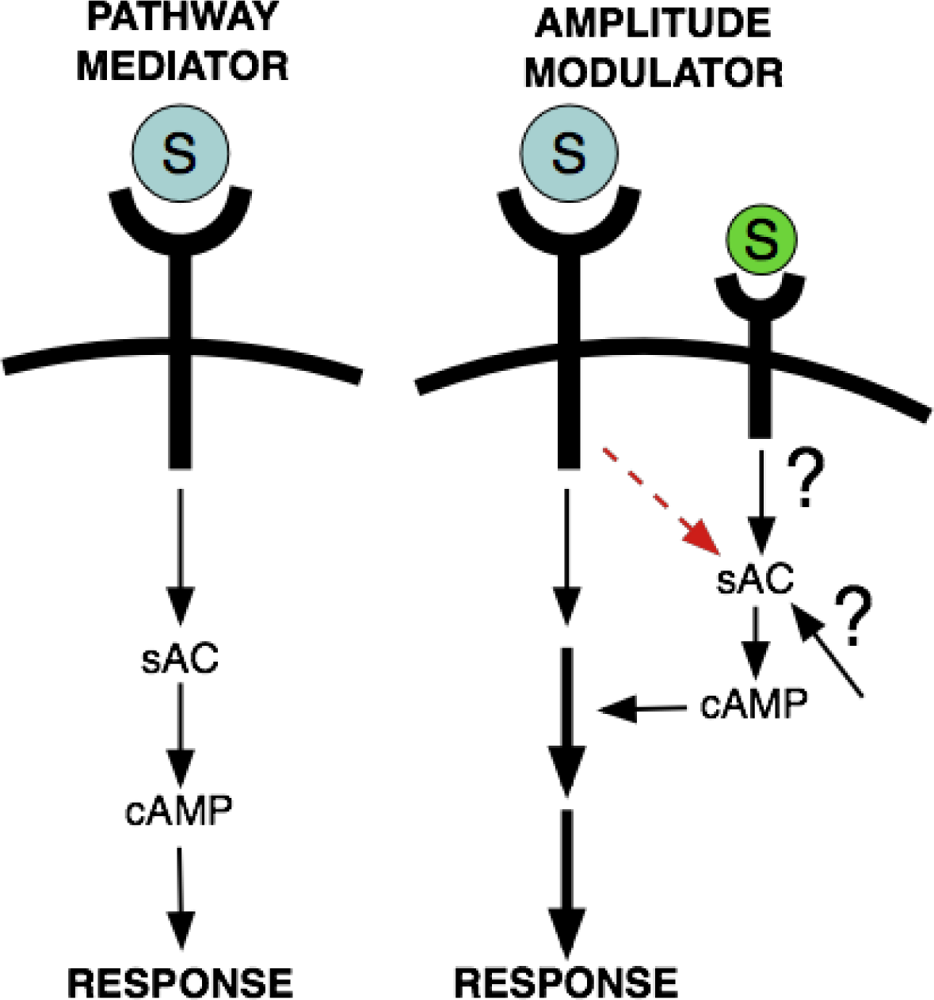
<p>The concept of cAMP as an amplitude or frequency modulator of other signaling pathways derives from an idea posited 15 years ago by Ravi Iyengar [<xref ref-type="bibr" rid="b7-sensors-11-02112">7</xref>]. In addition to its role as a signal mediator (Iyengar referred to this role as functioning as part of a “bucket-brigade” where cAMP is both necessary and sufficient to elicit a response), he suggested that cAMP might be functioning as a “gate” to regulate information flow through distinct signaling pathways. In his “gating” model, cAMP served a permissive role, turning a pathway on or off. Our studies of sAC have confirmed and extended this model for cAMP function; our studies identified a role for sAC-generated cAMP functioning like a rheostat, modulating intensity or frequency of a signaling pathway (<xref ref-type="fig" rid="f1-sensors-11-02112">Figure 1</xref>).</p>
<p>As described in more detail below, sAC is responsible for CO<sub>2</sub>-dependent regulation of oxidative phosphorylation in mitochondria [<xref ref-type="bibr" rid="b42-sensors-11-02112">42</xref>]. In performing this role, sAC-generated cAMP does not elicit a response on its own, but functions as an ‘amplitude modulator;’ it alters the rate of ATP production dependent upon the amount of metabolically generated CO<sub>2</sub>. sAC also has modulatory functions in the CO<sub>2</sub>-dependent regulation of beat frequency of cilia in airway epithelia [<xref ref-type="bibr" rid="b43-sensors-11-02112">43</xref>] and the HCO<sub>3</sub>-induced activation of sperm motility [<xref ref-type="bibr" rid="b44-sensors-11-02112">44</xref>–<xref ref-type="bibr" rid="b46-sensors-11-02112">46</xref>]; in both cases, sAC-generated cAMP alters the frequency of an already existing beating response (in cilia or flagella, respectively). Interestingly, sAC in sperm exhibits both types of functionalities; sAC-generated cAMP acts as a ‘frequency modulator’ to control the rate of flagellar beating for hyperactivated motility, but it also acts as an “on-off” pathway mediator, initiating swimming and the process of capacitation, the developmental program needed to enable sperm to penetrate and fertilize an egg [<xref ref-type="bibr" rid="b44-sensors-11-02112">44</xref>,<xref ref-type="bibr" rid="b45-sensors-11-02112">45</xref>,<xref ref-type="bibr" rid="b47-sensors-11-02112">47</xref>]. Other examples where cAMP seems to serve a “gating” function included growth factor activation of the MAP Kinase pathway [<xref ref-type="bibr" rid="b48-sensors-11-02112">48</xref>], long-range patterning induced by the diffusible morphogen, Sonic Hedgehog [<xref ref-type="bibr" rid="b49-sensors-11-02112">49</xref>–<xref ref-type="bibr" rid="b51-sensors-11-02112">51</xref>], long-term potentiation evoked by repeated stimulation in hippocampal CA1 region [<xref ref-type="bibr" rid="b52-sensors-11-02112">52</xref>], and neurotrophin-dependent survival and growth of neurons [<xref ref-type="bibr" rid="b53-sensors-11-02112">53</xref>]. Interestingly, these processes may also involve sAC [<xref ref-type="bibr" rid="b54-sensors-11-02112">54</xref>–<xref ref-type="bibr" rid="b58-sensors-11-02112">58</xref>].</p>
<p>‘Amplitude or frequency modulation’ provides a mechanism for cells to fine tune responses to a signal such that more (or less) signal is required to provide a consistent or maintained response. This property is particularly useful for a gradient morphogen or any diffusible signal that induces directional movement, such as a neuronal guidance cue, where a cell responds by moving up (or down) a concentration gradient.</p></sec>
<sec>
<label>2.</label>
<title>Discovery of sAC and Regulation by Bicarbonate</title>
<p>G protein regulated, transmembrane adenylyl cyclases (tmACs) mediate intracellular changes due to extracellular signals such as hormones and neurotransmitters binding to G protein coupled receptors (GPCRs); for a long time, these were thought to be the predominant (if not only) sources of cAMP in higher eukaryotes. In 1999, our laboratory purified and cloned mammalian soluble adenylyl cyclase (sAC) [<xref ref-type="bibr" rid="b59-sensors-11-02112">59</xref>] defining a unique signaling enzyme (<xref ref-type="table" rid="t1-sensors-11-02112">Table 1</xref>; Reviewed in [<xref ref-type="bibr" rid="b60-sensors-11-02112">60</xref>]). sAC is more closely related to (cyano)bacterial ACs than to tmACs or other metazoan cyclases providing a link between prokaryotic and eukaryotic signal transduction mechanisms. Isoform diversity for tmACs is generated via nine distinct genes; whereas for mammalian sAC, a single gene is alternatively spliced [<xref ref-type="bibr" rid="b61-sensors-11-02112">61</xref>,<xref ref-type="bibr" rid="b62-sensors-11-02112">62</xref>] and uses multiple promoters [<xref ref-type="bibr" rid="b63-sensors-11-02112">63</xref>]. Unlike tmACs, sACs are not transmembrane proteins and are found distributed throughout the cytoplasm and in specific organelles [<xref ref-type="bibr" rid="b9-sensors-11-02112">9</xref>,<xref ref-type="bibr" rid="b10-sensors-11-02112">10</xref>,<xref ref-type="bibr" rid="b15-sensors-11-02112">15</xref>] where they are thought to be the source of second messenger mediating the intracellular functions of cAMP [<xref ref-type="bibr" rid="b8-sensors-11-02112">8</xref>,<xref ref-type="bibr" rid="b15-sensors-11-02112">15</xref>]. As stated above, tmACs are directly modulated by heterotrimeric G proteins which transduce extracellular signals into intracellular cAMP changes. In contrast, sAC isoforms are insensitive to heterotrimeric G proteins [<xref ref-type="bibr" rid="b59-sensors-11-02112">59</xref>] but are instead regulated by intracellular signals, including bicarbonate [<xref ref-type="bibr" rid="b2-sensors-11-02112">2</xref>,<xref ref-type="bibr" rid="b64-sensors-11-02112">64</xref>–<xref ref-type="bibr" rid="b67-sensors-11-02112">67</xref>], calcium [<xref ref-type="bibr" rid="b68-sensors-11-02112">68</xref>,<xref ref-type="bibr" rid="b69-sensors-11-02112">69</xref>], and ATP [<xref ref-type="bibr" rid="b69-sensors-11-02112">69</xref>].</p>
<p>Structurally, sAC and tmACs are quite similar [<xref ref-type="bibr" rid="b70-sensors-11-02112">70</xref>]; both sAC [<xref ref-type="bibr" rid="b70-sensors-11-02112">70</xref>] and tmACs [<xref ref-type="bibr" rid="b71-sensors-11-02112">71</xref>] are active as dimers of two catalytic (C) units (Reviewed in [<xref ref-type="bibr" rid="b60-sensors-11-02112">60</xref>,<xref ref-type="bibr" rid="b72-sensors-11-02112">72</xref>]). However, structures (to a resolution of 1.9 Å) of various complexes of a bicarbonate- and calcium-regulated bacterial sAC-like cyclase with different substrate analogs provide a rationale for sAC-like cyclases’ insensitivity to heterotrimeric G proteins and their lower affinity for substrate ATP. These structures also reveal how calcium increases sAC-like cyclases’ affinity for ATP, and how bicarbonate stimulates catalytic rate. Bicarbonate regulation is conserved in sAC-like cyclases throughout evolution [<xref ref-type="bibr" rid="b2-sensors-11-02112">2</xref>,<xref ref-type="bibr" rid="b73-sensors-11-02112">73</xref>–<xref ref-type="bibr" rid="b76-sensors-11-02112">76</xref>] as well as in yeast adenylyl cyclases [<xref ref-type="bibr" rid="b77-sensors-11-02112">77</xref>–<xref ref-type="bibr" rid="b79-sensors-11-02112">79</xref>] and a number of transmembrane (<italic>i.e</italic>., receptor-type) guanylyl cyclases [<xref ref-type="bibr" rid="b80-sensors-11-02112">80</xref>–<xref ref-type="bibr" rid="b83-sensors-11-02112">83</xref>]; thus, bicarbonate regulation of cyclic nucleotide synthesis is poised to be an evolutionarily conserved mechanism for physiological sensing CO<sub>2</sub>/HCO<sub>3</sub>/pH. In this review, we focus specifically on the functions of sAC (and other bicarbonate-regulated cyclases) where it functions as a physiological CO<sub>2</sub>/HCO<sub>3</sub>/pH chemosensor. Broader reviews, describing the various functions of mammalian sAC [<xref ref-type="bibr" rid="b84-sensors-11-02112">84</xref>] and the variety of physiological CO<sub>2</sub>/HCO<sub>3</sub>/pH chemosensors [<xref ref-type="bibr" rid="b58-sensors-11-02112">58</xref>], have recently been published.</p></sec>
<sec>
<label>3.</label>
<title>Physiological CO<sub>2</sub>/HCO<sub>3</sub>/pH Chemosensing via sAC</title>
<sec>
<label>3.1.</label>
<title>Bicarbonate Activation of Sperm</title>
<p>Morphologically mature epididymal sperm do not have the “capacity” to fertilize an egg [<xref ref-type="bibr" rid="b85-sensors-11-02112">85</xref>]. They acquire fertilization-competence during ejaculation and transit through the female reproductive tract. Upon ejaculation, sperm acquire flagellar motility (<italic>i.e</italic>., swim) and begin a poorly defined maturation process called capacitation. Capacitation continues inside the female reproductive tract, where it includes hyperactivation of flagellar motility and attaining the ability to perforate the egg’s zona pellucida via the acrosome reaction. These events lead to binding and fusion to the egg’s plasma membrane and fertilization. At least two of these stages, motility and capacitation, are induced by bicarbonate [<xref ref-type="bibr" rid="b86-sensors-11-02112">86</xref>–<xref ref-type="bibr" rid="b89-sensors-11-02112">89</xref>] and dependent upon cAMP signaling [<xref ref-type="bibr" rid="b89-sensors-11-02112">89</xref>–<xref ref-type="bibr" rid="b92-sensors-11-02112">92</xref>].</p>
<p>We originally purified sAC from testis [<xref ref-type="bibr" rid="b59-sensors-11-02112">59</xref>] and sAC mRNA is highly expressed in male germ cells [<xref ref-type="bibr" rid="b93-sensors-11-02112">93</xref>]. At least two isoforms of sAC are present in male germ cells [<xref ref-type="bibr" rid="b44-sensors-11-02112">44</xref>]: a 187 kDa protein (“full length”, or sAC<sub>fl</sub>) and a shorter, 53 kDa variant (“truncated”, or sAC<sub>t</sub>) [<xref ref-type="bibr" rid="b59-sensors-11-02112">59</xref>]. sAC<sub>t</sub> has an approximately ten times higher specific activity than sAC<sub>fl</sub> [<xref ref-type="bibr" rid="b94-sensors-11-02112">94</xref>], and while both are found in testis and sperm [<xref ref-type="bibr" rid="b44-sensors-11-02112">44</xref>,<xref ref-type="bibr" rid="b95-sensors-11-02112">95</xref>,<xref ref-type="bibr" rid="b96-sensors-11-02112">96</xref>], sAC<sub>t</sub> appears to be responsible for the majority of cAMP production in mature sperm [<xref ref-type="bibr" rid="b44-sensors-11-02112">44</xref>,<xref ref-type="bibr" rid="b45-sensors-11-02112">45</xref>,<xref ref-type="bibr" rid="b47-sensors-11-02112">47</xref>,<xref ref-type="bibr" rid="b97-sensors-11-02112">97</xref>]. We (and others) demonstrated that the effects of bicarbonate on sperm are directly mediated by sAC [<xref ref-type="bibr" rid="b44-sensors-11-02112">44</xref>,<xref ref-type="bibr" rid="b45-sensors-11-02112">45</xref>,<xref ref-type="bibr" rid="b47-sensors-11-02112">47</xref>,<xref ref-type="bibr" rid="b97-sensors-11-02112">97</xref>]. Specifically, both motility [<xref ref-type="bibr" rid="b44-sensors-11-02112">44</xref>,<xref ref-type="bibr" rid="b47-sensors-11-02112">47</xref>,<xref ref-type="bibr" rid="b97-sensors-11-02112">97</xref>] and capacitation [<xref ref-type="bibr" rid="b44-sensors-11-02112">44</xref>,<xref ref-type="bibr" rid="b45-sensors-11-02112">45</xref>] are abrogated in sAC knockout mice and by the sAC-specific pharmacological inhibitor, KH7 [<xref ref-type="bibr" rid="b44-sensors-11-02112">44</xref>].</p></sec>
<sec>
<label>3.2.</label>
<title>pH Sensing</title>
<p>Prior to ejaculation, sperm are stored in the cauda epididymis where they are maintained in a quiescent state by an acidic pH of 6.5–6.8 and a low bicarbonate concentration of 2–7 mM (compared to 25 mM in serum, prostate and other bodily fluids) [<xref ref-type="bibr" rid="b98-sensors-11-02112">98</xref>]. In 2003, we demonstrated that sAC functions as a pH sensor in the clear cells of the epididymis to ensure that the luminal pH and bicarbonate concentration remain low [<xref ref-type="bibr" rid="b99-sensors-11-02112">99</xref>]. sAC is highly expressed in clear cells, and apical membrane accumulation of the proton pumping vacuolar ATPase (V-ATPase) is triggered by a sAC-dependent rise in cAMP in response to alkaline luminal pH. The apical mobilization of the V-ATPase is also dependent upon carbonic anhydrase (CA), the enzyme responsible for the nearly instantaneous equilibration of pH and HCO<sub>3</sub><sup>−</sup>, presumably facilitating sAC activation by bicarbonate in response to elevated pH.</p>
<p>sAC [<xref ref-type="bibr" rid="b76-sensors-11-02112">76</xref>], CA [<xref ref-type="bibr" rid="b100-sensors-11-02112">100</xref>], and V-ATPase [<xref ref-type="bibr" rid="b101-sensors-11-02112">101</xref>,<xref ref-type="bibr" rid="b102-sensors-11-02112">102</xref>] are also instrumental in regulating the recovery from alkalotic challenge in the dogfish shark. In the shark gill, which is the main acid-base sensing organ of this ancient vertebrate, alkalotic stress induces a sAC- and CA-dependent translocation of V-ATPase into the basolateral membrane of the gill. The V-ATPase then pumps protons back into the body to counter the systemic alkalosis. Additionally, sAC forms a complex with the V-ATPase in acid-base transporting intercalated cells in mammalian kidney [<xref ref-type="bibr" rid="b103-sensors-11-02112">103</xref>], and sAC, CA and V-ATPase are postulated to mediate proton secretion from acid (A-type) secreting cells into the renal collecting duct [<xref ref-type="bibr" rid="b104-sensors-11-02112">104</xref>]. Thus, sAC, CA and V-ATPase seem to form a functional unit for sensing, and responding to, alterations in pH [<xref ref-type="bibr" rid="b105-sensors-11-02112">105</xref>]. Interestingly, the sAC-CA-V-ATPase mechanism is capable of moving the proton transporter to wherever it is needed; <italic>i.e.</italic>, the V-ATPase translocates to the apical membranes in clear cells of the epididymis and A-type cells of the renal collecting duct while it moves to the basolateral membrane in the shark gill. Because sAC, CA, and V-ATPase are evolutionarily ancient, it is tempting to hypothesize that this functional unit for sensing pH and moving protons to correct pH imbalances will be found widely utilized throughout biology.</p></sec>
<sec>
<label>3.3.</label>
<title>CO<sub>2</sub> Regulation of Beating Frequency of Cilia on Airway Epithelia</title>
<p>Airway epithelial cells express motile cilia that are important for innate host defense; the beat of the cilia removes the mucous layer clearing toxins, pathogens, allergens, and debris [<xref ref-type="bibr" rid="b106-sensors-11-02112">106</xref>]. To accomplish this feat, cilia beat faster during exhalation relative to inhalation. Exhaled breath has higher CO<sub>2</sub> than inspired air. sAC ‘senses’ this elevated CO<sub>2</sub>, and sAC-generated cAMP activates PKA which increases the frequency of ciliary beating during exhalation [<xref ref-type="bibr" rid="b43-sensors-11-02112">43</xref>]. This represents an example where sAC-generated cAMP acts as a pathway modulator; CO<sub>2</sub> chemosensing via sAC controls the rate of ciliary beating, not whether or not the cilia beat.</p></sec>
<sec>
<label>3.4.</label>
<title>Krebs Cycle Generated CO<sub>2</sub> Regulates the Rate of Oxidative Phosphorylation</title>
<p>sAC resides inside mitochondria [<xref ref-type="bibr" rid="b9-sensors-11-02112">9</xref>,<xref ref-type="bibr" rid="b15-sensors-11-02112">15</xref>,<xref ref-type="bibr" rid="b107-sensors-11-02112">107</xref>] where it coordinates the rate of ATP production via oxidative phosphorylation (OXPHOS) with nutritional availability. Mitochondrial sAC activity is stimulated by Krebs Cycle-generated CO<sub>2</sub> in a carbonic anhydrase dependent manner [<xref ref-type="bibr" rid="b15-sensors-11-02112">15</xref>]. CO<sub>2</sub>/HCO<sub>3</sub><sup>−</sup> stimulation of sAC activates intramitochondrial PKA which phosphorylates Complex IV of the electron transport chain, increasing its rate and capacity to handle electrons. Because the electrons feeding the electron transport chain also originate from the Krebs Cycle, this mitochondrial CO<sub>2</sub>-sAC-cAMP-PKA pathway couples nutrient utilization (<italic>i.e</italic>., Krebs Cycle activity) to ATP production. Once again, this pathway does not turn on or off the electron transport chain, it simply modulates the rate of ATP generation to ensure optimal utilization of electrons.</p></sec>
<sec>
<label>3.5.</label>
<title>Physiological Processes Dependent upon CO<sub>2</sub>/HCO<sub>3</sub>/pH which May Involve sAC</title>
<p>There are a number of physiological processes where CO<sub>2</sub>/HCO<sub>3</sub>/pH chemosensing is known to play a role, but the chemosensor is not yet identified. Some are even thought to employ cAMP as a second messenger, but involvement of sAC has yet been demonstrated. For example, bone resorption by osteoclasts is thought to be mediated via V-ATPase dependent proton pumping [<xref ref-type="bibr" rid="b108-sensors-11-02112">108</xref>]. And while sAC seems to regulate growth and differentiation of osteoclasts [<xref ref-type="bibr" rid="b109-sensors-11-02112">109</xref>], there is only circumstantial evidence that sAC plays a role in bone formation. Human sAC was identified as a locus for absorptive hypercalciuria (AH), a kidney stone-forming condition frequently complicated by bone loss [<xref ref-type="bibr" rid="b110-sensors-11-02112">110</xref>], and polymorphisms in the human sAC locus are associated with phenotypic variations in bone mineral density [<xref ref-type="bibr" rid="b111-sensors-11-02112">111</xref>].</p>
<p>Cerebrospinal fluid formation (CSF) by the choroid plexus and aqueous humor formation by ocular ciliary processes are dependent on bicarbonate [<xref ref-type="bibr" rid="b112-sensors-11-02112">112</xref>,<xref ref-type="bibr" rid="b113-sensors-11-02112">113</xref>]. In ciliary processes and choroid plexus transport systems, carbonic anhydrase inhibitors decrease fluid secretion [<xref ref-type="bibr" rid="b114-sensors-11-02112">114</xref>], and carbonic anhydrase inhibitors can be used to treat glaucoma, a fluid secretion defect in the eye. sAC seems to be present in choroid plexus [<xref ref-type="bibr" rid="b2-sensors-11-02112">2</xref>] and in ciliary processes [<xref ref-type="bibr" rid="b115-sensors-11-02112">115</xref>], but as yet, there have been no functional studies linking sAC to either process.</p>
<p>Partial CO<sub>2</sub> pressure (PCO<sub>2</sub>) is the main determinant of ventilation rate [<xref ref-type="bibr" rid="b1-sensors-11-02112">1</xref>]. Elevations of PCO<sub>2</sub> increase breathing frequency, while decreased PCO<sub>2</sub> slows breathing frequency. These rate changes are mediated by peripheral and central chemoreceptors which monitor changes in arterial PO<sub>2</sub> and PCO<sub>2</sub> blood gases. The peripheral chemoreceptors are in the carotid and aortic bodies, and their actions have long been thought to be due to alterations in intracellular pH (pH<sub>i</sub>). However, studies in the chemosensitive (glomus) cells of the carotid body reveal a direct role for CO<sub>2</sub>, independent of pH<sub>i</sub> [<xref ref-type="bibr" rid="b116-sensors-11-02112">116</xref>]. These studies also demonstrated that elevations in PCO<sub>2</sub> elicited an increase in glomus cell cAMP leading the authors to suggest involvement of sAC. PCO<sub>2</sub> also plays a role in regulating blood flow. Blood flow is tightly coupled to tissue metabolism [<xref ref-type="bibr" rid="b1-sensors-11-02112">1</xref>]; cerebral arterioles dilate in response to increases in metabolic activity, and CO<sub>2</sub>, protons, and adenosine function as vasodilators by relaxing smooth muscles. Cerebral arterioles are exquisitely sensitive to the vasodilatory action of PCO<sub>2</sub>; however, the molecular nature of the vascular PCO<sub>2</sub> receptor is unknown. Interestingly, cAMP was postulated to be downstream of the CO<sub>2</sub> signal [<xref ref-type="bibr" rid="b117-sensors-11-02112">117</xref>], but once again, functional studies assessing sAC’s role in sensing circulating PCO<sub>2</sub> have not yet been performed.</p></sec></sec>
<sec>
<label>4.</label>
<title>Evolutionary Conservation of Physiological CO<sub>2</sub>/HCO<sub>3</sub>/pH Chemosensing via Nucleotidyl Cyclases</title>
<sec>
<label>4.1.</label>
<title>Fungal Adenylyl Cyclases Integrate CO<sub>2</sub> Sensing with cAMP Signaling and Virulence</title>
<p>The CO<sub>2</sub> concentration in mammals (5%) is more than 150 fold higher than in atmospheric air (0.033%). We identified this difference in CO<sub>2</sub> as a physiological signal inducing the yeast-to-hyphal transition essential for virulence of the fungal pathogen, <italic>Candida albicans</italic> [<xref ref-type="bibr" rid="b77-sensors-11-02112">77</xref>]. The <italic>C. albicans</italic> adenylyl cyclase (AC) is directly stimulated by HCO<sub>3</sub>, and it is responsible for ‘sensing’ in a carbonic anhydrase dependent manner, the elevated CO<sub>2</sub> inside infected hosts. CO<sub>2</sub>/HCO<sub>3</sub> regulation of cAMP synthesis is conserved in other fungi. In the fungal pathogen <italic>Cryptococcus neoformans</italic>, capsule formation is essential for evading host immune detection. Once again, the signal inducing capsule formation is the higher CO<sub>2</sub> concentration inside the infected host, and the <italic>C. neoformans</italic> cyclase serves as the pathogen’s CO<sub>2</sub>/HCO<sub>3</sub> chemosensor [<xref ref-type="bibr" rid="b78-sensors-11-02112">78</xref>].</p></sec>
<sec>
<label>4.2.</label>
<title>CO<sub>2</sub> Chemosensing via cGMP Signaling</title>
<p>The nematode <italic>Caenorhabditis elegans</italic> also senses environmental CO<sub>2</sub>. In contrast to many parasitic nematodes, the free-living <italic>C. elegans</italic> avoids CO<sub>2</sub> [<xref ref-type="bibr" rid="b118-sensors-11-02112">118</xref>,<xref ref-type="bibr" rid="b119-sensors-11-02112">119</xref>], and this response is dependent upon expression of the GCY-9 receptor-type guanylyl cyclase (along with cyclic nucleotide gated ion channels) in the CO<sub>2</sub> chemosensing (BAG) sensory neurons [<xref ref-type="bibr" rid="b120-sensors-11-02112">120</xref>]. Interestingly, <italic>C. elegans</italic> also avoid high levels (in excess of 12%) of oxygen; this response is mediated by a distinct subset of sensory neurons, but it also involves a receptor-type guanylyl cyclase (GCY-35) and cyclic nucleotide gated channels [<xref ref-type="bibr" rid="b121-sensors-11-02112">121</xref>].</p>
<p>The fruit fly <italic>Drosophila melanogaster</italic> also avoids environmental CO<sub>2</sub>, and while this response requires two GPCR-like olfactory receptors [<xref ref-type="bibr" rid="b122-sensors-11-02112">122</xref>], involvement of a cyclic nucleotide second messenger remains unclear [<xref ref-type="bibr" rid="b123-sensors-11-02112">123</xref>]. In mammals, the question of sensing environmental CO<sub>2</sub> via cyclic nucleotides also remains unresolved. A particular subset of olfactory neurons in mice seemed to be capable of sensing concentrations of CO<sub>2</sub> approaching environmental levels [<xref ref-type="bibr" rid="b124-sensors-11-02112">124</xref>]. These neurons express a transmembrane guanylyl cyclase, GC-D, which was subsequently demonstrated to be bicarbonate regulated [<xref ref-type="bibr" rid="b82-sensors-11-02112">82</xref>,<xref ref-type="bibr" rid="b83-sensors-11-02112">83</xref>]. A second transmembrane guanylyl cyclase, GC-G, which is also found in the olfactory system, has also been demonstrated to be directly modulated by bicarbonate [<xref ref-type="bibr" rid="b80-sensors-11-02112">80</xref>]. Sensory detection of environmental CO<sub>2</sub> in a number of organisms was recently reviewed in [<xref ref-type="bibr" rid="b125-sensors-11-02112">125</xref>]. While these findings cement the linkage between CO<sub>2</sub>/HCO<sub>3</sub>/pH chemosensing and cyclic nucleotide signal transduction, their physiological significance remains unknown.</p></sec></sec>
<sec sec-type="conclusions">
<label>5.</label>
<title>Summary and Future Trends</title>
<p>In physiological systems, CO<sub>2</sub>, HCO<sub>3</sub><sup>−</sup>, and pH are intimately linked via carbonic anhydrases, and a variety of biological processes, in mammals and throughout evolution, depend upon a CO<sub>2</sub>/HCO<sub>3</sub>/pH chemosensor. Bicarbonate-regulated sAC, which links intracellular CO<sub>2</sub>, HCO<sub>3</sub><sup>−</sup>, and/or pH levels with cAMP signal transduction, serves as the CO<sub>2</sub>/HCO<sub>3</sub>/pH chemosensor in at least a subset of these processes. The future will reveal whether other CO<sub>2</sub>/HCO<sub>3</sub>/pH chemosensing functions are also mediated by sAC. Bicarbonate regulation is observed in other mammalian nucleotidyl cyclases and in adenylyl cyclases across evolution implying that cyclic nucleotide signaling is an evolutionarily conserved mechanism for CO<sub>2</sub>/HCO<sub>3</sub>/pH chemosensing.</p></sec></body>
<back>
<ref-list>
<title>References</title>
<ref id="b1-sensors-11-02112"><label>1.</label><citation citation-type="book"><person-group person-group-type="author"><name><surname>Johnson</surname><given-names>L.R.</given-names></name></person-group><source>Essential Medical Physiology</source><edition>2nd ed</edition><publisher-name>Lippincott-Raven</publisher-name><publisher-loc>Philadelphia, PA, USA</publisher-loc><year>1998</year></citation></ref>
<ref id="b2-sensors-11-02112"><label>2.</label><citation citation-type="journal"><person-group person-group-type="author"><name><surname>Chen</surname><given-names>Y.</given-names></name><name><surname>Cann</surname><given-names>M.J.</given-names></name><name><surname>Litvin</surname><given-names>T.N.</given-names></name><name><surname>Iourgenko</surname><given-names>V.</given-names></name><name><surname>Sinclair</surname><given-names>M.L.</given-names></name><name><surname>Levin</surname><given-names>L.R.</given-names></name><name><surname>Buck</surname><given-names>J.</given-names></name></person-group><article-title>Soluble adenylyl cyclase as an evolutionarily conserved bicarbonate sensor</article-title><source>Science</source><year>2000</year><volume>289</volume><fpage>625</fpage><lpage>628</lpage><pub-id pub-id-type="doi">10.1126/science.289.5479.625</pub-id><pub-id pub-id-type="pmid">10915626</pub-id></citation></ref>
<ref id="b3-sensors-11-02112"><label>3.</label><citation citation-type="journal"><person-group person-group-type="author"><name><surname>Robison</surname><given-names>G.A.</given-names></name><name><surname>Butcher</surname><given-names>R.W.</given-names></name><name><surname>Sutherland</surname><given-names>E.W.</given-names></name></person-group><article-title>Cyclic AMP</article-title><source>Ann. Rev. Biochem</source><year>1968</year><volume>37</volume><fpage>149</fpage><lpage>174</lpage><pub-id pub-id-type="doi">10.1146/annurev.bi.37.070168.001053</pub-id><pub-id pub-id-type="pmid">4299844</pub-id></citation></ref>
<ref id="b4-sensors-11-02112"><label>4.</label><citation citation-type="journal"><person-group person-group-type="author"><name><surname>Berrera</surname><given-names>M.</given-names></name><name><surname>Dodoni</surname><given-names>G.</given-names></name><name><surname>Monterisi</surname><given-names>S.</given-names></name><name><surname>Pertegato</surname><given-names>V.</given-names></name><name><surname>Zamparo</surname><given-names>I.</given-names></name><name><surname>Zaccolo</surname><given-names>M.</given-names></name></person-group><article-title>A toolkit for real-time detection of cAMP: Insights into compartmentalized signaling</article-title><source>Handb. Exp. Pharmacol</source><year>2008</year><volume>186</volume><fpage>186285</fpage><lpage>186298</lpage></citation></ref>
<ref id="b5-sensors-11-02112"><label>5.</label><citation citation-type="journal"><person-group person-group-type="author"><name><surname>Willoughby</surname><given-names>D.</given-names></name><name><surname>Cooper</surname><given-names>D.M.</given-names></name></person-group><article-title>Live-cell imaging of cAMP dynamics</article-title><source>Nat. Methods</source><year>2008</year><volume>5</volume><fpage>29</fpage><lpage>36</lpage><pub-id pub-id-type="doi">10.1038/nmeth1135</pub-id><pub-id pub-id-type="pmid">18165805</pub-id></citation></ref>
<ref id="b6-sensors-11-02112"><label>6.</label><citation citation-type="journal"><person-group person-group-type="author"><name><surname>Zaccolo</surname><given-names>M.</given-names></name></person-group><article-title>cAMP signal transduction in the heart: Understanding spatial control for the development of novel therapeutic strategies</article-title><source>Br. J. Pharmacol</source><year>2009</year><volume>158</volume><fpage>50</fpage><lpage>60</lpage><pub-id pub-id-type="doi">10.1111/j.1476-5381.2009.00185.x</pub-id><pub-id pub-id-type="pmid">19371331</pub-id></citation></ref>
<ref id="b7-sensors-11-02112"><label>7.</label><citation citation-type="journal"><person-group person-group-type="author"><name><surname>Iyengar</surname><given-names>R.</given-names></name></person-group><article-title>Gating by cyclic AMP: Expanded role for an old signaling pathway</article-title><source>Science</source><year>1996</year><volume>271</volume><fpage>461</fpage><lpage>463</lpage><pub-id pub-id-type="doi">10.1126/science.271.5248.461</pub-id><pub-id pub-id-type="pmid">8560257</pub-id></citation></ref>
<ref id="b8-sensors-11-02112"><label>8.</label><citation citation-type="journal"><person-group person-group-type="author"><name><surname>Bundey</surname><given-names>R.A.</given-names></name><name><surname>Insel</surname><given-names>P.A.</given-names></name></person-group><article-title>Discrete intracellular signaling domains of soluble adenylyl cyclase: Camps of cAMP?</article-title><source>Sci. STKE</source><year>2004</year><volume>2004</volume><fpage>pe19</fpage><pub-id pub-id-type="doi">10.1126/stke.2312004pe19</pub-id><pub-id pub-id-type="pmid">15126677</pub-id></citation></ref>
<ref id="b9-sensors-11-02112"><label>9.</label><citation citation-type="journal"><person-group person-group-type="author"><name><surname>Zippin</surname><given-names>J.H.</given-names></name><name><surname>Chen</surname><given-names>Y.</given-names></name><name><surname>Nahirney</surname><given-names>P.</given-names></name><name><surname>Kamenetsky</surname><given-names>M.</given-names></name><name><surname>Wuttke</surname><given-names>M.S.</given-names></name><name><surname>Fischman</surname><given-names>D.A.</given-names></name><name><surname>Levin</surname><given-names>L.R.</given-names></name><name><surname>Buck</surname><given-names>J.</given-names></name></person-group><article-title>Compartmentalization of bicarbonate-sensitive adenylyl cyclase in distinct signaling microdomains</article-title><source>Faseb. J</source><year>2003</year><volume>17</volume><fpage>82</fpage><lpage>84</lpage><pub-id pub-id-type="pmid">12475901</pub-id></citation></ref>
<ref id="b10-sensors-11-02112"><label>10.</label><citation citation-type="journal"><person-group person-group-type="author"><name><surname>Zippin</surname><given-names>J.H.</given-names></name><name><surname>Farrell</surname><given-names>J.</given-names></name><name><surname>Huron</surname><given-names>D.</given-names></name><name><surname>Kamenetsky</surname><given-names>M.</given-names></name><name><surname>Hess</surname><given-names>K.C.</given-names></name><name><surname>Fischman</surname><given-names>D.A.</given-names></name><name><surname>Levin</surname><given-names>L.R.</given-names></name><name><surname>Buck</surname><given-names>J.</given-names></name></person-group><article-title>Bicarbonate-responsive “soluble” adenylyl cyclase defines a nuclear cAMP microdomain</article-title><source>J. Cell Biol</source><year>2004</year><volume>164</volume><fpage>527</fpage><lpage>534</lpage><pub-id pub-id-type="doi">10.1083/jcb.200311119</pub-id><pub-id pub-id-type="pmid">14769862</pub-id></citation></ref>
<ref id="b11-sensors-11-02112"><label>11.</label><citation citation-type="journal"><person-group person-group-type="author"><name><surname>Terrin</surname><given-names>A.</given-names></name><name><surname>Di Benedetto</surname><given-names>G.</given-names></name><name><surname>Pertegato</surname><given-names>V.</given-names></name><name><surname>Cheung</surname><given-names>Y.F.</given-names></name><name><surname>Baillie</surname><given-names>G.</given-names></name><name><surname>Lynch</surname><given-names>M.J.</given-names></name><name><surname>Elvassore</surname><given-names>N.</given-names></name><name><surname>Prinz</surname><given-names>A.</given-names></name><name><surname>Herberg</surname><given-names>F.W.</given-names></name><name><surname>Houslay</surname><given-names>M.D.</given-names></name><name><surname>Zaccolo</surname><given-names>M.</given-names></name></person-group><article-title>PGE(1) stimulation of HEK293 cells generates multiple contiguous domains with different [cAMP]: Role of compartmentalized phosphodiesterases</article-title><source>J. Cell Biol</source><year>2006</year><volume>175</volume><fpage>441</fpage><lpage>451</lpage><pub-id pub-id-type="doi">10.1083/jcb.200605050</pub-id><pub-id pub-id-type="pmid">17088426</pub-id></citation></ref>
<ref id="b12-sensors-11-02112"><label>12.</label><citation citation-type="journal"><person-group person-group-type="author"><name><surname>Gervasi</surname><given-names>N.</given-names></name><name><surname>TchÈnio</surname><given-names>P.</given-names></name><name><surname>Preat</surname><given-names>T.</given-names></name></person-group><article-title>PKA dynamics in a drosophila learning center: Coincidence detection by rutabaga adenylyl cyclase and spatial regulation by dunce phosphodiesterase</article-title><year>2010</year><volume>65</volume><fpage>516</fpage><lpage>529</lpage></citation></ref>
<ref id="b13-sensors-11-02112"><label>13.</label><citation citation-type="journal"><person-group person-group-type="author"><name><surname>Houslay</surname><given-names>M.D.</given-names></name></person-group><article-title>Underpinning compartmentalised cAMP signalling through targeted cAMP breakdown</article-title><source>Trends Biochem. Sci</source><year>2010</year><volume>35</volume><fpage>91</fpage><lpage>100</lpage><pub-id pub-id-type="doi">10.1016/j.tibs.2009.09.007</pub-id><pub-id pub-id-type="pmid">19864144</pub-id></citation></ref>
<ref id="b14-sensors-11-02112"><label>14.</label><citation citation-type="journal"><person-group person-group-type="author"><name><surname>Mongillo</surname><given-names>M.</given-names></name><name><surname>McSorley</surname><given-names>T.</given-names></name><name><surname>Evellin</surname><given-names>S.</given-names></name><name><surname>Sood</surname><given-names>A.</given-names></name><name><surname>Lissandron</surname><given-names>V.</given-names></name><name><surname>Terrin</surname><given-names>A.</given-names></name><name><surname>Huston</surname><given-names>E.</given-names></name><name><surname>Hannawacker</surname><given-names>A.</given-names></name><name><surname>Lohse</surname><given-names>M.J.</given-names></name><name><surname>Pozzan</surname><given-names>T.</given-names></name><name><surname>Houslay</surname><given-names>M.D.</given-names></name><name><surname>Zaccolo</surname><given-names>M.</given-names></name></person-group><article-title>Fluorescence resonance energy transfer-based analysis of cAMP dynamics in live neonatal rat cardiac myocytes reveals distinct functions of compartmentalized phosphodiesterases</article-title><source>Circ. Res</source><year>2004</year><volume>95</volume><fpage>67</fpage><lpage>75</lpage><pub-id pub-id-type="doi">10.1161/01.RES.0000134629.84732.11</pub-id><pub-id pub-id-type="pmid">15178638</pub-id></citation></ref>
<ref id="b15-sensors-11-02112"><label>15.</label><citation citation-type="journal"><person-group person-group-type="author"><name><surname>Acin-Perez</surname><given-names>R.</given-names></name><name><surname>Salazar</surname><given-names>E.</given-names></name><name><surname>Kamenetsky</surname><given-names>M.</given-names></name><name><surname>Buck</surname><given-names>J.</given-names></name><name><surname>Levin</surname><given-names>L.R.</given-names></name><name><surname>Manfredi</surname><given-names>G.</given-names></name></person-group><article-title>Cyclic AMP produced inside mitochondria regulates oxidative phosphorylation</article-title><source>Cell Metab</source><year>2009</year><volume>9</volume><fpage>265</fpage><lpage>276</lpage><pub-id pub-id-type="doi">10.1016/j.cmet.2009.01.012</pub-id><pub-id pub-id-type="pmid">19254571</pub-id></citation></ref>
<ref id="b16-sensors-11-02112"><label>16.</label><citation citation-type="journal"><person-group person-group-type="author"><name><surname>Beene</surname><given-names>D.L.</given-names></name><name><surname>Scott</surname><given-names>J.D.</given-names></name></person-group><article-title>A-kinase anchoring proteins take shape</article-title><source>Curr. Opin. Cell Biol</source><year>2007</year><volume>19</volume><fpage>192</fpage><lpage>198</lpage><pub-id pub-id-type="doi">10.1016/j.ceb.2007.02.011</pub-id><pub-id pub-id-type="pmid">17317140</pub-id></citation></ref>
<ref id="b17-sensors-11-02112"><label>17.</label><citation citation-type="journal"><person-group person-group-type="author"><name><surname>Carnegie</surname><given-names>G.K.</given-names></name><name><surname>Means</surname><given-names>C.K.</given-names></name><name><surname>Scott</surname><given-names>J.D.</given-names></name></person-group><article-title>A-kinase anchoring proteins: From protein complexes to physiology and disease</article-title><source>IUBMB Life</source><year>2009</year><volume>61</volume><fpage>394</fpage><lpage>406</lpage><pub-id pub-id-type="doi">10.1002/iub.168</pub-id><pub-id pub-id-type="pmid">19319965</pub-id></citation></ref>
<ref id="b18-sensors-11-02112"><label>18.</label><citation citation-type="journal"><person-group person-group-type="author"><name><surname>Bauman</surname><given-names>A.L.</given-names></name><name><surname>Soughayer</surname><given-names>J.</given-names></name><name><surname>Nguyen</surname><given-names>B.T.</given-names></name><name><surname>Willoughby</surname><given-names>D.</given-names></name><name><surname>Carnegie</surname><given-names>G.K.</given-names></name><name><surname>Wong</surname><given-names>W.</given-names></name><name><surname>Hoshi</surname><given-names>N.</given-names></name><name><surname>Langeberg</surname><given-names>L.K.</given-names></name><name><surname>Cooper</surname><given-names>D.M.</given-names></name><name><surname>Dessauer</surname><given-names>C.W.</given-names></name><name><surname>Scott</surname><given-names>J.D.</given-names></name></person-group><article-title>Dynamic regulation of cAMP synthesis through anchored PKA-adenylyl cyclase V/VI complexes</article-title><source>Mol. Cell</source><year>2006</year><volume>23</volume><fpage>925</fpage><lpage>931</lpage><pub-id pub-id-type="doi">10.1016/j.molcel.2006.07.025</pub-id><pub-id pub-id-type="pmid">16973443</pub-id></citation></ref>
<ref id="b19-sensors-11-02112"><label>19.</label><citation citation-type="journal"><person-group person-group-type="author"><name><surname>Efendiev</surname><given-names>R.</given-names></name><name><surname>Samelson</surname><given-names>B.K.</given-names></name><name><surname>Nguyen</surname><given-names>B.T.</given-names></name><name><surname>Phatarpekar</surname><given-names>P.V.</given-names></name><name><surname>Baameur</surname><given-names>F.</given-names></name><name><surname>Scott</surname><given-names>J.D.</given-names></name><name><surname>Dessauer</surname><given-names>C.W.</given-names></name></person-group><article-title>AKAP79 interacts with multiple adenylyl cyclase (AC) isoforms and scaffolds AC5 and -6 to alpha-amino-3-hydroxyl-5-methyl-4-isoxazole-propionate (AMPA) receptors</article-title><source>J. Biol. Chem</source><year>2010</year><volume>285</volume><fpage>14450</fpage><lpage>14458</lpage><pub-id pub-id-type="doi">10.1074/jbc.M110.109769</pub-id><pub-id pub-id-type="pmid">20231277</pub-id></citation></ref>
<ref id="b20-sensors-11-02112"><label>20.</label><citation citation-type="journal"><person-group person-group-type="author"><name><surname>Piggott</surname><given-names>L.A.</given-names></name><name><surname>Bauman</surname><given-names>A.L.</given-names></name><name><surname>Scott</surname><given-names>J.D.</given-names></name><name><surname>Dessauer</surname><given-names>C.W.</given-names></name></person-group><article-title>The A-kinase anchoring protein Yotiao binds and regulates adenylyl cyclase in brain</article-title><source>Proc. Natl. Acad. Sci. USA</source><year>2008</year><volume>105</volume><fpage>13835</fpage><lpage>13840</lpage><pub-id pub-id-type="doi">10.1073/pnas.0712100105</pub-id><pub-id pub-id-type="pmid">18772391</pub-id></citation></ref>
<ref id="b21-sensors-11-02112"><label>21.</label><citation citation-type="journal"><person-group person-group-type="author"><name><surname>Dodge</surname><given-names>K.L.</given-names></name><name><surname>Khouangsathiene</surname><given-names>S.</given-names></name><name><surname>Kapiloff</surname><given-names>M.S.</given-names></name><name><surname>Mouton</surname><given-names>R.</given-names></name><name><surname>Hill</surname><given-names>E.V.</given-names></name><name><surname>Houslay</surname><given-names>M.D.</given-names></name><name><surname>Langeberg</surname><given-names>L.K.</given-names></name><name><surname>Scott</surname><given-names>J.D.</given-names></name></person-group><article-title>mAKAP assembles a protein kinase A/PDE4 phosphodiesterase cAMP signaling module</article-title><source>Embo J</source><year>2001</year><volume>20</volume><fpage>1921</fpage><lpage>1930</lpage><pub-id pub-id-type="doi">10.1093/emboj/20.8.1921</pub-id><pub-id pub-id-type="pmid">11296225</pub-id></citation></ref>
<ref id="b22-sensors-11-02112"><label>22.</label><citation citation-type="journal"><person-group person-group-type="author"><name><surname>Tasken</surname><given-names>K.A.</given-names></name><name><surname>Collas</surname><given-names>P.</given-names></name><name><surname>Kemmner</surname><given-names>W.A.</given-names></name><name><surname>Witczak</surname><given-names>O.</given-names></name><name><surname>Conti</surname><given-names>M.</given-names></name><name><surname>Tasken</surname><given-names>K.</given-names></name></person-group><article-title>Phosphodiesterase 4D and protein kinase a type II constitute a signaling unit in the centrosomal area</article-title><source>J. Biol. Chem</source><year>2001</year><volume>276</volume><fpage>21999</fpage><lpage>22002</lpage><pub-id pub-id-type="doi">10.1074/jbc.C000911200</pub-id><pub-id pub-id-type="pmid">11285255</pub-id></citation></ref>
<ref id="b23-sensors-11-02112"><label>23.</label><citation citation-type="journal"><person-group person-group-type="author"><name><surname>Baillie</surname><given-names>G.S.</given-names></name><name><surname>Houslay</surname><given-names>M.D.</given-names></name></person-group><article-title>Arrestin times for compartmentalised cAMP signalling and phosphodiesterase-4 enzymes</article-title><source>Curr. Opin. Cell Biol</source><year>2005</year><volume>17</volume><fpage>129</fpage><lpage>134</lpage><pub-id pub-id-type="doi">10.1016/j.ceb.2005.01.003</pub-id><pub-id pub-id-type="pmid">15780588</pub-id></citation></ref>
<ref id="b24-sensors-11-02112"><label>24.</label><citation citation-type="journal"><person-group person-group-type="author"><name><surname>Bajpai</surname><given-names>M.</given-names></name><name><surname>Fiedler</surname><given-names>S.E.</given-names></name><name><surname>Huang</surname><given-names>Z.</given-names></name><name><surname>Vijayaraghavan</surname><given-names>S.</given-names></name><name><surname>Olson</surname><given-names>G.E.</given-names></name><name><surname>Livera</surname><given-names>G.</given-names></name><name><surname>Conti</surname><given-names>M.</given-names></name><name><surname>Carr</surname><given-names>D.W.</given-names></name></person-group><article-title>AKAP3 selectively binds PDE4A isoforms in bovine spermatozoa</article-title><source>Biol. Reprod</source><year>2006</year><volume>74</volume><fpage>109</fpage><lpage>118</lpage><pub-id pub-id-type="pmid">16177223</pub-id></citation></ref>
<ref id="b25-sensors-11-02112"><label>25.</label><citation citation-type="journal"><person-group person-group-type="author"><name><surname>McSorley</surname><given-names>T.</given-names></name><name><surname>Stefan</surname><given-names>E.</given-names></name><name><surname>Henn</surname><given-names>V.</given-names></name><name><surname>Wiesner</surname><given-names>B.</given-names></name><name><surname>Baillie</surname><given-names>G.S.</given-names></name><name><surname>Houslay</surname><given-names>M.D.</given-names></name><name><surname>Rosenthal</surname><given-names>W.</given-names></name><name><surname>Klussmann</surname><given-names>E.</given-names></name></person-group><article-title>Spatial organisation of AKAP18 and PDE4 isoforms in renal collecting duct principal cells</article-title><source>Eur. J. Cell Biol</source><year>2006</year><volume>85</volume><fpage>673</fpage><lpage>678</lpage><pub-id pub-id-type="doi">10.1016/j.ejcb.2006.01.005</pub-id><pub-id pub-id-type="pmid">16500722</pub-id></citation></ref>
<ref id="b26-sensors-11-02112"><label>26.</label><citation citation-type="journal"><person-group person-group-type="author"><name><surname>Willoughby</surname><given-names>D.</given-names></name><name><surname>Wong</surname><given-names>W.</given-names></name><name><surname>Schaack</surname><given-names>J.</given-names></name><name><surname>Scott</surname><given-names>J.D.</given-names></name><name><surname>Cooper</surname><given-names>D.M.</given-names></name></person-group><article-title>An anchored PKA and PDE4 complex regulates subplasmalemmal cAMP dynamics</article-title><source>Embo J</source><year>2006</year><volume>25</volume><fpage>2051</fpage><lpage>2061</lpage><pub-id pub-id-type="doi">10.1038/sj.emboj.7601113</pub-id><pub-id pub-id-type="pmid">16642035</pub-id></citation></ref>
<ref id="b27-sensors-11-02112"><label>27.</label><citation citation-type="journal"><person-group person-group-type="author"><name><surname>Paulucci-Holthauzen</surname><given-names>A.A.</given-names></name><name><surname>Vergara</surname><given-names>L.A.</given-names></name><name><surname>Bellot</surname><given-names>L.J.</given-names></name><name><surname>Canton</surname><given-names>D.</given-names></name><name><surname>Scott</surname><given-names>J.D.</given-names></name><name><surname>O’Connor</surname><given-names>K.L.</given-names></name></person-group><article-title>Spatial distribution of protein kinase A activity during cell migration is mediated by A-kinase anchoring protein AKAP Lbc</article-title><source>J. Biol. Chem</source><year>2009</year><volume>284</volume><fpage>5956</fpage><lpage>5967</lpage><pub-id pub-id-type="pmid">19106088</pub-id></citation></ref>
<ref id="b28-sensors-11-02112"><label>28.</label><citation citation-type="journal"><person-group person-group-type="author"><name><surname>Raymond</surname><given-names>D.R.</given-names></name><name><surname>Carter</surname><given-names>R.L.</given-names></name><name><surname>Ward</surname><given-names>C.A.</given-names></name><name><surname>Maurice</surname><given-names>D.H.</given-names></name></person-group><article-title>Distinct phosphodiesterase-4D variants integrate into protein kinase A-based signaling complexes in cardiac and vascular myocytes</article-title><source>Am. J. Physiol. Heart Circ. Physiol</source><year>2009</year><volume>296</volume><fpage>263</fpage><lpage>271</lpage></citation></ref>
<ref id="b29-sensors-11-02112"><label>29.</label><citation citation-type="journal"><person-group person-group-type="author"><name><surname>Flores</surname><given-names>J.</given-names></name><name><surname>Witkum</surname><given-names>P.A.</given-names></name><name><surname>Beckman</surname><given-names>B.</given-names></name><name><surname>Sharp</surname><given-names>G.W.</given-names></name></person-group><article-title>Stimulation of osmotic water flow in toad bladder by prostaglandin E1. Evidence for different compartments of cyclic AMP</article-title><source>J. Clin. Invest</source><year>1975</year><volume>56</volume><fpage>256</fpage><lpage>262</lpage><pub-id pub-id-type="doi">10.1172/JCI108088</pub-id><pub-id pub-id-type="pmid">168231</pub-id></citation></ref>
<ref id="b30-sensors-11-02112"><label>30.</label><citation citation-type="journal"><person-group person-group-type="author"><name><surname>Buxton</surname><given-names>I.L.</given-names></name><name><surname>Brunton</surname><given-names>L.L.</given-names></name></person-group><article-title>Compartments of cyclic AMP and protein kinase in mammalian cardiomyocytes</article-title><source>J. Biol. Chem</source><year>1983</year><volume>258</volume><fpage>10233</fpage><lpage>10239</lpage><pub-id pub-id-type="pmid">6309796</pub-id></citation></ref>
<ref id="b31-sensors-11-02112"><label>31.</label><citation citation-type="journal"><person-group person-group-type="author"><name><surname>DiPilato</surname><given-names>L.M.</given-names></name><name><surname>Cheng</surname><given-names>X.</given-names></name><name><surname>Zhang</surname><given-names>J.</given-names></name></person-group><article-title>Fluorescent indicators of cAMP and Epac activation reveal differential dynamics of cAMP signaling within discrete subcellular compartments</article-title><source>Proc. Natl. Acad. Sci. USA</source><year>2004</year><volume>101</volume><fpage>16513</fpage><lpage>16518</lpage><pub-id pub-id-type="doi">10.1073/pnas.0405973101</pub-id><pub-id pub-id-type="pmid">15545605</pub-id></citation></ref>
<ref id="b32-sensors-11-02112"><label>32.</label><citation citation-type="journal"><person-group person-group-type="author"><name><surname>Ponsioen</surname><given-names>B.</given-names></name><name><surname>Zhao</surname><given-names>J.</given-names></name><name><surname>Riedl</surname><given-names>J.</given-names></name><name><surname>Zwartkruis</surname><given-names>F.</given-names></name><name><surname>van der Krogt</surname><given-names>G.</given-names></name><name><surname>Zaccolo</surname><given-names>M.</given-names></name><name><surname>Moolenaar</surname><given-names>W.H.</given-names></name><name><surname>Bos</surname><given-names>J.L.</given-names></name><name><surname>Jalink</surname><given-names>K.</given-names></name></person-group><article-title>Detecting cAMP-induced Epac activation by fluorescence resonance energy transfer: Epac as a novel cAMP indicator</article-title><source>Embo Rep</source><year>2004</year><volume>5</volume><fpage>1176</fpage><lpage>1180</lpage><pub-id pub-id-type="doi">10.1038/sj.embor.7400290</pub-id><pub-id pub-id-type="pmid">15550931</pub-id></citation></ref>
<ref id="b33-sensors-11-02112"><label>33.</label><citation citation-type="journal"><person-group person-group-type="author"><name><surname>Zaccolo</surname><given-names>M.</given-names></name><name><surname>Cesetti</surname><given-names>T.</given-names></name><name><surname>Di Benedetto</surname><given-names>G.</given-names></name><name><surname>Mongillo</surname><given-names>M.</given-names></name><name><surname>Lissandron</surname><given-names>V.</given-names></name><name><surname>Terrin</surname><given-names>A.</given-names></name><name><surname>Zamparo</surname><given-names>I.</given-names></name></person-group><article-title>Imaging the cAMP-dependent signal transduction pathway</article-title><source>Biochem. Soc. Trans</source><year>2005</year><volume>33</volume><fpage>1323</fpage><lpage>1326</lpage><pub-id pub-id-type="doi">10.1042/BST20051323</pub-id><pub-id pub-id-type="pmid">16246109</pub-id></citation></ref>
<ref id="b34-sensors-11-02112"><label>34.</label><citation citation-type="journal"><person-group person-group-type="author"><name><surname>Karpen</surname><given-names>J.W.</given-names></name><name><surname>Rich</surname><given-names>T.C.</given-names></name></person-group><article-title>High-resolution measurements of cyclic adenosine monophosphate signals in 3D microdomains</article-title><source>Meth. Mol. Biol</source><year>2005</year><volume>307</volume><fpage>15</fpage><lpage>26</lpage></citation></ref>
<ref id="b35-sensors-11-02112"><label>35.</label><citation citation-type="journal"><person-group person-group-type="author"><name><surname>Rich</surname><given-names>T.C.</given-names></name><name><surname>Fagan</surname><given-names>K.A.</given-names></name><name><surname>Nakata</surname><given-names>H.</given-names></name><name><surname>Schaack</surname><given-names>J.</given-names></name><name><surname>Cooper</surname><given-names>D.M.</given-names></name><name><surname>Karpen</surname><given-names>J.W.</given-names></name></person-group><article-title>Cyclic nucleotide-gated channels colocalize with adenylyl cyclase in regions of restricted cAMP diffusion</article-title><source>J. Gen. Physiol</source><year>2000</year><volume>116</volume><fpage>147</fpage><lpage>161</lpage><pub-id pub-id-type="doi">10.1085/jgp.116.2.147</pub-id><pub-id pub-id-type="pmid">10919863</pub-id></citation></ref>
<ref id="b36-sensors-11-02112"><label>36.</label><citation citation-type="journal"><person-group person-group-type="author"><name><surname>Davare</surname><given-names>M.A.</given-names></name><name><surname>Avdonin</surname><given-names>V.</given-names></name><name><surname>Hall</surname><given-names>D.D.</given-names></name><name><surname>Peden</surname><given-names>E.M.</given-names></name><name><surname>Burette</surname><given-names>A.</given-names></name><name><surname>Weinberg</surname><given-names>R.J.</given-names></name><name><surname>Horne</surname><given-names>M.C.</given-names></name><name><surname>Hoshi</surname><given-names>T.</given-names></name><name><surname>Hell</surname><given-names>J.W.</given-names></name></person-group><article-title>A beta2 adrenergic receptor signaling complex assembled with the Ca<sup>2+</sup> channel Cav1.2</article-title><source>Science</source><year>2001</year><volume>293</volume><fpage>98</fpage><lpage>101</lpage><pub-id pub-id-type="doi">10.1126/science.293.5527.98</pub-id><pub-id pub-id-type="pmid">11441182</pub-id></citation></ref>
<ref id="b37-sensors-11-02112"><label>37.</label><citation citation-type="journal"><person-group person-group-type="author"><name><surname>Marx</surname><given-names>S.O.</given-names></name><name><surname>Kurokawa</surname><given-names>J.</given-names></name><name><surname>Reiken</surname><given-names>S.</given-names></name><name><surname>Motoike</surname><given-names>H.</given-names></name><name><surname>D’Armiento</surname><given-names>J.</given-names></name><name><surname>Marks</surname><given-names>A.R.</given-names></name><name><surname>Kass</surname><given-names>R.S.</given-names></name></person-group><article-title>Requirement of a macromolecular signaling complex for beta adrenergic receptor modulation of the KCNQ1-KCNE1 potassium channel</article-title><source>Science</source><year>2002</year><volume>295</volume><fpage>496</fpage><lpage>499</lpage><pub-id pub-id-type="doi">10.1126/science.1066843</pub-id><pub-id pub-id-type="pmid">11799244</pub-id></citation></ref>
<ref id="b38-sensors-11-02112"><label>38.</label><citation citation-type="journal"><person-group person-group-type="author"><name><surname>Creighton</surname><given-names>J.</given-names></name><name><surname>Zhu</surname><given-names>B.</given-names></name><name><surname>Alexeyev</surname><given-names>M.</given-names></name><name><surname>Stevens</surname><given-names>T.</given-names></name></person-group><article-title>Spectrin-anchored phosphodiesterase 4D4 restricts cAMP from disrupting microtubules and inducing endothelial cell gap formation</article-title><source>J. Cell Sci</source><year>2008</year><volume>121</volume><fpage>110</fpage><lpage>119</lpage><pub-id pub-id-type="doi">10.1242/jcs.011692</pub-id><pub-id pub-id-type="pmid">18073242</pub-id></citation></ref>
<ref id="b39-sensors-11-02112"><label>39.</label><citation citation-type="journal"><person-group person-group-type="author"><name><surname>Sayner</surname><given-names>S.</given-names></name><name><surname>Stevens</surname><given-names>T.</given-names></name></person-group><article-title>Soluble adenylate cyclase reveals the significance of compartmentalized cAMP on endothelial cell barrier function</article-title><source>Biochem. Soc. Trans</source><year>2006</year><volume>34</volume><fpage>492</fpage><lpage>494</lpage><pub-id pub-id-type="doi">10.1042/BST0340492</pub-id><pub-id pub-id-type="pmid">16856841</pub-id></citation></ref>
<ref id="b40-sensors-11-02112"><label>40.</label><citation citation-type="journal"><person-group person-group-type="author"><name><surname>Sayner</surname><given-names>S.L.</given-names></name><name><surname>Alexeyev</surname><given-names>M.</given-names></name><name><surname>Dessauer</surname><given-names>C.W.</given-names></name><name><surname>Stevens</surname><given-names>T.</given-names></name></person-group><article-title>Soluble adenylyl cyclase reveals the significance of cAMP compartmentation on pulmonary microvascular endothelial cell barrier</article-title><source>Circ. Res</source><year>2006</year><volume>98</volume><fpage>675</fpage><lpage>681</lpage><pub-id pub-id-type="doi">10.1161/01.RES.0000209516.84815.3e</pub-id><pub-id pub-id-type="pmid">16469954</pub-id></citation></ref>
<ref id="b41-sensors-11-02112"><label>41.</label><citation citation-type="journal"><person-group person-group-type="author"><name><surname>Shelly</surname><given-names>M.</given-names></name><name><surname>Lim</surname><given-names>B.K.</given-names></name><name><surname>Cancedda</surname><given-names>L.</given-names></name><name><surname>Heilshorn</surname><given-names>S.C.</given-names></name><name><surname>Gao</surname><given-names>H.</given-names></name><name><surname>Poo</surname><given-names>M.M.</given-names></name></person-group><article-title>Local and long-range reciprocal regulation of cAMP and cGMP in axon/dendrite formation</article-title><source>Science</source><year>2010</year><volume>327</volume><fpage>547</fpage><lpage>552</lpage><pub-id pub-id-type="doi">10.1126/science.1179735</pub-id><pub-id pub-id-type="pmid">20110498</pub-id></citation></ref>
<ref id="b42-sensors-11-02112"><label>42.</label><citation citation-type="journal"><person-group person-group-type="author"><name><surname>Acin-Perez</surname><given-names>R.</given-names></name><name><surname>Salazar</surname><given-names>E.</given-names></name><name><surname>Brosel</surname><given-names>S.</given-names></name><name><surname>Yang</surname><given-names>H.</given-names></name><name><surname>Schon</surname><given-names>E.A.</given-names></name><name><surname>Manfredi</surname><given-names>G.</given-names></name></person-group><article-title>Modulation of mitochondrial protein phosphorylation by soluble adenylyl cyclase ameliorates cytochrome oxidase defects</article-title><source>Embo Mol. Med</source><year>2009</year><volume>1</volume><fpage>392</fpage><lpage>406</lpage><pub-id pub-id-type="doi">10.1002/emmm.200900046</pub-id><pub-id pub-id-type="pmid">20049744</pub-id></citation></ref>
<ref id="b43-sensors-11-02112"><label>43.</label><citation citation-type="journal"><person-group person-group-type="author"><name><surname>Schmid</surname><given-names>A.</given-names></name><name><surname>Sutto</surname><given-names>Z.</given-names></name><name><surname>Nlend</surname><given-names>M.C.</given-names></name><name><surname>Horvath</surname><given-names>G.</given-names></name><name><surname>Schmid</surname><given-names>N.</given-names></name><name><surname>Buck</surname><given-names>J.</given-names></name><name><surname>Levin</surname><given-names>L.R.</given-names></name><name><surname>Conner</surname><given-names>G.E.</given-names></name><name><surname>Fregien</surname><given-names>N.</given-names></name><name><surname>Salathe</surname><given-names>M.</given-names></name></person-group><article-title>Soluble adenylyl cyclase is localized to cilia and contributes to ciliary beat frequency regulation via production of cAMP</article-title><source>J. Gen. Physiol</source><year>2007</year><volume>130</volume><fpage>99</fpage><lpage>109</lpage><pub-id pub-id-type="doi">10.1085/jgp.200709784</pub-id><pub-id pub-id-type="pmid">17591988</pub-id></citation></ref>
<ref id="b44-sensors-11-02112"><label>44.</label><citation citation-type="journal"><person-group person-group-type="author"><name><surname>Hess</surname><given-names>K.C.</given-names></name><name><surname>Jones</surname><given-names>B.H.</given-names></name><name><surname>Marquez</surname><given-names>B.</given-names></name><name><surname>Chen</surname><given-names>Y.</given-names></name><name><surname>Ord</surname><given-names>T.S.</given-names></name><name><surname>Kamenetsky</surname><given-names>M.</given-names></name><name><surname>Miyamoto</surname><given-names>C.</given-names></name><name><surname>Zippin</surname><given-names>J.H.</given-names></name><name><surname>Kopf</surname><given-names>G.S.</given-names></name><name><surname>Suarez</surname><given-names>S.S.</given-names></name><name><surname>Levin</surname><given-names>L.R.</given-names></name><name><surname>Williams</surname><given-names>C.J.</given-names></name><name><surname>Buck</surname><given-names>J.</given-names></name><name><surname>Moss</surname><given-names>S.B.</given-names></name></person-group><article-title>The “soluble” adenylyl cyclase in sperm mediates multiple signaling events required for fertilization</article-title><source>Dev. Cell</source><year>2005</year><volume>9</volume><fpage>249</fpage><lpage>259</lpage><pub-id pub-id-type="doi">10.1016/j.devcel.2005.06.007</pub-id><pub-id pub-id-type="pmid">16054031</pub-id></citation></ref>
<ref id="b45-sensors-11-02112"><label>45.</label><citation citation-type="journal"><person-group person-group-type="author"><name><surname>Xie</surname><given-names>F.</given-names></name><name><surname>Garcia</surname><given-names>M.A.</given-names></name><name><surname>Carlson</surname><given-names>A.E.</given-names></name><name><surname>Schuh</surname><given-names>S.M.</given-names></name><name><surname>Babcock</surname><given-names>D.F.</given-names></name><name><surname>Jaiswal</surname><given-names>B.S.</given-names></name><name><surname>Gossen</surname><given-names>J.A.</given-names></name><name><surname>Esposito</surname><given-names>G.</given-names></name><name><surname>van Duin</surname><given-names>M.</given-names></name><name><surname>Conti</surname><given-names>M.</given-names></name></person-group><article-title>Soluble adenylyl cyclase (sAC) is indispensable for sperm function and fertilization</article-title><source>Dev. Biol</source><year>2006</year><volume>296</volume><fpage>353</fpage><lpage>362</lpage><pub-id pub-id-type="doi">10.1016/j.ydbio.2006.05.038</pub-id><pub-id pub-id-type="pmid">16842770</pub-id></citation></ref>
<ref id="b46-sensors-11-02112"><label>46.</label><citation citation-type="journal"><person-group person-group-type="author"><name><surname>Carlson</surname><given-names>A.E.</given-names></name><name><surname>Hille</surname><given-names>B.</given-names></name><name><surname>Babcock</surname><given-names>D.F.</given-names></name></person-group><article-title>External Ca<sup>2+</sup> acts upstream of adenylyl cyclase SACY in the bicarbonate signaled activation of sperm motility</article-title><source>Dev. Biol</source><year>2007</year><volume>312</volume><fpage>183</fpage><lpage>192</lpage><pub-id pub-id-type="doi">10.1016/j.ydbio.2007.09.017</pub-id><pub-id pub-id-type="pmid">17950270</pub-id></citation></ref>
<ref id="b47-sensors-11-02112"><label>47.</label><citation citation-type="journal"><person-group person-group-type="author"><name><surname>Esposito</surname><given-names>G.</given-names></name><name><surname>Jaiswal</surname><given-names>B.S.</given-names></name><name><surname>Xie</surname><given-names>F.</given-names></name><name><surname>Krajnc-Franken</surname><given-names>M.A.</given-names></name><name><surname>Robben</surname><given-names>T.J.</given-names></name><name><surname>Strik</surname><given-names>A.M.</given-names></name><name><surname>Kuil</surname><given-names>C.</given-names></name><name><surname>Philipsen</surname><given-names>R.L.</given-names></name><name><surname>Van Duin</surname><given-names>M.</given-names></name><name><surname>Conti</surname><given-names>M.</given-names></name><name><surname>Gossen</surname><given-names>J.A.</given-names></name></person-group><article-title>Mice deficient for soluble adenylyl cyclase are infertile because of a severe sperm-motility defect</article-title><source>Proc. Natl. Acad. Sci. USA</source><year>2004</year><volume>101</volume><fpage>2993</fpage><lpage>2998</lpage><pub-id pub-id-type="doi">10.1073/pnas.0400050101</pub-id><pub-id pub-id-type="pmid">14976244</pub-id></citation></ref>
<ref id="b48-sensors-11-02112"><label>48.</label><citation citation-type="journal"><person-group person-group-type="author"><name><surname>Chen</surname><given-names>J.</given-names></name><name><surname>Iyengar</surname><given-names>R.</given-names></name></person-group><article-title>Suppression of Ras-induced transformation of NIH 3T3 cells by activated G alphas</article-title><source>Science</source><year>1994</year><volume>263</volume><fpage>1278</fpage><lpage>1281</lpage><pub-id pub-id-type="doi">10.1126/science.8122111</pub-id><pub-id pub-id-type="pmid">8122111</pub-id></citation></ref>
<ref id="b49-sensors-11-02112"><label>49.</label><citation citation-type="journal"><person-group person-group-type="author"><name><surname>Fan</surname><given-names>C.M.</given-names></name><name><surname>Porter</surname><given-names>J.A.</given-names></name><name><surname>Chiang</surname><given-names>C.</given-names></name><name><surname>Chang</surname><given-names>D.T.</given-names></name><name><surname>Beachy</surname><given-names>P.A.</given-names></name><name><surname>Tessier-Lavigne</surname><given-names>M.</given-names></name></person-group><article-title>Long-range sclerotome induction by sonic hedgehog: Direct role of the amino-terminal cleavage product and modulation by the cyclic AMP signaling pathway</article-title><source>Cell</source><year>1995</year><volume>81</volume><fpage>457</fpage><lpage>465</lpage><pub-id pub-id-type="doi">10.1016/0092-8674(95)90398-4</pub-id><pub-id pub-id-type="pmid">7736597</pub-id></citation></ref>
<ref id="b50-sensors-11-02112"><label>50.</label><citation citation-type="journal"><person-group person-group-type="author"><name><surname>Jiang</surname><given-names>J.</given-names></name><name><surname>Struhl</surname><given-names>G.</given-names></name></person-group><article-title>Protein kinase A and hedgehog signaling in Drosophila limb development</article-title><source>Cell</source><year>1995</year><volume>80</volume><fpage>563</fpage><lpage>572</lpage><pub-id pub-id-type="doi">10.1016/0092-8674(95)90510-3</pub-id><pub-id pub-id-type="pmid">7867064</pub-id></citation></ref>
<ref id="b51-sensors-11-02112"><label>51.</label><citation citation-type="journal"><person-group person-group-type="author"><name><surname>Li</surname><given-names>W.</given-names></name><name><surname>Ohlmeyer</surname><given-names>J.T.</given-names></name><name><surname>Lane</surname><given-names>M.E.</given-names></name><name><surname>Kalderon</surname><given-names>D.</given-names></name></person-group><article-title>Function of protein kinase A in hedgehog signal transduction and Drosophila imaginal disc development</article-title><source>Cell</source><year>1995</year><volume>80</volume><fpage>553</fpage><lpage>562</lpage><pub-id pub-id-type="doi">10.1016/0092-8674(95)90509-X</pub-id><pub-id pub-id-type="pmid">7867063</pub-id></citation></ref>
<ref id="b52-sensors-11-02112"><label>52.</label><citation citation-type="journal"><person-group person-group-type="author"><name><surname>Blitzer</surname><given-names>R.D.</given-names></name><name><surname>Wong</surname><given-names>T.</given-names></name><name><surname>Nouranifar</surname><given-names>R.</given-names></name><name><surname>Iyengar</surname><given-names>R.</given-names></name><name><surname>Landau</surname><given-names>E.M.</given-names></name></person-group><article-title>Postsynaptic cAMP pathway gates early LTP in hippocampal CA1 region</article-title><source>Neuron</source><year>1995</year><volume>15</volume><fpage>1403</fpage><lpage>1414</lpage><pub-id pub-id-type="doi">10.1016/0896-6273(95)90018-7</pub-id><pub-id pub-id-type="pmid">8845163</pub-id></citation></ref>
<ref id="b53-sensors-11-02112"><label>53.</label><citation citation-type="journal"><person-group person-group-type="author"><name><surname>Meyer-Franke</surname><given-names>A.</given-names></name><name><surname>Kaplan</surname><given-names>M.R.</given-names></name><name><surname>Pfrieger</surname><given-names>F.W.</given-names></name><name><surname>Barres</surname><given-names>B.A.</given-names></name></person-group><article-title>Characterization of the signaling interactions that promote the survival and growth of developing retinal ganglion cells in culture</article-title><source>Neuron</source><year>1995</year><volume>15</volume><fpage>805</fpage><lpage>819</lpage><pub-id pub-id-type="doi">10.1016/0896-6273(95)90172-8</pub-id><pub-id pub-id-type="pmid">7576630</pub-id></citation></ref>
<ref id="b54-sensors-11-02112"><label>54.</label><citation citation-type="other"><person-group person-group-type="author"><name><surname>Choi</surname><given-names>H.B.</given-names></name><name><surname>Gordon</surname><given-names>G.R.J.</given-names></name><name><surname>Zhou</surname><given-names>N.</given-names></name><name><surname>Tai</surname><given-names>C.</given-names></name><name><surname>Ryu</surname><given-names>J.K.</given-names></name><name><surname>McLarnon</surname><given-names>J.G.</given-names></name><name><surname>Levin</surname><given-names>L.R.</given-names></name><name><surname>Buck</surname><given-names>J.</given-names></name><name><surname>MacVIcar</surname><given-names>B.A.</given-names></name></person-group><article-title>Metabolic communication between astrocytes and neurons via bicarbonate responsive soluble adenylyl cyclase</article-title><comment>Unpublished work.</comment></citation></ref>
<ref id="b55-sensors-11-02112"><label>55.</label><citation citation-type="journal"><person-group person-group-type="author"><name><surname>Ramos</surname><given-names>L.S.</given-names></name><name><surname>Zippin</surname><given-names>J.H.</given-names></name><name><surname>Kamenetsky</surname><given-names>M.</given-names></name><name><surname>Buck</surname><given-names>J.</given-names></name><name><surname>Levin</surname><given-names>L.R.</given-names></name></person-group><article-title>Glucose and GLP-1 stimulate cAMP production via distinct adenylyl cyclases in INS-1E insulinoma cells</article-title><source>J. Gen. Physiol</source><year>2008</year><volume>132</volume><fpage>329</fpage><lpage>338</lpage><pub-id pub-id-type="doi">10.1085/jgp.200810044</pub-id><pub-id pub-id-type="pmid">18695009</pub-id></citation></ref>
<ref id="b56-sensors-11-02112"><label>56.</label><citation citation-type="journal"><person-group person-group-type="author"><name><surname>Stessin</surname><given-names>A.M.</given-names></name><name><surname>Zippin</surname><given-names>J.H.</given-names></name><name><surname>Kamenetsky</surname><given-names>M.</given-names></name><name><surname>Hess</surname><given-names>K.C.</given-names></name><name><surname>Buck</surname><given-names>J.</given-names></name><name><surname>Levin</surname><given-names>L.R.</given-names></name></person-group><article-title>Soluble adenylyl cyclase mediates nerve growth factor-induced activation of Rap1</article-title><source>J. Biol. Chem</source><year>2006</year><volume>281</volume><fpage>17253</fpage><lpage>17258</lpage><pub-id pub-id-type="doi">10.1074/jbc.M603500200</pub-id><pub-id pub-id-type="pmid">16627466</pub-id></citation></ref>
<ref id="b57-sensors-11-02112"><label>57.</label><citation citation-type="journal"><person-group person-group-type="author"><name><surname>Wu</surname><given-names>K.Y.</given-names></name><name><surname>Zippin</surname><given-names>J.H.</given-names></name><name><surname>Huron</surname><given-names>D.R.</given-names></name><name><surname>Kamenetsky</surname><given-names>M.</given-names></name><name><surname>Hengst</surname><given-names>U.</given-names></name><name><surname>Buck</surname><given-names>J.</given-names></name><name><surname>Levin</surname><given-names>L.R.</given-names></name><name><surname>Jaffrey</surname><given-names>S.R.</given-names></name></person-group><article-title>Soluble adenylyl cyclase is required for netrin-1 signaling in nerve growth cones</article-title><source>Nat. Neurosci</source><year>2006</year><volume>9</volume><fpage>1257</fpage><lpage>1264</lpage><pub-id pub-id-type="doi">10.1038/nn1767</pub-id><pub-id pub-id-type="pmid">16964251</pub-id></citation></ref>
<ref id="b58-sensors-11-02112"><label>58.</label><citation citation-type="journal"><person-group person-group-type="author"><name><surname>Tresguerres</surname><given-names>M.</given-names></name><name><surname>Buck</surname><given-names>J.</given-names></name><name><surname>Levin</surname><given-names>L.R.</given-names></name></person-group><article-title>Physiological carbon dioxide, bicarbonate, and pH sensing</article-title><source>Pflugers Arch</source><year>2010</year><volume>460</volume><fpage>953</fpage><lpage>964</lpage><pub-id pub-id-type="doi">10.1007/s00424-010-0865-6</pub-id><pub-id pub-id-type="pmid">20683624</pub-id></citation></ref>
<ref id="b59-sensors-11-02112"><label>59.</label><citation citation-type="journal"><person-group person-group-type="author"><name><surname>Buck</surname><given-names>J.</given-names></name><name><surname>Sinclair</surname><given-names>M.L.</given-names></name><name><surname>Schapal</surname><given-names>L.</given-names></name><name><surname>Cann</surname><given-names>M.J.</given-names></name><name><surname>Levin</surname><given-names>L.R.</given-names></name></person-group><article-title>Cytosolic adenylyl cyclase defines a unique signaling molecule in mammals</article-title><source>Proc. Natl. Acad. Sci. USA</source><year>1999</year><volume>96</volume><fpage>79</fpage><lpage>84</lpage><pub-id pub-id-type="doi">10.1073/pnas.96.1.79</pub-id><pub-id pub-id-type="pmid">9874775</pub-id></citation></ref>
<ref id="b60-sensors-11-02112"><label>60.</label><citation citation-type="journal"><person-group person-group-type="author"><name><surname>Kamenetsky</surname><given-names>M.</given-names></name><name><surname>Middelhaufe</surname><given-names>S.</given-names></name><name><surname>Bank</surname><given-names>E.M.</given-names></name><name><surname>Levin</surname><given-names>L.R.</given-names></name><name><surname>Buck</surname><given-names>J.</given-names></name><name><surname>Steegborn</surname><given-names>C.</given-names></name></person-group><article-title>Molecular details of cAMP generation in Mammalian cells: A tale of two systems</article-title><source>J. Mol. Biol</source><year>2006</year><volume>362</volume><fpage>623</fpage><lpage>639</lpage><pub-id pub-id-type="doi">10.1016/j.jmb.2006.07.045</pub-id><pub-id pub-id-type="pmid">16934836</pub-id></citation></ref>
<ref id="b61-sensors-11-02112"><label>61.</label><citation citation-type="journal"><person-group person-group-type="author"><name><surname>Geng</surname><given-names>W.</given-names></name><name><surname>Wang</surname><given-names>Z.</given-names></name><name><surname>Zhang</surname><given-names>J.</given-names></name><name><surname>Reed</surname><given-names>B.Y.</given-names></name><name><surname>Pak</surname><given-names>C.Y.</given-names></name><name><surname>Moe</surname><given-names>O.W.</given-names></name></person-group><article-title>Cloning and characterization of the human soluble adenylyl cyclase</article-title><source>Am. J. Physiol. Cell Physiol</source><year>2005</year><volume>288</volume><fpage>1305</fpage><lpage>1316</lpage><pub-id pub-id-type="doi">10.1152/ajpcell.00584.2004</pub-id></citation></ref>
<ref id="b62-sensors-11-02112"><label>62.</label><citation citation-type="journal"><person-group person-group-type="author"><name><surname>Jaiswal</surname><given-names>B.S.</given-names></name><name><surname>Conti</surname><given-names>M.</given-names></name></person-group><article-title>Identification and functional analysis of splice variants of the germ cell soluble adenylyl cyclase</article-title><source>J. Biol. Chem</source><year>2001</year><volume>276</volume><fpage>31698</fpage><lpage>31708</lpage><pub-id pub-id-type="doi">10.1074/jbc.M011698200</pub-id><pub-id pub-id-type="pmid">11423534</pub-id></citation></ref>
<ref id="b63-sensors-11-02112"><label>63.</label><citation citation-type="journal"><person-group person-group-type="author"><name><surname>Farrell</surname><given-names>J.</given-names></name><name><surname>Ramos</surname><given-names>L.</given-names></name><name><surname>Tresguerres</surname><given-names>M.</given-names></name><name><surname>Kamenetsky</surname><given-names>M.</given-names></name><name><surname>Levin</surname><given-names>L.R.</given-names></name><name><surname>Buck</surname><given-names>J.</given-names></name></person-group><article-title>Somatic “soluble” adenylyl cyclase isoforms are unaffected in Sacy tm1Lex/Sacy tm1Lex “knockout” mice</article-title><source>Plos One</source><year>2008</year><volume>3</volume><fpage>e3251</fpage><pub-id pub-id-type="doi">10.1371/journal.pone.0003251</pub-id><pub-id pub-id-type="pmid">18806876</pub-id></citation></ref>
<ref id="b64-sensors-11-02112"><label>64.</label><citation citation-type="journal"><person-group person-group-type="author"><name><surname>Garbers</surname><given-names>D.L.</given-names></name><name><surname>Tubb</surname><given-names>D.J.</given-names></name><name><surname>Hyne</surname><given-names>R.V.</given-names></name></person-group><article-title>A requirement of bicarbonate for Ca<sup>2+</sup>-induced elevations of cyclic AMP in guinea pig spermatozoa</article-title><source>J. Biol. Chem</source><year>1982</year><volume>257</volume><fpage>8980</fpage><lpage>8984</lpage><pub-id pub-id-type="pmid">6284752</pub-id></citation></ref>
<ref id="b65-sensors-11-02112"><label>65.</label><citation citation-type="journal"><person-group person-group-type="author"><name><surname>Garty</surname><given-names>N.B.</given-names></name><name><surname>Salomon</surname><given-names>Y.</given-names></name></person-group><article-title>Stimulation of partially purified adenylate cyclase from bull sperm by bicarbonate</article-title><source>FEBS Lett</source><year>1987</year><volume>218</volume><fpage>148</fpage><lpage>152</lpage><pub-id pub-id-type="doi">10.1016/0014-5793(87)81036-0</pub-id><pub-id pub-id-type="pmid">3036587</pub-id></citation></ref>
<ref id="b66-sensors-11-02112"><label>66.</label><citation citation-type="journal"><person-group person-group-type="author"><name><surname>Okamura</surname><given-names>N.</given-names></name><name><surname>Tajima</surname><given-names>Y.</given-names></name><name><surname>Soejima</surname><given-names>A.</given-names></name><name><surname>Masuda</surname><given-names>H.</given-names></name><name><surname>Sugita</surname><given-names>Y.</given-names></name></person-group><article-title>Sodium bicarbonate in seminal plasma stimulates the motility of mammalian spermatozoa through direct activation of adenylate cyclase</article-title><source>J. Biol. Chem</source><year>1985</year><volume>260</volume><fpage>9699</fpage><lpage>9705</lpage><pub-id pub-id-type="pmid">2991260</pub-id></citation></ref>
<ref id="b67-sensors-11-02112"><label>67.</label><citation citation-type="journal"><person-group person-group-type="author"><name><surname>Visconti</surname><given-names>P.E.</given-names></name><name><surname>Muschietti</surname><given-names>J.P.</given-names></name><name><surname>Flawia</surname><given-names>M.M.</given-names></name><name><surname>Tezon</surname><given-names>J.G.</given-names></name></person-group><article-title>Bicarbonate dependence of cAMP accumulation induced by phorbol esters in hamster spermatozoa</article-title><source>Biochim. Biophy. Acta</source><year>1990</year><volume>1054</volume><fpage>231</fpage><lpage>236</lpage><pub-id pub-id-type="doi">10.1016/0167-4889(90)90246-A</pub-id></citation></ref>
<ref id="b68-sensors-11-02112"><label>68.</label><citation citation-type="journal"><person-group person-group-type="author"><name><surname>Jaiswal</surname><given-names>B.S.</given-names></name><name><surname>Conti</surname><given-names>M.</given-names></name></person-group><article-title>Calcium regulation of the soluble adenylyl cyclase expressed in mammalian spermatozoa</article-title><source>Proc. Natl. Acad. Sci. USA</source><year>2003</year><volume>100</volume><fpage>10676</fpage><lpage>10681</lpage><pub-id pub-id-type="doi">10.1073/pnas.1831008100</pub-id><pub-id pub-id-type="pmid">12958208</pub-id></citation></ref>
<ref id="b69-sensors-11-02112"><label>69.</label><citation citation-type="journal"><person-group person-group-type="author"><name><surname>Litvin</surname><given-names>T.N.</given-names></name><name><surname>Kamenetsky</surname><given-names>M.</given-names></name><name><surname>Zarifyan</surname><given-names>A.</given-names></name><name><surname>Buck</surname><given-names>J.</given-names></name><name><surname>Levin</surname><given-names>L.R.</given-names></name></person-group><article-title>Kinetic properties of “soluble” adenylyl cyclase. Synergism between calcium and bicarbonate</article-title><source>J. Biol. Chem</source><year>2003</year><volume>278</volume><fpage>15922</fpage><lpage>15926</lpage><pub-id pub-id-type="doi">10.1074/jbc.M212475200</pub-id><pub-id pub-id-type="pmid">12609998</pub-id></citation></ref>
<ref id="b70-sensors-11-02112"><label>70.</label><citation citation-type="journal"><person-group person-group-type="author"><name><surname>Steegborn</surname><given-names>C.</given-names></name><name><surname>Litvin</surname><given-names>T.N.</given-names></name><name><surname>Levin</surname><given-names>L.R.</given-names></name><name><surname>Buck</surname><given-names>J.</given-names></name><name><surname>Wu</surname><given-names>H.</given-names></name></person-group><article-title>Bicarbonate activation of adenylyl cyclase via promotion of catalytic active site closure and metal recruitment</article-title><source>Nat. Struct. Mol. Biol</source><year>2005</year><volume>12</volume><fpage>32</fpage><lpage>37</lpage><pub-id pub-id-type="doi">10.1038/nsmb880</pub-id><pub-id pub-id-type="pmid">15619637</pub-id></citation></ref>
<ref id="b71-sensors-11-02112"><label>71.</label><citation citation-type="journal"><person-group person-group-type="author"><name><surname>Tesmer</surname><given-names>J.J.</given-names></name><name><surname>Sunahara</surname><given-names>R.K.</given-names></name><name><surname>Gilman</surname><given-names>A.G.</given-names></name><name><surname>Sprang</surname><given-names>S.R.</given-names></name></person-group><article-title>Crystal structure of the catalytic domains of adenylyl cyclase in a complex with Gsalpha.GTP gamma S</article-title><source>Science</source><year>1997</year><volume>278</volume><fpage>1907</fpage><lpage>1916</lpage><pub-id pub-id-type="doi">10.1126/science.278.5345.1907</pub-id><pub-id pub-id-type="pmid">9417641</pub-id></citation></ref>
<ref id="b72-sensors-11-02112"><label>72.</label><citation citation-type="journal"><person-group person-group-type="author"><name><surname>Linder</surname><given-names>J.U.</given-names></name><name><surname>Schultz</surname><given-names>J.E.</given-names></name></person-group><article-title>The class III adenylyl cyclases: Multi-purpose signalling modules</article-title><source>Cell. Signal</source><year>2003</year><volume>15</volume><fpage>1081</fpage><lpage>1089</lpage><pub-id pub-id-type="doi">10.1016/S0898-6568(03)00130-X</pub-id><pub-id pub-id-type="pmid">14575863</pub-id></citation></ref>
<ref id="b73-sensors-11-02112"><label>73.</label><citation citation-type="journal"><person-group person-group-type="author"><name><surname>Cann</surname><given-names>M.J.</given-names></name><name><surname>Hammer</surname><given-names>A.</given-names></name><name><surname>Zhou</surname><given-names>J.</given-names></name><name><surname>Kanacher</surname><given-names>T.</given-names></name></person-group><article-title>A defined subset of adenylyl cyclases is regulated by bicarbonate ion</article-title><source>J. Biol. Chem</source><year>2003</year><volume>278</volume><fpage>35033</fpage><lpage>35038</lpage><pub-id pub-id-type="doi">10.1074/jbc.M303025200</pub-id><pub-id pub-id-type="pmid">12829712</pub-id></citation></ref>
<ref id="b74-sensors-11-02112"><label>74.</label><citation citation-type="journal"><person-group person-group-type="author"><name><surname>Kobayashi</surname><given-names>M.</given-names></name><name><surname>Buck</surname><given-names>J.</given-names></name><name><surname>Levin</surname><given-names>L.R.</given-names></name></person-group><article-title>Conservation of functional domain structure in bicarbonate-regulated “soluble” adenylyl cyclases in bacteria and eukaryotes</article-title><source>Dev. Genes Evol</source><year>2004</year><volume>214</volume><fpage>503</fpage><lpage>509</lpage><pub-id pub-id-type="pmid">15322879</pub-id></citation></ref>
<ref id="b75-sensors-11-02112"><label>75.</label><citation citation-type="journal"><person-group person-group-type="author"><name><surname>Tresguerres</surname><given-names>M.</given-names></name><name><surname>Levin</surname><given-names>L.R.</given-names></name><name><surname>Buck</surname><given-names>J.</given-names></name><name><surname>Grosell</surname><given-names>M.</given-names></name></person-group><article-title>Modulation of NaCl absorption by [HCO<sup>3–</sup>] in the marine teleost intestine is mediated by soluble adenylyl cyclase</article-title><source>Amer. J. Physiol.-Regul. Integr. C</source><year>2010</year><volume>299</volume><fpage>R62</fpage><lpage>R71</lpage><pub-id pub-id-type="doi">10.1152/ajpregu.00761.2009</pub-id></citation></ref>
<ref id="b76-sensors-11-02112"><label>76.</label><citation citation-type="journal"><person-group person-group-type="author"><name><surname>Tresguerres</surname><given-names>M.</given-names></name><name><surname>Parks</surname><given-names>S.K.</given-names></name><name><surname>Salazar</surname><given-names>E.</given-names></name><name><surname>Levin</surname><given-names>L.R.</given-names></name><name><surname>Goss</surname><given-names>G.G.</given-names></name><name><surname>Buck</surname><given-names>J.</given-names></name></person-group><article-title>Bicarbonate-sensing soluble adenylyl cyclase is an essential sensor for acid/base homeostasis</article-title><source>Proc. Natl. Acad. Sci. USA</source><year>2010</year><volume>107</volume><fpage>442</fpage><lpage>447</lpage><pub-id pub-id-type="doi">10.1073/pnas.0911790107</pub-id><pub-id pub-id-type="pmid">20018667</pub-id></citation></ref>
<ref id="b77-sensors-11-02112"><label>77.</label><citation citation-type="journal"><person-group person-group-type="author"><name><surname>Klengel</surname><given-names>T.</given-names></name><name><surname>Liang</surname><given-names>W.J.</given-names></name><name><surname>Chaloupka</surname><given-names>J.</given-names></name><name><surname>Ruoff</surname><given-names>C.</given-names></name><name><surname>Schroppel</surname><given-names>K.</given-names></name><name><surname>Naglik</surname><given-names>J.R.</given-names></name><name><surname>Eckert</surname><given-names>S.E.</given-names></name><name><surname>Mogensen</surname><given-names>E.G.</given-names></name><name><surname>Haynes</surname><given-names>K.</given-names></name><name><surname>Tuite</surname><given-names>M.F.</given-names></name><name><surname>Levin</surname><given-names>L.R.</given-names></name><name><surname>Buck</surname><given-names>J.</given-names></name><name><surname>Muhlschlegel</surname><given-names>F.A.</given-names></name></person-group><article-title>Fungal adenylyl cyclase integrates CO(<sub>2</sub>) sensing with cAMP signaling and virulence</article-title><source>Curr. Biol</source><year>2005</year><volume>15</volume><fpage>2021</fpage><lpage>2026</lpage><pub-id pub-id-type="doi">10.1016/j.cub.2005.10.040</pub-id><pub-id pub-id-type="pmid">16303561</pub-id></citation></ref>
<ref id="b78-sensors-11-02112"><label>78.</label><citation citation-type="journal"><person-group person-group-type="author"><name><surname>Mogensen</surname><given-names>E.G.</given-names></name><name><surname>Janbon</surname><given-names>G.</given-names></name><name><surname>Chaloupka</surname><given-names>J.</given-names></name><name><surname>Steegborn</surname><given-names>C.</given-names></name><name><surname>Fu</surname><given-names>M.S.</given-names></name><name><surname>Moyrand</surname><given-names>F.</given-names></name><name><surname>Klengel</surname><given-names>T.</given-names></name><name><surname>Pearson</surname><given-names>D.S.</given-names></name><name><surname>Geeves</surname><given-names>M.A.</given-names></name><name><surname>Buck</surname><given-names>J.</given-names></name><name><surname>Levin</surname><given-names>L.R.</given-names></name><name><surname>Muhlschlegel</surname><given-names>F.A.</given-names></name></person-group><article-title>Cryptococcus neoformans senses CO<sub>2</sub> through the carbonic anhydrase Can2 and the adenylyl cyclase Cac1</article-title><source>Eukaryot. Cell</source><year>2006</year><volume>5</volume><fpage>103</fpage><lpage>111</lpage><pub-id pub-id-type="doi">10.1128/EC.5.1.103-111.2006</pub-id><pub-id pub-id-type="pmid">16400172</pub-id></citation></ref>
<ref id="b79-sensors-11-02112"><label>79.</label><citation citation-type="journal"><person-group person-group-type="author"><name><surname>Hall</surname><given-names>R.A.</given-names></name><name><surname>De Sordi</surname><given-names>L.</given-names></name><name><surname>Maccallum</surname><given-names>D.M.</given-names></name><name><surname>Topal</surname><given-names>H.</given-names></name><name><surname>Eaton</surname><given-names>R.</given-names></name><name><surname>Bloor</surname><given-names>J.W.</given-names></name><name><surname>Robinson</surname><given-names>G.K.</given-names></name><name><surname>Levin</surname><given-names>L.R.</given-names></name><name><surname>Buck</surname><given-names>J.</given-names></name><name><surname>Wang</surname><given-names>Y.</given-names></name><name><surname>Gow</surname><given-names>N.A.</given-names></name><name><surname>Steegborn</surname><given-names>C.</given-names></name><name><surname>Muhlschlegel</surname><given-names>F.A.</given-names></name></person-group><article-title>CO(<sub>2</sub>) acts as a signalling molecule in populations of the fungal pathogen Candida albicans</article-title><source>Plos Pathog</source><year>2010</year><volume>6</volume><fpage>e1001193</fpage><pub-id pub-id-type="doi">10.1371/journal.ppat.1001193</pub-id><pub-id pub-id-type="pmid">21124988</pub-id></citation></ref>
<ref id="b80-sensors-11-02112"><label>80.</label><citation citation-type="journal"><person-group person-group-type="author"><name><surname>Chao</surname><given-names>Y.C.</given-names></name><name><surname>Cheng</surname><given-names>C.J.</given-names></name><name><surname>Hsieh</surname><given-names>H.T.</given-names></name><name><surname>Lin</surname><given-names>C.C.</given-names></name><name><surname>Chen</surname><given-names>C.C.</given-names></name><name><surname>Yang</surname><given-names>R.B.</given-names></name></person-group><article-title>Guanylate cyclase-G, expressed in the Grueneberg ganglion olfactory subsystem, is activated by bicarbonate</article-title><source>Biochem. J</source><year>2010</year><volume>432</volume><fpage>267</fpage><lpage>273</lpage><pub-id pub-id-type="doi">10.1042/BJ20100617</pub-id><pub-id pub-id-type="pmid">20738256</pub-id></citation></ref>
<ref id="b81-sensors-11-02112"><label>81.</label><citation citation-type="journal"><person-group person-group-type="author"><name><surname>Duda</surname><given-names>T.</given-names></name><name><surname>Sharma</surname><given-names>R.K.</given-names></name></person-group><article-title>Distinct ONE-GC transduction modes and motifs of the odorants: Uroguanylin and CO(<sub>2</sub>)</article-title><source>Biochem. Biophys. Res. Commun</source><year>2010</year><volume>391</volume><fpage>1379</fpage><lpage>1384</lpage><pub-id pub-id-type="doi">10.1016/j.bbrc.2009.12.068</pub-id><pub-id pub-id-type="pmid">20026308</pub-id></citation></ref>
<ref id="b82-sensors-11-02112"><label>82.</label><citation citation-type="journal"><person-group person-group-type="author"><name><surname>Guo</surname><given-names>D.</given-names></name><name><surname>Zhang</surname><given-names>J.J.</given-names></name><name><surname>Huang</surname><given-names>X.Y.</given-names></name></person-group><article-title>Stimulation of guanylyl cyclase-D by bicarbonate</article-title><source>Biochemistry</source><year>2009</year><volume>48</volume><fpage>4417</fpage><lpage>4422</lpage><pub-id pub-id-type="doi">10.1021/bi900441v</pub-id><pub-id pub-id-type="pmid">19331426</pub-id></citation></ref>
<ref id="b83-sensors-11-02112"><label>83.</label><citation citation-type="journal"><person-group person-group-type="author"><name><surname>Sun</surname><given-names>L.</given-names></name><name><surname>Wang</surname><given-names>H.</given-names></name><name><surname>Hu</surname><given-names>J.</given-names></name><name><surname>Han</surname><given-names>J.</given-names></name><name><surname>Matsunami</surname><given-names>H.</given-names></name><name><surname>Luo</surname><given-names>M.</given-names></name></person-group><article-title>Guanylyl cyclase-D in the olfactory CO<sub>2</sub> neurons is activated by bicarbonate</article-title><source>Proc. Natl. Acad. Sci. USA</source><year>2009</year><volume>106</volume><fpage>2041</fpage><lpage>2046</lpage><pub-id pub-id-type="doi">10.1073/pnas.0812220106</pub-id><pub-id pub-id-type="pmid">19181845</pub-id></citation></ref>
<ref id="b84-sensors-11-02112"><label>84.</label><citation citation-type="journal"><person-group person-group-type="author"><name><surname>Tresguerres</surname><given-names>M.</given-names></name><name><surname>Levin</surname><given-names>L.R.</given-names></name><name><surname>Buck</surname><given-names>J.</given-names></name></person-group><article-title>Intracellular cAMP signaling by soluble adenylyl cyclase</article-title><source>Kidney Int</source><comment>in press.</comment></citation></ref>
<ref id="b85-sensors-11-02112"><label>85.</label><citation citation-type="book"><person-group person-group-type="author"><name><surname>Yanagimachi</surname><given-names>R.</given-names></name></person-group><article-title>Mammalian fertilization</article-title><source>The Physiology of Reproduction</source><person-group person-group-type="editor"><name><surname>Knobil</surname><given-names>E.</given-names></name><name><surname>Neill</surname><given-names>J.D.</given-names></name></person-group><publisher-name>Raven Press, Ltd.</publisher-name><publisher-loc>New York, NY, USA</publisher-loc><year>1994</year><fpage>189</fpage><lpage>317</lpage></citation></ref>
<ref id="b86-sensors-11-02112"><label>86.</label><citation citation-type="journal"><person-group person-group-type="author"><name><surname>Boatman</surname><given-names>D.F.</given-names></name><name><surname>Robbins</surname><given-names>R.S.</given-names></name></person-group><article-title>Bicarbonate: Carbon-dioxide regulation of sperm capacitation, hyperactivated motility, and acrosome reactions</article-title><source>Biol. Reprod</source><year>1991</year><volume>44</volume><fpage>806</fpage><lpage>813</lpage><pub-id pub-id-type="doi">10.1095/biolreprod44.5.806</pub-id><pub-id pub-id-type="pmid">1907858</pub-id></citation></ref>
<ref id="b87-sensors-11-02112"><label>87.</label><citation citation-type="journal"><person-group person-group-type="author"><name><surname>Lee</surname><given-names>M.A.</given-names></name><name><surname>Storey</surname><given-names>B.T.</given-names></name></person-group><article-title>Bicarbonate is essential for ferilization of mouse eggs: Mouse sperm require it to undergo the acrosome reaction</article-title><source>Biol. Reprod</source><year>1986</year><volume>34</volume><fpage>349</fpage><lpage>356</lpage><pub-id pub-id-type="doi">10.1095/biolreprod34.2.349</pub-id><pub-id pub-id-type="pmid">3082381</pub-id></citation></ref>
<ref id="b88-sensors-11-02112"><label>88.</label><citation citation-type="journal"><person-group person-group-type="author"><name><surname>Neill</surname><given-names>J.M.</given-names></name><name><surname>Olds-Clarke</surname><given-names>P.</given-names></name></person-group><article-title>A computer-assisted assay for mouse sperm hyperactivation demonstrates that bicarbonate but not bovine serum albumin is required</article-title><source>Gamete Res</source><year>1987</year><volume>18</volume><fpage>121</fpage><lpage>140</lpage><pub-id pub-id-type="doi">10.1002/mrd.1120180204</pub-id><pub-id pub-id-type="pmid">3507366</pub-id></citation></ref>
<ref id="b89-sensors-11-02112"><label>89.</label><citation citation-type="journal"><person-group person-group-type="author"><name><surname>Visconti</surname><given-names>P.E.</given-names></name><name><surname>Galantino-Homer</surname><given-names>H.</given-names></name><name><surname>Moore</surname><given-names>G.D.</given-names></name><name><surname>Bailey</surname><given-names>J.L.</given-names></name><name><surname>Ning</surname><given-names>X.</given-names></name><name><surname>Fornes</surname><given-names>M.</given-names></name><name><surname>Kopf</surname><given-names>G.S.</given-names></name></person-group><article-title>The molecular basis of sperm capacitation</article-title><source>J. Androl</source><year>1998</year><volume>19</volume><fpage>242</fpage><lpage>248</lpage><pub-id pub-id-type="pmid">9570749</pub-id></citation></ref>
<ref id="b90-sensors-11-02112"><label>90.</label><citation citation-type="journal"><person-group person-group-type="author"><name><surname>Tash</surname><given-names>J.S.</given-names></name><name><surname>Means</surname><given-names>A.R.</given-names></name></person-group><article-title>Cyclic adenosine 3′,5′ monophosphate, calcium and protein phosphorylation in flagellar motility</article-title><source>Biol. Reprod</source><year>1983</year><volume>28</volume><fpage>75</fpage><lpage>104</lpage><pub-id pub-id-type="doi">10.1095/biolreprod28.1.75</pub-id><pub-id pub-id-type="pmid">6299416</pub-id></citation></ref>
<ref id="b91-sensors-11-02112"><label>91.</label><citation citation-type="journal"><person-group person-group-type="author"><name><surname>Visconti</surname><given-names>P.E.</given-names></name><name><surname>Moore</surname><given-names>G.D.</given-names></name><name><surname>Bailey</surname><given-names>J.L.</given-names></name><name><surname>Leclerc</surname><given-names>P.</given-names></name><name><surname>Connors</surname><given-names>S.A.</given-names></name><name><surname>Pan</surname><given-names>D.</given-names></name><name><surname>Olds-Clarke</surname><given-names>P.</given-names></name><name><surname>Kopf</surname><given-names>G.S.</given-names></name></person-group><article-title>Capacitation of mouse spermatozoa. II. Protein tyrosine phosphorylation and capacitation are regulated by a cAMP-dependent pathway</article-title><source>Development</source><year>1995</year><volume>121</volume><fpage>1139</fpage><lpage>1150</lpage><pub-id pub-id-type="pmid">7538069</pub-id></citation></ref>
<ref id="b92-sensors-11-02112"><label>92.</label><citation citation-type="journal"><person-group person-group-type="author"><name><surname>Fraser</surname><given-names>L.R.</given-names></name><name><surname>Monks</surname><given-names>N.J.</given-names></name></person-group><article-title>Cyclic nucleotides and mammalian sperm capacitation</article-title><source>J. Reprod. Fertil. Suppl</source><year>1990</year><volume>42</volume><fpage>9</fpage><lpage>21</lpage><pub-id pub-id-type="pmid">1963902</pub-id></citation></ref>
<ref id="b93-sensors-11-02112"><label>93.</label><citation citation-type="journal"><person-group person-group-type="author"><name><surname>Sinclair</surname><given-names>M.L.</given-names></name><name><surname>Wang</surname><given-names>X.Y.</given-names></name><name><surname>Mattia</surname><given-names>M.</given-names></name><name><surname>Conti</surname><given-names>M.</given-names></name><name><surname>Buck</surname><given-names>J.</given-names></name><name><surname>Wolgemuth</surname><given-names>D.J.</given-names></name><name><surname>Levin</surname><given-names>L.R.</given-names></name></person-group><article-title>Specific expression of soluble adenylyl cyclase in male germ cells</article-title><source>Mol. Reprod. Dev</source><year>2000</year><volume>56</volume><fpage>6</fpage><lpage>11</lpage><pub-id pub-id-type="doi">10.1002/(SICI)1098-2795(200005)56:1&lt;6::AID-MRD2&gt;3.0.CO;2-M</pub-id><pub-id pub-id-type="pmid">10737962</pub-id></citation></ref>
<ref id="b94-sensors-11-02112"><label>94.</label><citation citation-type="journal"><person-group person-group-type="author"><name><surname>Chaloupka</surname><given-names>J.A.</given-names></name><name><surname>Bullock</surname><given-names>S.A.</given-names></name><name><surname>Iourgenko</surname><given-names>V.</given-names></name><name><surname>Levin</surname><given-names>L.R.</given-names></name><name><surname>Buck</surname><given-names>J.</given-names></name></person-group><article-title>Autoinhibitory regulation of soluble adenylyl cyclase</article-title><source>Mol. Reprod. Dev</source><year>2006</year><volume>73</volume><fpage>361</fpage><lpage>368</lpage><pub-id pub-id-type="doi">10.1002/mrd.20409</pub-id><pub-id pub-id-type="pmid">16250004</pub-id></citation></ref>
<ref id="b95-sensors-11-02112"><label>95.</label><citation citation-type="journal"><person-group person-group-type="author"><name><surname>Wang</surname><given-names>D.</given-names></name><name><surname>Hu</surname><given-names>J.</given-names></name><name><surname>Bobulescu</surname><given-names>I.A.</given-names></name><name><surname>Quill</surname><given-names>T.A.</given-names></name><name><surname>McLeroy</surname><given-names>P.</given-names></name><name><surname>Moe</surname><given-names>O.W.</given-names></name><name><surname>Garbers</surname><given-names>D.L.</given-names></name></person-group><article-title>A sperm-specific Na<sup>+</sup>/H<sup>+</sup> exchanger (sNHE) is critical for expression and <italic>in vivo</italic> bicarbonate regulation of the soluble adenylyl cyclase (sAC)</article-title><source>Proc. Natl. Acad. Sci. USA</source><year>2007</year><volume>104</volume><fpage>9325</fpage><lpage>9330</lpage><pub-id pub-id-type="doi">10.1073/pnas.0611296104</pub-id><pub-id pub-id-type="pmid">17517652</pub-id></citation></ref>
<ref id="b96-sensors-11-02112"><label>96.</label><citation citation-type="journal"><person-group person-group-type="author"><name><surname>Xie</surname><given-names>F.</given-names></name><name><surname>Conti</surname><given-names>M.</given-names></name></person-group><article-title>Expression of the soluble adenylyl cyclase during rat spermatogenesis: Evidence for cytoplasmic sites of cAMP production in germ cells</article-title><source>Dev. Biol</source><year>2004</year><volume>265</volume><fpage>196</fpage><lpage>206</lpage><pub-id pub-id-type="doi">10.1016/j.ydbio.2003.09.020</pub-id><pub-id pub-id-type="pmid">14697363</pub-id></citation></ref>
<ref id="b97-sensors-11-02112"><label>97.</label><citation citation-type="journal"><person-group person-group-type="author"><name><surname>Schuh</surname><given-names>S.M.</given-names></name><name><surname>Carlson</surname><given-names>A.E.</given-names></name><name><surname>McKnight</surname><given-names>G.S.</given-names></name><name><surname>Conti</surname><given-names>M.</given-names></name><name><surname>Hille</surname><given-names>B.</given-names></name><name><surname>Babcock</surname><given-names>D.F.</given-names></name></person-group><article-title>Signaling pathways for modulation of mouse sperm motility by adenosine and catecholamine agonists</article-title><source>Biol. Reprod</source><year>2006</year><volume>74</volume><fpage>492</fpage><lpage>500</lpage><pub-id pub-id-type="doi">10.1095/biolreprod.105.047837</pub-id><pub-id pub-id-type="pmid">16291925</pub-id></citation></ref>
<ref id="b98-sensors-11-02112"><label>98.</label><citation citation-type="journal"><person-group person-group-type="author"><name><surname>Levine</surname><given-names>N.</given-names></name><name><surname>Marsh</surname><given-names>D.J.</given-names></name></person-group><article-title>Micropuncture studies of the electrochemical aspects of fluid and electrolyte transport in individual seminiferous tubules, the epididymis, and the vas deferens in rats</article-title><source>J. Physiol</source><year>1971</year><volume>213</volume><fpage>557</fpage><lpage>570</lpage><pub-id pub-id-type="pmid">5551402</pub-id></citation></ref>
<ref id="b99-sensors-11-02112"><label>99.</label><citation citation-type="journal"><person-group person-group-type="author"><name><surname>Pastor-Soler</surname><given-names>N.</given-names></name><name><surname>Beaulieu</surname><given-names>V.</given-names></name><name><surname>Litvin</surname><given-names>T.N.</given-names></name><name><surname>Da Silva</surname><given-names>N.</given-names></name><name><surname>Chen</surname><given-names>Y.</given-names></name><name><surname>Brown</surname><given-names>D.</given-names></name><name><surname>Buck</surname><given-names>J.</given-names></name><name><surname>Levin</surname><given-names>L.R.</given-names></name><name><surname>Breton</surname><given-names>S.</given-names></name></person-group><article-title>Bicarbonate-regulated adenylyl cyclase (sAC) is a sensor that regulates pH-dependent V-ATPase recycling</article-title><source>J. Biol. Chem</source><year>2003</year><volume>278</volume><fpage>49523</fpage><lpage>49529</lpage><pub-id pub-id-type="doi">10.1074/jbc.M309543200</pub-id><pub-id pub-id-type="pmid">14512417</pub-id></citation></ref>
<ref id="b100-sensors-11-02112"><label>100.</label><citation citation-type="journal"><person-group person-group-type="author"><name><surname>Tresguerres</surname><given-names>M.</given-names></name><name><surname>Parks</surname><given-names>S.K.</given-names></name><name><surname>Wood</surname><given-names>C.M.</given-names></name><name><surname>Goss</surname><given-names>G.G.</given-names></name></person-group><article-title>V-H<sup>+</sup>-ATPase translocation during blood alkalosis in dogfish gills: Interaction with carbonic anhydrase and involvement in the postfeeding alkaline tide</article-title><source>Am. J. Physiol</source><year>2007</year><volume>292</volume><fpage>2012</fpage><lpage>2019</lpage></citation></ref>
<ref id="b101-sensors-11-02112"><label>101.</label><citation citation-type="journal"><person-group person-group-type="author"><name><surname>Tresguerres</surname><given-names>M.</given-names></name><name><surname>Katoh</surname><given-names>F.</given-names></name><name><surname>Fenton</surname><given-names>H.</given-names></name><name><surname>Jasinska</surname><given-names>E.</given-names></name><name><surname>Goss</surname><given-names>G.G.</given-names></name></person-group><article-title>Regulation of branchial V-H(<sup>+</sup>)-ATPase, Na(<sup>+</sup>)/K(<sup>+</sup>)-ATPase and NHE2 in response to acid and base infusions in the Pacific spiny dogfish (<italic>Squalus acanthias</italic>)</article-title><source>J. Exp. Biol</source><year>2005</year><volume>208</volume><fpage>345</fpage><lpage>354</lpage><pub-id pub-id-type="doi">10.1242/jeb.01382</pub-id><pub-id pub-id-type="pmid">15634853</pub-id></citation></ref>
<ref id="b102-sensors-11-02112"><label>102.</label><citation citation-type="journal"><person-group person-group-type="author"><name><surname>Tresguerres</surname><given-names>M.</given-names></name><name><surname>Parks</surname><given-names>S.K.</given-names></name><name><surname>Katoh</surname><given-names>F.</given-names></name><name><surname>Goss</surname><given-names>G.G.</given-names></name></person-group><article-title>Microtubule-dependent relocation of branchial V-H<sup>+</sup>-ATPase to the basolateral membrane in the Pacific spiny dogfish (<italic>Squalus acanthias</italic>): A role in base secretion</article-title><source>J. Exp. Biol</source><year>2006</year><volume>209</volume><fpage>599</fpage><lpage>609</lpage><pub-id pub-id-type="doi">10.1242/jeb.02059</pub-id><pub-id pub-id-type="pmid">16449555</pub-id></citation></ref>
<ref id="b103-sensors-11-02112"><label>103.</label><citation citation-type="journal"><person-group person-group-type="author"><name><surname>Paunescu</surname><given-names>T.G.</given-names></name><name><surname>Da Silva</surname><given-names>N.</given-names></name><name><surname>Russo</surname><given-names>L.M.</given-names></name><name><surname>McKee</surname><given-names>M.</given-names></name><name><surname>Lu</surname><given-names>H.A.</given-names></name><name><surname>Breton</surname><given-names>S.</given-names></name><name><surname>Brown</surname><given-names>D.</given-names></name></person-group><article-title>Association of soluble adenylyl cyclase with the V-ATPase in renal epithelial cells</article-title><source>Am. J. Physiol. Renal Physiol</source><year>2008</year><volume>294</volume><fpage>130</fpage><lpage>138</lpage></citation></ref>
<ref id="b104-sensors-11-02112"><label>104.</label><citation citation-type="journal"><person-group person-group-type="author"><name><surname>Paunescu</surname><given-names>T.G.</given-names></name><name><surname>Ljubojevic</surname><given-names>M.</given-names></name><name><surname>Russo</surname><given-names>L.M.</given-names></name><name><surname>Winter</surname><given-names>C.</given-names></name><name><surname>McLaughlin</surname><given-names>M.M.</given-names></name><name><surname>Wagner</surname><given-names>C.A.</given-names></name><name><surname>Breton</surname><given-names>S.</given-names></name><name><surname>Brown</surname><given-names>D.</given-names></name></person-group><article-title>cAMP stimulates apical V-ATPase accumulation, microvillar elongation, and proton extrusion in kidney collecting duct A-intercalated cells</article-title><source>Am. J. Physiol. Renal Physiol</source><year>2010</year><volume>298</volume><fpage>643</fpage><lpage>654</lpage></citation></ref>
<ref id="b105-sensors-11-02112"><label>105.</label><citation citation-type="journal"><person-group person-group-type="author"><name><surname>Brown</surname><given-names>D.</given-names></name><name><surname>Paunescu</surname><given-names>T.G.</given-names></name><name><surname>Breton</surname><given-names>S.</given-names></name><name><surname>Marshansky</surname><given-names>V.</given-names></name></person-group><article-title>Regulation of the V-ATPase in kidney epithelial cells: Dual role in acid-base homeostasis and vesicle trafficking</article-title><source>J. Exp. Biol</source><year>2009</year><volume>212</volume><fpage>1762</fpage><lpage>1772</lpage><pub-id pub-id-type="doi">10.1242/jeb.028803</pub-id><pub-id pub-id-type="pmid">19448085</pub-id></citation></ref>
<ref id="b106-sensors-11-02112"><label>106.</label><citation citation-type="journal"><person-group person-group-type="author"><name><surname>Gudis</surname><given-names>D.A.</given-names></name><name><surname>Cohen</surname><given-names>N.A.</given-names></name></person-group><article-title>Cilia dysfunction</article-title><source>Otolaryngol. Clin. North Am</source><year>2010</year><volume>43</volume><fpage>461</fpage><lpage>472</lpage><pub-id pub-id-type="doi">10.1016/j.otc.2010.02.007</pub-id><pub-id pub-id-type="pmid">20525503</pub-id></citation></ref>
<ref id="b107-sensors-11-02112"><label>107.</label><citation citation-type="journal"><person-group person-group-type="author"><name><surname>Kumar</surname><given-names>S.</given-names></name><name><surname>Kostin</surname><given-names>S.</given-names></name><name><surname>Flacke</surname><given-names>J.P.</given-names></name><name><surname>Reusch</surname><given-names>H.P.</given-names></name><name><surname>Ladilov</surname><given-names>Y.</given-names></name></person-group><article-title>Soluble adenylyl cyclase controls mitochondria-dependent apoptosis in coronary endothelial cells</article-title><source>J. Biol. Chem</source><year>2009</year><volume>284</volume><fpage>14760</fpage><lpage>14768</lpage><pub-id pub-id-type="doi">10.1074/jbc.M900925200</pub-id><pub-id pub-id-type="pmid">19336406</pub-id></citation></ref>
<ref id="b108-sensors-11-02112"><label>108.</label><citation citation-type="journal"><person-group person-group-type="author"><name><surname>Breton</surname><given-names>S.</given-names></name><name><surname>Brown</surname><given-names>D.</given-names></name></person-group><article-title>New insights into the regulation of V-ATPase-dependent proton secretion</article-title><source>Am. J. Physiol. Renal Physiol</source><year>2007</year><volume>292</volume><fpage>1</fpage><lpage>10</lpage></citation></ref>
<ref id="b109-sensors-11-02112"><label>109.</label><citation citation-type="journal"><person-group person-group-type="author"><name><surname>Geng</surname><given-names>W.</given-names></name><name><surname>Hill</surname><given-names>K.</given-names></name><name><surname>Zerwekh</surname><given-names>J.E.</given-names></name><name><surname>Kohler</surname><given-names>T.</given-names></name><name><surname>Muller</surname><given-names>R.</given-names></name><name><surname>Moe</surname><given-names>O.W.</given-names></name></person-group><article-title>Inhibition of osteoclast formation and function by bicarbonate: Role of soluble adenylyl cyclase</article-title><source>J. Cell. Physiol</source><year>2009</year><volume>220</volume><fpage>332</fpage><lpage>340</lpage><pub-id pub-id-type="doi">10.1002/jcp.21767</pub-id><pub-id pub-id-type="pmid">19360717</pub-id></citation></ref>
<ref id="b110-sensors-11-02112"><label>110.</label><citation citation-type="journal"><person-group person-group-type="author"><name><surname>Reed</surname><given-names>B.Y.</given-names></name><name><surname>Gitomer</surname><given-names>W.L.</given-names></name><name><surname>Heller</surname><given-names>H.J.</given-names></name><name><surname>Hsu</surname><given-names>M.C.</given-names></name><name><surname>Lemke</surname><given-names>M.</given-names></name><name><surname>Padalino</surname><given-names>P.</given-names></name><name><surname>Pak</surname><given-names>C.Y.</given-names></name></person-group><article-title>Identification and characterization of a gene with base substitutions associated with the absorptive hypercalciuria phenotype and low spinal bone density</article-title><source>J. Clin. Endocrinol. Metab</source><year>2002</year><volume>87</volume><fpage>1476</fpage><lpage>1485</lpage><pub-id pub-id-type="doi">10.1210/jc.87.4.1476</pub-id><pub-id pub-id-type="pmid">11932268</pub-id></citation></ref>
<ref id="b111-sensors-11-02112"><label>111.</label><citation citation-type="journal"><person-group person-group-type="author"><name><surname>Ichikawa</surname><given-names>S.</given-names></name><name><surname>Koller</surname><given-names>D.L.</given-names></name><name><surname>Curry</surname><given-names>L.R.</given-names></name><name><surname>Lai</surname><given-names>D.</given-names></name><name><surname>Xuei</surname><given-names>X.</given-names></name><name><surname>Edenberg</surname><given-names>H.J.</given-names></name><name><surname>Hui</surname><given-names>S.L.</given-names></name><name><surname>Peacock</surname><given-names>M.</given-names></name><name><surname>Foroud</surname><given-names>T.</given-names></name><name><surname>Econs</surname><given-names>M.J.</given-names></name></person-group><article-title>Association of adenylate cyclase 10 (ADCY10) polymorphisms and bone mineral density in healthy adults</article-title><source>Calcif. Tissue Int</source><year>2009</year><volume>84</volume><fpage>97</fpage><lpage>102</lpage><pub-id pub-id-type="doi">10.1007/s00223-008-9200-z</pub-id><pub-id pub-id-type="pmid">19093065</pub-id></citation></ref>
<ref id="b112-sensors-11-02112"><label>112.</label><citation citation-type="journal"><person-group person-group-type="author"><name><surname>Kishida</surname><given-names>K.</given-names></name><name><surname>Sasabe</surname><given-names>T.</given-names></name><name><surname>Iizuka</surname><given-names>S.</given-names></name><name><surname>Manabe</surname><given-names>R.</given-names></name><name><surname>Otori</surname><given-names>T.</given-names></name></person-group><article-title>Sodium and chloride transport across the isolated rabbit ciliary body</article-title><source>Curr. Eye Res</source><year>1982</year><volume>2</volume><fpage>149</fpage><lpage>152</lpage><pub-id pub-id-type="doi">10.3109/02713688208997688</pub-id><pub-id pub-id-type="pmid">7151462</pub-id></citation></ref>
<ref id="b113-sensors-11-02112"><label>113.</label><citation citation-type="journal"><person-group person-group-type="author"><name><surname>Maren</surname><given-names>T.H.</given-names></name></person-group><article-title>Bicarbonate formation in cerebrospinal fluid: Role in sodium transport and pH regulation</article-title><source>Am. J. Physiol</source><year>1972</year><volume>222</volume><fpage>885</fpage><lpage>899</lpage><pub-id pub-id-type="pmid">5027098</pub-id></citation></ref>
<ref id="b114-sensors-11-02112"><label>114.</label><citation citation-type="journal"><person-group person-group-type="author"><name><surname>Maren</surname><given-names>T.H.</given-names></name></person-group><article-title>The kinetics of HCO<sup>3−</sup> synthesis related to fluid secretion, pH control, and CO<sub>2</sub> elimination</article-title><source>Annu. Rev. Physiol</source><year>1988</year><volume>50</volume><fpage>695</fpage><lpage>717</lpage><pub-id pub-id-type="doi">10.1146/annurev.ph.50.030188.003403</pub-id><pub-id pub-id-type="pmid">3132082</pub-id></citation></ref>
<ref id="b115-sensors-11-02112"><label>115.</label><citation citation-type="journal"><person-group person-group-type="author"><name><surname>Mittag</surname><given-names>T.W.</given-names></name><name><surname>Guo</surname><given-names>W.B.</given-names></name><name><surname>Kobayashi</surname><given-names>K.</given-names></name></person-group><article-title>Bicarbonate-activated adenylyl cyclase in fluid-transporting tissues</article-title><source>Am. J. Physiol</source><year>1993</year><volume>264</volume><fpage>1060</fpage><lpage>1064</lpage></citation></ref>
<ref id="b116-sensors-11-02112"><label>116.</label><citation citation-type="journal"><person-group person-group-type="author"><name><surname>Summers</surname><given-names>B.A.</given-names></name><name><surname>Overholt</surname><given-names>J.L.</given-names></name><name><surname>Prabhakar</surname><given-names>N.R.</given-names></name></person-group><article-title>CO(<sub>2</sub>) and pH independently modulate L-type Ca(<sup>2+</sup>) current in rabbit carotid body glomus cells</article-title><source>J. Neurophysiol</source><year>2002</year><volume>88</volume><fpage>604</fpage><lpage>612</lpage><pub-id pub-id-type="pmid">12163513</pub-id></citation></ref>
<ref id="b117-sensors-11-02112"><label>117.</label><citation citation-type="journal"><person-group person-group-type="author"><name><surname>Pelligrino</surname><given-names>D.A.</given-names></name><name><surname>Wang</surname><given-names>Q.</given-names></name></person-group><article-title>Cyclic nucleotide crosstalk and the regulation of cerebral vasodilation</article-title><source>Prog. Neurobiol</source><year>1998</year><volume>56</volume><fpage>1</fpage><lpage>18</lpage><pub-id pub-id-type="doi">10.1016/S0301-0082(98)00009-4</pub-id><pub-id pub-id-type="pmid">9723128</pub-id></citation></ref>
<ref id="b118-sensors-11-02112"><label>118.</label><citation citation-type="journal"><person-group person-group-type="author"><name><surname>Bretscher</surname><given-names>A.J.</given-names></name><name><surname>Busch</surname><given-names>K.E.</given-names></name><name><surname>de Bono</surname><given-names>M.</given-names></name></person-group><article-title>A carbon dioxide avoidance behavior is integrated with responses to ambient oxygen and food in Caenorhabditis elegans</article-title><source>Proc. Natl. Acad. Sci. USA</source><year>2008</year><volume>105</volume><fpage>8044</fpage><lpage>8049</lpage><pub-id pub-id-type="doi">10.1073/pnas.0707607105</pub-id><pub-id pub-id-type="pmid">18524954</pub-id></citation></ref>
<ref id="b119-sensors-11-02112"><label>119.</label><citation citation-type="journal"><person-group person-group-type="author"><name><surname>Hallem</surname><given-names>E.A.</given-names></name><name><surname>Sternberg</surname><given-names>P.W.</given-names></name></person-group><article-title>Acute carbon dioxide avoidance in Caenorhabditis elegans</article-title><source>Proc. Natl. Acad. Sci. USA</source><year>2008</year><volume>105</volume><fpage>8038</fpage><lpage>8043</lpage><pub-id pub-id-type="doi">10.1073/pnas.0707469105</pub-id><pub-id pub-id-type="pmid">18524955</pub-id></citation></ref>
<ref id="b120-sensors-11-02112"><label>120.</label><citation citation-type="journal"><person-group person-group-type="author"><name><surname>Hallem</surname><given-names>E.A.</given-names></name><name><surname>Spencer</surname><given-names>W.C.</given-names></name><name><surname>McWhirter</surname><given-names>R.D.</given-names></name><name><surname>Zeller</surname><given-names>G.</given-names></name><name><surname>Henz</surname><given-names>S.R.</given-names></name><name><surname>Ratsch</surname><given-names>G.</given-names></name><name><surname>Miller</surname><given-names>D.M.</given-names><suffix>III</suffix></name><name><surname>Horvitz</surname><given-names>H.R.</given-names></name><name><surname>Sternberg</surname><given-names>P.W.</given-names></name><name><surname>Ringstad</surname><given-names>N.</given-names></name></person-group><article-title>Receptor-type guanylate cyclase is required for carbon dioxide sensation by Caenorhabditis elegans</article-title><source>Proc. Natl. Acad. Sci. USA</source><year>2011</year><volume>108</volume><fpage>254</fpage><lpage>259</lpage><pub-id pub-id-type="doi">10.1073/pnas.1017354108</pub-id><pub-id pub-id-type="pmid">21173231</pub-id></citation></ref>
<ref id="b121-sensors-11-02112"><label>121.</label><citation citation-type="journal"><person-group person-group-type="author"><name><surname>Gray</surname><given-names>J.M.</given-names></name><name><surname>Karow</surname><given-names>D.S.</given-names></name><name><surname>Lu</surname><given-names>H.</given-names></name><name><surname>Chang</surname><given-names>A.J.</given-names></name><name><surname>Chang</surname><given-names>J.S.</given-names></name><name><surname>Ellis</surname><given-names>R.E.</given-names></name><name><surname>Marletta</surname><given-names>M.A.</given-names></name><name><surname>Bargmann</surname><given-names>C.I.</given-names></name></person-group><article-title>Oxygen sensation and social feeding mediated by a C. elegans guanylate cyclase homologue</article-title><source>Nature</source><year>2004</year><volume>430</volume><fpage>317</fpage><lpage>322</lpage><pub-id pub-id-type="doi">10.1038/nature02714</pub-id><pub-id pub-id-type="pmid">15220933</pub-id></citation></ref>
<ref id="b122-sensors-11-02112"><label>122.</label><citation citation-type="journal"><person-group person-group-type="author"><name><surname>Jones</surname><given-names>W.D.</given-names></name><name><surname>Cayirlioglu</surname><given-names>P.</given-names></name><name><surname>Kadow</surname><given-names>I.G.</given-names></name><name><surname>Vosshall</surname><given-names>L.B.</given-names></name></person-group><article-title>Two chemosensory receptors together mediate carbon dioxide detection in Drosophila</article-title><source>Nature</source><year>2007</year><volume>445</volume><fpage>86</fpage><lpage>90</lpage><pub-id pub-id-type="doi">10.1038/nature05466</pub-id><pub-id pub-id-type="pmid">17167414</pub-id></citation></ref>
<ref id="b123-sensors-11-02112"><label>123.</label><citation citation-type="journal"><person-group person-group-type="author"><name><surname>Kaupp</surname><given-names>U.B.</given-names></name></person-group><article-title>Olfactory signalling in vertebrates and insects: Differences and commonalities</article-title><source>Nat. Rev. Neurosci</source><year>2010</year><volume>11</volume><fpage>188</fpage><lpage>200</lpage><pub-id pub-id-type="pmid">20145624</pub-id></citation></ref>
<ref id="b124-sensors-11-02112"><label>124.</label><citation citation-type="journal"><person-group person-group-type="author"><name><surname>Hu</surname><given-names>J.</given-names></name><name><surname>Zhong</surname><given-names>C.</given-names></name><name><surname>Ding</surname><given-names>C.</given-names></name><name><surname>Chi</surname><given-names>Q.</given-names></name><name><surname>Walz</surname><given-names>A.</given-names></name><name><surname>Mombaerts</surname><given-names>P.</given-names></name><name><surname>Matsunami</surname><given-names>H.</given-names></name><name><surname>Luo</surname><given-names>M.</given-names></name></person-group><article-title>Detection of near-atmospheric concentrations of CO<sub>2</sub> by an olfactory subsystem in the mouse</article-title><source>Science</source><year>2007</year><volume>317</volume><fpage>953</fpage><lpage>957</lpage><pub-id pub-id-type="doi">10.1126/science.1144233</pub-id><pub-id pub-id-type="pmid">17702944</pub-id></citation></ref>
<ref id="b125-sensors-11-02112"><label>125.</label><citation citation-type="journal"><person-group person-group-type="author"><name><surname>Scott</surname><given-names>K.</given-names></name></person-group><article-title>Out of thin air: Sensory detection of oxygen and carbon dioxide</article-title><source>Neuron</source><year>2011</year><volume>69</volume><fpage>194</fpage><lpage>202</lpage><pub-id pub-id-type="doi">10.1016/j.neuron.2010.12.018</pub-id><pub-id pub-id-type="pmid">21262460</pub-id></citation></ref></ref-list>
<sec sec-type="display-objects">
<title>Figure and Table</title>
<fig id="f1-sensors-11-02112" position="float">
<label>Figure 1.</label>
<caption>
<p><bold>Mediator <italic>vs</italic>. Modulator.</bold> In the mediator pathway, sAC generated cAMP functions as part of “bucket brigade” being both necessary and sufficient to elicit a response. In the modulator pathway, where sAC-generated cAMP controls the magnitude or duration of a response, sAC activity could be regulated by a distinct extracellular signal, by intracellular signals (<italic>i.e</italic>., CO<sub>2</sub>/HCO<sub>3</sub><sup>−</sup>/pHi), or as a secondary effect of the primary signal mediating the cellular response (red arrow).</p></caption>
<graphic xlink:href="sensors-11-02112f1.gif"/></fig>
<table-wrap id="t1-sensors-11-02112" position="float">
<label>Table 1.</label>
<caption>
<p>The two distinct classes of mammalian adenylyl cyclase.</p></caption>
<table frame="hsides" rules="groups">
<thead>
<tr>
<th align="center" valign="bottom"/>
<th align="center" valign="bottom"><bold>sAC</bold></th>
<th align="center" valign="bottom"><bold>tmACs</bold></th></tr></thead>
<tbody>
<tr content-type="background-color:#F2F2F2">
<td align="left" valign="middle"><bold>Evolutionary relatedness</bold></td>
<td align="center" valign="middle">(Cyano)bacteria</td>
<td align="center" valign="middle">‘First’ Appearance: Dictyostelium</td></tr>
<tr>
<td align="left" valign="middle"><bold>Isoform variability</bold></td>
<td align="center" valign="middle">One gene with multiple splice variants and an alternative start site</td>
<td align="center" valign="middle">Nine distinct genes</td></tr>
<tr content-type="background-color:#F2F2F2">
<td align="left" valign="middle"><bold>Tissue distribution</bold></td>
<td align="center" valign="middle">Ubiquitous</td>
<td align="center" valign="middle">Ubiquitous</td></tr>
<tr>
<td align="left" valign="middle"><bold>Subcellular localization</bold></td>
<td align="center" valign="middle">Cytoplasm, nucleus, mitochondria, centrioles, mitotic spindle, mid-body</td>
<td align="center" valign="middle">Plasma membrane</td></tr>
<tr content-type="background-color:#F2F2F2">
<td align="left" valign="middle"><bold>Physiological Modulators</bold></td>
<td align="center" valign="middle">Bicarbonate, calcium, &amp; ATP</td>
<td align="center" valign="middle">G proteins &amp; other 2nd messengers</td></tr>
<tr>
<td align="left" valign="middle"><bold>Functions</bold></td>
<td align="center" valign="middle">HCO<sub>3</sub><sup>−</sup> sensing in sperm<break/>pH sensing in acid/base sensing epithelia<break/>CO<sub>2</sub> sensing in airway cilia and mitochondria</td>
<td align="center" valign="middle">Intercellular signaling (<italic>i.e</italic>., hormones, neurotransmitters, odorants)</td></tr></tbody></table></table-wrap></sec></back></article>