<?xml version="1.0" encoding="UTF-8"?>
<!DOCTYPE article PUBLIC "-//NLM//DTD Journal Publishing DTD v2.3 20070202//EN" "journalpublishing.dtd">
<article xmlns:mml="http://www.w3.org/1998/Math/MathML" xmlns:xlink="http://www.w3.org/1999/xlink" xml:lang="en" article-type="research-article">
<front>
<journal-meta>
<journal-id journal-id-type="nlm-ta">Sensors</journal-id>
<journal-title>Sensors</journal-title>
<issn pub-type="epub">1424-8220</issn>
<publisher>
<publisher-name>Molecular Diversity Preservation International (MDPI)</publisher-name></publisher></journal-meta>
<article-meta>
<article-id pub-id-type="doi">10.3390/s110201607</article-id>
<article-id pub-id-type="publisher-id">sensors-11-01607</article-id>
<article-categories>
<subj-group>
<subject>Article</subject></subj-group></article-categories>
<title-group>
<article-title>Secure Chaotic Map Based Block Cryptosystem with Application to Camera Sensor Networks</article-title></title-group>
<contrib-group>
<contrib contrib-type="author">
<name><surname>Guo</surname><given-names>Xianfeng</given-names></name><xref ref-type="aff" rid="af1-sensors-11-01607"><sup>1</sup></xref><xref ref-type="aff" rid="af2-sensors-11-01607"><sup>2</sup></xref></contrib>
<contrib contrib-type="author">
<name><surname>Zhang</surname><given-names>Jiashu</given-names></name><xref ref-type="aff" rid="af1-sensors-11-01607"><sup>1</sup></xref></contrib>
<contrib contrib-type="author">
<name><surname>Khan</surname><given-names>Muhammad Khurram</given-names></name><xref ref-type="aff" rid="af3-sensors-11-01607"><sup>3</sup></xref><xref ref-type="corresp" rid="c1-sensors-11-01607"><sup>*</sup></xref></contrib>
<contrib contrib-type="author">
<name><surname>Alghathbar</surname><given-names>Khaled</given-names></name><xref ref-type="aff" rid="af3-sensors-11-01607"><sup>3</sup></xref><xref ref-type="aff" rid="af4-sensors-11-01607"><sup>4</sup></xref></contrib></contrib-group>
<aff id="af1-sensors-11-01607">
<label>1</label> Key Laboratory of Signal and Information Processing of Sichuan Province, School of Information Science &amp; Technology, Southwest Jiaotong University, Chengdu, China; E-Mail: <email>jszhang@home.swjtu.edu.cn</email></aff>
<aff id="af2-sensors-11-01607">
<label>2</label> College of Computer Science and Technology, Southwest University for Nationalities, Chengdu, China; E-Mail: <email>guoxianf@126.com</email></aff>
<aff id="af3-sensors-11-01607">
<label>3</label> Center of Excellence in Information Assurance, King Saud University, Riyadh, Saudi Arabia; E-Mail: <email>mkhurram@ksu.edu.sa</email></aff>
<aff id="af4-sensors-11-01607">
<label>4</label> Information Systems Department, College of Computer and Information Sciences, King Saud University, Riyadh, Saudi Arabia; E-Mail: <email>kalghathbar@ksu.edu.sa</email></aff>
<author-notes>
<corresp id="c1-sensors-11-01607">
<label>*</label>Author to whom correspondence should be addressed; E-Mail: <email>mkhurram@ksu.edu.sa</email>; Tel.: +966-1-469-6457.</corresp></author-notes>
<pub-date pub-type="collection">
<year>2011</year></pub-date>
<pub-date pub-type="epub">
<day>27</day>
<month>1</month>
<year>2011</year></pub-date>
<volume>11</volume>
<issue>2</issue>
<fpage>1607</fpage>
<lpage>1619</lpage>
<history>
<date date-type="received">
<day>10</day>
<month>12</month>
<year>2010</year></date>
<date date-type="rev-recd">
<day>10</day>
<month>1</month>
<year>2011</year></date>
<date date-type="accepted">
<day>15</day>
<month>1</month>
<year>2011</year></date></history>
<permissions>
<copyright-statement>© 2011 by the authors; licensee MDPI, Basel, Switzerland.</copyright-statement>
<copyright-year>2011</copyright-year>
<license>
<p>This article is an open access article distributed under the terms and conditions of the Creative Commons Attribution license (http://creativecommons.org/licenses/by/3.0/).</p></license></permissions>
<abstract>
<p>Recently, Wang <italic>et al.</italic> presented an efficient logistic map based block encryption system. The encryption system employs feedback ciphertext to achieve plaintext dependence of sub-keys. Unfortunately, we discovered that their scheme is unable to withstand key stream attack. To improve its security, this paper proposes a novel chaotic map based block cryptosystem. At the same time, a secure architecture for camera sensor network is constructed. The network comprises a set of inexpensive camera sensors to capture the images, a sink node equipped with sufficient computation and storage capabilities and a data processing server. The transmission security between the sink node and the server is gained by utilizing the improved cipher. Both theoretical analysis and simulation results indicate that the improved algorithm can overcome the flaws and maintain all the merits of the original cryptosystem. In addition, computational costs and efficiency of the proposed scheme are encouraging for the practical implementation in the real environment as well as camera sensor network.</p></abstract>
<kwd-group>
<kwd>cryptography</kwd>
<kwd>camera sensor network</kwd>
<kwd>chaotic</kwd>
<kwd>key stream attack</kwd></kwd-group></article-meta></front>
<body>
<sec sec-type="intro">
<label>1.</label>
<title>Introduction</title>
<p>Camera Sensor Networks (CSNs) are usually built with a large number of inexpensive, small and battery-powered devices. They have been used for a wide variety of applications such as environment monitoring, health monitoring, military sensing and tracking, <italic>etc.</italic> [<xref ref-type="bibr" rid="b1-sensors-11-01607">1</xref>]. As CSNs are widely deployed in remote and hostile environments to transmit sensitive information by broadcast, sensor nodes are prone to node compromise attacks and security issues such as data confidentiality and integrity are extremely important. Hence, security becomes a very serious concern in wireless CSN protocols. Unfortunately, the sensors have limited power, computation, storage and communication capabilities, they impose several constraints on the algorithms and protocols that can be effectively deployed for such systems. In this scenario, most of the traditional security mechanisms are useless. Thus, the research of new efficient security techniques such as block and stream cipher [<xref ref-type="bibr" rid="b2-sensors-11-01607">2</xref>,<xref ref-type="bibr" rid="b3-sensors-11-01607">3</xref>] is needed.</p>
<p>As a very complicated phenomenon of nonlinear system, chaos has inherent analogous cryptographic properties such as sensitive to parameter and initial state, which inspires people to apply it into cryptography [<xref ref-type="bibr" rid="b4-sensors-11-01607">4</xref>,<xref ref-type="bibr" rid="b5-sensors-11-01607">5</xref>] are representative works. Since Baptista proposed a novel cryptosystem based on the property of ergodicity of chaotic systems [<xref ref-type="bibr" rid="b5-sensors-11-01607">5</xref>], a number of new algorithms based on variations of Baptista’s one have been published [<xref ref-type="bibr" rid="b6-sensors-11-01607">6</xref>,<xref ref-type="bibr" rid="b7-sensors-11-01607">7</xref>]. However, most of those modified methods can’t possess both fast encryption speed and flat ciphertext distribution. To solve these problems, Xiang <italic>et al.</italic> [<xref ref-type="bibr" rid="b8-sensors-11-01607">8</xref>] proposed a novel chaotic block cryptosystem based on [<xref ref-type="bibr" rid="b5-sensors-11-01607">5</xref>,<xref ref-type="bibr" rid="b9-sensors-11-01607">9</xref>,<xref ref-type="bibr" rid="b10-sensors-11-01607">10</xref>]. Unfortunately, the sub-keys of this scheme are independent of the plaintext and are determined only by the secret key, which will cause chosen plaintext attack and differential known-plaintext attack [<xref ref-type="bibr" rid="b11-sensors-11-01607">11</xref>,<xref ref-type="bibr" rid="b12-sensors-11-01607">12</xref>]. Wang <italic>et al.</italic> [<xref ref-type="bibr" rid="b11-sensors-11-01607">11</xref>] put forward an improved version by utilizing ciphertext feedback.</p>
<p>This paper studies the security of Wang <italic>et al.</italic> scheme and reports the following findings: (1) Without the secret key, any ciphertext can be decrypted by using only two identical length of chosen ciphertext sequences; (2) It is vulnerable to key stream attack (KSA), <italic>i.e.</italic>, the underlying chaotic key stream sequence of any key (<italic>μ</italic>, <italic>x</italic><sub>0</sub>) can be deduced from some chosen plaintext and ciphertext pairs. By utilizing the calculated chaotic key stream sequence, any ciphertext encrypted by key (<italic>μ</italic>, <italic>x</italic><sub>0</sub>) can be decrypted efficiently. To provide an efficient cryptographic primitive and eliminate the weaknesses of Wang <italic>et al.</italic> scheme, this paper presents a modified chaotic block cryptographic algorithm on CSN. Security analysis shows that the proposed scheme is more secure than the original one. In addition, the high computational efficiency promotes its application in CSN.</p>
<p>The rest of this paper is organized as follows. Section 2 briefly reviews the Wang <italic>et al.</italic> scheme. Section 3 elaborates the chosen ciphertext attack (CCA) and the key stream attack (KSA). A secure chaotic block cipher in camera sensor network and its performance analysis are given in Section 4 and 5. Conclusions are drawn in Section 6.</p></sec>
<sec>
<label>2.</label>
<title>Review of Wang <italic>et al.</italic> Cryptosystem</title>
<p>In this cryptosystem, the secret key is (<italic>μ</italic>, <italic>x</italic><sub>0</sub>), where <italic>μ</italic> and <italic>x</italic><sub>0</sub> is the initial condition and control parameter of the following chaotic logistic map, respectively:
<disp-formula id="FD1">
<label>(1)</label>
<mml:math display="block">
<mml:mrow>
<mml:mi>τ</mml:mi>
<mml:mo>(</mml:mo>
<mml:mi>x</mml:mi>
<mml:mo>)</mml:mo>
<mml:mo>=</mml:mo>
<mml:mi>μ</mml:mi>
<mml:mi>x</mml:mi>
<mml:mo>(</mml:mo>
<mml:mn>1</mml:mn>
<mml:mo>−</mml:mo>
<mml:mi>x</mml:mi>
<mml:mo>)</mml:mo>
<mml:mo>,</mml:mo>
<mml:mo> </mml:mo>
<mml:mo> </mml:mo>
<mml:mi>x</mml:mi>
<mml:mo>∈</mml:mo>
<mml:mo>[</mml:mo>
<mml:mn>0</mml:mn>
<mml:mo>,</mml:mo>
<mml:mn>1</mml:mn>
<mml:mo>]</mml:mo></mml:mrow></mml:math></disp-formula></p>
<p>Writing the value of <italic>x</italic> in a binary representation:
<disp-formula id="FD2">
<label>(2)</label>
<mml:math display="block">
<mml:mrow>
<mml:mi>x</mml:mi>
<mml:mo>=</mml:mo>
<mml:mn>0.</mml:mn>
<mml:msub>
<mml:mi>b</mml:mi>
<mml:mn>1</mml:mn></mml:msub>
<mml:mo>(</mml:mo>
<mml:mi>x</mml:mi>
<mml:mo>)</mml:mo>
<mml:msub>
<mml:mi>b</mml:mi>
<mml:mn>2</mml:mn></mml:msub>
<mml:mo>(</mml:mo>
<mml:mi>x</mml:mi>
<mml:mo>)</mml:mo>
<mml:mo>⋯</mml:mo>
<mml:msub>
<mml:mrow>
<mml:mi>b</mml:mi></mml:mrow>
<mml:mi>i</mml:mi></mml:msub>
<mml:mo>(</mml:mo>
<mml:mi>x</mml:mi>
<mml:mo>)</mml:mo>
<mml:mo>⋯</mml:mo>
<mml:mo>,</mml:mo>
<mml:mi>x</mml:mi>
<mml:mo>∈</mml:mo>
<mml:mo>[</mml:mo>
<mml:mn>0</mml:mn>
<mml:mo>,</mml:mo>
<mml:mn>1</mml:mn>
<mml:mo>]</mml:mo>
<mml:mo>,</mml:mo>
<mml:msub>
<mml:mrow>
<mml:mi>b</mml:mi></mml:mrow>
<mml:mi>i</mml:mi></mml:msub>
<mml:mo>(</mml:mo>
<mml:mi>x</mml:mi>
<mml:mo>)</mml:mo>
<mml:mo>∈</mml:mo>
<mml:mo>{</mml:mo>
<mml:mn>0</mml:mn>
<mml:mo>,</mml:mo>
<mml:mn>1</mml:mn>
<mml:mo>}</mml:mo>
<mml:mo>.</mml:mo></mml:mrow></mml:math></disp-formula></p>
<p>A binary sequence 
<inline-formula>
<mml:math>
<mml:mrow>
<mml:msubsup>
<mml:mrow>
<mml:mi>B</mml:mi></mml:mrow>
<mml:mi>i</mml:mi>
<mml:mi>n</mml:mi></mml:msubsup>
<mml:mo>=</mml:mo>
<mml:msubsup>
<mml:mrow>
<mml:mrow>
<mml:mo>{</mml:mo>
<mml:msub>
<mml:mrow>
<mml:mi>b</mml:mi></mml:mrow>
<mml:mi>i</mml:mi></mml:msub>
<mml:mo>(</mml:mo>
<mml:msup>
<mml:mrow>
<mml:mi>τ</mml:mi></mml:mrow>
<mml:mi>n</mml:mi></mml:msup>
<mml:mo>(</mml:mo>
<mml:mi>x</mml:mi>
<mml:mo>)</mml:mo>
<mml:mo>)</mml:mo>
<mml:mo>}</mml:mo></mml:mrow></mml:mrow>
<mml:mrow>
<mml:mi>n</mml:mi>
<mml:mo>=</mml:mo>
<mml:mn>0</mml:mn></mml:mrow>
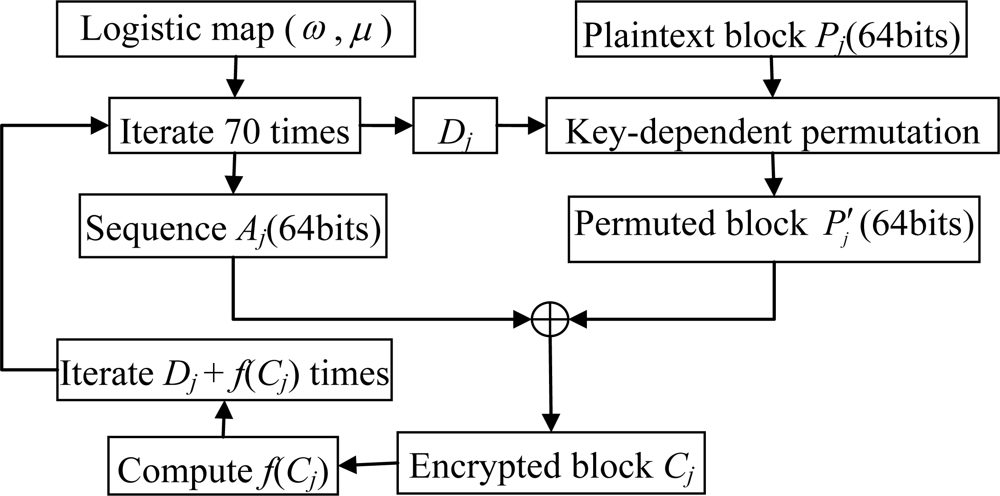
<mml:mo>∞</mml:mo></mml:msubsup></mml:mrow></mml:math></inline-formula>, where <italic>n</italic> is the length of the sequence and <italic>τ<sup>n</sup></italic> (<italic>x</italic>) is the <italic>n</italic>th iteration of the logistic map, can be obtained by iterating the logistic map. The whole procedure of this scheme can be described in the following steps and an illustration is given in <xref ref-type="fig" rid="f1-sensors-11-01607">Figure 1</xref>.</p>
<list list-type="simple">
<list-item>
<p>Step 1. Get the start point <italic>ω</italic> which denotes the real value of <italic>x</italic> from the last <italic>N</italic><sub>0</sub> transient iterations, <italic>i.e.</italic>, <italic>ω</italic> = <italic>τ<sup>N</sup></italic><sup><sub>0</sub></sup> (<italic>x</italic><sub>0</sub>). Note that we set <italic>N</italic><sub>0</sub> = 100 in all the following simulations.</p></list-item>
<list-item>
<p>Step 2. Divide the plaintext <italic>P</italic> into subsequences <italic>P<sub>j</sub></italic> of length <italic>l</italic> bytes (here <italic>l</italic> = 8):
<disp-formula id="FD3">
<label>(3)</label>
<mml:math display="block">
<mml:mrow>
<mml:mi>P</mml:mi>
<mml:mo>=</mml:mo>
<mml:msub>
<mml:mrow>
<mml:mi>P</mml:mi></mml:mrow>
<mml:mn>1</mml:mn></mml:msub>
<mml:msub>
<mml:mrow>
<mml:mi>P</mml:mi></mml:mrow>
<mml:mn>2</mml:mn></mml:msub>
<mml:mo>⋯</mml:mo>
<mml:msub>
<mml:mi>P</mml:mi>
<mml:mi>j</mml:mi></mml:msub>
<mml:mo>⋯</mml:mo></mml:mrow></mml:math></disp-formula></p></list-item>
<list-item>
<p>Step 3. Set <italic>j</italic> = 1;</p></list-item>
<list-item>
<p>Step 4. Based on the method to generate binary sequences by iterating the logistic map, obtain a 64-bit binary sequence 
<inline-formula>
<mml:math>
<mml:mrow>
<mml:msub>
<mml:mi>A</mml:mi>
<mml:mi>j</mml:mi></mml:msub>
<mml:mo>=</mml:mo>
<mml:msubsup>
<mml:mrow>
<mml:mi>B</mml:mi></mml:mrow>
<mml:mi>i</mml:mi>
<mml:mn>1</mml:mn></mml:msubsup>
<mml:msubsup>
<mml:mrow>
<mml:mi>B</mml:mi></mml:mrow>
<mml:mi>i</mml:mi>
<mml:mn>2</mml:mn></mml:msubsup>
<mml:mo>⋯</mml:mo>
<mml:msubsup>
<mml:mrow>
<mml:mi>B</mml:mi></mml:mrow>
<mml:mi>i</mml:mi>
<mml:mrow>
<mml:mn>64</mml:mn></mml:mrow></mml:msubsup></mml:mrow></mml:math></inline-formula> and a 6-bit binary sequence 
<inline-formula>
<mml:math>
<mml:mrow>
<mml:msubsup>
<mml:mrow>
<mml:mi>A</mml:mi></mml:mrow>
<mml:mi>j</mml:mi>
<mml:mo>′</mml:mo></mml:msubsup>
<mml:mo>=</mml:mo>
<mml:msubsup>
<mml:mrow>
<mml:mi>B</mml:mi></mml:mrow>
<mml:mi>i</mml:mi>
<mml:mrow>
<mml:mn>65</mml:mn></mml:mrow></mml:msubsup>
<mml:msubsup>
<mml:mrow>
<mml:mi>B</mml:mi></mml:mrow>
<mml:mi>i</mml:mi>
<mml:mrow>
<mml:mn>66</mml:mn></mml:mrow></mml:msubsup>
<mml:mo>⋯</mml:mo>
<mml:msubsup>
<mml:mrow>
<mml:mi>B</mml:mi></mml:mrow>
<mml:mi>i</mml:mi>
<mml:mrow>
<mml:mn>70</mml:mn></mml:mrow></mml:msubsup></mml:mrow></mml:math></inline-formula> formed by all the third bits, <italic>i.e.</italic>, <italic>i</italic> = 3 in <xref ref-type="disp-formula" rid="FD2">Equation (2)</xref>, through 70 iterations of the logistic map. <italic>D<sub>j</sub></italic> is the decimal value of 
<inline-formula>
<mml:math>
<mml:mrow>
<mml:msubsup>
<mml:mrow>
<mml:mi>A</mml:mi></mml:mrow>
<mml:mi>j</mml:mi>
<mml:mo>′</mml:mo></mml:msubsup></mml:mrow></mml:math></inline-formula>.</p></list-item>
<list-item>
<p>Step 5. Compute the <italic>j</italic>th ciphertext block:
<disp-formula id="FD4">
<label>(4)</label>
<mml:math display="block">
<mml:mrow>
<mml:msub>
<mml:mi>C</mml:mi>
<mml:mi>j</mml:mi></mml:msub>
<mml:mo>=</mml:mo>
<mml:mo>(</mml:mo>
<mml:msub>
<mml:mi>P</mml:mi>
<mml:mi>j</mml:mi></mml:msub>
<mml:mo>&lt;</mml:mo>
<mml:msub>
<mml:mi>D</mml:mi>
<mml:mi>j</mml:mi></mml:msub>
<mml:mo>)</mml:mo>
<mml:mo>⊕</mml:mo>
<mml:msub>
<mml:mi>A</mml:mi>
<mml:mi>j</mml:mi></mml:msub></mml:mrow></mml:math></disp-formula>where &lt;&lt;&lt; and ⊕ denote the left cyclic shift and XOR operation, respectively.</p></list-item>
<list-item>
<p>Step 6. Dividing the ciphertext block <italic>C<sub>j</sub></italic> into 8-bit partitions and obtain the ciphertext 
<inline-formula>
<mml:math>
<mml:mrow>
<mml:msubsup>
<mml:mrow>
<mml:mi>c</mml:mi></mml:mrow>
<mml:mi>j</mml:mi>
<mml:mn>1</mml:mn></mml:msubsup>
<mml:mo>,</mml:mo>
<mml:msubsup>
<mml:mrow>
<mml:mi>c</mml:mi></mml:mrow>
<mml:mi>j</mml:mi>
<mml:mn>2</mml:mn></mml:msubsup>
<mml:mo>,</mml:mo>
<mml:mo>⋯</mml:mo>
<mml:mo>,</mml:mo>
<mml:msubsup>
<mml:mrow>
<mml:mi>c</mml:mi></mml:mrow>
<mml:mi>j</mml:mi>
<mml:mn>8</mml:mn></mml:msubsup></mml:mrow></mml:math></inline-formula>.</p></list-item>
<list-item>
<p>Step 7. If all the plaintexts have already been encrypted, the encryption process is finished. Otherwise, calculate:
<disp-formula id="FD5">
<label>(5)</label>
<mml:math display="block">
<mml:mrow>
<mml:mi>f</mml:mi>
<mml:mo stretchy="false">(</mml:mo>
<mml:msub>
<mml:mi>C</mml:mi>
<mml:mi>j</mml:mi></mml:msub>
<mml:mo stretchy="false">)</mml:mo>
<mml:mo>=</mml:mo>
<mml:msubsup>
<mml:mrow>
<mml:mi>c</mml:mi></mml:mrow>
<mml:mi>j</mml:mi>
<mml:mn>1</mml:mn></mml:msubsup>
<mml:mo>+</mml:mo>
<mml:msubsup>
<mml:mrow>
<mml:mi>c</mml:mi></mml:mrow>
<mml:mi>j</mml:mi>
<mml:mn>2</mml:mn></mml:msubsup>
<mml:mo>+</mml:mo>
<mml:mo>⋯</mml:mo>
<mml:mo>+</mml:mo>
<mml:msubsup>
<mml:mrow>
<mml:mi>c</mml:mi></mml:mrow>
<mml:mi>j</mml:mi>
<mml:mn>8</mml:mn></mml:msubsup></mml:mrow></mml:math></disp-formula>
<disp-formula id="FD6">
<label>(6)</label>
<mml:math display="block">
<mml:mrow>
<mml:msubsup>
<mml:mrow>
<mml:mi>D</mml:mi></mml:mrow>
<mml:mi>j</mml:mi>
<mml:mo>*</mml:mo></mml:msubsup>
<mml:mo>=</mml:mo>
<mml:msub>
<mml:mi>D</mml:mi>
<mml:mi>j</mml:mi></mml:msub>
<mml:mo>+</mml:mo>
<mml:mi>f</mml:mi>
<mml:mo stretchy="false">(</mml:mo>
<mml:msub>
<mml:mi>C</mml:mi>
<mml:mi>j</mml:mi></mml:msub>
<mml:mo stretchy="false">)</mml:mo>
<mml:mo> </mml:mo>
<mml:mtext>mod</mml:mtext>
<mml:mo> </mml:mo>
<mml:mn>64</mml:mn></mml:mrow></mml:math></disp-formula>
<disp-formula id="FD7">
<label>(7)</label>
<mml:math display="block">
<mml:mrow>
<mml:mi>ω</mml:mi>
<mml:mo>=</mml:mo>
<mml:msup>
<mml:mrow>
<mml:mi>τ</mml:mi></mml:mrow>
<mml:mrow>
<mml:mn>70</mml:mn>
<mml:mo>+</mml:mo>
<mml:msubsup>
<mml:mrow>
<mml:mi>D</mml:mi></mml:mrow>
<mml:mi>j</mml:mi>
<mml:mo>*</mml:mo></mml:msubsup></mml:mrow></mml:msup>
<mml:mo stretchy="false">(</mml:mo>
<mml:mi>ω</mml:mi>
<mml:mo stretchy="false">)</mml:mo></mml:mrow></mml:math></disp-formula>
<disp-formula id="FD8">
<label>(8)</label>
<mml:math display="block">
<mml:mrow>
<mml:mi>j</mml:mi>
<mml:mo>=</mml:mo>
<mml:mi>j</mml:mi>
<mml:mo>+</mml:mo>
<mml:mn>1</mml:mn></mml:mrow></mml:math></disp-formula>and go to Step 4.</p></list-item></list>
<p>The decryption process is almost the same as the encryption one. Just need to replace <xref ref-type="disp-formula" rid="FD4">Equation (4)</xref> with:
<disp-formula id="FD9">
<label>(9)</label>
<mml:math display="block">
<mml:mrow>
<mml:msub>
<mml:mi>P</mml:mi>
<mml:mi>j</mml:mi></mml:msub>
<mml:mo>=</mml:mo>
<mml:mo>(</mml:mo>
<mml:msub>
<mml:mi>C</mml:mi>
<mml:mi>j</mml:mi></mml:msub>
<mml:mo>⊕</mml:mo>
<mml:msub>
<mml:mi>A</mml:mi>
<mml:mi>j</mml:mi></mml:msub>
<mml:mo>)</mml:mo>
<mml:mo>&gt;</mml:mo>
<mml:msub>
<mml:mi>D</mml:mi>
<mml:mi>j</mml:mi></mml:msub></mml:mrow></mml:math></disp-formula>where &gt;&gt;&gt; denote the right cyclic shift operation.</p></sec>
<sec sec-type="methods">
<label>3.</label>
<title>Cryptanalysis of Wang <italic>et al.</italic> Cryptosystem</title>
<p>According to <italic>Kerchoff</italic> ’s principle [<xref ref-type="bibr" rid="b13-sensors-11-01607">13</xref>], the cryptanalyst knows exactly the design and working of the cryptosystem under study except the secret key. The general types of cryptanalytic attacks [<xref ref-type="bibr" rid="b14-sensors-11-01607">14</xref>] are enumerated as follows, ordered from the hardest type of attack to easiest: ciphertext only attack, known plaintext attack, chosen plaintext attack and chosen ciphertext attack. In each of these four attacks, the objective is to determine the key that was used. It suffices that one of the attacks is feasible to consider an algorithm insecure.</p>
<p>In the following subsections, we will perform a chosen ciphertext attack (CCA) and a key stream attack (KSA) on Wang <italic>et al.</italic> scheme. For convenient illustration, suppose <italic>P</italic> = <italic>P</italic><sub>1</sub><italic>P</italic><sub>2</sub>⋯<italic>P<sub>j</sub></italic>⋯ and <italic>C</italic> = <italic>C</italic><sub>1</sub><italic>C</italic><sub>2</sub>⋯<italic>C<sub>j</sub></italic>⋯ are the plaintext and ciphertext pairs, (<italic>μ</italic>, <italic>x</italic><sub>0</sub>) and <italic>K</italic> = (<italic>A</italic><sub>1</sub><italic>D</italic><sub>1</sub>)(<italic>A</italic><sub>2</sub><italic>D</italic><sub>2</sub>)⋯(<italic>A<sub>j</sub>D<sub>j</sub></italic>)⋯ denote the corresponding secret key and key stream, respectively.</p>
<sec>
<label>3.1.</label>
<title>Chosen Ciphertext Attack</title>
<p>A chosen-ciphertext attack [<xref ref-type="bibr" rid="b15-sensors-11-01607">15</xref>] operates under the following model: an adversary is allowed access to plaintext-ciphertext pairs for some number of ciphertexts of his choice, and thereafter attempts to use this information to recover the key (or plaintext corresponding to some new ciphertext).</p>
<p>In the Wang <italic>et al.</italic> scheme, <xref ref-type="disp-formula" rid="FD5">Equations (5</xref>–<xref ref-type="disp-formula" rid="FD7">7</xref>) indicate that the space of the feedback message is only 64, <italic>i.e.</italic>, once the secret key (<italic>μ</italic>, <italic>x</italic><sub>0</sub>) is determined, the key stream <italic>D<sub>j+1</sub></italic> and <italic>A<sub>j+1</sub></italic> are determined only by the former ciphertext <italic>f</italic>(<italic>C<sub>j</sub></italic>) mod 64. To illustration this security loophole, we set the secret keys <italic>μ</italic> = 4, <italic>x</italic><sub>0</sub> = 0.1777 and decrypt two different ciphertext sequences. They are C1=“EAFA4D22D326D40C2960D4C5E76…” and C2=“F11ED8CA5F72155E8A99683495F…” in hexadecimal format. Each block of <italic>C<sub>j</sub></italic>, <italic>f</italic>(<italic>C<sub>j</sub></italic>) mod 64, <italic>D<sub>j</sub></italic> and <italic>A<sub>j</sub></italic> are filled into <xref ref-type="table" rid="t1-sensors-11-01607">Tables 1</xref> and <xref ref-type="table" rid="t2-sensors-11-01607">2</xref>, respectively.</p>
<p>The simulation results indicate that once <italic>μ</italic>, <italic>x</italic><sub>0</sub> and all the former ciphertext blocks have equal <italic>f</italic>(<italic>C<sub>j</sub></italic>)<italic>mod</italic> 64, any ciphertext has identical sub-key <italic>D<sub>j</sub></italic><sub>+1</sub> and <italic>A<sub>j</sub></italic><sub>+1</sub>. This loophole is vulnerable to CCA, one of CCA illustration can be played as follows: (they cannot be showed completely).</p>
<p>(1) Let 
<inline-formula>
<mml:math>
<mml:mrow>
<mml:msubsup>
<mml:mrow>
<mml:mi>f</mml:mi></mml:mrow>
<mml:mn>2</mml:mn>
<mml:mi>j</mml:mi></mml:msubsup></mml:mrow></mml:math></inline-formula> denotes the 6-bit length of <italic>f</italic>(<italic>C<sub>j</sub></italic>)<italic>mod</italic> 64 in binary representation. For <italic>j</italic> = 1,2,⋯ select two cipher blocks:
<disp-formula id="FD10">
<label>(10)</label>
<mml:math display="block">
<mml:mrow>
<mml:msubsup>
<mml:mrow>
<mml:mi>C</mml:mi></mml:mrow>
<mml:mi>j</mml:mi>
<mml:mn>1</mml:mn></mml:msubsup>
<mml:mo>=</mml:mo>
<mml:munder>
<mml:munder>
<mml:mrow>
<mml:mn>0</mml:mn>
<mml:mo>⋯</mml:mo>
<mml:mn>0</mml:mn></mml:mrow>
<mml:mo stretchy="true">︸</mml:mo></mml:munder>
<mml:mrow>
<mml:mn>56</mml:mn>
<mml:mi mathvariant="italic">bits</mml:mi></mml:mrow></mml:munder>
<mml:munder>
<mml:munder>
<mml:mrow>
<mml:mn>11</mml:mn>
<mml:msubsup>
<mml:mrow>
<mml:mi>f</mml:mi></mml:mrow>
<mml:mn>2</mml:mn>
<mml:mi>j</mml:mi></mml:msubsup></mml:mrow>
<mml:mo stretchy="true">︸</mml:mo></mml:munder>
<mml:mrow>
<mml:mn>8</mml:mn>
<mml:mi mathvariant="italic">bits</mml:mi></mml:mrow></mml:munder></mml:mrow></mml:math></disp-formula>
<disp-formula id="FD11">
<label>(11)</label>
<mml:math display="block">
<mml:mrow>
<mml:msubsup>
<mml:mrow>
<mml:mi>C</mml:mi></mml:mrow>
<mml:mi>j</mml:mi>
<mml:mn>2</mml:mn></mml:msubsup>
<mml:mo>=</mml:mo>
<mml:munder>
<mml:munder>
<mml:mrow>
<mml:mn>0</mml:mn>
<mml:mo>⋯</mml:mo>
<mml:mn>0</mml:mn></mml:mrow>
<mml:mo stretchy="true">︸</mml:mo></mml:munder>
<mml:mrow>
<mml:mn>50</mml:mn>
<mml:mi mathvariant="italic">bits</mml:mi></mml:mrow></mml:munder>
<mml:munder>
<mml:munder>
<mml:mrow>
<mml:msubsup>
<mml:mrow>
<mml:mi>f</mml:mi></mml:mrow>
<mml:mn>2</mml:mn>
<mml:mi>j</mml:mi></mml:msubsup></mml:mrow>
<mml:mo stretchy="true">︸</mml:mo></mml:munder>
<mml:mrow>
<mml:mn>6</mml:mn>
<mml:mi mathvariant="italic">bits</mml:mi></mml:mrow></mml:munder>
<mml:munder>
<mml:munder>
<mml:mrow>
<mml:mn>0</mml:mn>
<mml:mo>⋯</mml:mo>
<mml:mn>0</mml:mn></mml:mrow>
<mml:mo stretchy="true">︸</mml:mo></mml:munder>
<mml:mrow>
<mml:mn>8</mml:mn>
<mml:mi mathvariant="italic">bits</mml:mi></mml:mrow></mml:munder></mml:mrow></mml:math></disp-formula></p>
<p>From <xref ref-type="disp-formula" rid="FD5">Equation (5)</xref>, it is not difficult to see that:
<disp-formula id="FD12">
<label>(12)</label>
<mml:math display="block">
<mml:mrow>
<mml:mi>f</mml:mi>
<mml:mo>(</mml:mo>
<mml:msub>
<mml:mi>C</mml:mi>
<mml:mi>j</mml:mi></mml:msub>
<mml:mo>)</mml:mo>
<mml:mo>≡</mml:mo>
<mml:mi>f</mml:mi>
<mml:mo>(</mml:mo>
<mml:msubsup>
<mml:mrow>
<mml:mi>C</mml:mi></mml:mrow>
<mml:mi>j</mml:mi>
<mml:mn>1</mml:mn></mml:msubsup>
<mml:mo>)</mml:mo>
<mml:mo>≡</mml:mo>
<mml:mi>f</mml:mi>
<mml:mo>(</mml:mo>
<mml:msubsup>
<mml:mrow>
<mml:mi>C</mml:mi></mml:mrow>
<mml:mi>j</mml:mi>
<mml:mn>2</mml:mn></mml:msubsup>
<mml:mo>)</mml:mo>
<mml:mo> </mml:mo>
<mml:mtext>mod</mml:mtext>
<mml:mo> </mml:mo>
<mml:mn>64</mml:mn></mml:mrow></mml:math></disp-formula></p>
<p>To demonstrate this procedure, we fill the chosen corresponding <italic>C</italic><sup>1</sup> and <italic>C</italic><sup>2</sup> of a random selected ciphertext <italic>C</italic> = 218A916626 E5DA55… (in hexadecimal format) into <xref ref-type="table" rid="t3-sensors-11-01607">Table 3</xref>.</p>
<p>(2) Decrypt 
<inline-formula>
<mml:math>
<mml:mrow>
<mml:msup>
<mml:mi>C</mml:mi>
<mml:mn>1</mml:mn></mml:msup>
<mml:mo>=</mml:mo>
<mml:msubsup>
<mml:mrow>
<mml:mi>C</mml:mi></mml:mrow>
<mml:mn>1</mml:mn>
<mml:mn>1</mml:mn></mml:msubsup>
<mml:msubsup>
<mml:mrow>
<mml:mi>C</mml:mi></mml:mrow>
<mml:mn>2</mml:mn>
<mml:mn>1</mml:mn></mml:msubsup>
<mml:mo>⋯</mml:mo>
<mml:msubsup>
<mml:mrow>
<mml:mi>C</mml:mi></mml:mrow>
<mml:mi>j</mml:mi>
<mml:mn>1</mml:mn></mml:msubsup>
<mml:mo>⋯</mml:mo></mml:mrow></mml:math></inline-formula> and 
<inline-formula>
<mml:math>
<mml:mrow>
<mml:msup>
<mml:mi>C</mml:mi>
<mml:mn>2</mml:mn></mml:msup>
<mml:mo>=</mml:mo>
<mml:msubsup>
<mml:mrow>
<mml:mi>C</mml:mi></mml:mrow>
<mml:mn>1</mml:mn>
<mml:mn>2</mml:mn></mml:msubsup>
<mml:msubsup>
<mml:mrow>
<mml:mi>C</mml:mi></mml:mrow>
<mml:mn>2</mml:mn>
<mml:mn>2</mml:mn></mml:msubsup>
<mml:mo>⋯</mml:mo>
<mml:msubsup>
<mml:mrow>
<mml:mi>C</mml:mi></mml:mrow>
<mml:mi>j</mml:mi>
<mml:mn>2</mml:mn></mml:msubsup>
<mml:mo>⋯</mml:mo></mml:mrow></mml:math></inline-formula> using the same key (<italic>μ</italic>, <italic>x</italic><sub>0</sub>) of <italic>C</italic> = <italic>C</italic><sub>1</sub><italic>C</italic><sub>2</sub> ⋯<italic>C<sub>j</sub></italic> ⋯, then we can get the corresponding plaintext 
<inline-formula>
<mml:math>
<mml:mrow>
<mml:msup>
<mml:mi>P</mml:mi>
<mml:mn>1</mml:mn></mml:msup>
<mml:mo>=</mml:mo>
<mml:msubsup>
<mml:mrow>
<mml:mi>P</mml:mi></mml:mrow>
<mml:mn>1</mml:mn>
<mml:mn>1</mml:mn></mml:msubsup>
<mml:msubsup>
<mml:mrow>
<mml:mi>P</mml:mi></mml:mrow>
<mml:mn>2</mml:mn>
<mml:mn>1</mml:mn></mml:msubsup>
<mml:mo>⋯</mml:mo>
<mml:msubsup>
<mml:mrow>
<mml:mi>P</mml:mi></mml:mrow>
<mml:mi>j</mml:mi>
<mml:mn>1</mml:mn></mml:msubsup>
<mml:mo>⋯</mml:mo></mml:mrow></mml:math></inline-formula> and 
<inline-formula>
<mml:math>
<mml:mrow>
<mml:msup>
<mml:mi>P</mml:mi>
<mml:mn>2</mml:mn></mml:msup>
<mml:mo>=</mml:mo>
<mml:msubsup>
<mml:mrow>
<mml:mi>P</mml:mi></mml:mrow>
<mml:mn>1</mml:mn>
<mml:mn>2</mml:mn></mml:msubsup>
<mml:msubsup>
<mml:mrow>
<mml:mi>P</mml:mi></mml:mrow>
<mml:mn>2</mml:mn>
<mml:mn>2</mml:mn></mml:msubsup>
<mml:mo>⋯</mml:mo>
<mml:msubsup>
<mml:mrow>
<mml:mi>P</mml:mi></mml:mrow>
<mml:mi>j</mml:mi>
<mml:mn>2</mml:mn></mml:msubsup>
<mml:mo>⋯</mml:mo></mml:mrow></mml:math></inline-formula>. From <xref ref-type="disp-formula" rid="FD6">Equations (6)</xref> and <xref ref-type="disp-formula" rid="FD12">(12)</xref> we can deduce that <italic>C<sub>j</sub></italic>, 
<inline-formula>
<mml:math>
<mml:mrow>
<mml:msubsup>
<mml:mrow>
<mml:mi>C</mml:mi></mml:mrow>
<mml:mi>j</mml:mi>
<mml:mn>1</mml:mn></mml:msubsup></mml:mrow></mml:math></inline-formula> and 
<inline-formula>
<mml:math>
<mml:mrow>
<mml:msubsup>
<mml:mrow>
<mml:mi>C</mml:mi></mml:mrow>
<mml:mi>j</mml:mi>
<mml:mn>2</mml:mn></mml:msubsup></mml:mrow></mml:math></inline-formula> have the identical corresponding sub-keys <italic>D<sub>j</sub></italic> and <italic>A<sub>j</sub></italic>.</p>
<p>(3) Calculate 
<inline-formula>
<mml:math>
<mml:mrow>
<mml:msubsup>
<mml:mrow>
<mml:mi>P</mml:mi></mml:mrow>
<mml:mi>j</mml:mi>
<mml:mn>1</mml:mn></mml:msubsup>
<mml:mo>⊕</mml:mo>
<mml:msubsup>
<mml:mrow>
<mml:mi>P</mml:mi></mml:mrow>
<mml:mi>j</mml:mi>
<mml:mn>2</mml:mn></mml:msubsup>
<mml:mo>=</mml:mo>
<mml:mo>(</mml:mo>
<mml:mo>(</mml:mo>
<mml:msubsup>
<mml:mrow>
<mml:mi>C</mml:mi></mml:mrow>
<mml:mi>j</mml:mi>
<mml:mn>1</mml:mn></mml:msubsup>
<mml:mo>⊕</mml:mo>
<mml:msub>
<mml:mi>A</mml:mi>
<mml:mi>j</mml:mi></mml:msub>
<mml:mo>)</mml:mo>
<mml:mo>&gt;</mml:mo>
<mml:msub>
<mml:mi>D</mml:mi>
<mml:mi>j</mml:mi></mml:msub>
<mml:mo>)</mml:mo>
<mml:mo>⊕</mml:mo>
<mml:mo>(</mml:mo>
<mml:mo>(</mml:mo>
<mml:msubsup>
<mml:mrow>
<mml:mi>C</mml:mi></mml:mrow>
<mml:mi>j</mml:mi>
<mml:mn>2</mml:mn></mml:msubsup>
<mml:mo>⊕</mml:mo>
<mml:msub>
<mml:mi>A</mml:mi>
<mml:mi>j</mml:mi></mml:msub>
<mml:mo>)</mml:mo>
<mml:mo>&gt;</mml:mo>
<mml:msub>
<mml:mi>D</mml:mi>
<mml:mi>j</mml:mi></mml:msub>
<mml:mo>)</mml:mo>
<mml:mo>=</mml:mo>
<mml:mo>(</mml:mo>
<mml:msubsup>
<mml:mrow>
<mml:mi>C</mml:mi></mml:mrow>
<mml:mi>j</mml:mi>
<mml:mn>1</mml:mn></mml:msubsup>
<mml:mo>⊕</mml:mo>
<mml:msubsup>
<mml:mrow>
<mml:mi>C</mml:mi></mml:mrow>
<mml:mi>j</mml:mi>
<mml:mn>2</mml:mn></mml:msubsup>
<mml:mo>)</mml:mo>
<mml:mo>&gt;</mml:mo>
<mml:msub>
<mml:mi>D</mml:mi>
<mml:mi>j</mml:mi></mml:msub></mml:mrow></mml:math></inline-formula></p>
<p>From <xref ref-type="disp-formula" rid="FD10">Equations (10)</xref> and <xref ref-type="disp-formula" rid="FD11">(11)</xref>, we can obtain that:
<disp-formula id="FD13">
<label>(13)</label>
<mml:math display="block">
<mml:mrow>
<mml:msubsup>
<mml:mrow>
<mml:mi>C</mml:mi></mml:mrow>
<mml:mi>j</mml:mi>
<mml:mn>1</mml:mn></mml:msubsup>
<mml:mo>⊕</mml:mo>
<mml:msubsup>
<mml:mrow>
<mml:mi>C</mml:mi></mml:mrow>
<mml:mi>j</mml:mi>
<mml:mn>2</mml:mn></mml:msubsup>
<mml:mo>=</mml:mo>
<mml:munder>
<mml:munder>
<mml:mrow>
<mml:mn>0</mml:mn>
<mml:mo>⋯</mml:mo>
<mml:mn>0</mml:mn></mml:mrow>
<mml:mo stretchy="true">︸</mml:mo></mml:munder>
<mml:mrow>
<mml:mn>50</mml:mn>
<mml:mi mathvariant="italic">bits</mml:mi></mml:mrow></mml:munder>
<mml:munder>
<mml:munder>
<mml:mrow>
<mml:msubsup>
<mml:mrow>
<mml:mi>f</mml:mi></mml:mrow>
<mml:mn>2</mml:mn>
<mml:mi>j</mml:mi></mml:msubsup>
<mml:mn>11</mml:mn>
<mml:msubsup>
<mml:mrow>
<mml:mi>f</mml:mi></mml:mrow>
<mml:mn>2</mml:mn>
<mml:mi>j</mml:mi></mml:msubsup></mml:mrow>
<mml:mo stretchy="true">︸</mml:mo></mml:munder>
<mml:mrow>
<mml:mn>14</mml:mn>
<mml:mi mathvariant="italic">bits</mml:mi></mml:mrow></mml:munder></mml:mrow></mml:math></disp-formula></p>
<p>Therefore, we can determine the value of <italic>D<sub>j</sub></italic> by searching the position of 
<inline-formula>
<mml:math>
<mml:mrow>
<mml:msubsup>
<mml:mrow>
<mml:mi>f</mml:mi></mml:mrow>
<mml:mn>2</mml:mn>
<mml:mi>j</mml:mi></mml:msubsup>
<mml:mn>11</mml:mn>
<mml:msubsup>
<mml:mrow>
<mml:mi>f</mml:mi></mml:mrow>
<mml:mn>2</mml:mn>
<mml:mi>j</mml:mi></mml:msubsup></mml:mrow></mml:math></inline-formula> in 
<inline-formula>
<mml:math>
<mml:mrow>
<mml:msubsup>
<mml:mrow>
<mml:mi>P</mml:mi></mml:mrow>
<mml:mi>j</mml:mi>
<mml:mn>1</mml:mn></mml:msubsup>
<mml:mo>⊕</mml:mo>
<mml:msubsup>
<mml:mrow>
<mml:mi>P</mml:mi></mml:mrow>
<mml:mi>j</mml:mi>
<mml:mn>2</mml:mn></mml:msubsup></mml:mrow></mml:math></inline-formula>.</p>
<p>(4) Using <xref ref-type="disp-formula" rid="FD4">Equation (4)</xref> and the conquered <italic>D<sub>j</sub></italic>, we can calculate 
<inline-formula>
<mml:math>
<mml:mrow>
<mml:msub>
<mml:mi>A</mml:mi>
<mml:mi>j</mml:mi></mml:msub>
<mml:mo>=</mml:mo>
<mml:mo>(</mml:mo>
<mml:msubsup>
<mml:mrow>
<mml:mi>P</mml:mi></mml:mrow>
<mml:mi>j</mml:mi>
<mml:mn>1</mml:mn></mml:msubsup>
<mml:mo>&lt;</mml:mo>
<mml:msub>
<mml:mi>D</mml:mi>
<mml:mi>j</mml:mi></mml:msub>
<mml:mo>)</mml:mo>
<mml:mo>⊕</mml:mo>
<mml:msubsup>
<mml:mrow>
<mml:mi>C</mml:mi></mml:mrow>
<mml:mi>j</mml:mi>
<mml:mn>1</mml:mn></mml:msubsup></mml:mrow></mml:math></inline-formula>. To demonstrate these procedures, the chosen <italic>C</italic><sup>1</sup> and <italic>C</italic><sup>2</sup> of <xref ref-type="table" rid="t3-sensors-11-01607">Table 3</xref> are decrypted using <italic>μ</italic> = 4, <italic>x</italic><sub>0</sub> = 0.1777. The corresponding plaintext blocks and sub-keys are filled into <xref ref-type="table" rid="t4-sensors-11-01607">Table 4</xref>.</p>
<p>(5) By utilizing <italic>D<sub>j</sub></italic> and <italic>A<sub>j</sub></italic>, it is easy to figure out the plaintext
<disp-formula id="FD14">
<label>(14)</label>
<mml:math display="block">
<mml:mrow>
<mml:msub>
<mml:mi>P</mml:mi>
<mml:mi>j</mml:mi></mml:msub>
<mml:mo>=</mml:mo>
<mml:mo>(</mml:mo>
<mml:msub>
<mml:mi>C</mml:mi>
<mml:mi>j</mml:mi></mml:msub>
<mml:mo>⊕</mml:mo>
<mml:msub>
<mml:mi>A</mml:mi>
<mml:mi>j</mml:mi></mml:msub>
<mml:mo>)</mml:mo>
<mml:mo>&gt;</mml:mo>
<mml:msub>
<mml:mi>D</mml:mi>
<mml:mi>j</mml:mi></mml:msub></mml:mrow></mml:math></disp-formula></p>
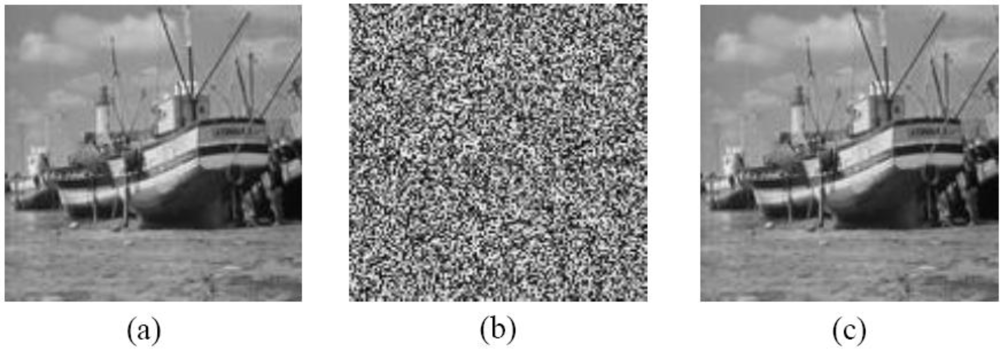
<p>Some simulations are utilized to prove the validity of CCA. <xref ref-type="fig" rid="f2-sensors-11-01607">Figure 2(a–c)</xref> are the original image, the encrypted image with Wang et al’s scheme and the analyzed image of a 128 × 128 bitmap image file named Boat, where the secret key <italic>μ</italic> = 4, <italic>x</italic><sub>0</sub> = 0.1777 and <italic>N</italic><sub>0</sub> = 100.</p></sec>
<sec>
<label>3.2.</label>
<title>Key Stream Attack</title>
<p>In the Wang <italic>et al.</italic> scheme [<xref ref-type="bibr" rid="b11-sensors-11-01607">11</xref>], although a ciphertext feedback model is employed to ensure sub-keys depend on both secret key and plaintext, a fundamental flaw is unaware, <italic>i.e.</italic>, the first sub-key <italic>D</italic><sub>1</sub> and <italic>A</italic><sub>1</sub> are independent of the plaintext and are determined only by the secret key (<italic>μ</italic>, <italic>x</italic><sub>0</sub>). An adversary can reconstruct the key stream sequence as an equivalent key (<italic>μ</italic>, <italic>x</italic><sub>0</sub>) as follows:
<list list-type="order">
<list-item>
<p>Choose two pair of special messages (<italic>P<sub>z</sub></italic>, <italic>C<sub>z</sub></italic>) and (<italic>P<sub>s</sub></italic>, <italic>C<sub>s</sub></italic>), where <italic>P<sub>z</sub></italic> is composed of 64-bit zeros, <italic>P<sub>s</sub></italic> is 011…11 in binary representation, <italic>C<sub>z</sub></italic> and <italic>C<sub>s</sub></italic> are the corresponding ciphertext of <italic>P<sub>z</sub></italic> and <italic>P<sub>s</sub></italic>, respectively.</p></list-item>
<list-item>
<p>Set <italic>P<sub>z</sub></italic> as the first plaintext block, then can get <italic>C<sub>z</sub></italic> = (<italic>P<sub>z</sub></italic> &lt;&lt;&lt; <italic>D</italic><sub>1</sub>) ⊕ <italic>A</italic><sub>1</sub> = <italic>A</italic><sub>1</sub>.</p></list-item>
<list-item>
<p>Similarly, when set <italic>P<sub>s</sub></italic> as the first plaintext block, <italic>C<sub>s</sub></italic> = (<italic>P<sub>s</sub></italic> &lt;&lt;&lt; <italic>D</italic><sub>1</sub>) ⊕ <italic>A</italic><sub>1</sub>, <italic>i.e.</italic>, <italic>C<sub>s</sub></italic> ⊕ <italic>A</italic><sub>1</sub> = <italic>P<sub>s</sub></italic> &lt;&lt;&lt; <italic>D</italic><sub>1</sub>. Thus the position of zero in <italic>C<sub>s</sub></italic> ⊕ <italic>A</italic><sub>1</sub> counting from rightmost bit is equal to <italic>D</italic><sub>1</sub>.</p></list-item>
<list-item>
<p>Set <italic>k</italic> = 0, and define a plaintext sequence <italic>P<sub>u</sub></italic> = <italic>ϕ</italic>, where <italic>ϕ</italic> is a null string.</p></list-item>
<list-item>
<p><italic>k</italic> = <italic>k</italic> + 1. By utilizing <italic>D<sub>k</sub></italic>, choose 
<inline-formula>
<mml:math>
<mml:mrow>
<mml:msub>
<mml:mi>C</mml:mi>
<mml:mi>k</mml:mi></mml:msub>
<mml:mo>=</mml:mo>
<mml:munder>
<mml:munder>
<mml:mrow>
<mml:mn>00</mml:mn>
<mml:mo>⋯</mml:mo>
<mml:mn>0</mml:mn></mml:mrow>
<mml:mo stretchy="true">︸</mml:mo></mml:munder>
<mml:mrow>
<mml:mn>56</mml:mn>
<mml:mi mathvariant="italic">bits</mml:mi></mml:mrow></mml:munder>
<mml:munder>
<mml:munder>
<mml:mrow>
<mml:msubsup>
<mml:mrow>
<mml:mi>c</mml:mi></mml:mrow>
<mml:mi>k</mml:mi>
<mml:mn>8</mml:mn></mml:msubsup></mml:mrow>
<mml:mo stretchy="true">︸</mml:mo></mml:munder>
<mml:mrow>
<mml:mn>8</mml:mn>
<mml:mi mathvariant="italic">bits</mml:mi></mml:mrow></mml:munder></mml:mrow></mml:math></inline-formula> to make sure
<disp-formula id="FD15">
<label>(15)</label>
<mml:math display="block">
<mml:mrow>
<mml:msubsup>
<mml:mrow>
<mml:mi>D</mml:mi></mml:mrow>
<mml:mi>k</mml:mi>
<mml:mo>*</mml:mo></mml:msubsup>
<mml:mo>=</mml:mo>
<mml:msub>
<mml:mi>D</mml:mi>
<mml:mi>k</mml:mi></mml:msub>
<mml:mo>+</mml:mo>
<mml:mi>f</mml:mi>
<mml:mo stretchy="false">(</mml:mo>
<mml:msub>
<mml:mi>C</mml:mi>
<mml:mi>k</mml:mi></mml:msub>
<mml:mo stretchy="false">)</mml:mo>
<mml:mo> </mml:mo>
<mml:mtext>mod</mml:mtext>
<mml:mo> </mml:mo>
<mml:mn>64</mml:mn>
<mml:mo>=</mml:mo>
<mml:mn>0</mml:mn></mml:mrow></mml:math></disp-formula></p>
<p>From <xref ref-type="disp-formula" rid="FD7">Equation (7)</xref>, it can be seen that the sub-keys of 
<inline-formula>
<mml:math>
<mml:mrow>
<mml:msub>
<mml:mi>A</mml:mi>
<mml:mi>k</mml:mi></mml:msub>
<mml:mo>=</mml:mo>
<mml:msubsup>
<mml:mrow>
<mml:mi>B</mml:mi></mml:mrow>
<mml:mi>i</mml:mi>
<mml:mn>1</mml:mn></mml:msubsup>
<mml:msubsup>
<mml:mrow>
<mml:mi>B</mml:mi></mml:mrow>
<mml:mi>i</mml:mi>
<mml:mn>2</mml:mn></mml:msubsup>
<mml:mo>⋯</mml:mo>
<mml:msubsup>
<mml:mrow>
<mml:mi>B</mml:mi></mml:mrow>
<mml:mi>i</mml:mi>
<mml:mrow>
<mml:mn>64</mml:mn></mml:mrow></mml:msubsup></mml:mrow></mml:math></inline-formula>, 
<inline-formula>
<mml:math>
<mml:mrow>
<mml:msubsup>
<mml:mrow>
<mml:mi>A</mml:mi></mml:mrow>
<mml:mi>k</mml:mi>
<mml:mo>′</mml:mo></mml:msubsup>
<mml:mo>=</mml:mo>
<mml:msubsup>
<mml:mrow>
<mml:mi>B</mml:mi></mml:mrow>
<mml:mi>i</mml:mi>
<mml:mrow>
<mml:mn>65</mml:mn></mml:mrow></mml:msubsup>
<mml:msubsup>
<mml:mrow>
<mml:mi>B</mml:mi></mml:mrow>
<mml:mi>i</mml:mi>
<mml:mrow>
<mml:mn>66</mml:mn></mml:mrow></mml:msubsup>
<mml:mo>⋯</mml:mo>
<mml:msubsup>
<mml:mrow>
<mml:mi>B</mml:mi></mml:mrow>
<mml:mi>i</mml:mi>
<mml:mrow>
<mml:mn>70</mml:mn></mml:mrow></mml:msubsup></mml:mrow></mml:math></inline-formula>, 
<inline-formula>
<mml:math>
<mml:mrow>
<mml:msub>
<mml:mrow>
<mml:mi>A</mml:mi></mml:mrow>
<mml:mrow>
<mml:mi>k</mml:mi>
<mml:mo>+</mml:mo>
<mml:mn>1</mml:mn></mml:mrow></mml:msub>
<mml:mo>=</mml:mo>
<mml:msubsup>
<mml:mrow>
<mml:mi>B</mml:mi></mml:mrow>
<mml:mi>i</mml:mi>
<mml:mn>1</mml:mn></mml:msubsup>
<mml:msubsup>
<mml:mrow>
<mml:mi>B</mml:mi></mml:mrow>
<mml:mi>i</mml:mi>
<mml:mn>2</mml:mn></mml:msubsup>
<mml:mo>⋯</mml:mo>
<mml:msubsup>
<mml:mrow>
<mml:mi>B</mml:mi></mml:mrow>
<mml:mi>i</mml:mi>
<mml:mrow>
<mml:mn>64</mml:mn></mml:mrow></mml:msubsup></mml:mrow></mml:math></inline-formula> and 
<inline-formula>
<mml:math>
<mml:mrow>
<mml:msubsup>
<mml:mi>A</mml:mi>
<mml:mrow>
<mml:mi>k</mml:mi>
<mml:mo>+</mml:mo>
<mml:mn>1</mml:mn></mml:mrow>
<mml:mo>′</mml:mo></mml:msubsup>
<mml:mo>=</mml:mo>
<mml:msubsup>
<mml:mrow>
<mml:mi>B</mml:mi></mml:mrow>
<mml:mi>i</mml:mi>
<mml:mrow>
<mml:mn>65</mml:mn></mml:mrow></mml:msubsup>
<mml:msubsup>
<mml:mrow>
<mml:mi>B</mml:mi></mml:mrow>
<mml:mi>i</mml:mi>
<mml:mrow>
<mml:mn>66</mml:mn></mml:mrow></mml:msubsup>
<mml:mo>⋯</mml:mo>
<mml:msubsup>
<mml:mrow>
<mml:mi>B</mml:mi></mml:mrow>
<mml:mi>i</mml:mi>
<mml:mrow>
<mml:mn>70</mml:mn></mml:mrow></mml:msubsup></mml:mrow></mml:math></inline-formula> are continuous state bit of logistic map.</p></list-item>
<list-item>
<p>Decrypt <italic>C<sub>k</sub></italic> with <italic>D<sub>k</sub></italic> and <italic>A<sub>k</sub></italic>:
<disp-formula id="FD16">
<label>(16)</label>
<mml:math display="block">
<mml:mrow>
<mml:msub>
<mml:mi>P</mml:mi>
<mml:mi>k</mml:mi></mml:msub>
<mml:mo>=</mml:mo>
<mml:mo stretchy="false">(</mml:mo>
<mml:msub>
<mml:mi>C</mml:mi>
<mml:mi>k</mml:mi></mml:msub>
<mml:mo>⊕</mml:mo>
<mml:msub>
<mml:mi>A</mml:mi>
<mml:mi>k</mml:mi></mml:msub>
<mml:mo stretchy="false">)</mml:mo>
<mml:mo>&gt;</mml:mo>
<mml:msub>
<mml:mi>D</mml:mi>
<mml:mi>k</mml:mi></mml:msub></mml:mrow></mml:math></disp-formula></p></list-item>
<list-item>
<p>Set <italic>P<sub>u</sub></italic> = <italic>P<sub>u</sub>P<sub>k</sub></italic>, <italic>i.e.</italic>, add <italic>P<sub>k</sub></italic> as the last 64 bits of <italic>P<sub>u</sub></italic>.</p></list-item>
<list-item>
<p>Encrypt the 64(<italic>k</italic> + 1)-bit length plaintext sequence <italic>P<sup>z</sup></italic> = <italic>P<sub>u</sub>P<sub>z</sub></italic>, and then obtain the corresponding ciphertext:
<disp-formula id="FD17">
<label>(17)</label>
<mml:math display="block">
<mml:mrow>
<mml:msup>
<mml:mrow>
<mml:mi>C</mml:mi></mml:mrow>
<mml:mi>z</mml:mi></mml:msup>
<mml:mo>=</mml:mo>
<mml:msubsup>
<mml:mrow>
<mml:mi>C</mml:mi></mml:mrow>
<mml:mn>1</mml:mn>
<mml:mi>z</mml:mi></mml:msubsup>
<mml:mo>⋯</mml:mo>
<mml:msubsup>
<mml:mrow>
<mml:mi>C</mml:mi></mml:mrow>
<mml:mi>k</mml:mi>
<mml:mi>z</mml:mi></mml:msubsup>
<mml:msubsup>
<mml:mrow>
<mml:mi>C</mml:mi></mml:mrow>
<mml:mrow>
<mml:mi>k</mml:mi>
<mml:mo>+</mml:mo>
<mml:mn>1</mml:mn></mml:mrow>
<mml:mi>z</mml:mi></mml:msubsup></mml:mrow></mml:math></disp-formula></p></list-item>
<list-item>
<p>Obviously, 
<inline-formula>
<mml:math>
<mml:mrow>
<mml:msubsup>
<mml:mrow>
<mml:mi>C</mml:mi></mml:mrow>
<mml:mn>1</mml:mn>
<mml:mi>z</mml:mi></mml:msubsup>
<mml:mo>⋯</mml:mo>
<mml:msubsup>
<mml:mrow>
<mml:mi>C</mml:mi></mml:mrow>
<mml:mi>k</mml:mi>
<mml:mi>z</mml:mi></mml:msubsup>
<mml:msubsup>
<mml:mrow>
<mml:mi>C</mml:mi></mml:mrow>
<mml:mrow>
<mml:mi>k</mml:mi>
<mml:mo>+</mml:mo>
<mml:mn>1</mml:mn></mml:mrow>
<mml:mi>z</mml:mi></mml:msubsup></mml:mrow></mml:math></inline-formula> is equal to <italic>C</italic><sub>1</sub> ⋯<italic>C<sub>k</sub></italic> when <italic>k</italic> &gt; 1, and 
<inline-formula>
<mml:math>
<mml:mrow>
<mml:msubsup>
<mml:mrow>
<mml:mi>C</mml:mi></mml:mrow>
<mml:mrow>
<mml:mi>k</mml:mi>
<mml:mo>+</mml:mo>
<mml:mn>1</mml:mn></mml:mrow>
<mml:mi>z</mml:mi></mml:msubsup>
<mml:mo>=</mml:mo>
<mml:mo>(</mml:mo>
<mml:msub>
<mml:mi>P</mml:mi>
<mml:mi>z</mml:mi></mml:msub>
<mml:mo>&lt;</mml:mo>
<mml:msub>
<mml:mrow>
<mml:mi>D</mml:mi></mml:mrow>
<mml:mrow>
<mml:mi>k</mml:mi>
<mml:mo>+</mml:mo>
<mml:mn>1</mml:mn></mml:mrow></mml:msub>
<mml:mo>)</mml:mo>
<mml:mo>⊕</mml:mo>
<mml:msub>
<mml:mrow>
<mml:mi>A</mml:mi></mml:mrow>
<mml:mrow>
<mml:mi>k</mml:mi>
<mml:mo>+</mml:mo>
<mml:mn>1</mml:mn></mml:mrow></mml:msub></mml:mrow></mml:math></inline-formula>. Therefore, it can be calculated that 
<inline-formula>
<mml:math>
<mml:mrow>
<mml:msub>
<mml:mrow>
<mml:mi>A</mml:mi></mml:mrow>
<mml:mrow>
<mml:mi>k</mml:mi>
<mml:mo>+</mml:mo>
<mml:mn>1</mml:mn></mml:mrow></mml:msub>
<mml:mo>=</mml:mo>
<mml:msubsup>
<mml:mrow>
<mml:mi>C</mml:mi></mml:mrow>
<mml:mrow>
<mml:mi>k</mml:mi>
<mml:mo>+</mml:mo>
<mml:mn>1</mml:mn></mml:mrow>
<mml:mi>z</mml:mi></mml:msubsup></mml:mrow></mml:math></inline-formula>.</p></list-item>
<list-item>
<p>Encrypt another 64(<italic>k</italic> + 1)-bit length plaintext sequence <italic>P<sup>s</sup></italic> = <italic>P<sub>u</sub>P<sub>s</sub></italic>, and then obtain the corresponding ciphertext:
<disp-formula id="FD18">
<label>(18)</label>
<mml:math display="block">
<mml:mrow>
<mml:msup>
<mml:mrow>
<mml:mi>C</mml:mi></mml:mrow>
<mml:mi>s</mml:mi></mml:msup>
<mml:mo>=</mml:mo>
<mml:msubsup>
<mml:mrow>
<mml:mi>C</mml:mi></mml:mrow>
<mml:mn>1</mml:mn>
<mml:mi>s</mml:mi></mml:msubsup>
<mml:mo>⋯</mml:mo>
<mml:msubsup>
<mml:mrow>
<mml:mi>C</mml:mi></mml:mrow>
<mml:mi>k</mml:mi>
<mml:mi>s</mml:mi></mml:msubsup>
<mml:msubsup>
<mml:mrow>
<mml:mi>C</mml:mi></mml:mrow>
<mml:mrow>
<mml:mi>k</mml:mi>
<mml:mo>+</mml:mo>
<mml:mn>1</mml:mn></mml:mrow>
<mml:mi>s</mml:mi></mml:msubsup></mml:mrow></mml:math></disp-formula></p>
<p>Similarly, 
<inline-formula>
<mml:math>
<mml:mrow>
<mml:msubsup>
<mml:mrow>
<mml:mi>C</mml:mi></mml:mrow>
<mml:mn>1</mml:mn>
<mml:mi>s</mml:mi></mml:msubsup>
<mml:mo>⋯</mml:mo>
<mml:msubsup>
<mml:mrow>
<mml:mi>C</mml:mi></mml:mrow>
<mml:mi>k</mml:mi>
<mml:mi>s</mml:mi></mml:msubsup></mml:mrow></mml:math></inline-formula> is equal to <italic>C</italic><sub>1</sub> ⋯<italic>C<sub>k</sub></italic> when <italic>k</italic> &gt; 1, and 
<inline-formula>
<mml:math>
<mml:mrow>
<mml:msubsup>
<mml:mrow>
<mml:mi>C</mml:mi></mml:mrow>
<mml:mrow>
<mml:mi>k</mml:mi>
<mml:mo>+</mml:mo>
<mml:mn>1</mml:mn></mml:mrow>
<mml:mi>s</mml:mi></mml:msubsup>
<mml:mo>=</mml:mo>
<mml:mo>(</mml:mo>
<mml:msub>
<mml:mi>P</mml:mi>
<mml:mi>s</mml:mi></mml:msub>
<mml:mo>&lt;</mml:mo>
<mml:msub>
<mml:mrow>
<mml:mi>D</mml:mi></mml:mrow>
<mml:mrow>
<mml:mi>k</mml:mi>
<mml:mo>+</mml:mo>
<mml:mn>1</mml:mn></mml:mrow></mml:msub>
<mml:mo>)</mml:mo>
<mml:mo>⊕</mml:mo>
<mml:msub>
<mml:mrow>
<mml:mi>A</mml:mi></mml:mrow>
<mml:mrow>
<mml:mi>k</mml:mi>
<mml:mo>+</mml:mo>
<mml:mn>1</mml:mn></mml:mrow></mml:msub></mml:mrow></mml:math></inline-formula>, <italic>i.e.</italic>, 
<inline-formula>
<mml:math>
<mml:mrow>
<mml:msubsup>
<mml:mrow>
<mml:mi>C</mml:mi></mml:mrow>
<mml:mrow>
<mml:mi>k</mml:mi>
<mml:mo>+</mml:mo>
<mml:mn>1</mml:mn></mml:mrow>
<mml:mi>s</mml:mi></mml:msubsup>
<mml:mo>⊕</mml:mo>
<mml:msub>
<mml:mrow>
<mml:mi>A</mml:mi></mml:mrow>
<mml:mrow>
<mml:mi>k</mml:mi>
<mml:mo>+</mml:mo>
<mml:mn>1</mml:mn></mml:mrow></mml:msub>
<mml:mo>=</mml:mo>
<mml:msub>
<mml:mi>P</mml:mi>
<mml:mi>s</mml:mi></mml:msub>
<mml:mo>&lt;</mml:mo>
<mml:msub>
<mml:mrow>
<mml:mi>D</mml:mi></mml:mrow>
<mml:mrow>
<mml:mi>k</mml:mi>
<mml:mo>+</mml:mo>
<mml:mn>1</mml:mn></mml:mrow></mml:msub></mml:mrow></mml:math></inline-formula>. Utilizing the computed <italic>A<sub>k</sub></italic><sub>+1</sub>, the adversary can obtain <italic>D<sub>k</sub></italic><sub>+1</sub> by counting the position of zero in 
<inline-formula>
<mml:math>
<mml:mrow>
<mml:msubsup>
<mml:mrow>
<mml:mi>C</mml:mi></mml:mrow>
<mml:mrow>
<mml:mi>k</mml:mi>
<mml:mo>+</mml:mo>
<mml:mn>1</mml:mn></mml:mrow>
<mml:mi>s</mml:mi></mml:msubsup>
<mml:mo>⊕</mml:mo>
<mml:msub>
<mml:mrow>
<mml:mi>A</mml:mi></mml:mrow>
<mml:mrow>
<mml:mi>k</mml:mi>
<mml:mo>+</mml:mo>
<mml:mn>1</mml:mn></mml:mrow></mml:msub></mml:mrow></mml:math></inline-formula> from rightmost bit.</p></list-item>
<list-item>
<p>Go to (5) if the length of the key stream sequence is not enough; otherwise, finish the attack.</p></list-item></list></p>
<p>For <italic>j</italic> = 1,2,⋯,<italic>k</italic>, translate decimal value <italic>D<sub>j</sub></italic> to the corresponding 6-bit length binary sequence 
<inline-formula>
<mml:math>
<mml:mrow>
<mml:msubsup>
<mml:mrow>
<mml:mi>A</mml:mi></mml:mrow>
<mml:mi>j</mml:mi>
<mml:mo>′</mml:mo></mml:msubsup></mml:mrow></mml:math></inline-formula>, and then the adversary can acquire a 70<italic>j</italic>-bit length binary key stream sequence <italic>K</italic> = (<italic>A</italic><sub>1</sub><italic>A</italic><sub>1</sub>′) (<italic>A</italic><sub>2</sub><italic>A</italic><sub>2</sub>′) ⋯ <italic>A<sub>j</sub>A<sub>j</sub></italic>′ of secret key (<italic>μ</italic>, <italic>x</italic><sub>0</sub>). We denote <italic>K</italic> = <italic>B</italic><sub>1</sub><italic>B</italic><sub>2</sub> ⋯ <italic>B</italic><sub>70</sub><italic><sub>j</sub></italic>.</p>
<p>The key stream <italic>K</italic> can be utilized to decrypt any ciphertext encrypted by (<italic>μ</italic>, <italic>x</italic><sub>0</sub>). To demonstrate this circumstance, ciphertext <italic>C</italic> = <italic>C</italic><sub>1</sub><italic>C</italic><sub>2</sub> ⋯ <italic>C<sub>i</sub></italic> is decrypted as follows:
<list list-type="order">
<list-item>
<p>Define <italic>k</italic> = 1. Set the start point of <italic>k</italic>th sub-key in <italic>K</italic> = <italic>B</italic><sub>1</sub><italic>B</italic><sub>2</sub> ⋯ <italic>B</italic><sub>70</sub><italic><sub>j</sub></italic> as <italic>n</italic> = 1.</p></list-item>
<list-item>
<p>Obviously, the <italic>k</italic>th sub-key of <italic>C<sub>k</sub></italic> is <italic>B<sub>n</sub>B<sub>n</sub></italic><sub>+1</sub> ⋯ <italic>B<sub>n</sub></italic><sub>+69</sub>, <italic>i.e.</italic>, <italic>A<sub>k</sub></italic> = <italic>B<sub>n</sub>B<sub>n</sub></italic><sub>+1</sub> ⋯ <italic>B<sub>n</sub></italic><sub>+63</sub>, <italic>D<sub>k</sub></italic> is the decimal value of <italic>A</italic>′<italic><sub>k</sub></italic> = <italic>B<sub>n+</sub></italic><sub>64</sub><italic>B<sub>n</sub></italic><sub>+65</sub> ⋯ <italic>B<sub>n</sub></italic><sub>+69</sub>. And then we can obtain the <italic>k</italic>th plaintext block:
<disp-formula id="FD19">
<label>(19)</label>
<mml:math display="block">
<mml:mrow>
<mml:msub>
<mml:mi>P</mml:mi>
<mml:mi>k</mml:mi></mml:msub>
<mml:mo>=</mml:mo>
<mml:mo stretchy="false">(</mml:mo>
<mml:msub>
<mml:mi>C</mml:mi>
<mml:mi>k</mml:mi></mml:msub>
<mml:mo>⊕</mml:mo>
<mml:msub>
<mml:mi>A</mml:mi>
<mml:mi>k</mml:mi></mml:msub>
<mml:mo stretchy="false">)</mml:mo>
<mml:mo>&gt;</mml:mo>
<mml:msub>
<mml:mi>D</mml:mi>
<mml:mi>k</mml:mi></mml:msub></mml:mrow></mml:math></disp-formula></p></list-item>
<list-item>
<p>If <italic>k</italic> &lt; <italic>i</italic>, continue; otherwise, finish the decryption process.</p></list-item>
<list-item>
<p>By utilizing the known <italic>C<sub>k</sub></italic>, <italic>D<sub>k</sub></italic> and <xref ref-type="disp-formula" rid="FD5">Equations (5)</xref> and <xref ref-type="disp-formula" rid="FD6">(6)</xref>, it is easy to obtain the value of 
<inline-formula>
<mml:math>
<mml:mrow>
<mml:msubsup>
<mml:mrow>
<mml:mi>D</mml:mi></mml:mrow>
<mml:mi>k</mml:mi>
<mml:mo>*</mml:mo></mml:msubsup></mml:mrow></mml:math></inline-formula>. Thus, we can utilize <xref ref-type="disp-formula" rid="FD7">Equation (7)</xref> to calculate the start point of (<italic>k</italic>+1)th sub-key in <italic>K</italic> = <italic>B</italic><sub>1</sub><italic>B</italic><sub>2</sub> ⋯ <italic>B</italic><sub>70</sub><italic><sub>j</sub></italic>:
<disp-formula id="FD20">
<label>(20)</label>
<mml:math display="block">
<mml:mrow>
<mml:mi>n</mml:mi>
<mml:mo>=</mml:mo>
<mml:mi>n</mml:mi>
<mml:mo>+</mml:mo>
<mml:mn>70</mml:mn>
<mml:mo>+</mml:mo>
<mml:msubsup>
<mml:mrow>
<mml:mi>D</mml:mi></mml:mrow>
<mml:mi>k</mml:mi>
<mml:mo>*</mml:mo></mml:msubsup></mml:mrow></mml:math></disp-formula></p></list-item>
<list-item>
<p>Compute <italic>k</italic> = <italic>k</italic> +1and go to (2).</p></list-item></list></p>
<p>As a result, <italic>C</italic> = <italic>C</italic><sub>1</sub><italic>C</italic><sub>2</sub> ⋯ <italic>C<sub>i</sub></italic> is decrypted effectively with key stream sequence <italic>K</italic> = <italic>B</italic><sub>1</sub><italic>B</italic><sub>2</sub> ⋯ <italic>B</italic><sub>70</sub><italic><sub>j</sub></italic>.</p></sec></sec>
<sec>
<label>4.</label>
<title>Proposed Secure Block Cipher for Camera Sensor Networks</title>
<sec>
<label>4.1.</label>
<title>Secure Block Cipher Algorithm</title>
<p>The Wang <italic>et al.</italic> cryptosystem is cryptographically weak because information about the feedback value 
<inline-formula>
<mml:math>
<mml:mrow>
<mml:msubsup>
<mml:mrow>
<mml:mi>D</mml:mi></mml:mrow>
<mml:mi>k</mml:mi>
<mml:mo>*</mml:mo></mml:msubsup></mml:mrow></mml:math></inline-formula> leaks into the ciphertext and the first sub-key is independent of plaintext. Except these flaws, it has some excellent benefits, such as flat ciphertext, fast encryption speed and prominent diffusion and confusion. Therefore it is valuable to propose an improved version to get rid of above flaws. As for the first flaw, it can be remedied via hiding 
<inline-formula>
<mml:math>
<mml:mrow>
<mml:msubsup>
<mml:mrow>
<mml:mi>D</mml:mi></mml:mrow>
<mml:mi>k</mml:mi>
<mml:mo>*</mml:mo></mml:msubsup></mml:mrow></mml:math></inline-formula> from ciphertext, and the latter can be conquered by pretreating of the first plaintext block. Detail of the improvement is described as follows:
<list list-type="simple">
<list-item>
<p>Steps 1–4. They are the same as Wang <italic>et al.</italic> scheme described in Section 2.</p></list-item>
<list-item>
<p>Step 5. Compute:
<disp-formula id="FD21">
<label>(21)</label>
<mml:math display="block">
<mml:mrow>
<mml:mi>ω</mml:mi>
<mml:mo>=</mml:mo>
<mml:msup>
<mml:mrow>
<mml:mi>τ</mml:mi></mml:mrow>
<mml:mrow>
<mml:msub>
<mml:mrow>
<mml:mi>D</mml:mi></mml:mrow>
<mml:mn>1</mml:mn></mml:msub></mml:mrow></mml:msup>
<mml:mo stretchy="false">(</mml:mo>
<mml:mi>ω</mml:mi>
<mml:mo stretchy="false">)</mml:mo>
<mml:mo>,</mml:mo></mml:mrow></mml:math></disp-formula>
<disp-formula id="FD22">
<label>(22)</label>
<mml:math display="block">
<mml:mrow>
<mml:msub>
<mml:mrow>
<mml:mi>A</mml:mi></mml:mrow>
<mml:mn>0</mml:mn></mml:msub>
<mml:mo>=</mml:mo>
<mml:msubsup>
<mml:mrow>
<mml:mi>B</mml:mi></mml:mrow>
<mml:mi>i</mml:mi>
<mml:mn>1</mml:mn></mml:msubsup>
<mml:msubsup>
<mml:mrow>
<mml:mi>B</mml:mi></mml:mrow>
<mml:mi>i</mml:mi>
<mml:mn>2</mml:mn></mml:msubsup>
<mml:mo>⋯</mml:mo>
<mml:msubsup>
<mml:mrow>
<mml:mi>B</mml:mi></mml:mrow>
<mml:mi>i</mml:mi>
<mml:mrow>
<mml:mn>64</mml:mn></mml:mrow></mml:msubsup>
<mml:mo>.</mml:mo></mml:mrow></mml:math></disp-formula></p></list-item>
<list-item>
<p>Step 6. Obtain the <italic>j</italic>th ciphertext block (<italic>j</italic> ≥ 1):
<disp-formula id="FD23">
<label>(23)</label>
<mml:math display="block">
<mml:mrow>
<mml:msub>
<mml:mi>C</mml:mi>
<mml:mi>j</mml:mi></mml:msub>
<mml:mo>=</mml:mo>
<mml:mo stretchy="false">(</mml:mo>
<mml:msub>
<mml:mi>P</mml:mi>
<mml:mi>j</mml:mi></mml:msub>
<mml:mo>⊕</mml:mo>
<mml:msub>
<mml:mrow>
<mml:mi>A</mml:mi></mml:mrow>
<mml:mrow>
<mml:mi>j</mml:mi>
<mml:mo>−</mml:mo>
<mml:mn>1</mml:mn></mml:mrow></mml:msub>
<mml:mo stretchy="false">)</mml:mo>
<mml:mo>&lt;</mml:mo>
<mml:msub>
<mml:mi>D</mml:mi>
<mml:mi>j</mml:mi></mml:msub>
<mml:mo stretchy="false">)</mml:mo>
<mml:mo>⊕</mml:mo>
<mml:msub>
<mml:mi>A</mml:mi>
<mml:mi>j</mml:mi></mml:msub></mml:mrow></mml:math></disp-formula>
<disp-formula id="FD24">
<label>(24)</label>
<mml:math display="block">
<mml:mrow>
<mml:msubsup>
<mml:mrow>
<mml:mi>D</mml:mi></mml:mrow>
<mml:mi>j</mml:mi>
<mml:mo>*</mml:mo></mml:msubsup>
<mml:mo>=</mml:mo>
<mml:msub>
<mml:mi>D</mml:mi>
<mml:mi>j</mml:mi></mml:msub>
<mml:mo>+</mml:mo>
<mml:mi>f</mml:mi>
<mml:mo stretchy="false">(</mml:mo>
<mml:msub>
<mml:mrow>
<mml:mi>A</mml:mi></mml:mrow>
<mml:mrow>
<mml:mi>j</mml:mi>
<mml:mo>−</mml:mo>
<mml:mn>1</mml:mn></mml:mrow></mml:msub>
<mml:mo stretchy="false">)</mml:mo>
<mml:mo>+</mml:mo>
<mml:mi>f</mml:mi>
<mml:mo stretchy="false">(</mml:mo>
<mml:msub>
<mml:mi>A</mml:mi>
<mml:mi>j</mml:mi></mml:msub>
<mml:mo>⊕</mml:mo>
<mml:msub>
<mml:mi>C</mml:mi>
<mml:mi>j</mml:mi></mml:msub>
<mml:mo stretchy="false">)</mml:mo>
<mml:mo> </mml:mo>
<mml:mtext>mod</mml:mtext>
<mml:mo> </mml:mo>
<mml:mn>64</mml:mn></mml:mrow></mml:math></disp-formula>
<disp-formula id="FD25">
<label>(25)</label>
<mml:math display="block">
<mml:mrow>
<mml:mi>ω</mml:mi>
<mml:mo>=</mml:mo>
<mml:msup>
<mml:mrow>
<mml:mi>τ</mml:mi></mml:mrow>
<mml:mrow>
<mml:mn>70</mml:mn>
<mml:mo>+</mml:mo>
<mml:msubsup>
<mml:mrow>
<mml:mi>D</mml:mi></mml:mrow>
<mml:mi>j</mml:mi>
<mml:mo>*</mml:mo></mml:msubsup></mml:mrow></mml:msup>
<mml:mo stretchy="false">(</mml:mo>
<mml:mi>ω</mml:mi>
<mml:mo stretchy="false">)</mml:mo></mml:mrow></mml:math></disp-formula></p></list-item></list></p>
<p>Obviously, after the modified process, the feedback value 
<inline-formula>
<mml:math>
<mml:mrow>
<mml:msubsup>
<mml:mrow>
<mml:mi>D</mml:mi></mml:mrow>
<mml:mi>j</mml:mi>
<mml:mo>*</mml:mo></mml:msubsup></mml:mrow></mml:math></inline-formula> is hidden from ciphertext. Encrypt <italic>P<sub>z</sub></italic> and <italic>P<sub>s</sub></italic>, then one can obtain:
<disp-formula id="FD26">
<label>(26)</label>
<mml:math display="block">
<mml:mrow>
<mml:msub>
<mml:mi>C</mml:mi>
<mml:mi>s</mml:mi></mml:msub>
<mml:mo>=</mml:mo>
<mml:mo stretchy="false">(</mml:mo>
<mml:msub>
<mml:mi>P</mml:mi>
<mml:mi>s</mml:mi></mml:msub>
<mml:mo>⊕</mml:mo>
<mml:msub>
<mml:mrow>
<mml:mi>A</mml:mi></mml:mrow>
<mml:mn>0</mml:mn></mml:msub>
<mml:mo stretchy="false">)</mml:mo>
<mml:mo>&lt;</mml:mo>
<mml:msub>
<mml:mrow>
<mml:mi>D</mml:mi></mml:mrow>
<mml:mn>1</mml:mn></mml:msub>
<mml:mo stretchy="false">)</mml:mo>
<mml:mo>⊕</mml:mo>
<mml:msub>
<mml:mrow>
<mml:mi>A</mml:mi></mml:mrow>
<mml:mn>1</mml:mn></mml:msub></mml:mrow></mml:math></disp-formula>
<disp-formula id="FD27">
<label>(27)</label>
<mml:math display="block">
<mml:mrow>
<mml:msub>
<mml:mi>C</mml:mi>
<mml:mi>z</mml:mi></mml:msub>
<mml:mo>=</mml:mo>
<mml:mo stretchy="false">(</mml:mo>
<mml:msub>
<mml:mi>P</mml:mi>
<mml:mi>z</mml:mi></mml:msub>
<mml:mo>⊕</mml:mo>
<mml:msub>
<mml:mrow>
<mml:mi>A</mml:mi></mml:mrow>
<mml:mn>0</mml:mn></mml:msub>
<mml:mo stretchy="false">)</mml:mo>
<mml:mo>&lt;</mml:mo>
<mml:msub>
<mml:mrow>
<mml:mi>D</mml:mi></mml:mrow>
<mml:mn>1</mml:mn></mml:msub>
<mml:mo stretchy="false">)</mml:mo>
<mml:mo>⊕</mml:mo>
<mml:msub>
<mml:mrow>
<mml:mi>A</mml:mi></mml:mrow>
<mml:mn>1</mml:mn></mml:msub>
<mml:mo>=</mml:mo>
<mml:mo stretchy="false">(</mml:mo>
<mml:msub>
<mml:mrow>
<mml:mi>A</mml:mi></mml:mrow>
<mml:mn>0</mml:mn></mml:msub>
<mml:mo>&lt;</mml:mo>
<mml:msub>
<mml:mrow>
<mml:mi>D</mml:mi></mml:mrow>
<mml:mn>1</mml:mn></mml:msub>
<mml:mo stretchy="false">)</mml:mo>
<mml:mo>⊕</mml:mo>
<mml:msub>
<mml:mrow>
<mml:mi>A</mml:mi></mml:mrow>
<mml:mn>1</mml:mn></mml:msub></mml:mrow></mml:math></disp-formula></p>
<p><xref ref-type="disp-formula" rid="FD26">Equations (26)</xref> and <xref ref-type="disp-formula" rid="FD27">(27)</xref> leak noting about the key stream <italic>A</italic><sub>1</sub> and <italic>D</italic><sub>1</sub>, so the security is enhanced in the improvement. Though it involves some computations, they are not time consuming operations. Therefore, the improved scheme does not lose the original efficiency advantage.</p></sec>
<sec>
<label>4.2.</label>
<title>Architecture of Wireless Camera Sensor Networks</title>
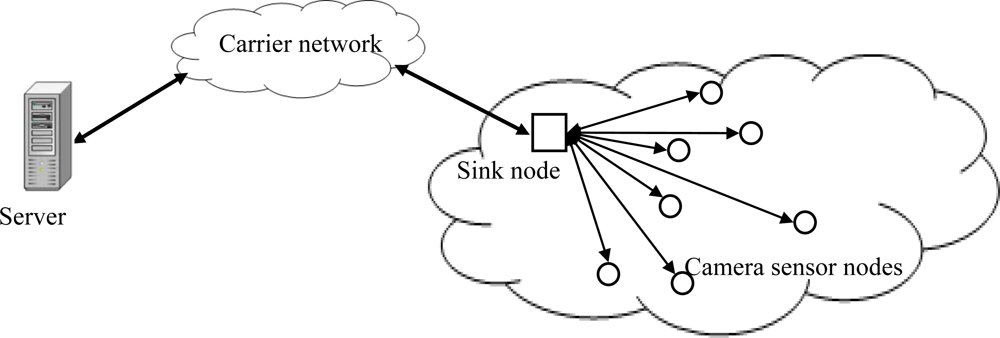
<p>In this section, we introduce the developed architecture of the secure wireless camera sensor networks by utilizing the proposed chaotic block cipher. Each camera sensor node in the networks is battery-powered and has limited computation and wireless communication capabilities. The sink is a data collection center equipped with sufficient computation and storage capabilities. Camera sensor nodes periodically send the captured images to the sink node. Then the sink nodes transport this information secretly with the data process server via carrier networks. The proposed block cipher is mounting at the carrier network. <xref ref-type="fig" rid="f3-sensors-11-01607">Figure 3</xref> shows the system architecture of the camera sensor network.</p></sec></sec>
<sec sec-type="methods">
<label>5.</label>
<title>Performance Analysis</title>
<sec sec-type="methods">
<label>5.1.</label>
<title>Information Entropy Analysis</title>
<p>It is known that the entropy <italic>H</italic>(<italic>m</italic>) of a message source m can be calculated by <xref ref-type="disp-formula" rid="FD28">Equation (28)</xref> [<xref ref-type="bibr" rid="b8-sensors-11-01607">8</xref>]:
<disp-formula id="FD28">
<label>(28)</label>
<mml:math display="block">
<mml:mrow>
<mml:mi>H</mml:mi>
<mml:mo stretchy="false">(</mml:mo>
<mml:mi>m</mml:mi>
<mml:mo stretchy="false">)</mml:mo>
<mml:mo>=</mml:mo>
<mml:mo>−</mml:mo>
<mml:munderover>
<mml:mo>∑</mml:mo>
<mml:mrow>
<mml:mi>i</mml:mi>
<mml:mo>=</mml:mo>
<mml:mn>0</mml:mn></mml:mrow>
<mml:mrow>
<mml:msup>
<mml:mrow>
<mml:mn>2</mml:mn></mml:mrow>
<mml:mi>N</mml:mi></mml:msup>
<mml:mo>−</mml:mo>
<mml:mn>1</mml:mn></mml:mrow></mml:munderover>
<mml:mrow>
<mml:mi>p</mml:mi>
<mml:mo stretchy="false">(</mml:mo>
<mml:msub>
<mml:mrow>
<mml:mi>m</mml:mi></mml:mrow>
<mml:mi>i</mml:mi></mml:msub>
<mml:mo stretchy="false">)</mml:mo>
<mml:mo> </mml:mo>
<mml:mtext>log</mml:mtext>
<mml:mo> </mml:mo>
<mml:mfrac>
<mml:mn>1</mml:mn>
<mml:mrow>
<mml:mi>p</mml:mi>
<mml:mo stretchy="false">(</mml:mo>
<mml:msub>
<mml:mrow>
<mml:mi>m</mml:mi></mml:mrow>
<mml:mi>i</mml:mi></mml:msub>
<mml:mo stretchy="false">)</mml:mo></mml:mrow></mml:mfrac></mml:mrow></mml:mrow></mml:math></disp-formula>where <italic>p</italic>(<italic>m<sub>i</sub></italic>) represents the probability of symbol <italic>m<sub>i</sub></italic>. The entropy is expressed in bits. For a purely random source emitting 2<italic>N</italic> symbols, the entropy is <italic>H</italic>(<italic>m</italic>) = <italic>N</italic>. For encrypted messages, the entropy should ideally be <italic>H</italic>(<italic>m</italic>) = <italic>N</italic> .</p>
<p>When a cipher emits symbols with entropy less than <italic>N</italic>, there exists a certain degree of predictability, which threatens its security. Let us consider the ciphertext of a random text file, a Lena’s image of size 256 × 256 and a random video file encrypted using the proposed scheme. The number of occurrence of each ciphertext pixel <italic>m<sub>i</sub></italic> is recorded and the probability of occurrence is computed for the three files. The corresponding entropies are filled into <xref ref-type="table" rid="t5-sensors-11-01607">Table 5</xref>. The test values obtained are very close to the theoretical value <italic>N</italic> = 8 for the three kinds of files. This means that information leakage in the encryption process is negligible and the encryption system is secure against the entropy attack.</p></sec>
<sec>
<label>5.2.</label>
<title>Correlation of Adjacent Pixels in Encrypted Image</title>
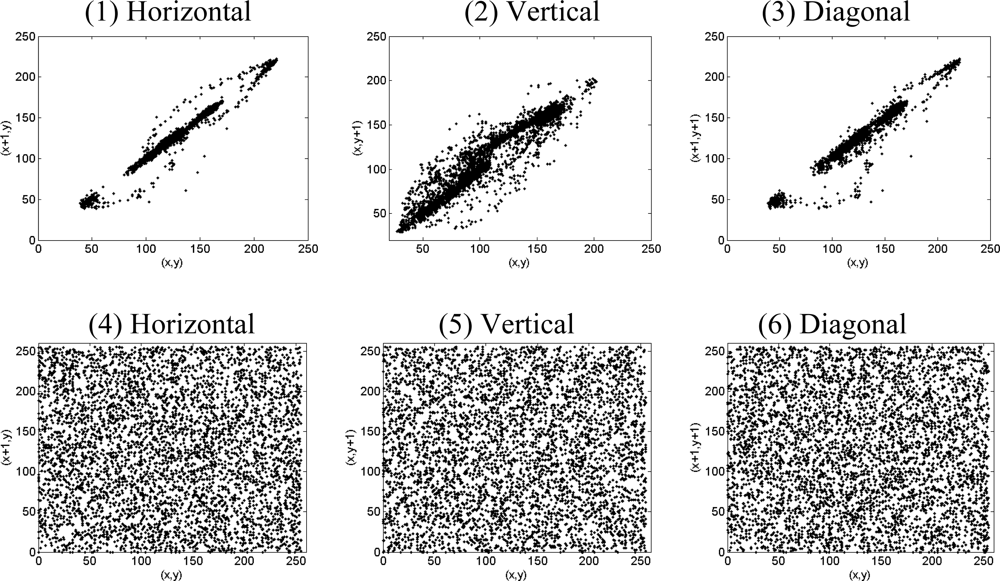
<p>In order to resist statistical attacks, the ciphertext should possess certain random properties. A detail study has been explored and the results are summarized. The results of the Lena.bmp are used for illustration. For an ordinary image, each pixel is usually highly correlated with its adjacent pixels either in horizontal, vertical or diagonal directions. These high-correlation properties can be quantified as their correlation coefficients for comparison. To calculate the correlation coefficients, the following formulas are used:
<disp-formula id="FD29">
<label>(29)</label>
<mml:math display="block">
<mml:mrow>
<mml:mi>r</mml:mi>
<mml:mo stretchy="false">(</mml:mo>
<mml:mi>x</mml:mi>
<mml:mo>,</mml:mo>
<mml:mi>y</mml:mi>
<mml:mo stretchy="false">)</mml:mo>
<mml:mo>=</mml:mo>
<mml:mfrac>
<mml:mrow>
<mml:mrow>
<mml:mo>|</mml:mo>
<mml:mrow>
<mml:mi mathvariant="italic">Cov</mml:mi>
<mml:mo stretchy="false">(</mml:mo>
<mml:mi>x</mml:mi>
<mml:mo>,</mml:mo>
<mml:mi>y</mml:mi>
<mml:mo stretchy="false">)</mml:mo></mml:mrow>
<mml:mo>|</mml:mo></mml:mrow></mml:mrow>
<mml:mrow>
<mml:msqrt>
<mml:mrow>
<mml:mi>D</mml:mi>
<mml:mo stretchy="false">(</mml:mo>
<mml:mi>x</mml:mi>
<mml:mo stretchy="false">)</mml:mo></mml:mrow></mml:msqrt>
<mml:msqrt>
<mml:mrow>
<mml:mi>D</mml:mi>
<mml:mo stretchy="false">(</mml:mo>
<mml:mi>y</mml:mi>
<mml:mo stretchy="false">)</mml:mo></mml:mrow></mml:msqrt></mml:mrow></mml:mfrac></mml:mrow></mml:math></disp-formula>
<disp-formula id="FD30">
<label>(30)</label>
<mml:math display="block">
<mml:mrow>
<mml:mtext>cov</mml:mtext>
<mml:mo stretchy="false">(</mml:mo>
<mml:mi>x</mml:mi>
<mml:mo>,</mml:mo>
<mml:mi>y</mml:mi>
<mml:mo stretchy="false">)</mml:mo>
<mml:mo>=</mml:mo>
<mml:mfrac>
<mml:mn>1</mml:mn>
<mml:mi>N</mml:mi></mml:mfrac>
<mml:munderover>
<mml:mo>∑</mml:mo>
<mml:mrow>
<mml:mi>k</mml:mi>
<mml:mo>=</mml:mo>
<mml:mn>1</mml:mn></mml:mrow>
<mml:mi>N</mml:mi></mml:munderover>
<mml:mrow>
<mml:mo stretchy="false">(</mml:mo>
<mml:msub>
<mml:mrow>
<mml:mi>x</mml:mi></mml:mrow>
<mml:mi>k</mml:mi></mml:msub>
<mml:mo>−</mml:mo>
<mml:mi>E</mml:mi>
<mml:mo stretchy="false">(</mml:mo>
<mml:mi>x</mml:mi>
<mml:mo stretchy="false">)</mml:mo>
<mml:mo stretchy="false">(</mml:mo>
<mml:msub>
<mml:mrow>
<mml:mi>y</mml:mi></mml:mrow>
<mml:mi>k</mml:mi></mml:msub>
<mml:mo>−</mml:mo>
<mml:mi>E</mml:mi>
<mml:mo stretchy="false">(</mml:mo>
<mml:mi>y</mml:mi>
<mml:mo stretchy="false">)</mml:mo>
<mml:mo stretchy="false">)</mml:mo></mml:mrow></mml:mrow></mml:math></disp-formula>
<disp-formula id="FD31">
<label>(31)</label>
<mml:math display="block">
<mml:mrow>
<mml:mi>E</mml:mi>
<mml:mo stretchy="false">(</mml:mo>
<mml:mi>x</mml:mi>
<mml:mo stretchy="false">)</mml:mo>
<mml:mo>=</mml:mo>
<mml:mfrac>
<mml:mn>1</mml:mn>
<mml:mi>N</mml:mi></mml:mfrac>
<mml:munderover>
<mml:mo>∑</mml:mo>
<mml:mrow>
<mml:mi>k</mml:mi>
<mml:mo>=</mml:mo>
<mml:mn>1</mml:mn></mml:mrow>
<mml:mi>N</mml:mi></mml:munderover>
<mml:mrow>
<mml:msub>
<mml:mrow>
<mml:mi>x</mml:mi></mml:mrow>
<mml:mi>k</mml:mi></mml:msub></mml:mrow></mml:mrow></mml:math></disp-formula>
<disp-formula id="FD32">
<label>(32)</label>
<mml:math display="block">
<mml:mrow>
<mml:mi>D</mml:mi>
<mml:mo stretchy="false">(</mml:mo>
<mml:mi>x</mml:mi>
<mml:mo stretchy="false">)</mml:mo>
<mml:mo>=</mml:mo>
<mml:mfrac>
<mml:mn>1</mml:mn>
<mml:mi>N</mml:mi></mml:mfrac>
<mml:munderover>
<mml:mo>∑</mml:mo>
<mml:mrow>
<mml:mi>k</mml:mi>
<mml:mo>=</mml:mo>
<mml:mn>1</mml:mn></mml:mrow>
<mml:mi>N</mml:mi></mml:munderover>
<mml:mrow>
<mml:mo stretchy="false">(</mml:mo>
<mml:msub>
<mml:mrow>
<mml:mi>x</mml:mi></mml:mrow>
<mml:mi>k</mml:mi></mml:msub>
<mml:mo>−</mml:mo>
<mml:mi>E</mml:mi>
<mml:mo stretchy="false">(</mml:mo>
<mml:mi>x</mml:mi>
<mml:mo stretchy="false">)</mml:mo>
<mml:mo stretchy="false">)</mml:mo></mml:mrow></mml:mrow></mml:math></disp-formula>where <italic>x</italic> and <italic>y</italic> are the grey-scale value of two adjacent pixels in the image and <italic>N</italic> is the total number of pixels selected from the image for the calculation. In <xref ref-type="table" rid="t6-sensors-11-01607">Table 6</xref> and <xref ref-type="fig" rid="f4-sensors-11-01607">Figure 4</xref>, the correlation coefficients of Lena image and those of its encrypted image with the secret key (<italic>μ</italic> = 3.998, <italic>x<sub>0</sub></italic> = 0.21745) are given.</p>
<p>It is clear that there is negligible correlation between these two adjacent pixels in the encrypted image. However, the two adjacent pixels in the original image are highly correlated. The results indicate that the proposed algorithm has successfully removed the correlation of adjacent pixels in the plain-image so that neighbor pixels in the cipher-image virtually have no correlation. That is to say, the new scheme possesses prominent diffusion property.</p></sec>
<sec sec-type="methods">
<label>5.3.</label>
<title>Sensitivity Analysis</title>
<p>From the cryptographical point of view, given two distinct keys, even if their difference is the minimal value under the current finite precision, the encryption and decryption results of a good cryptosystem should still be completely different. In other words, this cryptosystem should have a very high sensitivity to the secret key [<xref ref-type="bibr" rid="b14-sensors-11-01607">14</xref>]. For testing the key sensitivity of the proposed block encryption procedure, we use the grayscale image Lena.bmp of size 256 × 256 as the test image to illustrate the result and perform the following steps:
<list list-type="order">
<list-item>
<p>Lena.bmp is encrypted by using the secret key (<italic>μ</italic> = 3.998, <italic>x<sub>0</sub></italic> = 0.21745) and the resultant image is referred as Ciphertext A;</p></list-item>
<list-item>
<p>The same image is encrypted by making the slight modification in the secret key <italic>i.e.</italic>, (<italic>μ</italic> = 3.998 + 10<sup>−15</sup>, <italic>x<sub>0</sub></italic> = 0.21745) and the resultant image is referred as Ciphertext B;</p></list-item>
<list-item>
<p>Again, the same original image is encrypted by making the slight modification in the secret key <italic>i.e.</italic>, (<italic>μ</italic> = 3.998, <italic>x<sub>0</sub></italic> = 0.21745 + 10<sup>−15</sup>) and the resultant image is referred as Ciphertext C;</p></list-item>
<list-item>
<p>The same original image is encrypted by making the slight modification in the secret key <italic>i.e.</italic>, (<italic>μ</italic> = 3.998, <italic>x<sub>0</sub></italic> = 0.21745 − 10<sup>−15</sup>) and the resultant image is referred as Ciphertext D.</p></list-item>
<list-item>
<p>Finally, the correlation coefficients between the corresponding pixels of the four ciphertexts A, B, C and D are computed and filled into <xref ref-type="table" rid="t7-sensors-11-01607">Table 7</xref>.</p></list-item></list></p>
<p>It is clear from the <xref ref-type="table" rid="t7-sensors-11-01607">Table 7</xref> that no correlation exists among four encrypted images even though these have been produced by using slightly different secret keys. These results sufficiently demonstrate the proposed cryptosystem is highly key sensitive.</p>
<p>Another cryptographical property required by a good cryptosystem is that the encryption should be very sensitive to plaintext, <italic>i.e.</italic>, the ciphertexts of two plaintexts with a slight difference should be very different [<xref ref-type="bibr" rid="b14-sensors-11-01607">14</xref>]. <xref ref-type="fig" rid="f5-sensors-11-01607">Figure 5</xref> is the bit-wise XOR of two ciphertexts when encrypting two image plaintexts with only the first bit different based on the proposed cryptosystem. The result of <xref ref-type="fig" rid="f5-sensors-11-01607">Figure 5</xref> showing that the proposed encryption scheme is very sensitive with respect to small changes in the plaintext.</p>
<p>From the above investigation and study, we can conclude that the lack of security will discourage the use of these algorithms for secure applications. It is advisable that new chaotic cryptosystems take into account some important things: (1) the distribution of the ciphertext should be sufficiently flat in order to resist the statistics attack [<xref ref-type="bibr" rid="b8-sensors-11-01607">8</xref>]; (2) the sub keys should depend on not only the secret key but also the plaintext to avoid key stream attack [<xref ref-type="bibr" rid="b11-sensors-11-01607">11</xref>]; (3) the first block or sub key should be pretreated to resist some existing attacks; (4) the ciphertext should not leak out any information of the sub keys to eliminate corresponding utilizing ciphertext attacks.</p></sec></sec>
<sec sec-type="conclusions">
<label>6.</label>
<title>Conclusions</title>
<p>This paper has analyzed the security of a block cipher based on logistic map proposed in [<xref ref-type="bibr" rid="b11-sensors-11-01607">11</xref>]. It demonstrated that [<xref ref-type="bibr" rid="b11-sensors-11-01607">11</xref>] is vulnerable to chosen ciphertext attack and key stream attack. Then it gave an enhancement version on wireless camera sensor network. Performance analysis demonstrates that the proposed scheme possesses the original benefits as well as enhancing its security. The sample procedure and efficiency of the new scheme are encouraging for the practical implementation in wireless camera sensor network.</p></sec></body>
<back>
<ack>
<p>This work described here was supported in part by the National Natural Science Foundation of China (No.60971104), the Fundamental Research Funds for the Central Universities (No. SWJTU09ZT16), the Science &amp; Technology Key Plan Project of Chengdu (No.10GGYB649GX-023) and the Foundation of Southwest University for Nationalities (No.09NYB002 and Y-2010-08).</p></ack>
<ref-list>
<title>References and Notes</title>
<ref id="b1-sensors-11-01607"><label>1.</label><citation citation-type="journal"><person-group person-group-type="author"><name><surname>Yick</surname><given-names>J.</given-names></name><name><surname>Mukherjee</surname><given-names>B.</given-names></name><name><surname>Ghosal</surname><given-names>D.</given-names></name></person-group><article-title>Wireless sensor network survey</article-title><source>Comp. Netw</source><year>2008</year><volume>52</volume><fpage>2292</fpage><lpage>2330</lpage><pub-id pub-id-type="doi">10.1016/j.comnet.2008.04.002</pub-id></citation></ref>
<ref id="b2-sensors-11-01607"><label>2.</label><citation citation-type="journal"><person-group person-group-type="author"><name><surname>Yang</surname><given-names>J.</given-names></name><name><surname>Xiao</surname><given-names>D.</given-names></name><name><surname>Xiang</surname><given-names>T.</given-names></name></person-group><article-title>Cryptanalysis of a chaos block cipher for wireless sensor network</article-title><source>Commun. Nonlinear Sci. Numer. Sim</source><year>2011</year><volume>16</volume><fpage>844</fpage><lpage>850</lpage><pub-id pub-id-type="doi">10.1016/j.cnsns.2010.05.005</pub-id></citation></ref>
<ref id="b3-sensors-11-01607"><label>3.</label><citation citation-type="journal"><person-group person-group-type="author"><name><surname>Khan</surname><given-names>M.K.</given-names></name><name><surname>Alghathbar</surname><given-names>K.</given-names></name></person-group><article-title>Cryptanalysis and security improvements of “Two-Factor User Authentication in Wireless Sensor Networks”</article-title><source>Sensors</source><year>2010</year><volume>10</volume><fpage>2450</fpage><lpage>2459</lpage><pub-id pub-id-type="doi">10.3390/s100302450</pub-id><pub-id pub-id-type="pmid">22294935</pub-id></citation></ref>
<ref id="b4-sensors-11-01607"><label>4.</label><citation citation-type="journal"><person-group person-group-type="author"><name><surname>Khan</surname><given-names>M.K.</given-names></name><name><surname>Xie</surname><given-names>L.</given-names></name><name><surname>Zhang</surname><given-names>J.</given-names></name></person-group><article-title>Chaos and NDFT-based concealing of fingerprint-biometric data into audio signals for trustworthy Person Authentication</article-title><source>Digit. Signal Process</source><year>2010</year><volume>20</volume><fpage>179</fpage><lpage>190</lpage><pub-id pub-id-type="doi">10.1016/j.dsp.2009.05.004</pub-id></citation></ref>
<ref id="b5-sensors-11-01607"><label>5.</label><citation citation-type="journal"><person-group person-group-type="author"><name><surname>Baptista</surname><given-names>M.S.</given-names></name></person-group><article-title>Cryptography with chaos</article-title><source>Phy. Lett. A</source><year>1998</year><volume>240</volume><fpage>50</fpage><lpage>54</lpage><pub-id pub-id-type="doi">10.1016/S0375-9601(98)00086-3</pub-id></citation></ref>
<ref id="b6-sensors-11-01607"><label>6.</label><citation citation-type="journal"><person-group person-group-type="author"><name><surname>Wong</surname><given-names>W.-K.</given-names></name><name><surname>Lee</surname><given-names>L.-P.</given-names></name><name><surname>Wong</surname><given-names>K.-W.</given-names></name></person-group><article-title>A modified chaotic cryptographic method</article-title><source>Comp. Phys. Commun</source><year>2001</year><volume>138</volume><fpage>234</fpage><lpage>236</lpage><pub-id pub-id-type="doi">10.1016/S0010-4655(01)00220-X</pub-id></citation></ref>
<ref id="b7-sensors-11-01607"><label>7.</label><citation citation-type="journal"><person-group person-group-type="author"><name><surname>Rhouma</surname><given-names>R.</given-names></name><name><surname>Belghith</surname><given-names>S.</given-names></name></person-group><article-title>Cryptanalysis of a spatiotemporal chaotic image/video cryptosystem</article-title><source>Phys. Lett. A</source><year>2008</year><volume>372</volume><fpage>5790</fpage><lpage>5794</lpage><pub-id pub-id-type="doi">10.1016/j.physleta.2008.07.042</pub-id></citation></ref>
<ref id="b8-sensors-11-01607"><label>8.</label><citation citation-type="journal"><person-group person-group-type="author"><name><surname>Xiang</surname><given-names>T.</given-names></name><name><surname>Liao</surname><given-names>X.</given-names></name><name><surname>Tang</surname><given-names>G.</given-names></name><name><surname>Chen</surname><given-names>Y.</given-names></name><name><surname>Wong</surname><given-names>K.</given-names></name></person-group><article-title>A novel block cryptosystem based on iterating a chaotic map</article-title><source>Phys. Lett. A</source><year>2006</year><volume>349</volume><fpage>109</fpage><lpage>115</lpage><pub-id pub-id-type="doi">10.1016/j.physleta.2005.02.083</pub-id></citation></ref>
<ref id="b9-sensors-11-01607"><label>9.</label><citation citation-type="journal"><person-group person-group-type="author"><name><surname>García</surname><given-names>P.</given-names></name><name><surname>Jiménez</surname><given-names>J.</given-names></name></person-group><article-title>Communication through chaotic map systems</article-title><source>Phys. Lett. A</source><year>2002</year><volume>298</volume><fpage>35</fpage><lpage>40</lpage><pub-id pub-id-type="doi">10.1016/S0375-9601(02)00382-1</pub-id></citation></ref>
<ref id="b10-sensors-11-01607"><label>10.</label><citation citation-type="journal"><person-group person-group-type="author"><name><surname>Wong</surname><given-names>K.</given-names></name></person-group><article-title>A combined chaotic cryptographic and hashing scheme</article-title><source>Phys. Lett. A</source><year>2003</year><volume>307</volume><fpage>292</fpage><lpage>298</lpage><pub-id pub-id-type="doi">10.1016/S0375-9601(02)01770-X</pub-id></citation></ref>
<ref id="b11-sensors-11-01607"><label>11.</label><citation citation-type="journal"><person-group person-group-type="author"><name><surname>Wang</surname><given-names>Y.</given-names></name><name><surname>Liao</surname><given-names>X.</given-names></name><name><surname>Xiang</surname><given-names>T.</given-names></name><name><surname>Wong</surname><given-names>K.</given-names></name><name><surname>Yang</surname><given-names>D.</given-names></name></person-group><article-title>Cryptanalysis and improvement on a block cryptosystem based on iteration a chaotic map</article-title><source>Phys. Lett. A</source><year>2007</year><volume>363</volume><fpage>277</fpage><lpage>281</lpage><pub-id pub-id-type="doi">10.1016/j.physleta.2006.11.023</pub-id></citation></ref>
<ref id="b12-sensors-11-01607"><label>12.</label><citation citation-type="journal"><person-group person-group-type="author"><name><surname>Li</surname><given-names>C.</given-names></name><name><surname>Li</surname><given-names>S.</given-names></name><name><surname>Alvarez</surname><given-names>G.</given-names></name><name><surname>Chen</surname><given-names>G.</given-names></name><name><surname>Lo</surname><given-names>K.</given-names></name></person-group><article-title>Cryptanalysis of two chaotic encryption schemes based on circular bit shift and XOR operations</article-title><source>Phys. Lett. A</source><year>2007</year><volume>369</volume><fpage>23</fpage><lpage>30</lpage><pub-id pub-id-type="doi">10.1016/j.physleta.2007.04.023</pub-id></citation></ref>
<ref id="b13-sensors-11-01607"><label>13.</label><citation citation-type="book"><person-group person-group-type="author"><name><surname>Stinson</surname><given-names>D.R.</given-names></name></person-group><source>Cryptography: Theory and Practice</source><publisher-name>CRC Press</publisher-name><publisher-loc>Boca Raton, FL, USA</publisher-loc><year>1995</year></citation></ref>
<ref id="b14-sensors-11-01607"><label>14.</label><citation citation-type="book"><person-group person-group-type="author"><name><surname>Schneier</surname><given-names>B.</given-names></name></person-group><source>Applied Cryptography-Protocols, Algorithms, and Source Code in C</source><edition>2nd ed</edition><publisher-name>John Wiley Sons</publisher-name><publisher-loc>New York, NY, USA</publisher-loc><year>1996</year></citation></ref>
<ref id="b15-sensors-11-01607"><label>15.</label><citation citation-type="book"><person-group person-group-type="author"><name><surname>Menezes</surname><given-names>A.</given-names></name><name><surname>VanOorschot</surname><given-names>P.</given-names></name><name><surname>Vanstone</surname><given-names>S.</given-names></name></person-group><source>Handbook of Applied Cryptography</source><publisher-name>CRC Press</publisher-name><publisher-loc>Boca Raton, FL, USA</publisher-loc><year>1996</year></citation></ref></ref-list>
<sec sec-type="display-objects">
<title>Figures and Tables</title>
<fig id="f1-sensors-11-01607" position="float">
<label>Figure 1.</label>
<caption>
<p>Block diagram of Wang <italic>et al.</italic> scheme.</p></caption>
<graphic xlink:href="sensors-11-01607f1.gif"/></fig>
<fig id="f2-sensors-11-01607" position="float">
<label>Figure 2.</label>
<caption>
<p><bold>(a)</bold> Plaintext. <bold>(b)</bold> The ciphertext. <bold>(c)</bold> The result of attack.</p></caption>
<graphic xlink:href="sensors-11-01607f2.gif"/></fig>
<fig id="f3-sensors-11-01607" position="float">
<label>Figure 3.</label>
<caption>
<p>System architecture of the camera sensor network.</p></caption>
<graphic xlink:href="sensors-11-01607f3.gif"/></fig>
<fig id="f4-sensors-11-01607" position="float">
<label>Figure 4.</label>
<caption>
<p>Correlation of the adjacent pixels (1–3)are plaintext and (4–6) are ciphertext.</p></caption>
<graphic xlink:href="sensors-11-01607f4.gif"/></fig>
<fig id="f5-sensors-11-01607" position="float">
<label>Figure 5.</label>
<caption>
<p>Bit-wise XOR of two ciphertexts.</p></caption>
<graphic xlink:href="sensors-11-01607f5.gif"/></fig>
<table-wrap id="t1-sensors-11-01607" position="float">
<label>Table 1.</label>
<caption>
<p>Decryption of C1 using <italic>μ</italic> = 4, <italic>x</italic><sub>0</sub> = 0.1777.</p></caption>
<table frame="hsides" rules="groups">
<thead>
<tr>
<th align="left" valign="bottom"><italic>j</italic></th>
<th align="left" valign="bottom"><italic>C<sub>j</sub></italic></th>
<th align="left" valign="bottom"><italic>f</italic>(<italic>C<sub>j</sub></italic>) mod 64</th>
<th align="left" valign="bottom"><italic>D<sub>j</sub></italic></th>
<th align="left" valign="bottom"><italic>A<sub>j</sub></italic></th></tr></thead>
<tbody>
<tr>
<td align="left" valign="bottom">1</td>
<td align="left" valign="bottom">EAFA4D22D326D40C</td>
<td align="left" valign="bottom">35</td>
<td align="left" valign="bottom">10</td>
<td align="left" valign="bottom">5E0AEF19A566A729</td></tr>
<tr>
<td align="left" valign="bottom">2</td>
<td align="left" valign="bottom">2960D4C5E768138D</td>
<td align="left" valign="bottom">36</td>
<td align="left" valign="bottom">03</td>
<td align="left" valign="bottom">D6E5053AF966B07E</td></tr>
<tr>
<td align="left" valign="bottom">3</td>
<td align="left" valign="bottom">C716165410ACD847</td>
<td align="left" valign="bottom">12</td>
<td align="left" valign="bottom">1D</td>
<td align="left" valign="bottom">EF5FCAE1DB5FA883</td></tr>
<tr>
<td align="left" valign="bottom">4</td>
<td align="left" valign="bottom">3C991CA5F1E8FCC6</td>
<td align="left" valign="bottom">20</td>
<td align="left" valign="bottom">2E</td>
<td align="left" valign="bottom">4246A2AAADA975E2</td></tr></tbody></table></table-wrap>
<table-wrap id="t2-sensors-11-01607" position="float">
<label>Table 2.</label>
<caption>
<p>Decryption of C2 using <italic>μ</italic> = 4, <italic>x</italic><sub>0</sub> = 0.1777.</p></caption>
<table frame="hsides" rules="groups">
<thead>
<tr>
<th align="left" valign="bottom"><italic>j</italic></th>
<th align="left" valign="bottom"><italic>C<sub>j</sub></italic></th>
<th align="left" valign="bottom"><italic>f</italic>(<italic>C<sub>j</sub></italic>) mod 64</th>
<th align="left" valign="bottom"><italic>D<sub>j</sub></italic></th>
<th align="left" valign="bottom"><italic>A<sub>j</sub></italic></th></tr></thead>
<tbody>
<tr>
<td align="left" valign="bottom">1</td>
<td align="left" valign="bottom">F11ED8CA5F72155E</td>
<td align="left" valign="bottom">35</td>
<td align="left" valign="bottom">10</td>
<td align="left" valign="bottom">5E0AEF19A566A729</td></tr>
<tr>
<td align="left" valign="bottom">2</td>
<td align="left" valign="bottom">8A99683495FDBAAB</td>
<td align="left" valign="bottom">36</td>
<td align="left" valign="bottom">03</td>
<td align="left" valign="bottom">D6E5053AF966B07E</td></tr>
<tr>
<td align="left" valign="bottom">3</td>
<td align="left" valign="bottom">CC1E07D524E0E7A1</td>
<td align="left" valign="bottom">12</td>
<td align="left" valign="bottom">1D</td>
<td align="left" valign="bottom">EF5FCAE1DB5FA883</td></tr>
<tr>
<td align="left" valign="bottom">4</td>
<td align="left" valign="bottom">D9D58D603B600C1E</td>
<td align="left" valign="bottom">20</td>
<td align="left" valign="bottom">2E</td>
<td align="left" valign="bottom">4246A2AAADA975E2</td></tr></tbody></table></table-wrap>
<table-wrap id="t3-sensors-11-01607" position="float">
<label>Table 3.</label>
<caption>
<p>The chosen <italic>C<sup>1</sup></italic> and <italic>C<sup>2</sup></italic> of <italic>C</italic>.</p></caption>
<table frame="hsides" rules="groups">
<thead>
<tr>
<th align="left" valign="bottom"><italic>j</italic></th>
<th align="left" valign="bottom"><italic>C<sub>j</sub></italic></th>
<th align="left" valign="bottom"><italic>f</italic>(<italic>C<sub>j</sub></italic>) mod 64</th>
<th align="left" valign="bottom">Chosen 
<inline-formula>
<mml:math>
<mml:mrow>
<mml:msubsup>
<mml:mrow>
<mml:mi>C</mml:mi></mml:mrow>
<mml:mi>j</mml:mi>
<mml:mn>1</mml:mn></mml:msubsup></mml:mrow></mml:math></inline-formula></th>
<th align="left" valign="bottom">Chosen 
<inline-formula>
<mml:math>
<mml:mrow>
<mml:msubsup>
<mml:mrow>
<mml:mi>C</mml:mi></mml:mrow>
<mml:mi>j</mml:mi>
<mml:mn>2</mml:mn></mml:msubsup></mml:mrow></mml:math></inline-formula></th></tr></thead>
<tbody>
<tr>
<td align="left" valign="bottom">1</td>
<td align="left" valign="bottom">218A916626E5DA55</td>
<td align="left" valign="bottom">28</td>
<td align="left" valign="bottom">00000000000000DC</td>
<td align="left" valign="bottom">0000000000001C00</td></tr>
<tr>
<td align="left" valign="bottom">2</td>
<td align="left" valign="bottom">BA53340E52524733</td>
<td align="left" valign="bottom">45</td>
<td align="left" valign="bottom">00000000000000ED</td>
<td align="left" valign="bottom">0000000000002D00</td></tr>
<tr>
<td align="left" valign="bottom">3</td>
<td align="left" valign="bottom">2C2CE7EEB40BA7EC</td>
<td align="left" valign="bottom">63</td>
<td align="left" valign="bottom">00000000000000FF</td>
<td align="left" valign="bottom">0000000000003F00</td></tr>
<tr>
<td align="left" valign="bottom">4</td>
<td align="left" valign="bottom">B19F2A8A8BBAB8BD</td>
<td align="left" valign="bottom">62</td>
<td align="left" valign="bottom">00000000000000FE</td>
<td align="left" valign="bottom">0000000000003E00</td></tr></tbody></table></table-wrap>
<table-wrap id="t4-sensors-11-01607" position="float">
<label>Table 4.</label>
<caption>
<p>Decrypt the chosen <italic>C<sup>1</sup></italic> and <italic>C<sup>2</sup></italic> of <xref ref-type="table" rid="t3-sensors-11-01607">Table 3</xref> using <italic>μ</italic> = 4, <italic>x</italic><sub>0</sub> = 0.1777.</p></caption>
<table frame="hsides" rules="groups">
<thead>
<tr>
<th align="left" valign="bottom"><italic>j</italic></th>
<th align="left" valign="bottom">
<inline-formula>
<mml:math>
<mml:mrow>
<mml:msubsup>
<mml:mrow>
<mml:mi>P</mml:mi></mml:mrow>
<mml:mi>j</mml:mi>
<mml:mn>1</mml:mn></mml:msubsup></mml:mrow></mml:math></inline-formula></th>
<th align="left" valign="bottom">
<inline-formula>
<mml:math>
<mml:mrow>
<mml:msubsup>
<mml:mrow>
<mml:mi>P</mml:mi></mml:mrow>
<mml:mi>j</mml:mi>
<mml:mn>2</mml:mn></mml:msubsup></mml:mrow></mml:math></inline-formula></th>
<th align="left" valign="bottom">
<inline-formula>
<mml:math>
<mml:mrow>
<mml:msubsup>
<mml:mrow>
<mml:mi>P</mml:mi></mml:mrow>
<mml:mi>j</mml:mi>
<mml:mn>1</mml:mn></mml:msubsup>
<mml:mo>⊕</mml:mo>
<mml:msubsup>
<mml:mrow>
<mml:mi>P</mml:mi></mml:mrow>
<mml:mi>j</mml:mi>
<mml:mn>2</mml:mn></mml:msubsup></mml:mrow></mml:math></inline-formula></th>
<th align="left" valign="bottom"><italic>D<sub>j</sub></italic></th>
<th align="left" valign="bottom"><italic>A<sub>j</sub></italic></th></tr></thead>
<tbody>
<tr>
<td align="left" valign="bottom">1</td>
<td align="left" valign="bottom">A7F55E0AEF19A566</td>
<td align="left" valign="bottom">BB295E0AEF19A566</td>
<td align="left" valign="bottom">1CDC000000000000</td>
<td align="left" valign="bottom">16</td>
<td align="left" valign="bottom">5E0AEF19A566A729</td></tr>
<tr>
<td align="left" valign="bottom">2</td>
<td align="left" valign="bottom">ABA16BD9AC1F83AC</td>
<td align="left" valign="bottom">ABB79D59AC1F83AC</td>
<td align="left" valign="bottom">0016F68000000000</td>
<td align="left" valign="bottom">25</td>
<td align="left" valign="bottom">B3583F075957423A</td></tr>
<tr>
<td align="left" valign="bottom">3</td>
<td align="left" valign="bottom">2B876D414E8FBD7F</td>
<td align="left" valign="bottom">2B8762BE8E8FBD7F</td>
<td align="left" valign="bottom">00000FFFC0000000</td>
<td align="left" valign="bottom">34</td>
<td align="left" valign="bottom">3A3EF5FCAE1DB5FA</td></tr>
<tr>
<td align="left" valign="bottom">4</td>
<td align="left" valign="bottom">6A2A9568E24C2424</td>
<td align="left" valign="bottom">6A252AE8E24C2424</td>
<td align="left" valign="bottom">000FBF8000000000</td>
<td align="left" valign="bottom">26</td>
<td align="left" valign="bottom">A389309091A8AAAB</td></tr></tbody></table></table-wrap>
<table-wrap id="t5-sensors-11-01607" position="float">
<label>Table 5.</label>
<caption>
<p>Entropy test result.</p></caption>
<table frame="hsides" rules="groups">
<thead>
<tr>
<th align="left" valign="bottom">Test file</th>
<th align="left" valign="bottom">Lena</th>
<th align="left" valign="bottom">Text file</th>
<th align="left" valign="bottom">Video file</th></tr></thead>
<tbody>
<tr>
<td align="left" valign="bottom">Ciphertext entropy</td>
<td align="left" valign="bottom">7.9923</td>
<td align="left" valign="bottom">7.9981</td>
<td align="left" valign="bottom">7.9919</td></tr></tbody></table></table-wrap>
<table-wrap id="t6-sensors-11-01607" position="float">
<label>Table 6.</label>
<caption>
<p>The correlation coefficients of the adjacent pixels.</p></caption>
<table frame="hsides" rules="groups">
<thead>
<tr>
<th align="left" valign="bottom"><bold>Positions</bold></th>
<th align="left" valign="bottom"><bold>Plaintext image</bold></th>
<th align="left" valign="bottom"><bold>Ciphertext image</bold></th></tr></thead>
<tbody>
<tr>
<td align="left" valign="bottom">Horizontal</td>
<td align="left" valign="bottom">0.98448</td>
<td align="left" valign="bottom">0.0031261</td></tr>
<tr>
<td align="left" valign="bottom">Vertical</td>
<td align="left" valign="bottom">0.94878</td>
<td align="left" valign="bottom">0.0057563</td></tr>
<tr>
<td align="left" valign="bottom">Diagonal</td>
<td align="left" valign="bottom">0.96787</td>
<td align="left" valign="bottom">0.0130690</td></tr></tbody></table></table-wrap>
<table-wrap id="t7-sensors-11-01607" position="float">
<label>Table 7.</label>
<caption>
<p>The correlation coefficients of the ciphertexts.</p></caption>
<table frame="hsides" rules="groups">
<thead>
<tr>
<th align="left" valign="bottom"><bold>Ciphertext 1</bold></th>
<th align="left" valign="bottom"><bold>Ciphertext 2</bold></th>
<th align="center" valign="bottom"><bold>Correlation Coefficient</bold></th></tr></thead>
<tbody>
<tr>
<td align="left" valign="bottom">Ciphertext A</td>
<td align="left" valign="bottom">Ciphertext B</td>
<td align="center" valign="bottom">0.00296</td></tr>
<tr>
<td align="left" valign="bottom">Ciphertext A</td>
<td align="left" valign="bottom">Ciphertext C</td>
<td align="center" valign="bottom">0.00137</td></tr>
<tr>
<td align="left" valign="bottom">Ciphertext A</td>
<td align="left" valign="bottom">Ciphertext D</td>
<td align="center" valign="bottom">0.00429</td></tr>
<tr>
<td align="left" valign="bottom">Ciphertext B</td>
<td align="left" valign="bottom">Ciphertext C</td>
<td align="center" valign="bottom">0.00153</td></tr>
<tr>
<td align="left" valign="bottom">Ciphertext B</td>
<td align="left" valign="bottom">Ciphertext D</td>
<td align="center" valign="bottom">0.00194</td></tr>
<tr>
<td align="left" valign="bottom">Ciphertext C</td>
<td align="left" valign="bottom">Ciphertext D</td>
<td align="center" valign="bottom">0.00296</td></tr></tbody></table></table-wrap></sec></back></article>