
<?xml version="1.0" encoding="UTF-8"?>
<!DOCTYPE article PUBLIC "-//NLM//DTD Journal Publishing DTD v2.3 20070202//EN" "journalpublishing.dtd">
<article xmlns:mml="http://www.w3.org/1998/Math/MathML" xmlns:xlink="http://www.w3.org/1999/xlink" xml:lang="en" article-type="research-article">
<front>
<journal-meta>
<journal-id journal-id-type="nlm-ta">Sensors</journal-id>
<journal-title>Sensors</journal-title>
<issn pub-type="epub">1424-8220</issn>
<publisher>
<publisher-name>Molecular Diversity Preservation International (MDPI)</publisher-name></publisher></journal-meta>
<article-meta>
<article-id pub-id-type="doi">10.3390/s110201261</article-id>
<article-id pub-id-type="publisher-id">sensors-11-01261</article-id>
<article-categories>
<subj-group>
<subject>Article</subject></subj-group></article-categories>
<title-group>
<article-title>Preparation of Mesoporous and/or Macroporous SnO<sub>2</sub>-Based Powders and Their Gas-Sensing Properties as Thick Film Sensors</article-title></title-group>
<contrib-group>
<contrib contrib-type="author">
<name><surname>Yuan</surname><given-names>Luyang</given-names></name><xref ref-type="aff" rid="af1-sensors-11-01261"><sup>1</sup></xref></contrib>
<contrib contrib-type="author">
<name><surname>Hyodo</surname><given-names>Takeo</given-names></name><xref ref-type="aff" rid="af2-sensors-11-01261"><sup>2</sup></xref></contrib>
<contrib contrib-type="author">
<name><surname>Shimizu</surname><given-names>Yasuhiro</given-names></name><xref ref-type="aff" rid="af2-sensors-11-01261"><sup>2</sup></xref><xref ref-type="corresp" rid="c1-sensors-11-01261">*</xref></contrib>
<contrib contrib-type="author">
<name><surname>Egashira</surname><given-names>Makoto</given-names></name><xref ref-type="aff" rid="af2-sensors-11-01261"><sup>2</sup></xref></contrib></contrib-group>
<aff id="af1-sensors-11-01261">
<label>1</label> Graduate School of Science and Technology, Nagasaki University, 1-14 Bunkyo-machi, Nagasaki 852-8521, Japan; E-Mail: <email>d708057c@cc.nagasaki-u.ac.jp</email> (L.Y.)</aff>
<aff id="af2-sensors-11-01261">
<label>2</label> Faculty of Engineering, Nagasaki University, 1-14 Bunkyo-machi, Nagasaki 852-8521, Japan; E-Mails: <email>hyodo@nagasaki-u.ac.jp</email> (T.H.); <email>egashira@nagasaki-u.ac.jp</email> (M.E.)</aff>
<author-notes>
<corresp id="c1-sensors-11-01261">
<label>*</label> Author to whom correspondence should be addressed; E-Mail: <email>shimizu@nagasaki-u.ac.jp</email>; Tel.: +81-95-819-2642; Fax: +81-95-819-2643.</corresp></author-notes>
<pub-date pub-type="collection">
<year>2011</year></pub-date>
<pub-date pub-type="epub">
<day>25</day>
<month>1</month>
<year>2011</year></pub-date>
<volume>11</volume>
<issue>2</issue>
<fpage>1261</fpage>
<lpage>1276</lpage>
<history>
<date date-type="received">
<day>13</day>
<month>12</month>
<year>2010</year></date>
<date date-type="rev-recd">
<day>10</day>
<month>1</month>
<year>2011</year></date>
<date date-type="accepted">
<day>19</day>
<month>1</month>
<year>2011</year></date></history>
<permissions>
<copyright-statement>© 2011 by the authors; licensee MDPI, Basel, Switzerland.</copyright-statement>
<copyright-year>2011</copyright-year>
<license>
<p>This article is an open access article distributed under the terms and conditions of the Creative Commons Attribution license (http://creativecommons.org/licenses/by/3.0/).</p></license></permissions>
<abstract>
<p>Mesoporous and/or macroporous SnO<sub>2</sub>-based powders have been prepared and their gas-sensing properties as thick film sensors towards H<sub>2</sub> and NO<sub>2</sub> have been investigated. The mesopores and macropores of various SnO<sub>2</sub>-based powders were controlled by self-assembly of sodium bis(2-ethylhexyl)sulfosuccinate and polymethyl-methacrylate (PMMA) microspheres (<italic>ca</italic>. 800 nm in diameter), respectively. The introduction of mesopores and macropores into SnO<sub>2</sub>-based sensors increased their sensor resistance in air significantly. The additions of SiO<sub>2</sub> and Sb<sub>2</sub>O<sub>5</sub> into mesoporous and/or macroporous SnO<sub>2</sub> were found to improve the sensing properties of the sensors. The addition of SiO<sub>2</sub> into mesoporous and/or macroporous SnO<sub>2</sub> was found to increase the sensor resistance in air, whereas doping of Sb<sub>2</sub>O<sub>5</sub> into mesoporous and/or macroporous SnO<sub>2</sub> was found to markedly reduce the sensor resistance in air, and to increase the response to 1,000 ppm H<sub>2</sub> as well as 1 ppm NO<sub>2</sub> in air. Among all the sensors tested, meso-macroporous SnO<sub>2</sub> added with 1 wt% SiO<sub>2</sub> and 5 wt% Sb<sub>2</sub>O<sub>5</sub>, which were prepared with the above two templates simultaneously, exhibited the largest H<sub>2</sub> and NO<sub>2</sub> responses.</p></abstract>
<kwd-group>
<kwd>mesopore</kwd>
<kwd>macropore</kwd>
<kwd>meso-macropore</kwd>
<kwd>SnO<sub>2</sub> gas sensors</kwd>
<kwd>SiO<sub>2</sub></kwd>
<kwd>Sb<sub>2</sub>O<sub>5</sub></kwd></kwd-group></article-meta></front>
<body>
<sec sec-type="intro">
<label>1.</label>
<title>Introduction</title>
<p>In recent years, the development for porous materials is been an essential objective of materials science research. This interest is the result of the progress in all fields of industry and technology [<xref ref-type="bibr" rid="b1-sensors-11-01261">1</xref>–<xref ref-type="bibr" rid="b5-sensors-11-01261">5</xref>]. According to the IUPAC definition, microporous materials are those with pore diameters less than 2 nm, mesoporous materials are those that have pore diameters between 2 and 50 nm, and macroporous materials are those with pores bigger than 50 nm [<xref ref-type="bibr" rid="b6-sensors-11-01261">6</xref>]. Among them, macroporous and mesoporous silica with sufficient thermal stability has been applied to catalysts [<xref ref-type="bibr" rid="b7-sensors-11-01261">7</xref>,<xref ref-type="bibr" rid="b8-sensors-11-01261">8</xref>] membranes [<xref ref-type="bibr" rid="b9-sensors-11-01261">9</xref>], adsorbents [<xref ref-type="bibr" rid="b10-sensors-11-01261">10</xref>], chemical sensors [<xref ref-type="bibr" rid="b11-sensors-11-01261">11</xref>] and templates for nanowires [<xref ref-type="bibr" rid="b12-sensors-11-01261">12</xref>]. On the contrary, the poor thermal stability of non-silica mesoporous materials limits their applications. Over the past 50 years, semiconductor metal oxides such as SnO<sub>2</sub>, ZnO and In<sub>2</sub>O<sub>3</sub> have been extensively studied as gas sensing materials due to their various advantages such as the facile fabrication process of thin and thick films, low cost and high thermal stability [<xref ref-type="bibr" rid="b13-sensors-11-01261">13</xref>,<xref ref-type="bibr" rid="b14-sensors-11-01261">14</xref>]. Among the various metal oxides, SnO<sub>2</sub> is one of the most attractive materials for semiconductor gas sensors [<xref ref-type="bibr" rid="b13-sensors-11-01261">13</xref>–<xref ref-type="bibr" rid="b23-sensors-11-01261">23</xref>] operated at elevated temperatures (200–600 °C). The gas sensing property of semiconductor gas sensors is largely dependent on various factors such as shape and size of the oxide particles [<xref ref-type="bibr" rid="b24-sensors-11-01261">24</xref>–<xref ref-type="bibr" rid="b30-sensors-11-01261">30</xref>]. In addition, strict control of nanostructure of the oxide powders is also quite effective in improving the gas sensing properties [<xref ref-type="bibr" rid="b31-sensors-11-01261">31</xref>–<xref ref-type="bibr" rid="b34-sensors-11-01261">34</xref>]. Thus, our group’s efforts have so far been directed to preparing thermally stable mesoporous (m-) [<xref ref-type="bibr" rid="b15-sensors-11-01261">15</xref>–<xref ref-type="bibr" rid="b17-sensors-11-01261">17</xref>] and macroporous (mp-) [<xref ref-type="bibr" rid="b18-sensors-11-01261">18</xref>,<xref ref-type="bibr" rid="b21-sensors-11-01261">21</xref>] oxide films. However, the H<sub>2</sub> sensing properties of the m-SnO<sub>2</sub> sensors were relatively lower than expected from their large specific surface area and mp-SnO<sub>2</sub> showed rather excellent sensing properties to H<sub>2</sub>. Moreover, our recent studies have demonstrated the successful preparation of thermally stable meso-macroporous (m·mp-) SnO<sub>2</sub> and the improvement of gas sensing properties by employing pellet-type sensor structures [<xref ref-type="bibr" rid="b19-sensors-11-01261">19</xref>]. However, the mechanical strength of the m·mp-SnO<sub>2</sub> pellets was not enough for long-term operation and this then became a subject for further investigation.</p>
<p>The present study is thus directed to developing m-, mp- and m·mp-SnO<sub>2</sub> thick film sensors. The sensors were fabricated by screen-printing of their as-prepared powders, which were produced by employing sodium bis(2-ethylhexyl)sulfosuccinate (aerosol-OT, AOT) as a mesopore template and PMMA microspheres with an average diameter of 800 nm as a macropore template, and then subsequent calcination at 600 °C for 5 h. The effects of the addition of SiO<sub>2</sub> and Sb<sub>2</sub>O<sub>5</sub> to m-, mp- and m·mp-SnO<sub>2</sub> powders on their H<sub>2</sub> and NO<sub>2</sub> sensing properties were also examined.</p></sec>
<sec>
<label>2.</label>
<title>Experimental Section</title>
<sec>
<label>2.1.</label>
<title>Preparation of Mesoporous and/or Macroporous SnO<sub>2</sub>-Based Powders</title>
<p>Various SnO<sub>2</sub>-based powders with well-developed mesopores and/or macropores were prepared by a sol-gel method using SnCl<sub>4</sub>·5H<sub>2</sub>O (Kishida Chem. Co., Ltd.) as a Sn source, AOT (Kishida Chem. Co., Ltd.) as a mesopore template and PMMA microspheres with an average diameter of 800 nm (MP-1600, Soken Chem. &amp; Eng. Co., Ltd.) as a macropore template. A given amount of SnCl<sub>4</sub>·5H<sub>2</sub>O (1.75 g) was mixed in 400 mL of ultra pure water together with an appropriate amount of AOT and/or PMMA microspheres. In some cases, appropriate amounts of tetraethoxysilane (TEOS, Kishida Chem. Co., Ltd.) and/or SbCl<sub>3</sub> (Kishida Chem. Co., Ltd.) were also added to the solution, in order to prepare SnO<sub>2</sub> powders added with the given amounts of SiO<sub>2</sub> and/or Sb<sub>2</sub>O<sub>5</sub>. Then the pH value of the resulting mixture was adjusted to 8.5 by adding an aqueous solution of NH<sub>3</sub>. The solid product obtained was aged in the solution at 20 °C for 3 days, then the resulting product was separated from the solution by centrifugation. After drying the product in an oven at 80 °C overnight, the resulting powder product was treated with a 0.1 mol L<sup>−1</sup> phosphoric acid solution for about 2 h, and the resulting product was dried in an oven at 80 °C overnight. The powder product resulting after pulverization is referred to as-prepared powder. The as-prepared powders were used for fabricating thick film sensors, but for the characterization tests, as-prepared powders were subjected to calcination at 600 °C for 5 h in air, which are the same conditions adopted for the thick film sensors after the screen-printing of a paste of as-prepared powders. The preparation conditions and compositions of all SnO<sub>2</sub>-based powders obtained in this study and their abbreviations are summarized in <xref ref-type="table" rid="t1-sensors-11-01261">Table 1</xref>.</p>
<p>In our study, the SnO<sub>2</sub>-based powders prepared using AOT or PMMA microspheres as a template are identified by using abbreviations such as m-T<italic>x</italic>S<italic>y</italic> or mp-T<italic>x</italic>S<italic>y</italic>, respectively, and the SnO<sub>2</sub>-based powder prepared using both AOT and PMMA microspheres as templates is indicated as m·mp-T<italic>x</italic>S<italic>y</italic>, as shown in <xref ref-type="table" rid="t1-sensors-11-01261">Table 1</xref>. Here, T and S mean the addition of TEOS and SbCl<sub>3</sub> in the precursor solution, respectively, and <italic>x</italic> (<italic>x</italic> = 0, 1, 5) and <italic>y</italic> (<italic>y</italic> = 0, 1, 5) represent the added amounts of SiO<sub>2</sub> and Sb<sub>2</sub>O<sub>5</sub> (wt%) with respect to the weight of SnO<sub>2</sub>, respectively, on the basis of the expected weight of constituent oxides after calcination.</p>
<p>Crystal phase and crystallite size of SnO<sub>2</sub>-based powders were characterized with X-ray diffraction (XRD, CuKα, Shimadzu Corp., RINT-2200). The crystallite size was calculated by using Scherrer’s formula:
<disp-formula id="FD1">
<label>(1)</label>
<mml:math display="block">
<mml:mrow>
<mml:mtext>CS</mml:mtext>
<mml:mo> </mml:mo>
<mml:mo>=</mml:mo>
<mml:mo> </mml:mo>
<mml:mn>0.89</mml:mn>
<mml:mi>λ</mml:mi>
<mml:mo>/</mml:mo>
<mml:mi>β</mml:mi>
<mml:mtext>cos</mml:mtext>
<mml:mi>θ</mml:mi></mml:mrow></mml:math></disp-formula>where λ is the wavelength of CuKα, <italic>β</italic> is the full-width at the half-maximum of the (110) line and <italic>θ</italic> is the diffraction angle of the (110) peak. The specific surface area, pore volume and pore size distribution of SnO<sub>2</sub>-based powders were measured by the BET method using a N<sub>2</sub> sorption isotherm (Micromeritics Instrument Corp., TriStar3000). Morphology of SnO<sub>2</sub>-based thick films was observed by a scanning electron microscope (SEM, JEOL Ltd., JCM-5700).</p></sec>
<sec>
<label>2.2.</label>
<title>Fabrication of Mesoporous and/or Macroporous SnO<sub>2</sub>-Based Thick Film Sensors</title>
<p>The as-prepared SnO<sub>2</sub>-based powder was mixed with a printing oil which is composed of an alkyl ester of methacrylic acid as a binder, a toluene-based solvent, and an ammonium salt of polyacrylic acid as a plasticizer, and the resulting paste was screen printed on an alumina substrate, on which a pair of interdigitated Pt electrodes (gap between electrodes: 130 μm) had been printed (the thickness of the film was controlled to be about 20 μm after calcination for all the sensors fabricated). Then the printed film was subjected to heat treatment at 600 °C for 5 h in air prior to response measurements. The gas-sensing properties of the thick film sensors to 1,000 ppm H<sub>2</sub> and 1 ppm NO<sub>2</sub> balanced with air were measured in the temperature range of 350–500 °C. The magnitude of the gas response was defined as the ratio (R<sub>a</sub>/R<sub>g</sub>) of the sensor resistance in air (R<sub>a</sub>) to that in a target gas (R<sub>g</sub>) for H<sub>2</sub>, but the reverse ratio (R<sub>g</sub>/R<sub>a</sub>) was used for NO<sub>2</sub>.</p></sec></sec>
<sec sec-type="results|discussion">
<label>3.</label>
<title>Results and Discussion</title>
<sec>
<label>3.1.</label>
<title>Characterization of Mesoporous and/or Macroporous SnO<sub>2</sub>-Based Powders</title>
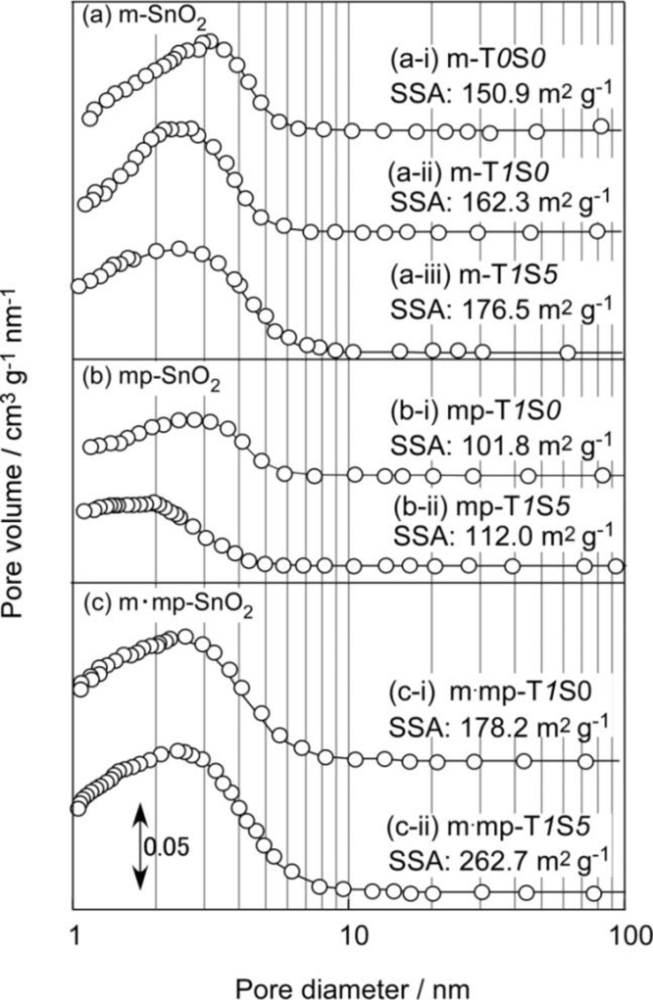
<p>Pore size distribution and specific surface area (SSA) of representative m-SnO<sub>2</sub>, mp-SnO<sub>2</sub> and m·mp-SnO<sub>2</sub> powders after calcination are shown in <xref ref-type="fig" rid="f1-sensors-11-01261">Figure 1</xref>. As shown in <xref ref-type="fig" rid="f1-sensors-11-01261">Figures 1(a-i)</xref>, m-T<italic>0</italic>S<italic>0</italic> powder, which was prepared only with the addition of AOT, showed a SSA of 150.9 m<sup>2</sup> g<sup>−1</sup> and a larger pore volume of 0.153 cm<sup>3</sup> g<sup>−1</sup> with a pore diameter of ca. 3.1 nm at the maximum pore volume (hereafter, it will be referred to as the maximum pore diameter). The characterization data of representative SnO<sub>2</sub>-based powders is summarized in <xref ref-type="table" rid="t2-sensors-11-01261">Table 2</xref>. The addition of 1 wt% SiO<sub>2</sub> to m-T<italic>0</italic>S<italic>0</italic> induced a slight increase in SSA (162.3 m<sup>2</sup> g<sup>−1</sup>) and reduced the maximum pore diameter to ca. 2.7 nm (see m-T<italic>1</italic>S<italic>0</italic>). This result implies the repression of growth of SnO<sub>2</sub> crystallites and/or grains by the added SiO<sub>2</sub>, as was reported by Fukuoka <italic>et al</italic>. [<xref ref-type="bibr" rid="b12-sensors-11-01261">12</xref>]. Simultaneous addition of 1 wt% SiO<sub>2</sub> and 5 wt% Sb<sub>2</sub>O<sub>5</sub> to m-T<italic>0</italic>S<italic>0</italic> resulted in further increase in SSA slightly to a value of 176.5 m<sup>2</sup> g<sup>−1</sup> (see m-T<italic>1</italic>S<italic>5</italic>). Thus, the addition of Sb<sub>2</sub>O<sub>5</sub> was suggested to be also effective in controlling grain growth, which will be confirmed by the change in SnO<sub>2</sub> crystallite size discussed later.</p>
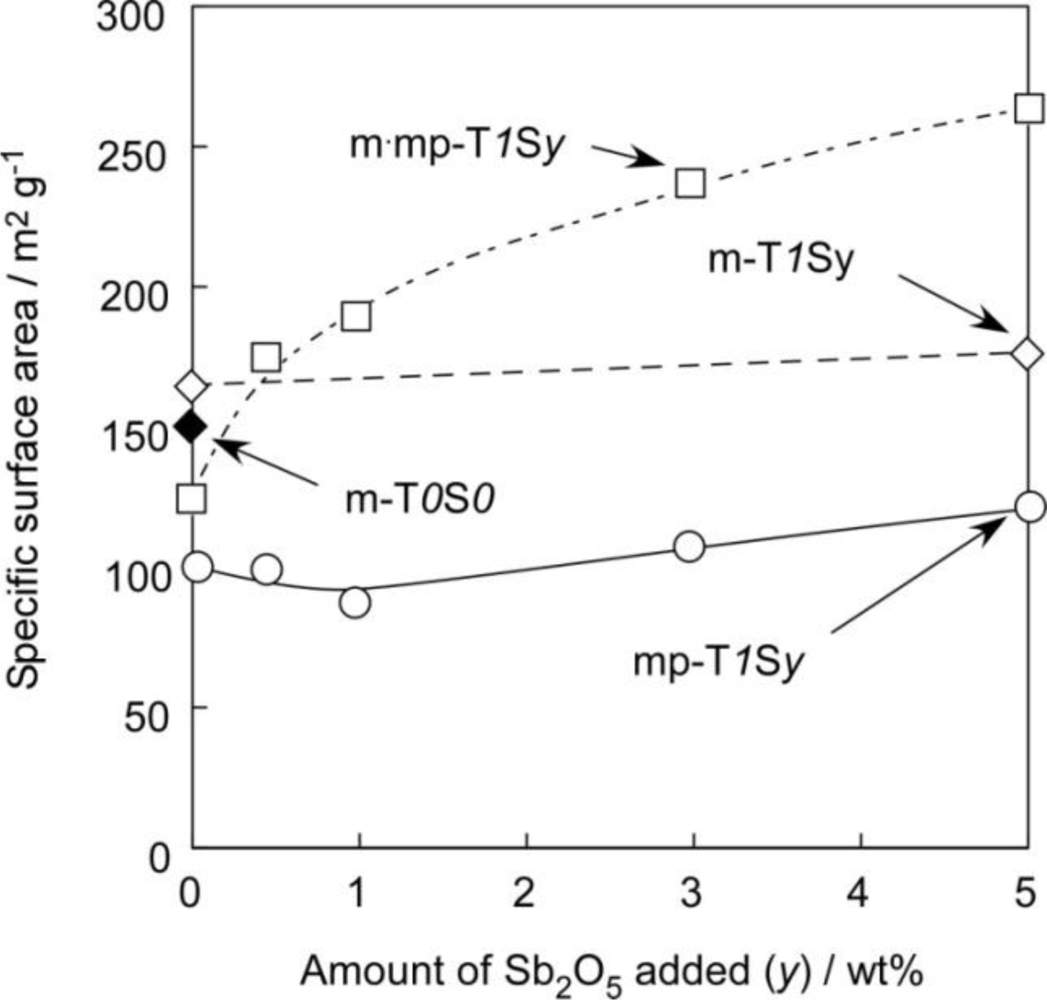
<p>It was revealed that the introduction of macropores into m-T<italic>1</italic>S<italic>5</italic> was very effective for increasing SSA to a value of 262.7 m<sup>2</sup> g<sup>−1</sup> (see m·mp-T<italic>1</italic>S<italic>5</italic>, <xref ref-type="fig" rid="f1-sensors-11-01261">Figures 1(c-ii)</xref>). This arises undoubtedly from the decrease in the maximum pore diameter and the increase in pore volume, as summarized in <xref ref-type="table" rid="t2-sensors-11-01261">Table 2</xref>. On the other hand, the introduction of macropores only (mp-T<italic>1</italic>S<italic>5</italic>), instead of mesopores (m-T<italic>1</italic>S<italic>5</italic>), into SnO<sub>2</sub>-based powder reduced SSA to a value of 112.0 m<sup>2</sup> g<sup>−1</sup> (compare <xref ref-type="fig" rid="f2-sensors-11-01261">Figure 2(b-ii)</xref> with <xref ref-type="fig" rid="f2-sensors-11-01261">Figure 2(a-iii)</xref>) and then decreased pore volume (see <xref ref-type="table" rid="t2-sensors-11-01261">Table 2</xref>). From these results, it is confirmed that the introduction of mesopores is essential for obtaining both large specific surface and large pore volume of SnO<sub>2</sub>-based powders.</p>
<p><xref ref-type="fig" rid="f2-sensors-11-01261">Figure 2</xref> shows variations in SSA of representative SnO<sub>2</sub>-based powders with amount of Sb<sub>2</sub>O<sub>5</sub> added. The effect of the Sb<sub>2</sub>O<sub>5</sub> on SSA can be seen more clearly from this figure. As for the cases of m-T<italic>1</italic>S<italic>y</italic> and mp-T<italic>1</italic>S<italic>y</italic> series, SSA values increased slightly with increasing amounts of Sb<sub>2</sub>O<sub>5</sub> added, but only for the m·mp-T<italic>1</italic>S<italic>y</italic> series, it is obvious that SSA increased markedly with an increase in the additive amount of Sb<sub>2</sub>O<sub>5</sub> reaching the largest value of 262.7 m<sup>2</sup> g<sup>−1</sup> obtained in the present study. The reason for this preferable effect for sensor application observed only the m·mp-T<italic>1</italic>S<italic>y</italic> series is not yet clarified and is a subject for future work.</p>
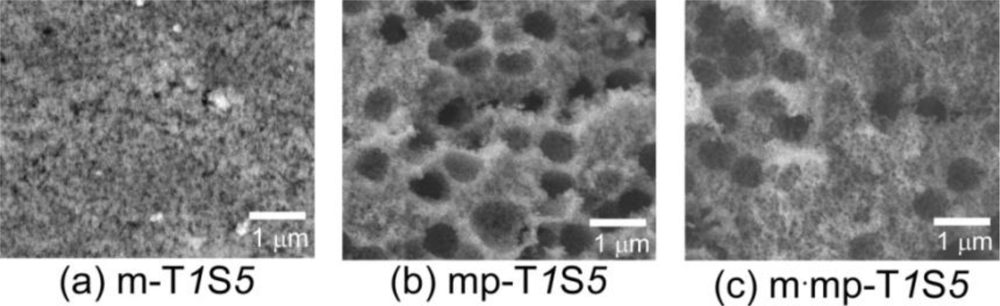
<p><xref ref-type="fig" rid="f3-sensors-11-01261">Figure 3</xref> shows the SEM images of the fracture surface of m-T<italic>1</italic>S<italic>5</italic>, mp-T<italic>1</italic>S<italic>5</italic> and m·mp-T<italic>1</italic>S<italic>5</italic> thick film sensors. No formation of macropores in m-T<italic>1</italic>S<italic>5</italic> is reasonable, since no PMMA microspheres were added, as shown in <xref ref-type="fig" rid="f3-sensors-11-01261">Figure 3(a)</xref>. But, <xref ref-type="fig" rid="f3-sensors-11-01261">Figure 3(b,c)</xref> confirm the formation of many spherical macropores originating from the morphology of PMMA microspheres as a template in the mp-T<italic>1</italic>S<italic>5</italic> and m·mp-T<italic>1</italic>S<italic>5</italic> thick film sensors. However, the diameter of macropores observed was in the 400–750 nm range, which was smaller than that of the diameter of raw PMMA microspheres, due to shrinkage of resulting voids during the growth of SnO<sub>2</sub> crystallites.</p>
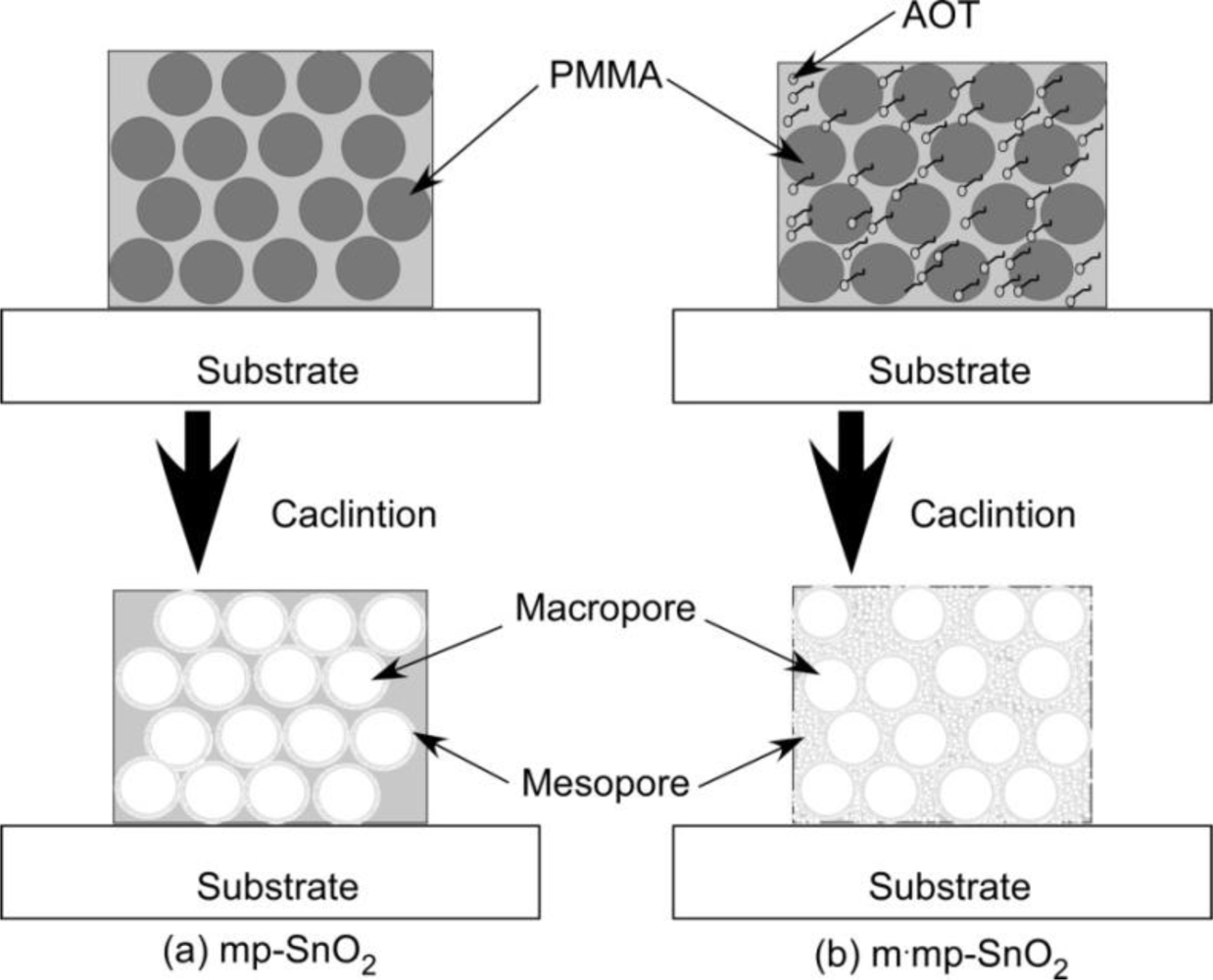
<p>As shown in <xref ref-type="fig" rid="f1-sensors-11-01261">Figure 1</xref> and <xref ref-type="table" rid="t1-sensors-11-01261">Table 1</xref>, mp-SnO<sub>2</sub> powder prepared in the present study showed relatively larger SSA than the conventional SnO<sub>2</sub> powder (8.4 m<sup>2</sup> g<sup>−1</sup>, [<xref ref-type="bibr" rid="b35-sensors-11-01261">35</xref>]), indicating the formation of a certain amount of mesopores, irrespective of the addition or not of AOT as a mesoporous structure template. This result implies penetration or diffusion of PMMA fragments into the dried SnO<sub>2</sub> precursor material during the calcination and such fragments may act as a mesoporous template at the interface between the PMMA microsphere and surrounding dried SnO<sub>2</sub> precursor. Thus, after the calcination at 600 °C for 5 h of the mp-SnO<sub>2</sub> thick film, a thin mesoporous layer may be formed at the interface between the pores and SnO<sub>2</sub> particles, as shown schematically in <xref ref-type="fig" rid="f4-sensors-11-01261">Figure 4(a)</xref> [<xref ref-type="bibr" rid="b36-sensors-11-01261">36</xref>]. As for m·mp-SnO<sub>2</sub>, it is considered that mesopores are formed uniformly inside all the SnO<sub>2</sub> particles and the whole thick film structure, as shown in <xref ref-type="fig" rid="f4-sensors-11-01261">Figure 4(b)</xref>.</p>
<p>Another notable finding in <xref ref-type="fig" rid="f3-sensors-11-01261">Figure 3</xref> is a relatively longer distance of the macropores in m·mp-T<italic>1</italic>S<italic>5</italic> than that in mp-T<italic>1</italic>S<italic>5</italic>. Since AOT was used as a mesoporous template in fabricating m·mp-SnO<sub>2</sub> powder, thermal decomposition and subsequent firing along with generation of combustion gases may induce sponge and/or bulky structure with mesopores, leading to a longer distance of the macropores, as also shown schematically in <xref ref-type="fig" rid="f4-sensors-11-01261">Figure 4(b)</xref>.</p>
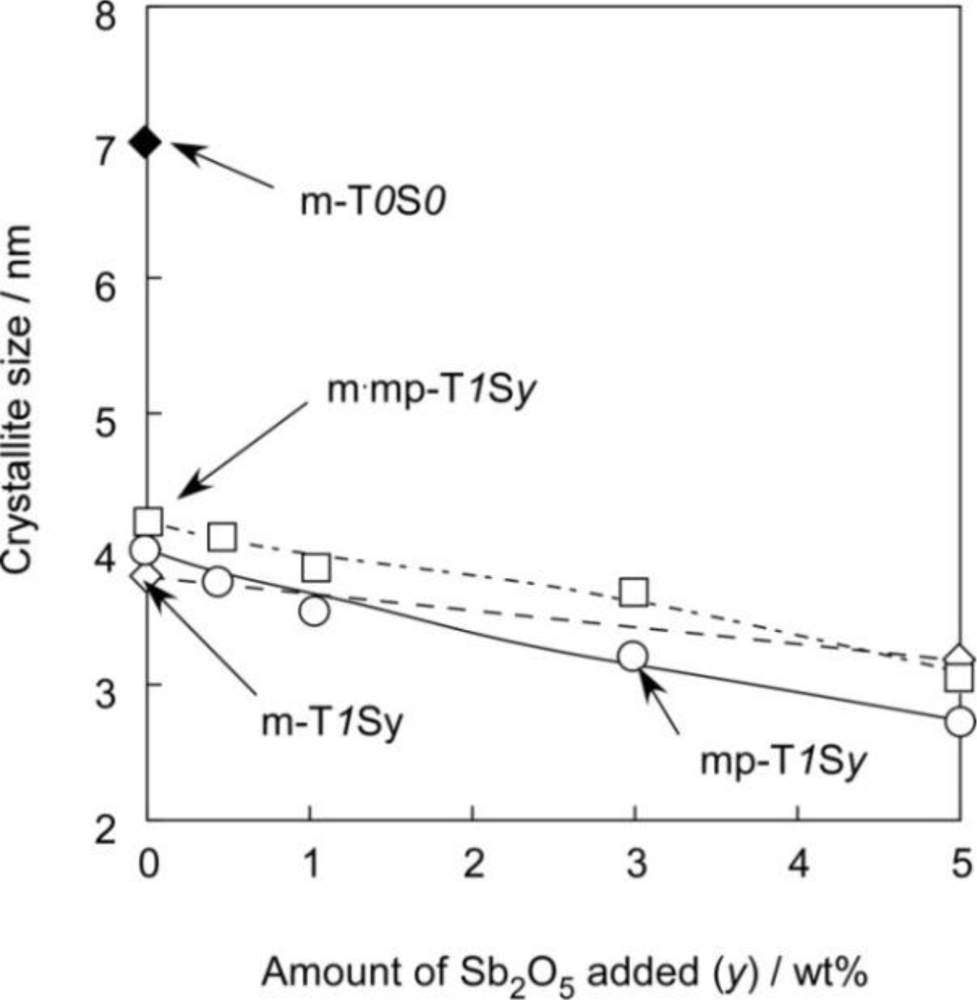
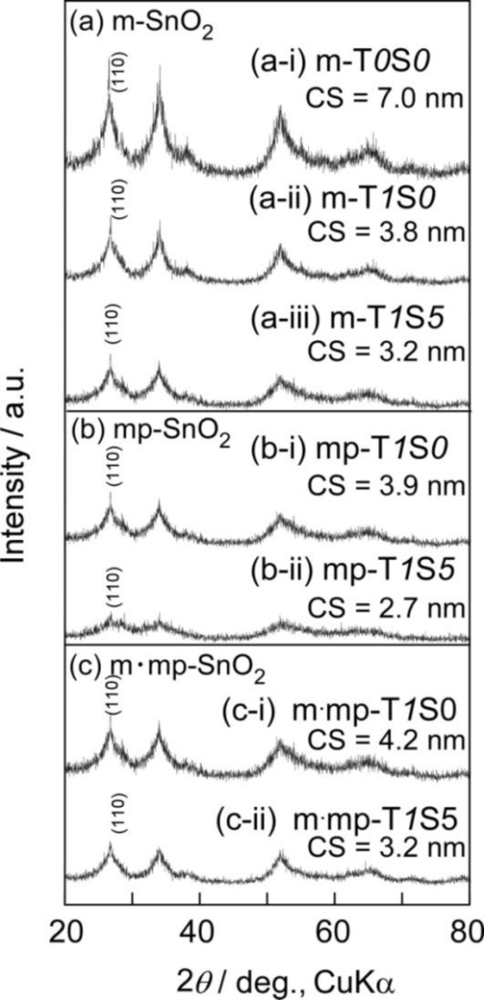
<p><xref ref-type="fig" rid="f5-sensors-11-01261">Figure 5</xref> shows XRD patterns of representative m-SnO<sub>2</sub>, mp-SnO<sub>2</sub> and m·mp-SnO<sub>2</sub> powders. Diffraction peaks of all powders were rather broad, indicating low crystallinity, but all peaks could be ascribed to those of tetragonal SnO<sub>2</sub>. The CS value which was calculated for each powder using Scherrer’s formula is summarized in <xref ref-type="table" rid="t2-sensors-11-01261">Table 2</xref>. Variations in CS of representative SnO<sub>2</sub>-based powders are shown <xref ref-type="fig" rid="f6-sensors-11-01261">Figure 6</xref>. On the whole, the CS values were small and were in a range of 2.7–7 nm in diameter, due to the limitation of crystallite growth induced by the phosphoric acid treatment before the calcination [<xref ref-type="bibr" rid="b15-sensors-11-01261">15</xref>,<xref ref-type="bibr" rid="b16-sensors-11-01261">16</xref>]. Exceptionally, m-T<italic>0</italic>S<italic>0</italic> showed the largest CS value of 7 nm. The CS value was decreased drastically to 3.8 nm by the addition of 1 wt% SiO<sub>2</sub> to m-T<italic>0</italic>S<italic>0</italic> (see m-T<italic>1</italic>S<italic>0</italic> in <xref ref-type="table" rid="t2-sensors-11-01261">Table 2</xref> and <xref ref-type="fig" rid="f6-sensors-11-01261">Figure 6</xref>). Thus, the repression of the growth of SnO<sub>2</sub> crystallites by the added SiO<sub>2</sub> could be confirmed from these results [<xref ref-type="bibr" rid="b37-sensors-11-01261">37</xref>]. As for the powders containing 1 wt% SiO<sub>2</sub>, CS values were almost comparable, whereas they tended to decrease slightly with increasing amounts of the Sb<sub>2</sub>O<sub>5</sub> additive in each series. In addition, the kind of porous structure, <italic>i.e.</italic>, mesopore, macropore, and mesopore plus macropore, was found to have only a little effect on controlling the CS values. Thus, we can confirm again that the addition of 1 wt% SiO<sub>2</sub> was the most powerful method in reducing the CS value among several factors. The CS values decreased slightly by the Sb<sub>2</sub>O<sub>5</sub> addition in each series, but no diffraction peaks other than SnO<sub>2</sub> were observed in XRD patterns even for the cases of 5 wt% Sb<sub>2</sub>O<sub>5</sub> addition (<xref ref-type="fig" rid="f5-sensors-11-01261">Figure 5</xref>). This implies that Sb ions added were sufficiently incorporated into the SnO<sub>2</sub> crystal lattice and this solid-solution is also effective for the repression of the crystal growth among SnO<sub>2</sub>-based crystallites [<xref ref-type="bibr" rid="b23-sensors-11-01261">23</xref>,<xref ref-type="bibr" rid="b38-sensors-11-01261">38</xref>,<xref ref-type="bibr" rid="b39-sensors-11-01261">39</xref>]. These results demonstrate that the pore size distribution, SSA and CS values of SnO<sub>2</sub>-based powders can be controlled by selecting the kinds of templates, the kind of additives and their additive amounts.</p></sec>
<sec>
<label>3.2.</label>
<title>H<sub>2</sub> and NO<sub>2</sub> Sensing Properties of Mesoporous and/or Macroporous SnO<sub>2</sub>-Based Sensors</title>
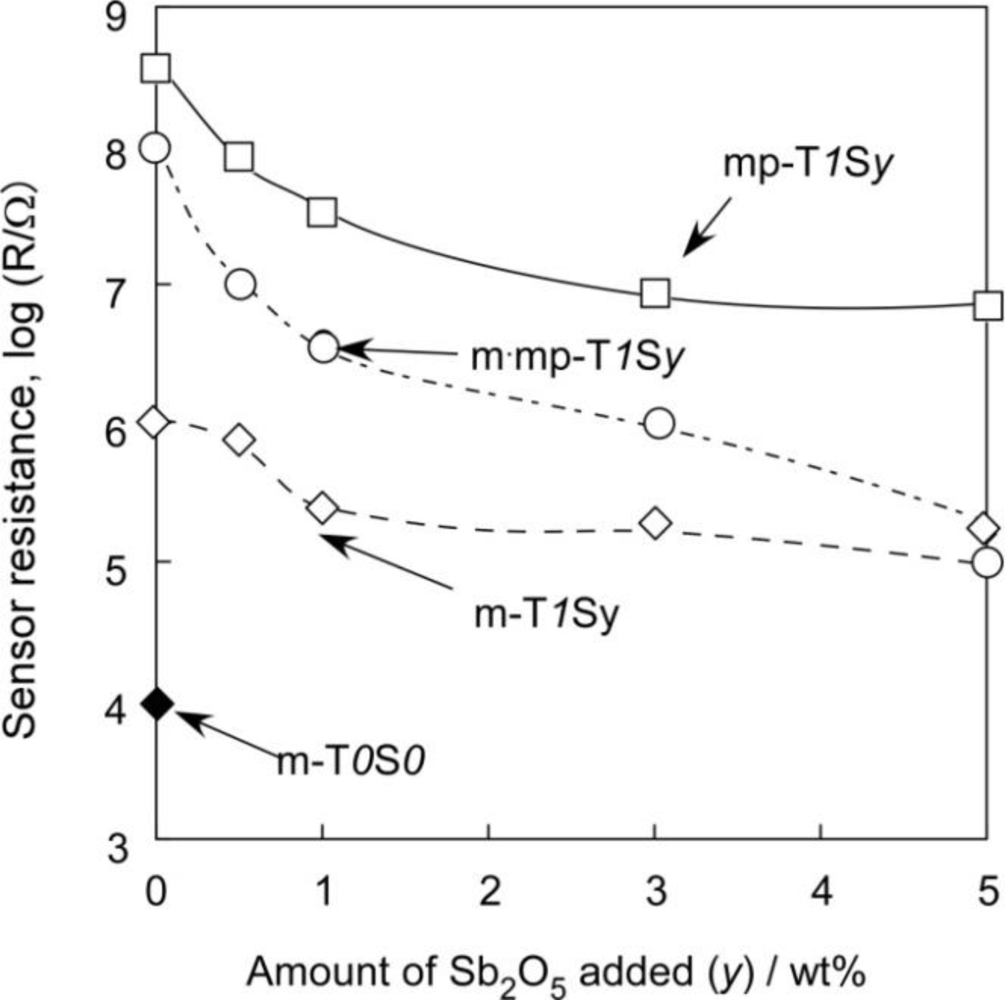
<p>Variations in sensor resistance of SnO<sub>2</sub>-based thick film sensors in air at 450 °C with amounts of Sb<sub>2</sub>O<sub>5</sub> added are shown in <xref ref-type="fig" rid="f7-sensors-11-01261">Figure 7</xref>. The m-T<italic>0</italic>S<italic>0</italic> sensor showed the lowest resistance in air, but the addition of 1 wt% SiO<sub>2</sub> to m-T<italic>0</italic>S<italic>0</italic> increased the sensor resistance in air (see m-T<italic>1</italic>S<italic>0</italic>). The sensor resistance of other two series sensors, <italic>i.e.</italic>, mp-T<italic>1</italic>S<italic>0</italic> and m·mp-T<italic>1</italic>S<italic>0</italic>, in air was also very high. Even if Si<sup>4+</sup> ions would be substituted for Sn<sup>4+</sup> ion sites, no valency control effect could be expected. Therefore, SiO<sub>2</sub> added was anticipated to be segregated among SnO<sub>2</sub> crystallites and/or grains and then to reduce electronic conduction of SnO<sub>2</sub>-based thick film sensors, although the segregation of SiO<sub>2</sub> was not confirmed by the XRD measurements due to its small amount added.</p>
<p>Introduction of macropores into SnO<sub>2</sub> by using PMMA microspheres (see mp-T<italic>1</italic>S<italic>y</italic> series), instead of the introduction of mesopores, and/or the simultaneous introduction of macropores (see m·mp-T<italic>1</italic>S<italic>y</italic> series) also resulted in an increase in sensor resistance. This phenomenon can be considered to arise mainly from the introduction of air voids, which are electrical insulators, via various pores in the thick film sensors, but the mp-T<italic>1</italic>S<italic>y</italic> sensor with macropores showed the largest resistance in air, irrespective of the smallest pore volume, among three series of sensors. This fact implies the existence of another factor, besides the pore volume, in determining the sensor resistance in air, such as the manner of distribution of pores in the thick film and so on, though the details are not clear at present.</p>
<p>In each sensor series, the sensor resistance in air decreased with increasing amounts of Sb<sub>2</sub>O<sub>5</sub> additive. This behavior can be explained by the valency control, <italic>i.e.</italic>, partial substitution of Sn<sup>4+</sup> sites with Sb<sup>5+</sup> ions, producing free electrons, as described in <xref ref-type="disp-formula" rid="FD2">Equation (2)</xref> [<xref ref-type="bibr" rid="b38-sensors-11-01261">38</xref>–<xref ref-type="bibr" rid="b40-sensors-11-01261">40</xref>]:
<disp-formula id="FD2">
<label>(2)</label>
<mml:math display="block">
<mml:mrow>
<mml:msub>
<mml:mtext>Sb</mml:mtext>
<mml:mn>2</mml:mn></mml:msub>
<mml:msub>
<mml:mi mathvariant="normal">O</mml:mi>
<mml:mn>5</mml:mn></mml:msub>
<mml:mo>→</mml:mo>
<mml:mn>2</mml:mn>
<mml:mo> </mml:mo>
<mml:msub>
<mml:mtext>Sb</mml:mtext>
<mml:mtext>Sn</mml:mtext></mml:msub>
<mml:mo>+</mml:mo>
<mml:mn>4</mml:mn>
<mml:mo> </mml:mo>
<mml:msup>
<mml:mrow>
<mml:msub>
<mml:mi mathvariant="normal">O</mml:mi>
<mml:mi mathvariant="normal">O</mml:mi></mml:msub></mml:mrow>
<mml:mi mathvariant="normal">x</mml:mi></mml:msup>
<mml:mo>+</mml:mo>
<mml:mn>1</mml:mn>
<mml:mo>/</mml:mo>
<mml:mn>2</mml:mn>
<mml:mo> </mml:mo>
<mml:msub>
<mml:mi mathvariant="normal">O</mml:mi>
<mml:mn>2</mml:mn></mml:msub>
<mml:mo> </mml:mo>
<mml:mo stretchy="false">(</mml:mo>
<mml:mi mathvariant="normal">g</mml:mi>
<mml:mo stretchy="false">)</mml:mo>
<mml:mo>+</mml:mo>
<mml:mn>2</mml:mn>
<mml:mo> </mml:mo>
<mml:mi mathvariant="normal">e</mml:mi>
<mml:mo>'</mml:mo></mml:mrow></mml:math></disp-formula></p>
<p>These results also confirm the existence of substituted Sb<sup>5+</sup> ions, <italic>i.e.</italic>, the solid-solution of between Sb<sub>2</sub>O<sub>5</sub> and SnO<sub>2</sub> and then little amount of segregated Sb<sub>2</sub>O<sub>5</sub> among SnO<sub>2</sub>-based particles.</p>
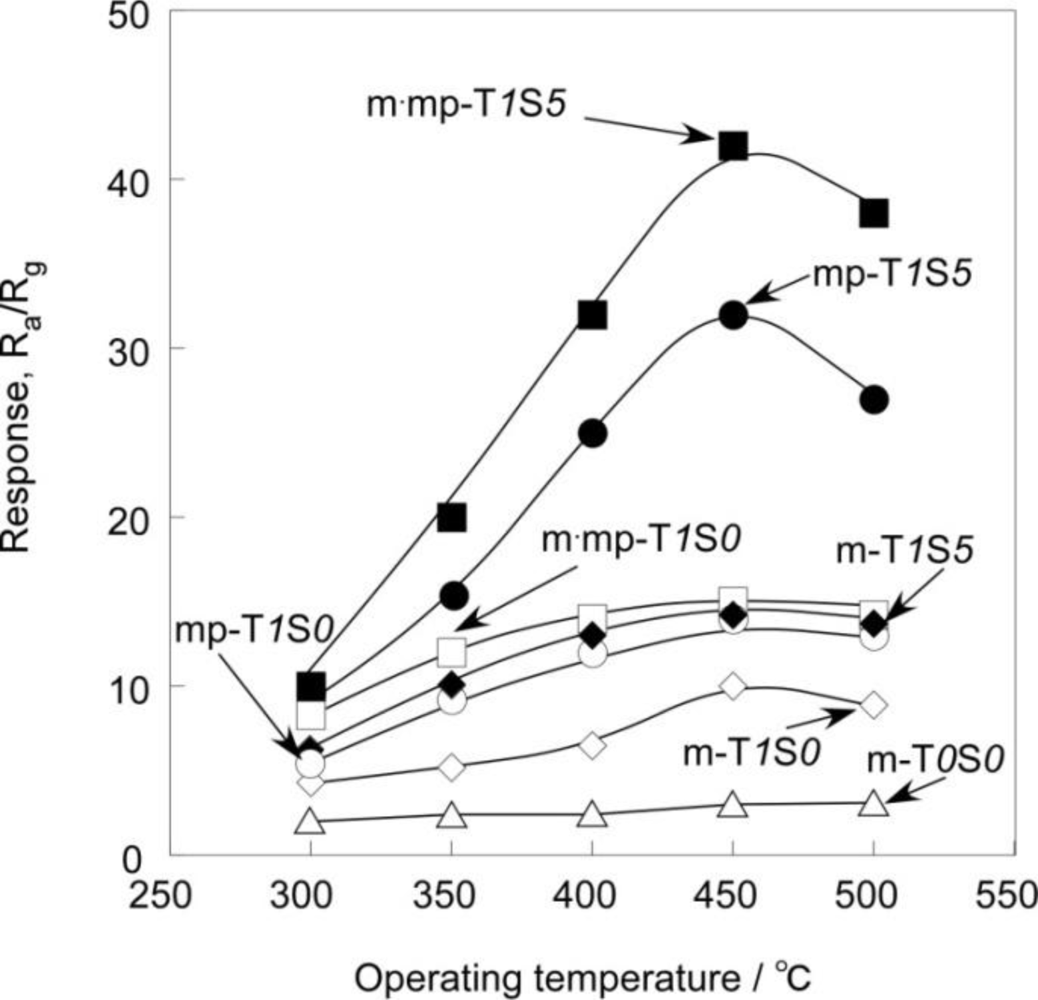
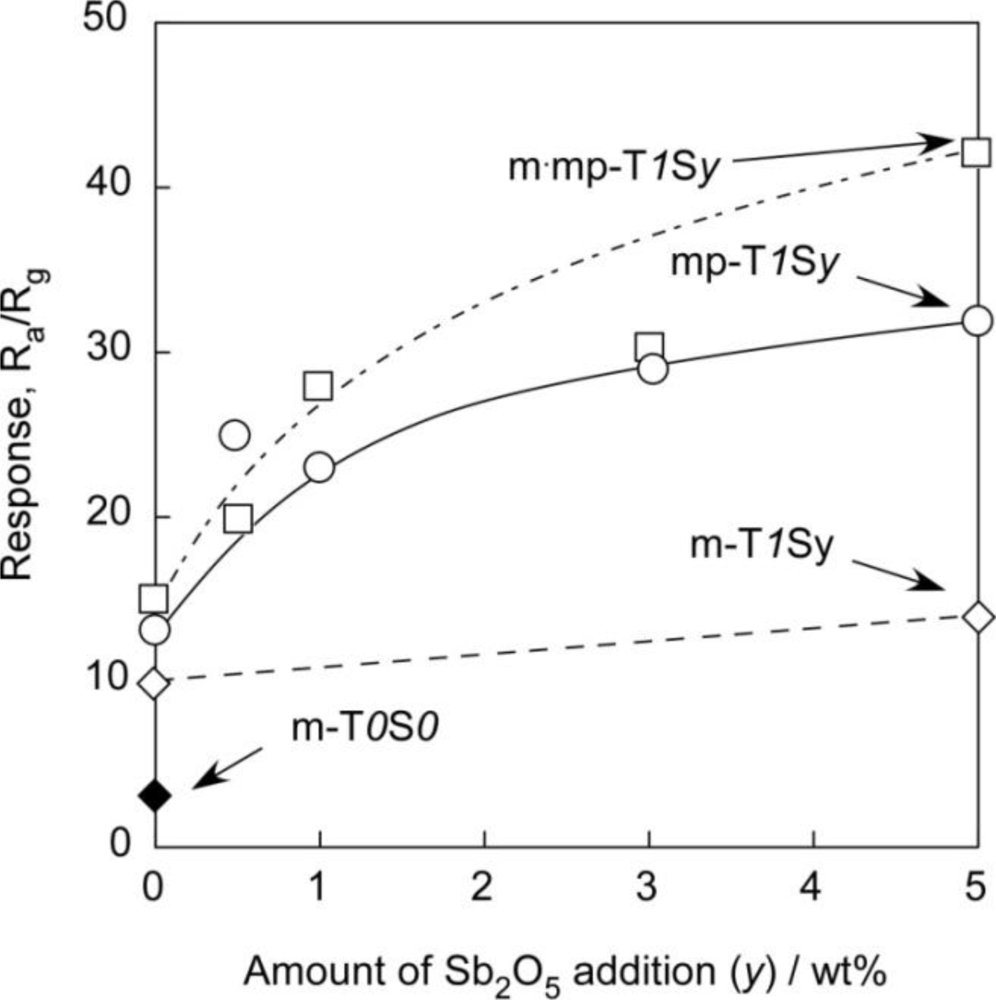
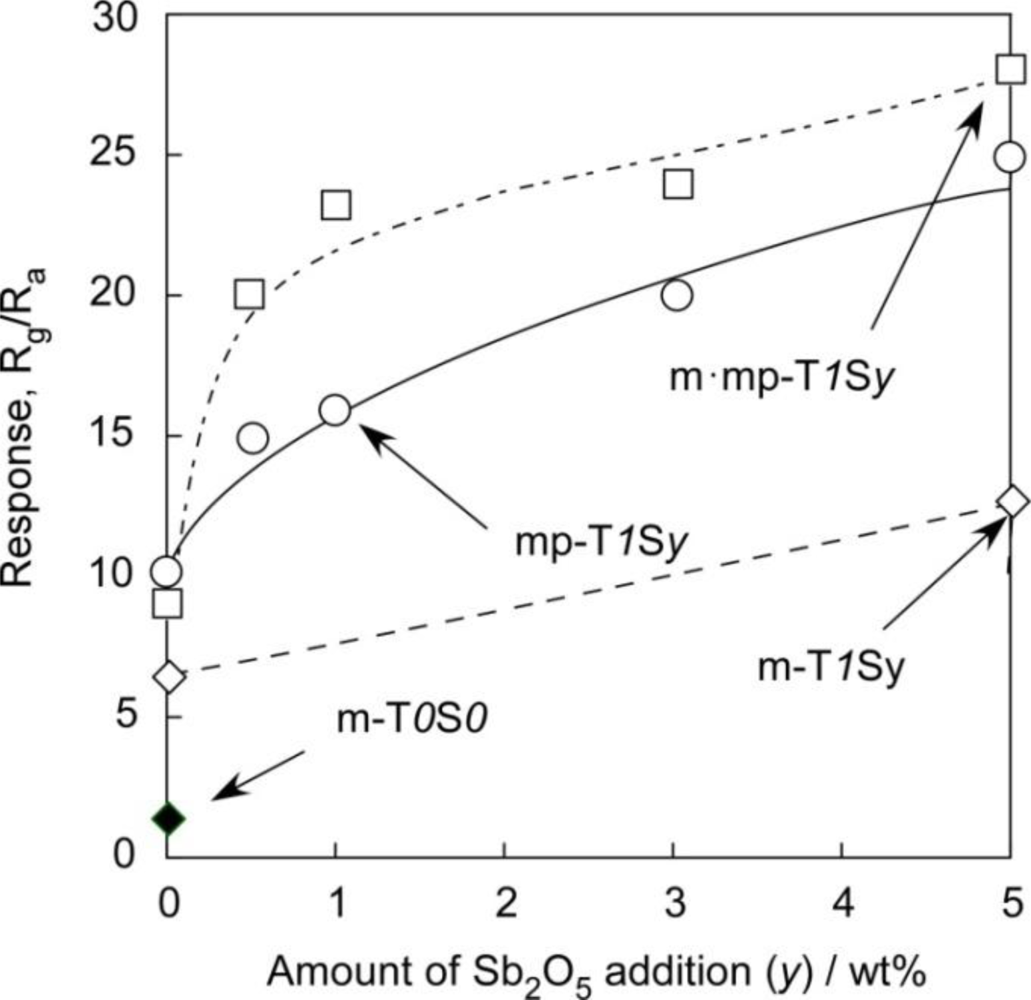
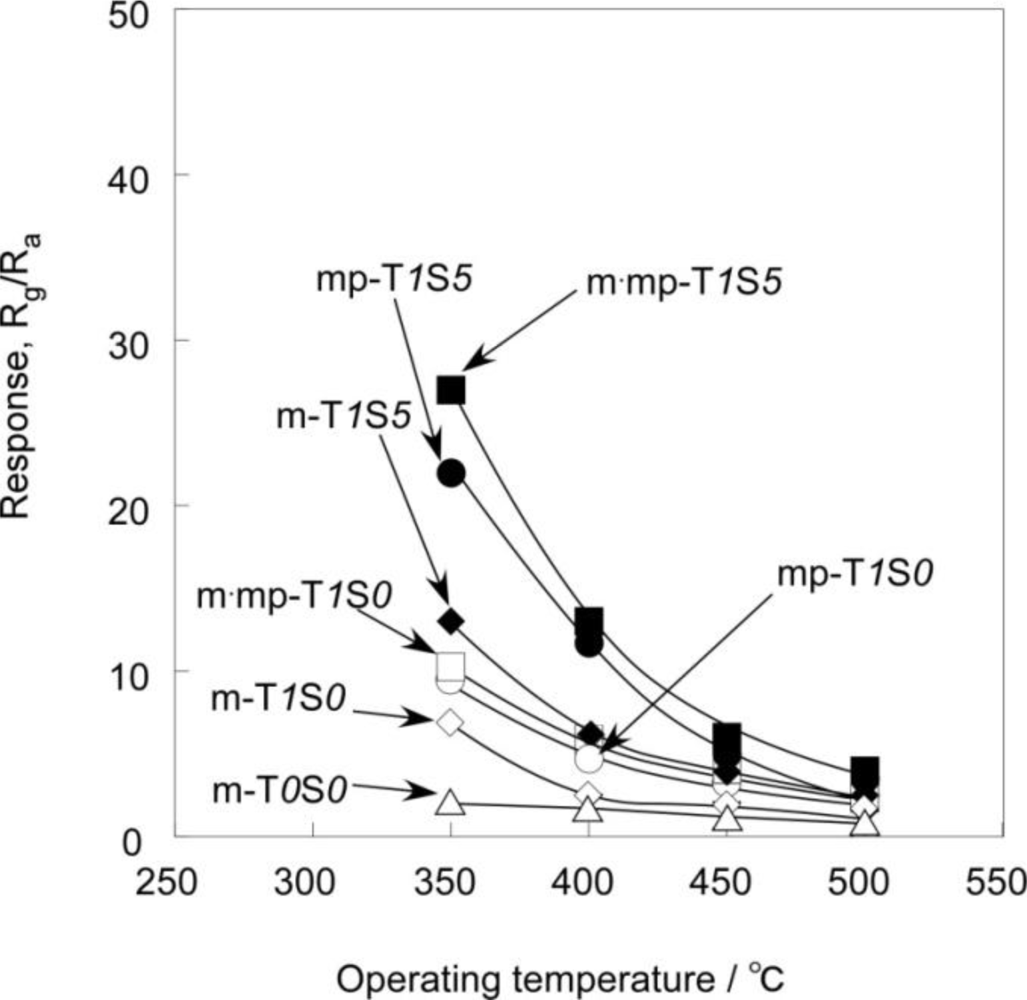
<p><xref ref-type="fig" rid="f8-sensors-11-01261">Figures 8</xref> and <xref ref-type="fig" rid="f9-sensors-11-01261">9</xref> show temperature dependence of response of SnO<sub>2</sub>-based thick film sensors to 1,000 ppm H<sub>2</sub> balanced with air and 1 ppm NO<sub>2</sub> balanced with air. Almost all sensors showed the maximum response to 1,000 ppm H<sub>2</sub> at a temperature of 450 °C. In contrast, the response to 1 ppm NO<sub>2</sub> of all sensors tended to increase as the operating temperature decreased, and showed the largest response in the temperature range studied at 350 °C.</p>
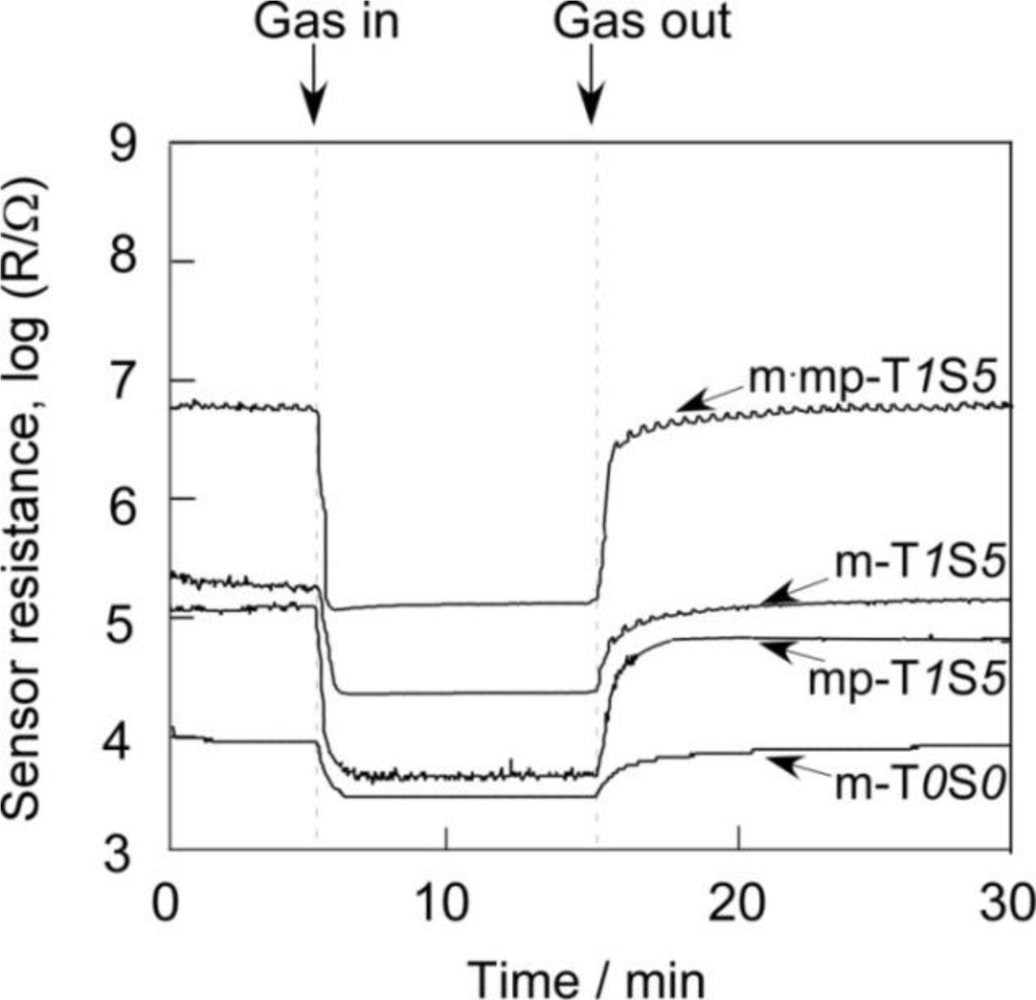
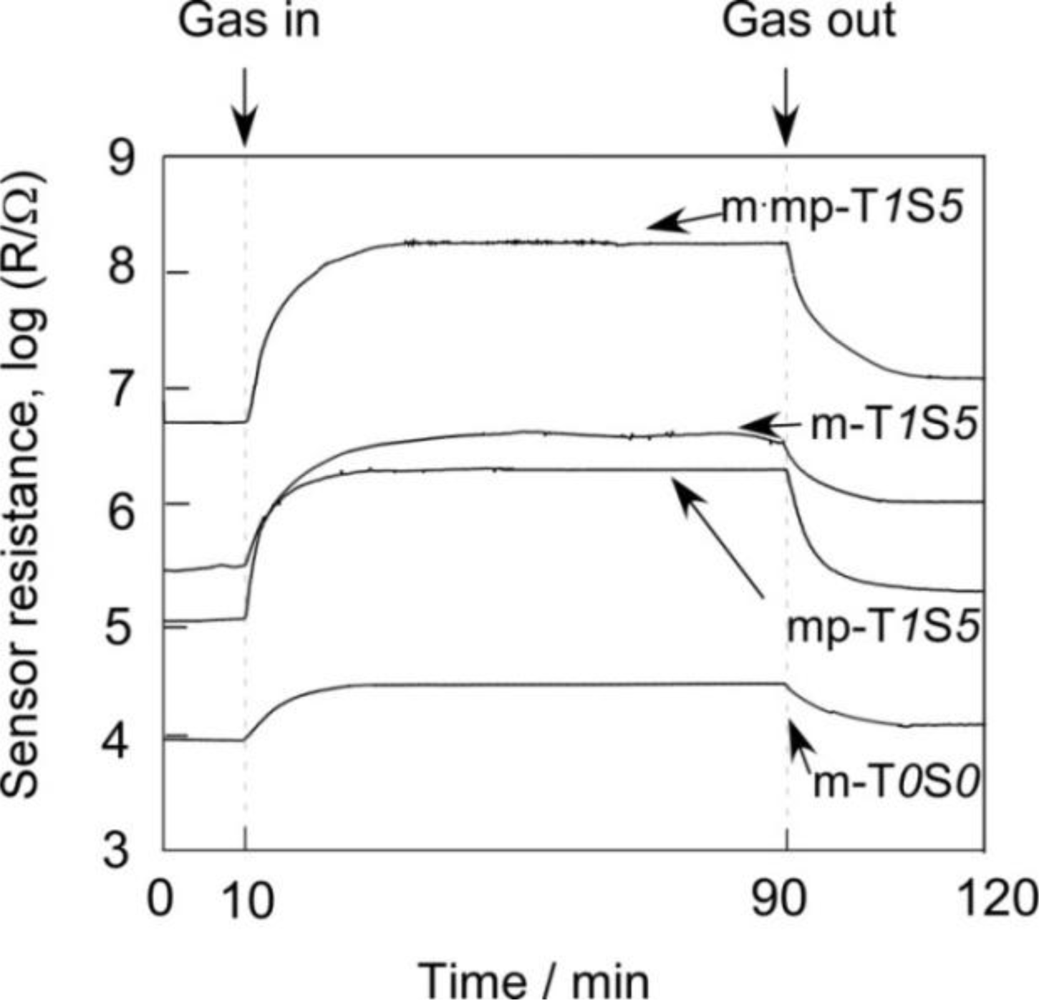
<p>Response transients of SnO<sub>2</sub>-based thick film sensors to 1,000 ppm H<sub>2</sub> at 450 °C and 1 ppm NO<sub>2</sub> at 350 °C balanced with air are shown in <xref ref-type="fig" rid="f10-sensors-11-01261">Figures 10</xref> and <xref ref-type="fig" rid="f11-sensors-11-01261">11</xref>, respectively. In this study, 50% response time is defined as a period necessary to achieve 50% of resistance value of R<sub>a</sub> − R<sub>g</sub>, while 50% recovery time is defined as that necessary to achieve 50% of resistance value of R<sub>g</sub> − R<sub>a</sub> for H<sub>2</sub>. The 50% response and recovery times to NO<sub>2</sub> are also defined in the similar manner, but by using R<sub>g</sub> − R<sub>a</sub> for response time and R<sub>a</sub> − R<sub>g</sub> for recovery time. Hereafter, they are simply expressed as response time and recovery time, respectively. Response and recovery times of SnO<sub>2</sub>-based thick film sensors to 1,000 ppm H<sub>2</sub> at 450 °C and 1 ppm NO<sub>2</sub> at 350 °C were summarized in <xref ref-type="table" rid="t3-sensors-11-01261">Table 3</xref>. The m-T<italic>0</italic>S<italic>0</italic> sensor showed the longest response and recovery times to H<sub>2</sub> among the sensors listed in <xref ref-type="table" rid="t3-sensors-11-01261">Table 3</xref>. The simultaneous addition of 1 wt% SiO<sub>2</sub> and 5 wt% Sb<sub>2</sub>O<sub>5</sub> to m-T<italic>0</italic>S<italic>0</italic> was found to shorten slightly response and recovery times to H<sub>2</sub> (see m-T<italic>1</italic>S<italic>5</italic>).</p>
<p>However, the m-T<italic>1</italic>S<italic>5</italic> sensor showed longer response and recovery times to 1 ppm NO<sub>2</sub> than m-T<italic>0</italic>S<italic>0</italic>. Thus, the effect of additive on the response and recovery times varied with the kind of target gas. The introduction of macropores into m-T<italic>1</italic>S<italic>5</italic> shortens the response and recovery times to H<sub>2</sub>. More remarkable shortening of the recovery time to H<sub>2</sub> as well as response and recovery times to NO<sub>2</sub> were observed with m·mp-T<italic>1</italic>S<italic>5</italic>. It is reasonable to consider that the response time to H<sub>2</sub> is closely related to the diffusivity of H<sub>2</sub>, while the recovery time is controlled by the diffusivity of O<sub>2</sub> which has a larger molecular size than H<sub>2</sub>. As for NO<sub>2</sub>, on the other hand, both the response and recovery times are considered to affected by the diffusivity of NO<sub>2</sub> itself, which has a larger molecular size than H<sub>2</sub>, from its gas sensing mechanism. Such considerations predict a shorter recovery time to H<sub>2</sub> as well as shorter response and recovery times to NO<sub>2</sub> by the introduction of macropores into the sensor materials. The results obtained with m·mp-T<italic>1</italic>S<italic>5</italic> were in good agreement with this prediction. Thus, the mp-T<italic>1</italic>S<italic>5</italic> sensor, which was fabricated only by the introduction of macropores, showed the fastest response to H<sub>2</sub> as well as the fastest response and recovery times to NO<sub>2</sub> among the sensors tested. But, the reason for the longer recovery time to H<sub>2</sub> of mp-T<italic>1</italic>S<italic>5</italic> than m·mp-T<italic>1</italic>S<italic>5</italic> is not clear at present. Anyway, such behavior undoubtedly arises from more easy diffusion of a target gas as well as oxygen through mesopores rather than macropores. On the other hand, all of the response and recovery times to NO<sub>2</sub> are much longer than those to H<sub>2</sub>. This may arise not only from slow diffusivity of NO<sub>2</sub> in comparison to H<sub>2</sub>, but also from slow adsorption rate and strong interaction of NO<sub>2</sub><sup>−</sup> species on the oxide surface.</p>
<p><xref ref-type="fig" rid="f12-sensors-11-01261">Figures 12</xref> and <xref ref-type="fig" rid="f13-sensors-11-01261">13</xref> show variations in responses of SnO<sub>2</sub>-based sensors to 1,000 ppm H<sub>2</sub> at 450 °C and to 1 ppm NO<sub>2</sub> at 350 °C in air with amounts of Sb<sub>2</sub>O<sub>5</sub> added, respectively. From these figures, it is also apparent that the m-T<italic>0</italic>S<italic>0</italic> sensor showed the smallest responses to both H<sub>2</sub> and NO<sub>2</sub> among the sensors studied. The addition of 1 wt% SiO<sub>2</sub> to m-T<italic>0</italic>S<italic>0</italic> enhanced responses to both H<sub>2</sub> and NO<sub>2</sub> to a certain level for every series of sensors. In addition, H<sub>2</sub> and NO<sub>2</sub> responses increased with increasing amounts of Sb<sub>2</sub>O<sub>5</sub> additive in each series of sensors. On the whole, the magnitude of the response was in the order of m·mp-T<italic>1</italic>S<italic>y</italic> &gt; mp-T<italic>1</italic>S<italic>y</italic> &gt; m-T<italic>1</italic>S<italic>y</italic>, when the comparison was made at the same additive amount of Sb<sub>2</sub>O<sub>5</sub>, with only one exception observed for the NO<sub>2</sub> response of the m·mp-T<italic>1</italic>S<italic>0</italic> sensor. It is worth noting that the mp-T<italic>1</italic>S<italic>y</italic> series sensors showed higher H<sub>2</sub> and NO<sub>2</sub> responses than those of m-T<italic>1</italic>S<italic>y</italic> series sensors, irrespective of their smaller surface area. This implies that all the surface of sensor materials including the inner surface of mesopores is not utilized effectively for gas detection, and that easy diffusion of a target gas as well as oxygen to the active surface, <italic>i.e.</italic>, the existence of certain amounts of macropores inside the thick film sensors, is more important for improving gas response. The highest H<sub>2</sub> and NO<sub>2</sub> responses observed with the m·mp-T<italic>1</italic>S<italic>y</italic> sensors may be a result of good combination of mesopore and macropores in the thick film sensors. From these results, it was revealed that the strict control of microstructure having well-developed mesoporous and macroporous is indispensable to enhancing gas reactivity and diffusivity and thus to improving responses to H<sub>2</sub> and NO<sub>2</sub> in air.</p></sec></sec>
<sec sec-type="conclusions">
<label>4.</label>
<title>Conclusions</title>
<p>Mesoporous and/or macroporous SnO<sub>2</sub>-based powders have been prepared by a sol-gel method by employing SnCl<sub>4</sub>·5H<sub>2</sub>O, ATO as a mesopore template, PMMA microspheres as a macropore template, and their gas-sensing properties as thick film sensors towards 1 ppm NO<sub>2</sub> as well as 1,000 ppm H<sub>2</sub> in air have been investigated. The addition of SiO<sub>2</sub> into mesoporous and/or macroporous SnO<sub>2</sub> was found to increase SSA of mesoporous SnO<sub>2</sub>. However, the SSA of all samples increased and their CS tended to decrease slightly with the addition of the Sb<sub>2</sub>O<sub>5</sub>. The additions of SiO<sub>2</sub> and Sb<sub>2</sub>O<sub>5</sub> into mesoporous and/or macroporous SnO<sub>2</sub> were found to improve the sensing properties of the resulting sensors. The addition of SiO<sub>2</sub> into mesoporous and/or macroporous SnO<sub>2</sub> was found to increase the sensor resistance in air. However, the doping of Sb<sub>2</sub>O<sub>5</sub> into mesoporous and/or macroporous SnO<sub>2</sub> was found to markedly reduce the sensor resistance in air, and to increase the response to 1,000 ppm H<sub>2</sub> as well as 1 ppm NO<sub>2</sub> in air. Among all the sensors tested, meso-macroporous SnO<sub>2</sub> mixed with 1 wt% SiO<sub>2</sub> and 5 wt% Sb<sub>2</sub>O<sub>5</sub>, which were prepared with above two templates simultaneously, exhibited the largest H<sub>2</sub> and NO<sub>2</sub> responses.</p></sec></body>
<back>
<ref-list>
<title>References and Notes</title>
<ref id="b1-sensors-11-01261"><label>1.</label><citation citation-type="journal"><person-group person-group-type="author"><name><surname>Soler-Illia</surname><given-names>G.J.A.A.</given-names></name><name><surname>Sanchez</surname><given-names>C.</given-names></name><name><surname>Lebeau</surname><given-names>B.</given-names></name><name><surname>Patarin</surname><given-names>J.</given-names></name></person-group><article-title>Chemical strategies to design textured materials: From microporous and mesoporous oxides to nano networks and hierarchical structures</article-title><source>Chem. Rev</source><year>2002</year><volume>102</volume><fpage>4093</fpage><lpage>4138</lpage><pub-id pub-id-type="doi">10.1021/cr0200062</pub-id><pub-id pub-id-type="pmid">12428985</pub-id></citation></ref>
<ref id="b2-sensors-11-01261"><label>2.</label><citation citation-type="journal"><person-group person-group-type="author"><name><surname>Havancsak</surname><given-names>K.</given-names></name></person-group><article-title>Materials science: Testing and informatics I</article-title><source>Materi. Sci. Forum</source><year>2003</year><volume>85</volume><fpage>414</fpage><lpage>415</lpage></citation></ref>
<ref id="b3-sensors-11-01261"><label>3.</label><citation citation-type="book"><person-group person-group-type="author"><name><surname>Wolf</surname><given-names>E.L.</given-names></name></person-group><source>Nanophysics and Nanotechnology: An Introduction to Modern Concepts in Nanoscience</source><publisher-name>John Wiley &amp; Sons</publisher-name><publisher-loc>New York, NY, USA</publisher-loc><year>2004</year></citation></ref>
<ref id="b4-sensors-11-01261"><label>4.</label><citation citation-type="journal"><person-group person-group-type="author"><name><surname>Yamazoe</surname><given-names>N.</given-names></name></person-group><article-title>New approaches for improving semiconductor gas sensors</article-title><source>Sens. Actuat. B</source><year>1991</year><volume>5</volume><fpage>7</fpage><lpage>19</lpage><pub-id pub-id-type="doi">10.1016/0925-4005(91)80213-4</pub-id></citation></ref>
<ref id="b5-sensors-11-01261"><label>5.</label><citation citation-type="book"><person-group person-group-type="author"><name><surname>Borisenko</surname><given-names>V.E.</given-names></name><name><surname>Ossicini</surname><given-names>S.</given-names></name></person-group><source>What is What in the Nanoworld: A Handbook on Nanoscience and Nanotechnology</source><publisher-name>John Wiley &amp; Sons</publisher-name><publisher-loc>New York, NY, USA</publisher-loc><year>2004</year></citation></ref>
<ref id="b6-sensors-11-01261"><label>6.</label><citation citation-type="book"><person-group person-group-type="author"><name><surname>Szostak</surname><given-names>R.</given-names></name></person-group><source>Handbook of Molecular Sieves</source><publisher-name>Van Nostrand Reinhold</publisher-name><publisher-loc>New York, NY, USA</publisher-loc><year>1992</year></citation></ref>
<ref id="b7-sensors-11-01261"><label>7.</label><citation citation-type="journal"><person-group person-group-type="author"><name><surname>Nguyen</surname><given-names>S.V.</given-names></name><name><surname>Szabo</surname><given-names>V.</given-names></name><name><surname>Trong On</surname><given-names>D.</given-names></name><name><surname>Kaliaguine</surname><given-names>S.</given-names></name></person-group><article-title>Mesoporous silica supported LaCoO<sub>3</sub> perovskites as catalysts for methane oxidation</article-title><source>Microporous Mesoporous Mater</source><year>2002</year><volume>54</volume><fpage>51</fpage><lpage>61</lpage><pub-id pub-id-type="doi">10.1016/S1387-1811(02)00340-2</pub-id></citation></ref>
<ref id="b8-sensors-11-01261"><label>8.</label><citation citation-type="journal"><person-group person-group-type="author"><name><surname>Umbarkar</surname><given-names>S.B.</given-names></name><name><surname>Kotbagi</surname><given-names>T.V.</given-names></name><name><surname>Biradar</surname><given-names>A.V.</given-names></name><name><surname>Pasricha</surname><given-names>R.</given-names></name><name><surname>Chanale</surname><given-names>J.</given-names></name><name><surname>Dongare</surname><given-names>M.K.</given-names></name><name><surname>Mamede</surname><given-names>A.S.</given-names></name><name><surname>Lancelot</surname><given-names>C.</given-names></name><name><surname>Payen</surname><given-names>E.</given-names></name></person-group><article-title>Acetalization of glycerol using mesoporous MoO<sub>3</sub>/SiO<sub>2</sub> solid acid catalyst</article-title><source>J. Mol. Catal. A Chem</source><year>2009</year><volume>310</volume><fpage>150</fpage><lpage>158</lpage><pub-id pub-id-type="doi">10.1016/j.molcata.2009.06.010</pub-id></citation></ref>
<ref id="b9-sensors-11-01261"><label>9.</label><citation citation-type="journal"><person-group person-group-type="author"><name><surname>Zhong</surname><given-names>S.H.</given-names></name><name><surname>Li</surname><given-names>C.F.</given-names></name><name><surname>Li</surname><given-names>Q.</given-names></name><name><surname>Xiao</surname><given-names>X.F.</given-names></name></person-group><article-title>Supported mesoporous SiO<sub>2</sub> membrane synthesized by sol-gel-template technology</article-title><source>Sep. Purif. Technol</source><year>2003</year><volume>32</volume><fpage>17</fpage><lpage>22</lpage><pub-id pub-id-type="doi">10.1016/S1383-5866(03)00034-0</pub-id></citation></ref>
<ref id="b10-sensors-11-01261"><label>10.</label><citation citation-type="journal"><person-group person-group-type="author"><name><surname>Li</surname><given-names>J.</given-names></name><name><surname>Zhang</surname><given-names>Y.</given-names></name><name><surname>Hao</surname><given-names>Y.</given-names></name><name><surname>Zhao</surname><given-names>J.</given-names></name><name><surname>Sun</surname><given-names>X.</given-names></name><name><surname>Wang</surname><given-names>L.</given-names></name></person-group><article-title>Synthesis of ordered mesoporous silica membrane on inorganic hollow fiber</article-title><source>J. Colloid Interface Sci</source><year>2008</year><volume>326</volume><fpage>439</fpage><lpage>444</lpage><pub-id pub-id-type="doi">10.1016/j.jcis.2008.06.037</pub-id><pub-id pub-id-type="pmid">18675988</pub-id></citation></ref>
<ref id="b11-sensors-11-01261"><label>11.</label><citation citation-type="journal"><person-group person-group-type="author"><name><surname>Liu</surname><given-names>J.</given-names></name><name><surname>Cai</surname><given-names>Y.</given-names></name><name><surname>Deng</surname><given-names>Y.H.</given-names></name><name><surname>Sun</surname><given-names>Z.K.</given-names></name><name><surname>Gu</surname><given-names>D.</given-names></name><name><surname>Tu</surname><given-names>B.</given-names></name><name><surname>Zhao</surname><given-names>D.</given-names></name></person-group><article-title>Magnetic 3-D ordered macroporous silica templated from binary colloidal crystals and its application for effective removal of microcystin</article-title><source>Microporous Mesoporous Mater</source><year>2010</year><volume>130</volume><fpage>26</fpage><lpage>31</lpage><pub-id pub-id-type="doi">10.1016/j.micromeso.2009.10.008</pub-id></citation></ref>
<ref id="b12-sensors-11-01261"><label>12.</label><citation citation-type="journal"><person-group person-group-type="author"><name><surname>Fukuoka</surname><given-names>A.</given-names></name><name><surname>Araki</surname><given-names>H.</given-names></name><name><surname>Sakamoto</surname><given-names>Y.</given-names></name><name><surname>Inagaki</surname><given-names>S.</given-names></name><name><surname>Fukushima</surname><given-names>Y.</given-names></name><name><surname>Ichikawa</surname><given-names>M.</given-names></name></person-group><article-title>Palladium nanowires and nanoparticles in mesoporous silica templates</article-title><source>Inorg. Chim. Acta</source><year>2003</year><volume>350</volume><fpage>371</fpage><lpage>378</lpage><pub-id pub-id-type="doi">10.1016/S0020-1693(02)01541-4</pub-id></citation></ref>
<ref id="b13-sensors-11-01261"><label>13.</label><citation citation-type="journal"><person-group person-group-type="author"><name><surname>Choe</surname><given-names>Y.S.</given-names></name></person-group><article-title>New gas sensing mechanism for SnO<sub>2</sub> thin-film gas sensors fabricated by using dual ion beam sputtering</article-title><source>Sens. Actuat. B</source><year>2001</year><volume>77</volume><fpage>200</fpage><lpage>208</lpage><pub-id pub-id-type="doi">10.1016/S0925-4005(01)00731-6</pub-id></citation></ref>
<ref id="b14-sensors-11-01261"><label>14.</label><citation citation-type="journal"><person-group person-group-type="author"><name><surname>Kim</surname><given-names>D.</given-names></name><name><surname>Yoon</surname><given-names>J.</given-names></name><name><surname>Park</surname><given-names>H.</given-names></name><name><surname>Kim</surname><given-names>K.</given-names></name></person-group><article-title>CO<sub>2</sub>-sensing characteristics of SnO<sub>2</sub> thick film by coating lanthanum oxide</article-title><source>Sens. Actuat. B</source><year>2000</year><volume>62</volume><fpage>61</fpage><lpage>66</lpage><pub-id pub-id-type="doi">10.1016/S0925-4005(99)00305-6</pub-id></citation></ref>
<ref id="b15-sensors-11-01261"><label>15.</label><citation citation-type="journal"><person-group person-group-type="author"><name><surname>Hyodo</surname><given-names>T.</given-names></name><name><surname>Shimizu</surname><given-names>Y.</given-names></name><name><surname>Egashira</surname><given-names>M.</given-names></name></person-group><article-title>Design of mesoporous oxides as semiconductor gas sensor materials</article-title><source>Electrochemistry</source><year>2003</year><volume>71</volume><fpage>387</fpage><lpage>392</lpage></citation></ref>
<ref id="b16-sensors-11-01261"><label>16.</label><citation citation-type="journal"><person-group person-group-type="author"><name><surname>Hyodo</surname><given-names>T.</given-names></name><name><surname>Nishida</surname><given-names>N.</given-names></name><name><surname>Shimizu</surname><given-names>Y.</given-names></name><name><surname>Egashira</surname><given-names>M.</given-names></name></person-group><article-title>Preparation and gas-sensing properties of thermally stable mesoporous SnO<sub>2</sub></article-title><source>Sens. Actuat. B</source><year>2002</year><volume>83</volume><fpage>209</fpage><lpage>215</lpage><pub-id pub-id-type="doi">10.1016/S0925-4005(01)01042-5</pub-id></citation></ref>
<ref id="b17-sensors-11-01261"><label>17.</label><citation citation-type="journal"><person-group person-group-type="author"><name><surname>Sasahara</surname><given-names>K.</given-names></name><name><surname>Hyodo</surname><given-names>T.</given-names></name><name><surname>Shimizu</surname><given-names>Y.</given-names></name><name><surname>Egashira</surname><given-names>M.</given-names></name></person-group><article-title>Macroporous and nanosized ceramic films prepared by modified sol-gel method with PMMA microsphere templates</article-title><source>J. Eur. Ceram. Soc</source><year>2004</year><volume>24</volume><fpage>1961</fpage><lpage>1967</lpage><pub-id pub-id-type="doi">10.1016/S0955-2219(03)00518-1</pub-id></citation></ref>
<ref id="b18-sensors-11-01261"><label>18.</label><citation citation-type="journal"><person-group person-group-type="author"><name><surname>Hyodo</surname><given-names>T.</given-names></name><name><surname>Sasahara</surname><given-names>K.</given-names></name><name><surname>Shimizu</surname><given-names>Y.</given-names></name><name><surname>Egashira</surname><given-names>M.</given-names></name></person-group><article-title>Preparation of macroporous SnO<sub>2</sub> films using PMMA microspheres and their sensing properties to NO<sub>x</sub> and H<sub>2</sub></article-title><source>Sens. Actuat. B</source><year>2005</year><volume>106</volume><fpage>580</fpage><lpage>590</lpage><pub-id pub-id-type="doi">10.1016/j.snb.2004.07.024</pub-id></citation></ref>
<ref id="b19-sensors-11-01261"><label>19.</label><citation citation-type="journal"><person-group person-group-type="author"><name><surname>Yuan</surname><given-names>L.</given-names></name><name><surname>Hyodo</surname><given-names>T.</given-names></name><name><surname>Shimizu</surname><given-names>Y.</given-names></name><name><surname>Egashira</surname><given-names>M.</given-names></name></person-group><article-title>Preparation of mesoporous and meso-macroporous SnO<sub>2</sub> powders and their application to H<sub>2</sub> gas sensor</article-title><source>Sens. Mater</source><year>2009</year><volume>21</volume><fpage>241</fpage><lpage>250</lpage></citation></ref>
<ref id="b20-sensors-11-01261"><label>20.</label><citation citation-type="journal"><person-group person-group-type="author"><name><surname>Supothina</surname><given-names>S.</given-names></name></person-group><article-title>Gas sensing properties of nanocrystalline SnO<sub>2</sub> thin films prepared by liquid flow deposition</article-title><source>Sens. Actuat. B</source><year>2003</year><volume>93</volume><fpage>526</fpage><lpage>530</lpage><pub-id pub-id-type="doi">10.1016/S0925-4005(03)00178-3</pub-id></citation></ref>
<ref id="b21-sensors-11-01261"><label>21.</label><citation citation-type="journal"><person-group person-group-type="author"><name><surname>Firooz</surname><given-names>A.A.</given-names></name><name><surname>Hyodo</surname><given-names>T.</given-names></name><name><surname>Mahjoub</surname><given-names>A.R.</given-names></name><name><surname>Khodadadi</surname><given-names>A.A.</given-names></name><name><surname>Shimizu</surname><given-names>Y.</given-names></name><name><surname>Egashira</surname><given-names>M.</given-names></name></person-group><article-title>Synthesis and gas-sensing properties of nano- and mesoporous MoO<sub>3</sub>-doped SnO<sub>2</sub></article-title><source>Sens. Actuat. B</source><year>2010</year><volume>147</volume><fpage>554</fpage><lpage>560</lpage><pub-id pub-id-type="doi">10.1016/j.snb.2010.03.021</pub-id></citation></ref>
<ref id="b22-sensors-11-01261"><label>22.</label><citation citation-type="journal"><person-group person-group-type="author"><name><surname>Hyodo</surname><given-names>T.</given-names></name><name><surname>Abe</surname><given-names>S.</given-names></name><name><surname>Shimizu</surname><given-names>Y.</given-names></name><name><surname>Egashira</surname><given-names>M.</given-names></name></person-group><article-title>Gas-sensing properties of ordered mesoporous SnO<sub>2</sub> and effects of coatings thereof</article-title><source>Sens. Actuat. B</source><year>2003</year><volume>93</volume><fpage>590</fpage><lpage>600</lpage><pub-id pub-id-type="doi">10.1016/S0925-4005(03)00208-9</pub-id></citation></ref>
<ref id="b23-sensors-11-01261"><label>23.</label><citation citation-type="journal"><person-group person-group-type="author"><name><surname>Szczuko</surname><given-names>D.</given-names></name><name><surname>Werner</surname><given-names>J.</given-names></name><name><surname>Oswald</surname><given-names>S.</given-names></name><name><surname>Behr</surname><given-names>G.</given-names></name><name><surname>Wetzig</surname><given-names>K.</given-names></name></person-group><article-title>Surface-related investigations to characterize different preparation techniques of Sb-doped SnO<sub>2</sub> powders</article-title><source>Appl. Surf. Sci</source><year>2001</year><volume>79</volume><fpage>484</fpage><lpage>491</lpage></citation></ref>
<ref id="b24-sensors-11-01261"><label>24.</label><citation citation-type="journal"><person-group person-group-type="author"><name><surname>Horrillo</surname><given-names>M.C.</given-names></name><name><surname>Serventi</surname><given-names>A.</given-names></name><name><surname>Rickerby</surname><given-names>D.</given-names></name><name><surname>Gutierrez</surname><given-names>J.</given-names></name></person-group><article-title>Influence of tin oxide microstructure on the sensitivity to redactor gases</article-title><source>Sens. Actuat. B</source><year>1999</year><volume>58</volume><fpage>474</fpage><lpage>477</lpage><pub-id pub-id-type="doi">10.1016/S0925-4005(99)00106-9</pub-id></citation></ref>
<ref id="b25-sensors-11-01261"><label>25.</label><citation citation-type="journal"><person-group person-group-type="author"><name><surname>Jones</surname><given-names>A.</given-names></name><name><surname>Jones</surname><given-names>T.A.</given-names></name><name><surname>Mann</surname><given-names>B.</given-names></name><name><surname>Firth</surname><given-names>J.G.</given-names></name></person-group><article-title>The effect of the physical form of the oxide on the conductivity changes produced by CH<sub>4</sub>, CO and H<sub>2</sub>O on ZnO</article-title><source>Sens. Actuat</source><year>1984</year><volume>5</volume><fpage>75</fpage><lpage>88</lpage><pub-id pub-id-type="doi">10.1016/0250-6874(84)87008-0</pub-id></citation></ref>
<ref id="b26-sensors-11-01261"><label>26.</label><citation citation-type="journal"><person-group person-group-type="author"><name><surname>Xu</surname><given-names>C.N.</given-names></name><name><surname>Tamaki</surname><given-names>J.</given-names></name><name><surname>Miura</surname><given-names>N.</given-names></name><name><surname>Yamazoe</surname><given-names>N.</given-names></name></person-group><article-title>Grain size effects on gas sensitivity of porous SnO<sub>2</sub>-based elements</article-title><source>Sens. Actuat. B</source><year>1991</year><volume>3</volume><fpage>147</fpage><lpage>155</lpage><pub-id pub-id-type="doi">10.1016/0925-4005(91)80207-Z</pub-id></citation></ref>
<ref id="b27-sensors-11-01261"><label>27.</label><citation citation-type="journal"><person-group person-group-type="author"><name><surname>Ahn</surname><given-names>J.P.</given-names></name><name><surname>Kim</surname><given-names>S.H.</given-names></name><name><surname>Park</surname><given-names>J.K.</given-names></name><name><surname>Huh</surname><given-names>M.Y.</given-names></name></person-group><article-title>Effect of orthorhombic phase on hydrogen gas sensing property of thick film sensors fabricated by nanophase tin dioxide</article-title><source>Sens. Actuat. B</source><year>2003</year><volume>7106</volume><fpage>1</fpage><lpage>7</lpage></citation></ref>
<ref id="b28-sensors-11-01261"><label>28.</label><citation citation-type="journal"><person-group person-group-type="author"><name><surname>Clifford</surname><given-names>P.K.</given-names></name><name><surname>Tuma</surname><given-names>D.T.</given-names></name></person-group><article-title>Characteristics of semiconductor gas sensors. II. Transient response to temperature change</article-title><source>Sens. Actuat</source><year>1982</year><volume>3</volume><fpage>255</fpage><lpage>265</lpage><pub-id pub-id-type="doi">10.1016/0250-6874(82)80027-9</pub-id></citation></ref>
<ref id="b29-sensors-11-01261"><label>29.</label><citation citation-type="journal"><person-group person-group-type="author"><name><surname>Yamazoe</surname><given-names>N.</given-names></name><name><surname>Sakai</surname><given-names>G.</given-names></name><name><surname>Shimanoe</surname><given-names>K.</given-names></name></person-group><article-title>Oxide semiconductor gas sensors</article-title><source>Catal. Surv. Asia</source><year>2003</year><volume>7</volume><fpage>63</fpage><lpage>75</lpage><pub-id pub-id-type="doi">10.1023/A:1023436725457</pub-id></citation></ref>
<ref id="b30-sensors-11-01261"><label>30.</label><citation citation-type="journal"><person-group person-group-type="author"><name><surname>Ahna</surname><given-names>J.P.</given-names></name><name><surname>Kim</surname><given-names>J.H.</given-names></name><name><surname>Park</surname><given-names>J.K.</given-names></name><name><surname>Huh</surname><given-names>M.Y.</given-names></name></person-group><article-title>Microstructure and gas-sensing properties of thick film sensor using nanophase SnO<sub>2</sub> powder</article-title><source>Sens. Actuat. B</source><year>2004</year><volume>99</volume><fpage>18</fpage><lpage>24</lpage><pub-id pub-id-type="doi">10.1016/S0925-4005(03)00629-4</pub-id></citation></ref>
<ref id="b31-sensors-11-01261"><label>31.</label><citation citation-type="journal"><person-group person-group-type="author"><name><surname>Williams</surname><given-names>G.</given-names></name><name><surname>Coles</surname><given-names>G.S.V.</given-names></name></person-group><article-title>Gas-sensing potential of nanocrystalline tin dioxide produced by a laser ablation technique</article-title><source>MRS Bull</source><year>1999</year><volume>24</volume><fpage>25</fpage><lpage>29</lpage></citation></ref>
<ref id="b32-sensors-11-01261"><label>32.</label><citation citation-type="journal"><person-group person-group-type="author"><name><surname>Tholen</surname><given-names>A.R.</given-names></name></person-group><article-title>Formation land observation of ultrafine particles</article-title><source>Mater. Sci. Eng</source><year>1993</year><volume>A168</volume><fpage>131</fpage><lpage>135</lpage></citation></ref>
<ref id="b33-sensors-11-01261"><label>33.</label><citation citation-type="journal"><person-group person-group-type="author"><name><surname>Herrmann</surname><given-names>J.M.</given-names></name><name><surname>Disdier</surname><given-names>J.</given-names></name><name><surname>Fernandez</surname><given-names>A.</given-names></name><name><surname>Jimenez</surname><given-names>V.M.</given-names></name><name><surname>Sanchez-Lopez</surname><given-names>J.C.</given-names></name></person-group><article-title>Oxygen gas sensing behavior of nanocrystalline tin oxide prepared by the gas phase condensation method</article-title><source>Nano Struct. Mater</source><year>1997</year><volume>6</volume><fpage>675</fpage><lpage>686</lpage></citation></ref>
<ref id="b34-sensors-11-01261"><label>34.</label><citation citation-type="journal"><person-group person-group-type="author"><name><surname>Li</surname><given-names>G.J.</given-names></name><name><surname>Kawi</surname><given-names>S.</given-names></name></person-group><article-title>High-surface area SnO<sub>2</sub>: A novel semiconductor oxide gas sensor</article-title><source>Mater. Lett</source><year>1998</year><volume>34</volume><fpage>99</fpage><lpage>102</lpage><pub-id pub-id-type="doi">10.1016/S0167-577X(97)00142-0</pub-id></citation></ref>
<ref id="b35-sensors-11-01261"><label>35.</label><citation citation-type="journal"><person-group person-group-type="author"><name><surname>Shimizu</surname><given-names>Y.</given-names></name><name><surname>Hyodo</surname><given-names>T.</given-names></name><name><surname>Egashira</surname><given-names>M.</given-names></name></person-group><article-title>Mesoporous semiconducting oxides for gas sensor application</article-title><source>J. Eur. Ceram. Soc</source><year>2004</year><volume>34</volume><fpage>1389</fpage><lpage>1398</lpage></citation></ref>
<ref id="b36-sensors-11-01261"><label>36.</label><citation citation-type="journal"><person-group person-group-type="author"><name><surname>Hieda</surname><given-names>K.</given-names></name><name><surname>Hyodo</surname><given-names>T.</given-names></name><name><surname>Shimizu</surname><given-names>Y.</given-names></name><name><surname>Egashira</surname><given-names>M.</given-names></name></person-group><article-title>Preparation of porous tin dioxide powder by ultrasonic spray pyrolysis and their application to sensor materials</article-title><source>Sens. Actuat. B</source><year>2008</year><volume>133</volume><fpage>144</fpage><lpage>150</lpage><pub-id pub-id-type="doi">10.1016/j.snb.2008.02.002</pub-id></citation></ref>
<ref id="b37-sensors-11-01261"><label>37.</label><citation citation-type="journal"><person-group person-group-type="author"><name><surname>Hyodo</surname><given-names>T.</given-names></name><name><surname>Baba</surname><given-names>Y.</given-names></name><name><surname>Wada</surname><given-names>K.</given-names></name><name><surname>Shimizu</surname><given-names>Y.</given-names></name><name><surname>Egashira</surname><given-names>M.</given-names></name></person-group><article-title>Hydrogen sensing properties of SnO<sub>2</sub> varistors loaded with SiO<sub>2</sub> by surface chemical modification with diethoxydimethylsilane</article-title><source>Sens. Actuat. B</source><year>2000</year><volume>64</volume><fpage>175</fpage><lpage>181</lpage><pub-id pub-id-type="doi">10.1016/S0925-4005(99)00503-1</pub-id></citation></ref>
<ref id="b38-sensors-11-01261"><label>38.</label><citation citation-type="journal"><person-group person-group-type="author"><name><surname>Li</surname><given-names>L.L.</given-names></name><name><surname>Mao</surname><given-names>L.</given-names></name><name><surname>Duan</surname><given-names>X.C.</given-names></name></person-group><article-title>Solvothermal synthesis and characterization of Sb-doped SnO<sub>2</sub> nanoparticles used as transparent conductive films</article-title><source>Mater. Res. Bull</source><year>2006</year><volume>41</volume><fpage>541</fpage><lpage>546</lpage><pub-id pub-id-type="doi">10.1016/j.materresbull.2005.09.011</pub-id></citation></ref>
<ref id="b39-sensors-11-01261"><label>39.</label><citation citation-type="journal"><person-group person-group-type="author"><name><surname>Wang</surname><given-names>Y.D.</given-names></name><name><surname>Chen</surname><given-names>T.</given-names></name></person-group><article-title>Nonaqueous and template-free synthesis of Sb doped SnO<sub>2</sub> microspheres and their application to lithium-ion battery anode</article-title><source>Electrochim. Acta</source><year>2009</year><volume>54</volume><fpage>3510</fpage><lpage>3515</lpage><pub-id pub-id-type="doi">10.1016/j.electacta.2008.11.039</pub-id></citation></ref>
<ref id="b40-sensors-11-01261"><label>40.</label><citation citation-type="journal"><person-group person-group-type="author"><name><surname>Kong</surname><given-names>J.</given-names></name><name><surname>Deng</surname><given-names>H.</given-names></name><name><surname>Yang</surname><given-names>P.</given-names></name><name><surname>Chu</surname><given-names>J.</given-names></name></person-group><article-title>Properties of pure and antimony-doped tin dioxide thin films fabricated by sol-gel technique on silicon wafer</article-title><source>Mater. Chem. Phys</source><year>2009</year><volume>114</volume><fpage>854</fpage><lpage>859</lpage><pub-id pub-id-type="doi">10.1016/j.matchemphys.2008.10.049</pub-id></citation></ref></ref-list>
<sec sec-type="display-objects">
<title>Figures and Tables</title>
<fig id="f1-sensors-11-01261" position="float">
<label>Figure 1.</label>
<caption>
<p>Pore size distributions and specific surface area of representative <bold>(a)</bold> m-SnO<sub>2</sub>, <bold>(b)</bold> mp-SnO<sub>2</sub> and <bold>(c)</bold> m·mp-SnO<sub>2</sub> powders.</p></caption>
<graphic xlink:href="sensors-11-01261f1.gif"/></fig>
<fig id="f2-sensors-11-01261" position="float">
<label>Figure 2.</label>
<caption>
<p>Variations in specific surface area of representative SnO<sub>2</sub>-based powders with amounts of Sb<sub>2</sub>O<sub>5</sub> added.</p></caption>
<graphic xlink:href="sensors-11-01261f2.gif"/></fig>
<fig id="f3-sensors-11-01261" position="float">
<label>Figure 3.</label>
<caption>
<p>SEM images of fracture surface of <bold>(a)</bold> m-T<italic>1</italic>S<italic>5</italic>, <bold>(b)</bold> mp-T<italic>1</italic>S<italic>5</italic> and <bold>(c)</bold> m·mp-T<italic>1</italic>S<italic>5</italic> thick film sensors.</p></caption>
<graphic xlink:href="sensors-11-01261f3.gif"/></fig>
<fig id="f4-sensors-11-01261" position="float">
<label>Figure 4.</label>
<caption>
<p>Schematic drawing of formation mechanism of mesopores and macropores in <bold>(a)</bold> mp-SnO<sub>2</sub> and <bold>(b)</bold> m·mp-SnO<sub>2</sub> thick film sensors.</p></caption>
<graphic xlink:href="sensors-11-01261f4.gif"/></fig>
<fig id="f5-sensors-11-01261" position="float">
<label>Figure 5.</label>
<caption>
<p>XRD patterns of <bold>(a)</bold> m-SnO<sub>2</sub>, <bold>(b)</bold> mp-SnO<sub>2</sub> and <bold>(c)</bold> m·mp-SnO<sub>2</sub> powders.</p></caption>
<graphic xlink:href="sensors-11-01261f5.gif"/></fig>
<fig id="f6-sensors-11-01261" position="float">
<label>Figure 6.</label>
<caption>
<p>Variations in crystallite size of representative SnO<sub>2</sub>-based powders with amounts of Sb<sub>2</sub>O<sub>5</sub> added.</p></caption>
<graphic xlink:href="sensors-11-01261f6.gif"/></fig>
<fig id="f7-sensors-11-01261" position="float">
<label>Figure 7.</label>
<caption>
<p>Variations in sensor resistance of SnO<sub>2</sub>-based thick film sensors in air at 450 °C with amounts of Sb<sub>2</sub>O<sub>5</sub> added.</p></caption>
<graphic xlink:href="sensors-11-01261f7.gif"/></fig>
<fig id="f8-sensors-11-01261" position="float">
<label>Figure 8.</label>
<caption>
<p>Temperature dependence of response SnO<sub>2</sub>-based thick film sensors to 1,000 ppm H<sub>2</sub>.</p></caption>
<graphic xlink:href="sensors-11-01261f8.gif"/></fig>
<fig id="f9-sensors-11-01261" position="float">
<label>Figure 9.</label>
<caption>
<p>Temperature dependence of response SnO<sub>2</sub>-based thick film sensors to 1 ppm NO<sub>2</sub>.</p></caption>
<graphic xlink:href="sensors-11-01261f9.gif"/></fig>
<fig id="f10-sensors-11-01261" position="float">
<label>Figure 10.</label>
<caption>
<p>Response transients of SnO<sub>2</sub>-based thick film sensors to 1,000 ppm H<sub>2</sub> in air at 450 °C.</p></caption>
<graphic xlink:href="sensors-11-01261f10.gif"/></fig>
<fig id="f11-sensors-11-01261" position="float">
<label>Figure 11.</label>
<caption>
<p>Response transients of SnO<sub>2</sub>-based thick film sensors to 1 ppm NO<sub>2</sub> in air at 350 °C.</p></caption>
<graphic xlink:href="sensors-11-01261f11.gif"/></fig>
<fig id="f12-sensors-11-01261" position="float">
<label>Figure 12.</label>
<caption>
<p>Variations in response of SnO<sub>2</sub>-based sensors to 1,000 ppm H<sub>2</sub> in air at 450 °C with amounts of Sb<sub>2</sub>O<sub>5</sub> added.</p></caption>
<graphic xlink:href="sensors-11-01261f12.gif"/></fig>
<fig id="f13-sensors-11-01261" position="float">
<label>Figure 13.</label>
<caption>
<p>Variations in response of SnO<sub>2</sub>-based sensors to 1 ppm NO<sub>2</sub> in air at 350 °C with amounts of Sb<sub>2</sub>O<sub>5</sub> added.</p></caption>
<graphic xlink:href="sensors-11-01261f13.gif"/></fig>
<table-wrap id="t1-sensors-11-01261" position="float">
<label>Table 1.</label>
<caption>
<p>Preparation conditions of SnO<sub>2</sub>-based powders.</p></caption>
<table frame="hsides" rules="groups">
<thead>
<tr>
<th colspan="2" align="center" valign="middle"><bold>Sensors</bold>
<hr/></th>
<th align="center" valign="middle" rowspan="2"><bold>Mesopore template (AOT) /g<xref ref-type="table-fn" rid="tfn1-sensors-11-01261">*</xref></bold></th>
<th align="center" valign="middle" rowspan="2"><bold>Macropore template (PMMA) /g<xref ref-type="table-fn" rid="tfn1-sensors-11-01261">*</xref></bold></th>
<th colspan="2" align="center" valign="top"><bold>Amount of MO added to SnO<sub>2</sub> (<italic>x</italic> or <italic>y</italic>)/wt%</bold>
<hr/></th></tr>
<tr>
<th align="left" valign="middle"><bold>Kind of powder</bold></th>
<th align="center" valign="middle"><bold>Abbreviation</bold></th>
<th align="center" valign="top"><bold>MO: Sb<sub>2</sub>O<sub>5</sub> (using NbCl<sub>5</sub>)</bold></th>
<th align="center" valign="top"><bold>MO: SiO<sub>2</sub> (using TEOS)</bold></th></tr></thead>
<tbody>
<tr>
<td align="left" valign="middle" rowspan="3"><bold>Mesoporous (m-) SnO<sub>2</sub></bold></td>
<td align="left" valign="top">m-T<italic>0</italic>S<italic>0</italic></td>
<td align="center" valign="middle" rowspan="3">1.75</td>
<td align="center" valign="middle" rowspan="3">none</td>
<td align="center" valign="middle" rowspan="2">none</td>
<td align="center" valign="top">none</td></tr>
<tr>
<td align="left" valign="top">m-T<italic>1</italic>S<italic>0</italic></td>
<td align="center" valign="middle" rowspan="2">1.0</td></tr>
<tr>
<td align="left" valign="top">m-T<italic>1</italic>S<italic>5</italic></td>
<td align="center" valign="top">5.0</td></tr>
<tr>
<td colspan="6" align="left" valign="middle">
<hr/></td></tr>
<tr>
<td align="left" valign="middle" rowspan="5"><bold>Meso-macroporous (m·mp-) SnO<sub>2</sub></bold></td>
<td align="left" valign="top">m·mp-T<italic>1</italic>S<italic>0</italic></td>
<td align="center" valign="middle" rowspan="5">1.75</td>
<td align="center" valign="middle" rowspan="5">0.35</td>
<td align="center" valign="top">none</td>
<td align="center" valign="middle" rowspan="5">1.0</td></tr>
<tr>
<td align="left" valign="top">m·mp-T<italic>1</italic>S<italic>0.5</italic></td>
<td align="center" valign="top">0.5</td></tr>
<tr>
<td align="left" valign="top">m·mp-T<italic>1</italic>S<italic>1</italic></td>
<td align="center" valign="top">1.0</td></tr>
<tr>
<td align="left" valign="top">m·mp-T<italic>1</italic>S<italic>3</italic></td>
<td align="center" valign="top">3.0</td></tr>
<tr>
<td align="left" valign="top">m·mp-T<italic>1</italic>S<italic>5</italic></td>
<td align="center" valign="top">5.0</td></tr>
<tr>
<td colspan="6" align="left" valign="middle">
<hr/></td></tr>
<tr>
<td align="left" valign="middle" rowspan="5"><bold>Macroporous (mp-) SnO<sub>2</sub></bold></td>
<td align="left" valign="top">mp-T<italic>1</italic>S<italic>0</italic></td>
<td align="center" valign="middle" rowspan="5">none</td>
<td align="center" valign="middle" rowspan="5">0.35</td>
<td align="center" valign="top">none</td>
<td align="center" valign="middle" rowspan="5">1.0</td></tr>
<tr>
<td align="left" valign="top">mp-T<italic>1</italic>S<italic>0.5</italic></td>
<td align="center" valign="top">0.5</td></tr>
<tr>
<td align="left" valign="top">mp-T<italic>1</italic>S<italic>1</italic></td>
<td align="center" valign="top">1.0</td></tr>
<tr>
<td align="left" valign="top">mp-T<italic>1</italic>S<italic>3</italic></td>
<td align="center" valign="top">3.0</td></tr>
<tr>
<td align="left" valign="top">mp-T<italic>1</italic>S<italic>5</italic></td>
<td align="center" valign="top">5.0</td></tr></tbody></table>
<table-wrap-foot><fn id="tfn1-sensors-11-01261">
<label>*</label>
<p>In 400 mL aqueous solution.</p></fn></table-wrap-foot></table-wrap>
<table-wrap id="t2-sensors-11-01261" position="float">
<label>Table 2.</label>
<caption>
<p>Characterization data of representative m-SnO<sub>2</sub>, mp-SnO<sub>2</sub> and m·mp-SnO<sub>2</sub> powders.</p></caption>
<table frame="hsides" rules="groups">
<thead>
<tr>
<th colspan="2" align="center" valign="middle"><bold>Sensors</bold>
<hr/></th>
<th align="center" valign="bottom" rowspan="2"><bold>Specific surface area (SSA) /m<sup>2</sup> g<sup>−1</sup></bold></th>
<th align="center" valign="bottom" rowspan="2"><bold>Pore volume/cm<sup>3</sup> g<sup>−1</sup></bold></th>
<th align="center" valign="bottom" rowspan="2"><bold>Maximum pore diameter <xref ref-type="table-fn" rid="tfn2-sensors-11-01261">*</xref>/nm</bold></th>
<th align="center" valign="bottom" rowspan="2"><bold>Crystallite size (CS)/nm</bold></th></tr>
<tr>
<th align="left" valign="middle"><bold>Kind of powder</bold></th>
<th align="center" valign="middle"><bold>Abbreviation</bold></th></tr></thead>
<tbody>
<tr>
<td align="left" valign="top" rowspan="3"><bold>m-SnO<sub>2</sub></bold></td>
<td align="left" valign="top">m-T<italic>0</italic>S<italic>0</italic></td>
<td align="center" valign="top">150.9</td>
<td align="center" valign="top">0.153</td>
<td align="center" valign="top">3.1</td>
<td align="center" valign="top">7.0</td></tr>
<tr>
<td align="left" valign="top">m-T<italic>1</italic>S<italic>0</italic></td>
<td align="center" valign="top">162.3</td>
<td align="center" valign="top">0.160</td>
<td align="center" valign="top">2.7</td>
<td align="center" valign="top">3.8</td></tr>
<tr>
<td align="left" valign="top">m-T<italic>1</italic>S<italic>5</italic></td>
<td align="center" valign="top">176.5</td>
<td align="center" valign="top">0.155</td>
<td align="center" valign="top">2.5</td>
<td align="center" valign="top">3.2</td></tr>
<tr>
<td colspan="6" align="left" valign="top">
<hr/></td></tr>
<tr>
<td align="left" valign="top" rowspan="2"><bold>m·mp-SnO<sub>2</sub></bold></td>
<td align="left" valign="top">m·mp-T<italic>1</italic>S<italic>0</italic></td>
<td align="center" valign="top">178.2</td>
<td align="center" valign="top">0.184</td>
<td align="center" valign="top">2.5</td>
<td align="center" valign="top">4.2</td></tr>
<tr>
<td align="left" valign="top">m·mp-T<italic>1</italic>S<italic>5</italic></td>
<td align="center" valign="top">262.7</td>
<td align="center" valign="top">0.191</td>
<td align="center" valign="top">2.3</td>
<td align="center" valign="top">3.2</td></tr>
<tr>
<td colspan="6" align="left" valign="top">
<hr/></td></tr>
<tr>
<td align="left" valign="top" rowspan="2"><bold>mp-SnO<sub>2</sub></bold></td>
<td align="left" valign="top">mp-T<italic>1</italic>S<italic>0</italic></td>
<td align="center" valign="top">101.8</td>
<td align="center" valign="top">0.090</td>
<td align="center" valign="top">2.9</td>
<td align="center" valign="top">3.9</td></tr>
<tr>
<td align="left" valign="top">mp-T<italic>1</italic>S<italic>5</italic></td>
<td align="center" valign="top">112.0</td>
<td align="center" valign="top">0.079</td>
<td align="center" valign="top">2.0</td>
<td align="center" valign="top">2.7</td></tr></tbody></table>
<table-wrap-foot><fn id="tfn2-sensors-11-01261">
<label>*</label>
<p>Pore diameter at the maximum pore volume in the pore size distribution curve.</p></fn></table-wrap-foot></table-wrap>
<table-wrap id="t3-sensors-11-01261" position="float">
<label>Table 3.</label>
<caption>
<p>50% response time and 50% response time of SnO<sub>2</sub>-based thick film sensors to 1,000 ppm H<sub>2</sub> at 450 °C and 1 ppm NO<sub>2</sub> at 350 °C balanced with air.</p></caption>
<table frame="hsides" rules="rows">
<thead>
<tr>
<th colspan="2" align="center" valign="middle"><bold>Sensors</bold></th>
<th colspan="2" align="center" valign="middle"><bold>1,000 ppm H<sub>2</sub> (450 °C)</bold></th>
<th colspan="2" align="center" valign="middle"><bold>1 ppm NO<sub>2</sub> (350 °C)</bold></th></tr>
<tr>
<th align="left" valign="middle"><bold>Kind of powder</bold></th>
<th align="center" valign="middle"><bold>Abbreviation</bold></th>
<th align="center" valign="middle"><bold>50% response time/s</bold></th>
<th align="center" valign="middle"><bold>50% recovery time/s</bold></th>
<th align="center" valign="middle"><bold>50% response time/s</bold></th>
<th align="center" valign="middle"><bold>50% recovery time/s</bold></th></tr></thead>
<tbody>
<tr>
<td align="left" valign="middle"><bold>m-SnO<sub>2</sub></bold></td>
<td align="left" valign="top">m-T<italic>0</italic>S<italic>0</italic><break/>m-T<italic>1</italic>S<italic>5</italic></td>
<td align="center" valign="top">25<break/>22</td>
<td align="center" valign="top">35<break/>29</td>
<td align="center" valign="top">182<break/>195</td>
<td align="center" valign="top">330<break/>600</td></tr>
<tr>
<td align="left" valign="top"><bold>m·mp-SnO<sub>2</sub></bold></td>
<td align="left" valign="top">m·mp-T<italic>1</italic>S<italic>5</italic></td>
<td align="center" valign="top">20</td>
<td align="center" valign="top">17</td>
<td align="center" valign="top">154</td>
<td align="center" valign="top">325</td></tr>
<tr>
<td align="left" valign="top"><bold>mp-SnO<sub>2</sub></bold></td>
<td align="left" valign="top">mp-T<italic>1</italic>S<italic>5</italic></td>
<td align="center" valign="top">16</td>
<td align="center" valign="top">22</td>
<td align="center" valign="top">110</td>
<td align="center" valign="top">220</td></tr></tbody></table></table-wrap></sec></back></article>