<?xml version="1.0" encoding="UTF-8"?>
<!DOCTYPE article PUBLIC "-//NLM//DTD Journal Publishing DTD v2.3 20070202//EN" "journalpublishing.dtd">
<article xmlns:xlink="http://www.w3.org/1999/xlink" xml:lang="en" article-type="research-article">
<front>
<journal-meta>
<journal-id journal-id-type="nlm-ta">Sensors</journal-id>
<journal-title>Sensors</journal-title>
<issn pub-type="epub">1424-8220</issn>
<publisher>
<publisher-name>Molecular Diversity Preservation International (MDPI)</publisher-name></publisher></journal-meta>
<article-meta>
<article-id pub-id-type="doi">10.3390/s100505063</article-id>
<article-id pub-id-type="publisher-id">sensors-10-05063</article-id>
<article-categories>
<subj-group>
<subject>Article</subject></subj-group></article-categories>
<title-group>
<article-title>Novel Microwave-Assisted Synthesis of Poly(D,L-lactide): The Influence of Monomer/Initiator Molar Ratio on the Product Properties</article-title></title-group>
<contrib-group>
<contrib contrib-type="author">
<name><surname>Nikolic</surname><given-names>Ljubisa</given-names></name><xref ref-type="aff" rid="af1-sensors-10-05063"><sup>1</sup></xref><xref ref-type="corresp" rid="c1-sensors-10-05063"><sup>*</sup></xref></contrib>
<contrib contrib-type="author">
<name><surname>Ristic</surname><given-names>Ivan</given-names></name><xref ref-type="aff" rid="af2-sensors-10-05063"><sup>2</sup></xref></contrib>
<contrib contrib-type="author">
<name><surname>Adnadjevic</surname><given-names>Borivoj</given-names></name><xref ref-type="aff" rid="af3-sensors-10-05063"><sup>3</sup></xref></contrib>
<contrib contrib-type="author">
<name><surname>Nikolic</surname><given-names>Vesna</given-names></name><xref ref-type="aff" rid="af1-sensors-10-05063"><sup>1</sup></xref></contrib>
<contrib contrib-type="author">
<name><surname>Jovanovic</surname><given-names>Jelena</given-names></name><xref ref-type="aff" rid="af3-sensors-10-05063"><sup>3</sup></xref></contrib>
<contrib contrib-type="author">
<name><surname>Stankovic</surname><given-names>Mihajlo</given-names></name><xref ref-type="aff" rid="af1-sensors-10-05063"><sup>1</sup></xref></contrib></contrib-group>
<aff id="af1-sensors-10-05063">
<label>1</label> Faculty of Technology, University of Nis, Bulevar oslobodjenja 124, 16000 Leskovac, Serbia; E-Mails: <email>nvesna@yahoo.com</email> (V.N.); <email>mstankovic_99@yahoo.com</email> (M.S.)</aff>
<aff id="af2-sensors-10-05063">
<label>2</label> Faculty of Technology, University of Novi Sad, Cara Lazara 1, 21000 Novi Sad, Serbia; E-Mail: <email>ivancekaris@yahoo.com</email></aff>
<aff id="af3-sensors-10-05063">
<label>3</label> Faculty for Physical Chemistry, University of Belgrade, Studentski trg 12-16, 11000 Belgrade, Serbia; E-Mails: <email>adnadjevic@nadlanu.com</email> (B.A.); <email>jelenaj@ffh.bg.ac.yu</email> (J.J.)</aff>
<author-notes>
<corresp id="c1-sensors-10-05063">
<label>*</label> Author to whom correspondence should be addressed; E-Mail: <email>nljubisa@yahoo.com</email>.</corresp></author-notes>
<pub-date pub-type="collection">
<year>2010</year></pub-date>
<pub-date pub-type="epub">
<day>20</day>
<month>5</month>
<year>2010</year></pub-date>
<volume>10</volume>
<issue>5</issue>
<fpage>5063</fpage>
<lpage>5073</lpage>
<history>
<date date-type="received">
<day>29</day>
<month>3</month>
<year>2010</year></date>
<date date-type="rev-recd">
<day>26</day>
<month>4</month>
<year>2010</year></date>
<date date-type="accepted">
<day>28</day>
<month>4</month>
<year>2010</year></date></history>
<permissions>
<copyright-statement>© 2010 by the authors; licensee MDPI, Basel, Switzerland.</copyright-statement>
<copyright-year>2010</copyright-year>
<license>
<p>This article is an Open Access article distributed under the terms and conditions of the Creative Commons Attribution license (<ext-link xlink:href="http://creativecommons.org/licenses/by/3.0/" ext-link-type="uri">http://creativecommons.org/licenses/by/3.0/</ext-link>).</p></license></permissions>
<abstract>
<p>Poly(D,L-lactide) synthesis using tin(II) 2-ethylhexanoate initiated ring-opening polymerization (ROP) takes over 30 hours in bulk at 120 °C. The use of microwave makes the same bulk polymerization process with the same initiator much faster and energy saving, with a reaction time of about 30 minutes at 100 °C. Here, the poly(lactide) synthesis was done in a microwave reactor, using frequency of 2.45 GHz and maximal power of 150 W. The reaction temperature was controlled via infra-red system for in-bulk-measuring, and was maintained at 100 °C. Different molar ratios of monomer and initiator, [M]/[I], of 1,000, 5,000 and 10,000 were used. The achieved average molar masses for the obtained polymers (determined by gel permeation chromatography) were in the interval from 26,700 to 112,500 g/mol. The polydispersion index was from 2.436 to 3.425. For applicative purposes, the obtained material was purified during the procedure of microsphere preparation. Microspheres were obtained by spraying a fine fog of polymer (D,L-lactide) solution in tetrahydrofuran into the water solution of poly(vinyl alcohol) with intensive stirring.</p></abstract>
<kwd-group>
<kwd>poly(D,L-lactide)</kwd>
<kwd>novel microwave synthesis</kwd>
<kwd>ring-opening polymerization (ROP)</kwd></kwd-group></article-meta></front>
<body>
<sec sec-type="intro">
<label>1.</label>
<title>Introduction</title>
<p>Polymers based on lactic acid deserve great attention because they decompose by hydrolysis in the human body into nontoxic metabolites. Among the many applications found for these polymers in medicine, it is worth mentioning: a fracture fixer [<xref ref-type="bibr" rid="b1-sensors-10-05063">1</xref>,<xref ref-type="bibr" rid="b2-sensors-10-05063">2</xref>], surgical cord for the inner lesions suture [<xref ref-type="bibr" rid="b2-sensors-10-05063">2</xref>–<xref ref-type="bibr" rid="b6-sensors-10-05063">6</xref>], various implants [<xref ref-type="bibr" rid="b7-sensors-10-05063">7</xref>,<xref ref-type="bibr" rid="b8-sensors-10-05063">8</xref>] and material for target therapy or controlled release of medications [<xref ref-type="bibr" rid="b9-sensors-10-05063">9</xref>–<xref ref-type="bibr" rid="b20-sensors-10-05063">20</xref>]. The traditional method of poly(lactide) (PLA) synthesis required rigorous conditions: a high vacuum, long polymerization times and the consumption of great quantities of energy, using metal or metal oxide as a catalyst to speed up the reaction and minimize the pyrolysis by reducing the temperature [<xref ref-type="bibr" rid="b21-sensors-10-05063">21</xref>–<xref ref-type="bibr" rid="b29-sensors-10-05063">29</xref>].</p>
<p>Polymerization of lactide has the same basic approach:
<list list-type="bullet">
<list-item>
<p>– Re-crystallization of lactide monomer in order to eliminate possible impurities;</p></list-item>
<list-item>
<p>– Drying of the monomer and ampoules for polymerization, because lactide hydrolyzes in the presence of even traces of moisture;</p></list-item>
<list-item>
<p>– Filling of ampoules with the monomer mixture and the initiator, and sealing under extreme vacuum;</p></list-item>
<list-item>
<p>– Polymerization process at high temperature, usually from 100 to 130 °C, sometimes even up to 280 °C, for a duration of 20 to 30 hours, sometimes over 50 hours;</p></list-item>
<list-item>
<p>– Precipitation of the obtained polymer from the solution by means of a non-solvent to eliminate the residual monomer and initiator;</p></list-item>
<list-item>
<p>– Drying under vacuum.</p></list-item></list></p>
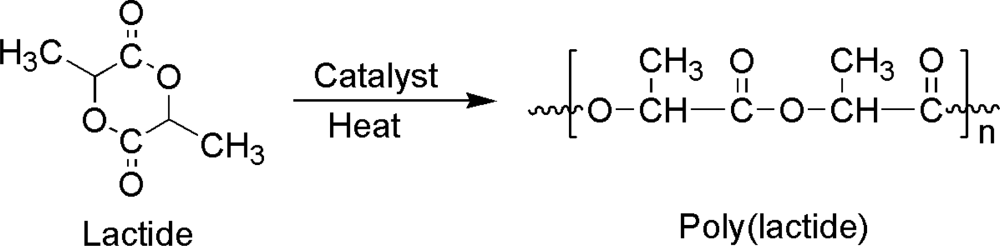
<p>The poly(lactide) synthesis is carried out by ring-opening polymerization according to the scheme given in the <xref ref-type="fig" rid="f1-sensors-10-05063">Figure 1</xref>.</p>
<p>The difficulties of poly(lactide) synthesis can be successfully overcome by microwave heating. Microwave radiation has numerous advantages compared to conventional heating: homogeneous heating of the whole volume of the reaction mixture, high transfer energy per unit of time, improved yield, the possibility of the process acceleration and synthesis without using great quantity of the solvent. Polymerization assisted by microwave provides a new approach for enhancing polymer properties as well as economic advantages through energy saving and accelerated product development. Animated by numerous successes in the organic synthesis field, the use of microwaves enables a drastic reduction of polymerization time, to only 5–30 minutes, while obtaining polymers of high molar mass at the same time. For example, super absorbing resin was synthesized by using microwaves in only six minutes [<xref ref-type="bibr" rid="b30-sensors-10-05063">30</xref>].</p>
<p>The power of microwaves of 150 W has been used in the synthesis of poly(D,L-lactide), which is several times lower than the power used in other polymer synthesis processes, using up to 800 W [<xref ref-type="bibr" rid="b31-sensors-10-05063">31</xref>].</p>
<p>The homogeneous nature of microwave heating eliminates local overheating at the reaction walls, which can lead to side products. Therefore, microwave-irradiated reactions are not only faster, but proceed with higher purity and, consequently, higher yields. In an industry where time is money, the dramatic rate acceleration and increased purity and yields of microwave assisted reactions make them attractive for high-produced polymers.</p>
<p>To develop a technique of microwave-assisted polymerization of D,L-lactide, to efficiently and easily prepare poly(D,L-lactide) with high molecular weight, the ring opening polymerization of D,L-lactide by microwave irradiation under atmosphere was investigated. Both lactic acid and its oligomer are polar molecules, so they can absorb microwave energy to increase the temperature.</p></sec>
<sec>
<label>2.</label>
<title>Experimental Section</title>
<sec sec-type="materials">
<label>2.1.</label>
<title>Materials</title>
<p>D,L-Lactide (3,6-dimethyl-1,4-dioxane-2,5-dione), (98% purity) was from Sigma-Aldrich Wisconsin. Tin(II) 2-ethylhexanoate (Stannous octoate), (95% purity), density 1,251 g/mL at 25 °C was from Sigma-Aldrich Wisconsin. Chloroform and methanol were high-performance liquid chromatography grade. Other solvents, toluene, tetrahydrophurane (THF), and water were of reagent grade. All solvents were purchased from Merck Chemical Co. Poly(vinyl alcohol) (PVA, 88 mol% hydrolyzed, M<sub>w</sub> 25,000) was purchased from Polysciences, Inc. (Warrington, PA, USA).</p>
<p>Three mol ratios of monomer and initiator were used for the synthesis: [M]/[I] = 1,000, 5,000 and 10,000. Composition of reaction mixtures for the synthesis in microwave reactor are shown in <xref ref-type="table" rid="t1-sensors-10-05063">Table 1</xref>.</p></sec>
<sec>
<label>2.2.</label>
<title>Microwave-Assisted Synthesis of PLLA</title>
<p>Dry D,L-lactide (5 g, 34.7 mmol), pre-crystallized from methanol, was placed in evaporating bowls, 14.05, 2.81 or 1.41 mg tin(II) 2-ethylhexanoate (34.7, 6.9 and 3.47 mol) was added with 1 cm<sup>3</sup> dry, fresh distilled toluene. The mixture was homogenized, and then toluene was evaporated at 60 °C in vacuum for 12 h. The reaction mixture was then removed into glass ampoule and closed under reduced pressure. Polymerization was performed in a “Discover” focus microwave reactor, CEM Corporation, Matthews, NC, USA. The frequency and the power applied were 2.45 GHz and 150 W, respectively. The temperature regulation was carried out by infrared mass measuring system and maintained at 100 °C.</p></sec>
<sec>
<label>2.3.</label>
<title>Poly(D,L-lactide) Microsphere Preparation</title>
<p>After polymerization, the polymer was precipitated by methanol from the chloroform solution to purify it from residual monomer and initiator. Poly(D,L-lactide) were dissolved in 10 mL tetrahydrofuran to provide concentration of 2 to 4% wt/vol. The solution was then sprinkled into a 200 mL aqueous solution containing 0.5% wt/vol poly(vinyl alcohol) (PVA). The mixture was stirred on a hot plate magnetic stirrer to form a stable emulsion system at room temperature (25 ± 2 °C). Stirring was continued for 3 hour at 65 °C to allow the evaporation of tetrahydrofuran and the formation of solid micro-spheres. Microspheres were filtered, washed with distilled water, and dried until no weight loss was observed.</p></sec>
<sec>
<label>2.4.</label>
<title>Characterization of Obtained Polymers and Microspheres</title>
<p>Fourier transform infrared spectrum, FTIR, was recorded by Bomem Hartmann &amp; Braun MB-series. Samples were milled with KBr (0.5 mg of the sample with 150 mg of KBr) and formed tablets under vacuum press. Recording was performed in the wave band range from 400 to 4,000 cm<sup>−1</sup>.</p>
<p>The molecular weight of obtained polymers was determined by gel permeation chromatography, GPC, using Agilent 1100 Series system with refractive index, RID 1200, and diode array, DAD, 1200 (recording at 212 nm) detectors. Used column ZORBAX PSM 300, 250 × 6.2 mm, 5 μm, covered molecular mass range 3 × 10<sup>3</sup>–3 × 10<sup>5</sup> g/mol and operated at temperature 25 °C. Tetrahydrofuran used as eluent (flow 1 cm<sup>3</sup>/min). Sample injection volume was 10 μl. The average molar masses, <italic>M<sub>n</sub></italic>, <italic>M<sub>w</sub></italic> and poly(D,L-lactide) polydispersivity index Q were determined by software Agilent ChemStation for LC and GPC. Poly(styrene) standards were used to make calibration curve: 10.000 g/mol (Mw = 10.640, Mn = 9.940, Mp = 10.860, Q = 1.07, FLUKA), 100.000 g/mol (Mw = 94.900, Mn = 89.300, Mp = 89.400, Q = 1.06, FLUKA), 300.000 g/mol (Mw = 319.000, Mn = 305.000, Mp = 321.000, Q = 1.05, FLUKA).</p>
<p>The morphologies of the microspheres were observed using a scanning electron microscope (SEM, JEOL JSM–5300, Japan). The microspheres were vacuum dried at room temperature, mounted onto brass stubs and sputter-coated with gold in an argon atmosphere using JEOL JFC–1100 ion sputter.</p></sec></sec>
<sec sec-type="results|discussion">
<label>3.</label>
<title>Results and Discussion</title>
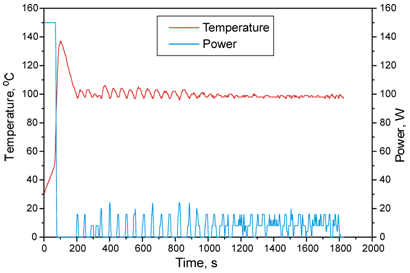
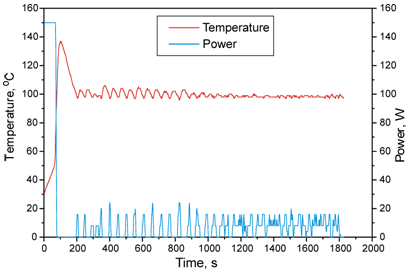
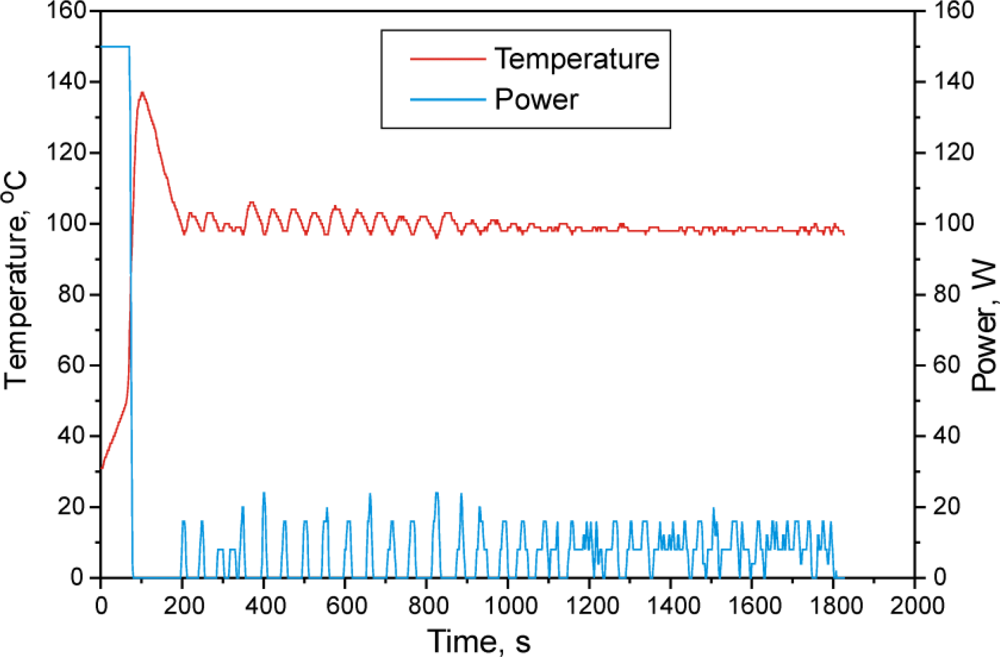
<p>This work concerned the tin(II) 2-ethylhexanoate initiated synthesis of poly(D,L-lactide). <xref ref-type="fig" rid="f2-sensors-10-05063">Figure 2</xref> shows the temperature and the applied power of the reaction mixture as dependent on the reaction time. D,L-Lactide readily absorbs the microwaves, having as a result a fast temperature increase in the first 80 seconds. After the start of the reaction, heat is released due to the exothermic effect of the polymerization reaction (since almost all of the initiator is included in the reaction). The temperature (140 °C) rises above the appointed value (100 °C) although the microwave radiation is automatically switched off, as the program of the microwave reactor is set at maintaining the temperature at 100 °C. The applied power of 150 W at the beginning of the reaction becomes zero after reaching the appointed temperature (in about 1.5 minutes). In the sequel of the polymerization reaction, power of only about 20 W is applied to maintain the temperature, in pulses of several tens of seconds with intermittent pauses of similar duration. The graph shows that the beginning of the polymerization occurs at 70 °C, that the absorption of microwaves decreases with the increase of the polymer content in the reaction mixture and that the highest absorption is that of pure monomer.</p>
<p>The change of reaction mixture temperature from the period of 3–20 minutes shows that the microwave absorption is still present and that there is still some monomer in the reaction mixture to be polymerized, hence the temperature leaps from the polymerization reaction exothermicity. Namely, every intermittent temperature leap follows the automatic turning off of microwave radiation. After 20 minutes the temperature change becomes insignificant and it is maintained constant only through the microwaves absorption, but there are no more temperature leaps or exothermal processes in the reaction mixture, indicating that the monomer conversion into polymer is complete.</p>
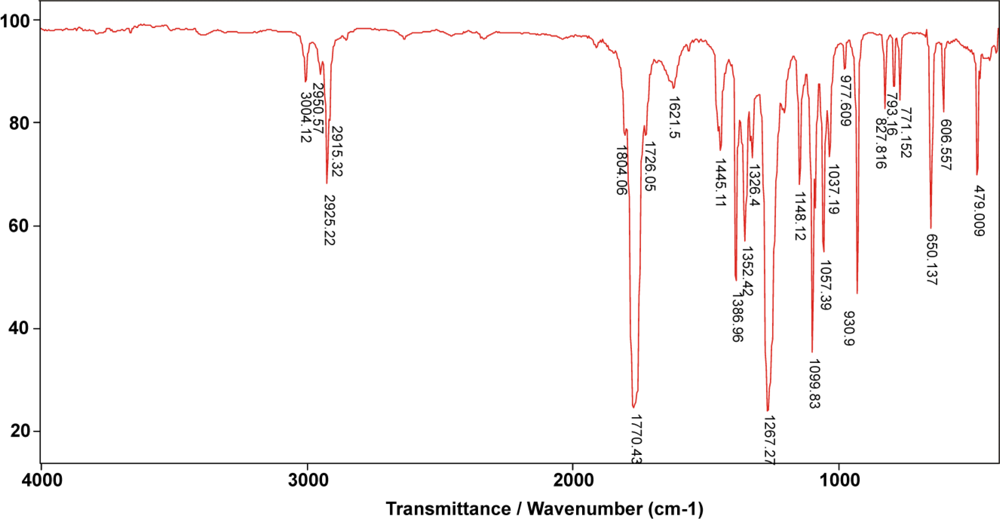
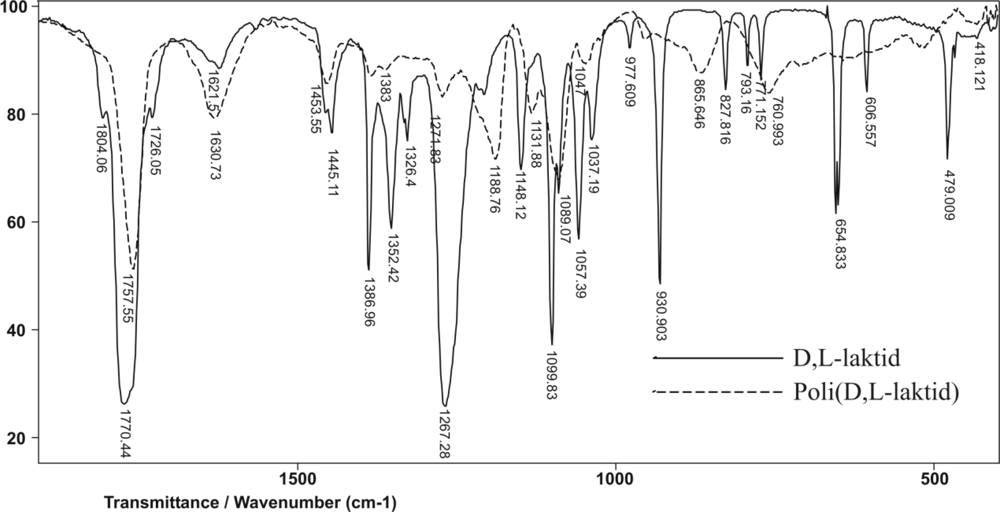
<p>The molecular structures of synthesized polymers were confirmed by FTIR methods. FTIR spectrum of the monomer D,L-lactide (<xref ref-type="fig" rid="f3-sensors-10-05063">Figure 3</xref>) shows bands at 2,915.32 and 2,950.57 cm<sup>−1</sup> from symmetric and asymmetric valence vibrations of C-H, respectively. Bands at 2,925.22 and 3,004.12 cm<sup>−1</sup> originate from symmetric and asymmetric valence vibrations of C-H from CH<sub>3</sub>, respectively. In the FTIR spectrum of the monomer D,L-lactide, bands also appear at 1,267.27 cm<sup>−1</sup> (asymmetric valence vibrations of C-O-C in the lactonic ring), 1,099.83 cm<sup>−1</sup> (symmetric valence vibrations of C-O-C in the lactonic ring), 1,770.43 cm<sup>−1</sup> (cyclic dilactone C = O valence vibration), 1,445.11 and 1,386.96 cm<sup>−1</sup> (asymmetric and symmetric bending vibration of C-H from CH<sub>3</sub>, respectively) and 930.9 cm<sup>−1</sup> (COO ring breathing mode).</p>
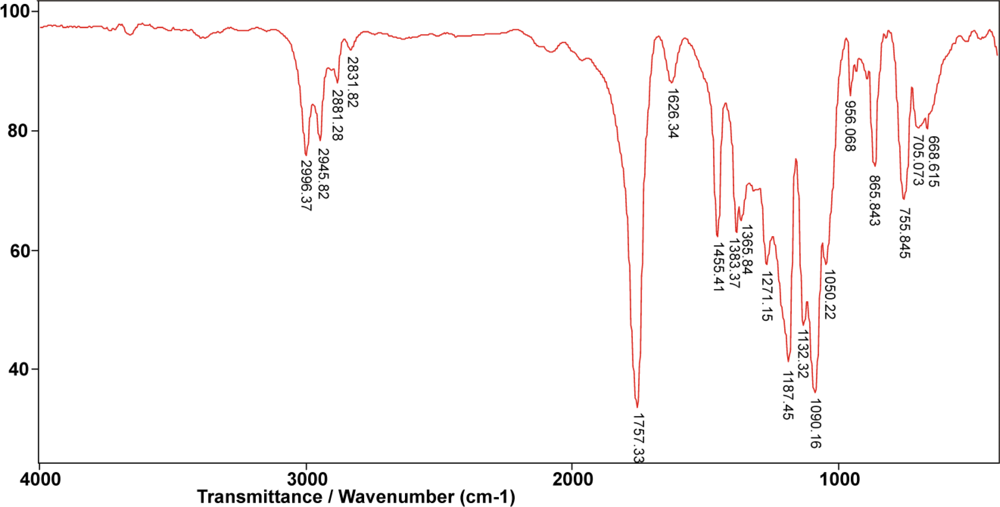
<p>In the FTIR spectrum of poly(D,L-lactide), with the monomer/initiator ratio of 1/5,000, obtained for 15 minutes, bands were present at 2,831.82 and 2,945.82 cm<sup>−1</sup> from symmetric and asymmetric valence vibrations of C-H, respectively (<xref ref-type="fig" rid="f4-sensors-10-05063">Figure 4</xref>). At 2,881.28 and 2,996.37 cm<sup>−1</sup>, bands were from symmetric and asymmetric valence vibrations of C-H from CH<sub>3</sub>. Asymmetrical valence vibrations of C-O-C of the aliphatic chain were shifted at 1,187.45 cm<sup>−1</sup>, and symmetrical valence vibrations of C-O-C of the aliphatic chain 1,090.16 cm<sup>−1</sup>, compared with bands at 1,276 and 1,099 cm<sup>−1</sup>, which appeared in monomer D,L-lactide, <xref ref-type="fig" rid="f5-sensors-10-05063">Figure 5</xref>. Accompanying bands at 1,757.33 cm<sup>−1</sup> (valence vibration of C═O of aliphatic ester), 1,455.41 and 1,383.37 cm<sup>−1</sup> (asymmetric and symmetric bending vibration of C-H from CH<sub>3</sub>, respectively), 1,271.15 cm<sup>−1</sup> (the overlap C-H bending vibration and C-O-C stretching vibration) were also detected.</p>
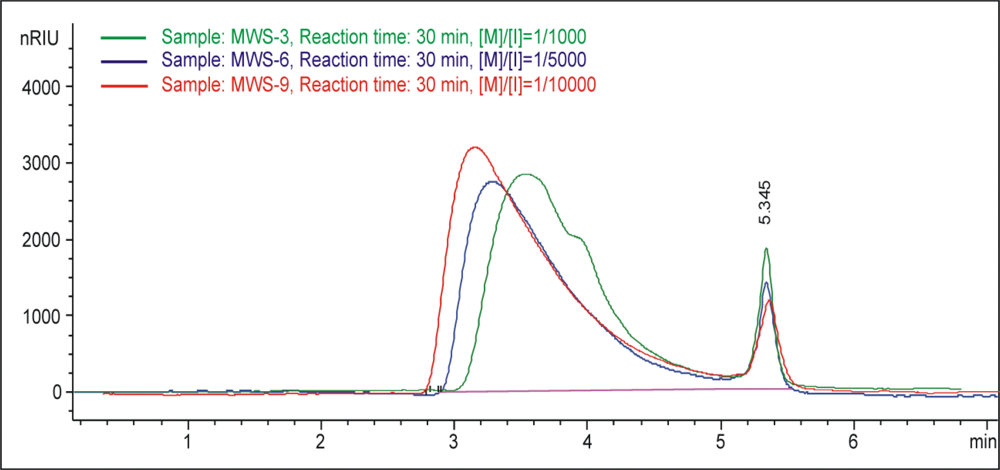
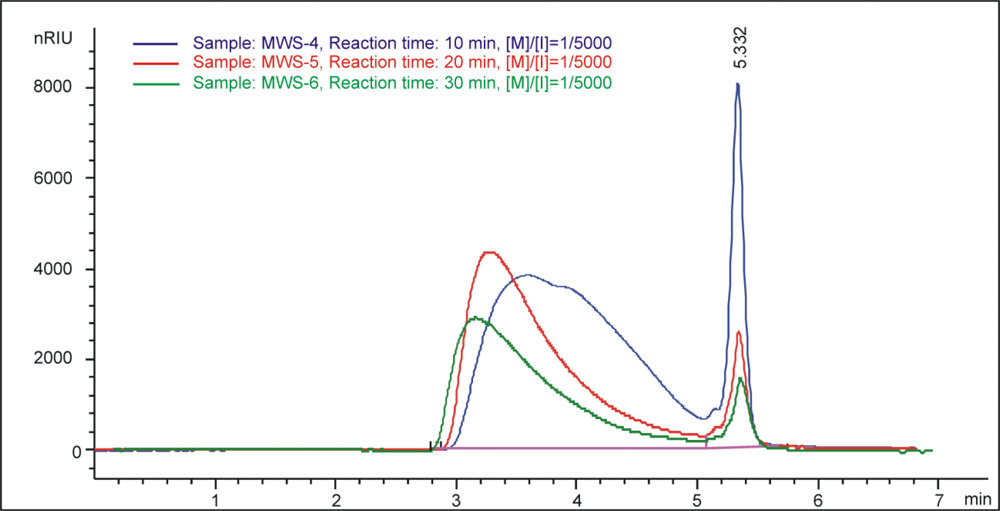
<p>The GPC curves of synthesized polymer are shown in <xref ref-type="fig" rid="f6-sensors-10-05063">Figures 6</xref> and <xref ref-type="fig" rid="f7-sensors-10-05063">7</xref>. Unreacted monomer was found in the profile for poly(D,L-lactide) synthesized by microwaves, but with increasing reaction time a decreased quantity of unreacted monomers was observed (retention time 5.33 minutes), <xref ref-type="fig" rid="f6-sensors-10-05063">Figure 6</xref>. <xref ref-type="fig" rid="f7-sensors-10-05063">Figure 7</xref> shows GPC curves for poly(D,L-lactide)s polymerized at the same time with different monomer/initiator ratios. As expected, it can be concluded that with decreasing initiator content, the molecular mass of obtained polymers increases. Peaks from unreacted monomers decreased with decreasing initiator content.</p>
<p><xref ref-type="table" rid="t2-sensors-10-05063">Table 2</xref> shows the values of mean molar masses <italic>M<sub>n</sub></italic>, <italic>M<sub>w</sub></italic> and polydispersivity index Q, for poly(D,L-lactide) synthesized using microwaves as the function of polymerization time and monomer/initiator mol ratio [M]/[I]. The values of mean molar mass and the polydispersivity index were observed to increase with the increase of reaction duration. These values were also increased with the increase of monomer/initiator ratio.</p>
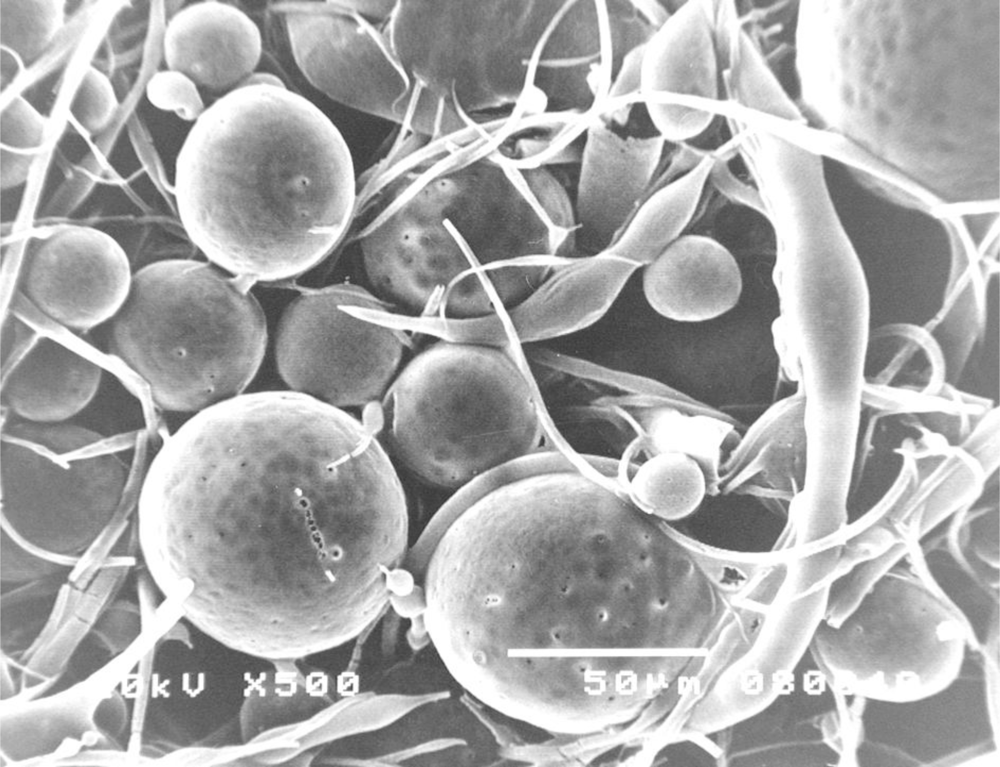
<p><xref ref-type="fig" rid="f8-sensors-10-05063">Figure 8</xref> shows the SEM image of poly(D,L-lactide) spheres obtained by spraying a fine fog of poly(D,L-lactide) solution in tetrahydrofuran into the water solution of poly(vinyl alcohol) with intensive stirring.</p>
<p>Such microspheres can be used as polymer matrices for the production of devices for controlled release of medicinal substances, since the diameter of the microspheres is appropriate for phagocytosis by macrophages.</p></sec>
<sec sec-type="conclusions">
<label>4.</label>
<title>Conclusions</title>
<p>The reduction of poly(D,L-lactide) synthesis duration and energy consumption by using microwaves enables a more economical production. The microwave synthesis requires more energy during the first few seconds only to obtain uniform and intensive initiation. The polymerization reaction course is readily supervised by monitoring the temperature of the reaction mixture by infra-red sensors and the applied power of microwave radiation. poly(D,L-lactide) could be synthesized effectively by microwave-assisted ring opening polymerization using tin(II)2-ethylhexanoate as a initiator. This microwave assisted polymerization was much faster than the literature data for polymerization heated by a conventional oil bath under similar reaction conditions. The monomer/initiator ratios had a strong influence on the molecular masses and polydispersity of obtained polymers. A higher monomer/initiator ratio resulted in polymers with higher molar masses and lower polydispersity, Q. At a reaction temperature of 100 °C, the prolonged microwave irradiation time showed a significant effect on the increasing polymer molar mass.</p>
<p>From SEM imagine of microspheres it was concluded that the technique provides uniform sized spheres. The size of the obtained microspheres was about 50 μm.</p></sec></body>
<back>
<ack>
<p>This paper was supported by Ministry of Science and Technological Development—Republic of Serbia, project TR-19048.</p></ack>
<ref-list>
<title>References</title>
<ref id="b1-sensors-10-05063"><label>1.</label><citation citation-type="journal"><person-group person-group-type="author"><name><surname>Gilding</surname><given-names>D.K.</given-names></name><name><surname>Reed</surname><given-names>A.M.</given-names></name></person-group><article-title>Biodegradable polymers for use in surgery-polyglicolic/poly(lactic acid) homo-and copolymers</article-title><source>Polymer</source><year>1979</year><volume>20</volume><fpage>1459</fpage><lpage>1464</lpage><pub-id pub-id-type="doi">10.1016/0032-3861(79)90009-0</pub-id></citation></ref>
<ref id="b2-sensors-10-05063"><label>2.</label><citation citation-type="journal"><person-group person-group-type="author"><name><surname>Tomihata</surname><given-names>K.</given-names></name><name><surname>Suzuki</surname><given-names>M.</given-names></name><name><surname>Oka</surname><given-names>T.</given-names></name><name><surname>Ikada</surname><given-names>Y.</given-names></name></person-group><article-title>A new resorbable monofilament suture</article-title><source>Polymer Degrad. Stability</source><year>1998</year><volume>59</volume><fpage>13</fpage><lpage>18</lpage><pub-id pub-id-type="doi">10.1016/S0141-3910(97)00183-3</pub-id></citation></ref>
<ref id="b3-sensors-10-05063"><label>3.</label><citation citation-type="journal"><person-group person-group-type="author"><name><surname>Leenslag</surname><given-names>J.W.</given-names></name><name><surname>Pennings</surname><given-names>A.J.</given-names></name></person-group><article-title>High-strength poly(L-Lactide) fibers by a dry-spinning hot-drawing Process</article-title><source>Polymer</source><year>1987</year><volume>28</volume><fpage>1695</fpage><lpage>1702</lpage><pub-id pub-id-type="doi">10.1016/0032-3861(87)90012-7</pub-id></citation></ref>
<ref id="b4-sensors-10-05063"><label>4.</label><citation citation-type="journal"><person-group person-group-type="author"><name><surname>Mäkelä</surname><given-names>P.</given-names></name><name><surname>Pohjonen</surname><given-names>T.</given-names></name><name><surname>Törmälä</surname><given-names>P.</given-names></name><name><surname>Waris</surname><given-names>T.</given-names></name><name><surname>Ashammakhi</surname><given-names>N.</given-names></name></person-group><article-title>Strength retention properties of self-reinforced poly L-lactide (SR-PLLA) sutures compared with polyglyconate (Maxon<sup>R</sup>) and polydioxanone (PDS) sutures. An <italic>in vitro</italic> study</article-title><source>Biomaterials</source><year>2002</year><volume>23</volume><fpage>2587</fpage><lpage>2592</lpage><pub-id pub-id-type="doi">10.1016/S0142-9612(01)00396-9</pub-id><pub-id pub-id-type="pmid">12033607</pub-id></citation></ref>
<ref id="b5-sensors-10-05063"><label>5.</label><citation citation-type="journal"><person-group person-group-type="author"><name><surname>Channuan</surname><given-names>W.</given-names></name><name><surname>Siripitayananon</surname><given-names>J.</given-names></name><name><surname>Molloy</surname><given-names>R.</given-names></name><name><surname>Mitchell</surname><given-names>G.R.</given-names></name></person-group><article-title>Defining the physical structure and properties in novel monofilaments with potential for use as absorbable surgical sutures based on a lactide containing block terpolymer</article-title><source>Polymer</source><year>2008</year><volume>49</volume><fpage>4433</fpage><lpage>4445</lpage><pub-id pub-id-type="doi">10.1016/j.polymer.2008.07.058</pub-id></citation></ref>
<ref id="b6-sensors-10-05063"><label>6.</label><citation citation-type="journal"><person-group person-group-type="author"><name><surname>Penning</surname><given-names>J.P.</given-names></name><name><surname>Dijkstra</surname><given-names>H.</given-names></name><name><surname>Pennings</surname><given-names>A.J.</given-names></name></person-group><article-title>Preparation and properties of absorbable fibres from L-lactide copolymers</article-title><source>Polymer</source><year>1993</year><volume>34</volume><fpage>942</fpage><lpage>951</lpage><pub-id pub-id-type="doi">10.1016/0032-3861(93)90212-S</pub-id></citation></ref>
<ref id="b7-sensors-10-05063"><label>7.</label><citation citation-type="journal"><person-group person-group-type="author"><name><surname>Leenslag</surname><given-names>W.J.</given-names></name><name><surname>Pennings</surname><given-names>A.J.</given-names></name><name><surname>Bos</surname><given-names>R.M.</given-names></name><name><surname>Rozema</surname><given-names>F.R.</given-names></name><name><surname>Boering</surname><given-names>G.</given-names></name></person-group><article-title>Resorbable materials of poly(L-lactide): VII <italic>In vivo</italic> and <italic>in vitro</italic> degradation</article-title><source>Biomaterials</source><year>1987</year><volume>8</volume><fpage>311</fpage><lpage>314</lpage><pub-id pub-id-type="doi">10.1016/0142-9612(87)90121-9</pub-id><pub-id pub-id-type="pmid">3663810</pub-id></citation></ref>
<ref id="b8-sensors-10-05063"><label>8.</label><citation citation-type="journal"><person-group person-group-type="author"><name><surname>Winet</surname><given-names>H.</given-names></name><name><surname>Bao</surname><given-names>J.Y.</given-names></name></person-group><article-title>Fibroblast growth factor-2 alters the effect of eroding polylactide-polyglycolide on osteogenesis in the bone chamber</article-title><source>J. Biomed. Mater. Res</source><year>1998</year><volume>40</volume><fpage>567</fpage><lpage>576</lpage><pub-id pub-id-type="doi">10.1002/(SICI)1097-4636(19980615)40:4&lt;567::AID-JBM8&gt;3.0.CO;2-D</pub-id><pub-id pub-id-type="pmid">9599033</pub-id></citation></ref>
<ref id="b9-sensors-10-05063"><label>9.</label><citation citation-type="journal"><person-group person-group-type="author"><name><surname>Lunt</surname><given-names>J.</given-names></name></person-group><article-title>Large-scale production, properties, and commercial applications of polylactic acid polymers</article-title><source>Polym. Degrad. Stab</source><year>1998</year><volume>59</volume><fpage>145</fpage><lpage>152</lpage><pub-id pub-id-type="doi">10.1016/S0141-3910(97)00148-1</pub-id></citation></ref>
<ref id="b10-sensors-10-05063"><label>10.</label><citation citation-type="journal"><person-group person-group-type="author"><name><surname>Sodergard</surname><given-names>A.</given-names></name><name><surname>Stolt</surname><given-names>M.</given-names></name></person-group><article-title>Properties of lactic acid based polymers and their correlation with composition</article-title><source>Prog. Polym. Sci</source><year>2002</year><volume>27</volume><fpage>1123</fpage><lpage>1163</lpage><pub-id pub-id-type="doi">10.1016/S0079-6700(02)00012-6</pub-id></citation></ref>
<ref id="b11-sensors-10-05063"><label>11.</label><citation citation-type="journal"><person-group person-group-type="author"><name><surname>Drumright</surname><given-names>R.E.</given-names></name><name><surname>Gruber</surname><given-names>P.R.</given-names></name><name><surname>Henton</surname><given-names>D.E.</given-names></name></person-group><article-title>Polylactic acid technology</article-title><source>Adv. Mater</source><year>2000</year><volume>12</volume><fpage>1841</fpage><lpage>1846</lpage><pub-id pub-id-type="doi">10.1002/1521-4095(200012)12:23&lt;1841::AID-ADMA1841&gt;3.0.CO;2-E</pub-id></citation></ref>
<ref id="b12-sensors-10-05063"><label>12.</label><citation citation-type="journal"><person-group person-group-type="author"><name><surname>Herrmann</surname><given-names>J.</given-names></name><name><surname>Bodmeier</surname><given-names>R.</given-names></name></person-group><article-title>The effect of particle microstructure on the somatostatin release from poly(lactide) microspheres prepared by a W/O/W solvent evaporation method</article-title><source>J. Control. Release</source><year>1995</year><volume>36</volume><fpage>63</fpage><lpage>71</lpage><pub-id pub-id-type="doi">10.1016/0168-3659(95)00051-9</pub-id></citation></ref>
<ref id="b13-sensors-10-05063"><label>13.</label><citation citation-type="journal"><person-group person-group-type="author"><name><surname>Miyajima</surname><given-names>M.</given-names></name><name><surname>Koshika</surname><given-names>A.</given-names></name><name><surname>Okada</surname><given-names>J.</given-names></name><name><surname>Ikeda</surname><given-names>M.</given-names></name></person-group><article-title>Effect of polymer/basic drug interactions on the two-stage diffusion-controlled release from a poly(L-lactic acid) matrix</article-title><source>J. Control. Release</source><year>1999</year><volume>61</volume><fpage>295</fpage><lpage>304</lpage><pub-id pub-id-type="doi">10.1016/S0168-3659(99)00149-2</pub-id><pub-id pub-id-type="pmid">10477802</pub-id></citation></ref>
<ref id="b14-sensors-10-05063"><label>14.</label><citation citation-type="journal"><person-group person-group-type="author"><name><surname>Aso</surname><given-names>Y.</given-names></name><name><surname>Yoshioka</surname><given-names>S.</given-names></name><name><surname>Po</surname><given-names>A.L.W.</given-names></name><name><surname>Terao</surname><given-names>T.</given-names></name></person-group><article-title>Effect of temperature on mechanisms of drug release and matrix degradation of poly(D,L-lactide) microspheres</article-title><source>J. Control. Release</source><year>1994</year><volume>31</volume><fpage>33</fpage><lpage>39</lpage><pub-id pub-id-type="doi">10.1016/0168-3659(94)90248-8</pub-id></citation></ref>
<ref id="b15-sensors-10-05063"><label>15.</label><citation citation-type="journal"><person-group person-group-type="author"><name><surname>Yoshioka</surname><given-names>S.</given-names></name><name><surname>Aso</surname><given-names>Y.</given-names></name><name><surname>Kojima</surname><given-names>S.</given-names></name></person-group><article-title>Drug release from poly(D,L-lactide) microspheres controlled by γ-irradiation</article-title><source>J. Control. Release</source><year>1995</year><volume>37</volume><fpage>263</fpage><lpage>267</lpage><pub-id pub-id-type="doi">10.1016/0168-3659(95)00083-6</pub-id></citation></ref>
<ref id="b16-sensors-10-05063"><label>16.</label><citation citation-type="journal"><person-group person-group-type="author"><name><surname>Pradhan</surname><given-names>R.S.</given-names></name><name><surname>Vasavada</surname><given-names>R.C.</given-names></name></person-group><article-title>Formulation and <italic>in vitro</italic> release study on poly (D,L-lactide) microspheres containing hydrophilic compounds: glycine homopeptides</article-title><source>J. Control. Release</source><year>1994</year><volume>30</volume><fpage>143</fpage><lpage>154</lpage><pub-id pub-id-type="doi">10.1016/0168-3659(94)90261-5</pub-id></citation></ref>
<ref id="b17-sensors-10-05063"><label>17.</label><citation citation-type="journal"><person-group person-group-type="author"><name><surname>Izumikawa</surname><given-names>S.</given-names></name><name><surname>Yoshioka</surname><given-names>S.</given-names></name><name><surname>Aso</surname><given-names>Y.</given-names></name><name><surname>Takeda</surname><given-names>Y.</given-names></name></person-group><article-title>Preparation of poly(L-lactide) microspheres of different crystalline morphology and effect of crystalline morphology on drug release rate</article-title><source>J. Control. Release</source><year>1991</year><volume>15</volume><fpage>133</fpage><lpage>140</lpage><pub-id pub-id-type="doi">10.1016/0168-3659(91)90071-K</pub-id></citation></ref>
<ref id="b18-sensors-10-05063"><label>18.</label><citation citation-type="journal"><person-group person-group-type="author"><name><surname>Zhang</surname><given-names>X.</given-names></name><name><surname>Wyss</surname><given-names>U.P.</given-names></name><name><surname>Pichora</surname><given-names>D.</given-names></name><name><surname>Goosen</surname><given-names>M.F.A.</given-names></name></person-group><article-title>A mechanistic study of antibiotic release from biodegradable poly(D,L-lactide) cylinders</article-title><source>J. Control. Release</source><year>1994</year><volume>31</volume><fpage>129</fpage><lpage>144</lpage><pub-id pub-id-type="doi">10.1016/0168-3659(94)00011-5</pub-id></citation></ref>
<ref id="b19-sensors-10-05063"><label>19.</label><citation citation-type="journal"><person-group person-group-type="author"><name><surname>Uhrich</surname><given-names>K.</given-names></name><name><surname>Cannizzaro</surname><given-names>S.</given-names></name><name><surname>Langer</surname><given-names>R.</given-names></name><name><surname>Shakesheff</surname><given-names>K.</given-names></name></person-group><article-title>Polymeric systems for controlled drug release</article-title><source>Chem. Rev</source><year>1999</year><volume>99</volume><fpage>3181</fpage><lpage>3198</lpage><pub-id pub-id-type="doi">10.1021/cr940351u</pub-id><pub-id pub-id-type="pmid">11749514</pub-id></citation></ref>
<ref id="b20-sensors-10-05063"><label>20.</label><citation citation-type="journal"><person-group person-group-type="author"><name><surname>Jacoby</surname><given-names>M.</given-names></name></person-group><article-title>Custom-made biomaterials</article-title><source>Chem. Eng. News</source><year>2001</year><volume>79</volume><fpage>30</fpage><lpage>35</lpage></citation></ref>
<ref id="b21-sensors-10-05063"><label>21.</label><citation citation-type="journal"><person-group person-group-type="author"><name><surname>Hyon</surname><given-names>S.H.</given-names></name><name><surname>Jamshidi</surname><given-names>K.</given-names></name><name><surname>Ikada</surname><given-names>Y.</given-names></name></person-group><article-title>Synthesis of polylactides with different molecular weights</article-title><source>Biomaterials</source><year>1997</year><volume>18</volume><fpage>1503</fpage><lpage>1508</lpage><pub-id pub-id-type="doi">10.1016/S0142-9612(97)00076-8</pub-id><pub-id pub-id-type="pmid">9426180</pub-id></citation></ref>
<ref id="b22-sensors-10-05063"><label>22.</label><citation citation-type="journal"><person-group person-group-type="author"><name><surname>Bendix</surname><given-names>D.</given-names></name></person-group><article-title>Chemical synthesis of poly(lactide) and its copolymers for medical applications</article-title><source>Polymer Degrad. Stability</source><year>1998</year><volume>59</volume><fpage>129</fpage><lpage>135</lpage><pub-id pub-id-type="doi">10.1016/S0141-3910(97)00149-3</pub-id></citation></ref>
<ref id="b23-sensors-10-05063"><label>23.</label><citation citation-type="journal"><person-group person-group-type="author"><name><surname>Leenslag</surname><given-names>J.W.</given-names></name><name><surname>Pennings</surname><given-names>A.J.</given-names></name></person-group><article-title>Synthesis of high-molecular-weight poly(L-lactide) initiated with tin 2-ethylhexanoate</article-title><source>Makromol. Chem</source><year>1987</year><volume>188</volume><fpage>1809</fpage><lpage>1814</lpage><pub-id pub-id-type="doi">10.1002/macp.1987.021880804</pub-id></citation></ref>
<ref id="b24-sensors-10-05063"><label>24.</label><citation citation-type="journal"><person-group person-group-type="author"><name><surname>Nijenhuis</surname><given-names>A.J.</given-names></name><name><surname>Grijpma</surname><given-names>D.W.</given-names></name><name><surname>Pennings</surname><given-names>A.J.</given-names></name></person-group><article-title>Lewis acid catalyzed polymerization of L-Lactide. Kinetics and mechanism of the bulk polymerization</article-title><source>Macromolecules</source><year>1992</year><volume>25</volume><fpage>6419</fpage><lpage>6424</lpage><pub-id pub-id-type="doi">10.1021/ma00050a006</pub-id></citation></ref>
<ref id="b25-sensors-10-05063"><label>25.</label><citation citation-type="journal"><person-group person-group-type="author"><name><surname>Du</surname><given-names>Y.J.</given-names></name><name><surname>Lemstra</surname><given-names>P.J.</given-names></name><name><surname>Nijenhuis</surname><given-names>A.J.</given-names></name><name><surname>van Aert</surname><given-names>H.A.M.</given-names></name><name><surname>Bastiaansen</surname><given-names>C.</given-names></name></person-group><article-title>ABA type copolymers of lactide with poly(ethylene glycol). Kinetic, mechanistic and model studies</article-title><source>Macromolecules</source><year>1995</year><volume>28</volume><fpage>2124</fpage><lpage>2132</lpage><pub-id pub-id-type="doi">10.1021/ma00111a004</pub-id></citation></ref>
<ref id="b26-sensors-10-05063"><label>26.</label><citation citation-type="journal"><person-group person-group-type="author"><name><surname>Schwach</surname><given-names>G.</given-names></name><name><surname>Coudane</surname><given-names>J.</given-names></name><name><surname>Engel</surname><given-names>R.</given-names></name><name><surname>Vert</surname><given-names>M.</given-names></name></person-group><article-title>More about the polymerization of lactides in the presence of stannous octoate</article-title><source>J. Polym. Sci. Part A: Polym. Chem</source><year>1997</year><volume>35</volume><fpage>3431</fpage><lpage>3440</lpage><pub-id pub-id-type="doi">10.1002/(SICI)1099-0518(19971130)35:16&lt;3431::AID-POLA10&gt;3.0.CO;2-G</pub-id></citation></ref>
<ref id="b27-sensors-10-05063"><label>27.</label><citation citation-type="journal"><person-group person-group-type="author"><name><surname>Kricheldorf</surname><given-names>H.R.</given-names></name><name><surname>Kreiser-Saunders</surname><given-names>I.</given-names></name><name><surname>Boettcher</surname><given-names>C.</given-names></name></person-group><article-title>Polylactones: 31. Sn(II)octoate-initiated polymerization of L-lactide: a mechanistic study</article-title><source>Polymer</source><year>1995</year><volume>36</volume><fpage>1253</fpage><lpage>1259</lpage><pub-id pub-id-type="doi">10.1016/0032-3861(95)93928-F</pub-id></citation></ref>
<ref id="b28-sensors-10-05063"><label>28.</label><citation citation-type="journal"><person-group person-group-type="author"><name><surname>Zhang</surname><given-names>X.</given-names></name><name><surname>McDonald</surname><given-names>D.A.</given-names></name><name><surname>Goosen</surname><given-names>M.F.</given-names></name><name><surname>McAuley</surname><given-names>K.B.</given-names></name></person-group><article-title>Mechanism of lactide polymerization in the presence of stannous octoate: The effect of hydroxy and carboxylic acid substances</article-title><source>J. Polym. Sci. Part A: Polym. Chem</source><year>1994</year><volume>32</volume><fpage>2965</fpage><lpage>2970</lpage><pub-id pub-id-type="doi">10.1002/pola.1994.080321519</pub-id></citation></ref>
<ref id="b29-sensors-10-05063"><label>29.</label><citation citation-type="journal"><person-group person-group-type="author"><name><surname>In’t Veld</surname><given-names>P.J.A.</given-names></name><name><surname>Velner</surname><given-names>E.M.</given-names></name><name><surname>van de Witte</surname><given-names>P.</given-names></name><name><surname>Hamhuis</surname><given-names>J.</given-names></name><name><surname>Dijkstra</surname><given-names>P.J.</given-names></name><name><surname>Feijen</surname><given-names>J.</given-names></name></person-group><article-title>Melt block copolymerization of ε-caprolactone and L-lactide</article-title><source>J. Polym. Sci. Part A: Polym. Chem</source><year>1997</year><volume>35</volume><fpage>219</fpage><lpage>226</lpage><pub-id pub-id-type="doi">10.1002/(SICI)1099-0518(19970130)35:2&lt;219::AID-POLA3&gt;3.0.CO;2-N</pub-id></citation></ref>
<ref id="b30-sensors-10-05063"><label>30.</label><citation citation-type="journal"><person-group person-group-type="author"><name><surname>Tong</surname><given-names>Z.</given-names></name><name><surname>Peng</surname><given-names>W.</given-names></name><name><surname>Zhiqian</surname><given-names>Z.</given-names></name><name><surname>Baoxiu</surname><given-names>Z.</given-names></name></person-group><article-title>Microwave irradiation copolymerization of superabsorbents from cornstarch and sodium acrylate</article-title><source>J. Appl. Polym. Sci</source><year>2005</year><volume>95</volume><fpage>264</fpage><lpage>269</lpage><pub-id pub-id-type="doi">10.1002/app.21265</pub-id></citation></ref>
<ref id="b31-sensors-10-05063"><label>31.</label><citation citation-type="journal"><person-group person-group-type="author"><name><surname>Li</surname><given-names>H.</given-names></name><name><surname>Liao</surname><given-names>L.</given-names></name><name><surname>Liu</surname><given-names>L.</given-names></name></person-group><article-title>Kinetic investigation into the non-thermal microwave effect on the ring-opening polymerization of ε-caprolactone</article-title><source>Macromol. Rapid Commun</source><year>2007</year><volume>28</volume><fpage>411</fpage><lpage>416</lpage><pub-id pub-id-type="doi">10.1002/marc.200600648</pub-id></citation></ref></ref-list>
<sec sec-type="display-objects">
<title>Figures and Tables</title>
<fig id="f1-sensors-10-05063" position="float">
<label>Figure 1.</label>
<caption>
<p>Scheme of poly(lactide) synthesis.</p></caption>
<graphic xlink:href="sensors-10-05063f1.gif"/></fig>
<fig id="f2-sensors-10-05063" position="float">
<label>Figure 2.</label>
<caption>
<p>Temperature and microwave radiation power dependence on reaction time (sample MWS-6) for (poly(D,L-lactide) synthesis in bulk.</p></caption>
<graphic xlink:href="sensors-10-05063f2.gif"/></fig>
<fig id="f3-sensors-10-05063" position="float">
<label>Figure 3.</label>
<caption>
<p>FTIR spectrum of monomer D,L-lactide.</p></caption>
<graphic xlink:href="sensors-10-05063f3.gif"/></fig>
<fig id="f4-sensors-10-05063" position="float">
<label>Figure 4.</label>
<caption>
<p>FTIR spectrum of poly(D,L-lactide).</p></caption>
<graphic xlink:href="sensors-10-05063f4.gif"/></fig>
<fig id="f5-sensors-10-05063" position="float">
<label>Figure 5.</label>
<caption>
<p>FTIR spectrum of monomer D,L-lactide and obtained poly(D,L-lactide) in the wave band range from 400 to 2,000 cm<sup>−1</sup>.</p></caption>
<graphic xlink:href="sensors-10-05063f5.gif"/></fig>
<fig id="f6-sensors-10-05063" position="float">
<label>Figure 6.</label>
<caption>
<p>The signal at RID detector in function of eluation volume for samples with the same monomer/initiator ratio, 1/5,000, obtained for different reaction times.</p></caption>
<graphic xlink:href="sensors-10-05063f6.gif"/></fig>
<fig id="f7-sensors-10-05063" position="float">
<label>Figure 7.</label>
<caption>
<p>The signal at RID detector in function of eluation volume for samples with different monomer to initiator, [M]/[I], ratio.</p></caption>
<graphic xlink:href="sensors-10-05063f7.gif"/></fig>
<fig id="f8-sensors-10-05063" position="float">
<label>Figure 8.</label>
<caption>
<p>SEM micrograph of poly(D,L-lactide) microspheres; magnified 500 X, bar = 50 μm.</p></caption>
<graphic xlink:href="sensors-10-05063f8.gif"/></fig>
<table-wrap id="t1-sensors-10-05063" position="float">
<label>Table 1.</label>
<caption>
<p>Composition of reaction mixtures for the synthesis in microwave reactor (molar concentration of monomer [M] and [I] initiator).</p></caption>
<table frame="box" rules="cols">
<thead>
<tr>
<th align="center" valign="bottom">Sample</th>
<th align="center" valign="bottom">[M]/[I]</th>
<th align="center" valign="bottom">m<sub>M</sub>, g</th>
<th align="center" valign="bottom">m<sub>C</sub>, mg</th></tr>
<tr>
<th align="center" valign="bottom" colspan="4">
<hr/></th></tr></thead>
<tbody>
<tr>
<td align="center" valign="top">MWS-1 MWS-2 MWS-3</td>
<td align="center" valign="top">1/1,000</td>
<td align="center" valign="top">5</td>
<td align="center" valign="top">14.05</td></tr>
<tr>
<td align="center" valign="top">MWS-4 MWS-5 MWS-6</td>
<td align="center" valign="top">1/5,000</td>
<td align="center" valign="top">5</td>
<td align="center" valign="top">2.81</td></tr>
<tr>
<td align="center" valign="top">MWS-7 MWS-8 MWS-9</td>
<td align="center" valign="top">1/10,000</td>
<td align="center" valign="top">5</td>
<td align="center" valign="top">1.41</td></tr></tbody></table>
<table-wrap-foot><fn id="tfn1-sensors-10-05063">
<p>m<sub>M</sub> - the mass of the monomer</p></fn><fn id="tfn2-sensors-10-05063">
<p>m<sub>C</sub> - the mass of the initiator</p></fn></table-wrap-foot></table-wrap>
<table-wrap id="t2-sensors-10-05063" position="float">
<label>Table 2.</label>
<caption>
<p>Mean molar masses <italic>M<sub>n</sub></italic>, <italic>M<sub>w</sub></italic> and polydispersivity index Q for poly(D,L-lactide) synthesized using microwaves, as the function of the polymerization time and monomer/initiator [M]/[I] mol ratio.</p></caption>
<table frame="box" rules="cols">
<thead>
<tr>
<th align="center" valign="bottom">Sample</th>
<th align="center" valign="bottom">Reaction time, min</th>
<th align="center" valign="bottom">[M]/[I]</th>
<th align="center" valign="bottom"><italic>M<sub>n</sub></italic>, g/mol</th>
<th align="center" valign="bottom"><italic>M<sub>w</sub></italic>, g/mol</th>
<th align="center" valign="bottom">Q</th>
<th align="center" valign="bottom">Yield (%)</th></tr>
<tr>
<th align="center" valign="bottom" colspan="7">
<hr/></th></tr></thead>
<tbody>
<tr>
<td align="center" valign="top">MWS-1</td>
<td align="center" valign="top">10</td>
<td align="center" valign="top">1/1,000</td>
<td align="center" valign="top">35,820</td>
<td align="center" valign="top">108,033</td>
<td align="center" valign="top">3.016</td>
<td align="center" valign="top">68</td></tr>
<tr>
<td align="center" valign="top">MWS-2</td>
<td align="center" valign="top">20</td>
<td align="center" valign="top">1/1,000</td>
<td align="center" valign="top">40,982</td>
<td align="center" valign="top">127,126</td>
<td align="center" valign="top">3.102</td>
<td align="center" valign="top">81</td></tr>
<tr>
<td align="center" valign="top">MWS-3</td>
<td align="center" valign="top">30</td>
<td align="center" valign="top">1/1,000</td>
<td align="center" valign="top">59,483</td>
<td align="center" valign="top">203,729</td>
<td align="center" valign="top">3.425</td>
<td align="center" valign="top">89</td></tr>
<tr>
<td align="center" valign="top">MWS-4</td>
<td align="center" valign="top">10</td>
<td align="center" valign="top">1/5,000</td>
<td align="center" valign="top">26,724</td>
<td align="center" valign="top">78,461</td>
<td align="center" valign="top">2.936</td>
<td align="center" valign="top">81</td></tr>
<tr>
<td align="center" valign="top">MWS-5</td>
<td align="center" valign="top">20</td>
<td align="center" valign="top">1/5,000</td>
<td align="center" valign="top">42,470</td>
<td align="center" valign="top">131,359</td>
<td align="center" valign="top">3.093</td>
<td align="center" valign="top">83</td></tr>
<tr>
<td align="center" valign="top">MWS-6</td>
<td align="center" valign="top">30</td>
<td align="center" valign="top">1/5,000</td>
<td align="center" valign="top">102,321</td>
<td align="center" valign="top">287,111</td>
<td align="center" valign="top">2.806</td>
<td align="center" valign="top">83</td></tr>
<tr>
<td align="center" valign="top">MWS-7</td>
<td align="center" valign="top">10</td>
<td align="center" valign="top">1/10,000</td>
<td align="center" valign="top">32,627</td>
<td align="center" valign="top">79,479</td>
<td align="center" valign="top">2.436</td>
<td align="center" valign="top">87</td></tr>
<tr>
<td align="center" valign="top">MWS-8</td>
<td align="center" valign="top">20</td>
<td align="center" valign="top">1/10,000</td>
<td align="center" valign="top">62,075</td>
<td align="center" valign="top">164,498</td>
<td align="center" valign="top">2.650</td>
<td align="center" valign="top">89</td></tr>
<tr>
<td align="center" valign="top">MWS-9</td>
<td align="center" valign="top">30</td>
<td align="center" valign="top">1/10,000</td>
<td align="center" valign="top">112,542</td>
<td align="center" valign="top">309,940</td>
<td align="center" valign="top">2.754</td>
<td align="center" valign="top">95</td></tr></tbody></table></table-wrap></sec></back></article>