
<?xml version="1.0" encoding="UTF-8"?>
<!DOCTYPE article PUBLIC "-//NLM//DTD Journal Publishing DTD v2.3 20070202//EN" "journalpublishing.dtd">
<article xmlns:xlink="http://www.w3.org/1999/xlink" xml:lang="en" article-type="review-article">
<front>
<journal-meta>
<journal-id journal-id-type="nlm-ta">Sensors</journal-id>
<journal-title>Sensors</journal-title>
<issn pub-type="epub">1424-8220</issn>
<publisher>
<publisher-name>Molecular Diversity Preservation International (MDPI)</publisher-name></publisher></journal-meta>
<article-meta>
<article-id pub-id-type="doi">10.3390/s100505031</article-id>
<article-id pub-id-type="publisher-id">sensors-10-05031</article-id>
<article-categories>
<subj-group>
<subject>Review</subject></subj-group></article-categories>
<title-group>
<article-title>Transcriptional Regulation of Glucose Sensors in Pancreatic β-Cells and Liver: An Update</article-title></title-group>
<contrib-group>
<contrib contrib-type="author">
<name><surname>Bae</surname><given-names>Jin-Sik</given-names></name><xref ref-type="aff" rid="af1-sensors-10-05031"><sup>1</sup></xref><xref ref-type="aff" rid="af2-sensors-10-05031"><sup>2</sup></xref></contrib>
<contrib contrib-type="author">
<name><surname>Kim</surname><given-names>Tae-Hyun</given-names></name><xref ref-type="aff" rid="af1-sensors-10-05031"><sup>1</sup></xref><xref ref-type="aff" rid="af2-sensors-10-05031"><sup>2</sup></xref><xref ref-type="aff" rid="af3-sensors-10-05031"><sup>3</sup></xref></contrib>
<contrib contrib-type="author">
<name><surname>Kim</surname><given-names>Mi-Young</given-names></name><xref ref-type="aff" rid="af1-sensors-10-05031"><sup>1</sup></xref><xref ref-type="aff" rid="af2-sensors-10-05031"><sup>2</sup></xref></contrib>
<contrib contrib-type="author">
<name><surname>Park</surname><given-names>Joo-Man</given-names></name><xref ref-type="aff" rid="af1-sensors-10-05031"><sup>1</sup></xref><xref ref-type="aff" rid="af2-sensors-10-05031"><sup>2</sup></xref><xref ref-type="aff" rid="af3-sensors-10-05031"><sup>3</sup></xref></contrib>
<contrib contrib-type="author">
<name><surname>Ahn</surname><given-names>Yong-Ho</given-names></name><xref ref-type="aff" rid="af1-sensors-10-05031"><sup>1</sup></xref><xref ref-type="aff" rid="af2-sensors-10-05031"><sup>2</sup></xref><xref ref-type="aff" rid="af3-sensors-10-05031"><sup>3</sup></xref><xref ref-type="corresp" rid="c1-sensors-10-05031"><sup>*</sup></xref></contrib></contrib-group>
<aff id="af1-sensors-10-05031">
<label>1</label> Department of Biochemistry and Molecular Biology, Yonsei University College of Medicine, Seoul 120-752, Korea; E-Mails: <email>baejinsik@yuhs.ac</email> (J.-S.B.); <email>taehyun@yuhs.ac</email> (T.-H.K.); <email>theresakim@yuhs.ac</email> (M.-Y.K.); <email>jjumans@yuhs.ac</email> (J.-M.P.)</aff>
<aff id="af2-sensors-10-05031">
<label>2</label> Center for Chronic Metabolic Disease Research, Yonsei University College of Medicine, Seoul, Korea</aff>
<aff id="af3-sensors-10-05031">
<label>3</label> Brain Korea 21 Project for Medical Sciences, Yonsei University College of Medicine, Seoul, Korea</aff>
<author-notes>
<corresp id="c1-sensors-10-05031">
<label>*</label> Author to whom correspondence should be addressed; E-Mail: <email>yha111@yuhs.ac</email>; Tel.: +82-2-2228-1674; Fax: +82-2-312-5041.</corresp></author-notes>
<pub-date pub-type="collection">
<year>2010</year></pub-date>
<pub-date pub-type="epub">
<day>19</day>
<month>5</month>
<year>2010</year></pub-date>
<volume>10</volume>
<issue>5</issue>
<fpage>5031</fpage>
<lpage>5053</lpage>
<history>
<date date-type="received">
<day>1</day>
<month>2</month>
<year>2010</year></date>
<date date-type="rev-recd">
<day>7</day>
<month>5</month>
<year>2010</year></date>
<date date-type="accepted">
<day>13</day>
<month>5</month>
<year>2010</year></date></history>
<permissions>
<copyright-statement>© 2010 by the authors; licensee MDPI, Basel, Switzerland.</copyright-statement>
<copyright-year>2010</copyright-year>
<license>
<p>This article is an Open Access article distributed under the terms and conditions of the Creative Commons Attribution license (<ext-link xlink:href="http://creativecommons.org/licenses/by/3.0/" ext-link-type="uri">http://creativecommons.org/licenses/by/3.0/</ext-link>).</p></license></permissions>
<abstract>
<p>Pancreatic β-cells and the liver play a key role in glucose homeostasis. After a meal or in a state of hyperglycemia, glucose is transported into the β-cells or hepatocytes where it is metabolized. In the β-cells, glucose is metabolized to increase the ATP:ADP ratio, resulting in the secretion of insulin stored in the vesicle. In the hepatocytes, glucose is metabolized to CO<sub>2</sub>, fatty acids or stored as glycogen. In these cells, solute carrier family 2 (<italic>SLC2A2</italic>) and glucokinase play a key role in sensing and uptaking glucose. Dysfunction of these proteins results in the hyperglycemia which is one of the characteristics of type 2 diabetes mellitus (T2DM). Thus, studies on the molecular mechanisms of their transcriptional regulations are important in understanding pathogenesis and combating T2DM. In this paper, we will review a recent update on the progress of gene regulation of glucose sensors in the liver and β-cells.</p></abstract>
<kwd-group>
<kwd>glucose sensor</kwd>
<kwd>solute carrier family 2 (<italic>SLC2A2</italic>)</kwd>
<kwd>glucokinase (<italic>GCK</italic>)</kwd>
<kwd>transcription</kwd>
<kwd>liver</kwd>
<kwd>pancreatic β-cell</kwd></kwd-group></article-meta></front>
<body>
<sec sec-type="intro">
<label>1.</label>
<title>Introduction</title>
<p>Glucose is one of the most important molecules that acts as a basic fuel for energy source and a substrate for intermediary metabolism as well. Because of its essential role in the metabolism, most cells have evolved to have an apparatus to sense and transport extracellular glucose into the cells. The glucose sensing in mammalian cells is regulated by both direct and indirect pathways. In the postprandial state, temporarily increased glucose has to be disposed of to prevent the cells from gluco-toxicity. After meal, glucose in the blood is absorbed near the portal vein, and metabolized in the liver and pancreas [<xref ref-type="bibr" rid="b1-sensors-10-05031">1</xref>].</p>
<p>Blood glucose is transported into the liver and β-cells of pancreas through solute carrier family 2 (SLC2A2, also known as GLUT2) and immediately phosphorylated by glucokinase present in the liver (LGCK) or β-cells (βGCK) which acts as a glucose sensor. Glucose-6-phosphate in the hepatocytes undergoes glycolysis, glycogenesis, pentose phosphate pathway, or hexosamine biosynthetic pathway depending on the metabolic needs. Both SLC2A2 and GCK have high <italic>K</italic><sub>m</sub> values and high capacity and thus are able to sense and transport glucose into hepatocytes or β-cells in proportion to the blood glucose level [<xref ref-type="bibr" rid="b2-sensors-10-05031">2</xref>].</p>
<p>In the β-cells, glucose is metabolized and thereby increases intracellular the ATP:ADP ratio which causes suppression of ATP-sensitive K<sup>+</sup> channel and triggers insulin secretion [<xref ref-type="bibr" rid="b3-sensors-10-05031">3</xref>–<xref ref-type="bibr" rid="b5-sensors-10-05031">5</xref>]. In addition, the gene expression of insulin is stimulated by glucose and is subjected to control at the transcriptional level.</p>
<p>Most of the type 2 diabetes mellitus (T2DM)-associated genes are mainly involved both in β-cell function and peripheral insulin sensitivity. Mutations in the <italic>GCK</italic> gene are associated with maturity onset diabetes of the young (MODY), a subtype of diabetes characterized by monogenic autosomal dominant transmission, early age of onset (typically less than 25 years of age) and primary defects in β-cell function. MODY are also associated with mutations in the genes encoding transcription factors like, hepatic nuclear factor 4 alpha (<italic>HNF4A</italic>), HNF1 homeobox A (<italic>HNF1A</italic>), pancreatic and duodenal homeobox 1 (<italic>PDX1</italic>), HNF1 homeobox B (<italic>HNF1B</italic>) and neurogenic differentiation 1 (<italic>NEUROD1</italic>) [<xref ref-type="bibr" rid="b6-sensors-10-05031">6</xref>–<xref ref-type="bibr" rid="b8-sensors-10-05031">8</xref>]. Furthermore, these transcription factors are known to be involved in the regulation of tissue-specific expression of <italic>SLC2A2</italic> and/or <italic>GCK</italic> genes [<xref ref-type="bibr" rid="b9-sensors-10-05031">9</xref>]. Dysfunctional mutation in <italic>SLC2A2</italic> gene is also found in one patient with T2DM [<xref ref-type="bibr" rid="b10-sensors-10-05031">10</xref>].</p>
<p>The gene expression of <italic>SLC2A2</italic> and <italic>GCK</italic> is affected by metabolic conditions and are also tissue-specific. SLC2A2 is primarily expressed in the liver and β-cells [<xref ref-type="bibr" rid="b11-sensors-10-05031">11</xref>,<xref ref-type="bibr" rid="b12-sensors-10-05031">12</xref>] and its gene expression is affected by the blood glucose and insulin [<xref ref-type="bibr" rid="b13-sensors-10-05031">13</xref>,<xref ref-type="bibr" rid="b14-sensors-10-05031">14</xref>]. In diabetic animal models, <italic>SLC2A2</italic> mRNA level is increased in the liver [<xref ref-type="bibr" rid="b15-sensors-10-05031">15</xref>], whereas it is decreased in β-cells [<xref ref-type="bibr" rid="b16-sensors-10-05031">16</xref>,<xref ref-type="bibr" rid="b17-sensors-10-05031">17</xref>]. GCK is expressed mainly in the mammalian liver and β-cells, with two alternative promoters that govern tissue-specific expression [<xref ref-type="bibr" rid="b18-sensors-10-05031">18</xref>–<xref ref-type="bibr" rid="b21-sensors-10-05031">21</xref>]. The β<italic>GCK</italic> promoter (upstream promoter) is regulated by glucose, whereas the L<italic>GCK</italic> promoter (downstream promoter) is regulated by insulin and glucagon [<xref ref-type="bibr" rid="b21-sensors-10-05031">21</xref>].</p>
<p>In this review, we will focus on an update on the transcriptional regulation of <italic>SLC2A2</italic> and <italic>GCK</italic> genes in the liver and β-cells. Studying the molecular mechanisms in relation to T2DM will help understand its pathogenesis and find potential drug targets for the development of therapeutic drugs.</p></sec>
<sec>
<label>2.</label>
<title>Transcriptional Regulation of <italic>SLC2A2</italic> in the Liver and β-Cells of Pancreas</title>
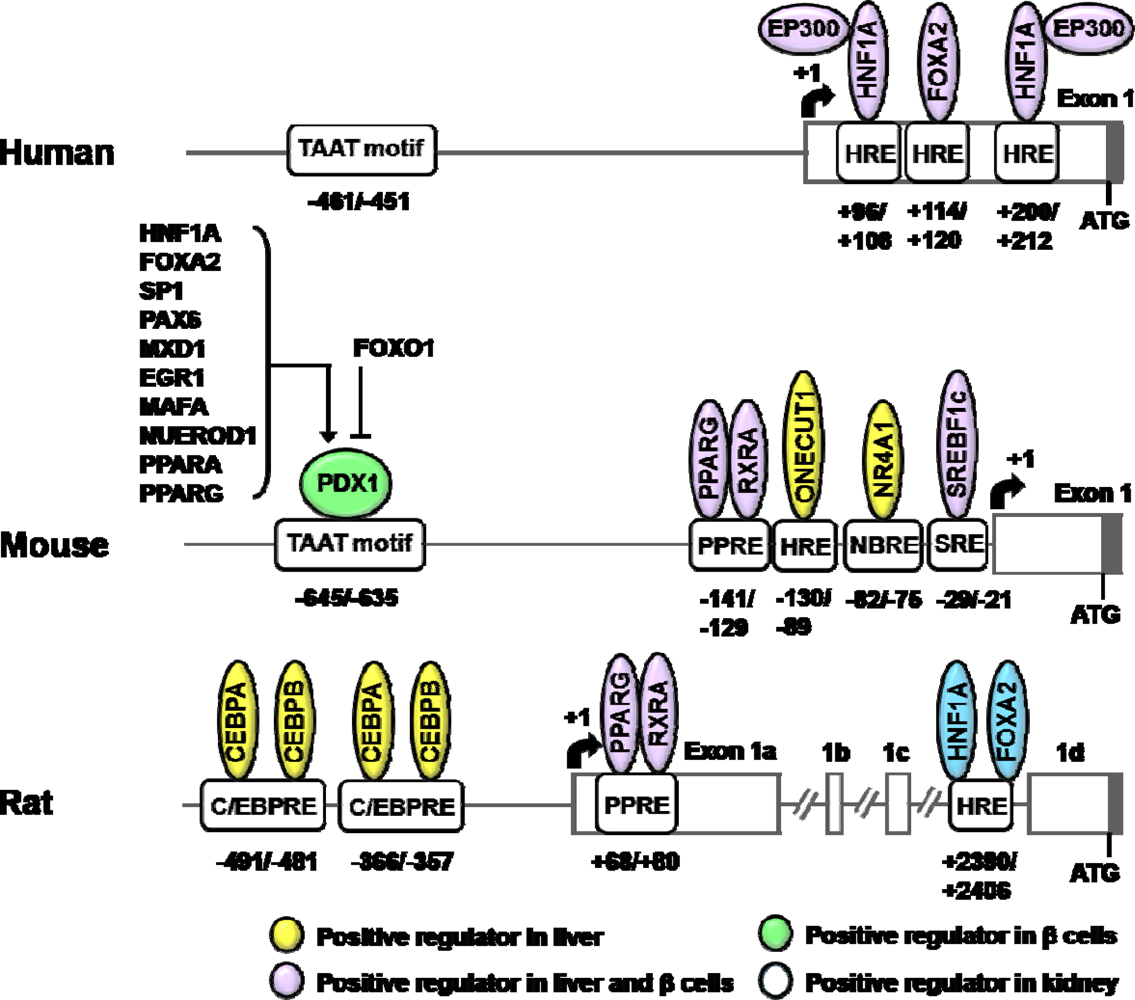
<p>Since the cloning of the promoter regions of <italic>SLC2A2</italic> gene, numerous studies on the transcriptional regulation have been performed (for a review see [<xref ref-type="bibr" rid="b9-sensors-10-05031">9</xref>]). Unlike those of human or mouse <italic>SLC2A2</italic> genes, rat <italic>Slc2a2</italic> promoter contains three noncoding exons (exons 1A, 1B, and 1C; <xref ref-type="fig" rid="f1-sensors-10-05031">Figure 1</xref>) [<xref ref-type="bibr" rid="b22-sensors-10-05031">22</xref>]. As shown, several HNFs are involved in transcriptional regulation of <italic>SLC2A2</italic> genes.</p>
<p>HNF1A is an essential transcription factor for the expression of <italic>Slc2a2</italic> gene in β-cells. In transgenic mice over-expressing a dominant negative form of HNF1A, the expression of <italic>Slc2a2</italic> gene is decreased in the pancreatic islets. In <italic>Hnf1a</italic> knockout mice, the expression of <italic>Slc2a2</italic> gene was decreased in the pancreatic islets, but not affected in the liver [<xref ref-type="bibr" rid="b23-sensors-10-05031">23</xref>–<xref ref-type="bibr" rid="b25-sensors-10-05031">25</xref>].</p>
<p>Both HNF1A and forkhead box A2 (FOXA2, also known as HNF3B) are responsible for the tissue-specific expression of the human <italic>SLC2A2</italic> gene. These factors synergistically increase the promoter activity of human <italic>SLC2A2</italic> gene in NIH-3T3 cells. Binding of HNF1A and FOXA2 to +96/+108 and +114/+120 bp region of human <italic>SLC2A2</italic> promoter was identified and these binding sites were well conserved in the mouse and rat gene [<xref ref-type="bibr" rid="b26-sensors-10-05031">26</xref>]. HNF1A and FOXA2 also upregulate <italic>Slc2a2</italic> mRNA in the kidney of diabetic rats [<xref ref-type="bibr" rid="b27-sensors-10-05031">27</xref>]. Another HNF1A binding site (+200/+212 bp) was found in the promoter of human <italic>SLC2A2</italic> gene. A mutation study revealed that the +200/+212 bp site is more important than the +96/+108 bp one in HNF1A-induced <italic>SLC2A2</italic> gene expression. Moreover, E1A binding protein p300 (EP300) potentiates activity of the human <italic>SLC2A2</italic> promoter by interacting with the transactivation domain of HNF1A [<xref ref-type="bibr" rid="b28-sensors-10-05031">28</xref>].</p>
<p>In transgenic mice or adenoviral transduction of recombinant <italic>Foxa2</italic> (Ad<italic>Foxa2</italic>), <italic>Slc2a2</italic> mRNA level was decreased in the liver [<xref ref-type="bibr" rid="b29-sensors-10-05031">29</xref>, <xref ref-type="bibr" rid="b30-sensors-10-05031">30</xref>], presumably because FOXA2 represses one cut homeobox 1 (<italic>Onecut1</italic>, also known as <italic>Hnf6</italic>) gene expression, which is a positive regulator of <italic>Slc2a2</italic> gene in the mouse liver [<xref ref-type="bibr" rid="b31-sensors-10-05031">31</xref>]. However, mRNA levels of <italic>Slc2a2</italic> and <italic>Onecut1</italic> were not altered in liver specific <italic>Foxa2</italic> knockout mice [<xref ref-type="bibr" rid="b32-sensors-10-05031">32</xref>]. In addition, <italic>Slc2a2</italic> gene expression was not altered in β-cell specific <italic>Foxa2</italic> knockout mice [<xref ref-type="bibr" rid="b33-sensors-10-05031">33</xref>]. These reports suggest that transactivating effect of FOXA2 on <italic>Slc2a2</italic> promoter may be weak or absent in mouse liver and β-cells.</p>
<p>FOXA3 (also known as HNF3G) is known to act as a positive regulator of the <italic>Slc2a2</italic> gene in the liver, although upregulation of the gene was not observed in β-cells [<xref ref-type="bibr" rid="b34-sensors-10-05031">34</xref>]. HNF4A is also known to activate <italic>SLC2A2</italic> gene expression in embryonic stem cells [<xref ref-type="bibr" rid="b35-sensors-10-05031">35</xref>] and β-cells [<xref ref-type="bibr" rid="b36-sensors-10-05031">36</xref>].</p>
<p>PDX1 plays a key role in the development of pancreas by orchestrating gene regulation in β-cells [<xref ref-type="bibr" rid="b37-sensors-10-05031">37</xref>] and is known to upregulate <italic>Slc2a2</italic> gene expression through TAAT motif in the <italic>Slc2a2</italic> promoter [<xref ref-type="bibr" rid="b38-sensors-10-05031">38</xref>]. <italic>Slc2a2</italic> gene expression in the β-cell specific <italic>Pdx1</italic> knockout [<xref ref-type="bibr" rid="b39-sensors-10-05031">39</xref>,<xref ref-type="bibr" rid="b40-sensors-10-05031">40</xref>] and <italic>Pdx1</italic> heterozygote mice [<xref ref-type="bibr" rid="b41-sensors-10-05031">41</xref>] is dramatically reduced when compared to that of wild type mice.</p>
<p>Although PDX1 was shown to bind <italic>in vitro</italic> to the promoter region of β-cell specific genes, including <italic>Slc2a2</italic> (EMSA data), chromatin immunoprecipitation (ChIP) assays indicated that PDX1 did not bind to the promoter of <italic>Slc2a2</italic> gene in the β-TC3 cells. These results suggest that selectivity of PDX1 may depend on the cell type specific chromatin structures and/or the presence of interacting proteins [<xref ref-type="bibr" rid="b42-sensors-10-05031">42</xref>]. Indeed, PDX1 of which binding to <italic>Slc2a2</italic> promoter is reinforced by high-mobility group N 3 (HMGN3), a chromatin binding protein that is highly expressed in β-cells [<xref ref-type="bibr" rid="b43-sensors-10-05031">43</xref>].</p>
<p>Since various transcription factors, like HNF1A, FOXA2, Sp1 transcription factor (SP1) [<xref ref-type="bibr" rid="b44-sensors-10-05031">44</xref>], paired box 6 (PAX6) [<xref ref-type="bibr" rid="b45-sensors-10-05031">45</xref>], MAX dimerization protein 1 (MXD1) [<xref ref-type="bibr" rid="b46-sensors-10-05031">46</xref>], early growth response-1 (EGR1) [<xref ref-type="bibr" rid="b47-sensors-10-05031">47</xref>,<xref ref-type="bibr" rid="b48-sensors-10-05031">48</xref>], v-maf musculoaponeurotic fibrosarcoma oncogene homolog A (MAFA) [<xref ref-type="bibr" rid="b49-sensors-10-05031">49</xref>], neurogenic differentiation 1 (NEUROD1) [<xref ref-type="bibr" rid="b50-sensors-10-05031">50</xref>], peroxisome proliferator–activated receptor alpha (PPARA) [<xref ref-type="bibr" rid="b51-sensors-10-05031">51</xref>] and peroxisome proliferator–activated receptor gamma (PPARG) [<xref ref-type="bibr" rid="b52-sensors-10-05031">52</xref>], were known to be positive-regulators of <italic>PDX1</italic> gene, it was speculated that many of these transcription factors may indirectly affect gene expression of <italic>SLC2A2</italic> through PDX1. <italic>Slc2a2</italic> mRNA level was decreased in INS832/13 cells in which forkhead transcription factor FOXO1 is overexpressed [<xref ref-type="bibr" rid="b53-sensors-10-05031">53</xref>]. Since FOXO1 binds to the <italic>PDX1</italic> promoter and inhibits FOXA2-induced PDX1 expression, the effect of FOXO1-suppression of <italic>Slc2a2</italic> gene expression might occur in an indirect way [<xref ref-type="bibr" rid="b54-sensors-10-05031">54</xref>].</p>
<p>V-maf musculoaponeurotic fibrosarcoma oncogene homolog B (MAFB) is a critical transcription factor for β-cell differentiation, although its expression was not observed in adult pancreas β-cells [<xref ref-type="bibr" rid="b55-sensors-10-05031">55</xref>–<xref ref-type="bibr" rid="b57-sensors-10-05031">57</xref>]. <italic>Slc2a2</italic> and <italic>Pdx1</italic> gene expression is reduced in the embryonic pancreas of <italic>Mafb</italic> knockout mice and MAFB binds to the promoter of <italic>Slc2a2</italic> gene <italic>in vivo</italic> [<xref ref-type="bibr" rid="b57-sensors-10-05031">57</xref>]. Because PDX1 is a positive regulator of <italic>Slc2a2</italic> gene expression, <italic>Slc2a2</italic> gene expression may be regulated by MAFB either directly or indirectly. Furthermore, <italic>Slc2a2</italic> expression is decreased in <italic>Mafa</italic>-deficient mice [<xref ref-type="bibr" rid="b58-sensors-10-05031">58</xref>]. However, MAF response element(s) in the <italic>Slc2a2</italic> promoter has not been identified.</p>
<p>PPARG directly activates <italic>SLC2A2</italic> gene expression in the liver and β-cells [<xref ref-type="bibr" rid="b59-sensors-10-05031">59</xref>–<xref ref-type="bibr" rid="b61-sensors-10-05031">61</xref>]. Rosiglitazone increased <italic>SLC2A2</italic> mRNA level in the primary cultured hepatocytes, Alexander [<xref ref-type="bibr" rid="b59-sensors-10-05031">59</xref>] and INS-1 cells [<xref ref-type="bibr" rid="b62-sensors-10-05031">62</xref>]. Troglitazone also increased <italic>Slc2a2</italic> mRNA level in primary cultured islets from rats [<xref ref-type="bibr" rid="b52-sensors-10-05031">52</xref>,<xref ref-type="bibr" rid="b60-sensors-10-05031">60</xref>]. In addition, decreased <italic>Slc2a2</italic> gene expression in the islets of <italic>db</italic>/<italic>db</italic> mouse was restored by pioglitazone treatment [<xref ref-type="bibr" rid="b63-sensors-10-05031">63</xref>, <xref ref-type="bibr" rid="b64-sensors-10-05031">64</xref>]. RNAi-suppression of <italic>Pparg</italic> in INS-1 cells caused reduction in <italic>Slc2a2</italic> mRNA levels [<xref ref-type="bibr" rid="b52-sensors-10-05031">52</xref>]. The functional PPAR response elements (PPREs) have been identified in the promoters of rat [<xref ref-type="bibr" rid="b60-sensors-10-05031">60</xref>] and mouse [<xref ref-type="bibr" rid="b59-sensors-10-05031">59</xref>] <italic>Slc2a2</italic> gene. Therefore, thiazolidinediones (TZDs) may contribute to the transport glucose into the liver or β-cell by upregulating <italic>SLC2A2</italic> gene [<xref ref-type="bibr" rid="b61-sensors-10-05031">61</xref>]. PPARA also upregulates the <italic>Slc2a2</italic> gene expression in the β-cells [<xref ref-type="bibr" rid="b51-sensors-10-05031">51</xref>,<xref ref-type="bibr" rid="b65-sensors-10-05031">65</xref>]. <italic>Ppara</italic> null mice showed low level of <italic>Slc2a2</italic> mRNA in the pancreas [<xref ref-type="bibr" rid="b66-sensors-10-05031">66</xref>].</p>
<p>Glucose increased the <italic>Slc2a2</italic> gene expression in the liver and β-cells, both <italic>in vivo</italic> and <italic>in vitro</italic> [<xref ref-type="bibr" rid="b14-sensors-10-05031">14</xref>,<xref ref-type="bibr" rid="b67-sensors-10-05031">67</xref>–<xref ref-type="bibr" rid="b70-sensors-10-05031">70</xref>]. Recently, we have identified a sterol regulatory element binding transcription factor 1 (SREBF1) response element (SRE) in the promoter of mouse <italic>Slc2a2</italic> gene, which is responsive to glucose in primary cultured hepatocytes [<xref ref-type="bibr" rid="b69-sensors-10-05031">69</xref>]. Furthermore, glucose-induction of the <italic>Slc2a2</italic> gene expression in pancreatic islets was not found in <italic>Srebf1</italic> knockout mice [<xref ref-type="bibr" rid="b70-sensors-10-05031">70</xref>].</p>
<p>Also, cyclic adenosine monophosphate (cAMP) prevents the glucose-mediated stimulation of <italic>Slc2a2</italic> gene expression in hepatocytes. The −312/+49 bp region of the mouse <italic>Slc2a2</italic> promoter is responsible for cAMP responsiveness [<xref ref-type="bibr" rid="b71-sensors-10-05031">71</xref>]. However, functional cAMP response element(s) within this region has not been identified.</p>
<p>An orphan nuclear receptor NR4A1 (nuclear receptor subfamily 4, group A, member 1) binds to nerve growth factor I-B response element (NBRE) in mouse <italic>Slc2a2</italic> promoter (−82/–75 bp) and increases mRNA level in primary cultured hepatocytes and liver. Furthermore, <italic>Slc2a2</italic> mRNA induced by NR4A1 is synergistically enhanced by PPARG coactivator 1 alpha (PPARGC1A) [<xref ref-type="bibr" rid="b72-sensors-10-05031">72</xref>]. Because NR4A1 expression is highly regulated by the cAMP axis in the liver [<xref ref-type="bibr" rid="b72-sensors-10-05031">72</xref>], these results are not consistent with the previous report that cAMP decreases the promoter activity of the <italic>Slc2a2</italic> gene [<xref ref-type="bibr" rid="b71-sensors-10-05031">71</xref>]. Further studies are needed to elucidate these contradictory results.</p>
<p>Insulin plays a negative role in <italic>Slc2a2</italic> gene expression in the liver [<xref ref-type="bibr" rid="b14-sensors-10-05031">14</xref>]. Since insulin-FOXO1 pathway is responsible for the negative role in insulin-mediated gene expression [<xref ref-type="bibr" rid="b73-sensors-10-05031">73</xref>], it is tempting to speculate that FOXO1 may be a negative regulator of <italic>Slc2a2</italic> gene expression. However, there is no evidence that FOXO1 is involved in the gene expression of <italic>Slc2a2</italic> in the liver, although its negative role of FOXO1 in the <italic>Slc2a2</italic> gene expression was shown in β-cells.</p>
<p>CCAAT/enhancer binding protein (CEBP) is shown to activate rat <italic>Slc2a2</italic> promoter in HepG2 cells. The promoter has two CEBP consensus sequences binding CEBPA and CEBPB (<xref ref-type="fig" rid="f1-sensors-10-05031">Figure 1</xref>). These factors synergistically activate the promoter [<xref ref-type="bibr" rid="b74-sensors-10-05031">74</xref>].</p>
<p>Kruppel-like factor 7 (KLF7) is known to reduce mRNA level of <italic>SLC2A2</italic> in HIT-T15 and HepG2 cells. Because KLF7 is shown to reduce <italic>PDX1</italic> gene expression in HIT-T15 cells [<xref ref-type="bibr" rid="b75-sensors-10-05031">75</xref>], <italic>SLC2A2</italic> gene expression may be regulated by KLF7 either directly or indirectly.</p>
<p>Although tissue-specific transcriptional regulation is not absolutely consistent between human and mouse [<xref ref-type="bibr" rid="b76-sensors-10-05031">76</xref>], <italic>SLC2A2</italic> gene expression in liver was activated by ONECUT1, FOXA3, PPARG, SREBF1c, NR4A1, CEBPA, CEBPB and KLF7. On the other hand, <italic>SLC2A2</italic> gene expression in β-cells was activated by HNF1A, HNF4A, PDX1, HMGN3, MAFA, MAFB, PPARA, PPARG and KLF7 and was suppressed by FOXO1. The gene expression or activity of these regulators in abnormal conditions like high-fat or high-carbohydrate diet and cellular stress may contribute to the etiology of T2DM.</p></sec>
<sec>
<label>3.</label>
<title>Transcriptional Regulation of Glucokinase (GCK)</title>
<sec>
<label>3.1.</label>
<title>Beta Cell Glucokinase (βGCK)</title>
<p>GCK plays a critical role in maintaining the postprandial glucose level near 5 mM, which is achieved by glucose stimulated insulin secretion (GSIS) from β-cells and glucose metabolism in the liver [<xref ref-type="bibr" rid="b77-sensors-10-05031">77</xref>]. βGCK is a primary determinant of blood glucose level because it senses glucose for GSIS.</p>
<p>Upregulation of β<italic>Gck</italic> gene expression by glucose is mediated by insulin. In this mechanism, insulin receptor B type, PI3K class 1a and p70 s6 kinase pathway are known to be involved in glucose-regulated β<italic>Gck</italic> transcription [<xref ref-type="bibr" rid="b78-sensors-10-05031">78</xref>]. Furthermore, β<italic>Gck</italic> gene expression is increased when MIN6 cells were cultured at 30 mM glucose [<xref ref-type="bibr" rid="b79-sensors-10-05031">79</xref>]. However, β<italic>Gck</italic> mRNA level is not changed in rats which are subjected to fasting/refeeding although L<italic>Gck</italic> gene expression is significantly increased [<xref ref-type="bibr" rid="b80-sensors-10-05031">80</xref>]. Indeed, the 4 kb promoter reporter construct of the β<italic>Gck</italic> gene was not activated either by glucose (30 mM) or insulin (20 nM) [<xref ref-type="bibr" rid="b81-sensors-10-05031">81</xref>]. These studies indicate that the role of glucose or insulin in the activation of βGCK may occur by stabilization rather than upregulation of β<italic>Gck</italic> gene expression in insulinoma cells [<xref ref-type="bibr" rid="b21-sensors-10-05031">21</xref>].</p>
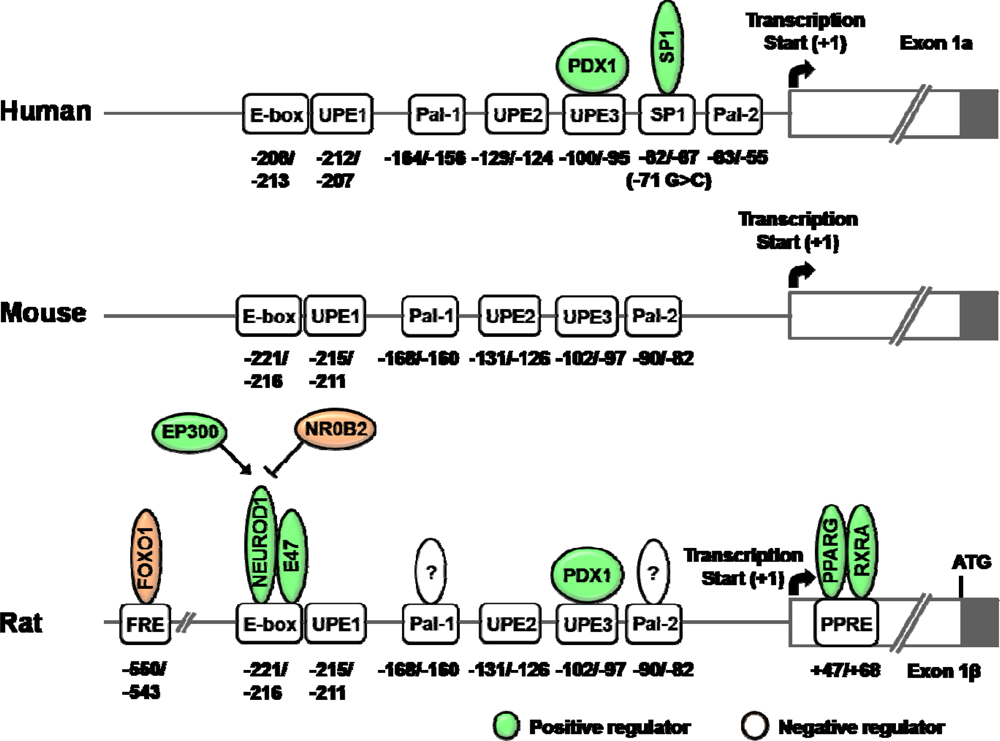
<p>As shown in <xref ref-type="fig" rid="f2-sensors-10-05031">Figure 2</xref>, the gene expression of β<italic>GCK</italic> is regulated by various transcription factors. In its 5′-flanking region, there are three upstream promoter elements (UPEs) and two Pal motifs. Particulary, UPE-3 and Pal motifs are well conserved in the rat, mouse and human genes [<xref ref-type="bibr" rid="b19-sensors-10-05031">19</xref>,<xref ref-type="bibr" rid="b82-sensors-10-05031">82</xref>,<xref ref-type="bibr" rid="b83-sensors-10-05031">83</xref>]. The Pal motifs consist of inverted repeats separated by 1 bp (TGGTCACCA). The promoter activity of β<italic>Gck</italic> gene was decreased by the introduction of mutation in the Pal motifs. These Pal motifs are pivotal determinants for the neural/neuroendocrine cell-specific expression of the <italic>Gck</italic> promoter [<xref ref-type="bibr" rid="b82-sensors-10-05031">82</xref>,<xref ref-type="bibr" rid="b83-sensors-10-05031">83</xref>].</p>
<p>UPEs have AT-rich sequence, which is known to be responsible for PDX1 activation. PDX1 is a master regulator for maintaining function and differentiation of β-cell. In the presence of glucose, PDX1 is phosphorylated and translocated into nucleus [<xref ref-type="bibr" rid="b84-sensors-10-05031">84</xref>–<xref ref-type="bibr" rid="b86-sensors-10-05031">86</xref>]. Expression of PDX1 increased the reporter activity of β<italic>Gck</italic> promoter in CHO cells. PDX1 binding site is conserved at UPE3 region in human β<italic>GCK</italic> promoter and may play an essential role for β-cell function [<xref ref-type="bibr" rid="b87-sensors-10-05031">87</xref>]. However, β-cell specific disruption of <italic>Pdx1</italic> did not affect the expression of β<italic>Gck</italic> although <italic>Slc2a2</italic> expression was down-regulated [<xref ref-type="bibr" rid="b39-sensors-10-05031">39</xref>]. The transcriptional role of PDX1 on the β<italic>GCK</italic> gene is not fully understood.</p>
<p>A basic helix-loop-helix (bHLH) transcription factor, NEUROD1 is known to bind β<italic>Gck</italic> promoter (−221/–216 bp; E-box) with E47 as a heterodimeric partner and transactivates the β<italic>Gck</italic> gene [<xref ref-type="bibr" rid="b88-sensors-10-05031">88</xref>]. In addition, nuclear receptor subfamily 0, group B, member 2 (NR0B2, also known as SHP) interacts with NEUROD1 and represses the transcriptional activity of NEUROD1 by competing with coactivator EP300 [<xref ref-type="bibr" rid="b89-sensors-10-05031">89</xref>]</p>
<p>PPARG/RXRA (retinoic X receptor alpha) binds to the promoter of rat β<italic>Gck</italic> gene of which binding element (PPRE) is located at +47/+68 bp. In addition, troglitazone increased the endogenous expression and enzyme activity of βGCK [<xref ref-type="bibr" rid="b24-sensors-10-05031">24</xref>]. Knockdown of <italic>Pparg</italic> using siRNA resulted in a decrease in the mRNA level of <italic>Pdx1</italic>, <italic>Gck, Slc2a2</italic> and insulin II [<xref ref-type="bibr" rid="b52-sensors-10-05031">52</xref>].</p>
<p>In addition, insulin-like growth factor 1 (IGF1) is known to induce β<italic>Gck</italic> gene expression by phosphorylating FOXO1. FOXO1 response element (FRE) is located at −550/–543 bp of rat β<italic>Gck</italic> promoter and FOXO1 binding to FRE is decreased by IGF1 <italic>in vitro</italic> [<xref ref-type="bibr" rid="b90-sensors-10-05031">90</xref>].</p>
<p>Although PDX1, NEUROD1 and NK2 homeobox 2 (NKX2-2) bind to the region of −285/–5 bp in the mouse β<italic>Gck</italic> promoter, their respective response elements in the β<italic>Gck</italic> promoter have not been characterized [<xref ref-type="bibr" rid="b91-sensors-10-05031">91</xref>]. Consistent with a role of NKX2-2 on the β<italic>Gck</italic> promoter, <italic>Nkx2-2</italic> knockout mice revealed a reduction in the β<italic>Gck</italic> mRNA level. In addition, NKX2-2 appeared to play an important role for the differentiation of β-cells [<xref ref-type="bibr" rid="b92-sensors-10-05031">92</xref>].</p></sec>
<sec>
<label>3.2.</label>
<title>Liver Glucokinase (LGCK)</title>
<p>The gene expression of L<italic>Gck</italic> is decreased in streptozotocin-induced diabetic rats and restored by insulin administration [<xref ref-type="bibr" rid="b93-sensors-10-05031">93</xref>]. In addition, L<italic>Gck</italic> gene expression is increased by insulin and decreased by the glucagons-cAMP system in primary cultured hepatocytes [<xref ref-type="bibr" rid="b94-sensors-10-05031">94</xref>]. Insulin-induction of L<italic>Gck</italic> gene expression is shown to be blocked by LY294002 or wortmannin, a PI3K inhibitor [<xref ref-type="bibr" rid="b95-sensors-10-05031">95</xref>]. Furthermore, L<italic>Gck</italic> gene expression is inhibited by a dominant negative form of insulin receptor substrate 1 (IRS1) [<xref ref-type="bibr" rid="b96-sensors-10-05031">96</xref>]. These studies support that insulin is a principal regulator of L<italic>Gck</italic> gene expression.</p>
<p>SREBF1c, one of the master regulators of lipogenesis, is dramatically induced by insulin [<xref ref-type="bibr" rid="b97-sensors-10-05031">97</xref>,<xref ref-type="bibr" rid="b98-sensors-10-05031">98</xref>]. Administration of recombinant adenovirus of <italic>Srebf1c</italic> to streptozotocin-induced diabetic mice restored L<italic>Gck</italic> and lipogenic enzymes normalizing blood glucose level despite that insulin is absent [<xref ref-type="bibr" rid="b99-sensors-10-05031">99</xref>]. In addition, adenoviral expression of dominant negative form of SREBF1c in primary cultured hepatocytes decreased insulin-induction of L<italic>Gck</italic> gene, suggesting a direct participation of SREBF1c in the L<italic>Gck</italic> gene expression [<xref ref-type="bibr" rid="b100-sensors-10-05031">100</xref>]. Furthermore, direct binding site of SREBF1c on rat L<italic>Gck</italic> promoter is identified [<xref ref-type="bibr" rid="b101-sensors-10-05031">101</xref>]. However, L<italic>Gck</italic> gene expression is still increased by refeeding the <italic>Srebf1c</italic> knockout mice [<xref ref-type="bibr" rid="b102-sensors-10-05031">102</xref>]. Moreover, L<italic>Gck</italic> gene expression is not changed even though <italic>Srebf1c</italic> was knockdown by siRNA although fatty acid synthase mRNA level is decreased. These studies suggest that SREBF1c is not likely to be a mediator of L<italic>Gck</italic> gene expression [<xref ref-type="bibr" rid="b103-sensors-10-05031">103</xref>, <xref ref-type="bibr" rid="b104-sensors-10-05031">104</xref>]. Further studies are needed to answer these contradictory results.</p>
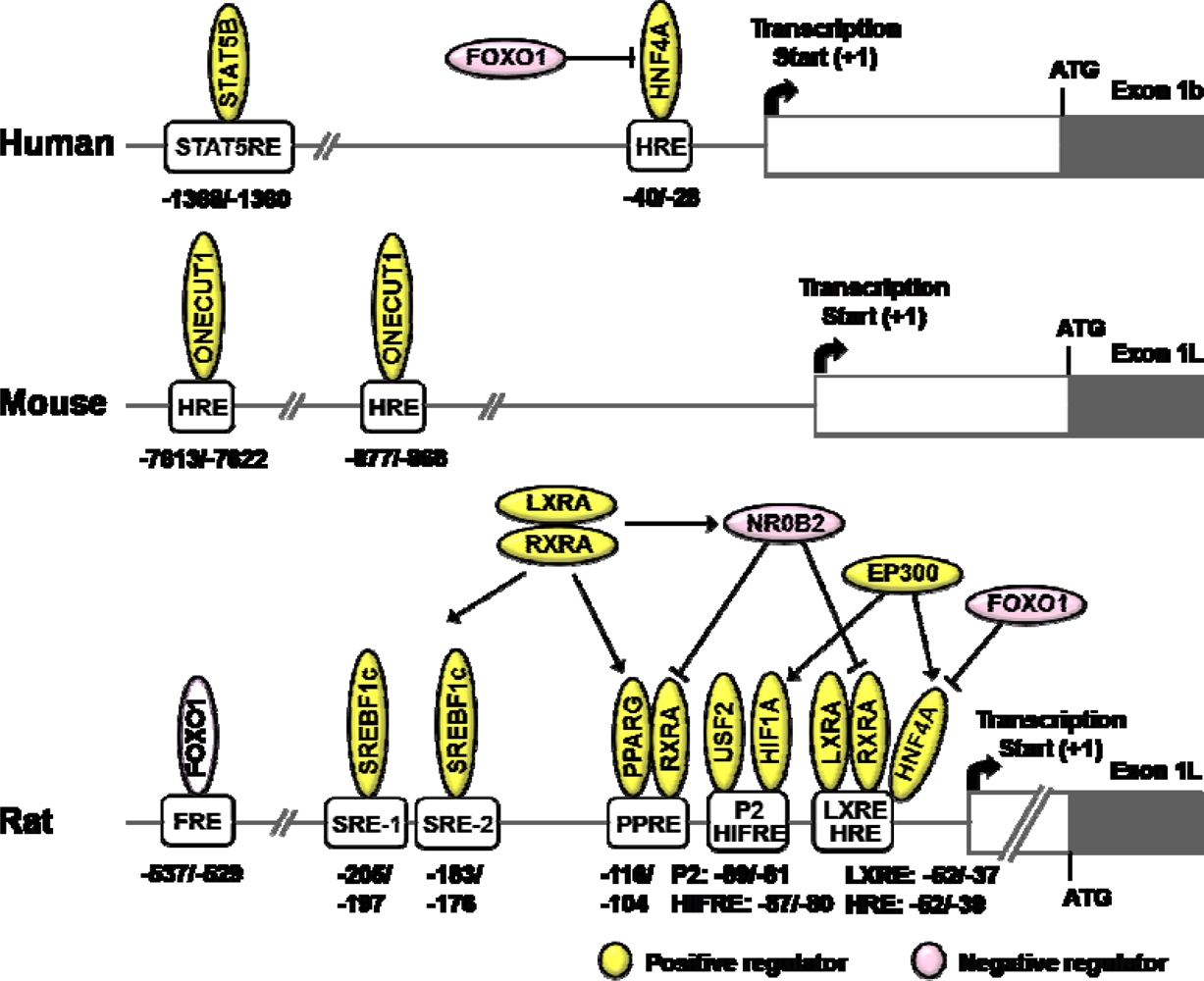
<p>HNF4A is known to be an important transcription factor for glucose and lipid homeostasis [<xref ref-type="bibr" rid="b35-sensors-10-05031">35</xref>,<xref ref-type="bibr" rid="b105-sensors-10-05031">105</xref>]. HNF4A increases the L<italic>GCK</italic> gene expression and its binding site HRE (HNF response element) is identified in human [<xref ref-type="bibr" rid="b106-sensors-10-05031">106</xref>] and rat [<xref ref-type="bibr" rid="b107-sensors-10-05031">107</xref>]. During the fasting period, L<italic>GCK</italic> transcription by HNF4A is repressed by FOXO1 which acts as a corepressor, whereas the suppression is restored by feeding where FOXO1 is phosphorylated and extruded to cytosol by insulin [<xref ref-type="bibr" rid="b106-sensors-10-05031">106</xref>].</p>
<p>Hypoxia inducible factor 1 alpha subunit (HIF1A) also affects promoter activity of rat L<italic>Gck</italic> gene. HIF1A binding site is localized at −87/−80 bp region of the promoter. Both insulin [<xref ref-type="bibr" rid="b108-sensors-10-05031">108</xref>] and hypoxia [<xref ref-type="bibr" rid="b21-sensors-10-05031">21</xref>,<xref ref-type="bibr" rid="b109-sensors-10-05031">109</xref>,<xref ref-type="bibr" rid="b110-sensors-10-05031">110</xref>] upregulate L<italic>Gck</italic> gene expression by increasing HIF1A level and its DNA-binding activity. Transactivation by HIF1A was also enhanced by co-expression of HNF4A and EP300. Moreover, HIF1A interacts with HNF4A and each of these factors also interacts with EP300. It was suggested that synergy and cooperative interactions between HIF1A, HNF4A and EP300 might be necessary for insulin-stimulated L<italic>Gck</italic> expression [<xref ref-type="bibr" rid="b109-sensors-10-05031">109</xref>].</p>
<p>Signal transducer and activator of transcription 5B (STAT5B) is known to be regulated by insulin [<xref ref-type="bibr" rid="b111-sensors-10-05031">111</xref>,<xref ref-type="bibr" rid="b112-sensors-10-05031">112</xref>]. STAT5B phosphorylated by insulin is translocated to the nucleus and increases its binding to the <italic>cis</italic>-acting elements, thereby increasing the transcription of target genes. Activated STAT5B by insulin increased L<italic>GCK</italic> gene expression [<xref ref-type="bibr" rid="b113-sensors-10-05031">113</xref>,<xref ref-type="bibr" rid="b114-sensors-10-05031">114</xref>]. In humans, the binding site of STAT5B is characterized at −1368/−1360 bp region, but the mouse STAT5 response element (STAT5RE) was unknown. The binding affinity of STAT5B to the human L<italic>GCK</italic> promoter is also increased by insulin and the activation by insulin occurs in a janus kinase (JAK)-independent manner. Thus, it is suggested that STAT5B plays an important role in the insulin-mediated upregulation of L<italic>Gck</italic> gene [<xref ref-type="bibr" rid="b113-sensors-10-05031">113</xref>]. However, insulin is known to increase the transcription of L<italic>Gck</italic> in primary cultured hepatocytes although the tyrosine phosphorylation of STAT5 was not detectable [<xref ref-type="bibr" rid="b114-sensors-10-05031">114</xref>].</p>
<p>During the fasting period, sirtuin 1 (SIRT1), an NAD<sup>+</sup>-dependent deacetylase, decreases the rat L<italic>Gck</italic> gene expression by deacetylating FOXO1, which results in an increase in binding of FOXO1 to FRE (−537/–529 bp) of its promoter. They also observed that resveratrol enhances interaction of between FOXO1 and HNF4A, causing a decrease in the binding affinity of HNF4A to the HRE [<xref ref-type="bibr" rid="b115-sensors-10-05031">115</xref>].</p>
<p>Upstream stimulating factor 2 (USF2) is responsible for the regulation of L<italic>Gck</italic> gene expression by binding to the P2 element (−89/–81 bp), and thus, the transcription factor may be in part responsible for the glucose homeostasis [<xref ref-type="bibr" rid="b116-sensors-10-05031">116</xref>].</p>
<p>TZDs are anti-diabetic drugs improving glucose utilization and insulin sensitivity. Troglitazone is a synthetic ligand of PPARG and is shown to upregulate L<italic>Gck</italic> gene expression. The PPRE is located at the −116/–104 bp of L<italic>Gck</italic> gene promoter [<xref ref-type="bibr" rid="b117-sensors-10-05031">117</xref>].</p>
<p>Recently, liver X receptor alpha (LXRA, also known as NR1H3) was shown to upregulate L<italic>Gck</italic> gene expression by binding to the LXR response element (LXRE) (−52/–39 bp) in its promoter. In addition, LXRA increases L<italic>Gck</italic> gene expression by inducing SREBF1c and increasing transcriptional activity of PPARG. Furthermore, NR0B2 induced by LXRA plays a role in the fine-tuning the L<italic>Gck</italic> gene expression [<xref ref-type="bibr" rid="b118-sensors-10-05031">118</xref>]. Because the binding site of LXRA and HNF4A seems to be overlapped [<xref ref-type="bibr" rid="b107-sensors-10-05031">107</xref>], detailed studies are needed to elaborate their precise roles of these factors with regard to specific metabolic conditions.</p>
<p>In mice, ONECUT1 binding site in the L<italic>Gck</italic> gene promoter is localized at −7613/–7622 bp and −877/–868 bp, suggesting a possible link between <italic>Onecut1</italic> deficiency and development of T2DM. This study could explain why T2DM occurs in <italic>Onecut1</italic> knockout mice [<xref ref-type="bibr" rid="b119-sensors-10-05031">119</xref>,<xref ref-type="bibr" rid="b120-sensors-10-05031">120</xref>].</p></sec></sec>
<sec>
<label>4.</label>
<title>Effect of Promoter Polymorphisms on <italic>SLC2A2</italic> and <italic>GCK</italic> Transcription</title>
<p>Single nucleotide polymorphisms (SNPs) in the promoter regions can affect the binding of transcription factors regulating the transcription of genes. Some significant promoter SNPs of <italic>SLC2A2</italic> and <italic>GCK</italic> genes were reported in T2DM patients.</p>
<sec>
<label>4.1.</label>
<title>Promoter Polymorphisms in SLC2A2 Gene</title>
<p>Three common SNPs, −149C &gt; A (rs5393), −122T &gt; C (rs5394) and −44G &gt; A (rs5396), in <italic>SLC2A2</italic> promoter were identified in a Danish population. These SNPs were not significantly different in the genotype frequency between T2DM patients and control subjects. In addition, clinical characteristics of T2DM were not significantly associated [<xref ref-type="bibr" rid="b121-sensors-10-05031">121</xref>]. However, SNPs rs5393 and rs5394 of <italic>SLC2A2</italic> could be high risk genotypes to predict the conversion of T2DM in an obese Finnish subject who had impaired glucose tolerance [<xref ref-type="bibr" rid="b122-sensors-10-05031">122</xref>]. This discrepancy is not explained at present, but it may be due to differences in the ethnic group or study population. Detailed functional studies of the effects of promoter SNPs on <italic>SLC2A2</italic> transcription are needed.</p></sec>
<sec>
<label>4.2.</label>
<title>Promoter Polymorphisms in GCK Gene</title>
<p>Recently, a functional β<italic>GCK</italic> promoter mutation (−71G &gt; C) was identified in Slovakian and British patients with GCK-MODY phenotype who have no abnormality of the <italic>GCK</italic> coding seqeuence. The mutation was associated with increased fasting plasma glucose (FPG) levels. In addition, the β<italic>GCK</italic> promoter of the −71C allele showed remarkable reductions of promoter reporter activity in INS-1 cells due to the decreased SP1 binding to −82/–67 bp region (<xref ref-type="fig" rid="f2-sensors-10-05031">Figure 2</xref>). These data suggested that the mutation was cosegregated with fasting hyperglycemia due to loss of SP1 binding [<xref ref-type="bibr" rid="b123-sensors-10-05031">123</xref>].</p>
<p>Two SNPs, −6612G &gt; A (rs4607517) [<xref ref-type="bibr" rid="b124-sensors-10-05031">124</xref>,<xref ref-type="bibr" rid="b125-sensors-10-05031">125</xref>] and −30G &gt; A (rs1799884) [<xref ref-type="bibr" rid="b126-sensors-10-05031">126</xref>–<xref ref-type="bibr" rid="b129-sensors-10-05031">129</xref>], in the β<italic>GCK</italic> promoter were significantly associated with fasting plasma glucose level in several populations. Moreover, the −30G &gt; A SNP has been associated with reduced β-cell function [<xref ref-type="bibr" rid="b130-sensors-10-05031">130</xref>], impaired glucose tolerance [<xref ref-type="bibr" rid="b131-sensors-10-05031">131</xref>] and T2DM [<xref ref-type="bibr" rid="b126-sensors-10-05031">126</xref>]. These data suggested that rare alleles of these two SNPs may also inhibit the β<italic>GCK</italic> transcription. However, functional studies of these two SNPs are needed to clarify cause-effect in terms of β<italic>GCK</italic> transcription.</p></sec></sec>
<sec sec-type="conclusions">
<label>5.</label>
<title>Conclusions</title>
<p>Although muscle or adipose tissue have been considered as the principal organs of glucose disposal, immediate handling of hyperglycemia in β-cells or liver is also important because high levels of glucose are toxic to various tissues. Thus, studies on the regulation of glucose sensors in the liver and β-cells are important in understanding T2DM and preventing the long-term complications resulting from hyperglycemia. Recent advances in the analytical technologies of genomics and proteomics make it possible to unveil the existence of transcription factors and their physical interactions with DNA or other coregulators.</p>
<p>Deeper understanding of the role of transcription factors involved in the gene regulation of the glucose sensors in the liver and β-cells may provide important clues in the prevention of the occurrence of hyperglycemia-related complications and development of novel therapeutic drugs combating T2DM, a world-wide epidemic.</p></sec></body>
<back>
<ack>
<p>We apologize to all the contributors in the field whose works could not be cited due to space limitations. This research was supported by Basic Science Research Program through the National Research Foundation of Korea (NRF) funded by the Ministry of Education, Science and Technology (2009-0080655) and was supported by a grant of the Korea Healthcare technology R&amp;D Project, Ministry for Health, Welfare &amp; Family Affairs, Republic of Korea. (A091023).</p></ack>
<ref-list>
<title>References</title>
<ref id="b1-sensors-10-05031"><label>1.</label><citation citation-type="journal"><person-group person-group-type="author"><name><surname>Thorens</surname><given-names>B.</given-names></name></person-group><article-title>Glucose sensing and the pathogenesis of obesity and type 2 diabetes</article-title><source>Int. J. Obes. (Lond)</source><year>2008</year><volume>32</volume><fpage>S62</fpage><lpage>S71</lpage></citation></ref>
<ref id="b2-sensors-10-05031"><label>2.</label><citation citation-type="book"><person-group person-group-type="author"><name><surname>Magnuson</surname><given-names>M.A.</given-names></name><name><surname>Matschinsky</surname><given-names>F.M.</given-names></name></person-group><article-title>Glucokinase as a glucose sensor: Past, present and future</article-title><source>Glucokinase and Glycemic Disease: From Basics to Novle Therapeutics</source><publisher-name>Karger</publisher-name><publisher-loc>Basel. Switzerland</publisher-loc><year>2004</year><fpage>1</fpage><lpage>17</lpage></citation></ref>
<ref id="b3-sensors-10-05031"><label>3.</label><citation citation-type="journal"><person-group person-group-type="author"><name><surname>Tarasov</surname><given-names>A.</given-names></name><name><surname>Dusonchet</surname><given-names>J.</given-names></name><name><surname>Ashcroft</surname><given-names>F.</given-names></name></person-group><article-title>Metabolic regulation of the pancreatic beta-cell ATP-sensitive K<sup>+</sup> channel: A pas de deux</article-title><source>Diabetes</source><year>2004</year><volume>53</volume><fpage>S113</fpage><lpage>S122</lpage><pub-id pub-id-type="doi">10.2337/diabetes.53.suppl_3.S113</pub-id><pub-id pub-id-type="pmid">15561898</pub-id></citation></ref>
<ref id="b4-sensors-10-05031"><label>4.</label><citation citation-type="journal"><person-group person-group-type="author"><name><surname>Muoio</surname><given-names>D.M.</given-names></name><name><surname>Newgard</surname><given-names>C.B.</given-names></name></person-group><article-title>Mechanisms of disease: molecular and metabolic mechanisms of insulin resistance and beta-cell failure in type 2 diabetes</article-title><source>Nat. Rev. Mol. Cell Biol</source><year>2008</year><volume>9</volume><fpage>193</fpage><lpage>205</lpage><pub-id pub-id-type="doi">10.1038/nrm2327</pub-id><pub-id pub-id-type="pmid">18200017</pub-id></citation></ref>
<ref id="b5-sensors-10-05031"><label>5.</label><citation citation-type="journal"><person-group person-group-type="author"><name><surname>Remedi</surname><given-names>M.S.</given-names></name><name><surname>Nichols</surname><given-names>C.G.</given-names></name></person-group><article-title>Hyperinsulinism and diabetes: genetic dissection of beta cell metabolism-excitation coupling in mice</article-title><source>Cell Metab</source><year>2009</year><volume>10</volume><fpage>442</fpage><lpage>453</lpage><pub-id pub-id-type="doi">10.1016/j.cmet.2009.10.011</pub-id><pub-id pub-id-type="pmid">19945402</pub-id></citation></ref>
<ref id="b6-sensors-10-05031"><label>6.</label><citation citation-type="journal"><person-group person-group-type="author"><name><surname>Fajans</surname><given-names>S.S.</given-names></name><name><surname>Bell</surname><given-names>G.I.</given-names></name><name><surname>Polonsky</surname><given-names>K.S.</given-names></name></person-group><article-title>Molecular mechanisms and clinical pathophysiology of maturity-onset diabetes of the young</article-title><source>N Engl. J. Med</source><year>2001</year><volume>345</volume><fpage>971</fpage><lpage>980</lpage><pub-id pub-id-type="doi">10.1056/NEJMra002168</pub-id><pub-id pub-id-type="pmid">11575290</pub-id></citation></ref>
<ref id="b7-sensors-10-05031"><label>7.</label><citation citation-type="journal"><person-group person-group-type="author"><name><surname>Vaxillaire</surname><given-names>M.</given-names></name><name><surname>Froguel</surname><given-names>P.</given-names></name></person-group><article-title>Monogenic diabetes in the young, pharmacogenetics and relevance to multifactorial forms of type 2 diabetes</article-title><source>Endocr. Rev</source><year>2008</year><volume>29</volume><fpage>254</fpage><lpage>264</lpage><pub-id pub-id-type="pmid">18436708</pub-id></citation></ref>
<ref id="b8-sensors-10-05031"><label>8.</label><citation citation-type="journal"><person-group person-group-type="author"><name><surname>O’Rahilly</surname><given-names>S.</given-names></name></person-group><article-title>Human genetics illuminates the paths to metabolic disease</article-title><source>Nature</source><year>2009</year><volume>462</volume><fpage>307</fpage><lpage>314</lpage><pub-id pub-id-type="doi">10.1038/nature08532</pub-id><pub-id pub-id-type="pmid">19924209</pub-id></citation></ref>
<ref id="b9-sensors-10-05031"><label>9.</label><citation citation-type="journal"><person-group person-group-type="author"><name><surname>Im</surname><given-names>S.S.</given-names></name><name><surname>Kim</surname><given-names>S.Y.</given-names></name><name><surname>Kim</surname><given-names>H.I.</given-names></name><name><surname>Ahn</surname><given-names>Y.H.</given-names></name></person-group><article-title>Transcriptional regulation of glucose sensors in pancreatic beta cells and liver</article-title><source>Curr. Diabetes Rev</source><year>2006</year><volume>2</volume><fpage>11</fpage><lpage>18</lpage><pub-id pub-id-type="doi">10.2174/157339906775473581</pub-id><pub-id pub-id-type="pmid">18220613</pub-id></citation></ref>
<ref id="b10-sensors-10-05031"><label>10.</label><citation citation-type="journal"><person-group person-group-type="author"><name><surname>Mueckler</surname><given-names>M.</given-names></name><name><surname>Kruse</surname><given-names>M.</given-names></name><name><surname>Strube</surname><given-names>M.</given-names></name><name><surname>Riggs</surname><given-names>A.C.</given-names></name><name><surname>Chiu</surname><given-names>K.C.</given-names></name><name><surname>Permutt</surname><given-names>M.A.</given-names></name></person-group><article-title>A mutation in the Glut2 glucose transporter gene of a diabetic patient abolishes transport activity</article-title><source>J. Biol. Chem</source><year>1994</year><volume>269</volume><fpage>17765</fpage><lpage>17767</lpage><pub-id pub-id-type="pmid">8027028</pub-id></citation></ref>
<ref id="b11-sensors-10-05031"><label>11.</label><citation citation-type="journal"><person-group person-group-type="author"><name><surname>Waeber</surname><given-names>G.</given-names></name><name><surname>Thompson</surname><given-names>N.</given-names></name><name><surname>Haefliger</surname><given-names>J.A.</given-names></name><name><surname>Nicod</surname><given-names>P.</given-names></name></person-group><article-title>Characterization of the murine high Km glucose transporter GLUT2 gene and its transcriptional regulation by glucose in a differentiated insulin-secreting cell line</article-title><source>J. Biol. Chem</source><year>1994</year><volume>269</volume><fpage>26912</fpage><lpage>26919</lpage><pub-id pub-id-type="pmid">7929431</pub-id></citation></ref>
<ref id="b12-sensors-10-05031"><label>12.</label><citation citation-type="journal"><person-group person-group-type="author"><name><surname>Leturque</surname><given-names>A.</given-names></name><name><surname>Brot-Laroche</surname><given-names>E.</given-names></name><name><surname>Le Gall</surname><given-names>M.</given-names></name></person-group><article-title>GLUT2 mutations, translocation, and receptor function in diet sugar managing</article-title><source>Am. J. Physiol. Endocrinol. Metab</source><year>2009</year><volume>296</volume><fpage>E985</fpage><lpage>E992</lpage><pub-id pub-id-type="doi">10.1152/ajpendo.00004.2009</pub-id><pub-id pub-id-type="pmid">19223655</pub-id></citation></ref>
<ref id="b13-sensors-10-05031"><label>13.</label><citation citation-type="journal"><person-group person-group-type="author"><name><surname>Chen</surname><given-names>L.</given-names></name><name><surname>Alam</surname><given-names>T.</given-names></name><name><surname>Johnson</surname><given-names>J.H.</given-names></name><name><surname>Hughes</surname><given-names>S.</given-names></name><name><surname>Newgard</surname><given-names>C.B.</given-names></name><name><surname>Unger</surname><given-names>R.H.</given-names></name></person-group><article-title>Regulation of beta-cell glucose transporter gene expression</article-title><source>Proc. Natl. Acad. Sci. USA</source><year>1990</year><volume>87</volume><fpage>4088</fpage><lpage>4092</lpage><pub-id pub-id-type="doi">10.1073/pnas.87.11.4088</pub-id><pub-id pub-id-type="pmid">2190214</pub-id></citation></ref>
<ref id="b14-sensors-10-05031"><label>14.</label><citation citation-type="journal"><person-group person-group-type="author"><name><surname>Postic</surname><given-names>C.</given-names></name><name><surname>Burcelin</surname><given-names>R.</given-names></name><name><surname>Rencurel</surname><given-names>F.</given-names></name><name><surname>Pegorier</surname><given-names>J.P.</given-names></name><name><surname>Loizeau</surname><given-names>M.</given-names></name><name><surname>Girard</surname><given-names>J.</given-names></name><name><surname>Leturque</surname><given-names>A.</given-names></name></person-group><article-title>Evidence for a transient inhibitory effect of insulin on GLUT2 expression in the liver: Studies <italic>in vivo</italic> and <italic>in vitro</italic></article-title><source>Biochem. J</source><year>1993</year><volume>293</volume><fpage>119</fpage><lpage>124</lpage><pub-id pub-id-type="pmid">8328952</pub-id></citation></ref>
<ref id="b15-sensors-10-05031"><label>15.</label><citation citation-type="journal"><person-group person-group-type="author"><name><surname>Rencurel</surname><given-names>F.</given-names></name><name><surname>Waeber</surname><given-names>G.</given-names></name><name><surname>Antoine</surname><given-names>B.</given-names></name><name><surname>Rocchiccioli</surname><given-names>F.</given-names></name><name><surname>Maulard</surname><given-names>P.</given-names></name><name><surname>Girard</surname><given-names>J.</given-names></name><name><surname>Leturque</surname><given-names>A.</given-names></name></person-group><article-title>Requirement of glucose metabolism for regulation of glucose transporter type 2 (GLUT2) gene expression in liver</article-title><source>Biochem. J</source><year>1996</year><volume>314</volume><fpage>903</fpage><lpage>909</lpage><pub-id pub-id-type="pmid">8615787</pub-id></citation></ref>
<ref id="b16-sensors-10-05031"><label>16.</label><citation citation-type="journal"><person-group person-group-type="author"><name><surname>Thorens</surname><given-names>B.</given-names></name><name><surname>Wu</surname><given-names>Y.J.</given-names></name><name><surname>Leahy</surname><given-names>J.L.</given-names></name><name><surname>Weir</surname><given-names>G.C.</given-names></name></person-group><article-title>The loss of GLUT2 expression by glucose-unresponsive beta cells of db/db mice is reversible and is induced by the diabetic environment</article-title><source>J. Clin. Invest</source><year>1992</year><volume>90</volume><fpage>77</fpage><lpage>85</lpage><pub-id pub-id-type="doi">10.1172/JCI115858</pub-id><pub-id pub-id-type="pmid">1634622</pub-id></citation></ref>
<ref id="b17-sensors-10-05031"><label>17.</label><citation citation-type="journal"><person-group person-group-type="author"><name><surname>Ohneda</surname><given-names>M.</given-names></name><name><surname>Johnson</surname><given-names>J.H.</given-names></name><name><surname>Inman</surname><given-names>L.R.</given-names></name><name><surname>Chen</surname><given-names>L.</given-names></name><name><surname>Suzuki</surname><given-names>K.</given-names></name><name><surname>Goto</surname><given-names>Y.</given-names></name><name><surname>Alam</surname><given-names>T.</given-names></name><name><surname>Ravazzola</surname><given-names>M.</given-names></name><name><surname>Orci</surname><given-names>L.</given-names></name><name><surname>Unger</surname><given-names>R.H.</given-names></name></person-group><article-title>GLUT2 expression and function in beta-cells of GK rats with NIDDM. Dissociation between reductions in glucose transport and glucose-stimulated insulin secretion</article-title><source>Diabetes</source><year>1993</year><volume>42</volume><fpage>1065</fpage><lpage>1072</lpage><pub-id pub-id-type="doi">10.2337/diabetes.42.7.1065</pub-id><pub-id pub-id-type="pmid">8513973</pub-id></citation></ref>
<ref id="b18-sensors-10-05031"><label>18.</label><citation citation-type="journal"><person-group person-group-type="author"><name><surname>Stoffel</surname><given-names>M.</given-names></name><name><surname>Froguel</surname><given-names>P.</given-names></name><name><surname>Takeda</surname><given-names>J.</given-names></name><name><surname>Zouali</surname><given-names>H.</given-names></name><name><surname>Vionnet</surname><given-names>N.</given-names></name><name><surname>Nishi</surname><given-names>S.</given-names></name><name><surname>Weber</surname><given-names>I.T.</given-names></name><name><surname>Harrison</surname><given-names>R.W.</given-names></name><name><surname>Pilkis</surname><given-names>S.J.</given-names></name><name><surname>Lesage</surname><given-names>S.</given-names></name></person-group><article-title>Human glucokinase gene: isolation, characterization, and identification of two missense mutations linked to early-onset non-insulin-dependent (type 2) diabetes mellitus</article-title><source>Proc. Natl. Acad. Sci. USA</source><year>1992</year><volume>89</volume><fpage>7698</fpage><lpage>7702</lpage><pub-id pub-id-type="doi">10.1073/pnas.89.16.7698</pub-id><pub-id pub-id-type="pmid">1502186</pub-id></citation></ref>
<ref id="b19-sensors-10-05031"><label>19.</label><citation citation-type="journal"><person-group person-group-type="author"><name><surname>Postic</surname><given-names>C.</given-names></name><name><surname>Niswender</surname><given-names>K.D.</given-names></name><name><surname>Decaux</surname><given-names>J.F.</given-names></name><name><surname>Parsa</surname><given-names>R.</given-names></name><name><surname>Shelton</surname><given-names>K.D.</given-names></name><name><surname>Gouhot</surname><given-names>B.</given-names></name><name><surname>Pettepher</surname><given-names>C.C.</given-names></name><name><surname>Granner</surname><given-names>D.K.</given-names></name><name><surname>Girard</surname><given-names>J.</given-names></name><name><surname>Magnuson</surname><given-names>M.A.</given-names></name></person-group><article-title>Cloning and characterization of the mouse glucokinase gene locus and identification of distal liver-specific DNase I hypersensitive sites</article-title><source>Genomics</source><year>1995</year><volume>29</volume><fpage>740</fpage><lpage>750</lpage><pub-id pub-id-type="doi">10.1006/geno.1995.9943</pub-id><pub-id pub-id-type="pmid">8575768</pub-id></citation></ref>
<ref id="b20-sensors-10-05031"><label>20.</label><citation citation-type="journal"><person-group person-group-type="author"><name><surname>Williams</surname><given-names>C.P.</given-names></name><name><surname>Granner</surname><given-names>D.K.</given-names></name><name><surname>Magnuson</surname><given-names>M.A.</given-names></name><name><surname>Chalkley</surname><given-names>R.</given-names></name></person-group><article-title>Cell specific differences in DNase I hypersensitivity between the two promoters of the rat glucokinase gene</article-title><source>Biochem. Biophys. Res. Commun</source><year>1995</year><volume>215</volume><fpage>272</fpage><lpage>279</lpage><pub-id pub-id-type="doi">10.1006/bbrc.1995.2462</pub-id><pub-id pub-id-type="pmid">7575601</pub-id></citation></ref>
<ref id="b21-sensors-10-05031"><label>21.</label><citation citation-type="journal"><person-group person-group-type="author"><name><surname>Iynedjian</surname><given-names>P.B.</given-names></name></person-group><article-title>Molecular physiology of mammalian glucokinase</article-title><source>Cell Mol. Life Sci</source><year>2009</year><volume>66</volume><fpage>27</fpage><lpage>42</lpage><pub-id pub-id-type="doi">10.1007/s00018-008-8322-9</pub-id><pub-id pub-id-type="pmid">18726182</pub-id></citation></ref>
<ref id="b22-sensors-10-05031"><label>22.</label><citation citation-type="journal"><person-group person-group-type="author"><name><surname>Ahn</surname><given-names>Y.H.</given-names></name><name><surname>Kim</surname><given-names>J.W.</given-names></name><name><surname>Han</surname><given-names>G.S.</given-names></name><name><surname>Lee</surname><given-names>B.G.</given-names></name><name><surname>Kim</surname><given-names>Y.S.</given-names></name></person-group><article-title>Cloning and characterization of rat pancreatic beta-cell/liver type glucose transporter gene: a unique exon/intron organization</article-title><source>Arch. Biochem. Biophys</source><year>1995</year><volume>323</volume><fpage>387</fpage><lpage>396</lpage><pub-id pub-id-type="doi">10.1006/abbi.1995.0059</pub-id><pub-id pub-id-type="pmid">7487103</pub-id></citation></ref>
<ref id="b23-sensors-10-05031"><label>23.</label><citation citation-type="journal"><person-group person-group-type="author"><name><surname>Rahimian</surname><given-names>R.</given-names></name><name><surname>Masih-Khan</surname><given-names>E.</given-names></name><name><surname>Lo</surname><given-names>M.</given-names></name><name><surname>van Breemen</surname><given-names>C.</given-names></name><name><surname>McManus</surname><given-names>B.M.</given-names></name><name><surname>Dube</surname><given-names>G.P.</given-names></name></person-group><article-title>Hepatic over-expression of peroxisome proliferator activated receptor gamma2 in the ob/ob mouse model of non-insulin dependent diabetes mellitus</article-title><source>Mol. Cell Biochem</source><year>2001</year><volume>224</volume><fpage>29</fpage><lpage>37</lpage><pub-id pub-id-type="doi">10.1023/A:1011927113563</pub-id><pub-id pub-id-type="pmid">11693197</pub-id></citation></ref>
<ref id="b24-sensors-10-05031"><label>24.</label><citation citation-type="journal"><person-group person-group-type="author"><name><surname>Kim</surname><given-names>H.I.</given-names></name><name><surname>Cha</surname><given-names>J.Y.</given-names></name><name><surname>Kim</surname><given-names>S.Y.</given-names></name><name><surname>Kim</surname><given-names>J.W.</given-names></name><name><surname>Roh</surname><given-names>K.J.</given-names></name><name><surname>Seong</surname><given-names>J.K.</given-names></name><name><surname>Lee</surname><given-names>N.T.</given-names></name><name><surname>Choi</surname><given-names>K.Y.</given-names></name><name><surname>Kim</surname><given-names>K.S.</given-names></name><name><surname>Ahn</surname><given-names>Y.H.</given-names></name></person-group><article-title>Peroxisomal proliferator-activated receptor-gamma upregulates glucokinase gene expression in beta-cells</article-title><source>Diabetes</source><year>2002</year><volume>51</volume><fpage>676</fpage><lpage>685</lpage><pub-id pub-id-type="doi">10.2337/diabetes.51.3.676</pub-id><pub-id pub-id-type="pmid">11872666</pub-id></citation></ref>
<ref id="b25-sensors-10-05031"><label>25.</label><citation citation-type="journal"><person-group person-group-type="author"><name><surname>Shih</surname><given-names>D.Q.</given-names></name><name><surname>Screenan</surname><given-names>S.</given-names></name><name><surname>Munoz</surname><given-names>K.N.</given-names></name><name><surname>Philipson</surname><given-names>L.</given-names></name><name><surname>Pontoglio</surname><given-names>M.</given-names></name><name><surname>Yaniv</surname><given-names>M.</given-names></name><name><surname>Polonsky</surname><given-names>K.S.</given-names></name><name><surname>Stoffel</surname><given-names>M.</given-names></name></person-group><article-title>Loss of HNF-1alpha function in mice leads to abnormal expression of genes involved in pancreatic islet development and metabolism</article-title><source>Diabetes</source><year>2001</year><volume>50</volume><fpage>2472</fpage><lpage>2480</lpage><pub-id pub-id-type="doi">10.2337/diabetes.50.11.2472</pub-id><pub-id pub-id-type="pmid">11679424</pub-id></citation></ref>
<ref id="b26-sensors-10-05031"><label>26.</label><citation citation-type="journal"><person-group person-group-type="author"><name><surname>Cha</surname><given-names>J.Y.</given-names></name><name><surname>Kim</surname><given-names>H.</given-names></name><name><surname>Kim</surname><given-names>K.S.</given-names></name><name><surname>Hur</surname><given-names>M.W.</given-names></name><name><surname>Ahn</surname><given-names>Y.</given-names></name></person-group><article-title>Identification of transacting factors responsible for the tissue-specific expression of human glucose transporter type 2 isoform gene. Cooperative role of hepatocyte nuclear factors 1alpha and 3beta</article-title><source>J. Biol. Chem</source><year>2000</year><volume>275</volume><fpage>18358</fpage><lpage>18365</lpage><pub-id pub-id-type="doi">10.1074/jbc.M909536199</pub-id><pub-id pub-id-type="pmid">10748140</pub-id></citation></ref>
<ref id="b27-sensors-10-05031"><label>27.</label><citation citation-type="journal"><person-group person-group-type="author"><name><surname>Freitas</surname><given-names>H.S.</given-names></name><name><surname>Schaan</surname><given-names>B.D.</given-names></name><name><surname>David-Silva</surname><given-names>A.</given-names></name><name><surname>Sabino-Silva</surname><given-names>R.</given-names></name><name><surname>Okamoto</surname><given-names>M.M.</given-names></name><name><surname>Alves-Wagner</surname><given-names>A.B.</given-names></name><name><surname>Mori</surname><given-names>R.C.</given-names></name><name><surname>Machado</surname><given-names>U.F.</given-names></name></person-group><article-title>SLC2A2 gene expression in kidney of diabetic rats is regulated by HNF-1alpha and HNF-3beta</article-title><source>Mol. Cell Endocrinol</source><year>2009</year><volume>305</volume><fpage>63</fpage><lpage>70</lpage><pub-id pub-id-type="doi">10.1016/j.mce.2009.02.014</pub-id><pub-id pub-id-type="pmid">19433262</pub-id></citation></ref>
<ref id="b28-sensors-10-05031"><label>28.</label><citation citation-type="journal"><person-group person-group-type="author"><name><surname>Ban</surname><given-names>N.</given-names></name><name><surname>Yamada</surname><given-names>Y.</given-names></name><name><surname>Someya</surname><given-names>Y.</given-names></name><name><surname>Miyawaki</surname><given-names>K.</given-names></name><name><surname>Ihara</surname><given-names>Y.</given-names></name><name><surname>Hosokawa</surname><given-names>M.</given-names></name><name><surname>Toyokuni</surname><given-names>S.</given-names></name><name><surname>Tsuda</surname><given-names>K.</given-names></name><name><surname>Seino</surname><given-names>Y.</given-names></name></person-group><article-title>Hepatocyte nuclear factor-1alpha recruits the transcriptional co-activator p300 on the GLUT2 gene promoter</article-title><source>Diabetes</source><year>2002</year><volume>51</volume><fpage>1409</fpage><lpage>1418</lpage><pub-id pub-id-type="doi">10.2337/diabetes.51.5.1409</pub-id><pub-id pub-id-type="pmid">11978637</pub-id></citation></ref>
<ref id="b29-sensors-10-05031"><label>29.</label><citation citation-type="journal"><person-group person-group-type="author"><name><surname>Rausa</surname><given-names>F.M.</given-names></name><name><surname>Tan</surname><given-names>Y.</given-names></name><name><surname>Zhou</surname><given-names>H.</given-names></name><name><surname>Yoo</surname><given-names>K.W.</given-names></name><name><surname>Stolz</surname><given-names>D.B.</given-names></name><name><surname>Watkins</surname><given-names>S.C.</given-names></name><name><surname>Franks</surname><given-names>R.R.</given-names></name><name><surname>Unterman</surname><given-names>T.G.</given-names></name><name><surname>Costa</surname><given-names>R.H.</given-names></name></person-group><article-title>Elevated levels of hepatocyte nuclear factor 3beta in mouse hepatocytes influence expression of genes involved in bile acid and glucose homeostasis</article-title><source>Mol. Cell Biol</source><year>2000</year><volume>20</volume><fpage>8264</fpage><lpage>8282</lpage><pub-id pub-id-type="doi">10.1128/MCB.20.21.8264-8282.2000</pub-id><pub-id pub-id-type="pmid">11027295</pub-id></citation></ref>
<ref id="b30-sensors-10-05031"><label>30.</label><citation citation-type="journal"><person-group person-group-type="author"><name><surname>Tan</surname><given-names>Y.</given-names></name><name><surname>Hughes</surname><given-names>D.</given-names></name><name><surname>Wang</surname><given-names>X.</given-names></name><name><surname>Costa</surname><given-names>R.H.</given-names></name></person-group><article-title>Adenovirus-mediated increase in HNF-3beta or HNF-3alpha shows differences in levels of liver glycogen and gene expression</article-title><source>Hepatology</source><year>2002</year><volume>35</volume><fpage>30</fpage><lpage>39</lpage><pub-id pub-id-type="doi">10.1053/jhep.2002.30317</pub-id><pub-id pub-id-type="pmid">11786957</pub-id></citation></ref>
<ref id="b31-sensors-10-05031"><label>31.</label><citation citation-type="journal"><person-group person-group-type="author"><name><surname>Tan</surname><given-names>Y.</given-names></name><name><surname>Adami</surname><given-names>G.</given-names></name><name><surname>Costa</surname><given-names>R.H.</given-names></name></person-group><article-title>Maintaining HNF6 expression prevents AdHNF3beta-mediated decrease in hepatic levels of Glut-2 and glycogen</article-title><source>Hepatology</source><year>2002</year><volume>35</volume><fpage>790</fpage><lpage>798</lpage><pub-id pub-id-type="doi">10.1053/jhep.2002.32482</pub-id><pub-id pub-id-type="pmid">11915024</pub-id></citation></ref>
<ref id="b32-sensors-10-05031"><label>32.</label><citation citation-type="journal"><person-group person-group-type="author"><name><surname>Rubins</surname><given-names>N.E.</given-names></name><name><surname>Friedman</surname><given-names>J.R.</given-names></name><name><surname>Le</surname><given-names>P.P.</given-names></name><name><surname>Zhang</surname><given-names>L.</given-names></name><name><surname>Brestelli</surname><given-names>J.</given-names></name><name><surname>Kaestner</surname><given-names>K.H.</given-names></name></person-group><article-title>Transcriptional networks in the liver: hepatocyte nuclear factor 6 function is largely independent of Foxa2</article-title><source>Mol. Cell Biol</source><year>2005</year><volume>25</volume><fpage>7069</fpage><lpage>7077</lpage><pub-id pub-id-type="doi">10.1128/MCB.25.16.7069-7077.2005</pub-id><pub-id pub-id-type="pmid">16055718</pub-id></citation></ref>
<ref id="b33-sensors-10-05031"><label>33.</label><citation citation-type="journal"><person-group person-group-type="author"><name><surname>Lee</surname><given-names>C.S.</given-names></name><name><surname>Sund</surname><given-names>N.J.</given-names></name><name><surname>Vatamaniuk</surname><given-names>M.Z.</given-names></name><name><surname>Matschinsky</surname><given-names>F.M.</given-names></name><name><surname>Stoffers</surname><given-names>D.A.</given-names></name><name><surname>Kaestner</surname><given-names>K.H.</given-names></name></person-group><article-title>Foxa2 controls Pdx1 gene expression in pancreatic beta-cells <italic>in vivo</italic></article-title><source>Diabetes</source><year>2002</year><volume>51</volume><fpage>2546</fpage><lpage>2551</lpage><pub-id pub-id-type="doi">10.2337/diabetes.51.8.2546</pub-id><pub-id pub-id-type="pmid">12145169</pub-id></citation></ref>
<ref id="b34-sensors-10-05031"><label>34.</label><citation citation-type="journal"><person-group person-group-type="author"><name><surname>Shen</surname><given-names>W.</given-names></name><name><surname>Scearce</surname><given-names>L.M.</given-names></name><name><surname>Brestelli</surname><given-names>J.E.</given-names></name><name><surname>Sund</surname><given-names>N.J.</given-names></name><name><surname>Kaestner</surname><given-names>K.H.</given-names></name></person-group><article-title>Foxa3 (hepatocyte nuclear factor 3gamma ) is required for the regulation of hepatic GLUT2 expression and the maintenance of glucose homeostasis during a prolonged fast</article-title><source>J. Biol. Chem</source><year>2001</year><volume>276</volume><fpage>42812</fpage><lpage>42817</lpage><pub-id pub-id-type="doi">10.1074/jbc.M106344200</pub-id><pub-id pub-id-type="pmid">11546810</pub-id></citation></ref>
<ref id="b35-sensors-10-05031"><label>35.</label><citation citation-type="journal"><person-group person-group-type="author"><name><surname>Stoffel</surname><given-names>M.</given-names></name><name><surname>Duncan</surname><given-names>S.A.</given-names></name></person-group><article-title>The maturity-onset diabetes of the young (MODY1) transcription factor HNF4alpha regulates expression of genes required for glucose transport and metabolism</article-title><source>Proc. Natl. Acad. Sci. USA</source><year>1997</year><volume>94</volume><fpage>13209</fpage><lpage>13214</lpage><pub-id pub-id-type="doi">10.1073/pnas.94.24.13209</pub-id><pub-id pub-id-type="pmid">9371825</pub-id></citation></ref>
<ref id="b36-sensors-10-05031"><label>36.</label><citation citation-type="journal"><person-group person-group-type="author"><name><surname>Wang</surname><given-names>H.</given-names></name><name><surname>Maechler</surname><given-names>P.</given-names></name><name><surname>Antinozzi</surname><given-names>P.A.</given-names></name><name><surname>Hagenfeldt</surname><given-names>K.A.</given-names></name><name><surname>Wollheim</surname><given-names>C.B.</given-names></name></person-group><article-title>Hepatocyte nuclear factor 4alpha regulates the expression of pancreatic beta-cell genes implicated in glucose metabolism and nutrient-induced insulin secretion</article-title><source>J. Biol. Chem</source><year>2000</year><volume>275</volume><fpage>35953</fpage><lpage>35959</lpage><pub-id pub-id-type="doi">10.1074/jbc.M006612200</pub-id><pub-id pub-id-type="pmid">10967120</pub-id></citation></ref>
<ref id="b37-sensors-10-05031"><label>37.</label><citation citation-type="journal"><person-group person-group-type="author"><name><surname>Babu</surname><given-names>D.A.</given-names></name><name><surname>Deering</surname><given-names>T.G.</given-names></name><name><surname>Mirmira</surname><given-names>R.G.</given-names></name></person-group><article-title>A feat of metabolic proportions: Pdx1 orchestrates islet development and function in the maintenance of glucose homeostasis</article-title><source>Mol. Genet. Metab</source><year>2007</year><volume>92</volume><fpage>43</fpage><lpage>55</lpage><pub-id pub-id-type="doi">10.1016/j.ymgme.2007.06.008</pub-id><pub-id pub-id-type="pmid">17659992</pub-id></citation></ref>
<ref id="b38-sensors-10-05031"><label>38.</label><citation citation-type="journal"><person-group person-group-type="author"><name><surname>Waeber</surname><given-names>G.</given-names></name><name><surname>Thompson</surname><given-names>N.</given-names></name><name><surname>Nicod</surname><given-names>P.</given-names></name><name><surname>Bonny</surname><given-names>C.</given-names></name></person-group><article-title>Transcriptional activation of the GLUT2 gene by the IPF-1/STF-1/IDX-1 homeobox factor</article-title><source>Mol. Endocrinol</source><year>1996</year><volume>10</volume><fpage>1327</fpage><lpage>1334</lpage><pub-id pub-id-type="doi">10.1210/me.10.11.1327</pub-id><pub-id pub-id-type="pmid">8923459</pub-id></citation></ref>
<ref id="b39-sensors-10-05031"><label>39.</label><citation citation-type="journal"><person-group person-group-type="author"><name><surname>Ahlgren</surname><given-names>U.</given-names></name><name><surname>Jonsson</surname><given-names>J.</given-names></name><name><surname>Jonsson</surname><given-names>L.</given-names></name><name><surname>Simu</surname><given-names>K.</given-names></name><name><surname>Edlund</surname><given-names>H.</given-names></name></person-group><article-title>beta-cell-specific inactivation of the mouse Ipf1/Pdx1 gene results in loss of the beta-cell phenotype and maturity onset diabetes</article-title><source>Genes Dev</source><year>1998</year><volume>12</volume><fpage>1763</fpage><lpage>1768</lpage><pub-id pub-id-type="doi">10.1101/gad.12.12.1763</pub-id><pub-id pub-id-type="pmid">9637677</pub-id></citation></ref>
<ref id="b40-sensors-10-05031"><label>40.</label><citation citation-type="journal"><person-group person-group-type="author"><name><surname>Lottmann</surname><given-names>H.</given-names></name><name><surname>Vanselow</surname><given-names>J.</given-names></name><name><surname>Hessabi</surname><given-names>B.</given-names></name><name><surname>Walther</surname><given-names>R.</given-names></name></person-group><article-title>The Tet-On system in transgenic mice: inhibition of the mouse pdx-1 gene activity by antisense RNA expression in pancreatic beta-cells</article-title><source>J. Mol. Med</source><year>2001</year><volume>79</volume><fpage>321</fpage><lpage>328</lpage><pub-id pub-id-type="doi">10.1007/s001090100229</pub-id><pub-id pub-id-type="pmid">11485027</pub-id></citation></ref>
<ref id="b41-sensors-10-05031"><label>41.</label><citation citation-type="journal"><person-group person-group-type="author"><name><surname>Brissova</surname><given-names>M.</given-names></name><name><surname>Shiota</surname><given-names>M.</given-names></name><name><surname>Nicholson</surname><given-names>W.E.</given-names></name><name><surname>Gannon</surname><given-names>M.</given-names></name><name><surname>Knobel</surname><given-names>S.M.</given-names></name><name><surname>Piston</surname><given-names>D.W.</given-names></name><name><surname>Wright</surname><given-names>C.V.</given-names></name><name><surname>Powers</surname><given-names>A.C.</given-names></name></person-group><article-title>Reduction in pancreatic transcription factor PDX-1 impairs glucose-stimulated insulin secretion</article-title><source>J. Biol. Chem</source><year>2002</year><volume>277</volume><fpage>11225</fpage><lpage>11232</lpage><pub-id pub-id-type="doi">10.1074/jbc.M111272200</pub-id><pub-id pub-id-type="pmid">11781323</pub-id></citation></ref>
<ref id="b42-sensors-10-05031"><label>42.</label><citation citation-type="journal"><person-group person-group-type="author"><name><surname>Chakrabarti</surname><given-names>S.K.</given-names></name><name><surname>James</surname><given-names>J.C.</given-names></name><name><surname>Mirmira</surname><given-names>R.G.</given-names></name></person-group><article-title>Quantitative assessment of gene targeting <italic>in vitro</italic> and <italic>in vivo</italic> by the pancreatic transcription factor, Pdx1. Importance of chromatin structure in directing promoter binding</article-title><source>J. Biol. Chem</source><year>2002</year><volume>277</volume><fpage>13286</fpage><lpage>13293</lpage><pub-id pub-id-type="doi">10.1074/jbc.M111857200</pub-id><pub-id pub-id-type="pmid">11825903</pub-id></citation></ref>
<ref id="b43-sensors-10-05031"><label>43.</label><citation citation-type="journal"><person-group person-group-type="author"><name><surname>Ueda</surname><given-names>T.</given-names></name><name><surname>Furusawa</surname><given-names>T.</given-names></name><name><surname>Kurahashi</surname><given-names>T.</given-names></name><name><surname>Tessarollo</surname><given-names>L.</given-names></name><name><surname>Bustin</surname><given-names>M.</given-names></name></person-group><article-title>The nucleosome binding protein HMGN3 modulates the transcription profile of pancreatic beta cells and affects insulin secretion</article-title><source>Mol. Cell Biol</source><year>2009</year><volume>29</volume><fpage>5264</fpage><lpage>5276</lpage><pub-id pub-id-type="doi">10.1128/MCB.00526-09</pub-id><pub-id pub-id-type="pmid">19651901</pub-id></citation></ref>
<ref id="b44-sensors-10-05031"><label>44.</label><citation citation-type="journal"><person-group person-group-type="author"><name><surname>Ben-Shushan</surname><given-names>E.</given-names></name><name><surname>Marshak</surname><given-names>S.</given-names></name><name><surname>Shoshkes</surname><given-names>M.</given-names></name><name><surname>Cerasi</surname><given-names>E.</given-names></name><name><surname>Melloul</surname><given-names>D.</given-names></name></person-group><article-title>A pancreatic beta-cell-specific enhancer in the human PDX-1 gene is regulated by hepatocyte nuclear factor 3beta (HNF-3beta), HNF-1alpha, and SPs transcription factors</article-title><source>J. Biol. Chem</source><year>2001</year><volume>276</volume><fpage>17533</fpage><lpage>17540</lpage><pub-id pub-id-type="doi">10.1074/jbc.M009088200</pub-id><pub-id pub-id-type="pmid">11278466</pub-id></citation></ref>
<ref id="b45-sensors-10-05031"><label>45.</label><citation citation-type="journal"><person-group person-group-type="author"><name><surname>Samaras</surname><given-names>S.E.</given-names></name><name><surname>Cissell</surname><given-names>M.A.</given-names></name><name><surname>Gerrish</surname><given-names>K.</given-names></name><name><surname>Wright</surname><given-names>C.V.</given-names></name><name><surname>Gannon</surname><given-names>M.</given-names></name><name><surname>Stein</surname><given-names>R.</given-names></name></person-group><article-title>Conserved sequences in a tissue-specific regulatory region of the pdx-1 gene mediate transcription in Pancreatic beta cells: role for hepatocyte nuclear factor 3 beta and Pax6</article-title><source>Mol. Cell Biol</source><year>2002</year><volume>22</volume><fpage>4702</fpage><lpage>4713</lpage><pub-id pub-id-type="doi">10.1128/MCB.22.13.4702-4713.2002</pub-id><pub-id pub-id-type="pmid">12052878</pub-id></citation></ref>
<ref id="b46-sensors-10-05031"><label>46.</label><citation citation-type="journal"><person-group person-group-type="author"><name><surname>Patane</surname><given-names>G.</given-names></name><name><surname>Kaneto</surname><given-names>H.</given-names></name><name><surname>Toschi</surname><given-names>E.</given-names></name><name><surname>Sharma</surname><given-names>A.</given-names></name><name><surname>Gupta</surname><given-names>S.</given-names></name><name><surname>Weir</surname><given-names>G.C.</given-names></name></person-group><article-title>Induction of Mad expression leads to augmentation of insulin gene transcription</article-title><source>Biochem. Biophys. Res. Commun</source><year>2003</year><volume>303</volume><fpage>1199</fpage><lpage>1208</lpage><pub-id pub-id-type="doi">10.1016/S0006-291X(03)00493-5</pub-id><pub-id pub-id-type="pmid">12684063</pub-id></citation></ref>
<ref id="b47-sensors-10-05031"><label>47.</label><citation citation-type="journal"><person-group person-group-type="author"><name><surname>Eto</surname><given-names>K.</given-names></name><name><surname>Kaur</surname><given-names>V.</given-names></name><name><surname>Thomas</surname><given-names>M.K.</given-names></name></person-group><article-title>Regulation of insulin gene transcription by the immediate-early growth response gene Egr-1</article-title><source>Endocrinology</source><year>2006</year><volume>147</volume><fpage>2923</fpage><lpage>2935</lpage><pub-id pub-id-type="doi">10.1210/en.2005-1336</pub-id><pub-id pub-id-type="pmid">16543365</pub-id></citation></ref>
<ref id="b48-sensors-10-05031"><label>48.</label><citation citation-type="journal"><person-group person-group-type="author"><name><surname>Eto</surname><given-names>K.</given-names></name><name><surname>Kaur</surname><given-names>V.</given-names></name><name><surname>Thomas</surname><given-names>M.K.</given-names></name></person-group><article-title>Regulation of pancreas duodenum homeobox-1 expression by early growth response-1</article-title><source>J. Biol. Chem</source><year>2007</year><volume>282</volume><fpage>5973</fpage><lpage>5983</lpage><pub-id pub-id-type="pmid">17150967</pub-id></citation></ref>
<ref id="b49-sensors-10-05031"><label>49.</label><citation citation-type="journal"><person-group person-group-type="author"><name><surname>Samaras</surname><given-names>S.E.</given-names></name><name><surname>Zhao</surname><given-names>L.</given-names></name><name><surname>Means</surname><given-names>A.</given-names></name><name><surname>Henderson</surname><given-names>E.</given-names></name><name><surname>Matsuoka</surname><given-names>T.A.</given-names></name><name><surname>Stein</surname><given-names>R.</given-names></name></person-group><article-title>The islet beta cell-enriched RIPE3b1/Maf transcription factor regulates pdx-1 expression</article-title><source>J. Biol. Chem</source><year>2003</year><volume>278</volume><fpage>12263</fpage><lpage>12270</lpage><pub-id pub-id-type="doi">10.1074/jbc.M210801200</pub-id><pub-id pub-id-type="pmid">12551916</pub-id></citation></ref>
<ref id="b50-sensors-10-05031"><label>50.</label><citation citation-type="journal"><person-group person-group-type="author"><name><surname>Babu</surname><given-names>D.A.</given-names></name><name><surname>Chakrabarti</surname><given-names>S.K.</given-names></name><name><surname>Garmey</surname><given-names>J.C.</given-names></name><name><surname>Mirmira</surname><given-names>R.G.</given-names></name></person-group><article-title>Pdx1 and BETA2/NeuroD1 participate in a transcriptional complex that mediates short-range DNA looping at the insulin gene</article-title><source>J. Biol. Chem</source><year>2008</year><volume>283</volume><fpage>8164</fpage><lpage>8172</lpage><pub-id pub-id-type="doi">10.1074/jbc.M800336200</pub-id><pub-id pub-id-type="pmid">18252719</pub-id></citation></ref>
<ref id="b51-sensors-10-05031"><label>51.</label><citation citation-type="journal"><person-group person-group-type="author"><name><surname>Sun</surname><given-names>Y.</given-names></name><name><surname>Zhang</surname><given-names>L.</given-names></name><name><surname>Gu</surname><given-names>H.F.</given-names></name><name><surname>Han</surname><given-names>W.</given-names></name><name><surname>Ren</surname><given-names>M.</given-names></name><name><surname>Wang</surname><given-names>F.</given-names></name><name><surname>Gong</surname><given-names>B.</given-names></name><name><surname>Wang</surname><given-names>L.</given-names></name><name><surname>Guo</surname><given-names>H.</given-names></name><name><surname>Xin</surname><given-names>W.</given-names></name><name><surname>Zhao</surname><given-names>J.</given-names></name><name><surname>Gao</surname><given-names>L.</given-names></name></person-group><article-title>Peroxisome proliferator-activated receptor-alpha regulates the expression of pancreatic/duodenal homeobox-1 in rat insulinoma (INS-1) cells and ameliorates glucose-induced insulin secretion impaired by palmitate</article-title><source>Endocrinology</source><year>2008</year><volume>149</volume><fpage>662</fpage><lpage>671</lpage><pub-id pub-id-type="pmid">17991720</pub-id></citation></ref>
<ref id="b52-sensors-10-05031"><label>52.</label><citation citation-type="journal"><person-group person-group-type="author"><name><surname>Moibi</surname><given-names>J.A.</given-names></name><name><surname>Gupta</surname><given-names>D.</given-names></name><name><surname>Jetton</surname><given-names>T.L.</given-names></name><name><surname>Peshavaria</surname><given-names>M.</given-names></name><name><surname>Desai</surname><given-names>R.</given-names></name><name><surname>Leahy</surname><given-names>J.L.</given-names></name></person-group><article-title>Peroxisome proliferator-activated receptor-gamma regulates expression of PDX-1 and NKX6.1 in INS-1 cells</article-title><source>Diabetes</source><year>2007</year><volume>56</volume><fpage>88</fpage><lpage>95</lpage><pub-id pub-id-type="doi">10.2337/db06-0948</pub-id><pub-id pub-id-type="pmid">17192469</pub-id></citation></ref>
<ref id="b53-sensors-10-05031"><label>53.</label><citation citation-type="journal"><person-group person-group-type="author"><name><surname>Buteau</surname><given-names>J.</given-names></name><name><surname>Shlien</surname><given-names>A.</given-names></name><name><surname>Foisy</surname><given-names>S.</given-names></name><name><surname>Accili</surname><given-names>D.</given-names></name></person-group><article-title>Metabolic diapause in pancreatic beta-cells expressing a gain-of-function mutant of the forkhead protein Foxo1</article-title><source>J. Biol. Chem</source><year>2007</year><volume>282</volume><fpage>287</fpage><lpage>293</lpage><pub-id pub-id-type="pmid">17107961</pub-id></citation></ref>
<ref id="b54-sensors-10-05031"><label>54.</label><citation citation-type="journal"><person-group person-group-type="author"><name><surname>Kitamura</surname><given-names>T.</given-names></name><name><surname>Nakae</surname><given-names>J.</given-names></name><name><surname>Kitamura</surname><given-names>Y.</given-names></name><name><surname>Kido</surname><given-names>Y.</given-names></name><name><surname>Biggs</surname><given-names>W.H.</given-names><suffix>III</suffix></name><name><surname>Wright</surname><given-names>C.V.</given-names></name><name><surname>White</surname><given-names>M.F.</given-names></name><name><surname>Arden</surname><given-names>K.C.</given-names></name><name><surname>Accili</surname><given-names>D.</given-names></name></person-group><article-title>The forkhead transcription factor Foxo1 links insulin signaling to Pdx1 regulation of pancreatic beta cell growth</article-title><source>J. Clin. Invest</source><year>2002</year><volume>110</volume><fpage>1839</fpage><lpage>1847</lpage><pub-id pub-id-type="pmid">12488434</pub-id></citation></ref>
<ref id="b55-sensors-10-05031"><label>55.</label><citation citation-type="journal"><person-group person-group-type="author"><name><surname>Artner</surname><given-names>I.</given-names></name><name><surname>Le Lay</surname><given-names>J.</given-names></name><name><surname>Hang</surname><given-names>Y.</given-names></name><name><surname>Elghazi</surname><given-names>L.</given-names></name><name><surname>Schisler</surname><given-names>J.C.</given-names></name><name><surname>Henderson</surname><given-names>E.</given-names></name><name><surname>Sosa-Pineda</surname><given-names>B.</given-names></name><name><surname>Stein</surname><given-names>R.</given-names></name></person-group><article-title>MafB: An activator of the glucagon gene expressed in developing islet alpha- and beta-cells</article-title><source>Diabetes</source><year>2006</year><volume>55</volume><fpage>297</fpage><lpage>304</lpage><pub-id pub-id-type="doi">10.2337/diabetes.55.02.06.db05-0946</pub-id><pub-id pub-id-type="pmid">16443760</pub-id></citation></ref>
<ref id="b56-sensors-10-05031"><label>56.</label><citation citation-type="journal"><person-group person-group-type="author"><name><surname>Nishimura</surname><given-names>W.</given-names></name><name><surname>Kondo</surname><given-names>T.</given-names></name><name><surname>Salameh</surname><given-names>T.</given-names></name><name><surname>El Khattabi</surname><given-names>I.</given-names></name><name><surname>Dodge</surname><given-names>R.</given-names></name><name><surname>Bonner-Weir</surname><given-names>S.</given-names></name><name><surname>Sharma</surname><given-names>A.</given-names></name></person-group><article-title>A switch from MafB to MafA expression accompanies differentiation to pancreatic beta-cells</article-title><source>Dev. Biol</source><year>2006</year><volume>293</volume><fpage>526</fpage><lpage>539</lpage><pub-id pub-id-type="doi">10.1016/j.ydbio.2006.02.028</pub-id><pub-id pub-id-type="pmid">16580660</pub-id></citation></ref>
<ref id="b57-sensors-10-05031"><label>57.</label><citation citation-type="journal"><person-group person-group-type="author"><name><surname>Artner</surname><given-names>I.</given-names></name><name><surname>Blanchi</surname><given-names>B.</given-names></name><name><surname>Raum</surname><given-names>J.C.</given-names></name><name><surname>Guo</surname><given-names>M.</given-names></name><name><surname>Kaneko</surname><given-names>T.</given-names></name><name><surname>Cordes</surname><given-names>S.</given-names></name><name><surname>Sieweke</surname><given-names>M.</given-names></name><name><surname>Stein</surname><given-names>R.</given-names></name></person-group><article-title>MafB is required for islet beta cell maturation</article-title><source>Proc. Natl. Acad. Sci. USA</source><year>2007</year><volume>104</volume><fpage>3853</fpage><lpage>3858</lpage><pub-id pub-id-type="doi">10.1073/pnas.0700013104</pub-id><pub-id pub-id-type="pmid">17360442</pub-id></citation></ref>
<ref id="b58-sensors-10-05031"><label>58.</label><citation citation-type="journal"><person-group person-group-type="author"><name><surname>Zhang</surname><given-names>C.</given-names></name><name><surname>Moriguchi</surname><given-names>T.</given-names></name><name><surname>Kajihara</surname><given-names>M.</given-names></name><name><surname>Esaki</surname><given-names>R.</given-names></name><name><surname>Harada</surname><given-names>A.</given-names></name><name><surname>Shimohata</surname><given-names>H.</given-names></name><name><surname>Oishi</surname><given-names>H.</given-names></name><name><surname>Hamada</surname><given-names>M.</given-names></name><name><surname>Morito</surname><given-names>N.</given-names></name><name><surname>Hasegawa</surname><given-names>K.</given-names></name><name><surname>Kudo</surname><given-names>T.</given-names></name><name><surname>Engel</surname><given-names>J.D.</given-names></name><name><surname>Yamamoto</surname><given-names>M.</given-names></name><name><surname>Takahashi</surname><given-names>S.</given-names></name></person-group><article-title>MafA is a key regulator of glucose-stimulated insulin secretion</article-title><source>Mol. Cell Biol</source><year>2005</year><volume>25</volume><fpage>4969</fpage><lpage>4976</lpage><pub-id pub-id-type="doi">10.1128/MCB.25.12.4969-4976.2005</pub-id><pub-id pub-id-type="pmid">15923615</pub-id></citation></ref>
<ref id="b59-sensors-10-05031"><label>59.</label><citation citation-type="journal"><person-group person-group-type="author"><name><surname>Im</surname><given-names>S.S.</given-names></name><name><surname>Kim</surname><given-names>J.W.</given-names></name><name><surname>Kim</surname><given-names>T.H.</given-names></name><name><surname>Song</surname><given-names>X.L.</given-names></name><name><surname>Kim</surname><given-names>S.Y.</given-names></name><name><surname>Kim</surname><given-names>H.I.</given-names></name><name><surname>Ahn</surname><given-names>Y.H.</given-names></name></person-group><article-title>Identification and characterization of peroxisome proliferator response element in the mouse GLUT2 promoter</article-title><source>Exp. Mol. Med</source><year>2005</year><volume>37</volume><fpage>101</fpage><lpage>110</lpage><pub-id pub-id-type="doi">10.1038/emm.2005.14</pub-id><pub-id pub-id-type="pmid">15886523</pub-id></citation></ref>
<ref id="b60-sensors-10-05031"><label>60.</label><citation citation-type="journal"><person-group person-group-type="author"><name><surname>Kim</surname><given-names>H.I.</given-names></name><name><surname>Kim</surname><given-names>J.W.</given-names></name><name><surname>Kim</surname><given-names>S.H.</given-names></name><name><surname>Cha</surname><given-names>J.Y.</given-names></name><name><surname>Kim</surname><given-names>K.S.</given-names></name><name><surname>Ahn</surname><given-names>Y.H.</given-names></name></person-group><article-title>Identification and functional characterization of the peroxisomal proliferator response element in rat GLUT2 promoter</article-title><source>Diabetes</source><year>2000</year><volume>49</volume><fpage>1517</fpage><lpage>1524</lpage><pub-id pub-id-type="doi">10.2337/diabetes.49.9.1517</pub-id><pub-id pub-id-type="pmid">10969836</pub-id></citation></ref>
<ref id="b61-sensors-10-05031"><label>61.</label><citation citation-type="journal"><person-group person-group-type="author"><name><surname>Kim</surname><given-names>H.I.</given-names></name><name><surname>Ahn</surname><given-names>Y.H.</given-names></name></person-group><article-title>Role of peroxisome proliferator-activated receptor-gamma in the glucose-sensing apparatus of liver and beta-cells</article-title><source>Diabetes</source><year>2004</year><volume>53</volume><fpage>S60</fpage><lpage>S65</lpage><pub-id pub-id-type="doi">10.2337/diabetes.53.2007.S60</pub-id><pub-id pub-id-type="pmid">14749267</pub-id></citation></ref>
<ref id="b62-sensors-10-05031"><label>62.</label><citation citation-type="journal"><person-group person-group-type="author"><name><surname>Kim</surname><given-names>H.S.</given-names></name><name><surname>Noh</surname><given-names>J.H.</given-names></name><name><surname>Hong</surname><given-names>S.H.</given-names></name><name><surname>Hwang</surname><given-names>Y.C.</given-names></name><name><surname>Yang</surname><given-names>T.Y.</given-names></name><name><surname>Lee</surname><given-names>M.S.</given-names></name><name><surname>Kim</surname><given-names>K.W.</given-names></name><name><surname>Lee</surname><given-names>M.K.</given-names></name></person-group><article-title>Rosiglitazone stimulates the release and synthesis of insulin by enhancing GLUT-2, glucokinase and BETA2/NeuroD expression</article-title><source>Biochem. Biophys. Res. Commun</source><year>2008</year><volume>367</volume><fpage>623</fpage><lpage>629</lpage><pub-id pub-id-type="doi">10.1016/j.bbrc.2007.12.192</pub-id><pub-id pub-id-type="pmid">18191635</pub-id></citation></ref>
<ref id="b63-sensors-10-05031"><label>63.</label><citation citation-type="journal"><person-group person-group-type="author"><name><surname>Yajima</surname><given-names>K.</given-names></name><name><surname>Hirose</surname><given-names>H.</given-names></name><name><surname>Fujita</surname><given-names>H.</given-names></name><name><surname>Seto</surname><given-names>Y.</given-names></name><name><surname>Ukeda</surname><given-names>K.</given-names></name><name><surname>Miyashita</surname><given-names>K.</given-names></name><name><surname>Kawai</surname><given-names>T.</given-names></name><name><surname>Yamamoto</surname><given-names>Y.</given-names></name><name><surname>Ogawa</surname><given-names>T.</given-names></name><name><surname>Yamada</surname><given-names>T.</given-names></name><name><surname>Saruta</surname><given-names>T.</given-names></name></person-group><article-title>Combination therapy with PPARgamma and PPARalpha agonists increases glucose-stimulated insulin secretion in db/db mice</article-title><source>Am. J. Physiol. Endocrinol. Metab</source><year>2003</year><volume>284</volume><fpage>E966</fpage><lpage>E971</lpage><pub-id pub-id-type="pmid">12676649</pub-id></citation></ref>
<ref id="b64-sensors-10-05031"><label>64.</label><citation citation-type="journal"><person-group person-group-type="author"><name><surname>Evans-Molina</surname><given-names>C.</given-names></name><name><surname>Robbins</surname><given-names>R.D.</given-names></name><name><surname>Kono</surname><given-names>T.</given-names></name><name><surname>Tersey</surname><given-names>S.A.</given-names></name><name><surname>Vestermark</surname><given-names>G.L.</given-names></name><name><surname>Nunemaker</surname><given-names>C.S.</given-names></name><name><surname>Garmey</surname><given-names>J.C.</given-names></name><name><surname>Deering</surname><given-names>T.G.</given-names></name><name><surname>Keller</surname><given-names>S.R.</given-names></name><name><surname>Maier</surname><given-names>B.</given-names></name><name><surname>Mirmira</surname><given-names>R.G.</given-names></name></person-group><article-title>Peroxisome proliferator-activated receptor gamma activation restores islet function in diabetic mice through reduction of endoplasmic reticulum stress and maintenance of euchromatin structure</article-title><source>Mol. Cell Biol</source><year>2009</year><volume>29</volume><fpage>2053</fpage><lpage>2067</lpage><pub-id pub-id-type="doi">10.1128/MCB.01179-08</pub-id><pub-id pub-id-type="pmid">19237535</pub-id></citation></ref>
<ref id="b65-sensors-10-05031"><label>65.</label><citation citation-type="journal"><person-group person-group-type="author"><name><surname>Wang</surname><given-names>M.Y.</given-names></name><name><surname>Koyama</surname><given-names>K.</given-names></name><name><surname>Shimabukuro</surname><given-names>M.</given-names></name><name><surname>Mangelsdorf</surname><given-names>D.</given-names></name><name><surname>Newgard</surname><given-names>C.B.</given-names></name><name><surname>Unger</surname><given-names>R.H.</given-names></name></person-group><article-title>Overexpression of leptin receptors in pancreatic islets of Zucker diabetic fatty rats restores GLUT-2, glucokinase, and glucose-stimulated insulin secretion</article-title><source>Proc. Natl. Acad. Sci. USA</source><year>1998</year><volume>95</volume><fpage>11921</fpage><lpage>11926</lpage><pub-id pub-id-type="doi">10.1073/pnas.95.20.11921</pub-id><pub-id pub-id-type="pmid">9751766</pub-id></citation></ref>
<ref id="b66-sensors-10-05031"><label>66.</label><citation citation-type="journal"><person-group person-group-type="author"><name><surname>Yessoufou</surname><given-names>A.</given-names></name><name><surname>Ategbo</surname><given-names>J.M.</given-names></name><name><surname>Attakpa</surname><given-names>E.</given-names></name><name><surname>Hichami</surname><given-names>A.</given-names></name><name><surname>Moutairou</surname><given-names>K.</given-names></name><name><surname>Dramane</surname><given-names>K.L.</given-names></name><name><surname>Khan</surname><given-names>N.A.</given-names></name></person-group><article-title>Peroxisome proliferator-activated receptor-alpha modulates insulin gene transcription factors and inflammation in adipose tissues in mice</article-title><source>Mol. Cell Biochem</source><year>2009</year><volume>323</volume><fpage>101</fpage><lpage>111</lpage><pub-id pub-id-type="doi">10.1007/s11010-008-9968-1</pub-id><pub-id pub-id-type="pmid">19039651</pub-id></citation></ref>
<ref id="b67-sensors-10-05031"><label>67.</label><citation citation-type="journal"><person-group person-group-type="author"><name><surname>Asano</surname><given-names>T.</given-names></name><name><surname>Katagiri</surname><given-names>H.</given-names></name><name><surname>Tsukuda</surname><given-names>K.</given-names></name><name><surname>Lin</surname><given-names>J.L.</given-names></name><name><surname>Ishihara</surname><given-names>H.</given-names></name><name><surname>Yazaki</surname><given-names>Y.</given-names></name><name><surname>Oka</surname><given-names>Y.</given-names></name></person-group><article-title>Upregulation of GLUT2 mRNA by glucose, mannose, and fructose in isolated rat hepatocytes</article-title><source>Diabetes</source><year>1992</year><volume>41</volume><fpage>22</fpage><lpage>25</lpage><pub-id pub-id-type="doi">10.2337/diabetes.41.1.22</pub-id><pub-id pub-id-type="pmid">1727734</pub-id></citation></ref>
<ref id="b68-sensors-10-05031"><label>68.</label><citation citation-type="journal"><person-group person-group-type="author"><name><surname>Schuit</surname><given-names>F.</given-names></name><name><surname>Flamez</surname><given-names>D.</given-names></name><name><surname>De Vos</surname><given-names>A.</given-names></name><name><surname>Pipeleers</surname><given-names>D.</given-names></name></person-group><article-title>Glucose-regulated gene expression maintaining the glucose-responsive state of beta-cells</article-title><source>Diabetes</source><year>2002</year><volume>51</volume><fpage>S326</fpage><lpage>S332</lpage><pub-id pub-id-type="doi">10.2337/diabetes.51.2007.S326</pub-id><pub-id pub-id-type="pmid">12475771</pub-id></citation></ref>
<ref id="b69-sensors-10-05031"><label>69.</label><citation citation-type="journal"><person-group person-group-type="author"><name><surname>Im</surname><given-names>S.S.</given-names></name><name><surname>Kang</surname><given-names>S.Y.</given-names></name><name><surname>Kim</surname><given-names>S.Y.</given-names></name><name><surname>Kim</surname><given-names>H.I.</given-names></name><name><surname>Kim</surname><given-names>J.W.</given-names></name><name><surname>Kim</surname><given-names>K.S.</given-names></name><name><surname>Ahn</surname><given-names>Y.H.</given-names></name></person-group><article-title>Glucose-stimulated upregulation of GLUT2 gene is mediated by sterol response element-binding protein-1c in the hepatocytes</article-title><source>Diabetes</source><year>2005</year><volume>54</volume><fpage>1684</fpage><lpage>1691</lpage><pub-id pub-id-type="doi">10.2337/diabetes.54.6.1684</pub-id><pub-id pub-id-type="pmid">15919789</pub-id></citation></ref>
<ref id="b70-sensors-10-05031"><label>70.</label><citation citation-type="journal"><person-group person-group-type="author"><name><surname>Diraison</surname><given-names>F.</given-names></name><name><surname>Ravier</surname><given-names>M.A.</given-names></name><name><surname>Richards</surname><given-names>S.K.</given-names></name><name><surname>Smith</surname><given-names>R.M.</given-names></name><name><surname>Shimano</surname><given-names>H.</given-names></name><name><surname>Rutter</surname><given-names>G.A.</given-names></name></person-group><article-title>SREBP1 is required for the induction by glucose of pancreatic beta-cell genes involved in glucose sensing</article-title><source>J. Lipid Res</source><year>2008</year><volume>49</volume><fpage>814</fpage><lpage>822</lpage><pub-id pub-id-type="doi">10.1194/jlr.M700533-JLR200</pub-id><pub-id pub-id-type="pmid">18178930</pub-id></citation></ref>
<ref id="b71-sensors-10-05031"><label>71.</label><citation citation-type="journal"><person-group person-group-type="author"><name><surname>Rencurel</surname><given-names>F.</given-names></name><name><surname>Waeber</surname><given-names>G.</given-names></name><name><surname>Bonny</surname><given-names>C.</given-names></name><name><surname>Antoine</surname><given-names>B.</given-names></name><name><surname>Maulard</surname><given-names>P.</given-names></name><name><surname>Girard</surname><given-names>J.</given-names></name><name><surname>Leturque</surname><given-names>A.</given-names></name></person-group><article-title>cAMP prevents the glucose-mediated stimulation of GLUT2 gene transcription in hepatocytes</article-title><source>Biochem. J</source><year>1997</year><volume>322</volume><fpage>441</fpage><lpage>448</lpage><pub-id pub-id-type="pmid">9065761</pub-id></citation></ref>
<ref id="b72-sensors-10-05031"><label>72.</label><citation citation-type="journal"><person-group person-group-type="author"><name><surname>Pei</surname><given-names>L.</given-names></name><name><surname>Waki</surname><given-names>H.</given-names></name><name><surname>Vaitheesvaran</surname><given-names>B.</given-names></name><name><surname>Wilpitz</surname><given-names>D.C.</given-names></name><name><surname>Kurland</surname><given-names>I.J.</given-names></name><name><surname>Tontonoz</surname><given-names>P.</given-names></name></person-group><article-title>NR4A orphan nuclear receptors are transcriptional regulators of hepatic glucose metabolism</article-title><source>Nat. Med</source><year>2006</year><volume>12</volume><fpage>1048</fpage><lpage>1055</lpage><pub-id pub-id-type="doi">10.1038/nm1471</pub-id><pub-id pub-id-type="pmid">16906154</pub-id></citation></ref>
<ref id="b73-sensors-10-05031"><label>73.</label><citation citation-type="journal"><person-group person-group-type="author"><name><surname>Barthel</surname><given-names>A.</given-names></name><name><surname>Schmoll</surname><given-names>D.</given-names></name><name><surname>Unterman</surname><given-names>T.G.</given-names></name></person-group><article-title>FoxO proteins in insulin action and metabolism</article-title><source>Trends Endocrinol. Metab</source><year>2005</year><volume>16</volume><fpage>183</fpage><lpage>189</lpage><pub-id pub-id-type="doi">10.1016/j.tem.2005.03.010</pub-id><pub-id pub-id-type="pmid">15860415</pub-id></citation></ref>
<ref id="b74-sensors-10-05031"><label>74.</label><citation citation-type="journal"><person-group person-group-type="author"><name><surname>Kim</surname><given-names>J.W.</given-names></name><name><surname>Ahn</surname><given-names>Y.H.</given-names></name></person-group><article-title>CCAAT/enhancer binding protein regulates the promoter activity of the rat GLUT2 glucose transporter gene in liver cells</article-title><source>Biochem. J</source><year>1998</year><volume>336</volume><fpage>83</fpage><lpage>90</lpage><pub-id pub-id-type="pmid">9806888</pub-id></citation></ref>
<ref id="b75-sensors-10-05031"><label>75.</label><citation citation-type="journal"><person-group person-group-type="author"><name><surname>Kawamura</surname><given-names>Y.</given-names></name><name><surname>Tanaka</surname><given-names>Y.</given-names></name><name><surname>Kawamori</surname><given-names>R.</given-names></name><name><surname>Maeda</surname><given-names>S.</given-names></name></person-group><article-title>Overexpression of Kruppel-like factor 7 regulates adipocytokine gene expressions in human adipocytes and inhibits glucose-induced insulin secretion in pancreatic beta-cell line</article-title><source>Mol. Endocrinol</source><year>2006</year><volume>20</volume><fpage>844</fpage><lpage>856</lpage><pub-id pub-id-type="pmid">16339272</pub-id></citation></ref>
<ref id="b76-sensors-10-05031"><label>76.</label><citation citation-type="journal"><person-group person-group-type="author"><name><surname>Odom</surname><given-names>D.T.</given-names></name><name><surname>Dowell</surname><given-names>R.D.</given-names></name><name><surname>Jacobsen</surname><given-names>E.S.</given-names></name><name><surname>Gordon</surname><given-names>W.</given-names></name><name><surname>Danford</surname><given-names>T.W.</given-names></name><name><surname>MacIsaac</surname><given-names>K.D.</given-names></name><name><surname>Rolfe</surname><given-names>P.A.</given-names></name><name><surname>Conboy</surname><given-names>C.M.</given-names></name><name><surname>Gifford</surname><given-names>D.K.</given-names></name><name><surname>Fraenkel</surname><given-names>E.</given-names></name></person-group><article-title>Tissue-specific transcriptional regulation has diverged significantly between human and mouse</article-title><source>Nat. Genet</source><year>2007</year><volume>39</volume><fpage>730</fpage><lpage>732</lpage><pub-id pub-id-type="doi">10.1038/ng2047</pub-id><pub-id pub-id-type="pmid">17529977</pub-id></citation></ref>
<ref id="b77-sensors-10-05031"><label>77.</label><citation citation-type="journal"><person-group person-group-type="author"><name><surname>Matschinsky</surname><given-names>F.</given-names></name><name><surname>Liang</surname><given-names>Y.</given-names></name><name><surname>Kesavan</surname><given-names>P.</given-names></name><name><surname>Wang</surname><given-names>L.</given-names></name><name><surname>Froguel</surname><given-names>P.</given-names></name><name><surname>Velho</surname><given-names>G.</given-names></name><name><surname>Cohen</surname><given-names>D.</given-names></name><name><surname>Permutt</surname><given-names>M.A.</given-names></name><name><surname>Tanizawa</surname><given-names>Y.</given-names></name><name><surname>Jetton</surname><given-names>T.L.</given-names></name></person-group><article-title>Glucokinase as pancreatic beta cell glucose sensor and diabetes gene</article-title><source>J. Clin. Invest</source><year>1993</year><volume>92</volume><fpage>2092</fpage><lpage>2098</lpage><pub-id pub-id-type="doi">10.1172/JCI116809</pub-id><pub-id pub-id-type="pmid">8227324</pub-id></citation></ref>
<ref id="b78-sensors-10-05031"><label>78.</label><citation citation-type="journal"><person-group person-group-type="author"><name><surname>Leibiger</surname><given-names>B.</given-names></name><name><surname>Leibiger</surname><given-names>I.B.</given-names></name><name><surname>Moede</surname><given-names>T.</given-names></name><name><surname>Kemper</surname><given-names>S.</given-names></name><name><surname>Kulkarni</surname><given-names>R.N.</given-names></name><name><surname>Kahn</surname><given-names>C.R.</given-names></name><name><surname>de Vargas</surname><given-names>L.M.</given-names></name><name><surname>Berggren</surname><given-names>P.O.</given-names></name></person-group><article-title>Selective insulin signaling through A and B insulin receptors regulates transcription of insulin and glucokinase genes in pancreatic beta cells</article-title><source>Mol. Cell</source><year>2001</year><volume>7</volume><fpage>559</fpage><lpage>570</lpage><pub-id pub-id-type="doi">10.1016/S1097-2765(01)00203-9</pub-id><pub-id pub-id-type="pmid">11463381</pub-id></citation></ref>
<ref id="b79-sensors-10-05031"><label>79.</label><citation citation-type="journal"><person-group person-group-type="author"><name><surname>Da Silva Xavier</surname><given-names>G.</given-names></name><name><surname>Qian</surname><given-names>Q.</given-names></name><name><surname>Cullen</surname><given-names>P.J.</given-names></name><name><surname>Rutter</surname><given-names>G.A.</given-names></name></person-group><article-title>Distinct roles for insulin and insulin-like growth factor-1 receptors in pancreatic beta-cell glucose sensing revealed by RNA silencing</article-title><source>Biochem. J</source><year>2004</year><volume>377</volume><fpage>149</fpage><lpage>158</lpage><pub-id pub-id-type="doi">10.1042/BJ20031260</pub-id><pub-id pub-id-type="pmid">14563207</pub-id></citation></ref>
<ref id="b80-sensors-10-05031"><label>80.</label><citation citation-type="journal"><person-group person-group-type="author"><name><surname>Iynedjian</surname><given-names>P.B.</given-names></name><name><surname>Pilot</surname><given-names>P.R.</given-names></name><name><surname>Nouspikel</surname><given-names>T.</given-names></name><name><surname>Milburn</surname><given-names>J.L.</given-names></name><name><surname>Quaade</surname><given-names>C.</given-names></name><name><surname>Hughes</surname><given-names>S.</given-names></name><name><surname>Ucla</surname><given-names>C.</given-names></name><name><surname>Newgard</surname><given-names>C.B.</given-names></name></person-group><article-title>Differential expression and regulation of the glucokinase gene in liver and islets of Langerhans</article-title><source>Proc. Natl. Acad. Sci. USA</source><year>1989</year><volume>86</volume><fpage>7838</fpage><lpage>7842</lpage><pub-id pub-id-type="doi">10.1073/pnas.86.20.7838</pub-id><pub-id pub-id-type="pmid">2682629</pub-id></citation></ref>
<ref id="b81-sensors-10-05031"><label>81.</label><citation citation-type="journal"><person-group person-group-type="author"><name><surname>da Silva Xavier</surname><given-names>G.</given-names></name><name><surname>Varadi</surname><given-names>A.</given-names></name><name><surname>Ainscow</surname><given-names>E.K.</given-names></name><name><surname>Rutter</surname><given-names>G.A.</given-names></name></person-group><article-title>Regulation of gene expression by glucose in pancreatic beta-cells (MIN6) via insulin secretion and activation of phosphatidylinositol 3′-kinase</article-title><source>J. Biol. Chem</source><year>2000</year><volume>275</volume><fpage>36269</fpage><lpage>36277</lpage><pub-id pub-id-type="doi">10.1074/jbc.M006597200</pub-id><pub-id pub-id-type="pmid">10967119</pub-id></citation></ref>
<ref id="b82-sensors-10-05031"><label>82.</label><citation citation-type="journal"><person-group person-group-type="author"><name><surname>Shelton</surname><given-names>K.D.</given-names></name><name><surname>Franklin</surname><given-names>A.J.</given-names></name><name><surname>Khoor</surname><given-names>A.</given-names></name><name><surname>Beechem</surname><given-names>J.</given-names></name><name><surname>Magnuson</surname><given-names>M.A.</given-names></name></person-group><article-title>Multiple elements in the upstream glucokinase promoter contribute to transcription in insulinoma cells</article-title><source>Mol. Cell Biol</source><year>1992</year><volume>12</volume><fpage>4578</fpage><lpage>4589</lpage><pub-id pub-id-type="pmid">1406648</pub-id></citation></ref>
<ref id="b83-sensors-10-05031"><label>83.</label><citation citation-type="journal"><person-group person-group-type="author"><name><surname>Moates</surname><given-names>J.M.</given-names></name><name><surname>Shelton</surname><given-names>K.D.</given-names></name><name><surname>Magnuson</surname><given-names>M.A.</given-names></name></person-group><article-title>Characterization of the Pal motifs in the upstream glucokinase promoter: binding of a cell type-specific protein complex correlates with transcriptional activation</article-title><source>Mol. Endocrinol</source><year>1996</year><volume>10</volume><fpage>723</fpage><lpage>731</lpage><pub-id pub-id-type="doi">10.1210/me.10.6.723</pub-id><pub-id pub-id-type="pmid">8776732</pub-id></citation></ref>
<ref id="b84-sensors-10-05031"><label>84.</label><citation citation-type="journal"><person-group person-group-type="author"><name><surname>Macfarlane</surname><given-names>W.M.</given-names></name><name><surname>Smith</surname><given-names>S.B.</given-names></name><name><surname>James</surname><given-names>R.F.</given-names></name><name><surname>Clifton</surname><given-names>A.D.</given-names></name><name><surname>Doza</surname><given-names>Y.N.</given-names></name><name><surname>Cohen</surname><given-names>P.</given-names></name><name><surname>Docherty</surname><given-names>K.</given-names></name></person-group><article-title>The p38/reactivating kinase mitogen-activated protein kinase cascade mediates the activation of the transcription factor insulin upstream factor 1 and insulin gene transcription by high glucose in pancreatic beta-cells</article-title><source>J. Biol. Chem</source><year>1997</year><volume>272</volume><fpage>20936</fpage><lpage>20944</lpage><pub-id pub-id-type="doi">10.1074/jbc.272.33.20936</pub-id><pub-id pub-id-type="pmid">9252422</pub-id></citation></ref>
<ref id="b85-sensors-10-05031"><label>85.</label><citation citation-type="journal"><person-group person-group-type="author"><name><surname>Rafiq</surname><given-names>I.</given-names></name><name><surname>Kennedy</surname><given-names>H.J.</given-names></name><name><surname>Rutter</surname><given-names>G.A.</given-names></name></person-group><article-title>Glucose-dependent translocation of insulin promoter factor-1 (IPF-1) between the nuclear periphery and the nucleoplasm of single MIN6 beta-cells</article-title><source>J. Biol. Chem</source><year>1998</year><volume>273</volume><fpage>23241</fpage><lpage>23247</lpage><pub-id pub-id-type="doi">10.1074/jbc.273.36.23241</pub-id><pub-id pub-id-type="pmid">9722555</pub-id></citation></ref>
<ref id="b86-sensors-10-05031"><label>86.</label><citation citation-type="journal"><person-group person-group-type="author"><name><surname>Habener</surname><given-names>J.F.</given-names></name><name><surname>Kemp</surname><given-names>D.M.</given-names></name><name><surname>Thomas</surname><given-names>M.K.</given-names></name></person-group><article-title>Minireview: transcriptional regulation in pancreatic development</article-title><source>Endocrinology</source><year>2005</year><volume>146</volume><fpage>1025</fpage><lpage>1034</lpage><pub-id pub-id-type="pmid">15604203</pub-id></citation></ref>
<ref id="b87-sensors-10-05031"><label>87.</label><citation citation-type="journal"><person-group person-group-type="author"><name><surname>Watada</surname><given-names>H.</given-names></name><name><surname>Kajimoto</surname><given-names>Y.</given-names></name><name><surname>Umayahara</surname><given-names>Y.</given-names></name><name><surname>Matsuoka</surname><given-names>T.</given-names></name><name><surname>Kaneto</surname><given-names>H.</given-names></name><name><surname>Fujitani</surname><given-names>Y.</given-names></name><name><surname>Kamada</surname><given-names>T.</given-names></name><name><surname>Kawamori</surname><given-names>R.</given-names></name><name><surname>Yamasaki</surname><given-names>Y.</given-names></name></person-group><article-title>The human glucokinase gene beta-cell-type promoter: an essential role of insulin promoter factor 1/PDX-1 in its activation in HIT-T15 cells</article-title><source>Diabetes</source><year>1996</year><volume>45</volume><fpage>1478</fpage><lpage>1488</lpage><pub-id pub-id-type="doi">10.2337/diabetes.45.11.1478</pub-id><pub-id pub-id-type="pmid">8866550</pub-id></citation></ref>
<ref id="b88-sensors-10-05031"><label>88.</label><citation citation-type="journal"><person-group person-group-type="author"><name><surname>Moates</surname><given-names>J.M.</given-names></name><name><surname>Nanda</surname><given-names>S.</given-names></name><name><surname>Cissell</surname><given-names>M.A.</given-names></name><name><surname>Tsai</surname><given-names>M.J.</given-names></name><name><surname>Stein</surname><given-names>R.</given-names></name></person-group><article-title>BETA2 activates transcription from the upstream glucokinase gene promoter in islet beta-cells and gut endocrine cells</article-title><source>Diabetes</source><year>2003</year><volume>52</volume><fpage>403</fpage><lpage>408</lpage><pub-id pub-id-type="pmid">12540614</pub-id></citation></ref>
<ref id="b89-sensors-10-05031"><label>89.</label><citation citation-type="journal"><person-group person-group-type="author"><name><surname>Kim</surname><given-names>J.Y.</given-names></name><name><surname>Chu</surname><given-names>K.</given-names></name><name><surname>Kim</surname><given-names>H.J.</given-names></name><name><surname>Seong</surname><given-names>H.A.</given-names></name><name><surname>Park</surname><given-names>K.C.</given-names></name><name><surname>Sanyal</surname><given-names>S.</given-names></name><name><surname>Takeda</surname><given-names>J.</given-names></name><name><surname>Ha</surname><given-names>H.</given-names></name><name><surname>Shong</surname><given-names>M.</given-names></name><name><surname>Tsai</surname><given-names>M.J.</given-names></name><name><surname>Choi</surname><given-names>H.S.</given-names></name></person-group><article-title>Orphan nuclear receptor small heterodimer partner, a novel corepressor for a basic helix-loop-helix transcription factor BETA2/neuroD</article-title><source>Mol. Endocrinol</source><year>2004</year><volume>18</volume><fpage>776</fpage><lpage>790</lpage><pub-id pub-id-type="doi">10.1210/me.2003-0311</pub-id><pub-id pub-id-type="pmid">14752053</pub-id></citation></ref>
<ref id="b90-sensors-10-05031"><label>90.</label><citation citation-type="journal"><person-group person-group-type="author"><name><surname>Yoshida</surname><given-names>K.</given-names></name><name><surname>Murao</surname><given-names>K.</given-names></name><name><surname>Imachi</surname><given-names>H.</given-names></name><name><surname>Cao</surname><given-names>W.M.</given-names></name><name><surname>Yu</surname><given-names>X.</given-names></name><name><surname>Li</surname><given-names>J.</given-names></name><name><surname>Ahmed</surname><given-names>R.A.</given-names></name><name><surname>Kitanaka</surname><given-names>N.</given-names></name><name><surname>Wong</surname><given-names>N.C.</given-names></name><name><surname>Unterman</surname><given-names>T.G.</given-names></name><name><surname>Magnuson</surname><given-names>M.A.</given-names></name><name><surname>Ishida</surname><given-names>T.</given-names></name></person-group><article-title>Pancreatic glucokinase is activated by insulin-like growth factor-I</article-title><source>Endocrinology</source><year>2007</year><volume>148</volume><fpage>2904</fpage><lpage>2913</lpage><pub-id pub-id-type="doi">10.1210/en.2006-1149</pub-id><pub-id pub-id-type="pmid">17317782</pub-id></citation></ref>
<ref id="b91-sensors-10-05031"><label>91.</label><citation citation-type="journal"><person-group person-group-type="author"><name><surname>Cissell</surname><given-names>M.A.</given-names></name><name><surname>Zhao</surname><given-names>L.</given-names></name><name><surname>Sussel</surname><given-names>L.</given-names></name><name><surname>Henderson</surname><given-names>E.</given-names></name><name><surname>Stein</surname><given-names>R.</given-names></name></person-group><article-title>Transcription factor occupancy of the insulin gene <italic>in vivo</italic>. Evidence for direct regulation by Nkx2.2</article-title><source>J. Biol. Chem</source><year>2003</year><volume>278</volume><fpage>751</fpage><lpage>756</lpage><pub-id pub-id-type="doi">10.1074/jbc.M205905200</pub-id><pub-id pub-id-type="pmid">12426319</pub-id></citation></ref>
<ref id="b92-sensors-10-05031"><label>92.</label><citation citation-type="journal"><person-group person-group-type="author"><name><surname>Sussel</surname><given-names>L.</given-names></name><name><surname>Kalamaras</surname><given-names>J.</given-names></name><name><surname>Hartigan-O’Connor</surname><given-names>D.J.</given-names></name><name><surname>Meneses</surname><given-names>J.J.</given-names></name><name><surname>Pedersen</surname><given-names>R.A.</given-names></name><name><surname>Rubenstein</surname><given-names>J.L.</given-names></name><name><surname>German</surname><given-names>M.S.</given-names></name></person-group><article-title>Mice lacking the homeodomain transcription factor Nkx2.2 have diabetes due to arrested differentiation of pancreatic beta cells</article-title><source>Development</source><year>1998</year><volume>125</volume><fpage>2213</fpage><lpage>2221</lpage><pub-id pub-id-type="pmid">9584121</pub-id></citation></ref>
<ref id="b93-sensors-10-05031"><label>93.</label><citation citation-type="journal"><person-group person-group-type="author"><name><surname>Iynedjian</surname><given-names>P.B.</given-names></name><name><surname>Gjinovci</surname><given-names>A.</given-names></name><name><surname>Renold</surname><given-names>A.E.</given-names></name></person-group><article-title>Stimulation by insulin of glucokinase gene transcription in liver of diabetic rats</article-title><source>J. Biol. Chem</source><year>1988</year><volume>263</volume><fpage>740</fpage><lpage>744</lpage><pub-id pub-id-type="pmid">3275657</pub-id></citation></ref>
<ref id="b94-sensors-10-05031"><label>94.</label><citation citation-type="journal"><person-group person-group-type="author"><name><surname>Iynedjian</surname><given-names>P.B.</given-names></name><name><surname>Jotterand</surname><given-names>D.</given-names></name><name><surname>Nouspikel</surname><given-names>T.</given-names></name><name><surname>Asfari</surname><given-names>M.</given-names></name><name><surname>Pilot</surname><given-names>P.R.</given-names></name></person-group><article-title>Transcriptional induction of glucokinase gene by insulin in cultured liver cells and its repression by the glucagon-cAMP system</article-title><source>J. Biol. Chem</source><year>1989</year><volume>264</volume><fpage>21824</fpage><lpage>21829</lpage><pub-id pub-id-type="pmid">2557341</pub-id></citation></ref>
<ref id="b95-sensors-10-05031"><label>95.</label><citation citation-type="journal"><person-group person-group-type="author"><name><surname>Iynedjian</surname><given-names>P.B.</given-names></name><name><surname>Roth</surname><given-names>R.A.</given-names></name><name><surname>Fleischmann</surname><given-names>M.</given-names></name><name><surname>Gjinovci</surname><given-names>A.</given-names></name></person-group><article-title>Activation of protein kinase B/cAkt in hepatocytes is sufficient for the induction of expression of the gene encoding glucokinase</article-title><source>Biochem. J</source><year>2000</year><volume>351</volume><fpage>621</fpage><lpage>627</lpage><pub-id pub-id-type="doi">10.1042/0264-6021:3510621</pub-id><pub-id pub-id-type="pmid">11042116</pub-id></citation></ref>
<ref id="b96-sensors-10-05031"><label>96.</label><citation citation-type="journal"><person-group person-group-type="author"><name><surname>Matsumoto</surname><given-names>M.</given-names></name><name><surname>Ogawa</surname><given-names>W.</given-names></name><name><surname>Teshigawara</surname><given-names>K.</given-names></name><name><surname>Inoue</surname><given-names>H.</given-names></name><name><surname>Miyake</surname><given-names>K.</given-names></name><name><surname>Sakaue</surname><given-names>H.</given-names></name><name><surname>Kasuga</surname><given-names>M.</given-names></name></person-group><article-title>Role of the insulin receptor substrate 1 and phosphatidylinositol 3-kinase signaling pathway in insulin-induced expression of sterol regulatory element binding protein 1c and glucokinase genes in rat hepatocytes</article-title><source>Diabetes</source><year>2002</year><volume>51</volume><fpage>1672</fpage><lpage>1680</lpage><pub-id pub-id-type="doi">10.2337/diabetes.51.6.1672</pub-id><pub-id pub-id-type="pmid">12031952</pub-id></citation></ref>
<ref id="b97-sensors-10-05031"><label>97.</label><citation citation-type="journal"><person-group person-group-type="author"><name><surname>Kim</surname><given-names>J.B.</given-names></name><name><surname>Sarraf</surname><given-names>P.</given-names></name><name><surname>Wright</surname><given-names>M.</given-names></name><name><surname>Yao</surname><given-names>K.M.</given-names></name><name><surname>Mueller</surname><given-names>E.</given-names></name><name><surname>Solanes</surname><given-names>G.</given-names></name><name><surname>Lowell</surname><given-names>B.B.</given-names></name><name><surname>Spiegelman</surname><given-names>B.M.</given-names></name></person-group><article-title>Nutritional and insulin regulation of fatty acid synthetase and leptin gene expression through ADD1/SREBP1</article-title><source>J. Clin. Invest</source><year>1998</year><volume>101</volume><fpage>1</fpage><lpage>9</lpage><pub-id pub-id-type="doi">10.1172/JCI1411</pub-id><pub-id pub-id-type="pmid">9421459</pub-id></citation></ref>
<ref id="b98-sensors-10-05031"><label>98.</label><citation citation-type="journal"><person-group person-group-type="author"><name><surname>Foretz</surname><given-names>M.</given-names></name><name><surname>Pacot</surname><given-names>C.</given-names></name><name><surname>Dugail</surname><given-names>I.</given-names></name><name><surname>Lemarchand</surname><given-names>P.</given-names></name><name><surname>Guichard</surname><given-names>C.</given-names></name><name><surname>Le Liepvre</surname><given-names>X.</given-names></name><name><surname>Berthelier-Lubrano</surname><given-names>C.</given-names></name><name><surname>Spiegelman</surname><given-names>B.</given-names></name><name><surname>Kim</surname><given-names>J.B.</given-names></name><name><surname>Ferre</surname><given-names>P.</given-names></name><name><surname>Foufelle</surname><given-names>F.</given-names></name></person-group><article-title>ADD1/SREBP-1c is required in the activation of hepatic lipogenic gene expression by glucose</article-title><source>Mol. Cell Biol</source><year>1999</year><volume>19</volume><fpage>3760</fpage><lpage>3768</lpage><pub-id pub-id-type="pmid">10207099</pub-id></citation></ref>
<ref id="b99-sensors-10-05031"><label>99.</label><citation citation-type="journal"><person-group person-group-type="author"><name><surname>Becard</surname><given-names>D.</given-names></name><name><surname>Hainault</surname><given-names>I.</given-names></name><name><surname>Azzout-Marniche</surname><given-names>D.</given-names></name><name><surname>Bertry-Coussot</surname><given-names>L.</given-names></name><name><surname>Ferre</surname><given-names>P.</given-names></name><name><surname>Foufelle</surname><given-names>F.</given-names></name></person-group><article-title>Adenovirus-mediated overexpression of sterol regulatory element binding protein-1c mimics insulin effects on hepatic gene expression and glucose homeostasis in diabetic mice</article-title><source>Diabetes</source><year>2001</year><volume>50</volume><fpage>2425</fpage><lpage>2430</lpage><pub-id pub-id-type="doi">10.2337/diabetes.50.11.2425</pub-id><pub-id pub-id-type="pmid">11679417</pub-id></citation></ref>
<ref id="b100-sensors-10-05031"><label>100.</label><citation citation-type="journal"><person-group person-group-type="author"><name><surname>Foretz</surname><given-names>M.</given-names></name><name><surname>Guichard</surname><given-names>C.</given-names></name><name><surname>Ferre</surname><given-names>P.</given-names></name><name><surname>Foufelle</surname><given-names>F.</given-names></name></person-group><article-title>Sterol regulatory element binding protein-1c is a major mediator of insulin action on the hepatic expression of glucokinase and lipogenesis-related genes</article-title><source>Proc. Natl. Acad. Sci. USA</source><year>1999</year><volume>96</volume><fpage>12737</fpage><lpage>12742</lpage><pub-id pub-id-type="doi">10.1073/pnas.96.22.12737</pub-id><pub-id pub-id-type="pmid">10535992</pub-id></citation></ref>
<ref id="b101-sensors-10-05031"><label>101.</label><citation citation-type="journal"><person-group person-group-type="author"><name><surname>Kim</surname><given-names>S.Y.</given-names></name><name><surname>Kim</surname><given-names>H.I.</given-names></name><name><surname>Kim</surname><given-names>T.H.</given-names></name><name><surname>Im</surname><given-names>S.S.</given-names></name><name><surname>Park</surname><given-names>S.K.</given-names></name><name><surname>Lee</surname><given-names>I.K.</given-names></name><name><surname>Kim</surname><given-names>K.S.</given-names></name><name><surname>Ahn</surname><given-names>Y.H.</given-names></name></person-group><article-title>SREBP-1c mediates the insulin-dependent hepatic glucokinase expression</article-title><source>J. Biol. Chem</source><year>2004</year><volume>279</volume><fpage>30823</fpage><lpage>30829</lpage><pub-id pub-id-type="doi">10.1074/jbc.M313223200</pub-id><pub-id pub-id-type="pmid">15123649</pub-id></citation></ref>
<ref id="b102-sensors-10-05031"><label>102.</label><citation citation-type="journal"><person-group person-group-type="author"><name><surname>Liang</surname><given-names>G.</given-names></name><name><surname>Yang</surname><given-names>J.</given-names></name><name><surname>Horton</surname><given-names>J.D.</given-names></name><name><surname>Hammer</surname><given-names>R.E.</given-names></name><name><surname>Goldstein</surname><given-names>J.L.</given-names></name><name><surname>Brown</surname><given-names>M.S.</given-names></name></person-group><article-title>Diminished hepatic response to fasting/refeeding and liver X receptor agonists in mice with selective deficiency of sterol regulatory element-binding protein-1c</article-title><source>J. Biol. Chem</source><year>2002</year><volume>277</volume><fpage>9520</fpage><lpage>9528</lpage><pub-id pub-id-type="doi">10.1074/jbc.M111421200</pub-id><pub-id pub-id-type="pmid">11782483</pub-id></citation></ref>
<ref id="b103-sensors-10-05031"><label>103.</label><citation citation-type="journal"><person-group person-group-type="author"><name><surname>Gregori</surname><given-names>C.</given-names></name><name><surname>Guillet-Deniau</surname><given-names>I.</given-names></name><name><surname>Girard</surname><given-names>J.</given-names></name><name><surname>Decaux</surname><given-names>J.F.</given-names></name><name><surname>Pichard</surname><given-names>A.L.</given-names></name></person-group><article-title>Insulin regulation of glucokinase gene expression: Evidence against a role for sterol regulatory element binding protein 1 in primary hepatocytes</article-title><source>FEBS Lett</source><year>2006</year><volume>580</volume><fpage>410</fpage><lpage>414</lpage><pub-id pub-id-type="doi">10.1016/j.febslet.2005.12.032</pub-id><pub-id pub-id-type="pmid">16380121</pub-id></citation></ref>
<ref id="b104-sensors-10-05031"><label>104.</label><citation citation-type="journal"><person-group person-group-type="author"><name><surname>Hansmannel</surname><given-names>F.</given-names></name><name><surname>Mordier</surname><given-names>S.</given-names></name><name><surname>Iynedjian</surname><given-names>P.B.</given-names></name></person-group><article-title>Insulin induction of glucokinase and fatty acid synthase in hepatocytes: analysis of the roles of sterol-regulatory-element-binding protein-1c and liver X receptor</article-title><source>Biochem. J</source><year>2006</year><volume>399</volume><fpage>275</fpage><lpage>283</lpage><pub-id pub-id-type="doi">10.1042/BJ20060811</pub-id><pub-id pub-id-type="pmid">16834571</pub-id></citation></ref>
<ref id="b105-sensors-10-05031"><label>105.</label><citation citation-type="journal"><person-group person-group-type="author"><name><surname>Yamagata</surname><given-names>K.</given-names></name><name><surname>Furuta</surname><given-names>H.</given-names></name><name><surname>Oda</surname><given-names>N.</given-names></name><name><surname>Kaisaki</surname><given-names>P.J.</given-names></name><name><surname>Menzel</surname><given-names>S.</given-names></name><name><surname>Cox</surname><given-names>N.J.</given-names></name><name><surname>Fajans</surname><given-names>S.S.</given-names></name><name><surname>Signorini</surname><given-names>S.</given-names></name><name><surname>Stoffel</surname><given-names>M.</given-names></name><name><surname>Bell</surname><given-names>G.I.</given-names></name></person-group><article-title>Mutations in the hepatocyte nuclear factor-4alpha gene in maturity-onset diabetes of the young (MODY1)</article-title><source>Nature</source><year>1996</year><volume>384</volume><fpage>458</fpage><lpage>460</lpage><pub-id pub-id-type="doi">10.1038/384458a0</pub-id><pub-id pub-id-type="pmid">8945471</pub-id></citation></ref>
<ref id="b106-sensors-10-05031"><label>106.</label><citation citation-type="journal"><person-group person-group-type="author"><name><surname>Hirota</surname><given-names>K.</given-names></name><name><surname>Sakamaki</surname><given-names>J.</given-names></name><name><surname>Ishida</surname><given-names>J.</given-names></name><name><surname>Shimamoto</surname><given-names>Y.</given-names></name><name><surname>Nishihara</surname><given-names>S.</given-names></name><name><surname>Kodama</surname><given-names>N.</given-names></name><name><surname>Ohta</surname><given-names>K.</given-names></name><name><surname>Yamamoto</surname><given-names>M.</given-names></name><name><surname>Tanimoto</surname><given-names>K.</given-names></name><name><surname>Fukamizu</surname><given-names>A.</given-names></name></person-group><article-title>A combination of HNF-4 and Foxo1 is required for reciprocal transcriptional regulation of glucokinase and glucose-6-phosphatase genes in response to fasting and feeding</article-title><source>J. Biol. Chem</source><year>2008</year><volume>283</volume><fpage>32432</fpage><lpage>32441</lpage><pub-id pub-id-type="doi">10.1074/jbc.M806179200</pub-id><pub-id pub-id-type="pmid">18805788</pub-id></citation></ref>
<ref id="b107-sensors-10-05031"><label>107.</label><citation citation-type="journal"><person-group person-group-type="author"><name><surname>Roth</surname><given-names>U.</given-names></name><name><surname>Jungermann</surname><given-names>K.</given-names></name><name><surname>Kietzmann</surname><given-names>T.</given-names></name></person-group><article-title>Activation of glucokinase gene expression by hepatic nuclear factor 4alpha in primary hepatocytes</article-title><source>Biochem. J</source><year>2002</year><volume>365</volume><fpage>223</fpage><lpage>228</lpage><pub-id pub-id-type="doi">10.1042/BJ20020340</pub-id><pub-id pub-id-type="pmid">11950391</pub-id></citation></ref>
<ref id="b108-sensors-10-05031"><label>108.</label><citation citation-type="journal"><person-group person-group-type="author"><name><surname>Kietzmann</surname><given-names>T.</given-names></name><name><surname>Samoylenko</surname><given-names>A.</given-names></name><name><surname>Roth</surname><given-names>U.</given-names></name><name><surname>Jungermann</surname><given-names>K.</given-names></name></person-group><article-title>Hypoxia-inducible factor-1 and hypoxia response elements mediate the induction of plasminogen activator inhibitor-1 gene expression by insulin in primary rat hepatocytes</article-title><source>Blood</source><year>2003</year><volume>101</volume><fpage>907</fpage><lpage>914</lpage><pub-id pub-id-type="doi">10.1182/blood-2002-06-1693</pub-id><pub-id pub-id-type="pmid">12393531</pub-id></citation></ref>
<ref id="b109-sensors-10-05031"><label>109.</label><citation citation-type="journal"><person-group person-group-type="author"><name><surname>Roth</surname><given-names>U.</given-names></name><name><surname>Curth</surname><given-names>K.</given-names></name><name><surname>Unterman</surname><given-names>T.G.</given-names></name><name><surname>Kietzmann</surname><given-names>T.</given-names></name></person-group><article-title>The transcription factors HIF-1 and HNF-4 and the coactivator p300 are involved in insulin-regulated glucokinase gene expression via the phosphatidylinositol 3-kinase/protein kinase B pathway</article-title><source>J. Biol. Chem</source><year>2004</year><volume>279</volume><fpage>2623</fpage><lpage>2631</lpage><pub-id pub-id-type="pmid">14612449</pub-id></citation></ref>
<ref id="b110-sensors-10-05031"><label>110.</label><citation citation-type="journal"><person-group person-group-type="author"><name><surname>Kietzmann</surname><given-names>T.</given-names></name><name><surname>Roth</surname><given-names>U.</given-names></name><name><surname>Freimann</surname><given-names>S.</given-names></name><name><surname>Jungermann</surname><given-names>K.</given-names></name></person-group><article-title>Arterial oxygen partial pressures reduce the insulin-dependent induction of the perivenously located glucokinase in rat hepatocyte cultures: mimicry of arterial oxygen pressures by H2O2</article-title><source>Biochem. J</source><year>1997</year><volume>321</volume><fpage>17</fpage><lpage>20</lpage><pub-id pub-id-type="pmid">9003396</pub-id></citation></ref>
<ref id="b111-sensors-10-05031"><label>111.</label><citation citation-type="journal"><person-group person-group-type="author"><name><surname>Storz</surname><given-names>P.</given-names></name><name><surname>Doppler</surname><given-names>H.</given-names></name><name><surname>Pfizenmaier</surname><given-names>K.</given-names></name><name><surname>Muller</surname><given-names>G.</given-names></name></person-group><article-title>Insulin selectively activates STAT5b, but not STAT5a, via a JAK2-independent signalling pathway in Kym-1 rhabdomyosarcoma cells</article-title><source>FEBS Lett</source><year>1999</year><volume>464</volume><fpage>159</fpage><lpage>163</lpage><pub-id pub-id-type="doi">10.1016/S0014-5793(99)01689-0</pub-id><pub-id pub-id-type="pmid">10618497</pub-id></citation></ref>
<ref id="b112-sensors-10-05031"><label>112.</label><citation citation-type="journal"><person-group person-group-type="author"><name><surname>Sadowski</surname><given-names>C.L.</given-names></name><name><surname>Choi</surname><given-names>T.S.</given-names></name><name><surname>Le</surname><given-names>M.</given-names></name><name><surname>Wheeler</surname><given-names>T.T.</given-names></name><name><surname>Wang</surname><given-names>L.H.</given-names></name><name><surname>Sadowski</surname><given-names>H.B.</given-names></name></person-group><article-title>Insulin Induction of SOCS-2 and SOCS-3 mRNA expression in C2C12 Skeletal Muscle Cells Is Mediated by Stat5*</article-title><source>J. Biol. Chem</source><year>2001</year><volume>276</volume><fpage>20703</fpage><lpage>20710</lpage><pub-id pub-id-type="doi">10.1074/jbc.M101014200</pub-id><pub-id pub-id-type="pmid">11279166</pub-id></citation></ref>
<ref id="b113-sensors-10-05031"><label>113.</label><citation citation-type="journal"><person-group person-group-type="author"><name><surname>Sawka-Verhelle</surname><given-names>D.</given-names></name><name><surname>Tartare-Deckert</surname><given-names>S.</given-names></name><name><surname>Decaux</surname><given-names>J.F.</given-names></name><name><surname>Girard</surname><given-names>J.</given-names></name><name><surname>Van Obberghen</surname><given-names>E.</given-names></name></person-group><article-title>Stat 5B, activated by insulin in a Jak-independent fashion, plays a role in glucokinase gene transcription</article-title><source>Endocrinology</source><year>2000</year><volume>141</volume><fpage>1977</fpage><lpage>1988</lpage><pub-id pub-id-type="doi">10.1210/en.141.6.1977</pub-id><pub-id pub-id-type="pmid">10830280</pub-id></citation></ref>
<ref id="b114-sensors-10-05031"><label>114.</label><citation citation-type="journal"><person-group person-group-type="author"><name><surname>Ribaux</surname><given-names>P.</given-names></name><name><surname>Gjinovci</surname><given-names>A.</given-names></name><name><surname>Sadowski</surname><given-names>H.B.</given-names></name><name><surname>Iynedjian</surname><given-names>P.B.</given-names></name></person-group><article-title>Discrimination between signaling pathways in regulation of specific gene expression by insulin and growth hormone in hepatocytes</article-title><source>Endocrinology</source><year>2002</year><volume>143</volume><fpage>3766</fpage><lpage>3772</lpage><pub-id pub-id-type="doi">10.1210/en.2002-220304</pub-id><pub-id pub-id-type="pmid">12239086</pub-id></citation></ref>
<ref id="b115-sensors-10-05031"><label>115.</label><citation citation-type="journal"><person-group person-group-type="author"><name><surname>Ganjam</surname><given-names>G.K.</given-names></name><name><surname>Dimova</surname><given-names>E.Y.</given-names></name><name><surname>Unterman</surname><given-names>T.G.</given-names></name><name><surname>Kietzmann</surname><given-names>T.</given-names></name></person-group><article-title>FoxO1 and HNF-4 are involved in regulation of hepatic glucokinase gene expression by resveratrol</article-title><source>J. Biol. Chem</source><year>2009</year><volume>284</volume><fpage>30783</fpage><lpage>30797</lpage><pub-id pub-id-type="doi">10.1074/jbc.M109.045260</pub-id><pub-id pub-id-type="pmid">19740748</pub-id></citation></ref>
<ref id="b116-sensors-10-05031"><label>116.</label><citation citation-type="journal"><person-group person-group-type="author"><name><surname>Iynedjian</surname><given-names>P.B.</given-names></name></person-group><article-title>Identification of upstream stimulatory factor as transcriptional activator of the liver promoter of the glucokinase gene</article-title><source>Biochem. J</source><year>1998</year><volume>333</volume><fpage>705</fpage><lpage>712</lpage><pub-id pub-id-type="pmid">9677331</pub-id></citation></ref>
<ref id="b117-sensors-10-05031"><label>117.</label><citation citation-type="journal"><person-group person-group-type="author"><name><surname>Kim</surname><given-names>S.Y.</given-names></name><name><surname>Kim</surname><given-names>H.I.</given-names></name><name><surname>Park</surname><given-names>S.K.</given-names></name><name><surname>Im</surname><given-names>S.S.</given-names></name><name><surname>Li</surname><given-names>T.</given-names></name><name><surname>Cheon</surname><given-names>H.G.</given-names></name><name><surname>Ahn</surname><given-names>Y.H.</given-names></name></person-group><article-title>Liver glucokinase can be activated by peroxisome proliferator-activated receptor-gamma</article-title><source>Diabetes</source><year>2004</year><volume>53</volume><fpage>S66</fpage><lpage>S70</lpage><pub-id pub-id-type="doi">10.2337/diabetes.53.2007.S66</pub-id><pub-id pub-id-type="pmid">14749268</pub-id></citation></ref>
<ref id="b118-sensors-10-05031"><label>118.</label><citation citation-type="journal"><person-group person-group-type="author"><name><surname>Kim</surname><given-names>T.H.</given-names></name><name><surname>Kim</surname><given-names>H.</given-names></name><name><surname>Park</surname><given-names>J.M.</given-names></name><name><surname>Im</surname><given-names>S.S.</given-names></name><name><surname>Bae</surname><given-names>J.S.</given-names></name><name><surname>Kim</surname><given-names>M.Y.</given-names></name><name><surname>Yoon</surname><given-names>H.G.</given-names></name><name><surname>Cha</surname><given-names>J.Y.</given-names></name><name><surname>Kim</surname><given-names>K.S.</given-names></name><name><surname>Ahn</surname><given-names>Y.H.</given-names></name></person-group><article-title>Interrelationship between liver X receptor alpha, sterol regulatory element-binding protein-1c, peroxisome proliferator-activated receptor gamma, and small heterodimer partner in the transcriptional regulation of glucokinase gene expression in liver</article-title><source>J. Biol. Chem</source><year>2009</year><volume>284</volume><fpage>15071</fpage><lpage>15083</lpage><pub-id pub-id-type="doi">10.1074/jbc.M109.006742</pub-id><pub-id pub-id-type="pmid">19366697</pub-id></citation></ref>
<ref id="b119-sensors-10-05031"><label>119.</label><citation citation-type="journal"><person-group person-group-type="author"><name><surname>Lemaigre</surname><given-names>F.P.</given-names></name><name><surname>Durviaux</surname><given-names>S.M.</given-names></name><name><surname>Truong</surname><given-names>O.</given-names></name><name><surname>Lannoy</surname><given-names>V.J.</given-names></name><name><surname>Hsuan</surname><given-names>J.J.</given-names></name><name><surname>Rousseau</surname><given-names>G.G.</given-names></name></person-group><article-title>Hepatocyte nuclear factor 6, a transcription factor that contains a novel type of homeodomain and a single cut domain</article-title><source>Proc. Natl. Acad. Sci. USA</source><year>1996</year><volume>93</volume><fpage>9460</fpage><lpage>9464</lpage><pub-id pub-id-type="doi">10.1073/pnas.93.18.9460</pub-id><pub-id pub-id-type="pmid">8790352</pub-id></citation></ref>
<ref id="b120-sensors-10-05031"><label>120.</label><citation citation-type="journal"><person-group person-group-type="author"><name><surname>Lannoy</surname><given-names>V.J.</given-names></name><name><surname>Decaux</surname><given-names>J.F.</given-names></name><name><surname>Pierreux</surname><given-names>C.E.</given-names></name><name><surname>Lemaigre</surname><given-names>F.P.</given-names></name><name><surname>Rousseau</surname><given-names>G.G.</given-names></name></person-group><article-title>Liver glucokinase gene expression is controlled by the onecut transcription factor hepatocyte nuclear factor-6</article-title><source>Diabetologia</source><year>2002</year><volume>45</volume><fpage>1136</fpage><lpage>1141</lpage><pub-id pub-id-type="doi">10.1007/s00125-002-0856-z</pub-id><pub-id pub-id-type="pmid">12189444</pub-id></citation></ref>
<ref id="b121-sensors-10-05031"><label>121.</label><citation citation-type="journal"><person-group person-group-type="author"><name><surname>Moller</surname><given-names>A.M.</given-names></name><name><surname>Jensen</surname><given-names>N.M.</given-names></name><name><surname>Pildal</surname><given-names>J.</given-names></name><name><surname>Drivsholm</surname><given-names>T.</given-names></name><name><surname>Borch-Johnsen</surname><given-names>K.</given-names></name><name><surname>Urhammer</surname><given-names>S.A.</given-names></name><name><surname>Hansen</surname><given-names>T.</given-names></name><name><surname>Pedersen</surname><given-names>O.</given-names></name></person-group><article-title>Studies of genetic variability of the glucose transporter 2 promoter in patients with type 2 diabetes mellitus</article-title><source>J. Clin. Endocrinol. Metab</source><year>2001</year><volume>86</volume><fpage>2181</fpage><lpage>2186</lpage><pub-id pub-id-type="doi">10.1210/jc.86.5.2181</pub-id><pub-id pub-id-type="pmid">11344224</pub-id></citation></ref>
<ref id="b122-sensors-10-05031"><label>122.</label><citation citation-type="journal"><person-group person-group-type="author"><name><surname>Laukkanen</surname><given-names>O.</given-names></name><name><surname>Lindstrom</surname><given-names>J.</given-names></name><name><surname>Eriksson</surname><given-names>J.</given-names></name><name><surname>Valle</surname><given-names>T.T.</given-names></name><name><surname>Hamalainen</surname><given-names>H.</given-names></name><name><surname>Ilanne-Parikka</surname><given-names>P.</given-names></name><name><surname>Keinanen-Kiukaanniemi</surname><given-names>S.</given-names></name><name><surname>Tuomilehto</surname><given-names>J.</given-names></name><name><surname>Uusitupa</surname><given-names>M.</given-names></name><name><surname>Laakso</surname><given-names>M.</given-names></name></person-group><article-title>Polymorphisms in the SLC2A2 (GLUT2) gene are associated with the conversion from impaired glucose tolerance to type 2 diabetes: The Finnish Diabetes Prevention Study</article-title><source>Diabetes</source><year>2005</year><volume>54</volume><fpage>2256</fpage><lpage>2260</lpage><pub-id pub-id-type="doi">10.2337/diabetes.54.7.2256</pub-id><pub-id pub-id-type="pmid">15983230</pub-id></citation></ref>
<ref id="b123-sensors-10-05031"><label>123.</label><citation citation-type="journal"><person-group person-group-type="author"><name><surname>Gasperikova</surname><given-names>D.</given-names></name><name><surname>Tribble</surname><given-names>N.D.</given-names></name><name><surname>Stanik</surname><given-names>J.</given-names></name><name><surname>Huckova</surname><given-names>M.</given-names></name><name><surname>Misovicova</surname><given-names>N.</given-names></name><name><surname>van de Bunt</surname><given-names>M.</given-names></name><name><surname>Valentinova</surname><given-names>L.</given-names></name><name><surname>Barrow</surname><given-names>B.A.</given-names></name><name><surname>Barak</surname><given-names>L.</given-names></name><name><surname>Dobransky</surname><given-names>R.</given-names></name><name><surname>Bereczkova</surname><given-names>E.</given-names></name><name><surname>Michalek</surname><given-names>J.</given-names></name><name><surname>Wicks</surname><given-names>K.</given-names></name><name><surname>Colclough</surname><given-names>K.</given-names></name><name><surname>Knight</surname><given-names>J.C.</given-names></name><name><surname>Ellard</surname><given-names>S.</given-names></name><name><surname>Klimes</surname><given-names>I.</given-names></name><name><surname>Gloyn</surname><given-names>A.L.</given-names></name></person-group><article-title>Identification of a novel beta-cell glucokinase (GCK) promoter mutation (−71G &gt; NC) that modulates GCK gene exp<italic>ression</italic> through <italic>l</italic>oss of allele-specific Sp1 binding causing mild fasting hyperglycemia in humans</article-title><source>Diabetes</source><year>2009</year><volume>58</volume><fpage>1929</fpage><lpage>1935</lpage><pub-id pub-id-type="doi">10.2337/db09-0070</pub-id><pub-id pub-id-type="pmid">19411616</pub-id></citation></ref>
<ref id="b124-sensors-10-05031"><label>124.</label><citation citation-type="journal"><person-group person-group-type="author"><name><surname>Prokopenko</surname><given-names>I.</given-names></name><name><surname>Langenberg</surname><given-names>C.</given-names></name><name><surname>Florez</surname><given-names>J.C.</given-names></name><name><surname>Saxena</surname><given-names>R.</given-names></name><name><surname>Soranzo</surname><given-names>N.</given-names></name><name><surname>Thorleifsson</surname><given-names>G.</given-names></name><name><surname>Loos</surname><given-names>R.J.</given-names></name><name><surname>Manning</surname><given-names>A.K.</given-names></name><name><surname>Jackson</surname><given-names>A.U.</given-names></name><name><surname>Aulchenko</surname><given-names>Y.</given-names></name><name><surname>Potter</surname><given-names>S.C.</given-names></name><name><surname>Erdos</surname><given-names>M.R.</given-names></name><name><surname>Sanna</surname><given-names>S.</given-names></name><name><surname>Hottenga</surname><given-names>J.J.</given-names></name><name><surname>Wheeler</surname><given-names>E.</given-names></name><name><surname>Kaakinen</surname><given-names>M.</given-names></name><name><surname>Lyssenko</surname><given-names>V.</given-names></name><name><surname>Chen</surname><given-names>W.M.</given-names></name><name><surname>Ahmadi</surname><given-names>K.</given-names></name><name><surname>Beckmann</surname><given-names>J.S.</given-names></name><name><surname>Bergman</surname><given-names>R.N.</given-names></name><name><surname>Bochud</surname><given-names>M.</given-names></name><name><surname>Bonnycastle</surname><given-names>L.L.</given-names></name><name><surname>Buchanan</surname><given-names>T.A.</given-names></name><name><surname>Cao</surname><given-names>A.</given-names></name><name><surname>Cervino</surname><given-names>A.</given-names></name><name><surname>Coin</surname><given-names>L.</given-names></name><name><surname>Collins</surname><given-names>F.S.</given-names></name><name><surname>Crisponi</surname><given-names>L.</given-names></name><name><surname>de Geus</surname><given-names>E.J.</given-names></name><name><surname>Dehghan</surname><given-names>A.</given-names></name><name><surname>Deloukas</surname><given-names>P.</given-names></name><name><surname>Doney</surname><given-names>A.S.</given-names></name><name><surname>Elliott</surname><given-names>P.</given-names></name><name><surname>Freimer</surname><given-names>N.</given-names></name><name><surname>Gateva</surname><given-names>V.</given-names></name><name><surname>Herder</surname><given-names>C.</given-names></name><name><surname>Hofman</surname><given-names>A.</given-names></name><name><surname>Hughes</surname><given-names>T.E.</given-names></name><name><surname>Hunt</surname><given-names>S.</given-names></name><name><surname>Illig</surname><given-names>T.</given-names></name><name><surname>Inouye</surname><given-names>M.</given-names></name><name><surname>Isomaa</surname><given-names>B.</given-names></name><name><surname>Johnson</surname><given-names>T.</given-names></name><name><surname>Kong</surname><given-names>A.</given-names></name><name><surname>Krestyaninova</surname><given-names>M.</given-names></name><name><surname>Kuusisto</surname><given-names>J.</given-names></name><name><surname>Laakso</surname><given-names>M.</given-names></name><name><surname>Lim</surname><given-names>N.</given-names></name><name><surname>Lindblad</surname><given-names>U.</given-names></name><name><surname>Lindgren</surname><given-names>C.M.</given-names></name><name><surname>McCann</surname><given-names>O.T.</given-names></name><name><surname>Mohlke</surname><given-names>K.L.</given-names></name><name><surname>Morris</surname><given-names>A.D.</given-names></name><name><surname>Naitza</surname><given-names>S.</given-names></name><name><surname>Orru</surname><given-names>M.</given-names></name><name><surname>Palmer</surname><given-names>C.N.</given-names></name><name><surname>Pouta</surname><given-names>A.</given-names></name><name><surname>Randall</surname><given-names>J.</given-names></name><name><surname>Rathmann</surname><given-names>W.</given-names></name><name><surname>Saramies</surname><given-names>J.</given-names></name><name><surname>Scheet</surname><given-names>P.</given-names></name><name><surname>Scott</surname><given-names>L.J.</given-names></name><name><surname>Scuteri</surname><given-names>A.</given-names></name><name><surname>Sharp</surname><given-names>S.</given-names></name><name><surname>Sijbrands</surname><given-names>E.</given-names></name><name><surname>Smit</surname><given-names>J.H.</given-names></name><name><surname>Song</surname><given-names>K.</given-names></name><name><surname>Steinthorsdottir</surname><given-names>V.</given-names></name><name><surname>Stringham</surname><given-names>H.M.</given-names></name><name><surname>Tuomi</surname><given-names>T.</given-names></name><name><surname>Tuomilehto</surname><given-names>J.</given-names></name><name><surname>Uitterlinden</surname><given-names>A.G.</given-names></name><name><surname>Voight</surname><given-names>B.F.</given-names></name><name><surname>Waterworth</surname><given-names>D.</given-names></name><name><surname>Wichmann</surname><given-names>H.E.</given-names></name><name><surname>Willemsen</surname><given-names>G.</given-names></name><name><surname>Witteman</surname><given-names>J.C.</given-names></name><name><surname>Yuan</surname><given-names>X.</given-names></name><name><surname>Zhao</surname><given-names>J.H.</given-names></name><name><surname>Zeggini</surname><given-names>E.</given-names></name><name><surname>Schlessinger</surname><given-names>D.</given-names></name><name><surname>Sandhu</surname><given-names>M.</given-names></name><name><surname>Boomsma</surname><given-names>D.I.</given-names></name><name><surname>Uda</surname><given-names>M.</given-names></name><name><surname>Spector</surname><given-names>T.D.</given-names></name><name><surname>Penninx</surname><given-names>B.W.</given-names></name><name><surname>Altshuler</surname><given-names>D.</given-names></name><name><surname>Vollenweider</surname><given-names>P.</given-names></name><name><surname>Jarvelin</surname><given-names>M.R.</given-names></name><name><surname>Lakatta</surname><given-names>E.</given-names></name><name><surname>Waeber</surname><given-names>G.</given-names></name><name><surname>Fox</surname><given-names>C.S.</given-names></name><name><surname>Peltonen</surname><given-names>L.</given-names></name><name><surname>Groop</surname><given-names>L.C.</given-names></name><name><surname>Mooser</surname><given-names>V.</given-names></name><name><surname>Cupples</surname><given-names>L.A.</given-names></name><name><surname>Thorsteinsdottir</surname><given-names>U.</given-names></name><name><surname>Boehnke</surname><given-names>M.</given-names></name><name><surname>Barroso</surname><given-names>I.</given-names></name><name><surname>Van Duijn</surname><given-names>C.</given-names></name><name><surname>Dupuis</surname><given-names>J.</given-names></name><name><surname>Watanabe</surname><given-names>R.M.</given-names></name><name><surname>Stefansson</surname><given-names>K.</given-names></name><name><surname>McCarthy</surname><given-names>M.I.</given-names></name><name><surname>Wareham</surname><given-names>N.J.</given-names></name><name><surname>Meigs</surname><given-names>J.B.</given-names></name><name><surname>Abecasis</surname><given-names>G.R.</given-names></name></person-group><article-title>Variants in MTNR1B influence fasting glucose levels</article-title><source>Nat. Genet</source><year>2009</year><volume>41</volume><fpage>77</fpage><lpage>81</lpage><pub-id pub-id-type="doi">10.1038/ng.290</pub-id><pub-id pub-id-type="pmid">19060907</pub-id></citation></ref>
<ref id="b125-sensors-10-05031"><label>125.</label><citation citation-type="journal"><person-group person-group-type="author"><name><surname>Dupuis</surname><given-names>J.</given-names></name><name><surname>Langenberg</surname><given-names>C.</given-names></name><name><surname>Prokopenko</surname><given-names>I.</given-names></name><name><surname>Saxena</surname><given-names>R.</given-names></name><name><surname>Soranzo</surname><given-names>N.</given-names></name><name><surname>Jackson</surname><given-names>A.U.</given-names></name><name><surname>Wheeler</surname><given-names>E.</given-names></name><name><surname>Glazer</surname><given-names>N.L.</given-names></name><name><surname>Bouatia-Naji</surname><given-names>N.</given-names></name><name><surname>Gloyn</surname><given-names>A.L.</given-names></name><name><surname>Lindgren</surname><given-names>C.M.</given-names></name><name><surname>Magi</surname><given-names>R.</given-names></name><name><surname>Morris</surname><given-names>A.P.</given-names></name><name><surname>Randall</surname><given-names>J.</given-names></name><name><surname>Johnson</surname><given-names>T.</given-names></name><name><surname>Elliott</surname><given-names>P.</given-names></name><name><surname>Rybin</surname><given-names>D.</given-names></name><name><surname>Thorleifsson</surname><given-names>G.</given-names></name><name><surname>Steinthorsdottir</surname><given-names>V.</given-names></name><name><surname>Henneman</surname><given-names>P.</given-names></name><name><surname>Grallert</surname><given-names>H.</given-names></name><name><surname>Dehghan</surname><given-names>A.</given-names></name><name><surname>Hottenga</surname><given-names>J.J.</given-names></name><name><surname>Franklin</surname><given-names>C.S.</given-names></name><name><surname>Navarro</surname><given-names>P.</given-names></name><name><surname>Song</surname><given-names>K.</given-names></name><name><surname>Goel</surname><given-names>A.</given-names></name><name><surname>Perry</surname><given-names>J.R.</given-names></name><name><surname>Egan</surname><given-names>J.M.</given-names></name><name><surname>Lajunen</surname><given-names>T.</given-names></name><name><surname>Grarup</surname><given-names>N.</given-names></name><name><surname>Sparso</surname><given-names>T.</given-names></name><name><surname>Doney</surname><given-names>A.</given-names></name><name><surname>Voight</surname><given-names>B.F.</given-names></name><name><surname>Stringham</surname><given-names>H.M.</given-names></name><name><surname>Li</surname><given-names>M.</given-names></name><name><surname>Kanoni</surname><given-names>S.</given-names></name><name><surname>Shrader</surname><given-names>P.</given-names></name><name><surname>Cavalcanti-Proenca</surname><given-names>C.</given-names></name><name><surname>Kumari</surname><given-names>M.</given-names></name><name><surname>Qi</surname><given-names>L.</given-names></name><name><surname>Timpson</surname><given-names>N.J.</given-names></name><name><surname>Gieger</surname><given-names>C.</given-names></name><name><surname>Zabena</surname><given-names>C.</given-names></name><name><surname>Rocheleau</surname><given-names>G.</given-names></name><name><surname>Ingelsson</surname><given-names>E.</given-names></name><name><surname>An</surname><given-names>P.</given-names></name><name><surname>O’Connell</surname><given-names>J.</given-names></name><name><surname>Luan</surname><given-names>J.</given-names></name><name><surname>Elliott</surname><given-names>A.</given-names></name><name><surname>McCarroll</surname><given-names>S.A.</given-names></name><name><surname>Payne</surname><given-names>F.</given-names></name><name><surname>Roccasecca</surname><given-names>R.M.</given-names></name><name><surname>Pattou</surname><given-names>F.</given-names></name><name><surname>Sethupathy</surname><given-names>P.</given-names></name><name><surname>Ardlie</surname><given-names>K.</given-names></name><name><surname>Ariyurek</surname><given-names>Y.</given-names></name><name><surname>Balkau</surname><given-names>B.</given-names></name><name><surname>Barter</surname><given-names>P.</given-names></name><name><surname>Beilby</surname><given-names>J.P.</given-names></name><name><surname>Ben-Shlomo</surname><given-names>Y.</given-names></name><name><surname>Benediktsson</surname><given-names>R.</given-names></name><name><surname>Bennett</surname><given-names>A.J.</given-names></name><name><surname>Bergmann</surname><given-names>S.</given-names></name><name><surname>Bochud</surname><given-names>M.</given-names></name><name><surname>Boerwinkle</surname><given-names>E.</given-names></name><name><surname>Bonnefond</surname><given-names>A.</given-names></name><name><surname>Bonnycastle</surname><given-names>L.L.</given-names></name><name><surname>Borch-Johnsen</surname><given-names>K.</given-names></name><name><surname>Bottcher</surname><given-names>Y.</given-names></name><name><surname>Brunner</surname><given-names>E.</given-names></name><name><surname>Bumpstead</surname><given-names>S.J.</given-names></name><name><surname>Charpentier</surname><given-names>G.</given-names></name><name><surname>Chen</surname><given-names>Y.D.</given-names></name><name><surname>Chines</surname><given-names>P.</given-names></name><name><surname>Clarke</surname><given-names>R.</given-names></name><name><surname>Coin</surname><given-names>L.J.</given-names></name><name><surname>Cooper</surname><given-names>M.N.</given-names></name><name><surname>Cornelis</surname><given-names>M.</given-names></name><name><surname>Crawford</surname><given-names>G.</given-names></name><name><surname>Crisponi</surname><given-names>L.</given-names></name><name><surname>Day</surname><given-names>I.N.</given-names></name><name><surname>de Geus</surname><given-names>E.J.</given-names></name><name><surname>Delplanque</surname><given-names>J.</given-names></name><name><surname>Dina</surname><given-names>C.</given-names></name><name><surname>Erdos</surname><given-names>M.R.</given-names></name><name><surname>Fedson</surname><given-names>A. C.</given-names></name><name><surname>Fischer-Rosinsky</surname><given-names>A.</given-names></name><name><surname>Forouhi</surname><given-names>N. G.</given-names></name><name><surname>Fox</surname><given-names>C.S.</given-names></name><name><surname>Frants</surname><given-names>R.</given-names></name><name><surname>Franzosi</surname><given-names>M.G.</given-names></name><name><surname>Galan</surname><given-names>P.</given-names></name><name><surname>Goodarzi</surname><given-names>M.O.</given-names></name><name><surname>Graessler</surname><given-names>J.</given-names></name><name><surname>Groves</surname><given-names>C.J.</given-names></name><name><surname>Grundy</surname><given-names>S.</given-names></name><name><surname>Gwilliam</surname><given-names>R.</given-names></name><name><surname>Gyllensten</surname><given-names>U.</given-names></name><name><surname>Hadjadj</surname><given-names>S.</given-names></name><name><surname>Hallmans</surname><given-names>G.</given-names></name><name><surname>Hammond</surname><given-names>N.</given-names></name><name><surname>Han</surname><given-names>X.</given-names></name><name><surname>Hartikainen</surname><given-names>A.L.</given-names></name><name><surname>Hassanali</surname><given-names>N.</given-names></name><name><surname>Hayward</surname><given-names>C.</given-names></name><name><surname>Heath</surname><given-names>S.C.</given-names></name><name><surname>Hercberg</surname><given-names>S.</given-names></name><name><surname>Herder</surname><given-names>C.</given-names></name><name><surname>Hicks</surname><given-names>A.A.</given-names></name><name><surname>Hillman</surname><given-names>D.R.</given-names></name><name><surname>Hingorani</surname><given-names>A.D.</given-names></name><name><surname>Hofman</surname><given-names>A.</given-names></name><name><surname>Hui</surname><given-names>J.</given-names></name><name><surname>Hung</surname><given-names>J.</given-names></name><name><surname>Isomaa</surname><given-names>B.</given-names></name><name><surname>Johnson</surname><given-names>P.R.</given-names></name><name><surname>Jorgensen</surname><given-names>T.</given-names></name><name><surname>Jula</surname><given-names>A.</given-names></name><name><surname>Kaakinen</surname><given-names>M.</given-names></name><name><surname>Kaprio</surname><given-names>J.</given-names></name><name><surname>Kesaniemi</surname><given-names>Y.A.</given-names></name><name><surname>Kivimaki</surname><given-names>M.</given-names></name><name><surname>Knight</surname><given-names>B.</given-names></name><name><surname>Koskinen</surname><given-names>S.</given-names></name><name><surname>Kovacs</surname><given-names>P.</given-names></name><name><surname>Kyvik</surname><given-names>K.O.</given-names></name><name><surname>Lathrop</surname><given-names>G.M.</given-names></name><name><surname>Lawlor</surname><given-names>D.A.</given-names></name><name><surname>Le Bacquer</surname><given-names>O.</given-names></name><name><surname>Lecoeur</surname><given-names>C.</given-names></name><name><surname>Li</surname><given-names>Y.</given-names></name><name><surname>Lyssenko</surname><given-names>V.</given-names></name><name><surname>Mahley</surname><given-names>R.</given-names></name><name><surname>Mangino</surname><given-names>M.</given-names></name><name><surname>Manning</surname><given-names>A.K.</given-names></name><name><surname>Martinez-Larrad</surname><given-names>M.T.</given-names></name><name><surname>McAteer</surname><given-names>J.B.</given-names></name><name><surname>McCulloch</surname><given-names>L.J.</given-names></name><name><surname>McPherson</surname><given-names>R.</given-names></name><name><surname>Meisinger</surname><given-names>C.</given-names></name><name><surname>Melzer</surname><given-names>D.</given-names></name><name><surname>Meyre</surname><given-names>D.</given-names></name><name><surname>Mitchell</surname><given-names>B.D.</given-names></name><name><surname>Morken</surname><given-names>M.A.</given-names></name><name><surname>Mukherjee</surname><given-names>S.</given-names></name><name><surname>Naitza</surname><given-names>S.</given-names></name><name><surname>Narisu</surname><given-names>N.</given-names></name><name><surname>Neville</surname><given-names>M.J.</given-names></name><name><surname>Oostra</surname><given-names>B.A.</given-names></name><name><surname>Orru</surname><given-names>M.</given-names></name><name><surname>Pakyz</surname><given-names>R.</given-names></name><name><surname>Palmer</surname><given-names>C.N.</given-names></name><name><surname>Paolisso</surname><given-names>G.</given-names></name><name><surname>Pattaro</surname><given-names>C.</given-names></name><name><surname>Pearson</surname><given-names>D.</given-names></name><name><surname>Peden</surname><given-names>J.F.</given-names></name><name><surname>Pedersen</surname><given-names>N.L.</given-names></name><name><surname>Perola</surname><given-names>M.</given-names></name><name><surname>Pfeiffer</surname><given-names>A.F.</given-names></name><name><surname>Pichler</surname><given-names>I.</given-names></name><name><surname>Polasek</surname><given-names>O.</given-names></name><name><surname>Posthuma</surname><given-names>D.</given-names></name><name><surname>Potter</surname><given-names>S.C.</given-names></name><name><surname>Pouta</surname><given-names>A.</given-names></name><name><surname>Province</surname><given-names>M.A.</given-names></name><name><surname>Psaty</surname><given-names>B.M.</given-names></name><name><surname>Rathmann</surname><given-names>W.</given-names></name><name><surname>Rayner</surname><given-names>N.W.</given-names></name><name><surname>Rice</surname><given-names>K.</given-names></name><name><surname>Ripatti</surname><given-names>S.</given-names></name><name><surname>Rivadeneira</surname><given-names>F.</given-names></name><name><surname>Roden</surname><given-names>M.</given-names></name><name><surname>Rolandsson</surname><given-names>O.</given-names></name><name><surname>Sandbaek</surname><given-names>A.</given-names></name><name><surname>Sandhu</surname><given-names>M.</given-names></name><name><surname>Sanna</surname><given-names>S.</given-names></name><name><surname>Sayer</surname><given-names>A.A.</given-names></name><name><surname>Scheet</surname><given-names>P.</given-names></name><name><surname>Scott</surname><given-names>L.J.</given-names></name><name><surname>Seedorf</surname><given-names>U.</given-names></name><name><surname>Sharp</surname><given-names>S.J.</given-names></name><name><surname>Shields</surname><given-names>B.</given-names></name><name><surname>Sigurethsson</surname><given-names>G.</given-names></name><name><surname>Sijbrands</surname><given-names>E.J.</given-names></name><name><surname>Silveira</surname><given-names>A.</given-names></name><name><surname>Simpson</surname><given-names>L.</given-names></name><name><surname>Singleton</surname><given-names>A.</given-names></name><name><surname>Smith</surname><given-names>N.L.</given-names></name><name><surname>Sovio</surname><given-names>U.</given-names></name><name><surname>Swift</surname><given-names>A.</given-names></name><name><surname>Syddall</surname><given-names>H.</given-names></name><name><surname>Syvanen</surname><given-names>A.C.</given-names></name><name><surname>Tanaka</surname><given-names>T.</given-names></name><name><surname>Thorand</surname><given-names>B.</given-names></name><name><surname>Tichet</surname><given-names>J.</given-names></name><name><surname>Tonjes</surname><given-names>A.</given-names></name><name><surname>Tuomi</surname><given-names>T.</given-names></name><name><surname>Uitterlinden</surname><given-names>A.G.</given-names></name><name><surname>van Dijk</surname><given-names>K.W.</given-names></name><name><surname>van Hoek</surname><given-names>M.</given-names></name><name><surname>Varma</surname><given-names>D.</given-names></name><name><surname>Visvikis-Siest</surname><given-names>S.</given-names></name><name><surname>Vitart</surname><given-names>V.</given-names></name><name><surname>Vogelzangs</surname><given-names>N.</given-names></name><name><surname>Waeber</surname><given-names>G.</given-names></name><name><surname>Wagner</surname><given-names>P.J.</given-names></name><name><surname>Walley</surname><given-names>A.</given-names></name><name><surname>Walters</surname><given-names>G.B.</given-names></name><name><surname>Ward</surname><given-names>K.L.</given-names></name><name><surname>Watkins</surname><given-names>H.</given-names></name><name><surname>Weedon</surname><given-names>M.N.</given-names></name><name><surname>Wild</surname><given-names>S.H.</given-names></name><name><surname>Willemsen</surname><given-names>G.</given-names></name><name><surname>Witteman</surname><given-names>J.C.</given-names></name><name><surname>Yarnell</surname><given-names>J.W.</given-names></name><name><surname>Zeggini</surname><given-names>E.</given-names></name><name><surname>Zelenika</surname><given-names>D.</given-names></name><name><surname>Zethelius</surname><given-names>B.</given-names></name><name><surname>Zhai</surname><given-names>G.</given-names></name><name><surname>Zhao</surname><given-names>J.H.</given-names></name><name><surname>Zillikens</surname><given-names>M.C.</given-names></name><name><surname>Borecki</surname><given-names>I.B.</given-names></name><name><surname>Loos</surname><given-names>R.J.</given-names></name><name><surname>Meneton</surname><given-names>P.</given-names></name><name><surname>Magnusson</surname><given-names>P.K.</given-names></name><name><surname>Nathan</surname><given-names>D.M.</given-names></name><name><surname>Williams</surname><given-names>G.H.</given-names></name><name><surname>Hattersley</surname><given-names>A.T.</given-names></name><name><surname>Silander</surname><given-names>K.</given-names></name><name><surname>Salomaa</surname><given-names>V.</given-names></name><name><surname>Smith</surname><given-names>G.D.</given-names></name><name><surname>Bornstein</surname><given-names>S.R.</given-names></name><name><surname>Schwarz</surname><given-names>P.</given-names></name><name><surname>Spranger</surname><given-names>J.</given-names></name><name><surname>Karpe</surname><given-names>F.</given-names></name><name><surname>Shuldiner</surname><given-names>A.R.</given-names></name><name><surname>Cooper</surname><given-names>C.</given-names></name><name><surname>Dedoussis</surname><given-names>G.V.</given-names></name><name><surname>Serrano-Rios</surname><given-names>M.</given-names></name><name><surname>Morris</surname><given-names>A.D.</given-names></name><name><surname>Lind</surname><given-names>L.</given-names></name><name><surname>Palmer</surname><given-names>L.J.</given-names></name><name><surname>Hu</surname><given-names>F.B.</given-names></name><name><surname>Franks</surname><given-names>P.W.</given-names></name><name><surname>Ebrahim</surname><given-names>S.</given-names></name><name><surname>Marmot</surname><given-names>M.</given-names></name><name><surname>Kao</surname><given-names>W.H.</given-names></name><name><surname>Pankow</surname><given-names>J.S.</given-names></name><name><surname>Sampson</surname><given-names>M.J.</given-names></name><name><surname>Kuusisto</surname><given-names>J.</given-names></name><name><surname>Laakso</surname><given-names>M.</given-names></name><name><surname>Hansen</surname><given-names>T.</given-names></name><name><surname>Pedersen</surname><given-names>O.</given-names></name><name><surname>Pramstaller</surname><given-names>P.P.</given-names></name><name><surname>Wichmann</surname><given-names>H.E.</given-names></name><name><surname>Illig</surname><given-names>T.</given-names></name><name><surname>Rudan</surname><given-names>I.</given-names></name><name><surname>Wright</surname><given-names>A.F.</given-names></name><name><surname>Stumvoll</surname><given-names>M.</given-names></name><name><surname>Campbell</surname><given-names>H.</given-names></name><name><surname>Wilson</surname><given-names>J.F.</given-names></name><name><surname>Bergman</surname><given-names>R.N.</given-names></name><name><surname>Buchanan</surname><given-names>T.A.</given-names></name><name><surname>Collins</surname><given-names>F.S.</given-names></name><name><surname>Mohlke</surname><given-names>K.L.</given-names></name><name><surname>Tuomilehto</surname><given-names>J.</given-names></name><name><surname>Valle</surname><given-names>T.T.</given-names></name><name><surname>Altshuler</surname><given-names>D.</given-names></name><name><surname>Rotter</surname><given-names>J.I.</given-names></name><name><surname>Siscovick</surname><given-names>D.S.</given-names></name><name><surname>Penninx</surname><given-names>B.W.</given-names></name><name><surname>Boomsma</surname><given-names>D.I.</given-names></name><name><surname>Deloukas</surname><given-names>P.</given-names></name><name><surname>Spector</surname><given-names>T.D.</given-names></name><name><surname>Frayling</surname><given-names>T.M.</given-names></name><name><surname>Ferrucci</surname><given-names>L.</given-names></name><name><surname>Kong</surname><given-names>A.</given-names></name><name><surname>Thorsteinsdottir</surname><given-names>U.</given-names></name><name><surname>Stefansson</surname><given-names>K.</given-names></name><name><surname>van Duijn</surname><given-names>C. M.</given-names></name><name><surname>Aulchenko</surname><given-names>Y.S.</given-names></name><name><surname>Cao</surname><given-names>A.</given-names></name><name><surname>Scuteri</surname><given-names>A.</given-names></name><name><surname>Schlessinger</surname><given-names>D.</given-names></name><name><surname>Uda</surname><given-names>M.</given-names></name><name><surname>Ruokonen</surname><given-names>A.</given-names></name><name><surname>Jarvelin</surname><given-names>M.R.</given-names></name><name><surname>Waterworth</surname><given-names>D.M.</given-names></name><name><surname>Vollenweider</surname><given-names>P.</given-names></name><name><surname>Peltonen</surname><given-names>L.</given-names></name><name><surname>Mooser</surname><given-names>V.</given-names></name><name><surname>Abecasis</surname><given-names>G.R.</given-names></name><name><surname>Wareham</surname><given-names>N.J.</given-names></name><name><surname>Sladek</surname><given-names>R.</given-names></name><name><surname>Froguel</surname><given-names>P.</given-names></name><name><surname>Watanabe</surname><given-names>R.M.</given-names></name><name><surname>Meigs</surname><given-names>J.B.</given-names></name><name><surname>Groop</surname><given-names>L.</given-names></name><name><surname>Boehnke</surname><given-names>M.</given-names></name><name><surname>McCarthy</surname><given-names>M.I.</given-names></name><name><surname>Florez</surname><given-names>J.C.</given-names></name><name><surname>Barroso</surname><given-names>I.</given-names></name></person-group><article-title>New genetic loci implicated in fasting glucose homeostasis and their impact on type 2 diabetes risk</article-title><source>Nat. Genet</source><year>2010</year><volume>42</volume><fpage>105</fpage><lpage>116</lpage><pub-id pub-id-type="doi">10.1038/ng.520</pub-id><pub-id pub-id-type="pmid">20081858</pub-id></citation></ref>
<ref id="b126-sensors-10-05031"><label>126.</label><citation citation-type="journal"><person-group person-group-type="author"><name><surname>Marz</surname><given-names>W.</given-names></name><name><surname>Nauck</surname><given-names>M.</given-names></name><name><surname>Hoffmann</surname><given-names>M.M.</given-names></name><name><surname>Nagel</surname><given-names>D.</given-names></name><name><surname>Boehm</surname><given-names>B.O.</given-names></name><name><surname>Koenig</surname><given-names>W.</given-names></name><name><surname>Rothenbacher</surname><given-names>D.</given-names></name><name><surname>Winkelmann</surname><given-names>B.R.</given-names></name></person-group><article-title>G(−30)A polymorphism in the pancreatic promoter of the glucokinase gene associated with angiographic coronary artery disease and type 2 diabetes mellitus</article-title><source>Circulation</source><year>2004</year><volume>109</volume><fpage>2844</fpage><lpage>2849</lpage><pub-id pub-id-type="doi">10.1161/01.CIR.0000129306.44085.C4</pub-id><pub-id pub-id-type="pmid">15173029</pub-id></citation></ref>
<ref id="b127-sensors-10-05031"><label>127.</label><citation citation-type="journal"><person-group person-group-type="author"><name><surname>Weedon</surname><given-names>M.N.</given-names></name><name><surname>Frayling</surname><given-names>T.M.</given-names></name><name><surname>Shields</surname><given-names>B.</given-names></name><name><surname>Knight</surname><given-names>B.</given-names></name><name><surname>Turner</surname><given-names>T.</given-names></name><name><surname>Metcalf</surname><given-names>B.S.</given-names></name><name><surname>Voss</surname><given-names>L.</given-names></name><name><surname>Wilkin</surname><given-names>T.J.</given-names></name><name><surname>McCarthy</surname><given-names>A.</given-names></name><name><surname>Ben-Shlomo</surname><given-names>Y.</given-names></name><name><surname>Davey Smith</surname><given-names>G.</given-names></name><name><surname>Ring</surname><given-names>S.</given-names></name><name><surname>Jones</surname><given-names>R.</given-names></name><name><surname>Golding</surname><given-names>J.</given-names></name><name><surname>Byberg</surname><given-names>L.</given-names></name><name><surname>Mann</surname><given-names>V.</given-names></name><name><surname>Axelsson</surname><given-names>T.</given-names></name><name><surname>Syvanen</surname><given-names>A.C.</given-names></name><name><surname>Leon</surname><given-names>D.</given-names></name><name><surname>Hattersley</surname><given-names>A.T.</given-names></name></person-group><article-title>Genetic regulation of birth weight and fasting glucose by a common polymorphism in the islet cell promoter of the glucokinase gene</article-title><source>Diabetes</source><year>2005</year><volume>54</volume><fpage>576</fpage><lpage>581</lpage><pub-id pub-id-type="pmid">15677518</pub-id></citation></ref>
<ref id="b128-sensors-10-05031"><label>128.</label><citation citation-type="journal"><person-group person-group-type="author"><name><surname>Tam</surname><given-names>C.H.</given-names></name><name><surname>Ma</surname><given-names>R.C.</given-names></name><name><surname>So</surname><given-names>W.Y.</given-names></name><name><surname>Wang</surname><given-names>Y.</given-names></name><name><surname>Lam</surname><given-names>V.K.</given-names></name><name><surname>Germer</surname><given-names>S.</given-names></name><name><surname>Martin</surname><given-names>M.</given-names></name><name><surname>Chan</surname><given-names>J.C.</given-names></name><name><surname>Ng</surname><given-names>M.C.</given-names></name></person-group><article-title>Interaction effect of genetic polymorphisms in glucokinase (GCK) and glucokinase regulatory protein (GCKR) on metabolic traits in healthy Chinese adults and adolescents</article-title><source>Diabetes</source><year>2009</year><volume>58</volume><fpage>765</fpage><lpage>769</lpage><pub-id pub-id-type="pmid">19073768</pub-id></citation></ref>
<ref id="b129-sensors-10-05031"><label>129.</label><citation citation-type="journal"><person-group person-group-type="author"><name><surname>Reiling</surname><given-names>E.</given-names></name><name><surname>van ’t Riet</surname><given-names>E.</given-names></name><name><surname>Groenewoud</surname><given-names>M.J.</given-names></name><name><surname>Welschen</surname><given-names>L.M.</given-names></name><name><surname>van Hove</surname><given-names>E.C.</given-names></name><name><surname>Nijpels</surname><given-names>G.</given-names></name><name><surname>Maassen</surname><given-names>J.A.</given-names></name><name><surname>Dekker</surname><given-names>J.M.</given-names></name><name><surname>’t Hart</surname><given-names>L.M.</given-names></name></person-group><article-title>Combined effects of single-nucleotide polymorphisms in GCK, GCKR, G6PC2 and MTNR1B on fasting plasma glucose and type 2 diabetes risk</article-title><source>Diabetologia</source><year>2009</year><volume>52</volume><fpage>1866</fpage><lpage>1870</lpage><pub-id pub-id-type="doi">10.1007/s00125-009-1413-9</pub-id><pub-id pub-id-type="pmid">19533084</pub-id></citation></ref>
<ref id="b130-sensors-10-05031"><label>130.</label><citation citation-type="journal"><person-group person-group-type="author"><name><surname>Stone</surname><given-names>L.M.</given-names></name><name><surname>Kahn</surname><given-names>S.E.</given-names></name><name><surname>Fujimoto</surname><given-names>W.Y.</given-names></name><name><surname>Deeb</surname><given-names>S.S.</given-names></name><name><surname>Porte</surname><given-names>D.</given-names><suffix>Jr</suffix></name></person-group><article-title>A variation at position −30 of the beta-cell glucokinase gene promoter is associated with reduced beta-cell function in middle-aged Japanese-American men</article-title><source>Diabetes</source><year>1996</year><volume>45</volume><fpage>422</fpage><lpage>428</lpage><pub-id pub-id-type="doi">10.2337/diabetes.45.4.422</pub-id><pub-id pub-id-type="pmid">8603762</pub-id></citation></ref>
<ref id="b131-sensors-10-05031"><label>131.</label><citation citation-type="journal"><person-group person-group-type="author"><name><surname>Yamada</surname><given-names>K.</given-names></name><name><surname>Yuan</surname><given-names>X.</given-names></name><name><surname>Ishiyama</surname><given-names>S.</given-names></name><name><surname>Ichikawa</surname><given-names>F.</given-names></name><name><surname>Koyama</surname><given-names>K.I.</given-names></name><name><surname>Koyanagi</surname><given-names>A.</given-names></name><name><surname>Koyama</surname><given-names>W.</given-names></name><name><surname>Nonaka</surname><given-names>K.</given-names></name></person-group><article-title>Clinical characteristics of Japanese men with glucokinase gene beta-cell promoter variant</article-title><source>Diabetes Care</source><year>1997</year><volume>20</volume><fpage>1159</fpage><lpage>1161</lpage><pub-id pub-id-type="doi">10.2337/diacare.20.7.1159</pub-id><pub-id pub-id-type="pmid">9203455</pub-id></citation></ref></ref-list>
<sec sec-type="display-objects">
<title>Figures</title>
<fig id="f1-sensors-10-05031" position="float">
<label>Figure 1.</label>
<caption>
<p>Schematics of transcriptional regulatory elements on the <italic>SLC2A2</italic> gene promoter.</p>
<p><italic>Abbreviations</italic>: HNF1A, HNF1 homeobox A; EP300, E1A binding protein p300; FOXA2, forkhead box A2 (also known as HNF3B); PDX1, pancreatic and duodenal homeobox 1; SP1, Sp1 transcription factor; PAX6, paired box 6; MXD1, MAX dimerization protein 1; EGR1, early growth response 1; MAFA, v-maf musculoaponeurotic fibrosarcoma oncogene homolog A; NEUROD1, neurogenic differentiation 1; PPARA, peroxisome proliferator-activated receptor alpha; PPARG, peroxisome proliferator-activated receptor gamma; FOXO1, forkhead box O1; RXRA, retinoic X receptor alpha; ONECUT1, one cut homeobox 1 (also known as HNF6); NR4A1, nuclear receptor subfamily 4, group A, member 1; SREBF1c, sterol regulatory element binding transcription factor 1c; CEBPA, CCAAT/enhancer binding protein (C/EBP) alpha; CEBPB, CCAAT/enhancer binding protein (C/EBP) beta; HRE, HNF response element; PPRE, PPAR response element; NBRE, nerve growth factor I-B response element; SRE, SREBF response element; C/EBPRE, CEBP response element. +1, transcription start site.</p></caption>
<graphic xlink:href="sensors-10-05031f1.gif"/></fig>
<fig id="f2-sensors-10-05031" position="float">
<label>Figure 2.</label>
<caption>
<p>Schematics of transcriptional regulatory elements on the β<italic>GCK</italic> gene promoter.</p>
<p><italic>Abbreviations</italic>: PDX1, pancreatic and duodenal homeobox 1; SP1, Sp1 transcription factor; FOXO1, forkhead box O1; NEUROD1, neurogenic differentiation 1; E47, an immunoglobulin enhancer-binding factor; EP300, E1A binding protein p300; NR0B2, nuclear receptor subfamily 0, group B, member 2 (also known as SHP); PPARG, peroxisome proliferator-activated receptor gamma; RXRA, retinoic X receptor alpha; UPE, upstream promoter element; FRE, FOXO1 response element; PPRE, PPAR response element.</p></caption>
<graphic xlink:href="sensors-10-05031f2.gif"/></fig>
<fig id="f3-sensors-10-05031" position="float">
<label>Figure 3.</label>
<caption>
<p>Schematics of transcriptional regulatory elements on the L<italic>GCK</italic> gene promoter.</p>
<p><italic>Abbreviations</italic>: STAT5B, signal transducer and activator of transcription 5B; HNF4A, hepatic nuclear factor 4 alpha; FOXO1, forkhead box O1; ONECUT1, one cut homeobox 1 (also known as HNF6); SREBF1c, sterol regulatory element binding transcription factor 1c; LXRA, liver X receptor alpha (also known as NR1H3); RXRA, retinoid X receptor alpha; NR0B2, nuclear receptor subfamily 0, group B, member 2 (also known as SHP); EP300, E1A binding protein p300; PPARG, peroxisome proliferator-activated receptor gamma; USF2, upstream stimulatory factor 2; HIF1A, hypoxia induced factor 1 alpha subunit; STAT5RE, STAT5B response element; HRE, HNF response element; FRE, FOXO1 response element; SRE, SREBF response element; PPRE, PPAR response element; HIFRE, HIF1A response element; LXRE, LXR response element.</p></caption>
<graphic xlink:href="sensors-10-05031f3.gif"/></fig></sec></back></article>