Visual Pathways Serving Motion Detection in the Mammalian Brain

Abstract
:1. Introduction
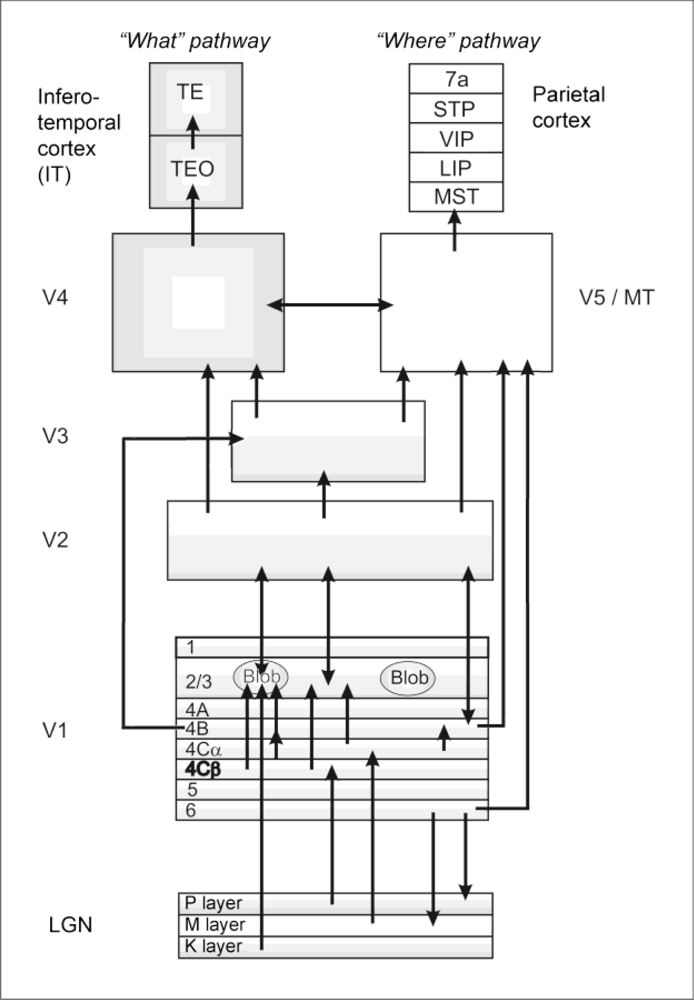
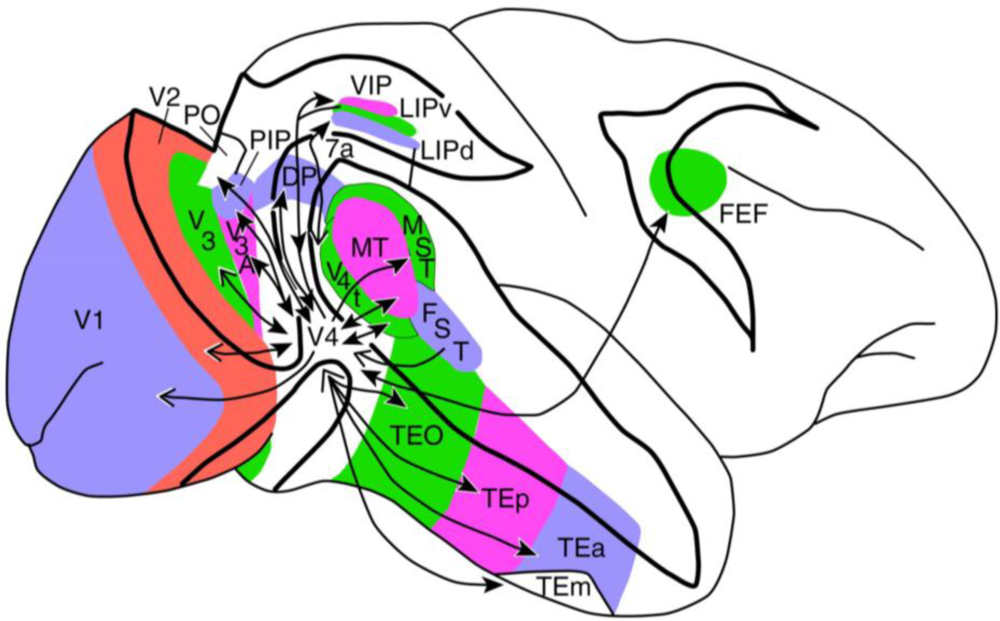
2. Retino-Geniculo-Cortical Visual Pathways in Primates
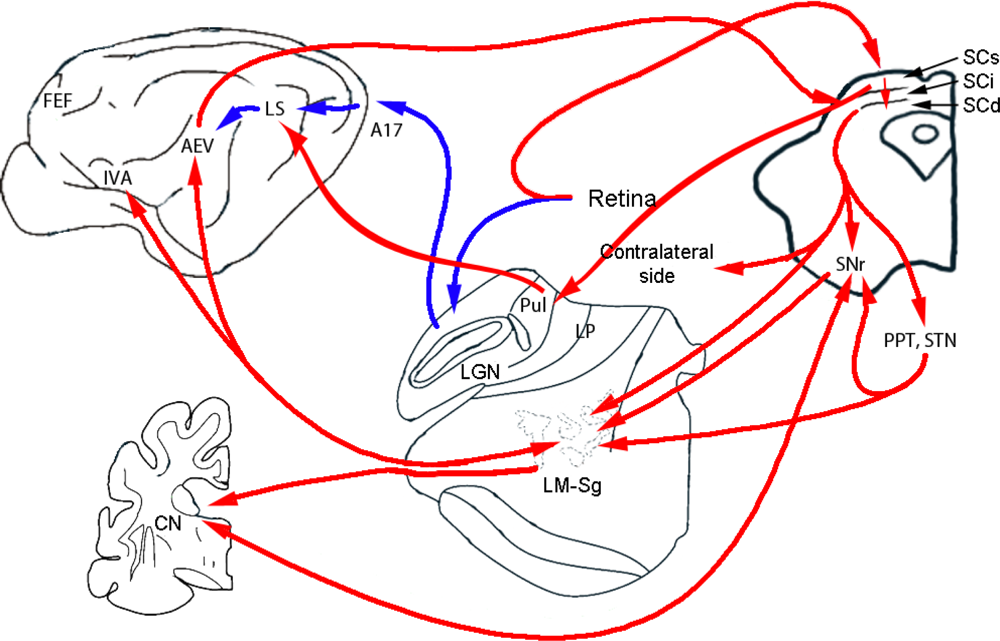
3. The Ascending Tectofugal System in the Feline Brain
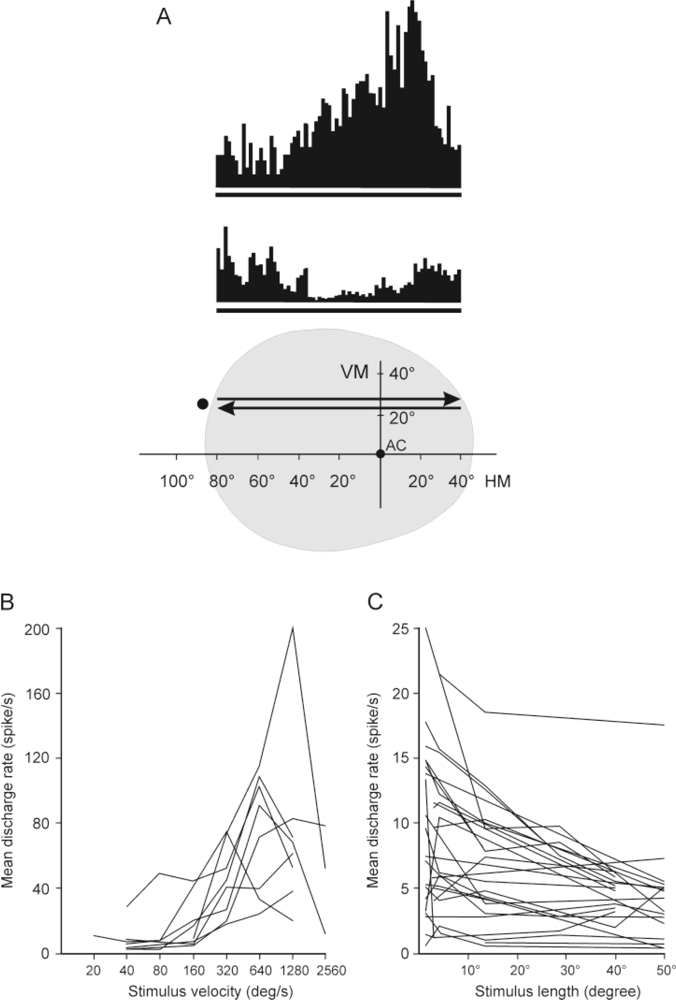
4. Lateral Suprasylvian Areas of the Feline Brain
5. Is There a Primate Homolog of the Feline Ascending Tectofugal System?
6. Conclusions
Acknowledgments
References
- Nakayama, K. Biological image motion processing: A review. Vis. Res 1985, 25, 625–660. [Google Scholar]
- Braunstein, M.L. Sensitivity of the observer to transformations of the visual field. J. Exp. Psychol 1966, 72, 638–687. [Google Scholar]
- Simpson, J.I.; Leonard, C.S.; Soodak, R.E. The accessory optic-system. Analyzer of self-motion. Ann. N. Y. Acad. Sci 1988, 545, 170–179. [Google Scholar]
- Goodale, M.A.; Milner, A.D. Separate visual pathways for perception and action. Trends Neurosci 1992, 15, 20–25. [Google Scholar]
- Ungerleider, L.G.; Mishkin, M. Two cortical visual systems. In Analysis of Visual Behavior; Ingle, D.J., Goodale, M.A., Mansfield, R.J.W., Eds.; MIT Press: Cambridge, MA, USA, 1982; pp. 549–586. [Google Scholar]
- Hubel, D.H.; Wiesel, T.N. Receptive fields, binocular interaction and functional architecture in the cat’s visual cortex. J. Physiol. Lond 1962, 160, 106–154. [Google Scholar]
- Hubel, D.H.; Wiesel, T.N. Receptive fields and functional architecture of monkey striate cortex. J. Physiol. Lond 1968, 195, 215–243. [Google Scholar]
- Snowden, R.J.; Treue, T.; Erickson, R.G.; Anderson, R.A. The response of area Mt and V1 neurons to transparent motion. J. Neurosci 1991, 11, 2768–2785. [Google Scholar]
- Movshon, J.A.; Newsome, W.T. Visual response properties of striate cortical neurons projecting to area MT in macaque monkey. J. Neurosci 1996, 16, 7733–7741. [Google Scholar]
- Clifford, C.W.G.; Ibbotson, M.R. Fundamental mechanisms of visual motion detection: models, cells and functions. Prog. Neurobiol 2002, 68, 409–437. [Google Scholar]
- Andersen, R.A. Neural mechanisms of visual motion perception in primates. Neuron 1997, 18, 865–872. [Google Scholar]
- Snowden, R.J.; Freeman, T.C.A. The visual perception of motion. Curr. Biol 2004, 14, R828–R831. [Google Scholar]
- Adelson, E.H.; Movshon, J.A. Phenomenal coherence of moving visual patterns. Nature 1982, 300, 523–525. [Google Scholar]
- Welch, L. The perception of moving plaids reveals two motion-processing stages. Nature 1989, 337, 734–736. [Google Scholar]
- Derrington, A; Suero, M. Motion of complex patterns is computed from the perceived motions of their components. Vision Res 1991, 31, 139–149. [Google Scholar]
- Albright, T.D.; Stoner, G.R. Visual motion perception. Proc. Natl. Acad. Sci. USA 1995, 92, 2433–2440. [Google Scholar]
- Li, B.; Chen, Y.; Li, B.W.; Wang, L.H.; Diao, Y.C. Pattern and component motion selectivity in cortical area PMLS of the cat. Eur. J. Neurosci 2001, 14, 690–700. [Google Scholar]
- Dacey, D.M.; Peterson, B.B.; Robinson, F.R.; Gamlin, P.D. Fireworks in the primate retina: In vitro photodynamics reveals diverse LGN-projecting ganglion cell types. Neuron 2003, 37, 15–27. [Google Scholar]
- Hendry, S.H.; Reid, R.C. The koniocellular pathway in primate vision. Annu. Rev. Neurosci 2000, 23, 127–53. [Google Scholar]
- Kuffler, S. Discharge patterns and functional organization of the mammalian retina. J. Neurophysiol 1953, 16, 37–68. [Google Scholar]
- Croner, L.J.; Kaplan, E. Receptive fields of P and M ganglion cells across the primate retina. Vision Res 1995, 35, 7–24. [Google Scholar]
- Barlow, H.B.; Levick, W.R. The mechanism of directionally selective units in rabbit’s retina. J. Physiol 1965, 178, 477–504. [Google Scholar]
- Jones, E.G. The Thalamus; Plenum Press: New York, NY, USA, 1985; pp. 261–319. [Google Scholar]
- Kaplan, E.; Shapley, R.M. X and Y cells in the lateral geniculate nucleus of macaque monkeys. J. Physiol 1982, 330, 125–143. [Google Scholar]
- Cavanagh, P.; Tyler, C.W.; Favreau, O.E. Perceived velocity of moving chromatic gratings. J. Opt. Soc. Am. A 1984, 1, 893–899. [Google Scholar]
- Ramachandran, V.S.; Gregory, R.L. Does color provide an input to human motion perception? Nature 1978, 275, 55–56. [Google Scholar]
- Gur, M.; Snodderly, D.M. Direction selectivity in V1 of alert monkeys: evidence for parallel pathways for motion processing. J Physiol 2007, 585, 383–400. [Google Scholar]
- Livingstone, M.S.; Hubel, D.H. Do the relative mapping densities of the magno- and parvocellular systems vary with eccentricity? J. Neurosci 1988, 8, 4334–4339. [Google Scholar]
- Shipp, S.; Zeki, S. The Organization of Connections between Areas V5 and V1 in Macaque Monkey Visual Cortex. Eur. J. Neurosci 1989, 1, 309–332. [Google Scholar]
- Nassi, J.J.; Callaway, E.M. Specialized circuits from primary visual cortex to V2 and area MT. Neuron 2007, 55, 799–808. [Google Scholar]
- Felleman, D.J.; Burkhalter, A.; Van Essen, D.C. Cortical connections of areas V3 and VP of macaque monkey extrastriate visual cortex. J. Comp. Neurol 1997, 379, 21–47. [Google Scholar]
- Nassi, J.J.; Callaway, E.M. Parallel processing strategies of the primate visual system. Nat. Rev. Neurosci 2009, 10, 360–372. [Google Scholar]
- Allman, J.M.; Kaas, J.H. A crescent-shaped cortical visual area surrounding the middle temporal area (MT) in the owl monkey (Aotus trivirgatus). Brain Res 1974, 81, 199–213. [Google Scholar]
- Zeki, S.M. Functional organization of a visual area in the posterior bank of the superior temporal sulcus of the rhesus monkey. J. Physiol 1974, 236, 549–573. [Google Scholar]
- Van Essen, D.C. Visual areas of the mammalian cerebral cortex. Ann. Rev. Neurosci 1979, 2, 227–261. [Google Scholar]
- Zeki, S.M. Convergent input from the striate cortex (area 17) to the cortex of the superior temporal sulcus in the rhesus monkey. Brain Res 1971, 28, 338–340. [Google Scholar]
- Zeki, S.M. Cortical projections from two prestriate areas in the monkey. Brain Res 1971, 34, 19–35. [Google Scholar]
- Maunsell, J.H.; Van Essen, D.C. Functional properties of neurons in middle temporal visual area of the macaque monkey. I. Selectivity for stimulus direction, speed, and orientation. J. Neurophysiol 1983, 49, 1127–1147. [Google Scholar]
- Albright, T.D.; Desimone, R.; Gross, C.G. Columnar organization of directionally selective cells in visual area MT of the macaque. J. Neurophysiol 1984, 51, 16–31. [Google Scholar]
- Newsome, W.T.; Wurtz, R.H.; Dürsteler, M. R.; Mikami, A. Deficits in visual motion processing following ibotenic acid lesions of the middle temporal visual area of the macaque monkey. J. Neurosci 1985, 5, 825–840. [Google Scholar]
- Rashbass, C. The relationship between saccadic and smooth tracking eye movements. J. Physiol 1961, 159, 326–338. [Google Scholar]
- Suzuki, D.A.; Noda, H.; Kase, M. Visual and pursuit eye movement-related activity in posterior vermis of monkey cerebellum. J. Neurophysiol 1981, 46, 1120–1139. [Google Scholar]
- Suzuki, D.A.; Keller, E.L. Visual signals in the dorsolateral pontine nucleus of the alert monkey: their relationship to smooth-pursuit eye movements. Exp. Brain Res 1984, 53, 473–478. [Google Scholar]
- Movshon, J.A.; Newsome, W.T. Functional characteristics of striate cortical neurons projecting to MT in the macaque. Soc. Neurosci. Abstr 1984, 10(933). [Google Scholar]
- Bradley, D.C.; Chang, G.C.; Andersen, R.A. Encoding of three-dimensional structure-from-motion by primate area MT neurons. Nature 1998, 392, 714–717. [Google Scholar]
- Grunewald, A.; Bradley, D.C.; Andersen, R.A. Neural correlates of structure-from-motion perception in macaque V1 and MT. J. Neurosci 2002, 22, 6195–6207. [Google Scholar]
- Shipp, S.; Zeki, S. The Organization of Connections between Areas V5 and V2 in Macaque Monkey Visual Cortex. Eur. J. Neurosci 1989, 1, 333–354. [Google Scholar]
- Vaina, L.M.; Cowey, A.; Eskew, R.T., Jr.; LeMay, M.; Kemper, T. Regional cerebral correlates of global motion perception: evidence from unilateral cerebral brain damage. Brain 2001, 124, 310–321. [Google Scholar]
- Perge, A.J.; Borghuis, B.G.; Bours, R.J.E.; Lankheet, M.J.M.; van Wezel, R.J.A. Temporal dynamics of direction tuning in motion-sensitive macaque area MT. J. Neurophysiol 2005, 93, 2104–2116. [Google Scholar]
- Serences, J.T.; Boynton, G.M. The representation of behavioral choice for motion in human visual cortex. J. Neurosci 2007, 27, 12893–12899. [Google Scholar]
- Zeki, S.; Watson, J.D.G.; Frackowiak, R.S.J. Going beyond the information given: the relation of illusory visual motion to brain activity. Proc. Biol. Sci 1993, 252, 215–222. [Google Scholar]
- Williford, T.; Maunsell, J.H. Effects of spatial attention on contrast response functions in macaque area V4. J. Neurophysiol 2006, 96, 40–54. [Google Scholar]
- Martínez-Trujillo, J.; Treue, S. Attentional modulation strength in cortical area MT depends on stimulus contrast. Neuron 2002, 35, 365–370. [Google Scholar]
- Patzwahl, D.R.; Treue, S. Combining spatial and feature-based attention within the receptive field of MT neurons. Vision Res 2009, 49, 1188–1193. [Google Scholar]
- Treue, S. Neural correlates of attention in primate visual cortex. Trends Neurosci 2001, 24, 295–300. [Google Scholar]
- Lui, L.L.; Bourne, J.A.; Rosa, M.G.P. Spatial and temporal frequency selectivity of neurons in the middle temporal visual area of new world monkeys (Callithrix jacchus). Eur. J. Neurosci 2007, 25, 1780–1792. [Google Scholar]
- Ungerleider, L.G.; Desimone, R.J. Cortical connections of visual area MT in the macaque. Comp. Neurol 1986, 248, 190–222. [Google Scholar]
- Maunsell, J.H.; van Essen, D.C. The connections of the middle temporal visual area (MT) and their relationship to a cortical hierarchy in the macaque monkey. J. Neurosci 1983, 3, 2563–2586. [Google Scholar]
- Eifuku, S.; Wurtz, R.H. Response to motion in extrastriate area MSTl: center-surround interactions. J. Neurophysiol 1998, 80, 282–296. [Google Scholar]
- Britten, K.H.; Van Wezel, R.J. Area MST and heading perception in macaque monkeys. Cereb. Cortex 2002, 12, 692–701. [Google Scholar]
- Rizzolatti, G.; Fogassi, L.; Gallese, V. Parietal cortex: from sight to action. Curr. Opin. Neurobiol 1997, 7, 562–567. [Google Scholar]
- Kalaska, J.F.; Scott, S.H.; Cisek, P.; Sergio, L.E. Cortical control of reaching movements. Curr. Opin. Neurobiol 1997, 7, 849–859. [Google Scholar]
- Culham, J.C.; Cavina-Pratesi, C.; Singhal, A. The role of parietal cortex in visuomotor control: what have we learned from neuroimaging? Neuropsychologia 2006, 44, 2668–2684. [Google Scholar]
- Sakata, H.; Taira, M.; Murata, A.; Mine, S. Neural Mechanisms of visual guidance of hand action in the parietal cortex of monkey. Cereb. Cortex 1995, 5, 429–438. [Google Scholar]
- Sakata, H.; Taira, M.; Kusunoki, M.; Murata, A.; Tanaka, Y. The TINS lecture. The parietal association cortex in depth perception and visual control of hand action. Trends Neurosci 1997, 20, 350–357. [Google Scholar]
- Motter, B.C.; Mountcastle, V.B. The functional properties of the light-sensitive neurons of the posterior parietal cortex studied in waking monkeys: foveal sparing and opponent vector organization. J. Neurosci 1981, 1, 3–26. [Google Scholar]
- Collewijn, H.; Curio, G.; Grüsser, O.J. Spatially selective visual attention and generation of eye pursuit movements. Experiments with sigma-movement. Hum. Neurobiol 1982, 1, 129–139. [Google Scholar]
- Carman, J.B.; Cowan, W.M.; Powell, T.P.; Webster, K.E. A bilateral cortico-striate projection. J. Neurol. Neurosurg. Psychiatry 1965, 28, 71–77. [Google Scholar]
- Atkinson, J. Development of optokinetic nystagmus in the human infant and monkey infant: an analogue to development in kittens. In Developmental Neurobiology of Vision; Freeman, R.D., Ed.; Plenum Press: New York, NY, USA, 1979; pp. 277–287. [Google Scholar]
- Atkinson, J.; Braddick, O.J. Acuity, contrast sensitivity and accommodation in infancy. In The Development of Perception; Aslin, R.N., Alberts, J.R., Petersen, M.R., Eds.; Academic Press: New York, NY, USA, 1981; Volume 2, pp. 245–278. [Google Scholar]
- Croner, L.J.; Albright, T.D. Seeing the big picture: integration of image cues in the primate visual system. Neuron 1999, 24, 777–789. [Google Scholar]
- Albright, T.D.; Stoner, G.R. Visual motion perception. Proc. Natl. Acad. Sci. USA 1995, 92, 2433–2440. [Google Scholar]
- Ungerleider, L.G.; Galkin, T.W.; Desimone, R.; Gattass, R. Cortical connections of area V4 in the macaque. Cereb. Cortex 2008, 18, 477–499. [Google Scholar]
- Rosenquist, A.C. Connections of visual Cortical Areas in the Cat. In Cerebral Cortex; Peters, A., Jones, E.G., Eds.; Plenum Press: New York, NY, USA, 1985; Volume 3, Visual Cortex,; pp. 81–117. [Google Scholar]
- Mucke, L.; Norita, M.; Benedek, G.; Creutzfeldt, O. Physiologic and anatomic investigation of a visual cortical area situated in the ventral bank of the anterior ectosylvian sulcus of the cat. Exp. Brain Res 1982, 46, 1–11. [Google Scholar]
- Olson, C.R.; Graybiel, A.M. Ectosylvian visual area of the cat: location, retinotopic organization, and connections. J. Comp. Neurol 1987, 261, 277–294. [Google Scholar]
- Olson, C.R.; Graybiel, A.M. An outlying visual area in the cerebral cortex of the cat. Prog. Brain Res 1983, 58, 239–245. [Google Scholar]
- Benedek, G.; Jang, E.K.; Hicks, T.P. Physiological properties of visually responsive neurons in the insular cortex of the cat. Neurosci. Lett 1986, 64, 269–274. [Google Scholar]
- Hicks, T.P.; Benedek, G.; Thurlow, G.A. Organization and properties of neurons in a visual area within the insular cortex of the cat. J. Neurophysiol 1988, 60, 397–421. [Google Scholar]
- Norita, M.; Hicks, T.P.; Benedek, G.; Katoh, Y.Y. Organization of cortical and subcortical projections to the feline insular visual area, IVA. J. Hirnforsch 1991, 32, 119–134. [Google Scholar]
- Reinoso-Suarez, F.; Roda, J.M. Topographical organization of the cortical afferent connections to the cortex of the anterior ectosylvian sulcus in the cat. Exp. Brain Res 1985, 59, 313–324. [Google Scholar]
- Hoshino, K.; Horie, M.; Nagy, A.; Berényi, A.; Benedek, G.; Norita, M. Direct synaptic connections between superior colliculus afferents and thalamo-insular projection neurons in the feline suprageniculate nucleus: A double-labeling study with WGA-HRP and kainic acid. Neurosci. Res 2009. [Google Scholar] [CrossRef]
- Norita, M.; Mucke, L.; Benedek, G.; Albowitz, B.; Katoh, Y.Y.; Creutzfeldt, O.D. Connections of the anterior ectosylvian visual area (AEV). Exp. Brain Res 1986, 62, 225–240. [Google Scholar]
- Miceli, D.; Reperant, J.; Ptito, M. Intracortical connections of the anterior ectosylvian and lateral suprasylvian visual areas in the cat. Brain Res 1985, 347, 291–298. [Google Scholar]
- Hardy, H.; Heimer, L.; Switzer, R.; Watkins, D. Simultaneous demonstration of horseradish peroxydase and acetylcholinesterase. Neurosci. Lett 1976, 3, 1–15. [Google Scholar]
- Katoh, Y.Y.; Benedek, G. Organization of the colliculo-suprageniculate pathway in the cat: a wheat germ agglutinin-horseradish peroxydase study. J. Comp. Neurol 1995, 352, 381–397. [Google Scholar]
- Katoh, Y.Y.; Benedek, G.; Deura, S. Bilateral projections from the superior colliculus to the suprageniculate nucleus in the cat: a WGA-HRP/double fluorescent tracing study. Brain Res 1995, 669, 298–302. [Google Scholar]
- Crapse, T.B.; Sommer, M.A. Frontal eye field neurons with spatial representations predicted by their subcortical input. J. Neurosci 2009, 29, 5308–5318. [Google Scholar]
- Hoshino, K.; Eördegh, G.; Nagy, A.; Benedek, G.; Norita, M. Overlap of nigrothalamic terminals and thalamostriatal neurons in the feline lateralis medialis-suprageniculate nucleus. Acta Physiol. Hung 2009, 96, 203–211. [Google Scholar]
- Katoh, Y.Y.; Arai, R.; Benedek, G. Bifurcating projections from the cerebellar fastigial neurons to the thalamic suprageniculate nucleus and to the superior colliculus. Brain Res 2000, 864, 308–311. [Google Scholar]
- Guirado, S.; Real, M.A.; Dávila, J.C. The ascending tectofugal visual system in amniotes: New insights. Brain Res. Bull 2005, 66, 290–296. [Google Scholar]
- Rokszin, A.; Márkus, Z.; Braunitzer, G.; Berényi, A.; Wypych, M.; Waleszczyk, W.J.; Benedek, G.; Nagy, A. Spatio-temporal visual properties in the ascending tectofugal system. Cent. Eur. J. Biol 2009, (in press).. [Google Scholar]
- Benedek, G.; Hicks, T.P. The visual insular cortex of the cat: organization, properties and modality specificity. Prog. Brain Res 1988, 75, 271–278. [Google Scholar]
- Benedek, G.; Perény, J.; Kovács, G.; Fischer-Szatmári, L.; Katoh, Y.Y. Visual, somatosensory, auditory and nociceptive modality properties in the feline suprageniculate nucleus. Neuroscience 1997, 78, 179–189. [Google Scholar]
- Tusa, R.J.; Palmer, L.A.; Rosenquist, A.C. The retinotopic organization of area 17 (striate cortex) in the cat. J. Comp. Neurol 1978, 177, 213–235. [Google Scholar]
- Scannell, J.W.; Sengpiel, F.; Tovee, M.J.; Benson, P.J.; Blakemore, C.; Young, M.P. Visual motion processing in the anterior ectosylvian sulcus of the cat. J. Neurophysiol 1996, 76, 895–907. [Google Scholar]
- Benedek, G.; Mucke, L.; Norita, M.; Albowitz, B.; Creutzfeldt, O.D. Anterior ectosylvian visual area (AEV) of the cat: physiological properties. Prog. Brain Res 1988, 75, 245–255. [Google Scholar]
- Middlebrooks, J.C.; Clock, A.E.; Xu, L.; Green, D.M. A panoramic code for sound location by cortical neurons. Science 1994, 264, 842–844. [Google Scholar]
- Benedek, G.; Sztriha, L.; Kovács, G. Coding of spatial co-ordinates on neurons of the feline visual association cortex. Neuroreport 2000, 11, 1–4. [Google Scholar]
- Stein, B.E.; Meredith, M.A. The Merging of the Sense; The MIT Press: Cambridge, MA, USA, 1993. [Google Scholar]
- De Valois, K.K.; De Valois, R.L.; Yund, E.W. Responses of striate cortex cells to grating and checkerboard patterns. J. Physiol 1979, 291, 483–505. [Google Scholar]
- Pinter, R.B.; Harris, L.R. Temporal and spatial response characteristics of the cat superior colliculus. Brain Res 1981, 207, 73–94. [Google Scholar]
- Enroth-Cugell, C.; Robson, J.G. The contrast sensitivity of retinal ganglion cells of the cat. J. Physiol 1966, 187, 517–552. [Google Scholar]
- Zumbroich, T.; Price, D.J.; Blakemore, C. Development of spatial and temporal selectivity in the suprasylvian visual cortex of the cat. J. Neurosci 1988, 8, 2713–2728. [Google Scholar]
- Anderson, S.J.; Burr, D.C. Spatial and temporal selectivity of the human motion detection system. Vision Res 1985, 25, 1147–1154. [Google Scholar]
- Burr, D.C.; Ross, J. Contrast sensitivity at high velocities. Vision Res 1982, 22, 479–484. [Google Scholar]
- Burr, D.C.; Morrone, M.C.; Ross, J. Local and global visual processing. Vision Res 1986, 26, 749–757. [Google Scholar]
- Morrone, M.C.; Di Stefano, M.; Burr, D.C. Spatial and temporal properties of neurons of the lateral suprasylvian cortex of the cat. J. Neurophysiol 1986, 56, 969–986. [Google Scholar]
- Brosseau-Lachaine, O.; Faubert, J.; Casanova, C. Functional subregions for optic flow processing in the posteromedial lateral suprasylvian cortex of the cat. Cereb. Cortex 2001, 11, 989–1001. [Google Scholar]
- Palmer, L.A.; Rosenquist, A.C.; Tusa, R.J. The retinotopic organization of lateral suprasylvian visual areas in the cat. J. Comp. Neurol 1978, 177, 237–256. [Google Scholar]
- Ogashawara, K.; McHaffie, J.G.; Stein, B.E. Two visual corticotectal systems in cat. J. Neurophysiol 1984, 52, 1226–1245. [Google Scholar]
- Hardy, S.C.; Stein, B.E. Small lateral suprasylvian cortex lesion produce visual neglect and decreased visual activity in the superior colliculus. J. Comp. Neurol 1988, 273, 527–542. [Google Scholar]
- Payne, B.R.; Lomber, S.G.; Geeraerts, S.; van der Gucht, E.; Vandenbusschen, E. Reversible visual hemineglect. Proc. Natl. Acad. Sci. USA 1996, 93, 290–294. [Google Scholar]
- Pasternak, T.; Horn, K.M.; Maunsell, J.H. Deficits in speed discrimination following lesions of the lateral suprasylvian cortex in the cat. Vis. Nerosci 1989, 3, 365–375. [Google Scholar]
- Rudolph, K.K.; Pasternak, T. Lesions in cat lateral suprasylvian cortex affect the perception of complex motion. Cereb. Cortex 1996, 6, 814–822. [Google Scholar]
- Kiefer, W.; Kruger, K.; Strauss, G.; Berlucchi, G. Considerable deficits in the detection performance of the cat after lesion of the suprasylvian visual cortex. Exp. Brain Res 1989, 75, 208–212. [Google Scholar]
- Krüger, K.; Kiefer, W.; Groh, A.; Dinse, H.R.; von Seelen, W. The role of the lateral suprasylvian cortex of the cat in object-background interactions: permanent deficits following lesions. Exp. Brain Res 1993, 97, 40–60. [Google Scholar]
- Spear, P.D.; Baumann, T.P. Receptive-field characteristics of single neurons in lateral suprasylvian visual area of the cat. J. Neurophysiol 1975, 38, 1403–1420. [Google Scholar]
- Blakemore, C.; Zumbroich, T.J. Stimulus selectivity and functional organization in the lateral suprasylvian visual cortex of the cat. J. Physiol. (London) 1987, 389, 569–603. [Google Scholar]
- Rauschecker, J.P.; von Grünau, M.W.; Poulin, C. Centrifugal organization of direction preferences in the cat’s lateral suprasylvian visual cortex and its relation to flow field processing. J. Neurosci 1987, 7, 943–958. [Google Scholar]
- von Grünau, M.W.; Zumbroich, T.J.; Poulin, C. Visual receptive field properties in the posterior suprasylvian cortex of the cat: a comparison between areas PMLS and PLLS. Vision Res 1987, 27, 343–356. [Google Scholar]
- Gizzi, M.S.; Katz, E.; Movshon, J.A. Spatial and temporal analysis by neurons in the representation of the central visual field in the cat’s lateral suprasylvian visual cortex. Vis. Neurosci 1990, 5, 463–468. [Google Scholar]
- Gizzi, M.S.; Katz, E.; Schumer, R.A.; Movshon, J.A. Selectivity for orientation and direction of motion of single neurons in cat striate and extrastriate visual cortex. J. Neurophysiol 1990, 63, 1529–1543. [Google Scholar]
- Minville, K.; Casanova, C. Spatial frequency processing in the posteromedial lateral suprasylvian cortex does not depend on the projections from the striate-recipient zone of the cat’s lateral posterior-pulvinar complex. Neurosciences 1998, 84, 699–711. [Google Scholar]
- Li, B.; Li, B.W.; Chen, Y.; Wang, L.H.; Diao, Y.C. Response properties of PMLS and PLLS neurons to stimulated optic flow patterns. J. Neurosci 2000, 12, 1534–1544. [Google Scholar]
- Brosseau-Lachaine, O.; Faubert, J.; Casanova, C. Functional sub-regions for optic flow processing in the posteromedial lateral suprasylvian cortex of the cat. Cereb. Cortex 2001, 11, 989–1001. [Google Scholar]
- Morrone, M.C.; Di Stefano, M.; Burr, D.C. Spatial and temporal properties of neurons of the lateral suprasylvian cortex of the cat. J. Neurophysiol 1986, 56, 969–986. [Google Scholar]
- von Grünau, M.; Frost, B.J. Double-opponent-process mechanism underlying RF-structure of directionally specific cells of cat lateral suprasylvian visual area. Exp. Brain Res 1983, 49, 84–92. [Google Scholar]
- Yin, T.C.; Greenwood, M. Visuomotor interactions in responses of neurons in the middle and lateral suprasylvian cortices of the behaving cat. Exp. Brain Res 1992, 88, 15–32. [Google Scholar]
- Sherk, H.; Fowler, G.A. Lesions of extrastriate cortex and consequences for visual guidance during locomotion. Exp. Brain Res 2002, 144, 159–171. [Google Scholar]
- Camarda, R.; Rizzolatti, G. Visual receptive fields in the lateral suprasylvian area (Clare-Bishop area) of the cat. Brain Res 1976, 101, 427–443. [Google Scholar]
- Toyama, K.; Mizobe, K.; Akase, E.; Kaihara, T. Neuronal responsiveness in areas 19 and 21a, and the posteromedial lateral suprasylvian cortex of the cat. Exp. Brain Res 1994, 99, 289–301. [Google Scholar]
- Hamada, T. Neural response to the motion of textures in the lateral suprasylvian area of cats. Behav. Brain Res 1987, 25, 175–185. [Google Scholar]
- Danilov, Y.; Moore, R.J.; King, V.R.; Spear, P.D. Are neurons in cat posteromedial lateral suprasylvian visual cortex orientation sensitive? Tests with bars and gratings. Vis. Neurosci 1995, 12, 141–151. [Google Scholar]
- Dreher, B.; Wang, C.; Turlejski, K.J.; Djavadian, R.L.; Burke, W. Areas PMLS and 21a of cat visual cortex: two functionally distinct areas. Cereb. Cortex 1996, 6, 585–599. [Google Scholar]
- Villeneuve, M.Y.; Ptito, M.; Casanova, C. Global motion integration in the postero-medial part of the lateral suprasylvian cortex in the cat. Exp. Bran Res 2006, 172, 485–497. [Google Scholar]
- Dreher, B. Thalamocortical and corticocortical interconnections in the cat visual system: relation to the mechanisms of information processing. In Visual Neuroscience; Pettigrew, J.D., Sanderson, K.J., Levick, W.R., Eds.; Cambridge University Press: New York, NY, USA, 1986; pp. 290–315. [Google Scholar]
- Sherk, H. Location and connections of visual cortical areas in the cat’s suprasylvian sulcus. J. Comp. Neurol 1986, 247, 1–31. [Google Scholar]
- Grant, S.; Shipp, S. Visuotopic organization of the lateral suprasylvian area and of an adjacent area of the ectosylvian gyrus of cat cortex: A physiological and connectional study. Vis. Neurosci 1991, 6, 315–338. [Google Scholar]
- Scannell, J.W.; Blakemore, C.; Young, M.P. Analysis of connectivity in the cat cerebral cortex. J. Neurosci 1995, 15, 1463–1483. [Google Scholar]
- Kim, J.N.; Mulligan, K.; Sherk, H. Simulated optic flow and extrastriate cortex. I. Optic flow versus texture. J. Neurophysiol 1997, 77, 554–561. [Google Scholar]
- Sherk, H.; Mulligan, K.; Kim, J.N. Neuronal responses in extrastriate cortex to objects in optic flow fields. Vis. Neurosci 1997, 14, 879–895. [Google Scholar]
- Robitaille, N.; Lepore, F; Bacon, B.A.; Ellemberg, D.; Guillemot, J.P. Receptive field properties and sensitivity to edges defined by motion in the postero-lateral lateral suprasylvian (PLLS) area of the cat. Brain Res 2008, 1187, 82–94. [Google Scholar]
- Lomber, S.G. Behavioral cartography of visual functions in cat parietal cortex: areal and laminar dissociations. Prog. Brain Res 2001, 134, 265–284. [Google Scholar]
- Vanduffel, W.; Vandenbusschen, E.; Singer, W.; Orban, G.A. A metabolic study of orientation discrimination and detection tasks in the cat. Eur. J. Neurol 1997, 9, 1314–1328. [Google Scholar]
- Sprague, J.M.; De Weerd, P.; Xiao, D.K.; Vandenbusschen, E.; Orban, G.A. Orientation discrimination in the cat: its cortical locus: II. Extrastriate cortical areas. J. Comp. Neurol 1996, 364, 32–50. [Google Scholar]
- Ouellette, B.G.; Minville, K.; Faubert, J.; Casanova, C. Simple and complex visual motion response properties in the anterior medial bank of the lateral suprasylvian cortex. Neuroscience 2004, 123, 231–245. [Google Scholar]
- Symonds, L.L.; Rosenquist, A.C. Corticocortical connections among visual areas in the cat. J. Comp. Neurol 1984, 229, 1–38. [Google Scholar]
- Symonds, L.L.; Rosenquist, A.C. Laminar origins of visual corticocortical connections in the cat. J. Comp. Neurol 1984, 229, 39–47. [Google Scholar]
- Miceli, D.; Repérant, J.; Ptito, M. Intracortical connections of the anterior ectosylvian and lateral suprasylvian visual areas in the cat. Brain Res 1985, 347, 291–298. [Google Scholar]
- Zeki, S.; Watson, J.D.; Lueck, C.J.; Friston, K.J.; Kennard, C.; Frackowiak, R.S. A direct demonstration of functional specialization in human cortex. J. Neurosci 1991, 11, 641–649. [Google Scholar]
- Fries, W. The projection from the lateral geniculate nucleus to the peristriate cortex of the macaque monkey. Proc. R. Soc. Lond. B. Biol 1981, 213, 73–86. [Google Scholar]
- Yukie, M.; Iwai, E. Direct projection from the dorsal lateral geniculate nucleus to the peristriate cortex in macaque monkey. J. Comp. Neurol 1981, 201, 81–97. [Google Scholar]
- Standage, G.P.; Benevento, L.A. The organization of connections between the pulvinar and visual area MT in the macaque monkey. Brain Res 1983, 262, 288–294. [Google Scholar]
- Gross, C.G. Contribution of striate cortex and the superior colliculus to visual function in area MT, the superior temporal polysensory area and the inferior temporal cortex. Neuropsychologia 1991, 29, 497–515. [Google Scholar]
- Rodman, H.R.; Gross, C.G.; Albright, T.D. Afferent basis of visual response properties in area MT of the macaque. I. Effects of striate cortex removal. J. Neurosci 1989, 9, 2033–2050. [Google Scholar]
- Rodman, H.R.; Gross, C.G.; Albright, T.D. Afferent basis of visual response properties in area MT of the macaque. II. Effects of superior colliculus removal. J. Neurosci 1990, 10, 1154–1164. [Google Scholar]
- Schoenfeld, M.A.; Heinze, H.-J.; Woldorff, M.G. Unmasking motion-processing activity in human brain area V5/MT+ mediated by pathways that bypass primary visual cortex. Neuroimage 2002, 17, 769–779. [Google Scholar]
- Felleman, D.J.; Van Essen, D.C. Distributed hierarchical processing in the primate cerebral cortex. Cereb. Cortex 1991, 1, 1–47. [Google Scholar]
- Payne, B.R. Evidence for visual cortical area homologs in cat and macaque monkey. Cereb. Cortex 1993, 3, 1–25. [Google Scholar]
- Stepniewska, I.; Qi, H.X.; Kaas, J.H. Do superior colliculus projection zones in the inferior pulvinar project to MT in primates? Eur. J. Neurosci 1999, 11, 469–480. [Google Scholar]
- Gutierrez, C.; Cusick, C.G. Area V1 in macaque monkeys projects to multiple histochemically defined subdivisions of the inferior pulvinar complex. Brain Res 1997, 765, 349–356. [Google Scholar]
- Cavada, C.; Compañy, T.; Hernández-González, A.; Reinoso-Suárez, F. Acetylcholinesterase histochemistry in the macaque thalamus reveals territories selectively connected to frontal, parietal and temporal association cortices. J. Chem. Neuroanat 1995, 8, 245–257. [Google Scholar]
- Robinson, D.L. Functional contributions of the primate pulvinar. Prog. Brain Res 1993, 95, 371–380. [Google Scholar]
- Grieve, K.L.; Acuña, C.; Cudeiro, J. The primate pulvinar nuclei: vision and action. Trends Neurosci 2000, 23, 35–39. [Google Scholar]


© 2010 by the authors; licensee Molecular Diversity Preservation International, Basel, Switzerland. This article is an open-access article distributed under the terms and conditions of the Creative Commons Attribution license ( http://creativecommons.org/licenses/by/3.0/).
Share and Cite
Rokszin, A.; Márkus, Z.; Braunitzer, G.; Berényi, A.; Benedek, G.; Nagy, A. Visual Pathways Serving Motion Detection in the Mammalian Brain. Sensors 2010, 10, 3218-3242. https://doi.org/10.3390/s100403218
Rokszin A, Márkus Z, Braunitzer G, Berényi A, Benedek G, Nagy A. Visual Pathways Serving Motion Detection in the Mammalian Brain. Sensors. 2010; 10(4):3218-3242. https://doi.org/10.3390/s100403218
Chicago/Turabian StyleRokszin, Alice, Zita Márkus, Gábor Braunitzer, Antal Berényi, György Benedek, and Attila Nagy. 2010. "Visual Pathways Serving Motion Detection in the Mammalian Brain" Sensors 10, no. 4: 3218-3242. https://doi.org/10.3390/s100403218
APA StyleRokszin, A., Márkus, Z., Braunitzer, G., Berényi, A., Benedek, G., & Nagy, A. (2010). Visual Pathways Serving Motion Detection in the Mammalian Brain. Sensors, 10(4), 3218-3242. https://doi.org/10.3390/s100403218