<?xml version="1.0" encoding="UTF-8"?>
<!DOCTYPE article PUBLIC "-//NLM//DTD Journal Publishing DTD v2.3 20070202//EN" "journalpublishing.dtd">
<article xmlns:xlink="http://www.w3.org/1999/xlink" xml:lang="en" article-type="review-article">
<front>
<journal-meta>
<journal-id journal-id-type="nlm-ta">Sensors</journal-id>
<journal-title>Sensors</journal-title>
<issn pub-type="epub">1424-8220</issn>
<publisher>
<publisher-name>Molecular Diversity Preservation International (MDPI)</publisher-name></publisher></journal-meta>
<article-meta>
<article-id pub-id-type="doi">10.3390/s100403126</article-id>
<article-id pub-id-type="publisher-id">sensors-10-03126</article-id>
<article-categories>
<subj-group>
<subject>Review</subject></subj-group></article-categories>
<title-group>
<article-title>Environmentally Sensitive Fluorescent Sensors Based on Synthetic Peptides</article-title></title-group>
<contrib-group>
<contrib contrib-type="author">
<name><surname>Choulier</surname><given-names>Laurence</given-names></name><xref ref-type="aff" rid="af1-sensors-10-03126"><sup>1</sup></xref><xref ref-type="corresp" rid="c1-sensors-10-03126"><sup>*</sup></xref></contrib>
<contrib contrib-type="author">
<name><surname>Enander</surname><given-names>Karin</given-names></name><xref ref-type="aff" rid="af2-sensors-10-03126"><sup>2</sup></xref></contrib></contrib-group>
<aff id="af1-sensors-10-03126">
<label>1</label> Biosensor group, CNRS / Université de Strasbourg, IREBS, Parc d’Innovation, Boulevard Sébastien Brandt, BP 10413, 67412 Illkirch cedex, France</aff>
<aff id="af2-sensors-10-03126">
<label>2</label> Division of Molecular Physics, Department of Physics, Chemistry and Biology, Linköping University, 581 83 Linköping, Sweden; E-Mail: <email>karen@ifm.liu.se</email></aff>
<author-notes>
<corresp id="c1-sensors-10-03126">
<label>*</label> Author to whom correspondence should be addressed; E-Mail: <email>laurence.choulier@unistra.fr</email>; Tel.: +33-3-68854846; Fax: +33-3-68854683.</corresp></author-notes>
<pub-date pub-type="collection">
<year>2010</year></pub-date>
<pub-date pub-type="epub">
<day>31</day>
<month>3</month>
<year>2010</year></pub-date>
<volume>10</volume>
<issue>4</issue>
<fpage>3126</fpage>
<lpage>3144</lpage>
<history>
<date date-type="received">
<day>6</day>
<month>1</month>
<year>2010</year></date>
<date date-type="rev-recd">
<day>27</day>
<month>2</month>
<year>2010</year></date>
<date date-type="accepted">
<day>24</day>
<month>3</month>
<year>2010</year></date></history>
<permissions>
<copyright-statement>© 2010 by the authors; licensee Molecular Diversity Preservation International, Basel, Switzerland.</copyright-statement>
<copyright-year>2010</copyright-year>
<license>
<p>This article is an open-access article distributed under the terms and conditions of the Creative Commons Attribution license (<ext-link xlink:href="http://creativecommons.org/licenses/by/3.0/" ext-link-type="uri">http://creativecommons.org/licenses/by/3.0/</ext-link>).</p></license></permissions>
<abstract>
<p>Biosensors allow the direct detection of molecular analytes, by associating a biological receptor with a transducer able to convert the analyte-receptor recognition event into a measurable signal. We review recent work aimed at developing synthetic fluorescent molecular sensors for a variety of analytes, based on peptidic receptors labeled with environmentally sensitive fluorophores. Fluorescent indicators based on synthetic peptides are highly interesting alternatives to protein-based sensors, since they can be synthesized chemically, are stable, and can be easily modified in a site-specific manner for fluorophore coupling and for immobilization on solid supports.</p></abstract>
<kwd-group>
<kwd>peptide biosensors</kwd>
<kwd>environmentally-sensitive fluorophore</kwd></kwd-group></article-meta></front>
<body>
<sec sec-type="intro">
<label>1.</label>
<title>Introduction</title>
<p>A molecular biosensor [<xref ref-type="bibr" rid="b1-sensors-10-03126">1</xref>] is a molecule composed of a biological recognition element (receptor) covalently associated with a transducer, generally a fluorophore, for signaling. The receptor is selected to specifically recognize a molecule of interest (analyte), while the fluorophore responds to the recognition event and transforms it into a measurable signal. The molecular biosensor can be distinguished from a chemosensor by the nature of the receptor, which is typically a biomacromolecule such as a nucleic acid (DNA or RNA), or a protein (often an enzyme or an antibody). Fluorescent molecular biosensors are mainly designed for the detection and quantification of analyte, with potential applications in the fields of medicine, agro-industry, defense or protection of the environment, but are also exploited to understand biomolecular events.</p>
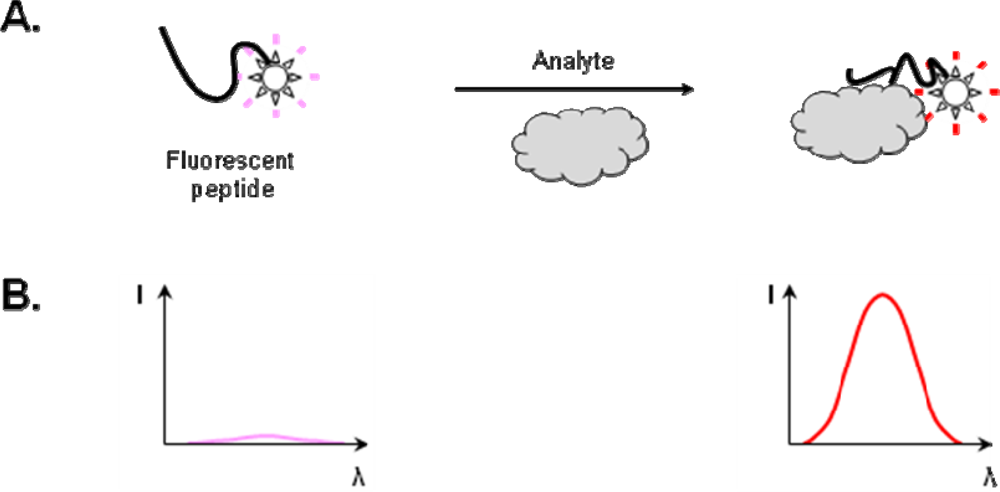
<p>Compared to an immunoassay, which requires indirect labeling and multistep reactions, the detection of an analyte by a fluorescent biosensor is simple, direct and can be appreciated in real-time. The principle of sensing is illustrated in <xref ref-type="fig" rid="f1-sensors-10-03126">Figure 1</xref>. When an environmentally sensitive fluorophore is coupled near the binding site of a receptor, it will respond to changes in the physico-chemical environment induced by complex formation, by altering its fluorescence properties. Typically, polarity variations in the immediate vicinity of the fluorophore result in quenching or enhancement of the fluorescence and/or a wavelength shift in the emission spectrum. Recent reviews describe the structures, key physical parameters (extinction coefficients, excitation and emission wavelengths, quantum yields, size, hydrophobicity, stability) and advantages of some of the most common environmentally-sensitive fluorophores [<xref ref-type="bibr" rid="b2-sensors-10-03126">2</xref>], or the design of biosensor molecules based on proteins [<xref ref-type="bibr" rid="b3-sensors-10-03126">3</xref>]. While implemented with many different types of protein receptors, analytes and fluorophores, site-specific incorporation of fluorophores in proteins remains a challenge. The most widely used approach to covalently couple an extrinsic fluorophore to a recombinant protein involves the replacement of a less reactive amino acid residue with cysteine, followed by dye coupling to the free thiol group of the purified protein in buffer. This approach is straightforward, but difficult to implement on a general basis because mutations and coupling can lead to poor expression levels, deleterious effects on analyte binding, poor stability, aggregation or unfolding. Moreover, side reactions between thiol-reactive fluorophores and lysine side chains have been observed [<xref ref-type="bibr" rid="b4-sensors-10-03126">4</xref>,<xref ref-type="bibr" rid="b5-sensors-10-03126">5</xref>]. Other approaches to coupling a fluorophore at a specific site of proteins involve nonsense suppression [<xref ref-type="bibr" rid="b6-sensors-10-03126">6</xref>], active-site-selective labeling [<xref ref-type="bibr" rid="b7-sensors-10-03126">7</xref>–<xref ref-type="bibr" rid="b9-sensors-10-03126">9</xref>], post-photoaffinity labeling modification [<xref ref-type="bibr" rid="b10-sensors-10-03126">10</xref>–<xref ref-type="bibr" rid="b12-sensors-10-03126">12</xref>], and, for chemically solid-phase synthesized proteins, the Suzuki-coupling reaction [<xref ref-type="bibr" rid="b13-sensors-10-03126">13</xref>] and native-chemical ligation of peptides [<xref ref-type="bibr" rid="b14-sensors-10-03126">14</xref>].</p>
<p>Protein-based environmentally-sensitive fluorescent biosensors have been successfully used for analyte detection and quantification with affinities varying from 0.2 nM to 150 mM, sometimes even in immobilized formats [<xref ref-type="bibr" rid="b14-sensors-10-03126">14</xref>–<xref ref-type="bibr" rid="b17-sensors-10-03126">17</xref>]. Still, synthetic peptides are interesting alternatives as receptors, because they provide obvious advantages over proteins in terms of production and stability. Peptide synthesis is straightforward and cost-effective and peptide-dye constructs can be manufactured at large scale. Moreover, synthetic peptides are robust, offer an even larger chemical versatility than recombinant proteins and are easily modified in a site-specific manner by means of orthogonal protection group strategies. Thus, peptides should have a great potential as components in molecular biosensors.</p>
<p>This review will specifically focus on biosensor constructs based on synthetic peptides and designed for the detection of biomolecular analytes by transduction <italic>via</italic> environmentally sensitive fluorescent dyes. Detection based on energy transfer (FRET) or changes in anisotropy will not be considered. The peptide may either serve as the recognition unit to provide ‘intrinsic recognition’ (Section 2) or as a scaffold onto which other recognition elements can be grafted (‘extrinsic recognition’, Section 3).</p></sec>
<sec>
<label>2.</label>
<title>Synthetic Peptide Sensors: Peptides as Recognition Elements</title>
<p>Half of the reported protein biosensors are based on bacterial periplasmic binding proteins and target sugars, the reason being that these proteins are well described and that sugar binding induces a pronounced conformational change that may result in local changes in the chemical environment in many parts of the protein. In contrast, most of the singly-labeled fluorescent peptide biosensors target proteic or peptidic analytes. Binding-related peptide sensors constructed by labeling of an amino acid residue and by incorporation of a fluorescent amino acid are listed in <xref ref-type="table" rid="t1-sensors-10-03126">Tables 1</xref> and <xref ref-type="table" rid="t2-sensors-10-03126">2</xref>, respectively, together with targeted analytes, sensor affinities and performances. Sensors for enzymes, where the fluorescence signal is changed in response to the enzymatic activity (discussed in Section 2.1.), are not included.</p>
<p>This section will describe how and for what purpose peptide biosensors are constructed.</p>
<sec>
<label>2.1.</label>
<title>Applications of Peptide Biosensors</title>
<p>Protein chips are expected to become important tools for direct analyses of biomolecular function and interaction in a high-throughput fashion. Hisakazu Mihara and his team contribute to this development by designing protein-detection systems, where peptide-based biosensor molecules with defined secondary structures are used as capture agents. Interactions are reported by environmentally sensitive fluorophores attached to the peptides. Libraries of peptides with β-strand (16 peptides, [<xref ref-type="bibr" rid="b25-sensors-10-03126">25</xref>]), β-loop (126 peptides, [<xref ref-type="bibr" rid="b24-sensors-10-03126">24</xref>]) and α-helix (20 peptides, [<xref ref-type="bibr" rid="b27-sensors-10-03126">27</xref>]) structures were synthesized. In proteins, the solvent accessible part of these secondary structure elements is often implicated in the recognition of protein partners. Peptides were introduced into separate wells of a microplate, either involving covalent immobilization <italic>via</italic> an N-terminal cysteine [<xref ref-type="bibr" rid="b24-sensors-10-03126">24</xref>,<xref ref-type="bibr" rid="b25-sensors-10-03126">25</xref>] or adsorbed [<xref ref-type="bibr" rid="b27-sensors-10-03126">27</xref>]. The resulting peptide arrays were used to produce characteristic protein fingerprints (PFP), allowing discrimination between a range of proteins. The proteins could be detected down to 1.2 fmol [<xref ref-type="bibr" rid="b27-sensors-10-03126">27</xref>]. Tomizaki and Mihara [<xref ref-type="bibr" rid="b26-sensors-10-03126">26</xref>] developed a fluorescence sensing system for the detection of proteins using a photochromism-based assay (P-CHROBA) technique. Spiropyran derivatives were attached to the N-termini of eight peptides. When irradiated by UV or visible light, spiropyran undergoes a reversible transition to a highly fluorescent merocyanine form with rate constants that depend on the microenvironment of the dye. Changes in these constants were used to detect complex formation between the spiropyran-containing peptides and six different proteins. Even this small number of peptides gave rise to unique PFPs and allowed for successful discrimination between the proteins.</p>
<p>Many peptide-based biosensors were constructed to gain insights into peptide-protein interaction systems. Fluorophore-peptide conjugates were used as probes to resolve the interaction kinetics of peptide-chaperone (<italic>E. coli</italic> DnaK and SecB) interactions and to gain insights into the relative polarity of the peptide binding site [<xref ref-type="bibr" rid="b19-sensors-10-03126">19</xref>,<xref ref-type="bibr" rid="b20-sensors-10-03126">20</xref>]. Similarly, Wearsch <italic>et al.</italic> [<xref ref-type="bibr" rid="b28-sensors-10-03126">28</xref>] investigated complex formation between the chaperone GRP94 and a peptide derived from the vesicular stomatitis virus labeled with an environmentally sensitive fluorophore. By using peptides derived from cholecystokinin (CCK) and modified with the fluorophore Alexa, Laurence J Miller’s group demonstrated that the environment of the fluorophore is different when the peptide is bound to type A [<xref ref-type="bibr" rid="b21-sensors-10-03126">21</xref>] and type B [<xref ref-type="bibr" rid="b22-sensors-10-03126">22</xref>] CCK receptors. By incorporating the fluorescent amino acid DANA (6-(2-dimethylaminonaphthoyl)alanine) in the N-terminus, the mid-region, or the C-terminus of the peptide, pronounced differences in the mechanism of CCK binding and activation of these structurally related receptors were shown [<xref ref-type="bibr" rid="b34-sensors-10-03126">34</xref>]. Further, Harikumar <italic>et al.</italic> [<xref ref-type="bibr" rid="b23-sensors-10-03126">23</xref>] examined the binding environment of a peptide agonist to family B of G protein-coupled secretin receptors by attaching Alexa Fluor 488 at four different positions throughout the pharmacophore. Peptide-based biosensors were also used to probe the phosphorylation-dependent binding of an octapeptide to the 14-3-3 protein (see Section 2.2.1) and to study intramolecular interactions [<xref ref-type="bibr" rid="b32-sensors-10-03126">32</xref>].</p>
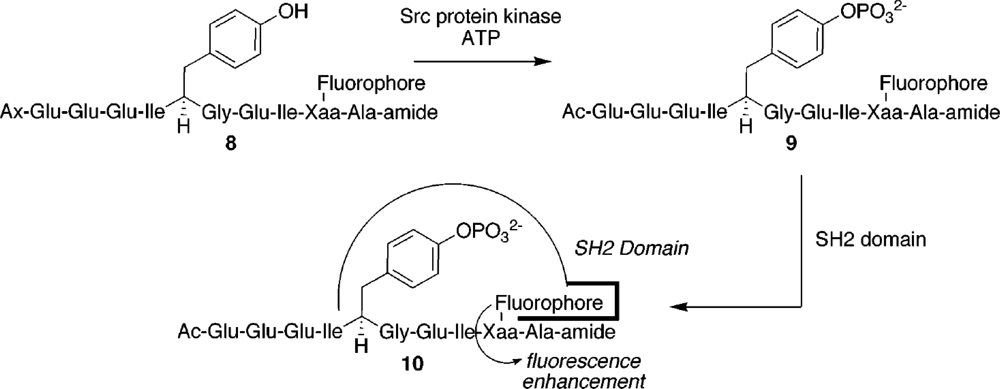
<p>Several peptide biosensors equipped with environmentally-sensitive fluorophores were designed for the detection of enzymes and for monitoring their activity. David S. Lawrence and colleagues designed functionalized peptide libraries for the identification of efficient biosensor systems for protein kinases. Sensing of Src kinase was based on phosphorylation-driven disruption of stacking interactions between an extrinsic fluorophore and the target tyrosine residue in a peptide substrate [<xref ref-type="bibr" rid="b39-sensors-10-03126">39</xref>,<xref ref-type="bibr" rid="b40-sensors-10-03126">40</xref>]. In a different design, an environmentally sensitive fluorophore was covalently attached to a tyrosine-containing peptide substrate recognized by Src kinase and the assay was performed in the presence of the phosphotyrosine binding domain Lck-SH2 [<xref ref-type="bibr" rid="b41-sensors-10-03126">41</xref>]. Upon tyrosine phosphorylation, the fluorophore experienced changes in the local environment caused by the peptide binding to Lck-SH2 (<xref ref-type="fig" rid="f5-sensors-10-03126">Scheme 1</xref>). A similar approach was used for the detection of serine phosphorylation by the cAMP-dependent protein kinase [<xref ref-type="bibr" rid="b42-sensors-10-03126">42</xref>]. Barbara Imperiali and colleagues designed a generic kinase sensor containing a variable enzyme recognition sequence and a fluorescent amino acid residue, Sox (from 8-hydroxy-5-(N,N-dimethylsulfonamido)-2-methylquinoline), which displays chelation-enhanced emission when binding Mg<sup>2+</sup>. Phosphorylation of a target serine, threonine or tyrosine residue increased the affinity of Sox for the metal ion, which resulted in enhanced fluorescence intensity [<xref ref-type="bibr" rid="b43-sensors-10-03126">43</xref>,<xref ref-type="bibr" rid="b44-sensors-10-03126">44</xref>].</p>
<p>Fluorescent peptide reporters for histone acetyltransferase were designed by synthesizing a 20-residue peptide corresponding to the N-terminal part of histone H4 followed by functionalization with dansyl or fluorescein [<xref ref-type="bibr" rid="b45-sensors-10-03126">45</xref>]. Charge reduction of the peptide following acetylation of target lysines resulted in a small increase in the emission from the fluorophores. Along similar lines, biosensor peptides for arginine methyltransferase 1 were also designed [<xref ref-type="bibr" rid="b46-sensors-10-03126">46</xref>].</p></sec>
<sec>
<label>2.2.</label>
<title>Construction of Peptide Biosensors</title>
<sec>
<label>2.2.1.</label>
<title>Strategies for the incorporation of fluorescent dye in the peptide</title>
<p>Two main strategies for covalent incorporation of the fluorophore in the peptide can be distinguished. The first one involves post-synthetic coupling at the N-terminal amine [<xref ref-type="bibr" rid="b21-sensors-10-03126">21</xref>–<xref ref-type="bibr" rid="b23-sensors-10-03126">23</xref>,<xref ref-type="bibr" rid="b28-sensors-10-03126">28</xref>,<xref ref-type="bibr" rid="b30-sensors-10-03126">30</xref>] or at the side chains of cysteines [<xref ref-type="bibr" rid="b19-sensors-10-03126">19</xref>,<xref ref-type="bibr" rid="b29-sensors-10-03126">29</xref>] or lysines [<xref ref-type="bibr" rid="b24-sensors-10-03126">24</xref>–<xref ref-type="bibr" rid="b27-sensors-10-03126">27</xref>,<xref ref-type="bibr" rid="b31-sensors-10-03126">31</xref>].</p>
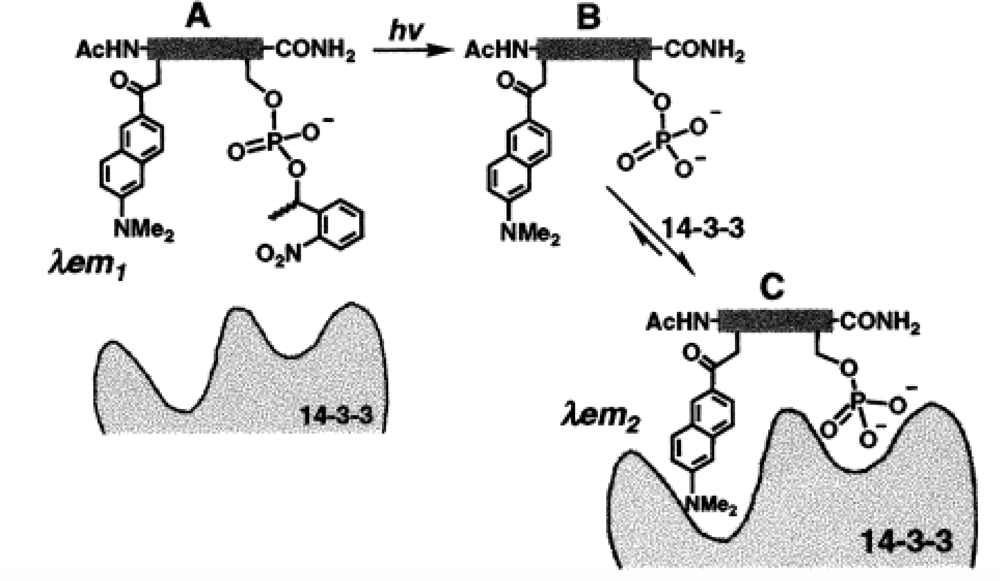
<p>The second strategy involves the incorporation of unnatural fluorescent amino acids during peptide synthesis. Barbara Imperiali’s group has developed the functionalized amino acids DANA [<xref ref-type="bibr" rid="b33-sensors-10-03126">33</xref>] and 4-DAPA (4-N,N-dimethylaminophtalimidoalanine, [<xref ref-type="bibr" rid="b35-sensors-10-03126">35</xref>]), and used them to probe the phosphorylation-dependent binding of an octapeptide to a 14-3-3 protein. The 14-3-3 proteins are essential intermediates in cell cycle regulation, acting through phosphorylation-dependent protein-protein interactions. A caged fluorescent octo-phospho-peptide was synthesized that exposed a phosphoserine residue upon irradiation, allowing the peptide to bind to the 14-3-3 protein and modulate the emission properties of the fluorescent amino acid (<xref ref-type="fig" rid="f6-sensors-10-03126">Scheme 2</xref>). A shift in the maximum emission wavelength was observed, along with a 4- and 6-fold increase in the emission intensity for the DANA- and 4-DAPA-containing peptides, respectively.</p>
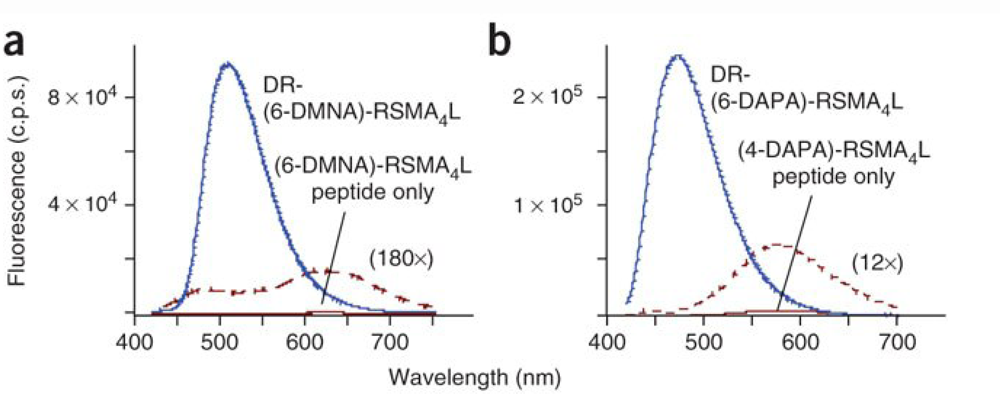
<p>The amino acid 6-DMNA (6-N,N-dimethylamino-2,3-naphtalimidoalanine) was introduced adjacent to the conserved binding determinants of several peptides and exhibited up to an 11-fold change in fluorescence emission intensity upon binding to selected Src homology 2 (SH2) phosphotyrosine binding domains [<xref ref-type="bibr" rid="b37-sensors-10-03126">37</xref>]. Much larger signal enhancements were observed for the binding of peptides containing 4-DAPA (470-fold) and 6-DMNA (1100-fold) to class II MHC proteins [<xref ref-type="bibr" rid="b38-sensors-10-03126">38</xref>] (<xref ref-type="fig" rid="f2-sensors-10-03126">Figure 2</xref>). In two other papers, DANA was introduced in place of a phenylalanine to construct a fluorescent δ-opioid antagonist [<xref ref-type="bibr" rid="b32-sensors-10-03126">32</xref>] and at three positions of a CCK-binding peptide to provide insights into distinct modes of binding and activation of type A and B CCK receptors [<xref ref-type="bibr" rid="b34-sensors-10-03126">34</xref>].</p></sec>
<sec>
<label>2.2.2.</label>
<title>Position of the fluorophore in the amino acid sequence</title>
<p>It is difficult to predict the optimal position for labeling. It should be chosen so that the microenvironment of the fluorophore is altered upon analyte binding. In protein biosensors, this is achieved either (i) by analyte-dye contacts in or (ii) near the analyte binding site, or (iii) by conformational effects occurring over substantially longer intra-protein distances, affecting a fluorophore located distantly from the analyte binding site [<xref ref-type="bibr" rid="b47-sensors-10-03126">47</xref>,<xref ref-type="bibr" rid="b48-sensors-10-03126">48</xref>]. The design of a molecular sensor thus requires some knowledge about the interaction, gained from structural or functional studies, in order to identify positions for which fluorescent labeling allows analyte detection without perturbing its binding. Not only the position, but also the nature of the dye plays a critical role in the performance of a biosensor. It has been observed that simply changing the fluorophore at the same site of a protein can lead to differences in binding parameters [<xref ref-type="bibr" rid="b8-sensors-10-03126">8</xref>,<xref ref-type="bibr" rid="b18-sensors-10-03126">18</xref>,<xref ref-type="bibr" rid="b49-sensors-10-03126">49</xref>,<xref ref-type="bibr" rid="b50-sensors-10-03126">50</xref>]. A combinatorial approach with various fluorophores is recommended to optimize sensitivity [<xref ref-type="bibr" rid="b51-sensors-10-03126">51</xref>] and affinity.</p>
<p>Site-dependent differences in fluorescence response upon analyte binding to a peptide biosensor were quantified in three different studies.</p>
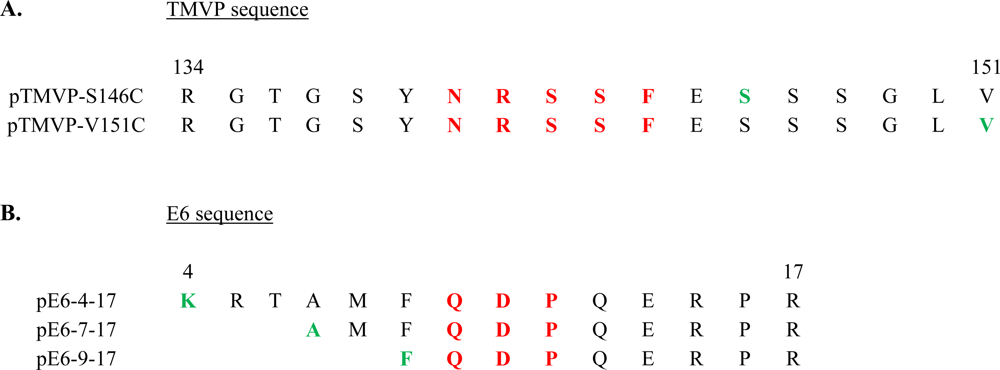
<p>Enander <italic>et al.</italic> [<xref ref-type="bibr" rid="b29-sensors-10-03126">29</xref>] constructed a peptide-based ratiometric biosensor for the detection of an antibody fragment. Based on a detailed characterization of the functional epitope corresponding to residues 134–151 of the tobacco mosaic virus protein (TMVP), two positions were targeted (<xref ref-type="fig" rid="f3-sensors-10-03126">Figure 3A</xref>) for labeling with a two-band fluorophore, one in the immediate vicinity of positions mapped as essential for binding (position 146) and one in the C-terminus (position 151). Only one out of these two constructs behaved as a biosensor. When the peptide was labeled in the C-terminus, seven amino acids away from the essential residues of the epitope, the intensity ratio of the two emission bands changed by 40% upon analyte binding, while labeling two amino acids away from the residues most important for binding resulted in a construct that completely lacked ratiometric sensing ability. Choulier <italic>et al.</italic> [<xref ref-type="bibr" rid="b30-sensors-10-03126">30</xref>] performed a similar study on a different antigen-antibody system. Three peptides, corresponding to the N-terminal sequence of the oncoproteine E6 of human papillomavirus (HPV) 16, were labeled at different distances from the epitope (<xref ref-type="fig" rid="f3-sensors-10-03126">Figure 3B</xref>): zero, two and five residues away from the first position in the sequence mapped as important for binding of the antibody fragment. One of these three peptidic constructs possessed sensing properties, namely the peptide for which the dye was coupled two residues away from the epitope. Addition of the antibody fragment to this peptide caused a 47 % decrease in the ratio of its two emission bands.</p>
<p>These two examples indicate that the fluorescence response largely depends on the site of fluorophore incorporation, and also that its distance to residues essential for analyte binding cannot be used as a simple parameter for sensor optimization. Similar results have been presented for protein biosensors earlier [<xref ref-type="bibr" rid="b48-sensors-10-03126">48</xref>,<xref ref-type="bibr" rid="b50-sensors-10-03126">50</xref>,<xref ref-type="bibr" rid="b52-sensors-10-03126">52</xref>–<xref ref-type="bibr" rid="b58-sensors-10-03126">58</xref>].</p>
<p>Recently, Sainlos <italic>et al.</italic> [<xref ref-type="bibr" rid="b36-sensors-10-03126">36</xref>] developed a general screening strategy in the design of environmentally sensitive peptidic probes for PDZ domains. The design strategy includes two steps: (1) development of a peptide library to screen for the optimal site for fluorophore attachment and (2) screening of different peptide sequences for improved affinity and specificity while keeping a fixed fluorophore position. The initial library, consisting of 11 decamer peptides derived from the C-terminal sequence of stargazin (<sup>−9</sup>NTANRRTTPV<sup>0</sup>) that included 4-DAPA derivatives in eight different positions, was screened against three PDZ constructs. Positions 0 and −2 were not tested as they are essential for binding. Further optimization was carried out by adjusting the length of the linker bearing the dye (from one to three methylene groups). After this first step, out of eight coupling locations, three produced sensors with a &lt;10-fold increase in fluorescence, two with a 10–20-fold increase and three with a &gt;25-fold increase. Maximum fluorescence increase was obtained with the fluorescent amino acid in position −5, bearing a 2-methylene linker (β). In a second step, this position and linker size were kept fixed in the C-terminal sequences of a series of four known PDZ binders. The highest fluorescence increase was 265-fold for the GluR1 sequence (<sup>−9</sup>SGδPβGATGV<sup>0</sup>, δ being norleucine) with the PDZ domain Shank3. Both the nature of the fluorophore and its site of conjugation seem important for maximal signal change.</p></sec></sec></sec>
<sec>
<label>3.</label>
<title>Synthetic Peptide Sensors: Recognition Element Grafted on a Peptide Scaffold</title>
<p>In the examples given in Section 2, the sequence of the peptide was chosen in order to provide the recognition site for the analyte. A different role for the peptide has been presented in a series of papers by the groups of Akihiko Ueno and Lars Baltzer. Here, the folding propensity of polypeptides is a key property that makes them useful as scaffolds, onto which non-peptidic molecules for recognition can be grafted along with fluorophores for signaling. A well-defined structure provides directionality of incorporated groups, which is an important parameter in the design and optimization of biosensor performance. Also, the distance between recognition unit and fluorophore can be systematically varied by addressing different amino acid side chains in the scaffold.</p>
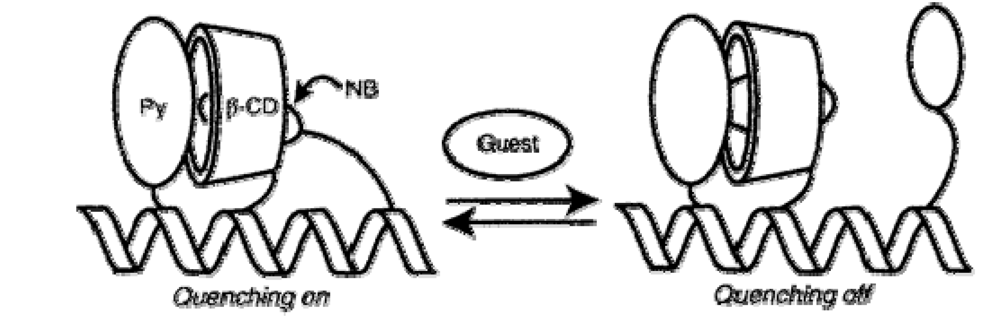
<p>A number of biosensor molecules based on a 17-residue, <italic>de novo</italic> designed α-helical peptide were presented, where different cyclodextrins were employed for recognition of bile acids and aliphatic alcohols [<xref ref-type="bibr" rid="b59-sensors-10-03126">59</xref>–<xref ref-type="bibr" rid="b67-sensors-10-03126">67</xref>]. The sensing principle was based on the disruption of an inclusion complex between cyclodextrin and a fluorophore upon binding of the analyte (guest). In the simplest design, dansyl or dimethylaminobenzoyl was attached in position i, i + 4 or i, i + 7 with respect to a β-cyclodextrin moiety, which corresponds to the two groups being separated by one or two turns of the helix scaffold while oriented similarly in space [<xref ref-type="bibr" rid="b59-sensors-10-03126">59</xref>,<xref ref-type="bibr" rid="b65-sensors-10-03126">65</xref>]. This arrangement allowed the fluorophore to interact with the hydrophobic interior of the cyclodextrin moiety. Upon introduction of a guest molecule, e.g., ursodeoxycholic acid, displacement of the fluorophore was reflected in quenching of its emission. In a different construct, α- or β-cyclodextrin was coupled to the scaffold along with pyrene and its quencher nitrobenzene [<xref ref-type="bibr" rid="b63-sensors-10-03126">63</xref>,<xref ref-type="bibr" rid="b66-sensors-10-03126">66</xref>]. The signaling principle was based on nitrobenzene and the analyte competing for the binding site inside cyclodextrin, affecting the distance between fluorophore and quencher and thus the fluorescence intensity (<xref ref-type="fig" rid="f4-sensors-10-03126">Figure 4</xref>). Yet another design approach involved functionalization with two molecules of naphthalene or pyrene, and analyte binding was monitored from excimer fluorescence [<xref ref-type="bibr" rid="b60-sensors-10-03126">60</xref>–<xref ref-type="bibr" rid="b62-sensors-10-03126">62</xref>,<xref ref-type="bibr" rid="b64-sensors-10-03126">64</xref>]. Bile acids and ring-structured alcohols were sensed using constructs with β- [<xref ref-type="bibr" rid="b59-sensors-10-03126">59</xref>,<xref ref-type="bibr" rid="b63-sensors-10-03126">63</xref>–<xref ref-type="bibr" rid="b65-sensors-10-03126">65</xref>,<xref ref-type="bibr" rid="b67-sensors-10-03126">67</xref>] or γ-cyclodextrin [<xref ref-type="bibr" rid="b60-sensors-10-03126">60</xref>–<xref ref-type="bibr" rid="b62-sensors-10-03126">62</xref>] while α-cyclodextrin was used for short chain aliphatic alcohols [<xref ref-type="bibr" rid="b66-sensors-10-03126">66</xref>].</p>
<p>In a similar approach, <italic>de novo</italic> designed helix-loop-helix polypeptides that dimerize into four-helix bundles upon folding were functionalized to become molecular biosensors for protein analytes. In the initial design, dansyl and a benzenesulfonamide derivative were attached to separate helices of the scaffold [<xref ref-type="bibr" rid="b68-sensors-10-03126">68</xref>,<xref ref-type="bibr" rid="b69-sensors-10-03126">69</xref>]. The presence of carbonic anhydrase, which binds specifically to benzenesulfonamide, was accompanied by a disruption of the dimer [<xref ref-type="bibr" rid="b70-sensors-10-03126">70</xref>] and a significant intensity increase of the dansyl fluorescence.</p></sec>
<sec>
<label>4.</label>
<title>Affinity Characterization of the Interaction between Biosensor and Analyte</title>
<p>The equilibrium dissociation constant (K<sub>D</sub>) of interactions between peptide biosensors and their analytes can be determined from the hyperbolic binding curves obtained by titration of a constant concentration of peptide biosensor with increased concentrations of analyte [<xref ref-type="bibr" rid="b13-sensors-10-03126">13</xref>,<xref ref-type="bibr" rid="b19-sensors-10-03126">19</xref>,<xref ref-type="bibr" rid="b20-sensors-10-03126">20</xref>,<xref ref-type="bibr" rid="b27-sensors-10-03126">27</xref>,<xref ref-type="bibr" rid="b31-sensors-10-03126">31</xref>,<xref ref-type="bibr" rid="b35-sensors-10-03126">35</xref>]. Affinities determined in this way vary from low nM to 500 μM depending on the system under study. In two studies [<xref ref-type="bibr" rid="b30-sensors-10-03126">30</xref>,<xref ref-type="bibr" rid="b36-sensors-10-03126">36</xref>], competition binding assays with non-fluorescent peptides recognizing the same analyte as the peptide biosensor further complemented titration experiments and allowed for determination of the relative affinities of unlabeled peptides for their protein analytes. The binding affinities were also independently evaluated by using non-fluorescence-based methods; isothermal titration calorimetry (ITC, [<xref ref-type="bibr" rid="b36-sensors-10-03126">36</xref>]) and surface plasmon resonance (SPR, [<xref ref-type="bibr" rid="b30-sensors-10-03126">30</xref>]). In both cases, K<sub>D</sub> values determined by ITC or SPR were in the same range as those determined by fluorescence-based procedures.</p>
<p>Based on the helix-loop-helix scaffolds designed by Baltzer and colleagues, biosensors with affinities towards carbonic anhydrase spanning three orders of magnitude were designed by varying the length of an aliphatic spacer attached to the benzenesulfonamide moiety [<xref ref-type="bibr" rid="b69-sensors-10-03126">69</xref>,<xref ref-type="bibr" rid="b71-sensors-10-03126">71</xref>]. Although interactions between the spacer and a hydrophobic pocket in the protein contributed to binding, the scaffold itself played an important role in providing both sterical constraints and chemical functionalities that affected the affinity [<xref ref-type="bibr" rid="b71-sensors-10-03126">71</xref>].</p></sec>
<sec>
<label>5.</label>
<title>Limit of Detection</title>
<p>Singly labeled reagentless biosensors based on proteins and used for analyte quantification displayed limits of detection (LOD) in the submillimolar range for maltose [<xref ref-type="bibr" rid="b54-sensors-10-03126">54</xref>], and in the submicromolar range for glucose [<xref ref-type="bibr" rid="b72-sensors-10-03126">72</xref>], glutamine [<xref ref-type="bibr" rid="b17-sensors-10-03126">17</xref>,<xref ref-type="bibr" rid="b73-sensors-10-03126">73</xref>], and β-lactam antibiotic [<xref ref-type="bibr" rid="b74-sensors-10-03126">74</xref>].</p>
<p>The LOD of analyte by peptide biosensors was reported only in a few cases. The protein detection method established with folded peptides (see Section2.1) allowed for the detection of 5 μg/mL (# 90 nM) of α-amylase [<xref ref-type="bibr" rid="b24-sensors-10-03126">24</xref>]. The LOD of the antibody fragment scFv1F4<sub>Q34S</sub> by the pE6 peptide biosensor [<xref ref-type="bibr" rid="b30-sensors-10-03126">30</xref>] was 15 nM in buffer, and 50–100 nM in a more complex medium (bovine serum albumin (BSA) 100 μg/mL). Normal concentrations of specific antibodies and BSA in serum are around 50 μg/ml (330 nM) and 35–50 mg/ml, respectively.</p></sec>
<sec>
<label>6.</label>
<title>Perspectives for Peptide Biosensors</title>
<p>The performances of peptide and protein sensors were recently compared [<xref ref-type="bibr" rid="b30-sensors-10-03126">30</xref>] based on various antigen-antibody interactions that display affinities in the 0.1–20 nM range. In these studies, the receptor was either an antibody [<xref ref-type="bibr" rid="b52-sensors-10-03126">52</xref>,<xref ref-type="bibr" rid="b53-sensors-10-03126">53</xref>], or a peptide antigen [<xref ref-type="bibr" rid="b29-sensors-10-03126">29</xref>,<xref ref-type="bibr" rid="b30-sensors-10-03126">30</xref>], but the analytes were large in all cases (between 14 and 54 kDa). A biosensor was defined as operational if it showed a &gt;35% fluorescence intensity variation upon analyte binding. Out of the total number of sensors constructed in each study (maximum 10 for antibody receptors and 3 for peptide receptors), 20–50% behaved as biosensors. In these studies, the proportion of efficient fluorescent sensors was therefore in the same range whether the receptor was a protein or a peptide. This observation makes peptide biosensors promising tools for developing new applications. With the availability of automatedchemical synthesis of long peptide fragments at high scale (100 mg of a 100 amino acid peptide can be routinely synthesized at &gt;99% purity) and low price, rational or combinatorial peptide libraries can be straightforwardly produced for the optimization of recognition sites and positions for fluorophore attachment. However, the main challenge in the future will be to make peptide-based fluorescent biosensors useful for sensitive detection of bio-analytes in complex media (e.g., serum). In order to accomplish this, problems with interference from non-analyte components in the sample have to be addressed. Specifically, the possibility of enzymatic peptide degradation and of non-specific binding of sample components to the peptide, causing irrelevant sensor signals, has to be taken into consideration. The frequent problem of autofluorescence can be avoided by employing long-wavelength dyes, which are usually very bright although they may be less sensitive to environmental changes compared to fluorophores excited in the UV region. Ratiometric sensor peptides, where the relative rather than the absolute intensity change upon analyte binding is monitored, should also be very useful in this respect.</p>
<p>In conclusion, fluorescent sensor peptides have already proven useful in a number of applications, ranging from analyte detection to elucidation of molecular details of protein-peptide and protein-protein interactions. It is expected that their general applicability with respect to analyte quantification – beyond proof-of-concept – will be expanded by combining combinatorial methods for peptide design with further improvement of fluorophores and fluorescent amino acids in terms of sensitivity to environmental changes. The most robust protein detection system will then probably rely on fingerprints obtained from arrayed sensor peptides.</p></sec></body>
<back>
<ack>
<p>We are grateful to Danièle Altschuh for valuable comments on the manuscript.</p></ack>
<ref-list>
<title>References</title>
<ref id="b1-sensors-10-03126"><label>1.</label><citation citation-type="journal"><person-group person-group-type="author"><name><surname>Hellinga</surname><given-names>H.W.</given-names></name><name><surname>Marvin</surname><given-names>J.S.</given-names></name></person-group><article-title>Protein engineering and the development of generic biosensors</article-title><source>Trends. Biotechnol</source><year>1998</year><volume>16</volume><fpage>183</fpage><lpage>189</lpage><pub-id pub-id-type="doi">10.1016/S0167-7799(98)01174-3</pub-id><pub-id pub-id-type="pmid">9586241</pub-id></citation></ref>
<ref id="b2-sensors-10-03126"><label>2.</label><citation citation-type="journal"><person-group person-group-type="author"><name><surname>Loving</surname><given-names>G.S.</given-names></name><name><surname>Sainlos</surname><given-names>M.</given-names></name><name><surname>Imperiali</surname><given-names>B.</given-names></name></person-group><article-title>Monitoring protein interactions and dynamics with solvatochromic fluorophores</article-title><source>Trends Biotechnol</source><year>2010</year><volume>28</volume><fpage>73</fpage><lpage>83</lpage><pub-id pub-id-type="doi">10.1016/j.tibtech.2009.11.002</pub-id><pub-id pub-id-type="pmid">19962774</pub-id></citation></ref>
<ref id="b3-sensors-10-03126"><label>3.</label><citation citation-type="journal"><person-group person-group-type="author"><name><surname>Wang</surname><given-names>H.</given-names></name><name><surname>Nakata</surname><given-names>E.</given-names></name><name><surname>Hamachi</surname><given-names>I.</given-names></name></person-group><article-title>Recent progress in strategies for the creation of protein-based fluorescent biosensors</article-title><source>Chembiochem</source><year>2009</year><volume>10</volume><fpage>2560</fpage><lpage>2577</lpage><pub-id pub-id-type="doi">10.1002/cbic.200900249</pub-id><pub-id pub-id-type="pmid">19693761</pub-id></citation></ref>
<ref id="b4-sensors-10-03126"><label>4.</label><citation citation-type="journal"><person-group person-group-type="author"><name><surname>Mims</surname><given-names>M.P.</given-names></name><name><surname>Sturgis</surname><given-names>C.B.</given-names></name><name><surname>Sparrow</surname><given-names>J.T.</given-names></name><name><surname>Morrisett</surname><given-names>J.D.</given-names></name></person-group><article-title>Acrylodan can label amino as well as sulfhydryl groups: results with low-density lipoprotein, lipoprotein[a], and lipid-free proteins</article-title><source>Biochemistry</source><year>1993</year><volume>32</volume><fpage>9215</fpage><lpage>9120</lpage><pub-id pub-id-type="doi">10.1021/bi00086a029</pub-id><pub-id pub-id-type="pmid">8369288</pub-id></citation></ref>
<ref id="b5-sensors-10-03126"><label>5.</label><citation citation-type="journal"><person-group person-group-type="author"><name><surname>Yem</surname><given-names>A.W.</given-names></name><name><surname>Epps</surname><given-names>D.E.</given-names></name><name><surname>Mathews</surname><given-names>W.R.</given-names></name><name><surname>Guido</surname><given-names>D.M.</given-names></name><name><surname>Richard</surname><given-names>K.A.</given-names></name><name><surname>Staite</surname><given-names>N.D.</given-names></name><name><surname>Deibel</surname><given-names>M.R.</given-names></name></person-group><article-title>Sitespecific chemical modification of interleukin-1-beta by acrylodan at cysteine-8 and lysine-103</article-title><source>J. Biol. Chem</source><year>1992</year><volume>267</volume><fpage>3122</fpage><lpage>3128</lpage><pub-id pub-id-type="pmid">1531337</pub-id></citation></ref>
<ref id="b6-sensors-10-03126"><label>6.</label><citation citation-type="journal"><person-group person-group-type="author"><name><surname>Cohen</surname><given-names>B.E.</given-names></name><name><surname>McAnaney</surname><given-names>T.B.</given-names></name><name><surname>Park</surname><given-names>E.S.</given-names></name><name><surname>Jan</surname><given-names>Y.N.</given-names></name><name><surname>Boxer</surname><given-names>S.G.</given-names></name><name><surname>Jan</surname><given-names>L.Y.</given-names></name></person-group><article-title>Probing protein electrostatics with a synthetic fluorescent amino acid</article-title><source>Science</source><year>2002</year><volume>296</volume><fpage>1700</fpage><lpage>1703</lpage><pub-id pub-id-type="doi">10.1126/science.1069346</pub-id><pub-id pub-id-type="pmid">12040199</pub-id></citation></ref>
<ref id="b7-sensors-10-03126"><label>7.</label><citation citation-type="journal"><person-group person-group-type="author"><name><surname>Bock</surname><given-names>P.E.</given-names></name></person-group><article-title>Active-site-selective labeling of blood coagulation proteinases with fluorescence probes by the use of thioester peptide chloromethyl ketones</article-title><source>J. Biol. Chem</source><year>1992</year><volume>267</volume><fpage>14974</fpage><lpage>14981</lpage><pub-id pub-id-type="pmid">1634536</pub-id></citation></ref>
<ref id="b8-sensors-10-03126"><label>8.</label><citation citation-type="journal"><person-group person-group-type="author"><name><surname>Verhamme</surname><given-names>I.M.</given-names></name><name><surname>Olson</surname><given-names>S.T.</given-names></name><name><surname>Tollefsen</surname><given-names>D.M.</given-names></name><name><surname>Bock</surname><given-names>P.E.</given-names></name></person-group><article-title>Binding of exosite ligands to human thrombin. Re-evaluation of allosteric linkage between thrombin exosites I and II</article-title><source>J. Biol. Chem</source><year>2002</year><volume>277</volume><fpage>6788</fpage><lpage>6798</lpage><pub-id pub-id-type="doi">10.1074/jbc.M110257200</pub-id><pub-id pub-id-type="pmid">11724802</pub-id></citation></ref>
<ref id="b9-sensors-10-03126"><label>9.</label><citation citation-type="journal"><person-group person-group-type="author"><name><surname>Pollack</surname><given-names>S.J.</given-names></name><name><surname>Nakayama</surname><given-names>G.R.</given-names></name><name><surname>Schultz</surname><given-names>P.G.</given-names></name></person-group><article-title>Introduction of nucleophiles and spectroscopic probes into antibody combining sites</article-title><source>Science</source><year>1988</year><volume>242</volume><fpage>1038</fpage><lpage>1040</lpage><pub-id pub-id-type="doi">10.1126/science.3194752</pub-id><pub-id pub-id-type="pmid">3194752</pub-id></citation></ref>
<ref id="b10-sensors-10-03126"><label>10.</label><citation citation-type="journal"><person-group person-group-type="author"><name><surname>Hamachi</surname><given-names>I.</given-names></name><name><surname>Nagase</surname><given-names>T.</given-names></name><name><surname>Shinkai</surname><given-names>S.</given-names></name></person-group><article-title>A general semisynthetic method for fluorescent saccharide-biosensors based on a lectin</article-title><source>J. Am. Chem. Soc</source><year>2000</year><volume>122</volume><fpage>12065</fpage><lpage>12066</lpage><pub-id pub-id-type="doi">10.1021/ja002044d</pub-id></citation></ref>
<ref id="b11-sensors-10-03126"><label>11.</label><citation citation-type="journal"><person-group person-group-type="author"><name><surname>Nakata</surname><given-names>E.</given-names></name><name><surname>Nagase</surname><given-names>T.</given-names></name><name><surname>Shinkai</surname><given-names>S.</given-names></name><name><surname>Hamachi</surname><given-names>I.</given-names></name></person-group><article-title>Coupling a natural receptor protein with an artificial receptor to afford a semisynthetic fluorescent biosensor</article-title><source>J. Am. Chem. Soc</source><year>2004</year><volume>126</volume><fpage>490</fpage><lpage>495</lpage><pub-id pub-id-type="doi">10.1021/ja035631i</pub-id><pub-id pub-id-type="pmid">14719946</pub-id></citation></ref>
<ref id="b12-sensors-10-03126"><label>12.</label><citation citation-type="journal"><person-group person-group-type="author"><name><surname>Nakata</surname><given-names>E.</given-names></name><name><surname>Wang</surname><given-names>H.</given-names></name><name><surname>Hamachi</surname><given-names>I.</given-names></name></person-group><article-title>Ratiometric fluorescent biosensor for real-time and label-free monitoring of fine saccharide metabolic pathways</article-title><source>ChemBioChem</source><year>2008</year><volume>9</volume><fpage>25</fpage><lpage>28</lpage><pub-id pub-id-type="doi">10.1002/cbic.200700364</pub-id><pub-id pub-id-type="pmid">18061910</pub-id></citation></ref>
<ref id="b13-sensors-10-03126"><label>13.</label><citation citation-type="journal"><person-group person-group-type="author"><name><surname>Ojida</surname><given-names>A.</given-names></name><name><surname>Tsutsumi</surname><given-names>H.</given-names></name><name><surname>Kasagi</surname><given-names>N.</given-names></name><name><surname>Hamachi</surname><given-names>I.</given-names></name></person-group><article-title>Suzuki coupling for protein modification</article-title><source>Tetrahedron Lett</source><year>2005</year><volume>46</volume><fpage>3301</fpage><lpage>3305</lpage><pub-id pub-id-type="doi">10.1016/j.tetlet.2005.03.094</pub-id></citation></ref>
<ref id="b14-sensors-10-03126"><label>14.</label><citation citation-type="journal"><person-group person-group-type="author"><name><surname>Becker</surname><given-names>C.F.W.</given-names></name><name><surname>Hunter</surname><given-names>C.L.</given-names></name><name><surname>Seidel</surname><given-names>R.P.</given-names></name><name><surname>Kent</surname><given-names>S.B.H.</given-names></name><name><surname>Goody</surname><given-names>R.S.</given-names></name><name><surname>Engelhard</surname><given-names>M.</given-names></name></person-group><article-title>A sensitive fluorescence monitor for the detection of activated Ras: total chemical synthesis of site-speci¢cally labeled Ras binding domain of c-Raf1 immobilized on a surface</article-title><source>Chem. Biol</source><year>2001</year><volume>8</volume><fpage>243</fpage><lpage>252</lpage><pub-id pub-id-type="doi">10.1016/S1074-5521(01)00003-5</pub-id><pub-id pub-id-type="pmid">11306349</pub-id></citation></ref>
<ref id="b15-sensors-10-03126"><label>15.</label><citation citation-type="journal"><person-group person-group-type="author"><name><surname>Viljanen</surname><given-names>J.</given-names></name><name><surname>Larsson</surname><given-names>J.</given-names></name><name><surname>Larsson</surname><given-names>A.</given-names></name><name><surname>Broo</surname><given-names>K.S.</given-names></name></person-group><article-title>A multipurpose receptor composed of promiscuous proteins. Analyte detection through pattern recognition</article-title><source>Bioconjugate Chem</source><year>2007</year><volume>18</volume><fpage>1935</fpage><lpage>1945</lpage><pub-id pub-id-type="doi">10.1021/bc700247x</pub-id></citation></ref>
<ref id="b16-sensors-10-03126"><label>16.</label><citation citation-type="journal"><person-group person-group-type="author"><name><surname>de Lorimier</surname><given-names>R.M.</given-names></name><name><surname>Tian</surname><given-names>Y.</given-names></name><name><surname>Hellinga</surname><given-names>H.W.</given-names></name></person-group><article-title>Binding and signaling of surface-immobilized reagentless fluorescent biosensors derived from periplasmic binding proteins</article-title><source>Protein Sci</source><year>2006</year><volume>15</volume><fpage>1936</fpage><lpage>1944</lpage><pub-id pub-id-type="doi">10.1110/ps.062261606</pub-id><pub-id pub-id-type="pmid">16823040</pub-id></citation></ref>
<ref id="b17-sensors-10-03126"><label>17.</label><citation citation-type="journal"><person-group person-group-type="author"><name><surname>Wada</surname><given-names>A</given-names></name><name><surname>Mie</surname><given-names>M.</given-names></name><name><surname>Aizawa</surname><given-names>M.</given-names></name><name><surname>Lahoud</surname><given-names>P.</given-names></name><name><surname>Cass</surname><given-names>A.E.G.</given-names></name><name><surname>Kobatake</surname><given-names>E.</given-names></name></person-group><article-title>Design and construction of glutamine binding proteins with a self-adhering capability to unmodified hydrophobic surfaces as reagentless fluorescence sensing devices</article-title><source>J. Am. Chem. Soc</source><year>2003</year><volume>125</volume><fpage>16228</fpage><lpage>16234</lpage><pub-id pub-id-type="doi">10.1021/ja036459l</pub-id><pub-id pub-id-type="pmid">14692764</pub-id></citation></ref>
<ref id="b18-sensors-10-03126"><label>18.</label><citation citation-type="journal"><person-group person-group-type="author"><name><surname>Gilardi</surname><given-names>G.</given-names></name><name><surname>Zhou</surname><given-names>L.Q.</given-names></name><name><surname>Hibbert</surname><given-names>L.</given-names></name><name><surname>Cass</surname><given-names>A.E.G.</given-names></name></person-group><article-title>Engineering the maltose binding protein for reagentless fluorescence sensing</article-title><source>Anal. Chem</source><year>1994</year><volume>66</volume><fpage>3840</fpage><lpage>3847</lpage><pub-id pub-id-type="doi">10.1021/ac00093a047</pub-id><pub-id pub-id-type="pmid">7802263</pub-id></citation></ref>
<ref id="b19-sensors-10-03126"><label>19.</label><citation citation-type="journal"><person-group person-group-type="author"><name><surname>Schmid</surname><given-names>D.</given-names></name><name><surname>Baici</surname><given-names>A.</given-names></name><name><surname>Gehring</surname><given-names>H.</given-names></name><name><surname>Christen</surname><given-names>P.</given-names></name></person-group><article-title>Kinetics of molecular chaperone action</article-title><source>Science</source><year>1994</year><volume>263</volume><fpage>971</fpage><lpage>973</lpage><pub-id pub-id-type="doi">10.1126/science.8310296</pub-id><pub-id pub-id-type="pmid">8310296</pub-id></citation></ref>
<ref id="b20-sensors-10-03126"><label>20.</label><citation citation-type="journal"><person-group person-group-type="author"><name><surname>Fekkes</surname><given-names>P</given-names></name><name><surname>den Blaauwen</surname><given-names>T.</given-names></name><name><surname>Driessen</surname><given-names>A.J.</given-names></name></person-group><article-title>Diffusion-limited interaction between unfolded polypeptides and the Escherichia coli chaperone SecB</article-title><source>Biochemistry</source><year>1995</year><volume>34</volume><fpage>10078</fpage><lpage>10085</lpage><pub-id pub-id-type="doi">10.1021/bi00031a032</pub-id><pub-id pub-id-type="pmid">7543278</pub-id></citation></ref>
<ref id="b21-sensors-10-03126"><label>21.</label><citation citation-type="journal"><person-group person-group-type="author"><name><surname>Harikumar</surname><given-names>K.G.</given-names></name><name><surname>Pinon</surname><given-names>D.I.</given-names></name><name><surname>Wessels</surname><given-names>W.S.</given-names></name><name><surname>Prendergast</surname><given-names>F.G.</given-names></name><name><surname>Miller</surname><given-names>L.J.</given-names></name></person-group><article-title>Environment and mobility of a series of fluorescent reporters at the amino terminus of structurally related peptide agonists and antagonists bound to the cholecystokinin receptor</article-title><source>J. Biol. Chem</source><year>2002</year><volume>277</volume><fpage>18552</fpage><lpage>18560</lpage><pub-id pub-id-type="doi">10.1074/jbc.M201164200</pub-id><pub-id pub-id-type="pmid">11893747</pub-id></citation></ref>
<ref id="b22-sensors-10-03126"><label>22.</label><citation citation-type="journal"><person-group person-group-type="author"><name><surname>Harikumar</surname><given-names>K.G.</given-names></name><name><surname>Clain</surname><given-names>J.</given-names></name><name><surname>Pinon</surname><given-names>D.I.</given-names></name><name><surname>Dong</surname><given-names>M.</given-names></name><name><surname>Miller</surname><given-names>L.J.</given-names></name></person-group><article-title>Distinct molecular mechanisms for agonist peptide binding to types A and B cholecystokinin receptors demonstrated using fluorescence spectroscopy</article-title><source>J. Biol. Chem</source><year>2005</year><volume>280</volume><fpage>1044</fpage><lpage>1050</lpage><pub-id pub-id-type="pmid">15520004</pub-id></citation></ref>
<ref id="b23-sensors-10-03126"><label>23.</label><citation citation-type="journal"><person-group person-group-type="author"><name><surname>Harikumar</surname><given-names>K.G.</given-names></name><name><surname>Hosohata</surname><given-names>K.</given-names></name><name><surname>Pinon</surname><given-names>D.I.</given-names></name><name><surname>Miller</surname><given-names>L.J.</given-names></name></person-group><article-title>Use of probes with fluorescence indicator distributed throughout the pharmacophore to examine the peptide agonist-binding environment of the family B G protein-coupled secretin receptor</article-title><source>J Biol Chem</source><year>2006</year><volume>281</volume><fpage>2543</fpage><lpage>2550</lpage><pub-id pub-id-type="pmid">16319066</pub-id></citation></ref>
<ref id="b24-sensors-10-03126"><label>24.</label><citation citation-type="journal"><person-group person-group-type="author"><name><surname>Takahashi</surname><given-names>M.</given-names></name><name><surname>Nokihara</surname><given-names>K.</given-names></name><name><surname>Mihara</surname><given-names>H.</given-names></name></person-group><article-title>Construction of a protein-detection system using a loop peptide library with a fluorescence label</article-title><source>Chem Biol</source><year>2003</year><volume>10</volume><fpage>53</fpage><lpage>60</lpage><pub-id pub-id-type="doi">10.1016/S1074-5521(02)00308-3</pub-id><pub-id pub-id-type="pmid">12573698</pub-id></citation></ref>
<ref id="b25-sensors-10-03126"><label>25.</label><citation citation-type="journal"><person-group person-group-type="author"><name><surname>Usui</surname><given-names>K.</given-names></name><name><surname>Ojima</surname><given-names>T.</given-names></name><name><surname>Takahashi</surname><given-names>M.</given-names></name><name><surname>Nokihara</surname><given-names>K.</given-names></name><name><surname>Mihara</surname><given-names>H.</given-names></name></person-group><article-title>Peptide arrays with designed secondary structures for protein characterization using fluorescent fingerprint patterns</article-title><source>Biopolymers</source><year>2004</year><volume>76</volume><fpage>129</fpage><lpage>39</lpage><pub-id pub-id-type="doi">10.1002/bip.10568</pub-id><pub-id pub-id-type="pmid">15054893</pub-id></citation></ref>
<ref id="b26-sensors-10-03126"><label>26.</label><citation citation-type="journal"><person-group person-group-type="author"><name><surname>Tomizaki</surname><given-names>K.</given-names></name><name><surname>Mihara</surname><given-names>H.</given-names></name></person-group><article-title>A novel fluorescence sensing system using a photochromism-based assay (P-CHROBA) technique for the detection of target proteins</article-title><source>J. Mater. Chem</source><year>2005</year><volume>15</volume><fpage>2732</fpage><lpage>2740</lpage><pub-id pub-id-type="doi">10.1039/b501877n</pub-id></citation></ref>
<ref id="b27-sensors-10-03126"><label>27.</label><citation citation-type="journal"><person-group person-group-type="author"><name><surname>Usui</surname><given-names>K.</given-names></name><name><surname>Tomizaki</surname><given-names>K.Y.</given-names></name><name><surname>Ohyama</surname><given-names>T.</given-names></name><name><surname>Nokihara</surname><given-names>K.</given-names></name><name><surname>Mihara</surname><given-names>H.</given-names></name></person-group><article-title>A novel peptide microarray for protein detection and analysis utilizing a dry peptide array system</article-title><source>Mol. Biosyst</source><year>2006</year><volume>2</volume><fpage>113</fpage><lpage>121</lpage><pub-id pub-id-type="doi">10.1039/b514263f</pub-id><pub-id pub-id-type="pmid">16880928</pub-id></citation></ref>
<ref id="b28-sensors-10-03126"><label>28.</label><citation citation-type="journal"><person-group person-group-type="author"><name><surname>Wearsch</surname><given-names>P.A.</given-names></name><name><surname>Voglino</surname><given-names>L.</given-names></name><name><surname>Nicchitta</surname><given-names>C.V.</given-names></name></person-group><article-title>Structural transitions accompanying the activation of peptide binding to the endoplasmic reticulum Hsp90 chaperone GRP94</article-title><source>Biochemistry</source><year>1998</year><volume>37</volume><fpage>5709</fpage><lpage>5719</lpage><pub-id pub-id-type="doi">10.1021/bi9801006</pub-id><pub-id pub-id-type="pmid">9548957</pub-id></citation></ref>
<ref id="b29-sensors-10-03126"><label>29.</label><citation citation-type="journal"><person-group person-group-type="author"><name><surname>Enander</surname><given-names>K.</given-names></name><name><surname>Choulier</surname><given-names>L.</given-names></name><name><surname>Olsson</surname><given-names>A.L.</given-names></name><name><surname>Yushchenko</surname><given-names>D.A.</given-names></name><name><surname>Kanmert</surname><given-names>D.</given-names></name><name><surname>Klymchenko</surname><given-names>A.S.</given-names></name><name><surname>Demchenko</surname><given-names>A.P.</given-names></name><name><surname>Mely</surname><given-names>Y.</given-names></name><name><surname>Altschuh</surname><given-names>D.</given-names></name></person-group><article-title>A peptide-based, ratiometric biosensor construct for direct fluorescence detection of a protein analyte</article-title><source>Bioconjugate Chem</source><year>2008</year><volume>19</volume><fpage>1864</fpage><lpage>1870</lpage><pub-id pub-id-type="doi">10.1021/bc800159d</pub-id></citation></ref>
<ref id="b30-sensors-10-03126"><label>30.</label><citation citation-type="journal"><person-group person-group-type="author"><name><surname>Choulier</surname><given-names>L.</given-names></name><name><surname>Shvadchak</surname><given-names>V.V.</given-names></name><name><surname>Naidoo</surname><given-names>A.</given-names></name><name><surname>Klymchenko</surname><given-names>A.S.</given-names></name><name><surname>Mély</surname><given-names>Y.</given-names></name><name><surname>Altschuh</surname><given-names>D.</given-names></name></person-group><article-title>A peptide-based fluorescent ratiometric sensor for quantitative detection of proteins</article-title><source>Anal. Biochem</source><comment>(in press).</comment></citation></ref>
<ref id="b31-sensors-10-03126"><label>31.</label><citation citation-type="journal"><person-group person-group-type="author"><name><surname>Thompson</surname><given-names>M.</given-names></name></person-group><article-title>Synthesis, photophysical effects, and DNA targeting properties of oxazole yellow-peptide bioconjugates</article-title><source>Bioconjugate Chem</source><year>2006</year><volume>17</volume><fpage>507</fpage><lpage>513</lpage><pub-id pub-id-type="doi">10.1021/bc050307t</pub-id></citation></ref>
<ref id="b32-sensors-10-03126"><label>32.</label><citation citation-type="journal"><person-group person-group-type="author"><name><surname>Chen</surname><given-names>H.</given-names></name><name><surname>Chung</surname><given-names>N.N.</given-names></name><name><surname>Lemieux</surname><given-names>C.</given-names></name><name><surname>Zelent</surname><given-names>B.</given-names></name><name><surname>Vanderkooi</surname><given-names>J.M.</given-names></name><name><surname>Gryczynski</surname><given-names>I.</given-names></name><name><surname>Wilkes</surname><given-names>B.C.</given-names></name><name><surname>Schiller</surname><given-names>P.W.</given-names></name></person-group><article-title>[Aladan<sup>3</sup>]TIPP: A fluorescent δ-opioid antagonist with high δ-receptor binding affinity and δ selectivity</article-title><source>Biopolymers</source><year>2005</year><volume>80</volume><fpage>325</fpage><lpage>331</lpage><pub-id pub-id-type="doi">10.1002/bip.20200</pub-id><pub-id pub-id-type="pmid">15614807</pub-id></citation></ref>
<ref id="b33-sensors-10-03126"><label>33.</label><citation citation-type="journal"><person-group person-group-type="author"><name><surname>Vázquez</surname><given-names>M.E.</given-names></name><name><surname>Nitz</surname><given-names>M.</given-names></name><name><surname>Stehn</surname><given-names>J.</given-names></name><name><surname>Yaffe</surname><given-names>M.B.</given-names></name><name><surname>Barbara Imperiali</surname><given-names>B.</given-names></name></person-group><article-title>Fluorescent caged phosphoserine peptides as probes to investigate phosphorylation-dependent protein associations</article-title><source>J. Am. Chem. Soc</source><year>2003</year><volume>125</volume><fpage>10150</fpage><lpage>10151</lpage><pub-id pub-id-type="doi">10.1021/ja0351847</pub-id><pub-id pub-id-type="pmid">12926919</pub-id></citation></ref>
<ref id="b34-sensors-10-03126"><label>34.</label><citation citation-type="journal"><person-group person-group-type="author"><name><surname>Harikumar</surname><given-names>K.G.</given-names></name><name><surname>Pinon</surname><given-names>D.I.</given-names></name><name><surname>Miller</surname><given-names>L.J.</given-names></name></person-group><article-title>Fluorescent indicators distributed throughout the pharmacophore of cholecystokinin provide insights into distinct modes of binding and activation of type A and B cholecystokinin receptors</article-title><source>J. Biol. Chem</source><year>2006</year><volume>281</volume><fpage>27072</fpage><lpage>27080</lpage><pub-id pub-id-type="doi">10.1074/jbc.M605098200</pub-id><pub-id pub-id-type="pmid">16857665</pub-id></citation></ref>
<ref id="b35-sensors-10-03126"><label>35.</label><citation citation-type="journal"><person-group person-group-type="author"><name><surname>Vázquez</surname><given-names>M.E.</given-names></name><name><surname>Rothman</surname><given-names>D.M.</given-names></name><name><surname>Imperiali</surname><given-names>B.</given-names></name></person-group><article-title>A new environment-sensitive fluorescent amino acid for Fmoc-based solid phase peptide synthesis</article-title><source>Org. Biomol.Chem</source><year>2004</year><volume>2</volume><fpage>1965</fpage><lpage>1966</lpage><pub-id pub-id-type="doi">10.1039/b408001g</pub-id><pub-id pub-id-type="pmid">15254619</pub-id></citation></ref>
<ref id="b36-sensors-10-03126"><label>36.</label><citation citation-type="journal"><person-group person-group-type="author"><name><surname>Sainlos</surname><given-names>M.</given-names></name><name><surname>Iskenderian</surname><given-names>W.S.</given-names></name><name><surname>Imperiali</surname><given-names>B.</given-names></name></person-group><article-title>A general screening strategy for peptide-based fluorogenic ligands: probes for dynamic studies of PDZ domain-mediated interactions</article-title><source>J. Am. Chem. Soc</source><year>2009</year><volume>131</volume><fpage>6680</fpage><lpage>6682</lpage><pub-id pub-id-type="doi">10.1021/ja900371q</pub-id><pub-id pub-id-type="pmid">19388649</pub-id></citation></ref>
<ref id="b37-sensors-10-03126"><label>37.</label><citation citation-type="journal"><person-group person-group-type="author"><name><surname>Vázquez</surname><given-names>M.E.</given-names></name><name><surname>Blanco</surname><given-names>J.B.</given-names></name><name><surname>Imperiali</surname><given-names>B.</given-names></name></person-group><article-title>Photophysics and biological applications of the environment-sensitive fluorophore 6-N,N-dimethylamino-2,3-naphthalimide</article-title><source>J. Am. Chem. Soc</source><year>2005</year><volume>127</volume><fpage>1300</fpage><lpage>1306</lpage><pub-id pub-id-type="doi">10.1021/ja0449168</pub-id><pub-id pub-id-type="pmid">15669870</pub-id></citation></ref>
<ref id="b38-sensors-10-03126"><label>38.</label><citation citation-type="journal"><person-group person-group-type="author"><name><surname>Venkatraman</surname><given-names>P.</given-names></name><name><surname>Nguyen</surname><given-names>T.T.</given-names></name><name><surname>Sainlos</surname><given-names>M.</given-names></name><name><surname>Bilsel</surname><given-names>O.</given-names></name><name><surname>Chitta</surname><given-names>S.</given-names></name><name><surname>Imperiali</surname><given-names>B.</given-names></name><name><surname>Stern</surname><given-names>L.J.</given-names></name></person-group><article-title>Fluorogenic probes for monitoring peptide binding to class II MHC proteins in living cells</article-title><source>Nat. Chem. Biol</source><year>2007</year><volume>3</volume><fpage>222</fpage><lpage>228</lpage><pub-id pub-id-type="doi">10.1038/nchembio868</pub-id><pub-id pub-id-type="pmid">17351628</pub-id></citation></ref>
<ref id="b39-sensors-10-03126"><label>39.</label><citation citation-type="journal"><person-group person-group-type="author"><name><surname>Wang</surname><given-names>Q.</given-names></name><name><surname>Cahill</surname><given-names>S.M.</given-names></name><name><surname>Blumenstein</surname><given-names>M.</given-names></name><name><surname>Lawrence</surname><given-names>D.S.</given-names></name></person-group><article-title>Self-reporting fluorescent substrates of protein tyrosine kinases</article-title><source>J. Am. Chem. Soc</source><year>2006</year><volume>128</volume><fpage>1808</fpage><lpage>1809</lpage><pub-id pub-id-type="doi">10.1021/ja0577692</pub-id><pub-id pub-id-type="pmid">16464077</pub-id></citation></ref>
<ref id="b40-sensors-10-03126"><label>40.</label><citation citation-type="journal"><person-group person-group-type="author"><name><surname>Wang</surname><given-names>Q.</given-names></name><name><surname>Dai</surname><given-names>Z.</given-names></name><name><surname>Cahill</surname><given-names>S.M.</given-names></name><name><surname>Blumenstein</surname><given-names>M.</given-names></name><name><surname>Lawrence</surname><given-names>D.S.</given-names></name></person-group><article-title>Light-regulated sampling of protein tyrosine kinase activity</article-title><source>J. Am. Chem. Soc</source><year>2006</year><volume>128</volume><fpage>14016</fpage><lpage>14017</lpage><pub-id pub-id-type="doi">10.1021/ja065852z</pub-id><pub-id pub-id-type="pmid">17061870</pub-id></citation></ref>
<ref id="b41-sensors-10-03126"><label>41.</label><citation citation-type="journal"><person-group person-group-type="author"><name><surname>Wang</surname><given-names>Q.</given-names></name><name><surname>Lawrence</surname><given-names>D.S.</given-names></name></person-group><article-title>Phosphorylation-driven protein–protein interactions: a protein kinase sensing system</article-title><source>J. Am. Chem. Soc</source><year>2005</year><volume>127</volume><fpage>7684</fpage><lpage>7685</lpage><pub-id pub-id-type="doi">10.1021/ja050789j</pub-id><pub-id pub-id-type="pmid">15913351</pub-id></citation></ref>
<ref id="b42-sensors-10-03126"><label>42.</label><citation citation-type="journal"><person-group person-group-type="author"><name><surname>Sharma</surname><given-names>V.</given-names></name><name><surname>Agnes</surname><given-names>R.S.</given-names></name><name><surname>Lawrence</surname><given-names>D.S.</given-names></name></person-group><article-title>Deep quench: an expanded dynamic range for protein kinase sensors</article-title><source>J. Am. Chem. Soc</source><year>2007</year><volume>129</volume><fpage>2742</fpage><lpage>2743</lpage><pub-id pub-id-type="doi">10.1021/ja068280r</pub-id><pub-id pub-id-type="pmid">17305340</pub-id></citation></ref>
<ref id="b43-sensors-10-03126"><label>43.</label><citation citation-type="journal"><person-group person-group-type="author"><name><surname>Shults</surname><given-names>M.D.</given-names></name><name><surname>Imperiali</surname><given-names>B.</given-names></name></person-group><article-title>Versatile fluorescence probes of protein kinase activity</article-title><source>J. Am. Chem. Soc</source><year>2003</year><volume>125</volume><fpage>14248</fpage><lpage>14249</lpage><pub-id pub-id-type="doi">10.1021/ja0380502</pub-id><pub-id pub-id-type="pmid">14624552</pub-id></citation></ref>
<ref id="b44-sensors-10-03126"><label>44.</label><citation citation-type="journal"><person-group person-group-type="author"><name><surname>Shults</surname><given-names>M.D.</given-names></name><name><surname>Carrico-Moniz</surname><given-names>D.</given-names></name><name><surname>Imperiali</surname><given-names>B.</given-names></name></person-group><article-title>Optimal Sox-based fluorescent chemosensor design for serine/threonine protein kinases</article-title><source>Anal. Biochem</source><year>2006</year><volume>352</volume><fpage>198</fpage><lpage>207</lpage><pub-id pub-id-type="doi">10.1016/j.ab.2006.03.003</pub-id><pub-id pub-id-type="pmid">16600168</pub-id></citation></ref>
<ref id="b45-sensors-10-03126"><label>45.</label><citation citation-type="journal"><person-group person-group-type="author"><name><surname>Wu</surname><given-names>J.</given-names></name><name><surname>Zheng</surname><given-names>Y.G.</given-names></name></person-group><article-title>Fluorescent reporters of the histone acetyltransferase</article-title><source>Anal. Biochem</source><year>2008</year><volume>380</volume><fpage>106</fpage><lpage>110</lpage><pub-id pub-id-type="doi">10.1016/j.ab.2008.05.030</pub-id><pub-id pub-id-type="pmid">18558077</pub-id></citation></ref>
<ref id="b46-sensors-10-03126"><label>46.</label><citation citation-type="journal"><person-group person-group-type="author"><name><surname>Feng</surname><given-names>Y.</given-names></name><name><surname>Xie</surname><given-names>N.</given-names></name><name><surname>Wu</surname><given-names>J.</given-names></name><name><surname>Yang</surname><given-names>C.</given-names></name><name><surname>Zheng</surname><given-names>Y.G.</given-names></name></person-group><article-title>Inhibitory study of protein arginine methyltransferase 1 using a fluorescent approach</article-title><source>Biochem. Biophys. Res. Commun</source><year>2009</year><volume>379</volume><fpage>567</fpage><lpage>572</lpage><pub-id pub-id-type="doi">10.1016/j.bbrc.2008.12.119</pub-id><pub-id pub-id-type="pmid">19121292</pub-id></citation></ref>
<ref id="b47-sensors-10-03126"><label>47.</label><citation citation-type="journal"><person-group person-group-type="author"><name><surname>de Lorimier</surname><given-names>R.M.</given-names></name><name><surname>Smith</surname><given-names>J.J.</given-names></name><name><surname>Dwyer</surname><given-names>M.A.</given-names></name><name><surname>Looger</surname><given-names>L.L.</given-names></name><name><surname>Sali</surname><given-names>K.M.</given-names></name><name><surname>Paavola</surname><given-names>C.D.</given-names></name><name><surname>Rizk</surname><given-names>S.S.</given-names></name><name><surname>Sadigov</surname><given-names>S.</given-names></name><name><surname>Conrad</surname><given-names>D.W.</given-names></name><name><surname>Loew</surname><given-names>L.</given-names></name><name><surname>Hellinga</surname><given-names>H.W.</given-names></name></person-group><article-title>Construction of a fluorescent biosensor family</article-title><source>Protein Sci</source><year>2002</year><volume>11</volume><fpage>2655</fpage><lpage>2675</lpage><pub-id pub-id-type="pmid">12381848</pub-id></citation></ref>
<ref id="b48-sensors-10-03126"><label>48.</label><citation citation-type="journal"><person-group person-group-type="author"><name><surname>Medintz</surname><given-names>I.L.</given-names></name><name><surname>Mauro</surname><given-names>J.M.</given-names></name></person-group><article-title>Use of a cyanine dye as a reporter probe in reagentless maltose sensors based on <italic>E. coli</italic> maltose binding protein</article-title><source>Anal. Lett</source><year>2004</year><volume>37</volume><fpage>191</fpage><lpage>202</lpage><pub-id pub-id-type="doi">10.1081/AL-120027785</pub-id></citation></ref>
<ref id="b49-sensors-10-03126"><label>49.</label><citation citation-type="journal"><person-group person-group-type="author"><name><surname>Sherman</surname><given-names>D.B.</given-names></name><name><surname>Pitner</surname><given-names>J.B.</given-names></name><name><surname>Ambroise</surname><given-names>A.</given-names></name><name><surname>Thomas</surname><given-names>K.J.</given-names></name></person-group><article-title>Synthesis of Thiol-derivative, long-wavelength fluorescent phenoxazine derivatives for biosensor applications</article-title><source>Bioconjugate Chem</source><year>2006</year><volume>17</volume><fpage>387</fpage><lpage>392</lpage><pub-id pub-id-type="doi">10.1021/bc050309d</pub-id></citation></ref>
<ref id="b50-sensors-10-03126"><label>50.</label><citation citation-type="journal"><person-group person-group-type="author"><name><surname>Tian</surname><given-names>Y.</given-names></name><name><surname>Cuneo</surname><given-names>M.J.</given-names></name><name><surname>Changela</surname><given-names>A.</given-names></name><name><surname>Höcker</surname><given-names>B.</given-names></name><name><surname>Beese</surname><given-names>L.S.</given-names></name><name><surname>Hellinga</surname><given-names>H.W.</given-names></name></person-group><article-title>Structure-based design of robust glucose biosensors using a Thermotoga maritima periplasmic glucose-binding protein</article-title><source>Protein Sci</source><year>2007</year><volume>16</volume><fpage>2240</fpage><lpage>2250</lpage><pub-id pub-id-type="doi">10.1110/ps.072969407</pub-id><pub-id pub-id-type="pmid">17766373</pub-id></citation></ref>
<ref id="b51-sensors-10-03126"><label>51.</label><citation citation-type="journal"><person-group person-group-type="author"><name><surname>Morii</surname><given-names>T.</given-names></name><name><surname>Sugimoto</surname><given-names>K.</given-names></name><name><surname>Makino</surname><given-names>K.</given-names></name><name><surname>Otsuka</surname><given-names>M.</given-names></name><name><surname>Imoto</surname><given-names>K.</given-names></name><name><surname>Mori</surname><given-names>Y.</given-names></name></person-group><article-title>A new fluorescent biosensor for inositol trisphosphate</article-title><source>J. Am. Chem. Soc</source><year>2002</year><volume>124</volume><comment>2002,</comment><fpage>1138</fpage><lpage>1139</lpage><pub-id pub-id-type="doi">10.1021/ja016824d</pub-id><pub-id pub-id-type="pmid">11841260</pub-id></citation></ref>
<ref id="b52-sensors-10-03126"><label>52.</label><citation citation-type="journal"><person-group person-group-type="author"><name><surname>Renard</surname><given-names>M.</given-names></name><name><surname>Belkadi</surname><given-names>L.</given-names></name><name><surname>Hugo</surname><given-names>N.</given-names></name><name><surname>England</surname><given-names>P.</given-names></name><name><surname>Altschuh</surname><given-names>D.</given-names></name><name><surname>Bedouelle</surname><given-names>H.</given-names></name></person-group><article-title>Knowledge-based design of reagentless fluorescent biosensors from recombinant antibodies</article-title><source>J. Mol. Biol</source><year>2002</year><volume>318</volume><fpage>429</fpage><lpage>442</lpage><pub-id pub-id-type="doi">10.1016/S0022-2836(02)00023-2</pub-id><pub-id pub-id-type="pmid">12051849</pub-id></citation></ref>
<ref id="b53-sensors-10-03126"><label>53.</label><citation citation-type="journal"><person-group person-group-type="author"><name><surname>Renard</surname><given-names>M.</given-names></name><name><surname>Belkadi</surname><given-names>L.</given-names></name><name><surname>Bedouelle</surname><given-names>H.</given-names></name></person-group><article-title>Deriving topological constraints from functional data for the design of reagentless fluorescent immunosensors</article-title><source>J. Mol. Biol</source><year>2003</year><volume>326</volume><fpage>167</fpage><lpage>175</lpage><pub-id pub-id-type="doi">10.1016/S0022-2836(02)01334-7</pub-id><pub-id pub-id-type="pmid">12547199</pub-id></citation></ref>
<ref id="b54-sensors-10-03126"><label>54.</label><citation citation-type="journal"><person-group person-group-type="author"><name><surname>Marvin</surname><given-names>J.S.</given-names></name><name><surname>Corcoran</surname><given-names>E.E.</given-names></name><name><surname>Hattangadi</surname><given-names>N.A.</given-names></name><name><surname>Zhang</surname><given-names>J.V.</given-names></name><name><surname>Gere</surname><given-names>S.A.</given-names></name><name><surname>Hellinga</surname><given-names>H.W.</given-names></name></person-group><article-title>The rational design of allosteric interactions in a monomeric protein and its applications to the construction of biosensors</article-title><source>Proc. Natl. Acad. Sci. USA</source><year>1997</year><volume>94</volume><fpage>4366</fpage><lpage>4371</lpage><pub-id pub-id-type="doi">10.1073/pnas.94.9.4366</pub-id><pub-id pub-id-type="pmid">9113995</pub-id></citation></ref>
<ref id="b55-sensors-10-03126"><label>55.</label><citation citation-type="journal"><person-group person-group-type="author"><name><surname>Choi</surname><given-names>E.J.</given-names></name><name><surname>Mao</surname><given-names>J.</given-names></name><name><surname>Mayo</surname><given-names>S.L.</given-names></name></person-group><article-title>Computational design and biochemical characterization of maize nonspecific lipid transfer protein variants for biosensor applications</article-title><source>Protein Sci</source><year>2007</year><volume>16</volume><fpage>582</fpage><lpage>588</lpage><pub-id pub-id-type="doi">10.1110/ps.062607007</pub-id><pub-id pub-id-type="pmid">17384226</pub-id></citation></ref>
<ref id="b56-sensors-10-03126"><label>56.</label><citation citation-type="journal"><person-group person-group-type="author"><name><surname>Rizk</surname><given-names>S.S.</given-names></name><name><surname>Cuneo</surname><given-names>M.J.</given-names></name><name><surname>Hellinga</surname><given-names>H.W.</given-names></name></person-group><article-title>Identification of cognate ligands for the Escherichia coli phnD protein product and engineering of a reagentless fluorescent biosensor for phosphonates</article-title><source>Protein Sci</source><year>2006</year><volume>15</volume><fpage>1745</fpage><lpage>1751</lpage><pub-id pub-id-type="doi">10.1110/ps.062135206</pub-id><pub-id pub-id-type="pmid">16751609</pub-id></citation></ref>
<ref id="b57-sensors-10-03126"><label>57.</label><citation citation-type="journal"><person-group person-group-type="author"><name><surname>Thomas</surname><given-names>J.</given-names></name><name><surname>Sherman</surname><given-names>D.B.</given-names></name><name><surname>Amiss</surname><given-names>T.J.</given-names></name><name><surname>Andaluz</surname><given-names>S.A.</given-names></name><name><surname>Pitner</surname><given-names>J.B.</given-names></name></person-group><article-title>Synthesis and biosensor performance of a near-IR thiol-derivative fluorophore based on benzothiazolium squaraine</article-title><source>Bioconjugate Chem</source><year>2007</year><volume>18</volume><fpage>1841</fpage><lpage>1846</lpage><pub-id pub-id-type="doi">10.1021/bc700146r</pub-id></citation></ref>
<ref id="b58-sensors-10-03126"><label>58.</label><citation citation-type="journal"><person-group person-group-type="author"><name><surname>Dattelbaum</surname><given-names>J.D.</given-names></name><name><surname>Looger</surname><given-names>L.L.</given-names></name><name><surname>Benson</surname><given-names>D.E.</given-names></name><name><surname>Sali</surname><given-names>K.M.</given-names></name><name><surname>Thompson</surname><given-names>R.B.</given-names></name><name><surname>Hellinga</surname><given-names>H.W.</given-names></name></person-group><article-title>Analysis of allosteric signal transduction mechanisms in an engineered fluorescent maltose biosensor</article-title><source>Protein Sci</source><year>2005</year><volume>14</volume><fpage>284</fpage><lpage>291</lpage><pub-id pub-id-type="doi">10.1110/ps.041146005</pub-id><pub-id pub-id-type="pmid">15659363</pub-id></citation></ref>
<ref id="b59-sensors-10-03126"><label>59.</label><citation citation-type="journal"><person-group person-group-type="author"><name><surname>Matsumura</surname><given-names>S.</given-names></name><name><surname>Sakamoto</surname><given-names>S.</given-names></name><name><surname>Ueno</surname><given-names>A.</given-names></name><name><surname>Mihara</surname><given-names>H.</given-names></name></person-group><article-title>Construction of α-Helix peptides with β-cyclodextrin and dansyl units and their conformational and molecular sensing properties</article-title><source>Chem. Eur. J</source><year>2000</year><volume>6</volume><fpage>1781</fpage><lpage>1788</lpage><pub-id pub-id-type="doi">10.1002/(SICI)1521-3765(20000515)6:10&lt;1781::AID-CHEM1781&gt;3.0.CO;2-Z</pub-id><pub-id pub-id-type="pmid">10845636</pub-id></citation></ref>
<ref id="b60-sensors-10-03126"><label>60.</label><citation citation-type="journal"><person-group person-group-type="author"><name><surname>Hossain</surname><given-names>M.A.</given-names></name><name><surname>Hamasaki</surname><given-names>K.</given-names></name><name><surname>Mihara</surname><given-names>H.</given-names></name><name><surname>Ueno</surname><given-names>A.</given-names></name></person-group><article-title>Association and guest-induced dissociation of a novel α-helix peptide bearing pyrene and γ-cyclodextrin in the side chains</article-title><source>Chem. Lett</source><year>2000</year><volume>29</volume><fpage>252</fpage><lpage>253</lpage></citation></ref>
<ref id="b61-sensors-10-03126"><label>61.</label><citation citation-type="journal"><person-group person-group-type="author"><name><surname>Hossain</surname><given-names>M.A.</given-names></name><name><surname>Matsumura</surname><given-names>S.</given-names></name><name><surname>Kanai</surname><given-names>T.</given-names></name><name><surname>Hamasaki</surname><given-names>K.</given-names></name><name><surname>Mihara</surname><given-names>H.</given-names></name><name><surname>Ueno</surname><given-names>A.</given-names></name></person-group><article-title>Association of α-helix peptides that have γ-cyclodextrin and pyrene units in their side chain, and induction of dissociation of the association dimer by external stimulant molecules</article-title><source>J. Chem. Soc. Perkin Trans</source><year>2000</year><volume>2</volume><fpage>1527</fpage><lpage>1533</lpage></citation></ref>
<ref id="b62-sensors-10-03126"><label>62.</label><citation citation-type="journal"><person-group person-group-type="author"><name><surname>Toyoda</surname><given-names>T.</given-names></name><name><surname>Matsumura</surname><given-names>S.</given-names></name><name><surname>Mihara</surname><given-names>H.</given-names></name><name><surname>Ueno</surname><given-names>A.</given-names></name></person-group><article-title>Guest-responsive excimer emission in an α-helix peptide bearing γ-cyclodextrin and two naphthalene units</article-title><source>Macromol. Rapid Commun</source><year>2000</year><volume>21</volume><fpage>485</fpage><lpage>488</lpage><pub-id pub-id-type="doi">10.1002/(SICI)1521-3927(20000501)21:8&lt;485::AID-MARC485&gt;3.0.CO;2-O</pub-id></citation></ref>
<ref id="b63-sensors-10-03126"><label>63.</label><citation citation-type="journal"><person-group person-group-type="author"><name><surname>Hossain</surname><given-names>M.A.</given-names></name><name><surname>Hamasaki</surname><given-names>K.</given-names></name><name><surname>Takahashi</surname><given-names>K.</given-names></name><name><surname>Mihara</surname><given-names>H.</given-names></name><name><surname>Ueno</surname><given-names>A.</given-names></name></person-group><article-title>Guest-induced diminishment in fluorescence quenching and molecule sensing ability of a novel cyclodextrin-peptide conjugate</article-title><source>J. Am. Chem. Soc</source><year>2001</year><volume>123</volume><fpage>7435</fpage><lpage>7436</lpage><pub-id pub-id-type="doi">10.1021/ja0105921</pub-id><pub-id pub-id-type="pmid">11472180</pub-id></citation></ref>
<ref id="b64-sensors-10-03126"><label>64.</label><citation citation-type="journal"><person-group person-group-type="author"><name><surname>Yana</surname><given-names>D.</given-names></name><name><surname>Shimizu</surname><given-names>T.</given-names></name><name><surname>Hamasaki</surname><given-names>K.</given-names></name><name><surname>Mihara</surname><given-names>H.</given-names></name><name><surname>Ueno</surname><given-names>A.</given-names></name></person-group><article-title>Double naphthalene-tagged cyclodextrin-peptide capable of exhibiting guest-induced naphthalene excimer fluorescence</article-title><source>Macromol. Rapid. Commun</source><year>2002</year><volume>23</volume><fpage>11</fpage><lpage>15</lpage><pub-id pub-id-type="doi">10.1002/1521-3927(20020101)23:1&lt;11::AID-MARC11&gt;3.0.CO;2-D</pub-id></citation></ref>
<ref id="b65-sensors-10-03126"><label>65.</label><citation citation-type="journal"><person-group person-group-type="author"><name><surname>Toyoda</surname><given-names>T.</given-names></name><name><surname>Mihara</surname><given-names>H.</given-names></name><name><surname>Ueno</surname><given-names>A.</given-names></name></person-group><article-title>Fluorescent cyclodextrin/peptide hybrids with a novel guest-responsive chemosensor in the peptide side chain</article-title><source>Macromol. Rapid. Commun</source><year>2002</year><volume>23</volume><fpage>905</fpage><lpage>908</lpage><pub-id pub-id-type="doi">10.1002/1521-3927(20021001)23:15&lt;905::AID-MARC905&gt;3.0.CO;2-O</pub-id></citation></ref>
<ref id="b66-sensors-10-03126"><label>66.</label><citation citation-type="journal"><person-group person-group-type="author"><name><surname>Hossain</surname><given-names>M.A.</given-names></name><name><surname>Takahashi</surname><given-names>K.</given-names></name><name><surname>Mihara</surname><given-names>H.</given-names></name><name><surname>Ueno</surname><given-names>A.</given-names></name></person-group><article-title>Molecule-responsive fluorescent sensors of α-helix peptides bearing α-cyclodextrin, pyrene and nitrobenzene units in their side chains</article-title><source>J. Inclusion Phenom. Macrocyclic Chem</source><year>2002</year><volume>43</volume><fpage>271</fpage><lpage>277</lpage><pub-id pub-id-type="doi">10.1023/A:1021242225087</pub-id></citation></ref>
<ref id="b67-sensors-10-03126"><label>67.</label><citation citation-type="journal"><person-group person-group-type="author"><name><surname>Furukawa</surname><given-names>S.</given-names></name><name><surname>Mihara</surname><given-names>H.</given-names></name><name><surname>Ueno</surname><given-names>A.</given-names></name></person-group><article-title>Sensing behavior of fluorescent cyclodextrin/peptide hybrids bearing a macrocyclic metal complex</article-title><source>Macromol. Rapid Commun</source><year>2003</year><volume>24</volume><fpage>202</fpage><lpage>206</lpage><pub-id pub-id-type="doi">10.1002/marc.200390033</pub-id></citation></ref>
<ref id="b68-sensors-10-03126"><label>68.</label><citation citation-type="journal"><person-group person-group-type="author"><name><surname>Enander</surname><given-names>K.</given-names></name><name><surname>Dolphin</surname><given-names>G.T.</given-names></name><name><surname>Andersson</surname><given-names>L.K.</given-names></name><name><surname>Liedberg</surname><given-names>B.</given-names></name><name><surname>Lundstrom</surname><given-names>I.</given-names></name><name><surname>Baltzer</surname><given-names>L.</given-names></name></person-group><article-title>Designed, folded polypeptide scaffolds that combine key biosensing events of recognition and reporting</article-title><source>J. Org. Chem</source><year>2002</year><volume>67</volume><fpage>3120</fpage><lpage>3123</lpage><pub-id pub-id-type="doi">10.1021/jo010954n</pub-id><pub-id pub-id-type="pmid">11975577</pub-id></citation></ref>
<ref id="b69-sensors-10-03126"><label>69.</label><citation citation-type="journal"><person-group person-group-type="author"><name><surname>Enander</surname><given-names>K.</given-names></name><name><surname>Dolphin</surname><given-names>G.T.</given-names></name><name><surname>Liedberg</surname><given-names>B.</given-names></name><name><surname>Lundström</surname><given-names>I.</given-names></name><name><surname>Baltzer</surname><given-names>L.</given-names></name></person-group><article-title>A versatile polypeptide platform for integrated recognition and reporting: affinity arrays for protein-ligand interaction analysis</article-title><source>Chem. Eur. J</source><year>2004</year><volume>10</volume><fpage>2375</fpage><lpage>2385</lpage><pub-id pub-id-type="doi">10.1002/chem.200305391</pub-id><pub-id pub-id-type="pmid">15146511</pub-id></citation></ref>
<ref id="b70-sensors-10-03126"><label>70.</label><citation citation-type="journal"><person-group person-group-type="author"><name><surname>Enander</surname><given-names>K.</given-names></name><name><surname>Dolphin</surname><given-names>G.T.</given-names></name><name><surname>Baltzer</surname><given-names>L.</given-names></name></person-group><article-title>Designed, functionalized helix-loop-helix motifs that bind human carbonic anhydrase II: A new class of synthetic receptor molecules</article-title><source>J. Am. Chem. Soc</source><year>2004</year><volume>126</volume><fpage>4464</fpage><lpage>4465</lpage><pub-id pub-id-type="doi">10.1021/ja038799c</pub-id><pub-id pub-id-type="pmid">15070333</pub-id></citation></ref>
<ref id="b71-sensors-10-03126"><label>71.</label><citation citation-type="journal"><person-group person-group-type="author"><name><surname>Andersson</surname><given-names>T.</given-names></name><name><surname>Lundquist</surname><given-names>M.</given-names></name><name><surname>Dolphin</surname><given-names>G.T.</given-names></name><name><surname>Enander</surname><given-names>K.</given-names></name><name><surname>Jonsson</surname><given-names>B-H.</given-names></name><name><surname>Nilsson</surname><given-names>J.W.</given-names></name><name><surname>Baltzer</surname><given-names>B.</given-names></name></person-group><article-title>The binding of human carbonic anhydrase II by functionalized folded polypeptide receptors</article-title><source>Chem. Biol</source><year>2005</year><volume>12</volume><fpage>1245</fpage><lpage>1252</lpage><pub-id pub-id-type="doi">10.1016/j.chembiol.2005.08.018</pub-id><pub-id pub-id-type="pmid">16298304</pub-id></citation></ref>
<ref id="b72-sensors-10-03126"><label>72.</label><citation citation-type="journal"><person-group person-group-type="author"><name><surname>Salins</surname><given-names>L.L.E.</given-names></name><name><surname>Ware</surname><given-names>R.A.</given-names></name><name><surname>Ensor</surname><given-names>C.M.</given-names></name><name><surname>Daunert</surname><given-names>S.</given-names></name></person-group><article-title>A novel reagentless sensing system for measuring glucose based on the galactose/glucose-binding protein</article-title><source>Anal. Biochem</source><year>2001</year><volume>294</volume><fpage>19</fpage><lpage>26</lpage><pub-id pub-id-type="doi">10.1006/abio.2001.5131</pub-id><pub-id pub-id-type="pmid">11412001</pub-id></citation></ref>
<ref id="b73-sensors-10-03126"><label>73.</label><citation citation-type="journal"><person-group person-group-type="author"><name><surname>Lam</surname><given-names>H.</given-names></name><name><surname>Kostov</surname><given-names>Y.</given-names></name><name><surname>Rao</surname><given-names>G.</given-names></name><name><surname>Tolosa</surname><given-names>L.</given-names></name></person-group><article-title>Low-cost optical lifetime assisted ratiometric glutamine sensor based on glutamine binding protein</article-title><source>Anal. Biochem</source><year>2008</year><volume>383</volume><fpage>61</fpage><lpage>67</lpage><pub-id pub-id-type="doi">10.1016/j.ab.2008.08.018</pub-id><pub-id pub-id-type="pmid">18786501</pub-id></citation></ref>
<ref id="b74-sensors-10-03126"><label>74.</label><citation citation-type="journal"><person-group person-group-type="author"><name><surname>Chan</surname><given-names>P.H.</given-names></name><name><surname>Liu</surname><given-names>H.B.</given-names></name><name><surname>Chen</surname><given-names>Y.W.</given-names></name><name><surname>Chan</surname><given-names>K.C.</given-names></name><name><surname>Tsang</surname><given-names>C.W.</given-names></name><name><surname>Leung</surname><given-names>Y.C.</given-names></name><name><surname>Wong</surname><given-names>K.Y.</given-names></name></person-group><article-title>Rational design of a novel fluorescent biosensor for β-lactam antibiotics from a class A β-lactamase</article-title><source>J. Am. Chem. Soc</source><year>2004</year><volume>126</volume><fpage>4074</fpage><lpage>4075</lpage><pub-id pub-id-type="doi">10.1021/ja038409m</pub-id><pub-id pub-id-type="pmid">15053574</pub-id></citation></ref></ref-list>
<sec sec-type="display-objects">
<title>Figures and Tables</title>
<fig id="f1-sensors-10-03126" position="float">
<label>Figure 1.</label>
<caption>
<p>Principle of a fluorescent peptide biosensor. <bold>A)</bold> Schematic drawing showing the effect of analyte binding. The fluorophore attached close to the binding site responds to a microenvironmental change. <bold>B)</bold> Binding of analyte is detected by changes in the fluorescence emission spectrum. Adapted from [<xref ref-type="bibr" rid="b18-sensors-10-03126">18</xref>], with permission from the American Chemical Society.</p></caption>
<graphic xlink:href="sensors-10-03126f1.gif"/></fig>
<fig id="f2-sensors-10-03126" position="float">
<label>Figure 2.</label>
<caption>
<p>Fluorescence emission spectra of a) a (6-DMNA)-peptide and b) a (4-DAPA)-peptide (<bold>b</bold>) and their complexes with a class II MHC protein (DR) are shown. Free peptide spectra are shown also on an expanded scale. Note the shift in emission wavelength λ<sub>max</sub> upon binding of the peptide to protein, as well as the increase in the emission intensity. From [<xref ref-type="bibr" rid="b38-sensors-10-03126">38</xref>], reprinted by permission from Macmillan Publishers Ltd (licence number 2341811044647).</p></caption>
<graphic xlink:href="sensors-10-03126f2.gif"/></fig>
<fig id="f3-sensors-10-03126" position="float">
<label>Figure 3.</label>
<caption>
<p>Sequences of the peptides corresponding to A) amino acids 134–151 of the TMV protein [<xref ref-type="bibr" rid="b29-sensors-10-03126">29</xref>], and <bold>B)</bold> amino-acids 4–17, 7–17 and 9–17 of oncoprotein E6 [<xref ref-type="bibr" rid="b30-sensors-10-03126">30</xref>]. Residues most important for analyte binding are shown in red, while positions targeted for fluorophore labeling are shown in green. Post-synthetic coupling of the fluorophore was performed <bold>A)</bold> at the side chains of cysteines replacing residues S146 and V151, and <bold>B)</bold> at the N-terminal amine.</p></caption>
<graphic xlink:href="sensors-10-03126f3.gif"/></fig>
<fig id="f4-sensors-10-03126" position="float">
<label>Figure 4.</label>
<caption>
<p>Schematic representation of a scaffold-based biosensor with β-cyclodextrin (β-CD) acting as the recognition element. Upon binding of the analyte (guest), the quencher nitrobenzene (NB) is displaced from the β-CD binding site and the emission from the fluorophore (pyrene, Py) is enhanced. From [<xref ref-type="bibr" rid="b63-sensors-10-03126">63</xref>], with permission from the American Chemical Society.</p></caption>
<graphic xlink:href="sensors-10-03126f4.gif"/></fig>
<fig id="f5-sensors-10-03126" position="float">
<label>Scheme 1.</label>
<caption>
<p>Fluorescent sensing of Src protein kinase based on binding of an SH2 domain to the sensor peptide containing the kinase recognition sequence and a target tyrosine. The affinity of the SH2 domain for the peptide is increased upon phosphorylation, and SH2 binding induces a change in the chemical environment surrounding the fluorophore. From [<xref ref-type="bibr" rid="b41-sensors-10-03126">41</xref>].</p></caption>
<graphic xlink:href="sensors-10-03126f5.gif"/></fig>
<fig id="f6-sensors-10-03126" position="float">
<label>Scheme 2.</label>
<caption>
<p>Probing of the phosphorylation-dependent binding of an octapeptide containing the fluorescent amino acid DANA to a 14-3-3 protein. <bold>A)</bold> The caged phosphopeptide is unable to bind 14-3-3. The maximum emission wavelength (λ<sub>em1</sub>) of DANA is 522 nm. <bold>B)</bold> Irradiation of the caged phosphopeptide releases free phosphoserine-containing peptide. <bold>C)</bold> Released phosphoserine-peptide binds to the protein, thereby modulating the fluorescence properties of DANA (λ<sub>em2</sub> = 501 nm). From [<xref ref-type="bibr" rid="b33-sensors-10-03126">33</xref>].</p></caption>
<graphic xlink:href="sensors-10-03126f6.gif"/></fig>
<table-wrap id="t1-sensors-10-03126" position="float">
<label>Table 1.</label>
<caption>
<p>Environmentally sensitive fluorescent peptide biosensors constructed by labeling of an amino acid.</p></caption>
<table frame="box" rules="all">
<thead>
<tr>
<th colspan="3" align="center" valign="bottom"><bold>System characteristics</bold></th>
<th colspan="2" align="center" valign="bottom"><bold>Sensor affinity and performance</bold></th>
<th align="center" valign="top" rowspan="2"><bold>References</bold></th></tr>
<tr>
<th align="center" valign="top"><bold>Analytes</bold></th>
<th align="center" valign="middle"><bold>Receptors</bold></th>
<th align="center" valign="top"><bold>Fluorophores</bold></th>
<th align="center" valign="top"><bold>Maximum fluorescent signal change upon analyte-receptor interaction</bold></th>
<th align="center" valign="top"><bold><italic>K</italic><sub>D</sub> of the corresponding analyte-receptor complex</bold></th></tr></thead>
<tbody>
<tr>
<td align="left" valign="top">DNaK chaperone</td>
<td align="left" valign="top">Targeting sequence of the precursor of mitochondrial aspartate aminotransferase</td>
<td align="left" valign="top">Acrylodan</td>
<td align="center" valign="top">4-fold</td>
<td align="center" valign="top">1.4 μM</td>
<td align="center" valign="top">[<xref ref-type="bibr" rid="b19-sensors-10-03126">19</xref>]</td></tr>
<tr>
<td align="left" valign="top">SecB chaperone</td>
<td align="left" valign="top">Bovine pancreatic trypsin inhibitor</td>
<td align="left" valign="top">Acrylodan</td>
<td align="center" valign="top">3.4 -fold</td>
<td align="center" valign="top">5.4 nM</td>
<td align="center" valign="top">[<xref ref-type="bibr" rid="b20-sensors-10-03126">20</xref>]</td></tr>
<tr>
<td align="left" valign="top">Cholecystokinin (CCK) receptor</td>
<td align="left" valign="top">Peptides agonist and antagonist of the CCK receptor</td>
<td align="left" valign="top">Alexa, NBD<xref ref-type="table-fn" rid="tfn2-sensors-10-03126"><sup>a</sup></xref>, Acrylodan</td>
<td align="center" valign="top">NR</td>
<td align="center" valign="top">ND<xref ref-type="table-fn" rid="tfn5-sensors-10-03126"><sup>d</sup></xref></td>
<td align="center" valign="top">[<xref ref-type="bibr" rid="b21-sensors-10-03126">21</xref>]</td></tr>
<tr>
<td align="left" valign="top">Cholecystokinin (CCK) receptor</td>
<td align="left" valign="top">Peptides agonist of the CCK receptor</td>
<td align="left" valign="top">Alexa<sup>488</sup></td>
<td align="center" valign="top">NR</td>
<td align="center" valign="top">ND<xref ref-type="table-fn" rid="tfn5-sensors-10-03126"><sup>d</sup></xref></td>
<td align="center" valign="top">[<xref ref-type="bibr" rid="b22-sensors-10-03126">22</xref>]</td></tr>
<tr>
<td align="left" valign="top">Secretin receptor</td>
<td align="left" valign="top">Analogues of the hormone secretin</td>
<td align="left" valign="top">Alexa<sup>488</sup></td>
<td align="center" valign="top">NR</td>
<td align="center" valign="top">ND<xref ref-type="table-fn" rid="tfn5-sensors-10-03126"><sup>d</sup></xref></td>
<td align="center" valign="top">[<xref ref-type="bibr" rid="b23-sensors-10-03126">23</xref>]</td></tr>
<tr>
<td align="left" valign="top">α-amylase<xref ref-type="table-fn" rid="tfn7-sensors-10-03126"><sup>#</sup></xref></td>
<td align="left" valign="top">Library of designed loop peptides</td>
<td align="left" valign="top">Fluorescein</td>
<td align="center" valign="top">&gt; 4-fold</td>
<td align="center" valign="top">1.1 μM</td>
<td align="center" valign="top">[<xref ref-type="bibr" rid="b24-sensors-10-03126">24</xref>]</td></tr>
<tr>
<td align="left" valign="top">β-lactoglobulin<xref ref-type="table-fn" rid="tfn7-sensors-10-03126"><sup>#</sup></xref></td>
<td align="left" valign="top">Mini-library of designed β-strand peptides</td>
<td align="left" valign="top">Fluorescein</td>
<td align="center" valign="top">2.5-fold</td>
<td align="center" valign="top">ND</td>
<td align="center" valign="top">[<xref ref-type="bibr" rid="b25-sensors-10-03126">25</xref>]</td></tr>
<tr>
<td align="left" valign="top">PKA, α-amylase, β-galactosidase, lysozyme, hexokinase, S-100</td>
<td align="left" valign="top">Peptides derived from substrates of 4 kinases (PKA, c-Src kinase, c-Abl tyrosine kinase &amp; PKC)</td>
<td align="left" valign="top">Spiropyran</td>
<td align="center" valign="top">NR</td>
<td align="center" valign="top">ND</td>
<td align="center" valign="top">[<xref ref-type="bibr" rid="b26-sensors-10-03126">26</xref>]</td></tr>
<tr>
<td align="left" valign="top">Calmodulin<xref ref-type="table-fn" rid="tfn7-sensors-10-03126"><sup>#</sup></xref></td>
<td align="left" valign="top">Mini-library of designed α-helical peptides</td>
<td align="left" valign="top">TAMRA<xref ref-type="table-fn" rid="tfn3-sensors-10-03126"><sup>b</sup></xref></td>
<td align="center" valign="top">4-fold</td>
<td align="center" valign="top">1.5 μM</td>
<td align="center" valign="top">[<xref ref-type="bibr" rid="b27-sensors-10-03126">27</xref>]</td></tr>
<tr>
<td align="left" valign="top">GRP94</td>
<td align="left" valign="top">VSV8, the immonudominant peptide epitope of the vesicular stomatitis virus</td>
<td align="left" valign="top">Acrylodan, Nile-red</td>
<td align="center" valign="top">NR</td>
<td align="center" valign="top">ND<xref ref-type="table-fn" rid="tfn5-sensors-10-03126"><sup>d</sup></xref></td>
<td align="center" valign="top">[<xref ref-type="bibr" rid="b28-sensors-10-03126">28</xref>]</td></tr>
<tr>
<td align="left" valign="top">Fab 57P</td>
<td align="left" valign="top">Sequence 134–151 of the tobacco mosaic virus coat protein</td>
<td align="left" valign="top">3-hydroxychromone<xref ref-type="table-fn" rid="tfn4-sensors-10-03126"><sup>c</sup></xref><xref ref-type="table-fn" rid="tfn8-sensors-10-03126">*</xref></td>
<td align="center" valign="top">1.4-fold<xref ref-type="table-fn" rid="tfn6-sensors-10-03126"><sup>e</sup></xref></td>
<td align="center" valign="top">2.4 nM</td>
<td align="center" valign="top">[<xref ref-type="bibr" rid="b29-sensors-10-03126">29</xref>]</td></tr>
<tr>
<td align="left" valign="top">scFv 1F4</td>
<td align="left" valign="top">N-terminus sequence of the E6 protein of human papillomavirus 16</td>
<td align="left" valign="top">3-hydroxychromone<xref ref-type="table-fn" rid="tfn4-sensors-10-03126"><sup>c</sup></xref><xref ref-type="table-fn" rid="tfn8-sensors-10-03126">*</xref></td>
<td align="center" valign="top">1.5 -fold<xref ref-type="table-fn" rid="tfn6-sensors-10-03126"><sup>e</sup></xref></td>
<td align="center" valign="top">1nM</td>
<td align="center" valign="top">[<xref ref-type="bibr" rid="b30-sensors-10-03126">30</xref>]</td></tr>
<tr>
<td align="left" valign="top">Double-stranded DNA</td>
<td align="left" valign="top">Polypeptide derived from the Hin recombinase of <italic>Salmonella typhimurium</italic></td>
<td align="left" valign="top">Oxazole yellow</td>
<td align="center" valign="top">&gt;1.1-fold</td>
<td align="center" valign="top">10 nM</td>
<td align="center" valign="top">[<xref ref-type="bibr" rid="b31-sensors-10-03126">31</xref>]</td></tr></tbody></table>
<table-wrap-foot><fn id="tfn1-sensors-10-03126">
<p>NR. Not reported; ND. Not determined;</p></fn><fn id="tfn2-sensors-10-03126">
<label>a</label>
<p>4-nitrobenzoxadiazole;</p></fn><fn id="tfn3-sensors-10-03126">
<label>b</label>
<p>5-(and-6)-carboxytetramethylrhodamine;</p></fn><fn id="tfn4-sensors-10-03126">
<label>c</label>
<p>2-(2-furanyl)-3-hydroxychromone</p></fn><fn id="tfn5-sensors-10-03126">
<label>d</label>
<p><italic>K</italic><sub>i</sub> or EC50 values were reported;</p></fn><fn id="tfn6-sensors-10-03126">
<label>e</label>
<p>This number refers to changes in the ratio of the intensities of the twoemission bands characteristic of this dye;</p></fn><fn id="tfn7-sensors-10-03126">
<label>#</label>
<p>Main protein used as analyte;</p></fn><fn id="tfn8-sensors-10-03126">
<label>*</label>
<p>Ratiometric fluorophores are inherently quantitative as the ratiometric signal is independent of probe concentrations.</p></fn></table-wrap-foot></table-wrap>
<table-wrap id="t2-sensors-10-03126" position="float">
<label>Table 2.</label>
<caption>
<p>Environmentally sensitive peptide biosensors constructed by incorporating a fluorescent amino acid in the peptide sequence.</p></caption>
<table frame="box" rules="all">
<thead>
<tr>
<th colspan="3" align="center" valign="top"><bold>System characteristics</bold></th>
<th colspan="2" align="center" valign="top"><bold>Sensor affinity and performance</bold></th>
<th align="center" valign="top"><bold>References</bold></th></tr>
<tr>
<th align="center" valign="top"><bold>Analytes</bold></th>
<th align="center" valign="middle"><bold>Receptors</bold></th>
<th align="center" valign="top"><bold>Fluorescent amino acids</bold></th>
<th align="center" valign="top"><bold>Maximum fluorescent signal change upon analyte-receptor interaction</bold></th>
<th align="center" valign="top"><bold><italic>K</italic><sub>D</sub> of the corresponding analyte-receptor complex</bold></th>
<th align="center" valign="top"/></tr></thead>
<tbody>
<tr>
<td align="left" valign="top">δ-opioid receptor</td>
<td align="left" valign="top">δ-opioid antagonists</td>
<td align="left" valign="top">DANA<xref ref-type="table-fn" rid="tfn10-sensors-10-03126"><sup>a</sup></xref> (Aladan)</td>
<td align="center" valign="top">NR</td>
<td align="center" valign="top">ND<xref ref-type="table-fn" rid="tfn13-sensors-10-03126"><sup>d</sup></xref></td>
<td align="center" valign="top">[<xref ref-type="bibr" rid="b32-sensors-10-03126">32</xref>]</td></tr>
<tr>
<td align="left" valign="top">14-3-3 protein</td>
<td align="left" valign="top">Caged phosphopeptides</td>
<td align="left" valign="top">DANA<xref ref-type="table-fn" rid="tfn10-sensors-10-03126"><sup>a</sup></xref> (Aladan)</td>
<td align="center" valign="top">4-fold</td>
<td align="center" valign="top">700 nM</td>
<td align="center" valign="top">[<xref ref-type="bibr" rid="b33-sensors-10-03126">33</xref>]</td></tr>
<tr>
<td align="left" valign="top">Cholecystokinin (CCK) receptor</td>
<td align="left" valign="top">Peptides agonist of the CCK receptor</td>
<td align="left" valign="top">DANA<xref ref-type="table-fn" rid="tfn10-sensors-10-03126"><sup>a</sup></xref> (Aladan)</td>
<td align="center" valign="top">NR</td>
<td align="center" valign="top">ND<xref ref-type="table-fn" rid="tfn13-sensors-10-03126"><sup>d</sup></xref></td>
<td align="center" valign="top">[<xref ref-type="bibr" rid="b34-sensors-10-03126">34</xref>]</td></tr>
<tr>
<td align="left" valign="top">14-3-3 protein</td>
<td align="left" valign="top">Phosphopeptides</td>
<td align="left" valign="top">4-DAPA<xref ref-type="table-fn" rid="tfn11-sensors-10-03126"><sup>b</sup></xref></td>
<td align="center" valign="top">6-fold</td>
<td align="center" valign="top">4.6 μM</td>
<td align="center" valign="top">[<xref ref-type="bibr" rid="b35-sensors-10-03126">35</xref>]</td></tr>
<tr>
<td align="left" valign="top">PDZ domains</td>
<td align="left" valign="top">C-terminal sequence of stargazin, CRIPT, NR2a and GluR1</td>
<td align="left" valign="top">4-DAPA<xref ref-type="table-fn" rid="tfn11-sensors-10-03126"><sup>b</sup></xref></td>
<td align="center" valign="top">265-fold</td>
<td align="center" valign="top">0.2 μM</td>
<td align="center" valign="top">[<xref ref-type="bibr" rid="b36-sensors-10-03126">36</xref>]</td></tr>
<tr>
<td align="left" valign="top">SH2 phosphotyrosine-binding domains</td>
<td align="left" valign="top">SH2 domains</td>
<td align="left" valign="top">6-DMNA<xref ref-type="table-fn" rid="tfn12-sensors-10-03126"><sup>c</sup></xref><xref ref-type="table-fn" rid="tfn14-sensors-10-03126">*</xref></td>
<td align="center" valign="top">11-fold</td>
<td align="center" valign="top">2.4 μM</td>
<td align="center" valign="top">[<xref ref-type="bibr" rid="b37-sensors-10-03126">37</xref>]</td></tr>
<tr>
<td align="left" valign="top">Class II MHC proteins</td>
<td align="left" valign="top">HLA-DR-binding peptides</td>
<td align="left" valign="top">4-DAPA<xref ref-type="table-fn" rid="tfn11-sensors-10-03126"><sup>b</sup></xref> and 6-DMNA<xref ref-type="table-fn" rid="tfn12-sensors-10-03126"><sup>c</sup></xref><xref ref-type="table-fn" rid="tfn14-sensors-10-03126">*</xref></td>
<td align="center" valign="top">1100-fold</td>
<td align="center" valign="top">ND<xref ref-type="table-fn" rid="tfn13-sensors-10-03126"><sup>d</sup></xref></td>
<td align="center" valign="top">[<xref ref-type="bibr" rid="b38-sensors-10-03126">38</xref>]</td></tr></tbody></table>
<table-wrap-foot><fn id="tfn9-sensors-10-03126">
<p>NR. Not reported; ND. Not determined;</p></fn><fn id="tfn10-sensors-10-03126">
<label>a</label>
<p>6-(2-dimethylaminonaphthoyl)alanine;</p></fn><fn id="tfn11-sensors-10-03126">
<label>b</label>
<p>4-N,N-dimethylaminophtalimidoalanine;</p></fn><fn id="tfn12-sensors-10-03126">
<label>c</label>
<p>6-N,N-dimethylamino-2,3-naphtalimidoalanine;</p></fn><fn id="tfn13-sensors-10-03126">
<label>d</label>
<p><italic>K</italic><sub>i</sub> or EC50 values were reported;</p></fn><fn id="tfn14-sensors-10-03126">
<label>*</label>
<p>Can be used as ratiometric fluorophore</p></fn></table-wrap-foot></table-wrap></sec></back></article>