<?xml version="1.0" encoding="UTF-8"?>
<!DOCTYPE article PUBLIC "-//NLM//DTD Journal Publishing DTD v2.3 20070202//EN" "journalpublishing.dtd">
<article xmlns:mml="http://www.w3.org/1998/Math/MathML" xmlns:xlink="http://www.w3.org/1999/xlink" xml:lang="en" article-type="research-article">
<front>
<journal-meta>
<journal-id journal-id-type="nlm-ta">Sensors</journal-id>
<journal-title>Sensors</journal-title>
<issn pub-type="epub">1424-8220</issn>
<publisher>
<publisher-name>Molecular Diversity Preservation International (MDPI)</publisher-name></publisher></journal-meta>
<article-meta>
<article-id pub-id-type="doi">10.3390/s101009424</article-id>
<article-id pub-id-type="publisher-id">sensors-10-09424</article-id>
<article-categories>
<subj-group>
<subject>Article</subject></subj-group></article-categories>
<title-group>
<article-title>An Integration of GPS with INS Sensors for Precise Long-Baseline Kinematic Positioning</article-title></title-group>
<contrib-group>
<contrib contrib-type="author">
<name><surname>Lee</surname><given-names>Hungkyu</given-names></name></contrib>
<aff id="af1-sensors-10-09424">Department of Civil Engineering, Changwon National University, 9 Sarim-dong, Changwon, Gyeongnam, 641-773, Korea; E-Mail: <email>hkyulee@changwon.ac.kr</email>; Tel.: +82-55-213-3777; Fax: +82-55-285-9491</aff></contrib-group>
<pub-date pub-type="collection">
<year>2010</year></pub-date>
<pub-date pub-type="epub">
<day>20</day>
<month>10</month>
<year>2010</year></pub-date>
<volume>10</volume>
<issue>10</issue>
<fpage>9424</fpage>
<lpage>9438</lpage>
<history>
<date date-type="received">
<day>3</day>
<month>9</month>
<year>2010</year></date>
<date date-type="rev-recd">
<day>8</day>
<month>10</month>
<year>2010</year></date>
<date date-type="accepted">
<day>19</day>
<month>10</month>
<year>2010</year></date></history>
<permissions>
<copyright-statement>© 2010 by the authors; licensee MDPI, Basel, Switzerland.</copyright-statement>
<copyright-year>2010</copyright-year>
<license>
<p>This article is an open access article distributed under the terms and conditions of the Creative Commons Attribution license (http://creativecommons.org/licenses/by/3.0/).</p></license></permissions>
<abstract>
<p>Integrating the precise GPS carrier phases and INS sensor technologies is a methodology that has been applied indispensably in those application fields requiring accurate and reliable position, velocity, and attitude information. However, conventional integration approaches with a single GPS reference station may not fulfil the demanding performance requirements, especially in the position component, when the baseline length between the reference station and mobile user’s GPS receiver is greater than a few tens of kilometres. This is because their positioning performance is primarily dependent on the common mode of errors of GPS measurements. To address this constraint, a novel GPS/INS integration scheme using multiple GPS reference stations is proposed here that can improve its positioning accuracy by modelling the baseline-dependent errors. In this paper, the technical issues concerned with implementing the proposed scheme are described, including the GPS network correction modelling and integrated GPS/INS filtering. In addition, the results from the processing of the simulated measurements are presented to characterise the system performance. As a result, it has been established that the integration of GPS/INS with multiple reference stations would make it possible to ensure centimetre-level positioning accuracy, even if the baseline length reaches about 100 km.</p></abstract>
<kwd-group>
<kwd>navigation sensor integration</kwd>
<kwd>Global Positioning System (GPS)</kwd>
<kwd>Inertial Navigation System (INS)</kwd>
<kwd>multiple reference stations</kwd></kwd-group></article-meta></front>
<body>
<sec sec-type="intro">
<label>1.</label>
<title>Introduction</title>
<p>The carrier phase-based Global Positioning System (GPS) has become an essential technique for a wide range of precise positioning applications, such as kinematic positioning and vehicle navigation and guidance. However, there are several constraints on the use of this technique. Firstly, an assurance of satellite signal line-of-sight is a critical requirement, yet GPS signals can be obstructed by buildings, bridges, and even tree foliage. Under these circumstances, the GPS system is unable to continuously carry out its positioning task because of the insufficient number of tracked satellites. Furthermore, the impact of baseline-dependent GPS errors, such as orbit uncertainties, and atmospheric effects, further constrains the applicable baseline length between reference and mobile user receiver to perhaps 10–15 km. These constraints have led to the development of several network-based GPS kinematic positioning techniques, including the virtual reference station approach [<xref ref-type="bibr" rid="b1-sensors-10-09424">1</xref>], and the area correction parameter techniques [<xref ref-type="bibr" rid="b2-sensors-10-09424">2</xref>]. Additional limitations of using GPS are the relatively low carrier phase data output rate (e.g., typically 1–10 Hz), and the need to deploy more than one GPS antenna to derive full attitude information. Such constraints can be so restrictive that they may hinder the widespread adoption of carrier phases-based GPS techniques for many precise positioning and navigation applications.</p>
<p>Some of the restrictions of carrier phase-based GPS technology can be addressed by its integration with an inertial navigation system (INS). The INS is a self-contained navigation unit providing position, velocity and attitude information based on measurements by its ensemble of sensors (typically a set of accelerometers and gyroscopes). Its disadvantage is that INS navigation accuracy deteriorates rapidly with time due to the presence of sensor biases and a double-integration mechanisation algorithm. However, an appropriate integration of INS with GPS can take advantage of each technology’s strengths, delivering a high data-rate complete navigation solution with both superior short-term and long-term accuracies [<xref ref-type="bibr" rid="b3-sensors-10-09424">3</xref>–<xref ref-type="bibr" rid="b5-sensors-10-09424">5</xref>]. Even during a GPS signal blockage, it is still possible to carry out positioning in the INS stand-alone mode for short periods of time; the so-called INS bridging mode. The critical duration of the bridging capability varies as a function of the quality of the INS [<xref ref-type="bibr" rid="b6-sensors-10-09424">6</xref>]. Nevertheless, the baseline length constraint cannot be overcome using the integrated GPS/INS approach as the quality of double-differenced GPS observations decreases with increasing baseline length. A solution to this problem would be to combine measurements from a number of reference receivers to model the baseline-dependent GPS errors, through applying various parameterisation techniques [<xref ref-type="bibr" rid="b7-sensors-10-09424">7</xref>–<xref ref-type="bibr" rid="b9-sensors-10-09424">9</xref>]. The use of multiple GPS reference receivers therefore permits the baseline lengths to be much longer than that in the single reference station scenario. As a result, all of the aforementioned constrains of precise kinematic GPS technique would be effectively addressed by augmentation of GPS/INS with multiple reference station carrier phase data.</p>
<p>This paper proposes a GPS/INS integration scheme with multiple GPS references for use in highly precise long-baseline kinematic positioning. This approach utilises measurements from multiple reference stations to model the GPS baseline-dependent errors and to apply them to mobile receiver observations before updating the integration filter. Hence, the applicable baseline length is extended with centimetre-level positioning accuracy. After discussing the concept of the employment of multiple reference stations with the integrated GPS/INS, some technical issues required for the implementation of the algorithm are described. This is followed by the description of measurement simulations and test results with an emphasis on the effects of employing multiple reference stations in the integrated GPS/INS data processing.</p></sec>
<sec>
<label>2.</label>
<title>Description of Sensor Integration Concept</title>
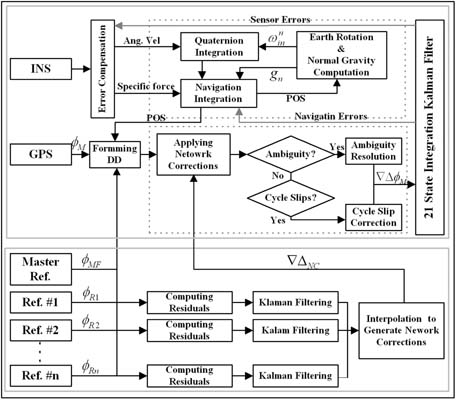
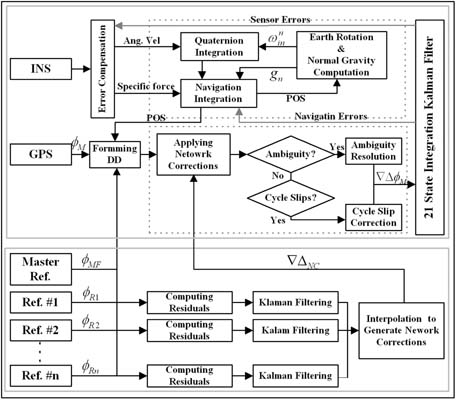
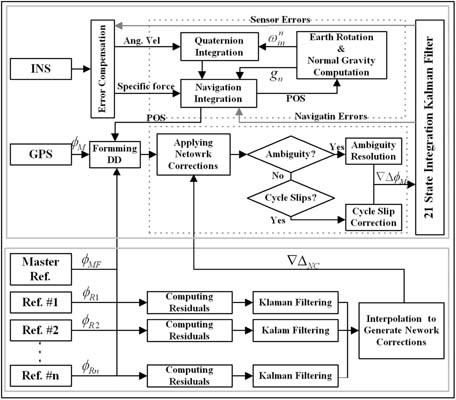
<p>The proposed integration approach is comprised of two components, namely the stationary reference measurement processing and the mobile positioning instrumentation. The role of the multiple GPS reference stations is to generate the so-called network corrections that model the baseline-dependent errors at a mobile station, whereas the mobile platform component is an integrated GPS/INS device. As illustrated in <xref ref-type="fig" rid="f1-sensors-10-09424">Figure 1</xref>, the mobile component consists of INS mechanisation, GPS carrier phase processing, and the Kalman filter that estimates the INS navigation and sensor errors. Using such an integration scheme, high positioning accuracy can be maintained through the continuous calibration/estimation of the INS errors. The network correction terms substantially reduce the baseline-dependent GPS errors at the mobile station compared with the conventional GPS/INS integration approach based on a single reference station.</p></sec>
<sec>
<label>3.</label>
<title>GPS Baseline-Dependent Error Modelling</title>
<p>The GPS baseline-dependent errors are estimated based on the pre-determined coordinates of the reference stations. It is prerequisite to correctly resolve the double differenced (DD) carrier phase ambiguities between the reference stations to generate the accurate corrections. For real-time measurements with baselines over a few tens of kilometres, several integer ambiguity resolution algorithms have been proposed [<xref ref-type="bibr" rid="b10-sensors-10-09424">10</xref>–<xref ref-type="bibr" rid="b12-sensors-10-09424">12</xref>]. These techniques are characterised by an attempt to form linear combinations with longer wavelengths and less noise, using the L1 and L2 carrier phase measurements. Due to the considerable magnitude of the ionospheric effect in the L1 and L2 carrier phases, the ambiguities of the wide-lane linear combinations are resolved first, and then the L1 ambiguities are fixed from the ionospheric-free measurements. This is followed by computing the L2 ambiguities from those of the resolved L1 and wide-lane combinations. The ambiguity estimation and validation procedure are applied for each step of the resolution. While the least squares ambiguity decorrelation adjustment (LAMBDA) method is used for the ambiguity estimation, the W-ratio test is applied for the validation [<xref ref-type="bibr" rid="b13-sensors-10-09424">13</xref>,<xref ref-type="bibr" rid="b14-sensors-10-09424">14</xref>].</p>
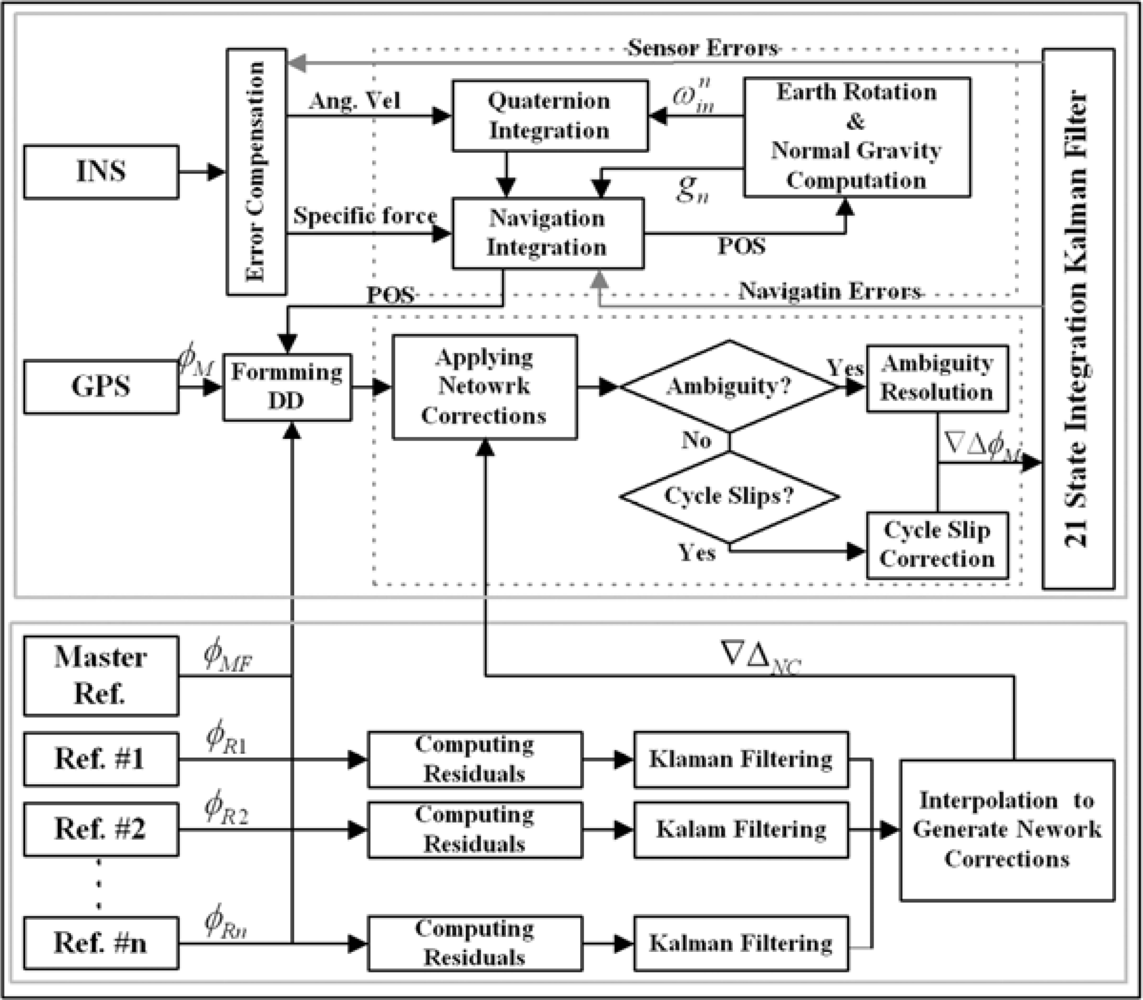
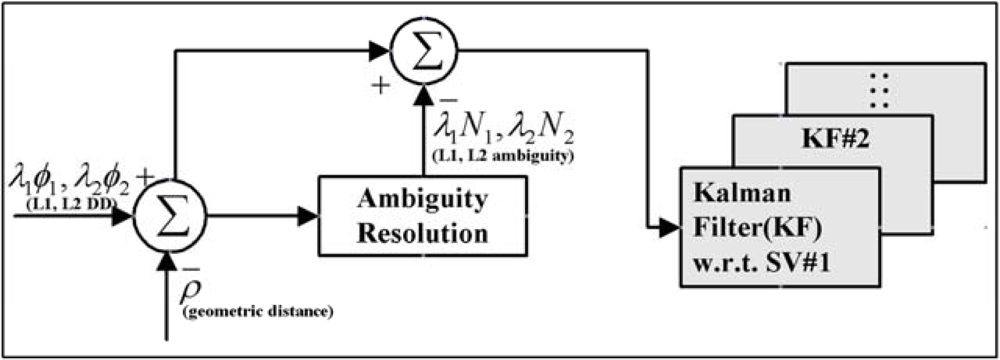
<p>The performance of positioning and navigation with the multiple GPS reference stations is largely dependent on the ability of an algorithm to separate the site-dependent errors from the DD residuals computed by subtracting the ambiguities and geometric distances from the DD measurements. <xref ref-type="fig" rid="f2-sensors-10-09424">Figure 2</xref> illustrates an estimation procedure of the baseline-dependent errors based on a Kalman filtering. The 4-states model has been implemented to describe the dynamics of the baseline-dependent errors (the 1st–3rd state), and the multipath error (the 4th state). As given in <xref ref-type="disp-formula" rid="FD1">Equation (1)</xref>, a position, velocity, and acceleration (PVA) model is applied for the first three states, whereas the multipath (the 4th state) is modelled as a first-order Markov process [<xref ref-type="bibr" rid="b15-sensors-10-09424">15</xref>–<xref ref-type="bibr" rid="b16-sensors-10-09424">16</xref>]:
<disp-formula id="FD1">
<label>(1)</label>
<mml:math display="block">
<mml:mrow>
<mml:mrow>
<mml:mo>[</mml:mo>
<mml:mrow>
<mml:mtable columnalign="left">
<mml:mtr columnalign="left">
<mml:mtd columnalign="left">
<mml:mrow>
<mml:msub>
<mml:mrow>
<mml:mover accent="true">
<mml:mi>x</mml:mi>
<mml:mo>˙</mml:mo></mml:mover></mml:mrow>
<mml:mrow>
<mml:mi>L</mml:mi>
<mml:mn>1</mml:mn></mml:mrow></mml:msub>
<mml:mo stretchy="false">(</mml:mo>
<mml:mi>t</mml:mi>
<mml:mo stretchy="false">)</mml:mo></mml:mrow></mml:mtd></mml:mtr>
<mml:mtr columnalign="left">
<mml:mtd columnalign="left">
<mml:mrow>
<mml:msub>
<mml:mrow>
<mml:mover accent="true">
<mml:mi>x</mml:mi>
<mml:mo>˙</mml:mo></mml:mover></mml:mrow>
<mml:mrow>
<mml:mi>L</mml:mi>
<mml:mn>2</mml:mn></mml:mrow></mml:msub>
<mml:mo stretchy="false">(</mml:mo>
<mml:mi>t</mml:mi>
<mml:mo stretchy="false">)</mml:mo></mml:mrow></mml:mtd></mml:mtr></mml:mtable></mml:mrow>
<mml:mo>]</mml:mo></mml:mrow>
<mml:mo>=</mml:mo>
<mml:mrow>
<mml:mo>[</mml:mo>
<mml:mrow>
<mml:mtable columnalign="left">
<mml:mtr columnalign="left">
<mml:mtd columnalign="left">
<mml:mi>F</mml:mi></mml:mtd>
<mml:mtd columnalign="left">
<mml:mn>0</mml:mn></mml:mtd></mml:mtr>
<mml:mtr columnalign="left">
<mml:mtd columnalign="left">
<mml:mn>0</mml:mn></mml:mtd>
<mml:mtd columnalign="left">
<mml:mi>F</mml:mi></mml:mtd></mml:mtr></mml:mtable></mml:mrow>
<mml:mo>]</mml:mo></mml:mrow>
<mml:mrow>
<mml:mo>[</mml:mo>
<mml:mrow>
<mml:mtable columnalign="left">
<mml:mtr columnalign="left">
<mml:mtd columnalign="left">
<mml:mrow>
<mml:msub>
<mml:mrow>
<mml:mi>x</mml:mi></mml:mrow>
<mml:mrow>
<mml:mi>L</mml:mi>
<mml:mn>1</mml:mn></mml:mrow></mml:msub>
<mml:mo stretchy="false">(</mml:mo>
<mml:mi>t</mml:mi>
<mml:mo stretchy="false">)</mml:mo></mml:mrow></mml:mtd></mml:mtr>
<mml:mtr columnalign="left">
<mml:mtd columnalign="left">
<mml:mrow>
<mml:msub>
<mml:mrow>
<mml:mi>x</mml:mi></mml:mrow>
<mml:mrow>
<mml:mi>L</mml:mi>
<mml:mn>2</mml:mn></mml:mrow></mml:msub>
<mml:mo stretchy="false">(</mml:mo>
<mml:mi>t</mml:mi>
<mml:mo stretchy="false">)</mml:mo></mml:mrow></mml:mtd></mml:mtr></mml:mtable></mml:mrow>
<mml:mo>]</mml:mo></mml:mrow>
<mml:mo>+</mml:mo>
<mml:mrow>
<mml:mo>[</mml:mo>
<mml:mrow>
<mml:mtable columnalign="left">
<mml:mtr columnalign="left">
<mml:mtd columnalign="left">
<mml:mrow>
<mml:msub>
<mml:mrow>
<mml:mi>w</mml:mi></mml:mrow>
<mml:mrow>
<mml:mi>L</mml:mi>
<mml:mn>1</mml:mn></mml:mrow></mml:msub>
<mml:mo stretchy="false">(</mml:mo>
<mml:mi>t</mml:mi>
<mml:mo stretchy="false">)</mml:mo></mml:mrow></mml:mtd></mml:mtr>
<mml:mtr columnalign="left">
<mml:mtd columnalign="left">
<mml:mrow>
<mml:msub>
<mml:mrow>
<mml:mi>w</mml:mi></mml:mrow>
<mml:mrow>
<mml:mi>L</mml:mi>
<mml:mn>2</mml:mn></mml:mrow></mml:msub>
<mml:mo stretchy="false">(</mml:mo>
<mml:mi>t</mml:mi>
<mml:mo stretchy="false">)</mml:mo></mml:mrow></mml:mtd></mml:mtr></mml:mtable></mml:mrow>
<mml:mo>]</mml:mo></mml:mrow></mml:mrow></mml:math></disp-formula></p>
<p>A detailed expression of the dynamic matrix can be given by:
<disp-formula id="FD2">
<label>(2)</label>
<mml:math display="block">
<mml:mrow>
<mml:mi>F</mml:mi>
<mml:mo>=</mml:mo>
<mml:mrow>
<mml:mo>[</mml:mo>
<mml:mrow>
<mml:mtable columnalign="left">
<mml:mtr columnalign="left">
<mml:mtd columnalign="left">
<mml:mn>1</mml:mn></mml:mtd>
<mml:mtd columnalign="left">
<mml:mi>T</mml:mi></mml:mtd>
<mml:mtd columnalign="left">
<mml:mrow>
<mml:mfrac>
<mml:mrow>
<mml:msup>
<mml:mrow>
<mml:mi>T</mml:mi></mml:mrow>
<mml:mn>2</mml:mn></mml:msup></mml:mrow>
<mml:mn>2</mml:mn></mml:mfrac></mml:mrow></mml:mtd>
<mml:mtd columnalign="left">
<mml:mn>0</mml:mn></mml:mtd></mml:mtr>
<mml:mtr columnalign="left">
<mml:mtd columnalign="left">
<mml:mn>0</mml:mn></mml:mtd>
<mml:mtd columnalign="left">
<mml:mn>1</mml:mn></mml:mtd>
<mml:mtd columnalign="left">
<mml:mi>T</mml:mi></mml:mtd>
<mml:mtd columnalign="left">
<mml:mn>0</mml:mn></mml:mtd></mml:mtr>
<mml:mtr columnalign="left">
<mml:mtd columnalign="left">
<mml:mn>0</mml:mn></mml:mtd>
<mml:mtd columnalign="left">
<mml:mn>0</mml:mn></mml:mtd>
<mml:mtd columnalign="left">
<mml:mn>1</mml:mn></mml:mtd>
<mml:mtd columnalign="left">
<mml:mn>0</mml:mn></mml:mtd></mml:mtr>
<mml:mtr columnalign="left">
<mml:mtd columnalign="left">
<mml:mn>0</mml:mn></mml:mtd>
<mml:mtd columnalign="left">
<mml:mn>0</mml:mn></mml:mtd>
<mml:mtd columnalign="left">
<mml:mn>0</mml:mn></mml:mtd>
<mml:mtd columnalign="left">
<mml:mrow>
<mml:msup>
<mml:mrow>
<mml:mi>e</mml:mi></mml:mrow>
<mml:mrow>
<mml:mo>−</mml:mo>
<mml:mi>α</mml:mi>
<mml:mi>T</mml:mi></mml:mrow></mml:msup></mml:mrow></mml:mtd></mml:mtr></mml:mtable></mml:mrow>
<mml:mo>]</mml:mo></mml:mrow></mml:mrow></mml:math></disp-formula>where <italic>T</italic> is the sampling interval and <italic>α</italic> is the correction time.</p>
<p>The error states in <xref ref-type="disp-formula" rid="FD1">Equation (1)</xref> are as follows:
<disp-formula id="FD3">
<label>(3)</label>
<mml:math display="block">
<mml:mrow>
<mml:msub>
<mml:mrow>
<mml:mi>x</mml:mi></mml:mrow>
<mml:mrow>
<mml:mi>L</mml:mi>
<mml:mn>1</mml:mn></mml:mrow></mml:msub>
<mml:mo>=</mml:mo>
<mml:msup>
<mml:mrow>
<mml:mrow>
<mml:mrow>
<mml:mo>[</mml:mo>
<mml:mrow>
<mml:mtable columnalign="left">
<mml:mtr columnalign="left">
<mml:mtd columnalign="left">
<mml:mrow>
<mml:mo>∇</mml:mo>
<mml:msub>
<mml:mrow>
<mml:mo>Δ</mml:mo></mml:mrow>
<mml:mrow>
<mml:mi>P</mml:mi>
<mml:mn>1</mml:mn></mml:mrow></mml:msub></mml:mrow></mml:mtd>
<mml:mtd columnalign="left">
<mml:mrow>
<mml:mo>∇</mml:mo>
<mml:msub>
<mml:mrow>
<mml:mo>Δ</mml:mo></mml:mrow>
<mml:mrow>
<mml:mi>V</mml:mi>
<mml:mn>1</mml:mn></mml:mrow></mml:msub></mml:mrow></mml:mtd>
<mml:mtd columnalign="left">
<mml:mrow>
<mml:mo>∇</mml:mo>
<mml:msub>
<mml:mrow>
<mml:mo>Δ</mml:mo></mml:mrow>
<mml:mrow>
<mml:mi>A</mml:mi>
<mml:mn>1</mml:mn></mml:mrow></mml:msub></mml:mrow></mml:mtd>
<mml:mtd columnalign="left">
<mml:mrow>
<mml:mo>∇</mml:mo>
<mml:msub>
<mml:mrow>
<mml:mo>Δ</mml:mo></mml:mrow>
<mml:mrow>
<mml:mi>M</mml:mi>
<mml:mn>1</mml:mn></mml:mrow></mml:msub></mml:mrow></mml:mtd></mml:mtr></mml:mtable></mml:mrow>
<mml:mo>]</mml:mo></mml:mrow></mml:mrow></mml:mrow>
<mml:mi>T</mml:mi></mml:msup></mml:mrow></mml:math></disp-formula>
<disp-formula id="FD4">
<label>(4)</label>
<mml:math display="block">
<mml:mrow>
<mml:msub>
<mml:mrow>
<mml:mi>x</mml:mi></mml:mrow>
<mml:mrow>
<mml:mi>L</mml:mi>
<mml:mn>2</mml:mn></mml:mrow></mml:msub>
<mml:mo>=</mml:mo>
<mml:msup>
<mml:mrow>
<mml:mrow>
<mml:mrow>
<mml:mo>[</mml:mo>
<mml:mrow>
<mml:mtable columnalign="left">
<mml:mtr columnalign="left">
<mml:mtd columnalign="left">
<mml:mrow>
<mml:mo>∇</mml:mo>
<mml:msub>
<mml:mrow>
<mml:mo>Δ</mml:mo></mml:mrow>
<mml:mrow>
<mml:mi>P</mml:mi>
<mml:mn>2</mml:mn></mml:mrow></mml:msub></mml:mrow></mml:mtd>
<mml:mtd columnalign="left">
<mml:mrow>
<mml:mo>∇</mml:mo>
<mml:msub>
<mml:mrow>
<mml:mo>Δ</mml:mo></mml:mrow>
<mml:mrow>
<mml:mi>V</mml:mi>
<mml:mn>2</mml:mn></mml:mrow></mml:msub></mml:mrow></mml:mtd>
<mml:mtd columnalign="left">
<mml:mrow>
<mml:mo>∇</mml:mo>
<mml:msub>
<mml:mrow>
<mml:mo>Δ</mml:mo></mml:mrow>
<mml:mrow>
<mml:mi>A</mml:mi>
<mml:mn>2</mml:mn></mml:mrow></mml:msub></mml:mrow></mml:mtd>
<mml:mtd columnalign="left">
<mml:mrow>
<mml:mo>∇</mml:mo>
<mml:msub>
<mml:mrow>
<mml:mo>Δ</mml:mo></mml:mrow>
<mml:mrow>
<mml:mi>M</mml:mi>
<mml:mn>2</mml:mn></mml:mrow></mml:msub></mml:mrow></mml:mtd></mml:mtr></mml:mtable></mml:mrow>
<mml:mo>]</mml:mo></mml:mrow></mml:mrow></mml:mrow>
<mml:mi>T</mml:mi></mml:msup></mml:mrow></mml:math></disp-formula>where ∇Δ<italic><sub>P</sub></italic> is the DD baseline-dependent error, ∇Δ<italic><sub>V</sub></italic> and ∇Δ<italic><sub>A</sub></italic> are the velocity and the acceleration of the error respectively, and ∇Δ<italic><sub>M</sub></italic> is the multipath.</p></sec>
<sec>
<label>4.</label>
<title>Integrated Mobile GPS/INS Filtering</title>
<p>The so-called corrections, modelled by interpolating the baseline-dependent errors at the reference stations with respect to the position of a mobile station, should be applied for mobile GPS receiver measurements to reduce these errors. Over the past decades, a number of interpolation methods have been proposed, including the linear combination model, distance-based linear interpolation method, and linear interpolation method [<xref ref-type="bibr" rid="b17-sensors-10-09424">17</xref>]. However, the performances of these methods are equivalent according to Dai <italic>et al</italic>. [<xref ref-type="bibr" rid="b18-sensors-10-09424">18</xref>]. To interpolate the baseline-dependent errors at three or more stations, the coefficients <italic>α</italic> and <italic>β</italic> should be computed using the following equation [<xref ref-type="bibr" rid="b9-sensors-10-09424">9</xref>]:
<disp-formula id="FD5">
<label>(5)</label>
<mml:math display="block">
<mml:mrow>
<mml:mrow>
<mml:mo>[</mml:mo>
<mml:mrow>
<mml:mtable columnalign="left">
<mml:mtr columnalign="left">
<mml:mtd columnalign="left">
<mml:mi>α</mml:mi></mml:mtd></mml:mtr>
<mml:mtr columnalign="left">
<mml:mtd columnalign="left">
<mml:mi>β</mml:mi></mml:mtd></mml:mtr></mml:mtable></mml:mrow>
<mml:mo>]</mml:mo></mml:mrow>
<mml:mo>=</mml:mo>
<mml:msup>
<mml:mrow>
<mml:mrow>
<mml:mrow>
<mml:mo>(</mml:mo>
<mml:mrow>
<mml:msup>
<mml:mrow>
<mml:mi>A</mml:mi></mml:mrow>
<mml:mi>T</mml:mi></mml:msup>
<mml:mi>A</mml:mi></mml:mrow>
<mml:mo>)</mml:mo></mml:mrow></mml:mrow></mml:mrow>
<mml:mrow>
<mml:mo>−</mml:mo>
<mml:mn>1</mml:mn></mml:mrow></mml:msup>
<mml:msup>
<mml:mrow>
<mml:mi>A</mml:mi></mml:mrow>
<mml:mi>T</mml:mi></mml:msup>
<mml:mi>C</mml:mi></mml:mrow></mml:math></disp-formula>where:
<disp-formula id="FD6">
<label>(6)</label>
<mml:math display="block">
<mml:mrow>
<mml:mi>A</mml:mi>
<mml:mo>=</mml:mo>
<mml:mrow>
<mml:mo>[</mml:mo>
<mml:mrow>
<mml:mtable>
<mml:mtr>
<mml:mtd>
<mml:mrow>
<mml:mo>Δ</mml:mo>
<mml:msub>
<mml:mrow>
<mml:mi>X</mml:mi></mml:mrow>
<mml:mrow>
<mml:mi>R</mml:mi>
<mml:mn>1</mml:mn></mml:mrow></mml:msub></mml:mrow></mml:mtd>
<mml:mtd>
<mml:mrow>
<mml:mo>Δ</mml:mo>
<mml:msub>
<mml:mrow>
<mml:mi>Y</mml:mi></mml:mrow>
<mml:mrow>
<mml:mi>R</mml:mi>
<mml:mn>1</mml:mn></mml:mrow></mml:msub></mml:mrow></mml:mtd></mml:mtr>
<mml:mtr>
<mml:mtd>
<mml:mrow>
<mml:mo>Δ</mml:mo>
<mml:msub>
<mml:mrow>
<mml:mi>X</mml:mi></mml:mrow>
<mml:mrow>
<mml:mi>R</mml:mi>
<mml:mn>2</mml:mn></mml:mrow></mml:msub></mml:mrow></mml:mtd>
<mml:mtd>
<mml:mrow>
<mml:mo>Δ</mml:mo>
<mml:msub>
<mml:mrow>
<mml:mi>Y</mml:mi></mml:mrow>
<mml:mrow>
<mml:mi>R</mml:mi>
<mml:mn>2</mml:mn></mml:mrow></mml:msub></mml:mrow></mml:mtd></mml:mtr>
<mml:mtr>
<mml:mtd>
<mml:mo>⋮</mml:mo></mml:mtd>
<mml:mtd>
<mml:mo>⋮</mml:mo></mml:mtd></mml:mtr>
<mml:mtr>
<mml:mtd>
<mml:mrow>
<mml:mo>Δ</mml:mo>
<mml:msub>
<mml:mrow>
<mml:mi>X</mml:mi></mml:mrow>
<mml:mrow>
<mml:mi>R</mml:mi>
<mml:mo stretchy="false">(</mml:mo>
<mml:mi>n</mml:mi>
<mml:mo>−</mml:mo>
<mml:mn>1</mml:mn>
<mml:mo stretchy="false">)</mml:mo></mml:mrow></mml:msub></mml:mrow></mml:mtd>
<mml:mtd>
<mml:mrow>
<mml:mo>Δ</mml:mo>
<mml:msub>
<mml:mrow>
<mml:mi>Y</mml:mi></mml:mrow>
<mml:mrow>
<mml:mi>R</mml:mi>
<mml:mo stretchy="false">(</mml:mo>
<mml:mi>n</mml:mi>
<mml:mo>−</mml:mo>
<mml:mn>1</mml:mn>
<mml:mo stretchy="false">)</mml:mo></mml:mrow></mml:msub></mml:mrow></mml:mtd></mml:mtr></mml:mtable></mml:mrow>
<mml:mo>]</mml:mo></mml:mrow></mml:mrow></mml:math></disp-formula>
<disp-formula id="FD7">
<label>(7)</label>
<mml:math display="block">
<mml:mrow>
<mml:mrow>
<mml:mi mathvariant="normal">C</mml:mi>
<mml:mo>=</mml:mo></mml:mrow>
<mml:mrow>
<mml:mo>[</mml:mo>
<mml:mrow>
<mml:mtable>
<mml:mtr>
<mml:mtd>
<mml:mrow>
<mml:mo>∇</mml:mo>
<mml:msub>
<mml:mrow>
<mml:mo>Δ</mml:mo></mml:mrow>
<mml:mrow>
<mml:mrow>
<mml:mi mathvariant="normal">P</mml:mi>
<mml:mo>,</mml:mo>
<mml:mtext>R1</mml:mtext></mml:mrow></mml:mrow></mml:msub></mml:mrow></mml:mtd></mml:mtr>
<mml:mtr>
<mml:mtd>
<mml:mrow>
<mml:mo>∇</mml:mo>
<mml:msub>
<mml:mrow>
<mml:mo>Δ</mml:mo></mml:mrow>
<mml:mrow>
<mml:mrow>
<mml:mi mathvariant="normal">P</mml:mi>
<mml:mo>,</mml:mo>
<mml:mtext>R1</mml:mtext></mml:mrow></mml:mrow></mml:msub></mml:mrow></mml:mtd></mml:mtr>
<mml:mtr>
<mml:mtd>
<mml:mo>⋮</mml:mo></mml:mtd></mml:mtr>
<mml:mtr>
<mml:mtd>
<mml:mrow>
<mml:mo>∇</mml:mo>
<mml:msub>
<mml:mrow>
<mml:mo>Δ</mml:mo></mml:mrow>
<mml:mrow>
<mml:mrow>
<mml:mi mathvariant="normal">P</mml:mi>
<mml:mo>,</mml:mo>
<mml:mi mathvariant="normal">R</mml:mi>
<mml:mo stretchy="false">(</mml:mo>
<mml:mi mathvariant="normal">n</mml:mi>
<mml:mo>−</mml:mo>
<mml:mn>1</mml:mn>
<mml:mo stretchy="false">)</mml:mo></mml:mrow></mml:mrow></mml:msub></mml:mrow></mml:mtd></mml:mtr></mml:mtable></mml:mrow>
<mml:mo>]</mml:mo></mml:mrow></mml:mrow></mml:math></disp-formula>as well as <italic>ΔX</italic> and <italic>ΔY</italic> are the plane coordinate differences referred to the master reference station (MR), the subscripts <italic>R<sub>i</sub></italic> indicate the reference station <italic>R<sub>i</sub></italic>, and the elements of the vector <italic>C</italic> are the baseline-dependent errors.</p>
<p>The mobile platform within the coverage of the reference network can apply the following 2-D linear model to interpolate the baseline-dependent errors:
<disp-formula id="FD8">
<label>(8)</label>
<mml:math display="block">
<mml:mrow>
<mml:mo>∇</mml:mo>
<mml:msub>
<mml:mrow>
<mml:mo>Δ</mml:mo></mml:mrow>
<mml:mrow>
<mml:mi mathvariant="italic">NC</mml:mi></mml:mrow></mml:msub>
<mml:mo>=</mml:mo>
<mml:mi>α</mml:mi>
<mml:mo>Δ</mml:mo>
<mml:msub>
<mml:mi>X</mml:mi>
<mml:mi mathvariant="italic">MR</mml:mi></mml:msub>
<mml:mo>+</mml:mo>
<mml:mi>β</mml:mi>
<mml:mo>Δ</mml:mo>
<mml:msub>
<mml:mi>Y</mml:mi>
<mml:mi mathvariant="italic">MR</mml:mi></mml:msub></mml:mrow></mml:math></disp-formula></p>
<p>The integration of GPS with INS has been implemented using a tightly-coupled Kalman filtering technique, which utilises a single filter to process all the data in the DD measurements domain. The integrated processing procedure employed in this study is presented in <xref ref-type="fig" rid="f1-sensors-10-09424">Figure 1</xref>. The error state vector for the filter includes the parameters of the navigation solution and the INS sensor errors. The psi-angle model [e.g., <xref ref-type="disp-formula" rid="FD9">Equations (9</xref>–<xref ref-type="disp-formula" rid="FD11">11)</xref>] is used to describe the behaviour of INS navigation errors [<xref ref-type="bibr" rid="b19-sensors-10-09424">19</xref>].
<disp-formula id="FD9">
<label>(9)</label>
<mml:math display="block">
<mml:mrow>
<mml:msup>
<mml:mrow>
<mml:mi>δ</mml:mi>
<mml:mover accent="true">
<mml:mi>r</mml:mi>
<mml:mo>˙</mml:mo></mml:mover></mml:mrow>
<mml:mi>n</mml:mi></mml:msup>
<mml:mo>=</mml:mo>
<mml:mo>−</mml:mo>
<mml:msubsup>
<mml:mo>Ω</mml:mo>
<mml:mi mathvariant="italic">en</mml:mi>
<mml:mi>n</mml:mi></mml:msubsup>
<mml:msup>
<mml:mrow>
<mml:mi>δ</mml:mi>
<mml:mi>r</mml:mi></mml:mrow>
<mml:mi>n</mml:mi></mml:msup>
<mml:mo>+</mml:mo>
<mml:msup>
<mml:mrow>
<mml:mi>δ</mml:mi>
<mml:mi>ν</mml:mi></mml:mrow>
<mml:mi>n</mml:mi></mml:msup></mml:mrow></mml:math></disp-formula>
<disp-formula id="FD10">
<label>(10)</label>
<mml:math display="block">
<mml:mrow>
<mml:msup>
<mml:mrow>
<mml:mi>δ</mml:mi>
<mml:mover accent="true">
<mml:mi>ν</mml:mi>
<mml:mo>˙</mml:mo></mml:mover></mml:mrow>
<mml:mi>n</mml:mi></mml:msup>
<mml:mo>=</mml:mo>
<mml:mo>−</mml:mo>
<mml:mrow>
<mml:mo>(</mml:mo>
<mml:mrow>
<mml:msubsup>
<mml:mrow>
<mml:mo>Ω</mml:mo></mml:mrow>
<mml:mrow>
<mml:mi mathvariant="italic">en</mml:mi></mml:mrow>
<mml:mi>n</mml:mi></mml:msubsup>
<mml:mo>+</mml:mo>
<mml:mn>2</mml:mn>
<mml:msubsup>
<mml:mrow>
<mml:mo>Ω</mml:mo></mml:mrow>
<mml:mrow>
<mml:mi mathvariant="italic">ie</mml:mi></mml:mrow>
<mml:mi>n</mml:mi></mml:msubsup></mml:mrow>
<mml:mo>)</mml:mo></mml:mrow>
<mml:mi>δ</mml:mi>
<mml:msup>
<mml:mrow>
<mml:mi>ν</mml:mi></mml:mrow>
<mml:mi>n</mml:mi></mml:msup>
<mml:mo>+</mml:mo>
<mml:mi>δ</mml:mi>
<mml:msup>
<mml:mrow>
<mml:mo>∇</mml:mo></mml:mrow>
<mml:mi>n</mml:mi></mml:msup>
<mml:mo>−</mml:mo>
<mml:msub>
<mml:mrow>
<mml:mo>Ω</mml:mo></mml:mrow>
<mml:mi>ψ</mml:mi></mml:msub>
<mml:msup>
<mml:mi>f</mml:mi>
<mml:mi>n</mml:mi></mml:msup></mml:mrow></mml:math></disp-formula>
<disp-formula id="FD11">
<label>(11)</label>
<mml:math display="block">
<mml:mrow>
<mml:msup>
<mml:mrow>
<mml:mover accent="true">
<mml:mi>ψ</mml:mi>
<mml:mo>˙</mml:mo></mml:mover></mml:mrow>
<mml:mi>n</mml:mi></mml:msup>
<mml:mo>=</mml:mo>
<mml:mo>−</mml:mo>
<mml:msubsup>
<mml:mo>Ω</mml:mo>
<mml:mi mathvariant="italic">in</mml:mi>
<mml:mi>n</mml:mi></mml:msubsup>
<mml:msup>
<mml:mrow>
<mml:mi>ψ</mml:mi></mml:mrow>
<mml:mi>n</mml:mi></mml:msup>
<mml:mo>+</mml:mo>
<mml:mi>δ</mml:mi>
<mml:msup>
<mml:mrow>
<mml:mi>ɛ</mml:mi></mml:mrow>
<mml:mi>n</mml:mi></mml:msup></mml:mrow></mml:math></disp-formula>where <italic>δr</italic>, <italic>δν</italic>, <italic>δψ</italic>, and <italic>δψ</italic> are the position, velocity, and attitude error vector respectively, Ω is the skew-system form of the frame rotation rate vector, δ∇ is the accelerometer error vector, <italic>δε</italic> is the gyro drift vector, and the superscripts and subscripts indicate coordinate frames (e.g., inertial, ECEF, and navigation). The biases and scale factors of the INS sensors are modelled by a random bias and the first-order Gauss-Markov process respectively. Hence, a total of 21 error states are considered in this research. For a more detailed discussion, see, for example, Grejer-Brezinska <italic>et al</italic>. [<xref ref-type="bibr" rid="b20-sensors-10-09424">20</xref>], Da [<xref ref-type="bibr" rid="b21-sensors-10-09424">21</xref>], and Lee [<xref ref-type="bibr" rid="b22-sensors-10-09424">22</xref>].</p>
<p>In this GPS/INS integration, the DD GPS carrier phases are used to update the Kalman filter to estimate the navigation and INS sensor errors. The DD measurements are formed by differencing between two single differences (SD) across two different satellites at each epoch. In the case of a medium baseline up to 100 km, the measurements can be mathematically represented as:
<disp-formula id="FD12">
<label>(12)</label>
<mml:math display="block">
<mml:mrow>
<mml:mi>λ</mml:mi>
<mml:mo>⋅</mml:mo>
<mml:mo>Δ</mml:mo>
<mml:mo>∇</mml:mo>
<mml:mi>ϕ</mml:mi>
<mml:mo>=</mml:mo>
<mml:mo>Δ</mml:mo>
<mml:mo>∇</mml:mo>
<mml:mi>ρ</mml:mi>
<mml:mo>+</mml:mo>
<mml:munder>
<mml:munder>
<mml:mrow>
<mml:mo>Δ</mml:mo>
<mml:mo>∇</mml:mo>
<mml:mi>d</mml:mi>
<mml:mi>ρ</mml:mi>
<mml:mo>−</mml:mo>
<mml:mo>Δ</mml:mo>
<mml:mo>∇</mml:mo>
<mml:mi>d</mml:mi>
<mml:mi>i</mml:mi>
<mml:mo>+</mml:mo>
<mml:mo>Δ</mml:mo>
<mml:mo>∇</mml:mo>
<mml:mi>d</mml:mi>
<mml:mi>r</mml:mi></mml:mrow>
<mml:mo stretchy="true">︸</mml:mo></mml:munder>
<mml:mrow>
<mml:mtext>the distance</mml:mtext>
<mml:mo>−</mml:mo>
<mml:mtext>dependent errors</mml:mtext></mml:mrow></mml:munder>
<mml:mo>+</mml:mo>
<mml:mi>λ</mml:mi>
<mml:mo>⋅</mml:mo>
<mml:mo>Δ</mml:mo>
<mml:mo>∇</mml:mo>
<mml:mi>N</mml:mi>
<mml:mo>+</mml:mo>
<mml:mo>Δ</mml:mo>
<mml:mo>∇</mml:mo>
<mml:mi>ɛ</mml:mi></mml:mrow></mml:math></disp-formula>where ∇ denotes differencing between two satellites, so that Δ∇ represents a double-differencing, <italic>λ</italic> is the wave length of the carrier phase, <italic>ρ</italic> is the true range or geometric range, <italic>dρ</italic> is the satellite orbit uncertainties, <italic>di</italic> is the ionospheric effect, <italic>dr</italic> is the tropospheric delay, <italic>N</italic> is the integer-ambiguity, and <italic>ε</italic> is the noise.</p>
<p>By applying the network correction, <xref ref-type="disp-formula" rid="FD12">Equation (12)</xref> can be re-written as follows:
<disp-formula id="FD13">
<label>(13)</label>
<mml:math display="block">
<mml:mrow>
<mml:mi>λ</mml:mi>
<mml:mo>⋅</mml:mo>
<mml:mo>Δ</mml:mo>
<mml:mo>∇</mml:mo>
<mml:mi>ϕ</mml:mi>
<mml:mo>=</mml:mo>
<mml:mo>Δ</mml:mo>
<mml:mo>∇</mml:mo>
<mml:mi>ρ</mml:mi>
<mml:mo>+</mml:mo>
<mml:mo>Δ</mml:mo>
<mml:mo>∇</mml:mo>
<mml:mi>N</mml:mi>
<mml:mo>+</mml:mo>
<mml:mo>Δ</mml:mo>
<mml:mo>∇</mml:mo>
<mml:mi>ɛ</mml:mi></mml:mrow></mml:math></disp-formula></p>
<p>However, <xref ref-type="disp-formula" rid="FD13">Equation (13)</xref> contains an integer ambiguity term, which should be correctly resolved to ensure centimetre-level positioning accuracy. Here, an INS-aided ambiguity resolution scheme utilising the INS-predicted position in the float ambiguity estimation has been implemented. This approach enhances the performance of the ambiguity resolution by improving the precision of the DD range estimation. More details on this approach can be found in Lee <italic>et al</italic>. [<xref ref-type="bibr" rid="b23-sensors-10-09424">23</xref>]. <xref ref-type="disp-formula" rid="FD13">Equation (13)</xref> with the ambiguity resolved is applied for updating the Kalman filter to estimate its error states, which are fed back to correct the inertial solution and sensor measurements. However, it is important to note that the term Δ∇ε in <xref ref-type="disp-formula" rid="FD13">Equation (13)</xref> contains not only the noise, but also the un-modelled baseline-dependent errors, which means that the positioning accuracy of the GPS/INS integration is determined by the quality of the corrections modelled by the multiple reference stations.</p></sec>
<sec sec-type="results">
<label>5.</label>
<title>Testing and Results with Simulated Measurements</title>
<p>Three sets of simulated GPS and INS measurements have been processed in this section to test the performance of the algorithms implemented and to evaluate the achievable accuracy of the position and attitude parameter estimation.</p>
<sec>
<label>5.1.</label>
<title>Measurement Simulation and Processing</title>
<p>All the test measurements were generated using a GNSS/INS simulator consisting of trajectory profile generation, GPS satellite, and INS measurements simulation modules [<xref ref-type="bibr" rid="b24-sensors-10-09424">24</xref>]. The original software was modified in the following ways to more realistically model GPS errors: (a) the ionospheric effect is derived from Klobuchar-style coefficients provided by Centre for Orbit Determination in Europe (CODE); (b) the tropospheric delay is computed the Saastamoinen model with the Neil mapping function; (c) the multipath is generated by passing white noise through a first-order Butterworth low-pass filter.</p>
<p>The measurement simulation begins with defining a reference trajectory (the time, coordinate, velocity, and attitude) for a moving vehicle. In the INS data generation, specific force (acceleration) and angular velocity is firstly computed, based on the given trajectory profile. Then, the related sensor errors, accelerometer/gyro bias, scale factor and noise, as well as the effects associated with the Earth’s rotation and gravity, are computed and added to the generated true measurements. All the data generated are stored in a binary format at a rate of 64 Hz. On the other hand, the geometric distances between the receiver and the satellite are initially computed to simulate the GPS observations. The biases, errors and measurement noise are then added to the geometric distance. These simulations were performed with respect to a tactical-grade INS (e.g., gyro drift 5 deg/h and accelerometer bias 500 μg) and dual-frequency geodetic GPS receivers.</p>
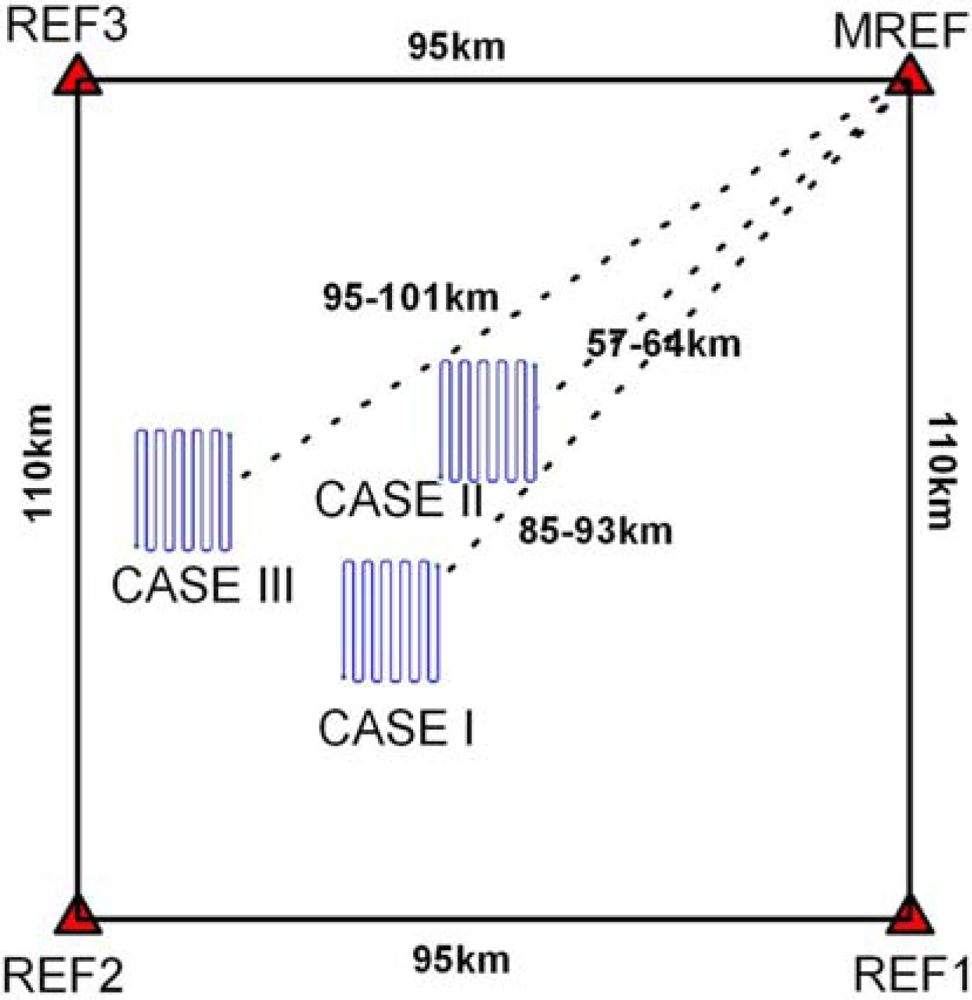
<p><xref ref-type="fig" rid="f3-sensors-10-09424">Figure 3</xref> shows a layout of the multiple reference stations and testing area, considered in the simulations. GPS measurements at the four reference stations were generated for a time period of 2,238 seconds, with a separation of 115 km and 95 km in the latitudinal and longitudinal direction respectively.</p>
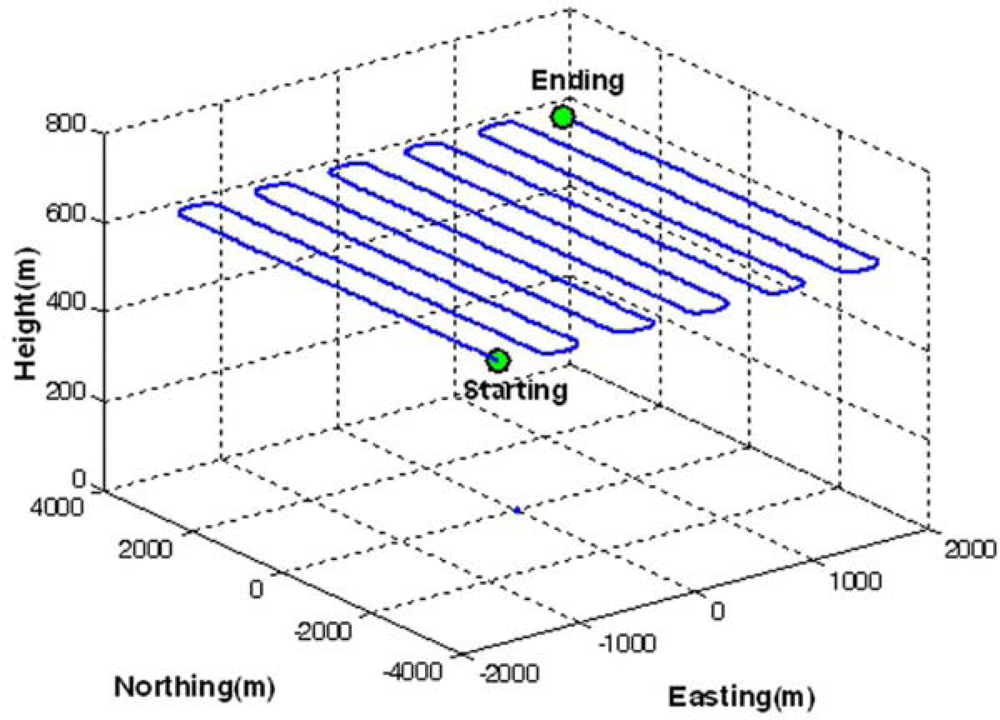
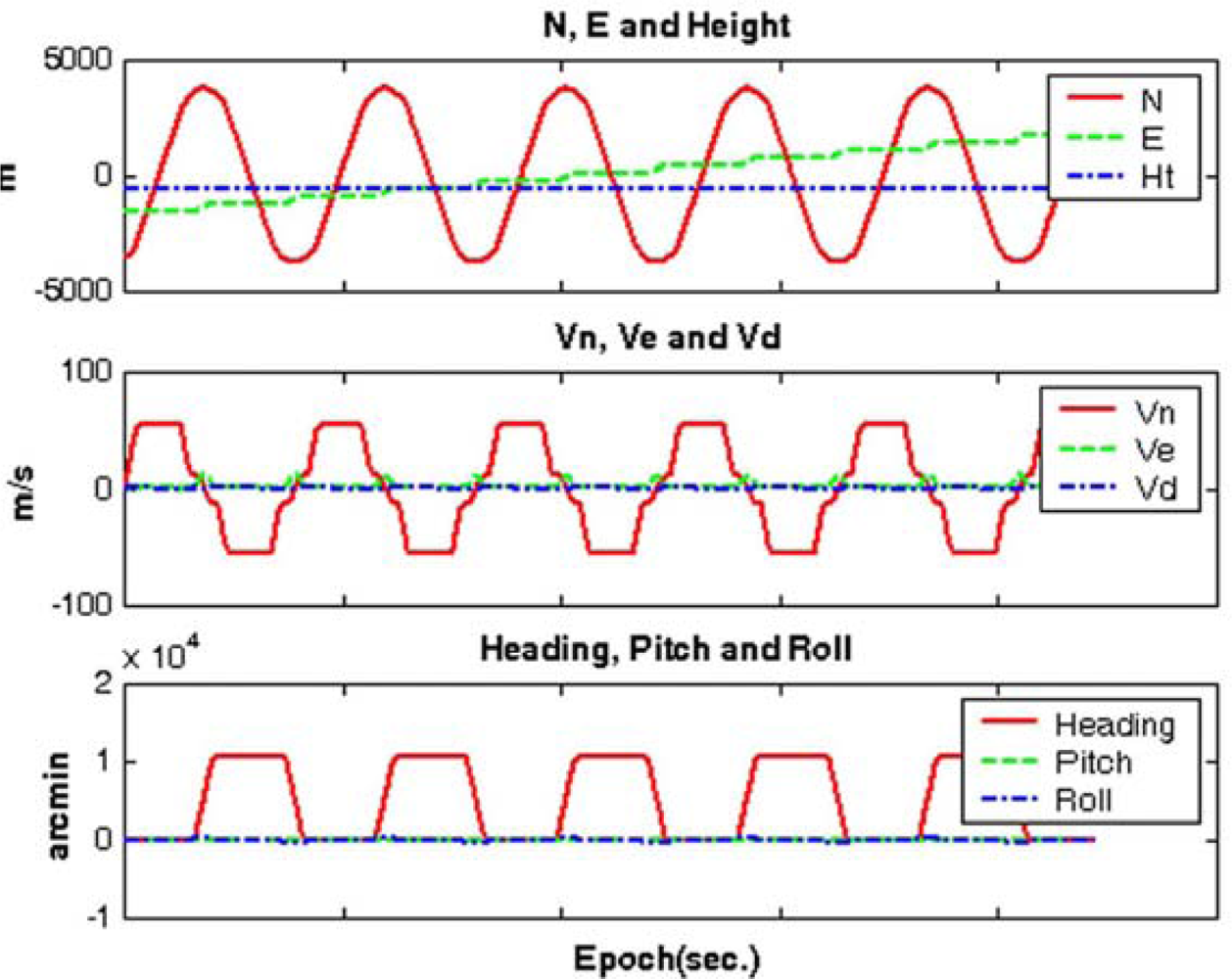
<p>Three different scenarios, denoted as CASE1, CASE2, and CASE3, were considered in the GPS/INS simulation, depending on baseline length between the master reference and the mobile station. Because MREF is selected as the master reference station, the baseline lengths range from 57 km to 101 km in these scenarios. <xref ref-type="fig" rid="f4-sensors-10-09424">Figure 4</xref> depicts an example of the generated reference trajectories (e.g., CASE1), which contains 63 segments defining the vehicle dynamics (e.g., acceleration, deceleration, attitude change). The trajectories were generated with the consideration of an airborne environment, which is a typical example of long-baseline positioning and navigation. The vehicle flew with an average velocity of 55 m/sec (200 km/h) excluding the vehicle turning manoeuvre at the end of flight path. In addition, the flying height above the ground was about 600 m. It was assumed in the trajectory generation that the velocity component along the H-(Up) axis of the navigation frame was zero m/sec unless the pitch and roll angles were changed.</p>
<p>All the simulated measurements were processed in post-mission mode using self-programmed software to estimate the navigation parameters. However, it is important to note that all the algorithms are applicable for the real-time implementation. Although the main goal of this study was to investigate the impact of including the multiple reference stations in the GPS/INS integration in terms of the accuracy of the position and attitude estimation, the performance of the implemented algorithms at each step of data processing was tested, which includes the baseline-dependent errors estimation, the network correction modelling, and the ambiguity resolution</p></sec>
<sec>
<label>5.2.</label>
<title>Network Correction Modelling</title>
<p>The data processing of the integrated GPS/INS with multiple reference stations begins with the carrier phase ambiguity resolution between the stations. By applying the procedure described in Section 3, it was possible to fix the ambiguities to their correct values within a few seconds. Because MREF was selected as a master reference station, three baselines, denoted as MREF-REF1, MREF-REF2, and MREF-REF3, were composed in the data processing.</p>
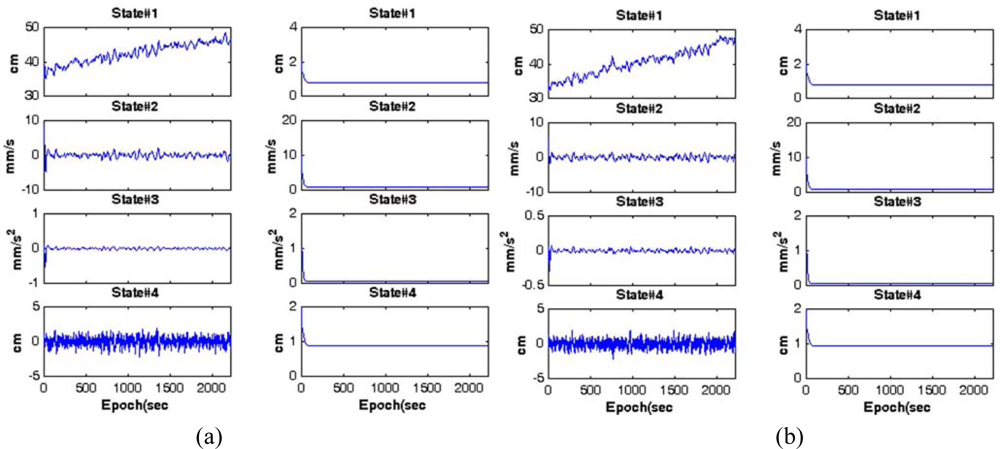
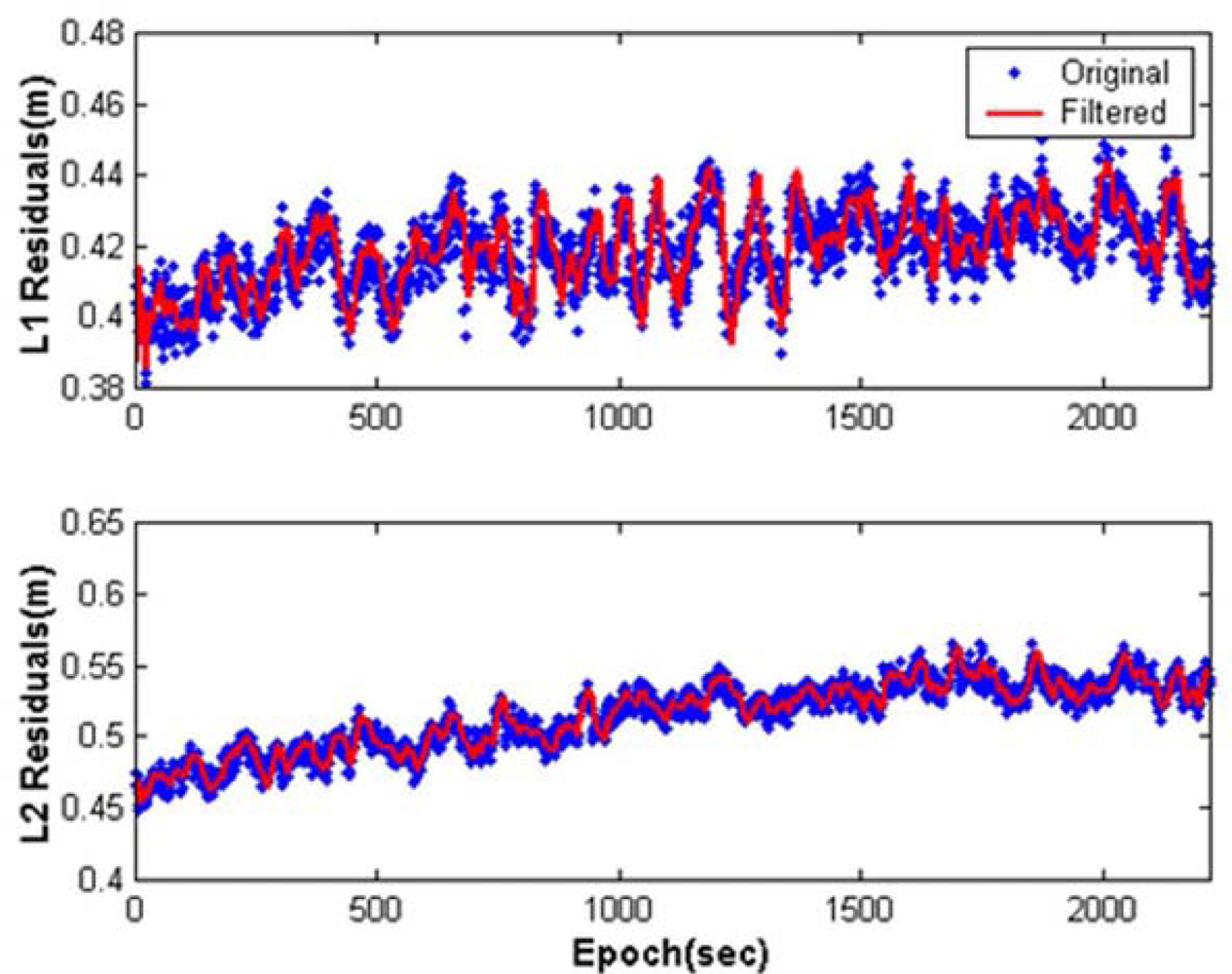
<p>The Kalman filters processed the DD residuals computed at the reference stations in parallel to estimate the baseline-dependent errors with the minimising impact of the site-dependent errors. For example, the results from the filtering for the L1 and L2 of space vehicle (SV) 8 in CASE I are shown in <xref ref-type="fig" rid="f5-sensors-10-09424">Figures 5(a,b)</xref>. In these figures, the graphs in the first column represent state estimates obtained, whereas those in the second column depict their standard deviations extracted from the diagonal components of the updated covariance matrix. It should be noted from the plots in the second columns that the entire filter states converge with respect to time. To closely observe the impact of the Kalman filtering, the DD residuals of SV8 and those processed by the filter (e.g., the estimated baseline-dependent errors) are illustrated in <xref ref-type="fig" rid="f6-sensors-10-09424">Figure 6</xref>, indicating that the site-dependent errors are reduced.</p>
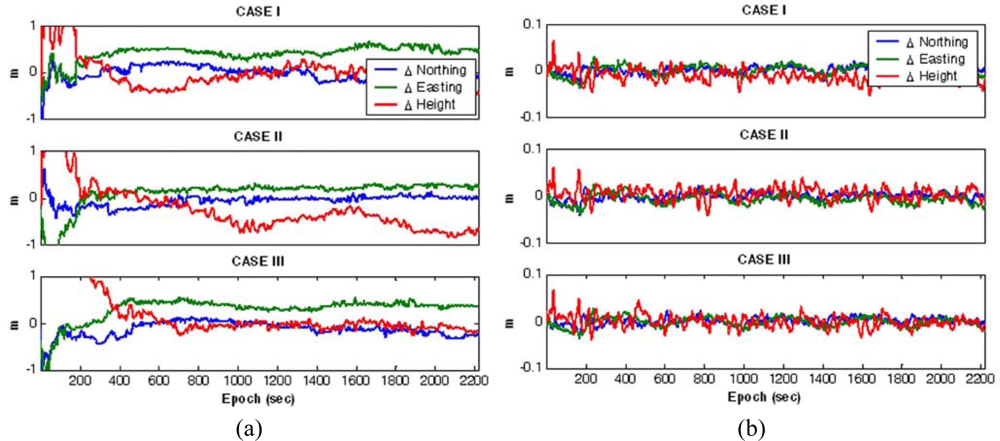
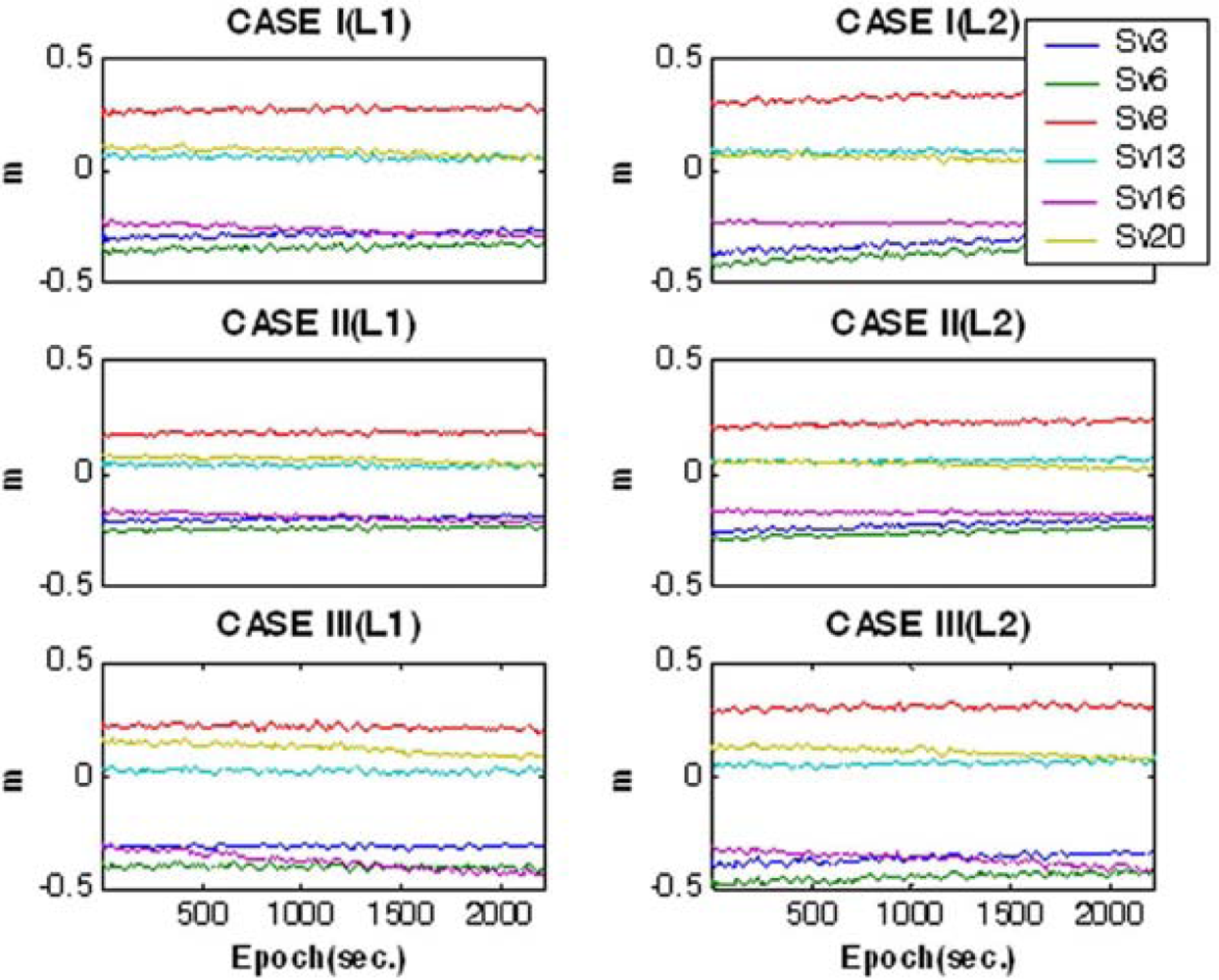
<p><xref ref-type="fig" rid="f7-sensors-10-09424">Figure 7</xref> shows the interpolated satellite-by-satellite and epoch-by-epoch L1 and L2 baseline-dependent errors, the so-called network corrections, with respect to the mobile platforms. As illustrated in <xref ref-type="fig" rid="f8-sensors-10-09424">Figure 8(a)</xref>, the true DD residuals of the mobile receivers were computed with respect to the reference trajectories to evaluate the performance. Due to the long-baseline between the master reference and the mobile receivers, ranging from 57 km to 101 km, some values mostly representing the baseline-dependent errors may reach a few tens of centimetres, as seen in the figure. To evaluate the accuracy of the modelled network corrections, the DD residuals were re-calculated by applying the network corrections, plotted in <xref ref-type="fig" rid="f8-sensors-10-09424">Figure 8(b)</xref>. It can be found from the results that the DD residuals are significantly reduced to a few centimetres in all the cases by applying the network corrections, which represents the achievable modelling accuracy of the corrections in these tests.</p></sec>
<sec>
<label>5.3.</label>
<title>Integrated GPS/INS Processing</title>
<p>Ambiguity resolution (AR) is one of the most crucial procedures for achieving the goal of high accuracy carrier phases-based GPS positioning and navigation applications. Due to the existence of the baseline-dependent errors, the ability to correctly resolve the integer ambiguities is restricted to relatively short distances between the reference station and the mobile receiver. To correctly resolve the ambiguities, the residual errors of the DD carrier phases should be theoretically smaller than a half-wavelength, corresponding to about 10 cm and 12 cm for the L1 and L2 phase observations, respectively. It is almost impossible to resolve the correct ambiguities using the single reference AR technique in the case of the medium baseline. However, the proposed integration technique is expected to correctly fix the ambiguities by modelling the baseline-dependent errors based on the multiple reference stations and using the INS-predicted position obtained from its mechanisation. An instantaneous AR procedure with single-epoch observations was carried out to demonstrate its performance. The results are summarised in <xref ref-type="table" rid="t1-sensors-10-09424">Table 1</xref> in terms of the success rate of the ambiguity resolutions. As expected, the table shows that the instantaneous AR becomes possible with the proposed approach.</p>
<p><xref ref-type="fig" rid="f9-sensors-10-09424">Figure 9</xref> shows the navigation parameters estimated by the Kalman filter during the vehicle manoeuvre. To demonstrate the benefit of including multiple reference stations, the simulated measurement sets were processed twice with different modes: the single-reference station mode and the multiple-references stations mode. A comparison between the reference trajectories and estimated coordinates was used to determine the achievable accuracy. <xref ref-type="fig" rid="f10-sensors-10-09424">Figure 10(a)</xref> shows the coordinate differences for the GPS/INS with the single-reference scenario, whereas <xref ref-type="fig" rid="f10-sensors-10-09424">Figure 10(b)</xref> depicts those of the GPS/INS with the multiple-reference stations. In addition, <xref ref-type="table" rid="t2-sensors-10-09424">Table 2</xref> statistically summarises the comparison. It can be observed from the results that the accuracy for the GPS/INS with the single-reference reaches a few decimetres, mostly reflecting the baseline-dependent errors in the observations. On the other hand, these results reveal that centimetre-level positioning would be possible with the proposed integration scheme even if the baseline length is about 100 km. Furthermore, although the baseline lengths considered in study are different by a few tens of kilometres, the achievable positioning accuracies are similar. This is due to the fact that, as evaluated in <xref ref-type="fig" rid="f8-sensors-10-09424">Figure 8(b)</xref>, the baseline-dependent errors are modelled with equivalent accuracies.</p>
<p><xref ref-type="table" rid="t3-sensors-10-09424">Table 3</xref> summarises a comparison of the attitude parameters between the reference and estimate values. Comparing the results from the single-reference mode with those from the multiple-references mode reveals that marginal improvement is only found in the mean values. These results are attributed to the fact that the attitude accuracy of an INS does not depend much on the quality of the GPS measurements used in the filter update, but is largely determined by gyro drift rates.</p></sec></sec>
<sec>
<label>6.</label>
<title>Concluding Remarks</title>
<p>An integration of GPS/INS with multiple-reference stations for long-baseline kinematic positioning has been proposed in this paper, with the objective of improving the accuracy of the position estimation in the case of baseline lengths up to about 100 km. The algorithms concerned with implementing the proposed scheme are addressed, which include the AR between reference stations, the estimation of the baseline-dependent errors, the network correction modelling, and the integrated GPS/INS processing with an emphasis on the Kalman filter design. Three GPS and INS simulated measurement sets on mobile platforms were processed to characterise not only the performance of the algorithms implemented, but also the achievable accuracy of the position and attitude estimation. The results show that the accuracy of the position component was significantly improved to be a few centimetres through modelling the baseline-dependent errors based on the multiple reference stations. Because the accuracy of the attitude estimation based on INS depends primarily on the quality of the gyro sensors, marginal improvement was observed in the component. In conclusion, more research on quality control algorithms for the integration and further tests with real data sets will be carried out in the near future.</p></sec></body>
<back>
<ack>
<p>This research was supported by Basic Science Research Program through the National Research Foundation of Korea (NRF) funded by the Ministry of Education, Science and Technology (KRF-2007-331-D00481).</p></ack>
<ref-list>
<title>References</title>
<ref id="b1-sensors-10-09424"><label>1.</label><citation citation-type="journal"><person-group person-group-type="author"><name><surname>Wanniger</surname><given-names>L</given-names></name></person-group><article-title>Virtual reference stations (VRS)</article-title><source>GPS Solut</source><year>2003</year><volume>7</volume><fpage>143</fpage><lpage>144</lpage><pub-id pub-id-type="doi">10.1007/s10291-003-0060-8</pub-id></citation></ref>
<ref id="b2-sensors-10-09424"><label>2.</label><citation citation-type="confproc"><person-group person-group-type="author"><name><surname>Wübbena</surname><given-names>G</given-names></name><name><surname>Bagge</surname><given-names>A</given-names></name><name><surname>Schmitz</surname><given-names>M</given-names></name></person-group><article-title>RTK networks based on Geo++ GNSMART—concepts, implementation, and results</article-title><conf-name>Proceedings of the 14th International Technical Meeting of the Satellite Division of the US Institute of Navigation</conf-name><conf-loc>Salt Lake City, UT, USA</conf-loc><conf-date>September 2001</conf-date><fpage>368</fpage><lpage>377</lpage></citation></ref>
<ref id="b3-sensors-10-09424"><label>3.</label><citation citation-type="journal"><person-group person-group-type="author"><name><surname>Knight</surname><given-names>DT</given-names></name></person-group><article-title>Rapid development of tightly-coupled GPS/INS systems</article-title><source>IEEE Aerosp. Electron. Syst. Mag</source><year>1997</year><volume>12</volume><fpage>14</fpage><lpage>18</lpage><pub-id pub-id-type="doi">10.1109/62.577432</pub-id></citation></ref>
<ref id="b4-sensors-10-09424"><label>4.</label><citation citation-type="book"><person-group person-group-type="author"><name><surname>Farrell</surname><given-names>RA</given-names></name><name><surname>Barth</surname><given-names>M</given-names></name></person-group><source>The Global Positioning System &amp; Inertial Navigation</source><publisher-name>McGraw-Hill</publisher-name><publisher-loc>New York, NY, USA</publisher-loc><year>1998</year></citation></ref>
<ref id="b5-sensors-10-09424"><label>5.</label><citation citation-type="book"><person-group person-group-type="author"><name><surname>Rogers</surname><given-names>RM</given-names></name></person-group><source>Applied Mathematics in Integrated Navigation Systems</source><publisher-name>American Institute of Aeronautics and Astronautics</publisher-name><publisher-loc>Reston, VA, USA</publisher-loc><year>2003</year></citation></ref>
<ref id="b6-sensors-10-09424"><label>6.</label><citation citation-type="journal"><person-group person-group-type="author"><name><surname>Wang</surname><given-names>J</given-names></name><name><surname>Lee</surname><given-names>HK</given-names></name><name><surname>Rizos</surname><given-names>C</given-names></name></person-group><article-title>GPS/INS Integration: A performance sensitivity analysis</article-title><source>J. Nat. Sci</source><year>2003</year><volume>8</volume><fpage>508</fpage><lpage>515</lpage></citation></ref>
<ref id="b7-sensors-10-09424"><label>7.</label><citation citation-type="confproc"><person-group person-group-type="author"><name><surname>Wanninger</surname><given-names>L</given-names></name></person-group><article-title>Improved ambiguity resolution by regional differential modelling of the ionosphere</article-title><conf-name>Proceedings of the 8th International Technical Meeting of the Satellite Division of the US Institute of Navigation</conf-name><conf-loc>Palm Springs, CA, USA</conf-loc><conf-date>September 1995</conf-date><fpage>55</fpage><lpage>62</lpage></citation></ref>
<ref id="b8-sensors-10-09424"><label>8.</label><citation citation-type="confproc"><person-group person-group-type="author"><name><surname>Han</surname><given-names>S</given-names></name><name><surname>Rizos</surname><given-names>C</given-names></name></person-group><article-title>GPS network design and error mitigation for real-time continuous array monitoring system</article-title><conf-name>Proceedings of the 9th International Technical Meeting of the Satellite Division of the US Institute of Navigation</conf-name><conf-loc>Kansas City, MO, USA</conf-loc><conf-date>September 1996</conf-date><fpage>1827</fpage><lpage>1836</lpage></citation></ref>
<ref id="b9-sensors-10-09424"><label>9.</label><citation citation-type="confproc"><person-group person-group-type="author"><name><surname>Wübbena</surname><given-names>G</given-names></name><name><surname>Bagge</surname><given-names>A</given-names></name><name><surname>Seeber</surname><given-names>G</given-names></name><name><surname>Böder</surname><given-names>V</given-names></name><name><surname>Hankemeier</surname><given-names>P</given-names></name></person-group><article-title>Reducing distance dependent errors for real-time precise DGPS applications by establishing reference station network</article-title><conf-name>Proceedings of the 9th International Technical Meeting of the Satellite Division of the US Institute Of Navigation</conf-name><conf-loc>Kansas City, MO</conf-loc><conf-date>September 1996</conf-date><fpage>1845</fpage><lpage>1852</lpage></citation></ref>
<ref id="b10-sensors-10-09424"><label>10.</label><citation citation-type="book"><person-group person-group-type="author"><name><surname>Han</surname><given-names>S</given-names></name></person-group><source>Carrier Phase-based Long-range GPS Kinematic Positioning</source><publisher-name>The University of New South Wales</publisher-name><publisher-loc>Sydney, Australia</publisher-loc><year>1997</year><fpage>72</fpage><lpage>114</lpage></citation></ref>
<ref id="b11-sensors-10-09424"><label>11.</label><citation citation-type="confproc"><person-group person-group-type="author"><name><surname>Li</surname><given-names>Z</given-names></name><name><surname>Gao</surname><given-names>Y</given-names></name></person-group><article-title>Improving ambiguity resolution for a regional area DGPS system using multiple days of data</article-title><conf-name>Proceedings of the 11th International Technical Meeting of the Satellite Division of the US Institute of Navigation</conf-name><conf-loc>Nashville, TN, USA</conf-loc><conf-date>September 1998</conf-date><fpage>399</fpage><lpage>406</lpage></citation></ref>
<ref id="b12-sensors-10-09424"><label>12.</label><citation citation-type="confproc"><person-group person-group-type="author"><name><surname>Chen</surname><given-names>H</given-names></name></person-group><article-title>An instantaneous ambiguity resolution procedure suitable for medium-scale GPS reference station networks</article-title><conf-name>Proceedings of the 13th International Technical Meeting of the Satellite Division of the US Institute of Navigation</conf-name><conf-loc>Salt Lake City, UT, USA</conf-loc><conf-date>September 2001</conf-date><fpage>1061</fpage><lpage>1070</lpage></citation></ref>
<ref id="b13-sensors-10-09424"><label>13.</label><citation citation-type="confproc"><person-group person-group-type="author"><name><surname>Teunissen</surname><given-names>PJG</given-names></name></person-group><article-title>A new method for fast carrier phase ambiguity estimation</article-title><conf-name>Proceedings of IEEE Position, Location and Navigation Symposium</conf-name><conf-loc>Las Vegas, NV</conf-loc><conf-date>April 1993</conf-date><fpage>562</fpage><lpage>573</lpage></citation></ref>
<ref id="b14-sensors-10-09424"><label>14.</label><citation citation-type="journal"><person-group person-group-type="author"><name><surname>Wang</surname><given-names>J</given-names></name><name><surname>Stewart</surname><given-names>MP</given-names></name><name><surname>Tsakiri</surname><given-names>M</given-names></name></person-group><article-title>A discrimination test procedure for ambiguity resolution on-the-fly</article-title><source>J. Geodesy</source><year>1998</year><volume>72</volume><fpage>644</fpage><lpage>653</lpage><pub-id pub-id-type="doi">10.1007/s001900050204</pub-id></citation></ref>
<ref id="b15-sensors-10-09424"><label>15.</label><citation citation-type="book"><person-group person-group-type="author"><name><surname>Brown</surname><given-names>RG</given-names></name><name><surname>Hwang</surname><given-names>PYC</given-names></name></person-group><source>Introduction to Random Signals and Applied Kalman Filtering</source><edition>3rd ed</edition><publisher-name>John Wiley and Sons</publisher-name><publisher-loc>New York, NY, USA</publisher-loc><year>1997</year></citation></ref>
<ref id="b16-sensors-10-09424"><label>16.</label><citation citation-type="journal"><person-group person-group-type="author"><name><surname>Farrell</surname><given-names>J</given-names></name></person-group><article-title>Differential GPS reference station algorithm-design and analysis</article-title><source>IEEE Trans. Control Syst. Technol</source><year>2000</year><volume>8</volume><fpage>519</fpage><lpage>531</lpage><pub-id pub-id-type="doi">10.1109/87.845882</pub-id></citation></ref>
<ref id="b17-sensors-10-09424"><label>17.</label><citation citation-type="journal"><person-group person-group-type="author"><name><surname>Fotopoulos</surname><given-names>G</given-names></name><name><surname>Cannon</surname><given-names>ME</given-names></name></person-group><article-title>An overview of multi-reference station method for cm-level positioning</article-title><source>GPS Solut</source><year>2001</year><volume>4</volume><fpage>1</fpage><lpage>10</lpage></citation></ref>
<ref id="b18-sensors-10-09424"><label>18.</label><citation citation-type="confproc"><person-group person-group-type="author"><name><surname>Dai</surname><given-names>L</given-names></name><name><surname>Han</surname><given-names>S</given-names></name><name><surname>Wang</surname><given-names>J</given-names></name><name><surname>Rizos</surname><given-names>C</given-names></name></person-group><article-title>A study on GPS/GLONASS multiple reference station techniques for precise real-time carrier phase positioning</article-title><conf-name>Proceedings of the 12th International Technical Meeting of the Satellite Division of the US Institute of Navigation</conf-name><conf-loc>Salt Lake City, UT, USA</conf-loc><conf-date>September 2001</conf-date><fpage>392</fpage><lpage>403</lpage></citation></ref>
<ref id="b19-sensors-10-09424"><label>19.</label><citation citation-type="journal"><person-group person-group-type="author"><name><surname>Bar-Itzhack</surname><given-names>IY</given-names></name><name><surname>Berman</surname><given-names>N</given-names></name></person-group><article-title>Control theoretic approach to inertial navigation system</article-title><source>AIAA J. Guid. Control Dynamics</source><year>1988</year><volume>11</volume><fpage>237</fpage><lpage>245</lpage><pub-id pub-id-type="doi">10.2514/3.20299</pub-id></citation></ref>
<ref id="b20-sensors-10-09424"><label>20.</label><citation citation-type="journal"><person-group person-group-type="author"><name><surname>Gerjner-Brzezinska</surname><given-names>DA</given-names></name><name><surname>Da</surname><given-names>R</given-names></name><name><surname>Toth</surname><given-names>C</given-names></name></person-group><article-title>GPS error modeling and OTF ambiguity resolution for high-accuracy GPS/INS integrated system</article-title><source>J. Geodesy</source><year>1998</year><volume>72</volume><fpage>626</fpage><lpage>638</lpage><pub-id pub-id-type="doi">10.1007/s001900050202</pub-id></citation></ref>
<ref id="b21-sensors-10-09424"><label>21.</label><citation citation-type="confproc"><person-group person-group-type="author"><name><surname>Da</surname><given-names>R</given-names></name></person-group><article-title>Investigation of a low-cost and high-accuracy GPS/IMU system</article-title><conf-name>Proceedings of the National Technical Meeting of the US Institute of Navigation</conf-name><conf-loc>Santa Monica, CA, USA</conf-loc><conf-date>September 1997</conf-date><fpage>955</fpage><lpage>963</lpage></citation></ref>
<ref id="b22-sensors-10-09424"><label>22.</label><citation citation-type="book"><person-group person-group-type="author"><name><surname>Lee</surname><given-names>HK</given-names></name></person-group><source>Integration of GPS/Pseudolite/INS for High Precision Kinematic Positioning and Navigation</source><publisher-name>The University of New South Wales</publisher-name><publisher-loc>Sydney, Australia</publisher-loc><year>2004</year><fpage>97</fpage><lpage>124</lpage></citation></ref>
<ref id="b23-sensors-10-09424"><label>23.</label><citation citation-type="journal"><person-group person-group-type="author"><name><surname>Lee</surname><given-names>HK</given-names></name><name><surname>Wang</surname><given-names>J</given-names></name><name><surname>Rizos</surname><given-names>C</given-names></name></person-group><article-title>An integer ambiguity resolution procedure for GPS/Pseudolite/INS integration</article-title><source>J. Geodesy</source><year>2005</year><volume>79</volume><fpage>242</fpage><lpage>255</lpage><pub-id pub-id-type="doi">10.1007/s00190-005-0466-x</pub-id></citation></ref>
<ref id="b24-sensors-10-09424"><label>24.</label><citation citation-type="journal"><person-group person-group-type="author"><name><surname>Lee</surname><given-names>HK</given-names></name><name><surname>Wang</surname><given-names>J</given-names></name><name><surname>Rizos</surname><given-names>C</given-names></name><name><surname>Grejner-Brzezinska</surname><given-names>DA</given-names></name></person-group><article-title>GPS/pseudolite/INS integration: Concept and first tests</article-title><source>GPS Solut</source><year>2002</year><volume>6</volume><fpage>24</fpage><lpage>46</lpage></citation></ref></ref-list>
<sec sec-type="display-objects">
<title>Figures and Tables</title>
<fig id="f1-sensors-10-09424" position="float">
<label>Figure 1.</label>
<caption>
<p>Configuration of the tightly-coupled GPS/INS integration using GPS multiple reference stations.</p></caption>
<graphic xlink:href="sensors-10-09424f1.gif"/></fig>
<fig id="f2-sensors-10-09424" position="float">
<label>Figure 2.</label>
<caption>
<p>An estimation procedure for GPS baseline-dependent error utilising the Kalman Filter.</p></caption>
<graphic xlink:href="sensors-10-09424f2.gif"/></fig>
<fig id="f3-sensors-10-09424" position="float">
<label>Figure 3.</label>
<caption>
<p>Layout of the GPS multiple reference station and testing areas.</p></caption>
<graphic xlink:href="sensors-10-09424f3.gif"/></fig>
<fig id="f4-sensors-10-09424" position="float">
<label>Figure 4.</label>
<caption>
<p>Generated reference trajectory.</p></caption>
<graphic xlink:href="sensors-10-09424f4.gif"/></fig>
<fig id="f5-sensors-10-09424" position="float">
<label>Figure 5.</label>
<caption>
<p>Filtering results to generate the GPS baseline-dependent errors of SV8 (CASE I). <bold>(a)</bold> L1 carrier phases. <bold>(b)</bold> L2 carrier phases.</p></caption>
<graphic xlink:href="sensors-10-09424f5.gif"/></fig>
<fig id="f6-sensors-10-09424" position="float">
<label>Figure 6.</label>
<caption>
<p>Impact of Kalman filtering in the estimation of the GPS baseline-dependent errors of SV8(CASE I).</p></caption>
<graphic xlink:href="sensors-10-09424f6.gif"/></fig>
<fig id="f7-sensors-10-09424" position="float">
<label>Figure 7.</label>
<caption>
<p>Interpolated GPS baseline-dependent errors (network corrections).</p></caption>
<graphic xlink:href="sensors-10-09424f7.gif"/></fig>
<fig id="f8-sensors-10-09424" position="float">
<label>Figure 8.</label>
<caption>
<p>DD residuals of mobile receivers. <bold>(a)</bold> Single-reference station mode. <bold>(b)</bold> Multiple-reference stations mode.</p></caption>
<graphic xlink:href="sensors-10-09424f8.gif"/></fig>
<fig id="f9-sensors-10-09424" position="float">
<label>Figure 9.</label>
<caption>
<p>Example of the estimated navigation parameters (CASE I).</p></caption>
<graphic xlink:href="sensors-10-09424f9.gif"/></fig>
<fig id="f10-sensors-10-09424" position="float">
<label>Figure 10.</label>
<caption>
<p>Coordinate differences between the references and estimates. <bold>(a)</bold> Single-reference station mode. <bold>(b)</bold> Multiple-reference stations mode.</p></caption>
<graphic xlink:href="sensors-10-09424f10.gif"/></fig>
<table-wrap id="t1-sensors-10-09424" position="float">
<label>Table 1.</label>
<caption>
<p>Success rate of the ambiguity resolutions (epoch-by-epoch).</p></caption>
<table frame="hsides" rules="cols">
<thead>
<tr>
<th align="center" valign="top"><bold>CASE</bold></th>
<th align="center" valign="top"><bold>I</bold></th>
<th align="center" valign="top"><bold>2</bold></th>
<th align="center" valign="top"><bold>3</bold></th></tr>
<tr>
<th align="center" valign="top" colspan="4">
<hr/></th></tr></thead>
<tbody>
<tr>
<td align="center" valign="top"><bold>Success Rate</bold></td>
<td align="center" valign="top">99.7%</td>
<td align="center" valign="top">100.0%</td>
<td align="center" valign="top">99.0%</td></tr></tbody></table></table-wrap>
<table-wrap id="t2-sensors-10-09424" position="float">
<label>Table 2.</label>
<caption>
<p>Statistical summary of the coordinate differences between the references and estimates (unit: centimetres).</p></caption>
<table frame="box" rules="all">
<thead>
<tr>
<th align="center" valign="top" rowspan="3"><bold>CASE</bold></th>
<th colspan="6" align="center" valign="top"><bold>Single-reference GPS/INS</bold></th>
<th colspan="6" align="center" valign="top"><bold>Multiple-references GPS/INS</bold></th></tr>
<tr>
<th colspan="2" align="center" valign="top"><bold>Δ Northing</bold></th>
<th colspan="2" align="center" valign="top"><bold>Δ Easting</bold></th>
<th colspan="2" align="center" valign="top"><bold>Δ Height</bold></th>
<th colspan="2" align="center" valign="top"><bold>Δ Northing</bold></th>
<th colspan="2" align="center" valign="top"><bold>Δ Easting</bold></th>
<th colspan="2" align="center" valign="top"><bold>Δ Height</bold></th></tr>
<tr>
<th align="center" valign="top"><bold>Mean</bold></th>
<th align="center" valign="top"><bold>Std.</bold></th>
<th align="center" valign="top"><bold>Mean</bold></th>
<th align="center" valign="top"><bold>Std.</bold></th>
<th align="center" valign="top"><bold>Mean</bold></th>
<th align="center" valign="top"><bold>Std.</bold></th>
<th align="center" valign="top"><bold>Mean</bold></th>
<th align="center" valign="top"><bold>Std.</bold></th>
<th align="center" valign="top"><bold>Mean</bold></th>
<th align="center" valign="top"><bold>Std.</bold></th>
<th align="center" valign="top"><bold>Mean</bold></th>
<th align="center" valign="top"><bold>Std.</bold></th></tr></thead>
<tbody>
<tr>
<td align="center" valign="top">I</td>
<td align="center" valign="top">3.8</td>
<td align="center" valign="top">±.16.5</td>
<td align="center" valign="top">41.5</td>
<td align="center" valign="top">±.17.1</td>
<td align="center" valign="top">41.7</td>
<td align="center" valign="top">±23.8</td>
<td align="center" valign="top">0.3</td>
<td align="center" valign="top">±0.7</td>
<td align="center" valign="top">0.1</td>
<td align="center" valign="top">±1.1</td>
<td align="center" valign="top">1.1</td>
<td align="center" valign="top">±1.3</td></tr>
<tr>
<td align="center" valign="top">II</td>
<td align="center" valign="top">5.1</td>
<td align="center" valign="top">±11.4</td>
<td align="center" valign="top">10.5</td>
<td align="center" valign="top">±32.8</td>
<td align="center" valign="top">11.7</td>
<td align="center" valign="top">±34.7</td>
<td align="center" valign="top">0.0</td>
<td align="center" valign="top">±0.7</td>
<td align="center" valign="top">0.5</td>
<td align="center" valign="top">±1.0</td>
<td align="center" valign="top">0.6</td>
<td align="center" valign="top">±1.3</td></tr>
<tr>
<td align="center" valign="top">III</td>
<td align="center" valign="top">13.4</td>
<td align="center" valign="top">±17.5</td>
<td align="center" valign="top">29.8</td>
<td align="center" valign="top">±26.3</td>
<td align="center" valign="top">32.7</td>
<td align="center" valign="top">±31.6</td>
<td align="center" valign="top">0.1</td>
<td align="center" valign="top">±0.7</td>
<td align="center" valign="top">0.1</td>
<td align="center" valign="top">±1.0</td>
<td align="center" valign="top">0.1</td>
<td align="center" valign="top">±1.3</td></tr></tbody></table></table-wrap>
<table-wrap id="t3-sensors-10-09424" position="float">
<label>Table 3.</label>
<caption>
<p>Statistical summary of the attitude parameter differences between the references and estimates (unit: arc-minutes).</p></caption>
<table frame="box" rules="all">
<thead>
<tr>
<th align="center" valign="middle" rowspan="3"><bold>CASES</bold></th>
<th colspan="6" align="center" valign="bottom"><bold>Single-reference GPS/INS</bold></th>
<th colspan="6" align="center" valign="bottom"><bold>Multiple-references GPS/INS</bold></th></tr>
<tr>
<th colspan="2" align="center" valign="bottom"><bold>Δ Heading</bold></th>
<th colspan="2" align="center" valign="bottom"><bold>Δ Pitch</bold></th>
<th colspan="2" align="center" valign="bottom"><bold>Δ Roll</bold></th>
<th colspan="2" align="center" valign="bottom"><bold>Δ Heading</bold></th>
<th colspan="2" align="center" valign="bottom"><bold>Δ Pitch</bold></th>
<th colspan="2" align="center" valign="bottom"><bold>Δ Roll</bold></th></tr>
<tr>
<th align="center" valign="bottom"><bold>Mean</bold></th>
<th align="center" valign="bottom"><bold>Std.</bold></th>
<th align="center" valign="bottom"><bold>Mean</bold></th>
<th align="center" valign="bottom"><bold>Std.</bold></th>
<th align="center" valign="bottom"><bold>Mean</bold></th>
<th align="center" valign="bottom"><bold>Std.</bold></th>
<th align="center" valign="bottom"><bold>Mean</bold></th>
<th align="center" valign="bottom"><bold>Std.</bold></th>
<th align="center" valign="bottom"><bold>Mean</bold></th>
<th align="center" valign="bottom"><bold>Std.</bold></th>
<th align="center" valign="bottom"><bold>Mean</bold></th>
<th align="center" valign="bottom"><bold>Std.</bold></th></tr></thead>
<tbody>
<tr>
<td align="center" valign="bottom">I</td>
<td align="center" valign="bottom">2.50</td>
<td align="center" valign="bottom">±2.50</td>
<td align="center" valign="bottom">0.69</td>
<td align="center" valign="bottom">±0.72</td>
<td align="center" valign="bottom">2.69</td>
<td align="center" valign="bottom">±1.32</td>
<td align="center" valign="bottom">1.92</td>
<td align="center" valign="bottom">±2.26</td>
<td align="center" valign="bottom">0.53</td>
<td align="center" valign="bottom">±0.64</td>
<td align="center" valign="bottom">2.67</td>
<td align="center" valign="bottom">±1.27</td></tr>
<tr>
<td align="center" valign="bottom">II</td>
<td align="center" valign="bottom">2.11</td>
<td align="center" valign="bottom">±2.61</td>
<td align="center" valign="bottom">0.72</td>
<td align="center" valign="bottom">±0.77</td>
<td align="center" valign="bottom">2.56</td>
<td align="center" valign="bottom">±1.33</td>
<td align="center" valign="bottom">1.88</td>
<td align="center" valign="bottom">±2.28</td>
<td align="center" valign="bottom">0.53</td>
<td align="center" valign="bottom">±0.64</td>
<td align="center" valign="bottom">2.66</td>
<td align="center" valign="bottom">±1.27</td></tr>
<tr>
<td align="center" valign="bottom">III</td>
<td align="center" valign="bottom">2.62</td>
<td align="center" valign="bottom">±2.71</td>
<td align="center" valign="bottom">0.74</td>
<td align="center" valign="bottom">±0.77</td>
<td align="center" valign="bottom">2.69</td>
<td align="center" valign="bottom">±1.32</td>
<td align="center" valign="bottom">1.93</td>
<td align="center" valign="bottom">±2.28</td>
<td align="center" valign="bottom">0.53</td>
<td align="center" valign="bottom">±0.64</td>
<td align="center" valign="bottom">2.68</td>
<td align="center" valign="bottom">±1.27</td></tr></tbody></table></table-wrap></sec></back></article>