<?xml version="1.0" encoding="UTF-8"?>
<!DOCTYPE article PUBLIC "-//NLM//DTD Journal Publishing DTD v2.3 20070202//EN" "journalpublishing.dtd">
<article xmlns:xlink="http://www.w3.org/1999/xlink" xml:lang="en" article-type="research-article">
<front>
<journal-meta>
<journal-id journal-id-type="publisher-id">Diversity</journal-id>
<journal-title>Diversity</journal-title>
<issn pub-type="epub">1424-2818</issn>
<publisher>
<publisher-name>Molecular Diversity Preservation International (MDPI)</publisher-name></publisher></journal-meta>
<article-meta>
<article-id pub-id-type="doi">10.3390/d3040712</article-id>
<article-id pub-id-type="publisher-id">diversity-03-00712</article-id>
<article-categories>
<subj-group>
<subject>Article</subject></subj-group></article-categories>
<title-group>
<article-title>Ecological Impact on Nitrogen and Phosphorus Cycling of a Widespread Fast-growing Leguminous Tropical Forest Plantation Tree Species, <italic>Acacia mangium</italic></article-title></title-group>
<contrib-group>
<contrib contrib-type="author">
<name><surname>Inagaki</surname><given-names>Masahiro</given-names></name><xref ref-type="corresp" rid="c1-diversity-03-00712"><sup>*</sup></xref></contrib>
<contrib contrib-type="author">
<name><surname>Ishizuka</surname><given-names>Shigehiro</given-names></name></contrib>
<aff id="af1-diversity-03-00712">Forestry and Forest Products Research Institute, Kyushu Research Center/4-11-16 Kurokami, Kumamoto city, Kumamoto 860-0862, Japan; E-Mail: <email>ishiz03@affrc.go.jp</email></aff></contrib-group>
<author-notes>
<corresp id="c1-diversity-03-00712">
<label>*</label> Author to whom correspondence should be addressed; E-Mail: <email>inagaki@affrc.go.jp</email>; Tel.: +81-96-343-3168; Fax: +81-96-344-5054</corresp></author-notes>
<pub-date pub-type="collection">
<year>2011</year></pub-date>
<pub-date pub-type="epub">
<day>28</day>
<month>11</month>
<year>2011</year></pub-date>
<volume>3</volume>
<issue>4</issue>
<fpage>712</fpage>
<lpage>720</lpage>
<history>
<date date-type="received">
<day>11</day>
<month>10</month>
<year>2011</year></date>
<date date-type="rev-recd">
<day>14</day>
<month>11</month>
<year>2011</year></date>
<date date-type="accepted">
<day>21</day>
<month>11</month>
<year>2011</year></date></history>
<permissions>
<copyright-statement>© 2011 by the authors; licensee MDPI, Basel, Switzerland.</copyright-statement>
<copyright-year>2011</copyright-year>
<license>
<p>This article is an open access article distributed under the terms and conditions of the Creative Commons Attribution license (http://creativecommons.org/licenses/by/3.0/).</p></license></permissions>
<abstract>
<p>Symbiotic nitrogen fixation is one of the major pathways of N input to forest ecosystems, enriching N availability, particularly in lowland tropics. Recently there is growing concern regarding the wide areas of fast-growing leguminous plantations that could alter global N<sub>2</sub>O emissions. Here, we highlight substantially different N and phosphorus utilization and cycling at a plantation of <italic>Acacia mangium</italic>, which is N<sub>2</sub>-fixing and one of the major plantation species in tropical/subtropical Asia. The litterfall, fresh leaf quality and fine-root ingrowth of <italic>A. mangium</italic> were compared to those of non-N<sub>2</sub>-fixing <italic>Swietenia macrophylla</italic> and coniferous <italic>Araucaria cunninghamii</italic> in wet tropical climates in Borneo, Malaysia. The N and P concentrations of the <italic>A. mangium</italic> fresh leaves were higher than those of the other two species, whereas the P concentration in the leaf-litterfall of <italic>A. mangium</italic> was less than half that of the others; in contrast the N concentration was higher. The N:P ratio in the <italic>A. mangium</italic> leaf was markedly increased from fresh-leaf (29) to leaf-litterfall (81). Although the N flux in the total litterfall at the <italic>A. mangium</italic> plantation was large, the fine-root ingrowth of <italic>A. mangium</italic> significantly increased by applying both N and P. In conclusion, large quantities of N were accumulated and returned to the forest floor in <italic>A. mangium</italic> plantation, while its P resorption capacity was efficient. Such large N cycling and restricted P cycling in wide areas of monoculture <italic>A. mangium</italic> plantations may alter N and P cycling and their balance in the organic layer and soil on a stand level.</p></abstract>
<kwd-group>
<kwd>litterfall</kwd>
<kwd>resorption</kwd>
<kwd>fine-root ingrowth</kwd>
<kwd>nutrient application</kwd>
<kwd>N:P ratio</kwd></kwd-group></article-meta></front>
<body>
<sec sec-type="intro">
<label>1.</label>
<title>Introduction</title>
<p>The amount of tropical plantations is increasing due to the demand for woody biomass. <italic>Acacia</italic> is one of the major plantation genera which is planted as frequently as <italic>Eucalyptus</italic>. <italic>Acacia mangium</italic> has been planted in more than 2 million ha around the world, which is nearly a quarter of the total planted area of all Acacias [<xref ref-type="bibr" rid="b1-diversity-03-00712">1</xref>]. <italic>A. mangium</italic> is one of the major fast-growing species which yields 31–128 kg ha<sup>−1</sup> year<sup>−1</sup> of nitrogen (N) [<xref ref-type="bibr" rid="b2-diversity-03-00712">2</xref>,<xref ref-type="bibr" rid="b3-diversity-03-00712">3</xref>], and which grows well in the wet tropics even under acidic and poor nutrient conditions [<xref ref-type="bibr" rid="b4-diversity-03-00712">4</xref>]. However, such fast-growing plantations have been criticized because of their resource consumption, such as of water and nutrients, their lower biodiversity and vulnerability to pests and disease [<xref ref-type="bibr" rid="b5-diversity-03-00712">5</xref>]. In addition to these problems, <italic>A. mangium</italic> is also criticized for extracting large nitrous oxide (N<sub>2</sub>O) from soil [<xref ref-type="bibr" rid="b6-diversity-03-00712">6</xref>,<xref ref-type="bibr" rid="b7-diversity-03-00712">7</xref>].</p>
<p>Symbiotic nitrogen fixation is one of the major pathways of N input to forest ecosystems enriching N availability, particularly in lowland tropics. Tropical forests generally are large N<sub>2</sub>O and NO sources compared to other forests in upper latitudes, because of higher N availability [<xref ref-type="bibr" rid="b8-diversity-03-00712">8</xref>]. As compared to carbon dioxide (CO<sub>2</sub>), N<sub>2</sub>O is a 300-fold stronger green house gas, and is considered the most dominant ozone depleting substance of the 21st century [<xref ref-type="bibr" rid="b9-diversity-03-00712">9</xref>]. Arai <italic>et al.</italic> [<xref ref-type="bibr" rid="b6-diversity-03-00712">6</xref>] reported that <italic>A. mangium</italic> plantations produced 8-fold larger N<sub>2</sub>O emissions compared to adjacent secondary forests during wet seasons and these results were supported by Konda <italic>et al.</italic> [<xref ref-type="bibr" rid="b7-diversity-03-00712">7</xref>]. They attributed the reasons for the larger emissions to dinitrification [<xref ref-type="bibr" rid="b6-diversity-03-00712">6</xref>] and N mineralization [<xref ref-type="bibr" rid="b7-diversity-03-00712">7</xref>], due to higher N availability under <italic>A. mangium</italic> soil, in addition to sufficient soil water conditions. Previous studies on N input through litterfall and N mineralization in <italic>A. mangium</italic> plantations have reported a large N availability [<xref ref-type="bibr" rid="b10-diversity-03-00712">10</xref>-<xref ref-type="bibr" rid="b13-diversity-03-00712">13</xref>]. In addition to standing plantations, logging of tropical forests can increase N<sub>2</sub>O emissions by promoting soil N mineralization [<xref ref-type="bibr" rid="b14-diversity-03-00712">14</xref>]. Therefore such large areas of short-rotation <italic>A. mangium</italic> plantations can be a crucial source of N<sub>2</sub>O, which may reduce CO<sub>2</sub> mitigation effects by accumulating C in their biomass.</p>
<p>In contrast to the large N cycling in <italic>A. mangium</italic> plantations, phosphorus (P) cycling is unclear. Some tropical N<sub>2</sub>-fixing trees exhibit specific P acquisition abilities by producing larger extracellular phosphatase [<xref ref-type="bibr" rid="b15-diversity-03-00712">15</xref>]. This phosphatase production was larger in soils under <italic>A. mangium</italic> than those under secondary forests [<xref ref-type="bibr" rid="b16-diversity-03-00712">16</xref>]. Houlton <italic>et al.</italic> [<xref ref-type="bibr" rid="b17-diversity-03-00712">17</xref>] suggested that N<sub>2</sub>-fixing plants could thrive under P-deficit conditions, such as those encountered in the wet tropics, in part by enhanced phosphatase production using the abundant N resources. <italic>A. mangium</italic> growing in solution cultures and pots were found to use P efficiently under P-deficit conditions [<xref ref-type="bibr" rid="b18-diversity-03-00712">18</xref>]. Hence, the phosphorus cycling in <italic>A. mangium</italic> plantations is expected to be different from that of others.</p>
<p>In this study, we reviewed the difference in N and P retranslocation and in N and P demand in the case of the <italic>A. mangium</italic> plantation compared with two other plantations of <italic>Swetenia macrophylla</italic> and <italic>Araucaria cunninghamii;</italic> as well as litterfall data from adjacent primary forests [<xref ref-type="bibr" rid="b19-diversity-03-00712">19</xref>]. We also discussed how <italic>A. mangium</italic> plantations can influence the regional and global N and P cycling and nutrient conditions for other plants.</p></sec>
<sec sec-type="materials|methods">
<label>2.</label>
<title>Materials and Methods</title>
<p>This study was conducted at the Gum Gum Forest Reserve in Sandakan, Sabah, Malaysia (5°52′N, 117°54′E). The average annual precipitation was 2,572 mm, and the average annual temperature was 27.9 °C during the measurement period. This area has a wet tropical climate, with no month receiving a long-term average of less than 100 mm of rain. Fluctuations in the mean monthly temperature are less than ±1.5 °C, and no obvious long droughts have occurred. The research sites were on gently sloping alluvial plains at an altitude of less than 40 m above sea level. Litterfall, fresh leaves and fine-root ingrowth by nutrient applications were examined at three plantations: (i) 20-year-old <italic>Acacia mangium</italic> Willd., (ii) 34-year-old <italic>S. macrophylla</italic> King, and (iii) 27-year-old <italic>Araucaria cunninghamii</italic> Sweet., as of 2002, located within 1 km of each other. <italic>A. mangium</italic> is a N<sub>2</sub>-fixing evergreen tree from northern Australia and Papua New Guinea, <italic>S. macrophylla</italic> is a non-N<sub>2</sub>-fixing evergreen tree from Central and South America, and <italic>Ar. cunninghamii</italic> is a conifer from Australia and Papua New Guinea, respectively. The forest conditions of each plot are described by Inagaki <italic>et al.</italic> [<xref ref-type="bibr" rid="b20-diversity-03-00712">20</xref>]. The soil is Haplic Alisol, and the chemical conditions in the surface soil (0–5 cm, 5–15 cm, and 15–30 cm) were virtually the same among the sites, particularly in the sub-surface soil [<xref ref-type="bibr" rid="b21-diversity-03-00712">21</xref>].</p>
<p>All litterfall data was obtained from Inagaki <italic>et al.</italic> [<xref ref-type="bibr" rid="b13-diversity-03-00712">13</xref>]. Litterfall samples were collected from March 2002 to February 2005 (3 years), twice per month on the 1st and 15th days, using 1 m × 1 m square litter traps. The litter traps were randomly placed at each site, corresponding to the density of one trap per 0.01 ha. Litter samples were dried and separated into five fractions: species leaves, other leaves, fine wood (&lt;20 mm in diameter), reproductive parts, and miscellaneous. Large wood samples (≥20 mm) were omitted from the analysis because of large fluctuations in values. Fresh leaf data was obtained from Inagaki <italic>et al.</italic> [<xref ref-type="bibr" rid="b22-diversity-03-00712">22</xref>]. Fresh leaf samples were collected in July 2008 using slingshots from as high as possible on five different trees of each species. All samples were dried at 70 °C to a constant weight, and were ground before chemical analyses. Total C and N concentrations were measured using the dry combustion method (NC-22F, Sumitomo chemical, Tokyo, Japan). For P analyses, samples were tested on an ICP-AES (Optima 4300 DV, PerkinElmer, Waltham, MA, USA) using the wet combustion method.</p>
<p>The root-ingrowth core method was used for evaluating the N and P limitations at the plantations [<xref ref-type="bibr" rid="b20-diversity-03-00712">20</xref>]. Expanded vermiculite was immersed in a 0.1 M NH<sub>4</sub>NO<sub>3</sub> for N application and in a 0.1 M KH<sub>2</sub>PO<sub>4</sub> solution for P application for 24 h. For combined treatments, a 0.1 M mixed solution of both NH<sub>4</sub>NO<sub>3</sub> and KH<sub>2</sub>PO<sub>4</sub> was used. As the control, vermiculite was immersed in water. We filled 1-mm-mesh polyethylene bags with approximately 100 g of moist vermiculite, that is called as root-ingrowth core [<xref ref-type="bibr" rid="b23-diversity-03-00712">23</xref>,<xref ref-type="bibr" rid="b24-diversity-03-00712">24</xref>]. Six replicates were prepared for each treatment, and 24 cores were placed at each site. We installed the cores on October 2002. Soil monolyths of 5 cm in diameter and 10 cm in depth (ca. 200 mL) were excavated vertically from the soil surface using augers, and the cores were positioned in the soil surface void. The depth was almost equivalent to the Ah horizon, where most fine roots were found to be distributed. The in-growth cores were collected after 5 months. Penetrating roots were carefully cut away from the cores on site using scissors. At the laboratory, vermiculite and roots were separated using tweezers. The root samples were dried at 70 °C for 3 days and then measured for dry weight.</p></sec>
<sec sec-type="results|discussion">
<label>3.</label>
<title>Results and Discussion</title>
<sec>
<label>3.1.</label>
<title>Litterfall</title>
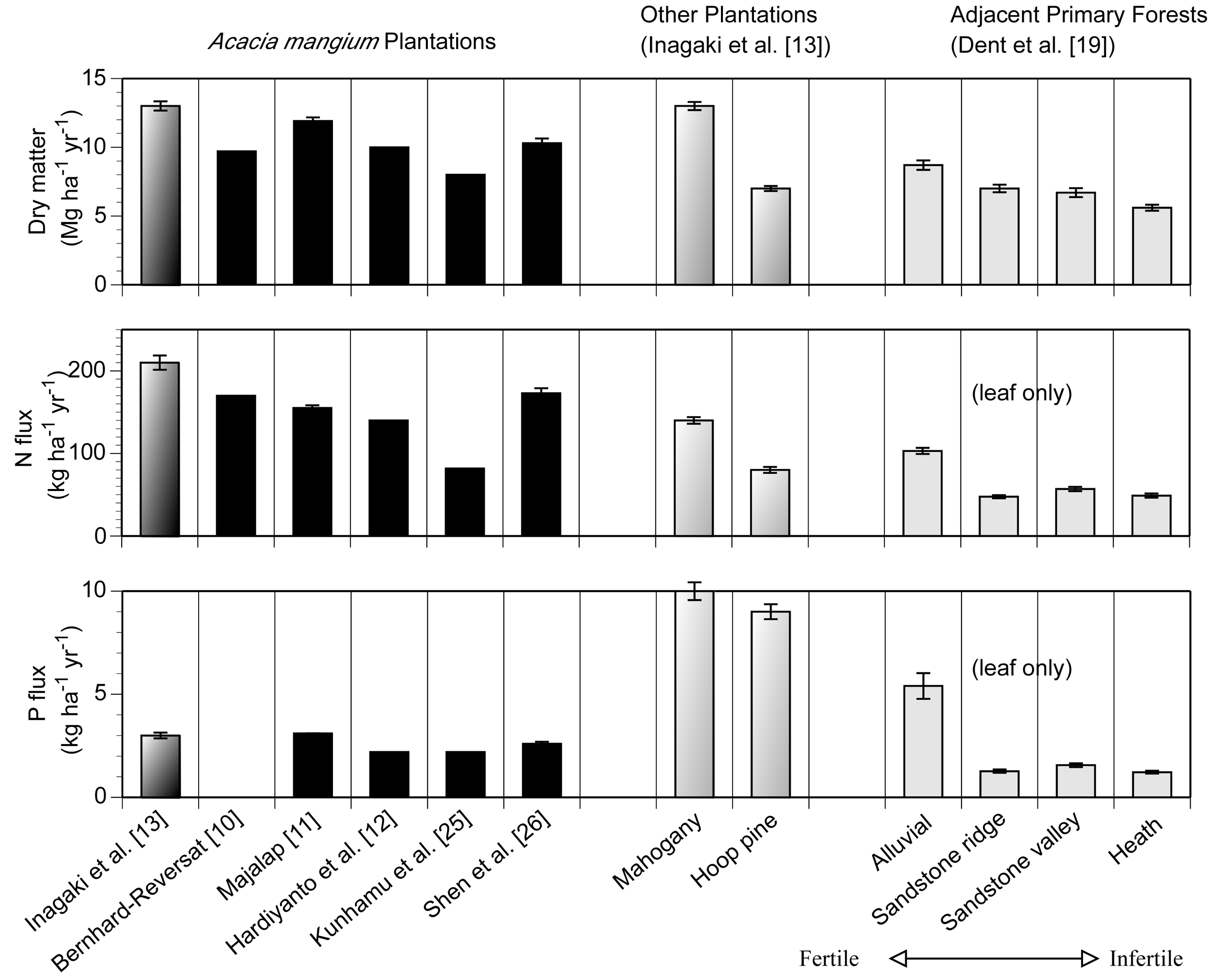
<p>The annual litterfall mass in the <italic>A. mangium</italic> and <italic>S. macrophylla</italic> plantations exceeded 12 Mg ha<sup>−1</sup> year<sup>−1</sup> (<xref ref-type="fig" rid="f1-diversity-03-00712">Figure 1</xref>). These amounts were about 1.6-fold higher than that in the adjacent primary forest under nutrient rich alluvial soil [<xref ref-type="bibr" rid="b19-diversity-03-00712">19</xref>], which is located about 5 km away from this study site. The mean annual N flux via litterfall of <italic>A. mangium</italic> (217 kg ha<sup>−1</sup> year<sup>−1</sup>) exceeded that of <italic>S. macrophylla</italic> (137 kg ha<sup>−1</sup> year<sup>−1</sup>) because the N concentrations in the litterfall of <italic>A. mangium</italic> were higher at all fractions than those of <italic>S. macrophylla</italic>. Across the studies, the annual N flux ranged between 88–228 kg ha<sup>−1</sup> year<sup>−1</sup> [<xref ref-type="bibr" rid="b10-diversity-03-00712">10</xref>-<xref ref-type="bibr" rid="b13-diversity-03-00712">13</xref>,<xref ref-type="bibr" rid="b25-diversity-03-00712">25</xref>,<xref ref-type="bibr" rid="b26-diversity-03-00712">26</xref>]. In contrast to the N flux, the mean annual P flux via litterfall of <italic>A. mangium</italic> (3.3 kg ha<sup>−1</sup> year<sup>−1</sup>) was considerably smaller than at other plantations and the primary forest at the alluvial site. The P fluxes of <italic>A. mangium</italic> plantations exhibited a narrower range (2.7–3.3 kg ha<sup>−1</sup> year<sup>−1</sup>) than the N flux. <italic>A. mangium</italic> plantations likely move larger N and smaller P via litterfall than other forests. Leaf litterfall of <italic>A. mangium</italic> accounted for 7.1 Mg ha<sup>−1</sup> year<sup>−1</sup>, which corresponded to 54 % of total litterfall. N and P fluxes through leaf litterfall were 123 and 1.14 kg ha<sup>−1</sup> year<sup>−1</sup>, which corresponded to 57 and 35 % of total litterfall, respectively.</p></sec>
<sec>
<label>3.2.</label>
<title>N and P Demand under the Root Ingrowth-core Experiment</title>
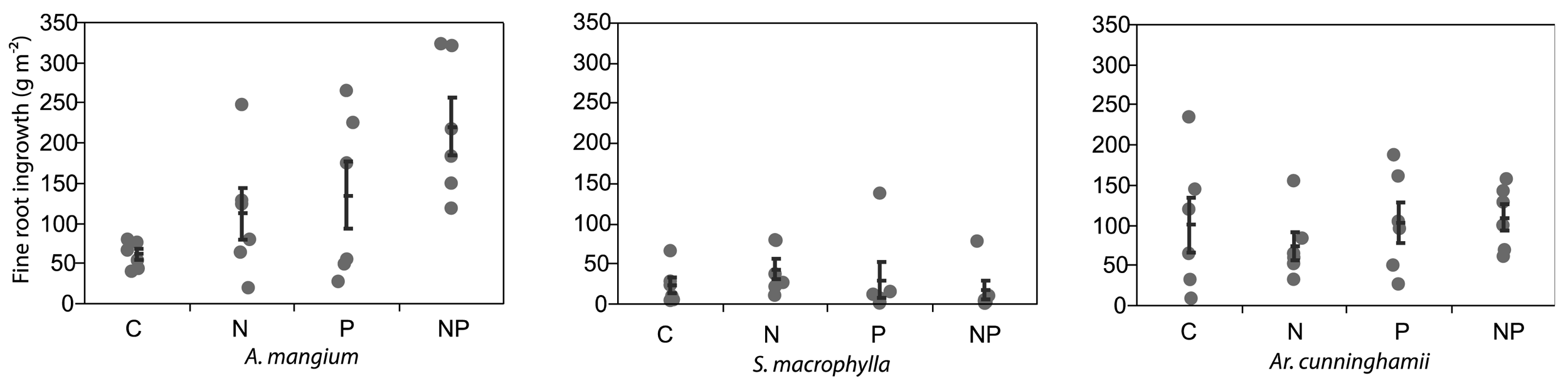
<p>After 5 months from the installation of the root ingrowth-cores, the fine roots of <italic>A. mangium</italic> in the cores were significantly increased by N + P application (ANOVA and Dunnett's step-down test; <italic>P</italic> &lt; 0.05; <xref ref-type="fig" rid="f2-diversity-03-00712">Figure 2</xref>). The averages of fine root growth in the cores were doubled by both N and P application. The fine roots of the other two plantations did not increase by N or P applications. Raich <italic>et al.</italic> [<xref ref-type="bibr" rid="b24-diversity-03-00712">24</xref>] reported that root-growth by nutrient applications using the root-ingrowth core method had significant positive correlation with aboveground growth under fertilized conditions. Although the nitrogen availability at the <italic>A. mangium</italic> site was likely high from the results of litterfall, we considered that <italic>A. mangium</italic> indicated significant demand for both N and P.</p></sec>
<sec>
<label>3.3.</label>
<title>N and P Resorption and N:P Ratio</title>
<p>We compared the N and P concentrations in fresh leaves collected in July 2008 and the three year averages of July data in leaf litterfall from 2002 to 2004 (<xref ref-type="table" rid="t1-diversity-03-00712">Table 1</xref>). The N and P concentrations in fresh leaves were highest for <italic>A. mangium</italic>. In the leaf litterfall, the N concentration was highest but the leaf litterfall was lowest in <italic>A. mangium</italic>. To express the differences in the degree of N and P resorption, we used an N to P (N:P) ratio. The N:P ratio of <italic>A. mangium</italic> increased drastically from fresh leaves to leaf litterfall. In the other two species, such a drastic increase did not occur. Therefore, we considered that <italic>A. mangium</italic> selectively retranslocated high amounts of P, whereas it retranslocated less N.</p>
<p>Killingbeck [<xref ref-type="bibr" rid="b27-diversity-03-00712">27</xref>] reported that N<sub>2</sub>-fixing trees had lower N resorption efficiencies than non-N<sub>2</sub>-fixing trees, but P resorption efficiency did not differ between both groups. Australian sclerophyll species, developed under P limited soils, tended to have lower P concentrations in senesced leaves [<xref ref-type="bibr" rid="b28-diversity-03-00712">28</xref>]. Our results supported the findings of those studies, but <italic>A. mangium</italic> showed a drastic P resorption, while P was not limiting for two other species (<xref ref-type="fig" rid="f2-diversity-03-00712">Figure 2</xref>).</p></sec>
<sec>
<label>3.4.</label>
<title>Effect of A. Mangium Plantations on Global and Regional N and P Cycling</title>
<p><italic>A. mangium</italic> produces a large amount of N in litterfall and enhances the N availability at the forest floor. The N demand of <italic>A. mangium</italic> is likely high under such N rich conditions. Conversely, <italic>A. mangium</italic> selectively retranslocates a great deal of P before leaf-fall. N and P utilization by <italic>A. mangium</italic> differed substantially. These characteristics of <italic>A. mangium</italic> would be an advantage when growing in the wet tropics, where in general, N availability is high and P availability is low. <italic>A. mangium</italic> is only competitive under high light conditions [<xref ref-type="bibr" rid="b29-diversity-03-00712">29</xref>] and such N and P utilization by <italic>A. mangium</italic> is likely to be associated with higher photosynthetic production. Large areas of mono-culture <italic>A. mangium</italic> plantations may alter the cycling of both nutrients. While not only exhibiting the general problems of mono-culture plantation, <italic>A. mangium</italic> plantations can also cause a potential nutrient imbalance in ecosystems, particularly at the forest floor.</p>
<p>Here we tried to estimate how much N and P flux is altered by <italic>A. mangium</italic> plantations in the world. The global averages of N and P concentrations in tropical senesced-leaf were 12.5 and 0.4 mg g<sup>−1</sup>, respectively [<xref ref-type="bibr" rid="b30-diversity-03-00712">30</xref>]. Given that N and P concentrations in the leaf-litterfall of tropical forests were equal, the N and P fluxes via litterfall of <italic>A. mangium</italic> accounted for 140 % of N and only 40% of P compared to average tropical forests. This estimation is concluded from our results of three years averages of N and P concentrations in <italic>A. mangium</italic> leaf litterfall (17.4 and 0.16, respectively; [<xref ref-type="bibr" rid="b22-diversity-03-00712">22</xref>]). Given that all tropical leaf-litterfall was equal to the mean annual leaf-litterfall for <italic>A. mangium</italic> (7.1 Mg ha<sup>−1</sup> year<sup>−1</sup>), <italic>A. mangium</italic> plantations in the world (2.1 million ha) resulted in an increase of 73 Gg N year<sup>−1</sup> and a reduction of 3.6 Gg P year<sup>−1</sup> in litterfall flux. The leaf (needle) litterfall of <italic>S. macrophylla</italic> and <italic>Ar. cunninghamii</italic> were 6.4 and 8.0 Mg ha<sup>−1</sup> year<sup>−1</sup>, respectively, and the range of 3 plots was narrower than total litterfall. So this estimation is conservative but contains less uncertainty compared to using the total litterfall data. Other litterfall fractions will increase these differences because leaf-litterfall accounts for only 54 % of total litterfall in an <italic>A. mangium</italic> forest [<xref ref-type="bibr" rid="b13-diversity-03-00712">13</xref>], although the contributions from these fractions are difficult to estimate because the global averages are uncertain. Also, the area of <italic>A. mangium</italic> plantation could be wider because the species name of <italic>Acacia</italic> was not certain in the original data source from some countries [<xref ref-type="bibr" rid="b1-diversity-03-00712">1</xref>]. This estimation is very rough because the N concentrations of <italic>A. mangium</italic> varied from 6–17 mg g<sup>−1</sup> across the studies [<xref ref-type="bibr" rid="b13-diversity-03-00712">13</xref>], but this estimation can show the potential alteration of N and P flux by single species mono-culture plantations. In addition, a part of excess nitrogen through N<sub>2</sub>-fixation and litterfall can contribute to 4.5 Gg N of N<sub>2</sub>O flux using the data from Arai <italic>et al.</italic> [<xref ref-type="bibr" rid="b6-diversity-03-00712">6</xref>] (2.23 kg N ha<sup>−1</sup> year<sup>−1</sup>).</p>
<p>Although N<sub>2</sub>-fixing trees, including <italic>A. mangium,</italic> are expected to be used as fertilizer trees or protection trees, we recommend mixed planting with other plants or the application of a mixed litter for mulching with lower N:P ratios, e.g., conifers [<xref ref-type="bibr" rid="b22-diversity-03-00712">22</xref>]. Moreover, forest researchers and managers should pay more attention to the nutrient conditions of monoculture <italic>A. mangium</italic> plantations. Further studies are needed to assess the effect of nutrient imbalance at the forest floor of <italic>A. mangium</italic> plantations regarding litter decomposing soil fauna and microbial communities, for the better understanding and management of fast-growing tropical plantations. Because they could be regulated by stociometric ratios in their habitat [<xref ref-type="bibr" rid="b31-diversity-03-00712">31</xref>].</p></sec></sec></body>
<back>
<sec sec-type="display-objects">
<title>Figures and Table</title>
<fig id="f1-diversity-03-00712" position="float">
<label>Figure 1.</label>
<caption>
<p>Litterfall mass, and N and P flux via litterfall in <italic>A. mangium</italic> plantations, Mahogany (<italic>S. macrophylla</italic>) and Hoop pine (<italic>Ar. cunninghamii</italic>) plantations, and adjacent primary tropical forests. The vertical bar indicates one standard error (SE) of the mean.</p></caption>
<graphic xlink:href="diversity-03-00712f1.gif"/></fig>
<fig id="f2-diversity-03-00712" position="float">
<label>Figure 2.</label>
<caption>
<p>Fine-root ingrowth after the application of N, P and both N + P at the three plantations during the measurement period. The vertical bar indicates the mean ± 1SE. Modified from Inagaki <italic>et al.</italic> [<xref ref-type="bibr" rid="b20-diversity-03-00712">20</xref>].</p></caption>
<graphic xlink:href="diversity-03-00712f2.gif"/></fig>
<table-wrap id="t1-diversity-03-00712" position="float">
<label>Table 1.</label>
<caption>
<p>N and P concentrations in fresh leaves and leaf litterfall and N:P ratio in the three plantations.</p></caption>
<table frame="hsides" rules="groups">
<thead>
<tr>
<th align="center" valign="top"/>
<th colspan="2" align="center" valign="top"><bold>Nitrogen</bold></th>
<th colspan="2" align="center" valign="top"><bold>Phosphorus</bold></th>
<th colspan="2" align="center" valign="top"><bold>N:P ratio</bold></th></tr>
<tr>
<th align="center" valign="top"/>
<th colspan="6" valign="bottom">
<hr/></th></tr>
<tr>
<th align="center" valign="top"><bold>Site</bold></th>
<th align="center" valign="top"><bold>Fresh leaves (mg g<sup>−1</sup>)</bold></th>
<th align="center" valign="top"><bold>Leaf litterfall (mg g<sup>−1</sup>)</bold></th>
<th align="center" valign="top"><bold>Fresh leaves (mg g<sup>−1</sup>)</bold></th>
<th align="center" valign="top"><bold>Leaf litterfall (mg g<sup>−1</sup>)</bold></th>
<th align="center" valign="top"><bold>Fresh leaves</bold></th>
<th align="center" valign="top"><bold>Leaf litterfall</bold></th></tr></thead>
<tbody>
<tr>
<td align="left" valign="top"><italic>A. mangium</italic></td>
<td align="center" valign="top">29.4</td>
<td align="center" valign="top">21.8</td>
<td align="center" valign="top">1.01</td>
<td align="center" valign="top">0.27</td>
<td align="center" valign="top">29</td>
<td align="center" valign="top">81</td></tr>
<tr>
<td align="left" valign="top"><italic>S. macrophylla</italic></td>
<td align="center" valign="top">19.2</td>
<td align="center" valign="top">16.1</td>
<td align="center" valign="top">0.82</td>
<td align="center" valign="top">0.68</td>
<td align="center" valign="top">23</td>
<td align="center" valign="top">24</td></tr>
<tr>
<td align="left" valign="top"><italic>Ar. cunninghamii</italic></td>
<td align="center" valign="top">12.3</td>
<td align="center" valign="top">14.2</td>
<td align="center" valign="top">0.71</td>
<td align="center" valign="top">1.20</td>
<td align="center" valign="top">17</td>
<td align="center" valign="top">12</td></tr></tbody></table>
<table-wrap-foot><fn id="tfn1-diversity-03-00712">
<p>Modified from Inagaki <italic>et al.</italic> [<xref ref-type="bibr" rid="b22-diversity-03-00712">22</xref>].</p></fn></table-wrap-foot></table-wrap></sec>
<ack>
<p>This study was funded by the Ministry of Agriculture, Forestry and Fisheries of Japan, and supported by the FFPRI Encouragement Model in Support of Researchers with Family Responsibilities.</p></ack>
<ref-list>
<title>References</title>
<ref id="b1-diversity-03-00712"><label>1.</label><citation citation-type="book"><person-group person-group-type="author"><collab>FAO</collab></person-group><source>Global Planted Forests Thematic Study: Results and Analysis</source><publisher-name>FAO</publisher-name><publisher-loc>Rome, Italy</publisher-loc><year>2006</year><fpage>168</fpage></citation></ref>
<ref id="b2-diversity-03-00712"><label>2.</label><citation citation-type="journal"><person-group person-group-type="author"><name><surname>Bouillet</surname><given-names>J.P.</given-names></name><name><surname>Laclau</surname><given-names>J.P.</given-names></name><name><surname>Gonçalves</surname><given-names>J.L.D.M.</given-names></name><name><surname>Moreira</surname><given-names>M.Z.</given-names></name><name><surname>Trivelin</surname><given-names>P.C.O.</given-names></name><name><surname>Jourdan</surname><given-names>C.</given-names></name><name><surname>Silva</surname><given-names>E.V.</given-names></name><name><surname>Piccolo</surname><given-names>M.C.</given-names></name><name><surname>Tsai</surname><given-names>S.M.</given-names></name><name><surname>Galiana</surname><given-names>A.</given-names></name></person-group><article-title>Mixed-species plantations of <italic>Acacia mangium</italic> and <italic>Eucalyptus grandis</italic> in Brazil 2: Nitrogen accumulation in the stands and biological N<sub>2</sub> fixation</article-title><source>For. Ecol. Manag.</source><year>2008</year><volume>255</volume><fpage>3918</fpage><lpage>3930</lpage><pub-id pub-id-type="doi">10.1016/j.foreco.2007.10.050</pub-id></citation></ref>
<ref id="b3-diversity-03-00712"><label>3.</label><citation citation-type="journal"><person-group person-group-type="author"><name><surname>Mercado</surname><given-names>A.R.</given-names></name><name><surname>van Noordwijk</surname><given-names>M.</given-names></name><name><surname>Cadisch</surname><given-names>G.</given-names></name></person-group><article-title>Positive nitrogen balance of <italic>Acacia mangium</italic> woodlots as fallows in the Philippines based on <sup>15</sup>N natural abundance data of N<sub>2</sub> fixation</article-title><source>Agrofor. Syst.</source><year>2011</year><volume>81</volume><fpage>221</fpage><lpage>233</lpage><pub-id pub-id-type="doi">10.1007/s10457-010-9309-8</pub-id></citation></ref>
<ref id="b4-diversity-03-00712"><label>4.</label><citation citation-type="journal"><person-group person-group-type="author"><name><surname>Norisada</surname><given-names>M.</given-names></name><name><surname>Hitsuma</surname><given-names>G.</given-names></name><name><surname>Kuroda</surname><given-names>K.</given-names></name><name><surname>Yamanoshita</surname><given-names>T.</given-names></name><name><surname>Masumori</surname><given-names>M.</given-names></name><name><surname>Tange</surname><given-names>T.</given-names></name><name><surname>Yagi</surname><given-names>H.</given-names></name><name><surname>Nuyim</surname><given-names>T.</given-names></name><name><surname>Sasaki</surname><given-names>S.</given-names></name><name><surname>Kojima</surname><given-names>K.</given-names></name></person-group><article-title><italic>Acacia mangium</italic>, a nurse tree candidate for reforestation on degraded sandy soils in the Malay Peninsula</article-title><source>For. Sci.</source><year>2005</year><volume>51</volume><fpage>498</fpage><lpage>510</lpage></citation></ref>
<ref id="b5-diversity-03-00712"><label>5.</label><citation citation-type="book"><person-group person-group-type="author"><name><surname>Cossalter</surname><given-names>C.</given-names></name><name><surname>Pye-Smith</surname><given-names>C.</given-names></name></person-group><source>Fast-Wood Forestry-Myths and Realities</source><publisher-name>CIFOR</publisher-name><publisher-loc>Jakarta, Indonesia</publisher-loc><year>2003</year><fpage>54</fpage></citation></ref>
<ref id="b6-diversity-03-00712"><label>6.</label><citation citation-type="journal"><person-group person-group-type="author"><name><surname>Arai</surname><given-names>S.</given-names></name><name><surname>Ishizuka</surname><given-names>S.</given-names></name><name><surname>Ohta</surname><given-names>S.</given-names></name><name><surname>Ansori</surname><given-names>S.</given-names></name><name><surname>Tokuchi</surname><given-names>N.</given-names></name><name><surname>Tanaka</surname><given-names>N.</given-names></name><name><surname>Hardjono</surname><given-names>A.</given-names></name></person-group><article-title>Potential N<sub>2</sub>O emissions from leguminous tree plantation soils in the humid tropics</article-title><source>Glob. Biogeochem. Cycles</source><year>2008</year><fpage>22</fpage><pub-id pub-id-type="doi">10.1029/2007GB002965</pub-id></citation></ref>
<ref id="b7-diversity-03-00712"><label>7.</label><citation citation-type="journal"><person-group person-group-type="author"><name><surname>Konda</surname><given-names>R.</given-names></name><name><surname>Ohta</surname><given-names>S.</given-names></name><name><surname>Ishizuka</surname><given-names>S.</given-names></name><name><surname>Heriyanto</surname><given-names>J.</given-names></name><name><surname>Wicaksono</surname><given-names>A.</given-names></name></person-group><article-title>Seasonal changes in the spatial structures of N<sub>2</sub>O, CO<sub>2</sub>, and CH<sub>4</sub> fluxes from <italic>Acacia mangium</italic> plantation soils in Indonesia</article-title><source>Soil Biol. Biochem.</source><year>2010</year><volume>42</volume><fpage>1512</fpage><lpage>1522</lpage><pub-id pub-id-type="doi">10.1016/j.soilbio.2010.05.022</pub-id></citation></ref>
<ref id="b8-diversity-03-00712"><label>8.</label><citation citation-type="journal"><person-group person-group-type="author"><name><surname>Matson</surname><given-names>P.</given-names></name><name><surname>Vitousek</surname><given-names>P.M.</given-names></name></person-group><article-title>Ecosystem approach to a global nitrous oxide budget</article-title><source>Bioscience</source><year>1990</year><volume>40</volume><fpage>667</fpage><lpage>672</lpage><pub-id pub-id-type="doi">10.2307/1311434</pub-id></citation></ref>
<ref id="b9-diversity-03-00712"><label>9.</label><citation citation-type="journal"><person-group person-group-type="author"><name><surname>Ravishankara</surname><given-names>A.R.</given-names></name><name><surname>Daniel</surname><given-names>J.S.</given-names></name><name><surname>Portmann</surname><given-names>R.W.</given-names></name></person-group><article-title>Nitrous oxide (N<sub>2</sub>O): The dominant ozone-depleting substance emitted in the 21st century</article-title><source>Science</source><year>2009</year><volume>326</volume><fpage>123</fpage><lpage>125</lpage><pub-id pub-id-type="doi">10.1126/science.1176985</pub-id><pub-id pub-id-type="pmid">19713491</pub-id></citation></ref>
<ref id="b10-diversity-03-00712"><label>10.</label><citation citation-type="journal"><person-group person-group-type="author"><name><surname>Bernhard-Reversat</surname><given-names>F.</given-names></name></person-group><article-title>Nitrogen cycling in tree plantations grown on a poor sandy savanna soil in Congo</article-title><source>Appl. Soil Ecol.</source><year>1996</year><volume>4</volume><fpage>161</fpage><lpage>172</lpage><pub-id pub-id-type="doi">10.1016/0929-1393(96)00096-0</pub-id></citation></ref>
<ref id="b11-diversity-03-00712"><label>11.</label><citation citation-type="thesis"><person-group person-group-type="author"><name><surname>Majalap</surname><given-names>N.</given-names></name></person-group><article-title>Effects of Acacia Mangium on Soils in Sabah</article-title><source>Ph.D. Dissertation</source><publisher-name>The University of Aberdeen</publisher-name><publisher-loc>Aberdeen, UK</publisher-loc><year>1999</year><fpage>323</fpage></citation></ref>
<ref id="b12-diversity-03-00712"><label>12.</label><citation citation-type="confproc"><person-group person-group-type="author"><name><surname>Hardiyanto</surname><given-names>E.</given-names></name><name><surname>Wicaksono</surname><given-names>A</given-names></name></person-group><article-title>Inter-rotation site management, stand growth and soil properties in <italic>Acacia mangium</italic> plantations in South Sumatra, Indonesia</article-title><conf-name>Site Management and Productivity in Tropical Plantation Forests: Proceedings of Workshops in Piracicaba (Brazil) 22&amp;26 November 2004 and Bogor (Indonesia) 6&amp;9 November 2006</conf-name><person-group person-group-type="editor"><name><surname>Nambiar</surname><given-names>E.</given-names></name></person-group><publisher-name>CIFOR</publisher-name><publisher-loc>Jakarta, Indonesia</publisher-loc><year>2008</year><fpage>107</fpage><lpage>122</lpage></citation></ref>
<ref id="b13-diversity-03-00712"><label>13.</label><citation citation-type="journal"><person-group person-group-type="author"><name><surname>Inagaki</surname><given-names>M.</given-names></name><name><surname>Kamo</surname><given-names>K.</given-names></name><name><surname>Titin</surname><given-names>J.</given-names></name><name><surname>Jamalung</surname><given-names>L.</given-names></name><name><surname>Lapongan</surname><given-names>J.</given-names></name><name><surname>Miura</surname><given-names>S.</given-names></name></person-group><article-title>Nutrient dynamics through fine litterfall in three plantations in Sabah, Malaysia, in relation to nutrient supply to surface soil</article-title><source>Nutr. Cycl. Agroecosyst.</source><year>2010</year><volume>88</volume><fpage>381</fpage><lpage>395</lpage><pub-id pub-id-type="doi">10.1007/s10705-010-9364-6</pub-id></citation></ref>
<ref id="b14-diversity-03-00712"><label>14.</label><citation citation-type="journal"><person-group person-group-type="author"><name><surname>Yashiro</surname><given-names>Y.</given-names></name><name><surname>Kadir</surname><given-names>W.</given-names></name><name><surname>Okuda</surname><given-names>T.</given-names></name><name><surname>Koizumi</surname><given-names>H.</given-names></name></person-group><article-title>The effects of logging on soil greenhouse gas (CO<sub>2</sub>, CH<sub>4</sub>, N<sub>2</sub>O) flux in a tropical rain forest, Peninsular Malaysia</article-title><source>Agric. For. Meteorol.</source><year>2008</year><volume>148</volume><fpage>799</fpage><lpage>806</lpage><pub-id pub-id-type="doi">10.1016/j.agrformet.2008.01.010</pub-id></citation></ref>
<ref id="b15-diversity-03-00712"><label>15.</label><citation citation-type="journal"><person-group person-group-type="author"><name><surname>Khanna</surname><given-names>P.K.</given-names></name></person-group><article-title>Nutrient cycling under mixed-species tree systems in southeast Asia</article-title><source>Agrofor. Syst.</source><year>1998</year><volume>38</volume><fpage>99</fpage><lpage>120</lpage></citation></ref>
<ref id="b16-diversity-03-00712"><label>16.</label><citation citation-type="journal"><person-group person-group-type="author"><name><surname>Lee</surname><given-names>Y.K.</given-names></name><name><surname>Lee</surname><given-names>D.K.</given-names></name><name><surname>Woo</surname><given-names>S.Y.</given-names></name><name><surname>Park</surname><given-names>P.S.</given-names></name><name><surname>Jang</surname><given-names>Y.H.</given-names></name><name><surname>Abraham</surname><given-names>E.R.G.</given-names></name></person-group><article-title>Effect of <italic>Acacia</italic> plantations on net photosynthesis, tree species composition, soil enzyme activities, and microclimate on Mt. Makiling</article-title><source>Photosynthetica</source><year>2006</year><volume>44</volume><fpage>299</fpage><lpage>308</lpage><pub-id pub-id-type="doi">10.1007/s11099-006-0022-9</pub-id></citation></ref>
<ref id="b17-diversity-03-00712"><label>17.</label><citation citation-type="journal"><person-group person-group-type="author"><name><surname>Houlton</surname><given-names>B.Z.</given-names></name><name><surname>Wang</surname><given-names>Y.P.</given-names></name><name><surname>Vitousek</surname><given-names>P.M.</given-names></name><name><surname>Field</surname><given-names>C.B.</given-names></name></person-group><article-title>A unifying framework for dinitrogen fixation in the terrestrial biosphere</article-title><source>Nature</source><year>2008</year><volume>454</volume><fpage>327</fpage><lpage>330</lpage><pub-id pub-id-type="doi">10.1038/nature07028</pub-id><pub-id pub-id-type="pmid">18563086</pub-id></citation></ref>
<ref id="b18-diversity-03-00712"><label>18.</label><citation citation-type="journal"><person-group person-group-type="author"><name><surname>Ribet</surname><given-names>J.</given-names></name><name><surname>Drevon</surname><given-names>J.J.</given-names></name></person-group><article-title>The phosphorus requirement of N<sub>2</sub>-fixing and urea-fed <italic>Acacia mangium</italic></article-title><source>New Phytol</source><year>1996</year><volume>132</volume><fpage>383</fpage><lpage>390</lpage><pub-id pub-id-type="doi">10.1111/j.1469-8137.1996.tb01858.x</pub-id></citation></ref>
<ref id="b19-diversity-03-00712"><label>19.</label><citation citation-type="journal"><person-group person-group-type="author"><name><surname>Dent</surname><given-names>D.H.</given-names></name><name><surname>Bagchi</surname><given-names>R.</given-names></name><name><surname>Robinson</surname><given-names>D.</given-names></name><name><surname>Majalap-Lee</surname><given-names>N.</given-names></name><name><surname>Burslem</surname><given-names>D.F.R.P.</given-names></name></person-group><article-title>Nutrient fluxes via litterfall and leaf litter decomposition vary across a gradient of soil nutrient supply in a lowland tropical rain forest</article-title><source>Plant Soil</source><year>2006</year><volume>288</volume><fpage>197</fpage><lpage>215</lpage><pub-id pub-id-type="doi">10.1007/s11104-006-9108-1</pub-id></citation></ref>
<ref id="b20-diversity-03-00712"><label>20.</label><citation citation-type="journal"><person-group person-group-type="author"><name><surname>Inagaki</surname><given-names>M.</given-names></name><name><surname>Inagaki</surname><given-names>Y.</given-names></name><name><surname>Kamo</surname><given-names>K.</given-names></name><name><surname>Titin</surname><given-names>J.</given-names></name></person-group><article-title>Fine-root production in response to nutrient application at three forest plantations in Sabah, Malaysia: Higher nitrogen and phosphorus demand by Acacia mangium</article-title><source>J. For. Res.</source><year>2009</year><volume>14</volume><fpage>178</fpage><lpage>182</lpage><pub-id pub-id-type="doi">10.1007/s10310-009-0113-0</pub-id></citation></ref>
<ref id="b21-diversity-03-00712"><label>21.</label><citation citation-type="book"><person-group person-group-type="author"><name><surname>Inagaki</surname><given-names>M.</given-names></name><name><surname>Titin</surname><given-names>J.</given-names></name></person-group><article-title>Evaluation of site environments for agroforestry production</article-title><source>Development of Agroforestry Technology for the Rehabilitation of Tropical Forests</source><comment>JIRCAS Working Report 60</comment><person-group person-group-type="editor"><name><surname>Gotoh</surname><given-names>T.</given-names></name><name><surname>Yokota</surname><given-names>Y.</given-names></name></person-group><publisher-name>JIRCAS</publisher-name><publisher-loc>Tsukuba, Japan</publisher-loc><year>2009</year><fpage>26</fpage><lpage>31</lpage></citation></ref>
<ref id="b22-diversity-03-00712"><label>22.</label><citation citation-type="journal"><person-group person-group-type="author"><name><surname>Inagaki</surname><given-names>M.</given-names></name><name><surname>Kamo</surname><given-names>K.</given-names></name><name><surname>Miyamoto</surname><given-names>K.</given-names></name><name><surname>Titin</surname><given-names>J.</given-names></name><name><surname>Jamalung</surname><given-names>L.</given-names></name><name><surname>Lapongan</surname><given-names>J.</given-names></name><name><surname>Miura</surname><given-names>S.</given-names></name></person-group><article-title>Nitrogen and phosphorus retranslocation and N:P ratios of litterfall in three tropical plantations: Luxurious N and efficient P use by <italic>Acacia mangium</italic></article-title><source>Plant Soil</source><year>2011</year><volume>341</volume><fpage>295</fpage><lpage>307</lpage><pub-id pub-id-type="doi">10.1007/s11104-010-0644-3</pub-id></citation></ref>
<ref id="b23-diversity-03-00712"><label>23.</label><citation citation-type="journal"><person-group person-group-type="author"><name><surname>Cuevas</surname><given-names>E.</given-names></name><name><surname>Medina</surname><given-names>E.</given-names></name></person-group><article-title>Nutrient dynamics within Amazonian forests II. Fine root growth, nutrient availability and leaf litter decomposition</article-title><source>Oecologia</source><year>1988</year><volume>76</volume><fpage>222</fpage><lpage>235</lpage><pub-id pub-id-type="doi">10.1007/BF00379956</pub-id></citation></ref>
<ref id="b24-diversity-03-00712"><label>24.</label><citation citation-type="journal"><person-group person-group-type="author"><name><surname>Raich</surname><given-names>J.</given-names></name><name><surname>Riley</surname><given-names>R.</given-names></name><name><surname>Vitousek</surname><given-names>P.</given-names></name></person-group><article-title>Use of root-ingrowth cores to assess nutrient limitations in forest ecosystems</article-title><source>Ecosystems</source><year>1994</year><volume>24</volume><fpage>2135</fpage><lpage>2138</lpage></citation></ref>
<ref id="b25-diversity-03-00712"><label>25.</label><citation citation-type="journal"><person-group person-group-type="author"><name><surname>Kunhamu</surname><given-names>T.K.</given-names></name><name><surname>Kumar</surname><given-names>B.M.</given-names></name><name><surname>Viswanath</surname><given-names>S.</given-names></name></person-group><article-title>Does thinning affect litterfall, litter decomposition, and associated nutrient release in <italic>Acacia mangium</italic> stands of Kerala in peninsular India?</article-title><source>Can. J. For. Res.</source><year>2009</year><volume>39</volume><fpage>792</fpage><lpage>801</lpage><pub-id pub-id-type="doi">10.1139/X09-008</pub-id></citation></ref>
<ref id="b26-diversity-03-00712"><label>26.</label><citation citation-type="journal"><person-group person-group-type="author"><name><surname>Shen</surname><given-names>W.</given-names></name><name><surname>Lin</surname><given-names>Y.</given-names></name><name><surname>Jenerette</surname><given-names>G.D.</given-names></name><name><surname>Wu</surname><given-names>J.</given-names></name></person-group><article-title>Blowing litter across a landscape: Effects on ecosystem nutrient flux and implications for landscape management</article-title><source>Landsc. Ecol.</source><year>2011</year><volume>26</volume><fpage>629</fpage><lpage>644</lpage><pub-id pub-id-type="doi">10.1007/s10980-011-9599-x</pub-id></citation></ref>
<ref id="b27-diversity-03-00712"><label>27.</label><citation citation-type="journal"><person-group person-group-type="author"><name><surname>Killingbeck</surname><given-names>K.T.</given-names></name></person-group><article-title>Nutrients in senesced leaves: Keys to the search for potential resorption and resorption proficiency</article-title><source>Ecology</source><year>1996</year><volume>77</volume><fpage>1716</fpage><lpage>1727</lpage><pub-id pub-id-type="doi">10.2307/2265777</pub-id></citation></ref>
<ref id="b28-diversity-03-00712"><label>28.</label><citation citation-type="journal"><person-group person-group-type="author"><name><surname>Wright</surname><given-names>I.J.</given-names></name><name><surname>Westoby</surname><given-names>M.</given-names></name></person-group><article-title>Nutrient concentration, resorption and lifespan: Leaf traits of Australian sclerophyll species</article-title><source>Funct. Ecol.</source><year>2003</year><volume>17</volume><fpage>10</fpage><lpage>19</lpage><pub-id pub-id-type="doi">10.1046/j.1365-2435.2003.00694.x</pub-id></citation></ref>
<ref id="b29-diversity-03-00712"><label>29.</label><citation citation-type="journal"><person-group person-group-type="author"><name><surname>Osunkoya</surname><given-names>O.O.</given-names></name><name><surname>Othman</surname><given-names>F.E.</given-names></name><name><surname>Kahar</surname><given-names>R.S.</given-names></name></person-group><article-title>Growth and competition between seedlings of an invasive plantation tree, <italic>Acacia mangium</italic>, and those of a native Borneo heath-forest species, <italic>Melastoma beccarianum</italic></article-title><source>Ecol. Res.</source><year>2005</year><volume>20</volume><fpage>205</fpage><lpage>214</lpage><pub-id pub-id-type="doi">10.1007/s11284-004-0027-4</pub-id></citation></ref>
<ref id="b30-diversity-03-00712"><label>30.</label><citation citation-type="journal"><person-group person-group-type="author"><name><surname>Yuan</surname><given-names>Z.</given-names></name><name><surname>Chen</surname><given-names>H.Y.H.</given-names></name></person-group><article-title>Global trends in senesced-leaf nitrogen and phosphorus</article-title><source>Glob. Ecol. Biogeogr.</source><year>2009</year><volume>18</volume><fpage>532</fpage><lpage>542</lpage><pub-id pub-id-type="doi">10.1111/j.1466-8238.2009.00474.x</pub-id></citation></ref>
<ref id="b31-diversity-03-00712"><label>31.</label><citation citation-type="journal"><person-group person-group-type="author"><name><surname>Güsewell</surname><given-names>S.</given-names></name><name><surname>Gessner</surname><given-names>M.O.</given-names></name></person-group><article-title>N:P ratios influence litter decomposition and colonization by fungi and bacteria in microcosms</article-title><source>Funct. Ecol.</source><year>2009</year><volume>23</volume><fpage>211</fpage><lpage>219</lpage><pub-id pub-id-type="doi">10.1111/j.1365-2435.2008.01478.x</pub-id></citation></ref></ref-list></back></article>