
<?xml version="1.0" encoding="UTF-8"?>
<!DOCTYPE article PUBLIC "-//NLM//DTD Journal Publishing DTD v2.3 20070202//EN" "journalpublishing.dtd">
<article xmlns:mml="http://www.w3.org/1998/Math/MathML" xmlns:xlink="http://www.w3.org/1999/xlink" xml:lang="en" article-type="research-article">
<front>
<journal-meta>
<journal-id journal-id-type="publisher-id">ijms</journal-id>
<journal-title>International Journal of Molecular Sciences</journal-title>
<abbrev-journal-title>Int. J. Mol. Sci.</abbrev-journal-title>
<issn pub-type="epub">1422-0067</issn>
<publisher>
<publisher-name>Molecular Diversity Preservation International (MDPI)</publisher-name></publisher></journal-meta>
<article-meta>
<article-id pub-id-type="doi">10.3390/ijms9081424</article-id>
<article-id pub-id-type="publisher-id">ijms-09-01424</article-id>
<article-categories>
<subj-group>
<subject>Article</subject></subj-group></article-categories>
<title-group>
<article-title>Redox Behavior of Anticancer Chalcone on a Glassy Carbon Electrode and Evaluation of its Interaction Parameters with DNA</article-title></title-group>
<contrib-group>
<contrib contrib-type="author">
<name><surname>Shah</surname><given-names>Afzal</given-names></name></contrib>
<contrib contrib-type="author">
<name><surname>Khan</surname><given-names>Asad M.</given-names></name><xref ref-type="corresp" rid="c1-ijms-09-01424">*</xref></contrib>
<contrib contrib-type="author">
<name><surname>Qureshi</surname><given-names>Rumana</given-names></name></contrib>
<contrib contrib-type="author">
<name><surname>Ansari</surname><given-names>Farzana L.</given-names></name></contrib>
<contrib contrib-type="author">
<name><surname>Nazar</surname><given-names>Muhammad F.</given-names></name></contrib>
<contrib contrib-type="author">
<name><surname>Shah</surname><given-names>Syed S.</given-names></name></contrib>
<aff id="af1-ijms-09-01424">Deprtment of Chmeistry, Quaid-i-Azam University, 45320 Islamabad, Pakistan</aff></contrib-group>
<author-notes>
<corresp id="c1-ijms-09-01424">
<label>*</label>Author to whom correspondence should be addressed; E-Mail:
<email>amk.qau@gmail.com</email> (A. K.); Tel. +92-51-90642047; Fax: +92-51-90642242</corresp></author-notes>
<pub-date pub-type="epub">
<day>13</day>
<month>8</month>
<year>2008</year></pub-date>
<pub-date pub-type="collection">
<month>8</month>
<year>2008</year></pub-date>
<volume>9</volume>
<issue>8</issue>
<fpage>1424</fpage>
<lpage>1434</lpage>
<history>
<date date-type="received">
<day>3</day>
<month>7</month>
<year>2008</year></date>
<date date-type="rev-recd">
<day>23</day>
<month>7</month>
<year>2008</year></date>
<date date-type="accepted">
<day>23</day>
<month>7</month>
<year>2008</year></date></history>
<permissions>
<copyright-statement>© 2008 by the authors; licensee Molecular Diversity Preservation International, Basel, Switzerland. This article is an open-access article distributed under the terms and conditions of the Creative Commons Attribution license (<ext-link xlink:href="http://creativecommons.org/licenses/by/3.0/" ext-link-type="uri">http://creativecommons.org/licenses/by/3.0/</ext-link>).</copyright-statement>
<copyright-year>2008</copyright-year>
<license license-type="open-access">
<p>This article is an open-access article distributed under the terms and conditions of the Creative Commons Attribution license (<ext-link xlink:href="http://creativecommons.org/licenses/by/3.0/" ext-link-type="uri">http://creativecommons.org/licenses/by/3.0/</ext-link>).</p></license></permissions>
<abstract>
<p>The interaction of anticancer chalcone [AMC, 1-(4′-aminophenyl)-3-(4-<italic>N,N</italic>-dimethylphenyl)-2-propen-1-one] with DNA has been explored using electrochemical, spectroscopic and viscometric techniques. A shift in peak potential and decrease in peak current were observed in cyclic voltammetry and hypochromism accompanied with bathochromic shift were noticed in UV-Vis absorption spectroscopy. These findings were taken as evidence for AMC –DNA intercalation. A binding constant (<italic>K</italic>) with a value of 6.15 × 10<sup>5</sup> M<sup>−1</sup> was obtained from CV data, which was also confirmed by UV-Vis absorption titration. Moreover, the diffusion coefficient of the drug with and without DNA (D<sub>b</sub> and D<sub>u</sub>), heterogeneous electron transfer rate constant (k<sup>o</sup>) and electron affinity (A) were also calculated from electrochemical data.</p></abstract>
<kwd-group>
<kwd>DNA</kwd>
<kwd>hypochromism</kwd>
<kwd>bathochromic shift</kwd>
<kwd>binding constant</kwd></kwd-group></article-meta></front>
<body>
<sec sec-type="intro">
<title>1. Introduction</title>
<p>Due to ineffective drugs, cancer is the secondmost leading cause of death after heart attack. Therefore, the researchers have accelerated their efforts for the generation of new anticancer drugs with high therapeutic index. In this connection, a clinically effective antitumor derivative of chalcone (calicheamicin) has stimulated the investigators to concentrate their studies on chalcones and related compounds [<xref ref-type="bibr" rid="b1-ijms-09-01424">1</xref>].</p>
<p>Chalcones [<xref ref-type="bibr" rid="b2-ijms-09-01424">2</xref>] (α,β-unsaturated ketones) are promising candidates in the new era of medicines on account of their wide spectrum of antitumor, antibacterial and anti-inflammatory activities [<xref ref-type="bibr" rid="b3-ijms-09-01424">3</xref>–<xref ref-type="bibr" rid="b12-ijms-09-01424">12</xref>]. Until now, several research teams have already reported the interaction of compounds and DNA using conventional three electrode cells which consisted of GCE, SCE and Pt wire. These works provide much valuable information for further investigation and the design of new anticancer drugs [<xref ref-type="bibr" rid="b13-ijms-09-01424">13</xref>–<xref ref-type="bibr" rid="b14-ijms-09-01424">14</xref>]. By application of spectroscopic and voltammetric techniques, parameters like binding constant, binding site size, Gibbs energy of binding, ratio of binding constants for oxidized and reduced species, diffusion coefficient (free and DNA-bound drug) and heterogeneous electron transfer rate constant can be determined.</p>
<p>The activities of several DNA binding molecules have their origin primarily in intercalation [<xref ref-type="bibr" rid="b15-ijms-09-01424">15</xref>– <xref ref-type="bibr" rid="b16-ijms-09-01424">16</xref>]. However, the nature of intercalation depends upon the functional group and geometry of the molecule [<xref ref-type="bibr" rid="b17-ijms-09-01424">17</xref>– <xref ref-type="bibr" rid="b18-ijms-09-01424">18</xref>]. In this paper the interaction of AMC (<xref ref-type="fig" rid="f7-ijms-09-01424">Scheme 1a</xref>) with DNA for unleashing its role in arresting DNA duplication has been studied by cyclic voltammetry [<xref ref-type="bibr" rid="b19-ijms-09-01424">19</xref>–<xref ref-type="bibr" rid="b22-ijms-09-01424">22</xref>], UV-Vis spectroscopy and viscometry at 25°C in 10% aqueous methanol buffered at pH 7.4 using 0.05 M Tris-HCl.</p></sec>
<sec sec-type="results|discussion">
<title>2. Results and Discussion</title>
<sec>
<title>2.1. Redox studies of AMC-DNA interaction</title>
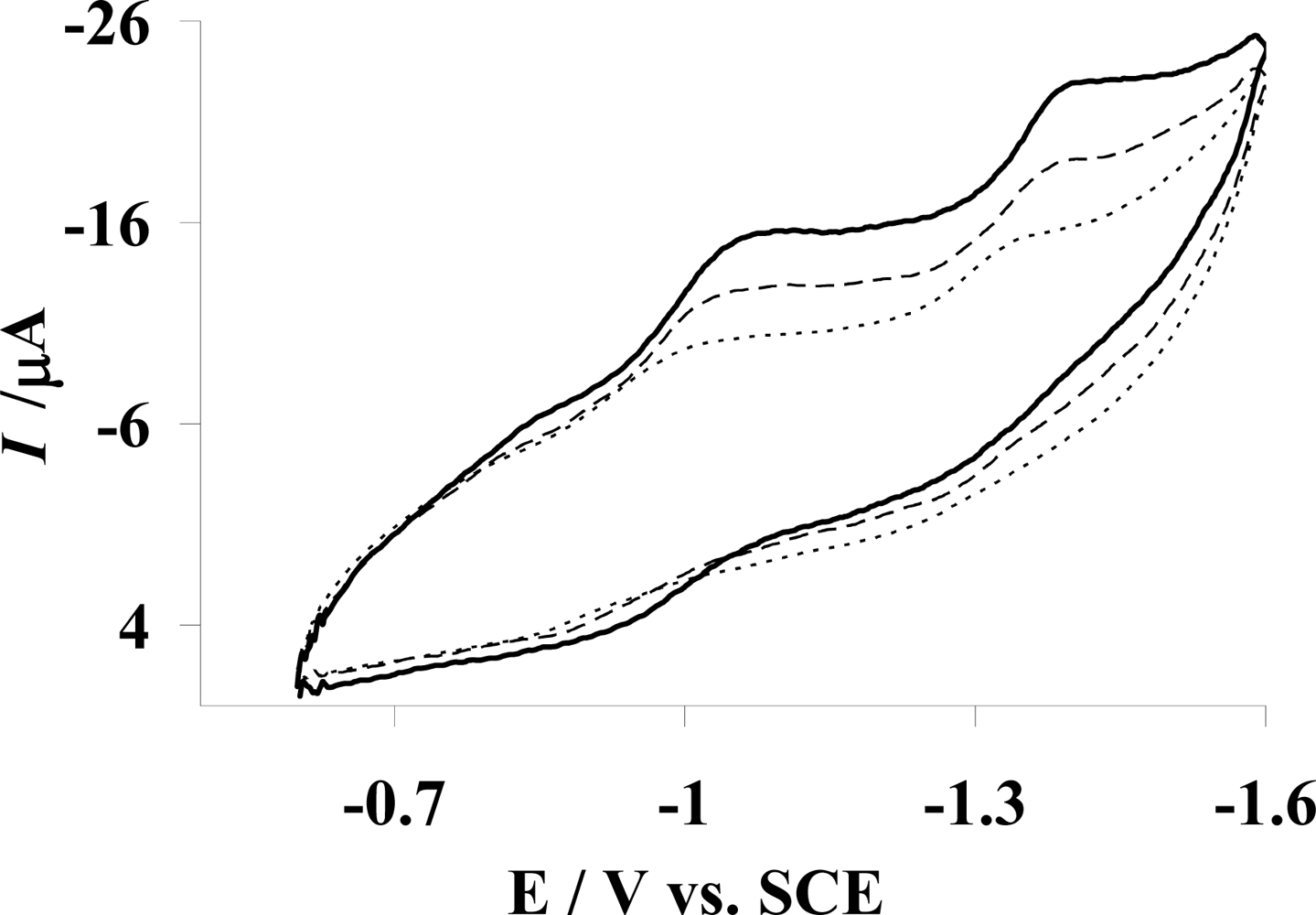
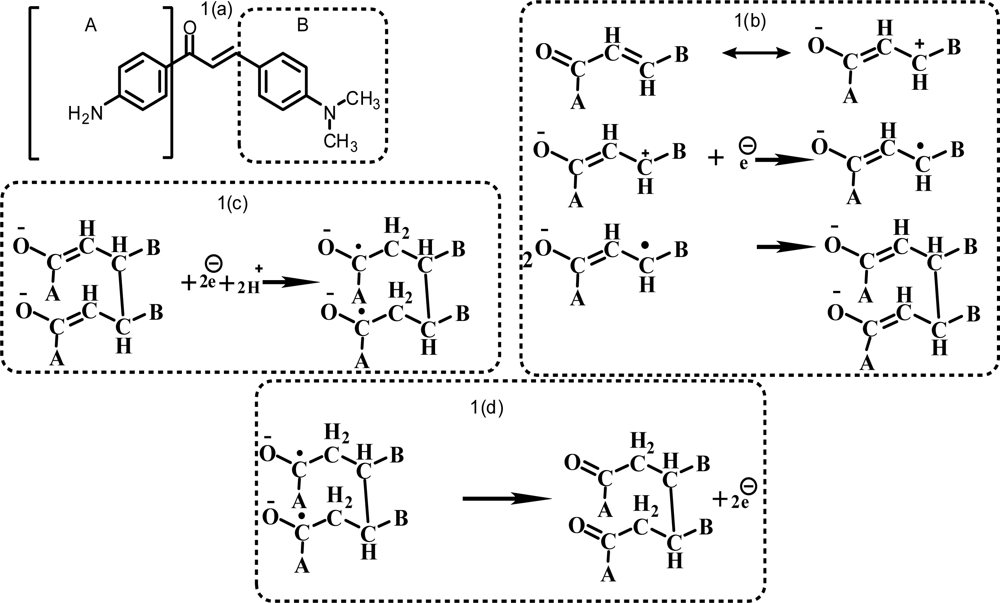
<p>The cyclic voltammetric behavior of 2 mM AMC in 0.05 M Tris-HCl buffer (pH 7.4) at GCE in the absence and presence of varying concentration of CB-DNA has been shown in <xref ref-type="fig" rid="f1-ijms-09-01424">Figure 1</xref>. The voltammogram (—) shows that AMC exhibits two prominent reduction peaks and one weak oxidation peak at the bare GCE. Peak I<sub>c</sub> at –1.06 V corresponds to the one electron reduction of carbon 3 followed by dimer formation as shown in <xref ref-type="fig" rid="f7-ijms-09-01424">Scheme 1b</xref>. Peak II<sub>c</sub> at –1.40 V can be attributed to the two electron/two proton reduction of the dimer as depicted in <xref ref-type="fig" rid="f7-ijms-09-01424">Scheme 1c</xref>.The weak anodic peak I<sub>a</sub> at –0.94 V may be due to the electrooxidation of the product generated from II<sub>c</sub> as illustrated in <xref ref-type="fig" rid="f7-ijms-09-01424">scheme 1(d)</xref>.</p>
<p>Voltammograms (- - -) and (- - -) in <xref ref-type="fig" rid="f1-ijms-09-01424">Figure 1</xref> further indicate considerable diminution of the peak currents and shift of cathodic peak potentials to less negative values by the addition of increasing concentration of DNA. Such observations can be attributed to the decrease in free drug concentration due to its intercalation into DNA [<xref ref-type="bibr" rid="b23-ijms-09-01424">23</xref>]. The shift in peak potential indicates the interaction of AMC with DNA.</p>
<p>Further examination of the cyclic voltammograms reveals the disappearance of anodic peak, which may be due to the formation of electrochemically unoxidizable drug-DNA adduct. To show that the decrease in peak current is due to the formation of slowly diffusing AMC -DNA complex, the diffusion coefficient of the drug with and without DNA was determined by using Randles- Sevcik equation [<xref ref-type="bibr" rid="b24-ijms-09-01424">24</xref>]:
<disp-formula id="FD1">
<label>(1)</label>
<mml:math display="block">
<mml:msub>
<mml:mi>I</mml:mi>
<mml:mi>p</mml:mi></mml:msub>
<mml:mo>=</mml:mo>
<mml:mn>2.69</mml:mn>
<mml:mo>×</mml:mo>
<mml:msup>
<mml:mn>10</mml:mn>
<mml:mn>5</mml:mn></mml:msup>
<mml:mi> </mml:mi>
<mml:msup>
<mml:mi>n</mml:mi>
<mml:mrow>
<mml:mn>3</mml:mn>
<mml:mo>/</mml:mo>
<mml:mn>2</mml:mn></mml:mrow></mml:msup>
<mml:mi>A</mml:mi>
<mml:msubsup>
<mml:mi>C</mml:mi>
<mml:mi>o</mml:mi>
<mml:mo>*</mml:mo></mml:msubsup>
<mml:msubsup>
<mml:mi>D</mml:mi>
<mml:mi>o</mml:mi>
<mml:mrow>
<mml:mn>1</mml:mn>
<mml:mo>/</mml:mo>
<mml:mn>2</mml:mn></mml:mrow></mml:msubsup>
<mml:msup>
<mml:mi>v</mml:mi>
<mml:mrow>
<mml:mn>1</mml:mn>
<mml:mo>/</mml:mo>
<mml:mn>2</mml:mn></mml:mrow></mml:msup></mml:math></disp-formula>where <italic>I</italic><italic><sub>p</sub></italic> (A) is the peak current, <italic>A</italic> (cm<sup>2</sup>) is the surface area of the electrode, <italic>C<sub>o</sub></italic>*(mol cm<sup>−3</sup>) is the bulk concentration of the electroactive species, <italic>D</italic><italic><sub>o</sub></italic> (cm<sup>2</sup>s<sup>−1</sup>) is the diffusion coefficient and <italic>ν</italic> (Vs<sup>−1</sup>) is the scan rate.</p>
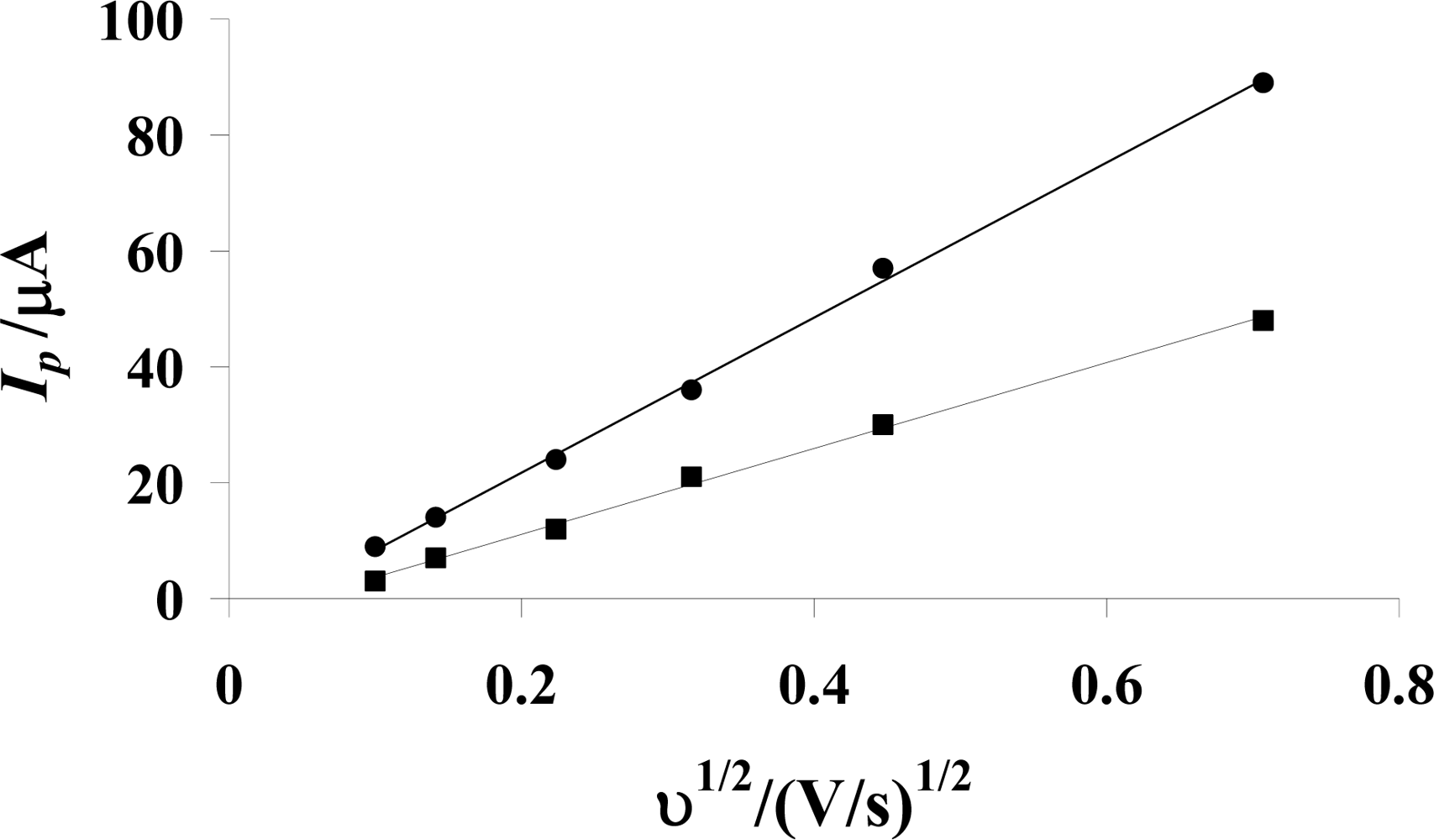
<p>The linearity of the plot (<xref ref-type="fig" rid="f2-ijms-09-01424">Figure 2</xref>) between <italic>I</italic><italic><sub>p</sub></italic> and <italic>υ</italic><italic><sup>1/2</sup></italic> indicates that the reduction of AMC is controlled by the diffusion step. The diffusion co-efficient of 2 mM AMC in the absence and presence of 5 μM DNA was obtained as 1.11 × 10<sup>−9</sup> m<sup>2</sup>s<sup>−1</sup> and 2.97 × 10<sup>−10</sup> m<sup>2</sup>s<sup>−1</sup> from the slope of <italic>I</italic><italic><sub>p</sub></italic> vs. <italic>υ</italic><italic><sup>1/2</sup></italic> plot. These results indicate that the diffusion coefficient of DNA – bound drug (AMC), which is an order of magnitude lower than that of the free drug is responsible for the observed decay in peak current. Similar results have also been obtained by other investigators [<xref ref-type="bibr" rid="b25-ijms-09-01424">25</xref>–<xref ref-type="bibr" rid="b27-ijms-09-01424">27</xref>].</p>
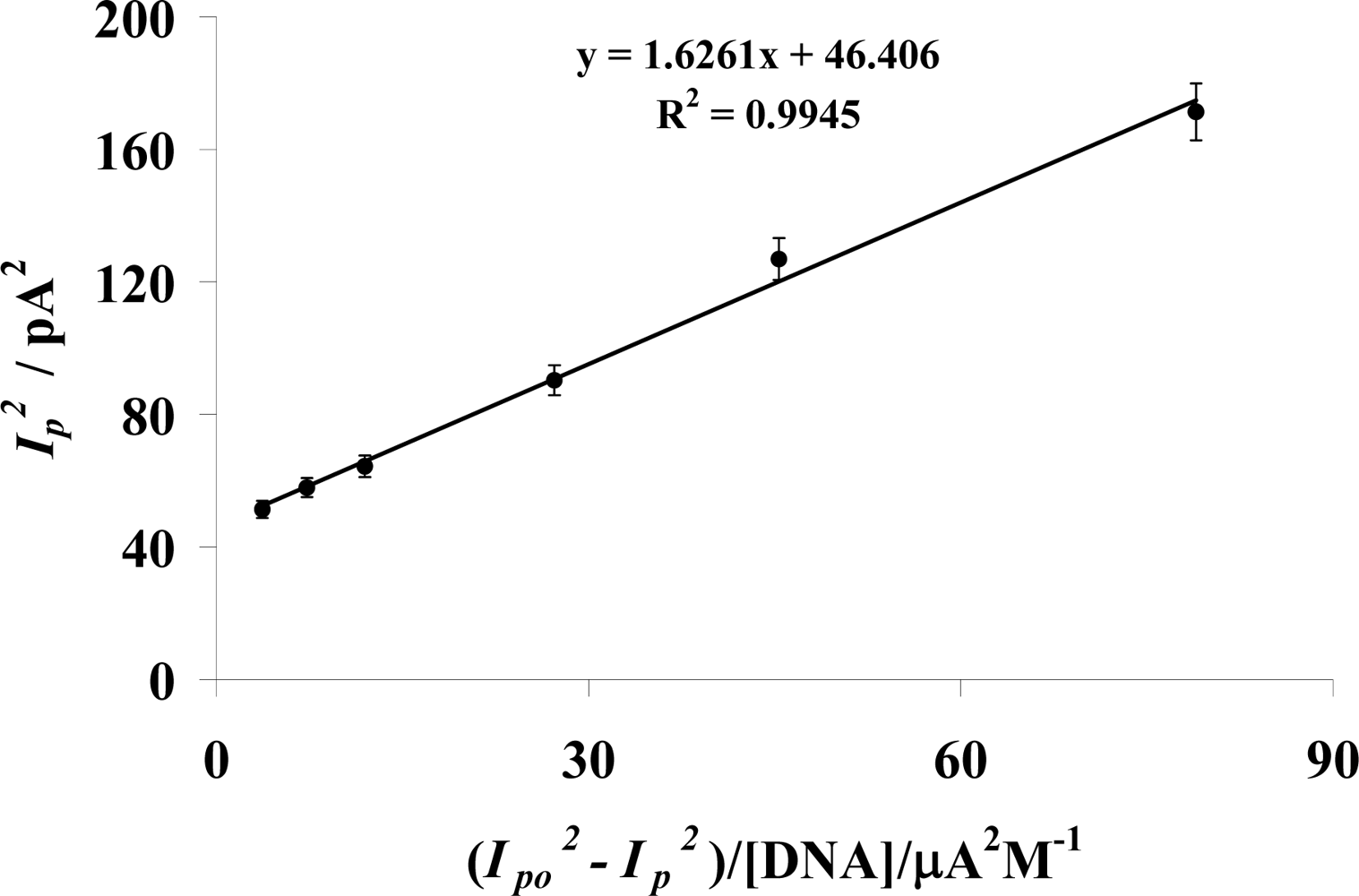
<p>The binding constant (<italic>K</italic>) of AMC- DNA interaction was obtained by using the following equation [<xref ref-type="bibr" rid="b28-ijms-09-01424">28</xref>–<xref ref-type="bibr" rid="b29-ijms-09-01424">29</xref>]:
<disp-formula id="FD2">
<label>(2)</label>
<mml:math display="block">
<mml:mi>I</mml:mi>
<mml:msup>
<mml:mi>p</mml:mi>
<mml:mn>2</mml:mn></mml:msup>
<mml:mo>=</mml:mo>
<mml:mfrac>
<mml:mn>1</mml:mn>
<mml:mrow>
<mml:mi>K</mml:mi>
<mml:mo stretchy="false">[</mml:mo>
<mml:mi>D</mml:mi>
<mml:mi>N</mml:mi>
<mml:mi>A</mml:mi>
<mml:mo stretchy="false">]</mml:mo></mml:mrow></mml:mfrac>
<mml:mo stretchy="false">(</mml:mo>
<mml:mi>I</mml:mi>
<mml:mi>p</mml:mi>
<mml:msup>
<mml:mi>o</mml:mi>
<mml:mn>2</mml:mn></mml:msup>
<mml:mo>−</mml:mo>
<mml:mi>I</mml:mi>
<mml:msup>
<mml:mi>p</mml:mi>
<mml:mn>2</mml:mn></mml:msup>
<mml:mo stretchy="false">)</mml:mo>
<mml:mo>+</mml:mo>
<mml:mi>I</mml:mi>
<mml:mi>p</mml:mi>
<mml:msup>
<mml:mi>o</mml:mi>
<mml:mn>2</mml:mn></mml:msup>
<mml:mo>−</mml:mo>
<mml:mo stretchy="false">[</mml:mo>
<mml:mtext>DNA</mml:mtext>
<mml:mo stretchy="false">]</mml:mo></mml:math></disp-formula>where <italic>I</italic><italic><sub>p</sub></italic> and <italic>I</italic><italic><sub>po</sub></italic> are the peak currents of AMC with and without DNA respectively. A value of 6.15 ×10<sup>5</sup> M<sup>−1</sup> was obtained from the slope of 
<inline-formula>
<mml:math>
<mml:msubsup>
<mml:mi>I</mml:mi>
<mml:mi>p</mml:mi>
<mml:mn>2</mml:mn></mml:msubsup></mml:math></inline-formula> vs. 
<inline-formula>
<mml:math>
<mml:msubsup>
<mml:mi>I</mml:mi>
<mml:mrow>
<mml:mi>p</mml:mi>
<mml:mi>o</mml:mi></mml:mrow>
<mml:mtext>2</mml:mtext></mml:msubsup>
<mml:mo>−</mml:mo>
<mml:msubsup>
<mml:mi>I</mml:mi>
<mml:mi>p</mml:mi>
<mml:mn>2</mml:mn></mml:msubsup></mml:math></inline-formula> / [DNA] plot as shown in <xref ref-type="fig" rid="f3-ijms-09-01424">Figure 3</xref>. The strong affinity of this drug to DNA as is evident from its high binding constant which could serve as an important addition to the traditional cancer treatment.</p>
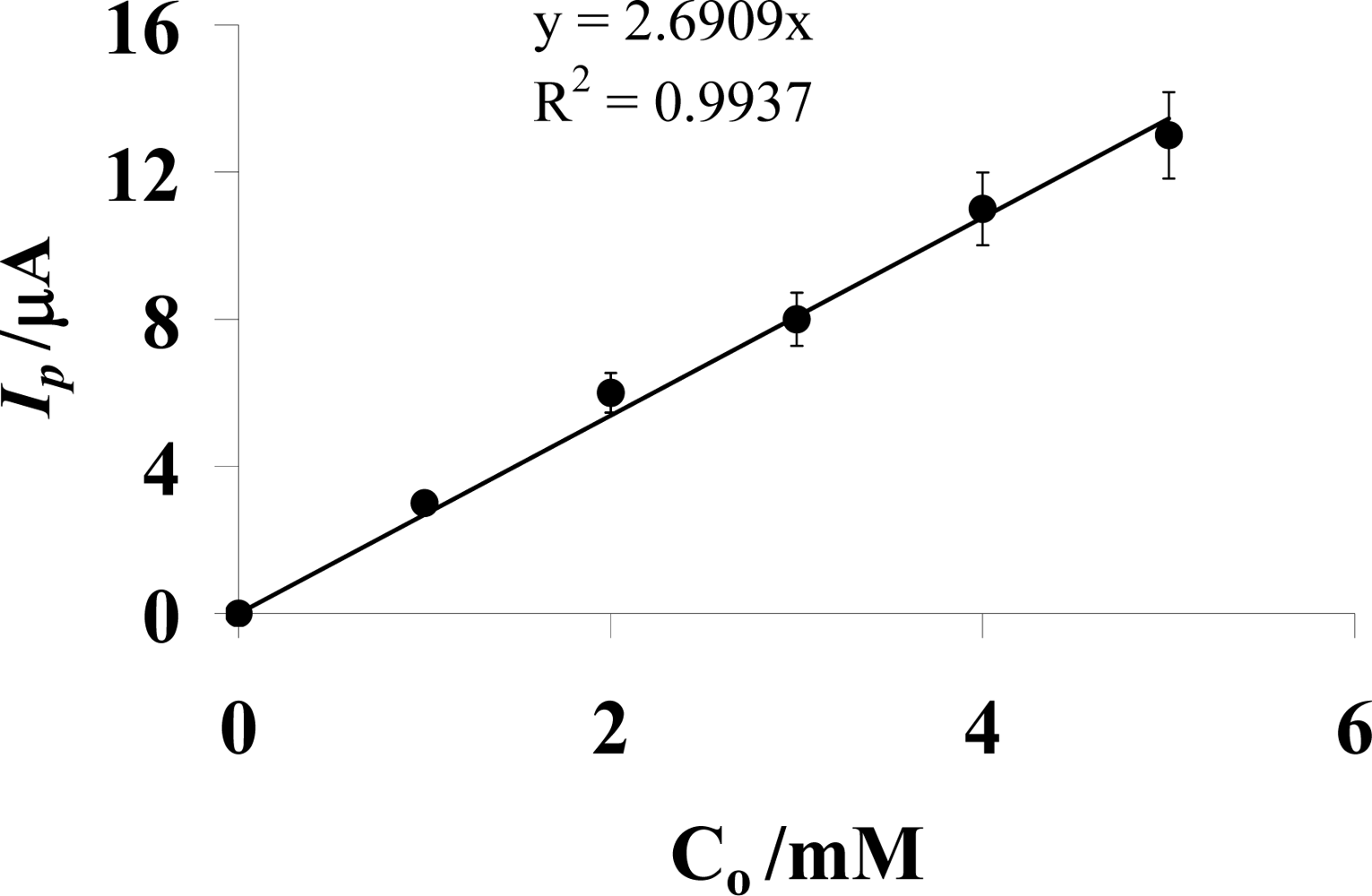
<p>The experimental heterogeneous electron transfer rate constant of AMC (<italic>k</italic><italic><sup>o</sup></italic>) with a value of 3.95 × 10<sup>−6</sup> ms<sup>−1</sup> was obtained at 100 mV/s scan rate from the slope of <italic>I</italic><italic><sub>p</sub></italic> vs. <italic>C</italic><italic><sub>o</sub></italic> plot (<xref ref-type="fig" rid="f4-ijms-09-01424">Figure 4</xref>) using Reinmuth’s expression [<xref ref-type="bibr" rid="b30-ijms-09-01424">30</xref>]:
<disp-formula id="FD3">
<label>(3)</label>
<mml:math display="block">
<mml:msub>
<mml:mi>I</mml:mi>
<mml:mi>p</mml:mi></mml:msub>
<mml:mo>=</mml:mo>
<mml:mi>n</mml:mi>
<mml:mi>F</mml:mi>
<mml:mi>A</mml:mi>
<mml:msub>
<mml:mi>C</mml:mi>
<mml:mi>o</mml:mi></mml:msub>
<mml:msup>
<mml:mi>k</mml:mi>
<mml:mi>o</mml:mi></mml:msup></mml:math></disp-formula>where <italic>I</italic><italic><sub>p</sub></italic> and <italic>C</italic><italic><sub>o</sub></italic> denote the peak current and concentration of the electroactive species respectively.</p>
<p>The electron affinity (A) of AMC with a value of 1.71 eV was calculated from its <italic>E</italic><italic><sub>1/2</sub></italic> value by the relationship reported as [<xref ref-type="bibr" rid="b31-ijms-09-01424">31</xref>]:
<disp-formula id="FD4">
<label>(4)</label>
<mml:math display="block">
<mml:mi>A</mml:mi>
<mml:mo>=</mml:mo>
<mml:mi>χ</mml:mi>
<mml:mo>−</mml:mo>
<mml:msub>
<mml:mi>E</mml:mi>
<mml:mrow>
<mml:mn>1</mml:mn>
<mml:mo>/</mml:mo>
<mml:mn>2</mml:mn></mml:mrow></mml:msub>
<mml:mo>−</mml:mo>
<mml:mi>S</mml:mi></mml:math></disp-formula>where <italic>S</italic> is the solvation energy and χ is the work function of working electrode, whose value is 4.39 eV for glassy carbon electrode [<xref ref-type="bibr" rid="b32-ijms-09-01424">32</xref>]. The electron affinity of AMC is comparable with 1- (4′-N,N-dimethylphenyl)-2-propen-1-one (1.69 eV) [<xref ref-type="bibr" rid="b33-ijms-09-01424">33</xref>] but slightly greater than simple aromatic hydrocarbons [<xref ref-type="bibr" rid="b31-ijms-09-01424">31</xref>– <xref ref-type="bibr" rid="b34-ijms-09-01424">34</xref>– <xref ref-type="bibr" rid="b35-ijms-09-01424">35</xref>] due to its conjugated carbonyl group.</p>
<p>The solvation energy was evaluated from Born′s equation [<xref ref-type="bibr" rid="b33-ijms-09-01424">33</xref>]:
<disp-formula id="FD5">
<label>(5)</label>
<mml:math display="block">
<mml:mi>S</mml:mi>
<mml:mo>=</mml:mo>
<mml:mrow>
<mml:mo>−(</mml:mo>
<mml:msup>
<mml:mtext>z</mml:mtext>
<mml:mn>2</mml:mn></mml:msup>
<mml:msup>
<mml:mi>e</mml:mi>
<mml:mn>2</mml:mn></mml:msup></mml:mrow>
<mml:mo>/</mml:mo>
<mml:mn>2</mml:mn>
<mml:mi>r</mml:mi>
<mml:mo>)</mml:mo>
<mml:mi> </mml:mi>
<mml:mo>(</mml:mo>
<mml:mn>1</mml:mn>
<mml:mo>−</mml:mo>
<mml:mn>1</mml:mn>
<mml:mo>/</mml:mo>
<mml:mi>ε</mml:mi>
<mml:mtext>)</mml:mtext>
<mml:mi> </mml:mi>
<mml:mo>(</mml:mo>
<mml:mn>1</mml:mn>
<mml:mo>/</mml:mo>
<mml:mn>4</mml:mn>
<mml:mi>π</mml:mi>
<mml:msub>
<mml:mi>ε</mml:mi>
<mml:mi>o</mml:mi></mml:msub>
<mml:mtext>)</mml:mtext>
<mml:mi> </mml:mi>
<mml:mn>1</mml:mn>
<mml:mo>/</mml:mo>
<mml:mn>1</mml:mn>
<mml:mtext>.6</mml:mtext>
<mml:mi>x</mml:mi>
<mml:msup>
<mml:mn>10</mml:mn>
<mml:mrow>
<mml:mo>−</mml:mo>
<mml:mn>19</mml:mn></mml:mrow></mml:msup></mml:math></disp-formula></p>
<p>The radius of AMC was calculated from the density equation [<xref ref-type="bibr" rid="b33-ijms-09-01424">33</xref>]:
<disp-formula id="FD6">
<label>(6)</label>
<mml:math display="block">
<mml:mfrac>
<mml:mn>4</mml:mn>
<mml:mn>3</mml:mn></mml:mfrac>
<mml:mi>π</mml:mi>
<mml:msup>
<mml:mi>r</mml:mi>
<mml:mn>3</mml:mn></mml:msup>
<mml:mo>=</mml:mo>
<mml:mfrac>
<mml:mi>M</mml:mi>
<mml:mrow>
<mml:mi>N</mml:mi>
<mml:mi>d</mml:mi></mml:mrow></mml:mfrac></mml:math></disp-formula></p></sec>
<sec>
<title>2.2. Spectroscopic studies</title>
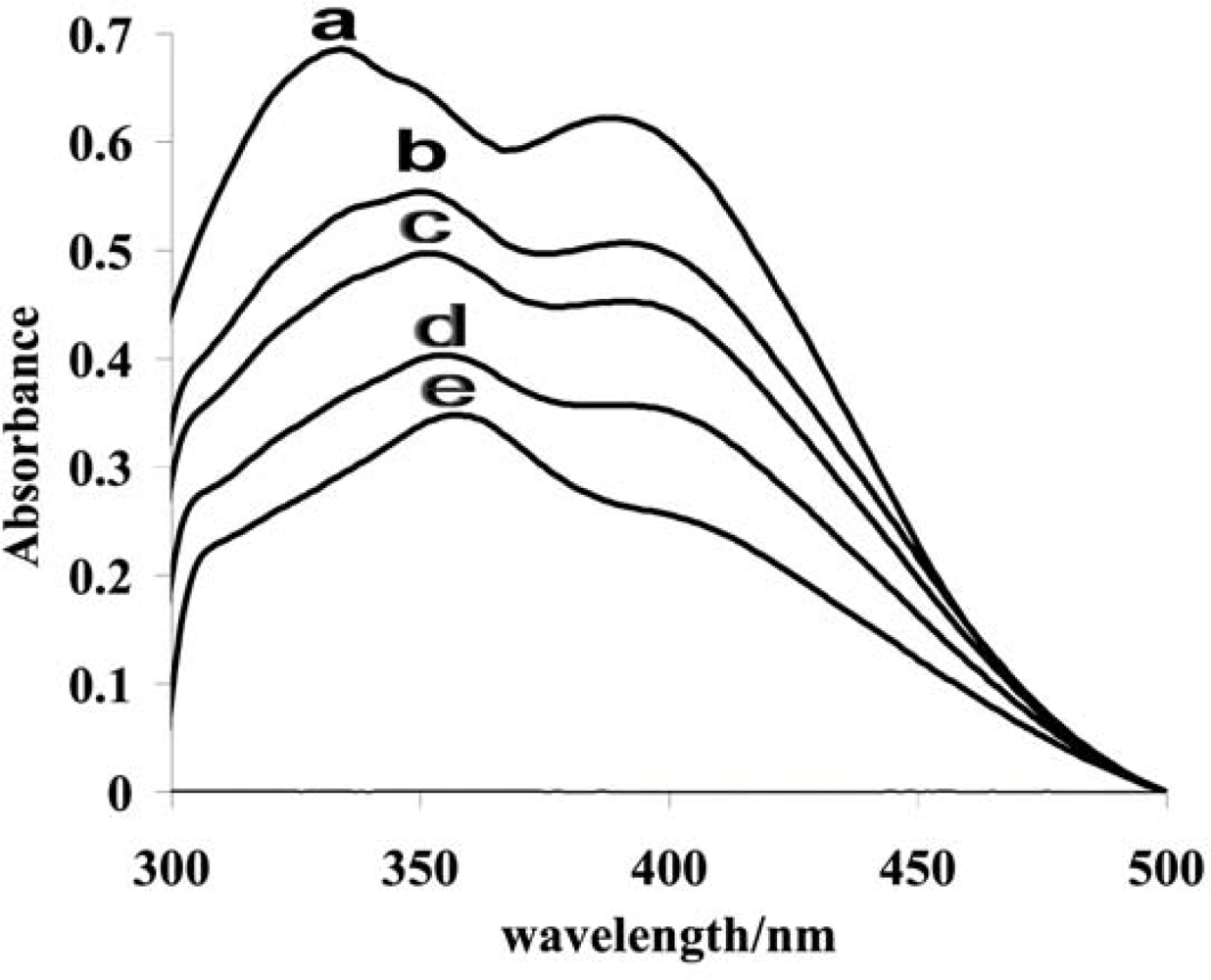
<p>The UV–Vis absorption spectra of AMC–DNA complexes in 10% aqueous methanol maintained at pH 7.4 (0.05 M Tris-HCl buffer) were also recorded using 5 μM AMC with varying concentration (ranging from 0.5–20 μM) of DNA for getting further clues about the mode and strength of interaction. <xref ref-type="fig" rid="f5-ijms-09-01424">Figure 5</xref> shows the absorption spectra of AMC in the absence and presence of DNA. The absorption spectra exhibited peculiar bathochromic and hypochromic shifts by the addition of increasing concentration of DNA. Such findings indicate the interaction of electronic states of AMC intercalating chromophore (α,β-unsaturated ketonic part) with the DNA bases, resulting in a stable AMC-DNA complex by π–π stacking and dipole–dipole interactions [<xref ref-type="bibr" rid="b36-ijms-09-01424">36</xref>– <xref ref-type="bibr" rid="b37-ijms-09-01424">37</xref>]. The bathochromic shift of the drug from 336 nm to 359 nm and hypochromic effect of 0.34 after binding to a fixed amount of DNA are typical characteristics of an intercalative mode of binding [<xref ref-type="bibr" rid="b38-ijms-09-01424">38</xref>– <xref ref-type="bibr" rid="b39-ijms-09-01424">39</xref>], in which the drug inserts itself between the adjacent base pairs causing partial unwinding of DNA resulting in the failure of its translation and transcription machinery. The insertion of the drug is expected to occur through minor and major grooves as its radius (0.46 nm) is less than the width (0.6 and 1.2 nm) of both these grooves [<xref ref-type="bibr" rid="b40-ijms-09-01424">40</xref>]. The decrease in the drug absorption intensities were exploited for the evaluation of the binding constant using the following equation [<xref ref-type="bibr" rid="b41-ijms-09-01424">41</xref>– <xref ref-type="bibr" rid="b42-ijms-09-01424">42</xref>]:
<disp-formula id="FD7">
<label>(7)</label>
<mml:math display="block">
<mml:mfrac>
<mml:mrow>
<mml:msub>
<mml:mi>A</mml:mi>
<mml:mi>o</mml:mi></mml:msub></mml:mrow>
<mml:mrow>
<mml:mi>A</mml:mi>
<mml:mo>−</mml:mo>
<mml:msub>
<mml:mi>A</mml:mi>
<mml:mi>o</mml:mi></mml:msub></mml:mrow></mml:mfrac>
<mml:mo>=</mml:mo>
<mml:mfrac>
<mml:mrow>
<mml:msub>
<mml:mi>ε</mml:mi>
<mml:mi>u</mml:mi></mml:msub></mml:mrow>
<mml:mrow>
<mml:msub>
<mml:mi>ε</mml:mi>
<mml:mi>b</mml:mi></mml:msub>
<mml:mo>−</mml:mo>
<mml:msub>
<mml:mi>ε</mml:mi>
<mml:mi>u</mml:mi></mml:msub></mml:mrow></mml:mfrac>
<mml:mo>+</mml:mo>
<mml:mfrac>
<mml:mrow>
<mml:msub>
<mml:mi>ε</mml:mi>
<mml:mi>u</mml:mi></mml:msub></mml:mrow>
<mml:mrow>
<mml:msub>
<mml:mi>ε</mml:mi>
<mml:mi>b</mml:mi></mml:msub>
<mml:mo>−</mml:mo>
<mml:msub>
<mml:mi>ε</mml:mi>
<mml:mi>u</mml:mi></mml:msub></mml:mrow></mml:mfrac>
<mml:mrow>
<mml:mo>[</mml:mo> 
<mml:mrow>
<mml:mfrac>
<mml:mn>1</mml:mn>
<mml:mrow>
<mml:mi>K</mml:mi>
<mml:mo stretchy="false">[</mml:mo>
<mml:mi>D</mml:mi>
<mml:mi>N</mml:mi>
<mml:mi>A</mml:mi>
<mml:mo stretchy="false">]</mml:mo></mml:mrow></mml:mfrac></mml:mrow> 
<mml:mo>]</mml:mo></mml:mrow></mml:math></disp-formula>where <italic>A</italic> and <italic>A</italic><italic><sub>o</sub></italic> represent the absorbance of bound and unbound drug with ɛ<sub>b</sub> and ɛ<italic><sub>u</sub></italic> as their respective absorption coefficients.</p>
<p>The binding constant with a value of 2.86 × 10<sup>5</sup> M<sup>−1</sup> was obtained from intercept to slope ratio of <italic>A</italic><italic><sub>0</sub></italic><italic>/(A–A</italic><italic><sub>0</sub></italic><italic>)</italic> vs. 1/[DNA] plot. The value of <italic>K</italic> obtained here is in close agreement with that obtained from CV measurements and is greater then the <italic>K</italic> = 2.60× .10<sup>5</sup> M<sup>−1</sup> obtained for the interaction of kaempferol with DNA due to a couple factors like the presence of electrophilic carcbon and extensive aromatic system [<xref ref-type="bibr" rid="b43-ijms-09-01424">43</xref>].</p></sec>
<sec>
<title>2.3. Viscosity measurements</title>
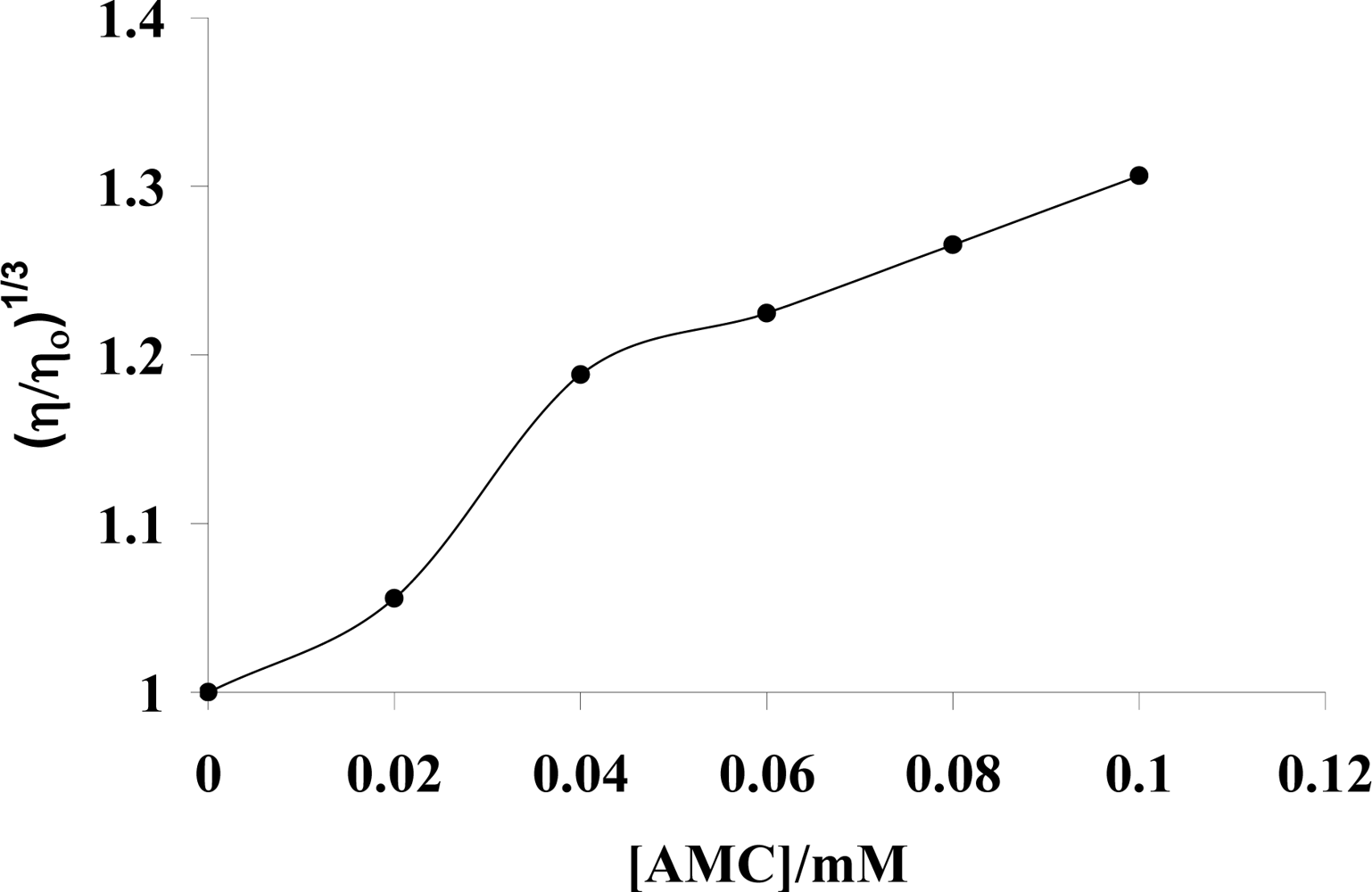
<p>Electrochemical techniques generally provide necessary but insufficient evidence to support an intercalative mode of binding. Viscometric measurements can offer least ambiguous clues about the binding model in solution [<xref ref-type="bibr" rid="b13-ijms-09-01424">13</xref>]. The change in the viscosity of 50 μM DNA upon the addition of the drug ranging from 20 μM to 100 μM is shown in <xref ref-type="fig" rid="f6-ijms-09-01424">Figure 6</xref>. Representing intrinsic viscosity of DNA with and without drug by η and η<sub>o</sub>, data were plotted as (η/η<sub>o</sub>)<sup>1/3</sup> against the concentration of the drug. The results reveal a significant increase in the relative viscosity of DNA, indicating an intercalative mode of binding [<xref ref-type="bibr" rid="b44-ijms-09-01424">44</xref>]. The intercalating agents for their accommodation widen the gap between the adjacent base pairs and thus cause lengthening of the double helical structure resulting in a significant increase of relative viscosity of DNA [<xref ref-type="bibr" rid="b45-ijms-09-01424">45</xref>].</p></sec></sec>
<sec>
<title>3. Experimental Section</title>
<sec>
<title>3.1. Reagents and chemicals</title>
<p>AMC was kindly provided by F. L. Ansari from her combinatorial library of 120 chalcones [<xref ref-type="bibr" rid="b20-ijms-09-01424">20</xref>– <xref ref-type="bibr" rid="b46-ijms-09-01424">46</xref>]. Methanol UN-no 1230 with more than 99.5% purity was used without further purification. Tetrabutylammonium perchlorate (TBAP, Fluka, 99% purity) was further purified by recrystallization using methanol as a solvent. Doubly distilled water was used to prepare all the solutions and buffered at pH 7.4 by using 0.05 M Tris-HCl buffer. DNA was extracted from chicken blood by Falcon method [<xref ref-type="bibr" rid="b21-ijms-09-01424">21</xref>]. Stock solution of chicken blood DNA (CB-DNA) was prepared by dissolving an appropriate amount of DNA in doubly distilled water and stored at 4°C. The concentration of the stock solution of CB-DNA (200 μM in nucleotide phosphate, NP) was determined by UV absorbance at 260 nm using the molar extinction coefficient (∈) of 6600 M<sup>−1</sup> cm<sup>−1</sup> [<xref ref-type="bibr" rid="b22-ijms-09-01424">22</xref>].</p>
<p>The nucleotide to protein (N/P) ratio of 1.85 obtained from the ratio of optical density at 260 and 280 nm (<italic>A</italic><italic><sub>260</sub></italic><italic>/A</italic><italic><sub>280</sub></italic> = 1.85) was taken as evidence for protein free DNA [<xref ref-type="bibr" rid="b19-ijms-09-01424">19</xref>]. Stock solution of AMC (6 mM) was prepared by dissolving AMC in 10% aqueous methanol.</p></sec>
<sec sec-type="methods">
<title>3.2. Apparatus and procedures</title>
<p>Voltammetric experiments were performed using a PGSTAT 302 equipped with Autolab GPES version 4.9 (Eco Chemie, Utrecht, the Netherlands). Measurements were carried out in a conventional three electrode cell which consisted of saturated calomel electrode (SCE, Fisher Scientific Company cat no.13-639-51) as a reference electrode, a thin Pt wire of thickness 0.5 mm with an exposed end of 10 mm as the counter electrode and a bare glassy carbon electrode (GCE) with a geometric area of 0.071 cm<sup>2</sup> as the working electrode. Prior to experiments, the GCE was polished with 0.25-μm diamond paste on a nylon buffing pad. For electrochemical measurements the test solution was kept in an electrochemical cell (model K64 PARC) connected to a Lauda model K-4R circulating thermostat. Absorption spectra were measured on a Shimadzu 1601 UV-Vis Spectrometer. For the extraction of DNA, a Table Top Centrifuge, Model PLC-05 (Taiwan) was used. Density and viscosity measurements were made on an Anton Paar Stabinger Viscometer SVM 3000.</p>
<p>For CV experiments both the concentration and volume of AMC were kept constant while varying the concentration of DNA in solution. The voltammograms were recorded as aliquots of known volume of DNA were added. The solutions were deoxygenated via purging argon gas for 10 min before every experiment and used to keep argon atmosphere throughout the measurements. All experiments were carried out at 25 °C and blood pH (7.4). Prior to every electrochemical assay the GCE was polished for carrying out the electrochemical process on a clean electrode surface.</p>
<p>Spectroscopic titrations were carried out for monitoring the system by keeping both the concentration and volume of the drug constant, while varying the concentration of DNA. The solutions were allowed to equilibrate for 5 min before measurements. The spectrum was recorded after each addition of DNA solution. The data were presented as the average of three experiments in all cases.</p></sec></sec>
<sec sec-type="conclusions">
<title>4. Conclusions</title>
<p>In general, AMC shows electrochemically, spectroscopically and vicometrically measurable interactions with DNA at blood pH and ambient temperature of 25°C. Its CV, UV-Vis and vicometric results confirmed an intercalative mode of binding with high affinity for DNA as is clear from its binding constant of 2.86 × 10<sup>5</sup> M<sup>−1</sup>. This value is consistent with that reported for the interaction of daunomycin with DNA [<xref ref-type="bibr" rid="b47-ijms-09-01424">47</xref>]. The Gibbs energy change (ΔG= -RTlnK) of –33.02 kJ/mol at 25°C indicate the spontaneity of the binding interaction.</p>
<p>The k<sup>o</sup> of AMC shows an irreversible charge transfer reaction which is in accordance with the suggestions made by Matsuda and Ayabe [<xref ref-type="bibr" rid="b48-ijms-09-01424">48</xref>]. Furthermore, the solvation energy and electron affinity fall within the range of substituted chalcones [<xref ref-type="bibr" rid="b33-ijms-09-01424">33</xref>]. These investigations will help in further understanding of the mechanism of interaction as required for the design of new anticancer drugs.</p></sec></body>
<back>
<ack>
<p>The authors are highly grateful to Mr. Abbas Khan for his valuable comments on viscosity part of the manuscript. Higher Education Commission of Pakistan is acknowledged for the financial support of this project.</p></ack>
<ref-list>
<title>References</title>
<ref id="b1-ijms-09-01424"><label>1</label><citation citation-type="book"><person-group person-group-type="author"><name><surname>Graham</surname><given-names>TW</given-names></name><name><surname>Solomons</surname></name><name><surname>Fryhle</surname><given-names>CB</given-names></name></person-group><source>Organic Chemistry</source><edition>8 ed</edition><publisher-name>Wiley and Sons</publisher-name><year>NewYork</year><year>2003</year><fpage>1344</fpage></citation></ref>
<ref id="b2-ijms-09-01424"><label>2</label><citation citation-type="journal"><person-group person-group-type="author"><name><surname>Ni</surname><given-names>L</given-names></name><name><surname>Meng</surname><given-names>CQ</given-names></name><name><surname>Sikorski</surname><given-names>JA</given-names></name></person-group><article-title>Recent advances in therapeutic chalcones</article-title><source>Expert Opin. Ther. Pat</source><year>2004</year><volume>14</volume><fpage>1669</fpage><lpage>1691</lpage><pub-id pub-id-type="doi">10.1517/13543776.14.12.1669</pub-id></citation></ref>
<ref id="b3-ijms-09-01424"><label>3</label><citation citation-type="journal"><person-group person-group-type="author"><name><surname>Sasayama</surname><given-names>T</given-names></name><name><surname>Tanaka</surname><given-names>K</given-names></name><name><surname>Mizukawa</surname><given-names>K</given-names></name><name><surname>Kawamura</surname><given-names>A</given-names></name><name><surname>Kondoh</surname><given-names>T</given-names></name><name><surname>Hosoda</surname><given-names>K</given-names></name><name><surname>Kohmura</surname><given-names>E</given-names></name></person-group><article-title>Trans-4-lodo,4-boranyl-chalcone induces antitumor activity against malignant glioma cell lines <italic>in vitro</italic> and <italic>in vivo</italic></article-title><source>J. Neu-Onc</source><year>2007</year><volume>85</volume><fpage>123</fpage><lpage>132</lpage><pub-id pub-id-type="doi">10.1007/s11060-007-9395-2</pub-id></citation></ref>
<ref id="b4-ijms-09-01424"><label>4</label><citation citation-type="journal"><person-group person-group-type="author"><name><surname>Ye</surname><given-names>CL</given-names></name><name><surname>Liu</surname><given-names>JW</given-names></name><name><surname>Wei</surname><given-names>DZ</given-names></name><name><surname>Lu</surname><given-names>YH</given-names></name><name><surname>Qian</surname><given-names>F</given-names></name></person-group><article-title><italic>In vitro</italic> anti-tumor activity of 2, 4-dihydroxy-6-methoxy-3, 5-dimethylchalcone against six established human cancer cell lines</article-title><source>Pharmacol. Res</source><year>2004</year><volume>50</volume><fpage>505</fpage><lpage>510</lpage><pub-id pub-id-type="doi">10.1016/j.phrs.2004.05.004</pub-id><pub-id pub-id-type="pmid">15458771</pub-id></citation></ref>
<ref id="b5-ijms-09-01424"><label>5</label><citation citation-type="journal"><person-group person-group-type="author"><name><surname>Ye</surname><given-names>CL</given-names></name><name><surname>Liu</surname><given-names>JW</given-names></name><name><surname>Wei</surname><given-names>DZ</given-names></name><name><surname>Lu</surname><given-names>YH</given-names></name><name><surname>Qian</surname><given-names>F</given-names></name></person-group><article-title><italic>In vivo</italic> antitumor activity by 2, 4-dihydroxy-6-methoxy-3, 5-dimethylchalcone in a solid human carcinoma xenograft model</article-title><source>Canc. Chemo. Pharm</source><year>2005</year><volume>55</volume><fpage>447</fpage><lpage>452</lpage><pub-id pub-id-type="doi">10.1007/s00280-004-0917-8</pub-id></citation></ref>
<ref id="b6-ijms-09-01424"><label>6</label><citation citation-type="journal"><person-group person-group-type="author"><name><surname>Lee</surname><given-names>YS</given-names></name><name><surname>Lim</surname><given-names>SS</given-names></name><name><surname>Shin</surname><given-names>KH</given-names></name><name><surname>Kim</surname><given-names>YS</given-names></name><name><surname>Ohuchi</surname><given-names>K</given-names></name><name><surname>Jung</surname><given-names>SH</given-names></name></person-group><article-title>Anti-angiogenic and anti-tumor activities of 2-hydroxy-4- methoxychalcone</article-title><source>Biol. Pharm. Bull</source><year>2006</year><volume>29</volume><fpage>1028</fpage><lpage>1031</lpage><pub-id pub-id-type="doi">10.1248/bpb.29.1028</pub-id><pub-id pub-id-type="pmid">16651739</pub-id></citation></ref>
<ref id="b7-ijms-09-01424"><label>7</label><citation citation-type="journal"><person-group person-group-type="author"><name><surname>Haraguchi</surname><given-names>H</given-names></name><name><surname>Ishikawa</surname><given-names>H</given-names></name><name><surname>Mizutani</surname><given-names>K</given-names></name><name><surname>Tamura</surname><given-names>Y</given-names></name><name><surname>Kinoshita</surname><given-names>T</given-names></name></person-group><article-title>Antioxidative and superoxide scavenging activities of retrochalcones in Glycyrrhiza inflata</article-title><source>Bioorg. Med. Chem</source><year>1998</year><volume>6</volume><fpage>339</fpage><lpage>347</lpage><pub-id pub-id-type="doi">10.1016/S0968-0896(97)10034-7</pub-id><pub-id pub-id-type="pmid">9568287</pub-id></citation></ref>
<ref id="b8-ijms-09-01424"><label>8</label><citation citation-type="journal"><person-group person-group-type="author"><name><surname>Hsieh</surname><given-names>HK</given-names></name><name><surname>Lee</surname><given-names>TH</given-names></name><name><surname>Wang</surname><given-names>JP</given-names></name><name><surname>Wang</surname><given-names>JJ</given-names></name><name><surname>Lin</surname><given-names>CN</given-names></name></person-group><article-title>Synthesis and anti-inflammatory effect of chalcones and related compounds</article-title><source>Pharm. Res</source><year>1998</year><volume>15</volume><fpage>39</fpage><lpage>46</lpage><pub-id pub-id-type="doi">10.1023/A:1011940401754</pub-id><pub-id pub-id-type="pmid">9487544</pub-id></citation></ref>
<ref id="b9-ijms-09-01424"><label>9</label><citation citation-type="journal"><person-group person-group-type="author"><name><surname>Flechtner</surname><given-names>TW</given-names></name></person-group><article-title>Carbohydrate triflates: reactions with bases</article-title><source>Carbohydr. Res</source><year>1979</year><volume>77</volume><fpage>262</fpage><lpage>266</lpage><pub-id pub-id-type="doi">10.1016/S0008-6215(00)83816-1</pub-id></citation></ref>
<ref id="b10-ijms-09-01424"><label>10</label><citation citation-type="journal"><person-group person-group-type="author"><name><surname>Chang</surname><given-names>HJ</given-names></name><name><surname>Yoon</surname><given-names>G</given-names></name><name><surname>Park</surname><given-names>JS</given-names></name><name><surname>Kim</surname><given-names>MH</given-names></name><name><surname>Baek</surname><given-names>MK</given-names></name><name><surname>Kim</surname><given-names>NH</given-names></name><name><surname>Shin</surname><given-names>BA</given-names></name><name><surname>Ahn</surname><given-names>BW</given-names></name><name><surname>Cheon</surname><given-names>SH</given-names></name><name><surname>Jung</surname><given-names>YD</given-names></name></person-group><article-title>Induction of apoptosis by the licochalcone E in endothelial cells via modulation of NF-B and Bcl-2 family</article-title><source>Biological and Pharmaceutical Bulletin</source><year>2007</year><volume>30</volume><fpage>2290</fpage><lpage>2293</lpage><pub-id pub-id-type="doi">10.1248/bpb.30.2290</pub-id><pub-id pub-id-type="pmid">18057714</pub-id></citation></ref>
<ref id="b11-ijms-09-01424"><label>11</label><citation citation-type="journal"><person-group person-group-type="author"><name><surname>Rauf</surname><given-names>S</given-names></name><name><surname>Gooding</surname><given-names>JJ</given-names></name><name><surname>Akhtar</surname><given-names>K</given-names></name><name><surname>Ghauri</surname><given-names>MA</given-names></name><name><surname>Rahman</surname><given-names>M</given-names></name><name><surname>Anwar</surname><given-names>MA</given-names></name><name><surname>Khalid</surname><given-names>AM</given-names></name></person-group><article-title>Electrochemical approach of anticancer drugs-DNA interaction</article-title><source>J. Pharm. Biomed. Anal</source><year>2005</year><volume>37</volume><fpage>205</fpage><lpage>217</lpage><pub-id pub-id-type="doi">10.1016/j.jpba.2004.10.037</pub-id><pub-id pub-id-type="pmid">15708659</pub-id></citation></ref>
<ref id="b12-ijms-09-01424"><label>12</label><citation citation-type="journal"><person-group person-group-type="author"><name><surname>Pandey</surname><given-names>MK</given-names></name><name><surname>Sandur</surname><given-names>SK</given-names></name><name><surname>Sung</surname><given-names>B</given-names></name><name><surname>Sethi</surname><given-names>G</given-names></name><name><surname>Kunnumakkara</surname><given-names>AB</given-names></name><name><surname>Aggarwal</surname><given-names>BB</given-names></name></person-group><article-title>Butein, a tetrahydroxychalcone, inhibits nuclear factor (NF)-B and NF-B-regulated gene expression through direct inhibition of IB kinase on cysteine 179 residue</article-title><source>J. Biol. Chem</source><year>2007</year><volume>282</volume><fpage>17340</fpage><lpage>17350</lpage><pub-id pub-id-type="doi">10.1074/jbc.M700890200</pub-id><pub-id pub-id-type="pmid">17439942</pub-id></citation></ref>
<ref id="b13-ijms-09-01424"><label>13</label><citation citation-type="journal"><person-group person-group-type="author"><name><surname>Barton</surname><given-names>JK</given-names></name></person-group><article-title>Coordination Complexes: Drugs and Probes for DNA Structure</article-title><source>Inorg. Chem. Commun</source><year>1985</year><fpage>321</fpage><lpage>348</lpage></citation></ref>
<ref id="b14-ijms-09-01424"><label>14</label><citation citation-type="journal"><person-group person-group-type="author"><name><surname>Gibson</surname><given-names>D</given-names></name></person-group><article-title>Drug-DNA interactions and novel drug design</article-title><source>Pharmacogenomics J</source><year>2002</year><volume>2</volume><fpage>275</fpage><lpage>276</lpage><pub-id pub-id-type="doi">10.1038/sj.tpj.6500133</pub-id><pub-id pub-id-type="pmid">12439732</pub-id></citation></ref>
<ref id="b15-ijms-09-01424"><label>15</label><citation citation-type="journal"><person-group person-group-type="author"><name><surname>Neidle</surname><given-names>S</given-names></name></person-group><article-title>The molecular basis for the action of some DNA-binding drugs</article-title><source>Prog. Med. Chem</source><year>1979</year><volume>16</volume><fpage>151</fpage><lpage>221</lpage><pub-id pub-id-type="pmid">95595</pub-id></citation></ref>
<ref id="b16-ijms-09-01424"><label>16</label><citation citation-type="journal"><person-group person-group-type="author"><name><surname>Berman</surname><given-names>HM</given-names></name><name><surname>Young</surname><given-names>PR</given-names></name></person-group><article-title>The interaction of intercalating drugs with nucleic acids</article-title><source>Annu. Rev. Biophys. Bioeng</source><year>1981</year><volume>10</volume><fpage>87</fpage><lpage>114</lpage><pub-id pub-id-type="doi">10.1146/annurev.bb.10.060181.000511</pub-id><pub-id pub-id-type="pmid">7020585</pub-id></citation></ref>
<ref id="b17-ijms-09-01424"><label>17</label><citation citation-type="journal"><person-group person-group-type="author"><name><surname>Wilson</surname><given-names>WD</given-names></name><name><surname>Jones</surname><given-names>RL</given-names></name></person-group><article-title>Intercalating drugs: DNA binding and molecular pharmacology</article-title><source>Adv. Pharmacol. Chemother</source><year>1981</year><volume>18</volume><fpage>177</fpage><lpage>222</lpage><pub-id pub-id-type="pmid">6172965</pub-id></citation></ref>
<ref id="b18-ijms-09-01424"><label>18</label><citation citation-type="journal"><person-group person-group-type="author"><name><surname>Lippard</surname><given-names>SJ</given-names></name></person-group><article-title>Platinum complexes: Probes of polynucleotide structure and antitumor drugs</article-title><source>Acc. Chem. Res</source><year>1978</year><volume>11</volume><fpage>211</fpage><lpage>217</lpage><pub-id pub-id-type="doi">10.1021/ar50125a006</pub-id></citation></ref>
<ref id="b19-ijms-09-01424"><label>19</label><citation citation-type="journal"><person-group person-group-type="author"><name><surname>Babkina</surname><given-names>SS</given-names></name><name><surname>Ulakhovich</surname><given-names>NA</given-names></name></person-group><article-title>Complexing of heavy metals with DNA and new bioaffinity method of their determination based on amperometric DNA-based biosensor</article-title><source>Anal. Chem</source><year>2005</year><volume>77</volume><fpage>5678</fpage><lpage>5685</lpage><pub-id pub-id-type="doi">10.1021/ac050727b</pub-id><pub-id pub-id-type="pmid">16131081</pub-id></citation></ref>
<ref id="b20-ijms-09-01424"><label>20</label><citation citation-type="journal"><person-group person-group-type="author"><name><surname>Ansari</surname><given-names>FL</given-names></name><name><surname>Nazir</surname><given-names>S</given-names></name><name><surname>Noureen</surname><given-names>H</given-names></name><name><surname>Mirza</surname><given-names>B</given-names></name></person-group><article-title>Combinatorial synthesis and antibacterial evaluation of an indexed chalcone library</article-title><source>Chem. Biodiverse</source><year>2005</year><volume>2</volume><fpage>1656</fpage><lpage>1664</lpage><pub-id pub-id-type="doi">10.1002/cbdv.200590135</pub-id></citation></ref>
<ref id="b21-ijms-09-01424"><label>21</label><citation citation-type="book"><person-group person-group-type="author"><name><surname>Sambrook</surname><given-names>J</given-names></name><name><surname>Fritsch</surname><given-names>EF</given-names></name><name><surname>Maniatis</surname><given-names>T</given-names></name></person-group><source>Molecular cloning: a laboratory manual</source><publisher-name>Cold Spring Harbor</publisher-name><publisher-loc>New York</publisher-loc><year>1989</year></citation></ref>
<ref id="b22-ijms-09-01424"><label>22</label><citation citation-type="journal"><person-group person-group-type="author"><name><surname>Reichmann</surname><given-names>ME</given-names></name><name><surname>Rice</surname><given-names>SA</given-names></name><name><surname>Thomas</surname><given-names>CA</given-names></name><name><surname>Doty</surname><given-names>P</given-names></name></person-group><article-title>A further examination of the molecular weight and size of desoxypentose nucleic acid</article-title><source>J. Am. Chem. Soc</source><year>1954</year><volume>76</volume><fpage>3047</fpage><lpage>3053</lpage><pub-id pub-id-type="doi">10.1021/ja01640a067</pub-id></citation></ref>
<ref id="b23-ijms-09-01424"><label>23</label><citation citation-type="journal"><person-group person-group-type="author"><name><surname>Lu</surname><given-names>X</given-names></name><name><surname>Zhang</surname><given-names>M</given-names></name><name><surname>Kang</surname><given-names>J</given-names></name><name><surname>Wang</surname><given-names>X</given-names></name><name><surname>Zhuo</surname><given-names>L</given-names></name><name><surname>Liu</surname><given-names>H</given-names></name></person-group><article-title>Electrochemical studies of kanamycin immobilization on self-assembled monolayer and interaction with DNA</article-title><source>J. Inorg. Biochem</source><year>2004</year><volume>98</volume><fpage>582</fpage><lpage>588</lpage><pub-id pub-id-type="doi">10.1016/j.jinorgbio.2003.12.019</pub-id><pub-id pub-id-type="pmid">15041237</pub-id></citation></ref>
<ref id="b24-ijms-09-01424"><label>24</label><citation citation-type="journal"><person-group person-group-type="author"><name><surname>Randles</surname><given-names>JEB</given-names></name></person-group><article-title>A cathode ray polarograph. Part II. - The current-voltage curves</article-title><source>Trans. Faraday Soc</source><year>1948</year><volume>44</volume><fpage>327</fpage><lpage>338</lpage><pub-id pub-id-type="doi">10.1039/tf9484400327</pub-id></citation></ref>
<ref id="b25-ijms-09-01424"><label>25</label><citation citation-type="journal"><person-group person-group-type="author"><name><surname>Welch</surname><given-names>TW</given-names></name><name><surname>Thorp</surname><given-names>HH</given-names></name></person-group><article-title>Distribution of metal complexes bound to DNA determined by normal pulse voltammetry</article-title><source>J. Phys. Chem</source><year>1996</year><volume>100</volume><fpage>13829</fpage><lpage>13836</lpage><pub-id pub-id-type="doi">10.1021/jp960251n</pub-id></citation></ref>
<ref id="b26-ijms-09-01424"><label>26</label><citation citation-type="journal"><person-group person-group-type="author"><name><surname>Swiatek</surname><given-names>J</given-names></name></person-group><article-title>Review: interactions of metal ions with nucleic acids and their subunits. An electrochemical approach</article-title><source>J. Coord. Chem</source><year>1994</year><volume>33</volume><fpage>191</fpage><lpage>217</lpage><pub-id pub-id-type="doi">10.1080/00958979408024278</pub-id></citation></ref>
<ref id="b27-ijms-09-01424"><label>27</label><citation citation-type="journal"><person-group person-group-type="author"><name><surname>Carter</surname><given-names>MT</given-names></name><name><surname>Bard</surname><given-names>AJ</given-names></name></person-group><article-title>Voltammetric studies of the interaction of tris(1,10-phenanthroline)cobalt(III) with DNA</article-title><source>J. Am. Chem. Soc</source><year>1987</year><volume>109</volume><fpage>7528</fpage><lpage>7530</lpage><pub-id pub-id-type="doi">10.1021/ja00258a046</pub-id></citation></ref>
<ref id="b28-ijms-09-01424"><label>28</label><citation citation-type="journal"><person-group person-group-type="author"><name><surname>Aslanoglu</surname><given-names>M</given-names></name><name><surname>Oge</surname><given-names>N</given-names></name></person-group><article-title>Voltammetric, UV absorption and viscometric studies of the interaction of norepinephrine with DNA</article-title><source>Turk. J. Chem</source><year>2005</year><volume>29</volume><fpage>477</fpage><lpage>485</lpage></citation></ref>
<ref id="b29-ijms-09-01424"><label>29</label><citation citation-type="journal"><person-group person-group-type="author"><name><surname>Niu</surname><given-names>J</given-names></name><name><surname>Cheng</surname><given-names>G</given-names></name><name><surname>Dong</surname><given-names>S</given-names></name></person-group><article-title>Study on the kinetic process of the complex reaction between bilirubin and cyclodextrins</article-title><source>Electrochim. Acta</source><year>1994</year><volume>39</volume><fpage>2455</fpage><lpage>2460</lpage><pub-id pub-id-type="doi">10.1016/0013-4686(94)E0150-M</pub-id></citation></ref>
<ref id="b30-ijms-09-01424"><label>30</label><citation citation-type="journal"><person-group person-group-type="author"><name><surname>Nadjo</surname><given-names>L</given-names></name><name><surname>Savéant</surname><given-names>JM</given-names></name></person-group><article-title>Linear sweep voltammetry: Kinetic control by charge transfer and/or secondary chemical reactions: I. Formal kinetics</article-title><source>J. Electroanal. Chem</source><year>1973</year><volume>48</volume><fpage>113</fpage><lpage>145</lpage><pub-id pub-id-type="doi">10.1016/S0022-0728(73)80300-6</pub-id></citation></ref>
<ref id="b31-ijms-09-01424"><label>31</label><citation citation-type="journal"><person-group person-group-type="author"><name><surname>Lyons</surname><given-names>LE</given-names></name></person-group><article-title>Electron affinities of some aromatic molecules</article-title><source>Nature</source><year>1950</year><volume>166</volume><fpage>193</fpage><pub-id pub-id-type="doi">10.1038/166193a0</pub-id><pub-id pub-id-type="pmid">15439225</pub-id></citation></ref>
<ref id="b32-ijms-09-01424"><label>32</label><citation citation-type="journal"><person-group person-group-type="author"><name><surname>Hedges</surname><given-names>RM</given-names></name><name><surname>Matsen</surname><given-names>FA</given-names></name></person-group><article-title>Antisymmetrized H[u-umlaut]ckel orbital calculations of ionization potentials and electron affinities of some aromatic hydrocarbons</article-title><source>The J. Chem. Phys</source><year>1958</year><volume>28</volume><fpage>950</fpage><lpage>953</lpage><pub-id pub-id-type="doi">10.1063/1.1744302</pub-id></citation></ref>
<ref id="b33-ijms-09-01424"><label>33</label><citation citation-type="journal"><person-group person-group-type="author"><name><surname>Rahman</surname><given-names>A</given-names></name><name><surname>Qureshi</surname><given-names>R</given-names></name><name><surname>Kiran</surname><given-names>M</given-names></name><name><surname>Ansari</surname><given-names>FL</given-names></name></person-group><article-title>Electron affinities, solvation energies and redox potentials of some chalcones: substituents` effect and correlation with semi-empirical MO energies</article-title><source>Turk. J. Chem</source><year>2007</year><volume>31</volume><fpage>25</fpage><lpage>34</lpage></citation></ref>
<ref id="b34-ijms-09-01424"><label>34</label><citation citation-type="book"><person-group person-group-type="author"><name><surname>Bloomfield</surname><given-names>VA</given-names></name><name><surname>Crothersn</surname><given-names>DM</given-names></name><name><surname>Tinoco</surname><given-names>I</given-names></name></person-group><source>Physical chemistry of nucleic Acids</source><publisher-loc>Harper</publisher-loc><publisher-name>New York</publisher-name><year>1974</year></citation></ref>
<ref id="b35-ijms-09-01424"><label>35</label><citation citation-type="journal"><person-group person-group-type="author"><name><surname>Dang</surname><given-names>XJ</given-names></name><name><surname>Tong</surname><given-names>J</given-names></name><name><surname>Li</surname><given-names>HL</given-names></name></person-group><article-title>The electrochemistry of the inclusion complex of anthraquinone with beta-Cyclodextrin studied by means of OSWV</article-title><source>J. Inclusion Phenom</source><year>1996</year><volume>24</volume><fpage>275</fpage><lpage>286</lpage><pub-id pub-id-type="doi">10.1007/BF01041113</pub-id></citation></ref>
<ref id="b36-ijms-09-01424"><label>36</label><citation citation-type="journal"><person-group person-group-type="author"><name><surname>Long</surname><given-names>EC</given-names></name><name><surname>Barton</surname><given-names>JK</given-names></name></person-group><article-title>On demonstrating DNA intercalation</article-title><source>Acc. Chem. Res</source><year>1990</year><volume>23</volume><fpage>271</fpage><lpage>273</lpage><pub-id pub-id-type="doi">10.1021/ar00177a001</pub-id></citation></ref>
<ref id="b37-ijms-09-01424"><label>37</label><citation citation-type="journal"><person-group person-group-type="author"><name><surname>Fukuda</surname><given-names>R</given-names></name><name><surname>Takenaka</surname><given-names>S</given-names></name><name><surname>Takagi</surname><given-names>M</given-names></name></person-group><article-title>Metal ion assisted DNA-intercalation of crown ether-linked acridine derivatives</article-title><source>J. Chem. Soc., Chem. Commun.</source><year>1990</year><fpage>1028</fpage><lpage>1030</lpage></citation></ref>
<ref id="b38-ijms-09-01424"><label>38</label><citation citation-type="journal"><person-group person-group-type="author"><name><surname>Takenaka</surname><given-names>S</given-names></name><name><surname>Ihara</surname><given-names>T</given-names></name><name><surname>Takagi</surname><given-names>M</given-names></name></person-group><article-title>Bis-9-acridinyl derivative containing a viologen linker chain: electrochemically active intercalator for reversible labelling of DNA</article-title><source>J. Chem. Soc., Chem. Commun</source><year>1990</year><fpage>1485</fpage><lpage>1487</lpage></citation></ref>
<ref id="b39-ijms-09-01424"><label>39</label><citation citation-type="journal"><person-group person-group-type="author"><name><surname>Pyle</surname><given-names>AM</given-names></name><name><surname>Rehmann</surname><given-names>JP</given-names></name><name><surname>Meshoyrer</surname><given-names>R</given-names></name><name><surname>Kumar</surname><given-names>CV</given-names></name><name><surname>Turro</surname><given-names>NJ</given-names></name><name><surname>Barton</surname><given-names>JK</given-names></name></person-group><article-title>Mixed-ligand complexes of ruthenium(II): Factors governing binding to DNA</article-title><source>J. Am. Chem. Soc</source><year>1989</year><volume>111</volume><fpage>3051</fpage><lpage>3058</lpage><pub-id pub-id-type="doi">10.1021/ja00190a046</pub-id></citation></ref>
<ref id="b40-ijms-09-01424"><label>40</label><citation citation-type="journal"><person-group person-group-type="author"><name><surname>Pang</surname><given-names>D-W</given-names></name><name><surname>Zhao</surname><given-names>Y-D</given-names></name><name><surname>Fang</surname><given-names>P-F</given-names></name><name><surname>Cheng</surname><given-names>J-K</given-names></name><name><surname>Chen</surname><given-names>Y-Y</given-names></name><name><surname>Qi</surname><given-names>Y-P</given-names></name><name><surname>Abruña</surname><given-names>HD</given-names></name></person-group><article-title>Interactions between DNA and a water-soluble C60 derivative studied by surface-based electrochemical methods</article-title><source>J. Electroanal. Chem</source><year>2004</year><volume>567</volume><fpage>339</fpage><lpage>349</lpage><pub-id pub-id-type="doi">10.1016/j.jelechem.2004.01.004</pub-id></citation></ref>
<ref id="b41-ijms-09-01424"><label>41</label><citation citation-type="journal"><person-group person-group-type="author"><name><surname>Zsila</surname><given-names>F</given-names></name><name><surname>Bikadi</surname><given-names>Z</given-names></name><name><surname>Simonyi</surname><given-names>M</given-names></name></person-group><article-title>Probing the binding of the flavonoid, quercetin to human serum albumin by circular dichroism, electronic absorption spectroscopy and molecular modelling methods</article-title><source>Biochem. Pharmacol</source><year>2003</year><volume>65</volume><fpage>447</fpage><lpage>456</lpage><pub-id pub-id-type="doi">10.1016/S0006-2952(02)01521-6</pub-id><pub-id pub-id-type="pmid">12527338</pub-id></citation></ref>
<ref id="b42-ijms-09-01424"><label>42</label><citation citation-type="journal"><person-group person-group-type="author"><name><surname>Ibrahim</surname><given-names>MS</given-names></name><name><surname>Shehatta</surname><given-names>IS</given-names></name><name><surname>Al-Nayeli</surname><given-names>AA</given-names></name></person-group><article-title>Voltammetric studies of the interaction of lumazine with cyclodextrins and DNA</article-title><source>J. Pharm. Biomed. Anal</source><year>2002</year><volume>28</volume><fpage>217</fpage><lpage>225</lpage><pub-id pub-id-type="doi">10.1016/S0731-7085(01)00624-0</pub-id><pub-id pub-id-type="pmid">11929664</pub-id></citation></ref>
<ref id="b43-ijms-09-01424"><label>43</label><citation citation-type="journal"><person-group person-group-type="author"><name><surname>Kanakis</surname><given-names>CD</given-names></name><name><surname>Tarantilis</surname><given-names>PA</given-names></name><name><surname>Polissiou</surname><given-names>MG</given-names></name><name><surname>Diamantoglou</surname><given-names>S</given-names></name><name><surname>Tajmir-Riahi</surname><given-names>HA</given-names></name></person-group><article-title>Antioxidant flavonoids bind human serum albumin</article-title><source>J. Mol. Struct</source><year>2006</year><volume>798</volume><fpage>69</fpage><lpage>74</lpage><pub-id pub-id-type="doi">10.1016/j.molstruc.2006.03.051</pub-id></citation></ref>
<ref id="b44-ijms-09-01424"><label>44</label><citation citation-type="journal"><person-group person-group-type="author"><name><surname>Satyanarayana</surname><given-names>S</given-names></name><name><surname>Dabrowiak</surname><given-names>JC</given-names></name><name><surname>Chaires</surname><given-names>JB</given-names></name></person-group><article-title>Neither .DELTA.- nor .LAMBDA.-tris(phenanthroline)ruthenium(II) binds to DNA by classical intercalation</article-title><source>Biochemistry</source><year>1992</year><volume>31</volume><fpage>9319</fpage><lpage>9324</lpage><pub-id pub-id-type="doi">10.1021/bi00154a001</pub-id><pub-id pub-id-type="pmid">1390718</pub-id></citation></ref>
<ref id="b45-ijms-09-01424"><label>45</label><citation citation-type="journal"><person-group person-group-type="author"><name><surname>Lerman</surname><given-names>LS</given-names></name></person-group><article-title>Structural considerations in interaction of DNA and acridines</article-title><source>J. Mol. Biol</source><year>1961</year><volume>3</volume><fpage>18</fpage><lpage>30</lpage><pub-id pub-id-type="doi">10.1016/S0022-2836(61)80004-1</pub-id><pub-id pub-id-type="pmid">13761054</pub-id></citation></ref>
<ref id="b46-ijms-09-01424"><label>46</label><citation citation-type="journal"><person-group person-group-type="author"><name><surname>Ullah</surname><given-names>A</given-names></name><name><surname>Ansari</surname><given-names>FL</given-names></name><name><surname>Ihsanul</surname><given-names>H</given-names></name><name><surname>Nazir</surname><given-names>S</given-names></name><name><surname>Mirza</surname><given-names>B</given-names></name></person-group><article-title>Combinatorial synthesis, lead identification, and antitumor study of a chalcone-based positional-scanning library</article-title><source>Chem. Biodiverse</source><year>2007</year><volume>4</volume><fpage>203</fpage><lpage>214</lpage><pub-id pub-id-type="doi">10.1002/cbdv.200790025</pub-id></citation></ref>
<ref id="b47-ijms-09-01424"><label>47</label><citation citation-type="journal"><person-group person-group-type="author"><name><surname>Chu</surname><given-names>X</given-names></name><name><surname>Shen</surname><given-names>G-L</given-names></name><name><surname>Jiang</surname><given-names>J-H</given-names></name><name><surname>Kang</surname><given-names>T-F</given-names></name><name><surname>Xiong</surname><given-names>B</given-names></name><name><surname>Yu</surname><given-names>R-Q</given-names></name></person-group><article-title>Voltammetric studies of the interaction of daunomycin anticancer drug with DNA and analytical applications</article-title><source>Anal. Chim. Acta</source><year>1998</year><volume>373</volume><fpage>29</fpage><lpage>38</lpage><pub-id pub-id-type="doi">10.1016/S0003-2670(98)00362-6</pub-id></citation></ref>
<ref id="b48-ijms-09-01424"><label>48</label><citation citation-type="journal"><person-group person-group-type="author"><name><surname>Hicks</surname><given-names>LD</given-names></name><name><surname>Fry</surname><given-names>AJ</given-names></name><name><surname>Kurzweil</surname><given-names>VC</given-names></name></person-group><article-title>Ab initio computation of electron affinities of substituted benzalacetophenones (chalcones): a new approach to substituent effects in organic electrochemistry</article-title><source>Electrochim. Acta</source><year>2004</year><volume>50</volume><fpage>1039</fpage><lpage>1047</lpage><pub-id pub-id-type="doi">10.1016/j.electacta.2004.08.003</pub-id></citation></ref></ref-list>
<sec sec-type="display-objects">
<title>Figures</title>
<fig id="f1-ijms-09-01424" position="float">
<label>Figure. 1</label>
<caption>
<p>Cyclic voltammograms of 2 mM AMC in methanol with 0.1 M TBAP as supporting electrolyte in the absence (—) and presence of 1 μM DNA (– – –) and 5 μM DNA (- - -) at 100 mV/s scan rate in 0.05 M Tris-HCl buffer at 7.4 pH and 25 °C. Glassy carbon electrode (0.071 cm<sup>2</sup>) was used as working electrode and all potentials were reported vs. saturated calomel electrode (SCE).</p></caption>
<graphic xlink:href="ijms-09-01424f1.png"/></fig>
<fig id="f2-ijms-09-01424" position="float">
<label>Figure. 2</label>
<caption>
<p>Ip vs. υ 1/2 plots of 2 mΜ AMC in the absence of DNA (•) and presence of 5 μΜ DNA (▪) at 20 mV/s (a), 50 mV/s (b), 100 mV/s (c), 200 mV/s (d) and 500 mV/s (e) in 0.05 M Tris-HCl buffer (pH 7.4) at 25 °C.</p></caption>
<graphic xlink:href="ijms-09-01424f2.png"/></fig>
<fig id="f3-ijms-09-01424" position="float">
<label>Figure. 3</label>
<caption>
<p>Plot of 
<inline-formula>
<mml:math>
<mml:msubsup>
<mml:mi>I</mml:mi>
<mml:mi>p</mml:mi>
<mml:mn>2</mml:mn></mml:msubsup></mml:math></inline-formula> vs. (
<inline-formula>
<mml:math>
<mml:msubsup>
<mml:mi>I</mml:mi>
<mml:mrow>
<mml:mi>p</mml:mi>
<mml:mi>o</mml:mi></mml:mrow>
<mml:mtext>2</mml:mtext></mml:msubsup>
<mml:mo>−</mml:mo>
<mml:msubsup>
<mml:mi>I</mml:mi>
<mml:mi>p</mml:mi>
<mml:mn>2</mml:mn></mml:msubsup></mml:math></inline-formula>) / [DNA] for 2 mM AMC with varying concentration of DNA ranging from 1 μM to 50 μM in a medium buffered at pH 7.4, used to calculate the binding constant of AMC-DNA adduct. A 5% overall error in data was observed.</p></caption>
<graphic xlink:href="ijms-09-01424f3.png"/></fig>
<fig id="f4-ijms-09-01424" position="float">
<label>Figure. 4</label>
<caption>
<p>Plot of <italic>I</italic><italic><sub>p</sub></italic> vs. <italic>C</italic><italic><sub>o</sub></italic> used to calculate the heterogeneous electron transfer rate constant of AMC on GCE at 100 mV/s scan rate. Error bars show the fluctuation in the values of y-axis with respect to experimentally observed values.</p></caption>
<graphic xlink:href="ijms-09-01424f4.png"/></fig>
<fig id="f5-ijms-09-01424" position="float">
<label>Figure. 5</label>
<caption>
<p>UV-Vis absorption spectra of 5 μM AMC in the absence of DNA (a), in the presence of 2.5 μM (b), 5 μM (c) 10 μ M (d) and 20 μM DNA (e) at pH 7.4 and 25 °C.</p></caption>
<graphic xlink:href="ijms-09-01424f5.png"/></fig>
<fig id="f6-ijms-09-01424" position="float">
<label>Figure. 6</label>
<caption>
<p>Plot of Relative viscosity (η/η<sub>o</sub>)<sup>1/3</sup> vs. concentration of AMC in 0.05 M Tris-HCl buffer (pH 7.4) at 25 °C. <xref ref-type="fig" rid="f7-ijms-09-01424">Scheme 1(a)</xref> Molecular structure of AMC chemically named as 1-(4′-Aminophenyl)-3-(4-N,N-dimethylphenyl)-2-propen-1-one. (b) dimer formation AMC (c) two electron/two proton reduction of the dimer of AMC (d) electrooxidation of the product.</p></caption>
<graphic xlink:href="ijms-09-01424f6.png"/></fig>
<fig id="f7-ijms-09-01424" position="float">
<label>Scheme. 1</label>
<caption>
<p>(a) Molecular structure of AMC [1-(4′-aminophenyl)-3-(4-<italic>N,N</italic>-dimethylphenyl)-2-propen-1-one]. (b) dimer formation AMC. (c) two electron/two proton reduction of the dimer of AMC (d) electrooxidation of the product.</p></caption>
<graphic xlink:href="ijms-09-01424f7.png"/></fig></sec></back></article>