
<?xml version="1.0" encoding="UTF-8"?>
<!DOCTYPE article PUBLIC "-//NLM//DTD Journal Publishing DTD v2.3 20070202//EN" "journalpublishing.dtd">
<article xmlns:mml="http://www.w3.org/1998/Math/MathML" xmlns:xlink="http://www.w3.org/1999/xlink" xml:lang="en" article-type="research-article">
<front>
<journal-meta>
<journal-id journal-id-type="publisher-id">ijms</journal-id>
<journal-title>International Journal of Molecular Sciences</journal-title>
<abbrev-journal-title>Int. J. Mol. Sci.</abbrev-journal-title>
<issn pub-type="epub">1422-0067</issn>
<publisher>
<publisher-name>Molecular Diversity Preservation International (MDPI)</publisher-name></publisher></journal-meta>
<article-meta>
<article-id pub-id-type="publisher-id">ijms-09-02745</article-id>
<article-id pub-id-type="doi">10.3390/ijms9122745</article-id>
<article-categories>
<subj-group>
<subject>Article</subject></subj-group></article-categories>
<title-group>
<article-title>Synthesis, Characterization, and Photovoltaic Properties of Soluble TiOPc Derivatives</article-title></title-group>
<contrib-group>
<contrib contrib-type="author">
<name><surname>Kim</surname><given-names>Young-Keun</given-names></name><xref ref-type="aff" rid="af1-ijms-09-02745">1</xref><xref ref-type="aff" rid="af2-ijms-09-02745">2</xref></contrib>
<contrib contrib-type="author">
<name><surname>Kang</surname><given-names>Hyo-Jin</given-names></name><xref ref-type="aff" rid="af1-ijms-09-02745">1</xref></contrib>
<contrib contrib-type="author">
<name><surname>Jang</surname><given-names>Young-Wook</given-names></name><xref ref-type="aff" rid="af1-ijms-09-02745">1</xref><xref ref-type="aff" rid="af2-ijms-09-02745">2</xref></contrib>
<contrib contrib-type="author">
<name><surname>Lee</surname><given-names>Su-Bin</given-names></name><xref ref-type="aff" rid="af1-ijms-09-02745">1</xref></contrib>
<contrib contrib-type="author">
<name><surname>Lee</surname><given-names>Seung-Min</given-names></name><xref ref-type="aff" rid="af1-ijms-09-02745">1</xref></contrib>
<contrib contrib-type="author">
<name><surname>Jung</surname><given-names>Ki-Suck</given-names></name><xref ref-type="aff" rid="af1-ijms-09-02745">1</xref><xref ref-type="aff" rid="af3-ijms-09-02745">3</xref></contrib>
<contrib contrib-type="author">
<name><surname>Lee</surname><given-names>Jin-Kook</given-names></name><xref ref-type="aff" rid="af1-ijms-09-02745">1</xref><xref ref-type="corresp" rid="c1">*</xref></contrib>
<contrib contrib-type="author">
<name><surname>Kim</surname><given-names>Mi-Ra</given-names></name><xref ref-type="aff" rid="af1-ijms-09-02745">1</xref><xref ref-type="corresp" rid="c1">*</xref></contrib></contrib-group>
<aff id="af1-ijms-09-02745">
<label>1</label>Department of Polymer Science and Engineering, Pusan National University, Busan, 609-735, South Korea</aff>
<aff id="af2-ijms-09-02745">
<label>2</label>Polycen Co., Ltd., Busan, 608-739, South Korea</aff>
<aff id="af3-ijms-09-02745">
<label>3</label>Daehan Solvay Special Chemicals Co., Ltd., Ulsan, South Korea</aff>
<author-notes>
<corresp id="c1">
<label>*</label> Authors to whom correspondence should be addressed; E-Mails:
<email>leejk@pusan.ac.kr</email> (J. L.),
<email>mrkim2@pusan.ac.kr</email> (M. K.); Tel. +82-51-510-3045; Fax: +82-51-513-7720</corresp></author-notes>
<pub-date pub-type="collection">
<month>12</month>
<year>2008</year></pub-date>
<pub-date pub-type="epub">
<day>19</day>
<month>12</month>
<year>2008</year></pub-date>
<volume>9</volume>
<issue>12</issue>
<fpage>2745</fpage>
<lpage>2756</lpage>
<history>
<date date-type="received">
<day>20</day>
<month>11</month>
<year>2008</year></date>
<date date-type="rev-recd">
<day>16</day>
<month>12</month>
<year>2008</year></date>
<date date-type="accepted">
<day>18</day>
<month>12</month>
<year>2008</year></date></history>
<permissions>
<copyright-statement>© 2008 by the authors; licensee Molecular Diversity Preservation International, Basel, Switzerland. This article is an open-access article distributed under the terms and conditions of the Creative Commons Attribution license (<ext-link xlink:href="http://creativecommons.org/licenses/by/3.0/" ext-link-type="uri">http://creativecommons.org/licenses/by/3.0/</ext-link>).</copyright-statement>
<copyright-year>2008</copyright-year>
<license license-type="open-access">
<p>This article is an open-access article distributed under the terms and conditions of the Creative Commons Attribution license (<ext-link xlink:href="http://creativecommons.org/licenses/by/3.0/" ext-link-type="uri">http://creativecommons.org/licenses/by/3.0/</ext-link>).</p></license></permissions>
<abstract>
<p>We have synthesized soluble TiOPc derivatives containing alkoxy groups for use as additives in dye-sensitized solar cells (DSSCs). The DSSC devices containing these TiOPc derivatives exhibited short-circuit current densities of 8.49~10.04 mA/cm<sup>2</sup> and power conversion efficiencies of 2.73~3.62 % under AM 1.5 illumination and 100 mW/cm<sup>2</sup> irradiation.</p></abstract>
<kwd-group>
<kwd>Titanyl phthalocyanine (TiOPc)</kwd>
<kwd>Dye-sensitized solar cell</kwd>
<kwd>Polymer electrolyte</kwd></kwd-group></article-meta></front>
<body>
<sec sec-type="intro">
<title>1. Introduction</title>
<p>Dye-sensitized solar cells (DSSCs) constructed using dye molecules, nanocrystalline metal oxides and organic liquid electrolytes were originally developed by the research group of Gratzel <italic>et al</italic>. [<xref ref-type="bibr" rid="b1-ijms-09-02745">1</xref>–<xref ref-type="bibr" rid="b6-ijms-09-02745">6</xref>]. DSSCs have attracted much attention around the world, due to their high power conversion efficiency, easy fabrication, and low production cost. However, DSSCs have not been used in practical applications because many difficulties regarding their use of a liquid electrolyte remain unresolved, such as solvent evaporation, leakage and deterioration, which cause sealing problems and performance degradation. To solve these problems, solid-state electrolytes have been developed to replace these liquid electrolytes. Solid-state DSSCs do not need hermetic sealing, but their power conversion efficiency is lower than that of DSSCs with conventional organic liquid electrolytes. To improve their power conversion efficiency, attempts have been made to add various materials to the electrolyte [<xref ref-type="bibr" rid="b7-ijms-09-02745">7</xref>–<xref ref-type="bibr" rid="b12-ijms-09-02745">12</xref>]. Solid-state or quasi-solid-state electrolytes, such as hole-conducting molecular solids [<xref ref-type="bibr" rid="b13-ijms-09-02745">13</xref>] and polymers [<xref ref-type="bibr" rid="b14-ijms-09-02745">14</xref>], molten salts [<xref ref-type="bibr" rid="b15-ijms-09-02745">15</xref>] and ionic liquids [<xref ref-type="bibr" rid="b16-ijms-09-02745">16</xref>–<xref ref-type="bibr" rid="b17-ijms-09-02745">17</xref>], have been investigated and used in place of the volatile organic solvent in DSSCs. In light of their unusual electrochemical and electronic properties, phthalocyanines (Pcs) are potentially useful additives. Pcs have attracted the attention of many researchers during the twentieth century and are still being actively studied in this century [<xref ref-type="bibr" rid="b18-ijms-09-02745">18</xref>–<xref ref-type="bibr" rid="b19-ijms-09-02745">19</xref>]. Many potential applications are expected for phthalocyanines (Pcs), which have high thermal and chemical stability, for instance as solar cell functional materials, gas sensors, and photodynamic therapy agents. The results concerning DSSCs using TiOPc as a co-adsorbent have been previously reported [<xref ref-type="bibr" rid="b20-ijms-09-02745">20</xref>]. However, many of the applications of Pcs have been limited by their lack of solubility in organic solvents and water. Over the past few decades, a large variety of substituted Pc derivatives have been synthesized in order to improve their solubility [<xref ref-type="bibr" rid="b21-ijms-09-02745">21</xref>, <xref ref-type="bibr" rid="b22-ijms-09-02745">22</xref>].</p>
<p>In this study, we synthesized titanyl phthalocyanine (TiOPc) derivatives containing an alkoxy chain group with good solubility. The molecular structures of the synthesized TiOPc derivatives were characterized by Fourier Transform Infrared Spectrophotometry (FT-IR), Matrix Assisted Laser Desorption Ionization Time-of-Flight (MALDI-TOF) mass spectroscopy, X-ray Diffraction (XRD), and Transmission Electron Microscopy (TEM). The thermal properties of the TiOPc derivatives were analyzed by thermal gravimetric analysis (TGA) and differential scanning calorimetry (DSC) under a nitrogen atmosphere. The optical properties of the TiOPc derivatives were monitored by UV-vis spectrophotometry and fluorescence spectrophotometry.</p>
<p>We also studied the photovoltaic properties of the TiOPc derivatives. We prepared quasi-solid state dye-sensitized solar cell (DSSC) devices with TiOPc derivatives. These DSSC devices were fabricated using ruthenium (II) complex dye (N3 dye) as a photosensitizer and the TiOPc derivatives as additives in the electrolytes.</p></sec>
<sec sec-type="results|discussion">
<title>2. Results and Discussion</title>
<sec>
<title><italic>2.1 Synthesis and characterization of TiOPc derivatives</italic> (<bold>3a</bold> and <bold>3b</bold>)</title>
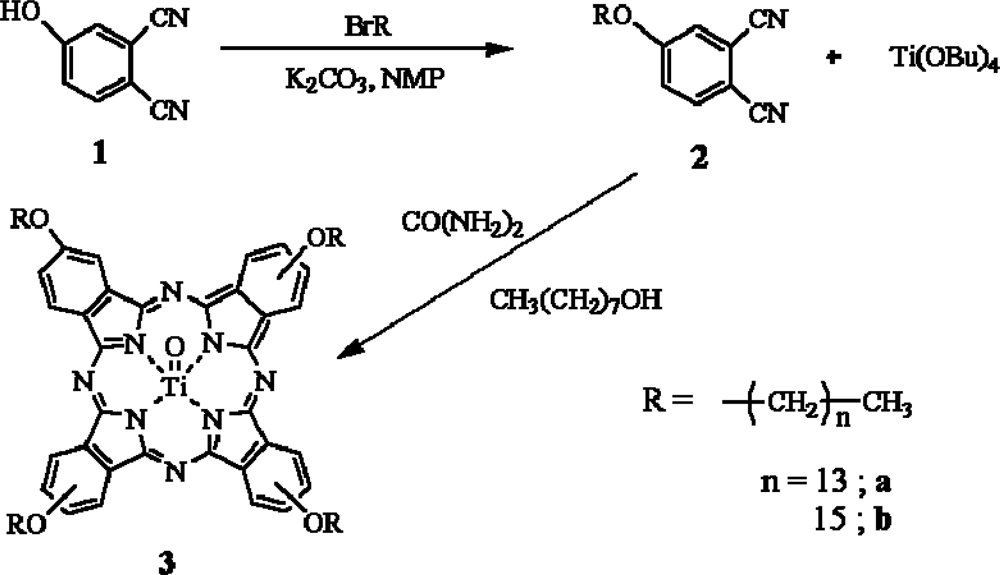
<p>The TiOPc derivatives, 2,9,16,23-tridecyloxyphthalocyaninato oxotitanium(IV) (<bold>3a)</bold> and 2,9,16,23-pentadecyloxyphthalocyaninato oxotitanium(IV) (<bold>3b)</bold> were prepared using the two-step synthesis described in Ref. [<xref ref-type="bibr" rid="b23-ijms-09-02745">23</xref>]. The synthetic route of TiOPc derivatives is shown in Scheme 1. Their chemical structures were characterized by FT-IR. The characteristic alkyl group stretch at 2850–2950 cm<sup>−1</sup> and ether stretch at 1250 cm<sup>−1</sup> of 4-tridecyloxyphthalonitrile (<bold>2a</bold>) / 4-pentadecyloxyphthalonitrile (<bold>2b</bold>) appear upon the formation of the alkoxy group in alkoxyphthalonitriles. The characteristic nitrile (C≡N) stretch at 2232 cm<sup>−1</sup> of <bold>2</bold> disappears upon the formation of the TiOPc. The split ether stretching frequencies are prominent for both the phthalonitriles and the phthalocyanines in the 1100–1264 cm<sup>−1</sup> range.</p></sec>
<sec>
<title>2.2. Solubility of <bold>3a</bold> and <bold>3b</bold></title>
<p>The solubilities of <bold>3a</bold> and <bold>3b</bold> were examined at a ratio of compound to solvent of 100 mg/mL. <xref ref-type="table" rid="t1-ijms-09-02745">Table 1</xref> shows the solubilities of TiOPc, <bold>3a</bold>, and <bold>3b</bold> in a variety of common solvents. TiOPc was insoluble in almost all organic solvents. Compared with TiOPc, <bold>3a</bold> and <bold>3b</bold> exhibited increased solubility in various solvents, such as chloroform, chlorobenzene, and toluene, but not in methanol and acetone. In many applications, the solubility of materials is a very important problem. Therefore, the solubility of <bold>3a</bold> and <bold>3b</bold> in organic solvents makes them promising materials.</p></sec>
<sec>
<title>2.3. Optical properties of <bold>3a</bold> and <bold>3b</bold></title>
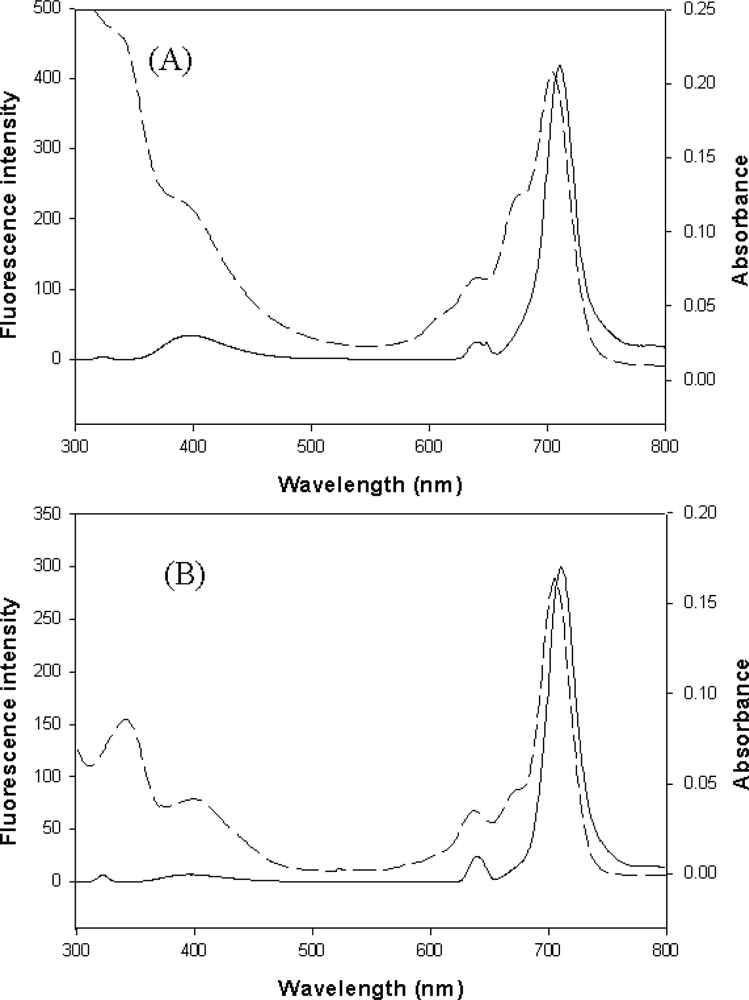
<p>The absorption and fluorescence spectra of <bold>3a</bold> and <bold>3b</bold> in chloroform are shown in <xref ref-type="fig" rid="f1-ijms-09-02745">Figure 1</xref>. The absorption spectra of <bold>3a</bold> and <bold>3b</bold> showed broad bands in the region around 340 nm and sharp peaks at 704 nm and 705 nm, respectively. Weak Q-band region peaks contributed by the aggregations appear in the 620–680 nm region. The spectra show the typical Soret and Q-bands, which are characteristic of phthalocyanines. Upon excitation at 640 nm. Compounds <bold>3a</bold> and <bold>3b</bold> showed fluorescence emissions at 709 and 711 nm, respectively.</p></sec>
<sec>
<title>2.4. XRD</title>
<p>The XRD patterns of <bold>3a</bold> and <bold>3b</bold> measured in the range of 2 theta of 10–50 degrees (<xref ref-type="table" rid="t2-ijms-09-02745">Table 2</xref>) show identical features with relatively poor crystallinity. Although the observed patterns resemble qualitatively that of the corresponding unsubstituted TiOPc, the peaks are found to be broadened with diffused intensity. This reveals that <bold>3a</bold> and <bold>3b</bold> were less crystalline than the unsubstituted TiOPc [<xref ref-type="bibr" rid="b24-ijms-09-02745">24</xref>]. This may be due to the presence of the bulky substituent alkoxy chain, and seems to play a dominant role in the stacking of the metal phthalocyanine derivatives. The X-ray diffraction patterns were only used to explain the degree of crystallinity, which is qualitative. The effect of the alkoxy chain substitution can be clearly identified from the first d values of all of the complexes.</p></sec>
<sec>
<title>2.5. TEM studies</title>
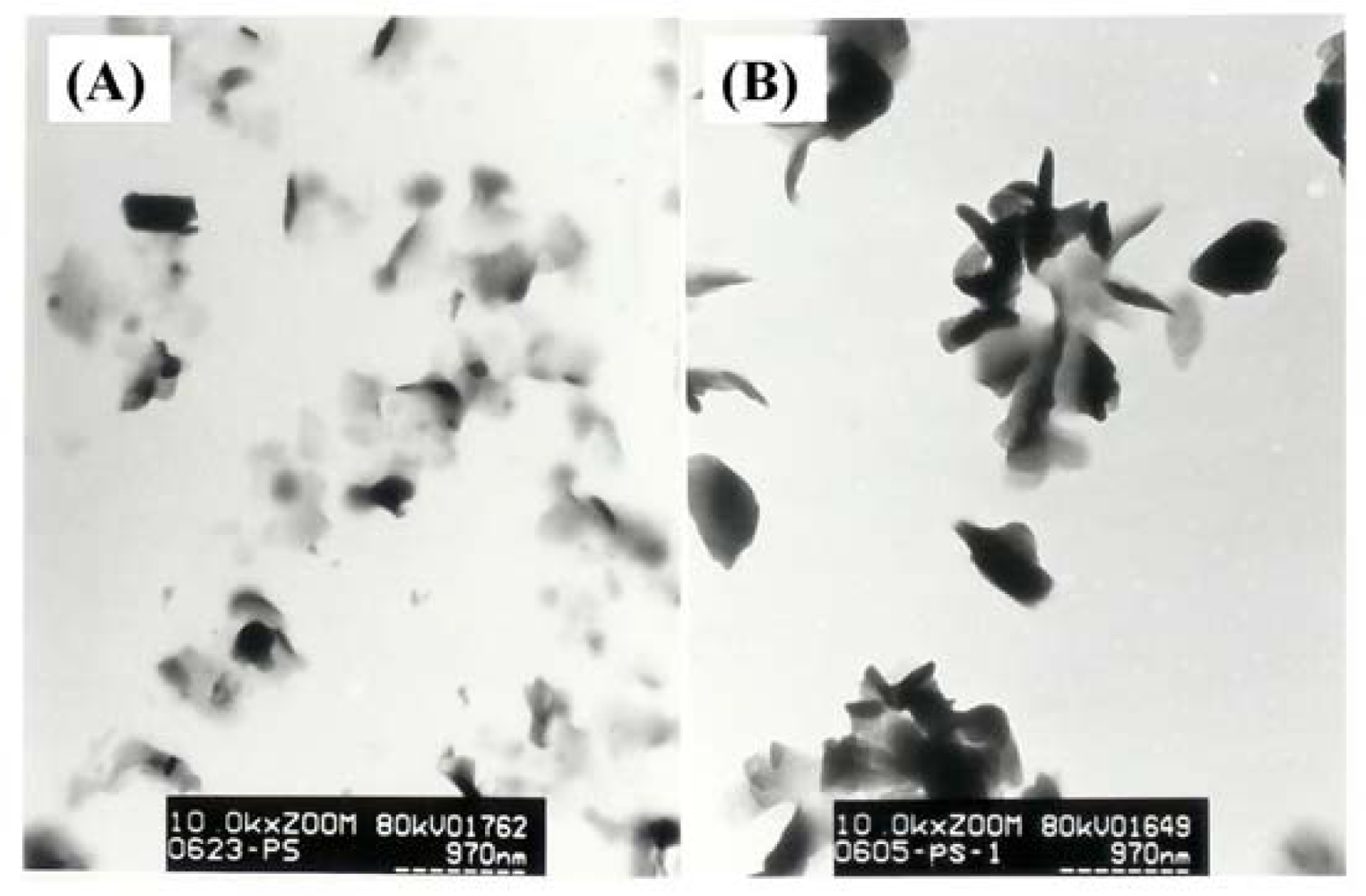
<p>The size and morphology of the synthesized compounds were analyzed by TEM measurements. The TEM images of <bold>3a</bold> and <bold>3b</bold> are shown in <xref ref-type="fig" rid="f2-ijms-09-02745">Figure 2</xref>. The TEM micrography revealed that <bold>3a</bold> and <bold>3b</bold> consisted of irregular spherical nanoparticles with diameters ranging from 450 nm to 600 nm and that the particles were agglomerated.</p></sec>
<sec>
<title>2.6. AFM studies</title>
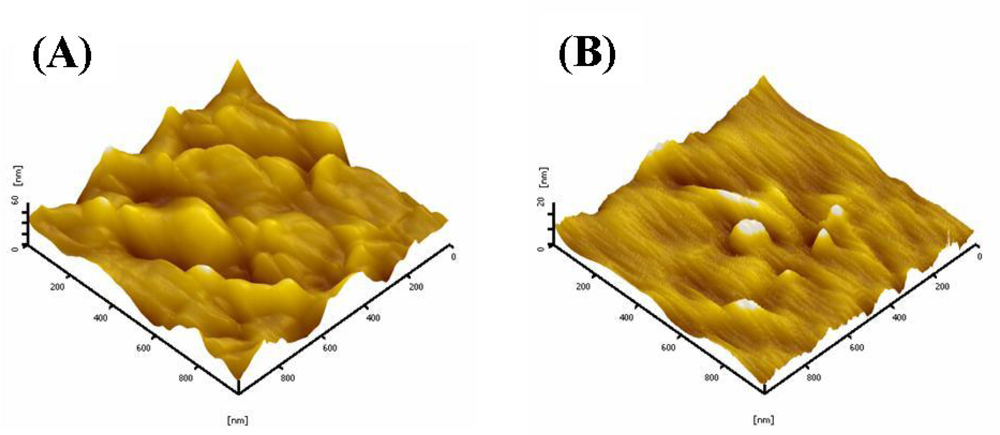
<p>The surface morphology of <bold>3a</bold> and <bold>3b</bold> films was measured by atomic force microscopy (AFM). All of the films were prepared by the spin-coating method from a chloroform solution. The difference in the root mean square (RMS) surface roughness between the two films was not very large, as depicted in <xref ref-type="fig" rid="f3-ijms-09-02745">Figure 3</xref>. The RMS roughnesses of <bold>3a</bold> and <bold>3b</bold> were 2.22 nm and 10.59 nm, respectively.</p></sec>
<sec>
<title>2.7. TGA and DSC studies</title>
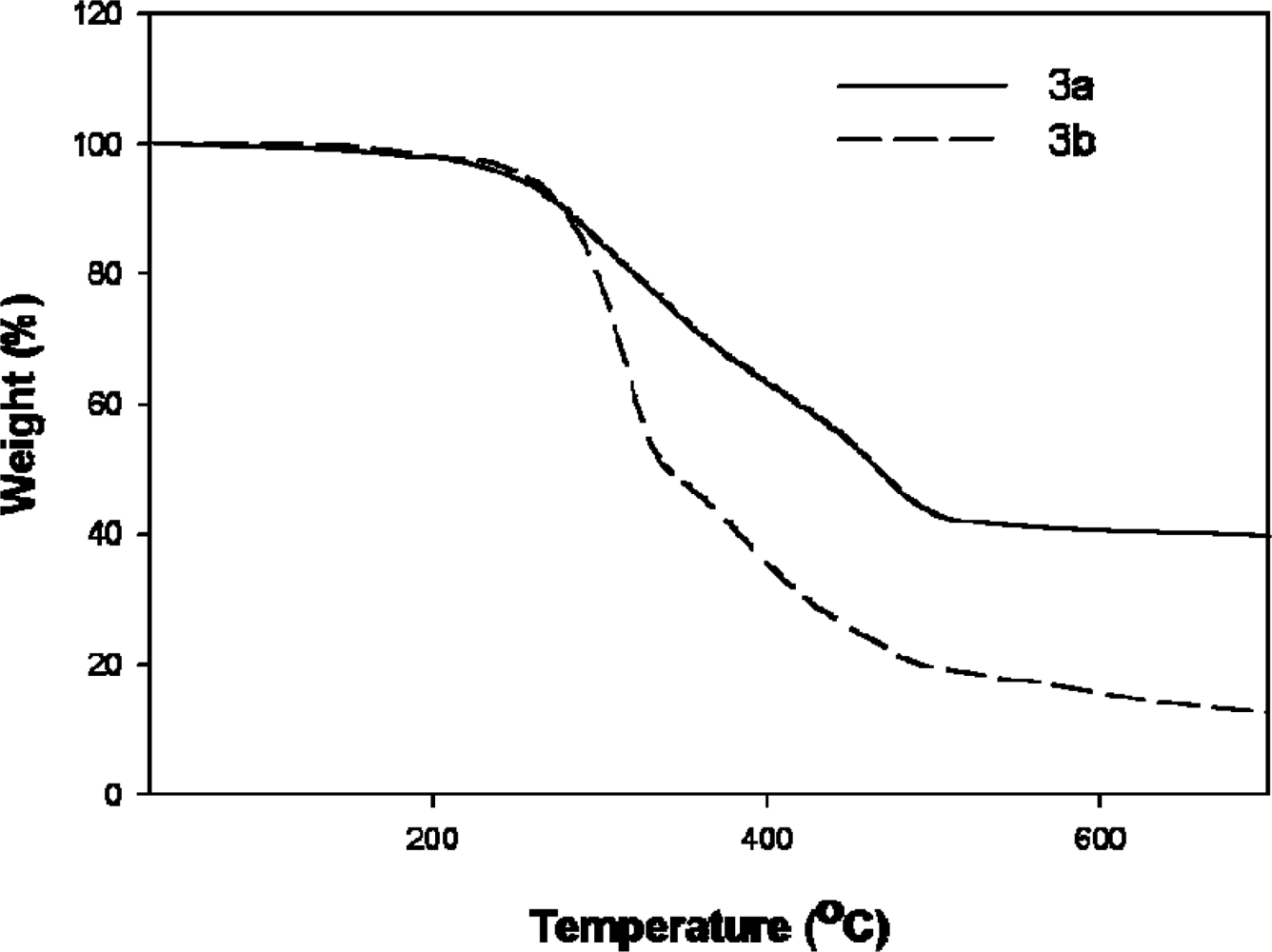
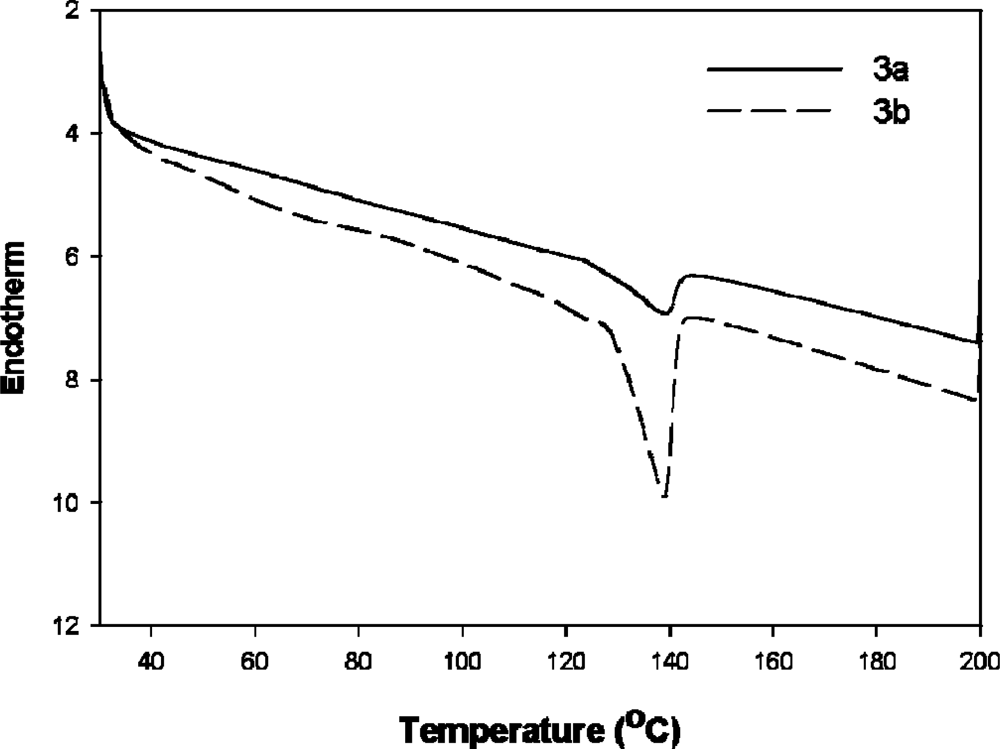
<p>The TGA curves of <bold>3a</bold> and <bold>3b</bold> are illustrated in <xref ref-type="fig" rid="f4-ijms-09-02745">Figure 4</xref>. The typical TGA curve obtained with a heating rate of 10 °C/min demonstrated high thermal stability up to 245 °C. The initial decomposition temperatures (Tds) of <bold>3a</bold> and <bold>3b</bold> were observed to be 213.65 °C and 256.11 °C, respectively, which are less than that of TiOPc. This may be due to the substituted alkoxy chains of <bold>3a</bold> and <bold>3b</bold>. <xref ref-type="fig" rid="f5-ijms-09-02745">Figure 5</xref> shows the DSC curves of 3a and 3b.</p></sec>
<sec>
<title>2.8. Photovoltaic performances of DSSC devices</title>
<p>The photovoltaic measurements were performed using a solar simulator under AM 1.5 illuminated conditions, and the active area of the DSSC devices was 0.25 cm<sup>2</sup>. The power conversion efficiency (η) of a solar cell given by:
<disp-formula id="FD1">
<label>(1)</label>
<mml:math display="block">
<mml:mtable columnalign="center">
<mml:mtr>
<mml:mtd>
<mml:mo>η</mml:mo>
<mml:mo>=</mml:mo>
<mml:msub>
<mml:mtext>P</mml:mtext>
<mml:mrow>
<mml:mtext>out</mml:mtext></mml:mrow></mml:msub>
<mml:mo>/</mml:mo>
<mml:msub>
<mml:mtext>P</mml:mtext>
<mml:mrow>
<mml:mtext>in</mml:mtext></mml:mrow></mml:msub>
<mml:mo>=</mml:mo>
<mml:mo stretchy="false">(</mml:mo>
<mml:msub>
<mml:mtext>J</mml:mtext>
<mml:mrow>
<mml:mtext>sc</mml:mtext></mml:mrow></mml:msub>
<mml:mo>×</mml:mo>
<mml:msub>
<mml:mtext>V</mml:mtext>
<mml:mrow>
<mml:mtext>oc</mml:mtext></mml:mrow></mml:msub>
<mml:mo>×</mml:mo>
<mml:mtext>FF</mml:mtext>
<mml:mo stretchy="false">)</mml:mo>
<mml:msub>
<mml:mtext>P</mml:mtext>
<mml:mrow>
<mml:mtext>in</mml:mtext></mml:mrow></mml:msub></mml:mtd></mml:mtr>
<mml:mtr>
<mml:mtd>
<mml:mtext>with</mml:mtext>
<mml:mo> </mml:mo>
<mml:mtext>FF</mml:mtext>
<mml:mo>=</mml:mo>
<mml:mo stretchy="false">(</mml:mo>
<mml:msub>
<mml:mtext>I</mml:mtext>
<mml:mrow>
<mml:mo>max</mml:mo></mml:mrow></mml:msub>
<mml:mo>×</mml:mo>
<mml:msub>
<mml:mtext>V</mml:mtext>
<mml:mrow>
<mml:mo>max</mml:mo></mml:mrow></mml:msub>
<mml:mo stretchy="false">)</mml:mo>
<mml:mo>/</mml:mo>
<mml:mo stretchy="false">(</mml:mo>
<mml:msub>
<mml:mtext>J</mml:mtext>
<mml:mrow>
<mml:mtext>sc</mml:mtext></mml:mrow></mml:msub>
<mml:mo>×</mml:mo>
<mml:msub>
<mml:mtext>V</mml:mtext>
<mml:mrow>
<mml:mtext>oc</mml:mtext></mml:mrow></mml:msub>
<mml:mo stretchy="false">)</mml:mo>
<mml:mo>=</mml:mo>
<mml:msub>
<mml:mtext>P</mml:mtext>
<mml:mrow>
<mml:mo>max</mml:mo></mml:mrow></mml:msub>
<mml:mo>/</mml:mo>
<mml:mo stretchy="false">(</mml:mo>
<mml:msub>
<mml:mtext>J</mml:mtext>
<mml:mrow>
<mml:mtext>sc</mml:mtext></mml:mrow></mml:msub>
<mml:mo>×</mml:mo>
<mml:msub>
<mml:mtext>V</mml:mtext>
<mml:mrow>
<mml:mtext>oc</mml:mtext></mml:mrow></mml:msub>
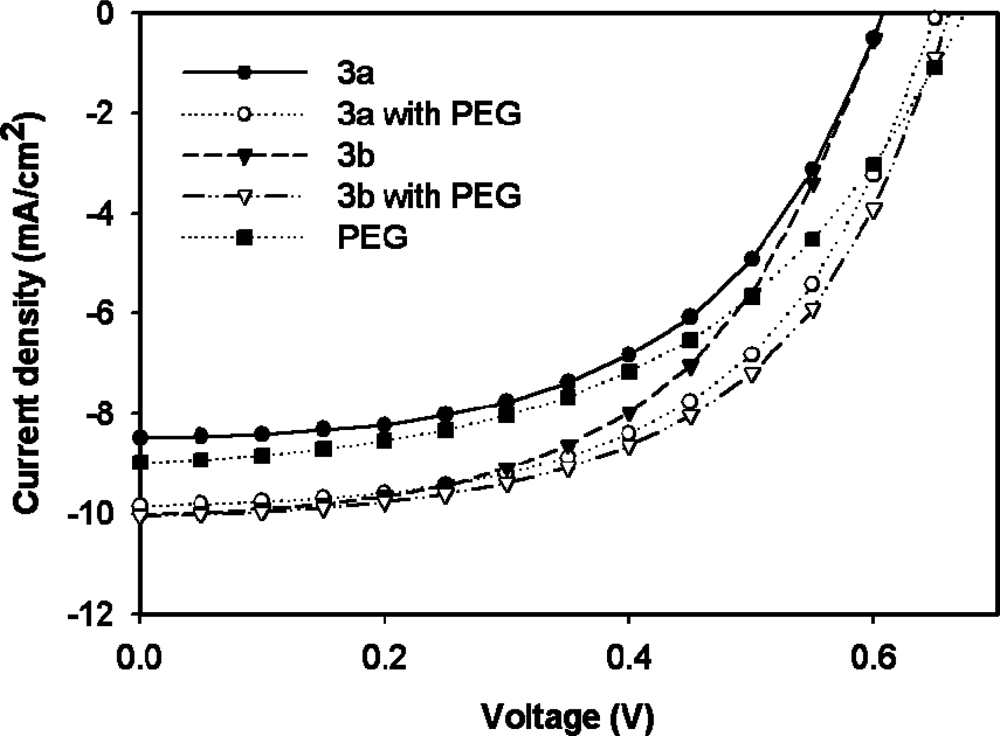
<mml:mo stretchy="false">)</mml:mo></mml:mtd></mml:mtr></mml:mtable></mml:math></disp-formula>where P<sub>out</sub> is the output electrical power of the device under illumination and P<sub>in</sub> represents the intensity of the incident light (e.g., in W/m<sup>2</sup> or mW/cm<sup>2</sup>). V<sub>oc</sub> is the open-circuit voltage, J<sub>sc</sub> is the short-circuit current density, and the fill factor (FF) is calculated from the values of V<sub>oc</sub>, J<sub>sc</sub>, and the maximum power point, P<sub>max</sub>. <xref ref-type="fig" rid="f6-ijms-09-02745">Figure 6</xref> shows the I–V curves of the FTO/TiO<sub>2</sub>/Dye/Electrolyte/Pt device using <bold>3a</bold> or <bold>3b</bold> as an additive. The DSSC devices using the TiOPc derivatives showed different results according to the methyl chain length. The values of V<sub>oc</sub>, J<sub>sc</sub>, FF and the power conversion efficiency (η) are listed in <xref ref-type="table" rid="t3-ijms-09-02745">Table 3</xref>. The J<sub>sc</sub>s of the devices using <bold>3a</bold>, <bold>3a</bold> with PEG, <bold>3b</bold>, <bold>3b</bold> with PEG, and PEG were 8.49, 9.84, 10.02, 10.04, and 8.98 mA/cm<sup>2</sup>, respectively. The power conversion efficiencies of the DSSC devices using <bold>3a</bold>, <bold>3a</bold> with PEG, <bold>3b</bold>, <bold>3b</bold> with PEG, and PEG was 2.73, 3.49, 3.19, 3.62, and 2.94 %, respectively. The DSSC devices using <bold>3a</bold> and <bold>3b</bold> with PEG showed higher photovoltaic performance than the devices using PEG without <bold>3a</bold> and <bold>3b</bold> in the same procedure. The J<sub>sc</sub> values of the DSSC devices using <bold>3a</bold> and <bold>3b</bold> were increased, and this can attributed to improvements in their power conversion efficiency.</p></sec></sec>
<sec>
<title>3. Experimental Section</title>
<sec sec-type="materials">
<title>3.1. Materials</title>
<p>4-Hydroxyphthalonitrile, 1-bromohexadecane, 1-bromotetradecane, 1-octanol, 1-methyl-2-pyrrolidinone (NMP), titanium(IV) butoxide [Ti(OBu)<sub>4</sub>], I<sub>2</sub>, tetrabutylammonium iodide (TBAI), ethylene carbonate (EC), and propylene carbonate (PC) were purchased from Sigma-Aldrich Co. Urea was purchased from Shinyo Pure Chemicals Co. All reagents were of analytical grade and used as received without further purification. TiO<sub>2</sub> paste, viz. Ti-Nanoxide HT/SP (particle size: 9 nm, wt 20 %), cis-bis(isothiocyanato)bis(2,2′-bipyridyl-4,4′-dicarboxylato)-ruthenium(II) dye (N3 dye), F-doped SnO<sub>2</sub> glass (FTO glass), Pt paste (Pt catalyst T/SP), and 1-propyl-3-methylimidazolium iodide (PMImI), were purchased from Solaronix CA.</p></sec>
<sec>
<title>3.2. Measurements</title>
<p>The FT-IR spectra (KBr pellets) were recorded on a Jasco FT/IR-460 Plus spectrometer. The <sup>1</sup>H NMR spectra (300 MHz) were recorded in CDCl<sub>3</sub> using a Varian Unity Plus 300 NMR spectrometer. The UV-vis absorption and fluorescence spectra of the TiOPc derivatives in chloroform solution were recorded on a UVIKON 860 spectrophotometer and Hitachi F-4500 fluorescence spectrophotometer, respectively. The TEM images were recorded on a Hitachi H-7500 Transmission Electron Microscope. Scanning Probe Microscopy was performed using a NITECH Model SPA-400. The TGA and DSC analyses were conducted on a TA instruments (TGA-Q 50 and TGA-Q 100) thermal analyser at a heating rate of 10 °C/min under flowing nitrogen (40 mL/min and 50 mL/min). The measurement of the I–V characteristics of the solar cells was carried out using a Solar Simulator (300 W simulator, models 81150) under simulated solar light with an ARC Lamp power supply (AM 1.5, 100 mW/cm<sup>2</sup>).</p></sec>
<sec>
<title>3.3. Synthesis of TiOPc derivatives <bold>3a</bold> and <bold>3b</bold></title>
<p>In the first step, alkoxyphthalonitriles were formed from 4-hydroxyphthalonitrile and 1-bromo-hexadecane or 1-bromotetradecane. 4-Hydroxyphthalonitrile (0.72 g, 5 mmol) and dry potassium carbonate (5.52 g, 40 mmol) was stirred for 30 min under N<sub>2</sub> gas in NMP, then a solution of 1-bromohexadecane or 1-bromotetradecane (10 mmol) in NMP was added and the mixture was stirred for 12 h at room temperature. The reaction mixture was filtered and purified by chromatography on a silica column with dichloromethane as the eluent. Yield: 92 % (2a) and 79 % (2b).</p>
<p><bold>2a</bold>; FT-IR (KBr, cm<sup>−1</sup>) : 2917, 2852 (C-H str.), 2232 (C≡N), 1601, 1562 (Ar. C=C str.), 1475 (CH<sub>2</sub> bend), 1429 (CH<sub>3</sub> bend), 1308, 1251 (C-O); <sup>1</sup>H-NMR (δ) 7.72, 7.25, 7.20 (Ar. C-H), 4.05 (-O-CH<sub>2</sub>-), 1.83 (-O-CH<sub>2</sub>-CH<sub>2</sub>-), 1.60 (-CH<sub>2</sub>-CH<sub>3</sub>), 1.46, 1.27 (-CH<sub>2</sub>-), 0.89 (-CH<sub>3</sub>); Anal calc. for C<sub>22</sub>H<sub>32</sub>N<sub>2</sub>O: C 77.60, H 9.47, N 8.23, O 4.70; found : C 76.30, H 12.20, N 8.17; MS: 340; <bold>2b</bold>; FT-IR (KBr, cm<sup>−1</sup>): 2917, 2851 (C-H str.), 2232 (C≡N), 1603, 1562 (Ar. C=C str.), 1475 (CH<sub>2</sub> bend), 1431 (CH<sub>3</sub> bend), 1308, 1252 (C-O); <sup>1</sup>H-NMR (δ) 7.74, 7.29, 7.20 (Ar. C-H), 4.06 (-O-CH<sub>2</sub>-), 1.86 (-O-CH<sub>2</sub>-CH<sub>2</sub>-), 1.60 (-CH<sub>2</sub>-CH<sub>3</sub>), 1.46, 1.27 (-CH<sub>2</sub>-), 0.89 (-CH<sub>3</sub>); Anal calc. for C<sub>24</sub>H<sub>36</sub>N<sub>2</sub>O: C 78.21, H 9.85, N 7.60, O 4.34; found : C 79.22, H 13.31, N 8.02; MS: 368;</p>
<p>The second step was the base catalyzed cyclotetramerization of the phthalonitriles. A mixture of alkoxyphthalonitrile (4 mmol), Ti(OBu)<sub>4</sub> (0.37 g, 1.1 mmol), urea (0.12 g, 2 mmol), and 1-octanol was heated at 150 °C under N<sub>2</sub> for 24 h. After the addition of methanol to the reaction mixture followed by refluxing for 30 min, the resulting deep green blue crystals were collected by filtration, washed with methanol, and then dried in a vacuum oven at 100 °C. Yield: 24 % (<bold>3a</bold>) and 21 % (<bold>3b</bold>).</p>
<p><bold>3a</bold>; FT-IR (KBr, cm<sup>−1</sup>) : 2920, 2850 (C-H str.), 1607, 1529 (Ar. C=C str.), 1529, 1468 (CH<sub>2</sub> bend), 1383, 1344, 1282 (C-N), 1244, 1120 (C-O), 1074, 1016, 965, 749 (Ti-N); MS MALDI-TOF: 1364 (MH<sup>+</sup>), <bold>3b</bold>; FT-IR (KBr, cm<sup>−1</sup>): 2915, 2854 (C-H str.), 1752, 1607, 1531 (Ar. C=C str.), 1492, 1464 (CH<sub>2</sub> bend), 1367, 1343, 1302 (C-N), 1237, 1120 (C-O), 1073, 1016, 964, 750 (Ti-N); MS MALDI-TOF: 1476 (MH<sup>+</sup>).</p></sec>
<sec>
<title>3.4. Fabrication of DSSC devices</title>
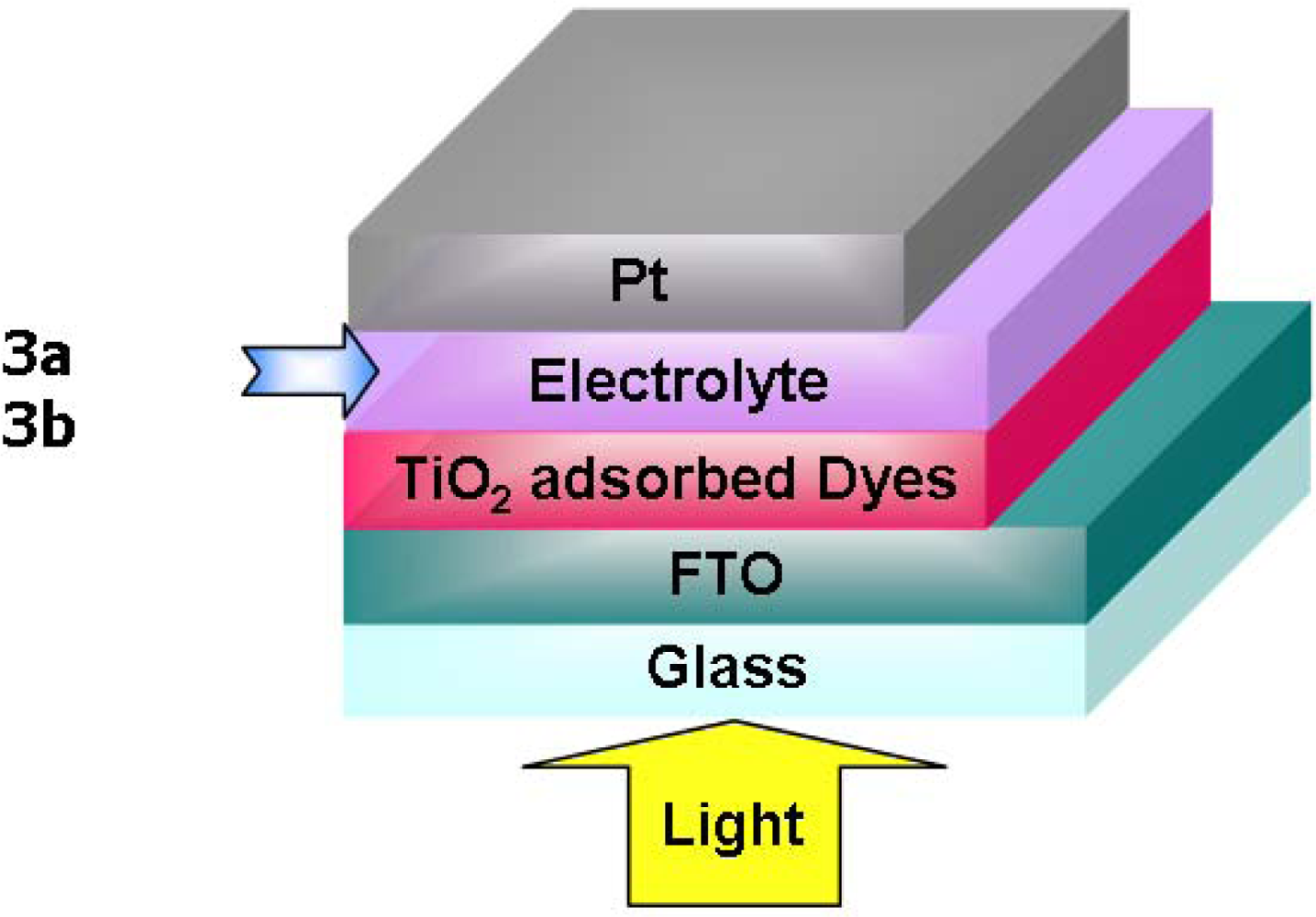
<p>We prepared DSSC devices using a quasi-solid state electrolyte containing <bold>3a</bold> or <bold>3b</bold> as an additive sandwiched with TiO<sub>2</sub> adsorbed dyes and Pt-coated electrode as the two electrodes. The structure of the DSSC device is shown in <xref ref-type="fig" rid="f7-ijms-09-02745">Figure 7</xref>. The FTO/TiO<sub>2</sub>/Dye/Electrolyte/Pt device was fabricated using the following procedure; a volume of ca. 10 μL/cm<sup>2</sup> of the transparent paste (Ti-Nanoxide HT) was spread on FTO glass by the doctor blade method. After heating the FTO glass covered with TiO<sub>2</sub> nanoparticles successively at ca. 100 °C and ca. 450 °C for about 30 min each, the sintering process was completed and the TiO<sub>2</sub> deposited electrode was cooled down from 100 °C to ca. 60 °C at a controlled cooling rate (5 °C/min) to avoid the cracking of the glass. A Pt counter electrode was fabricated by spreading on FTO glass using the doctor blade method. After heating the FTO glass spread Pt catalyst T/SP at 100 °C for 10 min, it was fired at 400 °C for 30 min. N3 dye was dissolved in absolute ethanol at a concentration of 20 mg per 100 mL of solution. Nanoporous TiO<sub>2</sub> film was dipped in this solution at room temperature for 24 hours. Afterwards, the dye-sensitized TiO<sub>2</sub> electrode was rinsed with absolute ethanol and dried in air. Without a sealant, the electrolyte solution was cast onto the TiO<sub>2</sub> electrode impregnated with N3 dye and then dried at 55 °C for 2 hours. The electrolyte solution was composed of 24 mg of I<sub>2</sub>, 72 mg of TBAI, 80 mg of PMImI as an ionic liquid, 0.32 mL of EC/0.08 mL of PC (EC/PC=4/1 as volume ratio) and <bold>3a</bold> or <bold>3b</bold> in acetonitrile solution.</p></sec></sec>
<sec sec-type="conclusions">
<title>4. Conclusions</title>
<p>We have synthesized two kinds of TiOPc derivatives containing alkoxy groups, <bold>3a</bold> and <bold>3b</bold>, and analyzed them by FT-IR, UV-vis and Fluorescence spectroscopy, XRD, and TEM. The optical properties of <bold>3a</bold> and <bold>3b</bold> were measured by UV-vis and fluorescence spectrophotometry. Both <bold>3a</bold> and <bold>3b</bold> showed high solubility in organic solvents such as chloroform, chlorobenzene, and dichloromethane. The quasi-solid DSSC devices prepared with a polymer electrolyte using <bold>3a</bold> or <bold>3b</bold> as an additive showed higher photovoltaic performance than the devices with a polymer electrolyte without <bold>3a</bold> or <bold>3b</bold>, due to their increased J<sub>sc</sub> values. The best result obtained for the DSSC devices was a power conversion efficiency of 3.62 in the case of the DSSC device using PEG with 3b. Its Voc, J<sub>sc</sub>, and FF were 0.66 V, 10.04 mA/cm<sup>2</sup> and 0.54, respectively.</p></sec></body>
<back>
<ack>
<p>This research was financially supporting by the Ministry of Education, Science Technology (MEST) and Korea Industrial Technology Foundation (KOTEF) through the Human Resource Training Project for Regional Innovation.</p></ack>
<ref-list>
<title>References and Notes</title>
<ref id="b1-ijms-09-02745"><label>1.</label><citation citation-type="journal"><person-group person-group-type="author"><name><surname>O’Regan</surname><given-names>B</given-names></name><name><surname>Grätzel</surname><given-names>M</given-names></name></person-group><article-title>A low-cost, high-efficiency solar cell based on dye-sensitized colloidal TiO<sub>2</sub> films</article-title><source>Nature</source><year>1991</year><volume>353</volume><fpage>737</fpage><lpage>740</lpage><pub-id pub-id-type="doi">10.1038/353737a0</pub-id></citation></ref>
<ref id="b2-ijms-09-02745"><label>2.</label><citation citation-type="journal"><person-group person-group-type="author"><name><surname>Nazeeruddin</surname><given-names>MK</given-names></name><name><surname>Key</surname><given-names>A</given-names></name><name><surname>Rodico</surname><given-names>I</given-names></name><name><surname>Humphry-Baker</surname><given-names>R</given-names></name><name><surname>Muller</surname><given-names>E</given-names></name><name><surname>Liska</surname><given-names>P</given-names></name><name><surname>Vlachopoulos</surname><given-names>N</given-names></name><name><surname>Grätzel</surname><given-names>M</given-names></name></person-group><article-title>Conversion of Light to Electricity by cis-X<sub>2</sub>Bis(2,2′-bipyridyl-4,4′-dicarboxylate)ruthenium(II) Charge-Transfer Sensitizers (X = Cl<sup>−</sup>, Br<sup>−</sup>, I<sup>−</sup>, CN<sup>−</sup>, and SCN<sup>−</sup>) on Nanocrystalline TiO<sub>2</sub> Electrodes</article-title><source>J. Am. Chem. Soc</source><year>1993</year><volume>115</volume><fpage>6382</fpage><lpage>6390</lpage><pub-id pub-id-type="doi">10.1021/ja00067a063</pub-id></citation></ref>
<ref id="b3-ijms-09-02745"><label>3.</label><citation citation-type="journal"><person-group person-group-type="author"><name><surname>Smestad</surname><given-names>G</given-names></name><name><surname>Bignozzi</surname><given-names>C</given-names></name><name><surname>Argazzi</surname><given-names>R</given-names></name></person-group><article-title>Testing of dye sensitized TiO<sub>2</sub> solar cells I: Experimental photocurrent output and conversion efficiencies</article-title><source>Sol. Energy Mater. Sol. Cells</source><year>1994</year><volume>32</volume><fpage>259</fpage><lpage>272</lpage><pub-id pub-id-type="doi">10.1016/0927-0248(94)90263-1</pub-id></citation></ref>
<ref id="b4-ijms-09-02745"><label>4.</label><citation citation-type="journal"><person-group person-group-type="author"><name><surname>Hara</surname><given-names>K</given-names></name><name><surname>Sayama</surname><given-names>K</given-names></name><name><surname>Ohga</surname><given-names>Y</given-names></name><name><surname>Shinpo</surname><given-names>A</given-names></name><name><surname>Suga</surname><given-names>S</given-names></name><name><surname>Arakawa</surname><given-names>H</given-names></name></person-group><article-title>A coumarin-derivative dye sensitized nanocrystalline TiO<sub>2</sub> solar cell having a high solar-energy conversion efficiency up to 5.6%</article-title><source>Chem. Commun</source><year>2001</year><volume>6</volume><fpage>569</fpage><lpage>570</lpage></citation></ref>
<ref id="b5-ijms-09-02745"><label>5.</label><citation citation-type="journal"><person-group person-group-type="author"><name><surname>Chen</surname><given-names>J</given-names></name><name><surname>Too</surname><given-names>CO</given-names></name><name><surname>Burrel</surname><given-names>AK</given-names></name><name><surname>Collis</surname><given-names>GE</given-names></name><name><surname>Officer</surname><given-names>DL</given-names></name><name><surname>Wallace</surname><given-names>GG</given-names></name></person-group><article-title>Photovoltaic devices based on poly(bis-terthiophenes) and substituted poly(bisterthiophene)</article-title><source>Synth. Met</source><year>2003</year><volume>137</volume><fpage>1373</fpage><lpage>1374</lpage><pub-id pub-id-type="doi">10.1016/S0379-6779(02)01120-7</pub-id></citation></ref>
<ref id="b6-ijms-09-02745"><label>6.</label><citation citation-type="journal"><person-group person-group-type="author"><name><surname>Li</surname><given-names>G</given-names></name><name><surname>Shrotriya</surname><given-names>V</given-names></name><name><surname>Yao</surname><given-names>Y</given-names></name><name><surname>Yang</surname><given-names>Y</given-names></name></person-group><article-title>Investigation of annealing effects and film thickness dependence of polymer solar cells based on poly(3-hexylthiophene)</article-title><source>J. Appl. Phys</source><year>2005</year><volume>98</volume><fpage>043704/1</fpage><lpage>043704/5</lpage></citation></ref>
<ref id="b7-ijms-09-02745"><label>7.</label><citation citation-type="journal"><person-group person-group-type="author"><name><surname>Tennakone</surname><given-names>K</given-names></name><name><surname>Kumara</surname><given-names>GRRA</given-names></name><name><surname>Kottegoda</surname><given-names>IRM</given-names></name><name><surname>Wijayantha</surname><given-names>KGU</given-names></name><name><surname>Perera</surname><given-names>VPS</given-names></name></person-group><article-title>A solid-state photovoltaic cell sensitized with a ruthenium bipyridyl complex</article-title><source>J. Phys. D Appl. Phys</source><year>1998</year><volume>31</volume><fpage>1492</fpage><lpage>1496</lpage><pub-id pub-id-type="doi">10.1088/0022-3727/31/12/014</pub-id></citation></ref>
<ref id="b8-ijms-09-02745"><label>8.</label><citation citation-type="journal"><person-group person-group-type="author"><name><surname>O’Regan</surname><given-names>B</given-names></name><name><surname>Schwartz</surname><given-names>DT</given-names></name><name><surname>Zakeeruddin</surname><given-names>SM</given-names></name><name><surname>Grätzel</surname><given-names>M</given-names></name></person-group><article-title>Electrodeposited nanocomposite n-p heterojunctions for solid-state dye-sensitized photovoltaics</article-title><source>Adv. Mater</source><year>2000</year><volume>12</volume><fpage>1263</fpage><lpage>1267</lpage><pub-id pub-id-type="doi">10.1002/1521-4095(200009)12:17&lt;1263::AID-ADMA1263&gt;3.0.CO;2-T</pub-id></citation></ref>
<ref id="b9-ijms-09-02745"><label>9.</label><citation citation-type="journal"><person-group person-group-type="author"><name><surname>Woehrle</surname><given-names>D</given-names></name><name><surname>Eskes</surname><given-names>M</given-names></name><name><surname>Shigehara</surname><given-names>K</given-names></name><name><surname>Yamada</surname><given-names>A</given-names></name></person-group><article-title>A simple synthesis of 4,5-disubstityted 1,2-dicyanobenzenes and 2,3,9,10,16,17,23,24-octasubstituted phthalocyanines</article-title><source>Synthesis</source><year>1993</year><volume>2</volume><fpage>194</fpage><lpage>196</lpage></citation></ref>
<ref id="b10-ijms-09-02745"><label>10.</label><citation citation-type="journal"><person-group person-group-type="author"><name><surname>Bach</surname><given-names>U</given-names></name><name><surname>Lupo</surname><given-names>D</given-names></name><name><surname>Comte</surname><given-names>P</given-names></name><name><surname>Moser</surname><given-names>JE</given-names></name><name><surname>Weissőrtel</surname><given-names>F</given-names></name><name><surname>Salbeck</surname><given-names>J</given-names></name><name><surname>Spreitzer</surname><given-names>H</given-names></name><name><surname>Grätzel</surname><given-names>M</given-names></name></person-group><article-title>Solid-state dye-sensitized mesoporous TiO<sub>2</sub> solar cells with high photon-to-electron conversion efficiencies</article-title><source>Nature</source><year>1998</year><volume>395</volume><fpage>583</fpage><lpage>585</lpage><pub-id pub-id-type="doi">10.1038/26936</pub-id></citation></ref>
<ref id="b11-ijms-09-02745"><label>11.</label><citation citation-type="journal"><person-group person-group-type="author"><name><surname>Gebeyehu</surname><given-names>D</given-names></name><name><surname>Brabec</surname><given-names>CJ</given-names></name><name><surname>Sariciftci</surname><given-names>NS</given-names></name><name><surname>Vangeneugden</surname><given-names>D</given-names></name><name><surname>Kiebooms</surname><given-names>R</given-names></name><name><surname>Vanderzande</surname><given-names>D</given-names></name><name><surname>Kienberger</surname><given-names>F</given-names></name><name><surname>Schindler</surname><given-names>H</given-names></name></person-group><article-title>Hybrid solar cells based on dye-sensitized nanoporous TiO<sub>2</sub> electrodes and conjugated polymers as hole transport materials</article-title><source>Synth. Met</source><year>2002</year><volume>125</volume><fpage>279</fpage><lpage>287</lpage></citation></ref>
<ref id="b12-ijms-09-02745"><label>12.</label><citation citation-type="journal"><person-group person-group-type="author"><name><surname>Grant</surname><given-names>CD</given-names></name><name><surname>Schwartzberg</surname><given-names>AM</given-names></name><name><surname>Smestad</surname><given-names>GP</given-names></name><name><surname>Kowalik</surname><given-names>J</given-names></name><name><surname>Tolbert</surname><given-names>LM</given-names></name><name><surname>Zhang</surname><given-names>JZ</given-names></name></person-group><article-title>Characterization of nanocrystalline and thin film TiO<sub>2</sub> solar cells with poly(3-undecyl-2,2′-bithiophene) ans a sensitizer and hole conductor</article-title><source>J. Electroanal. Chem</source><year>2002</year><volume>522</volume><fpage>40</fpage><lpage>48</lpage><pub-id pub-id-type="doi">10.1016/S0022-0728(01)00715-X</pub-id></citation></ref>
<ref id="b13-ijms-09-02745"><label>13.</label><citation citation-type="journal"><person-group person-group-type="author"><name><surname>Bach</surname><given-names>U</given-names></name><name><surname>Tachibana</surname><given-names>Y</given-names></name><name><surname>Moser</surname><given-names>JE</given-names></name><name><surname>Haque</surname><given-names>SA</given-names></name><name><surname>Durrant</surname><given-names>JR</given-names></name><name><surname>Grätzel</surname><given-names>M</given-names></name><name><surname>Klug</surname><given-names>DR</given-names></name></person-group><article-title>Charge Separation in Solid-State Dye-Sensitized Heterojunction Solar Cells</article-title><source>J. Am. Chem. Soc</source><year>1999</year><volume>121</volume><fpage>7445</fpage><lpage>7446</lpage><pub-id pub-id-type="doi">10.1021/ja9915403</pub-id></citation></ref>
<ref id="b14-ijms-09-02745"><label>14.</label><citation citation-type="journal"><person-group person-group-type="author"><name><surname>Li</surname><given-names>W</given-names></name><name><surname>Kang</surname><given-names>J</given-names></name><name><surname>Li</surname><given-names>X</given-names></name><name><surname>Fang</surname><given-names>S</given-names></name><name><surname>Lin</surname><given-names>Y</given-names></name><name><surname>Wang</surname><given-names>G</given-names></name><name><surname>Xiao</surname><given-names>X</given-names></name></person-group><article-title>A novel polymer quaternary ammonium iodide and application in quasi-solid-state dye-sensitized solar cells</article-title><source>J. Photochem. Photobiol. A</source><year>2005</year><volume>170</volume><fpage>1</fpage><lpage>6</lpage><pub-id pub-id-type="doi">10.1016/j.jphotochem.2004.07.016</pub-id></citation></ref>
<ref id="b15-ijms-09-02745"><label>15.</label><citation citation-type="journal"><person-group person-group-type="author"><name><surname>Matsumoto</surname><given-names>H</given-names></name><name><surname>Matsuda</surname><given-names>T</given-names></name><name><surname>Tsuda</surname><given-names>T</given-names></name><name><surname>Hagiwara</surname><given-names>R</given-names></name><name><surname>Ito</surname><given-names>Y</given-names></name><name><surname>Miyazaki</surname><given-names>Y</given-names></name></person-group><article-title>The application on room temperature molten salt with low viscosity to the electrolyte for dye-sensitized solar cell</article-title><source>Chem. Letters</source><year>2001</year><volume>1</volume><fpage>26</fpage><lpage>27</lpage></citation></ref>
<ref id="b16-ijms-09-02745"><label>16.</label><citation citation-type="journal"><person-group person-group-type="author"><name><surname>Wang</surname><given-names>H</given-names></name><name><surname>Liu</surname><given-names>X</given-names></name><name><surname>Wang</surname><given-names>Z</given-names></name><name><surname>Li</surname><given-names>H</given-names></name><name><surname>Li</surname><given-names>D</given-names></name><name><surname>Meng</surname><given-names>Q</given-names></name><name><surname>Chen</surname><given-names>L</given-names></name></person-group><article-title>Effect of Iodine Addition on Solid-State Electrolyte LiI/3-Hydroxypropionitrile (1:4) for Dye-Sensitized Solar Cells</article-title><source>J. Phys. Chem. B</source><year>2006</year><volume>110</volume><fpage>5970</fpage><lpage>5974</lpage><pub-id pub-id-type="doi">10.1021/jp057121b</pub-id><pub-id pub-id-type="pmid">16553405</pub-id></citation></ref>
<ref id="b17-ijms-09-02745"><label>17.</label><citation citation-type="journal"><person-group person-group-type="author"><name><surname>Xue</surname><given-names>B</given-names></name><name><surname>Wang</surname><given-names>H</given-names></name><name><surname>Hu</surname><given-names>Y</given-names></name><name><surname>Li</surname><given-names>H</given-names></name><name><surname>Wang</surname><given-names>Z</given-names></name><name><surname>Meng</surname><given-names>Q</given-names></name><name><surname>Huang</surname><given-names>X</given-names></name><name><surname>Sato</surname><given-names>O</given-names></name><name><surname>Chen</surname><given-names>L</given-names></name><name><surname>Fujishima</surname><given-names>A</given-names></name></person-group><article-title>An alternative ionic liquid based electrolyte for dye-sensitized solar cells</article-title><source>Photochem. Photobiol. Sci</source><year>2004</year><volume>3</volume><fpage>918</fpage><lpage>919</lpage><pub-id pub-id-type="doi">10.1039/b412647e</pub-id><pub-id pub-id-type="pmid">15480481</pub-id></citation></ref>
<ref id="b18-ijms-09-02745"><label>18.</label><citation citation-type="journal"><person-group person-group-type="author"><name><surname>Ng</surname><given-names>DKP</given-names></name></person-group><article-title>Dendritic phthalocyanines: Synthesis, photophysical properties, and aggregation behavior</article-title><source>C.R. Chimie</source><year>2003</year><volume>6</volume><fpage>903</fpage><lpage>910</lpage><pub-id pub-id-type="doi">10.1016/j.crci.2003.05.006</pub-id></citation></ref>
<ref id="b19-ijms-09-02745"><label>19.</label><citation citation-type="journal"><person-group person-group-type="author"><name><surname>Gurek</surname><given-names>AG</given-names></name><name><surname>Bekaroglu</surname><given-names>O</given-names></name></person-group><article-title>Tetrathia-macrocycle-bridged dimeric with hexakis(alkylthio) substituents and network polymer phthalocyanines</article-title><source>J. Porph. Phthalocyan</source><year>1997</year><volume>1</volume><fpage>227</fpage><lpage>237</lpage><pub-id pub-id-type="doi">10.1002/(SICI)1099-1409(199707)1:3&lt;227::AID-JPP17&gt;3.0.CO;2-K</pub-id></citation></ref>
<ref id="b20-ijms-09-02745"><label>20.</label><citation citation-type="journal"><person-group person-group-type="author"><name><surname>Lee</surname><given-names>HJ</given-names></name><name><surname>Kim</surname><given-names>WS</given-names></name><name><surname>Park</surname><given-names>SH</given-names></name><name><surname>Shin</surname><given-names>WS</given-names></name><name><surname>Jin</surname><given-names>SH</given-names></name><name><surname>Lee</surname><given-names>JK</given-names></name><name><surname>Han</surname><given-names>SM</given-names></name><name><surname>Jung</surname><given-names>KS</given-names></name><name><surname>Kim</surname><given-names>MR</given-names></name></person-group><article-title>Effect of nanocrystalline porous TiO<sub>2</sub> films on interface adsorption of phthalocyanines and polymer electrolytes in dye-sensitized solar cells</article-title><source>Macromol. Symp</source><year>2006</year><volume>235</volume><fpage>230</fpage><lpage>236</lpage><pub-id pub-id-type="doi">10.1002/masy.200650328</pub-id></citation></ref>
<ref id="b21-ijms-09-02745"><label>21.</label><citation citation-type="journal"><person-group person-group-type="author"><name><surname>Han</surname><given-names>DS</given-names></name><name><surname>Li</surname><given-names>YJ</given-names></name><name><surname>Kim</surname><given-names>JS</given-names></name><name><surname>Kim</surname><given-names>E</given-names></name></person-group><article-title>Effect of bridging group in poly(titanyloxo-phthalocyanine)s on photocurrent generation</article-title><source>Synth. Met</source><year>1999</year><volume>101</volume><fpage>62</fpage><lpage>63</lpage><pub-id pub-id-type="doi">10.1016/S0379-6779(98)01126-6</pub-id></citation></ref>
<ref id="b22-ijms-09-02745"><label>22.</label><citation citation-type="journal"><person-group person-group-type="author"><name><surname>Han</surname><given-names>DS</given-names></name><name><surname>Lee</surname><given-names>YJ</given-names></name><name><surname>Kim</surname><given-names>JS</given-names></name><name><surname>Kim</surname><given-names>E</given-names></name></person-group><article-title>Photocurrent generation of poly(titanyloxo-phthalocyanine)s and silica hybrid film</article-title><source>Synth. Met</source><year>2001</year><volume>117</volume><fpage>203</fpage><lpage>205</lpage><pub-id pub-id-type="doi">10.1016/S0379-6779(00)00501-4</pub-id></citation></ref>
<ref id="b23-ijms-09-02745"><label>23.</label><citation citation-type="journal"><person-group person-group-type="author"><name><surname>Yao</surname><given-names>J</given-names></name><name><surname>Yonehara</surname><given-names>H</given-names></name><name><surname>Pac</surname><given-names>C</given-names></name></person-group><article-title>A Convenient Synthetic method for pure oxo(phthalo-cyaninato)titanium(IV) and application to other metal phthalocynines</article-title><source>Bull. Chem. Soc. Jpn</source><year>1995</year><volume>68</volume><fpage>1001</fpage><lpage>1005</lpage><pub-id pub-id-type="doi">10.1246/bcsj.68.1001</pub-id></citation></ref>
<ref id="b24-ijms-09-02745"><label>24.</label><citation citation-type="journal"><person-group person-group-type="author"><name><surname>Saito</surname><given-names>T</given-names></name><name><surname>Iwakabe</surname><given-names>Y</given-names></name><name><surname>Kobayashi</surname><given-names>T</given-names></name><name><surname>Suzuki</surname><given-names>S</given-names></name><name><surname>Iwayanagi</surname><given-names>T</given-names></name></person-group><article-title>Thermochromism of specific crystal form oxotitanium phthalocyanines studied by electroabsorption and X-ray diffraction measurements</article-title><source>J. Phys. Chem</source><year>1994</year><volume>98</volume><fpage>2726</fpage><lpage>2728</lpage><pub-id pub-id-type="doi">10.1021/j100062a003</pub-id></citation></ref></ref-list>
<sec sec-type="display-objects">
<title>Figures and Tables</title>
<fig id="f1-ijms-09-02745" position="float">
<label>Figure 1.</label>
<caption>
<p>Fluorescence (solid line) and absorption (dashed line) spectra of (A) <bold>3a</bold> and (B) <bold>3b</bold>.</p></caption>
<graphic xlink:href="ijms-09-02745f1.png"/></fig>
<fig id="f2-ijms-09-02745" position="float">
<label>Figure 2.</label>
<caption>
<p>TEM images of <bold>3a</bold> (A) and <bold>3b</bold> (B).</p></caption>
<graphic xlink:href="ijms-09-02745f2.png"/></fig>
<fig id="f3-ijms-09-02745" position="float">
<label>Figure 3.</label>
<caption>
<p>AFM images of <bold>3a</bold> (A) and <bold>3b</bold> (B); image sizes are 3 μm × 3 μm.</p></caption>
<graphic xlink:href="ijms-09-02745f3.png"/></fig>
<fig id="f4-ijms-09-02745" position="float">
<label>Figure 4.</label>
<caption>
<p>TGA curves of <bold>3a</bold> and <bold>3b</bold>.</p></caption>
<graphic xlink:href="ijms-09-02745f4.png"/></fig>
<fig id="f5-ijms-09-02745" position="float">
<label>Figure 5.</label>
<caption>
<p>DSC curves of <bold>3a</bold> and <bold>3b</bold>.</p></caption>
<graphic xlink:href="ijms-09-02745f5.png"/></fig>
<fig id="f6-ijms-09-02745" position="float">
<label>Figure 6.</label>
<caption>
<p>I–V curves of FTO/TiO<sub>2</sub>/Dye/Electrolyte/Pt devices using <bold>3a</bold>, <bold>3a</bold> with PEG, <bold>3b</bold>, <bold>3b</bold> with PEG, and PEG under AM 1.5 illumination; light intensity: 100 mW/cm<sup>2</sup>; active area: 0.25 cm<sup>2</sup>; with mask.</p></caption>
<graphic xlink:href="ijms-09-02745f6.png"/></fig>
<fig id="f7-ijms-09-02745" position="float">
<label>Figure 7.</label>
<caption>
<p>The structure of FTO/TiO<sub>2</sub>/N3 Dye/Electrolyte/Pt device using <bold>3a</bold> and <bold>3b</bold>.</p></caption>
<graphic xlink:href="ijms-09-02745f7.png"/></fig>
<fig id="f8-ijms-09-02745" position="float">
<label>Scheme 1.</label>
<caption>
<p>The synthetic route to titanyl phthalocyanine (TiOPc) derivatives.</p></caption>
<graphic xlink:href="ijms-09-02745f8.png"/></fig>
<table-wrap id="t1-ijms-09-02745" position="float">
<label>Table 1.</label>
<caption>
<p>Solubility of TiOPc, <bold>3a</bold>, and <bold>3b.</bold></p></caption>
<table frame="hsides" rules="groups">
<thead>
<tr>
<th align="center">Compounds</th>
<th align="center">TiOPc</th>
<th align="center">3a</th>
<th align="center">3b</th></tr></thead>
<tbody>
<tr>
<td align="center">CHCl<sub>2</sub></td>
<td align="center">I</td>
<td align="center">S</td>
<td align="center">S</td></tr>
<tr>
<td align="center">Chlorobenzene</td>
<td align="center">I</td>
<td align="center">S</td>
<td align="center">S</td></tr>
<tr>
<td align="center">Toluene</td>
<td align="center">I</td>
<td align="center">S</td>
<td align="center">S</td></tr>
<tr>
<td align="center">Acetone</td>
<td align="center">I</td>
<td align="center">I</td></tr>
<tr>
<td align="center">Methanol</td>
<td align="center">I</td>
<td align="center">I</td></tr>
<tr>
<td align="center">DMF</td>
<td align="center">I</td>
<td align="center">I</td></tr>
<tr>
<td align="center">THF</td>
<td align="center">I</td>
<td align="center">P (17 wt%)</td>
<td align="center">P (26 wt%)</td></tr></tbody></table>
<table-wrap-foot><fn id="tfn1-ijms-09-02745">
<label>*</label>
<p>Solubility in 100 mg/mL</p></fn><fn id="tfn2-ijms-09-02745">
<label>*</label>
<p>S = soluble, P = partially soluble, I = insoluble</p></fn></table-wrap-foot></table-wrap>
<table-wrap id="t2-ijms-09-02745" position="float">
<label>Table 2.</label>
<caption>
<p>XRD data 2 theta angle and relative intensity of <bold>3a</bold> and <bold>3b.</bold></p></caption>
<table frame="hsides" rules="groups">
<thead>
<tr>
<th align="center">Compounds</th>
<th align="center">XRD data 2 theta angle (dA)</th>
<th align="center">Relative intensity (%)</th></tr></thead>
<tbody>
<tr>
<td align="center"/>
<td align="center">10.94 (8.08)</td>
<td align="center">73</td></tr>
<tr>
<td align="center"/>
<td align="center">11.64 (7.59)</td>
<td align="center">79</td></tr>
<tr>
<td align="center"/>
<td align="center">17.30 (5.12)</td>
<td align="center">25</td></tr>
<tr>
<td align="center"/>
<td align="center">17.92 (4.94)</td>
<td align="center">31</td></tr>
<tr>
<td align="center"/>
<td align="center">19.34 (4.58)</td>
<td align="center">84</td></tr>
<tr>
<td align="center"><bold>3a</bold></td>
<td align="center">20.46 (4.34)</td>
<td align="center">37</td></tr>
<tr>
<td align="center"/>
<td align="center">22.50 (3.95)</td>
<td align="center">28</td></tr>
<tr>
<td align="center"/>
<td align="center">22.84 (3.89)</td>
<td align="center">38</td></tr>
<tr>
<td align="center"/>
<td align="center">23.50 (3.78)</td>
<td align="center">58</td></tr>
<tr>
<td align="center"/>
<td align="center">24.38 (3.64)</td>
<td align="center">100</td></tr>
<tr>
<td align="center">
<hr/></td>
<td align="center">26.60 (3.35)
<hr/></td>
<td align="center">38
<hr/></td></tr>
<tr>
<td align="center"/>
<td align="center">11.32 (7.81)</td>
<td align="center">83</td></tr>
<tr>
<td align="center"/>
<td align="center">13.22 (6.69)</td>
<td align="center">41</td></tr>
<tr>
<td align="center"/>
<td align="center">16.82 (5.27)</td>
<td align="center">38</td></tr>
<tr>
<td align="center"/>
<td align="center">18.04 (4.91)</td>
<td align="center">33</td></tr>
<tr>
<td align="center"/>
<td align="center">18.48 (4.80)</td>
<td align="center">96</td></tr>
<tr>
<td align="center"/>
<td align="center">19.76 (4.49)</td>
<td align="center">63</td></tr>
<tr>
<td align="center"><bold>3b</bold></td>
<td align="center">20.14 (4.41)</td>
<td align="center">77</td></tr>
<tr>
<td align="center"/>
<td align="center">21.28 (4.18)</td>
<td align="center">27</td></tr>
<tr>
<td align="center"/>
<td align="center">22.06 (4.03)</td>
<td align="center">49</td></tr>
<tr>
<td align="center"/>
<td align="center">23.00 (3.87)</td>
<td align="center">79</td></tr>
<tr>
<td align="center"/>
<td align="center">23.64 (3.76)</td>
<td align="center">39</td></tr>
<tr>
<td align="center"/>
<td align="center">24.86 (3.57)</td>
<td align="center">27</td></tr>
<tr>
<td align="center"/>
<td align="center">25.98 (3.43)</td>
<td align="center">100</td></tr></tbody></table></table-wrap>
<table-wrap id="t3-ijms-09-02745" position="float">
<label>Table 3.</label>
<caption>
<p>The photovoltaic Performances of FTO/TiO<sub>2</sub>/Dye/Electrolyte/Pt Devices Using <bold>3a</bold>, <bold>3a</bold> with PEG, <bold>3b</bold>, and <bold>3b</bold> with PEG under AM 1.5 Illumination.</p></caption>
<table frame="hsides" rules="groups">
<thead>
<tr>
<th align="left"/>
<th align="left">V<sub>oc</sub><xref ref-type="table-fn" rid="tfn3-ijms-09-02745">1)</xref> (V)</th>
<th align="left">J<sub>sc</sub><xref ref-type="table-fn" rid="tfn4-ijms-09-02745">2)</xref>(mA/cm<sup>2</sup>)</th>
<th align="left">FF<xref ref-type="table-fn" rid="tfn5-ijms-09-02745">3)</xref></th>
<th align="left">Efficiency (%)</th></tr></thead>
<tbody>
<tr>
<td align="center"><bold>3a</bold></td>
<td align="center">0.61</td>
<td align="center">8.49</td>
<td align="center">0.53</td>
<td align="center">2.73</td></tr>
<tr>
<td align="center"><bold>3a</bold> with PEG<xref ref-type="table-fn" rid="tfn6-ijms-09-02745">4)</xref></td>
<td align="center">0.65</td>
<td align="center">9.84</td>
<td align="center">0.54</td>
<td align="center">3.49</td></tr>
<tr>
<td align="center"><bold>3b</bold></td>
<td align="center">0.61</td>
<td align="center">10.02</td>
<td align="center">0.53</td>
<td align="center">3.19</td></tr>
<tr>
<td align="center"><bold>3b</bold> with PEG<xref ref-type="table-fn" rid="tfn6-ijms-09-02745">4)</xref></td>
<td align="center">0.66</td>
<td align="center">10.04</td>
<td align="center">0.54</td>
<td align="center">3.62</td></tr>
<tr>
<td align="center">PEG</td>
<td align="center">0.67</td>
<td align="center">8.98</td>
<td align="center">0.49</td>
<td align="center">2.94</td></tr></tbody></table>
<table-wrap-foot><fn id="tfn3-ijms-09-02745">
<label>1)</label>
<p>V<sub>oc</sub>(V): Open circuit voltage.</p></fn><fn id="tfn4-ijms-09-02745">
<label>2)</label>
<p>J<sub>sc</sub>(mA/cm<sup>2</sup>): Short circuit current density.</p></fn><fn id="tfn5-ijms-09-02745">
<label>3)</label>
<p>FF: Fill factor.</p></fn><fn id="tfn6-ijms-09-02745">
<label>4)</label>
<p>Compound : PEG = 1.7 (wt%).</p></fn></table-wrap-foot></table-wrap></sec></back></article>