<?xml version="1.0" encoding="UTF-8"?>
<!DOCTYPE article PUBLIC "-//NLM//DTD Journal Publishing DTD v2.3 20070202//EN" "journalpublishing.dtd">
<article xmlns:xlink="http://www.w3.org/1999/xlink" xml:lang="en" article-type="research-article">
<front>
<journal-meta>
<journal-id journal-id-type="publisher-id">ijms</journal-id>
<journal-title>International Journal of Molecular Sciences</journal-title>
<abbrev-journal-title>Int. J. Mol. Sci.</abbrev-journal-title>
<issn pub-type="epub">1422-0067</issn>
<publisher>
<publisher-name>Molecular Diversity Preservation International (MDPI)</publisher-name></publisher></journal-meta>
<article-meta>
<article-id pub-id-type="publisher-id">ijms-09-02495</article-id>
<article-id pub-id-type="doi">10.3390/ijms9122495</article-id>
<article-categories>
<subj-group>
<subject>Article</subject></subj-group></article-categories>
<title-group>
<article-title>Development of a Generic PCR Detection of 3-Acetyldeoxy-nivalenol-, 15-Acetyldeoxynivalenol- and Nivalenol-Chemotypes of <italic>Fusarium graminearum</italic> Clade</article-title></title-group>
<contrib-group>
<contrib contrib-type="author">
<name><surname>Wang</surname><given-names>Jian-Hua</given-names></name><xref ref-type="aff" rid="af1-ijms-09-02495">1</xref></contrib>
<contrib contrib-type="author">
<name><surname>Li</surname><given-names>He-Ping</given-names></name><xref ref-type="aff" rid="af1-ijms-09-02495">1</xref></contrib>
<contrib contrib-type="author">
<name><surname>Qu</surname><given-names>Bo</given-names></name><xref ref-type="aff" rid="af1-ijms-09-02495">1</xref></contrib>
<contrib contrib-type="author">
<name><surname>Zhang</surname><given-names>Jing-Bo</given-names></name><xref ref-type="aff" rid="af1-ijms-09-02495">1</xref></contrib>
<contrib contrib-type="author">
<name><surname>Huang</surname><given-names>Tao</given-names></name><xref ref-type="aff" rid="af1-ijms-09-02495">1</xref></contrib>
<contrib contrib-type="author">
<name><surname>Chen</surname><given-names>Fang-Fang</given-names></name><xref ref-type="aff" rid="af1-ijms-09-02495">1</xref></contrib>
<contrib contrib-type="author">
<name><surname>Liao</surname><given-names>Yu-Cai</given-names></name><xref ref-type="aff" rid="af1-ijms-09-02495">1</xref><xref ref-type="aff" rid="af2-ijms-09-02495">2</xref><xref ref-type="corresp" rid="c1">*</xref></contrib></contrib-group>
<aff id="af1-ijms-09-02495">
<label>1</label>Molecular Biotechnology Laboratory of Triticeae Crops, Huazhong Agricultural University, Wuhan 430070, P.R. China. E-Mails:
<email>jianhuawang@webmail.hzau.edu.cn</email> (J. W);
<email>hepingli@mail.hzau.edu.cn</email> (H. L.);
<email>qubo@mail.hzau.edu.cn</email> (B. Q);
<email>jingbozhang@webmail.hzau.edu.cn</email> (J. Z.);
<email>hhttao@mail.hzau.edu.cn</email> (T. H);
<email>chenfangfang@webmail.hzau.edu.cn</email> (F. C)</aff>
<aff id="af2-ijms-09-02495">
<label>2</label>College of Plant Science and Technology, Huazhong Agricultural University, Wuhan 430070, P.R. China</aff>
<author-notes>
<corresp id="c1">
<label>*</label> Author to whom correspondence should be addressed; E-Mails:
<email>yucailiao@mail.hzau.edu.cn</email>;
<email>ycliao06@yahoo.com.cn</email>; Fax: +86-27-87283008</corresp></author-notes>
<pub-date pub-type="collection">
<month>12</month>
<year>2008</year></pub-date>
<pub-date pub-type="epub">
<day>5</day>
<month>12</month>
<year>2008</year></pub-date>
<volume>9</volume>
<issue>12</issue>
<fpage>2495</fpage>
<lpage>2504</lpage>
<history>
<date date-type="received">
<day>6</day>
<month>11</month>
<year>2008</year></date>
<date date-type="rev-recd">
<day>20</day>
<month>11</month>
<year>2008</year></date>
<date date-type="accepted">
<day>3</day>
<month>12</month>
<year>2008</year></date></history>
<permissions>
<copyright-statement>© 2008 by the authors; licensee Molecular Diversity Preservation International, Basel, Switzerland. This article is an open-access article distributed under the terms and conditions of the Creative Commons Attribution license (<ext-link xlink:href="http://creativecommons.org/licenses/by/3.0/" ext-link-type="uri">http://creativecommons.org/licenses/by/3.0/</ext-link>).</copyright-statement>
<copyright-year>2008</copyright-year>
<license license-type="open-access">
<p>This article is an open-access article distributed under the terms and conditions of the Creative Commons Attribution license (<ext-link xlink:href="http://creativecommons.org/licenses/by/3.0/" ext-link-type="uri">http://creativecommons.org/licenses/by/3.0/</ext-link>).</p></license></permissions>
<abstract>
<p><italic>Fusarium graminearum</italic> clade pathogens cause Fusarium head blight (FHB) or scab of wheat and other small cereal grains, producing different kinds of trichothecene mycotoxins that are detrimental to human and domestic animals. Type B trichothecene mycotoxins such as deoxynivalenol, 3-acetyldeoxynivalenol (3-AcDON), 15-acetyldeoxynivalenol (15-AcDON) and nivalenol (NIV) are the principal <italic>Fusarium</italic> mycotoxins reported in China, as well as in other countries. A genomic polymerase chain reaction (PCR) to predict chemotypes was developed based on the structural gene sequences of <italic>Tri13</italic> genes involved in trichothecene mycotoxin biosynthesis pathways. A single pair of primers derived from the <italic>Tri13</italic> genes detected a 583 bp fragment from 15-AcDON-chemotypes, a 644 bp fragment from 3-AcDON-chemotypes and an 859 bp fragment from NIV-producing strains. <italic>Fusarium</italic> strains from China, Nepal, USA and Europe were identified by this method, revealing their mycotoxin chemotypes identical to that obtained by chemical analyses of HPLC or GC/MS and other PCR assays. The mycotoxin chemotype-specific fragments were amplified from a highly variable region located in <italic>Tri13</italic> genes with three deletions for 15-AcDON-chemotypes, two deletions for 3-AcDON-chemotypes and no deletion for NIV-producers. This PCR assay generated a single amplicon and thus should be more reliable than other PCR-based assays that showed the absence or presence of a PCR fragment since these assays may generate false-negative results. The results with strains from several different countries as well as from different hosts further indicated that this method should be globally applicable. This is a rapid, reliable and cost-effective method for the identification of type B trichothecene mycotoxin chemotypes in <italic>Fusarium</italic> species and food safety controls.</p></abstract>
<kwd-group>
<kwd><italic>Fusarium graminearum</italic> clade</kwd>
<kwd>trichothecene</kwd>
<kwd>mycotoxin chemotype</kwd>
<kwd>3-AcDON</kwd>
<kwd>15-AcDON</kwd>
<kwd>NIV</kwd></kwd-group></article-meta></front>
<body>
<sec sec-type="intro">
<title>1. Introduction</title>
<p>Fusarium head blight (FHB) or scab of wheat and other small cereal grains caused by <italic>Fusarium graminearum</italic> clade pathogens is an economically devastating disease worldwide [<xref ref-type="bibr" rid="b1-ijms-09-02495">1</xref>]. FHB occurs both in the field and during storage, producing mycotoxins in moldy corn and wheat that are toxic to human and domestic animals [<xref ref-type="bibr" rid="b2-ijms-09-02495">2</xref>–<xref ref-type="bibr" rid="b6-ijms-09-02495">6</xref>]. Type B trichothecenes (8-ketotrichothecenes) are the principal toxins produced by <italic>F. graminearum</italic> clade. Based on the chemical structures and the acetylation positions of different 8-ketotrichothecenes, three trichothecene mycotoxin chemotypes have been identified within the type B trichothecene-producing <italic>F. graminearum</italic> clade: (IA) deoxynivalenol and 3-acetyldeoxy-nivalenol (3-AcDON), (IB) deoxynivalenol and 15-acetyldeoxynivalenol (15-AcDON), and (II) nivalenol and 4-acetylnivalenol (4-AcNIV) [<xref ref-type="bibr" rid="b7-ijms-09-02495">7</xref>–<xref ref-type="bibr" rid="b10-ijms-09-02495">10</xref>]. These trichothecene mycotoxins are difficult to detect and thus pose a serious risk to human health. Development of a fast, generic detection for DON, NIV and their acetylated mycotoxins will facilitate the molecular biology study and analysis of those mycotoxins in cereal grains and the derived products for food and livestock to reduce mycotoxin load.</p>
<p>Molecular characterization of trichothecene mycotoxin biosynthesis pathways has revealed the mycotoxin gene clusters and their regulations [<xref ref-type="bibr" rid="b5-ijms-09-02495">5</xref>, <xref ref-type="bibr" rid="b6-ijms-09-02495">6</xref>, <xref ref-type="bibr" rid="b11-ijms-09-02495">11</xref>–<xref ref-type="bibr" rid="b16-ijms-09-02495">16</xref>]. The <italic>Tri13</italic> gene has been found to be the determinant for the DON-NIV switching in <italic>Fusarium</italic>, and the <italic>Tri7</italic> gene is responsible for acetylation of NIV to produce 4-AcNIV. NIV-producers carry functional <italic>Tri7</italic> and <italic>Tri13</italic> genes while nonfunctional copies of both genes are present in DON-producers [<xref ref-type="bibr" rid="b17-ijms-09-02495">17</xref>–<xref ref-type="bibr" rid="b20-ijms-09-02495">20</xref>]. Comparative analysis of <italic>Tri13</italic> gene sequences from different <italic>Fusarium</italic> fungi revealed that the deletion sequences within <italic>Tri13</italic> gene appear to be associated with acetylation position of DON-chemotypes in addition to their association with the DON-NIV switching. Based on these sequences we have designed a pair of primers that allows amplification of 3-AcDON-, 15-AcDON- and NIV-chemotype-specific fragments of different sizes by PCR. With this method all isolates of <italic>F. graminearum</italic> clade should produce a trichothecene mycotoxin chemotype-specific product, which makes the PCR-based mycotoxin assays more efficient and reliable.</p>
<p>To demonstrate the applicability and reliability of this generic PCR detection, a global collection of <italic>F. graminearum</italic> clade strains from China, Nepal, USA and different European countries were assayed with this method together with GC/MS analysis. The results indicated that three different mycotoxin chemotypes of <italic>F. graminearum</italic> clade pathogens can be identified efficiently with this pair of primers, suggesting that this generic PCR detection could be used in the identification of mycotoxin chemotypes and food safety controls.</p></sec>
<sec sec-type="materials|methods">
<title>2. Materials and Methods</title>
<sec>
<title>2.1. Fusarium Strains</title>
<p>All the Chinese <italic>Fusarium</italic> strains were selected from a large collection of <italic>Fusarium</italic> strains described previously [<xref ref-type="bibr" rid="b21-ijms-09-02495">21</xref>]. They were isolated by single-spore isolation from the diseased wheat spikes that were collected from the regions with a known history of FHB epidemics in China. All the foreign <italic>Fusarium</italic> strains from France, Germany, Italy, Nepal, UK, and USA were obtained from the fungal collection of the John Innes Centre, UK, that were kindly provided by Dr. Paul Nicholson [<xref ref-type="bibr" rid="b22-ijms-09-02495">22</xref>]. In total 54 strains of <italic>F. graminearum</italic> clade were used in this study, and their known chemotypes and detailed information are listed in <xref ref-type="table" rid="t1-ijms-09-02495">Table 1</xref>.</p></sec>
<sec>
<title>2.2. DNA Extraction</title>
<p><italic>Fusarium</italic> strains were grown on sterile glass-membrane paper overlaying potato dextrose (PDA) at 25 °C for 5 days. The mycelium were harvested and ground to fine powder in the presence of liquid nitrogen. Total genomic DNA was extracted using the CTAB method as described by Nicholson <italic>et al</italic>. [<xref ref-type="bibr" rid="b23-ijms-09-02495">23</xref>].</p></sec>
<sec sec-type="methods">
<title>2.3. Primer Design</title>
<p>Primers were designed with the aid of the Primer Premier 5 Program (PREMIER Biosoft International, Canada). The <italic>Tri13</italic> gene sequences of eight <italic>F. graminearum</italic> clade strains, including three NIV-producers (88-1, accession no. AF336365; HKM136, accession no. AY057841; HKM215, accession no. AY057842), four 15-AcDON producers (HKM87, accession no. AY057844; HKM95, accession no. AY057843; H-11, accession no. AF336366; GZ3639 accession no. AF359361) and one 3-AcDON producer (F15, accession no. AB060689) were compared through multiple sequence alignments. This allowed designing one set of primers Tri13P1 (5′-CTCSACCGCATCGAAGASTCTC-3′) and Tri13P2 (5′-GAASGTCGCARGACCTTGTTTC-3′) that generate an 859 bp fragment from NIV-producing strains, a 644 bp fragment from 3-AcDON-producers, and a 583 bp fragment from 15-AcDON-producers, respectively.</p></sec>
<sec>
<title>2.4. PCR Amplification</title>
<p>PCR reactions were carried out in a volume of 25 μL containing 50 ng DNA template and PCR reagents used were as described by Li <italic>et al</italic>. [<xref ref-type="bibr" rid="b24-ijms-09-02495">24</xref>]. A negative control omitting DNA template was used in every set of reactions. The thermal cycler (Mycycler, Bio-RAD, USA) conditions used were: 94 °C for 4 min, followed by 35 cycles of 94 °C for 1 min, 58 °C for 40 s, 72 °C for 40 s, then a final extension of 72 °C for 6 min. PCR products were separated by electrophoresis on 2 % agarose gels, stained with ethidium bromide and photographed under UV light in the Bio-Imaging system (Bio-RAD, USA).</p></sec>
<sec sec-type="methods">
<title>2.5. GC/MS Analysis</title>
<p>The strains were cultured in Petri dishes on the surface of a cellophane membrane laid over the PDA medium. After growth for 4 days in 28 °C, the mycelium was collected and ground as described above for DNA isolation. The powder was dried in electric blast drying oven. Supercritical fluid extraction (SFE) was used to extract mycotoxins. Extraction were analyzed by gas chromatography/mass spectrometry (QP2010, Shimadzu, Japan) as previously described by Maciej <italic>et al</italic>. [<xref ref-type="bibr" rid="b25-ijms-09-02495">25</xref>] with the following modifications. The analysis was performed with a programmed temperature from 120 °C hold for 1 min, then to 280 °C at 20 °C min<sup>−1</sup>, and the final temperature being held for 8 min. The helium flow rate was held constant at 1 mL/min. The following ions were used for trichothecene detection: DON, <italic>m</italic>/<italic>z</italic> 235 and 422; 3-AcDON, <italic>m</italic>/<italic>z</italic> 117 and 392; 15-AcDON, <italic>m</italic>/<italic>z</italic> 193 and 392. The first ion in each set was used for quantitative analysis.</p></sec></sec>
<sec sec-type="results|discussion">
<title>3. Results and Discussion</title>
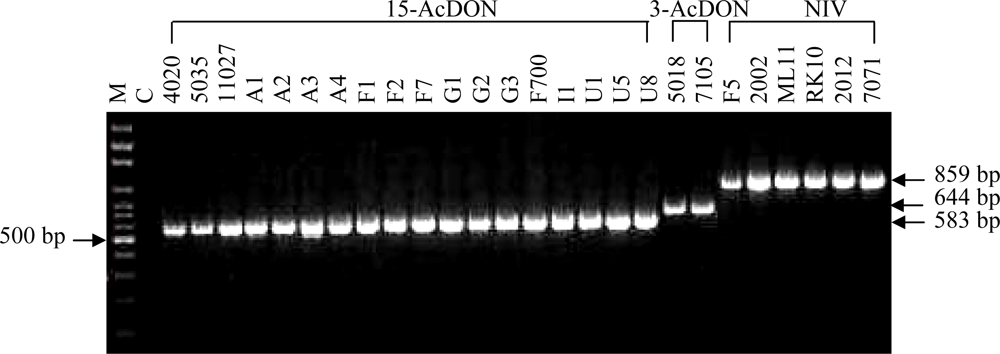
<p>To investigate the reliability of the Tri13P1 and Tri13P2 primers for the identification of the 3-AcDON-, 15-AcDON- and NIV-chemotypes of <italic>F. graminearum</italic> clade, twenty six <italic>F. graminearum</italic> strains from various geographical origins were selected for the PCR assay. The mycotoxin chemotypes of these strains were determined either by HPLC, GC/MS or PCR. For instance, the strain 7015 from China was first determined to produce DON mycotoxin by HPLC [<xref ref-type="bibr" rid="b24-ijms-09-02495">24</xref>] and is now identified as a 3-AcDON-producer by GC/MS (<xref ref-type="table" rid="t1-ijms-09-02495">Table 1</xref>). The Chinese strain 5035 was identified as a 15-AcDON-producer by PCR assay [<xref ref-type="bibr" rid="b26-ijms-09-02495">26</xref>] as well as GC/MS analysis (<xref ref-type="table" rid="t1-ijms-09-02495">Table 1</xref>), while RK10 from Nepal produced NIV mycotoxins as revealed by both HPLC and PCR [<xref ref-type="bibr" rid="b24-ijms-09-02495">24</xref>] (<xref ref-type="table" rid="t1-ijms-09-02495">Table 1</xref>). PCR with Tri13P1 and Tri13P2 primers indeed showed that the 15-AcDON-chemotypes yielded a 583 bp fragment, a 644 bp fragment was generated from the 3-AcDON-chemotypes, and the NIV-chemotypes produced an 859 bp fragment. The three different chemotype-specific DNA fragments displayed a distinct profile on an agarose gel that could be easily determined by visual image under UV light (<xref ref-type="fig" rid="f1-ijms-09-02495">Figure 1</xref>).</p>
<p>With this method fifty-four strains from China, Europe, Nepal and USA were assayed and the results indicated that this pair of primers efficiently amplified a DNA fragment for all the strains with a chemotype-specificity. The results from this PCR assay were completely congruent with the previous chemical analyses and PCR identifications (<xref ref-type="table" rid="t1-ijms-09-02495">Table 1</xref>) [<xref ref-type="bibr" rid="b22-ijms-09-02495">22</xref>, <xref ref-type="bibr" rid="b24-ijms-09-02495">24</xref>, <xref ref-type="bibr" rid="b26-ijms-09-02495">26</xref>–<xref ref-type="bibr" rid="b28-ijms-09-02495">28</xref>], indicating the high reliability for this generic PCR detection of three trichothecene mycotoxin chemotypes from <italic>F. graminearum</italic> clade strains.</p>
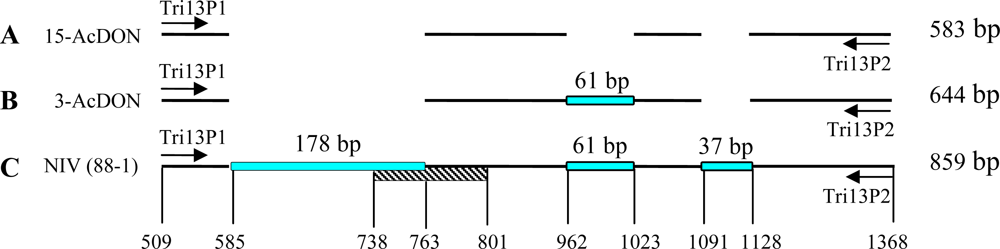
<p>The distinct DNA fragments from different chemotype-producing strains generated by this single pair of primers suggested that each chemotype contained a conserved structure within the <italic>Tri13</italic> gene sequences. NIV-producers carried an intact, functional <italic>Tri13</italic> gene with the region amplified by Tri13P1 and Tri13P2 primers, thus generating an 859 bp fragment (<xref ref-type="fig" rid="f2-ijms-09-02495">Figure 2-C</xref>). However, deletions were present in the <italic>Tri13</italic> gene sequences of DON-producing strains. 3-AcDON-chemotypes contained two deletions of 178 bp and 37 bp in length, respectively, that were located in the region spanned by the two primers Tri13P1 and Tri13P2, generating a 644 bp fragment (<xref ref-type="fig" rid="f2-ijms-09-02495">Figure 2-B</xref>). 15-AcDON-producers not only carried these two deletions but also had a third deletion of 61 bp in the region, yielding a 583 bp fragment (<xref ref-type="fig" rid="f2-ijms-09-02495">Figure 2-A</xref>). These structural characters ensure the efficient differentiation among the three chemotypes by this generic detection method.</p>
<p>The <italic>Tri13</italic> gene in the genome of NIV-producers encodes 3-acetyltrichothecene C-4 hydroxylase that plays an essential role for the addition of the C-4 oxygen to calonectrin [<xref ref-type="bibr" rid="b29-ijms-09-02495">29</xref>]. The genome sequence of the <italic>Tri13</italic> gene contains 1802 bp with a unique intron of 63 bp between the positions 738 and 801 (<xref ref-type="fig" rid="f2-ijms-09-02495">Figure 2-C</xref>). The amplicon generated by the Tri13P1 and Tri13P2 primers includes the sequence from the positions 509 to 1368. The largest deletion of 178 bp fragment present in all DON-producers contains 153 bp of the first exon sequence (positions 585 to 737) and 25 bp of the intron (positions 738 to 763). The remaining two smaller deletions are located within the coding sequence of the <italic>Tri13</italic> gene. Sequence analyses showed these deletions in the DON-producing strains [<xref ref-type="bibr" rid="b30-ijms-09-02495">30</xref>, <xref ref-type="bibr" rid="b31-ijms-09-02495">31</xref>]. The current study revealed that the numbers of the deletion within this region of the <italic>Tri13</italic> gene were apparently associated with the position of acetylation in DON-mycotoxin producers, which could be used as the molecular distinction between 3-AcDON- and 15-AcDON-chemotypes. Mechanisms involved in the creation of the chemotype-specific sequences in the <italic>Tri13</italic> genes during the evolution within <italic>F. graminearum</italic> clade remain to be investigated.</p>
<p>The generic PCR detection of 3-AcDON-, 15-AcDON- and NIV-chemotypes based on one amplicon should be more reliable than other PCR-based assays that showed the absence or presence of a PCR fragment since these assays may generate false-negative results. The results with strains from several different countries as well as from different hosts further indicated that this method should be globally applicable. This is a rapid, reliable and cost-effective method for the identification of three mycotoxin chemotypes in <italic>Fusarium</italic> species.</p></sec>
<sec sec-type="conclusions">
<title>4. Conclusions</title>
<p>A single pair of primers based on the <italic>Tri13</italic> gene sequences of <italic>F. graminearum</italic> clade was designed that detected a chemotype-specific DNA fragment with different sizes from 3-AcDON-, 15-AcDON- and NIV-producers of <italic>F. graminearum</italic> clade strains. This PCR-based method was applied to assay the mycotoxin chemotypes of <italic>Fusarium</italic> strains from different countries and different hosts. The chemotypes revealed with this pair of primers were identical to that obtained by chemical analyses and other PCR-based assays. This generic PCR detection of the type B trichothecene mycotoxin chemotypes apparently appears to be more reliable and accurate than other PCR-based assays that may generate false-negative results based on the presence or absence of a DNA fragment. This is a reliable and cost-effective method for the identification of the trichothecene mycotoxin chemotypes in <italic>F. graminearum</italic> clade as well as in food and feed safety controls.</p></sec></body>
<back>
<ack>
<p>We thank Dr. Paul Nicholson, John Innes Centre, UK for providing foreign <italic>Fusarium</italic> strains. This work was supported by the National Natural Science Foundation of China (30530510, 30571160, 30771337) and the Ministry of Science and Technology of China (2007AA10Z425).</p></ack>
<ref-list>
<title>References</title>
<ref id="b1-ijms-09-02495"><label>1.</label><citation citation-type="journal"><person-group person-group-type="author"><name><surname>Windels</surname><given-names>CE</given-names></name></person-group><article-title>Economic and social impacts of <italic>Fusarium</italic> head blight: Changing farms and rural communities in the Northern Great Plains</article-title><source>Phytopathology</source><year>2000</year><volume>90</volume><fpage>17</fpage><lpage>21</lpage><pub-id pub-id-type="doi">10.1094/PHYTO.2000.90.1.17</pub-id><pub-id pub-id-type="pmid">18944567</pub-id></citation></ref>
<ref id="b2-ijms-09-02495"><label>2.</label><citation citation-type="journal"><person-group person-group-type="author"><name><surname>Placinta</surname><given-names>EM</given-names></name><name><surname>D’Mello</surname><given-names>JPF</given-names></name><name><surname>Machdonald</surname><given-names>AMC</given-names></name></person-group><article-title>A review of worldwide contamination of cereal grains and animal feed with <italic>Fusarium</italic> mycotoxins</article-title><source>Anim. Feed Sci. Tech</source><year>1999</year><volume>78</volume><fpage>21</fpage><lpage>37</lpage><pub-id pub-id-type="doi">10.1016/S0377-8401(98)00278-8</pub-id></citation></ref>
<ref id="b3-ijms-09-02495"><label>3.</label><citation citation-type="journal"><person-group person-group-type="author"><name><surname>Cleveland</surname><given-names>TE</given-names></name><name><surname>Dowd</surname><given-names>PF</given-names></name><name><surname>Desjardins</surname><given-names>AE</given-names></name><name><surname>Bhatnagar</surname><given-names>D</given-names></name><name><surname>Cotty</surname><given-names>PJ</given-names></name></person-group><article-title>Unitied States department of agriculture-agricultural research service research on pre-harvest prevention of mycotoxins and mycotoxingenic fungi in US crops</article-title><source>Pest Manag. Sci</source><year>2003</year><volume>59</volume><fpage>629</fpage><lpage>642</lpage><pub-id pub-id-type="doi">10.1002/ps.724</pub-id><pub-id pub-id-type="pmid">12846313</pub-id></citation></ref>
<ref id="b4-ijms-09-02495"><label>4.</label><citation citation-type="journal"><person-group person-group-type="author"><name><surname>Desjardins</surname><given-names>AE</given-names></name><name><surname>Manandhar</surname><given-names>G</given-names></name><name><surname>Plattner</surname><given-names>RD</given-names></name><name><surname>Maragos</surname><given-names>CM</given-names></name><name><surname>Shrestha</surname><given-names>K</given-names></name><name><surname>McCormick</surname><given-names>SP</given-names></name></person-group><article-title>Occurrence of <italic>Fusarium</italic> species and mycotoxins in Nepalese maize and wheat and effect of traditional processing methods on mycotoxin levels</article-title><source>J. Agri. Food Chem</source><year>2000</year><volume>48</volume><fpage>1377</fpage><lpage>1383</lpage><pub-id pub-id-type="doi">10.1021/jf991022b</pub-id></citation></ref>
<ref id="b5-ijms-09-02495"><label>5.</label><citation citation-type="journal"><person-group person-group-type="author"><name><surname>D’Mello</surname><given-names>JPF</given-names></name><name><surname>Placinta</surname><given-names>CM</given-names></name><name><surname>Macdonald</surname><given-names>AMC</given-names></name></person-group><article-title><italic>Fusarium</italic> mycotoxins: A review of global implications for animal health, welfare and productivity</article-title><source>Anim. Feed Sci.Technol</source><year>1999</year><volume>80</volume><fpage>183</fpage><lpage>205</lpage><pub-id pub-id-type="doi">10.1016/S0377-8401(99)00059-0</pub-id></citation></ref>
<ref id="b6-ijms-09-02495"><label>6.</label><citation citation-type="journal"><person-group person-group-type="author"><name><surname>Gutleb</surname><given-names>AC</given-names></name><name><surname>Morrison</surname><given-names>E</given-names></name><name><surname>Murk</surname><given-names>AJ</given-names></name></person-group><article-title>Cytotoxicity assays for mycotoxins produced by <italic>Fusarium</italic> strains: A review</article-title><source>Environ. Toxicol. Pharmacol</source><year>2002</year><volume>11</volume><fpage>309</fpage><lpage>320</lpage><pub-id pub-id-type="doi">10.1016/S1382-6689(02)00020-0</pub-id><pub-id pub-id-type="pmid">21782614</pub-id></citation></ref>
<ref id="b7-ijms-09-02495"><label>7.</label><citation citation-type="journal"><person-group person-group-type="author"><name><surname>Ward</surname><given-names>TJ</given-names></name><name><surname>Bielawski</surname><given-names>JP</given-names></name><name><surname>Kistler</surname><given-names>HC</given-names></name><name><surname>Sullivan</surname><given-names>E</given-names></name><name><surname>O’Donnell</surname><given-names>K</given-names></name></person-group><article-title>Ancestral polymorphism and adaptive evolution in the trichothecene mycotoxin gene cluster of phytopathogenic <italic>Fusarium</italic></article-title><source>Proc. Natl. Acad. Sci. USA</source><year>2002</year><volume>9</volume><fpage>9278</fpage><lpage>9283</lpage></citation></ref>
<ref id="b8-ijms-09-02495"><label>8.</label><citation citation-type="journal"><person-group person-group-type="author"><name><surname>Miller</surname><given-names>JD</given-names></name><name><surname>Greenhalgh</surname><given-names>R</given-names></name><name><surname>Wang</surname><given-names>YZ</given-names></name><name><surname>Lu</surname><given-names>M</given-names></name></person-group><article-title>Trichothecene chemotypes of three <italic>Fusarium</italic> species</article-title><source>Mycologia</source><year>1991</year><volume>83</volume><fpage>121</fpage><lpage>130</lpage><pub-id pub-id-type="doi">10.2307/3759927</pub-id></citation></ref>
<ref id="b9-ijms-09-02495"><label>9.</label><citation citation-type="journal"><person-group person-group-type="author"><name><surname>Moss</surname><given-names>MO</given-names></name><name><surname>Thrane</surname><given-names>U</given-names></name></person-group><article-title><italic>Fusarium</italic> taxonomy with relation to trichothecene formation</article-title><source>Toxicol. Lett</source><year>2004</year><volume>153</volume><fpage>23</fpage><lpage>28</lpage><pub-id pub-id-type="doi">10.1016/j.toxlet.2004.04.021</pub-id><pub-id pub-id-type="pmid">15342077</pub-id></citation></ref>
<ref id="b10-ijms-09-02495"><label>10.</label><citation citation-type="journal"><person-group person-group-type="author"><name><surname>Haratian</surname><given-names>M</given-names></name><name><surname>Sharifnabi</surname><given-names>B</given-names></name><name><surname>Alizadeh</surname><given-names>A</given-names></name><name><surname>Safaie</surname><given-names>N</given-names></name></person-group><article-title>PCR analysis of the <italic>Tri13</italic> gene to determine the genetic potential of <italic>Fusarium graminearum</italic> isolates from Iran to produce Nivalenol and Deoxynivalenol</article-title><source>Mycopathologia</source><year>2008</year><volume>166</volume><fpage>109</fpage><lpage>116</lpage><pub-id pub-id-type="doi">10.1007/s11046-008-9127-y</pub-id><pub-id pub-id-type="pmid">18523864</pub-id></citation></ref>
<ref id="b11-ijms-09-02495"><label>11.</label><citation citation-type="journal"><person-group person-group-type="author"><name><surname>O’Donnell</surname><given-names>K</given-names></name><name><surname>Kistler</surname><given-names>HC</given-names></name><name><surname>Tacke</surname><given-names>BK</given-names></name><name><surname>Casper</surname><given-names>HH</given-names></name></person-group><article-title>Gene genealogies reveal global phylogeographic structure and reproductive isolation among lineages of <italic>Fusarium graminearum</italic>, the fungus causing wheat scab</article-title><source>Proc. Natl. Acad. Sci. USA</source><year>2000</year><volume>97</volume><fpage>7905</fpage><lpage>7910</lpage><pub-id pub-id-type="doi">10.1073/pnas.130193297</pub-id><pub-id pub-id-type="pmid">10869425</pub-id></citation></ref>
<ref id="b12-ijms-09-02495"><label>12.</label><citation citation-type="book"><person-group person-group-type="author"><name><surname>Grove</surname><given-names>JF</given-names></name></person-group><article-title>The trichothecenes and their biosynthesis</article-title><source>Fortschritte der Chemie organischer Naturstoffe/Progress in the Chemistry of Organic Natural Products</source><person-group person-group-type="editor"><name><surname>Herz</surname><given-names>W</given-names></name><name><surname>Falk</surname><given-names>H</given-names></name><name><surname>Kirby</surname><given-names>GW</given-names></name></person-group><publisher-name>Springer</publisher-name><publisher-loc>Wien, New York, USA</publisher-loc><year>2007</year><volume>Volume 88</volume><fpage>63</fpage><lpage>130</lpage></citation></ref>
<ref id="b13-ijms-09-02495"><label>13.</label><citation citation-type="journal"><person-group person-group-type="author"><name><surname>Ward</surname><given-names>TJ</given-names></name><name><surname>Bielawski</surname><given-names>JP</given-names></name><name><surname>Kistler</surname><given-names>HC</given-names></name><name><surname>Sullivan</surname><given-names>E</given-names></name><name><surname>O’Donnell</surname><given-names>K</given-names></name></person-group><article-title>Ancestral polymorphism and adaptive evolution in the trichothecene mycotoxin gene cluster of phytopathogenic <italic>Fusarium</italic></article-title><source>Proc. Natl. Acad. Sci. USA</source><year>2002</year><volume>9</volume><fpage>9278</fpage><lpage>9283</lpage></citation></ref>
<ref id="b14-ijms-09-02495"><label>14.</label><citation citation-type="journal"><person-group person-group-type="author"><name><surname>Nicholson</surname><given-names>P</given-names></name><name><surname>Simpson</surname><given-names>DR</given-names></name><name><surname>Wilson</surname><given-names>AH</given-names></name><name><surname>Chandler</surname><given-names>E</given-names></name><name><surname>Thomsett</surname><given-names>M</given-names></name></person-group><article-title>Detection and differentiation of trichothecene and enniatin-producing <italic>Fusarium</italic> species on small-grain cereals</article-title><source>Eur. J. Plant Pathol</source><year>2004</year><volume>110</volume><fpage>503</fpage><lpage>514</lpage><pub-id pub-id-type="doi">10.1023/B:EJPP.0000032390.65641.a7</pub-id></citation></ref>
<ref id="b15-ijms-09-02495"><label>15.</label><citation citation-type="journal"><person-group person-group-type="author"><name><surname>Hsueh</surname><given-names>CC</given-names></name><name><surname>Liu</surname><given-names>Y</given-names></name><name><surname>Freund</surname><given-names>MS</given-names></name></person-group><article-title>Indirect electrochemical detection of type-B trichothecene mycotoxins</article-title><source>Anal. Chem</source><year>1999</year><volume>71</volume><fpage>4075</fpage><lpage>4080</lpage><pub-id pub-id-type="doi">10.1021/ac981114k</pub-id><pub-id pub-id-type="pmid">10500491</pub-id></citation></ref>
<ref id="b16-ijms-09-02495"><label>16.</label><citation citation-type="journal"><person-group person-group-type="author"><name><surname>Schollenberger</surname><given-names>M</given-names></name><name><surname>Drochner</surname><given-names>W</given-names></name></person-group><article-title><italic>Fusarium</italic> toxins of the scirpentriol subgroup: A review</article-title><source>Mycopathologia</source><year>2007</year><volume>164</volume><fpage>101</fpage><lpage>118</lpage><pub-id pub-id-type="doi">10.1007/s11046-007-9036-5</pub-id><pub-id pub-id-type="pmid">17610049</pub-id></citation></ref>
<ref id="b17-ijms-09-02495"><label>17.</label><citation citation-type="journal"><person-group person-group-type="author"><name><surname>Lee</surname><given-names>T</given-names></name><name><surname>Han</surname><given-names>YK</given-names></name><name><surname>Kim</surname><given-names>KH</given-names></name><name><surname>Yun</surname><given-names>SH</given-names></name><name><surname>Lee</surname><given-names>YW</given-names></name></person-group><article-title><italic>Tri13</italic> and <italic>Tri7</italic> determine deoxynivalenol- and nivalenol-producing chemotypes of <italic>Gibberella zeae</italic></article-title><source>Appl. Environ. Microbiol</source><year>2002</year><volume>5</volume><fpage>2148</fpage><lpage>2154</lpage></citation></ref>
<ref id="b18-ijms-09-02495"><label>18.</label><citation citation-type="journal"><person-group person-group-type="author"><name><surname>Hohn</surname><given-names>TM</given-names></name><name><surname>McCormick</surname><given-names>SP</given-names></name><name><surname>Desjardins</surname><given-names>AE</given-names></name></person-group><article-title>Evidence for a gene cluster involving trichothecene-pathway biosynthetic genes in <italic>Fusarium sporotrichioides</italic></article-title><source>Curr. Genet</source><year>1993</year><volume>24</volume><fpage>291</fpage><lpage>295</lpage><pub-id pub-id-type="doi">10.1007/BF00336778</pub-id><pub-id pub-id-type="pmid">8252637</pub-id></citation></ref>
<ref id="b19-ijms-09-02495"><label>19.</label><citation citation-type="journal"><person-group person-group-type="author"><name><surname>Brown</surname><given-names>DW</given-names></name><name><surname>McCormick</surname><given-names>SP</given-names></name><name><surname>Alexander</surname><given-names>NJ</given-names></name><name><surname>Proctor</surname><given-names>RH</given-names></name><name><surname>Desjardins</surname><given-names>AE</given-names></name></person-group><article-title>A genetic and biochemical approach to study trichothecene diversity in <italic>Fusarium sporotrichioides</italic> and <italic>Fusarium graminearum</italic></article-title><source>Fungal Genet. Biol</source><year>2001</year><volume>32</volume><fpage>121</fpage><lpage>133</lpage><pub-id pub-id-type="doi">10.1006/fgbi.2001.1256</pub-id><pub-id pub-id-type="pmid">11352533</pub-id></citation></ref>
<ref id="b20-ijms-09-02495"><label>20.</label><citation citation-type="journal"><person-group person-group-type="author"><name><surname>Ji</surname><given-names>L</given-names></name><name><surname>Cao</surname><given-names>K</given-names></name><name><surname>Hu</surname><given-names>T</given-names></name><name><surname>Wang</surname><given-names>S</given-names></name></person-group><article-title>Determination of deoxynivalenol and nivalenol chemotypes of <italic>Fusarium graminearum</italic> isolates from China by PCR assay</article-title><source>Phytopathology</source><year>2007</year><volume>155</volume><fpage>505</fpage><lpage>512</lpage><pub-id pub-id-type="doi">10.1111/j.1439-0434.2007.01270.x</pub-id></citation></ref>
<ref id="b21-ijms-09-02495"><label>21.</label><citation citation-type="journal"><person-group person-group-type="author"><name><surname>Qu</surname><given-names>B</given-names></name><name><surname>Li</surname><given-names>HP</given-names></name><name><surname>Zhang</surname><given-names>JB</given-names></name><name><surname>Xu</surname><given-names>YB</given-names></name><name><surname>Huang</surname><given-names>T</given-names></name><name><surname>Wu</surname><given-names>AB</given-names></name><name><surname>Zhao</surname><given-names>CS</given-names></name><name><surname>Carter</surname><given-names>J</given-names></name><name><surname>Nicholson</surname><given-names>P</given-names></name><name><surname>Liao</surname><given-names>YC</given-names></name></person-group><article-title>Geographic distribution and genetic diversity of <italic>Fusarium graminearum</italic> and <italic>F. asiaticum</italic> on wheat spikes throughout China</article-title><source>Plant Pathol</source><year>2008</year><volume>57</volume><fpage>15</fpage><lpage>24</lpage></citation></ref>
<ref id="b22-ijms-09-02495"><label>22.</label><citation citation-type="journal"><person-group person-group-type="author"><name><surname>Carter</surname><given-names>JP</given-names></name><name><surname>Rezanoor</surname><given-names>HN</given-names></name><name><surname>Holden</surname><given-names>D</given-names></name><name><surname>Desjardins</surname><given-names>AE</given-names></name><name><surname>Plattner</surname><given-names>RD</given-names></name><name><surname>Nicholson</surname><given-names>P</given-names></name></person-group><article-title>Variation in pathogenicity associated with the genetic diversity of <italic>Fusarium graminearum</italic></article-title><source>Eur. J. Plant Pathol</source><year>2002</year><volume>108</volume><fpage>573</fpage><lpage>583</lpage><pub-id pub-id-type="doi">10.1023/A:1019921203161</pub-id></citation></ref>
<ref id="b23-ijms-09-02495"><label>23.</label><citation citation-type="journal"><person-group person-group-type="author"><name><surname>Nicholson</surname><given-names>P</given-names></name><name><surname>Rezanoor</surname><given-names>HN</given-names></name><name><surname>Simpson</surname><given-names>DR</given-names></name><name><surname>Joyce</surname><given-names>D</given-names></name></person-group><article-title>Differentiation and quantification of the cereal eyespot fungi <italic>Tapesia yallundae</italic> and <italic>Tapesia acuformis</italic> using a PCR assay</article-title><source>Plant Pathol</source><year>1997</year><volume>46</volume><fpage>842</fpage><lpage>856</lpage><pub-id pub-id-type="doi">10.1046/j.1365-3059.1997.d01-74.x</pub-id></citation></ref>
<ref id="b24-ijms-09-02495"><label>24.</label><citation citation-type="journal"><person-group person-group-type="author"><name><surname>Li</surname><given-names>HP</given-names></name><name><surname>Wu</surname><given-names>AB</given-names></name><name><surname>Zhao</surname><given-names>CS</given-names></name><name><surname>Scholten</surname><given-names>O</given-names></name><name><surname>Löffler</surname><given-names>H</given-names></name><name><surname>Liao</surname><given-names>YC</given-names></name></person-group><article-title>Development of a generic PCR detection of deoxynivalenol- and nivalenol-chemotypes of <italic>Fusarium graminearum</italic></article-title><source>FEMS Microbiol. Lett</source><year>2005</year><volume>243</volume><fpage>505</fpage><lpage>511</lpage><pub-id pub-id-type="doi">10.1016/j.femsle.2005.01.015</pub-id><pub-id pub-id-type="pmid">15686855</pub-id></citation></ref>
<ref id="b25-ijms-09-02495"><label>25.</label><citation citation-type="journal"><person-group person-group-type="author"><name><surname>Busko</surname><given-names>M</given-names></name><name><surname>Ckhełowski</surname><given-names>J</given-names></name><name><surname>Popiel</surname><given-names>D</given-names></name><name><surname>Perkowski</surname><given-names>J</given-names></name></person-group><article-title>Solid substrate bioassay to evaluate impact of <italic>Trichoderma</italic> on trichothecene mycotoxin production by <italic>Fusarium</italic> species</article-title><source>J. Sci. Food Agric</source><year>2008</year><volume>88</volume><fpage>536</fpage><lpage>541</lpage><pub-id pub-id-type="doi">10.1002/jsfa.3119</pub-id></citation></ref>
<ref id="b26-ijms-09-02495"><label>26.</label><citation citation-type="journal"><person-group person-group-type="author"><name><surname>Zhang</surname><given-names>JB</given-names></name><name><surname>Li</surname><given-names>HP</given-names></name><name><surname>Dang</surname><given-names>FJ</given-names></name><name><surname>Qu</surname><given-names>B</given-names></name><name><surname>Xu</surname><given-names>YB</given-names></name><name><surname>Zhao</surname><given-names>CS</given-names></name><name><surname>Liao</surname><given-names>YC</given-names></name></person-group><article-title>Determination of the trichothecene mycotoxin chemotypes and associated geographical distribution and phylogenetic species of the <italic>Fusarium graminearum</italic> clade from China</article-title><source>Mycol. Res</source><year>2007</year><volume>111</volume><fpage>967</fpage><lpage>975</lpage><pub-id pub-id-type="doi">10.1016/j.mycres.2007.06.008</pub-id><pub-id pub-id-type="pmid">17716884</pub-id></citation></ref>
<ref id="b27-ijms-09-02495"><label>27.</label><citation citation-type="journal"><person-group person-group-type="author"><name><surname>Qu</surname><given-names>B</given-names></name><name><surname>Li</surname><given-names>HP</given-names></name><name><surname>Zhang</surname><given-names>JB</given-names></name><name><surname>Huang</surname><given-names>T</given-names></name><name><surname>Carter</surname><given-names>J</given-names></name><name><surname>Liao</surname><given-names>YC</given-names></name><name><surname>Nicholson</surname><given-names>P</given-names></name></person-group><article-title>Comparison of genetic diversity and pathogenicity of <italic>Fusarium</italic> head blight pathogens from China and Europe by SSCP and seedling assays on wheat</article-title><source>Plant Pathol</source><year>2008</year><volume>57</volume><fpage>642</fpage><lpage>651</lpage><pub-id pub-id-type="doi">10.1111/j.1365-3059.2008.01824.x</pub-id></citation></ref>
<ref id="b28-ijms-09-02495"><label>28.</label><citation citation-type="journal"><person-group person-group-type="author"><name><surname>Chandler</surname><given-names>EA</given-names></name><name><surname>Simpson</surname><given-names>DR</given-names></name><name><surname>Thomsett</surname><given-names>MA</given-names></name><name><surname>Nicholson</surname><given-names>P</given-names></name></person-group><article-title>Development of PCR assays to <italic>Tri7</italic> and <italic>Tri13</italic> trichothecene biosynthetic genes, and characterisation of chemotypes of <italic>Fusarium graminearum</italic>, <italic>Fusarium culmorum</italic> and <italic>Fusarium cerealis</italic></article-title><source>Physiol. Mol. Plant Pathol</source><year>2003</year><volume>62</volume><fpage>355</fpage><lpage>367</lpage><pub-id pub-id-type="doi">10.1016/S0885-5765(03)00092-4</pub-id></citation></ref>
<ref id="b29-ijms-09-02495"><label>29.</label><citation citation-type="journal"><person-group person-group-type="author"><name><surname>Kimura</surname><given-names>M</given-names></name><name><surname>Takeshi</surname><given-names>T</given-names></name><name><surname>Naoko</surname><given-names>TA</given-names></name><name><surname>Shuichi</surname><given-names>O</given-names></name><name><surname>Makoto</surname><given-names>F</given-names></name></person-group><article-title>Molecular and genetic studies of <italic>Fusarium</italic> trichothecene biosynthesis: pathways, genes, and evolution</article-title><source>Biosci. Biotechnol. Biochem</source><year>2007</year><volume>71</volume><fpage>2105</fpage><lpage>2123</lpage><pub-id pub-id-type="doi">10.1271/bbb.70183</pub-id><pub-id pub-id-type="pmid">17827683</pub-id></citation></ref>
<ref id="b30-ijms-09-02495"><label>30.</label><citation citation-type="journal"><person-group person-group-type="author"><name><surname>Brown</surname><given-names>DW</given-names></name><name><surname>McCormick</surname><given-names>SP</given-names></name><name><surname>Alexander</surname><given-names>NJ</given-names></name><name><surname>Proctor</surname><given-names>RH</given-names></name><name><surname>Desjardins</surname><given-names>AE</given-names></name></person-group><article-title>Inactivation of a cytochrome P-450 is a determinant of trichothecene diversity in <italic>Fusarium</italic> species</article-title><source>Fungal Genet. Biol</source><year>2002</year><volume>36</volume><fpage>224</fpage><lpage>233</lpage><pub-id pub-id-type="doi">10.1016/S1087-1845(02)00021-X</pub-id><pub-id pub-id-type="pmid">12135578</pub-id></citation></ref>
<ref id="b31-ijms-09-02495"><label>31.</label><citation citation-type="journal"><person-group person-group-type="author"><name><surname>Kimura</surname><given-names>M</given-names></name><name><surname>Tokai</surname><given-names>T</given-names></name><name><surname>O’Donnell</surname><given-names>K</given-names></name><name><surname>Ward</surname><given-names>TJ</given-names></name><name><surname>Fujimura</surname><given-names>M</given-names></name><name><surname>Hamamoto</surname><given-names>H</given-names></name><name><surname>Shibata</surname><given-names>T</given-names></name><name><surname>Yamaguchi</surname><given-names>I</given-names></name></person-group><article-title>The trichothecene biosynthesis gene cluster of <italic>Fusarium graminearum</italic> F15 contains a limited number of essential pathway genes and expressed non-essential genes</article-title><source>FEBS Lett</source><year>2003</year><volume>539</volume><fpage>105</fpage><lpage>110</lpage><pub-id pub-id-type="doi">10.1016/S0014-5793(03)00208-4</pub-id><pub-id pub-id-type="pmid">12650935</pub-id></citation></ref></ref-list>
<sec sec-type="display-objects">
<title>Figures and Table</title>
<fig id="f1-ijms-09-02495" position="float">
<label>Figure 1.</label>
<caption>
<p>PCR amplification of 3-AcDON-, 15-AcDON- and NIV-chemotypes of <italic>F. graminearum</italic> clade strains. Lane M, 100-bp ladder marker; Lane C, negative control (omitting DNA template); Codes numbers above the panel correspond to the strain codes of <italic>F. graminearum</italic> clade in <xref ref-type="table" rid="t1-ijms-09-02495">Table 1</xref>.</p></caption>
<graphic xlink:href="ijms-09-02495f1.png"/></fig>
<fig id="f2-ijms-09-02495" position="float">
<label>Figure 2.</label>
<caption>
<p>Diagrammatic presentations of <italic>Tri13</italic> genes are showing the gene structures of 3-AcDON-, 15-AcDON- and NIV-chemotype strains, and indicating the positions of primers designed for this study and the positions of nucleotides in the amplicon amplified by the primers in a NIV-chemotype.</p></caption>
<graphic xlink:href="ijms-09-02495f2.png"/></fig>
<table-wrap id="t1-ijms-09-02495" position="float">
<label>Table 1.</label>
<caption>
<p>Origin, chemotype, host and PCR assay results of <italic>Fusarium graminearum</italic> clade strains examined in this study.</p></caption>
<table frame="hsides" rules="groups">
<thead>
<tr>
<th align="left" rowspan="2">Strain code</th>
<th align="left" rowspan="2">Origin</th>
<th align="left" rowspan="2">Host</th>
<th align="left" rowspan="2">Chemotype</th>
<th align="center" colspan="4">PCR assay results
<hr/></th></tr>
<tr>
<th align="left">Fragment size (bp)</th>
<th align="left">NIV</th>
<th align="left">3-Ac DON</th>
<th align="left">15-Ac DON</th></tr></thead>
<tbody>
<tr>
<td align="left">2002</td>
<td align="left">China</td>
<td align="left">Wheat</td>
<td align="left">NIV <xref ref-type="table-fn" rid="tfn1-ijms-09-02495">a</xref></td>
<td align="left">859</td>
<td align="left">+</td>
<td align="left">−</td>
<td align="left">−</td></tr>
<tr>
<td align="left">2012</td>
<td align="left">China</td>
<td align="left">Wheat</td>
<td align="left">NIV <xref ref-type="table-fn" rid="tfn1-ijms-09-02495">a</xref></td>
<td align="left">859</td>
<td align="left">+</td>
<td align="left">−</td>
<td align="left">−</td></tr>
<tr>
<td align="left">3002</td>
<td align="left">China</td>
<td align="left">Wheat</td>
<td align="left">15-AcDON <xref ref-type="table-fn" rid="tfn1-ijms-09-02495">a</xref></td>
<td align="left">583</td>
<td align="left">−</td>
<td align="left">+</td></tr>
<tr>
<td align="left">4020</td>
<td align="left">China</td>
<td align="left">Wheat</td>
<td align="left">15-AcDON <xref ref-type="table-fn" rid="tfn2-ijms-09-02495">b</xref></td>
<td align="left">583</td>
<td align="left">−</td>
<td align="left">+</td></tr>
<tr>
<td align="left">5018</td>
<td align="left">China</td>
<td align="left">Wheat</td>
<td align="left">3-AcDON <xref ref-type="table-fn" rid="tfn3-ijms-09-02495">c</xref></td>
<td align="left">644</td>
<td align="left">−</td>
<td align="left">+</td>
<td align="left">−</td></tr>
<tr>
<td align="left">5035</td>
<td align="left">China</td>
<td align="left">Wheat</td>
<td align="left">15-AcDON <xref ref-type="table-fn" rid="tfn4-ijms-09-02495">d</xref></td>
<td align="left">583</td>
<td align="left">−</td>
<td align="left">+</td></tr>
<tr>
<td align="left">5039</td>
<td align="left">China</td>
<td align="left">Wheat</td>
<td align="left">3-AcDON <xref ref-type="table-fn" rid="tfn1-ijms-09-02495">a</xref></td>
<td align="left">644</td>
<td align="left">−</td>
<td align="left">+</td>
<td align="left">−</td></tr>
<tr>
<td align="left">5119</td>
<td align="left">China</td>
<td align="left">Wheat</td>
<td align="left">15-AcDON <xref ref-type="table-fn" rid="tfn1-ijms-09-02495">a</xref></td>
<td align="left">583</td>
<td align="left">−</td>
<td align="left">+</td></tr>
<tr>
<td align="left">5226</td>
<td align="left">China</td>
<td align="left">Wheat</td>
<td align="left">n.t.</td>
<td align="left">583</td>
<td align="left">−</td>
<td align="left">+</td></tr>
<tr>
<td align="left">7105</td>
<td align="left">China</td>
<td align="left">Wheat</td>
<td align="left">3-AcDON <xref ref-type="table-fn" rid="tfn4-ijms-09-02495">d</xref></td>
<td align="left">644</td>
<td align="left">−</td>
<td align="left">+</td>
<td align="left">−</td></tr>
<tr>
<td align="left">7047</td>
<td align="left">China</td>
<td align="left">Wheat</td>
<td align="left">3-AcDON <xref ref-type="table-fn" rid="tfn1-ijms-09-02495">a</xref></td>
<td align="left">644</td>
<td align="left">−</td>
<td align="left">+</td>
<td align="left">−</td></tr>
<tr>
<td align="left">7071</td>
<td align="left">China</td>
<td align="left">Wheat</td>
<td align="left">NIV <xref ref-type="table-fn" rid="tfn1-ijms-09-02495">a</xref></td>
<td align="left">859</td>
<td align="left">+</td>
<td align="left">−</td>
<td align="left">−</td></tr>
<tr>
<td align="left">7089</td>
<td align="left">China</td>
<td align="left">Wheat</td>
<td align="left">3-AcDON <xref ref-type="table-fn" rid="tfn1-ijms-09-02495">a</xref></td>
<td align="left">644</td>
<td align="left">−</td>
<td align="left">+</td>
<td align="left">−</td></tr>
<tr>
<td align="left">11027</td>
<td align="left">China</td>
<td align="left">Wheat</td>
<td align="left">15-AcDON <xref ref-type="table-fn" rid="tfn1-ijms-09-02495">a</xref></td>
<td align="left">583</td>
<td align="left">−</td>
<td align="left">+</td></tr>
<tr>
<td align="left">12002</td>
<td align="left">China</td>
<td align="left">Wheat</td>
<td align="left">NIV <xref ref-type="table-fn" rid="tfn1-ijms-09-02495">a</xref></td>
<td align="left">859</td>
<td align="left">+</td>
<td align="left">−</td>
<td align="left">−</td></tr>
<tr>
<td align="left">12003</td>
<td align="left">China</td>
<td align="left">Wheat</td>
<td align="left">NIV <xref ref-type="table-fn" rid="tfn1-ijms-09-02495">a</xref></td>
<td align="left">859</td>
<td align="left">+</td>
<td align="left">−</td>
<td align="left">−</td></tr>
<tr>
<td align="left">13081</td>
<td align="left">China</td>
<td align="left">Wheat</td>
<td align="left">n.t.</td>
<td align="left">644</td>
<td align="left">−</td>
<td align="left">+</td>
<td align="left">−</td></tr>
<tr>
<td align="left">104</td>
<td align="left">China</td>
<td align="left">Wheat</td>
<td align="left">n.t.</td>
<td align="left">583</td>
<td align="left">−</td>
<td align="left">+</td></tr>
<tr>
<td align="left">CH1-1</td>
<td align="left">China</td>
<td align="left">Wheat</td>
<td align="left">n.t.</td>
<td align="left">583</td>
<td align="left">−</td>
<td align="left">+</td></tr>
<tr>
<td align="left">CH2-1</td>
<td align="left">China</td>
<td align="left">Wheat</td>
<td align="left">n.t.</td>
<td align="left">583</td>
<td align="left">−</td>
<td align="left">+</td></tr>
<tr>
<td align="left">SH</td>
<td align="left">China</td>
<td align="left">Maize</td>
<td align="left">n.t.</td>
<td align="left">583</td>
<td align="left">−</td>
<td align="left">+</td></tr>
<tr>
<td align="left">LY-11</td>
<td align="left">China</td>
<td align="left">Wheat</td>
<td align="left">n.t.</td>
<td align="left">583</td>
<td align="left">−</td>
<td align="left">+</td></tr>
<tr>
<td align="left">YZ-2</td>
<td align="left">China</td>
<td align="left">Rice</td>
<td align="left">n.t.</td>
<td align="left">583</td>
<td align="left">−</td>
<td align="left">+</td></tr>
<tr>
<td align="left">JYH</td>
<td align="left">China</td>
<td align="left">Maize</td>
<td align="left">n.t.</td>
<td align="left">583</td>
<td align="left">−</td>
<td align="left">+</td></tr>
<tr>
<td align="left">F1</td>
<td align="left">France</td>
<td align="left">Wheat</td>
<td align="left">15-AcDON <xref ref-type="table-fn" rid="tfn3-ijms-09-02495">c</xref></td>
<td align="left">583</td>
<td align="left">−</td>
<td align="left">+</td></tr>
<tr>
<td align="left">F2</td>
<td align="left">France</td>
<td align="left">Wheat</td>
<td align="left">15-AcDON <xref ref-type="table-fn" rid="tfn3-ijms-09-02495">c</xref></td>
<td align="left">583</td>
<td align="left">−</td>
<td align="left">+</td></tr>
<tr>
<td align="left">F4</td>
<td align="left">France</td>
<td align="left">Wheat</td>
<td align="left">15-AcDON <xref ref-type="table-fn" rid="tfn3-ijms-09-02495">c</xref></td>
<td align="left">583</td>
<td align="left">−</td>
<td align="left">+</td></tr>
<tr>
<td align="left">F5</td>
<td align="left">France</td>
<td align="left">Wheat</td>
<td align="left">n.t.</td>
<td align="left">859</td>
<td align="left">+</td>
<td align="left">−</td>
<td align="left">−</td></tr>
<tr>
<td align="left">F6</td>
<td align="left">France</td>
<td align="left">Wheat</td>
<td align="left">NIV <xref ref-type="table-fn" rid="tfn3-ijms-09-02495">c</xref></td>
<td align="left">859</td>
<td align="left">+</td>
<td align="left">−</td>
<td align="left">−</td></tr>
<tr>
<td align="left">F7</td>
<td align="left">France</td>
<td align="left">Wheat</td>
<td align="left">15-AcDON <xref ref-type="table-fn" rid="tfn3-ijms-09-02495">c</xref></td>
<td align="left">583</td>
<td align="left">−</td>
<td align="left">+</td></tr>
<tr>
<td align="left">D5</td>
<td align="left">Germany</td>
<td align="left">Wheat</td>
<td align="left">DON <xref ref-type="table-fn" rid="tfn5-ijms-09-02495">e</xref></td>
<td align="left">583</td>
<td align="left">−</td>
<td align="left">+</td></tr>
<tr>
<td align="left">G1</td>
<td align="left">Germany</td>
<td align="left">Wheat</td>
<td align="left">15-AcDON <xref ref-type="table-fn" rid="tfn3-ijms-09-02495">c</xref></td>
<td align="left">583</td>
<td align="left">−</td>
<td align="left">+</td></tr>
<tr>
<td align="left">G2</td>
<td align="left">Germany</td>
<td align="left">Wheat</td>
<td align="left">15-AcDON <xref ref-type="table-fn" rid="tfn3-ijms-09-02495">c</xref></td>
<td align="left">583</td>
<td align="left">−</td>
<td align="left">+</td></tr>
<tr>
<td align="left">G3</td>
<td align="left">Germany</td>
<td align="left">Wheat</td>
<td align="left">15-AcDON <xref ref-type="table-fn" rid="tfn3-ijms-09-02495">c</xref></td>
<td align="left">583</td>
<td align="left">−</td>
<td align="left">+</td></tr>
<tr>
<td align="left">F700</td>
<td align="left">Germany</td>
<td align="left">Wheat</td>
<td align="left">15-AcDON <xref ref-type="table-fn" rid="tfn2-ijms-09-02495">b</xref></td>
<td align="left">583</td>
<td align="left">−</td>
<td align="left">+</td></tr>
<tr>
<td align="left">G6</td>
<td align="left">Germany</td>
<td align="left">Wheat</td>
<td align="left">15-AcDON <xref ref-type="table-fn" rid="tfn3-ijms-09-02495">c</xref></td>
<td align="left">583</td>
<td align="left">−</td>
<td align="left">+</td></tr>
<tr>
<td align="left">I1</td>
<td align="left">Italy</td>
<td align="left">Wheat</td>
<td align="left">15-AcDON <xref ref-type="table-fn" rid="tfn3-ijms-09-02495">c</xref></td>
<td align="left">583</td>
<td align="left">−</td>
<td align="left">+</td></tr>
<tr>
<td align="left">I3</td>
<td align="left">Italy</td>
<td align="left">Wheat</td>
<td align="left">15-AcDON <xref ref-type="table-fn" rid="tfn3-ijms-09-02495">c</xref></td>
<td align="left">583</td>
<td align="left">−</td>
<td align="left">+</td></tr>
<tr>
<td align="left">ML11</td>
<td align="left">Nepal</td>
<td align="left">Maize</td>
<td align="left">NIV <xref ref-type="table-fn" rid="tfn5-ijms-09-02495">e</xref></td>
<td align="left">859</td>
<td align="left">+</td>
<td align="left">−</td>
<td align="left">−</td></tr>
<tr>
<td align="left">RK10(HKM215)</td>
<td align="left">Nepal</td>
<td align="left">Rice</td>
<td align="left">NIV <xref ref-type="table-fn" rid="tfn5-ijms-09-02495">e</xref></td>
<td align="left">859</td>
<td align="left">+</td>
<td align="left">−</td>
<td align="left">−</td></tr>
<tr>
<td align="left">N6 (MK6)</td>
<td align="left">Nepal</td>
<td align="left">Maize</td>
<td align="left">NIV <xref ref-type="table-fn" rid="tfn5-ijms-09-02495">e</xref></td>
<td align="left">859</td>
<td align="left">+</td>
<td align="left">−</td>
<td align="left">−</td></tr>
<tr>
<td align="left">U1</td>
<td align="left">UK</td>
<td align="left">Wheat</td>
<td align="left">15-AcDON <xref ref-type="table-fn" rid="tfn3-ijms-09-02495">c</xref></td>
<td align="left">583</td>
<td align="left">−</td>
<td align="left">+</td></tr>
<tr>
<td align="left">U2</td>
<td align="left">UK</td>
<td align="left">Wheat</td>
<td align="left">n.t.</td>
<td align="left">859</td>
<td align="left">+</td>
<td align="left">−</td>
<td align="left">−</td></tr>
<tr>
<td align="left">U4</td>
<td align="left">UK</td>
<td align="left">Wheat</td>
<td align="left">15-AcDON <xref ref-type="table-fn" rid="tfn3-ijms-09-02495">c</xref></td>
<td align="left">583</td>
<td align="left">−</td>
<td align="left">+</td></tr>
<tr>
<td align="left">U5</td>
<td align="left">UK</td>
<td align="left">Wheat</td>
<td align="left">15-AcDON <xref ref-type="table-fn" rid="tfn3-ijms-09-02495">c</xref></td>
<td align="left">583</td>
<td align="left">−</td>
<td align="left">+</td></tr>
<tr>
<td align="left">U7</td>
<td align="left">UK</td>
<td align="left">Wheat</td>
<td align="left">n.t.</td>
<td align="left">583</td>
<td align="left">−</td>
<td align="left">+</td></tr>
<tr>
<td align="left">U8</td>
<td align="left">UK</td>
<td align="left">Wheat</td>
<td align="left">15-AcDON <xref ref-type="table-fn" rid="tfn3-ijms-09-02495">c</xref></td>
<td align="left">583</td>
<td align="left">−</td>
<td align="left">+</td></tr>
<tr>
<td align="left">UK1</td>
<td align="left">UK</td>
<td align="left">Wheat</td>
<td align="left">DON <xref ref-type="table-fn" rid="tfn5-ijms-09-02495">e</xref></td>
<td align="left">583</td>
<td align="left">−</td>
<td align="left">+</td></tr>
<tr>
<td align="left">A1</td>
<td align="left">USA</td>
<td align="left">Wheat</td>
<td align="left">15-AcDON <xref ref-type="table-fn" rid="tfn3-ijms-09-02495">c</xref></td>
<td align="left">583</td>
<td align="left">−</td>
<td align="left">+</td></tr>
<tr>
<td align="left">A2</td>
<td align="left">USA</td>
<td align="left">Wheat</td>
<td align="left">15-AcDON <xref ref-type="table-fn" rid="tfn3-ijms-09-02495">c</xref></td>
<td align="left">583</td>
<td align="left">−</td>
<td align="left">+</td></tr>
<tr>
<td align="left">A3</td>
<td align="left">USA</td>
<td align="left">Wheat</td>
<td align="left">15-AcDON <xref ref-type="table-fn" rid="tfn3-ijms-09-02495">c</xref></td>
<td align="left">583</td>
<td align="left">−</td>
<td align="left">+</td></tr>
<tr>
<td align="left">A4</td>
<td align="left">USA</td>
<td align="left">Wheat</td>
<td align="left">15-AcDON <xref ref-type="table-fn" rid="tfn3-ijms-09-02495">c</xref></td>
<td align="left">583</td>
<td align="left">−</td>
<td align="left">+</td></tr>
<tr>
<td align="left">A5 (IL42)</td>
<td align="left">USA</td>
<td align="left">Wheat</td>
<td align="left">15-AcDON <xref ref-type="table-fn" rid="tfn3-ijms-09-02495">c</xref></td>
<td align="left">583</td>
<td align="left">−</td>
<td align="left">+</td></tr></tbody></table>
<table-wrap-foot><fn>
<p>+ Corresponding fragment amplified; −, no corresponding fragment amplified; n.t., Not tested.</p></fn><fn id="tfn1-ijms-09-02495">
<label>a</label>
<p>Mycotoxin chemotypes determined by PCR in Ref. [<xref ref-type="bibr" rid="b26-ijms-09-02495">26</xref>];</p></fn><fn id="tfn2-ijms-09-02495">
<label>b</label>
<p>Mycotoxin chemotypes determined by HPLC in Ref. [<xref ref-type="bibr" rid="b24-ijms-09-02495">24</xref>];</p></fn><fn id="tfn3-ijms-09-02495">
<label>c</label>
<p>Mycotoxin chemotypes determined by PCR in Ref. [<xref ref-type="bibr" rid="b27-ijms-09-02495">27</xref>];</p></fn><fn id="tfn4-ijms-09-02495">
<label>d</label>
<p>Mycotoxin chemotypes determined by GC/MS in this study;</p></fn><fn id="tfn5-ijms-09-02495">
<label>e</label>
<p>Mycotoxin chemotypes determined by GC/MS in Ref. [<xref ref-type="bibr" rid="b22-ijms-09-02495">22</xref>].</p></fn></table-wrap-foot></table-wrap></sec></back></article>