
<?xml version="1.0" encoding="UTF-8"?>
<!DOCTYPE article PUBLIC "-//NLM//DTD Journal Publishing DTD v2.3 20070202//EN" "journalpublishing.dtd">
<article xmlns:xlink="http://www.w3.org/1999/xlink" xml:lang="en" article-type="review-article">
<front>
<journal-meta>
<journal-id journal-id-type="publisher-id">ijms</journal-id>
<journal-title>International Journal of Molecular Sciences</journal-title>
<abbrev-journal-title>Int. J. Mol. Sci.</abbrev-journal-title>
<issn pub-type="epub">1422-0067</issn>
<publisher>
<publisher-name>Molecular Diversity Preservation International (MDPI)</publisher-name></publisher></journal-meta>
<article-meta>
<article-id pub-id-type="doi">10.3390/ijms9101944</article-id>
<article-id pub-id-type="publisher-id">ijms-09-01944</article-id>
<article-categories>
<subj-group>
<subject>Review</subject></subj-group></article-categories>
<title-group>
<article-title>DNA Mimics for the Rapid Identification of Microorganisms by Fluorescence <italic>in situ</italic> Hybridization (FISH)</article-title></title-group>
<contrib-group>
<contrib contrib-type="author">
<name><surname>Cerqueira</surname><given-names>Laura</given-names></name><xref ref-type="aff" rid="af1-ijms-09-01944">1</xref><xref ref-type="fn" rid="fn1-ijms-09-01944">†</xref></contrib>
<contrib contrib-type="author">
<name><surname>Azevedo</surname><given-names>Nuno F.</given-names></name><xref ref-type="aff" rid="af1-ijms-09-01944">1</xref><xref ref-type="aff" rid="af2-ijms-09-01944">2</xref><xref ref-type="fn" rid="fn1-ijms-09-01944">†</xref><xref ref-type="corresp" rid="c1-ijms-09-01944">*</xref></contrib>
<contrib contrib-type="author">
<name><surname>Almeida</surname><given-names>Carina</given-names></name><xref ref-type="aff" rid="af1-ijms-09-01944">1</xref><xref ref-type="aff" rid="af2-ijms-09-01944">2</xref></contrib>
<contrib contrib-type="author">
<name><surname>Jardim</surname><given-names>Tatiana</given-names></name><xref ref-type="aff" rid="af1-ijms-09-01944">1</xref></contrib>
<contrib contrib-type="author">
<name><surname>Keevil</surname><given-names>Charles William</given-names></name><xref ref-type="aff" rid="af2-ijms-09-01944">2</xref></contrib>
<contrib contrib-type="author">
<name><surname>Vieira</surname><given-names>Maria J.</given-names></name><xref ref-type="aff" rid="af1-ijms-09-01944">1</xref></contrib></contrib-group>
<aff id="af1-ijms-09-01944">
<label>1</label> IBB - Institute for Biotechnology and Bioengineering, Centre of Biological Engineering, Universidade do Minho, Campus de Gualtar 4710-057, Braga, Portugal. E-Mails:
<email>lauracerqueira66@iol.pt</email> (L. C.);
<email>carinaalmeida@deb.uminho.pt</email> (C. A.);
<email>tatianajardim@gmail.com</email> (T. J.);
<email>mjv@deb.uminho.pt</email> (M. V.)</aff>
<aff id="af2-ijms-09-01944">
<label>2</label> Environmental Healthcare Unit, School of Biological Sciences, University of Southampton, Bassett Crescent East, Southampton SO16 7PX, UK. E-Mail:
<email>C.W.Keevil@soton.ac.uk</email> (N. A.)</aff>
<author-notes><fn id="fn1-ijms-09-01944">
<label>†</label>
<p>These authors contributed equally to this work</p></fn>
<corresp id="c1-ijms-09-01944">
<label>*</label>Author to whom correspondence should be addressed; E-Mail:
<email>nunoazevedo@deb.uminho.pt</email>; Tel. +351-253605413; Fax: +351-253678986</corresp></author-notes>
<pub-date pub-type="epub">
<day>20</day>
<month>10</month>
<year>2008</year></pub-date>
<pub-date pub-type="collection">
<month>10</month>
<year>2008</year></pub-date>
<volume>9</volume>
<issue>10</issue>
<fpage>1944</fpage>
<lpage>1960</lpage>
<history>
<date date-type="received">
<day>2</day>
<month>4</month>
<year>2008</year></date>
<date date-type="rev-recd">
<day>24</day>
<month>9</month>
<year>2008</year></date>
<date date-type="accepted">
<day>6</day>
<month>10</month>
<year>2008</year></date></history>
<permissions>
<copyright-statement>© 2008 by MDPI</copyright-statement>
<copyright-year>2008</copyright-year>
<license license-type="open-access" xlink:href="http://creativecommons.org/licenses/by/3.0">
<p>This article is an open-access article distributed under the terms and conditions of the Creative Commons Attribution license (http://creativecommons.org/licenses/by/3.0/).</p></license></permissions>
<abstract>
<p>Fluorescence <italic>in situ</italic> hybridization (FISH) is a well-established technique that is used for a variety of purposes, ranging from pathogen detection in clinical diagnostics to the determination of chromosomal stability in stem cell research. The key step of FISH involves the detection of a nucleic acid region and as such, DNA molecules have typically been used to probe for the sequences of interest. However, since the turn of the century, an increasing number of laboratories have started to move on to the more robust DNA mimics methods, most notably peptide and locked nucleic acids (PNA and LNA). In this review, we will cover the state-of-the-art of the different DNA mimics in regard to their application as efficient markers for the presence of individual microbial cells, and consider their potential advantages and pitfalls. Available PNA probes are then reassessed in terms of sensitivity and specificity using rRNA databases. In addition, we also attempt to predict the applicability of DNA mimics in well-known techniques attempting to detect <italic>in situ</italic> low number of copies of specific nucleic acid sequences such as catalyzed reporter deposition (CARD) and recognition of individual genes (RING) FISH.</p></abstract>
<kwd-group>
<kwd>FISH</kwd>
<kwd>DNA mimics</kwd>
<kwd>PNA</kwd>
<kwd>LNA</kwd>
<kwd>molecular diagnostics</kwd></kwd-group></article-meta></front>
<body>
<sec>
<title>1. FISH for Microbial Detection</title>
<p>Conventional <italic>in situ</italic> hybridization (ISH) is based on the annealing of DNA or RNA molecules to a specific target sequence within a cell. To identify that a successful ISH has occurred, different detection methods have been devised. For instance, in chemiluminescent <italic>in situ</italic> hybridization (CISH), the nucleic acids are coupled with an enzyme such as soybean peroxidase [<xref ref-type="bibr" rid="b1-ijms-09-01944">1</xref>]. This enzyme will then recognize the presence and cleave a chemiluminescent substratum, thereby releasing light that can be captured. More commonly, nucleic acids are attached to a fluorescent label in a technique named as fluorescence <italic>in situ</italic> hybridization (FISH) [<xref ref-type="bibr" rid="b2-ijms-09-01944">2</xref>]. Typical labels include cyanine (e. g. Cy3 and Cy5) and fluorescein molecules, but a novel generation of fluorophore families that includes de Alexa Fluors and of nanosized crystal particles named quantum dots [<xref ref-type="bibr" rid="b3-ijms-09-01944">3</xref>, <xref ref-type="bibr" rid="b4-ijms-09-01944">4</xref>], is gaining widespread acceptance. The advantages of these new dyes are based on an increased photostability and brightness. Due to serious methodological problems that affect the robustness of RNA FISH (even though RNA ISH is quite common to target gene expression), hybridization generally occurs employing DNA molecules. FISH is rapidly becoming one of the most well-established molecular biology techniques, with applications on pathogen detection in clinical samples for patient management [<xref ref-type="bibr" rid="b5-ijms-09-01944">5</xref>, <xref ref-type="bibr" rid="b6-ijms-09-01944">6</xref>], identification of novel biomarkers for cancer progression [<xref ref-type="bibr" rid="b7-ijms-09-01944">7</xref>, <xref ref-type="bibr" rid="b8-ijms-09-01944">8</xref>], characterization of communities structure and diversity of natural habitats [<xref ref-type="bibr" rid="b2-ijms-09-01944">2</xref>, <xref ref-type="bibr" rid="b9-ijms-09-01944">9</xref>, <xref ref-type="bibr" rid="b10-ijms-09-01944">10</xref>], determination of genes presence and expression [<xref ref-type="bibr" rid="b11-ijms-09-01944">11</xref>, <xref ref-type="bibr" rid="b12-ijms-09-01944">12</xref>] and even chromosomal stability in stem cell research [<xref ref-type="bibr" rid="b13-ijms-09-01944">13</xref>], among many others. In this review, we will focus exclusively on the recent developments of DNA mimics for the identification of microorganisms.</p>
<p>Prior to the analysis of the hybridization results by epifluorescence microscopy or eventually flow cytometry, the FISH method usually comprises three steps – fixation, hybridization and washing. The fixation step involves the application of chemical fixatives, such as formalin, paraformaldehyde and ethanol that are very commonly used in bacterial and human cells [<xref ref-type="bibr" rid="b6-ijms-09-01944">6</xref>, <xref ref-type="bibr" rid="b14-ijms-09-01944">14</xref>, <xref ref-type="bibr" rid="b15-ijms-09-01944">15</xref>]. During the hybridization step, temperature, pH, ionic strength and formamide concentrations are all well defined to guarantee that the probe accesses and hybridizes with the target sequence. The washing step ensures that all loosely bound or unbound labelled probes are removed from the sample, hence providing specificity to the detection. After optimization of the hybridization method, it is expected that the probes will only recognize their complementary sequence, hence providing specificity to the method. In general, the probes used for FISH identification target a sequence of the 16S ribosomal RNA in members of the Bacteria or Archaea domain, or the 18S rRNA in members of Eucaryota. The choice of rRNA as a target molecule is related to the abundance of these structures in the cell and to their use as a phylogenetic marker [<xref ref-type="bibr" rid="b15-ijms-09-01944">15</xref>, <xref ref-type="bibr" rid="b16-ijms-09-01944">16</xref>]. Ribosome numbers in a single cell range from 10<sup>2</sup>–10<sup>3</sup> for <italic>Mycobacterium tuberculosis</italic> to 10<sup>4</sup>–10<sup>5</sup> for <italic>Escherichia coli</italic> [<xref ref-type="bibr" rid="b16-ijms-09-01944">16</xref>], which implies that the observed fluorescence intensity is the result of multiple probe labels and is related to ribosomal content [<xref ref-type="bibr" rid="b17-ijms-09-01944">17</xref>, <xref ref-type="bibr" rid="b18-ijms-09-01944">18</xref>]. As such, low signal intensity might result from low rRNA content in cells [<xref ref-type="bibr" rid="b18-ijms-09-01944">18</xref>].</p>
<p>In spite of the recent surge in the application of DNA FISH, all of those who have worked with this method are aware that not everything is straightforward in probe design and protocol development. For a start, cell membranes are not always permeable to DNA probes. Consequently, pre-treatment with lysozyme or other proteolytic enzymes may be required, particularly for Gram-positive bacteria [<xref ref-type="bibr" rid="b15-ijms-09-01944">15</xref>, <xref ref-type="bibr" rid="b19-ijms-09-01944">19</xref>]. Furthermore, rRNA accessibility due to ribosomal secondary structure might imply increased hybridization times of up to 96 hours [<xref ref-type="bibr" rid="b20-ijms-09-01944">20</xref>], whereas the degradation of the probe by proteases or endonucleases of living cells may also constitute an obstacle to the implementation of this method [<xref ref-type="bibr" rid="b21-ijms-09-01944">21</xref>, <xref ref-type="bibr" rid="b22-ijms-09-01944">22</xref>]. Finally, there have also been concerns about the ability of the method to discriminate sequences with single-base mismatches, hence affecting the specificity [<xref ref-type="bibr" rid="b23-ijms-09-01944">23</xref>]. Interestingly, the reason why so many DNA probes failed to provide bright signals has been recently related to low affinity between the probe and target, i.e. to the overall Gibbs free energy change (ΔG° overall) involving the rRNA and DNA interactions during FISH [<xref ref-type="bibr" rid="b24-ijms-09-01944">24</xref>]. A strategy involving the elongation of DNA probes has subsequently been shown to increase affinity and hence improve the brightness of probes with a ΔG°overall below the threshold of 10–13.5 kcal/mol [<xref ref-type="bibr" rid="b20-ijms-09-01944">20</xref>, <xref ref-type="bibr" rid="b24-ijms-09-01944">24</xref>].</p>
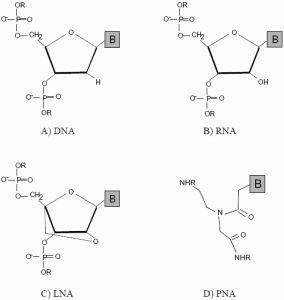
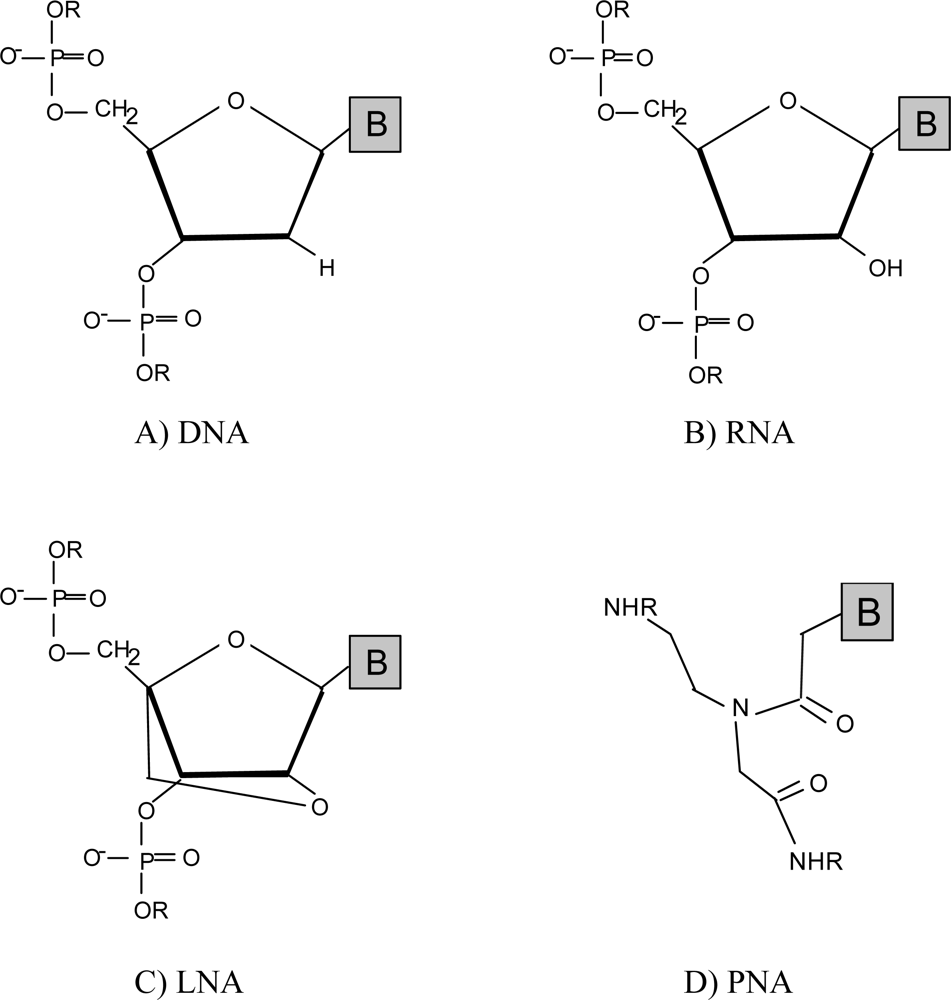
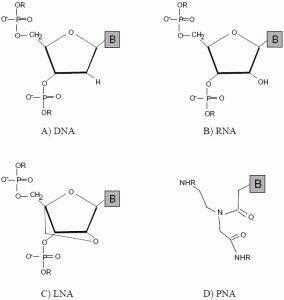
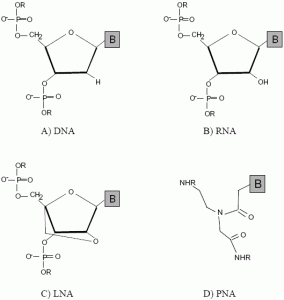
<p>With all the problems that have been described associated with DNA FISH, it is no wonder that researchers started to search for alternatives to improve the robustness of this method. The solution appears to have arrived in the form of nucleic acid analogues [<xref ref-type="bibr" rid="b25-ijms-09-01944">25</xref>, <xref ref-type="bibr" rid="b26-ijms-09-01944">26</xref>], a new class of molecules that has been originally explored for the regulation of gene expression [<xref ref-type="bibr" rid="b27-ijms-09-01944">27</xref>, <xref ref-type="bibr" rid="b28-ijms-09-01944">28</xref>], but that have also found a niche of application on the FISH arena. This new class of molecules is better known as DNA mimics (<xref ref-type="fig" rid="f1-ijms-09-01944">Figure 1</xref>).</p></sec>
<sec>
<title>2. Emergence of DNA Mimics</title>
<p>DNA mimics are emerging as very promising molecules for cell detection in environmental and clinical samples. In fact, only two years after the description of the FISH technique by DeLong <italic>et al.</italic> [<xref ref-type="bibr" rid="b17-ijms-09-01944">17</xref>], Nielsen and co-workers published the design and synthesis of peptide nucleic acids (PNA), one of the first DNA analogues to be published [<xref ref-type="bibr" rid="b25-ijms-09-01944">25</xref>]. The value of PNA probes for clinical diagnostics has been very recently established by Forrest <italic>et al</italic>. [<xref ref-type="bibr" rid="b29-ijms-09-01944">29</xref>, <xref ref-type="bibr" rid="b30-ijms-09-01944">30</xref>]. When applying PNA FISH methods for the rapid differentiation of <italic>S. aureus</italic> from coagulase-negative staphylococci (CoNS) and also for the identification of <italic>C. albicans</italic> in blood cultures, it was determined that there was a significant reduction in median length of hospital stay and a trend towards less antibiotics usage. Consequently, the application of both methods was found to contribute to a decrease in hospital costs per patient and the assay on <italic>C. albicans</italic> has been recently cleared by the US FDA as an <italic>in vitro</italic> diagnostic kit for identification of yeast directly from positive blood cultures [<xref ref-type="bibr" rid="b31-ijms-09-01944">31</xref>].</p>
<p>The number of other DNA mimics that have been reported to potentially have application on FISH procedures has in the meantime risen exponentially. The most common, besides PNA, are locked nucleic acid (LNA) [<xref ref-type="bibr" rid="b32-ijms-09-01944">32</xref>] and 2’-O-methyl (2’-OMe) RNA [<xref ref-type="bibr" rid="b22-ijms-09-01944">22</xref>], but other PNA or LNA-modified molecules have also appeared very recently [e.g. 33, 34–36]. Of these, the two mimics that have been applied for the identification of microorganisms are PNA and LNA [<xref ref-type="bibr" rid="b15-ijms-09-01944">15</xref>, <xref ref-type="bibr" rid="b37-ijms-09-01944">37</xref>, <xref ref-type="bibr" rid="b38-ijms-09-01944">38</xref>]. These and other DNA mimics, along with their most relevant characteristics and applications, are described next.</p>
<sec>
<title>2.1. Peptide nucleic acids (PNA)</title>
<p>PNAs were introduced in FISH studies for the detection of microorganisms during the late 1990s [<xref ref-type="bibr" rid="b38-ijms-09-01944">38</xref>–<xref ref-type="bibr" rid="b41-ijms-09-01944">41</xref>]. In this DNA mimic, the negatively charged sugar-phosphate backbone of DNA is replaced by a neutral polyamide backbone composed of N-(2-aminoethyl) glycine units (<xref ref-type="fig" rid="f1-ijms-09-01944">Figure 1</xref>) [<xref ref-type="bibr" rid="b25-ijms-09-01944">25</xref>]. Because of PNA chemical configuration, the nucleobases are practically positioned in the same place and within the same distance as it occurs to the natural DNA. Consequently, PNA can hybridize with complementary DNA or RNA sequences [<xref ref-type="bibr" rid="b23-ijms-09-01944">23</xref>, <xref ref-type="bibr" rid="b42-ijms-09-01944">42</xref>].</p>
<p>The lack of electrostatic repulsion, due to the non-charged nature of the PNA backbone is perhaps the main reason responsible for its properties, such as the improved thermal stability compared with DNA/DNA duplexes [<xref ref-type="bibr" rid="b42-ijms-09-01944">42</xref>, <xref ref-type="bibr" rid="b43-ijms-09-01944">43</xref>], which implies that the melting temperature (Tm) for PNA/DNA duplexes is higher than for DNA/DNA. This increased Tm is useful for synthesizing PNA probes that are shorter than most DNA probes. In fact, sequences of approximately 15 bp have been found to be optimal for PNA probes which contrast with probes of 20–24 bp for DNA. As a consequence, the effect on the Tm of a single-base mismatch in a PNA/DNA hybridization will have much more impact than in a DNA/DNA hybridization. This factor has great influence on the higher specificity that PNA exhibits for DNA sequence detection [<xref ref-type="bibr" rid="b44-ijms-09-01944">44</xref>]. In addition, hybridization could be performed efficiently under low salt concentrations [<xref ref-type="bibr" rid="b45-ijms-09-01944">45</xref>], a condition that promotes the destabilization of rRNA secondary structures and results in an improved access to target sequences that would be more elusive using conventional FISH [<xref ref-type="bibr" rid="b20-ijms-09-01944">20</xref>, <xref ref-type="bibr" rid="b46-ijms-09-01944">46</xref>, <xref ref-type="bibr" rid="b47-ijms-09-01944">47</xref>]. Like for all other synthetic molecules, PNA also denotes an increased resistance to nucleases and proteases [<xref ref-type="bibr" rid="b14-ijms-09-01944">14</xref>, <xref ref-type="bibr" rid="b16-ijms-09-01944">16</xref>, <xref ref-type="bibr" rid="b48-ijms-09-01944">48</xref>]. Finally, diffusion through the cell membrane and naturally occurring microstructures such as the EPS biofilm matrix might be easier, even in Gram-positive bacteria, due to the hydrophobic character of PNA as compared to DNA [<xref ref-type="bibr" rid="b40-ijms-09-01944">40</xref>]. However, Stender <italic>et al.</italic> refer the importance of checking for self-complementarity in the design of PNA probes since strong hybridization between PNA complementary sequences can occur [<xref ref-type="bibr" rid="b16-ijms-09-01944">16</xref>].</p>
<p>The past few years have seen a significant increase in the number of published PNA probes. In <xref ref-type="table" rid="t1-ijms-09-01944">Table 1</xref>, the PNA probes that have been designed until the present moment have been described, along with several characteristics such as specificity and sensitivity. Specificity and sensitivity are two of the most important parameters to take into account during probe design. Specificity is expressed as the percentage of the number of strains of the microorganism of interest detected by the probe divided by the total number of microbial strains detected by the probe. Sensitivity is calculated as the percentage of the number of strains of the microorganism of interest detected by the probe divided by the total number of strains of the microorganism of interest present in the database [<xref ref-type="bibr" rid="b6-ijms-09-01944">6</xref>]. To calculate these parameters, the Ribosomal Database Project II (RDP II) and the National Centre for Biotechnology Information (NCBI) was used to assess 16S rRNA targets [<xref ref-type="bibr" rid="b49-ijms-09-01944">49</xref>, <xref ref-type="bibr" rid="b50-ijms-09-01944">50</xref>], whereas only the NCBI database was used for 18S, 23S and 26S targets. The accuracy of these results is obviously related to the quality and quantity of the sequences deposited in the database, and will vary with time as databases are being constantly updated.</p>
<p>As expected, the large majority of sequences present in <xref ref-type="table" rid="t1-ijms-09-01944">Table 1</xref> present a very high (&gt;90%) theoretical specificity and sensitivity. However, some of the probes do present values that are far from expected. One of the explanations is that some probes might have been designed to detect a specific strain of the microorganism of interest. For instance, Azevedo <italic>et al.</italic> designed a probe with 100% specificity but only 24% sensitive [<xref ref-type="bibr" rid="b51-ijms-09-01944">51</xref>]. However, the primary aim of the researchers was to detect a specific <italic>H. pylori</italic> strain that was inoculated in a biofilm system in an <italic>in vitro</italic> study. It was therefore important to have very high specificity, but sensitivity (as defined here) was not that relevant in this case as long as the strain of interest was detected. Other possible explanation is that when the probes were originally designed, the number of available sequences in the databases was lower. In fact, with the increasing number of sequences available, it is easy to foresee a scenario where hardly any probe will be 100% specific. The criterion for the choice of the correct probe should therefore fall on the possibility of finding the non-target microorganisms in the samples that will be analyzed for the microorganism of interest.</p>
<p>Peptide nucleic acids are clearly the most advanced technology in respect to applications in FISH, and the robustness of the method implied that some of the probes are now commercially available to perform <italic>in vitro</italic> diagnostic tests (<ext-link xlink:href="http://www.advandx.com" ext-link-type="uri">http://www.advandx.com</ext-link>). The synthesis of custom PNA probes is accessible via a South Korean company named Panagene (<ext-link xlink:href="http://www.panagene.com" ext-link-type="uri">http://www.panagene.com</ext-link>).</p></sec>
<sec>
<title>2.2. Locked nucleic acids (LNA)</title>
<p>Locked nucleic acid (LNA) is a synthetic RNA derivative in which the ribose is linked to a methylene bridge between 2’-oxigen and 4’-carbon atoms, <italic>i.e.</italic> formed with 2’-O, 4’-C-methylene-ß-D-ribofuranosyl nucleotides (<xref ref-type="fig" rid="f1-ijms-09-01944">Figure 1</xref>) [<xref ref-type="bibr" rid="b32-ijms-09-01944">32</xref>, <xref ref-type="bibr" rid="b52-ijms-09-01944">52</xref>]. The connection encloses the sugar, which is responsible for the new conformation that is preferable for the formation of hybrids with complementary DNA or RNA sequences [<xref ref-type="bibr" rid="b53-ijms-09-01944">53</xref>]. In fact, it has been shown by thermal studies that DNA duplexes containing LNA residues have the ability to increase the melting temperature between 2 °C and 10 °C per single LNA nucleotide incorporation [<xref ref-type="bibr" rid="b26-ijms-09-01944">26</xref>, <xref ref-type="bibr" rid="b54-ijms-09-01944">54</xref>]. Wahlestedt <italic>et al.</italic> demonstrated that LNA oligonucleotides have high <italic>in vivo</italic> efficacy, and hence are very useful in functional genomics and therapeutic applications [<xref ref-type="bibr" rid="b28-ijms-09-01944">28</xref>]. As such, these oligonucleotides have so far found more utility in antisense studies rather in FISH methodologies [<xref ref-type="bibr" rid="b26-ijms-09-01944">26</xref>, <xref ref-type="bibr" rid="b28-ijms-09-01944">28</xref>].</p>
<p>Typically, FISH probes incorporate only few LNA nucleotides into a DNA strand, compensating the increased affinity of the new strand by a decrease in the number of base pairs used on the probe. Due to strong thermal stability, LNA may self-anneal, being difficult to design, but a web site is available with a help designing tool (<ext-link xlink:href="www.exiqon.com" ext-link-type="uri">www.exiqon.com</ext-link>) [<xref ref-type="bibr" rid="b52-ijms-09-01944">52</xref>]. As for PNA, it is important to design LNA probes without extensive self-complementary sequences or applying chimeric LNAs. Equally, this DNA mimic is not susceptible to nucleases, which means that it is optimal when applied in living cell protocols [<xref ref-type="bibr" rid="b55-ijms-09-01944">55</xref>].</p>
<p>LNA technology is only now providing the first steps towards application for rapid identification of microorganisms [<xref ref-type="bibr" rid="b37-ijms-09-01944">37</xref>]. Nevertheless, applications of LNA in FISH technology for the detection of human miRNA and mRNA [<xref ref-type="bibr" rid="b56-ijms-09-01944">56</xref>, <xref ref-type="bibr" rid="b57-ijms-09-01944">57</xref>], together with studies that report increased fluorescence intensities of probes after the substitution of DNA bases by LNA bases [<xref ref-type="bibr" rid="b37-ijms-09-01944">37</xref>, <xref ref-type="bibr" rid="b58-ijms-09-01944">58</xref>], indicate that this technology also holds great promise.</p></sec>
<sec>
<title>2.3. Other mimics</title>
<p>2’-OMe RNA, 2’-deoxy-2’-fluoro-ß-<sc>d</sc>-ribonucleic acid (2’-F RNA) and morpholinos are three other common backbone modified structures that might be important for the development of future <italic>in situ</italic> hybridization procedures. Adding to these, numerous PNA and LNA-based molecules have been developed. Due to their synthetic nature, they all possess increased resistance to enzymes such as nucleases.</p>
<p>2’-OMe RNA probes have demonstrated high affinity, increased specificity and capacity to bind RNA target sequences [<xref ref-type="bibr" rid="b59-ijms-09-01944">59</xref>, <xref ref-type="bibr" rid="b60-ijms-09-01944">60</xref>]. In fact, these probes form more stable complexes with complementary RNA sequences than natural DNA and RNA oligonucleotides [<xref ref-type="bibr" rid="b61-ijms-09-01944">61</xref>]. This efficient hybridization combined with its chemical structure may lead to the utilization of these polymers in many antisense applications [<xref ref-type="bibr" rid="b62-ijms-09-01944">62</xref>, <xref ref-type="bibr" rid="b63-ijms-09-01944">63</xref>]. Even though 2’-OMe RNA probes have never been employed in micro-organisms, they have already found application for RNA detection in living eukaryotic cells [<xref ref-type="bibr" rid="b60-ijms-09-01944">60</xref>, <xref ref-type="bibr" rid="b64-ijms-09-01944">64</xref>].</p>
<p>The chemical structure of 2’-F RNA is very similar to that of RNA, where the 2’-OH group is replaced by a fluorine [<xref ref-type="bibr" rid="b21-ijms-09-01944">21</xref>]. Hybridization analysis demonstrated that 2’-F RNA hybridized with greater affinity to RNA than 2’-OMe RNA [<xref ref-type="bibr" rid="b65-ijms-09-01944">65</xref>, <xref ref-type="bibr" rid="b66-ijms-09-01944">66</xref>]. In 2’-F RNA the Δ Tm increases the more 2’-F RNA bases are incorporated in the probe, i.e., the bigger the 2’-F RNA sequence is, the higher the Tm. However, applications in FISH have been hindered by the difficulty and high cost of synthesis of this molecule.</p>
<p>Morpholinos [e.g. 67, 68–71], PNA-based backbones or monomers such as trans-4-hydroxy-<italic>N</italic>-acetylpyrrolidine-2-phosphonate (PHypNAs) and trans-4-hydroxy-<sc>l</sc>-proline (HypNA-pPNAs) [<xref ref-type="bibr" rid="b72-ijms-09-01944">72</xref>–<xref ref-type="bibr" rid="b74-ijms-09-01944">74</xref>] and LNA-based molecules such as phosphorothiolate-LNA and 2’-thio-LNA [<xref ref-type="bibr" rid="b75-ijms-09-01944">75</xref>–<xref ref-type="bibr" rid="b79-ijms-09-01944">79</xref>] are other chemically synthesised molecules with similar structures to that of DNA/RNA. Up until now, they have been primarily tested for antisense therapy, but their structure might also lead for applications in FISH procedures. It is therefore to be expected that the future will bring a range of new molecules with capacity of detecting cells by FISH, bringing possible benefits to the robustness of the technique.</p></sec></sec>
<sec sec-type="conclusions">
<title>3. Conclusions and Future Work</title>
<p>Before the appearance of DNA mimics, FISH techniques employed natural DNA molecules to perform hybridizations. By now, DNA mimics have unequivocally proved that they might contribute to improve the robustness of the method. Their main advantages include resistance to the attack of enzymes due to their synthetic nature; higher affinity for RNA sequences with a lower number of base pairs, which leads not only to more successful hybridizations but also to easier discrimination of single-base mismatches; and for certain mimics such as PNA, hybridization under low salt conditions allow unrestricted access to the full sequence of rRNA. This begs the question: Why have DNA mimics failed so far to impose themselves over standard DNA methods? The answer is threefold: First of all, not all microbiology laboratories are aware of these technologies, and when they are, it is not always easy to identify the companies or research groups that might provide you with the desired probe and know-how; Secondly, most of the probes have costs many times higher than those associated with DNA probes; Finally, the status of research for DNA probes is many years ahead than that of most DNA mimics. As a consequence, there is a general lack of information on some basic thermodynamic properties. For instance, whereas the estimation of hybridization temperature is quite straightforward for DNA probes in different hybridization solutions [<xref ref-type="bibr" rid="b80-ijms-09-01944">80</xref>, <xref ref-type="bibr" rid="b81-ijms-09-01944">81</xref>], all other mimics, arguably with the exception of PNA [<xref ref-type="bibr" rid="b82-ijms-09-01944">82</xref>], have little data available. Before imposing DNA mimics-based procedures as the methods of excellence for the whole-cell detection of microorganisms in different settings, these issues need addressing.</p>
<p>In the future, the robustness of DNA mimics methods might improve the application of multiplex procedures, where various species are targeted with different probes at the same time. In fact, Perry-O’Keefe <italic>et al.</italic> developed a new PNA FISH procedure for the simultaneous detection of both Gram-negative and Gram-positive species, something never accomplished using DNA probes [<xref ref-type="bibr" rid="b43-ijms-09-01944">43</xref>]. The use of DNA mimics to perform FISH in living cells could be another major area of application but it also appears to be a trickier one, because of all the deleterious processes that the cells undergo during the fixation, hybridization and washing steps. Besides having to support relatively high temperatures, cells will have to support the toxicity of compounds present in the solutions, such as paraformaldehyde and ethanol in the fixation step. So far, hybridization of unfixed cells as been accomplished [<xref ref-type="bibr" rid="b83-ijms-09-01944">83</xref>], but there are serious questions over whether these cells remained viable during the whole hybridization process [<xref ref-type="bibr" rid="b2-ijms-09-01944">2</xref>]. Nevertheless, with a battery of DNA mimics available, the chances of developing an experiment where the adverse effects of the hybridization process might be overcome are multiplied.</p>
<p>Finally, DNA mimics might also be of use for the detection of low-copy genomic sequences in the chromosome. Using DNA probes, techniques such as catalyzed reporter deposition (CARD) FISH [<xref ref-type="bibr" rid="b18-ijms-09-01944">18</xref>], recognition of individual genes (RING) FISH [<xref ref-type="bibr" rid="b84-ijms-09-01944">84</xref>] and rolling circle amplification [<xref ref-type="bibr" rid="b85-ijms-09-01944">85</xref>] have tried to solve this problem. In CARD FISH, the enzyme horseradish peroxidase is covalently crosslinked to a nucleic acid probe, and if the probe hybridizes, the enzyme will be present inside the cell. When fluorescently-labelled tyramide is added, the enzyme will induce the deposition of these molecules by peroxidase activity. The major shortcoming of this technique is the large size of the enzyme, which means that damaging permeabilization procedures are necessary. Whereas the application of DNA mimics in this method is not expected to significantly affect the entry of the labelled probe, the increased specificity and sensitivity of these analogs might be very useful for the detection of single nucleotide polymorphisms (SNP). So far, only DNA CARD FISH has been attempted, but enzymes coupled with PNA are already accessible via Panagene. RING FISH is based on the hybridization of multiple-labelled probes (one labelled nucleotide every 10–20 bp) that usually have more than two hundred bases length. The probe then anchors other probes that in turn form a network around the cell periphery and emit an halo of fluorescence [<xref ref-type="bibr" rid="b84-ijms-09-01944">84</xref>]. As the probe is particularly long, the incorporation of LNA residues would likely improve the specificity and sensitivity of the method. Even though PNA might minimize the membrane permeabilization issue, it is not clear how would such a long PNA probe behave on this method. On rolling circle amplification, the use of DNA mimics as probes seems to be of little use, as the method requires an amplification step mediated by the enzyme DNA-polymerase. Interestingly, the method does use PNA molecules to open the double helix configuration of DNA [<xref ref-type="bibr" rid="b85-ijms-09-01944">85</xref>].</p>
<p>Due to their special chemical features, DNA mimics-based methods are expected to play a very important role in cell and gene detection in clinical and environmental samples in the future. The real challenge will be to determine the best nucleic acid for each specific case/method. Even though the chemistry of the molecules will allow us to take some theoretical assumptions, there are many uncertainties on how DNA mimics behave under most conditions. As such, new reliable and systematic screening protocols that compare all these different molecules – both biological and synthetic – should be developed.</p></sec></body>
<back>
<ack>
<p>This work was supported by the Portuguese Institute Fundação para a Ciência e Tecnologia (Post-Doc Fellowship SFRH/BPD/20484/2004 and PhD grants SFRH/BD/38124/2007 and SFRH/BD/29297/2006).</p></ack>
<ref-list>
<title>References and Notes</title>
<ref id="b1-ijms-09-01944"><label>1</label><citation citation-type="journal"><person-group person-group-type="author"><name><surname>Kricka</surname><given-names>LJ</given-names></name></person-group><article-title>Stains, labels and detection strategies for nucleic acids assays</article-title><source>Ann. Clin. Biochem.</source><year>2002</year><volume>39</volume><fpage>114</fpage><lpage>129</lpage><pub-id pub-id-type="doi">10.1258/0004563021901865</pub-id><pub-id pub-id-type="pmid">11928759</pub-id></citation></ref>
<ref id="b2-ijms-09-01944"><label>2</label><citation citation-type="journal"><person-group person-group-type="author"><name><surname>Amann</surname><given-names>R</given-names></name><name><surname>Fuchs</surname><given-names>BM</given-names></name></person-group><article-title>Single-cell identification in microbial communities by improved fluorescence <italic>in situ</italic> hybridization techniques</article-title><source>Nat. Rev. Microbiol</source><year>2008</year><volume>6</volume><fpage>339</fpage><lpage>348</lpage><pub-id pub-id-type="doi">10.1038/nrmicro1888</pub-id><pub-id pub-id-type="pmid">18414500</pub-id></citation></ref>
<ref id="b3-ijms-09-01944"><label>3</label><citation citation-type="journal"><person-group person-group-type="author"><name><surname>Michalet</surname><given-names>X</given-names></name><name><surname>Pinaud</surname><given-names>FF</given-names></name><name><surname>Bentolila</surname><given-names>LA</given-names></name><name><surname>Tsay</surname><given-names>JM</given-names></name><name><surname>Doose</surname><given-names>S</given-names></name><name><surname>Li</surname><given-names>JJ</given-names></name><name><surname>Sundaresan</surname><given-names>G</given-names></name><name><surname>Wu</surname><given-names>AM</given-names></name><name><surname>Gambhir</surname><given-names>SS</given-names></name><name><surname>Weiss</surname><given-names>S</given-names></name></person-group><article-title>Quantum dots for live cells, <italic>in vivo</italic> imaging, and diagnostics</article-title><source>Science</source><year>2005</year><volume>307</volume><fpage>538</fpage><lpage>544</lpage><pub-id pub-id-type="doi">10.1126/science.1104274</pub-id><pub-id pub-id-type="pmid">15681376</pub-id></citation></ref>
<ref id="b4-ijms-09-01944"><label>4</label><citation citation-type="journal"><person-group person-group-type="author"><name><surname>Berlier</surname><given-names>JE</given-names></name><name><surname>Rothe</surname><given-names>A</given-names></name><name><surname>Buller</surname><given-names>G</given-names></name><name><surname>Bradford</surname><given-names>J</given-names></name><name><surname>Gray</surname><given-names>DR</given-names></name><name><surname>Filanoski</surname><given-names>BJ</given-names></name><name><surname>Telford</surname><given-names>WG</given-names></name><name><surname>Yue</surname><given-names>S</given-names></name><name><surname>Liu</surname><given-names>J</given-names></name><name><surname>Cheung</surname><given-names>CY</given-names></name><name><surname>Chang</surname><given-names>W</given-names></name><name><surname>Hirsch</surname><given-names>JD</given-names></name><name><surname>Beechem</surname><given-names>JM</given-names></name><name><surname>Haugland</surname><given-names>RP</given-names></name></person-group><article-title>Quantitative comparison of long-wavelength Alexa Fluor dyes to Cy dyes: Fluorescence of the dyes and their bioconjugates</article-title><source>J. Histochem. Cytochem.</source><year>2003</year><volume>51</volume><fpage>1699</fpage><lpage>1712</lpage><pub-id pub-id-type="doi">10.1177/002215540305101214</pub-id><pub-id pub-id-type="pmid">14623938</pub-id></citation></ref>
<ref id="b5-ijms-09-01944"><label>5</label><citation citation-type="journal"><person-group person-group-type="author"><name><surname>Barken</surname><given-names>KB</given-names></name><name><surname>Haagensen</surname><given-names>JA</given-names></name><name><surname>Tolker-Nielsen</surname><given-names>T</given-names></name></person-group><article-title>Advances in nucleic acid-based diagnostics of bacterial infections</article-title><source>Clin. Chim. Acta</source><year>2007</year><volume>384</volume><fpage>1</fpage><lpage>11</lpage><pub-id pub-id-type="doi">10.1016/j.cca.2007.07.004</pub-id><pub-id pub-id-type="pmid">17689512</pub-id></citation></ref>
<ref id="b6-ijms-09-01944"><label>6</label><citation citation-type="journal"><person-group person-group-type="author"><name><surname>Guimaraes</surname><given-names>N</given-names></name><name><surname>Azevedo</surname><given-names>NF</given-names></name><name><surname>Figueiredo</surname><given-names>C</given-names></name><name><surname>Keevil</surname><given-names>CW</given-names></name><name><surname>Vieira</surname><given-names>MJ</given-names></name></person-group><article-title>Development and application of a novel peptide nucleic acid probe for the specific detection of <italic>Helicobacter pylori</italic> in gastric biopsy specimens</article-title><source>J. Clin. Microbiol</source><year>2007</year><volume>45</volume><fpage>3089</fpage><lpage>3094</lpage><pub-id pub-id-type="doi">10.1128/JCM.00858-07</pub-id><pub-id pub-id-type="pmid">17609326</pub-id></citation></ref>
<ref id="b7-ijms-09-01944"><label>7</label><citation citation-type="journal"><person-group person-group-type="author"><name><surname>Bayani</surname><given-names>J</given-names></name><name><surname>Squire</surname><given-names>JA</given-names></name></person-group><article-title>Application and interpretation of FISH in biomarker studies</article-title><source>Cancer Lett</source><year>2007</year><volume>249</volume><fpage>97</fpage><lpage>109</lpage><pub-id pub-id-type="doi">10.1016/j.canlet.2006.12.030</pub-id><pub-id pub-id-type="pmid">17287077</pub-id></citation></ref>
<ref id="b8-ijms-09-01944"><label>8</label><citation citation-type="journal"><person-group person-group-type="author"><name><surname>Arentsen</surname><given-names>HC</given-names></name><name><surname>de la Rosette</surname><given-names>JJ</given-names></name><name><surname>de Reijke</surname><given-names>TM</given-names></name><name><surname>Langbein</surname><given-names>S</given-names></name></person-group><article-title>Fluorescence <italic>in situ</italic> hybridization: A multitarget approach in diagnosis and management of urothelial cancer</article-title><source>Expert. Rev. Mol. Diagn.</source><year>2007</year><volume>7</volume><fpage>11</fpage><lpage>19</lpage><pub-id pub-id-type="doi">10.1586/14737159.7.1.11</pub-id><pub-id pub-id-type="pmid">17187480</pub-id></citation></ref>
<ref id="b9-ijms-09-01944"><label>9</label><citation citation-type="journal"><person-group person-group-type="author"><name><surname>Sanz</surname><given-names>JL</given-names></name><name><surname>Kochling</surname><given-names>T</given-names></name></person-group><article-title>Molecular biology techniques used in wastewater treatment: An overview</article-title><source>Process Biochem</source><year>2007</year><volume>42</volume><fpage>119</fpage><lpage>133</lpage><pub-id pub-id-type="doi">10.1016/j.procbio.2006.10.003</pub-id></citation></ref>
<ref id="b10-ijms-09-01944"><label>10</label><citation citation-type="journal"><person-group person-group-type="author"><name><surname>Rogers</surname><given-names>SW</given-names></name><name><surname>Moorman</surname><given-names>TB</given-names></name><name><surname>Ong</surname><given-names>SK</given-names></name></person-group><article-title>Fluorescent <italic>in situ</italic> hybridization and micro-autoradiography applied to ecophysiology in soil</article-title><source>Soil Sci. Soc. Amer. J.</source><year>2007</year><volume>71</volume><fpage>620</fpage><lpage>631</lpage><pub-id pub-id-type="doi">10.2136/sssaj2006.0105</pub-id></citation></ref>
<ref id="b11-ijms-09-01944"><label>11</label><citation citation-type="journal"><person-group person-group-type="author"><name><surname>Dmochowski</surname><given-names>IJ</given-names></name><name><surname>Tang</surname><given-names>XJ</given-names></name></person-group><article-title>Taking control of gene expression with light-activated oligonucleotides</article-title><source>Biotechniques</source><year>2007</year><volume>43</volume><fpage>161</fpage><lpage>171</lpage><pub-id pub-id-type="doi">10.2144/000112519</pub-id><pub-id pub-id-type="pmid">17824383</pub-id></citation></ref>
<ref id="b12-ijms-09-01944"><label>12</label><citation citation-type="journal"><person-group person-group-type="author"><name><surname>Miyauchi</surname><given-names>R</given-names></name><name><surname>Oki</surname><given-names>K</given-names></name><name><surname>Aoi</surname><given-names>Y</given-names></name><name><surname>Tsuneda</surname><given-names>S</given-names></name></person-group><article-title>Diversity of nitrite reductase genes in “Candidatus <italic>Accumulibacter phosphatis</italic>”-dominated cultures enriched by flow-cytometric sorting</article-title><source>Appl. Environ. Microbiol.</source><year>2007</year><volume>73</volume><fpage>5331</fpage><lpage>5337</lpage><pub-id pub-id-type="doi">10.1128/AEM.00175-07</pub-id><pub-id pub-id-type="pmid">17513594</pub-id></citation></ref>
<ref id="b13-ijms-09-01944"><label>13</label><citation citation-type="journal"><person-group person-group-type="author"><name><surname>Catalina</surname><given-names>P</given-names></name><name><surname>Cobo</surname><given-names>F</given-names></name><name><surname>Cortes</surname><given-names>JL</given-names></name><name><surname>Nieto</surname><given-names>AI</given-names></name><name><surname>Cabrera</surname><given-names>C</given-names></name><name><surname>Montes</surname><given-names>R</given-names></name><name><surname>Concha</surname><given-names>A</given-names></name><name><surname>Menendez</surname><given-names>P</given-names></name></person-group><article-title>Conventional and molecular cytogenetic diagnostic methods in stem cell research: A concise review</article-title><source>Cell Biol. Int.</source><year>2007</year><volume>31</volume><fpage>861</fpage><lpage>869</lpage><pub-id pub-id-type="doi">10.1016/j.cellbi.2007.03.012</pub-id><pub-id pub-id-type="pmid">17467306</pub-id></citation></ref>
<ref id="b14-ijms-09-01944"><label>14</label><citation citation-type="journal"><person-group person-group-type="author"><name><surname>Wagner</surname><given-names>M</given-names></name><name><surname>Horn</surname><given-names>M</given-names></name><name><surname>Daims</surname><given-names>H</given-names></name></person-group><article-title>Fluorescence <italic>in situ</italic> hybridisation for the identification and characterisation of prokaryotes</article-title><source>Curr. Opin. Microbiol.</source><year>2003</year><volume>6</volume><fpage>302</fpage><lpage>309</lpage><pub-id pub-id-type="doi">10.1016/S1369-5274(03)00054-7</pub-id><pub-id pub-id-type="pmid">12831908</pub-id></citation></ref>
<ref id="b15-ijms-09-01944"><label>15</label><citation citation-type="journal"><person-group person-group-type="author"><name><surname>Silverman</surname><given-names>AP</given-names></name><name><surname>Kool</surname><given-names>ET</given-names></name></person-group><article-title>Oligonucleotide probes for RNA-targeted fluorescence <italic>in situ</italic> hybridization</article-title><source>Adv. Clin. Chem</source><year>2007</year><volume>43</volume><fpage>79</fpage><lpage>115</lpage><pub-id pub-id-type="pmid">17249381</pub-id></citation></ref>
<ref id="b16-ijms-09-01944"><label>16</label><citation citation-type="journal"><person-group person-group-type="author"><name><surname>Stender</surname><given-names>H</given-names></name><name><surname>Fiandaca</surname><given-names>M</given-names></name><name><surname>Hyldig-Nielsen</surname><given-names>JJ</given-names></name><name><surname>Coull</surname><given-names>J</given-names></name></person-group><article-title>PNA for rapid microbiology</article-title><source>J. Microbiol. Methods</source><year>2002</year><volume>48</volume><fpage>1</fpage><lpage>17</lpage><pub-id pub-id-type="doi">10.1016/S0167-7012(01)00340-2</pub-id><pub-id pub-id-type="pmid">11733079</pub-id></citation></ref>
<ref id="b17-ijms-09-01944"><label>17</label><citation citation-type="journal"><person-group person-group-type="author"><name><surname>Delong</surname><given-names>EF</given-names></name><name><surname>Wickham</surname><given-names>GS</given-names></name><name><surname>Pace</surname><given-names>NR</given-names></name></person-group><article-title>Phylogenetic Stains - Ribosomal RNA-Based Probes for the Identification of Single Cells</article-title><source>Science</source><year>1989</year><volume>243</volume><fpage>1360</fpage><lpage>1363</lpage><pub-id pub-id-type="doi">10.1126/science.2466341</pub-id><pub-id pub-id-type="pmid">2466341</pub-id></citation></ref>
<ref id="b18-ijms-09-01944"><label>18</label><citation citation-type="journal"><person-group person-group-type="author"><name><surname>Pernthaler</surname><given-names>A</given-names></name><name><surname>Pernthaler</surname><given-names>J</given-names></name><name><surname>Amann</surname><given-names>R</given-names></name></person-group><article-title>Fluorescence <italic>in situ</italic> hybridization and catalyzed reporter deposition for the identification of marine bacteria</article-title><source>Appl. Environ. Microbiol.</source><year>2002</year><volume>68</volume><fpage>3094</fpage><lpage>3101</lpage><pub-id pub-id-type="doi">10.1128/AEM.68.6.3094-3101.2002</pub-id><pub-id pub-id-type="pmid">12039771</pub-id></citation></ref>
<ref id="b19-ijms-09-01944"><label>19</label><citation citation-type="journal"><person-group person-group-type="author"><name><surname>Wagner</surname><given-names>M</given-names></name><name><surname>Schmid</surname><given-names>M</given-names></name><name><surname>Juretschko</surname><given-names>S</given-names></name><name><surname>Trebesius</surname><given-names>KH</given-names></name><name><surname>Bubert</surname><given-names>A</given-names></name><name><surname>Goebel</surname><given-names>W</given-names></name><name><surname>Schleifer</surname><given-names>KH</given-names></name></person-group><article-title><italic>In situ </italic>detection of a virulence factor mRNA and 16S rRNA in <italic>Listeria monocytogenes</italic></article-title><source>FEMS Microbiol. Lett</source><year>1998</year><volume>160</volume><fpage>159</fpage><lpage>168</lpage><pub-id pub-id-type="doi">10.1111/j.1574-6968.1998.tb12906.x</pub-id><pub-id pub-id-type="pmid">9495027</pub-id></citation></ref>
<ref id="b20-ijms-09-01944"><label>20</label><citation citation-type="journal"><person-group person-group-type="author"><name><surname>Yilmaz</surname><given-names>LS</given-names></name><name><surname>Okten</surname><given-names>HE</given-names></name><name><surname>Noguera</surname><given-names>DR</given-names></name></person-group><article-title>Making all parts of the 16S rRNA of <italic>Escherichia coli</italic> accessible <italic>in situ</italic> to single DNA oligonucleotides</article-title><source>Appl. Environ. Microbiol.</source><year>2006</year><volume>72</volume><fpage>733</fpage><lpage>744</lpage><pub-id pub-id-type="doi">10.1128/AEM.72.1.733-744.2006</pub-id><pub-id pub-id-type="pmid">16391113</pub-id></citation></ref>
<ref id="b21-ijms-09-01944"><label>21</label><citation citation-type="journal"><person-group person-group-type="author"><name><surname>Yazbeck</surname><given-names>DR</given-names></name><name><surname>Min</surname><given-names>KL</given-names></name><name><surname>Damha</surname><given-names>MJ</given-names></name></person-group><article-title>Molecular requirements for degradation of a modified sense RNA strand by <italic>Escherichia coli</italic> ribonuclease H1</article-title><source>Nucleic Acids Res</source><year>2002</year><volume>30</volume><fpage>3015</fpage><lpage>3025</lpage><pub-id pub-id-type="doi">10.1093/nar/gkf429</pub-id><pub-id pub-id-type="pmid">12136083</pub-id></citation></ref>
<ref id="b22-ijms-09-01944"><label>22</label><citation citation-type="journal"><person-group person-group-type="author"><name><surname>Cummins</surname><given-names>LL</given-names></name><name><surname>Owens</surname><given-names>SR</given-names></name><name><surname>Risen</surname><given-names>LM</given-names></name><name><surname>Lesnik</surname><given-names>EA</given-names></name><name><surname>Freier</surname><given-names>SM</given-names></name><name><surname>Mcgee</surname><given-names>D</given-names></name><name><surname>Guinosso</surname><given-names>CJ</given-names></name><name><surname>Cook</surname><given-names>PD</given-names></name></person-group><article-title>Characterization of fully 2’-modified oligoribonucleotide heteroduplex and homoduplex hybridization and nuclease sensitivity</article-title><source>Nucleic Acids Res.</source><year>1995</year><volume>23</volume><fpage>2019</fpage><lpage>2024</lpage><pub-id pub-id-type="doi">10.1093/nar/23.11.2019</pub-id><pub-id pub-id-type="pmid">7541132</pub-id></citation></ref>
<ref id="b23-ijms-09-01944"><label>23</label><citation citation-type="journal"><person-group person-group-type="author"><name><surname>Shakeel</surname><given-names>S</given-names></name><name><surname>Karim</surname><given-names>S</given-names></name><name><surname>Ali</surname><given-names>A</given-names></name></person-group><article-title>Peptide nucleic acid (PNA) - a review</article-title><source>J. Chem. Technol. Biotechnol.</source><year>2006</year><volume>81</volume><fpage>892</fpage><lpage>899</lpage><pub-id pub-id-type="doi">10.1002/jctb.1505</pub-id></citation></ref>
<ref id="b24-ijms-09-01944"><label>24</label><citation citation-type="journal"><person-group person-group-type="author"><name><surname>Yilmaz</surname><given-names>LS</given-names></name><name><surname>Noguera</surname><given-names>DR</given-names></name></person-group><article-title>Mechanistic approach to the problem of hybridization efficiency in fluorescent <italic>in situ</italic> hybridization</article-title><source>Appl. Environ. Microbiol.</source><year>2004</year><volume>70</volume><fpage>7126</fpage><lpage>7139</lpage><pub-id pub-id-type="doi">10.1128/AEM.70.12.7126-7139.2004</pub-id><pub-id pub-id-type="pmid">15574909</pub-id></citation></ref>
<ref id="b25-ijms-09-01944"><label>25</label><citation citation-type="journal"><person-group person-group-type="author"><name><surname>Nielsen</surname><given-names>PE</given-names></name><name><surname>Egholm</surname><given-names>M</given-names></name><name><surname>Berg</surname><given-names>RH</given-names></name><name><surname>Buchardt</surname><given-names>O</given-names></name></person-group><article-title>Sequence-selective recognition of DNA by strand displacement with a thymine-substituted polyamide</article-title><source>Science</source><year>1991</year><volume>254</volume><fpage>1497</fpage><lpage>1500</lpage><pub-id pub-id-type="doi">10.1126/science.1962210</pub-id><pub-id pub-id-type="pmid">1962210</pub-id></citation></ref>
<ref id="b26-ijms-09-01944"><label>26</label><citation citation-type="journal"><person-group person-group-type="author"><name><surname>Petersen</surname><given-names>M</given-names></name><name><surname>Wengel</surname><given-names>J</given-names></name></person-group><article-title>LNA: A versatile tool for therapeutics and genomics</article-title><source>Trends Biotechnol</source><year>2003</year><volume>21</volume><fpage>74</fpage><lpage>81</lpage><pub-id pub-id-type="doi">10.1016/S0167-7799(02)00038-0</pub-id><pub-id pub-id-type="pmid">12573856</pub-id></citation></ref>
<ref id="b27-ijms-09-01944"><label>27</label><citation citation-type="journal"><person-group person-group-type="author"><name><surname>Hanvey</surname><given-names>JC</given-names></name><name><surname>Peffer</surname><given-names>NJ</given-names></name><name><surname>Bisi</surname><given-names>JE</given-names></name><name><surname>Thomson</surname><given-names>SA</given-names></name><name><surname>Cadilla</surname><given-names>R</given-names></name><name><surname>Josey</surname><given-names>JA</given-names></name><name><surname>Ricca</surname><given-names>DJ</given-names></name><name><surname>Hassman</surname><given-names>CF</given-names></name><name><surname>Bonham</surname><given-names>MA</given-names></name><name><surname>Au</surname><given-names>KG</given-names></name><name><surname>Carter</surname><given-names>SG</given-names></name><name><surname>Bruckenstein</surname><given-names>DA</given-names></name><name><surname>Boyd</surname><given-names>AL</given-names></name><name><surname>Noble</surname><given-names>SA</given-names></name><name><surname>Babiss</surname><given-names>LE</given-names></name></person-group><article-title>Antisense and Antigene Properties of Peptide Nucleic-Acids</article-title><source>Science</source><year>1992</year><volume>258</volume><fpage>1481</fpage><lpage>1485</lpage><pub-id pub-id-type="doi">10.1126/science.1279811</pub-id><pub-id pub-id-type="pmid">1279811</pub-id></citation></ref>
<ref id="b28-ijms-09-01944"><label>28</label><citation citation-type="journal"><person-group person-group-type="author"><name><surname>Wahlestedt</surname><given-names>C</given-names></name><name><surname>Salmi</surname><given-names>P</given-names></name><name><surname>Good</surname><given-names>L</given-names></name><name><surname>Kela</surname><given-names>J</given-names></name><name><surname>Johnsson</surname><given-names>T</given-names></name><name><surname>Hokfelt</surname><given-names>T</given-names></name><name><surname>Broberger</surname><given-names>C</given-names></name><name><surname>Porreca</surname><given-names>F</given-names></name><name><surname>Lai</surname><given-names>J</given-names></name><name><surname>Ren</surname><given-names>KK</given-names></name><name><surname>Ossipov</surname><given-names>M</given-names></name><name><surname>Koshkin</surname><given-names>A</given-names></name><name><surname>Jakobsen</surname><given-names>N</given-names></name><name><surname>Skouv</surname><given-names>J</given-names></name><name><surname>Oerum</surname><given-names>H</given-names></name><name><surname>Jacobsen</surname><given-names>MH</given-names></name><name><surname>Wengel</surname><given-names>J</given-names></name></person-group><article-title>Potent and nontoxic antisense oligonucleotides containing locked nucleic acids</article-title><source>Proc. Natl. Acad. Sci. USA</source><year>2000</year><volume>97</volume><fpage>5633</fpage><lpage>5638</lpage><pub-id pub-id-type="doi">10.1073/pnas.97.10.5633</pub-id><pub-id pub-id-type="pmid">10805816</pub-id></citation></ref>
<ref id="b29-ijms-09-01944"><label>29</label><citation citation-type="journal"><person-group person-group-type="author"><name><surname>Forrest</surname><given-names>GN</given-names></name><name><surname>Mehta</surname><given-names>S</given-names></name><name><surname>Weekes</surname><given-names>E</given-names></name><name><surname>Lincalis</surname><given-names>DP</given-names></name><name><surname>Johnson</surname><given-names>JK</given-names></name><name><surname>Venezia</surname><given-names>RA</given-names></name></person-group><article-title>Impact of rapid <italic>in situ</italic> hybridization testing on coagulase-negative staphylococci positive blood cultures</article-title><source>J. Antimicrob. Chemother</source><year>2006</year><volume>58</volume><fpage>154</fpage><lpage>158</lpage><pub-id pub-id-type="doi">10.1093/jac/dkl146</pub-id><pub-id pub-id-type="pmid">16636084</pub-id></citation></ref>
<ref id="b30-ijms-09-01944"><label>30</label><citation citation-type="journal"><person-group person-group-type="author"><name><surname>Forrest</surname><given-names>GN</given-names></name><name><surname>Mankes</surname><given-names>K</given-names></name><name><surname>Jabra-Rizk</surname><given-names>MA</given-names></name><name><surname>Weekes</surname><given-names>E</given-names></name><name><surname>Johnson</surname><given-names>JK</given-names></name><name><surname>Lincalis</surname><given-names>DP</given-names></name><name><surname>Venezia</surname><given-names>RA</given-names></name></person-group><article-title>Peptide nucleic acid fluorescence <italic>in situ</italic> hybridization-based identification of <italic>Candida albicans</italic> and its impact on mortality and antifungal therapy costs</article-title><source>J. Clin. Microbiol.</source><year>2006</year><volume>44</volume><fpage>3381</fpage><lpage>3383</lpage><pub-id pub-id-type="doi">10.1128/JCM.00751-06</pub-id><pub-id pub-id-type="pmid">16954279</pub-id></citation></ref>
<ref id="b31-ijms-09-01944"><label>31</label><citation citation-type="journal"><person-group person-group-type="author"><name><surname>Shepard</surname><given-names>JR</given-names></name><name><surname>Addison</surname><given-names>RM</given-names></name><name><surname>Alexander</surname><given-names>BD</given-names></name><name><surname>Della-Latta</surname><given-names>P</given-names></name><name><surname>Gherna</surname><given-names>M</given-names></name><name><surname>Haase</surname><given-names>G</given-names></name><name><surname>Hall</surname><given-names>G</given-names></name><name><surname>Johnson</surname><given-names>JK</given-names></name><name><surname>Merz</surname><given-names>WG</given-names></name><name><surname>Peltroche-Llacsahuanga</surname><given-names>H</given-names></name><name><surname>Stender</surname><given-names>H</given-names></name><name><surname>Venezia</surname><given-names>RA</given-names></name><name><surname>Wilson</surname><given-names>D</given-names></name><name><surname>Procop</surname><given-names>GW</given-names></name><name><surname>Wu</surname><given-names>F</given-names></name><name><surname>Fiandaca</surname><given-names>MJ</given-names></name></person-group><article-title>Multicenter evaluation of the <italic>Candida albicans</italic>/<italic>Candida glabrata</italic> peptide nucleic acid fluorescent <italic>in situ</italic> hybridization method for simultaneous dual-color identification of <italic>C. albicans</italic> and <italic>C. glabrata</italic> directly from blood culture bottles</article-title><source>J. Clin. Microbiol</source><year>2008</year><volume>46</volume><fpage>50</fpage><lpage>55</lpage><pub-id pub-id-type="doi">10.1128/JCM.01385-07</pub-id><pub-id pub-id-type="pmid">17977998</pub-id></citation></ref>
<ref id="b32-ijms-09-01944"><label>32</label><citation citation-type="journal"><person-group person-group-type="author"><name><surname>Koshkin</surname><given-names>AA</given-names></name><name><surname>Nielsen</surname><given-names>P</given-names></name><name><surname>Meldgaard</surname><given-names>M</given-names></name><name><surname>Rajwanshi</surname><given-names>VK</given-names></name><name><surname>Singh</surname><given-names>SK</given-names></name><name><surname>Wengel</surname><given-names>J</given-names></name></person-group><article-title>LNA (locked nucleic acid): An RNA mimic forming exceedingly stable LNA : LNA duplexes</article-title><source>J. Am. Chem. Soc.</source><year>1998</year><volume>120</volume><fpage>13252</fpage><lpage>13253</lpage><pub-id pub-id-type="doi">10.1021/ja9822862</pub-id></citation></ref>
<ref id="b33-ijms-09-01944"><label>33</label><citation citation-type="journal"><person-group person-group-type="author"><name><surname>Shirude</surname><given-names>PS</given-names></name><name><surname>Kumar</surname><given-names>VA</given-names></name><name><surname>Ganesh</surname><given-names>KN</given-names></name></person-group><article-title>(2S,5R/2R,5S)-aminoethylpipecolyl aepip-aegPNA chimera: synthesis and duplex/triplex stability</article-title><source>Tetrahedron</source><year>2004</year><volume>60</volume><fpage>9485</fpage><lpage>9491</lpage><pub-id pub-id-type="doi">10.1016/j.tet.2004.07.080</pub-id></citation></ref>
<ref id="b34-ijms-09-01944"><label>34</label><citation citation-type="journal"><person-group person-group-type="author"><name><surname>Corradini</surname><given-names>R</given-names></name><name><surname>Sforza</surname><given-names>S</given-names></name><name><surname>Tedeschi</surname><given-names>T</given-names></name><name><surname>Totsingan</surname><given-names>F</given-names></name><name><surname>Marchelli</surname><given-names>R</given-names></name></person-group><article-title>Peptide nucleic acids with a structurally biased backbone: Effects of conformational constraints and stereochemistry</article-title><source>Curr. Top. Med. Chem.</source><year>2007</year><volume>7</volume><fpage>681</fpage><lpage>694</lpage><pub-id pub-id-type="doi">10.2174/156802607780487759</pub-id><pub-id pub-id-type="pmid">17430209</pub-id></citation></ref>
<ref id="b35-ijms-09-01944"><label>35</label><citation citation-type="journal"><person-group person-group-type="author"><name><surname>Jensen</surname><given-names>J</given-names></name><name><surname>Sjogren</surname><given-names>G</given-names></name><name><surname>Hansen</surname><given-names>JB</given-names></name><name><surname>Rosenbohm</surname><given-names>C</given-names></name><name><surname>Koch</surname><given-names>T</given-names></name></person-group><article-title>Synthesis and biological evaluation of LNA phosphoramidates</article-title><source>Nucleos. Nucleot. Nucleic Acids</source><year>2008</year><volume>27</volume><fpage>37</fpage><lpage>42</lpage><pub-id pub-id-type="doi">10.1080/15257770701571834</pub-id></citation></ref>
<ref id="b36-ijms-09-01944"><label>36</label><citation citation-type="journal"><person-group person-group-type="author"><name><surname>Sharma</surname><given-names>PK</given-names></name><name><surname>Kumar</surname><given-names>S</given-names></name><name><surname>Nielsen</surname><given-names>P</given-names></name></person-group><article-title>Synthesis of a branched locked nucleic acid (LNA) analogue</article-title><source>Nucleos. Nucleot. Nucleic Acids</source><year>2007</year><volume>26</volume><fpage>1505</fpage><lpage>1508</lpage><pub-id pub-id-type="doi">10.1080/15257770701542975</pub-id></citation></ref>
<ref id="b37-ijms-09-01944"><label>37</label><citation citation-type="journal"><person-group person-group-type="author"><name><surname>Kubota</surname><given-names>K</given-names></name><name><surname>Ohashi</surname><given-names>A</given-names></name><name><surname>Imachi</surname><given-names>H</given-names></name><name><surname>Harada</surname><given-names>H</given-names></name></person-group><article-title>Improved <italic>in situ</italic> hybridization efficiency with locked-nucleic-acid-incorporated DNA probes</article-title><source>Appl. Environ. Microbiol</source><year>2006</year><volume>72</volume><fpage>5311</fpage><lpage>5317</lpage><pub-id pub-id-type="doi">10.1128/AEM.03039-05</pub-id><pub-id pub-id-type="pmid">16885281</pub-id></citation></ref>
<ref id="b38-ijms-09-01944"><label>38</label><citation citation-type="journal"><person-group person-group-type="author"><name><surname>Stender</surname><given-names>H</given-names></name><name><surname>Mollerup</surname><given-names>TA</given-names></name><name><surname>Lund</surname><given-names>K</given-names></name><name><surname>Petersen</surname><given-names>KH</given-names></name><name><surname>Hongmanee</surname><given-names>P</given-names></name><name><surname>Godtfredsen</surname><given-names>SE</given-names></name></person-group><article-title>Direct detection and identification of <italic>Mycobacterium tuberculosis</italic> in smear-positive sputum samples by fluorescence <italic>in situ</italic> hybridization (FISH) using peptide nucleic acid (PNA) probes</article-title><source>Int. J. Tuberc. Lung Dis</source><year>1999</year><volume>3</volume><fpage>830</fpage><lpage>837</lpage><pub-id pub-id-type="pmid">10488893</pub-id></citation></ref>
<ref id="b39-ijms-09-01944"><label>39</label><citation citation-type="journal"><person-group person-group-type="author"><name><surname>Stender</surname><given-names>H</given-names></name><name><surname>Broomer</surname><given-names>A</given-names></name><name><surname>Oliveira</surname><given-names>K</given-names></name><name><surname>Perry-O’Keefe</surname><given-names>H</given-names></name><name><surname>Hyldig-Nielsen</surname><given-names>JJ</given-names></name><name><surname>Sage</surname><given-names>A</given-names></name><name><surname>Young</surname><given-names>B</given-names></name><name><surname>Coull</surname><given-names>J</given-names></name></person-group><article-title>Rapid detection, identification, and enumeration of <italic>Pseudomonas aeruginosa</italic> in bottled water using peptide nucleic acid probes</article-title><source>J. Microbiol. Methods</source><year>2000</year><volume>42</volume><fpage>245</fpage><lpage>253</lpage><pub-id pub-id-type="doi">10.1016/S0167-7012(00)00196-2</pub-id><pub-id pub-id-type="pmid">11044568</pub-id></citation></ref>
<ref id="b40-ijms-09-01944"><label>40</label><citation citation-type="journal"><person-group person-group-type="author"><name><surname>Drobniewski</surname><given-names>FA</given-names></name><name><surname>More</surname><given-names>PG</given-names></name><name><surname>Harris</surname><given-names>GS</given-names></name></person-group><article-title>Differentiation of <italic>Mycobacterium tuberculosis</italic> complex and nontuberculous mycobacterial liquid cultures by using peptide nucleic acid-fluorescence <italic>in situ</italic> hybridization probes</article-title><source>J. Clin. Microbiol</source><year>2000</year><volume>38</volume><fpage>444</fpage><lpage>447</lpage><pub-id pub-id-type="pmid">10618138</pub-id></citation></ref>
<ref id="b41-ijms-09-01944"><label>41</label><citation citation-type="journal"><person-group person-group-type="author"><name><surname>Prescott</surname><given-names>AM</given-names></name><name><surname>Fricker</surname><given-names>CR</given-names></name></person-group><article-title>Use of PNA oligonucleotides for the <italic>in situ</italic> detection of <italic>Escherichia coli</italic> in water</article-title><source>Mol. Cell. Probes</source><year>1999</year><volume>13</volume><fpage>261</fpage><lpage>268</lpage><pub-id pub-id-type="doi">10.1006/mcpr.1999.0246</pub-id><pub-id pub-id-type="pmid">10441198</pub-id></citation></ref>
<ref id="b42-ijms-09-01944"><label>42</label><citation citation-type="journal"><person-group person-group-type="author"><name><surname>Nielsen</surname><given-names>PE</given-names></name></person-group><article-title>Peptide nucleic acid: a versatile tool in genetic diagnostics and molecular biology</article-title><source>Curr. Opin. Biotechnol.</source><year>2001</year><volume>12</volume><fpage>16</fpage><lpage>20</lpage><pub-id pub-id-type="doi">10.1016/S0958-1669(00)00170-1</pub-id><pub-id pub-id-type="pmid">11167067</pub-id></citation></ref>
<ref id="b43-ijms-09-01944"><label>43</label><citation citation-type="journal"><person-group person-group-type="author"><name><surname>Perry-O’Keefe</surname><given-names>H</given-names></name><name><surname>Rigby</surname><given-names>S</given-names></name><name><surname>Oliveira</surname><given-names>K</given-names></name><name><surname>Sorensen</surname><given-names>D</given-names></name><name><surname>Stender</surname><given-names>H</given-names></name><name><surname>Coull</surname><given-names>J</given-names></name><name><surname>Hyldig-Nielsen</surname><given-names>JJ</given-names></name></person-group><article-title>Identification of indicator microorganisms using a standardized PNA FISH method</article-title><source>J. Microbiol. Methods</source><year>2001</year><volume>47</volume><fpage>281</fpage><lpage>292</lpage><pub-id pub-id-type="doi">10.1016/S0167-7012(01)00303-7</pub-id><pub-id pub-id-type="pmid">11714518</pub-id></citation></ref>
<ref id="b44-ijms-09-01944"><label>44</label><citation citation-type="journal"><person-group person-group-type="author"><name><surname>Lomakin</surname><given-names>A</given-names></name><name><surname>Frank-Kamenetskii</surname><given-names>MD</given-names></name></person-group><article-title>A theoretical analysis of specificity of nucleic acid interactions with oligonucleotides and peptide nucleic acids (PNAs)</article-title><source>J. Mol. Biol.</source><year>1998</year><volume>276</volume><fpage>57</fpage><lpage>70</lpage><pub-id pub-id-type="doi">10.1006/jmbi.1997.1497</pub-id><pub-id pub-id-type="pmid">9514718</pub-id></citation></ref>
<ref id="b45-ijms-09-01944"><label>45</label><citation citation-type="journal"><person-group person-group-type="author"><name><surname>Orum</surname><given-names>H</given-names></name><name><surname>Nielsen</surname><given-names>PE</given-names></name><name><surname>Jorgensen</surname><given-names>M</given-names></name><name><surname>Larsson</surname><given-names>C</given-names></name><name><surname>Stanley</surname><given-names>C</given-names></name><name><surname>Koch</surname><given-names>T</given-names></name></person-group><article-title>Sequence-Specific Purification of Nucleic-Acids by PNA-Controlled Hybrid Selection</article-title><source>Biotechniques</source><year>1995</year><volume>19</volume><fpage>472</fpage><lpage>480</lpage><pub-id pub-id-type="pmid">7495562</pub-id></citation></ref>
<ref id="b46-ijms-09-01944"><label>46</label><citation citation-type="journal"><person-group person-group-type="author"><name><surname>Fuchs</surname><given-names>BM</given-names></name><name><surname>Syutsubo</surname><given-names>K</given-names></name><name><surname>Ludwig</surname><given-names>W</given-names></name><name><surname>Amann</surname><given-names>R</given-names></name></person-group><article-title><italic>In situ</italic> accessibility of <italic>Escherichia coli</italic> 23S rRNA to fluorescently labeled oligonucleotide probes</article-title><source>Appl. Environ. Microbiol</source><year>2001</year><volume>67</volume><fpage>961</fpage><lpage>968</lpage><pub-id pub-id-type="doi">10.1128/AEM.67.2.961-968.2001</pub-id><pub-id pub-id-type="pmid">11157269</pub-id></citation></ref>
<ref id="b47-ijms-09-01944"><label>47</label><citation citation-type="journal"><person-group person-group-type="author"><name><surname>Fuchs</surname><given-names>BM</given-names></name><name><surname>Wallner</surname><given-names>G</given-names></name><name><surname>Beisker</surname><given-names>W</given-names></name><name><surname>Schwippl</surname><given-names>I</given-names></name><name><surname>Ludwig</surname><given-names>W</given-names></name><name><surname>Amann</surname><given-names>R</given-names></name></person-group><article-title>Flow cytometric analysis of the <italic>in situ</italic> accessibility of <italic>Escherichia coli</italic> 16S rRNA for fluorescently labeled oligonucleotide probes</article-title><source>Appl. Environ. Microbiol</source><year>1998</year><volume>64</volume><fpage>4973</fpage><lpage>4982</lpage><pub-id pub-id-type="pmid">9835591</pub-id></citation></ref>
<ref id="b48-ijms-09-01944"><label>48</label><citation citation-type="journal"><person-group person-group-type="author"><name><surname>Demidov</surname><given-names>VV</given-names></name><name><surname>Potaman</surname><given-names>VN</given-names></name><name><surname>Frank-Kamenetskii</surname><given-names>MD</given-names></name><name><surname>Egholm</surname><given-names>M</given-names></name><name><surname>Buchard</surname><given-names>O</given-names></name><name><surname>Sonnichsen</surname><given-names>SH</given-names></name><name><surname>Nielsen</surname><given-names>PE</given-names></name></person-group><article-title>Stability of peptide nucleic acids in human serum and cellular extracts</article-title><source>Biochem. Pharmacol.</source><year>1994</year><volume>48</volume><fpage>1310</fpage><lpage>1313</lpage><pub-id pub-id-type="doi">10.1016/0006-2952(94)90171-6</pub-id><pub-id pub-id-type="pmid">7945427</pub-id></citation></ref>
<ref id="b49-ijms-09-01944"><label>49</label><citation citation-type="journal"><person-group person-group-type="author"><name><surname>Cole</surname><given-names>JR</given-names></name><name><surname>Chai</surname><given-names>B</given-names></name><name><surname>Farris</surname><given-names>RJ</given-names></name><name><surname>Wang</surname><given-names>Q</given-names></name><name><surname>Kulam</surname><given-names>SA</given-names></name><name><surname>McGarrell</surname><given-names>DM</given-names></name><name><surname>Garrity</surname><given-names>GM</given-names></name><name><surname>Tiedje</surname><given-names>JM</given-names></name></person-group><article-title>The Ribosomal Database Project (RDP-II): Sequences and tools for high-throughput rRNA analysis.</article-title><source>Nucleic Acids Res</source><year>2005</year><volume>33</volume><fpage>D294</fpage><lpage>D296</lpage><pub-id pub-id-type="pmid">15608200</pub-id></citation></ref>
<ref id="b50-ijms-09-01944"><label>50</label><citation citation-type="journal"><person-group person-group-type="author"><name><surname>McGinnis</surname><given-names>S</given-names></name><name><surname>Madden</surname><given-names>TL</given-names></name></person-group><article-title>BLAST: At the core of a powerful and diverse set of sequence analysis tools.</article-title><source>Nucleic Acids Res</source><year>2004</year><volume>32</volume><fpage>W20</fpage><lpage>W25</lpage><pub-id pub-id-type="doi">10.1093/nar/gkh435</pub-id><pub-id pub-id-type="pmid">15215342</pub-id></citation></ref>
<ref id="b51-ijms-09-01944"><label>51</label><citation citation-type="journal"><person-group person-group-type="author"><name><surname>Azevedo</surname><given-names>NF</given-names></name><name><surname>Vieira</surname><given-names>MJ</given-names></name><name><surname>Keevil</surname><given-names>CW</given-names></name></person-group><article-title>Establishment of a continuous model system to study <italic>Helicobacter pylori</italic> survival in potable water biofilms</article-title><source>Water Sci. Technol</source><year>2003</year><volume>47</volume><fpage>155</fpage><lpage>160</lpage><pub-id pub-id-type="pmid">12926683</pub-id></citation></ref>
<ref id="b52-ijms-09-01944"><label>52</label><citation citation-type="journal"><person-group person-group-type="author"><name><surname>Vester</surname><given-names>B</given-names></name><name><surname>Wengel</surname><given-names>J</given-names></name></person-group><article-title>LNA (Locked nucleic acid): High-affinity targeting of complementary RNA and DNA</article-title><source>Biochemistry</source><year>2004</year><volume>43</volume><fpage>13233</fpage><lpage>13241</lpage><pub-id pub-id-type="doi">10.1021/bi0485732</pub-id><pub-id pub-id-type="pmid">15491130</pub-id></citation></ref>
<ref id="b53-ijms-09-01944"><label>53</label><citation citation-type="journal"><person-group person-group-type="author"><name><surname>Demidov</surname><given-names>VV</given-names></name></person-group><article-title>PNA and LNA throw light on DNA</article-title><source>Trends Biotechnol</source><year>2003</year><volume>21</volume><fpage>4</fpage><lpage>7</lpage><pub-id pub-id-type="doi">10.1016/S0167-7799(02)00008-2</pub-id><pub-id pub-id-type="pmid">12480343</pub-id></citation></ref>
<ref id="b54-ijms-09-01944"><label>54</label><citation citation-type="journal"><person-group person-group-type="author"><name><surname>Kauppinen</surname><given-names>S</given-names></name><name><surname>Vester</surname><given-names>B</given-names></name><name><surname>Wengel</surname><given-names>J</given-names></name></person-group><article-title>Locked nucleic acid: high-affinity targeting of complementary RNA for RNomics</article-title><source>Handb. Exp. Pharmacol.</source><year>2006</year><volume>173</volume><fpage>405</fpage><lpage>422</lpage><pub-id pub-id-type="pmid">16594628</pub-id></citation></ref>
<ref id="b55-ijms-09-01944"><label>55</label><citation citation-type="journal"><person-group person-group-type="author"><name><surname>Darfeuille</surname><given-names>F</given-names></name><name><surname>Hansen</surname><given-names>JB</given-names></name><name><surname>Orum</surname><given-names>H</given-names></name><name><surname>Primo</surname><given-names>CD</given-names></name><name><surname>Toulme</surname><given-names>JJ</given-names></name></person-group><article-title>LNA/DNA chimeric oligomers mimic RNA aptamers targeted to the TAR RNA element of HIV-1</article-title><source>Nucleic Acids Res</source><year>2004</year><volume>32</volume><fpage>3101</fpage><lpage>3107</lpage><pub-id pub-id-type="doi">10.1093/nar/gkh636</pub-id><pub-id pub-id-type="pmid">15181175</pub-id></citation></ref>
<ref id="b56-ijms-09-01944"><label>56</label><citation citation-type="journal"><person-group person-group-type="author"><name><surname>Kloosterman</surname><given-names>WP</given-names></name><name><surname>Wienholds</surname><given-names>E</given-names></name><name><surname>de Bruijn</surname><given-names>E</given-names></name><name><surname>Kauppinen</surname><given-names>S</given-names></name><name><surname>Plasterk</surname><given-names>RH</given-names></name></person-group><article-title><italic>In situ</italic> detection of miRNAs in animal embryos using LNA-modified oligonucleotide probes</article-title><source>Nat. Methods</source><year>2006</year><volume>3</volume><fpage>27</fpage><lpage>29</lpage><pub-id pub-id-type="doi">10.1038/nmeth843</pub-id><pub-id pub-id-type="pmid">16369549</pub-id></citation></ref>
<ref id="b57-ijms-09-01944"><label>57</label><citation citation-type="journal"><person-group person-group-type="author"><name><surname>Silahtaroglu</surname><given-names>AN</given-names></name><name><surname>Tommerup</surname><given-names>N</given-names></name><name><surname>Vissing</surname><given-names>H</given-names></name></person-group><article-title>FISHing with locked nucleic acids (LNA): evaluation of different LNA/DNA mixmers</article-title><source>Mol. Cell. Probes</source><year>2003</year><volume>17</volume><fpage>165</fpage><lpage>169</lpage><pub-id pub-id-type="doi">10.1016/S0890-8508(03)00048-3</pub-id><pub-id pub-id-type="pmid">12944118</pub-id></citation></ref>
<ref id="b58-ijms-09-01944"><label>58</label><citation citation-type="journal"><person-group person-group-type="author"><name><surname>Thomsen</surname><given-names>R</given-names></name><name><surname>Nielsen</surname><given-names>PS</given-names></name><name><surname>Jensen</surname><given-names>TH</given-names></name></person-group><article-title>Dramatically improved RNA <italic>in situ</italic> hybridization signals using LNA-modified probes</article-title><source>RNA</source><year>2005</year><volume>11</volume><fpage>1745</fpage><lpage>1748</lpage><pub-id pub-id-type="doi">10.1261/rna.2139705</pub-id><pub-id pub-id-type="pmid">16177135</pub-id></citation></ref>
<ref id="b59-ijms-09-01944"><label>59</label><citation citation-type="journal"><person-group person-group-type="author"><name><surname>Pitts</surname><given-names>AE</given-names></name><name><surname>Corey</surname><given-names>DR</given-names></name></person-group><article-title>Inhibition of human telomerase by 2 ‘-O-methyl-RNA</article-title><source>Proc. Natl. Acad. Sci. USA</source><year>1998</year><volume>95</volume><fpage>11549</fpage><lpage>11554</lpage><pub-id pub-id-type="doi">10.1073/pnas.95.20.11549</pub-id><pub-id pub-id-type="pmid">9751703</pub-id></citation></ref>
<ref id="b60-ijms-09-01944"><label>60</label><citation citation-type="journal"><person-group person-group-type="author"><name><surname>Majlessi</surname><given-names>M</given-names></name><name><surname>Nelson</surname><given-names>NC</given-names></name><name><surname>Becker</surname><given-names>MM</given-names></name></person-group><article-title>Advantages of 2 ‘-O-methyl oligoribonucleotide probes for detecting RNA targets</article-title><source>Nucleic Acids Res.</source><year>1998</year><volume>26</volume><fpage>2224</fpage><lpage>2229</lpage><pub-id pub-id-type="doi">10.1093/nar/26.9.2224</pub-id><pub-id pub-id-type="pmid">9547284</pub-id></citation></ref>
<ref id="b61-ijms-09-01944"><label>61</label><citation citation-type="journal"><person-group person-group-type="author"><name><surname>Tsourkas</surname><given-names>A</given-names></name><name><surname>Behlke</surname><given-names>MA</given-names></name><name><surname>Bao</surname><given-names>G</given-names></name></person-group><article-title>Hybridization of 2 ‘-O-methyl and 2 ‘-deoxy molecular beacons to RNA and DNA targets</article-title><source>Nucleic Acids Res.</source><year>2002</year><volume>30</volume><fpage>5168</fpage><lpage>5174</lpage><pub-id pub-id-type="doi">10.1093/nar/gkf635</pub-id><pub-id pub-id-type="pmid">12466541</pub-id></citation></ref>
<ref id="b62-ijms-09-01944"><label>62</label><citation citation-type="journal"><person-group person-group-type="author"><name><surname>Lamond</surname><given-names>AI</given-names></name><name><surname>Sproat</surname><given-names>BS</given-names></name></person-group><article-title>Antisense oligonucleotides made of 2’-o-alkylrna - their properties and applications in rna biochemistry</article-title><source>FEBS Lett</source><year>1993</year><volume>325</volume><fpage>123</fpage><lpage>127</lpage><pub-id pub-id-type="doi">10.1016/0014-5793(93)81427-2</pub-id><pub-id pub-id-type="pmid">7685712</pub-id></citation></ref>
<ref id="b63-ijms-09-01944"><label>63</label><citation citation-type="journal"><person-group person-group-type="author"><name><surname>Sproat</surname><given-names>BS</given-names></name></person-group><article-title>Chemistry and Applications of Oligonucleotide Analogs</article-title><source>J. Biotechnol.</source><year>1995</year><volume>41</volume><fpage>221</fpage><lpage>238</lpage><pub-id pub-id-type="doi">10.1016/0168-1656(95)00012-F</pub-id><pub-id pub-id-type="pmid">7544590</pub-id></citation></ref>
<ref id="b64-ijms-09-01944"><label>64</label><citation citation-type="journal"><person-group person-group-type="author"><name><surname>Molenaar</surname><given-names>C</given-names></name><name><surname>Marras</surname><given-names>SA</given-names></name><name><surname>Slats</surname><given-names>JCM</given-names></name><name><surname>Truffert</surname><given-names>JC</given-names></name><name><surname>Lemaitre</surname><given-names>M</given-names></name><name><surname>Raap</surname><given-names>AK</given-names></name><name><surname>Dirks</surname><given-names>RW</given-names></name><name><surname>Tanke</surname><given-names>HJ</given-names></name></person-group><article-title>Linear 2’ O-Methyl RNA probes for the visualization of RNA in living cells.</article-title><source>Nucleic Acids Res.</source><year>2001</year><volume>29</volume><fpage>E89</fpage><lpage>E99</lpage><pub-id pub-id-type="doi">10.1093/nar/29.17.e89</pub-id><pub-id pub-id-type="pmid">11522845</pub-id></citation></ref>
<ref id="b65-ijms-09-01944"><label>65</label><citation citation-type="journal"><person-group person-group-type="author"><name><surname>Monia</surname><given-names>BP</given-names></name><name><surname>Lesnik</surname><given-names>EA</given-names></name><name><surname>Gonzalez</surname><given-names>C</given-names></name><name><surname>Lima</surname><given-names>WF</given-names></name><name><surname>Mcgee</surname><given-names>D</given-names></name><name><surname>Guinosso</surname><given-names>CJ</given-names></name><name><surname>Kawasaki</surname><given-names>AM</given-names></name><name><surname>Cook</surname><given-names>PD</given-names></name><name><surname>Freier</surname><given-names>SM</given-names></name></person-group><article-title>Evaluation of 2’-modified oligonucleotides containing 2’-deoxy gaps as antisense inhibitors of gene-expression</article-title><source>J. Biol. Chem.</source><year>1993</year><volume>268</volume><fpage>14514</fpage><lpage>14522</lpage><pub-id pub-id-type="pmid">8390996</pub-id></citation></ref>
<ref id="b66-ijms-09-01944"><label>66</label><citation citation-type="journal"><person-group person-group-type="author"><name><surname>Kawasaki</surname><given-names>AM</given-names></name><name><surname>Casper</surname><given-names>MD</given-names></name><name><surname>Freier</surname><given-names>SM</given-names></name><name><surname>Lesnik</surname><given-names>EA</given-names></name><name><surname>Zounes</surname><given-names>MC</given-names></name><name><surname>Cummins</surname><given-names>LL</given-names></name><name><surname>Gonzalez</surname><given-names>C</given-names></name><name><surname>Cook</surname><given-names>PD</given-names></name></person-group><article-title>Uniformly modified 2’-deoxy-2’-fluoro phosphorothioate oligonucleotides as nuclease-resistant antisense compounds with high-affinity and specificity for rna targets</article-title><source>J. Med. Chem.</source><year>1993</year><volume>36</volume><fpage>831</fpage><lpage>841</lpage><pub-id pub-id-type="doi">10.1021/jm00059a007</pub-id><pub-id pub-id-type="pmid">8464037</pub-id></citation></ref>
<ref id="b67-ijms-09-01944"><label>67</label><citation citation-type="journal"><person-group person-group-type="author"><name><surname>Summerton</surname><given-names>J</given-names></name></person-group><article-title>Morpholino antisense oligomers: the case for an RNase H-independent structural type</article-title><source>Biochim. Biophys. Acta</source><year>1999</year><volume>1489</volume><fpage>141</fpage><lpage>158</lpage><pub-id pub-id-type="doi">10.1016/S0167-4781(99)00150-5</pub-id><pub-id pub-id-type="pmid">10807004</pub-id></citation></ref>
<ref id="b68-ijms-09-01944"><label>68</label><citation citation-type="journal"><person-group person-group-type="author"><name><surname>Ge</surname><given-names>Q</given-names></name><name><surname>Pastey</surname><given-names>M</given-names></name><name><surname>Kobasa</surname><given-names>D</given-names></name><name><surname>Puthavathana</surname><given-names>P</given-names></name><name><surname>Lupfer</surname><given-names>C</given-names></name><name><surname>Bestwick</surname><given-names>RK</given-names></name><name><surname>Iversen</surname><given-names>PL</given-names></name><name><surname>Chen</surname><given-names>J</given-names></name><name><surname>Stein</surname><given-names>DA</given-names></name></person-group><article-title>Inhibition of multiple subtypes of influenza A virus in cell cultures with morpholino oligomers</article-title><source>Antimicrob. Agents Chemother.</source><year>2006</year><volume>50</volume><fpage>3724</fpage><lpage>3733</lpage><pub-id pub-id-type="doi">10.1128/AAC.00644-06</pub-id><pub-id pub-id-type="pmid">16966399</pub-id></citation></ref>
<ref id="b69-ijms-09-01944"><label>69</label><citation citation-type="journal"><person-group person-group-type="author"><name><surname>Deas</surname><given-names>TS</given-names></name><name><surname>Bennett</surname><given-names>CJ</given-names></name><name><surname>Jones</surname><given-names>SA</given-names></name><name><surname>Tilgner</surname><given-names>M</given-names></name><name><surname>Ren</surname><given-names>P</given-names></name><name><surname>Behr</surname><given-names>MJ</given-names></name><name><surname>Stein</surname><given-names>DA</given-names></name><name><surname>Iversen</surname><given-names>PL</given-names></name><name><surname>Kramer</surname><given-names>LD</given-names></name><name><surname>Bernard</surname><given-names>KA</given-names></name><name><surname>Shi</surname><given-names>PY</given-names></name></person-group><article-title><italic>In vitro</italic> resistance selection and <italic>in vivo</italic> efficacy of morpholino oligomers against West Nile virus</article-title><source>Antimicrob. Agents Chemother.</source><year>2007</year><volume>51</volume><fpage>2470</fpage><lpage>2482</lpage><pub-id pub-id-type="doi">10.1128/AAC.00069-07</pub-id><pub-id pub-id-type="pmid">17485503</pub-id></citation></ref>
<ref id="b70-ijms-09-01944"><label>70</label><citation citation-type="journal"><person-group person-group-type="author"><name><surname>Tilley</surname><given-names>LD</given-names></name><name><surname>Hine</surname><given-names>OS</given-names></name><name><surname>Kellogg</surname><given-names>JA</given-names></name><name><surname>Hassinger</surname><given-names>JN</given-names></name><name><surname>Weller</surname><given-names>DD</given-names></name><name><surname>Iversen</surname><given-names>PL</given-names></name><name><surname>Geller</surname><given-names>BL</given-names></name></person-group><article-title>Gene-specific effects of antisense phosphorodiamidate morpholino oligomer-peptide conjugates on <italic>Escherichia coli</italic> and <italic>Salmonella enterica</italic> serovar typhimurium in pure culture and in tissue culture</article-title><source>Antimicrob. Agents Chemother</source><year>2006</year><volume>50</volume><fpage>2789</fpage><lpage>2796</lpage><pub-id pub-id-type="doi">10.1128/AAC.01286-05</pub-id><pub-id pub-id-type="pmid">16870773</pub-id></citation></ref>
<ref id="b71-ijms-09-01944"><label>71</label><citation citation-type="journal"><person-group person-group-type="author"><name><surname>Klee</surname><given-names>EW</given-names></name><name><surname>Shim</surname><given-names>KJ</given-names></name><name><surname>Pickart</surname><given-names>MA</given-names></name><name><surname>Ekker</surname><given-names>SC</given-names></name><name><surname>Ellis</surname><given-names>LB</given-names></name></person-group><article-title>AMOD: A morpholino oligonucleotide selection tool.</article-title><source>Nucleic Acids Res</source><year>2005</year><volume>33</volume><fpage>W506</fpage><lpage>W511</lpage><pub-id pub-id-type="doi">10.1093/nar/gki453</pub-id><pub-id pub-id-type="pmid">15980523</pub-id></citation></ref>
<ref id="b72-ijms-09-01944"><label>72</label><citation citation-type="journal"><person-group person-group-type="author"><name><surname>Efimov</surname><given-names>VA</given-names></name><name><surname>Birikh</surname><given-names>KR</given-names></name><name><surname>Staroverov</surname><given-names>DB</given-names></name><name><surname>Lukyanov</surname><given-names>SA</given-names></name><name><surname>Tereshina</surname><given-names>MB</given-names></name><name><surname>Zaraisky</surname><given-names>AG</given-names></name><name><surname>Chakhmakhcheva</surname><given-names>OG</given-names></name></person-group><article-title>Hydroxyproline-based DNA mimics provide an efficient gene silencing <italic>in vitro</italic> and <italic>in vivo</italic></article-title><source>Nucleic Acids Res.</source><year>2006</year><volume>34</volume><fpage>2247</fpage><lpage>2257</lpage><pub-id pub-id-type="doi">10.1093/nar/gkl249</pub-id><pub-id pub-id-type="pmid">16670431</pub-id></citation></ref>
<ref id="b73-ijms-09-01944"><label>73</label><citation citation-type="journal"><person-group person-group-type="author"><name><surname>Efimov</surname><given-names>VA</given-names></name><name><surname>Buryakova</surname><given-names>AA</given-names></name><name><surname>Chakhmakhcheva</surname><given-names>OG</given-names></name></person-group><article-title>Synthesis of polyacrylamides N-substituted with PNA-like oligonucleotide mimics for molecular diagnostic applications</article-title><source>Nucleic Acids Res.</source><year>1999</year><volume>27</volume><fpage>4416</fpage><lpage>4426</lpage><pub-id pub-id-type="doi">10.1093/nar/27.22.4416</pub-id><pub-id pub-id-type="pmid">10536151</pub-id></citation></ref>
<ref id="b74-ijms-09-01944"><label>74</label><citation citation-type="journal"><person-group person-group-type="author"><name><surname>Efimov</surname><given-names>VA</given-names></name><name><surname>Choob</surname><given-names>MV</given-names></name><name><surname>Buryakova</surname><given-names>AA</given-names></name><name><surname>Kalinkina</surname><given-names>AL</given-names></name><name><surname>Chakhmakhcheva</surname><given-names>OG</given-names></name></person-group><article-title>Synthesis and evaluation of some properties of chimeric oligomers containing PNA and phosphono-PNA residues</article-title><source>Nucleic Acids Res</source><year>1998</year><volume>26</volume><fpage>566</fpage><lpage>575</lpage><pub-id pub-id-type="doi">10.1093/nar/26.2.566</pub-id><pub-id pub-id-type="pmid">9421517</pub-id></citation></ref>
<ref id="b75-ijms-09-01944"><label>75</label><citation citation-type="journal"><person-group person-group-type="author"><name><surname>Fluiter</surname><given-names>K</given-names></name><name><surname>Frieden</surname><given-names>M</given-names></name><name><surname>Vreijling</surname><given-names>J</given-names></name><name><surname>Rosenbohm</surname><given-names>C</given-names></name><name><surname>De Wissel</surname><given-names>MB</given-names></name><name><surname>Christensen</surname><given-names>SM</given-names></name><name><surname>Koch</surname><given-names>T</given-names></name><name><surname>Orum</surname><given-names>H</given-names></name><name><surname>Baas</surname><given-names>F</given-names></name></person-group><article-title>On the <italic>in vitro</italic> and <italic>in vivo</italic> properties of four locked nucleic acid nucleotides incorporated into an anti-H-Ras antisense oligonucleotide</article-title><source>Chembiochem</source><year>2005</year><volume>6</volume><fpage>1104</fpage><lpage>1109</lpage><pub-id pub-id-type="doi">10.1002/cbic.200400419</pub-id><pub-id pub-id-type="pmid">15861430</pub-id></citation></ref>
<ref id="b76-ijms-09-01944"><label>76</label><citation citation-type="journal"><person-group person-group-type="author"><name><surname>Rosenbohm</surname><given-names>C</given-names></name><name><surname>Christensen</surname><given-names>SM</given-names></name><name><surname>Sorensen</surname><given-names>MD</given-names></name><name><surname>Pedersen</surname><given-names>DS</given-names></name><name><surname>Larsen</surname><given-names>LE</given-names></name><name><surname>Wengel</surname><given-names>J</given-names></name><name><surname>Koch</surname><given-names>T</given-names></name></person-group><article-title>Synthesis of 2’-amino-LNA: a new strategy</article-title><source>Org. Biomol. Chem.</source><year>2003</year><volume>1</volume><fpage>655</fpage><lpage>663</lpage><pub-id pub-id-type="doi">10.1039/b208864a</pub-id><pub-id pub-id-type="pmid">12929452</pub-id></citation></ref>
<ref id="b77-ijms-09-01944"><label>77</label><citation citation-type="journal"><person-group person-group-type="author"><name><surname>Sorensen</surname><given-names>MD</given-names></name><name><surname>Kvaerno</surname><given-names>L</given-names></name><name><surname>Bryld</surname><given-names>T</given-names></name><name><surname>Hakansson</surname><given-names>AE</given-names></name><name><surname>Verbeure</surname><given-names>B</given-names></name><name><surname>Gaubert</surname><given-names>G</given-names></name><name><surname>Herdewijn</surname><given-names>P</given-names></name><name><surname>Wengel</surname><given-names>J</given-names></name></person-group><article-title>Alpha-L-ribo-configured locked nucleic acid (alpha-L-LNA): Synthesis and properties</article-title><source>J. Am. Chem. Soc.</source><year>2002</year><volume>124</volume><fpage>2164</fpage><lpage>2176</lpage><pub-id pub-id-type="doi">10.1021/ja0168763</pub-id><pub-id pub-id-type="pmid">11878970</pub-id></citation></ref>
<ref id="b78-ijms-09-01944"><label>78</label><citation citation-type="journal"><person-group person-group-type="author"><name><surname>Kumar</surname><given-names>R</given-names></name><name><surname>Singh</surname><given-names>SK</given-names></name><name><surname>Koshkin</surname><given-names>AA</given-names></name><name><surname>Rajwanshi</surname><given-names>VK</given-names></name><name><surname>Meldgaard</surname><given-names>M</given-names></name><name><surname>Wengel</surname><given-names>J</given-names></name></person-group><article-title>The first analogues of LNA (locked nucleic acids): phosphorothioate-LNA and 2’-thio-LNA</article-title><source>Bioorg. Med. Chem. Lett.</source><year>1998</year><volume>8</volume><fpage>2219</fpage><lpage>2222</lpage><pub-id pub-id-type="doi">10.1016/S0960-894X(98)00366-7</pub-id><pub-id pub-id-type="pmid">9873516</pub-id></citation></ref>
<ref id="b79-ijms-09-01944"><label>79</label><citation citation-type="journal"><person-group person-group-type="author"><name><surname>Hakansson</surname><given-names>AE</given-names></name><name><surname>Koshkin</surname><given-names>AA</given-names></name><name><surname>Sorensen</surname><given-names>MD</given-names></name><name><surname>Wengel</surname><given-names>J</given-names></name></person-group><article-title>Convenient syntheses of 7-hydroxy-1-(hydroxymethyl)-3-(thymin-1-yl)-2,5-dioxabicyclo</article-title><source>J. Org. Chem</source><year>2000</year><volume>65</volume><fpage>5161</fpage><lpage>5166</lpage><pub-id pub-id-type="doi">10.1021/jo000232g</pub-id><pub-id pub-id-type="pmid">10993341</pub-id></citation></ref>
<ref id="b80-ijms-09-01944"><label>80</label><citation citation-type="journal"><person-group person-group-type="author"><name><surname>SantaLucia</surname><given-names>J</given-names></name><name><surname>Hicks</surname><given-names>D</given-names></name></person-group><article-title>The thermodynamics of DNA structural motifs</article-title><source>Annu. Rev. Biophys. Biomol. Struct.</source><year>2004</year><volume>33</volume><fpage>415</fpage><lpage>440</lpage><pub-id pub-id-type="doi">10.1146/annurev.biophys.32.110601.141800</pub-id><pub-id pub-id-type="pmid">15139820</pub-id></citation></ref>
<ref id="b81-ijms-09-01944"><label>81</label><citation citation-type="journal"><person-group person-group-type="author"><name><surname>SantaLucia</surname><given-names>J</given-names></name><name><surname>Allawi</surname><given-names>HT</given-names></name><name><surname>Seneviratne</surname><given-names>A</given-names></name></person-group><article-title>Improved nearest-neighbor parameters for predicting DNA duplex stability</article-title><source>Biochem</source><year>1996</year><volume>35</volume><fpage>3555</fpage><lpage>3562</lpage><pub-id pub-id-type="doi">10.1021/bi951907q</pub-id></citation></ref>
<ref id="b82-ijms-09-01944"><label>82</label><citation citation-type="journal"><person-group person-group-type="author"><name><surname>Giesen</surname><given-names>U</given-names></name><name><surname>Kleider</surname><given-names>W</given-names></name><name><surname>Berding</surname><given-names>C</given-names></name><name><surname>Geiger</surname><given-names>A</given-names></name><name><surname>Orum</surname><given-names>H</given-names></name><name><surname>Nielsen</surname><given-names>PE</given-names></name></person-group><article-title>A formula for thermal stability (Tm) prediction of PNA/DNA duplexes</article-title><source>Nucleic Acids Res</source><year>1998</year><volume>26</volume><fpage>5004</fpage><lpage>5006</lpage><pub-id pub-id-type="doi">10.1093/nar/26.21.5004</pub-id><pub-id pub-id-type="pmid">9776766</pub-id></citation></ref>
<ref id="b83-ijms-09-01944"><label>83</label><citation citation-type="journal"><person-group person-group-type="author"><name><surname>Silverman</surname><given-names>AP</given-names></name><name><surname>Kool</surname><given-names>ET</given-names></name></person-group><article-title>Quenched autoligation probes allow discrimination of live bacterial species by single nucleotide differences in rRNA</article-title><source>Nucleic Acids Res</source><year>2005</year><volume>33</volume><fpage>4978</fpage><lpage>4986</lpage><pub-id pub-id-type="doi">10.1093/nar/gki814</pub-id><pub-id pub-id-type="pmid">16284198</pub-id></citation></ref>
<ref id="b84-ijms-09-01944"><label>84</label><citation citation-type="journal"><person-group person-group-type="author"><name><surname>Zwirglmaier</surname><given-names>K</given-names></name><name><surname>Ludwig</surname><given-names>W</given-names></name><name><surname>Schleifer</surname><given-names>KH</given-names></name></person-group><article-title>Recognition of individual genes in a single bacterial cell by fluorescence <italic>in situ</italic> hybridization - RING-FISH</article-title><source>Mol. Microbiol</source><year>2004</year><volume>51</volume><fpage>89</fpage><lpage>96</lpage><pub-id pub-id-type="pmid">14651613</pub-id></citation></ref>
<ref id="b85-ijms-09-01944"><label>85</label><citation citation-type="journal"><person-group person-group-type="author"><name><surname>Smolina</surname><given-names>I</given-names></name><name><surname>Lee</surname><given-names>C</given-names></name><name><surname>Frank-Kamenetskii</surname><given-names>M</given-names></name></person-group><article-title>Detection of low-copy-number genomic DNA sequences in individual bacterial cells by using peptide nucleic acid-assisted rolling-circle amplification and fluorescence <italic>in situ</italic> hybridization</article-title><source>Appl. Environ. Microbiol</source><year>2007</year><volume>73</volume><fpage>2324</fpage><lpage>2328</lpage><pub-id pub-id-type="doi">10.1128/AEM.02038-06</pub-id><pub-id pub-id-type="pmid">17293504</pub-id></citation></ref>
<ref id="b86-ijms-09-01944"><label>86</label><citation citation-type="journal"><person-group person-group-type="author"><name><surname>Rigby</surname><given-names>S</given-names></name><name><surname>Procop</surname><given-names>GW</given-names></name><name><surname>Haase</surname><given-names>G</given-names></name><name><surname>Wilson</surname><given-names>D</given-names></name><name><surname>Hall</surname><given-names>G</given-names></name><name><surname>Kurtzman</surname><given-names>C</given-names></name><name><surname>Oliveira</surname><given-names>K</given-names></name><name><surname>Von Oy</surname><given-names>S</given-names></name><name><surname>Hyldig-Nielsen</surname><given-names>JJ</given-names></name><name><surname>Coull</surname><given-names>J</given-names></name><name><surname>Stender</surname><given-names>H</given-names></name></person-group><article-title>Fluorescence <italic>in situ</italic> hybridization with peptide nucleic acid probes for rapid identification of <italic>Candida albicans</italic> directly from blood culture bottles</article-title><source>J. Clin. Microbiol.</source><year>2002</year><volume>40</volume><fpage>2182</fpage><lpage>2186</lpage><pub-id pub-id-type="doi">10.1128/JCM.40.6.2182-2186.2002</pub-id><pub-id pub-id-type="pmid">12037084</pub-id></citation></ref>
<ref id="b87-ijms-09-01944"><label>87</label><citation citation-type="journal"><person-group person-group-type="author"><name><surname>Oliveira</surname><given-names>K</given-names></name><name><surname>Haase</surname><given-names>G</given-names></name><name><surname>Kurtzman</surname><given-names>C</given-names></name><name><surname>Hyldig-Nielsen</surname><given-names>JJ</given-names></name><name><surname>Stender</surname><given-names>H</given-names></name></person-group><article-title>Differentiation of<italic>Candida albicans</italic> and <italic>Candida dubliniensis</italic> by fluorescent <italic>in situ</italic> hybridization with peptide nucleic acid probes</article-title><source>J. Clin. Microbiol.</source><year>2001</year><volume>39</volume><fpage>4138</fpage><lpage>4141</lpage><pub-id pub-id-type="doi">10.1128/JCM.39.11.4138-4141.2001</pub-id><pub-id pub-id-type="pmid">11682542</pub-id></citation></ref>
<ref id="b88-ijms-09-01944"><label>88</label><citation citation-type="journal"><person-group person-group-type="author"><name><surname>Stender</surname><given-names>H</given-names></name><name><surname>Kurtzman</surname><given-names>C</given-names></name><name><surname>Hyldig-Nielsen</surname><given-names>JJ</given-names></name><name><surname>Sorensen</surname><given-names>D</given-names></name><name><surname>Broomer</surname><given-names>A</given-names></name><name><surname>Oliveira</surname><given-names>K</given-names></name><name><surname>Perry-O’ Keefe</surname><given-names>H</given-names></name><name><surname>Sage</surname><given-names>A</given-names></name><name><surname>Young</surname><given-names>B</given-names></name><name><surname>Coull</surname><given-names>J</given-names></name></person-group><article-title>Identification of <italic>Dekkera bruxellensis</italic> (Brettanomyces) from wine by fluorescence <italic>in situ</italic> hybridization using peptide nucleic acid probes</article-title><source>Appl. Environ. Microbiol.</source><year>2001</year><volume>67</volume><fpage>938</fpage><lpage>941</lpage><pub-id pub-id-type="doi">10.1128/AEM.67.2.938-941.2001</pub-id><pub-id pub-id-type="pmid">11157265</pub-id></citation></ref>
<ref id="b89-ijms-09-01944"><label>89</label><citation citation-type="journal"><person-group person-group-type="author"><name><surname>Perry-O’ Keefe</surname><given-names>H</given-names></name><name><surname>Stender</surname><given-names>H</given-names></name><name><surname>Broomer</surname><given-names>A</given-names></name><name><surname>Oliveira</surname><given-names>K</given-names></name><name><surname>Coull</surname><given-names>J</given-names></name><name><surname>Hyldig-Nielsen</surname><given-names>JJ</given-names></name></person-group><article-title>Filter-based PNA <italic>in situ</italic> hybridization for rapid detection, identification and enumeration of specific microorganisms</article-title><source>J. Appl. Microbiol</source><year>2001</year><volume>90</volume><fpage>180</fpage><lpage>189</lpage><pub-id pub-id-type="doi">10.1046/j.1365-2672.2001.01230.x</pub-id><pub-id pub-id-type="pmid">11168720</pub-id></citation></ref>
<ref id="b90-ijms-09-01944"><label>90</label><citation citation-type="journal"><person-group person-group-type="author"><name><surname>Radwanska</surname><given-names>M</given-names></name><name><surname>Magez</surname><given-names>S</given-names></name><name><surname>Perry-O’Keefe</surname><given-names>H</given-names></name><name><surname>Stender</surname><given-names>H</given-names></name><name><surname>Coull</surname><given-names>J</given-names></name><name><surname>Sternberg</surname><given-names>JM</given-names></name><name><surname>Buscher</surname><given-names>P</given-names></name><name><surname>Hyldig-Nielsen</surname><given-names>JJ</given-names></name></person-group><article-title>Direct detection and identification of African trypanosomes by fluorescence <italic>in situ</italic> hybridization with peptide nucleic acid probes</article-title><source>J. Clin. Microbiol</source><year>2002</year><volume>40</volume><fpage>4295</fpage><lpage>4297</lpage><pub-id pub-id-type="doi">10.1128/JCM.40.11.4295-4297.2002</pub-id><pub-id pub-id-type="pmid">12409413</pub-id></citation></ref>
<ref id="b91-ijms-09-01944"><label>91</label><citation citation-type="journal"><person-group person-group-type="author"><name><surname>Lehtola</surname><given-names>MJ</given-names></name><name><surname>Loades</surname><given-names>CJ</given-names></name><name><surname>Keevil</surname><given-names>CW</given-names></name></person-group><article-title>Advantages of peptide nucleic acid oligonucleotides for sensitive site directed 16S rRNA fluorescence <italic>in situ</italic> hybridization (FISH) detection of <italic>Campylobacter jejuni</italic>, <italic>Campylobacter coli</italic> and <italic>Campylobacter lari</italic></article-title><source>J. Microbiol. Methods</source><year>2005</year><volume>62</volume><fpage>211</fpage><lpage>219</lpage><pub-id pub-id-type="doi">10.1016/j.mimet.2005.02.009</pub-id><pub-id pub-id-type="pmid">16009278</pub-id></citation></ref>
<ref id="b92-ijms-09-01944"><label>92</label><citation citation-type="journal"><person-group person-group-type="author"><name><surname>Juhna</surname><given-names>T</given-names></name><name><surname>Birzniece</surname><given-names>D</given-names></name><name><surname>Larsson</surname><given-names>S</given-names></name><name><surname>Zulenkovs</surname><given-names>D</given-names></name><name><surname>Sharipo</surname><given-names>A</given-names></name><name><surname>Azevedo</surname><given-names>NF</given-names></name><name><surname>Menard-Szczebara</surname><given-names>F</given-names></name><name><surname>Castagnet</surname><given-names>S</given-names></name><name><surname>Feliers</surname><given-names>C</given-names></name><name><surname>Keevil</surname><given-names>CW</given-names></name></person-group><article-title>Detection of <italic>Escherichia coli</italic> in biofilms from pipe samples and coupons in drinking water distribution networks</article-title><source>Appl. Environ. Microbiol.</source><year>2007</year><volume>73</volume><fpage>7456</fpage><lpage>7464</lpage><pub-id pub-id-type="doi">10.1128/AEM.00845-07</pub-id><pub-id pub-id-type="pmid">17720845</pub-id></citation></ref>
<ref id="b93-ijms-09-01944"><label>93</label><citation citation-type="journal"><person-group person-group-type="author"><name><surname>Bragança</surname><given-names>SM</given-names></name><name><surname>Azevedo</surname><given-names>NF</given-names></name><name><surname>Simoes</surname><given-names>LC</given-names></name><name><surname>Keevil</surname><given-names>CW</given-names></name><name><surname>Vieira</surname><given-names>MJ</given-names></name></person-group><article-title>Use of fluorescent <italic>in situ</italic> hybridisation for the visualisation of <italic>Helicobacter pylori</italic> in real drinking water biofilms</article-title><source>Water Sci. Technol.</source><year>2007</year><volume>55</volume><fpage>387</fpage><lpage>393</lpage><pub-id pub-id-type="pmid">17547009</pub-id></citation></ref>
<ref id="b94-ijms-09-01944"><label>94</label><citation citation-type="journal"><person-group person-group-type="author"><name><surname>Sogaard</surname><given-names>M</given-names></name><name><surname>Hansen</surname><given-names>DS</given-names></name><name><surname>Fiandaca</surname><given-names>MJ</given-names></name><name><surname>Stender</surname><given-names>H</given-names></name><name><surname>Schonheyder</surname><given-names>HC</given-names></name></person-group><article-title>Peptide nucleic acid fluorescence <italic>in situ</italic> hybridization for rapid detection of <italic>Klebsiella pneumoniae</italic> from positive blood cultures</article-title><source>J. Med. Microbiol</source><year>2007</year><volume>56</volume><fpage>914</fpage><lpage>917</lpage><pub-id pub-id-type="doi">10.1099/jmm.0.46829-0</pub-id><pub-id pub-id-type="pmid">17577055</pub-id></citation></ref>
<ref id="b95-ijms-09-01944"><label>95</label><citation citation-type="journal"><person-group person-group-type="author"><name><surname>Wilks</surname><given-names>SA</given-names></name><name><surname>Keevil</surname><given-names>CW</given-names></name></person-group><article-title>Targeting species-specific low-affinity 16S rRNA binding sites by using peptide nucleic acids for detection of legionellae in biofilms</article-title><source>Appl. Environ. Microbiol</source><year>2006</year><volume>72</volume><fpage>5453</fpage><lpage>5462</lpage><pub-id pub-id-type="doi">10.1128/AEM.02918-05</pub-id><pub-id pub-id-type="pmid">16885298</pub-id></citation></ref>
<ref id="b96-ijms-09-01944"><label>96</label><citation citation-type="journal"><person-group person-group-type="author"><name><surname>Brehm-Stecher</surname><given-names>BF</given-names></name><name><surname>Hyldig-Nielsen</surname><given-names>JJ</given-names></name><name><surname>Johnson</surname><given-names>EA</given-names></name></person-group><article-title>Design and evaluation of 16S rRNA-targeted peptide nucleic acid probes for whole-cell detection of members of the genus Listeria</article-title><source>Appl. Environ. Microbiol.</source><year>2005</year><volume>71</volume><fpage>5451</fpage><lpage>5457</lpage><pub-id pub-id-type="doi">10.1128/AEM.71.9.5451-5457.2005</pub-id><pub-id pub-id-type="pmid">16151137</pub-id></citation></ref>
<ref id="b97-ijms-09-01944"><label>97</label><citation citation-type="journal"><person-group person-group-type="author"><name><surname>Lefmann</surname><given-names>M</given-names></name><name><surname>Schweickert</surname><given-names>B</given-names></name><name><surname>Buchholz</surname><given-names>P</given-names></name><name><surname>Gobel</surname><given-names>UB</given-names></name><name><surname>Ulrichs</surname><given-names>T</given-names></name><name><surname>Seiler</surname><given-names>P</given-names></name><name><surname>Theegarten</surname><given-names>D</given-names></name><name><surname>Moter</surname><given-names>A</given-names></name></person-group><article-title>Evaluation of peptide nucleic acid-fluorescence <italic>in situ</italic> hybridization for identification of clinically relevant mycobacteria in clinical specimens and tissue sections</article-title><source>J. Clin. Microbiol.</source><year>2006</year><volume>44</volume><fpage>3760</fpage><lpage>3767</lpage><pub-id pub-id-type="doi">10.1128/JCM.01435-06</pub-id><pub-id pub-id-type="pmid">17021106</pub-id></citation></ref>
<ref id="b98-ijms-09-01944"><label>98</label><citation citation-type="journal"><person-group person-group-type="author"><name><surname>Lehtola</surname><given-names>MJ</given-names></name><name><surname>Torvinen</surname><given-names>E</given-names></name><name><surname>Miettinen</surname><given-names>LT</given-names></name><name><surname>Keevil</surname><given-names>CW</given-names></name></person-group><article-title>Fluorescence <italic>in situ</italic> hybridization using peptide nucleic acid probes for rapid detection of <italic>Mycobacterium avium</italic> subsp <italic>avium</italic> and <italic>Mycobacterium avium</italic> subsp <italic>paratuberculosis</italic> in potable-water biofilms</article-title><source>Appl. Environ. Microbiol</source><year>2006</year><volume>72</volume><fpage>848</fpage><lpage>853</lpage><pub-id pub-id-type="doi">10.1128/AEM.72.1.848-853.2006</pub-id><pub-id pub-id-type="pmid">16391126</pub-id></citation></ref></ref-list>
<sec sec-type="display-objects">
<title>Figure and Table</title>
<fig id="f1-ijms-09-01944" position="float">
<label>Figure 1.</label>
<caption>
<p>Chemical structures of DNA, RNA and of the DNA mimics, locked nucleic acid (LNA) and peptide nucleic acid (PNA).</p></caption>
<graphic xlink:href="ijms-09-01944f1.png"/></fig>
<table-wrap id="t1-ijms-09-01944" position="float">
<label>Table 1.</label>
<caption>
<p>PNA probes already described in the literature together with some of their most important characteristics.</p></caption>
<table frame="hsides" rules="groups">
<thead>
<tr>
<th align="left">Microorganism</th>
<th align="center">Sequence (5'–3')</th>
<th align="center">Target</th>
<th align="center">GC Content (%)</th>
<th align="center">Hybridization temperature (°C)/solvent concentration</th>
<th align="center">Specificity (%)</th>
<th align="center">Sensitivity (%)</th>
<th align="center">Ref.</th></tr></thead>
<tbody>
<tr>
<td align="left"><bold>Eucarya</bold></td>
<td align="center"/>
<td align="center"/></tr>
<tr>
<td align="left"><italic>C. albicans</italic></td>
<td align="center">AGAGAGCAGCATGCA</td>
<td align="center">26S</td>
<td align="center">53</td>
<td align="center">55°C / 30% DMF</td>
<td align="center">96</td>
<td align="center">46</td>
<td align="center">[<xref ref-type="bibr" rid="b86-ijms-09-01944">86</xref>]</td></tr>
<tr>
<td align="left"><italic>C. albicans</italic></td>
<td align="center">ACAGCAGAAGCCGTG</td>
<td align="center">26S</td>
<td align="center">60</td>
<td align="center">50°C / 30% DMF</td>
<td align="center">91</td>
<td align="center">70</td>
<td align="center">[<xref ref-type="bibr" rid="b87-ijms-09-01944">87</xref>]</td></tr>
<tr>
<td align="left"><italic>C. dubliniensis</italic></td>
<td align="center">TAGCCAGAAGAAAGG</td>
<td align="center">18S</td>
<td align="center">47</td>
<td align="center">50°C / 30% DMF</td>
<td align="center">100</td>
<td align="center">4</td>
<td align="center">[<xref ref-type="bibr" rid="b87-ijms-09-01944">87</xref>]</td></tr>
<tr>
<td align="left"><italic>D. bruxellensis</italic></td>
<td align="center">CGGTCTCCAGCGATT</td>
<td align="center">26S</td>
<td align="center">60</td>
<td align="center">50°C / 50% DMF or 50°C / 30% DMF</td>
<td align="center">100</td>
<td align="center">85</td>
<td align="center">[<xref ref-type="bibr" rid="b88-ijms-09-01944">88</xref>]</td></tr>
<tr>
<td align="left">Eucarya</td>
<td align="center">ACCAGACTTGCCCTC</td>
<td align="center">18S</td>
<td align="center">60</td>
<td align="center">55°C/ 0.5% (w/v) SDS 50°C/50% DMF</td>
<td align="center">N.D.</td>
<td align="center">[<xref ref-type="bibr" rid="b43-ijms-09-01944">43</xref>, <xref ref-type="bibr" rid="b89-ijms-09-01944">89</xref>]</td></tr>
<tr>
<td align="left"><italic>S. cerevisae</italic></td>
<td align="center">TTACCGAGGCAAGCT</td>
<td align="center">18S</td>
<td align="center">53</td>
<td align="center">50°C / 50% DMF</td>
<td align="center">N.D.</td>
<td align="center">[<xref ref-type="bibr" rid="b43-ijms-09-01944">43</xref>]</td></tr>
<tr>
<td align="left"><italic>T.</italic> subgenus <italic><xref ref-type="table-fn" rid="tfn2-ijms-09-01944">A</xref></italic></td>
<td align="center">CGGAACCCAGCCA</td>
<td align="center">18S</td>
<td align="center">69</td>
<td align="center">45°C / 30% DMF</td>
<td align="center">N.D.</td>
<td align="center">[<xref ref-type="bibr" rid="b90-ijms-09-01944">90</xref>]</td></tr>
<tr>
<td align="left"><italic>T.</italic> subgenus <italic><xref ref-type="table-fn" rid="tfn2-ijms-09-01944">A</xref></italic></td>
<td align="center">GTTGCCACCAGCAGT</td>
<td align="center">18S</td>
<td align="center">60</td>
<td align="center">45°C / 30% DMF</td>
<td align="center">N.D.</td>
<td align="center">[<xref ref-type="bibr" rid="b90-ijms-09-01944">90</xref>]</td></tr>
<tr>
<td align="left"><italic>T.</italic> genus <italic><sup>B</sup></italic></td>
<td align="center">GCCCTAACAGGTGTG</td>
<td align="center">18S</td>
<td align="center">60</td>
<td align="center">55°C / 30% DMF</td>
<td align="center">N.D.</td>
<td align="center">[<xref ref-type="bibr" rid="b90-ijms-09-01944">90</xref>]</td></tr>
<tr>
<td align="left"><italic>Z. bailii</italic></td>
<td align="center">CGAGCGAAACGCCTG</td>
<td align="center">18S</td>
<td align="center">67</td>
<td align="center">50°C / 50% DMF</td>
<td align="center">5</td>
<td align="center">50</td>
<td align="center">[<xref ref-type="bibr" rid="b89-ijms-09-01944">89</xref>]</td></tr>
<tr>
<td align="left"><bold>Bacteria</bold></td>
<td align="center"/>
<td align="center"/></tr>
<tr>
<td align="left"><italic>C. coli, C. jejuni</italic> and <italic>C. lari</italic></td>
<td align="center">CCCTACTCAACTTGT</td>
<td align="center">16S</td>
<td align="center">47</td>
<td align="center">50°C / 30% DMF</td>
<td align="center">100</td>
<td align="center">91</td>
<td align="center">[<xref ref-type="bibr" rid="b91-ijms-09-01944">91</xref>]</td></tr>
<tr>
<td align="left"><italic>E. coli</italic></td>
<td align="center">TCAATGAGCAAAGGT</td>
<td align="center">16S</td>
<td align="center">40</td>
<td align="center">55°C/ 0.5%(w/v) SDS or 50°C/50% DMF or 57°C / 30% DMF</td>
<td align="center">59</td>
<td align="center">10</td>
<td align="center">[<xref ref-type="bibr" rid="b43-ijms-09-01944">43</xref>, <xref ref-type="bibr" rid="b89-ijms-09-01944">89</xref>, <xref ref-type="bibr" rid="b91-ijms-09-01944">91</xref>, <xref ref-type="bibr" rid="b92-ijms-09-01944">92</xref>]</td></tr>
<tr>
<td align="left"><italic>E. coli</italic></td>
<td align="center">GCAAAGCAGCAAGCTC</td>
<td align="center">16S</td>
<td align="center">56</td>
<td align="center">50°C/ 0.01% SDS</td>
<td align="center">100</td>
<td align="center">1</td>
<td align="center">[<xref ref-type="bibr" rid="b41-ijms-09-01944">41</xref>]</td></tr>
<tr>
<td align="left">Eubacteria</td>
<td align="center">CTGCCTCCCGTAGGA</td>
<td align="center">16S</td>
<td align="center">67</td>
<td align="center">55°C/ 0.5% (w/v) SDS or 50°C/50% DMF</td>
<td align="center">N.D.</td>
<td align="center">93</td>
<td align="center">[<xref ref-type="bibr" rid="b89-ijms-09-01944">89</xref>]</td></tr>
<tr>
<td align="left"><italic>H. pylori</italic></td>
<td align="center">GAGACTAAGCCCTCC</td>
<td align="center">16S</td>
<td align="center">60</td>
<td align="center">59°C / 30% DMF</td>
<td align="center">96</td>
<td align="center">90</td>
<td align="center">[<xref ref-type="bibr" rid="b6-ijms-09-01944">6</xref>]</td></tr>
<tr>
<td align="left"><italic>H. pylori</italic></td>
<td align="center">TAATCAGCACTCTAGCAA</td>
<td align="center">16S</td>
<td align="center">39</td>
<td align="center">55°C / 30% DMF</td>
<td align="center">100</td>
<td align="center">24</td>
<td align="center">[<xref ref-type="bibr" rid="b51-ijms-09-01944">51</xref>, <xref ref-type="bibr" rid="b93-ijms-09-01944">93</xref>]</td></tr>
<tr>
<td align="left"><italic>K. pneumoniae</italic></td>
<td align="center">CACCTACACACCAGC</td>
<td align="center">23S</td>
<td align="center">60</td>
<td align="center">55°C</td>
<td align="center">100</td>
<td align="center">92</td>
<td align="center">[<xref ref-type="bibr" rid="b94-ijms-09-01944">94</xref>]</td></tr>
<tr>
<td align="left"><italic>L. brevis</italic></td>
<td align="center">CTCTAAGATTGGCAG</td>
<td align="center">16S</td>
<td align="center">47</td>
<td align="center">50°C / 50% DMF</td>
<td align="center">81</td>
<td align="center">97</td>
<td align="center">[<xref ref-type="bibr" rid="b89-ijms-09-01944">89</xref>]</td></tr>
<tr>
<td align="left"><italic>Legionella</italic> genus</td>
<td align="center">GACGCAGGCTAATCT</td>
<td align="center">16S</td>
<td align="center">53</td>
<td align="center">55°C to 65°C/ 30% DMF</td>
<td align="center">88</td>
<td align="center">68</td>
<td align="center">[<xref ref-type="bibr" rid="b95-ijms-09-01944">95</xref>]</td></tr>
<tr>
<td align="left"><italic>L. pneumophila</italic></td>
<td align="center">CTGACCGTCCCAGGT</td>
<td align="center">16S</td>
<td align="center">67</td>
<td align="center">55°C to 65°C / 30% DMF</td>
<td align="center">92</td>
<td align="center">100</td>
<td align="center">[<xref ref-type="bibr" rid="b95-ijms-09-01944">95</xref>]</td></tr>
<tr>
<td align="left"><italic>Listeria</italic> genus</td>
<td align="center">CCCCAACTTACAGGC</td>
<td align="center">16S</td>
<td align="center">60</td>
<td align="center">55°C /0.5% SDS</td>
<td align="center">98</td>
<td align="center">91</td>
<td align="center">[<xref ref-type="bibr" rid="b96-ijms-09-01944">96</xref>]</td></tr>
<tr>
<td align="left"><italic>Listeria</italic> genus</td>
<td align="center">AAGGGACAAGCAGT</td>
<td align="center">16S</td>
<td align="center">50</td>
<td align="center">55°C /0.5% SDS</td>
<td align="center">97</td>
<td align="center">[<xref ref-type="bibr" rid="b96-ijms-09-01944">96</xref>]</td></tr>
<tr>
<td align="left"><italic>M. avium</italic></td>
<td align="center">ATGCGTCTTGAGGTC</td>
<td align="center">16S</td>
<td align="center">53</td>
<td align="center">55°C / 40% DMF</td>
<td align="center">95</td>
<td align="center">91</td>
<td align="center">[<xref ref-type="bibr" rid="b97-ijms-09-01944">97</xref>]</td></tr>
<tr>
<td align="left"><italic>M. avium</italic> subsp. <italic>avium</italic> and <italic>M. avium</italic> subsp. <italic>paratuberculosis</italic></td>
<td align="center">TGCGTCTTGAGGTCC</td>
<td align="center">16S</td>
<td align="center">60</td>
<td align="center">59°C / 30% DMF</td>
<td align="center">100</td>
<td align="center">89</td>
<td align="center">[<xref ref-type="bibr" rid="b98-ijms-09-01944">98</xref>]</td></tr>
<tr>
<td align="left"><italic>M. kansasii</italic></td>
<td align="center">TATCCCGGTGTGCAG</td>
<td align="center">16S</td>
<td align="center">60</td>
<td align="center">55°C / 40% DMF</td>
<td align="center">57</td>
<td align="center">100</td>
<td align="center">[<xref ref-type="bibr" rid="b97-ijms-09-01944">97</xref>]</td></tr>
<tr>
<td align="left"><italic>M. leprae</italic></td>
<td align="center">CGCCTTGAAGTCCTA</td>
<td align="center">16S</td>
<td align="center">53</td>
<td align="center">55°C / 40% DMF</td>
<td align="center">100</td>
<td align="center">[<xref ref-type="bibr" rid="b97-ijms-09-01944">97</xref>]</td></tr>
<tr>
<td align="left"><italic>M. tuberculosis</italic> complex (MTC) species</td>
<td align="center">GCATCCCGTGGTCCT</td>
<td align="center">16S</td>
<td align="center">67</td>
<td align="center">60°C / 50% DMF</td>
<td align="center">76</td>
<td align="center">100</td>
<td align="center">[<xref ref-type="bibr" rid="b97-ijms-09-01944">97</xref>]</td></tr>
<tr>
<td align="left"><italic>M. tuberculosis</italic> complex (MTC) species</td>
<td align="center">GGTTTTAAGGATTC</td>
<td align="center">16S</td>
<td align="center">40</td>
<td align="center">55°C / 30% DMF</td>
<td align="center">62</td>
<td align="center">100</td>
<td align="center">[<xref ref-type="bibr" rid="b38-ijms-09-01944">38</xref>]</td></tr>
<tr>
<td align="left">Nontuberculous (NTM) mycobacteria species</td>
<td align="center">GCATTACCCGCTGGC</td>
<td align="center">16S</td>
<td align="center">67</td>
<td align="center">55°C / 30% DMF</td>
<td align="center">34</td>
<td align="center">[<xref ref-type="bibr" rid="b38-ijms-09-01944">38</xref>]</td></tr>
<tr>
<td align="left"><italic>P. aeruginosa</italic></td>
<td align="center">CTGAATCCAGGAGCA</td>
<td align="center">16S</td>
<td align="center">53</td>
<td align="center">55°C/ 0.5% (w/v) SDS or 50°C/50% DMF</td>
<td align="center">80</td>
<td align="center">87</td>
<td align="center">[<xref ref-type="bibr" rid="b43-ijms-09-01944">43</xref>, <xref ref-type="bibr" rid="b89-ijms-09-01944">89</xref>]</td></tr>
<tr>
<td align="left"><italic>Salmonella</italic></td>
<td align="center">TAAGCCGGGATGGC</td>
<td align="center">23S</td>
<td align="center">64</td>
<td align="center">55°C/ 0.5% (w/v) SDS or 50°C/50% DMF</td>
<td align="center">41</td>
<td align="center">60</td>
<td align="center">[<xref ref-type="bibr" rid="b43-ijms-09-01944">43</xref>, <xref ref-type="bibr" rid="b89-ijms-09-01944">89</xref>]</td></tr>
<tr>
<td align="left"><italic>S. aureus</italic></td>
<td align="center">GCTTCTCGTCCGTTC</td>
<td align="center">16S</td>
<td align="center">60</td>
<td align="center">55°C/ 0.5%(w/v) SDS or 50°C/50% DMF</td>
<td align="center">100</td>
<td align="center">92</td>
<td align="center">[<xref ref-type="bibr" rid="b43-ijms-09-01944">43</xref>, <xref ref-type="bibr" rid="b89-ijms-09-01944">89</xref>]</td></tr></tbody></table>
<table-wrap-foot><fn id="tfn1-ijms-09-01944">
<p>N.D. – Not determined</p></fn><fn id="tfn2-ijms-09-01944">
<p><sup>A</sup>T. brucei gambiense, T. brucei rhodesiense, T. brucei brucei, T. envasi and T. equiperdum</p></fn><fn id="tfn3-ijms-09-01944">
<p><italic><sup>B</sup></italic>All <italic>Trypanozoon</italic> species</p></fn></table-wrap-foot></table-wrap></sec></back></article>