<?xml version="1.0" encoding="UTF-8"?>
<!DOCTYPE article PUBLIC "-//NLM//DTD Journal Publishing DTD v2.3 20070202//EN" "journalpublishing.dtd">
<article xmlns:mml="http://www.w3.org/1998/Math/MathML" xmlns:xlink="http://www.w3.org/1999/xlink" xml:lang="en" article-type="research-article">
<front>
<journal-meta>
<journal-id journal-id-type="publisher-id">ijms</journal-id>
<journal-title>International Journal of Molecular Sciences</journal-title>
<abbrev-journal-title>Int. J. Mol. Sci.</abbrev-journal-title>
<issn pub-type="epub">1422-0067</issn>
<publisher>
<publisher-name>Molecular Diversity Preservation International (MDPI)</publisher-name></publisher></journal-meta>
<article-meta>
<article-id pub-id-type="doi">10.3390/ijms9101908</article-id>
<article-id pub-id-type="publisher-id">ijms-09-01908</article-id>
<article-categories>
<subj-group>
<subject>Article</subject></subj-group></article-categories>
<title-group>
<article-title>A DFT Study on Deactivation of Triplet Excited State Riboflavin by Polyphenols</article-title></title-group>
<contrib-group>
<contrib contrib-type="author">
<name><surname>Ji</surname><given-names>Hong-Fang</given-names></name></contrib>
<contrib contrib-type="author">
<name><surname>Shen</surname><given-names>Liang</given-names></name><xref ref-type="corresp" rid="c1-ijms-09-01908">*</xref></contrib>
<aff id="af1-ijms-09-01908">Shandong Provincial Research Center for Bioinformatic Engineering and Technique, Center for Advanced Study, Shandong University of Technology, Zibo 255049, P.R. China</aff></contrib-group>
<author-notes>
<corresp id="c1-ijms-09-01908">
<label>*</label>Author to whom correspondence should be addressed; E-mail:
<email>shen@sdut.edu.cn</email></corresp></author-notes>
<pub-date pub-type="epub">
<day>8</day>
<month>10</month>
<year>2008</year></pub-date>
<pub-date pub-type="collection">
<month>10</month>
<year>2008</year></pub-date>
<volume>9</volume>
<issue>10</issue>
<fpage>1908</fpage>
<lpage>1914</lpage>
<history>
<date date-type="received">
<day>30</day>
<month>7</month>
<year>2008</year></date>
<date date-type="rev-recd">
<day>7</day>
<month>9</month>
<year>2008</year></date>
<date date-type="accepted">
<day>27</day>
<month>9</month>
<year>2008</year></date></history>
<permissions>
<copyright-statement>© 2008 by MDPI</copyright-statement>
<copyright-year>2008</copyright-year>
<license license-type="open-access" xlink:href="http://creativecommons.org/licenses/by/3.0">
<p>This article is an open-access article distributed under the terms and conditions of the Creative Commons Attribution license (http://creativecommons.org/licenses/by/3.0/).</p></license></permissions>
<abstract>
<p>The deactivation of triplet excited state riboflavin by polyphenols, <italic>e.g.</italic> rutin and catechin, was studied on the basis of density functional theory calculations. The results show that the H-atom transfer pathway is more feasible on thermodynamic grounds in comparison with the direct energy transfer or direct electron transfer pathways involved in the triplet excited state riboflavin deactivation by rutin/catechin. The findings are helpful to understand the protective effect of polyphenols against the riboflavin induced photosensitizing damage.</p></abstract>
<kwd-group>
<kwd>Riboflavin</kwd>
<kwd>polyphenols</kwd>
<kwd>triplet excited state</kwd>
<kwd>deactivation</kwd>
<kwd>density functional theory</kwd></kwd-group></article-meta></front>
<body>
<sec sec-type="intro">
<title>1. Introduction</title>
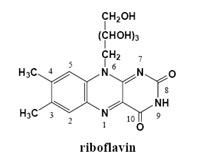
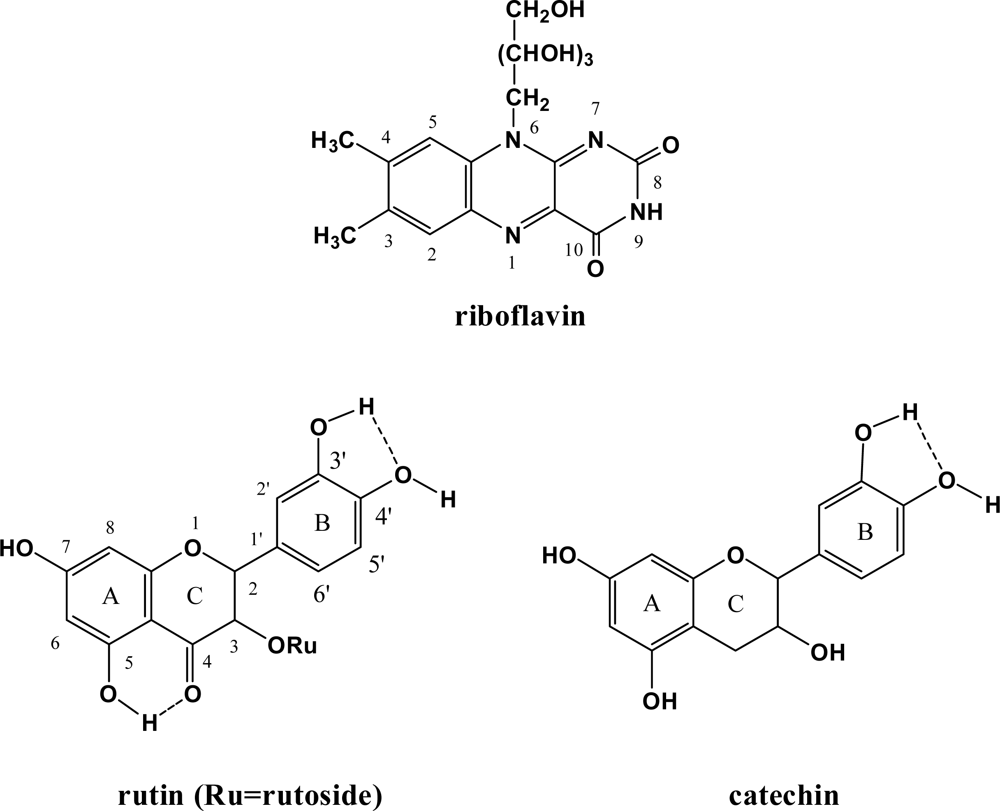
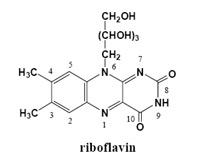
<p>Numerous endogenous photosensitizers, among which riboflavin has attracted much attention, can photogenerate various reactive oxygen species (ROS, <italic>e.g.</italic> <sup>1</sup>O<sub>2</sub> and O<sub>2</sub><sup>˙−</sup>) [<xref ref-type="bibr" rid="b1-ijms-09-01908">1</xref>, <xref ref-type="bibr" rid="b2-ijms-09-01908">2</xref>]. It has been reported that riboflavin is an efficient ROS-generator [<xref ref-type="bibr" rid="b1-ijms-09-01908">1</xref>, <xref ref-type="bibr" rid="b3-ijms-09-01908">3</xref>, <xref ref-type="bibr" rid="b4-ijms-09-01908">4</xref>] and can cause photosensitizing DNA damage [<xref ref-type="bibr" rid="b5-ijms-09-01908">5</xref>, <xref ref-type="bibr" rid="b6-ijms-09-01908">6</xref>]. Polyphenolic compounds, <italic>e.g.</italic> rutin and catechin (<xref ref-type="fig" rid="f1-ijms-09-01908">Figure 1</xref>), are ideal antioxidants with strong free radical-scavenging ability. Recently, it was reported that rutin and catechin play dual roles in protecting from the photosensitizing damage caused by riboflavin, that is, as ROS scavengers and triplet excited (T<sub>1</sub>) state riboflavin quenchers [<xref ref-type="bibr" rid="b7-ijms-09-01908">7</xref>]. The free radical-scavenging mechanisms of rutin and catechin have been investigated before [<xref ref-type="bibr" rid="b8-ijms-09-01908">8</xref>], however, more effort is needed to elucidate the deactivating mechanisms of T<sub>1</sub> state riboflavin by rutin/catechin. In recent years, density functional theory (DFT) calculations have been widely used to study both the photosensitization and deactivation mechanisms of excited state photosensitizers [<xref ref-type="bibr" rid="b4-ijms-09-01908">4</xref>, <xref ref-type="bibr" rid="b9-ijms-09-01908">9</xref>–<xref ref-type="bibr" rid="b12-ijms-09-01908">12</xref>]. Therefore, in the present study, we attempt to explore how T<sub>1</sub> state riboflavin was deactivated by rutin/catechin by means of theoretical calculations.</p></sec>
<sec sec-type="methods">
<title>2. Theoretical Methods</title>
<p>The calculation procedures are as follows. First, the geometries of riboflavin, rutin and catechin were fully optimized by DFT [<xref ref-type="bibr" rid="b14-ijms-09-01908">14</xref>, <xref ref-type="bibr" rid="b15-ijms-09-01908">15</xref>] and B3LYP functional [<xref ref-type="bibr" rid="b16-ijms-09-01908">16</xref>–<xref ref-type="bibr" rid="b18-ijms-09-01908">18</xref>] with 6–31G(d,p) Gaussian basis set <italic>in vacuo</italic>. Then, the lowest T<sub>1</sub> excitation energies (E<sub>T1</sub>) of the three molecules were estimated by time-dependent DFT (TD-DFT) [<xref ref-type="bibr" rid="b19-ijms-09-01908">19</xref>–<xref ref-type="bibr" rid="b21-ijms-09-01908">21</xref>] with the same basis set. Moreover, in view of the fact that the diffusion functions are crucial for treatment of anion and cation radicals, the vertical electron affinities (VEA) and vertical ionization potentials (VIP) of riboflavin, rutin and catechin were calculated by using a combined DFT method labeled as B3LYP/6–31+G(d,p)/B3LYP/6–31G(d,p), which means that B3LYP/6–31+G(d,p) was used to perform a single-point calculation using B3LYP/6–31G(d,p)-optimized geometries [<xref ref-type="bibr" rid="b10-ijms-09-01908">10</xref>]. The O-H bond dissociation enthalpy (BDE) of rutin/catechin and H-atom affinity (HAA) of riboflavin were obtained by a hybrid method combining DFT and semiempirical method AM1, labeled as (RO)B3LYP/6–311+G(2d,2p)/AM1, which takes advantages of accuracy and economy [<xref ref-type="bibr" rid="b8-ijms-09-01908">8</xref>]. The solvent (benzene and water) effects were taken into account by employing the self-consistent reaction field (SCRF) method with polarizable continuum model (PCM) [<xref ref-type="bibr" rid="b22-ijms-09-01908">22</xref>–<xref ref-type="bibr" rid="b24-ijms-09-01908">24</xref>] for the single point calculations. All the calculations were accomplished using the Gaussian 03 package of programs [<xref ref-type="bibr" rid="b25-ijms-09-01908">25</xref>].</p></sec>
<sec sec-type="results|discussion">
<title>3. Results and Discussion</title>
<p>As we know, the ground state photosensitizer is initially excited to the singlet excited state upon irradiation and then may intersystem cross to the relatively long-lived T<sub>1</sub> state. T<sub>1</sub> state riboflavin can react with molecular oxygen to photogenerate various ROS [<xref ref-type="bibr" rid="b1-ijms-09-01908">1</xref>, <xref ref-type="bibr" rid="b3-ijms-09-01908">3</xref>, <xref ref-type="bibr" rid="b4-ijms-09-01908">4</xref>] and at the same time, it can be deactivated by antioxidants through the following possible pathways:</p>
<p>The first deactivating pathway may proceed through the direct energy transfer between T<sub>1</sub> state riboflavin (RF) and polyphenols (PhOH) (<xref ref-type="disp-formula" rid="FD1">Equation 1</xref>).
<disp-formula id="FD1">
<label>(1)</label>
<mml:math display="block">
<mml:mrow>
<mml:mtext>RF</mml:mtext>
<mml:mo>(</mml:mo>
<mml:msub>
<mml:mtext>T</mml:mtext>
<mml:mn>1</mml:mn></mml:msub>
<mml:mtext>)</mml:mtext>
<mml:mi> </mml:mi>
<mml:mo>+</mml:mo>
<mml:mi> </mml:mi>
<mml:mtext>PhOH</mml:mtext>
<mml:mo>→</mml:mo>
<mml:mrow>
<mml:mtext>RF</mml:mtext>
<mml:mo>+</mml:mo>
<mml:mtext>PhOH</mml:mtext>
<mml:mo>(</mml:mo></mml:mrow>
<mml:msub>
<mml:mtext>T</mml:mtext>
<mml:mn>1</mml:mn></mml:msub>
<mml:mtext>)</mml:mtext></mml:mrow></mml:math></disp-formula></p>
<p>The second deactivating pathway involves the electron transfer between T<sub>1</sub> state riboflavin and polyphenols (<xref ref-type="disp-formula" rid="FD2">Equation 2</xref>).
<disp-formula id="FD2">
<label>(2)</label>
<mml:math display="block">
<mml:mtext>RF</mml:mtext>
<mml:mo>(</mml:mo>
<mml:msub>
<mml:mtext>T</mml:mtext>
<mml:mn>1</mml:mn></mml:msub>
<mml:mtext>)</mml:mtext>
<mml:mi> </mml:mi>
<mml:mo>+</mml:mo>
<mml:mi> </mml:mi>
<mml:mtext>PhOH</mml:mtext>
<mml:mo>→</mml:mo>
<mml:msup>
<mml:mtext>RF</mml:mtext>
<mml:mrow>
<mml:mtext>.</mml:mtext>
<mml:mo>-</mml:mo></mml:mrow></mml:msup>
<mml:mo>+</mml:mo>
<mml:msup>
<mml:mtext>PhOH</mml:mtext>
<mml:mrow>
<mml:mtext>.</mml:mtext>
<mml:mo>+</mml:mo></mml:mrow></mml:msup></mml:math></disp-formula></p>
<p>Moreover, as the polyphenolic antioxidants are ideal H-atom donors [<xref ref-type="bibr" rid="b8-ijms-09-01908">8</xref>], T<sub>1</sub> state riboflavin may be deactivated by polyphenols through a H-atom transfer process (<xref ref-type="disp-formula" rid="FD3">Equation 3</xref>).
<disp-formula id="FD3">
<label>(3)</label>
<mml:math display="block">
<mml:mtext>RF</mml:mtext>
<mml:mo>(</mml:mo>
<mml:msub>
<mml:mtext>T</mml:mtext>
<mml:mn>1</mml:mn></mml:msub>
<mml:mtext>)</mml:mtext>
<mml:mi> </mml:mi>
<mml:mo>+</mml:mo>
<mml:mi> </mml:mi>
<mml:mtext>PhOH</mml:mtext>
<mml:mo>→</mml:mo>
<mml:msup>
<mml:mtext>RFH</mml:mtext>
<mml:mtext>.</mml:mtext></mml:msup>
<mml:mo>+</mml:mo>
<mml:msup>
<mml:mtext>PhO</mml:mtext>
<mml:mtext>.</mml:mtext></mml:msup></mml:math></disp-formula></p>
<p>Therefore, the corresponding electronic parameters of riboflavin, rutin and catechin, including E<sub>T1</sub>, VEA, VIP, O-H BDE and HAA, were estimated and listed in <xref ref-type="table" rid="t1-ijms-09-01908">Table 1</xref>, according to which, the deactivating reactions of T<sub>1</sub> state riboflavin by rutin/catechin were analyzed.</p>
<p>Primarily, the E<sub>T1</sub> of riboflavin, rutin and catechin have been calculated using TD-DFT methods, whose accuracy in estimating the T<sub>1</sub> state properties of various photosensitizers has been verified [<xref ref-type="bibr" rid="b4-ijms-09-01908">4</xref>, <xref ref-type="bibr" rid="b9-ijms-09-01908">9</xref>–<xref ref-type="bibr" rid="b13-ijms-09-01908">13</xref>]. It can be seen that the theoretical E<sub>T1</sub> of rutin/catechin is much higher than that of riboflavin (<xref ref-type="table" rid="t1-ijms-09-01908">Table 1</xref>), implying that the direct energy transfer-based deactivating pathway (<xref ref-type="disp-formula" rid="FD1">Equation 1</xref>) is not feasible on thermodynamic grounds in both solvents.</p>
<p>As to the direct electron transfer-based deactivating pathway (<xref ref-type="disp-formula" rid="FD2">Equation 2</xref>), its feasibility depends on the VEA of T<sub>1</sub> state riboflavin (VEA<sub>T1</sub>) and VIP of rutin/catechin. According to the theoretical results, the summation of VEA<sub>T1</sub> of riboflavin and VIP of rutin/catechin is positive both in benzene and water, implying that the electron transfer-based deactivating pathway is also not favorable from the thermodynamic point of view.</p>
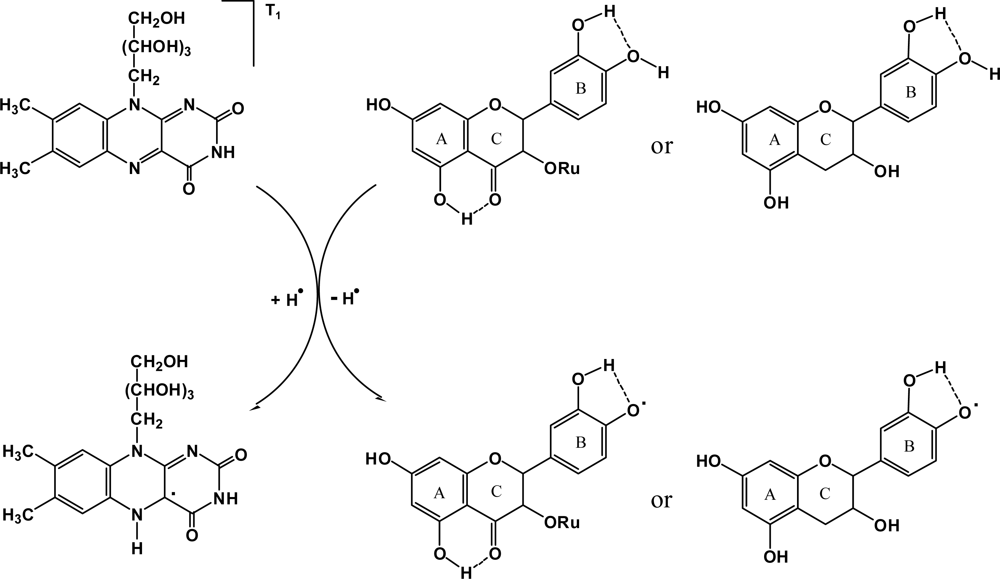
<p>Thirdly, rutin and catechin are excellent H-atom donating substrates [<xref ref-type="bibr" rid="b8-ijms-09-01908">8</xref>]. To explore whether the H-atom transfer reaction from rutin/catechin to T<sub>1</sub> state riboflavin (<xref ref-type="disp-formula" rid="FD3">Equation 3</xref>) can occur or not, the O-H BDE of rutin and catechin, which has been successfully used to measure the molecular H-atom-donating ability [<xref ref-type="bibr" rid="b8-ijms-09-01908">8</xref>], and the HAA of riboflavin, an appropriate theoretical parameter to characterize the molecular H-atom-abstracting ability [<xref ref-type="bibr" rid="b8-ijms-09-01908">8</xref>], have been calculated. Despite the fact that rutin and catechin possess several phenolic hydroxyls that may donate H-atoms, previous studies demonstrated that the hydroxyl at position 4’ (<xref ref-type="fig" rid="f1-ijms-09-01908">Figure 1</xref>) is the most active one [<xref ref-type="bibr" rid="b26-ijms-09-01908">26</xref>] and the corresponding O-H BDE in benzene and water is listed in <xref ref-type="table" rid="t2-ijms-09-01908">Table 2</xref>. The theoretically estimated HAA of T<sub>1</sub> state riboflavin at N1 (<xref ref-type="fig" rid="f1-ijms-09-01908">Figure 1</xref>), which has been reported to be the thermodynamically favorable position to accept a H-atom [<xref ref-type="bibr" rid="b27-ijms-09-01908">27</xref>], is –97.24 kcal/mol in benzene and –106.19 kcal/mol in water (<xref ref-type="table" rid="t2-ijms-09-01908">Table 2</xref>). As the summation of HAA<sub>T1</sub> of riboflavin and the O-H BDE of rutin/catechin is negative in both solvents, the H-atom transfer-based quenching pathway is thermodynamically feasible. Therefore, the H-atom transfer-based T<sub>1</sub> state riboflavin deactivating mechanism by rutin/catechin is proposed as illustrated in <xref ref-type="fig" rid="f2-ijms-09-01908">Figure 2</xref>.</p></sec>
<sec sec-type="conclusions">
<title>4. Conclusions</title>
<p>In summary, through comparing the electronic parameters of riboflavin, rutin and catechin, including E<sub>T1</sub>, VEA, VIP, BDE and HAA, it can be inferred that the H-atom transfer pathway is more feasible on thermodynamic grounds relative to the direct energy transfer or direct electron transfer pathways responsible for the T<sub>1</sub> state riboflavin deactivation by rutin/catechin. The results have important implications to design/screen better polyphenolic antioxidants as protectors against the photo-oxidative damage induced by riboflavin.</p></sec></body>
<back>
<ack>
<p>This work was supported by the National Natural Science Foundation of China (Grant No. 30700113) and the Natural Science Foundation of Shandong Province (Grant No. Y2007D53).</p></ack>
<ref-list>
<title>References and Notes</title>
<ref id="b1-ijms-09-01908"><label>1</label><citation citation-type="journal"><person-group person-group-type="author"><name><surname>Baier</surname><given-names>J</given-names></name><name><surname>Maisch</surname><given-names>T</given-names></name><name><surname>Maier</surname><given-names>M</given-names></name><name><surname>Engel</surname><given-names>E</given-names></name><name><surname>Landthaler</surname><given-names>M</given-names></name><name><surname>Bäumler</surname><given-names>W</given-names></name></person-group><article-title>Singlet oxygen generation by UVA light exposure of endogenous photosensitizers</article-title><source>Biophys. J.</source><year>2006</year><volume>91</volume><fpage>1452</fpage><lpage>1459</lpage><pub-id pub-id-type="doi">10.1529/biophysj.106.082388</pub-id><pub-id pub-id-type="pmid">16751234</pub-id></citation></ref>
<ref id="b2-ijms-09-01908"><label>2</label><citation citation-type="journal"><person-group person-group-type="author"><name><surname>Wondrak</surname><given-names>GT</given-names></name><name><surname>Jacobson</surname><given-names>MK</given-names></name><name><surname>Jacobson</surname><given-names>EL</given-names></name></person-group><article-title>Endogenous UVA-photosensitizers: Mediators of skin photodamage and novel targets for skin photoprotection</article-title><source>Photochem. Photobiol. Sci</source><year>2006</year><volume>5</volume><fpage>215</fpage><lpage>237</lpage><pub-id pub-id-type="doi">10.1039/b504573h</pub-id><pub-id pub-id-type="pmid">16465308</pub-id></citation></ref>
<ref id="b3-ijms-09-01908"><label>3</label><citation citation-type="journal"><person-group person-group-type="author"><name><surname>Grzelak</surname><given-names>A</given-names></name><name><surname>Rychlik</surname><given-names>B</given-names></name><name><surname>Bartosz</surname><given-names>G</given-names></name></person-group><article-title>Light-dependent generation of reactive oxygen species in cell culture media</article-title><source>Free Radic. Biol. Med</source><year>2001</year><volume>30</volume><fpage>1418</fpage><lpage>1425</lpage><pub-id pub-id-type="doi">10.1016/S0891-5849(01)00545-7</pub-id><pub-id pub-id-type="pmid">11390187</pub-id></citation></ref>
<ref id="b4-ijms-09-01908"><label>4</label><citation citation-type="journal"><person-group person-group-type="author"><name><surname>Shen</surname><given-names>L</given-names></name><name><surname>Ji</surname><given-names>HF</given-names></name><name><surname>Zhang</surname><given-names>HY</given-names></name></person-group><article-title>Computational note on the photosensitization mechanisms of riboflavin</article-title><source>J. Mol. Struct. (Theochem)</source><year>2007</year><volume>821</volume><fpage>171</fpage><lpage>172</lpage><pub-id pub-id-type="doi">10.1016/j.theochem.2007.07.002</pub-id></citation></ref>
<ref id="b5-ijms-09-01908"><label>5</label><citation citation-type="journal"><person-group person-group-type="author"><name><surname>Ito</surname><given-names>K</given-names></name><name><surname>Inoue</surname><given-names>S</given-names></name><name><surname>Yamamoto</surname><given-names>K</given-names></name><name><surname>Kawanishi</surname><given-names>S</given-names></name></person-group><article-title>8-Hydroxydeoxyguanosine formation at the 5′ site of 5′-GG-3′ sequences in double-stranded DNA by UV radiation with riboflavin</article-title><source>J. Biol. Chem.</source><year>1993</year><volume>268</volume><fpage>13221</fpage><lpage>13227</lpage><pub-id pub-id-type="pmid">8390459</pub-id></citation></ref>
<ref id="b6-ijms-09-01908"><label>6</label><citation citation-type="journal"><person-group person-group-type="author"><name><surname>Joshi</surname><given-names>PC</given-names></name></person-group><article-title>Comparison of the DNA-damaging property of photosensitised riboflavin via singlet oxygen (<sup>1</sup>O<sub>2</sub>) and superoxide radical O<sup>2-</sup>. mechanisms</article-title><source>Toxicol. Lett</source><year>1985</year><volume>26</volume><fpage>211</fpage><lpage>217</lpage><pub-id pub-id-type="doi">10.1016/0378-4274(85)90169-9</pub-id><pub-id pub-id-type="pmid">2994263</pub-id></citation></ref>
<ref id="b7-ijms-09-01908"><label>7</label><citation citation-type="journal"><person-group person-group-type="author"><name><surname>Becker</surname><given-names>EM</given-names></name><name><surname>Cardoso</surname><given-names>DR</given-names></name><name><surname>Skibsted</surname><given-names>LH</given-names></name></person-group><article-title>Deactivation of riboflavin triplet-excited state by phenolic antioxidants: mechanism behind protective effects in photooxidation of milk-based beverages</article-title><source>Eur. Food. Res. Technol.</source><year>2005</year><volume>221</volume><fpage>382</fpage><lpage>386</lpage><pub-id pub-id-type="doi">10.1007/s00217-005-1184-6</pub-id></citation></ref>
<ref id="b8-ijms-09-01908"><label>8</label><citation citation-type="journal"><person-group person-group-type="author"><name><surname>Zhang</surname><given-names>HY</given-names></name></person-group><article-title>Structure-activity relationships and rational design strategies for radical-scavenging antioxidants</article-title><source>Curr. Computer-Aided Drug Des.</source><year>2005</year><volume>1</volume><fpage>257</fpage><lpage>273</lpage><pub-id pub-id-type="doi">10.2174/1573409054367691</pub-id></citation></ref>
<ref id="b9-ijms-09-01908"><label>9</label><citation citation-type="journal"><person-group person-group-type="author"><name><surname>Shen</surname><given-names>L</given-names></name><name><surname>Ji</surname><given-names>HF</given-names></name><name><surname>Zhang</surname><given-names>HY</given-names></name></person-group><article-title>A theoretical elucidation on the solvent-dependent photosensitive behaviors of C<sub>60</sub></article-title><source>Photochem. Photobiol</source><year>2006</year><volume>82</volume><fpage>798</fpage><lpage>800</lpage><pub-id pub-id-type="doi">10.1562/2005-10-20-RN-723</pub-id><pub-id pub-id-type="pmid">16420101</pub-id></citation></ref>
<ref id="b10-ijms-09-01908"><label>10</label><citation citation-type="journal"><person-group person-group-type="author"><name><surname>Shen</surname><given-names>L</given-names></name><name><surname>Ji</surname><given-names>HF</given-names></name><name><surname>Zhang</surname><given-names>HY</given-names></name></person-group><article-title>A TD-DFT study on triplet excited-state properties of curcumin and its implications in elucidating the photosensitizing mechanisms of the pigment</article-title><source>Chem. Phys. Lett.</source><year>2005</year><volume>409</volume><fpage>300</fpage><lpage>303</lpage><pub-id pub-id-type="doi">10.1016/j.cplett.2005.05.023</pub-id></citation></ref>
<ref id="b11-ijms-09-01908"><label>11</label><citation citation-type="journal"><person-group person-group-type="author"><name><surname>Shen</surname><given-names>L</given-names></name><name><surname>Ji</surname><given-names>HF</given-names></name><name><surname>Zhang</surname><given-names>HY</given-names></name></person-group><article-title>Hypericin anion is crucial to elucidating the pigment’s photosensitive features</article-title><source>Bioorg. Med. Chem. Lett</source><year>2006</year><volume>16</volume><fpage>1414</fpage><lpage>1417</lpage><pub-id pub-id-type="doi">10.1016/j.bmcl.2005.11.056</pub-id><pub-id pub-id-type="pmid">16337376</pub-id></citation></ref>
<ref id="b12-ijms-09-01908"><label>12</label><citation citation-type="journal"><person-group person-group-type="author"><name><surname>Shen</surname><given-names>L</given-names></name><name><surname>Ji</surname><given-names>HF</given-names></name></person-group><article-title>How α-tocopherol quenches triplet state riboflavin? Insights from theory</article-title><source>J. Photochem. Photobiol. A: Chem.</source><year>2008</year><volume>199</volume><fpage>119</fpage><lpage>121</lpage><pub-id pub-id-type="doi">10.1016/j.jphotochem.2008.04.002</pub-id></citation></ref>
<ref id="b13-ijms-09-01908"><label>13</label><citation citation-type="journal"><person-group person-group-type="author"><name><surname>Shen</surname><given-names>L</given-names></name><name><surname>Ji</surname><given-names>HF</given-names></name></person-group><article-title>A theoretical study on the quenching mechanisms of triplet state riboflavin by tryptophan and tyrosine</article-title><source>J. Photochem. Photobiol. B: Biol.</source><year>2008</year><volume>92</volume><fpage>10</fpage><lpage>12</lpage><pub-id pub-id-type="doi">10.1016/j.jphotobiol.2008.03.005</pub-id></citation></ref>
<ref id="b14-ijms-09-01908"><label>14</label><citation citation-type="journal"><person-group person-group-type="author"><name><surname>Hohenberg</surname><given-names>P</given-names></name><name><surname>Kohn</surname><given-names>W</given-names></name></person-group><article-title>Inhomogeneous electron gas</article-title><source>Phys. Rev</source><year>1964</year><volume>136</volume><fpage>B864</fpage><lpage>B871</lpage><pub-id pub-id-type="doi">10.1103/PhysRev.136.B864</pub-id></citation></ref>
<ref id="b15-ijms-09-01908"><label>15</label><citation citation-type="journal"><person-group person-group-type="author"><name><surname>Kohn</surname><given-names>W</given-names></name><name><surname>Sham</surname><given-names>LJ</given-names></name></person-group><article-title>Self-consistent equations including exchange and correlation effects</article-title><source>Phys. Rev</source><year>1965</year><volume>140</volume><fpage>A1133</fpage><lpage>A1138</lpage><pub-id pub-id-type="doi">10.1103/PhysRev.140.A1133</pub-id></citation></ref>
<ref id="b16-ijms-09-01908"><label>16</label><citation citation-type="journal"><person-group person-group-type="author"><name><surname>Lee</surname><given-names>C</given-names></name><name><surname>Yang</surname><given-names>W</given-names></name><name><surname>Parr</surname><given-names>RG</given-names></name></person-group><article-title>Development of the Colle-Salvetti correlation energy formula into a functional of the electron density</article-title><source>Phys. Rev. B.</source><year>1988</year><volume>37</volume><fpage>785</fpage><lpage>789</lpage><pub-id pub-id-type="doi">10.1103/PhysRevB.37.785</pub-id></citation></ref>
<ref id="b17-ijms-09-01908"><label>17</label><citation citation-type="journal"><person-group person-group-type="author"><name><surname>Becke</surname><given-names>AD</given-names></name></person-group><article-title>A new mixing of Hartree-Fock and local density-functional theories</article-title><source>J. Chem. Phys.</source><year>1993</year><volume>98</volume><fpage>1372</fpage><lpage>1377</lpage><pub-id pub-id-type="doi">10.1063/1.464304</pub-id></citation></ref>
<ref id="b18-ijms-09-01908"><label>18</label><citation citation-type="journal"><person-group person-group-type="author"><name><surname>Stephens</surname><given-names>PJ</given-names></name><name><surname>Devlin</surname><given-names>FJ</given-names></name><name><surname>Chabalowski</surname><given-names>CF</given-names></name><name><surname>Frisch</surname><given-names>MJ</given-names></name></person-group><article-title>Ab Initio calculation of vibrational absorption and circular dichroism spectra using density functional force fields</article-title><source>J. Phys. Chem.</source><year>1994</year><volume>98</volume><fpage>11623</fpage><lpage>11627</lpage><pub-id pub-id-type="doi">10.1021/j100096a001</pub-id></citation></ref>
<ref id="b19-ijms-09-01908"><label>19</label><citation citation-type="journal"><person-group person-group-type="author"><name><surname>Stratmann</surname><given-names>RE</given-names></name><name><surname>Scuseria</surname><given-names>GE</given-names></name><name><surname>Frisch</surname><given-names>MJ</given-names></name></person-group><article-title>An efficient implementation of time-dependent density-functional theory for the calculation of excitation energies of large molecules</article-title><source>J. Chem. Phys.</source><year>1998</year><volume>109</volume><fpage>8218</fpage><lpage>8224</lpage><pub-id pub-id-type="doi">10.1063/1.477483</pub-id></citation></ref>
<ref id="b20-ijms-09-01908"><label>20</label><citation citation-type="journal"><person-group person-group-type="author"><name><surname>Bauernschmitt</surname><given-names>R</given-names></name><name><surname>Ahlrichs</surname><given-names>R</given-names></name></person-group><article-title>Treatment of electronic excitations within the adiabatic approximation of time dependent density functional theory</article-title><source>Chem. Phys. Lett</source><year>1996</year><volume>256</volume><fpage>454</fpage><lpage>464</lpage><pub-id pub-id-type="doi">10.1016/0009-2614(96)00440-X</pub-id></citation></ref>
<ref id="b21-ijms-09-01908"><label>21</label><citation citation-type="journal"><person-group person-group-type="author"><name><surname>Casida</surname><given-names>ME</given-names></name><name><surname>Jamorski</surname><given-names>C</given-names></name><name><surname>Casida</surname><given-names>KC</given-names></name><name><surname>Salahub</surname><given-names>DR</given-names></name></person-group><article-title>Molecular excitation energies to high-lying bound states from time-dependent density-functional response theory: Characterization and correction of the time-dependent local density approximation ionization threshold</article-title><source>J. Chem. Phys.</source><year>1998</year><volume>108</volume><fpage>4439</fpage><lpage>4449</lpage><pub-id pub-id-type="doi">10.1063/1.475855</pub-id></citation></ref>
<ref id="b22-ijms-09-01908"><label>22</label><citation citation-type="journal"><person-group person-group-type="author"><name><surname>Miertus</surname><given-names>S</given-names></name><name><surname>Scrocco</surname><given-names>E</given-names></name><name><surname>Tomasi</surname><given-names>J</given-names></name></person-group><article-title>Electrostatic interaction of a solute with a continuum. A direct utilization of <italic>ab initio</italic> molecular potentials for the prevision of solvent effects</article-title><source>Chem. Phys.</source><year>1981</year><volume>55</volume><fpage>117</fpage><lpage>129</lpage><pub-id pub-id-type="doi">10.1016/0301-0104(81)85090-2</pub-id></citation></ref>
<ref id="b23-ijms-09-01908"><label>23</label><citation citation-type="journal"><person-group person-group-type="author"><name><surname>Miertus</surname><given-names>S</given-names></name><name><surname>Tomasi</surname><given-names>J</given-names></name></person-group><article-title>Approximate evaluations of the electrostatic free energy and internal energy changes in solution processes</article-title><source>Chem. Phys</source><year>1982</year><volume>65</volume><fpage>239</fpage><lpage>241</lpage><pub-id pub-id-type="doi">10.1016/0301-0104(82)85072-6</pub-id></citation></ref>
<ref id="b24-ijms-09-01908"><label>24</label><citation citation-type="journal"><person-group person-group-type="author"><name><surname>Cossi</surname><given-names>M</given-names></name><name><surname>Barone</surname><given-names>V</given-names></name><name><surname>Cammi</surname><given-names>J</given-names></name></person-group><article-title>Ab initio study of solvated molecules: a new implementation of the polarizable continuum model</article-title><source>Chem. Phys. Lett.</source><year>1996</year><volume>255</volume><fpage>327</fpage><lpage>335</lpage><pub-id pub-id-type="doi">10.1016/0009-2614(96)00349-1</pub-id></citation></ref>
<ref id="b25-ijms-09-01908"><label>25</label><citation citation-type="journal"><person-group person-group-type="author"><name><surname>Frisch</surname><given-names>MJ</given-names></name><name><surname>Trucks</surname><given-names>GW</given-names></name><name><surname>Schlegel</surname><given-names>HB</given-names></name><name><surname>Scuseria</surname><given-names>GE</given-names></name><name><surname>Robb</surname><given-names>MA</given-names></name><name><surname>Cheeseman</surname><given-names>JR</given-names></name><name><surname>Montgomery</surname><given-names>JA</given-names></name><name><surname>Vreven</surname><given-names>T</given-names></name><name><surname>Kudin</surname><given-names>KN</given-names></name><name><surname>Burant</surname><given-names>JC</given-names></name><etal/></person-group><source>Gaussian 03</source><publisher-name>Gaussian, Inc</publisher-name><publisher-loc>Pittsburgh PA</publisher-loc><year>2003</year></citation></ref>
<ref id="b26-ijms-09-01908"><label>26</label><citation citation-type="journal"><person-group person-group-type="author"><name><surname>Pannala</surname><given-names>SA</given-names></name><name><surname>Chan</surname><given-names>TS</given-names></name><name><surname>O′Brien</surname><given-names>PJ</given-names></name><name><surname>Rice-Evans</surname><given-names>CA</given-names></name></person-group><article-title>Flavonoid B-ring chemistry and antioxidant activity: fast reaction kinetics</article-title><source>Biochem. Biophys. Res. Commun.</source><year>2001</year><volume>282</volume><fpage>1161</fpage><lpage>1168</lpage><pub-id pub-id-type="doi">10.1006/bbrc.2001.4705</pub-id><pub-id pub-id-type="pmid">11302737</pub-id></citation></ref>
<ref id="b27-ijms-09-01908"><label>27</label><citation citation-type="journal"><person-group person-group-type="author"><name><surname>Cardoso</surname><given-names>DR</given-names></name><name><surname>Olsen</surname><given-names>K</given-names></name><name><surname>Skibsted</surname><given-names>LH</given-names></name></person-group><article-title>Mechanism of deactivation of triplet-excited riboflavin by ascorbate, carotenoids, and tocopherols in homogeneous and heterogeneous aqueous food model systems</article-title><source>J. Agric. Food Chem.</source><year>2007</year><volume>55</volume><fpage>6285</fpage><lpage>6291</lpage><pub-id pub-id-type="doi">10.1021/jf063497q</pub-id><pub-id pub-id-type="pmid">17585774</pub-id></citation></ref></ref-list>
<sec sec-type="display-objects">
<title>Figures and Tables</title>
<fig id="f1-ijms-09-01908" position="float">
<label>Figure 1.</label>
<caption>
<p>Molecular structures of riboflavin, rutin and catechin.</p></caption>
<graphic xlink:href="ijms-09-01908f1.png"/></fig>
<fig id="f2-ijms-09-01908" position="float">
<label>Figure 2.</label>
<caption>
<p>Theoretically postulated H-atom transfer-based triplet excited state riboflavin deactivating pathway by rutin/catechin.</p></caption>
<graphic xlink:href="ijms-09-01908f2.png"/></fig>
<table-wrap id="t1-ijms-09-01908" position="float">
<label>Table 1.</label>
<caption>
<p>Theoretically estimated lowest triplet excitation energy (E<sub>T1</sub>, in eV), vertical electron affinity (VEA, in eV) and vertical ionization potential (VIP, in eV) of polyphenols (rutin and catechin) and riboflavin in benzene and water.</p></caption>
<table frame="hsides" rules="groups">
<thead>
<tr>
<th align="center">Compounds</th>
<th align="center">Solvents</th>
<th align="center">E<sub>T1</sub></th>
<th align="center">VIP<sub>S0</sub></th>
<th align="center">VEA<sub>S0</sub></th>
<th align="center">VEA<sub>T1</sub><sup>a</sup></th></tr></thead>
<tbody>
<tr>
<td align="center" rowspan="2"><bold>Rutin</bold></td>
<td align="center">benzene</td>
<td align="center">3.12</td>
<td align="center">6.76</td>
<td align="center"/>
<td align="center"/></tr>
<tr>
<td align="center">water</td>
<td align="center">3.13</td>
<td align="center">5.95</td>
<td align="center"/>
<td align="center"/></tr>
<tr>
<td align="center" rowspan="2"><bold>Catechin</bold></td>
<td align="center">benzene</td>
<td align="center">3.62</td>
<td align="center">6.49</td>
<td align="center"/>
<td align="center"/></tr>
<tr>
<td align="center">water</td>
<td align="center">3.63</td>
<td align="center">5.82</td>
<td align="center"/>
<td align="center"/></tr>
<tr>
<td align="center" rowspan="2"><bold>Riboflavin</bold><bold><xref ref-type="table-fn" rid="tfn2-ijms-09-01908">b</xref></bold></td>
<td align="center">benzene</td>
<td align="center">2.10</td>
<td align="center"/>
<td align="center">–2.52</td>
<td align="center">–4.62</td></tr>
<tr>
<td align="center">water</td>
<td align="center">2.09</td>
<td align="center"/>
<td align="center">–3.32</td>
<td align="center">–5.41</td></tr></tbody></table>
<table-wrap-foot><fn id="tfn1-ijms-09-01908">
<p><sup>a</sup>VEA<sub>T1</sub> = VEA<sub>S0</sub> – E<sub>T1</sub>;</p></fn><fn id="tfn2-ijms-09-01908">
<p><sup>b</sup>data from ref [<xref ref-type="bibr" rid="b4-ijms-09-01908">4</xref>].</p></fn></table-wrap-foot></table-wrap>
<table-wrap id="t2-ijms-09-01908" position="float">
<label>Table 2.</label>
<caption>
<p>Theoretically estimated O-H bond dissociation enthalpy (BDE, in kcal/mol) of the phenolic compounds (rutin and catechin) and T<sub>1</sub> sate H-atom affinity (HAA<sub>T1</sub>, in kcal/mol) of riboflavin in benzene and water.</p></caption>
<table frame="hsides" rules="groups">
<thead>
<tr>
<th align="center">Compounds</th>
<th align="center">Solvents</th>
<th align="center">O-H BDE</th>
<th align="center">HAA<sub>T1</sub><sup>a</sup></th></tr></thead>
<tbody>
<tr>
<td align="center" rowspan="2"><bold>Rutin</bold></td>
<td align="center">benzene</td>
<td align="center">78.18</td>
<td align="center"/></tr>
<tr>
<td align="center">water</td>
<td align="center">79.97</td>
<td align="center"/></tr>
<tr>
<td align="center" rowspan="2"><bold>Catechin</bold></td>
<td align="center">benzene</td>
<td align="center">78.97</td>
<td align="center"/></tr>
<tr>
<td align="center">water</td>
<td align="center">80.73</td>
<td align="center"/></tr>
<tr>
<td align="center" rowspan="2"><bold>Riboflavin</bold></td>
<td align="center">benzene</td>
<td align="center"/>
<td align="center">−97.24</td></tr>
<tr>
<td align="center">water</td>
<td align="center"/>
<td align="center">−106.19</td></tr></tbody></table>
<table-wrap-foot><fn id="tfn3-ijms-09-01908">
<p><sup>a</sup>HAA<sub>T1</sub> = HAA<sub>S0</sub> + E<sub>T1</sub> .</p></fn></table-wrap-foot></table-wrap></sec></back></article>