
<?xml version="1.0" encoding="UTF-8"?>
<!DOCTYPE article PUBLIC "-//NLM//DTD Journal Publishing DTD v2.3 20070202//EN" "journalpublishing.dtd">
<article xmlns:xlink="http://www.w3.org/1999/xlink" xml:lang="en" article-type="research-article">
<front>
<journal-meta>
<journal-id journal-id-type="publisher-id">ijms</journal-id>
<journal-title>International Journal of Molecular Sciences</journal-title>
<abbrev-journal-title>Int. J. Mol. Sci.</abbrev-journal-title>
<issn pub-type="epub">1422-0067</issn>
<publisher>
<publisher-name>Molecular Diversity Preservation International (MDPI)</publisher-name></publisher></journal-meta>
<article-meta>
<article-id pub-id-type="doi">10.3390/ijms14023110</article-id>
<article-id pub-id-type="publisher-id">ijms-14-03110</article-id>
<article-categories>
<subj-group>
<subject>Article</subject></subj-group></article-categories>
<title-group>
<article-title>Analysis of Expressed Sequence Tags from Chinese Bayberry Fruit (<italic>Myrica rubra</italic> Sieb. and Zucc.) at Different Ripening Stages and Their Association with Fruit Quality Development</article-title></title-group>
<contrib-group>
<contrib contrib-type="author">
<name><surname>Zhu</surname><given-names>Changqing</given-names></name></contrib>
<contrib contrib-type="author">
<name><surname>Feng</surname><given-names>Chao</given-names></name></contrib>
<contrib contrib-type="author">
<name><surname>Li</surname><given-names>Xian</given-names></name></contrib>
<contrib contrib-type="author">
<name><surname>Xu</surname><given-names>Changjie</given-names></name></contrib>
<contrib contrib-type="author">
<name><surname>Sun</surname><given-names>Chongde</given-names></name><xref ref-type="corresp" rid="c1-ijms-14-03110">*</xref></contrib>
<contrib contrib-type="author">
<name><surname>Chen</surname><given-names>Kunsong</given-names></name></contrib>
<aff id="af1-ijms-14-03110">Laboratory of Fruit Quality Biology/The State Agriculture Ministry Laboratory of Horticultural Plant Growth, Development and Quality Improvement, Zhejiang University, Zijingang Campus, Hangzhou 310058, China; E-Mails: <email>zcq1236@zju.edu.cn</email> (C.Z.); <email>11016044@zju.edu.cn</email> (C.F.); <email>xianli@zju.edu.cn</email> (X.L.); <email>chjxu@zju.edu.cn</email> (C.X.); <email>akun@zju.edu.cn</email> (K.C.)</aff></contrib-group>
<author-notes>
<corresp id="c1-ijms-14-03110">
<label>*</label>Author to whom correspondence should be addressed; E-Mail: <email>adesun2006@zju.edu.cn</email>; Tel.: +86-571-8898-2229; Fax: +86-571-8898-2224.</corresp></author-notes>
<pub-date pub-type="collection">
<year>2013</year></pub-date>
<pub-date pub-type="epub">
<day>01</day>
<month>02</month>
<year>2013</year></pub-date>
<volume>14</volume>
<issue>2</issue>
<fpage>3110</fpage>
<lpage>3123</lpage>
<history>
<date date-type="received">
<day>12</day>
<month>12</month>
<year>2012</year></date>
<date date-type="rev-recd">
<day>09</day>
<month>01</month>
<year>2013</year></date>
<date date-type="accepted">
<day>21</day>
<month>01</month>
<year>2013</year></date></history>
<permissions>
<copyright-statement>© 2013 by the authors; licensee Molecular Diversity Preservation International, Basel, Switzerland.</copyright-statement>
<copyright-year>2013</copyright-year>
<license license-type="open-access" xlink:href="http://creativecommons.org/licenses/by/3.0">
<p>This article is an open-access article distributed under the terms and conditions of the Creative Commons Attribution license (http://creativecommons.org/licenses/by/3.0/).</p></license></permissions>
<abstract>
<p>A total of 2000 EST sequences were produced from cDNA libraries generated from Chinese bayberry fruit (<italic>Myrica rubra</italic> Sieb. and Zucc. cv. “Biqi”) at four different ripening stages. After cluster and assembly analysis of the datasets by UniProt, 395 unigenes were identified, and their presumed functions were assigned to 14 putative cellular roles. Furthermore, a sequence BLAST was done for the top ten highly expressed genes in the ESTs, and genes associated with disease/defense and anthocyanin accumulation were analyzed. Gene-encoding elements associated with ethylene biosynthesis and signal transductions, in addition to other senescence-regulating proteins, as well as those associated with quality formation during fruit ripening, were also identified. Their possible roles were subsequently discussed.</p></abstract>
<kwd-group>
<kwd>Chinese bayberry (<italic>Myrica rubra</italic> Sieb and Zucc.)</kwd>
<kwd>fruit ripening</kwd>
<kwd>expressed sequence tags (EST)</kwd>
<kwd>fruit quality</kwd>
<kwd>development</kwd>
<kwd>senescence</kwd></kwd-group></article-meta></front>
<body>
<sec sec-type="intro">
<title>1. Introduction</title>
<p>Chinese bayberry (<italic>Myrica rubra</italic> Sieb. and Zucc., <italic>Myricaceae</italic>) is a subtropical evergreen fruit tree widely grown in southern China [<xref ref-type="bibr" rid="b1-ijms-14-03110">1</xref>,<xref ref-type="bibr" rid="b2-ijms-14-03110">2</xref>]. For most cultivars in China, the tree blossoms in March and April, and then the fruit ripens in June and July [<xref ref-type="bibr" rid="b1-ijms-14-03110">1</xref>]. During fruit development and ripening, chlorophylls and titratable acids decrease, while sugars increase and, for pigmented cultivars, anthocyanins accumulate rapidly, especially during the late ripening stage. Fruit at the eating-ripe stage is delicious, with total soluble solids up to 14%, titratable acid content around 1%, and anthocyanins reaching 76 mg/100 g FW for dark-purple fruit cultivars such as the “Biqi” variety [<xref ref-type="bibr" rid="b1-ijms-14-03110">1</xref>,<xref ref-type="bibr" rid="b3-ijms-14-03110">3</xref>,<xref ref-type="bibr" rid="b4-ijms-14-03110">4</xref>]. In addition, bayberry is a fruit with high nutritional values, due to the high content of various bioactive compounds, as well as its significant antioxidant capacity [<xref ref-type="bibr" rid="b1-ijms-14-03110">1</xref>,<xref ref-type="bibr" rid="b4-ijms-14-03110">4</xref>], anti-diabetic activity [<xref ref-type="bibr" rid="b5-ijms-14-03110">5</xref>,<xref ref-type="bibr" rid="b6-ijms-14-03110">6</xref>], and anti-tumor activity [<xref ref-type="bibr" rid="b7-ijms-14-03110">7</xref>]. Recently, Chinese bayberry gained more and more international attention due to its unique and attractive qualities [<xref ref-type="bibr" rid="b3-ijms-14-03110">3</xref>,<xref ref-type="bibr" rid="b8-ijms-14-03110">8</xref>–<xref ref-type="bibr" rid="b10-ijms-14-03110">10</xref>]. However, the fruit has a short storage or shelf life after harvest, and fruit quality declines rapidly at ambient temperatures [<xref ref-type="bibr" rid="b4-ijms-14-03110">4</xref>,<xref ref-type="bibr" rid="b11-ijms-14-03110">11</xref>], thus impeding the development of the Chinese bayberry industry.</p>
<p>Some efforts have been made for regulating the fruit quality changes during its ripening and for controlling the postharvest fruit decay [<xref ref-type="bibr" rid="b12-ijms-14-03110">12</xref>–<xref ref-type="bibr" rid="b14-ijms-14-03110">14</xref>]. However, knowledge about the molecular mechanism underlying the fruit quality formation and its regulations is quite limited, which prevents the further development of the bayberry industry.</p>
<p>As a valuable tool for various genome-scale experiments, expressed sequence tags (EST) have been extensively applied to identify functional genes, to reveal gene expression patterns for various tissues of different developmental stages, to explore the EST-based markers, and to analyze genomes from different species [<xref ref-type="bibr" rid="b15-ijms-14-03110">15</xref>–<xref ref-type="bibr" rid="b17-ijms-14-03110">17</xref>]. Recently, EST-based analysis of genes associated with fruit ripening and senescence or fruit quality changes has been carried out on various woody fruit crops, such as citrus [<xref ref-type="bibr" rid="b18-ijms-14-03110">18</xref>,<xref ref-type="bibr" rid="b19-ijms-14-03110">19</xref>], apple [<xref ref-type="bibr" rid="b20-ijms-14-03110">20</xref>–<xref ref-type="bibr" rid="b22-ijms-14-03110">22</xref>], grape [<xref ref-type="bibr" rid="b23-ijms-14-03110">23</xref>,<xref ref-type="bibr" rid="b24-ijms-14-03110">24</xref>], kiwifruit [<xref ref-type="bibr" rid="b25-ijms-14-03110">25</xref>], peach [<xref ref-type="bibr" rid="b26-ijms-14-03110">26</xref>], <italic>etc.</italic> The results suggested that EST datasets are a valuable source for the studies associated with fruit quality regulation and for the development of functional molecular markers.</p>
<p>In the present study, cDNA libraries of fruit at four different ripening stages were constructed, and a total number of 2000 ESTs were obtained. Furthermore, genes related to fruit quality and ripening were identified and their transcript abundance during fruit ripening was analyzed.</p></sec>
<sec sec-type="results|discussion">
<title>2. Results and Discussion</title>
<sec>
<title>2.1. Changes in Quality Attributes during Fruit Development and Ripening</title>
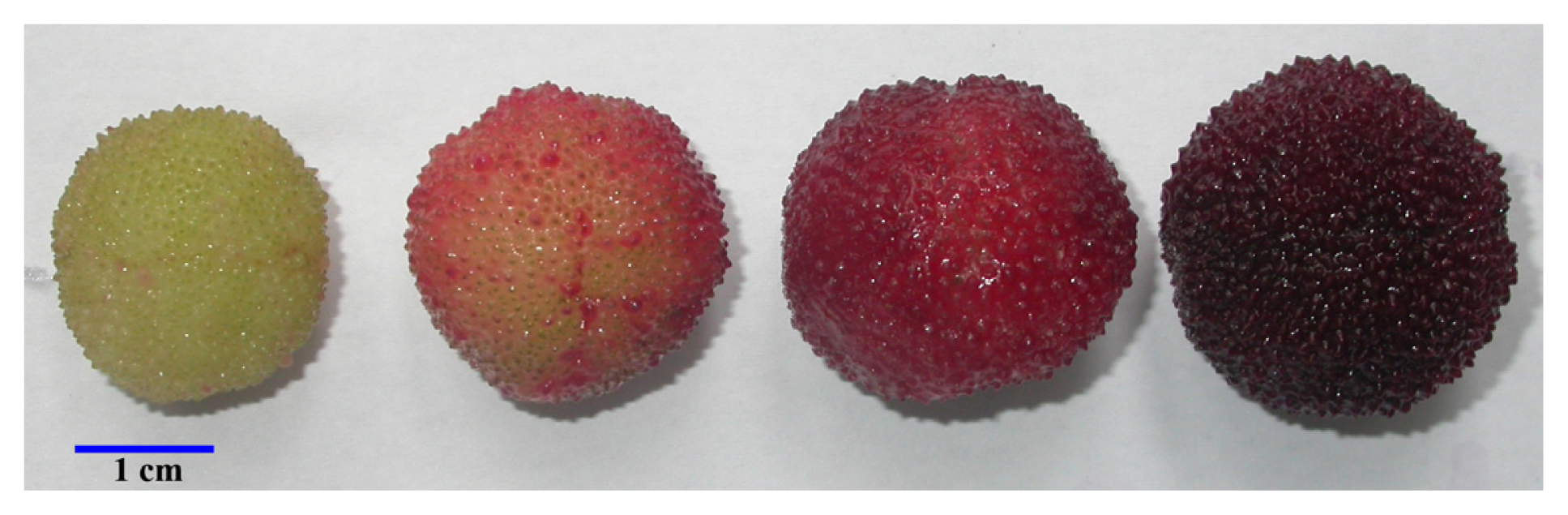
<p>During the fruit development and ripening, significant changes took place in fruit size, weight, as well as color and flavor attributes (<xref ref-type="fig" rid="f1-ijms-14-03110">Figure 1</xref> and <xref ref-type="table" rid="t1-ijms-14-03110">Table 1</xref>). Fruit size and weight kept increasing from mature green (MG), pink ripe (PR), red ripe (RR), to full ripe (FR) stages during ripening, which is quite different from common fruits, such as tomato and citrus. Sugars accumulated while the organic acid content decreased during ripening, and such changes were quite apparent, especially in late ripening stages (<xref ref-type="table" rid="t1-ijms-14-03110">Table 1</xref>). Fruit color development, as indicated by changes in CIRG, was well correlated with the accumulation in anthocyanins. The fully ripe fruit had an average diameter of 28.02 ± 1.16 mm, TSS of 12.95 ± 0.71 Brix, TA of 6.65 ± 0.80 mg/g FW, and total anthocyanins of 88.03 ± 9.24 mg/100 g FW.</p></sec>
<sec sec-type="methods">
<title>2.2. Analysis of Bayberry Fruit cDNA Libraries and EST Library</title>
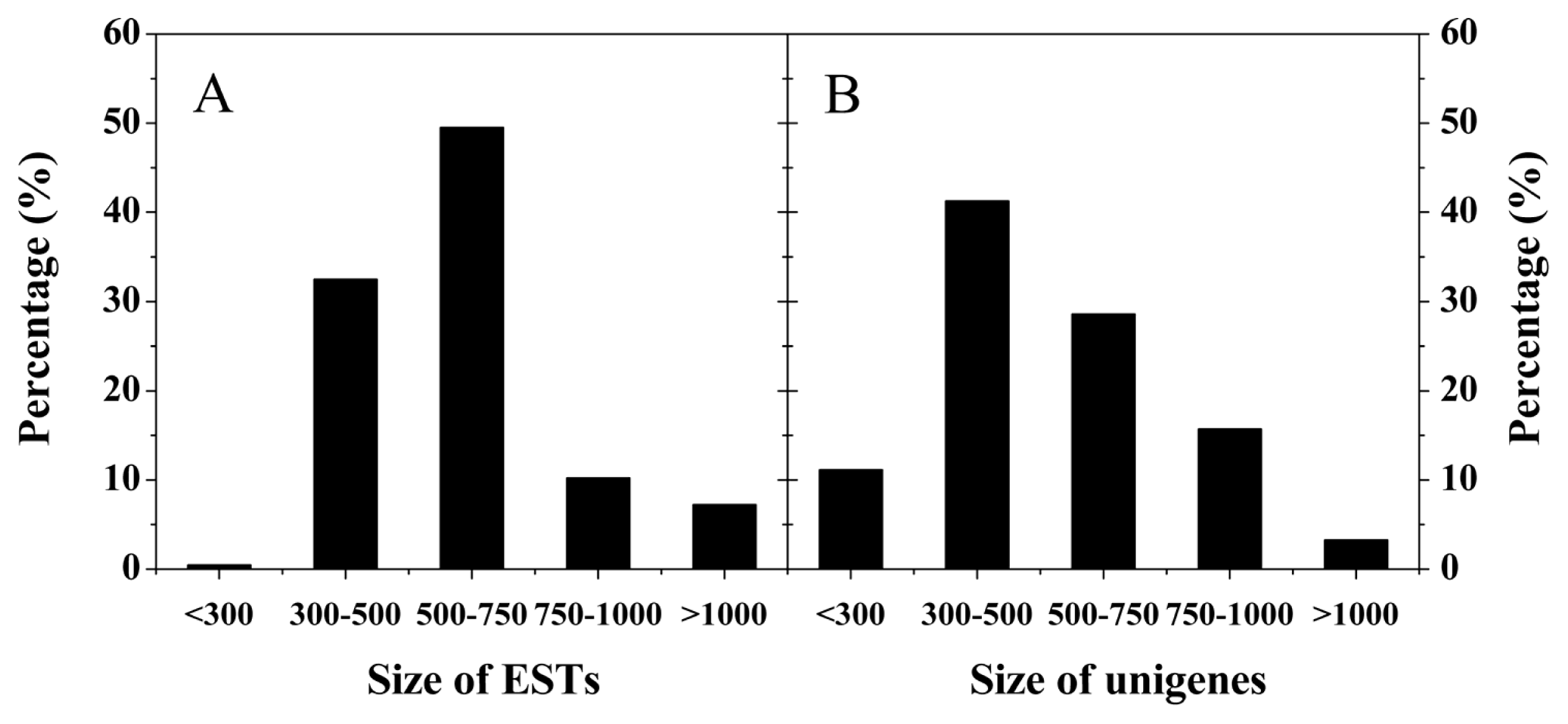
<p>The cDNA libraries for fruit at four different ripening stages were constructed with the titer of all the original cDNA libraries higher than 10<sup>5</sup> cfu/mL, while the titer for final EST libraries constructed thereafter were more than 10<sup>9</sup> cfu/mL (<xref ref-type="table" rid="t2-ijms-14-03110">Table 2</xref>). The recombinant rates of all the libraries were over 94%, and 500 recombinant clones from each library were chosen for sequencing for EST library construction. The length of EST ranged from 300 bp to 2000 bp (<xref ref-type="table" rid="t2-ijms-14-03110">Table 2</xref>), and the majority of the EST had a sequence length between 300 and 750 bp (<xref ref-type="fig" rid="f2-ijms-14-03110">Figure 2A</xref>). Cluster analysis showed that 395 unigenes were obtained from the 2000 ESTs, and the unigenes’ length distribution was shown in <xref ref-type="fig" rid="f2-ijms-14-03110">Figure 2B</xref>. The total number of tentative consensus sequences (TCs) was 94, and the total number of singletons was 301 (<xref ref-type="table" rid="t2-ijms-14-03110">Table 2</xref>). The diversity of expressed mRNA was lowest for MG fruit and highest for PR fruit (<xref ref-type="table" rid="t2-ijms-14-03110">Table 2</xref>), indicating that remarkable physiological changes occurred during the initiation of fruit ripening (<xref ref-type="fig" rid="f1-ijms-14-03110">Figure 1</xref>).</p></sec>
<sec>
<title>2.3. Functional Annotation of Bayberry EST</title>
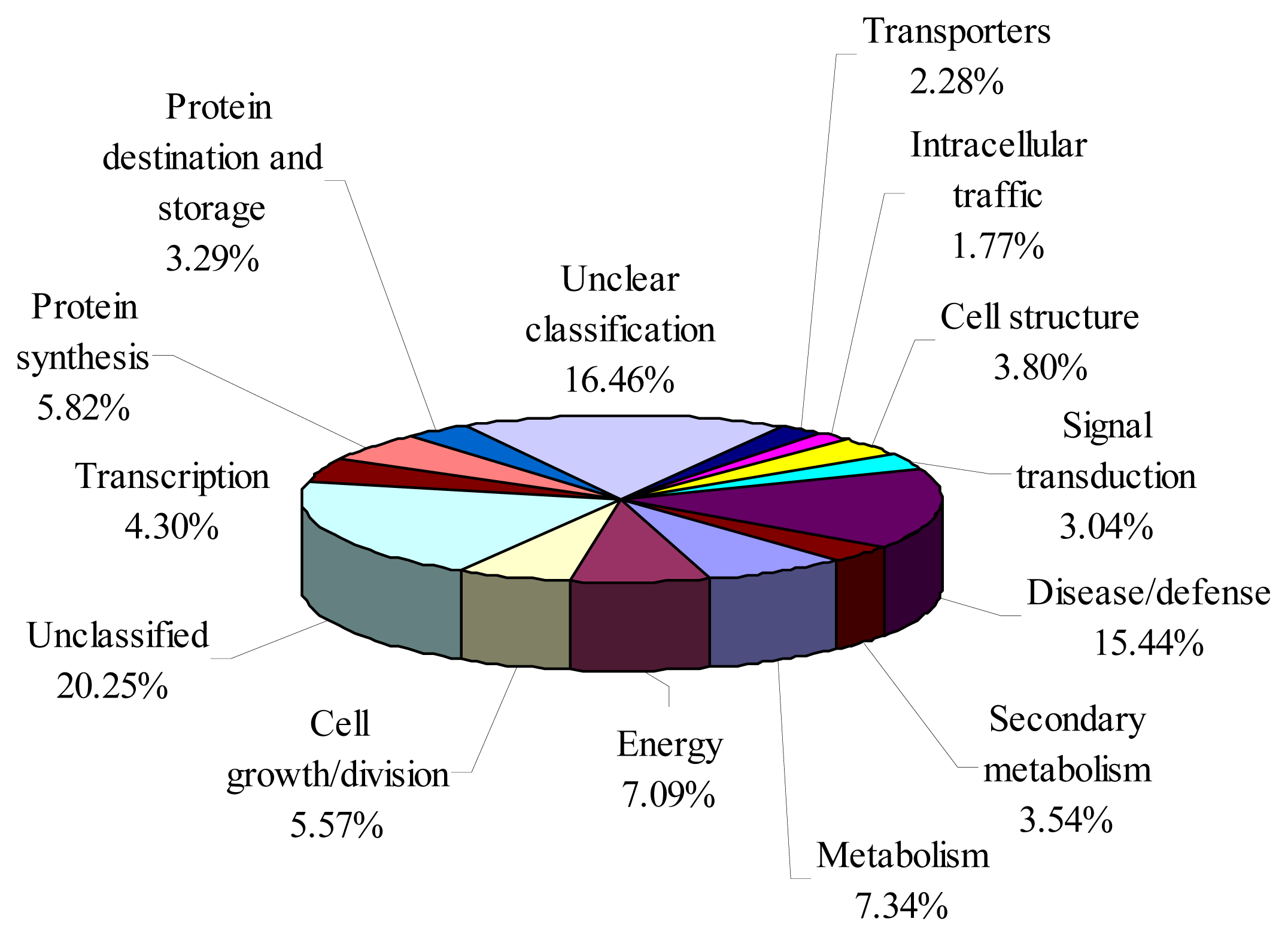
<p>BLASTing Uniprot database with the sequences of 395 unigenes from bayberry EST resulted in functional classification of 315 unigenes, while 80 unigenes were unclassified (<xref ref-type="fig" rid="f3-ijms-14-03110">Figure 3</xref>). About 15.44% unigenes were related to disease/defense, and they ranked as the first group with specific functional annotation available. Genes involved in metabolism (7.34% of the total unigenes) and energy (7.09%), ranked second and third, respectively. The rest of genes were annotated and classed into various cellular events, including protein synthesis (5.82%), cell growth and division (5.57%), transcription (4.30%), cell structure (3.80%), secondary metabolism (3.54%), protein destination and storage (3.29%), signal transduction (3.04%), transporters (2.28%), and intracellular traffic (1.77%). Besides this classification of unigenes, 16.46% genes were found without clear functional denotation. Generally, as the fleshy fruit ripens, degradation of cell wall materials exacerbated, which facilitated infection of fungus pathogens. The expression of a high number of disease/defense genes might be adaptive responses of Chinese bayberry ripe fruit to environments.</p></sec>
<sec sec-type="methods">
<title>2.4. Analysis of Highly Expressed Genes from “Biqi” Fruit ESTs</title>
<p>Ten highly expressed genes in the ESTs accounted for 1140 sequence reads, which was 57% of the total. The highest frequency gene (MRU00001) sequenced 408 times in four libraries, which alone accounted for 20.4% of the total EST numbers, and it showed highest amino acid sequence identity (77%) with metallothionein-like protein type 3 (MT3) from <italic>Musa acuminata</italic>. MTs are proteins involved in metal detoxification and homeostasis in the plant, and another two highly expressed genes (MRU00007 and MRU00032) showed 82% and 77% amino acid identity with MT2 from <italic>Ricinus communis</italic> and <italic>Fagus sylvatica</italic>, respectively. Another three highly expressed genes with more than 100 sequence reads might encode proteins, such as phytocystatin cysteine proteinase inhibitor 1 (MRU00012), phase-change related protein precursor (MRU00135), and thaumatin-like protein (MRU00040), respectively. In addition, genes encoding GAST-like protein and heat-shock proteins were all detected as highly expressed genes in “Biqi” fruit ESTs, and, therefore, data in <xref ref-type="table" rid="t3-ijms-14-03110">Table 3</xref> was consistent with those in <xref ref-type="fig" rid="f3-ijms-14-03110">Figure 3</xref> for the high percentage of disease/defense genes in ESTs. The presence of gene-encoding flavonoid 3′-hydroxylase (F3′H) (MRU00008) as highly expressed genes was also consistent with the accumulation of pigment during fruit development and ripening (<xref ref-type="table" rid="t3-ijms-14-03110">Table 3</xref>). Moreover, this is also consistent with what was reported on the highest transcript abundance of <italic>MrF3′H</italic> among all anthocyanin biosynthesis genes [<xref ref-type="bibr" rid="b27-ijms-14-03110">27</xref>].</p></sec>
<sec>
<title>2.5. Identification of Genes Regulating Bayberry Fruit Ripening and Senescence</title>
<p>Based on the BLAST result, ESTs encoding 1-aminocyclopropane-1-carboxylic acid oxidase (ACO) (MRU00059), ethylene response factor (ERF) (MRU00110), ethylene-insensitive 3-like protein (EIL) (MRU00129), and 9-<italic>cis</italic>-epoxycarotenoid dioxygenase (NCED) (MRU00088) were identified in the ripening bayberry library (<xref ref-type="table" rid="t4-ijms-14-03110">Table 4</xref>), indicating regulation of the plant hormone ethylene and ABA signal transduction pathway during fruit ripening and senescence. Chinese bayberry fruit was classified as a climacteric fruit due to its typical climacteric respiratory and ethylene behavior during postharvest storage [<xref ref-type="bibr" rid="b11-ijms-14-03110">11</xref>]. The three ESTs identified that are associated with ethylene biosynthesis and transduction may provide important tools for the discovery of the molecular regulatory mechanisms of bayberry fruit by ethylene. Other senescence-associated proteins (MRU00062 and MRU00387), ascorbate peroxidase (MRU00242), and cytochrome C reductase protein (MRU00050) were also identified as a result of the BLAST analysis.</p></sec>
<sec>
<title>2.6. Identification of Genes Associated with Quality Formation in Ripening Bayberry Fruit</title>
<p>Bayberry fruit undergoes significant quality changes during fruit development and ripening [<xref ref-type="bibr" rid="b11-ijms-14-03110">11</xref>]. Fruit pigments and volatiles accumulate as fruit become soft, juicy, and full of flavor. Over 100 ESTs were discovered to be related with such fruit quality formation and regulation. Genes encoding flavonoid 3′-hydroxylase (F3′H, MRU00008) and transcript factor MYB (MRU00113) were highly expressed ESTs during ripening stages (<xref ref-type="table" rid="t5-ijms-14-03110">Table 5</xref>), which is important for the pigment accumulation during fruit development (<xref ref-type="fig" rid="f1-ijms-14-03110">Figure 1</xref>), and UDP-glucose:flavonoid 3-<italic>O</italic>-glucosyltransferase (UFGT) (MRU00098) was identified in the FR fruit library. F3′H and UFTG were proven to be two key enzymes in anthocyanin biosynthesis in Chinese bayberry, which was regulated by MrMYB1 [<xref ref-type="bibr" rid="b27-ijms-14-03110">27</xref>].</p>
<p>Metabolism of sugar and organic acid during fruit development is important for the formation of flavors of bayberry characteristics [<xref ref-type="bibr" rid="b11-ijms-14-03110">11</xref>]. Genes encoding vacuolar ATP synthase subunit G1 (MRU00009), 6-phosphogluconate dehydrogenase (MRU00061), α-glucosidase-like protein (MRU00369), and β 1–3 glucanase (MRU00046) (<xref ref-type="table" rid="t5-ijms-14-03110">Table 5</xref>) were identified. Vacuolar ATP complex was important in the transport of organic acid between mitochondrion and cytoplasm, so expression of its subunit G1 was closely related to degradation of organic acid during fruit ripening.</p>
<p>In addition, enzymes involved in cell wall modification play an important role in regulating fruit texture changes as fruit softens during ripening. ESTs encoding polygalacturonase inhibitor-like protein (PGIP) (MRU00130), polygalacturonase (PG) (MRU00124), and peroxidase (POD) (MRU00022) were identified in the FR library (<xref ref-type="table" rid="t5-ijms-14-03110">Table 5</xref>).</p>
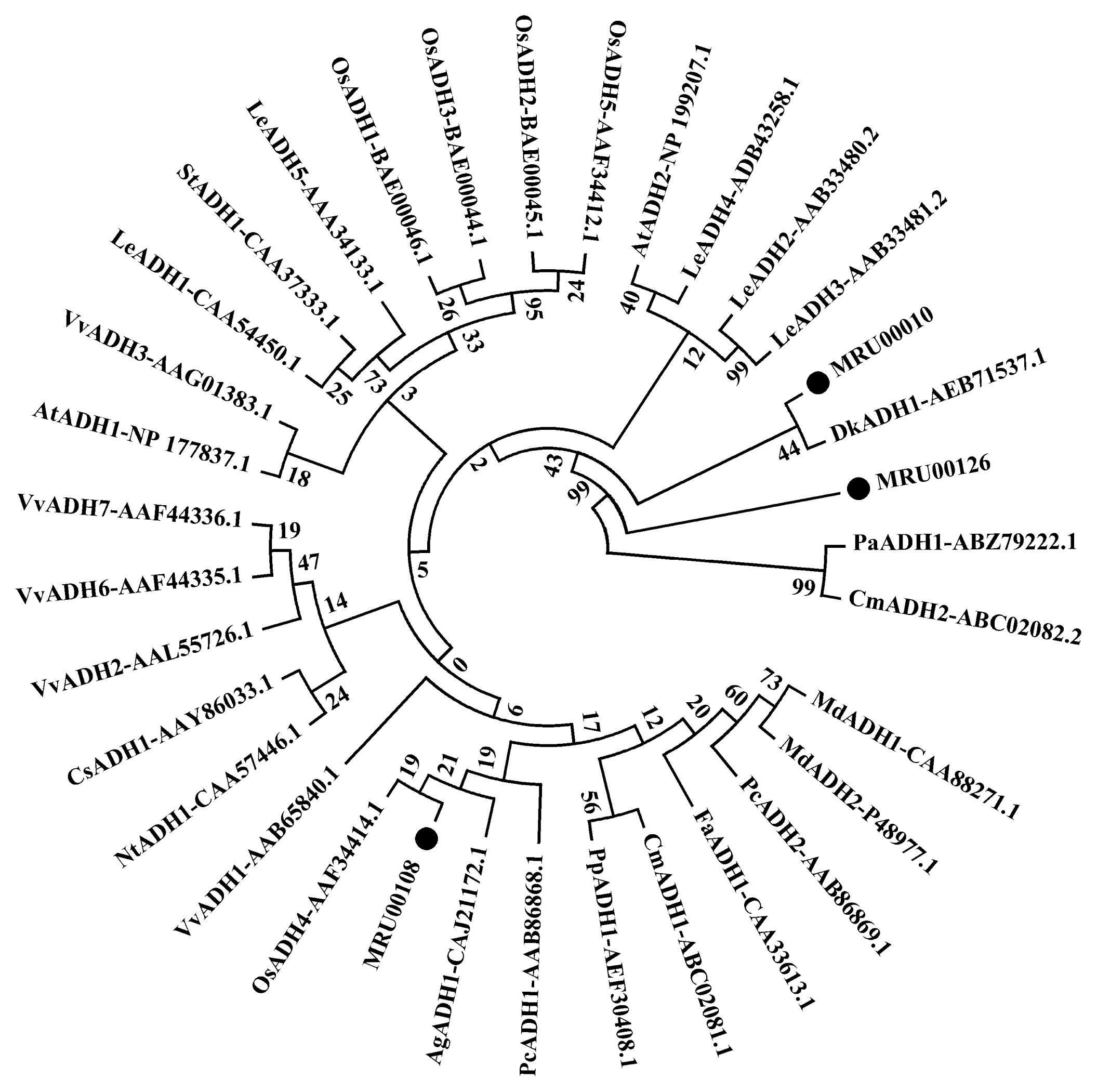
<p>For the aroma formation during bayberry development, 19 ESTs were identified as possibly encoding three members of alcohol dehydrogenases (ADH) (MRU00010, MRU00108, MRU00126) (<xref ref-type="table" rid="t5-ijms-14-03110">Table 5</xref>). The biosynthesis of ADH during RR and FR stages was associated with the increased contents of ethanol and acetaldehyde as parts of aroma composition during fruit ripening (<xref ref-type="table" rid="t1-ijms-14-03110">Table 1</xref>). Amino acid sequence alignment of three bayberry ADH members with those from other plants is shown in <xref ref-type="fig" rid="f4-ijms-14-03110">Figure 4</xref>, and they demonstrated high amino acid identity with ADHs from persimmon (<italic>Diospyros kaki</italic>), alder (<italic>Alnus glutinosa</italic>), and grape (<italic>Vitis vinifera</italic>). Additionally, ESTs encoding short chain alcohol dehydrogenase were also obtained (<xref ref-type="table" rid="t5-ijms-14-03110">Table 5</xref>).</p></sec></sec>
<sec>
<title>3. Experimental Section</title>
<sec sec-type="materials">
<title>3.1. Plant Materials</title>
<p>Chinese bayberry (<italic>Myrica rubra</italic> Sieb and Zucc. <italic>cv.</italic> Biqi) fruit were harvested from the Germplasm Collection of China Bayberry at Yuyao city, Zhejiang Province, China, at four different ripening stages according to fruit color, <italic>i.e.</italic>, mature green (MG), pink ripe (PR), red ripe (RR), and full ripe (FR) (<xref ref-type="fig" rid="f1-ijms-14-03110">Figure 1</xref>). The flesh tissues were taken and frozen in liquid nitrogen, and then stored at −70 °C.</p></sec>
<sec>
<title>3.2. Fruit Surface Color Measurement</title>
<p>Ten fruits for each ripening stage were subjected to color measurement with MiniScan XE Plus (HunterLab, Reston, VA, USA) and the color index of red grapes (CIRG) was calculated to indicate the fruit maturity as described by Zhang <italic>et al.</italic>[<xref ref-type="bibr" rid="b11-ijms-14-03110">11</xref>], where <italic>CIRG</italic> = (180 − <italic>H</italic>)/(<italic>L</italic>* + <italic>C</italic>).</p></sec>
<sec>
<title>3.3. Total Soluble Solid (TSS) and Titratable Acidity (TA)</title>
<p>Total soluble solids (TSS) and total titratable acids were measured according to Zhang <italic>et al.</italic>[<xref ref-type="bibr" rid="b11-ijms-14-03110">11</xref>]. TSS contents (∘Brix) of 10 fruits, two measurements per fruit, were determined with a handheld refractometer (ATAGO PR-101α, Tokyo, Japan). For TA analysis, one gram of fruit mesocarp tissue derived from a segment of flesh was ground with 5 mL of distilled water. After filtration and centrifugation for 10 min at 10,000 × <italic>g</italic>, the supernatant was brought to 10 mL with distilled water. The water was heated for 5 min at 100 °C to eliminate CO<sub>2</sub>, and subsequently titrated with freshly prepared 10 mmol/L NaOH to pH 8.2. TA was quantified as citric acid equivalents and results were expressed as mg/fresh weight (FW). The samples for TA analysis were taken in triplicate.</p></sec>
<sec>
<title>3.4. Determination of Total Anthocyanin Contents</title>
<p>Anthocyanin quantification was performed as described by Zhang <italic>et al.</italic>[<xref ref-type="bibr" rid="b4-ijms-14-03110">4</xref>]. The fruit extract was diluted with buffers at 1:5, respectively. Absorbance at 510 nm and 700 nm using a spectrophotometer (DU-8000 Beckman Coulter, Fullerton, CA, USA) were recorded for reactions at both pHs. Results were expressed as mg C3G equivalents/100 g FW using a molar extinction coefficient of 29,600. The samples for anthocyanin determination were taken in triplicate.</p></sec>
<sec>
<title>3.5. Determination of Alcohol Contents</title>
<p>The method for measurements of acetaldehyde and ethanol production was slightly modified from that of Ke and Kader [<xref ref-type="bibr" rid="b28-ijms-14-03110">28</xref>]. Frozen fruit powder was homogenized in 5 mL saturated NaCl solution. 5 mL of the mixture were put in a 10 mL air-tight test tube with crimp-top caps. Before measurement, the test tube was incubated at 60 °C for 1 h in a water bath. Then, 1 mL sample of the head space gas was withdrawn from each test tube and injected into the gas chromatograph (Lunan Chemical Engineering Instrument Co. Ltd., model GC-6800, Shandong, China) equipped with a flame ionization detector (FID) and a PGE-20K packed column (Lunan Chemical Engineering Instrument Co. Ltd). The injector, detector and oven temperatures were 150, 80 and 150 °C, respectively. Sec-butyl alcohol was added to each vial as an internal control. Acetaldehyde and ethanol was identified by comparison of retention times, and the results were calculated using standard curves.</p></sec>
<sec>
<title>3.6. Construction of Bayberry Fruit cDNA Library</title>
<p>Total RNA was extracted according to our previously published protocol [<xref ref-type="bibr" rid="b29-ijms-14-03110">29</xref>]. Poly(A) RNA was isolated using PolyATtract<sup>®</sup> mRNA Isolation Systems (Promega, Madison, WI, USA) according to the procedure recommended by the manufacturer, and the concentration of poly(A) RNA isolated was quantified fluorometrically as described by Wang <italic>et al.</italic>[<xref ref-type="bibr" rid="b30-ijms-14-03110">30</xref>]. Synthesis of double-stranded cDNA, construction and titration of cDNA libraries were carried out using a Creator™ SMART™ cDNA Library Construction Kit (Clontech Laboratories, Inc., Mountain View, CA, USA) according to the instructions of the manufacturer, except that the cDNA size fractionation was completed with a gel-recovery strategy using Wizard<sup>®</sup> PCR Preps DNA Purification System (Promega, Madison, WI, USA). The cDNA libraries were constructed using the pDNR-LIB vector. The recombinant pDNR-LIB plasmids harboring cDNAs were transformed into ElectroTen-Blue<sup>®</sup> Electroporation Competent Cells (Stratagene, La Jolla, CA, USA).</p>
<p>The size of insert in individual cDNA clones was analyzed by conventional PCR with pDNR-F3 (5′-ACGACTCACTATAGGGCGCT-3′) and pDNR-R2 (5′-GCGCCAAACGAATGGTCTAG-3′) as primers. Clones with insert shorter than 300 bp were excluded from further sequencing. Sequencing was completed by Invitrogen Biotechnology Co., Ltd. (Shanghai, China) with pDNR-F3 as sequencing primer.</p></sec>
<sec sec-type="methods">
<title>3.7. Bioinformatics Analysis</title>
<p>After removal of vector sequences, the final sequences were recorded as ESTs. Alignment of ESTs was completed with Clustal X 1.81 (Institut de Genetiave et de Biologie Moleculaire et cellvlaire, CNRS/INSERM/VLP, Illkirch Cedex, France). Sequences with a 40-bp-overlap of no less than 97.5% homology were regarded as tentative consensus sequences (TCs), while the others as singletons. Homologous information for individual unigene was obtained by BLASTing UniProt [<xref ref-type="bibr" rid="b31-ijms-14-03110">31</xref>,<xref ref-type="bibr" rid="b32-ijms-14-03110">32</xref>]. The function of each individual unigene was classified according to Bevan <italic>et al.</italic>[<xref ref-type="bibr" rid="b33-ijms-14-03110">33</xref>].</p></sec>
<sec sec-type="methods">
<title>3.8. Statistic Analysis</title>
<p>Experiments were performed in triplicate and data were expressed as the mean ± standard deviation.</p></sec></sec>
<sec sec-type="conclusions">
<title>4. Conclusions</title>
<p>In conclusion, based on analysis of 2000 ESTs from cDNA libraries of bayberry fruit at four different ripening stages, a total of 395 unigenes were obtained. Genes encoding elements associated with ethylene biosynthesis and signal transductions, and other senescence-regulating proteins, as well as those related to fruit quality attributes were identified. It was then observed that expression of these genes generally increased as the fruit ripened, which was suggested to be involved in fruit quality formation and regulation during fruit ripening.</p></sec></body>
<back>
<ack>
<title>Acknowledgments</title>
<p>This work was supported by the Special Scientific Research Fund of Agricultural Public Welfare Profession of China (201203089), and the Science and Technology Project of Zhejiang Province (2009C14023, 2012C12904-3), the 948 project (2010-S18), the National Spark Project (2012GA700003), the Specialized Research Fund for the Doctoral Program of Higher Education of China (20090101110099), and Zhejiang Province Education Foundation (Y201122362).</p></ack>
<fn-group><fn id="fn1-ijms-14-03110">
<p><bold>Conflict of Interest</bold></p>
<p>The authors declare no conflict of interest.</p></fn></fn-group>
<ref-list>
<title>References</title>
<ref id="b1-ijms-14-03110"><label>1</label><citation citation-type="journal"><person-group person-group-type="author"><name><surname>Chen</surname><given-names>K.S.</given-names></name><name><surname>Xu</surname><given-names>C.J.</given-names></name><name><surname>Zhang</surname><given-names>B.</given-names></name><name><surname>Ferguson</surname><given-names>I.B.</given-names></name></person-group><article-title>Red bayberry: Botany and horticulture</article-title><source>Hort. Rev</source><year>2004</year><volume>30</volume><fpage>83</fpage><lpage>114</lpage></citation></ref>
<ref id="b2-ijms-14-03110"><label>2</label><citation citation-type="journal"><person-group person-group-type="author"><name><surname>Zhang</surname><given-names>S.M.</given-names></name><name><surname>Gao</surname><given-names>Z.S.</given-names></name><name><surname>Xu</surname><given-names>C.J.</given-names></name><name><surname>Chen</surname><given-names>K.S.</given-names></name><name><surname>Wang</surname><given-names>G.Y.</given-names></name><name><surname>Zheng</surname><given-names>J.T.</given-names></name><name><surname>Lu</surname><given-names>T.</given-names></name></person-group><article-title>Genetic diversity of Chinese bayberry (<italic>Myrica rubra</italic> Sieb. et Zucc.) accessions revealed by amplified fragment length polymorphism</article-title><source>HortScience</source><year>2009</year><volume>44</volume><fpage>487</fpage><lpage>491</lpage></citation></ref>
<ref id="b3-ijms-14-03110"><label>3</label><citation citation-type="book"><person-group person-group-type="author"><name><surname>Chen</surname><given-names>K.S.</given-names></name><name><surname>Xu</surname><given-names>C.J.</given-names></name><name><surname>Zhang</surname><given-names>B.</given-names></name><name><surname>Ferguson</surname><given-names>I.B.</given-names></name></person-group><article-title><italic>Myrica rubra</italic> (Red Bayberry)</article-title><source>The Encyclopedia of Fruit and Nuts</source><person-group person-group-type="editor"><name><surname>Janick</surname><given-names>J.</given-names></name><name><surname>Paull</surname><given-names>R.E.</given-names></name></person-group><publisher-name>Cambridge University Press</publisher-name><publisher-loc>Cambridge, UK</publisher-loc><year>2008</year><fpage>522</fpage><lpage>526</lpage></citation></ref>
<ref id="b4-ijms-14-03110"><label>4</label><citation citation-type="journal"><person-group person-group-type="author"><name><surname>Zhang</surname><given-names>W.S.</given-names></name><name><surname>Li</surname><given-names>X.</given-names></name><name><surname>Zheng</surname><given-names>J.T.</given-names></name><name><surname>Wang</surname><given-names>G.Y.</given-names></name><name><surname>Sun</surname><given-names>C.D.</given-names></name><name><surname>Ferguson</surname><given-names>I.B.</given-names></name><name><surname>Chen</surname><given-names>K.S.</given-names></name></person-group><article-title>Bioactive components and antioxidant capacity of Chinese bayberry (<italic>Myrica rubra</italic> Sieb. and Zucc.) fruit in relation to fruit maturity and postharvest storage</article-title><source>Eur. Food Res. Technol</source><year>2008</year><volume>227</volume><fpage>1091</fpage><lpage>1097</lpage><pub-id pub-id-type="doi">10.1007/s00217-008-0824-z</pub-id></citation></ref>
<ref id="b5-ijms-14-03110"><label>5</label><citation citation-type="journal"><person-group person-group-type="author"><name><surname>Zhang</surname><given-names>B.</given-names></name><name><surname>Kang</surname><given-names>M.</given-names></name><name><surname>Xie</surname><given-names>Q.</given-names></name><name><surname>Xu</surname><given-names>B.</given-names></name><name><surname>Sun</surname><given-names>C.</given-names></name><name><surname>Chen</surname><given-names>K.</given-names></name><name><surname>Wu</surname><given-names>Y.</given-names></name></person-group><article-title>Anthocyanins from Chinese bayberry extract protect β cells from oxidative stress-mediated injury via HO-1 upregulation</article-title><source>J. Agric. Food Chem</source><year>2011</year><volume>59</volume><fpage>537</fpage><lpage>545</lpage><pub-id pub-id-type="doi">10.1021/jf1035405</pub-id><pub-id pub-id-type="pmid">21166417</pub-id></citation></ref>
<ref id="b6-ijms-14-03110"><label>6</label><citation citation-type="journal"><person-group person-group-type="author"><name><surname>Sun</surname><given-names>C.D.</given-names></name><name><surname>Zhang</surname><given-names>B.</given-names></name><name><surname>Zhang</surname><given-names>J.K.</given-names></name><name><surname>Xu</surname><given-names>C.J.</given-names></name><name><surname>Wu</surname><given-names>Y.L.</given-names></name><name><surname>Li</surname><given-names>X.</given-names></name><name><surname>Chen</surname><given-names>K.S.</given-names></name></person-group><article-title>Cyanidin-3-glucoside-rich extract from Chinese bayberry fruit protects pancreatic β cells and ameliorates hyperglycemia in streptozotocin-induced diabetic mice</article-title><source>J. Med. Food</source><year>2012</year><volume>15</volume><fpage>288</fpage><lpage>298</lpage><pub-id pub-id-type="doi">10.1089/jmf.2011.1806</pub-id><pub-id pub-id-type="pmid">22181073</pub-id></citation></ref>
<ref id="b7-ijms-14-03110"><label>7</label><citation citation-type="journal"><person-group person-group-type="author"><name><surname>Sun</surname><given-names>C.D.</given-names></name><name><surname>Zheng</surname><given-names>Y.X.</given-names></name><name><surname>Chen</surname><given-names>Q.J.</given-names></name><name><surname>Tang</surname><given-names>X.L.</given-names></name><name><surname>Jiang</surname><given-names>M.</given-names></name><name><surname>Zhang</surname><given-names>J.K.</given-names></name><name><surname>Li</surname><given-names>X.</given-names></name><name><surname>Chen</surname><given-names>K.S.</given-names></name></person-group><article-title>Purification and anti-tumor activity of cyanidin-3-<italic>O</italic>-glucoside from Chinese bayberry fruit</article-title><source>Food Chem</source><year>2012</year><volume>131</volume><fpage>1287</fpage><lpage>1294</lpage><pub-id pub-id-type="doi">10.1016/j.foodchem.2011.09.121</pub-id></citation></ref>
<ref id="b8-ijms-14-03110"><label>8</label><citation citation-type="journal"><person-group person-group-type="author"><name><surname>Joyce</surname><given-names>D.C.</given-names></name></person-group><article-title>Evaluation of fresh red bayberry (<italic>Myrica rubra</italic>) fruit acceptance</article-title><source>N. Z. J. Crop Hort</source><year>2007</year><volume>35</volume><fpage>125</fpage><lpage>128</lpage><pub-id pub-id-type="doi">10.1080/01140670709510176</pub-id></citation></ref>
<ref id="b9-ijms-14-03110"><label>9</label><citation citation-type="journal"><person-group person-group-type="author"><name><surname>Karp</surname><given-names>D</given-names></name></person-group><article-title>From China, only in a bottle, a berry with an alluring name</article-title><source>The New York Times</source><day>12</day><month>December</month><year>2007</year></citation></ref>
<ref id="b10-ijms-14-03110"><label>10</label><citation citation-type="journal"><person-group person-group-type="author"><name><surname>Karp</surname><given-names>D.</given-names></name></person-group><article-title><italic>Myrica rubra</italic>, a fruit of many names</article-title><source>Fruit Gardener</source><year>2008</year><volume>40</volume><fpage>30</fpage><lpage>33</lpage></citation></ref>
<ref id="b11-ijms-14-03110"><label>11</label><citation citation-type="journal"><person-group person-group-type="author"><name><surname>Zhang</surname><given-names>W.S.</given-names></name><name><surname>Chen</surname><given-names>K.S.</given-names></name><name><surname>Zhang</surname><given-names>B.</given-names></name><name><surname>Sun</surname><given-names>C.D.</given-names></name><name><surname>Cai</surname><given-names>C.</given-names></name><name><surname>Zhou</surname><given-names>C.H.</given-names></name><name><surname>Xu</surname><given-names>W.P.</given-names></name><name><surname>Zhang</surname><given-names>W.Q.</given-names></name><name><surname>Ferguson</surname><given-names>I.B.</given-names></name></person-group><article-title>Postharvest responses of Chinese bayberry fruit</article-title><source>Postharvest Biol. Technol</source><year>2005</year><volume>37</volume><fpage>241</fpage><lpage>251</lpage><pub-id pub-id-type="doi">10.1016/j.postharvbio.2005.05.005</pub-id></citation></ref>
<ref id="b12-ijms-14-03110"><label>12</label><citation citation-type="journal"><person-group person-group-type="author"><name><surname>Zhang</surname><given-names>W.S.</given-names></name><name><surname>Li</surname><given-names>X.</given-names></name><name><surname>Wang</surname><given-names>X.X.</given-names></name><name><surname>Wang</surname><given-names>G.Y.</given-names></name><name><surname>Zheng</surname><given-names>J.T.</given-names></name><name><surname>Abeysinghe</surname><given-names>D.C.</given-names></name><name><surname>Ferguson</surname><given-names>I.B.</given-names></name><name><surname>Chen</surname><given-names>K.S.</given-names></name></person-group><article-title>Ethanol vapour treatment alleviates postharvest decay and maintains fruit quality in Chinese bayberry fruit</article-title><source>Postharvest Biol. Technol</source><year>2007</year><volume>46</volume><fpage>195</fpage><lpage>198</lpage><pub-id pub-id-type="doi">10.1016/j.postharvbio.2007.05.001</pub-id></citation></ref>
<ref id="b13-ijms-14-03110"><label>13</label><citation citation-type="journal"><person-group person-group-type="author"><name><surname>Yang</surname><given-names>Z.F.</given-names></name><name><surname>Heng</surname><given-names>Y.H.</given-names></name><name><surname>Cao</surname><given-names>S.F.</given-names></name></person-group><article-title>Effect of high oxygen atmosphere storage on quality, antioxidant enzymes, and DPPH-radical scavenging activity of Chinese bayberry fruit</article-title><source>J. Agric. Food Chem</source><year>2009</year><volume>57</volume><fpage>176</fpage><lpage>181</lpage><pub-id pub-id-type="doi">10.1021/jf803007j</pub-id><pub-id pub-id-type="pmid">19093866</pub-id></citation></ref>
<ref id="b14-ijms-14-03110"><label>14</label><citation citation-type="journal"><person-group person-group-type="author"><name><surname>Wang</surname><given-names>K.T.</given-names></name><name><surname>Jin</surname><given-names>P.</given-names></name><name><surname>Tang</surname><given-names>S.S.</given-names></name><name><surname>Shang</surname><given-names>H.T.</given-names></name><name><surname>Rui</surname><given-names>H.J.</given-names></name><name><surname>Di</surname><given-names>H.T.</given-names></name><name><surname>Cai</surname><given-names>Y.</given-names></name><name><surname>Zheng</surname><given-names>Y.H.</given-names></name></person-group><article-title>Improved control of postharvest decay in Chinese bayberries by a combination treatment of ethanol vapor with hot air</article-title><source>Food Control</source><year>2011</year><volume>22</volume><fpage>82</fpage><lpage>87</lpage><pub-id pub-id-type="doi">10.1016/j.foodcont.2010.05.011</pub-id></citation></ref>
<ref id="b15-ijms-14-03110"><label>15</label><citation citation-type="journal"><person-group person-group-type="author"><name><surname>Alba</surname><given-names>R.</given-names></name><name><surname>Fei</surname><given-names>Z.</given-names></name><name><surname>Payton</surname><given-names>P.</given-names></name><name><surname>Liu</surname><given-names>Y.</given-names></name><name><surname>Moore</surname><given-names>S.L.</given-names></name><name><surname>Debbie</surname><given-names>P.</given-names></name><name><surname>Cohn</surname><given-names>J.</given-names></name><name><surname>Ascenzo</surname><given-names>M.D.</given-names></name><name><surname>Gordon</surname><given-names>J.S.</given-names></name><name><surname>Rose</surname><given-names>J.K.C.</given-names></name><etal/></person-group><article-title>ESTs, cDNA microarrays, and gene expression profiling: Tools for dissecting plant physiology and development</article-title><source>Plant J</source><year>2004</year><volume>39</volume><fpage>697</fpage><lpage>714</lpage><pub-id pub-id-type="doi">10.1111/j.1365-313X.2004.02178.x</pub-id><pub-id pub-id-type="pmid">15315633</pub-id></citation></ref>
<ref id="b16-ijms-14-03110"><label>16</label><citation citation-type="journal"><person-group person-group-type="author"><name><surname>Pashley</surname><given-names>C.H.</given-names></name><name><surname>Ellis</surname><given-names>J.R.</given-names></name><name><surname>McCauley</surname><given-names>D.E.</given-names></name><name><surname>Burke</surname><given-names>J.M.</given-names></name></person-group><article-title>EST databases as a source for molecular markers: Lessons from Helianthus</article-title><source>J. Hered</source><year>2006</year><volume>97</volume><fpage>381</fpage><lpage>388</lpage><pub-id pub-id-type="pmid">16840524</pub-id></citation></ref>
<ref id="b17-ijms-14-03110"><label>17</label><citation citation-type="journal"><person-group person-group-type="author"><name><surname>Rudd</surname><given-names>S.</given-names></name></person-group><article-title>Expressed sequence tags: Alternative or complement to whole genome sequences?</article-title><source>Trends Plant Sci</source><year>2003</year><volume>8</volume><fpage>321</fpage><lpage>329</lpage><pub-id pub-id-type="doi">10.1016/S1360-1385(03)00131-6</pub-id><pub-id pub-id-type="pmid">12878016</pub-id></citation></ref>
<ref id="b18-ijms-14-03110"><label>18</label><citation citation-type="journal"><person-group person-group-type="author"><name><surname>Cercós</surname><given-names>M.</given-names></name><name><surname>Soler</surname><given-names>G.</given-names></name><name><surname>Iglesias</surname><given-names>D.J.</given-names></name><name><surname>Gadea</surname><given-names>J.</given-names></name><name><surname>Forment</surname><given-names>J.</given-names></name><name><surname>Talón</surname><given-names>M.</given-names></name></person-group><article-title>Global analysis of gene expression during development and ripening of citrus fruit flesh. A proposed mechanism for citric acid utilization</article-title><source>Plant Mol. Biol</source><year>2006</year><volume>62</volume><fpage>513</fpage><lpage>527</lpage><pub-id pub-id-type="doi">10.1007/s11103-006-9037-7</pub-id><pub-id pub-id-type="pmid">16897468</pub-id></citation></ref>
<ref id="b19-ijms-14-03110"><label>19</label><citation citation-type="journal"><person-group person-group-type="author"><name><surname>Terol</surname><given-names>J.</given-names></name><name><surname>Conesa</surname><given-names>A.</given-names></name><name><surname>Colmenero</surname><given-names>J.M.</given-names></name><name><surname>Cercos</surname><given-names>M.</given-names></name><name><surname>Tadeo</surname><given-names>F.</given-names></name><name><surname>Agustí</surname><given-names>J.</given-names></name><name><surname>Alós</surname><given-names>E.</given-names></name><name><surname>Andres</surname><given-names>F.</given-names></name><name><surname>Soler</surname><given-names>G.</given-names></name><name><surname>Brumos</surname><given-names>J.</given-names></name><etal/></person-group><article-title>Analysis of 13,000 unique Citrus clusters associated with fruit quality, production and salinity tolerance</article-title><source>BMC Genomics</source><year>2007</year><volume>8</volume><fpage>31</fpage><pub-id pub-id-type="doi">10.1186/1471-2164-8-31</pub-id><pub-id pub-id-type="pmid">17254327</pub-id></citation></ref>
<ref id="b20-ijms-14-03110"><label>20</label><citation citation-type="journal"><person-group person-group-type="author"><name><surname>Janssen</surname><given-names>B.J.</given-names></name><name><surname>Thodey</surname><given-names>K.</given-names></name><name><surname>Schaffer</surname><given-names>R.J.</given-names></name><name><surname>Alba</surname><given-names>R.</given-names></name><name><surname>Balakrishnan</surname><given-names>L.</given-names></name><name><surname>Bishop</surname><given-names>R.</given-names></name><name><surname>Bowen</surname><given-names>J.H.</given-names></name><name><surname>Crowhurst</surname><given-names>R.N.</given-names></name><name><surname>Gleave</surname><given-names>A.P.</given-names></name><name><surname>Ledger</surname><given-names>S.</given-names></name><etal/></person-group><article-title>Global gene expression analysis of apple fruit development from the floral bud to ripe fruit</article-title><source>BMC Plant Biol</source><year>2008</year><volume>8</volume><fpage>16</fpage><pub-id pub-id-type="doi">10.1186/1471-2229-8-16</pub-id><pub-id pub-id-type="pmid">18279528</pub-id></citation></ref>
<ref id="b21-ijms-14-03110"><label>21</label><citation citation-type="journal"><person-group person-group-type="author"><name><surname>Newcomb</surname><given-names>R.D.</given-names></name><name><surname>Crowhurst</surname><given-names>R.N.</given-names></name><name><surname>Gleave</surname><given-names>A.P.</given-names></name><name><surname>Rikkerink</surname><given-names>E.H.A.</given-names></name><name><surname>Allan</surname><given-names>A.C.</given-names></name><name><surname>Beuning</surname><given-names>L.L.</given-names></name><name><surname>Bowen</surname><given-names>J.H.</given-names></name><name><surname>Gera</surname><given-names>E.</given-names></name><name><surname>Jamieson</surname><given-names>K.R.</given-names></name><name><surname>Janssen</surname><given-names>B.J.</given-names></name><etal/></person-group><article-title>Analyses of expressed sequence tags from apple</article-title><source>Plant Physiol</source><year>2006</year><volume>141</volume><fpage>147</fpage><lpage>166</lpage><pub-id pub-id-type="doi">10.1104/pp.105.076208</pub-id><pub-id pub-id-type="pmid">16531485</pub-id></citation></ref>
<ref id="b22-ijms-14-03110"><label>22</label><citation citation-type="journal"><person-group person-group-type="author"><name><surname>Park</surname><given-names>S.</given-names></name><name><surname>Sugimoto</surname><given-names>N.</given-names></name><name><surname>Larson</surname><given-names>M.D.</given-names></name><name><surname>Beaudry</surname><given-names>R.</given-names></name><name><surname>Nocker</surname><given-names>S.</given-names></name></person-group><article-title>Identification of genes with potential roles in apple fruit development and biochemistry through large-scale statistical analysis of expressed sequence tags</article-title><source>Plant Physiol</source><year>2006</year><volume>141</volume><fpage>811</fpage><lpage>824</lpage><pub-id pub-id-type="doi">10.1104/pp.106.080994</pub-id><pub-id pub-id-type="pmid">16825339</pub-id></citation></ref>
<ref id="b23-ijms-14-03110"><label>23</label><citation citation-type="journal"><person-group person-group-type="author"><name><surname>Da Silva</surname><given-names>F.G.</given-names></name><name><surname>Iandolino</surname><given-names>A.</given-names></name><name><surname>Al-Kayal</surname><given-names>F.</given-names></name><name><surname>Bohlmann</surname><given-names>M.C.</given-names></name><name><surname>Cushman</surname><given-names>M.A.</given-names></name><name><surname>Lim</surname><given-names>H.</given-names></name><name><surname>Ergul</surname><given-names>A.</given-names></name><name><surname>Figueroa</surname><given-names>R.</given-names></name><name><surname>Kabuloglu</surname><given-names>E.K.</given-names></name><name><surname>Osborne</surname><given-names>C.</given-names></name><etal/></person-group><article-title>Characterizing the grape transcriptome. Analysis of expressed sequence tags from multiple <italic>Vitis</italic> species and development of a compendium of gene expression during berry development</article-title><source>Plant Physiol</source><year>2005</year><volume>139</volume><fpage>574</fpage><lpage>597</lpage><pub-id pub-id-type="doi">10.1104/pp.105.065748</pub-id><pub-id pub-id-type="pmid">16219919</pub-id></citation></ref>
<ref id="b24-ijms-14-03110"><label>24</label><citation citation-type="journal"><person-group person-group-type="author"><name><surname>Wang</surname><given-names>X.C.</given-names></name><name><surname>Guo</surname><given-names>L.</given-names></name><name><surname>Shangguan</surname><given-names>L.F.</given-names></name><name><surname>Wang</surname><given-names>C.</given-names></name><name><surname>Yang</surname><given-names>G.</given-names></name><name><surname>Qu</surname><given-names>S.C.</given-names></name><name><surname>Fang</surname><given-names>J.G.</given-names></name></person-group><article-title>Analysis of expressed sequence tags from grapevine flower and fruit and development of simple sequence repeat markers</article-title><source>Mol. Biol. Rep</source><year>2012</year><volume>39</volume><fpage>6825</fpage><lpage>6834</lpage><pub-id pub-id-type="doi">10.1007/s11033-012-1507-1</pub-id><pub-id pub-id-type="pmid">22318547</pub-id></citation></ref>
<ref id="b25-ijms-14-03110"><label>25</label><citation citation-type="journal"><person-group person-group-type="author"><name><surname>Crowhurst</surname><given-names>R.N.</given-names></name><name><surname>Gleave</surname><given-names>A.P.</given-names></name><name><surname>MacRae</surname><given-names>E.A.</given-names></name><name><surname>Ampomah-Dwamena</surname><given-names>C.</given-names></name><name><surname>Atkinson</surname><given-names>R.G.</given-names></name><name><surname>Beuning</surname><given-names>L.L.</given-names></name><name><surname>Bulley</surname><given-names>S.M.</given-names></name><name><surname>Chagne</surname><given-names>D.</given-names></name><name><surname>Marsh</surname><given-names>K.B.</given-names></name><name><surname>Matich</surname><given-names>A.J.</given-names></name><etal/></person-group><article-title>Analysis of expressed sequence tags from Actinidia: Applications of a cross species EST database for gene discovery in the areas of flavor, health, color and ripening</article-title><source>BMC Genomics</source><year>2008</year><volume>9</volume><fpage>351</fpage><pub-id pub-id-type="doi">10.1186/1471-2164-9-351</pub-id><pub-id pub-id-type="pmid">18655731</pub-id></citation></ref>
<ref id="b26-ijms-14-03110"><label>26</label><citation citation-type="journal"><person-group person-group-type="author"><name><surname>Ogundiwin</surname><given-names>E.A.</given-names></name><name><surname>Martí</surname><given-names>C.</given-names></name><name><surname>Forment</surname><given-names>J.</given-names></name><name><surname>Pons</surname><given-names>C.</given-names></name><name><surname>Granell</surname><given-names>A.</given-names></name><name><surname>Gradziel</surname><given-names>T.M.</given-names></name><name><surname>Peace</surname><given-names>C.P.</given-names></name><name><surname>Crisosto</surname><given-names>C.H.</given-names></name></person-group><article-title>Development of ChillPeach genomic tools and identification of cold-responsive genes in peach fruit</article-title><source>Plant Mol. Biol</source><year>2008</year><volume>68</volume><fpage>379</fpage><lpage>397</lpage><pub-id pub-id-type="doi">10.1007/s11103-008-9378-5</pub-id><pub-id pub-id-type="pmid">18661259</pub-id></citation></ref>
<ref id="b27-ijms-14-03110"><label>27</label><citation citation-type="journal"><person-group person-group-type="author"><name><surname>Niu</surname><given-names>S.S.</given-names></name><name><surname>Xu</surname><given-names>C.J.</given-names></name><name><surname>Zhang</surname><given-names>W.S.</given-names></name><name><surname>Zhang</surname><given-names>B.</given-names></name><name><surname>Li</surname><given-names>X.</given-names></name><name><surname>Lin-Wang</surname><given-names>K.</given-names></name><name><surname>Ferguson</surname><given-names>I.B.</given-names></name><name><surname>Allan</surname><given-names>A.C.</given-names></name><name><surname>Chen</surname><given-names>K.S.</given-names></name></person-group><article-title>Coordinated regulation of anthocyanin biosynthesis in Chinese bayberry (<italic>Myrica rubra</italic>) fruit by a R2R3 MYB transcription factor</article-title><source>Planta</source><year>2010</year><volume>231</volume><fpage>887</fpage><lpage>899</lpage><pub-id pub-id-type="doi">10.1007/s00425-009-1095-z</pub-id><pub-id pub-id-type="pmid">20183921</pub-id></citation></ref>
<ref id="b28-ijms-14-03110"><label>28</label><citation citation-type="journal"><person-group person-group-type="author"><name><surname>Ke</surname><given-names>D.</given-names></name><name><surname>Kader</surname><given-names>A.</given-names></name></person-group><article-title>Tolerance of “Valencia” oranges to controlled atmospheres as determined by physiological responses and quality attributes</article-title><source>J. Am. Soc. Hortic. Sci</source><year>1990</year><volume>115</volume><fpage>779</fpage><lpage>783</lpage></citation></ref>
<ref id="b29-ijms-14-03110"><label>29</label><citation citation-type="journal"><person-group person-group-type="author"><name><surname>Xu</surname><given-names>C.J.</given-names></name><name><surname>Zhu</surname><given-names>C.Q.</given-names></name><name><surname>Gao</surname><given-names>Z.S.</given-names></name><name><surname>Chen</surname><given-names>K.S.</given-names></name></person-group><article-title>Application of fruit crop ESTs in studies on fruit development and ripening</article-title><source>J. Fruit Sci</source><year>2009</year><volume>26</volume><fpage>353</fpage><lpage>360</lpage></citation></ref>
<ref id="b30-ijms-14-03110"><label>30</label><citation citation-type="journal"><person-group person-group-type="author"><name><surname>Wang</surname><given-names>W.J.</given-names></name><name><surname>Chen</surname><given-names>K.S.</given-names></name><name><surname>Xu</surname><given-names>C.J.</given-names></name></person-group><article-title>DNA quantification using EvaGreen and a real-time PCR instrument</article-title><source>Anal. Biochem</source><year>2006</year><volume>356</volume><fpage>303</fpage><lpage>305</lpage><pub-id pub-id-type="doi">10.1016/j.ab.2006.05.027</pub-id><pub-id pub-id-type="pmid">16797474</pub-id></citation></ref>
<ref id="b31-ijms-14-03110"><label>31</label><citation citation-type="journal"><collab>The UniProt Consortium</collab><article-title>The universal protein resource (UniProt)</article-title><source>Nucleic Acids Res</source><year>2008</year><volume>36</volume><fpage>D190</fpage><lpage>D195</lpage><pub-id pub-id-type="doi">10.1093/nar/gkn141</pub-id><pub-id pub-id-type="pmid">18045787</pub-id></citation></ref>
<ref id="b32-ijms-14-03110"><label>32</label><citation citation-type="web"><source>UniProt</source><comment>Available online: <ext-link xlink:href="http://beta.uniprot.org/?tab=blast" ext-link-type="uri">http://beta.uniprot.org/?tab=blast</ext-link></comment><access-date>accessed on 12 December 2012</access-date></citation></ref>
<ref id="b33-ijms-14-03110"><label>33</label><citation citation-type="journal"><person-group person-group-type="author"><name><surname>Bevan</surname><given-names>M.</given-names></name><name><surname>Bancroft</surname><given-names>I.</given-names></name><name><surname>Bent</surname><given-names>E.</given-names></name><name><surname>Love</surname><given-names>K.</given-names></name><name><surname>Goodman</surname><given-names>H.</given-names></name><name><surname>Dean</surname><given-names>C.</given-names></name><name><surname>Bergkamp</surname><given-names>R.</given-names></name><name><surname>Dirkse</surname><given-names>W.</given-names></name><name><surname>van Staveren</surname><given-names>M.</given-names></name><name><surname>Stiekema</surname><given-names>W.</given-names></name><etal/></person-group><article-title>Analysis of 1.9 Mb of contiguous sequence from chromosome 4 of <italic>Arabidopsis thaliana</italic></article-title><source>Nature</source><year>1998</year><volume>391</volume><fpage>485</fpage><lpage>488</lpage><pub-id pub-id-type="doi">10.1038/35140</pub-id><pub-id pub-id-type="pmid">9461215</pub-id></citation></ref></ref-list>
<sec sec-type="display-objects">
<title>Figures and Tables</title>
<fig id="f1-ijms-14-03110" position="float">
<label>Figure 1</label>
<caption>
<p>Size and color of “Biqi” fruit at mature green (MG), pink ripe (PR), red ripe (RR), and full ripe (FR) stages.</p></caption>
<graphic xlink:href="ijms-14-03110f1.gif"/></fig>
<fig id="f2-ijms-14-03110" position="float">
<label>Figure 2</label>
<caption>
<p>Distribution of the size of ESTs (<bold>A</bold>) and unigenes (<bold>B</bold>) of “Biqi” fruit on the basis of sequencing of 2000 recombinant clones.</p></caption>
<graphic xlink:href="ijms-14-03110f2.gif"/></fig>
<fig id="f3-ijms-14-03110" position="float">
<label>Figure 3</label>
<caption>
<p>Functional classification of 395 unigenes from “Biqi” fruit EST library.</p></caption>
<graphic xlink:href="ijms-14-03110f3.gif"/></fig>
<fig id="f4-ijms-14-03110" position="float">
<label>Figure 4</label>
<caption>
<p>Alignment of alcohol dehydrogenase (ADH) gene family members of Chinese bayberry with other plant ADHs based on amino acid sequences.</p></caption>
<graphic xlink:href="ijms-14-03110f4.gif"/></fig>
<table-wrap id="t1-ijms-14-03110" position="float">
<label>Table 1</label>
<caption>
<p>Quality attributes of “Biqi” fruit at mature green (MG), pink ripe (PR), red ripe (RR), and full ripe (FR) stages.</p></caption>
<table frame="hsides" rules="groups">
<thead>
<tr>
<th align="center" valign="bottom">Quality attributes</th>
<th align="center" valign="bottom">MG</th>
<th align="center" valign="bottom">PR</th>
<th align="center" valign="bottom">RR</th>
<th align="center" valign="bottom">FR</th></tr></thead>
<tbody>
<tr>
<td align="center" valign="top">Length <xref ref-type="table-fn" rid="tfn1-ijms-14-03110">*</xref> (mm)</td>
<td align="center" valign="top">18.86 ± 0.68</td>
<td align="center" valign="top">20.00 ± 0.90</td>
<td align="center" valign="top">25.44 ± 1.75</td>
<td align="center" valign="top">26.47 ± 1.19</td></tr>
<tr>
<td align="center" valign="top">Diameter <xref ref-type="table-fn" rid="tfn1-ijms-14-03110">*</xref> (mm)</td>
<td align="center" valign="top">19.92 ± 0.42</td>
<td align="center" valign="top">21.65 ± 1.12</td>
<td align="center" valign="top">27.19 ± 1.06</td>
<td align="center" valign="top">28.02 ± 1.16</td></tr>
<tr>
<td align="center" valign="top">Weight <xref ref-type="table-fn" rid="tfn1-ijms-14-03110">*</xref> (g)</td>
<td align="center" valign="top">3.91 ± 0.42</td>
<td align="center" valign="top">4.90 ± 0.63</td>
<td align="center" valign="top">9.45 ± 1.30</td>
<td align="center" valign="top">11.29 ± 1.47</td></tr>
<tr>
<td align="center" valign="top">Color <xref ref-type="table-fn" rid="tfn1-ijms-14-03110">*</xref> (CIRG)</td>
<td align="center" valign="top">1.18 ± 0.14</td>
<td align="center" valign="top">2.59 ± 0.35</td>
<td align="center" valign="top">3.61 ± 0.29</td>
<td align="center" valign="top">6.01 ± 1.03</td></tr>
<tr>
<td align="center" valign="top">TSS <xref ref-type="table-fn" rid="tfn1-ijms-14-03110">*</xref> (∘Brix)</td>
<td align="center" valign="top">8.76 ± 0.23</td>
<td align="center" valign="top">9.97 ± 0.44</td>
<td align="center" valign="top">11.80 ± 0.75</td>
<td align="center" valign="top">12.95 ± 0.71</td></tr>
<tr>
<td align="center" valign="top">TA <xref ref-type="table-fn" rid="tfn2-ijms-14-03110">**</xref> (mg/g FW)</td>
<td align="center" valign="top">47.18 ± 0.55</td>
<td align="center" valign="top">30.87 ± 0.43</td>
<td align="center" valign="top">6.87 ± 0.95</td>
<td align="center" valign="top">6.65 ± 0.80</td></tr>
<tr>
<td align="center" valign="top">Total anthocyanins <xref ref-type="table-fn" rid="tfn2-ijms-14-03110">**</xref> (mg/100 g FW)</td>
<td align="center" valign="top">0.25 ± 0.12</td>
<td align="center" valign="top">2.67 ± 0.37</td>
<td align="center" valign="top">63.06 ± 16.01</td>
<td align="center" valign="top">88.03 ± 9.24</td></tr>
<tr>
<td align="center" valign="top">Ethanol <xref ref-type="table-fn" rid="tfn2-ijms-14-03110">**</xref> (μmol/100 g FW)</td>
<td align="center" valign="top">0.76 ± 0.46</td>
<td align="center" valign="top">3.21 ± 0.52</td>
<td align="center" valign="top">6.96 ± 2.53</td>
<td align="center" valign="top">62.92 ± 4.99</td></tr>
<tr>
<td align="center" valign="top">Acetaldehyde <xref ref-type="table-fn" rid="tfn2-ijms-14-03110">**</xref> (μmol/100 g FW)</td>
<td align="center" valign="top">1.33 ± 0.05</td>
<td align="center" valign="top">1.46 ± 0.07</td>
<td align="center" valign="top">1.48 ± 0.10</td>
<td align="center" valign="top">3.38 ± 0.24</td></tr></tbody></table>
<table-wrap-foot><fn id="tfn1-ijms-14-03110">
<label>*</label>
<p>Data are expressed as means ± SD, <italic>n</italic> = 10;</p></fn><fn id="tfn2-ijms-14-03110">
<label>**</label>
<p>For titratable acids (TA), total anthocyanins, ethanol, acetaldehyde, <italic>n</italic> = 3.</p></fn></table-wrap-foot></table-wrap>
<table-wrap id="t2-ijms-14-03110" position="float">
<label>Table 2</label>
<caption>
<p>cDNA/EST library parameters on the basis of sequencing of 500 recombinant clones from “Biqi” fruit at mature green (MG), pink ripe (PR), red ripe (RR), and full ripe (FR) stages.</p></caption>
<table frame="hsides" rules="groups">
<thead>
<tr>
<th align="center" valign="bottom">Library parameter</th>
<th align="center" valign="bottom">MG</th>
<th align="center" valign="bottom">PR</th>
<th align="center" valign="bottom">RR</th>
<th align="center" valign="bottom">FR</th></tr></thead>
<tbody>
<tr>
<td align="center" valign="top">Titer of original cDNA library</td>
<td align="center" valign="top">2.01 × 10<sup>5</sup></td>
<td align="center" valign="top">1.49 × 10<sup>5</sup></td>
<td align="center" valign="top">3.92 × 10<sup>5</sup></td>
<td align="center" valign="top">1.18 × 10<sup>6</sup></td></tr>
<tr>
<td align="center" valign="top">Titer of EST library</td>
<td align="center" valign="top">3.13 × 10<sup>9</sup></td>
<td align="center" valign="top">3.04 × 10<sup>9</sup></td>
<td align="center" valign="top">3.53 × 10<sup>9</sup></td>
<td align="center" valign="top">3.95 × 10<sup>9</sup></td></tr>
<tr>
<td align="center" valign="top">Recombinant rate</td>
<td align="center" valign="top">94.74%</td>
<td align="center" valign="top">100%</td>
<td align="center" valign="top">94.74%</td>
<td align="center" valign="top">94.74%</td></tr>
<tr>
<td align="center" valign="top">Average length of EST (bp)</td>
<td align="center" valign="top">701</td>
<td align="center" valign="top">597</td>
<td align="center" valign="top">565</td>
<td align="center" valign="top">1272</td></tr>
<tr>
<td align="center" valign="top">Number of TCs</td>
<td align="center" valign="top">14</td>
<td align="center" valign="top">37</td>
<td align="center" valign="top">28</td>
<td align="center" valign="top">53</td></tr>
<tr>
<td align="center" valign="top">Number of singletons</td>
<td align="center" valign="top">45</td>
<td align="center" valign="top">202</td>
<td align="center" valign="top">36</td>
<td align="center" valign="top">79</td></tr></tbody></table></table-wrap>
<table-wrap id="t3-ijms-14-03110" position="float">
<label>Table 3</label>
<caption>
<p>Analysis of highly expressed genes from “Biqi” fruit ESTs.</p></caption>
<table frame="hsides" rules="groups">
<thead>
<tr>
<th align="center" valign="middle" rowspan="3">NO.</th>
<th align="center" valign="middle" rowspan="3">Unigene code</th>
<th colspan="3" align="center" valign="middle">Highest BLAST match based on deduced amino acid sequences</th>
<th colspan="5" align="center" valign="middle">Numbers of ESTs obtained</th></tr>
<tr>
<th colspan="3" align="left" valign="middle">
<hr/></th>
<th colspan="5" align="left" valign="middle">
<hr/></th></tr>
<tr>
<th align="center" valign="middle">Deduced protein</th>
<th align="center" valign="middle">Plant</th>
<th align="center" valign="middle">Identity (%)</th>
<th align="center" valign="middle">MG</th>
<th align="center" valign="middle">PR</th>
<th align="center" valign="middle">RR</th>
<th align="center" valign="middle">FR</th>
<th align="center" valign="middle">Total</th></tr></thead>
<tbody>
<tr>
<td align="left" valign="top">1</td>
<td align="center" valign="top">MRU00001</td>
<td align="center" valign="top">Metallothionein-like protein type 3 (AF268393.1)</td>
<td align="center" valign="top"><italic>Musa acuminata</italic></td>
<td align="center" valign="top">77</td>
<td align="center" valign="top">150</td>
<td align="center" valign="top">64</td>
<td align="center" valign="top">117</td>
<td align="center" valign="top">77</td>
<td align="center" valign="top">408</td></tr>
<tr>
<td align="left" valign="top">2</td>
<td align="center" valign="top">MRU00012</td>
<td align="center" valign="top">Phytocystatin cysteine proteinase inhibitor 1 (AY390352.1)</td>
<td align="center" valign="top"><italic>Actinidia deliciosa</italic></td>
<td align="center" valign="top">74</td>
<td align="center" valign="top">19</td>
<td align="center" valign="top">11</td>
<td align="center" valign="top">48</td>
<td align="center" valign="top">65</td>
<td align="center" valign="top">143</td></tr>
<tr>
<td align="left" valign="top">3</td>
<td align="center" valign="top">MRU00135</td>
<td align="center" valign="top">Phase-change related protein (AJ271778.1)</td>
<td align="center" valign="top"><italic>Quercus robur</italic></td>
<td align="center" valign="top">59</td>
<td align="center" valign="top">122</td>
<td align="center" valign="top">2</td>
<td align="center" valign="top">1</td>
<td align="center" valign="top">0</td>
<td align="center" valign="top">125</td></tr>
<tr>
<td align="left" valign="top">4</td>
<td align="center" valign="top">MRU00040</td>
<td align="center" valign="top">Thaumatin-like protein (AJ871175.2)</td>
<td align="center" valign="top"><italic>Actinidia deliciosa</italic></td>
<td align="center" valign="top">79</td>
<td align="center" valign="top">65</td>
<td align="center" valign="top">25</td>
<td align="center" valign="top">11</td>
<td align="center" valign="top">13</td>
<td align="center" valign="top">114</td></tr>
<tr>
<td align="left" valign="top">5</td>
<td align="center" valign="top">MRU00003</td>
<td align="center" valign="top">GAST-like (cold-regulated LTCOR12)(EU717678.1)</td>
<td align="center" valign="top"><italic>Litchi chinensis</italic></td>
<td align="center" valign="top">71</td>
<td align="center" valign="top">3</td>
<td align="center" valign="top">8</td>
<td align="center" valign="top">45</td>
<td align="center" valign="top">20</td>
<td align="center" valign="top">76</td></tr>
<tr>
<td align="left" valign="top">6</td>
<td align="center" valign="top">MRU00007</td>
<td align="center" valign="top">Metallothionein-like protein type 2 (L02306.1)</td>
<td align="center" valign="top"><italic>Ricinus communis</italic></td>
<td align="center" valign="top">82</td>
<td align="center" valign="top">25</td>
<td align="center" valign="top">2</td>
<td align="center" valign="top">32</td>
<td align="center" valign="top">17</td>
<td align="center" valign="top">76</td></tr>
<tr>
<td align="left" valign="top">7</td>
<td align="center" valign="top">MRU00008</td>
<td align="center" valign="top">Flavonoid 3′-hydroxylase (F3′H) (DQ218417.1)</td>
<td align="center" valign="top"><italic>Gerbera hybrida</italic></td>
<td align="center" valign="top">82</td>
<td align="center" valign="top">1</td>
<td align="center" valign="top">24</td>
<td align="center" valign="top">12</td>
<td align="center" valign="top">20</td>
<td align="center" valign="top">57</td></tr>
<tr>
<td align="left" valign="top">8</td>
<td align="center" valign="top">MRU00032</td>
<td align="center" valign="top">Metallothionein-like protein class II (AJ130886.1)</td>
<td align="center" valign="top"><italic>Fagus sylvatica</italic></td>
<td align="center" valign="top">77</td>
<td align="center" valign="top">28</td>
<td align="center" valign="top">15</td>
<td align="center" valign="top">8</td>
<td align="center" valign="top">5</td>
<td align="center" valign="top">56</td></tr>
<tr>
<td align="left" valign="top">9</td>
<td align="center" valign="top">MRU00026</td>
<td align="center" valign="top">Putative tropinone reductase (AK175221.1)</td>
<td align="center" valign="top"><italic>Arabidopsis thaliana</italic></td>
<td align="center" valign="top">72</td>
<td align="center" valign="top">1</td>
<td align="center" valign="top">3</td>
<td align="center" valign="top">25</td>
<td align="center" valign="top">54</td></tr>
<tr>
<td align="left" valign="top">10</td>
<td align="center" valign="top">MRU00028</td>
<td align="center" valign="top">Small molecular heat shock protein 17.5 ( EF100453.1)</td>
<td align="center" valign="top"><italic>Nelumbo nucifera</italic></td>
<td align="center" valign="top">89</td>
<td align="center" valign="top">0</td>
<td align="center" valign="top">3</td>
<td align="center" valign="top">22</td>
<td align="center" valign="top">6</td>
<td align="center" valign="top">31</td></tr></tbody></table></table-wrap>
<table-wrap id="t4-ijms-14-03110" position="float">
<label>Table 4</label>
<caption>
<p>Identification of genes associated with bayberry fruit ripening and senescence from “Biqi” fruit ESTs.</p></caption>
<table frame="hsides" rules="groups">
<thead>
<tr>
<th align="center" valign="middle" rowspan="3">Processes involved</th>
<th align="center" valign="middle" rowspan="3">Unigene code</th>
<th colspan="3" align="center" valign="middle">Highest BLAST match based on deduced amino acid sequences</th>
<th colspan="5" align="center" valign="middle">Numbers of ESTs obtained</th></tr>
<tr>
<th colspan="3" align="left" valign="middle">
<hr/></th>
<th colspan="5" align="left" valign="middle">
<hr/></th></tr>
<tr>
<th align="center" valign="middle">Deduced protein</th>
<th align="center" valign="middle">Plant</th>
<th align="center" valign="middle">Identity (%)</th>
<th align="center" valign="middle">MG</th>
<th align="center" valign="middle">PR</th>
<th align="center" valign="middle">RR</th>
<th align="center" valign="middle">FR</th>
<th align="center" valign="middle">Total</th></tr></thead>
<tbody>
<tr>
<td align="left" valign="top">Ethylene biosynthesis</td>
<td align="center" valign="top">MRU00059</td>
<td align="center" valign="top">1-aminocyclopropane-1-carboxylic acid oxidase (ACO) (AY211549.1)</td>
<td align="center" valign="top"><italic>Vitis vinifera</italic></td>
<td align="center" valign="top">89</td>
<td align="center" valign="top"/>
<td align="center" valign="top">1</td>
<td align="center" valign="top">1</td></tr>
<tr>
<td align="left" valign="top" rowspan="2">Ethylene signal transduction</td>
<td align="center" valign="top">MRU00110</td>
<td align="center" valign="top">Ethylene response factor (ERF) (AJ606475.1)</td>
<td align="center" valign="top"><italic>Fagus sylvatica</italic></td>
<td align="center" valign="top">75</td>
<td align="center" valign="top"/>
<td align="center" valign="top">1</td>
<td align="center" valign="top">1</td></tr>
<tr>
<td align="center" valign="top">MRU00129</td>
<td align="center" valign="top">Ethylene-insensitive 3-like protein (EIL) (GU981740.1)</td>
<td align="center" valign="top"><italic>Citrus aurantium</italic></td>
<td align="center" valign="top">64</td>
<td align="center" valign="top"/>
<td align="center" valign="top">1</td>
<td align="center" valign="top">1</td></tr>
<tr>
<td align="left" valign="top">ABA biosynthesis</td>
<td align="center" valign="top">MRU00088</td>
<td align="center" valign="top">9-<italic>cis</italic>-epoxycarotenoid dioxygenase (NCED) (DQ309329.1)</td>
<td align="center" valign="top"><italic>Citrus clementina</italic></td>
<td align="center" valign="top">86</td>
<td align="center" valign="top"/>
<td align="center" valign="top">1</td>
<td align="center" valign="top">1</td></tr>
<tr>
<td align="left" valign="top" rowspan="4">Senescence and apoptosis</td>
<td align="center" valign="top">MRU00242</td>
<td align="center" valign="top">Ascorbate peroxidase (HQ661034.1)</td>
<td align="center" valign="top"><italic>Dimocarpus longan</italic></td>
<td align="center" valign="top">94</td>
<td align="center" valign="top"/>
<td align="center" valign="top">1</td>
<td align="center" valign="top"/>
<td align="center" valign="top">1</td></tr>
<tr>
<td align="center" valign="top">MRU00387</td>
<td align="center" valign="top">Senescence-related protein (FJ014471.1)</td>
<td align="center" valign="top"><italic>Camellia sinensis</italic></td>
<td align="center" valign="top">77</td>
<td align="center" valign="top"/>
<td align="center" valign="top">1</td>
<td align="center" valign="top"/>
<td align="center" valign="top">1</td></tr>
<tr>
<td align="center" valign="top">MRU00062</td>
<td align="center" valign="top">Senescence-associated protein (EU961590.1)</td>
<td align="center" valign="top"><italic>Zea mays</italic></td>
<td align="center" valign="top">71</td>
<td align="center" valign="top"/>
<td align="center" valign="top">1</td>
<td align="center" valign="top">1</td></tr>
<tr>
<td align="center" valign="top">MRU00050</td>
<td align="center" valign="top">Cytochrome C reductase (8.0 KD subunit) (X79274.1)</td>
<td align="center" valign="top"><italic>Solanum tuberosum</italic></td>
<td align="center" valign="top">72</td>
<td align="center" valign="top"/>
<td align="center" valign="top">2</td>
<td align="center" valign="top">1</td>
<td align="center" valign="top">3</td>
<td align="center" valign="top">6</td></tr></tbody></table></table-wrap>
<table-wrap id="t5-ijms-14-03110" position="float">
<label>Table 5</label>
<caption>
<p>Identification of genes associated with quality formation during fruit ripening from “Biqi” fruit ESTs.</p></caption>
<table frame="hsides" rules="groups">
<thead>
<tr>
<th align="center" valign="middle" rowspan="3">Fruit quality attributes</th>
<th align="center" valign="middle" rowspan="3">Unigene code</th>
<th colspan="3" align="center" valign="middle">Highest BLAST match based on deduced amino acid sequences</th>
<th colspan="5" align="center" valign="middle">Numbers of ESTs obtained</th></tr>
<tr>
<th colspan="3" align="left" valign="middle">
<hr/></th>
<th colspan="5" align="left" valign="middle">
<hr/></th></tr>
<tr>
<th align="center" valign="middle">Deduced protein</th>
<th align="center" valign="middle">Plant</th>
<th align="center" valign="middle">Identity (%)</th>
<th align="center" valign="middle">MG</th>
<th align="center" valign="middle">PR</th>
<th align="center" valign="middle">RR</th>
<th align="center" valign="middle">FR</th>
<th align="center" valign="middle">Total</th></tr></thead>
<tbody>
<tr>
<td align="center" valign="top" rowspan="3">Color</td>
<td align="center" valign="top">MRU00008</td>
<td align="center" valign="top">Flavonoid 3′-hydroxylase (F3′H) (DQ218417.1)</td>
<td align="center" valign="top"><italic>Gerbera hybrida</italic></td>
<td align="center" valign="top">82</td>
<td align="center" valign="top">1</td>
<td align="center" valign="top">24</td>
<td align="center" valign="top">12</td>
<td align="center" valign="top">20</td>
<td align="center" valign="top">57</td></tr>
<tr>
<td align="center" valign="top">MRU00113</td>
<td align="center" valign="top">Myb transcription factor (HQ661039.1)</td>
<td align="center" valign="top"><italic>Dimocarpus longan</italic></td>
<td align="center" valign="top">76</td>
<td align="center" valign="top"/>
<td align="center" valign="top">3</td>
<td align="center" valign="top">2</td>
<td align="center" valign="top">5</td></tr>
<tr>
<td align="center" valign="top">MRU00098</td>
<td align="center" valign="top">UDP-glucose:flavonoid 3-<italic>O</italic>-glucosyltransferase (UFGT) (AY695815.1)</td>
<td align="center" valign="top"><italic>Fragaria ananassa</italic></td>
<td align="center" valign="top">59</td>
<td align="center" valign="top"/>
<td align="center" valign="top">1</td>
<td align="center" valign="top">1</td></tr>
<tr>
<td align="center" valign="top" rowspan="4">Flavor</td>
<td align="center" valign="top">MRU00009</td>
<td align="center" valign="top">Vacuolar ATP synthase subunit G1 (FJ906831.1)</td>
<td align="center" valign="top"><italic>Jatropha curcas</italic></td>
<td align="center" valign="top">81</td>
<td align="center" valign="top"/>
<td align="center" valign="top">3</td>
<td align="center" valign="top">5</td>
<td align="center" valign="top">8</td></tr>
<tr>
<td align="center" valign="top">MRU00061</td>
<td align="center" valign="top">6-phosphogluconate dehydrogenase (EU815934.1)</td>
<td align="center" valign="top"><italic>Cucumis sativus</italic></td>
<td align="center" valign="top">87</td>
<td align="center" valign="top"/>
<td align="center" valign="top">1</td>
<td align="center" valign="top">3</td></tr>
<tr>
<td align="center" valign="top">MRU00369</td>
<td align="center" valign="top">Alpha glucosidase-like protein (AB240194.1)</td>
<td align="center" valign="top"><italic>Hordeum vulgare</italic></td>
<td align="center" valign="top">68</td>
<td align="center" valign="top"/>
<td align="center" valign="top">1</td>
<td align="center" valign="top"/>
<td align="center" valign="top">1</td></tr>
<tr>
<td align="center" valign="top">MRU00046</td>
<td align="center" valign="top">β 1–3 glucanase (EU676805.1)</td>
<td align="center" valign="top"><italic>Vitis riparia</italic></td>
<td align="center" valign="top">75</td>
<td align="center" valign="top"/>
<td align="center" valign="top">2</td>
<td align="center" valign="top">2</td></tr>
<tr>
<td align="center" valign="top" rowspan="3">Texture</td>
<td align="center" valign="top">MRU00130</td>
<td align="center" valign="top">Polygalacturonase inhibitor-like protein (PGIP) (AJ515557.1)</td>
<td align="center" valign="top"><italic>Cicer arietinum</italic></td>
<td align="center" valign="top">88</td>
<td align="center" valign="top"/>
<td align="center" valign="top">1</td>
<td align="center" valign="top">1</td></tr>
<tr>
<td align="center" valign="top">MRU00124</td>
<td align="center" valign="top">Polygalacturonase (PG) (AY062697.1)</td>
<td align="center" valign="top"><italic>Arabidopsis thaliana</italic></td>
<td align="center" valign="top">63</td>
<td align="center" valign="top"/>
<td align="center" valign="top">1</td>
<td align="center" valign="top">1</td></tr>
<tr>
<td align="center" valign="top">MRU00022</td>
<td align="center" valign="top">Peroxidase (POD) (FJ473421.1)</td>
<td align="center" valign="top"><italic>Litchi chinensis</italic></td>
<td align="center" valign="top">72</td>
<td align="center" valign="top"/>
<td align="center" valign="top">2</td>
<td align="center" valign="top">2</td></tr>
<tr>
<td align="center" valign="top" rowspan="5">Aroma</td>
<td align="center" valign="top">MRU00010</td>
<td align="center" valign="top">Alcohol dehydrogenase (ADH) (JF357957.1)</td>
<td align="center" valign="top"><italic>Diospyros kaki</italic></td>
<td align="center" valign="top">81</td>
<td align="center" valign="top"/>
<td align="center" valign="top">4</td>
<td align="center" valign="top">10</td>
<td align="center" valign="top">14</td></tr>
<tr>
<td align="center" valign="top">MRU00108</td>
<td align="center" valign="top">Alcohol dehydrogenase (ADH) (AM062702.1)</td>
<td align="center" valign="top"><italic>Alnus glutinosa</italic></td>
<td align="center" valign="top">94</td>
<td align="center" valign="top"/>
<td align="center" valign="top">1</td>
<td align="center" valign="top">1</td></tr>
<tr>
<td align="center" valign="top">MRU00126</td>
<td align="center" valign="top">Alcohol dehydrogenase (ADH) (AF194173.1)</td>
<td align="center" valign="top"><italic>Vitis vinifera</italic></td>
<td align="center" valign="top">88</td>
<td align="center" valign="top"/>
<td align="center" valign="top">4</td>
<td align="center" valign="top">4</td></tr>
<tr>
<td align="center" valign="top">MRU00002</td>
<td align="center" valign="top">Short chain alcohol dehydrogenase (AY084550.1)</td>
<td align="center" valign="top"><italic>Arabidopsis thaliana</italic></td>
<td align="center" valign="top">71</td>
<td align="center" valign="top"/>
<td align="center" valign="top">1</td>
<td align="center" valign="top">1</td></tr>
<tr>
<td align="center" valign="top">MRU00315</td>
<td align="center" valign="top">Short chain alcohol dehydrogenase (AB192882.1)</td>
<td align="center" valign="top"><italic>Solanum tuberosum</italic></td>
<td align="center" valign="top">64</td>
<td align="center" valign="top"/>
<td align="center" valign="top">1</td>
<td align="center" valign="top"/>
<td align="center" valign="top">1</td></tr></tbody></table></table-wrap></sec></back></article>