
<?xml version="1.0" encoding="UTF-8"?>
<!DOCTYPE article PUBLIC "-//NLM//DTD Journal Publishing DTD v2.3 20070202//EN" "journalpublishing.dtd">
<article xmlns:mml="http://www.w3.org/1998/Math/MathML" xmlns:xlink="http://www.w3.org/1999/xlink" xml:lang="en" article-type="research-article">
<front>
<journal-meta>
<journal-id journal-id-type="publisher-id">ijms</journal-id>
<journal-title>International Journal of Molecular Sciences</journal-title>
<abbrev-journal-title>Int. J. Mol. Sci.</abbrev-journal-title>
<issn pub-type="epub">1422-0067</issn>
<publisher>
<publisher-name>Molecular Diversity Preservation International (MDPI)</publisher-name></publisher></journal-meta>
<article-meta>
<article-id pub-id-type="doi">10.3390/ijms14010999</article-id>
<article-id pub-id-type="publisher-id">ijms-14-00999</article-id>
<article-categories>
<subj-group>
<subject>Articles</subject></subj-group></article-categories>
<title-group>
<article-title>Photophysical Property and Photocatalytic Activity of New Gd<sub>2</sub>InSbO<sub>7</sub> and Gd<sub>2</sub>FeSbO<sub>7</sub> Compounds under Visible Light Irradiation</article-title></title-group>
<contrib-group>
<contrib contrib-type="author">
<name><surname>Luan</surname><given-names>Jingfei</given-names></name><xref ref-type="corresp" rid="c1-ijms-14-00999">*</xref></contrib>
<contrib contrib-type="author">
<name><surname>Xu</surname><given-names>Yong</given-names></name></contrib>
<aff id="af1-ijms-14-00999">State Key Laboratory of Pollution Control and Resource Reuse, School of the Environment, Nanjing University, Nanjing 210093, Jiangsu, China; E-Mail: <email>xuscut2006@163.com</email></aff></contrib-group>
<author-notes>
<corresp id="c1-ijms-14-00999">
<label>*</label>Author to whom correspondence should be addressed; E-Mail: <email>jfluan@nju.edu.cn</email>; Tel.: +86-135-8520-6718; Fax: +86-25-8370-7304.</corresp></author-notes>
<pub-date pub-type="collection">
<year>2013</year></pub-date>
<pub-date pub-type="epub">
<day>07</day>
<month>01</month>
<year>2013</year></pub-date>
<volume>14</volume>
<issue>1</issue>
<fpage>999</fpage>
<lpage>1021</lpage>
<history>
<date date-type="received">
<day>03</day>
<month>12</month>
<year>2012</year></date>
<date date-type="rev-recd">
<day>21</day>
<month>12</month>
<year>2012</year></date>
<date date-type="accepted">
<day>24</day>
<month>12</month>
<year>2012</year></date></history>
<permissions>
<copyright-statement>© 2013 by the authors; licensee Molecular Diversity Preservation International, Basel, Switzerland.</copyright-statement>
<copyright-year>2013</copyright-year>
<license license-type="open-access" xlink:href="http://creativecommons.org/licenses/by/3.0">
<p>This article is an open-access article distributed under the terms and conditions of the Creative Commons Attribution license (http://creativecommons.org/licenses/by/3.0/).</p></license></permissions>
<abstract>
<p>Gd<sub>2</sub>InSbO<sub>7</sub> and Gd<sub>2</sub>FeSbO<sub>7</sub> were synthesized first, and their structural and photocatalytic properties were studied. The lattice parameters and the band gaps for Gd<sub>2</sub>InSbO<sub>7</sub> and Gd<sub>2</sub>FeSbO<sub>7</sub> were 10.449546 Å, 10.276026 Å, 2.897 eV and 2.151 eV. The photocatalytic degradation of rhodamine B was performed with Gd<sub>2</sub>InSbO<sub>7</sub> and Gd<sub>2</sub>FeSbO<sub>7</sub> under visible light irradiation. Gd<sub>2</sub>InSbO<sub>7</sub> and Gd<sub>2</sub>FeSbO<sub>7</sub> had higher catalytic activity compared with Bi<sub>2</sub>InTaO<sub>7</sub>. Gd<sub>2</sub>FeSbO<sub>7</sub> exhibited higher catalytic activity than Gd<sub>2</sub>InSbO<sub>7</sub>. The photocatalytic degradation of rhodamine B followed with the first-order reaction kinetics, and the first-order rate constant <italic>k</italic> was 0.01606, 0.02220 or 0.00329 min<sup>−1</sup> with Gd<sub>2</sub>InSbO<sub>7</sub>, Gd<sub>2</sub>FeSbO<sub>7</sub> or Bi<sub>2</sub>InTaO<sub>7</sub> as photocatalyst. Complete removal of rhodamine B was observed after visible light irradiation for 225 min or 260 min with Gd<sub>2</sub>FeSbO<sub>7</sub> or Gd<sub>2</sub>InSbO<sub>7</sub> as photocatalyst. The evolution of CO<sub>2</sub> was realized, and it indicated continuous mineralization of rhodamine B during the photocatalytic process. The possible photocatalytic degradation pathway of rhodamine B was proposed.</p></abstract>
<kwd-group>
<kwd>inorganic compounds</kwd>
<kwd>crystal growth</kwd>
<kwd>X-ray diffraction</kwd>
<kwd>catalytic properties</kwd>
<kwd>optical properties</kwd></kwd-group></article-meta></front>
<body>
<sec sec-type="intro">
<title>1. Introduction</title>
<p>Nowadays, with the development of industry, wastewater is yielded in bulk. Particularly, some industries, such as textile and dyeing manufacturing, produce a large amount of dyestuff wastewater [<xref ref-type="bibr" rid="b1-ijms-14-00999">1</xref>]. These dyestuffs are usually synthetic aromatic compounds, which are seriously harmful to the aquatic biota. Moreover, the coloration of the wastewater in streams or lakes would absolutely influence the solar illumination, which would affect the growth of creatures and hydrophytes. Among all kinds of dyestuff, rhodamine B (RhB) is one of the most important representatives of xanthene dyes. RhB is toxic and resistant to biodegradation and direct photolysis, thus RhB would have a considerable deleterious effect upon the environmental matrix. RhB undergoes natural reductive anaerobic degradation; as a result, potentially carcinogenic aromatic amines [<xref ref-type="bibr" rid="b2-ijms-14-00999">2</xref>,<xref ref-type="bibr" rid="b3-ijms-14-00999">3</xref>] are yielded. Moreover, RhB is widely used as a photosensitizer, a quantum counter and an active medium in dye lasers, <italic>etc</italic>. [<xref ref-type="bibr" rid="b4-ijms-14-00999">4</xref>,<xref ref-type="bibr" rid="b5-ijms-14-00999">5</xref>]. Thus, we use RhB as a probe contaminant to evaluate the activity of new photocatalysts, both under ultraviolet light and visible light irradiation.</p>
<p>In terms of the enormous harm of RhB dye wastewater, it was thoroughly urgent to remove RhB dye from effluents before they were emitted to natural water bodies. At present, several treatment measurements were adopted for RhB dye removal. For example, the technology of adsorption using absorbents [<xref ref-type="bibr" rid="b3-ijms-14-00999">3</xref>,<xref ref-type="bibr" rid="b6-ijms-14-00999">6</xref>–<xref ref-type="bibr" rid="b8-ijms-14-00999">8</xref>], such as activated carbon, has been found to be an efficient technology for decolorization of wastewater. Although it was quite effective for activated carbon to adsorb RhB dye in wastewater, activated carbon was restricted from use because of its high cost and difficulty in being regenerated. Therefore, a novel processing method, photocatalysis, has been developed for removing RhB dye wastewater. Photocatalysis is an advanced oxidation processes and has aroused more and more attention by investigators [<xref ref-type="bibr" rid="b9-ijms-14-00999">9</xref>–<xref ref-type="bibr" rid="b23-ijms-14-00999">23</xref>], and much scientific research on the photocatalytic degradation of aqueous organic contaminants has been reported [<xref ref-type="bibr" rid="b10-ijms-14-00999">10</xref>–<xref ref-type="bibr" rid="b31-ijms-14-00999">31</xref>]. Some investigations [<xref ref-type="bibr" rid="b2-ijms-14-00999">2</xref>,<xref ref-type="bibr" rid="b32-ijms-14-00999">32</xref>–<xref ref-type="bibr" rid="b38-ijms-14-00999">38</xref>] about the photodegradation of RhB have been reported under ultraviolet light or visible light irradiation, showing that photocatalysis was an effective degradation method for degrading dye to a large extent.</p>
<p>With the development of the investigation of the photocatalysis process, investigators also paid much attention to researching and developing novel photocatalysts [<xref ref-type="bibr" rid="b39-ijms-14-00999">39</xref>–<xref ref-type="bibr" rid="b43-ijms-14-00999">43</xref>]. Presently, TiO<sub>2</sub> was the most common photocatalyst; however, TiO<sub>2</sub> could not be used in the visible light region and could only degrade RhB under ultraviolet light irradiation. Moreover, ultraviolet light only occupied 4% of sunlight, which was a restrained factor for photocatalysis technology with TiO<sub>2</sub> as the catalyst. Therefore, some efficient catalysts, which could generate electron-hole pairs under visible light irradiation, should be developed, because visible light occupies 43% of sunlight. Fortunately, A<sub>2</sub>B<sub>2</sub>O<sub>7</sub> compounds were often considered to have photocatalytic properties under visible light irradiation. In our previous work [<xref ref-type="bibr" rid="b44-ijms-14-00999">44</xref>], we have found that Bi<sub>2</sub>InTaO<sub>7</sub> crystallized with the pyrochlore-type structure and acted as a photocatalyst under visible light irradiation and seemed to have a potential for improvement of the photocatalytic activity upon modification of its structure. Based on the above analysis, we could assume that substitution of Ta<sup>5+</sup> by Sb<sup>5+</sup>, substitution of Bi<sup>3+</sup> by Gd<sup>3+</sup> and substitution of In<sup>3+</sup> by Fe<sup>3+</sup> in Bi<sub>2</sub>InTaO<sub>7</sub> might increase carrier concentration; as a result, the new photocatalysts Gd<sub>2</sub>InSbO<sub>7</sub> and Gd<sub>2</sub>FeSbO<sub>7</sub> might have advanced photocatalytic properties. Gd<sub>2</sub>InSbO<sub>7</sub> and Gd<sub>2</sub>FeSbO<sub>7</sub> were never synthesized before and never used in the photocatalysis progress. The molecular composition of Gd<sub>2</sub>InSbO<sub>7</sub> and Gd<sub>2</sub>FeSbO<sub>7</sub> was very similar with other A<sub>2</sub>B<sub>2</sub>O<sub>7</sub> compounds. Thus, the resemblance suggested that Gd<sub>2</sub>InSbO<sub>7</sub> and Gd<sub>2</sub>FeSbO<sub>7</sub> might possess photocatalytic properties under visible light irradiation, which was similar with the other members in the A<sub>2</sub>B<sub>2</sub>O<sub>7</sub> family. This paper reported the preparation process and property characterization of Gd<sub>2</sub>InSbO<sub>7</sub> and Gd<sub>2</sub>FeSbO<sub>7</sub>. Both Gd<sub>2</sub>InSbO<sub>7</sub> and Gd<sub>2</sub>FeSbO<sub>7</sub> were semiconductor compounds that were synthesized for the first time. In this contribution, we discussed the structural and photocatalytic properties of Gd<sub>2</sub>InSbO<sub>7</sub> and Gd<sub>2</sub>FeSbO<sub>7</sub> by degrading RhB under visible light irradiation and compared the photocatalytic activity among Gd<sub>2</sub>InSbO<sub>7</sub>, Gd<sub>2</sub>FeSbO<sub>7</sub> and Bi<sub>2</sub>InTaO<sub>7</sub> in order to elucidate the structure-photocatalytic activity relationship in these newly synthesized compounds.</p></sec>
<sec sec-type="results|discussion">
<title>2. Results and Discussion</title>
<sec>
<title>2.1. Characterization</title>
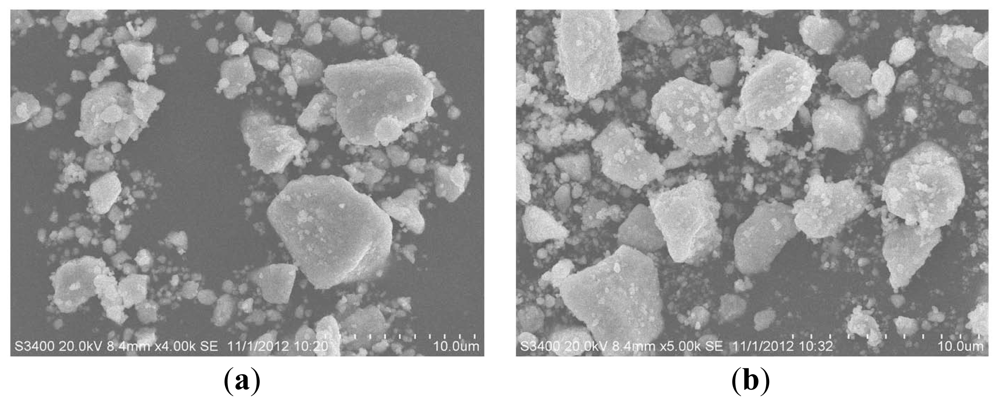
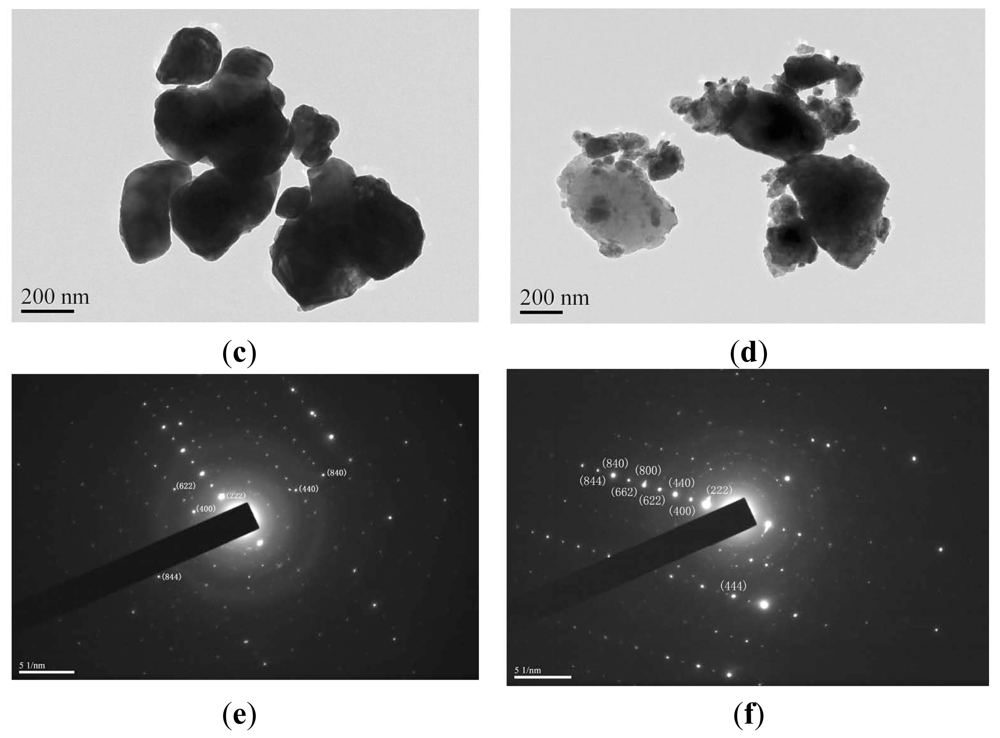
<p><xref ref-type="fig" rid="f1-ijms-14-00999">Figure 1a,b</xref> show the SEM images of Gd<sub>2</sub>InSbO<sub>7</sub> and Gd<sub>2</sub>FeSbO<sub>7</sub> with low magnification. <xref ref-type="fig" rid="f1-ijms-14-00999">Figure 1c,d</xref> show the TEM images of Gd<sub>2</sub>InSbO<sub>7</sub> and Gd<sub>2</sub>FeSbO<sub>7</sub> with high magnification. The results showed that the particle diameter of Gd<sub>2</sub>FeSbO<sub>7</sub> was 240 nm and the particle diameter of Gd<sub>2</sub>InSbO<sub>7</sub> was 310 nm. The nanosized particles of Gd<sub>2</sub>FeSbO<sub>7</sub> and Gd<sub>2</sub>InSbO<sub>7</sub> were obtained, and these particles were in inhomogenous global shapes. <xref ref-type="fig" rid="f1-ijms-14-00999">Figure 1</xref> revealed that the average particle size of Gd<sub>2</sub>FeSbO<sub>7</sub> was smaller than that of Gd<sub>2</sub>InSbO<sub>7</sub>. There were two reasons to obtain nanocrystals in this experiment, while synthesizing Gd<sub>2</sub>InSbO<sub>7</sub> and Gd<sub>2</sub>FeSbO<sub>7</sub> powders by the solid-state method. Firstly, the powders, which were obtained after a sintering process by an electric furnace, would be ground by mortar three times and then would be ground in a ball mill three times. The total time for grinding the above photocatalyst powders was approximately 15 h. Secondly, the sizes of the photocatalyst particles were different. We utilized a centrifuge to realize separation of the photocatalyst particles, which had different sizes by adjusting the rotation speed of the centrifuge, and the small particles were obtained. SEM-EDS spectrum taken from the prepared Gd<sub>2</sub>FeSbO<sub>7</sub> indicated the existence of gadolinium, iron, antimony and oxygen. As to the prepared Gd<sub>2</sub>InSbO<sub>7</sub>, gadolinium, indium, antimony and oxygen were detected and other elements were not identified.</p>
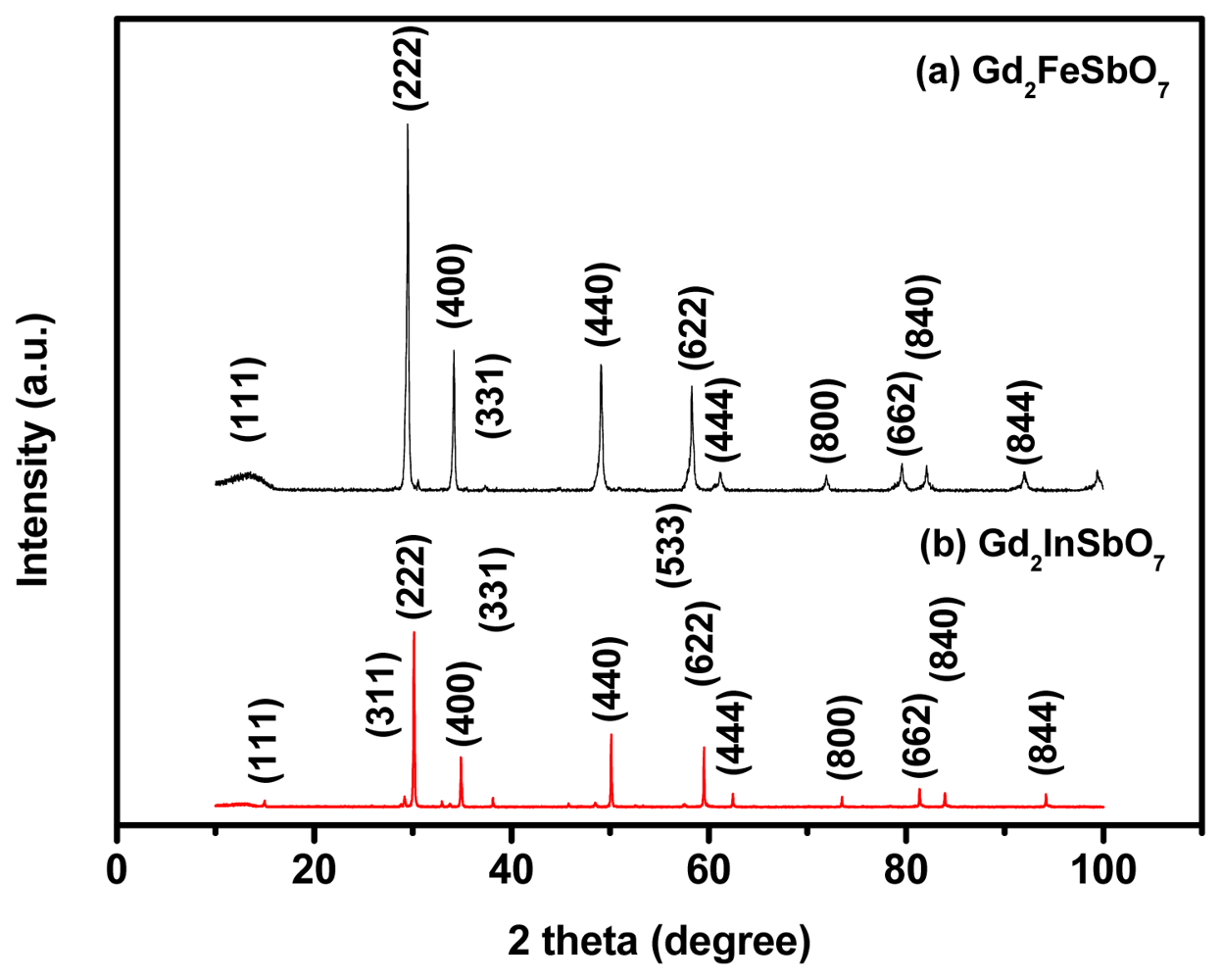
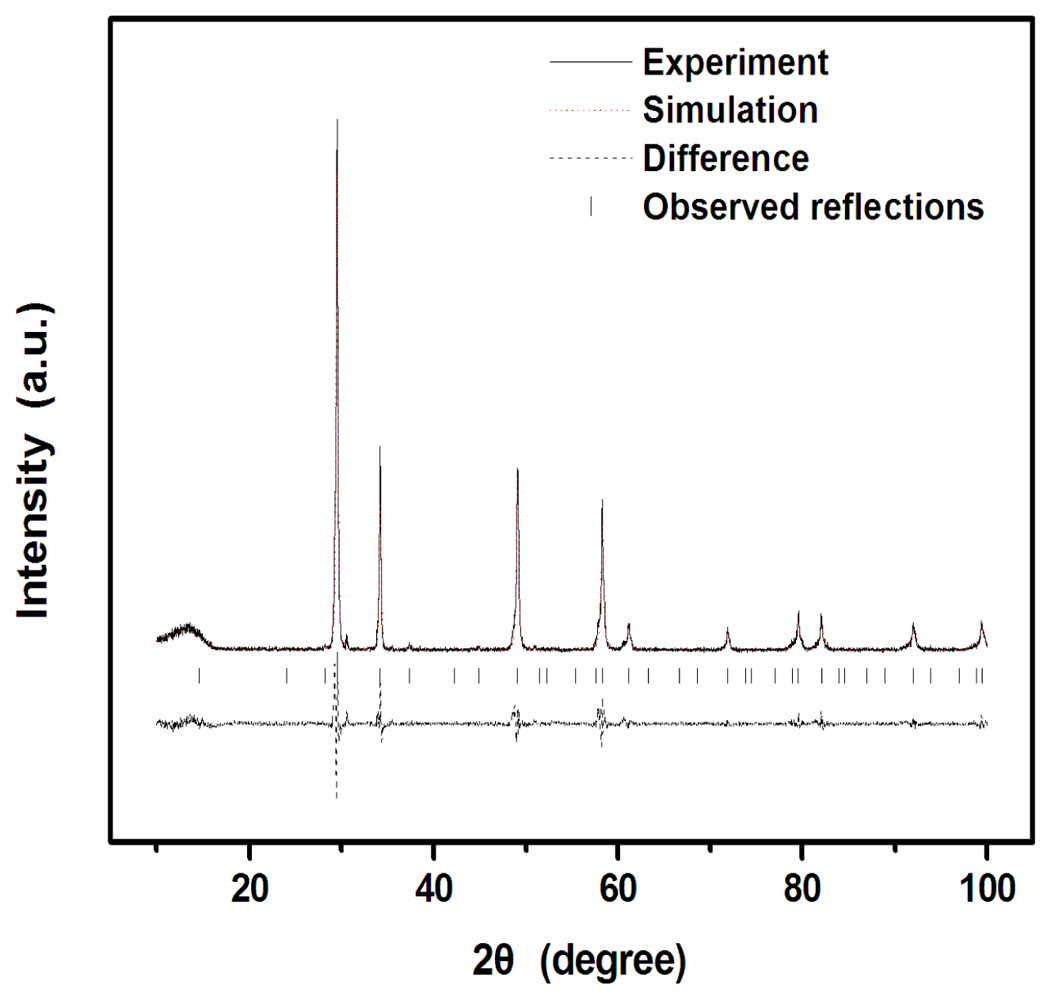
<p>X-ray powder diffraction patterns of Gd<sub>2</sub>FeSbO<sub>7</sub> and Gd<sub>2</sub>InSbO<sub>7</sub> are shown in <xref ref-type="fig" rid="f2-ijms-14-00999">Figure 2</xref>. <xref ref-type="fig" rid="f3-ijms-14-00999">Figure 3</xref> displays the powder X-ray diffraction patterns of Gd<sub>2</sub>InSbO<sub>7</sub> together with full-profile structure refinements of the collected data as obtained by the RIETAN™ [<xref ref-type="bibr" rid="b45-ijms-14-00999">45</xref>] program, which is based on Rietveld analysis. The results of the final refinement for Gd<sub>2</sub>FeSbO<sub>7</sub> and Gd<sub>2</sub>InSbO<sub>7</sub> manifested an excellent consistency between the observed and calculated intensities for the pyrochlore-type structure, a cubic crystal system and a space group <italic>Fd3m</italic> (O atoms were included in the model). The lattice parameters of Gd<sub>2</sub>InSbO<sub>7</sub> and Gd<sub>2</sub>FeSbO<sub>7</sub> were 10.449546 Å and 10.276026 Å, respectively. All the diffraction peaks for Gd<sub>2</sub>FeSbO<sub>7</sub> and Gd<sub>2</sub>InSbO<sub>7</sub> could be successfully indexed based on the lattice constant and above space group. The atomic coordinates and structural parameters of Gd<sub>2</sub>FeSbO<sub>7</sub> and Gd<sub>2</sub>InSbO<sub>7</sub> are listed in <xref ref-type="table" rid="t1-ijms-14-00999">Tables 1</xref> and <xref ref-type="table" rid="t2-ijms-14-00999">2</xref>, respectively. In addition, Our XRD results showed that Gd<sub>2</sub>FeSbO<sub>7</sub> and Gd<sub>2</sub>InSbO<sub>7</sub> crystallized with the same structure, and 2 theta angles of each reflection of Gd<sub>2</sub>InSbO<sub>7</sub> changed with the substitution of In<sup>3+</sup> by Fe<sup>3+</sup>. The lattice parameter decreased from <italic>α</italic> = 10.449546 Å for Gd<sub>2</sub>InSbO<sub>7</sub> to <italic>α</italic> = 10.276026 Å for Gd<sub>2</sub>FeSbO<sub>7</sub>, indicating a decrease in the lattice parameter of the photocatalyst with the decrease of M ionic radii, Fe<sup>3+</sup> (0.78 Å) &lt; In<sup>3+</sup> (0.92 Å). <xref ref-type="fig" rid="f1-ijms-14-00999">Figure 1e,f</xref> show the selected area electron diffraction patterns of Gd<sub>2</sub>InSbO<sub>7</sub> and Gd<sub>2</sub>FeSbO<sub>7</sub>, respectively. It could be seen that Gd<sub>2</sub>InSbO<sub>7</sub> and Gd<sub>2</sub>FeSbO<sub>7</sub> crystallized with a cubic crystal system, and the lattice parameters <italic>α</italic> of Gd<sub>2</sub>InSbO<sub>7</sub> and Gd<sub>2</sub>FeSbO<sub>7</sub> were proved to be 10.449546 Å and 10.276026 Å, respectively. According to the calculation results from <xref ref-type="fig" rid="f1-ijms-14-00999">Figure 1e,f</xref> the main diffraction peaks (222), (440), (400) and (622) for Gd<sub>2</sub>InSbO<sub>7</sub> and Gd<sub>2</sub>FeSbO<sub>7</sub> could be found and indexed within <xref ref-type="fig" rid="f1-ijms-14-00999">Figure 1e,f</xref>.</p>
<p>Our X-ray diffraction outcomes showed that Gd<sub>2</sub>FeSbO<sub>7</sub>, Gd<sub>2</sub>InSbO<sub>7</sub> and Bi<sub>2</sub>InTaO<sub>7</sub> crystallized with the same pyrochlore-type structure. The cubic system structure with space group <italic>Fd3m</italic> for Bi<sub>2</sub>InTaO<sub>7</sub> remained unchanged, with Ta<sup>5+</sup> being substituted by Sb<sup>5+</sup> and with Bi<sup>3+</sup> being substituted by Gd<sup>3+</sup>. The cubic system structure with space group <italic>Fd3m</italic> for Bi<sub>2</sub>InTaO<sub>7</sub> also remained unchanged with Ta<sup>5+</sup> being substituted by Sb<sup>5+,</sup> with In<sup>3+</sup> being substituted by Fe<sup>3+</sup> and with Bi<sup>3+</sup> being substituted by Gd<sup>3+</sup>. The result of refinements for Gd<sub>2</sub>FeSbO<sub>7</sub> generated the unweighted <italic>R</italic> factors, <italic>R</italic><sub>P</sub> = 16.20% with space group <italic>Fd3m</italic>. Similarly, the result of refinements for Gd<sub>2</sub>InSbO<sub>7</sub> generated the unweighted <italic>R</italic> factors, <italic>R</italic><sub>P</sub> = 12.13% with space group <italic>Fd3m</italic>. Zou <italic>et al.</italic>[<xref ref-type="bibr" rid="b46-ijms-14-00999">46</xref>] refined the crystal structure of Bi<sub>2</sub>InNbO<sub>7</sub> and obtained a large <italic>R</italic> factor, which was owing to a slightly modified structure model for Bi<sub>2</sub>InNbO<sub>7</sub>. Based on the high purity of the precursors that were used in this study and the EDS results that did not trace any other elements, it was unlikely that the observed space groups originated from the presence of impurities. Therefore, it was suggested that the slightly high <italic>R</italic> factor for Gd<sub>2</sub>FeSbO<sub>7</sub> or Gd<sub>2</sub>InSbO<sub>7</sub> was due to a slightly modified structure model of Gd<sub>2</sub>FeSbO<sub>7</sub> or Gd<sub>2</sub>InSbO<sub>7</sub>. It should be emphasized that the defects or the disorder/order of a fraction of the atoms could result in the change of structures, including different bond-distance distributions, thermal displacement parameters and/or occupation factors for some of the atoms.</p>
<p>The XPS spectra of Gd<sub>2</sub>FeSbO<sub>7</sub> and Gd<sub>2</sub>InSbO<sub>7</sub> were obtained. The various elemental peaks, which are corresponding to specific binding energies, are given in <xref ref-type="table" rid="t3-ijms-14-00999">Table 3</xref>. The results further suggested that the oxidative valence state of Gd, Fe, Sb and O ions from Gd<sub>2</sub>FeSbO<sub>7</sub> were +3, +3, +5 and −2, respectively. For Gd<sub>2</sub>FeSbO<sub>7</sub>, the mean atomic ratios of Gd: Fe: Sb: O were 2.00: 1.02: 0.99: 6.96 based on averaging our XPS, SEM-EDS and XFS results. Similarly, the oxidation state of Gd, In, Sb and O ions from Gd<sub>2</sub>InSbO<sub>7</sub> were +3, +3, +5 and −2, respectively. For Gd<sub>2</sub>InSbO<sub>7</sub>, the mean atomic ratios of Gd: In: Sb: O were 2.00: 1.03: 0.97: 6.98 based on averaging our XPS, SEM-EDS and XFS results. Consequently, it could be deduced that the final materials were of high purity under our preparation conditions. It was noteworthy that neither shoulders nor widening of any XPS peaks of Gd<sub>2</sub>FeSbO<sub>7</sub> or Gd<sub>2</sub>InSbO<sub>7</sub> were observed, suggesting the absence of any other phases.</p>
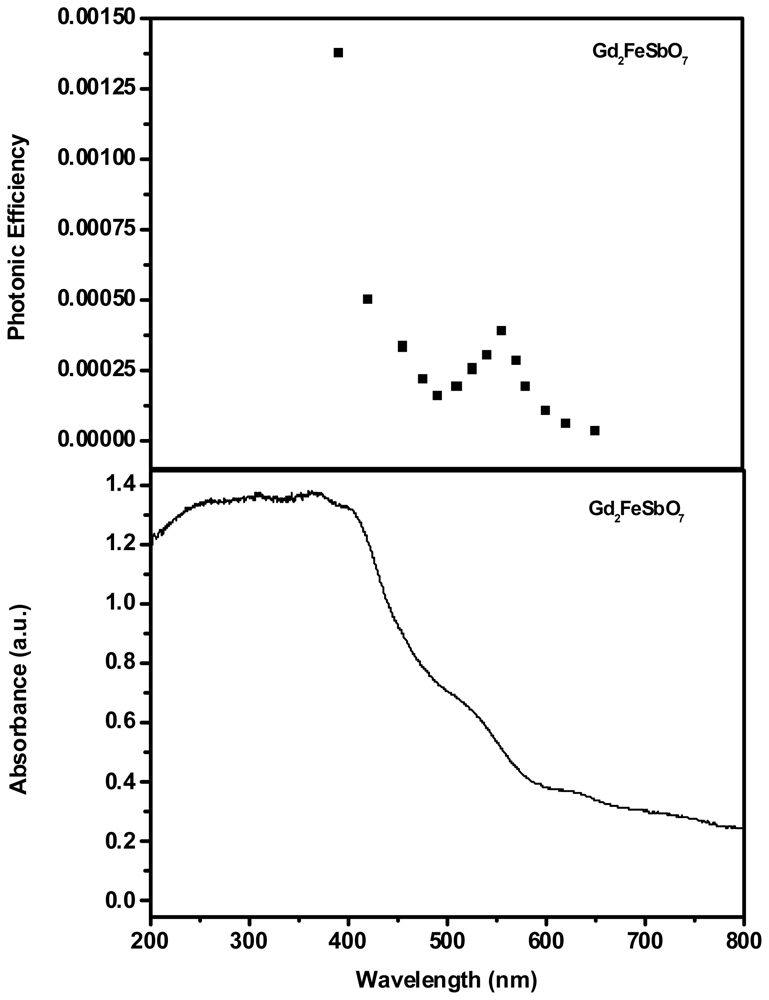
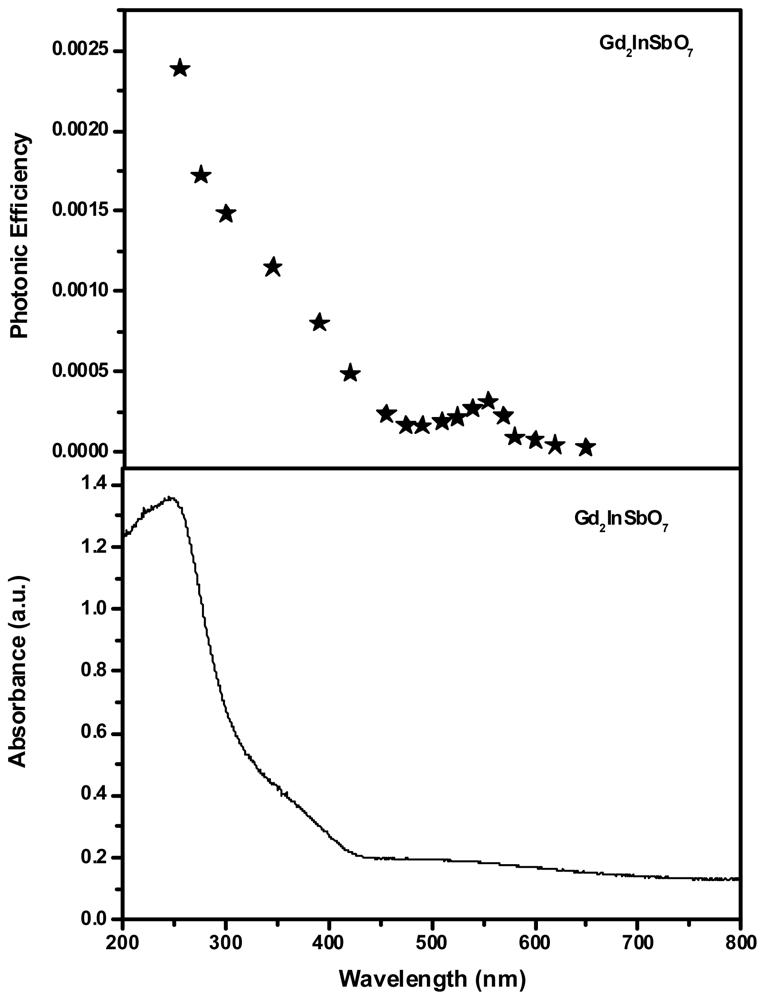
<p><xref ref-type="fig" rid="f4-ijms-14-00999">Figures 4</xref> and <xref ref-type="fig" rid="f5-ijms-14-00999">5</xref> present the absorption spectra of Gd<sub>2</sub>FeSbO<sub>7</sub> and Gd<sub>2</sub>InSbO<sub>7</sub>, respectively. In contrast to the well-known TiO<sub>2</sub>, whose absorption edge was less than 380 nm, the absorption edges of newly synthesized Gd<sub>2</sub>FeSbO<sub>7</sub> and Gd<sub>2</sub>InSbO<sub>7</sub> were found to be 586 nm and 428 nm, respectively, which were in the visible region of the spectrum. It was noteworthy that the apparent absorption (defined hereby as 1-transmission) could not take into consideration reflection and scattering. As a result, the apparent absorbance at sub-bandgap wavelengths (600 to 800 nm for Gd<sub>2</sub>FeSbO<sub>7</sub> and 425 to 800 nm for Gd<sub>2</sub>InSbO<sub>7</sub>) was higher than zero.</p>
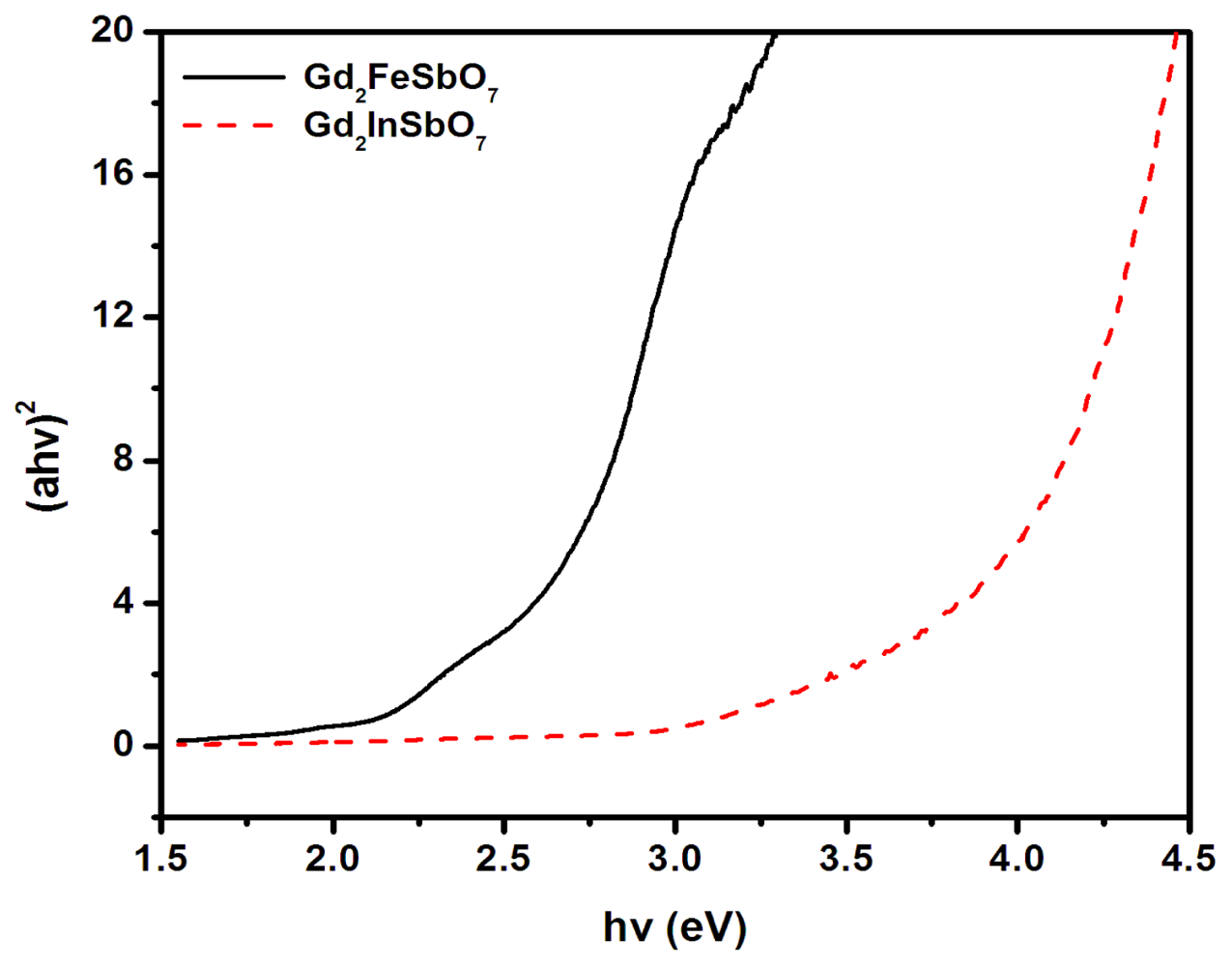
<p>For a crystalline semiconductor compound, the optical absorption near the band edge followed the equation [<xref ref-type="bibr" rid="b47-ijms-14-00999">47</xref>,<xref ref-type="bibr" rid="b48-ijms-14-00999">48</xref>]: <italic>αhν</italic> = A (<italic>hν</italic>-<italic>E</italic><sub>g</sub>)<italic><sup>n</sup></italic>. Here, A, <italic>α</italic>, <italic>E</italic><sub>g</sub> and <italic>ν</italic> denoted proportional constant, absorption coefficient, band gap and light frequency, respectively. In this equation, <italic>n</italic> determined the character of the transition in a semiconductor compound. <italic>E</italic><sub>g</sub> and <italic>n</italic> could be calculated by the following steps: (i) plotting ln(<italic>αhν</italic>) <italic>versus</italic> ln(<italic>hν</italic>-<italic>E</italic><sub>g</sub>) assuming an approximate value of <italic>E</italic><sub>g</sub>, (ii) deducing the value of <italic>n</italic> based on the slope in this graph and (iii) refining the value of <italic>E</italic><sub>g</sub> by plotting (<italic>αhν</italic>)<italic><sup>1/n</sup></italic><italic>versus hν</italic> and extrapolating the plot to (<italic>αhν</italic>)<italic><sup>1/n</sup></italic> = 0. According to this method, <xref ref-type="fig" rid="f6-ijms-14-00999">Figure 6</xref> shows the plot of (<italic>αhν</italic>)<italic><sup>1/n</sup></italic><italic>versus hν</italic> for Gd<sub>2</sub>FeSbO<sub>7</sub> and Gd<sub>2</sub>InSbO<sub>7</sub>. It was evidently to be found from <xref ref-type="fig" rid="f6-ijms-14-00999">Figure 6</xref> that the values of <italic>E</italic><sub>g</sub> for Gd<sub>2</sub>FeSbO<sub>7</sub> and Gd<sub>2</sub>InSbO<sub>7</sub> were calculated to be 2.151 eV and 2.897 eV, respectively, while the values of <italic>n</italic> for Gd<sub>2</sub>FeSbO<sub>7</sub> and Gd<sub>2</sub>InSbO<sub>7</sub> were calculated to be 0.50 and 0.50, respectively, indicating that Gd<sub>2</sub>FeSbO<sub>7</sub> possessed a narrower band gap compared with that of Gd<sub>2</sub>InSbO<sub>7</sub>.</p></sec>
<sec>
<title>2.2. Photocatalytic Activity</title>
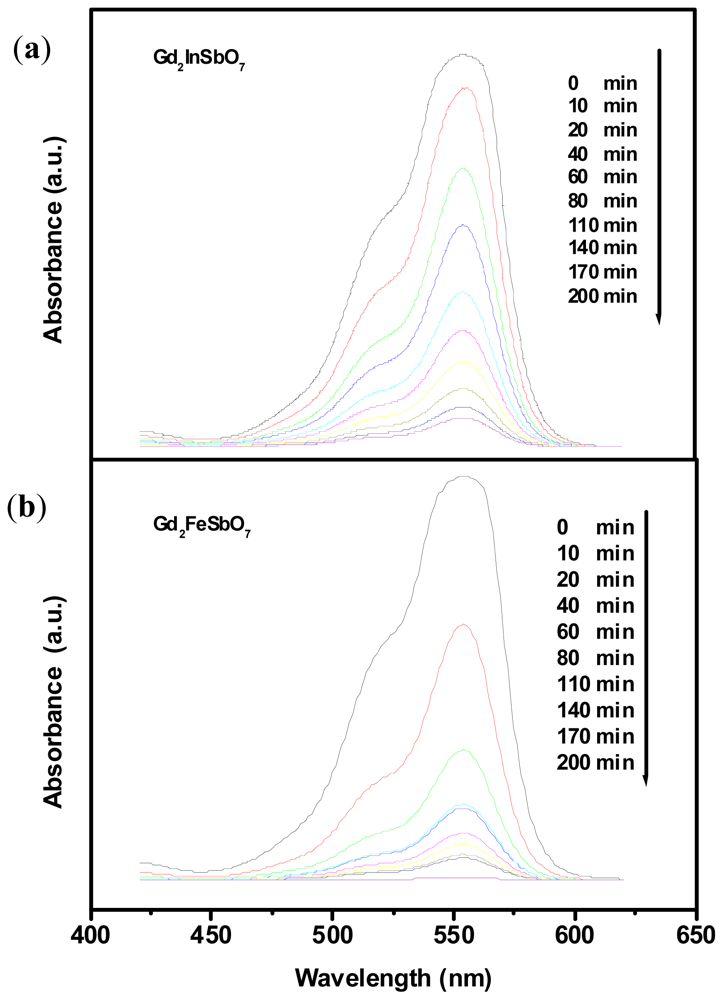
<p>Generally, the photocatalytic process by semiconductors begins with the direct absorption of supra-bandgap photons and the generation of electron–hole pairs within semiconductor particles. This is followed by diffusion of the charge carriers to the surface of the semiconductor particle. Changes in the UV-Vis spectrum of rhodamine B (RhB) upon exposure to visible light (<italic>λ</italic> &gt; 400 nm) with the presence of Gd<sub>2</sub>FeSbO<sub>7</sub> or Gd<sub>2</sub>InSbO<sub>7</sub> are depicted in <xref ref-type="fig" rid="f7-ijms-14-00999">Figure 7a,b</xref>, respectively. The measurements were performed under oxygen-saturation conditions ([O<sub>2</sub>]<sub>sat</sub> = 1.02 × 10<sup>−3</sup> M). The degradation of RhB did not occur in darkness within the Gd<sub>2</sub>FeSbO<sub>7</sub>/RhB suspension or Gd<sub>2</sub>InSbO<sub>7</sub>/RhB suspension or Bi<sub>2</sub>InTaO<sub>7</sub>/RhB suspension or RhB suspension. It could be seen from <xref ref-type="fig" rid="f7-ijms-14-00999">Figure 7a</xref> and <xref ref-type="fig" rid="f7-ijms-14-00999">Figure 7b</xref> that a reduction of typical RhB peaks at 553.5 nm and 525 nm was clearly noticed. The results showed that the initial degradation rate of RhB was about 2.413 × 10<sup>−9</sup> mol L<sup>−1</sup> s<sup>−1</sup>, and the initial photonic efficiency was estimated to be 0.05069% (<italic>λ</italic> = 420 nm) for Gd<sub>2</sub>FeSbO<sub>7</sub>. Similarly, the initial degradation rate of RhB was about 2.322 × 10<sup>−9</sup> mol L<sup>−1</sup> s<sup>−1</sup>, and the initial photonic efficiency was estimated to be 0.04877% (<italic>λ</italic> = 420 nm) for Gd<sub>2</sub>InSbO<sub>7</sub>. For Bi<sub>2</sub>InTaO<sub>7</sub>, after visible light irradiation for 200 min, the RhB concentration decreased only from 0.0293 mM to 0.0161 mM, and the initial degradation rate of RhB was about 1.1 × 10<sup>−9</sup> mol L<sup>−1</sup> s<sup>−1</sup>. The initial photonic efficiency was estimated to be 0.02311% (<italic>λ</italic> = 420 nm) for Bi<sub>2</sub>InTaO<sub>7</sub>. By contrast, the photonic efficiency of Bi<sub>2</sub>InTaO<sub>7</sub> was inferior to that of Gd<sub>2</sub>FeSbO<sub>7</sub> or Gd<sub>2</sub>InSbO<sub>7</sub>.</p>
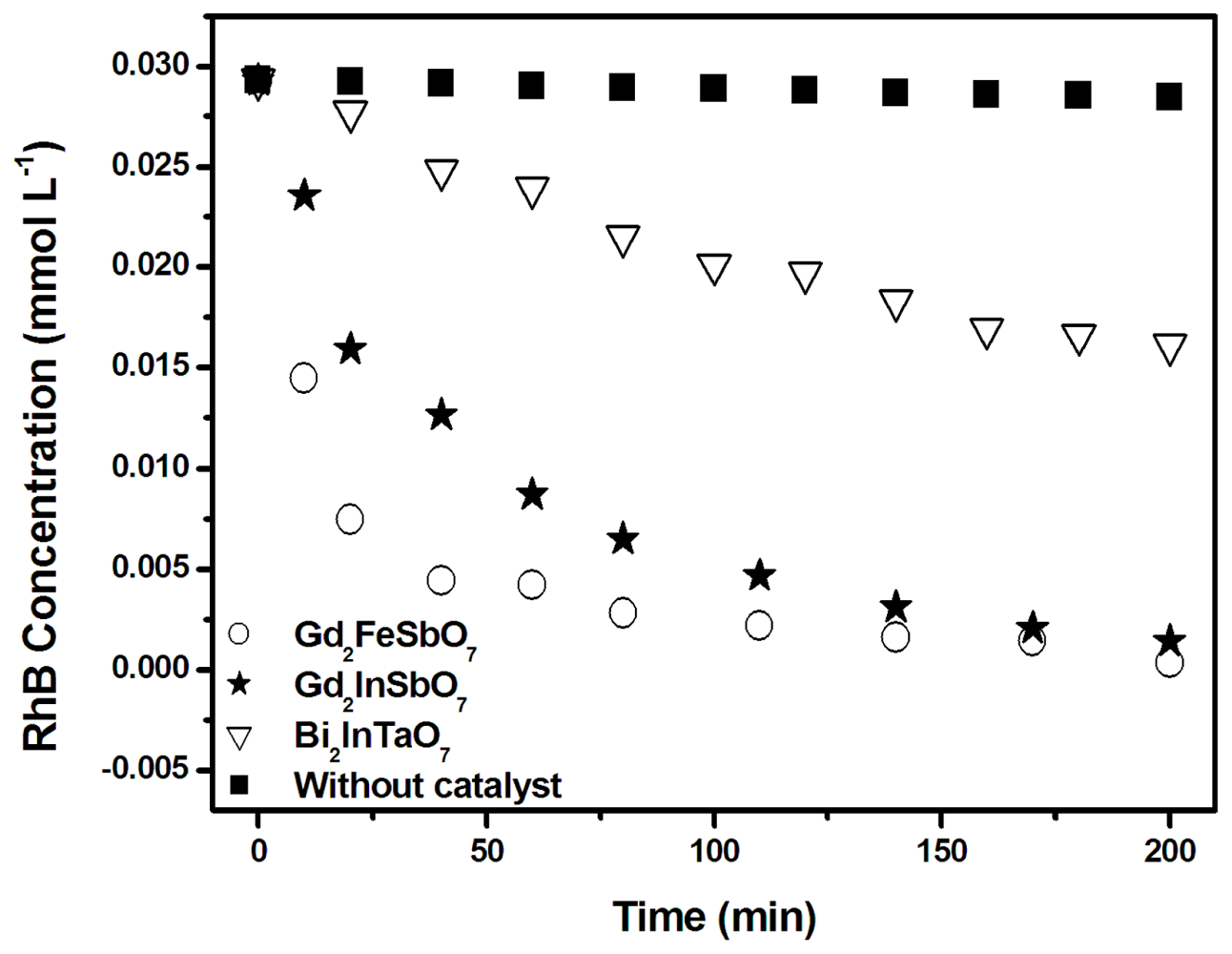
<p>The kinetics of RhB degradation deduced according to the spectral changes under visible light irradiation are shown in <xref ref-type="fig" rid="f8-ijms-14-00999">Figure 8</xref>, which describes the kinetics not only with Gd<sub>2</sub>FeSbO<sub>7</sub>, Gd<sub>2</sub>InSbO<sub>7</sub> and Bi<sub>2</sub>InTaO<sub>7</sub> as catalysts, but also without any photocatalyst. As expected, reduction of RhB signal in the controlled measurements in the absence of a photocatalyst was promising. In addition, the photodegradation removal rate of RhB was 90.35%, 77.80% and 26.62% after visible light irradiation for 80 min with Gd<sub>2</sub>FeSbO<sub>7</sub>, Gd<sub>2</sub>InSbO<sub>7</sub> and Bi<sub>2</sub>InTaO<sub>7</sub> as catalysts, respectively. Complete removal of rhodamine B was observed after visible light irradiation for 225 min or 260 min with Gd<sub>2</sub>FeSbO<sub>7</sub> or Gd<sub>2</sub>InSbO<sub>7</sub> as photocatalyst. Based on the above outcomes, it was much faster for Gd<sub>2</sub>FeSbO<sub>7</sub> and Gd<sub>2</sub>InSbO<sub>7</sub> to photodegrade RhB compared with Bi<sub>2</sub>InTaO<sub>7</sub>, and the photocatalytic degradation activity of Gd<sub>2</sub>FeSbO<sub>7</sub> or Gd<sub>2</sub>InSbO<sub>7</sub> for degrading RhB was higher than that of Bi<sub>2</sub>InTaO<sub>7</sub>; moreover, Gd<sub>2</sub>FeSbO<sub>7</sub> showed higher photocatalytic degradation activity than Gd<sub>2</sub>InSbO<sub>7</sub>. The main reason was that the lattice parameter α = 10.746410 Å for Bi<sub>2</sub>InTaO<sub>7</sub> was larger than the lattice parameter α = 10.449546 Å for Gd<sub>2</sub>InSbO<sub>7</sub>, and the lattice parameter α = 10.449546 Å for Gd<sub>2</sub>InSbO<sub>7</sub> was larger than the lattice parameter α = 10.276026 Å for Gd<sub>2</sub>FeSbO<sub>7</sub>, which probably resulted in a decrease for the migration distance of photogenerated electrons and holes to reach the reaction site on the photocatalyst surface; subsequently, the creation of more active sites was realized. As a result, it would probably improve the photocatalytic activities by decreasing the lattice parameter of the photocatalyst.</p>
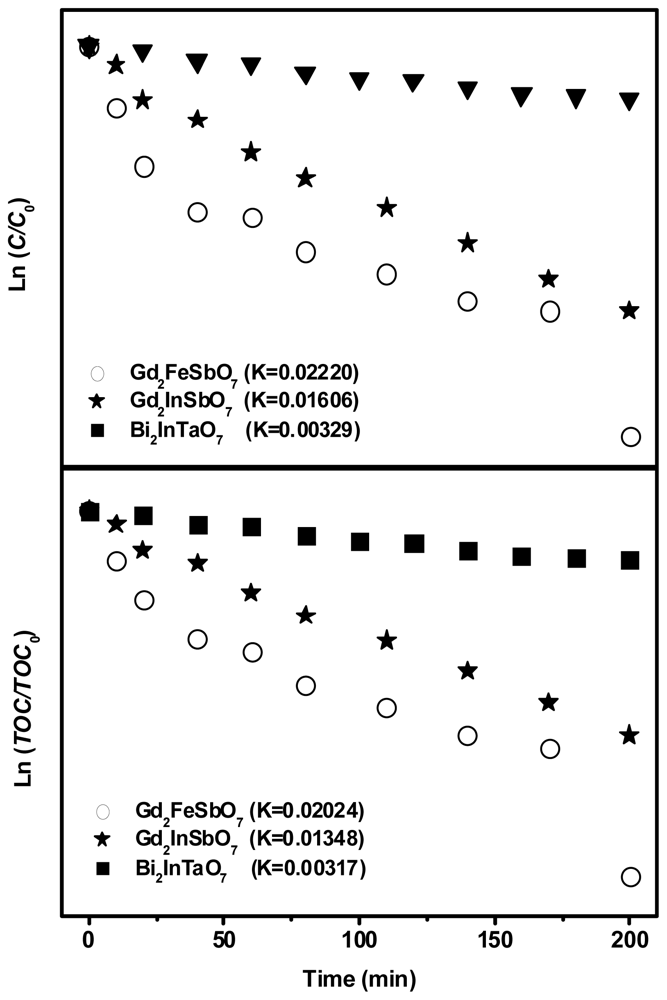
<p>The first order nature of the photocatalytic degradation kinetics with Gd<sub>2</sub>FeSbO<sub>7</sub>, Gd<sub>2</sub>InSbO<sub>7</sub> and Bi<sub>2</sub>InTaO<sub>7</sub> as catalysts is clearly exhibited in <xref ref-type="fig" rid="f9-ijms-14-00999">Figure 9</xref>, which describes a linear correlation between ln(<italic>C/C</italic><italic><sub>0</sub></italic>) (or ln(<italic>TOC/TOC</italic><italic><sub>0</sub></italic>)) and the irradiation time for the photocatalytic degradation of RhB under visible light irradiation by using Gd<sub>2</sub>FeSbO<sub>7</sub> or Gd<sub>2</sub>InSbO<sub>7</sub> or Bi<sub>2</sub>InTaO<sub>7</sub> as catalyst. Here, <italic>C</italic> represented the RhB concentration at time t, and <italic>C</italic><italic><sub>0</sub></italic> represented the initial concentration of RhB. <italic>TOC</italic> represented the total organic carbon concentration at time t, and <italic>TOC</italic><italic><sub>0</sub></italic> denoted the initial total organic carbon concentration. According to the relationship between ln(<italic>C/C</italic><italic><sub>0</sub></italic>) and the irradiation time, the apparent first-order rate constant <italic>k</italic> was estimated to be 0.02220 min<sup>−1</sup> with Gd<sub>2</sub>FeSbO<sub>7</sub> as catalyst, 0.01606 min<sup>−1</sup> with Gd<sub>2</sub>InSbO<sub>7</sub> as catalyst and 0.00329 min<sup>−1</sup> with Bi<sub>2</sub>InTaO<sub>7</sub> as catalyst, indicating that Gd<sub>2</sub>FeSbO<sub>7</sub> and Gd<sub>2</sub>InSbO<sub>7</sub> were more effective than Bi<sub>2</sub>InTaO<sub>7</sub> for the photocatalytic degradation of RhB under visible light irradiation. Meanwhile, Gd<sub>2</sub>FeSbO<sub>7</sub> showed more effective photocatalytic activity for degrading RhB than Gd<sub>2</sub>InSbO<sub>7</sub>. According to the relationship between ln(<italic>TOC/TOC</italic><italic><sub>0</sub></italic>) and the irradiation time, the apparent first-order rate constant <italic>k</italic> was estimated to be 0.02024 min<sup>−1</sup> with Gd<sub>2</sub>FeSbO<sub>7</sub> as catalyst, 0.01348 min<sup>−1</sup> with Gd<sub>2</sub>InSbO<sub>7</sub> as catalyst and 0.00317 min<sup>−1</sup> with Bi<sub>2</sub>InTaO<sub>7</sub> as catalyst, indicating that the photodegradation intermediate products of RhB were probably produced during the photocatalytic degradation of RhB under visible light irradiation.</p>
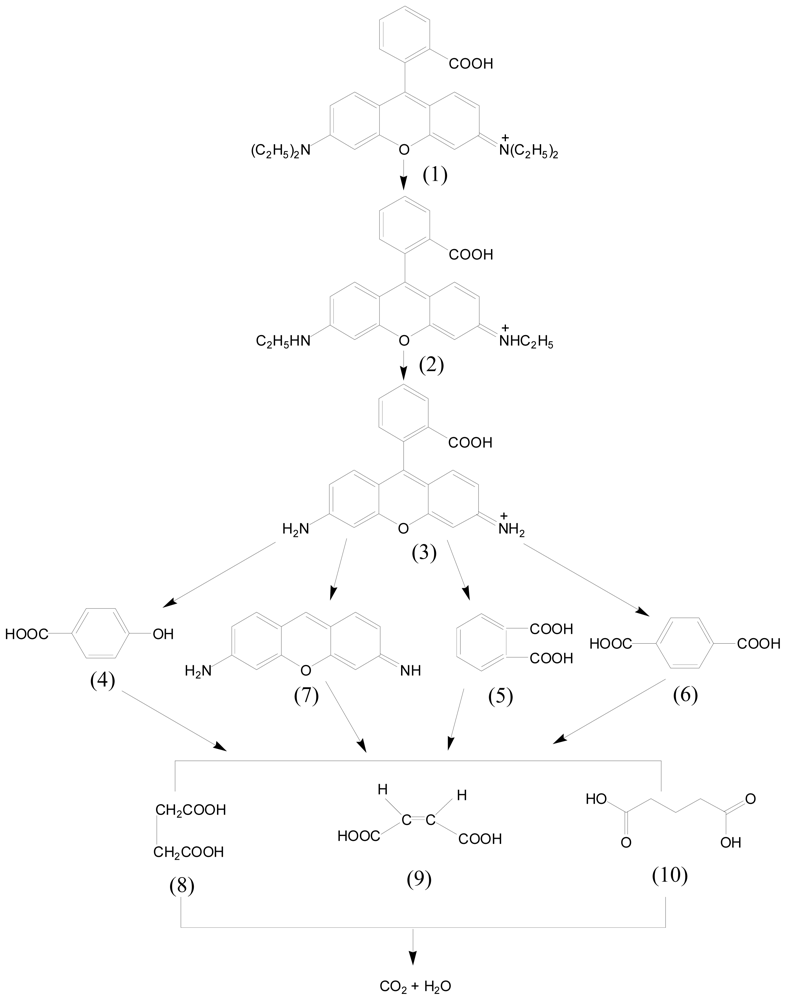
<p>The photodegradation intermediate products of RhB in our experiment were identified as succinic acid (<italic>m/z</italic> = 118), terephthalic acid (<italic>m/z</italic> = 166), pentanedioic acid, 3-Hydroxybenzoic acid (<italic>m/z</italic> = 138), 1,2-benzenedicarboxylic acid and maleic acid (<italic>m/z</italic> = 116). Based on the intermediate products detected in this work, a possible photocatalytic degradation pathway for RhB is proposed in <xref ref-type="fig" rid="f10-ijms-14-00999">Figure 10</xref>. This pathway was similar, but not identical, to the pathway proposed by Horikoshi <italic>et al.</italic>[<xref ref-type="bibr" rid="b49-ijms-14-00999">49</xref>] for the photodegradation of RhB under ultraviolet light illumination assisted by microwave radiation with TiO<sub>2</sub> as catalyst. According to the research from Zhang <italic>et al.</italic>[<xref ref-type="bibr" rid="b32-ijms-14-00999">32</xref>], the photodegradation of RhB occurred through two competitive processes: one was <italic>N</italic>-demethylation and the other one was the destruction of the conjugated structure. Thus, we considered that chromophore cleavage, opening-ring and mineralization would be the main photocatalytic degradation pathway of RhB in our experiment. RhB was converted to smaller organic species, which were ultimately mineralized into inorganic products, such as CO<sub>2</sub> and water. <xref ref-type="fig" rid="f11-ijms-14-00999">Figure 11</xref> shows CO<sub>2</sub> yields during the photocatalytic degradation of RhB with Gd<sub>2</sub>FeSbO<sub>7</sub>, Gd<sub>2</sub>InSbO<sub>7</sub> or Bi<sub>2</sub>InTaO<sub>7</sub> as catalyst under visible light irradiation. The results indicated that the yielded CO<sub>2</sub> increased gradually with the increase of reaction time by using Gd<sub>2</sub>FeSbO<sub>7</sub>, Gd<sub>2</sub>InSbO<sub>7</sub> or Bi<sub>2</sub>InTaO<sub>7</sub> as catalyst. The production rate of CO<sub>2</sub> with Gd<sub>2</sub>FeSbO<sub>7</sub> or Gd<sub>2</sub>InSbO<sub>7</sub> as catalyst was higher than that with Bi<sub>2</sub>InTaO<sub>7</sub> as catalyst, which was in line with the absorption curves (<xref ref-type="fig" rid="f4-ijms-14-00999">Figures 4</xref> and <xref ref-type="fig" rid="f5-ijms-14-00999">5</xref>) of Gd<sub>2</sub>FeSbO<sub>7</sub> and Gd<sub>2</sub>InSbO<sub>7</sub>. For example, after visible light irradiation for 200 min, the CO<sub>2</sub> production was 0.2366 mmol with Gd<sub>2</sub>FeSbO<sub>7</sub> as catalyst, 0.2280 mmol with Gd<sub>2</sub>InSbO<sub>7</sub> as catalyst and 0.1080 mmol with Bi<sub>2</sub>InTaO<sub>7</sub> as catalyst.</p>
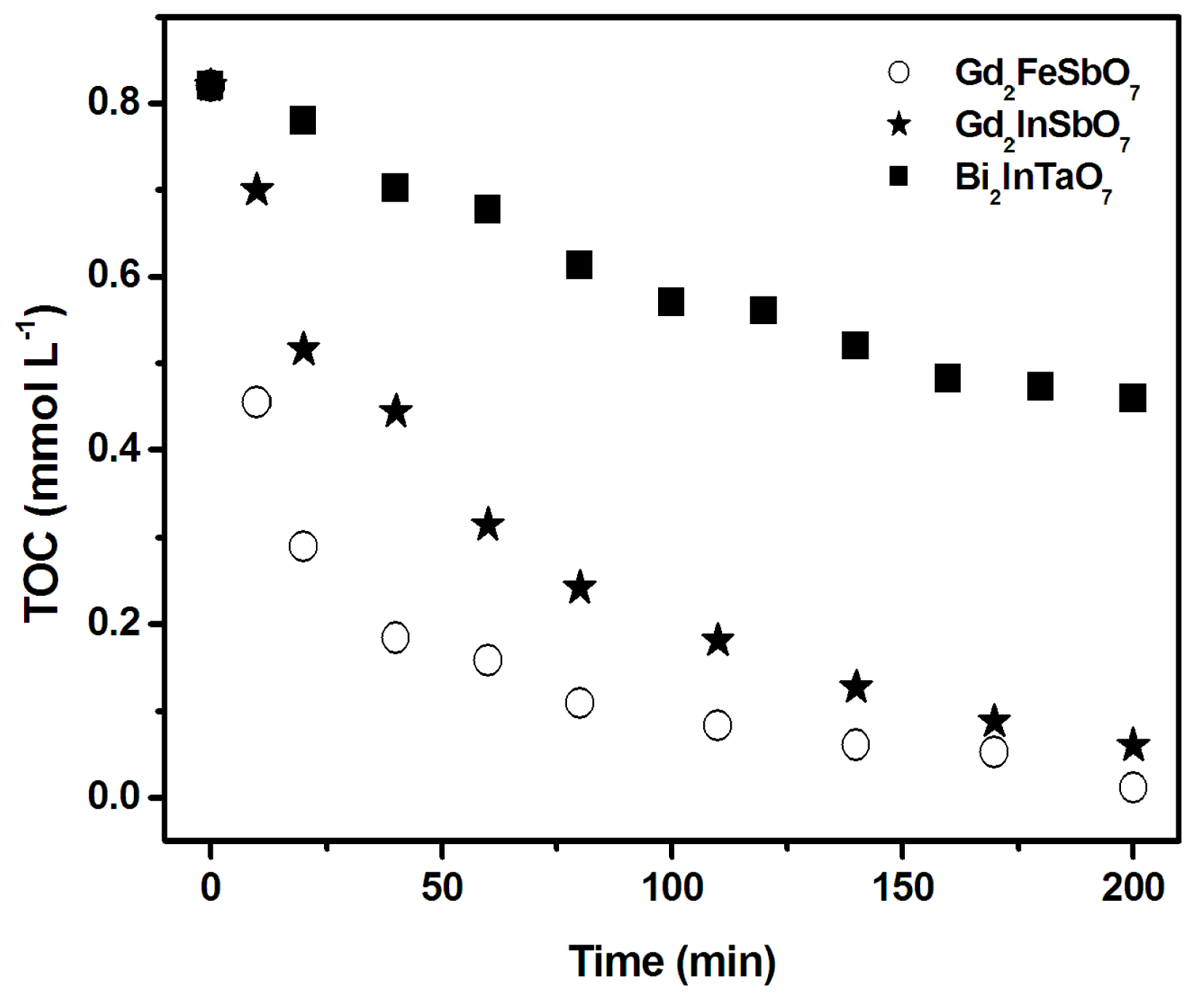
<p><xref ref-type="fig" rid="f12-ijms-14-00999">Figure 12</xref> shows the change of the total organic carbon (TOC) for photocatalytic degradation of rhodamine B during visible light irradiation with Gd<sub>2</sub>FeSbO<sub>7</sub>, Gd<sub>2</sub>InSbO<sub>7</sub> or Bi<sub>2</sub>InTaO<sub>7</sub> as catalyst. The TOC measurements revealed the disappearance of organic carbon when the RhB solution containing Gd<sub>2</sub>FeSbO<sub>7</sub>, Gd<sub>2</sub>InSbO<sub>7</sub> or Bi<sub>2</sub>InTaO<sub>7</sub> was exposed under visible light irradiation. The results showed that 86.70%, 70.49% or 25.26% of TOC decrease was obtained after visible light irradiation for 80 min with Gd<sub>2</sub>FeSbO<sub>7</sub>, Gd<sub>2</sub>InSbO<sub>7</sub> or Bi<sub>2</sub>InTaO<sub>7</sub> as catalyst, respectively. The turnover numbers, which were the ratio between total amount of evolved gas and exhausted catalyst, were calculated to be more than 0.18 or 0.19 for Gd<sub>2</sub>FeSbO<sub>7</sub> or Gd<sub>2</sub>InSbO<sub>7</sub> after 200 min of reaction time under visible light irradiation. The reactions ceased when the light was turned off, indicating an obvious photic response.</p>
<p>The photocatalytic performance of Gd<sub>2</sub>FeSbO<sub>7</sub> and Gd<sub>2</sub>InSbO<sub>7</sub> was remarkable under visible light irradiation. This superior quality could be even more bracing if one considered the fact that the specific surface areas of Gd<sub>2</sub>FeSbO<sub>7</sub> and Gd<sub>2</sub>InSbO<sub>7</sub> were further smaller than that of titanium dioxide. In this experiment, BET isotherm measurements gave a specific surface area of 4.12 m<sup>2</sup> g<sup>−1</sup>, 3.26 m<sup>2</sup> g<sup>−1</sup> and 1.26 m<sup>2</sup> g<sup>−1</sup> for Gd<sub>2</sub>FeSbO<sub>7</sub>, Gd<sub>2</sub>InSbO<sub>7</sub> and Bi<sub>2</sub>InTaO<sub>7</sub>, respectively, which was almost 12-times smaller than that of TiO<sub>2</sub> (46.24 m<sup>2</sup> g<sup>−1</sup>). The particle sizes of Gd<sub>2</sub>InSbO<sub>7</sub> and Gd<sub>2</sub>FeSbO<sub>7</sub> were uneven. We provide SEM images with low magnification of Gd<sub>2</sub>InSbO<sub>7</sub> and Gd<sub>2</sub>FeSbO<sub>7</sub>. Simultaneously, we give the TEM images of Gd<sub>2</sub>InSbO<sub>7</sub> and Gd<sub>2</sub>FeSbO<sub>7</sub>, which represent the average particle size. Because the particle size of Gd<sub>2</sub>InSbO<sub>7</sub> and Gd<sub>2</sub>FeSbO<sub>7</sub> compounds were greater than 230nm, their specific surface areas were less than 5 m<sup>2</sup> g<sup>−1</sup>.</p>
<p>There are three main reasons to choose Gd for producing Gd<sub>2</sub>FeSbO<sub>7</sub> and Gd<sub>2</sub>InSbO<sub>7</sub> in this paper. Firstly, the substitution of Bi<sup>3+</sup> by Gd<sup>3+</sup> and the substitution of Ta<sup>5+</sup> by Sb<sup>5+</sup> in Bi<sub>2</sub>InTaO<sub>7</sub> will produce smaller catalyst particles and increase the specific surface area, because the radii of Gd<sup>3+</sup>, Bi<sup>3+</sup>, Ta<sup>5+</sup> and Sb<sup>5+</sup> are 1.053 Å, 1.17 Å, 0.74 Å and 0.60 Å, which shows that the radius of Gd<sup>3+</sup> is smaller than the radius of Bi<sup>3+</sup>, and the radius of Sb<sup>5+</sup> is smaller than the radius of Ta<sup>5+</sup>. Similarly, the substitution of Bi<sup>3+</sup> by Gd<sup>3+</sup>, the substitution of In<sup>3+</sup> by Fe<sup>3+</sup> and the substitution of Ta<sup>5+</sup> by Sb<sup>5+</sup> in Bi<sub>2</sub>InTaO<sub>7</sub> will produce smaller catalyst particles and increase the specific surface area, because the radii of In<sup>3+</sup> and Fe<sup>3+</sup> are 0.92 Å and 0.78 Å, which shows that the radius of Gd<sup>3+</sup> is smaller than the radius of Bi<sup>3+</sup>, the radius of Fe<sup>3+</sup> is smaller than the radius of In<sup>3+</sup> and the radius of Sb<sup>5+</sup> is smaller than the radius of Ta<sup>5+</sup>. Thus, the active sites and the catalytic activity will increase. Secondly, the smaller catalyst particles probably result in a decrease of the migration distance of photogenerated electrons and holes, which are formed under visible light irradiation from the grain interior to reach the reaction site on the photocatalyst surface. Subsequently, the photogenerated electrons and the photogenerated holes that reach the surface of the particles in unit time increase, and the creation of more active sites is realized. As a result, it will probably improve the photocatalytic activities with decreasing the particle size of the photocatalyst. Thirdly, some literatures reported that Gd-containing catalyst had excellent catalytic performance [<xref ref-type="bibr" rid="b50-ijms-14-00999">50</xref>–<xref ref-type="bibr" rid="b53-ijms-14-00999">53</xref>].</p>
<p><xref ref-type="fig" rid="f4-ijms-14-00999">Figure 4</xref> and <xref ref-type="fig" rid="f5-ijms-14-00999">Figure 5</xref> show the action spectra of RhB degradation in the presence of Gd<sub>2</sub>FeSbO<sub>7</sub> or Gd<sub>2</sub>InSbO<sub>7</sub> under visible light irradiation. A clear photonic efficiency (0.03921% at its maximal point for Gd<sub>2</sub>FeSbO<sub>7</sub> and 0.03145% at its maximal point for Gd<sub>2</sub>InSbO<sub>7</sub>) at wavelengths that corresponded to sub-Eg energies of the photocatalysts (<italic>λ</italic> from 425 to 800 nm) was observed for Gd<sub>2</sub>FeSbO<sub>7</sub> and Gd<sub>2</sub>InSbO<sub>7</sub>. The existence of photonic efficiency at energies where photons were not absorbed by the photocatalysts, and the correlation between the low-energy action spectrum and the absorption spectrum of RhB clearly demonstrated that any photodegradation at wavelengths above 479 nm should be attributed to the photosensitization by RhB dye itself, the mechanism showing as follows:</p>
<disp-formula id="FD1">
<label>(1)</label>
<mml:math id="mm1" display="block">
<mml:semantics id="sm1">
<mml:mrow>
<mml:msub>
<mml:mrow>
<mml:mrow>
<mml:mtext>RhB</mml:mtext></mml:mrow></mml:mrow>
<mml:mrow>
<mml:mo stretchy="false">(</mml:mo>
<mml:mtext>ads</mml:mtext>
<mml:mo stretchy="false">)</mml:mo></mml:mrow></mml:msub>
<mml:mover>
<mml:mo>→</mml:mo>
<mml:mrow>
<mml:mtext>Visible light</mml:mtext></mml:mrow></mml:mover>
<mml:msub>
<mml:mrow>
<mml:msup>
<mml:mrow>
<mml:mrow>
<mml:mtext>RhB</mml:mtext></mml:mrow></mml:mrow>
<mml:mo>*</mml:mo></mml:msup></mml:mrow>
<mml:mrow>
<mml:mo stretchy="false">(</mml:mo>
<mml:mtext>ads</mml:mtext>
<mml:mo stretchy="false">)</mml:mo></mml:mrow></mml:msub></mml:mrow></mml:semantics></mml:math></disp-formula>
<disp-formula id="FD2">
<label>(2)</label>
<mml:math id="mm2" display="block">
<mml:semantics id="sm2">
<mml:mrow>
<mml:msub>
<mml:mrow>
<mml:msup>
<mml:mrow>
<mml:mrow>
<mml:mtext>RhB</mml:mtext></mml:mrow></mml:mrow>
<mml:mo>*</mml:mo></mml:msup></mml:mrow>
<mml:mrow>
<mml:mo stretchy="false">(</mml:mo>
<mml:mtext>ads</mml:mtext>
<mml:mo stretchy="false">)</mml:mo></mml:mrow></mml:msub>
<mml:mo>+</mml:mo>
<mml:msub>
<mml:mrow>
<mml:mrow>
<mml:mtext>Gd</mml:mtext></mml:mrow></mml:mrow>
<mml:mn>2</mml:mn></mml:msub>
<mml:msub>
<mml:mrow>
<mml:mrow>
<mml:mtext>FeSbO</mml:mtext></mml:mrow></mml:mrow>
<mml:mn>7</mml:mn></mml:msub>
<mml:mi> </mml:mi>
<mml:mo stretchy="false">(</mml:mo>
<mml:mtext>or </mml:mtext>
<mml:msub>
<mml:mrow>
<mml:mrow>
<mml:mtext>Gd</mml:mtext></mml:mrow></mml:mrow>
<mml:mn>2</mml:mn></mml:msub>
<mml:msub>
<mml:mrow>
<mml:mrow>
<mml:mtext>InSbO</mml:mtext></mml:mrow></mml:mrow>
<mml:mn>7</mml:mn></mml:msub>
<mml:mo stretchy="false">)</mml:mo>
<mml:mo>→</mml:mo>
<mml:msub>
<mml:mrow>
<mml:mrow>
<mml:mtext>Gd</mml:mtext></mml:mrow></mml:mrow>
<mml:mn>2</mml:mn></mml:msub>
<mml:msub>
<mml:mrow>
<mml:mrow>
<mml:mtext>FeSbO</mml:mtext></mml:mrow></mml:mrow>
<mml:mn>7</mml:mn></mml:msub>
<mml:mi> </mml:mi>
<mml:mo stretchy="false">(</mml:mo>
<mml:mtext>or </mml:mtext>
<mml:msub>
<mml:mrow>
<mml:mrow>
<mml:mtext>Gd</mml:mtext></mml:mrow></mml:mrow>
<mml:mn>2</mml:mn></mml:msub>
<mml:msub>
<mml:mrow>
<mml:mrow>
<mml:mtext>InSbO</mml:mtext></mml:mrow></mml:mrow>
<mml:mn>7</mml:mn></mml:msub>
<mml:mo stretchy="false">)</mml:mo>
<mml:mi> </mml:mi>
<mml:mo stretchy="false">(</mml:mo>
<mml:mtext>e</mml:mtext>
<mml:mo stretchy="false">)</mml:mo>
<mml:mo>+</mml:mo>
<mml:msub>
<mml:mrow>
<mml:msup>
<mml:mrow>
<mml:mrow>
<mml:mtext>RhB</mml:mtext></mml:mrow></mml:mrow>
<mml:mo>+</mml:mo></mml:msup></mml:mrow>
<mml:mrow>
<mml:mo stretchy="false">(</mml:mo>
<mml:mtext>ads</mml:mtext>
<mml:mo stretchy="false">)</mml:mo></mml:mrow></mml:msub></mml:mrow></mml:semantics></mml:math></disp-formula>
<disp-formula id="FD3">
<label>(3)</label>
<mml:math id="mm3" display="block">
<mml:semantics id="sm3">
<mml:mrow>
<mml:msub>
<mml:mrow>
<mml:mrow>
<mml:mtext>Gd</mml:mtext></mml:mrow></mml:mrow>
<mml:mn>2</mml:mn></mml:msub>
<mml:msub>
<mml:mrow>
<mml:mrow>
<mml:mtext>FeSbO</mml:mtext></mml:mrow></mml:mrow>
<mml:mn>7</mml:mn></mml:msub>
<mml:mi> </mml:mi>
<mml:mo stretchy="false">(</mml:mo>
<mml:mtext>or </mml:mtext>
<mml:msub>
<mml:mrow>
<mml:mrow>
<mml:mtext>Gd</mml:mtext></mml:mrow></mml:mrow>
<mml:mn>2</mml:mn></mml:msub>
<mml:msub>
<mml:mrow>
<mml:mrow>
<mml:mtext>InSbO</mml:mtext></mml:mrow></mml:mrow>
<mml:mn>7</mml:mn></mml:msub>
<mml:mo stretchy="false">)</mml:mo>
<mml:mi> </mml:mi>
<mml:mo stretchy="false">(</mml:mo>
<mml:mtext>e</mml:mtext>
<mml:mo stretchy="false">)</mml:mo>
<mml:mo>+</mml:mo>
<mml:msub>
<mml:mrow>
<mml:mtext>O</mml:mtext></mml:mrow>
<mml:mn>2</mml:mn></mml:msub>
<mml:mo>→</mml:mo>
<mml:msub>
<mml:mrow>
<mml:mrow>
<mml:mtext>Gd</mml:mtext></mml:mrow></mml:mrow>
<mml:mn>2</mml:mn></mml:msub>
<mml:msub>
<mml:mrow>
<mml:mrow>
<mml:mtext>FeSbO</mml:mtext></mml:mrow></mml:mrow>
<mml:mn>7</mml:mn></mml:msub>
<mml:mi> </mml:mi>
<mml:mo stretchy="false">(</mml:mo>
<mml:mtext>or </mml:mtext>
<mml:msub>
<mml:mrow>
<mml:mrow>
<mml:mtext>Gd</mml:mtext></mml:mrow></mml:mrow>
<mml:mn>2</mml:mn></mml:msub>
<mml:msub>
<mml:mrow>
<mml:mrow>
<mml:mtext>InSbO</mml:mtext></mml:mrow></mml:mrow>
<mml:mn>7</mml:mn></mml:msub>
<mml:mo stretchy="false">)</mml:mo>
<mml:mo>+</mml:mo>
<mml:mo>·</mml:mo>
<mml:msup>
<mml:mrow>
<mml:msub>
<mml:mrow>
<mml:mtext>O</mml:mtext></mml:mrow>
<mml:mn>2</mml:mn></mml:msub></mml:mrow>
<mml:mo>-</mml:mo></mml:msup></mml:mrow></mml:semantics></mml:math></disp-formula>
<p>According to this mechanism, RhB adsorbed on Gd<sub>2</sub>FeSbO<sub>7</sub> or Gd<sub>2</sub>InSbO<sub>7</sub> was excited by visible light irradiation. Subsequently an electron was injected from the excited RhB to the conduction band of Gd<sub>2</sub>FeSbO<sub>7</sub> or Gd<sub>2</sub>InSbO<sub>7</sub>, where the electron was scavenged by molecular oxygen. Scheme I served to explain the results obtained with Gd<sub>2</sub>FeSbO<sub>7</sub> or Gd<sub>2</sub>InSbO<sub>7</sub> as catalyst under visible light irradiation, where Gd<sub>2</sub>FeSbO<sub>7</sub> or Gd<sub>2</sub>InSbO<sub>7</sub> might serve to reduce recombination of photogenerated electrons and holes by scavenging of electrons [<xref ref-type="bibr" rid="b54-ijms-14-00999">54</xref>].</p>
<p>The situation was different below 479 nm, where the photonic efficiency correlated well with the absorption spectra of Gd<sub>2</sub>FeSbO<sub>7</sub> and Gd<sub>2</sub>InSbO<sub>7</sub>. This result evidently showed that the mechanism, which was responsible for the photodegradation of RhB, went through band gap excitation of Gd<sub>2</sub>FeSbO<sub>7</sub> or Gd<sub>2</sub>InSbO<sub>7</sub>. Although detailed experiments about the effect of oxygen and water on the degradation mechanism were not performed, it was sensible to assume that the mechanism in the first steps was similar to the observed mechanism for Gd<sub>2</sub>FeSbO<sub>7</sub> or Gd<sub>2</sub>InSbO<sub>7</sub> under supra-bandgap irradiation, namely showing below:</p>
<disp-formula id="FD4">
<label>(4)</label>
<mml:math id="mm4" display="block">
<mml:semantics id="sm4">
<mml:mrow>
<mml:msub>
<mml:mrow>
<mml:mrow>
<mml:mtext>Gd</mml:mtext></mml:mrow></mml:mrow>
<mml:mn>2</mml:mn></mml:msub>
<mml:msub>
<mml:mrow>
<mml:mrow>
<mml:mtext>FeSbO</mml:mtext></mml:mrow></mml:mrow>
<mml:mn>7</mml:mn></mml:msub>
<mml:mi> </mml:mi>
<mml:mo stretchy="false">(</mml:mo>
<mml:mtext>or </mml:mtext>
<mml:msub>
<mml:mrow>
<mml:mrow>
<mml:mtext>Gd</mml:mtext></mml:mrow></mml:mrow>
<mml:mn>2</mml:mn></mml:msub>
<mml:msub>
<mml:mrow>
<mml:mrow>
<mml:mtext>InSbO</mml:mtext></mml:mrow></mml:mrow>
<mml:mn>7</mml:mn></mml:msub>
<mml:mo stretchy="false">)</mml:mo>
<mml:mover>
<mml:mo>→</mml:mo>
<mml:mrow>
<mml:mtext>Visible light</mml:mtext></mml:mrow></mml:mover>
<mml:msup>
<mml:mrow>
<mml:mtext>h</mml:mtext></mml:mrow>
<mml:mo>+</mml:mo></mml:msup>
<mml:mo>+</mml:mo>
<mml:msup>
<mml:mrow>
<mml:mtext>e</mml:mtext></mml:mrow>
<mml:mo>-</mml:mo></mml:msup></mml:mrow></mml:semantics></mml:math></disp-formula>
<disp-formula id="FD5">
<label>(5)</label>
<mml:math id="mm5" display="block">
<mml:semantics id="sm5">
<mml:mrow>
<mml:msup>
<mml:mrow>
<mml:mtext>e</mml:mtext></mml:mrow>
<mml:mo>-</mml:mo></mml:msup>
<mml:mo>+</mml:mo>
<mml:msub>
<mml:mrow>
<mml:mtext>O</mml:mtext></mml:mrow>
<mml:mn>2</mml:mn></mml:msub>
<mml:mo>→</mml:mo>
<mml:mo>·</mml:mo>
<mml:msup>
<mml:mrow>
<mml:msub>
<mml:mrow>
<mml:mtext>O</mml:mtext></mml:mrow>
<mml:mn>2</mml:mn></mml:msub></mml:mrow>
<mml:mo>-</mml:mo></mml:msup></mml:mrow></mml:semantics></mml:math></disp-formula>
<disp-formula id="FD6">
<label>(6)</label>
<mml:math id="mm6" display="block">
<mml:semantics id="sm6">
<mml:mrow>
<mml:msup>
<mml:mrow>
<mml:mtext>h</mml:mtext></mml:mrow>
<mml:mo>+</mml:mo></mml:msup>
<mml:mo>+</mml:mo>
<mml:msup>
<mml:mrow>
<mml:mrow>
<mml:mtext>OH</mml:mtext></mml:mrow></mml:mrow>
<mml:mo>-</mml:mo></mml:msup>
<mml:mo>→</mml:mo>
<mml:mo>·</mml:mo>
<mml:mtext>OH</mml:mtext></mml:mrow></mml:semantics></mml:math></disp-formula>
<p>Previous luminescent studies had shown that the closer the M–O–M bond angle was to 180°, the more delocalized was the excited state [<xref ref-type="bibr" rid="b55-ijms-14-00999">55</xref>]; As a result, the charge carriers could move easily in the matrix. The mobility of the photoinduced electrons and holes influenced the photocatalytic activity, because high diffusivity increased the probability that the photogenerated electrons and holes would reach the reactive sites of the catalyst surface. Based on the above results, the lattice parameter α = 10.276026 Å for Gd<sub>2</sub>FeSbO<sub>7</sub> was smaller than the lattice parameter α = 10.449546 Å for Gd<sub>2</sub>InSbO<sub>7</sub>, thus the photoinduced electrons and holes inside Gd<sub>2</sub>FeSbO<sub>7</sub> was easier and faster to reach the reactive sites of the Gd<sub>2</sub>FeSbO<sub>7</sub> surface than those inside Gd<sub>2</sub>InSbO<sub>7</sub>; as a result, the photocatalytic degradation activity of Gd<sub>2</sub>FeSbO<sub>7</sub> was higher than that of Gd<sub>2</sub>InSbO<sub>7</sub>. Moreover, in this experiment, for Gd<sub>2</sub>FeSbO<sub>7</sub>, the Fe–O–Fe bond angle was 116.424°; at the same time, for Gd<sub>2</sub>InSbO<sub>7</sub>, the In–O–In bond angle was 123.338°. The above results showed that the Fe–O–Fe bond angle of Gd<sub>2</sub>FeSbO<sub>7</sub> or the In–O–In bond angle of Gd<sub>2</sub>InSbO<sub>7</sub> was close to 180°, thus the photocatalytic activity of Gd<sub>2</sub>FeSbO<sub>7</sub> or Gd<sub>2</sub>InSbO<sub>7</sub> was accordingly higher. Moreover, the In–O–In bond angle of Gd<sub>2</sub>InSbO<sub>7</sub> was larger than the Fe–O–Fe bond angle of Gd<sub>2</sub>FeSbO<sub>7</sub>, which led to an increase of photocatalytic activity for Gd<sub>2</sub>InSbO<sub>7</sub> compared with that of Gd<sub>2</sub>FeSbO<sub>7</sub>. The crystal structures of Gd<sub>2</sub>FeSbO<sub>7</sub>, Gd<sub>2</sub>InSbO<sub>7</sub> and Bi<sub>2</sub>InTaO<sub>7</sub> were the same, but their electronic structures were considered to be a little different. For Gd<sub>2</sub>FeSbO<sub>7</sub> or Gd<sub>2</sub>InSbO<sub>7</sub>, Sb or In was a 5<italic>p</italic>-block metal element, Gd was a 5<italic>d</italic>-block rare earth metal element and Fe was a 3<italic>d</italic>-block metal element, but for Bi<sub>2</sub>InTaO<sub>7</sub>, Ta was a 5<italic>d</italic>-block metal element and Bi was a 6<italic>p</italic>-block metal element, indicating that the photocatalytic activity might be affected not only by the crystal structure of the photocatalysts, but also by the electronic structure of the photocatalysts. According to the above analysis, the difference of RhB photocatalytic degradation among Gd<sub>2</sub>FeSbO<sub>7</sub>, Gd<sub>2</sub>InSbO<sub>7</sub> and Bi<sub>2</sub>InTaO<sub>7</sub> could be mainly attributed to the difference of their crystalline structure and electronic structure.</p>
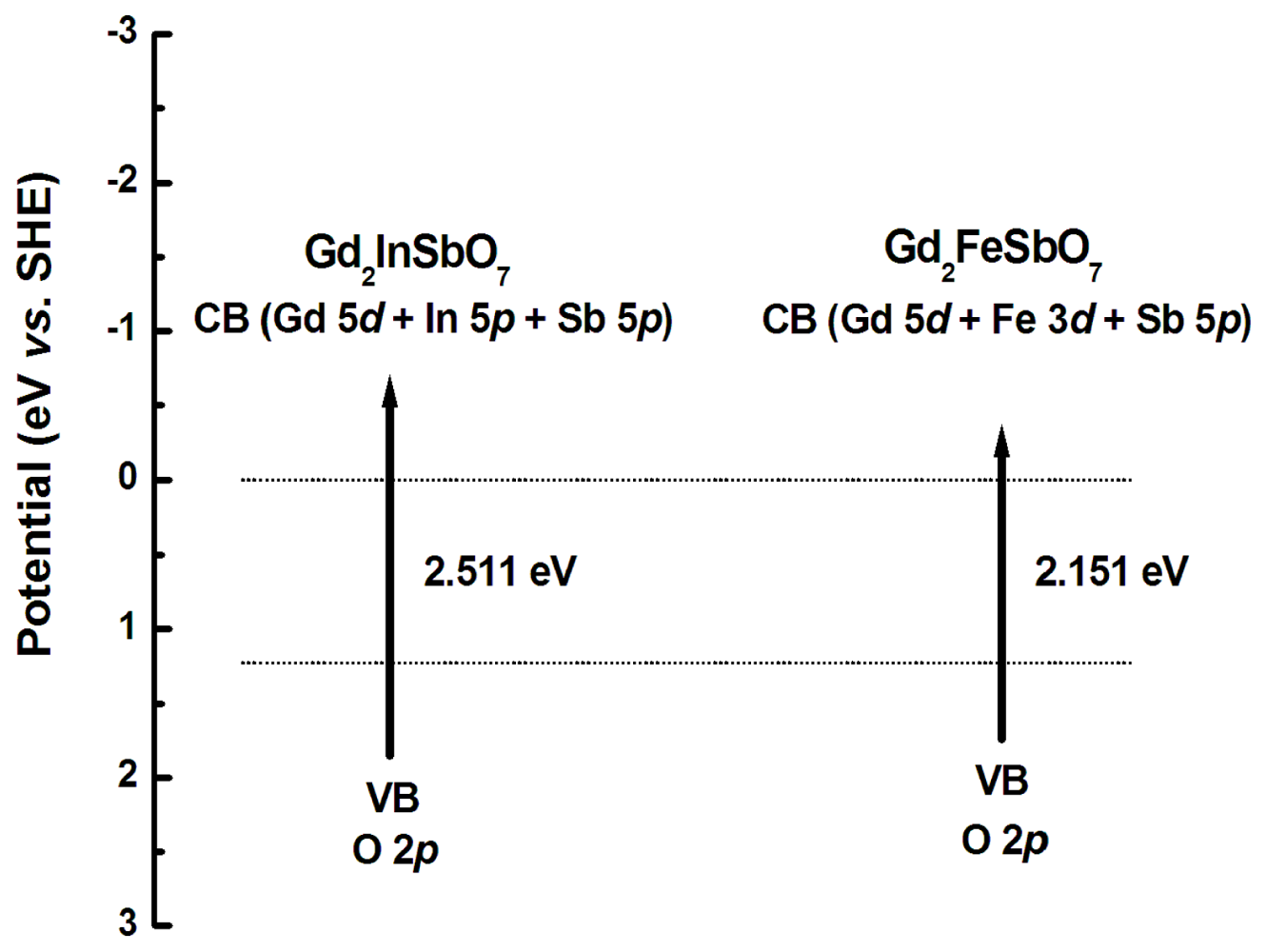
<p><xref ref-type="fig" rid="f13-ijms-14-00999">Figure 13</xref> shows the suggested band structures of Gd<sub>2</sub>FeSbO<sub>7</sub> and Gd<sub>2</sub>InSbO<sub>7</sub>. The positions and width of the conduction band (CB) and the valence band (VB) were investigated by calculating the electronic band structure of Gd<sub>2</sub>FeSbO<sub>7</sub> and Gd<sub>2</sub>InSbO<sub>7</sub> with the plane-wave-based density functional method. The band structure calculations of Gd<sub>2</sub>FeSbO<sub>7</sub> and Gd<sub>2</sub>InSbO<sub>7</sub> were performed with the program of cambridge serial total energy package (CASTEP) and first-principles simulation. The CASTEP calculation was composed of the plane-wave pseudopotential total energy method according to the density functional theory. The generalized gradient approximation (GGA-PBE) and the geometry optimization were adopted. The selected unit cell for calculation was [Gd<sub>2</sub>FeSbO<sub>7</sub>]<sub>2</sub> or [Gd<sub>2</sub>InSbO<sub>7</sub>]<sub>2</sub>. The pseudo-atomic calculations were accomplished for Gd<sub>2</sub>FeSbO<sub>7</sub> with 5d<sup>1</sup>6s<sup>2</sup> (Gd), 3d<sup>6</sup>4s<sup>2</sup> (Fe), 5s<sup>2</sup>5p<sup>3</sup> (Sb) and 2s<sup>2</sup>2p<sup>4</sup> (O). The pseudo-atomic calculations were accomplished for Gd<sub>2</sub>InSbO<sub>7</sub> with 5d<sup>1</sup>6s<sup>2</sup> (Gd), 5s<sup>2</sup>5p<sup>1</sup> (In), 5s<sup>2</sup>5p<sup>3</sup> (Sb) and 2s<sup>2</sup>2p<sup>4</sup> (O). The self-consistent field tolerance was 1.0 × 10<sup>−6</sup> eV/atom. The core electrons were replaced by the ultra-soft pseudopotentials. The FFT grid of the basis was 40 × 30 × 30. The kinetic energy cutoff was 400 eV. 4 × 5 × 5 k-point, and the ultrasoft pseudopotential was applied in the above calculation. The total and partial density of the states of Gd<sub>2</sub>FeSbO<sub>7</sub> and Gd<sub>2</sub>InSbO<sub>7</sub> was taken into consideration. We determined the band structures of Gd<sub>2</sub>InSbO<sub>7</sub> and Gd<sub>2</sub>FeSbO<sub>7</sub> by borrowing ideas from the relevant literature [<xref ref-type="bibr" rid="b56-ijms-14-00999">56</xref>–<xref ref-type="bibr" rid="b62-ijms-14-00999">62</xref>]. Recently, the electronic structures of InMO<sub>4</sub> (M = V, Nb and Ta) and BiVO<sub>4</sub> were reported by Oshikiri <italic>et al.</italic> based on the first principles calculations [<xref ref-type="bibr" rid="b63-ijms-14-00999">63</xref>]. The conduction bands of InMO<sub>4</sub> (M = V, Nb and Ta) were mainly composed of a dominant <italic>d</italic> orbital component from V 3<italic>d</italic>, Nb 4<italic>d</italic> and Ta 5<italic>d</italic> orbitals, respectively. The valence bands of BiVO<sub>4</sub> were composed of a small Bi 6<italic>s</italic> orbital component and a dominant O 2<italic>p</italic> orbital component. The band structures of Gd<sub>2</sub>FeSbO<sub>7</sub> and Gd<sub>2</sub>InSbO<sub>7</sub> should be similar to that of the above compounds. Therefore, we concluded that the conduction band of Gd<sub>2</sub>FeSbO<sub>7</sub> was composed of Gd 5<italic>d</italic>, Fe 3<italic>d</italic> and Sb 5<italic>p</italic> orbital components; meanwhile, the valence band of Gd<sub>2</sub>FeSbO<sub>7</sub> was composed of a small dominant O 2<italic>p</italic> orbital component. Similarly, the conduction band of Gd<sub>2</sub>InSbO<sub>7</sub> was composed of Gd 5<italic>d</italic>, In 5<italic>p</italic> and Sb 5<italic>p</italic> orbital components; moreover, the valence band of Gd<sub>2</sub>InSbO<sub>7</sub> was composed of a small dominant O 2<italic>p</italic> orbital component. Direct absorption of photons by Gd<sub>2</sub>FeSbO<sub>7</sub> or Gd<sub>2</sub>InSbO<sub>7</sub> could produce electron–hole pairs within the catalyst, indicating that larger energy than the band gap of Gd<sub>2</sub>FeSbO<sub>7</sub> or Gd<sub>2</sub>InSbO<sub>7</sub> was necessary for decomposing RhB by photocatalysis.</p>
<p>The presented results indicated that the Gd<sub>2</sub>FeSbO<sub>7</sub> (or Gd<sub>2</sub>InSbO<sub>7</sub>)-visible light photocatalysis system might be regarded as a method for practical treatment of diluted colored waste water. Our Gd<sub>2</sub>FeSbO<sub>7</sub> (or Gd<sub>2</sub>InSbO<sub>7</sub>)-visible light photocatalysis system could be utilized for decolorization, purification and detoxification in the textile, printing and dyeing industries within semi-arid countries. We designed Gd<sub>2</sub>FeSbO<sub>7</sub> (or Gd<sub>2</sub>InSbO<sub>7</sub>)-visible light photocatalysis system without demanding chemical reagents or using the high pressure of oxygen or heating. The decolorized and detoxified water was submitted to our new system for treatment, and the results showed that the Gd<sub>2</sub>FeSbO<sub>7</sub> (or Gd<sub>2</sub>InSbO<sub>7</sub>)-visible light photocatalysis system might provide a valuable treatment for purifying and reusing colored aqueous effluents.</p></sec></sec>
<sec>
<title>3. Experimental Section</title>
<p>The novel photocatalysts were synthesized by a solid-state reaction method. Gd<sub>2</sub>O<sub>3</sub>, Bi<sub>2</sub>O<sub>3</sub>, Fe<sub>2</sub>O<sub>3</sub>, In<sub>2</sub>O<sub>3</sub>, Sb<sub>2</sub>O<sub>5</sub> and Ta<sub>2</sub>O<sub>5</sub> with purity of 99.99% (Sinopharm Group Chemical Reagent Co., Ltd., Shanghai, China) were used as starting materials. All powders were dried at 200 °C for 4 h before synthesis. For the sake of synthesizing Gd<sub>2</sub>FeSbO<sub>7</sub>, the precursors were stoichiometrically churned up, subsequently pressed into small columns and put into an alumina crucible (Shenyang Crucible Co., LTD, Shenyang, China). Eventually, calcination was performed at 1250 °C for 65 h in an electric furnace (KSL 1700X, Hefei Kejing Materials Technology CO., LTD, Hefei, China). Similarly, Gd<sub>2</sub>InSbO<sub>7</sub> was prepared by calcination at 1320 °C for 65 h, and Bi<sub>2</sub>InTaO<sub>7</sub> was prepared by calcination at 1050 °C for 46 h. The crystal structures of Gd<sub>2</sub>FeSbO<sub>7</sub> and Gd<sub>2</sub>InSbO<sub>7</sub> were analyzed by the powder X-ray diffraction method (D/MAX-RB, Rigaku Corporation, Tokyo, Japan) with Cu<italic>K</italic>α radiation (λ = 1.54056 angstrom). The data were collected at 295 K with a step-scan procedure in the range of 2θ = 10–100°. The step interval was 0.02°, and the time per step was 1.2 s. The chemical composition of Gd<sub>2</sub>InSbO<sub>7</sub> and Gd<sub>2</sub>FeSbO<sub>7</sub> was inspected by scanning electron microscope-X-ray energy dispersion spectrum (SEM-EDS, LEO 1530VP, LEO Electron Microscopy Inc., New York, NY, USA) and X-ray fluorescence spectrometer (XFS, ARL-9800, Thermo ARL, ARL Applied Research Laboratories S.A., Ecublens, Switzerland). The Gd<sup>3+</sup> content, Sb<sup>5+</sup> content, Fe<sup>3+</sup> content, In<sup>3+</sup> content and O<sup>2−</sup> content of Gd<sub>2</sub>FeSbO<sub>7</sub> and Gd<sub>2</sub>InSbO<sub>7</sub> were detected by X-ray photoelectron spectroscopy (XPS, ESCALABMK-2, VG Scientific Ltd., East Grinstead, UK). The chemical composition within the depth profile of Gd<sub>2</sub>FeSbO<sub>7</sub> or Gd<sub>2</sub>InSbO<sub>7</sub> was examined by the argon ion denudation method when X-ray photoelectron spectroscopy was used. The optical absorption of Gd<sub>2</sub>FeSbO<sub>7</sub> and Gd<sub>2</sub>InSbO<sub>7</sub> was analyzed with an UV-visible spectrophotometer (Lambda 40, Perkin-Elmer Corporation, Waltham, MA, USA). The surface areas of Gd<sub>2</sub>InSbO<sub>7,</sub> Gd<sub>2</sub>FeSbO<sub>7</sub> and Bi<sub>2</sub>InTaO<sub>7</sub> were surveyed by the Brunauer-Emmett-Teller (BET) method (MS-21, Quantachrome Instruments Corporation, Boynton Beach, FL, USA), with N<sub>2</sub> adsorption at liquid nitrogen temperature. The particle sizes of the photocatalysts were measured by Malvern’s mastersize-2000 particle size analyzer (Malvern Instruments Ltd, Worcestershire, United Kingdom). The particle morphology of Gd<sub>2</sub>FeSbO<sub>7</sub> and Gd<sub>2</sub>InSbO<sub>7</sub> were measured by transmission electron microscope (TEM, Tecnal F20 S-Twin, FEI Corporation, Hillsboro, OR, USA).</p>
<p>The photocatalytic degradation of rhodamine B (RhB) (Tianjin Kermel Chemical Reagent Co., Ltd., Tianjin, China) was performed with Gd<sub>2</sub>InSbO<sub>7</sub> or Gd<sub>2</sub>FeSbO<sub>7</sub> or Bi<sub>2</sub>InTaO<sub>7</sub> powder (0.8 g) suspended in RhB (300 mL 0.0293 mmol) solution by a pyrex glass cell (Jiangsu Yancheng Huaou Industry, Yancheng, China). Before visible light irradiation, the suspensions were magnetically stirred in darkness for 45 min to make sure the establishment of an adsorption/desorption equilibrium among Gd<sub>2</sub>FeSbO<sub>7</sub>, Gd<sub>2</sub>InSbO<sub>7</sub>, Bi<sub>2</sub>InTaO<sub>7</sub>, the RhB dye and atmospheric oxygen. The photocatalytic reaction system was composed of a 300 W Xe arc lamp, which was a light resource, with the main emission wavelength at 436 nm (Nanjing JYZCPST CO., LTD, Nanjing, China), a magnetic stirrer and a cut-off filter (λ &gt; 400 nm, Jiangsu Nantong JSOL Corporation, Nantong, China). The Xe arc lamp was surrounded by a quartz jacket and was placed inside a photoreactor quartz vessel (5.8 cm in diameter and 68 cm in length) by which a suspension of RhB and the photocatalyst was circulated. An outer recycling water glass jacket maintained a near constant reaction temperature (22 °C), and the solution was stirred and aerated continuously. Two milliliters aliquots were sampled at various time intervals. The incident photon flux <italic>I</italic><italic><sub>o</sub></italic> measured by a radiometer (Model FZ-A, Photoelectric Instrument Factory Beijing Normal University, Beijing, China) was determined to be 4.76 × 10<sup>−6</sup> Einstein L<sup>−1</sup> s<sup>−1</sup> under visible light irradiation (wavelength range of 400–700 nm). The incident photon flux on the photoreactor was varied by adjusting the distance between the photoreactor and the Xe arc lamp. The initial pH value of the liquid was 7.0 and was not adjusted subsequently. The concentration of RhB was determined based on the absorption at 553.5 nm measured by an UV-Vis spectrophotometer (Lambda 40, Perkin-Elmer Corporation, Waltham, MA, USA). The inorganic products obtained from RhB degradation were analyzed by ion chromatograph (DX-300, Dionex Corporation, Sunnyvale, CA, USA). The identification of RhB and the degradation intermediate products of RhB were performed by gas chromatograph—mass spectrometer (GC-MS, HP 6890 series gas chromatograph, AT™ column, 20.3 m × 0.32 mm, ID of 0.25 μm) operating at 320 °C, which was connected to a HP 5973 mass selective detector and a flame ionization detector, with H<sub>2</sub> as the carried gas. The intermediate products of RhB were measured by liquid chromatograph—mass spectrometer (LC-MS, Thermo Quest LCQ Duo, Atlanta, GA, USA, Beta Basic-C<sub>18</sub> HPLC column: 150 × 2.1 mm, ID of 5 μm, Finnigan, Thermo, Atlanta, GA, USA). Here, post-photocatalysis solution (20 μL) was injected automatically into the LC-MS system. The eluent contained 60% methanol and 40% water, and the flow rate was 0.2 mL min<sup>−1</sup>. MS conditions included an electrospray ionization interface, a capillary temperature of 27 °C with a voltage of 19.00 V, a spray voltage of 5000 V and a constant sheath gas flow rate. The spectrum was acquired in the negative ion scan mode, sweeping the <italic>m/z</italic> range from 50 to 600. Evolution of CO<sub>2</sub> was analyzed with an intersmat™ IGC120-MB gas chromatograph equipped with a porapack Q column (3 m in length and an inner diameter of 0.25 in.), which was connected to a catharometer detector.</p>
<p>The total organic carbon (TOC) concentration was determined with a TOC analyzer (TOC-5000, Shimadzu Corporation, Kyoto, Japan). The photonic efficiency was calculated according to the following equation [<xref ref-type="bibr" rid="b64-ijms-14-00999">64</xref>]:</p>
<disp-formula id="FD7">
<label>(7)</label>
<mml:math id="mm7" display="block">
<mml:semantics id="sm7">
<mml:mrow>
<mml:mi>ξ</mml:mi>
<mml:mo>=</mml:mo>
<mml:mi>R</mml:mi>
<mml:mo>/</mml:mo>
<mml:msub>
<mml:mrow>
<mml:mtext>I</mml:mtext></mml:mrow>
<mml:mn>0</mml:mn></mml:msub></mml:mrow></mml:semantics></mml:math></disp-formula>
<p>where ϕ was the photonic efficiency (%), <italic>R</italic> was the rate of RhB degradation (Mol L<sup>−1</sup> s<sup>−1</sup>) and <italic>I</italic><italic><sub>o</sub></italic> was the incident photon flux (Einstein L<sup>−1</sup> s<sup>−1</sup>).</p></sec>
<sec sec-type="conclusions">
<title>4. Conclusions</title>
<p>Gd<sub>2</sub>FeSbO<sub>7</sub> and Gd<sub>2</sub>InSbO<sub>7</sub> were prepared by the solid-state reaction method for the first time. The structural, optical absorption and photocatalytic properties of Gd<sub>2</sub>FeSbO<sub>7</sub> and Gd<sub>2</sub>InSbO<sub>7</sub> were investigated and compared with Bi<sub>2</sub>InTaO<sub>7</sub>. XRD results indicated that Gd<sub>2</sub>FeSbO<sub>7</sub> and Gd<sub>2</sub>InSbO<sub>7</sub> crystallized with the pyrochlore-type structure, cubic crystal system and space group <italic>Fd3m</italic>. The lattice parameters of Gd<sub>2</sub>FeSbO<sub>7</sub> and Gd<sub>2</sub>InSbO<sub>7</sub> were found to be α = 10.276026 Å and α = 10.449546 Å. The band gaps of Gd<sub>2</sub>FeSbO<sub>7</sub> and Gd<sub>2</sub>InSbO<sub>7</sub> were estimated to be about 2.151 eV and 2.897 eV, indicating that Gd<sub>2</sub>FeSbO<sub>7</sub> and Gd<sub>2</sub>InSbO<sub>7</sub> showed a strong optical absorption in the visible light region (λ &gt; 400 nm). Photocatalytic degradation of aqueous RhB was observed under visible light irradiation in the presence of Gd<sub>2</sub>FeSbO<sub>7</sub> and Gd<sub>2</sub>InSbO<sub>7</sub> accompanied with the formation of final products, such as CO<sub>2</sub> and water. Complete removal of carbon from RhB was obtained, as indicated from TOC and CO<sub>2</sub> yield measurements, with Gd<sub>2</sub>FeSbO<sub>7</sub> or Gd<sub>2</sub>InSbO<sub>7</sub> as catalyst under visible light irradiation. A Gd<sub>2</sub>FeSbO<sub>7</sub> or (Gd<sub>2</sub>InSbO<sub>7</sub>) visible light photocatalysis system could be regarded as an effective way for treating textile industry wastewater. Gd<sub>2</sub>FeSbO<sub>7</sub> or Gd<sub>2</sub>InSbO<sub>7</sub> also showed higher photocatalytic activity compared with Bi<sub>2</sub>InTaO<sub>7</sub> for RhB photocatalytic degradation under visible light irradiation. Moreover, Gd<sub>2</sub>FeSbO<sub>7</sub> exhibited higher catalytic activity than Gd<sub>2</sub>InSbO<sub>7</sub>. The photocatalytic degradation of RhB was in line with the first-order reaction kinetics. The apparent first-order rate constant <italic>k</italic> was 0.01606, 0.02220 and 0.00318 min<sup>−1</sup> with Gd<sub>2</sub>FeSbO<sub>7</sub>, Gd<sub>2</sub>InSbO<sub>7</sub> or Bi<sub>2</sub>InTaO<sub>7</sub> as catalyst. The possible photocatalytic degradation pathway of RhB was proposed under visible light irradiation.</p></sec></body>
<back>
<ack>
<title>Acknowledgments</title>
<p>This work was supported by the National Natural Science Foundation of China (No. 21277067). This work was supported by a grant from the China-Israel Joint Research Program in Water Technology and Renewable Energy (No. 5). This work was supported by a grant from The Fourth Technological Development Scheming (Industry) Program of Suzhou City of China from 2010 (SYG201006). This work was supported by a grant from the Fundamental Research Funds for the Central Universities.</p></ack>
<ref-list>
<title>References</title>
<ref id="b1-ijms-14-00999"><label>1</label><citation citation-type="journal"><person-group person-group-type="author"><name><surname>Bhatnagar</surname><given-names>A.</given-names></name><name><surname>Jain</surname><given-names>A.K.</given-names></name></person-group><article-title>A comparative adsorption study with different industrial wastes as adsorbents for the removal of cationic dyes from water</article-title><source>J. Colloid Interface Sci</source><year>2005</year><volume>281</volume><fpage>49</fpage><lpage>55</lpage><pub-id pub-id-type="doi">10.1016/j.jcis.2004.08.076</pub-id><pub-id pub-id-type="pmid">15567379</pub-id></citation></ref>
<ref id="b2-ijms-14-00999"><label>2</label><citation citation-type="journal"><person-group person-group-type="author"><name><surname>Fu</surname><given-names>H.B.</given-names></name><name><surname>Pan</surname><given-names>C.S.</given-names></name><name><surname>Yao</surname><given-names>W.Q.</given-names></name><name><surname>Zhu</surname><given-names>Y.F.</given-names></name></person-group><article-title>Visible-light-induced degradation of rhodamine B by nanosized Bi<sub>2</sub>WO<sub>6</sub></article-title><source>J. Phys. Chem. B</source><year>2005</year><volume>109</volume><fpage>22432</fpage><lpage>22439</lpage><pub-id pub-id-type="doi">10.1021/jp052995j</pub-id><pub-id pub-id-type="pmid">16853922</pub-id></citation></ref>
<ref id="b3-ijms-14-00999"><label>3</label><citation citation-type="journal"><person-group person-group-type="author"><name><surname>Guo</surname><given-names>Y.P.</given-names></name><name><surname>Zhao</surname><given-names>J.Z.</given-names></name><name><surname>Zhang</surname><given-names>H.</given-names></name><name><surname>Yang</surname><given-names>S.F.</given-names></name><name><surname>Qi</surname><given-names>J.R.</given-names></name><name><surname>Wang</surname><given-names>Z.C.</given-names></name><name><surname>Xu</surname><given-names>H.D.</given-names></name></person-group><article-title>Use of rice husk-based porous carbon for adsorption of Rhodamine B from aqueous solutions</article-title><source>Dyes Pigm</source><year>2005</year><volume>66</volume><fpage>123</fpage><lpage>128</lpage><pub-id pub-id-type="doi">10.1016/j.dyepig.2004.09.014</pub-id></citation></ref>
<ref id="b4-ijms-14-00999"><label>4</label><citation citation-type="journal"><person-group person-group-type="author"><name><surname>Gupta</surname><given-names>V.K.</given-names></name><name><surname>Ali</surname><given-names>I.</given-names></name><name><surname>Saini</surname><given-names>V.K.</given-names></name></person-group><article-title>Removal of rhodamine B, fast green and methylene blue from wastewater using red mud, an aluminum industry waste</article-title><source>Ind. Eng. Chem. Res</source><year>2004</year><volume>43</volume><fpage>1740</fpage><lpage>1747</lpage><pub-id pub-id-type="doi">10.1021/ie034218g</pub-id></citation></ref>
<ref id="b5-ijms-14-00999"><label>5</label><citation citation-type="journal"><person-group person-group-type="author"><name><surname>Fujii</surname><given-names>T.</given-names></name><name><surname>Nishikiori</surname><given-names>H.</given-names></name><name><surname>Tamura</surname><given-names>T.</given-names></name></person-group><article-title>Absorption-Spectra of Rhodamine-B dimers in dip-coated thin-films prepared by the sol-gel method</article-title><source>Chem. Phy. Lett</source><year>1995</year><volume>233</volume><fpage>424</fpage><lpage>429</lpage><pub-id pub-id-type="doi">10.1016/0009-2614(94)01477-D</pub-id></citation></ref>
<ref id="b6-ijms-14-00999"><label>6</label><citation citation-type="journal"><person-group person-group-type="author"><name><surname>Wang</surname><given-names>S.B.</given-names></name><name><surname>Li</surname><given-names>H.T.</given-names></name></person-group><article-title>Dye adsorption on unburned carbon: Kinetics and equilibrium</article-title><source>J. Hazard. Mater</source><year>2005</year><volume>126</volume><fpage>71</fpage><lpage>77</lpage><pub-id pub-id-type="doi">10.1016/j.jhazmat.2005.05.049</pub-id><pub-id pub-id-type="pmid">16081211</pub-id></citation></ref>
<ref id="b7-ijms-14-00999"><label>7</label><citation citation-type="journal"><person-group person-group-type="author"><name><surname>Wang</surname><given-names>S.B.</given-names></name><name><surname>Boyjoo</surname><given-names>Y.</given-names></name><name><surname>Choueib</surname><given-names>A.</given-names></name></person-group><article-title>A comparative study of dye removal using fly ash treated by different methods</article-title><source>Chemosphere</source><year>2005</year><volume>60</volume><fpage>1401</fpage><lpage>1407</lpage><pub-id pub-id-type="doi">10.1016/j.chemosphere.2005.01.091</pub-id><pub-id pub-id-type="pmid">16054909</pub-id></citation></ref>
<ref id="b8-ijms-14-00999"><label>8</label><citation citation-type="journal"><person-group person-group-type="author"><name><surname>Gupta</surname><given-names>V.K.</given-names></name><name><surname>Jain</surname><given-names>R.</given-names></name><name><surname>Malathi</surname><given-names>S.</given-names></name><name><surname>Nayak</surname><given-names>A.</given-names></name></person-group><article-title>Adsorption-desorption studies of indigocarmine from industrial effluents by using deoiled mustard and its comparison with charcoal</article-title><source>J. Colloid Interface Sci</source><year>2010</year><volume>348</volume><fpage>628</fpage><lpage>633</lpage><pub-id pub-id-type="doi">10.1016/j.jcis.2010.04.085</pub-id><pub-id pub-id-type="pmid">20570276</pub-id></citation></ref>
<ref id="b9-ijms-14-00999"><label>9</label><citation citation-type="journal"><person-group person-group-type="author"><name><surname>Ohsaki</surname><given-names>H.</given-names></name><name><surname>Kanai</surname><given-names>N.</given-names></name><name><surname>Fukunaga</surname><given-names>Y.</given-names></name><name><surname>Suzuki</surname><given-names>M.</given-names></name><name><surname>Watanabe</surname><given-names>T.</given-names></name><name><surname>Hashimoto</surname><given-names>K.</given-names></name></person-group><article-title>Photocatalytic properties of SnO<sub>2</sub>/TiO<sub>2</sub> multilayers</article-title><source>Thin Solid Films</source><year>2006</year><volume>502</volume><fpage>138</fpage><lpage>142</lpage><pub-id pub-id-type="doi">10.1016/j.tsf.2005.07.258</pub-id></citation></ref>
<ref id="b10-ijms-14-00999"><label>10</label><citation citation-type="journal"><person-group person-group-type="author"><name><surname>Davit</surname><given-names>P.</given-names></name><name><surname>Martra</surname><given-names>G.</given-names></name><name><surname>Coluccia</surname><given-names>S.</given-names></name><name><surname>Augugliaro</surname><given-names>V.</given-names></name><name><surname>Lopez</surname><given-names>E.G.</given-names></name><name><surname>Loddo</surname><given-names>V.</given-names></name><name><surname>Marci</surname><given-names>G.</given-names></name><name><surname>Palmisano</surname><given-names>L.</given-names></name><name><surname>Schiavello</surname><given-names>M.</given-names></name></person-group><article-title>Adsorption and photocatalytic degradation of acetonitrile: FT-IR investigation</article-title><source>J. Mol. Catal. A</source><year>2003</year><volume>204</volume><fpage>693</fpage><lpage>701</lpage><pub-id pub-id-type="doi">10.1016/S1381-1169(03)00354-6</pub-id></citation></ref>
<ref id="b11-ijms-14-00999"><label>11</label><citation citation-type="journal"><person-group person-group-type="author"><name><surname>Kim</surname><given-names>S.</given-names></name><name><surname>Choi</surname><given-names>W.</given-names></name></person-group><article-title>Dual photocatalytic pathways of trichloroacetate degradation on TiO<sub>2</sub>: Effects of nanosized platinum deposits on kinetics and mechanism</article-title><source>J. Phys. Chem. B</source><year>2002</year><volume>106</volume><fpage>13311</fpage><lpage>13317</lpage><pub-id pub-id-type="doi">10.1021/jp0262261</pub-id></citation></ref>
<ref id="b12-ijms-14-00999"><label>12</label><citation citation-type="journal"><person-group person-group-type="author"><name><surname>Luan</surname><given-names>J.F.</given-names></name><name><surname>Ma</surname><given-names>K.</given-names></name><name><surname>Wang</surname><given-names>S.</given-names></name><name><surname>Hu</surname><given-names>Z.T.</given-names></name><name><surname>Li</surname><given-names>Y.M.</given-names></name><name><surname>Pan</surname><given-names>B.C.</given-names></name></person-group><article-title>Research on Photocatalytic Degradation Pathway and Degradation Mechanisms of Organics</article-title><source>Curr. Org. Chem</source><year>2010</year><volume>14</volume><fpage>645</fpage><lpage>682</lpage><pub-id pub-id-type="doi">10.2174/138527210790963403</pub-id></citation></ref>
<ref id="b13-ijms-14-00999"><label>13</label><citation citation-type="journal"><person-group person-group-type="author"><name><surname>Chatterjee</surname><given-names>D.</given-names></name><name><surname>Mahata</surname><given-names>A.</given-names></name></person-group><article-title>Visible light induced photodegradation of organic pollutants on dye adsorbed TiO<sub>2</sub> surface</article-title><source>J. Photochem. Photobiol. A</source><year>2002</year><volume>153</volume><fpage>199</fpage><lpage>204</lpage><pub-id pub-id-type="doi">10.1016/S1010-6030(02)00291-5</pub-id></citation></ref>
<ref id="b14-ijms-14-00999"><label>14</label><citation citation-type="journal"><person-group person-group-type="author"><name><surname>Fabbri</surname><given-names>D.</given-names></name><name><surname>Prevot</surname><given-names>A.B.</given-names></name><name><surname>Zelano</surname><given-names>V.</given-names></name><name><surname>Ginepro</surname><given-names>M.</given-names></name><name><surname>Pramauro</surname><given-names>E.</given-names></name></person-group><article-title>Removal and degradation of aromatic compounds from a highly polluted site by coupling soil washing with photocatalysis</article-title><source>Chemosphere</source><year>2008</year><volume>71</volume><fpage>59</fpage><lpage>65</lpage><pub-id pub-id-type="doi">10.1016/j.chemosphere.2007.10.028</pub-id><pub-id pub-id-type="pmid">18061238</pub-id></citation></ref>
<ref id="b15-ijms-14-00999"><label>15</label><citation citation-type="journal"><person-group person-group-type="author"><name><surname>Sohrabi</surname><given-names>M.R.</given-names></name><name><surname>Ghavami</surname><given-names>M.</given-names></name></person-group><article-title>Comparison of Direct Yellow 12 dye degradation efficiency using UV/semiconductor and UV/H(2)O(2)/semiconductor systems</article-title><source>Desalination</source><year>2010</year><volume>252</volume><fpage>157</fpage><lpage>162</lpage><pub-id pub-id-type="doi">10.1016/j.desal.2009.10.009</pub-id></citation></ref>
<ref id="b16-ijms-14-00999"><label>16</label><citation citation-type="journal"><person-group person-group-type="author"><name><surname>Franch</surname><given-names>M.I.</given-names></name><name><surname>Peral</surname><given-names>J.</given-names></name><name><surname>Domenech</surname><given-names>X.</given-names></name><name><surname>Howe</surname><given-names>R.F.</given-names></name><name><surname>Ayllon</surname><given-names>J.A.</given-names></name></person-group><article-title>Enhancement of photocatalytic activity of TiO<sub>2</sub> by adsorbed aluminium(III)</article-title><source>Appl. Catal. B</source><year>2005</year><volume>55</volume><fpage>105</fpage><lpage>113</lpage><pub-id pub-id-type="doi">10.1016/j.apcatb.2004.07.006</pub-id></citation></ref>
<ref id="b17-ijms-14-00999"><label>17</label><citation citation-type="journal"><person-group person-group-type="author"><name><surname>Yamashita</surname><given-names>H.</given-names></name><name><surname>Nose</surname><given-names>H.</given-names></name><name><surname>Kuwahara</surname><given-names>Y.</given-names></name><name><surname>Nishida</surname><given-names>Y.</given-names></name><name><surname>Yuan</surname><given-names>S.</given-names></name><name><surname>Mori</surname><given-names>K.</given-names></name></person-group><article-title>TiO<sub>2</sub> photocatalyst loaded on hydrophobic Si<sub>3</sub>N<sub>4</sub> support for efficient degradation of organics diluted in water</article-title><source>Appl. Catal. A</source><year>2008</year><volume>350</volume><fpage>164</fpage><lpage>168</lpage><pub-id pub-id-type="doi">10.1016/j.apcata.2008.08.015</pub-id></citation></ref>
<ref id="b18-ijms-14-00999"><label>18</label><citation citation-type="journal"><person-group person-group-type="author"><name><surname>Neppolian</surname><given-names>B.</given-names></name><name><surname>Yamashita</surname><given-names>H.</given-names></name><name><surname>Okada</surname><given-names>Y.</given-names></name><name><surname>Nishijima</surname><given-names>H.</given-names></name><name><surname>Anpo</surname><given-names>M.</given-names></name></person-group><article-title>Preparation of unique TiO<sub>2</sub> nano-particle photocatalysts by a multi-gelation method for control of the physicochemical parameters and reactivity</article-title><source>Catal. Lett</source><year>2005</year><volume>105</volume><fpage>111</fpage><lpage>117</lpage><pub-id pub-id-type="doi">10.1007/s10562-005-8013-1</pub-id></citation></ref>
<ref id="b19-ijms-14-00999"><label>19</label><citation citation-type="journal"><person-group person-group-type="author"><name><surname>An</surname><given-names>H.Q.</given-names></name><name><surname>Zhou</surname><given-names>J.</given-names></name><name><surname>Li</surname><given-names>J.X.</given-names></name><name><surname>Zhu</surname><given-names>B.L.</given-names></name><name><surname>Wang</surname><given-names>S.R.</given-names></name><name><surname>Zhang</surname><given-names>S.M.</given-names></name><name><surname>Wu</surname><given-names>S.H.</given-names></name><name><surname>Huang</surname><given-names>W.P.</given-names></name></person-group><article-title>Deposition of Pt on the stable nanotubular TiO<sub>2</sub> and its photocatalytic performance</article-title><source>Catal. Commun</source><year>2009</year><volume>11</volume><fpage>175</fpage><lpage>179</lpage><pub-id pub-id-type="doi">10.1016/j.catcom.2009.09.020</pub-id></citation></ref>
<ref id="b20-ijms-14-00999"><label>20</label><citation citation-type="journal"><person-group person-group-type="author"><name><surname>Davit</surname><given-names>P.</given-names></name><name><surname>Martra</surname><given-names>G.</given-names></name><name><surname>Coluccia</surname><given-names>S.</given-names></name></person-group><article-title>Photocatalytic degradation of organic compounds on TiO<sub>2</sub> powders: FT-IR investigation of surface reactivity and mechanistic aspects</article-title><source>J. Jpn. Pet. Inst</source><year>2004</year><volume>47</volume><fpage>359</fpage><lpage>376</lpage><pub-id pub-id-type="doi">10.1627/jpi.47.359</pub-id></citation></ref>
<ref id="b21-ijms-14-00999"><label>21</label><citation citation-type="journal"><person-group person-group-type="author"><name><surname>Cernigoj</surname><given-names>U.</given-names></name><name><surname>Stangar</surname><given-names>U.L.</given-names></name><name><surname>Trebse</surname><given-names>P.</given-names></name></person-group><article-title>Degradation of neonicotinoid insecticides by different advanced oxidation processes and studying the effect of ozone on TiO<sub>2</sub> photocatalysis</article-title><source>Appl. Catal. B</source><year>2007</year><volume>75</volume><fpage>229</fpage><lpage>238</lpage><pub-id pub-id-type="doi">10.1016/j.apcatb.2007.04.014</pub-id></citation></ref>
<ref id="b22-ijms-14-00999"><label>22</label><citation citation-type="journal"><person-group person-group-type="author"><name><surname>Sohrabi</surname><given-names>M.R.</given-names></name><name><surname>Ghavami</surname><given-names>M.</given-names></name></person-group><article-title>Photocatalytic degradation of Direct Red 23 dye using UV/TiO2: Effect of operational parameters</article-title><source>J. Hazard. Mater</source><year>2008</year><volume>153</volume><fpage>1235</fpage><lpage>1239</lpage><pub-id pub-id-type="doi">10.1016/j.jhazmat.2007.09.114</pub-id><pub-id pub-id-type="pmid">18006230</pub-id></citation></ref>
<ref id="b23-ijms-14-00999"><label>23</label><citation citation-type="journal"><person-group person-group-type="author"><name><surname>Franch</surname><given-names>M.I.</given-names></name><name><surname>Peral</surname><given-names>J.</given-names></name><name><surname>Domenech</surname><given-names>X.</given-names></name><name><surname>Ayllon</surname><given-names>J.A.</given-names></name></person-group><article-title>Aluminium(III) adsorption: A soft and simple method to prevent TiO<sub>2</sub> deactivation during salicylic acid photodegradation</article-title><source>Chem. Commun</source><year>2005</year><volume>14</volume><fpage>1851</fpage><lpage>1853</lpage></citation></ref>
<ref id="b24-ijms-14-00999"><label>24</label><citation citation-type="journal"><person-group person-group-type="author"><name><surname>Hammami</surname><given-names>S.</given-names></name><name><surname>Bellakhal</surname><given-names>N.</given-names></name><name><surname>Oturan</surname><given-names>N.</given-names></name><name><surname>Oturan</surname><given-names>M.A.</given-names></name><name><surname>Dachraoui</surname><given-names>M.</given-names></name></person-group><article-title>Degradation of Acid Orange 7 by electrochemically generated (OH)-O-center dot radicals in acidic aqueous medium using a boron-doped diamond or platinum anode: A mechanistic study</article-title><source>Chemosphere</source><year>2008</year><volume>73</volume><fpage>678</fpage><lpage>684</lpage><pub-id pub-id-type="doi">10.1016/j.chemosphere.2008.07.010</pub-id><pub-id pub-id-type="pmid">18760822</pub-id></citation></ref>
<ref id="b25-ijms-14-00999"><label>25</label><citation citation-type="journal"><person-group person-group-type="author"><name><surname>Luan</surname><given-names>J.F.</given-names></name><name><surname>Pan</surname><given-names>B.C.</given-names></name><name><surname>Paz</surname><given-names>Y.</given-names></name><name><surname>Li</surname><given-names>Y.M.</given-names></name><name><surname>Wu</surname><given-names>X.S.</given-names></name><name><surname>Zou</surname><given-names>Z.G.</given-names></name></person-group><article-title>Structural, photophysical and photocatalytic properties of new Bi<sub>2</sub>SbVO<sub>7</sub> under visible light irradiation</article-title><source>Phys. Chem. Chem. Phys</source><year>2009</year><volume>11</volume><fpage>6289</fpage><lpage>6298</lpage><pub-id pub-id-type="doi">10.1039/b815260h</pub-id><pub-id pub-id-type="pmid">19606342</pub-id></citation></ref>
<ref id="b26-ijms-14-00999"><label>26</label><citation citation-type="journal"><person-group person-group-type="author"><name><surname>Arana</surname><given-names>J.</given-names></name><name><surname>Rendon</surname><given-names>E.T.</given-names></name><name><surname>Rodriguez</surname><given-names>J.M.D.</given-names></name><name><surname>Melian</surname><given-names>J.A.H.</given-names></name><name><surname>Diaz</surname><given-names>O.G.</given-names></name><name><surname>Pena</surname><given-names>J.P.</given-names></name></person-group><article-title>FTIR study of the photocatalytic degradation of NH<sup>4+</sup> determination wastes</article-title><source>J. Photochem. Photobiol. A</source><year>2002</year><volume>148</volume><fpage>215</fpage><lpage>222</lpage><pub-id pub-id-type="doi">10.1016/S1010-6030(02)00047-3</pub-id></citation></ref>
<ref id="b27-ijms-14-00999"><label>27</label><citation citation-type="journal"><person-group person-group-type="author"><name><surname>Arana</surname><given-names>J.</given-names></name><name><surname>Nieto</surname><given-names>J.L.M.</given-names></name><name><surname>Melian</surname><given-names>J.A.H.</given-names></name><name><surname>Rodriguez</surname><given-names>J.M.D.</given-names></name><name><surname>Diaz</surname><given-names>O.G.</given-names></name><name><surname>Pena</surname><given-names>J.P.</given-names></name><name><surname>Bergasa</surname><given-names>O.</given-names></name><name><surname>Alvarez</surname><given-names>C.</given-names></name><name><surname>Mendez</surname><given-names>J.</given-names></name></person-group><article-title>Photocatalytic degradation of formaldehyde containing wastewater from veterinarian laboratories</article-title><source>Chemosphere</source><year>2004</year><volume>55</volume><fpage>893</fpage><lpage>904</lpage><pub-id pub-id-type="doi">10.1016/j.chemosphere.2003.11.060</pub-id><pub-id pub-id-type="pmid">15041294</pub-id></citation></ref>
<ref id="b28-ijms-14-00999"><label>28</label><citation citation-type="journal"><person-group person-group-type="author"><name><surname>Vijayabalan</surname><given-names>A.</given-names></name><name><surname>Selvam</surname><given-names>K.</given-names></name><name><surname>Velmurugan</surname><given-names>R.</given-names></name><name><surname>Swaminathan</surname><given-names>M.</given-names></name></person-group><article-title>Photocatalytic activity of surface fluorinated TiO<sub>2</sub>-P25 in the degradation of Reactive Orange 4</article-title><source>J. Hazard. Mater</source><year>2009</year><volume>172</volume><fpage>914</fpage><lpage>921</lpage><pub-id pub-id-type="doi">10.1016/j.jhazmat.2009.07.082</pub-id><pub-id pub-id-type="pmid">19733965</pub-id></citation></ref>
<ref id="b29-ijms-14-00999"><label>29</label><citation citation-type="journal"><person-group person-group-type="author"><name><surname>Arana</surname><given-names>J.</given-names></name><name><surname>Rodriguez</surname><given-names>J.M.D.</given-names></name><name><surname>Diaz</surname><given-names>O.G.</given-names></name><name><surname>Melian</surname><given-names>J.A.H.</given-names></name><name><surname>Pena</surname><given-names>J.P.</given-names></name></person-group><article-title>Comparative study on the photocatalytic mineralization of homologous aliphatic acids and alcohols</article-title><source>Appl. Surface Sci</source><year>2006</year><volume>252</volume><fpage>8193</fpage><lpage>8202</lpage><pub-id pub-id-type="doi">10.1016/j.apsusc.2005.10.036</pub-id></citation></ref>
<ref id="b30-ijms-14-00999"><label>30</label><citation citation-type="journal"><person-group person-group-type="author"><name><surname>Eslami</surname><given-names>A.</given-names></name><name><surname>Nasseri</surname><given-names>S.</given-names></name><name><surname>Yadollahi</surname><given-names>B.</given-names></name><name><surname>Mesdaghinia</surname><given-names>A.</given-names></name><name><surname>Vaezi</surname><given-names>F.</given-names></name><name><surname>Nabizadeh</surname><given-names>R.</given-names></name><name><surname>Nazmara</surname><given-names>S.</given-names></name></person-group><article-title>Photocatalytic degradation of methyl tert-butyl ether (MTBE) in contaminated water by ZnO nanoparticles</article-title><source>J. Chem. Technol. Biotechnol</source><year>2008</year><volume>83</volume><fpage>1447</fpage><lpage>1453</lpage><pub-id pub-id-type="doi">10.1002/jctb.1919</pub-id></citation></ref>
<ref id="b31-ijms-14-00999"><label>31</label><citation citation-type="journal"><person-group person-group-type="author"><name><surname>Arana</surname><given-names>J.</given-names></name><name><surname>Cabo</surname><given-names>C.G.I.</given-names></name><name><surname>Rodriguez</surname><given-names>C.F.</given-names></name><name><surname>Melian</surname><given-names>J.A.H.</given-names></name><name><surname>Mendez</surname><given-names>J.A.O.</given-names></name><name><surname>Rodriguez</surname><given-names>J.M.D.</given-names></name><name><surname>Pena</surname><given-names>J.P.</given-names></name></person-group><article-title>Combining TiO<sub>2</sub>-photocatalysis and wetland reactors for the efficient treatment of pesticides</article-title><source>Chemosphere</source><year>2008</year><volume>71</volume><fpage>788</fpage><lpage>794</lpage><pub-id pub-id-type="doi">10.1016/j.chemosphere.2007.10.008</pub-id><pub-id pub-id-type="pmid">18023844</pub-id></citation></ref>
<ref id="b32-ijms-14-00999"><label>32</label><citation citation-type="journal"><person-group person-group-type="author"><name><surname>Li</surname><given-names>J.P.</given-names></name><name><surname>Zhang</surname><given-names>X.</given-names></name><name><surname>Ai</surname><given-names>Z.H.</given-names></name><name><surname>Jia</surname><given-names>F.L.</given-names></name><name><surname>Zhang</surname><given-names>L.Z.</given-names></name><name><surname>Lin</surname><given-names>J.</given-names></name></person-group><article-title>Efficient visible light degradation of rhodamine B by a photo-electrochemical process based on a Bi<sub>2</sub>WO<sub>6</sub> nanoplate film electrode</article-title><source>J. Phys. Chem. C</source><year>2007</year><volume>111</volume><fpage>6832</fpage><lpage>6836</lpage></citation></ref>
<ref id="b33-ijms-14-00999"><label>33</label><citation citation-type="journal"><person-group person-group-type="author"><name><surname>Li</surname><given-names>X.</given-names></name><name><surname>Ye</surname><given-names>J.H.</given-names></name></person-group><article-title>Photocatalytic degradation of rhodamine B over Pb<sub>3</sub>Nb<sub>4</sub>O<sub>13</sub>/fumed SiO<sub>2</sub> composite under visible light irradiation</article-title><source>J. Phys. Chem. C</source><year>2007</year><volume>111</volume><fpage>13109</fpage><lpage>13116</lpage><pub-id pub-id-type="doi">10.1021/jp072752m</pub-id></citation></ref>
<ref id="b34-ijms-14-00999"><label>34</label><citation citation-type="journal"><person-group person-group-type="author"><name><surname>Wu</surname><given-names>J.M.</given-names></name></person-group><article-title>Photodegradation of rhodamine B in water assisted by titania nanorod thin films subjected to various thermal treatments</article-title><source>Environ. Sci. Technol</source><year>2007</year><volume>41</volume><fpage>1723</fpage><lpage>1728</lpage><pub-id pub-id-type="doi">10.1021/es0623562</pub-id><pub-id pub-id-type="pmid">17396666</pub-id></citation></ref>
<ref id="b35-ijms-14-00999"><label>35</label><citation citation-type="journal"><person-group person-group-type="author"><name><surname>Wu</surname><given-names>J.M.</given-names></name><name><surname>Zhang</surname><given-names>T.W.</given-names></name></person-group><article-title>Photodegradation of rhodamine B in water assisted by titania films prepared through a novel procedure</article-title><source>J. Photochem. Photobiol. A</source><year>2004</year><volume>162</volume><fpage>171</fpage><lpage>177</lpage><pub-id pub-id-type="doi">10.1016/S1010-6030(03)00345-9</pub-id></citation></ref>
<ref id="b36-ijms-14-00999"><label>36</label><citation citation-type="journal"><person-group person-group-type="author"><name><surname>Li</surname><given-names>J.Q.</given-names></name><name><surname>Li</surname><given-names>L.P.</given-names></name><name><surname>Zheng</surname><given-names>L.</given-names></name><name><surname>Xian</surname><given-names>Y.Z.</given-names></name><name><surname>Jin</surname><given-names>L.T.</given-names></name></person-group><article-title>Photoelectrocatalytic degradation of rhodamine B using Ti/TiO<sub>2</sub> electrode prepared by laser calcination method</article-title><source>Electrochim. Acta</source><year>2006</year><volume>51</volume><fpage>4942</fpage><lpage>4949</lpage><pub-id pub-id-type="doi">10.1016/j.electacta.2006.01.037</pub-id></citation></ref>
<ref id="b37-ijms-14-00999"><label>37</label><citation citation-type="journal"><person-group person-group-type="author"><name><surname>Qu</surname><given-names>P.</given-names></name><name><surname>Zhao</surname><given-names>J.C.</given-names></name><name><surname>Shen</surname><given-names>T.</given-names></name><name><surname>Hidaka</surname><given-names>H.</given-names></name></person-group><article-title>TiO<sub>2</sub>-assisted photodegradation of dyes: A study of two competitive primary processes in the degradation of RB in an aqueous TiO<sub>2</sub> colloidal solution</article-title><source>J. Mol. Catal. A</source><year>1998</year><volume>129</volume><fpage>257</fpage><lpage>268</lpage><pub-id pub-id-type="doi">10.1016/S1381-1169(97)00185-4</pub-id></citation></ref>
<ref id="b38-ijms-14-00999"><label>38</label><citation citation-type="journal"><person-group person-group-type="author"><name><surname>Zhao</surname><given-names>J.C.</given-names></name><name><surname>Wu</surname><given-names>T.X.</given-names></name><name><surname>Wu</surname><given-names>K.Q.</given-names></name><name><surname>Oikawa</surname><given-names>K.</given-names></name><name><surname>Hidaka</surname><given-names>H.</given-names></name><name><surname>Serpone</surname><given-names>N.</given-names></name></person-group><article-title>Photoassisted degradation of dye pollutants. 3. Degradation of the cationic dye rhodamine B in aqueous anionic surfactant/TiO<sub>2</sub> dispersions under visible light irradiation: Evidence for the need of substrate adsorption on TiO2 particles</article-title><source>Environ. Sci. Technol</source><year>1998</year><volume>32</volume><fpage>2394</fpage><lpage>2400</lpage><pub-id pub-id-type="doi">10.1021/es9707926</pub-id></citation></ref>
<ref id="b39-ijms-14-00999"><label>39</label><citation citation-type="journal"><person-group person-group-type="author"><name><surname>Luan</surname><given-names>J.F.</given-names></name><name><surname>Ma</surname><given-names>K.</given-names></name><name><surname>Zhang</surname><given-names>L.Y.</given-names></name><name><surname>Li</surname><given-names>M.</given-names></name><name><surname>Li</surname><given-names>Y.M.</given-names></name><name><surname>Pan</surname><given-names>B.C.</given-names></name></person-group><article-title>Research on Different Preparation Methods of New Photocatalysts</article-title><source>Curr. Org. Chem</source><year>2010</year><volume>14</volume><fpage>683</fpage><lpage>698</lpage><pub-id pub-id-type="doi">10.2174/138527210790963449</pub-id></citation></ref>
<ref id="b40-ijms-14-00999"><label>40</label><citation citation-type="journal"><person-group person-group-type="author"><name><surname>Kitano</surname><given-names>M.</given-names></name><name><surname>Takeuchi</surname><given-names>M.</given-names></name><name><surname>Matsuoka</surname><given-names>M.</given-names></name><name><surname>Thomas</surname><given-names>J.M.</given-names></name><name><surname>Anpo</surname><given-names>M.</given-names></name></person-group><article-title>Preparation of visible light-responsive TiO<sub>2</sub> thin film photocatalysts by an RF magnetron sputtering deposition method and their photocatalytic reactivity</article-title><source>Chem. Lett</source><year>2005</year><volume>34</volume><fpage>616</fpage><lpage>617</lpage><pub-id pub-id-type="doi">10.1246/cl.2005.616</pub-id></citation></ref>
<ref id="b41-ijms-14-00999"><label>41</label><citation citation-type="journal"><person-group person-group-type="author"><name><surname>Anpo</surname><given-names>M.</given-names></name><name><surname>Yamashita</surname><given-names>H.</given-names></name><name><surname>Ikeue</surname><given-names>K.</given-names></name><name><surname>Fujii</surname><given-names>Y.</given-names></name><name><surname>Zhang</surname><given-names>S.G.</given-names></name><name><surname>Ichihashi</surname><given-names>Y.</given-names></name><name><surname>Park</surname><given-names>D.R.</given-names></name><name><surname>Suzuki</surname><given-names>Y.</given-names></name><name><surname>Koyano</surname><given-names>K.</given-names></name><name><surname>Tatsumi</surname><given-names>T.</given-names></name></person-group><article-title>Photocatalytic reduction of CO<sub>2</sub> with H<sub>2</sub>O on Ti-MCM-41 and Ti-MCM-48 mesoporous zeolite catalysts</article-title><source>Catal. Today</source><year>1998</year><volume>44</volume><fpage>327</fpage><lpage>332</lpage><pub-id pub-id-type="doi">10.1016/S0920-5861(98)00206-5</pub-id></citation></ref>
<ref id="b42-ijms-14-00999"><label>42</label><citation citation-type="journal"><person-group person-group-type="author"><name><surname>Anpo</surname><given-names>M.</given-names></name><name><surname>Takeuchi</surname><given-names>M.</given-names></name></person-group><article-title>The design and development of highly reactive titanium oxide photocatalysts operating under visible light irradiation</article-title><source>J. Catal</source><year>2003</year><volume>216</volume><fpage>505</fpage><lpage>516</lpage><pub-id pub-id-type="doi">10.1016/S0021-9517(02)00104-5</pub-id></citation></ref>
<ref id="b43-ijms-14-00999"><label>43</label><citation citation-type="journal"><person-group person-group-type="author"><name><surname>Hamadanian</surname><given-names>M.</given-names></name><name><surname>Reisi-Vanani</surname><given-names>A.</given-names></name><name><surname>Majedi</surname><given-names>A.</given-names></name></person-group><article-title>Preparation and characterization of S-doped TiO<sub>2</sub> nanoparticles, effect of calcination temperature and evaluation of photocatalytic activity</article-title><source>Mater. Chem. Phys</source><year>2009</year><volume>116</volume><fpage>376</fpage><lpage>382</lpage><pub-id pub-id-type="doi">10.1016/j.matchemphys.2009.03.039</pub-id></citation></ref>
<ref id="b44-ijms-14-00999"><label>44</label><citation citation-type="journal"><person-group person-group-type="author"><name><surname>Luan</surname><given-names>J.F.</given-names></name><name><surname>Zhao</surname><given-names>W.</given-names></name><name><surname>Feng</surname><given-names>J.W.</given-names></name><name><surname>Cai</surname><given-names>H.L.</given-names></name><name><surname>Zheng</surname><given-names>Z.</given-names></name><name><surname>Pan</surname><given-names>B.C.</given-names></name><name><surname>Wu</surname><given-names>X.S.</given-names></name><name><surname>Zou</surname><given-names>Z.G.</given-names></name><name><surname>Li</surname><given-names>Y.M.</given-names></name></person-group><article-title>Structural, photophysical and photocatalytic properties of novel Bi<sub>2</sub>AlVO<sub>7</sub></article-title><source>J. Hazard. Mater</source><year>2009</year><volume>164</volume><fpage>781</fpage><lpage>789</lpage><pub-id pub-id-type="doi">10.1016/j.jhazmat.2008.08.088</pub-id><pub-id pub-id-type="pmid">18842341</pub-id></citation></ref>
<ref id="b45-ijms-14-00999"><label>45</label><citation citation-type="journal"><person-group person-group-type="author"><name><surname>Izumi</surname><given-names>F.</given-names></name></person-group><article-title>A software package for the Rietveld analysis of X-ray and neutron diffraction patterns</article-title><source>J. Crystallogr. Assoc. Jpn</source><year>1985</year><volume>27</volume><fpage>23</fpage><lpage>26</lpage><pub-id pub-id-type="doi">10.5940/jcrsj.27.23</pub-id></citation></ref>
<ref id="b46-ijms-14-00999"><label>46</label><citation citation-type="journal"><person-group person-group-type="author"><name><surname>Zou</surname><given-names>Z.</given-names></name><name><surname>Ye</surname><given-names>J.</given-names></name><name><surname>Arakawa</surname><given-names>H.</given-names></name></person-group><article-title>Preparation, structural and photophysical properties of Bi<sub>2</sub>InNbO<sub>7</sub> compound</article-title><source>J. Mater. Sci. Lett</source><year>2000</year><volume>19</volume><fpage>1909</fpage><lpage>1911</lpage><pub-id pub-id-type="doi">10.1023/A:1006799013743</pub-id></citation></ref>
<ref id="b47-ijms-14-00999"><label>47</label><citation citation-type="journal"><person-group person-group-type="author"><name><surname>Tauc</surname><given-names>J.</given-names></name><name><surname>Grigorov</surname><given-names>R.</given-names></name><name><surname>Vancu</surname><given-names>A.</given-names></name></person-group><article-title>Optical properties and electronic structure of amorphous germanium</article-title><source>Phys. Status Solidi</source><year>1966</year><volume>15</volume><fpage>627</fpage><lpage>637</lpage><pub-id pub-id-type="doi">10.1002/pssb.19660150224</pub-id></citation></ref>
<ref id="b48-ijms-14-00999"><label>48</label><citation citation-type="journal"><person-group person-group-type="author"><name><surname>Butler</surname><given-names>M.A.</given-names></name></person-group><article-title>Photoelectrolysis and physical-properties of semiconducting electrode WO<sub>3</sub></article-title><source>J. Appl. Phys</source><year>1977</year><volume>48</volume><fpage>1914</fpage><lpage>1920</lpage><pub-id pub-id-type="doi">10.1063/1.323948</pub-id></citation></ref>
<ref id="b49-ijms-14-00999"><label>49</label><citation citation-type="journal"><person-group person-group-type="author"><name><surname>Horikoshi</surname><given-names>S.</given-names></name><name><surname>Saitou</surname><given-names>A.</given-names></name><name><surname>Hidaka</surname><given-names>H.</given-names></name><name><surname>Serpone</surname><given-names>N.</given-names></name></person-group><article-title>Environmental remediation by an integrated microwave/UV illumination method. V. Thermal and nonthermal effects of microwave radiation on the photocatalyst and on the photodegradation of rhodamine-b under UV/Vis radiation</article-title><source>Environ. Sci. Technol</source><year>2003</year><volume>37</volume><fpage>5813</fpage><lpage>5822</lpage><pub-id pub-id-type="doi">10.1021/es030326i</pub-id><pub-id pub-id-type="pmid">14717200</pub-id></citation></ref>
<ref id="b50-ijms-14-00999"><label>50</label><citation citation-type="journal"><person-group person-group-type="author"><name><surname>Li</surname><given-names>G.R.</given-names></name><name><surname>Qu</surname><given-names>D.L.</given-names></name><name><surname>Arurault</surname><given-names>L.</given-names></name><name><surname>Tong</surname><given-names>Y.X.</given-names></name></person-group><article-title>Hierarchically Porous Gd<sup>3+</sup>-Doped CeO<sub>2</sub> Nanostructures for the Remarkable Enhancement of Optical and Magnetic Properties</article-title><source>J. Phys. Chem. C</source><year>2009</year><volume>113</volume><fpage>1235</fpage><lpage>1241</lpage></citation></ref>
<ref id="b51-ijms-14-00999"><label>51</label><citation citation-type="journal"><person-group person-group-type="author"><name><surname>Selvan</surname><given-names>R.K.</given-names></name><name><surname>Gedanken</surname><given-names>A.</given-names></name><name><surname>Anilkumar</surname><given-names>P.</given-names></name><name><surname>Manikandan</surname><given-names>G.</given-names></name><name><surname>Karunakaran</surname><given-names>C.</given-names></name></person-group><article-title>Synthesis and Characterization of Rare Earth Orthovanadate (RVO<sub>4</sub>; R = La, Ce, Nd, Sm, Eu &amp; Gd) Nanorods/Nanocrystals/Nanospindles by a Facile Sonochemical Method and Their Catalytic Properties</article-title><source>J. Cluster Sci</source><year>2009</year><volume>20</volume><fpage>291</fpage><lpage>305</lpage><pub-id pub-id-type="doi">10.1007/s10876-008-0229-y</pub-id></citation></ref>
<ref id="b52-ijms-14-00999"><label>52</label><citation citation-type="journal"><person-group person-group-type="author"><name><surname>Perles</surname><given-names>J.</given-names></name><name><surname>Fortes-Revilla</surname><given-names>C.</given-names></name><name><surname>Gutierrez-Puebla</surname><given-names>E.</given-names></name><name><surname>Iglesias</surname><given-names>M.</given-names></name><name><surname>Monge</surname><given-names>M.A.</given-names></name><name><surname>Ruiz-Valero</surname><given-names>C.</given-names></name><name><surname>Snejko</surname><given-names>N.</given-names></name></person-group><article-title>Synthesis, structure and catalytic properties of rare-earth ternary sulfates</article-title><source>Chem. Mater</source><year>2005</year><volume>17</volume><fpage>2701</fpage><lpage>2706</lpage><pub-id pub-id-type="doi">10.1021/cm049451z</pub-id></citation></ref>
<ref id="b53-ijms-14-00999"><label>53</label><citation citation-type="journal"><person-group person-group-type="author"><name><surname>Wang</surname><given-names>W.</given-names></name><name><surname>Su</surname><given-names>C.</given-names></name><name><surname>Ran</surname><given-names>R.</given-names></name><name><surname>Shao</surname><given-names>Z.P.</given-names></name></person-group><article-title>A new Gd-promoted nickel catalyst for methane conversion to syngas and as an anode functional layer in a solid oxide fuel cell</article-title><source>J. Power Sources</source><year>2011</year><volume>196</volume><fpage>3855</fpage><lpage>3862</lpage><pub-id pub-id-type="doi">10.1016/j.jpowsour.2010.12.072</pub-id></citation></ref>
<ref id="b54-ijms-14-00999"><label>54</label><citation citation-type="journal"><person-group person-group-type="author"><name><surname>Nasr</surname><given-names>C.</given-names></name><name><surname>Vinodgopal</surname><given-names>K.</given-names></name><name><surname>Fisher</surname><given-names>L.</given-names></name><name><surname>Hotchandani</surname><given-names>S.</given-names></name><name><surname>Chattopadhyay</surname><given-names>A.K.</given-names></name><name><surname>Kamat</surname><given-names>P.V.</given-names></name></person-group><article-title>Environmental photochemistry on semiconductor surfaces. Visible light induced degradation of a textile diazo dye, naphthol blue black, on TiO<sub>2</sub> nanoparticles</article-title><source>J. Phys. Chem</source><year>1996</year><volume>100</volume><fpage>8436</fpage><lpage>8442</lpage><pub-id pub-id-type="doi">10.1021/jp953556v</pub-id></citation></ref>
<ref id="b55-ijms-14-00999"><label>55</label><citation citation-type="journal"><person-group person-group-type="author"><name><surname>Wiegel</surname><given-names>M.</given-names></name><name><surname>Middel</surname><given-names>W.</given-names></name><name><surname>Blasse</surname><given-names>G.</given-names></name></person-group><article-title>Influence of NS<sub>2</sub> ions on the luminescence of niobates and tantalates</article-title><source>J. Mater. Chem</source><year>1995</year><volume>5</volume><fpage>981</fpage><lpage>983</lpage><pub-id pub-id-type="doi">10.1039/jm9950500981</pub-id></citation></ref>
<ref id="b56-ijms-14-00999"><label>56</label><citation citation-type="journal"><person-group person-group-type="author"><name><surname>Li</surname><given-names>N.</given-names></name><name><surname>Xiao</surname><given-names>H.Y.</given-names></name><name><surname>Zu</surname><given-names>X.T.</given-names></name><name><surname>Wang</surname><given-names>L.M.</given-names></name><name><surname>Ewing</surname><given-names>R.C.</given-names></name><name><surname>Lian</surname><given-names>J.</given-names></name><name><surname>Gao</surname><given-names>F.</given-names></name></person-group><article-title>First-principles study of electronic properties of La<sub>2</sub>Hf<sub>2</sub>O<sub>7</sub> and Gd<sub>2</sub>Hf<sub>2</sub>O<sub>7</sub></article-title><source>J. Appl. Phys.</source><year>2007</year><volume>102</volume><fpage>063704:1</fpage><lpage>063704:6</lpage></citation></ref>
<ref id="b57-ijms-14-00999"><label>57</label><citation citation-type="journal"><person-group person-group-type="author"><name><surname>Luan</surname><given-names>J.F.</given-names></name><name><surname>Zhang</surname><given-names>L.Y.</given-names></name><name><surname>Ma</surname><given-names>K.</given-names></name><name><surname>Li</surname><given-names>Y.M.</given-names></name><name><surname>Zou</surname><given-names>Z.G.</given-names></name></person-group><article-title>Preparation and property characterization of new Y<sub>2</sub>FeSbO<sub>7</sub> and In<sub>2</sub>FeSbO<sub>7</sub> photocatalysts</article-title><source>Solid State Sci</source><year>2011</year><volume>13</volume><fpage>185</fpage><lpage>194</lpage><pub-id pub-id-type="doi">10.1016/j.solidstatesciences.2010.11.011</pub-id></citation></ref>
<ref id="b58-ijms-14-00999"><label>58</label><citation citation-type="journal"><person-group person-group-type="author"><name><surname>Charifi</surname><given-names>Z.</given-names></name><name><surname>Reshak</surname><given-names>A.H.</given-names></name><name><surname>Baaziz</surname><given-names>H.</given-names></name></person-group><article-title>Phase transition of LaX (X = P, As, Sb and Bi) at high pressure: Theoretical investigation of the structural and electronic properties</article-title><source>Solid State Commun</source><year>2008</year><volume>148</volume><fpage>139</fpage><lpage>144</lpage><pub-id pub-id-type="doi">10.1016/j.ssc.2008.07.038</pub-id></citation></ref>
<ref id="b59-ijms-14-00999"><label>59</label><citation citation-type="journal"><person-group person-group-type="author"><name><surname>Vajenine</surname><given-names>G.V.</given-names></name><name><surname>Hoffmann</surname><given-names>R.</given-names></name><name><surname>zurLoye</surname><given-names>H.C.</given-names></name></person-group><article-title>The electronic structures and magnetic properties of one-dimensional ABO<sub>6</sub> chains in Sr<sub>3</sub>ABO<sub>6</sub> (A = Co,Ni; B = Pt,Ir) and two-dimensional MO<sub>3</sub> sheets in InMO<sub>3</sub> (M = Fe,Mn)</article-title><source>Chem. Phys</source><year>1996</year><volume>204</volume><fpage>469</fpage><lpage>478</lpage><pub-id pub-id-type="doi">10.1016/0301-0104(95)00335-5</pub-id></citation></ref>
<ref id="b60-ijms-14-00999"><label>60</label><citation citation-type="journal"><person-group person-group-type="author"><name><surname>Luo</surname><given-names>H.Z.</given-names></name><name><surname>Zhu</surname><given-names>Z.Y.</given-names></name><name><surname>Liu</surname><given-names>G.D.</given-names></name><name><surname>Xu</surname><given-names>S.F.</given-names></name><name><surname>Wu</surname><given-names>G.H.</given-names></name><name><surname>Liu</surname><given-names>H.Y.</given-names></name><name><surname>Qu</surname><given-names>J.P.</given-names></name><name><surname>Li</surname><given-names>Y.X.</given-names></name></person-group><article-title><italic>Ab-initio</italic> investigation of electronic properties magnetism of half-Heusler alloys XCrAl (X = Fe, Co, Ni) and NiCrZ (Z = Al, Ga, In)</article-title><source>Phys. B Condens. Matter</source><year>2008</year><volume>403</volume><fpage>200</fpage><lpage>206</lpage><pub-id pub-id-type="doi">10.1016/j.physb.2007.08.214</pub-id></citation></ref>
<ref id="b61-ijms-14-00999"><label>61</label><citation citation-type="journal"><person-group person-group-type="author"><name><surname>Xiang</surname><given-names>H.P.</given-names></name><name><surname>Wu</surname><given-names>Z.J.</given-names></name><name><surname>Meng</surname><given-names>J.</given-names></name></person-group><article-title>Theoretical investigation on the magnetic and electronic properties of Sr<sub>2</sub>BMoO<sub>6</sub> (B = Fe, Co)</article-title><source>Phys. Status Solidi B</source><year>2005</year><volume>242</volume><fpage>1414</fpage><lpage>1421</lpage><pub-id pub-id-type="doi">10.1002/pssb.200440028</pub-id></citation></ref>
<ref id="b62-ijms-14-00999"><label>62</label><citation citation-type="journal"><person-group person-group-type="author"><name><surname>Zhou</surname><given-names>A.</given-names></name><name><surname>Liu</surname><given-names>L.S.</given-names></name><name><surname>Shu</surname><given-names>C.C.</given-names></name><name><surname>Zhai</surname><given-names>P.C.</given-names></name><name><surname>Zhao</surname><given-names>W.Y.</given-names></name><name><surname>Zhang</surname><given-names>Q.J.</given-names></name></person-group><article-title>Electronic Structures and Transport Properties of RFe<sub>4</sub>Sb<sub>12</sub> (R = Na, Ca, Nd, Yb, Sn, In)</article-title><source>J. Electron. Mater</source><year>2011</year><volume>40</volume><fpage>974</fpage><lpage>979</lpage><pub-id pub-id-type="doi">10.1007/s11664-010-1472-1</pub-id></citation></ref>
<ref id="b63-ijms-14-00999"><label>63</label><citation citation-type="journal"><person-group person-group-type="author"><name><surname>Oshikiri</surname><given-names>M.</given-names></name><name><surname>Boero</surname><given-names>M.</given-names></name><name><surname>Ye</surname><given-names>J.H.</given-names></name><name><surname>Zou</surname><given-names>Z.G.</given-names></name><name><surname>Kido</surname><given-names>G.</given-names></name></person-group><article-title>Electronic structures of promising photocatalysts InMO<sub>4</sub> (M = V, Nb, Ta) and BiVO4 for water decomposition in the visible wavelength region</article-title><source>J. Chem. Phys</source><year>2002</year><volume>117</volume><fpage>7313</fpage><lpage>7318</lpage><pub-id pub-id-type="doi">10.1063/1.1507101</pub-id></citation></ref>
<ref id="b64-ijms-14-00999"><label>64</label><citation citation-type="journal"><person-group person-group-type="author"><name><surname>Marugan</surname><given-names>J.</given-names></name><name><surname>Hufschmidt</surname><given-names>D.</given-names></name><name><surname>Sagawe</surname><given-names>G.</given-names></name><name><surname>Selzer</surname><given-names>V.</given-names></name><name><surname>Bahnemann</surname><given-names>D.</given-names></name></person-group><article-title>Optical density and photonic efficiency of silica-supported TiO<sub>2</sub> photocatalysts</article-title><source>Water Res</source><year>2006</year><volume>40</volume><fpage>833</fpage><lpage>839</lpage><pub-id pub-id-type="doi">10.1016/j.watres.2005.12.019</pub-id><pub-id pub-id-type="pmid">16434074</pub-id></citation></ref></ref-list>
<sec sec-type="display-objects">
<title>Figures and Tables</title>
<fig id="f1-ijms-14-00999" position="float">
<label>Figure 1</label>
<caption>
<p>(<bold>a</bold>) Scanning electron microscope (SEM) image of Gd<sub>2</sub>InSbO<sub>7</sub> with low magnification; (<bold>b</bold>) SEM image of Gd<sub>2</sub>FeSbO<sub>7</sub> with low magnification; (<bold>c</bold>) Transmission electron microscopy (TEM) image of Gd<sub>2</sub>InSbO<sub>7</sub> with high magnification; (<bold>d</bold>) TEM image of Gd<sub>2</sub>FeSbO<sub>7</sub> with high magnification; (<bold>e</bold>) The selected area electron diffraction (SAED) pattern of Gd<sub>2</sub>InSbO<sub>7</sub>; (<bold>f</bold>) The SAED pattern of Gd<sub>2</sub>FeSbO<sub>7</sub>.</p></caption>
<graphic xlink:href="ijms-14-00999f1a.gif"/>
<graphic xlink:href="ijms-14-00999f1b.gif"/></fig>
<fig id="f2-ijms-14-00999" position="float">
<label>Figure 2</label>
<caption>
<p>X-ray powder diffraction patterns of (<bold>a</bold>) Gd<sub>2</sub>FeSbO<sub>7</sub> and (<bold>b</bold>) Gd<sub>2</sub>InSbO<sub>7</sub>.</p></caption>
<graphic xlink:href="ijms-14-00999f2.gif"/></fig>
<fig id="f3-ijms-14-00999" position="float">
<label>Figure 3</label>
<caption>
<p>X-ray powder diffraction patterns and Rietveld refinements of Gd<sub>2</sub>InSbO<sub>7</sub> prepared by a solid-state reaction method at 1320 °C. A difference (observed-calculated) profile is shown beneath. The tic marks represent reflection positions.</p></caption>
<graphic xlink:href="ijms-14-00999f3.gif"/></fig>
<fig id="f4-ijms-14-00999" position="float">
<label>Figure 4</label>
<caption>
<p>Upper trace: action spectra of rhodamine B degradation with Gd<sub>2</sub>FeSbO<sub>7</sub> as catalyst under visible light irradiation. Lower trace: absorption spectra of Gd<sub>2</sub>FeSbO<sub>7</sub>.</p></caption>
<graphic xlink:href="ijms-14-00999f4.gif"/></fig>
<fig id="f5-ijms-14-00999" position="float">
<label>Figure 5</label>
<caption>
<p>Upper trace: action spectra of rhodamine B degradation with Gd<sub>2</sub>InSbO<sub>7</sub> as catalyst under visible light irradiation. Lower trace: absorption spectra of Gd<sub>2</sub>InSbO<sub>7</sub>.</p></caption>
<graphic xlink:href="ijms-14-00999f5.gif"/></fig>
<fig id="f6-ijms-14-00999" position="float">
<label>Figure 6</label>
<caption>
<p>Plot of (<italic>αhν</italic>)<sup>2</sup><italic>versus hν</italic> for Gd<sub>2</sub>FeSbO<sub>7</sub> and Gd<sub>2</sub>InSbO<sub>7</sub>.</p></caption>
<graphic xlink:href="ijms-14-00999f6.gif"/></fig>
<fig id="f7-ijms-14-00999" position="float">
<label>Figure 7</label>
<caption>
<p>Temporal spectral changes of aqueous rhodamine B due to visible light irradiation in the presence of (<bold>a</bold>) Gd<sub>2</sub>InSbO<sub>7</sub> or (<bold>b</bold>) Gd<sub>2</sub>FeSbO<sub>7</sub>.</p></caption>
<graphic xlink:href="ijms-14-00999f7.gif"/></fig>
<fig id="f8-ijms-14-00999" position="float">
<label>Figure 8</label>
<caption>
<p>Photocatalytic degradation of rhodamine B under visible light irradiation in the presence of Gd<sub>2</sub>FeSbO<sub>7</sub>, Gd<sub>2</sub>InSbO<sub>7</sub>, Bi<sub>2</sub>InTaO<sub>7</sub>, as well as in the absence of a photocatalyst.</p></caption>
<graphic xlink:href="ijms-14-00999f8.gif"/></fig>
<fig id="f9-ijms-14-00999" position="float">
<label>Figure 9</label>
<caption>
<p>Observed first-order kinetic plots for the photocatalytic degradation of rhodamine B with Gd<sub>2</sub>FeSbO<sub>7</sub>, Gd<sub>2</sub>InSbO<sub>7</sub> or Bi<sub>2</sub>InTaO<sub>7</sub> as catalyst under visible light irradiation.</p></caption>
<graphic xlink:href="ijms-14-00999f9.gif"/></fig>
<fig id="f10-ijms-14-00999" position="float">
<label>Figure 10</label>
<caption>
<p>Suggested photocatalytic degradation pathway scheme for rhodamine B under visible light irradiation in the presence of Gd<sub>2</sub>FeSbO<sub>7</sub> or Gd<sub>2</sub>InSbO<sub>7</sub>.</p></caption>
<graphic xlink:href="ijms-14-00999f10.gif"/></fig>
<fig id="f11-ijms-14-00999" position="float">
<label>Figure 11</label>
<caption>
<p>CO<sub>2</sub> production kinetics during the photocatalytic degradation of rhodamine B with Gd<sub>2</sub>FeSbO<sub>7</sub>, Gd<sub>2</sub>InSbO<sub>7</sub> or Bi<sub>2</sub>InTaO<sub>7</sub> as catalyst under visible light irradiation.</p></caption>
<graphic xlink:href="ijms-14-00999f11.gif"/></fig>
<fig id="f12-ijms-14-00999" position="float">
<label>Figure 12</label>
<caption>
<p>Disappearance of the total organic carbon (TOC) during the photocatalytic degradation of rhodamine B with Gd<sub>2</sub>FeSbO<sub>7</sub>, Gd<sub>2</sub>InSbO<sub>7</sub> or Bi<sub>2</sub>InTaO<sub>7</sub> as catalyst under visible light irradiation.</p></caption>
<graphic xlink:href="ijms-14-00999f12.gif"/></fig>
<fig id="f13-ijms-14-00999" position="float">
<label>Figure 13</label>
<caption>
<p>Suggested band structures of Gd<sub>2</sub>FeSbO<sub>7</sub> and Gd<sub>2</sub>InSbO<sub>7</sub>.</p></caption>
<graphic xlink:href="ijms-14-00999f13.gif"/></fig>
<table-wrap id="t1-ijms-14-00999" position="float">
<label>Table 1</label>
<caption>
<p>Structural parameters of Gd<sub>2</sub>FeSbO<sub>7</sub> prepared by the solid state reaction method.</p></caption>
<table frame="hsides" rules="groups">
<thead>
<tr>
<th align="center" valign="bottom">Atom</th>
<th align="center" valign="bottom"><italic>x</italic></th>
<th align="center" valign="bottom"><italic>y</italic></th>
<th align="center" valign="bottom"><italic>z</italic></th>
<th align="center" valign="bottom">Occupation factor</th></tr></thead>
<tbody>
<tr>
<td align="center" valign="top">Gd</td>
<td align="center" valign="top">0.00000</td>
<td align="center" valign="top">1.0</td></tr>
<tr>
<td align="center" valign="top">Fe</td>
<td align="center" valign="top">0.50000</td>
<td align="center" valign="top">0.5</td></tr>
<tr>
<td align="center" valign="top">Sb</td>
<td align="center" valign="top">0.50000</td>
<td align="center" valign="top">0.5</td></tr>
<tr>
<td align="center" valign="top">O(1)</td>
<td align="center" valign="top">−0.20249</td>
<td align="center" valign="top">0.12500</td>
<td align="center" valign="top">1.0</td></tr>
<tr>
<td align="center" valign="top">O(2)</td>
<td align="center" valign="top">0.12500</td>
<td align="center" valign="top">1.0</td></tr></tbody></table></table-wrap>
<table-wrap id="t2-ijms-14-00999" position="float">
<label>Table 2</label>
<caption>
<p>Structural parameters of Gd<sub>2</sub>InSbO<sub>7</sub> prepared by the solid state reaction method.</p></caption>
<table frame="hsides" rules="groups">
<thead>
<tr>
<th align="center" valign="bottom">Atom</th>
<th align="center" valign="bottom"><italic>x</italic></th>
<th align="center" valign="bottom"><italic>y</italic></th>
<th align="center" valign="bottom"><italic>z</italic></th>
<th align="center" valign="bottom">Occupation factor</th></tr></thead>
<tbody>
<tr>
<td align="center" valign="top">Gd</td>
<td align="center" valign="top">0.00000</td>
<td align="center" valign="top">1.0</td></tr>
<tr>
<td align="center" valign="top">In</td>
<td align="center" valign="top">0.50000</td>
<td align="center" valign="top">0.5</td></tr>
<tr>
<td align="center" valign="top">Sb</td>
<td align="center" valign="top">0.50000</td>
<td align="center" valign="top">0.5</td></tr>
<tr>
<td align="center" valign="top">O(1)</td>
<td align="center" valign="top">−0.15469</td>
<td align="center" valign="top">0.12500</td>
<td align="center" valign="top">1.0</td></tr>
<tr>
<td align="center" valign="top">O(2)</td>
<td align="center" valign="top">0.12500</td>
<td align="center" valign="top">1.0</td></tr></tbody></table></table-wrap>
<table-wrap id="t3-ijms-14-00999" position="float">
<label>Table 3</label>
<caption>
<p>Binding energies (BE) for key elements.</p></caption>
<table frame="hsides" rules="groups">
<thead>
<tr>
<th align="center" valign="bottom">In<sub>3d5/2</sub><break/>BE (eV)</th>
<th align="center" valign="bottom">Sb<sub>3d5/2</sub><break/>BE (eV)</th>
<th align="center" valign="bottom">Fe<sub>2p3/2</sub><break/>BE (eV)</th>
<th align="center" valign="bottom">Gd<sub>4d5/2</sub><break/>BE (eV)</th>
<th align="center" valign="bottom">O<sub>1s</sub><break/>BE (eV)</th></tr></thead>
<tbody>
<tr>
<td align="center" valign="top"/>
<td align="center" valign="top">530.85</td>
<td align="center" valign="top">710.81</td>
<td align="center" valign="top">143.93</td>
<td align="center" valign="top">530.35</td></tr>
<tr>
<td align="center" valign="top">444.65</td>
<td align="center" valign="top">530.82</td>
<td align="center" valign="top"/>
<td align="center" valign="top">143.85</td>
<td align="center" valign="top">530.12</td></tr></tbody></table></table-wrap></sec></back></article>