<?xml version="1.0" encoding="UTF-8"?>
<!DOCTYPE article PUBLIC "-//NLM//DTD Journal Publishing DTD v2.3 20070202//EN" "journalpublishing.dtd">
<article xmlns:xlink="http://www.w3.org/1999/xlink" xml:lang="en" article-type="research-article">
<front>
<journal-meta>
<journal-id journal-id-type="publisher-id">ijms</journal-id>
<journal-title>International Journal of Molecular Sciences</journal-title>
<abbrev-journal-title>Int. J. Mol. Sci.</abbrev-journal-title>
<issn pub-type="epub">1422-0067</issn>
<publisher>
<publisher-name>Molecular Diversity Preservation International (MDPI)</publisher-name></publisher></journal-meta>
<article-meta>
<article-id pub-id-type="doi">10.3390/ijms14010888</article-id>
<article-id pub-id-type="publisher-id">ijms-14-00888</article-id>
<article-categories>
<subj-group>
<subject>Articles</subject></subj-group></article-categories>
<title-group>
<article-title>HGF–MET Cascade, a Key Target for Inhibiting Cancer Metastasis: The Impact of NK4 Discovery on Cancer Biology and Therapeutics</article-title></title-group>
<contrib-group>
<contrib contrib-type="author">
<name><surname>Mizuno</surname><given-names>Shinya</given-names></name><xref ref-type="aff" rid="af1-ijms-14-00888">1</xref></contrib>
<contrib contrib-type="author">
<name><surname>Nakamura</surname><given-names>Toshikazu</given-names></name><xref ref-type="aff" rid="af2-ijms-14-00888">2</xref><xref ref-type="corresp" rid="c1-ijms-14-00888">*</xref></contrib></contrib-group>
<aff id="af1-ijms-14-00888">
<label>1</label>Division of Virology, Department of Microbiology and Immunology, Osaka University Graduate School of Medicine, 2-2-B7 Yamadaoka, Suita 565-0871, Japan; E-Mail: <email>mizuno@onbich.med.osaka-u.ac.jp</email></aff>
<aff id="af2-ijms-14-00888">
<label>2</label>Division for Regenerative Drug Discovery, Center for Advanced Science and Innovation, Osaka University, 2-1 Yamadaoka, Suita 565-0871, Japan</aff>
<author-notes>
<corresp id="c1-ijms-14-00888">
<label>*</label>Author to whom correspondence should be addressed; E-Mail: <email>nakamura@casi.osaka-u.ac.jp</email>; Tel./Fax: +81-6-6879-4130.</corresp></author-notes>
<pub-date pub-type="collection">
<year>2013</year></pub-date>
<pub-date pub-type="epub">
<day>07</day>
<month>01</month>
<year>2013</year></pub-date>
<volume>14</volume>
<issue>1</issue>
<fpage>888</fpage>
<lpage>919</lpage>
<history>
<date date-type="received">
<day>15</day>
<month>10</month>
<year>2012</year></date>
<date date-type="rev-recd">
<day>06</day>
<month>12</month>
<year>2012</year></date>
<date date-type="accepted">
<day>10</day>
<month>12</month>
<year>2012</year></date></history>
<permissions>
<copyright-statement>© 2013 by the authors; licensee Molecular Diversity Preservation International, Basel, Switzerland.</copyright-statement>
<copyright-year>2013</copyright-year>
<license license-type="open-access" xlink:href="http://creativecommons.org/licenses/by/3.0">
<p>This article is an open-access article distributed under the terms and conditions of the Creative Commons Attribution license (http://creativecommons.org/licenses/by/3.0/).</p></license></permissions>
<abstract>
<p>Hepatocyte growth factor (HGF) was discovered in 1984 as a mitogen of rat hepatocytes in a primary culture system. In the mid-1980s, MET was identified as an oncogenic mutant protein that induces malignant phenotypes in a human cell line. In the early 1990s, wild-type MET was shown to be a functional receptor of HGF. Indeed, HGF exerts multiple functions, such as proliferation, morphogenesis and anti-apoptosis, in various cells via MET tyrosine kinase phosphorylation. During the past 20 years, we have accumulated evidence that HGF is an essential conductor for embryogenesis and tissue regeneration in various types of organs. Furthermore, we found in the mid-1990s that stroma-derived HGF is a major contributor to cancer invasion at least <italic>in vitro</italic>. Based on this background, we prepared NK4 as an antagonist of HGF: NK4 inhibits HGF-mediated MET tyrosine phosphorylation by competing with HGF for binding to MET. <italic>In vivo</italic>, NK4 treatments produced the anti-tumor outcomes in mice bearing distinct types of malignant cancers, associated with the loss in MET activation. There are now numerous reports showing that HGF-antagonists and MET-inhibitors are logical for inhibiting tumor growth and metastasis. Additionally, NK4 exerts anti-angiogenic effects, partly through perlecan-dependent cascades. This paper focuses on the chronology and significance of HGF-antagonisms in anti-tumor researches, with an interest in NK4 discovery. Tumor HGF–MET axis is now critical for drug resistance and cancer stem cell maintenance. Thus, oncologists cannot ignore this cascade for the future success of anti-metastatic therapy.</p></abstract>
<kwd-group>
<kwd>HGF</kwd>
<kwd>MET</kwd>
<kwd>NK4</kwd>
<kwd>oncogenesis</kwd>
<kwd>cancer invasion and metastasis</kwd>
<kwd>angiogenesis</kwd>
<kwd>perlecan</kwd></kwd-group></article-meta></front>
<body>
<sec sec-type="intro">
<title>1. Introduction</title>
<p>Cancer has become increasingly common among the aged. A report of the worldwide incidence and mortality from 27 kinds of tumors in 2008 estimates 12.7 million new cases and 7.6 million deaths occurred in 2008 [<xref ref-type="bibr" rid="b1-ijms-14-00888">1</xref>]. The difference between benign and malignant tumors depends on the absence or presence of metastatic features. In benign tumors, neoplastic growth is limited within the tissue of origin, particularly within the basement membrane, composed of extra-cellular matrix (ECM), which acts as a biological barrier. In contrast, malignant tumors acquire some properties involved in cancer cell dissociation, invasion and metastasis, and this response is mediated via the destruction of ECM-based barriers by matrix metalloproteinase (MMP). The invasive tumor cells successfully metastasize to distant organs via blood flow. Thus, it is important to elucidate the molecular basis of cancer metastasis.</p>
<p>Hepatocyte growth factor (HGF) was discovered as a potent mitogen of rat hepatocytes in primary culture [<xref ref-type="bibr" rid="b2-ijms-14-00888">2</xref>–<xref ref-type="bibr" rid="b4-ijms-14-00888">4</xref>]. Beyond its name, HGF is now recognized as an essential organotrophic factor in almost all tissues [<xref ref-type="bibr" rid="b4-ijms-14-00888">4</xref>–<xref ref-type="bibr" rid="b8-ijms-14-00888">8</xref>]. HGF induces mitogenic, motogenic and morphogenic activities in various types of cells via its functional receptor, MET [<xref ref-type="bibr" rid="b9-ijms-14-00888">9</xref>,<xref ref-type="bibr" rid="b10-ijms-14-00888">10</xref>]. HGF is required for organogenesis in the embryonic stage and for tissue repair in adulthood during organ diseases [<xref ref-type="bibr" rid="b5-ijms-14-00888">5</xref>–<xref ref-type="bibr" rid="b8-ijms-14-00888">8</xref>]. Several lines of <italic>in vitro</italic> studies have indicated that HGF stimulates the scattering and migration of cancer cells [<xref ref-type="bibr" rid="b11-ijms-14-00888">11</xref>–<xref ref-type="bibr" rid="b13-ijms-14-00888">13</xref>]. On the other hand, <italic>MET</italic> mutation is causative for familial carcinomas, such as renal carcinoma or head-and-neck carcinoma in humans [<xref ref-type="bibr" rid="b14-ijms-14-00888">14</xref>]. In malignant tumors, HGF is produced by stromal cells, while MET is expressed by cancer cells, which suggested in the mid-1990s that this paracrine loop may determine malignant behaviors [<xref ref-type="bibr" rid="b11-ijms-14-00888">11</xref>–<xref ref-type="bibr" rid="b13-ijms-14-00888">13</xref>].</p>
<p>NK4 is an intra-molecular fragment of HGF, and is composed of an <italic>N</italic>-terminal hairpin domain and 4-kringle domains (K1–K4) of HGF α-chain [<xref ref-type="bibr" rid="b15-ijms-14-00888">15</xref>,<xref ref-type="bibr" rid="b16-ijms-14-00888">16</xref>]. This fragment also binds to MET, but does not activate the receptor signal transduction. Using NK4 as an HGF-antagonist in experimental cancer models, we demonstrated that endogenous HGF–MET cascade plays a central role in tumor metastasis. In other words, inhibition of the HGF–MET cascade can be a pathogenesis-based approach to the blockage of malignant events. Various candidates have been implicated as HGF-antagonists or MET-inhibitors (such as anti-HGF antibodies and small-sized MET-inhibitor); all are promising for inhibiting malignant behaviors. This review focuses on the roles of endogenous HGF in cancer biology and pathology. We also emphasize the significance of the NK4 discovery for cancer biology and pharmaceutical developments of anti-cancer drugs.</p></sec>
<sec>
<title>2. Discovery of HGF and MET</title>
<p>HGF was discovered as a mitogen of rat hepatocytes [<xref ref-type="bibr" rid="b2-ijms-14-00888">2</xref>–<xref ref-type="bibr" rid="b4-ijms-14-00888">4</xref>]. Endogenous HGF is essential for protection and repair in numerous organs. The decrease in HGF production leads to organ failures, and HGF supplement therapy is reasonable for the attenuation of organ diseases [<xref ref-type="bibr" rid="b8-ijms-14-00888">8</xref>]. Endogenous HGF is also required for organ development in embryogenic stages. On the other hand, MET was identified as a mutant oncogenic protein that induces malignant formation in soft agar [<xref ref-type="bibr" rid="b17-ijms-14-00888">17</xref>]. MET has tyrosine kinase activities that are phosphorylated during tumorigenicity, suggesting the presence of ligand-like growth factors. HGF has been identified as a phantom ligand of MET [<xref ref-type="bibr" rid="b9-ijms-14-00888">9</xref>,<xref ref-type="bibr" rid="b10-ijms-14-00888">10</xref>]. Prior to discussion on the oncogenic roles of HGF, we will postulate the physiological importance of HGF, focusing on organ development and regeneration.</p>
<sec>
<title>2.1. Discovery of HGF and Scatter Factor</title>
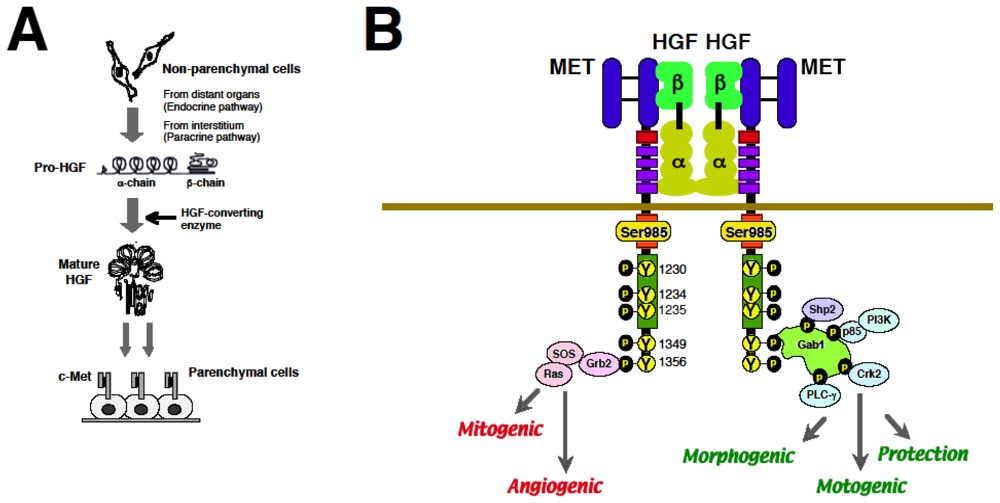
<p>HGF was identified in 1984 as a long-sought hepato-trophic factor. HGF was purified from serum of rats after 70%-partial hepatectomy [<xref ref-type="bibr" rid="b2-ijms-14-00888">2</xref>], and this factor potently stimulated DNA synthesis and proliferation of primary culture of adult rat hepatocytes. In the mid-1980s, we purified HGF to homogeneity from blood platelets of 3000 rats and demonstrated that it was a new growth factor [<xref ref-type="bibr" rid="b18-ijms-14-00888">18</xref>]. Based on complete purification of native HGF, cloning of HGF cDNAs was successfully performed, followed by the complete amino acid sequence of human HGF determined from the nucleotide sequences of cDNAs [<xref ref-type="bibr" rid="b3-ijms-14-00888">3</xref>,<xref ref-type="bibr" rid="b4-ijms-14-00888">4</xref>] (<xref ref-type="fig" rid="f1-ijms-14-00888">Figure 1A</xref>).</p>
<p>Scatter factor (SF) was identified as an embryonic lung fibroblast (MRC5)-derived factor that enhances motility of renal cells (MDCK) [<xref ref-type="bibr" rid="b19-ijms-14-00888">19</xref>]. Such SF-induced motogenic activities were abolished by anti-HGF antibody, while recombinant HGF mimicked the scatter activity in the culture of MDCK [<xref ref-type="bibr" rid="b20-ijms-14-00888">20</xref>]. Indeed, MRC5-fibroblasts expressed 6 kb mRNA that was hybridized with a HGF cDNA probe, and SF cDNA cloned from the MRC5 cDNA library had the same sequence as HGF of cDNA from human leukocytes [<xref ref-type="bibr" rid="b20-ijms-14-00888">20</xref>]. Overall, it was shown that SF is identical to HGF [<xref ref-type="bibr" rid="b20-ijms-14-00888">20</xref>,<xref ref-type="bibr" rid="b21-ijms-14-00888">21</xref>], suggesting roles of HGF/SF during cancer metastasis.</p></sec>
<sec>
<title>2.2. Identification of MET as a Functional Receptor for HGF</title>
<p>In the mid-1980s, <italic>MET</italic> was identified as a “mutant” oncogenic gene. Dean <italic>et al</italic>. isolated <italic>MET</italic> from carcinogen-induced osteosarcoma cells (MNNG-HOS), which induced NIH-3T3 transformation in soft agar [<xref ref-type="bibr" rid="b17-ijms-14-00888">17</xref>]. The <italic>MET</italic> proto-oncogene is localized to the seventh chromosome (7q21–q31) in humans. The <italic>MET</italic>-encoding protein has a tyrosine kinase activity, suggesting that MET is an orphan receptor of growth factors. On the other hand, HGF was identified as a mitogen of hepatocytes [<xref ref-type="bibr" rid="b2-ijms-14-00888">2</xref>–<xref ref-type="bibr" rid="b4-ijms-14-00888">4</xref>], but in the late 1980s, its receptor was still unknown.</p>
<p>Bottaro <italic>et al</italic>. reported in 1991 that MET may be a signaling receptor for HGF, along with the tyrosine phosphorylations [<xref ref-type="bibr" rid="b9-ijms-14-00888">9</xref>]. The protein band was identified as an antigen of anti-MET antibody in the cross-linking of <sup>125</sup>I-labeled NK1 (an HGF-variant) to cellular protein extraction. High-affinity binding cellular sites specific to HGF were detected in <italic>MET</italic> cDNA-transfected COS7 cells, with a Kd value of 30 pM. Only <italic>MET</italic>-transfected COS7 showed the mitogenic response to HGF, thus indicating that “wild-type” MET is an HGF-receptor [<xref ref-type="bibr" rid="b10-ijms-14-00888">10</xref>].</p></sec>
<sec>
<title>2.3. Biological Properties of HGF via MET</title>
<p>In the extra-cellular domain of MET, the first 519 amino aids form a 7-bladed β-propeller domain, called Sema domain, which is necessary for binding to the HGF β-chain and activation of the receptor by ligation. The MET immunoglobulin-like domain is required for binding to the first kringle domain (NK1) of HGF α-chain. HGF induces MET activation via the formation of 2:2 complex where MET–MET dimerization is mediated via dimmer-formed HGF [<xref ref-type="bibr" rid="b7-ijms-14-00888">7</xref>,<xref ref-type="bibr" rid="b8-ijms-14-00888">8</xref>] (<xref ref-type="fig" rid="f1-ijms-14-00888">Figure 1B</xref>).</p>
<p>The accurate binding of HGF to MET triggers signaling transduction. The ATP-dependent phosphorylation at three residues in the MET active loop kinase domain, Tyr-1230/34/35, is an initial step for activating MET. Phosphorylation at Tyr-1349/56 in the <italic>C</italic>-terminal docking site is required for various bio-functions via recruiting downstream adopters. For example, phospho-Tyr1349/56-dependent recruitment of Grb2-SOS activates Ras-ERK cascades, leading to cell proliferation. Association and tyrosine phosphorylation of Gab-1, a docking protein that couples MET with multiple signaling proteins such as PI-3kinase, PLC-γ, Shp-2, and Crk-2, plays definite roles in HGF-induced morphogenesis and motility. Various adaptor molecules, recruited at MET docking-site, explain multi-faceted functions of HGF [<xref ref-type="bibr" rid="b7-ijms-14-00888">7</xref>,<xref ref-type="bibr" rid="b8-ijms-14-00888">8</xref>] (<xref ref-type="fig" rid="f1-ijms-14-00888">Figure 1B</xref>).</p></sec>
<sec>
<title>2.4. HGF–MET System for Organ Development and Regeneration</title>
<p>In embryonic organs, HGF is mainly produced in stroma cells such as fibroblasts, while MET is expressed by parenchymal cells [<xref ref-type="bibr" rid="b4-ijms-14-00888">4</xref>–<xref ref-type="bibr" rid="b8-ijms-14-00888">8</xref>], suggesting that the paracrine loop of HGF–MET is critical for organ development. Indeed, HGF acts as a mesenchyme-derived morphogenic factor during fetal lung development. When HGF-antisense oligo-DNA was added to embryonic lung cultures, stromal HGF production became negligible, followed by impairment in lung branching morphogenesis [<xref ref-type="bibr" rid="b22-ijms-14-00888">22</xref>]. <italic>In vivo</italic>, lung alveoli-specific <italic>MET</italic> gene destruction led to a decrease in alveologenesis in mice. Organ-specific <italic>MET</italic> deletion techniques revealed pivotal roles for HGF in development of various organs, such as liver, kidney muscle, <italic>etc.</italic>[<xref ref-type="bibr" rid="b6-ijms-14-00888">6</xref>,<xref ref-type="bibr" rid="b8-ijms-14-00888">8</xref>].</p>
<p>Endogenous HGF is also important for tissue repair and protection <italic>in vivo</italic>. We provided the first evidence that recombinant HGF enhanced hepatic regeneration in mice with hepatitis [<xref ref-type="bibr" rid="b23-ijms-14-00888">23</xref>]. Therapeutic effects of recombinant HGF were also seen in injured organs, such as kidneys, lung, stomach–intestine, skin, heart, brain <italic>etc.</italic>[<xref ref-type="bibr" rid="b8-ijms-14-00888">8</xref>]. Blood HGF levels markedly increase in patients and rodents during tissue injuries. When anti-HGF antibody was administered to a rat model of myocardial infarction, cardiac damage was exacerbated [<xref ref-type="bibr" rid="b24-ijms-14-00888">24</xref>]. Such a key role of endogenous HGF has been seen in acute and chronic organ diseases [<xref ref-type="bibr" rid="b8-ijms-14-00888">8</xref>,<xref ref-type="bibr" rid="b25-ijms-14-00888">25</xref>]. Thus, compensation for the loss in intrinsic HGF by HGF administration is a logical strategy to improve organ failures [<xref ref-type="bibr" rid="b8-ijms-14-00888">8</xref>,<xref ref-type="bibr" rid="b25-ijms-14-00888">25</xref>].</p></sec></sec>
<sec>
<title>3. Roles of HGF–MET Axis in Tumorigenesis</title>
<p>Cancer growth continues beyond the cell–cell contact inhibition system, and cancer has been described as a neverhealing wound. Thus, molecular elucidation of oncogenesis remains to be a central interest for basic scientists. As mentioned, HGF is a key paracrine regulator for embryogenesis and organ regeneration. In contrast, <italic>MET</italic> mutation is responsible for familial renal carcinoma as well as for other sporadic types of cancers [<xref ref-type="bibr" rid="b14-ijms-14-00888">14</xref>]. Regardless of the presence or absence of <italic>MET</italic> mutation, stroma-secreted HGF plays a common role in tumor invasive growth. In this section, we will discuss the roles of HGF–MET pathways for cancer onset and development, with an interest in molecular mechanisms.</p>
<sec>
<title>3.1. Roles of MET Mutations for Oncogenesis</title>
<sec sec-type="methods">
<title>3.1.1. <italic>In Vitro</italic> Study</title>
<p>Originally, <italic>MET</italic> was identified as an oncogene that promotes anchorage-independent growth of osteosarcoma cells in soft agar [<xref ref-type="bibr" rid="b17-ijms-14-00888">17</xref>]. An initial report described that a mouse homolog of the human <italic>MET</italic> oncogene is amplified 4- to 8-fold in 7 of 10 lines of transformed NIH-3T3 fibroblasts in the soft agar culture. In addition, overexpression of HGF is also capable of inducing malignant phenotypes in soft agar. When rat <italic>HGF</italic> cDNA was introduced into immortalized mouse liver epithelial cells (MLE10), all MLE10-HGF cell lines grew much faster than the original MLE10 cells in culture and produced in large colonies in soft agar [<xref ref-type="bibr" rid="b26-ijms-14-00888">26</xref>], suggesting the involvement of aberrant MET signals in tumor onsets.</p></sec>
<sec sec-type="methods">
<title>3.1.2. Animal Study</title>
<p>In the mid-1990s, several groups created the transgenic mice to evaluate the tumorigenic roles of HGF <italic>in vivo</italic>. The MT1-HGF-transgenic mice developed a remarkably broad array of distinct tumors in several tissues [<xref ref-type="bibr" rid="b27-ijms-14-00888">27</xref>], including mammary glands, muscles, and skin, which was associated with the over-activation of MET tyrosine kinase. Likewise, local expression of HGF-transgene via an organ-specific gene promoter led to a higher incidence of tumor formation in muscles, airways, skin and mammary glands [<xref ref-type="bibr" rid="b27-ijms-14-00888">27</xref>,<xref ref-type="bibr" rid="b28-ijms-14-00888">28</xref>]. These transgenic animals are useful as a model to elucidate the tumorigenic mechanisms.</p></sec>
<sec>
<title>3.1.3. Human Studies</title>
<p><italic>MET</italic> mutations are causative for human cancers. In patients with papillary renal carcinoma (PRC), missense mutations in the MET tyrosine kinase domain were detected in the germ-line of familial PRC (<italic>i.e</italic>., M1149T, V1206L, V1238I, D1246N and Y1248C) and in a subset of sporadic PRC (<italic>i.e</italic>., L1213V, D1248H and M1268T) [<xref ref-type="bibr" rid="b14-ijms-14-00888">14</xref>]. Likewise, somatic mutations in the kinase domain (Y1230C and Y1235D) were identified in head-and-neck squamous carcinoma [<xref ref-type="bibr" rid="b29-ijms-14-00888">29</xref>]. Mutations of the MET juxta-membrane domain (<italic>i.e</italic>., R988C and T1010I) are also responsible for familial colon cancer, gastric cancer and small cell lung carcinoma [<xref ref-type="bibr" rid="b30-ijms-14-00888">30</xref>]. Moreover, one-point mutation of the MET extra-cellular domain (<italic>i.e</italic>., N375S) was seen in 13% of East Asians with lung cancers [<xref ref-type="bibr" rid="b31-ijms-14-00888">31</xref>]. There is now ample evidence showing that <italic>MET</italic> mutations observed in some MET-domain sites cause various types of solid tumors.</p></sec></sec>
<sec>
<title>3.2. Molecular Basis of MET-Mediated Cancer Development</title>
<p>Since constitutive activation of the MET signal is one of the key oncogenic events, it is important to discuss its molecular basis, focusing on downstream MET. Using some mutations of <italic>MET</italic> identified in patients with familial PRC, Giordano <italic>et al.</italic> found that some mutated <italic>MET</italic> enhance the Ras signaling pathway [<xref ref-type="bibr" rid="b32-ijms-14-00888">32</xref>]. Other mutations are devoid of transforming potential but are effective in inducing protection from apoptosis, associated with the efficient interaction of PI3Kinase. Thus, different mutations in the <italic>MET</italic> gene may elicit tumorigenesis via Ras-based mitogenesis and PI3Kinase-based protection pathways [<xref ref-type="bibr" rid="b32-ijms-14-00888">32</xref>].</p>
<p>β-catenin is an oncogenic protein involved in the regulation of cell–cell adhesion and gene transcription. Once β-catenin is activated, it is translocated from sub-membrane to nucleus, and then β-catenin functions as an activator of Tcf-transcriptional factor, leading to upregulation of mitogenic proteins, such as c-Myc and cyclin-D1. HGF activates β-catenin via a direct assembly of phospho-MET and β-catenin. Likewise, active <italic>MET</italic> mutants (such as M1268T) also activate the nuclear β-catenin function [<xref ref-type="bibr" rid="b33-ijms-14-00888">33</xref>]. Thus, aberrant activation of nuclear β-catenin by active MET leads to tumor formation via the upregulation of c-Myc and cyclin-D1.</p>
<p>Src kinase activity is important for mutant <italic>MET</italic> to acquire tumorigenic potentials. In the NIH-3T3 clone (F4) that overexpresses the mutant <italic>MET</italic> (M1268T), malignant formation was evident in both soft agar and implanted nude mice [<xref ref-type="bibr" rid="b34-ijms-14-00888">34</xref>]. These malignant phenotypes were abolished by dominant negative c-Src in the NIH-3T3-F4 clone. A recent report described how the direct assembly of MET by a membrane Fas-ligand is also required for tumorigenic potentials, possibly via sequential phosphorylations from MET to the downstream Stat3, a key regulator for enhancing anchorage independent growth [<xref ref-type="bibr" rid="b35-ijms-14-00888">35</xref>].</p>
<p>MET overexpression and its crosstalk with other receptors, such as EGFR, Her2, Her3 are also critical for tumor development. EGFR tyrosine kinase inhibitors (EGF-TKI) intercept EGFR-mediated downstream signaling pathways (such as PI3K-AKT) via de-phosphorylation of Her3, while some lung carcinoma cell lines acquire resistance via amplification of MET [<xref ref-type="bibr" rid="b36-ijms-14-00888">36</xref>]. In this process, amplified MET trans-phosphorylates Her3, and then impaired AKT pathways are restored, resulting in resistance to EGFR-TKIs, including Gefitinib (Iressa<sup>®</sup>) [<xref ref-type="bibr" rid="b36-ijms-14-00888">36</xref>,<xref ref-type="bibr" rid="b37-ijms-14-00888">37</xref>]. Such a redundant signaling via amplified MET may participate in breast cancer malignant behaviors during the treatment with anti-Her-2 antibody, Trastuzumab (Herceptin<sup>®</sup>) [<xref ref-type="bibr" rid="b38-ijms-14-00888">38</xref>], possibly due to association (and re-activation) of Her2 with amplified MET [<xref ref-type="bibr" rid="b39-ijms-14-00888">39</xref>,<xref ref-type="bibr" rid="b40-ijms-14-00888">40</xref>]. Thus, MET inhibition can be a target to block the redundant pathways, required for drug resistance (see Section 6.4).</p>
<p>In summary, several lines of human and animal studies have demonstrated that not only <italic>MET</italic> mutations, but also HGF over-productions, lead to oncogenenic outcomes via over-activation of <italic>MET</italic>-associated molecular pathways, such as Ras, β-catenin <italic>etc</italic>. (<xref ref-type="table" rid="t1-ijms-14-00888">Table 1</xref>).</p></sec></sec>
<sec>
<title>4. HGF-Mediated Cancer Metastasis</title>
<p>Oncogenic <italic>MET</italic>-mutants are responsible for PRCs [<xref ref-type="bibr" rid="b14-ijms-14-00888">14</xref>] and head-and-neck carcinoma [<xref ref-type="bibr" rid="b29-ijms-14-00888">29</xref>], but these are not common in many types of malignant tumors. In contrast, HGF plays common roles in cancer metastasis [<xref ref-type="bibr" rid="b13-ijms-14-00888">13</xref>,<xref ref-type="bibr" rid="b58-ijms-14-00888">58</xref>], independent of the presence or absence of <italic>MET</italic> mutations. This may be one of the reasons why HGF-antagonistic treatment is a logical approach to induce invasion-free conditions, like benign tumors. Prior to referring to the successful results of NK4 in rodents, the mechanisms of HGF-mediated tumor metastasis will be discussed.</p>
<sec>
<title>4.1. Functions of HGF for Tumor Cell Scattering and Invasion</title>
<p>Tumor cell scattering in the primary tumors is the first step for metastasis. In tumor tissues, stroma-secreted HGF is required for cancer cells to infiltrate neighboring tissues, such as vascular beds, across the basement membrane. The paracrine loop between HGF-producing stroma and MET-expressing tumor cells acts as a local switch for the invasive phenotypes, as follows.</p>
<sec>
<title>4.1.1. Tumor Cell Dissociation</title>
<p>The initial events for the metastatic spread involve loss of cell–cell contact within primary tumors. The integrity of epithelial tumor cell colonies is maintained by cell–cell contact mediated by cadherins and intracellular catenin molecules. Cancer cells must lose their tight cell-to-cell contact by downregulation of cadherin–cadherin complex during invasion into adjacent tissues. HGF induces dispersion of cluster cells into single cells via an endocytosis of E-cadherin from cell surface to cytoplasma [<xref ref-type="bibr" rid="b41-ijms-14-00888">41</xref>,<xref ref-type="bibr" rid="b42-ijms-14-00888">42</xref>].</p></sec>
<sec>
<title>4.1.2. Cell Movement</title>
<p>During tumor cell motility, HGF stimulates the Ras-Rab5 cascade for initiating endocytosis of cadherins [<xref ref-type="bibr" rid="b42-ijms-14-00888">42</xref>], followed by nuclear localization of β-catenin, a transcription factor of genes required for cell motility [<xref ref-type="bibr" rid="b43-ijms-14-00888">43</xref>]. HGF-mediated stimulation of Rho small G protein cascade and activation of cdc42/Rac/PAK are required for disassembly of stress fiber or focal adhesions, and then lamellipodia formation and cell spreading are enhanced [<xref ref-type="bibr" rid="b44-ijms-14-00888">44</xref>]. Such sequential downstream events of MET signaling are contributable for cancer cell motility.</p></sec>
<sec>
<title>4.1.3. Basement Membrane Breakdown</title>
<p>For adjacent invasion, tumor cells must move across a basement membrane between the epithelium and submucosa. Cancer cells spread rapidly and form focal adhesions, and then they disassemble these condensations, followed by enhanced cell locomotion. In the initial phase, HGF induces phosphorylation of focal adhesion kinase (FAK) together with a bridge between the ECM and integrins of cancer cells [<xref ref-type="bibr" rid="b11-ijms-14-00888">11</xref>,<xref ref-type="bibr" rid="b45-ijms-14-00888">45</xref>]. In a later phase, HGF upregulates several types of MMP, such as MMP-1/-9/-14 via the activation of Ets [<xref ref-type="bibr" rid="b46-ijms-14-00888">46</xref>–<xref ref-type="bibr" rid="b48-ijms-14-00888">48</xref>]. HGF-mediated invasion is abolished by MMP inhibitors. Overall, in addition to cell motility, the induction of MMP via HGF-Ets pathways is required for cancer invasion.</p></sec>
<sec>
<title>4.1.4. Hypoxia as a Trigger for Invasion</title>
<p>Tumor hypoxia occurs in the central areas of a growing mass, due to an insufficient blood flow. Such local hypoxia triggers tumor invasion via upregulating hypoxia-induced factor-1 (HIF1), a transcriptional factor that regulates several genes of cell motility, possibly in order to escape from hypoxic milieu. For this purpose, tumor cells acquire MET via the HIF-dependent pathway, while stroma-secreted HGF enhances cell motility from hypoxic regions to the aerobic milieu of distant organs (<italic>i.e</italic>., successful metastasis) [<xref ref-type="bibr" rid="b59-ijms-14-00888">59</xref>,<xref ref-type="bibr" rid="b60-ijms-14-00888">60</xref>]. The HIF1-MET pathway may underlie a key mechanism of hypoxia-initiated malignancies.</p></sec></sec>
<sec>
<title>4.2. Roles of HGF during Metastatic Cascade</title>
<p>In addition to adjacent invasion, the HGF–MET axis is important for distant metastasis, through extravasation, anti-anoikis and homing. HGF promotes cancer metastasis via inducing vascular bed formation and enhancing chemokine-induced homing. HGF also protects cancer cells from anoikis or immunological challenge. These sequential events lead to successful metastasis.</p>
<sec>
<title>4.2.1. Angiogenic Events</title>
<p>Vascular angiogenesis is a critical step for the delivery of cancer cells from the primary tumors to secondary organs. HGF enhances angiogenesis via the induction of growth, movement and morphogenesis of endothelial cells (EC) in a culture system [<xref ref-type="bibr" rid="b53-ijms-14-00888">53</xref>,<xref ref-type="bibr" rid="b61-ijms-14-00888">61</xref>] and in a mouse model of glioma [<xref ref-type="bibr" rid="b62-ijms-14-00888">62</xref>]. HGF has a direct effect on EC via the enhancement of cancer cell-EC contact via FAK phosphorylation [<xref ref-type="bibr" rid="b55-ijms-14-00888">55</xref>]. HGF decreases endothelial occludin, a cell–cell adhesion molecule [<xref ref-type="bibr" rid="b56-ijms-14-00888">56</xref>]. As a result, HGF decreases the trans-endothelial resistance of tumor vessels, and then cancer invasion across an EC barrier (<italic>i.e</italic>., intra-vasation) is achieved.</p></sec>
<sec>
<title>4.2.2. Anti-Anoikis</title>
<p>Suspension-induced apoptosis, also known as anoikis, is defined as apoptosis of parenchymal cells that is induced by loss of ECM attachment. Cancer cell resistance to anoikis (<italic>i.e</italic>., anti-anoikis) is important for achieving metastasis, because tumor cells lose matrix attachment during blood flow. HGF inhibits suspension-induced anoikis, and this effect is mediated by PI3-kinase and ERK-1/2 [<xref ref-type="bibr" rid="b49-ijms-14-00888">49</xref>]. Inhibitory effect of HGF on tumor anoikis is abolished by tetraspanin CD151 deletion [<xref ref-type="bibr" rid="b50-ijms-14-00888">50</xref>]. Thus, signaling complexes between MET and integrin-tetraspanin are needed for anti-anoikis, together with an involvement of MET/PI3-kinase/ERK cascades.</p></sec>
<sec>
<title>4.2.3. Homing</title>
<p>Stroma-derived factor-1 (SDF1) is a chemokine that induces cancer metastasis. Distant organs produce SDF1, whereas invasive cancer cells acquire CXCR4, a receptor of SDF1. Such an endocrine pathway is required for moving cells to determine the homing sites. Of note, HGF enhances CXCR4 expression by cancer cells [<xref ref-type="bibr" rid="b51-ijms-14-00888">51</xref>]. Furthermore, HGF enhances the ability of SDF1 to promote cancer invasion [<xref ref-type="bibr" rid="b52-ijms-14-00888">52</xref>]. Thus, a network between the HGF–MET axis and the SDF1-CXCR4 axis seems to be essential for determining the homing sites.</p></sec>
<sec>
<title>4.2.4. Immune Tolerance</title>
<p>A host immune surveillance system is important in the control of tumor metastasis. Dendritic cells (DC) play a key role in an immunological challenge, via recruiting cytotoxic T cells. HGF suppresses immune surveillance via the induction of anti-inflammatory cytokines, such as IL-10, in DC [<xref ref-type="bibr" rid="b57-ijms-14-00888">57</xref>]. Such HGF-mediated modification of DC (<italic>i.e</italic>., tolerogenic DC) leads to an escape of cancer cells from immunological challenges, as suggested [<xref ref-type="bibr" rid="b63-ijms-14-00888">63</xref>].</p></sec></sec>
<sec>
<title>4.3. Regulation of HGF Production during Cancer Progression</title>
<p>In addition to oncogenic mutants, the stromal environment plays a key role in cancer prognosis. Carcinoma-associated fibroblasts (CAF), but not normal fibroblasts, promote tumor progression of initiated non-tumorigenic epithelial cells. Stroma-derived HGF is responsible for tumor invasive growth [<xref ref-type="bibr" rid="b11-ijms-14-00888">11</xref>–<xref ref-type="bibr" rid="b13-ijms-14-00888">13</xref>]. Thus, the molecular basis of HGF production should be discussed.</p>
<p>Numerous types of carcinoma cells secrete soluble factors that induce HGF production in stromal cells (<italic>i.e</italic>., HGF-inducers). For example, conditioned medium of breast cancer cells enhances HGF production in fibroblasts, along with a raise in prostaglandin-E2 [<xref ref-type="bibr" rid="b64-ijms-14-00888">64</xref>]. Inhibition of prostaglandin-E synthesis by indomethacin leads to downregulation of HGF production and suppression of tumor migration, indicating that cancer-derived prostaglandins are important for stromal HGF production [<xref ref-type="bibr" rid="b64-ijms-14-00888">64</xref>]. Other cancer-derived HGF-inducers are IL-1β, b-FGF, PDGF, and TGF-α [<xref ref-type="bibr" rid="b12-ijms-14-00888">12</xref>,<xref ref-type="bibr" rid="b65-ijms-14-00888">65</xref>]. Such a paracrine loop, mediated by the cancer-derived HGF-inducers and stroma-secreted HGF, confers a key mechanism of tumor metastasis [<xref ref-type="bibr" rid="b66-ijms-14-00888">66</xref>].</p>
<p>In addition to CAF, tumor-associated macrophages (TAM) are a major source of HGF in tumor tissues. TAM isolated from 98 primary lung cancer tissues shows the higher ability to produce HGF. This is also the case for HGF produced by neutrophils infiltrating bronchiolo-alveolar subtype pulmonary adenocarcinoma [<xref ref-type="bibr" rid="b67-ijms-14-00888">67</xref>]. Serum levels of HGF are elevated in patients with recurrent malignant tumors [<xref ref-type="bibr" rid="b68-ijms-14-00888">68</xref>], thus suggesting an endocrine HGF delivery system. In this regard, peripheral blood monocytes are known to produce HGF, contributing to the increase in blood HGF levels via an endocrine mechanism [<xref ref-type="bibr" rid="b69-ijms-14-00888">69</xref>].</p>
<p>In summary, stroma-derived HGF is required for cancer invasion (<italic>i.e.</italic>, paracrine system). Moreover, blood leukocytes inhibit anoikis and enhance SDF1 signaling in tumor cells during blood flow via a secretion of HGF into blood (<italic>i.e</italic>., endocrine system). The roles of HGF during tumor growth (see Section 3) and metastasis are summarized in <xref ref-type="table" rid="t1-ijms-14-00888">Table 1</xref>.</p></sec></sec>
<sec>
<title>5. Preparation of NK4 as HGF-Antagonist</title>
<p>HGF is a stromal-derived factor that stimulates cancer invasion at least <italic>in vitro</italic>[<xref ref-type="bibr" rid="b11-ijms-14-00888">11</xref>–<xref ref-type="bibr" rid="b13-ijms-14-00888">13</xref>,<xref ref-type="bibr" rid="b66-ijms-14-00888">66</xref>]. The degree of serum HGF and MET expressions in cancer tissues correlates with the prognosis of patients [<xref ref-type="bibr" rid="b68-ijms-14-00888">68</xref>]. Even in cases of <italic>MET</italic> mutation, HGF is important for tumor malignancy [<xref ref-type="bibr" rid="b58-ijms-14-00888">58</xref>]. Thus, inhibition of HGF–MET signaling may be a logical strategy to prohibit cancer metastasis. To test this hypothesis, NK4 was prepared as an intra-molecular fragment of HGF. As expected, NK4 binds to MET and intercepts HGF–MET coupling as a competitive inhibitor. Strikingly, NK4 inhibits tumor angiogenesis through a MET-independent pathway. This section focuses on the dual role of NK4 as an HGF-antagonist and as an angiogenesis-inhibitor.</p>
<sec>
<title>5.1. Structure and Anti-Invasive Function of NK4</title>
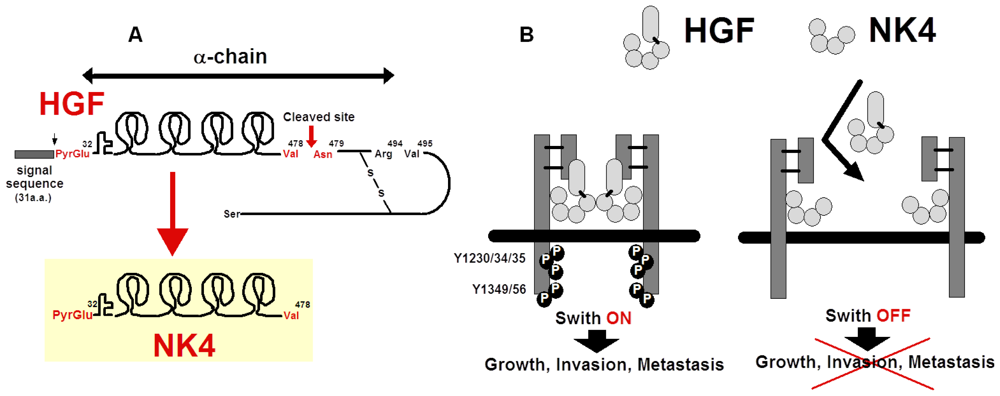
<p>NK4 was initially purified as a fragment from elastase-digested HGF samples [<xref ref-type="bibr" rid="b15-ijms-14-00888">15</xref>,<xref ref-type="bibr" rid="b70-ijms-14-00888">70</xref>]. The amino acid sequence revealed that NK4 is cleaved between Val<sup>478</sup> and Asn<sup>479</sup> by elastase. The <italic>N</italic>-terminal structure of NK4 is the same as undigested HGF (<italic>i.e</italic>., 32nd pyroglutamate), indicating that NK4 is composed of the <italic>N</italic>-terminal hairpin domain and 4-kringle domains (thus designated NK4) (<xref ref-type="fig" rid="f2-ijms-14-00888">Figure 2A</xref>). Precursor HGF is cleaved between Arg<sup>494</sup> and Val<sup>495</sup>, while NK4 is cleaved between Val<sup>478</sup> and Asn<sup>479</sup>. In other words, NK4 is identical to HGF α-chain that lacks <italic>C</italic>-terminal 16 amino acids (<italic>i.e</italic>., Asn<sup>479</sup> to Arg<sup>494</sup>) (<xref ref-type="fig" rid="f2-ijms-14-00888">Figure 2A</xref>). The domains that are responsible for high-affinity binding to <italic>MET</italic> are the <italic>N</italic>-terminal hairpin and the K1 domains in NK4.</p>
<p>Although NK4 is a MET-binder, NK4 alone does not phosphorylate MET tyrosine residues, indicating that NK4 acts as a complete HGF-antagonist (<xref ref-type="fig" rid="f2-ijms-14-00888">Figure 2B</xref>). Actually, MET tyrosine phosphorylation occurs in A549 lung carcinoma cells within 10 min after HGF addition, while NK4 inhibits the HGF-mediated MET activation. HGF induces invasion and migration of the gallbladder cancer cells in Matri-gels, while NK4 inhibits HGF-induced invasion [<xref ref-type="bibr" rid="b15-ijms-14-00888">15</xref>]. These anti-invasive effects of NK4 are also seen in distinct types of cancer cells, strengthening the common role of NK4 in cancer migration [<xref ref-type="bibr" rid="b66-ijms-14-00888">66</xref>].</p>
<p>Other HGF fragments, NK1 (composed of hairpin-loop and K1 domain) and NK2 (hairpin-loop and K1–K2 domains), are natural variant forms of HGF. NK1 is often agonistic to MET, particularly in the presence of heparin, but it sometimes elicits antagonistic effects. NK2 is antagonistic but sometimes agonistic to HGF–MET signaling. Indeed, forced expression of NK2 transgene leads to the acceleration of metastasis in mice bearing melanoma [<xref ref-type="bibr" rid="b71-ijms-14-00888">71</xref>]. In contrast to these variants, NK4 is a complete antagonist (<italic>i.e</italic>., without agonistic features). Therefore, this fragment is reasonable as a practical tool for anti-metastatic strategies (see, Section 6).</p></sec>
<sec>
<title>5.2. Perlecan-Dependent Anti-Angiogenic Mechanisms of NK4</title>
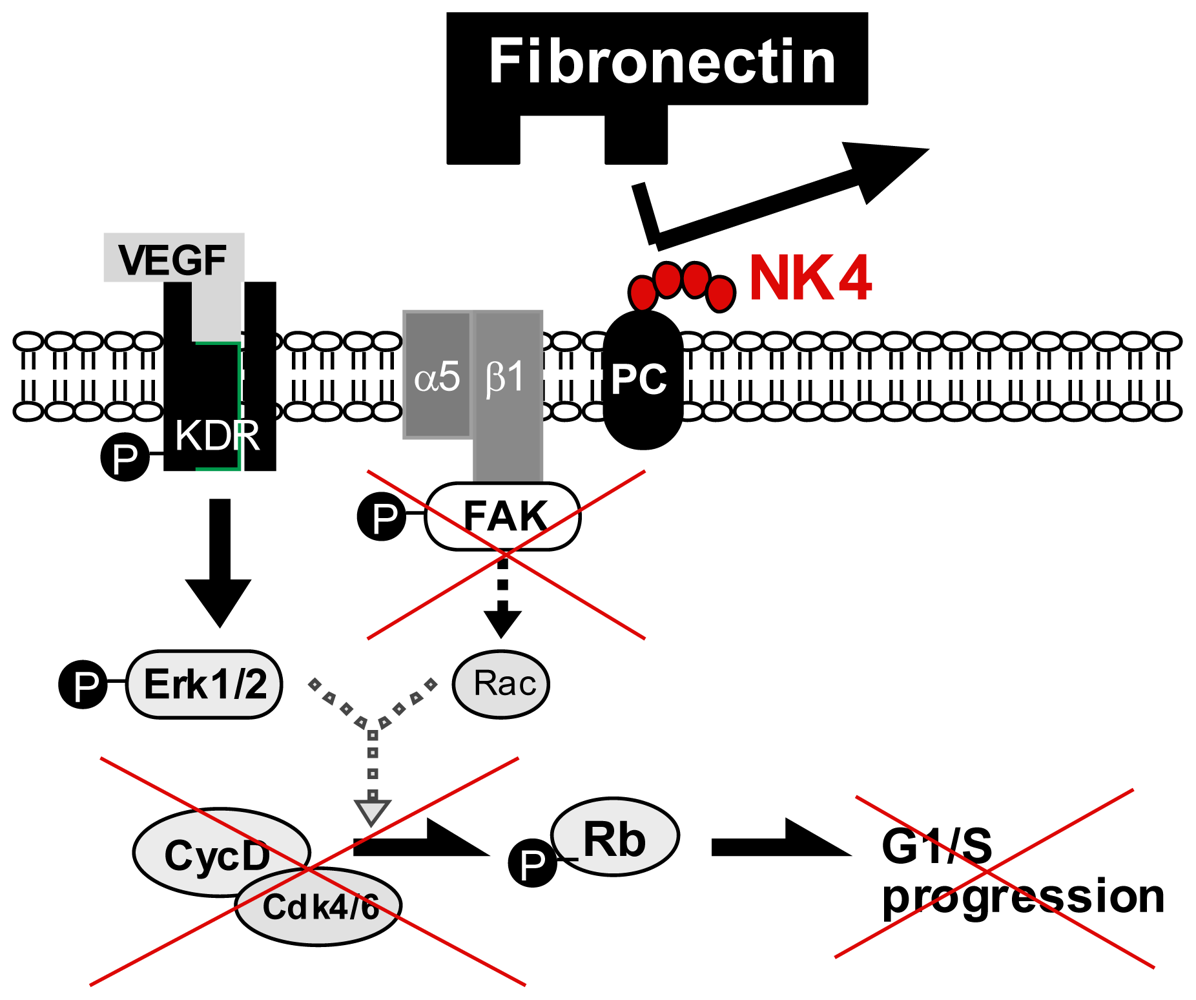
<p>Vascular EC expresses MET, and HGF stimulates mitogenic and morphogenic activities in EC [<xref ref-type="bibr" rid="b4-ijms-14-00888">4</xref>,<xref ref-type="bibr" rid="b61-ijms-14-00888">61</xref>]. Thus, it is possible that NK4 inhibits HGF-induced angiogenesis. Expectedly, NK4 potently inhibited the HGF-mediated proliferation of EC <italic>in vitro</italic>[<xref ref-type="bibr" rid="b72-ijms-14-00888">72</xref>]. Strikingly, NK4 also inhibited EC proliferation, induced by other angiogenic factors, such as b-FGF and VEGF [<xref ref-type="bibr" rid="b54-ijms-14-00888">54</xref>]. In this process, HGF and VEGF phosphorylate MET and KDR/VEGF-receptor, respectively, whereas NK4 inhibits HGF-induced MET tyrosine phosphorylation, but not KDR activation [<xref ref-type="bibr" rid="b54-ijms-14-00888">54</xref>]. Nevertheless, NK4 inhibits VEGF-induced proliferation, without modification of VEGF-mediated ERK1/2 activation. The same effect of NK4 was also seen <italic>in vivo</italic>: b-FGF-induced angiogenesis in the rabbit cornea was inhibited by NK4. Thus, another mechanism (<italic>i.e.</italic>, MET-independent pathway) may be involved in NK4-mediated arrest of angiogenesis. This alternative pathway is demonstrated in 2009, as follows.</p>
<p>The fibronectin-integrin signal in EC is required for angiogenesis. The NK4-mediated growth arrest of EC is due to a loss of the fibronectin-integrin signal [<xref ref-type="bibr" rid="b73-ijms-14-00888">73</xref>]. The affinity purification with NK4-immobilized beads revealed that perlecan is a counterpart to trap NK4. Perlecan is a heparan sulfate proteoglycan that interacts with basement membrane ECM, such as fibronectin. Deletion of perlecan expression by siRNA diminished the fibronectin assembly and EC spreading, indicating a key role of fibronectin-perlecan interaction during EC migration. Notably, NK4-perlecan interaction reduced the assembly of fibronectin by perlecan. As a result, FAK activation became faint due to the inhibition of perlecan-fibronectin complex with NK4. Under such a loss of integrin signals, EC growth was impaired [<xref ref-type="bibr" rid="b73-ijms-14-00888">73</xref>]. This MET-independent pathway is involved in the inhibitory effect of NK4 on VEGF-mediated angiogenesis (<xref ref-type="fig" rid="f3-ijms-14-00888">Figure 3</xref>).</p></sec>
<sec>
<title>5.3. Possible Cleavage of NK4-Like Fragment <italic>in Vivo</italic></title>
<p>In addition to pancreatic protease, endogenous proteases can generate an NK4-like fragment. Leucocyte-derived proteases, such as mast cell chymase, are able to convert HGF to fragments, including NK4 and remnant HGF-β [<xref ref-type="bibr" rid="b74-ijms-14-00888">74</xref>,<xref ref-type="bibr" rid="b75-ijms-14-00888">75</xref>]. Endogenous cathepsin-G and MMP also produce NK4-like fragment via its enzymatic reaction, suggesting that <italic>de novo</italic> synthesized NK4 may have a counteractive role in inhibiting HGF-mediated functions under pathological conditions.</p>
<p>For example, NK4-like fragments have been detected in the effusive fluid from skins with intractable ulcers in patients [<xref ref-type="bibr" rid="b75-ijms-14-00888">75</xref>]. In this process, kallikrein, an endogenous serine-protease, is critical for HGF-to-NK4 conversion at the local sites. Endogenous HGF is required for skin regeneration [<xref ref-type="bibr" rid="b8-ijms-14-00888">8</xref>]. Thus, it is likely that the synthesis of HGF-antagonistic NK4, in addition to the decrease in HGF (<italic>i.e</italic>., intrinsic repair factor), underlies the key mechanism whereby epidermal regeneration is impaired in the patients with intractable leg ulcers [<xref ref-type="bibr" rid="b75-ijms-14-00888">75</xref>].</p>
<p>During tumor progression, cancer cells may produce NK4 for tumor growth retardation. Indeed, NK4-like fragments are detectable in the culture supernatants of certain tumor cell lines that produce HGF [<xref ref-type="bibr" rid="b76-ijms-14-00888">76</xref>,<xref ref-type="bibr" rid="b77-ijms-14-00888">77</xref>]. Although it is still unclear whether NK4-like fragment is generated via an enzymatic cleavage or variant transcription, NK4-like fragment(s) could act as a natural HGF-antagonist to minimize tumor metastasis (as a negative feedback). Thus, exogenous NK4 supplementation may be a reasonable approach to arresting tumor malignancy, as follows.</p></sec></sec>
<sec>
<title>6. Anti-Cancer Strategy by NK4</title>
<p>Given that tumor-stroma interaction via HGF–MET axis is involved in cancer metastasis, inhibition of MET signaling may be a pathogenesis-based anti-tumor strategy. In the late 1990s, several oncologists proposed a proof of concept that tumor angiogenesis inhibition produces anti-metastatic results [<xref ref-type="bibr" rid="b78-ijms-14-00888">78</xref>]. NK4 also produces anti-angiogenic effects via a perlecan-dependent pathway. Thus, the dual effects of NK4 (<italic>i.e</italic>., HGF-antagonist and angiogenesis-inhibitor) could provide a new concept whereby NK4 may prove therapeutic for malignant tumors.</p>
<sec>
<title>6.1. First Evidence of HGF-Antagonist for Inhibition of Tumor Progression in Vivo</title>
<p>HGF, or co-cultured fibroblasts, induces invasion of gallbladder carcinoma cells (GB-d1) across Matrigel, an experimental mimic of the basement membrane [<xref ref-type="bibr" rid="b46-ijms-14-00888">46</xref>]. NK4 competitively inhibits the binding of HGF to MET on GB-d1 cells. As a result, NK4 diminishes HGF-induced, or fibroblast-induced, motogenic activities [<xref ref-type="bibr" rid="b16-ijms-14-00888">16</xref>]. Such a major role of HGF was also seen <italic>in vivo</italic>. Subcutaneous inoculations of GB-d1 cells in nude mice allow for primary tumor growth and invasion to adjacent muscular tissues. Using NK4 in this model, we provided the first evidence that HGF- antagonist can arrest tumor invasion <italic>in vivo</italic>[<xref ref-type="bibr" rid="b16-ijms-14-00888">16</xref>]: recombinant NK4 inhibited the growth and muscular invasion in mice bearing GB-d1 carcinoma. Consistent with growth arrest, apoptotic change was evident in NK4-treated mice. This is the first proof of concept to show that HGF-antagonist is useful for anti-tumor therapy.</p></sec>
<sec>
<title>6.2. Inhibition of Tumor Angiogenesis by NK4 Treatment</title>
<p>In culture of EC, NK4 produces anti-angiogenetic effects via a MET-independent pathway, as reported [<xref ref-type="bibr" rid="b54-ijms-14-00888">54</xref>,<xref ref-type="bibr" rid="b73-ijms-14-00888">73</xref>]. These effects are also observed in animal models of malignant tumors: recombinant NK4 suppressed the primary tumor growth, metastasis of Lewis lung carcinoma, and Jyg-MC(A) mammary carcinoma in mice [<xref ref-type="bibr" rid="b54-ijms-14-00888">54</xref>], although neither HGF nor NK4 affected proliferation and survival of these tumor cells <italic>in vitro</italic>. NK4 treatment resulted in a remarkable decrease in vessel density and an increase in apoptotic cells in the tumor tissues [<xref ref-type="bibr" rid="b54-ijms-14-00888">54</xref>]. NK4-induced anti-angiogenic effects are reproduced in various types of cancers [<xref ref-type="bibr" rid="b79-ijms-14-00888">79</xref>–<xref ref-type="bibr" rid="b81-ijms-14-00888">81</xref>]. Since inhibition of angiogenesis by NK4 results in tumor hypoxia, hypoxia-primed apoptosis may be involved in cancer growth arrest by NK4.</p></sec>
<sec>
<title>6.3. Delayed NK4 Therapy for Attenuation of End-Stage Carcinoma</title>
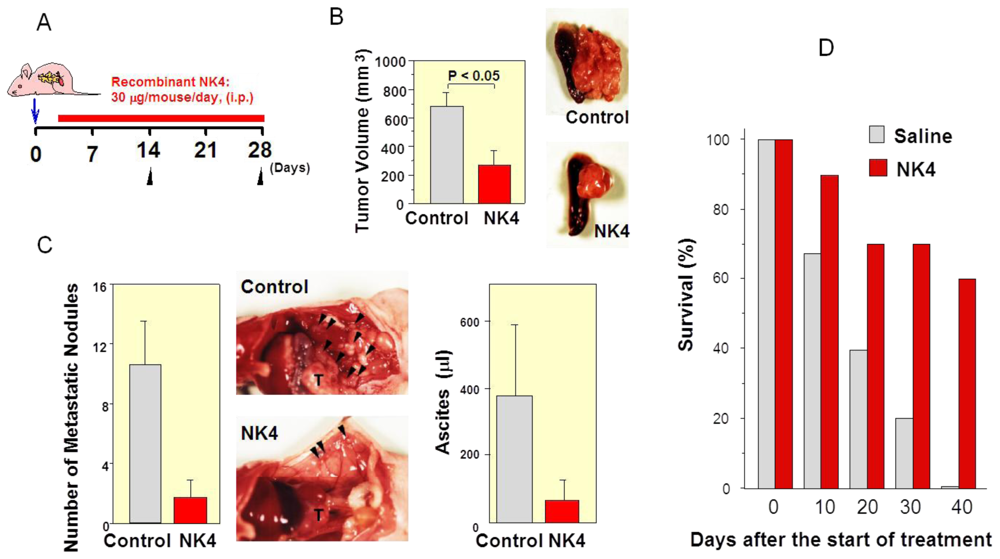
<p>Anti-tumor effects of NK4 is also observed in advanced carcinoma with metastasis [<xref ref-type="bibr" rid="b79-ijms-14-00888">79</xref>]. When NK4 treatment was initiated on day 10 (a time when cancer cells were already invading surrounding tissues), NK4 potently inhibited the tumor growth, peritoneal dissemination, and ascites accumulation at four weeks after the tumor inoculation. As a result, NK4 prolonged the survival time of mice at an end-stage of cancer (<xref ref-type="fig" rid="f4-ijms-14-00888">Figure 4</xref>). Because effective systemic therapy for pancreatic cancer is currently not available, and diagnosing pancreatic cancer in its early stages is difficult, the highly invasive and metastatic behaviors lead to difficulty in attaining a recurrence-free status. Blockade of HGF-mediated invasion may prove to be potential therapy for advanced stages of pancreatic carcinoma.</p></sec>
<sec>
<title>6.4. Therapy Combining NK4 with Other Treatments</title>
<p>Chemotherapy, radiation therapy and anti-angiogenic treatment are applicable in patients with inoperable tumors. Recent reports demonstrated the synergic anti-tumor effect of NK4 on these conventional therapies in rodents, as follows.</p>
<sec>
<title>6.4.1. Chemotherapy</title>
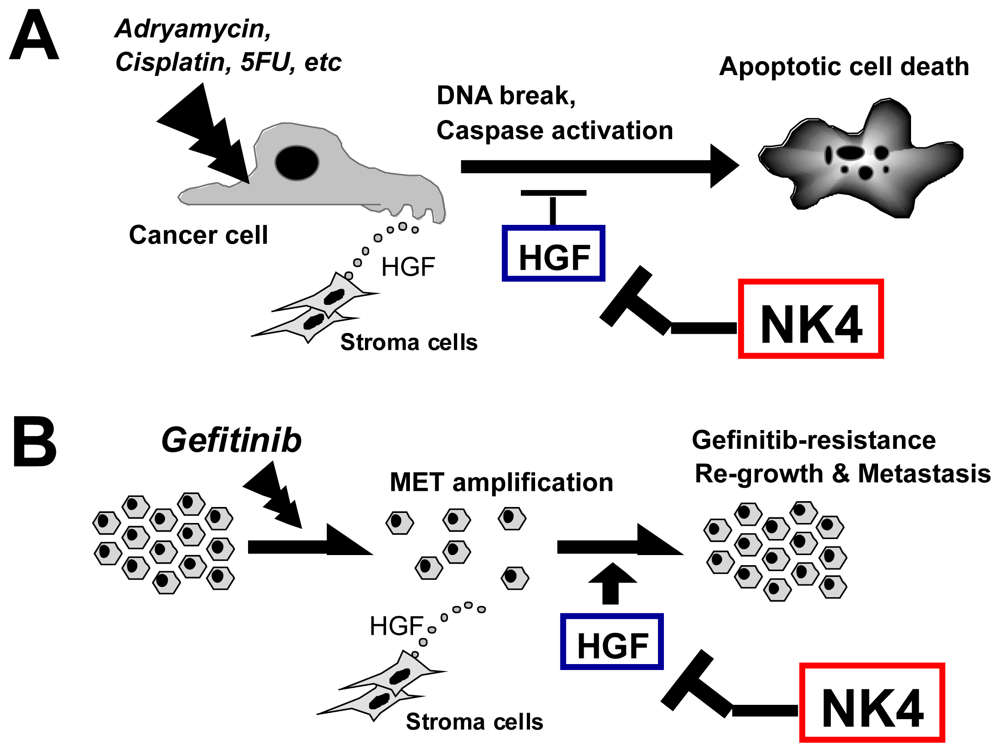
<p>HGF protects cancer cells from chemo drugs, such as Adriamycin, cisplatin and 5FU via the different mechanisms. One is that HGF enhances DNA repair from drug-induced single strand DNA breakage [<xref ref-type="bibr" rid="b82-ijms-14-00888">82</xref>]. Another is that HGF elicits anti-apoptotic effects via inducing anti-apoptotic molecules (<italic>i.e.</italic>, Bcl-xL) and reducing caspase-3 activation [<xref ref-type="bibr" rid="b83-ijms-14-00888">83</xref>]. Indeed, NK4 enhances cisplatin-induced tumoricidal effects in mouse models [<xref ref-type="bibr" rid="b84-ijms-14-00888">84</xref>], perhaps via the release of HGF-mediated protection (<xref ref-type="fig" rid="f5-ijms-14-00888">Figure 5A</xref>). EGF-receptor tyrosine kinase (TK) inhibitors, such as Gefitinib, are known to reduce lung carcinoma metastasis, but long-term use of Gefitinib leads to drug resistance via <italic>MET</italic> gene amplification [<xref ref-type="bibr" rid="b36-ijms-14-00888">36</xref>] or HGF-dependent pathway [<xref ref-type="bibr" rid="b85-ijms-14-00888">85</xref>]. Thus, NK4 is promising for the release of the Gefitinib resistance as an HGF-antagonist (<xref ref-type="fig" rid="f5-ijms-14-00888">Figure 5B</xref>).</p></sec>
<sec>
<title>6.4.2. Radiation Therapy</title>
<p>Irradiation often enhances metastasis, particularly in cases of pancreatic carcinoma, and this is associated with the radiation-induced upregulation of MET in cancer cells [<xref ref-type="bibr" rid="b86-ijms-14-00888">86</xref>]. HGF enhances the repair of DNA strand breaks caused by γ-radiation [<xref ref-type="bibr" rid="b82-ijms-14-00888">82</xref>]. Radiation can also enhance the secretion of HGF from malignant glioma [<xref ref-type="bibr" rid="b87-ijms-14-00888">87</xref>]. HGF also protects ECs from radiation-induced apoptosis [<xref ref-type="bibr" rid="b88-ijms-14-00888">88</xref>]. Thus, NK4 likely enhances radiation therapy via counteracting HGF-mediated protection from radio-toxicity.</p></sec>
<sec>
<title>6.4.3. Immune Therapy</title>
<p>A recent study demonstrated that NK4-mediated tumor regression depends on cytotoxic T lymphocytes (CTL) [<xref ref-type="bibr" rid="b63-ijms-14-00888">63</xref>]. NK4 treatment reduced the tumor growth and invasion in a mouse model of colon cancer, and this was associated with the enhanced infiltration of CD8+ CTL. Of note, such an anti-tumor activity of NK4 was abolished by depletion of CD8+ cells in this mouse model. Taken together, NK4 may also have utility for anti-tumor immunotherapy.</p></sec>
<sec>
<title>6.4.4. Anti-Angiogenic Therapy</title>
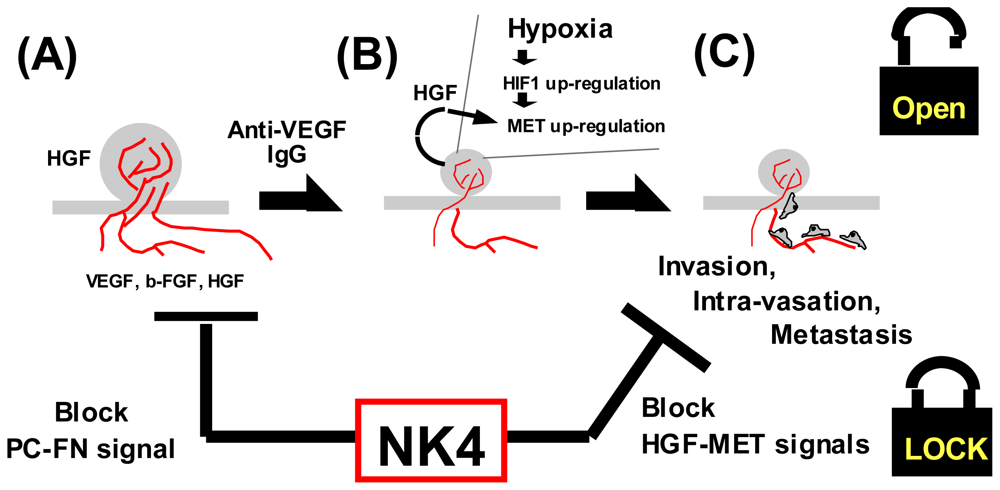
<p>Tumor angiogenesis inhibition is promising as an anti-metastatic strategy [<xref ref-type="bibr" rid="b78-ijms-14-00888">78</xref>]. Indeed, anti-VEGF antibody reduces tumor metastasis in the short-term, but long-term treatment often leads to resistance to VEGF antagonism [<xref ref-type="bibr" rid="b89-ijms-14-00888">89</xref>]. Under such a hypoxic state, tumor cells acquire MET via HIF1-dependent cascades [<xref ref-type="bibr" rid="b59-ijms-14-00888">59</xref>,<xref ref-type="bibr" rid="b60-ijms-14-00888">60</xref>], while local HGF protects these cells from hypoxia-induced apoptosis. HGF–MET signal is also important for hypoxia-triggered metastasis (see Section 4.1) [<xref ref-type="bibr" rid="b59-ijms-14-00888">59</xref>]. As a result, cancer cells can invade from hypoxic to aerobic tissues through HGF-mediated motogenic actions. Even if NK4 enhances tumor hypoxia via the inhibition of tumor angiogenesis, hypoxia-mediated metastasis will be avoidable, because NK4 can counteract HGF-mediated metastatic events (see Section 5.1). Such a dual function of NK4 will contribute to tumor freeze and dormancy therapies (<xref ref-type="fig" rid="f6-ijms-14-00888">Figure 6</xref>).</p></sec>
<sec>
<title>6.4.5. Anti-Cancer Stem Cell (CSC) Therapy</title>
<p>Recent studies delineate emerging roles of CSC in tumor malignancy. In tumor tissues, MET activation is required for sustaining CSC via inducing reprogramming transcription factors (such as Nanog, Sox2, Klf4, Oct4 and c-Myc) [<xref ref-type="bibr" rid="b90-ijms-14-00888">90</xref>]. HGF–MET cascade also participates in anti-tumor drug resistance, possibly through CSC conversion [<xref ref-type="bibr" rid="b91-ijms-14-00888">91</xref>]. Thus, inhibition of aberrant MET activation holds promise for the eradication of CSC, a key determinant for cancer recurrence after chemotherapy. The potential application of NK4 in the CSC growth prevention warrants further attention.</p>
<p>More than 30 reports demonstrate that NK4 is useful for the inhibition of growth, invasion and metastasis in various types of cancers (<xref ref-type="table" rid="t2-ijms-14-00888">Table 2</xref>) [<xref ref-type="bibr" rid="b92-ijms-14-00888">92</xref>]. These data support the hypothesis that HGF is a key paracrine regulator that is responsible for tumor malignancy [<xref ref-type="bibr" rid="b11-ijms-14-00888">11</xref>–<xref ref-type="bibr" rid="b13-ijms-14-00888">13</xref>].</p></sec></sec></sec>
<sec>
<title>7. Other Anti-Cancer Strategies for Blocking HGF–MET Signaling</title>
<p>Using NK4 in a mouse model of carcinoma, we firstly found in 1998 that MET inhibition by an HGF-antagonist inhibits tumor invasive growth <italic>in vivo</italic>. In the following year, another group reported that deletion of <italic>HGF</italic>, or of <italic>MET</italic>, from glioma cells via a ribozyme technique led to growth arrest in nude mice [<xref ref-type="bibr" rid="b104-ijms-14-00888">104</xref>]. Like NK4, anti-HGF antibody suppresses tumor progression in rodents [<xref ref-type="bibr" rid="b79-ijms-14-00888">79</xref>,<xref ref-type="bibr" rid="b105-ijms-14-00888">105</xref>]. There are now several approaches to blockage of the HGF–MET pathway.</p>
<sec>
<title>7.1. HGF-Mimic Molecules or HGF-Fragments</title>
<sec>
<title>7.1.1. Pro-HGF</title>
<p>HGF is secreted from stromal cells in a form of precursor (<italic>i.e</italic>., pro-HGF). For conversion to active-form HGF, pro-HGF is cleaved at Arg<sup>494</sup> and Val<sup>495</sup>. A point mutation at this cleaved site leads to the generation of uncleavable pro-HGF [<xref ref-type="bibr" rid="b106-ijms-14-00888">106</xref>]. Like NK4, pro-HGF inhibits HGF-mediated MET tyrosine phosphorylations <italic>in vitro</italic>. The systemic expression of pro-HGF suppresses tumor growth and prevents metastatic dissemination in mice [<xref ref-type="bibr" rid="b106-ijms-14-00888">106</xref>]. Thus, proteolytic activation of pro-HGF is an essential step in tumor progression, while the inhibition of pro-HGF activation could be an alternative target for controlling tumor metastasis.</p></sec>
<sec>
<title>7.1.2. Engineering for HGF Mutation</title>
<p>Artificially mutated <italic>HGF</italic>-coding protein is available as an HGF-antagonist. The <italic>N</italic>-terminal active pocket present in HGF β-chain is required for the assembly of MET, while one-point mutation near the pocket regions produces a complete HGF-antagonist. Indeed, each <italic>HGF</italic>-mutant proteins (D672N, V495G, V495A, G498I, and G498V) bind to MET, without any MET activation [<xref ref-type="bibr" rid="b107-ijms-14-00888">107</xref>]. These mutants clearly suppress HGF-induced cancer cell migration via the inhibition of MET tyrosine phosphorylation. Conversion of HGF from agonist to antagonist is achieved by as little as removal of two methyl groups (V495A) or a single charge (D672N).</p></sec>
<sec>
<title>7.1.3. NK1 and NK2</title>
<p><italic>HGF</italic> variants, NK1 and NK2, show bivalent activities. NK1 is basically agonistic to MET in the presence of heparin. A recent report suggests the potential use of mutant <italic>NK1</italic>-coding protein as an antagonist: HGF induced cell scattering in a culture of MDCK cells, while mutant NK1 (D127K) inhibits the HGF-mediated cell dissociation [<xref ref-type="bibr" rid="b108-ijms-14-00888">108</xref>]. It remains controversial as to whether or not NK2 is antagonistic <italic>in vivo</italic>. Toxin-induced hepatitis becomes severer in NK2-transgenic mice, suggesting an antagonistic effect of NK2 (<italic>i.e</italic>., release of HGF-mediated hepatic protection) [<xref ref-type="bibr" rid="b109-ijms-14-00888">109</xref>]. In contrast, NK2 transgene accelerated the metastasis in a mouse model of malignant melanoma [<xref ref-type="bibr" rid="b71-ijms-14-00888">71</xref>], implying the possible agonistic actions of NK2.</p></sec></sec>
<sec>
<title>7.2. Antibodies to HGF or MET</title>
<p>We provided evidence in 2001 that not only NK4 but also anti-HGF antibody is useful for improving the prognosis of malignant tumors, using pancreatic cancer-bearing mice [<xref ref-type="bibr" rid="b79-ijms-14-00888">79</xref>]. In the same year, another group also demonstrated the anti-tumor effect of anti-HGF antibody in a xeno-graft model [<xref ref-type="bibr" rid="b105-ijms-14-00888">105</xref>]. These studies stimulated the pharmaceutical companies to develop several types of antibodies specific to HGF or its receptor, MET, as follows.</p>
<sec>
<title>7.2.1. Anti-HGF Antibodies</title>
<p>Some clones of monoclonal antibodies against HGF were screened <italic>in vitro</italic> and anti-tumor efficacy was evaluated in human cancer-bearing nude mice. Human-type monoclonal antibody against human HGF (AMG102, Rilotumumab, Amgen, Thousand Oaks, CA, USA) was useful for several types of solid tumors. Indeed, AMG102 suppressed the subcutaneous growth of glioblastoma (U-87) in mice, through enhanced apoptosis and lowered mitogenesis [<xref ref-type="bibr" rid="b110-ijms-14-00888">110</xref>]. In this model, AMG102 did not modify the tumor angiogenesis. With regard to this, AMG102 prohibited the HGF-induced growth and survival of human endothelial cells (HUVEC) <italic>in vitro</italic>, but VEGF- and b-FGF-induced proliferation of HUVEC were not altered by AMG102 [<xref ref-type="bibr" rid="b110-ijms-14-00888">110</xref>], implying the selective effects of AMG102 on HGF-mediated tumorigenicity. Clinical studies of AMG102 are now ongoing, and its safety and efficacy will be carefully evaluated.</p>
<p>In contrast to anti-HGF antibody, NK4 inhibits not only invasive growth, but also tumor angiogenesis (as a perlecan-binder). This may be the reason why NK4 is more efficient than anti-HGF antibody in rodent models [<xref ref-type="bibr" rid="b79-ijms-14-00888">79</xref>].</p></sec>
<sec>
<title>7.2.2. Anti-MET Antibody</title>
<p>The masking of surface MET by specific antibodies is also promising. For instance, MetMab (Genentech, USA) is a single Fab-armed monoclonal antibody, which competitively blocks HGF–MET binding and subsequent cascade activation. Infusion of MetMab into U87-glioblastoma inhibited its growth in mice via enhancing apoptosis [<xref ref-type="bibr" rid="b111-ijms-14-00888">111</xref>]. The anti-tumor effect of MetMab was also shown in an orthotopic model of pancreatic cancer. Its safety and efficacy are now being evaluated in subjects with non-small cell lung carcinoma. Other types of anti-MET antibody are also promising. DN30 is an antibody that stimulates MET ectodomain shedding and cleavage of the intra-cellular domain. Injection of DN30 attenuated the metastatic spread to the lung in a mouse model [<xref ref-type="bibr" rid="b112-ijms-14-00888">112</xref>]. The LMH80 antibody recognizes an epitope in small cysteine-rich domain of MET [<xref ref-type="bibr" rid="b113-ijms-14-00888">113</xref>]. This antibody specifically binds to MET precursor (pro-MET). Considering that pro-MET is expressed on the surface of cancer cells, but not normal cells, this antibody is potentially tumor-specific [<xref ref-type="bibr" rid="b113-ijms-14-00888">113</xref>]. Anti-MET antibody is believed to be bivalent (<italic>i.e</italic>., antagonistic and agonistic effects), but the technology of monovalent antibody (<italic>i.e</italic>., antagonistic effect only) may support the anti-tumor therapy.</p></sec></sec>
<sec>
<title>7.3. Small-Sized MET TK Inhibitors</title>
<p>Small molecule MET tyrosine kinase (TK) inhibitors may be practical in a clinical setting, due to an oral administration. Binding of HGF to MET induces a dimer–dimer complex (2:2) and phosphorylates kinase domain active loop (<italic>i.e</italic>., Y1230/34/35) via recruiting ATP. These kinase domain activations rapidly elicit phosphorylation of multi-docking sites (<italic>i.e.</italic>, Y1349/56), and then various activities are producible via recruiting downstream adapter, Grab2 [<xref ref-type="bibr" rid="b114-ijms-14-00888">114</xref>]. Thus, blockade of this trans-phosphorylation can be an anti-cancer strategy, as follows.</p>
<p>PHA-665752 was identified as a small-molecule, ATP-competitive inhibitor of the catalytic activity of the MET kinase domain loop (<italic>i.e</italic>., Y1230/34/35). PHA665752 reduced NCI-H69 (small-cell lung cancer) and NCI-H441 (non-small-cell lung cancer) tumorigenicity in mouse xenografts by 99% and 75%, respectively [<xref ref-type="bibr" rid="b115-ijms-14-00888">115</xref>]. PHA665752 inhibited MET phosphorylation and c-Cbl binding sites in mouse xenografts derived from non-small cell lung cancer cells (NCI-H441 and A549) and small cell lung cancer cells (NCI-H69) [<xref ref-type="bibr" rid="b115-ijms-14-00888">115</xref>].</p>
<p>ATP-competitive inhibitors may suppress MET mutation-induced (<italic>i.e</italic>., HGF-independent) auto-phosphorylation by counteracting the kinase domain (Y1230/34/35) activation. However, some MET mutants are not sensitive to ATP-competitive inhibitors. Under such a resistant state, the MET multi-docking region may be a downstream target. For example, MK-2461, a novel multi-targeted TK inhibitor, suppresses phosphorylation of Y1349, but not Y1234/35 [<xref ref-type="bibr" rid="b116-ijms-14-00888">116</xref>]. As a result, MK-2461 reduced the malignant phenotypes in mice bearing <italic>MET</italic>-mutated tumors.</p>
<p>Collectively, not only targeting the kinase domain with ATP-competitive inhibitors but also inhibiting multi-docking sites may provide a therapeutic approach. Although small-sized TK inhibitors facilitate an oral administration (<italic>i.e</italic>., systemic exposure), an effective dose might impair non-tumor normal organs, since endogenous HGF is essential for organ homeostasis [<xref ref-type="bibr" rid="b8-ijms-14-00888">8</xref>]. Clinical trials of MET TK inhibitors (such as PHA-665752 or SU-11274) are now being developed [<xref ref-type="bibr" rid="b117-ijms-14-00888">117</xref>]. The tumor-specific delivery of these drugs warrants ongoing attention.</p></sec>
<sec>
<title>7.4. Decoys or MET Binders</title>
<p>Decorin is a member of the small leucine-rich proteoglycan gene family and it can impede tumor growth, but its molecular basis has not been elucidated. A recent study identified decorin as a MET antagonist. Decorin binds to MET and phosphorylates tyrosine sites in the kinase domain (<italic>i.e</italic>., Y1234/35) in Hela-cells within 15 min. post-addition [<xref ref-type="bibr" rid="b118-ijms-14-00888">118</xref>]. Nevertheless, decorin does not phosphorylate the MET multi-docking site, Y1349. As a result, decorin inhibited tumor growth <italic>in vivo</italic>, probably via the inhibition of the β-catenin pathway.</p>
<p>Norleual, an angiotensin-IV analog, exhibits a structural homology with the hinge region of HGF. Norleual competitively inhibited the binding of HGF to MET in mouse liver membranes, with an IC<sub>50</sub> value of 3 pM [<xref ref-type="bibr" rid="b119-ijms-14-00888">119</xref>]. Predictably, norleual inhibited HGF-dependent signaling, proliferation, migration and invasion in the cultures of multiple cell types at concentrations within the picomolar range. <italic>In vivo</italic>, norleual suppressed the pulmonary colonization by B16-F10 melanoma in mice [<xref ref-type="bibr" rid="b119-ijms-14-00888">119</xref>]. Thus, angiotensin-IV analogs have utility as agents in metastatic disorders via the interference with HGF–MET systems.</p>
<p>There are now numerous candidates for HGF-antagonistic and MET-targeted strategies (<xref ref-type="table" rid="t3-ijms-14-00888">Table 3</xref>). Soluble MET-Sema and phage display-based peptides against MET may be useful as a decoy or masking agent [<xref ref-type="bibr" rid="b120-ijms-14-00888">120</xref>,<xref ref-type="bibr" rid="b121-ijms-14-00888">121</xref>]. Aspirin is a classic type COX2 inhibitor that reduces tumor malignancy via an inhibition of prostaglandin-dependent HGF production [<xref ref-type="bibr" rid="b122-ijms-14-00888">122</xref>]. In addition, natural products included in foods or plants, such as diet-derived flavonoids [<xref ref-type="bibr" rid="b123-ijms-14-00888">123</xref>] and green-tea catechins [<xref ref-type="bibr" rid="b124-ijms-14-00888">124</xref>] exert unique activity that blocks HGF-mediated malignant behaviors. These drugs or natural products will produce or support anti-tumor outcomes.</p></sec></sec>
<sec>
<title>8. Remarks and Perspective</title>
<p>It has been 15 years since NK4 was identified in 1997 as an HGF-antagonist that inhibits tumor-stroma interaction during metastasis. Stroma-rich cancers, such as gastric scirrhous carcinoma, show a great invasive activity, due to the ability of fibroblasts to secrete HGF (<italic>i.e</italic>., paracrine pathway). In addition, HGF induces epithelial-to-mesenchymal transition (EMT), a histological hallmark of malignant cancer, via AKT-mTOR pathways [<xref ref-type="bibr" rid="b125-ijms-14-00888">125</xref>]. During EMT, tumor cells acquire HGF-transcriptional activity (<italic>i.e</italic>., autocrine mechanism). With regard to this, a mutation of <italic>HGF</italic> gene promoter regions (<italic>i.e</italic>., deletion of <italic>HGF</italic>-repressor region, <italic>DATE</italic>) leads to oncogenesis [<xref ref-type="bibr" rid="b126-ijms-14-00888">126</xref>]. Cigarette nicotine is also responsible for HGF production in lung cancer [<xref ref-type="bibr" rid="b127-ijms-14-00888">127</xref>]. Thus, not only tumor-secreted mediators [<xref ref-type="bibr" rid="b66-ijms-14-00888">66</xref>], but also <italic>HGF</italic> mutation or environmental pollutants should be considered as a causal factor for tumorigenesis.</p>
<p>It is important to discuss practical approaches to anti-metastatic therapy, with a focus on NK4. HGF is an intrinsic repair factor that is essential for organ repair and protection [<xref ref-type="bibr" rid="b8-ijms-14-00888">8</xref>,<xref ref-type="bibr" rid="b24-ijms-14-00888">24</xref>]. Thus, tumor-targeting delivery systems of NK4 are recommended for the avoidance of systemic side effects. Implantation of NK4-overexpressing autologous cells may be available for this purpose. For example, bone marrow-derived mesenchymal stem cells (MSC), transfected with <italic>NK4</italic> cDNA <italic>ex vivo</italic>, are known to have migrated to tumor tissues, and such a local NK4 delivery led to the arrest of lung metastasis in a mouse model [<xref ref-type="bibr" rid="b128-ijms-14-00888">128</xref>]. Similar results were obtained when <italic>NK4</italic> cDNA-transfected autologous macrophage were implanted in Meth-A sarcoma-bearing bearing mice [<xref ref-type="bibr" rid="b129-ijms-14-00888">129</xref>]. Thus, MSC and macrophages can serve as a homing tool for tumor-specific NK4 delivery systems. Cationic geratin microspheres containing a NK4 plasmid DNA are also useful for tumor-targeting therapies with a slow release system [<xref ref-type="bibr" rid="b130-ijms-14-00888">130</xref>].</p>
<p>The discovery of NK4 prompted researchers to search HGF-antagonists and MET-inhibitors as anti-tumor drugs. Clinical studies on anti-HGF antibody (AMG102) and anti-MET antibody (MetMab) are now ongoing in the US, and its safety and efficacy will be carefully evaluated. Additionally, diagnostic antibody against MET (<italic>i.e</italic>., MetSeek) may contribute to a real-time detection of metastatic cancers in nuclear imaging [<xref ref-type="bibr" rid="b131-ijms-14-00888">131</xref>]. “Aberrant” production or activation of the HGF–MET axis is critical for the maintenance of CSC [<xref ref-type="bibr" rid="b90-ijms-14-00888">90</xref>], drug resistance [<xref ref-type="bibr" rid="b132-ijms-14-00888">132</xref>,<xref ref-type="bibr" rid="b133-ijms-14-00888">133</xref>] and invasive growth [<xref ref-type="bibr" rid="b66-ijms-14-00888">66</xref>,<xref ref-type="bibr" rid="b92-ijms-14-00888">92</xref>–<xref ref-type="bibr" rid="b103-ijms-14-00888">103</xref>]. Thus, we must confront the challenge to control this molecular pathway, with an appropriate, but not aberrant, regulation at will, for the establishment of invasion-free therapies.</p></sec></body>
<back>
<ack>
<title>Acknowledgements</title>
<p>This work was supported by grants from the Ministry of Education, Science, Technology, Sports and Culture of Japan (No. 23590458 to S.M. and Global COE program to T.N.). We also thank Kimiko Ikushima and Yoshiko Yoneda for secretarial works.</p></ack>
<ref-list>
<title>References</title>
<ref id="b1-ijms-14-00888"><label>1</label><citation citation-type="journal"><person-group person-group-type="author"><name><surname>Ferlay</surname><given-names>J.</given-names></name><name><surname>Shin</surname><given-names>H.R.</given-names></name><name><surname>Bray</surname><given-names>F.</given-names></name><name><surname>Forman</surname><given-names>D.</given-names></name><name><surname>Mathers</surname><given-names>C.</given-names></name><name><surname>Parkin</surname><given-names>D.M.</given-names></name></person-group><article-title>Estimates of worldwide burden of cancer in 2008: GLOBOCAN 2008</article-title><source>Int. J. Cancer</source><year>2010</year><volume>127</volume><fpage>2893</fpage><lpage>2917</lpage><pub-id pub-id-type="doi">10.1002/ijc.25516</pub-id><pub-id pub-id-type="pmid">21351269</pub-id></citation></ref>
<ref id="b2-ijms-14-00888"><label>2</label><citation citation-type="journal"><person-group person-group-type="author"><name><surname>Nakamura</surname><given-names>T.</given-names></name><name><surname>Nawa</surname><given-names>K.</given-names></name><name><surname>Ichihara</surname><given-names>A.</given-names></name></person-group><article-title>Partial purification and characterization of hepatocyte growth factor from serum of hepatectomized rats</article-title><source>Biochem. Biophys. Res. Commun</source><year>1984</year><volume>122</volume><fpage>1450</fpage><lpage>1459</lpage><pub-id pub-id-type="doi">10.1016/0006-291X(84)91253-1</pub-id><pub-id pub-id-type="pmid">6477569</pub-id></citation></ref>
<ref id="b3-ijms-14-00888"><label>3</label><citation citation-type="journal"><person-group person-group-type="author"><name><surname>Nakamura</surname><given-names>T.</given-names></name><name><surname>Nishizawa</surname><given-names>T.</given-names></name><name><surname>Hagiya</surname><given-names>M.</given-names></name><name><surname>Seki</surname><given-names>T.</given-names></name><name><surname>Shimonishi</surname><given-names>M.</given-names></name><name><surname>Sugimura</surname><given-names>A.</given-names></name><name><surname>Tashiro</surname><given-names>K.</given-names></name><name><surname>Shimizu</surname><given-names>S.</given-names></name></person-group><article-title>Molecular cloning and expression of human hepatocyte growth factor</article-title><source>Nature</source><year>1989</year><volume>342</volume><fpage>440</fpage><lpage>443</lpage><pub-id pub-id-type="doi">10.1038/342440a0</pub-id><pub-id pub-id-type="pmid">2531289</pub-id></citation></ref>
<ref id="b4-ijms-14-00888"><label>4</label><citation citation-type="journal"><person-group person-group-type="author"><name><surname>Nakamura</surname><given-names>T.</given-names></name></person-group><article-title>Structure and function of hepatocyte growth factor</article-title><source>Prog. Growth Factor Res</source><year>1991</year><volume>3</volume><fpage>67</fpage><lpage>85</lpage><pub-id pub-id-type="doi">10.1016/0955-2235(91)90014-U</pub-id><pub-id pub-id-type="pmid">1838014</pub-id></citation></ref>
<ref id="b5-ijms-14-00888"><label>5</label><citation citation-type="journal"><person-group person-group-type="author"><name><surname>Boros</surname><given-names>P.</given-names></name><name><surname>Miller</surname><given-names>C.M.</given-names></name></person-group><article-title>Hepatocyte growth factor: A multifunctional cytokine</article-title><source>Lancet</source><year>1995</year><volume>345</volume><fpage>293</fpage><lpage>295</lpage><pub-id pub-id-type="doi">10.1016/S0140-6736(95)90279-1</pub-id><pub-id pub-id-type="pmid">7837864</pub-id></citation></ref>
<ref id="b6-ijms-14-00888"><label>6</label><citation citation-type="journal"><person-group person-group-type="author"><name><surname>Rosário</surname><given-names>M.</given-names></name><name><surname>Birchmeier</surname><given-names>W.</given-names></name></person-group><article-title>How to make tubes: Signaling by the Met receptor tyrosine kinase</article-title><source>Trends Cell Biol</source><year>2003</year><volume>13</volume><fpage>328</fpage><lpage>335</lpage><pub-id pub-id-type="doi">10.1016/S0962-8924(03)00104-1</pub-id><pub-id pub-id-type="pmid">12791299</pub-id></citation></ref>
<ref id="b7-ijms-14-00888"><label>7</label><citation citation-type="journal"><person-group person-group-type="author"><name><surname>Gherardi</surname><given-names>E.</given-names></name><name><surname>Sandin</surname><given-names>S.</given-names></name><name><surname>Petoukhov</surname><given-names>M.V.</given-names></name><name><surname>Finch</surname><given-names>J.</given-names></name><name><surname>Youles</surname><given-names>M.E.</given-names></name><name><surname>Ofverstedt</surname><given-names>L.G.</given-names></name><name><surname>Miguel</surname><given-names>R.N.</given-names></name><name><surname>Blundell</surname><given-names>T.L.</given-names></name><name><surname>Vande Woude</surname><given-names>G.F.</given-names></name><name><surname>Skoglund</surname><given-names>U.</given-names></name><etal/></person-group><article-title>Structural basis of hepatocyte growth factor/scatter factor and MET signaling</article-title><source>Proc. Natl. Acad. Sci</source><year>2006</year><volume>103</volume><fpage>4046</fpage><lpage>4051</lpage><pub-id pub-id-type="doi">10.1073/pnas.0509040103</pub-id><pub-id pub-id-type="pmid">16537482</pub-id></citation></ref>
<ref id="b8-ijms-14-00888"><label>8</label><citation citation-type="journal"><person-group person-group-type="author"><name><surname>Nakamura</surname><given-names>T.</given-names></name><name><surname>Mizuno</surname><given-names>S.</given-names></name></person-group><article-title>The discovery of hepatocyte growth factor (HGF) and its significance for cell biology, life sciences and clinical medicine</article-title><source>Proc. Jpn. Acad. Ser. B</source><year>2010</year><volume>86</volume><fpage>588</fpage><lpage>610</lpage><pub-id pub-id-type="doi">10.2183/pjab.86.588</pub-id></citation></ref>
<ref id="b9-ijms-14-00888"><label>9</label><citation citation-type="journal"><person-group person-group-type="author"><name><surname>Bottaro</surname><given-names>D.P.</given-names></name><name><surname>Rubin</surname><given-names>J.S.</given-names></name><name><surname>Faletto</surname><given-names>D.L.</given-names></name><name><surname>Chan</surname><given-names>A.M.</given-names></name><name><surname>Kmiecik</surname><given-names>T.E.</given-names></name><name><surname>Vande Woude</surname><given-names>G.F.</given-names></name><name><surname>Aaronson</surname><given-names>S.A.</given-names></name></person-group><article-title>Identification of the hepatocyte growth factor receptor as the c-met proto-oncogene product</article-title><source>Science</source><year>1991</year><volume>251</volume><fpage>802</fpage><lpage>804</lpage><pub-id pub-id-type="doi">10.1126/science.1846706</pub-id><pub-id pub-id-type="pmid">1846706</pub-id></citation></ref>
<ref id="b10-ijms-14-00888"><label>10</label><citation citation-type="journal"><person-group person-group-type="author"><name><surname>Higuchi</surname><given-names>O.</given-names></name><name><surname>Mizuno</surname><given-names>K.</given-names></name><name><surname>Vande Woude</surname><given-names>G.F.</given-names></name><name><surname>Nakamura</surname><given-names>T.</given-names></name></person-group><article-title>Expression of c-met proto-oncogene in COS cells induces the signal transducing high-affinity receptor for hepatocyte growth factor</article-title><source>FEBS Lett</source><year>1992</year><volume>301</volume><fpage>282</fpage><lpage>286</lpage><pub-id pub-id-type="doi">10.1016/0014-5793(92)80257-H</pub-id><pub-id pub-id-type="pmid">1315694</pub-id></citation></ref>
<ref id="b11-ijms-14-00888"><label>11</label><citation citation-type="journal"><person-group person-group-type="author"><name><surname>Matsumoto</surname><given-names>K.</given-names></name><name><surname>Matsumoto</surname><given-names>K.</given-names></name><name><surname>Nakamura</surname><given-names>T.</given-names></name><name><surname>Kramer</surname><given-names>R.H.</given-names></name></person-group><article-title>Hepatocyte growth factor/scatter factor induces tyrosine phosphorylation of focal adhesion kinase (p125FAK) and promotes migration and invasion by oral squamous cell carcinoma cells</article-title><source>J. Biol. Chem</source><year>1994</year><volume>269</volume><fpage>31807</fpage><lpage>31813</lpage><pub-id pub-id-type="pmid">7527397</pub-id></citation></ref>
<ref id="b12-ijms-14-00888"><label>12</label><citation citation-type="journal"><person-group person-group-type="author"><name><surname>Nakamura</surname><given-names>T.</given-names></name><name><surname>Matsumoto</surname><given-names>K.</given-names></name><name><surname>Kiritoshi</surname><given-names>A.</given-names></name><name><surname>Tano</surname><given-names>Y.</given-names></name><name><surname>Nakamura</surname><given-names>T.</given-names></name></person-group><article-title>Induction of hepatocyte growth factor in fibroblasts by tumor-derived factors affects invasive growth of tumor cells: <italic>In vitro</italic> analysis of tumor-stromal interactions</article-title><source>Cancer Res</source><year>1997</year><volume>57</volume><fpage>3305</fpage><lpage>3313</lpage><pub-id pub-id-type="pmid">9242465</pub-id></citation></ref>
<ref id="b13-ijms-14-00888"><label>13</label><citation citation-type="journal"><person-group person-group-type="author"><name><surname>Matsumoto</surname><given-names>K.</given-names></name><name><surname>Date</surname><given-names>K.</given-names></name><name><surname>Ohmichi</surname><given-names>H.</given-names></name><name><surname>Nakamura</surname><given-names>T.</given-names></name></person-group><article-title>Hepatocyte growth factor in lung morphogenesis and tumor invasion: role as a mediator in epithelium-mesenchyme and tumor-stroma interactions</article-title><source>Cancer Chemother. Pharmacol</source><year>1996</year><volume>38</volume><fpage>S42</fpage><lpage>S47</lpage><pub-id pub-id-type="doi">10.1007/s002800051037</pub-id><pub-id pub-id-type="pmid">8765416</pub-id></citation></ref>
<ref id="b14-ijms-14-00888"><label>14</label><citation citation-type="journal"><person-group person-group-type="author"><name><surname>Schmidt</surname><given-names>L.</given-names></name><name><surname>Duh</surname><given-names>F.M.</given-names></name><name><surname>Chen</surname><given-names>F.</given-names></name><name><surname>Kishida</surname><given-names>T.</given-names></name><name><surname>Glenn</surname><given-names>G.</given-names></name><name><surname>Choyke</surname><given-names>P.</given-names></name><name><surname>Scherer</surname><given-names>S.W.</given-names></name><name><surname>Zhuang</surname><given-names>Z.</given-names></name><name><surname>Lubensky</surname><given-names>I.</given-names></name><name><surname>Dean</surname><given-names>M.</given-names></name><etal/></person-group><article-title>Germline and somatic mutations in the tyrosine kinase domain of the MET proto-oncogene in papillary renal carcinomas</article-title><source>Nature Genet</source><year>1997</year><volume>16</volume><fpage>68</fpage><lpage>73</lpage><pub-id pub-id-type="doi">10.1038/ng0597-68</pub-id><pub-id pub-id-type="pmid">9140397</pub-id></citation></ref>
<ref id="b15-ijms-14-00888"><label>15</label><citation citation-type="journal"><person-group person-group-type="author"><name><surname>Date</surname><given-names>K.</given-names></name><name><surname>Matsumoto</surname><given-names>K.</given-names></name><name><surname>Shimura</surname><given-names>H.</given-names></name><name><surname>Tanaka</surname><given-names>M.</given-names></name><name><surname>Nakamura</surname><given-names>T.</given-names></name></person-group><article-title>HGF/NK4 is a specific antagonist for pleiotrophic actions of hepatocyte growth factor</article-title><source>FEBS Lett</source><year>1997</year><volume>420</volume><fpage>1</fpage><lpage>6</lpage><pub-id pub-id-type="doi">10.1016/S0014-5793(97)01475-0</pub-id><pub-id pub-id-type="pmid">9450538</pub-id></citation></ref>
<ref id="b16-ijms-14-00888"><label>16</label><citation citation-type="journal"><person-group person-group-type="author"><name><surname>Date</surname><given-names>K.</given-names></name><name><surname>Matsumoto</surname><given-names>K.</given-names></name><name><surname>Kuba</surname><given-names>K.</given-names></name><name><surname>Shimura</surname><given-names>H.</given-names></name><name><surname>Tanaka</surname><given-names>M.</given-names></name><name><surname>Nakamura</surname><given-names>T.</given-names></name></person-group><article-title>Inhibition of tumor growth and invasion by a four-kringle antagonist (HGF/NK4) for hepatocyte growth factor</article-title><source>Oncogene</source><year>1998</year><volume>17</volume><fpage>3045</fpage><lpage>3054</lpage><pub-id pub-id-type="doi">10.1038/sj.onc.1202231</pub-id><pub-id pub-id-type="pmid">9881707</pub-id></citation></ref>
<ref id="b17-ijms-14-00888"><label>17</label><citation citation-type="journal"><person-group person-group-type="author"><name><surname>Dean</surname><given-names>M.</given-names></name><name><surname>Park</surname><given-names>M.</given-names></name><name><surname>Le Beau</surname><given-names>M.M.</given-names></name><name><surname>Robins</surname><given-names>T.S.</given-names></name><name><surname>Diaz</surname><given-names>M.O.</given-names></name><name><surname>Rowley</surname><given-names>J.D.</given-names></name><name><surname>Blair</surname><given-names>D.G.</given-names></name><name><surname>Vande Woude</surname><given-names>G.F.</given-names></name></person-group><article-title>The human met oncogene is related to the tyrosine kinase oncogenes</article-title><source>Nature</source><year>1985</year><volume>318</volume><fpage>385</fpage><lpage>388</lpage><pub-id pub-id-type="doi">10.1038/318385a0</pub-id><pub-id pub-id-type="pmid">4069211</pub-id></citation></ref>
<ref id="b18-ijms-14-00888"><label>18</label><citation citation-type="journal"><person-group person-group-type="author"><name><surname>Nakamura</surname><given-names>T.</given-names></name><name><surname>Nawa</surname><given-names>K.</given-names></name><name><surname>Ichihara</surname><given-names>A.</given-names></name><name><surname>Kaise</surname><given-names>N.</given-names></name><name><surname>Nishino</surname><given-names>T.</given-names></name></person-group><article-title>Purification and subunit structure of hepatocyte growth factor from rat platelets</article-title><source>FEBS Lett</source><year>1987</year><volume>224</volume><fpage>311</fpage><lpage>316</lpage><pub-id pub-id-type="doi">10.1016/0014-5793(87)80475-1</pub-id><pub-id pub-id-type="pmid">3319692</pub-id></citation></ref>
<ref id="b19-ijms-14-00888"><label>19</label><citation citation-type="journal"><person-group person-group-type="author"><name><surname>Stoker</surname><given-names>M.</given-names></name><name><surname>Gherardi</surname><given-names>E.</given-names></name><name><surname>Perryman</surname><given-names>M.</given-names></name><name><surname>Gray</surname><given-names>J.</given-names></name></person-group><article-title>Scatter factor is a fibroblast-derived modulator of epithelial cell mobility</article-title><source>Nature</source><year>1987</year><volume>327</volume><fpage>239</fpage><lpage>242</lpage><pub-id pub-id-type="doi">10.1038/327239a0</pub-id><pub-id pub-id-type="pmid">2952888</pub-id></citation></ref>
<ref id="b20-ijms-14-00888"><label>20</label><citation citation-type="journal"><person-group person-group-type="author"><name><surname>Konishi</surname><given-names>T.</given-names></name><name><surname>Takehara</surname><given-names>T.</given-names></name><name><surname>Tsuji</surname><given-names>T.</given-names></name><name><surname>Ohsato</surname><given-names>K.</given-names></name><name><surname>Matsumoto</surname><given-names>K.</given-names></name><name><surname>Nakamura</surname><given-names>T.</given-names></name></person-group><article-title>Scatter factor from human embryonic lung fibroblasts is probably identical to hepatocyte growth factor</article-title><source>Biochem. Biophys. Res. Commun</source><year>1991</year><volume>180</volume><fpage>765</fpage><lpage>773</lpage><pub-id pub-id-type="doi">10.1016/S0006-291X(05)81131-3</pub-id><pub-id pub-id-type="pmid">1835386</pub-id></citation></ref>
<ref id="b21-ijms-14-00888"><label>21</label><citation citation-type="journal"><person-group person-group-type="author"><name><surname>Weidner</surname><given-names>K.M.</given-names></name><name><surname>Arakaki</surname><given-names>N.</given-names></name><name><surname>Hartmann</surname><given-names>G.</given-names></name><name><surname>Vandekerckhove</surname><given-names>J.</given-names></name><name><surname>Weingart</surname><given-names>S.</given-names></name><name><surname>Rieder</surname><given-names>H.</given-names></name><name><surname>Fonatsch</surname><given-names>C.</given-names></name><name><surname>Tsubouchi</surname><given-names>H.</given-names></name><name><surname>Hishida</surname><given-names>T.</given-names></name><name><surname>Daikuhara</surname><given-names>Y.</given-names></name><etal/></person-group><article-title>Evidence for the identity of human scatter factor and human hepatocyte growth factor</article-title><source>Proc. Natl. Acad. Sci</source><year>1991</year><volume>88</volume><fpage>7001</fpage><lpage>7005</lpage><pub-id pub-id-type="doi">10.1073/pnas.88.16.7001</pub-id><pub-id pub-id-type="pmid">1831266</pub-id></citation></ref>
<ref id="b22-ijms-14-00888"><label>22</label><citation citation-type="journal"><person-group person-group-type="author"><name><surname>Ohmichi</surname><given-names>H.</given-names></name><name><surname>Koshimizu</surname><given-names>U.</given-names></name><name><surname>Matsumoto</surname><given-names>K.</given-names></name><name><surname>Nakamura</surname><given-names>T.</given-names></name></person-group><article-title>Hepatocyte growth factor (HGF) acts as a mesenchyme-derived morphogenic factor during fetal lung development</article-title><source>Development</source><year>1998</year><volume>125</volume><fpage>1315</fpage><lpage>1324</lpage><pub-id pub-id-type="pmid">9477330</pub-id></citation></ref>
<ref id="b23-ijms-14-00888"><label>23</label><citation citation-type="journal"><person-group person-group-type="author"><name><surname>Ishiki</surname><given-names>Y.</given-names></name><name><surname>Ohnishi</surname><given-names>H.</given-names></name><name><surname>Muto</surname><given-names>Y.</given-names></name><name><surname>Matsumoto</surname><given-names>K.</given-names></name><name><surname>Nakamura</surname><given-names>T.</given-names></name></person-group><article-title>Direct evidence that hepatocyte growth factor is a hepatotrophic factor for liver regeneration and has a potent antihepatitis effect <italic>in vivo</italic></article-title><source>Hepatology</source><year>1992</year><volume>16</volume><fpage>1227</fpage><lpage>1235</lpage><pub-id pub-id-type="pmid">1427661</pub-id></citation></ref>
<ref id="b24-ijms-14-00888"><label>24</label><citation citation-type="journal"><person-group person-group-type="author"><name><surname>Nakamura</surname><given-names>T.</given-names></name><name><surname>Mizuno</surname><given-names>S.</given-names></name><name><surname>Matsumoto</surname><given-names>K.</given-names></name><name><surname>Sawa</surname><given-names>Y.</given-names></name><name><surname>Matsuda</surname><given-names>H.</given-names></name><name><surname>Nakamura</surname><given-names>T.</given-names></name></person-group><article-title>Myocardial protection from ischemia/reperfusion injury by endogenous and exogenous HGF</article-title><source>J. Clin. Invest</source><year>2000</year><volume>106</volume><fpage>1511</fpage><lpage>1519</lpage><pub-id pub-id-type="doi">10.1172/JCI10226</pub-id><pub-id pub-id-type="pmid">11120758</pub-id></citation></ref>
<ref id="b25-ijms-14-00888"><label>25</label><citation citation-type="journal"><person-group person-group-type="author"><name><surname>Mizuno</surname><given-names>S.</given-names></name><name><surname>Ohnishi</surname><given-names>H.</given-names></name><name><surname>Nakamura</surname><given-names>T.</given-names></name></person-group><article-title>Hepatocyte growth factor (HGF), an endogenous pulmotrophic regulator, for the rescue of acute and chronic lung diseases</article-title><source>Curr. Signal Transduct. Ther</source><year>2011</year><volume>6</volume><fpage>210</fpage><lpage>220</lpage><pub-id pub-id-type="doi">10.2174/157436211795659946</pub-id></citation></ref>
<ref id="b26-ijms-14-00888"><label>26</label><citation citation-type="journal"><person-group person-group-type="author"><name><surname>Kanda</surname><given-names>H.</given-names></name><name><surname>Tajima</surname><given-names>H.</given-names></name><name><surname>Lee</surname><given-names>G.H.</given-names></name><name><surname>Nomura</surname><given-names>K.</given-names></name><name><surname>Ohtake</surname><given-names>K.</given-names></name><name><surname>Matsumoto</surname><given-names>K.</given-names></name><name><surname>Nakamura</surname><given-names>T.</given-names></name><name><surname>Kitagawa</surname><given-names>T.</given-names></name></person-group><article-title>Hepatocyte growth factor transforms immortalized mouse liver epithelial cells</article-title><source>Oncogene</source><year>1993</year><volume>8</volume><fpage>3047</fpage><lpage>3053</lpage><pub-id pub-id-type="pmid">8414505</pub-id></citation></ref>
<ref id="b27-ijms-14-00888"><label>27</label><citation citation-type="journal"><person-group person-group-type="author"><name><surname>Takayama</surname><given-names>H.</given-names></name><name><surname>LaRochelle</surname><given-names>W.J.</given-names></name><name><surname>Sharp</surname><given-names>R.</given-names></name><name><surname>Otsuka</surname><given-names>T.</given-names></name><name><surname>Kriebel</surname><given-names>P.</given-names></name><name><surname>Anver</surname><given-names>M.</given-names></name><name><surname>Aaronson</surname><given-names>S.A.</given-names></name><name><surname>Merlino</surname><given-names>G.</given-names></name></person-group><article-title>Diverse tumorigenesis associated with aberrant development in mice overexpressing hepatocyte growth factor/scatter factor</article-title><source>Proc. Natl. Acad. Sci</source><year>1997</year><volume>94</volume><fpage>701</fpage><lpage>706</lpage><pub-id pub-id-type="doi">10.1073/pnas.94.2.701</pub-id><pub-id pub-id-type="pmid">9012848</pub-id></citation></ref>
<ref id="b28-ijms-14-00888"><label>28</label><citation citation-type="journal"><person-group person-group-type="author"><name><surname>Stabile</surname><given-names>L.P.</given-names></name><name><surname>Lyker</surname><given-names>J.S.</given-names></name><name><surname>Land</surname><given-names>S.R.</given-names></name><name><surname>Dacic</surname><given-names>S.</given-names></name><name><surname>Zamboni</surname><given-names>B.A.</given-names></name><name><surname>Siegfried</surname><given-names>J.M.</given-names></name></person-group><article-title>Transgenic mice overexpressing hepatocyte growth factor in the airways show increased susceptibility to lung cancer</article-title><source>Carcinogenesis</source><year>2006</year><volume>27</volume><fpage>1547</fpage><lpage>1555</lpage><pub-id pub-id-type="pmid">16513678</pub-id></citation></ref>
<ref id="b29-ijms-14-00888"><label>29</label><citation citation-type="journal"><person-group person-group-type="author"><name><surname>Di Renzo</surname><given-names>M.F.</given-names></name><name><surname>Olivero</surname><given-names>M.</given-names></name><name><surname>Martone</surname><given-names>T.</given-names></name><name><surname>Maffe</surname><given-names>A.</given-names></name><name><surname>Maggiora</surname><given-names>P.</given-names></name><name><surname>Stefani</surname><given-names>A.D.</given-names></name><name><surname>Valente</surname><given-names>G.</given-names></name><name><surname>Giordano</surname><given-names>S.</given-names></name><name><surname>Cortesina</surname><given-names>G.</given-names></name><name><surname>Comoglio</surname><given-names>P.M.</given-names></name></person-group><article-title>Somatic mutations of the <italic>MET</italic> oncogene are selected during metastatic spread of human HNSC carcinoma</article-title><source>Oncogene</source><year>2000</year><volume>19</volume><fpage>1547</fpage><lpage>1555</lpage><pub-id pub-id-type="doi">10.1038/sj.onc.1203455</pub-id><pub-id pub-id-type="pmid">10734314</pub-id></citation></ref>
<ref id="b30-ijms-14-00888"><label>30</label><citation citation-type="journal"><person-group person-group-type="author"><name><surname>Ma</surname><given-names>P.C.</given-names></name><name><surname>Kijima</surname><given-names>T.</given-names></name><name><surname>Maulik</surname><given-names>G.</given-names></name><name><surname>Fox</surname><given-names>E.A.</given-names></name><name><surname>Sattler</surname><given-names>M.</given-names></name><name><surname>Griffin</surname><given-names>J.D.</given-names></name><name><surname>Johnson</surname><given-names>B.E.</given-names></name><name><surname>Salgia</surname><given-names>R.</given-names></name></person-group><article-title>c-MET mutational analysis in small cell lung cancer: Novel juxtamembrane domain mutations regulating cytoskeletal functions</article-title><source>Cancer Res.</source><year>2003</year><volume>63</volume><fpage>6272</fpage><lpage>6281</lpage><pub-id pub-id-type="pmid">14559814</pub-id></citation></ref>
<ref id="b31-ijms-14-00888"><label>31</label><citation citation-type="journal"><person-group person-group-type="author"><name><surname>Krishnaswamy</surname><given-names>S.</given-names></name><name><surname>Kanteti</surname><given-names>R.</given-names></name><name><surname>Duke-Cohan</surname><given-names>J.S.</given-names></name><name><surname>Loganathan</surname><given-names>S.</given-names></name><name><surname>Liu</surname><given-names>W.</given-names></name><name><surname>Ma</surname><given-names>P.C.</given-names></name><name><surname>Sattler</surname><given-names>M.</given-names></name><name><surname>Singleton</surname><given-names>P.A.</given-names></name><name><surname>Ramnath</surname><given-names>N.</given-names></name><name><surname>Innocenti</surname><given-names>F.</given-names></name><etal/></person-group><article-title>Ethnic differences and functional analysis of MET mutations in lung cancer</article-title><source>Clin. Cancer Res</source><year>2009</year><volume>15</volume><fpage>5714</fpage><lpage>5723</lpage><pub-id pub-id-type="doi">10.1158/1078-0432.CCR-09-0070</pub-id><pub-id pub-id-type="pmid">19723643</pub-id></citation></ref>
<ref id="b32-ijms-14-00888"><label>32</label><citation citation-type="journal"><person-group person-group-type="author"><name><surname>Giordano</surname><given-names>S.</given-names></name><name><surname>Maffe</surname><given-names>A.</given-names></name><name><surname>Williams</surname><given-names>T.A.</given-names></name><name><surname>Artigiani</surname><given-names>S.</given-names></name><name><surname>Gual</surname><given-names>P.</given-names></name><name><surname>Bardelli</surname><given-names>A.</given-names></name><name><surname>Basilico</surname><given-names>C.</given-names></name><name><surname>Michieli</surname><given-names>P.</given-names></name><name><surname>Comoglio</surname><given-names>P.M.</given-names></name></person-group><article-title>Different point mutations in the <italic>met</italic> oncogene elicit distinct biological properties</article-title><source>FASEB J</source><year>2000</year><volume>14</volume><fpage>399</fpage><lpage>406</lpage><pub-id pub-id-type="pmid">10657996</pub-id></citation></ref>
<ref id="b33-ijms-14-00888"><label>33</label><citation citation-type="journal"><person-group person-group-type="author"><name><surname>Danilkovitch-Miagkova</surname><given-names>A.</given-names></name><name><surname>Miagkov</surname><given-names>A.</given-names></name><name><surname>Skeel</surname><given-names>A.</given-names></name><name><surname>Nakaigawa</surname><given-names>N.</given-names></name><name><surname>Zbar</surname><given-names>B.</given-names></name><name><surname>Leonard</surname><given-names>E.J.</given-names></name></person-group><article-title>Oncogenic mutants of RON and MET receptor tyrosine kinases cause activation of the beta-catenin pathway</article-title><source>Mol. Cell Biol</source><year>2001</year><volume>21</volume><fpage>5857</fpage><lpage>5868</lpage><pub-id pub-id-type="doi">10.1128/MCB.21.17.5857-5868.2001</pub-id><pub-id pub-id-type="pmid">11486025</pub-id></citation></ref>
<ref id="b34-ijms-14-00888"><label>34</label><citation citation-type="journal"><person-group person-group-type="author"><name><surname>Nakaigawa</surname><given-names>N.</given-names></name><name><surname>Weirich</surname><given-names>G.</given-names></name><name><surname>Schmidt</surname><given-names>L.</given-names></name><name><surname>Zbar</surname><given-names>B.</given-names></name></person-group><article-title>Tumorigenesis mediated by <italic>MET</italic> mutant M1268T is inhibited by dominant-negative Src</article-title><source>Oncogene</source><year>2000</year><volume>19</volume><fpage>2996</fpage><lpage>3002</lpage><pub-id pub-id-type="doi">10.1038/sj.onc.1203628</pub-id><pub-id pub-id-type="pmid">10871851</pub-id></citation></ref>
<ref id="b35-ijms-14-00888"><label>35</label><citation citation-type="journal"><person-group person-group-type="author"><name><surname>Lin</surname><given-names>H.C.</given-names></name><name><surname>Lai</surname><given-names>P.Y.</given-names></name><name><surname>Lin</surname><given-names>Y.P.</given-names></name><name><surname>Huang</surname><given-names>J.Y.</given-names></name><name><surname>Yang</surname><given-names>B.C.</given-names></name></person-group><article-title>Fas ligand enhances malignant behavior of tumor cells through interaction with Met, hepatocyte growth factor receptor, in lipid rafts</article-title><source>J. Biol. Chem</source><year>2012</year><volume>287</volume><fpage>20664</fpage><lpage>20673</lpage><pub-id pub-id-type="doi">10.1074/jbc.M111.326058</pub-id><pub-id pub-id-type="pmid">22535954</pub-id></citation></ref>
<ref id="b36-ijms-14-00888"><label>36</label><citation citation-type="journal"><person-group person-group-type="author"><name><surname>Engelman</surname><given-names>J.A.</given-names></name><name><surname>Zejnullahu</surname><given-names>K.</given-names></name><name><surname>Mitsudomi</surname><given-names>T.</given-names></name><name><surname>Song</surname><given-names>Y.</given-names></name><name><surname>Hyland</surname><given-names>C.</given-names></name><name><surname>Park</surname><given-names>J.O.</given-names></name><name><surname>Lindeman</surname><given-names>N.</given-names></name><name><surname>Gale</surname><given-names>C.M.</given-names></name><name><surname>Zhao</surname><given-names>X.</given-names></name><name><surname>Christensen</surname><given-names>J.</given-names></name><etal/></person-group><article-title>MET amplification leads to gefitinib resistance in lung cancer by activating ERBB3 signaling</article-title><source>Science</source><year>2007</year><volume>316</volume><fpage>1039</fpage><lpage>1043</lpage><pub-id pub-id-type="doi">10.1126/science.1141478</pub-id><pub-id pub-id-type="pmid">17463250</pub-id></citation></ref>
<ref id="b37-ijms-14-00888"><label>37</label><citation citation-type="journal"><person-group person-group-type="author"><name><surname>Karamouzis</surname><given-names>M.V.</given-names></name><name><surname>Konstantinopoulos</surname><given-names>P.A.</given-names></name><name><surname>Papavassiliou</surname><given-names>A.G.</given-names></name></person-group><article-title>Targeting MET as a strategy to overcome crosstalk-related resistance to EGFR inhibitors</article-title><source>Lancet Oncol</source><year>2009</year><volume>10</volume><fpage>709</fpage><lpage>717</lpage><pub-id pub-id-type="doi">10.1016/S1470-2045(09)70137-8</pub-id><pub-id pub-id-type="pmid">19573800</pub-id></citation></ref>
<ref id="b38-ijms-14-00888"><label>38</label><citation citation-type="journal"><person-group person-group-type="author"><name><surname>Shattuck</surname><given-names>D.L.</given-names></name><name><surname>Miller</surname><given-names>J.K.</given-names></name><name><surname>Carraway</surname><given-names>K.L.</given-names></name><name><surname>Sweeney</surname><given-names>C.</given-names></name></person-group><article-title>Met receptor contributes to trastuzumab resistance of Her2-overexpressing breast cancer cells</article-title><source>Cancer Res</source><year>2008</year><volume>68</volume><fpage>1471</fpage><lpage>1477</lpage><pub-id pub-id-type="doi">10.1158/0008-5472.CAN-07-5962</pub-id><pub-id pub-id-type="pmid">18316611</pub-id></citation></ref>
<ref id="b39-ijms-14-00888"><label>39</label><citation citation-type="journal"><person-group person-group-type="author"><name><surname>Guo</surname><given-names>A.</given-names></name><name><surname>Villén</surname><given-names>J.</given-names></name><name><surname>Kornhauser</surname><given-names>J.</given-names></name><name><surname>Lee</surname><given-names>K.A.</given-names></name><name><surname>Stokes</surname><given-names>M.P.</given-names></name><name><surname>Rikova</surname><given-names>K.</given-names></name><name><surname>Possemato</surname><given-names>A.</given-names></name><name><surname>Nardone</surname><given-names>J.</given-names></name><name><surname>Innocenti</surname><given-names>G.</given-names></name><name><surname>Wetzel</surname><given-names>R.</given-names></name><etal/></person-group><article-title>Signaling networks assembled by oncogenic EGFR and c-Met</article-title><source>Proc. Natl. Acad. Sci</source><year>2008</year><volume>105</volume><fpage>692</fpage><lpage>697</lpage><pub-id pub-id-type="doi">10.1073/pnas.0707270105</pub-id><pub-id pub-id-type="pmid">18180459</pub-id></citation></ref>
<ref id="b40-ijms-14-00888"><label>40</label><citation citation-type="journal"><person-group person-group-type="author"><name><surname>Tanizaki</surname><given-names>J.</given-names></name><name><surname>Okamoto</surname><given-names>I.</given-names></name><name><surname>Sakai</surname><given-names>K.</given-names></name><name><surname>Nakagawa</surname><given-names>K.</given-names></name></person-group><article-title>Differential roles of trans-phosphorylated EGFR, HER2, HER3, and RET as heterodimerisation partners of MET in lung cancer with MET amplification</article-title><source>Br. J. Cancer</source><year>2011</year><volume>105</volume><fpage>807</fpage><lpage>813</lpage><pub-id pub-id-type="doi">10.1038/bjc.2011.322</pub-id><pub-id pub-id-type="pmid">21847121</pub-id></citation></ref>
<ref id="b41-ijms-14-00888"><label>41</label><citation citation-type="journal"><person-group person-group-type="author"><name><surname>Miura</surname><given-names>H.</given-names></name><name><surname>Nishimura</surname><given-names>K.</given-names></name><name><surname>Tsujimura</surname><given-names>A.</given-names></name><name><surname>Matsumiya</surname><given-names>K.</given-names></name><name><surname>Matsumoto</surname><given-names>K.</given-names></name><name><surname>Nakamura</surname><given-names>T.</given-names></name><name><surname>Okuyama</surname><given-names>A.</given-names></name></person-group><article-title>Effects of hepatocyte growth factor on E-cadherin-mediated cell-cell adhesion in DU145 prostate cancer cells</article-title><source>Urology</source><year>2001</year><volume>58</volume><fpage>1064</fpage><lpage>1069</lpage><pub-id pub-id-type="doi">10.1016/S0090-4295(01)01427-3</pub-id><pub-id pub-id-type="pmid">11744496</pub-id></citation></ref>
<ref id="b42-ijms-14-00888"><label>42</label><citation citation-type="journal"><person-group person-group-type="author"><name><surname>Kimura</surname><given-names>T.</given-names></name><name><surname>Sakisaka</surname><given-names>T.</given-names></name><name><surname>Baba</surname><given-names>T.</given-names></name><name><surname>Yamada</surname><given-names>T.</given-names></name><name><surname>Takai</surname><given-names>Y.</given-names></name></person-group><article-title>Involvement of the Ras-Ras-activated Rab5 guanine nucleotide exchange factor RIN2-Rab5 pathway in the hepatocyte growth factor-induced endocytosis of E-cadherin</article-title><source>J. Biol. Chem</source><year>2006</year><volume>281</volume><fpage>10598</fpage><lpage>10609</lpage><pub-id pub-id-type="doi">10.1074/jbc.M510531200</pub-id><pub-id pub-id-type="pmid">16423831</pub-id></citation></ref>
<ref id="b43-ijms-14-00888"><label>43</label><citation citation-type="journal"><person-group person-group-type="author"><name><surname>Hiscox</surname><given-names>S.</given-names></name><name><surname>Jiang</surname><given-names>W.G.</given-names></name></person-group><article-title>Hepatocyte growth factor/scatter factor disrupts epithelial tumour cell-cell adhesion: Involvement of beta-catenin</article-title><source>Anticancer Res</source><year>1999</year><volume>19</volume><fpage>509</fpage><lpage>517</lpage><pub-id pub-id-type="pmid">10226590</pub-id></citation></ref>
<ref id="b44-ijms-14-00888"><label>44</label><citation citation-type="journal"><person-group person-group-type="author"><name><surname>Royal</surname><given-names>I.</given-names></name><name><surname>Lamarche-Vane</surname><given-names>N.</given-names></name><name><surname>Lamorte</surname><given-names>L.</given-names></name><name><surname>Kaibuchi</surname><given-names>K.</given-names></name><name><surname>Park</surname><given-names>M.</given-names></name></person-group><article-title>Activation of cdc42, rac, PAK, and rho-kinase in response to hepatocyte growth factor differentially regulates epithelial cell colony spreading and dissociation</article-title><source>Mol. Biol. Cell</source><year>2000</year><volume>11</volume><fpage>1709</fpage><lpage>1725</lpage><pub-id pub-id-type="pmid">10793146</pub-id></citation></ref>
<ref id="b45-ijms-14-00888"><label>45</label><citation citation-type="journal"><person-group person-group-type="author"><name><surname>Parr</surname><given-names>C.</given-names></name><name><surname>Davies</surname><given-names>G.</given-names></name><name><surname>Nakamura</surname><given-names>T.</given-names></name><name><surname>Matsumoto</surname><given-names>K.</given-names></name><name><surname>Mason</surname><given-names>M.D.</given-names></name><name><surname>Jiang</surname><given-names>W.G.</given-names></name></person-group><article-title>The HGF/SF-induced phosphorylation of paxillin, matrix adhesion, and invasion of prostate cancer cells were suppressed by NK4, an HGF/SF variant</article-title><source>Biochem. Biophys. Res. Commun</source><year>2001</year><volume>285</volume><fpage>1330</fpage><lpage>1337</lpage><pub-id pub-id-type="doi">10.1006/bbrc.2001.5307</pub-id><pub-id pub-id-type="pmid">11478803</pub-id></citation></ref>
<ref id="b46-ijms-14-00888"><label>46</label><citation citation-type="journal"><person-group person-group-type="author"><name><surname>Li</surname><given-names>H.</given-names></name><name><surname>Shimura</surname><given-names>H.</given-names></name><name><surname>Aoki</surname><given-names>Y.</given-names></name><name><surname>Date</surname><given-names>K.</given-names></name><name><surname>Matsumoto</surname><given-names>K.</given-names></name><name><surname>Nakamura</surname><given-names>T.</given-names></name><name><surname>Tanaka</surname><given-names>M.</given-names></name></person-group><article-title>Hepatocyte growth factor stimulates the invasion of gallbladder carcinoma cell lines <italic>in vitro</italic></article-title><source>Clin. Exp. Metastasis</source><year>1998</year><volume>16</volume><fpage>74</fpage><lpage>82</lpage><pub-id pub-id-type="pmid">9502079</pub-id></citation></ref>
<ref id="b47-ijms-14-00888"><label>47</label><citation citation-type="journal"><person-group person-group-type="author"><name><surname>Nagakawa</surname><given-names>O.</given-names></name><name><surname>Murakami</surname><given-names>K.</given-names></name><name><surname>Yamaura</surname><given-names>T.</given-names></name><name><surname>Fujiuchi</surname><given-names>Y.</given-names></name><name><surname>Murata</surname><given-names>J.</given-names></name><name><surname>Fuse</surname><given-names>H.</given-names></name><name><surname>Saiki</surname><given-names>I.</given-names></name></person-group><article-title>Expression of membrane-type 1 matrix metalloproteinase (MT1-MMP) on prostate cancer cell lines</article-title><source>Cancer Lett</source><year>2000</year><volume>155</volume><fpage>173</fpage><lpage>179</lpage><pub-id pub-id-type="doi">10.1016/S0304-3835(00)00425-0</pub-id><pub-id pub-id-type="pmid">10822133</pub-id></citation></ref>
<ref id="b48-ijms-14-00888"><label>48</label><citation citation-type="journal"><person-group person-group-type="author"><name><surname>Jiang</surname><given-names>Y.</given-names></name><name><surname>Xu</surname><given-names>W.</given-names></name><name><surname>Lu</surname><given-names>J.</given-names></name><name><surname>He</surname><given-names>F.</given-names></name><name><surname>Yang</surname><given-names>X.</given-names></name></person-group><article-title>Invasiveness of hepatocellular carcinoma cell lines: Contribution of hepatocyte growth factor, c-met, and transcription factor Ets-1</article-title><source>Biochem. Biophys. Res. Commun</source><year>2001</year><volume>286</volume><fpage>1123</fpage><lpage>1130</lpage><pub-id pub-id-type="doi">10.1006/bbrc.2001.5521</pub-id><pub-id pub-id-type="pmid">11527416</pub-id></citation></ref>
<ref id="b49-ijms-14-00888"><label>49</label><citation citation-type="journal"><person-group person-group-type="author"><name><surname>Zeng</surname><given-names>Q.</given-names></name><name><surname>Chen</surname><given-names>S.</given-names></name><name><surname>You</surname><given-names>Z.</given-names></name><name><surname>Yang</surname><given-names>F.</given-names></name><name><surname>Carey</surname><given-names>T.E.</given-names></name><name><surname>Saims</surname><given-names>D.</given-names></name><name><surname>Wang</surname><given-names>C.Y.</given-names></name></person-group><article-title>Hepatocyte growth factor inhibits anoikis in head and neck squamous cell carcinoma cells by activation of ERK and Akt signaling independent of NFkappa B</article-title><source>J. Biol. Chem</source><year>2002</year><volume>277</volume><fpage>25203</fpage><lpage>25208</lpage><pub-id pub-id-type="doi">10.1074/jbc.M201598200</pub-id><pub-id pub-id-type="pmid">11994287</pub-id></citation></ref>
<ref id="b50-ijms-14-00888"><label>50</label><citation citation-type="journal"><person-group person-group-type="author"><name><surname>Franco</surname><given-names>M.</given-names></name><name><surname>Muratori</surname><given-names>C.</given-names></name><name><surname>Corso</surname><given-names>S.</given-names></name><name><surname>Tenaglia</surname><given-names>E.</given-names></name><name><surname>Bertotti</surname><given-names>A.</given-names></name><name><surname>Capparuccia</surname><given-names>L.</given-names></name><name><surname>Trusolino</surname><given-names>L.</given-names></name><name><surname>Comoglio</surname><given-names>P.M.</given-names></name><name><surname>Tamagnone</surname><given-names>L.</given-names></name></person-group><article-title>The tetraspanin CD151 is required for Met-dependent signaling and tumor cell growth</article-title><source>J. Biol. Chem</source><year>2010</year><volume>285</volume><fpage>38756</fpage><lpage>38764</lpage><pub-id pub-id-type="doi">10.1074/jbc.M110.145417</pub-id><pub-id pub-id-type="pmid">20937830</pub-id></citation></ref>
<ref id="b51-ijms-14-00888"><label>51</label><citation citation-type="journal"><person-group person-group-type="author"><name><surname>Huang</surname><given-names>S.</given-names></name><name><surname>Ouyang</surname><given-names>N.</given-names></name><name><surname>Lin</surname><given-names>L.</given-names></name><name><surname>Chen</surname><given-names>L.</given-names></name><name><surname>Wu</surname><given-names>W.</given-names></name><name><surname>Su</surname><given-names>F.</given-names></name><name><surname>Yao</surname><given-names>Y.</given-names></name><name><surname>Yao</surname><given-names>H.</given-names></name></person-group><article-title>HGF-induced PKCζ activation increases functional CXCR4 expression in human breast cancer cells</article-title><source>PLoS One</source><year>2012</year><volume>7</volume><fpage>e29124</fpage><pub-id pub-id-type="doi">10.1371/journal.pone.0029124</pub-id><pub-id pub-id-type="pmid">22242160</pub-id></citation></ref>
<ref id="b52-ijms-14-00888"><label>52</label><citation citation-type="journal"><person-group person-group-type="author"><name><surname>Tu</surname><given-names>H.</given-names></name><name><surname>Zhou</surname><given-names>Z.</given-names></name><name><surname>Liang</surname><given-names>Q.</given-names></name><name><surname>Li</surname><given-names>Z.</given-names></name><name><surname>Li</surname><given-names>D.</given-names></name><name><surname>Qing</surname><given-names>J.</given-names></name><name><surname>Wang</surname><given-names>H.</given-names></name><name><surname>Zhang</surname><given-names>L.</given-names></name></person-group><article-title>CXCR4 and SDF-1 production are stimulated by hepatocyte growth factor and promote glioma cell invasion</article-title><source>Onkologie</source><year>2009</year><volume>32</volume><fpage>331</fpage><lpage>336</lpage><pub-id pub-id-type="doi">10.1159/000216352</pub-id><pub-id pub-id-type="pmid">19521120</pub-id></citation></ref>
<ref id="b53-ijms-14-00888"><label>53</label><citation citation-type="journal"><person-group person-group-type="author"><name><surname>Bussolino</surname><given-names>F.</given-names></name><name><surname>Di Renzo</surname><given-names>M.F.</given-names></name><name><surname>Ziche</surname><given-names>M.</given-names></name><name><surname>Bocchietto</surname><given-names>E.</given-names></name><name><surname>Olivero</surname><given-names>M.</given-names></name><name><surname>Naldini</surname><given-names>L.</given-names></name><name><surname>Gaudino</surname><given-names>G.</given-names></name><name><surname>Tamagnone</surname><given-names>L.</given-names></name><name><surname>Coffer</surname><given-names>A.</given-names></name><name><surname>Comoglio</surname><given-names>P.M.</given-names></name></person-group><article-title>Hepatocyte growth factor is a potent angiogenic factor which stimulates endothelial cell motility and growth</article-title><source>J. Cell Biol</source><year>1992</year><volume>119</volume><fpage>629</fpage><lpage>641</lpage><pub-id pub-id-type="doi">10.1083/jcb.119.3.629</pub-id><pub-id pub-id-type="pmid">1383237</pub-id></citation></ref>
<ref id="b54-ijms-14-00888"><label>54</label><citation citation-type="journal"><person-group person-group-type="author"><name><surname>Kuba</surname><given-names>K.</given-names></name><name><surname>Matsumoto</surname><given-names>K.</given-names></name><name><surname>Date</surname><given-names>K.</given-names></name><name><surname>Shimura</surname><given-names>H.</given-names></name><name><surname>Tanaka</surname><given-names>M.</given-names></name><name><surname>Nakamura</surname><given-names>T.</given-names></name></person-group><article-title>HGF/NK4, a four-kringle antagonist of hepatocyte growth factor, is an angiogenesis inhibitor that suppresses tumor growth and metastasis in mice</article-title><source>Cancer Res</source><year>2000</year><volume>60</volume><fpage>6737</fpage><lpage>6743</lpage><pub-id pub-id-type="pmid">11118060</pub-id></citation></ref>
<ref id="b55-ijms-14-00888"><label>55</label><citation citation-type="journal"><person-group person-group-type="author"><name><surname>Kubota</surname><given-names>T.</given-names></name><name><surname>Taiyoh</surname><given-names>H.</given-names></name><name><surname>Matsumura</surname><given-names>A.</given-names></name><name><surname>Murayama</surname><given-names>Y.</given-names></name><name><surname>Ichikawa</surname><given-names>D.</given-names></name><name><surname>Okamoto</surname><given-names>K.</given-names></name><name><surname>Fujiwara</surname><given-names>H.</given-names></name><name><surname>Ikoma</surname><given-names>H.</given-names></name><name><surname>Nakanishi</surname><given-names>M.</given-names></name><name><surname>Kikuchi</surname><given-names>S.</given-names></name><etal/></person-group><article-title>NK4, an HGF antagonist, prevents hematogenous pulmonary metastasis by inhibiting adhesion of CT26 cells to endothelial cells</article-title><source>Clin. Exp. Metastasis</source><year>2009</year><volume>26</volume><fpage>447</fpage><lpage>456</lpage><pub-id pub-id-type="doi">10.1007/s10585-009-9244-0</pub-id><pub-id pub-id-type="pmid">19234748</pub-id></citation></ref>
<ref id="b56-ijms-14-00888"><label>56</label><citation citation-type="journal"><person-group person-group-type="author"><name><surname>Jiang</surname><given-names>W.G.</given-names></name><name><surname>Martin</surname><given-names>T.A.</given-names></name><name><surname>Matsumoto</surname><given-names>K.</given-names></name><name><surname>Nakamura</surname><given-names>T.</given-names></name><name><surname>Mansel</surname><given-names>R.E.</given-names></name></person-group><article-title>Hepatocyte growth factor/scatter factor decreases the expressio<italic>n of</italic> occludin and transendothelial resistance (TER) and increases paracellular permeability in human vascular endothelial cells</article-title><source>J. Cell Physiol</source><year>1999</year><volume>181</volume><fpage>319</fpage><lpage>329</lpage><pub-id pub-id-type="doi">10.1002/(SICI)1097-4652(199911)181:2&lt;319::AID-JCP14&gt;3.0.CO;2-S</pub-id><pub-id pub-id-type="pmid">10497311</pub-id></citation></ref>
<ref id="b57-ijms-14-00888"><label>57</label><citation citation-type="journal"><person-group person-group-type="author"><name><surname>Rutella</surname><given-names>S.</given-names></name><name><surname>Danese</surname><given-names>S.</given-names></name><name><surname>Leone</surname><given-names>G.</given-names></name></person-group><article-title>Tolerogenic dendritic cells: cytokine modulation comes of age</article-title><source>Blood</source><year>2006</year><volume>108</volume><fpage>1435</fpage><lpage>1440</lpage><pub-id pub-id-type="doi">10.1182/blood-2006-03-006403</pub-id><pub-id pub-id-type="pmid">16684955</pub-id></citation></ref>
<ref id="b58-ijms-14-00888"><label>58</label><citation citation-type="journal"><person-group person-group-type="author"><name><surname>Michieli</surname><given-names>P.</given-names></name><name><surname>Basilico</surname><given-names>C.</given-names></name><name><surname>Pennacchietti</surname><given-names>S.</given-names></name><name><surname>Maffè</surname><given-names>A.</given-names></name><name><surname>Tamagnone</surname><given-names>L.</given-names></name><name><surname>Giordano</surname><given-names>S.</given-names></name><name><surname>Bardelli</surname><given-names>A.</given-names></name><name><surname>Comoglio</surname><given-names>P.M.</given-names></name></person-group><article-title>Mutant Met-mediated transformation is ligand-dependent and can be inhibited by HGF antagonists</article-title><source>Oncogene</source><year>1999</year><volume>18</volume><fpage>5221</fpage><lpage>5231</lpage><pub-id pub-id-type="doi">10.1038/sj.onc.1202899</pub-id><pub-id pub-id-type="pmid">10498872</pub-id></citation></ref>
<ref id="b59-ijms-14-00888"><label>59</label><citation citation-type="journal"><person-group person-group-type="author"><name><surname>Pennacchietti</surname><given-names>S.</given-names></name><name><surname>Michieli</surname><given-names>P.</given-names></name><name><surname>Galluzzo</surname><given-names>M.</given-names></name><name><surname>Mazzone</surname><given-names>M.</given-names></name><name><surname>Giordano</surname><given-names>S.</given-names></name><name><surname>Comoglio</surname><given-names>P.M.</given-names></name></person-group><article-title>Hypoxia promotes invasive growth by transcriptional activation of the met protooncogene</article-title><source>Cancer Cell</source><year>2003</year><volume>3</volume><fpage>347</fpage><lpage>361</lpage><pub-id pub-id-type="doi">10.1016/S1535-6108(03)00085-0</pub-id><pub-id pub-id-type="pmid">12726861</pub-id></citation></ref>
<ref id="b60-ijms-14-00888"><label>60</label><citation citation-type="journal"><person-group person-group-type="author"><name><surname>Kitajima</surname><given-names>Y.</given-names></name><name><surname>Ide</surname><given-names>T.</given-names></name><name><surname>Ohtsuka</surname><given-names>T.</given-names></name><name><surname>Miyazaki</surname><given-names>K.</given-names></name></person-group><article-title>Induction of hepatocyte growth factor activator gene expression under hypoxia activates the hepatocyte growth factor/c-Met system via hypoxia inducible factor-1 in pancreatic cancer</article-title><source>Cancer Sci</source><year>2008</year><volume>99</volume><fpage>1341</fpage><lpage>1347</lpage><pub-id pub-id-type="doi">10.1111/j.1349-7006.2008.00828.x</pub-id><pub-id pub-id-type="pmid">18422749</pub-id></citation></ref>
<ref id="b61-ijms-14-00888"><label>61</label><citation citation-type="journal"><person-group person-group-type="author"><name><surname>Nakamura</surname><given-names>Y.</given-names></name><name><surname>Morishita</surname><given-names>R.</given-names></name><name><surname>Higaki</surname><given-names>J.</given-names></name><name><surname>Kida</surname><given-names>I.</given-names></name><name><surname>Aoki</surname><given-names>M.</given-names></name><name><surname>Moriguchi</surname><given-names>A.</given-names></name><name><surname>Yamada</surname><given-names>K.</given-names></name><name><surname>Hayashi</surname><given-names>S.</given-names></name><name><surname>Yo</surname><given-names>Y.</given-names></name><name><surname>Nakano</surname><given-names>H.</given-names></name><etal/></person-group><article-title>Hepatocyte growth factor is a novel member of the endothelium-specific growth factors: Additive stimulatory effect of hepatocyte growth factor with basic fibroblast growth factor but not with vascular endothelial growth factor</article-title><source>J. Hypertens</source><year>1996</year><volume>14</volume><fpage>1067</fpage><lpage>1072</lpage><pub-id pub-id-type="doi">10.1097/00004872-199609000-00004</pub-id><pub-id pub-id-type="pmid">8986905</pub-id></citation></ref>
<ref id="b62-ijms-14-00888"><label>62</label><citation citation-type="journal"><person-group person-group-type="author"><name><surname>Laterra</surname><given-names>J.</given-names></name><name><surname>Nam</surname><given-names>M.</given-names></name><name><surname>Rosen</surname><given-names>E.</given-names></name><name><surname>Rao</surname><given-names>J.S.</given-names></name><name><surname>Lamszus</surname><given-names>K.</given-names></name><name><surname>Goldberg</surname><given-names>I.D.</given-names></name><name><surname>Johnston</surname><given-names>P.</given-names></name></person-group><article-title>Scatter factor/hepatocyte growth factor gene transfer enhances glioma growth and angiogenesis <italic>in vivo</italic></article-title><source>Lab. Invest</source><year>1997</year><volume>76</volume><fpage>565</fpage><lpage>577</lpage><pub-id pub-id-type="pmid">9111517</pub-id></citation></ref>
<ref id="b63-ijms-14-00888"><label>63</label><citation citation-type="journal"><person-group person-group-type="author"><name><surname>Kubota</surname><given-names>T.</given-names></name><name><surname>Taiyoh</surname><given-names>H.</given-names></name><name><surname>Matsumura</surname><given-names>A.</given-names></name><name><surname>Murayama</surname><given-names>Y.</given-names></name><name><surname>Ichikawa</surname><given-names>D.</given-names></name><name><surname>Okamoto</surname><given-names>K.</given-names></name><name><surname>Fujiwara</surname><given-names>H.</given-names></name><name><surname>Ikoma</surname><given-names>H.</given-names></name><name><surname>Nakanishi</surname><given-names>M.</given-names></name><name><surname>Kikuchi</surname><given-names>S.</given-names></name><etal/></person-group><article-title>Gene transfer of NK4, an angiogenesis inhibitor, induces CT26 tumor regression via tumor-specific T lymphocyte activation</article-title><source>Int. J. Cancer</source><year>2009</year><volume>125</volume><fpage>2879</fpage><lpage>2886</lpage><pub-id pub-id-type="doi">10.1002/ijc.24735</pub-id><pub-id pub-id-type="pmid">19588506</pub-id></citation></ref>
<ref id="b64-ijms-14-00888"><label>64</label><citation citation-type="journal"><person-group person-group-type="author"><name><surname>Matsumoto-Taniura</surname><given-names>N.</given-names></name><name><surname>Matsumoto</surname><given-names>K.</given-names></name><name><surname>Nakamura</surname><given-names>T.</given-names></name></person-group><article-title>Prostaglandin production in mouse mammary tumour cells confers invasive growth potential by inducing hepatocyte growth factor in stromal fibroblasts</article-title><source>Br. J. Cancer</source><year>1999</year><volume>81</volume><fpage>194</fpage><lpage>202</lpage><pub-id pub-id-type="doi">10.1038/sj.bjc.6690677</pub-id><pub-id pub-id-type="pmid">10496342</pub-id></citation></ref>
<ref id="b65-ijms-14-00888"><label>65</label><citation citation-type="journal"><person-group person-group-type="author"><name><surname>Hasina</surname><given-names>R.</given-names></name><name><surname>Matsumoto</surname><given-names>K.</given-names></name><name><surname>Matsumoto-Taniura</surname><given-names>N.</given-names></name><name><surname>Kato</surname><given-names>I.</given-names></name><name><surname>Sakuda</surname><given-names>M.</given-names></name><name><surname>Nakamura</surname><given-names>T.</given-names></name></person-group><article-title>Autocrine and paracrine motility factors and their involvement in invasiveness in a human oral carcinoma cell line</article-title><source>Br. J. Cancer</source><year>1999</year><volume>80</volume><fpage>1708</fpage><lpage>1717</lpage><pub-id pub-id-type="doi">10.1038/sj.bjc.6690587</pub-id><pub-id pub-id-type="pmid">10468286</pub-id></citation></ref>
<ref id="b66-ijms-14-00888"><label>66</label><citation citation-type="journal"><person-group person-group-type="author"><name><surname>Matsumoto</surname><given-names>K.</given-names></name><name><surname>Nakamura</surname><given-names>T.</given-names></name></person-group><article-title>NK4 (HGF-antagonist/angiogenesis inhibitor) in cancer biology and therapeutics</article-title><source>Cancer Sci</source><year>2003</year><volume>94</volume><fpage>321</fpage><lpage>327</lpage><pub-id pub-id-type="doi">10.1111/j.1349-7006.2003.tb01440.x</pub-id><pub-id pub-id-type="pmid">12824898</pub-id></citation></ref>
<ref id="b67-ijms-14-00888"><label>67</label><citation citation-type="journal"><person-group person-group-type="author"><name><surname>Wislez</surname><given-names>M.</given-names></name><name><surname>Rabbe</surname><given-names>N.</given-names></name><name><surname>Marchal</surname><given-names>J.</given-names></name><name><surname>Milleron</surname><given-names>B.</given-names></name><name><surname>Crestani</surname><given-names>B.</given-names></name><name><surname>Mayaud</surname><given-names>C.</given-names></name><name><surname>Antoine</surname><given-names>M.</given-names></name><name><surname>Soler</surname><given-names>P.</given-names></name><name><surname>Cadranel</surname><given-names>J.</given-names></name></person-group><article-title>Hepatocyte growth factor production by neutrophils infiltrating bronchioloalveolar subtype pulmonary adenocarcinoma: role in tumor progression and death</article-title><source>Cancer Res</source><year>2003</year><volume>63</volume><fpage>1405</fpage><lpage>1412</lpage><pub-id pub-id-type="pmid">12649206</pub-id></citation></ref>
<ref id="b68-ijms-14-00888"><label>68</label><citation citation-type="journal"><person-group person-group-type="author"><name><surname>Osada</surname><given-names>S.</given-names></name><name><surname>Kanematsu</surname><given-names>M.</given-names></name><name><surname>Imai</surname><given-names>H.</given-names></name><name><surname>Goshima</surname><given-names>S.</given-names></name></person-group><article-title>Clinical significance of serum HGF and c-Met expression in tumor tissue for evaluation of properties and treatment of hepatocellular carcinoma</article-title><source>Hepatogastroenterology</source><year>2008</year><volume>55</volume><fpage>544</fpage><lpage>549</lpage><pub-id pub-id-type="pmid">18613405</pub-id></citation></ref>
<ref id="b69-ijms-14-00888"><label>69</label><citation citation-type="journal"><person-group person-group-type="author"><name><surname>Beppu</surname><given-names>K.</given-names></name><name><surname>Uchiyama</surname><given-names>A.</given-names></name><name><surname>Morisaki</surname><given-names>T.</given-names></name><name><surname>Matsumoto</surname><given-names>K.</given-names></name><name><surname>Nakamura</surname><given-names>T.</given-names></name><name><surname>Tanaka</surname><given-names>M.</given-names></name><name><surname>Katano</surname><given-names>M.</given-names></name></person-group><article-title>Hepatocyte growth factor production by peripheral blood mononuclear cells of recurrent cancer patients</article-title><source>Anticancer Res</source><year>2001</year><volume>21</volume><fpage>2195</fpage><lpage>2200</lpage><pub-id pub-id-type="pmid">11501846</pub-id></citation></ref>
<ref id="b70-ijms-14-00888"><label>70</label><citation citation-type="journal"><person-group person-group-type="author"><name><surname>Matsumoto</surname><given-names>K.</given-names></name><name><surname>Kataoka</surname><given-names>H.</given-names></name><name><surname>Date</surname><given-names>K.</given-names></name><name><surname>Nakamura</surname><given-names>T.</given-names></name></person-group><article-title>Cooperative interaction between alpha- and beta-chains of hepatocyte growth factor on c-Met receptor confers ligand-induced receptor tyrosine phosphorylation and multiple biological responses</article-title><source>J. Biol. Chem</source><year>1998</year><volume>273</volume><fpage>22913</fpage><lpage>22920</lpage><pub-id pub-id-type="doi">10.1074/jbc.273.36.22913</pub-id><pub-id pub-id-type="pmid">9722511</pub-id></citation></ref>
<ref id="b71-ijms-14-00888"><label>71</label><citation citation-type="journal"><person-group person-group-type="author"><name><surname>Otsuka</surname><given-names>T.</given-names></name><name><surname>Jakubczak</surname><given-names>J.</given-names></name><name><surname>Vieira</surname><given-names>W.</given-names></name><name><surname>Bottaro</surname><given-names>D.P.</given-names></name><name><surname>Breckenridge</surname><given-names>D.</given-names></name><name><surname>Larochelle</surname><given-names>W.J.</given-names></name><name><surname>Merlino</surname><given-names>G.</given-names></name></person-group><article-title>Disassociation of met-mediated biological responses <italic>in vivo</italic>: The natural hepatocyte growth factor/scatter factor splice variant NK2 antagonizes growth but facilitates metastasis</article-title><source>Mol. Cell Biol</source><year>2000</year><volume>20</volume><fpage>2055</fpage><lpage>2065</lpage><pub-id pub-id-type="doi">10.1128/MCB.20.6.2055-2065.2000</pub-id><pub-id pub-id-type="pmid">10688652</pub-id></citation></ref>
<ref id="b72-ijms-14-00888"><label>72</label><citation citation-type="journal"><person-group person-group-type="author"><name><surname>Jiang</surname><given-names>W.G.</given-names></name><name><surname>Hiscox</surname><given-names>S.E.</given-names></name><name><surname>Parr</surname><given-names>C.</given-names></name><name><surname>Martin</surname><given-names>T.A.</given-names></name><name><surname>Matsumoto</surname><given-names>K.</given-names></name><name><surname>Nakamura</surname><given-names>T.</given-names></name><name><surname>Mansel</surname><given-names>R.E.</given-names></name></person-group><article-title>Antagonistic effect of NK4, a novel hepatocyte growth factor variant, on <italic>in vitro</italic> angiogenesis of human vascular endothelial cells</article-title><source>Clin. Cancer Res</source><year>1999</year><volume>5</volume><fpage>3695</fpage><lpage>3703</lpage><pub-id pub-id-type="pmid">10589789</pub-id></citation></ref>
<ref id="b73-ijms-14-00888"><label>73</label><citation citation-type="journal"><person-group person-group-type="author"><name><surname>Sakai</surname><given-names>K.</given-names></name><name><surname>Nakamura</surname><given-names>T.</given-names></name><name><surname>Matsumoto</surname><given-names>K.</given-names></name><name><surname>Nakamura</surname><given-names>T.</given-names></name></person-group><article-title>Angioinhibitory action of NK4 involves impaired extracellular assembly of fibronectin mediated by perlecan-NK4 association</article-title><source>J. Biol. Chem</source><year>2009</year><volume>284</volume><fpage>22491</fpage><lpage>22499</lpage><pub-id pub-id-type="doi">10.1074/jbc.M109.025148</pub-id><pub-id pub-id-type="pmid">19553700</pub-id></citation></ref>
<ref id="b74-ijms-14-00888"><label>74</label><citation citation-type="journal"><person-group person-group-type="author"><name><surname>Ohnishi</surname><given-names>H.</given-names></name><name><surname>Oka</surname><given-names>K.</given-names></name><name><surname>Mizuno</surname><given-names>S.</given-names></name><name><surname>Nakamura</surname><given-names>T.</given-names></name></person-group><article-title>Identification of mannose receptor as receptor for hepatocyte growth factor beta-chain: novel ligand-receptor pathway for enhancing macrophage phagocytosis</article-title><source>J. Biol. Chem</source><year>2012</year><volume>287</volume><fpage>13371</fpage><lpage>13381</lpage><pub-id pub-id-type="doi">10.1074/jbc.M111.318568</pub-id><pub-id pub-id-type="pmid">22354962</pub-id></citation></ref>
<ref id="b75-ijms-14-00888"><label>75</label><citation citation-type="journal"><person-group person-group-type="author"><name><surname>Buchstein</surname><given-names>N.</given-names></name><name><surname>Hoffmann</surname><given-names>D.</given-names></name><name><surname>Smola</surname><given-names>H.</given-names></name><name><surname>Lang</surname><given-names>S.</given-names></name><name><surname>Paulsson</surname><given-names>M.</given-names></name><name><surname>Niemann</surname><given-names>C.</given-names></name><name><surname>Krieg</surname><given-names>T.</given-names></name><name><surname>Eming</surname><given-names>S.A.</given-names></name></person-group><article-title>Alternative proteolytic processing of hepatocyte growth factor during wound repair</article-title><source>Am. J. Pathol</source><year>2009</year><volume>174</volume><fpage>2116</fpage><lpage>21128</lpage><pub-id pub-id-type="doi">10.2353/ajpath.2009.080597</pub-id><pub-id pub-id-type="pmid">19389925</pub-id></citation></ref>
<ref id="b76-ijms-14-00888"><label>76</label><citation citation-type="journal"><person-group person-group-type="author"><name><surname>Wright</surname><given-names>T.G.</given-names></name><name><surname>Singh</surname><given-names>V.K.</given-names></name><name><surname>Li</surname><given-names>J.J.</given-names></name><name><surname>Foley</surname><given-names>J.H.</given-names></name><name><surname>Miller</surname><given-names>F.</given-names></name><name><surname>Jia</surname><given-names>Z.</given-names></name><name><surname>Elliott</surname><given-names>B.E.</given-names></name></person-group><article-title>Increased production and secretion of HGF alpha-chain and an antagonistic HGF fragment in a human breast cancer progression model</article-title><source>Int. J. Cancer</source><year>2009</year><volume>125</volume><fpage>1004</fpage><lpage>1015</lpage><pub-id pub-id-type="doi">10.1002/ijc.24364</pub-id><pub-id pub-id-type="pmid">19415747</pub-id></citation></ref>
<ref id="b77-ijms-14-00888"><label>77</label><citation citation-type="journal"><person-group person-group-type="author"><name><surname>Dai</surname><given-names>Y.</given-names></name><name><surname>Siemann</surname><given-names>D.W.</given-names></name></person-group><article-title>Constitutively active c-Met kinase in PC-3 cells is autocrine- independent and can be blocked by the Met kinase inhibitor BMS-777607</article-title><source>BMC Cancer</source><year>2012</year><volume>12</volume><fpage>e198</fpage><pub-id pub-id-type="doi">10.1186/1471-2407-12-198</pub-id></citation></ref>
<ref id="b78-ijms-14-00888"><label>78</label><citation citation-type="journal"><person-group person-group-type="author"><name><surname>Yancopoulos</surname><given-names>G.D.</given-names></name><name><surname>Klagsbrun</surname><given-names>M.</given-names></name><name><surname>Folkman</surname><given-names>J.</given-names></name></person-group><article-title>Vasculogenesis, angiogenesis, and growth factors: Ephrins enter the fray at the border</article-title><source>Cell</source><year>1998</year><volume>93</volume><fpage>661</fpage><lpage>664</lpage><pub-id pub-id-type="pmid">9630209</pub-id></citation></ref>
<ref id="b79-ijms-14-00888"><label>79</label><citation citation-type="journal"><person-group person-group-type="author"><name><surname>Tomioka</surname><given-names>D.</given-names></name><name><surname>Maehara</surname><given-names>N.</given-names></name><name><surname>Kuba</surname><given-names>K.</given-names></name><name><surname>Mizumoto</surname><given-names>K.</given-names></name><name><surname>Tanaka</surname><given-names>M.</given-names></name><name><surname>Matsumoto</surname><given-names>K.</given-names></name><name><surname>Nakamura</surname><given-names>T.</given-names></name></person-group><article-title>Inhibition of growth, invasion, and metastasis of human pancreatic carcinoma cells by NK4 in an orthotopic mouse model</article-title><source>Cancer Res</source><year>2001</year><volume>61</volume><fpage>7518</fpage><lpage>7524</lpage><pub-id pub-id-type="pmid">11606388</pub-id></citation></ref>
<ref id="b80-ijms-14-00888"><label>80</label><citation citation-type="journal"><person-group person-group-type="author"><name><surname>Saimura</surname><given-names>M.</given-names></name><name><surname>Nagai</surname><given-names>E.</given-names></name><name><surname>Mizumoto</surname><given-names>K.</given-names></name><name><surname>Maehara</surname><given-names>N.</given-names></name><name><surname>Minamishima</surname><given-names>Y.A.</given-names></name><name><surname>Katano</surname><given-names>M.</given-names></name><name><surname>Matsumoto</surname><given-names>K.</given-names></name><name><surname>Nakamura</surname><given-names>T.</given-names></name><name><surname>Tanaka</surname><given-names>M.</given-names></name></person-group><article-title>Tumor suppression through angiogenesis inhibition by SUIT-2 pancreatic cancer cells genetically engineered to secrete NK4</article-title><source>Clin. Cancer Res</source><year>2002</year><volume>8</volume><fpage>3243</fpage><lpage>3249</lpage><pub-id pub-id-type="pmid">12374695</pub-id></citation></ref>
<ref id="b81-ijms-14-00888"><label>81</label><citation citation-type="journal"><person-group person-group-type="author"><name><surname>Kishi</surname><given-names>Y.</given-names></name><name><surname>Kuba</surname><given-names>K.</given-names></name><name><surname>Nakamura</surname><given-names>T.</given-names></name><name><surname>Wen</surname><given-names>J.</given-names></name><name><surname>Suzuki</surname><given-names>Y.</given-names></name><name><surname>Mizuno</surname><given-names>S.</given-names></name><name><surname>Nukiwa</surname><given-names>T.</given-names></name><name><surname>Matsumoto</surname><given-names>K.</given-names></name><name><surname>Nakamura</surname><given-names>T.</given-names></name></person-group><article-title>Systemic <italic>NK4</italic> gene therapy inhibits tumor growth and metastasis of melanoma and lung carcinoma in syngeneic mouse tumor models</article-title><source>Cancer Sci</source><year>2009</year><volume>100</volume><fpage>1351</fpage><lpage>1358</lpage><pub-id pub-id-type="doi">10.1111/j.1349-7006.2009.01184.x</pub-id><pub-id pub-id-type="pmid">19438869</pub-id></citation></ref>
<ref id="b82-ijms-14-00888"><label>82</label><citation citation-type="journal"><person-group person-group-type="author"><name><surname>Fan</surname><given-names>S.</given-names></name><name><surname>Ma</surname><given-names>Y.X.</given-names></name><name><surname>Wang</surname><given-names>J.A.</given-names></name><name><surname>Yuan</surname><given-names>R.Q.</given-names></name><name><surname>Meng</surname><given-names>Q.</given-names></name><name><surname>Cao</surname><given-names>Y.</given-names></name><name><surname>Laterra</surname><given-names>J.J.</given-names></name><name><surname>Goldberg</surname><given-names>I.D.</given-names></name><name><surname>Rosen</surname><given-names>E.M.</given-names></name></person-group><article-title>The cytokine hepatocyte growth factor/scatter factor inhibits apoptosis and enhances DNA repair by a common mechanism involving signaling through phosphatidyl inositol 3′ kinase</article-title><source>Oncogene</source><year>2000</year><volume>19</volume><fpage>2212</fpage><lpage>2223</lpage><pub-id pub-id-type="doi">10.1038/sj.onc.1203566</pub-id><pub-id pub-id-type="pmid">10822371</pub-id></citation></ref>
<ref id="b83-ijms-14-00888"><label>83</label><citation citation-type="journal"><person-group person-group-type="author"><name><surname>Bowers</surname><given-names>D.C.</given-names></name><name><surname>Fan</surname><given-names>S.</given-names></name><name><surname>Walter</surname><given-names>K.A.</given-names></name><name><surname>Abounader</surname><given-names>R.</given-names></name><name><surname>Williams</surname><given-names>J.A.</given-names></name><name><surname>Rosen</surname><given-names>EM.</given-names></name><name><surname>Laterra</surname><given-names>J.</given-names></name></person-group><article-title>Scatter factor/hepatocyte growth factor protects against cytotoxic death in human glioblastoma via phosphatidylinositol 3-kinase-AKT-dependent pathways</article-title><source>Cancer Res.</source><year>2000</year><volume>60</volume><fpage>4277</fpage><lpage>4283</lpage><pub-id pub-id-type="pmid">10945642</pub-id></citation></ref>
<ref id="b84-ijms-14-00888"><label>84</label><citation citation-type="journal"><person-group person-group-type="author"><name><surname>Matsumoto</surname><given-names>G.</given-names></name><name><surname>Omi</surname><given-names>Y.</given-names></name><name><surname>Lee</surname><given-names>U.</given-names></name><name><surname>Kubota</surname><given-names>E.</given-names></name><name><surname>Tabata</surname><given-names>Y.</given-names></name></person-group><article-title><italic>NK4</italic> gene therapy combined with cisplatin inhibits tumour growth and metastasis of squamous cell carcinoma</article-title><source>Anticancer Res</source><year>2011</year><volume>31</volume><fpage>105</fpage><lpage>111</lpage><pub-id pub-id-type="pmid">21273587</pub-id></citation></ref>
<ref id="b85-ijms-14-00888"><label>85</label><citation citation-type="journal"><person-group person-group-type="author"><name><surname>Yano</surname><given-names>S.</given-names></name><name><surname>Wang</surname><given-names>W.</given-names></name><name><surname>Li</surname><given-names>Q.</given-names></name><name><surname>Matsumoto</surname><given-names>K.</given-names></name><name><surname>Sakurama</surname><given-names>H.</given-names></name><name><surname>Nakamura</surname><given-names>T.</given-names></name><name><surname>Ogino</surname><given-names>H.</given-names></name><name><surname>Kakiuchi</surname><given-names>S.</given-names></name><name><surname>Hanibuchi</surname><given-names>M.</given-names></name><name><surname>Nishioka</surname><given-names>Y.</given-names></name><etal/></person-group><article-title>Hepatocyte growth factor induces gefitinib resistance of lung adenocarcinoma with epidermal growth factor receptor-activating mutations</article-title><source>Cancer Res</source><year>2008</year><volume>68</volume><fpage>9479</fpage><lpage>9487</lpage><pub-id pub-id-type="doi">10.1158/0008-5472.CAN-08-1643</pub-id><pub-id pub-id-type="pmid">19010923</pub-id></citation></ref>
<ref id="b86-ijms-14-00888"><label>86</label><citation citation-type="journal"><person-group person-group-type="author"><name><surname>Ohuchida</surname><given-names>K.</given-names></name><name><surname>Mizumoto</surname><given-names>K.</given-names></name><name><surname>Murakami</surname><given-names>M.</given-names></name><name><surname>Qian</surname><given-names>L.W.</given-names></name><name><surname>Sato</surname><given-names>N.</given-names></name><name><surname>Nagai</surname><given-names>E.</given-names></name><name><surname>Matsumoto</surname><given-names>K.</given-names></name><name><surname>Nakamura</surname><given-names>T.</given-names></name><name><surname>Tanaka</surname><given-names>M.</given-names></name></person-group><article-title>Radiation to stromal fibroblasts increases invasiveness of pancreatic cancer cells through tumor-stromal interactions</article-title><source>Cancer Res</source><year>2004</year><volume>64</volume><fpage>3215</fpage><lpage>3222</lpage><pub-id pub-id-type="doi">10.1158/0008-5472.CAN-03-2464</pub-id><pub-id pub-id-type="pmid">15126362</pub-id></citation></ref>
<ref id="b87-ijms-14-00888"><label>87</label><citation citation-type="journal"><person-group person-group-type="author"><name><surname>Sheng-Hua</surname><given-names>C.</given-names></name><name><surname>Yan-Bin</surname><given-names>M.</given-names></name><name><surname>Zhi-An</surname><given-names>Z.</given-names></name><name><surname>Hong</surname><given-names>Z.</given-names></name><name><surname>Dong-Fu</surname><given-names>F.</given-names></name><name><surname>Zhi-Qiang</surname><given-names>L.</given-names></name><name><surname>Xian-Hou</surname><given-names>Y.</given-names></name></person-group><article-title>Radiation-enhanced hepatocyte growth factor secretion in malignant glioma cell lines</article-title><source>Surg. Neurol</source><year>2007</year><volume>68</volume><fpage>610</fpage><lpage>613</lpage><pub-id pub-id-type="doi">10.1016/j.surneu.2006.12.050</pub-id><pub-id pub-id-type="pmid">17765959</pub-id></citation></ref>
<ref id="b88-ijms-14-00888"><label>88</label><citation citation-type="journal"><person-group person-group-type="author"><name><surname>Hu</surname><given-names>S.Y.</given-names></name><name><surname>Duan</surname><given-names>H.F.</given-names></name><name><surname>Li</surname><given-names>Q.F.</given-names></name><name><surname>Yang</surname><given-names>Y.F.</given-names></name><name><surname>Chen</surname><given-names>J.L.</given-names></name><name><surname>Wang</surname><given-names>L.S.</given-names></name><name><surname>Wang</surname><given-names>H.</given-names></name></person-group><article-title>Hepatocyte growth factor protects endothelial cells against gamma ray irradiation-induced damage</article-title><source>Acta Pharmacol. Sin</source><year>2009</year><volume>30</volume><fpage>1415</fpage><lpage>1420</lpage><pub-id pub-id-type="doi">10.1038/aps.2009.133</pub-id><pub-id pub-id-type="pmid">19749787</pub-id></citation></ref>
<ref id="b89-ijms-14-00888"><label>89</label><citation citation-type="journal"><person-group person-group-type="author"><name><surname>Lynn</surname><given-names>K.D.</given-names></name><name><surname>Brekken</surname><given-names>R.A.</given-names></name></person-group><article-title>Anti-VEGF therapy revived by c-Met inhibition, but is c-Met the answer?</article-title><source>Cancer Discov</source><year>2012</year><volume>2</volume><fpage>211</fpage><lpage>213</lpage><pub-id pub-id-type="doi">10.1158/2159-8290.CD-12-0037</pub-id><pub-id pub-id-type="pmid">22585992</pub-id></citation></ref>
<ref id="b90-ijms-14-00888"><label>90</label><citation citation-type="journal"><person-group person-group-type="author"><name><surname>Li</surname><given-names>Y.</given-names></name><name><surname>Li</surname><given-names>A.</given-names></name><name><surname>Glas</surname><given-names>M.</given-names></name><name><surname>Lal</surname><given-names>B.</given-names></name><name><surname>Ying</surname><given-names>M.</given-names></name><name><surname>Sang</surname><given-names>Y.</given-names></name><name><surname>Xia</surname><given-names>S.</given-names></name><name><surname>Trageser</surname><given-names>D.</given-names></name><name><surname>Guerrero-Cázares</surname><given-names>H.</given-names></name><name><surname>Eberhart</surname><given-names>C.G.</given-names></name><etal/></person-group><article-title>c-Met signaling induces a reprogramming network and supports the glioblastoma stem-like phenotype</article-title><source>Proc. Natl. Acad. Sci</source><year>2011</year><volume>108</volume><fpage>9951</fpage><lpage>9956</lpage><pub-id pub-id-type="doi">10.1073/pnas.1016912108</pub-id><pub-id pub-id-type="pmid">21628563</pub-id></citation></ref>
<ref id="b91-ijms-14-00888"><label>91</label><citation citation-type="journal"><person-group person-group-type="author"><name><surname>Sun</surname><given-names>S.</given-names></name><name><surname>Wang</surname><given-names>Z.</given-names></name></person-group><article-title>Head neck squamous cell carcinoma c-Met<sup>+</sup> cells display cancer stem cell properties and are responsible for cisplatin-resistance and metastasis</article-title><source>Int. J. Cancer</source><year>2011</year><volume>129</volume><fpage>2337</fpage><lpage>2348</lpage><pub-id pub-id-type="doi">10.1002/ijc.25927</pub-id><pub-id pub-id-type="pmid">21225626</pub-id></citation></ref>
<ref id="b92-ijms-14-00888"><label>92</label><citation citation-type="journal"><person-group person-group-type="author"><name><surname>Matsumoto</surname><given-names>K.</given-names></name><name><surname>Nakamura</surname><given-names>T.</given-names></name></person-group><article-title>Mechanisms and significance of bifunctional NK4 in cancer treatment</article-title><source>Biochem. Biophys. Res. Commun</source><year>2005</year><volume>333</volume><fpage>316</fpage><lpage>327</lpage><pub-id pub-id-type="doi">10.1016/j.bbrc.2005.05.131</pub-id><pub-id pub-id-type="pmid">15950947</pub-id></citation></ref>
<ref id="b93-ijms-14-00888"><label>93</label><citation citation-type="journal"><person-group person-group-type="author"><name><surname>Ueda</surname><given-names>K.</given-names></name><name><surname>Iwahashi</surname><given-names>M.</given-names></name><name><surname>Matsuura</surname><given-names>I.</given-names></name><name><surname>Nakamori</surname><given-names>M.</given-names></name><name><surname>Nakamura</surname><given-names>M.</given-names></name><name><surname>Ojima</surname><given-names>T.</given-names></name><name><surname>Naka</surname><given-names>T.</given-names></name><name><surname>Ishida</surname><given-names>K.</given-names></name><name><surname>Matsumoto</surname><given-names>K.</given-names></name><name><surname>Nakamura</surname><given-names>T.</given-names></name><etal/></person-group><article-title>Adenoviral-mediated gene transduction of the hepatocyte growth factor (HGF) antagonist, NK4, suppresses peritoneal metastases of gastric cancer in nude mice</article-title><source>Eur. J. Cancer</source><year>2004</year><volume>40</volume><fpage>2135</fpage><lpage>2142</lpage><pub-id pub-id-type="doi">10.1016/j.ejca.2004.05.006</pub-id><pub-id pub-id-type="pmid">15341989</pub-id></citation></ref>
<ref id="b94-ijms-14-00888"><label>94</label><citation citation-type="journal"><person-group person-group-type="author"><name><surname>Son</surname><given-names>G.</given-names></name><name><surname>Hirano</surname><given-names>T.</given-names></name><name><surname>Seki</surname><given-names>E.</given-names></name><name><surname>Iimuro</surname><given-names>Y.</given-names></name><name><surname>Nukiwa</surname><given-names>T.</given-names></name><name><surname>Matsumoto</surname><given-names>K.</given-names></name><name><surname>Nakamura</surname><given-names>T.</given-names></name><name><surname>Fujimoto</surname><given-names>J.</given-names></name></person-group><article-title>Blockage of HGF/c-Met system by gene therapy (adenovirus-mediated <italic>NK4</italic> gene) suppresses hepatocellular carcinoma in mice</article-title><source>J. Hepatol</source><year>2006</year><volume>45</volume><fpage>688</fpage><lpage>695</lpage><pub-id pub-id-type="doi">10.1016/j.jhep.2006.04.011</pub-id><pub-id pub-id-type="pmid">16839638</pub-id></citation></ref>
<ref id="b95-ijms-14-00888"><label>95</label><citation citation-type="journal"><person-group person-group-type="author"><name><surname>Wen</surname><given-names>J.</given-names></name><name><surname>Matsumoto</surname><given-names>K.</given-names></name><name><surname>Taniura</surname><given-names>N.</given-names></name><name><surname>Tomioka</surname><given-names>D.</given-names></name><name><surname>Nakamura</surname><given-names>T.</given-names></name></person-group><article-title><italic>Hepatic</italic> gene expression of NK4, an HGF-antagonist/angiogenesis inhibitor, suppresses liver metastasis and invasive growth of colon cancer in mice</article-title><source>Cancer Gene Ther</source><year>2004</year><volume>11</volume><fpage>419</fpage><lpage>430</lpage><pub-id pub-id-type="doi">10.1038/sj.cgt.7700705</pub-id><pub-id pub-id-type="pmid">15017381</pub-id></citation></ref>
<ref id="b96-ijms-14-00888"><label>96</label><citation citation-type="journal"><person-group person-group-type="author"><name><surname>Maemondo</surname><given-names>M.</given-names></name><name><surname>Narumi</surname><given-names>K.</given-names></name><name><surname>Saijo</surname><given-names>Y.</given-names></name><name><surname>Usui</surname><given-names>K.</given-names></name><name><surname>Tahara</surname><given-names>M.</given-names></name><name><surname>Tazawa</surname><given-names>R.</given-names></name><name><surname>Hagiwara</surname><given-names>K.</given-names></name><name><surname>Matsumoto</surname><given-names>K.</given-names></name><name><surname>Nakamura</surname><given-names>T.</given-names></name><name><surname>Nukiwa</surname><given-names>T.</given-names></name></person-group><article-title>Targeting angiogenesis and HGF function using an adenoviral vector expressing the HGF antagonist NK4 for cancer therapy</article-title><source>Mol. Therapy</source><year>2002</year><volume>5</volume><fpage>177</fpage><lpage>185</lpage><pub-id pub-id-type="doi">10.1006/mthe.2002.0533</pub-id></citation></ref>
<ref id="b97-ijms-14-00888"><label>97</label><citation citation-type="journal"><person-group person-group-type="author"><name><surname>Suzuki</surname><given-names>Y.</given-names></name><name><surname>Sakai</surname><given-names>K.</given-names></name><name><surname>Ueki</surname><given-names>J.</given-names></name><name><surname>Xu</surname><given-names>Q.</given-names></name><name><surname>Nakamura</surname><given-names>T.</given-names></name><name><surname>Shimada</surname><given-names>H.</given-names></name><name><surname>Nakamura</surname><given-names>T.</given-names></name><name><surname>Matsumoto</surname><given-names>K.</given-names></name></person-group><article-title>Inhibition of Met/HGF receptor and angiogenesis by NK4 leads to suppression of tumor growth and migration in malignant pleural mesothelioma</article-title><source>Int. J. Cancer</source><year>2010</year><volume>127</volume><fpage>1948</fpage><lpage>1957</lpage><pub-id pub-id-type="doi">10.1002/ijc.25197</pub-id><pub-id pub-id-type="pmid">20104519</pub-id></citation></ref>
<ref id="b98-ijms-14-00888"><label>98</label><citation citation-type="journal"><person-group person-group-type="author"><name><surname>Davies</surname><given-names>G.</given-names></name><name><surname>Mason</surname><given-names>M.D.</given-names></name><name><surname>Martin</surname><given-names>T.A.</given-names></name><name><surname>Parr</surname><given-names>C.</given-names></name><name><surname>Watkins</surname><given-names>G.</given-names></name><name><surname>Lane</surname><given-names>J.</given-names></name><name><surname>Matsumoto</surname><given-names>K.</given-names></name><name><surname>Nakamura</surname><given-names>T.</given-names></name><name><surname>Jiang</surname><given-names>W.G.</given-names></name></person-group><article-title>The HGF/SF antagonist NK4 reverses fibroblast- and HGF-induced prostate tumor growth and angiogenesis <italic>in vivo</italic></article-title><source>Int. J. Cancer</source><year>2003</year><volume>106</volume><fpage>348</fpage><lpage>354</lpage><pub-id pub-id-type="doi">10.1002/ijc.11220</pub-id><pub-id pub-id-type="pmid">12845672</pub-id></citation></ref>
<ref id="b99-ijms-14-00888"><label>99</label><citation citation-type="journal"><person-group person-group-type="author"><name><surname>Saga</surname><given-names>Y.</given-names></name><name><surname>Mizukami</surname><given-names>H.</given-names></name><name><surname>Suzuki</surname><given-names>M.</given-names></name><name><surname>Urabe</surname><given-names>M.</given-names></name><name><surname>Kume</surname><given-names>A.</given-names></name><name><surname>Nakamura</surname><given-names>T.</given-names></name><name><surname>Sato</surname><given-names>I.</given-names></name><name><surname>Ozawa</surname><given-names>K.</given-names></name></person-group><article-title>Expression of HGF/NK4 in ovarian cancer cells suppresses intraperitoneal dissemination and extends host survival</article-title><source>Gene Ther</source><year>2001</year><volume>8</volume><fpage>1450</fpage><lpage>1455</lpage><pub-id pub-id-type="doi">10.1038/sj.gt.3301553</pub-id><pub-id pub-id-type="pmid">11593357</pub-id></citation></ref>
<ref id="b100-ijms-14-00888"><label>100</label><citation citation-type="journal"><person-group person-group-type="author"><name><surname>Kikuchi</surname><given-names>T.</given-names></name><name><surname>Maemondo</surname><given-names>M.</given-names></name><name><surname>Narumi</surname><given-names>K.</given-names></name><name><surname>Matsumoto</surname><given-names>K.</given-names></name><name><surname>Nakamura</surname><given-names>T.</given-names></name><name><surname>Nukiwa</surname><given-names>T.</given-names></name></person-group><article-title>Tumor suppression induced by intratumor administration of adenovirus vector expressing NK4, a 4-kringle antagonist of hepatocyte growth factor, and naive dendritic cells</article-title><source>Blood</source><year>2002</year><volume>100</volume><fpage>3950</fpage><lpage>3959</lpage><pub-id pub-id-type="doi">10.1182/blood-2002-04-1096</pub-id><pub-id pub-id-type="pmid">12393687</pub-id></citation></ref>
<ref id="b101-ijms-14-00888"><label>101</label><citation citation-type="journal"><person-group person-group-type="author"><name><surname>Du</surname><given-names>W.</given-names></name><name><surname>Hattori</surname><given-names>Y.</given-names></name><name><surname>Yamada</surname><given-names>T.</given-names></name><name><surname>Matsumoto</surname><given-names>K.</given-names></name><name><surname>Nakamura</surname><given-names>T.</given-names></name><name><surname>Sagawa</surname><given-names>M.</given-names></name><name><surname>Otsuki</surname><given-names>T.</given-names></name><name><surname>Niikura</surname><given-names>T.</given-names></name><name><surname>Nukiwa</surname><given-names>T.</given-names></name><name><surname>Ikeda</surname><given-names>Y.</given-names></name></person-group><article-title>NK4, an antagonist of hepatocyte growth factor (HGF), inhibits growth of multiple myeloma cells: Molecular targeting of angiogenic growth factor</article-title><source>Blood</source><year>2007</year><volume>109</volume><fpage>3042</fpage><lpage>3049</lpage><pub-id pub-id-type="pmid">17179234</pub-id></citation></ref>
<ref id="b102-ijms-14-00888"><label>102</label><citation citation-type="journal"><person-group person-group-type="author"><name><surname>Brockmann</surname><given-names>M.A.</given-names></name><name><surname>Papadimitriou</surname><given-names>A.</given-names></name><name><surname>Brandt</surname><given-names>M.</given-names></name><name><surname>Fillbrandt</surname><given-names>R.</given-names></name><name><surname>Westphal</surname><given-names>M.</given-names></name><name><surname>Lamszus</surname><given-names>K.</given-names></name></person-group><article-title>Inhibition of intracerebral glioblastoma growth by local treatment with the scatter factor/hepatocyte growth factor-antagonist NK4</article-title><source>Clin. Cancer Res</source><year>2003</year><volume>9</volume><fpage>4578</fpage><lpage>4585</lpage><pub-id pub-id-type="pmid">14555533</pub-id></citation></ref>
<ref id="b103-ijms-14-00888"><label>103</label><citation citation-type="journal"><person-group person-group-type="author"><name><surname>Martin</surname><given-names>T.A.</given-names></name><name><surname>Parr</surname><given-names>C.</given-names></name><name><surname>Davies</surname><given-names>G.</given-names></name><name><surname>Watkins</surname><given-names>G.</given-names></name><name><surname>Lane</surname><given-names>J.</given-names></name><name><surname>Matsumoto</surname><given-names>K.</given-names></name><name><surname>Nakamura</surname><given-names>T.</given-names></name><name><surname>Mansel</surname><given-names>R.E.</given-names></name><name><surname>Jiang</surname><given-names>W.G.</given-names></name></person-group><article-title>Growth and angiogenesis of human breast cancer in a nude mouse tumour model is reduced by NK4, a HGF/SF antagonist</article-title><source>Carcinogenesis</source><year>2003</year><volume>24</volume><fpage>1317</fpage><lpage>1323</lpage><pub-id pub-id-type="doi">10.1093/carcin/bgg072</pub-id><pub-id pub-id-type="pmid">12807719</pub-id></citation></ref>
<ref id="b104-ijms-14-00888"><label>104</label><citation citation-type="journal"><person-group person-group-type="author"><name><surname>Abounader</surname><given-names>R.</given-names></name><name><surname>Ranganathan</surname><given-names>S.</given-names></name><name><surname>Lal</surname><given-names>B.</given-names></name><name><surname>Fielding</surname><given-names>K.</given-names></name><name><surname>Book</surname><given-names>A.</given-names></name><name><surname>Dietz</surname><given-names>H.</given-names></name><name><surname>Burger</surname><given-names>P.</given-names></name><name><surname>Laterra</surname><given-names>J.</given-names></name></person-group><article-title>Reversion of human glioblastoma malignancy by U1 small nuclear RNA/ribozyme targeting of scatter factor/hepatocyte growth factor and c-met expression</article-title><source>J. Natl. Cancer Inst</source><year>1999</year><volume>91</volume><fpage>1548</fpage><lpage>1556</lpage><pub-id pub-id-type="doi">10.1093/jnci/91.18.1548</pub-id><pub-id pub-id-type="pmid">10491431</pub-id></citation></ref>
<ref id="b105-ijms-14-00888"><label>105</label><citation citation-type="journal"><person-group person-group-type="author"><name><surname>Cao</surname><given-names>B.</given-names></name><name><surname>Su</surname><given-names>Y.</given-names></name><name><surname>Oskarsson</surname><given-names>M.</given-names></name><name><surname>Zhao</surname><given-names>P.</given-names></name><name><surname>Kort</surname><given-names>E.J.</given-names></name><name><surname>Fisher</surname><given-names>R.J.</given-names></name><name><surname>Wang</surname><given-names>L.M.</given-names></name><name><surname>Vande Woude</surname><given-names>G.F.</given-names></name></person-group><article-title>Neutralizing monoclonal antibodies to hepatocyte growth factor/scatter factor (HGF/SF) display antitumor activity in animal models</article-title><source>Proc. Natl. Acad. Sci</source><year>2001</year><volume>98</volume><fpage>7443</fpage><lpage>7448</lpage><pub-id pub-id-type="doi">10.1073/pnas.131200498</pub-id><pub-id pub-id-type="pmid">11416216</pub-id></citation></ref>
<ref id="b106-ijms-14-00888"><label>106</label><citation citation-type="journal"><person-group person-group-type="author"><name><surname>Mazzone</surname><given-names>M.</given-names></name><name><surname>Basilico</surname><given-names>C.</given-names></name><name><surname>Cavassa</surname><given-names>S.</given-names></name><name><surname>Pennacchietti</surname><given-names>S.</given-names></name><name><surname>Risio</surname><given-names>M.</given-names></name><name><surname>Naldini</surname><given-names>L.</given-names></name><name><surname>Comoglio</surname><given-names>P.M.</given-names></name><name><surname>Michieli</surname><given-names>P.</given-names></name></person-group><article-title>An uncleavable form of pro-scatter factor suppresses tumor growth and dissemination in mice</article-title><source>J. Clin. Invest</source><year>2004</year><volume>114</volume><fpage>1418</fpage><lpage>1432</lpage><pub-id pub-id-type="pmid">15545993</pub-id></citation></ref>
<ref id="b107-ijms-14-00888"><label>107</label><citation citation-type="journal"><person-group person-group-type="author"><name><surname>Kirchhofer</surname><given-names>D.</given-names></name><name><surname>Lipari</surname><given-names>M.T.</given-names></name><name><surname>Santell</surname><given-names>L.</given-names></name><name><surname>Billeci</surname><given-names>K.L.</given-names></name><name><surname>Maun</surname><given-names>H.R.</given-names></name><name><surname>Sandoval</surname><given-names>W.N.</given-names></name><name><surname>Moran</surname><given-names>P.</given-names></name><name><surname>Ridgway</surname><given-names>J.</given-names></name><name><surname>Eigenbrot</surname><given-names>C.</given-names></name><name><surname>Lazarus</surname><given-names>R.A.</given-names></name></person-group><article-title>Utilizing the activation mechanism of serine proteases to engineer hepatocyte growth factor into a Met antagonist</article-title><source>Proc. Natl. Acad. Sci</source><year>2007</year><volume>104</volume><fpage>5306</fpage><lpage>5311</lpage><pub-id pub-id-type="doi">10.1073/pnas.0700184104</pub-id><pub-id pub-id-type="pmid">17372204</pub-id></citation></ref>
<ref id="b108-ijms-14-00888"><label>108</label><citation citation-type="journal"><person-group person-group-type="author"><name><surname>Jones</surname><given-names>D.S.</given-names></name><name><surname>Tsai</surname><given-names>P.C.</given-names></name><name><surname>Cochran</surname><given-names>J.R.</given-names></name></person-group><article-title>Engineering hepatocyte growth factor fragments with high stability and activity as Met receptor agonists and antagonists</article-title><source>Proc. Natl. Acad. Sci</source><year>2011</year><volume>108</volume><fpage>13035</fpage><lpage>13040</lpage><pub-id pub-id-type="doi">10.1073/pnas.1102561108</pub-id><pub-id pub-id-type="pmid">21788476</pub-id></citation></ref>
<ref id="b109-ijms-14-00888"><label>109</label><citation citation-type="journal"><person-group person-group-type="author"><name><surname>Otsuka</surname><given-names>T.</given-names></name><name><surname>Takagi</surname><given-names>H.</given-names></name><name><surname>Horiguchi</surname><given-names>N.</given-names></name><name><surname>Toyoda</surname><given-names>M.</given-names></name><name><surname>Sato</surname><given-names>K.</given-names></name><name><surname>Takayama</surname><given-names>H.</given-names></name><name><surname>Mori</surname><given-names>M.</given-names></name></person-group><article-title>CCl4-induced acute liver injury in mice is inhibited by hepatocyte growth factor overexpression but stimulated by NK2 overexpression</article-title><source>FEBS Lett.</source><year>2002</year><volume>532</volume><fpage>391</fpage><lpage>395</lpage><pub-id pub-id-type="doi">10.1016/S0014-5793(02)03714-6</pub-id><pub-id pub-id-type="pmid">12482598</pub-id></citation></ref>
<ref id="b110-ijms-14-00888"><label>110</label><citation citation-type="journal"><person-group person-group-type="author"><name><surname>Burgess</surname><given-names>T.</given-names></name><name><surname>Coxon</surname><given-names>A.</given-names></name><name><surname>Meyer</surname><given-names>S.</given-names></name><name><surname>Sun</surname><given-names>J.</given-names></name><name><surname>Rex</surname><given-names>K.</given-names></name><name><surname>Tsuruda</surname><given-names>T.</given-names></name><name><surname>Chen</surname><given-names>Q.</given-names></name><name><surname>Ho</surname><given-names>S.Y.</given-names></name><name><surname>Li</surname><given-names>L.</given-names></name><name><surname>Kaufman</surname><given-names>S.</given-names></name><etal/></person-group><article-title>Fully human monoclonal antibodies to hepatocyte growth factor with therapeutic potential against hepatocyte growth factor/c-Met-dependent human tumors</article-title><source>Cancer Res</source><year>2006</year><volume>66</volume><fpage>1721</fpage><lpage>1729</lpage><pub-id pub-id-type="doi">10.1158/0008-5472.CAN-05-3329</pub-id><pub-id pub-id-type="pmid">16452232</pub-id></citation></ref>
<ref id="b111-ijms-14-00888"><label>111</label><citation citation-type="journal"><person-group person-group-type="author"><name><surname>Martens</surname><given-names>T.</given-names></name><name><surname>Schmidt</surname><given-names>N.O.</given-names></name><name><surname>Eckerich</surname><given-names>C.</given-names></name><name><surname>Fillbrandt</surname><given-names>R.</given-names></name><name><surname>Merchant</surname><given-names>M.</given-names></name><name><surname>Schwall</surname><given-names>R.</given-names></name><name><surname>Westphal</surname><given-names>M.</given-names></name><name><surname>Lamszus</surname><given-names>K.</given-names></name></person-group><article-title>A novel one-armed anti-c-Met antibody inhibits glioblastoma growth <italic>in vivo</italic></article-title><source>Clin. Cancer Res</source><year>2006</year><volume>12</volume><fpage>6144</fpage><lpage>6152</lpage><pub-id pub-id-type="doi">10.1158/1078-0432.CCR-05-1418</pub-id><pub-id pub-id-type="pmid">17062691</pub-id></citation></ref>
<ref id="b112-ijms-14-00888"><label>112</label><citation citation-type="journal"><person-group person-group-type="author"><name><surname>Petrelli</surname><given-names>A.</given-names></name><name><surname>Circosta</surname><given-names>P.</given-names></name><name><surname>Granziero</surname><given-names>L.</given-names></name><name><surname>Mazzone</surname><given-names>M.</given-names></name><name><surname>Pisacane</surname><given-names>A.</given-names></name><name><surname>Fenoglio</surname><given-names>S.</given-names></name><name><surname>Comoglio</surname><given-names>P.M.</given-names></name><name><surname>Giordano</surname><given-names>S.</given-names></name></person-group><article-title>Ab-induced ectodomain shedding mediates hepatocyte growth factor receptor down-regulation and hampers biological activity</article-title><source>Proc. Natl. Acad. Sci</source><year>2006</year><volume>103</volume><fpage>5090</fpage><lpage>5095</lpage><pub-id pub-id-type="doi">10.1073/pnas.0508156103</pub-id><pub-id pub-id-type="pmid">16547140</pub-id></citation></ref>
<ref id="b113-ijms-14-00888"><label>113</label><citation citation-type="journal"><person-group person-group-type="author"><name><surname>Greenall</surname><given-names>S.A.</given-names></name><name><surname>Gherardi</surname><given-names>E.</given-names></name><name><surname>Liu</surname><given-names>Z.</given-names></name><name><surname>Donoghue</surname><given-names>J.F.</given-names></name><name><surname>Vitali</surname><given-names>A.A.</given-names></name><name><surname>Li</surname><given-names>Q.</given-names></name><name><surname>Murphy</surname><given-names>R.</given-names></name><name><surname>Iamele</surname><given-names>L.</given-names></name><name><surname>Scott</surname><given-names>A.M.</given-names></name><name><surname>Johns</surname><given-names>T.G.</given-names></name></person-group><article-title>Non-agonistic bivalent antibodies that promote c-MET degradation and inhibit tumor growth and others specific for tumor related c-MET</article-title><source>PLoS One</source><year>2012</year><volume>7</volume><fpage>e34658</fpage><pub-id pub-id-type="doi">10.1371/journal.pone.0034658</pub-id><pub-id pub-id-type="pmid">22511956</pub-id></citation></ref>
<ref id="b114-ijms-14-00888"><label>114</label><citation citation-type="journal"><person-group person-group-type="author"><name><surname>Bardelli</surname><given-names>A.</given-names></name><name><surname>Longati</surname><given-names>P.</given-names></name><name><surname>Gramaglia</surname><given-names>D.</given-names></name><name><surname>Stella</surname><given-names>M.C.</given-names></name><name><surname>Comoglio</surname><given-names>P.M.</given-names></name></person-group><article-title>Gab1 coupling to the HGF/Met receptor multifunctional docking site requires binding of Grb2 and correlates with the transforming potential</article-title><source>Oncogene</source><year>1997</year><volume>15</volume><fpage>3103</fpage><lpage>3111</lpage><pub-id pub-id-type="doi">10.1038/sj.onc.1201561</pub-id><pub-id pub-id-type="pmid">9444958</pub-id></citation></ref>
<ref id="b115-ijms-14-00888"><label>115</label><citation citation-type="journal"><person-group person-group-type="author"><name><surname>Puri</surname><given-names>N.</given-names></name><name><surname>Khramtsov</surname><given-names>A.</given-names></name><name><surname>Ahmed</surname><given-names>S.</given-names></name><name><surname>Nallasura</surname><given-names>V.</given-names></name><name><surname>Hetzel</surname><given-names>J.T.</given-names></name><name><surname>Jagadeeswaran</surname><given-names>R.</given-names></name><name><surname>Karczmar</surname><given-names>G.</given-names></name><name><surname>Salgia</surname><given-names>R.</given-names></name></person-group><article-title>A selective small molecule inhibitor of c-Met, PHA665752, inhibits tumorigenicity and angiogenesis in mouse lung cancer xenografts</article-title><source>Cancer Res</source><year>2007</year><volume>67</volume><fpage>3529</fpage><lpage>3534</lpage><pub-id pub-id-type="doi">10.1158/0008-5472.CAN-06-4416</pub-id><pub-id pub-id-type="pmid">17440059</pub-id></citation></ref>
<ref id="b116-ijms-14-00888"><label>116</label><citation citation-type="journal"><person-group person-group-type="author"><name><surname>Pan</surname><given-names>B.S.</given-names></name><name><surname>Chan</surname><given-names>G.K.</given-names></name><name><surname>Chenard</surname><given-names>M.</given-names></name><name><surname>Chi</surname><given-names>A.</given-names></name><name><surname>Davis</surname><given-names>L.J.</given-names></name><name><surname>Deshmukh</surname><given-names>S.V.</given-names></name><name><surname>Gibbs</surname><given-names>J.B.</given-names></name><name><surname>Gil</surname><given-names>S.</given-names></name><name><surname>Hang</surname><given-names>G.</given-names></name><name><surname>Hatch</surname><given-names>H.</given-names></name><etal/></person-group><article-title>MK-2461, a novel multitargeted kinase inhibitor, preferentially inhibits the activated c-Met receptor</article-title><source>Cancer Res</source><year>2010</year><volume>70</volume><fpage>1524</fpage><lpage>1533</lpage><pub-id pub-id-type="doi">10.1158/0008-5472.CAN-09-2541</pub-id><pub-id pub-id-type="pmid">20145145</pub-id></citation></ref>
<ref id="b117-ijms-14-00888"><label>117</label><citation citation-type="journal"><person-group person-group-type="author"><name><surname>Cecchi</surname><given-names>F.</given-names></name><name><surname>Rabe</surname><given-names>D.C.</given-names></name><name><surname>Bottaro</surname><given-names>D.P.</given-names></name></person-group><article-title>Targeting the HGF/Met signaling pathway in cancer therapy</article-title><source>Expert Opin. Ther. Targets</source><year>2012</year><volume>16</volume><fpage>553</fpage><lpage>572</lpage><pub-id pub-id-type="doi">10.1517/14728222.2012.680957</pub-id><pub-id pub-id-type="pmid">22530990</pub-id></citation></ref>
<ref id="b118-ijms-14-00888"><label>118</label><citation citation-type="journal"><person-group person-group-type="author"><name><surname>Buraschi</surname><given-names>S.</given-names></name><name><surname>Pal</surname><given-names>N.</given-names></name><name><surname>Tyler-Rubinstein</surname><given-names>N.</given-names></name><name><surname>Owens</surname><given-names>R.T.</given-names></name><name><surname>Neill</surname><given-names>T.</given-names></name><name><surname>Iozzo</surname><given-names>R.V.</given-names></name></person-group><article-title>Decorin antagonizes Met receptor activity and down-regulates β-catenin and Myc levels</article-title><source>J. Biol. Chem</source><year>2010</year><volume>285</volume><fpage>42075</fpage><lpage>42085</lpage><pub-id pub-id-type="doi">10.1074/jbc.M110.172841</pub-id><pub-id pub-id-type="pmid">20974860</pub-id></citation></ref>
<ref id="b119-ijms-14-00888"><label>119</label><citation citation-type="journal"><person-group person-group-type="author"><name><surname>Yamamoto</surname><given-names>B.J.</given-names></name><name><surname>Elias</surname><given-names>P.D.</given-names></name><name><surname>Masino</surname><given-names>J.A.</given-names></name><name><surname>Hudson</surname><given-names>B.D.</given-names></name><name><surname>McCoy</surname><given-names>A.T.</given-names></name><name><surname>Anderson</surname><given-names>Z.J.</given-names></name><name><surname>Varnum</surname><given-names>M.D.</given-names></name><name><surname>Sardinia</surname><given-names>M.F.</given-names></name><name><surname>Wright</surname><given-names>J.W.</given-names></name><name><surname>Harding</surname><given-names>J.W.</given-names></name></person-group><article-title>The angiotensin IV analog Nle-Tyr-Leu-psi-(CH2-NH2)3–4-His-Pro-Phe (norleual) can act as a hepatocyte growth factor/c-Met inhibitor</article-title><source>J. Pharmacol. Exp. Ther</source><year>2010</year><volume>333</volume><fpage>161</fpage><lpage>173</lpage><pub-id pub-id-type="doi">10.1124/jpet.109.161711</pub-id><pub-id pub-id-type="pmid">20086056</pub-id></citation></ref>
<ref id="b120-ijms-14-00888"><label>120</label><citation citation-type="journal"><person-group person-group-type="author"><name><surname>Kong-Beltran</surname><given-names>M.</given-names></name><name><surname>Stamos</surname><given-names>J.</given-names></name><name><surname>Wickramasinghe</surname><given-names>D.</given-names></name></person-group><article-title>The Sema domain of Met is necessary for receptor dimerization and activation</article-title><source>Cancer Cell</source><year>2004</year><volume>6</volume><fpage>75</fpage><lpage>84</lpage><pub-id pub-id-type="doi">10.1016/j.ccr.2004.06.013</pub-id><pub-id pub-id-type="pmid">15261143</pub-id></citation></ref>
<ref id="b121-ijms-14-00888"><label>121</label><citation citation-type="journal"><person-group person-group-type="author"><name><surname>Zhao</surname><given-names>P.</given-names></name><name><surname>Grabinski</surname><given-names>T.</given-names></name><name><surname>Gao</surname><given-names>C.</given-names></name><name><surname>Skinner</surname><given-names>R.S.</given-names></name><name><surname>Giambernardi</surname><given-names>T.</given-names></name><name><surname>Su</surname><given-names>Y.</given-names></name><name><surname>Hudson</surname><given-names>E.</given-names></name><name><surname>Resau</surname><given-names>J.</given-names></name><name><surname>Gross</surname><given-names>M.</given-names></name><name><surname>Vande Woude</surname><given-names>G.F.</given-names></name><etal/></person-group><article-title>Identification of a met-binding peptide from a phage display library</article-title><source>Clin. Cancer Res</source><year>2007</year><volume>13</volume><fpage>6049</fpage><lpage>6055</lpage><pub-id pub-id-type="doi">10.1158/1078-0432.CCR-07-0035</pub-id><pub-id pub-id-type="pmid">17947467</pub-id></citation></ref>
<ref id="b122-ijms-14-00888"><label>122</label><citation citation-type="journal"><person-group person-group-type="author"><name><surname>Tuynman</surname><given-names>J.B.</given-names></name><name><surname>Vermeulen</surname><given-names>L.</given-names></name><name><surname>Boon</surname><given-names>E.M.</given-names></name><name><surname>Kemper</surname><given-names>K.</given-names></name><name><surname>Zwinderman</surname><given-names>A.H.</given-names></name><name><surname>Peppelenbosch</surname><given-names>M.P.</given-names></name><name><surname>Richel</surname><given-names>D.J.</given-names></name></person-group><article-title>Cyclooxygenase-2 inhibition inhibits c-Met kinase activity and Wnt activity in colon cancer</article-title><source>Cancer Res</source><year>2008</year><volume>68</volume><fpage>1213</fpage><lpage>1220</lpage><pub-id pub-id-type="doi">10.1158/0008-5472.CAN-07-5172</pub-id><pub-id pub-id-type="pmid">18281498</pub-id></citation></ref>
<ref id="b123-ijms-14-00888"><label>123</label><citation citation-type="journal"><person-group person-group-type="author"><name><surname>Lee</surname><given-names>W.J.</given-names></name><name><surname>Chen</surname><given-names>W.K.</given-names></name><name><surname>Wang</surname><given-names>C.J.</given-names></name><name><surname>Lin</surname><given-names>W.L.</given-names></name><name><surname>Tseng</surname><given-names>T.H.</given-names></name></person-group><article-title>Apigenin inhibits HGF-promoted invasive growth and metastasis involving blocking PI3K/Akt pathway and beta 4 integrin function in MDA-MB-231 breast cancer cells</article-title><source>Toxicol. Appl. Pharmacol</source><year>2008</year><volume>226</volume><fpage>178</fpage><lpage>191</lpage><pub-id pub-id-type="doi">10.1016/j.taap.2007.09.013</pub-id><pub-id pub-id-type="pmid">17961621</pub-id></citation></ref>
<ref id="b124-ijms-14-00888"><label>124</label><citation citation-type="journal"><person-group person-group-type="author"><name><surname>Koh</surname><given-names>Y.W.</given-names></name><name><surname>Choi</surname><given-names>E.C.</given-names></name><name><surname>Kang</surname><given-names>S.U.</given-names></name><name><surname>Hwang</surname><given-names>H.S.</given-names></name><name><surname>Lee</surname><given-names>M.H.</given-names></name><name><surname>Pyun</surname><given-names>J.</given-names></name><name><surname>Park</surname><given-names>R.</given-names></name><name><surname>Lee</surname><given-names>Y.</given-names></name><name><surname>Kim</surname><given-names>C.H.</given-names></name></person-group><article-title>Green tea (−)-epigallocatechin-3-gallate inhibits HGF-induced progression in oral cavity cancer through suppression of HGF/c-Met</article-title><source>J. Nutr. Biochem</source><year>2011</year><volume>22</volume><fpage>1074</fpage><lpage>1083</lpage><pub-id pub-id-type="doi">10.1016/j.jnutbio.2010.09.005</pub-id><pub-id pub-id-type="pmid">21292466</pub-id></citation></ref>
<ref id="b125-ijms-14-00888"><label>125</label><citation citation-type="journal"><person-group person-group-type="author"><name><surname>Hung</surname><given-names>C.M.</given-names></name><name><surname>Kuo</surname><given-names>D.H.</given-names></name><name><surname>Chou</surname><given-names>C.H.</given-names></name><name><surname>Su</surname><given-names>Y.C.</given-names></name><name><surname>Ho</surname><given-names>C.T.</given-names></name><name><surname>Way</surname><given-names>T.D.</given-names></name></person-group><article-title>Osthole suppresses hepatocyte growth factor (HGF)-induced epithelial-mesenchymal transition via repression of the c-Met/Akt/mTOR pathway in human breast cancer cells</article-title><source>J. Agric. Food Chem</source><year>2011</year><volume>59</volume><fpage>9683</fpage><lpage>9690</lpage><pub-id pub-id-type="doi">10.1021/jf2021489</pub-id><pub-id pub-id-type="pmid">21806057</pub-id></citation></ref>
<ref id="b126-ijms-14-00888"><label>126</label><citation citation-type="journal"><person-group person-group-type="author"><name><surname>Ma</surname><given-names>J.</given-names></name><name><surname>DeFrances</surname><given-names>M.C.</given-names></name><name><surname>Zou</surname><given-names>C.</given-names></name><name><surname>Johnson</surname><given-names>C.</given-names></name><name><surname>Ferrell</surname><given-names>R.</given-names></name><name><surname>Zarnegar</surname><given-names>R.</given-names></name></person-group><article-title>Somatic mutation and functional polymorphism of a novel regulatory element in the <italic>HGF</italic> gene promoter causes its aberrant expression in human breast cancer</article-title><source>J. Clin. Invest</source><year>2009</year><volume>119</volume><fpage>478</fpage><lpage>491</lpage><pub-id pub-id-type="doi">10.1172/JCI36640</pub-id><pub-id pub-id-type="pmid">19188684</pub-id></citation></ref>
<ref id="b127-ijms-14-00888"><label>127</label><citation citation-type="journal"><person-group person-group-type="author"><name><surname>Chen</surname><given-names>J.T.</given-names></name><name><surname>Lin</surname><given-names>T.S.</given-names></name><name><surname>Chow</surname><given-names>K.C.</given-names></name><name><surname>Huang</surname><given-names>H.H.</given-names></name><name><surname>Chiou</surname><given-names>S.H.</given-names></name><name><surname>Chiang</surname><given-names>S.F.</given-names></name><name><surname>Chen</surname><given-names>H.C.</given-names></name><name><surname>Chuang</surname><given-names>T.L.</given-names></name><name><surname>Lin</surname><given-names>T.Y.</given-names></name><name><surname>Chen</surname><given-names>C.Y.</given-names></name></person-group><article-title>Cigarette smoking induces overexpression of hepatocyte growth factor in type II pneumocytes and lung cancer cells</article-title><source>Am. J. Respir. Cell Mol. Biol</source><year>2006</year><volume>34</volume><fpage>264</fpage><lpage>273</lpage><pub-id pub-id-type="pmid">16254251</pub-id></citation></ref>
<ref id="b128-ijms-14-00888"><label>128</label><citation citation-type="journal"><person-group person-group-type="author"><name><surname>Kanehira</surname><given-names>M.</given-names></name><name><surname>Xin</surname><given-names>H.</given-names></name><name><surname>Hoshino</surname><given-names>K.</given-names></name><name><surname>Maemondo</surname><given-names>M.</given-names></name><name><surname>Mizuguchi</surname><given-names>H.</given-names></name><name><surname>Hayakawa</surname><given-names>T.</given-names></name><name><surname>Matsumoto</surname><given-names>K.</given-names></name><name><surname>Nakamura</surname><given-names>T.</given-names></name><name><surname>Nukiwa</surname><given-names>T.</given-names></name><name><surname>Saijo</surname><given-names>Y.</given-names></name></person-group><article-title>Targeted delivery of NK4 to multiple lung tumors by bone marrow-derived mesenchymal stem cells</article-title><source>Cancer Gene Ther</source><year>2007</year><volume>14</volume><fpage>894</fpage><lpage>903</lpage><pub-id pub-id-type="doi">10.1038/sj.cgt.7701079</pub-id><pub-id pub-id-type="pmid">17693990</pub-id></citation></ref>
<ref id="b129-ijms-14-00888"><label>129</label><citation citation-type="journal"><person-group person-group-type="author"><name><surname>Okasora</surname><given-names>T.</given-names></name><name><surname>Jo</surname><given-names>J.I.</given-names></name><name><surname>Tabata</surname><given-names>Y.</given-names></name></person-group><article-title>Augmented anti-tumor therapy through natural targetability of macrophages genetically engineered by NK4 plasmid DNA</article-title><source>Gene Ther</source><year>2008</year><volume>15</volume><fpage>524</fpage><lpage>530</lpage><pub-id pub-id-type="doi">10.1038/gt.2008.5</pub-id><pub-id pub-id-type="pmid">18239606</pub-id></citation></ref>
<ref id="b130-ijms-14-00888"><label>130</label><citation citation-type="journal"><person-group person-group-type="author"><name><surname>Kushibiki</surname><given-names>T.</given-names></name><name><surname>Matsumoto</surname><given-names>K.</given-names></name><name><surname>Nakamura</surname><given-names>T.</given-names></name><name><surname>Tabata</surname><given-names>Y.</given-names></name></person-group><article-title>Suppression of tumor metastasis by NK4 plasmid DNA released from cationized gelatin</article-title><source>Gene Ther.</source><year>2004</year><volume>11</volume><fpage>1205</fpage><lpage>1214</lpage><pub-id pub-id-type="doi">10.1038/sj.gt.3302285</pub-id><pub-id pub-id-type="pmid">15103321</pub-id></citation></ref>
<ref id="b131-ijms-14-00888"><label>131</label><citation citation-type="journal"><person-group person-group-type="author"><name><surname>Hay</surname><given-names>R.V.</given-names></name><name><surname>Cao</surname><given-names>B.</given-names></name><name><surname>Skinner</surname><given-names>R.S.</given-names></name><name><surname>Su</surname><given-names>Y.</given-names></name><name><surname>Zhao</surname><given-names>P.</given-names></name><name><surname>Gustafson</surname><given-names>M.F.</given-names></name><name><surname>Qian</surname><given-names>C.N.</given-names></name><name><surname>The</surname><given-names>B.T.</given-names></name><name><surname>Knudsen</surname><given-names>B.S.</given-names></name><name><surname>Resau</surname><given-names>J.H.</given-names></name><etal/></person-group><article-title>Nuclear imaging of Met-expressing human and canine cancer xenografts with radiolabeled monoclonal antibodies (MetSeek)</article-title><source>Clin. Cancer Res</source><year>2005</year><volume>11</volume><fpage>7064s</fpage><lpage>7069s</lpage><pub-id pub-id-type="doi">10.1158/1078-0432.CCR-1004-0014</pub-id><pub-id pub-id-type="pmid">16203803</pub-id></citation></ref>
<ref id="b132-ijms-14-00888"><label>132</label><citation citation-type="journal"><person-group person-group-type="author"><name><surname>Straussman</surname><given-names>R.</given-names></name><name><surname>Morikawa</surname><given-names>T.</given-names></name><name><surname>Shee</surname><given-names>K.</given-names></name><name><surname>Barzily-Rokni</surname><given-names>M.</given-names></name><name><surname>Qian</surname><given-names>Z.R.</given-names></name><name><surname>Du</surname><given-names>J.</given-names></name><name><surname>Davis</surname><given-names>A.</given-names></name><name><surname>Mongare</surname><given-names>M.M.</given-names></name><name><surname>Gould</surname><given-names>J.</given-names></name><name><surname>Frederick</surname><given-names>D.T.</given-names></name><etal/></person-group><article-title>Tumour micro-environment elicits innate resistance to RAF inhibitors through HGF secretion</article-title><source>Nature</source><year>2012</year><volume>487</volume><fpage>500</fpage><lpage>504</lpage><pub-id pub-id-type="doi">10.1038/nature11183</pub-id><pub-id pub-id-type="pmid">22763439</pub-id></citation></ref>
<ref id="b133-ijms-14-00888"><label>133</label><citation citation-type="journal"><person-group person-group-type="author"><name><surname>Eder</surname><given-names>J.P.</given-names></name><name><surname>Vande Woude</surname><given-names>G.F.</given-names></name><name><surname>Boerner</surname><given-names>S.A.</given-names></name><name><surname>LoRusso</surname><given-names>P.M.</given-names></name></person-group><article-title>Novel therapeutic inhibitors of the c-Met signaling pathway in cancer</article-title><source>Clin. Cancer Res</source><year>2009</year><volume>15</volume><fpage>2207</fpage><lpage>2214</lpage><pub-id pub-id-type="doi">10.1158/1078-0432.CCR-08-1306</pub-id><pub-id pub-id-type="pmid">19318488</pub-id></citation></ref></ref-list>
<sec sec-type="display-objects">
<title>Figures and Tables</title>
<fig id="f1-ijms-14-00888" position="float">
<label>Figure 1</label>
<caption>
<p>Production and various biological functions of HGF. (<bold>A</bold>) Production, activation and delivery of HGF. HGF is produced by mesenchymal cells, such as fibroblasts. HGF is secreted in an inactive form (<italic>i.e</italic>., pro-HGF). Under diseased conditions, pro-HGF can be converted to mature HGF by HGF-converting enzymes, such as u-PA. HGF is delivered to injured sites via endocrine and paracrine pathways; (<bold>B</bold>) Multiple biological actions of HGF, mediated via MET tyrosine phosphorylation, are outlined. These activities depend on downstream adaptor molecules recruited by MET tyrosine-phosphorylated multi-docking sites. In developing or regenerating tissue, HGF induces MET activation via the formation of a 2:2 complex where MET dimerization is mediated by dimer formation of HGF [<xref ref-type="bibr" rid="b6-ijms-14-00888">6</xref>–<xref ref-type="bibr" rid="b8-ijms-14-00888">8</xref>].</p></caption>
<graphic xlink:href="ijms-14-00888f1.gif"/></fig>
<fig id="f2-ijms-14-00888" position="float">
<label>Figure 2</label>
<caption>
<p>Preparation of NK4 as an HGF-antagonist. (<bold>A</bold>) Preparation and structure of NK4. NK4 is generated via a cleavage of HGF between 478th Val and 479th Asn [<xref ref-type="bibr" rid="b15-ijms-14-00888">15</xref>]; (<bold>B</bold>) Inhibition of HGF-mediated MET tyrosine phosphorylation by NK4. NK4 alone binds to MET, but does not phosphorylate MET tyrosine kinases. Thus, the NK4–MET complex inhibits HGF–MET interaction via a masking of the HGF-binding motif in MET domains.</p></caption>
<graphic xlink:href="ijms-14-00888f2.gif"/></fig>
<fig id="f3-ijms-14-00888" position="float">
<label>Figure 3</label>
<caption>
<p>Involvement of perlecan (PC) in NK4-mediated growth arrest of endothelial cells. Cell surface PC is required for the binding of fibronectin and α5β1-integrin, leading to FAK phosphorylation and crosstalk of VEGF–VEGF receptor (KDR) signaling. NK4 binds to PC, and then the binding of fibronectin to integrin is impaired. As a result, VEGF fails to elicit G1/S progression of endothelial cells in the presence of NK4 [<xref ref-type="bibr" rid="b54-ijms-14-00888">54</xref>,<xref ref-type="bibr" rid="b73-ijms-14-00888">73</xref>].</p></caption>
<graphic xlink:href="ijms-14-00888f3.gif"/></fig>
<fig id="f4-ijms-14-00888" position="float">
<label>Figure 4</label>
<caption>
<p>Anti-metastatic effects of NK4 on advanced pancreas cancer in mice. (<bold>A</bold>) Schedules for NK4 treatment of mice with pancreatic cancer. NK4 was injected into mice between 3 and 28 days after the inoculation of pancreatic cancer cells (SUIT-2); (<bold>B</bold>) Inhibition of primary tumor growth by NK4. Photographs show appearance of the primary pancreatic cancers; (<bold>C</bold>) Inhibitory effects of NK4 on peritoneal metastasis. <bold>Left</bold>: Changes in the number of metastatic nodules. Middle: Macroscopic findings of metastasis. <bold>Right</bold>: Changes in the ascite volumes; (<bold>D</bold>) Prolonged survival of mice treated with NK4.</p></caption>
<graphic xlink:href="ijms-14-00888f4.gif"/></fig>
<fig id="f5-ijms-14-00888" position="float">
<label>Figure 5</label>
<caption>
<p>Release of HGF-mediated drug resistance by NK4 in cancer cells. (<bold>A</bold>) NK4 releases the HGF-mediated protection of cancer cells from DNA-damaging agents, such as Adriamycin and cisplatin. HGF prevents DNA single-strand breaks via the rapid induction of DNA repair. In addition, HGF inhibits caspase-3 activation and prohibits apoptosis. NK4 can antagonize the HGF-mediated protections of cancer cells; (<bold>B</bold>) EGF-receptor TK inhibitors, such as Gefitinib, induce cell death in an early phase, but cancer cells acquire drug resistance via MET gene amplification or HGF-dependent pathway [<xref ref-type="bibr" rid="b36-ijms-14-00888">36</xref>,<xref ref-type="bibr" rid="b85-ijms-14-00888">85</xref>]. NK4 restores the loss in Gefitinib sensitivity by the counteraction of HGF actions as an HGF-antagonist.</p></caption>
<graphic xlink:href="ijms-14-00888f5.gif"/></fig>
<fig id="f6-ijms-14-00888" position="float">
<label>Figure 6</label>
<caption>
<p>Freeze and dormant therapy of malignant tumors by NK4, an HGF-antagonist and angio-inhibitory agent. (<bold>A</bold>) Primary tumors show invasive growth under the support of vascular formation, mediated by VEGF, b-FGF and HGF. Stroma-secreted HGF also supports tumor growth and invasion via activations of Ras and β-catenin pathways; (<bold>B</bold>) Anti-angiogenic strategies, using anti-VEGF antibody, lead to tumor hypoxia and regression in a short period. The local hypoxia upregulates MET via HIF1-mediated cascades; (<bold>C</bold>) Under such a hypoxic condition, MET-expressing cancer cells migrate to adjacent vessels in response to HGF. Thus, NK4 is reasonable for suppressing hypoxia-mediated tumor progression: (i) in the early-stage, NK4 reduces tumor angiogenesis via inhibiting binding of fibronectin (FN) to perlecan (PC); and (ii) in the late-stage, NK4 blocks the HGF-mediated cancer invasion and metastasis as an HGF-antagonist. Such a dual property of NK4 produces “freeze and dormancy” therapy against tumor metastasis.</p></caption>
<graphic xlink:href="ijms-14-00888f6.gif"/></fig>
<table-wrap id="t1-ijms-14-00888" position="float">
<label>Table 1</label>
<caption>
<p>Biological effects of HGF on intra-tumor cells.</p></caption>
<table frame="hsides" rules="groups">
<thead>
<tr>
<th align="left" valign="middle">Target cells</th>
<th align="left" valign="middle">Effect</th>
<th align="left" valign="middle">Involved mechanism</th>
<th align="left" valign="middle">Reference</th></tr></thead>
<tbody>
<tr>
<td align="left" valign="middle" rowspan="10"><italic>Cancer cells</italic></td>
<td align="left" valign="middle" rowspan="2">Growth</td>
<td align="left" valign="middle">β-catenin, Src, RAS activations</td>
<td align="left" valign="middle">[<xref ref-type="bibr" rid="b32-ijms-14-00888">32</xref>–<xref ref-type="bibr" rid="b34-ijms-14-00888">34</xref>]</td></tr>
<tr>
<td align="left" valign="middle">FasL-Stat3 activation</td>
<td align="left" valign="middle">[<xref ref-type="bibr" rid="b35-ijms-14-00888">35</xref>]</td></tr>
<tr>
<td colspan="3" align="left" valign="middle">
<hr/></td></tr>
<tr>
<td align="left" valign="middle" rowspan="2">Dissociation</td>
<td align="left" valign="middle">Cadherin endocytosis</td>
<td align="left" valign="middle" rowspan="2">[<xref ref-type="bibr" rid="b41-ijms-14-00888">41</xref>–<xref ref-type="bibr" rid="b43-ijms-14-00888">43</xref>]</td></tr>
<tr>
<td align="left" valign="middle">β-catenin activation</td></tr>
<tr>
<td colspan="3" align="left" valign="middle">
<hr/></td></tr>
<tr>
<td align="left" valign="middle">Migration<break/>ECM breakdown<break/>Anti-anoikis</td>
<td align="left" valign="middle">cdc42-rac-PAK activation<break/>Induction of MMP<break/>Activations of PI3K-AKT<break/>Integrin-CD151 pathways</td>
<td align="left" valign="middle">[<xref ref-type="bibr" rid="b44-ijms-14-00888">44</xref>,<xref ref-type="bibr" rid="b45-ijms-14-00888">45</xref>]<break/>[<xref ref-type="bibr" rid="b46-ijms-14-00888">46</xref>–<xref ref-type="bibr" rid="b48-ijms-14-00888">48</xref>]<break/>[<xref ref-type="bibr" rid="b49-ijms-14-00888">49</xref>,<xref ref-type="bibr" rid="b50-ijms-14-00888">50</xref>]</td></tr>
<tr>
<td colspan="3" align="left" valign="middle">
<hr/></td></tr>
<tr>
<td align="left" valign="middle" rowspan="2">Homing</td>
<td align="left" valign="middle">Increased CXCR4</td>
<td align="left" valign="middle" rowspan="2">[<xref ref-type="bibr" rid="b51-ijms-14-00888">51</xref>,<xref ref-type="bibr" rid="b52-ijms-14-00888">52</xref>]</td></tr>
<tr>
<td align="left" valign="middle">Enhanced response to SDF1</td></tr>
<tr>
<td colspan="4" align="left" valign="middle">
<hr/></td></tr>
<tr>
<td colspan="4" align="left" valign="middle"><italic>Vascular cells</italic></td></tr>
<tr>
<td colspan="4" align="left" valign="middle">
<hr/></td></tr>
<tr>
<td align="left" valign="middle" rowspan="3">Endothelium</td>
<td align="left" valign="middle">Mitogenesis</td>
<td align="left" valign="middle">ERK1/2 activation</td>
<td align="left" valign="middle">[<xref ref-type="bibr" rid="b53-ijms-14-00888">53</xref>,<xref ref-type="bibr" rid="b54-ijms-14-00888">54</xref>]</td></tr>
<tr>
<td align="left" valign="middle">Cancer-adhesion</td>
<td align="left" valign="middle">Integrin-β4 involvement</td>
<td align="left" valign="middle">[<xref ref-type="bibr" rid="b45-ijms-14-00888">45</xref>,<xref ref-type="bibr" rid="b55-ijms-14-00888">55</xref>]</td></tr>
<tr>
<td align="left" valign="middle">Permeability</td>
<td align="left" valign="middle">Occludin downregulation</td>
<td align="left" valign="middle">[<xref ref-type="bibr" rid="b56-ijms-14-00888">56</xref>]</td></tr>
<tr>
<td align="left" valign="middle"/>
<td colspan="3" align="left" valign="middle">
<hr/></td></tr>
<tr>
<td align="left" valign="middle">Pericytes</td>
<td align="left" valign="middle">Migration</td>
<td align="left" valign="middle">PI3K-AKT activations</td>
<td align="left" valign="middle">[<xref ref-type="bibr" rid="b8-ijms-14-00888">8</xref>]</td></tr>
<tr>
<td colspan="4" align="left" valign="middle">
<hr/></td></tr>
<tr>
<td colspan="4" align="left" valign="middle"><italic>Immune cells</italic></td></tr>
<tr>
<td colspan="4" align="left" valign="middle">
<hr/></td></tr>
<tr>
<td align="left" valign="middle">DC</td>
<td align="left" valign="middle">Tolerogenic effects</td>
<td align="left" valign="middle">TH1 &lt;&lt; TH2 balance</td>
<td align="left" valign="middle">[<xref ref-type="bibr" rid="b57-ijms-14-00888">57</xref>]</td></tr>
<tr>
<td align="left" valign="middle">T-lymphocytes</td>
<td align="left" valign="middle">Anti-proliferation</td>
<td align="left" valign="middle">Reduced IFN-γ</td>
<td align="left" valign="middle">[<xref ref-type="bibr" rid="b8-ijms-14-00888">8</xref>]</td></tr></tbody></table>
<table-wrap-foot><fn id="tfn1-ijms-14-00888">
<p>TH, Helper T-lymphocytes; IFN, Interferon; For other abbreviations see text.</p></fn></table-wrap-foot></table-wrap>
<table-wrap id="t2-ijms-14-00888" position="float">
<label>Table 2</label>
<caption>
<p>Representative studies to show beneficial effects of NK4 on distinct types of tumors in animal models</p></caption>
<table frame="hsides" rules="rows">
<thead>
<tr>
<th align="left" valign="middle">Tumor diseases</th>
<th align="left" valign="middle">Animal model</th>
<th align="left" valign="middle">Approach</th>
<th align="left" valign="middle">Outcome</th>
<th align="left" valign="middle">Reference</th></tr></thead>
<tbody>
<tr>
<td colspan="5" align="left" valign="middle"><italic>Digestive system</italic></td></tr>
<tr>
<td align="left" valign="middle">Gastric carcinoma</td>
<td align="left" valign="middle">TMK1 cells, ip (Mouse)</td>
<td align="left" valign="middle">Adeno-NK4, ip</td>
<td align="left" valign="middle">Inhibition of growth, Anti-metastasis, Anti-angiogenesis, Reduced ascites</td>
<td align="left" valign="middle">[<xref ref-type="bibr" rid="b93-ijms-14-00888">93</xref>]</td></tr>
<tr>
<td align="left" valign="middle">Hepatic carcinoma</td>
<td align="left" valign="middle">HUH7 cells, portal vein (Mouse)</td>
<td align="left" valign="middle">Adeno-NK4, iv</td>
<td align="left" valign="middle">Inhibition of growth, Anti-angiogenesis, Prolonged survival</td>
<td align="left" valign="middle">[<xref ref-type="bibr" rid="b94-ijms-14-00888">94</xref>]</td></tr>
<tr>
<td align="left" valign="middle">Gallbladder carcinoma</td>
<td align="left" valign="middle">GB-d1, sc (Mouse)</td>
<td align="left" valign="middle">r-NK4, sc</td>
<td align="left" valign="middle">Inhibition of growth, Anti-invasion</td>
<td align="left" valign="middle">[<xref ref-type="bibr" rid="b16-ijms-14-00888">16</xref>]</td></tr>
<tr>
<td align="left" valign="middle">Pancreatic cancer</td>
<td align="left" valign="middle">SUIT-2 cells, intra-pancreas (Mouse)</td>
<td align="left" valign="middle">r-NK4, ip</td>
<td align="left" valign="middle">Inhibition of growth, Anti-metastasis, Anti-angiogenesis, Reduced ascites, Prolonged survival</td>
<td align="left" valign="middle">[<xref ref-type="bibr" rid="b79-ijms-14-00888">79</xref>]</td></tr>
<tr>
<td align="left" valign="middle">Colon carcinoma</td>
<td align="left" valign="middle">MC-38 cells, intra-spleen (Mouse)</td>
<td align="left" valign="middle">NK4 cDNA, bolus iv (hydrodynamics)</td>
<td align="left" valign="middle">Inhibition of growth, Anti-metastasis, Anti-angiogenesis, Prolonged survival</td>
<td align="left" valign="middle">[<xref ref-type="bibr" rid="b95-ijms-14-00888">95</xref>]</td></tr>
<tr>
<td colspan="5" align="left" valign="middle"><italic>Respiratory tissue</italic></td></tr>
<tr>
<td align="left" valign="middle">Lung carcinoma</td>
<td align="left" valign="middle">Lewis lung cancer, sc (Mouse)</td>
<td align="left" valign="middle">r-NK4, sc</td>
<td align="left" valign="middle">Inhibition of growth, Anti-metastasis, Anti-angiogenesis</td>
<td align="left" valign="middle">[<xref ref-type="bibr" rid="b54-ijms-14-00888">54</xref>]</td></tr>
<tr>
<td align="left" valign="middle">Lung carcinoma</td>
<td align="left" valign="middle">A549 cells, sc (Mouse)</td>
<td align="left" valign="middle">Adeno-NK4, intra-tumor or ip</td>
<td align="left" valign="middle">Inhibition of growth, Anti-angiogenesis</td>
<td align="left" valign="middle">[<xref ref-type="bibr" rid="b96-ijms-14-00888">96</xref>]</td></tr>
<tr>
<td align="left" valign="middle">Mesothelioma</td>
<td align="left" valign="middle">EHMES-10 cells, sc (Mouse)</td>
<td align="left" valign="middle">Adeno-NK4, intra-tumor</td>
<td align="left" valign="middle">Inhibition of growth, Enhanced apoptosis, Anti-angiogenesis</td>
<td align="left" valign="middle">[<xref ref-type="bibr" rid="b97-ijms-14-00888">97</xref>]</td></tr>
<tr>
<td colspan="5" align="left" valign="middle"><italic>Reproductive organ</italic></td></tr>
<tr>
<td align="left" valign="middle">Prostate carcinoma</td>
<td align="left" valign="middle">PC-3 cells, sc (Mouse)</td>
<td align="left" valign="middle">r-NK4, sc (osmotic pump)</td>
<td align="left" valign="middle">Inhibitions of growth, Anti-angiogenesis</td>
<td align="left" valign="middle">[<xref ref-type="bibr" rid="b98-ijms-14-00888">98</xref>]</td></tr>
<tr>
<td align="left" valign="middle">Ovarian carcinoma</td>
<td align="left" valign="middle">HRA cells, ip (Mouse)</td>
<td align="left" valign="middle">NK4 gene, Stable transfection</td>
<td align="left" valign="middle">Anti-metastasis, Prolonged survival</td>
<td align="left" valign="middle">[<xref ref-type="bibr" rid="b99-ijms-14-00888">99</xref>]</td></tr>
<tr>
<td colspan="5" align="left" valign="middle"><italic>Blood system</italic></td></tr>
<tr>
<td align="left" valign="middle">Lymphoma</td>
<td align="left" valign="middle">E.G7-OVA cells, sc (Mouse)</td>
<td align="left" valign="middle">Adeno-NK4, intra-tumor (with DC)</td>
<td align="left" valign="middle">Inhibition of growth, Anti-angiogenesis, Induction of CTL</td>
<td align="left" valign="middle">[<xref ref-type="bibr" rid="b100-ijms-14-00888">100</xref>]</td></tr>
<tr>
<td align="left" valign="middle">Multiple myeloma</td>
<td align="left" valign="middle">KMS11/34 cells, sc (Mouse)</td>
<td align="left" valign="middle">Adeno-NK4, im</td>
<td align="left" valign="middle">Inhibition of growth, Anti-angiogenesis, Enhanced apoptosis</td>
<td align="left" valign="middle">[<xref ref-type="bibr" rid="b101-ijms-14-00888">101</xref>]</td></tr>
<tr>
<td colspan="5" align="left" valign="middle"><italic>Others</italic></td></tr>
<tr>
<td align="left" valign="middle">Melanoma</td>
<td align="left" valign="middle">B16F10 cells, sc (Mouse)</td>
<td align="left" valign="middle">Adeno-NK4, iv</td>
<td align="left" valign="middle">Inhibition of growth, Anti-metastasis, Anti-angiogenesis</td>
<td align="left" valign="middle">[<xref ref-type="bibr" rid="b81-ijms-14-00888">81</xref>]</td></tr>
<tr>
<td align="left" valign="middle">Glioblastoma</td>
<td align="left" valign="middle">U-87 MG cells, intra-brain (Mouse)</td>
<td align="left" valign="middle">r-NK4, intra-tumor</td>
<td align="left" valign="middle">Inhibition of growth, Anti-angiogenesis, Enhanced apoptosis</td>
<td align="left" valign="middle">[<xref ref-type="bibr" rid="b102-ijms-14-00888">102</xref>]</td></tr>
<tr>
<td align="left" valign="middle">Breast carcinoma</td>
<td align="left" valign="middle">MDAMB231 cells, sc (Mouse)</td>
<td align="left" valign="middle">r-NK4, sc</td>
<td align="left" valign="middle">Inhibition of growth, Anti-angiogenesis</td>
<td align="left" valign="middle">[<xref ref-type="bibr" rid="b103-ijms-14-00888">103</xref>]</td></tr></tbody></table>
<table-wrap-foot><fn id="tfn2-ijms-14-00888">
<p>Adeno-NK4, adenoviral vector carrying NK4 cDNA; r-NK4, recombinant NK4 protein; sc, subcutaneous; iv, intravenous; ip, intraperitoneal; im, intramuscular; DC, dendritic cells; and CTL, cytotoxic T cells.</p></fn></table-wrap-foot></table-wrap>
<table-wrap id="t3-ijms-14-00888" position="float">
<label>Table 3</label>
<caption>
<p>Therapeutic effects of other HGF-antagonists or MET-inhibitors on experimental tumors in animals.</p></caption>
<table frame="hsides" rules="rows">
<thead>
<tr>
<th align="left" valign="middle">Tumor diseases</th>
<th align="left" valign="middle">Animal model</th>
<th align="left" valign="middle">Treatment</th>
<th align="left" valign="middle">Outcome</th>
<th align="left" valign="middle">Reference</th></tr></thead>
<tbody>
<tr>
<td colspan="5" align="left" valign="middle"><italic>Anti-HGF approaches</italic></td></tr>
<tr>
<td align="left" valign="middle">HGF knock-down</td>
<td align="left" valign="middle">U87 glioblastoma, brain (Mouse)</td>
<td align="left" valign="middle">HGF ribozyme, cell implant (brain)</td>
<td align="left" valign="middle">Reduced mass size, Anti-proliferation</td>
<td align="left" valign="middle">[<xref ref-type="bibr" rid="b104-ijms-14-00888">104</xref>]</td></tr>
<tr>
<td align="left" valign="middle">Uncleavable pro-HGF</td>
<td align="left" valign="middle">MDA-MB435 breast cancer, sc (Mouse)</td>
<td align="left" valign="middle">Pro-HGF cDNA, lentivirus vector, intra-tumor, 18 days</td>
<td align="left" valign="middle">Anti-proliferation, Anti-angiogenesis, Enhanced apoptosis</td>
<td align="left" valign="middle">[<xref ref-type="bibr" rid="b106-ijms-14-00888">106</xref>]</td></tr>
<tr>
<td align="left" valign="middle">Anti-HGF antibody</td>
<td align="left" valign="middle">U118 glioblastoma, sc (Nude mice)</td>
<td align="left" valign="middle">Anti-HGF IgG, sc, 2 times/week × 10</td>
<td align="left" valign="middle">Reduced mass size</td>
<td align="left" valign="middle">[<xref ref-type="bibr" rid="b105-ijms-14-00888">105</xref>]</td></tr>
<tr>
<td align="left" valign="middle">Anti-HGF antibody (AMG102) <xref ref-type="table-fn" rid="tfn4-ijms-14-00888">*</xref></td>
<td align="left" valign="middle">U87 glioblastoma, sc (Mouse)</td>
<td align="left" valign="middle">Anti-HGF IgG, sc, 2 times/week × 5</td>
<td align="left" valign="middle">Anti-proliferation, Enhanced caspase-3</td>
<td align="left" valign="middle">[<xref ref-type="bibr" rid="b110-ijms-14-00888">110</xref>]</td></tr>
<tr>
<td colspan="5" align="left" valign="middle"><italic>MET-inhibitions</italic></td></tr>
<tr>
<td align="left" valign="middle">Anti-MET antibody (MetMab) <xref ref-type="table-fn" rid="tfn4-ijms-14-00888">**</xref></td>
<td align="left" valign="middle">U87 glioblastoma, brain (Mouse)</td>
<td align="left" valign="middle">Antibody, intra-brain, pump, 4 weeks</td>
<td align="left" valign="middle">Anti-proliferation, Enhanced apoptosis</td>
<td align="left" valign="middle">[<xref ref-type="bibr" rid="b111-ijms-14-00888">111</xref>]</td></tr>
<tr>
<td align="left" valign="middle">Anti-MET antibody (DN30)</td>
<td align="left" valign="middle">GTL16 gastric cancer, sc (Mouse)</td>
<td align="left" valign="middle">Antibody, sc, 2 times/week × 4</td>
<td align="left" valign="middle">Anti-proliferation, MET shedding</td>
<td align="left" valign="middle">[<xref ref-type="bibr" rid="b112-ijms-14-00888">112</xref>]</td></tr>
<tr>
<td align="left" valign="middle">Anti-pro MET antibody (LMH-80)</td>
<td align="left" valign="middle">U87 glioblastoma, brain (Mouse)</td>
<td align="left" valign="middle">Antibody, 3 times, sc</td>
<td align="left" valign="middle">Anti-proliferation, Binding to pro-MET</td>
<td align="left" valign="middle">[<xref ref-type="bibr" rid="b113-ijms-14-00888">113</xref>]</td></tr>
<tr>
<td align="left" valign="middle">Decorin</td>
<td align="left" valign="middle">A431 epidermoid cancer, sc (Mouse)</td>
<td align="left" valign="middle">5 mg/kg/48 hr, ip, 12 times</td>
<td align="left" valign="middle">Growth arrest, β-catenin inactivation</td>
<td align="left" valign="middle">[<xref ref-type="bibr" rid="b118-ijms-14-00888">118</xref>]</td></tr>
<tr>
<td align="left" valign="middle">Angiotensin-IV (Norleual)</td>
<td align="left" valign="middle">B16F10 melanoma, iv (Mouse)</td>
<td align="left" valign="middle">50 μg/kg/day, ip, 14 days</td>
<td align="left" valign="middle">Anti-metastasis, Gab1 inactivation</td>
<td align="left" valign="middle">[<xref ref-type="bibr" rid="b119-ijms-14-00888">119</xref>]</td></tr>
<tr>
<td align="left" valign="middle">PHA665752</td>
<td align="left" valign="middle">NCI-H69 lung cancer, sc (Mouse)</td>
<td align="left" valign="middle">16.5 μg/day, intra-tumor, 8 days</td>
<td align="left" valign="middle">Anti-angiogenesis, Increased TSP-1</td>
<td align="left" valign="middle">[<xref ref-type="bibr" rid="b115-ijms-14-00888">115</xref>]</td></tr>
<tr>
<td align="left" valign="middle">MK-2461 <xref ref-type="table-fn" rid="tfn4-ijms-14-00888">***</xref></td>
<td align="left" valign="middle">GTL16 gastric cancer, sc (Mouse)</td>
<td align="left" valign="middle">200 mg/kg/day, po, 20 days</td>
<td align="left" valign="middle">MET Y-1349 inhibition, Growth arrest</td>
<td align="left" valign="middle">[<xref ref-type="bibr" rid="b116-ijms-14-00888">116</xref>]</td></tr>
<tr>
<td align="left" valign="middle">Apigenin (Flavonoids)</td>
<td align="left" valign="middle">MDA-MB231 breast cancer, iv (Mouse)</td>
<td align="left" valign="middle">40 μM, iv, with cancer cells + HGF</td>
<td align="left" valign="middle">Anti-metastasis</td>
<td align="left" valign="middle">[<xref ref-type="bibr" rid="b123-ijms-14-00888">123</xref>]</td></tr>
<tr>
<td align="left" valign="middle">EGCG (Green tea)</td>
<td align="left" valign="middle">SCC-VII/SF, sc (Mouse)</td>
<td align="left" valign="middle">75 mg/kg/day, ip, 21 days</td>
<td align="left" valign="middle">Anti-proliferation, Enhanced apoptosis</td>
<td align="left" valign="middle">[<xref ref-type="bibr" rid="b124-ijms-14-00888">124</xref>]</td></tr></tbody></table>
<table-wrap-foot><fn id="tfn3-ijms-14-00888">
<p>TSP-1: thrombospondin-1. EGCG: epigallo-catechin-3-gallate. For abbreviations see text or other tables.</p></fn><fn id="tfn4-ijms-14-00888">
<label>*, **, ***</label>
<p>The safety and efficacy are now being evaluated through clinical studies (phase-I/II) [<xref ref-type="bibr" rid="b117-ijms-14-00888">117</xref>].</p></fn></table-wrap-foot></table-wrap></sec></back></article>