<?xml version="1.0" encoding="UTF-8"?>
<!DOCTYPE article PUBLIC "-//NLM//DTD Journal Publishing DTD v2.3 20070202//EN" "journalpublishing.dtd">
<article xmlns:xlink="http://www.w3.org/1999/xlink" xml:lang="en" article-type="research-article">
<front>
<journal-meta>
<journal-id journal-id-type="publisher-id">ijms</journal-id>
<journal-title>International Journal of Molecular Sciences</journal-title>
<abbrev-journal-title>Int. J. Mol. Sci.</abbrev-journal-title>
<issn pub-type="epub">1422-0067</issn>
<publisher>
<publisher-name>Molecular Diversity Preservation International (MDPI)</publisher-name></publisher></journal-meta>
<article-meta>
<article-id pub-id-type="doi">10.3390/ijms14010322</article-id>
<article-id pub-id-type="publisher-id">ijms-14-00322</article-id>
<article-categories>
<subj-group>
<subject>Articles</subject></subj-group></article-categories>
<title-group>
<article-title>Synthesis and Self-Organization of Fluorene-Conjugated Bisimidazolylporphyrin and Its Optical Properties</article-title></title-group>
<contrib-group>
<contrib contrib-type="author">
<name><surname>Ogawa</surname><given-names>Kazuya</given-names></name><xref ref-type="corresp" rid="c1-ijms-14-00322">*</xref><xref ref-type="author-notes" rid="fn2-ijms-14-00322">†</xref></contrib>
<contrib contrib-type="author">
<name><surname>Makiuchi</surname><given-names>Naoyuki</given-names></name><xref ref-type="author-notes" rid="fn3-ijms-14-00322">‡</xref></contrib>
<contrib contrib-type="author">
<name><surname>Kobuke</surname><given-names>Yoshiaki</given-names></name><xref ref-type="author-notes" rid="fn1-ijms-14-00322">§</xref><xref ref-type="author-notes" rid="fn3-ijms-14-00322">‡</xref></contrib>
<aff id="af1-ijms-14-00322">Graduate School of Materials Science, Nara Institute of Science and Technology, 8916-5 Takayama, Ikoma, Nara 630-0192, Japan; E-Mail: <email>ma_naoyu@yahoo.co.jp</email> (N.M.)</aff></contrib-group>
<author-notes>
<corresp id="c1-ijms-14-00322">
<label>*</label>Author to whom correspondence should be addressed; E-Mail: <email>kogawa@yamanashi.ac.jp</email>; Tel./Fax: +81-55-220-8511.</corresp><fn id="fn1-ijms-14-00322">
<label>§</label>
<p>These authors contributed equally to this work.</p></fn><fn id="fn2-ijms-14-00322">
<label>†</label>
<p>Present address: Interdisciplinary Graduate School of Medicine and Engineering, Division of Medical and Engineering Science, Life Environment Medical Engineering, University of Yamanashi, 4-3-11 Takeda, Kofu, Yamanashi 400-8511, Japan.</p></fn><fn id="fn3-ijms-14-00322">
<label>‡</label>
<p>Present address: Institute of Advanced Energy, Kyoto University, Gokasho, Uji, Kyoto 611-0011, Japan; E-Mail: <email>kobuke@iae.kyoto-u.ac.jp</email></p></fn></author-notes>
<pub-date pub-type="collection">
<year>2013</year></pub-date>
<pub-date pub-type="epub">
<day>21</day>
<month>12</month>
<year>2012</year></pub-date>
<volume>14</volume>
<issue>1</issue>
<fpage>322</fpage>
<lpage>331</lpage>
<history>
<date date-type="received">
<day>26</day>
<month>11</month>
<year>2012</year></date>
<date date-type="rev-recd">
<day>14</day>
<month>12</month>
<year>2012</year></date>
<date date-type="accepted">
<day>17</day>
<month>12</month>
<year>2012</year></date></history>
<permissions>
<copyright-statement>© 2013 by the authors; licensee Molecular Diversity Preservation International, Basel, Switzerland.</copyright-statement>
<copyright-year>2013</copyright-year>
<license license-type="open-access" xlink:href="http://creativecommons.org/licenses/by/3.0">
<p>This article is an open-access article distributed under the terms and conditions of the Creative Commons Attribution license (http://creativecommons.org/licenses/by/3.0/).</p></license></permissions>
<abstract>
<p>A conjugated-bisimidazolylporphyrin bridged by bis(ethynylfluorene) was synthesized and organized into linear polymer through self-coordination having mean molecular weights, <italic>M</italic><sub>w</sub> and <italic>M</italic><sub>n</sub>, of ~2.1 × 10<sup>5</sup> Da and ~1.6 × 10<sup>5</sup> Da, respectively. A large two-photon absorption cross section value of 3.4 × 10<sup>5</sup> GM (per dimer unit) was observed. This value was comparable to that of the previously reported self-assembled linear polymer consisting of butadiyne-bridged imidazolylporphyrins. The two-photon absorption properties could be controlled by tuning the wavelength and absorption intensity of the one-photon absorption.</p></abstract>
<kwd-group>
<kwd>porphyrin</kwd>
<kwd>self-assembly</kwd>
<kwd>two-photon absorption</kwd>
<kwd>fluorene</kwd>
<kwd>imidazole</kwd>
<kwd>Z-scan</kwd></kwd-group></article-meta></front>
<body>
<sec sec-type="intro">
<title>1. Introduction</title>
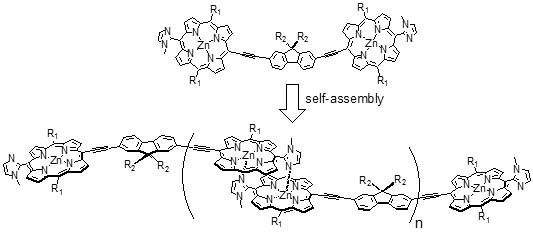
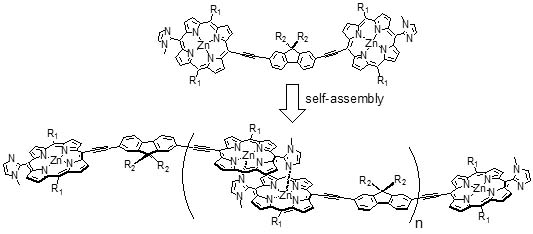
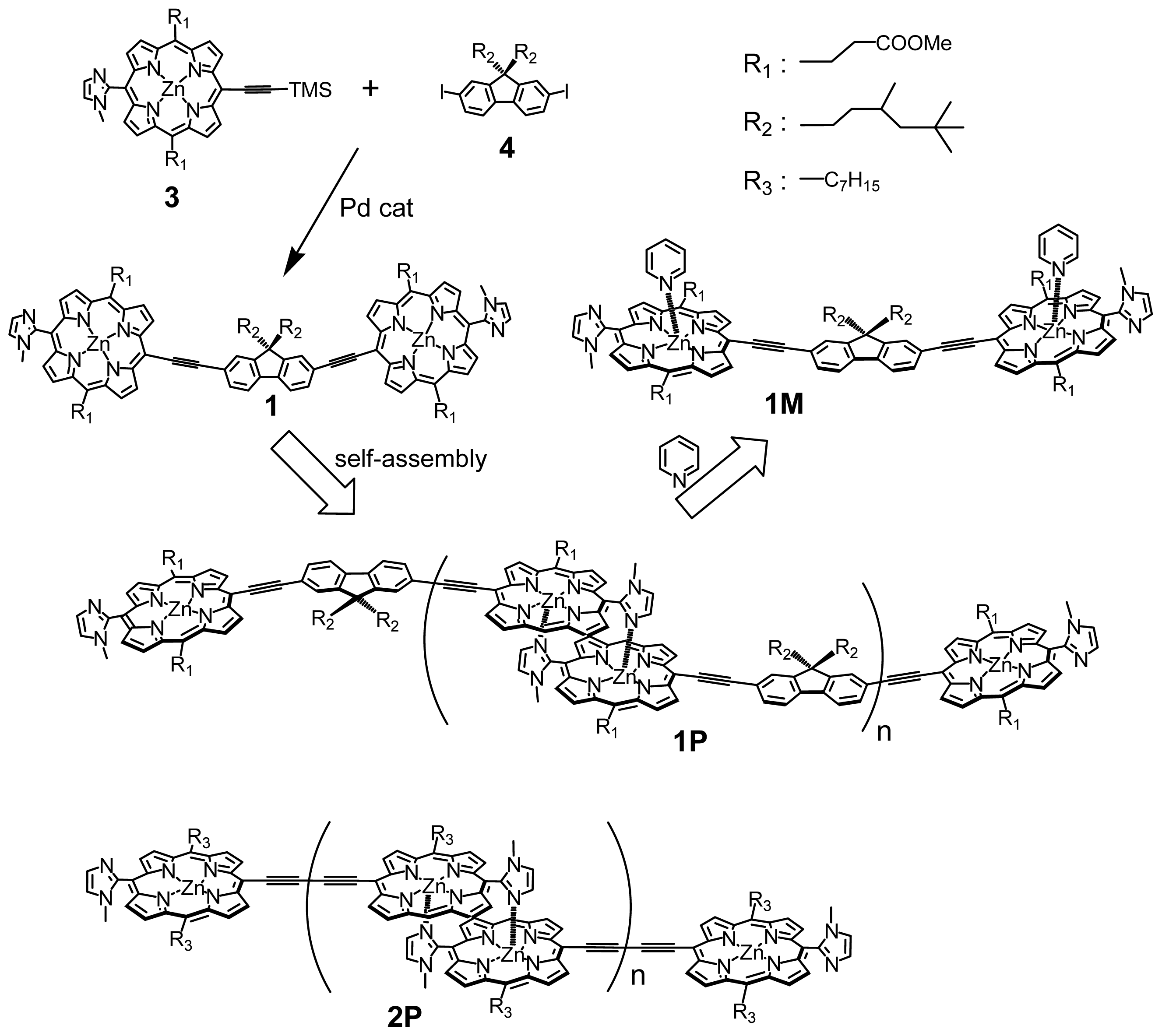
<p>Recently, much attention has been focused on organic dye molecules in view of optical applications such as organic solar cell [<xref ref-type="bibr" rid="b1-ijms-14-00322">1</xref>], electronic luminescence [<xref ref-type="bibr" rid="b2-ijms-14-00322">2</xref>], photon-mode optical memory using photochromic molecules [<xref ref-type="bibr" rid="b3-ijms-14-00322">3</xref>], and nonlinear optics including two-photon absorption (2PA) materials [<xref ref-type="bibr" rid="b4-ijms-14-00322">4</xref>–<xref ref-type="bibr" rid="b11-ijms-14-00322">11</xref>]. Novel functions would be expected upon conjugation of two or more chromophores, even when a monomeric dye itself exhibits insignificant function. We developed two-photon absorption materials [<xref ref-type="bibr" rid="b12-ijms-14-00322">12</xref>–<xref ref-type="bibr" rid="b22-ijms-14-00322">22</xref>] using self-assembled multi-porphyrin arrays and found that the extension of the π-conjugation between the porphyrins with triple bonds was the most significant for 2PA enhancement. Complementary coordination of imidazolyl to zinc, in which the stability constant of the complementary dimer exceeded 10<sup>11</sup> M<sup>−1</sup> in CHCl<sub>3</sub>[<xref ref-type="bibr" rid="b23-ijms-14-00322">23</xref>–<xref ref-type="bibr" rid="b25-ijms-14-00322">25</xref>], also contributed to the enhancement. However, an additional expansion of π-conjugation gave rise to a large red-shift of the S<sub>0</sub>→S<sub>1</sub> one-photon absorption (1PA) to the two-photon resonance range (800 nm to 900 nm) [<xref ref-type="bibr" rid="b22-ijms-14-00322">22</xref>]. To prevent such an overlap of 2PA and 1PA, it is necessary to control the position of the S<sub>0</sub>→S<sub>1</sub> one-photon absorption by tuning the interaction between chromophores. Fluorene is a well-known π-spacer for two-photon absorption materials [<xref ref-type="bibr" rid="b26-ijms-14-00322">26</xref>–<xref ref-type="bibr" rid="b33-ijms-14-00322">33</xref>] and provides an angle of 160° between two ethynylimidazolylporphyrins when these are connected at the 2- and 7-positions of fluorene (<bold>1</bold>). Therien and Anderson reported bisporphyrins bridged by a π-spacer comprising an acetylenic connection [<xref ref-type="bibr" rid="b5-ijms-14-00322">5</xref>,<xref ref-type="bibr" rid="b34-ijms-14-00322">34</xref>]. Compound <bold>1</bold> gave the linear polymer <bold>1P</bold> by zinc-imidazolyl complementary coordination. Polymer <bold>1P</bold> could easily be dissociated into the unit <bold>1M</bold> by ligand coordination, such as with pyridine and imidazole. The slightly bent angle of 160° was expected to reduce the exciton interaction between the two porphyrins and shift the 1PA bands to shorter wavelengths than those of the butadiyne-bridged bisimidazolylporphyrin array <bold>2P</bold> without fluorene, allowing the measurement of the hidden 2PA bands in the shorter wavelength range. Similar fluorene-conjugated bisimidazolylporphyrins having two allyl groups at <italic>meso</italic>-positions have been synthesized to construct large macrocyclic arrays. The self-coordinated structures in the macrocycles were fixed by the ring-closing metathesis reaction of the allyl groups to investigate the effect of cyclization on 2PA by a femtosecond fluorescence method in the range between 800 and 875 nm [<xref ref-type="bibr" rid="b20-ijms-14-00322">20</xref>]. Here, we report the synthesis of linear polymers self-organized by fluorene-conjugated bisimidazolylporphyrins without allyl groups, and their 2PA properties in the range from 740 to 930 nm.</p></sec>
<sec sec-type="results|discussion">
<title>2. Results and Discussion</title>
<sec>
<title>2.1. Synthesis</title>
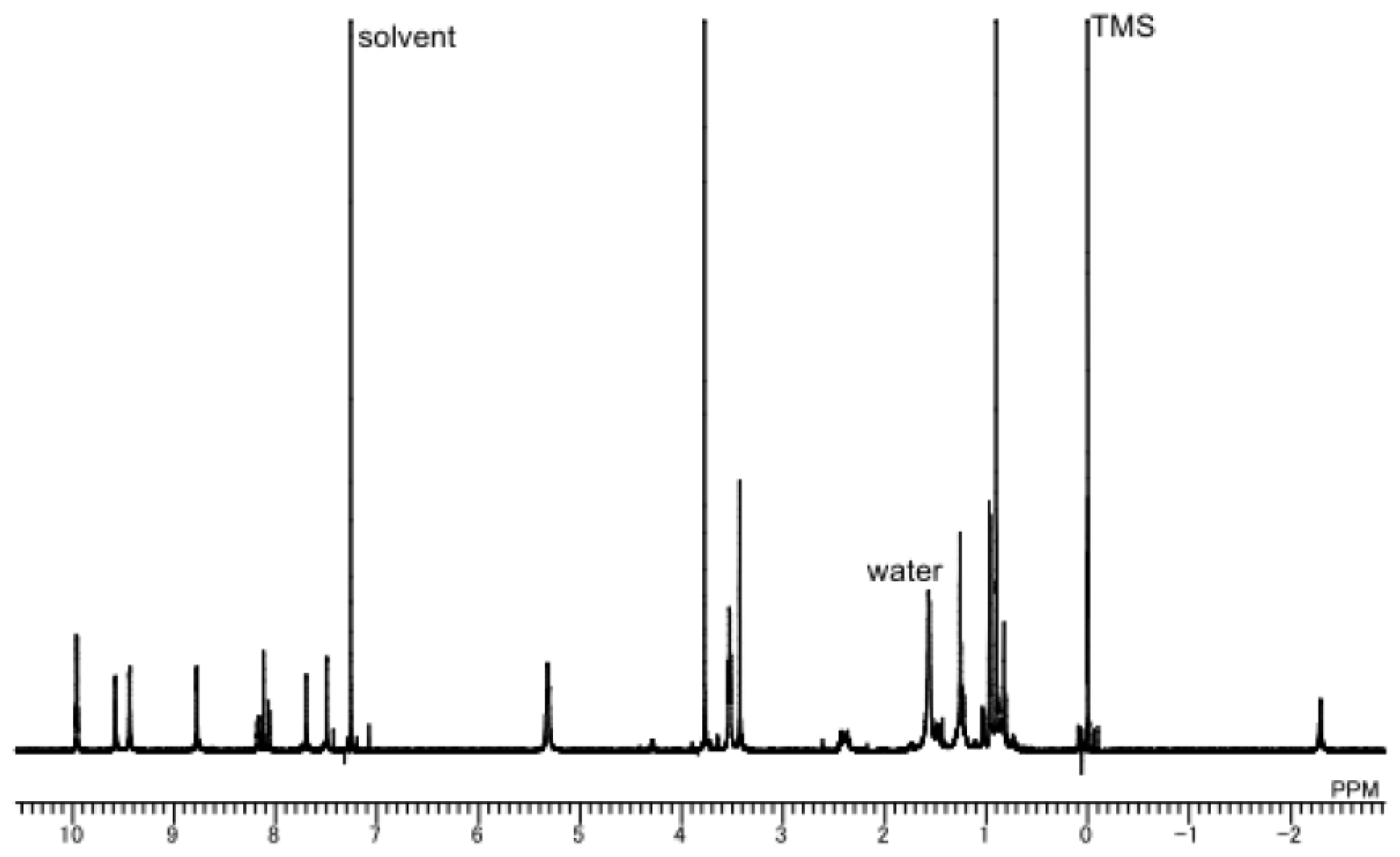
<p>Bisporphyrin <bold>1</bold> was synthesized from 5,15-bis(2-methoxycarbonylethyl)-10- (trimethylsilylpropargyl)-20-(1-methyl-2-imidazolyl)porphyrinatozinc <bold>3</bold>[<xref ref-type="bibr" rid="b15-ijms-14-00322">15</xref>] and 2,7-diiodo-9,9- bis(3,5,5-trimethylhexyl)fluorene <bold>4</bold>[<xref ref-type="bibr" rid="b35-ijms-14-00322">35</xref>,<xref ref-type="bibr" rid="b36-ijms-14-00322">36</xref>] using a Pd<sub>2</sub>(dba)<sub>3</sub>/AsPh<sub>3</sub> catalytic system, where deprotection of the TMS group and the coupling reaction were conducted in a one-pot procedure because of the low solubility of the deprotected ethynylimidazolylporphyrin (<xref ref-type="fig" rid="f6-ijms-14-00322">Scheme 1</xref>). Purification by preparative gel permeation chromatography (GPC) with pyridine elution allowed for the isolation of <bold>1</bold> from the crude mixture in 33% yield. Both the MALDI-TOF mass spectral and analytical GPC measurements showed a single species corresponding to the molecular weight of <bold>1</bold>. However, broad signals were obtained in the NMR spectrum of <bold>1</bold>, even in a coordinating solvent such as pyridine-<italic>d</italic><sub>5</sub>. Accordingly, the free base <bold>5</bold> was prepared by treatment with HCl to obtain a clearer NMR spectrum (<xref ref-type="fig" rid="f1-ijms-14-00322">Figure 1</xref>). Bisporphyrin <bold>1</bold> could not be obtained when 2,7-dibromofluorene was used as a starting material, due to its low reactivity.</p></sec>
<sec>
<title>2.2. Formation of Self-Assembled Polymer</title>
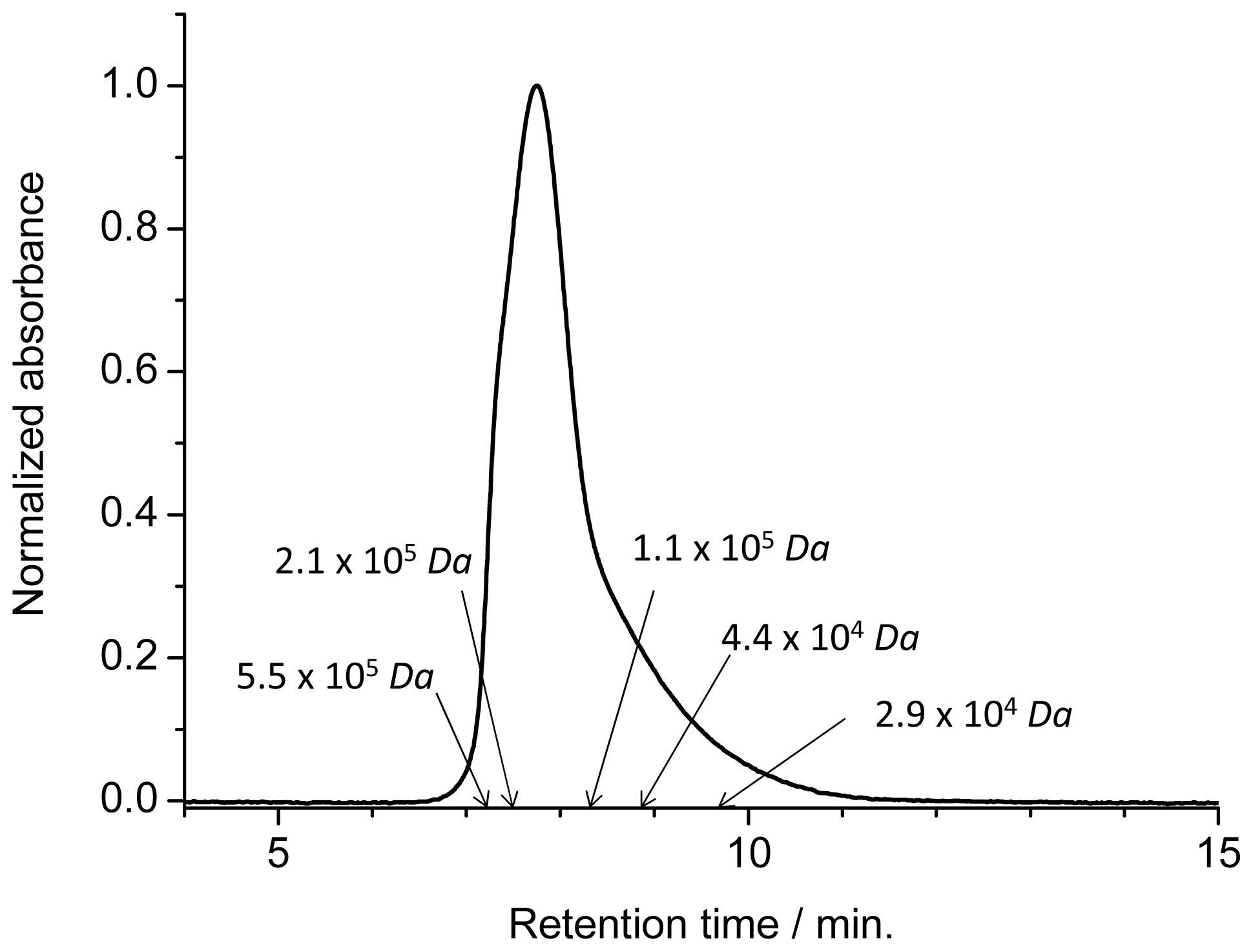
<p>When <bold>1</bold> was dissolved in a nonpolar solvent such as chloroform or 1,1,2,2,-tetrachloroethane after the evaporation of pyridine, the long linear polymer <bold>1P</bold> was formed by self-coordination. Polymer <bold>1P</bold> changed gradually to cyclic arrays of various sizes in chloroform above 45 °C or in chloroform/methanol (7:3, <italic>v</italic>/<italic>v</italic>%) at room temperature. Such cyclic arrays have been reported elsewhere [<xref ref-type="bibr" rid="b20-ijms-14-00322">20</xref>]. <bold>1P</bold> retains its linear polymer structure in chloroform or in tetrachloroethane without methanol at room temperature sufficiently long for 2PA measurements. The molecular weight of <bold>1P</bold> was analyzed by GPC with chloroform elution on a column with an exclusion limit of 5 × 10<sup>5</sup> Da. <xref ref-type="fig" rid="f2-ijms-14-00322">Figure 2</xref> shows the GPC chart of <bold>1P</bold> monitored at 420 nm by an UV-vis photodiode array. The arrows indicate the peak positions of polystyrene standards. The absorption spectra of <bold>1P</bold> at different retention times between 7 and 10 min were identical. The distribution maximum of the elution curve of <bold>1P</bold> appeared around Mw 1.5 × 10<sup>5</sup> Da. The mean molecular weights, <italic>M</italic><sub>w</sub> and <italic>M</italic><sub>n</sub>, estimated by comparing the data with those of polystyrene standards [<xref ref-type="bibr" rid="b37-ijms-14-00322">37</xref>], were ~2.1 × 10<sup>5</sup> Da and ~1.6 × 10<sup>5</sup> Da, respectively, which results in a polydispersity index of <italic>M</italic><sub>w</sub>/<italic>M</italic><sub>n</sub> = 1.4. The mean molecular weight of <italic>M</italic><sub>n</sub> = 1.6 × 10<sup>5</sup> corresponded to ca. 94 units of <bold>1</bold>, and these values were comparable with linear self-assembled bisporphyrin arrays [<xref ref-type="bibr" rid="b14-ijms-14-00322">14</xref>].</p></sec>
<sec>
<title>2.3. UV-Vis Absorption Spectra</title>
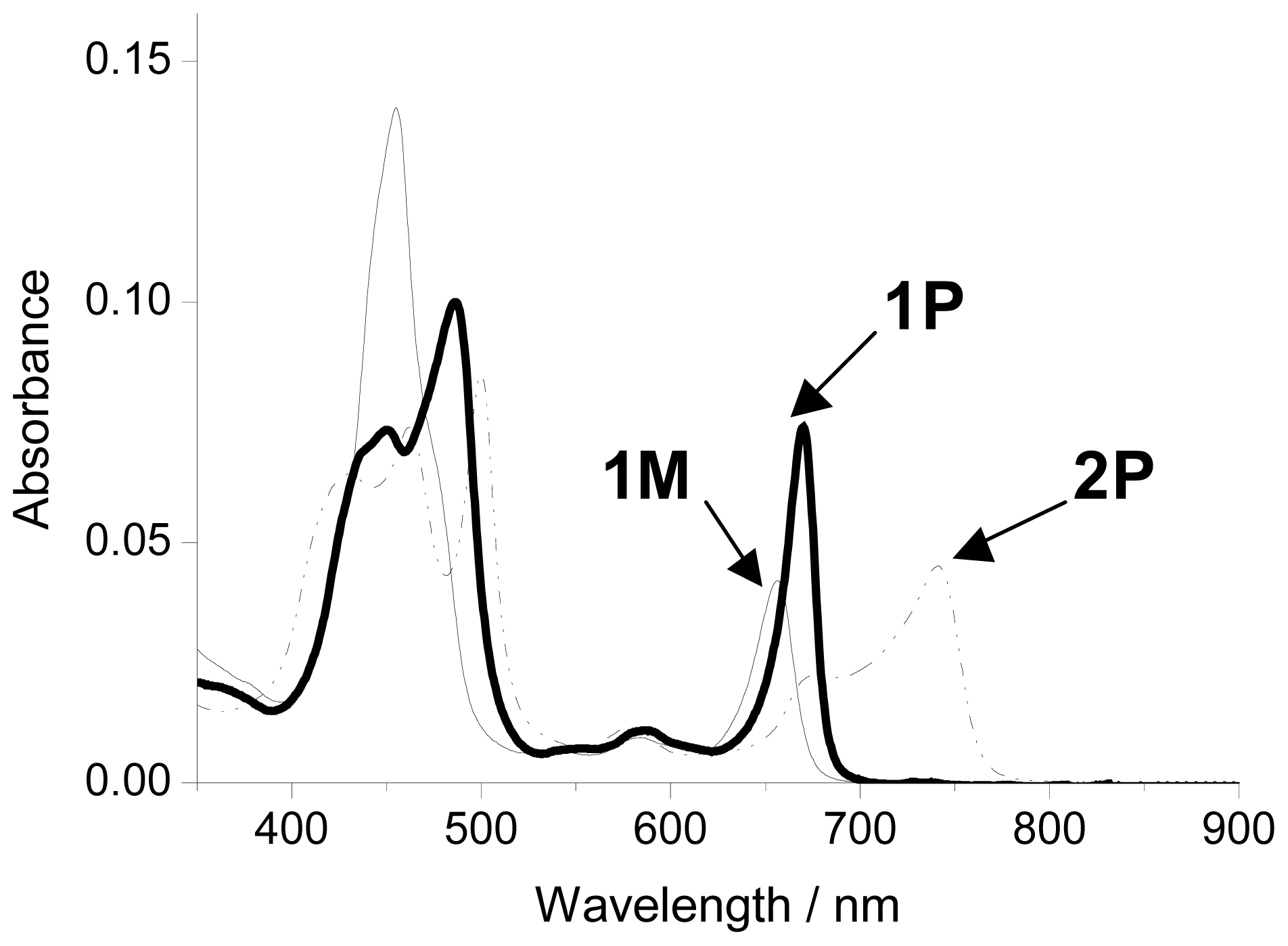
<p>The UV<italic>-</italic>vis absorption spectra of <bold>1P</bold> in tetrachloroethane (solid line), <bold>1M</bold> in tetrachloroethane/pyridine (7:3, <italic>v</italic>/<italic>v</italic>%), and <bold>2P</bold> in chloroform (dashed line) are shown in <xref ref-type="fig" rid="f3-ijms-14-00322">Figure 3</xref>. The Soret and Q-bands of <bold>1P</bold> were observed at around 485 and 670 nm, respectively. These were blue-shifted by 15 and 70 nm compared with those of <bold>2P</bold> (500 nm and 740 nm), suggesting a decrease in interaction due to the long distance and torsional angle of 160° between the two porphyrins. However, the absorption intensity of the Q-band in <bold>1P</bold> was still strong. On the other hand, the Q-band of unit <bold>1M</bold> was blue-shifted to 655 nm and its intensity was considerably decreased because of the disappearance of excitonic interactions through the zinc-imidazolyl complementary coordination.</p></sec>
<sec>
<title>2.4. Nonlinear Absorption</title>
<p>The 2PA cross sections of <bold>1P</bold> and <bold>1M</bold> were measured with an open-aperture Z-scan technique at wavelengths from 740 to 920 nm, using a Nd:YAG nanosecond pulse laser system with optical parametric oscillator. The nanosecond measurement system and analysis method were previously reported [<xref ref-type="bibr" rid="b14-ijms-14-00322">14</xref>]. In general, the effective cross section value, <sup>eff</sup>σ<sup>(2)</sup>, measured using nanosecond pulses, is 2–3 orders of magnitude larger than the pure 2PA cross section, σ <sup>(2)</sup>, obtained with femtosecond pulses, because the excited state absorption (ESA) contributes to the data. In our porphyrin systems, the <sup>eff</sup>σ <sup>(2)</sup> values were 30 to 50 times larger than the σ <sup>(2)</sup> values, and the 2PA spectra measured with nanosecond and femtosecond pulses were similar. Therefore, <sup>eff</sup>σ <sup>(2)</sup> values obtained by nanosecond measurements were a good measure for the 2PA properties. Moreover, in some 2PA applications, such as 2PA-PDT and 3-D optical memory, nanosecond pulses will be more appropriate because of the ease of operation and availability.</p>
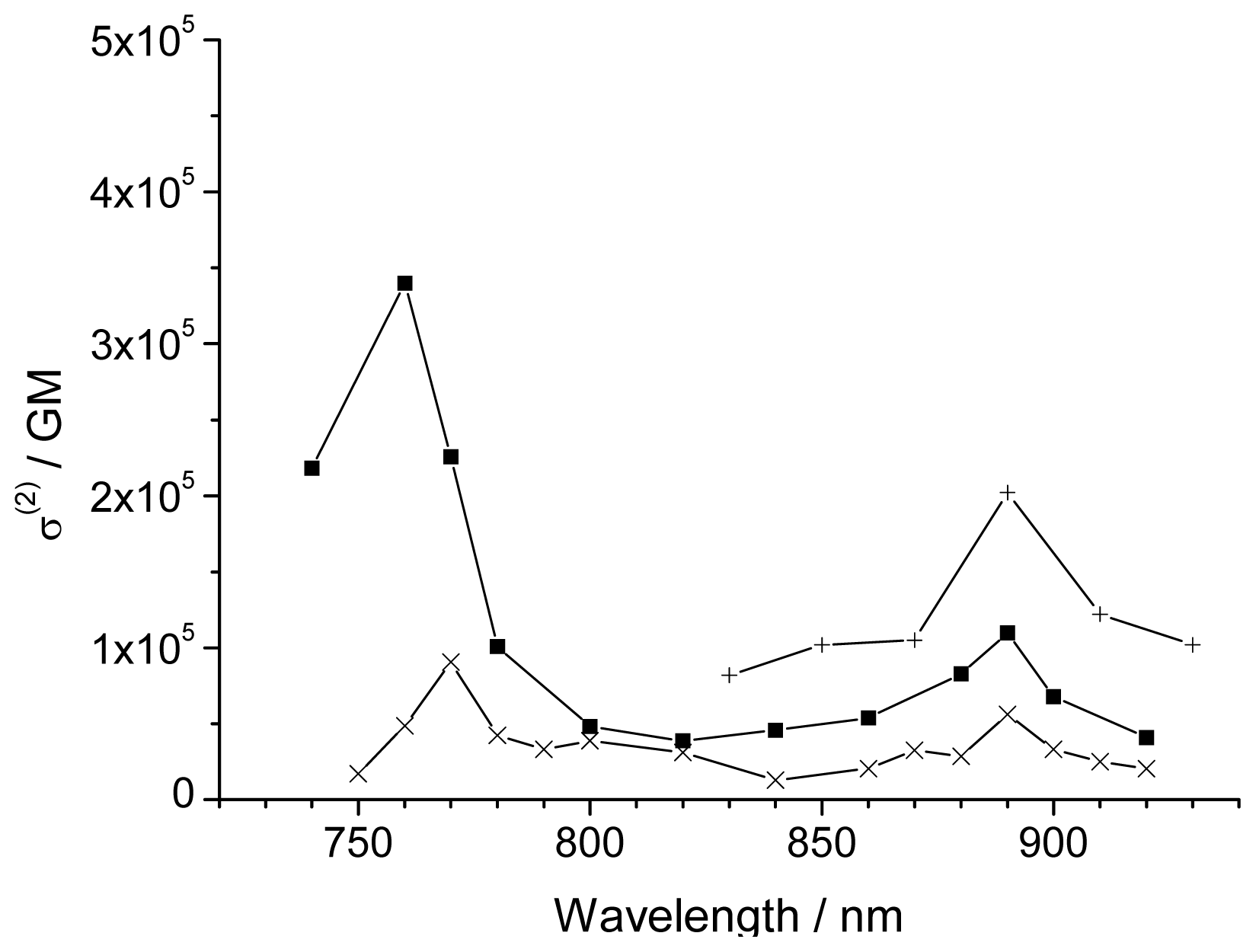
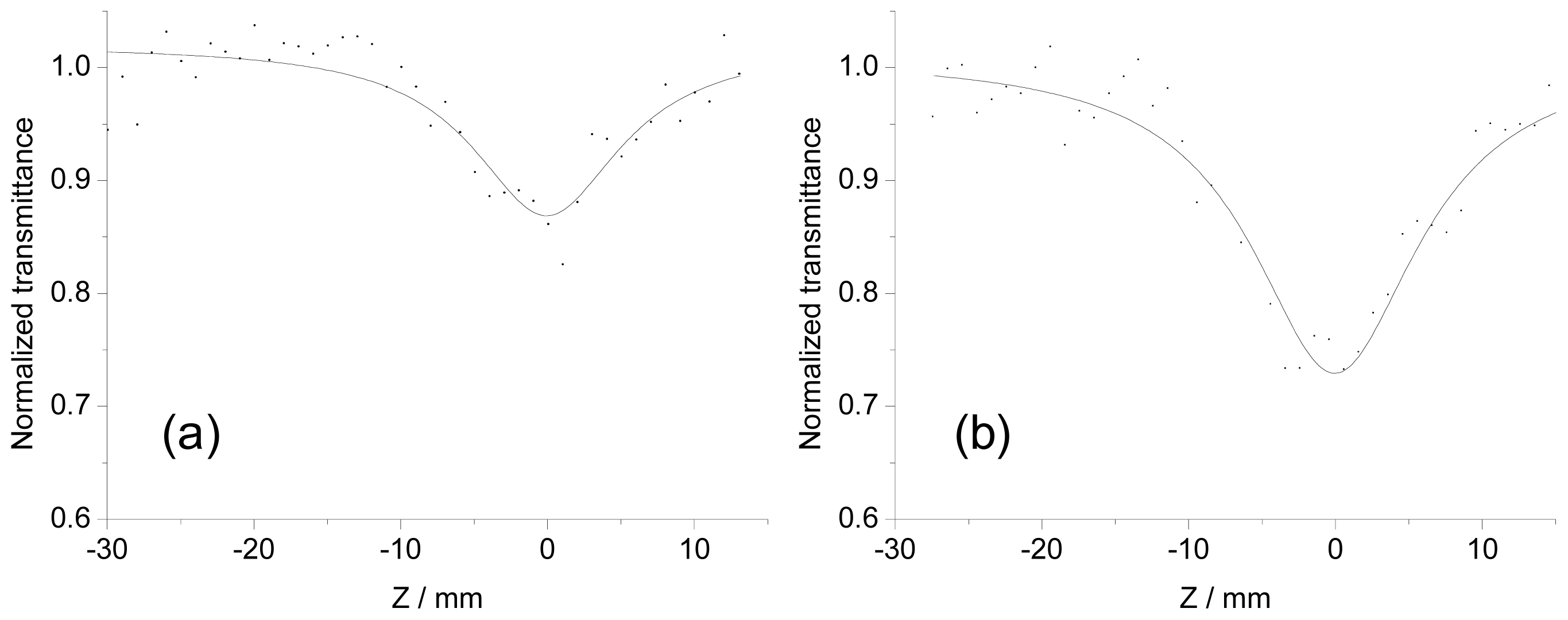
<p><xref ref-type="fig" rid="f4-ijms-14-00322">Figure 4</xref> shows typical Z-scan traces for <bold>1P</bold> in tetrachloroethane (dotted trace) and theoretically fitted curves (solid line) at 890 nm ((a) at a concentration of 7.66 × 10<sup>−5</sup> M with a pulse energy of 1.6 mJ) and 760 nm ((b) at a concentration of 6.87 × 10<sup>−5</sup> M with a pulse energy of 1.45 mJ). The <sup>eff</sup>σ <sup>(2)</sup> values were obtained from the fitted curves and theoretical equations [<xref ref-type="bibr" rid="b14-ijms-14-00322">14</xref>,<xref ref-type="bibr" rid="b38-ijms-14-00322">38</xref>]. <xref ref-type="fig" rid="f5-ijms-14-00322">Figure 5</xref> shows 2PA spectra of <bold>1P</bold> (square). Two peaks were observed at 760 and 890 nm with large <sup>eff</sup>σ <sup>(2)</sup> values of 3.4 × 10<sup>5</sup> and 1.1 × 10<sup>5</sup> GM (per dimer unit), respectively. 2PA spectra of <bold>1M</bold> (<xref ref-type="fig" rid="f5-ijms-14-00322">Figure 5</xref>, cross) also showed two peaks at 770 and 890 nm, with values of 9.1 × 10<sup>4</sup> and 5.6 × 10<sup>4</sup> GM, respectively. The values obtained for <bold>1M</bold> were almost one-third to one-half of those of <bold>1P</bold>. As described for the absorption spectra, <bold>1P</bold> showed strong one-photon absorption of the Q-band at 670 nm. On the other hand, that of <bold>1M</bold> was blue-shifted to 655 nm and the oscillator strength was almost half that of <bold>1P</bold>, indicating that the resonance enhancement for <bold>1M</bold>, which comes from the one-photon absorption near the two-photon resonance [<xref ref-type="bibr" rid="b38-ijms-14-00322">38</xref>,<xref ref-type="bibr" rid="b39-ijms-14-00322">39</xref>], would be expected to be poorer than that for <bold>1P</bold>. This may clearly explain the difference in the <sup>eff</sup>σ <sup>(2)</sup> values between <bold>1P</bold> and <bold>1M</bold>, and we can confirm again that self-organization through complementary coordination is effective for the enhancement [<xref ref-type="bibr" rid="b13-ijms-14-00322">13</xref>,<xref ref-type="bibr" rid="b14-ijms-14-00322">14</xref>]. The shapes of the 2PA spectra of <bold>1P</bold> and <bold>1M</bold> were similar, but did not correspond to those of the one-photon spectra in the wavelength range of half of 2PA, <italic>i.e.</italic>, 370 nm to 500 nm, suggesting that the final state by 2PA is different from the one-photon excited state [<xref ref-type="bibr" rid="b5-ijms-14-00322">5</xref>,<xref ref-type="bibr" rid="b39-ijms-14-00322">39</xref>]. The <sup>eff</sup>σ <sup>(2)</sup> values per dimer unit of <bold>1P</bold> in the wavelength range between 800 and 860 nm ranged from 3.9 × 10<sup>4</sup> to 5.4 × 10<sup>4</sup> GM. These values were similar to those of macrocycles measured by femtosecond pulses [<xref ref-type="bibr" rid="b20-ijms-14-00322">20</xref>], indicating negligible ESA contributions in this wavelength range, considering nanosecond measurement.</p>
<p>In the previous report, the linear polymer <bold>2P</bold> exhibited a large <sup>eff</sup>σ <sup>(2)</sup> value of 2.0 × 10<sup>5</sup> GM (per dimer unit) at 890 nm [<xref ref-type="bibr" rid="b14-ijms-14-00322">14</xref>], which was twice of that of <bold>1P</bold> at the same wavelength. <bold>2P</bold> had a strong one-photon absorption of the Q-band at 740 nm that was longer than <bold>1P</bold> by 70 nm, suggesting that <bold>2P</bold> undergoes a stronger resonance enhancement effect than <bold>1P</bold>. However, the shift of the strong Q-band to the shorter wavelength of 670 nm for <bold>1P</bold> allows the Z-scan measurements in the wavelength range of 720 to 820 nm, which is prohibited by one-photon absorption in the case of <bold>2P</bold>. Then, we could find another strong 2PA band at around 760 nm with the largest <sup>eff</sup>σ<sup>(2)</sup> value of 3.4 × 10<sup>5</sup> GM. The cross sections increased with the shortening of the incident light wavelength below around 800 nm. Similar behavior was observed in simple porphyrins such as tetraphenylporphyrin, Zn octaethylporphyrin, and a self-assembled dimer measured using a femtosecond fluorescence method [<xref ref-type="bibr" rid="b39-ijms-14-00322">39</xref>] or nanosecond Z-scan method [<xref ref-type="bibr" rid="b16-ijms-14-00322">16</xref>]. This has been explained as a resonance enhancement near the one-photon absorption of the Q-band.</p></sec></sec>
<sec>
<title>3. Experimental Section</title>
<sec>
<title>General</title>
<p><sup>1</sup>H NMR spectra were obtained in CDCl<sub>3</sub> with Me<sub>4</sub>Si as the internal standard (δ 0 ppm) and recorded on either a JEOL JNM EX270 or JEOL ECP600. UV-vis spectra were obtained on either a Shimadzu UV-1650PC or UV-3100PC. MALDI-TOF mass spectra were obtained on Perseptive Biosystems Voyager DE-STR and Shimadzu/KRATOS Axima-CFR Kompact MALDI with dithranol (Aldrich, St. Louis, MO, USA) or 2-[3-(4-<italic>tert</italic>-butylphenyl)-2-methylprop-2-enylidene]-malononitrile (DCTB, Aldrich) as the matrix. Reactions were monitored on silica gel 60 F254 TLC plates (Merck, Darmstadt, Germany). The silica gel utilized for column chromatography was purchased from Kanto Chemical Co. Inc.: Silica Gel 60N (Spherical, Neutral) 60–210 mm and 40–50 mm (Flash). The alumina used for column chromatography was purchased from Merck: Aluminum oxide 90 active basic. Analytical GPC measurements were performed on a HEWLETT PACKARD 1100 SERIES with a JAIGEL 3H-A or 4H-A column for chloroform eluent. The nanosecond Z-scan measurement system and analysis method were previously reported [<xref ref-type="bibr" rid="b14-ijms-14-00322">14</xref>].</p>
<p>Synthesis of <bold>1</bold>: Under argon atmosphere, <bold>3</bold>[<xref ref-type="bibr" rid="b15-ijms-14-00322">15</xref>] (95 mg, 132 μmol) and <bold>4</bold>[<xref ref-type="bibr" rid="b35-ijms-14-00322">35</xref>,<xref ref-type="bibr" rid="b36-ijms-14-00322">36</xref>] (35.4 mg, 52.6 μmol) were dissolved in dry THF (45 mL). Then, tetrabutylammonium fluoride in THF (264 μL, 264 μmol) was added. After 30 min, triethylamine (9 mL), Pd<sub>2</sub>(dba)<sub>3</sub> (27.2 mg, 26.3 μmol), and AsPh<sub>3</sub> (32.2 mg, 105 μmol) were added. After stirring 4 h, the reaction solvents were evaporated. The residue was dissolved in chloroform and washed with water. The crude residue after concentration was purified by preparative GPC (Tosoh G2500H<sub>HR</sub>, pyridine elution) to give <bold>1</bold> (29 mg, 33%). MALDI-TOF mass (dithranol) <italic>m</italic>/<italic>z</italic> 1711.66 (M + H)<sup>+</sup>, calcd for C<sub>99</sub>H<sub>98</sub>N<sub>12</sub>O<sub>8</sub>Zn<sub>2</sub>, 1710.62; UV-vis λ<sub>max</sub> (nm, in CHCl<sub>3</sub>) 449, 484, 583, 667; fluorescence λ<sub>max</sub> (nm, λ<sub>ex</sub> = 484 nm, in CHCl<sub>3</sub>) 670, 731.</p>
<p>Synthesis of <bold>5</bold>: Under an Ar atmosphere, <bold>1</bold> (4.5 mg, 2.63 μmol) in chloroform (30 mL) was added into a mixture of 12 N hydrochloric acid (8 mL) and methanol (40 mL). After stirring for 30 min at room temperature, the reaction solution was diluted with water and extracted with chloroform. The chloroform layer was washed with saturated NaHCO<sub>3</sub> aqueous solution. The crude residue after concentration was purified with silica gel column chromatography (CHCl<sub>3</sub>/MeOH = 20/1) (yield: 53%). <sup>1</sup>H NMR (600 MHz, CDCl<sub>3</sub>) δ 9.96 (q, 4H, <italic>J</italic> = 4.8 Hz, β), 9.58 (q, 4H, <italic>J</italic> = 4.8 Hz, β), 9.44 (d, 4H, <italic>J</italic> = 4.8 Hz, β), 8.78 (d, 4H, <italic>J</italic> = 4.8 Hz, β), 8.17(m, 2H, Ph), 8.12 (s, 2H, Ph), 8.07 (d, 2H, <italic>J</italic> = 7.8 Hz, Ph), 7.70 (d, 1H, <italic>J</italic> = 1.8 Hz, im), 7.50 (d, 1H, <italic>J</italic> = 1.8 Hz, im), 5.32 (t, 8H, <italic>J</italic> = 7.8 Hz, CH<sub>2</sub>), 3.77 (s, 12H, <italic>J</italic> = 7.8 Hz, OMe), 3.53 (t, 8H, <italic>J</italic> = 7.8 Hz, CH<sub>2</sub>), 3.43 (s, 6H, NMe), 2.36–0.81 (m, 38H, alkyl groups in fluorene), −2.29 (s, 4H, NH); MALDI-TOF mass (dithranol), <italic>m</italic>/<italic>z</italic> 1587.75 (M + H)<sup>+</sup>, calcd for C<sub>99</sub>H<sub>102</sub>N<sub>12</sub>O<sub>8</sub>, 1586.79.</p></sec></sec>
<sec sec-type="conclusions">
<title>4. Conclusions</title>
<p>In conclusion, a porphyrin-fluorene conjugate connected by triple bonds <bold>1</bold> was successfully synthesized through a Pd-catalyzed coupling reaction. Polymer <bold>1P</bold>, self-assembled through zinc-imidazolyl complementary coordination, was successfully formed. The 2PA properties could be controlled by tuning the wavelength and absorption intensity of 1PA bands, which were altered by changing the interactions between the porphyrins by the introduction of fluorene or complementary coordination.</p></sec></body>
<back>
<ack>
<title>Acknowledgments</title>
<p>We gratefully acknowledge financial support through Grants-in-Aid for Scientific Research (A) (No. 15205020) and Young Scientists (B) (No. 18750118) (Kazuya Ogawa) from the Ministry of Education, Culture, Sports, Science, and Technology, Japan (Monbu Kagakusho).</p></ack>
<ref-list>
<title>References</title>
<ref id="b1-ijms-14-00322"><label>1</label><citation citation-type="journal"><person-group person-group-type="author"><name><surname>Gunes</surname><given-names>S.</given-names></name><name><surname>Neugebauer</surname><given-names>H.</given-names></name><name><surname>Sariciftci</surname><given-names>N.S.</given-names></name></person-group><article-title>Conjugated polymer-based organic solar cells</article-title><source>Chem. Rev</source><year>2007</year><volume>107</volume><fpage>1324</fpage><lpage>1338</lpage><pub-id pub-id-type="doi">10.1021/cr050149z</pub-id><pub-id pub-id-type="pmid">17428026</pub-id></citation></ref>
<ref id="b2-ijms-14-00322"><label>2</label><citation citation-type="journal"><person-group person-group-type="author"><name><surname>Grimsdale</surname><given-names>A.C.</given-names></name><name><surname>Chan</surname><given-names>K.L.</given-names></name><name><surname>Martin</surname><given-names>R.E.</given-names></name><name><surname>Jokisz</surname><given-names>P.G.</given-names></name><name><surname>Holmes</surname><given-names>A.B.</given-names></name></person-group><article-title>Synthesis of light-emitting conjugated polymers for applications in electroluminescent devices</article-title><source>Chem. Rev</source><year>2009</year><volume>109</volume><fpage>897</fpage><lpage>1091</lpage><pub-id pub-id-type="doi">10.1021/cr000013v</pub-id><pub-id pub-id-type="pmid">19228015</pub-id></citation></ref>
<ref id="b3-ijms-14-00322"><label>3</label><citation citation-type="journal"><person-group person-group-type="author"><name><surname>Irie</surname><given-names>M.</given-names></name></person-group><article-title>Photochromism: Memories and switches—Introduction</article-title><source>Chem. Rev</source><year>2000</year><volume>100</volume><fpage>1683</fpage><lpage>1683</lpage><pub-id pub-id-type="doi">10.1021/cr980068l</pub-id><pub-id pub-id-type="pmid">11777415</pub-id></citation></ref>
<ref id="b4-ijms-14-00322"><label>4</label><citation citation-type="journal"><person-group person-group-type="author"><name><surname>Drobizhev</surname><given-names>M.</given-names></name><name><surname>Stepanenko</surname><given-names>Y.</given-names></name><name><surname>Rebane</surname><given-names>A.</given-names></name><name><surname>Wilson</surname><given-names>C.J.</given-names></name><name><surname>Screen</surname><given-names>T.E.O.</given-names></name><name><surname>Anderson</surname><given-names>H.L.</given-names></name></person-group><article-title>Strong cooperative enhancement of two-photon absorption in double-strand conjugated porphyrin ladder arrays</article-title><source>J. Am. Chem. Soc</source><year>2006</year><volume>128</volume><fpage>12432</fpage><lpage>12433</lpage><pub-id pub-id-type="doi">10.1021/ja0649623</pub-id><pub-id pub-id-type="pmid">16984190</pub-id></citation></ref>
<ref id="b5-ijms-14-00322"><label>5</label><citation citation-type="journal"><person-group person-group-type="author"><name><surname>Drobizhev</surname><given-names>M.</given-names></name><name><surname>Stepanenko</surname><given-names>Y.</given-names></name><name><surname>Dzenis</surname><given-names>Y.</given-names></name><name><surname>Karotki</surname><given-names>A.</given-names></name><name><surname>Rebane</surname><given-names>A.</given-names></name><name><surname>Taylor</surname><given-names>P.N.</given-names></name><name><surname>Anderson</surname><given-names>H.L.</given-names></name></person-group><article-title>Understanding strong two-photon absorption in pi-conjugated porphyrin dimers via double-resonance enhancement in a three-level model</article-title><source>J. Am. Chem. Soc</source><year>2004</year><volume>126</volume><fpage>15352</fpage><lpage>15353</lpage><pub-id pub-id-type="doi">10.1021/ja0445847</pub-id><pub-id pub-id-type="pmid">15563141</pub-id></citation></ref>
<ref id="b6-ijms-14-00322"><label>6</label><citation citation-type="journal"><person-group person-group-type="author"><name><surname>Hisaki</surname><given-names>I.</given-names></name><name><surname>Hiroto</surname><given-names>S.</given-names></name><name><surname>Kim</surname><given-names>K.S.</given-names></name><name><surname>Noh</surname><given-names>S.B.</given-names></name><name><surname>Kim</surname><given-names>D.</given-names></name><name><surname>Shinokubo</surname><given-names>H.</given-names></name><name><surname>Osuka</surname><given-names>A.</given-names></name></person-group><article-title>Synthesis of doubly beta-to-beta 1,3-butadiyne-bridged diporphyrins: Enforced planar structures and large two-photon absorption cross sections</article-title><source>Angew. Chem. Int. Ed</source><year>2007</year><volume>46</volume><fpage>5125</fpage><lpage>5128</lpage><pub-id pub-id-type="doi">10.1002/anie.200700550</pub-id></citation></ref>
<ref id="b7-ijms-14-00322"><label>7</label><citation citation-type="journal"><person-group person-group-type="author"><name><surname>Ikeda</surname><given-names>C.</given-names></name><name><surname>Yoon</surname><given-names>Z.S.</given-names></name><name><surname>Park</surname><given-names>M.</given-names></name><name><surname>Inoue</surname><given-names>H.</given-names></name><name><surname>Kim</surname><given-names>D.</given-names></name><name><surname>Osuka</surname><given-names>A.</given-names></name></person-group><article-title>Helicity induction and two-photon absorbance enhancement in zinc(ii) meso-meso linked porphyrin oligomers via intermolecular hydrogen bonding interactions</article-title><source>J. Am. Chem. Soc</source><year>2005</year><volume>127</volume><fpage>534</fpage><lpage>535</lpage><pub-id pub-id-type="doi">10.1021/ja043428x</pub-id><pub-id pub-id-type="pmid">15643872</pub-id></citation></ref>
<ref id="b8-ijms-14-00322"><label>8</label><citation citation-type="journal"><person-group person-group-type="author"><name><surname>Bhaskar</surname><given-names>A.</given-names></name><name><surname>Guda</surname><given-names>R.</given-names></name><name><surname>Haley</surname><given-names>M.M.</given-names></name><name><surname>Goodson</surname><given-names>T.</given-names></name></person-group><article-title>Building symmetric two-dimensional two-photon materials</article-title><source>J. Am. Chem. Soc</source><year>2006</year><volume>128</volume><fpage>13972</fpage><lpage>13973</lpage><pub-id pub-id-type="doi">10.1021/ja062709x</pub-id><pub-id pub-id-type="pmid">17061848</pub-id></citation></ref>
<ref id="b9-ijms-14-00322"><label>9</label><citation citation-type="journal"><person-group person-group-type="author"><name><surname>Bhaskar</surname><given-names>A.</given-names></name><name><surname>Ramakrishna</surname><given-names>G.</given-names></name><name><surname>Lu</surname><given-names>Z.K.</given-names></name><name><surname>Twieg</surname><given-names>R.</given-names></name><name><surname>Hales</surname><given-names>J.M.</given-names></name><name><surname>Hagan</surname><given-names>D.J.</given-names></name><name><surname>van Stryland</surname><given-names>E.</given-names></name><name><surname>Goodson</surname><given-names>T.</given-names></name></person-group><article-title>Investigation of two-photon absorption properties in branched alkene and alkyne chromophores</article-title><source>J. Am. Chem. Soc</source><year>2006</year><volume>128</volume><fpage>11840</fpage><lpage>11849</lpage><pub-id pub-id-type="doi">10.1021/ja060630m</pub-id><pub-id pub-id-type="pmid">16953624</pub-id></citation></ref>
<ref id="b10-ijms-14-00322"><label>10</label><citation citation-type="journal"><person-group person-group-type="author"><name><surname>Arnbjerg</surname><given-names>J.</given-names></name><name><surname>Jimenez-Banzo</surname><given-names>A.</given-names></name><name><surname>Paterson</surname><given-names>M.J.</given-names></name><name><surname>Nonell</surname><given-names>S.</given-names></name><name><surname>Borrell</surname><given-names>J.I.</given-names></name><name><surname>Christiansen</surname><given-names>O.</given-names></name><name><surname>Ogilby</surname><given-names>P.R.</given-names></name></person-group><article-title>Two-photon absorption in tetraphenylporphycenes: Are porphycenes better candidates than porphyrins for providing optimal optical properties for two-photon photodynamic therapy</article-title><source>J. Am. Chem. Soc</source><year>2007</year><volume>129</volume><fpage>5188</fpage><lpage>5199</lpage><pub-id pub-id-type="doi">10.1021/ja0688777</pub-id><pub-id pub-id-type="pmid">17397157</pub-id></citation></ref>
<ref id="b11-ijms-14-00322"><label>11</label><citation citation-type="journal"><person-group person-group-type="author"><name><surname>Kamada</surname><given-names>K.</given-names></name><name><surname>Ohta</surname><given-names>K.</given-names></name><name><surname>Kubo</surname><given-names>T.</given-names></name><name><surname>Shimizu</surname><given-names>A.</given-names></name><name><surname>Morita</surname><given-names>Y.</given-names></name><name><surname>Nakasuji</surname><given-names>K.</given-names></name><name><surname>Kishi</surname><given-names>R.</given-names></name><name><surname>Ohta</surname><given-names>S.</given-names></name><name><surname>Furukawa</surname><given-names>S.</given-names></name><name><surname>Takahashi</surname><given-names>H.</given-names></name><etal/></person-group><article-title>Strong two-photon absorption of singlet diradical hydrocarbons</article-title><source>Angew. Chem. Int. Ed</source><year>2007</year><volume>46</volume><fpage>3544</fpage><lpage>3546</lpage><pub-id pub-id-type="doi">10.1002/anie.200605061</pub-id></citation></ref>
<ref id="b12-ijms-14-00322"><label>12</label><citation citation-type="journal"><person-group person-group-type="author"><name><surname>Ogawa</surname><given-names>K.</given-names></name><name><surname>Zhang</surname><given-names>T.Q.</given-names></name><name><surname>Yoshihara</surname><given-names>K.</given-names></name><name><surname>Kobuke</surname><given-names>Y.</given-names></name></person-group><article-title>Large third-order optical nonlinearity of self-assembled porphyrin oligomers</article-title><source>J. Am. Chem. Soc</source><year>2002</year><volume>124</volume><fpage>22</fpage><lpage>23</lpage><pub-id pub-id-type="doi">10.1021/ja0169015</pub-id><pub-id pub-id-type="pmid">11772054</pub-id></citation></ref>
<ref id="b13-ijms-14-00322"><label>13</label><citation citation-type="journal"><person-group person-group-type="author"><name><surname>Ogawa</surname><given-names>K.</given-names></name><name><surname>Ohashi</surname><given-names>A.</given-names></name><name><surname>Kobuke</surname><given-names>Y.</given-names></name><name><surname>Kamada</surname><given-names>K.</given-names></name><name><surname>Ohta</surname><given-names>K.</given-names></name></person-group><article-title>Strong two-photon absorption of self-assembled butadiyne-linked bisporphyrin</article-title><source>J. Am. Chem. Soc</source><year>2003</year><volume>125</volume><fpage>13356</fpage><lpage>13357</lpage><pub-id pub-id-type="doi">10.1021/ja035056i</pub-id><pub-id pub-id-type="pmid">14583021</pub-id></citation></ref>
<ref id="b14-ijms-14-00322"><label>14</label><citation citation-type="journal"><person-group person-group-type="author"><name><surname>Ogawa</surname><given-names>K.</given-names></name><name><surname>Ohashi</surname><given-names>A.</given-names></name><name><surname>Kobuke</surname><given-names>Y.</given-names></name><name><surname>Kamada</surname><given-names>K.</given-names></name><name><surname>Ohta</surname><given-names>K.</given-names></name></person-group><article-title>Two-photon absorption properties of self-assemblies of butadiyne-linked bis(imidazolylporphyrin)</article-title><source>J. Phys. Chem. B</source><year>2005</year><volume>109</volume><fpage>22003</fpage><lpage>22012</lpage><pub-id pub-id-type="doi">10.1021/jp054444z</pub-id><pub-id pub-id-type="pmid">16853858</pub-id></citation></ref>
<ref id="b15-ijms-14-00322"><label>15</label><citation citation-type="journal"><person-group person-group-type="author"><name><surname>Ogawa</surname><given-names>K.</given-names></name><name><surname>Hasegawa</surname><given-names>H.</given-names></name><name><surname>Inaba</surname><given-names>Y.</given-names></name><name><surname>Kobuke</surname><given-names>Y.</given-names></name><name><surname>Inouye</surname><given-names>H.</given-names></name><name><surname>Kanemitsu</surname><given-names>Y.</given-names></name><name><surname>Kohno</surname><given-names>E.</given-names></name><name><surname>Hirano</surname><given-names>T.</given-names></name><name><surname>Ogura</surname><given-names>S.</given-names></name><name><surname>Okura</surname><given-names>I.</given-names></name></person-group><article-title>Water-soluble bis(imidazolylporphyrin) self-assemblies with large two-photon absorption cross sections as potential agents for photodynamic therapy</article-title><source>J. Med. Chem</source><year>2006</year><volume>49</volume><fpage>2276</fpage><lpage>2283</lpage><pub-id pub-id-type="doi">10.1021/jm051072+</pub-id><pub-id pub-id-type="pmid">16570924</pub-id></citation></ref>
<ref id="b16-ijms-14-00322"><label>16</label><citation citation-type="journal"><person-group person-group-type="author"><name><surname>Tanihara</surname><given-names>J.</given-names></name><name><surname>Ogawa</surname><given-names>K.</given-names></name><name><surname>Kobuke</surname><given-names>Y.</given-names></name></person-group><article-title>Two-photon absorption properties of conjugated supramolecular porphyrins with electron donor and acceptor</article-title><source>J. Photochem. Photobiol. A</source><year>2006</year><volume>178</volume><fpage>140</fpage><lpage>149</lpage><pub-id pub-id-type="doi">10.1016/j.jphotochem.2005.10.042</pub-id></citation></ref>
<ref id="b17-ijms-14-00322"><label>17</label><citation citation-type="journal"><person-group person-group-type="author"><name><surname>Dy</surname><given-names>J.T.</given-names></name><name><surname>Ogawa</surname><given-names>K.</given-names></name><name><surname>Satake</surname><given-names>A.</given-names></name><name><surname>Ishizumi</surname><given-names>A.</given-names></name><name><surname>Kobuke</surname><given-names>Y.</given-names></name></person-group><article-title>Water-soluble self-assembled butadiyne-bridged bisporphyrin: A potential two-photon-absorbing photosensitizer for photodynamic therapy</article-title><source>Chem. Eur. J</source><year>2007</year><volume>13</volume><fpage>3491</fpage><lpage>3500</lpage><pub-id pub-id-type="doi">10.1002/chem.200601205</pub-id><pub-id pub-id-type="pmid">17225219</pub-id></citation></ref>
<ref id="b18-ijms-14-00322"><label>18</label><citation citation-type="journal"><person-group person-group-type="author"><name><surname>Dy</surname><given-names>J.T.</given-names></name><name><surname>Maeda</surname><given-names>R.</given-names></name><name><surname>Nagatsuka</surname><given-names>Y.</given-names></name><name><surname>Ogawa</surname><given-names>K.</given-names></name><name><surname>Kamada</surname><given-names>K.</given-names></name><name><surname>Ohta</surname><given-names>K.</given-names></name><name><surname>Kobuke</surname><given-names>Y.</given-names></name></person-group><article-title>A photochromic porphyrin-perinaphthothioindigo conjugate and its two-photon absorption properties</article-title><source>Chem. Commun.</source><year>2007</year><fpage>5170</fpage><lpage>5172</lpage></citation></ref>
<ref id="b19-ijms-14-00322"><label>19</label><citation citation-type="journal"><person-group person-group-type="author"><name><surname>Dy</surname><given-names>J.</given-names></name><name><surname>Ogawa</surname><given-names>K.</given-names></name><name><surname>Kamada</surname><given-names>K.</given-names></name><name><surname>Ohta</surname><given-names>K.</given-names></name><name><surname>Kobuke</surname><given-names>Y.</given-names></name></person-group><article-title>Stepwise elongation effect on the two-photon absorption of self-assembled butadiyne porphyrins</article-title><source>Chem. Commun.</source><year>2008</year><fpage>3411</fpage><lpage>3413</lpage></citation></ref>
<ref id="b20-ijms-14-00322"><label>20</label><citation citation-type="journal"><person-group person-group-type="author"><name><surname>Raymond</surname><given-names>J.E.</given-names></name><name><surname>Bhaskar</surname><given-names>A.</given-names></name><name><surname>Goodson</surname><given-names>T.</given-names></name><name><surname>Makiuchi</surname><given-names>N.</given-names></name><name><surname>Ogawa</surname><given-names>K.</given-names></name><name><surname>Kobuke</surname><given-names>Y.</given-names></name></person-group><article-title>Synthesis and two-photon absorption enhancement of porphyrin macrocycles</article-title><source>J. Am. Chem. Soc</source><year>2008</year><volume>130</volume><fpage>17212</fpage><lpage>17213</lpage><pub-id pub-id-type="doi">10.1021/ja804415b</pub-id><pub-id pub-id-type="pmid">19053414</pub-id></citation></ref>
<ref id="b21-ijms-14-00322"><label>21</label><citation citation-type="journal"><person-group person-group-type="author"><name><surname>Morisue</surname><given-names>M.</given-names></name><name><surname>Ogawa</surname><given-names>K.</given-names></name><name><surname>Kamada</surname><given-names>K.</given-names></name><name><surname>Ohta</surname><given-names>K.</given-names></name><name><surname>Kobuke</surname><given-names>Y.</given-names></name></person-group><article-title>Strong two-photon and three-photon absorptions in the antiparallel dimer of a porphyrin-phthalocyanine tandem</article-title><source>Chem. Commun</source><year>2010</year><volume>46</volume><fpage>2121</fpage><lpage>2123</lpage><pub-id pub-id-type="doi">10.1039/b921278g</pub-id></citation></ref>
<ref id="b22-ijms-14-00322"><label>22</label><citation citation-type="journal"><person-group person-group-type="author"><name><surname>Kamada</surname><given-names>K.</given-names></name><name><surname>Hara</surname><given-names>C.</given-names></name><name><surname>Ogawa</surname><given-names>K.</given-names></name><name><surname>Ohta</surname><given-names>K.</given-names></name><name><surname>Kobuke</surname><given-names>Y.</given-names></name></person-group><article-title>Strong two-photon absorption and its saturation of a self-organized dimer of an ethynylene-linked porphyrin tandem</article-title><source>Chem. Commun</source><year>2012</year><volume>48</volume><fpage>7988</fpage><lpage>7990</lpage><pub-id pub-id-type="doi">10.1039/c2cc30879g</pub-id></citation></ref>
<ref id="b23-ijms-14-00322"><label>23</label><citation citation-type="journal"><person-group person-group-type="author"><name><surname>Kobuke</surname><given-names>Y.</given-names></name><name><surname>Miyaji</surname><given-names>H.</given-names></name></person-group><article-title>Supramolecular organization of imidazolyl-porphyrin to a slipped cofacial dimer</article-title><source>J. Am. Chem. Soc</source><year>1994</year><volume>116</volume><fpage>4111</fpage><lpage>4112</lpage><pub-id pub-id-type="doi">10.1021/ja00088a070</pub-id></citation></ref>
<ref id="b24-ijms-14-00322"><label>24</label><citation citation-type="journal"><person-group person-group-type="author"><name><surname>Kobuke</surname><given-names>Y.</given-names></name><name><surname>Ogawa</surname><given-names>K.</given-names></name></person-group><article-title>Porphyrin supramolecules for artificial photosynthesis and molecular photonic/electronic materials</article-title><source>Bull. Chem. Soc. Jpn</source><year>2003</year><volume>76</volume><fpage>689</fpage><lpage>708</lpage><pub-id pub-id-type="doi">10.1246/bcsj.76.689</pub-id></citation></ref>
<ref id="b25-ijms-14-00322"><label>25</label><citation citation-type="journal"><person-group person-group-type="author"><name><surname>Ogawa</surname><given-names>K.</given-names></name><name><surname>Kobuke</surname><given-names>Y.</given-names></name></person-group><article-title>Formation of a giant supramolecular porphyrin array by self-coordination</article-title><source>Angew. Chem. Int. Ed</source><year>2000</year><volume>39</volume><fpage>4070</fpage><lpage>4073</lpage><pub-id pub-id-type="doi">10.1002/1521-3773(20001117)39:22&lt;4070::AID-ANIE4070&gt;3.0.CO;2-C</pub-id></citation></ref>
<ref id="b26-ijms-14-00322"><label>26</label><citation citation-type="journal"><person-group person-group-type="author"><name><surname>Rogers</surname><given-names>J.E.</given-names></name><name><surname>Slagle</surname><given-names>J.E.</given-names></name><name><surname>McLean</surname><given-names>D.G.</given-names></name><name><surname>Sutherland</surname><given-names>R.L.</given-names></name><name><surname>Brant</surname><given-names>M.C.</given-names></name><name><surname>Heinrichs</surname><given-names>J.</given-names></name><name><surname>Jakubiak</surname><given-names>R.</given-names></name><name><surname>Kannan</surname><given-names>R.</given-names></name><name><surname>Tan</surname><given-names>L.S.</given-names></name><name><surname>Fleitz</surname><given-names>P.A.</given-names></name></person-group><article-title>Insight into the nonlinear absorbance of two related series of two-photon absorbing chromophores</article-title><source>J. Phys. Chem. A</source><year>2007</year><volume>111</volume><fpage>1899</fpage><lpage>1906</lpage><pub-id pub-id-type="doi">10.1021/jp070050r</pub-id><pub-id pub-id-type="pmid">17388283</pub-id></citation></ref>
<ref id="b27-ijms-14-00322"><label>27</label><citation citation-type="journal"><person-group person-group-type="author"><name><surname>Morales</surname><given-names>A.R.</given-names></name><name><surname>Belfield</surname><given-names>K.D.</given-names></name><name><surname>Hales</surname><given-names>J.M.</given-names></name><name><surname>Van Stryland</surname><given-names>E.W.</given-names></name><name><surname>Hagan</surname><given-names>D.J.</given-names></name></person-group><article-title>Synthesis of two-photon absorbing unsymmetrical fluorenyl-based chromophores</article-title><source>Chem. Mater</source><year>2006</year><volume>18</volume><fpage>4972</fpage><lpage>4980</lpage><pub-id pub-id-type="doi">10.1021/cm061406z</pub-id></citation></ref>
<ref id="b28-ijms-14-00322"><label>28</label><citation citation-type="journal"><person-group person-group-type="author"><name><surname>Padmawar</surname><given-names>P.A.</given-names></name><name><surname>Rogers</surname><given-names>J.E.</given-names></name><name><surname>He</surname><given-names>G.S.</given-names></name><name><surname>Chiang</surname><given-names>L.Y.</given-names></name><name><surname>Tan</surname><given-names>L.S.</given-names></name><name><surname>Canteenwala</surname><given-names>T.</given-names></name><name><surname>Zheng</surname><given-names>Q.D.</given-names></name><name><surname>Slagle</surname><given-names>J.E.</given-names></name><name><surname>McLean</surname><given-names>D.G.</given-names></name><name><surname>Fleitz</surname><given-names>P.A.</given-names></name><etal/></person-group><article-title>Large cross-section enhancement and intramolecular energy transfer upon multiphoton absorption of hindered diphenylaminofluorene-c-60 dyads and triads</article-title><source>Chem. Mater</source><year>2006</year><volume>18</volume><fpage>4065</fpage><lpage>4074</lpage><pub-id pub-id-type="doi">10.1021/cm060718z</pub-id></citation></ref>
<ref id="b29-ijms-14-00322"><label>29</label><citation citation-type="journal"><person-group person-group-type="author"><name><surname>Zheng</surname><given-names>Q.D.</given-names></name><name><surname>He</surname><given-names>G.S.</given-names></name><name><surname>Prasad</surname><given-names>P.N.</given-names></name></person-group><article-title>Pi-conjugated dendritic nanosized chromophore with enhanced two-photon absorption</article-title><source>Chem. Mater</source><year>2005</year><volume>17</volume><fpage>6004</fpage><lpage>6011</lpage><pub-id pub-id-type="doi">10.1021/cm051292b</pub-id></citation></ref>
<ref id="b30-ijms-14-00322"><label>30</label><citation citation-type="journal"><person-group person-group-type="author"><name><surname>Belfield</surname><given-names>K.D.</given-names></name><name><surname>Morales</surname><given-names>A.R.</given-names></name><name><surname>Kang</surname><given-names>B.S.</given-names></name><name><surname>Hales</surname><given-names>J.M.</given-names></name><name><surname>Hagan</surname><given-names>D.J.</given-names></name><name><surname>van Stryland</surname><given-names>E.W.</given-names></name><name><surname>Chapela</surname><given-names>V.M.</given-names></name><name><surname>Percino</surname><given-names>J.</given-names></name></person-group><article-title>Synthesis, characterization, and optical properties of new two-photon-absorbing fluorene derivatives</article-title><source>Chem. Mater</source><year>2004</year><volume>16</volume><fpage>4634</fpage><lpage>4641</lpage><pub-id pub-id-type="doi">10.1021/cm049872g</pub-id></citation></ref>
<ref id="b31-ijms-14-00322"><label>31</label><citation citation-type="journal"><person-group person-group-type="author"><name><surname>Belfield</surname><given-names>K.D.</given-names></name><name><surname>Hagan</surname><given-names>D.J.</given-names></name><name><surname>van Stryland</surname><given-names>E.W.</given-names></name><name><surname>Schafer</surname><given-names>K.J.</given-names></name><name><surname>Negres</surname><given-names>R.A.</given-names></name></person-group><article-title>New two-photon absorbing fluorene derivatives: Synthesis and nonlinear optical characterization</article-title><source>Org. Lett</source><year>1999</year><volume>1</volume><fpage>1575</fpage><lpage>1578</lpage><pub-id pub-id-type="doi">10.1021/ol9909177</pub-id></citation></ref>
<ref id="b32-ijms-14-00322"><label>32</label><citation citation-type="journal"><person-group person-group-type="author"><name><surname>Reinhardt</surname><given-names>B.A.</given-names></name><name><surname>Brott</surname><given-names>L.L.</given-names></name><name><surname>Clarson</surname><given-names>S.J.</given-names></name><name><surname>Dillard</surname><given-names>A.G.</given-names></name><name><surname>Bhatt</surname><given-names>J.C.</given-names></name><name><surname>Kannan</surname><given-names>R.</given-names></name><name><surname>Yuan</surname><given-names>L.X.</given-names></name><name><surname>He</surname><given-names>G.S.</given-names></name><name><surname>Prasad</surname><given-names>P.N.</given-names></name></person-group><article-title>Highly active two-photon dyes: Design, synthesis, and characterization toward application</article-title><source>Chem. Mater</source><year>1998</year><volume>10</volume><fpage>1863</fpage><lpage>1874</lpage><pub-id pub-id-type="doi">10.1021/cm980036e</pub-id></citation></ref>
<ref id="b33-ijms-14-00322"><label>33</label><citation citation-type="journal"><person-group person-group-type="author"><name><surname>Yao</surname><given-names>S.</given-names></name><name><surname>Belfield</surname><given-names>K.D.</given-names></name></person-group><article-title>Synthesis of two-photon absorbing unsymmetrical branched chromophores through direct tris(bromomethylation) of fluorene</article-title><source>J. Org. Chem</source><year>2005</year><volume>70</volume><fpage>5126</fpage><lpage>5132</lpage><pub-id pub-id-type="doi">10.1021/jo0503512</pub-id><pub-id pub-id-type="pmid">15960514</pub-id></citation></ref>
<ref id="b34-ijms-14-00322"><label>34</label><citation citation-type="journal"><person-group person-group-type="author"><name><surname>Susumu</surname><given-names>K.</given-names></name><name><surname>Duncan</surname><given-names>T.V.</given-names></name><name><surname>Therien</surname><given-names>M.J.</given-names></name></person-group><article-title>Potentiometric, electronic structural, and ground- and excited-state optical properties of conjugated bis[(porphinato)zinc(ii)] compounds featuring proquinoidal spacer units</article-title><source>J. Am. Chem. Soc</source><year>2005</year><volume>127</volume><fpage>5186</fpage><lpage>5195</lpage><pub-id pub-id-type="doi">10.1021/ja040243h</pub-id><pub-id pub-id-type="pmid">15810854</pub-id></citation></ref>
<ref id="b35-ijms-14-00322"><label>35</label><citation citation-type="journal"><person-group person-group-type="author"><name><surname>Lee</surname><given-names>S.H.</given-names></name><name><surname>Nakamura</surname><given-names>T.</given-names></name><name><surname>Tsutsui</surname><given-names>T.</given-names></name></person-group><article-title>Synthesis and characterization of oligo(9,9-dihexyl-2,7-fluorene ethynylene)s: For application as blue light-emitting diode</article-title><source>Org. Lett</source><year>2001</year><volume>3</volume><fpage>2005</fpage><lpage>2007</lpage><pub-id pub-id-type="doi">10.1021/ol010069r</pub-id><pub-id pub-id-type="pmid">11418035</pub-id></citation></ref>
<ref id="b36-ijms-14-00322"><label>36</label><citation citation-type="journal"><person-group person-group-type="author"><name><surname>Kannan</surname><given-names>R.</given-names></name><name><surname>He</surname><given-names>G.S.</given-names></name><name><surname>Lin</surname><given-names>T.C.</given-names></name><name><surname>Prasad</surname><given-names>P.N.</given-names></name><name><surname>Vaia</surname><given-names>R.A.</given-names></name><name><surname>Tan</surname><given-names>L.S.</given-names></name></person-group><article-title>Toward highly active two-photon absorbing liquids. Synthesis and characterization of 1,3,5-triazine-based octupolar molecules</article-title><source>Chem. Mater</source><year>2004</year><volume>16</volume><fpage>185</fpage><lpage>194</lpage><pub-id pub-id-type="doi">10.1021/cm034358g</pub-id></citation></ref>
<ref id="b37-ijms-14-00322"><label>37</label><citation citation-type="journal"><person-group person-group-type="author"><name><surname>Balke</surname><given-names>S.T.</given-names></name><name><surname>Hamielec</surname><given-names>A.E.</given-names></name><name><surname>LeClair</surname><given-names>B.P.</given-names></name><name><surname>Pearce</surname><given-names>S.L.</given-names></name></person-group><article-title>Gel permeation chromatography</article-title><source>Ind. Eng. Chem. Prod. Res. Dev</source><year>1969</year><volume>8</volume><fpage>54</fpage><lpage>57</lpage><pub-id pub-id-type="doi">10.1021/i360029a008</pub-id></citation></ref>
<ref id="b38-ijms-14-00322"><label>38</label><citation citation-type="journal"><person-group person-group-type="author"><name><surname>Kamada</surname><given-names>K.</given-names></name><name><surname>Ohta</surname><given-names>K.</given-names></name><name><surname>Yoichiro</surname><given-names>I.</given-names></name><name><surname>Kondo</surname><given-names>K.</given-names></name></person-group><article-title>Two-photon absorption properties of symmetric substituted diacetylene: Drastic enhancement of the cross section near the one-photon absorption peak</article-title><source>Chem. Phys. Lett</source><year>2003</year><volume>372</volume><fpage>386</fpage><lpage>393</lpage><pub-id pub-id-type="doi">10.1016/S0009-2614(03)00413-5</pub-id></citation></ref>
<ref id="b39-ijms-14-00322"><label>39</label><citation citation-type="journal"><person-group person-group-type="author"><name><surname>Drobizhev</surname><given-names>M.</given-names></name><name><surname>Karotki</surname><given-names>A.</given-names></name><name><surname>Kruk</surname><given-names>M.</given-names></name><name><surname>Rebane</surname><given-names>A.</given-names></name></person-group><article-title>Resonance enhancement of two-photon absorption in porphyrins</article-title><source>Chem. Phys. Lett</source><year>2002</year><volume>355</volume><fpage>175</fpage><lpage>182</lpage><pub-id pub-id-type="doi">10.1016/S0009-2614(02)00206-3</pub-id></citation></ref></ref-list>
<sec sec-type="display-objects">
<title>Figures</title>
<fig id="f1-ijms-14-00322" position="float">
<label>Figure 1</label>
<caption>
<p>600 MHz <sup>1</sup>H NMR spectrum of free base <bold>5</bold> in CDCl<sub>3</sub>.</p></caption>
<graphic xlink:href="ijms-14-00322f1.gif"/></fig>
<fig id="f2-ijms-14-00322" position="float">
<label>Figure 2</label>
<caption>
<p>GPC chart of <bold>1P</bold> along with the peak positions of polystyrene standards.</p></caption>
<graphic xlink:href="ijms-14-00322f2.gif"/></fig>
<fig id="f3-ijms-14-00322" position="float">
<label>Figure 3</label>
<caption>
<p>One-photon absorption spectra of <bold>1P</bold> (bold line) in tetrachloroethane, <bold>1M</bold> (thin line) in tetrachloroethane/pyridine (7:3, <italic>v</italic>/<italic>v</italic>), and <bold>2P</bold> (dashed line) in CHCl<sub>3</sub>.</p></caption>
<graphic xlink:href="ijms-14-00322f3.gif"/></fig>
<fig id="f4-ijms-14-00322" position="float">
<label>Figure 4</label>
<caption>
<p>Typical open-aperture Z-scan traces for <bold>1P</bold> (dotted trace) and theoretically fitted curves (solid line) at 890 nm (<bold>a</bold> at a concentration of 7.66 × 10<sup>−5</sup> M in 1,1,2,2,-tetrachloroethane with a pulse energy of 1.6 mJ) and 760 nm (<bold>b</bold> at a concentration of 6.87 × 10<sup>−5</sup> M in 1,1,2,2,-tetrachloroethane with a pulse energy of 1.45 mJ).</p></caption>
<graphic xlink:href="ijms-14-00322f4.gif"/></fig>
<fig id="f5-ijms-14-00322" position="float">
<label>Figure 5</label>
<caption>
<p>2PA spectra of <bold>1P</bold> (■), <bold>1M</bold> (×), and <bold>2P</bold> (+).</p></caption>
<graphic xlink:href="ijms-14-00322f5.gif"/></fig>
<fig id="f6-ijms-14-00322" position="float">
<label>Scheme 1</label>
<caption>
<p>Self-assembled imidazolylporphyrins connected by triple bond.</p></caption>
<graphic xlink:href="ijms-14-00322f6.gif"/></fig></sec></back></article>