
<?xml version="1.0" encoding="UTF-8"?>
<!DOCTYPE article PUBLIC "-//NLM//DTD Journal Publishing DTD v2.3 20070202//EN" "journalpublishing.dtd">
<article xmlns:mml="http://www.w3.org/1998/Math/MathML" xmlns:xlink="http://www.w3.org/1999/xlink" xml:lang="en" article-type="review-article">
<front>
<journal-meta>
<journal-id journal-id-type="publisher-id">ijms</journal-id>
<journal-title>International Journal of Molecular Sciences</journal-title>
<abbrev-journal-title>Int. J. Mol. Sci.</abbrev-journal-title>
<issn pub-type="epub">1422-0067</issn>
<publisher>
<publisher-name>Molecular Diversity Preservation International (MDPI)</publisher-name></publisher></journal-meta>
<article-meta>
<article-id pub-id-type="doi">10.3390/ijms130911643</article-id>
<article-id pub-id-type="publisher-id">ijms-13-11643</article-id>
<article-categories>
<subj-group>
<subject>Review</subject></subj-group></article-categories>
<title-group>
<article-title>Optimization to Low Temperature Activity in Psychrophilic Enzymes</article-title></title-group>
<contrib-group>
<contrib contrib-type="author">
<name><surname>Struvay</surname><given-names>Caroline</given-names></name></contrib>
<contrib contrib-type="author">
<name><surname>Feller</surname><given-names>Georges</given-names></name><xref ref-type="corresp" rid="c1-ijms-13-11643">*</xref></contrib>
<aff id="af1-ijms-13-11643">Laboratory of Biochemistry, Centre for Protein Engineering, University of Liège, Institute of Chemistry B6a, B-4000 Liège–Sart Tilman, Belgium; E-Mail: <email>cstruvay@ulg.ac.be</email></aff></contrib-group>
<author-notes>
<corresp id="c1-ijms-13-11643">
<label>*</label>Author to whom correspondence should be addressed; E-Mail: <email>gfeller@ulg.ac.be</email>; Tel.: +32-4-366-33-43; Fax: +32-4-366-33-64.</corresp></author-notes>
<pub-date pub-type="collection">
<year>2012</year></pub-date>
<pub-date pub-type="epub">
<day>17</day>
<month>09</month>
<year>2012</year></pub-date>
<volume>13</volume>
<issue>9</issue>
<fpage>11643</fpage>
<lpage>11665</lpage>
<history>
<date date-type="received">
<day>24</day>
<month>08</month>
<year>2012</year></date>
<date date-type="rev-recd">
<day>07</day>
<month>09</month>
<year>2012</year></date>
<date date-type="accepted">
<day>10</day>
<month>09</month>
<year>2012</year></date></history>
<permissions>
<copyright-statement>© 2012 by the authors; licensee Molecular Diversity Preservation International, Basel, Switzerland.</copyright-statement>
<copyright-year>2012</copyright-year>
<license license-type="open-access" xlink:href="http://creativecommons.org/licenses/by/3.0">
<p>This article is an open-access article distributed under the terms and conditions of the Creative Commons Attribution license (http://creativecommons.org/licenses/by/3.0/).</p></license></permissions>
<abstract>
<p>Psychrophiles, <italic>i.e.</italic>, organisms thriving permanently at near-zero temperatures, synthesize cold-active enzymes to sustain their cell cycle. These enzymes are already used in many biotechnological applications requiring high activity at mild temperatures or fast heat-inactivation rate. Most psychrophilic enzymes optimize a high activity at low temperature at the expense of substrate affinity, therefore reducing the free energy barrier of the transition state. Furthermore, a weak temperature dependence of activity ensures moderate reduction of the catalytic activity in the cold. In these naturally evolved enzymes, the optimization to low temperature activity is reached via destabilization of the structures bearing the active site or by destabilization of the whole molecule. This involves a reduction in the number and strength of all types of weak interactions or the disappearance of stability factors, resulting in improved dynamics of active site residues in the cold. Considering the subtle structural adjustments required for low temperature activity, directed evolution appears to be the most suitable methodology to engineer cold activity in biological catalysts.</p></abstract>
<kwd-group>
<kwd>extremophiles</kwd>
<kwd>psychrophiles</kwd>
<kwd>cold adaptation</kwd>
<kwd>enzyme activity</kwd>
<kwd>biotechnology</kwd></kwd-group></article-meta></front>
<body>
<sec sec-type="intro">
<title>1. Introduction</title>
<p>Psychrophiles are mainly microorganisms thriving in permanently cold environments and even at sub-zero temperatures in supercooled liquid water. Such extremely cold conditions are encountered, for instance, in salty cryopegs at −10 °C in the permafrost [<xref ref-type="bibr" rid="b1-ijms-13-11643">1</xref>] or in the brine veins between polar sea ice crystals at −20 °C [<xref ref-type="bibr" rid="b2-ijms-13-11643">2</xref>]. Unusual microbiotopes have also been described, such as porous rocks in Antarctic dry valleys hosting microbial communities surviving at −60 °C [<xref ref-type="bibr" rid="b3-ijms-13-11643">3</xref>,<xref ref-type="bibr" rid="b4-ijms-13-11643">4</xref>]. These examples illustrate the unsuspected ability of microorganisms to adapt to low temperatures. Such microorganisms do not merely survive or endure such extremely inhospitable conditions but are irreversibly adapted to these environments, as most psychrophiles are unable to grow at mild (or mesophilic) temperatures. It is frequently overlooked that the majority (&gt;80%) of the Earth’s biosphere is cold and permanently exposed to temperatures below 5 °C [<xref ref-type="bibr" rid="b5-ijms-13-11643">5</xref>]. Such a low mean temperature mainly arises from the fact that ~70% of the Earth’s surface is covered by oceans that have a constant temperature of 2–4 °C below 1000 m depth, irrespective of the latitude. The polar regions account for another 15%, to which the glacier and alpine regions must be added, as well as the permafrost representing more than 20% of terrestrial soils [<xref ref-type="bibr" rid="b6-ijms-13-11643">6</xref>,<xref ref-type="bibr" rid="b7-ijms-13-11643">7</xref>]. All these low temperature biotopes have been successfully colonized by cold-adapted organisms, which include a large range of representatives from all three domains: <italic>Bacteria</italic>, <italic>Archaea</italic> and <italic>Eukarya</italic>. As a result, psychrophiles are the most abundant extremophiles in terms of biomass, diversity and distribution.</p>
<p>Life in cold environments requires a vast array of adaptive features at nearly all levels of the cell architecture and function. However, a key determinant of these adaptations lies in the protein function that drives microbial metabolism and cell cycle. Earlier studies of psychrophiles at the molecular level were mainly focused on cold-active enzymes because this aspect was regarded as a prerequisite to the environmental adaptation. It was shown that the high level of specific activity at low temperatures of cold-adapted enzymes is a key adaptation to compensate for the exponential decrease in chemical reaction rates as the temperature is reduced. Such high biocatalytic activity arises from the disappearance of various non-covalent stabilizing interactions, resulting in an improved flexibility of the enzyme conformation [<xref ref-type="bibr" rid="b8-ijms-13-11643">8</xref>–<xref ref-type="bibr" rid="b10-ijms-13-11643">10</xref>]. As a general picture, psychrophilic enzymes are all faced to a main constraint, to be active at low temperatures, but the ways to reach this goal are quite diverse. It should be noted that this adaptive feature is genetically encoded within the protein sequence and results from a long term selection. We present here an overview of the optimization to low temperature activity in psychrophilic enzymes, also referred to as cold enzymes, and of their biotechnological applications.</p></sec>
<sec>
<title>2. Kinetic Properties of Cold Enzymes</title>
<sec>
<title>2.1. General Properties</title>
<p>The activity of enzymes is strongly dependent on the surrounding temperature. The catalytic constant <italic>k</italic><sub>cat</sub> corresponds to the maximum number of substrate molecules converted to product per active site per unit of time, and the temperature dependence of the catalytic rate constant is given by the relation:</p>
<disp-formula id="FD1">
<label>(1)</label>
<mml:math id="mm1" display="block">
<mml:semantics id="sm1">
<mml:mrow>
<mml:msub>
<mml:mrow>
<mml:mi>k</mml:mi></mml:mrow>
<mml:mrow>
<mml:mtext>cat</mml:mtext></mml:mrow></mml:msub>
<mml:mo>=</mml:mo>
<mml:mi>k</mml:mi>
<mml:mfrac>
<mml:mrow>
<mml:msub>
<mml:mrow>
<mml:mi>k</mml:mi></mml:mrow>
<mml:mtext>B</mml:mtext></mml:msub>
<mml:mi>T</mml:mi></mml:mrow>
<mml:mi>h</mml:mi></mml:mfrac>
<mml:msup>
<mml:mrow>
<mml:mi>e</mml:mi></mml:mrow>
<mml:mrow>
<mml:mfrac>
<mml:mrow>
<mml:mi mathvariant="normal">Λ</mml:mi>
<mml:msup>
<mml:mrow>
<mml:mi>G</mml:mi></mml:mrow>
<mml:mo>#</mml:mo></mml:msup></mml:mrow>
<mml:mrow>
<mml:mi>R</mml:mi>
<mml:mi>T</mml:mi></mml:mrow></mml:mfrac></mml:mrow></mml:msup></mml:mrow></mml:semantics></mml:math></disp-formula>
<p>In this equation, κ is the transmission coefficient generally close to 1, <italic>k</italic><sub>B</sub> is the Bolzmann constant (1.38 × 10<sup>−23</sup> J K<sup>−1</sup>), <italic>h</italic>, the Planck constant (6.63 × 10<sup>−34</sup> J s), <italic>R</italic>, the universal gas constant (8.31 J K<sup>−1</sup> mol<sup>−1</sup>) and Δ<italic>G</italic><sup>#</sup>, the free energy of activation or the variation of the Gibbs energy between the activated enzyme-substrate complex ES* and the ground state ES. Accordingly, the activity <italic>k</italic><sub>cat</sub> is exponentially dependent on the temperature. As a rule of thumb, for a biochemical reaction catalyzed by an enzyme from a mesophile (a bacterium or a warm-blooded vertebrate), a drop in temperature from 37 °C to 0 °C results in a 20 to 80 times lower activity. This is the main factor preventing the growth of non-adapted organisms at low temperatures.</p>
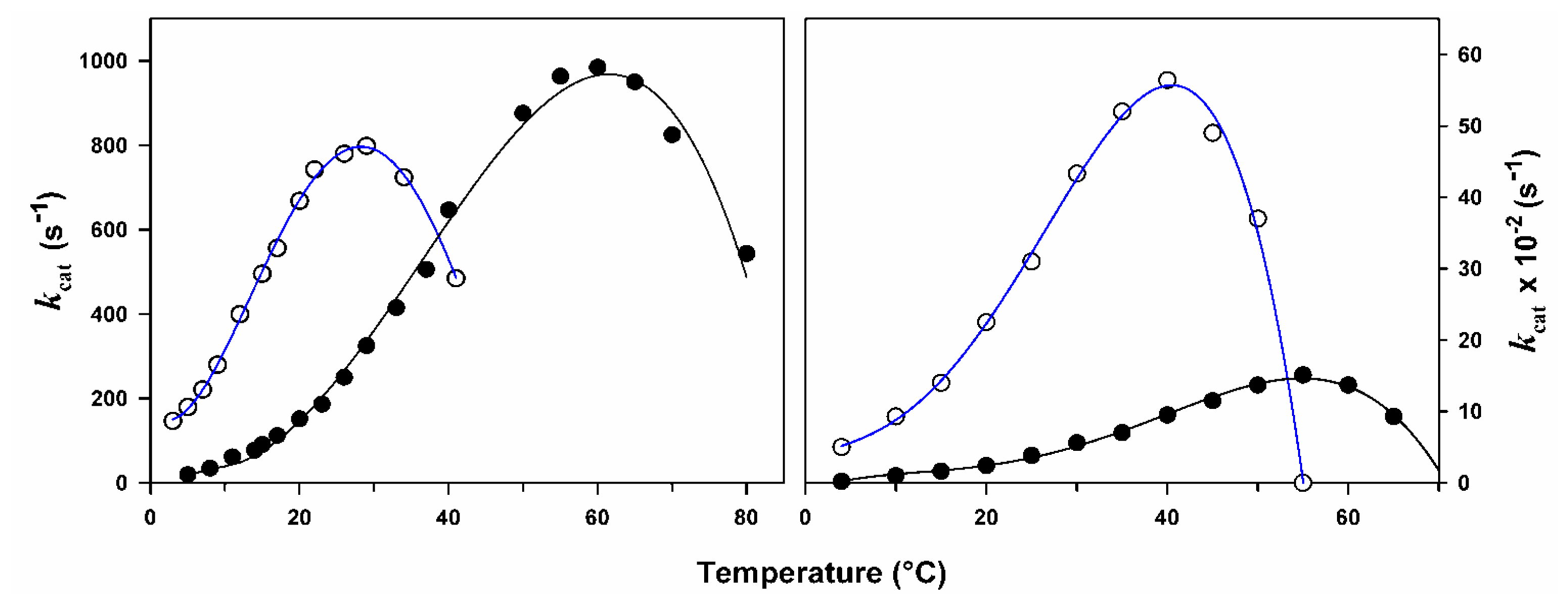
<p>The effect of temperature on the activity of psychrophilic and mesophilic enzymes is illustrated in <xref ref-type="fig" rid="f1-ijms-13-11643">Figure 1</xref>. <xref rid="FD1" ref-type="disp-formula">Equation 1</xref> is only valid for the exponential rise of activity with temperature on the left limb of the curves. This figure reveals at least three basic features of cold-adaptation. (<italic>i</italic>) In order to compensate for the slow reaction rates at low temperatures, psychrophiles synthesize enzymes having an up to tenfold higher specific activity in this temperature range. This is in fact the main physiological adaptation to cold at the enzyme level; (<italic>ii</italic>) The temperature for apparent maximal activity for cold-active enzymes is shifted towards low temperatures, reflecting the weak stability of these proteins and their unfolding and inactivation at moderate temperatures; (<italic>iii</italic>) Finally, the adaptation to cold is not always perfect. It can be seen in <xref ref-type="fig" rid="f1-ijms-13-11643">Figure 1</xref> (left panel) that the specific activity of the psychrophilic enzymes at low temperatures, although very high, remains lower than that of the mesophilic enzyme at 37 °C.</p></sec>
<sec>
<title>2.2. Heat-Labile and Unstable Cold Enzymes</title>
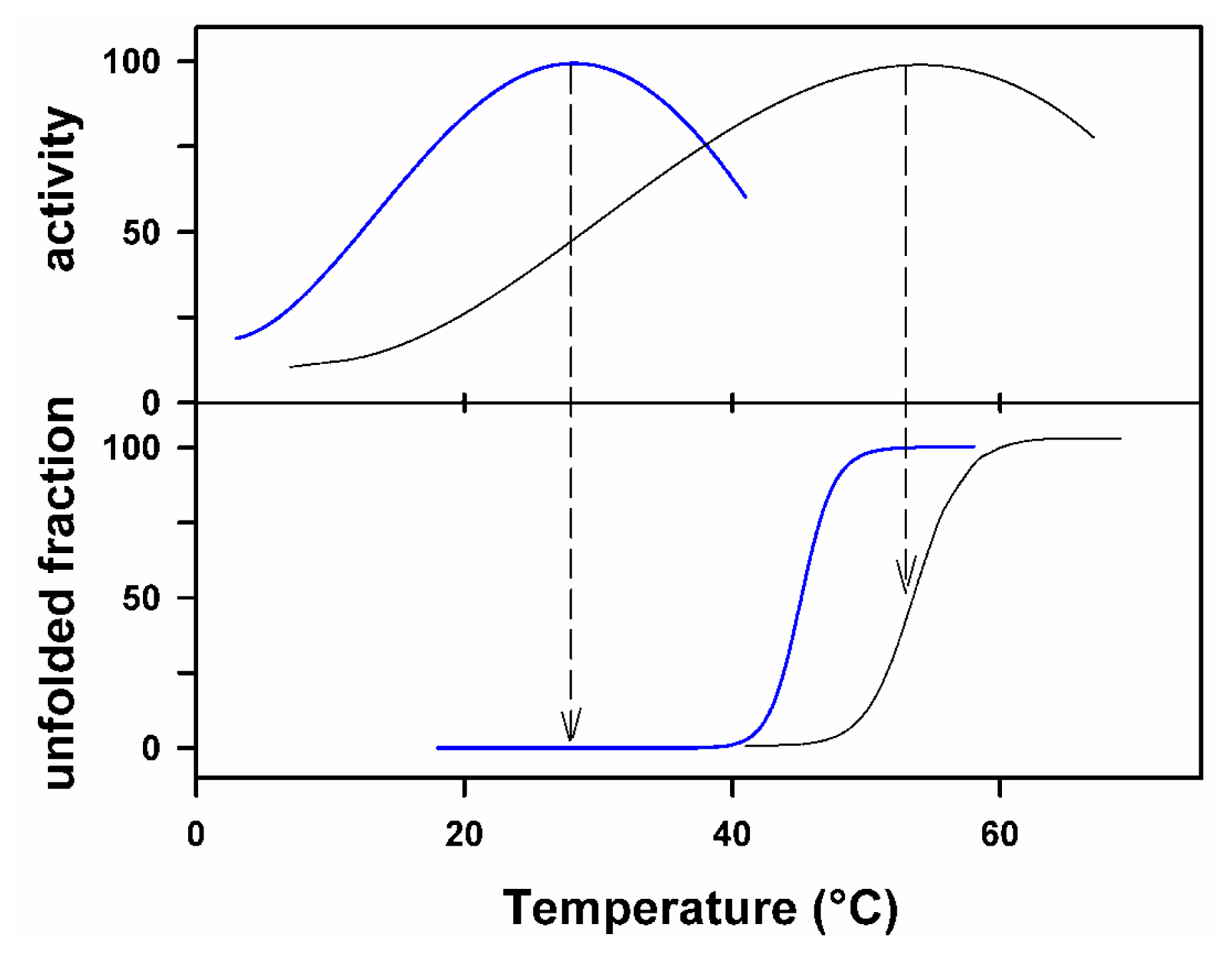
<p>Most psychrophilic enzymes share at least one property: a heat-labile activity, irrespective of the protein structural stability. Furthermore, the active site appears to be the most heat-labile structural element of these proteins [<xref ref-type="bibr" rid="b13-ijms-13-11643">13</xref>–<xref ref-type="bibr" rid="b15-ijms-13-11643">15</xref>]. <xref ref-type="fig" rid="f2-ijms-13-11643">Figure 2</xref> illustrates this significant difference between the stability of the active site and the stability of the structure. The lower panel shows the stability of the structure as recorded by fluorescence. As expected, the structure of the cold-active enzyme is less stable than the mesophilic one. In the upper panel, the activity is recorded under the same experimental conditions and it can be seen that the mesophilic enzyme is inactivated when the protein unfolds. By contrast, activity of the cold-active enzyme is lost before the protein unfolds. This means that the active site is even more heat-labile than the whole protein structure. It was also shown that the active site of a psychrophilic -amylase is the first structural element that unfolds in transverse urea gradient gel electrophoresis [<xref ref-type="bibr" rid="b16-ijms-13-11643">16</xref>]. All these aspects point to a very unstable and flexible active site and illustrate a central concept in cold adaptation: localized increases in flexibility at the active site are responsible for the high but heat-labile activity [<xref ref-type="bibr" rid="b17-ijms-13-11643">17</xref>], whereas other regions of the enzyme might or might not be characterized by low stability when not involved in catalysis. For instance, psychrophilic carbonic anhydrase [<xref ref-type="bibr" rid="b18-ijms-13-11643">18</xref>] and isocitrate dehydrogenase [<xref ref-type="bibr" rid="b19-ijms-13-11643">19</xref>] are highly stable enzymes with however improved flexibility in regions driving catalysis.</p>
<p>Beside this general rule, some rare exceptions have been reported so far. The chaperonin and heat-shock protein GroEL from an Antarctic bacterium is not cold-adapted and displays similar stability and activity than that of its <italic>E. coli</italic> homologue [<xref ref-type="bibr" rid="b20-ijms-13-11643">20</xref>]. It has been suggested that this chaperonin remains suited to function during sudden temperature increases of the environment [<xref ref-type="bibr" rid="b21-ijms-13-11643">21</xref>]. Similarly, activity of thioredoxin from the same bacterium is much more heat-stable than that of <italic>E. coli</italic> [<xref ref-type="bibr" rid="b22-ijms-13-11643">22</xref>]. One cannot exclude the possibility that enzymes involved in electron transfer do not require the same type of adaptations because the rate of electron flow is not significantly affected by the low biological temperatures.</p></sec>
<sec>
<title>2.3. Active Site Structure</title>
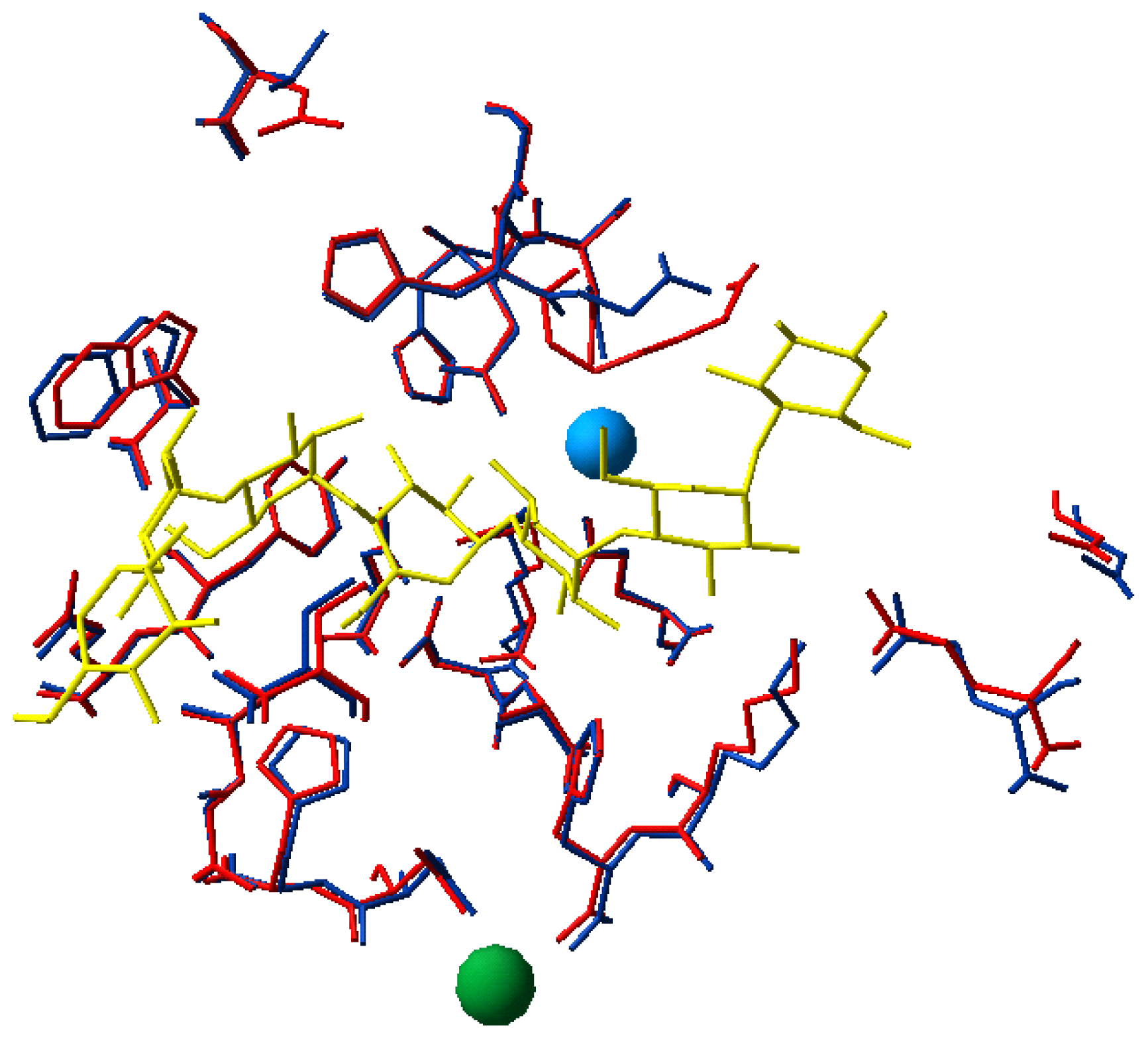
<p>Crystal structures of psychrophilic enzymes were of course of prime importance to investigate the properties of these heat-labile and cold-active catalytic centers. The first basic observation is that all side chains involved in the catalytic mechanism are strictly conserved. Indeed, comparison of the first X-ray structure of a psychrophilic enzyme, the cold-active -amylase [<xref ref-type="bibr" rid="b23-ijms-13-11643">23</xref>,<xref ref-type="bibr" rid="b24-ijms-13-11643">24</xref>], and of its closest structural homologue from pig both in complex with acarbose, a pseudosaccharide inhibitor mimicking the transition state intermediate [<xref ref-type="bibr" rid="b25-ijms-13-11643">25</xref>,<xref ref-type="bibr" rid="b26-ijms-13-11643">26</xref>], has shown that all 24 residues forming the catalytic cleft are strictly conserved in the cold-active α-amylase (<xref ref-type="fig" rid="f3-ijms-13-11643">Figure 3</xref>). This outstanding example of active site identity demonstrates that the specific properties of psychrophilic enzymes can be reached without any amino acid substitution in the reaction center. As a consequence, changes occurring elsewhere in the molecule are responsible for the optimization of the catalytic parameters (see Section 4).</p>
<p>Nevertheless, significant structural adjustments at the active site of psychrophilic enzymes have been frequently reported. In many cases, a larger opening of the catalytic cleft is observed and achieved by various ways, including replacement of bulky side chains for smaller groups, distinct conformation of the loops bordering the active site or small deletions in these loops, as illustrated by a cold active citrate synthase [<xref ref-type="bibr" rid="b28-ijms-13-11643">28</xref>]. In the case of a Ca<sup>2+</sup>, Zn<sup>2+</sup>-protease from a psychrophilic <italic>Pseudomonas</italic> species, an additional bound Ca<sup>2+</sup> ion pull the backbone forming the entrance of the site and markedly increases its accessibility when compared with the mesophilic homologue [<xref ref-type="bibr" rid="b29-ijms-13-11643">29</xref>]. As a result of such a better accessibility, cold-active enzymes can accommodate substrates at lower energy cost, as far as the conformational changes are concerned, and therefore reduce the activation energy required for the formation of the enzyme-substrate complex. The larger active site may also facilitate easier release and exit of products and thus may alleviate the effect of a rate limiting step on the reaction rate.</p>
<p>In addition, differences in electrostatic potentials in and around the active site of psychrophilic enzymes appear to be a crucial parameter for activity at low temperatures. Electrostatic surface potentials generated by charged and polar groups are an essential component of the catalytic mechanism at various stages: as the potential extends out into the medium, a substrate can be oriented and attracted before any contact between enzyme and substrate occurs. Interestingly, the cold-active citrate synthase [<xref ref-type="bibr" rid="b28-ijms-13-11643">28</xref>], malate dehydrogenase [<xref ref-type="bibr" rid="b30-ijms-13-11643">30</xref>], uracyl-DNA glycosylase [<xref ref-type="bibr" rid="b31-ijms-13-11643">31</xref>] and trypsin [<xref ref-type="bibr" rid="b32-ijms-13-11643">32</xref>–<xref ref-type="bibr" rid="b34-ijms-13-11643">34</xref>] are characterized by marked differences in electrostatic potentials near the active site region compared to their mesophilic or thermophilic counterparts that may facilitate interaction with ligand. In the case of malate dehydrogenase for example, the increased positive potential at and around the oxaloacetate binding site and the significantly decreased negative surface potential at the NADH binding region may facilitate the interaction of the oppositely charged ligands with the surface of the enzyme [<xref ref-type="bibr" rid="b30-ijms-13-11643">30</xref>]. In all cases, the differences were caused by discrete substitutions in non-conserved charged residues resulting in local electrostatic potential differing in both sign and magnitude.</p></sec>
<sec>
<title>2.4. Active Site Dynamics</title>
<p>The heat-labile activity of psychrophilic enzymes suggests that the dynamics of the functional side chains at the active site is improved in order to contribute to cold-activity and the above mentioned structural adaptations seem to favor a better accessibility to the substrate and release of the product. This view is strongly supported by the enzymological properties of cold-active enzymes. Non-specific psychrophilic enzymes accept various substrates and have a broader specificity than the mesophilic homologues, because substrates with slightly distinct conformations or sizes can fit and bind to the site. For instance, the observed differences in substrate specificity between Atlantic salmon and mammalian elastases have been interpreted to be based on a somewhat wider and deeper binding pocket for the cold-adapted elastase [<xref ref-type="bibr" rid="b32-ijms-13-11643">32</xref>]. The broad specificity of a psychrophilic alcohol dehydrogenase that oxidizes large bulky alcohols was also assigned to a highly flexible active site [<xref ref-type="bibr" rid="b35-ijms-13-11643">35</xref>]. Several crystal structures of psychrophilic enzymes also point to an increased flexibility at or near the active site [<xref ref-type="bibr" rid="b36-ijms-13-11643">36</xref>], as also supported by molecular dynamic simulations [<xref ref-type="bibr" rid="b37-ijms-13-11643">37</xref>–<xref ref-type="bibr" rid="b40-ijms-13-11643">40</xref>].</p>
<p>This active site flexibility of cold-active enzymes in solution is also well demonstrated by the psychrophilic α-amylase [<xref ref-type="bibr" rid="b41-ijms-13-11643">41</xref>]. As shown in <xref ref-type="table" rid="t1-ijms-13-11643">Table 1</xref>, both the psychrophilic and mesophilic α-amylases degrade large macromolecular polysaccharides made of glucose units linked by -1,4 bonds. These substrates have a complex structure and are generally branched. Taking the natural substrate, starch, as the reference, it can be seen that the psychrophilic enzyme is more active on all these large substrates. Being more flexible, the active site can accommodate easily these macromolecular polysaccharides. Considering the small substrates, the reverse situation is observed. Both enzymes are active on short oligosaccharides of at least four glucose units but in this case, the psychrophilic α-amylase is less active on all these small substrates. Apparently, the flexible active site accommodates less efficiently these short oligosaccharides.</p></sec>
<sec>
<title>2.5. Adaptive Drift of Substrate Affinity</title>
<p>As a consequence of the improved active site dynamics in cold-active enzymes, substrates bind less firmly in the binding site (if no point mutations have occurred) giving rise to higher <italic>K</italic><sub>m</sub> values. An example is given in <xref ref-type="table" rid="t2-ijms-13-11643">Table 2</xref> showing that the psychrophilic α-amylase is more active on its macromolecular substrates whereas the <italic>K</italic><sub>m</sub> values are up to 30-fold larger, <italic>i.e</italic>., the affinity for the substrates is up to 30-fold lower. Ideally, a functional adaptation to cold would mean optimizing both <italic>k</italic><sub>cat</sub> and <italic>K</italic><sub>m</sub>. However, a survey of the available data on psychrophilic enzymes indicates that optimization of the <italic>k</italic><sub>cat</sub>/<italic>K</italic><sub>m</sub> ratio is far from a general rule but on the contrary that the majority of cold-active enzymes improve the <italic>k</italic><sub>cat</sub> value at the expense of <italic>K</italic><sub>m</sub>, therefore leading to suboptimal values of the <italic>k</italic><sub>cat</sub>/<italic>K</italic><sub>m</sub> ratio, as also shown in <xref ref-type="table" rid="t2-ijms-13-11643">Table 2</xref>. For instance, high <italic>K</italic><sub>m</sub> values have been reported for psychrophilic aspartate carbamoyltransferase [<xref ref-type="bibr" rid="b42-ijms-13-11643">42</xref>,<xref ref-type="bibr" rid="b43-ijms-13-11643">43</xref>], triose-phosphate isomerase [<xref ref-type="bibr" rid="b44-ijms-13-11643">44</xref>], subtilisin [<xref ref-type="bibr" rid="b45-ijms-13-11643">45</xref>], lactate dehydrogénase [<xref ref-type="bibr" rid="b17-ijms-13-11643">17</xref>,<xref ref-type="bibr" rid="b46-ijms-13-11643">46</xref>], DNA ligase [<xref ref-type="bibr" rid="b47-ijms-13-11643">47</xref>], elongation factor Tu [<xref ref-type="bibr" rid="b48-ijms-13-11643">48</xref>] and G [<xref ref-type="bibr" rid="b49-ijms-13-11643">49</xref>], glutamate dehydrogenase [<xref ref-type="bibr" rid="b50-ijms-13-11643">50</xref>,<xref ref-type="bibr" rid="b51-ijms-13-11643">51</xref>], α-amylase [<xref ref-type="bibr" rid="b52-ijms-13-11643">52</xref>], dihydrofolate reductase [<xref ref-type="bibr" rid="b53-ijms-13-11643">53</xref>], cellulase [<xref ref-type="bibr" rid="b54-ijms-13-11643">54</xref>], endonuclease I [<xref ref-type="bibr" rid="b55-ijms-13-11643">55</xref>], aspartate aminotransferase [<xref ref-type="bibr" rid="b56-ijms-13-11643">56</xref>], isocitrate dehydrogenase [<xref ref-type="bibr" rid="b57-ijms-13-11643">57</xref>], xylanase [<xref ref-type="bibr" rid="b58-ijms-13-11643">58</xref>], ornithine carbamoyltransferase [<xref ref-type="bibr" rid="b59-ijms-13-11643">59</xref>], citrate synthase [<xref ref-type="bibr" rid="b60-ijms-13-11643">60</xref>], purine nucleoside phosphorylase [<xref ref-type="bibr" rid="b61-ijms-13-11643">61</xref>], DEAD-Box proteins [<xref ref-type="bibr" rid="b62-ijms-13-11643">62</xref>] and acetate kinase [<xref ref-type="bibr" rid="b63-ijms-13-11643">63</xref>].</p>
<p>There is in fact an evolutionary pressure on <italic>K</italic><sub>m</sub> to increase in order to maximize the overall reaction rate. Such adaptive drift of <italic>K</italic><sub>m</sub> has been well illustrated by the lactate dehydrogenases from Antarctic fish [<xref ref-type="bibr" rid="b17-ijms-13-11643">17</xref>] and by the psychrophilic α-amylase [<xref ref-type="bibr" rid="b52-ijms-13-11643">52</xref>] because both enzymes display rigorously identical substrate binding site and active site architecture when compared with their mesophilic homologues. In both cases, temperature-adaptive increases in <italic>k</italic><sub>cat</sub> occur concomitantly with increases in <italic>K</italic><sub>m</sub> in cold-active enzymes. As already mentioned, such identity of the sites also implies that adjustments of the kinetic parameters are obtained by structural changes occurring distantly from the reaction center. This aspect has received strong experimental supports [<xref ref-type="bibr" rid="b64-ijms-13-11643">64</xref>,<xref ref-type="bibr" rid="b65-ijms-13-11643">65</xref>].</p></sec>
<sec>
<title>2.6. Adaptive Optimization of Substrate Affinity</title>
<p>Several enzymes, especially in some cold-adapted fish, counteract this adaptive drift of <italic>K</italic><sub>m</sub> in order to maintain or to improve the substrate binding affinity by amino acid substitutions within the active site [<xref ref-type="bibr" rid="b32-ijms-13-11643">32</xref>,<xref ref-type="bibr" rid="b66-ijms-13-11643">66</xref>]. The first reason for these enzymes to react against the drift is obvious when considering the regulatory function associated with <italic>K</italic><sub>m</sub>, especially for intracellular enzymes. The second reason is related to the temperature dependence of weak interactions. Substrate binding is an especially temperature-sensitive step because both the binding geometry and interactions between binding site and ligand are governed by weak interactions having sometimes opposite temperature dependencies. Hydrophobic interactions form endothermically and are weakened by a decrease in temperature. By contrast, interactions of electrostatic nature (ion pairs, hydrogen bounds, Van der Waals interactions) form exothermically and are stabilized at low temperatures. Therefore low temperatures do not only reduce the enzyme activity (<italic>k</italic><sub>cat</sub>), but can also severely alter the substrate binding mode according to the type of interaction involved.</p></sec></sec>
<sec>
<title>3. Thermodynamic Origin of Optimization</title>
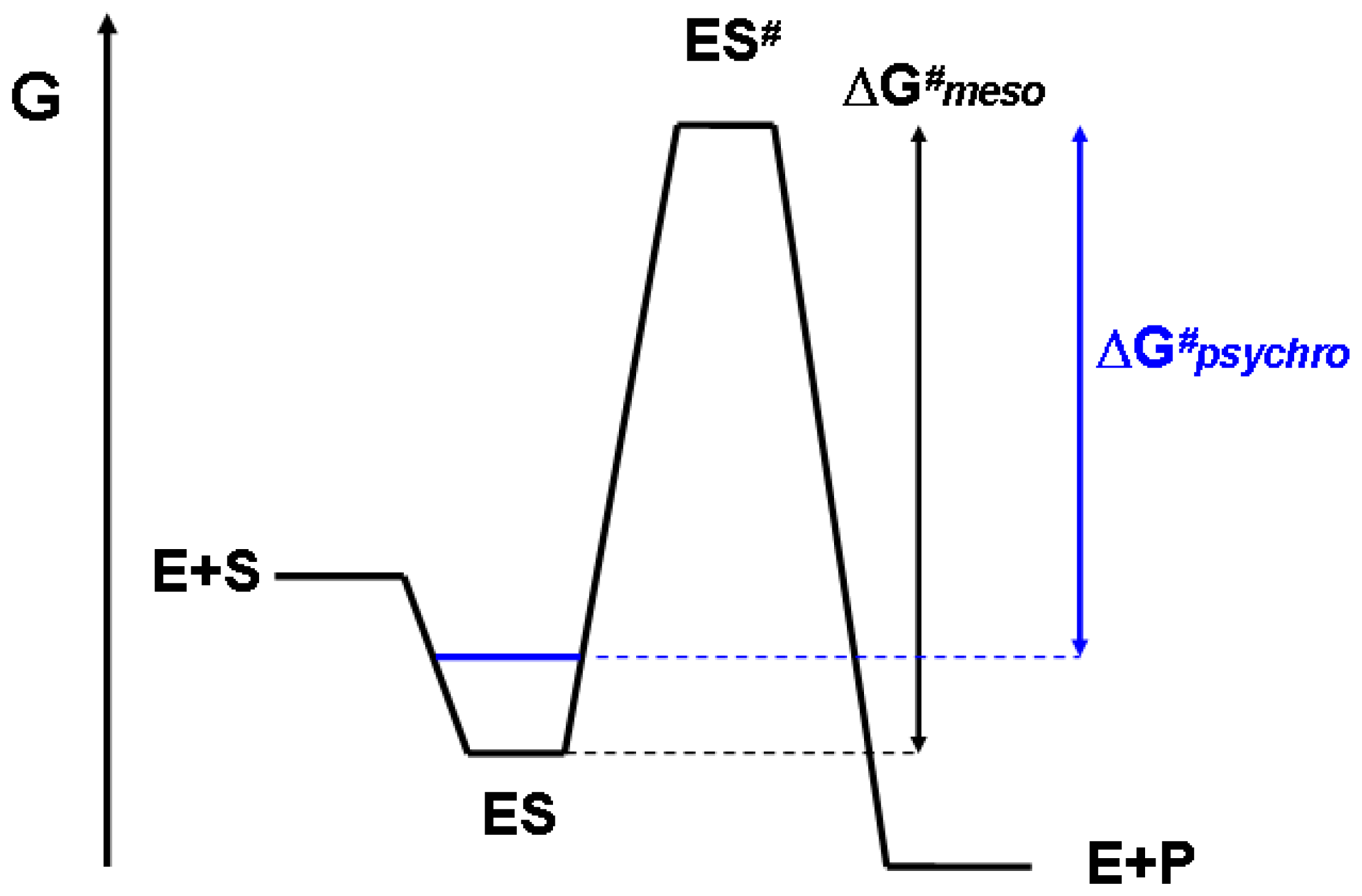
<p>Referring to <xref rid="FD1" ref-type="disp-formula">Equation 1</xref>, the high activity of cold-adapted enzymes corresponds to a decrease of the free energy of activation Δ<italic>G</italic><italic><sup>#</sup></italic>. Two strategies have been highlighted to reduce the height of this energy barrier. <xref ref-type="fig" rid="f4-ijms-13-11643">Figure 4</xref> illustrates the first strategy where an evolutionary pressure increases <italic>K</italic><sub>m</sub> in order to maximize the reaction rate. According to the transition state theory, when the enzyme encounters its substrate, the enzyme-substrate complex ES falls into an energy pit. For the reaction to proceed, an activated state ES<italic><sup>#</sup></italic> has to be reached, that eventually breaks down into the enzyme and the product. The height of the energy barrier between the ground state ES and the transition state ES<italic><sup>#</sup></italic> is defined as the free energy of activation Δ<italic>G</italic><italic><sup>#</sup></italic>: the lower this barrier, the higher the activity as reflected in <xref rid="FD1" ref-type="disp-formula">Equation 1</xref>. In the case of cold active enzymes displaying a weak affinity for the substrate, the energy pit for the ES complex is less deep (dashed in <xref ref-type="fig" rid="f4-ijms-13-11643">Figure 4</xref>). It follows that the magnitude of the energy barrier is reduced and therefore the activity is increased. This thermodynamic link between affinity and activity is valid for most enzymes (extremophilic or not) under saturating substrate concentrations and this link appears to be involved in the improvement of activity at low temperatures in numerous cold-active enzymes [<xref ref-type="bibr" rid="b17-ijms-13-11643">17</xref>,<xref ref-type="bibr" rid="b59-ijms-13-11643">59</xref>].</p>
<p>The second and more general strategy involves the temperature-dependence of the reaction catalyzed by cold-active enzymes. <xref ref-type="table" rid="t3-ijms-13-11643">Table 3</xref> reports the enthalpic and entropic contributions to the free energy of activation in extremophilic α-amylases. The free energy of activation Δ<italic>G</italic><italic><sup>#</sup></italic> is calculated from <xref rid="FD1" ref-type="disp-formula">Equation 1</xref> using the <italic>k</italic><sub>cat</sub> value at a given temperature and the enthalpy of activation Δ<italic>H</italic><italic><sup>#</sup></italic> is obtained by recording the temperature dependence of the activity [<xref ref-type="bibr" rid="b67-ijms-13-11643">67</xref>]. Finally, the entropic contribution <italic>T</italic>Δ<italic>S</italic><italic><sup>#</sup></italic> is deduced from the Gibbs-Helmholtz equation:</p>
<disp-formula id="FD2">
<label>(2)</label>
<mml:math id="mm2" display="block">
<mml:semantics id="sm2">
<mml:mrow>
<mml:mi mathvariant="normal">Δ</mml:mi>
<mml:msup>
<mml:mrow>
<mml:mi>G</mml:mi></mml:mrow>
<mml:mo>#</mml:mo></mml:msup>
<mml:mo>=</mml:mo>
<mml:mi mathvariant="normal">Δ</mml:mi>
<mml:msup>
<mml:mrow>
<mml:mi>H</mml:mi></mml:mrow>
<mml:mo>#</mml:mo></mml:msup>
<mml:mo>-</mml:mo>
<mml:mi>T</mml:mi>
<mml:mi mathvariant="normal">Δ</mml:mi>
<mml:msup>
<mml:mrow>
<mml:mi>S</mml:mi></mml:mrow>
<mml:mo>#</mml:mo></mml:msup></mml:mrow></mml:semantics></mml:math></disp-formula>
<p>The enthalpy of activation Δ<italic>H</italic><italic><sup>#</sup></italic> depicts the temperature dependence of the activity: the lower this value, the lower the variation of activity with temperature. The low value found for almost all psychrophilic enzymes demonstrates that their reaction rate is less reduced than for other enzymes when the temperature is lowered. Accordingly, the decrease of the activation enthalpy in the enzymatic reaction of psychrophilic enzymes can be considered as the main adaptive character to low temperatures. This decrease is structurally achieved by a decrease in the number of enthalpy-driven interactions that have to be broken during the activation steps. These interactions also contribute to the stability of the protein folded conformation and, as a corollary, the structural domain of the enzyme bearing the active site should be more flexible. It is interesting to note that such a macroscopic interpretation of the low activation enthalpy in cold-active enzymes fits with the experimental observation of a markedly heat-labile activity illustrated in <xref ref-type="fig" rid="f2-ijms-13-11643">Figure 2</xref>. <xref ref-type="table" rid="t3-ijms-13-11643">Table 3</xref> shows that the entropic contribution <italic>T</italic>Δ<italic>S</italic><italic><sup>#</sup></italic> for the cold-active enzyme is larger and negative. This has been interpreted as a large reduction of the apparent disorder between the ground state with its relatively loose conformation and the well organized and compact transition state [<xref ref-type="bibr" rid="b67-ijms-13-11643">67</xref>]. The heat-labile activity of cold-active enzymes suggests a macroscopic interpretation for this thermodynamic parameter. As a consequence of active site flexibility, the enzyme-substrate complex ES occupies a broader distribution of conformational states translated into increased entropy of this state, compared to that of the mesophilic or thermophilic homologues. This assumption has received strong experimental support by using microcalorimetry to compare the stabilities of free extremophilic enzymes with the same enzymes trapped in the transition state conformation by a non-hydrolysable substrate analog [<xref ref-type="bibr" rid="b14-ijms-13-11643">14</xref>]. The larger increase in stability for the psychrophilic enzyme in the transition state conformation demonstrated larger conformational changes between the free and bound states when compared to mesophilic and thermophilic homologues. Furthermore, a broader distribution of the ground state ES should be accompanied by a weaker substrate binding strength, as indeed observed for numerous psychrophilic enzymes. Finally, it should be mentioned that the typical activation parameters of psychrophilic enzymes are well reproduced by reaction kinetic simulations [<xref ref-type="bibr" rid="b68-ijms-13-11643">68</xref>].</p></sec>
<sec>
<title>4. Structural Origin of Cold Activity</title>
<p>Many observations similar to <xref ref-type="fig" rid="f1-ijms-13-11643">Figure 1</xref> have suggested relationships between the activity of the enzyme, the flexibility of the protein and its stability. Indeed, the high activity at low temperatures seems to arise from an increased flexibility of the protein structure, especially at temperatures that strongly slow down molecular motions, but the consequence of this improved mobility of the protein structure is of course a weak stability. As a matter of fact, various biophysical studies using fluorescence quenching [<xref ref-type="bibr" rid="b13-ijms-13-11643">13</xref>–<xref ref-type="bibr" rid="b15-ijms-13-11643">15</xref>] or neutron scattering [<xref ref-type="bibr" rid="b69-ijms-13-11643">69</xref>] have revealed a less compact conformation of psychrophilic enzymes, undergoing frequent micro-unfolding events.</p>
<p>The number of X-ray crystal structures from psychrophilic enzymes has increased dramatically, demonstrating the growing interest for these peculiar proteins. However, the interpretation of these structural data is frequently difficult for two main reasons. First, the structural adaptations are extremely discrete and can easily escape the analysis. Second, these structural adaptations are very diverse, reflecting the complexity of factors involved in the stability of a macromolecule at the atomic level. For instance, it was found that all structural factors currently known to stabilize the protein molecule could be attenuated in strength and number in the structure of cold-active enzymes [<xref ref-type="bibr" rid="b32-ijms-13-11643">32</xref>,<xref ref-type="bibr" rid="b70-ijms-13-11643">70</xref>–<xref ref-type="bibr" rid="b72-ijms-13-11643">72</xref>]. An exhaustive description of all these factors is beyond the scope of this chapter and only the essential features are summarized below. Two review articles can be consulted for a comprehensive discussion of this topic [<xref ref-type="bibr" rid="b9-ijms-13-11643">9</xref>,<xref ref-type="bibr" rid="b32-ijms-13-11643">32</xref>].</p>
<p>The observable parameters related to protein stability include structural factors and mainly weak interactions between atoms of the protein structure. In psychrophilic proteins, this involves the clustering of glycine residues (providing local mobility) [<xref ref-type="bibr" rid="b73-ijms-13-11643">73</xref>,<xref ref-type="bibr" rid="b74-ijms-13-11643">74</xref>], the disappearance of proline residues in loops (enhancing chain flexibility between secondary structures) [<xref ref-type="bibr" rid="b75-ijms-13-11643">75</xref>], a reduction in arginine residues which are capable of forming multiple salt bridges and H-bonds, as well as a lower number of ion pairs, aromatic interactions or H-bonds, compared to mesophilic enzymes. The size and relative hydrophobicity of non-polar residue clusters forming the protein core are frequently smaller, lowering the compactness of the protein interior by weakening the hydrophobic effect on folding. Psychrophilic proteins have larger cavity sizes sufficient to accommodate water molecules: these cavities and embedded water molecules can play a significant role in structural flexibility [<xref ref-type="bibr" rid="b76-ijms-13-11643">76</xref>]. The <italic>N</italic> and <italic>C</italic>-caps of α-helices are also altered (weakening the charge-dipole interaction) and loose or relaxed protein extremities appear to be preferential sites for unzipping. The binding of stabilizing ions, such as calcium, can be extremely weak, with binding constants differing from mesophiles by several orders of magnitude. Insertions and deletions are sometimes responsible for specific properties such as the acquisition of extra-surface charges (insertion) or the weakening of subunit interactions (deletion).</p>
<p>Calculation of the solvent accessible area showed that some psychrophilic enzymes expose a higher proportion of non-polar residues to the surrounding medium [<xref ref-type="bibr" rid="b24-ijms-13-11643">24</xref>,<xref ref-type="bibr" rid="b28-ijms-13-11643">28</xref>]. This is an entropy-driven destabilizing factor caused by the reorganization of water molecules around exposed hydrophobic side chains. Calculations of the electrostatic potential revealed in some instances an excess of negative charges at the surface of the protein and, indeed, the pI of cold-active enzymes is frequently more acidic than that of their mesophilic or thermophilic homologues. This has been related to improved interactions with the solvent, which could be of prime importance in the acquisition of flexibility near zero degrees [<xref ref-type="bibr" rid="b77-ijms-13-11643">77</xref>]. Besides the balance of charges, the number of salt bridges covering the protein surface is also reduced. There is a clear correlation between surface ion pairs and temperature adaptation, since these weak interactions significantly increase in number from psychrophiles to mesophiles, to thermophiles and hyperthermophiles, the latter showing arginine-mediated multiple ion pairs and interconnected salt bridge networks [<xref ref-type="bibr" rid="b78-ijms-13-11643">78</xref>,<xref ref-type="bibr" rid="b79-ijms-13-11643">79</xref>]. Such an altered pattern of electrostatic interactions is thought to improve the dynamics or the “breathing” of the external shell of cold-active enzymes.</p>
<p>However, each enzyme adopts its own strategy by using one or a combination of these altered structural factors in order to improve the local or global mobility of the protein edifice. Accordingly, a general theory for structural adaptations cannot be formulated but nevertheless, enzyme families sharing the 3D fold can be compared [<xref ref-type="bibr" rid="b80-ijms-13-11643">80</xref>]. Comparative structural analyses of psychrophilic, mesophilic and thermophilic enzymes indicate that each protein family displays different structural strategy to adapt to temperature [<xref ref-type="bibr" rid="b71-ijms-13-11643">71</xref>,<xref ref-type="bibr" rid="b80-ijms-13-11643">80</xref>–<xref ref-type="bibr" rid="b85-ijms-13-11643">85</xref>]. However, some common trends are observed: the number of ion pairs, the side-chain contribution to the exposed surface, and the apolar fraction of the buried surface show a consistent decrease with decreasing optimal temperatures [<xref ref-type="bibr" rid="b71-ijms-13-11643">71</xref>]. The multitude of structural strategies in cold-adapted proteins has also complicated statistical analyses aimed at delineating general trends in temperature adaptation. Various trends have been reported for psychrophilic proteins using different methodologies and datasets: a preference for smaller-size and less hydrophobic residues [<xref ref-type="bibr" rid="b86-ijms-13-11643">86</xref>]; a less hydrophobic core, less charged and long-chained surface residues [<xref ref-type="bibr" rid="b87-ijms-13-11643">87</xref>]; a decrease of solvent accessible surface contribution of charged residues and an increase of hydrophobic surface contribution [<xref ref-type="bibr" rid="b88-ijms-13-11643">88</xref>] or various patterns of preferential amino acid substitutions [<xref ref-type="bibr" rid="b89-ijms-13-11643">89</xref>,<xref ref-type="bibr" rid="b90-ijms-13-11643">90</xref>].</p></sec>
<sec>
<title>5. Biotechnological Usefulness of Psychrophilic Enzymes</title>
<p>As mentioned in previous sections, most enzymes from psychrophiles are cold-active and heat-labile. Psychrophilic enzymes can be up to ten times more active at low and moderate temperatures as compared with their mesophilic homologues. Furthermore, psychrophilic enzymes are frequently inactivated at temperatures that are not detrimental for their mesophilic counterparts. These specific traits are responsible for the three main advantages of cold-active enzymes in biotechnology: (<italic>i</italic>) as a result of their high activity, a lower concentration of the enzyme catalyst is required to reach a given activity, therefore reducing the amount of costly enzyme preparation in a process; (<italic>ii</italic>) as a result of their cold-activity, they remain efficient at tap water or ambient temperature, therefore avoiding heating during a process, either at domestic (e.g., washing machine) or industrial levels; and (<italic>iii</italic>) as a result of heat-lability, they can be efficiently and sometime selectively inactivated after a process by moderate heat input. Beside these traits specifically linked to temperature adaptation, an additional important aspect has to be mentioned: enzymes from organisms endemic to cold environments can be a valuable source of new catalysts possessing useful enzymological characteristics such as novel substrate specificities or product properties, as exemplified by lipases from the yeast <italic>Candida antarctica</italic> or by the xylanase from the bacterium <italic>Pseudoalteromonas haloplanktis</italic> (see below). Previous reviews should be consulted for a complete coverage of this topic [<xref ref-type="bibr" rid="b7-ijms-13-11643">7</xref>,<xref ref-type="bibr" rid="b91-ijms-13-11643">91</xref>–<xref ref-type="bibr" rid="b97-ijms-13-11643">97</xref>]. Bioprospector, an online database [<xref ref-type="bibr" rid="b98-ijms-13-11643">98</xref>] provides a survey of patents, commercial products and companies involved in applied research using genetic resources from both the Antarctic and the Arctic. This excellent initiative, accompanied by relevant publications, is currently the most updated survey of biotechnological applications based on psychrophiles and on their biomolecules. Some specific examples are provided below.</p>
<sec>
<title>5.1. Molecular Biology</title>
<p>In a pioneering work, Kobori <italic>et al.</italic> [<xref ref-type="bibr" rid="b99-ijms-13-11643">99</xref>] have purified and characterized a heat-labile alkaline phosphatase from an Antarctic bacterium isolated in McMurdo Sound. Alkaline phosphatases are mainly used in molecular biology for the dephosphorylation of DNA vectors prior to cloning to prevent recircularization, for the dephosphorylation of 5′-nucleic acid termini before 5′-end labeling by polynucleotide kinase or for removal of dNTPs and pyrophosphate from PCR reactions. However, the phosphatase has to be carefully removed after dephosphorylation to avoid interferences with the subsequent steps. Furthermore, <italic>E. coli</italic> and calf intestinal alkaline phosphatase (that was the preferred enzyme for these applications) are heat-stable and require detergent addition for inactivation. It follows that heat-labile alkaline phosphatases are excellent alternatives as they are inactivated by moderate heat treatment allowing to perform the subsequent steps in the same test tube and minimizing nucleic acid losses. While the scientific report of Kobori <italic>et al.</italic> [<xref ref-type="bibr" rid="b99-ijms-13-11643">99</xref>] specifically stressed the usefulness of their heat-labile alkaline phosphatase as a new tool in molecular biology, this interesting finding was apparently not turned into a marketed product. Fifteen years later, the group of V. Bouriotis isolated an alkaline phosphatase from another Antarctic bacterium and cloned its gene in <italic>E. coli</italic> [<xref ref-type="bibr" rid="b100-ijms-13-11643">100</xref>], solved its crystal structure [<xref ref-type="bibr" rid="b101-ijms-13-11643">101</xref>] and also showed that its properties can be further improved by directed evolution in terms of high activity and heat-lability [<xref ref-type="bibr" rid="b102-ijms-13-11643">102</xref>]. This heat-labile alkaline phosphatase, sold as Antarctic phosphatase, is now proposed on the market by New England Biolabs Inc. (Ipswich, MA, USA). In the same context, the heat-labile alkaline phosphatase from the Arctic shrimp <italic>Pandalus borealis</italic> is also available for instance from Biotec Pharmacon ASA (Tromsø, Norway) or GE Healthcare Life Sciences (Little Chalfont, UK).</p>
<p>Two other psychrophilic enzymes are also marketed for molecular biology applications taking advantage of the heat-labile property. Shrimp nuclease selectively degrades double stranded DNA: for instance, it is used for the removal of carry-over contaminants in PCR mixtures, and then it is heat-inactivated prior addition of the template. This enzyme is produced in recombinant form in <italic>Pichia pastoris</italic> and is available from Biotec Pharmacon ASA (Tromsø, Norway), USB Corporation (Santa Clara, CA, USA) or Thermo Scientific (Waltham, MA, USA). Heat-labile uracil-DNA <italic>N</italic>-glycosylase from Atlantic cod (<italic>Gadus morhua</italic>), that presents typical cold adaptation features [<xref ref-type="bibr" rid="b31-ijms-13-11643">31</xref>], is also used to remove DNA contaminants in sequential PCR reactions. When PCR is performed with dUTP instead of dTTP, PCR products become distinguishable from target DNA, and can be selectively degraded by uracil-DNA <italic>N</italic>-glycosylase. Following degradation of contaminants, the enzyme is completely and irreversibly inactivated after heat treatment. Heat-labile uracil-DNA <italic>N</italic>-glycosylase, produced in recombinant form in <italic>E. coli</italic>, is available from Biotec Pharmacon ASA (Tromsø, Norway).</p></sec>
<sec>
<title>5.2. Industrial Enzymes</title>
<p>At the industrial level, the best-known representative of polar microorganisms is certainly the yeast <italic>Candida antarctica</italic>, as its species name unambiguously refers to the sampling origin. This yeast produces two lipases, A and B, the latter being sold for instance as Novozym 435 by Novozymes (Bagsvaerd, Denmark). Although the moderate heat-stability of this lipase in aqueous solutions can be of concern, this enzyme is stabilized in its immobilized form. As a result of its substrate and stereospecificity, lipase B is involved in a very large number of organosynthesis applications related to food/feed processing, pharmaceuticals or cosmetics [<xref ref-type="bibr" rid="b103-ijms-13-11643">103</xref>]. In a survey of patents related to Antarctica [<xref ref-type="bibr" rid="b104-ijms-13-11643">104</xref>] it was shown that lipases from <italic>C. antarctica</italic> by far dominate the number of process- or product-based patents. This is a significant example of the potential for novel catalysts from genetic resources in cold environments.</p>
<p>The market for enzymes used in detergents represents 30%–40% of all enzymes produced worldwide. Amongst these enzymatic cleaning agents, subtilisin (an alkaline serine protease predominantly produced by <italic>Bacillus</italic> species) largely dominates this market. At the domestic level, the current trend is however to use detergents at lower washing temperatures because of the associated reductions in energy consumption and costs as well as to protect texture and colors of the fabrics. Accordingly, cold-active subtilisins are required for optimal washing results at tap water temperatures and the current advertisements for cold-active detergents indicate that this goal has been reached. The first psychrophilic subtilisins isolated from Antarctic <italic>Bacillus</italic> species have been extensively characterized to comply with such requirement [<xref ref-type="bibr" rid="b45-ijms-13-11643">45</xref>,<xref ref-type="bibr" rid="b105-ijms-13-11643">105</xref>]. However, they suffered from a low heat-stability that can compromise their storage but also from a low chemical stability towards the detergent components. Therefore, subtilisins currently incorporated in cold-active detergents are engineered enzymes that combine storage stability, alkaline stability and activity and cold-activity. Although psychrophilic subtilisins are not components <italic>per se</italic> of cold-active detergents, they have largely contributed to the advancement of this economically attractive concept.</p></sec>
<sec>
<title>5.3. Food Technology</title>
<p>The xylanase from the Antarctic bacterium <italic>Pseudoalteromonas haloplanktis</italic> is a nice example of the successful biotechnological transfer to the food industry. Xylanases are glycoside hydrolases that degrade the polysaccharide beta-1,4-xylan, thus breaking down hemicellulose, one of the major components of plant cell walls. Xylanases are also a key ingredient of industrial dough conditioners used to improve bread quality. It was found that the Antarctic enzyme belonged to a new class of xylanases as both its amino acid sequence and fold were distinct from previously characterized xylanases. The psychrophilic enzyme was therefore subjected to intensive investigations aimed at elucidating the structural origins of its high cold activity and weak stability as well as at understanding its enzymological mode of action [<xref ref-type="bibr" rid="b13-ijms-13-11643">13</xref>,<xref ref-type="bibr" rid="b58-ijms-13-11643">58</xref>,<xref ref-type="bibr" rid="b106-ijms-13-11643">106</xref>–<xref ref-type="bibr" rid="b108-ijms-13-11643">108</xref>]. Furthermore, baking trials have revealed that the psychrophilic xylanase was very effective in improving the dough properties and final bread quality with, for instance, a positive effect on loaf volume [<xref ref-type="bibr" rid="b109-ijms-13-11643">109</xref>]. This efficiency appears to be related to the high activity of the psychrophilic xylanase at cool temperatures required for dough resting and to its specific mode of xylan hydrolysis. Following careful production optimization of this peculiar xylanase, the product is now sold by Puratos (Grand-Bigard, Belgium). This is apparently the psychrophilic enzyme produced at the highest amounts to date.</p>
<p>Beta-galactosidase, or lactase, is also a glycoside hydrolase that specifically hydrolyzes the milk sugar lactose into galactose and glucose. It should be stressed that 75% of the world population suffers from lactose intolerance arising from deficient synthesis of intestinal lactase in adults and resulting in digestive disorders due to fermentation of lactose by enteric bacteria. In this context, a cold-active lactase from an Antarctic bacterium has been patented (WO 01/04276A1) for its capacity to hydrolyze lactose during milk storage at low temperatures [<xref ref-type="bibr" rid="b110-ijms-13-11643">110</xref>]. It is worth mentioning that commercially available lactases require milk heating to become active. This heating step has however detrimental effects on milk quality as it alters the aspect, the taste and texture (Maillard reactions, activation of proteases, coagulation, …). Although the psychrophilic lactase is apparently not used for this specific application, it is expected that it will be produced soon in large quantities by Nutrilab NV (Bekkevoort, Belgium) to hydrolyze lactose (a by-product of the dairy industry) in the process of the high value sweetener <sc>d</sc>-tagatose, a natural monosaccharide with low caloric value and glycemic index.</p></sec>
<sec>
<title>5.4. Engineering Cold Activity</title>
<p>When considering the biotechnological potential of cold-active and/or heat-labile enzymes, it is tempting to devise a mutational strategy in order to introduce these properties into an already well characterized commercial enzyme. However, engineering psychrophilic activity in a mesophilic enzyme by rational design has not been reported to date. The main reason should be found in the huge complexity of amino acid substitutions and interactions leading to psychrophilic activity that have been optimized during evolution on a long timescale. Accordingly, engineering psychrophilic activity currently escape our computational capacity. By contrast, laboratory evolution, that mimics natural selection, has been successful in producing cold-active enzymes with or without heat-lability, as reviewed in [<xref ref-type="bibr" rid="b111-ijms-13-11643">111</xref>]. It is worth mentioning that, in many cases, the effect of the selected random mutations cannot be properly explained, underlining again the complexity of the structural factors responsible for psychrophilic activity. The possibility to introduce several random mutations in a gene, to combine these mutations and to screen a large number of mutants for a specific property by directed evolution seems to be the best strategy to engineer enzyme cold-activity. Improved cold-activity by chemical modification has also been reported [<xref ref-type="bibr" rid="b112-ijms-13-11643">112</xref>–<xref ref-type="bibr" rid="b114-ijms-13-11643">114</xref>] but, although sometimes successful, the results of chemical modification remain unpredictable.</p></sec></sec>
<sec sec-type="conclusions">
<title>6. Conclusions</title>
<p>Cold-active enzymes are a key determinant in psychrophiles’ adaptation to life at low temperature. We have depicted the latest research on psychrophilic enzymes, underlining that cold-activity is not a uniform property: the extent of low temperature activity is variable, the adaptive optimization of the kinetic parameters differs in amplitude and origin and the structural factors involved are diverse and complex. Obviously, fine enzymological studies are required to improve our understanding of these essential adaptations for the vast range of organisms thriving on our cold planet. The biotechnological applications of these cold-active and heat-labile enzymes are still in their infancy. Nevertheless, future developments of these biocatalysts and of their derivatives are expected because they are frequently involved in environmentally friendly processes and contribute to energy saving, both aspects being of increasing significance.</p></sec></body>
<back>
<ack>
<title>Acknowledgments</title>
<p>Research in the authors’ laboratory was supported by the European Union, the Région wallonne (Belgium), the Fonds National de la Recherche Scientifique (Belgium) and the University of Liège. The facilities offered by the Institut Polaire Français are also acknowledged. Caroline Struvay is a FRS-FNRS research fellow.</p></ack>
<ref-list>
<title>References</title>
<ref id="b1-ijms-13-11643"><label>1</label><citation citation-type="journal"><person-group person-group-type="author"><name><surname>Gilichinsky</surname><given-names>D.</given-names></name><name><surname>Rivkina</surname><given-names>E.</given-names></name><name><surname>Bakermans</surname><given-names>C.</given-names></name><name><surname>Shcherbakova</surname><given-names>V.</given-names></name><name><surname>Petrovskaya</surname><given-names>L.</given-names></name><name><surname>Ozerskaya</surname><given-names>S.</given-names></name><name><surname>Ivanushkina</surname><given-names>N.</given-names></name><name><surname>Kochkina</surname><given-names>G.</given-names></name><name><surname>Laurinavichuis</surname><given-names>K.</given-names></name><name><surname>Pecheritsina</surname><given-names>S.</given-names></name><etal/></person-group><article-title>Biodiversity of cryopegs in permafrost</article-title><source>FEMS Microbiol. Ecol</source><year>2005</year><volume>53</volume><fpage>117</fpage><lpage>128</lpage><pub-id pub-id-type="doi">10.1016/j.femsec.2005.02.003</pub-id><pub-id pub-id-type="pmid">16329934</pub-id></citation></ref>
<ref id="b2-ijms-13-11643"><label>2</label><citation citation-type="journal"><person-group person-group-type="author"><name><surname>Deming</surname><given-names>J.W.</given-names></name></person-group><article-title>Psychrophiles and polar regions</article-title><source>Curr. Opin. Microbiol</source><year>2002</year><volume>5</volume><fpage>301</fpage><lpage>309</lpage><pub-id pub-id-type="doi">10.1016/S1369-5274(02)00329-6</pub-id><pub-id pub-id-type="pmid">12057685</pub-id></citation></ref>
<ref id="b3-ijms-13-11643"><label>3</label><citation citation-type="journal"><person-group person-group-type="author"><name><surname>Friedmann</surname><given-names>E.I.</given-names></name></person-group><article-title>Endolithic microorganisms in the Antarctic cold desert</article-title><source>Science</source><year>1982</year><volume>215</volume><fpage>1045</fpage><lpage>1053</lpage><pub-id pub-id-type="doi">10.1126/science.215.4536.1045</pub-id><pub-id pub-id-type="pmid">17771821</pub-id></citation></ref>
<ref id="b4-ijms-13-11643"><label>4</label><citation citation-type="journal"><person-group person-group-type="author"><name><surname>Cary</surname><given-names>S.C.</given-names></name><name><surname>McDonald</surname><given-names>I.R.</given-names></name><name><surname>Barrett</surname><given-names>J.E.</given-names></name><name><surname>Cowan</surname><given-names>D.A.</given-names></name></person-group><article-title>On the rocks: The microbiology of Antarctic Dry Valley soils</article-title><source>Nat. Rev. Microbiol</source><year>2010</year><volume>8</volume><fpage>129</fpage><lpage>138</lpage><pub-id pub-id-type="doi">10.1038/nrmicro2281</pub-id><pub-id pub-id-type="pmid">20075927</pub-id></citation></ref>
<ref id="b5-ijms-13-11643"><label>5</label><citation citation-type="journal"><person-group person-group-type="author"><name><surname>Rodrigues</surname><given-names>D.F.</given-names></name><name><surname>Tiedje</surname><given-names>J.M.</given-names></name></person-group><article-title>Coping with our cold planet</article-title><source>Appl. Environ. Microbiol</source><year>2008</year><volume>74</volume><fpage>1677</fpage><lpage>1686</lpage><pub-id pub-id-type="doi">10.1128/AEM.02000-07</pub-id><pub-id pub-id-type="pmid">18203855</pub-id></citation></ref>
<ref id="b6-ijms-13-11643"><label>6</label><citation citation-type="book"><person-group person-group-type="author"><name><surname>Cowan</surname><given-names>D.A.</given-names></name><name><surname>Casanueva</surname><given-names>A.</given-names></name><name><surname>Stafford</surname><given-names>W</given-names></name></person-group><article-title>Ecology and Biodiversity of Cold-adapted Microorganisms</article-title><source>Physiology and Biochemistry of Extremophiles</source><person-group person-group-type="editor"><name><surname>Gerday</surname><given-names>C.</given-names></name><name><surname>Glansdorff</surname><given-names>N.</given-names></name></person-group><publisher-name>ASM Press</publisher-name><publisher-loc>Washington, DC, USA</publisher-loc><year>2007</year><fpage>119</fpage><lpage>132</lpage></citation></ref>
<ref id="b7-ijms-13-11643"><label>7</label><citation citation-type="book"><person-group person-group-type="author"><name><surname>Margesin</surname><given-names>R.</given-names></name><name><surname>Schinner</surname><given-names>F.</given-names></name><name><surname>Marx</surname><given-names>J.C.</given-names></name><name><surname>Gerday</surname><given-names>C</given-names></name></person-group><source>Psychrophiles, from Biodiversity to Biotechnology</source><publisher-name>Springer-Verlag</publisher-name><publisher-loc>Berlin/Heidelberg, Germany</publisher-loc><year>2008</year></citation></ref>
<ref id="b8-ijms-13-11643"><label>8</label><citation citation-type="journal"><person-group person-group-type="author"><name><surname>Feller</surname><given-names>G.</given-names></name><name><surname>Gerday</surname><given-names>C.</given-names></name></person-group><article-title>Psychrophilic enzymes: Hot topics in cold adaptation</article-title><source>Nat. Rev. Microbiol</source><year>2003</year><volume>1</volume><fpage>200</fpage><lpage>208</lpage><pub-id pub-id-type="doi">10.1038/nrmicro773</pub-id><pub-id pub-id-type="pmid">15035024</pub-id></citation></ref>
<ref id="b9-ijms-13-11643"><label>9</label><citation citation-type="journal"><person-group person-group-type="author"><name><surname>Siddiqui</surname><given-names>K.S.</given-names></name><name><surname>Cavicchioli</surname><given-names>R.</given-names></name></person-group><article-title>Cold-adapted enzymes</article-title><source>Annu. Rev. Biochem</source><year>2006</year><volume>75</volume><fpage>403</fpage><lpage>433</lpage><pub-id pub-id-type="doi">10.1146/annurev.biochem.75.103004.142723</pub-id><pub-id pub-id-type="pmid">16756497</pub-id></citation></ref>
<ref id="b10-ijms-13-11643"><label>10</label><citation citation-type="journal"><person-group person-group-type="author"><name><surname>Feller</surname><given-names>G</given-names></name></person-group><article-title>Protein stability and enzyme activity at extreme biological temperatures</article-title><source>J. Phys. Condens. Mat</source><year>2010</year><volume>22</volume><pub-id pub-id-type="doi">10.1088/0953-8984/1022/1032/323101</pub-id></citation></ref>
<ref id="b11-ijms-13-11643"><label>11</label><citation citation-type="journal"><person-group person-group-type="author"><name><surname>Feller</surname><given-names>G.</given-names></name><name><surname>Lonhienne</surname><given-names>T.</given-names></name><name><surname>Deroanne</surname><given-names>C.</given-names></name><name><surname>Libioulle</surname><given-names>C.</given-names></name><name><surname>Van Beeumen</surname><given-names>J.</given-names></name><name><surname>Gerday</surname><given-names>C.</given-names></name></person-group><article-title>Purification, characterization, and nucleotide sequence of the thermolabile α-amylase from the antarctic psychrotroph <italic>Alteromonas haloplanctis</italic> A23</article-title><source>J. Biol. Chem</source><year>1992</year><volume>267</volume><fpage>5217</fpage><lpage>5221</lpage><pub-id pub-id-type="pmid">1544904</pub-id></citation></ref>
<ref id="b12-ijms-13-11643"><label>12</label><citation citation-type="journal"><person-group person-group-type="author"><name><surname>D’Amico</surname><given-names>S.</given-names></name><name><surname>Collins</surname><given-names>T.</given-names></name><name><surname>Marx</surname><given-names>J.C.</given-names></name><name><surname>Feller</surname><given-names>G.</given-names></name><name><surname>Gerday</surname><given-names>C.</given-names></name></person-group><article-title>Psychrophilic microorganisms: Challenges for life</article-title><source>EMBO Rep</source><year>2006</year><volume>7</volume><fpage>385</fpage><lpage>389</lpage><pub-id pub-id-type="doi">10.1038/sj.embor.7400662</pub-id><pub-id pub-id-type="pmid">16585939</pub-id></citation></ref>
<ref id="b13-ijms-13-11643"><label>13</label><citation citation-type="journal"><person-group person-group-type="author"><name><surname>Collins</surname><given-names>T.</given-names></name><name><surname>Meuwis</surname><given-names>M.A.</given-names></name><name><surname>Gerday</surname><given-names>C.</given-names></name><name><surname>Feller</surname><given-names>G.</given-names></name></person-group><article-title>Activity, stability and flexibility in glycosidases adapted to extreme thermal environments</article-title><source>J. Mol. Biol</source><year>2003</year><volume>328</volume><fpage>419</fpage><lpage>428</lpage><pub-id pub-id-type="doi">10.1016/S0022-2836(03)00287-0</pub-id><pub-id pub-id-type="pmid">12691750</pub-id></citation></ref>
<ref id="b14-ijms-13-11643"><label>14</label><citation citation-type="journal"><person-group person-group-type="author"><name><surname>D’Amico</surname><given-names>S.</given-names></name><name><surname>Marx</surname><given-names>J.C.</given-names></name><name><surname>Gerday</surname><given-names>C.</given-names></name><name><surname>Feller</surname><given-names>G.</given-names></name></person-group><article-title>Activity-stability relationships in extremophilic enzymes</article-title><source>J. Biol. Chem</source><year>2003</year><volume>278</volume><fpage>7891</fpage><lpage>7896</lpage><pub-id pub-id-type="doi">10.1074/jbc.M212508200</pub-id><pub-id pub-id-type="pmid">12511577</pub-id></citation></ref>
<ref id="b15-ijms-13-11643"><label>15</label><citation citation-type="journal"><person-group person-group-type="author"><name><surname>Georlette</surname><given-names>D.</given-names></name><name><surname>Damien</surname><given-names>B.</given-names></name><name><surname>Blaise</surname><given-names>V.</given-names></name><name><surname>Depiereux</surname><given-names>E.</given-names></name><name><surname>Uversky</surname><given-names>V.N.</given-names></name><name><surname>Gerday</surname><given-names>C.</given-names></name><name><surname>Feller</surname><given-names>G.</given-names></name></person-group><article-title>Structural and functional adaptations to extreme temperatures in psychrophilic, mesophilic, and thermophilic DNA ligases</article-title><source>J. Biol. Chem</source><year>2003</year><volume>278</volume><fpage>37015</fpage><lpage>37023</lpage><pub-id pub-id-type="doi">10.1074/jbc.M305142200</pub-id><pub-id pub-id-type="pmid">12857762</pub-id></citation></ref>
<ref id="b16-ijms-13-11643"><label>16</label><citation citation-type="journal"><person-group person-group-type="author"><name><surname>Siddiqui</surname><given-names>K.S.</given-names></name><name><surname>Feller</surname><given-names>G.</given-names></name><name><surname>D’Amico</surname><given-names>S.</given-names></name><name><surname>Gerday</surname><given-names>C.</given-names></name><name><surname>Giaquinto</surname><given-names>L.</given-names></name><name><surname>Cavicchioli</surname><given-names>R.</given-names></name></person-group><article-title>The active site is the least stable structure in the unfolding pathway of a multidomain cold-adapted alpha-amylase</article-title><source>J. Bacteriol</source><year>2005</year><volume>187</volume><fpage>6197</fpage><lpage>6205</lpage><pub-id pub-id-type="doi">10.1128/JB.187.17.6197-6205.2005</pub-id><pub-id pub-id-type="pmid">16109961</pub-id></citation></ref>
<ref id="b17-ijms-13-11643"><label>17</label><citation citation-type="journal"><person-group person-group-type="author"><name><surname>Fields</surname><given-names>P.A.</given-names></name><name><surname>Somero</surname><given-names>G.N.</given-names></name></person-group><article-title>Hot spots in cold adaptation: Localized increases in conformational flexibility in lactate dehydrogenase A(4) orthologs of Antarctic notothenioid fishes</article-title><source>Proc. Natl. Acad. Sci. USA</source><year>1998</year><volume>95</volume><fpage>11476</fpage><lpage>11481</lpage><pub-id pub-id-type="doi">10.1073/pnas.95.19.11476</pub-id><pub-id pub-id-type="pmid">9736762</pub-id></citation></ref>
<ref id="b18-ijms-13-11643"><label>18</label><citation citation-type="journal"><person-group person-group-type="author"><name><surname>Chiuri</surname><given-names>R.</given-names></name><name><surname>Maiorano</surname><given-names>G.</given-names></name><name><surname>Rizzello</surname><given-names>A.</given-names></name><name><surname>del Mercato</surname><given-names>L.L.</given-names></name><name><surname>Cingolani</surname><given-names>R.</given-names></name><name><surname>Rinaldi</surname><given-names>R.</given-names></name><name><surname>Maffia</surname><given-names>M.</given-names></name><name><surname>Pompa</surname><given-names>P.P.</given-names></name></person-group><article-title>Exploring local flexibility/rigidity in psychrophilic and mesophilic carbonic anhydrases</article-title><source>Biophys. J</source><year>2009</year><volume>96</volume><fpage>1586</fpage><lpage>1596</lpage><pub-id pub-id-type="doi">10.1016/j.bpj.2008.11.017</pub-id><pub-id pub-id-type="pmid">19217874</pub-id></citation></ref>
<ref id="b19-ijms-13-11643"><label>19</label><citation citation-type="journal"><person-group person-group-type="author"><name><surname>Fedoy</surname><given-names>A.E.</given-names></name><name><surname>Yang</surname><given-names>N.</given-names></name><name><surname>Martinez</surname><given-names>A.</given-names></name><name><surname>Leiros</surname><given-names>H.K.</given-names></name><name><surname>Steen</surname><given-names>I.H.</given-names></name></person-group><article-title>Structural and functional properties of isocitrate dehydrogenase from the psychrophilic bacterium <italic>Desulfotalea psychrophila</italic> reveal a cold-active enzyme with an unusual high thermal stability</article-title><source>J. Mol. Biol</source><year>2007</year><volume>372</volume><fpage>130</fpage><lpage>149</lpage><pub-id pub-id-type="doi">10.1016/j.jmb.2007.06.040</pub-id><pub-id pub-id-type="pmid">17632124</pub-id></citation></ref>
<ref id="b20-ijms-13-11643"><label>20</label><citation citation-type="journal"><person-group person-group-type="author"><name><surname>Tosco</surname><given-names>A.</given-names></name><name><surname>Birolo</surname><given-names>L.</given-names></name><name><surname>Madonna</surname><given-names>S.</given-names></name><name><surname>Lolli</surname><given-names>G.</given-names></name><name><surname>Sannia</surname><given-names>G.</given-names></name><name><surname>Marino</surname><given-names>G.</given-names></name></person-group><article-title>GroEL from the psychrophilic bacterium <italic>Pseudoalteromonas haloplanktis</italic> TAC 125: Molecular characterization and gene cloning</article-title><source>Extremophiles</source><year>2003</year><volume>7</volume><fpage>17</fpage><lpage>28</lpage><pub-id pub-id-type="pmid">12579376</pub-id></citation></ref>
<ref id="b21-ijms-13-11643"><label>21</label><citation citation-type="journal"><person-group person-group-type="author"><name><surname>Piette</surname><given-names>F.</given-names></name><name><surname>D’Amico</surname><given-names>S.</given-names></name><name><surname>Struvay</surname><given-names>C.</given-names></name><name><surname>Mazzucchelli</surname><given-names>G.</given-names></name><name><surname>Renaut</surname><given-names>J.</given-names></name><name><surname>Tutino</surname><given-names>M.L.</given-names></name><name><surname>Danchin</surname><given-names>A.</given-names></name><name><surname>Leprince</surname><given-names>P.</given-names></name><name><surname>Feller</surname><given-names>G.</given-names></name></person-group><article-title>Proteomics of life at low temperatures: Trigger factor is the primary chaperone in the Antarctic bacterium <italic>Pseudoalteromonas haloplanktis</italic> TAC125</article-title><source>Mol. Microbiol</source><year>2010</year><volume>76</volume><fpage>120</fpage><lpage>132</lpage><pub-id pub-id-type="doi">10.1111/j.1365-2958.2010.07084.x</pub-id><pub-id pub-id-type="pmid">20199592</pub-id></citation></ref>
<ref id="b22-ijms-13-11643"><label>22</label><citation citation-type="journal"><person-group person-group-type="author"><name><surname>Falasca</surname><given-names>P.</given-names></name><name><surname>Evangelista</surname><given-names>G.</given-names></name><name><surname>Cotugno</surname><given-names>R.</given-names></name><name><surname>Marco</surname><given-names>S.</given-names></name><name><surname>Masullo</surname><given-names>M.</given-names></name><name><surname>De Vendittis</surname><given-names>E.</given-names></name><name><surname>Raimo</surname><given-names>G.</given-names></name></person-group><article-title>Properties of the endogenous components of the thioredoxin system in the psychrophilic eubacterium <italic>Pseudoalteromonas haloplanktis</italic> TAC 125</article-title><source>Extremophiles</source><year>2012</year><volume>16</volume><fpage>539</fpage><lpage>552</lpage><pub-id pub-id-type="doi">10.1007/s00792-012-0453-0</pub-id><pub-id pub-id-type="pmid">22527046</pub-id></citation></ref>
<ref id="b23-ijms-13-11643"><label>23</label><citation citation-type="journal"><person-group person-group-type="author"><name><surname>Aghajari</surname><given-names>N.</given-names></name><name><surname>Feller</surname><given-names>G.</given-names></name><name><surname>Gerday</surname><given-names>C.</given-names></name><name><surname>Haser</surname><given-names>R.</given-names></name></person-group><article-title>Crystal structures of the psychrophilic α-amylase from <italic>Alteromonas haloplanctis</italic> in its native form and complexed with an inhibitor</article-title><source>Protein Sci</source><year>1998</year><volume>7</volume><fpage>564</fpage><lpage>572</lpage><pub-id pub-id-type="doi">10.1002/pro.5560070304</pub-id><pub-id pub-id-type="pmid">9541387</pub-id></citation></ref>
<ref id="b24-ijms-13-11643"><label>24</label><citation citation-type="journal"><person-group person-group-type="author"><name><surname>Aghajari</surname><given-names>N.</given-names></name><name><surname>Feller</surname><given-names>G.</given-names></name><name><surname>Gerday</surname><given-names>C.</given-names></name><name><surname>Haser</surname><given-names>R.</given-names></name></person-group><article-title>Structures of the psychrophilic <italic>Alteromonas haloplanctis</italic> α-amylase give insights into cold adaptation at a molecular level</article-title><source>Structure</source><year>1998</year><volume>6</volume><fpage>1503</fpage><lpage>1516</lpage><pub-id pub-id-type="doi">10.1016/S0969-2126(98)00149-X</pub-id><pub-id pub-id-type="pmid">9862804</pub-id></citation></ref>
<ref id="b25-ijms-13-11643"><label>25</label><citation citation-type="journal"><person-group person-group-type="author"><name><surname>Aghajari</surname><given-names>N.</given-names></name><name><surname>Roth</surname><given-names>M.</given-names></name><name><surname>Haser</surname><given-names>R.</given-names></name></person-group><article-title>Crystallographic evidence of a transglycosylation reaction: Ternary complexes of a psychrophilic alpha-amylase</article-title><source>Biochemistry</source><year>2002</year><volume>41</volume><fpage>4273</fpage><lpage>4280</lpage><pub-id pub-id-type="doi">10.1021/bi0160516</pub-id><pub-id pub-id-type="pmid">11914073</pub-id></citation></ref>
<ref id="b26-ijms-13-11643"><label>26</label><citation citation-type="journal"><person-group person-group-type="author"><name><surname>Qian</surname><given-names>M.</given-names></name><name><surname>Haser</surname><given-names>R.</given-names></name><name><surname>Buisson</surname><given-names>G.</given-names></name><name><surname>Duee</surname><given-names>E.</given-names></name><name><surname>Payan</surname><given-names>F.</given-names></name></person-group><article-title>The active center of a mammalian alpha-amylase. Structure of the complex of a pancreatic alpha-amylase with a carbohydrate inhibitor refined to 2.2 Å resolution</article-title><source>Biochemistry</source><year>1994</year><volume>33</volume><fpage>6284</fpage><lpage>6294</lpage><pub-id pub-id-type="doi">10.1021/bi00186a031</pub-id><pub-id pub-id-type="pmid">8193143</pub-id></citation></ref>
<ref id="b27-ijms-13-11643"><label>27</label><citation citation-type="book"><person-group person-group-type="author"><name><surname>Feller</surname><given-names>G</given-names></name></person-group><article-title>Enzyme Function at Low Temperatures in Psychrophiles</article-title><source>Protein Adaptation in Extremophiles</source><person-group person-group-type="editor"><name><surname>Siddiqui</surname><given-names>K.S.</given-names></name><name><surname>Thomas</surname><given-names>T.</given-names></name></person-group><publisher-name>Nova Science Publishers</publisher-name><publisher-loc>New York, NY, USA</publisher-loc><year>2008</year><fpage>35</fpage><lpage>69</lpage></citation></ref>
<ref id="b28-ijms-13-11643"><label>28</label><citation citation-type="journal"><person-group person-group-type="author"><name><surname>Russell</surname><given-names>R.J.</given-names></name><name><surname>Gerike</surname><given-names>U.</given-names></name><name><surname>Danson</surname><given-names>M.J.</given-names></name><name><surname>Hough</surname><given-names>D.W.</given-names></name><name><surname>Taylor</surname><given-names>G.L.</given-names></name></person-group><article-title>Structural adaptations of the cold-active citrate synthase from an Antarctic bacterium</article-title><source>Structure</source><year>1998</year><volume>6</volume><fpage>351</fpage><lpage>361</lpage><pub-id pub-id-type="doi">10.1016/S0969-2126(98)00037-9</pub-id><pub-id pub-id-type="pmid">9551556</pub-id></citation></ref>
<ref id="b29-ijms-13-11643"><label>29</label><citation citation-type="journal"><person-group person-group-type="author"><name><surname>Aghajari</surname><given-names>N.</given-names></name><name><surname>van Petegem</surname><given-names>F.</given-names></name><name><surname>Villeret</surname><given-names>V.</given-names></name><name><surname>Chessa</surname><given-names>J.P.</given-names></name><name><surname>Gerday</surname><given-names>C.</given-names></name><name><surname>Haser</surname><given-names>R.</given-names></name><name><surname>Van Beeumen</surname><given-names>J.</given-names></name></person-group><article-title>Crystal structures of a psychrophilic metalloprotease reveal new insights into catalysis by cold-adapted proteases</article-title><source>Proteins</source><year>2003</year><volume>50</volume><fpage>636</fpage><lpage>647</lpage><pub-id pub-id-type="doi">10.1002/prot.10264</pub-id><pub-id pub-id-type="pmid">12577270</pub-id></citation></ref>
<ref id="b30-ijms-13-11643"><label>30</label><citation citation-type="journal"><person-group person-group-type="author"><name><surname>Kim</surname><given-names>S.Y.</given-names></name><name><surname>Hwang</surname><given-names>K.Y.</given-names></name><name><surname>Kim</surname><given-names>S.H.</given-names></name><name><surname>Sung</surname><given-names>H.C.</given-names></name><name><surname>Han</surname><given-names>Y.S.</given-names></name><name><surname>Cho</surname><given-names>Y.J.</given-names></name></person-group><article-title>Structural basis for cold adaptation. Sequence, biochemical properties, and crystal structure of malate dehydrogenase from a psychrophile <italic>Aquaspirillium arcticum</italic></article-title><source>J. Biol. Chem</source><year>1999</year><volume>274</volume><fpage>11761</fpage><lpage>11767</lpage><pub-id pub-id-type="doi">10.1074/jbc.274.17.11761</pub-id><pub-id pub-id-type="pmid">10206992</pub-id></citation></ref>
<ref id="b31-ijms-13-11643"><label>31</label><citation citation-type="journal"><person-group person-group-type="author"><name><surname>Leiros</surname><given-names>I.</given-names></name><name><surname>Moe</surname><given-names>E.</given-names></name><name><surname>Lanes</surname><given-names>O.</given-names></name><name><surname>Smalas</surname><given-names>A.O.</given-names></name><name><surname>Willassen</surname><given-names>N.P.</given-names></name></person-group><article-title>The structure of uracil-DNA glycosylase from Atlantic cod (<italic>Gadus morhua</italic>) reveals cold-adaptation features</article-title><source>Acta Crystallogr. D Biol. Crystallogr</source><year>2003</year><volume>59</volume><fpage>1357</fpage><lpage>1365</lpage><pub-id pub-id-type="doi">10.1107/S0907444903011144</pub-id><pub-id pub-id-type="pmid">12876336</pub-id></citation></ref>
<ref id="b32-ijms-13-11643"><label>32</label><citation citation-type="journal"><person-group person-group-type="author"><name><surname>Smalas</surname><given-names>A.O.</given-names></name><name><surname>Leiros</surname><given-names>H.K.</given-names></name><name><surname>Os</surname><given-names>V.</given-names></name><name><surname>Willassen</surname><given-names>N.P.</given-names></name></person-group><article-title>Cold adapted enzymes</article-title><source>Biotechnol. Annu. Rev</source><year>2000</year><volume>6</volume><fpage>1</fpage><lpage>57</lpage><pub-id pub-id-type="pmid">11193291</pub-id></citation></ref>
<ref id="b33-ijms-13-11643"><label>33</label><citation citation-type="journal"><person-group person-group-type="author"><name><surname>Gorfe</surname><given-names>A.A.</given-names></name><name><surname>Brandsdal</surname><given-names>B.O.</given-names></name><name><surname>Leiros</surname><given-names>H.K.</given-names></name><name><surname>Helland</surname><given-names>R.</given-names></name><name><surname>Smalas</surname><given-names>A.O.</given-names></name></person-group><article-title>Electrostatics of mesophilic and psychrophilic trypsin isoenzymes: Qualitative evaluation of electrostatic differences at the substrate binding site</article-title><source>Proteins</source><year>2000</year><volume>40</volume><fpage>207</fpage><lpage>217</lpage><pub-id pub-id-type="doi">10.1002/(SICI)1097-0134(20000801)40:2&lt;207::AID-PROT40&gt;3.0.CO;2-U</pub-id><pub-id pub-id-type="pmid">10842337</pub-id></citation></ref>
<ref id="b34-ijms-13-11643"><label>34</label><citation citation-type="journal"><person-group person-group-type="author"><name><surname>Brandsdal</surname><given-names>B.O.</given-names></name><name><surname>Smalas</surname><given-names>A.O.</given-names></name><name><surname>Aqvist</surname><given-names>J.</given-names></name></person-group><article-title>Electrostatic effects play a central role in cold adaptation of trypsin</article-title><source>FEBS Lett</source><year>2001</year><volume>499</volume><fpage>171</fpage><lpage>175</lpage><pub-id pub-id-type="doi">10.1016/S0014-5793(01)02552-2</pub-id><pub-id pub-id-type="pmid">11418134</pub-id></citation></ref>
<ref id="b35-ijms-13-11643"><label>35</label><citation citation-type="journal"><person-group person-group-type="author"><name><surname>Tsigos</surname><given-names>I.</given-names></name><name><surname>Velonia</surname><given-names>K.</given-names></name><name><surname>Smonou</surname><given-names>I.</given-names></name><name><surname>Bouriotis</surname><given-names>V.</given-names></name></person-group><article-title>Purification and characterization of an alcohol dehydrogenase from the Antarctic psychrophile <italic>Moraxella</italic> sp. TAE123</article-title><source>Eur. J. Biochem</source><year>1998</year><volume>254</volume><fpage>356</fpage><lpage>362</lpage><pub-id pub-id-type="doi">10.1046/j.1432-1327.1998.2540356.x</pub-id><pub-id pub-id-type="pmid">9660191</pub-id></citation></ref>
<ref id="b36-ijms-13-11643"><label>36</label><citation citation-type="journal"><person-group person-group-type="author"><name><surname>Merlino</surname><given-names>A.</given-names></name><name><surname>Russo Krauss</surname><given-names>I.</given-names></name><name><surname>Castellano</surname><given-names>I.</given-names></name><name><surname>de Vendittis</surname><given-names>E.</given-names></name><name><surname>Rossi</surname><given-names>B.</given-names></name><name><surname>Conte</surname><given-names>M.</given-names></name><name><surname>Vergara</surname><given-names>A.</given-names></name><name><surname>Sica</surname><given-names>F.</given-names></name></person-group><article-title>Structure and flexibility in cold-adapted iron superoxide dismutases: The case of the enzyme isolated from <italic>Pseudoalteromonas haloplanktis</italic></article-title><source>J. Struct. Biol</source><year>2010</year><volume>172</volume><fpage>343</fpage><lpage>352</lpage><pub-id pub-id-type="doi">10.1016/j.jsb.2010.08.008</pub-id><pub-id pub-id-type="pmid">20732427</pub-id></citation></ref>
<ref id="b37-ijms-13-11643"><label>37</label><citation citation-type="journal"><person-group person-group-type="author"><name><surname>Aurilia</surname><given-names>V.</given-names></name><name><surname>Rioux-Dube</surname><given-names>J.F.</given-names></name><name><surname>Marabotti</surname><given-names>A.</given-names></name><name><surname>Pezolet</surname><given-names>M.</given-names></name><name><surname>D’Auria</surname><given-names>S.</given-names></name></person-group><article-title>Structure and dynamics of cold-adapted enzymes as investigated by FT-IR spectroscopy and MD. The case of an esterase from <italic>Pseudoalteromonas haloplanktis</italic></article-title><source>J. Phys. Chem. B</source><year>2009</year><volume>113</volume><fpage>7753</fpage><lpage>7761</lpage><pub-id pub-id-type="pmid">19435327</pub-id></citation></ref>
<ref id="b38-ijms-13-11643"><label>38</label><citation citation-type="journal"><person-group person-group-type="author"><name><surname>Mereghetti</surname><given-names>P.</given-names></name><name><surname>Riccardi</surname><given-names>L.</given-names></name><name><surname>Brandsdal</surname><given-names>B.O.</given-names></name><name><surname>Fantucci</surname><given-names>P.</given-names></name><name><surname>de Gioia</surname><given-names>L.</given-names></name><name><surname>Papaleo</surname><given-names>E.</given-names></name></person-group><article-title>Near native-state conformational landscape of psychrophilic and mesophilic enzymes: Probing the folding funnel model</article-title><source>J. Phys. Chem. B</source><year>2010</year><volume>114</volume><fpage>7609</fpage><lpage>7619</lpage><pub-id pub-id-type="pmid">20518574</pub-id></citation></ref>
<ref id="b39-ijms-13-11643"><label>39</label><citation citation-type="journal"><person-group person-group-type="author"><name><surname>Spiwok</surname><given-names>V.</given-names></name><name><surname>Lipovova</surname><given-names>P.</given-names></name><name><surname>Skalova</surname><given-names>T.</given-names></name><name><surname>Duskova</surname><given-names>J.</given-names></name><name><surname>Dohnalek</surname><given-names>J.</given-names></name><name><surname>Hasek</surname><given-names>J.</given-names></name><name><surname>Russell</surname><given-names>N.J.</given-names></name><name><surname>Kralova</surname><given-names>B.</given-names></name></person-group><article-title>Cold-active enzymes studied by comparative molecular dynamics simulation</article-title><source>J. Mol. Model</source><year>2007</year><volume>13</volume><fpage>485</fpage><lpage>497</lpage><pub-id pub-id-type="doi">10.1007/s00894-006-0164-5</pub-id><pub-id pub-id-type="pmid">17235516</pub-id></citation></ref>
<ref id="b40-ijms-13-11643"><label>40</label><citation citation-type="journal"><person-group person-group-type="author"><name><surname>Tiberti</surname><given-names>M.</given-names></name><name><surname>Papaleo</surname><given-names>E.</given-names></name></person-group><article-title>Dynamic properties of extremophilic subtilisin-like serine-proteases</article-title><source>J. Struct. Biol</source><year>2011</year><volume>174</volume><fpage>69</fpage><lpage>83</lpage><pub-id pub-id-type="doi">10.1016/j.jsb.2011.01.006</pub-id><pub-id pub-id-type="pmid">21276854</pub-id></citation></ref>
<ref id="b41-ijms-13-11643"><label>41</label><citation citation-type="journal"><person-group person-group-type="author"><name><surname>D’Amico</surname><given-names>S.</given-names></name><name><surname>Sohier</surname><given-names>J.S.</given-names></name><name><surname>Feller</surname><given-names>G.</given-names></name></person-group><article-title>Kinetics and energetics of ligand binding determined by microcalorimetry: Insights into active site mobility in a psychrophilic alpha-amylase</article-title><source>J. Mol. Biol</source><year>2006</year><volume>358</volume><fpage>1296</fpage><lpage>1304</lpage><pub-id pub-id-type="doi">10.1016/j.jmb.2006.03.004</pub-id><pub-id pub-id-type="pmid">16580683</pub-id></citation></ref>
<ref id="b42-ijms-13-11643"><label>42</label><citation citation-type="journal"><person-group person-group-type="author"><name><surname>Sun</surname><given-names>K.</given-names></name><name><surname>Camardella</surname><given-names>L.</given-names></name><name><surname>Di Prisco</surname><given-names>G.</given-names></name><name><surname>Herve</surname><given-names>G.</given-names></name></person-group><article-title>Properties of aspartate transcarbamylase from TAD1, a psychrophilic bacterial strain isolated from Antarctica</article-title><source>FEMS Microbiol. Lett</source><year>1998</year><volume>164</volume><fpage>375</fpage><lpage>382</lpage><pub-id pub-id-type="doi">10.1111/j.1574-6968.1998.tb13112.x</pub-id><pub-id pub-id-type="pmid">9682487</pub-id></citation></ref>
<ref id="b43-ijms-13-11643"><label>43</label><citation citation-type="journal"><person-group person-group-type="author"><name><surname>Xu</surname><given-names>Y.</given-names></name><name><surname>Zhang</surname><given-names>Y.</given-names></name><name><surname>Liang</surname><given-names>Z.</given-names></name><name><surname>van de Casteele</surname><given-names>M.</given-names></name><name><surname>Legrain</surname><given-names>C.</given-names></name><name><surname>Glansdorff</surname><given-names>N.</given-names></name></person-group><article-title>Aspartate carbamoyltransferase from a psychrophilic deep-sea bacterium, <italic>Vibrio</italic> strain 2693: Properties of the enzyme, genetic organization and synthesis in <italic>Escherichia coli</italic></article-title><source>Microbiology</source><year>1998</year><volume>144</volume><fpage>1435</fpage><lpage>1441</lpage><pub-id pub-id-type="doi">10.1099/00221287-144-5-1435</pub-id><pub-id pub-id-type="pmid">9611817</pub-id></citation></ref>
<ref id="b44-ijms-13-11643"><label>44</label><citation citation-type="journal"><person-group person-group-type="author"><name><surname>Alvarez</surname><given-names>M.</given-names></name><name><surname>Zeelen</surname><given-names>J.P.</given-names></name><name><surname>Mainfroid</surname><given-names>V.</given-names></name><name><surname>Rentier-Delrue</surname><given-names>F.</given-names></name><name><surname>Martial</surname><given-names>J.A.</given-names></name><name><surname>Wyns</surname><given-names>L.</given-names></name><name><surname>Wierenga</surname><given-names>R.K.</given-names></name><name><surname>Maes</surname><given-names>D.</given-names></name></person-group><article-title>Triose-phosphate isomerase (TIM) of the psychrophilic bacterium <italic>Vibrio marinus</italic>. Kinetic and structural properties</article-title><source>J.Biol. Chem</source><year>1998</year><volume>273</volume><fpage>2199</fpage><lpage>2206</lpage><pub-id pub-id-type="doi">10.1074/jbc.273.4.2199</pub-id><pub-id pub-id-type="pmid">9442062</pub-id></citation></ref>
<ref id="b45-ijms-13-11643"><label>45</label><citation citation-type="journal"><person-group person-group-type="author"><name><surname>Narinx</surname><given-names>E.</given-names></name><name><surname>Baise</surname><given-names>E.</given-names></name><name><surname>Gerday</surname><given-names>C.</given-names></name></person-group><article-title>Subtilisin from psychrophilic Antarctic bacteria: Characterization and site-directed mutagenesis of residues possibly involved in the adaptation to cold</article-title><source>Protein Eng</source><year>1997</year><volume>10</volume><fpage>1271</fpage><lpage>1279</lpage><pub-id pub-id-type="doi">10.1093/protein/10.11.1271</pub-id><pub-id pub-id-type="pmid">9514115</pub-id></citation></ref>
<ref id="b46-ijms-13-11643"><label>46</label><citation citation-type="journal"><person-group person-group-type="author"><name><surname>Coquelle</surname><given-names>N.</given-names></name><name><surname>Fioravanti</surname><given-names>E.</given-names></name><name><surname>Weik</surname><given-names>M.</given-names></name><name><surname>Vellieux</surname><given-names>F.</given-names></name><name><surname>Madern</surname><given-names>D.</given-names></name></person-group><article-title>Activity, stability and structural studies of lactate dehydrogenases adapted to extreme thermal environments</article-title><source>J. Mol. Biol</source><year>2007</year><volume>374</volume><fpage>547</fpage><lpage>562</lpage><pub-id pub-id-type="doi">10.1016/j.jmb.2007.09.049</pub-id><pub-id pub-id-type="pmid">17936781</pub-id></citation></ref>
<ref id="b47-ijms-13-11643"><label>47</label><citation citation-type="journal"><person-group person-group-type="author"><name><surname>Georlette</surname><given-names>D.</given-names></name><name><surname>Jonsson</surname><given-names>Z.O.</given-names></name><name><surname>van Petegem</surname><given-names>F.</given-names></name><name><surname>Chessa</surname><given-names>J.</given-names></name><name><surname>van Beeumen</surname><given-names>J.</given-names></name><name><surname>Hubscher</surname><given-names>U.</given-names></name><name><surname>Gerday</surname><given-names>C.</given-names></name></person-group><article-title>A DNA ligase from the psychrophile <italic>Pseudoalteromonas haloplanktis</italic> gives insights into the adaptation of proteins to low temperatures</article-title><source>Eur. J. Biochem</source><year>2000</year><volume>267</volume><fpage>3502</fpage><lpage>3512</lpage><pub-id pub-id-type="doi">10.1046/j.1432-1327.2000.01377.x</pub-id><pub-id pub-id-type="pmid">10848966</pub-id></citation></ref>
<ref id="b48-ijms-13-11643"><label>48</label><citation citation-type="journal"><person-group person-group-type="author"><name><surname>Masullo</surname><given-names>M.</given-names></name><name><surname>Arcari</surname><given-names>P.</given-names></name><name><surname>de Paola</surname><given-names>B.</given-names></name><name><surname>Parmeggiani</surname><given-names>A.</given-names></name><name><surname>Bocchini</surname><given-names>V.</given-names></name></person-group><article-title>Psychrophilic elongation factor Tu from the antarctic <italic>Moraxella</italic> sp. Tac II 25: Biochemical characterization and cloning of the encoding gene</article-title><source>Biochemistry</source><year>2000</year><volume>39</volume><fpage>15531</fpage><lpage>15539</lpage><pub-id pub-id-type="doi">10.1021/bi0018133</pub-id><pub-id pub-id-type="pmid">11112539</pub-id></citation></ref>
<ref id="b49-ijms-13-11643"><label>49</label><citation citation-type="journal"><person-group person-group-type="author"><name><surname>Ruggiero</surname><given-names>I.</given-names></name><name><surname>Raimo</surname><given-names>G.</given-names></name><name><surname>Palma</surname><given-names>M.</given-names></name><name><surname>Arcari</surname><given-names>P.</given-names></name><name><surname>Masullo</surname><given-names>M.</given-names></name></person-group><article-title>Molecular and functional properties of the psychrophilic elongation factor G from the Antarctic Eubacterium <italic>Pseudoalteromonas haloplanktis</italic> TAC 125</article-title><source>Extremophiles</source><year>2007</year><volume>11</volume><fpage>699</fpage><lpage>709</lpage><pub-id pub-id-type="doi">10.1007/s00792-007-0088-8</pub-id><pub-id pub-id-type="pmid">17541754</pub-id></citation></ref>
<ref id="b50-ijms-13-11643"><label>50</label><citation citation-type="journal"><person-group person-group-type="author"><name><surname>Ciardiello</surname><given-names>M.A.</given-names></name><name><surname>Camardella</surname><given-names>L.</given-names></name><name><surname>Carratore</surname><given-names>V.</given-names></name><name><surname>di Prisco</surname><given-names>G.</given-names></name></person-group><article-title>l-Glutamate dehydrogenase from the antarctic fish <italic>Chaenocephalus aceratus</italic>. Primary structure, function and thermodynamic characterisation: Relationship with cold adaptation</article-title><source>Biochim. Biophys. Acta</source><year>2000</year><volume>1543</volume><fpage>11</fpage><lpage>23</lpage><pub-id pub-id-type="doi">10.1016/S0167-4838(00)00186-2</pub-id><pub-id pub-id-type="pmid">11087937</pub-id></citation></ref>
<ref id="b51-ijms-13-11643"><label>51</label><citation citation-type="journal"><person-group person-group-type="author"><name><surname>Di Fraia</surname><given-names>R.</given-names></name><name><surname>Wilquet</surname><given-names>V.</given-names></name><name><surname>Ciardiello</surname><given-names>M.A.</given-names></name><name><surname>Carratore</surname><given-names>V.</given-names></name><name><surname>Antignani</surname><given-names>A.</given-names></name><name><surname>Camardella</surname><given-names>L.</given-names></name><name><surname>Glansdorff</surname><given-names>N.</given-names></name><name><surname>Di Prisco</surname><given-names>G.</given-names></name></person-group><article-title>NADP+-dependent glutamate dehydrogenase in the Antarctic psychrotolerant bacterium <italic>Psychrobacter</italic> sp. TAD1. Characterization, protein and DNA sequence, and relationship to other glutamate dehydrogenases</article-title><source>Eur. J. Biochem</source><year>2000</year><volume>267</volume><fpage>121</fpage><lpage>131</lpage><pub-id pub-id-type="doi">10.1046/j.1432-1327.2000.00972.x</pub-id><pub-id pub-id-type="pmid">10601858</pub-id></citation></ref>
<ref id="b52-ijms-13-11643"><label>52</label><citation citation-type="journal"><person-group person-group-type="author"><name><surname>D’Amico</surname><given-names>S.</given-names></name><name><surname>Gerday</surname><given-names>C.</given-names></name><name><surname>Feller</surname><given-names>G.</given-names></name></person-group><article-title>Structural determinants of cold adaptation and stability in a large protein</article-title><source>J. Biol. Chem</source><year>2001</year><volume>276</volume><fpage>25791</fpage><lpage>25796</lpage><pub-id pub-id-type="doi">10.1074/jbc.M102741200</pub-id><pub-id pub-id-type="pmid">11325973</pub-id></citation></ref>
<ref id="b53-ijms-13-11643"><label>53</label><citation citation-type="journal"><person-group person-group-type="author"><name><surname>Xu</surname><given-names>Y.</given-names></name><name><surname>Feller</surname><given-names>G.</given-names></name><name><surname>Gerday</surname><given-names>C.</given-names></name><name><surname>Glansdorff</surname><given-names>N.</given-names></name></person-group><article-title><italic>Moritella</italic> cold-active dihydrofolate reductase: Are there natural limits to optimization of catalytic efficiency at low temperature?</article-title><source>J. Bacteriol</source><year>2003</year><volume>185</volume><fpage>5519</fpage><lpage>5526</lpage><pub-id pub-id-type="doi">10.1128/JB.185.18.5519-5526.2003</pub-id><pub-id pub-id-type="pmid">12949104</pub-id></citation></ref>
<ref id="b54-ijms-13-11643"><label>54</label><citation citation-type="journal"><person-group person-group-type="author"><name><surname>Garsoux</surname><given-names>G.</given-names></name><name><surname>Lamotte</surname><given-names>J.</given-names></name><name><surname>Gerday</surname><given-names>C.</given-names></name><name><surname>Feller</surname><given-names>G.</given-names></name></person-group><article-title>Kinetic and structural optimization to catalysis at low temperatures in a psychrophilic cellulase from the Antarctic bacterium <italic>Pseudoalteromonas haloplanktis</italic></article-title><source>Biochem. J</source><year>2004</year><volume>384</volume><fpage>247</fpage><lpage>253</lpage><pub-id pub-id-type="doi">10.1042/BJ20040325</pub-id><pub-id pub-id-type="pmid">15287848</pub-id></citation></ref>
<ref id="b55-ijms-13-11643"><label>55</label><citation citation-type="journal"><person-group person-group-type="author"><name><surname>Altermark</surname><given-names>B.</given-names></name><name><surname>Niiranen</surname><given-names>L.</given-names></name><name><surname>Willassen</surname><given-names>N.P.</given-names></name><name><surname>Smalas</surname><given-names>A.O.</given-names></name><name><surname>Moe</surname><given-names>E.</given-names></name></person-group><article-title>Comparative studies of endonuclease I from cold-adapted <italic>Vibrio salmonicida</italic> and mesophilic <italic>Vibrio cholerae</italic></article-title><source>FEBS J</source><year>2007</year><volume>274</volume><fpage>252</fpage><lpage>263</lpage><pub-id pub-id-type="doi">10.1111/j.1742-4658.2006.05580.x</pub-id><pub-id pub-id-type="pmid">17222185</pub-id></citation></ref>
<ref id="b56-ijms-13-11643"><label>56</label><citation citation-type="journal"><person-group person-group-type="author"><name><surname>Birolo</surname><given-names>L.</given-names></name><name><surname>Tutino</surname><given-names>M.L.</given-names></name><name><surname>Fontanella</surname><given-names>B.</given-names></name><name><surname>Gerday</surname><given-names>C.</given-names></name><name><surname>Mainolfi</surname><given-names>K.</given-names></name><name><surname>Pascarella</surname><given-names>S.</given-names></name><name><surname>Sannia</surname><given-names>G.</given-names></name><name><surname>Vinci</surname><given-names>F.</given-names></name><name><surname>Marino</surname><given-names>G.</given-names></name></person-group><article-title>Aspartate aminotransferase from the Antarctic bacterium <italic>Pseudoalteromonas haloplanktis</italic> TAC 125. Cloning, expression, properties, and molecular modelling</article-title><source>Eur. J. Biochem</source><year>2000</year><volume>267</volume><fpage>2790</fpage><lpage>2802</lpage><pub-id pub-id-type="doi">10.1046/j.1432-1327.2000.01299.x</pub-id><pub-id pub-id-type="pmid">10785402</pub-id></citation></ref>
<ref id="b57-ijms-13-11643"><label>57</label><citation citation-type="journal"><person-group person-group-type="author"><name><surname>Watanabe</surname><given-names>S.</given-names></name><name><surname>Yasutake</surname><given-names>Y.</given-names></name><name><surname>Tanaka</surname><given-names>I.</given-names></name><name><surname>Takada</surname><given-names>Y.</given-names></name></person-group><article-title>Elucidation of stability determinants of cold-adapted monomeric isocitrate dehydrogenase from a psychrophilic bacterium, <italic>Colwellia maris</italic>, by construction of chimeric enzymes</article-title><source>Microbiology</source><year>2005</year><volume>151</volume><fpage>1083</fpage><lpage>1094</lpage><pub-id pub-id-type="doi">10.1099/mic.0.27667-0</pub-id><pub-id pub-id-type="pmid">15817777</pub-id></citation></ref>
<ref id="b58-ijms-13-11643"><label>58</label><citation citation-type="journal"><person-group person-group-type="author"><name><surname>Collins</surname><given-names>T.</given-names></name><name><surname>Meuwis</surname><given-names>M.A.</given-names></name><name><surname>Stals</surname><given-names>I.</given-names></name><name><surname>Claeyssens</surname><given-names>M.</given-names></name><name><surname>Feller</surname><given-names>G.</given-names></name><name><surname>Gerday</surname><given-names>C.</given-names></name></person-group><article-title>A novel family 8 xylanase, functional and physicochemical characterization</article-title><source>J. Biol. Chem</source><year>2002</year><volume>277</volume><fpage>35133</fpage><lpage>35139</lpage><pub-id pub-id-type="doi">10.1074/jbc.M204517200</pub-id><pub-id pub-id-type="pmid">12089151</pub-id></citation></ref>
<ref id="b59-ijms-13-11643"><label>59</label><citation citation-type="journal"><person-group person-group-type="author"><name><surname>Xu</surname><given-names>Y.</given-names></name><name><surname>Feller</surname><given-names>G.</given-names></name><name><surname>Gerday</surname><given-names>C.</given-names></name><name><surname>Glansdorff</surname><given-names>N.</given-names></name></person-group><article-title>Metabolic enzymes from psychrophilic bacteria: Challenge of adaptation to low temperatures in ornithine carbamoyltransferase from <italic>Moritella abyssi</italic></article-title><source>J. Bacteriol</source><year>2003</year><volume>185</volume><fpage>2161</fpage><lpage>2168</lpage><pub-id pub-id-type="doi">10.1128/JB.185.7.2161-2168.2003</pub-id><pub-id pub-id-type="pmid">12644485</pub-id></citation></ref>
<ref id="b60-ijms-13-11643"><label>60</label><citation citation-type="journal"><person-group person-group-type="author"><name><surname>Gerike</surname><given-names>U.</given-names></name><name><surname>Danson</surname><given-names>M.J.</given-names></name><name><surname>Russell</surname><given-names>N.J.</given-names></name><name><surname>Hough</surname><given-names>D.W.</given-names></name></person-group><article-title>Sequencing and expression of the gene encoding a cold-active citrate synthase from an Antarctic bacterium, strain DS2-3R</article-title><source>Eur. J. Biochem</source><year>1997</year><volume>248</volume><fpage>49</fpage><lpage>57</lpage><pub-id pub-id-type="doi">10.1111/j.1432-1033.1997.00049.x</pub-id><pub-id pub-id-type="pmid">9310359</pub-id></citation></ref>
<ref id="b61-ijms-13-11643"><label>61</label><citation citation-type="journal"><person-group person-group-type="author"><name><surname>Li</surname><given-names>X.</given-names></name><name><surname>Jiang</surname><given-names>X.</given-names></name><name><surname>Li</surname><given-names>H.</given-names></name><name><surname>Ren</surname><given-names>D.</given-names></name></person-group><article-title>Purine nucleoside phosphorylase from <italic>Pseudoalteromonas</italic> sp. Bsi590: Molecular cloning, gene expression and characterization of the recombinant protein</article-title><source>Extremophiles</source><year>2008</year><volume>12</volume><fpage>325</fpage><lpage>333</lpage><pub-id pub-id-type="doi">10.1007/s00792-007-0131-9</pub-id><pub-id pub-id-type="pmid">18299797</pub-id></citation></ref>
<ref id="b62-ijms-13-11643"><label>62</label><citation citation-type="journal"><person-group person-group-type="author"><name><surname>Cartier</surname><given-names>G.</given-names></name><name><surname>Lorieux</surname><given-names>F.</given-names></name><name><surname>Allemand</surname><given-names>F.</given-names></name><name><surname>Dreyfus</surname><given-names>M.</given-names></name><name><surname>Bizebard</surname><given-names>T.</given-names></name></person-group><article-title>Cold adaptation in DEAD-box proteins</article-title><source>Biochemistry</source><year>2010</year><volume>49</volume><fpage>2636</fpage><lpage>2646</lpage><pub-id pub-id-type="doi">10.1021/bi902082d</pub-id><pub-id pub-id-type="pmid">20166751</pub-id></citation></ref>
<ref id="b63-ijms-13-11643"><label>63</label><citation citation-type="journal"><person-group person-group-type="author"><name><surname>Tang</surname><given-names>M.A.</given-names></name><name><surname>Motoshima</surname><given-names>H.</given-names></name><name><surname>Watanabe</surname><given-names>K.</given-names></name></person-group><article-title>Fluorescence studies on the stability, flexibility and substrate-induced conformational changes of acetate kinases from psychrophilic and mesophilic bacteria</article-title><source>Protein J</source><year>2012</year><volume>31</volume><fpage>337</fpage><lpage>344</lpage><pub-id pub-id-type="doi">10.1007/s10930-012-9408-7</pub-id><pub-id pub-id-type="pmid">22481532</pub-id></citation></ref>
<ref id="b64-ijms-13-11643"><label>64</label><citation citation-type="journal"><person-group person-group-type="author"><name><surname>D’Amico</surname><given-names>S.</given-names></name><name><surname>Gerday</surname><given-names>C.</given-names></name><name><surname>Feller</surname><given-names>G.</given-names></name></person-group><article-title>Temperature adaptation of proteins: Engineering mesophilic-like activity and stability in a cold-adapted alpha-amylase</article-title><source>J. Mol. Biol</source><year>2003</year><volume>332</volume><fpage>981</fpage><lpage>988</lpage><pub-id pub-id-type="doi">10.1016/j.jmb.2003.07.014</pub-id><pub-id pub-id-type="pmid">14499602</pub-id></citation></ref>
<ref id="b65-ijms-13-11643"><label>65</label><citation citation-type="journal"><person-group person-group-type="author"><name><surname>Cipolla</surname><given-names>A.</given-names></name><name><surname>D’Amico</surname><given-names>S.</given-names></name><name><surname>Barumandzadeh</surname><given-names>R.</given-names></name><name><surname>Matagne</surname><given-names>A.</given-names></name><name><surname>Feller</surname><given-names>G.</given-names></name></person-group><article-title>Stepwise adaptations to low temperature as revealed by multiple mutants of psychrophilic alpha-amylase from Antarctic Bacterium</article-title><source>J. Biol. Chem</source><year>2011</year><volume>286</volume><fpage>38348</fpage><lpage>38355</lpage><pub-id pub-id-type="doi">10.1074/jbc.M111.274423</pub-id><pub-id pub-id-type="pmid">21900238</pub-id></citation></ref>
<ref id="b66-ijms-13-11643"><label>66</label><citation citation-type="journal"><person-group person-group-type="author"><name><surname>Asgeirsson</surname><given-names>B.</given-names></name><name><surname>Cekan</surname><given-names>P.</given-names></name></person-group><article-title>Microscopic rate-constants for substrate binding and acylation in cold-adaptation of trypsin I from Atlantic cod</article-title><source>FEBS Lett</source><year>2006</year><volume>580</volume><fpage>4639</fpage><lpage>4644</lpage><pub-id pub-id-type="doi">10.1016/j.febslet.2006.07.043</pub-id><pub-id pub-id-type="pmid">16879823</pub-id></citation></ref>
<ref id="b67-ijms-13-11643"><label>67</label><citation citation-type="journal"><person-group person-group-type="author"><name><surname>Lonhienne</surname><given-names>T.</given-names></name><name><surname>Gerday</surname><given-names>C.</given-names></name><name><surname>Feller</surname><given-names>G.</given-names></name></person-group><article-title>Psychrophilic enzymes: Revisiting the thermodynamic parameters of activation may explain local flexibility</article-title><source>Biochim. Biophys. Acta</source><year>2000</year><volume>1543</volume><fpage>1</fpage><lpage>10</lpage><pub-id pub-id-type="doi">10.1016/S0167-4838(00)00210-7</pub-id><pub-id pub-id-type="pmid">11087936</pub-id></citation></ref>
<ref id="b68-ijms-13-11643"><label>68</label><citation citation-type="journal"><person-group person-group-type="author"><name><surname>Bjelic</surname><given-names>S.</given-names></name><name><surname>Brandsdal</surname><given-names>B.O.</given-names></name><name><surname>Aqvist</surname><given-names>J.</given-names></name></person-group><article-title>Cold adaptation of enzyme reaction rates</article-title><source>Biochemistry</source><year>2008</year><volume>47</volume><fpage>10049</fpage><lpage>10057</lpage><pub-id pub-id-type="doi">10.1021/bi801177k</pub-id><pub-id pub-id-type="pmid">18759500</pub-id></citation></ref>
<ref id="b69-ijms-13-11643"><label>69</label><citation citation-type="journal"><person-group person-group-type="author"><name><surname>Tehei</surname><given-names>M.</given-names></name><name><surname>Franzetti</surname><given-names>B.</given-names></name><name><surname>Madern</surname><given-names>D.</given-names></name><name><surname>Ginzburg</surname><given-names>M.</given-names></name><name><surname>Ginzburg</surname><given-names>B.Z.</given-names></name><name><surname>Giudici-Orticoni</surname><given-names>M.T.</given-names></name><name><surname>Bruschi</surname><given-names>M.</given-names></name><name><surname>Zaccai</surname><given-names>G.</given-names></name></person-group><article-title>Adaptation to extreme environments: Macromolecular dynamics in bacteria compared <italic>in vivo</italic> by neutron scattering</article-title><source>EMBO Rep</source><year>2004</year><volume>5</volume><fpage>66</fpage><lpage>70</lpage><pub-id pub-id-type="doi">10.1038/sj.embor.7400049</pub-id><pub-id pub-id-type="pmid">14710189</pub-id></citation></ref>
<ref id="b70-ijms-13-11643"><label>70</label><citation citation-type="journal"><person-group person-group-type="author"><name><surname>Russell</surname><given-names>N.J.</given-names></name></person-group><article-title>Toward a molecular understanding of cold activity of enzymes from psychrophiles</article-title><source>Extremophiles</source><year>2000</year><volume>4</volume><fpage>83</fpage><lpage>90</lpage><pub-id pub-id-type="doi">10.1007/s007920050141</pub-id><pub-id pub-id-type="pmid">10805562</pub-id></citation></ref>
<ref id="b71-ijms-13-11643"><label>71</label><citation citation-type="journal"><person-group person-group-type="author"><name><surname>Gianese</surname><given-names>G.</given-names></name><name><surname>Bossa</surname><given-names>F.</given-names></name><name><surname>Pascarella</surname><given-names>S.</given-names></name></person-group><article-title>Comparative structural analysis of psychrophilic and meso- and thermophilic enzymes</article-title><source>Proteins</source><year>2002</year><volume>47</volume><fpage>236</fpage><lpage>249</lpage><pub-id pub-id-type="doi">10.1002/prot.10084</pub-id><pub-id pub-id-type="pmid">11933070</pub-id></citation></ref>
<ref id="b72-ijms-13-11643"><label>72</label><citation citation-type="journal"><person-group person-group-type="author"><name><surname>Goldstein</surname><given-names>R.A.</given-names></name></person-group><article-title>Amino-acid interactions in psychrophiles, mesophiles, thermophiles, and hyperthermophiles: Insights from the quasi-chemical approximation</article-title><source>Protein Sci</source><year>2007</year><volume>16</volume><fpage>1887</fpage><lpage>1895</lpage><pub-id pub-id-type="doi">10.1110/ps.072947007</pub-id><pub-id pub-id-type="pmid">17766385</pub-id></citation></ref>
<ref id="b73-ijms-13-11643"><label>73</label><citation citation-type="journal"><person-group person-group-type="author"><name><surname>Kulakova</surname><given-names>L.</given-names></name><name><surname>Galkin</surname><given-names>A.</given-names></name><name><surname>Nakayama</surname><given-names>T.</given-names></name><name><surname>Nishino</surname><given-names>T.</given-names></name><name><surname>Esaki</surname><given-names>N.</given-names></name></person-group><article-title>Cold-active esterase from <italic>Psychrobacter</italic> sp. Ant300: Gene cloning, characterization, and the effects of Gly→Pro substitution near the active site on its catalytic activity and stability</article-title><source>Biochim. Biophys. Acta</source><year>2004</year><volume>1696</volume><fpage>59</fpage><lpage>65</lpage><pub-id pub-id-type="doi">10.1016/j.bbapap.2003.09.008</pub-id><pub-id pub-id-type="pmid">14726205</pub-id></citation></ref>
<ref id="b74-ijms-13-11643"><label>74</label><citation citation-type="journal"><person-group person-group-type="author"><name><surname>Mavromatis</surname><given-names>K.</given-names></name><name><surname>Tsigos</surname><given-names>I.</given-names></name><name><surname>Tzanodaskalaki</surname><given-names>M.</given-names></name><name><surname>Kokkinidis</surname><given-names>M.</given-names></name><name><surname>Bouriotis</surname><given-names>V.</given-names></name></person-group><article-title>Exploring the role of a glycine cluster in cold adaptation of an alkaline phosphatase</article-title><source>Eur. J. Biochem</source><year>2002</year><volume>269</volume><fpage>2330</fpage><lpage>2335</lpage><pub-id pub-id-type="doi">10.1046/j.1432-1033.2002.02895.x</pub-id><pub-id pub-id-type="pmid">11985615</pub-id></citation></ref>
<ref id="b75-ijms-13-11643"><label>75</label><citation citation-type="journal"><person-group person-group-type="author"><name><surname>Sakaguchi</surname><given-names>M.</given-names></name><name><surname>Matsuzaki</surname><given-names>M.</given-names></name><name><surname>Niimiya</surname><given-names>K.</given-names></name><name><surname>Seino</surname><given-names>J.</given-names></name><name><surname>Sugahara</surname><given-names>Y.</given-names></name><name><surname>Kawakita</surname><given-names>M.</given-names></name></person-group><article-title>Role of proline residues in conferring thermostability on aqualysin I</article-title><source>J. Biochem</source><year>2007</year><volume>141</volume><fpage>213</fpage><lpage>220</lpage><pub-id pub-id-type="pmid">17169970</pub-id></citation></ref>
<ref id="b76-ijms-13-11643"><label>76</label><citation citation-type="journal"><person-group person-group-type="author"><name><surname>Paredes</surname><given-names>D.I.</given-names></name><name><surname>Watters</surname><given-names>K.</given-names></name><name><surname>Pitman</surname><given-names>D.J.</given-names></name><name><surname>Bystroff</surname><given-names>C.</given-names></name><name><surname>Dordick</surname><given-names>J.S.</given-names></name></person-group><article-title>Comparative void-volume analysis of psychrophilic and mesophilic enzymes: Structural bioinformatics of psychrophilic enzymes reveals sources of core flexibility</article-title><source>BMC Struct. Biol</source><year>2011</year><volume>11</volume><fpage>42</fpage><pub-id pub-id-type="doi">10.1186/1472-6807-11-42</pub-id><pub-id pub-id-type="pmid">22013889</pub-id></citation></ref>
<ref id="b77-ijms-13-11643"><label>77</label><citation citation-type="journal"><person-group person-group-type="author"><name><surname>Feller</surname><given-names>G.</given-names></name><name><surname>D’Amico</surname><given-names>D.</given-names></name><name><surname>Gerday</surname><given-names>C.</given-names></name></person-group><article-title>Thermodynamic stability of a cold-active α-amylase from the Antarctic bacterium <italic>Alteromonas haloplanctis</italic></article-title><source>Biochemistry</source><year>1999</year><volume>38</volume><fpage>4613</fpage><lpage>4619</lpage><pub-id pub-id-type="doi">10.1021/bi982650+</pub-id><pub-id pub-id-type="pmid">10194383</pub-id></citation></ref>
<ref id="b78-ijms-13-11643"><label>78</label><citation citation-type="journal"><person-group person-group-type="author"><name><surname>Yip</surname><given-names>K.S.</given-names></name><name><surname>Stillman</surname><given-names>T.J.</given-names></name><name><surname>Britton</surname><given-names>K.L.</given-names></name><name><surname>Artymiuk</surname><given-names>P.J.</given-names></name><name><surname>Baker</surname><given-names>P.J.</given-names></name><name><surname>Sedelnikova</surname><given-names>S.E.</given-names></name><name><surname>Engel</surname><given-names>P.C.</given-names></name><name><surname>Pasquo</surname><given-names>A.</given-names></name><name><surname>Chiaraluce</surname><given-names>R.</given-names></name><name><surname>Consalvi</surname><given-names>V.</given-names></name></person-group><article-title>The structure of <italic>Pyrococcus furiosus</italic> glutamate dehydrogenase reveals a key role for ion-pair networks in maintaining enzyme stability at extreme temperatures</article-title><source>Structure</source><year>1995</year><volume>3</volume><fpage>1147</fpage><lpage>1158</lpage><pub-id pub-id-type="doi">10.1016/S0969-2126(01)00251-9</pub-id><pub-id pub-id-type="pmid">8591026</pub-id></citation></ref>
<ref id="b79-ijms-13-11643"><label>79</label><citation citation-type="journal"><person-group person-group-type="author"><name><surname>Vetriani</surname><given-names>C.</given-names></name><name><surname>Maeder</surname><given-names>D.L.</given-names></name><name><surname>Tolliday</surname><given-names>N.</given-names></name><name><surname>Yip</surname><given-names>K.S.</given-names></name><name><surname>Stillman</surname><given-names>T.J.</given-names></name><name><surname>Britton</surname><given-names>K.L.</given-names></name><name><surname>Rice</surname><given-names>D.W.</given-names></name><name><surname>Klump</surname><given-names>H.H.</given-names></name><name><surname>Robb</surname><given-names>F.T.</given-names></name></person-group><article-title>Protein thermostability above 100 degrees C: A key role for ionic interactions</article-title><source>Proc. Natl. Acad. Sci. USA</source><year>1998</year><volume>95</volume><fpage>12300</fpage><lpage>12305</lpage><pub-id pub-id-type="doi">10.1073/pnas.95.21.12300</pub-id><pub-id pub-id-type="pmid">9770481</pub-id></citation></ref>
<ref id="b80-ijms-13-11643"><label>80</label><citation citation-type="journal"><person-group person-group-type="author"><name><surname>Papaleo</surname><given-names>E.</given-names></name><name><surname>Tiberti</surname><given-names>M.</given-names></name><name><surname>Invernizzi</surname><given-names>G.</given-names></name><name><surname>Pasi</surname><given-names>M.</given-names></name><name><surname>Ranzani</surname><given-names>V.</given-names></name></person-group><article-title>Molecular determinants of enzyme cold adaptation: Comparative structural and computational studies of cold- and warm-adapted enzymes</article-title><source>Curr. Protein Pept. Sci</source><year>2011</year><volume>12</volume><fpage>657</fpage><lpage>683</lpage><pub-id pub-id-type="doi">10.2174/1389203711109070657</pub-id><pub-id pub-id-type="pmid">21827423</pub-id></citation></ref>
<ref id="b81-ijms-13-11643"><label>81</label><citation citation-type="journal"><person-group person-group-type="author"><name><surname>Bell</surname><given-names>G.S.</given-names></name><name><surname>Russell</surname><given-names>R.J.</given-names></name><name><surname>Connaris</surname><given-names>H.</given-names></name><name><surname>Hough</surname><given-names>D.W.</given-names></name><name><surname>Danson</surname><given-names>M.J.</given-names></name><name><surname>Taylor</surname><given-names>G.L.</given-names></name></person-group><article-title>Stepwise adaptations of citrate synthase to survival at life’s extremes. From psychrophile to hyperthermophile</article-title><source>Eur. J. Biochem</source><year>2002</year><volume>269</volume><fpage>6250</fpage><lpage>6260</lpage><pub-id pub-id-type="doi">10.1046/j.1432-1033.2002.03344.x</pub-id><pub-id pub-id-type="pmid">12473121</pub-id></citation></ref>
<ref id="b82-ijms-13-11643"><label>82</label><citation citation-type="journal"><person-group person-group-type="author"><name><surname>Bae</surname><given-names>E.</given-names></name><name><surname>Phillips</surname><given-names>G.N.</given-names><suffix>Jr</suffix></name></person-group><article-title>Structures and analysis of highly homologous psychrophilic, mesophilic, and thermophilic adenylate kinases</article-title><source>J. Biol. Chem.</source><year>2004</year><volume>279</volume><fpage>28202</fpage><lpage>28208</lpage><pub-id pub-id-type="doi">10.1074/jbc.M401865200</pub-id><pub-id pub-id-type="pmid">15100224</pub-id></citation></ref>
<ref id="b83-ijms-13-11643"><label>83</label><citation citation-type="journal"><person-group person-group-type="author"><name><surname>Mandrich</surname><given-names>L.</given-names></name><name><surname>Pezzullo</surname><given-names>M.</given-names></name><name><surname>Del Vecchio</surname><given-names>P.</given-names></name><name><surname>Barone</surname><given-names>G.</given-names></name><name><surname>Rossi</surname><given-names>M.</given-names></name><name><surname>Manco</surname><given-names>G.</given-names></name></person-group><article-title>Analysis of thermal adaptation in the HSL enzyme family</article-title><source>J. Mol. Biol</source><year>2004</year><volume>335</volume><fpage>357</fpage><lpage>369</lpage><pub-id pub-id-type="doi">10.1016/j.jmb.2003.10.038</pub-id><pub-id pub-id-type="pmid">14659763</pub-id></citation></ref>
<ref id="b84-ijms-13-11643"><label>84</label><citation citation-type="journal"><person-group person-group-type="author"><name><surname>Tronelli</surname><given-names>D.</given-names></name><name><surname>Maugini</surname><given-names>E.</given-names></name><name><surname>Bossa</surname><given-names>F.</given-names></name><name><surname>Pascarella</surname><given-names>S.</given-names></name></person-group><article-title>Structural adaptation to low temperatures-analysis of the subunit interface of oligomeric psychrophilic enzymes</article-title><source>FEBS J</source><year>2007</year><volume>274</volume><fpage>4595</fpage><lpage>4608</lpage><pub-id pub-id-type="doi">10.1111/j.1742-4658.2007.05988.x</pub-id><pub-id pub-id-type="pmid">17697122</pub-id></citation></ref>
<ref id="b85-ijms-13-11643"><label>85</label><citation citation-type="journal"><person-group person-group-type="author"><name><surname>Zheng</surname><given-names>B.</given-names></name><name><surname>Yang</surname><given-names>W.</given-names></name><name><surname>Zhao</surname><given-names>X.</given-names></name><name><surname>Wang</surname><given-names>Y.</given-names></name><name><surname>Lou</surname><given-names>Z.</given-names></name><name><surname>Rao</surname><given-names>Z.</given-names></name><name><surname>Feng</surname><given-names>Y.</given-names></name></person-group><article-title>Crystal structure of hyperthermophilic endo-beta-1,4-glucanase: Implications for catalytic mechanism and thermostability</article-title><source>J. Biol. Chem</source><year>2012</year><volume>287</volume><fpage>8336</fpage><lpage>8346</lpage><pub-id pub-id-type="doi">10.1074/jbc.M111.266346</pub-id><pub-id pub-id-type="pmid">22128157</pub-id></citation></ref>
<ref id="b86-ijms-13-11643"><label>86</label><citation citation-type="journal"><person-group person-group-type="author"><name><surname>De Vendittis</surname><given-names>E.</given-names></name><name><surname>Castellano</surname><given-names>I.</given-names></name><name><surname>Cotugno</surname><given-names>R.</given-names></name><name><surname>Ruocco</surname><given-names>M.R.</given-names></name><name><surname>Raimo</surname><given-names>G.</given-names></name><name><surname>Masullo</surname><given-names>M.</given-names></name></person-group><article-title>Adaptation of model proteins from cold to hot environments involves continuous and small adjustments of average parameters related to amino acid composition</article-title><source>J. Theor. Biol</source><year>2008</year><volume>250</volume><fpage>156</fpage><lpage>171</lpage><pub-id pub-id-type="doi">10.1016/j.jtbi.2007.09.006</pub-id><pub-id pub-id-type="pmid">17950361</pub-id></citation></ref>
<ref id="b87-ijms-13-11643"><label>87</label><citation citation-type="journal"><person-group person-group-type="author"><name><surname>Saelensminde</surname><given-names>G.</given-names></name><name><surname>Halskau</surname><given-names>O.</given-names><suffix>Jr</suffix></name><name><surname>Helland</surname><given-names>R.</given-names></name><name><surname>Willassen</surname><given-names>N.P.</given-names></name><name><surname>Jonassen</surname><given-names>I.</given-names></name></person-group><article-title>Structure-dependent relationships between growth temperature of prokaryotes and the amino acid frequency in their proteins</article-title><source>Extremophiles</source><year>2007</year><volume>11</volume><fpage>585</fpage><lpage>596</lpage><pub-id pub-id-type="doi">10.1007/s00792-007-0072-3</pub-id><pub-id pub-id-type="pmid">17429573</pub-id></citation></ref>
<ref id="b88-ijms-13-11643"><label>88</label><citation citation-type="journal"><person-group person-group-type="author"><name><surname>Saunders</surname><given-names>N.F.</given-names></name><name><surname>Thomas</surname><given-names>T.</given-names></name><name><surname>Curmi</surname><given-names>P.M.</given-names></name><name><surname>Mattick</surname><given-names>J.S.</given-names></name><name><surname>Kuczek</surname><given-names>E.</given-names></name><name><surname>Slade</surname><given-names>R.</given-names></name><name><surname>Davis</surname><given-names>J.</given-names></name><name><surname>Franzmann</surname><given-names>P.D.</given-names></name><name><surname>Boone</surname><given-names>D.</given-names></name><name><surname>Rusterholtz</surname><given-names>K.</given-names></name><etal/></person-group><article-title>Mechanisms of thermal adaptation revealed from the genomes of the Antarctic Archaea <italic>Methanogenium frigidum</italic> and <italic>Methanococcoides burtonii</italic></article-title><source>Genome Res</source><year>2003</year><volume>13</volume><fpage>1580</fpage><lpage>1588</lpage><pub-id pub-id-type="doi">10.1101/gr.1180903</pub-id><pub-id pub-id-type="pmid">12805271</pub-id></citation></ref>
<ref id="b89-ijms-13-11643"><label>89</label><citation citation-type="journal"><person-group person-group-type="author"><name><surname>Jahandideh</surname><given-names>M.</given-names></name><name><surname>Barkooie</surname><given-names>S.M.</given-names></name><name><surname>Jahandideh</surname><given-names>S.</given-names></name><name><surname>Abdolmaleki</surname><given-names>P.</given-names></name><name><surname>Movahedi</surname><given-names>M.M.</given-names></name><name><surname>Hoseini</surname><given-names>S.</given-names></name><name><surname>Asadabadi</surname><given-names>E.B.</given-names></name><name><surname>Jouni</surname><given-names>F.J.</given-names></name><name><surname>Karami</surname><given-names>Z.</given-names></name><name><surname>Firoozabadi</surname><given-names>N.H.</given-names></name></person-group><article-title>Elucidating the protein cold-adaptation: Investigation of the parameters enhancing protein psychrophilicity</article-title><source>J. Theor. Biol</source><year>2008</year><volume>255</volume><fpage>113</fpage><lpage>118</lpage><pub-id pub-id-type="doi">10.1016/j.jtbi.2008.07.034</pub-id><pub-id pub-id-type="pmid">18718477</pub-id></citation></ref>
<ref id="b90-ijms-13-11643"><label>90</label><citation citation-type="journal"><person-group person-group-type="author"><name><surname>Metpally</surname><given-names>R.P.</given-names></name><name><surname>Reddy</surname><given-names>B.V.</given-names></name></person-group><article-title>Comparative proteome analysis of psychrophilic <italic>versus</italic> mesophilic bacterial species: Insights into the molecular basis of cold adaptation of proteins</article-title><source>BMC Genomics</source><year>2009</year><volume>10</volume><pub-id pub-id-type="doi">10.1186/1471-2164-10-11</pub-id></citation></ref>
<ref id="b91-ijms-13-11643"><label>91</label><citation citation-type="journal"><person-group person-group-type="author"><name><surname>Russell</surname><given-names>N.J.</given-names></name></person-group><article-title>Molecular adaptations in psychrophilic bacteria: Potential for biotechnological applications</article-title><source>Adv. Biochem. Eng. Biotechnol</source><year>1998</year><volume>61</volume><fpage>1</fpage><lpage>21</lpage><pub-id pub-id-type="pmid">9670796</pub-id></citation></ref>
<ref id="b92-ijms-13-11643"><label>92</label><citation citation-type="book"><person-group person-group-type="author"><name><surname>Margesin</surname><given-names>R.</given-names></name><name><surname>Schinner</surname><given-names>F</given-names></name></person-group><source>Biotechnological Applications of Cold-adapted Organisms</source><publisher-name>Springer-Verlag</publisher-name><publisher-loc>Berlin/Heidelberg, Germany</publisher-loc><year>1999</year></citation></ref>
<ref id="b93-ijms-13-11643"><label>93</label><citation citation-type="journal"><person-group person-group-type="author"><name><surname>Gerday</surname><given-names>C.</given-names></name><name><surname>Aittaleb</surname><given-names>M.</given-names></name><name><surname>Bentahier</surname><given-names>M.</given-names></name><name><surname>Chessa</surname><given-names>J.P.</given-names></name><name><surname>Claverie</surname><given-names>P.</given-names></name><name><surname>Collins</surname><given-names>T.</given-names></name><name><surname>D’Amico</surname><given-names>S.</given-names></name><name><surname>Dumont</surname><given-names>J.</given-names></name><name><surname>Garsoux</surname><given-names>G.</given-names></name><name><surname>Georlette</surname><given-names>D.</given-names></name><etal/></person-group><article-title>Cold-adapted enzymes: From fundamentals to biotechnology</article-title><source>Trends Biotechnol</source><year>2000</year><volume>18</volume><fpage>103</fpage><lpage>107</lpage><pub-id pub-id-type="doi">10.1016/S0167-7799(99)01413-4</pub-id><pub-id pub-id-type="pmid">10675897</pub-id></citation></ref>
<ref id="b94-ijms-13-11643"><label>94</label><citation citation-type="book"><person-group person-group-type="author"><name><surname>Allen</surname><given-names>D.</given-names></name><name><surname>Huston</surname><given-names>A.L.</given-names></name><name><surname>Weels</surname><given-names>L.E.</given-names></name><name><surname>Deming</surname><given-names>J.W.</given-names></name></person-group><article-title>Biotechnological Use of Psychrophiles</article-title><source>Encyclopedia of Environmental Microbiology</source><person-group person-group-type="editor"><name><surname>Bitton</surname><given-names>G.</given-names></name></person-group><publisher-name>John Wiley and Soons</publisher-name><publisher-loc>New York, NY, USA</publisher-loc><year>2002</year><fpage>1</fpage><lpage>17</lpage></citation></ref>
<ref id="b95-ijms-13-11643"><label>95</label><citation citation-type="journal"><person-group person-group-type="author"><name><surname>Cavicchioli</surname><given-names>R.</given-names></name><name><surname>Siddiqui</surname><given-names>K.S.</given-names></name><name><surname>Andrews</surname><given-names>D.</given-names></name><name><surname>Sowers</surname><given-names>K.R.</given-names></name></person-group><article-title>Low-temperature extremophiles and their applications</article-title><source>Curr. Opin. Biotechnol</source><year>2002</year><volume>13</volume><fpage>253</fpage><lpage>261</lpage><pub-id pub-id-type="doi">10.1016/S0958-1669(02)00317-8</pub-id><pub-id pub-id-type="pmid">12180102</pub-id></citation></ref>
<ref id="b96-ijms-13-11643"><label>96</label><citation citation-type="journal"><person-group person-group-type="author"><name><surname>Marx</surname><given-names>J.C.</given-names></name><name><surname>Collins</surname><given-names>T.</given-names></name><name><surname>D’Amico</surname><given-names>S.</given-names></name><name><surname>Feller</surname><given-names>G.</given-names></name><name><surname>Gerday</surname><given-names>C.</given-names></name></person-group><article-title>Cold-adapted enzymes from marine Antarctic microorganisms</article-title><source>Mar. Biotechnol</source><year>2007</year><volume>9</volume><fpage>293</fpage><lpage>304</lpage><pub-id pub-id-type="doi">10.1007/s10126-006-6103-8</pub-id><pub-id pub-id-type="pmid">17195087</pub-id></citation></ref>
<ref id="b97-ijms-13-11643"><label>97</label><citation citation-type="journal"><person-group person-group-type="author"><name><surname>Cavicchioli</surname><given-names>R.</given-names></name><name><surname>Charlton</surname><given-names>T.</given-names></name><name><surname>Ertan</surname><given-names>H.</given-names></name><name><surname>Mohd Omar</surname><given-names>S.</given-names></name><name><surname>Siddiqui</surname><given-names>K.S.</given-names></name><name><surname>Williams</surname><given-names>T.J.</given-names></name></person-group><article-title>Biotechnological uses of enzymes from psychrophiles</article-title><source>Microb. Biotechnol</source><year>2011</year><volume>4</volume><fpage>449</fpage><lpage>460</lpage><pub-id pub-id-type="doi">10.1111/j.1751-7915.2011.00258.x</pub-id><pub-id pub-id-type="pmid">21733127</pub-id></citation></ref>
<ref id="b98-ijms-13-11643"><label>98</label><citation citation-type="web"><source>Bioprospecting Information Resource, United Nations University: Tokyo, Japan</source><comment>Available online: <ext-link xlink:href="http://www.bioprospector.org/bioprospector/" ext-link-type="uri">http://www.bioprospector.org/bioprospector/</ext-link></comment><access-date>accessed on 14 September 2012</access-date></citation></ref>
<ref id="b99-ijms-13-11643"><label>99</label><citation citation-type="journal"><person-group person-group-type="author"><name><surname>Kobori</surname><given-names>H.</given-names></name><name><surname>Sullivan</surname><given-names>C.W.</given-names></name><name><surname>Shizuya</surname><given-names>H.</given-names></name></person-group><article-title>Heat-labile alkaline phosphatase from Antarctic bacteria: Rapid 5′ end labelling of nucleic acids</article-title><source>Proc. Natl. Acad. Sci. USA</source><year>1984</year><volume>81</volume><fpage>6691</fpage><lpage>6695</lpage><pub-id pub-id-type="doi">10.1073/pnas.81.21.6691</pub-id><pub-id pub-id-type="pmid">16593525</pub-id></citation></ref>
<ref id="b100-ijms-13-11643"><label>100</label><citation citation-type="journal"><person-group person-group-type="author"><name><surname>Rina</surname><given-names>M.</given-names></name><name><surname>Pozidis</surname><given-names>C.</given-names></name><name><surname>Mavromatis</surname><given-names>K.</given-names></name><name><surname>Tzanodaskalaki</surname><given-names>M.</given-names></name><name><surname>Kokkinidis</surname><given-names>M.</given-names></name><name><surname>Bouriotis</surname><given-names>V.</given-names></name></person-group><article-title>Alkaline phosphatase from the Antarctic strain TAB5. Properties and psychrophilic adaptations</article-title><source>Eur. J. Biochem</source><year>2000</year><volume>267</volume><fpage>1230</fpage><lpage>1238</lpage><pub-id pub-id-type="doi">10.1046/j.1432-1327.2000.01127.x</pub-id><pub-id pub-id-type="pmid">10672035</pub-id></citation></ref>
<ref id="b101-ijms-13-11643"><label>101</label><citation citation-type="journal"><person-group person-group-type="author"><name><surname>Wang</surname><given-names>E.</given-names></name><name><surname>Koutsioulis</surname><given-names>D.</given-names></name><name><surname>Leiros</surname><given-names>H.K.</given-names></name><name><surname>Andersen</surname><given-names>O.A.</given-names></name><name><surname>Bouriotis</surname><given-names>V.</given-names></name><name><surname>Hough</surname><given-names>E.</given-names></name><name><surname>Heikinheimo</surname><given-names>P.</given-names></name></person-group><article-title>Crystal structure of alkaline phosphatase from the Antarctic bacterium TAB5</article-title><source>J. Mol. Biol</source><year>2007</year><volume>366</volume><fpage>1318</fpage><lpage>1331</lpage><pub-id pub-id-type="doi">10.1016/j.jmb.2006.11.079</pub-id><pub-id pub-id-type="pmid">17198711</pub-id></citation></ref>
<ref id="b102-ijms-13-11643"><label>102</label><citation citation-type="journal"><person-group person-group-type="author"><name><surname>Koutsioulis</surname><given-names>D.</given-names></name><name><surname>Wang</surname><given-names>E.</given-names></name><name><surname>Tzanodaskalaki</surname><given-names>M.</given-names></name><name><surname>Nikiforaki</surname><given-names>D.</given-names></name><name><surname>Deli</surname><given-names>A.</given-names></name><name><surname>Feller</surname><given-names>G.</given-names></name><name><surname>Heikinheimo</surname><given-names>P.</given-names></name><name><surname>Bouriotis</surname><given-names>V.</given-names></name></person-group><article-title>Directed evolution on the cold adapted properties of TAB5 alkaline phosphatase</article-title><source>Protein Eng. Des. Sel</source><year>2008</year><volume>21</volume><fpage>319</fpage><lpage>327</lpage><pub-id pub-id-type="pmid">18411226</pub-id></citation></ref>
<ref id="b103-ijms-13-11643"><label>103</label><citation citation-type="journal"><person-group person-group-type="author"><name><surname>Babu</surname><given-names>J.</given-names></name><name><surname>Ramteke</surname><given-names>P.W.</given-names></name><name><surname>Thomas</surname><given-names>G.</given-names></name></person-group><article-title>Cold active microbial lipases: Some hot issues and recent developments</article-title><source>Biotechnol. Adv</source><year>2008</year><volume>26</volume><fpage>457</fpage><lpage>470</lpage><pub-id pub-id-type="doi">10.1016/j.biotechadv.2008.05.003</pub-id><pub-id pub-id-type="pmid">18571355</pub-id></citation></ref>
<ref id="b104-ijms-13-11643"><label>104</label><citation citation-type="web"><person-group person-group-type="author"><name><surname>Lohan</surname><given-names>D.</given-names></name><name><surname>Johnston</surname><given-names>S</given-names></name></person-group><source>UNU-IAS Report: Bioprospecting in Antarctica, 2005</source><comment>Available online: <ext-link xlink:href="http://www.ias.unu.edu/binaries2/antarctic_bioprospecting.pdf" ext-link-type="uri">http://www.ias.unu.edu/binaries2/antarctic_bioprospecting.pdf</ext-link></comment><access-date>accessed on 14 September 2014</access-date></citation></ref>
<ref id="b105-ijms-13-11643"><label>105</label><citation citation-type="journal"><person-group person-group-type="author"><name><surname>Davail</surname><given-names>S.</given-names></name><name><surname>Feller</surname><given-names>G.</given-names></name><name><surname>Narinx</surname><given-names>E.</given-names></name><name><surname>Gerday</surname><given-names>C.</given-names></name></person-group><article-title>Cold adaptation of proteins. Purification, characterization, and sequence of the heat-labile subtilisin from the Antarctic psychrophile <italic>Bacillus</italic> TA41</article-title><source>J. Biol. Chem</source><year>1994</year><volume>269</volume><fpage>17448</fpage><lpage>17453</lpage><pub-id pub-id-type="pmid">8021248</pub-id></citation></ref>
<ref id="b106-ijms-13-11643"><label>106</label><citation citation-type="journal"><person-group person-group-type="author"><name><surname>Van Petegem</surname><given-names>F.</given-names></name><name><surname>Collins</surname><given-names>T.</given-names></name><name><surname>Meuwis</surname><given-names>M.A.</given-names></name><name><surname>Gerday</surname><given-names>C.</given-names></name><name><surname>Feller</surname><given-names>G.</given-names></name><name><surname>Van Beeumen</surname><given-names>J.</given-names></name></person-group><article-title>The structure of a cold-adapted family 8 xylanase at 1.3 Å resolution. Structural adaptations to cold and investigation of the active site</article-title><source>J. Biol. Chem</source><year>2003</year><volume>278</volume><fpage>7531</fpage><lpage>7539</lpage><pub-id pub-id-type="doi">10.1074/jbc.M206862200</pub-id><pub-id pub-id-type="pmid">12475991</pub-id></citation></ref>
<ref id="b107-ijms-13-11643"><label>107</label><citation citation-type="journal"><person-group person-group-type="author"><name><surname>Collins</surname><given-names>T.</given-names></name><name><surname>de Vos</surname><given-names>D.</given-names></name><name><surname>Hoyoux</surname><given-names>A.</given-names></name><name><surname>Savvides</surname><given-names>S.N.</given-names></name><name><surname>Gerday</surname><given-names>C.</given-names></name><name><surname>Van Beeumen</surname><given-names>J.</given-names></name><name><surname>Feller</surname><given-names>G.</given-names></name></person-group><article-title>Study of the active site residues of a glycoside hydrolase family 8 xylanase</article-title><source>J. Mol. Biol</source><year>2005</year><volume>354</volume><fpage>425</fpage><lpage>435</lpage><pub-id pub-id-type="doi">10.1016/j.jmb.2005.09.064</pub-id><pub-id pub-id-type="pmid">16246370</pub-id></citation></ref>
<ref id="b108-ijms-13-11643"><label>108</label><citation citation-type="journal"><person-group person-group-type="author"><name><surname>De Vos</surname><given-names>D.</given-names></name><name><surname>Collins</surname><given-names>T.</given-names></name><name><surname>Nerinckx</surname><given-names>W.</given-names></name><name><surname>Savvides</surname><given-names>S.N.</given-names></name><name><surname>Claeyssens</surname><given-names>M.</given-names></name><name><surname>Gerday</surname><given-names>C.</given-names></name><name><surname>Feller</surname><given-names>G.</given-names></name><name><surname>Van Beeumen</surname><given-names>J.</given-names></name></person-group><article-title>Oligosaccharide binding in family 8 glycosidases: Crystal structures of active-site mutants of the beta-1,4-xylanase pXyl from <italic>Pseudoaltermonas haloplanktis</italic> TAH3a in complex with substrate and product</article-title><source>Biochemistry</source><year>2006</year><volume>45</volume><fpage>4797</fpage><lpage>4807</lpage><pub-id pub-id-type="doi">10.1021/bi052193e</pub-id><pub-id pub-id-type="pmid">16605248</pub-id></citation></ref>
<ref id="b109-ijms-13-11643"><label>109</label><citation citation-type="journal"><person-group person-group-type="author"><name><surname>Collins</surname><given-names>T.</given-names></name><name><surname>Hoyoux</surname><given-names>A.</given-names></name><name><surname>Dutron</surname><given-names>A.</given-names></name><name><surname>Georis</surname><given-names>J.</given-names></name><name><surname>Genot</surname><given-names>B.</given-names></name><name><surname>Dauvrin</surname><given-names>T.</given-names></name><name><surname>Arnaut</surname><given-names>F.</given-names></name><name><surname>Gerday</surname><given-names>C.</given-names></name><name><surname>Feller</surname><given-names>G.</given-names></name></person-group><article-title>Use of glycoside hydrolase family 8 xylanases in baking</article-title><source>J. Cereal Sci</source><year>2006</year><volume>43</volume><fpage>79</fpage><lpage>84</lpage><pub-id pub-id-type="doi">10.1016/j.jcs.2005.08.002</pub-id></citation></ref>
<ref id="b110-ijms-13-11643"><label>110</label><citation citation-type="journal"><person-group person-group-type="author"><name><surname>Hoyoux</surname><given-names>A.</given-names></name><name><surname>Jennes</surname><given-names>I.</given-names></name><name><surname>Dubois</surname><given-names>P.</given-names></name><name><surname>Genicot</surname><given-names>S.</given-names></name><name><surname>Dubail</surname><given-names>F.</given-names></name><name><surname>Francois</surname><given-names>J.M.</given-names></name><name><surname>Baise</surname><given-names>E.</given-names></name><name><surname>Feller</surname><given-names>G.</given-names></name><name><surname>Gerday</surname><given-names>C.</given-names></name></person-group><article-title>Cold-adapted beta-galactosidase from the Antarctic psychrophile <italic>Pseudoalteromonas haloplanktis</italic></article-title><source>Appl. Environ. Microbiol</source><year>2001</year><volume>67</volume><fpage>1529</fpage><lpage>1535</lpage><pub-id pub-id-type="doi">10.1128/AEM.67.4.1529-1535.2001</pub-id><pub-id pub-id-type="pmid">11282601</pub-id></citation></ref>
<ref id="b111-ijms-13-11643"><label>111</label><citation citation-type="journal"><person-group person-group-type="author"><name><surname>Wintrode</surname><given-names>P.L.</given-names></name><name><surname>Arnold</surname><given-names>F.H.</given-names></name></person-group><article-title>Temperature adaptation of enzymes: Lessons from laboratory evolution</article-title><source>Adv. Protein Chem</source><year>2000</year><volume>55</volume><fpage>161</fpage><lpage>225</lpage><pub-id pub-id-type="pmid">11050934</pub-id></citation></ref>
<ref id="b112-ijms-13-11643"><label>112</label><citation citation-type="journal"><person-group person-group-type="author"><name><surname>Siddiqui</surname><given-names>K.S.</given-names></name><name><surname>Cavicchioli</surname><given-names>R.</given-names></name></person-group><article-title>Improved thermal stability and activity in the cold-adapted lipase B from <italic>Candida antarctica</italic> following chemical modification with oxidized polysaccharides</article-title><source>Extremophiles</source><year>2005</year><volume>9</volume><fpage>471</fpage><lpage>476</lpage><pub-id pub-id-type="doi">10.1007/s00792-005-0464-1</pub-id><pub-id pub-id-type="pmid">15999221</pub-id></citation></ref>
<ref id="b113-ijms-13-11643"><label>113</label><citation citation-type="journal"><person-group person-group-type="author"><name><surname>Siddiqui</surname><given-names>K.S.</given-names></name><name><surname>Parkin</surname><given-names>D.M.</given-names></name><name><surname>Curmi</surname><given-names>P.M.</given-names></name><name><surname>de Francisci</surname><given-names>D.</given-names></name><name><surname>Poljak</surname><given-names>A.</given-names></name><name><surname>Barrow</surname><given-names>K.</given-names></name><name><surname>Noble</surname><given-names>M.H.</given-names></name><name><surname>Trewhella</surname><given-names>J.</given-names></name><name><surname>Cavicchioli</surname><given-names>R.</given-names></name></person-group><article-title>A novel approach for enhancing the catalytic efficiency of a protease at low temperature: Reduction in substrate inhibition by chemical modification</article-title><source>Biotechnol. Bioeng</source><year>2009</year><volume>103</volume><fpage>676</fpage><lpage>686</lpage><pub-id pub-id-type="doi">10.1002/bit.22300</pub-id><pub-id pub-id-type="pmid">19288442</pub-id></citation></ref>
<ref id="b114-ijms-13-11643"><label>114</label><citation citation-type="journal"><person-group person-group-type="author"><name><surname>Siddiqui</surname><given-names>K.S.</given-names></name><name><surname>Poljak</surname><given-names>A.</given-names></name><name><surname>Cavicchioli</surname><given-names>R.</given-names></name></person-group><article-title>Improved activity and stability of alkaline phosphatases from psychrophilic and mesophilic organisms by chemically modifying aliphatic or amino groups using tetracarboxy-benzophenone derivatives</article-title><source>Cell. Mol. Biol</source><year>2004</year><volume>50</volume><fpage>657</fpage><lpage>667</lpage><pub-id pub-id-type="pmid">15559981</pub-id></citation></ref></ref-list>
<sec sec-type="display-objects">
<title>Figures and Tables</title>
<fig id="f1-ijms-13-11643" position="float">
<label>Figure 1</label>
<caption>
<p>Temperature dependence of activity. The activity of psychrophilic (open symbols, blue lines) and mesophilic (closed symbols) enzymes recorded at various temperatures illustrates the main properties of cold-adapted enzymes: cold activity and heat lability. Left panel, -amylases; right panel, cellulases. Both psychrophilic enzymes are from the Antarctic bacterium <italic>Pseudoalteromonas haloplanktis</italic>. Adapted from [<xref ref-type="bibr" rid="b11-ijms-13-11643">11</xref>,<xref ref-type="bibr" rid="b12-ijms-13-11643">12</xref>].</p></caption>
<graphic xlink:href="ijms-13-11643f1.gif"/></fig>
<fig id="f2-ijms-13-11643" position="float">
<label>Figure 2</label>
<caption>
<p>Inactivation and unfolding of psychrophilic enzymes. The activity of psychrophilic enzymes (upper panel, blue line) is inactivated by temperature before unfolding of the protein structure (lower panel, blue line) illustrating the pronounced heat-lability of the active site. By contrast, inactivation of mesophilic enzymes (black curves) closely corresponds to the loss of the protein conformation. Adapted from [<xref ref-type="bibr" rid="b14-ijms-13-11643">14</xref>].</p></caption>
<graphic xlink:href="ijms-13-11643f2.gif"/></fig>
<fig id="f3-ijms-13-11643" position="float">
<label>Figure 3</label>
<caption>
<p>Structure of the active site. Superimposition of the active site residues in psychrophilic (blue) and mesophilic α-amylases (red). The chloride and calcium ions are shown as blue and green spheres, respectively. The 24 residues performing direct or water-mediated interactions with the substrate analog derived from acarbose (yellow) are identical and superimpose perfectly within the resolution of the structures, demonstrating a structural identity in these psychrophilic and mesophilic enzymes [<xref ref-type="bibr" rid="b27-ijms-13-11643">27</xref>].</p></caption>
<graphic xlink:href="ijms-13-11643f3.gif"/></fig>
<fig id="f4-ijms-13-11643" position="float">
<label>Figure 4</label>
<caption>
<p>Optimization of activity by decreasing substrate affinity in psychrophilic enzymes. Reaction profile for an enzyme-catalyzed reaction with Gibbs energy changes under saturating substrate concentration. Weak substrate binding (in blue) decreases the activation energy (Δ<italic>G</italic><italic><sup>#</sup></italic><italic>psychro</italic>) and thereby increases the reaction rate. In this scheme, the energy levels of E + S and of ES<italic><sup>#</sup></italic> are assumed to be similar [<xref ref-type="bibr" rid="b10-ijms-13-11643">10</xref>].</p></caption>
<graphic xlink:href="ijms-13-11643f4.gif"/></fig>
<table-wrap id="t1-ijms-13-11643" position="float">
<label>Table 1</label>
<caption>
<p>Relative activity of the psychrophilic (AHA) and the mesophilic (PPA)-amylases on macromolecular polysaccharides and on maltooligasaccharides. Adapted from [<xref ref-type="bibr" rid="b41-ijms-13-11643">41</xref>].</p></caption>
<table frame="hsides" rules="groups">
<thead>
<tr>
<th align="center" valign="middle" rowspan="3">Substrate</th>
<th colspan="2" align="center" valign="middle">Relative activity (%)</th></tr>
<tr>
<th colspan="2" align="left" valign="top">
<hr/></th></tr>
<tr>
<th align="center" valign="middle">AHA</th>
<th align="center" valign="middle">PPA</th></tr></thead>
<tbody>
<tr>
<td align="center" valign="top">Macromolecular substrates</td>
<td align="center" valign="top"/>
<td align="center" valign="top"/></tr>
<tr>
<td align="center" valign="top">Starch</td>
<td align="center" valign="top">100</td>
<td align="center" valign="top">100</td></tr>
<tr>
<td align="center" valign="top">Amylopectin</td>
<td align="center" valign="top">96</td>
<td align="center" valign="top">68</td></tr>
<tr>
<td align="center" valign="top">Amylose</td>
<td align="center" valign="top">324</td>
<td align="center" valign="top">214</td></tr>
<tr>
<td align="center" valign="top">Dextrin</td>
<td align="center" valign="top">108</td>
<td align="center" valign="top">95</td></tr>
<tr>
<td align="center" valign="top">Glycogen</td>
<td align="center" valign="top">74</td>
<td align="center" valign="top">59</td></tr>
<tr>
<td align="center" valign="top">Short oligosaccharides</td>
<td align="center" valign="top"/>
<td align="center" valign="top"/></tr>
<tr>
<td align="center" valign="top">Maltotetraose G4</td>
<td align="center" valign="top">17</td>
<td align="center" valign="top">22</td></tr>
<tr>
<td align="center" valign="top">Maltopentose G5</td>
<td align="center" valign="top">69</td>
<td align="center" valign="top">145</td></tr>
<tr>
<td align="center" valign="top">Maltohexaose G6</td>
<td align="center" valign="top">94</td>
<td align="center" valign="top">147</td></tr>
<tr>
<td align="center" valign="top">Maltoheptaose G7</td>
<td align="center" valign="top">119</td>
<td align="center" valign="top">155</td></tr>
<tr>
<td align="center" valign="top">Maltooligosaccharides (G4 to G10 mix)</td>
<td align="center" valign="top">64</td>
<td align="center" valign="top">101</td></tr></tbody></table></table-wrap>
<table-wrap id="t2-ijms-13-11643" position="float">
<label>Table 2</label>
<caption>
<p>Kinetic parameters for the hydrolysis of polysaccharides at 25 °C by the psychrophilic (AHA) and the mesophilic (PPA) α-amylases. Adapted from [<xref ref-type="bibr" rid="b41-ijms-13-11643">41</xref>].</p></caption>
<table frame="hsides" rules="groups">
<thead>
<tr>
<th align="center" valign="top"/>
<th colspan="3" align="center" valign="top">AHA</th>
<th colspan="3" align="center" valign="top">PPA</th></tr>
<tr>
<th align="center" valign="top"/>
<th colspan="3" align="left" valign="top">
<hr/></th>
<th colspan="3" align="left" valign="top">
<hr/></th></tr>
<tr>
<th align="center" valign="top">Substrate</th>
<th align="center" valign="top"><italic>k</italic><sub>cat</sub><break/>s<sup>−1</sup></th>
<th align="center" valign="top"><italic>K</italic><sub>m</sub><break/>mg L<sup>−1</sup></th>
<th align="center" valign="top"><italic>k</italic><sub>cat</sub><italic>/K</italic><sub>m</sub><break/>s<sup>−1</sup>mg<sup>−1</sup> L</th>
<th align="center" valign="top"><italic>k</italic><sub>cat</sub><break/>s<sup>−1</sup></th>
<th align="center" valign="top"><italic>K</italic><sub>m</sub><break/>mg L<sup>−1</sup></th>
<th align="center" valign="top"><italic>k</italic><sub>cat</sub><italic>/K</italic><sub>m</sub><break/>s<sup>−1</sup>mg<sup>−1</sup> L</th></tr></thead>
<tbody>
<tr>
<td align="center" valign="top">Starch</td>
<td align="center" valign="top">663</td>
<td align="center" valign="top">155</td>
<td align="center" valign="top">4.3</td>
<td align="center" valign="top">327</td>
<td align="center" valign="top">41</td>
<td align="center" valign="top">8.0</td></tr>
<tr>
<td align="center" valign="top">Amylopectin</td>
<td align="center" valign="top">636</td>
<td align="center" valign="top">258</td>
<td align="center" valign="top">2.5</td>
<td align="center" valign="top">222</td>
<td align="center" valign="top">53</td>
<td align="center" valign="top">4.2</td></tr>
<tr>
<td align="center" valign="top">Amylose</td>
<td align="center" valign="top">2148</td>
<td align="center" valign="top">178</td>
<td align="center" valign="top">12.1</td>
<td align="center" valign="top">700</td>
<td align="center" valign="top">36</td>
<td align="center" valign="top">19.4</td></tr>
<tr>
<td align="center" valign="top">Dextrin</td>
<td align="center" valign="top">716</td>
<td align="center" valign="top">586</td>
<td align="center" valign="top">1.2</td>
<td align="center" valign="top">311</td>
<td align="center" valign="top">61</td>
<td align="center" valign="top">5.1</td></tr>
<tr>
<td align="center" valign="top">Glycogen</td>
<td align="center" valign="top">491</td>
<td align="center" valign="top">1344</td>
<td align="center" valign="top">0.3</td>
<td align="center" valign="top">193</td>
<td align="center" valign="top">46</td>
<td align="center" valign="top">4.2</td></tr></tbody></table></table-wrap>
<table-wrap id="t3-ijms-13-11643" position="float">
<label>Table 3</label>
<caption>
<p>Activation parameters of the hydrolytic reaction of α-amylases at 10 °C. Adapted from [<xref ref-type="bibr" rid="b14-ijms-13-11643">14</xref>].</p></caption>
<table frame="hsides" rules="groups">
<thead>
<tr>
<th align="center" valign="top"/>
<th align="center" valign="top"><italic>k</italic><italic><sub>cat</sub></italic><break/>s<sup>−1</sup></th>
<th align="center" valign="top">Δ<italic>G</italic><italic><sup>#</sup></italic><break/>kcal mol<sup>−1</sup></th>
<th align="center" valign="top">Δ<italic>H</italic><italic><sup>#</sup></italic><break/>kcal mol<sup>−1</sup></th>
<th align="center" valign="top"><italic>T</italic>Δ<italic>S</italic><italic><sup>#</sup></italic><break/>kcal mol<sup>−1</sup></th></tr></thead>
<tbody>
<tr>
<td align="center" valign="top">Psychrophile</td>
<td align="center" valign="top">294</td>
<td align="center" valign="top">13.3</td>
<td align="center" valign="top">8.3</td>
<td align="center" valign="top">−5.0</td></tr>
<tr>
<td align="center" valign="top">Mesophile</td>
<td align="center" valign="top">97</td>
<td align="center" valign="top">14.0</td>
<td align="center" valign="top">11.1</td>
<td align="center" valign="top">−2.9</td></tr>
<tr>
<td align="center" valign="top">Thermophile</td>
<td align="center" valign="top">14</td>
<td align="center" valign="top">15.0</td>
<td align="center" valign="top">16.8</td>
<td align="center" valign="top">1.8</td></tr></tbody></table></table-wrap></sec></back></article>