
<?xml version="1.0" encoding="UTF-8"?>
<!DOCTYPE article PUBLIC "-//NLM//DTD Journal Publishing DTD v2.3 20070202//EN" "journalpublishing.dtd">
<article xmlns:xlink="http://www.w3.org/1999/xlink" xml:lang="en" article-type="review-article">
<front>
<journal-meta>
<journal-id journal-id-type="publisher-id">ijms</journal-id>
<journal-title>International Journal of Molecular Sciences</journal-title>
<abbrev-journal-title>Int. J. Mol. Sci.</abbrev-journal-title>
<issn pub-type="epub">1422-0067</issn>
<publisher>
<publisher-name>Molecular Diversity Preservation International (MDPI)</publisher-name></publisher></journal-meta>
<article-meta>
<article-id pub-id-type="doi">10.3390/ijms130910828</article-id>
<article-id pub-id-type="publisher-id">ijms-13-10828</article-id>
<article-categories>
<subj-group>
<subject>Review</subject></subj-group></article-categories>
<title-group>
<article-title>Vectors for Inhaled Gene Therapy in Lung Cancer. Application for Nano Oncology and Safety of Bio Nanotechnology</article-title></title-group>
<contrib-group>
<contrib contrib-type="author">
<name><surname>Zarogouldis</surname><given-names>Paul</given-names></name><xref ref-type="aff" rid="af1-ijms-13-10828">1</xref><xref ref-type="aff" rid="af2-ijms-13-10828">2</xref><xref ref-type="corresp" rid="c1-ijms-13-10828">*</xref></contrib>
<contrib contrib-type="author">
<name><surname>Karamanos</surname><given-names>Nikos K.</given-names></name><xref ref-type="aff" rid="af3-ijms-13-10828">3</xref></contrib>
<contrib contrib-type="author">
<name><surname>Porpodis</surname><given-names>Konstantinos</given-names></name><xref ref-type="aff" rid="af1-ijms-13-10828">1</xref></contrib>
<contrib contrib-type="author">
<name><surname>Domvri</surname><given-names>Kalliopi</given-names></name><xref ref-type="aff" rid="af1-ijms-13-10828">1</xref></contrib>
<contrib contrib-type="author">
<name><surname>Huang</surname><given-names>Haidong</given-names></name><xref ref-type="aff" rid="af4-ijms-13-10828">4</xref></contrib>
<contrib contrib-type="author">
<name><surname>Hohenforst-Schimdt</surname><given-names>Wolfgang</given-names></name><xref ref-type="aff" rid="af5-ijms-13-10828">5</xref></contrib>
<contrib contrib-type="author">
<name><surname>Goldberg</surname><given-names>Eugene P.</given-names></name><xref ref-type="aff" rid="af6-ijms-13-10828">6</xref></contrib>
<contrib contrib-type="author">
<name><surname>Zarogoulidis</surname><given-names>Konstantinos</given-names></name><xref ref-type="aff" rid="af1-ijms-13-10828">1</xref></contrib></contrib-group>
<aff id="af1-ijms-13-10828">
<label>1</label>Pulmonary Department-Oncology Unit, “G. Papanikolaou” General Hospital, Aristotle University of Thessaloniki, Thessaloniki 57010, Greece; E-Mails: <email>kporpodis@yahoo.gr</email> (K.P.); <email>kellybio4@hotmail.com</email> (K.D.); <email>zarog@med.auth.gr</email> (K.Z.)</aff>
<aff id="af2-ijms-13-10828">
<label>2</label>Pulmonary Department-Interventional Unit, “Ruhrland Klinik”, University of Essen, Essen 45239, Germany</aff>
<aff id="af3-ijms-13-10828">
<label>3</label>Laboratory of Biochemistry, University of Patras, Patras 25200, Greece; E-Mail: <email>n.k.karamanos@upatras.gr</email></aff>
<aff id="af4-ijms-13-10828">
<label>4</label>Department of Respiratory diseases, Changhai hospital, Second Military Medical University, Shanghai 200433, China; E-Mail: <email>hhdongbs@126.com</email></aff>
<aff id="af5-ijms-13-10828">
<label>5</label>II Medical Clinic, Hospital of Coburg, University of Wurzburg, Coburg 96450, Germany; E-Mail: <email>w.h-s@gmx.de</email></aff>
<aff id="af6-ijms-13-10828">
<label>6</label>Biomaterials Science &amp; Engineering, Department of Materials Science &amp; Engineering, University of Florida, FL 32611, USA; E-Mail: <email>egold@mse.ufl.edu</email></aff>
<author-notes>
<corresp id="c1-ijms-13-10828">
<label>*</label>Author to whom correspondence should be addressed; E-Mail: <email>pzarog@hotmail.com</email>; Tel.: +30-697-727-1974; Fax: +30-231-099-2433.</corresp></author-notes>
<pub-date pub-type="collection">
<year>2012</year></pub-date>
<pub-date pub-type="epub">
<day>29</day>
<month>08</month>
<year>2012</year></pub-date>
<volume>13</volume>
<issue>9</issue>
<fpage>10828</fpage>
<lpage>10862</lpage>
<history>
<date date-type="received">
<day>30</day>
<month>07</month>
<year>2012</year></date>
<date date-type="rev-recd">
<day>21</day>
<month>08</month>
<year>2012</year></date>
<date date-type="accepted">
<day>22</day>
<month>08</month>
<year>2012</year></date></history>
<permissions>
<copyright-statement>© 2012 by the authors; licensee Molecular Diversity Preservation International, Basel, Switzerland.</copyright-statement>
<copyright-year>2012</copyright-year>
<license license-type="open-access" xlink:href="http://creativecommons.org/licenses/by/3.0">
<p>This article is an open-access article distributed under the terms and conditions of the Creative Commons Attribution license (http://creativecommons.org/licenses/by/3.0/).</p></license></permissions>
<abstract>
<p>Novel aerosol therapeutic modalities have been investigated for lung cancer. Inhaled gene therapy has presented safety and effectiveness previously in cystic fibrosis. However, safety concerns have been raised regarding the safety of non-viral vectors for inhaled gene therapy in lung cancer, and therefore small steps have been made towards this multifunctional treatment modality. During the last decade, numerous new nanocomplexes have been created and investigated as a safe gene delivery nano-vehicle. These formulations are multifunctional; they can be used as either local therapy or carrier for an effective inhaled gene therapy for lung cancer. Herein, we present current and future perspectives of nanocomplexes for inhaled gene therapy treatment in lung cancer.</p></abstract>
<kwd-group>
<kwd>lung cancer</kwd>
<kwd>inhaled gene therapy</kwd>
<kwd>non-viral vectors</kwd>
<kwd>nanocomplexes</kwd>
<kwd>nanobiotechnology</kwd></kwd-group></article-meta></front>
<body>
<sec sec-type="intro">
<title>1. Introduction</title>
<p>The lung parenchyma has specific structural characteristics and properties. Thoracic malignancies, and especially lung cancer, is the leading cancer in males, with increasing incidence in women [<xref ref-type="bibr" rid="b1-ijms-13-10828">1</xref>]. Although frequent screening of high-risk population is established by the medical community, lung cancer patients are nevertheless already at a progressed stage upon diagnosis. However, additional methods of early lung cancer detection have been evaluated and many more are on their way towards this effort [<xref ref-type="bibr" rid="b2-ijms-13-10828">2</xref>–<xref ref-type="bibr" rid="b7-ijms-13-10828">7</xref>]. Several treatment modalities are administered either as cytotoxic agents or immunomodulating agents for small cell lung cancer (SCLC) or non-small cell lung cancer (NSCLC) [<xref ref-type="bibr" rid="b8-ijms-13-10828">8</xref>–<xref ref-type="bibr" rid="b12-ijms-13-10828">12</xref>]. According to the biological pathways of lung cancer tumors, tumor specific treatment modalities are already used [<xref ref-type="bibr" rid="b13-ijms-13-10828">13</xref>,<xref ref-type="bibr" rid="b14-ijms-13-10828">14</xref>]. However, cancer cell mutations are being and recorded [<xref ref-type="bibr" rid="b15-ijms-13-10828">15</xref>]. Therefore, the medical community has to investigate alternative treatments for the newly introduced mutations or resistance to current therapeutic regimens. Nevertheless, there is an alternative way of making already efficient drugs more effective and the ones that presented chemo-resistance effective once again. Local therapies for several types of cancer have demonstrated favorable results in disease control [<xref ref-type="bibr" rid="b16-ijms-13-10828">16</xref>–<xref ref-type="bibr" rid="b20-ijms-13-10828">20</xref>]. Lung cancer, as with any other form of cancer, is known to metastasize from the primary site, therefore a form of administration, such as aerosol, might have the additional benefit of local disease control by blocking local metastasis [<xref ref-type="bibr" rid="b21-ijms-13-10828">21</xref>]. Aerosol administration of chemotherapeutic agents has demonstrated effectiveness, either for local endobronchial disease [<xref ref-type="bibr" rid="b22-ijms-13-10828">22</xref>], or primary tumor mass control [<xref ref-type="bibr" rid="b19-ijms-13-10828">19</xref>]. Although safety and efficacy has been demonstrated by many chemotherapeutic agents administered by aerosol, there are still issues to be clarified [<xref ref-type="bibr" rid="b22-ijms-13-10828">22</xref>–<xref ref-type="bibr" rid="b28-ijms-13-10828">28</xref>]. The main issue is whether the respiratory capacity is being altered due to the inhalational agent and whether long term scar tissue damages occur. Few studies have investigated this very important aspect in humans [<xref ref-type="bibr" rid="b18-ijms-13-10828">18</xref>,<xref ref-type="bibr" rid="b29-ijms-13-10828">29</xref>–<xref ref-type="bibr" rid="b32-ijms-13-10828">32</xref>]. Two of these studies demonstrated adverse effects for doxorubicin and therefore investigation will not be further pursued for this drug formulation as an inhalation [<xref ref-type="bibr" rid="b30-ijms-13-10828">30</xref>,<xref ref-type="bibr" rid="b31-ijms-13-10828">31</xref>]. Another form of aerosol treatment as gene therapy has been investigated with the breakthrough of novel non-viral vectors (mainly cationic polymers). The two vector systems investigated are the viral and non-viral. Both have specific characteristics and properties. The viral vectors, although they are highly efficient in gene transfection, tend to stimulate the formation of neutralizing antibodies [<xref ref-type="bibr" rid="b33-ijms-13-10828">33</xref>]. The non-viral vectors tend to bind more efficiently to the airway epithelium; however, they present less gene transfection and safety issues are still under investigation [<xref ref-type="bibr" rid="b34-ijms-13-10828">34</xref>,<xref ref-type="bibr" rid="b35-ijms-13-10828">35</xref>]. Gene therapy demonstrated safety and effectiveness in a human model in cystic fibrosis [<xref ref-type="bibr" rid="b36-ijms-13-10828">36</xref>]. Nevertheless, due to concerns regarding the safety of the non-viral vectors, all efforts regarding aerosol gene application has been limited to <italic>in vitro</italic> and <italic>in vivo</italic> experiments in small animals [<xref ref-type="bibr" rid="b37-ijms-13-10828">37</xref>–<xref ref-type="bibr" rid="b39-ijms-13-10828">39</xref>]. Gene therapy as aerosol administration has been investigated mainly as tumor-suppressor gene (pathway), anti-vascular endothelial growth factor (VEGF), epidermal growth factor suppressor (EGF), K-Ras, and immune-therapy [<xref ref-type="bibr" rid="b40-ijms-13-10828">40</xref>–<xref ref-type="bibr" rid="b43-ijms-13-10828">43</xref>]. In the current review, we will briefly present the characteristics of the respiratory system and the aerosol properties for safe and efficient administration of gene therapy. Emphasis will be provided on the safety concerns of the non-viral vectors according to published data, and future vector delivery applications will be presented.</p></sec>
<sec sec-type="methods">
<title>2. Search Methods</title>
<p>We performed an electronic article search through PubMed, Google Scholar, Medscape, and Scopus databases, using combinations of the following keywords: inhaled therapy, aerosol gene therapy in lung cancer, gene therapy vectors, gene therapy transporters, aerosol nanoparticles, inhaled therapy nanoparticles, aerosol nanocomplexes for gene therapy, gene vectors in lung cancer, and inhaled immunotherapy. All types of articles (randomized controlled trials, clinical observational cohort studies, review articles, case reports) were included. The reference lists of all included studies and review articles were checked in order to identify any further relevant citations by electronic or manual searches. Citations were reviewed without language restriction. Selected references from identified articles were searched for further consideration.</p></sec>
<sec>
<title>3. Lung Microenvironment</title>
<p>The lung is an organ which comes in contact directly with millions of nanoparticles through respiration. It has a vast vascular bed (100 m<sup>2</sup>) able to absorb drug and gas formulations and circulate them through the systemic vascular and lymphatic circulation [<xref ref-type="bibr" rid="b44-ijms-13-10828">44</xref>,<xref ref-type="bibr" rid="b45-ijms-13-10828">45</xref>]. To date, there is no concrete clinical data indicating which is the optimal concentration for tumor control with aerosol gene therapy (suppressor gene therapy and immunotherapy), for humans, nor whether this treatment modality will be efficient in humans. There are indications based on animal models and previously tested inhaled chemotherapy. Even in the case of inhaled chemotherapy, there are still many aspects of the tumor cells and drug formulation interaction that need to enlightened. We know the mechanisms of interaction when the drug is absorbed through the tumor vessels, but the direct interaction with the aerosol-tumor cells is yet to be defined [<xref ref-type="bibr" rid="b46-ijms-13-10828">46</xref>]. Transporters and gene expression differ from site to site in the respiratory system and therefore the direct interaction of the aerosol-tumor cells still remains to be elicited [<xref ref-type="bibr" rid="b47-ijms-13-10828">47</xref>,<xref ref-type="bibr" rid="b48-ijms-13-10828">48</xref>]. To date, targeted therapy to tumors cells has been achieved by creating nanocomplexes with ligands coating various drug formulations [<xref ref-type="bibr" rid="b49-ijms-13-10828">49</xref>,<xref ref-type="bibr" rid="b50-ijms-13-10828">50</xref>]. There are factors that have to be evaluated when investigating a drug formulation to be administered as aerosol. The main factors to be considered are the defense mechanisms, cough, mucus, surfactant and macrophages that can prevent aerosol particles being deposited. However, macrophages play a crucial role in distributing a drug formulation to the lymphatic circulation (through phagocytosis) and therefore making the aerosol treatment more effective [<xref ref-type="bibr" rid="b51-ijms-13-10828">51</xref>]. In specific, in lung cancer, it is crucial that apart from targeting the evident tumor mass, we need to target the micro-metastasis. In order to do that, an aerosol has to be efficiently deposited (alveoli), absorbed and circulated to the vascular circulating system and targeted to cancer cells throughout the human body. It also has to circulate through the lymphatic system and target cancer cells in lymph nodes. The aerosol also has access to the pleura through the pleura porous and further absorption to the lymphatic circulation is established through the pleura lymphatic stomata [<xref ref-type="bibr" rid="b52-ijms-13-10828">52</xref>].</p>
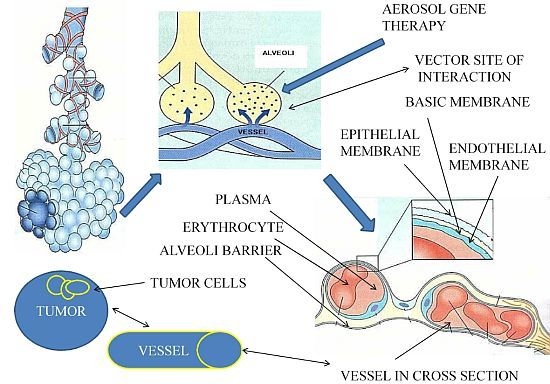
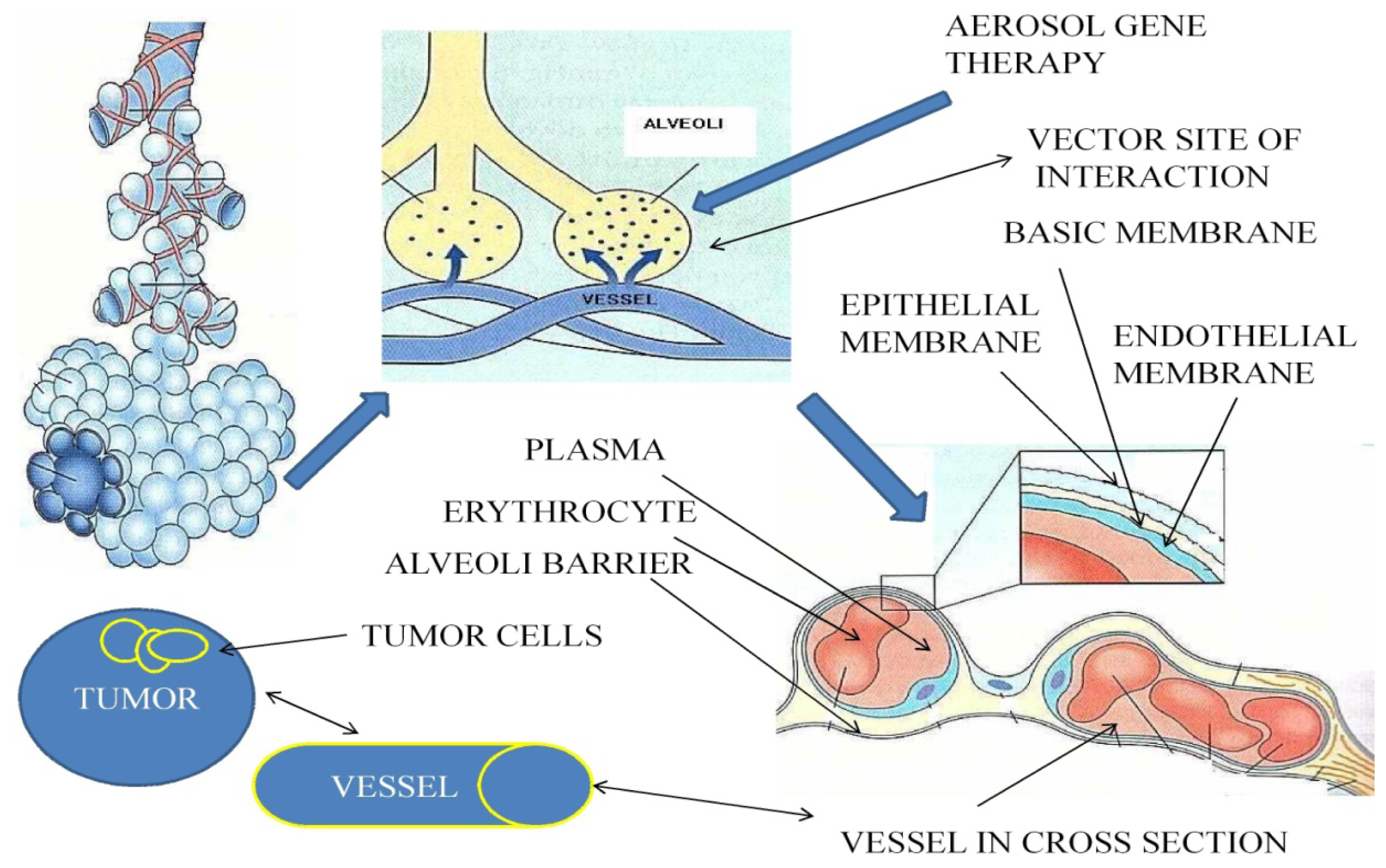
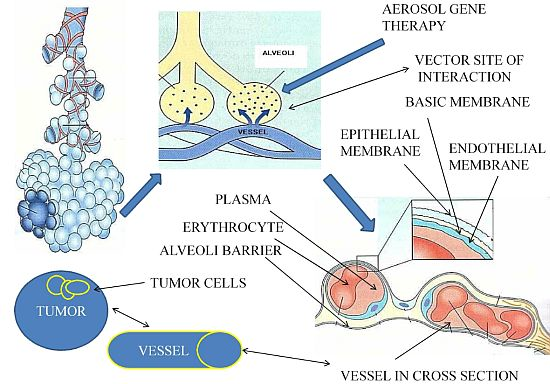
<p>Moreover, humidity (99.5%) is a major factor affecting almost all inhaled particles, as the particles tend to expand while moving from the upper airways to the lower [<xref ref-type="bibr" rid="b53-ijms-13-10828">53</xref>]. Underlying lung disease (asthma, cystic fibrosis, bronchiectasis, COPD) can also affect the aerosol deposition [<xref ref-type="bibr" rid="b54-ijms-13-10828">54</xref>]. The thick mucus production in cystic fibrosis and COPD patients blocks the proper absorption of the aerosol drug formulation by the airway epithelial [<xref ref-type="bibr" rid="b55-ijms-13-10828">55</xref>,<xref ref-type="bibr" rid="b56-ijms-13-10828">56</xref>]. Asthma bronchoconstriction can further disregulate the drug formulation absorption [<xref ref-type="bibr" rid="b57-ijms-13-10828">57</xref>]. Contrariwise, in bronchiectasis, bronchial blood flow is increased, therefore increasing the distribution of the deposited aerosol [<xref ref-type="bibr" rid="b58-ijms-13-10828">58</xref>]. Nevertheless, the aerosol product of inhaled insulin, provided indisputable data that the underlying disease is not a factor to stop or prevent its administration [<xref ref-type="bibr" rid="b59-ijms-13-10828">59</xref>]. In the case of underlying disease, proper and intense evaluation of glucose levels have to be performed, since the drug absorption cannot be anticipated. In addition, disease control measures have to be taken, such as administration of inhaled bronchodilators, corticosteroids and <italic>N</italic>-acetylcysteine, to prevent exacerbations. These drugs have also been administered as preparation for inhaled chemotherapy to prevent possible adverse effects [<xref ref-type="bibr" rid="b18-ijms-13-10828">18</xref>,<xref ref-type="bibr" rid="b19-ijms-13-10828">19</xref>]. Finally, an aspect of the aerosol therapy regarding lung cancer that needs to be clarified is the interaction of the drug formulation with the tumor mass. Several studies conducted on the human airway model included only patients with tumor mass diameter no more than 3–5 cm. It is believed that a larger mass will have necrotic tissue and there is not going to be an interaction or absorption of the drug formulation from the cancer cells. It is assumed, but not investigated, that small tumor masses (3–5 cm in diameter) will absorb an inhaled formulation, but larger ones will not [<xref ref-type="bibr" rid="b50-ijms-13-10828">50</xref>]. However, we should also take into consideration that the drug formulation will be deposited in normal alveoli and circulate through the vascular circulation to the vascular bed of the tumor and the rest of the human organs (<xref ref-type="fig" rid="f1-ijms-13-10828">Figure 1</xref>).</p>
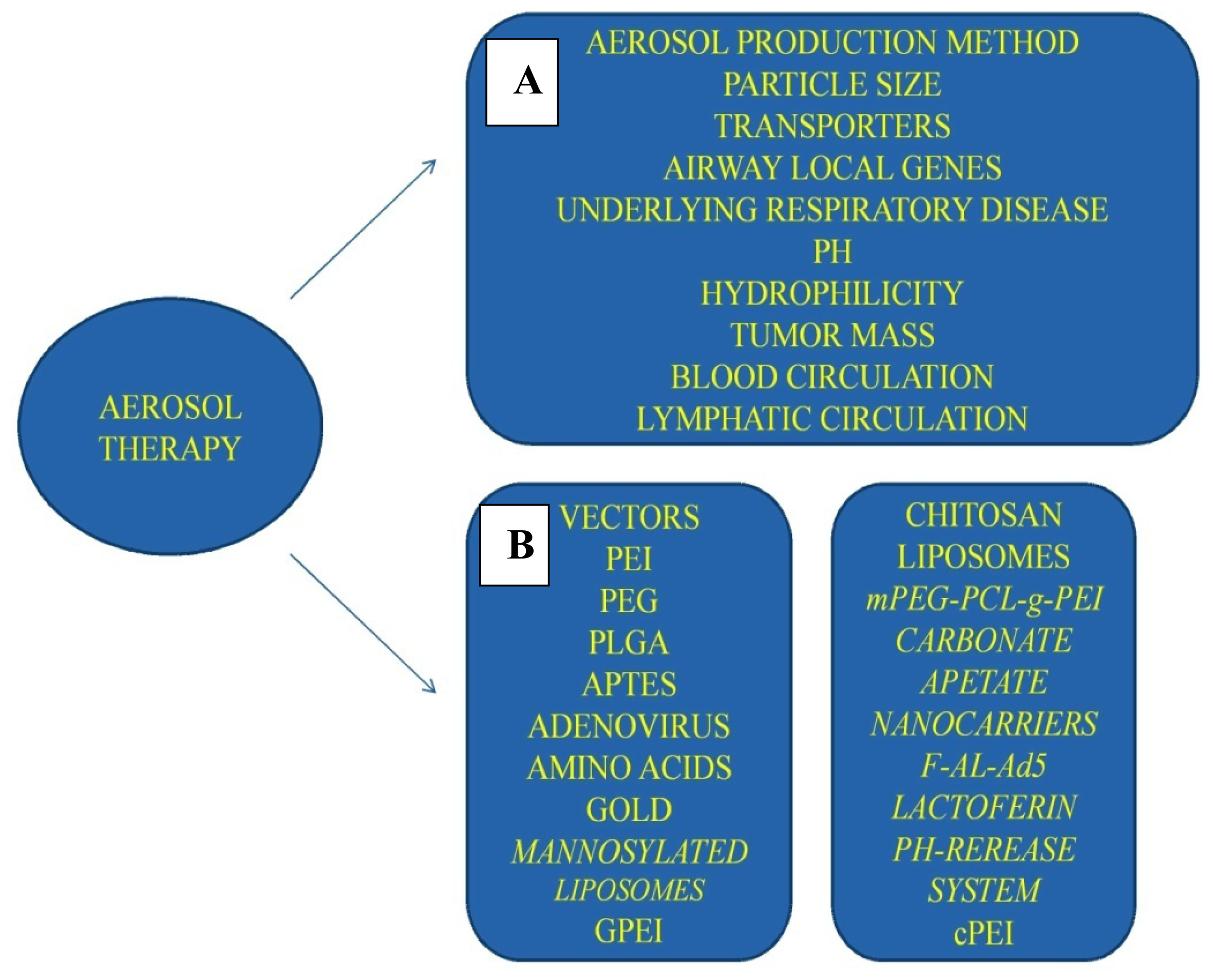
<p>It should be clarified that the reason we need local aerosol therapy for lung cancer is to deliver a smaller amount of therapeutic agent and therefore have less systemic side effects. In addition, micro-metastasis will be controlled either locally in the lung parenchyma, or in other organs through the vascular and lymphatic circulation of the chemotherapeutic agent [<xref ref-type="bibr" rid="b19-ijms-13-10828">19</xref>]. Another aspect that should be incorporated in this section is the modification of the respiratory properties. It has been shown that the addition of 5%–7% CO<sub>2</sub> through the nebulization process (aerosol gene therapy) can decrease the respiratory rate and increase the tidal volume by 150% (deep breathing pattern) [<xref ref-type="bibr" rid="b60-ijms-13-10828">60</xref>–<xref ref-type="bibr" rid="b64-ijms-13-10828">64</xref>]. Nevertheless, a higher concentration can lead to dizziness and sleepiness [<xref ref-type="bibr" rid="b65-ijms-13-10828">65</xref>]. Another option would be the nebulization of a drug formulation in heliox. This low-density gas mixture has the ability to reduce flow resistance, in consequence allowing more aerosol to be deposited in the alveoli region (<xref ref-type="fig" rid="f2-ijms-13-10828">Figure 2</xref>) [<xref ref-type="bibr" rid="b66-ijms-13-10828">66</xref>]. The CO<sub>2</sub> has been co-administered in nebulized inhaled chemotherapy trials and inhaled gene therapy trials.</p></sec>
<sec>
<title>4. Aerosol Drug Formulation</title>
<p>Aerosol therapies have been tested and have already been used for decades [<xref ref-type="bibr" rid="b67-ijms-13-10828">67</xref>]. It has been established that for the nanoparticles to be efficiently deposited and absorbed through the airways, they have to begin their journey from the upper airways on a scale of no more than 3.5 μm. This is necessary as due to the airway humidity; they will expand, and when they reach the alveoli, they have to be small enough to be deposited [<xref ref-type="bibr" rid="b68-ijms-13-10828">68</xref>]. Larger particles (&gt;5 μm) tend to deposit to the upper airways and not deposit to the alveoli. The macrophages have the ability to phagocytize particles 6 times their size, but the nanoparticles have to be equal in size in all axes. In the case were an axis is larger in size and the particle is not spherical, the macrophages will not be able to take up the nanoparticle, as usually happens with several types of fibers [<xref ref-type="bibr" rid="b69-ijms-13-10828">69</xref>]. Another factor affecting the uptake from the site of deposition is the local transporters. This is a field under investigation, since different nano-molecules interact differently when they come in contact with local transporters. In addition to this observation, it should be mentioned that there are different transporters in different sites of the airways. When designing such an aerosol formulation, we have to be aware of the local transporters [<xref ref-type="bibr" rid="b48-ijms-13-10828">48</xref>]. Moreover, another field of investigation is gene expression regulation. In the study by Leclerc <italic>et al.</italic> [<xref ref-type="bibr" rid="b47-ijms-13-10828">47</xref>], more than 380 genes of the airway epithelium and lung cancer were investigated. It was observed that a number of genes are activated in cancer cells and others in the normal airway epithelium, indicating that aerosol therapy can become even more targeted. At this point it should be stated that aerosol targeted therapy has already been investigated in the form of adding ligands to the inhaled nanoparticles. A new form of nanoparticles has been created—the so-called “nanocomplexes”. Instead of having a cytotoxic agent administered alone or encapsulated (liposome, polyethylene glycol-PEG coated), an addition of a ligand further targeted the nanocomplexes to bind with specific receptors of cancer cells [<xref ref-type="bibr" rid="b28-ijms-13-10828">28</xref>,<xref ref-type="bibr" rid="b70-ijms-13-10828">70</xref>–<xref ref-type="bibr" rid="b72-ijms-13-10828">72</xref>]. Further investigation of the nanocomplexes created a “stealth” drug formulation. This so-called “stealth” molecule has the ability to bypass the defense mechanisms of the airways, thus providing sustain release to a drug formulation [<xref ref-type="bibr" rid="b73-ijms-13-10828">73</xref>]. Regarding aerosol gene therapy, the cationic polymers established effectiveness, based on their efficient binding to airway epithelial cells, as previously stated [<xref ref-type="bibr" rid="b34-ijms-13-10828">34</xref>,<xref ref-type="bibr" rid="b37-ijms-13-10828">37</xref>,<xref ref-type="bibr" rid="b43-ijms-13-10828">43</xref>]. In addition, they do not form neutralizing antibodies, making them ideal for repeated administration. However, safety issues are to be presented in the following sections with reference, when necessary, to viral vector systems.</p>
<sec>
<title>4.1. Aerosolized Vectors Safety Concerns</title>
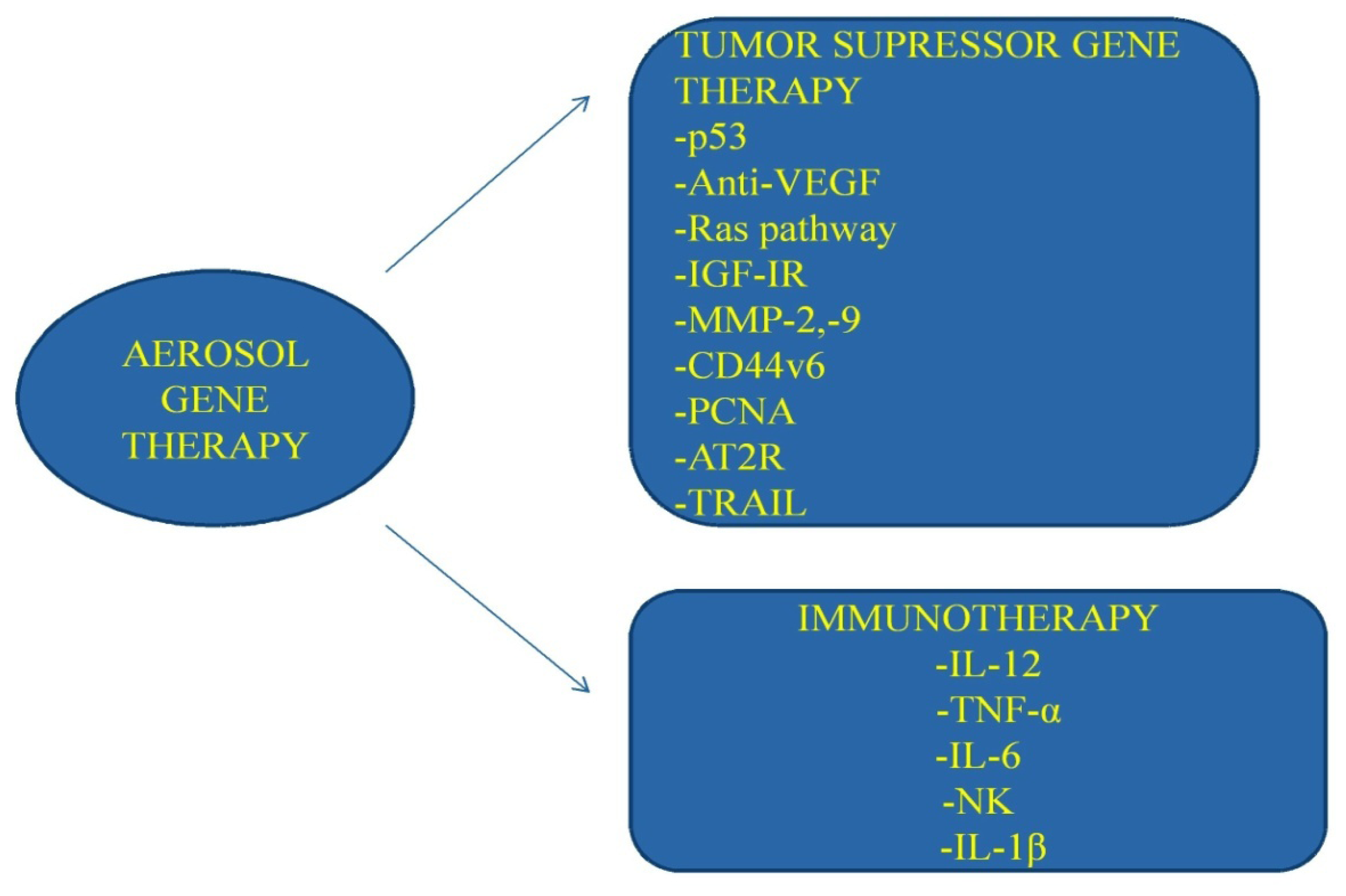
<p>In this section, all previous delivered nanocomplexes are presented with an emphasis on safety. Inhaled therapy safety concerns can be divided in two parts. The first consists of the drug formulation interaction with the medical personal administering the aerosol compound, and the second part, the drug formulation interaction with the patients or animal. Previous studies indicated that chemotherapeutic nanocomplexes induce bronchospasm, edema, hemoptysis and fibrotic lesions to the lungs [<xref ref-type="bibr" rid="b30-ijms-13-10828">30</xref>,<xref ref-type="bibr" rid="b31-ijms-13-10828">31</xref>] (<xref ref-type="table" rid="t1-ijms-13-10828">Table 1</xref>, <xref ref-type="fig" rid="f3-ijms-13-10828">Figure 3</xref>).</p>
<p>Therefore, protection measures were necessary for the medical personnel. The most efficient protection measure was the administration of the inhaled compound in a high-efficiency particulate air tent with filter (HEPA). The drug compound administration efficiency was measured by Wittgen <italic>et al.</italic> [<xref ref-type="bibr" rid="b27-ijms-13-10828">27</xref>], when the filter from a HEPA was used to investigate the drug compound (platinum analog) that was not inhaled from the patients. In this way, it was observed that only minimum non-toxic concentrations were diffused in the patients’ surrounding environment. Although the system used for aerosol administration in this study delivered the aerosol drug formulation efficiently, nevertheless, it provided us with the proper efficient measures that should be used to administer this treatment modality. Regarding the animal experiments, in almost all of the studies, a plastic cage was used to administer the aerosol compound, and therefore the medical personnel were safe [<xref ref-type="bibr" rid="b41-ijms-13-10828">41</xref>,<xref ref-type="bibr" rid="b74-ijms-13-10828">74</xref>]. Methods of establishing whether a compound affected the respiratory capacity of the patients were the: respiratory function measurement with forced expiratory capacity in 1 s (FEV1); forced vital capacity (FVC); diffusing capacity of the lung for carbon monoxide (DLCO), and the six minute walking test (6MWT). There were studies where these measurements took place before and after the aerosol administration [<xref ref-type="bibr" rid="b18-ijms-13-10828">18</xref>,<xref ref-type="bibr" rid="b29-ijms-13-10828">29</xref>]. In some studies, in order to protect the patients from possible adverse effects, inhaled bronchodilators and corticosteroids were administered before the aerosol [<xref ref-type="bibr" rid="b18-ijms-13-10828">18</xref>,<xref ref-type="bibr" rid="b29-ijms-13-10828">29</xref>,<xref ref-type="bibr" rid="b31-ijms-13-10828">31</xref>]. The most observed adverse effects were intermittent fever and cough that fell after a maximum of 3 days. The intensity and duration was less for the group of patients that had pretreatment. Regarding the animals’ safety evaluation, the weight, bronchoalveolar lavage fluid (BALF) and immunohistological examinations were mostly used. There are no clinical data regarding the toxicity that is expected with aerosol gene therapy in humans. There are indications with several animal experiments; however, the human respiratory anatomy and defense mechanisms are different. The toxicity will derive only from the vector delivery system and, in specific, the non-viral vector system. Nevertheless, there are encouraging results from several studies that a non-viral biodegradable system could release efficiently the plasmid to the nucleus of the cells without inducing inflammation to the normal tissue. In addition, at this section it should be stated that only large molecule drug formulations have been accused of inducing bronchoconstriction, regardless of the toxicity of a molecule [<xref ref-type="bibr" rid="b75-ijms-13-10828">75</xref>]. In order to have proper follow-up of inhaled gene therapy in lung cancer patients, lung function tests (FEV1, FVC, DLCO, 6MWT) and BALF has to be performed before and after aerosol gene therapy administration. BALF has to be evaluated at least one time.</p>
<sec>
<title>4.1.1. PEI</title>
<p>Polyethyleneimine (PEI) belongs to the cationic polymer family. They are constructed either as linear or branched and they have been used with low (2 kDa) and high (25 kDa) molecular weight. PEI can efficiently attach to the airway epithelial cells and efficiently introduce DNA in the cell nucleus [<xref ref-type="bibr" rid="b76-ijms-13-10828">76</xref>]. PEI protects the DNA against DNAse degradation and protects the non-viral-DNA nanocomplexes from the sheer forces of nebulization [<xref ref-type="bibr" rid="b77-ijms-13-10828">77</xref>,<xref ref-type="bibr" rid="b78-ijms-13-10828">78</xref>]. Furthermore, PEI can efficiently deliver the DNA to tumor cells, and resist to surfactant inhibition [<xref ref-type="bibr" rid="b79-ijms-13-10828">79</xref>]. In the study by Gautam <italic>et al.</italic> [<xref ref-type="bibr" rid="b37-ijms-13-10828">37</xref>], large molecule branched PEI (PEI/CAT N:P ratio 15:1, 25 kDa) were used as a non-viral vector for efficient DNA delivery. Histological analysis and myeloperoxidase assay were performed to investigate inflammation. Histological analysis did not reveal inflammation and abnormal fibrotic tissue formation. Myeloperoxidase assay also did not reveal elevated values in azurophilic granules. This aerosol gene nanocomplex demonstrated safety. In the study by Zamora-Avila <italic>et al.</italic> [<xref ref-type="bibr" rid="b38-ijms-13-10828">38</xref>], large molecule branched PEI (PEI/RNAi N:P ratio 10:1, 25 kDa) were administered and histological analysis was performed. No acute inflammation was observed. In another study by Gautam <italic>et al.</italic> [<xref ref-type="bibr" rid="b80-ijms-13-10828">80</xref>], again large molecule branched PEI (PEI/p53 N:P ratio 10:1 25 kDa) were administered and no acute inflammation was observed; however safety was not properly investigated as it was not the endpoint of the study. In another study by Gautam <italic>et al.</italic> [<xref ref-type="bibr" rid="b43-ijms-13-10828">43</xref>], large molecular weight branched PEI (PEI/p53 N:P ratio 10:1, 2 kDa) were investigated. Adverse histological findings regarding the PEI toxicity are stated, however, this was not the study endpoint. In addition, in two studies by Gautam <italic>et al.</italic> [<xref ref-type="bibr" rid="b63-ijms-13-10828">63</xref>,<xref ref-type="bibr" rid="b64-ijms-13-10828">64</xref>], the methodology of PEI construction, safety evaluation, gene transfection efficiency and nanocomplexes administration is thoroughly presented. In the study by Koshkina <italic>et al.</italic> [<xref ref-type="bibr" rid="b81-ijms-13-10828">81</xref>], large molecular weight branched PEI (PEI/p53 N:P ratio 10:1, 25 kDa) were investigated as aerosol and intravenous gene therapy administration. The purpose of the study was to elicit safety and efficiency differences. In the aerosol treatment modality, as expected, the sequence of the organ formulation distribution and transgene expression was as follows: lungs &gt; heart &gt; blood &gt; spleen &gt; liver &gt; kidney. Whereas, in the intravenous administration, the order was liver &gt; spleen &gt; blood &gt; lung &gt; heart &gt; kidney. Once again, this sequence deposition demonstrates proof of concept for efficiency of local aerosol treatment modality. No acute inflammation was reported; nevertheless, this parameter was not investigated in the study, since the constructed nanocomplex had been previously investigated for safety [<xref ref-type="bibr" rid="b37-ijms-13-10828">37</xref>,<xref ref-type="bibr" rid="b63-ijms-13-10828">63</xref>,<xref ref-type="bibr" rid="b64-ijms-13-10828">64</xref>]. In another study by Densmore <italic>et al.</italic> [<xref ref-type="bibr" rid="b61-ijms-13-10828">61</xref>], large molecular weight branched PEI (PEI/p53 or p53CD (1-366) N:P ratio 10:1, 25 kDa) were investigated. Histological analysis for aerosol PEI toxicity revealed no acute inflammatory responses. However, it should be mentioned that mice receiving PEI aerosol presented a higher reduction in weight in comparison to untreated. In the study by Hasenpusch <italic>et al.</italic> [<xref ref-type="bibr" rid="b82-ijms-13-10828">82</xref>], large molecular weight PEI (PEI/BC-819, 25 kDa) were investigated. No acute inflammatory responses were reported, although safety was not the prime endpoint. In the study by Duan <italic>et al.</italic> [<xref ref-type="bibr" rid="b83-ijms-13-10828">83</xref>], the large molecular weight PEI (PEI:IL-12, 25 kDa) were investigated to deliver pCAGG plasmid containing murine IL-12 as aerosol gene therapy with or without chemotherapeutic agents. Although the systemic administration of IL-12 results in systemic toxicity, no acute inflammation was presented, as the nanocomplex achieved efficient concentrations on the tumor site. It has been previously demonstrated that bacterial plasmids due to the unmethylated CpG motifs induce cytokine production and activate B-cell response and natural killer (NK) activity [<xref ref-type="bibr" rid="b84-ijms-13-10828">84</xref>]. Cationic lipids are known to induce mild cytokine production [<xref ref-type="bibr" rid="b85-ijms-13-10828">85</xref>]; however the cationic-lipid/DNA nanocomplex tends to induce increased cytokine production [<xref ref-type="bibr" rid="b85-ijms-13-10828">85</xref>,<xref ref-type="bibr" rid="b86-ijms-13-10828">86</xref>]. Safety of PEI was investigated by Gautam <italic>et al.</italic> [<xref ref-type="bibr" rid="b34-ijms-13-10828">34</xref>], by measuring immune response with the administration of large molecule branched PEI(25 kDa). The tumor necrosis factor-α (TNF-α) and interleukin-1β (IL-1β) were measured in serum and bronchoalveolar lavage fluid (BALF). Indeed, TNF-α and IL-1β were found elevated in serum at 2 h after intravenous administration. These two cytokine markers were observed increased in BALF after 5–8 h, but nevertheless, in much lower values than in serum. In the study by Densmore <italic>et al.</italic> [<xref ref-type="bibr" rid="b78-ijms-13-10828">78</xref>], large molecular weight PEI (PEI/pCMV-hGH, N:P ratio 10:1, 25 kDa) were administered by instillation and aerosol. In addition, the liposome-DNA (pCMV-hGH) was administered as instillation and aerosol. The pCMV-hGH expresses human growth hormone, and the purpose of the study was to evaluate the efficiency of gene transfection and vector stability. The ratio chosen for repeatable administration was 10:1, based on the low toxicity observed at this concentration. The results indicated similar efficiency (cationic lipids, cationic polymers) with low toxicity. In the study by Jia <italic>et al.</italic> [<xref ref-type="bibr" rid="b87-ijms-13-10828">87</xref>,<xref ref-type="bibr" rid="b88-ijms-13-10828">88</xref>], the nanocomplex PEI/pCAGGmIL-12 (N:P ratio 10:1) was created. No acute inflammatory response was observed as it has been previously presented with intravenous administration [<xref ref-type="bibr" rid="b89-ijms-13-10828">89</xref>]. In this study, aerosol gene therapy as immunotherapy was investigated and the administered nanocomplex of PEI/pCAGGmIL-12 demonstrated safety.</p></sec>
<sec>
<title>4.1.2. cPEI</title>
<p>The method of ultrafiltration was used by Davies <italic>et al.</italic> [<xref ref-type="bibr" rid="b62-ijms-13-10828">62</xref>] to create the nanocomplex of pCIKLux/PEI (pDNA/PEI N:P ratio 10:1 cPEI). Investigation of safety was performed with bronchoalveolar lavage fluid and histological analysis. In addition, a comparison of safety was performed between instillation and aerosol administration of aerosol gene therapy. No acute inflammation was observed for the group of aerosol administration. Only mild hemorrhagic edema between alveolar spaces and mild vascular congestion locally in some capillaries was observed. In contrast, the instillation method presented interstitial foci and necrosis due to neutrophil and lymphocyte rally. The extent of the damage was dose related. These results were attributed to the methodological disadvantage, where a large concentration of the non-viral vector comes in contact in one specific site and does not diffuse properly to the whole lung parenchyma. However, the new nanocomplex was more efficient and safe as aerosol gene therapy with a lower N:P ratio than the previous studies (10:1).</p></sec>
<sec>
<title>4.1.3. GPEI</title>
<p>Further exploration of PEI resulted in the creation of large molecular weight glucosylated PEI (25 kDa) by Kim <italic>et al.</italic> [<xref ref-type="bibr" rid="b41-ijms-13-10828">41</xref>]. The concept was to increase hydrophilicity of PEI and thus decrease the toxicity. It has been presented that the PEI toxicity is due to the prime amino group that occupies more than 30% of the molecule structure. Low toxicity was presented. In the study by Minai-Tehrani <italic>et al.</italic> [<xref ref-type="bibr" rid="b74-ijms-13-10828">74</xref>], previously created GPEI non-viral vectors were administered as GPEI/Akt1 nanocomplex. A correlation of the results was made with naphthalene-induced inflammation in Clara cells. The GPEI presented safety in comparison to naphthalene with histological analysis. In another study by Tehrani <italic>et al.</italic> [<xref ref-type="bibr" rid="b90-ijms-13-10828">90</xref>], large molecular weight glucosylated PEI (PEI/Akt WT or KD, 25 kDa) were investigated. No acute inflammatory toxicity was reported as already stated in the study by Kim <italic>et al.</italic> [<xref ref-type="bibr" rid="b41-ijms-13-10828">41</xref>]. In the study by Hwang <italic>et al.</italic> [<xref ref-type="bibr" rid="b91-ijms-13-10828">91</xref>], large molecular weight glucosylated PEI (PEI/PDCD4, 25 kDa) was prepared and investigated as in previous reported studies [<xref ref-type="bibr" rid="b41-ijms-13-10828">41</xref>,<xref ref-type="bibr" rid="b90-ijms-13-10828">90</xref>]. No acute inflammation and cytokine response was observed as stated in previous similar studies.</p></sec>
<sec>
<title>4.1.4. PEI/PEG Noncomplex</title>
<p>Another approach to nanocomplex coating was the addition of poly (ethylene glycol) (PEG) by Jere <italic>et al.</italic> [<xref ref-type="bibr" rid="b92-ijms-13-10828">92</xref>]. A new nanocomplex of low molecular weight PEI and poly (ethylene glycol) (PEG) (PAE/Akt1) was prepared and investigated. The newly formed nanocomplex was compared for safety with the already used non-viral vector PEI/Akt1 (high molecular weight 25 kDa), PAE presented less toxicity in comparison to PEI with cell proliferation assay and trypan blue dye exclusion. Another group by Xu <italic>et al.</italic> [<xref ref-type="bibr" rid="b93-ijms-13-10828">93</xref>] again investigated a novel vector from PEI with PEG coating and Akt1 siRNA. The vector was degradable poly (ester amine) copolymer. Safety of the nanocomplex was investigated with BALF, lactate dehydrogenase (LDH) and histological assay. No acute inflammatory response was reported, probably due to the degradable property of the non-viral vector, as previously reported [<xref ref-type="bibr" rid="b94-ijms-13-10828">94</xref>].</p></sec>
<sec>
<title>4.1.5. Tetrafunctional Amphiphilic Block Copolymer 704</title>
<p>A new synthetic non-viral vector combines the properties of cationic vectors and those of non-ionic amphiphilic polymers. It consists of four polyethylene oxide/polypropylene oxide blocks centered on an ethylene diamine moiety. Efficient gene transfection was previously established in skeletal and heart muscles [<xref ref-type="bibr" rid="b95-ijms-13-10828">95</xref>]. 704 synthetic vector was conjugated with fraktaline (CX3CL1), a powerful chemokine, the concept was to recruit and activate strong anti-tumor immune response. The nanocomplex was investigated by instillation administration and aerosol through a microsprayer<sup>®</sup> (Penn Century) [<xref ref-type="bibr" rid="b96-ijms-13-10828">96</xref>]. Histochemistry, histological assay and IL-6 measurements were used to evaluate inflammation in both administration modalities. Il-6 levels were higher for the instillation method. No acute inflammation was observed; nevertheless, increased perivascular and peribronchial infiltration were observed in the instillation modality in comparison to aerosol.</p></sec>
<sec>
<title>4.1.6. Adenoviral Vector Encoding Murine GM-CSF</title>
<p>In the study by Xing <italic>et al.</italic> [<xref ref-type="bibr" rid="b97-ijms-13-10828">97</xref>], human type 5 adenovirus genome with plasmid PACCMVmGM-CSF was instilled in mice. BALF, cytological examination and histopathology assay were performed. The group receiving only adenoviral vector presented mild neutrophilic and lymphocytic accumulation in BALF within the first 4 days, as in a previous study [<xref ref-type="bibr" rid="b98-ijms-13-10828">98</xref>]. In addition, low levels of TNF-α were detected in some BALF samples, but decreased over a period of 4 days. Moreover, when AD5-PACCMVmGM-CSF was administered, in short time, low levels of TNF-α were detected, but in addition, a cascade of inflammation response was stimulated. Eosinophilia, neutrophilia, increased macrophage accumulation peribronchially and perivascularly were observed. Finally, after 12 days of the nanocomplex administration, severe fibrotic reactions led to shrinkage and destruction of the lungs. In this study, it is presented that the instillation of the adenovirus vector is safe, and the severe cytokine stimulation was due to the administration of the plasmid PACCMVmGM-CSF. Previously in the study by Arndt <italic>et al.</italic> [<xref ref-type="bibr" rid="b99-ijms-13-10828">99</xref>], inhaled GM-CSF was administered as aerosol in humans and severe adverse effects occurred with reduction in the respiratory capacity of the patients, and destruction of the normal lung architecture and diffuse bilateral infiltration formation.</p></sec>
<sec>
<title>4.1.7. dTAT</title>
<p>Through dimerization of HIV1-TAT, Kawabata <italic>et al.</italic> [<xref ref-type="bibr" rid="b71-ijms-13-10828">71</xref>] formulated the dTAT vector. The vectors dTAT and PEI (large molecular weight branched, 25 kDa) were conjugated to a plasmid encoding Angiotensin-2-Receptor (pAT2R) and TNF-related apoptosis inducing ligand (pTRAIL). AT2R deficiency is associated with tumorigenesis in lung and colon [<xref ref-type="bibr" rid="b100-ijms-13-10828">100</xref>,<xref ref-type="bibr" rid="b101-ijms-13-10828">101</xref>], TRAIL is activating an anticancer pathway by inducing cell apoptosis [<xref ref-type="bibr" rid="b102-ijms-13-10828">102</xref>,<xref ref-type="bibr" rid="b103-ijms-13-10828">103</xref>]. The nanocomplexes were administered as aerosol by intratracheal spraying. Lower toxicity was observed for the dTAT vector in comparison with PEI. The dTAT also demonstrated transgene efficiency and additional glucose to the nanocomplex (dTAT/AT2R or TRAIL) caused further augmentation of this transfection. The dTAT vector is a safe vector for aerosol gene therapy; no dose escalation toxicity has been observed [<xref ref-type="bibr" rid="b71-ijms-13-10828">71</xref>].</p></sec>
<sec>
<title>4.1.8. Liposome-pDNA</title>
<p>In the study by Manunta <italic>et al.</italic> [<xref ref-type="bibr" rid="b36-ijms-13-10828">36</xref>], the liposome vector (DHDTMA/DOPE) and pEGFP-N1 (enhanced green fluorescent protein) was nebulized. The nanocomplexes produced were positively charged and no acute inflammation response was reported. The cell viability results demonstrate data that this vector can be used for efficient gene transfection in cystic fibrosis and other respiratory applications.</p></sec>
<sec>
<title>4.1.9. UAC</title>
<p>In the study by Jin <italic>et al.</italic> [<xref ref-type="bibr" rid="b104-ijms-13-10828">104</xref>], imidazole ring-containing urocanic acid-modified chitosan (UAC, 100 kDa) was investigated as a vector. Chitosan has proven a safe gene carrier, due to the biocompatibility and biodegradability properties, and it demonstrates efficient gene transfection [<xref ref-type="bibr" rid="b105-ijms-13-10828">105</xref>]. The UAC/programmed cell death protein-4 (PDCD4) nanocomplex was created and investigated for safety. Both chitosan/DNA and UAC/DNA were administered as aerosol, with a cell viability of &gt;90% for both vectors, however the UAC/DNA nanocomplex demonstrated higher transgene efficiency, probably due to the proton sponge activity. Chitosan does not demonstrate immunogenicity and has excellent biocompatibility [<xref ref-type="bibr" rid="b106-ijms-13-10828">106</xref>]. However, the large molecular weight, low solubility and low gene transfection in comparison to PEI brought them in the second line of vector systems, until the UAC was created. In the study by Okamoto <italic>et al.</italic> [<xref ref-type="bibr" rid="b107-ijms-13-10828">107</xref>], the nanocomplex of chitosan/pDNA (interferon-β) was investigated as dry powder and instillation. This study is a critical study since it presents the proof of concept for preparation of a nanocomplex as dry powder. The chitosan cationic vector had low-molecular-weight (Mw = 2000–5000) [<xref ref-type="bibr" rid="b108-ijms-13-10828">108</xref>], compared to another attempt [<xref ref-type="bibr" rid="b104-ijms-13-10828">104</xref>]. The shape of the powder fiber was rectangular regardless of pDNA type, and the nanocomplex was taken up by endocytosis. The dry powder formulation is safe; however, instillation probably to the high local concentration accumulation of chitosan was not effective, in the sense of not properly diffusing the formulation to a large alveoli area. No acute inflammation was presented. The dry powder nanocomplex presented favorable results with less concentration. However, in the study by Huang <italic>et al.</italic> [<xref ref-type="bibr" rid="b109-ijms-13-10828">109</xref>], additional investigation of chitosan nanoparticles for aerosol delivery was performed. Safety was assessed with bronchoalveolar lavage fluid-protein (BALF-P), lactate dehydrogenase activity (LDH) (BALF-LDH), myeloperoxidase activity (MPO), leukocyte migration and histopathological examination. The inflammatory markers were increased after 4 mg/kg intratracheal administration as aerosol (chitosan), compared to the control group (air inhalation). Inflammation observed was in the form of leukocyte infiltration, polymorphonuclear cell (neutrophils) and macrophage accumulation in lung tissue. Nevertheless, the inflammation activity was less compared to the bacterial liposaccharide (LPS) treatment. The LPS caused higher inflammatory stimulation for 4 mg/kg administration for the same amount of chitosan. The chitosan nanoparticle has a strong positive surface charge (+45 mV) and density of 0.38 g/cm<sup>3</sup>. The cationic polyelectrolyte property, with the high degree of deacetylation is responsible for the mild inflammatory activity presented <italic>in vitro</italic>. In another study by Takeuchi <italic>et al.</italic> [<xref ref-type="bibr" rid="b110-ijms-13-10828">110</xref>], submicron-sized liposome (ssLip) were conjugated to chitosan molecules and formulated the ssCS-Lip nanocomplex. No adverse effects were observed with the administration. Moreover, effective mucosa penetration was observed, making this nanocomplex an excellent candidate for aerosol administration gene therapy. The formulation reached the bloodstream, although the exact mechanism of the drug release is not yet fully understood.</p></sec>
<sec>
<title>4.1.10. AND</title>
<p>In the study by Zou <italic>et al.</italic> [<xref ref-type="bibr" rid="b42-ijms-13-10828">42</xref>], protamine sulfate, L-polylysine, and polyethyleneimine were prepared as the vector called “AND”. The nanocomplex AND/p53 was created and administered intratracheally as aerosol. The vector was administered alone or as AND/p53 nanocomplex and dose lethal toxicity was investigated. The aim of the study was to investigate the alternative of combining two to three cationic polymers and establish the higher gene transfection nanocomplex. The best combination was found to be polylysine and protamine at weight ratio of 8:1 [<xref ref-type="bibr" rid="b42-ijms-13-10828">42</xref>]. Toxicity was dose dependent, a concentration of 22.4 mg/m<sup>2</sup> demonstrated average toxicity ≤3. Inflammatory infiltrates with lymphocytes, pneumocytes and histiocytes were observed, but resolved after 14 days. Finally, when the dose was increased to 112 mg/m<sup>2</sup>, the toxicity reached grade 7, the lung architecture was lost and the scar tissue damage were irreversible. At low dosages &lt;22.4 mg/m<sup>2</sup> the AND presented safety and efficient gene transfection.</p></sec>
<sec>
<title>4.1.11. Lentiviral shOPN</title>
<p>Lentiviruses have been also used as vectors, by Yu <italic>et al.</italic> [<xref ref-type="bibr" rid="b21-ijms-13-10828">21</xref>], where a lentivirus was conjugated with shRNA, the small hairpin osteopontin (shOPN). The nanocomplex was administered as an aerosol. The viral vector was evaluated alone and as a nanocomplex Lentivirus/shOPN. The lentiviruses are known to present high gene transfection, both <italic>in vitro</italic> and <italic>in vivo</italic> [<xref ref-type="bibr" rid="b111-ijms-13-10828">111</xref>]. No acute inflammatory response was reported and therefore the nanocomplex is considered safe. Another possible explanation could be the multiple pathways that are down-regulated with the specific nanocomplex (vascular endothelial growth factor (VEGF), expression of proliferating cell nuclear antigen (PCNA), CD44 variant 6 (CD44v6), and matrix metalloproteinase-2,-9(MMP-2,-9)).</p></sec></sec>
<sec>
<title>4.2. Future Nanocomplexes</title>
<p>In this section, nanocomplexes with a possible application as vector or drug releasing system for aerosol gene therapy are presented (<xref ref-type="fig" rid="f2-ijms-13-10828">Figure 2</xref>).</p>
<sec>
<title>4.2.1. Cross-Linked Small PEIs</title>
<p>Another approach was investigated by Thomas <italic>et al.</italic> [<xref ref-type="bibr" rid="b112-ijms-13-10828">112</xref>], to create a vector with less systemic side effects, and therefore small PEIs 2 kDa with biodegradable linkages were tested <italic>in vitro</italic> and <italic>in vivo.</italic> Biodegradable linkages consist of the following: (a) esters, (b) amides, (c) orthoesters, (d) acetals, (e) glycosides and (f) bisulfides [<xref ref-type="bibr" rid="b113-ijms-13-10828">113</xref>]. The concept was to produce a nanocomplex that would biodegrade in a short time and therefore the interaction between the cells will induce inflammatory stimulation. The cross-linked PEIs demonstrated 95% cell viability [<xref ref-type="bibr" rid="b112-ijms-13-10828">112</xref>]. The efficiency in <italic>in vitro</italic> was presented up to 550- and in <italic>in vivo</italic> up to 80-, without any toxicity. It is known that small PEIs are not efficient (2 kDa). On the other hand the large PEIs (25 kDa) are toxic, therefore the cross-linked biodegradable 2 kDa PEIs demonstrated that short time local administration was safe and efficient (gene transfection) without any toxic adverse effects. In another study by Wang <italic>et al.</italic> [<xref ref-type="bibr" rid="b114-ijms-13-10828">114</xref>], small molecular weight PEI (2 kDa) were synthesized and structured with biscarbamate linkages, the PEI-ET nanocomplex was constructed (Mn: 1220, Mw: 2895). The non-viral vector presented lower toxicity in comparison to PEI 25 kDa and efficient gene expression in three different cell lines. The optimal ratio <italic>w</italic>/<italic>w</italic> for efficient gene transfection (3.4-higher than 25 kDa PEI) was 20. Nevertheless, concentration-dependent toxicity was observed at &gt;50 μg/mL. This novel nanocomplex still remains to be tested for aerosol stability.</p></sec>
<sec>
<title>4.2.2. PEIs with PEG Shielding</title>
<p>In the study by Uchida <italic>et al.</italic> [<xref ref-type="bibr" rid="b115-ijms-13-10828">115</xref>], PEG was added to PEIs as a shield to stabilize the nonspecific toxic interactions of the PEI. The polyplexes have a high surface positive charge, which is known to interact with the airway epithelial cells. Nevertheless, the addition of PEG with the neutralizing and hydrophilic properties decreases the transgene expression [<xref ref-type="bibr" rid="b116-ijms-13-10828">116</xref>]. Therefore, an attempt was made to increase the N/P ratio. The result was higher transgene efficiency, but with additional toxicity. The authors created the nanocomplex PEG-block-PAsp (DET) and homo PAsp (DET). The structure had high efficiency with minimal toxicity. The safety was evaluated with several markers, such as: (a) IL-6, (b) cyclooxygenase, (c) IL-10, (d) Tumor necrosis factor (TNF), and (e) C-reactive protein (CRP). No acute inflammation was observed with additional, immunohistochemistry assays, in several organs. The possible explanation is again the biodegradable property of the PAsp (DET). Further investigation with microsprayer<sup>®</sup> intratracheal administration of PEG-block-PAsp (DET) and homo PAsp (DET) 0/100 to the airways of animals presented acute inflammation (pro-inflammatory activation and increased cycloxigenase-2 expression). The optimal safety balance between the PEG/PEI (efficiency/toxicity) ratio is 50/50. In the study by Fan <italic>et al.</italic> [<xref ref-type="bibr" rid="b117-ijms-13-10828">117</xref>], another form of PEI shielding was investigated by adding the nonionic amphiphilic surfactant polyether-Pluronic<sup>®</sup>. This nanocomplex consists of hydrophilic ethylene oxide and hydrophobic propylene oxide blocks [<xref ref-type="bibr" rid="b117-ijms-13-10828">117</xref>]. The addition of Pluronics<sup>®</sup> demonstrated enhanced DNA cellular uptake, nuclear translocation, and gene expression with low toxicity. The efficiency was directly associated with the Pluronics<sup>®</sup> concentration. This nanocomplex structure remains to be tested as aerosol. In the study by Jiang <italic>et al.</italic> [<xref ref-type="bibr" rid="b118-ijms-13-10828">118</xref>], another form of active transport was investigated by targeting the mannose receptor of macrophages, and the nanocomplex structure of mannan-PEG-<sc>l</sc>-α-phosphatidylethanolamine (PE) was created. Efficient transgene expression was observed, making this structure ideal for macrophage targeting and therefore provided proof of concept for macrophages being the carrier of a gene treatment through lymphatic circulation [<xref ref-type="bibr" rid="b119-ijms-13-10828">119</xref>]. Cell viability assay confirmed 100% safety; nevertheless, this structure also remains to be tested as aerosol. In the study by Zeng <italic>et al.</italic> [<xref ref-type="bibr" rid="b120-ijms-13-10828">120</xref>], the concept of creating shield for an adenovirus vector was investigated. A cationic PEG derivative (APC) was formulated to coat the adenovirus 5 and presented effective protection against neutralizing antibodies (Nabs). The structure of Ad5/APC-PEG also presented high transgene expression. PEIs with low molecular weight 2 kDa and high molecular weight 5 kDa were compared with the APC coating for safety in multiple cell lines. The APC presented low toxicity comparable to PEI 2 kDa, and even lower to 25 kDa PEIs. This novel formulation remains to be tested as aerosol.</p></sec>
<sec>
<title>4.2.3. Solvoplex</title>
<p>A future methodology was proposed for gene therapy, by Schughart <italic>et al.</italic> [<xref ref-type="bibr" rid="b121-ijms-13-10828">121</xref>,<xref ref-type="bibr" rid="b122-ijms-13-10828">122</xref>]. The following solvoplexes presented high transgene expression: (a) di-<italic>n</italic>-propylsulfoxide (DPSO), (b) dimethylsulfoxide (DMSO), (c) tetramethylurea (TMU), and butylmethylsulfoxide (BMSO). The DPSO/DNA nanocomplex presented high transgene expression and stability either administered intratracheally directly in the airways or as aerosol with a microsprayer<sup>®</sup> [<xref ref-type="bibr" rid="b121-ijms-13-10828">121</xref>]. The microsprayer<sup>®</sup> prevents the degradation of the solvoplex/DNA complex, in contrast to jet nebulization. Repeated administration of solvoplexes is possible with low toxicity. The safety evaluation was performed with histopathology assay, alanine transaminase and asparagine transaminase. Administration of DPSO-solvolex at concentrations of 5%, 10% and 15% demonstrated that moderate inflammation occurred at 15% with edema and focal lesions which were resolved within 7 days.</p></sec>
<sec>
<title>4.2.4. APTES</title>
<p>In the study by Cheang <italic>et al.</italic> [<xref ref-type="bibr" rid="b123-ijms-13-10828">123</xref>], a new type of silicon nanoparticle the aminopropyltriethoxysilane-functionalized silicon dioxide nanoparticle was developed (APTES-SiNPs). This nanocomplex has previously demonstrated safety and efficiency, since they present low toxicity, excretion via the renal route, and they are biodegradable [<xref ref-type="bibr" rid="b124-ijms-13-10828">124</xref>,<xref ref-type="bibr" rid="b125-ijms-13-10828">125</xref>]. The quaternized APTES derivatives present less toxicity than regular APTES, because they have the property of maintaining the cationic charge inside the polymer covered by hydroxyl groups on the surface. In the study by Cheang <italic>et al.</italic> [<xref ref-type="bibr" rid="b123-ijms-13-10828">123</xref>], the APTES nanoparticles were compared with the Lipofectamine<sup>®</sup> 2000 and the results did not present any toxicity for the quaternized APTES nanocomplex in human cell lines, compared to Lipofectamine<sup>®</sup> 2000. The APTES nanocomplex maintains the low level of toxicity at high concentrations and prolonged local deposition. However, the APTES has been tested only <italic>in vitro</italic> and therefore remains to be tested <italic>in vivo</italic> and as an aerosol delivery system.</p></sec>
<sec>
<title>4.2.5. PLGA Delivery System for Immunotherapy</title>
<p>In the study by Ma <italic>et al.</italic> [<xref ref-type="bibr" rid="b126-ijms-13-10828">126</xref>], the poly(<sc>dl</sc>-lactide-co-glycolide) (PLGA) nanoparticle delivery system was developed to encapsulate tumor antigenic peptides [<xref ref-type="bibr" rid="b126-ijms-13-10828">126</xref>]. The nanocomplex has immunomodulatory properties of activating and stimulating the T-lymphocytes against tumor cells. Higher efficiency was demonstrated <italic>in vivo</italic> for PLGA–NPs delivery systems. Further investigation led to the efficient encapsulation of three peptides to the PLGA-NPs and loaded to the dendritic cells (DCs). A powerful response of cytotoxic T lymphocytes (CTLs) was observed. The nanocomplex was evaluated with cell viability assay for safety, and remains to be tested <italic>in vivo.</italic> In the study by Li <italic>et al.</italic> [<xref ref-type="bibr" rid="b127-ijms-13-10828">127</xref>], a PLGA nanocomplex was conjugated with PEG, the endpoint of the authors was the investigation of the nanoparticle properties and bio-distribution. Further investigation has to be performed for PLGA nanocomplexes for stability as aerosol administration.</p></sec>
<sec>
<title>4.2.6. Gene and Chemotherapy in One Complex (mPEG-PCL-g-PEI)</title>
<p>In the study by Shi <italic>et al.</italic> [<xref ref-type="bibr" rid="b128-ijms-13-10828">128</xref>], the polyethylene glycol-poly ɛ-caprolactone-polyethylamine (mPEG-PCL-g-PEI) an amphiphilic triblock copolymer was synthesized to deliver simultaneously doxorubicin and plasmidDNA. The complex is biodegradable and it was tested <italic>in vitro</italic> in several concentrations of mPEG-PCL-g-PEI (2000-2000-2000, 2000-6000-2000 and 5000-2000-2000). The mPEG-PCL-g-PEI copolymer 5000-2000-2000 has the highest transgene efficiency, while the formulation 2000-2000-2000 had the highest drug-loading capability. Cytotoxicity was observed in higher concentrations, but it differed between tested cell lines. The nanocomplex remains to be tested <italic>in vivo</italic>. The concept of gene therapy and chemotherapy co-administration could bring a new era to multimodality lung cancer treatment.</p></sec>
<sec>
<title>4.2.7. Carbonate Apatite nano-Carriers</title>
<p>Several techniques were investigated in order to develop the nanocomplex of an optimal size and efficiently induce gene transfection by Chowdhury <italic>et al.</italic> [<xref ref-type="bibr" rid="b129-ijms-13-10828">129</xref>]. The basic parameters: Ph of buffered solution and incubation temperature, were investigated and presented the optimal values to develop a highly efficient nanoparticle gene delivery system with a possible application for aerosol gene therapy delivery. Carbonate apatites are biodegradable nanoparticles that have presented efficient transgene expression [<xref ref-type="bibr" rid="b129-ijms-13-10828">129</xref>,<xref ref-type="bibr" rid="b130-ijms-13-10828">130</xref>]. Almost no toxicity has been observed <italic>in vitro</italic> when the complex of carbon apatite—siRNA—was delivered to cell cultures [<xref ref-type="bibr" rid="b130-ijms-13-10828">130</xref>]. In another study by Hossain <italic>et al.</italic> [<xref ref-type="bibr" rid="b131-ijms-13-10828">131</xref>], ph-sensitive carbon apatite nanocomplex was developed. There was no acute inflammation reported (cell viability assay), and the nanocomplex had the property of a ph-drug release system. When the nanocomplex contacts pH &lt; 7, it “activates” and delivers the RNA load. This drug delivery system again is an excellent candidate for aerosol gene therapy administration, as it is activated with the acidic cancer cells pH ≤ 6.5. This application could be incorporated as aerosol gene therapy for efficiently in endobronchial tumors.</p></sec>
<sec>
<title>4.2.8. F-AL-Ad5</title>
<p>In the study by Zhong <italic>et al.</italic> [<xref ref-type="bibr" rid="b72-ijms-13-10828">72</xref>], a nanocomplex conjugating an adenovirus vector and anionic liposome was investigated. The F-AL-Ad complex was investigated in normal airway epithelial cells and not in cancer cells, so the efficiency of the treatment still remains to be tested on a cancer model. It is known that folate receptors are over-expressed in a variety of tumors and therefore this nanocomplex could be used in aerosol gene therapy with the addition of a plasmid [<xref ref-type="bibr" rid="b132-ijms-13-10828">132</xref>]. The nanocomplex of adenovirus vector-5 and anionic liposome has been previously created, and in the present study, folate was added to the nanostructure, to create F-AL-Ad complex. The complex was not efficient when administered basolaterally, because the folate receptors are absent at the basolateral side, and therefore affected only the cancer cells. No acute toxicity was reported and this nanocomplex is an excellent candidate for receptor targeting vector. It remains to be tested as aerosol.</p></sec>
<sec>
<title>4.2.9. Amino Acids to Enhance the Aerosol Deposition</title>
<p>Amino acids have been proposed to enhance the efficiency of a delivery system through nebulization. Therefore, the amino acids arginine, aspartic acid, threonine and phenylalanine were investigated as to whether they could enhance the stability of aerosol nanocomplexes by Li <italic>et al.</italic> [<xref ref-type="bibr" rid="b133-ijms-13-10828">133</xref>]. Indeed, the arginine, aspartic acid and threonine addition produced more uniform particles, in specific arginine and phenylalanine demonstrated optimal powder aerolization. The addition of these two amino acids can influence the structural integrity of the dry powder formulation and therefore merit being incorporated in the nanocomplex structure; however, they decrease the gene transfection. Therefore, a balance has to be investigated for the optimal concentration within a vector/DNA nanocomplex. In the study of Li <italic>et al.</italic> [<xref ref-type="bibr" rid="b134-ijms-13-10828">134</xref>], another amino acid, leucine, was investigated and further enhanced the aerosol dispersion and deposition. However, again, the amino acid leucine negatively influenced the biological activity of the gene vector. The addition of the reported amino acids did not present any inflammatory activity.</p></sec>
<sec>
<title>4.2.10. GOLD Nanoparticles</title>
<p>In the study by Puvanakrishnan <italic>et al.</italic> [<xref ref-type="bibr" rid="b135-ijms-13-10828">135</xref>], gold nanoparticles (GNPs) were investigated as pegylated gold nanoshells (GNSs) and gold nanorods (GNRs) and demonstrated a safe profile. These nanovectors presented low toxicity locally on several organs that were dose-dependent when injected systematically. No necrosis was observed. The GNPs are non-toxic, stable and pose unique optical and thermal properties [<xref ref-type="bibr" rid="b136-ijms-13-10828">136</xref>]; in addition, they are PEG coated and therefore have the “stealth” ability to bypass several defense mechanisms [<xref ref-type="bibr" rid="b137-ijms-13-10828">137</xref>], making them an ideal nanocomplex to bypass the respiratory defense mechanisms. This nanovector could therefore be utilized as an aerosol gene delivery system; however, multiple experiments should be performed <italic>in vitro</italic> in airway epithelial cells and <italic>in vivo</italic> animal studies. The possible aerosol nanocomplex has to be tested for stability within the sheer forces of nebulization. Moreover, gold nanoparticle sensors have recently been used efficiently for classification of lung cancer [<xref ref-type="bibr" rid="b3-ijms-13-10828">3</xref>,<xref ref-type="bibr" rid="b6-ijms-13-10828">6</xref>].</p></sec>
<sec>
<title>4.2.11. PH-Release System</title>
<p>In the study by Li <italic>et al.</italic> [<xref ref-type="bibr" rid="b138-ijms-13-10828">138</xref>], a ph-sensitive delivery system was investigated. The anionic DNA, cationic liposomes, and o-carboxymethyl-chitosan (CMCS)-cationic liposome-coated DNA/protamine/ DNA complexes (CLDPD) were created. The nanocomplex is designed to deliver the gene load, based on the ph of the cells with which it comes into contact. In specific, the nanocomplex is activated not in the blood serum with a pH 7.4, but only when the formulation came in contact with the tumor cells with a pH of 6.5. Since the drug formulation will only be activated when it comes in contact with the tumor cells, therefore it does not interact with the normal cells. The CMCS-CLDPD also demonstrated less cytotoxicity compared to PEI/DNA (N:P ratio 10:1), due to the biodegradable property [<xref ref-type="bibr" rid="b138-ijms-13-10828">138</xref>]. However, this method still remains to be tested for aerosol stability. No acute inflammation was observed and cell viability was increased as observed to other chitosan derivatives [<xref ref-type="bibr" rid="b107-ijms-13-10828">107</xref>].</p></sec>
<sec>
<title>4.2.12. Lactoferin Nanoparticles</title>
<p>Lactoferin (Lf) is an iron binding glycoprotein that resembles transferrins (Tf) [<xref ref-type="bibr" rid="b139-ijms-13-10828">139</xref>]. It is found in several fluids of the body [<xref ref-type="bibr" rid="b140-ijms-13-10828">140</xref>]. Lf was previously conjugated with DNA and formed a nanocomplex able to efficiently deliver gene therapy. The Lf/DNA nanocomplex demonstrated even higher efficiency than Tf/Liposome/DNA [<xref ref-type="bibr" rid="b141-ijms-13-10828">141</xref>]. In another study by Gupta <italic>et al.</italic> [<xref ref-type="bibr" rid="b142-ijms-13-10828">142</xref>], Lf nanoparticle was conjugated with ceruloplasmin and superparamagnetic iron oxide and increased cell surface binding was observed. The Lf can be used as a target-delivery nanocomplex. In addition, different cells, such as monocytes/macrophages, lymphocytes, platelets, osteoblasts, chrondrocytes and hepatocytes, express receptors efficient to Lf, again demonstrating proof of concept that macrophages through lymphatic circulation can enhance an anticancer treatment [<xref ref-type="bibr" rid="b143-ijms-13-10828">143</xref>,<xref ref-type="bibr" rid="b144-ijms-13-10828">144</xref>]. Efficiency and safety of this carrier is still to be evaluated as aerosol gene therapy.</p></sec>
<sec>
<title>4.2.13. Mannosylated Liposomes</title>
<p>A novel formulation of mannosylated polyethylene glycol-phosphatidylethanolamine (M-PEG-PE) was developed and intravenously injected by Kong <italic>et al.</italic> [<xref ref-type="bibr" rid="b145-ijms-13-10828">145</xref>]. No acute inflammation was observed and cell viability was observed. In addition, efficient gene transfection was established, and PEG coating protects can protect the nanocomplex from the defense mechanisms of the respiratory system, namely macrophages. This nanocomplex could therefore be evaluated as aerosol gene therapy; nevertheless, caution should be taken in the case where adverse effects should be presented from the respiratory system (bronchospasm).</p></sec></sec></sec>
<sec sec-type="conclusions">
<title>5. Conclusions</title>
<p>Nanocomplexes have the ability due to their small size to diffuse through tight junctions and cell membranes, while other larger particles fail. It has been previously demonstrated that they deposit and accumulate at the tumor site for a longer time than uncoated drug formulations. The nanocomplexes can be used as the aerosol gene therapy treatment, with numerous multimodal approaches, most recently as early lung cancer detection system [<xref ref-type="bibr" rid="b2-ijms-13-10828">2</xref>–<xref ref-type="bibr" rid="b6-ijms-13-10828">6</xref>].</p>
<p>Vector systems (viral and non-viral) are used in gene therapy, each with specific properties, and therefore a different safety and gene transfection profile. The adenovirus vectors, although they have higher gene transfection, nevertheless tend to create neutralizing antibodies. Non-viral vectors also present higher affinity binding to the airway epithelial cells, in comparison to viral vectors [<xref ref-type="bibr" rid="b35-ijms-13-10828">35</xref>,<xref ref-type="bibr" rid="b146-ijms-13-10828">146</xref>]. In contrast, the non-viral vectors efficiently bind to the airway epithelial, but they do not present efficient transfection in comparison to the viral vectors. In addition, safety concerns have been raised concerning the non-viral vectors and in specific for PEI [<xref ref-type="bibr" rid="b147-ijms-13-10828">147</xref>]. Another important aspect is the production of the two delivery systems, the viral vectors are produced with a high cost, in comparison to the low production cost of the non-viral vectors [<xref ref-type="bibr" rid="b148-ijms-13-10828">148</xref>]. Moreover, an important aspect for inhaled gene therapy is the ability of the vector and nanocomplex to be delivered as either a dry powder or aerosol. The sheer forces of nebulization tend to degrade viral vectors. Cationic lipid vectors stabilize the DNA and therefore present high gene transfection; however, nebulization again degrades the nanocomplexes and reduces the degree of gene transfection. Nevertheless, many efforts towards modification of cationic lipids resulted in the development of lipid-based nanocomplexes with satisfactory gene transfection [<xref ref-type="bibr" rid="b149-ijms-13-10828">149</xref>–<xref ref-type="bibr" rid="b151-ijms-13-10828">151</xref>]. Adenoviruses (Ad), adeno-associated virus (AAV) have been used for aerosol gene therapy, with moderate gene transfection results. Regarding delivering a nanocomplex as aerosol gene therapy (with Ad and rAAV), the drug-formulations were observed to be efficiently diffused throughout the lung parenchyma [<xref ref-type="bibr" rid="b36-ijms-13-10828">36</xref>,<xref ref-type="bibr" rid="b152-ijms-13-10828">152</xref>]. In previous studies regarding inhaled chemotherapy, the safety was evaluated in patients and medical personnel [<xref ref-type="bibr" rid="b19-ijms-13-10828">19</xref>].</p>
<p>No adverse effects were observed in the medical personnel; however, transient reduction in the respiratory function of patients was observed. Therefore preparation with bronchodilators and inhaled corticosteroids was administered, either pre or post the inhaled chemotherapy administration. High particulate air filters (HEPA) and other protection measures, such as plastic tents (patients) and cages for animals, were used as a protection from dispersed chemo agents to the environment. However, HEPA filter measurements did not reveal high chemotherapeutic agent dispersion. Regarding the inhaled gene therapy, although protection measures were followed in multiple studies, there are no robust data from human studies. The previously published studies efficiently constructed nanocomplex particles with the necessary properties for efficient aerosol delivery and deposition [<xref ref-type="bibr" rid="b68-ijms-13-10828">68</xref>,<xref ref-type="bibr" rid="b69-ijms-13-10828">69</xref>]. However, Ad and rAAV induce inflammation and stimulate cytokine production. Flu-like symptoms are also observed and therefore they should be administered with caution to an already compromised respiratory system. The non-viral vectors are therefore suitable for repeatable delivery. The viral vectors are not suitable for repeatable application and the most important issue is that they do not bind efficiently to the airway epithelial as the non-viral vectors. Aerosol delivery properties and systems have been previously analyzed for aerosol delivery in lung cancer [<xref ref-type="bibr" rid="b19-ijms-13-10828">19</xref>]. Several modalities of aerosol distribution have been properly displayed by Beck <italic>et al.</italic> [<xref ref-type="bibr" rid="b152-ijms-13-10828">152</xref>], and the microsprayer<sup>®</sup>(Penn Century) presented the most efficient aerosol distribution. Nevertheless, this method has not been tested in humans and it remains minimally invasive. Regarding nebulization, the Aeroneb<sup>®</sup> nebulizer delivers aerosol efficiently with minimal nanocomplex degradation.</p>
<p>The cytotoxicity of the non-viral vectors (mainly polymers) is a consequence of the molecule aggregation on the cell surface, due to the strong electrostatic charge. This interaction vector-cell induces cell membrane instability. The optimal molecular weight for effective gene transfection is between 5 and 25 kDa; PEIs less than 1.8 kDa present almost no transfection. However, higher molecular weight of the PEI induces higher toxicity. Furthermore, the higher the N:P ratio the lower the size of PEI nanocomplexes [<xref ref-type="bibr" rid="b153-ijms-13-10828">153</xref>]. Linear and branched PEI/DNA nanoparticle size depends on the method of construction (glucose/salt/solvent) [<xref ref-type="bibr" rid="b154-ijms-13-10828">154</xref>]. Linear PEI present a more efficient gene transfection, but present higher toxicity compared to branched: branched presents higher effectiveness in delivering aerosol gene therapy [<xref ref-type="bibr" rid="b155-ijms-13-10828">155</xref>].</p>
<p>There are delivery systems, RNA/DNA, currently under investigation the exosome mimetics. These extracellular vesicles (phospholipids) have been identified as carriers. They have the ability to affect many systems at once, therefore different components of the exosome mimetics (incorporation of multiple membrane proteins in liposomes) are to be investigated and explored in correlation with a target system [<xref ref-type="bibr" rid="b156-ijms-13-10828">156</xref>]. Toxicity is also an issue due to the hydrophobicity. This vehicle has still remains to be tested for stability at nebulization and for <italic>in vitro</italic>–<italic>in vivo</italic> toxicity investigation.</p>
<p>The exosome mimetics have the ability to encapsulate different and multiple molecules and therefore target simultaneously several cells and pathways [<xref ref-type="bibr" rid="b156-ijms-13-10828">156</xref>]. PLGA nanoparticles have been used as carriers to encapsulate tumor antigenic peptides with safety [<xref ref-type="bibr" rid="b126-ijms-13-10828">126</xref>,<xref ref-type="bibr" rid="b157-ijms-13-10828">157</xref>]. GOLD nanoparticles, which have PEG shielding, have unique thermal properties to be activated with thermal energy and presented cell viability [<xref ref-type="bibr" rid="b135-ijms-13-10828">135</xref>]. Lf is another nanoparticle that can be used with safety as a non-viral vector for aerosol gene therapy [<xref ref-type="bibr" rid="b158-ijms-13-10828">158</xref>]. Moreover, several efforts have been made towards creating a safe non-viral vector. Several nanocomplexes were investigated where small-molecule 2 kDa PEI were linked with biodegradable linkages, with additional PEG encapsulation [<xref ref-type="bibr" rid="b115-ijms-13-10828">115</xref>–<xref ref-type="bibr" rid="b118-ijms-13-10828">118</xref>].</p>
<p>Moreover, several efforts have been made to block or minimize the neutralizing antibodies created by viral vectors. These efforts succeeded only in reducing the numbers of neutralizing antibodies [<xref ref-type="bibr" rid="b159-ijms-13-10828">159</xref>–<xref ref-type="bibr" rid="b161-ijms-13-10828">161</xref>]. Another system currently under investigation is the “Sleeping Beauty”; actually an enzyme that recognizes the ends of a transposon. It utilizes the transposon as a vector, however, this system SB transposase/transposon could result in mutagenesis and further investigation is required [<xref ref-type="bibr" rid="b162-ijms-13-10828">162</xref>].</p>
<p>Going through all the previous published data, there are sufficient data regarding safety of the non-viral vectors (PEI) and others are yet to be investigated <italic>in vivo</italic>. Proper safety evaluation requires that several parameters have to be assessed at the same time. The nebulizer, conditions of nebulization, amount of DNA and purity, specific reporter plasmid, vector concentration, nanocomplex coating, and methodology of construction. A non-viral system nanocomplex with biodegradable linkages and small-molecule PEG encapsulating nanocomplexes with or without additional surface ligands has to be pursued. A multifunctional nanocomplex is also welcomed, if it demonstrates safety and stability as an aerosol. Several methodologies for viral and non-viral delivery systems were previously presented; however, with current technology we should direct our efforts towards a multifunctional vector (sustained drug release, receptor target) and biodegradable non-viral vector.</p></sec></body>
<back>
<ack>
<title>Acknowledgements</title>
<p>P. Zarogoulidis conceived and wrote the manuscript. K. Domvri, K. Porpodis and H. Huang assisted in the writing and editing of the manuscript. N. Karamanos, W. Hohenforst-Schimdt, E. Goldberg and K. Zarogoulidis provided useful insights.</p></ack>
<fn-group><fn id="fn1-ijms-13-10828">
<p><bold>Conflict of Interest</bold></p>
<p>The authors declare no conflict of interest.</p></fn></fn-group>
<ref-list>
<title>References</title>
<ref id="b1-ijms-13-10828"><label>1</label><citation citation-type="journal"><person-group person-group-type="author"><name><surname>Siegel</surname><given-names>R.</given-names></name><name><surname>Naishadham</surname><given-names>D.</given-names></name><name><surname>Jemal</surname><given-names>A.</given-names></name></person-group><article-title>Cancer statistics, 2012</article-title><source>CA Cancer J. Clin</source><year>2012</year><volume>62</volume><fpage>10</fpage><lpage>29</lpage><pub-id pub-id-type="doi">10.3322/caac.20138</pub-id><pub-id pub-id-type="pmid">22237781</pub-id></citation></ref>
<ref id="b2-ijms-13-10828"><label>2</label><citation citation-type="journal"><person-group person-group-type="author"><name><surname>Peng</surname><given-names>G.</given-names></name><name><surname>Hakim</surname><given-names>M.</given-names></name><name><surname>Broza</surname><given-names>Y.Y.</given-names></name><name><surname>Billan</surname><given-names>S.</given-names></name><name><surname>Abdah-Bortnyak</surname><given-names>R.</given-names></name><name><surname>Kuten</surname><given-names>A.</given-names></name><name><surname>Tisch</surname><given-names>U.</given-names></name><name><surname>Haick</surname><given-names>H.</given-names></name></person-group><article-title>Detection of lung, breast, colorectal, and prostate cancers from exhaled breath using a single array of nanosensors</article-title><source>Br. J. Cancer</source><year>2010</year><volume>103</volume><fpage>542</fpage><lpage>551</lpage><pub-id pub-id-type="doi">10.1038/sj.bjc.6605810</pub-id><pub-id pub-id-type="pmid">20648015</pub-id></citation></ref>
<ref id="b3-ijms-13-10828"><label>3</label><citation citation-type="journal"><person-group person-group-type="author"><name><surname>Barash</surname><given-names>O.</given-names></name><name><surname>Peled</surname><given-names>N.</given-names></name><name><surname>Tisch</surname><given-names>U.</given-names></name><name><surname>Bunn</surname><given-names>P.A.</given-names><suffix>Jr</suffix></name><name><surname>Hirsch</surname><given-names>F.R.</given-names></name><name><surname>Haick</surname><given-names>H.</given-names></name></person-group><article-title>Classification of lung cancer histology by gold nanoparticle sensors</article-title><source>Nanomedicine</source><year>2012</year><volume>8</volume><fpage>580</fpage><lpage>589</lpage><pub-id pub-id-type="doi">10.1016/j.nano.2011.10.001</pub-id><pub-id pub-id-type="pmid">22033081</pub-id></citation></ref>
<ref id="b4-ijms-13-10828"><label>4</label><citation citation-type="journal"><person-group person-group-type="author"><name><surname>Hakim</surname><given-names>M.</given-names></name><name><surname>Billan</surname><given-names>S.</given-names></name><name><surname>Tisch</surname><given-names>U.</given-names></name></person-group><article-title>Bad breath: Can analysis of exhaled breath help sniff out cancer?</article-title><source>Expert Rev. Mol. Diagn</source><year>2011</year><volume>11</volume><fpage>469</fpage><lpage>471</lpage><pub-id pub-id-type="doi">10.1586/erm.11.36</pub-id><pub-id pub-id-type="pmid">21707455</pub-id></citation></ref>
<ref id="b5-ijms-13-10828"><label>5</label><citation citation-type="journal"><person-group person-group-type="author"><name><surname>Peng</surname><given-names>G.</given-names></name><name><surname>Tisch</surname><given-names>U.</given-names></name><name><surname>Adams</surname><given-names>O.</given-names></name><name><surname>Hakim</surname><given-names>M.</given-names></name><name><surname>Shehada</surname><given-names>N.</given-names></name><name><surname>Broza</surname><given-names>Y.Y.</given-names></name><name><surname>Billan</surname><given-names>S.</given-names></name><name><surname>Abdah-Bortnyak</surname><given-names>R.</given-names></name><name><surname>Kuten</surname><given-names>A.</given-names></name><name><surname>Haick</surname><given-names>H.</given-names></name></person-group><article-title>Diagnosing lung cancer in exhaled breath using gold nanoparticles</article-title><source>Nat. Nanotechnol</source><year>2009</year><volume>4</volume><fpage>669</fpage><lpage>673</lpage><pub-id pub-id-type="doi">10.1038/nnano.2009.235</pub-id><pub-id pub-id-type="pmid">19809459</pub-id></citation></ref>
<ref id="b6-ijms-13-10828"><label>6</label><citation citation-type="journal"><person-group person-group-type="author"><name><surname>Peng</surname><given-names>G.</given-names></name><name><surname>Tisch</surname><given-names>U.</given-names></name><name><surname>Haick</surname><given-names>H.</given-names></name></person-group><article-title>Detection of nonpolar molecules by means of carrier scattering in random networks of carbon nanotubes: Toward diagnosis of diseases via breath samples</article-title><source>Nano Lett</source><year>2009</year><volume>9</volume><fpage>1362</fpage><lpage>1368</lpage><pub-id pub-id-type="doi">10.1021/nl8030218</pub-id><pub-id pub-id-type="pmid">19320442</pub-id></citation></ref>
<ref id="b7-ijms-13-10828"><label>7</label><citation citation-type="journal"><person-group person-group-type="author"><name><surname>Dovgolevsky</surname><given-names>E.</given-names></name><name><surname>Tisch</surname><given-names>U.</given-names></name><name><surname>Haick</surname><given-names>H.</given-names></name></person-group><article-title>Chemically sensitive resistors based on monolayer-capped cubic nanoparticles: Towards configurable nanoporous sensors</article-title><source>Small</source><year>2009</year><volume>5</volume><fpage>1158</fpage><lpage>1161</lpage><pub-id pub-id-type="pmid">19274647</pub-id></citation></ref>
<ref id="b8-ijms-13-10828"><label>8</label><citation citation-type="journal"><person-group person-group-type="author"><name><surname>Zarogoulidis</surname><given-names>K.</given-names></name><name><surname>Eleftheriadou</surname><given-names>E.</given-names></name><name><surname>Kontakiotis</surname><given-names>T.</given-names></name><name><surname>Gerasimou</surname><given-names>G.</given-names></name><name><surname>Zarogoulidis</surname><given-names>P.</given-names></name><name><surname>Sapardanis</surname><given-names>I.</given-names></name><name><surname>Galaktidou</surname><given-names>G.</given-names></name><name><surname>Sakkas</surname><given-names>L.</given-names></name><name><surname>Gotzamani-Psarrakou</surname><given-names>A.</given-names></name><name><surname>Karatzas</surname><given-names>N.</given-names></name></person-group><article-title>Long acting somatostatin analogues in combination to antineoplastic agents in the treatment of small cell lung cancer patients</article-title><source>Lung Cancer</source><year>2012</year><volume>76</volume><fpage>84</fpage><lpage>88</lpage><pub-id pub-id-type="doi">10.1016/j.lungcan.2011.09.014</pub-id><pub-id pub-id-type="pmid">22018594</pub-id></citation></ref>
<ref id="b9-ijms-13-10828"><label>9</label><citation citation-type="journal"><person-group person-group-type="author"><name><surname>Liu</surname><given-names>L.</given-names></name><name><surname>Wu</surname><given-names>J.</given-names></name><name><surname>Zhong</surname><given-names>R.</given-names></name><name><surname>Wu</surname><given-names>C.</given-names></name><name><surname>Zou</surname><given-names>L.</given-names></name><name><surname>Yang</surname><given-names>B.</given-names></name><name><surname>Chen</surname><given-names>W.</given-names></name><name><surname>Zhu</surname><given-names>B.</given-names></name><name><surname>Duan</surname><given-names>S.</given-names></name><name><surname>Yu</surname><given-names>D.</given-names></name><etal/></person-group><article-title>Multi-loci analysis reveals the importance of genetic variations in sensitivity of platinum-based chemotherapy in non-small-cell lung cancer</article-title><source>Mol. Carcinog</source><year>2012</year><pub-id pub-id-type="doi">10.1002/mc.21942</pub-id></citation></ref>
<ref id="b10-ijms-13-10828"><label>10</label><citation citation-type="journal"><person-group person-group-type="author"><name><surname>Wang</surname><given-names>M.</given-names></name><name><surname>Zhao</surname><given-names>J.</given-names></name><name><surname>Zhang</surname><given-names>L.M.</given-names></name><name><surname>Li</surname><given-names>H.</given-names></name><name><surname>Yu</surname><given-names>J.P.</given-names></name><name><surname>Ren</surname><given-names>X.B.</given-names></name><name><surname>Wang</surname><given-names>C.L.</given-names></name></person-group><article-title>Combined Erlotinib and Cetuximab overcome the acquired resistance to epidermal growth factor receptors tyrosine kinase inhibitor in non-small-cell lung cancer</article-title><source>J. Cancer Res. Clin. Oncol</source><year>2012</year><comment>.10.1007/s00432-012-1291-2</comment></citation></ref>
<ref id="b11-ijms-13-10828"><label>11</label><citation citation-type="journal"><person-group person-group-type="author"><name><surname>Gridelli</surname><given-names>C.</given-names></name><name><surname>Rossi</surname><given-names>A.</given-names></name><name><surname>Airoma</surname><given-names>G.</given-names></name><name><surname>Bianco</surname><given-names>R.</given-names></name><name><surname>Costanzo</surname><given-names>R.</given-names></name><name><surname>Daniele</surname><given-names>B.</given-names></name><name><surname>Chiara</surname><given-names>G.D.</given-names></name><name><surname>Grimaldi</surname><given-names>G.</given-names></name><name><surname>Irtelli</surname><given-names>L.</given-names></name><name><surname>Maione</surname><given-names>P.</given-names></name><etal/></person-group><article-title>Treatment of pulmonary neuroendocrine tumours: State of the art and future developments</article-title><source>Cancer Treat. Rev</source><year>2012</year><comment>.10.1016/j.ctrv.2012.06.012</comment></citation></ref>
<ref id="b12-ijms-13-10828"><label>12</label><citation citation-type="journal"><person-group person-group-type="author"><name><surname>Michaelsen</surname><given-names>S.R.</given-names></name><name><surname>Christensen</surname><given-names>C.L.</given-names></name><name><surname>Sehested</surname><given-names>M.</given-names></name><name><surname>Cramer</surname><given-names>F.</given-names></name><name><surname>Poulsen</surname><given-names>T.T.</given-names></name><name><surname>Patterson</surname><given-names>A.V.</given-names></name><name><surname>Poulsen</surname><given-names>H.S.</given-names></name></person-group><article-title>Single agent- and combination treatment with two targeted suicide gene therapy systems is effective in chemo-resistant small cell lung cancer (SCLC) cells</article-title><source>J. Gene Med</source><year>2012</year><comment>.10.1002/jgm.2630</comment></citation></ref>
<ref id="b13-ijms-13-10828"><label>13</label><citation citation-type="journal"><person-group person-group-type="author"><name><surname>Metro</surname><given-names>G.</given-names></name><name><surname>Chiari</surname><given-names>R.</given-names></name><name><surname>Duranti</surname><given-names>S.</given-names></name><name><surname>Siggillino</surname><given-names>A.</given-names></name><name><surname>Fischer</surname><given-names>M.J.</given-names></name><name><surname>Giannarelli</surname><given-names>D.</given-names></name><name><surname>Ludovini</surname><given-names>V.</given-names></name><name><surname>Bennati</surname><given-names>C.</given-names></name><name><surname>Marcomigni</surname><given-names>L.</given-names></name><name><surname>Baldi</surname><given-names>A.</given-names></name><etal/></person-group><article-title>Impact of specific mutant KRAS on clinical outcome of EGFR-TKI-treated advanced non-small cell lung cancer patients with an EGFR wild type genotype</article-title><source>Lung Cancer</source><year>2012</year><comment>.10.1016/j.lungcan.2012.06.005</comment><pub-id pub-id-type="doi">10.1016/j.lungcan.2011.09.014</pub-id><pub-id pub-id-type="pmid">22018594</pub-id></citation></ref>
<ref id="b14-ijms-13-10828"><label>14</label><citation citation-type="journal"><person-group person-group-type="author"><name><surname>Passaro</surname><given-names>A.</given-names></name><name><surname>Palazzo</surname><given-names>A.</given-names></name><name><surname>Trenta</surname><given-names>P.</given-names></name><name><surname>Mancini</surname><given-names>M.L.</given-names></name><name><surname>Morano</surname><given-names>F.</given-names></name><name><surname>Cortesi</surname><given-names>E</given-names></name></person-group><article-title>Molecular and clinical analysis of predictive biomarkers in non-small-cell lung Cancer</article-title><source>Curr. Med. Chem</source><year>2012</year><pub-id pub-id-type="doi">10.2174/092986712801661149</pub-id></citation></ref>
<ref id="b15-ijms-13-10828"><label>15</label><citation citation-type="journal"><person-group person-group-type="author"><name><surname>Liu</surname><given-names>P.</given-names></name><name><surname>Morrison</surname><given-names>C.</given-names></name><name><surname>Wang</surname><given-names>L.</given-names></name><name><surname>Xiong</surname><given-names>D.</given-names></name><name><surname>Vedell</surname><given-names>P.</given-names></name><name><surname>Cui</surname><given-names>P.</given-names></name><name><surname>Hua</surname><given-names>X.</given-names></name><name><surname>Ding</surname><given-names>F.</given-names></name><name><surname>Lu</surname><given-names>Y.</given-names></name><name><surname>James</surname><given-names>M.</given-names></name><etal/></person-group><article-title>Identification of somatic mutations in non-small cell lung carcinomas using whole-exome sequencing</article-title><source>Carcinogenesis</source><year>2012</year><comment>.10.1093/carcin/bgs148</comment></citation></ref>
<ref id="b16-ijms-13-10828"><label>16</label><citation citation-type="journal"><person-group person-group-type="author"><name><surname>Markman</surname><given-names>M.</given-names></name></person-group><article-title>Intraperitoneal chemotherapy in the management of ovarian cancer: Focus on carboplatin</article-title><source>Ther. Clin. Risk Manag</source><year>2009</year><volume>5</volume><fpage>161</fpage><lpage>168</lpage><pub-id pub-id-type="pmid">19436618</pub-id></citation></ref>
<ref id="b17-ijms-13-10828"><label>17</label><citation citation-type="journal"><person-group person-group-type="author"><name><surname>Fujiwara</surname><given-names>S.</given-names></name><name><surname>Wada</surname><given-names>H.</given-names></name><name><surname>Miyata</surname><given-names>H.</given-names></name><name><surname>Kawada</surname><given-names>J.</given-names></name><name><surname>Kawabata</surname><given-names>R.</given-names></name><name><surname>Nishikawa</surname><given-names>H.</given-names></name><name><surname>Gnjatic</surname><given-names>S.</given-names></name><name><surname>Sedrak</surname><given-names>C.</given-names></name><name><surname>Sato</surname><given-names>E.</given-names></name><name><surname>Nakamura</surname><given-names>Y.</given-names></name><etal/></person-group><article-title>Clinical trial of the intratumoral administration of labeled DC combined with systemic chemotherapy for esophageal cancer</article-title><source>J. Immunother</source><year>2012</year><volume>35</volume><fpage>513</fpage><lpage>521</lpage><pub-id pub-id-type="doi">10.1097/CJI.0b013e3182619cb4</pub-id><pub-id pub-id-type="pmid">22735809</pub-id></citation></ref>
<ref id="b18-ijms-13-10828"><label>18</label><citation citation-type="journal"><person-group person-group-type="author"><name><surname>Zarogoulidis</surname><given-names>P.</given-names></name><name><surname>Eleftheriadou</surname><given-names>E.</given-names></name><name><surname>Sapardanis</surname><given-names>I.</given-names></name><name><surname>Zarogoulidou</surname><given-names>V.</given-names></name><name><surname>Lithoxopoulou</surname><given-names>H.</given-names></name><name><surname>Kontakiotis</surname><given-names>T.</given-names></name><name><surname>Karamanos</surname><given-names>N.</given-names></name><name><surname>Zachariadis</surname><given-names>G.</given-names></name><name><surname>Mabroudi</surname><given-names>M.</given-names></name><name><surname>Zisimopoulos</surname><given-names>A.</given-names></name><etal/></person-group><article-title>Feasibility and effectiveness of inhaled carboplatin in NSCLC patients</article-title><source>Invest. New Drugs</source><year>2012</year><volume>30</volume><fpage>1628</fpage><lpage>1640</lpage><pub-id pub-id-type="doi">10.1007/s10637-011-9714-5</pub-id><pub-id pub-id-type="pmid">21739158</pub-id></citation></ref>
<ref id="b19-ijms-13-10828"><label>19</label><citation citation-type="journal"><person-group person-group-type="author"><name><surname>Zarogoulidis</surname><given-names>P.</given-names></name><name><surname>Chatzaki</surname><given-names>E.</given-names></name><name><surname>Porpodis</surname><given-names>K.</given-names></name><name><surname>Domvri</surname><given-names>K.</given-names></name><name><surname>Hohenforst-Schmidt</surname><given-names>W.</given-names></name><name><surname>Goldberg</surname><given-names>E.P.</given-names></name><name><surname>Karamanos</surname><given-names>N.</given-names></name><name><surname>Zarogoulidis</surname><given-names>K.</given-names></name></person-group><article-title>Inhaled chemotherapy in lung cancer: Future concept of nanomedicine</article-title><source>Int. J. Nanomed</source><year>2012</year><volume>7</volume><fpage>1551</fpage><lpage>1572</lpage><pub-id pub-id-type="doi">10.2217/nnm.12.42</pub-id></citation></ref>
<ref id="b20-ijms-13-10828"><label>20</label><citation citation-type="journal"><person-group person-group-type="author"><name><surname>Zarogoulidis</surname><given-names>P.</given-names></name><name><surname>Chatzaki</surname><given-names>E.</given-names></name><name><surname>Hohenforst-Schmidt</surname><given-names>W.</given-names></name><name><surname>Goldberg</surname><given-names>E.P.</given-names></name><name><surname>Galaktidou</surname><given-names>G.</given-names></name><name><surname>Kontakiotis</surname><given-names>T.</given-names></name><name><surname>Karamanos</surname><given-names>N.</given-names></name><name><surname>Zarogoulidis</surname><given-names>K</given-names></name></person-group><article-title>Management of malignant pleural effusion by suicide gene therapy in advanced stage lung cancer: A case series and literature review</article-title><source>Cancer Gene Ther</source><year>2012</year><comment>.10.1038/cgt.2012.36</comment></citation></ref>
<ref id="b21-ijms-13-10828"><label>21</label><citation citation-type="journal"><person-group person-group-type="author"><name><surname>Yu</surname><given-names>K.N.</given-names></name><name><surname>Minai-Tehrani</surname><given-names>A.</given-names></name><name><surname>Chang</surname><given-names>S.H.</given-names></name><name><surname>Hwang</surname><given-names>S.K.</given-names></name><name><surname>Hong</surname><given-names>S.H.</given-names></name><name><surname>Kim</surname><given-names>J.E.</given-names></name><name><surname>Shin</surname><given-names>J.Y.</given-names></name><name><surname>Park</surname><given-names>S.J.</given-names></name><name><surname>Kim</surname><given-names>J.H.</given-names></name><name><surname>Kwon</surname><given-names>J.T.</given-names></name><etal/></person-group><article-title>Aerosol delivery of small hairpin osteopontin blocks pulmonary metastasis of breast cancer in mice</article-title><source>PLoS One</source><year>2010</year><volume>5</volume><fpage>e15623</fpage><pub-id pub-id-type="doi">10.1371/journal.pone.0015623</pub-id><pub-id pub-id-type="pmid">21203518</pub-id></citation></ref>
<ref id="b22-ijms-13-10828"><label>22</label><citation citation-type="journal"><person-group person-group-type="author"><name><surname>Tatsumura</surname><given-names>T.</given-names></name><name><surname>Yamamoto</surname><given-names>K.</given-names></name><name><surname>Murakami</surname><given-names>A.</given-names></name><name><surname>Tsuda</surname><given-names>M.</given-names></name><name><surname>Sugiyama</surname><given-names>S.</given-names></name></person-group><article-title>New chemotherapeutic method for the treatment of tracheal and bronchial cancers—Nebulization chemotherapy</article-title><source>Gan No Rinsho</source><year>1983</year><volume>29</volume><fpage>765</fpage><lpage>770</lpage><pub-id pub-id-type="pmid">6308308</pub-id></citation></ref>
<ref id="b23-ijms-13-10828"><label>23</label><citation citation-type="journal"><person-group person-group-type="author"><name><surname>Hershey</surname><given-names>A.E.</given-names></name><name><surname>Kurzman</surname><given-names>I.D.</given-names></name><name><surname>Forrest</surname><given-names>L.J.</given-names></name><name><surname>Bohling</surname><given-names>C.A.</given-names></name><name><surname>Stonerook</surname><given-names>M.</given-names></name><name><surname>Placke</surname><given-names>M.E.</given-names></name><name><surname>Imondi</surname><given-names>A.R.</given-names></name><name><surname>Vail</surname><given-names>D.M.</given-names></name></person-group><article-title>Inhalation chemotherapy for macroscopic primary or metastatic lung tumors: Proof of principle using dogs with spontaneously occurring tumors as a model</article-title><source>Clin. Cancer Res</source><year>1999</year><volume>5</volume><fpage>2653</fpage><lpage>2659</lpage><pub-id pub-id-type="pmid">10499645</pub-id></citation></ref>
<ref id="b24-ijms-13-10828"><label>24</label><citation citation-type="journal"><person-group person-group-type="author"><name><surname>Hureaux</surname><given-names>J.</given-names></name><name><surname>Lagarce</surname><given-names>F.</given-names></name><name><surname>Gagnadoux</surname><given-names>F.</given-names></name><name><surname>Vecellio</surname><given-names>L.</given-names></name><name><surname>Clavreul</surname><given-names>A.</given-names></name><name><surname>Roger</surname><given-names>E.</given-names></name><name><surname>Kempf</surname><given-names>M.</given-names></name><name><surname>Racineux</surname><given-names>J.L.</given-names></name><name><surname>Diot</surname><given-names>P.</given-names></name><name><surname>Benoit</surname><given-names>J.P.</given-names></name><etal/></person-group><article-title>Lipid nanocapsules: Ready-to-use nanovectors for the aerosol delivery of paclitaxel</article-title><source>Eur. J. Pharm. Biopharm</source><year>2009</year><volume>73</volume><fpage>239</fpage><lpage>246</lpage><pub-id pub-id-type="doi">10.1016/j.ejpb.2009.06.013</pub-id><pub-id pub-id-type="pmid">19560538</pub-id></citation></ref>
<ref id="b25-ijms-13-10828"><label>25</label><citation citation-type="journal"><person-group person-group-type="author"><name><surname>El-Gendy</surname><given-names>N.</given-names></name><name><surname>Berkland</surname><given-names>C.</given-names></name></person-group><article-title>Combination chemotherapeutic dry powder aerosols via controlled nanoparticle agglomeration</article-title><source>Pharm. Res</source><year>2009</year><volume>26</volume><fpage>1752</fpage><lpage>1763</lpage><pub-id pub-id-type="doi">10.1007/s11095-009-9886-2</pub-id><pub-id pub-id-type="pmid">19415471</pub-id></citation></ref>
<ref id="b26-ijms-13-10828"><label>26</label><citation citation-type="journal"><person-group person-group-type="author"><name><surname>Knight</surname><given-names>V.</given-names></name><name><surname>Koshkina</surname><given-names>N.V.</given-names></name><name><surname>Golunski</surname><given-names>E.</given-names></name><name><surname>Roberts</surname><given-names>L.E.</given-names></name><name><surname>Gilbert</surname><given-names>B.E.</given-names></name></person-group><article-title>Cyclosporin A aerosol improves the anticancer effect of paclitaxel aerosol in mice</article-title><source>Trans. Am. Clin. Climatol. Assoc</source><year>2004</year><volume>115</volume><fpage>395</fpage><lpage>404</lpage><comment>Discussion 404</comment><pub-id pub-id-type="pmid">17060982</pub-id></citation></ref>
<ref id="b27-ijms-13-10828"><label>27</label><citation citation-type="journal"><person-group person-group-type="author"><name><surname>Wittgen</surname><given-names>B.P.</given-names></name><name><surname>Kunst</surname><given-names>P.W.</given-names></name><name><surname>Perkins</surname><given-names>W.R.</given-names></name><name><surname>Lee</surname><given-names>J.K.</given-names></name><name><surname>Postmus</surname><given-names>P.E.</given-names></name></person-group><article-title>Assessing a system to capture stray aerosol during inhalation of nebulized liposomal cisplatin</article-title><source>J. Aerosol. Med</source><year>2006</year><volume>19</volume><fpage>385</fpage><lpage>391</lpage><pub-id pub-id-type="doi">10.1089/jam.2006.19.385</pub-id><pub-id pub-id-type="pmid">17034313</pub-id></citation></ref>
<ref id="b28-ijms-13-10828"><label>28</label><citation citation-type="journal"><person-group person-group-type="author"><name><surname>Tseng</surname><given-names>C.L.</given-names></name><name><surname>Su</surname><given-names>W.Y.</given-names></name><name><surname>Yen</surname><given-names>K.C.</given-names></name><name><surname>Yang</surname><given-names>K.C.</given-names></name><name><surname>Lin</surname><given-names>F.H.</given-names></name></person-group><article-title>The use of biotinylated-EGF-modified gelatin nanoparticle carrier to enhance cisplatin accumulation in cancerous lungs via inhalation</article-title><source>Biomaterials</source><year>2009</year><volume>30</volume><fpage>3476</fpage><lpage>3485</lpage><pub-id pub-id-type="doi">10.1016/j.biomaterials.2009.03.010</pub-id><pub-id pub-id-type="pmid">19345990</pub-id></citation></ref>
<ref id="b29-ijms-13-10828"><label>29</label><citation citation-type="journal"><person-group person-group-type="author"><name><surname>Wittgen</surname><given-names>B.P.</given-names></name><name><surname>Kunst</surname><given-names>P.W.</given-names></name><name><surname>van der Born</surname><given-names>K.</given-names></name><name><surname>van Wijk</surname><given-names>A.W.</given-names></name><name><surname>Perkins</surname><given-names>W.</given-names></name><name><surname>Pilkiewicz</surname><given-names>F.G.</given-names></name><name><surname>Perez-Soler</surname><given-names>R.</given-names></name><name><surname>Nicholson</surname><given-names>S.</given-names></name><name><surname>Peters</surname><given-names>G.J.</given-names></name><name><surname>Postmus</surname><given-names>P.E.</given-names></name></person-group><article-title>Phase I study of aerosolized SLIT cisplatin in the treatment of patients with carcinoma of the lung</article-title><source>Clin. Cancer Res</source><year>2007</year><volume>13</volume><fpage>2414</fpage><lpage>2421</lpage><pub-id pub-id-type="doi">10.1158/1078-0432.CCR-06-1480</pub-id><pub-id pub-id-type="pmid">17438100</pub-id></citation></ref>
<ref id="b30-ijms-13-10828"><label>30</label><citation citation-type="journal"><person-group person-group-type="author"><name><surname>Otterson</surname><given-names>G.A.</given-names></name><name><surname>Villalona-Calero</surname><given-names>M.A.</given-names></name><name><surname>Hicks</surname><given-names>W.</given-names></name><name><surname>Pan</surname><given-names>X.</given-names></name><name><surname>Ellerton</surname><given-names>J.A.</given-names></name><name><surname>Gettinger</surname><given-names>S.N.</given-names></name><name><surname>Murren</surname><given-names>J.R.</given-names></name></person-group><article-title>Phase I/II study of inhaled doxorubicin combined with platinum-based therapy for advanced non-small cell lung cancer</article-title><source>Clin. Cancer Res</source><year>2010</year><volume>16</volume><fpage>2466</fpage><lpage>2473</lpage><pub-id pub-id-type="doi">10.1158/1078-0432.CCR-09-3015</pub-id><pub-id pub-id-type="pmid">20371682</pub-id></citation></ref>
<ref id="b31-ijms-13-10828"><label>31</label><citation citation-type="journal"><person-group person-group-type="author"><name><surname>Otterson</surname><given-names>G.A.</given-names></name><name><surname>Villalona-Calero</surname><given-names>M.A.</given-names></name><name><surname>Sharma</surname><given-names>S.</given-names></name><name><surname>Kris</surname><given-names>M.G.</given-names></name><name><surname>Imondi</surname><given-names>A.</given-names></name><name><surname>Gerber</surname><given-names>M.</given-names></name><name><surname>White</surname><given-names>D.A.</given-names></name><name><surname>Ratain</surname><given-names>M.J.</given-names></name><name><surname>Schiller</surname><given-names>J.H.</given-names></name><name><surname>Sandler</surname><given-names>A.</given-names></name><etal/></person-group><article-title>Phase I study of inhaled Doxorubicin for patients with metastatic tumors to the lungs</article-title><source>Clin. Cancer Res</source><year>2007</year><volume>13</volume><fpage>1246</fpage><lpage>1252</lpage><pub-id pub-id-type="doi">10.1158/1078-0432.CCR-06-1096</pub-id><pub-id pub-id-type="pmid">17317836</pub-id></citation></ref>
<ref id="b32-ijms-13-10828"><label>32</label><citation citation-type="journal"><person-group person-group-type="author"><name><surname>Verschraegen</surname><given-names>C.F.</given-names></name><name><surname>Gilbert</surname><given-names>B.E.</given-names></name><name><surname>Loyer</surname><given-names>E.</given-names></name><name><surname>Huaringa</surname><given-names>A.</given-names></name><name><surname>Walsh</surname><given-names>G.</given-names></name><name><surname>Newman</surname><given-names>R.A.</given-names></name><name><surname>Knight</surname><given-names>V.</given-names></name></person-group><article-title>Clinical evaluation of the delivery and safety of aerosolized liposomal 9-nitro-20(s)-camptothecin in patients with advanced pulmonary malignancies</article-title><source>Clin. Cancer Res</source><year>2004</year><volume>10</volume><fpage>2319</fpage><lpage>2326</lpage><pub-id pub-id-type="doi">10.1158/1078-0432.CCR-0929-3</pub-id><pub-id pub-id-type="pmid">15073107</pub-id></citation></ref>
<ref id="b33-ijms-13-10828"><label>33</label><citation citation-type="journal"><person-group person-group-type="author"><name><surname>Chirmule</surname><given-names>N.</given-names></name><name><surname>Hughes</surname><given-names>J.V.</given-names></name><name><surname>Gao</surname><given-names>G.P.</given-names></name><name><surname>Raper</surname><given-names>S.E.</given-names></name><name><surname>Wilson</surname><given-names>J.M.</given-names></name></person-group><article-title>Role of E4 in eliciting CD4 T-cell and B-cell responses to adenovirus vectors delivered to murine and nonhuman primate lungs</article-title><source>J. Virol</source><year>1998</year><volume>72</volume><fpage>6138</fpage><lpage>6145</lpage><pub-id pub-id-type="pmid">9621078</pub-id></citation></ref>
<ref id="b34-ijms-13-10828"><label>34</label><citation citation-type="journal"><person-group person-group-type="author"><name><surname>Gautam</surname><given-names>A.</given-names></name><name><surname>Densmore</surname><given-names>C.L.</given-names></name><name><surname>Waldrep</surname><given-names>J.C.</given-names></name></person-group><article-title>Pulmonary cytokine responses associated with PEI-DNA aerosol gene therapy</article-title><source>Gene Ther</source><year>2001</year><volume>8</volume><fpage>254</fpage><lpage>257</lpage><pub-id pub-id-type="doi">10.1038/sj.gt.3301369</pub-id><pub-id pub-id-type="pmid">11313798</pub-id></citation></ref>
<ref id="b35-ijms-13-10828"><label>35</label><citation citation-type="journal"><person-group person-group-type="author"><name><surname>West</surname><given-names>J.</given-names></name><name><surname>Rodman</surname><given-names>D.M.</given-names></name></person-group><article-title>Gene therapy for pulmonary diseases</article-title><source>Chest</source><year>2001</year><volume>119</volume><fpage>613</fpage><lpage>617</lpage><pub-id pub-id-type="doi">10.1378/chest.119.2.613</pub-id><pub-id pub-id-type="pmid">11171744</pub-id></citation></ref>
<ref id="b36-ijms-13-10828"><label>36</label><citation citation-type="journal"><person-group person-group-type="author"><name><surname>Manunta</surname><given-names>M.D.</given-names></name><name><surname>McAnulty</surname><given-names>R.J.</given-names></name><name><surname>Tagalakis</surname><given-names>A.D.</given-names></name><name><surname>Bottoms</surname><given-names>S.E.</given-names></name><name><surname>Campbell</surname><given-names>F.</given-names></name><name><surname>Hailes</surname><given-names>H.C.</given-names></name><name><surname>Tabor</surname><given-names>A.B.</given-names></name><name><surname>Laurent</surname><given-names>G.J.</given-names></name><name><surname>O’Callaghan</surname><given-names>C.</given-names></name><name><surname>Hart</surname><given-names>S.L.</given-names></name></person-group><article-title>Nebulisation of receptor-targeted nanocomplexes for gene delivery to the airway epithelium</article-title><source>PLoS One</source><year>2011</year><volume>6</volume><fpage>e26768</fpage><pub-id pub-id-type="doi">10.1371/journal.pone.0026768</pub-id><pub-id pub-id-type="pmid">22046351</pub-id></citation></ref>
<ref id="b37-ijms-13-10828"><label>37</label><citation citation-type="journal"><person-group person-group-type="author"><name><surname>Gautam</surname><given-names>A.</given-names></name><name><surname>Densmore</surname><given-names>C.L.</given-names></name><name><surname>Xu</surname><given-names>B.</given-names></name><name><surname>Waldrep</surname><given-names>J.C.</given-names></name></person-group><article-title>Enhanced gene expression in mouse lung after PEI-DNA aerosol delivery</article-title><source>Mol. Ther</source><year>2000</year><volume>2</volume><fpage>63</fpage><lpage>70</lpage><pub-id pub-id-type="doi">10.1006/mthe.2000.0087</pub-id><pub-id pub-id-type="pmid">10899829</pub-id></citation></ref>
<ref id="b38-ijms-13-10828"><label>38</label><citation citation-type="journal"><person-group person-group-type="author"><name><surname>Zamora-Avila</surname><given-names>D.E.</given-names></name><name><surname>Zapata-Benavides</surname><given-names>P.</given-names></name><name><surname>Franco-Molina</surname><given-names>M.A.</given-names></name><name><surname>Saavedra-Alonso</surname><given-names>S.</given-names></name><name><surname>Trejo-Avila</surname><given-names>L.M.</given-names></name><name><surname>Resendez-Perez</surname><given-names>D.</given-names></name><name><surname>Mendez-Vazquez</surname><given-names>J.L.</given-names></name><name><surname>Isaias-Badillo</surname><given-names>J.</given-names></name><name><surname>Rodriguez-Padilla</surname><given-names>C.</given-names></name></person-group><article-title>WT1 gene silencing by aerosol delivery of PEI-RNAi complexes inhibits B16-F10 lung metastases growth</article-title><source>Cancer Gene Ther</source><year>2009</year><volume>16</volume><fpage>892</fpage><lpage>899</lpage><pub-id pub-id-type="doi">10.1038/cgt.2009.35</pub-id><pub-id pub-id-type="pmid">19461674</pub-id></citation></ref>
<ref id="b39-ijms-13-10828"><label>39</label><citation citation-type="journal"><person-group person-group-type="author"><name><surname>Densmore</surname><given-names>C.L.</given-names></name></person-group><article-title>The re-emergence of aerosol gene delivery: A viable approach to lung cancer therapy</article-title><source>Curr. Cancer Drug Targets</source><year>2003</year><volume>3</volume><fpage>275</fpage><lpage>286</lpage><pub-id pub-id-type="doi">10.2174/1568009033481886</pub-id><pub-id pub-id-type="pmid">12871058</pub-id></citation></ref>
<ref id="b40-ijms-13-10828"><label>40</label><citation citation-type="journal"><person-group person-group-type="author"><name><surname>Frederiksen</surname><given-names>K.S.</given-names></name><name><surname>Abrahamsen</surname><given-names>N.</given-names></name><name><surname>Cristiano</surname><given-names>R.J.</given-names></name><name><surname>Damstrup</surname><given-names>L.</given-names></name><name><surname>Poulsen</surname><given-names>H.S.</given-names></name></person-group><article-title>Gene delivery by an epidermal growth factor/DNA polyplex to small cell lung cancer cell lines expressing low levels of epidermal growth factor receptor</article-title><source>Cancer Gene Ther</source><year>2000</year><volume>7</volume><fpage>262</fpage><lpage>268</lpage><pub-id pub-id-type="doi">10.1038/sj.cgt.7700098</pub-id><pub-id pub-id-type="pmid">10770635</pub-id></citation></ref>
<ref id="b41-ijms-13-10828"><label>41</label><citation citation-type="journal"><person-group person-group-type="author"><name><surname>Kim</surname><given-names>H.W.</given-names></name><name><surname>Park</surname><given-names>I.K.</given-names></name><name><surname>Cho</surname><given-names>C.S.</given-names></name><name><surname>Lee</surname><given-names>K.H.</given-names></name><name><surname>Beck</surname><given-names>G.R.</given-names><suffix>Jr</suffix></name><name><surname>Colburn</surname><given-names>N.H.</given-names></name><name><surname>Cho</surname><given-names>M.H.</given-names></name></person-group><article-title>Aerosol delivery of glucosylated polyethylenimine/phosphatase and tensin homologue deleted on chromosome 10 complex suppresses Akt downstream pathways in the lung of K-ras null mice</article-title><source>Cancer Res.</source><year>2004</year><volume>64</volume><fpage>7971</fpage><lpage>7976</lpage><pub-id pub-id-type="doi">10.1158/0008-5472.CAN-04-1231</pub-id><pub-id pub-id-type="pmid">15520204</pub-id></citation></ref>
<ref id="b42-ijms-13-10828"><label>42</label><citation citation-type="journal"><person-group person-group-type="author"><name><surname>Zou</surname><given-names>Y.</given-names></name><name><surname>Tornos</surname><given-names>C.</given-names></name><name><surname>Qiu</surname><given-names>X.</given-names></name><name><surname>Lia</surname><given-names>M.</given-names></name><name><surname>Perez-Soler</surname><given-names>R.</given-names></name></person-group><article-title>p53 aerosol formulation with low toxicity and high efficiency for early lung cancer treatment</article-title><source>Clin. Cancer Res</source><year>2007</year><volume>13</volume><fpage>4900</fpage><lpage>4908</lpage><pub-id pub-id-type="doi">10.1158/1078-0432.CCR-07-0395</pub-id><pub-id pub-id-type="pmid">17699870</pub-id></citation></ref>
<ref id="b43-ijms-13-10828"><label>43</label><citation citation-type="journal"><person-group person-group-type="author"><name><surname>Gautam</surname><given-names>A.</given-names></name><name><surname>Densmore</surname><given-names>C.L.</given-names></name><name><surname>Melton</surname><given-names>S.</given-names></name><name><surname>Golunski</surname><given-names>E.</given-names></name><name><surname>Waldrep</surname><given-names>J.C.</given-names></name></person-group><article-title>Aerosol delivery of PEI-p53 complexes inhibits B16-F10 lung metastases through regulation of angiogenesis</article-title><source>Cancer Gene Ther</source><year>2002</year><volume>9</volume><fpage>28</fpage><lpage>36</lpage><pub-id pub-id-type="doi">10.1038/sj.cgt.7700405</pub-id><pub-id pub-id-type="pmid">11916242</pub-id></citation></ref>
<ref id="b44-ijms-13-10828"><label>44</label><citation citation-type="book"><person-group person-group-type="author"><name><surname>Lumb</surname><given-names>A.B.</given-names></name><name><surname>Nunn</surname><given-names>J.F.</given-names></name></person-group><source>Nunn’s Applied Respiratory Physiology</source><edition>5th ed</edition><publisher-name>Butterworth-Heinemann</publisher-name><publisher-loc>Oxford, UK; Boston, MA, USA</publisher-loc><year>2000</year><fpage>687</fpage></citation></ref>
<ref id="b45-ijms-13-10828"><label>45</label><citation citation-type="journal"><person-group person-group-type="author"><name><surname>El-Chemaly</surname><given-names>S.</given-names></name><name><surname>Levine</surname><given-names>S.J.</given-names></name><name><surname>Moss</surname><given-names>J.</given-names></name></person-group><article-title>Lymphatics in lung disease</article-title><source>Ann. N. Y. Acad.Sci</source><year>2008</year><volume>1131</volume><fpage>195</fpage><lpage>202</lpage><pub-id pub-id-type="doi">10.1196/annals.1413.017</pub-id><pub-id pub-id-type="pmid">18519971</pub-id></citation></ref>
<ref id="b46-ijms-13-10828"><label>46</label><citation citation-type="journal"><person-group person-group-type="author"><name><surname>Cryan</surname><given-names>S.A.</given-names></name></person-group><article-title>Carrier-based strategies for targeting protein and peptide drugs to the lungs</article-title><source>AAPS J</source><year>2005</year><volume>7</volume><fpage>E20</fpage><lpage>E41</lpage><pub-id pub-id-type="doi">10.1208/aapsj070104</pub-id><pub-id pub-id-type="pmid">16146340</pub-id></citation></ref>
<ref id="b47-ijms-13-10828"><label>47</label><citation citation-type="journal"><person-group person-group-type="author"><name><surname>Leclerc</surname><given-names>J.</given-names></name><name><surname>Courcot-Ngoubo Ngangue</surname><given-names>E.</given-names></name><name><surname>Cauffiez</surname><given-names>C.</given-names></name><name><surname>Allorge</surname><given-names>D.</given-names></name><name><surname>Pottier</surname><given-names>N.</given-names></name><name><surname>Lafitte</surname><given-names>J.J.</given-names></name><name><surname>Debaert</surname><given-names>M.</given-names></name><name><surname>Jaillard</surname><given-names>S.</given-names></name><name><surname>Broly</surname><given-names>F.</given-names></name><name><surname>Lo-Guidice</surname><given-names>J.M.</given-names></name></person-group><article-title>Xenobiotic metabolism and disposition in human lung: Transcript profiling in non-tumoral and tumoral tissues</article-title><source>Biochimie</source><year>2011</year><volume>93</volume><fpage>1012</fpage><lpage>1027</lpage><pub-id pub-id-type="doi">10.1016/j.biochi.2011.02.012</pub-id><pub-id pub-id-type="pmid">21376776</pub-id></citation></ref>
<ref id="b48-ijms-13-10828"><label>48</label><citation citation-type="journal"><person-group person-group-type="author"><name><surname>Bosquillon</surname><given-names>C.</given-names></name></person-group><article-title>Drug transporters in the lung—Do they play a role in the biopharmaceutics of inhaled drugs?</article-title><source>J. Pharm. Sci</source><year>2010</year><volume>99</volume><fpage>2240</fpage><lpage>2255</lpage><pub-id pub-id-type="doi">10.1002/jps.21995</pub-id><pub-id pub-id-type="pmid">19950388</pub-id></citation></ref>
<ref id="b49-ijms-13-10828"><label>49</label><citation citation-type="journal"><person-group person-group-type="author"><name><surname>Corti</surname><given-names>A.</given-names></name><name><surname>Pastorino</surname><given-names>F.</given-names></name><name><surname>Curnis</surname><given-names>F.</given-names></name><name><surname>Arap</surname><given-names>W.</given-names></name><name><surname>Ponzoni</surname><given-names>M.</given-names></name><name><surname>Pasqualini</surname><given-names>R</given-names></name></person-group><article-title>Targeted drug delivery and penetration into solid tumors</article-title><source>Med. Res. Rev</source><year>2011</year><comment>.10.1002/med.20238</comment></citation></ref>
<ref id="b50-ijms-13-10828"><label>50</label><citation citation-type="journal"><person-group person-group-type="author"><name><surname>Waite</surname><given-names>C.L.</given-names></name><name><surname>Roth</surname><given-names>C.M.</given-names></name></person-group><article-title>Nanoscale drug delivery systems for enhanced drug penetration into solid tumors: Current progress and opportunities</article-title><source>Crit. Rev. Biomed. Eng</source><year>2012</year><volume>40</volume><fpage>21</fpage><lpage>41</lpage><pub-id pub-id-type="doi">10.1615/CritRevBiomedEng.v40.i1.20</pub-id><pub-id pub-id-type="pmid">22428797</pub-id></citation></ref>
<ref id="b51-ijms-13-10828"><label>51</label><citation citation-type="journal"><person-group person-group-type="author"><name><surname>Cuong</surname><given-names>N.V.</given-names></name><name><surname>Hsieh</surname><given-names>M.F.</given-names></name></person-group><article-title>Molecular targeting of liposomal nano-particles to lymphatic system</article-title><source>Curr. Cancer Drug Targets</source><year>2011</year><volume>11</volume><fpage>147</fpage><lpage>155</lpage><pub-id pub-id-type="doi">10.2174/156800911794328439</pub-id><pub-id pub-id-type="pmid">21158721</pub-id></citation></ref>
<ref id="b52-ijms-13-10828"><label>52</label><citation citation-type="journal"><person-group person-group-type="author"><name><surname>Shinohara</surname><given-names>H.</given-names></name></person-group><article-title>Distribution of lymphatic stomata on the pleural surface of the thoracic cavity and the surface topography of the pleural mesothelium in the golden hamster</article-title><source>Anat. Rec</source><year>1997</year><volume>249</volume><fpage>16</fpage><lpage>23</lpage><pub-id pub-id-type="doi">10.1002/(SICI)1097-0185(199709)249:1&lt;16::AID-AR3&gt;3.0.CO;2-D</pub-id><pub-id pub-id-type="pmid">9294645</pub-id></citation></ref>
<ref id="b53-ijms-13-10828"><label>53</label><citation citation-type="journal"><person-group person-group-type="author"><name><surname>Swift</surname><given-names>D.L.</given-names></name></person-group><article-title>Aerosols and humidity therapy. Generation and respiratory deposition of therapeutic aerosols</article-title><source>Am. Rev. Respir. Dis</source><year>1980</year><volume>122</volume><fpage>71</fpage><lpage>77</lpage><pub-id pub-id-type="pmid">7458052</pub-id></citation></ref>
<ref id="b54-ijms-13-10828"><label>54</label><citation citation-type="journal"><person-group person-group-type="author"><name><surname>Houtmeyers</surname><given-names>E.</given-names></name><name><surname>Gosselink</surname><given-names>R.</given-names></name><name><surname>Gayan-Ramirez</surname><given-names>G.</given-names></name><name><surname>Decramer</surname><given-names>M.</given-names></name></person-group><article-title>Regulation of mucociliary clearance in health and disease</article-title><source>Eur. Respir. J</source><year>1999</year><volume>13</volume><fpage>1177</fpage><lpage>1188</lpage><pub-id pub-id-type="doi">10.1034/j.1399-3003.1999.13e39.x</pub-id><pub-id pub-id-type="pmid">10414423</pub-id></citation></ref>
<ref id="b55-ijms-13-10828"><label>55</label><citation citation-type="journal"><person-group person-group-type="author"><name><surname>Dolovich</surname><given-names>M.B.</given-names></name><name><surname>Killian</surname><given-names>D.</given-names></name><name><surname>Wolff</surname><given-names>R.K.</given-names></name><name><surname>Obminski</surname><given-names>G.</given-names></name><name><surname>Newhouse</surname><given-names>M.T.</given-names></name></person-group><article-title>Pulmonary aerosol deposition in chronic bronchitis: Intermittent positive pressure breathing <italic>vs</italic>. quiet breathing</article-title><source>Am. Rev. Respir. Dis</source><year>1977</year><volume>115</volume><fpage>397</fpage><lpage>402</lpage><pub-id pub-id-type="pmid">320924</pub-id></citation></ref>
<ref id="b56-ijms-13-10828"><label>56</label><citation citation-type="journal"><person-group person-group-type="author"><name><surname>Dolovich</surname><given-names>M.B.</given-names></name><name><surname>Sanchis</surname><given-names>J.</given-names></name><name><surname>Rossman</surname><given-names>C.</given-names></name><name><surname>Newhouse</surname><given-names>M.T.</given-names></name></person-group><article-title>Aerosol penetrance: A sensitive index of peripheral airways obstruction</article-title><source>J. Appl. Physiol</source><year>1976</year><volume>40</volume><fpage>468</fpage><lpage>471</lpage><pub-id pub-id-type="pmid">931865</pub-id></citation></ref>
<ref id="b57-ijms-13-10828"><label>57</label><citation citation-type="journal"><person-group person-group-type="author"><name><surname>Messina</surname><given-names>M.S.</given-names></name><name><surname>Smaldone</surname><given-names>G.C.</given-names></name></person-group><article-title>Evaluation of quantitative aerosol techniques for use in bronchoprovocation studies</article-title><source>J. Allergy Clin. Immunol</source><year>1985</year><volume>75</volume><fpage>252</fpage><lpage>257</lpage><pub-id pub-id-type="doi">10.1016/0091-6749(85)90054-5</pub-id><pub-id pub-id-type="pmid">3968336</pub-id></citation></ref>
<ref id="b58-ijms-13-10828"><label>58</label><citation citation-type="book"><person-group person-group-type="author"><name><surname>Nunn</surname><given-names>J.F.</given-names></name></person-group><source>Nunn’s Applied Respiratory Physiology</source><edition>4th ed</edition><publisher-name>Butterworth-Heinemann</publisher-name><publisher-loc>Oxford, UK; Boston, MA, USA</publisher-loc><year>1993</year><fpage>658</fpage></citation></ref>
<ref id="b59-ijms-13-10828"><label>59</label><citation citation-type="journal"><person-group person-group-type="author"><name><surname>Zarogoulidis</surname><given-names>P.</given-names></name><name><surname>Papanas</surname><given-names>N.</given-names></name><name><surname>Kouliatsis</surname><given-names>G.</given-names></name><name><surname>Spyratos</surname><given-names>D.</given-names></name><name><surname>Zarogoulidis</surname><given-names>K.</given-names></name><name><surname>Maltezos</surname><given-names>E.</given-names></name></person-group><article-title>Inhaled insulin: Too soon to be forgotten?</article-title><source>J. Aerosol. Med. Pulm. Drug Deliv</source><year>2011</year><volume>24</volume><fpage>213</fpage><lpage>223</lpage><pub-id pub-id-type="doi">10.1089/jamp.2011.0876</pub-id><pub-id pub-id-type="pmid">21689020</pub-id></citation></ref>
<ref id="b60-ijms-13-10828"><label>60</label><citation citation-type="journal"><person-group person-group-type="author"><name><surname>Gautam</surname><given-names>A.</given-names></name><name><surname>Densmore</surname><given-names>C.L.</given-names></name><name><surname>Golunski</surname><given-names>E.</given-names></name><name><surname>Xu</surname><given-names>B.</given-names></name><name><surname>Waldrep</surname><given-names>J.C.</given-names></name></person-group><article-title>Transgene expression in mouse airway epithelium by aerosol gene therapy with PEI-DNA complexes</article-title><source>Mol. Ther</source><year>2001</year><volume>3</volume><fpage>551</fpage><lpage>556</lpage><pub-id pub-id-type="doi">10.1006/mthe.2001.0300</pub-id><pub-id pub-id-type="pmid">11319917</pub-id></citation></ref>
<ref id="b61-ijms-13-10828"><label>61</label><citation citation-type="journal"><person-group person-group-type="author"><name><surname>Densmore</surname><given-names>C.L.</given-names></name><name><surname>Kleinerman</surname><given-names>E.S.</given-names></name><name><surname>Gautam</surname><given-names>A.</given-names></name><name><surname>Jia</surname><given-names>S.F.</given-names></name><name><surname>Xu</surname><given-names>B.</given-names></name><name><surname>Worth</surname><given-names>L.L.</given-names></name><name><surname>Waldrep</surname><given-names>J.C.</given-names></name><name><surname>Fung</surname><given-names>Y.K.</given-names></name><name><surname>T’Ang</surname><given-names>A.</given-names></name><name><surname>Knight</surname><given-names>V.</given-names></name></person-group><article-title>Growth suppression of established human osteosarcoma lung metastases in mice by aerosol gene therapy with PEI-p53 complexes</article-title><source>Cancer Gene Ther</source><year>2001</year><volume>8</volume><fpage>619</fpage><lpage>627</lpage><pub-id pub-id-type="doi">10.1038/sj.cgt.7700343</pub-id><pub-id pub-id-type="pmid">11593330</pub-id></citation></ref>
<ref id="b62-ijms-13-10828"><label>62</label><citation citation-type="journal"><person-group person-group-type="author"><name><surname>Davies</surname><given-names>L.A.</given-names></name><name><surname>McLachlan</surname><given-names>G.</given-names></name><name><surname>Sumner-Jones</surname><given-names>S.G.</given-names></name><name><surname>Ferguson</surname><given-names>D.</given-names></name><name><surname>Baker</surname><given-names>A.</given-names></name><name><surname>Tennant</surname><given-names>P.</given-names></name><name><surname>Gordon</surname><given-names>C.</given-names></name><name><surname>Vrettou</surname><given-names>C.</given-names></name><name><surname>Baker</surname><given-names>E.</given-names></name><name><surname>Zhu</surname><given-names>J.</given-names></name><etal/></person-group><article-title>Enhanced lung gene expression after aerosol delivery of concentrated pDNA/PEI complexes</article-title><source>Mol. Ther</source><year>2008</year><volume>16</volume><fpage>1283</fpage><lpage>1290</lpage><pub-id pub-id-type="doi">10.1038/mt.2008.96</pub-id><pub-id pub-id-type="pmid">18500249</pub-id></citation></ref>
<ref id="b63-ijms-13-10828"><label>63</label><citation citation-type="journal"><person-group person-group-type="author"><name><surname>Gautam</surname><given-names>A.</given-names></name><name><surname>Waldrep</surname><given-names>J.C.</given-names></name><name><surname>Kleinerman</surname><given-names>E.S.</given-names></name><name><surname>Xu</surname><given-names>B.</given-names></name><name><surname>Fung</surname><given-names>Y.K.</given-names></name><name><surname>T’Ang</surname><given-names>A.</given-names></name><name><surname>Densmore</surname><given-names>C.L.</given-names></name></person-group><article-title>Aerosol gene therapy for metastatic lung cancer using PEI-p53 complexes</article-title><source>Methods Mol. Med</source><year>2003</year><volume>75</volume><fpage>607</fpage><lpage>618</lpage><pub-id pub-id-type="pmid">12407767</pub-id></citation></ref>
<ref id="b64-ijms-13-10828"><label>64</label><citation citation-type="journal"><person-group person-group-type="author"><name><surname>Gautam</surname><given-names>A.</given-names></name><name><surname>Waldrep</surname><given-names>J.C.</given-names></name><name><surname>Orson</surname><given-names>F.M.</given-names></name><name><surname>Kinsey</surname><given-names>B.M.</given-names></name><name><surname>Xu</surname><given-names>B.</given-names></name><name><surname>Densmore</surname><given-names>C.L.</given-names></name></person-group><article-title>Topical gene therapy for pulmonary diseases with PEI-DNA aerosol complexes</article-title><source>Methods Mol. Med</source><year>2003</year><volume>75</volume><fpage>561</fpage><lpage>572</lpage><pub-id pub-id-type="pmid">12407764</pub-id></citation></ref>
<ref id="b65-ijms-13-10828"><label>65</label><citation citation-type="journal"><person-group person-group-type="author"><name><surname>Davis</surname><given-names>J.N.</given-names></name><name><surname>Stagg</surname><given-names>D.</given-names></name></person-group><article-title>Interrelationships of the volume and time components of individual breaths in resting man</article-title><source>J. Physiol</source><year>1975</year><volume>245</volume><fpage>481</fpage><lpage>498</lpage><pub-id pub-id-type="pmid">1142186</pub-id></citation></ref>
<ref id="b66-ijms-13-10828"><label>66</label><citation citation-type="journal"><person-group person-group-type="author"><name><surname>Anderson</surname><given-names>M.</given-names></name><name><surname>Svartengren</surname><given-names>M.</given-names></name><name><surname>Bylin</surname><given-names>G.</given-names></name><name><surname>Philipson</surname><given-names>K.</given-names></name><name><surname>Camner</surname><given-names>P.</given-names></name></person-group><article-title>Deposition in asthmatics of particles inhaled in air or in helium-oxygen</article-title><source>Am. Rev. Respir. Dis</source><year>1993</year><volume>147</volume><fpage>524</fpage><lpage>528</lpage><pub-id pub-id-type="pmid">8442582</pub-id></citation></ref>
<ref id="b67-ijms-13-10828"><label>67</label><citation citation-type="journal"><person-group person-group-type="author"><name><surname>Summers</surname><given-names>Q.A.</given-names></name></person-group><article-title>Inhaled drugs and the lung</article-title><source>Clin. Exp. Allergy</source><year>1991</year><volume>21</volume><fpage>259</fpage><lpage>268</lpage><pub-id pub-id-type="pmid">1863889</pub-id></citation></ref>
<ref id="b68-ijms-13-10828"><label>68</label><citation citation-type="journal"><person-group person-group-type="author"><name><surname>Labiris</surname><given-names>N.R.</given-names></name><name><surname>Dolovich</surname><given-names>M.B.</given-names></name></person-group><article-title>Pulmonary drug delivery. Part II: The role of inhalant delivery devices and drug formulations in therapeutic effectiveness of aerosolized medications</article-title><source>Br. J. Clin. Pharmacol</source><year>2003</year><volume>56</volume><fpage>600</fpage><lpage>612</lpage><pub-id pub-id-type="doi">10.1046/j.1365-2125.2003.01893.x</pub-id><pub-id pub-id-type="pmid">14616419</pub-id></citation></ref>
<ref id="b69-ijms-13-10828"><label>69</label><citation citation-type="journal"><person-group person-group-type="author"><name><surname>Labiris</surname><given-names>N.R.</given-names></name><name><surname>Dolovich</surname><given-names>M.B.</given-names></name></person-group><article-title>Pulmonary drug delivery. Part I: Physiological factors affecting therapeutic effectiveness of aerosolized medications</article-title><source>Br. J. Clin. Pharmacol</source><year>2003</year><volume>56</volume><fpage>588</fpage><lpage>599</lpage><pub-id pub-id-type="doi">10.1046/j.1365-2125.2003.01892.x</pub-id><pub-id pub-id-type="pmid">14616418</pub-id></citation></ref>
<ref id="b70-ijms-13-10828"><label>70</label><citation citation-type="journal"><person-group person-group-type="author"><name><surname>Dong</surname><given-names>A.Q.</given-names></name><name><surname>Kong</surname><given-names>M.J.</given-names></name><name><surname>Ma</surname><given-names>Z.Y.</given-names></name><name><surname>Qian</surname><given-names>J.F.</given-names></name><name><surname>Xu</surname><given-names>X.H.</given-names></name></person-group><article-title>Down-regulation of IGF-IR using small, interfering, hairpin RNA (siRNA) inhibits growth of human lung cancer cell line A549 <italic>in vitro</italic> and in nude mice</article-title><source>Cell Biol. Int</source><year>2007</year><volume>31</volume><fpage>500</fpage><lpage>507</lpage><pub-id pub-id-type="doi">10.1016/j.cellbi.2006.11.017</pub-id><pub-id pub-id-type="pmid">17196841</pub-id></citation></ref>
<ref id="b71-ijms-13-10828"><label>71</label><citation citation-type="journal"><person-group person-group-type="author"><name><surname>Kawabata</surname><given-names>A.</given-names></name><name><surname>Baoum</surname><given-names>A.</given-names></name><name><surname>Ohta</surname><given-names>N.</given-names></name><name><surname>Jacquez</surname><given-names>S.</given-names></name><name><surname>Seo</surname><given-names>G.M.</given-names></name><name><surname>Berkland</surname><given-names>C.</given-names></name><name><surname>Tamura</surname><given-names>M.</given-names></name></person-group><article-title>Intratracheal administration of a nanoparticle-based therapy with the angiotensin II type 2 receptor gene attenuates lung cancer growth</article-title><source>Cancer Res</source><year>2012</year><volume>72</volume><fpage>2057</fpage><lpage>2067</lpage><pub-id pub-id-type="doi">10.1158/0008-5472.CAN-11-3634</pub-id><pub-id pub-id-type="pmid">22389453</pub-id></citation></ref>
<ref id="b72-ijms-13-10828"><label>72</label><citation citation-type="journal"><person-group person-group-type="author"><name><surname>Zhong</surname><given-names>Z.</given-names></name><name><surname>Wan</surname><given-names>Y.</given-names></name><name><surname>Han</surname><given-names>J.</given-names></name><name><surname>Shi</surname><given-names>S.</given-names></name><name><surname>Zhang</surname><given-names>Z.</given-names></name><name><surname>Sun</surname><given-names>X.</given-names></name></person-group><article-title>Improvement of adenoviral vector-mediated gene transfer to airway epithelia by folate-modified anionic liposomes</article-title><source>Int. J. Nanomed</source><year>2011</year><volume>6</volume><fpage>1083</fpage><lpage>1093</lpage></citation></ref>
<ref id="b73-ijms-13-10828"><label>73</label><citation citation-type="journal"><person-group person-group-type="author"><name><surname>Klonne</surname><given-names>D.R.</given-names></name><name><surname>Dodd</surname><given-names>D.E.</given-names></name><name><surname>Losco</surname><given-names>P.E.</given-names></name><name><surname>Troup</surname><given-names>C.M.</given-names></name><name><surname>Tyler</surname><given-names>T.R.</given-names></name></person-group><article-title>Two-week aerosol inhalation study on polyethylene glycol (PEG) 3350 in F-344 rats</article-title><source>Drug Chem. Toxicol</source><year>1989</year><volume>12</volume><fpage>39</fpage><lpage>48</lpage><pub-id pub-id-type="doi">10.3109/01480548908999141</pub-id><pub-id pub-id-type="pmid">2714207</pub-id></citation></ref>
<ref id="b74-ijms-13-10828"><label>74</label><citation citation-type="journal"><person-group person-group-type="author"><name><surname>Minai-Tehrani</surname><given-names>A.</given-names></name><name><surname>Park</surname><given-names>Y.C.</given-names></name><name><surname>Hwang</surname><given-names>S.K.</given-names></name><name><surname>Kwon</surname><given-names>J.T.</given-names></name><name><surname>Chang</surname><given-names>S.H.</given-names></name><name><surname>Park</surname><given-names>S.J.</given-names></name><name><surname>Yu</surname><given-names>K.N.</given-names></name><name><surname>Kim</surname><given-names>J.E.</given-names></name><name><surname>Shin</surname><given-names>J.Y.</given-names></name><name><surname>Kim</surname><given-names>J.H.</given-names></name><etal/></person-group><article-title>Aerosol delivery of kinase-deficient Akt1 attenuates Clara cell injury induced by naphthalene in the lungs of dual luciferase mice</article-title><source>J. Vet. Sci</source><year>2011</year><volume>12</volume><fpage>309</fpage><lpage>317</lpage><pub-id pub-id-type="doi">10.4142/jvs.2011.12.4.309</pub-id><pub-id pub-id-type="pmid">22122896</pub-id></citation></ref>
<ref id="b75-ijms-13-10828"><label>75</label><citation citation-type="journal"><person-group person-group-type="author"><name><surname>Maestrelli</surname><given-names>P.</given-names></name><name><surname>Schlunssen</surname><given-names>V.</given-names></name><name><surname>Mason</surname><given-names>P.</given-names></name><name><surname>Sigsgaard</surname><given-names>T.</given-names></name></person-group><article-title>Contribution of host factors and workplace exposure to the outcome of occupational asthma</article-title><source>Eur. Respir. Rev</source><year>2012</year><volume>21</volume><fpage>88</fpage><lpage>96</lpage><pub-id pub-id-type="doi">10.1183/09059180.00004811</pub-id><pub-id pub-id-type="pmid">22654080</pub-id></citation></ref>
<ref id="b76-ijms-13-10828"><label>76</label><citation citation-type="journal"><person-group person-group-type="author"><name><surname>Godbey</surname><given-names>W.T.</given-names></name><name><surname>Wu</surname><given-names>K.K.</given-names></name><name><surname>Mikos</surname><given-names>A.G.</given-names></name></person-group><article-title>Tracking the intracellular path of poly(ethylenimine)/ DNA complexes for gene delivery</article-title><source>Proc. Natl. Acad. Sci. USA</source><year>1999</year><volume>96</volume><fpage>5177</fpage><lpage>5181</lpage><pub-id pub-id-type="doi">10.1073/pnas.96.9.5177</pub-id><pub-id pub-id-type="pmid">10220439</pub-id></citation></ref>
<ref id="b77-ijms-13-10828"><label>77</label><citation citation-type="journal"><person-group person-group-type="author"><name><surname>Ferrari</surname><given-names>S.</given-names></name><name><surname>Pettenazzo</surname><given-names>A.</given-names></name><name><surname>Garbati</surname><given-names>N.</given-names></name><name><surname>Zacchello</surname><given-names>F.</given-names></name><name><surname>Behr</surname><given-names>J.P.</given-names></name><name><surname>Scarpa</surname><given-names>M.</given-names></name></person-group><article-title>Polyethylenimine shows properties of interest for cystic fibrosis gene therapy</article-title><source>Biochim. Biophys. Acta</source><year>1999</year><volume>1447</volume><fpage>219</fpage><lpage>225</lpage><pub-id pub-id-type="doi">10.1016/S0167-4781(99)00153-0</pub-id><pub-id pub-id-type="pmid">10542318</pub-id></citation></ref>
<ref id="b78-ijms-13-10828"><label>78</label><citation citation-type="journal"><person-group person-group-type="author"><name><surname>Densmore</surname><given-names>C.L.</given-names></name><name><surname>Orson</surname><given-names>F.M.</given-names></name><name><surname>Xu</surname><given-names>B.</given-names></name><name><surname>Kinsey</surname><given-names>B.M.</given-names></name><name><surname>Waldrep</surname><given-names>J.C.</given-names></name><name><surname>Hua</surname><given-names>P.</given-names></name><name><surname>Bhogal</surname><given-names>B.</given-names></name><name><surname>Knight</surname><given-names>V.</given-names></name></person-group><article-title>Aerosol delivery of robust polyethyleneimine-DNA complexes for gene therapy and genetic immunization</article-title><source>Mol. Ther</source><year>2000</year><volume>1</volume><fpage>180</fpage><lpage>188</lpage><pub-id pub-id-type="doi">10.1006/mthe.1999.0021</pub-id><pub-id pub-id-type="pmid">10933929</pub-id></citation></ref>
<ref id="b79-ijms-13-10828"><label>79</label><citation citation-type="journal"><person-group person-group-type="author"><name><surname>Ernst</surname><given-names>N.</given-names></name><name><surname>Ulrichskotter</surname><given-names>S.</given-names></name><name><surname>Schmalix</surname><given-names>W.A.</given-names></name><name><surname>Radler</surname><given-names>J.</given-names></name><name><surname>Galneder</surname><given-names>R.</given-names></name><name><surname>Mayer</surname><given-names>E.</given-names></name><name><surname>Gersting</surname><given-names>S.</given-names></name><name><surname>Plank</surname><given-names>C.</given-names></name><name><surname>Reinhardt</surname><given-names>D.</given-names></name><name><surname>Rosenecker</surname><given-names>J.</given-names></name></person-group><article-title>Interaction of liposomal and polycationic transfection complexes with pulmonary surfactant</article-title><source>J. Gene Med</source><year>1999</year><volume>1</volume><fpage>331</fpage><lpage>340</lpage><pub-id pub-id-type="doi">10.1002/(SICI)1521-2254(199909/10)1:5&lt;331::AID-JGM60&gt;3.0.CO;2-8</pub-id><pub-id pub-id-type="pmid">10738550</pub-id></citation></ref>
<ref id="b80-ijms-13-10828"><label>80</label><citation citation-type="journal"><person-group person-group-type="author"><name><surname>Gautam</surname><given-names>A.</given-names></name><name><surname>Densmore</surname><given-names>C.L.</given-names></name><name><surname>Waldrep</surname><given-names>J.C.</given-names></name></person-group><article-title>Inhibition of experimental lung metastasis by aerosol delivery of PEI-p53 complexes</article-title><source>Mol. Ther</source><year>2000</year><volume>2</volume><fpage>318</fpage><lpage>323</lpage><pub-id pub-id-type="doi">10.1006/mthe.2000.0138</pub-id><pub-id pub-id-type="pmid">11020346</pub-id></citation></ref>
<ref id="b81-ijms-13-10828"><label>81</label><citation citation-type="journal"><person-group person-group-type="author"><name><surname>Koshkina</surname><given-names>N.V.</given-names></name><name><surname>Agoulnik</surname><given-names>I.Y.</given-names></name><name><surname>Melton</surname><given-names>S.L.</given-names></name><name><surname>Densmore</surname><given-names>C.L.</given-names></name><name><surname>Knight</surname><given-names>V.</given-names></name></person-group><article-title>Biodistribution and pharmacokinetics of aerosol and intravenously administered DNA-polyethyleneimine complexes: Optimization of pulmonary delivery and retention</article-title><source>Mol. Ther</source><year>2003</year><volume>8</volume><fpage>249</fpage><lpage>254</lpage><pub-id pub-id-type="doi">10.1016/S1525-0016(03)00177-1</pub-id><pub-id pub-id-type="pmid">12907147</pub-id></citation></ref>
<ref id="b82-ijms-13-10828"><label>82</label><citation citation-type="journal"><person-group person-group-type="author"><name><surname>Hasenpusch</surname><given-names>G.</given-names></name><name><surname>Pfeifer</surname><given-names>C.</given-names></name><name><surname>Aneja</surname><given-names>M.K.</given-names></name><name><surname>Wagner</surname><given-names>K.</given-names></name><name><surname>Reinhardt</surname><given-names>D.</given-names></name><name><surname>Gilon</surname><given-names>M.</given-names></name><name><surname>Ohana</surname><given-names>P.</given-names></name><name><surname>Hochberg</surname><given-names>A.</given-names></name><name><surname>Rudolph</surname><given-names>C.</given-names></name></person-group><article-title>Aerosolized BC-819 inhibits primary but not secondary lung cancer growth</article-title><source>PLoS One</source><year>2011</year><volume>6</volume><fpage>e20760</fpage><pub-id pub-id-type="doi">10.1371/journal.pone.0020760</pub-id><pub-id pub-id-type="pmid">21687669</pub-id></citation></ref>
<ref id="b83-ijms-13-10828"><label>83</label><citation citation-type="journal"><person-group person-group-type="author"><name><surname>Duan</surname><given-names>X.</given-names></name><name><surname>Jia</surname><given-names>S.F.</given-names></name><name><surname>Koshkina</surname><given-names>N.</given-names></name><name><surname>Kleinerman</surname><given-names>E.S.</given-names></name></person-group><article-title>Intranasal interleukin-12 gene therapy enhanced the activity of ifosfamide against osteosarcoma lung metastases</article-title><source>Cancer</source><year>2006</year><volume>106</volume><fpage>1382</fpage><lpage>1388</lpage><pub-id pub-id-type="doi">10.1002/cncr.21744</pub-id><pub-id pub-id-type="pmid">16453328</pub-id></citation></ref>
<ref id="b84-ijms-13-10828"><label>84</label><citation citation-type="journal"><person-group person-group-type="author"><name><surname>Tan</surname><given-names>Y.</given-names></name><name><surname>Li</surname><given-names>S.</given-names></name><name><surname>Pitt</surname><given-names>B.R.</given-names></name><name><surname>Huang</surname><given-names>L.</given-names></name></person-group><article-title>The inhibitory role of CpG immunostimulatory motifs in cationic lipid vector-mediated transgene expression <italic>in vivo</italic></article-title><source>Hum. Gene Ther</source><year>1999</year><volume>10</volume><fpage>2153</fpage><lpage>2161</lpage><pub-id pub-id-type="doi">10.1089/10430349950017149</pub-id><pub-id pub-id-type="pmid">10498247</pub-id></citation></ref>
<ref id="b85-ijms-13-10828"><label>85</label><citation citation-type="journal"><person-group person-group-type="author"><name><surname>Freimark</surname><given-names>B.D.</given-names></name><name><surname>Blezinger</surname><given-names>H.P.</given-names></name><name><surname>Florack</surname><given-names>V.J.</given-names></name><name><surname>Nordstrom</surname><given-names>J.L.</given-names></name><name><surname>Long</surname><given-names>S.D.</given-names></name><name><surname>Deshpande</surname><given-names>D.S.</given-names></name><name><surname>Nochumson</surname><given-names>S.</given-names></name><name><surname>Petrak</surname><given-names>K.L.</given-names></name></person-group><article-title>Cationic lipids enhance cytokine and cell influx levels in the lung following administration of plasmid: Cationic lipid complexes</article-title><source>J. Immunol</source><year>1998</year><volume>160</volume><fpage>4580</fpage><lpage>4586</lpage><pub-id pub-id-type="pmid">9574565</pub-id></citation></ref>
<ref id="b86-ijms-13-10828"><label>86</label><citation citation-type="journal"><person-group person-group-type="author"><name><surname>Li</surname><given-names>S.</given-names></name><name><surname>Wu</surname><given-names>S.P.</given-names></name><name><surname>Whitmore</surname><given-names>M.</given-names></name><name><surname>Loeffert</surname><given-names>E.J.</given-names></name><name><surname>Wang</surname><given-names>L.</given-names></name><name><surname>Watkins</surname><given-names>S.C.</given-names></name><name><surname>Pitt</surname><given-names>B.R.</given-names></name><name><surname>Huang</surname><given-names>L.</given-names></name></person-group><article-title>Effect of immune response on gene transfer to the lung via systemic administration of cationic lipidic vectors</article-title><source>Am. J. Physiol</source><year>1999</year><volume>276</volume><fpage>L796</fpage><lpage>L804</lpage><pub-id pub-id-type="pmid">10330036</pub-id></citation></ref>
<ref id="b87-ijms-13-10828"><label>87</label><citation citation-type="journal"><person-group person-group-type="author"><name><surname>Jia</surname><given-names>S.F.</given-names></name><name><surname>Worth</surname><given-names>L.L.</given-names></name><name><surname>Densmore</surname><given-names>C.L.</given-names></name><name><surname>Xu</surname><given-names>B.</given-names></name><name><surname>Duan</surname><given-names>X.</given-names></name><name><surname>Kleinerman</surname><given-names>E.S.</given-names></name></person-group><article-title>Aerosol gene therapy with PEI: IL-12 eradicates osteosarcoma lung metastases</article-title><source>Clin. Cancer Res</source><year>2003</year><volume>9</volume><fpage>3462</fpage><lpage>3468</lpage><pub-id pub-id-type="pmid">12960138</pub-id></citation></ref>
<ref id="b88-ijms-13-10828"><label>88</label><citation citation-type="journal"><person-group person-group-type="author"><name><surname>Jia</surname><given-names>S.F.</given-names></name><name><surname>Worth</surname><given-names>L.L.</given-names></name><name><surname>Densmore</surname><given-names>C.L.</given-names></name><name><surname>Xu</surname><given-names>B.</given-names></name><name><surname>Zhou</surname><given-names>Z.</given-names></name><name><surname>Kleinerman</surname><given-names>E.S.</given-names></name></person-group><article-title>Eradication of osteosarcoma lung metastases following intranasal interleukin-12 gene therapy using a nonviral polyethylenimine vector</article-title><source>Cancer Gene Ther</source><year>2002</year><volume>9</volume><fpage>260</fpage><lpage>266</lpage><pub-id pub-id-type="doi">10.1038/sj.cgt.7700432</pub-id><pub-id pub-id-type="pmid">11896442</pub-id></citation></ref>
<ref id="b89-ijms-13-10828"><label>89</label><citation citation-type="journal"><person-group person-group-type="author"><name><surname>Cohen</surname><given-names>J.</given-names></name></person-group><article-title>IL-12 deaths: Explanation and a puzzle</article-title><source>Science</source><year>1995</year><volume>270</volume><fpage>908</fpage><pub-id pub-id-type="pmid">7481785</pub-id></citation></ref>
<ref id="b90-ijms-13-10828"><label>90</label><citation citation-type="journal"><person-group person-group-type="author"><name><surname>Tehrani</surname><given-names>A.M.</given-names></name><name><surname>Hwang</surname><given-names>S.K.</given-names></name><name><surname>Kim</surname><given-names>T.H.</given-names></name><name><surname>Cho</surname><given-names>C.S.</given-names></name><name><surname>Hua</surname><given-names>J.</given-names></name><name><surname>Nah</surname><given-names>W.S.</given-names></name><name><surname>Kwon</surname><given-names>J.T.</given-names></name><name><surname>Kim</surname><given-names>J.S.</given-names></name><name><surname>Chang</surname><given-names>S.H.</given-names></name><name><surname>Yu</surname><given-names>K.N.</given-names></name><etal/></person-group><article-title>Aerosol delivery of Akt controls protein translation in the lungs of dual luciferase reporter mice</article-title><source>Gene Ther</source><year>2007</year><volume>14</volume><fpage>451</fpage><lpage>458</lpage><pub-id pub-id-type="doi">10.1038/sj.gt.3302879</pub-id><pub-id pub-id-type="pmid">17051249</pub-id></citation></ref>
<ref id="b91-ijms-13-10828"><label>91</label><citation citation-type="journal"><person-group person-group-type="author"><name><surname>Hwang</surname><given-names>S.K.</given-names></name><name><surname>Jin</surname><given-names>H.</given-names></name><name><surname>Kwon</surname><given-names>J.T.</given-names></name><name><surname>Chang</surname><given-names>S.H.</given-names></name><name><surname>Kim</surname><given-names>T.H.</given-names></name><name><surname>Cho</surname><given-names>C.S.</given-names></name><name><surname>Lee</surname><given-names>K.H.</given-names></name><name><surname>Young</surname><given-names>M.R.</given-names></name><name><surname>Colburn</surname><given-names>N.H.</given-names></name><name><surname>Beck</surname><given-names>G.R.</given-names><suffix>Jr</suffix></name><etal/></person-group><article-title>Aerosol-delivered programmed cell death 4 enhanced apoptosis, controlled cell cycle and suppressed. AP-1 activity in the lungs of AP-1 luciferase reporter mice</article-title><source>Gene Ther.</source><year>2007</year><volume>14</volume><fpage>1353</fpage><lpage>1361</lpage><pub-id pub-id-type="pmid">17611588</pub-id></citation></ref>
<ref id="b92-ijms-13-10828"><label>92</label><citation citation-type="journal"><person-group person-group-type="author"><name><surname>Jere</surname><given-names>D.</given-names></name><name><surname>Yoo</surname><given-names>M.K.</given-names></name><name><surname>Arote</surname><given-names>R.</given-names></name><name><surname>Kim</surname><given-names>T.H.</given-names></name><name><surname>Cho</surname><given-names>M.H.</given-names></name><name><surname>Nah</surname><given-names>J.W.</given-names></name><name><surname>Choi</surname><given-names>Y.J.</given-names></name><name><surname>Cho</surname><given-names>C.S.</given-names></name></person-group><article-title>Poly (amino ester) composed of poly (ethylene glycol) and aminosilane prepared by combinatorial chemistry as a gene carrier</article-title><source>Pharm. Res</source><year>2008</year><volume>25</volume><fpage>875</fpage><lpage>885</lpage><pub-id pub-id-type="doi">10.1007/s11095-007-9448-4</pub-id><pub-id pub-id-type="pmid">17899325</pub-id></citation></ref>
<ref id="b93-ijms-13-10828"><label>93</label><citation citation-type="journal"><person-group person-group-type="author"><name><surname>Xu</surname><given-names>C.X.</given-names></name><name><surname>Jere</surname><given-names>D.</given-names></name><name><surname>Jin</surname><given-names>H.</given-names></name><name><surname>Chang</surname><given-names>S.H.</given-names></name><name><surname>Chung</surname><given-names>Y.S.</given-names></name><name><surname>Shin</surname><given-names>J.Y.</given-names></name><name><surname>Kim</surname><given-names>J.E.</given-names></name><name><surname>Park</surname><given-names>S.J.</given-names></name><name><surname>Lee</surname><given-names>Y.H.</given-names></name><name><surname>Chae</surname><given-names>C.H.</given-names></name><etal/></person-group><article-title>Poly(ester amine)-mediated, aerosol-delivered Akt1 small interfering RNA suppresses lung tumorigenesis</article-title><source>Am. J. Respir. Crit. Care Med</source><year>2008</year><volume>178</volume><fpage>60</fpage><lpage>73</lpage><pub-id pub-id-type="doi">10.1164/rccm.200707-1022OC</pub-id><pub-id pub-id-type="pmid">18310482</pub-id></citation></ref>
<ref id="b94-ijms-13-10828"><label>94</label><citation citation-type="journal"><person-group person-group-type="author"><name><surname>Park</surname><given-names>M.R.</given-names></name><name><surname>Han</surname><given-names>K.O.</given-names></name><name><surname>Han</surname><given-names>I.K.</given-names></name><name><surname>Cho</surname><given-names>M.H.</given-names></name><name><surname>Nah</surname><given-names>J.W.</given-names></name><name><surname>Choi</surname><given-names>Y.J.</given-names></name><name><surname>Cho</surname><given-names>C.S.</given-names></name></person-group><article-title>Degradable polyethylenimine-alt-poly(ethylene glycol) copolymers as novel gene carriers</article-title><source>J. Control. Release</source><year>2005</year><volume>105</volume><fpage>367</fpage><lpage>380</lpage><pub-id pub-id-type="doi">10.1016/j.jconrel.2005.04.008</pub-id><pub-id pub-id-type="pmid">15936108</pub-id></citation></ref>
<ref id="b95-ijms-13-10828"><label>95</label><citation citation-type="journal"><person-group person-group-type="author"><name><surname>Pitard</surname><given-names>B.</given-names></name><name><surname>Bello-Roufai</surname><given-names>M.</given-names></name><name><surname>Lambert</surname><given-names>O.</given-names></name><name><surname>Richard</surname><given-names>P.</given-names></name><name><surname>Desigaux</surname><given-names>L.</given-names></name><name><surname>Fernandes</surname><given-names>S.</given-names></name><name><surname>Lanctin</surname><given-names>C.</given-names></name><name><surname>Pollard</surname><given-names>H.</given-names></name><name><surname>Zeghal</surname><given-names>M.</given-names></name><name><surname>Rescan</surname><given-names>P.Y.</given-names></name><etal/></person-group><article-title>Negatively charged self-assembling DNA/poloxamine nanospheres for <italic>in vivo</italic> gene transfer</article-title><source>Nucleic Acids Res</source><year>2004</year><volume>32</volume><fpage>e159</fpage><pub-id pub-id-type="doi">10.1093/nar/gnh153</pub-id><pub-id pub-id-type="pmid">15547248</pub-id></citation></ref>
<ref id="b96-ijms-13-10828"><label>96</label><citation citation-type="journal"><person-group person-group-type="author"><name><surname>Richard-Fiardo</surname><given-names>P.</given-names></name><name><surname>Cambien</surname><given-names>B.</given-names></name><name><surname>Pradelli</surname><given-names>E.</given-names></name><name><surname>Beilvert</surname><given-names>F.</given-names></name><name><surname>Pitard</surname><given-names>B.</given-names></name><name><surname>Schmid-Antomarchi</surname><given-names>H.</given-names></name><name><surname>Schmid-Alliana</surname><given-names>A.</given-names></name></person-group><article-title>Effect of fractalkine-Fc delivery in experimental lung metastasis using DNA/704 nanospheres</article-title><source>Cancer Gene Ther</source><year>2011</year><volume>18</volume><fpage>761</fpage><lpage>772</lpage><pub-id pub-id-type="doi">10.1038/cgt.2011.42</pub-id><pub-id pub-id-type="pmid">21869819</pub-id></citation></ref>
<ref id="b97-ijms-13-10828"><label>97</label><citation citation-type="journal"><person-group person-group-type="author"><name><surname>Xing</surname><given-names>Z.</given-names></name><name><surname>Ohkawara</surname><given-names>Y.</given-names></name><name><surname>Jordana</surname><given-names>M.</given-names></name><name><surname>Graham</surname><given-names>F.</given-names></name><name><surname>Gauldie</surname><given-names>J.</given-names></name></person-group><article-title>Transfer of granulocyte-macrophage colony-stimulating factor gene to rat lung induces eosinophilia, monocytosis, and fibrotic reactions</article-title><source>J. Clin. Invest</source><year>1996</year><volume>97</volume><fpage>1102</fpage><lpage>1110</lpage><pub-id pub-id-type="doi">10.1172/JCI118503</pub-id><pub-id pub-id-type="pmid">8613534</pub-id></citation></ref>
<ref id="b98-ijms-13-10828"><label>98</label><citation citation-type="journal"><person-group person-group-type="author"><name><surname>Xing</surname><given-names>Z.</given-names></name><name><surname>Braciak</surname><given-names>T.</given-names></name><name><surname>Jordana</surname><given-names>M.</given-names></name><name><surname>Croitoru</surname><given-names>K.</given-names></name><name><surname>Graham</surname><given-names>F.L.</given-names></name><name><surname>Gauldie</surname><given-names>J.</given-names></name></person-group><article-title>Adenovirus-mediated cytokine gene transfer at tissue sites. Overexpression of IL-6 induces lymphocytic hyperplasia in the lung</article-title><source>J. Immunol</source><year>1994</year><volume>153</volume><fpage>4059</fpage><lpage>4069</lpage><pub-id pub-id-type="pmid">7930613</pub-id></citation></ref>
<ref id="b99-ijms-13-10828"><label>99</label><citation citation-type="journal"><person-group person-group-type="author"><name><surname>Arndt</surname><given-names>C.A.</given-names></name><name><surname>Koshkina</surname><given-names>N.V.</given-names></name><name><surname>Inwards</surname><given-names>C.Y.</given-names></name><name><surname>Hawkins</surname><given-names>D.S.</given-names></name><name><surname>Krailo</surname><given-names>M.D.</given-names></name><name><surname>Villaluna</surname><given-names>D.</given-names></name><name><surname>Anderson</surname><given-names>P.M.</given-names></name><name><surname>Goorin</surname><given-names>A.M.</given-names></name><name><surname>Blakely</surname><given-names>M.L.</given-names></name><name><surname>Bernstein</surname><given-names>M.</given-names></name><etal/></person-group><article-title>Inhaled granulocyte-macrophage colony stimulating factor for first pulmonary recurrence of osteosarcoma: Effects on disease-free survival and immunomodulation. a report from the Children’s Oncology Group</article-title><source>Clin. Cancer Res</source><year>2010</year><volume>16</volume><fpage>4024</fpage><lpage>4030</lpage><pub-id pub-id-type="doi">10.1158/1078-0432.CCR-10-0662</pub-id><pub-id pub-id-type="pmid">20576718</pub-id></citation></ref>
<ref id="b100-ijms-13-10828"><label>100</label><citation citation-type="journal"><person-group person-group-type="author"><name><surname>Takagi</surname><given-names>T.</given-names></name><name><surname>Nakano</surname><given-names>Y.</given-names></name><name><surname>Takekoshi</surname><given-names>S.</given-names></name><name><surname>Inagami</surname><given-names>T.</given-names></name><name><surname>Tamura</surname><given-names>M.</given-names></name></person-group><article-title>Hemizygous mice for the angiotensin II type 2 receptor gene have attenuated susceptibility to azoxymethane-induced colon tumorigenesis</article-title><source>Carcinogenesis</source><year>2002</year><volume>23</volume><fpage>1235</fpage><lpage>1241</lpage><pub-id pub-id-type="doi">10.1093/carcin/23.7.1235</pub-id><pub-id pub-id-type="pmid">12117783</pub-id></citation></ref>
<ref id="b101-ijms-13-10828"><label>101</label><citation citation-type="journal"><person-group person-group-type="author"><name><surname>Kanehira</surname><given-names>T.</given-names></name><name><surname>Tani</surname><given-names>T.</given-names></name><name><surname>Takagi</surname><given-names>T.</given-names></name><name><surname>Nakano</surname><given-names>Y.</given-names></name><name><surname>Howard</surname><given-names>E.F.</given-names></name><name><surname>Tamura</surname><given-names>M.</given-names></name></person-group><article-title>Angiotensin II type 2 receptor gene deficiency attenuates susceptibility to tobacco-specific nitrosamine-induced lung tumorigenesis: Involvement of transforming growth factor-beta-dependent cell growth attenuation</article-title><source>Cancer Res</source><year>2005</year><volume>65</volume><fpage>7660</fpage><lpage>7665</lpage><pub-id pub-id-type="pmid">16140932</pub-id></citation></ref>
<ref id="b102-ijms-13-10828"><label>102</label><citation citation-type="journal"><person-group person-group-type="author"><name><surname>Takeda</surname><given-names>K.</given-names></name><name><surname>Smyth</surname><given-names>M.J.</given-names></name><name><surname>Cretney</surname><given-names>E.</given-names></name><name><surname>Hayakawa</surname><given-names>Y.</given-names></name><name><surname>Yamaguchi</surname><given-names>N.</given-names></name><name><surname>Yagita</surname><given-names>H.</given-names></name><name><surname>Okumura</surname><given-names>K.</given-names></name></person-group><article-title>Involvement of tumor necrosis factor-related apoptosis-inducing ligand in NK cell-mediated and IFN-gamma-dependent suppression of subcutaneous tumor growth</article-title><source>Cell. Immunol</source><year>2001</year><volume>214</volume><fpage>194</fpage><lpage>200</lpage><pub-id pub-id-type="doi">10.1006/cimm.2001.1896</pub-id><pub-id pub-id-type="pmid">12088418</pub-id></citation></ref>
<ref id="b103-ijms-13-10828"><label>103</label><citation citation-type="journal"><person-group person-group-type="author"><name><surname>Kedinger</surname><given-names>V.</given-names></name><name><surname>Muller</surname><given-names>S.</given-names></name><name><surname>Gronemeyer</surname><given-names>H.</given-names></name></person-group><article-title>Targeted expression of tumor necrosis factor-related apoptosis-inducing ligand TRAIL in skin protects mice against chemical carcinogenesis</article-title><source>Mol. Cancer</source><year>2011</year><volume>10</volume><fpage>34</fpage><pub-id pub-id-type="doi">10.1186/1476-4598-10-34</pub-id><pub-id pub-id-type="pmid">21463519</pub-id></citation></ref>
<ref id="b104-ijms-13-10828"><label>104</label><citation citation-type="journal"><person-group person-group-type="author"><name><surname>Jin</surname><given-names>H.</given-names></name><name><surname>Kim</surname><given-names>T.H.</given-names></name><name><surname>Hwang</surname><given-names>S.K.</given-names></name><name><surname>Chang</surname><given-names>S.H.</given-names></name><name><surname>Kim</surname><given-names>H.W.</given-names></name><name><surname>Anderson</surname><given-names>H.K.</given-names></name><name><surname>Lee</surname><given-names>H.W.</given-names></name><name><surname>Lee</surname><given-names>K.H.</given-names></name><name><surname>Colburn</surname><given-names>N.H.</given-names></name><name><surname>Yang</surname><given-names>H.S.</given-names></name><etal/></person-group><article-title>Aerosol delivery of urocanic acid-modified chitosan/programmed cell death 4 complex regulated apoptosis, cell cycle, and angiogenesis in lungs of K-ras null mice</article-title><source>Mol. Cancer Ther</source><year>2006</year><volume>5</volume><fpage>1041</fpage><lpage>1049</lpage><pub-id pub-id-type="doi">10.1158/1535-7163.MCT-05-0433</pub-id><pub-id pub-id-type="pmid">16648576</pub-id></citation></ref>
<ref id="b105-ijms-13-10828"><label>105</label><citation citation-type="journal"><person-group person-group-type="author"><name><surname>Koping-Hoggard</surname><given-names>M.</given-names></name><name><surname>Tubulekas</surname><given-names>I.</given-names></name><name><surname>Guan</surname><given-names>H.</given-names></name><name><surname>Edwards</surname><given-names>K.</given-names></name><name><surname>Nilsson</surname><given-names>M.</given-names></name><name><surname>Varum</surname><given-names>K.M.</given-names></name><name><surname>Artursson</surname><given-names>P.</given-names></name></person-group><article-title>Chitosan as a nonviral gene delivery system. Structure-property relationships and characteristics compared with polyethylenimine <italic>in vitro</italic> and after lung administration <italic>in vivo</italic></article-title><source>Gene Ther</source><year>2001</year><volume>8</volume><fpage>1108</fpage><lpage>1121</lpage><pub-id pub-id-type="doi">10.1038/sj.gt.3301492</pub-id><pub-id pub-id-type="pmid">11526458</pub-id></citation></ref>
<ref id="b106-ijms-13-10828"><label>106</label><citation citation-type="journal"><person-group person-group-type="author"><name><surname>Jiang</surname><given-names>H.L.</given-names></name><name><surname>Park</surname><given-names>I.K.</given-names></name><name><surname>Shin</surname><given-names>N.R.</given-names></name><name><surname>Yoo</surname><given-names>H.S.</given-names></name><name><surname>Akaike</surname><given-names>T.</given-names></name><name><surname>Cho</surname><given-names>C.S.</given-names></name></person-group><article-title>Controlled release of Bordetella bronchiseptica dermonecrotoxin (BBD) vaccine from BBD-loaded chitosan microspheres <italic>in vitro</italic></article-title><source>Arch. Pharm. Res</source><year>2004</year><volume>27</volume><fpage>346</fpage><lpage>350</lpage><pub-id pub-id-type="doi">10.1007/BF02980071</pub-id><pub-id pub-id-type="pmid">15089042</pub-id></citation></ref>
<ref id="b107-ijms-13-10828"><label>107</label><citation citation-type="journal"><person-group person-group-type="author"><name><surname>Okamoto</surname><given-names>H.</given-names></name><name><surname>Shiraki</surname><given-names>K.</given-names></name><name><surname>Yasuda</surname><given-names>R.</given-names></name><name><surname>Danjo</surname><given-names>K.</given-names></name><name><surname>Watanabe</surname><given-names>Y.</given-names></name></person-group><article-title>Chitosan-interferon-beta gene complex powder for inhalation treatment of lung metastasis in mice</article-title><source>J. Control. Release</source><year>2011</year><volume>150</volume><fpage>187</fpage><lpage>195</lpage><pub-id pub-id-type="doi">10.1016/j.jconrel.2010.12.006</pub-id><pub-id pub-id-type="pmid">21185340</pub-id></citation></ref>
<ref id="b108-ijms-13-10828"><label>108</label><citation citation-type="journal"><person-group person-group-type="author"><name><surname>Okamoto</surname><given-names>H.</given-names></name><name><surname>Nishida</surname><given-names>S.</given-names></name><name><surname>Todo</surname><given-names>H.</given-names></name><name><surname>Sakakura</surname><given-names>Y.</given-names></name><name><surname>Iida</surname><given-names>K.</given-names></name><name><surname>Danjo</surname><given-names>K.</given-names></name></person-group><article-title>Pulmonary gene delivery by chitosan-pDNA complex powder prepared by a supercritical carbon dioxide process</article-title><source>J. Pharm. Sci</source><year>2003</year><volume>92</volume><fpage>371</fpage><lpage>380</lpage><pub-id pub-id-type="doi">10.1002/jps.10285</pub-id><pub-id pub-id-type="pmid">12532386</pub-id></citation></ref>
<ref id="b109-ijms-13-10828"><label>109</label><citation citation-type="journal"><person-group person-group-type="author"><name><surname>Huang</surname><given-names>Y.C.</given-names></name><name><surname>Vieira</surname><given-names>A.</given-names></name><name><surname>Huang</surname><given-names>K.L.</given-names></name><name><surname>Yeh</surname><given-names>M.K.</given-names></name><name><surname>Chiang</surname><given-names>C.H.</given-names></name></person-group><article-title>Pulmonary inflammation caused by chitosan microparticles</article-title><source>J. Biomed. Mater. Res. A</source><year>2005</year><volume>75</volume><fpage>283</fpage><lpage>287</lpage><pub-id pub-id-type="pmid">16059899</pub-id></citation></ref>
<ref id="b110-ijms-13-10828"><label>110</label><citation citation-type="journal"><person-group person-group-type="author"><name><surname>Takeuchi</surname><given-names>H.</given-names></name><name><surname>Matsui</surname><given-names>Y.</given-names></name><name><surname>Sugihara</surname><given-names>H.</given-names></name><name><surname>Yamamoto</surname><given-names>H.</given-names></name><name><surname>Kawashima</surname><given-names>Y.</given-names></name></person-group><article-title>Effectiveness of submicron-sized, chitosan-coated liposomes in oral administration of peptide drugs</article-title><source>Int. J. Pharm</source><year>2005</year><volume>303</volume><fpage>160</fpage><lpage>170</lpage><pub-id pub-id-type="doi">10.1016/j.ijpharm.2005.06.028</pub-id><pub-id pub-id-type="pmid">16125348</pub-id></citation></ref>
<ref id="b111-ijms-13-10828"><label>111</label><citation citation-type="journal"><person-group person-group-type="author"><name><surname>Lotze</surname><given-names>M.T.</given-names></name><name><surname>Kost</surname><given-names>T.A.</given-names></name></person-group><article-title>Viruses as gene delivery vectors: Application to gene function, target validation, and assay development</article-title><source>Cancer Gene Ther</source><year>2002</year><volume>9</volume><fpage>692</fpage><lpage>699</lpage><pub-id pub-id-type="doi">10.1038/sj.cgt.7700493</pub-id><pub-id pub-id-type="pmid">12136431</pub-id></citation></ref>
<ref id="b112-ijms-13-10828"><label>112</label><citation citation-type="journal"><person-group person-group-type="author"><name><surname>Thomas</surname><given-names>M.</given-names></name><name><surname>Ge</surname><given-names>Q.</given-names></name><name><surname>Lu</surname><given-names>J.J.</given-names></name><name><surname>Chen</surname><given-names>J.</given-names></name><name><surname>Klibanov</surname><given-names>A.M.</given-names></name></person-group><article-title>Cross-linked small polyethylenimines: While still nontoxic, deliver DNA efficiently to mammalian cells <italic>in vitro</italic> and <italic>in vivo</italic></article-title><source>Pharm. Res</source><year>2005</year><volume>22</volume><fpage>373</fpage><lpage>380</lpage><pub-id pub-id-type="doi">10.1007/s11095-004-1874-y</pub-id><pub-id pub-id-type="pmid">15835742</pub-id></citation></ref>
<ref id="b113-ijms-13-10828"><label>113</label><citation citation-type="journal"><person-group person-group-type="author"><name><surname>Panyam</surname><given-names>J.</given-names></name><name><surname>Labhasetwar</surname><given-names>V.</given-names></name></person-group><article-title>Biodegradable nanoparticles for drug and gene delivery to cells and tissue</article-title><source>Adv. Drug Deliv. Rev</source><year>2003</year><volume>55</volume><fpage>329</fpage><lpage>347</lpage><pub-id pub-id-type="doi">10.1016/S0169-409X(02)00228-4</pub-id><pub-id pub-id-type="pmid">12628320</pub-id></citation></ref>
<ref id="b114-ijms-13-10828"><label>114</label><citation citation-type="journal"><person-group person-group-type="author"><name><surname>Wang</surname><given-names>Y.Q.</given-names></name><name><surname>Su</surname><given-names>J.</given-names></name><name><surname>Wu</surname><given-names>F.</given-names></name><name><surname>Lu</surname><given-names>P.</given-names></name><name><surname>Yuan</surname><given-names>L.F.</given-names></name><name><surname>Yuan</surname><given-names>W.E.</given-names></name><name><surname>Sheng</surname><given-names>J.</given-names></name><name><surname>Jin</surname><given-names>T.</given-names></name></person-group><article-title>Biscarbamate cross-linked polyethylenimine derivative with low molecular weight, low cytotoxicity, and high efficiency for gene delivery</article-title><source>Int. J. Nanomed</source><year>2012</year><volume>7</volume><fpage>693</fpage><lpage>704</lpage></citation></ref>
<ref id="b115-ijms-13-10828"><label>115</label><citation citation-type="journal"><person-group person-group-type="author"><name><surname>Uchida</surname><given-names>S.</given-names></name><name><surname>Itaka</surname><given-names>K.</given-names></name><name><surname>Chen</surname><given-names>Q.</given-names></name><name><surname>Osada</surname><given-names>K.</given-names></name><name><surname>Ishii</surname><given-names>T.</given-names></name><name><surname>Shibata</surname><given-names>M.A.</given-names></name><name><surname>Harada-Shiba</surname><given-names>M.</given-names></name><name><surname>Kataoka</surname><given-names>K.</given-names></name></person-group><article-title>PEGylated polyplex with optimized peg shielding enhances gene introduction in lungs by minimizing inflammatory responses</article-title><source>Mol. Ther</source><year>2012</year><volume>20</volume><fpage>1196</fpage><lpage>1203</lpage><pub-id pub-id-type="doi">10.1038/mt.2012.20</pub-id><pub-id pub-id-type="pmid">22334020</pub-id></citation></ref>
<ref id="b116-ijms-13-10828"><label>116</label><citation citation-type="journal"><person-group person-group-type="author"><name><surname>Brissault</surname><given-names>B.</given-names></name><name><surname>Kichler</surname><given-names>A.</given-names></name><name><surname>Leborgne</surname><given-names>C.</given-names></name><name><surname>Danos</surname><given-names>O.</given-names></name><name><surname>Cheradame</surname><given-names>H.</given-names></name><name><surname>Gau</surname><given-names>J.</given-names></name><name><surname>Auvray</surname><given-names>L.</given-names></name><name><surname>Guis</surname><given-names>C.</given-names></name></person-group><article-title>Synthesis, characterization, and gene transfer application of poly(ethylene glycol-b-ethylenimine) with high molar mass polyamine block</article-title><source>Biomacromolecules</source><year>2006</year><volume>7</volume><fpage>2863</fpage><lpage>2870</lpage><pub-id pub-id-type="doi">10.1021/bm060499a</pub-id><pub-id pub-id-type="pmid">17025363</pub-id></citation></ref>
<ref id="b117-ijms-13-10828"><label>117</label><citation citation-type="journal"><person-group person-group-type="author"><name><surname>Fan</surname><given-names>W.</given-names></name><name><surname>Wu</surname><given-names>X.</given-names></name><name><surname>Ding</surname><given-names>B.</given-names></name><name><surname>Gao</surname><given-names>J.</given-names></name><name><surname>Cai</surname><given-names>Z.</given-names></name><name><surname>Zhang</surname><given-names>W.</given-names></name><name><surname>Yin</surname><given-names>D.</given-names></name><name><surname>Wang</surname><given-names>X.</given-names></name><name><surname>Zhu</surname><given-names>Q.</given-names></name><name><surname>Liu</surname><given-names>J.</given-names></name><etal/></person-group><article-title>Degradable gene delivery systems based on Pluronics-modified low-molecular-weight polyethylenimine: Preparation, characterization, intracellular trafficking, and cellular distribution</article-title><source>Int. J. Nanomed</source><year>2012</year><volume>7</volume><fpage>1127</fpage><lpage>1138</lpage></citation></ref>
<ref id="b118-ijms-13-10828"><label>118</label><citation citation-type="journal"><person-group person-group-type="author"><name><surname>Jiang</surname><given-names>Z.</given-names></name><name><surname>Sun</surname><given-names>C.</given-names></name><name><surname>Yin</surname><given-names>Z.</given-names></name><name><surname>Zhou</surname><given-names>F.</given-names></name><name><surname>Ge</surname><given-names>L.</given-names></name><name><surname>Liu</surname><given-names>X.</given-names></name><name><surname>Kong</surname><given-names>F.</given-names></name></person-group><article-title>Comparison of two kinds of nanomedicine for targeted gene therapy: Premodified or postmodified gene delivery systems</article-title><source>Int. J. Nanomed</source><year>2012</year><volume>7</volume><fpage>2019</fpage><lpage>2031</lpage></citation></ref>
<ref id="b119-ijms-13-10828"><label>119</label><citation citation-type="journal"><person-group person-group-type="author"><name><surname>Margaris</surname><given-names>K.N.</given-names></name><name><surname>Black</surname><given-names>R.A.</given-names></name></person-group><article-title>Modelling the lymphatic system: Challenges and opportunities</article-title><source>J. R. Soc. Interface</source><year>2012</year><volume>9</volume><fpage>601</fpage><lpage>612</lpage><pub-id pub-id-type="doi">10.1098/rsif.2011.0751</pub-id><pub-id pub-id-type="pmid">22237677</pub-id></citation></ref>
<ref id="b120-ijms-13-10828"><label>120</label><citation citation-type="journal"><person-group person-group-type="author"><name><surname>Zeng</surname><given-names>Q.</given-names></name><name><surname>Han</surname><given-names>J.</given-names></name><name><surname>Zhao</surname><given-names>D.</given-names></name><name><surname>Gong</surname><given-names>T.</given-names></name><name><surname>Zhang</surname><given-names>Z.</given-names></name><name><surname>Sun</surname><given-names>X.</given-names></name></person-group><article-title>Protection of adenovirus from neutralizing antibody by cationic PEG derivative ionically linked to adenovirus</article-title><source>Int. J. Nanomed</source><year>2012</year><volume>7</volume><fpage>985</fpage><lpage>997</lpage></citation></ref>
<ref id="b121-ijms-13-10828"><label>121</label><citation citation-type="journal"><person-group person-group-type="author"><name><surname>Schughart</surname><given-names>K.</given-names></name><name><surname>Bischoff</surname><given-names>R.</given-names></name><name><surname>Rasmussen</surname><given-names>U.B.</given-names></name><name><surname>Hadji</surname><given-names>D.A.</given-names></name><name><surname>Perraud</surname><given-names>F.</given-names></name><name><surname>Accart</surname><given-names>N.</given-names></name><name><surname>Boussif</surname><given-names>O.</given-names></name><name><surname>Silvestre</surname><given-names>N.</given-names></name><name><surname>Cordier</surname><given-names>Y.</given-names></name><name><surname>Pavirani</surname><given-names>A.</given-names></name><etal/></person-group><article-title>Solvoplex: A new type of synthetic vector for intrapulmonary gene delivery</article-title><source>Hum. Gene Ther</source><year>1999</year><volume>10</volume><fpage>2891</fpage><lpage>2905</lpage><pub-id pub-id-type="doi">10.1089/10430349950016311</pub-id><pub-id pub-id-type="pmid">10609651</pub-id></citation></ref>
<ref id="b122-ijms-13-10828"><label>122</label><citation citation-type="journal"><person-group person-group-type="author"><name><surname>Schughart</surname><given-names>K.</given-names></name><name><surname>Rasmussen</surname><given-names>U.B.</given-names></name></person-group><article-title>Solvoplex synthetic vector for intrapulmonary gene delivery. Preparation and use</article-title><source>Methods Mol. Med</source><year>2002</year><volume>69</volume><fpage>83</fpage><lpage>94</lpage><pub-id pub-id-type="pmid">11987800</pub-id></citation></ref>
<ref id="b123-ijms-13-10828"><label>123</label><citation citation-type="journal"><person-group person-group-type="author"><name><surname>Cheang</surname><given-names>T.Y.</given-names></name><name><surname>Tang</surname><given-names>B.</given-names></name><name><surname>Xu</surname><given-names>A.W.</given-names></name><name><surname>Chang</surname><given-names>G.Q.</given-names></name><name><surname>Hu</surname><given-names>Z.J.</given-names></name><name><surname>He</surname><given-names>W.L.</given-names></name><name><surname>Xing</surname><given-names>Z.H.</given-names></name><name><surname>Xu</surname><given-names>J.B.</given-names></name><name><surname>Wang</surname><given-names>M.</given-names></name><name><surname>Wang</surname><given-names>S.M.</given-names></name></person-group><article-title>Promising plasmid DNA vector based on APTES-modified silica nanoparticles</article-title><source>Int. J. Nanomed</source><year>2012</year><volume>7</volume><fpage>1061</fpage><lpage>1067</lpage></citation></ref>
<ref id="b124-ijms-13-10828"><label>124</label><citation citation-type="journal"><person-group person-group-type="author"><name><surname>He</surname><given-names>X.</given-names></name><name><surname>Nie</surname><given-names>H.</given-names></name><name><surname>Wang</surname><given-names>K.</given-names></name><name><surname>Tan</surname><given-names>W.</given-names></name><name><surname>Wu</surname><given-names>X.</given-names></name><name><surname>Zhang</surname><given-names>P.</given-names></name></person-group><article-title><italic>In vivo</italic> study of biodistribution and urinary excretion of surface-modified silica nanoparticles</article-title><source>Anal. Chem</source><year>2008</year><volume>80</volume><fpage>9597</fpage><lpage>9603</lpage><pub-id pub-id-type="doi">10.1021/ac801882g</pub-id><pub-id pub-id-type="pmid">19007246</pub-id></citation></ref>
<ref id="b125-ijms-13-10828"><label>125</label><citation citation-type="journal"><person-group person-group-type="author"><name><surname>Burns</surname><given-names>A.A.</given-names></name><name><surname>Vider</surname><given-names>J.</given-names></name><name><surname>Ow</surname><given-names>H.</given-names></name><name><surname>Herz</surname><given-names>E.</given-names></name><name><surname>Penate-Medina</surname><given-names>O.</given-names></name><name><surname>Baumgart</surname><given-names>M.</given-names></name><name><surname>Larson</surname><given-names>S.M.</given-names></name><name><surname>Wiesner</surname><given-names>U.</given-names></name><name><surname>Bradbury</surname><given-names>M.</given-names></name></person-group><article-title>Fluorescent silica nanoparticles with efficient urinary excretion for nanomedicine</article-title><source>Nano Lett</source><year>2009</year><volume>9</volume><fpage>442</fpage><lpage>448</lpage><pub-id pub-id-type="doi">10.1021/nl803405h</pub-id><pub-id pub-id-type="pmid">19099455</pub-id></citation></ref>
<ref id="b126-ijms-13-10828"><label>126</label><citation citation-type="journal"><person-group person-group-type="author"><name><surname>Ma</surname><given-names>W.</given-names></name><name><surname>Chen</surname><given-names>M.</given-names></name><name><surname>Kaushal</surname><given-names>S.</given-names></name><name><surname>McElroy</surname><given-names>M.</given-names></name><name><surname>Zhang</surname><given-names>Y.</given-names></name><name><surname>Ozkan</surname><given-names>C.</given-names></name><name><surname>Bouvet</surname><given-names>M.</given-names></name><name><surname>Kruse</surname><given-names>C.</given-names></name><name><surname>Grotjahn</surname><given-names>D.</given-names></name><name><surname>Ichim</surname><given-names>T.</given-names></name><etal/></person-group><article-title>PLGA nanoparticle-mediated delivery of tumor antigenic peptides elicits effective immune responses</article-title><source>Int. J. Nanomed</source><year>2012</year><volume>7</volume><fpage>1475</fpage><lpage>1487</lpage><pub-id pub-id-type="doi">10.2217/nnm.12.144</pub-id></citation></ref>
<ref id="b127-ijms-13-10828"><label>127</label><citation citation-type="journal"><person-group person-group-type="author"><name><surname>Li</surname><given-names>M.</given-names></name><name><surname>Panagi</surname><given-names>Z.</given-names></name><name><surname>Avgoustakis</surname><given-names>K.</given-names></name><name><surname>Reineke</surname><given-names>J.</given-names></name></person-group><article-title>Physiologically based pharmacokinetic modeling of PLGA nanoparticles with varied mPEG content</article-title><source>Int. J. Nanomed</source><year>2012</year><volume>7</volume><fpage>1345</fpage><lpage>1356</lpage></citation></ref>
<ref id="b128-ijms-13-10828"><label>128</label><citation citation-type="journal"><person-group person-group-type="author"><name><surname>Shi</surname><given-names>S.</given-names></name><name><surname>Zhu</surname><given-names>X.</given-names></name><name><surname>Guo</surname><given-names>Q.</given-names></name><name><surname>Wang</surname><given-names>Y.</given-names></name><name><surname>Zuo</surname><given-names>T.</given-names></name><name><surname>Luo</surname><given-names>F.</given-names></name><name><surname>Qian</surname><given-names>Z.</given-names></name></person-group><article-title>Self-assembled mPEG-PCL-g-PEI micelles for simultaneous codelivery of chemotherapeutic drugs and DNA: Synthesis and characterization <italic>in vitro</italic></article-title><source>Int. J. Nanomed</source><year>2012</year><volume>7</volume><fpage>1749</fpage><lpage>1759</lpage></citation></ref>
<ref id="b129-ijms-13-10828"><label>129</label><citation citation-type="journal"><person-group person-group-type="author"><name><surname>Chowdhury</surname><given-names>E.H.</given-names></name><name><surname>Akaike</surname><given-names>T.</given-names></name></person-group><article-title>High performance DNA nano-carriers of carbonate apatite: Multiple factors in regulation of particle synthesis and transfection efficiency</article-title><source>Int. J. Nanomed</source><year>2007</year><volume>2</volume><fpage>101</fpage><lpage>106</lpage><pub-id pub-id-type="doi">10.2147/nano.2007.2.1.101</pub-id></citation></ref>
<ref id="b130-ijms-13-10828"><label>130</label><citation citation-type="journal"><person-group person-group-type="author"><name><surname>Hossain</surname><given-names>S.</given-names></name><name><surname>Stanislaus</surname><given-names>A.</given-names></name><name><surname>Chua</surname><given-names>M.J.</given-names></name><name><surname>Tada</surname><given-names>S.</given-names></name><name><surname>Tagawa</surname><given-names>Y.</given-names></name><name><surname>Chowdhury</surname><given-names>E.H.</given-names></name><name><surname>Akaike</surname><given-names>T.</given-names></name></person-group><article-title>Carbonate apatite-facilitated intracellularly delivered siRNA for efficient knockdown of functional genes</article-title><source>J. Control. Release</source><year>2010</year><volume>147</volume><fpage>101</fpage><lpage>108</lpage><pub-id pub-id-type="doi">10.1016/j.jconrel.2010.06.024</pub-id><pub-id pub-id-type="pmid">20620182</pub-id></citation></ref>
<ref id="b131-ijms-13-10828"><label>131</label><citation citation-type="journal"><person-group person-group-type="author"><name><surname>Hossain</surname><given-names>S.</given-names></name><name><surname>Tada</surname><given-names>S.</given-names></name><name><surname>Akaike</surname><given-names>T.</given-names></name><name><surname>Chowdhury</surname><given-names>E.H.</given-names></name></person-group><article-title>Influences of electrolytes and glucose on formulation of carbonate apatite nanocrystals for efficient gene delivery to mammalian cells</article-title><source>Anal. Biochem</source><year>2010</year><volume>397</volume><fpage>156</fpage><lpage>161</lpage><pub-id pub-id-type="doi">10.1016/j.ab.2009.10.019</pub-id><pub-id pub-id-type="pmid">19852925</pub-id></citation></ref>
<ref id="b132-ijms-13-10828"><label>132</label><citation citation-type="journal"><person-group person-group-type="author"><name><surname>Sudimack</surname><given-names>J.</given-names></name><name><surname>Lee</surname><given-names>R.J.</given-names></name></person-group><article-title>Targeted drug delivery via the folate receptor</article-title><source>Adv. Drug Deliv. Rev</source><year>2000</year><volume>41</volume><fpage>147</fpage><lpage>162</lpage><pub-id pub-id-type="doi">10.1016/S0169-409X(99)00062-9</pub-id><pub-id pub-id-type="pmid">10699311</pub-id></citation></ref>
<ref id="b133-ijms-13-10828"><label>133</label><citation citation-type="journal"><person-group person-group-type="author"><name><surname>Li</surname><given-names>H.Y.</given-names></name><name><surname>Seville</surname><given-names>P.C.</given-names></name><name><surname>Williamson</surname><given-names>I.J.</given-names></name><name><surname>Birchall</surname><given-names>J.C.</given-names></name></person-group><article-title>The use of amino acids to enhance the aerosolisation of spray-dried powders for pulmonary gene therapy</article-title><source>J. Gene Med</source><year>2005</year><volume>7</volume><fpage>343</fpage><lpage>353</lpage><pub-id pub-id-type="doi">10.1002/jgm.654</pub-id><pub-id pub-id-type="pmid">15515142</pub-id></citation></ref>
<ref id="b134-ijms-13-10828"><label>134</label><citation citation-type="journal"><person-group person-group-type="author"><name><surname>Li</surname><given-names>H.Y.</given-names></name><name><surname>Neill</surname><given-names>H.</given-names></name><name><surname>Innocent</surname><given-names>R.</given-names></name><name><surname>Seville</surname><given-names>P.</given-names></name><name><surname>Williamson</surname><given-names>I.</given-names></name><name><surname>Birchall</surname><given-names>J.C.</given-names></name></person-group><article-title>Enhanced dispersibility and deposition of spray-dried powders for pulmonary gene therapy</article-title><source>J. Drug Target</source><year>2003</year><volume>11</volume><fpage>425</fpage><lpage>432</lpage><pub-id pub-id-type="doi">10.1080/10611860410001659786</pub-id><pub-id pub-id-type="pmid">15203931</pub-id></citation></ref>
<ref id="b135-ijms-13-10828"><label>135</label><citation citation-type="journal"><person-group person-group-type="author"><name><surname>Puvanakrishnan</surname><given-names>P.</given-names></name><name><surname>Park</surname><given-names>J.</given-names></name><name><surname>Chatterjee</surname><given-names>D.</given-names></name><name><surname>Krishnan</surname><given-names>S.</given-names></name><name><surname>Tunnell</surname><given-names>J.W.</given-names></name></person-group><article-title><italic>In vivo</italic> tumor targeting of gold nanoparticles: Effect of particle type and dosing strategy</article-title><source>Int. J. Nanomed</source><year>2012</year><volume>7</volume><fpage>1251</fpage><lpage>1258</lpage></citation></ref>
<ref id="b136-ijms-13-10828"><label>136</label><citation citation-type="journal"><person-group person-group-type="author"><name><surname>Hirsch</surname><given-names>L.R.</given-names></name><name><surname>Stafford</surname><given-names>R.J.</given-names></name><name><surname>Bankson</surname><given-names>J.A.</given-names></name><name><surname>Sershen</surname><given-names>S.R.</given-names></name><name><surname>Rivera</surname><given-names>B.</given-names></name><name><surname>Price</surname><given-names>R.E.</given-names></name><name><surname>Hazle</surname><given-names>J.D.</given-names></name><name><surname>Halas</surname><given-names>N.J.</given-names></name><name><surname>West</surname><given-names>J.L.</given-names></name></person-group><article-title>Nanoshell-mediated near-infrared thermal therapy of tumors under magnetic resonance guidance</article-title><source>Proc. Natl. Acad. Sci. USA</source><year>2003</year><volume>100</volume><fpage>13549</fpage><lpage>13554</lpage><pub-id pub-id-type="doi">10.1073/pnas.2232479100</pub-id><pub-id pub-id-type="pmid">14597719</pub-id></citation></ref>
<ref id="b137-ijms-13-10828"><label>137</label><citation citation-type="journal"><person-group person-group-type="author"><name><surname>Loo</surname><given-names>C.</given-names></name><name><surname>Lowery</surname><given-names>A.</given-names></name><name><surname>Halas</surname><given-names>N.</given-names></name><name><surname>West</surname><given-names>J.</given-names></name><name><surname>Drezek</surname><given-names>R.</given-names></name></person-group><article-title>Immunotargeted nanoshells for integrated cancer imaging and therapy</article-title><source>Nano Lett</source><year>2005</year><volume>5</volume><fpage>709</fpage><lpage>711</lpage><pub-id pub-id-type="doi">10.1021/nl050127s</pub-id><pub-id pub-id-type="pmid">15826113</pub-id></citation></ref>
<ref id="b138-ijms-13-10828"><label>138</label><citation citation-type="journal"><person-group person-group-type="author"><name><surname>Li</surname><given-names>P.</given-names></name><name><surname>Liu</surname><given-names>D.</given-names></name><name><surname>Miao</surname><given-names>L.</given-names></name><name><surname>Liu</surname><given-names>C.</given-names></name><name><surname>Sun</surname><given-names>X.</given-names></name><name><surname>Liu</surname><given-names>Y.</given-names></name><name><surname>Zhang</surname><given-names>N.</given-names></name></person-group><article-title>A pH-sensitive multifunctional gene carrier assembled via layer-by-layer technique for efficient gene delivery</article-title><source>Int. J. Nanomed</source><year>2012</year><volume>7</volume><fpage>925</fpage><lpage>939</lpage></citation></ref>
<ref id="b139-ijms-13-10828"><label>139</label><citation citation-type="journal"><person-group person-group-type="author"><name><surname>Metz-Boutigue</surname><given-names>M.H.</given-names></name><name><surname>Jolles</surname><given-names>J.</given-names></name><name><surname>Mazurier</surname><given-names>J.</given-names></name><name><surname>Schoentgen</surname><given-names>F.</given-names></name><name><surname>Legrand</surname><given-names>D.</given-names></name><name><surname>Spik</surname><given-names>G.</given-names></name><name><surname>Montreuil</surname><given-names>J.</given-names></name><name><surname>Jolles</surname><given-names>P.</given-names></name></person-group><article-title>Human lactotransferrin: Amino acid sequence and structural comparisons with other transferrins</article-title><source>Eur. J. Biochem</source><year>1984</year><volume>145</volume><fpage>659</fpage><lpage>676</lpage><pub-id pub-id-type="doi">10.1111/j.1432-1033.1984.tb08607.x</pub-id><pub-id pub-id-type="pmid">6510420</pub-id></citation></ref>
<ref id="b140-ijms-13-10828"><label>140</label><citation citation-type="journal"><person-group person-group-type="author"><name><surname>Teng</surname><given-names>C.T.</given-names></name><name><surname>Beard</surname><given-names>C.</given-names></name><name><surname>Gladwell</surname><given-names>W.</given-names></name></person-group><article-title>Differential expression and estrogen response of lactoferrin gene in the female reproductive tract of mouse, rat, and hamster</article-title><source>Biol. Reprod</source><year>2002</year><volume>67</volume><fpage>1439</fpage><lpage>1449</lpage><pub-id pub-id-type="doi">10.1095/biolreprod.101.002089</pub-id><pub-id pub-id-type="pmid">12390874</pub-id></citation></ref>
<ref id="b141-ijms-13-10828"><label>141</label><citation citation-type="journal"><person-group person-group-type="author"><name><surname>Choe</surname><given-names>T.B.</given-names></name><name><surname>Park</surname><given-names>I.C.</given-names></name><name><surname>Hong</surname><given-names>S.I.</given-names></name></person-group><article-title>Enhancement of cationic liposome-mediated transfection by lactoferrin</article-title><source>Biotechnol. Tech</source><year>1998</year><volume>12</volume><fpage>577</fpage><lpage>581</lpage><pub-id pub-id-type="doi">10.1023/A:1008836110996</pub-id></citation></ref>
<ref id="b142-ijms-13-10828"><label>142</label><citation citation-type="journal"><person-group person-group-type="author"><name><surname>Gupta</surname><given-names>A.K.</given-names></name><name><surname>Curtis</surname><given-names>A.S.</given-names></name></person-group><article-title>Lactoferrin and ceruloplasmin derivatized superparamagnetic iron oxide nanoparticles for targeting cell surface receptors</article-title><source>Biomaterials</source><year>2004</year><volume>25</volume><fpage>3029</fpage><lpage>3040</lpage><pub-id pub-id-type="doi">10.1016/j.biomaterials.2003.09.095</pub-id><pub-id pub-id-type="pmid">14967536</pub-id></citation></ref>
<ref id="b143-ijms-13-10828"><label>143</label><citation citation-type="journal"><person-group person-group-type="author"><name><surname>Legrand</surname><given-names>D.</given-names></name><name><surname>Pierce</surname><given-names>A.</given-names></name><name><surname>Elass</surname><given-names>E.</given-names></name><name><surname>Carpentier</surname><given-names>M.</given-names></name><name><surname>Mariller</surname><given-names>C.</given-names></name><name><surname>Mazurier</surname><given-names>J.</given-names></name></person-group><article-title>Lactoferrin structure and functions</article-title><source>Adv. Exp. Med. Biol</source><year>2008</year><volume>606</volume><fpage>163</fpage><lpage>194</lpage><pub-id pub-id-type="pmid">18183929</pub-id></citation></ref>
<ref id="b144-ijms-13-10828"><label>144</label><citation citation-type="journal"><person-group person-group-type="author"><name><surname>Suzuki</surname><given-names>Y.A.</given-names></name><name><surname>Lopez</surname><given-names>V.</given-names></name><name><surname>Lonnerdal</surname><given-names>B.</given-names></name></person-group><article-title>Mammalian lactoferrin receptors: Structure and function</article-title><source>Cell. Mol. Life Sci</source><year>2005</year><volume>62</volume><fpage>2560</fpage><lpage>2575</lpage><pub-id pub-id-type="doi">10.1007/s00018-005-5371-1</pub-id><pub-id pub-id-type="pmid">16261254</pub-id></citation></ref>
<ref id="b145-ijms-13-10828"><label>145</label><citation citation-type="journal"><person-group person-group-type="author"><name><surname>Kong</surname><given-names>F.</given-names></name><name><surname>Zhou</surname><given-names>F.</given-names></name><name><surname>Ge</surname><given-names>L.</given-names></name><name><surname>Liu</surname><given-names>X.</given-names></name><name><surname>Wang</surname><given-names>Y.</given-names></name></person-group><article-title>Mannosylated liposomes for targeted gene delivery</article-title><source>Int. J. Nanomed</source><year>2012</year><volume>7</volume><fpage>1079</fpage><lpage>1089</lpage></citation></ref>
<ref id="b146-ijms-13-10828"><label>146</label><citation citation-type="journal"><person-group person-group-type="author"><name><surname>Tomko</surname><given-names>R.P.</given-names></name><name><surname>Xu</surname><given-names>R.</given-names></name><name><surname>Philipson</surname><given-names>L.</given-names></name></person-group><article-title>HCAR and MCAR: The human and mouse cellular receptors for subgroup C adenoviruses and group B coxsackieviruses</article-title><source>Proc. Natl. Acad. Sci. USA</source><year>1997</year><volume>94</volume><fpage>3352</fpage><lpage>3356</lpage><pub-id pub-id-type="doi">10.1073/pnas.94.7.3352</pub-id><pub-id pub-id-type="pmid">9096397</pub-id></citation></ref>
<ref id="b147-ijms-13-10828"><label>147</label><citation citation-type="journal"><person-group person-group-type="author"><name><surname>Ahn</surname><given-names>C.H.</given-names></name><name><surname>Chae</surname><given-names>S.Y.</given-names></name><name><surname>Bae</surname><given-names>Y.H.</given-names></name><name><surname>Kim</surname><given-names>S.W.</given-names></name></person-group><article-title>Biodegradable poly(ethylenimine) for plasmid DNA delivery</article-title><source>J. Control. Release</source><year>2002</year><volume>80</volume><fpage>273</fpage><lpage>282</lpage><pub-id pub-id-type="doi">10.1016/S0168-3659(01)00547-8</pub-id><pub-id pub-id-type="pmid">11943404</pub-id></citation></ref>
<ref id="b148-ijms-13-10828"><label>148</label><citation citation-type="journal"><person-group person-group-type="author"><name><surname>Densmore</surname><given-names>C.L.</given-names></name></person-group><article-title>Advances in noninvasive pulmonary gene therapy</article-title><source>Curr. Drug Deliv</source><year>2006</year><volume>3</volume><fpage>55</fpage><lpage>63</lpage><pub-id pub-id-type="doi">10.2174/156720106775197547</pub-id><pub-id pub-id-type="pmid">16472094</pub-id></citation></ref>
<ref id="b149-ijms-13-10828"><label>149</label><citation citation-type="journal"><person-group person-group-type="author"><name><surname>Eastman</surname><given-names>S.J.</given-names></name><name><surname>Lukason</surname><given-names>M.J.</given-names></name><name><surname>Tousignant</surname><given-names>J.D.</given-names></name><name><surname>Murray</surname><given-names>H.</given-names></name><name><surname>Lane</surname><given-names>M.D.</given-names></name><name><surname>St George</surname><given-names>J.A.</given-names></name><name><surname>Akita</surname><given-names>G.Y.</given-names></name><name><surname>Cherry</surname><given-names>M.</given-names></name><name><surname>Cheng</surname><given-names>S.H.</given-names></name><name><surname>Scheule</surname><given-names>R.K.</given-names></name></person-group><article-title>A concentrated and stable aerosol formulation of cationic lipid: DNA complexes giving high-level gene expression in mouse lung</article-title><source>Hum. Gene Ther</source><year>1997</year><volume>8</volume><fpage>765</fpage><lpage>773</lpage><pub-id pub-id-type="doi">10.1089/hum.1997.8.6-765</pub-id><pub-id pub-id-type="pmid">9113516</pub-id></citation></ref>
<ref id="b150-ijms-13-10828"><label>150</label><citation citation-type="journal"><person-group person-group-type="author"><name><surname>Eastman</surname><given-names>S.J.</given-names></name><name><surname>Tousignant</surname><given-names>J.D.</given-names></name><name><surname>Lukason</surname><given-names>M.J.</given-names></name><name><surname>Murray</surname><given-names>H.</given-names></name><name><surname>Siegel</surname><given-names>C.S.</given-names></name><name><surname>Constantino</surname><given-names>P.</given-names></name><name><surname>Harris</surname><given-names>D.J.</given-names></name><name><surname>Cheng</surname><given-names>S.H.</given-names></name><name><surname>Scheule</surname><given-names>R.K.</given-names></name></person-group><article-title>Optimization of formulations and conditions for the aerosol delivery of functional cationic lipid: DNA complexes</article-title><source>Hum. Gene Ther</source><year>1997</year><volume>8</volume><fpage>313</fpage><lpage>322</lpage><pub-id pub-id-type="doi">10.1089/hum.1997.8.3-313</pub-id><pub-id pub-id-type="pmid">9048198</pub-id></citation></ref>
<ref id="b151-ijms-13-10828"><label>151</label><citation citation-type="journal"><person-group person-group-type="author"><name><surname>Eastman</surname><given-names>S.J.</given-names></name><name><surname>Tousignant</surname><given-names>J.D.</given-names></name><name><surname>Lukason</surname><given-names>M.J.</given-names></name><name><surname>Chu</surname><given-names>Q.</given-names></name><name><surname>Cheng</surname><given-names>S.H.</given-names></name><name><surname>Scheule</surname><given-names>R.K.</given-names></name></person-group><article-title>Aerosolization of cationic lipid: pDNA complexes—<italic>In vitro</italic> optimization of nebulizer parameters for human clinical studies</article-title><source>Hum. Gene Ther</source><year>1998</year><volume>9</volume><fpage>43</fpage><lpage>52</lpage><pub-id pub-id-type="doi">10.1089/hum.1998.9.1-43</pub-id><pub-id pub-id-type="pmid">9458241</pub-id></citation></ref>
<ref id="b152-ijms-13-10828"><label>152</label><citation citation-type="journal"><person-group person-group-type="author"><name><surname>Beck</surname><given-names>S.E.</given-names></name><name><surname>Laube</surname><given-names>B.L.</given-names></name><name><surname>Barberena</surname><given-names>C.I.</given-names></name><name><surname>Fischer</surname><given-names>A.C.</given-names></name><name><surname>Adams</surname><given-names>R.J.</given-names></name><name><surname>Chesnut</surname><given-names>K.</given-names></name><name><surname>Flotte</surname><given-names>T.R.</given-names></name><name><surname>Guggino</surname><given-names>W.B.</given-names></name></person-group><article-title>Deposition and expression of aerosolized rAAV vectors in the lungs of Rhesus macaques</article-title><source>Mol. Ther</source><year>2002</year><volume>6</volume><fpage>546</fpage><lpage>554</lpage><pub-id pub-id-type="doi">10.1006/mthe.2002.0698</pub-id><pub-id pub-id-type="pmid">12387250</pub-id></citation></ref>
<ref id="b153-ijms-13-10828"><label>153</label><citation citation-type="journal"><person-group person-group-type="author"><name><surname>Dunlap</surname><given-names>D.D.</given-names></name><name><surname>Maggi</surname><given-names>A.</given-names></name><name><surname>Soria</surname><given-names>M.R.</given-names></name><name><surname>Monaco</surname><given-names>L.</given-names></name></person-group><article-title>Nanoscopic structure of DNA condensed for gene delivery</article-title><source>Nucleic Acids Res</source><year>1997</year><volume>25</volume><fpage>3095</fpage><lpage>3101</lpage><pub-id pub-id-type="doi">10.1093/nar/25.15.3095</pub-id><pub-id pub-id-type="pmid">9224610</pub-id></citation></ref>
<ref id="b154-ijms-13-10828"><label>154</label><citation citation-type="journal"><person-group person-group-type="author"><name><surname>Rudolph</surname><given-names>C.</given-names></name><name><surname>Lausier</surname><given-names>J.</given-names></name><name><surname>Naundorf</surname><given-names>S.</given-names></name><name><surname>Muller</surname><given-names>R.H.</given-names></name><name><surname>Rosenecker</surname><given-names>J.</given-names></name></person-group><article-title><italic>In vivo</italic> gene delivery to the lung using polyethylenimine and fractured polyamidoamine dendrimers</article-title><source>J. Gene Med</source><year>2000</year><volume>2</volume><fpage>269</fpage><lpage>278</lpage><pub-id pub-id-type="doi">10.1002/1521-2254(200007/08)2:4&lt;269::AID-JGM112&gt;3.0.CO;2-F</pub-id><pub-id pub-id-type="pmid">10953918</pub-id></citation></ref>
<ref id="b155-ijms-13-10828"><label>155</label><citation citation-type="journal"><person-group person-group-type="author"><name><surname>Rudolph</surname><given-names>C.</given-names></name><name><surname>Ortiz</surname><given-names>A.</given-names></name><name><surname>Schillinger</surname><given-names>U.</given-names></name><name><surname>Jauernig</surname><given-names>J.</given-names></name><name><surname>Plank</surname><given-names>C.</given-names></name><name><surname>Rosenecker</surname><given-names>J.</given-names></name></person-group><article-title>Methodological optimization of polyethylenimine (PEI)-based gene delivery to the lungs of mice via aerosol application</article-title><source>J. Gene Med</source><year>2005</year><volume>7</volume><fpage>59</fpage><lpage>66</lpage><pub-id pub-id-type="doi">10.1002/jgm.646</pub-id><pub-id pub-id-type="pmid">15538727</pub-id></citation></ref>
<ref id="b156-ijms-13-10828"><label>156</label><citation citation-type="journal"><person-group person-group-type="author"><name><surname>Kooijmans</surname><given-names>S.A.</given-names></name><name><surname>Vader</surname><given-names>P.</given-names></name><name><surname>van Dommelen</surname><given-names>S.M.</given-names></name><name><surname>van Solinge</surname><given-names>W.W.</given-names></name><name><surname>Schiffelers</surname><given-names>R.M.</given-names></name></person-group><article-title>Exosome mimetics: A novel class of drug delivery systems</article-title><source>Int. J. Nanomed</source><year>2012</year><volume>7</volume><fpage>1525</fpage><lpage>1541</lpage></citation></ref>
<ref id="b157-ijms-13-10828"><label>157</label><citation citation-type="journal"><person-group person-group-type="author"><name><surname>Ma</surname><given-names>Y.</given-names></name><name><surname>Zhao</surname><given-names>X.</given-names></name><name><surname>Li</surname><given-names>J.</given-names></name><name><surname>Shen</surname><given-names>Q.</given-names></name></person-group><article-title>The comparison of different daidzein-PLGA nanoparticles in increasing its oral bioavailability</article-title><source>Int. J. Nanomed</source><year>2012</year><volume>7</volume><fpage>559</fpage><lpage>570</lpage></citation></ref>
<ref id="b158-ijms-13-10828"><label>158</label><citation citation-type="journal"><person-group person-group-type="author"><name><surname>Kanwar</surname><given-names>J.R.</given-names></name><name><surname>Palmano</surname><given-names>K.P.</given-names></name><name><surname>Sun</surname><given-names>X.</given-names></name><name><surname>Kanwar</surname><given-names>R.K.</given-names></name><name><surname>Gupta</surname><given-names>R.</given-names></name><name><surname>Haggarty</surname><given-names>N.</given-names></name><name><surname>Rowan</surname><given-names>A.</given-names></name><name><surname>Ram</surname><given-names>S.</given-names></name><name><surname>Krissansen</surname><given-names>G.W.</given-names></name></person-group><article-title>“Iron-saturated” lactoferrin is a potent natural adjuvant for augmenting cancer chemotherapy</article-title><source>Immunol. Cell Biol</source><year>2008</year><volume>86</volume><fpage>277</fpage><lpage>288</lpage><pub-id pub-id-type="doi">10.1038/sj.icb.7100163</pub-id><pub-id pub-id-type="pmid">18268518</pub-id></citation></ref>
<ref id="b159-ijms-13-10828"><label>159</label><citation citation-type="journal"><person-group person-group-type="author"><name><surname>Mack</surname><given-names>C.A.</given-names></name><name><surname>Song</surname><given-names>W.R.</given-names></name><name><surname>Carpenter</surname><given-names>H.</given-names></name><name><surname>Wickham</surname><given-names>T.J.</given-names></name><name><surname>Kovesdi</surname><given-names>I.</given-names></name><name><surname>Harvey</surname><given-names>B.G.</given-names></name><name><surname>Magovern</surname><given-names>C.J.</given-names></name><name><surname>Isom</surname><given-names>O.W.</given-names></name><name><surname>Rosengart</surname><given-names>T.</given-names></name><name><surname>Falck-Pedersen</surname><given-names>E.</given-names></name><etal/></person-group><article-title>Circumvention of anti-adenovirus neutralizing immunity by administration of an adenoviral vector of an alternate serotype</article-title><source>Hum. Gene Ther</source><year>1997</year><volume>8</volume><fpage>99</fpage><lpage>109</lpage><pub-id pub-id-type="doi">10.1089/hum.1997.8.1-99</pub-id><pub-id pub-id-type="pmid">8989999</pub-id></citation></ref>
<ref id="b160-ijms-13-10828"><label>160</label><citation citation-type="journal"><person-group person-group-type="author"><name><surname>Parks</surname><given-names>R.J.</given-names></name><name><surname>Bramson</surname><given-names>J.L.</given-names></name><name><surname>Wan</surname><given-names>Y.</given-names></name><name><surname>Addison</surname><given-names>C.L.</given-names></name><name><surname>Graham</surname><given-names>F.L.</given-names></name></person-group><article-title>Effects of stuffer DNA on transgene expression from helper-dependent adenovirus vectors</article-title><source>J. Virol</source><year>1999</year><volume>73</volume><fpage>8027</fpage><lpage>8034</lpage><pub-id pub-id-type="pmid">10482551</pub-id></citation></ref>
<ref id="b161-ijms-13-10828"><label>161</label><citation citation-type="journal"><person-group person-group-type="author"><name><surname>Otake</surname><given-names>K.</given-names></name><name><surname>Ennist</surname><given-names>D.L.</given-names></name><name><surname>Harrod</surname><given-names>K.</given-names></name><name><surname>Trapnell</surname><given-names>B.C.</given-names></name></person-group><article-title>Nonspecific inflammation inhibits adenovirus-mediated pulmonary gene transfer and expression independent of specific acquired immune responses</article-title><source>Hum. Gene Ther</source><year>1998</year><volume>9</volume><fpage>2207</fpage><lpage>2222</lpage><pub-id pub-id-type="doi">10.1089/hum.1998.9.15-2207</pub-id><pub-id pub-id-type="pmid">9794205</pub-id></citation></ref>
<ref id="b162-ijms-13-10828"><label>162</label><citation citation-type="journal"><person-group person-group-type="author"><name><surname>Belur</surname><given-names>L.R.</given-names></name><name><surname>Frandsen</surname><given-names>J.L.</given-names></name><name><surname>Dupuy</surname><given-names>A.J.</given-names></name><name><surname>Ingbar</surname><given-names>D.H.</given-names></name><name><surname>Largaespada</surname><given-names>D.A.</given-names></name><name><surname>Hackett</surname><given-names>P.B.</given-names></name><name><surname>Scott McIvor</surname><given-names>R.</given-names></name></person-group><article-title>Gene insertion and long-term expression in lung mediated by the Sleeping Beauty transposon system</article-title><source>Mol. Ther</source><year>2003</year><volume>8</volume><fpage>501</fpage><lpage>507</lpage><pub-id pub-id-type="doi">10.1016/S1525-0016(03)00211-9</pub-id><pub-id pub-id-type="pmid">12946324</pub-id></citation></ref></ref-list>
<sec sec-type="display-objects">
<title>Figures and Table</title>
<fig id="f1-ijms-13-10828" position="float">
<label>Figure 1</label>
<caption>
<p>Aerosol gene therapy is administered as either liquid aerosol or dry powder. If the nanocomplex is efficiently deposited in the alveoli region it will diffuse through the alveoli membrane to the systemic circulation. It will then circulate to the lymph nodes and cancer tissue. The toxicity of the vector (if any) will be observed in the alveoli membrane. Figure by Paul Zarogoulidis.</p></caption>
<graphic xlink:href="ijms-13-10828f1.gif"/></fig>
<fig id="f2-ijms-13-10828" position="float">
<label>Figure 2</label>
<caption>
<p>Aerosol gene therapy modality parameters; (<bold>A</bold>) formulation and lung microenvironment; (<bold>B</bold>) current and future vector systems. Figure by Paul Zarogoulidis.</p></caption>
<graphic xlink:href="ijms-13-10828f2.gif"/></fig>
<fig id="f3-ijms-13-10828" position="float">
<label>Figure 3</label>
<caption>
<p>Gene therapy aerosol modalities. Figure by Paul Zarogoulidis.</p></caption>
<graphic xlink:href="ijms-13-10828f3.gif"/></fig>
<table-wrap id="t1-ijms-13-10828" position="float">
<label>Table 1</label>
<caption>
<p>Gene Therapy Studies.</p></caption>
<table frame="hsides" rules="groups">
<thead>
<tr>
<th align="left" valign="top">Author</th>
<th align="left" valign="top">Gene</th>
<th align="left" valign="top">Evaluation</th>
<th align="left" valign="top">Toxicity</th>
<th align="left" valign="top">Protection</th>
<th align="left" valign="top">Inhalation Mode</th>
<th align="left" valign="top">Subjects</th>
<th align="left" valign="top">Reference</th></tr></thead>
<tbody>
<tr>
<td align="left" valign="top">Hasenpusch <italic>et al.</italic> (2011)</td>
<td align="left" valign="top">PEI-BC-819</td>
<td align="left" valign="top">Histologic Bioluminescence</td>
<td align="left" valign="top">-</td>
<td align="left" valign="top">Inhalation<break/>Chamber</td>
<td align="left" valign="top">Nebulizer (spacer)</td>
<td align="left" valign="top"><italic>In Vitro</italic><break/><italic>In Vivo</italic></td>
<td align="left" valign="top">[<xref ref-type="bibr" rid="b82-ijms-13-10828">82</xref>]</td></tr>
<tr>
<td align="left" valign="top">Xu <italic>et al.</italic> (2008)</td>
<td align="left" valign="top">PEI + PEG Akt1 siRNA</td>
<td align="left" valign="top">BALF, LDH, IHC, Histologic, RTPCR, Western Blot</td>
<td align="left" valign="top">No toxicity</td>
<td align="left" valign="top">Nose only chamber</td>
<td align="left" valign="top">Aerosol</td>
<td align="left" valign="top"><italic>In Vivo</italic></td>
<td align="left" valign="top">[<xref ref-type="bibr" rid="b93-ijms-13-10828">93</xref>]</td></tr>
<tr>
<td align="left" valign="top">Jin <italic>et al.</italic> (2006)</td>
<td align="left" valign="top">UAC-PDCD4</td>
<td align="left" valign="top">Western Blot, IHC, TUNEL</td>
<td align="left" valign="top">Low toxicity</td>
<td align="left" valign="top">Nose only chamber</td>
<td align="left" valign="top">Patent<break/>Nebulizer No. 20304964</td>
<td align="left" valign="top"><italic>In Vitro</italic><break/><italic>In Vivo</italic></td>
<td align="left" valign="top">[<xref ref-type="bibr" rid="b104-ijms-13-10828">104</xref>]</td></tr>
<tr>
<td align="left" valign="top">Zou <italic>et al.</italic> (2012)</td>
<td align="left" valign="top">AND –p53sm</td>
<td align="left" valign="top">Weight, RT-PCR, extrusion precipitation</td>
<td align="left" valign="top">Dose dependent peribronchial inflammation</td>
<td align="left" valign="top">Accurately aerosol administration</td>
<td align="left" valign="top">Nebulizer</td>
<td align="left" valign="top"><italic>In Vitro</italic><break/><italic>In Vivo</italic></td>
<td align="left" valign="top">[<xref ref-type="bibr" rid="b42-ijms-13-10828">42</xref>]</td></tr>
<tr>
<td align="left" valign="top">Densmore <italic>et al.</italic> (2001)</td>
<td align="left" valign="top">PEI-p53/p53-CD(1-366)</td>
<td align="left" valign="top">Weight, histological, ELISA, IHC</td>
<td align="left" valign="top">No acute inflammatory response</td>
<td align="left" valign="top">Inhalation<break/>Chamber<break/>HEPA</td>
<td align="left" valign="top">Nebulizer + 5% CO<sub>2</sub></td>
<td align="left" valign="top"><italic>In Vitro</italic></td>
<td align="left" valign="top">[<xref ref-type="bibr" rid="b61-ijms-13-10828">61</xref>]</td></tr>
<tr>
<td align="left" valign="top">Gautam <italic>et al.</italic> (2000)</td>
<td align="left" valign="top">PEI-p53</td>
<td align="left" valign="top">Histological, ELISA, weight</td>
<td align="left" valign="top">Low toxicity</td>
<td align="left" valign="top">Inhalation<break/>Chamber</td>
<td align="left" valign="top">Nebulizer + 5% CO<sub>2</sub></td>
<td align="left" valign="top"><italic>In Vitro</italic><break/><italic>In Vivo</italic></td>
<td align="left" valign="top">[<xref ref-type="bibr" rid="b37-ijms-13-10828">37</xref>]</td></tr>
<tr>
<td align="left" valign="top">Okamoto <italic>et al.</italic> (2011)</td>
<td align="left" valign="top">Chitosan-Interferon-β</td>
<td align="left" valign="top">Scanning electron microscope, histological, weight</td>
<td align="left" valign="top">-</td>
<td align="left" valign="top">Intratracheal</td>
<td align="left" valign="top">Dry powder</td>
<td align="left" valign="top"><italic>In vivo</italic></td>
<td align="left" valign="top">[<xref ref-type="bibr" rid="b107-ijms-13-10828">107</xref>]</td></tr>
<tr>
<td align="left" valign="top">Tehrani <italic>et al.</italic> (2011)</td>
<td align="left" valign="top">GPEI-Akt1WT or KD</td>
<td align="left" valign="top">Western Blot, IHC, histopathological, CC10 marker</td>
<td align="left" valign="top">Low toxicity, correlated with naphthalene</td>
<td align="left" valign="top">Nose only chamber</td>
<td align="left" valign="top">Patent<break/>Nebulizer No. 20304964</td>
<td align="left" valign="top"><italic>In Vivo</italic></td>
<td align="left" valign="top">[<xref ref-type="bibr" rid="b74-ijms-13-10828">74</xref>]</td></tr>
<tr>
<td align="left" valign="top">Gautam <italic>et al.</italic> (2002)</td>
<td align="left" valign="top">PEI-p53</td>
<td align="left" valign="top">IHC, CAT IHV, vWF, VEGF-TSP-1 ELISA</td>
<td align="left" valign="top">-</td>
<td align="left" valign="top">Inhalation<break/>Chamber</td>
<td align="left" valign="top">Nebulizer + 5% CO<sub>2</sub></td>
<td align="left" valign="top"><italic>In Vitro</italic><break/><italic>In Vivo</italic></td>
<td align="left" valign="top">[<xref ref-type="bibr" rid="b42-ijms-13-10828">42</xref>]</td></tr>
<tr>
<td align="left" valign="top">Tehrani <italic>et al.</italic> (2007)</td>
<td align="left" valign="top">GPEI-Akt1WT or KD</td>
<td align="left" valign="top">Western blot, IHC, Luciferase</td>
<td align="left" valign="top">Low toxicity</td>
<td align="left" valign="top">Nose only chamber</td>
<td align="left" valign="top">Patent<break/>Nebulizer No. 20304964</td>
<td align="left" valign="top"><italic>In Vivo</italic></td>
<td align="left" valign="top">[<xref ref-type="bibr" rid="b90-ijms-13-10828">90</xref>]</td></tr>
<tr>
<td align="left" valign="top">Kim <italic>et al.</italic>(2004)</td>
<td align="left" valign="top">GPEI-pcDNA3.0-PTEN</td>
<td align="left" valign="top">Western blot, IHC, Detection of Apoptosis, Immuno-precipitation and Kinase assays, TUNEL, GFP expression</td>
<td align="left" valign="top">Low toxicity</td>
<td align="left" valign="top">Nose only chamber</td>
<td align="left" valign="top">Patent<break/>Nebulizer No. 20304964</td>
<td align="left" valign="top"><italic>In Vivo</italic></td>
<td align="left" valign="top">[<xref ref-type="bibr" rid="b41-ijms-13-10828">41</xref>]</td></tr>
<tr>
<td align="left" valign="top">Koshkina <italic>et al.</italic> (2003)</td>
<td align="left" valign="top">PEI-p53</td>
<td align="left" valign="top">Southern Blot analysis, Andersen cascade impactor, RT-PCR, Genomic DNA isolation</td>
<td align="left" valign="top">Low toxicity</td>
<td align="left" valign="top">Inhalation<break/>Chamber</td>
<td align="left" valign="top">Nebulizer + 5% CO<sub>2</sub></td>
<td align="left" valign="top"><italic>In Vivo</italic></td>
<td align="left" valign="top">[<xref ref-type="bibr" rid="b81-ijms-13-10828">81</xref>]</td></tr>
<tr>
<td align="left" valign="top">Hwang <italic>et al.</italic>(2007)</td>
<td align="left" valign="top">GPEI-PDCD4</td>
<td align="left" valign="top">Western Blot, IHC, TUNEL</td>
<td align="left" valign="top">Low toxicity</td>
<td align="left" valign="top">Nose only chamber</td>
<td align="left" valign="top">Patent<break/>Nebulizer No. 20304964</td>
<td align="left" valign="top"><italic>In Vivo</italic></td>
<td align="left" valign="top">[<xref ref-type="bibr" rid="b91-ijms-13-10828">91</xref>]</td></tr>
<tr>
<td align="left" valign="top">Frederiksen <italic>et al.</italic> (2000)</td>
<td align="left" valign="top">EGF-DNA complex</td>
<td align="left" valign="top">Receptor binding studies, Transfection experiments</td>
<td align="left" valign="top">-</td>
<td align="left" valign="top"><italic>In Vitro</italic></td>
<td align="left" valign="top">[<xref ref-type="bibr" rid="b40-ijms-13-10828">40</xref>]</td></tr>
<tr>
<td align="left" valign="top">Zamora-Avila <italic>et al.</italic> (2009)</td>
<td align="left" valign="top">PEI-RNA WT-1,2</td>
<td align="left" valign="top">RT-PCR, TUNEL, histology, weight</td>
<td align="left" valign="top">Low toxicity</td>
<td align="left" valign="top">Nose only chamber</td>
<td align="left" valign="top">Micro-mist<break/>Nebulizer</td>
<td align="left" valign="top"><italic>In Vivo</italic></td>
<td align="left" valign="top">[<xref ref-type="bibr" rid="b38-ijms-13-10828">38</xref>]</td></tr>
<tr>
<td align="left" valign="top">Jere <italic>et al.</italic> (2008)</td>
<td align="left" valign="top">PAE-shRNA (Akt1)</td>
<td align="left" valign="top">EFTEM, FACS, confocal Microscopy, Western Blot, RT-PCR</td>
<td align="left" valign="top">PAE Low toxicity <italic>vs.</italic> PEI</td>
<td align="left" valign="top">-</td>
<td align="left" valign="top">aerosol</td>
<td align="left" valign="top"><italic>In Vitro</italic><break/><italic>In Vivo</italic></td>
<td align="left" valign="top">[<xref ref-type="bibr" rid="b92-ijms-13-10828">92</xref>]</td></tr>
<tr>
<td align="left" valign="top">Densmore (2003)</td>
<td align="left" valign="top">Review</td>
<td align="left" valign="top">[<xref ref-type="bibr" rid="b39-ijms-13-10828">39</xref>]</td></tr>
<tr>
<td align="left" valign="top">Topical Gautam <italic>et al.</italic> (2003)</td>
<td align="left" valign="top">PEI-CAT</td>
<td align="left" valign="top">CAT, Luciferase, Histological, IHC, MPO, BALF</td>
<td align="left" valign="top">Toxicity concerns<break/>Presented for personnel and mice</td>
<td align="left" valign="top">Inhalation<break/>Chamber</td>
<td align="left" valign="top">Nebulizer + 5% CO<sub>2</sub></td>
<td align="left" valign="top"><italic>In Vivo</italic></td>
<td align="left" valign="top">[<xref ref-type="bibr" rid="b64-ijms-13-10828">64</xref>]</td></tr>
<tr>
<td align="left" valign="top">Gautam <italic>et al.</italic> (2003)</td>
<td align="left" valign="top">PEI-p53CD(1-366)</td>
<td align="left" valign="top">IHC, ELISA, Tumor growth</td>
<td align="left" valign="top">-</td>
<td align="left" valign="top">Inhalation<break/>Chamber</td>
<td align="left" valign="top">Nebulizer + 5% CO<sub>2</sub></td>
<td align="left" valign="top"><italic>In Vivo</italic></td>
<td align="left" valign="top">[<xref ref-type="bibr" rid="b63-ijms-13-10828">63</xref>]</td></tr>
<tr>
<td align="left" valign="top">Davies <italic>et al.</italic> (2008)</td>
<td align="left" valign="top">pCIKLux/PEI (cPEI)</td>
<td align="left" valign="top">BALF, Histological, Luciferase, GFP expression, Electron microscopy</td>
<td align="left" valign="top">Hunching, Pronounced piloerection, Weight loss 5-10%, Foci of interstitial inflammation, Hemorrhage, Necrosis</td>
<td align="left" valign="top">Inhalation<break/>Chamber</td>
<td align="left" valign="top">Nebulizer + 5% CO<sub>2</sub>/Instillation</td>
<td align="left" valign="top"><italic>In Vivo</italic></td>
<td align="left" valign="top">[<xref ref-type="bibr" rid="b62-ijms-13-10828">62</xref>]</td></tr>
<tr>
<td align="left" valign="top">Gautam <italic>et al.</italic> (2001)</td>
<td align="left" valign="top">PEI-DNA<break/>BGTC:DOPE-DNA<break/>DOTAP-Chol:DNA</td>
<td align="left" valign="top">TNF-a, IL-1β, MPO, PMN, Histology, Elisa, Weight, Luciferase, MPO, BALF</td>
<td align="left" valign="top">No Toxicity</td>
<td align="left" valign="top">Inhalation<break/>Chamber</td>
<td align="left" valign="top">Nebulizer + 5% CO<sub>2</sub></td>
<td align="left" valign="top"><italic>In Vivo</italic></td>
<td align="left" valign="top">[<xref ref-type="bibr" rid="b34-ijms-13-10828">34</xref>]</td></tr>
<tr>
<td align="left" valign="top">Dong <italic>et al.</italic> (2007)</td>
<td align="left" valign="top">siRNA IGF-IR PEI</td>
<td align="left" valign="top">RT-PCR, Western Blot, Flow Cytometry, Cell Proliferation, Apoptotic Detection, TUNEL</td>
<td align="left" valign="top">-</td>
<td align="left" valign="top">Intratumoral</td>
<td align="left" valign="top"><italic>In Vivo</italic></td>
<td align="left" valign="top">[<xref ref-type="bibr" rid="b70-ijms-13-10828">70</xref>]</td></tr>
<tr>
<td align="left" valign="top">Xing <italic>et al.</italic> (1996)</td>
<td align="left" valign="top">Human type 5 adenovirus with a CMV promoter</td>
<td align="left" valign="top">Northern hybridization analysis, RT-PCR, BALF,, Cytology, Histology, Elisa</td>
<td align="left" valign="top">Severe fibrotic reactions infiltrates of mono-nuclear cells, neutrophils and eosinophils</td>
<td align="left" valign="top">None</td>
<td align="left" valign="top">Instillation</td>
<td align="left" valign="top"><italic>In Vivo</italic></td>
<td align="left" valign="top">[<xref ref-type="bibr" rid="b97-ijms-13-10828">97</xref>]</td></tr>
<tr>
<td align="left" valign="top">Duan <italic>et al.</italic> (2005)</td>
<td align="left" valign="top">PEI:IL-12 ± IFX</td>
<td align="left" valign="top">Elisa, Fas/FasL, IHC, CD31, bFGF, PCNA, weight</td>
<td align="left" valign="top">-</td>
<td align="left" valign="top">Intranasal</td>
<td align="left" valign="top"><italic>In Vivo</italic></td>
<td align="left" valign="top">[<xref ref-type="bibr" rid="b83-ijms-13-10828">83</xref>]</td></tr>
<tr>
<td align="left" valign="top">Yu <italic>et al.</italic> (2010)</td>
<td align="left" valign="top">shOPN (recombinant lentivirus)</td>
<td align="left" valign="top">Western blot, IHC, Wound healing assay, VEGF, MMP-2, MMP-9, CD44v6, PCNA</td>
<td align="left" valign="top">-</td>
<td align="left" valign="top">Nose only chamber</td>
<td align="left" valign="top">Intranasal</td>
<td align="left" valign="top"><italic>In Vivo</italic></td>
<td align="left" valign="top">[<xref ref-type="bibr" rid="b21-ijms-13-10828">21</xref>]</td></tr>
<tr>
<td align="left" valign="top">Kawabata <italic>et al.</italic> (2012)</td>
<td align="left" valign="top">dTAT, PEI- AT2R, TRAIL</td>
<td align="left" valign="top">RT-PCR, TUNEL, Ki-67, IHC, Histology</td>
<td align="left" valign="top">PEI toxicity, but not for dTAT vector</td>
<td align="left" valign="top">-</td>
<td align="left" valign="top">Intratracheally</td>
<td align="left" valign="top"><italic>In Vitro</italic><break/><italic>In Vivo</italic></td>
<td align="left" valign="top">[<xref ref-type="bibr" rid="b71-ijms-13-10828">71</xref>]</td></tr>
<tr>
<td align="left" valign="top">Richard-Fiardo <italic>et al.</italic> (2011)</td>
<td align="left" valign="top">Amphiphilic<break/>Copolymer<break/>704/Fraktalkine (CS3CL1)</td>
<td align="left" valign="top">IHC,CAT, IL-6, BALF, Histology, Western blot, IL-12, NK cells</td>
<td align="left" valign="top">No histological abnormalities, increased IL-6 after 6 hours, Mononuclear infiltration In perivascularly and Peribronchial zones</td>
<td align="left" valign="top">-</td>
<td align="left" valign="top">Instillation, Microsprayer</td>
<td align="left" valign="top"><italic>In Vitro</italic><break/><italic>In Vivo</italic></td>
<td align="left" valign="top">[<xref ref-type="bibr" rid="b96-ijms-13-10828">96</xref>]</td></tr>
<tr>
<td align="left" valign="top">Jia <italic>et al.</italic> (2002)</td>
<td align="left" valign="top">PEI:IL-12</td>
<td align="left" valign="top">Northern blot analysis, RT-PCR</td>
<td align="left" valign="top">Low toxicity</td>
<td align="left" valign="top">-</td>
<td align="left" valign="top">Intranasal instillation</td>
<td align="left" valign="top"><italic>In Vitro</italic><break/><italic>In Vivo</italic></td>
<td align="left" valign="top">[<xref ref-type="bibr" rid="b88-ijms-13-10828">88</xref>]</td></tr>
<tr>
<td align="left" valign="top">Jia <italic>et al.</italic> (2003)</td>
<td align="left" valign="top">PEI:IL-12</td>
<td align="left" valign="top">RT-PCR, IHC</td>
<td align="left" valign="top">Low toxicity</td>
<td align="left" valign="top">Plastic cage, HEPA</td>
<td align="left" valign="top">Nebulizer + 5% CO<sub>2</sub></td>
<td align="left" valign="top"><italic>In Vitro</italic><break/><italic>In Vivo</italic></td>
<td align="left" valign="top">[<xref ref-type="bibr" rid="b87-ijms-13-10828">87</xref>]</td></tr></tbody></table>
<table-wrap-foot><fn id="tfn1-ijms-13-10828">
<p>MPO: myeloperoxidase; CAT: chroramphenicol acetyl transferase gene; PMN: polymorphonuclear leukocyte; BALF: bronchoalveolar lavage fluid; GFP: green fluorescent protein; TUNEL: Terminal deoxynucleotidyltransferase mediated dUTP Nick End Labeling assay; -: Not stated/presented; TNF-a: tumor necrosis factor-a; IL: interleukin; RT-PCR: real-time polymerase chain reaction; EFTEM: Energy-filtered transmission electron microscopy; CAT: Catalase; FACS: Flourescence activated cell sorting; BGTC:DOPE: guanidinium–cholesterol: dioleoylphosphatidyl–ethanolamine liposome; DOTAP-Chol: 1,2-dioleoyl-sn-glycero-3-trimethylammonium–propane-cholesterol; PEI: polyethylamine; GPEI: glucosylated polyethylamine; Akt1: protein kinase B; WT: wild type; KD: kinase- deficient; UAC: imidazole ring containing urocanic acid modified chitosan; AND: protamine sulfate, L-polylysine and polyethyleineimine; PEG: polyethylene glycol; CD31: antibody for vessel density; bFGF: basic fibroblast growth factor; PCNA: staining for tumor cell proliferation; Fas/FasL: type-II transmembrane protein that belongs to the tumor necrosis factor (TNF) family; OPN: osteopontin; PCNA: proliferating nuclear cell antigen; MMP-2,-9: Matrix Metalloproteinase.</p></fn></table-wrap-foot></table-wrap></sec></back></article>