
<?xml version="1.0" encoding="UTF-8"?>
<!DOCTYPE article PUBLIC "-//NLM//DTD Journal Publishing DTD v2.3 20070202//EN" "journalpublishing.dtd">
<article xmlns:xlink="http://www.w3.org/1999/xlink" xml:lang="en" article-type="research-article">
<front>
<journal-meta>
<journal-id journal-id-type="publisher-id">ijms</journal-id>
<journal-title>International Journal of Molecular Sciences</journal-title>
<abbrev-journal-title>Int. J. Mol. Sci.</abbrev-journal-title>
<issn pub-type="epub">1422-0067</issn>
<publisher>
<publisher-name>Molecular Diversity Preservation International (MDPI)</publisher-name></publisher></journal-meta>
<article-meta>
<article-id pub-id-type="doi">10.3390/ijms130810441</article-id>
<article-id pub-id-type="publisher-id">ijms-13-10441</article-id>
<article-categories>
<subj-group>
<subject>Article</subject></subj-group></article-categories>
<title-group>
<article-title>Species Differentiation of Chinese <italic>Mollitrichosiphum</italic> (Aphididae: Greenideinae) Driven by Geographical Isolation and Host Plant Acquirement</article-title></title-group>
<contrib-group>
<contrib contrib-type="author">
<name><surname>Zhang</surname><given-names>Ruiling</given-names></name><xref ref-type="aff" rid="af1-ijms-13-10441">1</xref><xref ref-type="aff" rid="af2-ijms-13-10441">2</xref><xref ref-type="author-notes" rid="fn1-ijms-13-10441">†</xref></contrib>
<contrib contrib-type="author">
<name><surname>Huang</surname><given-names>Xiaolei</given-names></name><xref ref-type="aff" rid="af1-ijms-13-10441">1</xref><xref ref-type="author-notes" rid="fn1-ijms-13-10441">†</xref></contrib>
<contrib contrib-type="author">
<name><surname>Jiang</surname><given-names>Liyun</given-names></name><xref ref-type="aff" rid="af1-ijms-13-10441">1</xref></contrib>
<contrib contrib-type="author">
<name><surname>Lei</surname><given-names>Fumin</given-names></name><xref ref-type="aff" rid="af1-ijms-13-10441">1</xref></contrib>
<contrib contrib-type="author">
<name><surname>Qiao</surname><given-names>Gexia</given-names></name><xref ref-type="aff" rid="af1-ijms-13-10441">1</xref><xref ref-type="corresp" rid="c1-ijms-13-10441">*</xref></contrib></contrib-group>
<aff id="af1-ijms-13-10441">
<label>1</label>Key Laboratory of Zoological Systematics and Evolution, Institute of Zoology, Chinese Academy of Sciences, Beijing 100101, China; E-Mails: <email>zhangrl_06@126.com</email> (R.Z.); <email>huangxl@ioz.ac.cn</email> (X.H.); <email>jiangliyun@gmail.com</email> (L.J.); <email>leifm@ioz.ac.cn</email> (F.L.)</aff>
<aff id="af2-ijms-13-10441">
<label>2</label>Graduate University of Chinese Academy of Sciences, Beijing 100049, China</aff>
<author-notes>
<corresp id="c1-ijms-13-10441">
<label>*</label>Author to whom correspondence should be addressed; E-Mail: <email>qiaogx@ioz.ac.cn</email>; Tel./Fax: +86-10-6480-7133.</corresp><fn id="fn1-ijms-13-10441">
<label>†</label>
<p>These authors contributed equally to this work.</p></fn></author-notes>
<pub-date pub-type="collection">
<year>2012</year></pub-date>
<pub-date pub-type="epub">
<day>21</day>
<month>08</month>
<year>2012</year></pub-date>
<volume>13</volume>
<issue>8</issue>
<fpage>10441</fpage>
<lpage>10460</lpage>
<history>
<date date-type="rev-recd">
<day>02</day>
<month>08</month>
<year>2012</year></date>
<date date-type="accepted">
<day>03</day>
<month>08</month>
<year>2012</year></date></history>
<permissions>
<copyright-statement>© 2012 by the authors; licensee Molecular Diversity Preservation International, Basel, Switzerland.</copyright-statement>
<copyright-year>2012</copyright-year>
<license license-type="open-access" xlink:href="http://creativecommons.org/licenses/by/3.0">
<p>This article is an open-access article distributed under the terms and conditions of the Creative Commons Attribution license (http://creativecommons.org/licenses/by/3.0/).</p></license></permissions>
<abstract>
<p>The impact of both the uplift of the Qinghai-Tibetan Plateau (QTP) and the separation of the Taiwan and Hainan Islands on the evolution of the fauna and flora in adjacent regions has been a topic of considerable interest. <italic>Mollitrichosiphum</italic> is a polyphagous insect group with a wide range of host plants (14 families) and distributions restricted to Southeast Asia. Based on the mitochondrial Cytochrome C Oxidase Subunit I (COI) and Cytochrome b (Cytb) genes, the nuclear elongation factor-1α (EF-1α) gene, and the detailed distribution and host plant data, we investigated the species differentiation modes of the Chinese <italic>Mollitrichosiphum</italic> species. Phylogenetic analyses supported the monophyly of <italic>Mollitrichosiphum</italic>. The divergence time of <italic>Mollitrichosiphum tenuicorpus</italic> (<italic>c</italic>. 11.0 mya (million years ago)), <italic>Mollitrichosiphum nandii</italic> and <italic>Mollitrichosiphum montanum</italic> (<italic>c</italic>. 10.6 mya) was within the time frame of the uplift of the QTP. Additionally, basal species mainly fed on Fagaceae, while species that fed on multiple plants diverged considerably later. Ancestral state reconstruction suggests that Fagaceae may be the first acquired host, and the acquisition of new hosts and the expansion of host range may have promoted species differentiation within this genus. Overall, it can be concluded that geographical isolation and the expansion of the host plant range may be the main factors driving species differentiation of <italic>Mollitrichosiphum</italic>.</p></abstract>
<kwd-group>
<kwd>aphid</kwd>
<kwd>divergence time</kwd>
<kwd>geographical isolation</kwd>
<kwd>host plant</kwd>
<kwd><italic>Mollitrichosiphum</italic></kwd>
<kwd>phylogeny</kwd>
<kwd>Qinghai-Tibetan Plateau</kwd>
<kwd>southern China</kwd>
<kwd>speciation</kwd></kwd-group></article-meta></front>
<body>
<sec sec-type="intro">
<title>1. Introduction</title>
<p>Southern China is characterized by a complex topography and represents the major biodiversity hotspots [<xref ref-type="bibr" rid="b1-ijms-13-10441">1</xref>]. This region includes several mountain chains (<italic>i.e.</italic>, the Wuyi, Nanling and Hengduan Mountains) and two islands (Taiwan and Hainan). The uplift of the Qinghai-Tibetan Plateau (QTP), which strongly influenced the environment of the plateau and its surrounding areas, as well as the climate in Asia and across the globe, was one of the most important events in the Earth’s geological history [<xref ref-type="bibr" rid="b2-ijms-13-10441">2</xref>–<xref ref-type="bibr" rid="b4-ijms-13-10441">4</xref>]. The recent violent uplifts of the QTP during the Quaternary initiated the formation of mountain and valley glaciers in many areas [<xref ref-type="bibr" rid="b2-ijms-13-10441">2</xref>,<xref ref-type="bibr" rid="b5-ijms-13-10441">5</xref>,<xref ref-type="bibr" rid="b6-ijms-13-10441">6</xref>], both the Taiwan and Hainan Islands were repeatedly connected and separated with the mainland following the glacial and interglacial cycle over the past million years [<xref ref-type="bibr" rid="b7-ijms-13-10441">7</xref>]. It has been suggested that these events greatly influenced the biogeography of the fauna and flora in this region and the surrounding areas [<xref ref-type="bibr" rid="b7-ijms-13-10441">7</xref>–<xref ref-type="bibr" rid="b9-ijms-13-10441">9</xref>].</p>
<p>Studies based on distribution data have indicated that the Hengduan Mountains, north of the Sichuan and Yunnan Province, and the Hainan and Taiwan Islands are diversity centers for birds, amphibians, insects and plants [<xref ref-type="bibr" rid="b10-ijms-13-10441">10</xref>–<xref ref-type="bibr" rid="b15-ijms-13-10441">15</xref>]. These studies, which are based on distribution records, described the primary spatial diversity patterns in southern China. However, research based on phylogeny and a time-calibrated framework is required to understand the evolutionary history of the species diversity in this region. To date, some phylogeographical studies have been performed in southern China, especially focused on plants [<xref ref-type="bibr" rid="b16-ijms-13-10441">16</xref>–<xref ref-type="bibr" rid="b18-ijms-13-10441">18</xref>], mammals [<xref ref-type="bibr" rid="b19-ijms-13-10441">19</xref>], birds [<xref ref-type="bibr" rid="b20-ijms-13-10441">20</xref>–<xref ref-type="bibr" rid="b22-ijms-13-10441">22</xref>] and reptiles [<xref ref-type="bibr" rid="b23-ijms-13-10441">23</xref>]. However, few of these reports discussed the biogeographical patterns beyond the species level and across a wide geographical range.</p>
<p>The aphid genus <italic>Mollitrichosiphum</italic> (Aphididae, Greenideinae) was described by Suenaga in 1934, based the description on the numerous transverse ridges on the hind tibiae, six elongated antennal segments and a pointed ultimate rostral segment. <italic>Mollitrichosiphum</italic> contains 18 known species, based on the different lengths and distributions of the setae on the antenna and the shape of the radial sector. This genus is divided into two subgenera, namely, <italic>Mollitrichosiphum</italic> and <italic>Metatrichosiphon</italic> [<xref ref-type="bibr" rid="b24-ijms-13-10441">24</xref>,<xref ref-type="bibr" rid="b25-ijms-13-10441">25</xref>]. The hosts of this genus belong to the plant families Fagaceae and Betulaceae, as well as to 12 other families (<xref ref-type="table" rid="t1-ijms-13-10441">Table 1</xref>). While the host plant of <italic>Mollitrichosiphum</italic> (<italic>Metatrichosiphon</italic>) <italic>kazirangi</italic> is unknown, it has been demonstrated that 14 species of <italic>Mollitrichosiphum</italic> feed on Fagaceae. Three (out of four) species of the subgenus <italic>Mollitrichosiphum</italic> feed exclusively on Fagaceae, while the species of the subgenus <italic>Metatrichosiphon</italic> display higher host diversity. For example, <italic>Mollitrichosiphum</italic> (<italic>Metatrichosiphon</italic>) <italic>rhusae</italic> and <italic>Mollitrichosiphum</italic> (<italic>Metatrichosiphon) nandii</italic> infest plants belonging to four families (Anacardiaceae, Proteaceae, Meliaceae and Fagaceae; Betulaceae, Lauraceae, Sapindaceae and Fagaceae, respectively), and <italic>Mollitrichosiphum</italic> (<italic>Metatrichosiphon</italic>) <italic>montanum</italic> and <italic>Mollitrichosiphum</italic> (<italic>Metatrichosiphon</italic>) <italic>nigrum</italic> (Betulaceae, Juglandaceae and Fagaceae; Sabiaceae, Simaroubaceae and Elaeagnaceae, respectively) feed on plants belonging to three different families.</p>
<p><italic>Mollitrichosiphum</italic> is mainly distributed throughout Southeast Asia (<xref ref-type="supplementary-material" rid="s1-ijms-13-10441">Table S1</xref>). The subgenus <italic>Mollitrichosiphum</italic> is restricted to Nepal, northeastern India (Sikkim) and the southern edge of the QTP, which is characterized by a notably complex mountainous topography. Most species of the subgenus <italic>Metatrichosiphon</italic> are primarily distributed in the eastern region of Southeast Asia. Twelve known species in China can be assigned to three distribution patterns: widespread throughout southern China (<italic>Mollitrichosiphum</italic> (<italic>Mollitrichosiphum</italic>) <italic>tenuicorpus</italic>), the Himalaya-Hengduan Mountains (<italic>Mollitrichosiphum</italic> (<italic>Metatrichosiphon</italic>) <italic>montanum</italic> and <italic>Mollitrichosiphum</italic> (<italic>Metatrichosiphon</italic>) <italic>nandi</italic>) and southeast of China (<italic>Mollitrichosiphum</italic> (<italic>Metatrichosiphon</italic>) <italic>rhusae</italic>, <italic>Mollitrichosiphum</italic> (<italic>Metatrichosiphon</italic>) <italic>luchuanum</italic>, <italic>Mollitrichosiphum</italic> (<italic>Metatrichosiphon</italic>) <italic>nigrofasciatum</italic>, <italic>Mollitrichosiphum</italic> (<italic>Metatrichosiphon</italic>) <italic>nigrum</italic> and <italic>Mollitrichosiphum</italic> sp.). These patterns provide the opportunity to determine the relative effects of geographical isolation caused by both the uplift of the QTP and the separation of the islands on the differentiation of these species.</p>
<p>Previous studies of this genus were alpha-taxonomic, and species descriptions based on morphology [<xref ref-type="bibr" rid="b25-ijms-13-10441">25</xref>–<xref ref-type="bibr" rid="b29-ijms-13-10441">29</xref>]. Zhang <italic>et al</italic>. [<xref ref-type="bibr" rid="b30-ijms-13-10441">30</xref>] primarily investigated the phylogenetic relationships of seven Chinese <italic>Mollitrichosiphum</italic> species based on the mitochondrial Cytochrome C Oxidase Subunit I (COI) and Cytochrome b (Cytb) genes. Their results indicated that the widespread species, <italic>M. tenuicorpus</italic>, may consist of three cryptic species, which are isolated by the Tibetan Plateau and Lancang River. However, these results require further investigation with additional data to elucidate the relationship between the species of this genus and the effects of host plants on species divergence.</p>
<p>Based on the geographic distribution and host plant use data of <italic>Mollitrichosiphum</italic>, we hypothesized that both geographical isolation and host plant diversity may have played important roles in species differentiation of <italic>Mollitrichosiphum</italic> in southern China. To test this hypothesis, we used extensive sampling and combined mitochondrial (COI, Cytb) and nuclear (elongation factor-1α, EF-1α) data to reconstruct the phylogenetic relationships of the Chinese <italic>Mollitrichosiphum</italic> species. We also estimated the divergence times of <italic>Mollitrichosiphum</italic> using a Bayesian approach to evaluate the potential relationship between species divergence, geological events and host plant evolution.</p></sec>
<sec sec-type="results|discussion">
<title>2. Results and Discussion</title>
<sec sec-type="results">
<title>2.1. Results</title>
<sec>
<title>2.1.1. Phylogenetic Analyses</title>
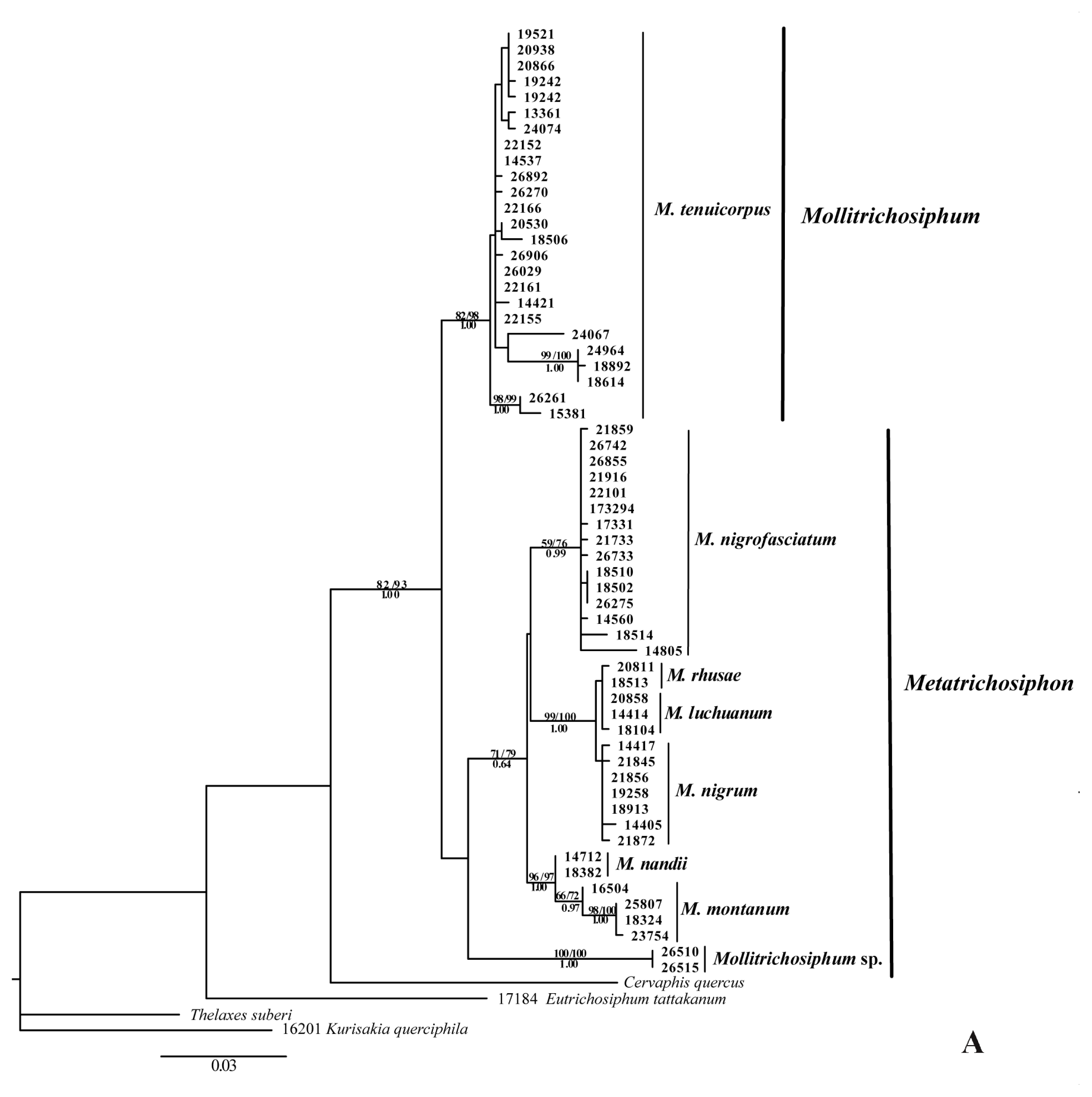
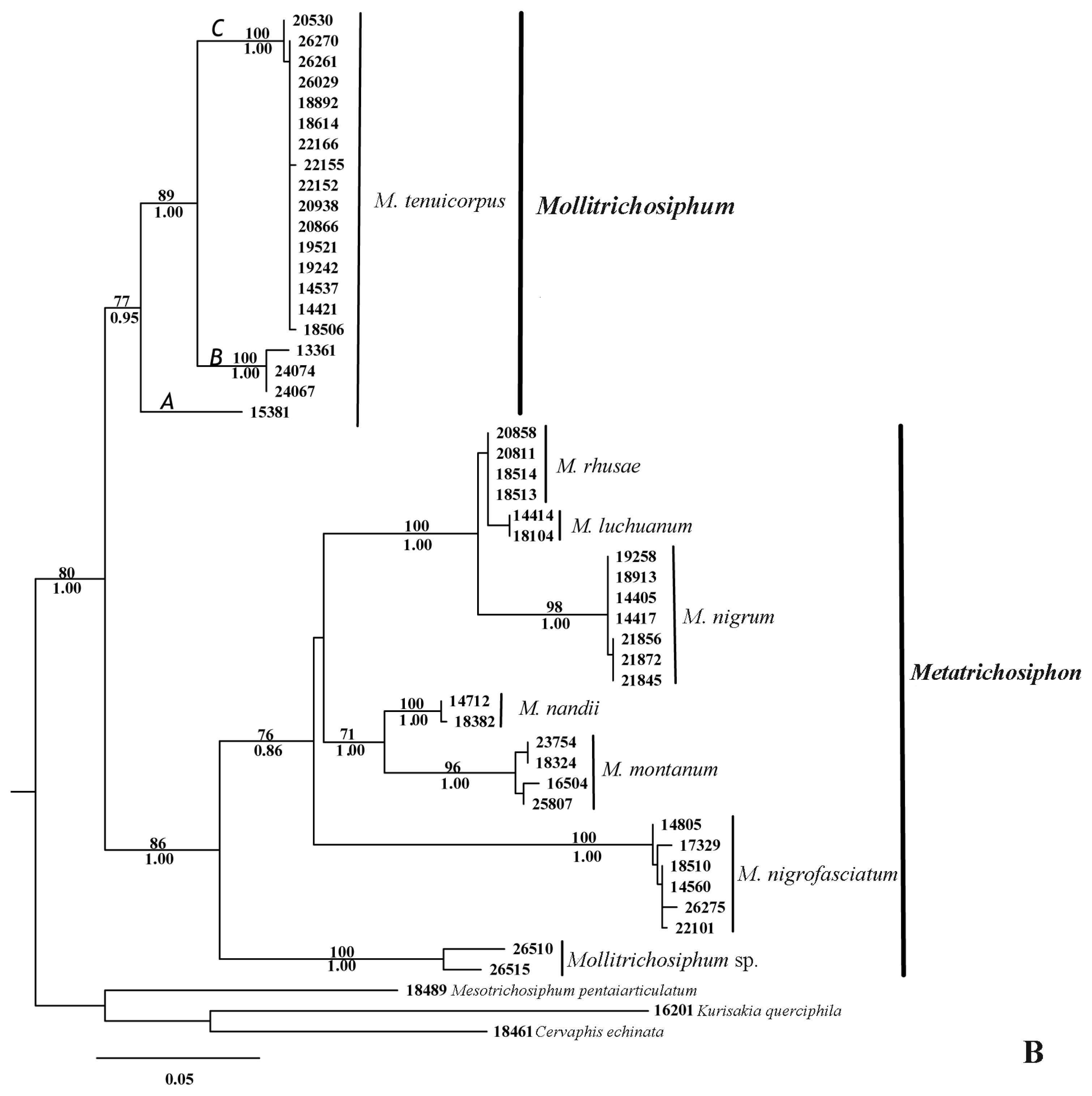
<p>We used mitochondrial gene COI, Cytb, and nuclear gene EF-1α to reconstruct the phylogenetic relationships of <italic>Mollitrichosiphum</italic>. All sequences were submitted to GenBank (see <xref ref-type="table" rid="t2-ijms-13-10441">Table 2</xref> for accession numbers). The detailed characters of the individual sequences and the combined dataset are listed in <xref ref-type="table" rid="t3-ijms-13-10441">Table 3</xref>. The monophyly of the sampled <italic>Mollitrichosiphum</italic> species was supported by all phylogenetic analyses. The results based on the combined dataset of COI and Cytb were similar to that of a previous study [<xref ref-type="bibr" rid="b30-ijms-13-10441">30</xref>] (data not shown here). Phylogenetic trees based on EF-1α sequences and the combined dataset of the EF-1α and mitochondrial genes are shown in <xref ref-type="fig" rid="f1-ijms-13-10441">Figure 1</xref>. In the phylogenetic analyses based on the EF-1α gene, four representatives of Thelaxinae, Cervaphidini and Greenideini were used to root the trees. Maximum parsimony (MP), maximum likelihood (ML) and Bayesian (BI) analyses yielded congruent trees, and the tree obtained from the ML analysis is shown (<xref ref-type="fig" rid="f1-ijms-13-10441">Figure 1A</xref>). The monophyly of the genus <italic>Mollitichosiphum</italic> was highly supported (MP/ML/BI: 82/93/1.00). Three samples of Greenideini, Cervaphidini and Thelaxinae were used as outgroups in the Bayesian and ML analyses of the combined dataset. The combined dataset also supported the monophyly of this genus (ML/BI: 80/1.00) and of most species (<xref ref-type="fig" rid="f1-ijms-13-10441">Figure 1B</xref>). All analyses supported the sister relationship between <italic>M. nandii</italic> and <italic>M. montanum</italic>. Interestingly, the samples of <italic>M. luchuanum</italic> and <italic>M. rhusae</italic> clustered together and formed a paraphyletic clade in the phylogenetic tree based on the EF-1α, while the two species could be distinguished in the trees based on combined datasets of the two mitochondrial genes as well as the total three genes. Moreover, the position of <italic>M. nigrum</italic> as a sister clade of <italic>M. luchuanum</italic> and <italic>M. rhusae</italic> is well-supported by all analyses. The basal position of <italic>Mollitrichosiphum</italic> sp. in the subgenus <italic>Metatrichosiphon</italic> is well-supported in the combined dataset, although the supports were lower than 50% with the EF-1α gene. The phylogenetic relationships of <italic>M. nigrofasciatum</italic> with other species are uncertain. In the EF-1α tree, <italic>M. nigrofasciatum</italic> grouped together with <italic>M. nigrum</italic>, <italic>M. rhusae</italic> and <italic>M. luchuanum</italic> (bootstrap values and posterior probabilities were all lower than 50%), and based on the combined dataset, this species forms a sister clade with <italic>M. nigrum</italic>, <italic>M. rhusae</italic>, <italic>M. luchuanum</italic>, <italic>M. montanum</italic> and <italic>M. nandii</italic> (ML/BI: 76/0.86). In the phylogenetic analyses based on the combined dataset, the samples of <italic>M. tenuicorpus</italic> were subdivided into three major clades (<xref ref-type="fig" rid="f1-ijms-13-10441">Figure 1B</xref>), which was also supported by the results obtained with EF-1α to some extent (<xref ref-type="fig" rid="f1-ijms-13-10441">Figure 1A</xref>).</p></sec>
<sec>
<title>2.1.2. Divergence Time and Geographical Distribution</title>
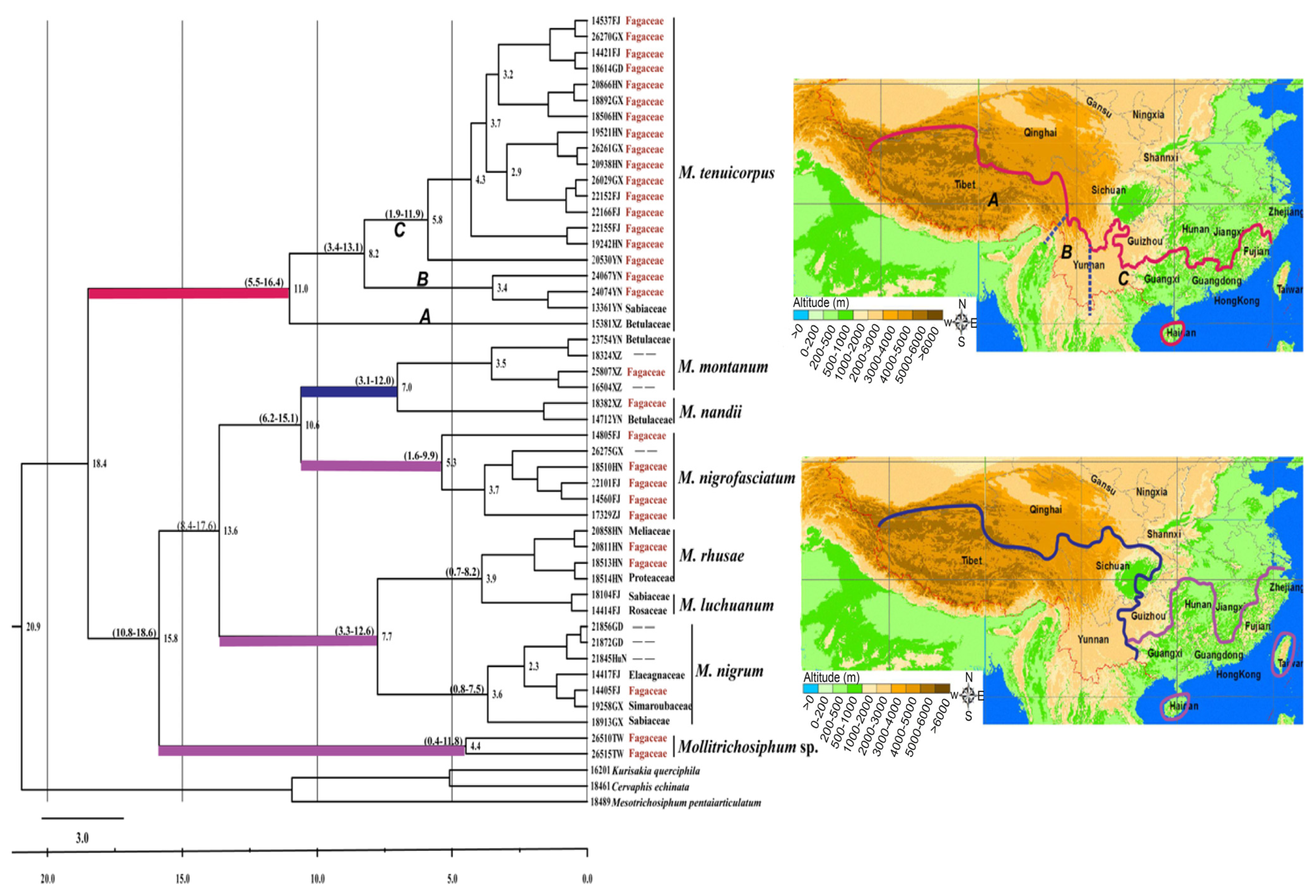
<p>The divergence times were estimated based on the mitochondrial and nuclear data separately, and the mean age estimates of most nodes were largely consistent. The molecular dating results indicate that clade A within <italic>M. tenuicorpus</italic> diverged at approximately 11.0 mya (95% Highest Posterior Density, HPD: 5.5–16.4 mya) (<xref ref-type="fig" rid="f2-ijms-13-10441">Figure 2</xref>), while clades B and C diverged at 8.2 mya (HPD: 3.7–13.1 mya). The ancestors of <italic>Mollitrichosiphum</italic> sp. and the other species of subgenus <italic>Metatrichosiphon</italic> diverged at approximately 15.8 mya (HPD: 10.8–18.6 mya). The most recent common ancestors (MRCAs) of the other six species were 13.6 mya (HPD: 8.4–17.6 mya). Divergence among the individuals of six species (<italic>M. rhusae</italic>, <italic>M. nigrum</italic>, <italic>M. nandii</italic>, <italic>M. luchuanum</italic>, <italic>M. nigrofasciatum</italic> and <italic>M. montanum</italic>) were between 10.6 mya (HPD: 6.2–15.1 mya) and 3.9 mya (HPD: 0.7–8.2 mya), with <italic>M. nigrofasciatum</italic> exhibiting the earliest within species divergence (5.3 mya), and MRCAs of <italic>M. montanum</italic> and <italic>M. nandii</italic> was estimated at 7.0 mya (HPD: 3.1–12.0 mya). <italic>M. tenuicorpus</italic> widespread from northeastern India, southern China, Thailand, Indonesia, Japan and Korea (<xref ref-type="supplementary-material" rid="s1-ijms-13-10441">Table S1</xref>); ranges of other seven species appear to be constrained. <italic>M. montanum</italic> and <italic>M. nandii</italic> are distributed on the south edge of the QTP and Hengduan Moutians; <italic>M. luchuanum</italic>, <italic>M. nigrum</italic>, <italic>M. nigrofasciatum</italic>, <italic>M. rhusae</italic> and <italic>Mollitrichosiphum</italic> sp. are limited to southeastern China. Among them, <italic>M. rhusae</italic> and <italic>Mollitrichosiphum</italic> sp. are distributed in the Hainan and Taiwan islands, respectively. Distributions of these species were mapped roughly in <xref ref-type="fig" rid="f2-ijms-13-10441">Figure 2</xref>.</p></sec>
<sec>
<title>2.1.3. Ancestral State Reconstruction</title>
<p>According to collection records of specimens and published reliable literature [<xref ref-type="bibr" rid="b25-ijms-13-10441">25</xref>,<xref ref-type="bibr" rid="b27-ijms-13-10441">27</xref>,<xref ref-type="bibr" rid="b31-ijms-13-10441">31</xref>], we summarized host plants of other 18 species in <italic>Mollitrichosiphum</italic>. Except for the host plant of <italic>M. kazirangi</italic> still unknown, the hosts of all other species related to 14 families were listed in <xref ref-type="table" rid="t1-ijms-13-10441">Table 1</xref>. Host plants of <italic>Metatrichosiphon</italic> have high diversity, referring to all 14 families mentioned above. While in the subgenus <italic>Mollitrichosiphum</italic>, three species are all restricted on Fagaceae and just a few samples of widespread species, <italic>M. tenuicorpus</italic> feed on plants of Betulaceae and Sabiaceae.</p>
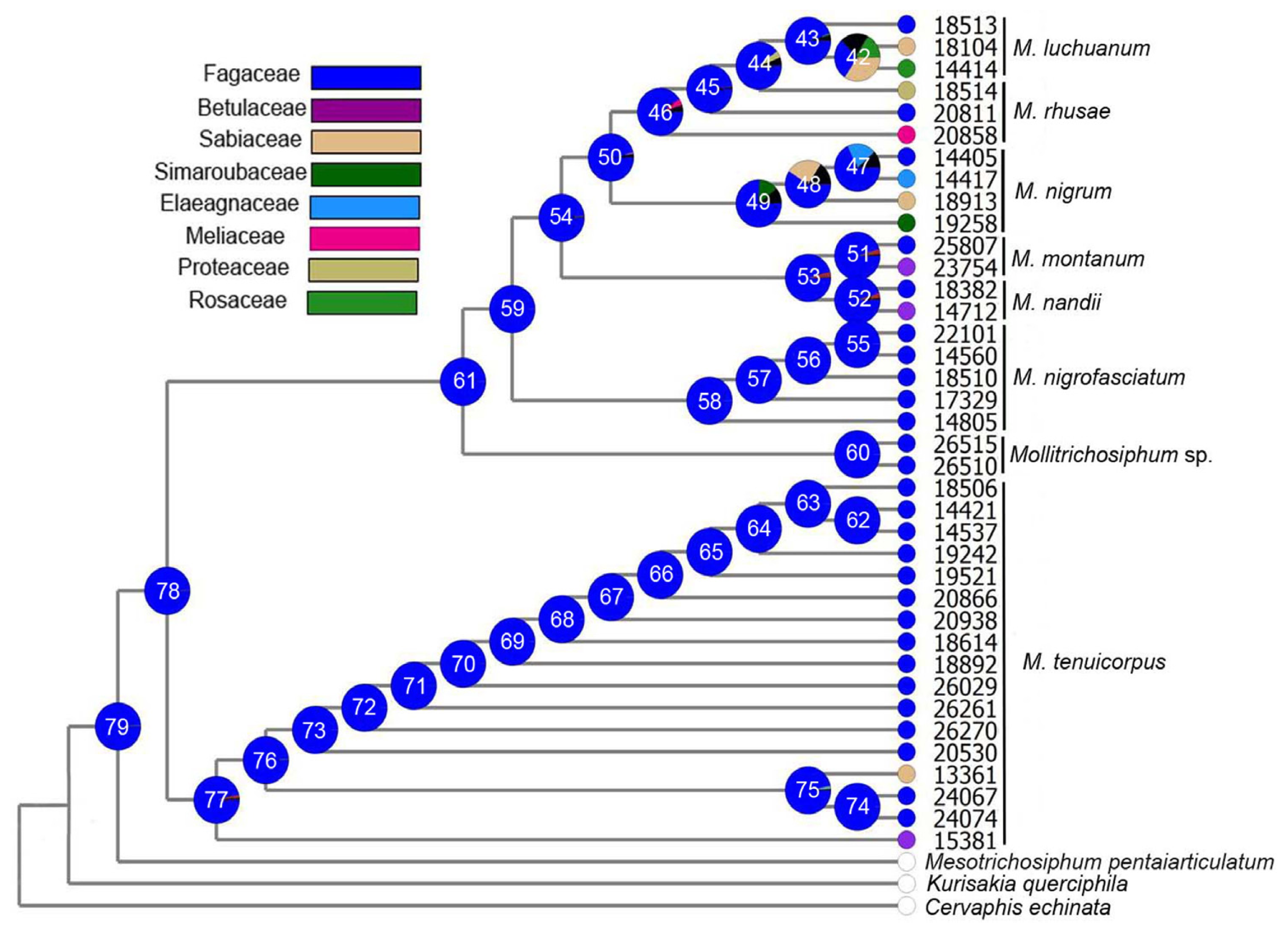
<p>The results of ancestral state reconstruction suggest that Fagaceae was highly favored among all host plants. Node 61 and 77 (<xref ref-type="fig" rid="f3-ijms-13-10441">Figure 3</xref>), which are the MRCAs of the subgenus <italic>Metatrichosiphon</italic> and <italic>Mollitrichosiphum</italic>, showed high proportion of Fagaceae, 0.99 and 0.97, respectively; thereby the common ancestor of <italic>Mollitrichosiphum</italic> (node 78, 0.99) feeds on Fagaceae received strong support.</p></sec></sec>
<sec sec-type="discussion">
<title>2.2. Discussion</title>
<sec>
<title>2.2.1. Phylogenetic Relationships</title>
<p>The monophyly of the genus <italic>Mollitrichosiphum</italic> was supported by phylogenetic analyses based on different approaches and genes (<xref ref-type="fig" rid="f1-ijms-13-10441">Figure 1</xref>). The phylogenetic trees of the combined dataset supported the division of the two subgenera (<italic>Mollitrichosiphum</italic> and <italic>Metatrichosiphon</italic>) based on morphological characters [<xref ref-type="bibr" rid="b24-ijms-13-10441">24</xref>,<xref ref-type="bibr" rid="b25-ijms-13-10441">25</xref>]. The molecular phylogenetic relationships between the species were also supported by morphological characters, such as the ultimate rostral segments of <italic>M. luchuanum</italic>, <italic>M. rhusae</italic> and <italic>M. nigrum</italic>, which are at least twice the length of the second hind tarsal segment, while the ultimate rostral segment of <italic>M. nandii</italic> and <italic>M. montanum</italic> are not more than twice the length of the second hind tarsal segment.</p>
<p>The phylogenetic placement of <italic>M. nigrofasciatum</italic> with respect to the other species remains undetermined, as the results based on different datasets were inconclusive. A possible explanation for the incongruent patterns of <italic>M. nigrofasciatum</italic> is incomplete lineage sorting during successive speciation events. However, more data and further study are needed to verify the real reasons that contribute to these results. Thus, additional markers are required for future studies to reveal the position of <italic>M. nigrofasciatum</italic>. Analysis of the EF-1α gene yielded a paraphyletic clade that included <italic>M. luchuanum</italic> and <italic>M. rhusae</italic>, while the combined datasets resulted in independent clades of the two species. This finding may be explained by the differential effectiveness of the genes. The nuclear EF-1α gene is usually used as a marker to investigate the phylogenetic relationship of aphids above the genus level, due to its slow rate of evolution, whereas the mitochondrial genes are more suitable for revealing the relationships at intra- and interspecies levels [<xref ref-type="bibr" rid="b32-ijms-13-10441">32</xref>]. <italic>M. luchuanum</italic> and <italic>M. rhusae</italic> may have diverged recently, therefore, only mitochondrial genes may provide phylogenetic signals.</p></sec>
<sec>
<title>2.2.2. Divergence Times and Biogeography</title>
<p>Southern China, which appears to be a center of diversity for <italic>Mollitrichosiphum</italic>, has experienced great topographical and climatic changes during the past million years. Estimated divergence times of this genus provide a reasonable temporal framework to reconstruct historical patterns of species divergence and distribution. Despite a degree of controversy regarding the exact timing of the uplift of the Tibetan Plateau [<xref ref-type="bibr" rid="b33-ijms-13-10441">33</xref>], geological estimates date the period of rapid uplift unequivocally within the Late Tertiary/mid-Miocene [<xref ref-type="bibr" rid="b34-ijms-13-10441">34</xref>], and episodes of uplift probably continued throughout the Late Pliocene (<italic>c</italic>. 3 mya) and into the Quaternary [<xref ref-type="bibr" rid="b5-ijms-13-10441">5</xref>,<xref ref-type="bibr" rid="b35-ijms-13-10441">35</xref>]. Clade A within <italic>M. tenuicorpus</italic> (<xref ref-type="fig" rid="f2-ijms-13-10441">Figure 2</xref>) is only currently distributed throughout the QTP, for which the divergence time was at approximately 11.0 mya, thereby falling within the time frame of the mid-Miocene uplift of the QTP. The clade including <italic>M. nandii</italic> and <italic>M. montanum</italic> was restricted to the Hengduan Mountains, which are located in the southeastern region of the QTP, and diverged from other species at approximately 10.6 mya (HPD: 6.2–15.1 mya). This result indicates that the distribution of these two species was probably also influenced by the uplift of the QTP.</p>
<p>The divergence of clades B and C within <italic>M. tenuicorpus</italic> was estimated at approximately 8.2 mya (<xref ref-type="fig" rid="f2-ijms-13-10441">Figure 2</xref>). These two clades are distributed east or west side of the Lancang River [<xref ref-type="bibr" rid="b30-ijms-13-10441">30</xref>], which concurs with the long-held notion that the “Mekong-Salween Divide” (MSD) acted as a significant historical and geographical barrier to species dispersal [<xref ref-type="bibr" rid="b18-ijms-13-10441">18</xref>,<xref ref-type="bibr" rid="b36-ijms-13-10441">36</xref>,<xref ref-type="bibr" rid="b37-ijms-13-10441">37</xref>]. The rivers located at the southeast margin of the Tibetan Plateau, the Dadu River, Mekong (Lancang River), Salween (Nu River), and Tsangpo-Brahmaputra (Yalu-Tsangpo River), were once tributaries of a single southward flowing river system, the Paleo-Honghe (Red River). The uplift of the Tibetan Plateau dramatically changed the characteristics of the major river drainages [<xref ref-type="bibr" rid="b38-ijms-13-10441">38</xref>]. Time scales of formation of the MSD have rarely been estimated [<xref ref-type="bibr" rid="b18-ijms-13-10441">18</xref>], thereby providing little insight into whether there is a direct link between the divergence of the B and C clades with the formation of the MSD. However, these historical events may have isolated the populations of <italic>M. tenuicorpus</italic> and stimulated differentiation among the populations.</p>
<p><italic>M. rhusae</italic> and <italic>Mollitrichosiphum</italic> sp. are restrictedly distributed in the Hainan Island and Taiwan Island, respectively. The MRCAs of these two species are estimated at approximately 3.9 mya and 15.8 mya, respectively. Based on the results of geological studies, Hainan Island was first separated from the mainland of China during the Early Pleistocene (<italic>c</italic>. 2 mya) [<xref ref-type="bibr" rid="b7-ijms-13-10441">7</xref>], and Taiwan Island was separated approximately 5 mya [<xref ref-type="bibr" rid="b39-ijms-13-10441">39</xref>]. The divergence times show that the MRCAs of <italic>M. rhusae</italic> and <italic>Mollitrichosiphum</italic> sp. originated much earlier than the separation of the two islands. These results indicate that the geographical isolation of the two islands was probably not the primary factor triggering the differentiation of the two species. However, the isolation may have limited the subsequent species dispersal between the islands and mainland and thereby promoted the present distribution pattern. Although both islands were connected to the mainland when the sea level retreated during the Pleistocene, it has been suggested that the flora covering the emerged areas during the glaciations were poorly developed [<xref ref-type="bibr" rid="b40-ijms-13-10441">40</xref>] and not suitable for aphid species dependent on woody host plants.</p>
<p>Fossils of <italic>Mollitrichosiphum</italic> have been found exclusively in Europe, while all extant species of this genus are currently restricted to Southeast Asia [<xref ref-type="bibr" rid="b25-ijms-13-10441">25</xref>,<xref ref-type="bibr" rid="b41-ijms-13-10441">41</xref>]. Peñalver <italic>et al</italic>. [<xref ref-type="bibr" rid="b42-ijms-13-10441">42</xref>] demonstrated that the geographic ranges of Greenideinae were markedly wider during the Miocene and comprised the northern coasts of the Tethys Sea. During the Lower and Middle Miocene, the southern region of Europe was characterized by a hot subtropical climate. The terrestrial plant communities of Europe were dominated by needle-leaved forests, Cupressaceae species, and some broadleaf forest species [<xref ref-type="bibr" rid="b41-ijms-13-10441">41</xref>]. Later geological events, such as the uplift of the Tibetan Plateau, affected both the climatic conditions of southern Europe and the composition of the flora [<xref ref-type="bibr" rid="b43-ijms-13-10441">43</xref>]. During this period, a suitable climate and host plants for <italic>Mollitrichosiphum</italic> disappeared [<xref ref-type="bibr" rid="b44-ijms-13-10441">44</xref>,<xref ref-type="bibr" rid="b45-ijms-13-10441">45</xref>]. However, the climate in Southeast Asia remained unchanged. This may have determined the current distribution pattern of <italic>Mollitrichosiphum</italic> in southeastern Asia, including southern China.</p></sec>
<sec>
<title>2.2.3. Species Differentiation of Chinese <italic>Mollitrichosiphum</italic></title>
<p>Speciation processes are generally driven by the advent of barriers to gene flow between interbreeding populations [<xref ref-type="bibr" rid="b46-ijms-13-10441">46</xref>,<xref ref-type="bibr" rid="b47-ijms-13-10441">47</xref>]. The life history of many phytophagous insects often depends on specific host plants. Differences in host plant preference can result in reproductive isolation [<xref ref-type="bibr" rid="b48-ijms-13-10441">48</xref>]. For example, studies of the pea aphid <italic>Acyrthosiphon pisum</italic> demonstrated that species differentiation occurred among different populations that fed on pea, clover and alfalfa [<xref ref-type="bibr" rid="b49-ijms-13-10441">49</xref>,<xref ref-type="bibr" rid="b50-ijms-13-10441">50</xref>].</p>
<p>Phylogenetic analyses show that <italic>Mollitrichosiphum</italic> sp. and <italic>M. nigrofasciatum</italic> are two basal clades in the subgenus <italic>Metatrichosiphon</italic>; together with <italic>M. tenuicorpus</italic>, these three species mainly feed on Fagaceae. The divergence times of these species were 15.8 mya, 10.6 mya and 18.4 mya, respectively (<xref ref-type="fig" rid="f2-ijms-13-10441">Figure 2</xref>), which are much earlier than the other species. In contrast, the host plants of a younger clade (with an age of 7.7 mya) including <italic>M. nigrum</italic>, <italic>M. rhusae</italic> and <italic>M. luchuanum</italic> are distinct (<xref ref-type="table" rid="t1-ijms-13-10441">Table 1</xref>), and each of the three aphid species has hosts belonging to at least two plant families. Similarly, the sister species <italic>M. nandii</italic> and <italic>M. montanum</italic> with divergence times of 3.5 mya and 1.5 mya, are associated with host plants belonging to three and four families, respectively. It seems that these species have acquired a wider range of host plants during their evolutionary history.</p>
<p>The phylogenetic pattern of host association shows that basal species much more exclusively feed on Fagaceae, which is a common host plant for most species. Results of ancestral state reconstruction also supported the fact that Fagaceae may be the ancestral host plant of <italic>Mollitrichosiphum</italic>. Notably for the subgenus <italic>Metatrichosiphon</italic>, the acquisition of new hosts and the expansion of the host range might be the main factor driving species differentiation. Of the species in the subgenus <italic>Mollitrichosiphum</italic>, <italic>M. tenuicorpus</italic> is widely distributed in Southeast Asia and southern China, while the other three species are restrictedly distributed in Nepal, the northeastern region of India (Sikkim), and the southern edge of the QTP [<xref ref-type="bibr" rid="b25-ijms-13-10441">25</xref>,<xref ref-type="bibr" rid="b27-ijms-13-10441">27</xref>,<xref ref-type="bibr" rid="b31-ijms-13-10441">31</xref>]. The divergence of the three clades within <italic>M. tenuicorpus</italic> (<xref ref-type="fig" rid="f2-ijms-13-10441">Figure 2</xref>) may be due to the combined effects of geographical isolation (as discussed above) and the differentiation of host plants (clade A on Betulaceae, clade B on Sabiaceae and Fagaceae, and clade C on Fagaceae). However, it seems that geographical isolation probably represents the key factor promoting the species divergence of the subgenus <italic>Mollitrichosiphum</italic>.</p></sec></sec></sec>
<sec>
<title>3. Experimental Section</title>
<sec>
<title>3.1. Taxa Sampling</title>
<p>We sampled the Chinese <italic>Mollitrichosiphum</italic> species except for four species with very restricted distributions (<italic>M. glaucae</italic>, Hong Kong; <italic>M. niitakaensis</italic>, and <italic>M. taiwanum</italic>, Taiwan; <italic>M. yamabiwae</italic>, Taiwan, Hong Kong and Fujian). <italic>Mollitrichosiphum</italic> sp. is an undescribed species found in Taiwan Island (unpublished data), and can be distinguished from all other species of <italic>Mollitrichosiphum</italic> by an enlarged distal half of siphunculi. Specimens for slide-mounting were stored in 75% ethanol for morphological examination. Samples for molecular experiments were stored in 95% ethanol. All the samples were preserved at −30 °C. On the basis of current knowledge of the phylogenetic relationships within Aphididae [<xref ref-type="bibr" rid="b51-ijms-13-10441">51</xref>,<xref ref-type="bibr" rid="b52-ijms-13-10441">52</xref>], outgroups were chosen from <italic>Cervaphis</italic> van der Goot (Cervaphidini), <italic>Eutrichosiphum</italic> Essig &amp; Kuwana (Greenideini), <italic>Greenidea</italic> Schouteden (Greenideini) and <italic>Kurisakia</italic> Takahashi (Thelaxinae), respectively. All voucher specimens were deposited in the National Zoological Museum of China (NZMC), Institute of Zoology, Chinese Academy of Sciences (Beijing). Collection information for all samples, including collection localities, host plants and collection dates are listed in <xref ref-type="table" rid="t2-ijms-13-10441">Table 2</xref>.</p></sec>
<sec>
<title>3.2. DNA Extraction, PCR and Sequencing</title>
<p>CTAB DNA isolation technique [<xref ref-type="bibr" rid="b53-ijms-13-10441">53</xref>] was used to extract genomic DNA. A 700 bp fragment of COI was amplified using primers LepF (5′-ATTCAACCAATCATAAAGATATTGG-3′) and LepR (5′-TAAACTTCTGGATGTCCAAAAAATCA-3′) from Foottit <italic>et al</italic>. [<xref ref-type="bibr" rid="b54-ijms-13-10441">54</xref>]. About 800bp of Cytb was amplified using primers Cp1 (5′-GATGATGAAATTTTGGATC-3′) and Cp2 (5′-CTAATGCAATAACTCCTCC-3′) from Harry <italic>et al</italic>. [<xref ref-type="bibr" rid="b55-ijms-13-10441">55</xref>]. The primers for amplifying EF-1α were EF3 (5′-GAACGTGAACGTGGTATCAC-3′) and EF2 (5′-ATGTGAGCAGTGTGGCAATCCAA-3′) [<xref ref-type="bibr" rid="b56-ijms-13-10441">56</xref>]. PCRs (Polymerase Chain Reaction-amplification) for Cytb was performed in 30 μL reaction volumes: 3 μL 10 × PCR buffer, 2.4 μL dNTPs, 20 μL dd H<sub>2</sub>O, 0.4 unit Taq DNA polymerase (all from TransGen Biotech, Beijing, China) and 0.6 μL 10 μM forward and reverse primers (synthesized by Invitrogen Biotech, Shanghai, China). PCR volumes for COI were the same as that for Cytb, except for 19.4 μL dd H<sub>2</sub>O and 0.8 μM primers. The PCR amplification cycling conditions for COI were as follows: 95 °C for 5 min; 34 cycles including denaturation at 95 °C for 0.5 min, annealing at 52 °C for 0.5 min, and extension at 72 °C for 1 min; followed by 72 °C for 10 min. Thermocycling program for Cytb consisted of 95 °C for 3 min; 35 cycles of 92 °C for 1 min, 48 °C for 1.5 min and 72 °C for 1 min. A final extension step of 10 min at 72 °C was added after cycling. PCR thermal regime for EF-1α was initial denaturation at 95 °C for 4 min, 35 cycles including denaturation at 94 °C for 1 min, annealing at 50 °C for 1 min, and extension at 72 °C for 1.5 min, and final extension at 72 °C for 10 min. Sequencing reactions were performed using the same primers that were used for PCRs using ABI 3730 automated sequencer (Applied Biosystems, Foster City, CA, USA).</p></sec>
<sec>
<title>3.3. Sequence Alignment and Phylogenetic Analyses</title>
<p>The sequences were assembled using Seqman II (DNASTAR) and assessed manually. Multiple alignments were performed using ClustalX 1.81 [<xref ref-type="bibr" rid="b57-ijms-13-10441">57</xref>]. Nucleotide composition, conserved sites, variable sites, and parsimony informative sites were calculated using MEGA 4 [<xref ref-type="bibr" rid="b58-ijms-13-10441">58</xref>]. For the EF-1α gene, we used the coding regions in the phylogenetic analyses. The intronic sequences were removed using the GT-AG rule and by comparing the sequences with the cDNA sequence of <italic>Mollitrichosiphum montanum</italic> (GenBank accession number: DQ493826). The combined dataset of the COI, Cytb and EF-1α genes was evaluated with the partition homogeneity test implemented with PAUP* 4.10b [<xref ref-type="bibr" rid="b59-ijms-13-10441">59</xref>] using random taxon addition (10 replicates), tree bisection-reconnection branch swapping, and heuristic searches with 100 random repartitions of the data.</p>
<p>Phylogenetic analyses were conducted in PAUP* 4.10b and MrBayes 3.1.2 [<xref ref-type="bibr" rid="b60-ijms-13-10441">60</xref>]. Maximum parsimony (MP) analysis was conducted for all datasets independently, EF-1α and the combined datasets of COI + Cytb and COI + Cytb + EF-1α, using a heuristic search with 1000 random sequence repetitions and tree-bisection-reconnection (TBR) branch swapping. Consensus trees (50% majority rule) were obtained if more than one equally maximum parsimonious tree was found. The reliability of the MP trees was tested using the bootstrap approach [<xref ref-type="bibr" rid="b61-ijms-13-10441">61</xref>] with 1000 pseudoreplicates using the heuristic search strategy and 100 random additions of sequences in each pseudoreplicate. Modeltest 3.7 [<xref ref-type="bibr" rid="b62-ijms-13-10441">62</xref>] was used to determine the best-fit nucleotide substitution model for maximum likelihood (ML) analyses. The best models selected according to the Akaike Information Criterion (AIC) [<xref ref-type="bibr" rid="b63-ijms-13-10441">63</xref>] for the combined dataset of mitochondrial genes and EF-1α, the combined mitochondrial dataset, and EF-1α were GTR + I + G, GTR + G and GTR + G, respectively. ML analysis was performed using PHYML [<xref ref-type="bibr" rid="b64-ijms-13-10441">64</xref>], and nodal support among branches was evaluated by bootstrap analysis. Bayesian analysis was performed separately on the EF-1α gene and the combined dataset of three genes using the models selected by Modeltest 3.7. The combined dataset was partitioned into mitochondrial <italic>versus</italic> nuclear sequences and with separate models. Four chains were run starting from a random tree and proceeded for one million Markov chain Monte Carlo generations with tree sampling every 100 generations. Four independent runs were conducted to verify the results. The first 2500 trees (25% of the total) were discarded as burn-in. Next, 50% majority-rule consensus trees were generated from the remaining trees. The examination of the log-likelihood scores and the average standard deviation of the split frequencies suggested that the burn-in periods were long enough for chains to become stationary.</p>
<p>Results of the partition-homogeneity test indicated that nuclear <italic>versus</italic> mitochondrial alignments were incongruent (<italic>P</italic> = 0.01). However, because each gene provided similar tree topology, we still performed phylogenetic analyses based on the combined dataset. For Bayesian analysis, partitions were made for each gene separately using their own parameters derived from Modeltest.</p></sec>
<sec>
<title>3.4. Divergence Time Estimation and Ancestral State Reconstruction</title>
<p>To date, the only fossil species of this genus was <italic>Mollitrichosiphum rubusensis</italic> [<xref ref-type="bibr" rid="b41-ijms-13-10441">41</xref>], which was found in Europe and dates back to 18–19 mya (million years ago). This time was used as a calibration point representing the minimum age of the most recent common ancestors (MRCAs) of this genus in our study. The divergence times among species were estimated using BEAST v1.6.1 [<xref ref-type="bibr" rid="b65-ijms-13-10441">65</xref>] under a relaxed molecular clock and uncorrelated lognormal model. The GTR model of nucleotide substitution with gamma rate heterogeneity among sites and a proportion of invariant sites and Yule speciation process were used.</p>
<p>After determining the optimal parameters over several preliminary runs, multiple analyses were run for 10 million generations, and 25% of samples were removed as burn-in. The results were visualized in Tracer v1.5 [<xref ref-type="bibr" rid="b66-ijms-13-10441">66</xref>], where the stationarity was assessed by ensuring that the Effective Sample Size (ESS) values were high for most parameters. The results proved repeatable over multiple independent runs, and thus a chronogram was reconstructed based on the results from a representative single run and was subsequently visualized using the program Fig Tree v1.3.1 [<xref ref-type="bibr" rid="b67-ijms-13-10441">67</xref>].</p>
<p>Host plants of the genus <italic>Mollitrichosiphum</italic> were reconstructed according to a Bayesian criterion, using RASP 2.0 (Reconstruct Ancestal State in Phylogenies) software to implements Bayesian Binary MCMC (BBM). BBM offers a statistical procedure for inferring states, including geographic distributions, at ancestral nodes using a full hierarchical Bayesian approach [<xref ref-type="bibr" rid="b68-ijms-13-10441">68</xref>]. For reconstruction of the ancestral state of host plants, each possible host plant of the species was coded based on the previous plants they fed on.</p></sec></sec>
<sec sec-type="conclusions">
<title>4. Conclusions</title>
<p>The monophyly of <italic>Mollitrichosiphum</italic> and most inter-species phylogenetic relationships were supported by molecular data as well as morphological characters. The sister relationships of <italic>M. nandii</italic> and <italic>M. montanum</italic>, <italic>M. luchuanum</italic>, <italic>M. rhusae</italic> with <italic>M. nigrum</italic> were supported in all analyses. Based on the divergence times, distribution and host plant information of the species, we speculate that geographical isolation due to the uplift of the Qinghai-Tibetan Plateau and the separation of the Hainan and Taiwan islands, as well as the expansion of host plant range may be the main factors driving differentiation of Chinese <italic>Mollitrichosiphum</italic> species and shaping their current distribution patterns.</p></sec>
<sec sec-type="supplementary-material">
<title>Supplementary Materials</title>
<supplementary-material id="s1-ijms-13-10441" content-type="local-data">
<media xlink:href="ijms-13-10441-s001.pdf" mimetype="application" mime-subtype="pdf"/></supplementary-material></sec></body>
<back>
<ack>
<title>Acknowledgments</title>
<p>We thank Na Zhao, Lin Liu and Zhe Wang for assistance in molecular techniques and data analysis. We are grateful to Dong Zhang, Xingya Wang, Huihong Zhang, Xiaomei Su, Qinghua Liu, Jing Chen, Yan Fang, Hecai Zhang for collecting samples, and to Fendi Yang for preparing aphid slides. The work was supported by the National Natural Sciences Foundation of China (Nos. 31061160186, 30830017, 30900133), National Science Funds for Distinguished Young Scientists (No. 31025024), National Science Fund for Fostering Talents in Basic Research (No. J0930004), a grant (No. O529YX5105) from the Key Laboratory of the Zoological Systematics and Evolution of the Chinese Academy of Sciences, and the Ministry of Science and Technology of the People’s Republic of China (MOST GRANT No. 2011FY120200).</p></ack>
<ref-list>
<title>References</title>
<ref id="b1-ijms-13-10441"><label>1</label><citation citation-type="journal"><person-group person-group-type="author"><name><surname>Myers</surname><given-names>N.</given-names></name><name><surname>Mittermeier</surname><given-names>R.A.</given-names></name><name><surname>Mittermeier</surname><given-names>C.G.</given-names></name><name><surname>Fonseca</surname><given-names>G.A.B.</given-names></name><name><surname>Kent</surname><given-names>J.</given-names></name></person-group><article-title>Biodiversity hotspots for conservation priorities</article-title><source>Nature</source><year>2000</year><volume>403</volume><fpage>854</fpage><lpage>858</lpage></citation></ref>
<ref id="b2-ijms-13-10441"><label>2</label><citation citation-type="book"><person-group person-group-type="author"><name><surname>Shi</surname><given-names>Y.F.</given-names></name><name><surname>Li</surname><given-names>J.J.</given-names></name><name><surname>Li</surname><given-names>B.Y.</given-names></name></person-group><source>Uplift and Environmental Change of Qinghai-Xizang (Tibetan) Plateau in the Late Cenozoic</source><publisher-name>Guangdong Science and Technology Press</publisher-name><publisher-loc>Guangzhou, China</publisher-loc><year>1998</year></citation></ref>
<ref id="b3-ijms-13-10441"><label>3</label><citation citation-type="journal"><person-group person-group-type="author"><name><surname>Shi</surname><given-names>Y.F.</given-names></name><name><surname>Li</surname><given-names>J.J.</given-names></name><name><surname>Li</surname><given-names>B.Y.</given-names></name><name><surname>Yao</surname><given-names>T.D.</given-names></name><name><surname>Wang</surname><given-names>S.M.</given-names></name><name><surname>Li</surname><given-names>S.J.</given-names></name></person-group><article-title>Uplift of the Qinghai-Xizang (Tibetan) Plateau and east Asia environmental change during late cenozoic</article-title><source>J. Geogr. Sci</source><year>1999</year><volume>54</volume><fpage>10</fpage><lpage>21</lpage></citation></ref>
<ref id="b4-ijms-13-10441"><label>4</label><citation citation-type="journal"><person-group person-group-type="author"><name><surname>Li</surname><given-names>B.Y.</given-names></name><name><surname>Pan</surname><given-names>B.T.</given-names></name></person-group><article-title>Progress in paleogeographic study of the Tibetan Plateau</article-title><source>Geogr. Res</source><year>2002</year><volume>21</volume><fpage>62</fpage><lpage>70</lpage></citation></ref>
<ref id="b5-ijms-13-10441"><label>5</label><citation citation-type="journal"><person-group person-group-type="author"><name><surname>Li</surname><given-names>J.J.</given-names></name><name><surname>Wen</surname><given-names>S.X.</given-names></name><name><surname>Zhang</surname><given-names>Q.S.</given-names></name><name><surname>Wang</surname><given-names>F.B.</given-names></name><name><surname>Zheng</surname><given-names>B.X.</given-names></name><name><surname>Li</surname><given-names>B.Y.</given-names></name></person-group><article-title>A discussion on the period, amplitude and type of the uplift of the Qinghai-Xizang Plateau</article-title><source>Sci. Sin</source><year>1979</year><volume>22</volume><fpage>1314</fpage><lpage>1328</lpage></citation></ref>
<ref id="b6-ijms-13-10441"><label>6</label><citation citation-type="journal"><person-group person-group-type="author"><name><surname>Harrison</surname><given-names>T.M.</given-names></name><name><surname>Copeland</surname><given-names>P.</given-names></name><name><surname>Kidd</surname><given-names>W.S.F.</given-names></name><name><surname>Yin</surname><given-names>A.</given-names></name></person-group><article-title>Raising Tibet</article-title><source>Science</source><year>1992</year><volume>255</volume><fpage>1663</fpage><lpage>1670</lpage><pub-id pub-id-type="doi">10.1126/science.255.5052.1663</pub-id><pub-id pub-id-type="pmid">17749419</pub-id></citation></ref>
<ref id="b7-ijms-13-10441"><label>7</label><citation citation-type="book"><person-group person-group-type="author"><name><surname>Zhang</surname><given-names>R.Z.</given-names></name></person-group><source>Zoogeography of China</source><publisher-name>Science Press</publisher-name><publisher-loc>Beijing, China</publisher-loc><year>1999</year></citation></ref>
<ref id="b8-ijms-13-10441"><label>8</label><citation citation-type="book"><person-group person-group-type="author"><name><surname>Cao</surname><given-names>W.X.</given-names></name><name><surname>Chen</surname><given-names>Y.Y.</given-names></name><name><surname>Wu</surname><given-names>Y.F.</given-names></name><name><surname>Zhu</surname><given-names>S.Q.</given-names></name></person-group><article-title>Origin and Evolution of Schizothoracine Fishes in Relation to the Upheaval of the Qinghai-Xizang Plateau</article-title><source>Studies on the Period, Amplitude and Type of the Uplift of the Qinghai-Xizang Plateau</source><person-group person-group-type="editor"><name><surname>Li</surname><given-names>Q.F.</given-names></name></person-group><publisher-name>Science Press</publisher-name><publisher-loc>Beijing, China</publisher-loc><year>1981</year><fpage>118</fpage><lpage>129</lpage></citation></ref>
<ref id="b9-ijms-13-10441"><label>9</label><citation citation-type="book"><person-group person-group-type="author"><name><surname>Huang</surname><given-names>F.S.</given-names></name></person-group><article-title>Promontory of Tibet Plateau and Insect Fauna</article-title><source>Insects of Xizang</source><person-group person-group-type="editor"><name><surname>Chen</surname><given-names>S.X.</given-names></name></person-group><publisher-name>Science Press</publisher-name><publisher-loc>Beijing, China</publisher-loc><year>1981</year><volume>1</volume><fpage>1</fpage><lpage>31</lpage></citation></ref>
<ref id="b10-ijms-13-10441"><label>10</label><citation citation-type="journal"><person-group person-group-type="author"><name><surname>López-Pujol</surname><given-names>J.</given-names></name><name><surname>Zhang</surname><given-names>F.M.</given-names></name><name><surname>Ge</surname><given-names>S.</given-names></name></person-group><article-title>Plant biodiversity in China: Richly varied, endangered, and in need of conservation</article-title><source>Biodivers. Conserv</source><year>2006</year><volume>15</volume><fpage>3983</fpage><lpage>4026</lpage><pub-id pub-id-type="doi">10.1007/s10531-005-3015-2</pub-id></citation></ref>
<ref id="b11-ijms-13-10441"><label>11</label><citation citation-type="journal"><person-group person-group-type="author"><name><surname>Chen</surname><given-names>Y.H.</given-names></name><name><surname>Bi</surname><given-names>J.F.</given-names></name></person-group><article-title>Biogeography and hotspots of amphibian species of China: Implications to reserve selection and conservation</article-title><source>Curr. Sci</source><year>2007</year><volume>92</volume><fpage>480</fpage><lpage>489</lpage></citation></ref>
<ref id="b12-ijms-13-10441"><label>12</label><citation citation-type="journal"><person-group person-group-type="author"><name><surname>Huang</surname><given-names>X.L.</given-names></name><name><surname>Qiao</surname><given-names>G.X.</given-names></name><name><surname>Lei</surname><given-names>F.M.</given-names></name></person-group><article-title>Diversity and distribution of aphids in the Qinghai-Tibetan Plateau-Himalayas</article-title><source>Ecol. Entomol</source><year>2006</year><volume>31</volume><fpage>608</fpage><lpage>615</lpage><pub-id pub-id-type="doi">10.1111/j.1365-2311.2006.00819.x</pub-id></citation></ref>
<ref id="b13-ijms-13-10441"><label>13</label><citation citation-type="journal"><person-group person-group-type="author"><name><surname>Huang</surname><given-names>X.L.</given-names></name><name><surname>Lei</surname><given-names>F.M.</given-names></name><name><surname>Qiao</surname><given-names>G.X.</given-names></name></person-group><article-title>Areas of endemism and patterns of diversity for aphids of the Qinghai-Tibetan Plateau and the Himalayas</article-title><source>J. Biogeogr</source><year>2008</year><volume>35</volume><fpage>230</fpage><lpage>240</lpage></citation></ref>
<ref id="b14-ijms-13-10441"><label>14</label><citation citation-type="journal"><person-group person-group-type="author"><name><surname>Lei</surname><given-names>F.M.</given-names></name><name><surname>Wei</surname><given-names>G.A.</given-names></name><name><surname>Zhao</surname><given-names>H.F.</given-names></name><name><surname>Yin</surname><given-names>Z.H.</given-names></name><name><surname>Lu</surname><given-names>J.L.</given-names></name></person-group><article-title>China subregional avian endemism and biodiversity conservation</article-title><source>Biodivers. Conserv</source><year>2007</year><volume>16</volume><fpage>1119</fpage><lpage>1130</lpage><pub-id pub-id-type="doi">10.1007/s10531-006-9080-3</pub-id></citation></ref>
<ref id="b15-ijms-13-10441"><label>15</label><citation citation-type="journal"><person-group person-group-type="author"><name><surname>Liu</surname><given-names>Z.</given-names></name><name><surname>Huang</surname><given-names>X.L.</given-names></name><name><surname>Jiang</surname><given-names>L.Y.</given-names></name><name><surname>Qiao</surname><given-names>G.X.</given-names></name></person-group><article-title>The species diversity and geographical distribution of aphids in China (Hemiptera, Aphidoidea)</article-title><source>Acta Zootax. Sin</source><year>2009</year><volume>34</volume><fpage>277</fpage><lpage>291</lpage></citation></ref>
<ref id="b16-ijms-13-10441"><label>16</label><citation citation-type="journal"><person-group person-group-type="author"><name><surname>Lu</surname><given-names>L.</given-names></name><name><surname>Fritsch</surname><given-names>P.W.</given-names></name><name><surname>Cruz</surname><given-names>B.C.</given-names></name><name><surname>Wang</surname><given-names>H.</given-names></name><name><surname>Li</surname><given-names>D.Z.</given-names></name></person-group><article-title>Reticulate evolution, cryptic species, and character convergence in the core East Asian clade of <italic>Gaultheria</italic> (Ericaceae)</article-title><source>Mol. Phylogenet. Evol</source><year>2010</year><volume>57</volume><fpage>364</fpage><lpage>379</lpage><pub-id pub-id-type="doi">10.1016/j.ympev.2010.06.002</pub-id><pub-id pub-id-type="pmid">20558306</pub-id></citation></ref>
<ref id="b17-ijms-13-10441"><label>17</label><citation citation-type="journal"><person-group person-group-type="author"><name><surname>Wang</surname><given-names>Y.H.</given-names></name><name><surname>Chen</surname><given-names>J.M.</given-names></name><name><surname>Xu</surname><given-names>C.</given-names></name><name><surname>Liu</surname><given-names>X.</given-names></name><name><surname>Wang</surname><given-names>Q.F.</given-names></name><name><surname>Motley</surname><given-names>T.J.</given-names></name></person-group><article-title>Population genetic structure of an aquatic herb <italic>Batrachium bungei</italic> (Ranuculaceae) in the Hengduan Mountains of China</article-title><source>Aquat. Bot</source><year>2010</year><volume>92</volume><fpage>221</fpage><lpage>225</lpage><pub-id pub-id-type="doi">10.1016/j.aquabot.2009.12.004</pub-id></citation></ref>
<ref id="b18-ijms-13-10441"><label>18</label><citation citation-type="journal"><person-group person-group-type="author"><name><surname>Li</surname><given-names>Y.</given-names></name><name><surname>Zhai</surname><given-names>S.N.</given-names></name><name><surname>Qiu</surname><given-names>Y.X.</given-names></name><name><surname>Guo</surname><given-names>Y.P.</given-names></name><name><surname>Ge</surname><given-names>X.J.</given-names></name><name><surname>Comes</surname><given-names>H.P.</given-names></name></person-group><article-title>Glacial survival east and west of the ‘Mekong-Salween-Divide’ in the Himalaya-Hengduan Mountains region as revealed by AFLP and cpDNA sequence variation in <italic>Sinopodophyllum hexandrum</italic> (Berberidaceae)</article-title><source>Mol. Phylogenet. Evol</source><year>2011</year><volume>59</volume><fpage>412</fpage><lpage>424</lpage><pub-id pub-id-type="doi">10.1016/j.ympev.2011.01.009</pub-id><pub-id pub-id-type="pmid">21296173</pub-id></citation></ref>
<ref id="b19-ijms-13-10441"><label>19</label><citation citation-type="journal"><person-group person-group-type="author"><name><surname>Liu</surname><given-names>Z.J.</given-names></name><name><surname>Ren</surname><given-names>B.P.</given-names></name><name><surname>Wei</surname><given-names>F.W.</given-names></name><name><surname>Long</surname><given-names>Y.C.</given-names></name><name><surname>Hao</surname><given-names>Y.L.</given-names></name><name><surname>Li</surname><given-names>M.</given-names></name></person-group><article-title>Phylogeography and population structure of the Yunnan snub-nosed monkey (<italic>Rhinopithecus bieti</italic>) inferred from mitochondrial control region DNA sequence analyses</article-title><source>Mol. Ecol</source><year>2007</year><volume>16</volume><fpage>3334</fpage><lpage>3349</lpage><pub-id pub-id-type="doi">10.1111/j.1365-294X.2007.03383.x</pub-id><pub-id pub-id-type="pmid">17688537</pub-id></citation></ref>
<ref id="b20-ijms-13-10441"><label>20</label><citation citation-type="journal"><person-group person-group-type="author"><name><surname>Song</surname><given-names>G.</given-names></name><name><surname>Qu</surname><given-names>Y.H.</given-names></name><name><surname>Yin</surname><given-names>Z.H.</given-names></name><name><surname>Li</surname><given-names>S.H.</given-names></name><name><surname>Liu</surname><given-names>N.F.</given-names></name><name><surname>Lei</surname><given-names>F.M.</given-names></name></person-group><article-title>Phylogeography of the <italic>Alcippe morrisonia</italic> (Aves: Timaliidae): Long population history beyond late Pleistocene glaciations</article-title><source>BMC Evol. Biol</source><year>2009</year><volume>9</volume><fpage>143</fpage><pub-id pub-id-type="doi">10.1186/1471-2148-9-143</pub-id><pub-id pub-id-type="pmid">19558699</pub-id></citation></ref>
<ref id="b21-ijms-13-10441"><label>21</label><citation citation-type="journal"><person-group person-group-type="author"><name><surname>Huang</surname><given-names>Z.H.</given-names></name><name><surname>Liu</surname><given-names>N.F.</given-names></name><name><surname>Liang</surname><given-names>W.</given-names></name><name><surname>Zhang</surname><given-names>Y.Y.</given-names></name><name><surname>Liao</surname><given-names>X.J.</given-names></name><name><surname>Ruan</surname><given-names>L.Z.</given-names></name><name><surname>Yang</surname><given-names>Z.S.</given-names></name></person-group><article-title>Phylogeography of Chinese bamboo partridge, <italic>Bambusicola thoracica thoracica</italic> (Aves: Galliformes) in south China: Inference from mitochondrial DNA control-region <italic>se</italic>quences</article-title><source>Mol. Phylogenet. Evol</source><year>2010</year><volume>56</volume><fpage>273</fpage><lpage>280</lpage><pub-id pub-id-type="doi">10.1016/j.ympev.2010.01.028</pub-id><pub-id pub-id-type="pmid">20132900</pub-id></citation></ref>
<ref id="b22-ijms-13-10441"><label>22</label><citation citation-type="journal"><person-group person-group-type="author"><name><surname>Gao</surname><given-names>B.</given-names></name><name><surname>Yu</surname><given-names>L.J.</given-names></name><name><surname>Qu</surname><given-names>Y.H.</given-names></name><name><surname>Song</surname><given-names>G.</given-names></name><name><surname>Dai</surname><given-names>C.Y.</given-names></name><name><surname>Zhang</surname><given-names>R.Y.</given-names></name><name><surname>Yin</surname><given-names>Z.H.</given-names></name><name><surname>Wang</surname><given-names>K.F.</given-names></name><name><surname>Gao</surname><given-names>X.B.</given-names></name><name><surname>Li</surname><given-names>S.H.</given-names></name><etal/></person-group><article-title>An unstructured phylogeographic pattern with extensive gene flow in an endemic bird of South China: Collared finchbill (<italic>Spizixos semitorques</italic>)</article-title><source>Int. J. Mol. Sci</source><year>2011</year><volume>12</volume><fpage>3635</fpage><lpage>3647</lpage><pub-id pub-id-type="doi">10.3390/ijms12063635</pub-id><pub-id pub-id-type="pmid">21747699</pub-id></citation></ref>
<ref id="b23-ijms-13-10441"><label>23</label><citation citation-type="journal"><person-group person-group-type="author"><name><surname>Che</surname><given-names>J.</given-names></name><name><surname>Zhou</surname><given-names>W.W.</given-names></name><name><surname>Hu</surname><given-names>J.S.</given-names></name><name><surname>Yan</surname><given-names>F.</given-names></name><name><surname>Papenfuss</surname><given-names>T.J.</given-names></name><name><surname>Wake</surname><given-names>D.B.</given-names></name><name><surname>Zhang</surname><given-names>Y.P.</given-names></name></person-group><article-title>Spiny frogs (Paini) illuminate the history of the Himalayan region and Southeast Asia</article-title><source>Proc. Natl. Acad. Sci. USA</source><year>2010</year><volume>31</volume><fpage>13765</fpage><lpage>13770</lpage></citation></ref>
<ref id="b24-ijms-13-10441"><label>24</label><citation citation-type="book"><person-group person-group-type="author"><name><surname>Remaudière</surname><given-names>G.</given-names></name><name><surname>Remaudiėr</surname><given-names>M</given-names></name></person-group><article-title>Catalogue of the World’s Aphididae</article-title><source>Homoptera Aphidoidea</source><publisher-name>Institut National de la Recherche Agronomique</publisher-name><publisher-loc>Paris, France</publisher-loc><year>1997</year><fpage>1</fpage><lpage>475</lpage></citation></ref>
<ref id="b25-ijms-13-10441"><label>25</label><citation citation-type="journal"><person-group person-group-type="author"><name><surname>Zhang</surname><given-names>D.</given-names></name><name><surname>Qiao</surname><given-names>G.X.</given-names></name></person-group><article-title><italic>Mollitrichosiphum</italic> Suenaga from China (Hemiptera, Aphididae), with the description of one new species</article-title><source>Zootaxa</source><year>2010</year><volume>2608</volume><fpage>1</fpage><lpage>24</lpage></citation></ref>
<ref id="b26-ijms-13-10441"><label>26</label><citation citation-type="journal"><person-group person-group-type="author"><name><surname>Zhang</surname><given-names>G.X.</given-names></name><name><surname>Zhong</surname><given-names>T.S.</given-names></name></person-group><article-title>Homoptera: Aphidinea</article-title><source>Economic Insect Fauna of China</source><publisher-name>Science Press</publisher-name><publisher-loc>Beijing, China</publisher-loc><year>1983</year><volume>Part I</volume><fpage>123</fpage><lpage>135</lpage></citation></ref>
<ref id="b27-ijms-13-10441"><label>27</label><citation citation-type="journal"><person-group person-group-type="author"><name><surname>Noordam</surname><given-names>D.</given-names></name></person-group><article-title>Greenideinae from Java (Homoptera, Aphididae)</article-title><source>Zool. Verh</source><year>1994</year><volume>296</volume><fpage>1</fpage><lpage>284</lpage></citation></ref>
<ref id="b28-ijms-13-10441"><label>28</label><citation citation-type="book"><person-group person-group-type="author"><name><surname>Tao</surname><given-names>C.C.</given-names></name></person-group><source>Aphid Fauna of Taiwan Province, China</source><publisher-name>Taiwan Provincial Museum</publisher-name><publisher-loc>Taipei, Taiwan</publisher-loc><year>1990</year></citation></ref>
<ref id="b29-ijms-13-10441"><label>29</label><citation citation-type="book"><person-group person-group-type="author"><name><surname>Tao</surname><given-names>C.C.</given-names></name></person-group><source>List of Aphidoidea (Homoptera) of China</source><publisher-name>Taiwan Agricultural Research Institute</publisher-name><publisher-loc>Taipei, Taiwan</publisher-loc><year>1999</year></citation></ref>
<ref id="b30-ijms-13-10441"><label>30</label><citation citation-type="journal"><person-group person-group-type="author"><name><surname>Zhang</surname><given-names>R.L.</given-names></name><name><surname>Huang</surname><given-names>X.L.</given-names></name><name><surname>Jiang</surname><given-names>L.Y.</given-names></name><name><surname>Qiao</surname><given-names>G.X.</given-names></name></person-group><article-title>Phylogeny and species differentiation of <italic>Mollitrichosiphum</italic> (Aphididae, Greenideinae) based on mitochondrial COI and Cytb genes</article-title><source>Curr. Zool</source><year>2011</year><volume>57</volume><fpage>806</fpage><lpage>815</lpage></citation></ref>
<ref id="b31-ijms-13-10441"><label>31</label><citation citation-type="journal"><person-group person-group-type="author"><name><surname>Ghosh</surname><given-names>A.K.</given-names></name><name><surname>Agarwala</surname><given-names>B.K.</given-names></name></person-group><article-title>Subfamily: Greenideinae</article-title><source>The Fauna of India and the Adjacent Countries: Homoptera, Aphidoidea</source><publisher-name>Zoological survey of India</publisher-name><publisher-loc>Calcutta, India</publisher-loc><year>1993</year><volume>Part 6</volume></citation></ref>
<ref id="b32-ijms-13-10441"><label>32</label><citation citation-type="journal"><person-group person-group-type="author"><name><surname>Zhang</surname><given-names>H.C.</given-names></name><name><surname>Qiao</surname><given-names>G.X.</given-names></name></person-group><article-title>Application of gene sequences in molecular phylogenetic study on Aphididae (Hemiptera)</article-title><source>Acta Entomol. Sin</source><year>2006</year><volume>49</volume><fpage>521</fpage><lpage>527</lpage></citation></ref>
<ref id="b33-ijms-13-10441"><label>33</label><citation citation-type="journal"><person-group person-group-type="author"><name><surname>Spicer</surname><given-names>R.A.</given-names></name><name><surname>Harris</surname><given-names>N.B.W.</given-names></name><name><surname>Widdowson</surname><given-names>M.</given-names></name><name><surname>Herman</surname><given-names>A.B.</given-names></name><name><surname>Guo</surname><given-names>S.</given-names></name><name><surname>Valdes</surname><given-names>P.J.</given-names></name><name><surname>Wolfe</surname><given-names>J.A.</given-names></name><name><surname>Kelley</surname><given-names>S.P.</given-names></name></person-group><article-title>Constant elevation of southern Tibet over the past 15 million years</article-title><source>Nature</source><year>2003</year><volume>421</volume><fpage>622</fpage><lpage>624</lpage><pub-id pub-id-type="doi">10.1038/nature01356</pub-id><pub-id pub-id-type="pmid">12571593</pub-id></citation></ref>
<ref id="b34-ijms-13-10441"><label>34</label><citation citation-type="journal"><person-group person-group-type="author"><name><surname>Royden</surname><given-names>L.H.</given-names></name><name><surname>Burchfiel</surname><given-names>B.C.</given-names></name><name><surname>van der Hilst</surname><given-names>R.D.</given-names></name></person-group><article-title>The geological evolution of the Tibetan Plateau</article-title><source>Science</source><year>2008</year><volume>321</volume><fpage>1054</fpage><lpage>1058</lpage><pub-id pub-id-type="doi">10.1126/science.1155371</pub-id><pub-id pub-id-type="pmid">18719275</pub-id></citation></ref>
<ref id="b35-ijms-13-10441"><label>35</label><citation citation-type="journal"><person-group person-group-type="author"><name><surname>Zhou</surname><given-names>S.Z.</given-names></name><name><surname>Wang</surname><given-names>X.L.</given-names></name><name><surname>Wang</surname><given-names>J.</given-names></name><name><surname>Xu</surname><given-names>L.B.</given-names></name></person-group><article-title>A preliminary study on timing of the oldest Pleistocene glaciation in Qinghai-Tibetan Plateau</article-title><source>Quat. Int</source><year>2006</year><volume>155</volume><fpage>44</fpage><lpage>51</lpage><pub-id pub-id-type="doi">10.1016/j.quaint.2006.02.002</pub-id></citation></ref>
<ref id="b36-ijms-13-10441"><label>36</label><citation citation-type="journal"><person-group person-group-type="author"><name><surname>Peng</surname><given-names>Z.</given-names></name><name><surname>Ho</surname><given-names>S.Y.W.</given-names></name><name><surname>Zhang</surname><given-names>Y.</given-names></name><name><surname>He</surname><given-names>S.</given-names></name></person-group><article-title>Uplift of the Tibetan plateau: Evidence from divergence times of glyptosternoid catfishes</article-title><source>Mol. Phylogenet. Evol</source><year>2006</year><volume>39</volume><fpage>568</fpage><lpage>572</lpage><pub-id pub-id-type="doi">10.1016/j.ympev.2005.10.016</pub-id><pub-id pub-id-type="pmid">16364665</pub-id></citation></ref>
<ref id="b37-ijms-13-10441"><label>37</label><citation citation-type="journal"><person-group person-group-type="author"><name><surname>Ward</surname><given-names>F.K.</given-names></name></person-group><article-title>The Mekong-Salween divide as a geographical barrier</article-title><source>Geogr. J</source><year>1921</year><volume>58</volume><fpage>49</fpage><lpage>56</lpage><pub-id pub-id-type="doi">10.2307/1780720</pub-id></citation></ref>
<ref id="b38-ijms-13-10441"><label>38</label><citation citation-type="journal"><person-group person-group-type="author"><name><surname>Clark</surname><given-names>M.K.</given-names></name><name><surname>Schoenbohm</surname><given-names>L.M.</given-names></name><name><surname>Royden</surname><given-names>L.H.</given-names></name><name><surname>Whipple</surname><given-names>K.X.</given-names></name><name><surname>Burchfiel</surname><given-names>B.C.</given-names></name><name><surname>Zhang</surname><given-names>X.</given-names></name><name><surname>Tang</surname><given-names>W.</given-names></name><name><surname>Wang</surname><given-names>E.</given-names></name><name><surname>Chen</surname><given-names>L.</given-names></name></person-group><article-title>Surface uplift, tectonics, and erosion of eastern Tibet from large-scale drainage patterns</article-title><source>Tectonics</source><year>2004</year><volume>23</volume><fpage>1006</fpage><lpage>1029</lpage></citation></ref>
<ref id="b39-ijms-13-10441"><label>39</label><citation citation-type="book"><person-group person-group-type="author"><name><surname>Hall</surname><given-names>R</given-names></name></person-group><article-title>The Plate Tectonics of Cenozoic SE Asia and the Distribution of Land and Sea</article-title><source>Biogeography and Geological Evolution of SE Asia</source><publisher-name>Backhuys publishers</publisher-name><publisher-loc>Leiden, The Netherlands</publisher-loc><year>1998</year></citation></ref>
<ref id="b40-ijms-13-10441"><label>40</label><citation citation-type="journal"><person-group person-group-type="author"><name><surname>Harrison</surname><given-names>S.P.</given-names></name><name><surname>Yu</surname><given-names>G.</given-names></name><name><surname>Takahara</surname><given-names>H.</given-names></name><name><surname>Prentice</surname><given-names>I.C.</given-names></name></person-group><article-title>Palaeovegetation (communications arising): Diversity of temperate plants in East Asian</article-title><source>Nature</source><year>2001</year><volume>413</volume><fpage>129</fpage><lpage>130</lpage><pub-id pub-id-type="doi">10.1038/35093166</pub-id><pub-id pub-id-type="pmid">11557970</pub-id></citation></ref>
<ref id="b41-ijms-13-10441"><label>41</label><citation citation-type="journal"><person-group person-group-type="author"><name><surname>Wegierek</surname><given-names>P.</given-names></name><name><surname>Peñalver</surname><given-names>E.</given-names></name></person-group><article-title>Fossil representatives of the family Greenideidae (Hemiptera, Aphidoidea) from the Miocene of Europe</article-title><source>Geobios-Lyon</source><year>2002</year><volume>35</volume><fpage>745</fpage><lpage>757</lpage><pub-id pub-id-type="doi">10.1016/S0016-6995(02)00086-4</pub-id></citation></ref>
<ref id="b42-ijms-13-10441"><label>42</label><citation citation-type="book"><person-group person-group-type="author"><name><surname>Penalver</surname><given-names>E.</given-names></name><name><surname>de Santisteban</surname><given-names>C.</given-names></name><name><surname>Barrón</surname><given-names>E</given-names></name></person-group><article-title>Fossil Insects and Palaeobotany of the Rubielos de Mora Basin (Teruel)</article-title><source>The Geological and Paleontological Heritage of Central and Eastern Iberia (Iberian Range, Spain)</source><person-group person-group-type="editor"><name><surname>Meléndez</surname><given-names>G.</given-names></name><name><surname>Soria-Llop</surname><given-names>C.</given-names></name></person-group><publisher-name>Publicaciones del Seminario de Paleontología</publisher-name><publisher-loc>Zaragoza, Spain</publisher-loc><year>1999</year><fpage>95</fpage><lpage>116</lpage></citation></ref>
<ref id="b43-ijms-13-10441"><label>43</label><citation citation-type="book"><person-group person-group-type="author"><name><surname>Van Andel</surname><given-names>T.H.</given-names></name></person-group><source>New Views on an Old Planet: A History of Global Change</source><publisher-name>Cambridge University Press</publisher-name><publisher-loc>Cambridge, UK</publisher-loc><year>1994</year><fpage>166</fpage><lpage>230</lpage></citation></ref>
<ref id="b44-ijms-13-10441"><label>44</label><citation citation-type="confproc"><person-group person-group-type="author"><name><surname>Ghosh</surname><given-names>A.K.</given-names></name></person-group><article-title>Biotaxonomy of Greenideinae (Homoptera: Aphidoidea)</article-title><conf-name>Proceedings of the International Smyposia on Population Structure, Genetics and Taxonomy of Aphids and Thysanoptera</conf-name><conf-loc>Smolenice, Czechoslovakia</conf-loc><conf-date>9–14 September 1985</conf-date></citation><citation citation-type="book"><person-group person-group-type="editor"><name><surname>Holman</surname><given-names>J.</given-names></name><name><surname>Pelikán</surname><given-names>J.</given-names></name><name><surname>Dixon</surname><given-names>A.F.G.</given-names></name><name><surname>Weismann</surname><given-names>L.</given-names></name></person-group><publisher-name>SPB Academic Publisher</publisher-name><publisher-loc>Hague, The Netherlands</publisher-loc><year>1987</year><fpage>273</fpage><lpage>292</lpage></citation></ref>
<ref id="b45-ijms-13-10441"><label>45</label><citation citation-type="book"><person-group person-group-type="author"><name><surname>Blackman</surname><given-names>R.L.</given-names></name><name><surname>Eastop</surname><given-names>V.F.</given-names></name></person-group><article-title>Aphids on the World’s Trees</article-title><source>An Identification and Information Guide</source><publisher-name>CAB International</publisher-name><publisher-loc>Wallingford, CT, USA</publisher-loc><fpage>1994</fpage></citation></ref>
<ref id="b46-ijms-13-10441"><label>46</label><citation citation-type="book"><person-group person-group-type="author"><name><surname>Dobzhansky</surname><given-names>T</given-names></name></person-group><source>Genetics and the Origin of Species</source><publisher-name>Columbia University Press</publisher-name><publisher-loc>New York, NY, USA</publisher-loc><fpage>1937</fpage></citation></ref>
<ref id="b47-ijms-13-10441"><label>47</label><citation citation-type="book"><person-group person-group-type="author"><name><surname>Mayr</surname><given-names>E</given-names></name></person-group><source>Animal Species and Evolution</source><publisher-name>Belknap Press</publisher-name><publisher-loc>Cambridge, UK</publisher-loc><fpage>1963</fpage></citation></ref>
<ref id="b48-ijms-13-10441"><label>48</label><citation citation-type="journal"><person-group person-group-type="author"><name><surname>Funk</surname><given-names>D.J.</given-names></name><name><surname>Nosil</surname><given-names>P.</given-names></name><name><surname>Etges</surname><given-names>W.J.</given-names></name></person-group><article-title>Ecological divergence exhibits consistently positive associations with reproductive isolation across disparate taxa</article-title><source>Proc. Natl. Acad. Sci. USA</source><year>2006</year><volume>103</volume><fpage>3209</fpage><lpage>3213</lpage><pub-id pub-id-type="doi">10.1073/pnas.0508653103</pub-id><pub-id pub-id-type="pmid">16492742</pub-id></citation></ref>
<ref id="b49-ijms-13-10441"><label>49</label><citation citation-type="journal"><person-group person-group-type="author"><name><surname>Peccoud</surname><given-names>J.</given-names></name><name><surname>Ollivier</surname><given-names>A.</given-names></name><name><surname>Plantegenest</surname><given-names>M.</given-names></name><name><surname>Simon</surname><given-names>J.C.</given-names></name></person-group><article-title>A continuum of genetic divergence from sympatric host races to species in the pea aphid complex</article-title><source>Proc. Natl. Acad. Sci. USA</source><year>2009</year><volume>106</volume><fpage>7495</fpage><lpage>7500</lpage><pub-id pub-id-type="doi">10.1073/pnas.0811117106</pub-id><pub-id pub-id-type="pmid">19380742</pub-id></citation></ref>
<ref id="b50-ijms-13-10441"><label>50</label><citation citation-type="journal"><person-group person-group-type="author"><name><surname>Peccoud</surname><given-names>J.</given-names></name><name><surname>Simon</surname><given-names>J.C.</given-names></name><name><surname>McLaughlin</surname><given-names>H.J.</given-names></name><name><surname>Moran</surname><given-names>N.A.</given-names></name></person-group><article-title>Post-Pleistocene radiation of the pea aphid complex revealed by rapidly evolving endosymbionts</article-title><source>Proc. Natl. Acad. Sci. USA</source><year>2009</year><volume>106</volume><fpage>16315</fpage><lpage>16320</lpage><pub-id pub-id-type="doi">10.1073/pnas.0905129106</pub-id><pub-id pub-id-type="pmid">19805299</pub-id></citation></ref>
<ref id="b51-ijms-13-10441"><label>51</label><citation citation-type="book"><person-group person-group-type="author"><name><surname>Heie</surname><given-names>O.E.</given-names></name></person-group><article-title>Paleontology and Phylogeny</article-title><source>Aphids, Their Biology, Natural Enemies, and Control</source><person-group person-group-type="editor"><name><surname>Minks</surname><given-names>A.K.</given-names></name><name><surname>Harrewijn</surname><given-names>P.</given-names></name></person-group><publisher-name>Elsevier</publisher-name><publisher-loc>Amsterdam, The Netherlands</publisher-loc><year>1987</year><volume>2A</volume><fpage>367</fpage><lpage>391</lpage></citation></ref>
<ref id="b52-ijms-13-10441"><label>52</label><citation citation-type="journal"><person-group person-group-type="author"><name><surname>Ortiz-Rivas</surname><given-names>B.</given-names></name><name><surname>Moya</surname><given-names>A.</given-names></name><name><surname>Martinez-Torres</surname><given-names>D.</given-names></name></person-group><article-title>Combination of molecular data support the existence of three main lineages in the phylogeny of aphids (Hemiptera: Aphididae) and the basal position of the subfamily Lachninae</article-title><source>Mol. Phylogenet. Evol</source><year>2010</year><volume>55</volume><fpage>305</fpage><lpage>317</lpage><pub-id pub-id-type="doi">10.1016/j.ympev.2009.12.005</pub-id><pub-id pub-id-type="pmid">20004730</pub-id></citation></ref>
<ref id="b53-ijms-13-10441"><label>53</label><citation citation-type="journal"><person-group person-group-type="author"><name><surname>Vavre</surname><given-names>F.</given-names></name><name><surname>Girin</surname><given-names>C.</given-names></name><name><surname>Boulétreau</surname><given-names>M.</given-names></name></person-group><article-title>Phylogenetic status of a fecundity enhancing Wolbachia that does not induce thelytoky in <italic>Trichogramma</italic></article-title><source>Insect Mol. Biol</source><year>1999</year><volume>8</volume><fpage>67</fpage><lpage>72</lpage><pub-id pub-id-type="doi">10.1046/j.1365-2583.1999.810067.x</pub-id><pub-id pub-id-type="pmid">9927175</pub-id></citation></ref>
<ref id="b54-ijms-13-10441"><label>54</label><citation citation-type="journal"><person-group person-group-type="author"><name><surname>Foottit</surname><given-names>R.G.</given-names></name><name><surname>Maw</surname><given-names>B.L.</given-names></name><name><surname>von Dohlen</surname><given-names>C.D.</given-names></name><name><surname>Hebert</surname><given-names>P.D.N.</given-names></name></person-group><article-title>Species identification of aphids (Insecta: Hemiptera: Aphididae) through DNA barcodes</article-title><source>Mol. Ecol. Resour</source><year>2008</year><volume>8</volume><fpage>1189</fpage><lpage>1201</lpage><pub-id pub-id-type="doi">10.1111/j.1755-0998.2008.02297.x</pub-id><pub-id pub-id-type="pmid">21586006</pub-id></citation></ref>
<ref id="b55-ijms-13-10441"><label>55</label><citation citation-type="journal"><person-group person-group-type="author"><name><surname>Harry</surname><given-names>M.</given-names></name><name><surname>Solignac</surname><given-names>M.</given-names></name><name><surname>Lachaise</surname><given-names>D.</given-names></name></person-group><article-title>Molecular evidence for parallel evolution of adaptive syndromes in fig-breeding <italic>Lissocephala</italic> (Drosophilidae)</article-title><source>Mol. Phylogenet. Evol</source><year>1998</year><volume>9</volume><fpage>542</fpage><lpage>551</lpage><pub-id pub-id-type="doi">10.1006/mpev.1998.0508</pub-id><pub-id pub-id-type="pmid">9668003</pub-id></citation></ref>
<ref id="b56-ijms-13-10441"><label>56</label><citation citation-type="book"><person-group person-group-type="author"><name><surname>Palumbi</surname><given-names>S.R.</given-names></name></person-group><article-title>Nucleic Acids II: The Polymerase Chain Reaction</article-title><source>Molecular Systematics</source><person-group person-group-type="editor"><name><surname>Hillis</surname><given-names>D.M.</given-names></name><name><surname>Moritz</surname><given-names>C.</given-names></name><name><surname>Mable</surname><given-names>B.K.</given-names></name></person-group><publisher-name>Sinauer</publisher-name><publisher-loc>Sunderland, MA, USA</publisher-loc><year>1996</year><fpage>205</fpage><lpage>247</lpage></citation></ref>
<ref id="b57-ijms-13-10441"><label>57</label><citation citation-type="journal"><person-group person-group-type="author"><name><surname>Thompson</surname><given-names>J.D.</given-names></name><name><surname>Gibson</surname><given-names>T.J.</given-names></name><name><surname>Plewniak</surname><given-names>F.</given-names></name><name><surname>Jeanmougin</surname><given-names>F.</given-names></name><name><surname>Higgins</surname><given-names>D.G.</given-names></name></person-group><article-title>The CLUSTAL_X windows interface: Flexible strategies for multiple sequence alignment aided by quality analysis tools</article-title><source>Nucleic Acid. Res</source><year>1997</year><volume>25</volume><fpage>4876</fpage><lpage>4882</lpage><pub-id pub-id-type="doi">10.1093/nar/25.24.4876</pub-id><pub-id pub-id-type="pmid">9396791</pub-id></citation></ref>
<ref id="b58-ijms-13-10441"><label>58</label><citation citation-type="journal"><person-group person-group-type="author"><name><surname>Tamura</surname><given-names>K.</given-names></name><name><surname>Dudley</surname><given-names>J.</given-names></name><name><surname>Nei</surname><given-names>M.</given-names></name><name><surname>Kumar</surname><given-names>S.</given-names></name></person-group><article-title>MEGA 4: Molecular evolutionary genetics analysis (MEGA) software version 4.0</article-title><source>Mol. Biol. Evol</source><year>2007</year><volume>24</volume><fpage>1596</fpage><lpage>1599</lpage><pub-id pub-id-type="doi">10.1093/molbev/msm092</pub-id><pub-id pub-id-type="pmid">17488738</pub-id></citation></ref>
<ref id="b59-ijms-13-10441"><label>59</label><citation citation-type="book"><person-group person-group-type="author"><name><surname>Swofford</surname><given-names>D.L.</given-names></name></person-group><source>PAUP*, version 4.0; Phylogenetic Analysis Using Parsimony (and Other Methods)</source><publisher-name>Sinauer Associates, Inc</publisher-name><publisher-loc>Sunderland, MA, USA</publisher-loc><fpage>2002</fpage></citation></ref>
<ref id="b60-ijms-13-10441"><label>60</label><citation citation-type="book"><person-group person-group-type="author"><name><surname>Ronquist</surname><given-names>F.</given-names></name><name><surname>Huelsenbeck</surname><given-names>J.P.</given-names></name></person-group><article-title>Bayesian Analysis of Molecular Evolution Using MrBayes</article-title><source>Statistical Methods in Molecular Evolution</source><person-group person-group-type="editor"><name><surname>Nielsen</surname><given-names>R.</given-names></name></person-group><publisher-name>Springer</publisher-name><publisher-loc>New York, NY, USA</publisher-loc><year>2005</year><fpage>183</fpage><lpage>232</lpage></citation></ref>
<ref id="b61-ijms-13-10441"><label>61</label><citation citation-type="journal"><person-group person-group-type="author"><name><surname>Felsenstein</surname><given-names>J.</given-names></name></person-group><article-title>Confidence limits on phylogenies: An approach using the bootstrap</article-title><source>Evolution</source><year>1985</year><volume>39</volume><fpage>783</fpage><lpage>791</lpage><pub-id pub-id-type="doi">10.2307/2408678</pub-id></citation></ref>
<ref id="b62-ijms-13-10441"><label>62</label><citation citation-type="journal"><person-group person-group-type="author"><name><surname>Posada</surname><given-names>D.</given-names></name><name><surname>Crandall</surname><given-names>K.A.</given-names></name></person-group><article-title>MODELTEST: Testing the model of DNA substitution</article-title><source>Bioinformatics</source><year>1998</year><volume>14</volume><fpage>817</fpage><lpage>818</lpage><pub-id pub-id-type="doi">10.1093/bioinformatics/14.9.817</pub-id><pub-id pub-id-type="pmid">9918953</pub-id></citation></ref>
<ref id="b63-ijms-13-10441"><label>63</label><citation citation-type="journal"><person-group person-group-type="author"><name><surname>Posada</surname><given-names>D.</given-names></name><name><surname>Buckley</surname><given-names>T.R.</given-names></name></person-group><article-title>Model selection and model averaging in phylogenetics: Advantages of akaike information criterion and Bayesian approaches over likelihood ratio tests</article-title><source>Syst. Biol</source><year>2004</year><volume>53</volume><fpage>793</fpage><lpage>808</lpage><pub-id pub-id-type="doi">10.1080/10635150490522304</pub-id><pub-id pub-id-type="pmid">15545256</pub-id></citation></ref>
<ref id="b64-ijms-13-10441"><label>64</label><citation citation-type="journal"><person-group person-group-type="author"><name><surname>Guindon</surname><given-names>S.</given-names></name><name><surname>Gascuel</surname><given-names>O.</given-names></name></person-group><article-title>A simple, fast, and accurate algorithm to estimate large phylogenies by maximum likelihood</article-title><source>Syst. Biol</source><year>2003</year><volume>52</volume><fpage>696</fpage><lpage>704</lpage><pub-id pub-id-type="doi">10.1080/10635150390235520</pub-id><pub-id pub-id-type="pmid">14530136</pub-id></citation></ref>
<ref id="b65-ijms-13-10441"><label>65</label><citation citation-type="journal"><person-group person-group-type="author"><name><surname>Drummond</surname><given-names>A.J.</given-names></name><name><surname>Suchard</surname><given-names>M.A.</given-names></name></person-group><article-title>Bayesian random local clocks or one rate to rule them all</article-title><source>BMC Boil</source><year>2010</year><volume>8</volume><pub-id pub-id-type="doi">10.1186/1741-7007-8-114</pub-id></citation></ref>
<ref id="b66-ijms-13-10441"><label>66</label><citation citation-type="web"><person-group person-group-type="author"><name><surname>Rambaut</surname><given-names>A.</given-names></name><name><surname>Drummond</surname><given-names>A.J.</given-names></name></person-group><source><italic>Tracer</italic>, version 1.5</source><publisher-name>BioMed Central</publisher-name><publisher-loc>London, UK</publisher-loc><year>2007</year><comment>Available online: <ext-link xlink:href="http://tree.bio.ed.ac.uk/software/tracer" ext-link-type="uri">http://tree.bio.ed.ac.uk/software/tracer</ext-link></comment><access-date>accessed on 30 November 2009</access-date></citation></ref>
<ref id="b67-ijms-13-10441"><label>67</label><citation citation-type="web"><person-group person-group-type="author"><name><surname>Rambaut</surname><given-names>A</given-names></name></person-group><source><italic>FigTree</italic>, version 1.3.1</source><publisher-name>BioMed Central</publisher-name><publisher-loc>London, UK</publisher-loc><year>2009</year><comment>Available online: <ext-link xlink:href="http://tree.bio.ed.ac.uk/software/figtree" ext-link-type="uri">http://tree.bio.ed.ac.uk/software/figtree</ext-link></comment><access-date>accessed on 21 December 2009</access-date></citation></ref>
<ref id="b68-ijms-13-10441"><label>68</label><citation citation-type="web"><person-group person-group-type="author"><name><surname>Yu</surname><given-names>Y.</given-names></name><name><surname>Harris</surname><given-names>A.J.</given-names></name><name><surname>He</surname><given-names>X.J.</given-names></name></person-group><source><italic>RASP</italic>, version 2.0b</source><publisher-name>Elsevier</publisher-name><publisher-loc>Amsterdam, The Netherlands</publisher-loc><year>2010</year><comment>Available online: <ext-link xlink:href="http://mnh.scu.edu.cn/soft/blog/RASP" ext-link-type="uri">http://mnh.scu.edu.cn/soft/blog/RASP</ext-link></comment><access-date>accessed on 23 November 2011</access-date></citation></ref></ref-list>
<sec sec-type="display-objects">
<title>Figures and Tables</title>
<fig id="f1-ijms-13-10441" position="float">
<label>Figure 1</label>
<caption>
<p>Phylogenetic relationships of <italic>Mollitichosiphum</italic> species based on Maximum likelihood analysis of the EF-1α sequences (<bold>A</bold>) and combined dataset of Cytochrome C Oxidase Subunit I (COI), Cytochrome b (Cytb) and Elongation Factor-1α (EF-1α) sequences (<bold>B</bold>). Bootstrap values (≥50%) for maximum parsimony (MP), maximum likelihood (ML) are shown above the branches, Bayesian posterior probabilities (≥50%) are shown below the branches. In Figure 1B, italic scripts of A, B and C represent the three clades in <italic>M. tenuicorpus</italic>.</p></caption>
<graphic xlink:href="ijms-13-10441f1a.gif"/>
<graphic xlink:href="ijms-13-10441f1b.gif"/></fig>
<fig id="f2-ijms-13-10441" position="float">
<label>Figure 2</label>
<caption>
<p>A chronogram of the Chinese <italic>Mollitrichosiphum</italic> species based on the combined COI and Cytb genes. Median age estimates are shown behind nodes (mya). Italic scripts of A, B and C represent three clades in <italic>M. tenuicorpus</italic>. Clades were marked with colours corresponding to the distributions of samples, and colour boundaries indicate the distribution ranges of clades. Host plant information was given following the sample names, with Fagaceae indicated in red, “--” represents host plants that are unknown. Locality abbreviated in capital letters: XZ, Tibet; YN, Yunnan; HN, Hainan; GX, Guangxi; FJ, Fujian; GD, Guangdong; ZJ, Zhejiang; HuN, Hunan; SC, Sichuan.</p></caption>
<graphic xlink:href="ijms-13-10441f2.gif"/></fig>
<fig id="f3-ijms-13-10441" position="float">
<label>Figure 3</label>
<caption>
<p>Ancestral state reconstruction of host plants in <italic>Mollitrichosiphum</italic>. The topology is derived from the ML tree of <xref ref-type="fig" rid="f1-ijms-13-10441">Figure 1A</xref>. Pie charts indicate the relative likelihoods at respective nodes. Terminal taxa are color-coded for the state of host use. The black part in the pie represents probability lower than 5%.</p></caption>
<graphic xlink:href="ijms-13-10441f3.gif"/></fig>
<table-wrap id="t1-ijms-13-10441" position="float">
<label>Table 1</label>
<caption>
<p>Host plants of eighteen species in the genus <italic>Mollitrichosiphum.</italic></p></caption>
<table frame="hsides" rules="groups">
<thead>
<tr>
<th align="center" valign="middle">Subgenera</th>
<th align="center" valign="middle">Species</th>
<th align="center" valign="middle"/>
<th align="center" valign="middle">Host plants (Family)</th></tr></thead>
<tbody>
<tr>
<td align="center" valign="middle" rowspan="11"><italic>Mollitrichosiphum</italic></td>
<td align="center" valign="middle"><italic>M. godavariense</italic></td>
<td align="center" valign="middle">1</td>
<td align="center" valign="middle">Fagaceae</td></tr>
<tr>
<td colspan="3" align="left" valign="middle">
<hr/></td></tr>
<tr>
<td align="center" valign="middle"><italic>M. nigriabdominalis</italic></td>
<td align="center" valign="middle">1</td>
<td align="center" valign="middle">Fagaceae</td></tr>
<tr>
<td colspan="3" align="left" valign="middle">
<hr/></td></tr>
<tr>
<td align="center" valign="middle" rowspan="5"><italic>M. tenuicorpus</italic></td>
<td align="center" valign="middle" rowspan="5">3</td>
<td align="center" valign="middle">Fagaceae</td></tr>
<tr>
<td align="left" valign="middle">
<hr/></td></tr>
<tr>
<td align="center" valign="middle">Betulaceae</td></tr>
<tr>
<td align="left" valign="middle">
<hr/></td></tr>
<tr>
<td align="center" valign="middle">Sabiaceae</td></tr>
<tr>
<td colspan="3" align="left" valign="middle">
<hr/></td></tr>
<tr>
<td align="center" valign="middle"><italic>M. trilokum</italic></td>
<td align="center" valign="middle">1</td>
<td align="center" valign="middle">Fagaceae</td></tr>
<tr>
<td colspan="4" align="left" valign="middle">
<hr/></td></tr>
<tr>
<td align="center" valign="middle" rowspan="53"><italic>Metatrichosiphon</italic></td>
<td align="center" valign="middle" rowspan="3"><italic>M. buddleiae</italic></td>
<td align="center" valign="middle" rowspan="3">2</td>
<td align="center" valign="middle">Buddlejaceae</td></tr>
<tr>
<td align="left" valign="middle">
<hr/></td></tr>
<tr>
<td align="center" valign="middle">Betulaceae</td></tr>
<tr>
<td colspan="3" align="left" valign="middle">
<hr/></td></tr>
<tr>
<td align="center" valign="middle"><italic>M. kazirangi</italic></td>
<td align="center" valign="middle">1</td>
<td align="center" valign="middle">unknown</td></tr>
<tr>
<td colspan="3" align="left" valign="middle">
<hr/></td></tr>
<tr>
<td align="center" valign="middle" rowspan="5"><italic>M. montanum</italic></td>
<td align="center" valign="middle" rowspan="5">3</td>
<td align="center" valign="middle">Betulaceae</td></tr>
<tr>
<td align="left" valign="middle">
<hr/></td></tr>
<tr>
<td align="center" valign="middle">Juglandaceae</td></tr>
<tr>
<td align="left" valign="middle">
<hr/></td></tr>
<tr>
<td align="center" valign="middle">Fagaceae</td></tr>
<tr>
<td align="center" valign="middle"/>
<td colspan="2" align="left" valign="middle">
<hr/></td></tr>
<tr>
<td align="center" valign="middle" rowspan="7"><italic>M. nandii</italic></td>
<td align="center" valign="middle" rowspan="7">4</td>
<td align="center" valign="middle">Betulaceae</td></tr>
<tr>
<td align="left" valign="middle">
<hr/></td></tr>
<tr>
<td align="center" valign="middle">Lauraceae</td></tr>
<tr>
<td align="left" valign="middle">
<hr/></td></tr>
<tr>
<td align="center" valign="middle">Sapindaceae</td></tr>
<tr>
<td align="left" valign="middle">
<hr/></td></tr>
<tr>
<td align="center" valign="middle">Fagaceae</td></tr>
<tr>
<td colspan="3" align="left" valign="middle">
<hr/></td></tr>
<tr>
<td align="center" valign="middle" rowspan="7"><italic>M. rhusae</italic></td>
<td align="center" valign="middle" rowspan="7">4</td>
<td align="center" valign="middle">Anacardiaceae</td></tr>
<tr>
<td align="left" valign="middle">
<hr/></td></tr>
<tr>
<td align="center" valign="middle">Proteaceae</td></tr>
<tr>
<td align="left" valign="middle">
<hr/></td></tr>
<tr>
<td align="center" valign="middle">Meliaceae</td></tr>
<tr>
<td align="left" valign="middle">
<hr/></td></tr>
<tr>
<td align="center" valign="middle">Fagaceae</td></tr>
<tr>
<td colspan="3" align="left" valign="middle">
<hr/></td></tr>
<tr>
<td align="center" valign="middle"><italic>M. elongatum</italic></td>
<td align="center" valign="middle">1</td>
<td align="center" valign="middle">Fagaceae</td></tr>
<tr>
<td colspan="3" align="left" valign="middle">
<hr/></td></tr>
<tr>
<td align="center" valign="middle"><italic>M. syzygii</italic></td>
<td align="center" valign="middle">1</td>
<td align="center" valign="middle">Myrtaceae</td></tr>
<tr>
<td colspan="3" align="left" valign="middle">
<hr/></td></tr>
<tr>
<td align="center" valign="middle" rowspan="3"><italic>M. luchuanum</italic></td>
<td align="center" valign="middle" rowspan="3">2</td>
<td align="center" valign="middle">Rosaceae</td></tr>
<tr>
<td align="left" valign="middle">
<hr/></td></tr>
<tr>
<td align="center" valign="middle">Fagaceae</td></tr>
<tr>
<td colspan="3" align="left" valign="middle">
<hr/></td></tr>
<tr>
<td align="center" valign="middle"><italic>M. nigrofasciatum</italic></td>
<td align="center" valign="middle">1</td>
<td align="center" valign="middle">Fagaceae</td></tr>
<tr>
<td colspan="3" align="left" valign="middle">
<hr/></td></tr>
<tr>
<td align="center" valign="middle" rowspan="5"><italic>M. nigrum</italic></td>
<td align="center" valign="middle" rowspan="5">3</td>
<td align="center" valign="middle">Sabiaceae</td></tr>
<tr>
<td align="left" valign="middle">
<hr/></td></tr>
<tr>
<td align="center" valign="middle">Simaroubaceae</td></tr>
<tr>
<td align="left" valign="middle">
<hr/></td></tr>
<tr>
<td align="center" valign="middle">Elaeagnaceae</td></tr>
<tr>
<td colspan="3" align="left" valign="middle">
<hr/></td></tr>
<tr>
<td align="center" valign="middle"><italic>M. yamabiwae</italic></td>
<td align="center" valign="middle">1</td>
<td align="center" valign="middle">Sabiaceae</td></tr>
<tr>
<td colspan="3" align="left" valign="middle">
<hr/></td></tr>
<tr>
<td align="center" valign="middle"><italic>M. niitakaensis</italic></td>
<td align="center" valign="middle">1</td>
<td align="center" valign="middle">Fagaceae</td></tr>
<tr>
<td colspan="3" align="left" valign="middle">
<hr/></td></tr>
<tr>
<td align="center" valign="middle"><italic>M. glaucae</italic></td>
<td align="center" valign="middle">1</td>
<td align="center" valign="middle">Fagaceae</td></tr>
<tr>
<td colspan="3" align="left" valign="middle">
<hr/></td></tr>
<tr>
<td align="center" valign="middle"><italic>M. taiwanum</italic></td>
<td align="center" valign="middle">1</td>
<td align="center" valign="middle">Sabiaceae</td></tr>
<tr>
<td colspan="3" align="left" valign="middle">
<hr/></td></tr>
<tr>
<td align="center" valign="middle"><italic>Mollitrichosiphum</italic> sp.</td>
<td align="center" valign="middle">1</td>
<td align="center" valign="middle">Fagaceae</td></tr></tbody></table></table-wrap>
<table-wrap id="t2-ijms-13-10441" position="float">
<label>Table 2</label>
<caption>
<p> <italic>Mollitrichosiphum</italic> samples examined in this study and related information.</p></caption>
<table frame="hsides" rules="groups">
<thead>
<tr>
<th align="left" valign="top">Species</th>
<th align="center" valign="top">Voucher No.</th>
<th align="center" valign="top">Locality</th>
<th align="center" valign="top">Dates</th>
<th align="center" valign="top">Host plant</th>
<th align="center" valign="top">GenBank accession Nos: COI/Cytb/EF-1α</th></tr></thead>
<tbody>
<tr>
<td colspan="6" align="left" valign="top"><bold>Ingroups</bold></td></tr>
<tr>
<td align="left" valign="top"> <italic>M. tenuicorpus</italic> (Okajima)</td>
<td align="center" valign="top">20938</td>
<td align="center" valign="top">Hainan: Jianfengling Mt.</td>
<td align="center" valign="top">25 March 2008</td>
<td align="center" valign="top"><italic>Castanopsis fabri</italic> (Fagaceae)</td>
<td align="center" valign="top">JF969334/JF969383/JN645046</td></tr>
<tr>
<td align="left" valign="top"/>
<td align="center" valign="top">13361</td>
<td align="center" valign="top">Yunnan: Baoshan City</td>
<td align="center" valign="top">20 September 2002</td>
<td align="center" valign="top"><italic>Meliosma rigida</italic> (Sabiaceae)</td>
<td align="center" valign="top">JF969308/JF969357/JN645020</td></tr>
<tr>
<td align="left" valign="top"/>
<td align="center" valign="top">24074</td>
<td align="center" valign="top">Yunnan: Ruili City</td>
<td align="center" valign="top">2 December 2009</td>
<td align="center" valign="top"><italic>Castanopsis calathiformis</italic> (Fagaceae)</td>
<td align="center" valign="top">JF969339/JF969388/JQ418332</td></tr>
<tr>
<td align="left" valign="top"/>
<td align="center" valign="top">24067</td>
<td align="center" valign="top">Yunnan: Ruili City</td>
<td align="center" valign="top">3 December 2009</td>
<td align="center" valign="top"><italic>Castanopsis calathiformis</italic> (Fagaceae)</td>
<td align="center" valign="top">JF969343/JF969392/JQ418331</td></tr>
<tr>
<td align="left" valign="top"/>
<td align="center" valign="top">14421</td>
<td align="center" valign="top">Fujian: Wuyishan Mt.</td>
<td align="center" valign="top">6 July 2003</td>
<td align="center" valign="top"><italic>Castanea</italic> sp. (Fagaceae)</td>
<td align="center" valign="top">JF969311/JF969360/JN645042</td></tr>
<tr>
<td align="left" valign="top"/>
<td align="center" valign="top">14537</td>
<td align="center" valign="top">Fujian: Wuyishan Mt.</td>
<td align="center" valign="top">19 July 2003</td>
<td align="center" valign="top"><italic>Castanopsis sclerophylla</italic> (Fagaceae)</td>
<td align="center" valign="top">JF969313/JF969362/JN645043</td></tr>
<tr>
<td align="left" valign="top"/>
<td align="center" valign="top">18506</td>
<td align="center" valign="top">Hainan: Diaoluoshan Mt.</td>
<td align="center" valign="top">29 March 2006</td>
<td align="center" valign="top"><italic>Cyclobalanopsis neglecta</italic> (Fagaceae)</td>
<td align="center" valign="top">JF969321/JF969370/JQ418327</td></tr>
<tr>
<td align="left" valign="top"/>
<td align="center" valign="top">19242</td>
<td align="center" valign="top">Hainan: Changjiang County</td>
<td align="center" valign="top">26 March 2007</td>
<td align="center" valign="top">Fagaceae</td>
<td align="center" valign="top">JF969327/JF969376/JN645045</td></tr>
<tr>
<td align="left" valign="top"/>
<td align="center" valign="top">20866</td>
<td align="center" valign="top">Hainan: Jianfengling Mt.</td>
<td align="center" valign="top">15 December 2007</td>
<td align="center" valign="top">Fagaceae</td>
<td align="center" valign="top">JF969333/JF969382/JN645030</td></tr>
<tr>
<td align="left" valign="top"/>
<td align="center" valign="top">22152</td>
<td align="center" valign="top">Fujian: Nanjing County</td>
<td align="center" valign="top">23 November 2008</td>
<td align="center" valign="top">unknown</td>
<td align="center" valign="top">JF969335/JF969384/JN645037</td></tr>
<tr>
<td align="left" valign="top"/>
<td align="center" valign="top">22155</td>
<td align="center" valign="top">Fujian: Huboliao District</td>
<td align="center" valign="top">23 November 2008</td>
<td align="center" valign="top">unknown</td>
<td align="center" valign="top">JF969336/JF969385/JN645038</td></tr>
<tr>
<td align="left" valign="top"/>
<td align="center" valign="top">19521</td>
<td align="center" valign="top">Hainan: Jianfengling Mt.</td>
<td align="center" valign="top">16 November 2006</td>
<td align="center" valign="top"><italic>Quercus</italic> sp. (Fagaceae)</td>
<td align="center" valign="top">JF969329/JF969378/JN645048</td></tr>
<tr>
<td align="left" valign="top"/>
<td align="center" valign="top">22166</td>
<td align="center" valign="top">Fujian: Huboliao District</td>
<td align="center" valign="top">25 November 2008</td>
<td align="center" valign="top">unknown</td>
<td align="center" valign="top">JF969337/JF969386/JN645039</td></tr>
<tr>
<td align="left" valign="top"/>
<td align="center" valign="top">26029</td>
<td align="center" valign="top">Guangxi: Huaping County</td>
<td align="center" valign="top">1 November 2010</td>
<td align="center" valign="top"><italic>Castanopsis eyrei</italic> (Fagaceae)</td>
<td align="center" valign="top">JN644999/JN645015/JN645054</td></tr>
<tr>
<td align="left" valign="top"/>
<td align="center" valign="top">26261</td>
<td align="center" valign="top">Guangxi: Shiwandashan Mt.</td>
<td align="center" valign="top">19 November 2010</td>
<td align="center" valign="top"><italic>Castanopsis fargesii</italic> Franch. (Fagaceae)</td>
<td align="center" valign="top">JN645000/JN645016/JN645050</td></tr>
<tr>
<td align="left" valign="top"/>
<td align="center" valign="top">22161</td>
<td align="center" valign="top">Fujian: Huboliao District</td>
<td align="center" valign="top">24 November 2008</td>
<td align="center" valign="top">unknown</td>
<td align="center" valign="top">JN644997/JN645013/JN645041</td></tr>
<tr>
<td align="left" valign="top"/>
<td align="center" valign="top">24964</td>
<td align="center" valign="top">Guangxi: Damin Mt.</td>
<td align="center" valign="top">28 May 2011</td>
<td align="center" valign="top">Fagaceae</td>
<td align="center" valign="top">JQ418333</td></tr>
<tr>
<td align="left" valign="top"/>
<td align="center" valign="top">18614</td>
<td align="center" valign="top">Guangdong: Chebaling District</td>
<td align="center" valign="top">13 April 2006</td>
<td align="center" valign="top"><italic>Castanopsis carlesii</italic> (Fagaceae)</td>
<td align="center" valign="top">JF969347/JF969396/JN645049</td></tr>
<tr>
<td align="left" valign="top"/>
<td align="center" valign="top">20530</td>
<td align="center" valign="top">Yunnan: Simao City</td>
<td align="center" valign="top">27 July 2007</td>
<td align="center" valign="top"><italic>Castanopsis ferox</italic> (Fagaceae)</td>
<td align="center" valign="top">JF969330/JF969379/JN645028</td></tr>
<tr>
<td align="left" valign="top"/>
<td align="center" valign="top">15381</td>
<td align="center" valign="top">Tibet: Motuo County</td>
<td align="center" valign="top">14 August 2003</td>
<td align="center" valign="top"><italic>Alnus cremastogyne</italic> (Betulaceae)</td>
<td align="center" valign="top">JF969317/JF969366/JN645044</td></tr>
<tr>
<td align="left" valign="top"/>
<td align="center" valign="top">18892</td>
<td align="center" valign="top">Guangxi: Guilin City</td>
<td align="center" valign="top">18 May 2006</td>
<td align="center" valign="top">Fagaceae</td>
<td align="center" valign="top">JF969348/JF969397/JN645025</td></tr>
<tr>
<td align="left" valign="top"/>
<td align="center" valign="top">26892</td>
<td align="center" valign="top">Fujian: Wuyishan Mt.</td>
<td align="center" valign="top">15 June 2011</td>
<td align="center" valign="top">Fagaceae</td>
<td align="center" valign="top">JQ418339</td></tr>
<tr>
<td align="left" valign="top"/>
<td align="center" valign="top">26270</td>
<td align="center" valign="top">Guangxi: Shangsi Country</td>
<td align="center" valign="top">20 November 2010</td>
<td align="center" valign="top">Fagaceae</td>
<td align="center" valign="top">JQ418313/JQ418317/JQ418334</td></tr>
<tr>
<td align="left" valign="top"/>
<td align="center" valign="top">26906</td>
<td align="center" valign="top">Fujian: Jiangle Country</td>
<td align="center" valign="top">17 June 2011</td>
<td align="center" valign="top">Fagaceae</td>
<td align="center" valign="top">JQ418340</td></tr>
<tr>
<td align="left" valign="top"> <italic>M. nigrum</italic> (Zhang &amp; Qiao)</td>
<td align="center" valign="top">14417</td>
<td align="center" valign="top">Fujian: Wuyishan Mt.</td>
<td align="center" valign="top">6 July 2003</td>
<td align="center" valign="top"><italic>Elaeagnus pungens</italic> (Elaeagnaceae)</td>
<td align="center" valign="top">JF969310/JF969359/JN645052</td></tr>
<tr>
<td align="left" valign="top"/>
<td align="center" valign="top">19258</td>
<td align="center" valign="top">Guangxi: Xingan County</td>
<td align="center" valign="top">2 July 2006</td>
<td align="center" valign="top"><italic>Ailanthus altissima</italic> (Simaroubaceae)</td>
<td align="center" valign="top">JF969328/JF969377/JN645027</td></tr>
<tr>
<td align="left" valign="top"/>
<td align="center" valign="top">21845</td>
<td align="center" valign="top">Hunan: Mangshan Mt.</td>
<td align="center" valign="top">17 July 2008</td>
<td align="center" valign="top">unknown</td>
<td align="center" valign="top">JF969341/JF969390/JN645032</td></tr>
<tr>
<td align="left" valign="top"/>
<td align="center" valign="top">21856</td>
<td align="center" valign="top">Guangdong: Nanling Mt.</td>
<td align="center" valign="top">18 July 2008</td>
<td align="center" valign="top">unknown</td>
<td align="center" valign="top">JF969342/JF969391/JN645033</td></tr>
<tr>
<td align="left" valign="top"/>
<td align="center" valign="top">18913</td>
<td align="center" valign="top">Guangxi: Longsheng County</td>
<td align="center" valign="top">21 May 2006</td>
<td align="center" valign="top"><italic>Meliosma cuneifolia</italic> (Sabiaceae)</td>
<td align="center" valign="top">JF969326/JF969375/JN645026</td></tr>
<tr>
<td align="left" valign="top"/>
<td align="center" valign="top">21872</td>
<td align="center" valign="top">Guangdong: Nanling Mt.</td>
<td align="center" valign="top">19 July 2008</td>
<td align="center" valign="top">unknown</td>
<td align="center" valign="top">JN644995/JN645011/JN645035</td></tr>
<tr>
<td align="left" valign="top"/>
<td align="center" valign="top">14405</td>
<td align="center" valign="top">Fujian: Wuyishan Mt.</td>
<td align="center" valign="top">4 July 2003</td>
<td align="center" valign="top"><italic>Castanea</italic> sp.(Fagaceae)</td>
<td align="center" valign="top">JN644988/JN645004/JN645019</td></tr>
<tr>
<td align="left" valign="top"> <italic>M. nandii</italic> (Busu)</td>
<td align="center" valign="top">14712</td>
<td align="center" valign="top">Yunnan: Baoshan City</td>
<td align="center" valign="top">27 October 2003</td>
<td align="center" valign="top"><italic>Alnus cremastogyne</italic> (Betulaceae)</td>
<td align="center" valign="top">JF969315/JF969364/JQ418318</td></tr>
<tr>
<td align="left" valign="top"/>
<td align="center" valign="top">18382</td>
<td align="center" valign="top">Tibet: Tongmai District</td>
<td align="center" valign="top">31 August 2005</td>
<td align="center" valign="top"><italic>Fagus longipetiolata</italic> (Fagaceae)</td>
<td align="center" valign="top">JF969320/JF969369/JQ418323</td></tr>
<tr>
<td align="left" valign="top"> <italic>M. nigrofasciatum</italic> (Maki)</td>
<td align="center" valign="top">14560</td>
<td align="center" valign="top">Fujian: Wuyishan Mt.</td>
<td align="center" valign="top">20 July 2003</td>
<td align="center" valign="top"><italic>Lithocarpus glaber</italic> (Fagaceae)</td>
<td align="center" valign="top">JF969314/JF969363/JN645022</td></tr>
<tr>
<td align="left" valign="top"/>
<td align="center" valign="top">14805</td>
<td align="center" valign="top">Fujian: Wuyishan Mt.</td>
<td align="center" valign="top">25 May 2004</td>
<td align="center" valign="top"><italic>Cyclobalanopsis glauca</italic> (Fagaceae)</td>
<td align="center" valign="top">JF969346/JF969395/JQ418319</td></tr>
<tr>
<td align="left" valign="top"/>
<td align="center" valign="top">22101</td>
<td align="center" valign="top">Fujian: Liangyeshan Mt.</td>
<td align="center" valign="top">14 November 2008</td>
<td align="center" valign="top"><italic>Lithocarpus glaber</italic> (Fagaceae)</td>
<td align="center" valign="top">JF969351/JF969400/JN645036</td></tr>
<tr>
<td align="left" valign="top"/>
<td align="center" valign="top">26742</td>
<td align="center" valign="top">Zhejiang: Anji Country</td>
<td align="center" valign="top">29 May 2011</td>
<td align="center" valign="top">Fagaceae</td>
<td align="center" valign="top">JQ418338</td></tr>
<tr>
<td align="left" valign="top"/>
<td align="center" valign="top">21916</td>
<td align="center" valign="top">Guangdong: Nanling Mt.</td>
<td align="center" valign="top">21 July 2008</td>
<td align="center" valign="top">unknown</td>
<td align="center" valign="top">JN645047</td></tr>
<tr>
<td align="left" valign="top"/>
<td align="center" valign="top">18510</td>
<td align="center" valign="top">Hainan: Lingshui Mt.</td>
<td align="center" valign="top">30 March 2006</td>
<td align="center" valign="top"><italic>Lithocarpus elmerrillii</italic> (Fagaceae)</td>
<td align="center" valign="top">JN644994/JN645010/JQ418328</td></tr>
<tr>
<td align="left" valign="top"/>
<td align="center" valign="top">26275</td>
<td align="center" valign="top">Guangxi: Shiwandashan Mt.</td>
<td align="center" valign="top">20 November 2010</td>
<td align="center" valign="top">unknown</td>
<td align="center" valign="top">JN645001/JN645016/JN645051</td></tr>
<tr>
<td align="left" valign="top"/>
<td align="center" valign="top">17329</td>
<td align="center" valign="top">Zhejiang: Taishun County</td>
<td align="center" valign="top">29 July 2005</td>
<td align="center" valign="top"><italic>Quercus</italic> sp. (Fagaceae)</td>
<td align="center" valign="top">JN644990/JN645006/JQ418322</td></tr>
<tr>
<td align="left" valign="top"/>
<td align="center" valign="top">26733</td>
<td align="center" valign="top">Zhejiang: Anji Country</td>
<td align="center" valign="top">29 May 2011</td>
<td align="center" valign="top">Fagaceae</td>
<td align="center" valign="top">JQ418337</td></tr>
<tr>
<td align="left" valign="top"/>
<td align="center" valign="top">18502</td>
<td align="center" valign="top">Hainan: Lingshui County</td>
<td align="center" valign="top">28 March 2006</td>
<td align="center" valign="top"><italic>Castanopsis fabri</italic> Hance (Fagaceae)</td>
<td align="center" valign="top">JN644993/JN645008/JQ418326</td></tr>
<tr>
<td align="left" valign="top"/>
<td align="center" valign="top">17331</td>
<td align="center" valign="top">Zhejiang: Taishun County</td>
<td align="center" valign="top">29 July 2005</td>
<td align="center" valign="top">Fagaceae</td>
<td align="center" valign="top">JN645023</td></tr>
<tr>
<td align="left" valign="top"/>
<td align="center" valign="top">21733</td>
<td align="center" valign="top">Hunan: Leiling County</td>
<td align="center" valign="top">7 July 2008</td>
<td align="center" valign="top">unknown</td>
<td align="center" valign="top">JN645031</td></tr>
<tr>
<td align="left" valign="top"/>
<td align="center" valign="top">21859</td>
<td align="center" valign="top">Guangdong: Nanling Mt.</td>
<td align="center" valign="top">19 July 2008</td>
<td align="center" valign="top">unknown</td>
<td align="center" valign="top">JN645034</td></tr>
<tr>
<td align="left" valign="top"> <italic>M. rhusae</italic> (Ghosh)</td>
<td align="center" valign="top">18513</td>
<td align="center" valign="top">Hainan: Diaoluoshan Mt.</td>
<td align="center" valign="top">30 March 2006</td>
<td align="center" valign="top">Fagaceae</td>
<td align="center" valign="top">JF969324/JF969373/JQ418329</td></tr>
<tr>
<td align="left" valign="top"/>
<td align="center" valign="top">20811</td>
<td align="center" valign="top">Hainan: Wuzhishan Mt.</td>
<td align="center" valign="top">7 December 2006</td>
<td align="center" valign="top">Fagaceae</td>
<td align="center" valign="top">JF969331/JF969380/JQ418330</td></tr>
<tr>
<td align="left" valign="top"/>
<td align="center" valign="top">20858</td>
<td align="center" valign="top">Hainan: Diaoluoshan Mt.</td>
<td align="center" valign="top">13 December 2007</td>
<td align="center" valign="top">Meliaceae</td>
<td align="center" valign="top">JF969332/JF969381/JN645029</td></tr>
<tr>
<td align="left" valign="top"> <italic>M. luchuanum</italic> (Takahashi)</td>
<td align="center" valign="top">14414</td>
<td align="center" valign="top">Fujian: Wuyishan Mt.</td>
<td align="center" valign="top">6 July 2003</td>
<td align="center" valign="top"><italic>Amygdalus persica</italic> (Rosaceae)</td>
<td align="center" valign="top">JF969309/JF969358/JN645021</td></tr>
<tr>
<td align="left" valign="top"/>
<td align="center" valign="top">18104</td>
<td align="center" valign="top">Fujian: Wuyishan Mt.</td>
<td align="center" valign="top">24 October 2005</td>
<td align="center" valign="top"><italic>Meliosma rigida</italic> (Sabiaceae)</td>
<td align="center" valign="top">JF969319/JF969368/JN645024</td></tr>
<tr>
<td align="left" valign="top"> <italic>M. montanum</italic> (van der Goot)</td>
<td align="center" valign="top">16504</td>
<td align="center" valign="top">Tibet: Zhangmu County</td>
<td align="center" valign="top">27 July 2005</td>
<td align="center" valign="top">unknown</td>
<td align="center" valign="top">JF969318/JF969367/JQ418321</td></tr>
<tr>
<td align="left" valign="top"/>
<td align="center" valign="top">23754</td>
<td align="center" valign="top">Yunnan: Qingliang County</td>
<td align="center" valign="top">10 November 2009</td>
<td align="center" valign="top"><italic>Alnus nepalensis</italic> (Betulaceae)</td>
<td align="center" valign="top">JF969338/JF969387/JN645040</td></tr>
<tr>
<td align="left" valign="top"/>
<td align="center" valign="top">18324</td>
<td align="center" valign="top">Tibet: Linzhi City</td>
<td align="center" valign="top">22 August 2005</td>
<td align="center" valign="top">unknown</td>
<td align="center" valign="top">JF969344/JF969393/JN645018</td></tr>
<tr>
<td align="left" valign="top"/>
<td align="center" valign="top">25807</td>
<td align="center" valign="top">Tibet: Zhangmu County</td>
<td align="center" valign="top">8 August 2010</td>
<td align="center" valign="top">Fagaceae</td>
<td align="center" valign="top">JN644998/JN645012/JN645053</td></tr>
<tr>
<td align="left" valign="top"> <italic>Mollitrichosiphum</italic> sp.</td>
<td align="center" valign="top">26510</td>
<td align="center" valign="top">Taiwan: Taman Mt.</td>
<td align="center" valign="top">14 June 2011</td>
<td align="center" valign="top">Fagaceae</td>
<td align="center" valign="top">JN645002/JQ418315/JQ418335</td></tr>
<tr>
<td align="left" valign="top"/>
<td align="center" valign="top">26515</td>
<td align="center" valign="top">Taiwan: Hualian County</td>
<td align="center" valign="top">20 June 2011</td>
<td align="center" valign="top">Fagaceae</td>
<td align="center" valign="top">JN645003/JQ418316/JQ418336</td></tr>
<tr>
<td colspan="6" align="left" valign="top"><bold>Outgroups</bold></td></tr>
<tr>
<td align="left" valign="top"> <italic>Eutrichosiphum tattakanum</italic> (Takahashi)</td>
<td align="center" valign="top">17184</td>
<td align="center" valign="top">Sichuan: Miyi County</td>
<td align="center" valign="top">20 April 2005</td>
<td align="center" valign="top">unknown</td>
<td align="center" valign="top">JN645055</td></tr>
<tr>
<td align="left" valign="top"> <italic>Kurisakia querciphila</italic> (Takahashi)</td>
<td align="center" valign="top">16201</td>
<td align="center" valign="top">Guizhou: Leigongshan Mt.</td>
<td align="center" valign="top">31 May 2005</td>
<td align="center" valign="top">Fagaceae</td>
<td align="center" valign="top">JF969355/JF969404/JQ418320</td></tr>
<tr>
<td align="left" valign="top"> <italic>Mesotrichosiphum pentaiarticulatum</italic> (Zhang &amp; Qiao)</td>
<td align="center" valign="top">18489</td>
<td align="center" valign="top">Hainan: Lingshui Mt.</td>
<td align="center" valign="top">27 March 2006</td>
<td align="center" valign="top">Fagaceae</td>
<td align="center" valign="top">JQ418312/JQ418314/JQ418325</td></tr>
<tr>
<td align="left" valign="top"> <italic>Cervaphis echinata</italic> (Hille Ris Lambers)</td>
<td align="center" valign="top">18461</td>
<td align="center" valign="top">Hainan: Jianfengling Mt.</td>
<td align="center" valign="top">21 March 2006</td>
<td align="center" valign="top"><italic>Paulownia</italic> sp. (Scrophulariaceae)</td>
<td align="center" valign="top">JF969356/JF969405/JQ418324</td></tr></tbody></table></table-wrap>
<table-wrap id="t3-ijms-13-10441" position="float">
<label>Table 3</label>
<caption>
<p>Characters of DNA sequences and the datasets used in phylogenetic analyses.</p></caption>
<table frame="hsides" rules="groups">
<thead>
<tr>
<th align="center" valign="top"/>
<th colspan="3" align="center" valign="top">Individual datasets</th>
<th align="center" valign="top">Combined dataset</th></tr>
<tr>
<th align="center" valign="top"/>
<th colspan="3" align="left" valign="top">
<hr/></th>
<th align="center" valign="top"/></tr>
<tr>
<th align="center" valign="top"/>
<th align="center" valign="top">COI <xref ref-type="table-fn" rid="tfn2-ijms-13-10441">a</xref></th>
<th align="center" valign="top">Cytb <xref ref-type="table-fn" rid="tfn3-ijms-13-10441">b</xref></th>
<th align="center" valign="top">EF-1α <xref ref-type="table-fn" rid="tfn4-ijms-13-10441">c</xref></th>
<th align="center" valign="top"/></tr></thead>
<tbody>
<tr>
<td align="center" valign="top">Number of taxa</td>
<td align="center" valign="top">72</td>
<td align="center" valign="top">57</td>
<td align="center" valign="top">59</td>
<td align="center" valign="top">50</td></tr>
<tr>
<td align="center" valign="top">Aligned sequence length (bp)</td>
<td align="center" valign="top">606</td>
<td align="center" valign="top">665</td>
<td align="center" valign="top">785</td>
<td align="center" valign="top">2056</td></tr>
<tr>
<td align="center" valign="top">Conserved sites</td>
<td align="center" valign="top">435 (473)</td>
<td align="center" valign="top">450 (498)</td>
<td align="center" valign="top">596 (656)</td>
<td align="center" valign="top">1500 (1644)</td></tr>
<tr>
<td align="center" valign="top">Variable sites</td>
<td align="center" valign="top">171 (133)</td>
<td align="center" valign="top">215 (167)</td>
<td align="center" valign="top">189 (129)</td>
<td align="center" valign="top">556 (412)</td></tr>
<tr>
<td align="center" valign="top">Parsimony-informative sites</td>
<td align="center" valign="top">147 (128)</td>
<td align="center" valign="top">141 (134)</td>
<td align="center" valign="top">111 (73)</td>
<td align="center" valign="top">365 (328)</td></tr></tbody></table>
<table-wrap-foot><fn id="tfn1-ijms-13-10441">
<p>Numbers in the bracket are the results of ingroups;</p></fn><fn id="tfn2-ijms-13-10441">
<label>a</label>
<p>COI: Cytochrome C Oxidase Subunit I;</p></fn><fn id="tfn3-ijms-13-10441">
<label>b</label>
<p>Cytb: Cytochrome b;</p></fn><fn id="tfn4-ijms-13-10441">
<label>c</label>
<p>EF-1α: Elongation Factor-1α.</p></fn></table-wrap-foot></table-wrap></sec></back></article>