<?xml version="1.0" encoding="UTF-8"?>
<!DOCTYPE article PUBLIC "-//NLM//DTD Journal Publishing DTD v2.3 20070202//EN" "journalpublishing.dtd">
<article xmlns:mml="http://www.w3.org/1998/Math/MathML" xmlns:xlink="http://www.w3.org/1999/xlink" xml:lang="en" article-type="research-article">
<front>
<journal-meta>
<journal-id journal-id-type="publisher-id">ijms</journal-id>
<journal-title>International Journal of Molecular Sciences</journal-title>
<abbrev-journal-title>Int. J. Mol. Sci.</abbrev-journal-title>
<issn pub-type="epub">1422-0067</issn>
<publisher>
<publisher-name>Molecular Diversity Preservation International (MDPI)</publisher-name></publisher></journal-meta>
<article-meta>
<article-id pub-id-type="doi">10.3390/ijms13079332</article-id>
<article-id pub-id-type="publisher-id">ijms-13-09332</article-id>
<article-categories>
<subj-group>
<subject>Article</subject></subj-group></article-categories>
<title-group>
<article-title>A Theoretical Study on Reductive Debromination of Polybrominated Diphenyl Ethers</article-title></title-group>
<contrib-group>
<contrib contrib-type="author">
<name><surname>Hu</surname><given-names>Ji-Wei</given-names></name><xref ref-type="aff" rid="af1-ijms-13-09332">1</xref><xref ref-type="corresp" rid="c1-ijms-13-09332">*</xref></contrib>
<contrib contrib-type="author">
<name><surname>Zhuang</surname><given-names>Yuan</given-names></name><xref ref-type="aff" rid="af2-ijms-13-09332">2</xref></contrib>
<contrib contrib-type="author">
<name><surname>Luo</surname><given-names>Jin</given-names></name><xref ref-type="aff" rid="af1-ijms-13-09332">1</xref></contrib>
<contrib contrib-type="author">
<name><surname>Wei</surname><given-names>Xiong-Hui</given-names></name><xref ref-type="aff" rid="af3-ijms-13-09332">3</xref></contrib>
<contrib contrib-type="author">
<name><surname>Huang</surname><given-names>Xian-Fei</given-names></name><xref ref-type="aff" rid="af1-ijms-13-09332">1</xref></contrib></contrib-group>
<aff id="af1-ijms-13-09332">
<label>1</label>Guizhou Provincial Key Laboratory for Information System of Mountainous Areas and Protection of Ecological Environment, Guizhou Normal University, Guiyang 550001, China; E-Mails: <email>luojin@gznu.edu.cn</email> (J.L.); <email>hxfswjs@gznu.edu.cn</email> (X.-F.H.)</aff>
<aff id="af2-ijms-13-09332">
<label>2</label>Department of Civil and Environmental Engineering, Stanford University, Stanford, CA 94305, USA; E-Mail: <email>zhuangy@stanford.edu</email></aff>
<aff id="af3-ijms-13-09332">
<label>3</label>Department of Applied Chemistry, College of Chemistry and Molecular Engineering, Peking University, Beijing 100871, China; E-Mail: <email>xhwei@pku.edu.cn</email></aff>
<author-notes>
<corresp id="c1-ijms-13-09332">
<label>*</label>Author to whom correspondence should be addressed; E-Mails: <email>jiweihu@yahoo.com</email> or <email>jwhu@gznu.edu.cn</email>; Tel.: +86-851-6700996; Fax: +86-851-6702710.</corresp></author-notes>
<pub-date pub-type="collection">
<year>2012</year></pub-date>
<pub-date pub-type="epub">
<day>24</day>
<month>07</month>
<year>2012</year></pub-date>
<volume>13</volume>
<issue>7</issue>
<fpage>9332</fpage>
<lpage>9342</lpage>
<history>
<date date-type="received">
<day>24</day>
<month>05</month>
<year>2012</year></date>
<date date-type="rev-recd">
<day>08</day>
<month>07</month>
<year>2012</year></date>
<date date-type="accepted">
<day>18</day>
<month>07</month>
<year>2012</year></date></history>
<permissions>
<copyright-statement>© 2012 by the authors; licensee Molecular Diversity Preservation International, Basel, Switzerland.</copyright-statement>
<copyright-year>2012</copyright-year>
<license license-type="open-access" xlink:href="http://creativecommons.org/licenses/by/3.0">
<p>This article is an open-access article distributed under the terms and conditions of the Creative Commons Attribution license (http://creativecommons.org/licenses/by/3.0/).</p></license></permissions>
<abstract>
<p>Recent progress has been made in the reductive debromination of polybrominated diphenyl ethers (PBDEs) by nanoscale zero-valent iron (nZVI). To better understand the mechanism of this reaction, seven selected BDE congeners and their anions were investigated at the density functional theory (DFT) level using four different methods, including B3LYP/6-31G(d), B3LYP/6-31+G(d), B3LYP/6-31G(d,p) and B3LYP/6-311G(d,p). The cleaved C–Br bonds observed in the equilibrium structures of anionic PBDEs were adopted as the probe of the susceptible debromination position of PBDEs in the presence of nZVI, and the proposed major reaction pathways based on our calculations can satisfactorily conform to the reported experimental results. The debromination preference is theoretically evaluated as meta-Br &gt; ortho-Br &gt; para-Br. In addition, both the calculated frontier orbital energies and adiabatic electronic affinities were found to be highly related to their experimental reductive debromination rate constants. The highest linear regression coefficient was observed in the case using the energy of lowest unoccupied molecular orbital as the molecular descriptor obtained from B3LYP/6-31G(d) (<italic>R</italic><sup>2</sup> = 0.961, <italic>n</italic> = 7) or B3LYP/6-31G(d,p) (<italic>R</italic><sup>2</sup> = 0.961, <italic>n</italic> = 7). The results clearly showed the evidence of an electron transfer mechanism associated with this reductive debromination reaction.</p></abstract>
<kwd-group>
<kwd>polybrominated diphenyl ethers</kwd>
<kwd>reductive debromination</kwd>
<kwd>radical anion</kwd>
<kwd>density functional theory</kwd>
<kwd>electron transfer</kwd></kwd-group></article-meta></front>
<body>
<sec sec-type="intro">
<title>1. Introduction</title>
<p>Polybrominated diphenyl ethers (PBDEs) have been widely used as additive flame retardants in polymers in many consumer products. During the manufacture, disposal, dismantling and recycling of plastics, foam and other PBDE-containing articles, PBDEs could be released into the environment and would end up in air, water, soil, sediment and the food chain, where they can accumulate in wildlife and in people [<xref ref-type="bibr" rid="b1-ijms-13-09332">1</xref>,<xref ref-type="bibr" rid="b2-ijms-13-09332">2</xref>]. They are generally persistent or semi-persistent, and bioaccumulative in the environment and could pose emerging risks to humans via effects such as endocrine disruption [<xref ref-type="bibr" rid="b2-ijms-13-09332">2</xref>–<xref ref-type="bibr" rid="b6-ijms-13-09332">6</xref>]. Although the ban of specific lowly brominated congeners of PBDEs has been adopted in some regions [<xref ref-type="bibr" rid="b7-ijms-13-09332">7</xref>–<xref ref-type="bibr" rid="b9-ijms-13-09332">9</xref>], continued use, degradation and biotransformation of deca-BDE will still lead to the accumulation of lower brominated congeners. Recently, the concentrations of PBDEs in most environmental compartments are increasing markedly [<xref ref-type="bibr" rid="b2-ijms-13-09332">2</xref>].</p>
<p>Due to the large surface area and high reaction activity, nanoscale zero-valent iron (nZVI) is becoming an increasingly popular choice for treatment of hazardous and toxic wastes [<xref ref-type="bibr" rid="b10-ijms-13-09332">10</xref>], including effective debromination of PBDEs [<xref ref-type="bibr" rid="b11-ijms-13-09332">11</xref>–<xref ref-type="bibr" rid="b13-ijms-13-09332">13</xref>]. Some useful generalizations concerning reductive dehalogenation can be made from the studies on their corresponding anions. For example, Arulmozhiraja and Morita performed a study on the anionic dibenzofurans (PCDFs), in which the chlorine atoms at a specific substituted position were bent as the C–Cl bond stretches, and the reductive dechlorination could take place through the π*–σ* orbital mixing [<xref ref-type="bibr" rid="b14-ijms-13-09332">14</xref>]. Furthermore, Zhao <italic>et al</italic>. investigated the possible dominant reductive dechlorination products of 1,2,3,7,8-PeCDD via a radical anion calculation, which were found to be in agreement with reported experimental results by the use of electron capture negative ion mass spectrometry (ECNI-MS) [<xref ref-type="bibr" rid="b15-ijms-13-09332">15</xref>]. In both of the above cases, the significantly elongated carbon-halogen bonds at specific position were adopted as the probe to elucidate regioselectivity of reductive dehalogenation. Previous researchers have found that the reaction rates for the debromination of BDE congeners by zerovalent iron correlated well with its lowest unoccupied molecular energy (<italic>E</italic><sub>LUMO</sub>) and electron affinity [<xref ref-type="bibr" rid="b13-ijms-13-09332">13</xref>,<xref ref-type="bibr" rid="b16-ijms-13-09332">16</xref>,<xref ref-type="bibr" rid="b17-ijms-13-09332">17</xref>], and therefore, it is generally believed that this reaction probably occurs by an electron transfer mechanism. It could be inferred that the study on the anions can also provide valuable insight into the reductive dehalogenation of similar halogenated compounds in the presence of nZVI, due to the possible similar mechanism shared by ECNI-MS and nZVI. However, limited research has been done on the PBDEs radical anions. Hitherto, only Zhao <italic>et al</italic>. calculated four anionic BDE congeners mainly of the ortho-and para-bromination [<xref ref-type="bibr" rid="b17-ijms-13-09332">17</xref>], and the elongated C–Br bonds were also found in the specific substituted position where the reductive debromination was observed experimentally [<xref ref-type="bibr" rid="b16-ijms-13-09332">16</xref>].</p>
<p>PBDEs are chemically stable in general, however the reactivity of their congeners or in different substituted position may vary considerably [<xref ref-type="bibr" rid="b18-ijms-13-09332">18</xref>,<xref ref-type="bibr" rid="b19-ijms-13-09332">19</xref>]. Since experimental determination on debromination of all 209 PBDE congeners is an expensive job, generally low cost theoretical evaluation becomes a convenient assistant method based on the limited experimental data available [<xref ref-type="bibr" rid="b19-ijms-13-09332">19</xref>,<xref ref-type="bibr" rid="b20-ijms-13-09332">20</xref>]. Recently, debromination pathways and kinetics of PBDEs with nZVI were reported by Zhuang <italic>et al</italic>. for 2,3,4-tribromodiphenyl ether (BDE-21), which has one bromine at each of the ortho-, meta-, and para-positions on one side of diphenyl ether, and its daughter debromination products [<xref ref-type="bibr" rid="b13-ijms-13-09332">13</xref>]. To better understand this reaction, in this paper we selected for study all seven BDE congeners involved in Reference [<xref ref-type="bibr" rid="b13-ijms-13-09332">13</xref>]: 2-monobromodiphenyl ether (BDE-1), 3-monobromodiphenyl ether (BDE-2), 4-monobromodiphenyl ether (BDE-3), 2,3-dibromodiphenyl ether (BDE-5), 2,4-dibromodiphenyl ether (BDE-7), 3,4-dibromodiphenyl ether (BDE-12) and BDE-21. The geometries for these BDE congeners were investigated at the density functional theory (DFT) level and the same calculations were also performed for their anionic forms. Prediction of the dominant debromination products based on the elongated C–Br bond in the obtained equilibrium structures of anionic PBDEs were used to compare with the reported experimental results. In addition, frontier orbital energies and adiabatic electronic affinities of the selected BDE congeners were also investigated, and employed for correlation study with their reaction rate constant for the debromination by nZVI.</p></sec>
<sec sec-type="results|discussion">
<title>2. Results and Discussion</title>
<sec>
<title>2.1. Use of Optimized Geometries of BDE Congeners for Prediction of Dominant Debromination Products by nZVI</title>
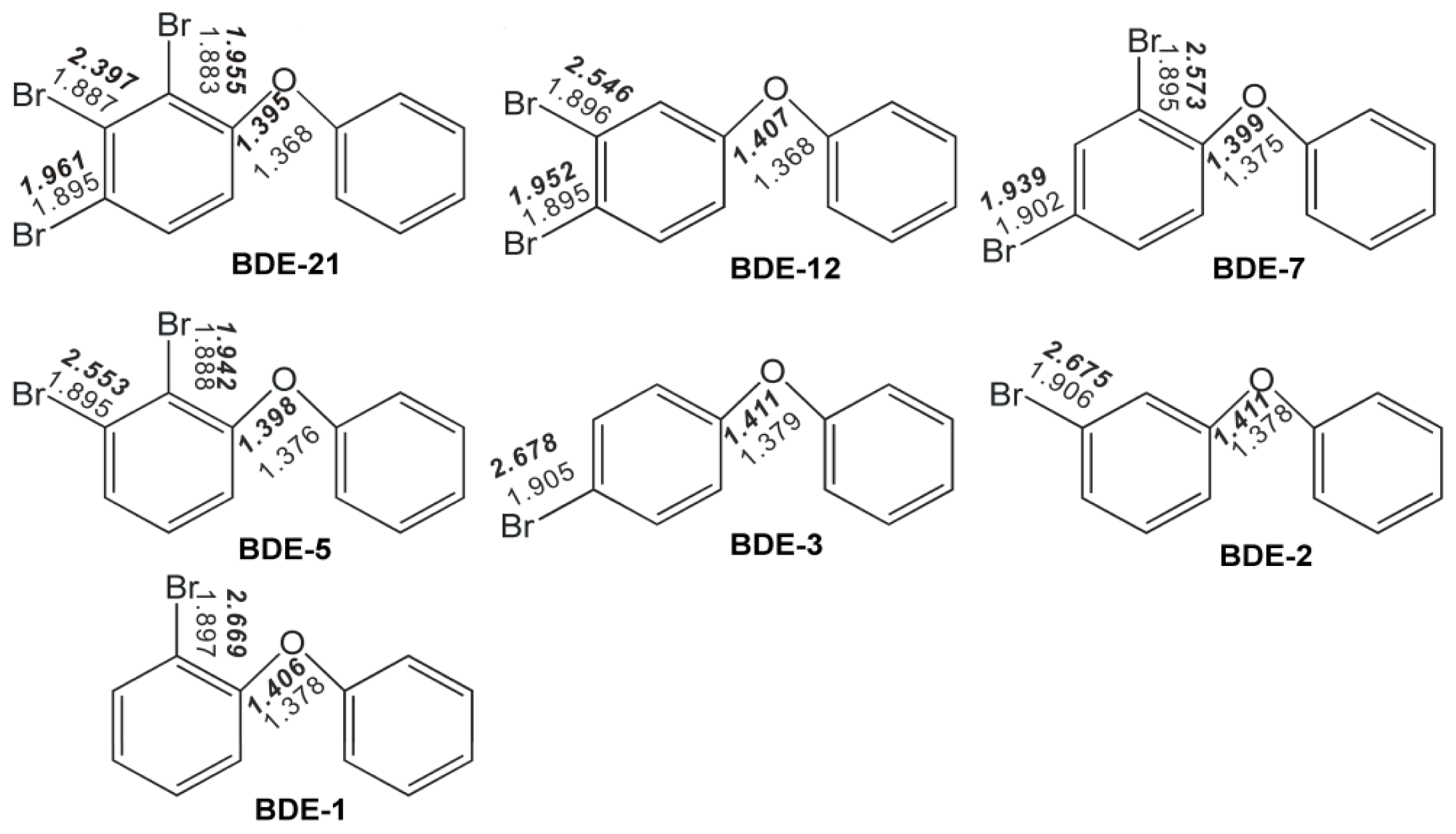
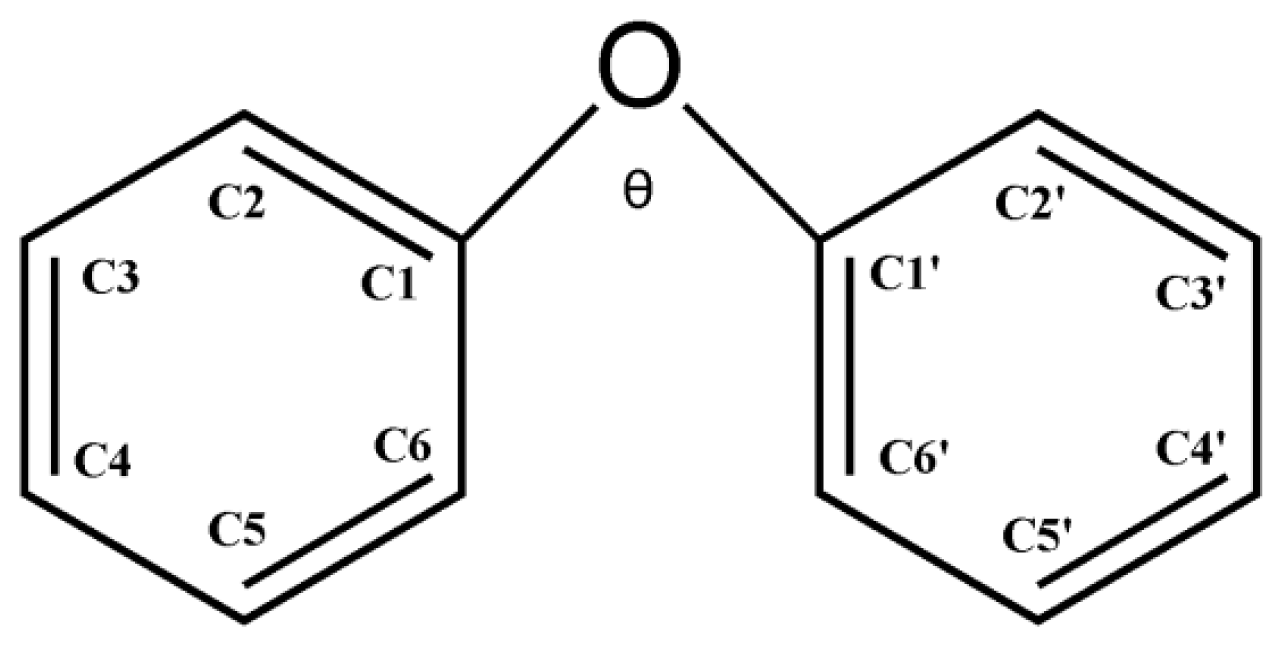
<p>We present the geometries of selected BDE congeners obtained from B3LYP/6-31+G(d) in <xref ref-type="fig" rid="f1-ijms-13-09332">Figure 1</xref> (Cartesian coordinates for the optimized structures from all our calculations are shown in <xref ref-type="supplementary-material" rid="s1-ijms-13-09332">Supplementary A</xref>). Presently, no structural data based on X-ray diffraction are available for the BDE congeners selected in this paper. Thus, we listed the previous reported theoretical calculated geometric parameters of BDE-7 and the corresponding results from the four methods in the present work in <xref ref-type="table" rid="t1-ijms-13-09332">Table 1</xref> for a comparison (the schematic geometry is shown in <xref ref-type="fig" rid="f2-ijms-13-09332">Figure 2</xref>), which shows that values of the geometric parameters obtained from these methods are fairly close. Previously, Zhao <italic>et al</italic>. reported that the molecular geometries of BDE neutral and its anionic species resulting from the two methods, B3LYP/6-31+G(d) and B3LYP/aug-cc-pVDZ, are virtually identical [<xref ref-type="bibr" rid="b17-ijms-13-09332">17</xref>]. Thus, with the B3LYP hybrid functional, the basis set effects are not obvious on the geometrical structure of these selected BDE molecules.</p>
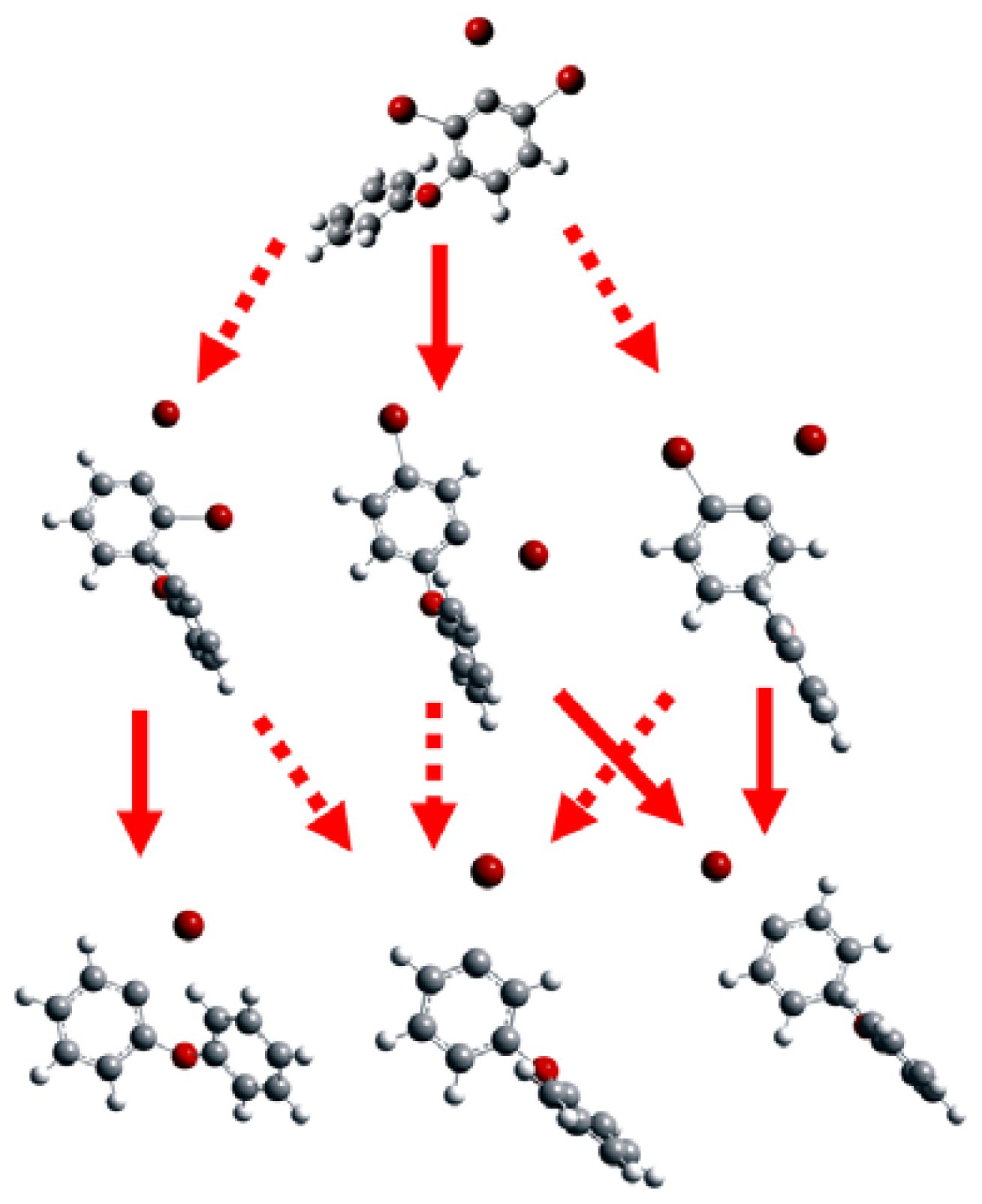
<p>Because of the electron negative character of halogen substituents, polyhalogenated compounds could behave as electron acceptors or oxidants [<xref ref-type="bibr" rid="b21-ijms-13-09332">21</xref>]. Anionic BDE congeners can be assumed as the molecules which have accepted the electrons from nZVI in the reductive environment. It was found that one of the C-Br bonds at the specific position of each anion of BDE congeners is approximately 0.6–0.9 Å longer than those of the corresponding neutral compounds (<xref ref-type="fig" rid="f1-ijms-13-09332">Figure 1</xref>). This means that the bond was significantly weakened by the added electron and is broken or cleaved within the context of covalent bonding (the visualized geometries directly from GaussView 4.1 (Semichem Inc., Shawnee Mission, KS, USA) are shown in <xref ref-type="fig" rid="f3-ijms-13-09332">Figure 3</xref>). Bending of this cleaved C–Br bonds out of the aromatic ring plane was also somehow observed in our calculations, implicating the π*–σ* orbital mixing [<xref ref-type="bibr" rid="b14-ijms-13-09332">14</xref>,<xref ref-type="bibr" rid="b15-ijms-13-09332">15</xref>]. Equilibrium geometry is the geometry at the energy minimum on the potential energy surface. Changing the geometry relative to the equilibrium structure must increase the energy. When the change occurs on the potential energy surface of the anion, the neutral-anion energy separation will decrease. This relationship can break down in pathological cases in which the nuclear configuration dramatically changes upon the addition of an electron [<xref ref-type="bibr" rid="b22-ijms-13-09332">22</xref>]. The equilibrium nuclear configuration of the PBDE anion might correspond to some point along the pathway to dissociation of the neutral molecule. When an electron was added into the PBDE molecule, the susceptible debromination position could be inferred from the substituted position where the cleavage of C–Br bond occurred in our calculations. Based on this, the predicted dominant debromination products in this study (<xref ref-type="fig" rid="f3-ijms-13-09332">Figure 3</xref>) were proposed and compared with the main debromination pathway of PBDEs with nZVI reported by Zhuang <italic>et al</italic>. [<xref ref-type="bibr" rid="b13-ijms-13-09332">13</xref>]. According to our proposed main debromination pathway of BDE-21 (<xref ref-type="fig" rid="f3-ijms-13-09332">Figure 3</xref>), the relative abundance of mono-BDE congeners should descend with the following order: BDE-3 &gt; BDE-1 &gt; BDE-2, and this trend was actually observed experimentally [<xref ref-type="bibr" rid="b13-ijms-13-09332">13</xref>]. Most of our calculational results were consistent with the experimental debromination pathway except for BDE-7. The calculated debromination products indicated that meta-is the first primary position of the selected PBDE molecules for the cleavage of the C–Br bond to occur, clearly pointing to a meta-susceptibility which was observed experimentally by the previous researchers [<xref ref-type="bibr" rid="b13-ijms-13-09332">13</xref>,<xref ref-type="bibr" rid="b16-ijms-13-09332">16</xref>]. Ortho-is the relatively preferential position for debromination compared with the para-. This predicted para-positional resistance to reductive debromination is also in agreement with the earlier reports by Shih <italic>et al</italic>. [<xref ref-type="bibr" rid="b11-ijms-13-09332">11</xref>] and by Keum and Li [<xref ref-type="bibr" rid="b16-ijms-13-09332">16</xref>]. In addition, such a positional preference is different from the debromination of PBDEs by nZVI/Pd, which was assumed to be through a mechanism concerning hydrogen atom transfer, thus its positional preference is probably dominated by steric hindrance [<xref ref-type="bibr" rid="b23-ijms-13-09332">23</xref>].</p>
<p>As indicated above, a priori prediction based on the calculated equilibrium structure satisfactorily conform to the experimental results, which provides a convenient method for the prediction of the major debromination pathway of PBDEs in some specific systems which concern the electron transfer mechanism. This outcome can also indicate that this kind of the PBDE debromination may be dominated by a thermodynamic process as reported by the previous researchers [<xref ref-type="bibr" rid="b16-ijms-13-09332">16</xref>], meaning that this reaction favored to more stable products, <italic>i.e.</italic>, low heat of formation (<italic>H</italic><sub>f</sub>) [<xref ref-type="bibr" rid="b19-ijms-13-09332">19</xref>] (the thermodynamic properties of these BDE congeners from our calculations are listed in <xref ref-type="supplementary-material" rid="s1-ijms-13-09332">Table S1</xref>). However, other factors, such as steric effect [<xref ref-type="bibr" rid="b13-ijms-13-09332">13</xref>] and the net charge at different brominated positions [<xref ref-type="bibr" rid="b12-ijms-13-09332">12</xref>] might also play a role in this debromination process.</p>
<p>Calculation of the divalent anion of BDE-21 was also performed at the B3LYP/6-31G(d) level in the present research, and the results indicated that no double debromination takes place, proving the theory of a stepwise debromination in general [<xref ref-type="bibr" rid="b16-ijms-13-09332">16</xref>]. Nevertheless, the double debromination was observed in the calculation of the triple-valent anion of BDE-21 (not properly converged), indicating that a multiple debromination pathway is possible if electrons are highly oversupplied (<italic>i.e.</italic>, use of excessive amount of ZVI). Interestingly, no cleavage of C–O linkage was found in any of the above calculations including those for divalent and triple valent ions (actually indicating strong reductive conditions). Implication of this finding is three-fold: (1) Persistency of PBDEs (probably also including dibenzodioxin and dibenzofuran types of compounds) comes partly from this highly stable ether linkage; (2) PBDEs have become so widespread in the environment partially because their degradation may be mostly due to a slow stepwise debromination, not to the cleavage of the ether linkage; (3) The reductive debromination (e.g., by ZVI) is of its limitation since it may not damage the framework of BDE congeners readily.</p></sec>
<sec>
<title>2.2. Frontier Orbital Energies, Adiabatic Electron Affinity and Their Relevance to Kinetics of Debromination Reactions by nZVI</title>
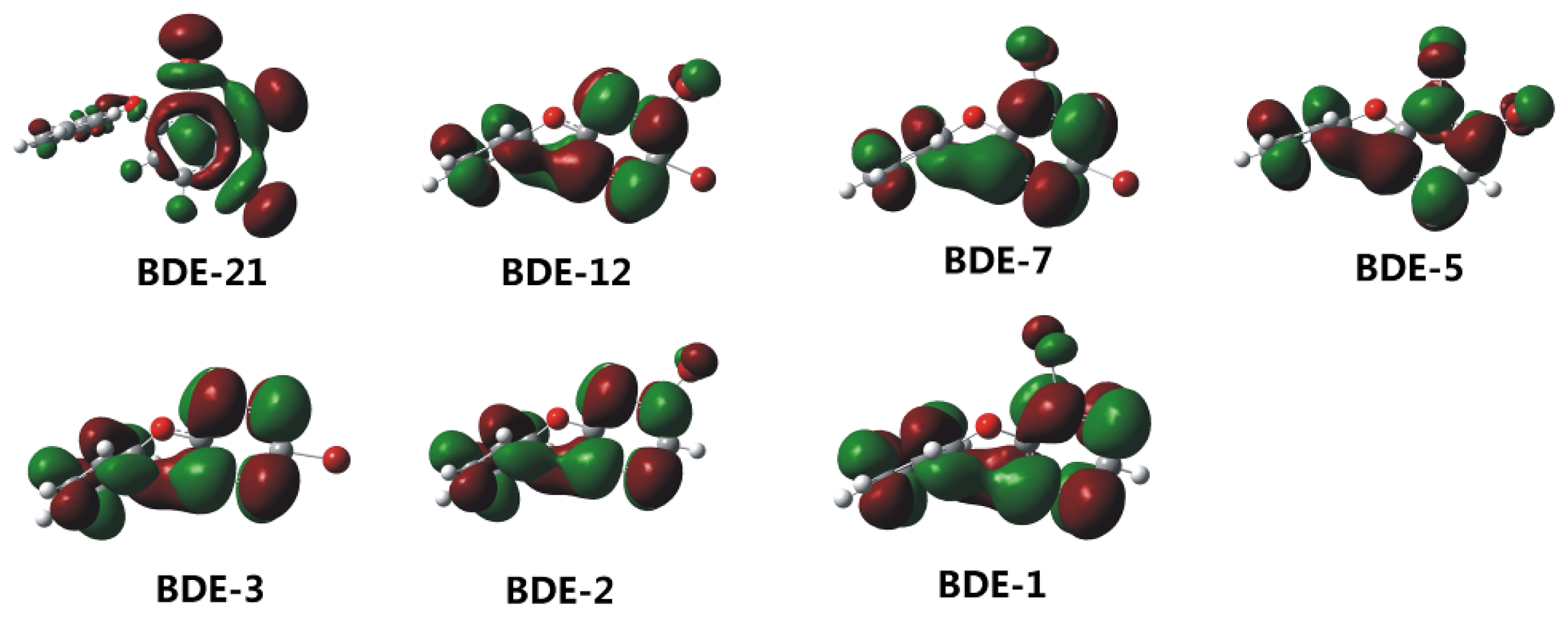
<p>According to frontier orbital theory [<xref ref-type="bibr" rid="b24-ijms-13-09332">24</xref>], frontier orbital characteristics of reacting molecules, namely the highest occupied molecular orbital (HOMO) and the lowest unoccupied molecular orbital (LUMO), determine the kinetics of a chemical reaction. Susceptibility of the position toward debromination reaction could be viewed as favoring nucleophilic substitution; the combined effects of the ether bond and the bromines on the electron density of a phenyl ring may make the specific-bromine more vulnerable to electron attack relatively [<xref ref-type="bibr" rid="b19-ijms-13-09332">19</xref>]. Spatial distributions of the LUMO obtained from the four methods are compatible for the BDE congeners in this study. The LUMO is almost completely located on the brominated phenyl group (<xref ref-type="fig" rid="f4-ijms-13-09332">Figure 4</xref>, take the surface image from 6-311G(d,p) basis set as an example), implicating reasonably that reductive reactions should occur to this phenyl group [<xref ref-type="bibr" rid="b19-ijms-13-09332">19</xref>] and a sigmatropic bromine shift within the phenyl group be possible. Furthermore, as shown in <xref ref-type="table" rid="t2-ijms-13-09332">Table 2</xref>, <italic>E</italic><sub>LUMO</sub> of the neutral BDE congeners tends to decrease with an increasing number of the bromine substituents, implicating that an increase in bromine number would lead to the increasing reductive reactivity or electrophilicity of PBDEs. Satisfactory linear relationships were observed between the logarithm of the reductive debromination rate constants of PBDEs with nZVI [<xref ref-type="bibr" rid="b13-ijms-13-09332">13</xref>] and <italic>E</italic><sub>LUMO</sub>, the energy of HOMO (<italic>E</italic><sub>HOMO</sub>) and the HOMO-LUMO energy gap (see the calculated values in <xref ref-type="supplementary-material" rid="s1-ijms-13-09332">Tables S2–S5</xref> and the Pearson correlation analysis in <xref ref-type="supplementary-material" rid="s1-ijms-13-09332">Table S6</xref>). The linear relationship based on <italic>E</italic><sub>LUMO</sub> is significantly better than that based on the other parameters calculated. The <italic>E</italic><sub>LUMO</sub> values calculated using B3LYP/6-31G(d) and B3LYP/6-31G(d,p) have the best statistical quality in the linear regression analysis both with the squared regression coefficient value of 0.961 (<xref ref-type="table" rid="t2-ijms-13-09332">Table 2</xref>). These results are in agreement with the previous studies using E<sub>LUMO</sub> values from AM1 semiempirical method [<xref ref-type="bibr" rid="b13-ijms-13-09332">13</xref>,<xref ref-type="bibr" rid="b16-ijms-13-09332">16</xref>] and with the correlation analysis of rate constants for the dehalogenation of other compounds with zero valent iron [<xref ref-type="bibr" rid="b25-ijms-13-09332">25</xref>].</p>
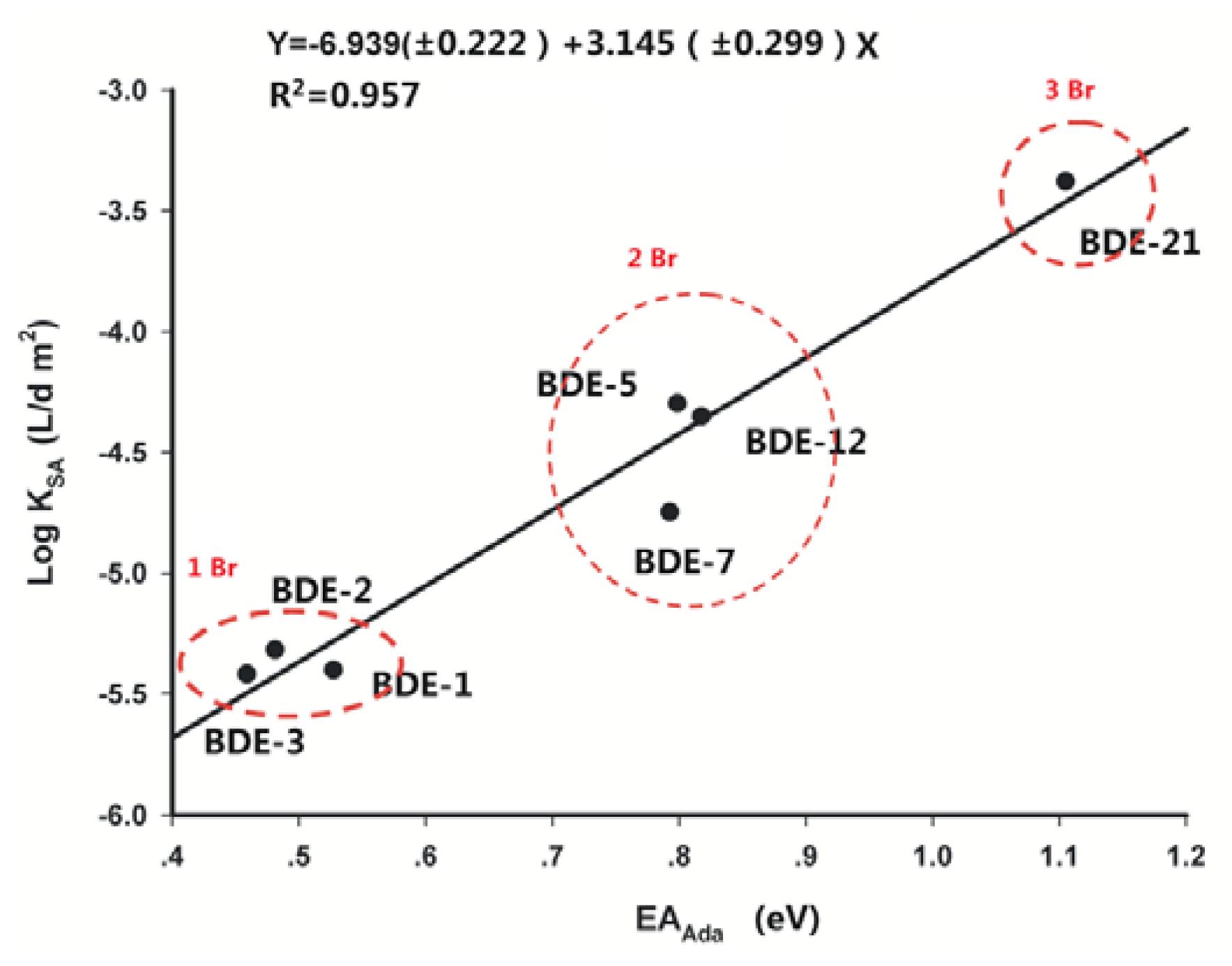
<p>The energy difference between an uncharged species and its negative ion, referred to as an electron affinity, is an important property of molecules. The theoretical <italic>EA</italic><sub>Ada</sub> represents the difference between the total energies of the neutral and anion at their respective equilibrium nuclear configurations [<xref ref-type="bibr" rid="b22-ijms-13-09332">22</xref>]. <xref ref-type="table" rid="t2-ijms-13-09332">Table 2</xref> lists the theoretically evaluated <italic>EA</italic><sub>Ada</sub> values from the B3LYP calculation with the four basis sets, and but does not include the corresponding experimental results since, to our knowledge, no experimental <italic>EA</italic><sub>Ada</sub> values for these selected PBDEs are available. The calculated <italic>EA</italic><sub>Ada</sub> values of PBDEs may be slightly lower than that calculated with a relatively large basis set. For example, the <italic>EA</italic><sub>Ada</sub> value calculated with B3LYP\6-31+G(d) was on average 0.2 eV lower than that from B3LYP\Aug-ccpVDZ [<xref ref-type="bibr" rid="b17-ijms-13-09332">17</xref>]. A positive linear relationship was also found between the <italic>EA</italic><sub>Ada</sub> and the rate constants of the reductive debromination [<xref ref-type="bibr" rid="b13-ijms-13-09332">13</xref>], as shown in <xref ref-type="table" rid="t2-ijms-13-09332">Table 2</xref>. The calculated <italic>EA</italic><sub>Ada</sub> values of the BDE congeners with different number of the brominated substituents seemed to differ notably. With each bromine atom added to the BDE congener, the calculated <italic>EA</italic><sub>Ada</sub> values increased by approximately 0.3 eV and the observed rate constant decreased by about 10 times correspondingly. <italic>EA</italic><sub>Ada</sub> values calculated using B3LYP/6-311G(d,p) have the best statistical quality in the correlation analysis with the observed rate constants (the obtained linear relationship is shown in <xref ref-type="fig" rid="f5-ijms-13-09332">Figure 5</xref>).</p>
<p>Electron affinity is related to the <italic>E</italic><sub>LUMO</sub> and could also use as an indicator of the susceptibility of the molecule toward reductive or nucleophilic attack. The calculated <italic>EA</italic><sub>Ada</sub> values are positive or near zero, suggesting that these PBDEs might act as electron acceptors in charge-transfer interactions. Both the significant linear relationship obtained above and the studies on the BDE anions clearly showed the evidence of an electron transfer mechanism associated with the debromination of PBDEs by nZVI, however such relationship seemed nonexistent in the cases of the dechlorination of PCBs [<xref ref-type="bibr" rid="b26-ijms-13-09332">26</xref>,<xref ref-type="bibr" rid="b27-ijms-13-09332">27</xref>] and PCDDs [<xref ref-type="bibr" rid="b28-ijms-13-09332">28</xref>], and debromination of PBDEs with the palladized material in which the precursor complex formation rather than electron transfer is the rate-controlling step.</p></sec></sec>
<sec>
<title>3. Experimental Section</title>
<p>All calculations were carried out with the Gaussian03 program suite [<xref ref-type="bibr" rid="b29-ijms-13-09332">29</xref>]. GaussView 4.1 was used as the molecular modeling system for constructing and visualizing the results of the calculations with Gaussian03. The molecular geometries of target BDE neutrals and their corresponding anions were optimized using B3LYP hybrid functional of DFT [<xref ref-type="bibr" rid="b30-ijms-13-09332">30</xref>,<xref ref-type="bibr" rid="b31-ijms-13-09332">31</xref>] in conjunction with four basis sets with polarization functions, including 6-31G(d), 6-31+G(d), 6-31G(d,p) and 6-311G(d,p). Due to the use of the DFT method, spin contamination for open-shell anions was small [<xref ref-type="bibr" rid="b32-ijms-13-09332">32</xref>]. The maximum expectation value of the <italic>S</italic><sup>2</sup> operator for doublets in this study is less than 0.76. The optimized geometries were confirmed by the harmonic vibrational frequencies to ensure that all geometries obtained are true energy minima not saddle points. These obtained vibrational frequencies were used to calculate the zero-point energies (ZPE), which were needed for adiabatic electron affinity (<italic>EA</italic><sub>Ada</sub>) calculations. <italic>EA</italic><sub>Ada</sub> were obtained from the following relationship:</p>
<disp-formula id="FD1">
<mml:math id="mm1" display="block">
<mml:semantics id="sm1">
<mml:mrow>
<mml:mi>E</mml:mi>
<mml:msub>
<mml:mrow>
<mml:mi>A</mml:mi></mml:mrow>
<mml:mrow>
<mml:mtext>Ada</mml:mtext></mml:mrow></mml:msub>
<mml:mo>=</mml:mo>
<mml:msub>
<mml:mrow>
<mml:mi>E</mml:mi></mml:mrow>
<mml:mrow>
<mml:mtext>neutral</mml:mtext></mml:mrow></mml:msub>
<mml:mi> </mml:mi>
<mml:mo stretchy="false">(</mml:mo>
<mml:mtext>optimized neutral</mml:mtext>
<mml:mo stretchy="false">)</mml:mo>
<mml:mo>-</mml:mo>
<mml:msub>
<mml:mrow>
<mml:mi>E</mml:mi></mml:mrow>
<mml:mrow>
<mml:mtext>anion</mml:mtext></mml:mrow></mml:msub>
<mml:mi> </mml:mi>
<mml:mo stretchy="false">(</mml:mo>
<mml:mtext>optimized anion</mml:mtext>
<mml:mo stretchy="false">)</mml:mo></mml:mrow></mml:semantics></mml:math></disp-formula>
<p>Statistical analyses were undertaken with the use of PASW 18 for Windows (SPSS Inc., Chicago, IL, USA).</p></sec>
<sec sec-type="conclusions">
<title>4. Conclusions</title>
<p>In the present work, using the cleaved C–Br bond of the anionic BDE congeners from the DFT calculations as the probe of the susceptible debromination position gave a satisfactory predictive ability for the dominant debromination products of PBDEs by nZVI. The debromination preference was theoretically evaluated as meta-Br &gt; ortho-Br &gt; para-Br. In addition, significant correlations were found between the reductive debromination rate constant of PBDEs with nZVI, and their frontier orbital energies (especially <italic>E</italic><sub>LUMO</sub>) and adiabatic electron affinities. These results clearly showed the evidence of an electron transfer mechanism associated with this reductive debromination reaction, based on which a deepened understanding on the environmental behaviors of such halogenated aromatic compounds can be obtained, since the photodebromination of these compounds may also involve the same mechanism [<xref ref-type="bibr" rid="b33-ijms-13-09332">33</xref>].</p></sec>
<sec sec-type="supplementary-material">
<title>Supplementary Information</title>
<supplementary-material id="s1-ijms-13-09332" content-type="local-data">
<media xlink:href="ijms-13-09332-s001.pdf" mimetype="application" mime-subtype="pdf"/></supplementary-material></sec></body>
<back>
<ack>
<title>Acknowledgments</title>
<p>This work was supported by the research funding from Guizhou Normal University, China.</p></ack>
<ref-list>
<title>References</title>
<ref id="b1-ijms-13-09332"><label>1</label><citation citation-type="journal"><person-group person-group-type="author"><name><surname>Chen</surname><given-names>L.G.</given-names></name><name><surname>Mai</surname><given-names>B.X.</given-names></name><name><surname>Bi</surname><given-names>X.H.</given-names></name><name><surname>Chen</surname><given-names>S.J.</given-names></name><name><surname>Wang</surname><given-names>X.M.</given-names></name><name><surname>Ran</surname><given-names>Y.</given-names></name><name><surname>Luo</surname><given-names>X.J.</given-names></name><name><surname>Sheng</surname><given-names>G.Y.</given-names></name><name><surname>Fu</surname><given-names>J.M.</given-names></name><name><surname>Zeng</surname><given-names>E.Y.</given-names></name></person-group><article-title>Concentration levels, compositional profiles, and gas-particle partitioning of polybrominated diphenyl ethers in the atmosphere of an urban city in South China</article-title><source>Environ. Sci. Technol</source><year>2006</year><volume>18</volume><fpage>1190</fpage><lpage>1196</lpage></citation></ref>
<ref id="b2-ijms-13-09332"><label>2</label><citation citation-type="journal"><person-group person-group-type="author"><name><surname>Hites</surname><given-names>R.A.</given-names></name></person-group><article-title>Polybrominated diphenyl ethers in the environment and in people: A meta-analysis of concentrations</article-title><source>Environ. Sci. Technol</source><year>2004</year><volume>38</volume><fpage>945</fpage><lpage>956</lpage><pub-id pub-id-type="doi">10.1021/es035082g</pub-id><pub-id pub-id-type="pmid">14998004</pub-id></citation></ref>
<ref id="b3-ijms-13-09332"><label>3</label><citation citation-type="journal"><person-group person-group-type="author"><name><surname>Darnerud</surname><given-names>P.O.</given-names></name><name><surname>Eriksen</surname><given-names>G.S.</given-names></name><name><surname>Jóhannesson</surname><given-names>T.</given-names></name><name><surname>Larsen</surname><given-names>P.B.</given-names></name><name><surname>Viluksela</surname><given-names>M</given-names></name></person-group><article-title>Polybrominated diphenyl ethers: occurrence, dietary exposure, and toxicology</article-title><source>Environ. Health Perspect</source><year>2001</year><volume>109</volume><issue>Suppl 1</issue><fpage>49</fpage><lpage>68</lpage><pub-id pub-id-type="pmid">11250805</pub-id></citation></ref>
<ref id="b4-ijms-13-09332"><label>4</label><citation citation-type="journal"><person-group person-group-type="author"><name><surname>Meerts</surname><given-names>I.A.T.M.</given-names></name><name><surname>Letcher</surname><given-names>R.J.</given-names></name><name><surname>Hoving</surname><given-names>S.</given-names></name><name><surname>Marsh</surname><given-names>G.</given-names></name><name><surname>Bergman</surname><given-names>Å.</given-names></name><name><surname>Lemmen</surname><given-names>J.G.</given-names></name><name><surname>Burg</surname><given-names>B.V.</given-names></name><name><surname>Brouwer</surname><given-names>A.</given-names></name></person-group><article-title><italic>In vitro</italic> estrogenicity of polybrominated diphenyl ethers, hydroxylated PBDEs, and polybrominated bisphenol A compounds</article-title><source>Environ. Health Perspect</source><year>2001</year><volume>109</volume><fpage>399</fpage><lpage>407</lpage><pub-id pub-id-type="pmid">11335189</pub-id></citation></ref>
<ref id="b5-ijms-13-09332"><label>5</label><citation citation-type="journal"><person-group person-group-type="author"><name><surname>Sjödin</surname><given-names>A.</given-names></name><name><surname>Patterson</surname><given-names>J.</given-names></name><name><surname>Patterson</surname><given-names>G.D.</given-names></name><name><surname>Bergman</surname><given-names>Å.</given-names></name></person-group><article-title>A review on human exposure to brominated flame retardants—Particularly polybrominated diphenyl ethers</article-title><source>Environ. Int</source><year>2003</year><volume>29</volume><fpage>829</fpage><lpage>839</lpage><pub-id pub-id-type="pmid">12850099</pub-id></citation></ref>
<ref id="b6-ijms-13-09332"><label>6</label><citation citation-type="journal"><person-group person-group-type="author"><name><surname>Haglund</surname><given-names>P.S.</given-names></name><name><surname>Zook</surname><given-names>D.R.</given-names></name><name><surname>Buser</surname><given-names>H.</given-names></name><name><surname>Hu</surname><given-names>J.W.</given-names></name></person-group><article-title>Identification and quantification of polybrominated diphenyl ethers and methoxy-polybrominated diphenyl ethers in baltic biota</article-title><source>Environ. Sci. Technol</source><year>1997</year><volume>31</volume><fpage>3281</fpage><lpage>3287</lpage></citation></ref>
<ref id="b7-ijms-13-09332"><label>7</label><citation citation-type="book"><collab>The European parliament and the council of the European Union</collab><source>Directive 2002/95/EC of the European Parliament and of the Council of 27 January 2003 on the Restriction of the Use of Certain Hazardous Substances in Electrical and Electronic Equipment; OJ L37</source><publisher-name>European Union</publisher-name><publisher-loc>Brussels, Belgium</publisher-loc><year>2003</year></citation></ref>
<ref id="b8-ijms-13-09332"><label>8</label><citation citation-type="journal"><person-group person-group-type="author"><name><surname>Canton</surname><given-names>R.F.</given-names></name><name><surname>Scholten</surname><given-names>D.E.</given-names></name><name><surname>Marsh</surname><given-names>G.</given-names></name><name><surname>de Jong</surname><given-names>P.C.</given-names></name><name><surname>van den Berg</surname><given-names>M.</given-names></name></person-group><article-title>Inhibition of human placental aromatase activity by hydroxylated polybrominated diphenyl ethers (OH-PBDEs)</article-title><source>Toxicol. Appl. Pharmacol</source><year>2008</year><volume>227</volume><fpage>68</fpage><lpage>75</lpage><pub-id pub-id-type="pmid">18022659</pub-id></citation></ref>
<ref id="b9-ijms-13-09332"><label>9</label><citation citation-type="journal"><person-group person-group-type="author"><name><surname>Ward</surname><given-names>J.</given-names></name><name><surname>Mohapatra</surname><given-names>S.P.</given-names></name><name><surname>Mitchell</surname><given-names>A.</given-names></name></person-group><article-title>An overview of policies for managing polybrominated diphenyl ethers (PBDEs) in the Great Lakes basin</article-title><source>Environ. Int</source><year>2008</year><volume>34</volume><fpage>1148</fpage><lpage>1156</lpage><pub-id pub-id-type="pmid">18579207</pub-id></citation></ref>
<ref id="b10-ijms-13-09332"><label>10</label><citation citation-type="journal"><person-group person-group-type="author"><name><surname>Li</surname><given-names>X.Q.</given-names></name><name><surname>Elliott</surname><given-names>D.W.</given-names></name><name><surname>Zhang</surname><given-names>W.X.</given-names></name></person-group><article-title>Zero-valent iron nanoparticles for abatement of environmental pollutants: Materials and engineering aspects</article-title><source>Crit. Rev. Solid State</source><year>2006</year><volume>31</volume><fpage>111</fpage><lpage>122</lpage></citation></ref>
<ref id="b11-ijms-13-09332"><label>11</label><citation citation-type="journal"><person-group person-group-type="author"><name><surname>Shih</surname><given-names>Y.</given-names></name><name><surname>Tai</surname><given-names>Y.</given-names></name></person-group><article-title>Reaction of decabrominated diphenyl ether by zerovalent iron nanoparticles</article-title><source>Chemosphere</source><year>2010</year><volume>78</volume><fpage>1200</fpage><lpage>1206</lpage><pub-id pub-id-type="pmid">20117822</pub-id></citation></ref>
<ref id="b12-ijms-13-09332"><label>12</label><citation citation-type="journal"><person-group person-group-type="author"><name><surname>Li</surname><given-names>A.</given-names></name><name><surname>Tai</surname><given-names>C.</given-names></name><name><surname>Zhao</surname><given-names>Z.S.</given-names></name><name><surname>Wang</surname><given-names>Y.W.</given-names></name><name><surname>Zhang</surname><given-names>Q.H.</given-names></name><name><surname>Jiang</surname><given-names>G.B.</given-names></name><name><surname>Hu</surname><given-names>J.T.</given-names></name></person-group><article-title>Debromination of decabrominated diphenyl ether by resin-bound iron nanoparticles</article-title><source>Environ. Sci. Technol</source><year>2007</year><volume>41</volume><fpage>6841</fpage><lpage>6846</lpage><pub-id pub-id-type="pmid">17969704</pub-id></citation></ref>
<ref id="b13-ijms-13-09332"><label>13</label><citation citation-type="journal"><person-group person-group-type="author"><name><surname>Zhuang</surname><given-names>Y.</given-names></name><name><surname>Ahn</surname><given-names>S.</given-names></name><name><surname>Luthy</surname><given-names>R.G.</given-names></name></person-group><article-title>Debromination of polybrominated diphenyl ethers by nanoscale zerovalent iron: Pathways, kinetics, and reactivity</article-title><source>Environ. Sci. Technol</source><year>2010</year><volume>44</volume><fpage>8236</fpage><lpage>8242</lpage><pub-id pub-id-type="pmid">20923154</pub-id></citation></ref>
<ref id="b14-ijms-13-09332"><label>14</label><citation citation-type="journal"><person-group person-group-type="author"><name><surname>Arulmozhiraja</surname><given-names>S.</given-names></name><name><surname>Morita</surname><given-names>M.</given-names></name></person-group><article-title>Electron affinities and reductive dechlorination of toxic polychlorinated dibenzofurans: A density functional theory study</article-title><source>J. Phys. Chem. A</source><year>2004</year><volume>108</volume><fpage>3499</fpage><lpage>3508</lpage></citation></ref>
<ref id="b15-ijms-13-09332"><label>15</label><citation citation-type="journal"><person-group person-group-type="author"><name><surname>Zhao</surname><given-names>Y.Y.</given-names></name><name><surname>Tao</surname><given-names>F.M.</given-names></name><name><surname>Zeng</surname><given-names>E.Y.</given-names></name></person-group><article-title>Structures, reductive dechlorination, and electron affinities of selected polychlorinated dibenzo-<italic>p</italic>-dioxins: Density functional theory study</article-title><source>J. Phys. Chem. A</source><year>2007</year><volume>111</volume><fpage>11638</fpage><lpage>11644</lpage><pub-id pub-id-type="pmid">17949062</pub-id></citation></ref>
<ref id="b16-ijms-13-09332"><label>16</label><citation citation-type="journal"><person-group person-group-type="author"><name><surname>Keum</surname><given-names>Y.</given-names></name><name><surname>Li</surname><given-names>Q.X.</given-names></name></person-group><article-title>Reductive debromination of polybrominated diphenyl ethers by zerovalent iron</article-title><source>Environ. Sci. Technol</source><year>2005</year><volume>39</volume><fpage>2280</fpage><lpage>2286</lpage><pub-id pub-id-type="pmid">15871265</pub-id></citation></ref>
<ref id="b17-ijms-13-09332"><label>17</label><citation citation-type="journal"><person-group person-group-type="author"><name><surname>Zhao</surname><given-names>Y.Y.</given-names></name><name><surname>Tao</surname><given-names>F.M.</given-names></name><name><surname>Zeng</surname><given-names>E.Y.</given-names></name></person-group><article-title>Theoretical study on the chemical properties of polybrominated diphenyl ethers</article-title><source>Chemosphere</source><year>2008</year><volume>70</volume><fpage>901</fpage><lpage>907</lpage><pub-id pub-id-type="pmid">17707458</pub-id></citation></ref>
<ref id="b18-ijms-13-09332"><label>18</label><citation citation-type="journal"><person-group person-group-type="author"><name><surname>Hu</surname><given-names>J.W.</given-names></name><name><surname>Eriksson</surname><given-names>L.</given-names></name><name><surname>Bergman</surname><given-names>Å.</given-names></name><name><surname>Jakobsson</surname><given-names>E.</given-names></name><name><surname>Kolehmainen</surname><given-names>E.</given-names></name><name><surname>Knuutinen</surname><given-names>J.</given-names></name><name><surname>Suontamo</surname><given-names>R.</given-names></name><name><surname>Wei</surname><given-names>X.H.</given-names></name></person-group><article-title>Molecular orbital studies on brominated diphenyl ethers. Part I—Conformational properties</article-title><source>Chemosphere</source><year>2005</year><volume>59</volume><fpage>1033</fpage><lpage>1041</lpage><pub-id pub-id-type="pmid">15823337</pub-id></citation></ref>
<ref id="b19-ijms-13-09332"><label>19</label><citation citation-type="journal"><person-group person-group-type="author"><name><surname>Hu</surname><given-names>J.W.</given-names></name><name><surname>Eriksson</surname><given-names>L.</given-names></name><name><surname>Bergman</surname><given-names>Å.</given-names></name><name><surname>Jakobsson</surname><given-names>E.</given-names></name><name><surname>Kolehmainen</surname><given-names>E.</given-names></name><name><surname>Knuutinen</surname><given-names>J.</given-names></name><name><surname>Suontamo</surname><given-names>R.</given-names></name><name><surname>Wei</surname><given-names>X.H.</given-names></name></person-group><article-title>Molecular orbital studies on brominated diphenyl ethers. Part II—Reactivity and quantitative structure-activity (property) relationships</article-title><source>Chemosphere</source><year>2005</year><volume>59</volume><fpage>1043</fpage><lpage>1057</lpage><pub-id pub-id-type="pmid">15823338</pub-id></citation></ref>
<ref id="b20-ijms-13-09332"><label>20</label><citation citation-type="journal"><person-group person-group-type="author"><name><surname>Zhou</surname><given-names>J.</given-names></name><name><surname>Chen</surname><given-names>J.W.</given-names></name><name><surname>Liang</surname><given-names>C.</given-names></name><name><surname>Xie</surname><given-names>Q.</given-names></name><name><surname>Wang</surname><given-names>Y.N.</given-names></name><name><surname>Zhang</surname><given-names>S.Y.</given-names></name><name><surname>Qiao</surname><given-names>X.L.</given-names></name><name><surname>Li</surname><given-names>X.H.</given-names></name></person-group><article-title>Quantum chemical investigation on the mechanism and kinetics of PBDE photooxidation by ·OH: A case study for BDE-15</article-title><source>Environ. Sci. Technol</source><year>2011</year><volume>45</volume><fpage>4839</fpage><lpage>4845</lpage><pub-id pub-id-type="pmid">21561130</pub-id></citation></ref>
<ref id="b21-ijms-13-09332"><label>21</label><citation citation-type="journal"><person-group person-group-type="author"><name><surname>Vogel</surname><given-names>T.M.</given-names></name><name><surname>Criddle</surname><given-names>C.S.</given-names></name><name><surname>McCarty</surname><given-names>P.L.</given-names></name></person-group><article-title>ES Critical Reviews: Transformations of halogenated aliphatic compounds</article-title><source>Environ. Sci. Technol</source><year>1987</year><volume>21</volume><fpage>722</fpage><lpage>736</lpage><pub-id pub-id-type="pmid">19995052</pub-id></citation></ref>
<ref id="b22-ijms-13-09332"><label>22</label><citation citation-type="journal"><person-group person-group-type="author"><name><surname>Rienstra-Kiracofe</surname><given-names>J.C.</given-names></name><name><surname>Tschumper</surname><given-names>G.S.</given-names></name><name><surname>Schaefer</surname><given-names>H.F.</given-names><suffix>III</suffix></name><name><surname>Nandi</surname><given-names>S.</given-names></name><name><surname>Ellison</surname><given-names>G.B.</given-names></name></person-group><article-title>Atomic and molecular electron affinities: Photoelectron experiments and theoretical computations</article-title><source>Chem. Rev</source><year>2003</year><volume>102</volume><fpage>231</fpage><lpage>282</lpage></citation></ref>
<ref id="b23-ijms-13-09332"><label>23</label><citation citation-type="journal"><person-group person-group-type="author"><name><surname>Zhuang</surname><given-names>Y.</given-names></name><name><surname>Ahn</surname><given-names>S.</given-names></name><name><surname>Seyfferth</surname><given-names>A.L.</given-names></name><name><surname>Masue-Slowey</surname><given-names>Y.</given-names></name><name><surname>Fendorf</surname><given-names>S.</given-names></name><name><surname>Luthy</surname><given-names>R.G.</given-names></name></person-group><article-title>Dehalogenation of polybrominated diphenyl ethers and polychlorinated biphenyl by bimetallic, impregnated, and nanoscale zerovalent iron</article-title><source>Environ. Sci. Technol</source><year>2011</year><volume>45</volume><fpage>4896</fpage><lpage>4903</lpage><pub-id pub-id-type="pmid">21557574</pub-id></citation></ref>
<ref id="b24-ijms-13-09332"><label>24</label><citation citation-type="journal"><person-group person-group-type="author"><name><surname>Fukui</surname><given-names>K.</given-names></name><name><surname>Yonezawa</surname><given-names>T.</given-names></name><name><surname>Nagata</surname><given-names>C.</given-names></name><name><surname>Shingu</surname><given-names>H.</given-names></name></person-group><article-title>Molecular orbital theory of orientation in aromatic, heteroaromatic and other conjugated molecules</article-title><source>J. Chem. Phys</source><year>1954</year><volume>22</volume><fpage>1433</fpage><lpage>1442</lpage></citation></ref>
<ref id="b25-ijms-13-09332"><label>25</label><citation citation-type="journal"><person-group person-group-type="author"><name><surname>Scherer</surname><given-names>M.M.</given-names></name><name><surname>Balko</surname><given-names>B.A.</given-names></name><name><surname>Gallagher</surname><given-names>D.A.</given-names></name><name><surname>Trantnyek</surname><given-names>P.G.</given-names></name></person-group><article-title>Correlation analysis of rate constants for dechlorination by zerov-alent iron</article-title><source>Environ. Sci. Technol</source><year>1998</year><volume>32</volume><fpage>3026</fpage><lpage>3033</lpage></citation></ref>
<ref id="b26-ijms-13-09332"><label>26</label><citation citation-type="journal"><person-group person-group-type="author"><name><surname>Lowry</surname><given-names>G.V.</given-names></name><name><surname>Johnson</surname><given-names>K.M.</given-names></name></person-group><article-title>Congener-specific dechlorination of dissolved PCBs by microscale and nanoscale zerovalent iron in a water/methanol solution</article-title><source>Environ. Sci. Technol</source><year>2004</year><volume>38</volume><fpage>5208</fpage><lpage>5216</lpage><pub-id pub-id-type="pmid">15506219</pub-id></citation></ref>
<ref id="b27-ijms-13-09332"><label>27</label><citation citation-type="journal"><person-group person-group-type="author"><name><surname>Agarwal</surname><given-names>S.</given-names></name><name><surname>Al-Abed</surname><given-names>S.R.</given-names></name><name><surname>Dionysiou</surname><given-names>D.D.</given-names></name><name><surname>Graybill</surname><given-names>E.</given-names></name></person-group><article-title>Reactivity of substituted chlorines and ensuing dechlorination pathways of select PCB congeners with Pd/Mg bimetallics</article-title><source>Environ. Sci. Technol</source><year>2009</year><volume>43</volume><fpage>915</fpage><lpage>921</lpage><pub-id pub-id-type="pmid">19245036</pub-id></citation></ref>
<ref id="b28-ijms-13-09332"><label>28</label><citation citation-type="journal"><person-group person-group-type="author"><name><surname>Kim</surname><given-names>J.H.</given-names></name><name><surname>Tratnyek</surname><given-names>P.G.</given-names></name><name><surname>Chang</surname><given-names>Y.S.</given-names></name></person-group><article-title>Rapid dechlorination of polychlorinated dibenzo-<italic>p</italic>-dioxins by bimetallic and nanosized zerovalent iron</article-title><source>Environ. Sci. Technol</source><year>2008</year><volume>42</volume><fpage>4106</fpage><lpage>4112</lpage><pub-id pub-id-type="pmid">18589973</pub-id></citation></ref>
<ref id="b29-ijms-13-09332"><label>29</label><citation citation-type="book"><person-group person-group-type="author"><name><surname>Frisch</surname><given-names>M.J.</given-names></name><name><surname>Trucks</surname><given-names>G.W.</given-names></name><name><surname>Schlegel</surname><given-names>H.B.</given-names></name><name><surname>Scuseria</surname><given-names>G.E.</given-names></name><name><surname>Robb</surname><given-names>M.A.</given-names></name><name><surname>Cheeseman</surname><given-names>J.R.</given-names></name><name><surname>Montgomery</surname><given-names>J.A.</given-names><suffix>Jr.</suffix></name><name><surname>Vreven</surname><given-names>T.</given-names></name><name><surname>Kudin</surname><given-names>K.N.</given-names></name><name><surname>Burant</surname><given-names>J.C.</given-names></name><etal/></person-group><source>Gaussian 03</source><publisher-name>Gaussian, Inc</publisher-name><publisher-loc>Wallingford, CT, USA</publisher-loc><year>2004</year></citation></ref>
<ref id="b30-ijms-13-09332"><label>30</label><citation citation-type="journal"><person-group person-group-type="author"><name><surname>Becke</surname><given-names>A.D.</given-names></name></person-group><article-title>Density-functional thermochemistry. III. The role of exact exchange</article-title><source>J. Chem. Phys</source><year>1993</year><volume>98</volume><fpage>5648</fpage><lpage>5652</lpage></citation></ref>
<ref id="b31-ijms-13-09332"><label>31</label><citation citation-type="journal"><person-group person-group-type="author"><name><surname>Lee</surname><given-names>C.</given-names></name><name><surname>Yang</surname><given-names>W.</given-names></name><name><surname>Parr</surname><given-names>R.G.</given-names></name></person-group><article-title>Development of the colle–salvetti correlation-energy formula into a functional of the electron density</article-title><source>Phys. Rev. B</source><year>1988</year><volume>37</volume><fpage>785</fpage><lpage>789</lpage></citation></ref>
<ref id="b32-ijms-13-09332"><label>32</label><citation citation-type="journal"><person-group person-group-type="author"><name><surname>Jon Baker</surname><given-names>A.S.</given-names></name><name><surname>Andzelm</surname><given-names>J.</given-names></name></person-group><article-title>Spin contamination in density functional theory</article-title><source>Chem. Phys. Lett</source><year>1993</year><volume>216</volume><fpage>380</fpage><lpage>388</lpage></citation></ref>
<ref id="b33-ijms-13-09332"><label>33</label><citation citation-type="journal"><person-group person-group-type="author"><name><surname>Zeng</surname><given-names>X.</given-names></name><name><surname>Simonich</surname><given-names>S.L.M.</given-names></name><name><surname>Robrock</surname><given-names>K.R.</given-names></name><name><surname>Korytar</surname><given-names>P.</given-names></name><name><surname>Alvarez-Cohen</surname><given-names>L.</given-names></name><name><surname>Barofsky</surname><given-names>D.F.</given-names></name></person-group><article-title>Application of a congener-specific debromination model to study photodebromination, anaerobic microbial debromination, and Fe<sup>0</sup> reduction of polybrominated diphenyl ethers</article-title><source>Environ. Toxicol. Chem</source><year>2010</year><volume>29</volume><fpage>770</fpage><lpage>778</lpage><pub-id pub-id-type="pmid">20821505</pub-id></citation></ref></ref-list>
<sec sec-type="display-objects">
<title>Figures and Tables</title>
<fig id="f1-ijms-13-09332" position="float">
<label>Figure 1</label>
<caption>
<p>Structures and some important geometrical parameters of BDE neutrals and their anionic species (parameters in bold are shown for anionic PBDEs) from B3LYP/6-31+G(d) calculations (bond distances are given in angstroms).</p></caption>
<graphic xlink:href="ijms-13-09332f1.gif"/></fig>
<fig id="f2-ijms-13-09332" position="float">
<label>Figure 2</label>
<caption>
<p>A schematic geometry of diphenyl ether and definitions of the atomic positions.</p></caption>
<graphic xlink:href="ijms-13-09332f2.gif"/></fig>
<fig id="f3-ijms-13-09332" position="float">
<label>Figure 3</label>
<caption>
<p>Visualized geometries (directly from GaussView 4.1) of the selected anionic BDE congeners optimized at the B3LYP/6-31+G(d) level and the proposed debromination pathway in this study (broader arrows indicate major pathways).</p></caption>
<graphic xlink:href="ijms-13-09332f3.gif"/></fig>
<fig id="f4-ijms-13-09332" position="float">
<label>Figure 4</label>
<caption>
<p>Surface images of lowest unoccupied molecular orbital (LUMO) of the neutral BDE congeners (taking the results obtained at the B3LYP/6-311G(d,p) level as an example).</p></caption>
<graphic xlink:href="ijms-13-09332f4.gif"/></fig>
<fig id="f5-ijms-13-09332" position="float">
<label>Figure 5</label>
<caption>
<p>Correlation between debromination rate constants and <italic>EA</italic><sub>Ada</sub> values from B3LYP/6-311G(d,p).</p></caption>
<graphic xlink:href="ijms-13-09332f5.gif"/></fig>
<table-wrap id="t1-ijms-13-09332" position="float">
<label>Table 1</label>
<caption>
<p>Geometrical parameters of neutral species and anions of 2,4-dibromodiphenyl ether (BDE-7) calculated with different basis sets with B3LYP hybrid functional (bond distances are given in angstroms, angles are given in degrees).</p></caption>
<table frame="hsides" rules="groups">
<thead>
<tr>
<th align="left" valign="bottom"/>
<th colspan="2" align="center" valign="bottom">6-31G(d)</th>
<th colspan="2" align="center" valign="bottom">6-31+G(d)</th>
<th colspan="2" align="center" valign="bottom">6-31G(d,p)</th>
<th colspan="2" align="center" valign="bottom">6-311G(d,p)</th>
<th align="center" valign="bottom">6-31+G(d) <xref ref-type="table-fn" rid="tfn1-ijms-13-09332">a</xref></th>
<th align="center" valign="bottom">aug-cc-pVDZ <xref ref-type="table-fn" rid="tfn1-ijms-13-09332">a</xref></th></tr>
<tr>
<th align="left" valign="bottom">
<hr/></th>
<th colspan="2" align="left" valign="bottom">
<hr/></th>
<th colspan="2" align="left" valign="bottom">
<hr/></th>
<th colspan="2" align="left" valign="bottom">
<hr/></th>
<th colspan="2" align="left" valign="bottom">
<hr/></th>
<th align="left" valign="bottom">
<hr/></th>
<th align="left" valign="bottom">
<hr/></th></tr>
<tr>
<th align="left" valign="bottom"/>
<th align="center" valign="bottom">neutral</th>
<th align="center" valign="bottom">anion</th>
<th align="center" valign="bottom">neutral</th>
<th align="center" valign="bottom">anion</th>
<th align="center" valign="bottom">neutral</th>
<th align="center" valign="bottom">anion</th>
<th align="center" valign="bottom">neutral</th>
<th align="center" valign="bottom">anion</th>
<th align="center" valign="bottom">neutral</th>
<th align="center" valign="bottom">neutral</th></tr></thead>
<tbody>
<tr>
<td align="left" valign="top">C1–O</td>
<td align="center" valign="top">1.368</td>
<td align="center" valign="top">1.400</td>
<td align="center" valign="top">1.375</td>
<td align="center" valign="top">1.399</td>
<td align="center" valign="top">1.368</td>
<td align="center" valign="top">1.399</td>
<td align="center" valign="top">1.365</td>
<td align="center" valign="top">1.398</td>
<td align="center" valign="top">1.375</td>
<td align="center" valign="top">1.370</td></tr>
<tr>
<td align="left" valign="top">C1′–O</td>
<td align="center" valign="top">1.388</td>
<td align="center" valign="top">1.374</td>
<td align="center" valign="top">1.388</td>
<td align="center" valign="top">1.370</td>
<td align="center" valign="top">1.388</td>
<td align="center" valign="top">1.373</td>
<td align="center" valign="top">1.39</td>
<td align="center" valign="top">1.369</td>
<td align="center" valign="top">1.388</td>
<td align="center" valign="top">1.391</td></tr>
<tr>
<td align="left" valign="top">C1–Br</td>
<td align="center" valign="top">1.902</td>
<td align="center" valign="top">2.703</td>
<td align="center" valign="top">1.895</td>
<td align="center" valign="top">2.573</td>
<td align="center" valign="top">1.902</td>
<td align="center" valign="top">2.695</td>
<td align="center" valign="top">1.908</td>
<td align="center" valign="top">2.698</td>
<td align="center" valign="top">1.895</td>
<td align="center" valign="top">1.909</td></tr>
<tr>
<td align="left" valign="top">C3–Br</td>
<td align="center" valign="top">1.910</td>
<td align="center" valign="top">1.946</td>
<td align="center" valign="top">1.902</td>
<td align="center" valign="top">1.939</td>
<td align="center" valign="top">1.910</td>
<td align="center" valign="top">1.946</td>
<td align="center" valign="top">1.916</td>
<td align="center" valign="top">1.952</td>
<td align="center" valign="top">1.902</td>
<td align="center" valign="top">1.971</td></tr>
<tr>
<td align="left" valign="top">C1–O–C1′</td>
<td align="center" valign="top">120.6</td>
<td align="center" valign="top">123.0</td>
<td align="center" valign="top">120.4</td>
<td align="center" valign="top">120.7</td>
<td align="center" valign="top">120.6</td>
<td align="center" valign="top">123.5</td>
<td align="center" valign="top">120.1</td>
<td align="center" valign="top">123.1</td>
<td align="center" valign="top">120.4</td>
<td align="center" valign="top">120.3</td></tr></tbody></table>
<table-wrap-foot><fn id="tfn1-ijms-13-09332">
<label>a</label>
<p>Cited from reference [<xref ref-type="bibr" rid="b17-ijms-13-09332">17</xref>].</p></fn></table-wrap-foot></table-wrap>
<table-wrap id="t2-ijms-13-09332" position="float">
<label>Table 2</label>
<caption>
<p> <italic>E</italic><sub>LUMO</sub> (hartree) and <italic>E</italic>A<sub>Ada</sub> (eV) of selected BDE congeners obtained with the B3LYP hybrid functional.</p></caption>
<table frame="hsides" rules="groups">
<thead>
<tr>
<th align="center" valign="middle" rowspan="3">IUPAC no.</th>
<th colspan="2" align="center" valign="bottom">6-31G(d)</th>
<th colspan="2" align="center" valign="bottom">6-31+G(d)</th>
<th colspan="2" align="center" valign="bottom">6-31G(d,p)</th>
<th colspan="2" align="center" valign="bottom">6-311G(d,p)</th>
<th align="center" valign="middle" rowspan="3">Log K<sub>SA</sub> <xref ref-type="table-fn" rid="tfn2-ijms-13-09332">a</xref></th></tr>
<tr>
<th colspan="2" align="left" valign="middle">
<hr/></th>
<th colspan="2" align="left" valign="middle">
<hr/></th>
<th colspan="2" align="left" valign="middle">
<hr/></th>
<th colspan="2" align="left" valign="middle">
<hr/></th></tr>
<tr>
<th align="center" valign="bottom"><italic>E</italic><sub>LUMO</sub></th>
<th align="center" valign="bottom"><italic>EA</italic><sub>Ada</sub></th>
<th align="center" valign="bottom"><italic>E</italic><sub>LUMO</sub></th>
<th align="center" valign="bottom"><italic>EA</italic><sub>Ada</sub></th>
<th align="center" valign="bottom"><italic>E</italic><sub>LUMO</sub></th>
<th align="center" valign="bottom"><italic>EA</italic><sub>Ada</sub></th>
<th align="center" valign="bottom"><italic>E</italic><sub>LUMO</sub></th>
<th align="center" valign="bottom"><italic>EA</italic><sub>Ada</sub></th></tr></thead>
<tbody>
<tr>
<td align="center" valign="top">BDE21</td>
<td align="center" valign="top">−0.0404</td>
<td align="center" valign="top">0.6481</td>
<td align="center" valign="top">−0.0527</td>
<td align="center" valign="top">0.9558</td>
<td align="center" valign="top">−0.0404</td>
<td align="center" valign="top">0.6509</td>
<td align="center" valign="top">−0.0544</td>
<td align="center" valign="top">1.1048</td>
<td align="center" valign="top">−3.378</td></tr>
<tr>
<td align="center" valign="top">BDE12</td>
<td align="center" valign="top">−0.0279</td>
<td align="center" valign="top">0.3131</td>
<td align="center" valign="top">−0.0439</td>
<td align="center" valign="top">0.6708</td>
<td align="center" valign="top">−0.0284</td>
<td align="center" valign="top">0.3142</td>
<td align="center" valign="top">−0.0400</td>
<td align="center" valign="top">0.8174</td>
<td align="center" valign="top">−4.351</td></tr>
<tr>
<td align="center" valign="top">BDE7</td>
<td align="center" valign="top">−0.0286</td>
<td align="center" valign="top">0.3707</td>
<td align="center" valign="top">−0.0471</td>
<td align="center" valign="top">0.7106</td>
<td align="center" valign="top">−0.0291</td>
<td align="center" valign="top">0.3743</td>
<td align="center" valign="top">−0.0402</td>
<td align="center" valign="top">0.7926</td>
<td align="center" valign="top">−4.747</td></tr>
<tr>
<td align="center" valign="top">BDE5</td>
<td align="center" valign="top">−0.0299</td>
<td align="center" valign="top">0.3219</td>
<td align="center" valign="top">−0.0437</td>
<td align="center" valign="top">0.6817</td>
<td align="center" valign="top">−0.0303</td>
<td align="center" valign="top">0.3231</td>
<td align="center" valign="top">−0.0375</td>
<td align="center" valign="top">0.7983</td>
<td align="center" valign="top">−4.298</td></tr>
<tr>
<td align="center" valign="top">BDE3</td>
<td align="center" valign="top">−0.0196</td>
<td align="center" valign="top">−0.0394</td>
<td align="center" valign="top">−0.0363</td>
<td align="center" valign="top">0.3549</td>
<td align="center" valign="top">−0.0204</td>
<td align="center" valign="top">−0.0398</td>
<td align="center" valign="top">−0.0325</td>
<td align="center" valign="top">0.4589</td>
<td align="center" valign="top">−5.417</td></tr>
<tr>
<td align="center" valign="top">BDE2</td>
<td align="center" valign="top">−0.0188</td>
<td align="center" valign="top">−0.0195</td>
<td align="center" valign="top">−0.0358</td>
<td align="center" valign="top">0.3701</td>
<td align="center" valign="top">−0.0196</td>
<td align="center" valign="top">−0.0194</td>
<td align="center" valign="top">−0.0315</td>
<td align="center" valign="top">0.4812</td>
<td align="center" valign="top">−5.317</td></tr>
<tr>
<td align="center" valign="top">BDE1</td>
<td align="center" valign="top">−0.0198</td>
<td align="center" valign="top">0.0969</td>
<td align="center" valign="top">−0.0357</td>
<td align="center" valign="top">0.4491</td>
<td align="center" valign="top">−0.0204</td>
<td align="center" valign="top">0.1029</td>
<td align="center" valign="top">−0.0300</td>
<td align="center" valign="top">0.5272</td>
<td align="center" valign="top">−5.401</td></tr>
<tr>
<td align="center" valign="top">R<sup>2</sup><xref ref-type="table-fn" rid="tfn3-ijms-13-09332">b</xref></td>
<td align="center" valign="top">0.961</td>
<td align="center" valign="top">0.896</td>
<td align="center" valign="top">0.863</td>
<td align="center" valign="top">0.915</td>
<td align="center" valign="top">0.961</td>
<td align="center" valign="top">0.892</td>
<td align="center" valign="top">0.896</td>
<td align="center" valign="top">0.957</td>
<td align="center" valign="top">-</td></tr></tbody></table>
<table-wrap-foot><fn id="tfn2-ijms-13-09332">
<label>a</label>
<p>Log K<sub>SA</sub> is the logarithm of the debromination constant of selected PBDEs normalized by the surface area of nZVI, taken from reference [<xref ref-type="bibr" rid="b13-ijms-13-09332">13</xref>];</p></fn><fn id="tfn3-ijms-13-09332">
<label>b</label>
<p><italic>R</italic><sup>2</sup> is the squared linear regression coefficient (<italic>n</italic> = 7).</p></fn></table-wrap-foot></table-wrap></sec></back></article>