
<?xml version="1.0" encoding="UTF-8"?>
<!DOCTYPE article PUBLIC "-//NLM//DTD Journal Publishing DTD v2.3 20070202//EN" "journalpublishing.dtd">
<article xmlns:xlink="http://www.w3.org/1999/xlink" xml:lang="en" article-type="review-article">
<front>
<journal-meta>
<journal-id journal-id-type="publisher-id">ijms</journal-id>
<journal-title>International Journal of Molecular Sciences</journal-title>
<abbrev-journal-title>Int. J. Mol. Sci.</abbrev-journal-title>
<issn pub-type="epub">1422-0067</issn>
<publisher>
<publisher-name>Molecular Diversity Preservation International (MDPI)</publisher-name></publisher></journal-meta>
<article-meta>
<article-id pub-id-type="doi">10.3390/ijms13078696</article-id>
<article-id pub-id-type="publisher-id">ijms-13-08696</article-id>
<article-categories>
<subj-group>
<subject>Review</subject></subj-group></article-categories>
<title-group>
<article-title>Multiple Mechanisms and Challenges for the Application of Allopolyploidy in Plants</article-title></title-group>
<contrib-group>
<contrib contrib-type="author">
<name><surname>Osabe</surname><given-names>Kenji</given-names></name><xref ref-type="aff" rid="af1-ijms-13-08696">1</xref><xref ref-type="author-notes" rid="fn1-ijms-13-08696">†</xref></contrib>
<contrib contrib-type="author">
<name><surname>Kawanabe</surname><given-names>Takahiro</given-names></name><xref ref-type="aff" rid="af2-ijms-13-08696">2</xref><xref ref-type="author-notes" rid="fn1-ijms-13-08696">†</xref></contrib>
<contrib contrib-type="author">
<name><surname>Sasaki</surname><given-names>Taku</given-names></name><xref ref-type="aff" rid="af2-ijms-13-08696">3</xref><xref ref-type="author-notes" rid="fn1-ijms-13-08696">†</xref></contrib>
<contrib contrib-type="author">
<name><surname>Ishikawa</surname><given-names>Ryo</given-names></name><xref ref-type="aff" rid="af4-ijms-13-08696">4</xref><xref ref-type="aff" rid="af5-ijms-13-08696">5</xref></contrib>
<contrib contrib-type="author">
<name><surname>Okazaki</surname><given-names>Keiichi</given-names></name><xref ref-type="aff" rid="af6-ijms-13-08696">6</xref></contrib>
<contrib contrib-type="author">
<name><surname>Dennis</surname><given-names>Elizabeth S.</given-names></name><xref ref-type="aff" rid="af1-ijms-13-08696">1</xref></contrib>
<contrib contrib-type="author">
<name><surname>Kazama</surname><given-names>Tomohiko</given-names></name><xref ref-type="aff" rid="af7-ijms-13-08696">7</xref></contrib>
<contrib contrib-type="author">
<name><surname>Fujimoto</surname><given-names>Ryo</given-names></name><xref ref-type="aff" rid="af6-ijms-13-08696">6</xref><xref ref-type="corresp" rid="c1-ijms-13-08696">*</xref></contrib></contrib-group>
<aff id="af1-ijms-13-08696">
<label>1</label>Commonwealth Scientific and Industrial Research Organisation (CSIRO) Plant Industry, Canberra, ACT 2601, Australia; E-Mails: <email>kenji.osabe@csiro.au</email> (K.O.); <email>liz.dennis@csiro.au</email> (E.S.D.)</aff>
<aff id="af2-ijms-13-08696">
<label>2</label>Watanabe Seed Co., Ltd, Machiyashiki, Misato-cho, Miyagi 987-8607, Japan; E-Mail: <email>tkawa@beach.ocn.ne.jp</email></aff>
<aff id="af3-ijms-13-08696">
<label>3</label>Gregor Mendel Institute of Molecular Plant Biology, Austrian Academy of Sciences, Dr. Bohrgasse 3, Vienna 1030, Austria; E-Mail: <email>taku.sasaki@gmi.oeaw.ac.at</email></aff>
<aff id="af4-ijms-13-08696">
<label>4</label>Laboratory of Plant Breeding, Graduate School of Agricultural Science, Kobe University, Nada, Kobe 657-8510, Japan; E-Mail: <email>r-ishika@port.kobe-u.ac.jp</email></aff>
<aff id="af5-ijms-13-08696">
<label>5</label>Cell and Developmental Biology, John Innes Centre, Norwich Research Park, Colney, Norwich, NR4 7UH, UK; E-Mail: <email>ryo.ishikawa@jic.ac.uk</email></aff>
<aff id="af6-ijms-13-08696">
<label>6</label>Graduate School of Science and Technology, Niigata University, Ikarashi-ninocho, Niigata 950-2181, Japan; E-Mail: <email>okazaki@agr.niigata-u.ac.jp</email></aff>
<aff id="af7-ijms-13-08696">
<label>7</label>Graduate School of Agricultural Science, Tohoku University, Aoba-ku, Sendai 981-8555, Japan; E-Mail: <email>tomo-kazama@bios.tohoku.ac.jp</email></aff>
<author-notes>
<corresp id="c1-ijms-13-08696">
<label>*</label>Author to whom correspondence should be addressed; E-Mail: <email>leo@agr.niigata-u.ac.jp</email>; Tel./Fax: +81-25-262-6615.</corresp><fn id="fn1-ijms-13-08696">
<label>†</label>
<p>These authors equally contributed to this work.</p></fn></author-notes>
<pub-date pub-type="collection">
<year>2012</year></pub-date>
<pub-date pub-type="epub">
<day>13</day>
<month>07</month>
<year>2012</year></pub-date>
<volume>13</volume>
<issue>7</issue>
<fpage>8696</fpage>
<lpage>8721</lpage>
<history>
<date date-type="received">
<day>30</day>
<month>05</month>
<year>2012</year></date>
<date date-type="rev-recd">
<day>04</day>
<month>07</month>
<year>2012</year></date>
<date date-type="accepted">
<day>04</day>
<month>07</month>
<year>2012</year></date></history>
<permissions>
<copyright-statement>© 2012 by the authors; licensee Molecular Diversity Preservation International, Basel, Switzerland.</copyright-statement>
<copyright-year>2012</copyright-year>
<license license-type="open-access" xlink:href="http://creativecommons.org/licenses/by/3.0">
<p>This article is an open-access article distributed under the terms and conditions of the Creative Commons Attribution license (http://creativecommons.org/licenses/by/3.0/).</p></license></permissions>
<abstract>
<p>An allopolyploid is an individual having two or more complete sets of chromosomes derived from different species. Generation of allopolyploids might be rare because of the need to overcome limitations such as co-existing populations of parental lines, overcoming hybrid incompatibility, gametic non-reduction, and the requirement for chromosome doubling. However, allopolyploids are widely observed among plant species, so allopolyploids have succeeded in overcoming these limitations and may have a selective advantage. As techniques for making allopolyploids are developed, we can compare transcription, genome organization, and epigenetic modifications between synthesized allopolyploids and their direct parental lines or between several generations of allopolyploids. It has been suggested that divergence of transcription caused either genetically or epigenetically, which can contribute to plant phenotype, is important for the adaptation of allopolyploids.</p></abstract>
<kwd-group>
<kwd>allopolyploid</kwd>
<kwd>self-compatibility</kwd>
<kwd>cytoplasmic male sterility</kwd>
<kwd>reproductive barrier</kwd>
<kwd>epigenetics</kwd></kwd-group></article-meta></front>
<body>
<sec sec-type="intro">
<title>1. Introduction</title>
<p>Polyploidization (whole genome duplication) is an important process in plant speciation [<xref ref-type="bibr" rid="b1-ijms-13-08696">1</xref>]. Polyploidy is common in angiosperms, and in general there are two types of polyploids, autopolyploid (auto = same) and allopolyploid (allo = different). Autopolyploids are produced by multiplication of the genome from a single species. Allopolyploids are typically derived from hybridization between two (or more) distantly related species and combine divergent genomes with their own chromosome complements. Merging genomes from different species provides not only genome variation, but also novel opportunities to generate diversification through their interactions that allow allopolyploidy to function as a potential source of new species [<xref ref-type="bibr" rid="b1-ijms-13-08696">1</xref>,<xref ref-type="bibr" rid="b2-ijms-13-08696">2</xref>].</p>
<p>Several different pathways of allopolyploid formation have been described. The one-step model is that allotetraploids are formed by fusion of unreduced male and female gametes from two diploid species. Direct hybridization between two autopolyploid species is also categorized in a one-step model. The two-step model is that an allotetraploid is formed by an inter-specific cross between two diploid species followed by somatic doubling in meristematic tissues [<xref ref-type="bibr" rid="b3-ijms-13-08696">3</xref>]. The triploid-bridge model is that triploids are formed by fusion of unreduced and reduced gametes from two diploid species and then unreduced gametes from triploids fuse with reduced gametes from diploids, which can generate stable allotetraploids [<xref ref-type="bibr" rid="b3-ijms-13-08696">3</xref>,<xref ref-type="bibr" rid="b4-ijms-13-08696">4</xref>].</p>
<p>Generation of natural allopolyploids may be sporadic because of limitations such as co-existing populations of parental lines, hybrid incompatibility (pre- and post-zygotic reproductive barriers), unreduced gametes, and chromosome doubling. However, allopolyploids are widely observed among plants and have been formed multiple times [<xref ref-type="bibr" rid="b5-ijms-13-08696">5</xref>], indicating that allopolyploids succeed in breaking down hybrid incompatibility, forming unreduced gametes and undergo chromosome doubling during evolution. The most common route to allopolyploid formation is via unreduced gametes, which have been identified in many plant taxa [<xref ref-type="bibr" rid="b3-ijms-13-08696">3</xref>]. Unreduced gametes are formed by meiotic dysfunction at the meiosis I (FDR: first division restitution) or at meiosis II (SDR: second division restitution). After successful generation of new allopolyploids, correct segregation of chromosomes is important for producing offspring as allopolyploids have more than two sets of chromosomes; suppression of crossovers between homoeologous chromosomes is required to ensure fertility. In allopolyploids, diploid-like meiotic behavior is observed, indicating that correct pairing of homologous chromosomes is controlled, in the case of wheat, the <italic>ph1</italic> locus performs this function [<xref ref-type="bibr" rid="b6-ijms-13-08696">6</xref>].</p>
<p>Allopolyploids may have a selective advantage because of their common occurrence in nature. Heterosis, gene dosage, gene redundancy, and reproductive system advantages of allopolyploids have been suggested as the basis of this advantage [<xref ref-type="bibr" rid="b7-ijms-13-08696">7</xref>,<xref ref-type="bibr" rid="b8-ijms-13-08696">8</xref>]. Heterosis or hybrid vigour refers to the phenotypic superiority of a hybrid over its parents. Heterozygosity of the different genomes might induce growth vigour and become fixed in allopolyploids [<xref ref-type="bibr" rid="b9-ijms-13-08696">9</xref>]. Several inter-specific hybrids show greater vigour than the average of their parental lines [<xref ref-type="bibr" rid="b9-ijms-13-08696">9</xref>–<xref ref-type="bibr" rid="b11-ijms-13-08696">11</xref>]. The hybrid between <italic>Arabidopsis arenosa</italic> and <italic>Arabidopsis thaliana</italic> shows a hybrid-vigour-like phenotype, and this phenomenon is considered to result from an alteration of circadian rhythm genes in hybrids [<xref ref-type="bibr" rid="b9-ijms-13-08696">9</xref>,<xref ref-type="bibr" rid="b12-ijms-13-08696">12</xref>]. The variation of dosage-regulated gene expression could be increased in allopolyploids, which may contribute to generating a new plant phenotype [<xref ref-type="bibr" rid="b8-ijms-13-08696">8</xref>,<xref ref-type="bibr" rid="b13-ijms-13-08696">13</xref>]. Gene redundancy has the potential to mask recessive deleterious alleles by dominant alleles [<xref ref-type="bibr" rid="b7-ijms-13-08696">7</xref>]. In addition to genetic robustness against null mutations, it has been suggested that duplicated genes produce a diversity of expression that facilitates adaptive evolution [<xref ref-type="bibr" rid="b14-ijms-13-08696">14</xref>]. Another advantage of allopolyploids is their reproductive system. Most allopolyploids show self-compatibility that can favor rapid reproduction, while some of their parents are self-incompatible [<xref ref-type="bibr" rid="b7-ijms-13-08696">7</xref>,<xref ref-type="bibr" rid="b15-ijms-13-08696">15</xref>]. Although self-compatibility has the potential to lead to inbreeding depression by the accumulation of recessive alleles, allopolyploids are more tolerant than diploids to this because of their genome redundancy.</p>
<p>Allopolyploids include important crops such as wheat, cotton, and canola, and all have improved agricultural traits relative to their diploid progenitors. Wheat was domesticated about 10,000 years ago, and bread wheat, <italic>Triticum aestivum</italic>, has a genome composition of AABBDD, which arose by inter-specific hybridization between <italic>T. turgidum</italic> (AABB) and <italic>Aegilops tauschii</italic> (DD) [<xref ref-type="bibr" rid="b16-ijms-13-08696">16</xref>,<xref ref-type="bibr" rid="b17-ijms-13-08696">17</xref>]. Durum (pasta) wheat has a genome composition of AABB. In cotton (Gossypium), there are two major branches of Gossypium diploid species, the New World (D-genome group) and the Old World (A, G, <italic>etc</italic>.). The commercially important cottons are naturally formed allopolyploids (AADD) such as <italic>Gossypium hirsutum</italic> (Upland cotton) and <italic>G. barbadense</italic> (Pima or Egyptian cotton), and they have superior fiber yield and quality relative to their ancestral species [<xref ref-type="bibr" rid="b18-ijms-13-08696">18</xref>,<xref ref-type="bibr" rid="b19-ijms-13-08696">19</xref>]. Canola (<italic>Brassica napus</italic>) is an allopolyploid (AACC), with the A and C genomes corresponding to the genomes of <italic>Brassica rapa</italic> and <italic>Brassica oleracea</italic>, respectively [<xref ref-type="bibr" rid="b20-ijms-13-08696">20</xref>]. <italic>B. rapa</italic> (Chinese cabbage, turnip, <italic>etc</italic>.) and <italic>B. oleracea</italic> (cabbage, broccoli, <italic>etc</italic>.) are cultivated mainly as vegetables, while canola is cultivated as an oil crop. In this way, allopolyploidy has played a crucial role in the domestication of crops and their selection for desirable products [<xref ref-type="bibr" rid="b16-ijms-13-08696">16</xref>].</p>
<p>Artificially synthesized allopolyploids are excellent material to understand early events following hybridization because the exact progenitors are known. Methods for synthesizing allopolyploids have been developed and artificially synthesized allopolyploids have been widely generated. Molecular studies using artificially synthesized allopolyploids have revealed genomic rearrangements [<xref ref-type="bibr" rid="b21-ijms-13-08696">21</xref>–<xref ref-type="bibr" rid="b23-ijms-13-08696">23</xref>], DNA methylation alterations [<xref ref-type="bibr" rid="b24-ijms-13-08696">24</xref>–<xref ref-type="bibr" rid="b26-ijms-13-08696">26</xref>], transposon activation [<xref ref-type="bibr" rid="b27-ijms-13-08696">27</xref>–<xref ref-type="bibr" rid="b29-ijms-13-08696">29</xref>], and transcriptome changes [<xref ref-type="bibr" rid="b11-ijms-13-08696">11</xref>,<xref ref-type="bibr" rid="b30-ijms-13-08696">30</xref>–<xref ref-type="bibr" rid="b36-ijms-13-08696">36</xref>]. Transcriptome changes caused genetically or epigenetically (transcriptional states of genes can be controlled by changes to the structure of chromatin without any change in the DNA sequence) have the potential to provide a source of developmental novelty, and might be important for the evolutionary success of allopolyploids.</p></sec>
<sec>
<title>2. Techniques for Synthesizing Allopolyploids</title>
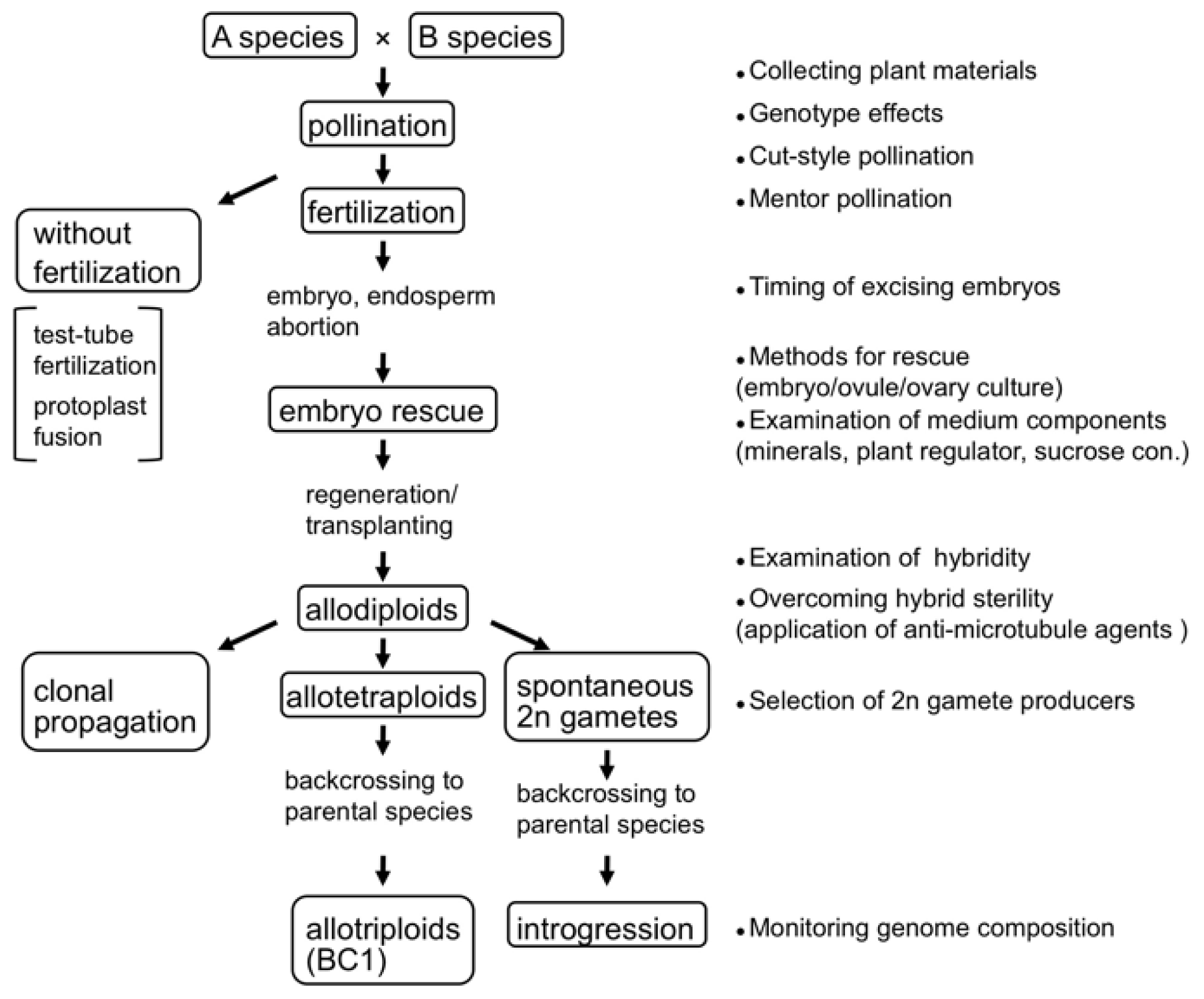
<p>In order to successfully produce synthetic allopolyploids, various factors related to inter-specific hybridization and subsequent procedures should be considered (<xref ref-type="fig" rid="f1-ijms-13-08696">Figure 1</xref>). As the level of cross-ability varies between parental materials, various combinations of genotypes have been tested in inter-specific breeding programs of many crops [<xref ref-type="bibr" rid="b37-ijms-13-08696">37</xref>–<xref ref-type="bibr" rid="b39-ijms-13-08696">39</xref>]. Whether a genotype is used as the maternal or paternal parent is important in inter-specific hybridization because unilateral incompatibility is often observed, especially in crossing combinations between self-incompatible and self-compatible species [<xref ref-type="bibr" rid="b40-ijms-13-08696">40</xref>]. In lilies, crosses between remotely related species succeeded in only one direction [<xref ref-type="bibr" rid="b41-ijms-13-08696">41</xref>]. Environmental factors such as temperature can also influence cross-ability: seed set was promoted at 15 °C in the inter-specific crosses of tulips [<xref ref-type="bibr" rid="b42-ijms-13-08696">42</xref>], and at 23–26 °C in the crosses between <italic>Cucumis sativus</italic> and <italic>C. metuliferus</italic> [<xref ref-type="bibr" rid="b43-ijms-13-08696">43</xref>]. The production of synthetic allopolyploids requires knowledge about the cross-ability of the species and sensitive techniques to overcome the limitations of incompatibility.</p>
<p>In lilies, the pollen tubes arrest halfway down the stylar canal after inter-specific pollination (post-pollination pre-zygotic barriers), but this can be efficiently overcome by placing pollen on the cut-style [<xref ref-type="bibr" rid="b44-ijms-13-08696">44</xref>,<xref ref-type="bibr" rid="b45-ijms-13-08696">45</xref>]. This technique led to the generation of new hybrid lilies such as LA (between <italic>L. longiflorum</italic> and Asiatic hybrids) hybrids, which were distributed commercially. In earlier studies, mentor pollen techniques were successfully applied to overcome pre-zygotic barriers in <italic>Populus</italic> [<xref ref-type="bibr" rid="b46-ijms-13-08696">46</xref>], apple [<xref ref-type="bibr" rid="b47-ijms-13-08696">47</xref>], <italic>Cucumis</italic> [<xref ref-type="bibr" rid="b48-ijms-13-08696">48</xref>], and pear [<xref ref-type="bibr" rid="b49-ijms-13-08696">49</xref>]. Application of plant growth regulators to ovaries at the time of pollination improved seed set after inter-specific hybridization of <italic>Lilium</italic> [<xref ref-type="bibr" rid="b50-ijms-13-08696">50</xref>]. Applications of these techniques are species specific, and further studies are required for bypassing pre-zygotic barriers.</p>
<p>Embryo rescue including embryo, ovule, and ovary culture is necessary to produce hybrids between distantly related species where a post-zygotic barrier is caused by insufficient endosperm formation (Chapter 3). For successful embryo rescue, it is necessary to first determine the optimal isolation time of immature hybrid embryos (days after pollination). In the case of a cross between <italic>B. oleracea</italic> and <italic>B. rapa</italic>, this timing was 20–30 days after pollination. <italic>In vitro</italic> culture conditions of embryos has been extensively discussed [<xref ref-type="bibr" rid="b51-ijms-13-08696">51</xref>,<xref ref-type="bibr" rid="b52-ijms-13-08696">52</xref>] and various culture procedures have been applied to produce inter-specific hybrids. For instance, the culture of ovules obtained from the cross between <italic>Nicotiana tabacum</italic> and <italic>N. acuminata</italic> [<xref ref-type="bibr" rid="b53-ijms-13-08696">53</xref>] was conducted using liquid Nitsch H medium containing 5% sucrose. The hybrid embryos obtained from the cross between <italic>B. oleracea</italic> var. <italic>alboglabra</italic> and <italic>Brassica campestris</italic> were cultured on White’s medium, containing 0.8% agar, 4% sucrose, and 10% coconut milk [<xref ref-type="bibr" rid="b54-ijms-13-08696">54</xref>]. Asano and Myodo [<xref ref-type="bibr" rid="b55-ijms-13-08696">55</xref>], working with <italic>Lilium</italic> embryos derived from the cross of distantly related species, showed that Murashige and Skoog medium is suitable for the culture of immature embryos when it was adjusted to pH 5.0 and supplemented with 20–40 g/L sucrose and 10<sup>−4</sup>–10<sup>−2</sup> mg/L NAA (Naphthalene acetic acid). Okazaki <italic>et al</italic>. [<xref ref-type="bibr" rid="b56-ijms-13-08696">56</xref>] revised the optimum sucrose concentration to 6% for embryo culture of lilies.</p>
<p>Hybrids obtained from distantly related inter-specific crosses are mostly sterile and cannot be used in cross breeding [<xref ref-type="bibr" rid="b57-ijms-13-08696">57</xref>–<xref ref-type="bibr" rid="b59-ijms-13-08696">59</xref>]. Restoration of hybrid fertility can be achieved by zygotic or somatic chromosome doubling and by gamete non-reduction (unreduced gamete) [<xref ref-type="bibr" rid="b60-ijms-13-08696">60</xref>–<xref ref-type="bibr" rid="b63-ijms-13-08696">63</xref>]. The anti-microtubule agent, colchicine, is effective for somatic (mitotic) polyploidization [<xref ref-type="bibr" rid="b64-ijms-13-08696">64</xref>]. Dinitroaniline herbicides such as trifluralin, oryzalin, or amiprophosmethyl also act as anti-microtubule agents and they are applied at a lower concentration (0.001–0.01%) compared to colchicine treatment (0.05–0.2%) [<xref ref-type="bibr" rid="b63-ijms-13-08696">63</xref>–<xref ref-type="bibr" rid="b68-ijms-13-08696">68</xref>]. Oryzalin was more efficient for inducing chromosome doubling and less toxic than colchicine [<xref ref-type="bibr" rid="b65-ijms-13-08696">65</xref>,<xref ref-type="bibr" rid="b68-ijms-13-08696">68</xref>]. Various methods of application of colchicine were adopted: treating flower buds under vacuum, soaking plantlets with colchicine solution, dropping colchicine on to the apical meristem, applying it to the leaf axils with cotton wool, <italic>etc</italic>. [<xref ref-type="bibr" rid="b64-ijms-13-08696">64</xref>]. Nitrous oxide (N<sub>2</sub>O) has been applied to zygotes [<xref ref-type="bibr" rid="b69-ijms-13-08696">69</xref>], seedlings [<xref ref-type="bibr" rid="b70-ijms-13-08696">70</xref>], pollen mother cells [<xref ref-type="bibr" rid="b71-ijms-13-08696">71</xref>,<xref ref-type="bibr" rid="b72-ijms-13-08696">72</xref>], and anther somatic cells [<xref ref-type="bibr" rid="b73-ijms-13-08696">73</xref>], as a polyploidizing agent in lieu of colchicine treatment. Nitrous oxide may act through depolymerization of microtubules [<xref ref-type="bibr" rid="b74-ijms-13-08696">74</xref>]. Nitrous oxide is suitable for treating organs inside tissues because the gas can permeate to reach the tissues of interest, e.g., developing microspores within tulip bulbs [<xref ref-type="bibr" rid="b71-ijms-13-08696">71</xref>]. Additionally, the gas is expected to be rapidly dissipated from treated tissues when the pressure is released, thereby preventing further harmful after-effects. For these reason nitrous oxide has been applied as a polyploidizing agent to overcome hybrid sterility in lilies [<xref ref-type="bibr" rid="b73-ijms-13-08696">73</xref>,<xref ref-type="bibr" rid="b75-ijms-13-08696">75</xref>].</p>
<p>Somatic chromosome doubling of a diploid inter-specific hybrid produces an allotetraploid containing two diploid genomes from two different species. In allotetraploids, the homologous chromosome from each parental species pairs during meiosis and leads to normal meiosis and fertile gamete production [<xref ref-type="bibr" rid="b60-ijms-13-08696">60</xref>,<xref ref-type="bibr" rid="b62-ijms-13-08696">62</xref>,<xref ref-type="bibr" rid="b63-ijms-13-08696">63</xref>,<xref ref-type="bibr" rid="b76-ijms-13-08696">76</xref>]. At the same time, such a preferential homologous chromosome pairing has the drawback of inhibiting meiotic recombination between genomes coming from different progenitors. The resulting fertile gametes show a few variations, so that the progeny of allotetraploids exhibit fixed heterozygosity [<xref ref-type="bibr" rid="b61-ijms-13-08696">61</xref>,<xref ref-type="bibr" rid="b77-ijms-13-08696">77</xref>–<xref ref-type="bibr" rid="b79-ijms-13-08696">79</xref>]. By contrast, spontaneous formation of unreduced gametes from aberrant meiosis (sexual polyploidization), <italic>i.e.</italic>, FDR or SDR, occurs in diploid species as well as allodiploids [<xref ref-type="bibr" rid="b61-ijms-13-08696">61</xref>,<xref ref-type="bibr" rid="b79-ijms-13-08696">79</xref>]. Lim <italic>et al</italic>. [<xref ref-type="bibr" rid="b80-ijms-13-08696">80</xref>] reported a new type of 2n gamete formation mechanism, IMR (indeterminate meiotic restitution), which combines characteristics of FDR and SDR: during the first meiotic division, some of the univalents divide equationally (as in FDR) and some bivalents disjoin reductionally (as in SDR) before telophase, leading to a dyad without further division. Such 2n-gametes can be used for the production of sexual progeny either through crossing or selfing [<xref ref-type="bibr" rid="b62-ijms-13-08696">62</xref>,<xref ref-type="bibr" rid="b80-ijms-13-08696">80</xref>–<xref ref-type="bibr" rid="b84-ijms-13-08696">84</xref>]. In addition, sexual polyploidization forces homoeologous chromosome pairing during meiosis in allodiploids, promoting genetic recombination between homoeologous chromosomes. Therefore, unlike in somatically doubled allotetraploids, fertile pollen derived from sexual polyploidization can transmit huge genetic variation to the progeny, which is preferable for introgression breeding via backcrossing with diploid parental species [<xref ref-type="bibr" rid="b78-ijms-13-08696">78</xref>,<xref ref-type="bibr" rid="b79-ijms-13-08696">79</xref>,<xref ref-type="bibr" rid="b84-ijms-13-08696">84</xref>].</p></sec>
<sec>
<title>3. Reproductive Barrier</title>
<p>There are many reproductive barriers to the natural formation of allopolyploids at pre- and post-zygotic stages [<xref ref-type="bibr" rid="b85-ijms-13-08696">85</xref>]. Pre-zygotic barriers include geographic or pollinator isolation (<italic>i.e.</italic>, flower structure or color) [<xref ref-type="bibr" rid="b85-ijms-13-08696">85</xref>] and flowering time [<xref ref-type="bibr" rid="b85-ijms-13-08696">85</xref>,<xref ref-type="bibr" rid="b86-ijms-13-08696">86</xref>]. The inhibition of pollen tube germination, arrest of pollen tube growth in ovules, and unilateral incompatibility (asymmetric patterns of pollen rejection in crosses between different species) are involved in post-pollination pre-zygotic barriers [<xref ref-type="bibr" rid="b85-ijms-13-08696">85</xref>]. Once the pollen-tube germination and fertilization have been successful, there are still reproductive barriers such as hybrid inviability, a post-zygotic barrier [<xref ref-type="bibr" rid="b85-ijms-13-08696">85</xref>]. Under- or over-proliferation of endosperm, which supports embryo development by providing nutrients crucial for viable seed formation, is one post zygotic barrier, which depends on the crossing combination [<xref ref-type="bibr" rid="b87-ijms-13-08696">87</xref>–<xref ref-type="bibr" rid="b90-ijms-13-08696">90</xref>]. A common characteristic of unusual endosperm development observed in inter-specific and inter-ploidy crosses is due to a premature or delayed cellularization. Recent studies suggested that the altered development of endosperm is due to dysregulation of genomic imprinting [<xref ref-type="bibr" rid="b91-ijms-13-08696">91</xref>]. Another post-zygotic barrier is hybrid sterility caused by sets of interacting genes and is described as the Dobzhansky-Muller incompatibility model [<xref ref-type="bibr" rid="b85-ijms-13-08696">85</xref>]. Sometimes inter-specific hybrids show male-sterility, even though they have succeeded in polyploidization. One type of male-sterility is caused by incompatibility between the nuclear genome and the maternally derived mitochondrial genome, termed cytoplasmic male sterility (CMS) [<xref ref-type="bibr" rid="b92-ijms-13-08696">92</xref>]. Inter-specific and inter-generic crosses sometimes lead to CMS, because a change of nuclear component has impacts on mitochondrial gene expression [<xref ref-type="bibr" rid="b93-ijms-13-08696">93</xref>]. In this chapter, we introduce genomic imprinting and CMS in detail as their molecular mechanisms have recently become clear. The understanding of imprinting and CMS will enable us to generate allopolyploids and inter-specific hybrids efficiently.</p>
<sec>
<title>3.1. Genomic Imprinting</title>
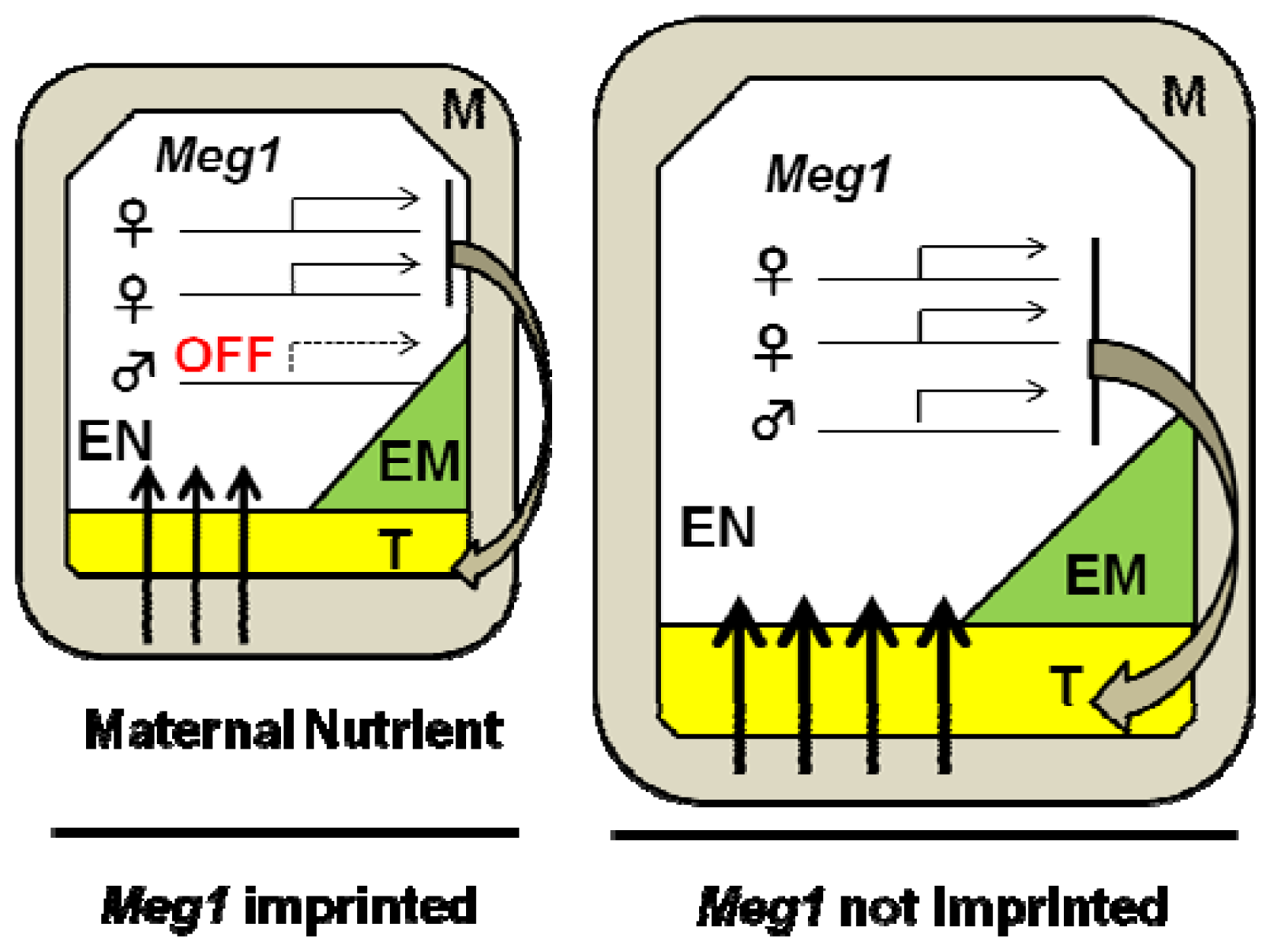
<p>In general, maternally and paternally inherited alleles of each gene are expressed equivalently in diploids but, in some genes, the two alleles are expressed at different levels depending on their parent of origin, termed genomic imprinting. Genomic imprinting is observed in both mammals and flowering plants and is regulated by DNA methylation or histone modifications. Genes involved in genomic imprinting have been extensively studied using the model plant, <italic>A. thaliana</italic> [<xref ref-type="bibr" rid="b94-ijms-13-08696">94</xref>]. Analyses of mutants showing a prolonged syncytial phase and delayed endosperm cellularization identified genes encoding the components of a Polycomb complex [<xref ref-type="bibr" rid="b94-ijms-13-08696">94</xref>]. In endosperm, only the maternal alleles of <italic>MEA</italic> (<italic>MEDEA</italic>) and <italic>FIS2</italic> (<italic>FERTILIZATION INDEPENDENT SEED 2</italic>) are expressed, while the paternal alleles are silenced [<xref ref-type="bibr" rid="b95-ijms-13-08696">95</xref>,<xref ref-type="bibr" rid="b96-ijms-13-08696">96</xref>]. On the other hand, <italic>PHE1</italic> (<italic>PHERES 1</italic>), a gene identified as a downstream target of the Polycomb complex, was expressed from the paternal allele [<xref ref-type="bibr" rid="b97-ijms-13-08696">97</xref>]. Imprinting of these genes is regulated by differences in genomic DNA methylation patterns between the embryo and endosperm [<xref ref-type="bibr" rid="b94-ijms-13-08696">94</xref>]. <italic>MEA</italic> and <italic>FIS2</italic> are maternally expressed while <italic>PHE1</italic> is paternally expressed, and they regulate endosperm development in opposite directions. This antagonistic regulation may explain the observed phenotypes of inter-specific crosses, and is consistent with the parental conflict hypothesis [<xref ref-type="bibr" rid="b98-ijms-13-08696">98</xref>]. Recently, <italic>Meg1</italic> (<italic>Maternally expressed gene 1</italic>) in maize has been shown to be required for the development of the endosperm nutrient transfer cells between seed and maternal tissue. <italic>Meg1</italic> also plays important roles in the regulation of maternal nutrient uptake and sucrose partitioning. This result demonstrated the first functional evidence that an imprinted gene is involved in a balanced distribution of maternal nutrients to filial tissues in plants, although <italic>Meg1</italic> is a maternally expressed imprinted gene that promotes rather than restricts nutrient allocation (<xref ref-type="fig" rid="f2-ijms-13-08696">Figure 2</xref>) [<xref ref-type="bibr" rid="b99-ijms-13-08696">99</xref>].</p>
<p>Several studies have indicated the involvement of genomic imprinting in reproductive barriers. The hybrid endosperm derived from <italic>A. thaliana</italic> as the female parent and its close relative, <italic>A. arenosa</italic> as the male parent, shows overgrowth with altered or arrested embryo development [<xref ref-type="bibr" rid="b100-ijms-13-08696">100</xref>]. The imprinted gene expression patterns of <italic>MEA</italic> and <italic>PHE1</italic> were disrupted and bi-allelic expression was detected in the hybrid endosperm. The overgrowth phenotype of endosperm is probably caused by the maternal de-repression of <italic>PHE1</italic>, suggested by the findings that the maternal <italic>phe1</italic> mutation improves fertility [<xref ref-type="bibr" rid="b100-ijms-13-08696">100</xref>–<xref ref-type="bibr" rid="b102-ijms-13-08696">102</xref>]. Disruption of <italic>PHE1</italic> imprinting may cause a prolonged and stable interaction with <italic>AGL62</italic> (<italic>AGAMOUS-LIKE 62</italic>), which inhibits cellularization [<xref ref-type="bibr" rid="b103-ijms-13-08696">103</xref>,<xref ref-type="bibr" rid="b104-ijms-13-08696">104</xref>]. Altered expression of the <italic>PHE1</italic> homolog, <italic>OsMADS87</italic>, is observed in the endosperm of hybrids between cultivated and wild rice species [<xref ref-type="bibr" rid="b105-ijms-13-08696">105</xref>]. These findings suggest that disruption of the regulation of genomic imprinting may be caused by the difference of epigenetic modifications on <italic>PHE1</italic> between species, and it may act as a reproductive barrier in species hybridization and allopolyploidization. This idea also supports the ‘Endosperm balance number (EBN) hypothesis’, in which the ratio 2:1 of maternal to paternal EBN value is important for a successful cross [<xref ref-type="bibr" rid="b88-ijms-13-08696">88</xref>–<xref ref-type="bibr" rid="b90-ijms-13-08696">90</xref>]. Analysis of genomic imprinting in allopolyploids will provide important findings on its role in species hybridization.</p></sec>
<sec>
<title>3.2. Cytoplasmic Male Sterility</title>
<p>Inter-specific hybrids sometimes show male-sterility, which is known as hybrid sterility. Occasionally male sterility is caused by incompatibility between mitochondrial and nuclear genomes (alloplasmic male sterility), a type of CMS (Cytoplasmic male sterility). CMS phenotypes range from floral abnormalities to failure of pollen maturation. CMS is often observed in natural plant populations, and can also be artificially produced by successive backcrossing resulting from inter-specific exchange of nuclear and cytoplasmic genomes. CMS is a maternally inherited phenotype and known to be governed by the mitochondrial genome. Plant mitochondria are quite different from those of animal mitochondria: the animal mitochondrial genome is less than 20 kb in size and has a circular structure, while plant mitochondrial genomes are large (200 to more than 2400 kb; dependent on species) and complex having a multipartite structure because of large repetitive sequences [<xref ref-type="bibr" rid="b106-ijms-13-08696">106</xref>]. Such repetitive sequences in plant mitochondrial DNA can induce recombination, and create chimeric <italic>orf</italic>s (<italic>open reading frames</italic>) [<xref ref-type="bibr" rid="b92-ijms-13-08696">92</xref>]. Expression of certain new <italic>orfs</italic> is associated with CMS. From a comparison of mitochondrial genomes or gene expression between CMS and normal cytoplasms, CMS-associated genes have been reported in many species [<xref ref-type="bibr" rid="b107-ijms-13-08696">107</xref>]. These genes often show a chimeric structure with the mitochondrial genes in normal mitochondria and have transmembrane domains. Expression of the CMS-associated gene is occasionally suppressed by a particular nuclear factor being transported into mitochondria, and results in fertility restoration. A gene for this nuclear factor is called <italic>Rf</italic> (<italic>Restorer of fertility</italic>).</p>
<p><italic>Rf</italic> genes are grouped into two types, PPR (pentatricopeptide repeat) type and non-PPR type. The PPR proteins are nuclear-encoded RNA binding proteins, which function in post-transcriptional processes (RNA editing, RNA splicing, RNA cleavage and translation) in organelles [<xref ref-type="bibr" rid="b108-ijms-13-08696">108</xref>]. <italic>Rf</italic> genes in <italic>Petunia hybrida</italic> (<italic>Rf-PPR592</italic>), <italic>Raphanus sativus</italic> (<italic>Rfo</italic>/<italic>Rfk</italic>), <italic>Oryza sativa</italic> L. (<italic>Rf1a</italic> and <italic>Rf1b</italic>) and <italic>Sorghum bicolor</italic> (<italic>Rf1</italic>) encode PPR proteins [<xref ref-type="bibr" rid="b109-ijms-13-08696">109</xref>–<xref ref-type="bibr" rid="b114-ijms-13-08696">114</xref>]. These PPR type RF proteins have been investigated and reported to have roles in decreasing CMS-associated gene products in each mitochondrion [<xref ref-type="bibr" rid="b115-ijms-13-08696">115</xref>–<xref ref-type="bibr" rid="b117-ijms-13-08696">117</xref>]. These analyses suggest that PPR type RF proteins are key factors that directly eliminate causes of CMS in mitochondria. The non-PPR type <italic>Rf</italic> genes include <italic>Rf2a</italic> of maize (<italic>Zea mays</italic>), which encodes aldehyde dehydrogenase, and <italic>Rf2</italic> and <italic>Rf17</italic> of rice (<italic>O. sativa</italic>), which encode glycine-rich and ACPS-like (acyl-carrier protein synthesis-like) domain containing proteins, respectively [<xref ref-type="bibr" rid="b118-ijms-13-08696">118</xref>–<xref ref-type="bibr" rid="b120-ijms-13-08696">120</xref>]. RF2a in maize does not reduce the accumulation of a CMS-associated gene product, URF13, although RF2a is required for normal anther development [<xref ref-type="bibr" rid="b121-ijms-13-08696">121</xref>]. The presence of <italic>Rf17</italic> in rice also does not affect the RNA profile of a CMS-associated gene, CW-<italic>orf307</italic> [<xref ref-type="bibr" rid="b122-ijms-13-08696">122</xref>]. The reduced expression of <italic>Rf17</italic> restores the fertility of CW-type CMS rice. The expression of <italic>Rf17</italic> is dependent on the mitochondrial haplotypes [<xref ref-type="bibr" rid="b119-ijms-13-08696">119</xref>], indicating that signals from the mitochondria to the nucleus (retrograde signals) control the expression of <italic>Rf17</italic>.</p>
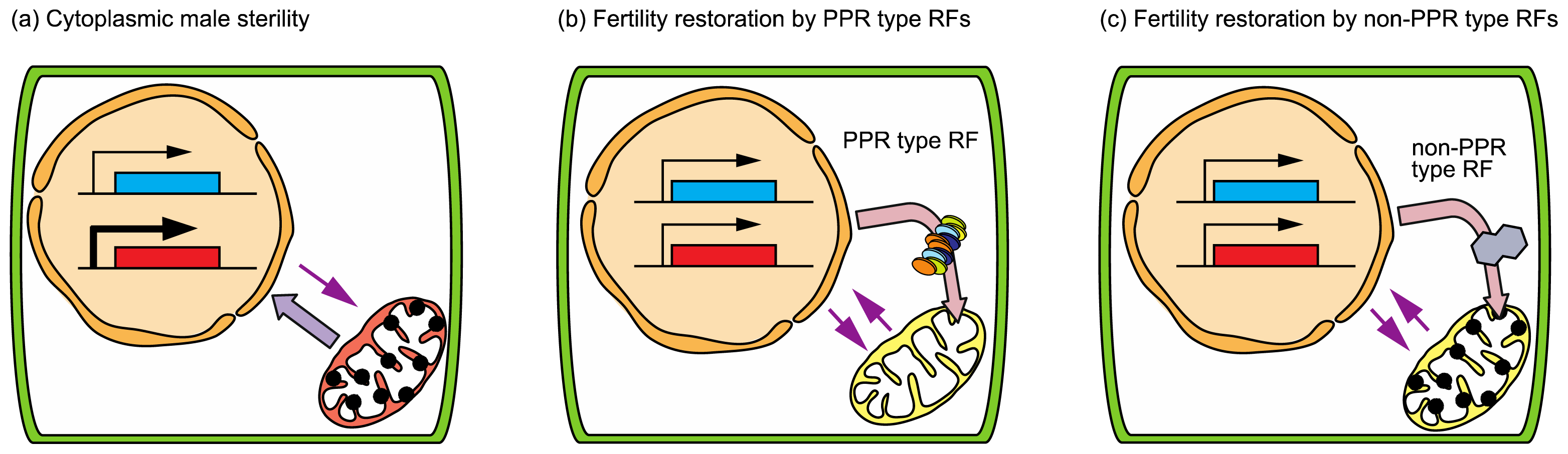
<p>Retrograde signals from mitochondria determine whether accumulation of CMS-associated gene products in mitochondria leads to male sterility [<xref ref-type="bibr" rid="b123-ijms-13-08696">123</xref>]. It is hypothesized that CMS is caused by insufficient ATP-production for pollen development due to the toxic effects of CMS-associated gene products in mitochondria. A new hypothesis is suggested from the point of view of retrograde signaling as shown in <xref ref-type="fig" rid="f3-ijms-13-08696">Figure 3</xref>. CMS associated gene products are accumulated in CMS mitochondria, which leads to an abnormal mitochondrial state and triggers emission of enhanced retrograde signals to disturb the expression of nuclear-encoded genes essential for pollen development. Such imbalance of nuclear gene expression during anther development leads to male sterility (<xref ref-type="fig" rid="f3-ijms-13-08696">Figure 3a</xref>). When a PPR type <italic>Rf</italic> gene exists in the nuclear genome, the RF protein is transported into mitochondria and suppresses expression and/or accumulation of CMS-associated gene products. As a result of RF function, the CMS mitochondria recover and reduce retrograde signals, so that the expression pattern of nuclear-encoded genes becomes identical to that of fertile plants with normal mitochondria, resulting in fertility restoration (<xref ref-type="fig" rid="f3-ijms-13-08696">Figure 3b</xref>). In the case of fertility restoration by non-PPR type RF proteins, the accumulation of the CMS-associated gene products is not changed. The RF protein may act to improve the metabolic state of CMS mitochondria, resulting in a bypass for fertility restoration (<xref ref-type="fig" rid="f3-ijms-13-08696">Figure 3c</xref>). Studies on the molecular entity of retrograde signals from CMS mitochondria will elucidate the details of CMS/<italic>Rf</italic> systems. This knowledge will help us to avoid hybrid sterility caused by incompatibility between mitochondrial and nuclear genomes when generating inter-specific hybrids.</p></sec></sec>
<sec>
<title>4. Self-Compatibility</title>
<p>Self-incompatibility is a mechanism for preventing self-fertilization in many plant species. Self-incompatibility recognition specificity of stigma and pollen is controlled by a single multi allelic locus, called an <italic>S</italic> locus. There are two major classes of self-incompatibility, gametophytic and sporophytic. In gametophytic self-incompatibility, the <italic>S</italic> phenotype of pollen is determined by its own haploid genome, while in sporophytic self-incompatibility the <italic>S</italic> phenotype of pollen is determined by the parental diploid genome [<xref ref-type="bibr" rid="b124-ijms-13-08696">124</xref>].</p>
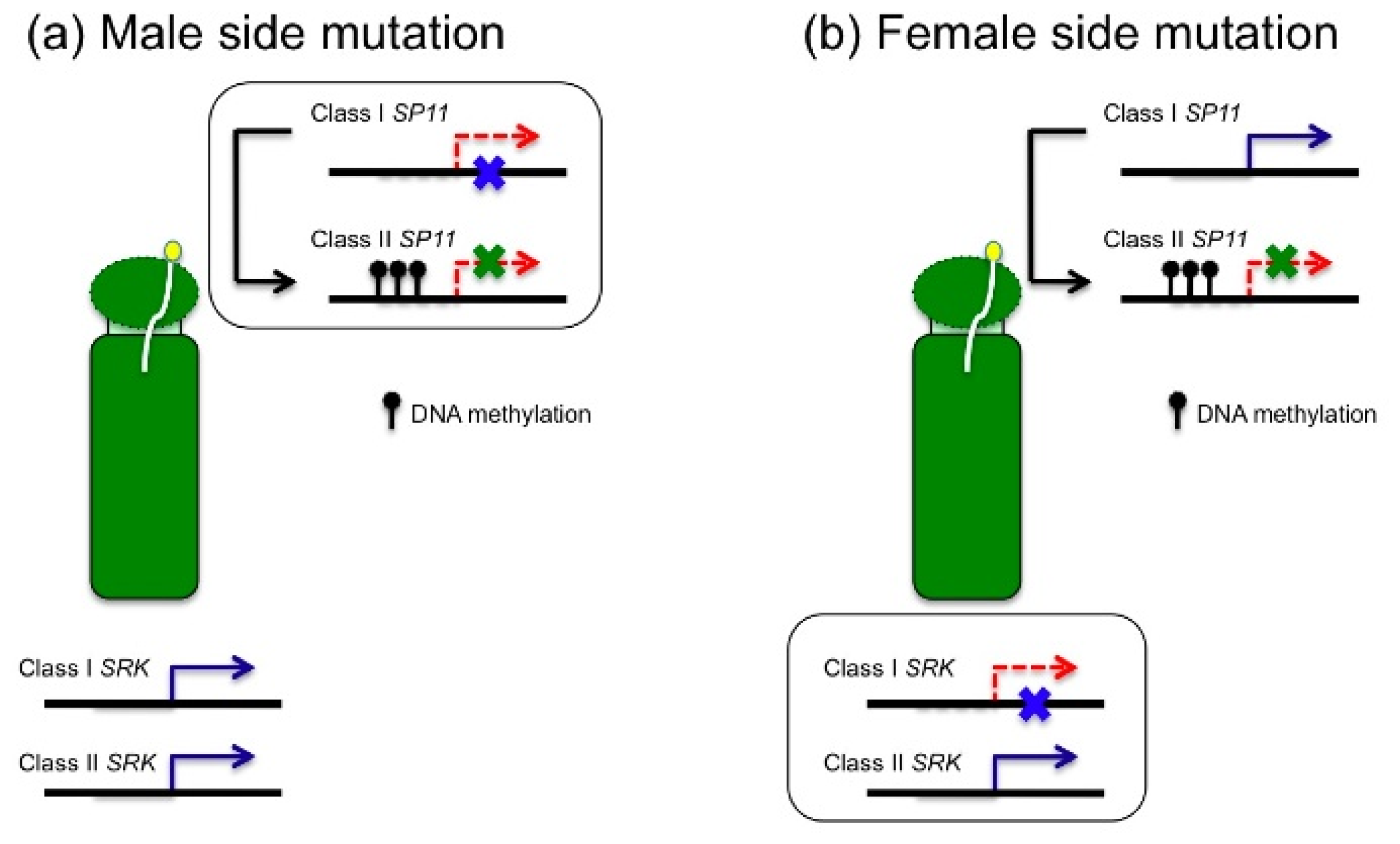
<p>Brassicaceae species have sporophytic self-incompatibility, and the self-incompatibility response is based on the <italic>S</italic> allele specific interaction between the stigma determinant, SRK (<italic>S</italic> receptor kinase), and the pollen determinant, SP11/SCR (<italic>S</italic>-locus protein 11/<italic>S</italic>-locus cysteine-rich protein) (hereafter called SP11): SRK and SP11 derived from the same <italic>S</italic> alleles bind to each other, and this interaction triggers inhibition of pollen tube germination or elongation [<xref ref-type="bibr" rid="b124-ijms-13-08696">124</xref>,<xref ref-type="bibr" rid="b125-ijms-13-08696">125</xref>]. These two genes, <italic>SRK</italic> and <italic>SP11</italic>, are normally not separable by recombination and are transmitted to progeny as one set, termed <italic>S</italic> haplotypes [<xref ref-type="bibr" rid="b124-ijms-13-08696">124</xref>,<xref ref-type="bibr" rid="b125-ijms-13-08696">125</xref>]. There are dominant relationships of <italic>S</italic> haplotypes in the pollen of <italic>S</italic> heterozygous plants (class-I; dominant, class-II, recessive) [<xref ref-type="bibr" rid="b125-ijms-13-08696">125</xref>]. Transcription of class-II <italic>SP11</italic> genes is suppressed in the pollen of the class-I/class-II <italic>S</italic> heterozygous plants [<xref ref-type="bibr" rid="b125-ijms-13-08696">125</xref>], and this suppression is associated with stage and tissue specific <italic>de novo</italic> DNA methylation in the promoter regions of class-II <italic>S</italic> haplotypes [<xref ref-type="bibr" rid="b126-ijms-13-08696">126</xref>]. Recently, Tarutani <italic>et al</italic>. [<xref ref-type="bibr" rid="b127-ijms-13-08696">127</xref>] showed that small RNAs, <italic>Smi</italic> (<italic>SP11 methylation inducer</italic>), are expressed from the <italic>S</italic> locus of class-I <italic>S</italic> haplotypes, and are homologous to the promoter region of class-II <italic>S</italic> haplotypes. The <italic>Smi</italic> RNAs can drive the <italic>de novo</italic> DNA methylation of the promoter region of the class-II <italic>SP11</italic> allele leading to suppression of its expression in the pollen of the class-I/class-II <italic>S</italic> heterozygous plants [<xref ref-type="bibr" rid="b127-ijms-13-08696">127</xref>].</p>
<p>Okamoto <italic>et al</italic>. [<xref ref-type="bibr" rid="b15-ijms-13-08696">15</xref>] suggested that the dominant relationship mentioned above is important for self-compatibility of <italic>B. napus</italic>. As <italic>B. napus</italic> is an allotetraploid having an AC genome, it has <italic>S</italic> loci derived from both the A and C genomes. Most <italic>B. napus</italic> have both class-I and class-II <italic>S</italic> haplotypes (one is derived from A genome and the other is from C genome), and class-I <italic>S</italic> haplotypes have lost the function of SP11 or SRK by spontaneous mutations. Complementation experiments confirmed that loss of function in class-I <italic>SP11</italic> by mutations caused self-compatibility in ‘Westar’ of <italic>B. napus</italic> [<xref ref-type="bibr" rid="b128-ijms-13-08696">128</xref>]. In the artificially synthesized inter-specific hybrid between <italic>B. rapa</italic> with class-I <italic>S</italic> homozygous alleles and <italic>B. oleracea</italic> with class-II <italic>S</italic> homozygous alleles, expression of <italic>SP11</italic> in class-II <italic>S</italic> haplotype was suppressed, indicating that there is a dominant relationship occurred between different chromosomes [<xref ref-type="bibr" rid="b129-ijms-13-08696">129</xref>]. So when class-I SRK lost its function by mutation, <italic>B. napus</italic> became self-compatible because the expression of class-II <italic>SP11</italic> was suppressed by a dominant relationship (<xref ref-type="fig" rid="f4-ijms-13-08696">Figure 4</xref>) [<xref ref-type="bibr" rid="b15-ijms-13-08696">15</xref>]. When class-I <italic>SP11</italic> lost its function by mutation, expression of class-II <italic>SP11</italic> was still suppressed by the dominant relationship (<xref ref-type="fig" rid="f4-ijms-13-08696">Figure 4</xref>) [<xref ref-type="bibr" rid="b15-ijms-13-08696">15</xref>], as the expression of class-I <italic>SP11</italic> is not essential for suppression of class-II <italic>SP11</italic> in the <italic>S</italic> heterozygotes [<xref ref-type="bibr" rid="b130-ijms-13-08696">130</xref>]. Mutations occurring in the <italic>S</italic> determinant genes (<italic>SRK</italic> or <italic>SP11</italic>) of both A and C genome alleles at the same time is highly unlikely. However, if there is a dominant relationship between <italic>S</italic> haplotypes of the A and C genome, a mutation of only a dominant <italic>S</italic> haplotype is sufficient for loss of self-incompatibility. Thus a dominant relationship may be utilized for generating self-compatible allopolyploids in the process of evolution.</p>
<p>In addition to the genetic mutations described above, the possibility that epigenetic change contributes to generating self-compatibility of allopolyploids has been suggested [<xref ref-type="bibr" rid="b131-ijms-13-08696">131</xref>]. Although an inter-specific hybrid between <italic>A. thaliana</italic> and <italic>A. lyrata</italic> has never been detected in nature, this inter-specific hybrid was obtained by crossing between self-compatible <italic>A. thaliana</italic> as a female parent and self-incompatible <italic>A. lyrata</italic> as a male parent [<xref ref-type="bibr" rid="b10-ijms-13-08696">10</xref>,<xref ref-type="bibr" rid="b11-ijms-13-08696">11</xref>]. In the stigma of the hybrid, the expression of <italic>SRK</italic> derived from <italic>A. lyrata</italic> was reduced, and became compatible with the pollen of parental <italic>A. lyrata</italic> [<xref ref-type="bibr" rid="b131-ijms-13-08696">131</xref>]. The stigma of BC<sub>1</sub>F<sub>1</sub> (backcrossed <italic>A. lyrata</italic> to inter-specific F<sub>1</sub> hybrid between <italic>A. thaliana</italic> and <italic>A. lyrata</italic>) showed a self-incompatibility response, suggesting that the disruption of the expression pattern of <italic>SRK</italic> in inter-specific hybrids, which leads to self-compatibility, may be due to the epigenetic changes [<xref ref-type="bibr" rid="b131-ijms-13-08696">131</xref>]. As several studies have reported that there are widespread changes to gene expression between hybrids and their progenitors (chapter 6), <italic>de novo</italic> changes in expression of self-incompatibility recognition specificity genes might be important for self-compatibility.</p>
<p>Out-crossing enforced by self-incompatibility may play a role in the avoidance of inbreeding depression, and self-incompatibility is advantageous in the process of evolution over the long term [<xref ref-type="bibr" rid="b7-ijms-13-08696">7</xref>,<xref ref-type="bibr" rid="b132-ijms-13-08696">132</xref>]. When there is mate limitation, self-compatibility rather than self-incompatibility is advantageous in the short-term (reproductive assurance) [<xref ref-type="bibr" rid="b132-ijms-13-08696">132</xref>]. Allopolyploids are generally self-compatible, though their putative parental lines are self-incompatible [<xref ref-type="bibr" rid="b15-ijms-13-08696">15</xref>]. Synthesized inter-specific hybrids between self-incompatible parental lines are self-incompatible [<xref ref-type="bibr" rid="b15-ijms-13-08696">15</xref>,<xref ref-type="bibr" rid="b129-ijms-13-08696">129</xref>], suggesting that allopolyploids lose self-incompatibility. Natural formation of allopolyploids may be uncommon, and self-compatibility can be advantageous for species survival when mating partners are limited: self-compatibility can establish new populations from individual plants [<xref ref-type="bibr" rid="b132-ijms-13-08696">132</xref>]. Moreover, as allopolyploids have more than two different genomes (heterozygosity), the risk of inbreeding depression is smaller than in diploid plants and reduces the selective pressure to maintain out-crossing [<xref ref-type="bibr" rid="b7-ijms-13-08696">7</xref>]. It can be speculated that self-compatibility has been selected in allopolyploids during evolution.</p></sec>
<sec>
<title>5. Genetic and Epigenetic Changes</title>
<p>Synthetic allopolyploid plants can readily provide material to investigate the changes that occur immediately after polyploidization and through subsequent generations. Unlike natural allopolyploids, the parents can be selected, and this allows comparison between the parents and the synthesized allopolyploids. Evidence of genomic changes has been demonstrated in synthesized allopolyploids such as wheat, <italic>B. napus</italic>, cotton, and <italic>Arabidopsis suecica</italic>, and there are variable levels of genomic changes among different allopolyploids. In synthesized wheat, genomic elimination occurred shortly after allopolyploid formation [<xref ref-type="bibr" rid="b133-ijms-13-08696">133</xref>]. By contrast, there is no genomic elimination or rearrangement in euploid plants of wheat allohexaploids [<xref ref-type="bibr" rid="b134-ijms-13-08696">134</xref>]. Most of the synthesized allohexaploids exhibit homologous pairing at metaphase I, but some aneuploids were observed especially in S0 generations, which are dependent on the progenitor combinations [<xref ref-type="bibr" rid="b134-ijms-13-08696">134</xref>]. No homoeologous pairing is observed in synthesized wheat, which might be due to the function of the <italic>Ph1</italic> gene [<xref ref-type="bibr" rid="b134-ijms-13-08696">134</xref>]. In synthesized <italic>B. napus</italic>, genetic changes are rare at the S0 generation [<xref ref-type="bibr" rid="b25-ijms-13-08696">25</xref>,<xref ref-type="bibr" rid="b135-ijms-13-08696">135</xref>], but genetic changes are much more frequent in the S5 generations [<xref ref-type="bibr" rid="b22-ijms-13-08696">22</xref>]. Phenotypic variation increased in the following generations and was associated with DNA fragment losses due to homoeologous chromosome rearrangements, suggesting that chromosomal rearrangements may play a role in phenotypic variation [<xref ref-type="bibr" rid="b22-ijms-13-08696">22</xref>]. In synthesized <italic>B. napus</italic>, homoeologous pairing, aneuploidy, and homoeologous chromosome compensation are observed, and pollen viability is negatively correlated with increasing aneuploidy [<xref ref-type="bibr" rid="b136-ijms-13-08696">136</xref>–<xref ref-type="bibr" rid="b138-ijms-13-08696">138</xref>]. Though there is variation in the level of crossover suppression between homoeologous chromosomes in natural <italic>B. napus</italic>, natural <italic>B. napus</italic> shows stronger control over homoeologous paring than synthesized <italic>B. napus</italic> [<xref ref-type="bibr" rid="b136-ijms-13-08696">136</xref>,<xref ref-type="bibr" rid="b139-ijms-13-08696">139</xref>]. A low level of genomic changes was detected in synthesized <italic>A. suecica</italic>. Synthetic <italic>A. suecica</italic> are meiotically stable and the frequencies of aneuploidy and chromosome abnormalities are relatively low [<xref ref-type="bibr" rid="b28-ijms-13-08696">28</xref>], but rapid rearrangements in some specific regions such as rDNA loci were detected [<xref ref-type="bibr" rid="b140-ijms-13-08696">140</xref>].</p>
<p>In addition to genetic changes, epigenetic modifications such as DNA methylation or histone modification are also affected in allopolyploids, probably caused by “genome shock” as McClintock predicted [<xref ref-type="bibr" rid="b21-ijms-13-08696">21</xref>,<xref ref-type="bibr" rid="b141-ijms-13-08696">141</xref>–<xref ref-type="bibr" rid="b143-ijms-13-08696">143</xref>], and recent studies indicate that small RNAs have diverse roles in allopolyploid formation. Some transposons were transcriptionally activated or transposed in hypo-methylated mutants [<xref ref-type="bibr" rid="b144-ijms-13-08696">144</xref>–<xref ref-type="bibr" rid="b147-ijms-13-08696">147</xref>]. Transcriptional activation in specific transposons occurred in allopolyploids, which might be caused by “genome shock” [<xref ref-type="bibr" rid="b23-ijms-13-08696">23</xref>,<xref ref-type="bibr" rid="b28-ijms-13-08696">28</xref>,<xref ref-type="bibr" rid="b141-ijms-13-08696">141</xref>]. Microarray analyses indicated that genome-wide transposon activation did not occur in inter-specific hybrids between <italic>A. thaliana</italic> and <italic>A. arenosa</italic> or between <italic>A. thaliana</italic> and <italic>A. lyrata</italic> [<xref ref-type="bibr" rid="b11-ijms-13-08696">11</xref>,<xref ref-type="bibr" rid="b33-ijms-13-08696">33</xref>].</p>
<p>One of the best known epigenetic phenomena observed in allopolyploids is nucleolar dominance, a phenomenon where one parental set of nucleolar rRNA genes is epigenetically silenced in the hybrids or allopolyploids, and the direction of silencing is consistent [<xref ref-type="bibr" rid="b148-ijms-13-08696">148</xref>]. This phenomenon is observed in many organisms such as plants, fruit flies, frogs, and mammals. In inter-specific hybrids between <italic>A. thaliana</italic> and <italic>A. arenosa</italic> or between <italic>A. thaliana</italic> and <italic>A. lyrata</italic>, the <italic>A. thaliana</italic>-derived rRNA gene is silenced [<xref ref-type="bibr" rid="b11-ijms-13-08696">11</xref>,<xref ref-type="bibr" rid="b26-ijms-13-08696">26</xref>,<xref ref-type="bibr" rid="b149-ijms-13-08696">149</xref>,<xref ref-type="bibr" rid="b150-ijms-13-08696">150</xref>]. The involvement of epigenetic regulation is indicated by the de-repression of silencing by treatment with the DNA methyltransferase inhibitor 5-azaC (5 azacytidine) or the histone deacetylase inhibitor, TSA (trichostatin A), in Arabidopsis, Brassica, and Triticale hybrids [<xref ref-type="bibr" rid="b151-ijms-13-08696">151</xref>,<xref ref-type="bibr" rid="b152-ijms-13-08696">152</xref>]. Treatment with both 5-azaC and TSA showed no additional effects, indicating DNA methylation and histone deacetylation work in the same pathway [<xref ref-type="bibr" rid="b152-ijms-13-08696">152</xref>]. The silenced <italic>A. thaliana</italic>-derived rRNA gene is enriched with repressive epigenetic marks such as DNA methylation and H3K9 di-methylation, whereas the active <italic>A. arenosa</italic>-derived gene is enriched with active epigenetic marks like H3K4 tri-methylation [<xref ref-type="bibr" rid="b153-ijms-13-08696">153</xref>]. This epigenetic silencing is established during early postembryonic growth, and the <italic>A. thaliana</italic>-derived gene is progressively associated with silent modifications [<xref ref-type="bibr" rid="b154-ijms-13-08696">154</xref>]. Factors required for nucleolar dominance, such as histone deacetylase; HDA6 (Histone deacetylase 6) and HDT1 (Histone deacetylase 1), <italic>de novo</italic> DNA methyltransferase DRM2 (Domains rearranged methyltransferase 2), RNA-directed DNA methylation pathway components; RDR2 (RNA-dependent RNA polymerase 2) and DCL3 (Dicer-like 3), and methylcytosine binding proteins; MBD6 (Methyl-CpG-binding domain 6) and MBD10, were identified from RNAi screening [<xref ref-type="bibr" rid="b153-ijms-13-08696">153</xref>,<xref ref-type="bibr" rid="b155-ijms-13-08696">155</xref>,<xref ref-type="bibr" rid="b156-ijms-13-08696">156</xref>]. Knockdown of these genes showed de-repression of silencing of the <italic>A. thaliana</italic>-derived rRNA gene, and this activation was associated with increased active histone modification of the <italic>A. thaliana</italic>-derived copy.</p>
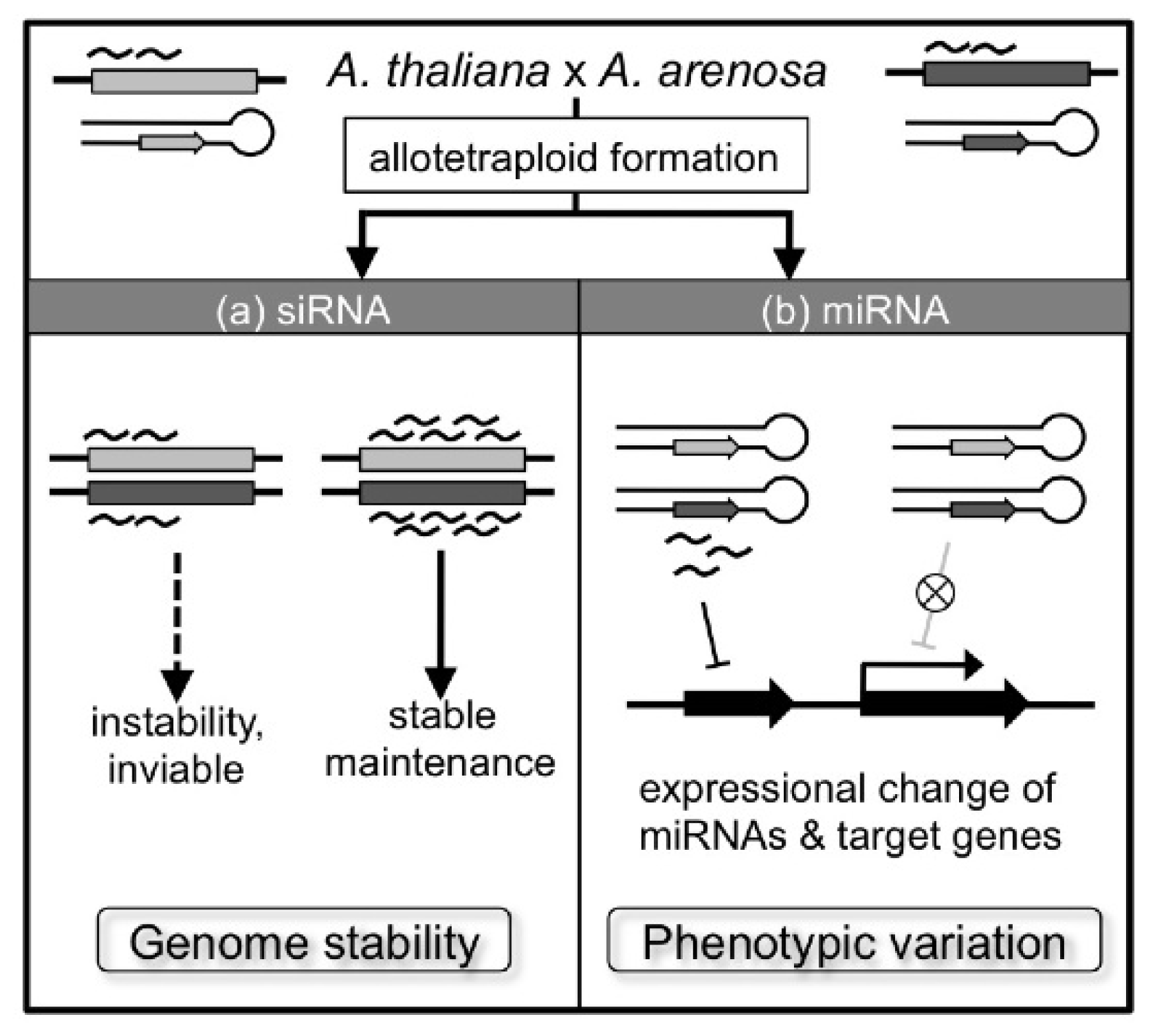
<p>Small RNAs may have important roles in allotetraploid formation, as changes in expression/accumulation of small RNAs are observed in inter-specific hybrids [<xref ref-type="bibr" rid="b157-ijms-13-08696">157</xref>,<xref ref-type="bibr" rid="b158-ijms-13-08696">158</xref>]. Ha <italic>et al</italic>. [<xref ref-type="bibr" rid="b157-ijms-13-08696">157</xref>] analyzed small RNA accumulation in <italic>A. thaliana</italic>, <italic>A. arenosa</italic>, a natural allotetraploid <italic>A. suecica</italic>, and a re-synthesized allotetraploid between <italic>A. thaliana</italic> and <italic>A. arenosa</italic> (F<sub>1</sub> and F<sub>7</sub> plants). <italic>A. thaliana</italic>-derived repeat- and transposon-associated siRNAs (small interfering RNAs), which are important for silencing of these sequences, were reduced in F<sub>1</sub>, but many siRNAs that disappeared in F<sub>1</sub> were restored in F<sub>7</sub> and their accumulation was similar to <italic>A. suecica</italic> [<xref ref-type="bibr" rid="b157-ijms-13-08696">157</xref>]. These data suggest that repeat-associated siRNA functions as a genetic buffer in allotetraploid formation: reduced repeat-associated siRNA causes instability of re-synthesized allotetraploid plants, and siRNA-maintained plants form stable allotetraploid plants (<xref ref-type="fig" rid="f5-ijms-13-08696">Figure 5a</xref>) [<xref ref-type="bibr" rid="b157-ijms-13-08696">157</xref>]. Expression of other classes of small RNAs, such as miRNAs (microRNA) and tasiRNAs (<italic>trans</italic>-acting siRNA), are changed as well in the inter-specific hybrid between <italic>A. thaliana</italic> and <italic>A. arenosa</italic>, and in the natural allotetraploid <italic>A. suecica</italic>. Many miRNA-targeted genes are differentially expressed in allotetraploids, indicating that a change of miRNA expression would induce phenotypic diversity in allotetraploids (<xref ref-type="fig" rid="f5-ijms-13-08696">Figure 5b</xref>) [<xref ref-type="bibr" rid="b157-ijms-13-08696">157</xref>]. In fact for example, Ng <italic>et al</italic>. [<xref ref-type="bibr" rid="b159-ijms-13-08696">159</xref>] suggest that the changed expression of miR163 induces variation in defense response by changing the amount of target transcripts of miR163 and secondary metabolites in allotetraploids.</p></sec>
<sec>
<title>6. Changes in Homoeologous Gene Expression</title>
<p>Some crops are allopolyploids, and it is important to understand the interaction and contribution of the homoeologs to the phenotype, and apply the knowledge for potential agronomical improvements. Allopolyploid formation is generally accompanied by gene expression change and, in synthetic wheat allohexaploids, the homoeologous gene expression changes established in early generations are similar to those in the natural allohexaploid [<xref ref-type="bibr" rid="b160-ijms-13-08696">160</xref>]. Thus, it is important to understand the processes involved in the immediate genomic changes that occur in allopolyploids, not only to apply the knowledge for improvement of recently or artificially formed allopolyploid crops but to understand the evolutionary history of ancient allopolyploids.</p>
<p>Gene expression analyses between parental lines and synthetic allopolyploids have revealed changes in the context of additive (gene expression being equal to the average of the parental gene expression level) and non-additive (gene expression being different to the average of the parental gene expression level) gene expression, and the homoeologous expression changes can be meta-stable or stably inherited over generations. One of the interesting gene expression changes observed in allopolyploids is parental-biased gene expression. Parental-biased gene expression change refers to biased expression of homoeologous genes (up- or down-regulated) depending on the parent-of-origin. Strong parental-biased expression has been reported in newly synthesized allohexaploid wheat [<xref ref-type="bibr" rid="b21-ijms-13-08696">21</xref>,<xref ref-type="bibr" rid="b30-ijms-13-08696">30</xref>,<xref ref-type="bibr" rid="b35-ijms-13-08696">35</xref>,<xref ref-type="bibr" rid="b161-ijms-13-08696">161</xref>,<xref ref-type="bibr" rid="b162-ijms-13-08696">162</xref>] and allotetraploid cotton [<xref ref-type="bibr" rid="b36-ijms-13-08696">36</xref>,<xref ref-type="bibr" rid="b163-ijms-13-08696">163</xref>–<xref ref-type="bibr" rid="b166-ijms-13-08696">166</xref>]. In allotetraploid cotton (AADD, <italic>G. hirsutum</italic>) fiber cells, 30% of homoeolog expression was biased to either the A- or the D-ancestral genome [<xref ref-type="bibr" rid="b163-ijms-13-08696">163</xref>]. Biased homoeolog expression in cotton has also been shown by microarray [<xref ref-type="bibr" rid="b36-ijms-13-08696">36</xref>,<xref ref-type="bibr" rid="b164-ijms-13-08696">164</xref>] and there are evidences for biased homoeolog expression of the D-genome over the A-genome [<xref ref-type="bibr" rid="b163-ijms-13-08696">163</xref>,<xref ref-type="bibr" rid="b165-ijms-13-08696">165</xref>,<xref ref-type="bibr" rid="b166-ijms-13-08696">166</xref>]. Biased homoeologous expression has been shown in other allopolyploid species such as Arabidopsis, wheat, sugarcane, and <italic>C x hytivus</italic> [<xref ref-type="bibr" rid="b21-ijms-13-08696">21</xref>,<xref ref-type="bibr" rid="b28-ijms-13-08696">28</xref>,<xref ref-type="bibr" rid="b167-ijms-13-08696">167</xref>,<xref ref-type="bibr" rid="b168-ijms-13-08696">168</xref>]. Organ-specific and biotic/abiotic stress-related bias of homoeologous expression has been observed in allotetraploid cotton [<xref ref-type="bibr" rid="b31-ijms-13-08696">31</xref>,<xref ref-type="bibr" rid="b169-ijms-13-08696">169</xref>,<xref ref-type="bibr" rid="b170-ijms-13-08696">170</xref>], <italic>Nicotiana</italic> [<xref ref-type="bibr" rid="b171-ijms-13-08696">171</xref>], and Tragopogon [<xref ref-type="bibr" rid="b172-ijms-13-08696">172</xref>], demonstrating that polyploid genome expression can be flexible, even soon after polyploid formation.</p>
<p>Change in homoeolog expression is expected to affect protein expression, and ultimately phenotype. Study on re-synthesized allotetraploid <italic>B. napus</italic> revealed that 2/3 of the investigated additive homoeologs exhibited non-additive protein expression [<xref ref-type="bibr" rid="b173-ijms-13-08696">173</xref>]. Another study on synthesized <italic>B. napus</italic> followed protein expression changes across four generations (F<sub>1</sub>–F<sub>4</sub>) and reported stochastic changes in protein level across generations that were silenced in one generation and reactivated in another [<xref ref-type="bibr" rid="b174-ijms-13-08696">174</xref>]. These stochastic changes suggest a potential relationship between small RNAs that are involved in epigenetic regulation of genes at early generations of allopolyploid formation, and translational regulation of proteins by small RNAs.</p>
<p>In the long-term, stably inherited homoeologous genes can experience sub-functionalization (if the homoeologs complement each other to retain the original gene function), neo-functionalization (acquiring new function), or pseudo-functionalization (homoeolog loses its original function) [<xref ref-type="bibr" rid="b1-ijms-13-08696">1</xref>]. These evolutionary fates of homoeologous genes are gradual processes that follow immediate genomic changes after an allopolyploidization event. In <italic>A. thaliana x A. arenosa</italic> hybrid plants, 0.4% of genes were silenced immediately after polyploidization, but expression variation between <italic>A. thaliana</italic> and <italic>A. arenosa</italic> that diverged 1.5 million years ago, show 2.5% gene expression difference [<xref ref-type="bibr" rid="b28-ijms-13-08696">28</xref>]. In newly synthesized allohexaploid wheat and allotetraploid cotton, 5% of genes are silenced within several generations after polyploidization [<xref ref-type="bibr" rid="b21-ijms-13-08696">21</xref>,<xref ref-type="bibr" rid="b30-ijms-13-08696">30</xref>,<xref ref-type="bibr" rid="b31-ijms-13-08696">31</xref>]. In natural allotetraploid cotton, which has experienced polyploidization 1–2 million years ago, 25% of assessed homoeologous genes were silenced or biased in their expression [<xref ref-type="bibr" rid="b169-ijms-13-08696">169</xref>]. In a recently formed allopolyploid species, Tragopogon, possible sub-functionalization was reported occurring within 80 years (or 40 generations) [<xref ref-type="bibr" rid="b172-ijms-13-08696">172</xref>]. A recent study of gene expression changes in allohexaploid wheat suggests that half of the duplicated genes are structurally (chromosomal rearrangements) and functionally (sub-functionalization and neo-functionalization) altered within 10 million years, and the pseudo-functionalization process is completed within 45–50 million years [<xref ref-type="bibr" rid="b175-ijms-13-08696">175</xref>]. Rice is another plant that has experienced polyploidization events [<xref ref-type="bibr" rid="b176-ijms-13-08696">176</xref>], and expression divergence between paleoduplicates of rice, has shown 88–96% gene expression divergence within 50–70 million years [<xref ref-type="bibr" rid="b177-ijms-13-08696">177</xref>]. The degree and speed of homoeolog expression divergence after polyploidization can vary depending on the species, but it is evident that homoeologous expression divergence occurs immediately after polyploidization and gene silencing can continue through evolution.</p></sec>
<sec>
<title>7. Conclusion</title>
<p>It is indubitable that allopolyploids have selective advantages. Allopolyploidy can cause dynamic changes in gene expression due to functional homoeologous copies interacting with each other, to changes in selective pressure on one of the homoeologous copies, and/or to epigenetic changes, which require orchestration of the genes for the plant to survive the “genome shock”. Interaction of homoeologs plays a key role in creating new phenotypes, and synthetic allopolyploids have helped us understand many genomic changes associated with polyploidization. With the success of RNAi technologies in down-regulating homoeologs in polyploids, demonstrated in sugarcane and Arabidopsis [<xref ref-type="bibr" rid="b178-ijms-13-08696">178</xref>,<xref ref-type="bibr" rid="b179-ijms-13-08696">179</xref>], it will be of interest to create polyploid crops that lack expression of genes involved in epigenetic regulation to investigate the involvement of epigenetics in homoeologous gene expression and their agronomical traits. Development of methods to synthesize allopolyploids and high-throughput sequencing technologies are expected to accelerate research on different allopolyploid plants. Combined analyses of phenotype, proteome, epigenome, transcriptome, and small RNAs in allopolyploid species will allow us to understand the mechanism of reproductive barriers, hybrid incompatibility, and allopolyploid gene regulation, and may provide insights into enhancing, manipulating, or controlling agronomical performance in allopolyploid crops.</p></sec></body>
<back>
<ack>
<title>Acknowledgments</title>
<p>This work was supported in part by a grant-in-aid for Scientific Research on Innovative Areas (24113509) and by Grant for Promotion of Niigata University Research Projects (23C024) to R. Fujimoto.</p></ack>
<ref-list>
<title>References</title>
<ref id="b1-ijms-13-08696"><label>1</label><citation citation-type="journal"><person-group person-group-type="author"><name><surname>Adams</surname><given-names>K.L.</given-names></name><name><surname>Wendel</surname><given-names>J.F.</given-names></name></person-group><article-title>Polyploidy and genome evolution in plants</article-title><source>Curr. Opin. Plant Biol</source><year>2005</year><volume>8</volume><fpage>135</fpage><lpage>141</lpage><pub-id pub-id-type="doi">10.1016/j.pbi.2005.01.001</pub-id><pub-id pub-id-type="pmid">15752992</pub-id></citation></ref>
<ref id="b2-ijms-13-08696"><label>2</label><citation citation-type="journal"><person-group person-group-type="author"><name><surname>Chen</surname><given-names>Z.J.</given-names></name></person-group><article-title>Genetic and epigenetic mechanisms for gene expression and phenotypic variation in plant polyploids</article-title><source>Annu. Rev. Plant Biol</source><year>2007</year><volume>58</volume><fpage>377</fpage><lpage>406</lpage><pub-id pub-id-type="doi">10.1146/annurev.arplant.58.032806.103835</pub-id><pub-id pub-id-type="pmid">17280525</pub-id></citation></ref>
<ref id="b3-ijms-13-08696"><label>3</label><citation citation-type="journal"><person-group person-group-type="author"><name><surname>Ramsey</surname><given-names>J.</given-names></name><name><surname>Schemske</surname><given-names>D.W.</given-names></name></person-group><article-title>Pathways, mechanisms, and rates of polyploid formation in flowering plants</article-title><source>Annu. Rev. Ecol. Syst</source><year>1998</year><volume>29</volume><fpage>467</fpage><lpage>501</lpage><pub-id pub-id-type="doi">10.1146/annurev.ecolsys.29.1.467</pub-id></citation></ref>
<ref id="b4-ijms-13-08696"><label>4</label><citation citation-type="journal"><person-group person-group-type="author"><name><surname>Yamauchi</surname><given-names>A.</given-names></name><name><surname>Hosokawa</surname><given-names>A.</given-names></name><name><surname>Nagata</surname><given-names>H.</given-names></name><name><surname>Shimoda</surname><given-names>M.</given-names></name></person-group><article-title>Triploid bridge and role of parthenogenesis in the evolution of autopolyploidy</article-title><source>Am. Nat</source><year>2004</year><volume>164</volume><fpage>101</fpage><lpage>112</lpage><pub-id pub-id-type="doi">10.1086/421356</pub-id><pub-id pub-id-type="pmid">15266374</pub-id></citation></ref>
<ref id="b5-ijms-13-08696"><label>5</label><citation citation-type="journal"><person-group person-group-type="author"><name><surname>Soltis</surname><given-names>D.E.</given-names></name><name><surname>Soltis</surname><given-names>P.S.</given-names></name></person-group><article-title>Molecular data and the dynamic nature of polyploidy</article-title><source>Crit. Rev. Plant Sci</source><year>1993</year><volume>12</volume><fpage>243</fpage><lpage>273</lpage></citation></ref>
<ref id="b6-ijms-13-08696"><label>6</label><citation citation-type="journal"><person-group person-group-type="author"><name><surname>Griffiths</surname><given-names>S.</given-names></name><name><surname>Sharp</surname><given-names>R.</given-names></name><name><surname>Foote</surname><given-names>T.N.</given-names></name><name><surname>Bertin</surname><given-names>I.</given-names></name><name><surname>Wanous</surname><given-names>M.</given-names></name><name><surname>Reader</surname><given-names>S.</given-names></name><name><surname>Colas</surname><given-names>I.</given-names></name><name><surname>Moore</surname><given-names>G.</given-names></name></person-group><article-title>Molecular characterization of <italic>Ph1</italic> as a major chromosome pairing locus in polyploid wheat</article-title><source>Nature</source><year>2006</year><volume>439</volume><fpage>749</fpage><lpage>752</lpage><pub-id pub-id-type="doi">10.1038/nature04434</pub-id><pub-id pub-id-type="pmid">16467840</pub-id></citation></ref>
<ref id="b7-ijms-13-08696"><label>7</label><citation citation-type="journal"><person-group person-group-type="author"><name><surname>Comai</surname><given-names>L.</given-names></name></person-group><article-title>The advantages and disadvantages of being polyploid</article-title><source>Nat. Rev. Genet</source><year>2005</year><volume>6</volume><fpage>836</fpage><lpage>846</lpage><pub-id pub-id-type="pmid">16304599</pub-id></citation></ref>
<ref id="b8-ijms-13-08696"><label>8</label><citation citation-type="journal"><person-group person-group-type="author"><name><surname>Osborn</surname><given-names>T.C.</given-names></name><name><surname>Pires</surname><given-names>J.C.</given-names></name><name><surname>Birchler</surname><given-names>J.A.</given-names></name><name><surname>Auger</surname><given-names>D.L.</given-names></name><name><surname>Chen</surname><given-names>Z.J.</given-names></name><name><surname>Lee</surname><given-names>H.S.</given-names></name><name><surname>Comai</surname><given-names>L.</given-names></name><name><surname>Madlung</surname><given-names>A.</given-names></name><name><surname>Doerge</surname><given-names>R.W.</given-names></name><name><surname>Colot</surname><given-names>V.</given-names></name><etal/></person-group><article-title>Understanding mechanisms of novel gene expression in polyploids</article-title><source>Trends Genet</source><year>2003</year><volume>19</volume><fpage>141</fpage><lpage>147</lpage><pub-id pub-id-type="doi">10.1016/S0168-9525(03)00015-5</pub-id><pub-id pub-id-type="pmid">12615008</pub-id></citation></ref>
<ref id="b9-ijms-13-08696"><label>9</label><citation citation-type="journal"><person-group person-group-type="author"><name><surname>Chen</surname><given-names>Z.J.</given-names></name></person-group><article-title>Molecular mechanisms of polyploidy and hybrid vigor</article-title><source>Trends Plant Sci</source><year>2010</year><volume>15</volume><fpage>57</fpage><lpage>71</lpage><pub-id pub-id-type="pmid">20080432</pub-id></citation></ref>
<ref id="b10-ijms-13-08696"><label>10</label><citation citation-type="journal"><person-group person-group-type="author"><name><surname>Nasrallah</surname><given-names>M.E.</given-names></name><name><surname>Yogeeswaran</surname><given-names>K.</given-names></name><name><surname>Snyder</surname><given-names>S.</given-names></name><name><surname>Nasrallah</surname><given-names>J.B.</given-names></name></person-group><article-title>Arabidopsis species hybrids in the study of species differences and evolution of amphiploidy in plants</article-title><source>Plant Physiol</source><year>2000</year><volume>124</volume><fpage>1605</fpage><lpage>1614</lpage><pub-id pub-id-type="doi">10.1104/pp.124.4.1605</pub-id><pub-id pub-id-type="pmid">11115878</pub-id></citation></ref>
<ref id="b11-ijms-13-08696"><label>11</label><citation citation-type="journal"><person-group person-group-type="author"><name><surname>Fujimoto</surname><given-names>R.</given-names></name><name><surname>Taylor</surname><given-names>J.M.</given-names></name><name><surname>Sasaki</surname><given-names>T.</given-names></name><name><surname>Kawanabe</surname><given-names>T.</given-names></name><name><surname>Dennis</surname><given-names>E.S.</given-names></name></person-group><article-title>Genome wide gene expression in artificially synthesized amphidiploids of <italic>Arabidopsis</italic></article-title><source>Plant Mol. Biol</source><year>2011</year><volume>77</volume><fpage>419</fpage><lpage>431</lpage><pub-id pub-id-type="doi">10.1007/s11103-011-9820-y</pub-id><pub-id pub-id-type="pmid">21882042</pub-id></citation></ref>
<ref id="b12-ijms-13-08696"><label>12</label><citation citation-type="journal"><person-group person-group-type="author"><name><surname>Ni</surname><given-names>Z.</given-names></name><name><surname>Kim</surname><given-names>E.D.</given-names></name><name><surname>Ha</surname><given-names>M.</given-names></name><name><surname>Lackey</surname><given-names>E.</given-names></name><name><surname>Liu</surname><given-names>J.</given-names></name><name><surname>Zhang</surname><given-names>Y.</given-names></name><name><surname>Sun</surname><given-names>Q.</given-names></name><name><surname>Chen</surname><given-names>Z.J.</given-names></name></person-group><article-title>Altered circadian rhythms regulate growth vigour in hybrids and allopolyploids</article-title><source>Nature</source><year>2009</year><volume>457</volume><fpage>327</fpage><lpage>331</lpage><pub-id pub-id-type="doi">10.1038/nature07523</pub-id><pub-id pub-id-type="pmid">19029881</pub-id></citation></ref>
<ref id="b13-ijms-13-08696"><label>13</label><citation citation-type="journal"><person-group person-group-type="author"><name><surname>Guo</surname><given-names>M.</given-names></name><name><surname>Davis</surname><given-names>D.</given-names></name><name><surname>Birchler</surname><given-names>J.A.</given-names></name></person-group><article-title>Dosage effects on gene expression in a maize ploidy series</article-title><source>Genetics</source><year>1996</year><volume>142</volume><fpage>1349</fpage><lpage>1355</lpage><pub-id pub-id-type="pmid">8846910</pub-id></citation></ref>
<ref id="b14-ijms-13-08696"><label>14</label><citation citation-type="journal"><person-group person-group-type="author"><name><surname>Ha</surname><given-names>M.</given-names></name><name><surname>Kim</surname><given-names>E.D.</given-names></name><name><surname>Chen</surname><given-names>Z.J.</given-names></name></person-group><article-title>Duplicate genes increase expression diversity in closely related species and allopolyploids</article-title><source>Proc. Natl. Acad. Sci. USA</source><year>2009</year><volume>106</volume><fpage>2295</fpage><lpage>2300</lpage><pub-id pub-id-type="doi">10.1073/pnas.0807350106</pub-id><pub-id pub-id-type="pmid">19168631</pub-id></citation></ref>
<ref id="b15-ijms-13-08696"><label>15</label><citation citation-type="journal"><person-group person-group-type="author"><name><surname>Okamoto</surname><given-names>S.</given-names></name><name><surname>Odashima</surname><given-names>M.</given-names></name><name><surname>Fujimoto</surname><given-names>R.</given-names></name><name><surname>Sato</surname><given-names>Y.</given-names></name><name><surname>Kitashiba</surname><given-names>H.</given-names></name><name><surname>Nishio</surname><given-names>T.</given-names></name></person-group><article-title>Self-compatibility in <italic>Brassica napus</italic> is caused by independent mutations in <italic>S</italic>-locus genes</article-title><source>Plant J</source><year>2007</year><volume>50</volume><fpage>391</fpage><lpage>400</lpage><pub-id pub-id-type="doi">10.1111/j.1365-313X.2007.03058.x</pub-id><pub-id pub-id-type="pmid">17425715</pub-id></citation></ref>
<ref id="b16-ijms-13-08696"><label>16</label><citation citation-type="journal"><person-group person-group-type="author"><name><surname>Dubcovsky</surname><given-names>J.</given-names></name><name><surname>Dvorak</surname><given-names>J.</given-names></name></person-group><article-title>Genome plasticity a key factor in the success of polyploid wheat under domestication</article-title><source>Science</source><year>2007</year><volume>316</volume><fpage>1862</fpage><lpage>1866</lpage><pub-id pub-id-type="doi">10.1126/science.1143986</pub-id><pub-id pub-id-type="pmid">17600208</pub-id></citation></ref>
<ref id="b17-ijms-13-08696"><label>17</label><citation citation-type="journal"><person-group person-group-type="author"><name><surname>Matsuoka</surname><given-names>Y.</given-names></name></person-group><article-title>Evolution of polyploid <italic>Triticum</italic> wheats under cultivation: The role of domestication, natural hybridization and allopolyploid speciation in their diversification</article-title><source>Plant Cell Physiol</source><year>2011</year><volume>52</volume><fpage>750</fpage><lpage>764</lpage><pub-id pub-id-type="doi">10.1093/pcp/pcr018</pub-id><pub-id pub-id-type="pmid">21317146</pub-id></citation></ref>
<ref id="b18-ijms-13-08696"><label>18</label><citation citation-type="journal"><person-group person-group-type="author"><name><surname>Wendel</surname><given-names>J.F.</given-names></name><name><surname>Cronn</surname><given-names>R.C.</given-names></name></person-group><article-title>Polyploidy and the evolutionary history of cotton</article-title><source>Adv. Agron</source><year>2003</year><volume>78</volume><fpage>139</fpage><lpage>186</lpage></citation></ref>
<ref id="b19-ijms-13-08696"><label>19</label><citation citation-type="journal"><person-group person-group-type="author"><name><surname>Lee</surname><given-names>J.J.</given-names></name><name><surname>Woodward</surname><given-names>A.W.</given-names></name><name><surname>Chen</surname><given-names>Z.J.</given-names></name></person-group><article-title>Gene expression changes and early events in cotton fibre development</article-title><source>Ann. Bot</source><year>2007</year><volume>100</volume><fpage>1391</fpage><lpage>1401</lpage><pub-id pub-id-type="doi">10.1093/aob/mcm232</pub-id><pub-id pub-id-type="pmid">17905721</pub-id></citation></ref>
<ref id="b20-ijms-13-08696"><label>20</label><citation citation-type="journal"><person-group person-group-type="author"><name><surname>Nagaharu</surname><given-names>N.</given-names></name></person-group><article-title>Genome analysis in <italic>Brassica</italic> with special reference to the experimental formation of <italic>B. napus</italic> and peculiar mode of fertilization</article-title><source>Jpn. J. Bot</source><year>1935</year><volume>7</volume><fpage>389</fpage><lpage>452</lpage></citation></ref>
<ref id="b21-ijms-13-08696"><label>21</label><citation citation-type="journal"><person-group person-group-type="author"><name><surname>Kashkush</surname><given-names>K.</given-names></name><name><surname>Feldman</surname><given-names>M.</given-names></name><name><surname>Levy</surname><given-names>A.A.</given-names></name></person-group><article-title>Gene loss, silencing and activation in a newly synthesized wheat allotetraploid</article-title><source>Genetics</source><year>2002</year><volume>160</volume><fpage>1651</fpage><lpage>1659</lpage><pub-id pub-id-type="pmid">11973318</pub-id></citation></ref>
<ref id="b22-ijms-13-08696"><label>22</label><citation citation-type="journal"><person-group person-group-type="author"><name><surname>Gaeta</surname><given-names>R.T.</given-names></name><name><surname>Pires</surname><given-names>J.C.</given-names></name><name><surname>Iniguez-Luy</surname><given-names>F.</given-names></name><name><surname>Leon</surname><given-names>E.</given-names></name><name><surname>Osborn</surname><given-names>T.C.</given-names></name></person-group><article-title>Genomic changes in resynthesized <italic>Brassica napus</italic> and their effect on gene expression and phenotype</article-title><source>Plant Cell</source><year>2007</year><volume>19</volume><fpage>3403</fpage><lpage>3417</lpage><pub-id pub-id-type="doi">10.1105/tpc.107.054346</pub-id><pub-id pub-id-type="pmid">18024568</pub-id></citation></ref>
<ref id="b23-ijms-13-08696"><label>23</label><citation citation-type="journal"><person-group person-group-type="author"><name><surname>Madlung</surname><given-names>A.</given-names></name><name><surname>Tyagi</surname><given-names>A.P.</given-names></name><name><surname>Watson</surname><given-names>B.</given-names></name><name><surname>Jiang</surname><given-names>H.</given-names></name><name><surname>Kagochi</surname><given-names>T.</given-names></name><name><surname>Doerge</surname><given-names>R.W.</given-names></name><name><surname>Martienssen</surname><given-names>R.</given-names></name><name><surname>Comai</surname><given-names>L.</given-names></name></person-group><article-title>Genomic changes in synthetic Arabidopsis polyploids</article-title><source>Plant J</source><year>2005</year><volume>41</volume><fpage>221</fpage><lpage>230</lpage><pub-id pub-id-type="pmid">15634199</pub-id></citation></ref>
<ref id="b24-ijms-13-08696"><label>24</label><citation citation-type="journal"><person-group person-group-type="author"><name><surname>Madlung</surname><given-names>A.</given-names></name><name><surname>Masuelli</surname><given-names>R.W.</given-names></name><name><surname>Watson</surname><given-names>B.</given-names></name><name><surname>Reynolds</surname><given-names>S.H.</given-names></name><name><surname>Davison</surname><given-names>J.</given-names></name><name><surname>Comai</surname><given-names>L.</given-names></name></person-group><article-title>Remodeling of DNA methylation and phenotypic and transcriptional changes in synthetic Arabidopsis allotetraploids</article-title><source>Plant Physiol</source><year>2002</year><volume>129</volume><fpage>733</fpage><lpage>746</lpage><pub-id pub-id-type="doi">10.1104/pp.003095</pub-id><pub-id pub-id-type="pmid">12068115</pub-id></citation></ref>
<ref id="b25-ijms-13-08696"><label>25</label><citation citation-type="journal"><person-group person-group-type="author"><name><surname>Lukens</surname><given-names>L.N.</given-names></name><name><surname>Pires</surname><given-names>J.C.</given-names></name><name><surname>Leon</surname><given-names>E.</given-names></name><name><surname>Vogelzang</surname><given-names>R.</given-names></name><name><surname>Oslach</surname><given-names>L.</given-names></name><name><surname>Osborn</surname><given-names>T.</given-names></name></person-group><article-title>Patterns of sequence loss and cytosine methylation within a population of newly resynthesized <italic>Brassica napus</italic> allopolyploids</article-title><source>Plant Physiol</source><year>2006</year><volume>140</volume><fpage>336</fpage><lpage>348</lpage><pub-id pub-id-type="pmid">16377753</pub-id></citation></ref>
<ref id="b26-ijms-13-08696"><label>26</label><citation citation-type="journal"><person-group person-group-type="author"><name><surname>Beaulieu</surname><given-names>J.</given-names></name><name><surname>Jean</surname><given-names>M.</given-names></name><name><surname>Belzile</surname><given-names>F.</given-names></name></person-group><article-title>The allotetraploid <italic>Arabidopsis thaliana</italic>-<italic>Arabidopsis lyrata</italic> subsp. <italic>petraea</italic> as an alternative model system for the study of polyploidy in plants</article-title><source>Mol. Genet. Genomics</source><year>2009</year><volume>281</volume><fpage>421</fpage><lpage>435</lpage><pub-id pub-id-type="doi">10.1007/s00438-008-0421-7</pub-id><pub-id pub-id-type="pmid">19148683</pub-id></citation></ref>
<ref id="b27-ijms-13-08696"><label>27</label><citation citation-type="journal"><person-group person-group-type="author"><name><surname>Parisod</surname><given-names>C.</given-names></name><name><surname>Alix</surname><given-names>K.</given-names></name><name><surname>Just</surname><given-names>J.</given-names></name><name><surname>Petit</surname><given-names>M.</given-names></name><name><surname>Sarilar</surname><given-names>V.</given-names></name><name><surname>Mhiri</surname><given-names>C.</given-names></name><name><surname>Ainouche</surname><given-names>M.</given-names></name><name><surname>Chalhoub</surname><given-names>B.</given-names></name><name><surname>Glandbastien</surname><given-names>M.A.</given-names></name></person-group><article-title>Impact of transposable elements on the organization and function of allopolyploid genomes</article-title><source>New Phytol</source><year>2010</year><volume>186</volume><fpage>37</fpage><lpage>45</lpage><pub-id pub-id-type="doi">10.1111/j.1469-8137.2009.03096.x</pub-id><pub-id pub-id-type="pmid">20002321</pub-id></citation></ref>
<ref id="b28-ijms-13-08696"><label>28</label><citation citation-type="journal"><person-group person-group-type="author"><name><surname>Comai</surname><given-names>L.</given-names></name><name><surname>Tyagi</surname><given-names>A.P.</given-names></name><name><surname>Winter</surname><given-names>K.</given-names></name><name><surname>Holmes-Davis</surname><given-names>R.</given-names></name><name><surname>Reynolds</surname><given-names>S.H.</given-names></name><name><surname>Stevens</surname><given-names>Y.</given-names></name><name><surname>Byers</surname><given-names>B.</given-names></name></person-group><article-title>Phenotypic instability and rapid gene silencing in newly formed Arabidopsis allotetraploids</article-title><source>Plant Cell</source><year>2000</year><volume>12</volume><fpage>1551</fpage><lpage>1568</lpage><pub-id pub-id-type="pmid">11006331</pub-id></citation></ref>
<ref id="b29-ijms-13-08696"><label>29</label><citation citation-type="journal"><person-group person-group-type="author"><name><surname>Kashkush</surname><given-names>K.</given-names></name><name><surname>Feldman</surname><given-names>M.</given-names></name><name><surname>Levy</surname><given-names>A.A.</given-names></name></person-group><article-title>Transcriptional activation of retrotransposons alters the expression of adjacent genes in wheat</article-title><source>Nat. Genet</source><year>2003</year><volume>33</volume><fpage>102</fpage><lpage>106</lpage><pub-id pub-id-type="doi">10.1038/ng1063</pub-id><pub-id pub-id-type="pmid">12483211</pub-id></citation></ref>
<ref id="b30-ijms-13-08696"><label>30</label><citation citation-type="journal"><person-group person-group-type="author"><name><surname>He</surname><given-names>P.</given-names></name><name><surname>Friebe</surname><given-names>B.R.</given-names></name><name><surname>Gill</surname><given-names>B.S.</given-names></name><name><surname>Zhou</surname><given-names>J.M.</given-names></name></person-group><article-title>Allopolyploidy alters gene expression in the highly stable hexaploid wheat</article-title><source>Plant Mol. Biol</source><year>2003</year><volume>52</volume><fpage>401</fpage><lpage>414</lpage><pub-id pub-id-type="doi">10.1023/A:1023965400532</pub-id><pub-id pub-id-type="pmid">12856945</pub-id></citation></ref>
<ref id="b31-ijms-13-08696"><label>31</label><citation citation-type="journal"><person-group person-group-type="author"><name><surname>Adams</surname><given-names>K.L.</given-names></name><name><surname>Percifield</surname><given-names>R.</given-names></name><name><surname>Wendel</surname><given-names>J.F.</given-names></name></person-group><article-title>Organ-specific silencing of duplicated genes in a newly synthesized cotton allotetraploid</article-title><source>Genetics</source><year>2004</year><volume>168</volume><fpage>2217</fpage><lpage>2226</lpage><pub-id pub-id-type="doi">10.1534/genetics.104.033522</pub-id><pub-id pub-id-type="pmid">15371349</pub-id></citation></ref>
<ref id="b32-ijms-13-08696"><label>32</label><citation citation-type="journal"><person-group person-group-type="author"><name><surname>Albertin</surname><given-names>W.</given-names></name><name><surname>Balliau</surname><given-names>T.</given-names></name><name><surname>Brabant</surname><given-names>P.</given-names></name><name><surname>Chèvre</surname><given-names>A.M.</given-names></name><name><surname>Eber</surname><given-names>F.</given-names></name><name><surname>Malosse</surname><given-names>C.</given-names></name><name><surname>Thiellement</surname><given-names>H.</given-names></name></person-group><article-title>Numerous and rapid nonstochastic modifications of gene products in newly synthesized <italic>Brassica napus</italic> allotetraploids</article-title><source>Genetics</source><year>2006</year><volume>173</volume><fpage>1101</fpage><lpage>1113</lpage><pub-id pub-id-type="doi">10.1534/genetics.106.057554</pub-id><pub-id pub-id-type="pmid">16624896</pub-id></citation></ref>
<ref id="b33-ijms-13-08696"><label>33</label><citation citation-type="journal"><person-group person-group-type="author"><name><surname>Wang</surname><given-names>J.</given-names></name><name><surname>Tian</surname><given-names>L.</given-names></name><name><surname>Lee</surname><given-names>H.S.</given-names></name><name><surname>Wei</surname><given-names>N.E.</given-names></name><name><surname>Jiang</surname><given-names>H.</given-names></name><name><surname>Watson</surname><given-names>B.</given-names></name><name><surname>Madlung</surname><given-names>A.</given-names></name><name><surname>Osborn</surname><given-names>T.C.</given-names></name><name><surname>Doerge</surname><given-names>R.W.</given-names></name><name><surname>Comai</surname><given-names>L.</given-names></name><name><surname>Chen</surname><given-names>Z.J.</given-names></name></person-group><article-title>Genomewide nonadditive gene regulation in Arabidopsis allotetraploids</article-title><source>Genetics</source><year>2006</year><volume>172</volume><fpage>507</fpage><lpage>517</lpage><pub-id pub-id-type="pmid">16172500</pub-id></citation></ref>
<ref id="b34-ijms-13-08696"><label>34</label><citation citation-type="journal"><person-group person-group-type="author"><name><surname>Gaeta</surname><given-names>R.T.</given-names></name><name><surname>Yoo</surname><given-names>S.Y.</given-names></name><name><surname>Pires</surname><given-names>J.C.</given-names></name><name><surname>Doerge</surname><given-names>R.W.</given-names></name><name><surname>Chen</surname><given-names>Z.J.</given-names></name><name><surname>Osborn</surname><given-names>T.C.</given-names></name></person-group><article-title>Analysis of gene expression in resynthesized <italic>Brassica napus</italic> allopolyploids using Arabidopsis 70mer oligo microarrays</article-title><source>PLoS One</source><year>2009</year><volume>4</volume><fpage>e4760</fpage><pub-id pub-id-type="doi">10.1371/journal.pone.0004760</pub-id><pub-id pub-id-type="pmid">19274085</pub-id></citation></ref>
<ref id="b35-ijms-13-08696"><label>35</label><citation citation-type="journal"><person-group person-group-type="author"><name><surname>Pumphrey</surname><given-names>M.</given-names></name><name><surname>Bai</surname><given-names>J.</given-names></name><name><surname>Laudencia-Chingcuanco</surname><given-names>D.</given-names></name><name><surname>Anderson</surname><given-names>O.</given-names></name><name><surname>Gill</surname><given-names>B.S.</given-names></name></person-group><article-title>Nonadditive expression of homoeologous genes is established upon polyploidization in hexaploid wheat</article-title><source>Genetics</source><year>2009</year><volume>181</volume><fpage>1147</fpage><lpage>1157</lpage><pub-id pub-id-type="doi">10.1534/genetics.108.096941</pub-id><pub-id pub-id-type="pmid">19104075</pub-id></citation></ref>
<ref id="b36-ijms-13-08696"><label>36</label><citation citation-type="journal"><person-group person-group-type="author"><name><surname>Rapp</surname><given-names>R.A.</given-names></name><name><surname>Udall</surname><given-names>J.A.</given-names></name><name><surname>Wendel</surname><given-names>J.F.</given-names></name></person-group><article-title>Genomic expression dominance in allopolyploids</article-title><source>BMC Biol</source><year>2009</year><volume>7</volume><fpage>18</fpage><pub-id pub-id-type="doi">10.1186/1741-7007-7-18</pub-id><pub-id pub-id-type="pmid">19409075</pub-id></citation></ref>
<ref id="b37-ijms-13-08696"><label>37</label><citation citation-type="journal"><person-group person-group-type="author"><name><surname>Mejía-Jiménez</surname><given-names>A.</given-names></name><name><surname>Muñoz</surname><given-names>C.</given-names></name><name><surname>Jacobsen</surname><given-names>H.J.</given-names></name><name><surname>Roca</surname><given-names>W.M.</given-names></name><name><surname>Singh</surname><given-names>S.P.</given-names></name></person-group><article-title>Interspecific hybridization between common and tepary beans: Increased hybrid embryo growth, fertility, and efficiency of hybridization through recurrent and congruity backcrossing</article-title><source>Theor. Appl. Genet</source><year>1994</year><volume>88</volume><fpage>324</fpage><lpage>331</lpage></citation></ref>
<ref id="b38-ijms-13-08696"><label>38</label><citation citation-type="journal"><person-group person-group-type="author"><name><surname>Akbar</surname><given-names>M.A.</given-names></name></person-group><article-title>Chromosomal stability and performance of resynthesized <italic>Brassica napus</italic> produced for gain in earliness and short-day response</article-title><source>Hereditas</source><year>1989</year><volume>111</volume><fpage>247</fpage><lpage>253</lpage></citation></ref>
<ref id="b39-ijms-13-08696"><label>39</label><citation citation-type="journal"><person-group person-group-type="author"><name><surname>Van Eijk</surname><given-names>J.P.</given-names></name><name><surname>van Raamsdonk</surname><given-names>L.W.D.</given-names></name><name><surname>Eikelboom</surname><given-names>W.</given-names></name><name><surname>Bino</surname><given-names>R.J.</given-names></name></person-group><article-title>Interspecific crosses between <italic>Tulipa gesneriana</italic> cultivars and wild <italic>Tulipa</italic> species: A survey</article-title><source>Sex. Plant Reprod</source><year>1991</year><volume>4</volume><fpage>1</fpage><lpage>5</lpage></citation></ref>
<ref id="b40-ijms-13-08696"><label>40</label><citation citation-type="journal"><person-group person-group-type="author"><name><surname>Murfett</surname><given-names>J.</given-names></name><name><surname>Strabala</surname><given-names>T.J.</given-names></name><name><surname>Zurek</surname><given-names>D.M.</given-names></name><name><surname>Mou</surname><given-names>B.</given-names></name><name><surname>Beecher</surname><given-names>B.</given-names></name><name><surname>McClure</surname><given-names>B.A.</given-names></name></person-group><article-title><italic>S</italic> RNase and interspecific pollen rejection in the genus <italic>Nicotiana</italic>: Multiple pollen-rejection pathways contribute to unilateral incompatibility between self-Incompatible and self-compatible species</article-title><source>Plant Cell</source><year>1996</year><volume>8</volume><fpage>943</fpage><lpage>958</lpage><pub-id pub-id-type="pmid">12239407</pub-id></citation></ref>
<ref id="b41-ijms-13-08696"><label>41</label><citation citation-type="journal"><person-group person-group-type="author"><name><surname>Asano</surname><given-names>Y.</given-names></name></person-group><article-title>Studies on crosses between distantly related species of lilies IV. The culture of immature hybrid embryos 0.3–0.4 mm long</article-title><source>J. Jpn. Soc. Hort. Sci</source><year>1980</year><volume>49</volume><fpage>114</fpage><lpage>118</lpage><pub-id pub-id-type="doi">10.2503/jjshs.49.114</pub-id></citation></ref>
<ref id="b42-ijms-13-08696"><label>42</label><citation citation-type="journal"><person-group person-group-type="author"><name><surname>Kho</surname><given-names>Y.O.</given-names></name><name><surname>Baër</surname><given-names>J.</given-names></name></person-group><article-title>Incompatibility problems in species crosses of tulips</article-title><source>Euphytica</source><year>1971</year><volume>20</volume><fpage>30</fpage><lpage>35</lpage><pub-id pub-id-type="doi">10.1007/BF00146770</pub-id></citation></ref>
<ref id="b43-ijms-13-08696"><label>43</label><citation citation-type="journal"><person-group person-group-type="author"><name><surname>Franken</surname><given-names>J.</given-names></name><name><surname>Custers</surname><given-names>J.B.M.</given-names></name><name><surname>Bino</surname><given-names>R.J.</given-names></name></person-group><article-title>Effects of temperature on pollen tube growth and fruit set in reciprocal crosses between <italic>Cucumis sativus</italic> and <italic>C. metuliferus</italic></article-title><source>Plant Breed</source><year>1988</year><volume>100</volume><fpage>150</fpage><lpage>153</lpage><pub-id pub-id-type="doi">10.1111/j.1439-0523.1988.tb00231.x</pub-id></citation></ref>
<ref id="b44-ijms-13-08696"><label>44</label><citation citation-type="journal"><person-group person-group-type="author"><name><surname>Watts</surname><given-names>V.M.</given-names></name></person-group><article-title>Influence of intrastylar pollination on seed set in lilies</article-title><source>Proc. Am. Soc. Hort. Sci</source><year>1967</year><volume>91</volume><fpage>660</fpage><lpage>663</lpage></citation></ref>
<ref id="b45-ijms-13-08696"><label>45</label><citation citation-type="journal"><person-group person-group-type="author"><name><surname>Asano</surname><given-names>Y.</given-names></name><name><surname>Myodo</surname><given-names>H.</given-names></name></person-group><article-title>Studies on crosses between distantly related species of lilies I. For the intrastylar pollination technique</article-title><source>J. Jpn. Soc. Hort. Sci</source><year>1977</year><volume>46</volume><fpage>59</fpage><lpage>65</lpage><pub-id pub-id-type="doi">10.2503/jjshs.46.59</pub-id></citation></ref>
<ref id="b46-ijms-13-08696"><label>46</label><citation citation-type="journal"><person-group person-group-type="author"><name><surname>Stettler</surname><given-names>R.F.</given-names></name></person-group><article-title>Irradiated mentor pollen: Its use in remote hybridization of black cottonwood</article-title><source>Nature</source><year>1968</year><volume>219</volume><fpage>746</fpage><lpage>747</lpage><pub-id pub-id-type="doi">10.1038/219746a0</pub-id><pub-id pub-id-type="pmid">5667073</pub-id></citation></ref>
<ref id="b47-ijms-13-08696"><label>47</label><citation citation-type="journal"><person-group person-group-type="author"><name><surname>Dayton</surname><given-names>D.F.</given-names></name></person-group><article-title>Overcoming self-incompatibility in plants with killed compatible pollen</article-title><source>J. Am. Soc. Hort. Sci</source><year>1974</year><volume>99</volume><fpage>190</fpage><lpage>192</lpage></citation></ref>
<ref id="b48-ijms-13-08696"><label>48</label><citation citation-type="journal"><person-group person-group-type="author"><name><surname>Den Nijs</surname><given-names>A.P.M.</given-names></name><name><surname>Oost</surname><given-names>E.H.</given-names></name></person-group><article-title>Effects of mentor pollen on pollen-pistil incongruities among species of <italic>Cucumis</italic> L</article-title><source>Euphytica</source><year>1980</year><volume>29</volume><fpage>267</fpage><lpage>271</lpage><pub-id pub-id-type="doi">10.1007/BF00025123</pub-id></citation></ref>
<ref id="b49-ijms-13-08696"><label>49</label><citation citation-type="journal"><person-group person-group-type="author"><name><surname>Visser</surname><given-names>T.</given-names></name></person-group><article-title>Pollen and pollination experiments IV. Mentor pollen and pioneer pollen techniques regarding incompatibility and incongruity in apple and pear</article-title><source>Euphytica</source><year>1981</year><volume>31</volume><fpage>305</fpage><lpage>312</lpage></citation></ref>
<ref id="b50-ijms-13-08696"><label>50</label><citation citation-type="journal"><person-group person-group-type="author"><name><surname>Emsweller</surname><given-names>S.L.</given-names></name><name><surname>Stuart</surname><given-names>N.W.</given-names></name></person-group><article-title>Use of growth regulating substances to overcome incompatibilities in <italic>Lilium</italic></article-title><source>Proc. Am. Soc. Hort. Sci</source><year>1948</year><volume>51</volume><fpage>581</fpage><lpage>589</lpage></citation></ref>
<ref id="b51-ijms-13-08696"><label>51</label><citation citation-type="book"><person-group person-group-type="author"><name><surname>Raghavan</surname><given-names>V.</given-names></name><name><surname>Srivastava</surname><given-names>P.S.</given-names></name></person-group><article-title>Embryo culture</article-title><source>Experimental Embryology of Vascular Plants</source><person-group person-group-type="editor"><name><surname>Johri</surname><given-names>B.M.</given-names></name></person-group><publisher-name>Springer-Verlag</publisher-name><publisher-loc>Berlin, Germany</publisher-loc><year>1982</year><fpage>195</fpage><lpage>230</lpage></citation></ref>
<ref id="b52-ijms-13-08696"><label>52</label><citation citation-type="journal"><person-group person-group-type="author"><name><surname>Williams</surname><given-names>E.G.</given-names></name><name><surname>Maheswaran</surname><given-names>G.</given-names></name><name><surname>Hutchinson</surname><given-names>J.F.</given-names></name></person-group><article-title>Embryo and ovule culture in crop improvement</article-title><source>Plant Breed. Rev</source><year>1987</year><volume>5</volume><fpage>181</fpage><lpage>236</lpage></citation></ref>
<ref id="b53-ijms-13-08696"><label>53</label><citation citation-type="journal"><person-group person-group-type="author"><name><surname>Iwai</surname><given-names>S.</given-names></name><name><surname>Kishi</surname><given-names>C.</given-names></name><name><surname>Nakata</surname><given-names>K.</given-names></name><name><surname>Kawashima</surname><given-names>N.</given-names></name></person-group><article-title>Production of <italic>Nicotiana tabacum</italic> x <italic>Nicotiana acuminata</italic> hybrid by ovule culture</article-title><source>Plant Cell Rep</source><year>1986</year><volume>5</volume><fpage>403</fpage><lpage>404</lpage><pub-id pub-id-type="doi">10.1007/BF00268613</pub-id></citation></ref>
<ref id="b54-ijms-13-08696"><label>54</label><citation citation-type="journal"><person-group person-group-type="author"><name><surname>Chen</surname><given-names>B.Y.</given-names></name><name><surname>Heneen</surname><given-names>W.K.</given-names></name><name><surname>Jonsson</surname><given-names>R.</given-names></name></person-group><article-title>Resynthesis of <italic>Brassica napus</italic> L. through interspecific hybridization between <italic>B. alboglabra</italic> Bailey and <italic>B. campestris</italic> L. with special emphasis on seed colour</article-title><source>Plant Breed</source><year>1986</year><volume>101</volume><fpage>52</fpage><lpage>59</lpage></citation></ref>
<ref id="b55-ijms-13-08696"><label>55</label><citation citation-type="journal"><person-group person-group-type="author"><name><surname>Asano</surname><given-names>Y.</given-names></name><name><surname>Myodo</surname><given-names>H.</given-names></name></person-group><article-title>Studies on crosses between distantly related species of lilies II. The culture of immature hybrid embryos</article-title><source>J. Jpn. Soc. Hort. Sci</source><year>1977</year><volume>46</volume><fpage>267</fpage><lpage>273</lpage><pub-id pub-id-type="doi">10.2503/jjshs.46.267</pub-id></citation></ref>
<ref id="b56-ijms-13-08696"><label>56</label><citation citation-type="journal"><person-group person-group-type="author"><name><surname>Okazaki</surname><given-names>K.</given-names></name><name><surname>Asano</surname><given-names>Y.</given-names></name><name><surname>Oosawa</surname><given-names>K.</given-names></name></person-group><article-title>Interspecific hybrids between <italic>Lilium</italic> ‘Oriental’ hybrid and <italic>L</italic>. ‘Asiatic’ hybrid produced by embryo culture with revised media</article-title><source>Breed. Sci</source><year>1994</year><volume>44</volume><fpage>59</fpage><lpage>64</lpage></citation></ref>
<ref id="b57-ijms-13-08696"><label>57</label><citation citation-type="journal"><person-group person-group-type="author"><name><surname>Gangadevi</surname><given-names>T.</given-names></name><name><surname>Rao</surname><given-names>P.N.</given-names></name><name><surname>Rao</surname><given-names>B.H.</given-names></name><name><surname>Satyanarayana</surname><given-names>K.V.</given-names></name></person-group><article-title>A study of morphology, cytology and sterility in interspecific hybrids and amphidiploids of <italic>Nicotiana knightiana</italic> × <italic>N. umbratica</italic></article-title><source>Theor. Appl. Genet</source><year>1985</year><volume>70</volume><fpage>330</fpage><lpage>332</lpage><pub-id pub-id-type="doi">10.1007/BF00304921</pub-id></citation></ref>
<ref id="b58-ijms-13-08696"><label>58</label><citation citation-type="journal"><person-group person-group-type="author"><name><surname>Poysa</surname><given-names>V.</given-names></name></person-group><article-title>The development of bridge lines for interspecific gene transfer between <italic>Lycopersicon esculentum</italic> and <italic>L. peruvianum</italic></article-title><source>Theor. Appl. Genet</source><year>1990</year><volume>79</volume><fpage>187</fpage><lpage>192</lpage></citation></ref>
<ref id="b59-ijms-13-08696"><label>59</label><citation citation-type="journal"><person-group person-group-type="author"><name><surname>Choudhary</surname><given-names>B.R.</given-names></name><name><surname>Joshi</surname><given-names>P.</given-names></name><name><surname>Ramarao</surname><given-names>S.</given-names></name></person-group><article-title>Interspecific hybridization between <italic>Brassica carinata</italic> and <italic>Brassica rapa</italic></article-title><source>Plant Breed</source><year>2000</year><volume>119</volume><fpage>417</fpage><lpage>420</lpage><pub-id pub-id-type="doi">10.1046/j.1439-0523.2000.00503.x</pub-id></citation></ref>
<ref id="b60-ijms-13-08696"><label>60</label><citation citation-type="journal"><person-group person-group-type="author"><name><surname>Asano</surname><given-names>Y.</given-names></name></person-group><article-title>Overcoming interspecific hybrid sterility in <italic>Lilium</italic></article-title><source>J. Jpn. Soc. Hort. Sci</source><year>1982</year><volume>51</volume><fpage>75</fpage><lpage>81</lpage><pub-id pub-id-type="doi">10.2503/jjshs.51.75</pub-id></citation></ref>
<ref id="b61-ijms-13-08696"><label>61</label><citation citation-type="journal"><person-group person-group-type="author"><name><surname>Bretagnolle</surname><given-names>F.</given-names></name><name><surname>Thompson</surname><given-names>J.D.</given-names></name></person-group><article-title>Gametes with the somatic chromosome number: Mechanisms of their formation and role in the evolution of autopolyploid plants</article-title><source>New Phytol</source><year>1995</year><volume>129</volume><fpage>1</fpage><lpage>22</lpage><pub-id pub-id-type="doi">10.1111/j.1469-8137.1995.tb03005.x</pub-id></citation></ref>
<ref id="b62-ijms-13-08696"><label>62</label><citation citation-type="journal"><person-group person-group-type="author"><name><surname>Lim</surname><given-names>K.B.</given-names></name><name><surname>Chung</surname><given-names>J.D.</given-names></name><name><surname>Kronenburg</surname><given-names>B.C.E.</given-names></name><name><surname>Ramanna</surname><given-names>M.S.</given-names></name><name><surname>de Jong</surname><given-names>J.H.</given-names></name><name><surname>Jacobsen</surname><given-names>E.</given-names></name><name><surname>van Tuyl</surname><given-names>J.M.</given-names></name></person-group><article-title>Introgression of <italic>Lilium rubellum</italic> Baker chromosomes into <italic>L. Longiflorum</italic> Thunb.: A genome painting study of the F1 hybrid, BC1 and BC2 progenies</article-title><source>Chromosome Res</source><year>2000</year><volume>8</volume><fpage>119</fpage><lpage>125</lpage><pub-id pub-id-type="doi">10.1023/A:1009290418889</pub-id><pub-id pub-id-type="pmid">10780700</pub-id></citation></ref>
<ref id="b63-ijms-13-08696"><label>63</label><citation citation-type="journal"><person-group person-group-type="author"><name><surname>Nimura</surname><given-names>M.</given-names></name><name><surname>Kato</surname><given-names>J.</given-names></name><name><surname>Horaguchi</surname><given-names>H.</given-names></name><name><surname>Mii</surname><given-names>M.</given-names></name><name><surname>Sakai</surname><given-names>K.</given-names></name><name><surname>Katoh</surname><given-names>T.</given-names></name></person-group><article-title>Induction of fertile amphidiploids by artificial chromosome-doubling in interspecific hybrid between Dianthus caryophyllus L. and <italic>D. japonicus</italic> Thunb</article-title><source>Breed. Sci</source><year>2006</year><volume>56</volume><fpage>303</fpage><lpage>310</lpage><pub-id pub-id-type="doi">10.1270/jsbbs.56.303</pub-id></citation></ref>
<ref id="b64-ijms-13-08696"><label>64</label><citation citation-type="book"><person-group person-group-type="author"><name><surname>Jensen</surname><given-names>C.J.</given-names></name></person-group><article-title>Chromosome Doubling Techniques in Haploids</article-title><source>Haploids in Higher Plants: Advances and Potential</source><person-group person-group-type="editor"><name><surname>Kasha</surname><given-names>K.J.</given-names></name></person-group><publisher-name>University of Guelph</publisher-name><publisher-loc>Guelph, ON, Canada</publisher-loc><year>1974</year><fpage>153</fpage><lpage>190</lpage></citation></ref>
<ref id="b65-ijms-13-08696"><label>65</label><citation citation-type="journal"><person-group person-group-type="author"><name><surname>Van Tuyl</surname><given-names>J.M.</given-names></name><name><surname>Meijer</surname><given-names>B.</given-names></name><name><surname>van Diën</surname><given-names>M.P.</given-names></name></person-group><article-title>The use of oryzalin as an alternative for colchicine in in-vitro chromosome doubling of <italic>Lilium</italic> and <italic>Nerine</italic></article-title><source>Acta Hort</source><year>1992</year><volume>352</volume><fpage>625</fpage><lpage>630</lpage></citation></ref>
<ref id="b66-ijms-13-08696"><label>66</label><citation citation-type="journal"><person-group person-group-type="author"><name><surname>Kermani</surname><given-names>M.J.</given-names></name><name><surname>Sarasan</surname><given-names>V.</given-names></name><name><surname>Roberts</surname><given-names>A.V.</given-names></name><name><surname>Yokoya</surname><given-names>K.</given-names></name><name><surname>Wentworth</surname><given-names>J.</given-names></name><name><surname>Sieber</surname><given-names>V.K.</given-names></name></person-group><article-title>Oryzalin-induced chromosome doubling in Rosa and its effect on plant morphology and pollen fertility</article-title><source>Theor. Appl. Genet</source><year>2003</year><volume>107</volume><fpage>1195</fpage><lpage>1200</lpage><pub-id pub-id-type="doi">10.1007/s00122-003-1374-1</pub-id><pub-id pub-id-type="pmid">12955205</pub-id></citation></ref>
<ref id="b67-ijms-13-08696"><label>67</label><citation citation-type="journal"><person-group person-group-type="author"><name><surname>Burge</surname><given-names>G.K.</given-names></name><name><surname>Morgan</surname><given-names>E.R.</given-names></name><name><surname>Eason</surname><given-names>J.R.</given-names></name><name><surname>Clark</surname><given-names>G.E.</given-names></name><name><surname>Catley</surname><given-names>J.L.</given-names></name><name><surname>Seelye</surname><given-names>J.F.</given-names></name></person-group><article-title><italic>Sandersonia aurantiaca</italic>: Domestication of a new ornamental crop</article-title><source>Sci. Hort</source><year>2008</year><volume>118</volume><fpage>87</fpage><lpage>99</lpage><pub-id pub-id-type="doi">10.1016/j.scienta.2008.06.007</pub-id></citation></ref>
<ref id="b68-ijms-13-08696"><label>68</label><citation citation-type="journal"><person-group person-group-type="author"><name><surname>Sree Ramulu</surname><given-names>K.</given-names></name><name><surname>Verhoeven</surname><given-names>H.A.</given-names></name><name><surname>Dijkhuis</surname><given-names>P.</given-names></name></person-group><article-title>Mitotic blocking, micronucleation, and chromosome doubling by oryzalin, amiprophos-methyl, and colchicine in potato</article-title><source>Protoplasma</source><year>1991</year><volume>160</volume><fpage>65</fpage><lpage>73</lpage><pub-id pub-id-type="doi">10.1007/BF01539957</pub-id></citation></ref>
<ref id="b69-ijms-13-08696"><label>69</label><citation citation-type="journal"><person-group person-group-type="author"><name><surname>Dvorak</surname><given-names>J.</given-names></name><name><surname>Harvey</surname><given-names>B.L.</given-names></name><name><surname>Coulman</surname><given-names>B.E.</given-names></name></person-group><article-title>The use of nitrous oxide for producing euploids and aneuploids in wheat and barley</article-title><source>Can. J. Genet. Cytol</source><year>1973</year><volume>15</volume><fpage>205</fpage><lpage>214</lpage></citation></ref>
<ref id="b70-ijms-13-08696"><label>70</label><citation citation-type="journal"><person-group person-group-type="author"><name><surname>Kato</surname><given-names>A.</given-names></name></person-group><article-title>Chromosome doubling of haploid maize seedling using nitrous oxide gas at the flower primordial stage</article-title><source>Plant Breed</source><year>2002</year><volume>121</volume><fpage>370</fpage><lpage>377</lpage><pub-id pub-id-type="doi">10.1046/j.1439-0523.2002.743321.x</pub-id></citation></ref>
<ref id="b71-ijms-13-08696"><label>71</label><citation citation-type="journal"><person-group person-group-type="author"><name><surname>Okazaki</surname><given-names>K.</given-names></name><name><surname>Kurimoto</surname><given-names>K.</given-names></name><name><surname>Miyajima</surname><given-names>I.</given-names></name><name><surname>Enami</surname><given-names>A.</given-names></name><name><surname>Mizuochi</surname><given-names>H.</given-names></name><name><surname>Matsumoto</surname><given-names>Y.</given-names></name><name><surname>Ohya</surname><given-names>H.</given-names></name></person-group><article-title>Induction of 2n pollen in tulips by arresting meiotic process with nitrous oxide gas</article-title><source>Euphytica</source><year>2005</year><volume>143</volume><fpage>101</fpage><lpage>114</lpage><pub-id pub-id-type="doi">10.1007/s10681-005-2910-7</pub-id></citation></ref>
<ref id="b72-ijms-13-08696"><label>72</label><citation citation-type="journal"><person-group person-group-type="author"><name><surname>Akutsu</surname><given-names>M.</given-names></name><name><surname>Kitamura</surname><given-names>S.</given-names></name><name><surname>Toda</surname><given-names>R.</given-names></name><name><surname>Miyajima</surname><given-names>I.</given-names></name><name><surname>Okazaki</surname><given-names>K.</given-names></name></person-group><article-title>Production of 2n pollen of Asiatic hybrid lilies by nitrous oxide treatment</article-title><source>Euphytica</source><year>2007</year><volume>155</volume><fpage>143</fpage><lpage>152</lpage><pub-id pub-id-type="doi">10.1007/s10681-006-9317-y</pub-id></citation></ref>
<ref id="b73-ijms-13-08696"><label>73</label><citation citation-type="journal"><person-group person-group-type="author"><name><surname>Nukui</surname><given-names>S.</given-names></name><name><surname>Kitamura</surname><given-names>S.</given-names></name><name><surname>Hioki</surname><given-names>T.</given-names></name><name><surname>Ootsuka</surname><given-names>H.</given-names></name><name><surname>Miyoshi</surname><given-names>K.</given-names></name><name><surname>Satou</surname><given-names>T.</given-names></name><name><surname>Takatori</surname><given-names>U.</given-names></name><name><surname>Oomiya</surname><given-names>T.</given-names></name><name><surname>Okazaki</surname><given-names>K.</given-names></name></person-group><article-title>N<sub>2</sub>O induces mitotic polyploidization in anther somatic cells and restores fertility in sterile interspecific hybrid lilies</article-title><source>Breed. Sci</source><year>2011</year><volume>61</volume><fpage>327</fpage><lpage>337</lpage><pub-id pub-id-type="doi">10.1270/jsbbs.61.327</pub-id><pub-id pub-id-type="pmid">23136469</pub-id></citation></ref>
<ref id="b74-ijms-13-08696"><label>74</label><citation citation-type="journal"><person-group person-group-type="author"><name><surname>Kitamura</surname><given-names>S.</given-names></name><name><surname>Akutsu</surname><given-names>M.</given-names></name><name><surname>Okazaki</surname><given-names>K.</given-names></name></person-group><article-title>Mechanism of action of nitrous oxide gas applied as a polyploidizing agent during meiosis in lilies</article-title><source>Sex. Plant Reprod</source><year>2009</year><volume>22</volume><fpage>9</fpage><lpage>14</lpage><pub-id pub-id-type="doi">10.1007/s00497-008-0084-x</pub-id><pub-id pub-id-type="pmid">20033451</pub-id></citation></ref>
<ref id="b75-ijms-13-08696"><label>75</label><citation citation-type="journal"><person-group person-group-type="author"><name><surname>Barba-Gonzalez</surname><given-names>R.</given-names></name><name><surname>Miller</surname><given-names>C.T.</given-names></name><name><surname>Ramanna</surname><given-names>M.S.</given-names></name><name><surname>van Tuyl</surname><given-names>J.M.</given-names></name></person-group><article-title>Nitrous oxide (N<sub>2</sub>O) induces 2n gametes in sterile F1 hybrids between Oriental × Asiatic lily (<italic>Lilium</italic>) hybrids and leads to intergenomic recombination</article-title><source>Euphytica</source><year>2006</year><volume>148</volume><fpage>308</fpage><lpage>309</lpage></citation></ref>
<ref id="b76-ijms-13-08696"><label>76</label><citation citation-type="journal"><person-group person-group-type="author"><name><surname>Karpechenko</surname><given-names>G.D.</given-names></name></person-group><article-title>The production of polyploidy gametes in hybrids</article-title><source>Hereditas</source><year>1927</year><volume>9</volume><fpage>349</fpage><lpage>368</lpage></citation></ref>
<ref id="b77-ijms-13-08696"><label>77</label><citation citation-type="journal"><person-group person-group-type="author"><name><surname>Veilleux</surname><given-names>R.</given-names></name></person-group><article-title>Diploid and polyploid gametes in crop plants: Mechanisms of formation and utilization in plant breeding</article-title><source>Plant Breed. Rev</source><year>1983</year><volume>3</volume><fpage>253</fpage><lpage>288</lpage></citation></ref>
<ref id="b78-ijms-13-08696"><label>78</label><citation citation-type="journal"><person-group person-group-type="author"><name><surname>Ramanna</surname><given-names>M.S.</given-names></name><name><surname>Jacobsen</surname><given-names>E.</given-names></name></person-group><article-title>Relevance of sexual polyploidization for crop improvement—A review</article-title><source>Euphytica</source><year>2003</year><volume>113</volume><fpage>3</fpage><lpage>18</lpage></citation></ref>
<ref id="b79-ijms-13-08696"><label>79</label><citation citation-type="journal"><person-group person-group-type="author"><name><surname>Barba-Gonzalez</surname><given-names>R.</given-names></name><name><surname>Lim</surname><given-names>K.B.</given-names></name><name><surname>Zhou</surname><given-names>S.</given-names></name><name><surname>Ramanna</surname><given-names>M.S.</given-names></name><name><surname>van Tuyl</surname><given-names>J.M.</given-names></name></person-group><article-title>Interspecific hybridization in lily: The use of 2n gametes in interspecific lily hybrids</article-title><source>Floric. Ornam. Plant Biotech</source><year>2008</year><volume>5</volume><fpage>138</fpage><lpage>145</lpage></citation></ref>
<ref id="b80-ijms-13-08696"><label>80</label><citation citation-type="journal"><person-group person-group-type="author"><name><surname>Lim</surname><given-names>K.B.</given-names></name><name><surname>Ramanna</surname><given-names>M.S.</given-names></name><name><surname>de Jong</surname><given-names>J.H.</given-names></name><name><surname>Jacobsen</surname><given-names>E.</given-names></name><name><surname>van Tuyl</surname><given-names>J.M.</given-names></name></person-group><article-title>Indeterminate meiotic restitution (IMR): A novel type of meiotic nuclear restitution mechanism detected in interspecific lily hybrids by GISH</article-title><source>Theor. Appl. Genet</source><year>2001</year><volume>103</volume><fpage>219</fpage><lpage>230</lpage><pub-id pub-id-type="doi">10.1007/s001220100638</pub-id></citation></ref>
<ref id="b81-ijms-13-08696"><label>81</label><citation citation-type="journal"><person-group person-group-type="author"><name><surname>Asano</surname><given-names>Y.</given-names></name></person-group><article-title>Fertility of a hybrid between distantly related species in <italic>Lilium</italic></article-title><source>Cytologia</source><year>1984</year><volume>49</volume><fpage>447</fpage><lpage>456</lpage><pub-id pub-id-type="doi">10.1508/cytologia.49.447</pub-id></citation></ref>
<ref id="b82-ijms-13-08696"><label>82</label><citation citation-type="journal"><person-group person-group-type="author"><name><surname>Van Tuyl</surname><given-names>J.M.</given-names></name><name><surname>Lim</surname><given-names>K.B.</given-names></name></person-group><article-title>Interspecific hybridization and polyploidization as tools in Ornamental plant breeding</article-title><source>Acta Hort</source><year>2003</year><volume>612</volume><fpage>13</fpage><lpage>22</lpage></citation></ref>
<ref id="b83-ijms-13-08696"><label>83</label><citation citation-type="journal"><person-group person-group-type="author"><name><surname>Barba-Gonzalez</surname><given-names>R.</given-names></name><name><surname>Lokker</surname><given-names>A.C.</given-names></name><name><surname>Lim</surname><given-names>K.B.</given-names></name><name><surname>Ramanna</surname><given-names>M.S.</given-names></name><name><surname>van Tuyl</surname><given-names>J.M.</given-names></name></person-group><article-title>Use of 2n gametes for the production of sexual polyploids from sterile Oriental × Asiatic hybrids of lilies (<italic>Lilium</italic>)</article-title><source>Theor. Appl. Genet</source><year>2004</year><volume>109</volume><fpage>1125</fpage><lpage>1132</lpage><pub-id pub-id-type="doi">10.1007/s00122-004-1739-0</pub-id><pub-id pub-id-type="pmid">15290047</pub-id></citation></ref>
<ref id="b84-ijms-13-08696"><label>84</label><citation citation-type="journal"><person-group person-group-type="author"><name><surname>Khan</surname><given-names>N.</given-names></name><name><surname>Zhou</surname><given-names>S.</given-names></name><name><surname>Ramanna</surname><given-names>M.S.</given-names></name><name><surname>Arens</surname><given-names>P.</given-names></name><name><surname>Herrera</surname><given-names>J.</given-names></name><name><surname>Visser</surname><given-names>R.G.F.</given-names></name><name><surname>van Tuyl</surname><given-names>J.M.</given-names></name></person-group><article-title>Potential for analytic breeding in allopolyploids: An illustration from <italic>Longiflorum</italic> × Asiatic hybrid lilies (<italic>Lilium</italic>)</article-title><source>Euphytica</source><year>2009</year><volume>166</volume><fpage>399</fpage><lpage>409</lpage><pub-id pub-id-type="doi">10.1007/s10681-008-9824-0</pub-id></citation></ref>
<ref id="b85-ijms-13-08696"><label>85</label><citation citation-type="journal"><person-group person-group-type="author"><name><surname>Rieseberg</surname><given-names>L.H.</given-names></name><name><surname>Blackman</surname><given-names>B.K.</given-names></name></person-group><article-title>Speciation genes in plants</article-title><source>Ann. Bot</source><year>2010</year><volume>106</volume><fpage>439</fpage><lpage>455</lpage><pub-id pub-id-type="doi">10.1093/aob/mcq126</pub-id><pub-id pub-id-type="pmid">20576737</pub-id></citation></ref>
<ref id="b86-ijms-13-08696"><label>86</label><citation citation-type="journal"><person-group person-group-type="author"><name><surname>Mayfield</surname><given-names>D.</given-names></name><name><surname>Chen</surname><given-names>Z.J.</given-names></name><name><surname>Pires</surname><given-names>J.C.</given-names></name></person-group><article-title>Epigenetic regulation of flowering time in polyploids</article-title><source>Curr. Opin. Plant Biol</source><year>2011</year><volume>14</volume><fpage>174</fpage><lpage>178</lpage><pub-id pub-id-type="doi">10.1016/j.pbi.2011.03.008</pub-id><pub-id pub-id-type="pmid">21470900</pub-id></citation></ref>
<ref id="b87-ijms-13-08696"><label>87</label><citation citation-type="journal"><person-group person-group-type="author"><name><surname>Nishiyama</surname><given-names>I.</given-names></name><name><surname>Yabuno</surname><given-names>T.</given-names></name></person-group><article-title>Causal relationships between the polar nuclei in double fertilization and interspecific cross-incompatibility in Avena</article-title><source>Cytologia</source><year>1978</year><volume>43</volume><fpage>453</fpage><lpage>466</lpage><pub-id pub-id-type="doi">10.1508/cytologia.43.453</pub-id></citation></ref>
<ref id="b88-ijms-13-08696"><label>88</label><citation citation-type="journal"><person-group person-group-type="author"><name><surname>Johnston</surname><given-names>S.A.</given-names></name><name><surname>Hanneman</surname><given-names>R.E.</given-names><suffix>Jr</suffix></name></person-group><article-title>Manipulations of endosperm balance number overcome crossing barriers between diploid solanum species</article-title><source>Science</source><year>1982</year><volume>217</volume><fpage>446</fpage><lpage>448</lpage><pub-id pub-id-type="doi">10.1126/science.217.4558.446</pub-id><pub-id pub-id-type="pmid">17782980</pub-id></citation></ref>
<ref id="b89-ijms-13-08696"><label>89</label><citation citation-type="journal"><person-group person-group-type="author"><name><surname>Kinoshita</surname><given-names>T.</given-names></name></person-group><article-title>Reproductive barrier and genomic imprinting in the endosperm of flowering plants</article-title><source>Genes Genet. Syst</source><year>2007</year><volume>82</volume><fpage>177</fpage><lpage>186</lpage><pub-id pub-id-type="doi">10.1266/ggs.82.177</pub-id><pub-id pub-id-type="pmid">17660688</pub-id></citation></ref>
<ref id="b90-ijms-13-08696"><label>90</label><citation citation-type="journal"><person-group person-group-type="author"><name><surname>Martienssen</surname><given-names>R.A.</given-names></name></person-group><article-title>Heterochromatin, small RNA and post-fertilization dysgenesis in allopolyploid and interploid hybrids of <italic>Arabidopsis</italic></article-title><source>New Phytol</source><year>2010</year><volume>186</volume><fpage>46</fpage><lpage>53</lpage><pub-id pub-id-type="doi">10.1111/j.1469-8137.2010.03193.x</pub-id><pub-id pub-id-type="pmid">20409176</pub-id></citation></ref>
<ref id="b91-ijms-13-08696"><label>91</label><citation citation-type="journal"><person-group person-group-type="author"><name><surname>Köhler</surname><given-names>C.</given-names></name><name><surname>Mittelsten Scheid</surname><given-names>O.</given-names></name><name><surname>Erilova</surname><given-names>A.</given-names></name></person-group><article-title>The impact of the triploid block on the origin and evolution of polyploidy plants</article-title><source>Trends Genet</source><year>2010</year><volume>26</volume><fpage>142</fpage><lpage>148</lpage><pub-id pub-id-type="doi">10.1016/j.tig.2009.12.006</pub-id><pub-id pub-id-type="pmid">20089326</pub-id></citation></ref>
<ref id="b92-ijms-13-08696"><label>92</label><citation citation-type="journal"><person-group person-group-type="author"><name><surname>Hanson</surname><given-names>M.R.</given-names></name><name><surname>Bentolila</surname><given-names>S.</given-names></name></person-group><article-title>Interactions of mitochondrial and nuclear genes that affect male gametophyte development</article-title><source>Plant Cell</source><year>2004</year><volume>16</volume><fpage>S154</fpage><lpage>S169</lpage><pub-id pub-id-type="doi">10.1105/tpc.015966</pub-id><pub-id pub-id-type="pmid">15131248</pub-id></citation></ref>
<ref id="b93-ijms-13-08696"><label>93</label><citation citation-type="journal"><person-group person-group-type="author"><name><surname>Leino</surname><given-names>M.</given-names></name><name><surname>Landgren</surname><given-names>M.</given-names></name><name><surname>Glimelius</surname><given-names>K.</given-names></name></person-group><article-title>Alloplasmic effects on mitochondrial transcriptional activity and RNA turnover result in accumulated transcripts of Arabidopsis <italic>orfs</italic> in cytoplasmc male-sterile <italic>Brassica napus</italic></article-title><source>Plant J</source><year>2005</year><volume>42</volume><fpage>469</fpage><lpage>480</lpage><pub-id pub-id-type="doi">10.1111/j.1365-313X.2005.02389.x</pub-id><pub-id pub-id-type="pmid">15860006</pub-id></citation></ref>
<ref id="b94-ijms-13-08696"><label>94</label><citation citation-type="journal"><person-group person-group-type="author"><name><surname>Köhler</surname><given-names>C.</given-names></name><name><surname>Wolff</surname><given-names>P.</given-names></name><name><surname>Spillane</surname><given-names>C.</given-names></name></person-group><article-title>Epigenetic mechanisms underlying genomic imprinting in plants</article-title><source>Annu. Rev. Plant Biol</source><year>2012</year><volume>63</volume><fpage>331</fpage><lpage>352</lpage><pub-id pub-id-type="doi">10.1146/annurev-arplant-042811-105514</pub-id><pub-id pub-id-type="pmid">22404470</pub-id></citation></ref>
<ref id="b95-ijms-13-08696"><label>95</label><citation citation-type="journal"><person-group person-group-type="author"><name><surname>Kinoshita</surname><given-names>T.</given-names></name><name><surname>Yadegari</surname><given-names>R.</given-names></name><name><surname>Harada</surname><given-names>J.J.</given-names></name><name><surname>Goldberg</surname><given-names>R.B.</given-names></name><name><surname>Fischer</surname><given-names>R.L.</given-names></name></person-group><article-title>Imprinting of the <italic>MEDEA</italic> polycomb gene in the Arabidopsis endosperm</article-title><source>Plant Cell</source><year>1999</year><volume>11</volume><fpage>1945</fpage><lpage>1952</lpage><pub-id pub-id-type="pmid">10521524</pub-id></citation></ref>
<ref id="b96-ijms-13-08696"><label>96</label><citation citation-type="journal"><person-group person-group-type="author"><name><surname>Jullien</surname><given-names>P.E.</given-names></name><name><surname>Kinoshita</surname><given-names>T.</given-names></name><name><surname>Ohad</surname><given-names>N.</given-names></name><name><surname>Berger</surname><given-names>F.</given-names></name></person-group><article-title>Maintenance of DNA methylation during the <italic>Arabidopsis</italic> life cycle is essential for parental imprinting</article-title><source>Plant Cell</source><year>2006</year><volume>18</volume><fpage>1360</fpage><lpage>1372</lpage><pub-id pub-id-type="doi">10.1105/tpc.106.041178</pub-id><pub-id pub-id-type="pmid">16648367</pub-id></citation></ref>
<ref id="b97-ijms-13-08696"><label>97</label><citation citation-type="journal"><person-group person-group-type="author"><name><surname>Köhler</surname><given-names>C.</given-names></name><name><surname>Page</surname><given-names>D.R.</given-names></name><name><surname>Gagliardini</surname><given-names>V.</given-names></name><name><surname>Grossniklaus</surname><given-names>U.</given-names></name></person-group><article-title>The <italic>Arabidopsis thaliana</italic> MEDEA Polycomb group protein controls expression of PHERES1 by parental imprinting</article-title><source>Nat. Genet</source><year>2005</year><volume>37</volume><fpage>28</fpage><lpage>30</lpage><pub-id pub-id-type="pmid">15619622</pub-id></citation></ref>
<ref id="b98-ijms-13-08696"><label>98</label><citation citation-type="journal"><person-group person-group-type="author"><name><surname>Haig</surname><given-names>D.</given-names></name><name><surname>Westoby</surname><given-names>M.</given-names></name></person-group><article-title>Genomic imprinting in endosperm: Its effect on seed development in crosses between species, and between different ploidies of the same species, and its implications for the evolution of apomixis</article-title><source>Phil. Trans. R. Soc. Lond. B</source><year>1991</year><volume>333</volume><fpage>1</fpage><lpage>13</lpage><pub-id pub-id-type="doi">10.1098/rstb.1991.0057</pub-id></citation></ref>
<ref id="b99-ijms-13-08696"><label>99</label><citation citation-type="journal"><person-group person-group-type="author"><name><surname>Costa</surname><given-names>L.M.</given-names></name><name><surname>Yuan</surname><given-names>J.</given-names></name><name><surname>Rouster</surname><given-names>J.</given-names></name><name><surname>Paul</surname><given-names>W.</given-names></name><name><surname>Dickinson</surname><given-names>H.</given-names></name><name><surname>Gutierrez-Marcos</surname><given-names>J.F.</given-names></name></person-group><article-title>Maternal control of nutrient allocation in plant seeds by genomic imprinting</article-title><source>Curr. Biol</source><year>2012</year><volume>22</volume><fpage>160</fpage><lpage>165</lpage><pub-id pub-id-type="doi">10.1016/j.cub.2011.11.059</pub-id><pub-id pub-id-type="pmid">22245001</pub-id></citation></ref>
<ref id="b100-ijms-13-08696"><label>100</label><citation citation-type="journal"><person-group person-group-type="author"><name><surname>Josefsson</surname><given-names>C.</given-names></name><name><surname>Dilkes</surname><given-names>B.</given-names></name><name><surname>Comai</surname><given-names>L.</given-names></name></person-group><article-title>Parent-dependent loss of gene silencing during interspecies hybridization</article-title><source>Curr. Biol</source><year>2006</year><volume>16</volume><fpage>1322</fpage><lpage>1328</lpage><pub-id pub-id-type="doi">10.1016/j.cub.2006.05.045</pub-id><pub-id pub-id-type="pmid">16824920</pub-id></citation></ref>
<ref id="b101-ijms-13-08696"><label>101</label><citation citation-type="journal"><person-group person-group-type="author"><name><surname>Erilova</surname><given-names>A.</given-names></name><name><surname>Brownfield</surname><given-names>L.</given-names></name><name><surname>Exner</surname><given-names>V.</given-names></name><name><surname>Rosa</surname><given-names>M.</given-names></name><name><surname>Twell</surname><given-names>D.</given-names></name><name><surname>Mittelsten Scheid</surname><given-names>O.</given-names></name><name><surname>Hennig</surname><given-names>L.</given-names></name><name><surname>Köhler</surname><given-names>C.</given-names></name></person-group><article-title>Imprinting of the polycomb group gene <italic>MEDEA</italic> serves as a ploidy sensor in Arabidopsis</article-title><source>PLoS Genet</source><year>2009</year><volume>5</volume><fpage>e1000663</fpage><pub-id pub-id-type="doi">10.1371/journal.pgen.1000663</pub-id><pub-id pub-id-type="pmid">19779546</pub-id></citation></ref>
<ref id="b102-ijms-13-08696"><label>102</label><citation citation-type="journal"><person-group person-group-type="author"><name><surname>Walia</surname><given-names>H.</given-names></name><name><surname>Josefsson</surname><given-names>C.</given-names></name><name><surname>Dilkes</surname><given-names>B.</given-names></name><name><surname>Kirkbride</surname><given-names>R.</given-names></name><name><surname>Harada</surname><given-names>J.</given-names></name><name><surname>Comai</surname><given-names>L.</given-names></name></person-group><article-title>Dosage-dependent deregulation of an AGAMOUS-LIKE gene cluster contributes to interspecific incompatibility</article-title><source>Curr. Biol</source><year>2009</year><volume>19</volume><fpage>1128</fpage><lpage>1132</lpage><pub-id pub-id-type="doi">10.1016/j.cub.2009.05.068</pub-id><pub-id pub-id-type="pmid">19559614</pub-id></citation></ref>
<ref id="b103-ijms-13-08696"><label>103</label><citation citation-type="journal"><person-group person-group-type="author"><name><surname>de Folter</surname><given-names>S.</given-names></name><name><surname>Immink</surname><given-names>R.G.</given-names></name><name><surname>Kieffer</surname><given-names>M.</given-names></name><name><surname>Parenicová</surname><given-names>L.</given-names></name><name><surname>Henz</surname><given-names>S.R.</given-names></name><name><surname>Weigel</surname><given-names>D.</given-names></name><name><surname>Busscher</surname><given-names>M.</given-names></name><name><surname>Kooiker</surname><given-names>M.</given-names></name><name><surname>Colombo</surname><given-names>L.</given-names></name><name><surname>Kater</surname><given-names>M.M.</given-names></name><etal/></person-group><article-title>Comprehensive interaction map of the Arabidopsis MADS Box transcription factors</article-title><source>Plant Cell</source><year>2005</year><volume>17</volume><fpage>1424</fpage><lpage>1433</lpage><pub-id pub-id-type="doi">10.1105/tpc.105.031831</pub-id><pub-id pub-id-type="pmid">15805477</pub-id></citation></ref>
<ref id="b104-ijms-13-08696"><label>104</label><citation citation-type="journal"><person-group person-group-type="author"><name><surname>Kang</surname><given-names>I.H.</given-names></name><name><surname>Steffen</surname><given-names>J.G.</given-names></name><name><surname>Portereiko</surname><given-names>M.F.</given-names></name><name><surname>Lloyd</surname><given-names>A.</given-names></name><name><surname>Drews</surname><given-names>G.N.</given-names></name></person-group><article-title>The AGL62 MADS domain protein regulates cellularization during endosperm development in <italic>Arabidopsis</italic></article-title><source>Plant Cell</source><year>2008</year><volume>20</volume><fpage>635</fpage><lpage>647</lpage><pub-id pub-id-type="doi">10.1105/tpc.107.055137</pub-id><pub-id pub-id-type="pmid">18334668</pub-id></citation></ref>
<ref id="b105-ijms-13-08696"><label>105</label><citation citation-type="journal"><person-group person-group-type="author"><name><surname>Ishikawa</surname><given-names>R.</given-names></name><name><surname>Ohnishi</surname><given-names>T.</given-names></name><name><surname>Kinoshita</surname><given-names>Y.</given-names></name><name><surname>Eiguchi</surname><given-names>M.</given-names></name><name><surname>Kurata</surname><given-names>N.</given-names></name><name><surname>Kinoshita</surname><given-names>T.</given-names></name></person-group><article-title>Rice interspecies hybrids show precocious or delayed developmental transitions in the endosperm without change to the rate of syncytial nuclear division</article-title><source>Plant J</source><year>2011</year><volume>65</volume><fpage>798</fpage><lpage>806</lpage><pub-id pub-id-type="doi">10.1111/j.1365-313X.2010.04466.x</pub-id><pub-id pub-id-type="pmid">21251103</pub-id></citation></ref>
<ref id="b106-ijms-13-08696"><label>106</label><citation citation-type="journal"><person-group person-group-type="author"><name><surname>Kubo</surname><given-names>T.</given-names></name><name><surname>Newton</surname><given-names>K.J.</given-names></name></person-group><article-title>Angiosperm mitochondrial genomes and mutations</article-title><source>Mitochondrion</source><year>2008</year><volume>8</volume><fpage>5</fpage><lpage>14</lpage><pub-id pub-id-type="doi">10.1016/j.mito.2007.10.006</pub-id><pub-id pub-id-type="pmid">18065297</pub-id></citation></ref>
<ref id="b107-ijms-13-08696"><label>107</label><citation citation-type="journal"><person-group person-group-type="author"><name><surname>Schnable</surname><given-names>P.S.</given-names></name><name><surname>Wise</surname><given-names>R.P.</given-names></name></person-group><article-title>The molecular basis of cytoplasmic male sterility and fertility restoration</article-title><source>Trends Plant Sci</source><year>1998</year><volume>3</volume><fpage>175</fpage><lpage>180</lpage><pub-id pub-id-type="doi">10.1016/S1360-1385(98)01235-7</pub-id></citation></ref>
<ref id="b108-ijms-13-08696"><label>108</label><citation citation-type="journal"><person-group person-group-type="author"><name><surname>Schmitz-Linneweber</surname><given-names>C.</given-names></name><name><surname>Small</surname><given-names>I.</given-names></name></person-group><article-title>Pentatricopeptide repeat proteins: A socket set for organelle gene expression</article-title><source>Trends Plant Sci</source><year>2008</year><volume>13</volume><fpage>663</fpage><lpage>670</lpage><pub-id pub-id-type="doi">10.1016/j.tplants.2008.10.001</pub-id><pub-id pub-id-type="pmid">19004664</pub-id></citation></ref>
<ref id="b109-ijms-13-08696"><label>109</label><citation citation-type="journal"><person-group person-group-type="author"><name><surname>Bentolila</surname><given-names>S.</given-names></name><name><surname>Alfonso</surname><given-names>A.A.</given-names></name><name><surname>Hanson</surname><given-names>M.R.</given-names></name></person-group><article-title>A pentatricopeptide repeat-containing gene restores fertility to cytoplasmic male-sterile plants</article-title><source>Proc. Natl. Acad. Sci. USA</source><year>2002</year><volume>99</volume><fpage>10887</fpage><lpage>10892</lpage><pub-id pub-id-type="doi">10.1073/pnas.102301599</pub-id><pub-id pub-id-type="pmid">12136123</pub-id></citation></ref>
<ref id="b110-ijms-13-08696"><label>110</label><citation citation-type="journal"><person-group person-group-type="author"><name><surname>Brown</surname><given-names>G.G.</given-names></name><name><surname>Formanova</surname><given-names>N.</given-names></name><name><surname>Jin</surname><given-names>H.</given-names></name><name><surname>Wargachuk</surname><given-names>R.</given-names></name><name><surname>Dendy</surname><given-names>C.</given-names></name><name><surname>Patil</surname><given-names>P.</given-names></name><name><surname>Laforest</surname><given-names>M.</given-names></name><name><surname>Zhang</surname><given-names>J.</given-names></name><name><surname>Cheung</surname><given-names>W.Y.</given-names></name><name><surname>Landry</surname><given-names>B.S.</given-names></name></person-group><article-title>The radish <italic>Rfo</italic> restorer gene of Ogura cytoplasmic male sterility encodes a protein with multiple pentatricopeptide repeats</article-title><source>Plant J</source><year>2003</year><volume>35</volume><fpage>262</fpage><lpage>272</lpage><pub-id pub-id-type="doi">10.1046/j.1365-313X.2003.01799.x</pub-id><pub-id pub-id-type="pmid">12848830</pub-id></citation></ref>
<ref id="b111-ijms-13-08696"><label>111</label><citation citation-type="journal"><person-group person-group-type="author"><name><surname>Koizuka</surname><given-names>N.</given-names></name><name><surname>Imai</surname><given-names>R.</given-names></name><name><surname>Fujimoto</surname><given-names>H.</given-names></name><name><surname>Hayakawa</surname><given-names>T.</given-names></name><name><surname>Kimura</surname><given-names>Y.</given-names></name><name><surname>Kohno-Murase</surname><given-names>J.</given-names></name><name><surname>Sakai</surname><given-names>T.</given-names></name><name><surname>Kawasaki</surname><given-names>S.</given-names></name><name><surname>Imamura</surname><given-names>J.</given-names></name></person-group><article-title>Genetic characterization of a pentatricopeptide repeat protein gene, <italic>orf687</italic>, that restores fertility in the cytoplasmic male-sterile Kosena radish</article-title><source>Plant J</source><year>2003</year><volume>34</volume><fpage>407</fpage><lpage>415</lpage><pub-id pub-id-type="doi">10.1046/j.1365-313X.2003.01735.x</pub-id><pub-id pub-id-type="pmid">12753581</pub-id></citation></ref>
<ref id="b112-ijms-13-08696"><label>112</label><citation citation-type="journal"><person-group person-group-type="author"><name><surname>Kazama</surname><given-names>T.</given-names></name><name><surname>Toriyama</surname><given-names>K.</given-names></name></person-group><article-title>A pentatricopeptide repeat-containing gene that promotes the processing of aberrant <italic>atp6</italic> RNA of cytoplasmic male-sterile rice</article-title><source>FEBS Lett</source><year>2003</year><volume>544</volume><fpage>99</fpage><lpage>102</lpage><pub-id pub-id-type="doi">10.1016/S0014-5793(03)00480-0</pub-id><pub-id pub-id-type="pmid">12782297</pub-id></citation></ref>
<ref id="b113-ijms-13-08696"><label>113</label><citation citation-type="journal"><person-group person-group-type="author"><name><surname>Klein</surname><given-names>R.R.</given-names></name><name><surname>Klein</surname><given-names>P.E.</given-names></name><name><surname>Mullet</surname><given-names>J.E.</given-names></name><name><surname>Minx</surname><given-names>P.</given-names></name><name><surname>Rooney</surname><given-names>W.L.</given-names></name><name><surname>Schertz</surname><given-names>K.F.</given-names></name></person-group><article-title>Fertility restorer locus <italic>Rf1</italic> of sorghum (<italic>Sorghum bicolor</italic> L.) encodes a pentatricopeptide repeat protein not present in the colinear region of rice chromosome 12</article-title><source>Theor. Appl. Genet</source><year>2005</year><volume>111</volume><fpage>994</fpage><lpage>1012</lpage><pub-id pub-id-type="doi">10.1007/s00122-005-2011-y</pub-id><pub-id pub-id-type="pmid">16078015</pub-id></citation></ref>
<ref id="b114-ijms-13-08696"><label>114</label><citation citation-type="journal"><person-group person-group-type="author"><name><surname>Wang</surname><given-names>Z.</given-names></name><name><surname>Zou</surname><given-names>Y.</given-names></name><name><surname>Li</surname><given-names>X.</given-names></name><name><surname>Zhang</surname><given-names>Q.</given-names></name><name><surname>Chen</surname><given-names>L.</given-names></name><name><surname>Wu</surname><given-names>H.</given-names></name><name><surname>Su</surname><given-names>D.</given-names></name><name><surname>Chen</surname><given-names>Y.</given-names></name><name><surname>Guo</surname><given-names>J.</given-names></name><name><surname>Luo</surname><given-names>D.</given-names></name><etal/></person-group><article-title>Cytoplasmic male sterility of rice with boro II cytoplasm is caused by a cytotoxic peptide and is restored by two related PPR motif genes via distinct modes of mRNA silencing</article-title><source>Plant Cell</source><year>2006</year><volume>18</volume><fpage>676</fpage><lpage>687</lpage><pub-id pub-id-type="doi">10.1105/tpc.105.038240</pub-id><pub-id pub-id-type="pmid">16489123</pub-id></citation></ref>
<ref id="b115-ijms-13-08696"><label>115</label><citation citation-type="journal"><person-group person-group-type="author"><name><surname>Gillman</surname><given-names>J.D.</given-names></name><name><surname>Bentolila</surname><given-names>S.</given-names></name><name><surname>Hanson</surname><given-names>M.R.</given-names></name></person-group><article-title>The petunia restorer of fertility protein is part of a large mitochondrial complex that interacts with transcripts of the CMS-associated locus</article-title><source>Plant J</source><year>2007</year><volume>49</volume><fpage>217</fpage><lpage>227</lpage><pub-id pub-id-type="doi">10.1111/j.1365-313X.2006.02953.x</pub-id><pub-id pub-id-type="pmid">17156410</pub-id></citation></ref>
<ref id="b116-ijms-13-08696"><label>116</label><citation citation-type="journal"><person-group person-group-type="author"><name><surname>Kazama</surname><given-names>T.</given-names></name><name><surname>Nakamura</surname><given-names>T.</given-names></name><name><surname>Watanabe</surname><given-names>M.</given-names></name><name><surname>Sugita</surname><given-names>M.</given-names></name><name><surname>Toriyama</surname><given-names>K.</given-names></name></person-group><article-title>Suppression mechanism of mitochondrial ORF79 accumulation by Rf1 protein in BT-type cytoplasmic male sterile rice</article-title><source>Plant J</source><year>2008</year><volume>55</volume><fpage>619</fpage><lpage>628</lpage><pub-id pub-id-type="doi">10.1111/j.1365-313X.2008.03529.x</pub-id><pub-id pub-id-type="pmid">18435825</pub-id></citation></ref>
<ref id="b117-ijms-13-08696"><label>117</label><citation citation-type="journal"><person-group person-group-type="author"><name><surname>Uyttewaal</surname><given-names>M.</given-names></name><name><surname>Arnal</surname><given-names>N.</given-names></name><name><surname>Quadrado</surname><given-names>M.</given-names></name><name><surname>Martin-Canadell</surname><given-names>A.</given-names></name><name><surname>Vrielynck</surname><given-names>N.</given-names></name><name><surname>Hiard</surname><given-names>S.</given-names></name><name><surname>Gherbi</surname><given-names>H.</given-names></name><name><surname>Bendahmane</surname><given-names>A.</given-names></name><name><surname>Budar</surname><given-names>F.</given-names></name><name><surname>Mireau</surname><given-names>H.</given-names></name></person-group><article-title>Characterization of Raphanus sativus pentatricopeptide repeat proteins encoded by the fertility restorer locus for Ogura cytoplasmic male sterility</article-title><source>Plant Cell</source><year>2008</year><volume>20</volume><fpage>3331</fpage><lpage>3345</lpage><pub-id pub-id-type="doi">10.1105/tpc.107.057208</pub-id><pub-id pub-id-type="pmid">19098270</pub-id></citation></ref>
<ref id="b118-ijms-13-08696"><label>118</label><citation citation-type="journal"><person-group person-group-type="author"><name><surname>Cui</surname><given-names>X.</given-names></name><name><surname>Wise</surname><given-names>R.P.</given-names></name><name><surname>Schnable</surname><given-names>P.S.</given-names></name></person-group><article-title>The <italic>rf2</italic> nuclear restorer gene of male-sterile T-cytoplasm maize</article-title><source>Science</source><year>1996</year><volume>272</volume><fpage>1334</fpage><lpage>1336</lpage><pub-id pub-id-type="doi">10.1126/science.272.5266.1334</pub-id><pub-id pub-id-type="pmid">8650543</pub-id></citation></ref>
<ref id="b119-ijms-13-08696"><label>119</label><citation citation-type="journal"><person-group person-group-type="author"><name><surname>Fujii</surname><given-names>S.</given-names></name><name><surname>Toriyama</surname><given-names>K.</given-names></name></person-group><article-title>Suppressed expression of Retrograde-Regulated Male Sterility restores pollen fertility in cytoplasmic male sterile rice plants</article-title><source>Proc. Natl. Acad. Sci. USA</source><year>2009</year><volume>106</volume><fpage>9513</fpage><lpage>9518</lpage><pub-id pub-id-type="doi">10.1073/pnas.0901860106</pub-id><pub-id pub-id-type="pmid">19458265</pub-id></citation></ref>
<ref id="b120-ijms-13-08696"><label>120</label><citation citation-type="journal"><person-group person-group-type="author"><name><surname>Itabashi</surname><given-names>E.</given-names></name><name><surname>Iwata</surname><given-names>N.</given-names></name><name><surname>Fujii</surname><given-names>S.</given-names></name><name><surname>Kazama</surname><given-names>T.</given-names></name><name><surname>Toriyama</surname><given-names>K.</given-names></name></person-group><article-title>The fertility restorer gene, <italic>Rf2</italic>, for Lead Rice-type cytoplasmic male sterility of rice encodes a mitochondrial glycine-rich protein</article-title><source>Plant J</source><year>2011</year><volume>65</volume><fpage>359</fpage><lpage>367</lpage><pub-id pub-id-type="doi">10.1111/j.1365-313X.2010.04427.x</pub-id><pub-id pub-id-type="pmid">21265890</pub-id></citation></ref>
<ref id="b121-ijms-13-08696"><label>121</label><citation citation-type="journal"><person-group person-group-type="author"><name><surname>Liu</surname><given-names>F.</given-names></name><name><surname>Cui</surname><given-names>X.</given-names></name><name><surname>Horner</surname><given-names>H.</given-names></name><name><surname>Weiner</surname><given-names>H.</given-names></name><name><surname>Schnable</surname><given-names>P.S.</given-names></name></person-group><article-title>Mitochondrial aldehyde dehydrogenase activity is requires for male fertility in maize</article-title><source>Plant Cell</source><year>2001</year><volume>13</volume><fpage>1063</fpage><lpage>1078</lpage><pub-id pub-id-type="pmid">11340182</pub-id></citation></ref>
<ref id="b122-ijms-13-08696"><label>122</label><citation citation-type="journal"><person-group person-group-type="author"><name><surname>Fujii</surname><given-names>S.</given-names></name><name><surname>Kazama</surname><given-names>T.</given-names></name><name><surname>Yamada</surname><given-names>M.</given-names></name><name><surname>Toriyama</surname><given-names>K.</given-names></name></person-group><article-title>Discovery of global genomic re-organization based on comparison of two newly sequenced rice mitochondrial genomes with cytoplasmic male sterility-related genes</article-title><source>BMC Genomics</source><year>2010</year><volume>11</volume><fpage>209</fpage><pub-id pub-id-type="doi">10.1186/1471-2164-11-209</pub-id><pub-id pub-id-type="pmid">20346185</pub-id></citation></ref>
<ref id="b123-ijms-13-08696"><label>123</label><citation citation-type="journal"><person-group person-group-type="author"><name><surname>Fujii</surname><given-names>S.</given-names></name><name><surname>Toriyama</surname><given-names>K.</given-names></name></person-group><article-title>Genome barriers between nuclei and mitochondria exemplified by cytoplasmic male sterility</article-title><source>Plant Cell Physiol</source><year>2008</year><volume>49</volume><fpage>1484</fpage><lpage>1494</lpage><pub-id pub-id-type="doi">10.1093/pcp/pcn102</pub-id><pub-id pub-id-type="pmid">18625609</pub-id></citation></ref>
<ref id="b124-ijms-13-08696"><label>124</label><citation citation-type="journal"><person-group person-group-type="author"><name><surname>Takayama</surname><given-names>S.</given-names></name><name><surname>Isogai</surname><given-names>A.</given-names></name></person-group><article-title>Self-incompatibility in plants</article-title><source>Annu. Rev. Plant Biol</source><year>2005</year><volume>56</volume><fpage>467</fpage><lpage>489</lpage><pub-id pub-id-type="doi">10.1146/annurev.arplant.56.032604.144249</pub-id><pub-id pub-id-type="pmid">15862104</pub-id></citation></ref>
<ref id="b125-ijms-13-08696"><label>125</label><citation citation-type="journal"><person-group person-group-type="author"><name><surname>Fujimoto</surname><given-names>R.</given-names></name><name><surname>Nishio</surname><given-names>T.</given-names></name></person-group><article-title>Self-incompatibility</article-title><source>Adv. Bot. Res</source><year>2007</year><volume>45</volume><fpage>139</fpage><lpage>154</lpage></citation></ref>
<ref id="b126-ijms-13-08696"><label>126</label><citation citation-type="journal"><person-group person-group-type="author"><name><surname>Shiba</surname><given-names>H.</given-names></name><name><surname>Kakizaki</surname><given-names>T.</given-names></name><name><surname>Iwano</surname><given-names>M.</given-names></name><name><surname>Tarutani</surname><given-names>Y.</given-names></name><name><surname>Watanabe</surname><given-names>M.</given-names></name><name><surname>Isogai</surname><given-names>A.</given-names></name><name><surname>Takayama</surname><given-names>S.</given-names></name></person-group><article-title>Dominance relationships between self-incompatibility alleles controlled by DNA methylation</article-title><source>Nat. Genet</source><year>2006</year><volume>38</volume><fpage>297</fpage><lpage>299</lpage><pub-id pub-id-type="doi">10.1038/ng1734</pub-id><pub-id pub-id-type="pmid">16444272</pub-id></citation></ref>
<ref id="b127-ijms-13-08696"><label>127</label><citation citation-type="journal"><person-group person-group-type="author"><name><surname>Tarutani</surname><given-names>Y.</given-names></name><name><surname>Shiba</surname><given-names>H.</given-names></name><name><surname>Ito</surname><given-names>T.</given-names></name><name><surname>Kakizaki</surname><given-names>T.</given-names></name><name><surname>Suzuki</surname><given-names>G.</given-names></name><name><surname>Watanabe</surname><given-names>M.</given-names></name><name><surname>Isogai</surname><given-names>A.</given-names></name><name><surname>Takayama</surname><given-names>S.</given-names></name></person-group><article-title><italic>Trans</italic>-acting small RNA determines dominance relationships in <italic>Brassica</italic> self-incompatibility</article-title><source>Nature</source><year>2010</year><volume>466</volume><fpage>983</fpage><lpage>986</lpage><pub-id pub-id-type="doi">10.1038/nature09308</pub-id><pub-id pub-id-type="pmid">20725042</pub-id></citation></ref>
<ref id="b128-ijms-13-08696"><label>128</label><citation citation-type="journal"><person-group person-group-type="author"><name><surname>Tochigi</surname><given-names>T.</given-names></name><name><surname>Udagawa</surname><given-names>H.</given-names></name><name><surname>Li</surname><given-names>F.</given-names></name><name><surname>Kitashiba</surname><given-names>H.</given-names></name><name><surname>Nishio</surname><given-names>T.</given-names></name></person-group><article-title>The self-compatibility mechanism in <italic>Brassica napus</italic> L. is applicable to F1 hybrid breeding</article-title><source>Theor. Appl. Genet.</source><year>2011</year><volume>123</volume><fpage>475</fpage><lpage>482</lpage><pub-id pub-id-type="doi">10.1007/s00122-011-1600-1</pub-id><pub-id pub-id-type="pmid">21544575</pub-id></citation></ref>
<ref id="b129-ijms-13-08696"><label>129</label><citation citation-type="journal"><person-group person-group-type="author"><name><surname>Kimura</surname><given-names>R.</given-names></name><name><surname>Sato</surname><given-names>K.</given-names></name><name><surname>Fujimoto</surname><given-names>R.</given-names></name><name><surname>Nishio</surname><given-names>T.</given-names></name></person-group><article-title>Recognition specificity of self-incompatibility maintained after the divergence of <italic>Brassica oleracea</italic> and <italic>Brassica rapa</italic></article-title><source>Plant J</source><year>2002</year><volume>29</volume><fpage>215</fpage><lpage>223</lpage><pub-id pub-id-type="doi">10.1046/j.1365-313x.2002.01208.x</pub-id><pub-id pub-id-type="pmid">11851921</pub-id></citation></ref>
<ref id="b130-ijms-13-08696"><label>130</label><citation citation-type="journal"><person-group person-group-type="author"><name><surname>Fujimoto</surname><given-names>R.</given-names></name><name><surname>Sugimura</surname><given-names>T.</given-names></name><name><surname>Fukai</surname><given-names>E.</given-names></name><name><surname>Nishio</surname><given-names>T.</given-names></name></person-group><article-title>Suppression of gene expression of a recessive <italic>SP11/SCR</italic> allele by an untranscribed <italic>SP11/SCR</italic> allele in <italic>Brassica</italic> self-incompatibility</article-title><source>Plant Mol. Biol</source><year>2006</year><volume>61</volume><fpage>577</fpage><lpage>587</lpage><pub-id pub-id-type="doi">10.1007/s11103-006-0032-9</pub-id><pub-id pub-id-type="pmid">16897476</pub-id></citation></ref>
<ref id="b131-ijms-13-08696"><label>131</label><citation citation-type="journal"><person-group person-group-type="author"><name><surname>Nasrallah</surname><given-names>J.B.</given-names></name><name><surname>Liu</surname><given-names>P.</given-names></name><name><surname>Sherman-Broyles</surname><given-names>S.</given-names></name><name><surname>Schmidt</surname><given-names>R.</given-names></name><name><surname>Nasrallah</surname><given-names>M.E.</given-names></name></person-group><article-title>Epigenetic mechanisms for breakdown of self-incompatibility in interspecific hybrids</article-title><source>Genetics</source><year>2007</year><volume>175</volume><fpage>1965</fpage><lpage>1973</lpage><pub-id pub-id-type="doi">10.1534/genetics.106.069393</pub-id><pub-id pub-id-type="pmid">17237505</pub-id></citation></ref>
<ref id="b132-ijms-13-08696"><label>132</label><citation citation-type="journal"><person-group person-group-type="author"><name><surname>Goldberg</surname><given-names>E.E.</given-names></name><name><surname>Kohn</surname><given-names>J.R.</given-names></name><name><surname>Lande</surname><given-names>R.</given-names></name><name><surname>Robertson</surname><given-names>K.A.</given-names></name><name><surname>Smith</surname><given-names>S.A.</given-names></name><name><surname>Igic</surname><given-names>B.</given-names></name></person-group><article-title>Species selection maintains self-incompatibility</article-title><source>Science</source><year>2010</year><volume>330</volume><fpage>493</fpage><lpage>495</lpage><pub-id pub-id-type="doi">10.1126/science.1194513</pub-id><pub-id pub-id-type="pmid">20966249</pub-id></citation></ref>
<ref id="b133-ijms-13-08696"><label>133</label><citation citation-type="journal"><person-group person-group-type="author"><name><surname>Shaked</surname><given-names>H.</given-names></name><name><surname>Kashkush</surname><given-names>K.</given-names></name><name><surname>Ozkan</surname><given-names>H.</given-names></name><name><surname>Feldman</surname><given-names>M.</given-names></name><name><surname>Levy</surname><given-names>A.A.</given-names></name></person-group><article-title>Sequence elimination and cytosine methylation are rapid and reproducible responses of the genome to wide hybridization and allopolyploidy in wheat</article-title><source>Plant Cell</source><year>2001</year><volume>13</volume><fpage>1749</fpage><lpage>1759</lpage><pub-id pub-id-type="pmid">11487690</pub-id></citation></ref>
<ref id="b134-ijms-13-08696"><label>134</label><citation citation-type="journal"><person-group person-group-type="author"><name><surname>Mestiri</surname><given-names>I.</given-names></name><name><surname>Chagué</surname><given-names>V.</given-names></name><name><surname>Tanguy</surname><given-names>A.M.</given-names></name><name><surname>Huneau</surname><given-names>C.</given-names></name><name><surname>Huteau</surname><given-names>V.</given-names></name><name><surname>Belcram</surname><given-names>H.</given-names></name><name><surname>Coriton</surname><given-names>O.</given-names></name><name><surname>Chalhoub</surname><given-names>B.</given-names></name><name><surname>Jahier</surname><given-names>J.</given-names></name></person-group><article-title>Newly synthesized wheat allohexaploids display progenitor-dependent meiotic stability and aneuploidy but structural genomic additivity</article-title><source>New Phytol</source><year>2010</year><volume>186</volume><fpage>86</fpage><lpage>101</lpage><pub-id pub-id-type="doi">10.1111/j.1469-8137.2010.03186.x</pub-id><pub-id pub-id-type="pmid">20149116</pub-id></citation></ref>
<ref id="b135-ijms-13-08696"><label>135</label><citation citation-type="journal"><person-group person-group-type="author"><name><surname>Song</surname><given-names>K.</given-names></name><name><surname>Lu</surname><given-names>P.</given-names></name><name><surname>Tang</surname><given-names>K.</given-names></name><name><surname>Osborn</surname><given-names>T.C.</given-names></name></person-group><article-title>Rapid genome change in synthetic polyploids of <italic>Brassica</italic> and its implications for polyploid evolution</article-title><source>Proc. Natl. Acad. Sci. USA</source><year>1995</year><volume>92</volume><fpage>7719</fpage><lpage>7723</lpage><pub-id pub-id-type="doi">10.1073/pnas.92.17.7719</pub-id><pub-id pub-id-type="pmid">7644483</pub-id></citation></ref>
<ref id="b136-ijms-13-08696"><label>136</label><citation citation-type="journal"><person-group person-group-type="author"><name><surname>Xiong</surname><given-names>Z.</given-names></name><name><surname>Gaeta</surname><given-names>R.T.</given-names></name><name><surname>Pires</surname><given-names>J.C.</given-names></name></person-group><article-title>Homoeologous shuffling and chromosome compensation maintain genome balance in resynthesized allopolyploid <italic>Brassica napus</italic></article-title><source>Proc. Natl. Acad. Sci. USA</source><year>2011</year><volume>108</volume><fpage>7908</fpage><lpage>7913</lpage><pub-id pub-id-type="doi">10.1073/pnas.1014138108</pub-id><pub-id pub-id-type="pmid">21512129</pub-id></citation></ref>
<ref id="b137-ijms-13-08696"><label>137</label><citation citation-type="journal"><person-group person-group-type="author"><name><surname>Szadkowski</surname><given-names>E.</given-names></name><name><surname>Eber</surname><given-names>F.</given-names></name><name><surname>Huteau</surname><given-names>V.</given-names></name><name><surname>Lodé</surname><given-names>M.</given-names></name><name><surname>Huneau</surname><given-names>C.</given-names></name><name><surname>Belcram</surname><given-names>H.</given-names></name><name><surname>Coriton</surname><given-names>O.</given-names></name><name><surname>Manzanares-Dauleux</surname><given-names>M.J.</given-names></name><name><surname>Delourme</surname><given-names>R.</given-names></name><name><surname>King</surname><given-names>G.J.</given-names></name><etal/></person-group><article-title>The first meiosis of resynthesized <italic>Brassica napus</italic>, a genome blender</article-title><source>New Phytol</source><year>2010</year><volume>186</volume><fpage>102</fpage><lpage>112</lpage><pub-id pub-id-type="doi">10.1111/j.1469-8137.2010.03182.x</pub-id><pub-id pub-id-type="pmid">20149113</pub-id></citation></ref>
<ref id="b138-ijms-13-08696"><label>138</label><citation citation-type="journal"><person-group person-group-type="author"><name><surname>Szadkowski</surname><given-names>E.</given-names></name><name><surname>Eber</surname><given-names>F.</given-names></name><name><surname>Huteau</surname><given-names>V.</given-names></name><name><surname>Lodé</surname><given-names>M.</given-names></name><name><surname>Coriton</surname><given-names>O.</given-names></name><name><surname>Jenczewski</surname><given-names>E.</given-names></name><name><surname>Chévre</surname><given-names>A.M.</given-names></name></person-group><article-title>Polyploid formation pathways have an impact on genetic rearrangements in resynthesized <italic>Brassica napus</italic></article-title><source>New Phytol</source><year>2011</year><volume>191</volume><fpage>884</fpage><lpage>894</lpage><pub-id pub-id-type="doi">10.1111/j.1469-8137.2011.03729.x</pub-id><pub-id pub-id-type="pmid">21517871</pub-id></citation></ref>
<ref id="b139-ijms-13-08696"><label>139</label><citation citation-type="journal"><person-group person-group-type="author"><name><surname>Cifuentes</surname><given-names>M.</given-names></name><name><surname>Grandont</surname><given-names>L.</given-names></name><name><surname>Moore</surname><given-names>G.</given-names></name><name><surname>Chévre</surname><given-names>A.M.</given-names></name><name><surname>Jenczewski</surname><given-names>E.</given-names></name></person-group><article-title>Genetic regulation of meiosis in polyploid species: New insights into an old question</article-title><source>New Phytol</source><year>2010</year><volume>186</volume><fpage>29</fpage><lpage>36</lpage><pub-id pub-id-type="doi">10.1111/j.1469-8137.2009.03084.x</pub-id><pub-id pub-id-type="pmid">19912546</pub-id></citation></ref>
<ref id="b140-ijms-13-08696"><label>140</label><citation citation-type="journal"><person-group person-group-type="author"><name><surname>Pontes</surname><given-names>O.</given-names></name><name><surname>Neves</surname><given-names>N.</given-names></name><name><surname>Silva</surname><given-names>M.</given-names></name><name><surname>Lewis</surname><given-names>M.S.</given-names></name><name><surname>Madlung</surname><given-names>A.</given-names></name><name><surname>Comai</surname><given-names>L.</given-names></name><name><surname>Viegas</surname><given-names>W.</given-names></name><name><surname>Pikaard</surname><given-names>C.S.</given-names></name></person-group><article-title>Chromosomal locus rearrangements are a rapid response to formation of the allotetraploid <italic>Arabidopsis suecica</italic> genome</article-title><source>Proc. Natl. Acad. Sci. USA</source><year>2004</year><volume>101</volume><fpage>18240</fpage><lpage>18245</lpage><pub-id pub-id-type="doi">10.1073/pnas.0407258102</pub-id><pub-id pub-id-type="pmid">15604143</pub-id></citation></ref>
<ref id="b141-ijms-13-08696"><label>141</label><citation citation-type="journal"><person-group person-group-type="author"><name><surname>McClintock</surname><given-names>B.</given-names></name></person-group><article-title>The significance of responses of the genome to challenge</article-title><source>Science</source><year>1984</year><volume>226</volume><fpage>792</fpage><lpage>801</lpage><pub-id pub-id-type="doi">10.1126/science.15739260</pub-id><pub-id pub-id-type="pmid">15739260</pub-id></citation></ref>
<ref id="b142-ijms-13-08696"><label>142</label><citation citation-type="journal"><person-group person-group-type="author"><name><surname>Wang</surname><given-names>J.</given-names></name><name><surname>Tian</surname><given-names>L.</given-names></name><name><surname>Madlung</surname><given-names>A.</given-names></name><name><surname>Lee</surname><given-names>H.S.</given-names></name><name><surname>Chen</surname><given-names>M.</given-names></name><name><surname>Lee</surname><given-names>J.J.</given-names></name><name><surname>Watson</surname><given-names>B.</given-names></name><name><surname>Kagochi</surname><given-names>T.</given-names></name><name><surname>Comai</surname><given-names>L.</given-names></name><name><surname>Chen</surname><given-names>Z.J.</given-names></name></person-group><article-title>Stochastic and epigenetic changes of gene expression in Arabidopsis polyploids</article-title><source>Genetics</source><year>2004</year><volume>167</volume><fpage>1961</fpage><lpage>1973</lpage><pub-id pub-id-type="doi">10.1534/genetics.104.027896</pub-id><pub-id pub-id-type="pmid">15342533</pub-id></citation></ref>
<ref id="b143-ijms-13-08696"><label>143</label><citation citation-type="journal"><person-group person-group-type="author"><name><surname>Xu</surname><given-names>Y.</given-names></name><name><surname>Zhong</surname><given-names>L.</given-names></name><name><surname>Wu</surname><given-names>X.</given-names></name><name><surname>Fang</surname><given-names>X.</given-names></name><name><surname>Wang</surname><given-names>J.</given-names></name></person-group><article-title>Rapid alterations of gene expression and cytosine methylation in newly synthesized <italic>Brassica napus</italic> allopolyploids</article-title><source>Planta</source><year>2009</year><volume>229</volume><fpage>471</fpage><lpage>483</lpage><pub-id pub-id-type="doi">10.1007/s00425-008-0844-8</pub-id><pub-id pub-id-type="pmid">18998158</pub-id></citation></ref>
<ref id="b144-ijms-13-08696"><label>144</label><citation citation-type="journal"><person-group person-group-type="author"><name><surname>Kakutani</surname><given-names>T.</given-names></name></person-group><article-title>Epi-alleles in plants: Inheritance of epigenetic information over generations</article-title><source>Plant Cell Physiol</source><year>2002</year><volume>43</volume><fpage>1106</fpage><lpage>1111</lpage><pub-id pub-id-type="doi">10.1093/pcp/pcf131</pub-id><pub-id pub-id-type="pmid">12407189</pub-id></citation></ref>
<ref id="b145-ijms-13-08696"><label>145</label><citation citation-type="journal"><person-group person-group-type="author"><name><surname>Fujimoto</surname><given-names>R.</given-names></name><name><surname>Sasaki</surname><given-names>T.</given-names></name><name><surname>Inoue</surname><given-names>H.</given-names></name><name><surname>Nishio</surname><given-names>T.</given-names></name></person-group><article-title>Hypomethylation and transcriptional reactivation of retrotransposon-like sequences in <italic>ddm1</italic> transgenic plants of <italic>Brassica rapa</italic></article-title><source>Plant Mol. Biol</source><year>2008</year><volume>66</volume><fpage>463</fpage><lpage>473</lpage><pub-id pub-id-type="doi">10.1007/s11103-007-9285-1</pub-id><pub-id pub-id-type="pmid">18236011</pub-id></citation></ref>
<ref id="b146-ijms-13-08696"><label>146</label><citation citation-type="journal"><person-group person-group-type="author"><name><surname>Tsukahara</surname><given-names>S.</given-names></name><name><surname>Kobayashi</surname><given-names>A.</given-names></name><name><surname>Kawabe</surname><given-names>A.</given-names></name><name><surname>Mathieu</surname><given-names>O.</given-names></name><name><surname>Miura</surname><given-names>A.</given-names></name><name><surname>Kakutani</surname><given-names>T.</given-names></name></person-group><article-title>Bursts of retrotransposition reproduced in <italic>Arabidopsis</italic></article-title><source>Nature</source><year>2009</year><volume>461</volume><fpage>423</fpage><lpage>426</lpage><pub-id pub-id-type="doi">10.1038/nature08351</pub-id><pub-id pub-id-type="pmid">19734880</pub-id></citation></ref>
<ref id="b147-ijms-13-08696"><label>147</label><citation citation-type="journal"><person-group person-group-type="author"><name><surname>Sasaki</surname><given-names>T.</given-names></name><name><surname>Fujimoto</surname><given-names>R.</given-names></name><name><surname>Kishitani</surname><given-names>S.</given-names></name><name><surname>Nishio</surname><given-names>T.</given-names></name></person-group><article-title>Analysis of target sequences of <italic>DDM1</italic>s in <italic>Brassica rapa</italic> by MSAP</article-title><source>Plant Cell Rep</source><year>2011</year><volume>30</volume><fpage>81</fpage><lpage>88</lpage><pub-id pub-id-type="doi">10.1007/s00299-010-0946-1</pub-id><pub-id pub-id-type="pmid">21072521</pub-id></citation></ref>
<ref id="b148-ijms-13-08696"><label>148</label><citation citation-type="journal"><person-group person-group-type="author"><name><surname>Preuss</surname><given-names>S.</given-names></name><name><surname>Pikaard</surname><given-names>C.S.</given-names></name></person-group><article-title>rRNA gene silencing and nucleolar dominance: Insights into a chromosome-scale epigenetic on/off switch</article-title><source>Biochim. Biophys. Acta</source><year>2007</year><volume>1769</volume><fpage>383</fpage><lpage>392</lpage><pub-id pub-id-type="doi">10.1016/j.bbaexp.2007.02.005</pub-id><pub-id pub-id-type="pmid">17439825</pub-id></citation></ref>
<ref id="b149-ijms-13-08696"><label>149</label><citation citation-type="journal"><person-group person-group-type="author"><name><surname>Chen</surname><given-names>Z.J.</given-names></name><name><surname>Comai</surname><given-names>L.</given-names></name><name><surname>Pikaard</surname><given-names>C.S.</given-names></name></person-group><article-title>Gene dosage and stochastic effects determine the severity and direction of uniparental ribosomal RNA gene silencing (nucleolar dominance) in <italic>Arabidopsis</italic> allopolyploids</article-title><source>Proc. Natl. Acad. Sci. USA</source><year>1998</year><volume>95</volume><fpage>14891</fpage><lpage>14896</lpage><pub-id pub-id-type="doi">10.1073/pnas.95.25.14891</pub-id><pub-id pub-id-type="pmid">9843986</pub-id></citation></ref>
<ref id="b150-ijms-13-08696"><label>150</label><citation citation-type="journal"><person-group person-group-type="author"><name><surname>Lewis</surname><given-names>M.S.</given-names></name><name><surname>Pikaard</surname><given-names>D.J.</given-names></name><name><surname>Nasrallah</surname><given-names>M.</given-names></name><name><surname>Doelling</surname><given-names>J.H.</given-names></name><name><surname>Pikaard</surname><given-names>C.S.</given-names></name></person-group><article-title>Locus-specific ribosomal RNA gene silencing in nucleolar dominance</article-title><source>PLoS One</source><year>2007</year><volume>2</volume><fpage>e815</fpage><pub-id pub-id-type="doi">10.1371/journal.pone.0000815</pub-id><pub-id pub-id-type="pmid">17726545</pub-id></citation></ref>
<ref id="b151-ijms-13-08696"><label>151</label><citation citation-type="journal"><person-group person-group-type="author"><name><surname>Neves</surname><given-names>N.</given-names></name><name><surname>Heslop-Harrison</surname><given-names>J.S.</given-names></name><name><surname>Viegas</surname><given-names>W.</given-names></name></person-group><article-title>rRNA gene activity and control of expression mediated by methylation and imprinting during embryo development in wheat x rye hybrids</article-title><source>Theor. Appl. Genet</source><year>1995</year><volume>91</volume><fpage>529</fpage><lpage>533</lpage></citation></ref>
<ref id="b152-ijms-13-08696"><label>152</label><citation citation-type="journal"><person-group person-group-type="author"><name><surname>Chen</surname><given-names>Z.J.</given-names></name><name><surname>Pikaard</surname><given-names>C.S.</given-names></name></person-group><article-title>Epigenetic silencing of RNA polymerase I transcription: A role for DNA methylation and histone modification in nucleolar dominance</article-title><source>Genes Dev</source><year>1997</year><volume>11</volume><fpage>2124</fpage><lpage>2136</lpage><pub-id pub-id-type="doi">10.1101/gad.11.16.2124</pub-id><pub-id pub-id-type="pmid">9284051</pub-id></citation></ref>
<ref id="b153-ijms-13-08696"><label>153</label><citation citation-type="journal"><person-group person-group-type="author"><name><surname>Lawrence</surname><given-names>R.J.</given-names></name><name><surname>Earley</surname><given-names>K.</given-names></name><name><surname>Pontes</surname><given-names>O.</given-names></name><name><surname>Silva</surname><given-names>M.</given-names></name><name><surname>Chen</surname><given-names>Z.J.</given-names></name><name><surname>Neves</surname><given-names>N.</given-names></name><name><surname>Viegas</surname><given-names>W.</given-names></name><name><surname>Pikaard</surname><given-names>C.S.</given-names></name></person-group><article-title>A concerted DNA methylation/histone methylation switch regulates rRNA gene dosage control and nucleolar dominance</article-title><source>Mol. Cell</source><year>2004</year><volume>13</volume><fpage>599</fpage><lpage>609</lpage><pub-id pub-id-type="doi">10.1016/S1097-2765(04)00064-4</pub-id><pub-id pub-id-type="pmid">14992728</pub-id></citation></ref>
<ref id="b154-ijms-13-08696"><label>154</label><citation citation-type="journal"><person-group person-group-type="author"><name><surname>Pontes</surname><given-names>O.</given-names></name><name><surname>Lawrence</surname><given-names>R.J.</given-names></name><name><surname>Silva</surname><given-names>M.</given-names></name><name><surname>Preuss</surname><given-names>S.</given-names></name><name><surname>Costa-Nunes</surname><given-names>P.</given-names></name><name><surname>Earley</surname><given-names>K.</given-names></name><name><surname>Neves</surname><given-names>N.</given-names></name><name><surname>Viegas</surname><given-names>W.</given-names></name><name><surname>Pikaard</surname><given-names>C.S.</given-names></name></person-group><article-title>Postembryonic establishment of megabase-scale gene silencing in nucleolar dominance</article-title><source>PLoS One</source><year>2007</year><volume>2</volume><fpage>e1157</fpage><pub-id pub-id-type="doi">10.1371/journal.pone.0001157</pub-id><pub-id pub-id-type="pmid">17987131</pub-id></citation></ref>
<ref id="b155-ijms-13-08696"><label>155</label><citation citation-type="journal"><person-group person-group-type="author"><name><surname>Earley</surname><given-names>K.</given-names></name><name><surname>Lawrence</surname><given-names>R.J.</given-names></name><name><surname>Pontes</surname><given-names>O.</given-names></name><name><surname>Reuther</surname><given-names>R.</given-names></name><name><surname>Enciso</surname><given-names>A.J.</given-names></name><name><surname>Silva</surname><given-names>M.</given-names></name><name><surname>Neves</surname><given-names>N.</given-names></name><name><surname>Gross</surname><given-names>M.</given-names></name><name><surname>Viegas</surname><given-names>W.</given-names></name><name><surname>Pikaard</surname><given-names>C.S.</given-names></name></person-group><article-title>Erasure of histone acetylation by <italic>Arabidopsis HDA6</italic> mediates large-scale gene silencing in nucleolar dominance</article-title><source>Genes Dev</source><year>2006</year><volume>20</volume><fpage>1283</fpage><lpage>1293</lpage><pub-id pub-id-type="doi">10.1101/gad.1417706</pub-id><pub-id pub-id-type="pmid">16648464</pub-id></citation></ref>
<ref id="b156-ijms-13-08696"><label>156</label><citation citation-type="journal"><person-group person-group-type="author"><name><surname>Preuss</surname><given-names>S.B.</given-names></name><name><surname>Costa-Nunes</surname><given-names>P.</given-names></name><name><surname>Tucker</surname><given-names>S.</given-names></name><name><surname>Pontes</surname><given-names>O.</given-names></name><name><surname>Lawrence</surname><given-names>R.J.</given-names></name><name><surname>Mosher</surname><given-names>R.</given-names></name><name><surname>Kasschau</surname><given-names>K.D.</given-names></name><name><surname>Carrington</surname><given-names>J.C.</given-names></name><name><surname>Baulcombe</surname><given-names>D.C.</given-names></name><name><surname>Viegas</surname><given-names>W.</given-names></name><etal/></person-group><article-title>Multimegabase silencing in nucleolar dominance involves siRNA-directed DNA methylation and specific methylcytosine-binding proteins</article-title><source>Mol. Cell</source><year>2008</year><volume>32</volume><fpage>673</fpage><lpage>684</lpage><pub-id pub-id-type="doi">10.1016/j.molcel.2008.11.009</pub-id><pub-id pub-id-type="pmid">19061642</pub-id></citation></ref>
<ref id="b157-ijms-13-08696"><label>157</label><citation citation-type="journal"><person-group person-group-type="author"><name><surname>Ha</surname><given-names>M.</given-names></name><name><surname>Lu</surname><given-names>J.</given-names></name><name><surname>Tian</surname><given-names>L.</given-names></name><name><surname>Ramachandran</surname><given-names>V.</given-names></name><name><surname>Kasschau</surname><given-names>K.D.</given-names></name><name><surname>Chapman</surname><given-names>E.J.</given-names></name><name><surname>Carrington</surname><given-names>J.C.</given-names></name><name><surname>Chen</surname><given-names>X.</given-names></name><name><surname>Wang</surname><given-names>X.J.</given-names></name><name><surname>Chen</surname><given-names>Z.J.</given-names></name></person-group><article-title>Small RNAs serve as a genetic buffer against genomic shock in <italic>Arabidopsis</italic> interspecific hybrids and allopolyploids</article-title><source>Proc. Natl. Acad. Sci. USA</source><year>2009</year><volume>106</volume><fpage>17835</fpage><lpage>17840</lpage><pub-id pub-id-type="doi">10.1073/pnas.0907003106</pub-id><pub-id pub-id-type="pmid">19805056</pub-id></citation></ref>
<ref id="b158-ijms-13-08696"><label>158</label><citation citation-type="journal"><person-group person-group-type="author"><name><surname>Kenan-Eichler</surname><given-names>M.</given-names></name><name><surname>Leshkowitz</surname><given-names>D.</given-names></name><name><surname>Tal</surname><given-names>L.</given-names></name><name><surname>Noor</surname><given-names>E.</given-names></name><name><surname>Melamed-Bessudo</surname><given-names>C.</given-names></name><name><surname>Feldman</surname><given-names>M.</given-names></name><name><surname>Levy</surname><given-names>A.A.</given-names></name></person-group><article-title>Wheat hybridization and polyploidization results in deregulation of small RNAs</article-title><source>Genetics</source><year>2011</year><volume>188</volume><fpage>263</fpage><lpage>272</lpage><pub-id pub-id-type="doi">10.1534/genetics.111.128348</pub-id><pub-id pub-id-type="pmid">21467573</pub-id></citation></ref>
<ref id="b159-ijms-13-08696"><label>159</label><citation citation-type="journal"><person-group person-group-type="author"><name><surname>Ng</surname><given-names>D.W.</given-names></name><name><surname>Zhang</surname><given-names>C.</given-names></name><name><surname>Miller</surname><given-names>M.</given-names></name><name><surname>Palmer</surname><given-names>G.</given-names></name><name><surname>Whiteley</surname><given-names>M.</given-names></name><name><surname>Tholl</surname><given-names>D.</given-names></name><name><surname>Chen</surname><given-names>Z.J.</given-names></name></person-group><article-title><italic>cis</italic>- and <italic>trans</italic>-regulation of miR163 and target genes confers natural variation of secondary metabolites in two <italic>Arabidopsis</italic> species and their allotetraploids</article-title><source>Plant Cell</source><year>2011</year><volume>23</volume><fpage>1729</fpage><lpage>1740</lpage><pub-id pub-id-type="doi">10.1105/tpc.111.083915</pub-id><pub-id pub-id-type="pmid">21602291</pub-id></citation></ref>
<ref id="b160-ijms-13-08696"><label>160</label><citation citation-type="journal"><person-group person-group-type="author"><name><surname>Chague</surname><given-names>V.</given-names></name><name><surname>Just</surname><given-names>J.</given-names></name><name><surname>Mestri</surname><given-names>I.</given-names></name><name><surname>Balzergue</surname><given-names>S.</given-names></name><name><surname>Tanguy</surname><given-names>A.M.</given-names></name><name><surname>Huneau</surname><given-names>C.</given-names></name><name><surname>Huteau</surname><given-names>V.</given-names></name><name><surname>Blacramm</surname><given-names>H.</given-names></name><name><surname>Coriton</surname><given-names>O.</given-names></name><name><surname>Jahier</surname><given-names>J.</given-names></name><name><surname>Chalhoub</surname><given-names>B.</given-names></name></person-group><article-title>Genome-wide gene expression changes in genetically stable synthetic and natural wheat allohexaploids</article-title><source>New Phytol</source><year>2010</year><volume>187</volume><fpage>1181</fpage><lpage>1194</lpage><pub-id pub-id-type="doi">10.1111/j.1469-8137.2010.03339.x</pub-id><pub-id pub-id-type="pmid">20591055</pub-id></citation></ref>
<ref id="b161-ijms-13-08696"><label>161</label><citation citation-type="journal"><person-group person-group-type="author"><name><surname>Akhunova</surname><given-names>A.R.</given-names></name><name><surname>Matnivazov</surname><given-names>R.T.</given-names></name><name><surname>Liang</surname><given-names>H.</given-names></name><name><surname>Akhunov</surname><given-names>E.D.</given-names></name></person-group><article-title>Homoeolog-specific transcriptional bias in allopolyploid wheat</article-title><source>BMC Genomics</source><year>2010</year><volume>11</volume><fpage>505</fpage><pub-id pub-id-type="doi">10.1186/1471-2164-11-505</pub-id><pub-id pub-id-type="pmid">20849627</pub-id></citation></ref>
<ref id="b162-ijms-13-08696"><label>162</label><citation citation-type="journal"><person-group person-group-type="author"><name><surname>Qi</surname><given-names>B.</given-names></name><name><surname>Huang</surname><given-names>W.</given-names></name><name><surname>Zhu</surname><given-names>B.</given-names></name><name><surname>Zhong</surname><given-names>X.</given-names></name><name><surname>Guo</surname><given-names>J.</given-names></name><name><surname>Zhao</surname><given-names>N.</given-names></name><name><surname>Xu</surname><given-names>C.</given-names></name><name><surname>Zhang</surname><given-names>H.</given-names></name><name><surname>Pang</surname><given-names>J.</given-names></name><name><surname>Han</surname><given-names>F.</given-names></name><name><surname>Liu</surname><given-names>B.</given-names></name></person-group><article-title>Global transgenerational gene expression dynamics in two newly synthesized allohexaploid wheat (<italic>Triticum aestivum</italic>) lines</article-title><source>BMC Biol</source><year>2012</year><volume>10</volume><fpage>3</fpage><pub-id pub-id-type="doi">10.1186/1741-7007-10-3</pub-id><pub-id pub-id-type="pmid">22277161</pub-id></citation></ref>
<ref id="b163-ijms-13-08696"><label>163</label><citation citation-type="journal"><person-group person-group-type="author"><name><surname>Hovav</surname><given-names>R.</given-names></name><name><surname>Udall</surname><given-names>J.A.</given-names></name><name><surname>Chaudhary</surname><given-names>B.</given-names></name><name><surname>Rapp</surname><given-names>R.</given-names></name><name><surname>Flagel</surname><given-names>L.</given-names></name><name><surname>Wendel</surname><given-names>J.F.</given-names></name></person-group><article-title>Partitioned expression of duplicated genes during development and evolution of a single cell in a polyploid plant</article-title><source>Proc. Natl. Acad. Sci. USA</source><year>2008</year><volume>105</volume><fpage>6191</fpage><lpage>6195</lpage><pub-id pub-id-type="doi">10.1073/pnas.0711569105</pub-id><pub-id pub-id-type="pmid">18420816</pub-id></citation></ref>
<ref id="b164-ijms-13-08696"><label>164</label><citation citation-type="journal"><person-group person-group-type="author"><name><surname>Udall</surname><given-names>J.A.</given-names></name><name><surname>Swanson</surname><given-names>J.M.</given-names></name><name><surname>Nettleton</surname><given-names>D.</given-names></name><name><surname>Percifield</surname><given-names>R.J.</given-names></name><name><surname>Wendel</surname><given-names>J.F.</given-names></name></person-group><article-title>A novel approach for characterizing expression levels of genes duplicated by polyploidy</article-title><source>Genetics</source><year>2006</year><volume>173</volume><fpage>1823</fpage><lpage>1827</lpage><pub-id pub-id-type="doi">10.1534/genetics.106.058271</pub-id><pub-id pub-id-type="pmid">16702424</pub-id></citation></ref>
<ref id="b165-ijms-13-08696"><label>165</label><citation citation-type="journal"><person-group person-group-type="author"><name><surname>Flagel</surname><given-names>L.</given-names></name><name><surname>Udall</surname><given-names>J.</given-names></name><name><surname>Nettleton</surname><given-names>D.</given-names></name><name><surname>Wendel</surname><given-names>J.</given-names></name></person-group><article-title>Duplicated gene expression in allopolyploid Gossypium reveals two temporally distinct phases of expression evolution</article-title><source>BMC Biol</source><year>2008</year><volume>6</volume><fpage>16</fpage><pub-id pub-id-type="doi">10.1186/1741-7007-6-16</pub-id><pub-id pub-id-type="pmid">18416842</pub-id></citation></ref>
<ref id="b166-ijms-13-08696"><label>166</label><citation citation-type="journal"><person-group person-group-type="author"><name><surname>Flagel</surname><given-names>L.E.</given-names></name><name><surname>Wendel</surname><given-names>J.F.</given-names></name></person-group><article-title>Evolutionary rate variation, genomic dominance and duplicate gene expression evolution during allotetraploid cotton speciation</article-title><source>New Phytol</source><year>2010</year><volume>186</volume><fpage>184</fpage><lpage>193</lpage><pub-id pub-id-type="doi">10.1111/j.1469-8137.2009.03107.x</pub-id><pub-id pub-id-type="pmid">20002320</pub-id></citation></ref>
<ref id="b167-ijms-13-08696"><label>167</label><citation citation-type="journal"><person-group person-group-type="author"><name><surname>Zhuang</surname><given-names>Y.</given-names></name><name><surname>Chen</surname><given-names>J.F.</given-names></name></person-group><article-title>Changes of gene expression in early generations of the synthetic allotetraploid <italic>Cucumis x hytivus Chen et Kirkbride</italic></article-title><source>Genet. Resour. Crop Evol</source><year>2009</year><volume>56</volume><fpage>1071</fpage><lpage>1076</lpage><pub-id pub-id-type="doi">10.1007/s10722-009-9429-z</pub-id></citation></ref>
<ref id="b168-ijms-13-08696"><label>168</label><citation citation-type="journal"><person-group person-group-type="author"><name><surname>Mudge</surname><given-names>S.R.</given-names></name><name><surname>Osabe</surname><given-names>K.</given-names></name><name><surname>Casu</surname><given-names>R.E.</given-names></name><name><surname>Bonnett</surname><given-names>G.D.</given-names></name><name><surname>Manners</surname><given-names>J.M.</given-names></name><name><surname>Birch</surname><given-names>R.G.</given-names></name></person-group><article-title>Efficient silencing of reporter transgenes coupled to known functional promoters in sugarcane, a highly polyploid crop species</article-title><source>Planta</source><year>2009</year><volume>229</volume><fpage>549</fpage><lpage>558</lpage><pub-id pub-id-type="doi">10.1007/s00425-008-0852-8</pub-id><pub-id pub-id-type="pmid">19011894</pub-id></citation></ref>
<ref id="b169-ijms-13-08696"><label>169</label><citation citation-type="journal"><person-group person-group-type="author"><name><surname>Adams</surname><given-names>K.L.</given-names></name><name><surname>Cronn</surname><given-names>R.</given-names></name><name><surname>Percifield</surname><given-names>R.</given-names></name><name><surname>Wendel</surname><given-names>J.F.</given-names></name></person-group><article-title>Genes duplicated by polyploidy show unequal contributions to the transcriptome and organ-specific reciprocal silencing</article-title><source>Proc. Natl. Acad. Sci. USA</source><year>2003</year><volume>100</volume><fpage>4649</fpage><lpage>4654</lpage><pub-id pub-id-type="doi">10.1073/pnas.0630618100</pub-id><pub-id pub-id-type="pmid">12665616</pub-id></citation></ref>
<ref id="b170-ijms-13-08696"><label>170</label><citation citation-type="journal"><person-group person-group-type="author"><name><surname>Dong</surname><given-names>S.W.</given-names></name><name><surname>Adams</surname><given-names>K.L.</given-names></name></person-group><article-title>Differential contributions to the transcriptome of duplicated genes in response to abiotic stresses in natural and synthetic polyploids</article-title><source>New Phytol</source><year>2011</year><volume>190</volume><fpage>1045</fpage><lpage>1057</lpage><pub-id pub-id-type="doi">10.1111/j.1469-8137.2011.03650.x</pub-id><pub-id pub-id-type="pmid">21361962</pub-id></citation></ref>
<ref id="b171-ijms-13-08696"><label>171</label><citation citation-type="journal"><person-group person-group-type="author"><name><surname>Anssour</surname><given-names>S.</given-names></name><name><surname>Baldwin</surname><given-names>I.T.</given-names></name></person-group><article-title>Variation in antiherbivore defense responses in synthetic <italic>Nicotiana</italic> allopolyploids correlates with changes in uniparental patterns of gene expression</article-title><source>Plant Physiol</source><year>2010</year><volume>153</volume><fpage>1907</fpage><lpage>1918</lpage><pub-id pub-id-type="doi">10.1104/pp.110.156786</pub-id><pub-id pub-id-type="pmid">20525855</pub-id></citation></ref>
<ref id="b172-ijms-13-08696"><label>172</label><citation citation-type="journal"><person-group person-group-type="author"><name><surname>Buggs</surname><given-names>R.J.</given-names></name><name><surname>Elliott</surname><given-names>N.M.</given-names></name><name><surname>Zhang</surname><given-names>L.</given-names></name><name><surname>Koh</surname><given-names>J.</given-names></name><name><surname>Viccini</surname><given-names>L.F.</given-names></name><name><surname>Soltis</surname><given-names>D.E.</given-names></name><name><surname>Soltis</surname><given-names>P.S.</given-names></name></person-group><article-title>Tissue-specific silencing of homoeologs in natural populations of the recent allopolyploid Tragopogon mirus</article-title><source>New Phytol</source><year>2010</year><volume>186</volume><fpage>175</fpage><lpage>183</lpage><pub-id pub-id-type="doi">10.1111/j.1469-8137.2010.03205.x</pub-id><pub-id pub-id-type="pmid">20409177</pub-id></citation></ref>
<ref id="b173-ijms-13-08696"><label>173</label><citation citation-type="journal"><person-group person-group-type="author"><name><surname>Marmagne</surname><given-names>A.</given-names></name><name><surname>Brabant</surname><given-names>P.</given-names></name><name><surname>Thiellement</surname><given-names>H.</given-names></name><name><surname>Alix</surname><given-names>K.</given-names></name></person-group><article-title>Analysis of gene expression in resynthesized <italic>Brassica napus</italic> allotetraploids: Transcriptional changes do not explain differential protein regulation</article-title><source>New Phytol</source><year>2010</year><volume>186</volume><fpage>216</fpage><lpage>227</lpage><pub-id pub-id-type="doi">10.1111/j.1469-8137.2009.03139.x</pub-id><pub-id pub-id-type="pmid">20100210</pub-id></citation></ref>
<ref id="b174-ijms-13-08696"><label>174</label><citation citation-type="journal"><person-group person-group-type="author"><name><surname>Kong</surname><given-names>F.</given-names></name><name><surname>Mao</surname><given-names>S.</given-names></name><name><surname>Jiang</surname><given-names>J.</given-names></name><name><surname>Wang</surname><given-names>J.</given-names></name><name><surname>Fang</surname><given-names>X.</given-names></name><name><surname>Wang</surname><given-names>Y.</given-names></name></person-group><article-title>Proteomic changes in newly synthesized <italic>Brassica napus</italic> allotetraploids and their early generations</article-title><source>Plant Mol. Biol. Rep</source><year>2011</year><volume>29</volume><fpage>927</fpage><lpage>935</lpage><pub-id pub-id-type="doi">10.1007/s11105-011-0301-x</pub-id></citation></ref>
<ref id="b175-ijms-13-08696"><label>175</label><citation citation-type="journal"><person-group person-group-type="author"><name><surname>Pont</surname><given-names>C.</given-names></name><name><surname>Murat</surname><given-names>F.</given-names></name><name><surname>Confolent</surname><given-names>C.</given-names></name><name><surname>Balzergue</surname><given-names>S.</given-names></name><name><surname>Salse</surname><given-names>J.</given-names></name></person-group><article-title>RNA-seq in grain unveils fate of neo- and paleopolyploidization events in bread wheat (<italic>Triticum aestivum</italic> L.)</article-title><source>Genome Biol</source><year>2011</year><volume>12</volume><fpage>R119</fpage><pub-id pub-id-type="doi">10.1186/gb-2011-12-12-r119</pub-id><pub-id pub-id-type="pmid">22136458</pub-id></citation></ref>
<ref id="b176-ijms-13-08696"><label>176</label><citation citation-type="journal"><person-group person-group-type="author"><name><surname>Zhang</surname><given-names>Y.</given-names></name><name><surname>Xu</surname><given-names>G.H.</given-names></name><name><surname>Guo</surname><given-names>X.Y.</given-names></name><name><surname>Fan</surname><given-names>L.J.</given-names></name></person-group><article-title>Two ancient rounds of polyploidy in rice genome</article-title><source>J. Zhejiang Univ. Sci. B</source><year>2005</year><volume>6</volume><fpage>87</fpage><lpage>90</lpage><pub-id pub-id-type="doi">10.1631/jzus.2005.AS0087</pub-id><pub-id pub-id-type="pmid">15633242</pub-id></citation></ref>
<ref id="b177-ijms-13-08696"><label>177</label><citation citation-type="journal"><person-group person-group-type="author"><name><surname>Throude</surname><given-names>M.</given-names></name><name><surname>Bolot</surname><given-names>S.</given-names></name><name><surname>Bosio</surname><given-names>M.</given-names></name><name><surname>Pont</surname><given-names>C.</given-names></name><name><surname>Sarda</surname><given-names>X.</given-names></name><name><surname>Quraishi</surname><given-names>U.M.</given-names></name><name><surname>Bourgis</surname><given-names>F.</given-names></name><name><surname>Lessard</surname><given-names>P.</given-names></name><name><surname>Rogowsky</surname><given-names>P.</given-names></name><name><surname>Ghesquiere</surname><given-names>A.</given-names></name><etal/></person-group><article-title>Structure and expression analysis of rice paleo duplications</article-title><source>Nucleic Acids Res</source><year>2009</year><volume>37</volume><fpage>1248</fpage><lpage>1259</lpage><pub-id pub-id-type="pmid">19136467</pub-id></citation></ref>
<ref id="b178-ijms-13-08696"><label>178</label><citation citation-type="journal"><person-group person-group-type="author"><name><surname>Lackey</surname><given-names>E.</given-names></name><name><surname>Ng</surname><given-names>D.W.K.</given-names></name><name><surname>Chen</surname><given-names>Z.J.</given-names></name></person-group><article-title>RNAi-mediated down-regulation of <italic>DCL1</italic> and <italic>AGO1</italic> induces developmental changes in resynthesized <italic>Arabidopsis</italic> allotetraploids</article-title><source>New Phytol</source><year>2010</year><volume>186</volume><fpage>207</fpage><lpage>215</lpage><pub-id pub-id-type="doi">10.1111/j.1469-8137.2010.03187.x</pub-id><pub-id pub-id-type="pmid">20409179</pub-id></citation></ref>
<ref id="b179-ijms-13-08696"><label>179</label><citation citation-type="journal"><person-group person-group-type="author"><name><surname>Osabe</surname><given-names>K.</given-names></name><name><surname>Mudge</surname><given-names>S.R.</given-names></name><name><surname>Graham</surname><given-names>M.W.</given-names></name><name><surname>Birch</surname><given-names>R.G.</given-names></name></person-group><article-title>RNAi mediated down-regulation of <italic>PDS</italic> gene expression in Sugarcane (<italic>Saccharum</italic>), a highly polyploid crop</article-title><source>Trop. Plant Biol</source><year>2009</year><volume>2</volume><fpage>143</fpage><lpage>148</lpage><pub-id pub-id-type="doi">10.1007/s12042-009-9036-3</pub-id></citation></ref></ref-list>
<sec sec-type="display-objects">
<title>Figures</title>
<fig id="f1-ijms-13-08696" position="float">
<label>Figure 1</label>
<caption>
<p>Procedures and technical remarks of making synthetic allopolyploids.</p></caption>
<graphic xlink:href="ijms-13-08696f1.gif"/></fig>
<fig id="f2-ijms-13-08696" position="float">
<label>Figure 2</label>
<caption>
<p>Imprinting of maize <italic>Meg1</italic> gene and its role on maternal nutrient allocation. <italic>Meg1</italic> imprinting limits the differentiation of transfer tissue and therefore nutrient allocation and seed size is affected when regulation of imprinting is disrupted. Nutrient allocation is shown by the size of arrows. T: Transfer tissue, EM: Embryo, EN: Endosperm, M: Maternal tissue.</p></caption>
<graphic xlink:href="ijms-13-08696f2.gif"/></fig>
<fig id="f3-ijms-13-08696" position="float">
<label>Figure 3</label>
<caption>
<p>Hypothetical retrograde signals from mitochondria involved in cytoplasmic male sterility (CMS)/restoration of fertility systems. (<bold>a</bold>) Retrograde signals from CMS mitochondria, which are enhanced by CMS-associated gene products, disturb the expression of a certain nuclear-encoded gene essential for pollen development. Such imbalance leads male sterility. (<bold>b</bold>) A PPR-type RF protein is imported into mitochondria and suppresses the expression of the CMS-associated gene and recovers the mitochondrial state to normal, which reduces the retrograde signals and restores the expression of a nuclear-encoded gene essential for pollen development. (<bold>c</bold>) Non-PPR type RF protein is imported into mitochondria and functions to improve the mitochondrial metabolic state. Although the CMS associated gene products still exist in mitochondria, retrograde signals and fertility are restored.</p></caption>
<graphic xlink:href="ijms-13-08696f3.gif"/></fig>
<fig id="f4-ijms-13-08696" position="float">
<label>Figure 4</label>
<caption>
<p>Two types of mutation cause self-compatibility in <italic>B. napus</italic>. (<bold>a</bold>) Class-I SP11 lost its function by mutation (blue cross), while expression of class-II <italic>SP11</italic> is suppressed by dominant relationship in pollen (green cross). (<bold>b</bold>) Class-I SRK lost its function by mutation (blue cross), and class-II <italic>SP11</italic> is silenced by dominant relationship (green cross).</p></caption>
<graphic xlink:href="ijms-13-08696f4.gif"/></fig>
<fig id="f5-ijms-13-08696" position="float">
<label>Figure 5</label>
<caption>
<p>Roles of small RNA in allotetraploid formation. In allotetraploid formation, expression of small RNAs is changed. (<bold>a</bold>) Reduced repeat-associated siRNA would cause genomic instability and such re-synthesized F<sub>1</sub> would be unviable. On the other hand, F<sub>1</sub> with enriched siRNA would form stable allotetraploid. (<bold>b</bold>) Changes of miRNAs expression in F<sub>1</sub> would induce diversity of the accumulation of target mRNAs. These transcriptional changes would induce phenotypic diversity in allotetraploid [<xref ref-type="bibr" rid="b157-ijms-13-08696">157</xref>].</p></caption>
<graphic xlink:href="ijms-13-08696f5.gif"/></fig></sec></back></article>