<?xml version="1.0" encoding="UTF-8"?>
<!DOCTYPE article PUBLIC "-//NLM//DTD Journal Publishing DTD v2.3 20070202//EN" "journalpublishing.dtd">
<article xmlns:mml="http://www.w3.org/1998/Math/MathML" xmlns:xlink="http://www.w3.org/1999/xlink" xml:lang="en" article-type="research-article">
<front>
<journal-meta>
<journal-id journal-id-type="publisher-id">ijms</journal-id>
<journal-title>International Journal of Molecular Sciences</journal-title>
<abbrev-journal-title>Int. J. Mol. Sci.</abbrev-journal-title>
<issn pub-type="epub">1422-0067</issn>
<publisher>
<publisher-name>Molecular Diversity Preservation International (MDPI)</publisher-name></publisher></journal-meta>
<article-meta>
<article-id pub-id-type="doi">10.3390/ijms13077980</article-id>
<article-id pub-id-type="publisher-id">ijms-13-07980</article-id>
<article-categories>
<subj-group>
<subject>Article</subject></subj-group></article-categories>
<title-group>
<article-title>Adsorption of Sodium Dodecyl Sulfate on Ge Substrate: The Effect of a Low-Polarity Solvent</article-title></title-group>
<contrib-group>
<contrib contrib-type="author">
<name><surname>Viana</surname><given-names>Rommel B.</given-names></name><xref ref-type="aff" rid="af1-ijms-13-07980">1</xref><xref ref-type="corresp" rid="c1-ijms-13-07980">*</xref></contrib>
<contrib contrib-type="author">
<name><surname>da Silva</surname><given-names>Albérico B. F.</given-names></name><xref ref-type="aff" rid="af1-ijms-13-07980">1</xref></contrib>
<contrib contrib-type="author">
<name><surname>Pimentel</surname><given-names>André S.</given-names></name><xref ref-type="aff" rid="af2-ijms-13-07980">2</xref></contrib></contrib-group>
<aff id="af1-ijms-13-07980">
<label>1</label>Department of Chemistry and Molecular Physics, Institute of Chemistry of São Carlos, University of São Paulo,13560-970, São Carlos, SP, Brazil; E-Mail: <email>alberico@iqsc.usp.br</email></aff>
<aff id="af2-ijms-13-07980">
<label>2</label>Department of Chemistry, Pontifical Catholic University of Rio de Janeiro, 22453-900, Rio de Janeiro, RJ, Brazil; E-Mail: <email>pimentel@qui.puc-rio.br</email></aff>
<author-notes>
<corresp id="c1-ijms-13-07980">
<label>*</label>Author to whom correspondence should be addressed; E-Mail: <email>rommelbv@yahoo.com.br</email>.</corresp></author-notes>
<pub-date pub-type="collection">
<year>2012</year></pub-date>
<pub-date pub-type="epub">
<day>28</day>
<month>06</month>
<year>2012</year></pub-date>
<volume>13</volume>
<issue>7</issue>
<fpage>7980</fpage>
<lpage>7993</lpage>
<history>
<date date-type="received">
<day>07</day>
<month>02</month>
<year>2012</year></date>
<date date-type="rev-recd">
<day>16</day>
<month>05</month>
<year>2012</year></date>
<date date-type="accepted">
<day>15</day>
<month>06</month>
<year>2012</year></date></history>
<permissions>
<copyright-statement>© 2012 by the authors; licensee Molecular Diversity Preservation International, Basel, Switzerland.</copyright-statement>
<copyright-year>2012</copyright-year>
<license license-type="open-access" xlink:href="http://creativecommons.org/licenses/by/3.0">
<p>This article is an open-access article distributed under the terms and conditions of the Creative Commons Attribution license (http://creativecommons.org/licenses/by/3.0/).</p></license></permissions>
<abstract>
<p>This paper describes the adsorption of sodium dodecyl sulfate (SDS) molecules in a low polar solvent on Ge substrate by using Fourier transform infrared-attenuated total reflection (FTIR-ATR) spectroscopy and atomic force microscopy (AFM). The maximum SDS amount adsorbed is (5.0 ± 0.3) × 10<sup>14</sup> molecules cm<sup>−2</sup> in CHCl<sub>3</sub>, while with the use of CCl<sub>4</sub> as subphase the ability of SDS adsorbed is 48% lower. AFM images show that depositions are highly disordered over the interface, and it was possible to establish that the size of the SDS deposition is around 30–40 nm over the Ge surface. A complete description of the infrared spectroscopic bands for the head and tail groups in the SDS molecule is also provided.</p></abstract>
<kwd-group>
<kwd>anionic surfactant</kwd>
<kwd>vibrational spectra</kwd>
<kwd>dichroism</kwd>
<kwd>deposition</kwd></kwd-group></article-meta></front>
<body>
<sec sec-type="intro">
<title>1. Introduction</title>
<p>Surfactant deposition on substrates has been widely studied due to its significance in both applied and fundamental processes [<xref ref-type="bibr" rid="b1-ijms-13-07980">1</xref>]. The determination of the packing, and ordering, and their relation to the properties of the surfactant aggregates is of fundamental importance [<xref ref-type="bibr" rid="b2-ijms-13-07980">2</xref>,<xref ref-type="bibr" rid="b3-ijms-13-07980">3</xref>]. These properties have been widely investigated and used to infer aggregation on substrates. However, the understanding of the structure and conformation of these aggregates has been limited due to a lack of suitable tools to determine the ordering and packing of the surfactants on substrates [<xref ref-type="bibr" rid="b4-ijms-13-07980">4</xref>–<xref ref-type="bibr" rid="b7-ijms-13-07980">7</xref>]. Two important tools to investigate the interaction between surfactant and substrate are Fourier transform infrared-attenuated total reflection (FTIR-ATR) spectroscopy and atomic force microscopy (AFM). While AFM has been providing superficial geometric considerations of the bulk assembly of surfactants and specific surfactant-surface interactions [<xref ref-type="bibr" rid="b8-ijms-13-07980">8</xref>–<xref ref-type="bibr" rid="b14-ijms-13-07980">14</xref>], FTIR-ATR can afford an excellent insight into the structure and conformation of these molecular systems [<xref ref-type="bibr" rid="b3-ijms-13-07980">3</xref>,<xref ref-type="bibr" rid="b15-ijms-13-07980">15</xref>]. In the past, the inability of infrared spectroscopists to assign some band features has been the main barrier to advance in studying the organization and conformation of few surfactants monolayers using FTIR-ATR [<xref ref-type="bibr" rid="b4-ijms-13-07980">4</xref>–<xref ref-type="bibr" rid="b7-ijms-13-07980">7</xref>,<xref ref-type="bibr" rid="b16-ijms-13-07980">16</xref>].</p>
<p>Recently, the use of solvents with low dielectric constant has been of concern in the advance of nanotechnology [<xref ref-type="bibr" rid="b17-ijms-13-07980">17</xref>–<xref ref-type="bibr" rid="b19-ijms-13-07980">19</xref>]. Chlorofom (CHCl<sub>3</sub>) solvent has been recently employed in the development of metal oxide nanorods [<xref ref-type="bibr" rid="b17-ijms-13-07980">17</xref>,<xref ref-type="bibr" rid="b18-ijms-13-07980">18</xref>] and nanowires [<xref ref-type="bibr" rid="b19-ijms-13-07980">19</xref>], and, in addition, surfactants have also assisted in the growth process of different nanorods [<xref ref-type="bibr" rid="b20-ijms-13-07980">20</xref>,<xref ref-type="bibr" rid="b21-ijms-13-07980">21</xref>]. It is important to mention that the influence of the medium dielectric constant on the surfactant adsorption process has been receiving almost no attention throughout the years [<xref ref-type="bibr" rid="b22-ijms-13-07980">22</xref>]. In addition, germanium substrates are better semiconductors than silicon ones and, as described by Kandel and Kaxiras [<xref ref-type="bibr" rid="b23-ijms-13-07980">23</xref>], surfactants have a high impact in the development of semiconductor thin-films. Germanium substrates demonstrate relevance in the field of III–V epitaxy [<xref ref-type="bibr" rid="b24-ijms-13-07980">24</xref>,<xref ref-type="bibr" rid="b25-ijms-13-07980">25</xref>], in the manufacture of solar cells [<xref ref-type="bibr" rid="b26-ijms-13-07980">26</xref>,<xref ref-type="bibr" rid="b27-ijms-13-07980">27</xref>] and also in the development of nanowires [<xref ref-type="bibr" rid="b28-ijms-13-07980">28</xref>,<xref ref-type="bibr" rid="b29-ijms-13-07980">29</xref>] and until now there are few studies concerning the adsorption of surfactants on a germanium substrate [<xref ref-type="bibr" rid="b30-ijms-13-07980">30</xref>]. Therefore, the purpose of the present study is to extend the range of reliable infrared measurements of adsorption of anionic surfactants on Ge substrate by using the FTIR-ATR and AFM techniques. The different approach of this work is the application of CHCl<sub>3</sub> as the bulk solvent, which presents a dielectric constant 16 times smaller than the water value. Special attention is devoted to the CH<sub>2</sub> asymmetric stretching and scissoring bands, and also SO<sub>4</sub> <sup>=</sup> asymmetric features, to observe the organization degree of the surfactant molecules adsorbed on the Ge substrate.</p></sec>
<sec sec-type="results|discussion">
<title>2. Results and Discussion</title>
<sec sec-type="methods">
<title>2.1. SDS Deposition and Adsorption Analysis</title>
<p>The surfactant deposition time was optimized by varying it from a few minutes to 2 h. Li and Tripp [<xref ref-type="bibr" rid="b13-ijms-13-07980">13</xref>] observed that CTAB takes from 50 to 100 min to deposit on TiO<sub>2</sub>, while SDS requires around 50 min to adsorb on the CTAB over TiO<sub>2</sub>. In our investigation it was observed that the amount of surfactant molecules deposited on Ge substrate does not change substantially after depositing them for more than 10 min. Then, our choice was to deposit the surfactant for 20–40 min. This deposition time range was used by Biswas and Chattoraj [<xref ref-type="bibr" rid="b31-ijms-13-07980">31</xref>], who showed that deposition reached at least 50% within 10 min. The authors also demonstrated that there is an enhancement of the deposition with increasing temperature [<xref ref-type="bibr" rid="b32-ijms-13-07980">32</xref>].</p>
<p>It was observed that the transfer ratio is around a few percent or less. The transfer ratio decreases as the number of SDS molecules increases on the CHCl<sub>3</sub> subphase. Unfortunately, the SDS deposition forms aggregates when the transfer ratio is around 3.5%. At this transfer ratio, the surface coverage is not complete, while transfer ratios smaller than 0.1% lead to a complete coverage of the Ge substrate. Besides, the transfer ratio of these molecules to the Ge substrate is known to be close to one using ultra pure water as a subphase [<xref ref-type="bibr" rid="b33-ijms-13-07980">33</xref>]. It is important to mention that the surface tension of an apolar organic solvent is usually much smaller than that for water, which makes it impossible to completely transfer the surfactant to the Ge substrate. Esumi <italic>et al.</italic> [<xref ref-type="bibr" rid="b34-ijms-13-07980">34</xref>] also suggested that a second layer of deposited surfactant was absent in solvents with low dielectric constants. Few tests were also performed with CCl<sub>4</sub>, however, CHCl<sub>3</sub> was found to be a better choice than CCl<sub>4</sub> as subphase. The SDS deposition using CHCl<sub>3</sub> as a subphase was around 48% larger than that using CCl<sub>4</sub>. This different adsorption values between CHCl<sub>3</sub> and CCl<sub>4</sub> solvents is due to the different dielectric constants. The small dielectric constant of CCl<sub>4</sub> may lead to the formation of large aggregates [<xref ref-type="bibr" rid="b35-ijms-13-07980">35</xref>], which may increase the concentration in the subphase and reduce the adsorption on Ge substrate. It is important to mention that CCl<sub>4</sub> is highly toxic and also considered carcinogenic, while CHCl<sub>3</sub> demonstrated a lower toxicity.</p>
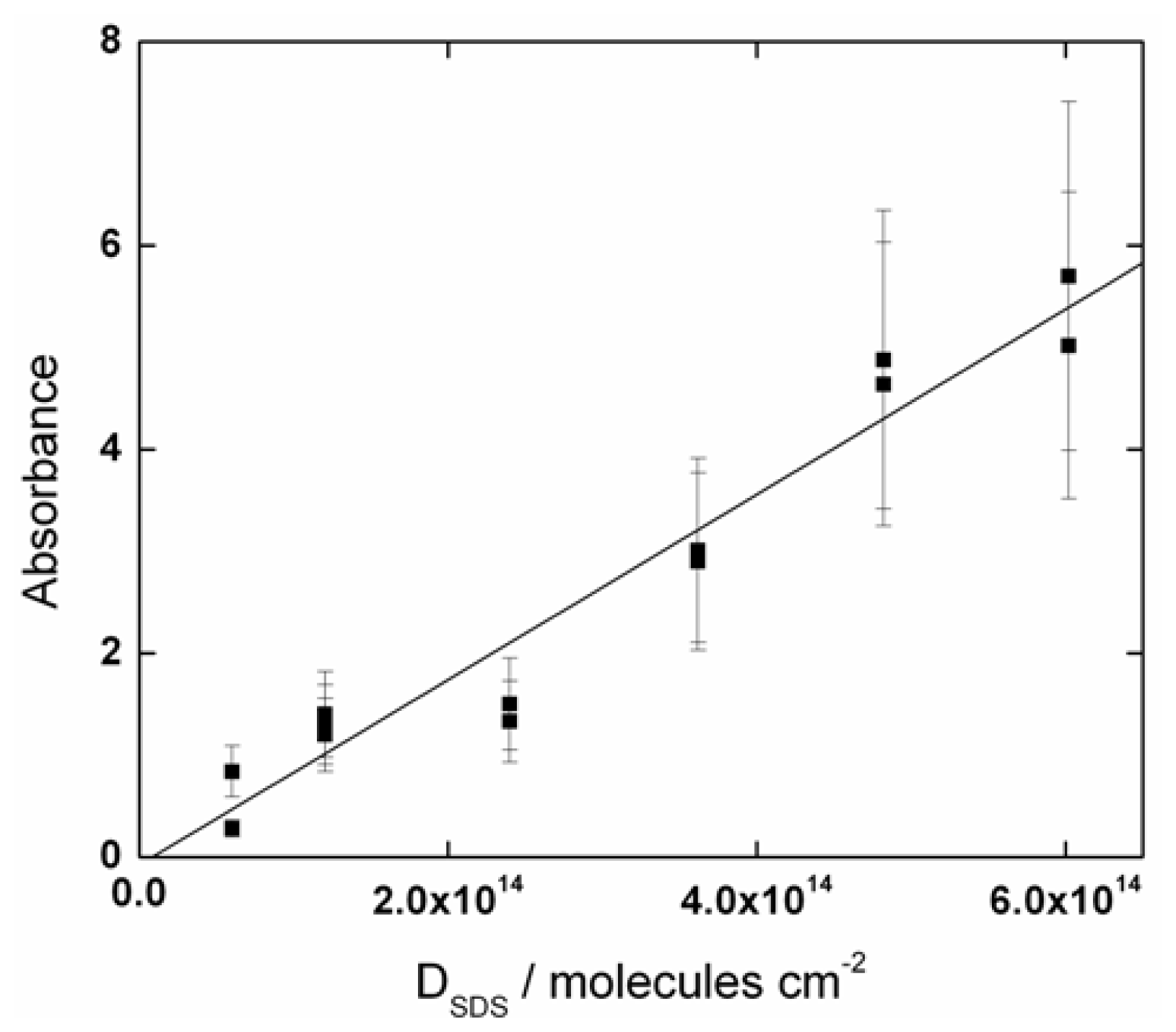
<p>The number of SDS molecules, N<sub>SDS</sub>, on the Ge substrate was obtained by using the casting technique [<xref ref-type="bibr" rid="b11-ijms-13-07980">11</xref>,<xref ref-type="bibr" rid="b36-ijms-13-07980">36</xref>,<xref ref-type="bibr" rid="b37-ijms-13-07980">37</xref>] under the assumption of homogeneous deposition and that the SDS molecules remain after deposition. Because this technique is well known to produce disordered molecules over the substrate [<xref ref-type="bibr" rid="b11-ijms-13-07980">11</xref>], it is suitable for the purpose of this investigation. The procedure was to cast increasing amounts of SDS molecules, and to evaluate the absorbance of the CH<sub>2</sub> asymmetric stretching band. From three SDS/water stock solutions (1, 20, and 500 mM), the number of SDS molecules was varied from 0.3 to 3.0 × 10<sup>15</sup> molecules on the Ge substrate. As the surface area of the Ge element is 5 cm<sup>2</sup>, the density of SDS molecules on it varied from 0.6 to 6 × 10<sup>14</sup> molecules cm<sup>−2</sup>. The solution volume added on the Ge substrate was varied from 2 to 50 μL. At low solution volumes (&lt;10 μL), it was difficult to cover the whole substrate before evaporating. In these cases, the assumption that the SDS molecules completely covered the Ge substrate was used. Then, the Ge substrate was kept in a desiccator coupled to a vacuum pump for 10 min to eliminate the excess water. However, this step was not necessary when small aliquots (2 to 8 μL) were used, due to fast water evaporation at room temperature. Two critical parameters are considered: Aliquot volume and solution concentration. When volumes larger than 20 μL or concentrations higher than 100 mM are used, the reproducibility for the absorbance of the CH<sub>2</sub> asymmetric stretching band was significantly reduced to 15%. The amount of SDS molecules deposited on the Ge substrate allows to one estimate its density on the Ge element as presented in <xref ref-type="fig" rid="f1-ijms-13-07980">Figure 1</xref>, which shows a straight line with a correlation coefficient of 0.97. Then, the density was estimated using the assumption that the SDS depositions cover 90% of the Ge substrate.</p></sec>
<sec sec-type="results">
<title>2.2. Atomic Force Microscopy Results</title>
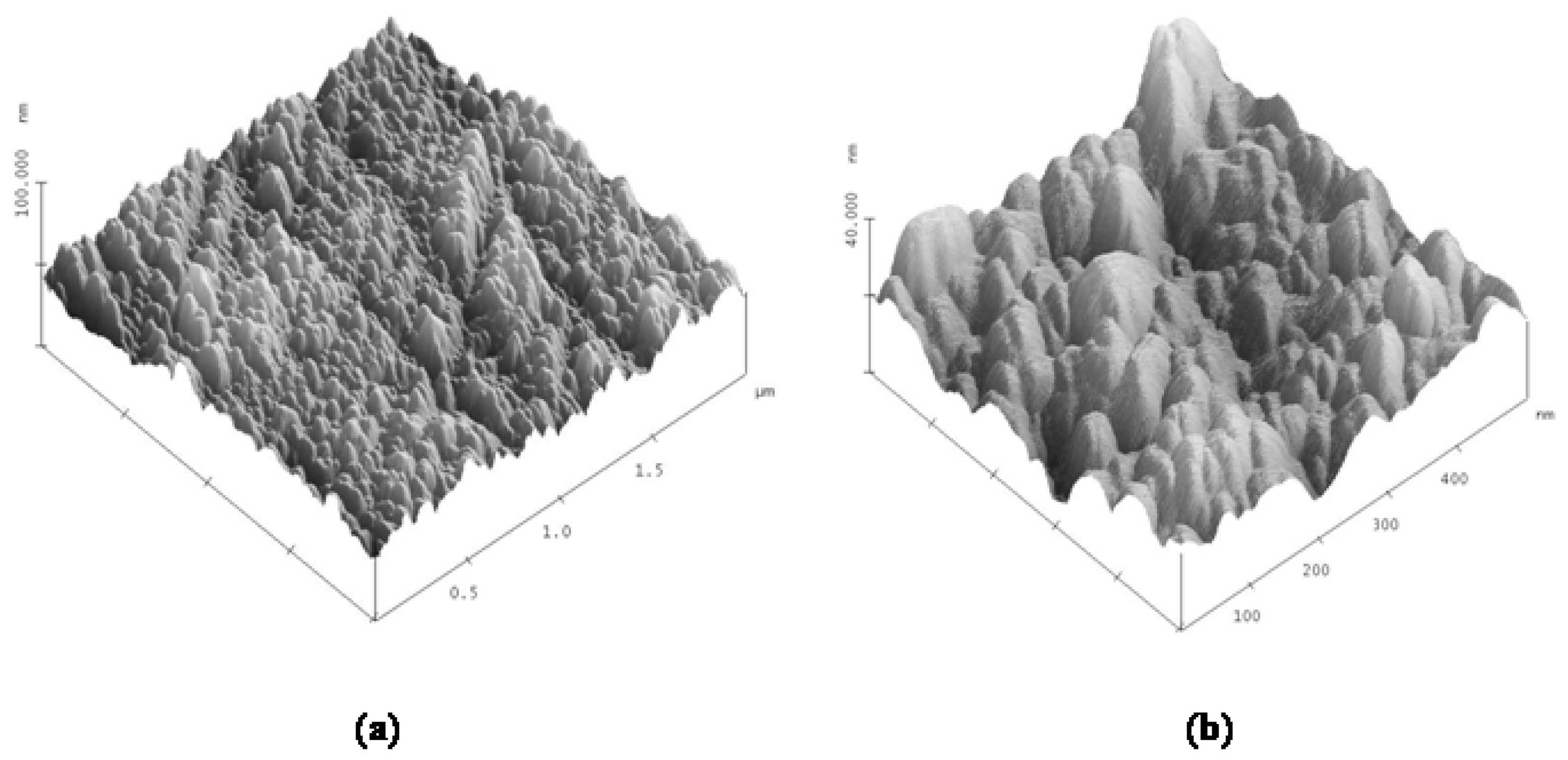
<p>The AFM images with 2 × 2 μm and 500 × 500 nm resolution are shown in <xref ref-type="fig" rid="f2-ijms-13-07980">Figure 2</xref>. It is important to point out that AFM results do represent directly a definite degree of conformational ordering of the SDS molecules deposited for the superficial layer. As can be seen, SDS molecules are highly disordered, at least at the air interface, indicating that the assumption applied for <italic>all-trans</italic> CH<sub>2</sub> configuration must be carefully considered. It is very well known that SDS deposits as hemicylinders on graphite and mica substrates [<xref ref-type="bibr" rid="b8-ijms-13-07980">8</xref>–<xref ref-type="bibr" rid="b10-ijms-13-07980">10</xref>]. However, the AFM images in <xref ref-type="fig" rid="f2-ijms-13-07980">Figure 2a</xref> also indicate that the surfactant deposition may be overlapped and entwined like bat structures on the Ge substrate. The size of these bat structures is around 30–40 nm, which is 5 to 7 times larger than that for hemicylinders, ~6 nm, found in the literature [<xref ref-type="bibr" rid="b8-ijms-13-07980">8</xref>–<xref ref-type="bibr" rid="b10-ijms-13-07980">10</xref>]. The roughness of the SDS deposit is around 4.8 nm using 2 × 2 μm resolution, and becomes smaller, 3.8 nm, with the 500 × 500 nm resolution.</p></sec>
<sec>
<title>2.3. Infrared Spectroscopy of SDS Adsorbed on Germanium Substrate</title>
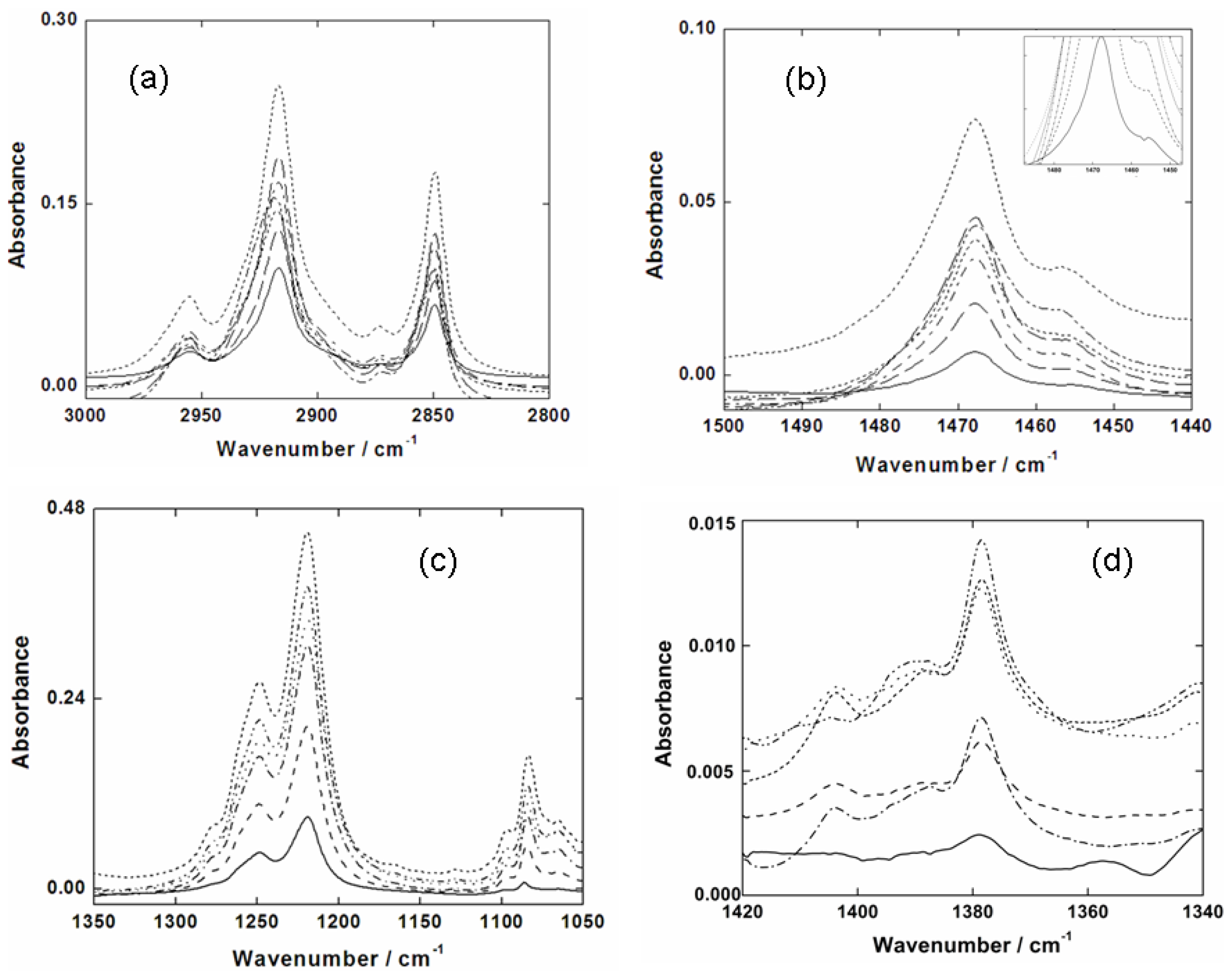
<p><xref ref-type="fig" rid="f3-ijms-13-07980">Figure 3a</xref> shows the C-H stretching modes for SDS deposited on a Ge substrate. The CH<sub>3</sub> asymmetric (2955 cm<sup>−1</sup>), the CH<sub>2</sub> asymmetric (2917 cm<sup>−1</sup>), CH<sub>3</sub> symmetric (2873 cm<sup>−1</sup>), and CH<sub>2</sub> symmetric (2850 cm<sup>−1</sup>) stretching bands are shown for different SDS concentrations on a liquid subphase. The CH<sub>3</sub> asymmetric and symmetric stretching bands are weaker, as expected, than those for the CH<sub>2</sub> ones. The CH<sub>2</sub> asymmetric and symmetric stretching bands are the two strongest bands in this region, which may be used to ascribe the packing and conformation of SDS molecules on the Ge substrate [<xref ref-type="bibr" rid="b6-ijms-13-07980">6</xref>]. The absorbance ratio between the CH<sub>2</sub> asymmetric and symmetric stretching features is very constant, 2.4 ± 0.1. The CH<sub>2</sub> asymmetric stretching mode appears at 2917 cm<sup>−1</sup>, suggesting an ordered hydrocarbon chain in an all-trans CH<sub>2</sub> conformation [<xref ref-type="bibr" rid="b38-ijms-13-07980">38</xref>–<xref ref-type="bibr" rid="b40-ijms-13-07980">40</xref>]. Furthermore, a shift was found in the CH<sub>2</sub> asymmetric stretching band from 2918 to 2920 cm<sup>−1</sup>, which depends on the packing of the SDS molecules.</p>
<p>The CH<sub>2</sub> scissoring modes of the SDS molecules deposited on the Ge substrate are seen at 1468 cm<sup>−1</sup> in <xref ref-type="fig" rid="f3-ijms-13-07980">Figure 3b</xref>. This band is very sensitive to chain interactions as well as the packing organization of the methylene chain [<xref ref-type="bibr" rid="b41-ijms-13-07980">41</xref>–<xref ref-type="bibr" rid="b44-ijms-13-07980">44</xref>]. The band has a shoulder at 1457 cm<sup>−1</sup>, which decreases as the number of SDS molecules deposited on the Ge substrate decreases, becoming a singlet at 1468 cm<sup>−1</sup>. The feature around 1466 cm<sup>−1</sup> broadens and decreases its intensity, which are both reasonable signs of reduction in chain interactions being accompanied by an increase in chain motion [<xref ref-type="bibr" rid="b41-ijms-13-07980">41</xref>–<xref ref-type="bibr" rid="b45-ijms-13-07980">45</xref>].</p>
<p>The methylene wagging modes of the hydrocarbon chain of the surfactants are located in the region of 1300–1400 cm<sup>−1</sup> (see <xref ref-type="fig" rid="f3-ijms-13-07980">Figure 3d</xref>). These bands are known to exhibit peaks with characteristic frequencies for different conformers or high energy rotamers, specifically for structures that contain a gauche orientation [<xref ref-type="bibr" rid="b38-ijms-13-07980">38</xref>–<xref ref-type="bibr" rid="b40-ijms-13-07980">40</xref>]. In this study, a peak at 1378 cm<sup>−1</sup> was found which is an indicative of a gauche-trans-gauche (g-t-g) conformation, or an umbrella deformation. This g-t-g conformation may affect the degree of order of the SDS molecules deposited in this study.</p>
<p>In <xref ref-type="fig" rid="f3-ijms-13-07980">Figure 3c</xref> one can see the degenerate SO<sub>4</sub> <sup>=</sup> asymmetric stretching modes at 1219 and 1249 cm<sup>−1</sup> of the SDS molecule deposited on the Ge substrate. As the packing of the acyl chains is related to the splitting of the CH<sub>2</sub> scissoring band, the symmetry of the SO<sub>4</sub> <sup>=</sup> group similarly produces the SO<sub>4</sub> <sup>=</sup> asymmetric band splitting as well. In fact, the SO<sub>4</sub> <sup>=</sup> group is very asymmetric because of the two inequivalent SO<sub>4</sub> <sup>=</sup> groups that face each other and have a slight dihedral angle between the two pseudo C<sub>3v</sub> axes. The different oxygen atoms in the SO<sub>4</sub> <sup>=</sup> group reduce the C<sub>3v</sub> symmetry to a single mirror plane, resulting in a strongly split band, similar to that found for the CH<sub>2</sub> scissoring mode [<xref ref-type="bibr" rid="b6-ijms-13-07980">6</xref>,<xref ref-type="bibr" rid="b35-ijms-13-07980">35</xref>]. Li and Tripp [<xref ref-type="bibr" rid="b13-ijms-13-07980">13</xref>] suggested that the decrease of the SO<sub>4</sub> <sup>=</sup> headgroup symmetry results in changes of lateral electrostatic interactions. A splitting of 30 cm<sup>−1</sup> was found to occur in our experiments, which is similar to the splitting found by other studies [<xref ref-type="bibr" rid="b13-ijms-13-07980">13</xref>,<xref ref-type="bibr" rid="b46-ijms-13-07980">46</xref>]. Nevertheless, this value is higher than those reported for SDS crystalline phase [<xref ref-type="bibr" rid="b6-ijms-13-07980">6</xref>] and lower than those predicted for bulk deposition [<xref ref-type="bibr" rid="b5-ijms-13-07980">5</xref>,<xref ref-type="bibr" rid="b7-ijms-13-07980">7</xref>,<xref ref-type="bibr" rid="b47-ijms-13-07980">47</xref>,<xref ref-type="bibr" rid="b48-ijms-13-07980">48</xref>], liquid crystals [<xref ref-type="bibr" rid="b6-ijms-13-07980">6</xref>,<xref ref-type="bibr" rid="b49-ijms-13-07980">49</xref>] and for SDS interacting with charged particles [<xref ref-type="bibr" rid="b50-ijms-13-07980">50</xref>].</p>
<p>While Sperline [<xref ref-type="bibr" rid="b6-ijms-13-07980">6</xref>] has assigned the presence of a medium intensity band at 1061 cm<sup>−1</sup> as an indicative of micellar SDS, in our study the SO<sub>4</sub> <sup>=</sup> symmetric stretching band was found at 1084 cm<sup>−1</sup>. It is important to note that this value is shifted to higher wavenumbers as compared to the results in the literature [<xref ref-type="bibr" rid="b13-ijms-13-07980">13</xref>,<xref ref-type="bibr" rid="b43-ijms-13-07980">43</xref>]. Applying quantum chemical calculation was possible to observe that in the absence of the counterion the frequency shift almost 30 cm<sup>−1</sup> to higher values, while when the headgroup is hydrated this band shift to lower values, between 10 and 16 cm<sup>−1</sup> [<xref ref-type="bibr" rid="b51-ijms-13-07980">51</xref>]. In addition, two shoulders of the SO<sub>4</sub> <sup>=</sup> symmetric stretching band were also found at 1097 and 1065 cm<sup>−1</sup>.</p>
<p>Li and Tripp [<xref ref-type="bibr" rid="b13-ijms-13-07980">13</xref>] observed a higher intensity in the band at 1249 cm<sup>−1</sup> than that one at 1219 cm<sup>−1</sup>. On the other hand, the opposite was observed in this study. Also, the difference in intensity between these two bands is larger than that reported by Li and Tripp [<xref ref-type="bibr" rid="b13-ijms-13-07980">13</xref>]. This may indicate a lateral interaction of the SO<sub>4</sub> <sup>=</sup> group with itself or an interaction of SO<sub>4</sub> <sup>=</sup> with the germanium substrate. Nevertheless, the absorbance increase in the shoulder at 1278 cm<sup>−1</sup> may also be an indicative of an interaction between the neighboring SO<sub>4</sub> <sup>=</sup> groups. Therefore, the continuous increasing in the shoulder may be due to the lateral repulsion among headgroups.</p>
<p>Scheuring and Weers [<xref ref-type="bibr" rid="b43-ijms-13-07980">43</xref>] observed that the SO<sub>4</sub> <sup>=</sup> symmetric stretching mode is shifted to higher wavenumbers. The explanation for this shift is the loss of interaction of the SDS headgroup with counterions, suggesting that the shift of the SO<sub>4</sub> <sup>=</sup> symmetric stretching mode to 1086 cm<sup>−1</sup> in our investigation is understood by the lack of counterion interaction. Theoretical calculations show that there is a shift of 16–24 cm<sup>−1</sup> in the absence of the counterion, which is in good agreement with the experimental result presented in this study [<xref ref-type="bibr" rid="b51-ijms-13-07980">51</xref>]. The effect of water was also considered on SO<sub>4</sub> <sup>=</sup> vibrational modes. The shift is predicted to be small. In addition, the shift of the headgroup bands may also be attributed to a possible interaction with the germanium substrate, which is a potential problem with all ATR techniques [<xref ref-type="bibr" rid="b52-ijms-13-07980">52</xref>]. Many ATR substrates are highly polar and may perturb the headgroups [<xref ref-type="bibr" rid="b52-ijms-13-07980">52</xref>]. However, this problem is not relevant in this situation due to the small interaction between SDS and the Ge substrate.</p></sec>
<sec>
<title>2.4. Linear Dichroism Measurements</title>
<p><xref ref-type="table" rid="t1-ijms-13-07980">Table 1</xref> presents the absorbance of the CH<sub>2</sub> asymmetric (ν<sub>a</sub>), CH<sub>2</sub> symmetric (ν<sub>s</sub>), and CH<sub>3</sub> asymmetric (ν<sub>a</sub>) stretching features for SDS molecules adsorbed on the Ge substrate. The linear dichroic ratios (A<sub>s</sub>/A<sub>p</sub> = LD = A<sub>⊥</sub>/A<sub>//</sub>), orientation angle (γ), and order parameter (S) calculated from the absorbance of these features are also shown in <xref ref-type="table" rid="t1-ijms-13-07980">Table 1</xref>. The SO<sub>4</sub> <sup>=</sup> asymmetric stretching feature has a shoulder and the SO<sub>4</sub> <sup>=</sup> symmetric is extremely weak. Consequently, it is difficult to attribute any degree of order from these features. With the exception of the SO<sub>4</sub> <sup>=</sup> symmetric stretching band, the LD ratios are always lower than 1, which indicates that the SDS molecules are slightly perpendicular to the Ge surface. If the SDS molecules are likely to be positioned at an angle γ from the normal to the surface, it is possible to use the uniaxial orientation model to evaluate the degree of order in SDS molecules. It is important to note that the transition dipole moments of the CH<sub>2</sub> asymmetric and symmetric stretching vibrations are parallel to the hydrocarbon chain axis, while the CH<sub>3</sub> asymmetric stretching one is perpendicular. Thus, it is used the assumption that α is 90° only for the CH<sub>3</sub> asymmetric stretching features, while α = 0° is used for the CH<sub>2</sub> asymmetric and symmetric stretching bands. For an orientation perpendicular to the surface plane, Neivandt <italic>et al.</italic> [<xref ref-type="bibr" rid="b53-ijms-13-07980">53</xref>] predicted a linear dichroic ratio value of 1.22 for cetyltrimethylammonium bromide while the work of Haller and Rice [<xref ref-type="bibr" rid="b54-ijms-13-07980">54</xref>] showed a range of 1.23–1.28 for a thin film of stearic acid. As can be seen in this study, the LD values for CH<sub>2</sub> and CH<sub>3</sub> range from 0.569 to 0.775, which is a good indication for a random orientation. These values were also observed in previous studies [<xref ref-type="bibr" rid="b53-ijms-13-07980">53</xref>,<xref ref-type="bibr" rid="b55-ijms-13-07980">55</xref>].</p>
<p>The orientation angle, γ, and calculated order parameter, S, are presented in <xref ref-type="table" rid="t1-ijms-13-07980">Table 1</xref>. From this model, it is straightforward to estimate that the SDS molecules are tilted by 47.6 ± 0.6 degrees from the normal axis, which is in agreement with same angles presented in the literature [<xref ref-type="bibr" rid="b30-ijms-13-07980">30</xref>,<xref ref-type="bibr" rid="b53-ijms-13-07980">53</xref>,<xref ref-type="bibr" rid="b56-ijms-13-07980">56</xref>], which is significantly less than 90° to the surface. In principle, if the order parameter is equal to 1.0, it would mean a perfect order perpendicular to the surface, while a value of −0.5 would indicate a perfect order parallel to the surface. In addition, in the case of S = 0.0 would imply an isotropic distribution or perfect disorder [<xref ref-type="bibr" rid="b30-ijms-13-07980">30</xref>,<xref ref-type="bibr" rid="b36-ijms-13-07980">36</xref>,<xref ref-type="bibr" rid="b37-ijms-13-07980">37</xref>,<xref ref-type="bibr" rid="b56-ijms-13-07980">56</xref>]. Nevertheless, the order parameter is calculated to be 0.18 ± 0.01, which indicates that the SDS molecules are not ordered in parallel, and it is most likely that they are being organized with no preferred orientation relative to surface. However, a certain minor alignment may also occur. An important point is that the partition coefficient of SDS molecules in both phases may affect the orientation of the SDS molecules. As is well known, chloroform presents a higher partition coefficient than water. Using water as subphase organizes the hydrocarbon chain pointing it out to the air. On the other hand, apolar solvent leaves the hydrocarbon chain randomly oriented on the air-liquid interface, producing a disordered deposition as reported in this study.</p></sec></sec>
<sec>
<title>3. Experimental Section</title>
<p>Electrophoresis purity grade SDS (purity &gt; 99%) was obtained from Bio-Rad laboratory. Methanol, CH<sub>3</sub>OH, and chloroform, CHCl<sub>3</sub> (HPLC grade) were purchased from J. T Baker and used as received. SDS/CHCl<sub>3</sub> solutions at the desired concentration were prepared by using aliquots of a stock solution (0.5 mol·L<sup>−1</sup>) of SDS dissolved in CH<sub>3</sub>OH and the CH<sub>3</sub>OH concentration in the final solution was negligible. A Teflon trough (11 × 10 × 50 mm) was used to accommodate the germanium ATR substrate on the vertical position in order to investigate the deposition dependency on their dimensions. Then, the trough was filled with CHCl<sub>3</sub> and few microliters of the final SDS/CHCl<sub>3</sub> solution were dribbled on the CHCl<sub>3</sub>/air interface. The surfactant depositions were obtained by transferring it onto a Ge ATR substrate. CHCl<sub>3</sub> was eliminated from the trough by slowly pumping it out with a peristaltic pump (P-1 model, Pharmacia) at a speed of 0.1 mL·min<sup>−1</sup>. Then, the Ge substrate with the surfactant deposition was put in a desiccator coupled with a vacuum pump operating at a pressure of ~1 × 10<sup>−2</sup> Torr to allow the remaining excess solvent to be eliminated, during 10 min. The whole equipment was kept in a clean environment at room temperature to avoid complications with the presence of dust particles. The germanium substrate was used as received, being mainly hydrophilic as it could be visually observed by the formation of the meniscus.</p>
<p>The infrared spectra of transferred SDS molecules were collected in a Varian/Digilab FTS7000 spectrometer equipped with a high sensitivity narrow band liquid-nitrogen-cooled Mercury-Cadmium-Tellurium (MCT) detector. The sampling was performed using a Horizon ATR accessory (Harrick Scientific Inc.). The ATR theory and accessory are fully described in the literature [<xref ref-type="bibr" rid="b43-ijms-13-07980">43</xref>]. It consists of a set of two plane mirrors to direct the infrared beam into the ATR germanium element and then to the MCT detector. The ATR germanium element is a single-pass trapezoid with dimension of 2 × 10 × 50 mm and a bevel angle (θ) of 45°. The length (l) and thickness (t) of the ATR element determine the number of reflections (N) by the formula N = l t<sup>−1</sup> tanθ, which gives 25 internal reflections. For each spectrum, 128 single beam scans were averaged with 1 cm<sup>−1</sup> resolution for the reference and sample. Prior to deposition, the ATR substrate was cleaned with a suitable procedure [<xref ref-type="bibr" rid="b52-ijms-13-07980">52</xref>] until the CH<sub>2</sub> signal was eliminated (cleaned with chloroform, isopropanol, methanol and water; in this following order). The reference spectrum was obtained by transmitting the infrared beam along the ATR substrate alone, after which the sample spectrum was taken immediately after transferring surfactant molecules onto the ATR element.</p>
<p>The experiments with polarized light were conducted using a holographic infrared polarizer with BaF<sub>2</sub> substrate (Cambridge Physical Sciences, Model IGP228), which has a useful transmission range from 1000 to 50000 cm<sup>−1</sup>. The electric field components depend on the refractive indices of the Ge ATR element (<italic>n</italic><sub>1</sub> = 4.0), sample (<italic>n</italic><sub>2</sub> = 1.5), upper phase (<italic>n</italic><sub>3</sub> = 1.0), and on the sample thickness. The molecules deposited onto germanium element in these studies are expected to be much thinner than the penetration depth of the evanescent wave. In this case, the electric field can be assumed to be constant within the sample. The electric field components (<xref rid="FD1" ref-type="disp-formula">Equations 1</xref>–<xref rid="FD3" ref-type="disp-formula">3</xref>) are then given by [<xref ref-type="bibr" rid="b52-ijms-13-07980">52</xref>,<xref ref-type="bibr" rid="b57-ijms-13-07980">57</xref>,<xref ref-type="bibr" rid="b58-ijms-13-07980">58</xref>]:</p>
<disp-formula id="FD1">
<label>(1)</label>
<mml:math id="mm1" display="block">
<mml:semantics id="sm1">
<mml:mrow>
<mml:mo stretchy="false">[</mml:mo>
<mml:msubsup>
<mml:mrow>
<mml:mi>E</mml:mi></mml:mrow>
<mml:mi>y</mml:mi>
<mml:mn>2</mml:mn></mml:msubsup>
<mml:mo>=</mml:mo>
<mml:mfrac>
<mml:mrow>
<mml:mn>4</mml:mn>
<mml:msubsup>
<mml:mrow>
<mml:mi>n</mml:mi></mml:mrow>
<mml:mn>1</mml:mn>
<mml:mn>2</mml:mn></mml:msubsup>
<mml:mi> </mml:mi>
<mml:msup>
<mml:mrow>
<mml:mrow>
<mml:mtext>cos</mml:mtext></mml:mrow></mml:mrow>
<mml:mn>2</mml:mn></mml:msup>
<mml:mi> </mml:mi>
<mml:mi>θ</mml:mi></mml:mrow>
<mml:mrow>
<mml:msubsup>
<mml:mrow>
<mml:mi>n</mml:mi></mml:mrow>
<mml:mn>1</mml:mn>
<mml:mn>2</mml:mn></mml:msubsup>
<mml:mo>-</mml:mo>
<mml:msubsup>
<mml:mrow>
<mml:mi>n</mml:mi></mml:mrow>
<mml:mn>3</mml:mn>
<mml:mn>2</mml:mn></mml:msubsup></mml:mrow></mml:mfrac>
<mml:mo stretchy="false">]</mml:mo></mml:mrow></mml:semantics></mml:math></disp-formula>
<disp-formula id="FD2">
<label>(2)</label>
<mml:math id="mm2" display="block">
<mml:semantics id="sm2">
<mml:mrow>
<mml:mo stretchy="false">[</mml:mo>
<mml:msubsup>
<mml:mrow>
<mml:mi>E</mml:mi></mml:mrow>
<mml:mi>x</mml:mi>
<mml:mn>2</mml:mn></mml:msubsup>
<mml:mo>=</mml:mo>
<mml:msubsup>
<mml:mrow>
<mml:mi>E</mml:mi></mml:mrow>
<mml:mi>y</mml:mi>
<mml:mn>2</mml:mn></mml:msubsup>
<mml:mfrac>
<mml:mrow>
<mml:msubsup>
<mml:mrow>
<mml:mi>n</mml:mi></mml:mrow>
<mml:mn>1</mml:mn>
<mml:mn>2</mml:mn></mml:msubsup>
<mml:mo>-</mml:mo>
<mml:mn>2</mml:mn>
<mml:msubsup>
<mml:mrow>
<mml:mi>n</mml:mi></mml:mrow>
<mml:mn>3</mml:mn>
<mml:mn>2</mml:mn></mml:msubsup></mml:mrow>
<mml:mrow>
<mml:msubsup>
<mml:mrow>
<mml:mi>n</mml:mi></mml:mrow>
<mml:mn>1</mml:mn>
<mml:mn>2</mml:mn></mml:msubsup>
<mml:mo>-</mml:mo>
<mml:msubsup>
<mml:mrow>
<mml:mi>n</mml:mi></mml:mrow>
<mml:mn>3</mml:mn>
<mml:mn>2</mml:mn></mml:msubsup></mml:mrow></mml:mfrac>
<mml:mo stretchy="false">]</mml:mo></mml:mrow></mml:semantics></mml:math></disp-formula>
<disp-formula id="FD3">
<label>(3)</label>
<mml:math id="mm3" display="block">
<mml:semantics id="sm3">
<mml:mrow>
<mml:mo stretchy="false">[</mml:mo>
<mml:msubsup>
<mml:mrow>
<mml:mi>E</mml:mi></mml:mrow>
<mml:mi>z</mml:mi>
<mml:mn>2</mml:mn></mml:msubsup>
<mml:mo>=</mml:mo>
<mml:msubsup>
<mml:mrow>
<mml:mi>E</mml:mi></mml:mrow>
<mml:mi>y</mml:mi>
<mml:mn>2</mml:mn></mml:msubsup>
<mml:mfrac>
<mml:mrow>
<mml:msubsup>
<mml:mrow>
<mml:mi>n</mml:mi></mml:mrow>
<mml:mn>1</mml:mn>
<mml:mn>2</mml:mn></mml:msubsup>
<mml:msubsup>
<mml:mrow>
<mml:mi>n</mml:mi></mml:mrow>
<mml:mn>3</mml:mn>
<mml:mn>2</mml:mn></mml:msubsup>
<mml:mo>/</mml:mo>
<mml:msubsup>
<mml:mrow>
<mml:mi>n</mml:mi></mml:mrow>
<mml:mn>2</mml:mn>
<mml:mn>2</mml:mn></mml:msubsup></mml:mrow>
<mml:mrow>
<mml:msubsup>
<mml:mrow>
<mml:mi>n</mml:mi></mml:mrow>
<mml:mn>1</mml:mn>
<mml:mn>2</mml:mn></mml:msubsup>
<mml:mo>-</mml:mo>
<mml:msubsup>
<mml:mrow>
<mml:mi>n</mml:mi></mml:mrow>
<mml:mn>3</mml:mn>
<mml:mn>2</mml:mn></mml:msubsup></mml:mrow></mml:mfrac>
<mml:mo stretchy="false">]</mml:mo></mml:mrow></mml:semantics></mml:math></disp-formula>
<p>The linear dichroic ratio (LD) (<xref rid="FD4" ref-type="disp-formula">Equation 4</xref>) is defined as the ratio of the absorbance for radiation perpendicularly polarized (<italic>A</italic><italic><sub>s</sub></italic>) to the plane of incidence to that polarized parallel (<italic>A</italic><italic><sub>p</sub></italic>) to the plane of incidence:</p>
<disp-formula id="FD4">
<label>(4)</label>
<mml:math id="mm4" display="block">
<mml:semantics id="sm4">
<mml:mrow>
<mml:mo stretchy="false">[</mml:mo>
<mml:mi>L</mml:mi>
<mml:mi>D</mml:mi>
<mml:mo>=</mml:mo>
<mml:mfrac>
<mml:mrow>
<mml:msub>
<mml:mrow>
<mml:mi>A</mml:mi></mml:mrow>
<mml:mi>s</mml:mi></mml:msub></mml:mrow>
<mml:mrow>
<mml:msub>
<mml:mrow>
<mml:mi>A</mml:mi></mml:mrow>
<mml:mi>p</mml:mi></mml:msub></mml:mrow></mml:mfrac>
<mml:mo>=</mml:mo>
<mml:mfrac>
<mml:mrow>
<mml:msub>
<mml:mrow>
<mml:mi>A</mml:mi></mml:mrow>
<mml:mrow>
<mml:mi>T</mml:mi>
<mml:mi>E</mml:mi></mml:mrow></mml:msub></mml:mrow>
<mml:mrow>
<mml:msub>
<mml:mrow>
<mml:mi>A</mml:mi></mml:mrow>
<mml:mrow>
<mml:mi>T</mml:mi>
<mml:mi>M</mml:mi></mml:mrow></mml:msub></mml:mrow></mml:mfrac>
<mml:mo stretchy="false">]</mml:mo></mml:mrow></mml:semantics></mml:math></disp-formula>
<p>where <italic>A</italic> is the integrated absorbance, <italic>TE</italic> is the transverse electric field or perpendicular field (<italic>E</italic><italic><sub>y</sub></italic>), and <italic>TM</italic> is the transverse magnetic field or parallel field (= <italic>E</italic><italic><sub>x</sub></italic> + <italic>E</italic><italic><sub>z</sub></italic>). For randomly oriented molecules and a given band, the molecular TM vectors are equally distributed about the axes (<xref rid="FD5" ref-type="disp-formula">Equation 5</xref>) [<xref ref-type="bibr" rid="b56-ijms-13-07980">56</xref>] and</p>
<disp-formula id="FD5">
<label>(5)</label>
<mml:math id="mm5" display="block">
<mml:semantics id="sm5">
<mml:mrow>
<mml:mo stretchy="false">[</mml:mo>
<mml:mi>L</mml:mi>
<mml:mi>D</mml:mi>
<mml:mo>=</mml:mo>
<mml:mfrac>
<mml:mrow>
<mml:msub>
<mml:mrow>
<mml:mi>A</mml:mi></mml:mrow>
<mml:mi>s</mml:mi></mml:msub></mml:mrow>
<mml:mrow>
<mml:msub>
<mml:mrow>
<mml:mi>A</mml:mi></mml:mrow>
<mml:mi>p</mml:mi></mml:msub></mml:mrow></mml:mfrac>
<mml:mo>=</mml:mo>
<mml:mfrac>
<mml:mrow>
<mml:msubsup>
<mml:mrow>
<mml:mi>E</mml:mi></mml:mrow>
<mml:mi>y</mml:mi>
<mml:mn>2</mml:mn></mml:msubsup></mml:mrow>
<mml:mrow>
<mml:msubsup>
<mml:mrow>
<mml:mi>E</mml:mi></mml:mrow>
<mml:mi>x</mml:mi>
<mml:mn>2</mml:mn></mml:msubsup>
<mml:mo>+</mml:mo>
<mml:msubsup>
<mml:mrow>
<mml:mi>E</mml:mi></mml:mrow>
<mml:mi>z</mml:mi>
<mml:mn>2</mml:mn></mml:msubsup></mml:mrow></mml:mfrac>
<mml:mo stretchy="false">]</mml:mo></mml:mrow></mml:semantics></mml:math></disp-formula>
<p>on the other hand, the uniaxial orientation model [<xref ref-type="bibr" rid="b56-ijms-13-07980">56</xref>,<xref ref-type="bibr" rid="b58-ijms-13-07980">58</xref>,<xref ref-type="bibr" rid="b59-ijms-13-07980">59</xref>] is more appropriate to represent our experiment which has no external force that causes the absorbed surfactant to orient laterally. This model considers two axial symmetric distributions: (1) the transition dipole moment about the chain axis centered at an angle α, and (2) the chain axis about the Z axis centered at an angle γ. In this case, the LD ratio (<xref rid="FD6" ref-type="disp-formula">Equation 6</xref>) is given by</p>
<disp-formula id="FD6">
<label>(6)</label>
<mml:math id="mm6" display="block">
<mml:semantics id="sm6">
<mml:mrow>
<mml:mo stretchy="false">[</mml:mo>
<mml:mi>L</mml:mi>
<mml:mi>D</mml:mi>
<mml:mo>=</mml:mo>
<mml:mfrac>
<mml:mrow>
<mml:msub>
<mml:mrow>
<mml:mi>A</mml:mi></mml:mrow>
<mml:mi>s</mml:mi></mml:msub></mml:mrow>
<mml:mrow>
<mml:msub>
<mml:mrow>
<mml:mi>A</mml:mi></mml:mrow>
<mml:mi>p</mml:mi></mml:msub></mml:mrow></mml:mfrac>
<mml:mo>=</mml:mo>
<mml:mfrac>
<mml:mrow>
<mml:msubsup>
<mml:mrow>
<mml:mi>E</mml:mi></mml:mrow>
<mml:mi>y</mml:mi>
<mml:mn>2</mml:mn></mml:msubsup>
<mml:mo>(</mml:mo>
<mml:mn>1</mml:mn>
<mml:mo>+</mml:mo>
<mml:msup>
<mml:mrow>
<mml:mrow>
<mml:mtext>cos</mml:mtext></mml:mrow></mml:mrow>
<mml:mn>2</mml:mn></mml:msup>
<mml:mi> </mml:mi>
<mml:mi>γ</mml:mi>
<mml:mo>)</mml:mo></mml:mrow>
<mml:mrow>
<mml:msubsup>
<mml:mrow>
<mml:mi>E</mml:mi></mml:mrow>
<mml:mi>x</mml:mi>
<mml:mn>2</mml:mn></mml:msubsup>
<mml:mo>(</mml:mo>
<mml:mn>1</mml:mn>
<mml:mo>+</mml:mo>
<mml:msup>
<mml:mrow>
<mml:mrow>
<mml:mtext>cos</mml:mtext></mml:mrow></mml:mrow>
<mml:mn>2</mml:mn></mml:msup>
<mml:mi> </mml:mi>
<mml:mi>γ</mml:mi>
<mml:mo>)</mml:mo>
<mml:mo>+</mml:mo>
<mml:mn>2</mml:mn>
<mml:msubsup>
<mml:mrow>
<mml:mi>E</mml:mi></mml:mrow>
<mml:mi>z</mml:mi>
<mml:mn>2</mml:mn></mml:msubsup>
<mml:mi> </mml:mi>
<mml:msup>
<mml:mrow>
<mml:mrow>
<mml:mtext>sin</mml:mtext></mml:mrow></mml:mrow>
<mml:mn>2</mml:mn></mml:msup>
<mml:mi> </mml:mi>
<mml:mi>γ</mml:mi></mml:mrow></mml:mfrac>
<mml:mo stretchy="false">]</mml:mo></mml:mrow></mml:semantics></mml:math></disp-formula>
<p>using the assumption that α is 90° for the vibration mode of interest. Using the assumption that the transition dipole moment of the vibration mode has an angle of 0° about the chain axis, the LD ratio is represented by (<xref rid="FD7" ref-type="disp-formula">Equation 7</xref>):</p>
<disp-formula id="FD7">
<label>(7)</label>
<mml:math id="mm7" display="block">
<mml:semantics id="sm7">
<mml:mrow>
<mml:mo stretchy="false">[</mml:mo>
<mml:mi>L</mml:mi>
<mml:mi>D</mml:mi>
<mml:mo>=</mml:mo>
<mml:mfrac>
<mml:mrow>
<mml:msub>
<mml:mrow>
<mml:mi>A</mml:mi></mml:mrow>
<mml:mi>s</mml:mi></mml:msub></mml:mrow>
<mml:mrow>
<mml:msub>
<mml:mrow>
<mml:mi>A</mml:mi></mml:mrow>
<mml:mi>p</mml:mi></mml:msub></mml:mrow></mml:mfrac>
<mml:mo>=</mml:mo>
<mml:mfrac>
<mml:mrow>
<mml:msubsup>
<mml:mrow>
<mml:mi>E</mml:mi></mml:mrow>
<mml:mi>y</mml:mi>
<mml:mn>2</mml:mn></mml:msubsup>
<mml:mi> </mml:mi>
<mml:msup>
<mml:mrow>
<mml:mrow>
<mml:mtext>sin</mml:mtext></mml:mrow></mml:mrow>
<mml:mn>2</mml:mn></mml:msup>
<mml:mi> </mml:mi>
<mml:mi>γ</mml:mi></mml:mrow>
<mml:mrow>
<mml:msubsup>
<mml:mrow>
<mml:mi>E</mml:mi></mml:mrow>
<mml:mi>x</mml:mi>
<mml:mn>2</mml:mn></mml:msubsup>
<mml:mi> </mml:mi>
<mml:msup>
<mml:mrow>
<mml:mrow>
<mml:mtext>sin</mml:mtext></mml:mrow></mml:mrow>
<mml:mn>2</mml:mn></mml:msup>
<mml:mi> </mml:mi>
<mml:mi>γ</mml:mi>
<mml:mo>+</mml:mo>
<mml:mn>2</mml:mn>
<mml:msubsup>
<mml:mrow>
<mml:mi>E</mml:mi></mml:mrow>
<mml:mi>z</mml:mi>
<mml:mn>2</mml:mn></mml:msubsup>
<mml:mi> </mml:mi>
<mml:msup>
<mml:mrow>
<mml:mrow>
<mml:mtext>cos</mml:mtext></mml:mrow></mml:mrow>
<mml:mn>2</mml:mn></mml:msup>
<mml:mi> </mml:mi>
<mml:mi>γ</mml:mi></mml:mrow></mml:mfrac>
<mml:mo stretchy="false">]</mml:mo></mml:mrow></mml:semantics></mml:math></disp-formula>
<p>The extent of the orientation can also be described by using a cone model with a fixed opening angle represented by γ, which is related to the order parameter, S (<xref rid="FD8" ref-type="disp-formula">Equation 8</xref>) [<xref ref-type="bibr" rid="b56-ijms-13-07980">56</xref>–<xref ref-type="bibr" rid="b60-ijms-13-07980">60</xref>]:</p>
<disp-formula id="FD8">
<label>(8)</label>
<mml:math id="mm8" display="block">
<mml:semantics id="sm8">
<mml:mrow>
<mml:mo stretchy="false">[</mml:mo>
<mml:mi>S</mml:mi>
<mml:mo>=</mml:mo>
<mml:mn>1</mml:mn>
<mml:mo>-</mml:mo>
<mml:mfrac>
<mml:mn>3</mml:mn>
<mml:mn>2</mml:mn></mml:mfrac>
<mml:msup>
<mml:mrow>
<mml:mrow>
<mml:mtext>sin</mml:mtext></mml:mrow></mml:mrow>
<mml:mn>2</mml:mn></mml:msup>
<mml:mi> </mml:mi>
<mml:mi>γ</mml:mi>
<mml:mo stretchy="false">]</mml:mo></mml:mrow></mml:semantics></mml:math></disp-formula>
<p>The smaller this angle is, the better are the molecules aligned. The perfect alignment corresponds to an order parameter of S equal to 1 and an opening angle γ = 0.</p>
<p>The topography was observed by using the AFM technique. AFM experiments were performed with a Nanoscope<sup>®</sup>IIIa Multimode™ of Digital Instruments, and the images were obtained under ambient conditions in the tapping mode. A 250 μm long silicon cantilever (scan rate of 2 Hz) was used with a spring constant of 70 N m<sup>−1</sup> and two scan areas, 2 × 2 μm and 500 × 500 nm, were monitored. The thickness was also estimated using the AFM system. The organic material was removed from the top to the bottom of the Ge substrate without damaging the substrate surface by using an aged silicon cantilever. Under these conditions, the depth profile of the furrow created upon complete removal provided a good estimate of the local thickness. While the furrow was produced with the slow scanning motion disabled, <italic>i.e.</italic>, the tip was made to run back and forth on the same line, the contrast change in the image display was monitored. The methodology to obtain the furrow was fully described in the literature [<xref ref-type="bibr" rid="b61-ijms-13-07980">61</xref>]. Before the SDS deposition on germanium crystal, the roughness of germanium ATR crystal was polished to an average surface roughness of ~2.0 nm. Further AFM analysis of germanium ATR element can be seen in previous literature [<xref ref-type="bibr" rid="b62-ijms-13-07980">62</xref>].</p></sec>
<sec sec-type="conclusions">
<title>4. Conclusions</title>
<p>This study describes the SDS deposition on Ge substrate by using Fourier transform infrared-attenuated total reflection (FTIR-ATR) spectroscopy and atomic force microscopy (AFM). The maximum amount deposited is (5.0 ± 0.3) × 10<sup>14</sup> molecules·cm<sup>−2</sup> in CHCl<sub>3</sub>, nevertheless, with the use of CCl<sub>4</sub> as subphase, the SDS deposition is 48% lower than with CHCl<sub>3</sub>. These small values may be due to (i) the weak interaction between SDS and germanium surface and also (ii) to the kind of subphase employed. In general, when it is seen a value of 2917 cm<sup>−1</sup> for ν<sub>a</sub> band is a good indication of the organization of SDS molecules. Nevertheless, the AFM images show that SDS molecules are highly disordered, indicating that the assumption applied for <italic>all trans</italic> CH<sub>2</sub> configuration must be carefully exercised for surfactants in general. In addition, linear dichroism analysis also confirms what is seen by AFM results. The order parameter is ≈2.0, which indicates that the SDS molecules are not paralleling ordered, and it is most likely that they are being organized with no preferred orientation relative to surface; however, a certain minor alignment may also occur. The main reason may be due to the apolar solvent, which leaves surfactant molecules randomly oriented on the air-liquid interface, producing a disordered deposition as reported in this study. Therefore, the results presented here will contribute significantly to future works which use apolar solvents as subphase.</p></sec></body>
<back>
<ack>
<title>Acknowledgments</title>
<p>The authors are grateful to the Brazilian agencies FAPESP (Grant No 04/08227–5) and CNPq. R. B. Viana also thanks CNPq for fellowship. A. S. Pimentel thanks the research fellowships from FAPESP (05/50722–6) and FAPERJ (E-26/101.452/2010). The authors are indebted to Marcel Tabak and Tereza Iwasita (IQSC/USP) for the help with some experiments.</p></ack>
<ref-list>
<title>References</title>
<ref id="b1-ijms-13-07980"><label>1</label><citation citation-type="book"><person-group person-group-type="author"><name><surname>Rosen</surname><given-names>M.J.</given-names></name></person-group><source>Surfactants and Interfacial Phenomena</source><edition>3rd ed</edition><publisher-name>Wiley-Interscience</publisher-name><publisher-loc>New York, NY, USA</publisher-loc><year>2004</year></citation></ref>
<ref id="b2-ijms-13-07980"><label>2</label><citation citation-type="journal"><person-group person-group-type="author"><name><surname>Paria</surname><given-names>S.</given-names></name><name><surname>Khilar</surname><given-names>K.C.</given-names></name></person-group><article-title>A review on experimental studies of surfactant adsorption at the hydrophilic solid–water interface</article-title><source>Adv. Colloid Interface Sci</source><year>2004</year><volume>110</volume><fpage>75</fpage><lpage>95</lpage><pub-id pub-id-type="doi">10.1016/j.cis.2004.03.001</pub-id><pub-id pub-id-type="pmid">15328059</pub-id></citation></ref>
<ref id="b3-ijms-13-07980"><label>3</label><citation citation-type="book"><person-group person-group-type="author"><name><surname>Mobius</surname><given-names>D.</given-names></name><name><surname>Miller</surname><given-names>R</given-names></name></person-group><source>Organized Monolayers and Assemblies: Structure, Processes and Function</source><publisher-name>Elsevier</publisher-name><publisher-loc>Amsterdam, The Netherlands</publisher-loc><year>2002</year></citation></ref>
<ref id="b4-ijms-13-07980"><label>4</label><citation citation-type="journal"><person-group person-group-type="author"><name><surname>Holler</surname><given-names>F.</given-names></name><name><surname>Callis</surname><given-names>J.B.</given-names></name></person-group><article-title>Conformation of the hydrocarbon chains of sodium dodecyl sulfate molecules in micelles: An FTIR Study</article-title><source>J. Phys. Chem</source><year>1989</year><volume>93</volume><fpage>2053</fpage><lpage>2058</lpage><pub-id pub-id-type="doi">10.1021/j100342a068</pub-id></citation></ref>
<ref id="b5-ijms-13-07980"><label>5</label><citation citation-type="journal"><person-group person-group-type="author"><name><surname>Sperline</surname><given-names>R.P.</given-names></name><name><surname>Song</surname><given-names>Y.</given-names></name><name><surname>Freiser</surname><given-names>H.</given-names></name></person-group><article-title>Fourier transform infrared attenuated total reflection spectroscopy linear dichroism study of sodium dodecyl sulfate adsorption at the Al<sub>2</sub>O<sub>3</sub>/Water interface using Al<sub>2</sub>O<sub>3</sub>-Coated optics</article-title><source>Langmuir</source><year>1992</year><volume>8</volume><fpage>2183</fpage><lpage>2191</lpage><pub-id pub-id-type="doi">10.1021/la00045a019</pub-id></citation></ref>
<ref id="b6-ijms-13-07980"><label>6</label><citation citation-type="journal"><person-group person-group-type="author"><name><surname>Sperline</surname><given-names>R.P.</given-names></name></person-group><article-title>Infrared spectroscopic study of the crystalline phases of sodium dodecyl sulfate</article-title><source>Langmuir</source><year>1997</year><volume>13</volume><fpage>3715</fpage><lpage>3726</lpage><pub-id pub-id-type="doi">10.1021/la9702087</pub-id></citation></ref>
<ref id="b7-ijms-13-07980"><label>7</label><citation citation-type="journal"><person-group person-group-type="author"><name><surname>Sperline</surname><given-names>R.P.</given-names></name><name><surname>Song</surname><given-names>Y.</given-names></name><name><surname>Freiser</surname><given-names>H.</given-names></name></person-group><article-title>Temperature dependent structure of adsorbed sodium dodecyl sulfate at the Al<sub>2</sub>O<sub>3</sub>/water interface</article-title><source>Langmuir</source><year>1997</year><volume>13</volume><fpage>3727</fpage><lpage>3732</lpage><pub-id pub-id-type="doi">10.1021/la970209z</pub-id></citation></ref>
<ref id="b8-ijms-13-07980"><label>8</label><citation citation-type="journal"><person-group person-group-type="author"><name><surname>Manne</surname><given-names>S.</given-names></name><name><surname>Cleveland</surname><given-names>J.P.</given-names></name><name><surname>Gaub</surname><given-names>H.E.</given-names></name><name><surname>Stucky</surname><given-names>G.D.</given-names></name><name><surname>Hansma</surname><given-names>P.K.</given-names></name></person-group><article-title>Direct visualization of surfactant hemimicelles by force microscopy of the electrical double layer</article-title><source>Langmuir</source><year>1994</year><volume>10</volume><fpage>4409</fpage><lpage>4413</lpage><pub-id pub-id-type="doi">10.1021/la00024a003</pub-id></citation></ref>
<ref id="b9-ijms-13-07980"><label>9</label><citation citation-type="journal"><person-group person-group-type="author"><name><surname>Patrick</surname><given-names>H.N.</given-names></name><name><surname>Warr</surname><given-names>G.G.</given-names></name><name><surname>Manne</surname><given-names>S.</given-names></name><name><surname>Aksay</surname><given-names>I.A.</given-names></name></person-group><article-title>Surface micellization patterns of quaternary ammonium surfactants on Mica</article-title><source>Langmuir</source><year>1999</year><volume>15</volume><fpage>1685</fpage><lpage>1692</lpage><pub-id pub-id-type="doi">10.1021/la981612o</pub-id></citation></ref>
<ref id="b10-ijms-13-07980"><label>10</label><citation citation-type="journal"><person-group person-group-type="author"><name><surname>Paruchuri</surname><given-names>V.K.</given-names></name><name><surname>Nalaskovski</surname><given-names>J.</given-names></name><name><surname>Shah</surname><given-names>D.O.</given-names></name><name><surname>Miller</surname><given-names>J.D.</given-names></name></person-group><article-title>The effect of cosurfactants on sodium dodecyl sulfate micellar structures at a graphite surface</article-title><source>Colloids Surf. A</source><year>2006</year><volume>272</volume><fpage>157</fpage><lpage>163</lpage><pub-id pub-id-type="doi">10.1016/j.colsurfa.2005.07.028</pub-id></citation></ref>
<ref id="b11-ijms-13-07980"><label>11</label><citation citation-type="journal"><person-group person-group-type="author"><name><surname>Prosser</surname><given-names>A.J.</given-names></name><name><surname>Franses</surname><given-names>E.I.</given-names></name></person-group><article-title>Infrared reflection absorption spectroscopy (IRRAS) of aqueous nonsurfactant salts, ionic surfactants, and mixed ionic surfactants</article-title><source>Langmuir</source><year>2002</year><volume>18</volume><fpage>9234</fpage><lpage>9242</lpage><pub-id pub-id-type="doi">10.1021/la020568g</pub-id></citation></ref>
<ref id="b12-ijms-13-07980"><label>12</label><citation citation-type="journal"><person-group person-group-type="author"><name><surname>Conboy</surname><given-names>J.C.</given-names></name><name><surname>Messmer</surname><given-names>M.C.</given-names></name><name><surname>Richmond</surname><given-names>G.L.</given-names></name></person-group><article-title>Investigation of surfactant conformation and order at the liquid-liquid interface by total internal reflection sum-frequency vibrational spectroscopy</article-title><source>J. Phys. Chem</source><year>1996</year><volume>100</volume><fpage>7617</fpage><lpage>7622</lpage><pub-id pub-id-type="doi">10.1021/jp953616x</pub-id></citation></ref>
<ref id="b13-ijms-13-07980"><label>13</label><citation citation-type="journal"><person-group person-group-type="author"><name><surname>Li</surname><given-names>H.</given-names></name><name><surname>Tripp</surname><given-names>C.P.</given-names></name></person-group><article-title>Use of infrared bands of the surfactant headgroup to identify mixed surfactant structures adsorbed on Titania</article-title><source>J. Phys. Chem. B</source><year>2004</year><volume>108</volume><fpage>18318</fpage><lpage>18326</lpage><pub-id pub-id-type="doi">10.1021/jp046741u</pub-id></citation></ref>
<ref id="b14-ijms-13-07980"><label>14</label><citation citation-type="journal"><person-group person-group-type="author"><name><surname>Kawai</surname><given-names>T.</given-names></name><name><surname>Kamio</surname><given-names>H.</given-names></name><name><surname>Kondo</surname><given-names>T.</given-names></name><name><surname>Kon-No</surname><given-names>K.</given-names></name></person-group><article-title>Effects of concentration and temperature on SDS monolayers at the air-solution interface studied by infrared external reflection spectroscopy</article-title><source>J. Phys. Chem. B</source><year>2005</year><volume>109</volume><fpage>4497</fpage><lpage>4500</lpage><pub-id pub-id-type="pmid">16851524</pub-id></citation></ref>
<ref id="b15-ijms-13-07980"><label>15</label><citation citation-type="book"><person-group person-group-type="author"><name><surname>Roberts</surname><given-names>G</given-names></name></person-group><source>Langmuir-Blodgett Films</source><publisher-name>Plenum Press</publisher-name><publisher-loc>New York, NY, USA</publisher-loc><year>1990</year></citation></ref>
<ref id="b16-ijms-13-07980"><label>16</label><citation citation-type="journal"><person-group person-group-type="author"><name><surname>Kimura</surname><given-names>F.</given-names></name><name><surname>Umemura</surname><given-names>J.</given-names></name><name><surname>Takenaka</surname><given-names>T.</given-names></name></person-group><article-title>FTIR-ATR studies on langmuir-blodgett films of stearic acid with 1–9 monolayers</article-title><source>Langmuir</source><year>1986</year><volume>2</volume><fpage>96</fpage><lpage>101</lpage><pub-id pub-id-type="doi">10.1021/la00067a017</pub-id></citation></ref>
<ref id="b17-ijms-13-07980"><label>17</label><citation citation-type="journal"><person-group person-group-type="author"><name><surname>Wen</surname><given-names>B.M.</given-names></name><name><surname>Liu</surname><given-names>C.Y.</given-names></name><name><surname>Liu</surname><given-names>Y.</given-names></name></person-group><article-title>Sovolthermal synthesis of ultralong single-crystalline TiO<sub>2</sub> nanowire</article-title><source>New J. Chem</source><year>2005</year><volume>29</volume><fpage>969</fpage><lpage>971</lpage><pub-id pub-id-type="doi">10.1039/b502604k</pub-id></citation></ref>
<ref id="b18-ijms-13-07980"><label>18</label><citation citation-type="journal"><person-group person-group-type="author"><name><surname>Su</surname><given-names>C.Y.</given-names></name><name><surname>Lin</surname><given-names>H.C.</given-names></name><name><surname>Yang</surname><given-names>T.K.</given-names></name><name><surname>Lin</surname><given-names>C.K.</given-names></name></person-group><article-title>The effect of vacuum annealing on the structure and surface chemistry of iron nanoparticles</article-title><source>J. Nanopart. Res</source><year>2010</year><volume>12</volume><fpage>1755</fpage><lpage>1765</lpage><pub-id pub-id-type="doi">10.1007/s11051-009-9730-y</pub-id></citation></ref>
<ref id="b19-ijms-13-07980"><label>19</label><citation citation-type="journal"><person-group person-group-type="author"><name><surname>Gong</surname><given-names>J.</given-names></name><name><surname>Zu</surname><given-names>X.</given-names></name><name><surname>Li</surname><given-names>Y.</given-names></name><name><surname>Mu</surname><given-names>W.</given-names></name><name><surname>Deng</surname><given-names>Y.</given-names></name></person-group><article-title>Janus particles with tunable coverage of zinc oxide nanowires</article-title><source>J. Mater. Chem</source><year>2011</year><volume>21</volume><fpage>2067</fpage><lpage>2069</lpage><pub-id pub-id-type="doi">10.1039/c0jm03809a</pub-id></citation></ref>
<ref id="b20-ijms-13-07980"><label>20</label><citation citation-type="journal"><person-group person-group-type="author"><name><surname>Liu</surname><given-names>Z.</given-names></name><name><surname>Hu</surname><given-names>Z.</given-names></name><name><surname>Xie</surname><given-names>Q.</given-names></name><name><surname>Yang</surname><given-names>B.</given-names></name><name><surname>Wu</surname><given-names>J.</given-names></name><name><surname>Qian</surname><given-names>Y.</given-names></name></person-group><article-title>Surfactant-assisted growth of uniform nanorods of crystalline tellurium</article-title><source>J. Mater. Chem</source><year>2003</year><volume>13</volume><fpage>159</fpage><lpage>162</lpage><pub-id pub-id-type="doi">10.1039/b208420a</pub-id></citation></ref>
<ref id="b21-ijms-13-07980"><label>21</label><citation citation-type="journal"><person-group person-group-type="author"><name><surname>Sun</surname><given-names>D.</given-names></name><name><surname>Riley</surname><given-names>A.E.</given-names></name><name><surname>Cadby</surname><given-names>A.J.</given-names></name><name><surname>Richman</surname><given-names>E.K.</given-names></name><name><surname>Korlann</surname><given-names>S.D.</given-names></name><name><surname>Tolbert</surname><given-names>S.H.</given-names></name></person-group><article-title>Hexagonal nanopourous germanium through surfactant-driven self-assembly of Zintl clusters</article-title><source>Nature</source><year>2006</year><volume>441</volume><fpage>1126</fpage><lpage>1130</lpage><pub-id pub-id-type="doi">10.1038/nature04891</pub-id><pub-id pub-id-type="pmid">16810251</pub-id></citation></ref>
<ref id="b22-ijms-13-07980"><label>22</label><citation citation-type="journal"><person-group person-group-type="author"><name><surname>Collic</surname><given-names>M.</given-names></name><name><surname>Fuerstenau</surname><given-names>D.W.</given-names></name></person-group><article-title>Influence of the dielectric constant of the media on oxide stability in surfactant solutions</article-title><source>Langmuir</source><year>1997</year><volume>13</volume><fpage>6644</fpage><lpage>6649</lpage><pub-id pub-id-type="doi">10.1021/la9702796</pub-id></citation></ref>
<ref id="b23-ijms-13-07980"><label>23</label><citation citation-type="journal"><person-group person-group-type="author"><name><surname>Kandel</surname><given-names>D.</given-names></name><name><surname>Kaxiras</surname><given-names>E.</given-names></name></person-group><article-title>The surfactant effect in semiconductor thin-film growth</article-title><source>Solid State Phys</source><year>1999</year><volume>54</volume><fpage>219</fpage><lpage>262</lpage></citation></ref>
<ref id="b24-ijms-13-07980"><label>24</label><citation citation-type="journal"><person-group person-group-type="author"><name><surname>Bakkers</surname><given-names>E.P.</given-names></name><name><surname>van Dam</surname><given-names>J.A.</given-names></name><name><surname>De Franceschi</surname><given-names>S.</given-names></name><name><surname>Kouwenhoven</surname><given-names>L.P.</given-names></name><name><surname>Kaiser</surname><given-names>M.</given-names></name><name><surname>Verheijen</surname><given-names>M.</given-names></name><name><surname>Wondergem</surname><given-names>H.</given-names></name><name><surname>van der Sluis</surname><given-names>P.</given-names></name></person-group><article-title>Epitaxial growth of InP nanowires on germanium</article-title><source>Nat. Mater</source><year>2004</year><volume>3</volume><fpage>769</fpage><lpage>773</lpage><pub-id pub-id-type="doi">10.1038/nmat1235</pub-id><pub-id pub-id-type="pmid">15475961</pub-id></citation></ref>
<ref id="b25-ijms-13-07980"><label>25</label><citation citation-type="journal"><person-group person-group-type="author"><name><surname>Bosi</surname><given-names>M.</given-names></name><name><surname>Anttolini</surname><given-names>G.</given-names></name></person-group><article-title>Germanium: Epitaxy and its applications</article-title><source>Prog. Cryst. Growth Charact</source><year>2010</year><volume>56</volume><fpage>146</fpage><lpage>174</lpage><pub-id pub-id-type="doi">10.1016/j.pcrysgrow.2010.09.002</pub-id></citation></ref>
<ref id="b26-ijms-13-07980"><label>26</label><citation citation-type="journal"><person-group person-group-type="author"><name><surname>Loscutoff</surname><given-names>P.W.</given-names></name><name><surname>Bent</surname><given-names>S.F.</given-names></name></person-group><article-title>Reactivity of the germanium surface: Chemical passivation and functionalization</article-title><source>Ann. Rev. Phys. Chem</source><year>2006</year><volume>57</volume><fpage>467</fpage><lpage>495</lpage><pub-id pub-id-type="doi">10.1146/annurev.physchem.56.092503.141307</pub-id></citation></ref>
<ref id="b27-ijms-13-07980"><label>27</label><citation citation-type="journal"><person-group person-group-type="author"><name><surname>Buriak</surname><given-names>J.M.</given-names></name></person-group><article-title>Organometallic Chemistry on Silicon and Germanium Surfaces</article-title><source>Chem. Rev</source><year>2002</year><volume>102</volume><fpage>1271</fpage><lpage>1308</lpage><pub-id pub-id-type="doi">10.1021/cr000064s</pub-id><pub-id pub-id-type="pmid">11996538</pub-id></citation></ref>
<ref id="b28-ijms-13-07980"><label>28</label><citation citation-type="journal"><person-group person-group-type="author"><name><surname>Pei</surname><given-names>L.Z.</given-names></name><name><surname>Cai</surname><given-names>Z.Y.</given-names></name></person-group><article-title>A Review on Germanium Nanowires</article-title><source>Recent Pat Nanotechnol</source><year>2012</year><volume>6</volume><fpage>44</fpage><lpage>59</lpage><pub-id pub-id-type="doi">10.2174/187221012798109291</pub-id><pub-id pub-id-type="pmid">22023079</pub-id></citation></ref>
<ref id="b29-ijms-13-07980"><label>29</label><citation citation-type="journal"><person-group person-group-type="author"><name><surname>Tang</surname><given-names>J.</given-names></name><name><surname>Wang</surname><given-names>C.Y.</given-names></name><name><surname>Xiu</surname><given-names>F.</given-names></name><name><surname>Zhou</surname><given-names>Y.</given-names></name><name><surname>Chen</surname><given-names>L.J.</given-names></name><name><surname>Wang</surname><given-names>K.L.</given-names></name></person-group><article-title>Formation and device application of Ge nanowire heterostructures via rapid thermal annealing</article-title><source>Adv. Mater. Sci. Eng</source><year>2011</year><volume>2011</volume><fpage>1</fpage><lpage>16</lpage></citation></ref>
<ref id="b30-ijms-13-07980"><label>30</label><citation citation-type="journal"><person-group person-group-type="author"><name><surname>Xing</surname><given-names>R.</given-names></name><name><surname>Rankin</surname><given-names>S.E.</given-names></name></person-group><article-title>Three-stage multilayer formation kinetics during adsorption of an anionic fluorinated surfactant onto germanium. 1. Concentration Effect</article-title><source>J. Phys. Chem. B</source><year>2006</year><volume>110</volume><fpage>295</fpage><lpage>304</lpage><pub-id pub-id-type="doi">10.1021/jp0549069</pub-id><pub-id pub-id-type="pmid">16471536</pub-id></citation></ref>
<ref id="b31-ijms-13-07980"><label>31</label><citation citation-type="journal"><person-group person-group-type="author"><name><surname>Biswas</surname><given-names>S.C.</given-names></name><name><surname>Chattoraj</surname><given-names>D.K.</given-names></name></person-group><article-title>Kinetics adsorption of cationic surfactants at silica-water interface</article-title><source>J. Colloid Interface Sci</source><year>1994</year><volume>205</volume><fpage>12</fpage><lpage>20</lpage></citation></ref>
<ref id="b32-ijms-13-07980"><label>32</label><citation citation-type="journal"><person-group person-group-type="author"><name><surname>Ahn</surname><given-names>D.J.</given-names></name><name><surname>Franses</surname><given-names>E.I.</given-names></name></person-group><article-title>Determination of molecular orientations in Langmuir-Blodgett films by polarized Fourier transform IR attenuated total reflection and transmission spectroscopy</article-title><source>Thin Solid Films</source><year>1994</year><volume>244</volume><fpage>971</fpage><lpage>976</lpage><pub-id pub-id-type="doi">10.1016/0040-6090(94)90613-0</pub-id></citation></ref>
<ref id="b33-ijms-13-07980"><label>33</label><citation citation-type="journal"><person-group person-group-type="author"><name><surname>Hidalgo</surname><given-names>A.A.</given-names></name><name><surname>Pimentel</surname><given-names>A.S.</given-names></name><name><surname>Tabak</surname><given-names>M.</given-names></name><name><surname>Oliveira</surname><given-names>O.N.</given-names></name></person-group><article-title>Thermodynamic and infrared analyses of the interaction of chlorpromazine with phospholipids monolayer</article-title><source>J. Phys. Chem. B</source><year>2006</year><volume>110</volume><fpage>19637</fpage><lpage>19646</lpage><pub-id pub-id-type="doi">10.1021/jp0633143</pub-id><pub-id pub-id-type="pmid">17004832</pub-id></citation></ref>
<ref id="b34-ijms-13-07980"><label>34</label><citation citation-type="journal"><person-group person-group-type="author"><name><surname>Esumi</surname><given-names>K.</given-names></name><name><surname>Kobayashi</surname><given-names>T.</given-names></name><name><surname>Meguro</surname><given-names>K.</given-names></name></person-group><article-title>Characterization of surfactants layer on alumina and water-dioxane mixtures</article-title><source>Colloids Surf</source><year>1991</year><volume>54</volume><fpage>189</fpage><lpage>196</lpage><pub-id pub-id-type="doi">10.1016/0166-6622(91)80059-W</pub-id></citation></ref>
<ref id="b35-ijms-13-07980"><label>35</label><citation citation-type="journal"><person-group person-group-type="author"><name><surname>Zhang</surname><given-names>Z.</given-names></name><name><surname>Kitamori</surname><given-names>T.</given-names></name><name><surname>Sawada</surname><given-names>T.</given-names></name><name><surname>Tsuyumoto</surname><given-names>I.</given-names></name></person-group><article-title>Effect of organic phase on dynamic and collective behavior of surfactants at liquid/liquid interfaces by a time-resolved quasi-elastic laser-scattering method</article-title><source>Anal. Sci</source><year>2000</year><volume>16</volume><fpage>1199</fpage><lpage>1202</lpage><pub-id pub-id-type="doi">10.2116/analsci.16.1199</pub-id></citation></ref>
<ref id="b36-ijms-13-07980"><label>36</label><citation citation-type="journal"><person-group person-group-type="author"><name><surname>Schmitt</surname><given-names>F.J.</given-names></name><name><surname>Muller</surname><given-names>M.</given-names></name></person-group><article-title>Conformation and orientation analysis of modified polyglutamates in thin films by ATR infrared spectroscopy</article-title><source>Thin Solid Films</source><year>1997</year><volume>310</volume><fpage>138</fpage><lpage>147</lpage><pub-id pub-id-type="doi">10.1016/S0040-6090(97)00370-2</pub-id></citation></ref>
<ref id="b37-ijms-13-07980"><label>37</label><citation citation-type="journal"><person-group person-group-type="author"><name><surname>Martin</surname><given-names>I.</given-names></name><name><surname>Goormaghtigh</surname><given-names>E.</given-names></name><name><surname>Ruysschaert</surname><given-names>J.M.</given-names></name></person-group><article-title>Attenuated total reflection IR spectroscopy as a tool to investigate the orientation and tertiary structure changes in fusion proteins</article-title><source>Biochim. Biophys. Acta</source><year>2003</year><volume>1614</volume><fpage>97</fpage><lpage>103</lpage><pub-id pub-id-type="doi">10.1016/S0005-2736(03)00167-6</pub-id><pub-id pub-id-type="pmid">12873770</pub-id></citation></ref>
<ref id="b38-ijms-13-07980"><label>38</label><citation citation-type="journal"><person-group person-group-type="author"><name><surname>Snyder</surname><given-names>R.G.</given-names></name><name><surname>Hsu</surname><given-names>S.L.</given-names></name><name><surname>Krimm</surname><given-names>S.</given-names></name></person-group><article-title>Vibrational spectp in the C-H stretching region and the structure of the polymethylene chain</article-title><source>Spectrochim. Acta A</source><year>1978</year><volume>34</volume><fpage>395</fpage><lpage>406</lpage><pub-id pub-id-type="doi">10.1016/0584-8539(78)80167-6</pub-id></citation></ref>
<ref id="b39-ijms-13-07980"><label>39</label><citation citation-type="journal"><person-group person-group-type="author"><name><surname>Snyder</surname><given-names>R.G.</given-names></name></person-group><article-title>Vibrational study of chain conformation of liquid n-paraffins and molten polyethylene</article-title><source>J. Chem. Phys</source><year>1967</year><volume>47</volume><fpage>1316</fpage><lpage>1360</lpage><pub-id pub-id-type="doi">10.1063/1.1712087</pub-id></citation></ref>
<ref id="b40-ijms-13-07980"><label>40</label><citation citation-type="journal"><person-group person-group-type="author"><name><surname>Snyder</surname><given-names>R.G.</given-names></name></person-group><article-title>Vibrational spectra of crystalline n-paraffins: 2. intermolecular effects</article-title><source>J. Mol. Spectrosc</source><year>1964</year><volume>7</volume><fpage>116</fpage><lpage>144</lpage></citation></ref>
<ref id="b41-ijms-13-07980"><label>41</label><citation citation-type="journal"><person-group person-group-type="author"><name><surname>Wong</surname><given-names>T.K.</given-names></name><name><surname>Wong</surname><given-names>N.B.</given-names></name><name><surname>Tanner</surname><given-names>P.A.</given-names></name></person-group><article-title>Fourier transform IR study of the phase transitions and molecular order in the hexadecyltrimethylammonium sulfate/water system</article-title><source>J. Colloid Interface Sci</source><year>1997</year><volume>186</volume><fpage>325</fpage><lpage>331</lpage><pub-id pub-id-type="doi">10.1006/jcis.1996.4674</pub-id><pub-id pub-id-type="pmid">9056361</pub-id></citation></ref>
<ref id="b42-ijms-13-07980"><label>42</label><citation citation-type="journal"><person-group person-group-type="author"><name><surname>Weers</surname><given-names>J.G.</given-names></name><name><surname>Scheuring</surname><given-names>D.R.</given-names></name></person-group><article-title>Structure/performance relationships in monoalkyl/diakyl cationic surfactant mixtures</article-title><source>J. Colloid Interface Sci</source><year>1991</year><volume>145</volume><fpage>563</fpage><lpage>580</lpage><pub-id pub-id-type="doi">10.1016/0021-9797(91)90386-M</pub-id></citation></ref>
<ref id="b43-ijms-13-07980"><label>43</label><citation citation-type="journal"><person-group person-group-type="author"><name><surname>Scheuing</surname><given-names>D.R.</given-names></name><name><surname>Weers</surname><given-names>J.G.</given-names></name></person-group><article-title>A Fourier transform infrared spectroscopic study of dodecyltrimethylammonium chloride/sodium dodecyl sulfate surfactant mixtures</article-title><source>Langmuir</source><year>1990</year><volume>6</volume><fpage>665</fpage><lpage>671</lpage><pub-id pub-id-type="doi">10.1021/la00093a023</pub-id></citation></ref>
<ref id="b44-ijms-13-07980"><label>44</label><citation citation-type="journal"><person-group person-group-type="author"><name><surname>Vaia</surname><given-names>R.A.</given-names></name><name><surname>Teukolsky</surname><given-names>R.K.</given-names></name><name><surname>Giannelis</surname><given-names>E.P.</given-names></name></person-group><article-title>Interlayer structure and molecular environment of alkylammonium layered silicates</article-title><source>Chem. Mater</source><year>1994</year><volume>6</volume><fpage>1017</fpage><lpage>1022</lpage><pub-id pub-id-type="doi">10.1021/cm00043a025</pub-id></citation></ref>
<ref id="b45-ijms-13-07980"><label>45</label><citation citation-type="journal"><person-group person-group-type="author"><name><surname>Venkataraman</surname><given-names>N.V.</given-names></name><name><surname>Vasudevan</surname><given-names>S.</given-names></name></person-group><article-title>Interdigitation of an intercalated surfactant bilayer</article-title><source>J. Phys. Chem. B</source><year>2001</year><volume>105</volume><fpage>7639</fpage><lpage>7650</lpage><pub-id pub-id-type="doi">10.1021/jp0105802</pub-id></citation></ref>
<ref id="b46-ijms-13-07980"><label>46</label><citation citation-type="journal"><person-group person-group-type="author"><name><surname>Prosser</surname><given-names>A.J.</given-names></name><name><surname>Franses</surname><given-names>E.I.</given-names></name></person-group><article-title>Adsorption and surface tension of ionic surfactants at the air–water interface: review and evaluation of equilibrium models</article-title><source>Colloids Surf. A</source><year>2001</year><volume>178</volume><fpage>1</fpage><lpage>40</lpage><pub-id pub-id-type="doi">10.1016/S0927-7757(00)00706-8</pub-id></citation></ref>
<ref id="b47-ijms-13-07980"><label>47</label><citation citation-type="journal"><person-group person-group-type="author"><name><surname>Gaikar</surname><given-names>V.G.</given-names></name><name><surname>Padalkar</surname><given-names>K.V.</given-names></name><name><surname>Aswal</surname><given-names>V.K.</given-names></name></person-group><article-title>Characterization of mixed micelles of structural isomers of sodium butyl benzene sulfonate and sodium dodecyl sulfate by SANS, FTIR spectroscopy and NMR spectroscopy</article-title><source>J. Mol. Liq</source><year>2008</year><volume>138</volume><fpage>155</fpage><lpage>167</lpage><pub-id pub-id-type="doi">10.1016/j.molliq.2007.10.001</pub-id></citation></ref>
<ref id="b48-ijms-13-07980"><label>48</label><citation citation-type="journal"><person-group person-group-type="author"><name><surname>Padalkar</surname><given-names>K.V.</given-names></name><name><surname>Gaikar</surname><given-names>V.G.</given-names></name><name><surname>Aswal</surname><given-names>V.K.</given-names></name></person-group><article-title>Characterization of mixed micelles of sodium cumene sulfonate with sodium dodecyl sulfate and cetyl-trimethylammonium bromide by SANS, FTIR spectroscopy and NMR spectroscopy</article-title><source>J. Mol. Liq</source><year>2009</year><volume>144</volume><fpage>40</fpage><lpage>49</lpage><pub-id pub-id-type="doi">10.1016/j.molliq.2008.09.004</pub-id></citation></ref>
<ref id="b49-ijms-13-07980"><label>49</label><citation citation-type="journal"><person-group person-group-type="author"><name><surname>Kawai</surname><given-names>T.</given-names></name><name><surname>Umemura</surname><given-names>J.</given-names></name><name><surname>Takenaka</surname><given-names>T.</given-names></name><name><surname>Kodoma</surname><given-names>M.</given-names></name><name><surname>Seki</surname><given-names>S.</given-names></name></person-group><article-title>Fourier transform infrared study on the phase transitions of an octadecyltrimethylammonium chloride-water system</article-title><source>J. Colloid Interface Sci</source><year>1985</year><volume>103</volume><fpage>56</fpage><lpage>61</lpage><pub-id pub-id-type="doi">10.1016/0021-9797(85)90076-1</pub-id></citation></ref>
<ref id="b50-ijms-13-07980"><label>50</label><citation citation-type="journal"><person-group person-group-type="author"><name><surname>Dobson</surname><given-names>K.D.</given-names></name><name><surname>Roddick–Lanzilotta</surname><given-names>A.D.</given-names></name><name><surname>McQuillan</surname><given-names>A.J.</given-names></name></person-group><article-title>An <italic>in situ</italic> infrared spectroscopic investigation of adsorption of sodium dodecyl sulfate and of cetyltrimethylammonium bromide surfactants to TiO<sub>2</sub>, ZrO<sub>2</sub>, Al<sub>2</sub>O<sub>3</sub>, and Ta<sub>2</sub>O<sub>4</sub> Particle Films from Aqueous Solutions</article-title><source>Vib. Spectrosc</source><year>2000</year><volume>24</volume><fpage>287</fpage><lpage>295</lpage><pub-id pub-id-type="doi">10.1016/S0924-2031(00)00096-5</pub-id></citation></ref>
<ref id="b51-ijms-13-07980"><label>51</label><citation citation-type="journal"><person-group person-group-type="author"><name><surname>Viana</surname><given-names>R.B.</given-names></name><name><surname>da Silva</surname><given-names>A.B.F</given-names></name><name><surname>Pimentel</surname><given-names>A.S.</given-names></name></person-group><article-title>Infrared Spectroscopy of Anionic, Cationic, and Zwitterionic Surfactants</article-title><source>Adv. Phys. Chem</source><year>2012</year><volume>2012</volume><fpage>1</fpage><lpage>14</lpage><pub-id pub-id-type="doi">10.1155/2012/903272</pub-id></citation></ref>
<ref id="b52-ijms-13-07980"><label>52</label><citation citation-type="book"><person-group person-group-type="author"><name><surname>Harrick</surname><given-names>N.J.</given-names></name></person-group><source>Internal Reflection Spectroscopy</source><publisher-name>Harrick Scientific</publisher-name><publisher-loc>New York, NY, USA</publisher-loc><year>1987</year></citation></ref>
<ref id="b53-ijms-13-07980"><label>53</label><citation citation-type="journal"><person-group person-group-type="author"><name><surname>Neivandt</surname><given-names>D.J.</given-names></name><name><surname>Gee</surname><given-names>M.L.</given-names></name><name><surname>Hair</surname><given-names>M.L.</given-names></name><name><surname>Tripp</surname><given-names>C.P.</given-names></name></person-group><article-title>Polarized Infrared Attenuated Total Reflection for the <italic>in Situ</italic> Determination of the Orientation of Surfactant Adsorbed at the Solid/Solution Interface</article-title><source>J. Phys. Chem. B</source><year>1998</year><volume>102</volume><fpage>5107</fpage><lpage>5114</lpage><pub-id pub-id-type="doi">10.1021/jp980801c</pub-id></citation></ref>
<ref id="b54-ijms-13-07980"><label>54</label><citation citation-type="journal"><person-group person-group-type="author"><name><surname>Haller</surname><given-names>G.L.</given-names></name><name><surname>Rice</surname><given-names>R.W.</given-names></name></person-group><article-title>Study of adsorption on single crystals by internal reflectance spectroscopy</article-title><source>J. Phys. Chem</source><year>1970</year><volume>74</volume><fpage>4386</fpage><lpage>4393</lpage><pub-id pub-id-type="doi">10.1021/j100719a016</pub-id></citation></ref>
<ref id="b55-ijms-13-07980"><label>55</label><citation citation-type="journal"><person-group person-group-type="author"><name><surname>Poirier</surname><given-names>J.S.</given-names></name><name><surname>Tripp</surname><given-names>C.P.</given-names></name><name><surname>Neivandt</surname><given-names>D.J.</given-names></name></person-group><article-title>Templated surfactant readsorption on polyelectrolyte-induced depleted surfactant surfaces</article-title><source>Langmuir</source><year>2005</year><volume>21</volume><fpage>2876</fpage><lpage>2880</lpage><pub-id pub-id-type="doi">10.1021/la047861w</pub-id><pub-id pub-id-type="pmid">15779961</pub-id></citation></ref>
<ref id="b56-ijms-13-07980"><label>56</label><citation citation-type="journal"><person-group person-group-type="author"><name><surname>Singh</surname><given-names>P.K.</given-names></name><name><surname>Adler</surname><given-names>J.J.</given-names></name><name><surname>Rabinovitch</surname><given-names>Y.I.</given-names></name><name><surname>Moudgil</surname><given-names>B.M.</given-names></name></person-group><article-title>Investigation of self-assembled surfactant structures at the solid-liquid interface using FT-IR/ATR</article-title><source>Langmuir</source><year>2001</year><volume>17</volume><fpage>468</fpage><lpage>473</lpage><pub-id pub-id-type="doi">10.1021/la000981t</pub-id></citation></ref>
<ref id="b57-ijms-13-07980"><label>57</label><citation citation-type="journal"><person-group person-group-type="author"><name><surname>Muller</surname><given-names>M.</given-names></name><name><surname>Kessler</surname><given-names>B.</given-names></name><name><surname>Lunkwitz</surname><given-names>K.</given-names></name></person-group><article-title>Induced orientation of α-helical polypeptides in polyelectrolyte multilayers</article-title><source>J. Phys. Chem. B</source><year>2003</year><volume>107</volume><fpage>8189</fpage><lpage>8197</lpage><pub-id pub-id-type="doi">10.1021/jp027812x</pub-id></citation></ref>
<ref id="b58-ijms-13-07980"><label>58</label><citation citation-type="journal"><person-group person-group-type="author"><name><surname>Marsh</surname><given-names>D.</given-names></name></person-group><article-title>Quantitation of secondary structure in ATR infrared spectroscopy</article-title><source>Biophys. J</source><year>1999</year><volume>77</volume><fpage>2630</fpage><lpage>2637</lpage><pub-id pub-id-type="doi">10.1016/S0006-3495(99)77096-7</pub-id><pub-id pub-id-type="pmid">10545362</pub-id></citation></ref>
<ref id="b59-ijms-13-07980"><label>59</label><citation citation-type="journal"><person-group person-group-type="author"><name><surname>Ahn</surname><given-names>D.J.</given-names></name><name><surname>Franses</surname><given-names>E.I.</given-names></name></person-group><article-title>Orientations of chain axes and transition moments in Langmuir-Blodgett monolayer determined by polarized FTIR-ATR spectroscopy</article-title><source>J. Phys. Chem</source><year>1992</year><volume>96</volume><fpage>9952</fpage><lpage>9959</lpage><pub-id pub-id-type="doi">10.1021/j100203a068</pub-id></citation></ref>
<ref id="b60-ijms-13-07980"><label>60</label><citation citation-type="journal"><person-group person-group-type="author"><name><surname>Ahn</surname><given-names>D.J.</given-names></name><name><surname>Franses</surname><given-names>E.I.</given-names></name></person-group><article-title>Determination of molecular orientations in Langmuir-Blodgett films by polarized Fourier transform IR attenuated total reflection and transmission spectroscopy</article-title><source>Thin Solid Films</source><year>1994</year><volume>244</volume><fpage>971</fpage><lpage>976</lpage><pub-id pub-id-type="doi">10.1016/0040-6090(94)90613-0</pub-id></citation></ref>
<ref id="b61-ijms-13-07980"><label>61</label><citation citation-type="journal"><person-group person-group-type="author"><name><surname>Lobo</surname><given-names>R.F.M.</given-names></name><name><surname>Pereira-da-Silva</surname><given-names>M.A.</given-names></name><name><surname>Raposo</surname><given-names>M.</given-names></name><name><surname>Faria</surname><given-names>R.M.</given-names></name><name><surname>Oliveira</surname><given-names>O.N.</given-names></name></person-group><article-title><italic>In situ</italic> thickness measurements of ultra-thin multilayer polymer films by atomic force microscopy</article-title><source>Nanotechnology</source><year>1999</year><volume>10</volume><fpage>389</fpage><lpage>393</lpage><pub-id pub-id-type="doi">10.1088/0957-4484/10/4/305</pub-id></citation></ref>
<ref id="b62-ijms-13-07980"><label>62</label><citation citation-type="journal"><person-group person-group-type="author"><name><surname>Ivanov</surname><given-names>D.</given-names></name><name><surname>Dubreuil</surname><given-names>N.</given-names></name><name><surname>Raussens</surname><given-names>V.</given-names></name><name><surname>Ruysschaert</surname><given-names>J.M.</given-names></name><name><surname>Goormaghtigh</surname><given-names>E.</given-names></name></person-group><article-title>Evaluation of the ordering of membranes in multilayer stacks built on an ATR-FTIR germanium crystal with atomic force microscopy: The case of the H<sup>+</sup>,K<sup>+</sup>-ATPase-containing gastric tubulovesicle membranes</article-title><source>Biophys. J</source><year>2004</year><volume>87</volume><fpage>1307</fpage><lpage>1315</lpage><pub-id pub-id-type="doi">10.1529/biophysj.104.041863</pub-id><pub-id pub-id-type="pmid">15298933</pub-id></citation></ref></ref-list>
<sec sec-type="display-objects">
<title>Figures and Table</title>
<fig id="f1-ijms-13-07980" position="float">
<label>Figure 1</label>
<caption>
<p>The infrared absorbance of the CH<sub>2</sub> asymmetric stretching band for sodium dodecyl sulfate (SDS) molecules on Ge substrate. The density of SDS molecules (D<sub>SDS</sub>) was estimated using the casting technique assuming complete substrate coverage.</p></caption>
<graphic xlink:href="ijms-13-07980f1.gif"/></fig>
<fig id="f2-ijms-13-07980" position="float">
<label>Figure 2</label>
<caption>
<p>The atomic force microscopy (AFM) images of the SDS molecules deposited on Ge substrate using the technique are presented at (<bold>a</bold>) 2 × 2 μm<sup>2</sup> and (<bold>b</bold>) 500 × 500 nm<sup>2</sup> resolutions. The <italic>z</italic>-axis refers to the depth used to estimate the thickness.</p></caption>
<graphic xlink:href="ijms-13-07980f2.gif"/></fig>
<fig id="f3-ijms-13-07980" position="float">
<label>Figure 3</label>
<caption>
<p>(<bold>a</bold>) The C-H stretching features for SDS molecules deposited on a Ge substrate; (<bold>b</bold>) The CH<sub>2</sub> scissoring modes (1468 and 1456 cm<sup>−1</sup>); (<bold>c</bold>) The SO<sub>4</sub> <sup>=</sup> asymmetric (1248 and 1219 cm<sup>−1</sup>) and symmetric (1084 cm<sup>−1</sup>) stretching modes; (<bold>d</bold>) CH<sup>2</sup> wagging region.</p></caption>
<graphic xlink:href="ijms-13-07980f3.gif"/></fig>
<table-wrap id="t1-ijms-13-07980" position="float">
<label>Table 1</label>
<caption>
<p>The absorbances of CH<sub>2</sub> asymmetric (ν<sub>a</sub>), CH<sub>2</sub> symmetric (ν<sub>s</sub>), and CH<sub>3</sub> asymmetric (ν<sub>a</sub>) stretching features at different polarization angles, the linear dichroic ratios (LD), orientation angle (γ), and order parameter (S) for the SDS molecules on the Ge substrate.</p></caption>
<table frame="hsides" rules="groups">
<thead>
<tr>
<th align="left" valign="bottom"/>
<th align="center" valign="bottom">CH<sub>2</sub></th>
<th align="center" valign="bottom"/>
<th align="center" valign="bottom">CH<sub>3</sub></th></tr>
<tr>
<th colspan="4" align="left" valign="bottom">
<hr/></th></tr>
<tr>
<th align="left" valign="bottom"/>
<th align="center" valign="bottom">ν<sub>a</sub> (α = 0)</th>
<th align="center" valign="bottom">ν<sub>s</sub> (α = 0)</th>
<th align="center" valign="bottom">ν<sub>a</sub> (α = 90)</th></tr></thead>
<tbody>
<tr>
<td align="left" valign="top">A<sub>⊥</sub></td>
<td align="center" valign="top">1.591</td>
<td align="center" valign="top">0.724</td>
<td align="center" valign="top">0.251</td></tr>
<tr>
<td align="left" valign="top">A<sub>//</sub></td>
<td align="center" valign="top">2.703</td>
<td align="center" valign="top">1.272</td>
<td align="center" valign="top">0.324</td></tr>
<tr>
<td align="left" valign="top">LD</td>
<td align="center" valign="top">0.589</td>
<td align="center" valign="top">0.569</td>
<td align="center" valign="top">0.775</td></tr>
<tr>
<td align="left" valign="top">γ (α = 0°)</td>
<td align="center" valign="top">48.1</td>
<td align="center" valign="top">47.0</td>
<td align="center" valign="top">-</td></tr>
<tr>
<td align="left" valign="top">S (α = 0°)</td>
<td align="center" valign="top">0.169</td>
<td align="center" valign="top">0.198</td>
<td align="center" valign="top">-</td></tr>
<tr>
<td align="left" valign="top">γ (α = 90°)</td>
<td align="center" valign="top">-</td>
<td align="center" valign="top">47.7</td></tr>
<tr>
<td align="left" valign="top">S (α = 90°)</td>
<td align="center" valign="top">-</td>
<td align="center" valign="top">0.179</td></tr></tbody></table></table-wrap></sec></back></article>