
<?xml version="1.0" encoding="UTF-8"?>
<!DOCTYPE article PUBLIC "-//NLM//DTD Journal Publishing DTD v2.3 20070202//EN" "journalpublishing.dtd">
<article xmlns:xlink="http://www.w3.org/1999/xlink" xml:lang="en" article-type="review-article">
<front>
<journal-meta>
<journal-id journal-id-type="publisher-id">ijms</journal-id>
<journal-title>International Journal of Molecular Sciences</journal-title>
<abbrev-journal-title>Int. J. Mol. Sci.</abbrev-journal-title>
<issn pub-type="epub">1422-0067</issn>
<publisher>
<publisher-name>Molecular Diversity Preservation International (MDPI)</publisher-name></publisher></journal-meta>
<article-meta>
<article-id pub-id-type="doi">10.3390/ijms13066995</article-id>
<article-id pub-id-type="publisher-id">ijms-13-06995</article-id>
<article-categories>
<subj-group>
<subject>Review</subject></subj-group></article-categories>
<title-group>
<article-title>Neuroglobin, a Novel Target for Endogenous Neuroprotection against Stroke and Neurodegenerative Disorders</article-title></title-group>
<contrib-group>
<contrib contrib-type="author">
<name><surname>Yu</surname><given-names>Zhanyang</given-names></name><xref ref-type="aff" rid="af1-ijms-13-06995">1</xref><xref ref-type="corresp" rid="c1-ijms-13-06995">*</xref></contrib>
<contrib contrib-type="author">
<name><surname>Liu</surname><given-names>Ning</given-names></name><xref ref-type="aff" rid="af1-ijms-13-06995">1</xref></contrib>
<contrib contrib-type="author">
<name><surname>Liu</surname><given-names>Jianxiang</given-names></name><xref ref-type="aff" rid="af2-ijms-13-06995">2</xref></contrib>
<contrib contrib-type="author">
<name><surname>Yang</surname><given-names>Kevin</given-names></name><xref ref-type="aff" rid="af1-ijms-13-06995">1</xref></contrib>
<contrib contrib-type="author">
<name><surname>Wang</surname><given-names>Xiaoying</given-names></name><xref ref-type="aff" rid="af1-ijms-13-06995">1</xref><xref ref-type="corresp" rid="c1-ijms-13-06995">*</xref></contrib></contrib-group>
<aff id="af1-ijms-13-06995">
<label>1</label>Neuroprotection Research Laboratory, Department of Neurology and Radiology, Massachusetts General Hospital, Neuroscience Program, Harvard Medical School, Room 2401/2411A, 149 13th Street, Charlestown Boston, MA 02129, USA; E-Mails: <email>liuning0731@yahoo.cn</email> (N.L.); <email>kevin.yang95@gmail.com</email> (K.Y.)</aff>
<aff id="af2-ijms-13-06995">
<label>2</label>National Institute for Radiological Protection, China Center for Disease Control and Prevention, Beijing 100088, China; E-Mail: <email>jxlamy@gmail.com</email></aff>
<author-notes>
<corresp id="c1-ijms-13-06995">
<label>*</label>Authors to whom correspondence should be addressed; E-Mails: <email>zyu@partners.org</email> (Z.Y.); <email>wangxi@helix.mgh.harvard.edu</email> (X.W.); Tel.: +1-617-724-9503 (Z.Y.); +1-617-724-9513 (X.W.); Fax: +1-617-726-7830 (Z.Y.); +1-617-726-7830 (X.W.).</corresp></author-notes>
<pub-date pub-type="collection">
<year>2012</year></pub-date>
<pub-date pub-type="epub">
<day>07</day>
<month>06</month>
<year>2012</year></pub-date>
<volume>13</volume>
<issue>6</issue>
<fpage>6995</fpage>
<lpage>7014</lpage>
<history>
<date date-type="received">
<day>28</day>
<month>04</month>
<year>2012</year></date>
<date date-type="rev-recd">
<day>25</day>
<month>05</month>
<year>2012</year></date>
<date date-type="accepted">
<day>31</day>
<month>05</month>
<year>2012</year></date></history>
<permissions>
<copyright-statement>© 2012 by the authors; licensee Molecular Diversity Preservation International, Basel, Switzerland.</copyright-statement>
<copyright-year>2012</copyright-year>
<license license-type="open-access" xlink:href="http://creativecommons.org/licenses/by/3.0">
<p>This article is an open-access article distributed under the terms and conditions of the Creative Commons Attribution license (http://creativecommons.org/licenses/by/3.0/).</p></license></permissions>
<abstract>
<p>Brain neurons and tissues respond to sublethal injury by activating endogenous protective pathways. Recently, following the failure of a large number of clinical trials for protective strategies against stroke that aim to inhibit a specific ischemia response pathway, endogenous neuroprotection has emerged as a more promising and hopeful strategy for development of therapeutics against stroke and neurodegenerative disorders. Neuroglobin (Ngb) is an oxygen-binding globin protein that is highly and specifically expressed in brain neurons. Accumulating evidence have clearly demonstrated that Ngb is an endogenous neuroprotective molecule against hypoxic/ischemic and oxidative stress-related insults in cultured neurons and animals, as well as neurodegenerative disorders such as Alzheimer’s disease, thus any pharmacological strategy that can up-regulate endogenous Ngb expression may lead to novel therapeutics against these brain disorders. In this review, we summarize recent studies about the biological function, regulation of gene expression, and neuroprotective mechanisms of Ngb. Furthermore, strategies for identification of chemical compounds that can up-regulate endogenous Ngb expression for neuroprotection against stroke and neurodegenerative disorders are discussed.</p></abstract>
<kwd-group>
<kwd>neuroglobin</kwd>
<kwd>neuroprotection</kwd>
<kwd>stroke</kwd>
<kwd>neurodegenerative diseases</kwd>
<kwd>hypoxia/ischemia</kwd>
<kwd>high-throughput screening</kwd></kwd-group></article-meta></front>
<body>
<sec sec-type="intro">
<title>1. Introduction</title>
<p>In the past 20 years, a large number of clinical trials for neuroprotectants against stroke and neurodegenerative disorders have yielded mostly disappointing outcomes. Nevertheless, enormous knowledge has been learnt from these trials and related basic investigations. In particular, preconditioning studies have demonstrated that activation of endogenous protective mechanisms can prevent or limit brain damage. Activation of these endogenous protective mechanisms could be a more promising strategy for the development of new therapies against stroke and neurodegenerative disorders. Neuroglobin (Ngb) is an oxygen-binding globin protein that is highly and specifically expressed in brain neurons[<xref ref-type="bibr" rid="b1-ijms-13-06995">1</xref>]. Accumulating evidence has proved that Ngb is an endogenous neuroprotective molecule against hypoxic/ischemic insults in cultured neurons and animals. Enhanced Ngb gene expression inversely correlates with the severity of histological and functional deficits after ischemic stroke [<xref ref-type="bibr" rid="b2-ijms-13-06995">2</xref>–<xref ref-type="bibr" rid="b5-ijms-13-06995">5</xref>], while Ngb knock-down deteriorates the outcome of hypoxic/ischemic brain injury [<xref ref-type="bibr" rid="b6-ijms-13-06995">6</xref>]. Furthermore, Ngb overexpression is also protective against beta-amyloid-induced neurotoxicity and transgenic Alzheimer phenotype <italic>in vivo</italic> [<xref ref-type="bibr" rid="b7-ijms-13-06995">7</xref>]. These findings strongly suggest that pharmacological strategies that can up-regulate endogenous Ngb expression may be developed into a novel therapeutic approach for stroke intervention. Here we review the recent experimental findings from our laboratory and others about Ngb’s biological function, regulation of gene expression, and neuroprotection mechanisms. Additionally, we discuss strategies to identify chemical compounds that can up-regulate endogenous Ngb expression for neuroprotection against stroke and neurodegenerative disorders.</p></sec>
<sec>
<title>2. Ngb Can Serve as a Target for Development of Therapeutics against Stroke and Neurodegenerative Disorders</title>
<p>Endogenous protection pathways can be activated in the brain in response to a wide variety of stimuli, in which a large number of proteins are involved and show protective effects [<xref ref-type="bibr" rid="b8-ijms-13-06995">8</xref>]. Endogenous neuroprotective molecules, including transcription factors, have been considered new therapeutic targets against stroke or related disorders [<xref ref-type="bibr" rid="b9-ijms-13-06995">9</xref>]. Since elevated levels of these molecules are related to improved physiological outcomes, strategies that can up-regulate the expression of these molecules are expected to be neuroprotective.</p>
<p>One of the endogenous neuroprotective molecules is Ngb, whose broad neuroprotective effects against stroke and neurodegenerative disorders have been demonstrated by a series of experimental studies [<xref ref-type="bibr" rid="b10-ijms-13-06995">10</xref>–<xref ref-type="bibr" rid="b14-ijms-13-06995">14</xref>]. Since Ngb is an intracellular protein that normally does not cross cell membranes, except in zebrafish [<xref ref-type="bibr" rid="b15-ijms-13-06995">15</xref>], delivery of exogenous Ngb protein is generally considered unfeasible as a therapy, especially for CNS disorders such as stroke, thus seeking small molecules capable of up-regulating endogenous Ngb may lead to the development of new approaches for the treatment of stroke and related disorders. Indeed, a couple of groups have recently reported that Ngb can be up-regulated by a few chemical compounds, including valproic acid, cinnamic acid and 17β-estradiol [<xref ref-type="bibr" rid="b16-ijms-13-06995">16</xref>,<xref ref-type="bibr" rid="b17-ijms-13-06995">17</xref>], which is a good start to develop Ngb-targeted therapeutics against stroke and neurodegenerative disorders. In addition, the discovery of these preliminary Ngb stimulators may serve as positive controls in the future establishment of a larger scale screening system for Ngb-stimulating compounds.</p></sec>
<sec>
<title>3. Neuroprotective Roles of Ngb against Hypoxic/Ischemic and Oxidative Stress-Related Brain/Neuron Injury</title>
<p>Globins, including hemoglobin, myoglobin and cytoglobin, are oxygen-binding proteins that widely exist and play important roles in many taxa, including bacteria, plant, fungi and animals. In 2000, Ngb was for the first time identified as a new globin family member that is highly expressed in brain neurons [<xref ref-type="bibr" rid="b1-ijms-13-06995">1</xref>]. Ngb is evolutionally highly conserved, with mouse and human Ngb sharing 94% identity in protein sequence. Besides brain neurons, Ngb is also highly expressed in the peripheral nervous system, endocrine tissues and retina [<xref ref-type="bibr" rid="b18-ijms-13-06995">18</xref>]. Since the discovery of Ngb, a large array of experimental studies have approved its neuroprotective functions and looked into possible underlying mechanisms, which have been extensively summarized in several review articles [<xref ref-type="bibr" rid="b13-ijms-13-06995">13</xref>,<xref ref-type="bibr" rid="b19-ijms-13-06995">19</xref>–<xref ref-type="bibr" rid="b24-ijms-13-06995">24</xref>].</p>
<p>The oxygen-binding property and neuron specific expression of Ngb are strong indications of Ngb’s neuroprotection role against hypoxic/ischemic neuron injury. Gene expression alteration approaches have been applied to address this issue. The first report in this category by Sun <italic>et al.</italic> showed that antisense-mediated knock-down of Ngb rendered cortical neurons more vulnerable to hypoxia, whereas Ngb overexpression conferred protection of cultured neurons against hypoxia [<xref ref-type="bibr" rid="b2-ijms-13-06995">2</xref>]. A similar effect was observed in the neuroblastoma cell line SH-SY5Y, that Ngb over-expression enhanced cell survival under conditions of anoxia or oxygen and glucose deprivation (OGD) [<xref ref-type="bibr" rid="b25-ijms-13-06995">25</xref>]. In animal stroke models, Ngb-overexpression by adeno-associated virus administration significantly reduced infarct size in rats following middle cerebral artery occlusion (MCAO), and the outcome was reversed when Ngb was knocked down using anti-sense oligonucleotide [<xref ref-type="bibr" rid="b6-ijms-13-06995">6</xref>]. In the Ngb-overexpressing transgenic (Ngb-Tg) mice, Dr. Greenberg’s group found that the cerebral infarct size after MCAO was reduced by approximately 30% compared to wild type [<xref ref-type="bibr" rid="b26-ijms-13-06995">26</xref>]. Our lab also tested the neuroprotective effects of Ngb in transient focal cerebral ischemia using our own Ngb-overexpressing transgenic mouse line [<xref ref-type="bibr" rid="b5-ijms-13-06995">5</xref>]. Our results were broadly consistent with the study by Dr. Greenberg’s group [<xref ref-type="bibr" rid="b26-ijms-13-06995">26</xref>], and further documented that the reduction of brain infarction in Ngb-overexpressing transgenic mice can be sustained up to 14 days after ischemia compared to wild type controls, suggesting that Ngb overexpression is neuroprotective against transient focal cerebral ischemia, but the involved mechanisms need to be further characterized. It should be noted that the above experiments with Ngb transgenic approaches are “outcome” studies. These findings are very informative about the effects of artificially increased Ngb level on stroke, but have limitations to fundamentally define or interpret the role of endogenous Ngb, thus in the future, a neuron-specific and inducible Ngb knockdown approach would be very useful in further investigations of Ngb function in the normal, <italic>versus</italic> ischemic, brain.</p>
<p>Previous studies on the neuroprotective effects of Ngb are mostly based on models using transgenic overexpression approaches. However, for stroke therapy, it would be more practical and easily applicable if increased Ngb protein level in brain tissue can be achieved after stroke. A recent report by Cai <italic>et al.</italic> [<xref ref-type="bibr" rid="b27-ijms-13-06995">27</xref>] presented important progress toward this direction. They delivered Ngb protein into mouse brain tissue using the 11-amino-acid human immunodeficiency virus trans-activator of the transcription (TAT) protein transduction domain. The results showed that the brain tissue was protected from ischemic stroke by both pre-treatment of TAT-Ngb or post-treatment right after reperfusion onset in a mild MCAO mouse model, but no beneficial outcome was observed if the TAT-Ngb was administered 2 hr after ischemia onset. This study suggests that Ngb-overexpression might be beneficial for early stroke treatment, and for stroke prevention for individuals with higher stroke risk as well.</p></sec>
<sec>
<title>4. Neuroprotective Effects of Ngb against Neurodegenerative and Other Neurological Disorders</title>
<p>As a brain specific oxygen-binding protein, it is not surprising that Ngb is also protective against other models of neurological disorders. One example is that Ngb overexpression was protective against beta-amyloid and NMDA toxicity in both cultured neurons and in the Alzheimer’s disease (AD) model of mice [<xref ref-type="bibr" rid="b7-ijms-13-06995">7</xref>,<xref ref-type="bibr" rid="b28-ijms-13-06995">28</xref>]. Additionally, Ngb expression can be up-regulated in the cerebellum of rat pups exposed to maternal epileptic seizures, implying that Ngb may also be protective against seizures [<xref ref-type="bibr" rid="b29-ijms-13-06995">29</xref>]. Our recent study showed that Ngb overexpression protects retinal ganglion cells (RGC) against ocular hypertension and glaucomatous damage [<xref ref-type="bibr" rid="b30-ijms-13-06995">30</xref>]. The broader implication of Ngb in neurodegenerative disorders indicates the importance of Ngb as an endogenous neuroprotective molecule, therefore any strategy that can up-regulate endogenous Ngb expression is more likely to be clinically beneficial.</p></sec>
<sec>
<title>5. Molecular Mechanisms of Ngb Neuroprotection</title>
<p>It has been widely accepted that Ngb is protective against hypoxic/ischemic brain injury [<xref ref-type="bibr" rid="b5-ijms-13-06995">5</xref>,<xref ref-type="bibr" rid="b26-ijms-13-06995">26</xref>], however, the underlying mechanisms remain poorly defined. Initial evidence suggests that the neuroprotective effect of Ngb may be largely linked to its structural features in O<sub>2</sub> and NO binding. Furthermore, putative signal transduction and mitochondrial function preservation may also be involved in the protective mechanisms.</p>
<sec>
<title>5.1. Oxygen Sensing and ROS Scavenging by Ngb</title>
<p>Ngb protein in human or mouse exists as a monomer, which is distinct from the heterotetrameric hemoglobins. The 3D structure of human [<xref ref-type="bibr" rid="b31-ijms-13-06995">31</xref>] or mouse Ngb [<xref ref-type="bibr" rid="b32-ijms-13-06995">32</xref>] has been solved, showing that the heme is inserted into the protein in two different orientations. The lack of orientation selectivity is possibly related to the presence of a large cavity lining the heme and to the increased mobility of heme contacts [<xref ref-type="bibr" rid="b32-ijms-13-06995">32</xref>]. Human Ngb displays a typical globin fold, and the heme-iron is hexacoordinate [<xref ref-type="bibr" rid="b33-ijms-13-06995">33</xref>], with proximal HisF8 and distal HisE7 that provide the two axial coordination bonds. An elongated protein matrix cavity in the 3D structure would facilitate O<sub>2</sub> diffusion to the heme [<xref ref-type="bibr" rid="b34-ijms-13-06995">34</xref>]. Ngb was originally thought to function in O<sub>2</sub> storage and transportation, however, since Ngb has a very high O<sub>2</sub> binding rate and low O<sub>2</sub> dissociation rate, and Ngb protein concentration in the brain is relatively low (~1 μM) [<xref ref-type="bibr" rid="b20-ijms-13-06995">20</xref>], thus O<sub>2</sub> storage and transportation might not be Ngb’s main function, instead, Ngb may function in O<sub>2</sub> sensing [<xref ref-type="bibr" rid="b35-ijms-13-06995">35</xref>,<xref ref-type="bibr" rid="b36-ijms-13-06995">36</xref>].</p>
<p>A number of studies have indicated that Ngb’s neuroprotection role is related to its ability in scavenging reactive species, because Ngb can directly bind to nitric oxide (NO) with high intrinsic affinity and a low dissociation rate [<xref ref-type="bibr" rid="b37-ijms-13-06995">37</xref>]. In support of this function, a high degree of co-localization of neuronal nitric oxide synthase (nNOS) and Ngb has been detected within anterior basomedial amygdala (BMA), lateral hypothalamus and laterodorsal tegmental nucleus (LDTg) [<xref ref-type="bibr" rid="b38-ijms-13-06995">38</xref>], implying that in these neurons, NO could be the endogenous ligand for Ngb. Furthermore, Brunori <italic>et al</italic>. [<xref ref-type="bibr" rid="b39-ijms-13-06995">39</xref>] found that the oxygenated derivative of Ngb, Ngb-O<sub>2</sub>, reacts with NO rapidly to produce NO<sup>3−</sup> and met-Ngb. This pathway would dispose of NO and may in turn protect cellular respiration jeopardized by the inhibitory effect of NO on cytochrome <italic>c</italic> oxidase activity [<xref ref-type="bibr" rid="b40-ijms-13-06995">40</xref>,<xref ref-type="bibr" rid="b41-ijms-13-06995">41</xref>]. Additionally, Ngb overexpression rendered HN33 neuroblastoma cells more resistant to NO-induced cell death compared to wild type cells, suggesting the ability of Ngb in neutralizing the neurotoxic effects of reactive nitrogen species [<xref ref-type="bibr" rid="b42-ijms-13-06995">42</xref>]. Ngb was also shown to be protective against other oxidative challenges in cultured neurons. For example, Ngb-overexpression conferred protection in SH-SY5Y cells directly injured by H<sub>2</sub>O<sub>2</sub> [<xref ref-type="bibr" rid="b43-ijms-13-06995">43</xref>]. Furthermore, beta-amyloid-induced cytotoxicity to PC12 cells, marked by reactive oxygen species production and lipids peroxidation, was ameliorated by Ngb overexpression [<xref ref-type="bibr" rid="b44-ijms-13-06995">44</xref>]. All of these findings suggest that Ngb may have the function of reactive oxygen species scavenging.</p></sec>
<sec>
<title>5.2. Regulation of Signal Transduction</title>
<p>In addition to the possible O<sub>2</sub> sensing and ROS scavenging functions described above, Ngb has also been hypothesized to act as a signal transducer. Dr. Morishima’s lab found that ferric human Ngb (met-Ngb) binds to the GDP-bound state of G protein α subunit (Gα), and exerts guanine-nucleotide dissociation inhibitor (GDI) activity [<xref ref-type="bibr" rid="b45-ijms-13-06995">45</xref>]. Ferric Ngb inhibits the exchange of GDP for GTP, thus prevents the Gα subunit from binding to the Gβγ complex and activates the downstream signal transduction pathway, which is protective against oxidative stress [<xref ref-type="bibr" rid="b46-ijms-13-06995">46</xref>]. This hypothesis was additionally supported by the observation that the guanine-nucleotide dissociation inhibitor activity of human Ngb is required for its neuroprotection for PC12 cells under oxidative stress [<xref ref-type="bibr" rid="b47-ijms-13-06995">47</xref>].</p>
<p>Khan <italic>et al.</italic> have shown that Ngb binds two members of the Rho GTPase family, Rac1 and Rho A, as well as the Pak1 kinase, a key regulator of actin assembly and Rho-GDI-GTPase signaling complex activity under hypoxia [<xref ref-type="bibr" rid="b48-ijms-13-06995">48</xref>]. They hypothesized that Ngb may play a neuroprotective role by inhibiting the dissociation of the GTPase Rac-1 from its endogenous GDI, which can reduce hypoxia-induced actin polymerization and microdomain aggregation. Moreover, Ngb was also found to interact with other targets, such as flotillin-1 (a lipid raft microdomain-associated protein) [<xref ref-type="bibr" rid="b49-ijms-13-06995">49</xref>] and cystatin C (a cysteine protease inhibitor) [<xref ref-type="bibr" rid="b50-ijms-13-06995">50</xref>], the latter proposing a possibility that Ngb modulates the intracellular transport of cystatin C to protect against neuronal death caused by oxidative stress.</p>
<p>Based on the above findings and the kinetics study of Ngb reaction with O<sub>2</sub> and NO, Brunori <italic>et al</italic>. proposed that Ngb might function as a sensor of the relative O<sub>2</sub> and NO concentrations in the tissue [<xref ref-type="bibr" rid="b39-ijms-13-06995">39</xref>]. Supportive evidence for this hypothesis is that Ngb oxygenation is quickly reversible, and the oxygenated derivative, Ngb-O<sub>2</sub>, reacts rapidly with NO to produce NO<sup>3−</sup> and met-Ngb. This process competes effectively with the direct formation of Ngb-NO, which excludes the production of met-Ngb, and its protective signaling function as a guanine-nucleotide dissociation inhibitor [<xref ref-type="bibr" rid="b45-ijms-13-06995">45</xref>]. On the other hand, Tsio <italic>et al</italic>. [<xref ref-type="bibr" rid="b51-ijms-13-06995">51</xref>] reported that human Ngb can function as a redox-regulated nitrite reductase as deoxygenated human Ngb can convert nitrate to NO. These studies suggest that Ngb may function as a physiological oxidative stress sensor and may regulate intracellular hypoxic NO-signaling pathways.</p>
<p>The proper function of Ngb requires a met-Ngb reductase to maintain the balance between redox and oxidized Ngb. Complying with this scenario, Dr. Brunori’s lab found that NADH:flavorubredoxin oxidoreductase (FlRd-red) from <italic>E. coli</italic> is able to slowly reduce Ngb at catalytic concentrations [<xref ref-type="bibr" rid="b52-ijms-13-06995">52</xref>]. More interestingly, <italic>E. coli</italic> FlRd-red was found to share significant similarity with human apoptosis-inducing factor (AIF), the principal mediator of the so-called caspase-independent programmed cell death [<xref ref-type="bibr" rid="b53-ijms-13-06995">53</xref>]. In healthy cells, AIF is located within the mitochondrion, but upon permeabilization of mitochondrial outer membrane, it translocates first to the cytosol and then to the nucleus, where it triggers chromatin condensation followed by massive DNA fragmentation [<xref ref-type="bibr" rid="b53-ijms-13-06995">53</xref>]. It is therefore possible that AIF may reduce cytoplasmic met-Ngb on its way from the mitochondrion to nucleus, and depending on O<sub>2</sub> tension, the reduced Ngb can either interfere with the classical apoptotic pathway by reducing ferric Cytochrome c (Cyt c) [<xref ref-type="bibr" rid="b54-ijms-13-06995">54</xref>] or become involved in NO scavenging [<xref ref-type="bibr" rid="b39-ijms-13-06995">39</xref>].</p>
<p>Previous studies have suggested that Ngb is very likely to function in multiple pathways leading to its neuroprotection role, as described above. Based on this, our laboratory has hypothesized that Ngb may also play a role in regulating gene expression in response to hypoxia/OGD; we therefore performed a microarray screening to examine the effect of Ngb overexpression on the expression of hypoxic-response genes in mouse cortical neurons. We found that 20 genes were downregulated at early phase OGD/Reoxygenaton in wild type neurons, while 12 of them were no longer significantly changed in Ngb-overexpressing neurons [<xref ref-type="bibr" rid="b55-ijms-13-06995">55</xref>]. These genes are broadly involved in neuronal function and survival, indicating that Ngb may play roles in multiple cell survival signaling pathways.</p>
<p>Another example of Ngb involvement in signal transduction was found in the animal model of Alzheimer’s Disease (AD). Ngb has been shown to attenuate beta-amyloid-induced neurotoxicity [<xref ref-type="bibr" rid="b7-ijms-13-06995">7</xref>]. As a potential molecular mechanism involved in this effect, it was found that Ngb overexpression attenuates tau hyperphosphorylation, a characterized pathological hallmark of AD brains, probably through activating the Akt signaling pathway [<xref ref-type="bibr" rid="b56-ijms-13-06995">56</xref>]. One should note that almost all of these tests are “correlation” studies; the role of Ngb in these signaling pathways might be direct or indirect. Direct and causative evidence is still largely lacking. Nonetheless, Ngb has been demonstrated to be protective in stroke, AD, and could serve as a therapeutic target.</p></sec>
<sec>
<title>5.3. Maintenance of Mitochondrial Function</title>
<p>Ngb expression has been shown to be confined to metabolically active, oxygen-consuming cell types [<xref ref-type="bibr" rid="b21-ijms-13-06995">21</xref>]. At the subcellular level, Ngb is associated with mitochondria and thus linked to the oxidative metabolism [<xref ref-type="bibr" rid="b57-ijms-13-06995">57</xref>]. Mitochondria play key roles in energy production, ROS homeostasis, and cell death signaling. Mitochondria respond to various insults to cells, and its dysfunction is associated with a large variety of clinical phenotypes. It has been demonstrated that mitochondria comprises a central locus for energetic perturbations and oxidative stress in hypoxia/ischemia [<xref ref-type="bibr" rid="b58-ijms-13-06995">58</xref>,<xref ref-type="bibr" rid="b59-ijms-13-06995">59</xref>]. Experimental studies have shown that overexpression of Ngb promotes cell survival of PC12 cells against beta-amyloid toxicity and attenuates beta-amyloid-induced mitochondrial dysfunction [<xref ref-type="bibr" rid="b60-ijms-13-06995">60</xref>]; and eliminates hypoxia-induced mitochondrial aggregation and neuron death [<xref ref-type="bibr" rid="b48-ijms-13-06995">48</xref>]. Our lab also demonstrated that Ngb overexpression improves mitochondrial function and reduces oxidative stress after hypoxic insult in cultured mouse cortical neurons [<xref ref-type="bibr" rid="b61-ijms-13-06995">61</xref>]. We found that at earlier time points after hypoxia/reoxygenation, no difference in neurotoxicity was observed between Ngb-overexpressing and wild type neurons, whereas the rates of decline of several mitochondria function biomarkers, including ATP level, 3-(4,5-dimethyl-2-thiazolyl)-2,5-diphenyl-2<italic>H</italic>-tetrazolium bromide (MTT) reduction, and mitochondrial membrane potential, were significantly ameliorated in Ngb-overexpressing neurons compared to wild type. At a later time point there was a significant reduction of neurotoxicity in Ngb-overexpressing neurons. Furthermore, Ngb overexpression reduced superoxide anion generation after hypoxia/reoxygenation, but glutathione levels were significantly improved, compared to wild type controls. Our data suggested that Ngb might affect both mitochondrial function and free radical generation as its potential neuroprotective mechanisms. However, there are multiple and probably inextricable feedback loops between preservation of mitochondrial energetics <italic>versus</italic> direct free radical scavenging [<xref ref-type="bibr" rid="b59-ijms-13-06995">59</xref>,<xref ref-type="bibr" rid="b62-ijms-13-06995">62</xref>–<xref ref-type="bibr" rid="b64-ijms-13-06995">64</xref>]. We acknowledge that it will likely be impossible to unequivocally separate mitochondrial effects <italic>versus</italic> reactive oxygen species effects of Ngb.</p>
<p>Hypoxia and OGD result in mitochondrial depolarization [<xref ref-type="bibr" rid="b65-ijms-13-06995">65</xref>]. The mitochondrial permeability transition pore (mPTP) is a protein pore formed across the inner and outer membrane of the mitochondria under pathological conditions such as stroke. In response to hypoxia/ischemia, mPTP opening caused release of Cyt c from mitochondria to cytosol [<xref ref-type="bibr" rid="b66-ijms-13-06995">66</xref>], followed by activation of caspase-dependent or -independent apoptosis pathways [<xref ref-type="bibr" rid="b67-ijms-13-06995">67</xref>–<xref ref-type="bibr" rid="b69-ijms-13-06995">69</xref>]. Studies in our lab have shown that Ngb overexpression is correlated with reduced mPTP opening, and decreased Cyt c release as well (unpublished data). This suggests an inhibitory role of Ngb in OGD-induced mPTP opening, which has been thought to be one of the major causes of cell death in a variety of tissue ischemic damage scenarios, as occurs in heart attack and stroke. Thus Ngb inhibitory effect in mPTP opening may be an important mechanism of Ngb neuroprotection.</p>
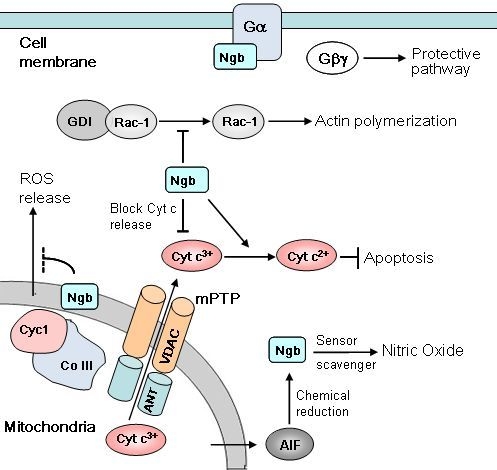
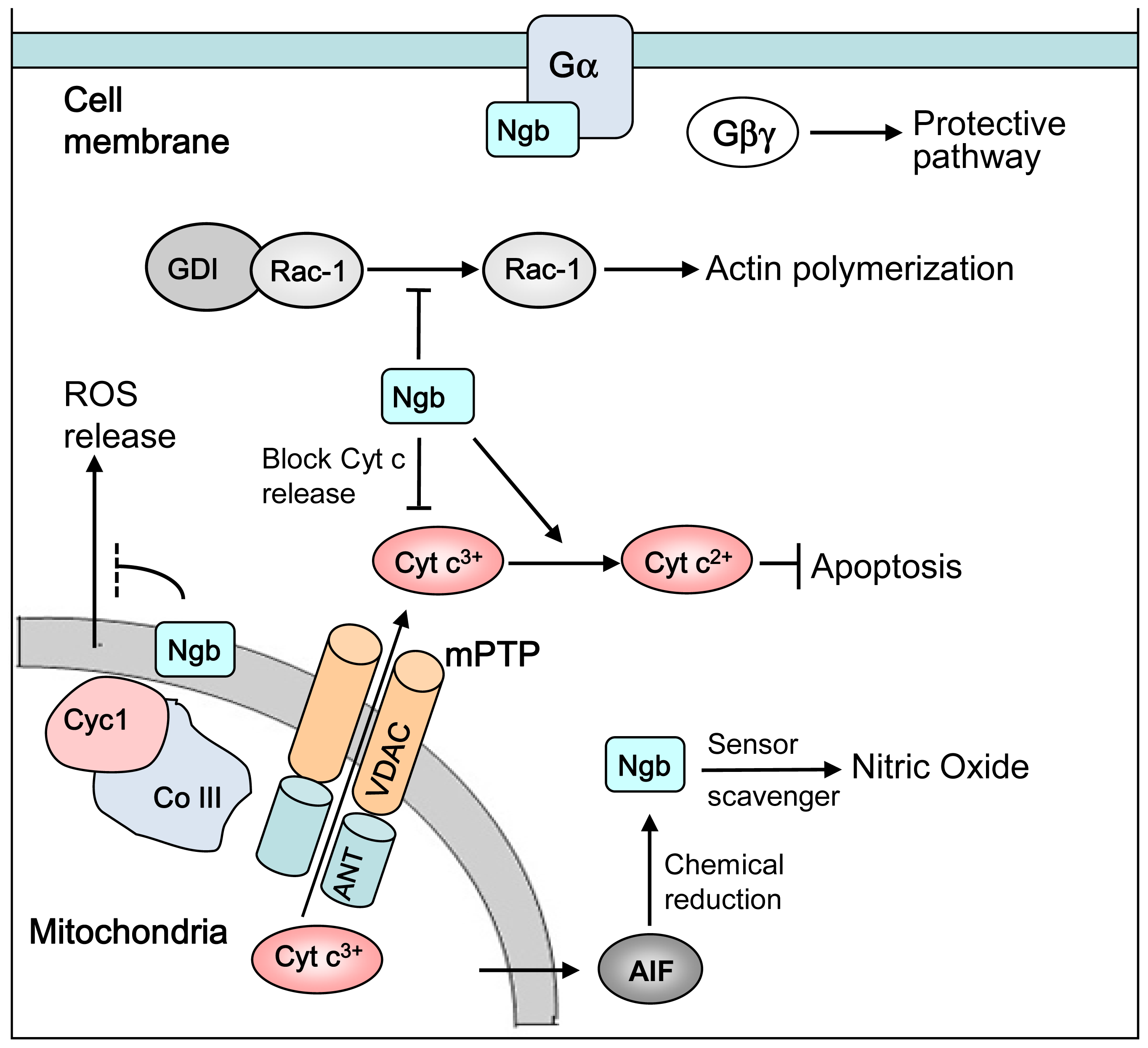
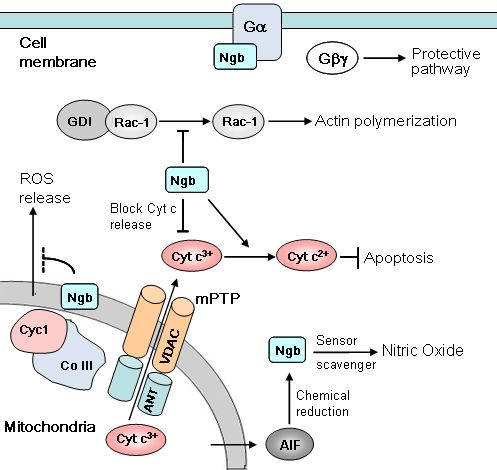
<p>To further dissect the molecular mechanisms of Ngb neuroprotection, our laboratory recently did a screening for the protein interaction partners of mouse Ngb, using yeast two-hybrid assay. We identified several Ngb-binding proteins, including Na/K ATPase beta 1, cytochrome c1, ubiquitin C, voltage-dependant anion channel (VDAC) and a few more [<xref ref-type="bibr" rid="b70-ijms-13-06995">70</xref>]. Among these Ngb-binding protein candidates, some are biologically important for neuronal function and survival. For example, cytochrome c1 is a subunit of the cytochrome bc1 complex (mitochondria complex III), which plays an important role in mitochondria function for energy transduction and generation of the superoxide anion [<xref ref-type="bibr" rid="b71-ijms-13-06995">71</xref>], and it also plays pathological roles in response to oxidative stress [<xref ref-type="bibr" rid="b72-ijms-13-06995">72</xref>,<xref ref-type="bibr" rid="b73-ijms-13-06995">73</xref>] and regulates hypoxia-inducible-factor-1 activation induced by hypoxia [<xref ref-type="bibr" rid="b74-ijms-13-06995">74</xref>–<xref ref-type="bibr" rid="b76-ijms-13-06995">76</xref>]. Cytochrome c1 is localized in the intermembrane space between the outer and inner membrane of mitochondria [<xref ref-type="bibr" rid="b77-ijms-13-06995">77</xref>]. The mitochondrial outer membrane contains the protein “porin”, which forms an aqueous channel through which proteins up to 10 kd can pass and go into the intermembrane space. It has been known that hypoxia-induced superoxide, as well as apoptotic signaling molecules, such as Bax, may cause permeabilization of the mitochondrial outer membrane [<xref ref-type="bibr" rid="b78-ijms-13-06995">78</xref>,<xref ref-type="bibr" rid="b79-ijms-13-06995">79</xref>]. Thus, as a 16 kd monomer, Ngb might be able to pass the outer membrane to bind and affect the function of cytochrome c1. Additionally, results from our laboratory showed that Ngb overexpression is able to decrease OGD-induced mitochondria permeability transition pore (mPTP) opening and Cyt c release from mitochondria. The interaction between Ngb and VDAC, an mPTP component, is supportive of Ngb’s effect in mPTP. However, the phenomenon of Ngb binding to other proteins and binding status-correlated alteration of cell signaling and mitochondrial function requires further investigation. The major hypotheses about Ngb-involved signaling pathways are summarized in <xref ref-type="fig" rid="f1-ijms-13-06995">Figure 1</xref>.</p></sec></sec>
<sec>
<title>6. Tissue Specific Expression of Ngb Gene and Its Regulation</title>
<sec>
<title>6.1. Neuron-Specific Expression of Ngb Gene</title>
<p>From the beginning of its discovery, Ngb gene expression has been found to be highly tissue-specific. <italic>In situ</italic> hybridization showed that Ngb mRNA was widely distributed throughout the adult rat brain, including cerebral cortex, hippocampus, and subcortical structures such as thalamus, hypothalamus, olfactory bulb, and cerebellum [<xref ref-type="bibr" rid="b33-ijms-13-06995">33</xref>,<xref ref-type="bibr" rid="b80-ijms-13-06995">80</xref>,<xref ref-type="bibr" rid="b81-ijms-13-06995">81</xref>]. The distribution of Ngb protein is consistent with its mRNA localization, and the subcellular immunoreactivity is restricted to the cytoplasm.</p>
<p>Among all Ngb-expressing cells, the highest expression is seen in the retina, with the estimated concentration about 100-fold higher than in the brain [<xref ref-type="bibr" rid="b82-ijms-13-06995">82</xref>]. Ngb mRNA was detected in the perikarya of the nuclear and ganglion layers of the neuronal retina, whereas the protein was present mainly in the plexiform layers and in the ellipsoid region of the photoreceptor inner segment [<xref ref-type="bibr" rid="b83-ijms-13-06995">83</xref>]. The distribution of Ngb correlates with the subcellular localization of mitochondria and with the relative oxygen demands. These findings suggest that Ngb supplies oxygen to the retina, similar to myoglobin in the myocardium and skeletal muscle. Although Ngb concentration in the brain is relatively lower than in the retina, considering that the neuron is the major cell type in the brain specifically expressing Ngb, thus Ngb may be a unique molecule that plays certain roles in maintaining normal neuron function and protectively responding to pathological insults.</p></sec>
<sec>
<title>6.2. Ngb Gene Expression under Pathological Conditions</title>
<p>The expression of Ngb gene is up-regulated under hypoxic/ischemic conditions both in cultured cells [<xref ref-type="bibr" rid="b84-ijms-13-06995">84</xref>,<xref ref-type="bibr" rid="b85-ijms-13-06995">85</xref>] and in stroke animal brains [<xref ref-type="bibr" rid="b2-ijms-13-06995">2</xref>,<xref ref-type="bibr" rid="b6-ijms-13-06995">6</xref>,<xref ref-type="bibr" rid="b86-ijms-13-06995">86</xref>,<xref ref-type="bibr" rid="b87-ijms-13-06995">87</xref>]. Ngb is also up-regulated in the cerebellum of mouse pups in response to hypoxic-ischemic insults caused by maternal seizures during intrauterine life [<xref ref-type="bibr" rid="b29-ijms-13-06995">29</xref>]. These data imply that Ngb up-regulation could be an endogenous compensatory or protective mechanism in response to the sublethal hypoxic/ischemic insults to brain neurons. More importantly, a recent report showed that Ngb expression is increased in the cortical peri-infarct region in stroke patients, suggesting its clinical relevance for endogenous neuroprotection [<xref ref-type="bibr" rid="b88-ijms-13-06995">88</xref>]. In contrast to acute hypoxic conditions, a chronic hypoxia (10% oxygen for 14 days) did not increase Ngb gene expression in mRNA or protein level in the mouse [<xref ref-type="bibr" rid="b89-ijms-13-06995">89</xref>]. Moreover, two-hour exposure of mice to 7.6% oxygen did not up-regulate brain Ngb either [<xref ref-type="bibr" rid="b83-ijms-13-06995">83</xref>]. However, others reported opposite results that housing rats in 10% oxygen for up to 14 days up-regulated Ngb mRNA in the rat brain [<xref ref-type="bibr" rid="b90-ijms-13-06995">90</xref>]. Thus, there might also be species- and condition-dependent differences for Ngb responses to hypoxic conditions. In addition to hypoxia/ischemia, aging might also be an influential factor for Ngb expression. Sun <italic>et al</italic>. have demonstrated that Ngb expression level decreased to about a half in aged rats (24 months) compared to young ones (3, 12 months) in various regions of brain, implying the pathophysiological importance of Ngb in age-related neurodegenerative diseases [<xref ref-type="bibr" rid="b44-ijms-13-06995">44</xref>].</p></sec>
<sec>
<title>6.3. Transcriptional Regulation of Ngb Gene</title>
<p>A few recent studies focused on the transcriptional regulation mechanisms of Ngb gene expression. Zhang <italic>et al.</italic> reported that transcription factors Sp1 and Sp3 can bind to the human Ngb promoter region and are responsible for transactivation of Ngb promoter [<xref ref-type="bibr" rid="b91-ijms-13-06995">91</xref>]. Our lab has analyzed the core promoter region of the mouse Ngb gene, and further characterized the transcription factors required for Ngb gene expression under both resting and hypoxic conditions [<xref ref-type="bibr" rid="b92-ijms-13-06995">92</xref>]. We located the core promoter of mouse Ngb gene to the 554 bp segment before the transcription start codon. Complementary approaches have demonstrated that transcription factors, NFκB family members (p65, p50, cRel), Egr1, and Sp1 bind the Ngb promoter, and are responsible for basal Ngb expression. Moreover, NFκB (p65) and Sp1, as well as Hif1α, were also responsible for hypoxia-induced up-regulation of Ngb expression. These findings will be helpful in establishing strategies to screen for compounds that can up-regulate endogenous Ngb gene expression.</p></sec>
<sec>
<title>6.4. Ngb Gene Expression in Non-Neuronal Cells</title>
<p>Besides brain neurons and the retina, Ngb expression could also be detected in other tissues such as pancreas, adrenal gland and testes, but the expression level was lower [<xref ref-type="bibr" rid="b93-ijms-13-06995">93</xref>]. It was reported that Ngb mRNA is detectable in cultured astrocytes from newborn mouse brain, and that Ngb protein co-localizes with glial fibrillary acid protein (GFAP) in cultured astrocytes [<xref ref-type="bibr" rid="b94-ijms-13-06995">94</xref>]. Moreover, a number of studies have demonstrated that Ngb was expressed in various tumor tissues, including glioblastoma [<xref ref-type="bibr" rid="b95-ijms-13-06995">95</xref>,<xref ref-type="bibr" rid="b96-ijms-13-06995">96</xref>] and astrocytoma [<xref ref-type="bibr" rid="b97-ijms-13-06995">97</xref>]. These findings imply a broader involvement of Ngb under pathological conditions in different tissues, and suggest Ngb may be related to the adaptation of tumor cells to hypoxic microenvironments, which is consistent with its role in oxygen sensing and hypoxic signaling.</p>
<p>Overall, emerging data have clearly documented that up-regulation of Ngb gene expression is neuroprotective against hypoxic/ischemic brain injury [<xref ref-type="bibr" rid="b5-ijms-13-06995">5</xref>,<xref ref-type="bibr" rid="b26-ijms-13-06995">26</xref>], therefore targeting Ngb for endogenous neuroprotection would be translationally significant. We need to seek strategies to identify small molecules that elevate endogenous Ngb, which would help us in the development of new therapy approaches for stroke and other related neurological disorders.</p></sec></sec>
<sec>
<title>7. Targeting Ngb for Endogenous Neuroprotection</title>
<sec>
<title>7.1. Previously Identified Chemical Compounds that Up-Regulate Endogenous Ngb Expression</title>
<p>As described earlier (Section 2), a few chemical compounds have been identified that are able to up-regulate endogenous Ngb gene expression, including valproic acid (VPA), cinnamic acid and 17β-estradiol (E2) [<xref ref-type="bibr" rid="b16-ijms-13-06995">16</xref>,<xref ref-type="bibr" rid="b17-ijms-13-06995">17</xref>]. VPA and cinnamic acid were identified in a small-scale screening for Ngb up-regulators in cultured neuroblastoma cell line HN33 [<xref ref-type="bibr" rid="b16-ijms-13-06995">16</xref>]. Interestingly, earlier studies have already shown that VPA was protective in rodent models of cerebral ischemia [<xref ref-type="bibr" rid="b20-ijms-13-06995">20</xref>,<xref ref-type="bibr" rid="b22-ijms-13-06995">22</xref>]. VPA is a commonly used drug to treat seizures and bipolar mood disorder, which at least in part warrants its clinical safety. However, previous studies suggested that the neuroprotective effect of VPA was through its function in histone deacetylase (HDAC) inhibition, and it is unclear whether Ngb induction plays a role in VPA neuroprotection. Cinnamic acid is a natural substance obtained from cinnamon oil. Cinnamic acid reduced glutamate toxicity in primary cultured rat cortical neurons [<xref ref-type="bibr" rid="b27-ijms-13-06995">27</xref>], but did not protect GT1-7 (immortalized mouse hypothalamic) cells from oxygen and glucose deprivation (OGD) [<xref ref-type="bibr" rid="b28-ijms-13-06995">28</xref>] <italic>in vitro</italic>. Another study also showed negative result of cinnamic acid in protection against beta-amyloid-induced toxicity in a rat-derived neuronal cell line [<xref ref-type="bibr" rid="b98-ijms-13-06995">98</xref>]. These studies cast doubt on the neuroprotective effect of cinnamic acid in animal stroke models, which nevertheless is worth investigating in the future.</p>
<p>17β-estradiol (E2) was found to upregulate Ngb expression in both the SK-N-BE human neuroblastoma cell line and mouse hippocampal neurons [<xref ref-type="bibr" rid="b17-ijms-13-06995">17</xref>]. As a type of estrogen, E2 has been reported to be protective for neuronal cells against a variety of insults, including H<sub>2</sub>O<sub>2</sub> [<xref ref-type="bibr" rid="b99-ijms-13-06995">99</xref>,<xref ref-type="bibr" rid="b100-ijms-13-06995">100</xref>] and oxygen-glucose deprivation [<xref ref-type="bibr" rid="b101-ijms-13-06995">101</xref>]. E2 can also attenuate the toxicity of beta-amyloid and glutamate in a hippocampal cell line [<xref ref-type="bibr" rid="b102-ijms-13-06995">102</xref>]. In addition, estrogen therapy in post-menopausal women is associated with decreased incidence and enhanced recovery from ischemic stroke [<xref ref-type="bibr" rid="b103-ijms-13-06995">103</xref>]. However, a serious drawback of E2 is its potential in carcinogenesis. E2 exposure to postmenopausal women is associated with an increased risk of endometrial and breast cancer [<xref ref-type="bibr" rid="b104-ijms-13-06995">104</xref>,<xref ref-type="bibr" rid="b105-ijms-13-06995">105</xref>]. Animal studies further confirmed the tumorigenesis caused by E2 administration [<xref ref-type="bibr" rid="b106-ijms-13-06995">106</xref>,<xref ref-type="bibr" rid="b107-ijms-13-06995">107</xref>]. Thus the prospect of E2 as a neuroprotective reagent looks slim.</p>
<p>It should be noted that the Ngb-upregulation effect of the above three molecules were all discovered in neuron cultures, thus many issues remain to be investigated, e.g., their Ngb regulation effect in animal models, the function and specificity of Ngb regulation. These three molecules need to be further studied as to whether they can be developed into therapeutic molecules via up-regulating Ngb. We expect that more small molecules may be Ngb upregulators and additional screening is necessary. As the availability of positive controls in screening assay is critical, it is necessary to justify in different models whether VPA, cinnamic acid and E2 can serve as positive controls for future screening to identify more Ngb upregulators.</p></sec>
<sec>
<title>7.2. Establishment of a Cell-based High Throughput Screening System for Identification of Small Molecules Capable of Ngb Upregulation</title>
<p>Our laboratory has just started to establish a cell-based high throughput screening (HTS) system for identifying novel small molecules capable of up-regulating Ngb expression. This screening approach has been successfully used in searching compounds for up-regulating intracellular proteins [<xref ref-type="bibr" rid="b108-ijms-13-06995">108</xref>]. For example, activation of NF-κB has been targeted in a cell-based high-throughput screening to identify neuroprotectants [<xref ref-type="bibr" rid="b9-ijms-13-06995">9</xref>]. A number of identified small molecules are being tested in preclinical animal studies, some of them initially showed promising results [<xref ref-type="bibr" rid="b109-ijms-13-06995">109</xref>–<xref ref-type="bibr" rid="b111-ijms-13-06995">111</xref>].</p>
<p>Generally, HTS incorporates two steps: (1) Establishment of a biological detection system; (2) Screening and validation of effective compounds. A common method of biological detection for transcriptional activation is to employ a cell-based assay with a reporter gene driven by the key promoter elements of the target gene. A popularly applied reporter gene is the firefly luciferase gene, due to its high sensitivity and cost efficiency [<xref ref-type="bibr" rid="b108-ijms-13-06995">108</xref>,<xref ref-type="bibr" rid="b112-ijms-13-06995">112</xref>]. In practice, the very first task before establishing the detection system is to identify the promoter of the target gene and then develop a reporter construct with this promoter. For Ngb, one study has identified a 2.0 kb promoter region for human Ngb gene [<xref ref-type="bibr" rid="b113-ijms-13-06995">113</xref>]. Our recently published study further located the core promoter region of mouse Ngb gene to the 554 bp fragment before the transcription start codon [<xref ref-type="bibr" rid="b92-ijms-13-06995">92</xref>]. This promoter region will be used to make luciferase reporter constructs.</p>
<p>A standard drug development procedure goes from cell assay to animal model, and eventually to clinical trial. An ideal compound would be able to induce the expression of endogenous neuroprotective molecules in both animal and human neurons and brains, therefore it is necessary to establish both mouse and human cell-based reporter constructs, <italic>i.e.</italic>, Ngb promoter-driven luciferase construct, for Ngb up-regulation compound screening, and to subsequently generate stable cell lines containing this Ngb reporter construct [<xref ref-type="bibr" rid="b110-ijms-13-06995">110</xref>].</p>
<p>Once the stable cell lines containing Ngb reporter construct has been validated, compound screening can be performed on a cell-based high throughput assay system [<xref ref-type="bibr" rid="b114-ijms-13-06995">114</xref>]. The identified compounds that can up-regulate Ngb expression should then be validated as follows: (1) Only the compounds that can up-regulate both mouse and human Ngb promoter activities will undergo further investigations; (2) To determine whether changes of Ngb reporter activities truly reflect endogenous Ngb mRNA or protein alterations, effects of selected compounds in Ngb mRNA or protein levels of cultured cell lines and primary neurons need to be examined by quantitative RT-PCR and Western blot for validation; (3) We need to validate the neuroprotective effects of these compounds against neuronal injury induced by OGD or other insults in neuron cultures; (4) Lastly, we need to validate the ability of the selected compounds in up-regulating Ngb in mouse brain and their neuroprotection against cerebral ischemia in mouse models.</p>
<p>We acknowledge that several technological issues require attention in the HTS process. For example, a certain amount of small molecules are interesting during the screening, however, some of them may turn out to be false positives during further validation and optimization, typically after a great deal of time and resources have been devoted, thus it would be critical to minimize false positives during the early screening stages [<xref ref-type="bibr" rid="b115-ijms-13-06995">115</xref>]. The HTS process consists of multiple automated steps involving compound handling, liquid transfers, and assay signal capture, all of which unavoidably contribute to systematic variation in the screening data. It will be challenging to distinguish biologically active compounds from assay variability [<xref ref-type="bibr" rid="b116-ijms-13-06995">116</xref>]. We may also need to consider building knowledge equity from the integration of multiple parallel screening assays, workstreams and data sources [<xref ref-type="bibr" rid="b117-ijms-13-06995">117</xref>]. Lastly, statistical analysis of the screening data may also result in false positives or false negatives, therefore it is essential to apply robust statistical methods effectively and properly for decision-making [<xref ref-type="bibr" rid="b115-ijms-13-06995">115</xref>,<xref ref-type="bibr" rid="b116-ijms-13-06995">116</xref>,<xref ref-type="bibr" rid="b118-ijms-13-06995">118</xref>].</p>
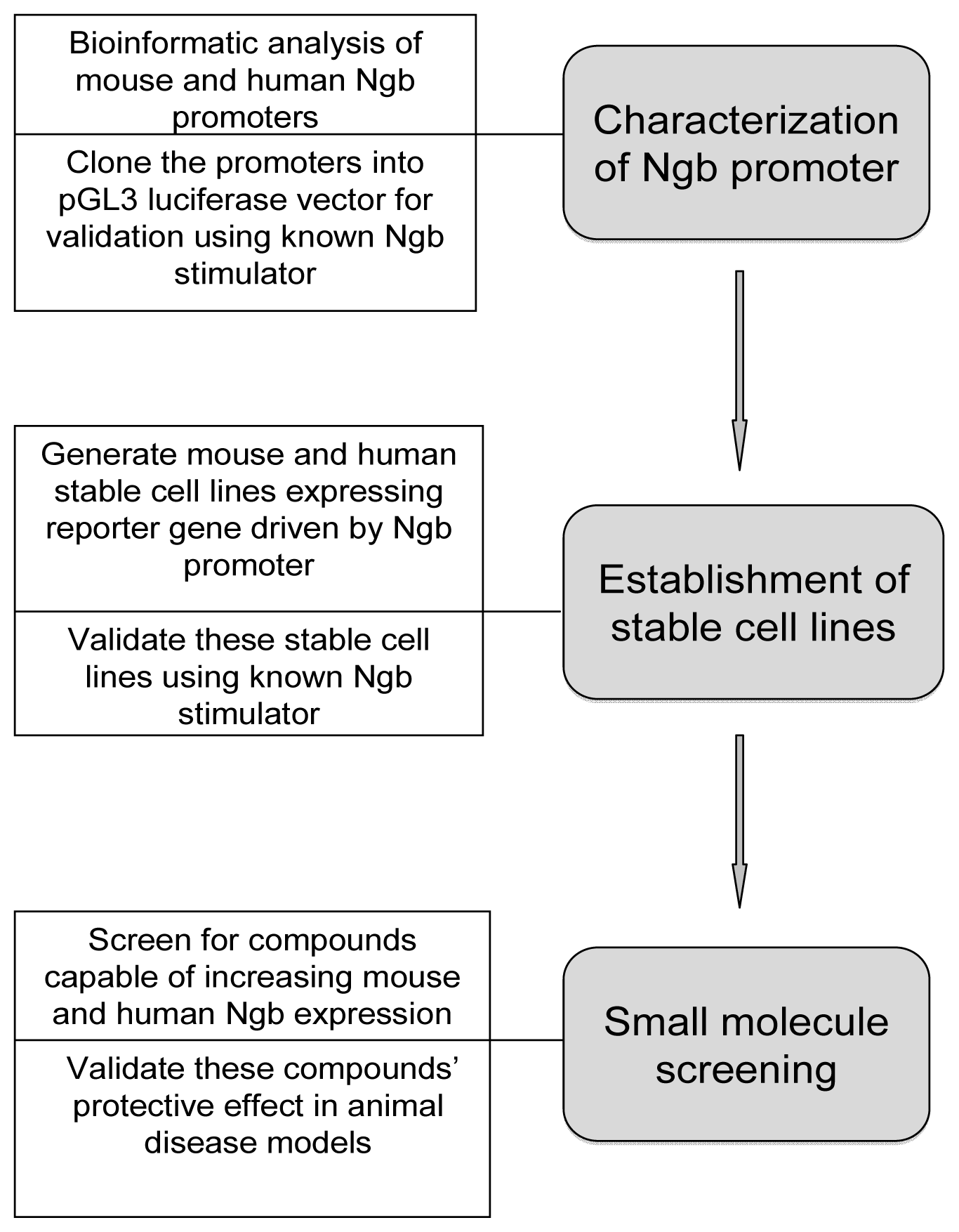
<p>In summary, the strategy we described above comprises two translational features. First, we will establish both mouse and human stable cell lines with Ngb promoter reporter to ensure that selected compounds are capable of activating both mouse and human Ngb promoters. Second, validation as the key component will be conducted in every step of small molecule screening and therapeutic development. The general strategy of this small molecule screening system is summarized in <xref ref-type="fig" rid="f2-ijms-13-06995">Figure 2</xref>.</p></sec></sec></body>
<back>
<ack>
<title>Acknowledgments</title>
<p>This work was supported in part by NIH grants R01-NS049476 and RO1-NS065998 (to X.W.), and Postdoctoral Fellowship (12POST9720007) from the American Heart Association (to Z.Y.). We appreciate Eng H. Lo for his very helpful discussion. The authors declare no conflicts of interest.</p></ack>
<ref-list>
<title>References</title>
<ref id="b1-ijms-13-06995"><label>1</label><citation citation-type="journal"><person-group person-group-type="author"><name><surname>Burmester</surname><given-names>T.</given-names></name><name><surname>Weich</surname><given-names>B.</given-names></name><name><surname>Reinhardt</surname><given-names>S.</given-names></name><name><surname>Hankeln</surname><given-names>T.</given-names></name></person-group><article-title>A vertebrate globin expressed in the brain</article-title><source>Nature</source><year>2000</year><volume>407</volume><fpage>520</fpage><lpage>523</lpage><pub-id pub-id-type="doi">10.1038/35035093</pub-id><pub-id pub-id-type="pmid">11029004</pub-id></citation></ref>
<ref id="b2-ijms-13-06995"><label>2</label><citation citation-type="journal"><person-group person-group-type="author"><name><surname>Sun</surname><given-names>Y.</given-names></name><name><surname>Jin</surname><given-names>K.</given-names></name><name><surname>Mao</surname><given-names>X.O.</given-names></name><name><surname>Zhu</surname><given-names>Y.</given-names></name><name><surname>Greenberg</surname><given-names>D.A.</given-names></name></person-group><article-title>Neuroglobin is up-regulated by and protects neurons from hypoxic-ischemic injury</article-title><source>Proc. Natl. Acad. Sci. USA</source><year>2001</year><volume>98</volume><fpage>15306</fpage><lpage>15311</lpage><pub-id pub-id-type="doi">10.1073/pnas.251466698</pub-id><pub-id pub-id-type="pmid">11742077</pub-id></citation></ref>
<ref id="b3-ijms-13-06995"><label>3</label><citation citation-type="journal"><person-group person-group-type="author"><name><surname>Peroni</surname><given-names>D.</given-names></name><name><surname>Negro</surname><given-names>A.</given-names></name><name><surname>Bahr</surname><given-names>M.</given-names></name><name><surname>Dietz</surname><given-names>G.P.</given-names></name></person-group><article-title>Intracellular delivery of neuroglobin using hiv-1 tat protein transduction domain fails to protect against oxygen and glucose deprivation</article-title><source>Neurosci. lett</source><year>2007</year><volume>421</volume><fpage>110</fpage><lpage>114</lpage><pub-id pub-id-type="doi">10.1016/j.neulet.2007.05.046</pub-id><pub-id pub-id-type="pmid">17566657</pub-id></citation></ref>
<ref id="b4-ijms-13-06995"><label>4</label><citation citation-type="journal"><person-group person-group-type="author"><name><surname>Hundahl</surname><given-names>C.</given-names></name><name><surname>Kelsen</surname><given-names>J.</given-names></name><name><surname>Kjaer</surname><given-names>K.</given-names></name><name><surname>Ronn</surname><given-names>L.C.</given-names></name><name><surname>Weber</surname><given-names>R.E.</given-names></name><name><surname>Geuens</surname><given-names>E.</given-names></name><name><surname>Hay-Schmidt</surname><given-names>A.</given-names></name><name><surname>Nyengaard</surname><given-names>J.R.</given-names></name></person-group><article-title>Does neuroglobin protect neurons from ischemic insult? A quantitative investigation of neuroglobin expression following transient mcao in spontaneously hypertensive rats</article-title><source>Brain Res</source><year>2006</year><volume>1085</volume><fpage>19</fpage><lpage>27</lpage><pub-id pub-id-type="doi">10.1016/j.brainres.2006.02.040</pub-id><pub-id pub-id-type="pmid">16647691</pub-id></citation></ref>
<ref id="b5-ijms-13-06995"><label>5</label><citation citation-type="journal"><person-group person-group-type="author"><name><surname>Wang</surname><given-names>X.</given-names></name><name><surname>Liu</surname><given-names>J.</given-names></name><name><surname>Zhu</surname><given-names>H.</given-names></name><name><surname>Tejima</surname><given-names>E.</given-names></name><name><surname>Tsuji</surname><given-names>K.</given-names></name><name><surname>Murata</surname><given-names>Y.</given-names></name><name><surname>Atochin</surname><given-names>D.N.</given-names></name><name><surname>Huang</surname><given-names>P.L.</given-names></name><name><surname>Zhang</surname><given-names>C.</given-names></name><name><surname>Lo</surname><given-names>E.H.</given-names></name></person-group><article-title>Effects of neuroglobin overexpression on acute brain injury and long-term outcomes after focal cerebral ischemia</article-title><source>Stroke</source><year>2008</year><volume>39</volume><fpage>1869</fpage><lpage>1874</lpage><pub-id pub-id-type="doi">10.1161/STROKEAHA.107.506022</pub-id><pub-id pub-id-type="pmid">18403737</pub-id></citation></ref>
<ref id="b6-ijms-13-06995"><label>6</label><citation citation-type="journal"><person-group person-group-type="author"><name><surname>Sun</surname><given-names>Y.</given-names></name><name><surname>Jin</surname><given-names>K.</given-names></name><name><surname>Peel</surname><given-names>A.</given-names></name><name><surname>Mao</surname><given-names>X.O.</given-names></name><name><surname>Xie</surname><given-names>L.</given-names></name><name><surname>Greenberg</surname><given-names>D.A.</given-names></name></person-group><article-title>Neuroglobin protects the brain from experimental stroke <italic>in vivo</italic></article-title><source>Proc. Natl. Acad. Sci. USA</source><year>2003</year><volume>100</volume><fpage>3497</fpage><lpage>3500</lpage><pub-id pub-id-type="doi">10.1073/pnas.0637726100</pub-id><pub-id pub-id-type="pmid">12621155</pub-id></citation></ref>
<ref id="b7-ijms-13-06995"><label>7</label><citation citation-type="journal"><person-group person-group-type="author"><name><surname>Khan</surname><given-names>A.A.</given-names></name><name><surname>Mao</surname><given-names>X.O.</given-names></name><name><surname>Banwait</surname><given-names>S.</given-names></name><name><surname>Jin</surname><given-names>K.</given-names></name><name><surname>Greenberg</surname><given-names>D.A.</given-names></name></person-group><article-title>Neuroglobin attenuates beta-amyloid neurotoxicity in vitro and transgenic alzheimer phenotype <italic>in vivo</italic></article-title><source>Proc. Natl. Acad. Sci. USA</source><year>2007</year><volume>104</volume><fpage>19114</fpage><lpage>19119</lpage><pub-id pub-id-type="doi">10.1073/pnas.0706167104</pub-id><pub-id pub-id-type="pmid">18025470</pub-id></citation></ref>
<ref id="b8-ijms-13-06995"><label>8</label><citation citation-type="journal"><person-group person-group-type="author"><name><surname>Mergenthaler</surname><given-names>P.</given-names></name><name><surname>Dirnagl</surname><given-names>U.</given-names></name></person-group><article-title>Protective conditioning of the brain: Expressway or roadblock?</article-title><source>J. Physiol</source><year>2011</year><volume>589</volume><fpage>4147</fpage><lpage>4155</lpage><pub-id pub-id-type="doi">10.1113/jphysiol.2011.209718</pub-id><pub-id pub-id-type="pmid">21708907</pub-id></citation></ref>
<ref id="b9-ijms-13-06995"><label>9</label><citation citation-type="journal"><person-group person-group-type="author"><name><surname>Manuvakhova</surname><given-names>M.S.</given-names></name><name><surname>Johnson</surname><given-names>G.G.</given-names></name><name><surname>White</surname><given-names>M.C.</given-names></name><name><surname>Ananthan</surname><given-names>S.</given-names></name><name><surname>Sosa</surname><given-names>M.</given-names></name><name><surname>Maddox</surname><given-names>C.</given-names></name><name><surname>McKellip</surname><given-names>S.</given-names></name><name><surname>Rasmussen</surname><given-names>L.</given-names></name><name><surname>Wennerberg</surname><given-names>K.</given-names></name><name><surname>Hobrath</surname><given-names>J.V.</given-names></name><etal/></person-group><article-title>Identification of novel small molecule activators of nuclear factor-κb with neuroprotective action via high-throughput screening</article-title><source>J. Neurosci. Res</source><year>2011</year><volume>89</volume><fpage>58</fpage><lpage>72</lpage><pub-id pub-id-type="doi">10.1002/jnr.22526</pub-id><pub-id pub-id-type="pmid">21046675</pub-id></citation></ref>
<ref id="b10-ijms-13-06995"><label>10</label><citation citation-type="journal"><person-group person-group-type="author"><name><surname>Sun</surname><given-names>Y.</given-names></name><name><surname>Jin</surname><given-names>K.</given-names></name><name><surname>Mao</surname><given-names>X.O.</given-names></name><name><surname>Zhu</surname><given-names>Y.</given-names></name><name><surname>Greenberg</surname><given-names>D.A.</given-names></name></person-group><article-title>Neuroglobin protects the brain from experimental stroke <italic>in vivo</italic></article-title><source>Proc. Natl. Acad. Sci. USA</source><year>2001</year><volume>98</volume><fpage>15306</fpage><lpage>15311</lpage><pub-id pub-id-type="doi">10.1073/pnas.251466698</pub-id><pub-id pub-id-type="pmid">11742077</pub-id></citation></ref>
<ref id="b11-ijms-13-06995"><label>11</label><citation citation-type="journal"><person-group person-group-type="author"><name><surname>Garry</surname><given-names>D.J.</given-names></name><name><surname>Mammen</surname><given-names>P.P.</given-names></name></person-group><article-title>Neuroprotection and the role of neuroglobin</article-title><source>Lancet</source><year>2003</year><volume>362</volume><fpage>342</fpage><lpage>343</lpage><pub-id pub-id-type="doi">10.1016/S0140-6736(03)14055-X</pub-id><pub-id pub-id-type="pmid">12907003</pub-id></citation></ref>
<ref id="b12-ijms-13-06995"><label>12</label><citation citation-type="journal"><person-group person-group-type="author"><name><surname>Greenberg</surname><given-names>D.A.</given-names></name><name><surname>Jin</surname><given-names>K.</given-names></name><name><surname>Khan</surname><given-names>A.A.</given-names></name></person-group><article-title>Neuroglobin: An endogenous neuroprotectant</article-title><source>Curr. Opin. Pharmacol</source><year>2008</year><volume>8</volume><fpage>20</fpage><lpage>24</lpage><pub-id pub-id-type="doi">10.1016/j.coph.2007.09.003</pub-id><pub-id pub-id-type="pmid">17942367</pub-id></citation></ref>
<ref id="b13-ijms-13-06995"><label>13</label><citation citation-type="journal"><person-group person-group-type="author"><name><surname>Yu</surname><given-names>Z.</given-names></name><name><surname>Fan</surname><given-names>X.</given-names></name><name><surname>Lo</surname><given-names>E.H.</given-names></name><name><surname>Wang</surname><given-names>X.</given-names></name></person-group><article-title>Neuroprotective roles and mechanisms of neuroglobin</article-title><source>Neurol. Res</source><year>2009</year><volume>31</volume><fpage>122</fpage><lpage>127</lpage><pub-id pub-id-type="doi">10.1179/174313209X389866</pub-id><pub-id pub-id-type="pmid">19298751</pub-id></citation></ref>
<ref id="b14-ijms-13-06995"><label>14</label><citation citation-type="journal"><person-group person-group-type="author"><name><surname>Venis</surname><given-names>S.</given-names></name></person-group><article-title>Neuroglobin might protect brain cells during stroke</article-title><source>Lancet</source><year>2001</year><volume>358</volume><pub-id pub-id-type="doi">10.1016/S0140-6736</pub-id><issue>01</issue><fpage>07148</fpage><lpage>3</lpage></citation></ref>
<ref id="b15-ijms-13-06995"><label>15</label><citation citation-type="journal"><person-group person-group-type="author"><name><surname>Watanabe</surname><given-names>S.</given-names></name><name><surname>Wakasugi</surname><given-names>K.</given-names></name></person-group><article-title>Zebrafish neuroglobin is a cell-membrane-penetrating globin</article-title><source>Biochemistry</source><year>2008</year><volume>47</volume><fpage>5266</fpage><lpage>5270</lpage><pub-id pub-id-type="doi">10.1021/bi800286m</pub-id><pub-id pub-id-type="pmid">18416560</pub-id></citation></ref>
<ref id="b16-ijms-13-06995"><label>16</label><citation citation-type="journal"><person-group person-group-type="author"><name><surname>Jin</surname><given-names>K.</given-names></name><name><surname>Mao</surname><given-names>X.O.</given-names></name><name><surname>Xie</surname><given-names>L.</given-names></name><name><surname>John</surname><given-names>V.</given-names></name><name><surname>Greenberg</surname><given-names>D.A.</given-names></name></person-group><article-title>Pharmacological induction of neuroglobin expression</article-title><source>Pharmacology</source><year>2011</year><volume>87</volume><fpage>81</fpage><lpage>84</lpage><pub-id pub-id-type="doi">10.1159/000322998</pub-id><pub-id pub-id-type="pmid">21228614</pub-id></citation></ref>
<ref id="b17-ijms-13-06995"><label>17</label><citation citation-type="journal"><person-group person-group-type="author"><name><surname>de Marinis</surname><given-names>E.</given-names></name><name><surname>Ascenzi</surname><given-names>P.</given-names></name><name><surname>Pellegrini</surname><given-names>M.</given-names></name><name><surname>Galluzzo</surname><given-names>P.</given-names></name><name><surname>Bulzomi</surname><given-names>P.</given-names></name><name><surname>Arevalo</surname><given-names>M.A.</given-names></name><name><surname>Garcia-Segura</surname><given-names>L.M.</given-names></name><name><surname>Marino</surname><given-names>M.</given-names></name></person-group><article-title>17β-estradiol—A new modulator of neuroglobin levels in neurons: Role in neuroprotection against H<sub>2</sub>O<sub>2</sub>-induced toxicity</article-title><source>Neurosignals</source><year>2010</year><volume>18</volume><fpage>223</fpage><lpage>235</lpage><pub-id pub-id-type="pmid">21335947</pub-id></citation></ref>
<ref id="b18-ijms-13-06995"><label>18</label><citation citation-type="journal"><person-group person-group-type="author"><name><surname>Reuss</surname><given-names>S.</given-names></name><name><surname>Saaler-Reinhardt</surname><given-names>S.</given-names></name><name><surname>Weich</surname><given-names>B.</given-names></name><name><surname>Wystub</surname><given-names>S.</given-names></name><name><surname>Reuss</surname><given-names>M.H.</given-names></name><name><surname>Burmester</surname><given-names>T.</given-names></name><name><surname>Hankeln</surname><given-names>T.</given-names></name></person-group><article-title>Expression analysis of neuroglobin mrna in rodent tissues</article-title><source>Neuroscience</source><year>2002</year><volume>115</volume><fpage>645</fpage><lpage>656</lpage><pub-id pub-id-type="pmid">12435404</pub-id></citation></ref>
<ref id="b19-ijms-13-06995"><label>19</label><citation citation-type="journal"><person-group person-group-type="author"><name><surname>Nienhaus</surname><given-names>K.</given-names></name><name><surname>Nienhaus</surname><given-names>G.U.</given-names></name></person-group><article-title>Searching for neuroglobin’s role in the brain</article-title><source>IUBMB Life</source><year>2007</year><volume>59</volume><fpage>490</fpage><lpage>497</lpage><pub-id pub-id-type="pmid">17701543</pub-id></citation></ref>
<ref id="b20-ijms-13-06995"><label>20</label><citation citation-type="journal"><person-group person-group-type="author"><name><surname>Brunori</surname><given-names>M.</given-names></name><name><surname>Vallone</surname><given-names>B.</given-names></name></person-group><article-title>A globin for the brain</article-title><source>FASEB J</source><year>2006</year><volume>20</volume><fpage>2192</fpage><lpage>2197</lpage><pub-id pub-id-type="doi">10.1096/fj.06-6643rev</pub-id><pub-id pub-id-type="pmid">17077295</pub-id></citation></ref>
<ref id="b21-ijms-13-06995"><label>21</label><citation citation-type="journal"><person-group person-group-type="author"><name><surname>Burmester</surname><given-names>T.</given-names></name><name><surname>Hankeln</surname><given-names>T.</given-names></name></person-group><article-title>Neuroglobin: A respiratory protein of the nervous system</article-title><source>News Physiol. Sci</source><year>2004</year><volume>19</volume><fpage>110</fpage><lpage>113</lpage><pub-id pub-id-type="pmid">15143204</pub-id></citation></ref>
<ref id="b22-ijms-13-06995"><label>22</label><citation citation-type="journal"><person-group person-group-type="author"><name><surname>Greenberg</surname><given-names>D.A.</given-names></name><name><surname>Jin</surname><given-names>K.</given-names></name><name><surname>Khan</surname><given-names>A.A.</given-names></name></person-group><article-title>Neuroglobin: An endogenous neuroprotectant</article-title><source>Curr. Opin. Pharmacol</source><year>2008</year><volume>8</volume><fpage>20</fpage><lpage>24</lpage><pub-id pub-id-type="doi">10.1016/j.coph.2007.09.003</pub-id><pub-id pub-id-type="pmid">17942367</pub-id></citation></ref>
<ref id="b23-ijms-13-06995"><label>23</label><citation citation-type="journal"><person-group person-group-type="author"><name><surname>Giuffre</surname><given-names>A.</given-names></name><name><surname>Moschetti</surname><given-names>T.</given-names></name><name><surname>Vallone</surname><given-names>B.</given-names></name><name><surname>Brunori</surname><given-names>M.</given-names></name></person-group><article-title>Is neuroglobin a signal transducer?</article-title><source>IUBMB Life</source><year>2008</year><volume>60</volume><fpage>410</fpage><lpage>413</lpage><pub-id pub-id-type="pmid">18484091</pub-id></citation></ref>
<ref id="b24-ijms-13-06995"><label>24</label><citation citation-type="journal"><person-group person-group-type="author"><name><surname>Brunori</surname><given-names>M.</given-names></name><name><surname>Vallone</surname><given-names>B.</given-names></name></person-group><article-title>Neuroglobin, seven years after</article-title><source>Cell Mol. Life Sci</source><year>2007</year><volume>64</volume><fpage>1259</fpage><lpage>1268</lpage><pub-id pub-id-type="doi">10.1007/s00018-007-7090-2</pub-id><pub-id pub-id-type="pmid">17385072</pub-id></citation></ref>
<ref id="b25-ijms-13-06995"><label>25</label><citation citation-type="journal"><person-group person-group-type="author"><name><surname>Fordel</surname><given-names>E.</given-names></name><name><surname>Thijs</surname><given-names>L.</given-names></name><name><surname>Martinet</surname><given-names>W.</given-names></name><name><surname>Schrijvers</surname><given-names>D.</given-names></name><name><surname>Moens</surname><given-names>L.</given-names></name><name><surname>Dewilde</surname><given-names>S.</given-names></name></person-group><article-title>Anoxia or oxygen and glucose deprivation in sh-sy5y cells: A step closer to the unraveling of neuroglobin and cytoglobin functions</article-title><source>Gene</source><year>2007</year><volume>398</volume><fpage>114</fpage><lpage>122</lpage><pub-id pub-id-type="doi">10.1016/j.gene.2007.03.022</pub-id><pub-id pub-id-type="pmid">17532579</pub-id></citation></ref>
<ref id="b26-ijms-13-06995"><label>26</label><citation citation-type="journal"><person-group person-group-type="author"><name><surname>Khan</surname><given-names>A.A.</given-names></name><name><surname>Wang</surname><given-names>Y.</given-names></name><name><surname>Sun</surname><given-names>Y.</given-names></name><name><surname>Mao</surname><given-names>X.O.</given-names></name><name><surname>Xie</surname><given-names>L.</given-names></name><name><surname>Miles</surname><given-names>E.</given-names></name><name><surname>Graboski</surname><given-names>J.</given-names></name><name><surname>Chen</surname><given-names>S.</given-names></name><name><surname>Ellerby</surname><given-names>L.M.</given-names></name><name><surname>Jin</surname><given-names>K.</given-names></name><etal/></person-group><article-title>Neuroglobin-overexpressing transgenic mice are resistant to cerebral and myocardial ischemia</article-title><source>Proc. Natl. Acad. Sci. USA</source><year>2006</year><volume>103</volume><fpage>17944</fpage><lpage>17948</lpage><pub-id pub-id-type="pmid">17098866</pub-id></citation></ref>
<ref id="b27-ijms-13-06995"><label>27</label><citation citation-type="journal"><person-group person-group-type="author"><name><surname>Cai</surname><given-names>B.</given-names></name><name><surname>Lin</surname><given-names>Y.</given-names></name><name><surname>Xue</surname><given-names>X.H.</given-names></name><name><surname>Fang</surname><given-names>L.</given-names></name><name><surname>Wang</surname><given-names>N.</given-names></name><name><surname>Wu</surname><given-names>Z.Y.</given-names></name></person-group><article-title>Tat-mediated delivery of neuroglobin protects against focal cerebral ischemia in mice</article-title><source>Exp. Neurol</source><year>2011</year><volume>227</volume><fpage>224</fpage><lpage>231</lpage><pub-id pub-id-type="doi">10.1016/j.expneurol.2010.11.009</pub-id><pub-id pub-id-type="pmid">21093435</pub-id></citation></ref>
<ref id="b28-ijms-13-06995"><label>28</label><citation citation-type="journal"><person-group person-group-type="author"><name><surname>Li</surname><given-names>R.C.</given-names></name><name><surname>Pouranfar</surname><given-names>F.</given-names></name><name><surname>Lee</surname><given-names>S.K.</given-names></name><name><surname>Morris</surname><given-names>M.W.</given-names></name><name><surname>Wang</surname><given-names>Y.</given-names></name><name><surname>Gozal</surname><given-names>D.</given-names></name></person-group><article-title>Neuroglobin protects pc12 cells against β-amyloid-induced cell injury</article-title><source>Neurobiol. Aging</source><year>2008</year><volume>29</volume><fpage>1815</fpage><lpage>1822</lpage><pub-id pub-id-type="doi">10.1016/j.neurobiolaging.2007.05.001</pub-id><pub-id pub-id-type="pmid">17560688</pub-id></citation></ref>
<ref id="b29-ijms-13-06995"><label>29</label><citation citation-type="journal"><person-group person-group-type="author"><name><surname>Lima</surname><given-names>D.C.</given-names></name><name><surname>Cossa</surname><given-names>A.C.</given-names></name><name><surname>Perosa</surname><given-names>S.R.</given-names></name><name><surname>de Oliveira</surname><given-names>E.M.</given-names></name><name><surname>da Silva</surname><given-names>J.A.J.</given-names></name><name><surname>da Silva Fernandes</surname><given-names>M.J.</given-names></name><name><surname>da Silva</surname><given-names>I.R.</given-names></name><name><surname>Higa</surname><given-names>E.M.</given-names></name><name><surname>da Graca Naffah-Mazzacoratti</surname><given-names>M.</given-names></name><name><surname>Cavalheiro</surname><given-names>E.A.</given-names></name><etal/></person-group><article-title>Neuroglobin is up-regulated in the cerebellum of pups exposed to maternal epileptic seizures</article-title><source>Int. J. Dev. Neurosci</source><year>2011</year><volume>29</volume><fpage>891</fpage><lpage>897</lpage><pub-id pub-id-type="pmid">21767627</pub-id></citation></ref>
<ref id="b30-ijms-13-06995"><label>30</label><citation citation-type="journal"><person-group person-group-type="author"><name><surname>Wei</surname><given-names>X.</given-names></name><name><surname>Yu</surname><given-names>Z.</given-names></name><name><surname>Cho</surname><given-names>K.S.</given-names></name><name><surname>Chen</surname><given-names>H.</given-names></name><name><surname>Malik</surname><given-names>M.T.</given-names></name><name><surname>Chen</surname><given-names>X.</given-names></name><name><surname>Lo</surname><given-names>E.H.</given-names></name><name><surname>Wang</surname><given-names>X.</given-names></name><name><surname>Chen</surname><given-names>D.F.</given-names></name></person-group><article-title>Neuroglobin is an endogenous neuroprotectant for retinal ganglion cells against glaucomatous damage</article-title><source>Am. J. Pathol</source><year>2011</year><volume>179</volume><fpage>2788</fpage><lpage>2797</lpage><pub-id pub-id-type="pmid">21967817</pub-id></citation></ref>
<ref id="b31-ijms-13-06995"><label>31</label><citation citation-type="journal"><person-group person-group-type="author"><name><surname>Pesce</surname><given-names>A.</given-names></name><name><surname>Dewilde</surname><given-names>S.</given-names></name><name><surname>Nardini</surname><given-names>M.</given-names></name><name><surname>Moens</surname><given-names>L.</given-names></name><name><surname>Ascenzi</surname><given-names>P.</given-names></name><name><surname>Hankeln</surname><given-names>T.</given-names></name><name><surname>Burmester</surname><given-names>T.</given-names></name><name><surname>Bolognesi</surname><given-names>M.</given-names></name></person-group><article-title>Human brain neuroglobin structure reveals a distinct mode of controlling oxygen affinity</article-title><source>Structure</source><year>2003</year><volume>11</volume><fpage>1087</fpage><lpage>1095</lpage><pub-id pub-id-type="pmid">12962627</pub-id></citation></ref>
<ref id="b32-ijms-13-06995"><label>32</label><citation citation-type="journal"><person-group person-group-type="author"><name><surname>Vallone</surname><given-names>B.</given-names></name><name><surname>Nienhaus</surname><given-names>K.</given-names></name><name><surname>Brunori</surname><given-names>M.</given-names></name><name><surname>Nienhaus</surname><given-names>G.U.</given-names></name></person-group><article-title>The structure of murine neuroglobin: Novel pathways for ligand migration and binding</article-title><source>Proteins</source><year>2004</year><volume>56</volume><fpage>85</fpage><lpage>92</lpage><pub-id pub-id-type="doi">10.1002/prot.20113</pub-id><pub-id pub-id-type="pmid">15162488</pub-id></citation></ref>
<ref id="b33-ijms-13-06995"><label>33</label><citation citation-type="journal"><person-group person-group-type="author"><name><surname>Wystub</surname><given-names>S.</given-names></name><name><surname>Laufs</surname><given-names>T.</given-names></name><name><surname>Schmidt</surname><given-names>M.</given-names></name><name><surname>Burmester</surname><given-names>T.</given-names></name><name><surname>Maas</surname><given-names>U.</given-names></name><name><surname>Saaler-Reinhardt</surname><given-names>S.</given-names></name><name><surname>Hankeln</surname><given-names>T.</given-names></name><name><surname>Reuss</surname><given-names>S.</given-names></name></person-group><article-title>Localization of neuroglobin protein in the mouse brain</article-title><source>Neurosci. Lett</source><year>2003</year><volume>346</volume><fpage>114</fpage><lpage>116</lpage><pub-id pub-id-type="doi">10.1016/S0304-3940(03)00563-9</pub-id><pub-id pub-id-type="pmid">12850561</pub-id></citation></ref>
<ref id="b34-ijms-13-06995"><label>34</label><citation citation-type="journal"><person-group person-group-type="author"><name><surname>Pesce</surname><given-names>A.</given-names></name><name><surname>Dewilde</surname><given-names>S.</given-names></name><name><surname>Nardini</surname><given-names>M.</given-names></name><name><surname>Moens</surname><given-names>L.</given-names></name><name><surname>Ascenzi</surname><given-names>P.</given-names></name><name><surname>Hankeln</surname><given-names>T.</given-names></name><name><surname>Burmester</surname><given-names>T.</given-names></name><name><surname>Bolognesi</surname><given-names>M.</given-names></name></person-group><article-title>The human brain hexacoordinated neuroglobin three-dimensional structure</article-title><source>Micron</source><year>2004</year><volume>35</volume><fpage>63</fpage><lpage>65</lpage><pub-id pub-id-type="doi">10.1016/j.micron.2003.10.013</pub-id><pub-id pub-id-type="pmid">15036293</pub-id></citation></ref>
<ref id="b35-ijms-13-06995"><label>35</label><citation citation-type="journal"><person-group person-group-type="author"><name><surname>Kriegl</surname><given-names>J.M.</given-names></name><name><surname>Bhattacharyya</surname><given-names>A.J.</given-names></name><name><surname>Nienhaus</surname><given-names>K.</given-names></name><name><surname>Deng</surname><given-names>P.</given-names></name><name><surname>Minkow</surname><given-names>O.</given-names></name><name><surname>Nienhaus</surname><given-names>G.U.</given-names></name></person-group><article-title>Ligand binding and protein dynamics in neuroglobin</article-title><source>Proc. Natl. Acad. Sci. USA</source><year>2002</year><volume>99</volume><fpage>7992</fpage><lpage>7997</lpage><pub-id pub-id-type="doi">10.1073/pnas.082244399</pub-id><pub-id pub-id-type="pmid">12048231</pub-id></citation></ref>
<ref id="b36-ijms-13-06995"><label>36</label><citation citation-type="journal"><person-group person-group-type="author"><name><surname>Fago</surname><given-names>A.</given-names></name><name><surname>Hundahl</surname><given-names>C.</given-names></name><name><surname>Dewilde</surname><given-names>S.</given-names></name><name><surname>Gilany</surname><given-names>K.</given-names></name><name><surname>Moens</surname><given-names>L.</given-names></name><name><surname>Weber</surname><given-names>R.E.</given-names></name></person-group><article-title>Allosteric regulation and temperature dependence of oxygen binding in human neuroglobin and cytoglobin. Molecular mechanisms and physiological significance</article-title><source>J. Biol. Chem</source><year>2004</year><volume>279</volume><fpage>44417</fpage><lpage>44426</lpage><pub-id pub-id-type="pmid">15299006</pub-id></citation></ref>
<ref id="b37-ijms-13-06995"><label>37</label><citation citation-type="journal"><person-group person-group-type="author"><name><surname>Van Doorslaer</surname><given-names>S.</given-names></name><name><surname>Dewilde</surname><given-names>S.</given-names></name><name><surname>Kiger</surname><given-names>L.</given-names></name><name><surname>Nistor</surname><given-names>S.V.</given-names></name><name><surname>Goovaerts</surname><given-names>E.</given-names></name><name><surname>Marden</surname><given-names>M.C.</given-names></name><name><surname>Moens</surname><given-names>L.</given-names></name></person-group><article-title>Nitric oxide binding properties of neuroglobin. A characterization by epr and flash photolysis</article-title><source>J. Biol. Chem</source><year>2003</year><volume>278</volume><fpage>4919</fpage><lpage>4925</lpage><pub-id pub-id-type="pmid">12480932</pub-id></citation></ref>
<ref id="b38-ijms-13-06995"><label>38</label><citation citation-type="journal"><person-group person-group-type="author"><name><surname>Hundahl</surname><given-names>C.A.</given-names></name><name><surname>Kelsen</surname><given-names>J.</given-names></name><name><surname>Dewilde</surname><given-names>S.</given-names></name><name><surname>Hay-Schmidt</surname><given-names>A.</given-names></name></person-group><article-title>Neuroglobin in the rat brain (ii): Co-localisation with neurotransmitters</article-title><source>Neuroendocrinology</source><year>2008</year><volume>88</volume><fpage>183</fpage><lpage>198</lpage><pub-id pub-id-type="pmid">18509243</pub-id></citation></ref>
<ref id="b39-ijms-13-06995"><label>39</label><citation citation-type="journal"><person-group person-group-type="author"><name><surname>Brunori</surname><given-names>M.</given-names></name><name><surname>Giuffre</surname><given-names>A.</given-names></name><name><surname>Nienhaus</surname><given-names>K.</given-names></name><name><surname>Nienhaus</surname><given-names>G.U.</given-names></name><name><surname>Scandurra</surname><given-names>F.M.</given-names></name><name><surname>Vallone</surname><given-names>B.</given-names></name></person-group><article-title>Neuroglobin, nitric oxide, and oxygen: Functional pathways and conformational changes</article-title><source>Proc. Natl. Acad. Sci. USA</source><year>2005</year><volume>102</volume><fpage>8483</fpage><lpage>8488</lpage><pub-id pub-id-type="pmid">15932948</pub-id></citation></ref>
<ref id="b40-ijms-13-06995"><label>40</label><citation citation-type="journal"><person-group person-group-type="author"><name><surname>Moncada</surname><given-names>S.</given-names></name><name><surname>Erusalimsky</surname><given-names>J.D.</given-names></name></person-group><article-title>Does nitric oxide modulate mitochondrial energy generation and apoptosis?</article-title><source>Nat. Rev. Mol. Cell Biol</source><year>2002</year><volume>3</volume><fpage>214</fpage><lpage>220</lpage><pub-id pub-id-type="pmid">11994742</pub-id></citation></ref>
<ref id="b41-ijms-13-06995"><label>41</label><citation citation-type="journal"><person-group person-group-type="author"><name><surname>Brunori</surname><given-names>M.</given-names></name><name><surname>Giuffre</surname><given-names>A.</given-names></name><name><surname>Forte</surname><given-names>E.</given-names></name><name><surname>Mastronicola</surname><given-names>D.</given-names></name><name><surname>Barone</surname><given-names>M.C.</given-names></name><name><surname>Sarti</surname><given-names>P.</given-names></name></person-group><article-title>Control of cytochrome c oxidase activity by nitric oxide</article-title><source>Biochim. Biophys. Acta</source><year>2004</year><volume>1655</volume><fpage>365</fpage><lpage>371</lpage><pub-id pub-id-type="pmid">15100052</pub-id></citation></ref>
<ref id="b42-ijms-13-06995"><label>42</label><citation citation-type="journal"><person-group person-group-type="author"><name><surname>Jin</surname><given-names>K.</given-names></name><name><surname>Mao</surname><given-names>X.O.</given-names></name><name><surname>Xie</surname><given-names>L.</given-names></name><name><surname>Khan</surname><given-names>A.A.</given-names></name><name><surname>Greenberg</surname><given-names>D.A.</given-names></name></person-group><article-title>Neuroglobin protects against nitric oxide toxicity</article-title><source>Neurosci. Lett</source><year>2008</year><volume>430</volume><fpage>135</fpage><lpage>137</lpage><pub-id pub-id-type="pmid">18035490</pub-id></citation></ref>
<ref id="b43-ijms-13-06995"><label>43</label><citation citation-type="journal"><person-group person-group-type="author"><name><surname>Fordel</surname><given-names>E.</given-names></name><name><surname>Thijs</surname><given-names>L.</given-names></name><name><surname>Martinet</surname><given-names>W.</given-names></name><name><surname>Lenjou</surname><given-names>M.</given-names></name><name><surname>Laufs</surname><given-names>T.</given-names></name><name><surname>van Bockstaele</surname><given-names>D.</given-names></name><name><surname>Moens</surname><given-names>L.</given-names></name><name><surname>Dewilde</surname><given-names>S.</given-names></name></person-group><article-title>Neuroglobin and cytoglobin overexpression protects human sh-sy5y neuroblastoma cells against oxidative stress-induced cell death</article-title><source>Neurosci. Lett</source><year>2006</year><volume>410</volume><fpage>146</fpage><lpage>151</lpage><pub-id pub-id-type="pmid">17095159</pub-id></citation></ref>
<ref id="b44-ijms-13-06995"><label>44</label><citation citation-type="journal"><person-group person-group-type="author"><name><surname>Sun</surname><given-names>Y.</given-names></name><name><surname>Jin</surname><given-names>K.</given-names></name><name><surname>Mao</surname><given-names>X.O.</given-names></name><name><surname>Xie</surname><given-names>L.</given-names></name><name><surname>Peel</surname><given-names>A.</given-names></name><name><surname>Childs</surname><given-names>J.T.</given-names></name><name><surname>Logvinova</surname><given-names>A.</given-names></name><name><surname>Wang</surname><given-names>X.</given-names></name><name><surname>Greenberg</surname><given-names>D.A.</given-names></name></person-group><article-title>Effect of aging on neuroglobin expression in rodent brain</article-title><source>Neurobiol. Aging</source><year>2005</year><volume>26</volume><fpage>275</fpage><lpage>278</lpage><pub-id pub-id-type="pmid">15582755</pub-id></citation></ref>
<ref id="b45-ijms-13-06995"><label>45</label><citation citation-type="journal"><person-group person-group-type="author"><name><surname>Wakasugi</surname><given-names>K.</given-names></name><name><surname>Nakano</surname><given-names>T.</given-names></name><name><surname>Morishima</surname><given-names>I.</given-names></name></person-group><article-title>Oxidized human neuroglobin acts as a heterotrimeric galpha protein guanine nucleotide dissociation inhibitor</article-title><source>J. Biol. Chem</source><year>2003</year><volume>278</volume><fpage>36505</fpage><lpage>36512</lpage><pub-id pub-id-type="pmid">12860983</pub-id></citation></ref>
<ref id="b46-ijms-13-06995"><label>46</label><citation citation-type="journal"><person-group person-group-type="author"><name><surname>Schwindinger</surname><given-names>W.F.</given-names></name><name><surname>Robishaw</surname><given-names>J.D.</given-names></name></person-group><article-title>Heterotrimeric g-protein βγ-dimers in growth and differentiation</article-title><source>Oncogene</source><year>2001</year><volume>20</volume><fpage>1653</fpage><lpage>1660</lpage><pub-id pub-id-type="doi">10.1038/sj.onc.1204181</pub-id><pub-id pub-id-type="pmid">11313913</pub-id></citation></ref>
<ref id="b47-ijms-13-06995"><label>47</label><citation citation-type="journal"><person-group person-group-type="author"><name><surname>Watanabe</surname><given-names>S.</given-names></name><name><surname>Wakasugi</surname><given-names>K.</given-names></name></person-group><article-title>Neuroprotective function of human neuroglobin is correlated with its guanine nucleotide dissociation inhibitor activity</article-title><source>Biochem. Biophys. Res. Commun</source><year>2008</year><volume>369</volume><fpage>695</fpage><lpage>700</lpage><pub-id pub-id-type="pmid">18302932</pub-id></citation></ref>
<ref id="b48-ijms-13-06995"><label>48</label><citation citation-type="journal"><person-group person-group-type="author"><name><surname>Khan</surname><given-names>A.A.</given-names></name><name><surname>Mao</surname><given-names>X.O.</given-names></name><name><surname>Banwait</surname><given-names>S.</given-names></name><name><surname>DerMardirossian</surname><given-names>C.M.</given-names></name><name><surname>Bokoch</surname><given-names>G.M.</given-names></name><name><surname>Jin</surname><given-names>K.</given-names></name><name><surname>Greenberg</surname><given-names>D.A.</given-names></name></person-group><article-title>Regulation of hypoxic neuronal death signaling by neuroglobin</article-title><source>FASEB J</source><year>2008</year><volume>22</volume><fpage>1737</fpage><lpage>1747</lpage><pub-id pub-id-type="pmid">18198211</pub-id></citation></ref>
<ref id="b49-ijms-13-06995"><label>49</label><citation citation-type="journal"><person-group person-group-type="author"><name><surname>Wakasugi</surname><given-names>K.</given-names></name><name><surname>Nakano</surname><given-names>T.</given-names></name><name><surname>Kitatsuji</surname><given-names>C.</given-names></name><name><surname>Morishima</surname><given-names>I.</given-names></name></person-group><article-title>Human neuroglobin interacts with flotillin-1, a lipid raft microdomain-associated protein</article-title><source>Biochem. Biophys. Res. Commun</source><year>2004</year><volume>318</volume><fpage>453</fpage><lpage>460</lpage><pub-id pub-id-type="pmid">15120622</pub-id></citation></ref>
<ref id="b50-ijms-13-06995"><label>50</label><citation citation-type="journal"><person-group person-group-type="author"><name><surname>Wakasugi</surname><given-names>K.</given-names></name><name><surname>Nakano</surname><given-names>T.</given-names></name><name><surname>Morishima</surname><given-names>I.</given-names></name></person-group><article-title>Association of human neuroglobin with cystatin c, a cysteine proteinase inhibitor</article-title><source>Biochemistry</source><year>2004</year><volume>43</volume><fpage>5119</fpage><lpage>5125</lpage><pub-id pub-id-type="doi">10.1021/bi0495782</pub-id><pub-id pub-id-type="pmid">15122877</pub-id></citation></ref>
<ref id="b51-ijms-13-06995"><label>51</label><citation citation-type="journal"><person-group person-group-type="author"><name><surname>Tiso</surname><given-names>M.</given-names></name><name><surname>Tejero</surname><given-names>J.</given-names></name><name><surname>Basu</surname><given-names>S.</given-names></name><name><surname>Azarov</surname><given-names>I.</given-names></name><name><surname>Wang</surname><given-names>X.</given-names></name><name><surname>Simplaceanu</surname><given-names>V.</given-names></name><name><surname>Frizzell</surname><given-names>S.</given-names></name><name><surname>Jayaraman</surname><given-names>T.</given-names></name><name><surname>Geary</surname><given-names>L.</given-names></name><name><surname>Shapiro</surname><given-names>C.</given-names></name><etal/></person-group><article-title>Human neuroglobin functions as a redox-regulated nitrite reductase</article-title><source>J. Biol. Chem</source><year>2011</year><volume>286</volume><fpage>18277</fpage><lpage>18289</lpage><pub-id pub-id-type="pmid">21296891</pub-id></citation></ref>
<ref id="b52-ijms-13-06995"><label>52</label><citation citation-type="journal"><person-group person-group-type="author"><name><surname>Giuffre</surname><given-names>A.</given-names></name><name><surname>Moschetti</surname><given-names>T.</given-names></name><name><surname>Vallone</surname><given-names>B.</given-names></name><name><surname>Brunori</surname><given-names>M.</given-names></name></person-group><article-title>Neuroglobin: Enzymatic reduction and oxygen affinity</article-title><source>Biochem. Biophys. Res. Commun</source><year>2008</year><volume>367</volume><fpage>893</fpage><lpage>898</lpage><pub-id pub-id-type="pmid">18198128</pub-id></citation></ref>
<ref id="b53-ijms-13-06995"><label>53</label><citation citation-type="journal"><person-group person-group-type="author"><name><surname>Modjtahedi</surname><given-names>N.</given-names></name><name><surname>Giordanetto</surname><given-names>F.</given-names></name><name><surname>Madeo</surname><given-names>F.</given-names></name><name><surname>Kroemer</surname><given-names>G.</given-names></name></person-group><article-title>Apoptosis-inducing factor: Vital and lethal</article-title><source>Trends Cell Biol</source><year>2006</year><volume>16</volume><fpage>264</fpage><lpage>272</lpage><pub-id pub-id-type="pmid">16621561</pub-id></citation></ref>
<ref id="b54-ijms-13-06995"><label>54</label><citation citation-type="journal"><person-group person-group-type="author"><name><surname>Fago</surname><given-names>A.</given-names></name><name><surname>Mathews</surname><given-names>A.J.</given-names></name><name><surname>Moens</surname><given-names>L.</given-names></name><name><surname>Dewilde</surname><given-names>S.</given-names></name><name><surname>Brittain</surname><given-names>T.</given-names></name></person-group><article-title>The reaction of neuroglobin with potential redox protein partners cytochrome b5 and cytochrome c</article-title><source>FEBS Lett</source><year>2006</year><volume>580</volume><fpage>4884</fpage><lpage>4888</lpage><pub-id pub-id-type="pmid">16914148</pub-id></citation></ref>
<ref id="b55-ijms-13-06995"><label>55</label><citation citation-type="journal"><person-group person-group-type="author"><name><surname>Yu</surname><given-names>Z.</given-names></name><name><surname>Liu</surname><given-names>J.</given-names></name><name><surname>Guo</surname><given-names>S.</given-names></name><name><surname>Xing</surname><given-names>C.</given-names></name><name><surname>Fan</surname><given-names>X.</given-names></name><name><surname>Ning</surname><given-names>M.</given-names></name><name><surname>Yuan</surname><given-names>J.C.</given-names></name><name><surname>Lo</surname><given-names>E.H.</given-names></name><name><surname>Wang</surname><given-names>X.</given-names></name></person-group><article-title>Neuroglobin-overexpression alters hypoxic response gene expression in primary neuron culture following oxygen glucose deprivation</article-title><source>Neuroscience</source><year>2009</year><volume>162</volume><fpage>396</fpage><lpage>403</lpage><pub-id pub-id-type="pmid">19401220</pub-id></citation></ref>
<ref id="b56-ijms-13-06995"><label>56</label><citation citation-type="journal"><person-group person-group-type="author"><name><surname>Chen</surname><given-names>L.M.</given-names></name><name><surname>Xiong</surname><given-names>Y.S.</given-names></name><name><surname>Kong</surname><given-names>F.L.</given-names></name><name><surname>Qu</surname><given-names>M.</given-names></name><name><surname>Wang</surname><given-names>Q.</given-names></name><name><surname>Chen</surname><given-names>X.Q.</given-names></name><name><surname>Wang</surname><given-names>J.Z.</given-names></name><name><surname>Zhu</surname><given-names>L.Q.</given-names></name></person-group><article-title>Neuroglobin attenuates alzheimer-like tau hyperphosphorylation by activating akt signaling</article-title><source>J. Neurochem</source><year>2012</year><volume>120</volume><fpage>157</fpage><lpage>164</lpage><pub-id pub-id-type="doi">10.1111/j.1471-4159.2011.07275.x</pub-id><pub-id pub-id-type="pmid">21496024</pub-id></citation></ref>
<ref id="b57-ijms-13-06995"><label>57</label><citation citation-type="journal"><person-group person-group-type="author"><name><surname>Burmester</surname><given-names>T.</given-names></name><name><surname>Gerlach</surname><given-names>F.</given-names></name><name><surname>Hankeln</surname><given-names>T.</given-names></name></person-group><article-title>Regulation and role of neuroglobin and cytoglobin under hypoxia</article-title><source>Adv. Exp. Med. Biol</source><year>2007</year><volume>618</volume><fpage>169</fpage><lpage>180</lpage><pub-id pub-id-type="pmid">18269196</pub-id></citation></ref>
<ref id="b58-ijms-13-06995"><label>58</label><citation citation-type="journal"><person-group person-group-type="author"><name><surname>Nicholls</surname><given-names>D.G.</given-names></name><name><surname>Budd</surname><given-names>S.L.</given-names></name></person-group><article-title>Mitochondria and neuronal survival</article-title><source>Physiol. Rev</source><year>2000</year><volume>80</volume><fpage>315</fpage><lpage>360</lpage><pub-id pub-id-type="pmid">10617771</pub-id></citation></ref>
<ref id="b59-ijms-13-06995"><label>59</label><citation citation-type="journal"><person-group person-group-type="author"><name><surname>Sims</surname><given-names>N.R.</given-names></name><name><surname>Anderson</surname><given-names>M.F.</given-names></name></person-group><article-title>Mitochondrial contributions to tissue damage in stroke</article-title><source>Neurochem. Int</source><year>2002</year><volume>40</volume><fpage>511</fpage><lpage>526</lpage><pub-id pub-id-type="pmid">11850108</pub-id></citation></ref>
<ref id="b60-ijms-13-06995"><label>60</label><citation citation-type="journal"><person-group person-group-type="author"><name><surname>Li</surname><given-names>R.C.</given-names></name><name><surname>Pouranfar</surname><given-names>F.</given-names></name><name><surname>Lee</surname><given-names>S.K.</given-names></name><name><surname>Morris</surname><given-names>M.W.</given-names></name><name><surname>Wang</surname><given-names>Y.</given-names></name><name><surname>Gozal</surname><given-names>D.</given-names></name></person-group><article-title>Neuroglobin protects pc12 cells against beta-amyloid-induced cell injury</article-title><source>Neurobiol. Aging</source><year>2008</year><volume>29</volume><fpage>1815</fpage><lpage>1822</lpage><pub-id pub-id-type="doi">10.1016/j.neurobiolaging.2007.05.001</pub-id><pub-id pub-id-type="pmid">17560688</pub-id></citation></ref>
<ref id="b61-ijms-13-06995"><label>61</label><citation citation-type="journal"><person-group person-group-type="author"><name><surname>Liu</surname><given-names>J.</given-names></name><name><surname>Yu</surname><given-names>Z.</given-names></name><name><surname>Guo</surname><given-names>S.</given-names></name><name><surname>Lee</surname><given-names>S.R.</given-names></name><name><surname>Xing</surname><given-names>C.</given-names></name><name><surname>Zhang</surname><given-names>C.</given-names></name><name><surname>Gao</surname><given-names>Y.</given-names></name><name><surname>Nicholls</surname><given-names>D.G.</given-names></name><name><surname>Lo</surname><given-names>E.H.</given-names></name><name><surname>Wang</surname><given-names>X.</given-names></name></person-group><article-title>Effects of neuroglobin overexpression on mitochondrial function and oxidative stress following hypoxia/reoxygenation in cultured neurons</article-title><source>J. Neurosci. Res</source><year>2009</year><volume>87</volume><fpage>164</fpage><lpage>170</lpage><pub-id pub-id-type="doi">10.1002/jnr.21826</pub-id><pub-id pub-id-type="pmid">18711728</pub-id></citation></ref>
<ref id="b62-ijms-13-06995"><label>62</label><citation citation-type="journal"><person-group person-group-type="author"><name><surname>Saito</surname><given-names>A.</given-names></name><name><surname>Maier</surname><given-names>C.M.</given-names></name><name><surname>Narasimhan</surname><given-names>P.</given-names></name><name><surname>Nishi</surname><given-names>T.</given-names></name><name><surname>Song</surname><given-names>Y.S.</given-names></name><name><surname>Yu</surname><given-names>F.</given-names></name><name><surname>Liu</surname><given-names>J.</given-names></name><name><surname>Lee</surname><given-names>Y.S.</given-names></name><name><surname>Nito</surname><given-names>C.</given-names></name><name><surname>Kamada</surname><given-names>H.</given-names></name><etal/></person-group><article-title>Oxidative stress and neuronal death/survival signaling in cerebral ischemia</article-title><source>Mol. Neurobiol</source><year>2005</year><volume>31</volume><fpage>105</fpage><lpage>116</lpage><pub-id pub-id-type="doi">10.1385/MN:31:1-3:105</pub-id><pub-id pub-id-type="pmid">15953815</pub-id></citation></ref>
<ref id="b63-ijms-13-06995"><label>63</label><citation citation-type="journal"><person-group person-group-type="author"><name><surname>Chan</surname><given-names>P.H.</given-names></name></person-group><article-title>Reactive oxygen radicals in signaling and damage in the ischemic brain</article-title><source>J. Cereb. Blood Flow Metabol</source><year>2001</year><volume>21</volume><fpage>2</fpage><lpage>14</lpage></citation></ref>
<ref id="b64-ijms-13-06995"><label>64</label><citation citation-type="journal"><person-group person-group-type="author"><name><surname>Perez-Pinzon</surname><given-names>M.A.</given-names></name><name><surname>Dave</surname><given-names>K.R.</given-names></name><name><surname>Raval</surname><given-names>A.P.</given-names></name></person-group><article-title>Role of reactive oxygen species and protein kinase c in ischemic tolerance in the brain</article-title><source>Antioxid. Redox. Signal</source><year>2005</year><volume>7</volume><fpage>1150</fpage><lpage>1157</lpage><pub-id pub-id-type="doi">10.1089/ars.2005.7.1150</pub-id><pub-id pub-id-type="pmid">16115018</pub-id></citation></ref>
<ref id="b65-ijms-13-06995"><label>65</label><citation citation-type="journal"><person-group person-group-type="author"><name><surname>Larsen</surname><given-names>G.A.</given-names></name><name><surname>Skjellegrind</surname><given-names>H.K.</given-names></name><name><surname>Berg-Johnsen</surname><given-names>J.</given-names></name><name><surname>Moe</surname><given-names>M.C.</given-names></name><name><surname>Vinje</surname><given-names>M.L.</given-names></name></person-group><article-title>Depolarization of mitochondria in isolated ca1 neurons during hypoxia, glucose deprivation and glutamate excitotoxicity</article-title><source>Brain Res</source><year>2006</year><volume>1077</volume><fpage>153</fpage><lpage>160</lpage><pub-id pub-id-type="doi">10.1016/j.brainres.2005.10.095</pub-id><pub-id pub-id-type="pmid">16480964</pub-id></citation></ref>
<ref id="b66-ijms-13-06995"><label>66</label><citation citation-type="journal"><person-group person-group-type="author"><name><surname>Zhang</surname><given-names>W.H.</given-names></name><name><surname>Wang</surname><given-names>H.</given-names></name><name><surname>Wang</surname><given-names>X.</given-names></name><name><surname>Narayanan</surname><given-names>M.V.</given-names></name><name><surname>Stavrovskaya</surname><given-names>I.G.</given-names></name><name><surname>Kristal</surname><given-names>B.S.</given-names></name><name><surname>Friedlander</surname><given-names>R.M.</given-names></name></person-group><article-title>Nortriptyline protects mitochondria and reduces cerebral ischemia/hypoxia injury</article-title><source>Stroke</source><year>2008</year><volume>39</volume><fpage>455</fpage><lpage>462</lpage><pub-id pub-id-type="pmid">18174477</pub-id></citation></ref>
<ref id="b67-ijms-13-06995"><label>67</label><citation citation-type="journal"><person-group person-group-type="author"><name><surname>Zhu</surname><given-names>S.</given-names></name><name><surname>Stavrovskaya</surname><given-names>I.G.</given-names></name><name><surname>Drozda</surname><given-names>M.</given-names></name><name><surname>Kim</surname><given-names>B.Y.</given-names></name><name><surname>Ona</surname><given-names>V.</given-names></name><name><surname>Li</surname><given-names>M.</given-names></name><name><surname>Sarang</surname><given-names>S.</given-names></name><name><surname>Liu</surname><given-names>A.S.</given-names></name><name><surname>Hartley</surname><given-names>D.M.</given-names></name><name><surname>Wu</surname><given-names>D.C.</given-names></name><etal/></person-group><article-title>Minocycline inhibits cytochrome c release and delays progression of amyotrophic lateral sclerosis in mice</article-title><source>Nature</source><year>2002</year><volume>417</volume><fpage>74</fpage><lpage>78</lpage><pub-id pub-id-type="pmid">11986668</pub-id></citation></ref>
<ref id="b68-ijms-13-06995"><label>68</label><citation citation-type="journal"><person-group person-group-type="author"><name><surname>Susin</surname><given-names>S.A.</given-names></name><name><surname>Zamzami</surname><given-names>N.</given-names></name><name><surname>Castedo</surname><given-names>M.</given-names></name><name><surname>Hirsch</surname><given-names>T.</given-names></name><name><surname>Marchetti</surname><given-names>P.</given-names></name><name><surname>Macho</surname><given-names>A.</given-names></name><name><surname>Daugas</surname><given-names>E.</given-names></name><name><surname>Geuskens</surname><given-names>M.</given-names></name><name><surname>Kroemer</surname><given-names>G.</given-names></name></person-group><article-title>Bcl-2 inhibits the mitochondrial release of an apoptogenic protease</article-title><source>J. Exp. Med</source><year>1996</year><volume>184</volume><fpage>1331</fpage><lpage>1341</lpage><pub-id pub-id-type="pmid">8879205</pub-id></citation></ref>
<ref id="b69-ijms-13-06995"><label>69</label><citation citation-type="journal"><person-group person-group-type="author"><name><surname>Petit</surname><given-names>P.X.</given-names></name><name><surname>Goubern</surname><given-names>M.</given-names></name><name><surname>Diolez</surname><given-names>P.</given-names></name><name><surname>Susin</surname><given-names>S.A.</given-names></name><name><surname>Zamzami</surname><given-names>N.</given-names></name><name><surname>Kroemer</surname><given-names>G.</given-names></name></person-group><article-title>Disruption of the outer mitochondrial membrane as a result of large amplitude swelling: The impact of irreversible permeability transition</article-title><source>FEBS Lett</source><year>1998</year><volume>426</volume><fpage>111</fpage><lpage>116</lpage><pub-id pub-id-type="doi">10.1016/S0014-5793(98)00318-4</pub-id><pub-id pub-id-type="pmid">9598989</pub-id></citation></ref>
<ref id="b70-ijms-13-06995"><label>70</label><citation citation-type="journal"><person-group person-group-type="author"><name><surname>Yu</surname><given-names>Z.</given-names></name><name><surname>Liu</surname><given-names>N.</given-names></name><name><surname>Wang</surname><given-names>Y.</given-names></name><name><surname>Li</surname><given-names>X.</given-names></name><name><surname>Wang</surname><given-names>X.</given-names></name></person-group><article-title>Identification of neuroglobin-interacting proteins using yeast two-hybrid screening</article-title><source>Neuroscience</source><year>2012</year><volume>200</volume><fpage>99</fpage><lpage>105</lpage><pub-id pub-id-type="pmid">22079573</pub-id></citation></ref>
<ref id="b71-ijms-13-06995"><label>71</label><citation citation-type="journal"><person-group person-group-type="author"><name><surname>Sun</surname><given-names>J.</given-names></name><name><surname>Trumpower</surname><given-names>B.L.</given-names></name></person-group><article-title>Superoxide anion generation by the cytochrome bc1 complex</article-title><source>Arch. Biochem. Biophys</source><year>2003</year><volume>419</volume><fpage>198</fpage><lpage>206</lpage><pub-id pub-id-type="pmid">14592463</pub-id></citation></ref>
<ref id="b72-ijms-13-06995"><label>72</label><citation citation-type="journal"><person-group person-group-type="author"><name><surname>Berry</surname><given-names>E.A.</given-names></name><name><surname>Guergova-Kuras</surname><given-names>M.</given-names></name><name><surname>Huang</surname><given-names>L.S.</given-names></name><name><surname>Crofts</surname><given-names>A.R.</given-names></name></person-group><article-title>Structure and function of cytochrome bc complexes</article-title><source>Annu. Rev. Biochem</source><year>2000</year><volume>69</volume><fpage>1005</fpage><lpage>1075</lpage><pub-id pub-id-type="doi">10.1146/annurev.biochem.69.1.1005</pub-id><pub-id pub-id-type="pmid">10966481</pub-id></citation></ref>
<ref id="b73-ijms-13-06995"><label>73</label><citation citation-type="journal"><person-group person-group-type="author"><name><surname>Hunte</surname><given-names>C.</given-names></name><name><surname>Palsdottir</surname><given-names>H.</given-names></name><name><surname>Trumpower</surname><given-names>B.L.</given-names></name></person-group><article-title>Protonmotive pathways and mechanisms in the cytochrome bc1 complex</article-title><source>FEBS Lett</source><year>2003</year><volume>545</volume><fpage>39</fpage><lpage>46</lpage><pub-id pub-id-type="doi">10.1016/S0014-5793(03)00391-0</pub-id><pub-id pub-id-type="pmid">12788490</pub-id></citation></ref>
<ref id="b74-ijms-13-06995"><label>74</label><citation citation-type="journal"><person-group person-group-type="author"><name><surname>Klimova</surname><given-names>T.</given-names></name><name><surname>Chandel</surname><given-names>N.S.</given-names></name></person-group><article-title>Mitochondrial complex iii regulates hypoxic activation of hif</article-title><source>Cell Death Differ</source><year>2008</year><volume>15</volume><fpage>660</fpage><lpage>666</lpage><pub-id pub-id-type="pmid">18219320</pub-id></citation></ref>
<ref id="b75-ijms-13-06995"><label>75</label><citation citation-type="journal"><person-group person-group-type="author"><name><surname>Guzy</surname><given-names>R.D.</given-names></name><name><surname>Hoyos</surname><given-names>B.</given-names></name><name><surname>Robin</surname><given-names>E.</given-names></name><name><surname>Chen</surname><given-names>H.</given-names></name><name><surname>Liu</surname><given-names>L.</given-names></name><name><surname>Mansfield</surname><given-names>K.D.</given-names></name><name><surname>Simon</surname><given-names>M.C.</given-names></name><name><surname>Hammerling</surname><given-names>U.</given-names></name><name><surname>Schumacker</surname><given-names>P.T.</given-names></name></person-group><article-title>Mitochondrial complex III is required for hypoxia-induced ros production and cellular oxygen sensing</article-title><source>Cell Metabol</source><year>2005</year><volume>1</volume><fpage>401</fpage><lpage>408</lpage></citation></ref>
<ref id="b76-ijms-13-06995"><label>76</label><citation citation-type="journal"><person-group person-group-type="author"><name><surname>Brunelle</surname><given-names>J.K.</given-names></name><name><surname>Bell</surname><given-names>E.L.</given-names></name><name><surname>Quesada</surname><given-names>N.M.</given-names></name><name><surname>Vercauteren</surname><given-names>K.</given-names></name><name><surname>Tiranti</surname><given-names>V.</given-names></name><name><surname>Zeviani</surname><given-names>M.</given-names></name><name><surname>Scarpulla</surname><given-names>R.C.</given-names></name><name><surname>Chandel</surname><given-names>N.S.</given-names></name></person-group><article-title>Oxygen sensing requires mitochondrial ros but not oxidative phosphorylation</article-title><source>Cell Metabol</source><year>2005</year><volume>1</volume><fpage>409</fpage><lpage>414</lpage></citation></ref>
<ref id="b77-ijms-13-06995"><label>77</label><citation citation-type="journal"><person-group person-group-type="author"><name><surname>Iwata</surname><given-names>S.</given-names></name><name><surname>Lee</surname><given-names>J.W.</given-names></name><name><surname>Okada</surname><given-names>K.</given-names></name><name><surname>Lee</surname><given-names>J.K.</given-names></name><name><surname>Iwata</surname><given-names>M.</given-names></name><name><surname>Rasmussen</surname><given-names>B.</given-names></name><name><surname>Link</surname><given-names>T.A.</given-names></name><name><surname>Ramaswamy</surname><given-names>S.</given-names></name><name><surname>Jap</surname><given-names>B.K.</given-names></name></person-group><article-title>Complete structure of the 11-subunit bovine mitochondrial cytochrome bc1 complex</article-title><source>Science</source><year>1998</year><volume>281</volume><fpage>64</fpage><lpage>71</lpage><pub-id pub-id-type="pmid">9651245</pub-id></citation></ref>
<ref id="b78-ijms-13-06995"><label>78</label><citation citation-type="journal"><person-group person-group-type="author"><name><surname>Madesh</surname><given-names>M.</given-names></name><name><surname>Hajnoczky</surname><given-names>G.</given-names></name></person-group><article-title>Vdac-dependent permeabilization of the outer mitochondrial membrane by superoxide induces rapid and massive cytochrome c release</article-title><source>J. Cell Biol</source><year>2001</year><volume>155</volume><fpage>1003</fpage><lpage>1015</lpage><pub-id pub-id-type="pmid">11739410</pub-id></citation></ref>
<ref id="b79-ijms-13-06995"><label>79</label><citation citation-type="journal"><person-group person-group-type="author"><name><surname>Billen</surname><given-names>L.P.</given-names></name><name><surname>Kokoski</surname><given-names>C.L.</given-names></name><name><surname>Lovell</surname><given-names>J.F.</given-names></name><name><surname>Leber</surname><given-names>B.</given-names></name><name><surname>Andrews</surname><given-names>D.W.</given-names></name></person-group><article-title>Bcl-xl inhibits membrane permeabilization by competing with bax</article-title><source>PLoS Biol</source><year>2008</year><volume>6</volume><pub-id pub-id-type="doi">10.1371/journal.pbio.0060147</pub-id></citation></ref>
<ref id="b80-ijms-13-06995"><label>80</label><citation citation-type="journal"><person-group person-group-type="author"><name><surname>Zhang</surname><given-names>C.</given-names></name><name><surname>Wang</surname><given-names>C.</given-names></name><name><surname>Deng</surname><given-names>M.</given-names></name><name><surname>Li</surname><given-names>L.</given-names></name><name><surname>Wang</surname><given-names>H.</given-names></name><name><surname>Fan</surname><given-names>M.</given-names></name><name><surname>Xu</surname><given-names>W.</given-names></name><name><surname>Meng</surname><given-names>F.</given-names></name><name><surname>Qian</surname><given-names>L.</given-names></name><name><surname>He</surname><given-names>F.</given-names></name></person-group><article-title>Full-length cdna cloning of human neuroglobin and tissue expression of rat neuroglobin</article-title><source>Biochem. Biophys. Res. Commun</source><year>2002</year><volume>290</volume><fpage>1411</fpage><lpage>1419</lpage><pub-id pub-id-type="pmid">11820779</pub-id></citation></ref>
<ref id="b81-ijms-13-06995"><label>81</label><citation citation-type="journal"><person-group person-group-type="author"><name><surname>Geuens</surname><given-names>E.</given-names></name><name><surname>Brouns</surname><given-names>I.</given-names></name><name><surname>Flamez</surname><given-names>D.</given-names></name><name><surname>Dewilde</surname><given-names>S.</given-names></name><name><surname>Timmermans</surname><given-names>J.P.</given-names></name><name><surname>Moens</surname><given-names>L.</given-names></name></person-group><article-title>A globin in the nucleus!</article-title><source>J. Biol. Chem</source><year>2003</year><volume>278</volume><fpage>30417</fpage><lpage>30420</lpage><pub-id pub-id-type="pmid">12796507</pub-id></citation></ref>
<ref id="b82-ijms-13-06995"><label>82</label><citation citation-type="journal"><person-group person-group-type="author"><name><surname>Schmidt</surname><given-names>M.</given-names></name><name><surname>Giessl</surname><given-names>A.</given-names></name><name><surname>Laufs</surname><given-names>T.</given-names></name><name><surname>Hankeln</surname><given-names>T.</given-names></name><name><surname>Wolfrum</surname><given-names>U.</given-names></name><name><surname>Burmester</surname><given-names>T.</given-names></name></person-group><article-title>How does the eye breathe? Evidence for neuroglobin-mediated oxygen supply in the mammalian retina</article-title><source>J. Biol. Chem</source><year>2003</year><volume>278</volume><fpage>1932</fpage><lpage>1935</lpage><pub-id pub-id-type="pmid">12409290</pub-id></citation></ref>
<ref id="b83-ijms-13-06995"><label>83</label><citation citation-type="journal"><person-group person-group-type="author"><name><surname>Hundahl</surname><given-names>C.</given-names></name><name><surname>Stoltenberg</surname><given-names>M.</given-names></name><name><surname>Fago</surname><given-names>A.</given-names></name><name><surname>Weber</surname><given-names>R.E.</given-names></name><name><surname>Dewilde</surname><given-names>S.</given-names></name><name><surname>Fordel</surname><given-names>E.</given-names></name><name><surname>Danscher</surname><given-names>G.</given-names></name></person-group><article-title>Effects of short-term hypoxia on neuroglobin levels and localization in mouse brain tissues</article-title><source>Neuropathol. Appl. Neurobiol</source><year>2005</year><volume>31</volume><fpage>610</fpage><lpage>617</lpage><pub-id pub-id-type="pmid">16281909</pub-id></citation></ref>
<ref id="b84-ijms-13-06995"><label>84</label><citation citation-type="journal"><person-group person-group-type="author"><name><surname>Schmidt-Kastner</surname><given-names>R.</given-names></name><name><surname>Haberkamp</surname><given-names>M.</given-names></name><name><surname>Schmitz</surname><given-names>C.</given-names></name><name><surname>Hankeln</surname><given-names>T.</given-names></name><name><surname>Burmester</surname><given-names>T.</given-names></name></person-group><article-title>Neuroglobin mrna expression after transient global brain ischemia and prolonged hypoxia in cell culture</article-title><source>Brain Res</source><year>2006</year><volume>1103</volume><fpage>173</fpage><lpage>180</lpage><pub-id pub-id-type="doi">10.1016/j.brainres.2006.05.047</pub-id><pub-id pub-id-type="pmid">16796995</pub-id></citation></ref>
<ref id="b85-ijms-13-06995"><label>85</label><citation citation-type="journal"><person-group person-group-type="author"><name><surname>Shao</surname><given-names>G.</given-names></name><name><surname>Gong</surname><given-names>K.R.</given-names></name><name><surname>Li</surname><given-names>J.</given-names></name><name><surname>Xu</surname><given-names>X.J.</given-names></name><name><surname>Gao</surname><given-names>C.Y.</given-names></name><name><surname>Zeng</surname><given-names>X.Z.</given-names></name><name><surname>Lu</surname><given-names>G.W.</given-names></name><name><surname>Huo</surname><given-names>X.</given-names></name></person-group><article-title>Antihypoxic effects of neuroglobin in hypoxia-preconditioned mice and sh-sy5y cells</article-title><source>Neurosignals</source><year>2009</year><volume>17</volume><fpage>196</fpage><lpage>202</lpage><pub-id pub-id-type="pmid">19325253</pub-id></citation></ref>
<ref id="b86-ijms-13-06995"><label>86</label><citation citation-type="journal"><person-group person-group-type="author"><name><surname>Shang</surname><given-names>A.</given-names></name><name><surname>Zhou</surname><given-names>D.</given-names></name><name><surname>Wang</surname><given-names>L.</given-names></name><name><surname>Gao</surname><given-names>Y.</given-names></name><name><surname>Fan</surname><given-names>M.</given-names></name><name><surname>Wang</surname><given-names>X.</given-names></name><name><surname>Zhou</surname><given-names>R.</given-names></name><name><surname>Zhang</surname><given-names>C.</given-names></name></person-group><article-title>Increased neuroglobin levels in the cerebral cortex and serum after ischemia-reperfusion insults</article-title><source>Brain Res</source><year>2006</year><volume>1078</volume><fpage>219</fpage><lpage>226</lpage><pub-id pub-id-type="doi">10.1016/j.brainres.2006.01.064</pub-id><pub-id pub-id-type="pmid">16492379</pub-id></citation></ref>
<ref id="b87-ijms-13-06995"><label>87</label><citation citation-type="journal"><person-group person-group-type="author"><name><surname>Fordel</surname><given-names>E.</given-names></name><name><surname>Thijs</surname><given-names>L.</given-names></name><name><surname>Moens</surname><given-names>L.</given-names></name><name><surname>Dewilde</surname><given-names>S.</given-names></name></person-group><article-title>Neuroglobin and cytoglobin expression in mice. Evidence for a correlation with reactive oxygen species scavenging</article-title><source>FEBS J</source><year>2007</year><volume>274</volume><fpage>1312</fpage><lpage>1317</lpage><pub-id pub-id-type="pmid">17286577</pub-id></citation></ref>
<ref id="b88-ijms-13-06995"><label>88</label><citation citation-type="journal"><person-group person-group-type="author"><name><surname>Jin</surname><given-names>K.</given-names></name><name><surname>Mao</surname><given-names>Y.</given-names></name><name><surname>Mao</surname><given-names>X.</given-names></name><name><surname>Xie</surname><given-names>L.</given-names></name><name><surname>Greenberg</surname><given-names>D.A.</given-names></name></person-group><article-title>Neuroglobin expression in ischemic stroke</article-title><source>Stroke</source><year>2010</year><volume>41</volume><fpage>557</fpage><lpage>559</lpage><pub-id pub-id-type="pmid">20075359</pub-id></citation></ref>
<ref id="b89-ijms-13-06995"><label>89</label><citation citation-type="journal"><person-group person-group-type="author"><name><surname>Mammen</surname><given-names>P.P.</given-names></name><name><surname>Shelton</surname><given-names>J.M.</given-names></name><name><surname>Goetsch</surname><given-names>S.C.</given-names></name><name><surname>Williams</surname><given-names>S.C.</given-names></name><name><surname>Richardson</surname><given-names>J.A.</given-names></name><name><surname>Garry</surname><given-names>M.G.</given-names></name><name><surname>Garry</surname><given-names>D.J.</given-names></name></person-group><article-title>Neuroglobin, a novel member of the globin family, is expressed in focal regions of the brain</article-title><source>J. Histochem. Cytochem</source><year>2002</year><volume>50</volume><fpage>1591</fpage><lpage>1598</lpage><pub-id pub-id-type="doi">10.1177/002215540205001203</pub-id><pub-id pub-id-type="pmid">12486081</pub-id></citation></ref>
<ref id="b90-ijms-13-06995"><label>90</label><citation citation-type="journal"><person-group person-group-type="author"><name><surname>Li</surname><given-names>R.C.</given-names></name><name><surname>Lee</surname><given-names>S.K.</given-names></name><name><surname>Pouranfar</surname><given-names>F.</given-names></name><name><surname>Brittian</surname><given-names>K.R.</given-names></name><name><surname>Clair</surname><given-names>H.B.</given-names></name><name><surname>Row</surname><given-names>B.W.</given-names></name><name><surname>Wang</surname><given-names>Y.</given-names></name><name><surname>Gozal</surname><given-names>D.</given-names></name></person-group><article-title>Hypoxia differentially regulates the expression of neuroglobin and cytoglobin in rat brain</article-title><source>Brain Res</source><year>2006</year><volume>1096</volume><fpage>173</fpage><lpage>179</lpage><pub-id pub-id-type="doi">10.1016/j.brainres.2006.04.063</pub-id><pub-id pub-id-type="pmid">16750520</pub-id></citation></ref>
<ref id="b91-ijms-13-06995"><label>91</label><citation citation-type="journal"><person-group person-group-type="author"><name><surname>Zhang</surname><given-names>W.</given-names></name><name><surname>Tian</surname><given-names>Z.</given-names></name><name><surname>Sha</surname><given-names>S.</given-names></name><name><surname>Cheng</surname><given-names>L.Y.</given-names></name><name><surname>Philipsen</surname><given-names>S.</given-names></name><name><surname>Tan-Un</surname><given-names>K.C.</given-names></name></person-group><article-title>Functional and sequence analysis of human neuroglobin gene promoter region</article-title><source>Biochim. Biophys. Acta</source><year>2011</year><volume>1809</volume><fpage>236</fpage><lpage>244</lpage><pub-id pub-id-type="pmid">21362510</pub-id></citation></ref>
<ref id="b92-ijms-13-06995"><label>92</label><citation citation-type="journal"><person-group person-group-type="author"><name><surname>Liu</surname><given-names>N.</given-names></name><name><surname>Yu</surname><given-names>Z.</given-names></name><name><surname>Xiang</surname><given-names>S.</given-names></name><name><surname>Zhao</surname><given-names>S.</given-names></name><name><surname>Tjarnlund-Wolf</surname><given-names>A.</given-names></name><name><surname>Xing</surname><given-names>C.</given-names></name><name><surname>Zhang</surname><given-names>J.</given-names></name><name><surname>Wang</surname><given-names>X.</given-names></name></person-group><article-title>Transcriptional regulation mechanisms of hypoxia-induced neuroglobin gene expression</article-title><source>Biochem. J</source><year>2012</year><volume>443</volume><fpage>153</fpage><lpage>164</lpage><pub-id pub-id-type="doi">10.1042/BJ20111856</pub-id><pub-id pub-id-type="pmid">22239089</pub-id></citation></ref>
<ref id="b93-ijms-13-06995"><label>93</label><citation citation-type="journal"><person-group person-group-type="author"><name><surname>Hankeln</surname><given-names>T.</given-names></name><name><surname>Wystub</surname><given-names>S.</given-names></name><name><surname>Laufs</surname><given-names>T.</given-names></name><name><surname>Schmidt</surname><given-names>M.</given-names></name><name><surname>Gerlach</surname><given-names>F.</given-names></name><name><surname>Saaler-Reinhardt</surname><given-names>S.</given-names></name><name><surname>Reuss</surname><given-names>S.</given-names></name><name><surname>Burmester</surname><given-names>T.</given-names></name></person-group><article-title>The cellular and subcellular localization of neuroglobin and cytoglobin—A clue to their function?</article-title><source>IUBMB Life</source><year>2004</year><volume>56</volume><fpage>671</fpage><lpage>679</lpage><pub-id pub-id-type="doi">10.1080/15216540500037794</pub-id><pub-id pub-id-type="pmid">15804831</pub-id></citation></ref>
<ref id="b94-ijms-13-06995"><label>94</label><citation citation-type="journal"><person-group person-group-type="author"><name><surname>Chen</surname><given-names>X.Q.</given-names></name><name><surname>Qin</surname><given-names>L.Y.</given-names></name><name><surname>Zhang</surname><given-names>C.G.</given-names></name><name><surname>Yang</surname><given-names>L.T.</given-names></name><name><surname>Gao</surname><given-names>Z.</given-names></name><name><surname>Liu</surname><given-names>S.</given-names></name><name><surname>Lau</surname><given-names>L.T.</given-names></name><name><surname>Fung</surname><given-names>Y.W.</given-names></name><name><surname>Greenberg</surname><given-names>D.A.</given-names></name><name><surname>Yu</surname><given-names>A.C.</given-names></name></person-group><article-title>Presence of neuroglobin in cultured astrocytes</article-title><source>Glia</source><year>2005</year><volume>50</volume><fpage>182</fpage><lpage>186</lpage><pub-id pub-id-type="pmid">15657899</pub-id></citation></ref>
<ref id="b95-ijms-13-06995"><label>95</label><citation citation-type="journal"><person-group person-group-type="author"><name><surname>Emara</surname><given-names>M.</given-names></name><name><surname>Turner</surname><given-names>A.R.</given-names></name><name><surname>Allalunis-Turner</surname><given-names>J.</given-names></name></person-group><article-title>Hypoxic regulation of cytoglobin and neuroglobin expression in human normal and tumor tissues</article-title><source>Cancer Cell Int</source><year>2010</year><volume>10</volume><pub-id pub-id-type="doi">10.1186/1475-2867-10-33</pub-id></citation></ref>
<ref id="b96-ijms-13-06995"><label>96</label><citation citation-type="journal"><person-group person-group-type="author"><name><surname>Emara</surname><given-names>M.</given-names></name><name><surname>Salloum</surname><given-names>N.</given-names></name><name><surname>Allalunis-Turner</surname><given-names>J.</given-names></name></person-group><article-title>Expression and hypoxic up-regulation of neuroglobin in human glioblastoma cells</article-title><source>Mol. Oncol</source><year>2009</year><volume>3</volume><fpage>45</fpage><lpage>53</lpage><pub-id pub-id-type="doi">10.1016/j.molonc.2008.11.002</pub-id><pub-id pub-id-type="pmid">19383366</pub-id></citation></ref>
<ref id="b97-ijms-13-06995"><label>97</label><citation citation-type="journal"><person-group person-group-type="author"><name><surname>Qin</surname><given-names>H.</given-names></name><name><surname>Guo</surname><given-names>Y.</given-names></name><name><surname>Zhang</surname><given-names>C.</given-names></name><name><surname>Zhang</surname><given-names>L.</given-names></name><name><surname>Li</surname><given-names>M.</given-names></name><name><surname>Guan</surname><given-names>P.</given-names></name></person-group><article-title>The expression of neuroglobin in astrocytoma</article-title><source>Brain Tumor. Pathol</source><year>2012</year><volume>29</volume><fpage>10</fpage><lpage>16</lpage><pub-id pub-id-type="doi">10.1007/s10014-011-0066-9</pub-id><pub-id pub-id-type="pmid">22009023</pub-id></citation></ref>
<ref id="b98-ijms-13-06995"><label>98</label><citation citation-type="journal"><person-group person-group-type="author"><name><surname>Mook-Jung</surname><given-names>I.</given-names></name><name><surname>Kim</surname><given-names>H.</given-names></name><name><surname>Fan</surname><given-names>W.</given-names></name><name><surname>Tezuka</surname><given-names>Y.</given-names></name><name><surname>Kadota</surname><given-names>S.</given-names></name><name><surname>Nishijo</surname><given-names>H.</given-names></name><name><surname>Jung</surname><given-names>M.W.</given-names></name></person-group><article-title>Neuroprotective effects of constituents of the oriental crude drugs, <italic>Rhodiola sacra</italic>, <italic>R. Sachalinensis</italic> and tokaku-joki-to, against β-amyloid toxicity, oxidative stress and apoptosis</article-title><source>Biol. Pharm. Bull</source><year>2002</year><volume>25</volume><fpage>1101</fpage><lpage>1104</lpage><pub-id pub-id-type="pmid">12186418</pub-id></citation></ref>
<ref id="b99-ijms-13-06995"><label>99</label><citation citation-type="journal"><person-group person-group-type="author"><name><surname>Sawada</surname><given-names>H.</given-names></name><name><surname>Ibi</surname><given-names>M.</given-names></name><name><surname>Kihara</surname><given-names>T.</given-names></name><name><surname>Urushitani</surname><given-names>M.</given-names></name><name><surname>Akaike</surname><given-names>A.</given-names></name><name><surname>Shimohama</surname><given-names>S.</given-names></name></person-group><article-title>Estradiol protects mesencephalic dopaminergic neurons from oxidative stress-induced neuronal death</article-title><source>J. Neurosci. Res</source><year>1998</year><volume>54</volume><fpage>707</fpage><lpage>719</lpage><pub-id pub-id-type="pmid">9843162</pub-id></citation></ref>
<ref id="b100-ijms-13-06995"><label>100</label><citation citation-type="journal"><person-group person-group-type="author"><name><surname>Green</surname><given-names>P.S.</given-names></name><name><surname>Simpkins</surname><given-names>J.W.</given-names></name></person-group><article-title>Neuroprotective effects of estrogens: Potential mechanisms of action</article-title><source>Int. J. Dev. Neurosci</source><year>2000</year><volume>18</volume><fpage>347</fpage><lpage>358</lpage><pub-id pub-id-type="pmid">10817919</pub-id></citation></ref>
<ref id="b101-ijms-13-06995"><label>101</label><citation citation-type="journal"><person-group person-group-type="author"><name><surname>Wilson</surname><given-names>M.E.</given-names></name><name><surname>Dubal</surname><given-names>D.B.</given-names></name><name><surname>Wise</surname><given-names>P.M.</given-names></name></person-group><article-title>Estradiol protects against injury-induced cell death in cortical explant cultures: A role for estrogen receptors</article-title><source>Brain Res</source><year>2000</year><volume>873</volume><fpage>235</fpage><lpage>242</lpage><pub-id pub-id-type="pmid">10930549</pub-id></citation></ref>
<ref id="b102-ijms-13-06995"><label>102</label><citation citation-type="journal"><person-group person-group-type="author"><name><surname>Behl</surname><given-names>C.</given-names></name><name><surname>Skutella</surname><given-names>T.</given-names></name><name><surname>Lezoualc’h</surname><given-names>F.</given-names></name><name><surname>Post</surname><given-names>A.</given-names></name><name><surname>Widmann</surname><given-names>M.</given-names></name><name><surname>Newton</surname><given-names>C.J.</given-names></name><name><surname>Holsboer</surname><given-names>F.</given-names></name></person-group><article-title>Neuroprotection against oxidative stress by estrogens: Structure-activity relationship</article-title><source>Mol. Pharmacol</source><year>1997</year><volume>51</volume><fpage>535</fpage><lpage>541</lpage><pub-id pub-id-type="pmid">9106616</pub-id></citation></ref>
<ref id="b103-ijms-13-06995"><label>103</label><citation citation-type="journal"><person-group person-group-type="author"><name><surname>Gillies</surname><given-names>G.E.</given-names></name><name><surname>McArthur</surname><given-names>S.</given-names></name></person-group><article-title>Estrogen actions in the brain and the basis for differential action in men and women: A case for sex-specific medicines</article-title><source>Pharmacol. Rev</source><year>2010</year><volume>62</volume><fpage>155</fpage><lpage>198</lpage><pub-id pub-id-type="pmid">20392807</pub-id></citation></ref>
<ref id="b104-ijms-13-06995"><label>104</label><citation citation-type="journal"><person-group person-group-type="author"><name><surname>Henderson</surname><given-names>B.E.</given-names></name><name><surname>Feigelson</surname><given-names>H.S.</given-names></name></person-group><article-title>Hormonal carcinogenesis</article-title><source>Carcinogenesis</source><year>2000</year><volume>21</volume><fpage>427</fpage><lpage>433</lpage><pub-id pub-id-type="pmid">10688862</pub-id></citation></ref>
<ref id="b105-ijms-13-06995"><label>105</label><citation citation-type="journal"><person-group person-group-type="author"><name><surname>Key</surname><given-names>T.J.</given-names></name></person-group><article-title>Serum oestradiol and breast cancer risk</article-title><source>Endocr. Relat. Cancer</source><year>1999</year><volume>6</volume><fpage>175</fpage><lpage>180</lpage><pub-id pub-id-type="pmid">10731106</pub-id></citation></ref>
<ref id="b106-ijms-13-06995"><label>106</label><citation citation-type="journal"><person-group person-group-type="author"><name><surname>Laviolette</surname><given-names>L.A.</given-names></name><name><surname>Garson</surname><given-names>K.</given-names></name><name><surname>Macdonald</surname><given-names>E.A.</given-names></name><name><surname>Senterman</surname><given-names>M.K.</given-names></name><name><surname>Courville</surname><given-names>K.</given-names></name><name><surname>Crane</surname><given-names>C.A.</given-names></name><name><surname>Vanderhyden</surname><given-names>B.C.</given-names></name></person-group><article-title>17β-estradiol accelerates tumor onset and decreases survival in a transgenic mouse model of ovarian cancer</article-title><source>Endocrinology</source><year>2010</year><volume>151</volume><fpage>929</fpage><lpage>938</lpage><pub-id pub-id-type="pmid">20056833</pub-id></citation></ref>
<ref id="b107-ijms-13-06995"><label>107</label><citation citation-type="journal"><person-group person-group-type="author"><name><surname>Bhat</surname><given-names>H.K.</given-names></name><name><surname>Calaf</surname><given-names>G.</given-names></name><name><surname>Hei</surname><given-names>T.K.</given-names></name><name><surname>Loya</surname><given-names>T.</given-names></name><name><surname>Vadgama</surname><given-names>J.V.</given-names></name></person-group><article-title>Critical role of oxidative stress in estrogen-induced carcinogenesis</article-title><source>Proc. Natl. Acad. Sci. USA</source><year>2003</year><volume>100</volume><fpage>3913</fpage><lpage>3918</lpage><pub-id pub-id-type="pmid">12655060</pub-id></citation></ref>
<ref id="b108-ijms-13-06995"><label>108</label><citation citation-type="journal"><person-group person-group-type="author"><name><surname>Sittampalam</surname><given-names>G.S.</given-names></name><name><surname>Kahl</surname><given-names>S.D.</given-names></name><name><surname>Janzen</surname><given-names>W.P.</given-names></name></person-group><article-title>High-throughput screening: Advances in assay technologies</article-title><source>Curr. Opin. Chem. Biol</source><year>1997</year><volume>1</volume><fpage>384</fpage><lpage>391</lpage><pub-id pub-id-type="pmid">9667878</pub-id></citation></ref>
<ref id="b109-ijms-13-06995"><label>109</label><citation citation-type="journal"><person-group person-group-type="author"><name><surname>Signore</surname><given-names>A.P.</given-names></name><name><surname>Zhang</surname><given-names>F.</given-names></name><name><surname>Weng</surname><given-names>Z.</given-names></name><name><surname>Gao</surname><given-names>Y.</given-names></name><name><surname>Chen</surname><given-names>J.</given-names></name></person-group><article-title>Leptin neuroprotection in the cns: Mechanisms and therapeutic potentials</article-title><source>J. Neurochem</source><year>2008</year><volume>106</volume><fpage>1977</fpage><lpage>1990</lpage><pub-id pub-id-type="pmid">18466320</pub-id></citation></ref>
<ref id="b110-ijms-13-06995"><label>110</label><citation citation-type="journal"><person-group person-group-type="author"><name><surname>Ma</surname><given-names>T.C.</given-names></name><name><surname>Campana</surname><given-names>A.</given-names></name><name><surname>Lange</surname><given-names>P.S.</given-names></name><name><surname>Lee</surname><given-names>H.H.</given-names></name><name><surname>Banerjee</surname><given-names>K.</given-names></name><name><surname>Bryson</surname><given-names>J.B.</given-names></name><name><surname>Mahishi</surname><given-names>L.</given-names></name><name><surname>Alam</surname><given-names>S.</given-names></name><name><surname>Giger</surname><given-names>R.J.</given-names></name><name><surname>Barnes</surname><given-names>S.</given-names></name><etal/></person-group><article-title>A large-scale chemical screen for regulators of the arginase 1 promoter identifies the soy isoflavone daidzeinas a clinically approved small molecule that can promote neuronal protection or regeneration via a camp-independent pathway</article-title><source>J. Neurosci</source><year>2010</year><volume>30</volume><fpage>739</fpage><lpage>748</lpage><pub-id pub-id-type="pmid">20071539</pub-id></citation></ref>
<ref id="b111-ijms-13-06995"><label>111</label><citation citation-type="journal"><person-group person-group-type="author"><name><surname>Ehrenreich</surname><given-names>H.</given-names></name><name><surname>Aust</surname><given-names>C.</given-names></name><name><surname>Krampe</surname><given-names>H.</given-names></name><name><surname>Jahn</surname><given-names>H.</given-names></name><name><surname>Jacob</surname><given-names>S.</given-names></name><name><surname>Herrmann</surname><given-names>M.</given-names></name><name><surname>Sirén</surname><given-names>A.L.</given-names></name></person-group><article-title>Erythropoietin: Novel approaches to neuroprotection in human brain disease</article-title><source>Metab. Brain Dis</source><year>2004</year><volume>19</volume><fpage>195</fpage><lpage>206</lpage><pub-id pub-id-type="pmid">15554415</pub-id></citation></ref>
<ref id="b112-ijms-13-06995"><label>112</label><citation citation-type="journal"><person-group person-group-type="author"><name><surname>Fan</surname><given-names>F.</given-names></name><name><surname>Wood</surname><given-names>K.V.</given-names></name></person-group><article-title>Bioluminescent assays for high-throughput screening</article-title><source>Assay. Drug. Dev. Technol</source><year>2007</year><volume>5</volume><fpage>127</fpage><lpage>136</lpage><pub-id pub-id-type="doi">10.1089/adt.2006.053</pub-id><pub-id pub-id-type="pmid">17355205</pub-id></citation></ref>
<ref id="b113-ijms-13-06995"><label>113</label><citation citation-type="journal"><person-group person-group-type="author"><name><surname>Zhang</surname><given-names>W.</given-names></name><name><surname>Tian</surname><given-names>Z.</given-names></name><name><surname>Sha</surname><given-names>S.</given-names></name><name><surname>Cheng</surname><given-names>L.Y.</given-names></name><name><surname>Philipsen</surname><given-names>S.</given-names></name><name><surname>Tan-Un</surname><given-names>K.C.</given-names></name></person-group><article-title>Functional and sequence analysis of human neuroglobin gene promoter region</article-title><source>Biochim. Biophys. Acta</source><year>2011</year><volume>1809</volume><fpage>236</fpage><lpage>244</lpage><pub-id pub-id-type="pmid">21362510</pub-id></citation></ref>
<ref id="b114-ijms-13-06995"><label>114</label><citation citation-type="journal"><person-group person-group-type="author"><name><surname>Iljin</surname><given-names>K.</given-names></name><name><surname>Ketola</surname><given-names>K.</given-names></name><name><surname>Vainio</surname><given-names>P.</given-names></name><name><surname>Halonen</surname><given-names>P.</given-names></name><name><surname>Kohonen</surname><given-names>P.</given-names></name><name><surname>Fey</surname><given-names>V.</given-names></name><name><surname>Grafström</surname><given-names>R.C.</given-names></name><name><surname>Perälä</surname><given-names>M.</given-names></name><name><surname>Kallioniemi</surname><given-names>O.</given-names></name></person-group><article-title>High-throughput cell-based screening of 4910 known drugs and drug-like small molecules identifies disulfiram as an inhibitor of prostate cancer cell growth</article-title><source>Clin. Cancer Res</source><year>2009</year><volume>15</volume><pub-id pub-id-type="doi">10.1158/1078-0432.CCR-09-1035</pub-id></citation></ref>
<ref id="b115-ijms-13-06995"><label>115</label><citation citation-type="journal"><person-group person-group-type="author"><name><surname>Sink</surname><given-names>R.</given-names></name><name><surname>Gobec</surname><given-names>S.</given-names></name><name><surname>Pecar</surname><given-names>S.</given-names></name><name><surname>Zega</surname><given-names>A.</given-names></name></person-group><article-title>False positives in the early stages of drug discovery</article-title><source>Curr. Med. Chem</source><year>2010</year><volume>17</volume><fpage>4231</fpage><lpage>4255</lpage><pub-id pub-id-type="pmid">20939815</pub-id></citation></ref>
<ref id="b116-ijms-13-06995"><label>116</label><citation citation-type="journal"><person-group person-group-type="author"><name><surname>Shun</surname><given-names>T.Y.</given-names></name><name><surname>Lazo</surname><given-names>J.S.</given-names></name><name><surname>Sharlow</surname><given-names>E.R.</given-names></name><name><surname>Johnston</surname><given-names>P.A.</given-names></name></person-group><article-title>Identifying actives from hts data sets: Practical approaches for the selection of an appropriate hts data-processing method and quality control review</article-title><source>J. Biomol. Screen</source><year>2011</year><volume>16</volume><fpage>1</fpage><lpage>14</lpage><pub-id pub-id-type="doi">10.1177/1087057110389039</pub-id><pub-id pub-id-type="pmid">21160066</pub-id></citation></ref>
<ref id="b117-ijms-13-06995"><label>117</label><citation citation-type="journal"><person-group person-group-type="author"><name><surname>Campbell</surname><given-names>J.B.</given-names></name></person-group><article-title>Improving lead generation success through integrated methods: Transcending “drug discovery by numbers”</article-title><source>IDrugs</source><year>2010</year><volume>13</volume><fpage>874</fpage><lpage>879</lpage><pub-id pub-id-type="pmid">21154146</pub-id></citation></ref>
<ref id="b118-ijms-13-06995"><label>118</label><citation citation-type="journal"><person-group person-group-type="author"><name><surname>Guido</surname><given-names>R.V.</given-names></name><name><surname>Oliva</surname><given-names>G.</given-names></name><name><surname>Andricopulo</surname><given-names>A.D.</given-names></name></person-group><article-title>Modern drug discovery technologies: Opportunities and challenges in lead discovery</article-title><source>Comb. Chem. High Throughput Screen</source><year>2011</year><volume>14</volume><fpage>830</fpage><lpage>839</lpage><pub-id pub-id-type="doi">10.2174/138620711797537067</pub-id><pub-id pub-id-type="pmid">21843147</pub-id></citation></ref></ref-list>
<sec sec-type="display-objects">
<title>Figures</title>
<fig id="f1-ijms-13-06995" position="float">
<label>Figure 1</label>
<caption>
<p>Possible molecular mechanisms of Ngb neuroprotection by modulating cell death/survival signaling pathways. Ngb may function as an O<sub>2</sub> and NO sensor. Ngb has guanine-nucleotide dissociation inhibitor (GDI) activity and can prevent Gα from binding to the Gβγ complex and activates the downstream signaling pathway. Ngb may inhibit the dissociation of Rac-1 from its endogenous GDI, thus preventing hypoxia-induced actin polymerization and microdomain aggregation. Ngb may interact with VDAC and inhibit hypoxia/OGD-induced mPTP opening and Cyt c release from mitochondria. Ngb could convert Cyt c<sup>3+</sup> to Cyt c<sup>2+</sup>, and subsequently interfere with apoptotic signaling cascades or scavenge nitric oxide. Ngb may interact with Cyc1 and inhibit hypoxia/OGD-induced ROS generation by mitochondria complex III.</p></caption>
<graphic xlink:href="ijms-13-06995f1.gif"/></fig>
<fig id="f2-ijms-13-06995" position="float">
<label>Figure 2</label>
<caption>
<p>Strategy of small molecule screening for chemical compounds capable of up-regulating Ngb gene expression. The key steps in this strategy include: (<bold>1</bold>) Characterization of Ngb promoter using bioinformatics tools and luciferase reporter construct; (<bold>2</bold>) Establishment of stable cell lines that express reporter genes driven by Ngb promoter; (<bold>3</bold>) Screening and validation of chemical compounds that can up-regulate Ngb expression and be neuroprotective.</p></caption>
<graphic xlink:href="ijms-13-06995f2.gif"/></fig></sec></back></article>