<?xml version="1.0" encoding="UTF-8"?>
<!DOCTYPE article PUBLIC "-//NLM//DTD Journal Publishing DTD v2.3 20070202//EN" "journalpublishing.dtd">
<article xmlns:xlink="http://www.w3.org/1999/xlink" xml:lang="en" article-type="review-article">
<front>
<journal-meta>
<journal-id journal-id-type="publisher-id">ijms</journal-id>
<journal-title>International Journal of Molecular Sciences</journal-title>
<abbrev-journal-title>Int. J. Mol. Sci.</abbrev-journal-title>
<issn pub-type="epub">1422-0067</issn>
<publisher>
<publisher-name>Molecular Diversity Preservation International (MDPI)</publisher-name></publisher></journal-meta>
<article-meta>
<article-id pub-id-type="doi">10.3390/ijms13056053</article-id>
<article-id pub-id-type="publisher-id">ijms-13-06053</article-id>
<article-categories>
<subj-group>
<subject>Review</subject></subj-group></article-categories>
<title-group>
<article-title>Design and Synthesis of Binding Growth Factors</article-title></title-group>
<contrib-group>
<contrib contrib-type="author">
<name><surname>Tada</surname><given-names>Seiichi</given-names></name></contrib>
<contrib contrib-type="author">
<name><surname>Kitajima</surname><given-names>Takashi</given-names></name></contrib>
<contrib contrib-type="author">
<name><surname>Ito</surname><given-names>Yoshihiro</given-names></name><xref ref-type="corresp" rid="c1-ijms-13-06053">*</xref></contrib>
<aff id="af1-ijms-13-06053">Nano Medical Engineering Laboratory, RIKEN Advanced Science Institute, 2-1 Hirosawa, Wako, Saitama 351-0198, Japan; E-Mails: <email>s-tada@riken.jp</email> (S.T.); <email>t-kitajima@riken.jp</email> (T.K.)</aff></contrib-group>
<author-notes>
<corresp id="c1-ijms-13-06053">
<label>*</label>Author to whom correspondence should be addressed; E-Mail: <email>y-ito@riken.jp</email>; Tel.: +81-48-467-9302; Fax: +81-48-467-9300.</corresp></author-notes>
<pub-date pub-type="collection">
<year>2012</year></pub-date>
<pub-date pub-type="epub">
<day>18</day>
<month>05</month>
<year>2012</year></pub-date>
<volume>13</volume>
<issue>5</issue>
<fpage>6053</fpage>
<lpage>6072</lpage>
<history>
<date date-type="received">
<day>05</day>
<month>03</month>
<year>2012</year></date>
<date date-type="rev-recd">
<day>10</day>
<month>04</month>
<year>2012</year></date>
<date date-type="accepted">
<day>09</day>
<month>05</month>
<year>2012</year></date></history>
<permissions>
<copyright-statement>© 2012 by the authors; licensee Molecular Diversity Preservation International, Basel, Switzerland.</copyright-statement>
<copyright-year>2012</copyright-year>
<license license-type="open-access" xlink:href="http://creativecommons.org/licenses/by/3.0">
<p>This article is an open-access article distributed under the terms and conditions of the Creative Commons Attribution license (http://creativecommons.org/licenses/by/3.0/).</p></license></permissions>
<abstract>
<p>Growth factors play important roles in tissue regeneration. However, because of their instability and diffusible nature, improvements in their performance would be desirable for therapeutic applications. Conferring binding affinities would be one way to improve their applicability. Here we review techniques for conjugating growth factors to polypeptides with particular affinities. Conjugation has been designed at the level of gene fusion and of polypeptide ligation. We summarize and discuss the designs and applications of binding growth factors prepared by such conjugation approaches.</p></abstract>
<kwd-group>
<kwd>growth factor</kwd>
<kwd>immobilization</kwd>
<kwd>protein engineering</kwd>
<kwd>tissue engineering</kwd>
<kwd>collagen</kwd>
<kwd>peptide ligation</kwd></kwd-group></article-meta></front>
<body>
<sec sec-type="intro">
<title>1. Introduction</title>
<p>Growth factors are involved in the regulation of a variety of cellular processes and typically act as signaling molecules between cells. They promote cell proliferation, differentiation and maturation, which vary in growth factors. As a result, they play important roles in wound healing and tissue regeneration [<xref ref-type="bibr" rid="b1-ijms-13-06053">1</xref>]. However, most growth factors act in a diffusible manner and are generally unstable in a tissue environment. This prolonged retention is considered to maintain the activity of growth factors in cells or in their environment (<italic>i.e.</italic>, the extracellular matrix [ECM] or artificial implant scaffolds) and to be advantageous in regenerative medicine applications, until the repair process is initiated or even completed. Thus, many attempts have been made to improve the performance of growth factors (e.g., their active period and stability). In addition, it is very important to add biofunctionality such as the regulation of cell functions to biomaterials used for artificial organs [<xref ref-type="bibr" rid="b2-ijms-13-06053">2</xref>]. Modification of growth factors for immobilization on, or for high-affinity binding to cells or scaffold biomaterials has been performed by various researchers.</p></sec>
<sec>
<title>2. Diffusible and Nondiffusible Actions of Growth Factors</title>
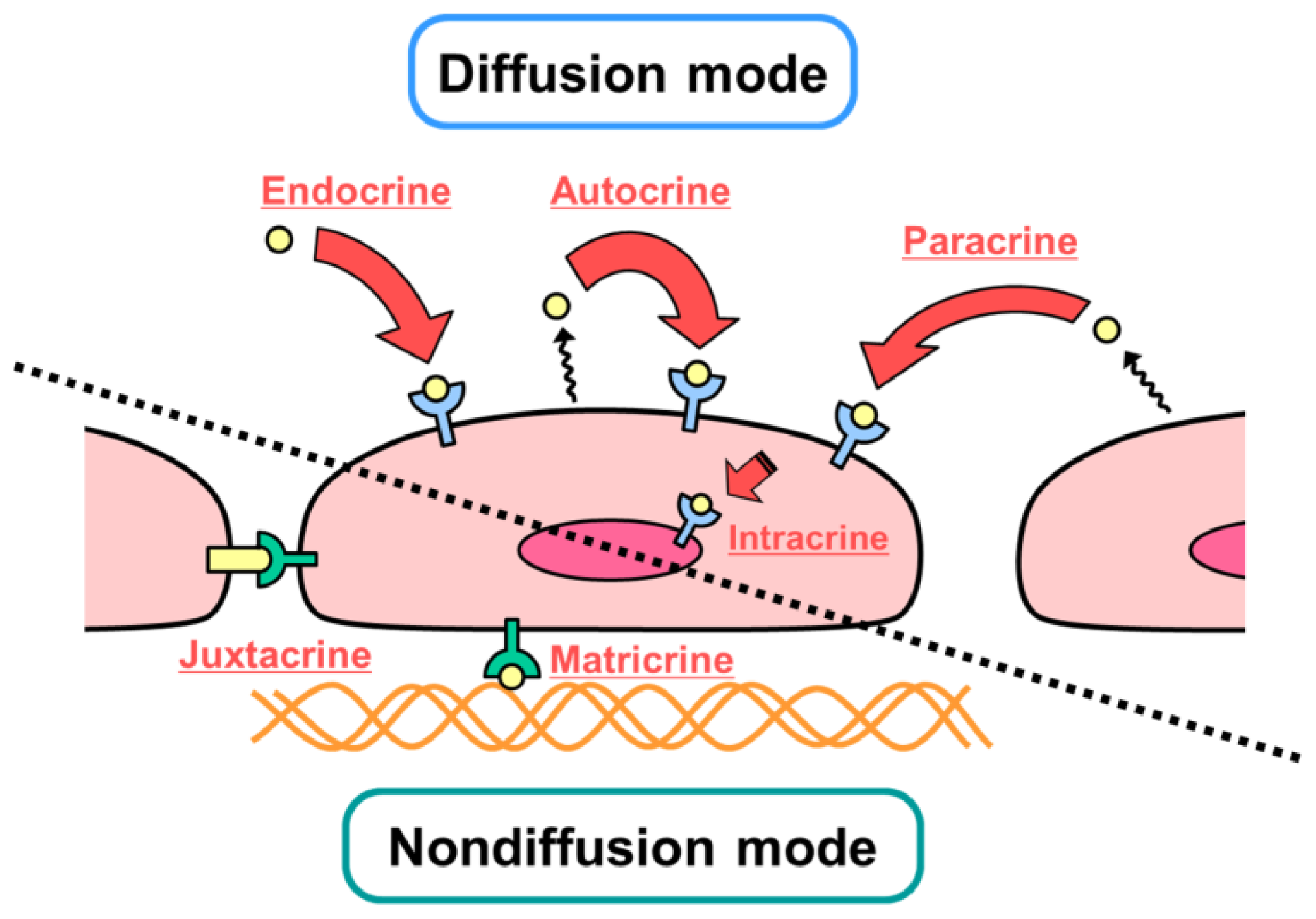
<p>In designing growth factors for tissue engineering, regenerative medicine, and cell culture systems, it is important to consider their mechanisms of action at the cellular and molecular levels. <xref ref-type="fig" rid="f1-ijms-13-06053">Figure 1</xref> summarizes the modes of action of growth factors in cells. Diffusible interactions (e.g., endocrine, paracrine, autocrine and intracrine) and nondiffusible interactions (e.g., juxtacrine and matricrine) are known to occur. It is also known that each growth factor does not necessarily have a single mechanism of action at the cellular level.</p>
<p>Most growth factors which act in a diffusible manner, interact with their cognate receptor on the cell membrane, and form a complex. This interaction induces phosphorylation of the receptor and triggers signal transduction in the cell. These complexes are then internalized, partially decomposed by lysosomes, and partially recycled to the cell membrane. Thus, internalization of the receptor/growth factor complexes leads to the desensitization of cells (downregulation), and to the reduction of excessive responses and overstimulation. In contrast, some growth factors are known to act in a nondiffusible manner by being present at the cell surface (juxtacrine) or by associating with specific substances, such as the ECM (matricrine). The nondiffusible mechanism was elucidated by the discovery of cell membrane-bound growth factors in the 1990s [<xref ref-type="bibr" rid="b3-ijms-13-06053">3</xref>,<xref ref-type="bibr" rid="b4-ijms-13-06053">4</xref>], which include heparin-binding EGF-like growth factor (HB-EGF), transforming growth factor-β (TGFβ), tumor necrosis factor-α (TNFα), colony stimulating factor 1 (CSF1), and the c-kit ligand. These growth factors are barely internalized even after binding to their receptors but exhibit long-term activity without downregulation. This point suggests the possibility of designing binding growth factors with specific activities [<xref ref-type="bibr" rid="b5-ijms-13-06053">5</xref>].</p>
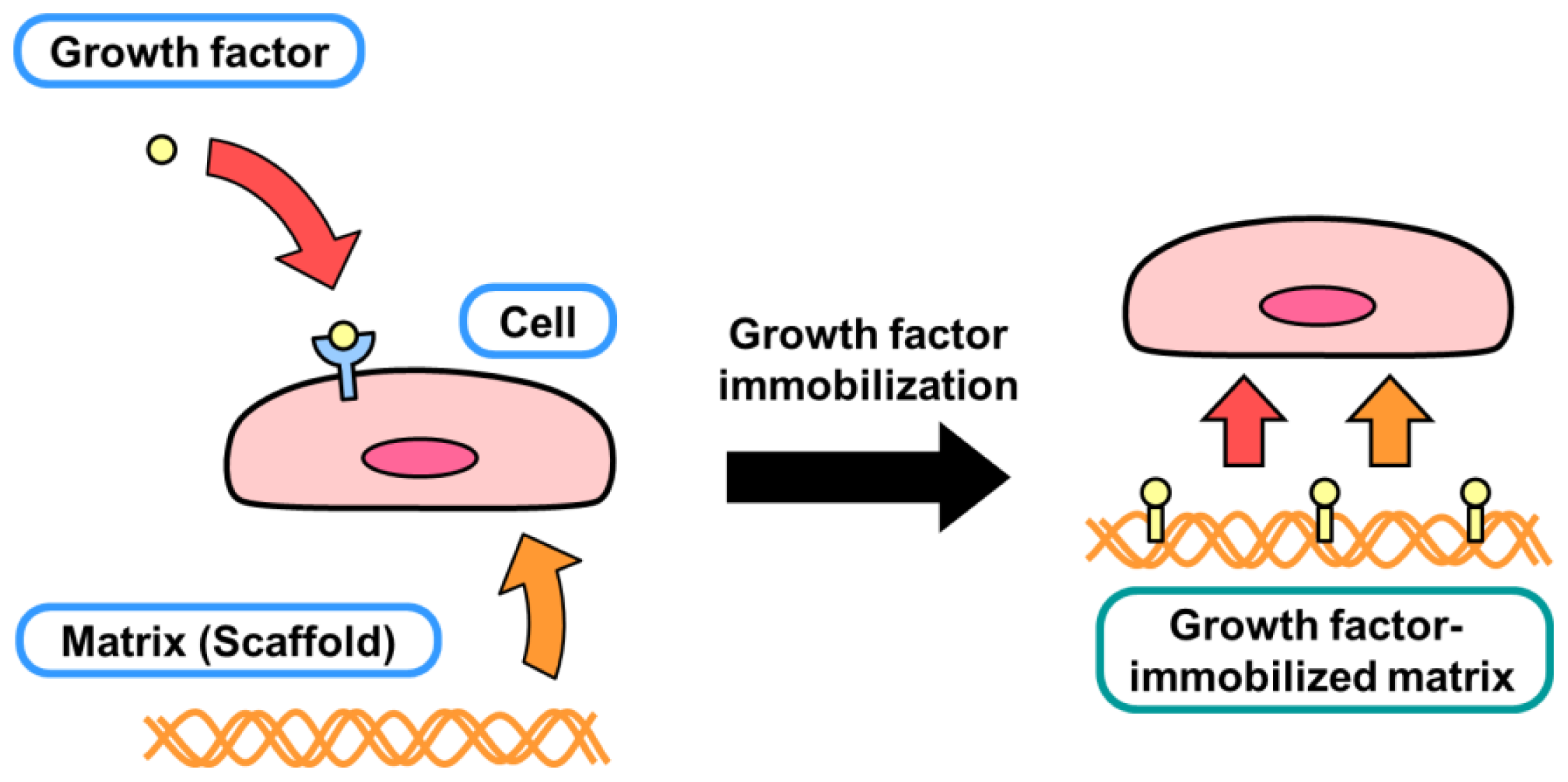
<p>It is recognized that there are three important elements in tissue regeneration: cells, matrix and growth factors (<xref ref-type="fig" rid="f2-ijms-13-06053">Figure 2</xref>). Conjugating the latter two elements would enable cells to reconstitute damaged tissues stably and efficiently during regeneration. The regulation of each element is important in regenerative medicine or tissue engineering.</p>
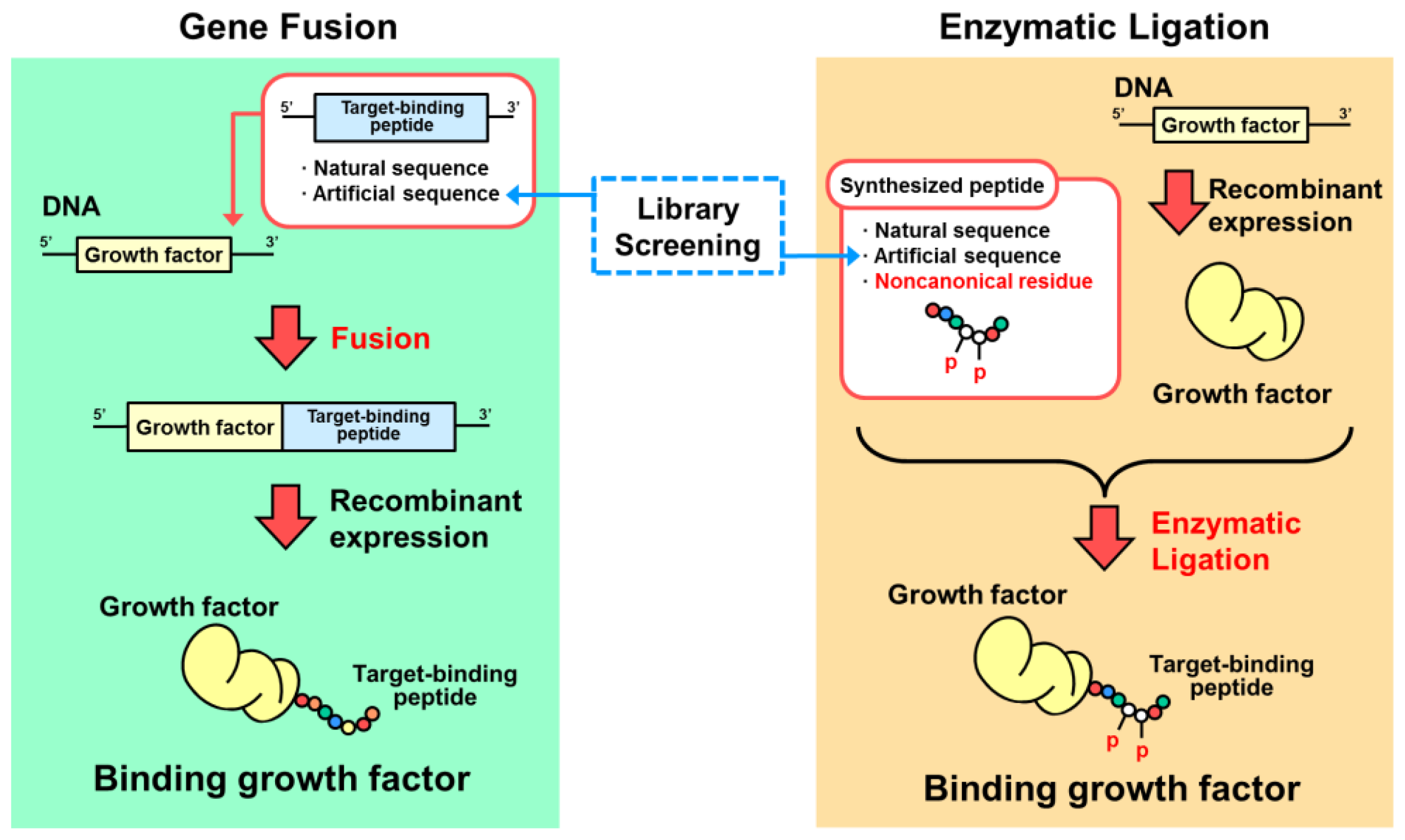
<p>Here we describe two ways of designing conjugated growth factors: one is genetic fusion to combine natural polypeptides and the other is peptide ligation to combine natural polypeptides (usually growth factors) and nonnatural polypeptides containing noncanonical amino acids (usually target-binding peptides) (<xref ref-type="fig" rid="f3-ijms-13-06053">Figure 3</xref>). The genetic approach has been developed since recombinant DNA technology arose. On the other hand, the peptide ligation method was developed to compensate the solid phase synthesis of biological macromolecules such as oligonucleotides, oligopeptides, and oligosaccharides. Because of the length of macromolecules prepared by solid phase synthesis, it was necessary to elongate them by chemical or enzymatic methods. Various methodologies have been studied using bioorthogonal chemistry [<xref ref-type="bibr" rid="b6-ijms-13-06053">6</xref>].</p></sec>
<sec sec-type="methods">
<title>3. Designs Based on Genetic Fusion</title>
<p>Much knowledge about the interactions between biological molecules and biological substrates has accumulated. Based on this knowledge, peptide sequences for binding to targets were selected and used for fusion with growth factors as listed in <xref ref-type="table" rid="t1-ijms-13-06053">Table 1</xref>. These binding growth factors were produced as chimeric proteins by recombinant expression from DNA sequence encoding growth factors and target-binding peptides (<xref ref-type="fig" rid="f3-ijms-13-06053">Figure 3</xref>). Growth factors have been developed that bind not only to biological substrates such as collagen or cells, but also to artificial substrates such as plastics or metals. Although most of the target-binding peptides were portions of natural proteins, nonnatural polypeptide sequences were also employed.</p>
<sec>
<title>3.1. Collagen-Binding Growth Factors</title>
<p>There are many examples of binding growth factors with collagen affinity. Because collagen is the major component of the ECM and is present in most tissues, it is a most promising target for therapeutic applications. To date, four kinds of polypeptide sequences from the collagen-binding site or domain (CBD) of different proteins have been employed to generate the collagen-binding growth factor: von Willebrand factor (vWF, 10 amino acids), bacterial collagenase (~24 kDa), human collagenase (eight amino acids), and fibronectin (~40 kDa or 27 kDa). Gene sequences encoding these polypeptide sequences and those encoding growth factor sequences were fused and expressed by recombinant techniques as single proteins.</p>
<p>Nimni and his colleagues produced a fusion protein of the CBD from vWF with TGFβ1 or other growth factors [<xref ref-type="bibr" rid="b7-ijms-13-06053">7</xref>–<xref ref-type="bibr" rid="b11-ijms-13-06053">11</xref>]. Although recombinant human collagen-binding TGFβ1 (rhTGFβ1-F2) had a lower biological activity compared with its native counterpart [<xref ref-type="bibr" rid="b7-ijms-13-06053">7</xref>], when combined with a collagen gel, rhTGFβ1-F2 stimulated the migration and proliferation of mesenchymal stem cells in the gel, as well as their differentiation to cartilage cells [<xref ref-type="bibr" rid="b8-ijms-13-06053">8</xref>]. Other fusion proteins of epidermal growth factor (EGF, EGF-CBD) [<xref ref-type="bibr" rid="b9-ijms-13-06053">9</xref>], basic fibroblast growth factor (bFGF, rhbFGF-F2) [<xref ref-type="bibr" rid="b10-ijms-13-06053">10</xref>], and bone morphogenetic protein3 (BMP3, rhBMP3-C) [<xref ref-type="bibr" rid="b11-ijms-13-06053">11</xref>] were also reported; all showed binding affinity to collagen and an activity similar to that of the original molecule.</p>
<p>Nishi <italic>et al</italic>. produced other fusion proteins using the collagen-binding motif from bacterial collagenase fused to EGF or bFGF [<xref ref-type="bibr" rid="b12-ijms-13-06053">12</xref>]. Both products were retained for about one week when subcutaneously injected into rats, suggesting their tight binding to collagen or other ECM components. The EGF fusion protein exhibited only 1/10 of the original EGF activity, while the bFGF fusion protein showed an activity similar to that of the native molecule. The CBD might affect the activity of the fusion protein or the binding affinity to the receptor, depending on the growth factors being fused. Brewster <italic>et al</italic>. employed the same CBD to generate collagen-binding bFGF (R136K-CBD) [<xref ref-type="bibr" rid="b13-ijms-13-06053">13</xref>]; R136K is an engineered bFGF that has thrombin resistance. The binding affinity of the fusion protein was four times that of native bFGF and R136K. It is not clear if this modified molecule has any advantage over the native one, considering that bFGF itself has very high affinity to collagen.</p>
<p>A short polypeptide sequence of the human collagenase CBD was also employed to construct collagen-binding fusion proteins of platelet-derived growth factor BB (PDGF-BB) [<xref ref-type="bibr" rid="b14-ijms-13-06053">14</xref>], bFGF [<xref ref-type="bibr" rid="b15-ijms-13-06053">15</xref>], BMP2 [<xref ref-type="bibr" rid="b16-ijms-13-06053">16</xref>], nerve growth factor (NGF) [<xref ref-type="bibr" rid="b17-ijms-13-06053">17</xref>], brain-derived neurotrophic factor (BDNF) [<xref ref-type="bibr" rid="b18-ijms-13-06053">18</xref>], EGF [<xref ref-type="bibr" rid="b19-ijms-13-06053">19</xref>], VEGF (vascular endothelial growth factor) [<xref ref-type="bibr" rid="b20-ijms-13-06053">20</xref>] and neurotrophin-3 [<xref ref-type="bibr" rid="b21-ijms-13-06053">21</xref>]. Zhao <italic>et al</italic>. compared a short polypeptide sequence of vWF with that of human collagenase as the fusion partner for bFGF and found that the latter provided a higher binding affinity to collagen [<xref ref-type="bibr" rid="b15-ijms-13-06053">15</xref>].</p>
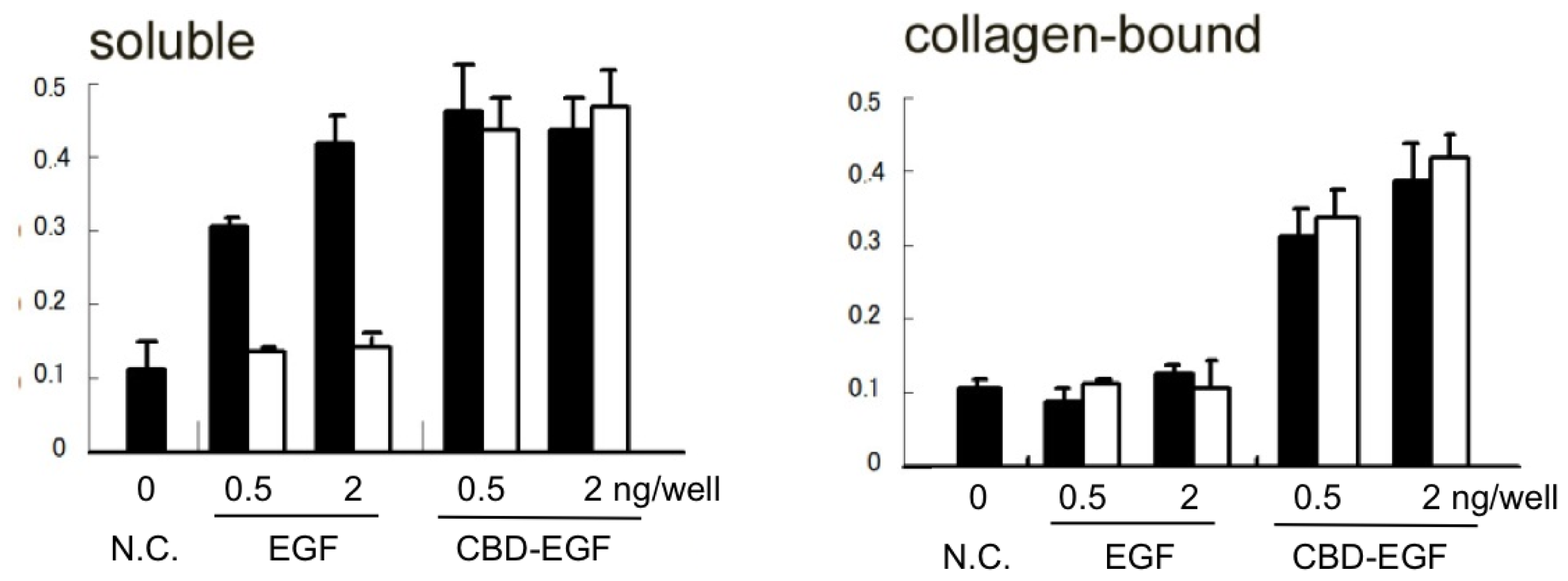
<p>We have also designed collagen-binding growth factors by a fusion of the fibronectin CBD with growth factors; CBD-EGF [<xref ref-type="bibr" rid="b22-ijms-13-06053">22</xref>], CBD-HGF (HGF = hepatocyte growth factor) [<xref ref-type="bibr" rid="b23-ijms-13-06053">23</xref>], CBD-VEGF [<xref ref-type="bibr" rid="b24-ijms-13-06053">24</xref>], CBD-PDGF-BB (unpublished) and CBD-BMP4 (unpublished). These fusion proteins exhibited binding affinity to major collagen types I–V, which was not observed for the native growth factors. Moreover, they showed authentic biological activities in the collagen-bound state. These fusion proteins can be stored for longer periods than native growth factors without loss of their activity (<xref ref-type="fig" rid="f4-ijms-13-06053">Figure 4</xref>). The fused CBD moiety might protect the growth factor moieties from degradation or denaturation.</p></sec>
<sec>
<title>3.2. Fibrin-Binding Growth Factors</title>
<p>Fibrin is an abundant protein present on the surface of injured tissues. In addition, it has been studied as a material for tissue engineering scaffolds. Therefore, growth factors with fibrin-binding affinity are considered useful for tissue regeneration. Sakiyama-Elbert <italic>et al</italic>. produced a fusion protein between NGF and a short polypeptide of the α<sub>2</sub>-plasmin inhibitor (α<sub>2</sub>-PI) [<xref ref-type="bibr" rid="b25-ijms-13-06053">25</xref>]; the activated coagulation factor XIII (FXIIIa, also known as plasma transglutaminase) mediated the cross-linking of this sequence to fibrin. In addition, a plasmin cleavage sequence was inserted between the α<sub>2</sub>-PI sequence and the growth factor. The resulting fusion protein (TG-P-NGF) was incorporated into fibrin clots by FXIIIa and was then released by plasmin when the tissues started to heal. TG-P-NGF was designed to be released “when cells demand.” The activity of the fusion protein was approximately 40% of that of native NGF, when assayed by neurite extension in PC12 cells. Unlike collagen-binding growth factors, this fusion protein bound to fibrin covalently. This could be related to the reduced activity observed in an <italic>in vitro</italic> assay.</p>
<p>The same or similar construct designs were applied to BMP2 [<xref ref-type="bibr" rid="b26-ijms-13-06053">26</xref>], keratinocyte growth factor (KGF) [<xref ref-type="bibr" rid="b27-ijms-13-06053">27</xref>], VEGF [<xref ref-type="bibr" rid="b28-ijms-13-06053">28</xref>–<xref ref-type="bibr" rid="b30-ijms-13-06053">30</xref>], ephrin B2 [<xref ref-type="bibr" rid="b31-ijms-13-06053">31</xref>] and insulin-like-growth factor-I (IGF-I) [<xref ref-type="bibr" rid="b32-ijms-13-06053">32</xref>]. The elevation of alkaline phosphatase activity in C3H10T1/2 cells mediated by the fibrin-binding BMP2 was similar to that observed for native BMP2, whereas its retention in a fibrin gel was more than that of the native protein (60% <italic>vs</italic>. 25% of added amount). The KGF fusion protein bound to fibrin gel and promoted the growth of epithelial cells after release from the gel. VEGF<sub>121</sub> is a VEGF isoform that lacks the fibrin-binding sequence found in the major isoform (VEGF<sub>165</sub>) [<xref ref-type="bibr" rid="b30-ijms-13-06053">30</xref>]. Fusion with the α<sub>2</sub>-PI sequence enabled the incorporation of VEGF<sub>121</sub> into a fibrin gel. In addition, the fusion protein stimulated the growth of endothelial cells on the gel in a dose-dependent manner.</p>
<p>We produced another fibrin-binding growth factor: a chimeric protein of the fibronectin fibrin-binding domain (FBD) and EGF [<xref ref-type="bibr" rid="b33-ijms-13-06053">33</xref>]. This fusion protein (FBD-EGF) bound to fibrin in the absence of the cross-linking enzyme (FXIIIa) and might be suitable for the preparation of fibrin-based scaffolds with EGF activity. The wound-healing potential of FBD-EGF was examined using an <italic>in vitro</italic> culture model of keratinocyte sheets; repair of the injured sheet was enhanced by fibrin-bound FBD-EGF but not by EGF alone.</p></sec>
<sec>
<title>3.3. Cell-Binding Fusion Proteins</title>
<p>Cell-binding growth factors have been designed to bind cell surface molecules such as integrins and receptors. The cell-binding domain of fibronectin (~30 kDa, including the RGD sequence that binds to integrins) was employed to produce EGF fusion protein (C-EGF) [<xref ref-type="bibr" rid="b34-ijms-13-06053">34</xref>] or bFGF fusion protein (FN-FGF) [<xref ref-type="bibr" rid="b35-ijms-13-06053">35</xref>]; proliferation of rat kidney fibroblasts or human umbilical vein endothelial cells was stimulated. However, their efficacy was not clearly shown. These fusion proteins might not be retained on the culture plates for long periods. An improved cell-binding EGF (containing an RGD sequence) was generated via the incorporation of hydrophobic linker sequences [<xref ref-type="bibr" rid="b36-ijms-13-06053">36</xref>] and collagen-binding sequences [<xref ref-type="bibr" rid="b37-ijms-13-06053">37</xref>] that ensured retention on culture substrate.</p>
<p>Van Lonkhuyzen <italic>et al</italic>. produced a chimeric protein of IGF-I and vitronectin (VN). This protein (VN: IGF-I) is associated with IGF-I-binding protein (IGF-BP) [<xref ref-type="bibr" rid="b38-ijms-13-06053">38</xref>]. The complex of VN: IGF-I and IGF-BP bound to both the IGF-I receptor and to integrin, stimulated receptor-mediated and integrin-mediated pathways. As a result, the VN: IGF-I/IGF-BP complex exhibited a higher cell proliferation activity than the IGF-I/IGF-BP complex. Although the authors mainly emphasized the role of cross-talk in IGF-I receptor-mediated signaling and integrin-mediated signaling, vitronectin also seemed to contribute to cell adhesion via adsorption of the fusion protein to the substrate.</p></sec>
<sec>
<title>3.4. Organic Material-Binding Growth Factors</title>
<p>Growth factors have also been engineered to bind to artificial materials. Ogiwara <italic>et al</italic>. produced an EGF fusion protein coupled with the Fc region of immunoglobulin G (IgG) [<xref ref-type="bibr" rid="b39-ijms-13-06053">39</xref>]. The Fc region is often used as a fusion tag to allow extracellular domains of large membrane proteins or receptor molecules to adhere nonspecifically to solid surfaces, thanks to its hydrophobicity [<xref ref-type="bibr" rid="b40-ijms-13-06053">40</xref>]. Their fusion protein EGF-Fc was able to adsorb stably to tissue culture-treated surfaces, and mouse fibroblast Swiss 3T3 cells adhered to an EGF-Fc-coated surface. Phosphorylation of EGF receptors and the subsequent activation of mitogen-activated protein kinase (MAPK) were induced by the adsorbed EGF-Fc. MAPK activation was sustained even after 4 h, suggesting that EGF-Fc activated MAPK signaling continuously without internalization of the growth factor. The Fc region was also fused to leukemia inhibitory factor (LIF) [<xref ref-type="bibr" rid="b41-ijms-13-06053">41</xref>]. Mouse embryonic stem cells maintained their undifferentiated state on LIF-Fc-coated surfaces. A fusion protein of Fc region and HGF also induced continuous activation of Akt signaling [<xref ref-type="bibr" rid="b42-ijms-13-06053">42</xref>].</p>
<p>Artificial polypeptide sequences were also employed to generate binding growth factors. An elastinlike polypeptide consisting of (APGVGV)<italic><sub>n</sub></italic> or (GVGVP)<italic><sub>n</sub></italic> repeated sequences was used for binding to hydrophobic solid surfaces. The hydrophobicity of these peptide sequences could be altered in a thermosensitive manner; they showed hydrophilicity and detached from hydrophobic substrates below the phase transition temperature. Elloumi <italic>et al</italic>. produced fusion proteins of EGF and elastin-like peptide containing an RGD cell-binding sequence for enhancing cell adhesion [<xref ref-type="bibr" rid="b36-ijms-13-06053">36</xref>,<xref ref-type="bibr" rid="b37-ijms-13-06053">37</xref>]. Minato <italic>et al</italic>. fused an elastin-like peptide with IGF-binding protein 4 (IGF-BP4) and succeeded in promoting cardiomyocyte differentiation in mouse embryonic stem cells [<xref ref-type="bibr" rid="b43-ijms-13-06053">43</xref>]. On the other hand, Doheny <italic>et al</italic>. fused the cellulose-binding domain of bacterial xylanase with the extracellular domain of stem cell factor (SCF) [<xref ref-type="bibr" rid="b44-ijms-13-06053">44</xref>]. The fusion construct bound to cellulose tightly and stimulated the proliferation of SCF-dependent murine and human cells.</p></sec>
<sec>
<title>3.5. Titanium-Binding Growth Factors</title>
<p>Titanium is the metallic biomaterial most widely used for artificial joints and dental implants. Titanium is highly suitable for clinical use because of its high biocompatibility, good mechanical properties and excellent corrosion resistance. In addition, dental implants made of titanium can form tight adhesions between the titanium surface of implants and bone tissue (termed osseointegration). However, it takes as long as several weeks for osseointegration and patients have to wait for a longer period to complete recovery. Therefore, surface modification of titanium, including protein coating for improving biocompatibility and osseointegration is important to shorten the recovery period. However, it is generally difficult to modify the metal surface directly with biological molecules. To overcome this problem, high-throughput selection methods such as phage display, yeast display, ribosomal display or mRNA display have been developed. Phage display in particular was developed around 1990 and employed for the selection of peptides binding to inorganic substrates including BaTiO<sub>3</sub> for electronic applications, SiO<sub>2</sub>, TiO<sub>2</sub>, aluminum, steel, semiconductors, platinum, silver and hydroxyapatite [<xref ref-type="bibr" rid="b45-ijms-13-06053">45</xref>–<xref ref-type="bibr" rid="b60-ijms-13-06053">60</xref>]. These are summarized in <xref ref-type="table" rid="t2-ijms-13-06053">Table 2</xref>. Typically, phage display technologies introduce a combinatorial library (of the order of 10<sup>9</sup> sequences) of 7-mer or 12-mer peptide sequences to a molecule, ligand or material. The technique has been utilized to identify amino acid sequences that recognize specific substrates, serving as a strategy to create biological linkers to bridge biomolecules and synthetic materials at the nanoscale. The selected peptides are called peptide aptamers (from “aptus” in Latin, the term was used for selected oligonucleotides for the first time).</p>
<p>Kashiwagi <italic>et al</italic>. fused BMP2 with an oligopeptide aptamer sequence to make Ti-binding peptide-1 (TBP-1) that has an affinity to titanium [<xref ref-type="bibr" rid="b61-ijms-13-06053">61</xref>]. This peptide aptamer sequence was selected using a phage display system [<xref ref-type="bibr" rid="b58-ijms-13-06053">58</xref>]. The fusion of this sequence allowed the reversible binding of BMP2 to titanium, with retention of its biological activity. However, they found that fusion of proteins with this peptide reduced its affinity to a TiO<sub>2</sub> surface, and considered that intramolecular interactions between the peptide aptamer and the BMP moiety affected the binding affinity.</p>
<p>To avoid this problem, we recently constructed a new selection system consisting of a random peptide library fused with the EGF sequence to make a TiO<sub>2</sub>-binding EGF, using a ribosomal display system (unpublished). In this system, DNA sequences encoding both random sequence peptides and EGF were subjected to the selection system. Through this selection method, we expected to enhance the affinity to TiO<sub>2</sub> surfaces modulated by intramolecular interactions between the growth factor and the binding portion. A peptide sequence fused with EGF (A8-EGF) was obtained after several rounds of selection, and its affinity to TiO<sub>2</sub> surfaces and effects on cell proliferation were evaluated. The binding affinity of A8-EGF to TiO<sub>2</sub> was higher than that of TBP-1 fused to EGF. This selection method appeared to reduce the possibility of conformational changes in binding growth factors, by fusing a random peptide library to growth factors ahead of selection. A8-EGF synthesized by a solid phase method also showed a high affinity to TiO<sub>2</sub> after protein refolding. To evaluate the enhancement of cell proliferation, NIH3T3 cells were cultured in the presence of A8-EGF for two days and the rate of cell proliferation was estimated. A8-EGF itself enhanced cell proliferation as much as did unmodified EGF in the soluble state. This selection technology extends the possibility of designing binding growth factors.</p></sec></sec>
<sec sec-type="methods">
<title>4. Designs Based on Peptide Ligation</title>
<p>In parallel with progress in gene technology, chemical or enzymatic approaches for the synthesis of biological macromolecules have also progressed with the development of the Merrifield method [<xref ref-type="bibr" rid="b62-ijms-13-06053">62</xref>]. The oligonucleotides and oligopeptides that are synthesized, have contributed significantly to biological and medical science and technology. Recent developments in the pharmaceutical industry require the large-scale production of biological macromolecules as drugs. However, although solidphase methods have realized the practical synthesis of oligonucleotides, oligopeptides and oligosaccharides, the chain lengths achieved have been limited. Therefore, similar to oligonucleotide ligation, some ligation methods including native chemical ligation have been developed for polypeptide chain extension to increase the chain length [<xref ref-type="bibr" rid="b63-ijms-13-06053">63</xref>].</p>
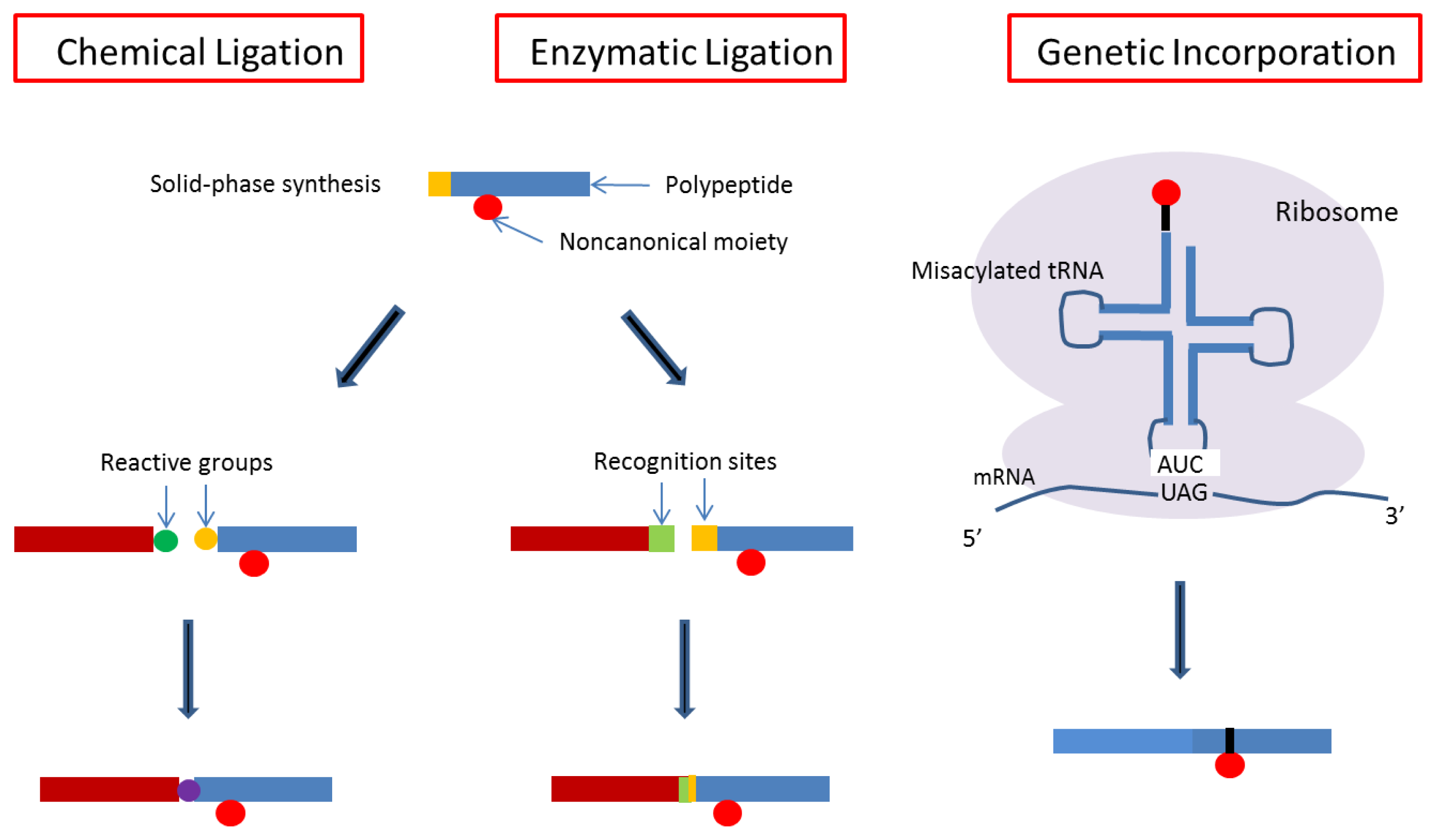
<p>Ligation methods have also enabled us to synthesize more complicated macromolecules, and it has become a useful method in bioorthogonal chemistry, as shown in <xref ref-type="fig" rid="f5-ijms-13-06053">Figure 5</xref> [<xref ref-type="bibr" rid="b64-ijms-13-06053">64</xref>–<xref ref-type="bibr" rid="b70-ijms-13-06053">70</xref>]. We can now prepare many types of complex macromolecules, including new synthetic polymer–biomacromolecular conjugates and biologically processed biomacromolecules. The former types include the conjugation of biological macromolecules with polyethylene glycol or stimuli-responsive polymers for medical or bioindustrial applications [<xref ref-type="bibr" rid="b71-ijms-13-06053">71</xref>–<xref ref-type="bibr" rid="b77-ijms-13-06053">77</xref>]. The latter molecules are biological modifications of DNA, RNA, or polypeptides. Therefore, it is now possible that growth factors and affinity peptides carrying noncanonical amino acids can be prepared separately and enzymatically conjugated into a single protein (<xref ref-type="fig" rid="f3-ijms-13-06053">Figure 3</xref>). To our knowledge, the design of a binding growth factor using this approach is the only example reported to date [<xref ref-type="bibr" rid="b78-ijms-13-06053">78</xref>].</p>
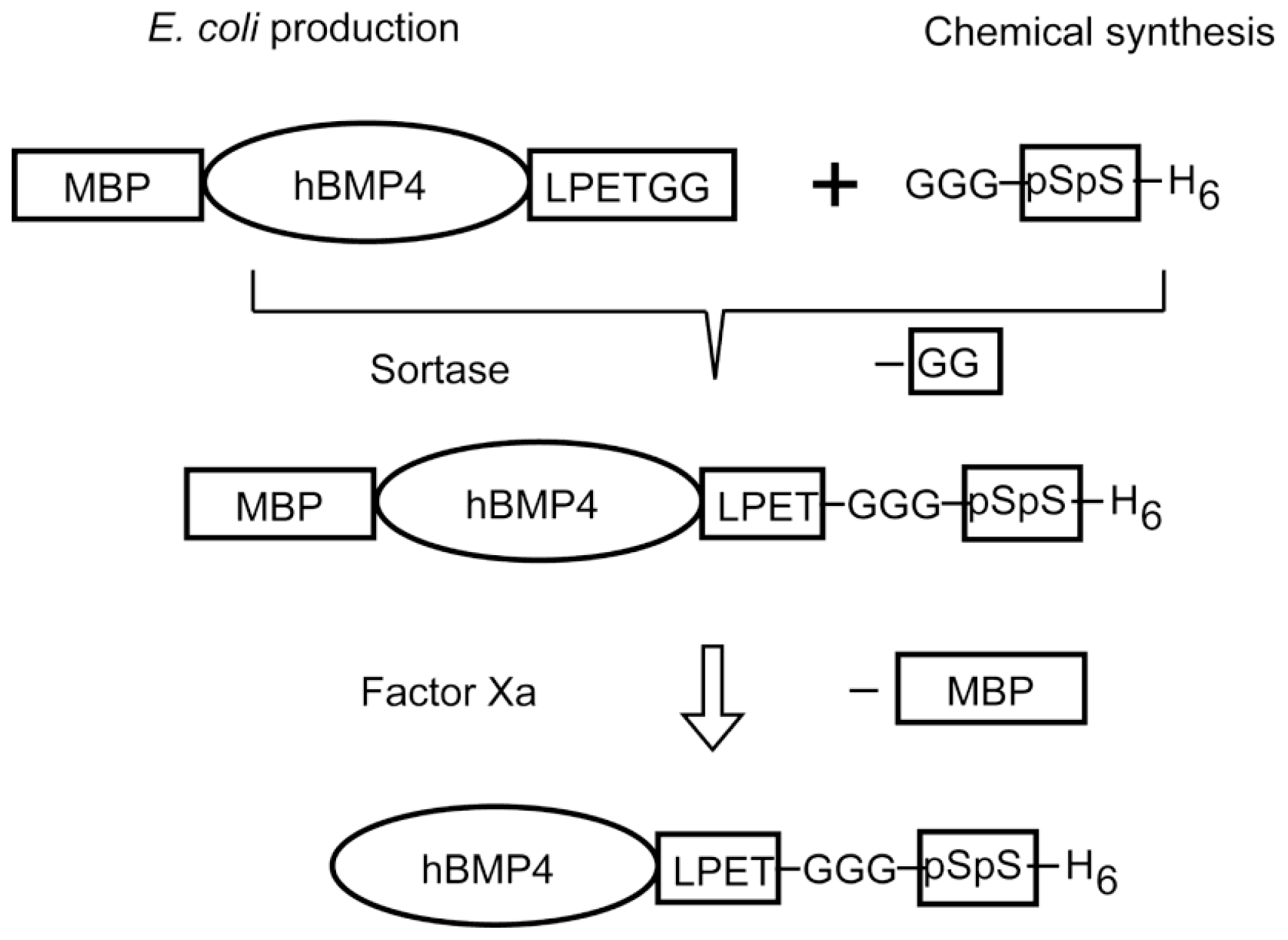
<p>One example is hydroxyapatite (HA) binding to BMP by conjugation with an active site of protein having affinity to tooth surfaces [<xref ref-type="bibr" rid="b78-ijms-13-06053">78</xref>]. HA is well known as a bone implant material [<xref ref-type="bibr" rid="b79-ijms-13-06053">79</xref>,<xref ref-type="bibr" rid="b80-ijms-13-06053">80</xref>], because of its composition, similar to natural bone. The salivary gland protein statherin has an affinity to HA [<xref ref-type="bibr" rid="b81-ijms-13-06053">81</xref>,<xref ref-type="bibr" rid="b82-ijms-13-06053">82</xref>] and chemically synthesized short peptides designed from this protein have been reported [<xref ref-type="bibr" rid="b83-ijms-13-06053">83</xref>]. In these, consecutive noncanonical amino acids—phosphorylated serines (pSpS)—were responsible for the affinity. Therefore, it was necessary to bind these noncanonical amino acids to BMP to prepare the HA-binding BMP. For this preparation, an enzymatic peptide ligation method was employed as shown in <xref ref-type="fig" rid="f6-ijms-13-06053">Figure 6</xref>. Soluble human BMP4 (hBMP4) with an enzymatic reaction target sequence at the <italic>C</italic>-terminal end was initially produced as fusion protein with maltose-binding protein (MBP) using an <italic>Escherichia coli</italic> expression system. For the enzymatic ligation, sortase A, a transpeptidase produced by <italic>Staphylococcus aureus</italic> to anchor cell surface proteins to the cell wall [<xref ref-type="bibr" rid="b84-ijms-13-06053">84</xref>] was employed. The construct recognized short motifs of the amino acid sequence LPXTG at the <italic>C</italic>-terminal of one polypeptide and a GG sequence at the <italic>N</italic>-terminal of the other polypeptide. It then cleaved the peptide bond of the former peptide between its threonine and glycine followed by the formation of an amide bond to the latter peptide. This unique reaction has been utilized extensively for peptide ligation [<xref ref-type="bibr" rid="b85-ijms-13-06053">85</xref>–<xref ref-type="bibr" rid="b87-ijms-13-06053">87</xref>]. Because of the shortness of recognized peptide sequences, ligation by sortase A is likely to minimize the influence of the added sequences to any resulting proteins. After a peptide sequence containing phosphorylated serine (GGGpSpSH6) was synthesized chemically, these two polypeptides were ligated by sortase A reaction, and then the MBP moiety was removed by Factor Xa. The resulting conjugated growth factor (hBMP4-pSpS) was purified using a histidine tag. An hBMP4 conjugate containing canonical serines (hBMP4-SS) was prepared similarly to the control to compare the HA-binding affinity.</p>
<p>Both hBMP4-pSpS and hBMP4-SS bound to HA-beads in concentration-dependent manner as measured by an anti-BMP4 antibody binding within the range examined (0–2 μg/mL). The amount of bound hBMP4-pSpS was significantly higher than that of hBMP4-SS at each concentration examined. These data confirmed that the pSpS sequences were responsible for the enhanced HA binding of hBMP4-pSpS. To confirm the biological activity of the HA-bound BMP4 conjugate, multipotential C3H10T1/2 mesenchymal cells were seeded onto the HA beads with hBMP4-pSpS as described [<xref ref-type="bibr" rid="b88-ijms-13-06053">88</xref>]. The expression levels of osteogenic genes (osteocalcin and osteopontin) known as markers of bone physiology [<xref ref-type="bibr" rid="b89-ijms-13-06053">89</xref>] were enhanced in the cells after one week of culture. Protein-untreated beads and hBMP4-SS-treated beads induced osteocalcin and osteopontin expression within similar but lower ranges. This enhancement of the marker expression levels showed that hBMP4-pSpS retained authentic BMP4 activity after HA binding and that the increased binding of hBMP4-pSpS enhanced the osteogenic differentiation of C3H10T1/2 cells.</p></sec>
<sec>
<title>5. Application of Engineered Binding Growth Factors</title>
<p>The binding growth factors were designed to continue to stimulate signaling for a long time. This advantage was the result of substantial immobilization to natural tissues or to artificial scaffolds by simple addition. Therefore, their usefulness has been studied with regard to their efficacy in wound healing, tissue reconstruction and substitution.</p>
<sec>
<title>5.1. Wound Healing</title>
<p>Collagen is exposed upon tissue injury. Thus, wound surfaces are considered to be good target sites for collagen-binding growth factors. CBD-EGF and CBD-HGF were retained on the wound surfaces and promoted closure in intractable skin wounds of diabetic (<italic>db</italic>/<italic>db</italic>) mice [<xref ref-type="bibr" rid="b22-ijms-13-06053">22</xref>,<xref ref-type="bibr" rid="b90-ijms-13-06053">90</xref>]. Implantation of a collagen sponge combined with CBD-EGF on skin wounds induced epithelialization above or underneath the sponge. Similar effects were observed for other collagen-binding factors such as bFGF (rhbFGF-F2, in collagen solution) [<xref ref-type="bibr" rid="b8-ijms-13-06053">8</xref>] and PDGF-BB (combined with a collagen membrane) [<xref ref-type="bibr" rid="b91-ijms-13-06053">91</xref>]. Fibrin-binding KGF (P-KGF) in combination with fibrin showed a potential for wound healing of human skin tissues grafted to athymic mice [<xref ref-type="bibr" rid="b27-ijms-13-06053">27</xref>], although its efficacy was marginal compared with that of native KGF/fibrin. Collagen-binding growth factors were also applied to other wounded tissues, such as the colon destroyed by inflammation [<xref ref-type="bibr" rid="b9-ijms-13-06053">9</xref>] and blood vessels injured and deprived of endothelial layer by a balloon catheter [<xref ref-type="bibr" rid="b90-ijms-13-06053">90</xref>,<xref ref-type="bibr" rid="b92-ijms-13-06053">92</xref>]. Restoration of the epithelial and endothelial layers was enhanced by the fused collagen-binding growth factors.</p></sec>
<sec>
<title>5.2. Repair of Cardiovascular Tissues by Implants</title>
<p>The angiogenic factors VEGF, bFGF and HGF have been studied for their therapeutic potential to restore the blood supply in ischemic tissues. The effects of gene-engineered constructs of these factors were also studied. Fibrin-binding VEGF<sub>121</sub> (α<sub>2</sub>PI<sub>1–8</sub>-VEGF<sub>121</sub>) mixed with fibrin exhibited efficacious angiogenic properties. In a chorioallantoic membrane assay, the blood vessel density was ~1.5 times higher with fibrin-binding VEGF<sub>121</sub> than that induced by native VEGF<sub>121</sub>. In addition, α<sub>2</sub>PI<sub>1–8</sub>-VEGF<sub>121</sub> induced the formation of nonleaky vessels on a polytetrafluoroethylene chamber coated with fibrin and implanted subcutaneously [<xref ref-type="bibr" rid="b29-ijms-13-06053">29</xref>].</p>
<p>Collagen-binding HGF (CBD-HGF) enhanced blood vessel migration into subcutaneously implanted collagen sponges that were combined with the fusion protein [<xref ref-type="bibr" rid="b23-ijms-13-06053">23</xref>]. Endothelialization of the implanted collagen material prepared from heart valves was promoted when the material was combined with CBD-HGF (canine pulmonary artery implantation). Similar promotion was observed on polytetrafluoroethylene tubes coated with collagen and combined with CBD-HGF (<italic>in vitro</italic> culture). A sheet of collagen preparation (decellularized porcine urinary bladder matrix) could be combined with CBD-HGF, and angiogenesis was induced in injured tissues after implantation into mechanically injured porcine hearts [<xref ref-type="bibr" rid="b93-ijms-13-06053">93</xref>].</p></sec>
<sec>
<title>5.3. Nerve Regeneration</title>
<p>Fibrin-binding NGF (TG-P-NGF) mixed with fibrin gel enhanced neurite extension from chick embryo dorsal root ganglia (organ culture) by 50% relative to native NGF and by 350% relative to the fibrin gel alone, in spite of the reduced activity of the fusion construct [<xref ref-type="bibr" rid="b25-ijms-13-06053">25</xref>]. Collagen-binding NGF (CBD-NGF) combined with a collagen membrane and implanted subcutaneously enhanced nerve growth into the membrane [<xref ref-type="bibr" rid="b17-ijms-13-06053">17</xref>]; the CBD-NGF-mediated nerve fiber density was approximately twice that observed for native NGF. It also enhanced healing of rabbit dermal ischemic ulcers.</p></sec>
<sec>
<title>5.4. Bone Regeneration</title>
<p>Demineralized bone matrix (DBM) combined with collagen-binding BMP2 (BMP2-h) was implanted subcutaneously in rats and induced ectopic bone formation [<xref ref-type="bibr" rid="b16-ijms-13-06053">16</xref>,<xref ref-type="bibr" rid="b94-ijms-13-06053">94</xref>]. BMP2-h-loaded DBM was also effective in the repair of rabbit mandibular bone defects, with 10–20% higher efficiency than that of native BMP2/DBM. In a rat craniotomy defect model, fibrin-binding BMP2 (TG-pI-BMP2) induced 76% more defect healing than native BMP2 [<xref ref-type="bibr" rid="b26-ijms-13-06053">26</xref>]. This study was extended to the repair of long bones, as assessed by bone bridging.</p></sec></sec>
<sec>
<title>6. Concluding Remarks</title>
<p>Growth factors that are able to bind to biological substances and artificial materials that can hardly retain native growth factors have been designed and synthesized. As a result, the stability of the resultant molecules was enhanced and the doses applied could be reduced. These considerations are also central to the production of biomaterials used as tissue repair scaffolds equipped with additional functions. There has been an increase in the number of reports on immobilized growth factors, since the effect of immobilized growth factors was first reported [<xref ref-type="bibr" rid="b95-ijms-13-06053">95</xref>–<xref ref-type="bibr" rid="b101-ijms-13-06053">101</xref>]. Thus, covalently immobilized growth factors have now been used effectively. The biological signals provided by immobilized growth factors last longer than with soluble ones. The long-lasting effect and the high local concentration on the surface, induced a significant biological effect on cells. Immobilization has been extended from organic materials to inorganic materials including metals and ceramics. However, chemical immobilization is insufficient for maximizing the efficacy of immobilized growth factors, because it is difficult to control their orientation. Therefore, to immobilize growth factors, genetic engineering and bioorthogonal chemistry approaches are required. These technologies enable specific modifications of growth factors, which can be immobilized at the desired orientations. This regulated immobilization enhances biological activity through specific interaction with cognate receptors of cells.</p>
<p>Considering recent progress in regenerative medicine, binding growth factors have become important molecules in culturing various kinds of stem cells and in constructing tissues. Additional properties for clinical use should be developed for binding growth factors, such as good stability in the human body and low immunogenicity.</p></sec></body>
<back>
<ack>
<title>Acknowledgments</title>
<p>This work was supported by KAKENHI 22220009.</p></ack>
<fn-group><fn id="fn1-ijms-13-06053">
<p><bold>Conflict of Interest Statement</bold></p>
<p>The authors declare no conflict of interest.</p></fn></fn-group>
<ref-list>
<title>References</title>
<ref id="b1-ijms-13-06053"><label>1</label><citation citation-type="journal"><person-group person-group-type="author"><name><surname>Werner</surname><given-names>S.</given-names></name><name><surname>Grose</surname><given-names>R.</given-names></name></person-group><article-title>Regulation of wound healing by growth factors and cytokines</article-title><source>Physiol. Rev</source><year>2003</year><volume>83</volume><fpage>835</fpage><lpage>870</lpage><pub-id pub-id-type="pmid">12843410</pub-id></citation></ref>
<ref id="b2-ijms-13-06053"><label>2</label><citation citation-type="journal"><person-group person-group-type="author"><name><surname>Whitaker</surname><given-names>M.J.</given-names></name><name><surname>Quirk</surname><given-names>R.A.</given-names></name><name><surname>Howdle</surname><given-names>S.M.</given-names></name><name><surname>Shakesheff</surname><given-names>K.M.</given-names></name></person-group><article-title>Growth factor release from tissue engineering scaffolds</article-title><source>Pharm. Pharmacol</source><year>2001</year><volume>53</volume><fpage>1427</fpage><lpage>1437</lpage><pub-id pub-id-type="doi">10.1211/0022357011777963</pub-id></citation></ref>
<ref id="b3-ijms-13-06053"><label>3</label><citation citation-type="journal"><person-group person-group-type="author"><name><surname>Massagué</surname><given-names>J.</given-names></name><name><surname>Pandiella</surname><given-names>A.</given-names></name></person-group><article-title>Membrane-anchored growth factors</article-title><source>Ann. Rev. Biochem</source><year>1993</year><volume>62</volume><fpage>515</fpage><lpage>541</lpage><pub-id pub-id-type="doi">10.1146/annurev.bi.62.070193.002503</pub-id><pub-id pub-id-type="pmid">8394682</pub-id></citation></ref>
<ref id="b4-ijms-13-06053"><label>4</label><citation citation-type="journal"><person-group person-group-type="author"><name><surname>Iwamoto</surname><given-names>R.</given-names></name><name><surname>Mekada</surname><given-names>E.</given-names></name></person-group><article-title>Heparin-binding EGF-like growth factor: A juxtacrine growth factor</article-title><source>Cytokine Growth Factor Rev</source><year>2000</year><volume>11</volume><fpage>335</fpage><lpage>344</lpage><pub-id pub-id-type="doi">10.1016/S1359-6101(00)00013-7</pub-id><pub-id pub-id-type="pmid">10959080</pub-id></citation></ref>
<ref id="b5-ijms-13-06053"><label>5</label><citation citation-type="book"><person-group person-group-type="author"><name><surname>Kitajima</surname><given-names>T.</given-names></name><name><surname>Ito</surname><given-names>Y.</given-names></name></person-group><article-title>Artificial Binding Growth Factors</article-title><source>Handbook of Intelligent Scaffolds for Tissue Engineering and Regenerative Medicine</source><person-group person-group-type="editor"><name><surname>Khang</surname><given-names>G.</given-names></name></person-group><publisher-loc>Pan Stanford Publishing</publisher-loc><publisher-name>Singapore</publisher-name><year>2012</year><fpage>337</fpage><lpage>353</lpage></citation></ref>
<ref id="b6-ijms-13-06053"><label>6</label><citation citation-type="journal"><person-group person-group-type="author"><name><surname>Ito</surname><given-names>Y.</given-names></name></person-group><article-title>Elaborate synthesis of biological macromolecules</article-title><source>ChemBioChem</source><year>2012</year><comment>in press</comment></citation></ref>
<ref id="b7-ijms-13-06053"><label>7</label><citation citation-type="journal"><person-group person-group-type="author"><name><surname>Tuan</surname><given-names>T.L.</given-names></name><name><surname>Cheung</surname><given-names>D.T.</given-names></name><name><surname>Wu</surname><given-names>L.T.</given-names></name><name><surname>Yee</surname><given-names>A.</given-names></name><name><surname>Gabriel</surname><given-names>S.</given-names></name><name><surname>Han</surname><given-names>B.</given-names></name><name><surname>Morton</surname><given-names>L.</given-names></name><name><surname>Nimni</surname><given-names>M.E.</given-names></name><name><surname>Hall</surname><given-names>F.L.</given-names></name></person-group><article-title>Engineering, expression and renaturation of targeted TGF-beta fusion proteins</article-title><source>Connect. Tissue Res</source><year>1996</year><volume>34</volume><fpage>1</fpage><lpage>9</lpage><pub-id pub-id-type="doi">10.3109/03008209609028888</pub-id><pub-id pub-id-type="pmid">8835843</pub-id></citation></ref>
<ref id="b8-ijms-13-06053"><label>8</label><citation citation-type="journal"><person-group person-group-type="author"><name><surname>Andrades</surname><given-names>J.A.</given-names></name><name><surname>Han</surname><given-names>B.</given-names></name><name><surname>Becerra</surname><given-names>J.</given-names></name><name><surname>Sorgente</surname><given-names>N.</given-names></name><name><surname>Hall</surname><given-names>F.L.</given-names></name><name><surname>Nimni</surname><given-names>M.E.</given-names></name></person-group><article-title>A recombinant human TGF-beta1 fusion protein with collagen-binding domain promotes migration, growth, and differentiation of bone marrow mesenchymal cells</article-title><source>Exp. Cell. Res</source><year>1999</year><volume>250</volume><fpage>485</fpage><lpage>498</lpage><pub-id pub-id-type="doi">10.1006/excr.1999.4528</pub-id><pub-id pub-id-type="pmid">10413602</pub-id></citation></ref>
<ref id="b9-ijms-13-06053"><label>9</label><citation citation-type="journal"><person-group person-group-type="author"><name><surname>Hall</surname><given-names>F.L.</given-names></name><name><surname>Kaiser</surname><given-names>A.</given-names></name><name><surname>Liu</surname><given-names>L.</given-names></name><name><surname>Chen</surname><given-names>Z.H.</given-names></name><name><surname>Hu</surname><given-names>J.</given-names></name><name><surname>Nimni</surname><given-names>M.E.</given-names></name><name><surname>Beart</surname><given-names>R.W.</given-names><suffix>Jr</suffix></name><name><surname>Gordon</surname><given-names>E.M.</given-names></name></person-group><article-title>Design, expression, and renaturation of a lesion-targeted recombinant epidermal growth factor-von Willebrand factor fusion protein: Efficacy in an animal model of experimental colitis</article-title><source>Int. J. Mol. Med</source><year>2000</year><volume>6</volume><fpage>635</fpage><lpage>643</lpage><pub-id pub-id-type="pmid">11078822</pub-id></citation></ref>
<ref id="b10-ijms-13-06053"><label>10</label><citation citation-type="journal"><person-group person-group-type="author"><name><surname>Andrades</surname><given-names>J.A.</given-names></name><name><surname>Santamaría</surname><given-names>J.A.</given-names></name><name><surname>Wu</surname><given-names>L.T.</given-names></name><name><surname>Hall</surname><given-names>F.L.</given-names></name><name><surname>Nimni</surname><given-names>M.E.</given-names></name><name><surname>Becerra</surname><given-names>J.</given-names></name></person-group><article-title>Production of a recombinant human basic fibroblast growth factor with a collagen binding domain</article-title><source>Protoplasma</source><year>2001</year><volume>218</volume><fpage>95</fpage><lpage>103</lpage><pub-id pub-id-type="doi">10.1007/BF01288365</pub-id><pub-id pub-id-type="pmid">11732325</pub-id></citation></ref>
<ref id="b11-ijms-13-06053"><label>11</label><citation citation-type="journal"><person-group person-group-type="author"><name><surname>Han</surname><given-names>B.</given-names></name><name><surname>Perelman</surname><given-names>N.</given-names></name><name><surname>Tang</surname><given-names>B.</given-names></name><name><surname>Hall</surname><given-names>F.</given-names></name><name><surname>Shors</surname><given-names>E.C.</given-names></name><name><surname>Nimni</surname><given-names>M.E.</given-names></name></person-group><article-title>Collagen-targeted BMP3 fusion proteins arrayed on collagen matrices or porous ceramics impregnated with Type I collagen enhance osteogenesis in a rat cranial defect model</article-title><source>J. Orthop. Res</source><year>2002</year><volume>20</volume><fpage>747</fpage><lpage>755</lpage><pub-id pub-id-type="doi">10.1016/S0736-0266(01)00157-7</pub-id><pub-id pub-id-type="pmid">12168663</pub-id></citation></ref>
<ref id="b12-ijms-13-06053"><label>12</label><citation citation-type="journal"><person-group person-group-type="author"><name><surname>Nishi</surname><given-names>N.</given-names></name><name><surname>Matsushita</surname><given-names>O.</given-names></name><name><surname>Yuube</surname><given-names>K.</given-names></name><name><surname>Miyanaka</surname><given-names>H.</given-names></name><name><surname>Okabe</surname><given-names>A.</given-names></name><name><surname>Wada</surname><given-names>F.</given-names></name></person-group><article-title>Collagen-binding growth factors: Production and characterization of functional fusion proteins having a collagen-binding domain</article-title><source>Proc. Natl. Acad. Sci. USA</source><year>1998</year><volume>95</volume><fpage>7018</fpage><lpage>7023</lpage><pub-id pub-id-type="doi">10.1073/pnas.95.12.7018</pub-id><pub-id pub-id-type="pmid">9618531</pub-id></citation></ref>
<ref id="b13-ijms-13-06053"><label>13</label><citation citation-type="journal"><person-group person-group-type="author"><name><surname>Brewster</surname><given-names>L.P.</given-names></name><name><surname>Washington</surname><given-names>C.</given-names></name><name><surname>Brey</surname><given-names>E.M.</given-names></name><name><surname>Gassman</surname><given-names>A.</given-names></name><name><surname>Subramanian</surname><given-names>A.</given-names></name><name><surname>Calceterra</surname><given-names>J.</given-names></name><name><surname>Wolf</surname><given-names>W.</given-names></name><name><surname>Hall</surname><given-names>C.L.</given-names></name><name><surname>Velander</surname><given-names>W.H.</given-names></name><name><surname>Burgess</surname><given-names>W.H.</given-names></name><etal/></person-group><article-title>Construction and characterization of a thrombin-resistant designer FGF-based collagen binding domain angiogen</article-title><source>Biomaterials</source><year>2008</year><volume>29</volume><fpage>327</fpage><lpage>336</lpage><pub-id pub-id-type="doi">10.1016/j.biomaterials.2007.09.034</pub-id><pub-id pub-id-type="pmid">17950455</pub-id></citation></ref>
<ref id="b14-ijms-13-06053"><label>14</label><citation citation-type="journal"><person-group person-group-type="author"><name><surname>Lin</surname><given-names>H.</given-names></name><name><surname>Chen</surname><given-names>B.</given-names></name><name><surname>Sun</surname><given-names>W.</given-names></name><name><surname>Zhao</surname><given-names>W.</given-names></name><name><surname>Zhao</surname><given-names>Y.</given-names></name><name><surname>Dai</surname><given-names>J.</given-names></name></person-group><article-title>The effect of collagen-targeting platelet-derived growth factor on cellularization and vascularization of collagen scaffolds</article-title><source>Biomaterials</source><year>2006</year><volume>27</volume><fpage>5708</fpage><lpage>5714</lpage><pub-id pub-id-type="doi">10.1016/j.biomaterials.2006.07.023</pub-id><pub-id pub-id-type="pmid">16901540</pub-id></citation></ref>
<ref id="b15-ijms-13-06053"><label>15</label><citation citation-type="journal"><person-group person-group-type="author"><name><surname>Zhao</surname><given-names>W.</given-names></name><name><surname>Chen</surname><given-names>B.</given-names></name><name><surname>Li</surname><given-names>X.</given-names></name><name><surname>Lin</surname><given-names>H.</given-names></name><name><surname>Sun</surname><given-names>W.</given-names></name><name><surname>Zhao</surname><given-names>Y.</given-names></name><name><surname>Wang</surname><given-names>B.</given-names></name><name><surname>Zhao</surname><given-names>Y.</given-names></name><name><surname>Han</surname><given-names>Q.</given-names></name><name><surname>Dai</surname><given-names>J.</given-names></name></person-group><article-title>Vascularization and cellularization of collagen scaffolds incorporated with two different collagen-targeting human basic fibroblast growth factors</article-title><source>J. Biomed. Mater. Res. A</source><year>2007</year><volume>82</volume><fpage>630</fpage><lpage>636</lpage><pub-id pub-id-type="pmid">17315233</pub-id></citation></ref>
<ref id="b16-ijms-13-06053"><label>16</label><citation citation-type="journal"><person-group person-group-type="author"><name><surname>Chen</surname><given-names>B.</given-names></name><name><surname>Lin</surname><given-names>H.</given-names></name><name><surname>Zhao</surname><given-names>Y.</given-names></name><name><surname>Wang</surname><given-names>B.</given-names></name><name><surname>Zhao</surname><given-names>Y.</given-names></name><name><surname>Liu</surname><given-names>Y.</given-names></name><name><surname>Liu</surname><given-names>Z.</given-names></name><name><surname>Dai</surname><given-names>J.</given-names></name></person-group><article-title>Activation of demineralized bone matrix by genetically engineered human bone morphogenetic protein-2 with a collagen binding domain derived from von Willebrand factor propolypeptide</article-title><source>J. Biomed. Mater. Res. A</source><year>2007</year><volume>80</volume><fpage>428</fpage><lpage>434</lpage><pub-id pub-id-type="pmid">17013862</pub-id></citation></ref>
<ref id="b17-ijms-13-06053"><label>17</label><citation citation-type="journal"><person-group person-group-type="author"><name><surname>Sun</surname><given-names>W.</given-names></name><name><surname>Lin</surname><given-names>H.</given-names></name><name><surname>Chen</surname><given-names>B.</given-names></name><name><surname>Zhao</surname><given-names>W.</given-names></name><name><surname>Zhao</surname><given-names>Y.</given-names></name><name><surname>Dai</surname><given-names>J.</given-names></name></person-group><article-title>Promotion of peripheral nerve growth by collagen scaffolds loaded with collagen-targeting human nerve growth factor-beta</article-title><source>J. Biomed. Mater. Res. A</source><year>2007</year><volume>83</volume><fpage>1054</fpage><lpage>1061</lpage><pub-id pub-id-type="pmid">17584895</pub-id></citation></ref>
<ref id="b18-ijms-13-06053"><label>18</label><citation citation-type="journal"><person-group person-group-type="author"><name><surname>Han</surname><given-names>Q.</given-names></name><name><surname>Sun</surname><given-names>W.</given-names></name><name><surname>Lin</surname><given-names>H.</given-names></name><name><surname>Zhao</surname><given-names>W.</given-names></name><name><surname>Gao</surname><given-names>Y.</given-names></name><name><surname>Zhao</surname><given-names>Y.</given-names></name><name><surname>Chen</surname><given-names>B.</given-names></name><name><surname>Xiao</surname><given-names>Z.</given-names></name><name><surname>Hu</surname><given-names>W.</given-names></name><name><surname>Li</surname><given-names>Y.</given-names></name><name><surname>Yang</surname><given-names>B.</given-names></name><name><surname>Dai</surname><given-names>J.</given-names></name></person-group><article-title>Linear ordered collagen scaffolds loaded with collagen-binding brain-derived neurotrophic factor improve the recovery of spinal cord injury in rats</article-title><source>Tissue Eng. Part A</source><year>2009</year><volume>15</volume><fpage>2927</fpage><lpage>2935</lpage><pub-id pub-id-type="doi">10.1089/ten.tea.2008.0506</pub-id><pub-id pub-id-type="pmid">19290803</pub-id></citation></ref>
<ref id="b19-ijms-13-06053"><label>19</label><citation citation-type="journal"><person-group person-group-type="author"><name><surname>Yang</surname><given-names>Y.</given-names></name><name><surname>Zhao</surname><given-names>Y.</given-names></name><name><surname>Chen</surname><given-names>B.</given-names></name><name><surname>Han</surname><given-names>Q.</given-names></name><name><surname>Sun</surname><given-names>W.</given-names></name><name><surname>Xiao</surname><given-names>Z.</given-names></name><name><surname>Dai</surname><given-names>J.</given-names></name></person-group><article-title>Collagen-binding human epidermal growth factor promotes cellularization of collagen scaffolds</article-title><source>Tissue Eng. Part A</source><year>2009</year><volume>15</volume><fpage>3589</fpage><lpage>3596</lpage><pub-id pub-id-type="doi">10.1089/ten.tea.2008.0648</pub-id><pub-id pub-id-type="pmid">19480569</pub-id></citation></ref>
<ref id="b20-ijms-13-06053"><label>20</label><citation citation-type="journal"><person-group person-group-type="author"><name><surname>Zhang</surname><given-names>J.</given-names></name><name><surname>Ding</surname><given-names>L.</given-names></name><name><surname>Zhao</surname><given-names>Y.</given-names></name><name><surname>Sun</surname><given-names>W.</given-names></name><name><surname>Chen</surname><given-names>B.</given-names></name><name><surname>Lin</surname><given-names>H.</given-names></name><name><surname>Wang</surname><given-names>X.</given-names></name><name><surname>Zhang</surname><given-names>L.</given-names></name><name><surname>Xu</surname><given-names>B.</given-names></name><name><surname>Dai</surname><given-names>J.</given-names></name></person-group><article-title>Collagen-targeting vascular endothelial growth factor improves cardiac performance after myocardial infarction</article-title><source>Circulation</source><year>2009</year><volume>119</volume><fpage>1776</fpage><lpage>1784</lpage><pub-id pub-id-type="doi">10.1161/CIRCULATIONAHA.108.800565</pub-id><pub-id pub-id-type="pmid">19307480</pub-id></citation></ref>
<ref id="b21-ijms-13-06053"><label>21</label><citation citation-type="journal"><person-group person-group-type="author"><name><surname>Fan</surname><given-names>J.</given-names></name><name><surname>Xiao</surname><given-names>Z.</given-names></name><name><surname>Zhang</surname><given-names>H.</given-names></name><name><surname>Chen</surname><given-names>B.</given-names></name><name><surname>Tang</surname><given-names>G.</given-names></name><name><surname>Hou</surname><given-names>X.</given-names></name><name><surname>Ding</surname><given-names>W.</given-names></name><name><surname>Wang</surname><given-names>B.</given-names></name><name><surname>Zhang</surname><given-names>P.</given-names></name><name><surname>Dai</surname><given-names>J.</given-names></name><name><surname>Xu</surname><given-names>R.</given-names></name></person-group><article-title>Linear ordered collagen scaffolds loaded with collagen-binding neurotrophin-3 promote axonal regeneration and partial functional recovery after complete spinal cord transection</article-title><source>J. Neurotrauma</source><year>2010</year><volume>27</volume><fpage>1671</fpage><lpage>1683</lpage><pub-id pub-id-type="doi">10.1089/neu.2010.1281</pub-id><pub-id pub-id-type="pmid">20597688</pub-id></citation></ref>
<ref id="b22-ijms-13-06053"><label>22</label><citation citation-type="journal"><person-group person-group-type="author"><name><surname>Ishikawa</surname><given-names>T.</given-names></name><name><surname>Terai</surname><given-names>H.</given-names></name><name><surname>Kitajima</surname><given-names>T.</given-names></name></person-group><article-title>Production of a biologically active epidermal growth factor fusion protein with high collagen affinity</article-title><source>J. Biochem</source><year>2001</year><volume>129</volume><fpage>627</fpage><lpage>633</lpage><pub-id pub-id-type="doi">10.1093/oxfordjournals.jbchem.a002900</pub-id><pub-id pub-id-type="pmid">11275564</pub-id></citation></ref>
<ref id="b23-ijms-13-06053"><label>23</label><citation citation-type="journal"><person-group person-group-type="author"><name><surname>Kitajima</surname><given-names>T.</given-names></name><name><surname>Terai</surname><given-names>H.</given-names></name><name><surname>Ito</surname><given-names>Y.</given-names></name></person-group><article-title>A fusion protein of hepatocyte growth factor for immobilization to collagen</article-title><source>Biomaterials</source><year>2007</year><volume>28</volume><fpage>1989</fpage><lpage>1997</lpage><pub-id pub-id-type="doi">10.1016/j.biomaterials.2006.12.022</pub-id><pub-id pub-id-type="pmid">17239947</pub-id></citation></ref>
<ref id="b24-ijms-13-06053"><label>24</label><citation citation-type="journal"><person-group person-group-type="author"><name><surname>Ishikawa</surname><given-names>T.</given-names></name><name><surname>Eguchi</surname><given-names>M.</given-names></name><name><surname>Wada</surname><given-names>M.</given-names></name><name><surname>Iwami</surname><given-names>Y.</given-names></name><name><surname>Tono</surname><given-names>K.</given-names></name><name><surname>Iwaguro</surname><given-names>H.</given-names></name><name><surname>Masuda</surname><given-names>H.</given-names></name><name><surname>Tamaki</surname><given-names>T.</given-names></name><name><surname>Asahara</surname><given-names>T.</given-names></name></person-group><article-title>Establishment of a functionally active collagen-binding vascular endothelial growth factor fusion protein in situ</article-title><source>Arterioscler. Thromb. Vasc. Biol</source><year>2006</year><volume>26</volume><fpage>1998</fpage><lpage>2004</lpage><pub-id pub-id-type="doi">10.1161/01.ATV.0000233359.74484.77</pub-id><pub-id pub-id-type="pmid">16794220</pub-id></citation></ref>
<ref id="b25-ijms-13-06053"><label>25</label><citation citation-type="journal"><person-group person-group-type="author"><name><surname>Sakiyama-Elbert</surname><given-names>S.E.</given-names></name><name><surname>Panitch</surname><given-names>A.</given-names></name><name><surname>Hubbell</surname><given-names>J.A.</given-names></name></person-group><article-title>Development of growth factor fusion proteins for cell-triggered drug delivery</article-title><source>FASEB J</source><year>2001</year><volume>15</volume><fpage>1300</fpage><lpage>1302</lpage><pub-id pub-id-type="pmid">11344120</pub-id></citation></ref>
<ref id="b26-ijms-13-06053"><label>26</label><citation citation-type="journal"><person-group person-group-type="author"><name><surname>Schmoekel</surname><given-names>H.G.</given-names></name><name><surname>Weber</surname><given-names>F.E.</given-names></name><name><surname>Schense</surname><given-names>J.C.</given-names></name><name><surname>Grätz</surname><given-names>K.W.</given-names></name><name><surname>Schawalder</surname><given-names>P.</given-names></name><name><surname>Hubbell</surname><given-names>J.A.</given-names></name></person-group><article-title>Bone repair with a form of BMP-2 engineered for incorporation into fibrin cell ingrowth matrices</article-title><source>Biotechnol. Bioeng</source><year>2005</year><volume>89</volume><fpage>253</fpage><lpage>262</lpage><pub-id pub-id-type="doi">10.1002/bit.20168</pub-id><pub-id pub-id-type="pmid">15619323</pub-id></citation></ref>
<ref id="b27-ijms-13-06053"><label>27</label><citation citation-type="journal"><person-group person-group-type="author"><name><surname>Geer</surname><given-names>D.J.</given-names></name><name><surname>Swartz</surname><given-names>D.D.</given-names></name><name><surname>Andreadis</surname><given-names>S.T.</given-names></name></person-group><article-title>Biomimetic delivery of keratinocyte growth factor upon cellular demand for accelerated wound healing <italic>in vitro</italic> and <italic>in vivo</italic></article-title><source>Am. J. Pathol</source><year>2005</year><volume>167</volume><fpage>1575</fpage><lpage>1586</lpage><pub-id pub-id-type="doi">10.1016/S0002-9440(10)61242-4</pub-id><pub-id pub-id-type="pmid">16314471</pub-id></citation></ref>
<ref id="b28-ijms-13-06053"><label>28</label><citation citation-type="journal"><person-group person-group-type="author"><name><surname>Zisch</surname><given-names>A.H.</given-names></name><name><surname>Schenk</surname><given-names>U.</given-names></name><name><surname>Schense</surname><given-names>J.C.</given-names></name><name><surname>Sakiyama-Elbert</surname><given-names>S.E.</given-names></name><name><surname>Hubbell</surname><given-names>J.A.</given-names></name></person-group><article-title>Covalently conjugated VEGF-fibrin matrices for endothelialization</article-title><source>J. Control. Release</source><year>2001</year><volume>72</volume><fpage>101</fpage><lpage>113</lpage><pub-id pub-id-type="doi">10.1016/S0168-3659(01)00266-8</pub-id><pub-id pub-id-type="pmid">11389989</pub-id></citation></ref>
<ref id="b29-ijms-13-06053"><label>29</label><citation citation-type="journal"><person-group person-group-type="author"><name><surname>Ehrbar</surname><given-names>M.</given-names></name><name><surname>Djonov</surname><given-names>V.G.</given-names></name><name><surname>Schnell</surname><given-names>C.</given-names></name><name><surname>Tschanz</surname><given-names>S.A.</given-names></name><name><surname>Martiny-Baron</surname><given-names>G.</given-names></name><name><surname>Schenk</surname><given-names>U.</given-names></name><name><surname>Wood</surname><given-names>J.</given-names></name><name><surname>Burri</surname><given-names>P.H.</given-names></name><name><surname>Hubbell</surname><given-names>J.A.</given-names></name><name><surname>Zisch</surname><given-names>A.H.</given-names></name></person-group><article-title>Cell-demanded liberation of VEGF<sub>121</sub> from fibrin implants induces local and controlled blood vessel growth</article-title><source>Circ. Res</source><year>2004</year><volume>94</volume><fpage>1124</fpage><lpage>1132</lpage><pub-id pub-id-type="doi">10.1161/01.RES.0000126411.29641.08</pub-id><pub-id pub-id-type="pmid">15044320</pub-id></citation></ref>
<ref id="b30-ijms-13-06053"><label>30</label><citation citation-type="journal"><person-group person-group-type="author"><name><surname>Sahni</surname><given-names>A.</given-names></name><name><surname>Francis</surname><given-names>C.W.</given-names></name></person-group><article-title>Vascular endothelial growth factor binds to fibrinogen and fibrin and stimulates endothelial cell proliferation</article-title><source>Blood</source><year>2000</year><volume>96</volume><fpage>3772</fpage><lpage>3778</lpage><pub-id pub-id-type="pmid">11090059</pub-id></citation></ref>
<ref id="b31-ijms-13-06053"><label>31</label><citation citation-type="journal"><person-group person-group-type="author"><name><surname>Ehrbar</surname><given-names>M.</given-names></name><name><surname>Zeisberger</surname><given-names>S.M.</given-names></name><name><surname>Raeber</surname><given-names>G.P.</given-names></name><name><surname>Hubbell</surname><given-names>J.A.</given-names></name><name><surname>Schnell</surname><given-names>C.</given-names></name><name><surname>Zisch</surname><given-names>A.H.</given-names></name></person-group><article-title>The role of actively released fibrin-conjugated VEGF for VEGF receptor 2 gene activation and the enhancement of angiogenesis</article-title><source>Biomaterials</source><year>2008</year><volume>29</volume><fpage>1720</fpage><lpage>1729</lpage><pub-id pub-id-type="doi">10.1016/j.biomaterials.2007.12.002</pub-id><pub-id pub-id-type="pmid">18155761</pub-id></citation></ref>
<ref id="b32-ijms-13-06053"><label>32</label><citation citation-type="journal"><person-group person-group-type="author"><name><surname>Lorentz</surname><given-names>K.M.</given-names></name><name><surname>Yang</surname><given-names>L.</given-names></name><name><surname>Frey</surname><given-names>P.</given-names></name><name><surname>Hubbell</surname><given-names>J.A.</given-names></name></person-group><article-title>Engineered insulin-like growth factor-1 for improved smooth muscle regeneration</article-title><source>Biomaterials</source><year>2012</year><volume>33</volume><fpage>494</fpage><lpage>503</lpage><pub-id pub-id-type="doi">10.1016/j.biomaterials.2011.09.088</pub-id><pub-id pub-id-type="pmid">22014943</pub-id></citation></ref>
<ref id="b33-ijms-13-06053"><label>33</label><citation citation-type="journal"><person-group person-group-type="author"><name><surname>Kitajima</surname><given-names>T.</given-names></name><name><surname>Sakuragi</surname><given-names>M.</given-names></name><name><surname>Hasuda</surname><given-names>H.</given-names></name><name><surname>Ozu</surname><given-names>T.</given-names></name><name><surname>Ito</surname><given-names>Y.</given-names></name></person-group><article-title>A chimeric epidermal growth factor with fibrin affinity promotes repair of injured keratinocyte sheets</article-title><source>Acta Biomater</source><year>2009</year><volume>5</volume><fpage>2623</fpage><lpage>2632</lpage><pub-id pub-id-type="doi">10.1016/j.actbio.2009.03.022</pub-id><pub-id pub-id-type="pmid">19376761</pub-id></citation></ref>
<ref id="b34-ijms-13-06053"><label>34</label><citation citation-type="journal"><person-group person-group-type="author"><name><surname>Kawase</surname><given-names>Y.</given-names></name><name><surname>Ohdate</surname><given-names>Y.</given-names></name><name><surname>Shimojo</surname><given-names>T.</given-names></name><name><surname>Taguchi</surname><given-names>Y.</given-names></name><name><surname>Kimizuka</surname><given-names>F.</given-names></name><name><surname>Kato</surname><given-names>I.</given-names></name></person-group><article-title>Construction and characterization of a fusion protein with epidermal growth factor and the cell-binding domain of fibronectin</article-title><source>FEBS Lett</source><year>1992</year><volume>298</volume><fpage>126</fpage><lpage>128</lpage><comment>erratum in <italic>FEBS Lett.</italic> 1992, <italic>301</italic>, 124</comment><pub-id pub-id-type="doi">10.1016/0014-5793(92)80037-H</pub-id><pub-id pub-id-type="pmid">1544433</pub-id></citation></ref>
<ref id="b35-ijms-13-06053"><label>35</label><citation citation-type="journal"><person-group person-group-type="author"><name><surname>Hashi</surname><given-names>H.</given-names></name><name><surname>Hatai</surname><given-names>M.</given-names></name><name><surname>Kimizuka</surname><given-names>F.</given-names></name><name><surname>Kato</surname><given-names>I.</given-names></name><name><surname>Yaoi</surname><given-names>Y.</given-names></name></person-group><article-title>Angiogenic activity of a fusion protein of the cell-binding domain of fibronectin and basic fibroblast growth factor</article-title><source>Cell Struct. Funct</source><year>1994</year><volume>19</volume><fpage>37</fpage><lpage>47</lpage><pub-id pub-id-type="doi">10.1247/csf.19.37</pub-id><pub-id pub-id-type="pmid">7520840</pub-id></citation></ref>
<ref id="b36-ijms-13-06053"><label>36</label><citation citation-type="journal"><person-group person-group-type="author"><name><surname>Elloumi</surname><given-names>I.</given-names></name><name><surname>Kobayashi</surname><given-names>R.</given-names></name><name><surname>Funabashi</surname><given-names>H.</given-names></name><name><surname>Mie</surname><given-names>M.</given-names></name><name><surname>Kobatake</surname><given-names>E.</given-names></name></person-group><article-title>Construction of epidermal growth factor fusion protein with cell adhesive activity</article-title><source>Biomaterials</source><year>2006</year><volume>27</volume><fpage>3451</fpage><lpage>3458</lpage><pub-id pub-id-type="doi">10.1016/j.biomaterials.2006.02.003</pub-id><pub-id pub-id-type="pmid">16497372</pub-id></citation></ref>
<ref id="b37-ijms-13-06053"><label>37</label><citation citation-type="journal"><person-group person-group-type="author"><name><surname>Hannachi Imen</surname><given-names>E.</given-names></name><name><surname>Nakamura</surname><given-names>M.</given-names></name><name><surname>Mie</surname><given-names>M.</given-names></name><name><surname>Kobatake</surname><given-names>E.</given-names></name></person-group><article-title>Construction of multifunctional proteins for tissue engineering: Epidermal growth factor with collagen binding and cell adhesive activities</article-title><source>J. Biotechnol</source><year>2009</year><volume>139</volume><fpage>19</fpage><lpage>25</lpage><pub-id pub-id-type="doi">10.1016/j.jbiotec.2008.09.011</pub-id><pub-id pub-id-type="pmid">18984018</pub-id></citation></ref>
<ref id="b38-ijms-13-06053"><label>38</label><citation citation-type="journal"><person-group person-group-type="author"><name><surname>Van Lonkhuyzen</surname><given-names>D.R.</given-names></name><name><surname>Hollier</surname><given-names>B.G.</given-names></name><name><surname>Shooter</surname><given-names>G.K.</given-names></name><name><surname>Leavesley</surname><given-names>D.I.</given-names></name><name><surname>Upton</surname><given-names>Z.</given-names></name></person-group><article-title>Chimeric vitronectin:insulin-like growth factor proteins enhance cell growth and migration through co-activation of receptors</article-title><source>Growth Factors</source><year>2007</year><volume>25</volume><fpage>295</fpage><lpage>308</lpage><pub-id pub-id-type="doi">10.1080/08977190701803752</pub-id><pub-id pub-id-type="pmid">18236208</pub-id></citation></ref>
<ref id="b39-ijms-13-06053"><label>39</label><citation citation-type="journal"><person-group person-group-type="author"><name><surname>Ogiwara</surname><given-names>K.</given-names></name><name><surname>Nagaoka</surname><given-names>M.</given-names></name><name><surname>Cho</surname><given-names>C.S.</given-names></name><name><surname>Akaike</surname><given-names>T.</given-names></name></person-group><article-title>Construction of a novel extracellular matrix using a new genetically engineered epidermal growth factor fused to IgG-Fc</article-title><source>Biotechnol. Lett</source><year>2005</year><volume>27</volume><fpage>1633</fpage><lpage>1637</lpage><pub-id pub-id-type="doi">10.1007/s10529-005-2605-0</pub-id><pub-id pub-id-type="pmid">16245186</pub-id></citation></ref>
<ref id="b40-ijms-13-06053"><label>40</label><citation citation-type="journal"><person-group person-group-type="author"><name><surname>Nagaoka</surname><given-names>M.</given-names></name><name><surname>Jiang</surname><given-names>H.L.</given-names></name><name><surname>Hoshiba</surname><given-names>T.</given-names></name><name><surname>Akaike</surname><given-names>T.</given-names></name><name><surname>Cho</surname><given-names>C.S.</given-names></name></person-group><article-title>Application of recombinant fusion proteins for tissue engineering</article-title><source>Ann. Biomed. Eng</source><year>2010</year><volume>38</volume><fpage>683</fpage><lpage>693</lpage><pub-id pub-id-type="doi">10.1007/s10439-010-9935-3</pub-id><pub-id pub-id-type="pmid">20131097</pub-id></citation></ref>
<ref id="b41-ijms-13-06053"><label>41</label><citation citation-type="journal"><person-group person-group-type="author"><name><surname>Nagaoka</surname><given-names>M.</given-names></name><name><surname>Hagiwara</surname><given-names>Y.</given-names></name><name><surname>Takemura</surname><given-names>K.</given-names></name><name><surname>Murakami</surname><given-names>Y.</given-names></name><name><surname>Li</surname><given-names>J.</given-names></name><name><surname>Duncan</surname><given-names>S.A.</given-names></name><name><surname>Akaike</surname><given-names>T.</given-names></name></person-group><article-title>Design of the artificial acellular feeder layer for the efficient propagation of mouse embryonic stem cells</article-title><source>J. Biol. Chem</source><year>2008</year><volume>283</volume><fpage>26468</fpage><lpage>26476</lpage><pub-id pub-id-type="doi">10.1074/jbc.M805037200</pub-id><pub-id pub-id-type="pmid">18614540</pub-id></citation></ref>
<ref id="b42-ijms-13-06053"><label>42</label><citation citation-type="journal"><person-group person-group-type="author"><name><surname>Azuma</surname><given-names>K.</given-names></name><name><surname>Nagaoka</surname><given-names>M.</given-names></name><name><surname>Cho</surname><given-names>C.S.</given-names></name><name><surname>Akaike</surname><given-names>T.</given-names></name></person-group><article-title>An artificial extracellular matrix created by hepatocyte growth factor fused to IgG-Fc</article-title><source>Biomaterials</source><year>2010</year><volume>31</volume><fpage>802</fpage><lpage>809</lpage><pub-id pub-id-type="doi">10.1016/j.biomaterials.2009.09.105</pub-id><pub-id pub-id-type="pmid">19846215</pub-id></citation></ref>
<ref id="b43-ijms-13-06053"><label>43</label><citation citation-type="journal"><person-group person-group-type="author"><name><surname>Minato</surname><given-names>A.</given-names></name><name><surname>Ise</surname><given-names>H.</given-names></name><name><surname>Goto</surname><given-names>M.</given-names></name><name><surname>Akaike</surname><given-names>T.</given-names></name></person-group><article-title>Cardiac differentiation of embryonic stem cells by substrate immobilization of insulin-like growth factor binding protein 4 with elastin-like polypeptides</article-title><source>Biomaterials</source><year>2012</year><volume>33</volume><fpage>515</fpage><lpage>523</lpage><pub-id pub-id-type="doi">10.1016/j.biomaterials.2011.09.070</pub-id><pub-id pub-id-type="pmid">22018385</pub-id></citation></ref>
<ref id="b44-ijms-13-06053"><label>44</label><citation citation-type="journal"><person-group person-group-type="author"><name><surname>Doheny</surname><given-names>J.G.</given-names></name><name><surname>Jervis</surname><given-names>E.J.</given-names></name><name><surname>Guarna</surname><given-names>M.M.</given-names></name><name><surname>Humphries</surname><given-names>R.K.</given-names></name><name><surname>Warren</surname><given-names>R.A.</given-names></name><name><surname>Kilburn</surname><given-names>D.G.</given-names></name></person-group><article-title>Cellulose as an inert matrix for presenting cytokines to target cells: Production and properties of a stem cell factor-cellulose-binding domain fusion protein</article-title><source>Biochem. J</source><year>1999</year><volume>339</volume><fpage>429</fpage><lpage>434</lpage><pub-id pub-id-type="doi">10.1042/0264-6021:3390429</pub-id><pub-id pub-id-type="pmid">10191276</pub-id></citation></ref>
<ref id="b45-ijms-13-06053"><label>45</label><citation citation-type="book"><person-group person-group-type="author"><name><surname>Segvich</surname><given-names>S.</given-names></name><name><surname>Kohn</surname><given-names>D.H.</given-names></name></person-group><article-title>Phage Display as a Strategy for Designing Organic/Inorganic Biomaterials</article-title><source>Biological Interactions on Materials Surfaces—Understanding and Controlling Protein, Cell, and Tissue Responses</source><person-group person-group-type="editor"><name><surname>Puleo</surname><given-names>D.A.</given-names></name><name><surname>Bizios</surname><given-names>R.</given-names></name></person-group><publisher-name>Springer Sciences + Business Media</publisher-name><publisher-loc>Boston, MA, USA</publisher-loc><year>2009</year><fpage>115</fpage><lpage>132</lpage></citation></ref>
<ref id="b46-ijms-13-06053"><label>46</label><citation citation-type="journal"><person-group person-group-type="author"><name><surname>Ahmad</surname><given-names>D.</given-names></name><name><surname>Dickerson</surname><given-names>M.B.</given-names></name><name><surname>Cai</surname><given-names>Y.</given-names></name><name><surname>Jones</surname><given-names>S.E.</given-names></name><name><surname>Ernst</surname><given-names>E.M.</given-names></name><name><surname>Vernon</surname><given-names>J.P.</given-names></name><name><surname>Michael</surname><given-names>S.</given-names></name><name><surname>Haluska</surname><given-names>M.S.</given-names></name><name><surname>Fang</surname><given-names>Y.</given-names></name><name><surname>Wang</surname><given-names>J.</given-names></name><name><surname>Subramanyam</surname><given-names>G.</given-names></name><name><surname>Naik</surname><given-names>R.R.</given-names></name><name><surname>Sandhag</surname><given-names>K.H.</given-names></name></person-group><article-title>Rapid bioenabled formation of ferroelectric BaTiO<sub>3</sub> at room temperature from an aqueous salt solution at near neutral pH</article-title><source>J. Am. Chem. Soc</source><year>2008</year><volume>130</volume><fpage>4</fpage><lpage>5</lpage><pub-id pub-id-type="doi">10.1021/ja0744302</pub-id><pub-id pub-id-type="pmid">18067293</pub-id></citation></ref>
<ref id="b47-ijms-13-06053"><label>47</label><citation citation-type="journal"><person-group person-group-type="author"><name><surname>Chen</surname><given-names>H.</given-names></name><name><surname>Su</surname><given-names>X.</given-names></name><name><surname>Neoh</surname><given-names>K.G.</given-names></name><name><surname>Choe</surname><given-names>W.S.</given-names></name></person-group><article-title>QCN-D analysis of binding mechanism of phage particles displaying a constrained heptapeptide with specific affinity to SO<sub>2</sub> and TiO<sub>2</sub></article-title><source>Anal. Chem</source><year>2006</year><volume>78</volume><fpage>4872</fpage><lpage>4879</lpage><pub-id pub-id-type="doi">10.1021/ac0603025</pub-id><pub-id pub-id-type="pmid">16841905</pub-id></citation></ref>
<ref id="b48-ijms-13-06053"><label>48</label><citation citation-type="journal"><person-group person-group-type="author"><name><surname>Zuo</surname><given-names>R.</given-names></name><name><surname>Ornek</surname><given-names>D.</given-names></name><name><surname>Wood</surname><given-names>K.</given-names></name></person-group><article-title>Aluminum- and mild steel-binding peptides from phage display</article-title><source>Appl. Microbiol. Biotechnol</source><year>2005</year><volume>68</volume><fpage>505</fpage><lpage>509</lpage><pub-id pub-id-type="doi">10.1007/s00253-005-1922-5</pub-id><pub-id pub-id-type="pmid">15703906</pub-id></citation></ref>
<ref id="b49-ijms-13-06053"><label>49</label><citation citation-type="journal"><person-group person-group-type="author"><name><surname>Mao</surname><given-names>C.</given-names></name><name><surname>Flynn</surname><given-names>C.E.</given-names></name><name><surname>Hayhurst</surname><given-names>A.</given-names></name><name><surname>Sweeny</surname><given-names>R.</given-names></name><name><surname>Qi</surname><given-names>J.</given-names></name><name><surname>Georgiou</surname><given-names>G.</given-names></name><name><surname>Iverson</surname><given-names>B.</given-names></name><name><surname>Belcher</surname><given-names>A.M.</given-names></name></person-group><article-title>Viral assembly of oriented quantum dot nanowires</article-title><source>Proc. Natl. Acad. Sci. USA</source><year>2003</year><volume>100</volume><fpage>6946</fpage><lpage>6951</lpage><pub-id pub-id-type="doi">10.1073/pnas.0832310100</pub-id><pub-id pub-id-type="pmid">12777631</pub-id></citation></ref>
<ref id="b50-ijms-13-06053"><label>50</label><citation citation-type="journal"><person-group person-group-type="author"><name><surname>Lee</surname><given-names>S.W.</given-names></name><name><surname>Mao</surname><given-names>C.</given-names></name><name><surname>Flynn</surname><given-names>C.E.</given-names></name><name><surname>Belcher</surname><given-names>A.M.</given-names></name></person-group><article-title>Ordering of quantum dots using genetically engineered viruses</article-title><source>Science</source><year>2002</year><volume>296</volume><fpage>892</fpage><lpage>895</lpage><pub-id pub-id-type="doi">10.1126/science.1068054</pub-id><pub-id pub-id-type="pmid">11988570</pub-id></citation></ref>
<ref id="b51-ijms-13-06053"><label>51</label><citation citation-type="journal"><person-group person-group-type="author"><name><surname>Whaley</surname><given-names>S.R.</given-names></name><name><surname>English</surname><given-names>D.S.</given-names></name><name><surname>Hu</surname><given-names>E.L.</given-names></name><name><surname>Barbara</surname><given-names>P.F.</given-names></name><name><surname>Belcher</surname><given-names>A.M.</given-names></name></person-group><article-title>Selection of peptides with semiconductor binding specificity for directed nanocrystal assembly</article-title><source>Nature</source><year>2000</year><volume>405</volume><fpage>665</fpage><lpage>668</lpage><pub-id pub-id-type="doi">10.1038/35015043</pub-id><pub-id pub-id-type="pmid">10864319</pub-id></citation></ref>
<ref id="b52-ijms-13-06053"><label>52</label><citation citation-type="journal"><person-group person-group-type="author"><name><surname>Seker</surname><given-names>U.O.</given-names></name><name><surname>Wilson</surname><given-names>B.</given-names></name><name><surname>Dincer</surname><given-names>S.</given-names></name><name><surname>Kim</surname><given-names>I.W.</given-names></name><name><surname>Oren</surname><given-names>E.E.</given-names></name><name><surname>Evans</surname><given-names>J.S.</given-names></name><name><surname>Tamerler</surname><given-names>C.</given-names></name><name><surname>Sarikaya</surname><given-names>M.</given-names></name></person-group><article-title>Adsorption behavior of linear and cyclic genetically engineered platinum binding peptides</article-title><source>Langmuir</source><year>2007</year><volume>23</volume><fpage>7895</fpage><lpage>7900</lpage><pub-id pub-id-type="doi">10.1021/la700446g</pub-id><pub-id pub-id-type="pmid">17579466</pub-id></citation></ref>
<ref id="b53-ijms-13-06053"><label>53</label><citation citation-type="journal"><person-group person-group-type="author"><name><surname>Zhang</surname><given-names>X.</given-names></name><name><surname>Chen</surname><given-names>J.</given-names></name><name><surname>Yang</surname><given-names>P.</given-names></name><name><surname>Yang</surname><given-names>W.</given-names></name></person-group><article-title>Biomimetic synthesis silver crystallite by peptide AYSSGAPPMPPF immobilized on PET film <italic>in vitro</italic></article-title><source>J. Inorg. Biochem</source><year>2005</year><volume>99</volume><fpage>1692</fpage><lpage>1697</lpage><pub-id pub-id-type="doi">10.1016/j.jinorgbio.2005.05.013</pub-id><pub-id pub-id-type="pmid">16005978</pub-id></citation></ref>
<ref id="b54-ijms-13-06053"><label>54</label><citation citation-type="journal"><person-group person-group-type="author"><name><surname>Naik</surname><given-names>R.R.</given-names></name><name><surname>Stringer</surname><given-names>S.J.</given-names></name><name><surname>Agarwal</surname><given-names>G.</given-names></name><name><surname>Jones</surname><given-names>S.E.</given-names></name><name><surname>Stones</surname><given-names>M.O.</given-names></name></person-group><article-title>Biomimetic synthesis and patterning of silver nanoparticles</article-title><source>Nat. Mater</source><year>2001</year><volume>1</volume><fpage>169</fpage><lpage>172</lpage></citation></ref>
<ref id="b55-ijms-13-06053"><label>55</label><citation citation-type="journal"><person-group person-group-type="author"><name><surname>Kjærgaard</surname><given-names>K.</given-names></name><name><surname>Sørensen</surname><given-names>J.K.</given-names></name><name><surname>Schembri</surname><given-names>M.A.</given-names></name></person-group><article-title>Sequestration of zinc oxide by fimbrial designer chelators</article-title><source>Appl. Environ. Microbiol</source><year>2000</year><volume>66</volume><fpage>10</fpage><lpage>14</lpage><pub-id pub-id-type="doi">10.1128/AEM.66.1.10-14.2000</pub-id><pub-id pub-id-type="pmid">10618196</pub-id></citation></ref>
<ref id="b56-ijms-13-06053"><label>56</label><citation citation-type="journal"><person-group person-group-type="author"><name><surname>Dai</surname><given-names>H.</given-names></name><name><surname>Choe</surname><given-names>W.-S.</given-names></name><name><surname>Thai</surname><given-names>C.K.</given-names></name><name><surname>Sarikaya</surname><given-names>M.</given-names></name><name><surname>Traxler</surname><given-names>B.A.</given-names></name><name><surname>Baneyx</surname><given-names>F.</given-names></name><name><surname>Schwartz</surname><given-names>D.T.</given-names></name></person-group><article-title>Nonequilibrium synthesis and assembly of hybrid inorganic-protein nanostructures using an engineered DNA binding protein</article-title><source>J. Am. Chem. Soc</source><year>2005</year><volume>127</volume><fpage>15637</fpage><lpage>15643</lpage><pub-id pub-id-type="doi">10.1021/ja055499h</pub-id><pub-id pub-id-type="pmid">16262431</pub-id></citation></ref>
<ref id="b57-ijms-13-06053"><label>57</label><citation citation-type="journal"><person-group person-group-type="author"><name><surname>Brown</surname><given-names>S.</given-names></name></person-group><article-title>Engineered iron oxide-adhesion mutants of the <italic>Escherichia coli</italic> phage lambda receptor</article-title><source>Proc. Natl Acad. Sci. USA</source><year>1992</year><volume>89</volume><fpage>8651</fpage><lpage>8655</lpage><pub-id pub-id-type="doi">10.1073/pnas.89.18.8651</pub-id><pub-id pub-id-type="pmid">1528875</pub-id></citation></ref>
<ref id="b58-ijms-13-06053"><label>58</label><citation citation-type="journal"><person-group person-group-type="author"><name><surname>Sano</surname><given-names>K.-I.</given-names></name><name><surname>Sasaki</surname><given-names>H.</given-names></name><name><surname>Shiba</surname><given-names>K.</given-names></name></person-group><article-title>Specificity and biomineralization activities of Ti-binding peptide-1 (TBP-1)</article-title><source>Langmuir</source><year>2005</year><volume>21</volume><fpage>3090</fpage><lpage>3095</lpage><pub-id pub-id-type="doi">10.1021/la047428m</pub-id><pub-id pub-id-type="pmid">15779989</pub-id></citation></ref>
<ref id="b59-ijms-13-06053"><label>59</label><citation citation-type="journal"><person-group person-group-type="author"><name><surname>Segvich</surname><given-names>S.</given-names></name><name><surname>Biswas</surname><given-names>S.</given-names></name><name><surname>Becker</surname><given-names>U.</given-names></name><name><surname>Kohn</surname><given-names>D.</given-names></name></person-group><article-title>Identification of peptides with targeted adhesion to bone-like mineral via phage display and computational modeling</article-title><source>Cell. Tissue Org</source><year>2009</year><volume>189</volume><fpage>245</fpage><lpage>251</lpage><pub-id pub-id-type="doi">10.1159/000151380</pub-id></citation></ref>
<ref id="b60-ijms-13-06053"><label>60</label><citation citation-type="journal"><person-group person-group-type="author"><name><surname>Roy</surname><given-names>M.D.</given-names></name><name><surname>Stanley</surname><given-names>S.K.</given-names></name><name><surname>Amis</surname><given-names>E.J.</given-names></name><name><surname>Becker</surname><given-names>M.L.</given-names></name></person-group><article-title>Identification of a highly specific hydroxyapatite-binding peptide using phage display</article-title><source>Adv. Mater</source><year>2008</year><volume>20</volume><fpage>1830</fpage><lpage>1836</lpage><pub-id pub-id-type="doi">10.1002/adma.200702322</pub-id></citation></ref>
<ref id="b61-ijms-13-06053"><label>61</label><citation citation-type="journal"><person-group person-group-type="author"><name><surname>Kashiwagi</surname><given-names>K.</given-names></name><name><surname>Tsuji</surname><given-names>T.</given-names></name><name><surname>Shiba</surname><given-names>K.</given-names></name></person-group><article-title>Directional BMP-2 for functionalization of titanium surfaces</article-title><source>Biomaterials</source><year>2009</year><volume>30</volume><fpage>1166</fpage><lpage>1175</lpage><pub-id pub-id-type="doi">10.1016/j.biomaterials.2008.10.040</pub-id><pub-id pub-id-type="pmid">19022501</pub-id></citation></ref>
<ref id="b62-ijms-13-06053"><label>62</label><citation citation-type="journal"><person-group person-group-type="author"><name><surname>Merrifield</surname><given-names>R.B.</given-names></name></person-group><article-title>Solid phase peptide synthesis. I. The synthesis of a tetrapeptide</article-title><source>J. Am. Chem. Soc</source><year>1963</year><volume>85</volume><fpage>2149</fpage><lpage>2154</lpage><pub-id pub-id-type="doi">10.1021/ja00897a025</pub-id></citation></ref>
<ref id="b63-ijms-13-06053"><label>63</label><citation citation-type="journal"><person-group person-group-type="author"><name><surname>Kent</surname><given-names>S.B.H.</given-names></name></person-group><article-title>Total chemical synthesis of proteins</article-title><source>Chem. Soc. Rev</source><year>2009</year><volume>38</volume><fpage>338</fpage><lpage>351</lpage><pub-id pub-id-type="doi">10.1039/b700141j</pub-id><pub-id pub-id-type="pmid">19169452</pub-id></citation></ref>
<ref id="b64-ijms-13-06053"><label>64</label><citation citation-type="journal"><person-group person-group-type="author"><name><surname>Boyce</surname><given-names>M.</given-names></name><name><surname>Bertozzi</surname><given-names>C.R.</given-names></name></person-group><article-title>Bringing chemistry to life</article-title><source>Nat. Meth</source><year>2011</year><volume>8</volume><fpage>638</fpage><lpage>642</lpage><pub-id pub-id-type="doi">10.1038/nmeth.1657</pub-id></citation></ref>
<ref id="b65-ijms-13-06053"><label>65</label><citation citation-type="journal"><person-group person-group-type="author"><name><surname>Bertozzi</surname><given-names>C.R.</given-names></name></person-group><article-title>A decade of bioorthogonal chemistry</article-title><source>Acc. Chem. Res</source><year>2011</year><volume>44</volume><fpage>651</fpage><lpage>653</lpage><pub-id pub-id-type="doi">10.1021/ar200193f</pub-id><pub-id pub-id-type="pmid">21928847</pub-id></citation></ref>
<ref id="b66-ijms-13-06053"><label>66</label><citation citation-type="journal"><person-group person-group-type="author"><name><surname>Sletten</surname><given-names>E.M.</given-names></name><name><surname>Bertozzi</surname><given-names>C.R.</given-names></name></person-group><article-title>From mechanism to mouse: A tale of two bioorthogonal reactions</article-title><source>Angew. Chem. Int. Ed</source><year>2009</year><volume>48</volume><fpage>6974</fpage><lpage>6998</lpage><pub-id pub-id-type="doi">10.1002/anie.200900942</pub-id></citation></ref>
<ref id="b67-ijms-13-06053"><label>67</label><citation citation-type="journal"><person-group person-group-type="author"><name><surname>Algar</surname><given-names>W.R.</given-names></name><name><surname>Prasuhn</surname><given-names>D.E.</given-names></name><name><surname>Stewart</surname><given-names>M.H.</given-names></name><name><surname>Jennings</surname><given-names>T.L.</given-names></name><name><surname>Blanco-Canosa</surname><given-names>J.B.</given-names></name><name><surname>Dawson</surname><given-names>P.E.</given-names></name><name><surname>Medintz</surname><given-names>I.L.</given-names></name></person-group><article-title>The controlled display of biomolecules on nanoparticles: A challenge suited to bioorthogonal chemistry</article-title><source>Bioconjonct. Chem</source><year>2011</year><volume>22</volume><fpage>825</fpage><lpage>858</lpage><pub-id pub-id-type="doi">10.1021/bc200065z</pub-id></citation></ref>
<ref id="b68-ijms-13-06053"><label>68</label><citation citation-type="journal"><person-group person-group-type="author"><name><surname>Focke</surname><given-names>P.J.</given-names></name><name><surname>Valiyaveetil</surname><given-names>F.I.</given-names></name></person-group><article-title>Studies of ion channels using expressed protein ligation</article-title><source>Curr. Opin. Chem. Biol</source><year>2010</year><volume>14</volume><fpage>797</fpage><lpage>802</lpage><pub-id pub-id-type="doi">10.1016/j.cbpa.2010.09.014</pub-id><pub-id pub-id-type="pmid">20965773</pub-id></citation></ref>
<ref id="b69-ijms-13-06053"><label>69</label><citation citation-type="journal"><person-group person-group-type="author"><name><surname>Yaoung</surname><given-names>T.S.</given-names></name><name><surname>Schultz</surname><given-names>P.G.</given-names></name></person-group><article-title>Beyond the canonical 20 amino acids: Expanding the genetic lexicon</article-title><source>J. Biol. Chem</source><year>2010</year><volume>285</volume><fpage>11039</fpage><lpage>11044</lpage><pub-id pub-id-type="doi">10.1074/jbc.R109.091306</pub-id><pub-id pub-id-type="pmid">20147747</pub-id></citation></ref>
<ref id="b70-ijms-13-06053"><label>70</label><citation citation-type="journal"><person-group person-group-type="author"><name><surname>Liu</surname><given-names>C.C.</given-names></name><name><surname>Schultz</surname><given-names>P.G.</given-names></name></person-group><article-title>Adding new chemistries to the genetic code</article-title><source>Ann. Rev. Biochem</source><year>2010</year><volume>89</volume><fpage>413</fpage><lpage>444</lpage></citation></ref>
<ref id="b71-ijms-13-06053"><label>71</label><citation citation-type="journal"><person-group person-group-type="author"><name><surname>Ito</surname><given-names>Y.</given-names></name><name><surname>Sugimura</surname><given-names>N.</given-names></name><name><surname>Kwon</surname><given-names>O.H.</given-names></name><name><surname>Imanishi</surname><given-names>Y.</given-names></name></person-group><article-title>Enzyme modification by polymers with solubilities that change in response to photoirradiation in organic media</article-title><source>Nat. Biotechnol</source><year>1999</year><volume>17</volume><fpage>73</fpage><lpage>75</lpage><pub-id pub-id-type="doi">10.1038/5250</pub-id><pub-id pub-id-type="pmid">9920273</pub-id></citation></ref>
<ref id="b72-ijms-13-06053"><label>72</label><citation citation-type="book"><person-group person-group-type="author"><name><surname>Tada</surname><given-names>S.</given-names></name><name><surname>Andou</surname><given-names>T.</given-names></name><name><surname>Suzuki</surname><given-names>T.</given-names></name><name><surname>Dohmae</surname><given-names>N.</given-names></name><name><surname>Kobatake</surname><given-names>E.</given-names></name><name><surname>Ito</surname><given-names>Y.</given-names></name></person-group><source>Genetic PEGylation</source><publisher-name>Nano Medical Engineering Laboratory, RIKEN Advanced Science Institute</publisher-name><publisher-loc>Saitama, Japan</publisher-loc><comment>Unpublished work</comment><year>2012</year></citation></ref>
<ref id="b73-ijms-13-06053"><label>73</label><citation citation-type="journal"><person-group person-group-type="author"><name><surname>Veronese</surname><given-names>F.M.</given-names></name><name><surname>Mero</surname><given-names>A.</given-names></name></person-group><article-title>The impact of PEGylation on biological therapies</article-title><source>Biodrugs</source><year>2008</year><volume>22</volume><fpage>315</fpage><lpage>329</lpage><pub-id pub-id-type="doi">10.2165/00063030-200822050-00004</pub-id><pub-id pub-id-type="pmid">18778113</pub-id></citation></ref>
<ref id="b74-ijms-13-06053"><label>74</label><citation citation-type="journal"><person-group person-group-type="author"><name><surname>Boyer</surname><given-names>R.M.</given-names></name><name><surname>Grover</surname><given-names>G.N.</given-names></name><name><surname>Maynard</surname><given-names>H.D.</given-names></name></person-group><article-title>Emerging synthetic approaches for protein –polymer conjugations</article-title><source>Chem. Commun</source><year>2011</year><volume>47</volume><fpage>2212</fpage><lpage>2226</lpage><pub-id pub-id-type="doi">10.1039/c0cc04062b</pub-id></citation></ref>
<ref id="b75-ijms-13-06053"><label>75</label><citation citation-type="journal"><person-group person-group-type="author"><name><surname>Klok</surname><given-names>H.-A.</given-names></name></person-group><article-title>Peptide/protein–synthetic polymer conjugates: <italic>Quo vadis</italic></article-title><source>Macromolecules</source><year>2009</year><volume>42</volume><fpage>7990</fpage><lpage>8000</lpage><pub-id pub-id-type="doi">10.1021/ma901561t</pub-id></citation></ref>
<ref id="b76-ijms-13-06053"><label>76</label><citation citation-type="journal"><person-group person-group-type="author"><name><surname>Joralemon</surname><given-names>M.J.</given-names></name><name><surname>McRae</surname><given-names>S.</given-names></name><name><surname>Emrick</surname><given-names>T.</given-names></name></person-group><article-title>PEGylated polymers for medicine : from conjugation to self-assembled systems</article-title><source>Chem. Commun</source><year>2010</year><volume>46</volume><fpage>1377</fpage><lpage>1393</lpage><pub-id pub-id-type="doi">10.1039/b920570p</pub-id></citation></ref>
<ref id="b77-ijms-13-06053"><label>77</label><citation citation-type="journal"><person-group person-group-type="author"><name><surname>Velonia</surname><given-names>K.</given-names></name></person-group><article-title>Protein-polymer amphiphilic chimeras: Recent advances and future challenges</article-title><source>Polym. Chem</source><year>2010</year><volume>1</volume><fpage>944</fpage><lpage>952</lpage><pub-id pub-id-type="doi">10.1039/b9py00362b</pub-id></citation></ref>
<ref id="b78-ijms-13-06053"><label>78</label><citation citation-type="journal"><person-group person-group-type="author"><name><surname>Sakuragi</surname><given-names>M.</given-names></name><name><surname>Kitajima</surname><given-names>T.</given-names></name><name><surname>Nagamune</surname><given-names>T.</given-names></name><name><surname>Ito</surname><given-names>Y.</given-names></name></person-group><article-title>Recombinant hBMP4 incorporated with non-canonical amino acid for binding to hydroxyapatite</article-title><source>Biotechnol. Lett</source><year>2011</year><volume>33</volume><fpage>1885</fpage><lpage>1890</lpage><pub-id pub-id-type="doi">10.1007/s10529-011-0637-1</pub-id><pub-id pub-id-type="pmid">21544608</pub-id></citation></ref>
<ref id="b79-ijms-13-06053"><label>79</label><citation citation-type="journal"><person-group person-group-type="author"><name><surname>Matsumoto</surname><given-names>T.</given-names></name><name><surname>Okazaki</surname><given-names>M.</given-names></name><name><surname>Nakahira</surname><given-names>A.</given-names></name><name><surname>Sasaki</surname><given-names>J.</given-names></name><name><surname>Egusa</surname><given-names>H.</given-names></name><name><surname>Sohmura</surname><given-names>T.</given-names></name></person-group><article-title>Modification of apatite materials for bone tissue engineering and drug delivery carriers</article-title><source>Curr. Med. Chem</source><year>2007</year><volume>14</volume><fpage>2726</fpage><lpage>2733</lpage><pub-id pub-id-type="doi">10.2174/092986707782023208</pub-id><pub-id pub-id-type="pmid">17979722</pub-id></citation></ref>
<ref id="b80-ijms-13-06053"><label>80</label><citation citation-type="journal"><person-group person-group-type="author"><name><surname>Kamitakahara</surname><given-names>M.</given-names></name><name><surname>Ohtsuki</surname><given-names>C.</given-names></name><name><surname>Miyazaki</surname><given-names>T.</given-names></name></person-group><article-title>Coating of bone-like apatite for development of bioactive materials for bone reconstruction</article-title><source>Biomed. Mater</source><year>2007</year><volume>2</volume><fpage>R17</fpage><lpage>R23</lpage><pub-id pub-id-type="doi">10.1088/1748-6041/2/4/R01</pub-id><pub-id pub-id-type="pmid">18458474</pub-id></citation></ref>
<ref id="b81-ijms-13-06053"><label>81</label><citation citation-type="journal"><person-group person-group-type="author"><name><surname>Raj</surname><given-names>P.A.</given-names></name><name><surname>Johnsson</surname><given-names>M.</given-names></name><name><surname>Levine</surname><given-names>M.J.</given-names></name><name><surname>Nancollas</surname><given-names>G.H.</given-names></name></person-group><article-title>Salivary statherin. Dependence on sequence, charge, hydrogen bonding potency, and helical conformation for adsorption to hydroxyapatite and inhibition of mineralization</article-title><source>J. Biol. Chem</source><year>1992</year><volume>267</volume><fpage>5968</fpage><lpage>5976</lpage><pub-id pub-id-type="pmid">1313424</pub-id></citation></ref>
<ref id="b82-ijms-13-06053"><label>82</label><citation citation-type="journal"><person-group person-group-type="author"><name><surname>Shaw</surname><given-names>W.J.</given-names></name><name><surname>Long</surname><given-names>J.R.</given-names></name><name><surname>Dindot</surname><given-names>J.L.</given-names></name><name><surname>Campbell</surname><given-names>A.A.</given-names></name><name><surname>Stayton</surname><given-names>P.S.</given-names></name><name><surname>Drobny</surname><given-names>G.P.</given-names></name></person-group><article-title>Determination of statherin N-terminal peptide conformation on hydroxyapatite crystals</article-title><source>J. Am. Chem. Soc</source><year>2000</year><volume>122</volume><fpage>1709</fpage><lpage>1716</lpage><pub-id pub-id-type="doi">10.1021/ja9842823</pub-id></citation></ref>
<ref id="b83-ijms-13-06053"><label>83</label><citation citation-type="journal"><person-group person-group-type="author"><name><surname>Gilbert</surname><given-names>M.</given-names></name><name><surname>Shaw</surname><given-names>W.J.</given-names></name><name><surname>Long</surname><given-names>J.R.</given-names></name><name><surname>Nelson</surname><given-names>K.</given-names></name><name><surname>Drobny</surname><given-names>G.P.</given-names></name><name><surname>Giachelli</surname><given-names>C.M.</given-names></name><name><surname>Stayton</surname><given-names>P.S.</given-names></name></person-group><article-title>Chimeric peptides of statherin and osteopontin that bind hydroxyapatite and mediate cell adhesion</article-title><source>J. Biol. Chem</source><year>2000</year><volume>275</volume><fpage>16213</fpage><lpage>16218</lpage><pub-id pub-id-type="doi">10.1074/jbc.M001773200</pub-id><pub-id pub-id-type="pmid">10748043</pub-id></citation></ref>
<ref id="b84-ijms-13-06053"><label>84</label><citation citation-type="journal"><person-group person-group-type="author"><name><surname>Mazmanian</surname><given-names>S.K.</given-names></name><name><surname>Liu</surname><given-names>G.</given-names></name><name><surname>Ton-That</surname><given-names>H.</given-names></name><name><surname>Schneewind</surname><given-names>O.</given-names></name></person-group><article-title><italic>Staphylococcus aureus</italic> sortase, an enzyme that anchors surface proteins to the cell wall</article-title><source>Science</source><year>1999</year><volume>285</volume><fpage>760</fpage><lpage>763</lpage><pub-id pub-id-type="doi">10.1126/science.285.5428.760</pub-id><pub-id pub-id-type="pmid">10427003</pub-id></citation></ref>
<ref id="b85-ijms-13-06053"><label>85</label><citation citation-type="journal"><person-group person-group-type="author"><name><surname>Parthasarathy</surname><given-names>R.</given-names></name><name><surname>Subramanian</surname><given-names>S.</given-names></name><name><surname>Boder</surname><given-names>E.T.</given-names></name></person-group><article-title>Sortase A as a novel molecular “stapler” for sequence-specific protein conjugation</article-title><source>Bioconjug Chem</source><year>2007</year><volume>18</volume><fpage>469</fpage><lpage>476</lpage><pub-id pub-id-type="doi">10.1021/bc060339w</pub-id><pub-id pub-id-type="pmid">17302384</pub-id></citation></ref>
<ref id="b86-ijms-13-06053"><label>86</label><citation citation-type="journal"><person-group person-group-type="author"><name><surname>Tanaka</surname><given-names>T.</given-names></name><name><surname>Yamamoto</surname><given-names>T.</given-names></name><name><surname>Tsukiji</surname><given-names>S.</given-names></name><name><surname>Nagamune</surname><given-names>T.</given-names></name></person-group><article-title>Site-specific protein modification on living cells catalyzed by sortase</article-title><source>ChemBioChem</source><year>2008</year><volume>9</volume><fpage>802</fpage><lpage>807</lpage><pub-id pub-id-type="doi">10.1002/cbic.200700614</pub-id><pub-id pub-id-type="pmid">18297670</pub-id></citation></ref>
<ref id="b87-ijms-13-06053"><label>87</label><citation citation-type="journal"><person-group person-group-type="author"><name><surname>Proft</surname><given-names>T.</given-names></name></person-group><article-title>Sortase-mediated protein ligation: An emerging biotechnology tool for protein modification and immobilisation</article-title><source>Biotechnol. Lett</source><year>2010</year><volume>32</volume><fpage>1</fpage><lpage>10</lpage><pub-id pub-id-type="doi">10.1007/s10529-009-0116-0</pub-id><pub-id pub-id-type="pmid">19728105</pub-id></citation></ref>
<ref id="b88-ijms-13-06053"><label>88</label><citation citation-type="journal"><person-group person-group-type="author"><name><surname>Taylor</surname><given-names>S.M.</given-names></name><name><surname>Jones</surname><given-names>P.A.</given-names></name></person-group><article-title>Multiple new phenotypes induced in 10T1/2 and 3T3 cells treated with 5-azacytidine</article-title><source>Cell</source><year>1979</year><volume>17</volume><fpage>771</fpage><lpage>779</lpage><pub-id pub-id-type="doi">10.1016/0092-8674(79)90317-9</pub-id><pub-id pub-id-type="pmid">90553</pub-id></citation></ref>
<ref id="b89-ijms-13-06053"><label>89</label><citation citation-type="journal"><person-group person-group-type="author"><name><surname>Nomura</surname><given-names>S.</given-names></name><name><surname>Wills</surname><given-names>A.J.</given-names></name><name><surname>Edwards</surname><given-names>D.R.</given-names></name><name><surname>Heath</surname><given-names>J.K.</given-names></name><name><surname>Hogan</surname><given-names>B.L.</given-names></name></person-group><article-title>Developmental expression of 2ar (osteopontin) and SPARC (osteonectin) RNA as revealed by in situ hybridization</article-title><source>J. Cell Biol</source><year>1988</year><volume>106</volume><fpage>441</fpage><lpage>450</lpage><pub-id pub-id-type="doi">10.1083/jcb.106.2.441</pub-id><pub-id pub-id-type="pmid">3339096</pub-id></citation></ref>
<ref id="b90-ijms-13-06053"><label>90</label><citation citation-type="journal"><person-group person-group-type="author"><name><surname>Ishikawa</surname><given-names>T.</given-names></name><name><surname>Terai</surname><given-names>H.</given-names></name><name><surname>Yamamoto</surname><given-names>T.</given-names></name><name><surname>Harada</surname><given-names>K.</given-names></name><name><surname>Kitajima</surname><given-names>T.</given-names></name></person-group><article-title>Delivery of a growth factor fusion protein having collagen-binding activity to wound tissues</article-title><source>Artif. Organs</source><year>2003</year><volume>27</volume><fpage>147</fpage><lpage>154</lpage><pub-id pub-id-type="doi">10.1046/j.1525-1594.2003.07009.x</pub-id><pub-id pub-id-type="pmid">12580771</pub-id></citation></ref>
<ref id="b91-ijms-13-06053"><label>91</label><citation citation-type="journal"><person-group person-group-type="author"><name><surname>Sun</surname><given-names>W.</given-names></name><name><surname>Lin</surname><given-names>H.</given-names></name><name><surname>Xie</surname><given-names>H.</given-names></name><name><surname>Chen</surname><given-names>B.</given-names></name><name><surname>Zhao</surname><given-names>W.</given-names></name><name><surname>Han</surname><given-names>Q.</given-names></name><name><surname>Zhao</surname><given-names>Y.</given-names></name><name><surname>Xiao</surname><given-names>Z.</given-names></name><name><surname>Dai</surname><given-names>J.</given-names></name></person-group><article-title>Collagen membranes loaded with collagen-binding human PDGF-BB accelerate wound healing in a rabbit dermal ischemic ulcer model</article-title><source>Growth Factors</source><year>2007</year><volume>25</volume><fpage>309</fpage><lpage>318</lpage><pub-id pub-id-type="doi">10.1080/08977190701803885</pub-id><pub-id pub-id-type="pmid">18236209</pub-id></citation></ref>
<ref id="b92-ijms-13-06053"><label>92</label><citation citation-type="journal"><person-group person-group-type="author"><name><surname>Ohkawara</surname><given-names>N.</given-names></name><name><surname>Ueda</surname><given-names>H.</given-names></name><name><surname>Shinozaki</surname><given-names>S.</given-names></name><name><surname>Kitajima</surname><given-names>T.</given-names></name><name><surname>Ito</surname><given-names>Y.</given-names></name><name><surname>Asaoka</surname><given-names>H.</given-names></name><name><surname>Kawakami</surname><given-names>A.</given-names></name><name><surname>Kaneko</surname><given-names>E.</given-names></name><name><surname>Shimokado</surname><given-names>K.</given-names></name></person-group><article-title>Hepatocyte growth factor fusion protein having collagen-binding activity (CBD-HGF) accelerates re-endothelialization and intimal hyperplasia in balloon-injured rat carotid artery</article-title><source>J. Atheroscler. Thromb</source><year>2007</year><volume>14</volume><fpage>185</fpage><lpage>191</lpage><pub-id pub-id-type="doi">10.5551/jat.E503</pub-id><pub-id pub-id-type="pmid">17726293</pub-id></citation></ref>
<ref id="b93-ijms-13-06053"><label>93</label><citation citation-type="journal"><person-group person-group-type="author"><name><surname>Ota</surname><given-names>T.</given-names></name><name><surname>Gilbert</surname><given-names>T.W.</given-names></name><name><surname>Schwartzman</surname><given-names>D.</given-names></name><name><surname>McTiernan</surname><given-names>C.F.</given-names></name><name><surname>Kitajima</surname><given-names>T.</given-names></name><name><surname>Ito</surname><given-names>Y.</given-names></name><name><surname>Sawa</surname><given-names>Y.</given-names></name><name><surname>Badylak</surname><given-names>S.F.</given-names></name><name><surname>Zenati</surname><given-names>M.A.</given-names></name></person-group><article-title>A fusion protein of hepatocyte growth factor enhances reconstruction of myocardium in a cardiac patch derived from porcine urinary bladder matrix</article-title><source>J. Thorac. Cardiovasc. Surg</source><year>2008</year><volume>136</volume><fpage>1309</fpage><lpage>1317</lpage><pub-id pub-id-type="doi">10.1016/j.jtcvs.2008.07.008</pub-id><pub-id pub-id-type="pmid">19026821</pub-id></citation></ref>
<ref id="b94-ijms-13-06053"><label>94</label><citation citation-type="journal"><person-group person-group-type="author"><name><surname>Chen</surname><given-names>B.</given-names></name><name><surname>Lin</surname><given-names>H.</given-names></name><name><surname>Wang</surname><given-names>J.</given-names></name><name><surname>Zhao</surname><given-names>Y.</given-names></name><name><surname>Wang</surname><given-names>B.</given-names></name><name><surname>Zhao</surname><given-names>W.</given-names></name><name><surname>Sun</surname><given-names>W.</given-names></name><name><surname>Dai</surname><given-names>J.</given-names></name></person-group><article-title>Homogeneous osteogenesis and bone regeneration by demineralized bone matrix loading with collagen-targeting bone morphogenetic protein-2</article-title><source>Biomaterials</source><year>2007</year><volume>28</volume><fpage>1027</fpage><lpage>1035</lpage><pub-id pub-id-type="doi">10.1016/j.biomaterials.2006.10.013</pub-id><pub-id pub-id-type="pmid">17095085</pub-id></citation></ref>
<ref id="b95-ijms-13-06053"><label>95</label><citation citation-type="journal"><person-group person-group-type="author"><name><surname>Ito</surname><given-names>Y.</given-names></name><name><surname>Liu</surname><given-names>S.Q.</given-names></name><name><surname>Imanishi</surname><given-names>Y.</given-names></name></person-group><article-title>Enhancement of cell growth on growth factor-immobilized polymer</article-title><source>Biomaterials</source><year>1991</year><volume>12</volume><fpage>449</fpage><lpage>453</lpage><pub-id pub-id-type="doi">10.1016/0142-9612(91)90141-V</pub-id><pub-id pub-id-type="pmid">1892979</pub-id></citation></ref>
<ref id="b96-ijms-13-06053"><label>96</label><citation citation-type="journal"><person-group person-group-type="author"><name><surname>Ito</surname><given-names>Y.</given-names></name><name><surname>Zheng</surname><given-names>J.</given-names></name><name><surname>Imanishi</surname><given-names>Y.</given-names></name><name><surname>Yonezawa</surname><given-names>K.</given-names></name><name><surname>Kasuga</surname><given-names>M.</given-names></name></person-group><article-title>Protein-free cell culture on artificial substrata immobilized with insulin</article-title><source>Proc. Natl. Acad. Sci. USA</source><year>1996</year><volume>93</volume><fpage>3598</fpage><lpage>3560</lpage><pub-id pub-id-type="doi">10.1073/pnas.93.8.3598</pub-id><pub-id pub-id-type="pmid">8622981</pub-id></citation></ref>
<ref id="b97-ijms-13-06053"><label>97</label><citation citation-type="journal"><person-group person-group-type="author"><name><surname>Ito</surname><given-names>Y.</given-names></name></person-group><article-title>Surface micropatterning to regulate cell functions</article-title><source>Biomaterials</source><year>1999</year><volume>2</volume><fpage>2333</fpage><lpage>2342</lpage></citation></ref>
<ref id="b98-ijms-13-06053"><label>98</label><citation citation-type="journal"><person-group person-group-type="author"><name><surname>Ito</surname><given-names>Y.</given-names></name></person-group><article-title>Covalently immobilized biosignal molecule materials for tissue engineering</article-title><source>Soft Matter</source><year>2008</year><volume>4</volume><fpage>46</fpage><lpage>56</lpage><pub-id pub-id-type="doi">10.1039/b708359a</pub-id></citation></ref>
<ref id="b99-ijms-13-06053"><label>99</label><citation citation-type="book"><person-group person-group-type="author"><name><surname>Ito</surname><given-names>Y.</given-names></name></person-group><article-title>Growth Factors on Biomaterial Scaffolds</article-title><source>Biological Interactions on Materials Surfaces: Understanding and Controlling Protein, Cell and Tissue Responses</source><person-group person-group-type="editor"><name><surname>Puleo</surname><given-names>D.</given-names></name><name><surname>Bizios</surname><given-names>R.</given-names></name></person-group><publisher-name>Springer</publisher-name><publisher-loc>New York, NY, USA</publisher-loc><year>2009</year><fpage>173</fpage><lpage>197</lpage></citation></ref>
<ref id="b100-ijms-13-06053"><label>100</label><citation citation-type="book"><person-group person-group-type="author"><name><surname>Ito</surname><given-names>Y.</given-names></name></person-group><article-title>Growth Factors and Protein Modified Surfaces and Interfaces</article-title><source>Comprehensive Biomaterials</source><person-group person-group-type="editor"><name><surname>Ducheyne</surname><given-names>P.</given-names></name><name><surname>Healy</surname><given-names>K.E.</given-names></name><name><surname>Hutmacher</surname><given-names>D.W.</given-names></name><name><surname>Grainger</surname><given-names>D.W.</given-names></name><name><surname>Kirkpatrick</surname><given-names>C.J.</given-names></name></person-group><publisher-name>Elsevier</publisher-name><publisher-loc>Amsterdam, the Netherlands</publisher-loc><year>2011</year><volume>4</volume><fpage>247</fpage><lpage>279</lpage></citation></ref>
<ref id="b101-ijms-13-06053"><label>101</label><citation citation-type="journal"><person-group person-group-type="author"><name><surname>Joddar</surname><given-names>B.</given-names></name><name><surname>Ito</surname><given-names>Y.</given-names></name></person-group><article-title>Biological modifications of materials surfaces with proteins for regenerative medicine</article-title><source>J. Mater. Chem</source><year>2011</year><volume>21</volume><fpage>13737</fpage><lpage>13755</lpage><pub-id pub-id-type="doi">10.1039/c1jm10984g</pub-id></citation></ref></ref-list>
<sec sec-type="display-objects">
<title>Figures and Tables</title>
<fig id="f1-ijms-13-06053" position="float">
<label>Figure 1</label>
<caption>
<p>Modes of action of growth factors. Growth factors interact with their receptors in a diffusible manner (e.g., by endocrine, paracrine, autocrine and intracrine pathways) or in a nondiffusible manner (e.g., by juxtacrine and matricrine pathways). Some growth factors are known to act in both ways.</p></caption>
<graphic xlink:href="ijms-13-06053f1.gif"/></fig>
<fig id="f2-ijms-13-06053" position="float">
<label>Figure 2</label>
<caption>
<p>Three main factors in tissue engineering: cells, growth factors and matrices (scaffolds). The conjugation of growth factors and matrices provides a new approach for generating biofunctional substrates for regenerative medicine.</p></caption>
<graphic xlink:href="ijms-13-06053f2.gif"/></fig>
<fig id="f3-ijms-13-06053" position="float">
<label>Figure 3</label>
<caption>
<p>Preparation of binding growth factors by genetic fusion or enzymatic peptide ligation methods. Whereas the genetic fusion method has been used in most studies of binding growth factors, the peptide ligation approach can be used for binding peptides containing noncanonical residues such as phosphorylated amino acids.</p></caption>
<graphic xlink:href="ijms-13-06053f3.gif"/></fig>
<fig id="f4-ijms-13-06053" position="float">
<label>Figure 4</label>
<caption>
<p>Stability of the growth-stimulating activity of collagen-binding epidermal growth factor (EGF). Fresh proteins or proteins stored at 4 °C for 30 days in culture medium (left graph) or bound to collagen-coated wells (right graph) were applied to cultures of human dermal fibroblasts (48-well plates). Filled columns, day 0; open columns, day 30. Cell growth activity was evaluated at seven days of culture using a WST1 colorimetric assay (absorbance at 450–650 nm; mean ± SD). Similar results were obtained for CBD-HGF (CBD = collagen-binding sites, HGF = hepatocyte growth factor)</p></caption>
<graphic xlink:href="ijms-13-06053f4.gif"/></fig>
<fig id="f5-ijms-13-06053" position="float">
<label>Figure 5</label>
<caption>
<p>Methodology of bioorthogonal chemistry. Chemical ligation, enzymatic ligation, and genetic incorporation are included.</p></caption>
<graphic xlink:href="ijms-13-06053f5.gif"/></fig>
<fig id="f6-ijms-13-06053" position="float">
<label>Figure 6</label>
<caption>
<p>Scheme of the production and purification of hydroxyapatite-binding bone morphogenetic protein (BMP). Using a sortase reaction, a peptide carrying noncanonical amino acids (pSpS) was fused with the protein MBP-hBMP4 bearing a recognition sequence. After cleavage of the maltose-binding protein (MBP) moiety with Factor Xa, hBMP4-pSpS was isolated by His tag affinity.</p></caption>
<graphic xlink:href="ijms-13-06053f6.gif"/></fig>
<table-wrap id="t1-ijms-13-06053" position="float">
<label>Table 1</label>
<caption>
<p>Gene-engineered binding growth factors which bind to biological and organic materials.</p></caption>
<table frame="box" rules="all">
<thead>
<tr>
<th colspan="2" align="center" valign="bottom">Binding target</th>
<th align="center" valign="bottom">Growth factor</th>
<th align="center" valign="bottom">Fused polypeptide</th>
<th align="center" valign="bottom">Origin</th></tr></thead>
<tbody>
<tr>
<td align="center" valign="top" rowspan="9">Natural substrate</td>
<td align="center" valign="top" rowspan="4">Collagen Gelatin</td>
<td align="center" valign="top">TGFβ1 [<xref ref-type="bibr" rid="b7-ijms-13-06053">7</xref>,<xref ref-type="bibr" rid="b8-ijms-13-06053">8</xref>], EGF [<xref ref-type="bibr" rid="b9-ijms-13-06053">9</xref>], bFGF [<xref ref-type="bibr" rid="b10-ijms-13-06053">10</xref>], BMP3 [<xref ref-type="bibr" rid="b11-ijms-13-06053">11</xref>]</td>
<td align="center" valign="top">CBD polypeptide <xref ref-type="table-fn" rid="tfn2-ijms-13-06053">a</xref> (10 amino acids)</td>
<td align="center" valign="top">vWF</td></tr>
<tr>
<td align="center" valign="top">EGF [<xref ref-type="bibr" rid="b12-ijms-13-06053">12</xref>], bFGF [<xref ref-type="bibr" rid="b13-ijms-13-06053">13</xref>]</td>
<td align="center" valign="top">CBD (20 kDa)</td>
<td align="center" valign="top">Bacterial collagenase</td></tr>
<tr>
<td align="center" valign="top">PDGF [<xref ref-type="bibr" rid="b14-ijms-13-06053">14</xref>], bFGF[<xref ref-type="bibr" rid="b15-ijms-13-06053">15</xref>], BMP2 [<xref ref-type="bibr" rid="b16-ijms-13-06053">16</xref>], NGF [<xref ref-type="bibr" rid="b17-ijms-13-06053">17</xref>], BDNF [<xref ref-type="bibr" rid="b18-ijms-13-06053">18</xref>], EGF [<xref ref-type="bibr" rid="b19-ijms-13-06053">19</xref>], VEGF [<xref ref-type="bibr" rid="b20-ijms-13-06053">20</xref>], NT3 [<xref ref-type="bibr" rid="b21-ijms-13-06053">21</xref>]</td>
<td align="center" valign="top">CBD polypeptide <xref ref-type="table-fn" rid="tfn3-ijms-13-06053">b</xref> (7 amino acids)</td>
<td align="center" valign="top">Human collagenase</td></tr>
<tr>
<td align="center" valign="top">EGF [<xref ref-type="bibr" rid="b22-ijms-13-06053">22</xref>], HGF [<xref ref-type="bibr" rid="b23-ijms-13-06053">23</xref>], VEGF [<xref ref-type="bibr" rid="b24-ijms-13-06053">24</xref>]</td>
<td align="center" valign="top">CBD (40 or 27 kDa)</td>
<td align="center" valign="top">Fibronectin</td></tr>
<tr>
<td align="center" valign="top" rowspan="2">Fibrin Fibrinogen</td>
<td align="center" valign="top">NGF [<xref ref-type="bibr" rid="b25-ijms-13-06053">25</xref>], BMP2 [<xref ref-type="bibr" rid="b26-ijms-13-06053">26</xref>], KGF [<xref ref-type="bibr" rid="b27-ijms-13-06053">27</xref>], VEGF [<xref ref-type="bibr" rid="b28-ijms-13-06053">28</xref>,<xref ref-type="bibr" rid="b29-ijms-13-06053">29</xref>,<xref ref-type="bibr" rid="b30-ijms-13-06053">30</xref>], ephrin B2 [<xref ref-type="bibr" rid="b31-ijms-13-06053">31</xref>], IGF-I [<xref ref-type="bibr" rid="b32-ijms-13-06053">32</xref>]</td>
<td align="center" valign="top">FXIIIa substrate sequence <xref ref-type="table-fn" rid="tfn4-ijms-13-06053">c</xref> (8 or 12 amino acids)</td>
<td align="center" valign="top">α<sub>2</sub>-plasmin inhibitor</td></tr>
<tr>
<td align="center" valign="top">EGF [<xref ref-type="bibr" rid="b33-ijms-13-06053">33</xref>]</td>
<td align="center" valign="top">FBD (11 kDa)</td>
<td align="center" valign="top">Fibronectin</td></tr>
<tr>
<td align="center" valign="top" rowspan="2">Cell (integrin)</td>
<td align="center" valign="top">EGF [<xref ref-type="bibr" rid="b34-ijms-13-06053">34</xref>], bFGF [<xref ref-type="bibr" rid="b35-ijms-13-06053">35</xref>]</td>
<td align="center" valign="top">Cell-binding domain (30 kDa)</td>
<td align="center" valign="top">Fibronectin</td></tr>
<tr>
<td align="center" valign="top">EGF [<xref ref-type="bibr" rid="b36-ijms-13-06053">36</xref>,<xref ref-type="bibr" rid="b37-ijms-13-06053">37</xref>]</td>
<td align="center" valign="top">Cell adhesive sequence <xref ref-type="table-fn" rid="tfn5-ijms-13-06053">d</xref></td>
<td align="center" valign="top">Fibronectin</td></tr>
<tr>
<td align="center" valign="top">Cell (integrin and IGF-I receptor)</td>
<td align="center" valign="top">IGF-I [<xref ref-type="bibr" rid="b38-ijms-13-06053">38</xref>]</td>
<td align="center" valign="top">Vitronectin (full size)</td>
<td align="center" valign="top">Vitronectin</td></tr>
<tr>
<td align="center" valign="top" rowspan="3">Artificial substrate</td>
<td align="center" valign="top" rowspan="2">Solid surface</td>
<td align="center" valign="top">EGF [<xref ref-type="bibr" rid="b39-ijms-13-06053">39</xref>,<xref ref-type="bibr" rid="b40-ijms-13-06053">40</xref>], LIF [<xref ref-type="bibr" rid="b41-ijms-13-06053">41</xref>], HGF [<xref ref-type="bibr" rid="b42-ijms-13-06053">42</xref>]</td>
<td align="center" valign="top">Fc region</td>
<td align="center" valign="top">Immunoglobulin</td></tr>
<tr>
<td align="center" valign="top">EGF [<xref ref-type="bibr" rid="b36-ijms-13-06053">36</xref>,<xref ref-type="bibr" rid="b37-ijms-13-06053">37</xref>], IGFBP4 [<xref ref-type="bibr" rid="b43-ijms-13-06053">43</xref>]</td>
<td align="center" valign="top">Elastin-like polypeptide <xref ref-type="table-fn" rid="tfn7-ijms-13-06053">f</xref> (artificial)</td>
<td align="center" valign="top">Elastin</td></tr>
<tr>
<td align="center" valign="top">Cellulose</td>
<td align="center" valign="top">SCF [<xref ref-type="bibr" rid="b44-ijms-13-06053">44</xref>] (extracellular domain)</td>
<td align="center" valign="top">Cellulose-binding domain</td>
<td align="center" valign="top">Bacterial xylanase</td></tr></tbody></table>
<table-wrap-foot><fn id="tfn1-ijms-13-06053">
<p>Key: BDNF, brain-derived neurotrophic factor; bFGF, basic fibroblast growth factor; BMP, bone morphogenetic protein; CBD, collagen-binding sites or domain; EGF, epidermal growth factor; FBD, fibronectin fibrin-binding domain; FXIIIa, activated coagulation factor XIII; HGF, hepatocyte growth factor; IGF-I, insulin-like growth factor; IGF-IR, insulin-like growth factor-I receptor; IGFBP4, insulin-like growth factor-binding protein 4; KGF, keratinocyte growth factor; LIF, leukemia inhibitory factor; NGF, nerve growth factor; NT3, neurotrophin-3; PDGF-BB, platelet-derived growth factor BB (homodimer); SCF, stem cell factor; TGFβ, transforming growth factor β; VEGF, vascular endothelial growth factor; vWF, von Willebrand factor. Peptide sequences:</p></fn><fn id="tfn2-ijms-13-06053">
<label>a</label>
<p>WREPSFMALS;</p></fn><fn id="tfn3-ijms-13-06053">
<label>b</label>
<p>TKKTLRT;</p></fn><fn id="tfn4-ijms-13-06053">
<label>c</label>
<p>NQEQVSPL or LNQEQVSPRKKC;</p></fn><fn id="tfn5-ijms-13-06053">
<label>d</label>
<p>RGD;</p></fn><fn id="tfn6-ijms-13-06053">
<label>e</label>
<p>RKLPDA;</p></fn><fn id="tfn7-ijms-13-06053">
<label>f</label>
<p>(APGVGV)<italic><sub>n</sub></italic> or (GVGVP)<italic><sub>n</sub></italic>.</p></fn></table-wrap-foot></table-wrap>
<table-wrap id="t2-ijms-13-06053" position="float">
<label>Table 2</label>
<caption>
<p>List of inorganic material-binding peptides found by phage display.</p></caption>
<table frame="box" rules="all">
<thead>
<tr>
<th align="center" valign="bottom">Peptide sequence</th>
<th align="center" valign="bottom">Binding target</th>
<th align="center" valign="bottom">References</th></tr></thead>
<tbody>
<tr>
<td align="center" valign="top">HQPANDPSWYTG/NTISGLRYAPHM</td>
<td align="center" valign="top">BaTiO<sub>3</sub></td>
<td align="center" valign="top"><xref ref-type="bibr" rid="b46-ijms-13-06053">46</xref></td></tr>
<tr>
<td align="center" valign="top">CRRWESKRC</td>
<td align="center" valign="top">SiO<sub>2</sub></td>
<td align="center" valign="top"><xref ref-type="bibr" rid="b47-ijms-13-06053">47</xref></td></tr>
<tr>
<td align="center" valign="top">CTKRNNKRC/CHKKPSKSC</td>
<td align="center" valign="top">TiO<sub>2</sub></td>
<td align="center" valign="top"><xref ref-type="bibr" rid="b47-ijms-13-06053">47</xref></td></tr>
<tr>
<td align="center" valign="top">VPSSGPQDTRTT</td>
<td align="center" valign="top">Aluminum/steel</td>
<td align="center" valign="top"><xref ref-type="bibr" rid="b48-ijms-13-06053">48</xref></td></tr>
<tr>
<td align="center" valign="top">CNNPMHQNC/VISNHAESSRRL/SLTPLTTSHLRS</td>
<td align="center" valign="top">Semiconductor</td>
<td align="center" valign="top"><xref ref-type="bibr" rid="b49-ijms-13-06053">49</xref>–<xref ref-type="bibr" rid="b51-ijms-13-06053">51</xref></td></tr>
<tr>
<td align="center" valign="top">PTSTGQA/CPTSTGQAC</td>
<td align="center" valign="top">Platinum</td>
<td align="center" valign="top"><xref ref-type="bibr" rid="b52-ijms-13-06053">52</xref></td></tr>
<tr>
<td align="center" valign="top">AYSSGAPPMPPF</td>
<td align="center" valign="top">Silver</td>
<td align="center" valign="top"><xref ref-type="bibr" rid="b53-ijms-13-06053">53</xref>,<xref ref-type="bibr" rid="b54-ijms-13-06053">54</xref></td></tr>
<tr>
<td align="center" valign="top">YDSRSMRPH</td>
<td align="center" valign="top">ZnO</td>
<td align="center" valign="top"><xref ref-type="bibr" rid="b55-ijms-13-06053">55</xref></td></tr>
<tr>
<td align="center" valign="top">CGPRHTDGLRRIAARGPC</td>
<td align="center" valign="top">Cu<sub>2</sub>O</td>
<td align="center" valign="top"><xref ref-type="bibr" rid="b56-ijms-13-06053">56</xref></td></tr>
<tr>
<td align="center" valign="top">RRTVKHHVN</td>
<td align="center" valign="top">Fe<sub>2</sub>O<sub>3</sub></td>
<td align="center" valign="top"><xref ref-type="bibr" rid="b57-ijms-13-06053">57</xref></td></tr>
<tr>
<td align="center" valign="top">RKLPDAPGMHTW</td>
<td align="center" valign="top">TiO<sub>2</sub>/Si/Ag</td>
<td align="center" valign="top"><xref ref-type="bibr" rid="b58-ijms-13-06053">58</xref></td></tr>
<tr>
<td align="center" valign="top">SVSVGMKPSPRP</td>
<td align="center" valign="top">Hydroxyapatite and tooth enamel</td>
<td align="center" valign="top"><xref ref-type="bibr" rid="b59-ijms-13-06053">59</xref></td></tr>
<tr>
<td align="center" valign="top">VTKHLNQISQSY</td>
<td align="center" valign="top">Hydroxyapatite and bone-like minerals</td>
<td align="center" valign="top"><xref ref-type="bibr" rid="b60-ijms-13-06053">60</xref></td></tr></tbody></table></table-wrap></sec></back></article>