
<?xml version="1.0" encoding="UTF-8"?>
<!DOCTYPE article PUBLIC "-//NLM//DTD Journal Publishing DTD v2.3 20070202//EN" "journalpublishing.dtd">
<article xmlns:mml="http://www.w3.org/1998/Math/MathML" xmlns:xlink="http://www.w3.org/1999/xlink" xml:lang="en" article-type="research-article">
<front>
<journal-meta>
<journal-id journal-id-type="publisher-id">ijms</journal-id>
<journal-title>International Journal of Molecular Sciences</journal-title>
<abbrev-journal-title>Int. J. Mol. Sci.</abbrev-journal-title>
<issn pub-type="epub">1422-0067</issn>
<publisher>
<publisher-name>Molecular Diversity Preservation International (MDPI)</publisher-name></publisher></journal-meta>
<article-meta>
<article-id pub-id-type="doi">10.3390/ijms13055789</article-id>
<article-id pub-id-type="publisher-id">ijms-13-05789</article-id>
<article-categories>
<subj-group>
<subject>Article</subject></subj-group></article-categories>
<title-group>
<article-title>Relationships Between Base-Catalyzed Hydrolysis Rates or Glutathione Reactivity for Acrylates and Methacrylates and Their NMR Spectra or Heat of Formation</article-title></title-group>
<contrib-group>
<contrib contrib-type="author">
<name><surname>Fujisawa</surname><given-names>Seiichiro</given-names></name><xref ref-type="aff" rid="af1-ijms-13-05789">1</xref></contrib>
<contrib contrib-type="author">
<name><surname>Kadoma</surname><given-names>Yoshinori</given-names></name><xref ref-type="aff" rid="af2-ijms-13-05789">2</xref><xref ref-type="corresp" rid="c1-ijms-13-05789">*</xref></contrib></contrib-group>
<aff id="af1-ijms-13-05789">
<label>1</label>Meikai University School of Dentistry, Sakado, Saitama 350-0283, Japan; E-Mail: <email>fujisawa33@nifty.com</email></aff>
<aff id="af2-ijms-13-05789">
<label>2</label>Institute of Biomaterials and Bioengineering, Tokyo Medical and Dental University, Kanda-surugadai, Chiyoda-ku, Tokyo 101-0062, Japan</aff>
<author-notes>
<corresp id="c1-ijms-13-05789">
<label>*</label>Author to whom correspondence should be addressed; E-Mail: <email>y-kadoma.fm@tmd.ac.jp</email>; Tel.: +81-3-5280-8030; Fax: +81-3-5280-8005.</corresp></author-notes>
<pub-date pub-type="collection">
<year>2012</year></pub-date>
<pub-date pub-type="epub">
<day>13</day>
<month>03</month>
<year>2012</year></pub-date>
<volume>13</volume>
<issue>5</issue>
<fpage>5789</fpage>
<lpage>5800</lpage>
<history>
<date date-type="received">
<day>15</day>
<month>05</month>
<year>2012</year></date>
<date date-type="rev-recd">
<day>26</day>
<month>04</month>
<year>2012</year></date>
<date date-type="accepted">
<day>08</day>
<month>05</month>
<year>2012</year></date></history>
<permissions>
<copyright-statement>© 2012 by the authors; licensee Molecular Diversity Preservation International, Basel, Switzerland.</copyright-statement>
<copyright-year>2012</copyright-year>
<license license-type="open-access" xlink:href="http://creativecommons.org/licenses/by/3.0">
<p>This article is an open-access article distributed under the terms and conditions of the Creative Commons Attribution license (http://creativecommons.org/licenses/by/3.0/).</p></license></permissions>
<abstract>
<p>The NMR chemical shift, <italic>i.e</italic>., the π-electron density of the double bond, of acrylates and methacrylates is related to the reactivity of their monomers. We investigated quantitative structure-property relationships (QSPRs) between the base-catalyzed hydrolysis rate constants (<italic>k</italic>1) or the rate constant with glutathione (GSH) (log <italic>k</italic><sub>GSH</sub>) for acrylates and methacrylates and the <sup>13</sup>C NMR chemical shifts of their α,β-unsaturated carbonyl groups (δC<sub>α</sub> and δC<sub>β</sub>) or heat of formation (Hf) calculated by the semi-empirical MO method. Reported data for the independent variables were employed. A significant linear relationship between <italic>k</italic>1 and δC<sub>β</sub>, but not δC<sub>α</sub>, was obtained for methacrylates (<italic>r</italic><sup>2</sup> = 0.93), but not for acrylates. Also, a significant relationship between <italic>k</italic>1 and Hf was obtained for both acrylates and methacrylates (<italic>r</italic><sup>2</sup> = 0.89). By contrast, log <italic>k</italic><sub>GSH</sub> for acrylates and methacrylates was linearly related to their δC<sub>β</sub> (<italic>r</italic><sup>2</sup> = 0.99), but not to Hf. These findings indicate that the <sup>13</sup>C NMR chemical shifts and calculated Hf values for acrylates and methacrylates could be valuable for estimating the hydrolysis rate constants and GSH reactivity of these compounds. Also, these data for monomers may be an important tool for examining mechanisms of reactivity.</p></abstract>
<kwd-group>
<kwd>acrylate and methacrylate esters</kwd>
<kwd>base-catalyzed hydrolysis</kwd>
<kwd>GSH reaction rate constants</kwd>
<kwd><sup>13</sup>C NMR spectra</kwd>
<kwd>heats of formation</kwd>
<kwd>QSPRs</kwd></kwd-group></article-meta></front>
<body>
<sec sec-type="intro">
<title>1. Introduction</title>
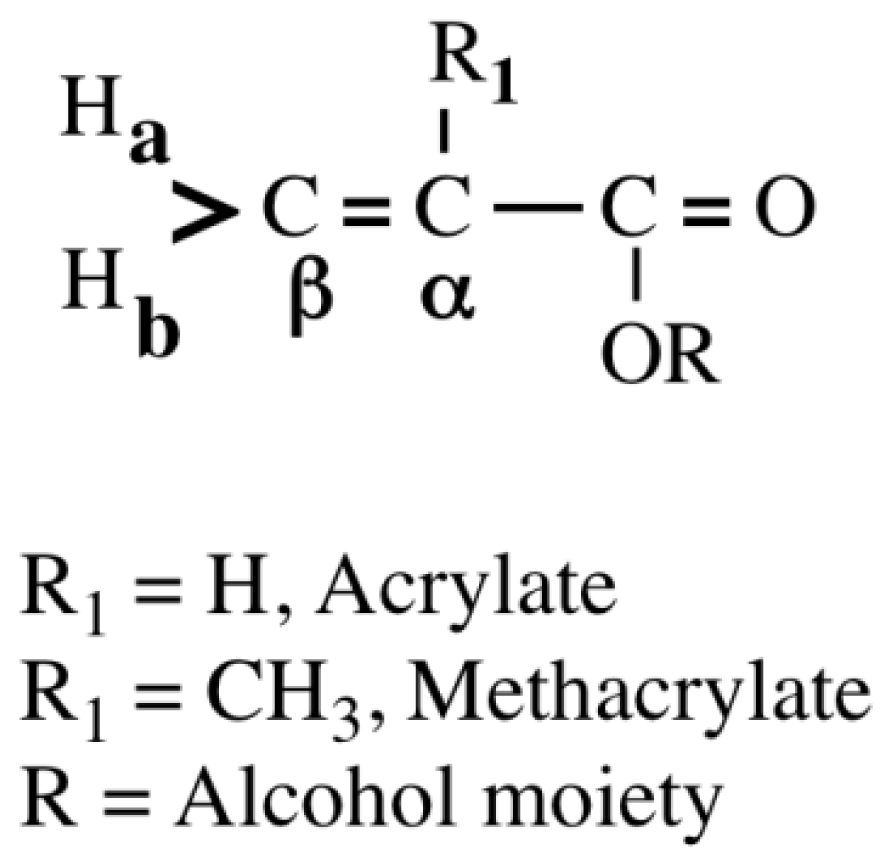
<p>Acrylates and methacrylates (<xref ref-type="fig" rid="f1-ijms-13-05789">Figure 1</xref>) are widely used in the formation of polymeric materials for medical, dental and industrial applications.</p>
<p>Many studies have investigated the hydrolysis reaction of acrylates and methacrylates [<xref ref-type="bibr" rid="b1-ijms-13-05789">1</xref>–<xref ref-type="bibr" rid="b6-ijms-13-05789">6</xref>] because the hydrolysis of monomers and decomposition of cured polymers are implicated in environmental pollution and toxicity. The hydrolysis reaction is one of the major sources of degradants (or metabolites) in <italic>in vitro</italic> and <italic>in vivo</italic> biodegradation tests stipulated in the Chemical Substance Control Law [<xref ref-type="bibr" rid="b7-ijms-13-05789">7</xref>]. Therefore, reliable and economical methods are needed for predicting the hydrolysis rates of the large number of these chemicals. Freidig <italic>et al</italic>. have previously reported that when acrylates and methacrylates with α,β-unsaturated carbonyl groups undergo hydrolysis in alkaline media, their electrophile (carbon: α-carbon, β-carbon, carbonyl carbon (&gt;C=O) may be preferentially attacked by a nucleophile (water, hydroxyl anion (OH<sup>−</sup>), glutathione (GSH) thiyl radical (GS<sup>−</sup>) [<xref ref-type="bibr" rid="b6-ijms-13-05789">6</xref>]. Double bonds (C=C) in acrylates and methacrylates act as an active center for Michael addition and radical scavenging oxidation because HOMO (Highest Occupied Molecular Orbital) and LUMO (Lowest Unoccupied Molecular Orbital) in methacrylate molecules exist in the double bonds [<xref ref-type="bibr" rid="b8-ijms-13-05789">8</xref>]. Also, since it is well known that the alkaline-mediated hydrolysis of acrylate polymers is due to an attack of OH<sup>−</sup> on the intermolecular carbonyl carbon in the ester group, the hydrolysis rate constant of a monomer is probably linked to that of the corresponding polymer and their reactions proceed via a similar mechanism. Therefore, we hypothesized that the OH<sup>−</sup>-catalyzed hydrolysis of acrylates and methacrylates may have an influence on the NMR-chemical shift of their β-carbon (δC<sub>β</sub>), because OH<sup>−</sup> could attack the β-carbon in a monomer molecule in the initial stage through a hydrolysis reaction. Subsequently, through a reaction involving the B<sub>AC</sub>2 mechanism (<italic>i.e</italic>., through nucleophilic attack on the &gt;C=O group) in most cases, acrylates and methacrylates are decomposed into acrylic acid and methacrylic acid together with alcohols, respectively, through hydrolysis. The resonance stabilization of methacrylates is dependent on their reactivity with these compounds. Kuznetsova <italic>et al</italic>. [<xref ref-type="bibr" rid="b9-ijms-13-05789">9</xref>] previously investigated the hydrolysis of <italic>N</italic>,<italic>N</italic>-dimethylaminoethyl methacrylate via the A<sub>AC</sub>2 and B<sub>AC</sub>2 mechanism, and found that the monomer was hydrolyzed to methacrylic acid and amino alcohol in an anion, pH, and surfactant-dependent manner [<xref ref-type="bibr" rid="b9-ijms-13-05789">9</xref>]. Acrylate and methacrylate esters are more highly hydrolyzed with a base than with an acid [<xref ref-type="bibr" rid="b1-ijms-13-05789">1</xref>,<xref ref-type="bibr" rid="b6-ijms-13-05789">6</xref>,<xref ref-type="bibr" rid="b9-ijms-13-05789">9</xref>], but their hydrolysis rate constants have been reported to be considerably small under alkaline conditions at 20 °C or 30 °C [<xref ref-type="bibr" rid="b1-ijms-13-05789">1</xref>–<xref ref-type="bibr" rid="b4-ijms-13-05789">4</xref>,<xref ref-type="bibr" rid="b6-ijms-13-05789">6</xref>]. There are a few QSPRs for acid- or base-catalyzed ester hydrolysis of methacrylates [<xref ref-type="bibr" rid="b2-ijms-13-05789">2</xref>,<xref ref-type="bibr" rid="b4-ijms-13-05789">4</xref>,<xref ref-type="bibr" rid="b6-ijms-13-05789">6</xref>], however the limited number of monomers have been chosen for QSARs study [<xref ref-type="bibr" rid="b1-ijms-13-05789">1</xref>–<xref ref-type="bibr" rid="b4-ijms-13-05789">4</xref>,<xref ref-type="bibr" rid="b6-ijms-13-05789">6</xref>] because the hydrolysis rate for many hydrophobic homologous acrylate and methacrylate esters may be below the detection limit of assays. We previously reported that the glutathione (GSH) reactivity of acrylates and methacrylates was significantly related to their δC<sub>β</sub>, possibly due to the high reactivity of GS<sup>−</sup> with C<sub>β</sub> of these monomers [<xref ref-type="bibr" rid="b10-ijms-13-05789">10</xref>–<xref ref-type="bibr" rid="b12-ijms-13-05789">12</xref>].</p>
<p>Mallik and Das [<xref ref-type="bibr" rid="b2-ijms-13-05789">2</xref>] previously investigated the kinetics of alkaline hydrolysis for methyl and ethyl acrylates and their corresponding methacrylates, and revealed a possible relationship between the hydrolysis rate constants and the experimentally determined activation energy for these compounds. Also, Nakajima <italic>et al</italic>. [<xref ref-type="bibr" rid="b13-ijms-13-05789">13</xref>] investigated the relationship between the acid-catalyzed hydrolysis rates for acetates and acrylates and their activation energy calculated using the MOPAC program, and found a good relationship between the hydrolysis rate constant and calculated activation energy for these compounds, except for formates and methacrylates, which showed a large discrepancy between the experimental and calculated values. The authors mentioned that recalculation for formates and methacrylates was desirable whenever possible. If a more precise calculation for monomers is required, this could be one way of utilizing a higher level of theory, such as density function theory or <italic>ab initio</italic> MO calculation.</p>
<p>In order to clarify the base-catalyzed hydrolysis reaction for acrylates and methacrylates in the light of currently available data, we investigated the relationship between the base-catalyzed hydrolysis rate constants or reaction rate constants with the GSH and <sup>13</sup>C NMR chemical shifts (δC<sub>β</sub>) or heat of formation (Hf) for these compounds. Previously reported data [<xref ref-type="bibr" rid="b14-ijms-13-05789">14</xref>,<xref ref-type="bibr" rid="b15-ijms-13-05789">15</xref>] for the independent variables were used.</p></sec>
<sec sec-type="results|discussion">
<title>2. Results and Discussion</title>
<sec>
<title>2.1. Hydrolysis</title>
<sec>
<title>2.1.1. δC<sub>β</sub> Parameter</title>
<p>Previously reported data for base-catalyzed hydrolysis constants (<italic>k</italic>1, <italic>k</italic>3) are shown in <xref ref-type="table" rid="t1-ijms-13-05789">Tables 1</xref> and <xref ref-type="table" rid="t2-ijms-13-05789">2</xref>. <sup>13</sup>C NMR chemical shifts for the α,β-unsaturated carbonyl group of acrylates and methacrylates are shown in <xref ref-type="table" rid="t1-ijms-13-05789">Table 1</xref>. The <sup>13</sup>C NMR chemical shift of the β-carbon (δC<sub>β</sub>) of monomers is also quantitatively related to the π-electron density. The higher the π-electron density on the β-carbon, the higher the magnetic field where the NMR peak is observed; that is, as the π-electron density increases, the chemical shift value (δ) becomes smaller [<xref ref-type="bibr" rid="b14-ijms-13-05789">14</xref>]. Therefore, if OH<sup>−</sup> attacks the C<sub>β</sub> in the monomer molecule, it should be possible to correlate the magnitude of the shift with the reactivity of the monomers.</p>
<p>We investigated the relationship between <italic>k</italic>1 and δC<sub>β</sub> or δC<sub>α</sub> for both acrylates and methacrylates. There was no relationship between <italic>k</italic>1 and δC<sub>β</sub> or δC<sub>α</sub> for both acrylates and methacrylates. By contrast, a significant relationship between <italic>k</italic>1 and δC<sub>β</sub>, but not δC<sub>α</sub>, was obtained when acrylates and methacrylates were separated, particularly in the latter situation. <xref rid="FD1" ref-type="disp-formula">Equation (1)</xref> for methacrylates is given as follows:</p>
<disp-formula id="FD1">
<label>(1)</label>
<mml:math id="mm1" display="block">
<mml:semantics id="sm1">
<mml:mrow>
<mml:mi>k</mml:mi>
<mml:mn>1</mml:mn>
<mml:mo>=</mml:mo>
<mml:mo>-</mml:mo>
<mml:mn>17.118</mml:mn>
<mml:mi> </mml:mi>
<mml:mo stretchy="false">(</mml:mo>
<mml:mo>±</mml:mo>
<mml:mn>0.130</mml:mn>
<mml:mo stretchy="false">)</mml:mo>
<mml:mo>+</mml:mo>
<mml:mn>0.137</mml:mn>
<mml:mi> </mml:mi>
<mml:mo stretchy="false">(</mml:mo>
<mml:mo>±</mml:mo>
<mml:mn>0.021</mml:mn>
<mml:mo stretchy="false">)</mml:mo>
<mml:mi> </mml:mi>
<mml:mi>δ</mml:mi>
<mml:msub>
<mml:mrow>
<mml:mtext>C</mml:mtext></mml:mrow>
<mml:mi>β</mml:mi></mml:msub>
<mml:mi> </mml:mi>
<mml:mo stretchy="false">(</mml:mo>
<mml:mi>n</mml:mi>
<mml:mo>=</mml:mo>
<mml:mn>5</mml:mn>
<mml:mo>,</mml:mo>
<mml:msup>
<mml:mrow>
<mml:mi>r</mml:mi></mml:mrow>
<mml:mn>2</mml:mn></mml:msup>
<mml:mo>=</mml:mo>
<mml:mn>0933</mml:mn>
<mml:mo>,</mml:mo>
<mml:mi>p</mml:mi>
<mml:mo>&lt;</mml:mo>
<mml:mn>0.01</mml:mn>
<mml:mo stretchy="false">)</mml:mo></mml:mrow></mml:semantics></mml:math></disp-formula>
<p>The <italic>k</italic>1 value for methacrylates was calculated using this equation. The results are also shown in <xref ref-type="table" rid="t1-ijms-13-05789">Table 1</xref>. The calculated <italic>k</italic>1 values for isoPMA and isoBMA with the branched substituent were less than the corresponding experimental values. By contrast, the calculated <italic>k</italic>1 values for MMA and allyl MA were larger than the experimental values. Also, the <italic>k</italic>1 value for nBMA could not be determined using <xref rid="FD1" ref-type="disp-formula">Equation (1)</xref>, and the value of δC<sub>β</sub> was below the limit of detection using that equation. A base-catalyzed second-order hydrolysis rate constant of 2.7 × 10<sup>−3</sup> L/mole-s was estimated using a structure estimation method [<xref ref-type="bibr" rid="b16-ijms-13-05789">16</xref>]. The hydrolysis rate constant for nBMA appeared to be less than that for isoBMA, as the δC<sub>β</sub> for nBMA was smaller than that for isoBMA. We predicted the <italic>k</italic>1 value using <xref rid="FD1" ref-type="disp-formula">Equation (1)</xref> for some monomers that have been used as medical, dental and industrial materials. The <italic>k</italic>1 values (mol<sup>−1</sup>s<sup>−1</sup>) for ethyleneglycol dimethacrylate (EGDMA), triethyleneglycol dimethacrylate (TEGDMA) and MMA were 0.130, 0.062 and 0.034, respectively. Note that the δC<sub>β</sub> values (ppm) for EGDMA, TEGDMA and MMA were 125.9, 125.5, and 125.2, respectively [<xref ref-type="bibr" rid="b11-ijms-13-05789">11</xref>]. Dimethacrylates such as EGDMA and TEGDMA appeared to be more hydrolyzed than MMA, a monomethacrylate. This may be due to the fact that dimethacrylates possess two double bonds in the molecule that has an affinity to OH<sup>−</sup>. We previously investigated the changes in the <sup>13</sup>C NMR chemical shift for methacrylates induced by their interaction with the phospholipid liposome system in deuterium oxide (D<sub>2</sub>O) at 30 °C, and it was found that the changes in chemical shifts of electrophiles (carbons: β-carbon, and carbonyl carbon (&gt;C=O)) for TEGDMA and EGDMA, particularly for the latter, was 3–5 fold larger than those for the corresponding MMA; the chemical shifts of β- and carbonyl carbon in the dimethacrylate molecule shifted to a higher field in liposomes in D<sub>2</sub>O, compared to those in MMA molecule [<xref ref-type="bibr" rid="b18-ijms-13-05789">18</xref>]. Although these finding may not be directly related to hydrolysis of methacrylates, it has been assumed from the shielding of chemical shift of β- and carbonyl carbon in D<sub>2</sub>O that the hydrolysis rate of dimethacrylates is greater than that of MMA. The higher the reactivity, the higher the field in which β-carbon resonates.</p>
<p>On the other hand, there was no relationship between <italic>k</italic>1 or <italic>k</italic>3 and δC<sub>β</sub> for both acrylates and methacrylates. In general, the electron-releasing methyl group was expected to reduce the rate of alkaline hydrolysis. Indeed, the <italic>k</italic>1 value for isoBA was greater than that for isoBMA. Similarly, the <italic>k</italic>1 value for EA was greater than for the corresponding EMA (<xref ref-type="table" rid="t1-ijms-13-05789">Table 1</xref>).</p>
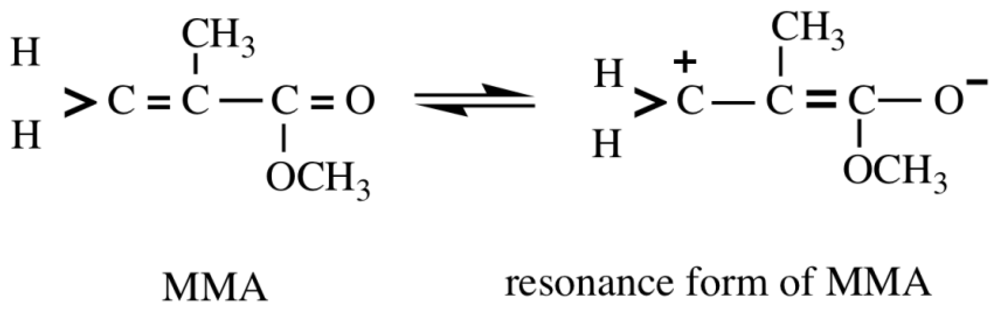
<p>The chemical shifts of the proton attached to the β-carbon of monomers are linearly related to the corresponding value of δC<sub>β</sub>, where Ha represents the proton <italic>trans</italic> to the substituent and Hb the proton <italic>cis</italic> to that. The δHa for acrylates and methacrylates was related to their δC<sub>β</sub> much more than the δHb. An understanding of the chemical shift difference between Ha and Hb, |δHa – δHb|, may be necessary to clarify the difference in the hydrolysis rate constants for acrylates and methacrylates. <xref ref-type="table" rid="t2-ijms-13-05789">Table 2</xref> shows Ha, Hb and |δHa – δHb|. We investigated the relationship between |δHa – δHb| and δC<sub>β</sub> for the separation of the acrylates and methacrylates. There was a significant relationship between |δHa – δHb| and δC<sub>β</sub> for acrylates (<italic>n</italic> = 7, <italic>r</italic><sup>2</sup> = 0.850, <italic>p</italic> &lt; 0.01), whereas there was no such relationship for methacrylates when the training set shown in <xref ref-type="table" rid="t2-ijms-13-05789">Table 2</xref> was used. Because of the electron-withdrawing character of the carbonyl group in monomers, resonance stabilization increases the electron density at the carbonyl carbon (&gt;C=O). As an example, MMA and its resonance form are shown in <xref ref-type="fig" rid="f2-ijms-13-05789">Figure 2</xref>. The π-electron density of the α,β-unsaturated carbonyl groups could be responsible for the resonance stabilization.</p>
<p>As shown in <xref ref-type="table" rid="t2-ijms-13-05789">Table 2</xref>, the charge density and |δHa – δHb| value for acrylates were greater than those for methacrylates, suggesting a possible relationship between the electron density at the carbonyl carbon and the |δHa – δHb| value. These findings can be interpreted in terms of a relationship between the base-catalyzed hydrolysis reaction and the δC<sub>β</sub> value for methacrylates and acrylates. For the chemical shifts (Ha, Hb) of the proton attached to β-carbon, the coefficient is much closer to unity for the chemical shift of Ha than that of Hb, probably due to the fact that the chemical shift of Hb is more strongly affected by the diamagnetic anisotropy of the substituent. From the geometrical consideration on the molecular model, differences in the deshielding effects of the C=O group are larger at Hb than at Ha [<xref ref-type="bibr" rid="b14-ijms-13-05789">14</xref>]. As the resonance stabilization becomes more important, the |δHa – δHb| becomes larger; the |δHa – δHb| is related to <italic>Q</italic> which is a measure of resonance stabilization. <italic>Q</italic> is a parameter concerning a monomer based on the <italic>Q–e</italic> scheme. As compared with the hydrolysis rate constant (<italic>k</italic>1) between the acrylate esters and the corresponding methacrylate esters (<xref ref-type="table" rid="t1-ijms-13-05789">Table 1</xref>), the rate constant for EA is greater than the EMA one, and similarly, that for isoBA is greater than the isoBMA one.</p>
<p>Next, we investigated the relationships between the base-catalyzed hydrolysis rate constant (<italic>k</italic>3) and δC<sub>α</sub> or δC<sub>β</sub> for the test compounds, acrylates (methyl acrylate, ethyl acrylate, butyl acrylate) and methacrylate (MMA) (<xref ref-type="table" rid="t1-ijms-13-05789">Table 1</xref>). With the exception of MMA, significant linear relationships of <italic>k</italic>3 with δC<sub>α</sub> and δC<sub>β</sub> were found, the correlation being <italic>r</italic><sup>2</sup> = 0.97 and <italic>r</italic><sup>2</sup> = 0.98, respectively. An increase of <italic>k</italic>3 occurred when δC<sub>β</sub> increased, whereas <italic>k</italic>3 increased as δC<sub>α</sub> decreased. Although the hydrolysis rates were determined for only a limited number of acrylates (<italic>n</italic> = 3), this finding indicated that <italic>k</italic>3 increased along with the π-electron density for C<sub>α</sub>. Thus in acrylates, the preferential site of attack of OH<sup>−</sup> may be both the C<sub>α</sub> and C<sub>β</sub>, which is possibly due to the absence of α-methyl substituent in the acrylate molecule. However, further studies will be needed to clarify the details of ester hydrolysis of acrylates in alkaline media.</p>
<p>The hydrolysis rates of chemicals are reportedly correlated with Hammet σ, the Taft parameters, σ* and Taft steric property parameter, E(s), and the van der Waals radius [<xref ref-type="bibr" rid="b6-ijms-13-05789">6</xref>,<xref ref-type="bibr" rid="b19-ijms-13-05789">19</xref>]. Freidig <italic>et al</italic>. reported previously that the base-catalyzed hydrolysis of six methacrylates was able to establish a linear free energy relationship as a function of the Taft σ* but not of the Taft E(s) [<xref ref-type="bibr" rid="b6-ijms-13-05789">6</xref>]. Therefore, we examined the relationships for the δC<sub>β</sub> <italic>vs</italic>. Taft σ* for the six monomers, and it was found that a good relationship between the two descriptors was obtained (<italic>r</italic><sup>2</sup> = 0.9, <italic>p</italic> &lt; 0.01) (data not shown). This clearly indicated that the attack of OH<sup>−</sup> on the β-carbon of methacrylates may be also associated with the electronic effects of the substituents (R, alcohol moiety as shown in <xref ref-type="fig" rid="f1-ijms-13-05789">Figure 1</xref>). The chemical shifts δC<sub>β</sub> for methacrylates likely reflect their electronic effects of the substituents. The π density shown in the NMR spectra is thus considered to be a useful parameter.</p></sec>
<sec>
<title>2.1.2. Hf Parameter</title>
<p>The <italic>k</italic>1, <italic>k</italic>2, Hf and ΔH<sub>f</sub>° values for acrylates and methacrylates are shown in <xref ref-type="table" rid="t3-ijms-13-05789">Table 3</xref>.</p>
<p>Next we investigated the relationship between <italic>k</italic>1 and Hf, and found that it was significant (<italic>r</italic><sup>2</sup> = 0.89, <italic>p</italic> &lt; 0.05). <xref rid="FD2" ref-type="disp-formula">Equation (2)</xref> is given as follows:</p>
<disp-formula id="FD2">
<label>(2)</label>
<mml:math id="mm2" display="block">
<mml:semantics id="sm2">
<mml:mrow>
<mml:mi>k</mml:mi>
<mml:mn>1</mml:mn>
<mml:mo>=</mml:mo>
<mml:mn>0.2288</mml:mn>
<mml:mi> </mml:mi>
<mml:mo stretchy="false">(</mml:mo>
<mml:mo>±</mml:mo>
<mml:mn>0.015</mml:mn>
<mml:mo stretchy="false">)</mml:mo>
<mml:mo>+</mml:mo>
<mml:mn>0.0026</mml:mn>
<mml:mi> </mml:mi>
<mml:mo stretchy="false">(</mml:mo>
<mml:mo>±</mml:mo>
<mml:mn>0.001</mml:mn>
<mml:mi> </mml:mi>
<mml:mo stretchy="false">)</mml:mo>
<mml:mi> </mml:mi>
<mml:mtext>Hf</mml:mtext>
<mml:mi> </mml:mi>
<mml:mo stretchy="false">(</mml:mo>
<mml:mi>n</mml:mi>
<mml:mo>=</mml:mo>
<mml:mn>5</mml:mn>
<mml:mo>,</mml:mo>
<mml:msup>
<mml:mrow>
<mml:mi>r</mml:mi></mml:mrow>
<mml:mn>2</mml:mn></mml:msup>
<mml:mo>=</mml:mo>
<mml:mn>0.891</mml:mn>
<mml:mo>,</mml:mo>
<mml:mi>p</mml:mi>
<mml:mo>&lt;</mml:mo>
<mml:mn>0.05</mml:mn>
<mml:mo stretchy="false">)</mml:mo></mml:mrow></mml:semantics></mml:math></disp-formula>
<p>Data on the physical and thermodynamic properties of vinyl monomers are needed for the design and operation of industrial chemical processes. Vatani <italic>et al.</italic> previously predicted the standard enthalpy of formation using a QSPR model [<xref ref-type="bibr" rid="b21-ijms-13-05789">21</xref>]. The application of this model may be useful for evaluating the biological activity of various vinyl monomers used for medical, dental and industrial materials. We investigated the relationship between the calculated Hf and the ΔH<sub>f</sub>° reported in DIPPR 9801 [<xref ref-type="bibr" rid="b20-ijms-13-05789">20</xref>] for acrylates and methacrylates using the data set shown in <xref ref-type="table" rid="t3-ijms-13-05789">Table 3</xref>, and found a good linear relationship between the two independent variables (<italic>n</italic> = 10, <italic>r</italic><sup>2</sup> = 0.992, <italic>p</italic> &lt; 0.001).</p>
<p>The relationship between <italic>k</italic>1 and ΔH<sub>f</sub>° for both acrylates and methacrylates is given as <xref rid="FD3" ref-type="disp-formula">Equation (3)</xref> as follows:</p>
<disp-formula id="FD3">
<label>(3)</label>
<mml:math id="mm3" display="block">
<mml:semantics id="sm3">
<mml:mrow>
<mml:mi>k</mml:mi>
<mml:mn>1</mml:mn>
<mml:mo>=</mml:mo>
<mml:mn>0.211</mml:mn>
<mml:mo stretchy="false">(</mml:mo>
<mml:mo>±</mml:mo>
<mml:mn>0.006</mml:mn>
<mml:mo stretchy="false">)</mml:mo>
<mml:mo>+</mml:mo>
<mml:mn>0.00044</mml:mn>
<mml:mo stretchy="false">(</mml:mo>
<mml:mn>8.1</mml:mn>
<mml:mo>×</mml:mo>
<mml:msup>
<mml:mrow>
<mml:mrow>
<mml:mn>10</mml:mn></mml:mrow></mml:mrow>
<mml:mn>5</mml:mn></mml:msup>
<mml:mo stretchy="false">)</mml:mo>
<mml:mi> </mml:mi>
<mml:mi mathvariant="normal">Δ</mml:mi>
<mml:msub>
<mml:mrow>
<mml:mtext>H</mml:mtext></mml:mrow>
<mml:mtext>f</mml:mtext></mml:msub>
<mml:mo>°</mml:mo>
<mml:mi> </mml:mi>
<mml:mo stretchy="false">(</mml:mo>
<mml:mi>n</mml:mi>
<mml:mo>=</mml:mo>
<mml:mn>5</mml:mn>
<mml:mo>,</mml:mo>
<mml:msup>
<mml:mrow>
<mml:mi>r</mml:mi></mml:mrow>
<mml:mn>2</mml:mn></mml:msup>
<mml:mo>=</mml:mo>
<mml:mn>0.907</mml:mn>
<mml:mo>,</mml:mo>
<mml:mi>p</mml:mi>
<mml:mo>&lt;</mml:mo>
<mml:mn>0.05</mml:mn>
<mml:mo stretchy="false">)</mml:mo></mml:mrow></mml:semantics></mml:math></disp-formula>
<p>The <italic>k</italic>1 value in the ΔH<sub>f</sub>° term for acrylates and methacrylates was calculated from <xref rid="FD3" ref-type="disp-formula">Equation (3)</xref>, and the results are shown in <xref ref-type="table" rid="t3-ijms-13-05789">Table 3</xref>. The experimentally determined and calculated values of <italic>k</italic>1 for each monomer were similar. We then investigated the relationship between the rate constant (<italic>k</italic>2) and Hf for MA, EA, MMA and EMA. <xref rid="FD4" ref-type="disp-formula">Equation (4)</xref> is given as follows:</p>
<disp-formula id="FD4">
<label>(4)</label>
<mml:math id="mm4" display="block">
<mml:semantics id="sm4">
<mml:mrow>
<mml:mi>k</mml:mi>
<mml:mn>2</mml:mn>
<mml:mo>=</mml:mo>
<mml:mn>0.085</mml:mn>
<mml:mi> </mml:mi>
<mml:mo stretchy="false">(</mml:mo>
<mml:mo>±</mml:mo>
<mml:mn>0.016</mml:mn>
<mml:mo stretchy="false">)</mml:mo>
<mml:mo>+</mml:mo>
<mml:mn>0.0013</mml:mn>
<mml:mi> </mml:mi>
<mml:mo stretchy="false">(</mml:mo>
<mml:mo>±</mml:mo>
<mml:mn>0.000</mml:mn>
<mml:mo stretchy="false">)</mml:mo>
<mml:mi> </mml:mi>
<mml:mtext>Hf</mml:mtext>
<mml:mi> </mml:mi>
<mml:mo stretchy="false">(</mml:mo>
<mml:mi>n</mml:mi>
<mml:mo>=</mml:mo>
<mml:mn>4</mml:mn>
<mml:mo>,</mml:mo>
<mml:msup>
<mml:mrow>
<mml:mi>r</mml:mi></mml:mrow>
<mml:mn>2</mml:mn></mml:msup>
<mml:mo>=</mml:mo>
<mml:mn>0.941</mml:mn>
<mml:mo>,</mml:mo>
<mml:mi>p</mml:mi>
<mml:mo>&lt;</mml:mo>
<mml:mn>0.05</mml:mn>
<mml:mo stretchy="false">)</mml:mo></mml:mrow></mml:semantics></mml:math></disp-formula>
<p>The calculated <italic>k</italic>2 value is also shown in <xref ref-type="table" rid="t3-ijms-13-05789">Table 3</xref>. These findings indicated that the <italic>k</italic>1 or <italic>k</italic>2 value for both acrylate and methacrylate esters was related to their Hf. In the present study, the hydrolysis rate constant for acrylate esters with the simple alkyl substituent was higher than for the corresponding methacrylate esters. It was concluded that the Hf (or ΔH<sub>f</sub>°) value for acrylates and methacrylates is valuable for the estimation of the rate constants. As the Hf (or ΔH<sub>f</sub>°) value for monomers increased, their hydrolysis rate constant increased. The hydrolysis rate-determining process for acrylates and methacrylates may be controlled by their Hf (or ΔH<sub>f</sub>°) value.</p></sec></sec>
<sec>
<title>2.2. GSH Reactivity</title>
<p>Acrylate and methacrylate esters are important chemicals in the polymer industry, and their induction of toxicity is considered to involve alkylation of crucial cellular nucleophiles through the Michael reaction [<xref ref-type="bibr" rid="b22-ijms-13-05789">22</xref>]. We investigated the relationship between <italic>k</italic><sub>GSH</sub> and δC<sub>α</sub> or δC<sub>β</sub> for both acrylates and methacrylates, and obtained a good correlation for δC<sub>β</sub>. For the δC<sub>β</sub>, <xref rid="FD5" ref-type="disp-formula">Equation (5)</xref> is given as follows:</p>
<disp-formula id="FD5">
<label>(5)</label>
<mml:math id="mm5" display="block">
<mml:semantics id="sm5">
<mml:mrow>
<mml:mtext>log</mml:mtext>
<mml:mi> </mml:mi>
<mml:msub>
<mml:mrow>
<mml:mi>k</mml:mi></mml:mrow>
<mml:mrow>
<mml:mtext>GSH</mml:mtext></mml:mrow></mml:msub>
<mml:mo>=</mml:mo>
<mml:mo>-</mml:mo>
<mml:mn>56.155</mml:mn>
<mml:mi> </mml:mi>
<mml:mo stretchy="false">(</mml:mo>
<mml:mo>±</mml:mo>
<mml:mn>0.131</mml:mn>
<mml:mo stretchy="false">)</mml:mo>
<mml:mo>+</mml:mo>
<mml:mn>0.443</mml:mn>
<mml:mo stretchy="false">(</mml:mo>
<mml:mo>±</mml:mo>
<mml:mn>0.019</mml:mn>
<mml:mo stretchy="false">)</mml:mo>
<mml:mi>δ</mml:mi>
<mml:msub>
<mml:mrow>
<mml:mtext>C</mml:mtext></mml:mrow>
<mml:mi>β</mml:mi></mml:msub>
<mml:mi> </mml:mi>
<mml:mo stretchy="false">(</mml:mo>
<mml:mi>n</mml:mi>
<mml:mo>=</mml:mo>
<mml:mn>8</mml:mn>
<mml:mi> </mml:mi>
<mml:msup>
<mml:mrow>
<mml:mi>r</mml:mi></mml:mrow>
<mml:mn>2</mml:mn></mml:msup>
<mml:mo>=</mml:mo>
<mml:mn>0.989</mml:mn>
<mml:mo>,</mml:mo>
<mml:mi>p</mml:mi>
<mml:mo>&lt;</mml:mo>
<mml:mn>0.001</mml:mn>
<mml:mo stretchy="false">)</mml:mo></mml:mrow></mml:semantics></mml:math></disp-formula>
<p>By contrast, there was a weak correlation for δC<sub>α</sub> (<italic>r</italic><sup>2</sup> = 0.65). It was assumed from this that the preferential site of GS<sup>−</sup> attack for these monomers would likely be the β-carbon. We calculated log <italic>k</italic><sub>GSH</sub> using <xref rid="FD5" ref-type="disp-formula">Equation (5)</xref> and the result is also shown in <xref ref-type="table" rid="t1-ijms-13-05789">Table 1</xref>. As the δC<sub>β</sub> for monomers increased, their log <italic>k</italic><sub>GSH</sub> increased. This showed that π-electron density of β-carbon for both acrylates and methacrylates may play an important role in the rate-determining process in GSH reactivity. GSH reactivity for acrylates was considerably higher than for methacrylates. It is interesting to note that the log <italic>k</italic><sub>GSH</sub> for both acrylates and methacrylates was not related to their Hf. Freidig <italic>et al.</italic> reported that hydrolysis of acrylates does not interfere with the GSH reactivity assay [<xref ref-type="bibr" rid="b6-ijms-13-05789">6</xref>]. In the present study, the base-catalyzed hydrolysis rate constant for acrylates and methacrylates was correlated with their Hf value (<xref rid="FD3" ref-type="disp-formula">Equations (3)</xref> and <xref rid="FD4" ref-type="disp-formula">(4)</xref>), whereas conversely, their GSH reactivity was not correlated with the Hf value. These findings support those of the above study [<xref ref-type="bibr" rid="b6-ijms-13-05789">6</xref>].</p>
<p>Putz <italic>et al.</italic> [<xref ref-type="bibr" rid="b23-ijms-13-05789">23</xref>] determined the actual quantitative-structure activity relationships (QSARs) for biological activity using the parameters recommended by the Hansch group [<xref ref-type="bibr" rid="b24-ijms-13-05789">24</xref>] (hydrophobicity, polarizability and total energy) and special reactivity indices (electronegativity (χ) and chemical hardness (η)) employing computational chemistry. The need for these parameters has potentially been met by QSARs and quantitative structure-property relationships (QSPRs), and the total enthalpy of formation as an independent variable is useful for kinetic studies of the hydrolysis reaction of vinyl monomers. We recently reported a good QSAR for biological activities <italic>vs</italic>. theoretical parameters for vinyl monomers [<xref ref-type="bibr" rid="b12-ijms-13-05789">12</xref>] and phenolic compounds [<xref ref-type="bibr" rid="b25-ijms-13-05789">25</xref>]. On the other hand, to develop the phenolic carbonate ester prodrugs, Østergaard and Larsen investigated the water, acid and base catalyzed hydrolysis rate constants for various carbonate esters with fatty acid-like structures, bioreversible derivatives of phenols [<xref ref-type="bibr" rid="b26-ijms-13-05789">26</xref>]. They reported that the hydrolysis rate constant of such chemicals may be useful for estimating their physical properties favorable for drug transport to the target site within the body.</p></sec></sec>
<sec>
<title>3. Experimental Section</title>
<sec>
<title>3.1. Monomers</title>
<p>The monomers used are abbreviated as follows. Acrylates: methyl acrylate (MA), ethyl acrylate (EA), <italic>n</italic>-butyl acrylate (nBA), isobutyl acrylate (isoBA), hexyl acrylate (Hexyl A); Methacrylates: methyl methacrylate (MMA), ethyl methacrylate (EMA), isopropyl methacrylate (isoPMA), isobutyl methacrylate (isoBMA), allyl methacrylate (allyl MA), benzyl methacrylate (benzyl MA).</p></sec>
<sec>
<title>3.2. NMR Spectra</title>
<p>The <sup>13</sup>C NMR chemical shift data for various monomers in chloroform-<italic>d</italic> (CDCl<sub>3</sub>) were taken from the literature [<xref ref-type="bibr" rid="b14-ijms-13-05789">14</xref>]. Briefly, the chemical shifts of the indicated monomers were measured in CDCl<sub>3</sub> at 35 °C at 125 and/or 500 MHz, respectively, using tetramethylsilane (TMS) as an internal standard.</p></sec>
<sec>
<title>3.3. Hydrolysis</title>
<p>The hydrolysis rate constants (<italic>k</italic>1) for acrylate EA, HA, isoBA and methacrylates (MMA, allyl MA, benzyl MA, isoPMA, isoBMA) under alkaline conditions (pH 10) were taken from Freidig <italic>et al</italic>. [<xref ref-type="bibr" rid="b6-ijms-13-05789">6</xref>]. The hydrolysis rate measurements were carried out using an HPLC method at 20 °C. Also, the alkaline hydrolysis rate constant <italic>k</italic>2 (second-order rate constant) for MA, EA, MMA and EMA at 30 °C was taken from Mallik and Das [<xref ref-type="bibr" rid="b2-ijms-13-05789">2</xref>]. Furthermore, the second-order rate constant (k3) data for base-catalyzed acrylates (MA, EA, BA) and methacrylates (MMA) obtained using a diffusion method were taken from Sharma and Sharma [<xref ref-type="bibr" rid="b4-ijms-13-05789">4</xref>].</p></sec>
<sec>
<title>3.4. Heats of Formation (Hf) and Standard Enthalpy of Formation (ΔH<sub>f</sub>°)</title>
<p>For calculation of the molecular HF descriptor, the optimized chemical structures of compounds are needed. We have previously calculated the Hf values for acrylates and methacrylates, and those data were used in the present work [<xref ref-type="bibr" rid="b10-ijms-13-05789">10</xref>,<xref ref-type="bibr" rid="b11-ijms-13-05789">11</xref>,<xref ref-type="bibr" rid="b15-ijms-13-05789">15</xref>]. Briefly, calculations of Hf were performed using the PM3/CONFLEX method. To obtain fine geometry details in the present study, initial geometry optimization was performed using CONFLEX5 (Conflex, Tokyo, Japan), then calculations using the PM3 method in the MOPAC 2000 program were carried out on a Tektronix CAChe workstation (Fujitsu Ltd., Tokyo, Japan). Also, the ΔH<sub>f</sub>° values for acrylates and methacrylates were taken from the literature [<xref ref-type="bibr" rid="b20-ijms-13-05789">20</xref>,<xref ref-type="bibr" rid="b21-ijms-13-05789">21</xref>].</p></sec>
<sec>
<title>3.5. GSH Reactivity</title>
<p>Data for GSH reactivity were taken from the literature [<xref ref-type="bibr" rid="b6-ijms-13-05789">6</xref>]. The reaction rate constant (<italic>k</italic><sub>GSH</sub>) was measured at 20 °C at pH 8.8.</p></sec>
<sec sec-type="methods">
<title>3.6. Multi-Regression Analysis</title>
<p>The multi-regression equations were calculated using StatMate III (ATMS Co., Ltd., Tokyo, Japan).</p></sec></sec>
<sec sec-type="conclusions">
<title>4. Conclusions</title>
<p>The present study has shown that the base-catalyzed hydrolysis rate constant for methacrylates is significantly related to δC<sub>β</sub>. By contrast, there was no relationship between two independent variables for acrylates. A good relationship for the hydrolysis rate constant <italic>vs</italic>. heat of formation was also obtained for both acrylates and methacrylates. The GSH reactivity for both acrylates and methacrylates was related to δC<sub>β</sub>, but not to Hf. The NMR spectra and heat of formation for acrylates and methacrylates could be used to estimate the base-catalyzed hydrolysis rate constants and GSH reactivity of these compounds, and also may be an important tool for examining the mechanism of their reactivity.</p></sec></body>
<back>
<ack>
<title>Acknowledgements</title>
<p>We thank M. Ishihara of Meikai University for the semi-empirical calculations.</p></ack>
<ref-list>
<title>References</title>
<ref id="b1-ijms-13-05789"><label>1</label><citation citation-type="journal"><person-group person-group-type="author"><name><surname>Mabey</surname><given-names>W.</given-names></name><name><surname>Mill</surname><given-names>T.</given-names></name></person-group><article-title>Critical review of hydrolysis of organic compounds in water under environmental conditions</article-title><source>J. Phys. Chem. Ref. Data</source><year>1978</year><volume>7</volume><fpage>383</fpage><lpage>415</lpage><pub-id pub-id-type="doi">10.1063/1.555572</pub-id></citation></ref>
<ref id="b2-ijms-13-05789"><label>2</label><citation citation-type="journal"><person-group person-group-type="author"><name><surname>Mallik</surname><given-names>K.L.</given-names></name><name><surname>Das</surname><given-names>M.N.</given-names></name></person-group><article-title>Alkaline hydrolysis of acrylic and methacrylic esters in 60% aqueous ethanol</article-title><source>Naturwissenschaften</source><year>1964</year><volume>51</volume><pub-id pub-id-type="doi">10.1007/BF00622580</pub-id></citation></ref>
<ref id="b3-ijms-13-05789"><label>3</label><citation citation-type="journal"><person-group person-group-type="author"><name><surname>Sharma</surname><given-names>R.C.</given-names></name><name><surname>Sharma</surname><given-names>M.M.</given-names></name></person-group><article-title>Kinetics of fast alkaline hydrolysis of esters</article-title><source>J. Appl. Chem</source><year>1969</year><volume>19</volume><fpage>162</fpage><lpage>166</lpage></citation></ref>
<ref id="b4-ijms-13-05789"><label>4</label><citation citation-type="journal"><person-group person-group-type="author"><name><surname>Sharma</surname><given-names>R.C.</given-names></name><name><surname>Sharma</surname><given-names>M.M.</given-names></name></person-group><article-title>Kinetics of alkaline hydrolysis of esters. II. Unsaturated esters and oxalic Esters</article-title><source>Bull. Chem. Soc. Jpn</source><year>1970</year><volume>43</volume><fpage>642</fpage><lpage>645</lpage><pub-id pub-id-type="doi">10.1246/bcsj.43.642</pub-id></citation></ref>
<ref id="b5-ijms-13-05789"><label>5</label><citation citation-type="journal"><person-group person-group-type="author"><name><surname>Kadoma</surname><given-names>Y.</given-names></name><name><surname>Tanaka</surname><given-names>M.</given-names></name></person-group><article-title>Acid and base-catalyzed hydrolysis of bisphenol A-related compounds</article-title><source>Dent. Mater. J</source><year>2000</year><volume>19</volume><fpage>139</fpage><lpage>152</lpage><pub-id pub-id-type="doi">10.4012/dmj.19.139</pub-id><pub-id pub-id-type="pmid">11219095</pub-id></citation></ref>
<ref id="b6-ijms-13-05789"><label>6</label><citation citation-type="journal"><person-group person-group-type="author"><name><surname>Freidig</surname><given-names>A.P.</given-names></name><name><surname>Verhaar</surname><given-names>H.J.M.</given-names></name><name><surname>Hermen</surname><given-names>J.L.M.</given-names></name></person-group><article-title>Quantitative structure-property relationships for the chemical reactivity of acrylates and methacrylates</article-title><source>Environ. Toxicol. Chem</source><year>1999</year><volume>18</volume><fpage>1133</fpage><lpage>1139</lpage></citation></ref>
<ref id="b7-ijms-13-05789"><label>7</label><citation citation-type="web"><source>Chemical Substance Control Law</source><comment>Available online: <ext-link xlink:href="http://www.safe.nite.go.jp/english/db.html" ext-link-type="uri">http://www.safe.nite.go.jp/english/db.html</ext-link></comment><access-date>accessed on 12 December 2011</access-date></citation></ref>
<ref id="b8-ijms-13-05789"><label>8</label><citation citation-type="journal"><person-group person-group-type="author"><name><surname>Fujisawa</surname><given-names>S.</given-names></name><name><surname>Kadoma</surname><given-names>Y.</given-names></name><name><surname>Ishihara</surname><given-names>M.</given-names></name><name><surname>Atsumi</surname><given-names>T.</given-names></name><name><surname>Yokoe</surname><given-names>I.</given-names></name></person-group><article-title>Dipalmitoylphosphatidylcholine (DPPC) and DPPC/cholesterol liposomes as predictors of the cytotoxicity of bis-GMA related compounds</article-title><source>J. Liposome Res</source><year>2004</year><volume>14</volume><fpage>39</fpage><lpage>49</lpage><pub-id pub-id-type="doi">10.1081/LPR-120039662</pub-id><pub-id pub-id-type="pmid">15461931</pub-id></citation></ref>
<ref id="b9-ijms-13-05789"><label>9</label><citation citation-type="journal"><person-group person-group-type="author"><name><surname>Kuznetsova</surname><given-names>N.A.</given-names></name><name><surname>Kazantsev</surname><given-names>O.A.</given-names></name><name><surname>Shirshin</surname><given-names>K.V.</given-names></name><name><surname>Khokhlova</surname><given-names>T.A.</given-names></name><name><surname>Malyshev</surname><given-names>A.P.</given-names></name></person-group><article-title>Hydrolysis of <italic>N</italic>,<italic>N</italic>-dimethylaminoethyl methacrylate and its salts in concentrated aqueous solution</article-title><source>Russ. J. Appl. Chem</source><year>2003</year><volume>7</volume><fpage>1117</fpage><lpage>1120</lpage></citation></ref>
<ref id="b10-ijms-13-05789"><label>10</label><citation citation-type="journal"><person-group person-group-type="author"><name><surname>Ishihara</surname><given-names>M.</given-names></name><name><surname>Fujisawa</surname><given-names>S.</given-names></name></person-group><article-title>A structure-activity relationship study on the mechanisms of methacrylate-induced toxicity using NMR chemical shift of β-carbon, RP-HPLC log P and semiempirical molecular descriptor</article-title><source>Dent. Mater. J</source><year>2009</year><volume>28</volume><fpage>113</fpage><lpage>120</lpage><pub-id pub-id-type="doi">10.4012/dmj.28.113</pub-id><pub-id pub-id-type="pmid">19280976</pub-id></citation></ref>
<ref id="b11-ijms-13-05789"><label>11</label><citation citation-type="journal"><person-group person-group-type="author"><name><surname>Fujisawa</surname><given-names>S.</given-names></name><name><surname>Kadoma</surname><given-names>Y.</given-names></name></person-group><article-title>Prediction of the reduced glutathione (GSH) reactivity of dental methacrylate monomers using NMR spectra—Relationship between toxicity and GSH reactivity</article-title><source>Dent. Mater. J</source><year>2009</year><volume>28</volume><fpage>722</fpage><lpage>729</lpage><pub-id pub-id-type="doi">10.4012/dmj.28.722</pub-id><pub-id pub-id-type="pmid">20019424</pub-id></citation></ref>
<ref id="b12-ijms-13-05789"><label>12</label><citation citation-type="journal"><person-group person-group-type="author"><name><surname>Fujisawa</surname><given-names>S.</given-names></name><name><surname>Kadoma</surname><given-names>Y.</given-names></name></person-group><article-title>Mechanism of action of (meth)acrylayes in hemolytic activity, <italic>in vivo</italic> toxicity and dipalmitoylphosphatidylcholine (DPPC) liposomes determined using NMR spectroscopy</article-title><source>Int. J. Mol. Sci</source><year>2012</year><volume>13</volume><fpage>758</fpage><lpage>773</lpage><pub-id pub-id-type="doi">10.3390/ijms13010758</pub-id><pub-id pub-id-type="pmid">22312284</pub-id></citation></ref>
<ref id="b13-ijms-13-05789"><label>13</label><citation citation-type="journal"><person-group person-group-type="author"><name><surname>Nakajima</surname><given-names>M.</given-names></name><name><surname>Sakuratani</surname><given-names>Y.</given-names></name><name><surname>Noguchi</surname><given-names>Y.</given-names></name><name><surname>Yamada</surname><given-names>J.</given-names></name><name><surname>Hori</surname><given-names>K.</given-names></name></person-group><article-title>Development of hydrolysis prediction system using reaction analysis with quantum chemical calculation</article-title><source>J. Comput. Aided Chem</source><year>2007</year><volume>18</volume><fpage>103</fpage><lpage>113</lpage></citation></ref>
<ref id="b14-ijms-13-05789"><label>14</label><citation citation-type="journal"><person-group person-group-type="author"><name><surname>Hatada</surname><given-names>K.</given-names></name><name><surname>Kitayama</surname><given-names>T.</given-names></name><name><surname>Nishiura</surname><given-names>T.</given-names></name><name><surname>Shibuya</surname><given-names>W.</given-names></name></person-group><article-title>Relation between reactivities of vinyl monomers and their NMR spectra</article-title><source>Curr. Org. Chem</source><year>2002</year><volume>6</volume><fpage>121</fpage><lpage>153</lpage><pub-id pub-id-type="doi">10.2174/1385272023374454</pub-id></citation></ref>
<ref id="b15-ijms-13-05789"><label>15</label><citation citation-type="journal"><person-group person-group-type="author"><name><surname>Ishihara</surname><given-names>M.</given-names></name><name><surname>Fujisawa</surname><given-names>S.</given-names></name></person-group><article-title>Quantum-chemical descriptors for estimating hemolytic activity of aliphatic and aromatic methacrylates</article-title><source>Chemosphere</source><year>2008</year><volume>70</volume><fpage>1898</fpage><lpage>1902</lpage><pub-id pub-id-type="doi">10.1016/j.chemosphere.2007.07.070</pub-id><pub-id pub-id-type="pmid">17850844</pub-id></citation></ref>
<ref id="b16-ijms-13-05789"><label>16</label><citation citation-type="book"><person-group person-group-type="author"><name><surname>Mill</surname><given-names>T.</given-names></name><name><surname>Haag</surname><given-names>W.</given-names></name><name><surname>Penwell</surname><given-names>P.</given-names></name><name><surname>Pettit</surname><given-names>T.</given-names></name><name><surname>Johnson</surname><given-names>H.</given-names></name></person-group><source>Environmental Fate and Exposure Studies Development of a PC-SAR for Hydrolysis: Esters, Alkyl Halides and Epoxides</source><comment>EPA Contract No. 68-02-4254</comment><publisher-name>SRI International</publisher-name><publisher-loc>Menlo Park, CA, USA</publisher-loc><year>1987</year></citation></ref>
<ref id="b17-ijms-13-05789"><label>17</label><citation citation-type="journal"><person-group person-group-type="author"><name><surname>Lawrence</surname><given-names>W.H.</given-names></name><name><surname>Bass</surname><given-names>G.E.</given-names></name><name><surname>Purcell</surname><given-names>W.P.</given-names></name><name><surname>Autian</surname><given-names>J.</given-names></name></person-group><article-title>Use of mathematical models in the study of structure-toxicity relationships of dental compounds: I. Esters of acrylic and methacrylic acids</article-title><source>J. Dent. Res</source><year>1972</year><volume>51</volume><fpage>526</fpage><lpage>535</lpage><pub-id pub-id-type="doi">10.1177/00220345720510024701</pub-id><pub-id pub-id-type="pmid">4501289</pub-id></citation></ref>
<ref id="b18-ijms-13-05789"><label>18</label><citation citation-type="journal"><person-group person-group-type="author"><name><surname>Fujisawa</surname><given-names>S.</given-names></name><name><surname>Kadoma</surname><given-names>Y.</given-names></name><name><surname>Komoda</surname><given-names>Y.</given-names></name></person-group><article-title>Changes in NMR chemical shifts of methacrylates induced by their interactions with the phospholipid and the phospholipid/cholesterol liposome system</article-title><source>Dent. Mater. J</source><year>1990</year><volume>9</volume><fpage>100</fpage><lpage>107</lpage><pub-id pub-id-type="doi">10.4012/dmj.9.100</pub-id><pub-id pub-id-type="pmid">2098205</pub-id></citation></ref>
<ref id="b19-ijms-13-05789"><label>19</label><citation citation-type="journal"><person-group person-group-type="author"><name><surname>Collett</surname><given-names>T.W.</given-names></name></person-group><article-title>Ester hydrolysis rate constant prediction from infrared interferograms</article-title><source>Environ. Sci. Technol</source><year>1990</year><volume>24</volume><fpage>1671</fpage><lpage>1676</lpage><pub-id pub-id-type="doi">10.1021/es00081a007</pub-id></citation></ref>
<ref id="b20-ijms-13-05789"><label>20</label><citation citation-type="web"><collab>Design Institute for Physical Properties Research (DIPPR)</collab><source>American Institute of Chemical Engineers, Project 801</source><year>2006</year><comment>Available online: <ext-link xlink:href="http://www.aiche.org/dippr/products/801.aspx" ext-link-type="uri">http://www.aiche.org/dippr/products/801.aspx</ext-link></comment><access-date>accessed on 12 December 2011</access-date></citation></ref>
<ref id="b21-ijms-13-05789"><label>21</label><citation citation-type="journal"><person-group person-group-type="author"><name><surname>Vatani</surname><given-names>A.</given-names></name><name><surname>Mehrpooya</surname><given-names>M.</given-names></name><name><surname>Gharagheizi</surname><given-names>F.</given-names></name></person-group><article-title>Prediction of standard enthalpy of formation by a QSAR model</article-title><source>Int. J. Mol. Sci</source><year>2003</year><volume>8</volume><fpage>407</fpage><lpage>432</lpage></citation></ref>
<ref id="b22-ijms-13-05789"><label>22</label><citation citation-type="journal"><person-group person-group-type="author"><name><surname>McCarthy</surname><given-names>T.J.</given-names></name><name><surname>Hayes</surname><given-names>E.P.</given-names></name><name><surname>Schwartz</surname><given-names>C.S.</given-names></name><name><surname>Witz</surname><given-names>G.</given-names></name></person-group><article-title>The reactivity of selected acrylate esters toward gluthatione and deoxyribonucleosides <italic>in vitro</italic> structure-activity relationships</article-title><source>Fundam. Appl. Toxicol</source><year>1994</year><volume>22</volume><fpage>543</fpage><lpage>548</lpage><pub-id pub-id-type="doi">10.1006/faat.1994.1061</pub-id><pub-id pub-id-type="pmid">8056201</pub-id></citation></ref>
<ref id="b23-ijms-13-05789"><label>23</label><citation citation-type="journal"><person-group person-group-type="author"><name><surname>Putz</surname><given-names>M.V.</given-names></name><name><surname>Ionaşcu</surname><given-names>C.</given-names></name><name><surname>Putz</surname><given-names>A.M.</given-names></name><name><surname>Ostafe</surname><given-names>V.</given-names></name></person-group><article-title>Alert QSAR. Implication for electrophilic theory of chemical carcinogenesis</article-title><source>Int. J. Mol. Sci</source><year>2011</year><volume>12</volume><fpage>5098</fpage><lpage>5134</lpage><pub-id pub-id-type="doi">10.3390/ijms12085098</pub-id><pub-id pub-id-type="pmid">21954348</pub-id></citation></ref>
<ref id="b24-ijms-13-05789"><label>24</label><citation citation-type="journal"><person-group person-group-type="author"><name><surname>Hansch</surname><given-names>C.</given-names></name><name><surname>Kurup</surname><given-names>A.</given-names></name><name><surname>Garg</surname><given-names>R.</given-names></name><name><surname>Gao</surname><given-names>H.</given-names></name></person-group><article-title>Chem-bioinformatics and QSAR: A review of QSAR lacking positive hydrophobic terms</article-title><source>Chem. Rev</source><year>2001</year><volume>101</volume><fpage>619</fpage><lpage>672</lpage><pub-id pub-id-type="doi">10.1021/cr0000067</pub-id><pub-id pub-id-type="pmid">11712499</pub-id></citation></ref>
<ref id="b25-ijms-13-05789"><label>25</label><citation citation-type="journal"><person-group person-group-type="author"><name><surname>Fujisawa</surname><given-names>S.</given-names></name><name><surname>Kadoma</surname><given-names>Y.</given-names></name></person-group><article-title>Relationship between phenol-induced cytotoxicity and experimental inhibition rate constants or theoretical parameters</article-title><source>Mini Rev. Med. Chem</source><year>2012</year><comment>in press</comment></citation></ref>
<ref id="b26-ijms-13-05789"><label>26</label><citation citation-type="journal"><person-group person-group-type="author"><name><surname>Østergaard</surname><given-names>J.</given-names></name><name><surname>Larsen</surname><given-names>C.</given-names></name></person-group><article-title>Bioreversible derivatives of phenol. 2. Reactivity of carbonate esters with fatty acid-like structures towards hydrolysis in aqueous solutions</article-title><source>Molecules</source><year>2007</year><volume>12</volume><fpage>2396</fpage><lpage>2412</lpage><pub-id pub-id-type="doi">10.3390/12102396</pub-id><pub-id pub-id-type="pmid">17978765</pub-id></citation></ref></ref-list>
<sec sec-type="display-objects">
<title>Figures and Tables</title>
<fig id="f1-ijms-13-05789" position="float">
<label>Figure 1</label>
<caption>
<p>The structure of acrylates and methacrylates.</p></caption>
<graphic xlink:href="ijms-13-05789f1.gif"/></fig>
<fig id="f2-ijms-13-05789" position="float">
<label>Figure 2</label>
<caption>
<p>The resonance form of MMA [<xref ref-type="bibr" rid="b14-ijms-13-05789">14</xref>]. The double bonds of MMA monomers change to single bonds, and the diamagnetic anisotropy effect of the carbonyl group at the vinylidene proton is enhanced. As the resonance effect becomes important, the double bond character of CH<sub>2</sub>=C decreases.</p></caption>
<graphic xlink:href="ijms-13-05789f2.gif"/></fig>
<table-wrap id="t1-ijms-13-05789" position="float">
<label>Table 1</label>
<caption>
<p>Base-catalyzed hydrolysis rate constants (<italic>k</italic>1, <italic>k</italic>3), reaction rate constants with glutathione (GSH) for acrylates and methacrylates and the <sup>13</sup>C NMR chemical shifts of their β-carbon (δC<sub>β</sub>) and α-carbon (δC<sub>α</sub>).</p></caption>
<table frame="hsides" rules="groups">
<thead>
<tr>
<th align="center" valign="middle" rowspan="3">Monomer<xref ref-type="table-fn" rid="tfn1-ijms-13-05789">a</xref></th>
<th colspan="2" align="center" valign="bottom"><sup>13</sup>C NMR Chemical Shifts</th>
<th align="center" valign="top" rowspan="3">Reported <italic>k</italic>1 at 20 °C (mol<sup>−1</sup>·s<sup>−1</sup>)<xref ref-type="table-fn" rid="tfn3-ijms-13-05789">c</xref></th>
<th align="center" valign="top" rowspan="3">Calculated from <xref rid="FD1" ref-type="disp-formula">Equation (1)</xref></th>
<th align="center" valign="top" rowspan="3">Reported <italic>k</italic>3 at 30 °C (mol<sup>−1</sup>·s<sup>−1</sup>)<xref ref-type="table-fn" rid="tfn4-ijms-13-05789">d</xref></th>
<th align="center" valign="top" rowspan="3">Reported log <italic>k</italic><sub>GSH</sub> (mol<sup>−1</sup>·min<sup>−1</sup>)<xref ref-type="table-fn" rid="tfn3-ijms-13-05789">c</xref></th>
<th align="center" valign="top" rowspan="3">Calculated from <xref rid="FD5" ref-type="disp-formula">Equation (5)</xref></th></tr>
<tr>
<th colspan="2" align="left" valign="bottom">
<hr/></th></tr>
<tr>
<th align="center" valign="bottom">ppm<xref ref-type="table-fn" rid="tfn2-ijms-13-05789">b</xref> δC<sub>β</sub></th>
<th align="center" valign="bottom">ppm<xref ref-type="table-fn" rid="tfn2-ijms-13-05789">b</xref> δC<sub>α</sub></th></tr></thead>
<tbody>
<tr>
<td align="center" valign="top">MA</td>
<td align="center" valign="top">130.56</td>
<td align="center" valign="top">128.15</td>
<td align="center" valign="top">–</td>
<td align="center" valign="top">0.198</td>
<td align="center" valign="top">–</td>
<td align="center" valign="top">1.68</td></tr>
<tr>
<td align="center" valign="top">EA</td>
<td align="center" valign="top">130.24</td>
<td align="center" valign="top">128.59</td>
<td align="center" valign="top">0.050</td>
<td align="center" valign="top">–</td>
<td align="center" valign="top">0.102</td>
<td align="center" valign="top">1.6</td>
<td align="center" valign="top">1.54</td></tr>
<tr>
<td align="center" valign="top">nPA</td>
<td align="center" valign="top">130.22</td>
<td align="center" valign="top">128.57</td>
<td align="center" valign="top">–</td>
<td align="center" valign="top">1.53</td></tr>
<tr>
<td align="center" valign="top">nBA</td>
<td align="center" valign="top">130.21</td>
<td align="center" valign="top">128.61</td>
<td align="center" valign="top">–</td>
<td align="center" valign="top">0.074</td>
<td align="center" valign="top">–</td>
<td align="center" valign="top">1.53</td></tr>
<tr>
<td align="center" valign="top">isoBA</td>
<td align="center" valign="top">130.23</td>
<td align="center" valign="top">128.6</td>
<td align="center" valign="top">0.020</td>
<td align="center" valign="top">–</td>
<td align="center" valign="top">1.6</td>
<td align="center" valign="top">1.54</td></tr>
<tr>
<td align="center" valign="top">HA</td>
<td align="center" valign="top">130.23</td>
<td align="center" valign="top">128.63</td>
<td align="center" valign="top">0.087</td>
<td align="center" valign="top">–</td>
<td align="center" valign="top">1.3</td>
<td align="center" valign="top">1.54</td></tr>
<tr>
<td align="center" valign="top">MMA</td>
<td align="center" valign="top">125.23</td>
<td align="center" valign="top">136.15</td>
<td align="center" valign="top">0.026</td>
<td align="center" valign="top">0.039</td>
<td align="center" valign="top">0.083</td>
<td align="center" valign="top">−0.7</td>
<td align="center" valign="top">−0.68</td></tr>
<tr>
<td align="center" valign="top">EMA</td>
<td align="center" valign="top">124.97</td>
<td align="center" valign="top">136.51</td>
<td align="center" valign="top">–</td>
<td align="center" valign="top">0.003</td>
<td align="center" valign="top">–</td>
<td align="center" valign="top">−0.79</td></tr>
<tr>
<td align="center" valign="top">isoPMA</td>
<td align="center" valign="top">124.95</td>
<td align="center" valign="top">136.52</td>
<td align="center" valign="top">0.008</td>
<td align="center" valign="top">0.0002</td>
<td align="center" valign="top">–</td>
<td align="center" valign="top">−1.0</td>
<td align="center" valign="top">−0.8</td></tr>
<tr>
<td align="center" valign="top">nBMA</td>
<td align="center" valign="top">124.7</td>
<td align="center" valign="top">136.41</td>
<td align="center" valign="top">(0.0027)<xref ref-type="table-fn" rid="tfn5-ijms-13-05789">e</xref></td>
<td align="center" valign="top">nd</td>
<td align="center" valign="top">–</td>
<td align="center" valign="top">−0.91</td></tr>
<tr>
<td align="center" valign="top">isoBMA</td>
<td align="center" valign="top">124.98</td>
<td align="center" valign="top">136.52</td>
<td align="center" valign="top">0.007</td>
<td align="center" valign="top">0.0043</td>
<td align="center" valign="top">–</td>
<td align="center" valign="top">−0.73</td>
<td align="center" valign="top">−0.79</td></tr>
<tr>
<td align="center" valign="top">Benzyl MA</td>
<td align="center" valign="top">125.66</td>
<td align="center" valign="top">136.21</td>
<td align="center" valign="top">0.110</td>
<td align="center" valign="top">0.097</td>
<td align="center" valign="top">–</td>
<td align="center" valign="top">−0.49</td>
<td align="center" valign="top">−0.49</td></tr>
<tr>
<td align="center" valign="top">Allyl MA</td>
<td align="center" valign="top">125.46</td>
<td align="center" valign="top">136.23</td>
<td align="center" valign="top">0.059</td>
<td align="center" valign="top">0.070</td>
<td align="center" valign="top">–</td>
<td align="center" valign="top">−0.52</td>
<td align="center" valign="top">−0.58</td></tr></tbody></table>
<table-wrap-foot><fn id="tfn1-ijms-13-05789">
<label>a</label>
<p>For abbreviations see the text;</p></fn><fn id="tfn2-ijms-13-05789">
<label>b</label>
<p>Taken from Reference [<xref ref-type="bibr" rid="b14-ijms-13-05789">14</xref>];</p></fn><fn id="tfn3-ijms-13-05789">
<label>c</label>
<p>Taken from Reference [<xref ref-type="bibr" rid="b6-ijms-13-05789">6</xref>];</p></fn><fn id="tfn4-ijms-13-05789">
<label>d</label>
<p>Taken from Reference [<xref ref-type="bibr" rid="b4-ijms-13-05789">4</xref>];</p></fn><fn id="tfn5-ijms-13-05789">
<label>e</label>
<p>Taken from Reference [<xref ref-type="bibr" rid="b16-ijms-13-05789">16</xref>];</p></fn><fn id="tfn6-ijms-13-05789">
<p>nd: not determined.</p></fn></table-wrap-foot></table-wrap>
<table-wrap id="t2-ijms-13-05789" position="float">
<label>Table 2</label>
<caption>
<p> <sup>1</sup>H NMR chemical shifts for acrylates and methacrylates and the charge density of their carbonyl carbon.</p></caption>
<table frame="hsides" rules="groups">
<thead>
<tr>
<th align="center" valign="middle"/>
<th colspan="4" align="center" valign="top"><sup>1</sup>H NMR Chemical Shifts<xref ref-type="table-fn" rid="tfn8-ijms-13-05789">b</xref></th>
<th align="center" valign="middle"/>
<th align="center" valign="middle" rowspan="3">Charge Density<xref ref-type="table-fn" rid="tfn11-ijms-13-05789">e</xref> (<underline>C</underline>=O) a.u.</th></tr>
<tr>
<th align="center" valign="middle"/>
<th colspan="4" align="left" valign="top">
<hr/></th>
<th align="center" valign="middle"/></tr>
<tr>
<th align="center" valign="top">Monomer<xref ref-type="table-fn" rid="tfn7-ijms-13-05789">a</xref></th>
<th align="center" valign="top">Ha ppm</th>
<th align="center" valign="top">Hb ppm</th>
<th align="center" valign="top">H ppm</th>
<th align="center" valign="top">|δHa–δHb|<xref ref-type="table-fn" rid="tfn9-ijms-13-05789">c</xref> ppm</th>
<th align="center" valign="top">Q<sup>σ</sup>(<underline>C</underline>=O)<xref ref-type="table-fn" rid="tfn10-ijms-13-05789">d</xref></th></tr></thead>
<tbody>
<tr>
<td align="center" valign="top">MA</td>
<td align="center" valign="top">5.825</td>
<td align="center" valign="top">6.406</td>
<td align="center" valign="top">0.581</td>
<td align="center" valign="top">0.1666</td>
<td align="center" valign="top">–</td></tr>
<tr>
<td align="center" valign="top">EA</td>
<td align="center" valign="top">5.807</td>
<td align="center" valign="top">6.395</td>
<td align="center" valign="top">6.113</td>
<td align="center" valign="top">0.587</td>
<td align="center" valign="top">0.1662</td>
<td align="center" valign="top">1.06</td></tr>
<tr>
<td align="center" valign="top">nPA</td>
<td align="center" valign="top">5.809</td>
<td align="center" valign="top">6.397</td>
<td align="center" valign="top">6.127</td>
<td align="center" valign="top">0.588</td>
<td align="center" valign="top">–</td>
<td align="center" valign="top">–</td></tr>
<tr>
<td align="center" valign="top">nBA</td>
<td align="center" valign="top">5.805</td>
<td align="center" valign="top">6.391</td>
<td align="center" valign="top">6.119</td>
<td align="center" valign="top">0.586</td>
<td align="center" valign="top">0.1662</td>
<td align="center" valign="top"/></tr>
<tr>
<td align="center" valign="top">isoBA</td>
<td align="center" valign="top">5.813</td>
<td align="center" valign="top">6.4</td>
<td align="center" valign="top">6.113</td>
<td align="center" valign="top">0.587</td>
<td align="center" valign="top">0.1662</td>
<td align="center" valign="top">1.04</td></tr>
<tr>
<td align="center" valign="top">Hexyl A</td>
<td align="center" valign="top">5.804</td>
<td align="center" valign="top">6.391</td>
<td align="center" valign="top">6.12</td>
<td align="center" valign="top">0.587</td>
<td align="center" valign="top">–</td>
<td align="center" valign="top">1.03</td></tr>
<tr>
<td align="center" valign="top">Benzyl A</td>
<td align="center" valign="top">5.83</td>
<td align="center" valign="top">6.349</td>
<td align="center" valign="top">6.162</td>
<td align="center" valign="top">0.519</td>
<td align="center" valign="top">–</td>
<td align="center" valign="top">–</td></tr>
<tr>
<td colspan="7" align="left" valign="top">
<hr/></td></tr>
<tr>
<td align="center" valign="top">MMA</td>
<td align="center" valign="top">5.55</td>
<td align="center" valign="top">6.1</td>
<td align="center" valign="top">–</td>
<td align="center" valign="top">0.55</td>
<td align="center" valign="top">0.1638</td>
<td align="center" valign="top">0.94</td></tr>
<tr>
<td align="center" valign="top">EMA</td>
<td align="center" valign="top">5.541</td>
<td align="center" valign="top">6.09</td>
<td align="center" valign="top">–</td>
<td align="center" valign="top">0.555</td>
<td align="center" valign="top">0.1634</td>
<td align="center" valign="top">–</td></tr>
<tr>
<td align="center" valign="top">nPMA</td>
<td align="center" valign="top">5.54</td>
<td align="center" valign="top">6.1</td>
<td align="center" valign="top">–</td>
<td align="center" valign="top">0.56</td>
<td align="center" valign="top">–</td>
<td align="center" valign="top">–</td></tr>
<tr>
<td align="center" valign="top">nBMA</td>
<td align="center" valign="top">5.532</td>
<td align="center" valign="top">6.091</td>
<td align="center" valign="top">–</td>
<td align="center" valign="top">0.559</td>
<td align="center" valign="top">0.1634</td>
<td align="center" valign="top">–</td></tr>
<tr>
<td align="center" valign="top">isoBMA</td>
<td align="center" valign="top">5.543</td>
<td align="center" valign="top">6.108</td>
<td align="center" valign="top">–</td>
<td align="center" valign="top">0.565</td>
<td align="center" valign="top">–</td>
<td align="center" valign="top">0.91</td></tr>
<tr>
<td align="center" valign="top">Benzyl MA</td>
<td align="center" valign="top">5.572</td>
<td align="center" valign="top">6.153</td>
<td align="center" valign="top">–</td>
<td align="center" valign="top">0.581</td>
<td align="center" valign="top">–</td>
<td align="center" valign="top">0.88</td></tr>
<tr>
<td align="center" valign="top">Allyl MA</td>
<td align="center" valign="top">5.574</td>
<td align="center" valign="top">6.138</td>
<td align="center" valign="top">–</td>
<td align="center" valign="top">0.564</td>
<td align="center" valign="top">–</td>
<td align="center" valign="top">0.94</td></tr>
<tr>
<td align="center" valign="top">Hexyl MA</td>
<td align="center" valign="top">5.537</td>
<td align="center" valign="top">6.092</td>
<td align="center" valign="top">–</td>
<td align="center" valign="top">0.555</td>
<td align="center" valign="top">–</td>
<td align="center" valign="top">–</td></tr></tbody></table>
<table-wrap-foot><fn id="tfn7-ijms-13-05789">
<label>a</label>
<p>For abbreviations see the text;</p></fn><fn id="tfn8-ijms-13-05789">
<label>b</label>
<p>Taken from Reference [<xref ref-type="bibr" rid="b14-ijms-13-05789">14</xref>];</p></fn><fn id="tfn9-ijms-13-05789">
<label>c</label>
<p>The chemical shift difference between Ha and Hb;</p></fn><fn id="tfn10-ijms-13-05789">
<label>d</label>
<p>Taken from Reference [<xref ref-type="bibr" rid="b17-ijms-13-05789">17</xref>];</p></fn><fn id="tfn11-ijms-13-05789">
<label>e</label>
<p>Taken from Reference [<xref ref-type="bibr" rid="b6-ijms-13-05789">6</xref>].</p></fn></table-wrap-foot></table-wrap>
<table-wrap id="t3-ijms-13-05789" position="float">
<label>Table 3</label>
<caption>
<p>Reported data for base-catalyzed hydrolysis rate constants (<italic>k</italic>1, <italic>k</italic>2) and heat of formation (Hf, ΔH<sub>f</sub>°) for acrylates and methacrylates and their rate constants calculated using the relevant Equations.</p></caption>
<table frame="hsides" rules="groups">
<thead>
<tr>
<th align="center" valign="middle">Monomer<xref ref-type="table-fn" rid="tfn12-ijms-13-05789">a</xref></th>
<th align="center" valign="middle">Heat of Formation (Hf) (kcal mol<sup>−1</sup>)<xref ref-type="table-fn" rid="tfn13-ijms-13-05789">b</xref></th>
<th align="center" valign="middle">Enthalpy of Formation (ΔH<sub>f</sub>°) (kJ mol<sup>−1</sup>)<xref ref-type="table-fn" rid="tfn14-ijms-13-05789">c</xref></th>
<th align="center" valign="middle">Reported <italic>k</italic>1 (mol<sup>−1</sup>sec<sup>−1</sup>)<xref ref-type="table-fn" rid="tfn15-ijms-13-05789">d</xref> 20 °C</th>
<th align="center" valign="middle">Calculated from <xref rid="FD2" ref-type="disp-formula">Equation (2)</xref></th>
<th align="center" valign="middle">Calculated from <xref rid="FD3" ref-type="disp-formula">Equation (3)</xref></th>
<th align="center" valign="middle">Reported <italic>k</italic>2 (mol<sup>−1</sup>s<sup>−1</sup>)<xref ref-type="table-fn" rid="tfn16-ijms-13-05789">e</xref> 30 °C</th>
<th align="center" valign="middle">Calculated from <xref rid="FD4" ref-type="disp-formula">Equation (4)</xref></th></tr></thead>
<tbody>
<tr>
<td align="center" valign="top">MA</td>
<td align="center" valign="top">−67.387</td>
<td align="center" valign="top">−362.2</td>
<td align="center" valign="top">–</td>
<td align="center" valign="top">0.054</td>
<td align="center" valign="top">0.052</td>
<td align="center" valign="top">0.015</td>
<td align="center" valign="top">0.016</td></tr>
<tr>
<td align="center" valign="top">EA</td>
<td align="center" valign="top">−72.173</td>
<td align="center" valign="top">−379.59</td>
<td align="center" valign="top">0.05</td>
<td align="center" valign="top">0.040</td>
<td align="center" valign="top">0.044</td>
<td align="center" valign="top">0.013</td>
<td align="center" valign="top">0.011</td></tr>
<tr>
<td align="center" valign="top">nPA</td>
<td align="center" valign="top">−77.404</td>
<td align="center" valign="top">−407.17</td>
<td align="center" valign="top">–</td>
<td align="center" valign="top">0.025</td>
<td align="center" valign="top">0.029</td>
<td align="center" valign="top">–</td>
<td align="center" valign="top">0.005</td></tr>
<tr>
<td align="center" valign="top">nBA</td>
<td align="center" valign="top">−82.791</td>
<td align="center" valign="top">−433.45</td>
<td align="center" valign="top">–</td>
<td align="center" valign="top">0.011</td>
<td align="center" valign="top">0.020</td>
<td align="center" valign="top">–</td>
<td align="center" valign="top">nd</td></tr>
<tr>
<td align="center" valign="top">isoBA</td>
<td align="center" valign="top">−82.435</td>
<td align="center" valign="top">−438.95</td>
<td align="center" valign="top">0.02</td>
<td align="center" valign="top">0.012</td>
<td align="center" valign="top">0.018</td>
<td align="center" valign="top">–</td>
<td align="center" valign="top">nd</td></tr>
<tr>
<td align="center" valign="top">MMA</td>
<td align="center" valign="top">−74.768</td>
<td align="center" valign="top">−399.13</td>
<td align="center" valign="top">0.026</td>
<td align="center" valign="top">0.032</td>
<td align="center" valign="top">0.036</td>
<td align="center" valign="top">0.008</td>
<td align="center" valign="top">0.009</td></tr>
<tr>
<td align="center" valign="top">EMA</td>
<td align="center" valign="top">−79.542</td>
<td align="center" valign="top">−421.34</td>
<td align="center" valign="top">–</td>
<td align="center" valign="top">0.020</td>
<td align="center" valign="top">0.026</td>
<td align="center" valign="top">0.003</td>
<td align="center" valign="top">0.003</td></tr>
<tr>
<td align="center" valign="top">nPMA</td>
<td align="center" valign="top">−84.767</td>
<td align="center" valign="top">−446.7</td>
<td align="center" valign="top">–</td>
<td align="center" valign="top">0.006</td>
<td align="center" valign="top">0.014</td>
<td align="center" valign="top">–</td>
<td align="center" valign="top">nd</td></tr>
<tr>
<td align="center" valign="top">nBMA</td>
<td align="center" valign="top">−90.156</td>
<td align="center" valign="top">−471.39</td>
<td align="center" valign="top">–</td>
<td align="center" valign="top">nd</td>
<td align="center" valign="top">0.0004</td>
<td align="center" valign="top">–</td>
<td align="center" valign="top">nd</td></tr>
<tr>
<td align="center" valign="top">isoBMA</td>
<td align="center" valign="top">−89.832</td>
<td align="center" valign="top">−465.16</td>
<td align="center" valign="top">0.007</td>
<td align="center" valign="top">nd</td>
<td align="center" valign="top">0.006</td>
<td align="center" valign="top">–</td>
<td align="center" valign="top">nd</td></tr>
<tr>
<td align="center" valign="top">Benzyl MA</td>
<td align="center" valign="top">−49.295</td>
<td align="center" valign="top">–</td>
<td align="center" valign="top">0.11</td>
<td align="center" valign="top">0.1</td>
<td align="center" valign="top">0.091</td>
<td align="center" valign="top">–</td>
<td align="center" valign="top">0.021</td></tr></tbody></table>
<table-wrap-foot><fn id="tfn12-ijms-13-05789">
<label>a</label>
<p>For abbreviations see the text;</p></fn><fn id="tfn13-ijms-13-05789">
<label>b</label>
<p>Taken from Reference [<xref ref-type="bibr" rid="b11-ijms-13-05789">11</xref>];</p></fn><fn id="tfn14-ijms-13-05789">
<label>c</label>
<p>Taken from Reference [<xref ref-type="bibr" rid="b20-ijms-13-05789">20</xref>];</p></fn><fn id="tfn15-ijms-13-05789">
<label>d</label>
<p>Taken from Reference [<xref ref-type="bibr" rid="b6-ijms-13-05789">6</xref>];</p></fn><fn id="tfn16-ijms-13-05789">
<label>e</label>
<p>Taken from Reference [<xref ref-type="bibr" rid="b2-ijms-13-05789">2</xref>].</p></fn></table-wrap-foot></table-wrap></sec></back></article>