
<?xml version="1.0" encoding="UTF-8"?>
<!DOCTYPE article PUBLIC "-//NLM//DTD Journal Publishing DTD v2.3 20070202//EN" "journalpublishing.dtd">
<article xmlns:mml="http://www.w3.org/1998/Math/MathML" xmlns:xlink="http://www.w3.org/1999/xlink" xml:lang="en" article-type="research-article">
<front>
<journal-meta>
<journal-id journal-id-type="publisher-id">ijms</journal-id>
<journal-title>International Journal of Molecular Sciences</journal-title>
<abbrev-journal-title>Int. J. Mol. Sci.</abbrev-journal-title>
<issn pub-type="epub">1422-0067</issn>
<publisher>
<publisher-name>Molecular Diversity Preservation International (MDPI)</publisher-name></publisher></journal-meta>
<article-meta>
<article-id pub-id-type="doi">10.3390/ijms13055441</article-id>
<article-id pub-id-type="publisher-id">ijms-13-05441</article-id>
<article-categories>
<subj-group>
<subject>Article</subject></subj-group></article-categories>
<title-group>
<article-title>Extraction Optimization of Water-Extracted Mycelial Polysaccharide from Endophytic Fungus <italic>Fusarium oxysporum</italic> Dzf17 by Response Surface Methodology</article-title></title-group>
<contrib-group>
<contrib contrib-type="author">
<name><surname>Li</surname><given-names>Peiqin</given-names></name></contrib>
<contrib contrib-type="author">
<name><surname>Lu</surname><given-names>Shiqiong</given-names></name></contrib>
<contrib contrib-type="author">
<name><surname>Shan</surname><given-names>Tijiang</given-names></name></contrib>
<contrib contrib-type="author">
<name><surname>Mou</surname><given-names>Yan</given-names></name></contrib>
<contrib contrib-type="author">
<name><surname>Li</surname><given-names>Yan</given-names></name></contrib>
<contrib contrib-type="author">
<name><surname>Sun</surname><given-names>Weibo</given-names></name></contrib>
<contrib contrib-type="author">
<name><surname>Zhou</surname><given-names>Ligang</given-names></name><xref ref-type="corresp" rid="c1-ijms-13-05441">*</xref></contrib>
<aff id="af1-ijms-13-05441">Department of Plant Pathology, College of Agronomy and Biotechnology, China Agricultural University, Beijing 100193, China; E-Mails: <email>lipq110@163.com</email> (P.L.); <email>shiqionglu@126.com</email> (S.L.); <email>shan5400388@163.com</email> (T.S.); <email>muyan01987@163.com</email> (Y.M.); <email>xlfdymmm@yahoo.com.cn</email> (Y.L.); <email>sunweibo.1001@163.com</email> (W.S.)</aff></contrib-group>
<author-notes>
<corresp id="c1-ijms-13-05441">
<label>*</label>Author to whom correspondence should be addressed; E-Mail: <email>lgzhou@cau.edu.cn</email>; Tel.: +86-10-62731199; Fax: +86-10-62731062.</corresp></author-notes>
<pub-date pub-type="collection">
<year>2012</year></pub-date>
<pub-date pub-type="epub">
<day>04</day>
<month>05</month>
<year>2012</year></pub-date>
<volume>13</volume>
<issue>5</issue>
<fpage>5441</fpage>
<lpage>5453</lpage>
<history>
<date date-type="received">
<day>15</day>
<month>03</month>
<year>2012</year></date>
<date date-type="rev-recd">
<day>13</day>
<month>04</month>
<year>2012</year></date>
<date date-type="accepted">
<day>25</day>
<month>04</month>
<year>2012</year></date></history>
<permissions>
<copyright-statement>© 2012 by the authors; licensee Molecular Diversity Preservation International, Basel, Switzerland.</copyright-statement>
<copyright-year>2012</copyright-year>
<license license-type="open-access" xlink:href="http://creativecommons.org/licenses/by/3.0">
<p>This article is an open-access article distributed under the terms and conditions of the Creative Commons Attribution license (http://creativecommons.org/licenses/by/3.0/).</p></license></permissions>
<abstract>
<p>Water-extracted mycelial polysaccharide (WPS) from the endophytic fungus <italic>Fusarium oxysporum</italic> Dzf17 isolated from <italic>Dioscorea zingiberensis</italic> was found to be an efficient elicitor to enhance diosgenin accumulation in <italic>D. zingigerensis</italic> cultures, and also demonstrated antioxidant activity. In this study, response surface methodology (RSM) was employed to optimize the extraction process of WPS from <italic>F. oxysporum</italic> Dzf17 using Box-Behnken design (BBD). The ranges of the factors investigated were 1–3 h for extraction time (<italic>X</italic><sub>1</sub>), 80–100 °C for extraction temperature (<italic>X</italic><sub>2</sub>), and 20–40 (v/w) for ratio of water volume (mL) to raw material weight (g) (<italic>X</italic><sub>3</sub>). The experimental data obtained were fitted to a second-order polynomial equation using multiple regression analysis. Statistical analysis showed that the polynomial regression model was in good agreement with the experimental results with the determination coefficient (<italic>R</italic><sup>2</sup>) of 0.9978. By solving the regression equation and analyzing the response surface contour plots, the extraction parameters were optimized as 1.7 h for extraction time, 95 °C for extraction temperature, 39 (v/w) for ratio of water volume (mL) to raw material weight (g), and with 2 extractions. The maximum value (10.862%) of WPS yield was obtained when the WPS extraction process was conducted under the optimal conditions.</p></abstract>
<kwd-group>
<kwd>optimization</kwd>
<kwd>water-extracted mycelial polysaccharide</kwd>
<kwd>extraction</kwd>
<kwd>endophytic fungus</kwd>
<kwd><italic>Fusarium oxysporum</italic> Dzf17</kwd>
<kwd>response surface methodology</kwd></kwd-group></article-meta></front>
<body>
<sec sec-type="intro">
<title>1. Introduction</title>
<p>Endophytic fungi refer to those fungi that reside within plant tissues, intercellularly and/or intracellularly, without causing any apparent symptoms of disease [<xref ref-type="bibr" rid="b1-ijms-13-05441">1</xref>,<xref ref-type="bibr" rid="b2-ijms-13-05441">2</xref>]. During the long period of co-evolution, endophytic fungi play multiple physiological and ecological roles in the mutualistic association with their host plants. For example, many endophytic fungi protect their host plants from the attack of natural enemies such as herbivores and pathogenic microorganisms [<xref ref-type="bibr" rid="b3-ijms-13-05441">3</xref>–<xref ref-type="bibr" rid="b5-ijms-13-05441">5</xref>], have the special ability to produce the same or similar bioactive compounds originating from their host plants [<xref ref-type="bibr" rid="b6-ijms-13-05441">6</xref>,<xref ref-type="bibr" rid="b7-ijms-13-05441">7</xref>], and produce the components (e.g. saccharide elicitors) to affect secondary metabolism of the host plants [<xref ref-type="bibr" rid="b8-ijms-13-05441">8</xref>–<xref ref-type="bibr" rid="b11-ijms-13-05441">11</xref>].</p>
<p><italic>Fusarium oxysporum</italic> Dzf17 is an endophytic fungus isolated from the rhizomes of <italic>Dioscorea zingiberensis</italic> C. H. Wright (Dioscoreaceae), a well-known traditional Chinese medicinal herb indigenous to the south of China [<xref ref-type="bibr" rid="b9-ijms-13-05441">9</xref>,<xref ref-type="bibr" rid="b12-ijms-13-05441">12</xref>]. The rhizomes of <italic>D. zingiberensis</italic> have a high content of diosgenin, which is an important precursor of semi-synthetic steroidal drugs in the pharmaceutical industry [<xref ref-type="bibr" rid="b13-ijms-13-05441">13</xref>]. In our previous study, water-extracted mycelial polysaccharide (WPS), exopolysaccharide (EPS), and sodium hydroxide-extracted mycelial polysaccharide (SPS) of <italic>F. oxysporum</italic> Dzf17 all showed enhancing effects on diosgenin production in <italic>D. zingiberensis</italic> cell cultures [<xref ref-type="bibr" rid="b10-ijms-13-05441">10</xref>]. Among them, WPS was found to be the most effective polysaccharide, which was regarded as a direct or indirect elicitor to regulate growth and diosgenin accumulation [<xref ref-type="bibr" rid="b10-ijms-13-05441">10</xref>,<xref ref-type="bibr" rid="b11-ijms-13-05441">11</xref>]. Furthermore, WPS was also found to show antioxidant activity [<xref ref-type="bibr" rid="b14-ijms-13-05441">14</xref>]. In order to speed up investigations of WPS and subsequent application, a great deal of WPS is needed. However, WPS extracted from <italic>F. oxysporum</italic> Dzf17 mycelia in the previous study was of low yield (<italic>ca.</italic> 5%) [<xref ref-type="bibr" rid="b10-ijms-13-05441">10</xref>]. Therefore, it is necessary to optimize the WPS extraction process. To the best of our knowledge, the optimization of the polysaccharide extraction from the cultured mycelia of endophytic fungus <italic>F. oxysporum</italic> Dzf17 has not yet been reported. In this study, Box-Behnken design (BBD) was selected to optimize the extraction parameters by response surface methodology (RSM) [<xref ref-type="bibr" rid="b15-ijms-13-05441">15</xref>–<xref ref-type="bibr" rid="b18-ijms-13-05441">18</xref>]. Firstly, single-factor experimental designs (<italic>i.e</italic>., extraction time, extraction temperature, ratio of water volume to raw material weight, and number of extractions) were carried out before BBD experiments. Secondly, the more significant factors (<italic>i.e.</italic>, extraction time, extraction temperature, and ratio of water volume to raw material weight), with three levels, were chosen for further extraction optimization of WPS by BBD experiment and RSM analysis.</p></sec>
<sec sec-type="results|discussion">
<title>2. Results and Discussion</title>
<sec>
<title>2.1. Effect of Extraction Time on WPS Yield</title>
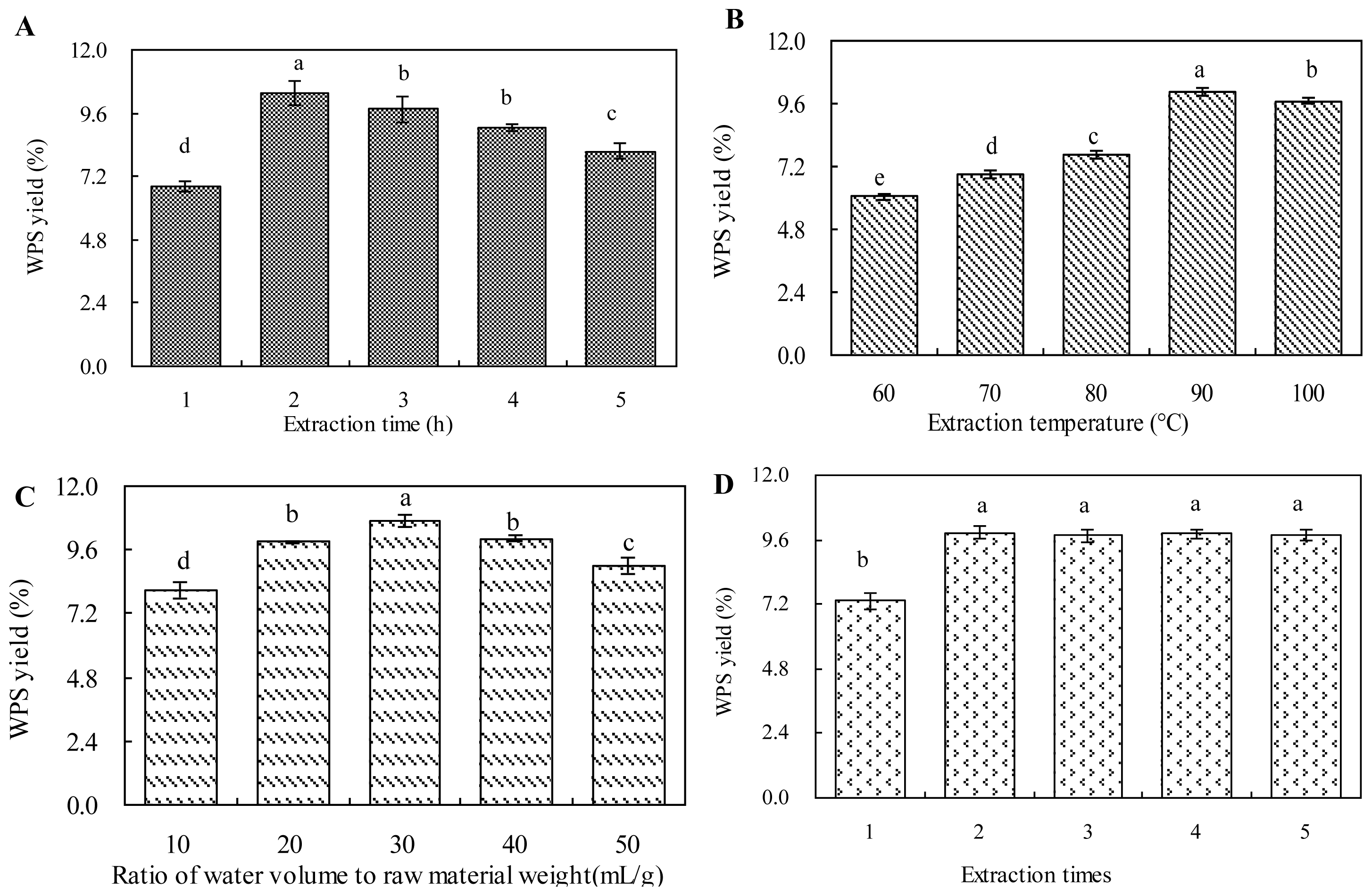
<p>Extraction time is an important parameter influencing the extraction efficiency and selectivity of the fluid [<xref ref-type="bibr" rid="b19-ijms-13-05441">19</xref>]. It has been reported that a longer extraction time presented a positive effect on the production of polysaccharide [<xref ref-type="bibr" rid="b20-ijms-13-05441">20</xref>]. In this study, extraction time was respectively set at 1, 2, 3, 4 and 5 h, while other extraction parameters were fitted as follows: extraction temperature as 90 °C, ratio of water volume (mL) to raw material weight (g) as 30 (v/w), and 2 extractions. The WPS yield increased significantly when the extraction time was prolonged from 1 to 2 h (<xref ref-type="fig" rid="f1-ijms-13-05441">Figure 1A</xref>). WPS yield achieved a maximum value (10.355%) when the extraction time was 2 h. When extraction time was longer than 2 h, WPS yield started to maintain a dynamic equilibrium with a slight decrease. This indicated that an extraction time of 2 h was sufficient to obtain WPS production. A very long extraction time may induce the degradation of polysaccharide, which would lead to changes in the polysaccharide molecular structure and a decrease in polysaccharide production [<xref ref-type="bibr" rid="b21-ijms-13-05441">21</xref>]. Therefore, 2 h was selected as the center point of the extraction time in the RSM experiment.</p></sec>
<sec>
<title>2.2. Effect of Extraction Temperature on WPS Yield</title>
<p>Extraction temperature is another factor that plays an important role in the extraction process of polysaccharide. A higher extraction temperature could increase the diffusion coefficient and solubility of the polysaccharide in the extraction solvent [<xref ref-type="bibr" rid="b22-ijms-13-05441">22</xref>,<xref ref-type="bibr" rid="b23-ijms-13-05441">23</xref>]. To investigate the effect of different temperatures on the extraction yield of WPS, the extraction process was carried out at different extraction temperatures (<italic>i.e.</italic>, 60, 70, 80, 90 and 100 °C), while other extraction parameters were set as follows: extraction time as 2 h, ratio of water volume (mL) to raw material weight (g) as 30 (v/w), and 2 extractions. As shown in <xref ref-type="fig" rid="f1-ijms-13-05441">Figure 1B</xref>, there was an increasing trend in the yield of WPS when the extraction temperature was increased from 60 to 90 °C, and the maximum WPS yield (10.028%) was observed at a temperature of 90 °C. When the extraction temperature was increased from 90 to 100 °C, the yield of WPS decreased slightly. Therefore, 90 °C was selected as the center point of the extraction temperature in the BBD experiment, as a higher temperature would destroy the structure of the polysaccharide and also increase the cost of the extraction process.</p></sec>
<sec>
<title>2.3. Effect of Ratio of Water to Raw Material on WPS Yield</title>
<p>The ratio of water volume to raw material weight would also significantly affect the yield of polysaccharide [<xref ref-type="bibr" rid="b24-ijms-13-05441">24</xref>]. In this study, the ratio of water volume (mL) to raw material weight (g) was set at 10, 20, 30, 40 and 50 (v/w) to investigate the influence of different ratios of water volume (mL) to raw material weight (g) on the yield of polysaccharide, while other extraction parameters were fitted as follows: extraction time as 2 h, extraction temperature as 90 °C and 2 extractions. As shown in <xref ref-type="fig" rid="f1-ijms-13-05441">Figure 1C</xref>, WPS yield was significantly increased from 8.052 to 10.704% as the ratio of water volume (mL) to raw material weight (g) was increased from 10 to 30 (v/w), the reason of which was that the increase of ratio of water volume (mL) to raw material weight (g) could enhance the transfer and diffusion of polysaccharide into the extraction solvent [<xref ref-type="bibr" rid="b25-ijms-13-05441">25</xref>–<xref ref-type="bibr" rid="b27-ijms-13-05441">27</xref>]. However, when the ratio of water volume (mL) to raw material weight (g) continued to increase, WPS yield no longer increased but slightly decreased. Therefore, the ratio of water volume (mL) to raw material weight (g) of 30 (v/w) was selected as the center point in the BBD experiment.</p></sec>
<sec>
<title>2.4. Effect of Extraction Times on WPS Yield</title>
<p><xref ref-type="fig" rid="f1-ijms-13-05441">Figure 1D</xref> showed the effect of the number of extractions (1–5) on WPS yield while other extraction parameters were fitted as follows: extraction time as 2 h, extraction temperature as 90 °C, and extraction ratio of water volume (mL) to raw material weight (g) as 30 (v/w). As shown in <xref ref-type="fig" rid="f1-ijms-13-05441">Figure 1D</xref>, WPS yield obviously increased when the number of extractions was increased from 1 to 2. With more than 2 extractions, WPS yield no longer changed, which demonstrated that 2 extractions was sufficient for WPS extraction. Thus, 2 extractions were used for the WPS extraction procedure in the succeeding experiments.</p></sec>
<sec sec-type="methods">
<title>2.5. Model Building and Statistical Analysis</title>
<p>On the basis of the results of single factor experiments, the three parameters: extraction time (<italic>X</italic><sub>1</sub>), extraction temperature (<italic>X</italic><sub>2</sub>) and extraction ratio of water volume to raw material weight (<italic>X</italic><sub>3</sub>) were chosen as the variables to optimize the process of polysaccharide extraction. There were a total of 17 runs performed for optimizing these three variables in the current Box-Behnken design (BBD) [<xref ref-type="bibr" rid="b28-ijms-13-05441">28</xref>]. The values of response <italic>Y</italic> (WPS yield) under the different experimental combinations are presented in <xref ref-type="table" rid="t1-ijms-13-05441">Table 1</xref>. There was a considerable variation of WPS yield depending upon the different extraction conditions. WPS yield ranged from 7.027 to 10.535%.</p>
<p>The empirical relationships between polysaccharide yield (<italic>Y</italic>) and the tested variables were obtained by application of RSM. By employing multiple regression analysis on the experimental data, the response variable (<italic>Y</italic>) and the tested variables were related by the following second-order polynomial equation (<xref rid="FD1" ref-type="disp-formula">Equation (1)</xref>):</p>
<disp-formula id="FD1">
<label>(1)</label>
<mml:math id="mm1" display="block">
<mml:semantics id="sm1">
<mml:mtable columnalign="left">
<mml:mtr>
<mml:mtd>
<mml:mi>Y</mml:mi>
<mml:mo>=</mml:mo>
<mml:mn>10.44</mml:mn>
<mml:mo>+</mml:mo>
<mml:mn>0.16</mml:mn>
<mml:mi> </mml:mi>
<mml:msub>
<mml:mrow>
<mml:mi>x</mml:mi></mml:mrow>
<mml:mn>1</mml:mn></mml:msub>
<mml:mo>+</mml:mo>
<mml:mn>1.02</mml:mn>
<mml:mi> </mml:mi>
<mml:msub>
<mml:mrow>
<mml:mi>x</mml:mi></mml:mrow>
<mml:mn>2</mml:mn></mml:msub>
<mml:mo>+</mml:mo>
<mml:mn>0.36</mml:mn>
<mml:mi> </mml:mi>
<mml:msub>
<mml:mrow>
<mml:mi>x</mml:mi></mml:mrow>
<mml:mn>3</mml:mn></mml:msub>
<mml:mo>-</mml:mo>
<mml:mn>0.45</mml:mn>
<mml:mi> </mml:mi>
<mml:msub>
<mml:mrow>
<mml:mi>x</mml:mi></mml:mrow>
<mml:mn>1</mml:mn></mml:msub>
<mml:msub>
<mml:mrow>
<mml:mi>x</mml:mi></mml:mrow>
<mml:mn>2</mml:mn></mml:msub>
<mml:mo>-</mml:mo></mml:mtd></mml:mtr>
<mml:mtr>
<mml:mtd>
<mml:mn>0.39</mml:mn>
<mml:mi> </mml:mi>
<mml:msub>
<mml:mrow>
<mml:mi>x</mml:mi></mml:mrow>
<mml:mn>1</mml:mn></mml:msub>
<mml:msub>
<mml:mrow>
<mml:mi>x</mml:mi></mml:mrow>
<mml:mn>3</mml:mn></mml:msub>
<mml:mo>-</mml:mo>
<mml:mn>0.072</mml:mn>
<mml:mi> </mml:mi>
<mml:msub>
<mml:mrow>
<mml:mi>x</mml:mi></mml:mrow>
<mml:mn>2</mml:mn></mml:msub>
<mml:msub>
<mml:mrow>
<mml:mi>x</mml:mi></mml:mrow>
<mml:mn>3</mml:mn></mml:msub>
<mml:mo>-</mml:mo>
<mml:mn>0.70</mml:mn>
<mml:msup>
<mml:mrow>
<mml:mi> </mml:mi>
<mml:msub>
<mml:mrow>
<mml:mi>x</mml:mi></mml:mrow>
<mml:mn>1</mml:mn></mml:msub></mml:mrow>
<mml:mn>2</mml:mn></mml:msup>
<mml:mo>-</mml:mo>
<mml:mn>1.12</mml:mn>
<mml:msup>
<mml:mrow>
<mml:mi> </mml:mi>
<mml:msub>
<mml:mrow>
<mml:mi>x</mml:mi></mml:mrow>
<mml:mn>2</mml:mn></mml:msub></mml:mrow>
<mml:mn>2</mml:mn></mml:msup>
<mml:mo>-</mml:mo>
<mml:mn>0.25</mml:mn>
<mml:msup>
<mml:mrow>
<mml:mi> </mml:mi>
<mml:msub>
<mml:mrow>
<mml:mi>x</mml:mi></mml:mrow>
<mml:mn>3</mml:mn></mml:msub></mml:mrow>
<mml:mn>2</mml:mn></mml:msup></mml:mtd></mml:mtr></mml:mtable></mml:semantics></mml:math></disp-formula>
<p>A summary of the analysis of variance (ANOVA) for the selected quadratic polynomial model is listed in <xref ref-type="table" rid="t2-ijms-13-05441">Table 2</xref>. The ANOVA of quadratic regression model demonstrated that the model was highly significant, evident from the Fisher’s <italic>F</italic>-test with a very high model <italic>F</italic>-value (345.32) but a very low <italic>p</italic>-value (<italic>p</italic> &lt; 0.0001). The goodness of the model can be checked by the determination coefficients (<italic>R</italic><sup>2</sup>) and the multiple correlation coefficients (<italic>R</italic>). The value of the determination coefficient adj-<italic>R</italic><sup>2</sup> (0.9949) suggested that the total variation of 99.49% for WPS yield was attributed to the independent variables and only about 0.51% of the total variation could not be explained by the model. The value of <italic>R</italic> was closer to 1, the fitness of the model was better [<xref ref-type="bibr" rid="b29-ijms-13-05441">29</xref>]. In this research, the value of <italic>R</italic> (0.9989) indicated a high degree of correlation between the observed and predicted values. The lack-of-fit measured the failure of the model to represent the data in the experimental domain at points which were not included in the regression. The <italic>F</italic>-value for the lack-of-fit was not significant (<italic>p</italic> &gt; 0.05), confirming the validity of the model.</p>
<p>The coefficient estimates of model equation, along with the corresponding <italic>p</italic>-values, are presented in <xref ref-type="table" rid="t3-ijms-13-05441">Table 3</xref>. The <italic>p</italic>-value was employed as a tool to check the significance of each coefficient, which also indicated the interactions between the variables [<xref ref-type="bibr" rid="b30-ijms-13-05441">30</xref>]. The smaller the <italic>p</italic>-value, the more significant the corresponding coefficient was [<xref ref-type="bibr" rid="b31-ijms-13-05441">31</xref>]. It was concluded from <xref ref-type="table" rid="t3-ijms-13-05441">Table 3</xref> that all regression coefficients were highly significant with <italic>p</italic>-values less than 0.01 except for the cross-product coefficient of <italic>x</italic><sub>2</sub> (extraction temperature) and <italic>x</italic><sub>3</sub> (ratio of water volume to raw material weight).</p></sec>
<sec>
<title>2.6. Response Surface Plot and Contour Plot Analyses</title>
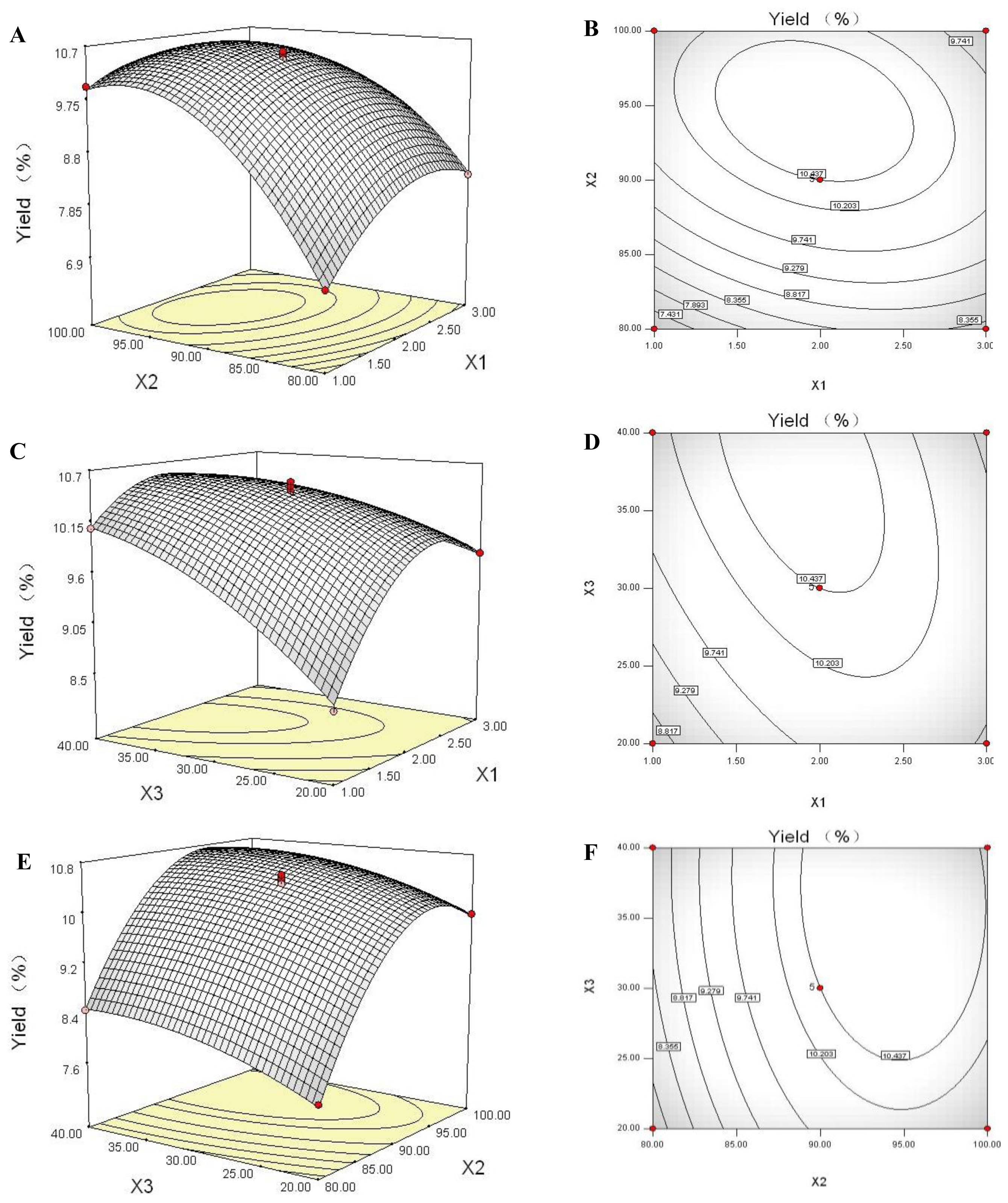
<p>Three-dimensional (3D) response surfaces and two-dimensional (2D) contour plots are the graphical representations of regression equation. They provide a method to visualize the relationship between the response and each variable, and the interactions between any two tested variables. In the present study, the 3D response surfaces and 2D contour plots are presented in <xref ref-type="fig" rid="f2-ijms-13-05441">Figure 2</xref>, which were generated employing the software of Design-Expert 7.1. Analyses of the 3D response surfaces and their respective 2D contour plots allowed us to conveniently investigate the interactions between any two variables, and locate the optimum ranges of the variables efficiently such that the response was maximized. The maximum predicted response was indicated by the surface confined in the smallest ellipse in the contour diagram. An elliptical contour would be obtained when there was an obvious interaction between any two independent variables [<xref ref-type="bibr" rid="b31-ijms-13-05441">31</xref>].</p>
<p>The response surface in <xref ref-type="fig" rid="f2-ijms-13-05441">Figure 2A</xref> and contour plot in <xref ref-type="fig" rid="f2-ijms-13-05441">Figure 2B</xref> show the effects of extraction time, extraction temperature and their interactions on WPS yield when the ratio of water volume (mL) to raw material weight (g) was fixed as 30 (v/w). A full elliptic contour was observed in <xref ref-type="fig" rid="f2-ijms-13-05441">Figure 2B</xref>, indicating a significant interaction between extraction time and extraction temperature [<xref ref-type="bibr" rid="b31-ijms-13-05441">31</xref>]. The maximum predicted value indicated by the surface was confined in the smallest ellipse in the contour diagram [<xref ref-type="bibr" rid="b32-ijms-13-05441">32</xref>]. Thus, the optimal ranges of the two tested variables for obtaining maximum WPS yield were also calculated as follows: extraction time as 1.40–2.39 h, and extraction temperature as 89.92–99.35 °C.</p>
<p>The effects of extraction time and ratio of water volume (mL) to raw material weight (g) on WPS yield at an extraction temperature of 90 °C are illustrated by response surface in <xref ref-type="fig" rid="f2-ijms-13-05441">Figure 2C</xref> and contour plot in <xref ref-type="fig" rid="f2-ijms-13-05441">Figure 2D</xref>. An increase of WPS yield was observed with increasing extraction time at first, but the trend was reversed when the extraction time reached a certain value. In the investigated range of ratio of water volume to raw material weight, WPS yield increased with an increase of ratio of water volume to raw material weight. A similar phenomenon was also observed when the extraction process of the polysaccharide from <italic>Panax japonicus</italic> was optimized by BBD experiment and RSM analysis [<xref ref-type="bibr" rid="b33-ijms-13-05441">33</xref>].</p>
<p><xref ref-type="fig" rid="f2-ijms-13-05441">Figure 2(E, F)</xref> present the effects of extraction temperature and ratio of water volume to raw material weight on WPS yield with an extraction time of 2 h. When the extraction temperature increased from 80 to 95 °C, the WPS yield exhibited a rapid increase, but above 95 °C WPS yield decreased with increasing extraction temperature. At the designed range of ratio of water volume (mL) to raw material weight (g) from 20 to 40 (v/w), an augmentation of WPS production was observed with increasing of ratio of water volume (mL) to raw material weight (g), which is in accordance with the previous studies [<xref ref-type="bibr" rid="b34-ijms-13-05441">34</xref>,<xref ref-type="bibr" rid="b35-ijms-13-05441">35</xref>].</p></sec>
<sec>
<title>2.7. Optimization of the Extraction Parameters and Validation of the Model</title>
<p>By solving the inverse matrix of the regression polynomial equation employing Design-Expert 7.1, the optimum values of the tested parameters in uncoded units were obtained as follows: extraction time as 1.71 h, extraction temperature as 94.87 °C, and ratio of water volume (mL) to raw material weight (g) as 38.85 (v/w). Under the optimum conditions, the maximum WPS yield was predicted to be 10.822%. Considering the operating convenience of the extraction process, the optimal values of variables were determined as follows: extraction time of 1.7 h, extraction temperature of 95 °C and ratio of water volume (mL) to raw material weight (g) of 39:1 (v/w).</p>
<p>To validate the suitability of the model equation for predicting the optimum response value, experimental rechecking was performed using the deduced optimal conditions. Under the determined conditions, a mean value of WPS yield of 10.862% (<italic>n</italic> = 5) was obtained from the real experiments, slightly higher than the predicted maximum value (10.822%). However, no significant difference was observed between the predicted yield and experimental one when the Student <italic>t</italic>-test was conducted, indicating that the model was satisfactory and adequate for reflecting the expected optimization.</p></sec></sec>
<sec>
<title>3. Experimental Section</title>
<sec>
<title>3.1. Cultivation of Fusarium oxysporum Dzf17</title>
<p>Endophytic fungus <italic>F. oxysporum</italic> Dzf17 was isolated from the healthy rhizomes of <italic>D. zingiberensis</italic> as reported previously [<xref ref-type="bibr" rid="b9-ijms-13-05441">9</xref>]. The mycelia of <italic>F. oxysporum</italic> Dzf17 were grown in a 1000 mL Erlenmeryer flask containing liquid medium (300 mL) consisting of glucose (50 g/L), peptone (13 g/L), NaCl (0.6 g/L), K<sub>2</sub>HPO<sub>4</sub> (0.6 g/L), and MgSO<sub>4</sub>·7H<sub>2</sub>O (0.2 g/L). All flasks were maintained on a rotary shaker at 150 rpm and 25 °C for 14 days. The mycelia were collected by filtration of fermentation broth (150 L), and washed twice with deionized water, then lyophilized.</p>
<p>The dried mycelia (600 g) were powdered in a high power disintegrator, and then subjected to heat circumfluence extraction at 50 °C by 95% ethanol-petroleum ether at 1:1 (v/v) as the refluxing solvent to remove monosaccharide, disaccharide and lipid. The ratio of mycelia powder (g) to refluxing solvent (mL) was 1:5 (w/v). Defatted mycelia powder was obtained by centrifugation (7741 × g, 20 min), and drying in an oven at 40 °C to a constant weight.</p></sec>
<sec>
<title>3.2. Extraction of WPS</title>
<p>WPS extraction was carried out by immersing dried and pretreated mycelial sample (0.5 g for each sample) in hot water at a selected temperature (60–100 °C) for various extraction time (1–5 h) with different ratios of water volume (mL) to material weight (g) from 10:1 to 50:1 (v/w) and different extraction numbers (1–5). The supernatant was collected by centrifugation (7,741 × g, 20 min) and concentrated to a volume of 1 mL. The carbohydrate content was measured spectrophotometrically by the method of anthrone-sulfuric acid [<xref ref-type="bibr" rid="b36-ijms-13-05441">36</xref>], which involved sulfuric acid hydrolysis of the sample in the presence of anthrone agent at 100 °C. The absorbance at 620 nm was measured and calibrated to carbohydrate content using glucose as a reference.</p></sec>
<sec sec-type="methods">
<title>3.3. Experimental Design</title>
<p>Single-factor experiments were carried out in order to screen out the more significant parameters for polysaccharide extraction, and to determine the proper ranges of these parameters. The factors investigated in this study included extraction time, extraction temperature, ratio of water volume to raw material weight, and extraction number. Based on the results of single-factor experiments, the parameters of extraction time, extraction temperature, and ratio of water volume to raw material weight were chosen for three-factor-three-level Box-Behnken design (BBD) in the analytical process of RSM (software Design-Expert, v.7.1; Stat-Ease, Inc.: Minneapolis, MN, USA, 2007), in order to obtain the optimum extraction conditions for the production of polysaccharide.</p>
<p><xref ref-type="table" rid="t4-ijms-13-05441">Table 4</xref> represented the coded and non-coded values of the experimental variables. The three factors chosen in this study were designated as <italic>x</italic><sub>1</sub>, <italic>x</italic><sub>2</sub>, <italic>x</italic><sub>3</sub> and prescribed into three levels, coded as +1, 0, −1 for high, intermediate and low, successively. The variable levels <italic>X</italic><sub>i</sub> were coded as <italic>x</italic><sub>i</sub> according to the following equation (<xref rid="FD2" ref-type="disp-formula">Equation (2)</xref>):</p>
<disp-formula id="FD2">
<label>(2)</label>
<mml:math id="mm2" display="block">
<mml:semantics id="sm2">
<mml:mrow>
<mml:msub>
<mml:mrow>
<mml:mi>x</mml:mi></mml:mrow>
<mml:mi>i</mml:mi></mml:msub>
<mml:mo>=</mml:mo>
<mml:mo stretchy="false">(</mml:mo>
<mml:msub>
<mml:mrow>
<mml:mi>X</mml:mi></mml:mrow>
<mml:mi>i</mml:mi></mml:msub>
<mml:mo>-</mml:mo>
<mml:msub>
<mml:mrow>
<mml:mi>X</mml:mi></mml:mrow>
<mml:mn>0</mml:mn></mml:msub>
<mml:mo stretchy="false">)</mml:mo>
<mml:mo>/</mml:mo>
<mml:mi mathvariant="normal">Δ</mml:mi>
<mml:mi>X</mml:mi></mml:mrow></mml:semantics></mml:math></disp-formula>
<p>where <italic>x</italic><sub>i</sub> is the coded value of the variable <italic>X</italic><sub>i</sub>, while <italic>X</italic><sub>0</sub> is the value of <italic>X</italic><sub>i</sub> at the center point, and Δ<italic>X</italic> is the step change of an independent variable, <italic>i</italic> = 1, 2, 3.</p>
<p>BBD in this experimental design consisted of 17 trials which were carried out in a random order in triplicate that was necessary to estimate the variability of measurements. Five replicates (for the treatments 13–17) at the center of the design were carried out to allow for estimation of a pure error sum of squares. The polysaccharide yield was recorded as the mean of triplicates, which was taken as the response value. <xref ref-type="table" rid="t1-ijms-13-05441">Table 1</xref> lists the BBD matrix of the experiment with 17 trials and the response values, which were employed to develop the model.</p>
<p>Based on the experimental data, a second-order polynomial model was established, which correlated the relationship between polysaccharide yield and extraction variables. The relationship could be expressed by the following equation (<xref rid="FD3" ref-type="disp-formula">Equation (3)</xref>):</p>
<disp-formula id="FD3">
<label>(3)</label>
<mml:math id="mm3" display="block">
<mml:semantics id="sm3">
<mml:mrow>
<mml:mi>Y</mml:mi>
<mml:mo>=</mml:mo>
<mml:msub>
<mml:mrow>
<mml:mtext>a</mml:mtext></mml:mrow>
<mml:mn>0</mml:mn></mml:msub>
<mml:mo>+</mml:mo>
<mml:msub>
<mml:mrow>
<mml:mtext>a</mml:mtext></mml:mrow>
<mml:mn>1</mml:mn></mml:msub>
<mml:msub>
<mml:mrow>
<mml:mi>x</mml:mi></mml:mrow>
<mml:mn>1</mml:mn></mml:msub>
<mml:mo>+</mml:mo>
<mml:msub>
<mml:mrow>
<mml:mtext>a</mml:mtext></mml:mrow>
<mml:mn>2</mml:mn></mml:msub>
<mml:msub>
<mml:mrow>
<mml:mi>x</mml:mi></mml:mrow>
<mml:mn>2</mml:mn></mml:msub>
<mml:mo>+</mml:mo>
<mml:msub>
<mml:mrow>
<mml:mtext>a</mml:mtext></mml:mrow>
<mml:mn>3</mml:mn></mml:msub>
<mml:msub>
<mml:mrow>
<mml:mi>x</mml:mi></mml:mrow>
<mml:mn>3</mml:mn></mml:msub>
<mml:mo>+</mml:mo>
<mml:msub>
<mml:mrow>
<mml:mtext>a</mml:mtext></mml:mrow>
<mml:mrow>
<mml:mn>12</mml:mn></mml:mrow></mml:msub>
<mml:msub>
<mml:mrow>
<mml:mi>x</mml:mi></mml:mrow>
<mml:mn>1</mml:mn></mml:msub>
<mml:msub>
<mml:mrow>
<mml:mi>x</mml:mi></mml:mrow>
<mml:mn>2</mml:mn></mml:msub>
<mml:mo>+</mml:mo>
<mml:msub>
<mml:mrow>
<mml:mtext>a</mml:mtext></mml:mrow>
<mml:mrow>
<mml:mn>13</mml:mn></mml:mrow></mml:msub>
<mml:msub>
<mml:mrow>
<mml:mi>x</mml:mi></mml:mrow>
<mml:mn>1</mml:mn></mml:msub>
<mml:msub>
<mml:mrow>
<mml:mi>x</mml:mi></mml:mrow>
<mml:mn>3</mml:mn></mml:msub>
<mml:mo>+</mml:mo>
<mml:msub>
<mml:mrow>
<mml:mtext>a</mml:mtext></mml:mrow>
<mml:mrow>
<mml:mn>23</mml:mn></mml:mrow></mml:msub>
<mml:msub>
<mml:mrow>
<mml:mi>x</mml:mi></mml:mrow>
<mml:mn>2</mml:mn></mml:msub>
<mml:msub>
<mml:mrow>
<mml:mi>x</mml:mi></mml:mrow>
<mml:mn>3</mml:mn></mml:msub>
<mml:mo>+</mml:mo>
<mml:msub>
<mml:mrow>
<mml:mtext>a</mml:mtext></mml:mrow>
<mml:mrow>
<mml:mn>11</mml:mn></mml:mrow></mml:msub>
<mml:msup>
<mml:mrow>
<mml:msub>
<mml:mrow>
<mml:mi>x</mml:mi></mml:mrow>
<mml:mn>1</mml:mn></mml:msub></mml:mrow>
<mml:mn>2</mml:mn></mml:msup>
<mml:mo>+</mml:mo>
<mml:msub>
<mml:mrow>
<mml:mtext>a</mml:mtext></mml:mrow>
<mml:mrow>
<mml:mn>22</mml:mn></mml:mrow></mml:msub>
<mml:msup>
<mml:mrow>
<mml:msub>
<mml:mrow>
<mml:mi>x</mml:mi></mml:mrow>
<mml:mn>2</mml:mn></mml:msub></mml:mrow>
<mml:mn>2</mml:mn></mml:msup>
<mml:mo>+</mml:mo>
<mml:msub>
<mml:mrow>
<mml:mtext>a</mml:mtext></mml:mrow>
<mml:mrow>
<mml:mn>33</mml:mn></mml:mrow></mml:msub>
<mml:msup>
<mml:mrow>
<mml:msub>
<mml:mrow>
<mml:mi>x</mml:mi></mml:mrow>
<mml:mn>3</mml:mn></mml:msub></mml:mrow>
<mml:mn>2</mml:mn></mml:msup></mml:mrow></mml:semantics></mml:math></disp-formula>
<p>where <italic>Y</italic> is the predicted response value; a<sub>0</sub> is the intercept term; <italic>x</italic><sub>1</sub>, <italic>x</italic><sub>2</sub> and <italic>x</italic><sub>3</sub> are independent variables; a<sub>1,</sub> a<sub>2</sub> and a<sub>3</sub> are linear coefficients; a<sub>12</sub>, a<sub>13</sub> and a<sub>23</sub> are cross product coefficients; and a<sub>11</sub>, a<sub>22</sub> and a<sub>33</sub> are the quadratic term coefficients. All of the coefficients of the second polynomial model and the responses obtained from the experimental design were subjected to multiple nonlinear regression analyses.</p>
<p>The fitness of the second-order polynomial model equation was evaluated by the coefficient (<italic>R</italic><sup>2</sup>) of determination. The analysis of variance (ANOVA) and test of significance for regression coefficients were conducted by <italic>F</italic>-test. In order to visualize the relationship between the response values and independent variables, the fitted polynomial equation was separately expressed as 3D response surfaces and 2D contour plots [<xref ref-type="bibr" rid="b37-ijms-13-05441">37</xref>,<xref ref-type="bibr" rid="b38-ijms-13-05441">38</xref>].</p></sec></sec>
<sec sec-type="conclusions">
<title>4. Conclusions</title>
<p>Based on the single-factor experiments, a Box-Behnken design combined with analysis of response surface methodology was employed to optimize the extraction process of water-extracted mycelial polysaccharide (WPS) of the endophytic fungus <italic>F. oxysporum</italic> Dzf17. The purpose was to determine the extraction parameters that may maximize WPS yield. The maximum value (10.862%) of WPS yield was obtained when the WPS extraction process was conducted under the optimal conditions which were as follows: extraction time as 1.7 h, extraction temperature as 95 °C, ratio of water volume (mL) to raw material weight (g) as 39:1 (v/w), and two extractions. The predicted WPS yield value (10.822%) by the regression polynomial equation showed no significant difference from the experimental yield (10.862%). By optimizing the extraction parameters of WPS from the cultured mycelia of the endophytic fungus <italic>F. oxysporum</italic> Dzf17, WPS yield (10.862%) was about 2-fold higher than that (<italic>ca</italic>. 5%) of the previous extraction [<xref ref-type="bibr" rid="b10-ijms-13-05441">10</xref>]. The results should be beneficial for future WPS production from the endophytic fungus <italic>F. oxysporum</italic> Dzf17 as well as for speeding up its research and application.</p></sec></body>
<back>
<ack>
<title>Acknowledgments</title>
<p>The authors wish to thank the National Basic Research Program of China (2010CB126105), Hi-Tech R &amp; D Program of China (2011AA10A202), and Natural Science Foundation of Beijing (6092015) for their financial support in this research.</p></ack>
<ref-list>
<title>References</title>
<ref id="b1-ijms-13-05441"><label>1</label><citation citation-type="journal"><person-group person-group-type="author"><name><surname>Wilson</surname><given-names>D.</given-names></name></person-group><article-title>Endophyte: The evolution of a term, and clarification of its use and definition</article-title><source>Oikos</source><year>1995</year><volume>73</volume><fpage>274</fpage><lpage>276</lpage><pub-id pub-id-type="doi">10.2307/3545919</pub-id></citation></ref>
<ref id="b2-ijms-13-05441"><label>2</label><citation citation-type="journal"><person-group person-group-type="author"><name><surname>Strobel</surname><given-names>G.A.</given-names></name></person-group><article-title>Harnessing endophytes for industrial microbiology</article-title><source>Curr. Opin. Microbiol</source><year>2006</year><volume>9</volume><fpage>240</fpage><lpage>244</lpage><pub-id pub-id-type="doi">10.1016/j.mib.2006.04.001</pub-id><pub-id pub-id-type="pmid">16647289</pub-id></citation></ref>
<ref id="b3-ijms-13-05441"><label>3</label><citation citation-type="journal"><person-group person-group-type="author"><name><surname>Gimenez</surname><given-names>C.</given-names></name><name><surname>Cabrera</surname><given-names>R.</given-names></name><name><surname>Reina</surname><given-names>M.</given-names></name><name><surname>Gonzalez-Coloma</surname><given-names>A.</given-names></name></person-group><article-title>Fungal endophytes and their role in plant protection</article-title><source>Curr. Org. Chem</source><year>2007</year><volume>11</volume><fpage>707</fpage><lpage>720</lpage><pub-id pub-id-type="doi">10.2174/138527207780598765</pub-id></citation></ref>
<ref id="b4-ijms-13-05441"><label>4</label><citation citation-type="journal"><person-group person-group-type="author"><name><surname>Li</surname><given-names>C.</given-names></name><name><surname>Gao</surname><given-names>J.</given-names></name><name><surname>Nan</surname><given-names>Z.</given-names></name></person-group><article-title>Interactions of <italic>Neotyphodium gansuense</italic>, <italic>Achnatherum inebrians</italic>, and plant-pathogenic fungi</article-title><source>Mycol. Res</source><year>2007</year><volume>111</volume><fpage>1220</fpage><lpage>1227</lpage><pub-id pub-id-type="doi">10.1016/j.mycres.2007.08.012</pub-id><pub-id pub-id-type="pmid">17988846</pub-id></citation></ref>
<ref id="b5-ijms-13-05441"><label>5</label><citation citation-type="journal"><person-group person-group-type="author"><name><surname>Berg</surname><given-names>G.</given-names></name></person-group><article-title>Plant-microbe interactions promoting plant growth and health: Perspectives for controlled use of microorganisms in agriculture</article-title><source>Appl. Microbiol. Biotechnol</source><year>2009</year><volume>84</volume><fpage>11</fpage><lpage>18</lpage><pub-id pub-id-type="doi">10.1007/s00253-009-2092-7</pub-id><pub-id pub-id-type="pmid">19568745</pub-id></citation></ref>
<ref id="b6-ijms-13-05441"><label>6</label><citation citation-type="journal"><person-group person-group-type="author"><name><surname>Kharwar</surname><given-names>R.N.</given-names></name><name><surname>Mishra</surname><given-names>A.</given-names></name><name><surname>Gond</surname><given-names>S.K.</given-names></name><name><surname>Stierle</surname><given-names>A.</given-names></name><name><surname>Stierle</surname><given-names>D.</given-names></name></person-group><article-title>Anticancer compounds derived from fungal endophytes: Their importance and future challenges</article-title><source>Nat. Prod. Rep</source><year>2011</year><volume>28</volume><fpage>1208</fpage><lpage>1228</lpage><pub-id pub-id-type="doi">10.1039/c1np00008j</pub-id><pub-id pub-id-type="pmid">21455524</pub-id></citation></ref>
<ref id="b7-ijms-13-05441"><label>7</label><citation citation-type="journal"><person-group person-group-type="author"><name><surname>Zhao</surname><given-names>J.</given-names></name><name><surname>Shan</surname><given-names>T.</given-names></name><name><surname>Mou</surname><given-names>Y.</given-names></name><name><surname>Zhou</surname><given-names>L.</given-names></name></person-group><article-title>Plant-derived bioactive compounds produced by endophytic fungi</article-title><source>Mini-Rev. Med. Chem</source><year>2011</year><volume>11</volume><fpage>159</fpage><lpage>168</lpage><pub-id pub-id-type="doi">10.2174/138955711794519492</pub-id><pub-id pub-id-type="pmid">21222580</pub-id></citation></ref>
<ref id="b8-ijms-13-05441"><label>8</label><citation citation-type="journal"><person-group person-group-type="author"><name><surname>Wang</surname><given-names>J.</given-names></name><name><surname>Zhang</surname><given-names>Z.</given-names></name><name><surname>Tan</surname><given-names>R.</given-names></name></person-group><article-title>Stimulation of artemisinin produciton in <italic>Artemisia annua</italic> hairy roots by the elicitor from the endophytic <italic>Colletotrichum</italic> sp</article-title><source>Biotechnol. Lett</source><year>2001</year><volume>23</volume><fpage>857</fpage><lpage>860</lpage><pub-id pub-id-type="doi">10.1023/A:1010535001943</pub-id></citation></ref>
<ref id="b9-ijms-13-05441"><label>9</label><citation citation-type="journal"><person-group person-group-type="author"><name><surname>Zhang</surname><given-names>R.</given-names></name><name><surname>Li</surname><given-names>P.</given-names></name><name><surname>Xu</surname><given-names>L.</given-names></name><name><surname>Chen</surname><given-names>Y.</given-names></name><name><surname>Sui</surname><given-names>P.</given-names></name><name><surname>Zhou</surname><given-names>L.</given-names></name><name><surname>Li</surname><given-names>J.</given-names></name></person-group><article-title>Enhancement of diosgenin production in <italic>Dioscorea zingiberensis</italic> cell culture by oligosaccharide elicitor from its endophytic fungus <italic>Fusarium oxysporum</italic> Dzf17</article-title><source>Nat. Prod. Commun</source><year>2009</year><volume>4</volume><fpage>1459</fpage><lpage>1462</lpage><pub-id pub-id-type="pmid">19967973</pub-id></citation></ref>
<ref id="b10-ijms-13-05441"><label>10</label><citation citation-type="journal"><person-group person-group-type="author"><name><surname>Li</surname><given-names>P.</given-names></name><name><surname>Mou</surname><given-names>Y.</given-names></name><name><surname>Shan</surname><given-names>T.</given-names></name><name><surname>Xu</surname><given-names>J.</given-names></name><name><surname>Li</surname><given-names>Y.</given-names></name><name><surname>Lu</surname><given-names>S.</given-names></name><name><surname>Zhou</surname><given-names>L.</given-names></name></person-group><article-title>Effects of polysaccharide elicitors from endophytic <italic>Fusarium oxysporium</italic> Dzf17 on the growth and diosgenin production in cell suspension culture of <italic>Dioscorea zingiberensis</italic></article-title><source>Molecules</source><year>2011</year><volume>16</volume><fpage>9003</fpage><lpage>9016</lpage><pub-id pub-id-type="doi">10.3390/molecules16119003</pub-id><pub-id pub-id-type="pmid">22031064</pub-id></citation></ref>
<ref id="b11-ijms-13-05441"><label>11</label><citation citation-type="journal"><person-group person-group-type="author"><name><surname>Li</surname><given-names>P.</given-names></name><name><surname>Mao</surname><given-names>Z.</given-names></name><name><surname>Lou</surname><given-names>J.</given-names></name><name><surname>Li</surname><given-names>Y.</given-names></name><name><surname>Mou</surname><given-names>Y.</given-names></name><name><surname>Lu</surname><given-names>S.</given-names></name><name><surname>Peng</surname><given-names>Y.</given-names></name><name><surname>Zhou</surname><given-names>L.</given-names></name></person-group><article-title>Enhancement of diosgenin production in <italic>Dioscorea zingiberensis</italic> cell cultures by oligosaccharides from its endophytic fungus <italic>Fusarium oxysporum</italic> Dzf17</article-title><source>Molecules</source><year>2011</year><volume>16</volume><fpage>10631</fpage><lpage>10644</lpage><pub-id pub-id-type="doi">10.3390/molecules161210631</pub-id><pub-id pub-id-type="pmid">22183887</pub-id></citation></ref>
<ref id="b12-ijms-13-05441"><label>12</label><citation citation-type="journal"><person-group person-group-type="author"><name><surname>Li</surname><given-names>N.</given-names></name><name><surname>Ni</surname><given-names>J.</given-names></name></person-group><article-title>Treatment of wastewater from <italic>Dioscorea zingiberensis</italic> tubes used for producing steroid hormones in a microbial fuel cell</article-title><source>Bioresour. Technol</source><year>2011</year><volume>102</volume><fpage>2731</fpage><lpage>2735</lpage><pub-id pub-id-type="doi">10.1016/j.biortech.2010.11.030</pub-id><pub-id pub-id-type="pmid">21129952</pub-id></citation></ref>
<ref id="b13-ijms-13-05441"><label>13</label><citation citation-type="journal"><person-group person-group-type="author"><name><surname>Liu</surname><given-names>W.</given-names></name><name><surname>Huang</surname><given-names>W.</given-names></name><name><surname>Sun</surname><given-names>W.L.</given-names></name><name><surname>Zhu</surname><given-names>Y.L.</given-names></name><name><surname>Ni</surname><given-names>J.R.</given-names></name></person-group><article-title>Production of diosgenin from yellow ginger (<italic>Dioscorea zingiberensis</italic> C. H. Wright) saponins by commercial cellulase</article-title><source>World J. Microbiol. Biotechnol</source><year>2010</year><volume>26</volume><fpage>1171</fpage><lpage>1180</lpage><pub-id pub-id-type="doi">10.1007/s11274-009-0285-y</pub-id></citation></ref>
<ref id="b14-ijms-13-05441"><label>14</label><citation citation-type="journal"><person-group person-group-type="author"><name><surname>Li</surname><given-names>P.</given-names></name><name><surname>Luo</surname><given-names>C.</given-names></name><name><surname>Sun</surname><given-names>W.</given-names></name><name><surname>Lu</surname><given-names>S.</given-names></name><name><surname>Mou</surname><given-names>Y.</given-names></name><name><surname>Peng</surname><given-names>Y.</given-names></name><name><surname>Zhou</surname><given-names>L.</given-names></name></person-group><article-title><italic>In vitro</italic> antioxidant activities of polysaccharides from endophytic fungus <italic>Fusarium oxysporum</italic> Dzf17</article-title><source>Afr. J. Microbiol. Res</source><year>2011</year><volume>5</volume><fpage>5990</fpage><lpage>5993</lpage></citation></ref>
<ref id="b15-ijms-13-05441"><label>15</label><citation citation-type="journal"><person-group person-group-type="author"><name><surname>Bezerra</surname><given-names>M.A.</given-names></name><name><surname>Santelli</surname><given-names>R.E.</given-names></name><name><surname>Oliveira</surname><given-names>E.P.</given-names></name><name><surname>Villar</surname><given-names>L.S.</given-names></name><name><surname>Escaleira</surname><given-names>L.A.</given-names></name></person-group><article-title>Response surface methodology (RSM) as a tool for optimization in analytical chemistry</article-title><source>Talanta</source><year>2008</year><volume>76</volume><fpage>965</fpage><lpage>977</lpage><pub-id pub-id-type="doi">10.1016/j.talanta.2008.05.019</pub-id><pub-id pub-id-type="pmid">18761143</pub-id></citation></ref>
<ref id="b16-ijms-13-05441"><label>16</label><citation citation-type="journal"><person-group person-group-type="author"><name><surname>Dahiya</surname><given-names>S.</given-names></name><name><surname>Singh</surname><given-names>N.</given-names></name><name><surname>Rana</surname><given-names>J.S.</given-names></name></person-group><article-title>Optimization of growth parameters of phytase producing fungus using RSM</article-title><source>J. Sci. Ind. Res</source><year>2009</year><volume>68</volume><fpage>955</fpage><lpage>959</lpage></citation></ref>
<ref id="b17-ijms-13-05441"><label>17</label><citation citation-type="journal"><person-group person-group-type="author"><name><surname>Ferreira</surname><given-names>S.L.C.</given-names></name><name><surname>Bruns</surname><given-names>R.E.</given-names></name><name><surname>Ferreira</surname><given-names>H.S.</given-names></name><name><surname>Matos</surname><given-names>G.D.</given-names></name><name><surname>David</surname><given-names>J.M.</given-names></name><name><surname>Brandao</surname><given-names>G.C.</given-names></name><name><surname>da Silva</surname><given-names>E.G.P.</given-names></name><name><surname>Portugal</surname><given-names>L.A.</given-names></name><name><surname>dos Reis</surname><given-names>P.S.</given-names></name><name><surname>Souza</surname><given-names>A.S.</given-names></name><etal/></person-group><article-title>Box-Behnken design: An alternative for the optimization of analytical methods</article-title><source>Anal. Chim. Acta</source><year>2007</year><volume>597</volume><fpage>179</fpage><lpage>186</lpage><pub-id pub-id-type="doi">10.1016/j.aca.2007.07.011</pub-id><pub-id pub-id-type="pmid">17683728</pub-id></citation></ref>
<ref id="b18-ijms-13-05441"><label>18</label><citation citation-type="journal"><person-group person-group-type="author"><name><surname>Dong</surname><given-names>C.-H.</given-names></name><name><surname>Xie</surname><given-names>X.-Q.</given-names></name><name><surname>Wang</surname><given-names>X.-L.</given-names></name><name><surname>Zhan</surname><given-names>Y.</given-names></name><name><surname>Yao</surname><given-names>Y.-J.</given-names></name></person-group><article-title>Application of Box-Behnken design in optimisation for polysaccharides extraction from cultured mycelium of <italic>Cordyceps sinensis</italic></article-title><source>Food Bioprod. Process</source><year>2009</year><volume>87</volume><fpage>139</fpage><lpage>144</lpage><pub-id pub-id-type="doi">10.1016/j.fbp.2008.06.004</pub-id></citation></ref>
<ref id="b19-ijms-13-05441"><label>19</label><citation citation-type="journal"><person-group person-group-type="author"><name><surname>Renjie</surname><given-names>L.</given-names></name></person-group><article-title>Optimization of extraction process of <italic>Glycyrrhiza glabra</italic> polysaccharides by response surface methodology</article-title><source>Carbohydr. Polym</source><year>2008</year><volume>74</volume><fpage>858</fpage><lpage>861</lpage><pub-id pub-id-type="doi">10.1016/j.carbpol.2008.05.005</pub-id></citation></ref>
<ref id="b20-ijms-13-05441"><label>20</label><citation citation-type="journal"><person-group person-group-type="author"><name><surname>Zhongdong</surname><given-names>L.</given-names></name><name><surname>Guohua</surname><given-names>W.</given-names></name><name><surname>Yunchang</surname><given-names>G.</given-names></name><name><surname>Kennedy</surname><given-names>J.F.</given-names></name></person-group><article-title>Image study of pectin extraction from orange skin assisted by microwave</article-title><source>Carbohydr. Polym</source><year>2006</year><volume>64</volume><fpage>548</fpage><lpage>552</lpage><pub-id pub-id-type="doi">10.1016/j.carbpol.2005.11.006</pub-id></citation></ref>
<ref id="b21-ijms-13-05441"><label>21</label><citation citation-type="journal"><person-group person-group-type="author"><name><surname>Cai</surname><given-names>W.</given-names></name><name><surname>Gu</surname><given-names>X.</given-names></name><name><surname>Tang</surname><given-names>J.</given-names></name></person-group><article-title>Extraction, purification, and characterization of the polysaccharides from <italic>Opuntia milpa</italic> Alta</article-title><source>Carbohydr. Polym</source><year>2008</year><volume>71</volume><fpage>403</fpage><lpage>410</lpage><pub-id pub-id-type="doi">10.1016/j.carbpol.2007.06.008</pub-id></citation></ref>
<ref id="b22-ijms-13-05441"><label>22</label><citation citation-type="journal"><person-group person-group-type="author"><name><surname>Oosterveld</surname><given-names>A.</given-names></name><name><surname>Beldman</surname><given-names>G.</given-names></name><name><surname>Schols</surname><given-names>H.A.</given-names></name><name><surname>Voragen</surname><given-names>A.G.J.</given-names></name></person-group><article-title>Arabinose and ferulic acid rich pectic polysaccharides extracted from sugar beet pulp</article-title><source>Carbohydr. Res</source><year>1996</year><volume>288</volume><fpage>143</fpage><lpage>153</lpage></citation></ref>
<ref id="b23-ijms-13-05441"><label>23</label><citation citation-type="journal"><person-group person-group-type="author"><name><surname>Vinogradov</surname><given-names>E.V.</given-names></name><name><surname>Brade</surname><given-names>L.</given-names></name><name><surname>Brade</surname><given-names>H.</given-names></name><name><surname>Holst</surname><given-names>O.</given-names></name></person-group><article-title>Structural and serological characterization of the <italic>O</italic>-antigenic polysaccharide of the lipopolysaccharide from <italic>Acinetobacter baumannii</italic> strain 24</article-title><source>Carbohydr. Res</source><year>2003</year><volume>338</volume><fpage>2751</fpage><lpage>2756</lpage><pub-id pub-id-type="doi">10.1016/j.carres.2003.05.001</pub-id><pub-id pub-id-type="pmid">14670733</pub-id></citation></ref>
<ref id="b24-ijms-13-05441"><label>24</label><citation citation-type="journal"><person-group person-group-type="author"><name><surname>Govender</surname><given-names>S.</given-names></name><name><surname>Pillay</surname><given-names>V.</given-names></name><name><surname>Chetty</surname><given-names>D.J.</given-names></name><name><surname>Essack</surname><given-names>S.Y.</given-names></name><name><surname>Dangor</surname><given-names>C.M.</given-names></name><name><surname>Govender</surname><given-names>T.</given-names></name></person-group><article-title>Optimisation and characterisation of bioadhesive controlled release tetracycline microspheres</article-title><source>Int. J. Pharmaceut</source><year>2005</year><volume>306</volume><fpage>24</fpage><lpage>40</lpage><pub-id pub-id-type="doi">10.1016/j.ijpharm.2005.07.026</pub-id></citation></ref>
<ref id="b25-ijms-13-05441"><label>25</label><citation citation-type="journal"><person-group person-group-type="author"><name><surname>Volpi</surname><given-names>N.</given-names></name></person-group><article-title>Application of high-performance capillary electrophoresis to the purification process of <italic>Escherichia coli</italic> K4 polysaccharide</article-title><source>J. Chromatogr. B</source><year>2004</year><volume>811</volume><fpage>253</fpage><lpage>256</lpage></citation></ref>
<ref id="b26-ijms-13-05441"><label>26</label><citation citation-type="journal"><person-group person-group-type="author"><name><surname>Ray</surname><given-names>B.</given-names></name></person-group><article-title>Polysaccharides from <italic>Enteromorpha compressa</italic>: Isolation, purification and structural features</article-title><source>Carbohydr. Polym</source><year>2006</year><volume>66</volume><fpage>408</fpage><lpage>416</lpage><pub-id pub-id-type="doi">10.1016/j.carbpol.2006.03.027</pub-id></citation></ref>
<ref id="b27-ijms-13-05441"><label>27</label><citation citation-type="journal"><person-group person-group-type="author"><name><surname>Bendahou</surname><given-names>A.</given-names></name><name><surname>Dufresne</surname><given-names>A.</given-names></name><name><surname>Kaddami</surname><given-names>H.</given-names></name><name><surname>Habibi</surname><given-names>Y.</given-names></name></person-group><article-title>Isolation and structural characterization of hemicellulose from palm of <italic>Phoenix dactylifera</italic> L</article-title><source>Carbohydr. Polym</source><year>2007</year><volume>68</volume><fpage>601</fpage><lpage>608</lpage><pub-id pub-id-type="doi">10.1016/j.carbpol.2006.10.016</pub-id></citation></ref>
<ref id="b28-ijms-13-05441"><label>28</label><citation citation-type="book"><person-group person-group-type="author"><name><surname>Box</surname><given-names>G.E.P.</given-names></name><name><surname>Hunter</surname><given-names>W.G.</given-names></name><name><surname>Hunter</surname><given-names>J.S.</given-names></name></person-group><source>Statistics for Experimenters</source><publisher-name>John Wiley &amp; Sons, Inc</publisher-name><publisher-loc>Hoboken, NJ, USA</publisher-loc><year>1978</year><fpage>510</fpage><lpage>539</lpage></citation></ref>
<ref id="b29-ijms-13-05441"><label>29</label><citation citation-type="journal"><person-group person-group-type="author"><name><surname>Pujari</surname><given-names>V.</given-names></name><name><surname>Chandra</surname><given-names>T.S.</given-names></name></person-group><article-title>Statistical optimization of medium components for enhanced riboflavin production by a UV-mutant of <italic>Eremothecium ashbyii</italic></article-title><source>Process Biochem</source><year>2000</year><volume>36</volume><fpage>31</fpage><lpage>37</lpage><pub-id pub-id-type="doi">10.1016/S0032-9592(00)00173-4</pub-id></citation></ref>
<ref id="b30-ijms-13-05441"><label>30</label><citation citation-type="journal"><person-group person-group-type="author"><name><surname>Liu</surname><given-names>J.-Z.</given-names></name><name><surname>Weng</surname><given-names>L.-P.</given-names></name><name><surname>Zhang</surname><given-names>Q.-L.</given-names></name><name><surname>Xu</surname><given-names>H.</given-names></name><name><surname>Ji</surname><given-names>L.-N.</given-names></name></person-group><article-title>Optimization of glucose oxidase production by <italic>Aspergillus niger</italic> in a benchtop bioreactor using response surface methodology</article-title><source>World J. Microbiol. Biotechnol</source><year>2003</year><volume>19</volume><fpage>317</fpage><lpage>323</lpage><pub-id pub-id-type="doi">10.1023/A:1023622925933</pub-id></citation></ref>
<ref id="b31-ijms-13-05441"><label>31</label><citation citation-type="journal"><person-group person-group-type="author"><name><surname>Muralidhar</surname><given-names>R.V.</given-names></name><name><surname>Chirumamila</surname><given-names>R.R.</given-names></name><name><surname>Marchant</surname><given-names>R.</given-names></name><name><surname>Nigam</surname><given-names>P.</given-names></name></person-group><article-title>A response surface approach for the comparison of lipase production by <italic>Candida cylindracea</italic> using two different carbon sources</article-title><source>Biochem. Eng. J</source><year>2001</year><volume>9</volume><fpage>17</fpage><lpage>23</lpage><pub-id pub-id-type="doi">10.1016/S1369-703X(01)00117-6</pub-id></citation></ref>
<ref id="b32-ijms-13-05441"><label>32</label><citation citation-type="journal"><person-group person-group-type="author"><name><surname>Wang</surname><given-names>R.</given-names></name><name><surname>Chen</surname><given-names>P.</given-names></name><name><surname>Jia</surname><given-names>F.</given-names></name><name><surname>Tang</surname><given-names>J.</given-names></name><name><surname>Ma</surname><given-names>F.</given-names></name></person-group><article-title>Optimization of polysaccharides from <italic>Panax japonicus</italic> C.A. Meyer by RSM and its anti-oxidant activity</article-title><source>Int. J. Biol. Macromol</source><year>2012</year><volume>50</volume><fpage>331</fpage><lpage>336</lpage><pub-id pub-id-type="doi">10.1016/j.ijbiomac.2011.12.023</pub-id><pub-id pub-id-type="pmid">22214823</pub-id></citation></ref>
<ref id="b33-ijms-13-05441"><label>33</label><citation citation-type="journal"><person-group person-group-type="author"><name><surname>Liu</surname><given-names>J.</given-names></name><name><surname>Miao</surname><given-names>S.</given-names></name><name><surname>Wen</surname><given-names>X.</given-names></name><name><surname>Sun</surname><given-names>Y.</given-names></name></person-group><article-title>Optimization of polysaccharides (ABP) extraction from the fruiting bodies of <italic>Agaricus blazei</italic> Murill using response surface methodology (RSM)</article-title><source>Carbohydr. Polym</source><year>2009</year><volume>78</volume><fpage>704</fpage><lpage>709</lpage><pub-id pub-id-type="doi">10.1016/j.carbpol.2009.06.003</pub-id></citation></ref>
<ref id="b34-ijms-13-05441"><label>34</label><citation citation-type="journal"><person-group person-group-type="author"><name><surname>Yin</surname><given-names>G.</given-names></name><name><surname>Dang</surname><given-names>Y.</given-names></name></person-group><article-title>Optimization of extraction technology of the <italic>Lycium barbarum</italic> polysaccharides by Box-Behnken statistical design</article-title><source>Carbohydr. Polym</source><year>2008</year><volume>74</volume><fpage>603</fpage><lpage>610</lpage><pub-id pub-id-type="doi">10.1016/j.carbpol.2008.04.025</pub-id></citation></ref>
<ref id="b35-ijms-13-05441"><label>35</label><citation citation-type="journal"><person-group person-group-type="author"><name><surname>Ye</surname><given-names>C.</given-names></name><name><surname>Jiang</surname><given-names>C.</given-names></name></person-group><article-title>Optimization of extraction process of crude polysaccharides from <italic>Plantago asiatica</italic> L. by response surface methodology</article-title><source>Carbohydr. Polym</source><year>2011</year><volume>84</volume><fpage>495</fpage><lpage>502</lpage><pub-id pub-id-type="doi">10.1016/j.carbpol.2010.12.014</pub-id></citation></ref>
<ref id="b36-ijms-13-05441"><label>36</label><citation citation-type="journal"><person-group person-group-type="author"><name><surname>Wang</surname><given-names>Z.J.</given-names></name><name><surname>Luo</surname><given-names>D.H.</given-names></name><name><surname>Ena</surname><given-names>C.</given-names></name></person-group><article-title>Optimization of polysaccharides extraction from <italic>Gynostemma pentaphyllum</italic> Makino using uniform design</article-title><source>Carbohydr. Polym</source><year>2007</year><volume>69</volume><fpage>311</fpage><lpage>317</lpage><pub-id pub-id-type="doi">10.1016/j.carbpol.2006.10.013</pub-id></citation></ref>
<ref id="b37-ijms-13-05441"><label>37</label><citation citation-type="journal"><person-group person-group-type="author"><name><surname>Triveni</surname><given-names>R.</given-names></name><name><surname>Shamala</surname><given-names>T.R.</given-names></name><name><surname>Rastogi</surname><given-names>N.K.</given-names></name></person-group><article-title>Optimized production and utilization of exopolysaccharide from <italic>Agrobacterium radiobacter</italic></article-title><source>Process Biochem</source><year>2001</year><volume>36</volume><fpage>787</fpage><lpage>795</lpage><pub-id pub-id-type="doi">10.1016/S0032-9592(00)00279-X</pub-id></citation></ref>
<ref id="b38-ijms-13-05441"><label>38</label><citation citation-type="journal"><person-group person-group-type="author"><name><surname>Soto-Cruz</surname><given-names>O.</given-names></name><name><surname>Saucedo-Castaneda</surname><given-names>G.</given-names></name><name><surname>Pablos-Hach</surname><given-names>J.L.</given-names></name><name><surname>Gutierrez-Rojas</surname><given-names>M.</given-names></name><name><surname>Favela-Torres</surname><given-names>E.</given-names></name></person-group><article-title>Effect of substrate composition on the mycelial growth of <italic>Pleurotus ostreatus</italic>. An analysis by mixture and response surface methodologies</article-title><source>Process Biochem</source><year>1999</year><volume>35</volume><fpage>127</fpage><lpage>133</lpage><pub-id pub-id-type="doi">10.1016/S0032-9592(99)00043-6</pub-id></citation></ref></ref-list>
<sec sec-type="display-objects">
<title>Figures and Tables</title>
<fig id="f1-ijms-13-05441" position="float">
<label>Figure 1</label>
<caption>
<p>Effects of extraction time (<bold>A</bold>), extraction temperature (<bold>B</bold>), ratio of water volume (mL) to raw material weight (g) (<bold>C</bold>), and number of extractions (<bold>D</bold>) on water-extracted mycelial polysaccharide (WPS) yield. The error bars represent standard deviations from three independent samples. Different letters indicate significant differences among the treatments at <italic>p</italic> = 0.05 level.</p></caption>
<graphic xlink:href="ijms-13-05441f1.gif"/></fig>
<fig id="f2-ijms-13-05441" position="float">
<label>Figure 2</label>
<caption>
<p>Three-dimensional response surfaces (<bold>A</bold>, <bold>C</bold> and <bold>E</bold>) and contour plots (<bold>B</bold>, <bold>D</bold> and <bold>F</bold>), showing the effects of extraction time (<italic>X</italic><sub>1</sub>), extraction temperature (<italic>X</italic><sub>2</sub>), and ratio of water volume (mL) to raw material weight (g) (<italic>X</italic><sub>3</sub>), and the effect of their their reciprocal interaction on WPS yield (<italic>Y</italic>).</p></caption>
<graphic xlink:href="ijms-13-05441f2.gif"/></fig>
<table-wrap id="t1-ijms-13-05441" position="float">
<label>Table 1</label>
<caption>
<p>Box-Behnken design (BBD) matrix and the response values for water-extracted mycelial polysaccharide (WPS) yield.</p></caption>
<table frame="hsides" rules="groups">
<thead>
<tr>
<th align="center" valign="middle" rowspan="3">Run</th>
<th align="center" valign="middle" rowspan="3"><italic>x</italic><sub>1</sub></th>
<th align="center" valign="middle" rowspan="3"><italic>x</italic><sub>2</sub></th>
<th align="center" valign="middle" rowspan="3"><italic>x</italic><sub>3</sub></th>
<th colspan="3" align="center" valign="bottom">WPS Yield (%)</th></tr>
<tr>
<th colspan="3" align="left" valign="bottom">
<hr/></th></tr>
<tr>
<th align="center" valign="bottom">Experimental <italic>Y</italic><sub>e</sub></th>
<th align="center" valign="bottom">Predicted <italic>Y</italic></th>
<th align="center" valign="bottom"><italic>Y</italic><sub>e</sub> – <italic>Y</italic></th></tr></thead>
<tbody>
<tr>
<td align="center" valign="top">1</td>
<td align="center" valign="top">−1</td>
<td align="center" valign="top">0</td>
<td align="center" valign="top">8.162</td>
<td align="center" valign="top">8.207</td>
<td align="center" valign="top">−0.045</td></tr>
<tr>
<td align="center" valign="top">2</td>
<td align="center" valign="top">0</td>
<td align="center" valign="top">−1</td>
<td align="center" valign="top">7.649</td>
<td align="center" valign="top">7.615</td>
<td align="center" valign="top">0.034</td></tr>
<tr>
<td align="center" valign="top">3</td>
<td align="center" valign="top">−1</td>
<td align="center" valign="top">0</td>
<td align="center" valign="top">7.027</td>
<td align="center" valign="top">6.933</td>
<td align="center" valign="top">0.094</td></tr>
<tr>
<td align="center" valign="top">4</td>
<td align="center" valign="top">1</td>
<td align="center" valign="top">0</td>
<td align="center" valign="top">9.318</td>
<td align="center" valign="top">9.352</td>
<td align="center" valign="top">−0.034</td></tr>
<tr>
<td align="center" valign="top">5</td>
<td align="center" valign="top">0</td>
<td align="center" valign="top">1</td>
<td align="center" valign="top">−1</td>
<td align="center" valign="top">9.826</td>
<td align="center" valign="top">9.803</td>
<td align="center" valign="top">0.023</td></tr>
<tr>
<td align="center" valign="top">6</td>
<td align="center" valign="top">−1</td>
<td align="center" valign="top">0</td>
<td align="center" valign="top">−1</td>
<td align="center" valign="top">8.511</td>
<td align="center" valign="top">8.579</td>
<td align="center" valign="top">−0.068</td></tr>
<tr>
<td align="center" valign="top">7</td>
<td align="center" valign="top">1</td>
<td align="center" valign="top">0</td>
<td align="center" valign="top">−1</td>
<td align="center" valign="top">9.695</td>
<td align="center" valign="top">9.684</td>
<td align="center" valign="top">0.011</td></tr>
<tr>
<td align="center" valign="top">8</td>
<td align="center" valign="top">1</td>
<td align="center" valign="top">0</td>
<td align="center" valign="top">1</td>
<td align="center" valign="top">9.684</td>
<td align="center" valign="top">9.616</td>
<td align="center" valign="top">0.068</td></tr>
<tr>
<td align="center" valign="top">9</td>
<td align="center" valign="top">−1</td>
<td align="center" valign="top">1</td>
<td align="center" valign="top">0</td>
<td align="center" valign="top">9.978</td>
<td align="center" valign="top">9.933</td>
<td align="center" valign="top">0.045</td></tr>
<tr>
<td align="center" valign="top">10</td>
<td align="center" valign="top">−1</td>
<td align="center" valign="top">0</td>
<td align="center" valign="top">1</td>
<td align="center" valign="top">10.077</td>
<td align="center" valign="top">10.088</td>
<td align="center" valign="top">−0.011</td></tr>
<tr>
<td align="center" valign="top">11</td>
<td align="center" valign="top">0</td>
<td align="center" valign="top">1</td>
<td align="center" valign="top">10.344</td>
<td align="center" valign="top">10.378</td>
<td align="center" valign="top">−0.034</td></tr>
<tr>
<td align="center" valign="top">12</td>
<td align="center" valign="top">0</td>
<td align="center" valign="top">−1</td>
<td align="center" valign="top">1</td>
<td align="center" valign="top">8.456</td>
<td align="center" valign="top">8.480</td>
<td align="center" valign="top">−0.024</td></tr>
<tr>
<td align="center" valign="top">13</td>
<td align="center" valign="top">0</td>
<td align="center" valign="top">10.437</td>
<td align="center" valign="top">0.000</td></tr>
<tr>
<td align="center" valign="top">14</td>
<td align="center" valign="top">0</td>
<td align="center" valign="top">10.535</td>
<td align="center" valign="top">10.437</td>
<td align="center" valign="top">0.098</td></tr>
<tr>
<td align="center" valign="top">15</td>
<td align="center" valign="top">0</td>
<td align="center" valign="top">10.339</td>
<td align="center" valign="top">10.437</td>
<td align="center" valign="top">−0.098</td></tr>
<tr>
<td align="center" valign="top">16</td>
<td align="center" valign="top">0</td>
<td align="center" valign="top">10.388</td>
<td align="center" valign="top">10.437</td>
<td align="center" valign="top">−0.049</td></tr>
<tr>
<td align="center" valign="top">17</td>
<td align="center" valign="top">0</td>
<td align="center" valign="top">10.486</td>
<td align="center" valign="top">10.437</td>
<td align="center" valign="top">0.049</td></tr></tbody></table></table-wrap>
<table-wrap id="t2-ijms-13-05441" position="float">
<label>Table 2</label>
<caption>
<p>Analysis of variance (ANOVA) for the fitted quadratic polynomial model for optimization of WPS yield.</p></caption>
<table frame="hsides" rules="groups">
<thead>
<tr>
<th align="center" valign="top">Source</th>
<th align="center" valign="top">Sum of Squares</th>
<th align="center" valign="top">d.f.</th>
<th align="center" valign="top">Mean Square</th>
<th align="center" valign="top"><italic>F</italic>-Value</th>
<th align="center" valign="top">Probability (<italic>p</italic>) &gt; <italic>F</italic></th></tr></thead>
<tbody>
<tr>
<td align="center" valign="top">Model</td>
<td align="center" valign="top">19.24</td>
<td align="center" valign="top">9</td>
<td align="center" valign="top">2.14</td>
<td align="center" valign="top">345.32</td>
<td align="center" valign="top">&lt;0.0001</td></tr>
<tr>
<td align="center" valign="top">Lack of fit</td>
<td align="center" valign="top">0.019</td>
<td align="center" valign="top">3</td>
<td align="center" valign="top">6.44 × 10<sup>−3</sup></td>
<td align="center" valign="top">1.07</td>
<td align="center" valign="top">0.4549</td></tr>
<tr>
<td align="center" valign="top">Pure error</td>
<td align="center" valign="top">0.024</td>
<td align="center" valign="top">4</td>
<td align="center" valign="top">6.00 × 10<sup>−3</sup></td>
<td align="center" valign="top"/>
<td align="center" valign="top"/></tr>
<tr>
<td align="center" valign="top">Corrected total</td>
<td align="center" valign="top">19.28</td>
<td align="center" valign="top">16</td>
<td align="center" valign="top"/>
<td align="center" valign="top"/></tr>
<tr>
<td align="center" valign="top"/>
<td align="center" valign="top"><italic>R</italic><sup>2</sup> = 0.9978</td>
<td align="center" valign="top"><italic>R</italic><italic><sup>2</sup></italic> <sub>adj</sub> = 0.9949</td>
<td align="center" valign="top">CV (%) = 0.83</td>
<td align="center" valign="top"/>
<td align="center" valign="top"/></tr></tbody></table></table-wrap>
<table-wrap id="t3-ijms-13-05441" position="float">
<label>Table 3</label>
<caption>
<p>Regression coefficient estimates and their significance test of quadratic polynomial model.</p></caption>
<table frame="hsides" rules="groups">
<thead>
<tr>
<th align="left" valign="top">Model Term</th>
<th align="left" valign="top">Coefficient Estimate</th>
<th align="left" valign="top">Standard Error</th>
<th align="left" valign="top">Sum of Squares</th>
<th align="left" valign="top">Mean Square</th>
<th align="left" valign="top"><italic>F</italic>-Value</th>
<th align="left" valign="top">Probability (<italic>p</italic>) &gt; <italic>F</italic></th></tr></thead>
<tbody>
<tr>
<td align="left" valign="top">Intercept</td>
<td align="left" valign="top">10.44</td>
<td align="left" valign="top">0.035</td>
<td align="left" valign="top"/>
<td align="left" valign="top"/></tr>
<tr>
<td align="left" valign="top"><italic>x</italic><sub>1</sub></td>
<td align="left" valign="top">0.16</td>
<td align="left" valign="top">0.028</td>
<td align="left" valign="top">0.20</td>
<td align="left" valign="top">32.37</td>
<td align="left" valign="top">0.0007</td></tr>
<tr>
<td align="left" valign="top"><italic>x</italic><sub>2</sub></td>
<td align="left" valign="top">1.02</td>
<td align="left" valign="top">0.028</td>
<td align="left" valign="top">8.35</td>
<td align="left" valign="top">1348.73</td>
<td align="left" valign="top">&lt;0.0001</td></tr>
<tr>
<td align="left" valign="top"><italic>x</italic><sub>3</sub></td>
<td align="left" valign="top">0.36</td>
<td align="left" valign="top">0.360</td>
<td align="left" valign="top">1.04</td>
<td align="left" valign="top">167.52</td>
<td align="left" valign="top">&lt;0.0001</td></tr>
<tr>
<td align="left" valign="top"><italic>x</italic><sub>1</sub><italic>x</italic><sub>2</sub></td>
<td align="left" valign="top">−0.45</td>
<td align="left" valign="top">0.039</td>
<td align="left" valign="top">0.81</td>
<td align="left" valign="top">130.15</td>
<td align="left" valign="top">&lt;0.0001</td></tr>
<tr>
<td align="left" valign="top"><italic>x</italic><sub>1</sub><italic>x</italic><sub>3</sub></td>
<td align="left" valign="top">−0.39</td>
<td align="left" valign="top">0.039</td>
<td align="left" valign="top">0.62</td>
<td align="left" valign="top">100.45</td>
<td align="left" valign="top">&lt;0.0001</td></tr>
<tr>
<td align="left" valign="top"><italic>x</italic><sub>2</sub><italic>x</italic><sub>3</sub></td>
<td align="left" valign="top">−0.07</td>
<td align="left" valign="top">0.039</td>
<td align="left" valign="top">0.02</td>
<td align="left" valign="top">3.37</td>
<td align="left" valign="top">0.1089</td></tr>
<tr>
<td align="left" valign="top"><italic>x</italic><sub>1</sub> <sup>2</sup></td>
<td align="left" valign="top">−0.70</td>
<td align="left" valign="top">0.038</td>
<td align="left" valign="top">2.04</td>
<td align="left" valign="top">329.90</td>
<td align="left" valign="top">&lt;0.0001</td></tr>
<tr>
<td align="left" valign="top"><italic>x</italic><sub>2</sub> <sup>2</sup></td>
<td align="left" valign="top">−1.12</td>
<td align="left" valign="top">0.038</td>
<td align="left" valign="top">5.28</td>
<td align="left" valign="top">852.41</td>
<td align="left" valign="top">&lt;0.0001</td></tr>
<tr>
<td align="left" valign="top"><italic>x</italic><sub>3</sub> <sup>2</sup></td>
<td align="left" valign="top">−0.25</td>
<td align="left" valign="top">0.038</td>
<td align="left" valign="top">0.26</td>
<td align="left" valign="top">42.14</td>
<td align="left" valign="top">0.0003</td></tr></tbody></table></table-wrap>
<table-wrap id="t4-ijms-13-05441" position="float">
<label>Table 4</label>
<caption>
<p>Coded and uncoded values of the experimental variables.</p></caption>
<table frame="hsides" rules="groups">
<thead>
<tr>
<th align="left" valign="top">Variable</th>
<th colspan="2" align="center" valign="top">Symbol</th>
<th colspan="3" align="center" valign="top">Coded Level</th></tr>
<tr>
<th align="left" valign="top"/>
<th colspan="2" align="left" valign="top">
<hr/></th>
<th colspan="3" align="left" valign="top">
<hr/></th></tr>
<tr>
<th align="left" valign="top"/>
<th align="center" valign="top">Uncoded</th>
<th align="center" valign="top">Coded</th>
<th align="right" valign="top">−1</th>
<th align="right" valign="top">0</th>
<th align="right" valign="top">1</th></tr></thead>
<tbody>
<tr>
<td align="left" valign="top">Extraction time (h)</td>
<td align="center" valign="top"><italic>X</italic><sub>1</sub></td>
<td align="center" valign="top"><italic>x</italic><sub>1</sub></td>
<td align="right" valign="top">1</td>
<td align="right" valign="top">2</td>
<td align="right" valign="top">3</td></tr>
<tr>
<td align="left" valign="top">Extraction temperature (°C)</td>
<td align="center" valign="top"><italic>X</italic><sub>2</sub></td>
<td align="center" valign="top"><italic>x</italic><sub>2</sub></td>
<td align="right" valign="top">80</td>
<td align="right" valign="top">90</td>
<td align="right" valign="top">100</td></tr>
<tr>
<td align="left" valign="top">Ratio (v/w) of water volume (mL) to material weight (g)</td>
<td align="center" valign="top"><italic>X</italic><sub>3</sub></td>
<td align="center" valign="top"><italic>x</italic><sub>3</sub></td>
<td align="right" valign="top">20</td>
<td align="right" valign="top">30</td>
<td align="right" valign="top">40</td></tr></tbody></table></table-wrap></sec></back></article>